Article

The Contribution of the Thin and Dense Cloud to the Microphysical Properties of Ice Clouds over the Tibetan Plateau and Its Surrounding Regions


1
Climate Change and Resource Utilization in Complex Terrain Regions Key Laboratory of Sichuan Province, Chengdu Plain Urban Meteorology and Environment Observation and Research Station of Sichuan Province, Sichuan Provincial Engineering Research Center for Meteorological Disaster Prediction and Early Warning, School of Atmospheric Sciences, Chengdu University of Information Technology, Chengdu 610225, China
2
Pujiang Meteorological Observatory, Chengdu 611630, China
3
State Key Laboratory of Remote Sensing Science, Aerospace Information Research Institute, Chinese Academy of Sciences, Beijing 100101, China
*
Author to whom correspondence should be addressed.
Atmosphere 2026, 17(2), 149; https://doi.org/10.3390/atmos17020149
Submission received: 11 December 2025 / Revised: 25 January 2026 / Accepted: 27 January 2026 / Published: 29 January 2026
(This article belongs to the Section Meteorology)

Abstract

The vertical structure and optical–microphysical properties of ice clouds determine their radiative effects. With an average altitude above 3000 m above mean sea level (AMSL) and unique thermal circulation, the Tibetan Plateau forms ice clouds with seasonally varying microphysical characteristics. In this study, satellite lidar observations from CALIPSO and ERA5 reanalysis from 2006 to 2023 reveal significant seasonal variation in ice clouds over the Tibetan Plateau and adjacent regions. In winter, maximums of the backscatter coefficient (β532) and ice water content (IWC) were found south of the Qinling-Huaihe Line, as well as in the Sichuan Basin and the Yangtze Plain. In summer, these maximums move onto the Plateau, and the cloud height rises by about 1 km. The altitude of the β532 maximum rises from about 4 km in winter to nearly 6 km in summer. Among four cloud categories defined by joint geometric and optical thickness thresholds, clouds with small geometric thickness and large optical thickness (thin and dense clouds) are the most radiatively important. While these clouds are seldom observed over the Tibetan Plateau in winter, they contribute to over thirty percent of local ice cloud occurrences during summer. Their preferred altitude rises from 3–4 km to 6–7 km, occurring under comparatively warmer environmental temperatures. Although limited in geometric depth, the thin and dense clouds exhibit the highest β532 and IWC, the lowest multiple scattering coefficient (η532), and the highest depolarization ratio (δ532). They contribute about thirty percent of the total extinction and backscatter, despite representing only ten to twenty percent of all cases.

1. Introduction

Clouds are indispensable components of the atmospheric system, regulating water vapor transport and latent heat release through phase change processes. They also participate in the Earth–atmosphere energy balance, hydrological cycle, and atmospheric circulation via radiative transfer and turbulent exchanges, profoundly influencing weather phenomena and climate evolution [1,2,3,4,5]. Ice clouds, predominantly composed of ice crystals and mainly cirrus clouds, cover over 40% of the global area and reach nearly 70% coverage in tropical regions [6], making them one of the most frequently occurring cloud types in the atmosphere [7]. Ice clouds both absorb and emit longwave radiation from the Earth’s surface and reflect portions of incoming shortwave radiation, thereby playing a significant role in modulating the Earth’s radiation budget. Their net radiative effect exhibits pronounced latitudinal and seasonal variability [8]. Beyond radiative impacts, ice clouds influence precipitation formation and the evolution of large-scale weather systems by modifying the thermodynamic structure and water vapor transport pathways in the upper troposphere [9]. Ice cloud formation, evolution, and radiative properties depend on microphysical characteristics (e.g., crystal habit, particle size, optical thickness) and on macrophysically properties such as cloud phase and altitude [8,10,11]. These features are jointly driven by environmental factors like air temperature, humidity, and atmospheric vertical motions, determining the lifecycle of ice clouds and their radiative feedback on the Earth–atmosphere system [12,13,14].
The Tibetan Plateau, as the world’s highest elevated region, exerts profound influences on regional and global climate systems through its unique topography and thermal forcing [15]. During summer, the interplay between surface sensible heat and atmospheric latent heat over the plateau significantly regulates local vertical motion and monsoon meridional circulations [16]. The combined mechanical and thermal forcing of the plateau substantially alters the subtropical circulation and precipitation distribution over the South Asian–East Asian climate system, thereby affecting cloud microphysical properties [15,17,18]. Previous studies have demonstrated the significant compressive effects of terrain on cloud layers [19]. Ice clouds over the Tibetan Plateau exhibit complex structures and marked seasonal variations, especially in terms of formation mechanisms, occurrence frequency, vertical structure, and radiative effects. Moreover, the radiative contribution of ice clouds substantially exceeds that of liquid clouds [20,21,22]. However, due to their high transparency and structural complexity, the role of ice clouds in climate feedback is often underestimated [23]. Cloud feedback mechanisms thus remain a critical challenge in climate modeling, particularly regarding discrepancies in radiative feedback, cloud cover, and microphysical parameterizations, which result in significant uncertainties in climate sensitivity estimates across models [24,25,26,27]. Zhao et al. [28] pointed out biases in the simulation of Tibetan Plateau thin cirrus clouds by current CMIP6 models, attributing these to deficiencies in the microphysical parameterizations of ice crystal nucleation and growth. Therefore, to reduce uncertainties in climate model simulations, it is imperative to utilize high-resolution observational data to systematically analyze the macro- and micro-physical structures of ice clouds over the Tibetan Plateau and surrounding regions, along with their seasonal variability, to improve model representation of ice cloud feedback mechanisms [29,30].
In recent years, active satellite remote sensing instruments such as the CALIOP lidar onboard the CALIPSO satellite have become effective tools for studying thin clouds, especially thin cirrus microphysical properties, due to their high-resolution capabilities [31,32,33]. CALIOP lidar not only accurately detects cloud vertical structure, optical thickness, and particle phase but also finely characterizes key ice cloud microphysical parameters such as depolarization ratio and backscatter coefficient. This enables effective identification of compact cirrus clouds and optically thin upper-level clouds over the plateau [34,35]. However, CALIOP observations also have inherent limitations, including signal attenuation in optically thick clouds, the lack of across track coverage due to single-track viewing geometry, and potential uncertainties in cloud aerosol discrimination under complex atmospheric conditions. Although previous studies have preliminarily characterized Tibetan Plateau ice clouds from vertical structure, spatiotemporal distribution, or macro-physical perspectives [22,36,37], systematic analyses of seasonal differences in ice cloud microphysical properties, particularly based on combined geometric and optical thickness classifications and their environmental drivers, remain limited [28,30].
Nevertheless, current research remains insufficient regarding the detailed compositional characteristics and seasonal variability of ice clouds over the Tibetan Plateau and its adjacent regions. Most previous studies have primarily focused on cloud occurrence, vertical structure, or bulk radiative effects, whereas systematic analyses of seasonal variability and microphysical characteristics particularly for thin and dense ice cloud types are still limited [11,19,21].
This study therefore investigates the spatiotemporal distribution and seasonal variation in ice cloud microphysical properties over the Tibetan Plateau and surrounding areas using a joint cloud classification method based on optical and geometric thickness criteria. Furthermore, we explore the coupling relationships between ice cloud formation mechanisms and crucial microphysical parameters such as particle depolarization ratio and multiple scattering coefficients, revealing seasonal characteristics of ice cloud radiative feedback potential. This work aims to provide observational evidence for improving ice cloud parameterizations in climate models.

2. Data and Methods

2.1. Data

This study primarily employs lidar observations from the Cloud-Aerosol Lidar with Orthogonal Polarization (CALIOP) instrument onboard the CALIPSO (Cloud-Aerosol Lidar and Infrared Pathfinder Satellite Observations) satellite. CALIPSO, jointly launched by NASA and the French National Centre for Space Studies (CNES), was a key component of the A-Train satellite constellation, providing near-global coverage approximately every 16 days [38]. The dataset utilized spans from June 2006 to June 2023, covering the Tibetan Plateau and its surrounding regions (50° E–127° E, 23° N–45° N).
The CALIOP lidar offers high vertical and along track horizontal resolution, together with high sensitivity, making it particularly suitable for detecting thin and ice clouds over complex terrains. Its measurement sensitivity and spatial characteristics have been extensively validated in previous studies [39,40]. Nevertheless, uncertainties may arise in distinguishing cloud and aerosol signals in CALIOP observations, particularly for optically thin cirrus or in cases of vertical overlap. To minimize these uncertainties, this study adopts the official CALIOP Vertical Feature Mask (VFM) product and applies strict quality control criteria. Ice cloud layers are first identified using high-confidence cloud aerosol discrimination (CAD) scores greater than 70 in the VFM product to delineate ice cloud boundaries. Subsequently, only retrievals with CAD scores exceeding 80 in the CALIOP cloud profile (CPro) product are retained for the extraction of ice cloud microphysical parameters. By restricting the analysis to these high-confidence observations, the potential contamination from aerosol signals is substantially reduced.
In this study, several cloud optical and microphysical parameters derived from CALIOP observations are used. The backscatter coefficient at 532 nm ( β 532 ) represents the intensity of lidar backscattering by cloud particles. The volume depolarization ratio at 532 nm ( δ 532 ) describes the degree of depolarization of the backscattered signal and provides information on particle shape and phase. The multiple scattering coefficient at 532 nm ( η 532 ) characterizes the contribution of multiple scattering within cloud layers. The extinction coefficient at 532 nm ( σ 532 ) quantifies the integrated extinction of cloud particles along the lidar path. In addition, ice water content (IWC) represents the mass concentration of ice particles within the cloud.

2.1.1. Vertical Feature Mask (VFM) Product

The macro-scale cloud classification in this work is based on the CALIOP Level 2 Vertical Feature Mask (VFM) product. The VFM is generated by the Scene Classification Algorithm (SCA) [41], providing an along track horizontal resolution of 333 m and a vertical resolution between 30 and 60 m, allowing detailed identification of cloud types, vertical structures, and phase states [42].
The CALIOP Vertical Feature Mask (VFM) product used in this study is public-ly available from the NASA Langley Atmospheric Science Data Center (ASDC): ASDC|Projects|CALIPSO (https://asdc.larc.nasa.gov/project/CALIPSO?level=2, accessed on 10 December 2025).

2.1.2. Cloud Profile (CPro) Product

To retrieve cloud microphysical parameters and vertical optical properties, this study simultaneously utilizes the CALIOP Level 2 Cloud Profile (CPro) product. The CPro product offers a vertical resolution of 60 m and approximately 5 km horizontal resolution, including key microphysical variables such as backscatter coefficient, depolarization ratio, and extinction coefficient. These parameters enable accurate characterization of cloud vertical structures and optical features. Cross-validation with independent observational datasets has demonstrated high consistency and representativeness of the CPro product [39,43,44].
The VFM and CPro products complement each other in data structure and physical information content. While VFM primarily provides macro-scale atmospheric classification and phase discrimination, CPro delivers optical and microphysical parameter data. Their combined use facilitates understanding of the spatiotemporal distribution of various cloud types from a classification perspective, while enabling detailed analysis of microphysical properties and their vertical evolution. Within the study domain (50° E–127° E, 23° N–45° N), this integrated dataset provides a reliable foundation for systematic analysis of cloud microphysical features.

2.1.3. ERA5 Reanalysis Data

To examine the relationship between ice cloud distributions and meteorological factors, this study uses ERA5 reanalysis data spanning June 2006 to June 2023. ERA5, produced by the European Centre for Medium-Range Weather Forecasts (ECMWF), is the fifth-generation global atmospheric reanalysis dataset covering the period from January 1940 to present. With a horizontal resolution of 0.25° × 0.25°, it is among the most accurate and highest spatiotemporal resolution global reanalysis datasets currently available, providing extensive atmospheric, land, and oceanic climate variables [45]. The dataset features an approximate grid spacing of 30 km at the Equator and includes 137 vertical levels extending from the surface to 80 km altitude. In this study, ERA5 upper-air temperature fields are used to characterize the thermodynamic background conditions associated with ice cloud occurrence and microphysical variations. To match the coarser-resolution ERA5 temperature data with the finer-resolution CALIOP observations (333 m along track), nearest-neighbor interpolation is applied.

2.2. Methodology

2.2.1. Data Gridding and Spatial Matching

This study utilizes vertically resolved profile data with high confidence levels from the quality assessment provided in the CALIOP L2-VFM dataset. Ice clouds are identified by extracting cloud contour data, treating cloud segments separated by one horizontal grid unit (333 m) as independent cloud entities. Corresponding physical and optical parameters from the L2-CPro product are then retrieved for these cloud segments, with quality control applied to ensure retrieval reliability.
The data set spans 18 years from June 2006 to June 2023, covering the study domain. The area is divided into 1° × 1° grid cells, resulting in 77 × 22 grid units. Within each grid cell, scattering particles detected at various altitudes along CALIOP profiles are treated as samples. Selected physical quantities are aggregated within each grid to retrieve the horizontal distribution and seasonal variability of ice cloud microphysical variables. For vertical distribution analysis, extracted CPro data are mapped to corresponding altitude layers and vertically stratified statistics are performed. Seasonal analysis adopts meteorological definitions: March–May as spring (MAM), June–August as summer (JJA), September–November as autumn (SON), and December–February as winter (DJF).
To match ERA5 reanalysis data (0.25° × 0.25° resolution) with the finer-resolution satellite data (333 m), nearest neighbor interpolation is applied. The resulting dataset is used for temperature field background analysis.

2.2.2. Study Area

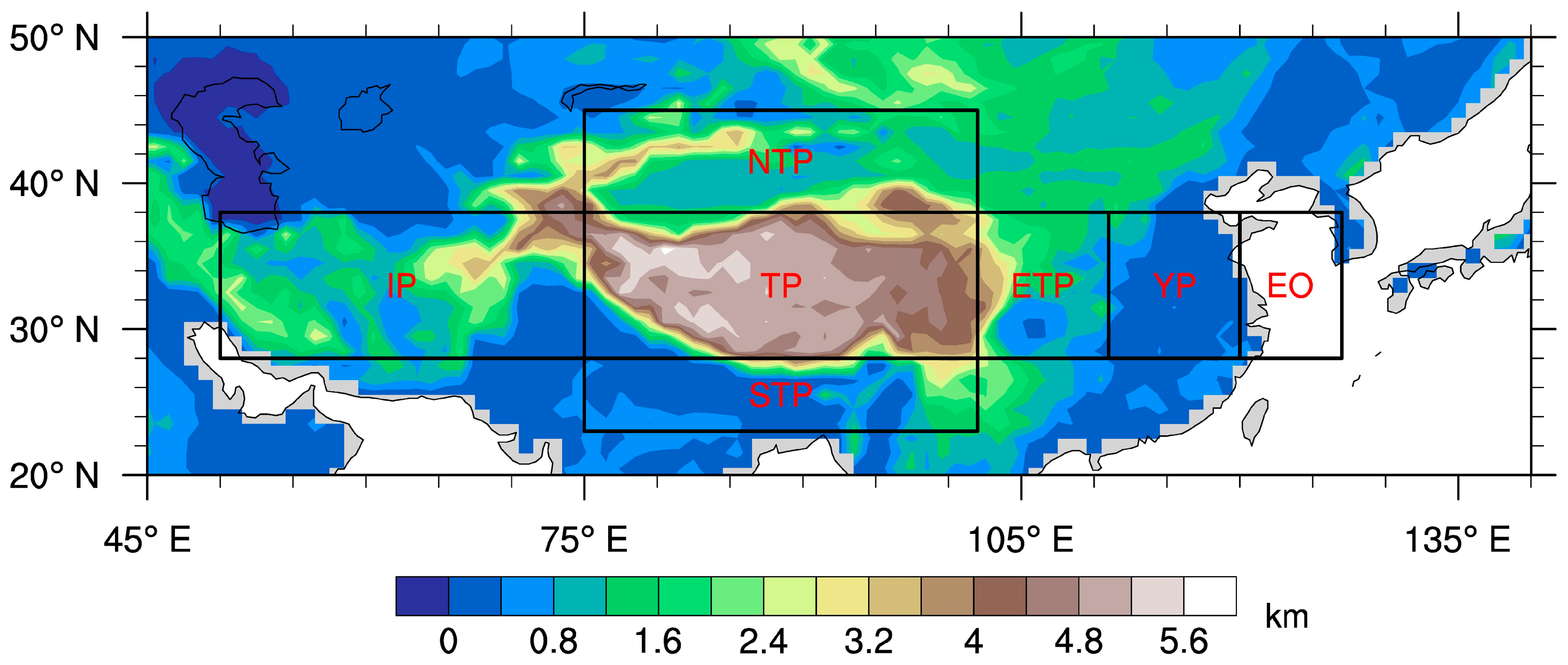
To analyze the regional cloud microphysical characteristics over the Tibetan Plateau and surrounding areas, the domain is partitioned based on elevation distribution, centered on the Tibetan Plateau. Seven subregions are defined (Figure 1): Iranian Plateau (IP; 28° N–38° N, 50° E–75° E), main Tibetan Plateau (TP; 28° N–38° N, 75° E–102° E), complex terrain region east of Tibetan Plateau (ETP; 28° N–38° N, 102° E–111° E), middle-lower Yangtze Plain (YP; 28° N–38° N, 111° E–120° E), eastern oceanic region (EO; 28° N–38° N, 120° E–127° E), southern plain adjacent to Tibetan Plateau (STP; 23° N–28° N, 75° E–102° E), and northern Xinjiang region beside Tibetan Plateau (NTP; 38° N–45° N, 75° E–102° E). Unless otherwise explicitly stated, all analyses are conducted over the entire study region.

3. Results

3.1. Seasonal Characteristics of Ice Clouds

3.1.1. Seasonal Differences in Horizontal Spatial Distribution

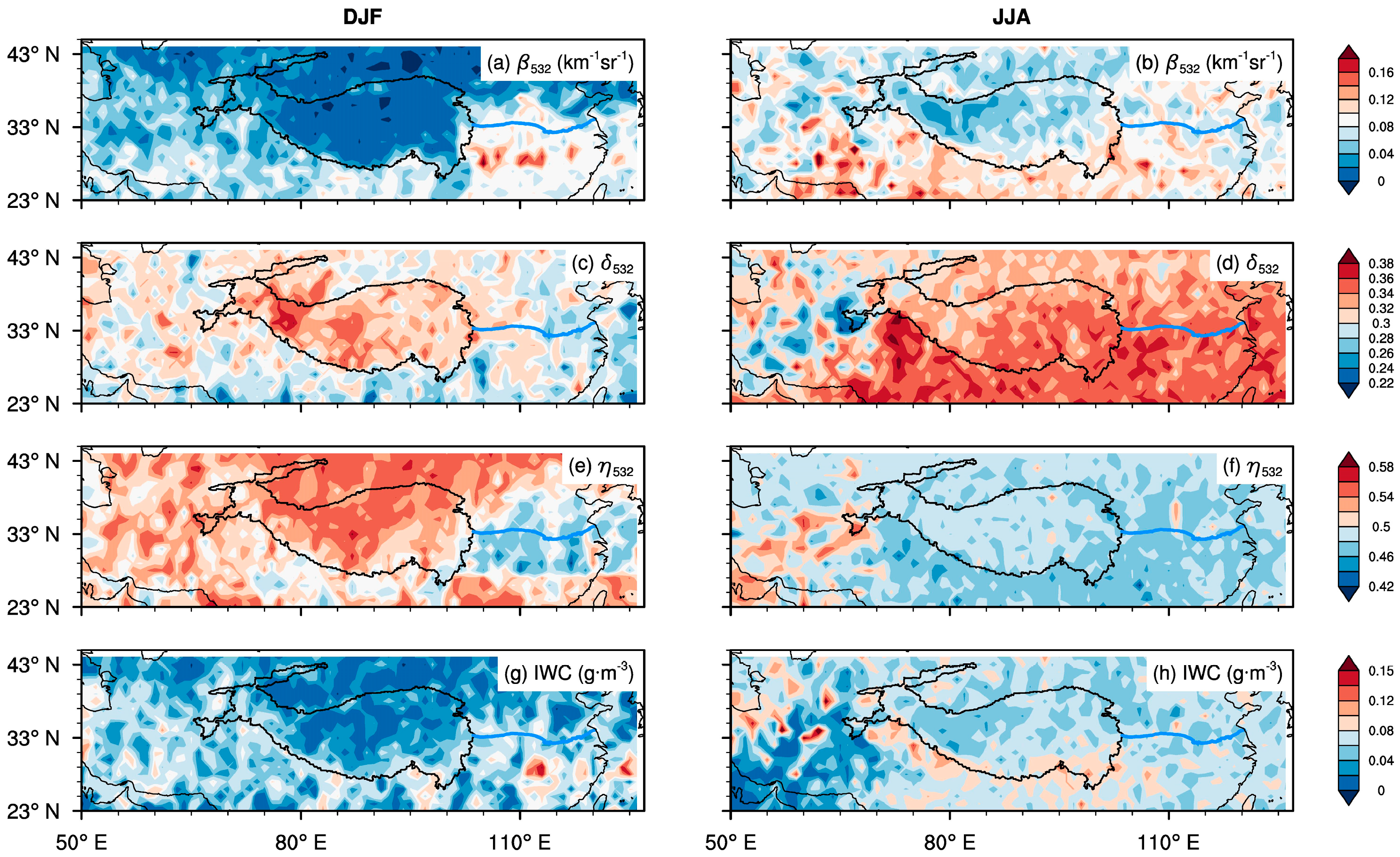
The analysis reveals pronounced seasonal variability in ice cloud microphysical properties across the Tibetan Plateau and neighboring regions (Figure 2). All parameters shown here represent column integrated values within the detected ice cloud column. During winter, the backscatter coefficient at 532 nm ( β 532 ) remains generally low over the plateau and areas north of approximately 30° N, with higher values confined primarily to regions south of the Qinling-Huaihe line (Figure 2a). In summer, these high-value zones markedly shift northward, increasing in both intensity and spatial extent, while areas of low β532 over the plateau notably shrink compared to winter. (Figure 2b). These observations are consistent with the findings of Kukulies [46], who documented the influence of the summer monsoon on cloud parameters.
A contrasting spatial pattern is observed between β 532 and the multiple scattering coefficient ( η 532 ), with regions of higher η 532 generally corresponding to lower β 532 (Figure 2e,f). Since η 532 is also sensitive to in-cloud temperature variations, its spatial and temporal changes serve as indirect indicators of shifts in particle concentration or size in response to thermal conditions [47].
The depolarization ratio at 532 nm ( δ 532 ) likewise exhibits significant seasonal modulation. In the colder months, non-spherical ice particles predominantly reside above the Tibetan Plateau (Figure 2c), whereas in warmer seasons, their presence expands southward with a notable enlargement of regions by relatively higher δ 532 values (Figure 2d). The plateau area is characterized by relatively low β532 paired with elevated δ532 values, indicating weaker scattering efficiency and pronounced non-spherical particle characteristics in the ice clouds.
Regarding ice water content (IWC), its distribution in winter is mostly concentrated to the south of the plateau and beneath the Qinling-Huaihe boundary (Figure 2g). Summer monsoon dynamics facilitate a northward extension of IWC, reaching the southern slopes of the plateau (Figure 2h), underscoring the crucial roles of thermal forcing and moisture transport in shaping ice cloud patterns. These observations are supported by Shang et al. [48], who utilized Himawari-8 satellite observations to demonstrate that seasonal cloud cover variations over the Tibetan Plateau correlate strongly with monsoon intensification, leading to a marked expansion of cloud coverage southward during the summer months.

3.1.2. Vertical Profile Characteristics

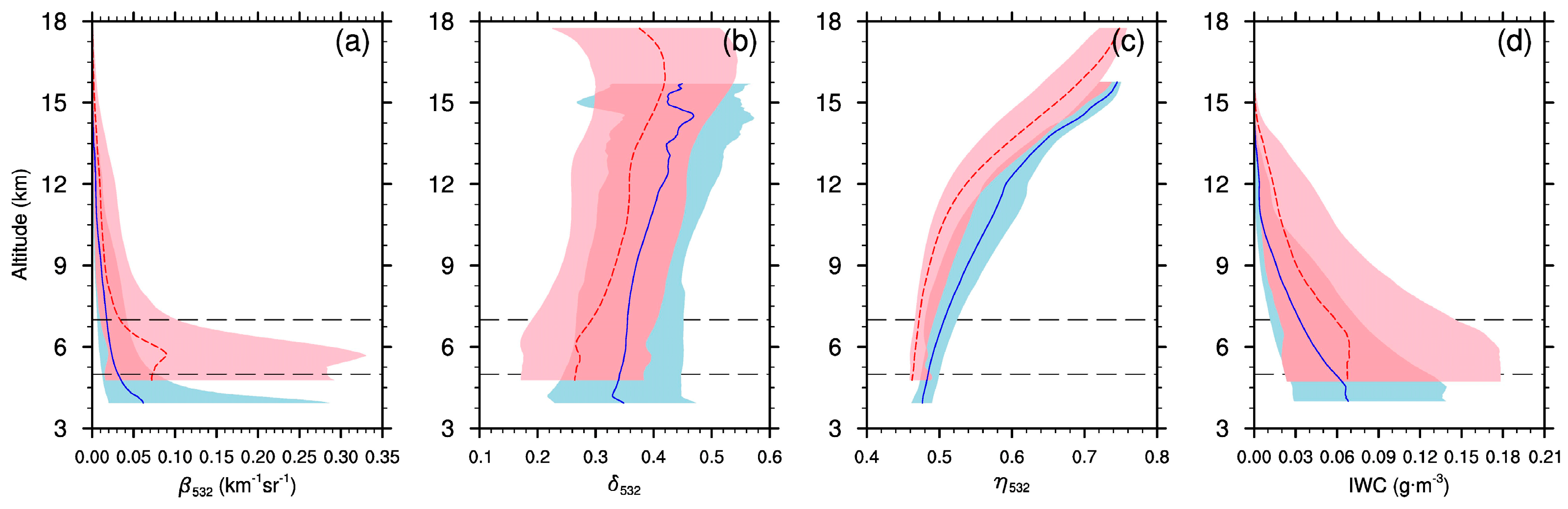
Seasonal variations in the vertical distribution of cloud micro-physical properties are presented in Figure 3. Overall, ice clouds exhibit lower vertical extents in winter than in summer, indicating clear seasonality. The vertical profiles shown in Figure 3 are derived from a total of 20,546 CALIOP profiles.The vertical profile of β 532 (Figure 3a) decreases monotonically with height, except for a notable peak near 6 km during summer, reflecting enhanced backscatter efficiency at this altitude. δ 532 mainly ranges from 0.2 to 0.5 and generally increases with altitude. At the same height, winter values are higher than summer, indicating more pronounced non-spherical particle features (Figure 3b). η 532 , representing the spatial complexity of particle distributions, increases with altitude (Figure 3c), suggesting more structurally complex particle arrangements at higher levels. [49]. Winter values of η 532 are consistently greater than summer at equivalent heights, implying sparser particle structures in winter clouds. IWC shows distinct vertical patterns between seasons (Figure 3d), maintaining relatively high values below ~0.75 km before rapidly declining with height. maintaining relatively high values within the lower ~0.75 km of the ice cloud vertical extent before rapidly declining with increasing cloud-relative height.Winter IWC is generally lower than summer. The 5–7 km layer corresponds to the mixed-phase cloud region. During the active summer monsoon, sufficient moisture and strong updrafts promote Hallett-Mossop ice crystal growth, making this layer a hotspot for intense ice microphysics, with large ice crystals and high concentrations [50].
In summary, the vertical structures of all four parameters display significant seasonal variation, reflecting marked changes in ice cloud macro- and microphysical properties across seasons.

3.1.3. Monthly Variations in the Backscatter Coefficient

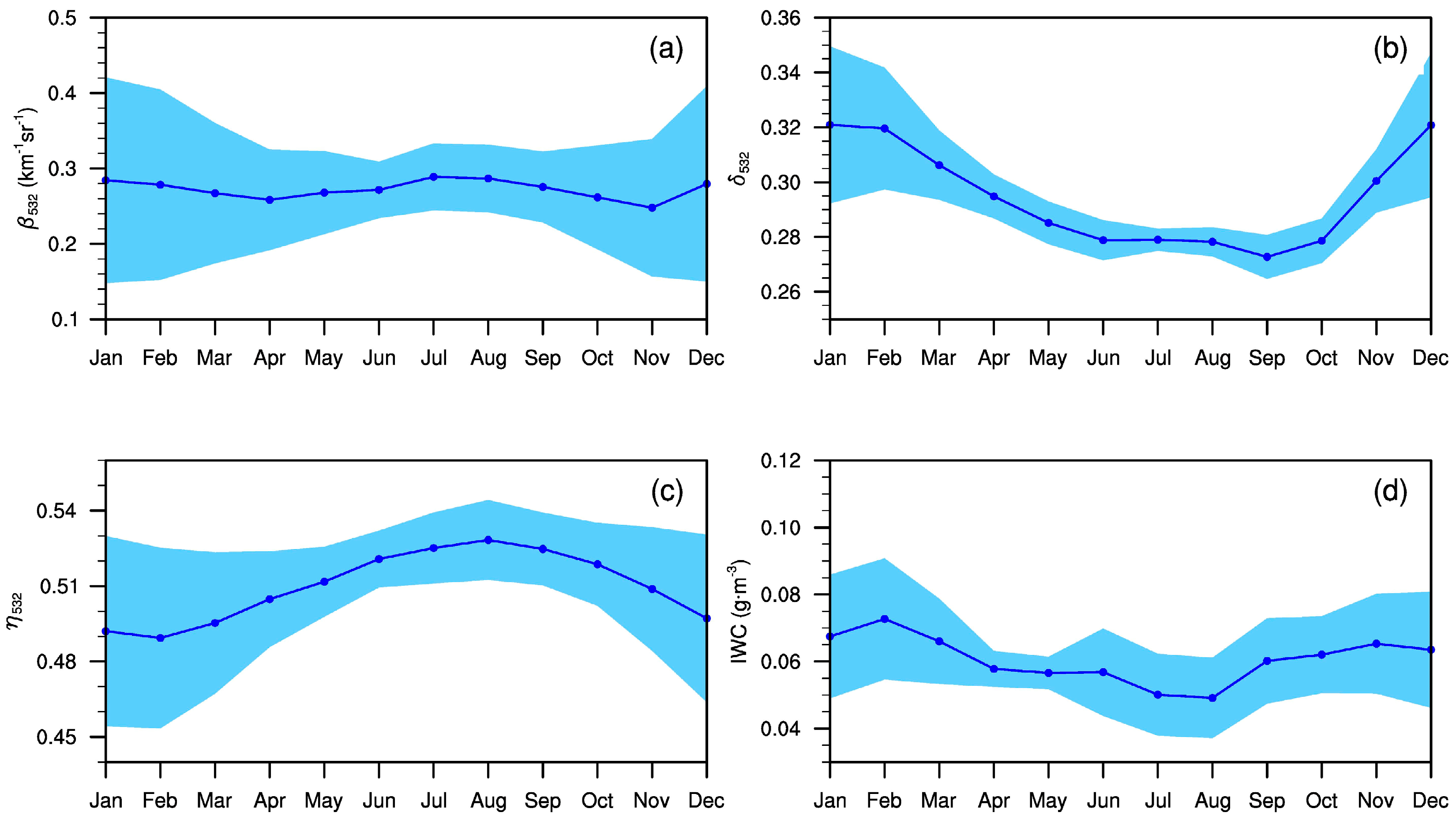
The monthly meantime series of β 532 (Figure 4a) exhibits a relatively stable pattern throughout the year, yet seasonal signals remain discernible. All monthly and annual mean values are calculated by spatially averaging over the entire study region.The number of CALIOP profiles used for each month is summarized in Table 1. Starting from the beginning of the year, β 532 gradually decreases before slowly rising to reach a peak in July, indicating enhanced backscatters in the atmosphere during summer. Subsequently, β 532 declines slightly through autumn and winter. The standard deviation range (shaded in blue) reflects the variability within each month, revealing greater fluctuations of β 532 during winter months and noticeably reduced variability in summer. The monthly mean series of δ 532 (Figure 4b) exhibits seasonal variation, with higher values in winter that gradually decrease toward summer and increase again in autumn, indicating enhanced particle non-sphericity during the cold season. η 532 (Figure 4c) shows an opposite tendency, increasing from winter to summer and peaking in July–August, reflecting enhanced spatial complexity of particle distributions during the warm season. IWC (Figure 4d) displays a relatively moderate seasonal variation, with slightly higher values in winter and early spring, a minimum in summer, and a gradual recovery in autumn. The shaded areas indicate the standard deviation, revealing generally larger variability in winter and more stable microphysical conditions in summer, and highlighting seasonal differences in microphysical properties.
Taken together, the results in Section 3.1 demonstrate that the microphysical properties of ice clouds, including β 532 , η 532 , δ 532 , and IWC, exhibit pronounced seasonal variability in both their horizontal and vertical distributions across the study region.

3.2. Differences in Distribution and Microphysical Properties in Four Ice Cloud Types

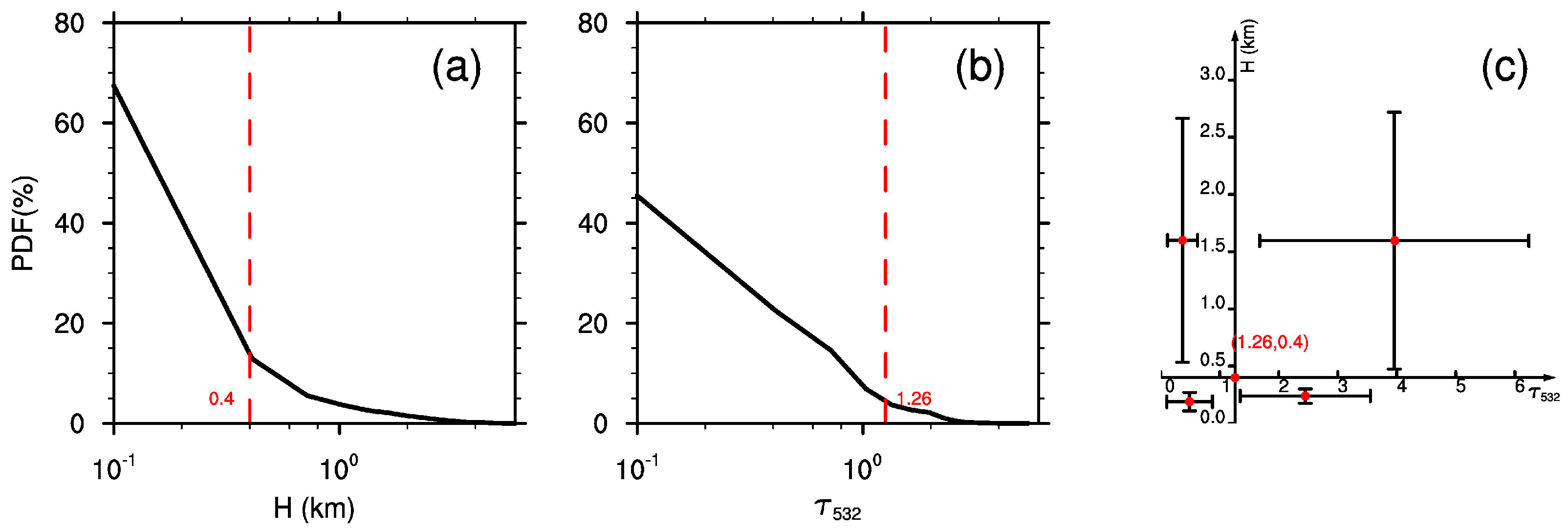
To further investigate the contributions and underlying causes of seasonal variations in cloud microphysics associated with ice clouds of differing optical and geometric thicknesses, this study employs the probability density distribution shown in Figure 5. Based on the cloud optical thickness classification method proposed by Winker et al. [51] and supported by statistical analysis [52], ice clouds are categorized into four types using threshold values of 0.4 km for geometric thickness and 1.26 for optical thickness: thin and dense, thin and sparse, thick and dense, and thick and sparse ice clouds. Figure 3c shows the distribution of the four cloud types in the two-dimensional space of geometric and optical thickness. An optical thickness of 1.26 and a geometric thickness of 0.4 km effectively divide all ice clouds into four categories. The range of each cloud type is defined as the mean plus or minus one standard deviation. The region defined by the mean ± one standard deviation for the thin and dense cloud category covers more than 73.45% of the samples belonging to this cloud type.

3.2.1. Horizontal Distribution Characteristics

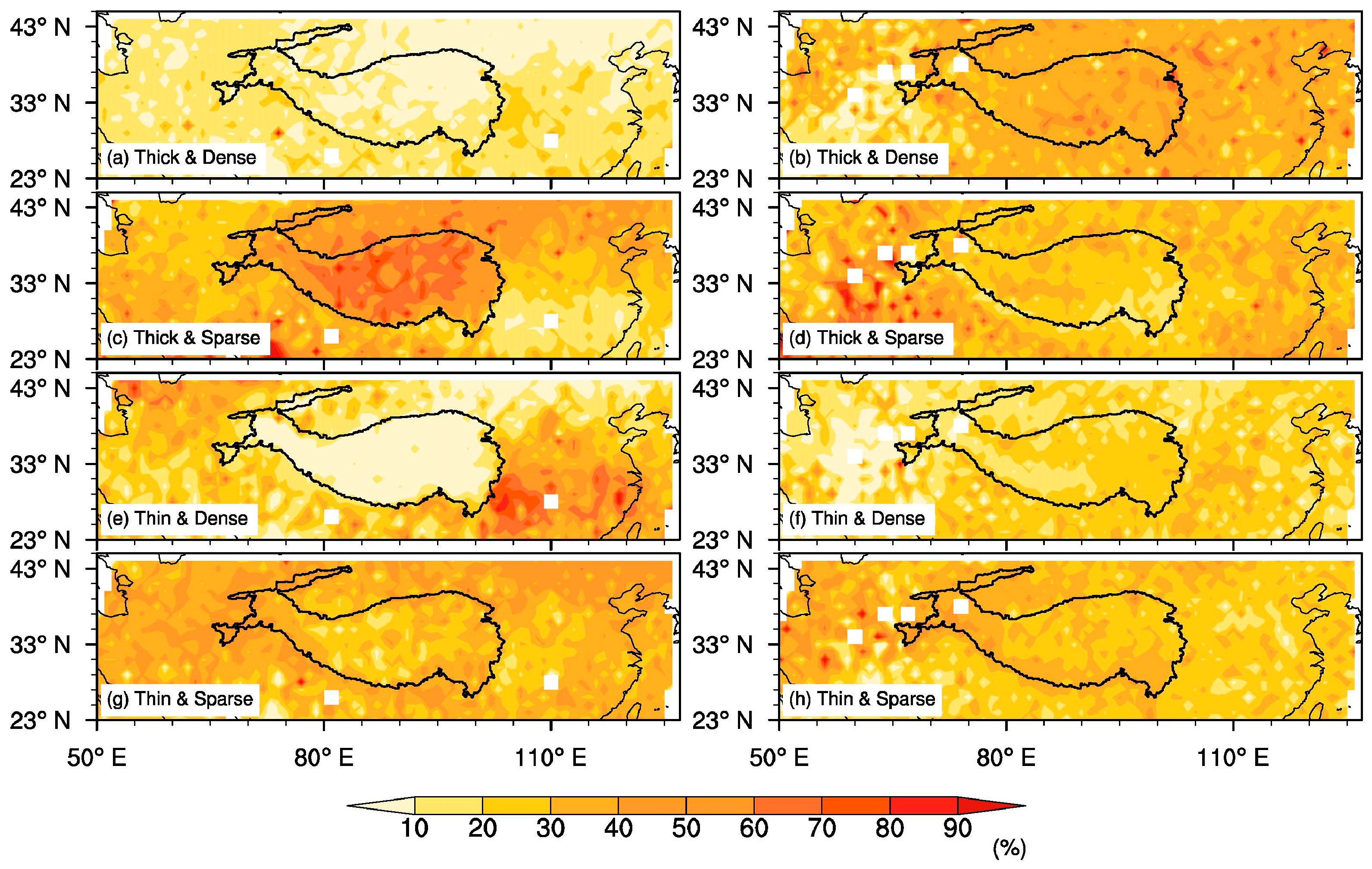
The results reveal significant seasonal differences in the spatial distributions of different ice cloud types (Figure 6). Ice clouds with large geometric thickness and high optical density (thick and dense) occur infrequently. In winter, they are mainly concentrated over the western and southern margins of the Tibetan Plateau, with a slight expansion in spatial extent during summer (Figure 6a,b). Ice clouds with large geometric thickness but low optical density (thick and sparse) exhibit a broader coverage area. They predominantly occupy the main body and northern regions of the plateau in winter, extending southwestward along the plateau margin in summer (Figure 6c,d).
The most pronounced seasonal variation is observed for ice clouds with small geometric thickness but high optical density (thin and dense). During winter, these clouds are nearly absent over the plateau core, instead primarily distributed over low-altitude areas east of the plateau. In summer, however, they are widespread across the plateau core and southern slopes, with local frequencies exceeding 40% (Figure 6e,f).
Ice clouds with both small geometric thickness and low optical density (thin and sparse) are distributed almost throughout the entire study area in both seasons. Winter high-frequency zones are mainly located in the northwest plateau, while summer concentrations shift to the plateau core and northwestern region (Figure 6g,h).
Overall, the spatial distribution of thin and dense ice clouds exhibits the most significant seasonal variability.

3.2.2. Microphysical Variable Comparisons

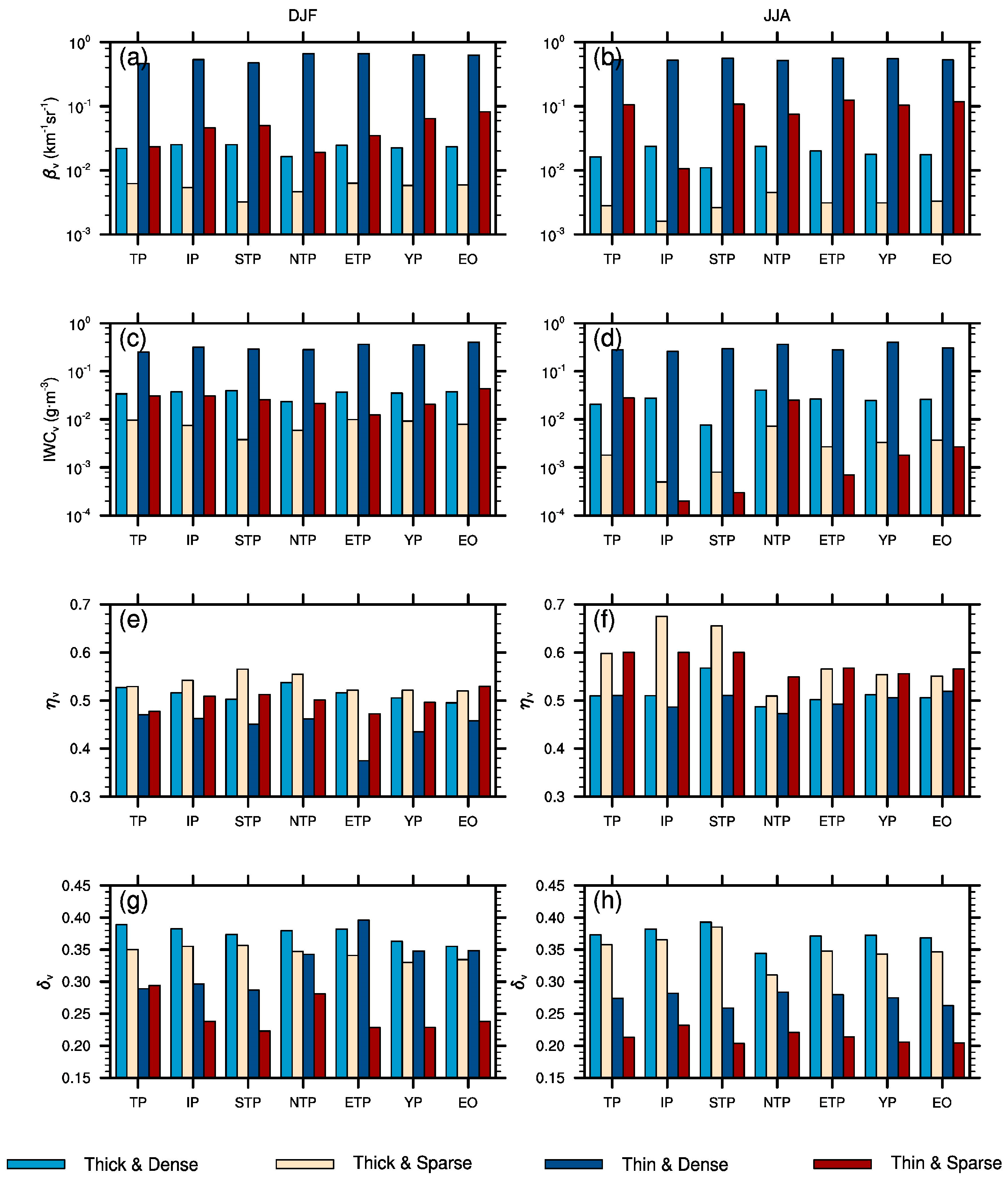
A comparative analysis of major microphysical properties across four ice cloud types during winter (DJF) and summer (JJA) is presented in Figure 7. The analysis focuses primarily on β 532 and IWC for each category. The results demonstrate that thin and dense ice clouds stand out distinctly among all types, exhibiting substantially higher β532 and IWC values across all regions, with differences reaching one to two orders of magnitude (Figure 7a–d). Thin and dense clouds combine relatively high optical thickness and particle concentration, resulting in strong radiative effects and pronounced microphysical features [53]. For thin and dense clouds, η 532 shows relatively weak seasonal and regional variability, with generally higher values in summer than in winter. In winter, slightly lower η 532 values are observed over the middle and lower reaches of the Yangtze River (Figure 7e,f). In contrast, δ 532 for thin and dense clouds exhibits a more pronounced seasonal signal (Figure 7g,h), with significantly higher values in winter, particularly over the middle and lower Yangtze River region, indicating enhanced particle non-sphericity during the cold season.
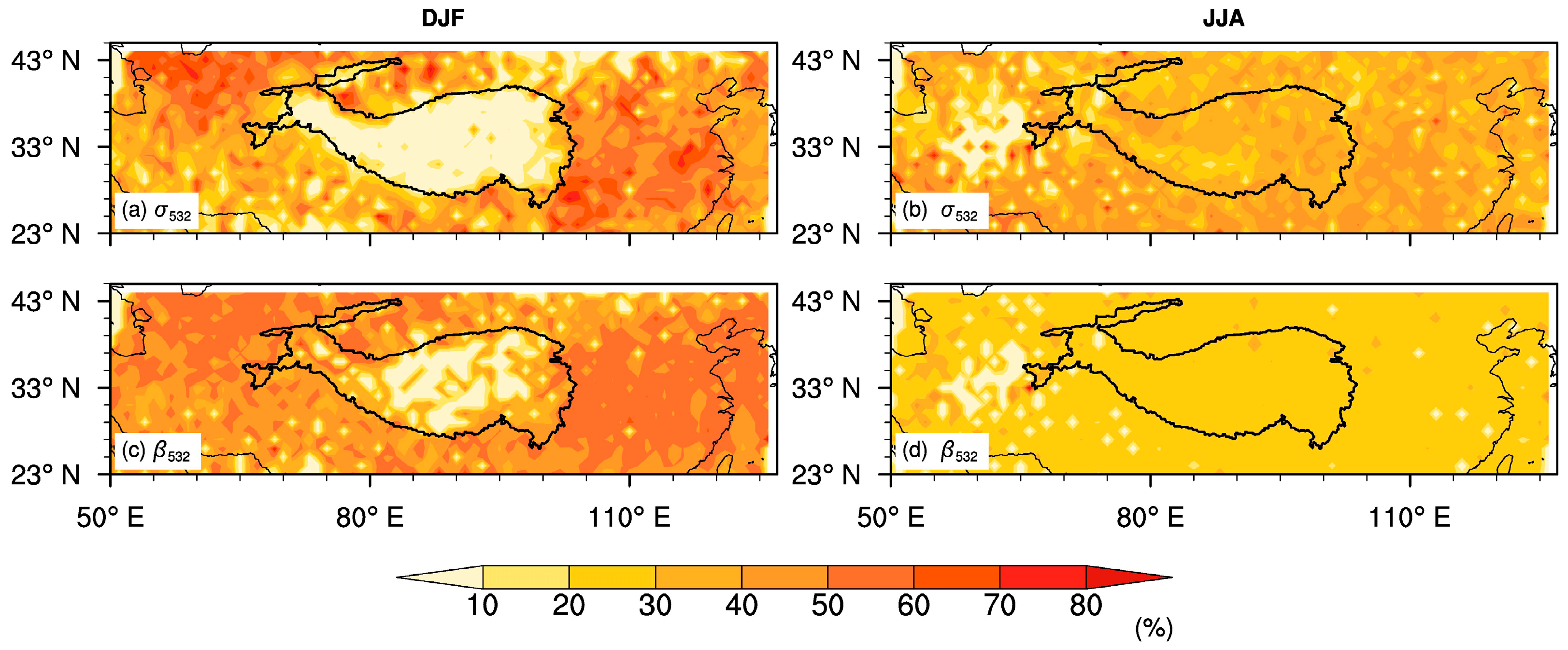
Shown in Figure 8 are distinct seasonal variations in the fractional roles played by thin and dense clouds regarding extinction and backscatter coefficients. In winter, the contributions of thin and dense clouds to both extinction and backscatter coefficients (Figure 8a,c) exceed 50% in the northwest and eastern regions of the Tibetan Plateau, while the central plateau exhibits lower fractions, yet still higher than the occurrence frequency of this cloud type. During summer, the contributions are more evenly distributed, generally ranging between 20% and 30% (Figure 8b,d), noticeably exceeding the summer occurrence frequency of Thin and Dense clouds, which lie between 10% and 20%. These results underscore the significant role of thin and dense clouds in the microphysical processes of ice clouds.
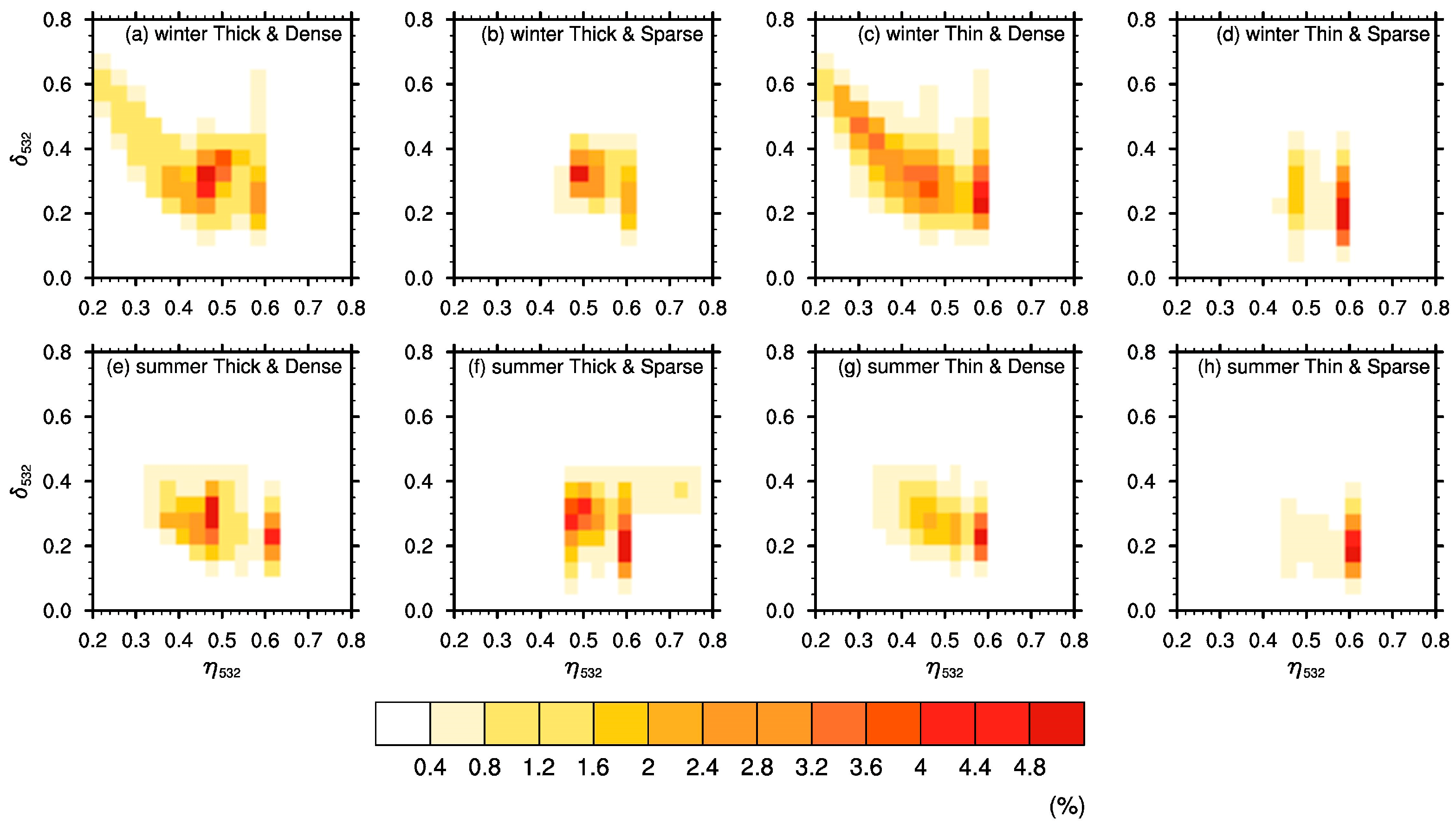
Figure 9 presents the probability density distributions of the multiple scattering coefficient ( η 532 ) and depolarization ratio ( δ 532 ) for the four ice cloud types during winter and summer, with 20 × 20 bins. Overall, the spatial distributions in the η 532 δ 532 parameter space differ significantly among cloud types, reflecting variations in particle density, degree of non-sphericity, and internal structure.
In winter, thick and dense clouds (Figure 9a) are mainly distributed in regions characterized by relatively lower η 532 and higher δ 532 , indicating dense particle concentrations, pronounced non-spherical shapes, and complex internal structures. Thick and sparse clouds (Figure 9b) are concentrated at relatively higher η 532 values with δ 532 ranging between 0.2 and 0.4, suggesting sparse particle distributions and loosely organized structures. Thin and dense clouds (Figure 9c) exhibit a distribution pattern similar to thick and dense, characterized by relatively lower η and relatively higher δ values; however, a larger proportion lies within the relatively lower η range, implying that despite their thinner layers, these clouds maintain concentrated particles and complex optical structures. Thin and sparse clouds (Figure 9d) display a narrower distribution primarily at moderate to relatively higher η 532 and relatively low δ 532 , indicating sparse particles with more regular shapes.
During summer, the overall distributions shift rightward with increased η 532 values, reflecting a trend toward sparser particle structures within the clouds. Compared to winter, δ 532 values generally remain lower, indicating a greater predominance of spherical particles.
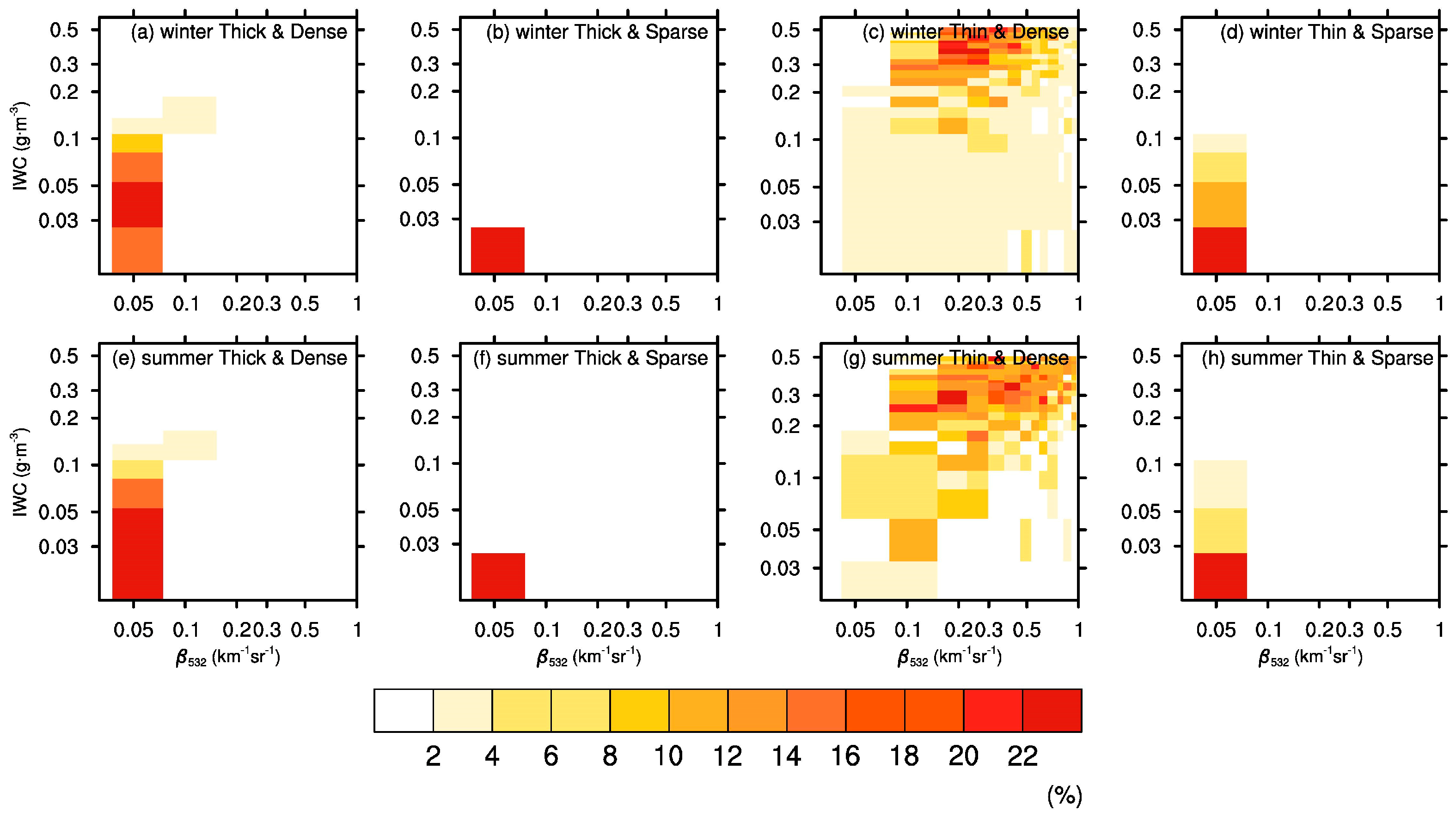
Further analysis in Figure 10 reveals the two-dimensional joint distributions of the backscatter coefficient (β532) and ice water content (IWC) for the four ice cloud types across winter and summer, with 20 × 20 bins. Differences among cloud types are more pronounced than seasonal variations.
The thin and dense cloud type (Figure 10c,g) exhibits a broader distribution in both seasons, with β532 reaching up to 0.2 k m 1 · s r 1 and IWC exceeding 0.3 g · m 3 , substantially higher than the other cloud types. This highlights its strong scattering capability and high ice water content. In contrast, the remaining three cloud types (Figure 10a,b,d–f,h) are concentrated predominantly in the lower value ranges of β 532 and IWC, further emphasizing the significance of thin and dense clouds as a key cloud category for focused research.
Based on the results of Section 3.2, thin and dense ice clouds stand out among the four cloud categories defined by combined optical and geometric thickness, exhibiting more pronounced microphysical properties and stronger backscattering signatures. These features suggest that thin and dense clouds may play a more important role in modulating radiative processes compared to other ice cloud types. Accordingly, subsequent analyses focus on this cloud category.

3.3. Microphysical Characteristics and Meteorological Environments of the Thin and Dense Clouds

Comparative analysis of the microphysical properties among the four ice cloud types reveals that thin and dense clouds exhibit more active microphysical characteristics. Despite their limited vertical extent, these clouds possess relatively high ice water content and strong radiative responses, playing a non-negligible role in the overall radiation budget. However, due to their small geometric thickness, thin and dense clouds are often misclassified as transmissive or ineffective clouds by traditional radiation parameterization schemes, leading to an underestimation of their radiative impact and seasonal sensitivity [54].

3.3.1. Microphysical Characteristics of the Thin and Dense Clouds

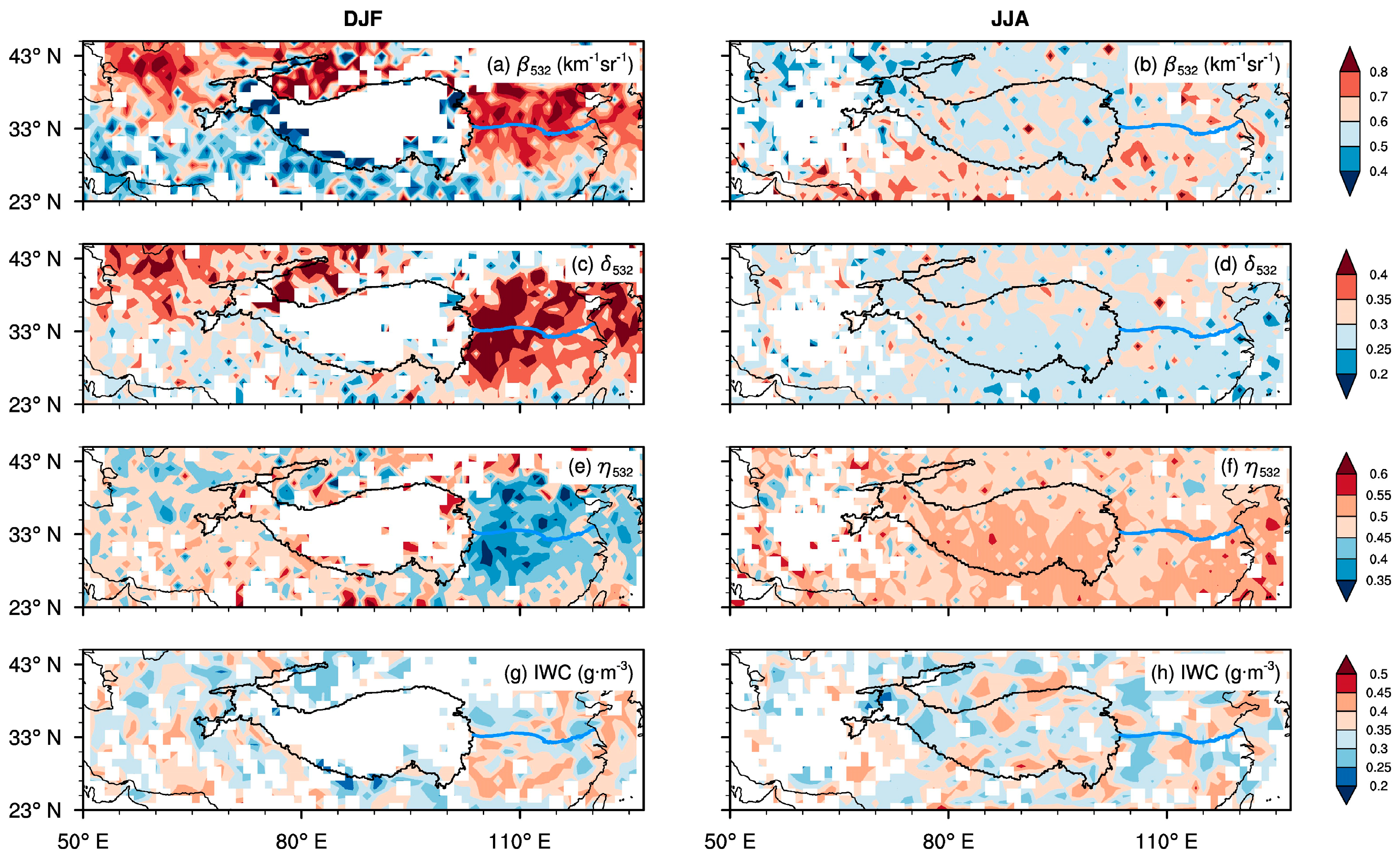
Presented in Figure 11 are clear seasonal contrasts in the horizontal features of microphysical parameters associated with thin and dense clouds. During winter, these clouds are predominantly concentrated east of the Tibetan Plateau, characterized by relatively high β 532 (Figure 11a), elevated δ 532 (Figure 11c), and low η 532 (Figure 11e). This combination indicates a high density of ice crystals, pronounced non-sphericity, and strong optical activity, consistent with the typical microphysical properties of thin and d-ense clouds. The distribution of ice water content (IWC) exhibits a limited correspondence with the occurrence frequency of this cloud type, suggesting that IWC act as one of several contributing factors (Figure 11g).
In summer, the high-frequency occurrence region of thin and dense clouds shifts noticeably southward and expands significantly, covering the main Tibetan Plateau, southern slopes, and central-eastern areas (Figure 2b,d,f,h). These regions exhibit marked increases in β 532 and IWC, alongside an expanded δ 532 range, suggesting that under the intensified summer monsoon, enhanced moisture transport promotes simultaneous increases in particle concentration and non-spherical particles. This further strengthens the radiative influence of thin and dense clouds over the plateau core. Overall, thin and dense clouds not only exhibit a broader distribution in summer but also demonstrate more pronounced optical characteristics [55].
Such seasonal variations are closely linked to large-scale climate system dynamics. During the warm season (May to October), the South Asian High and monsoon intensify and shift northward, leading to uneven precipitation distribution and promoting low cloud formation. In the cold season (November to April), the southward expansion of the Hadley circulation suppresses the generation of high and mid-level clouds, thereby affecting climatic radiation [56]. Meanwhile, aerosol variations modulate cloud microphysics and radiative processes, collectively driving the seasonal changes in ice cloud microphysical properties [57].
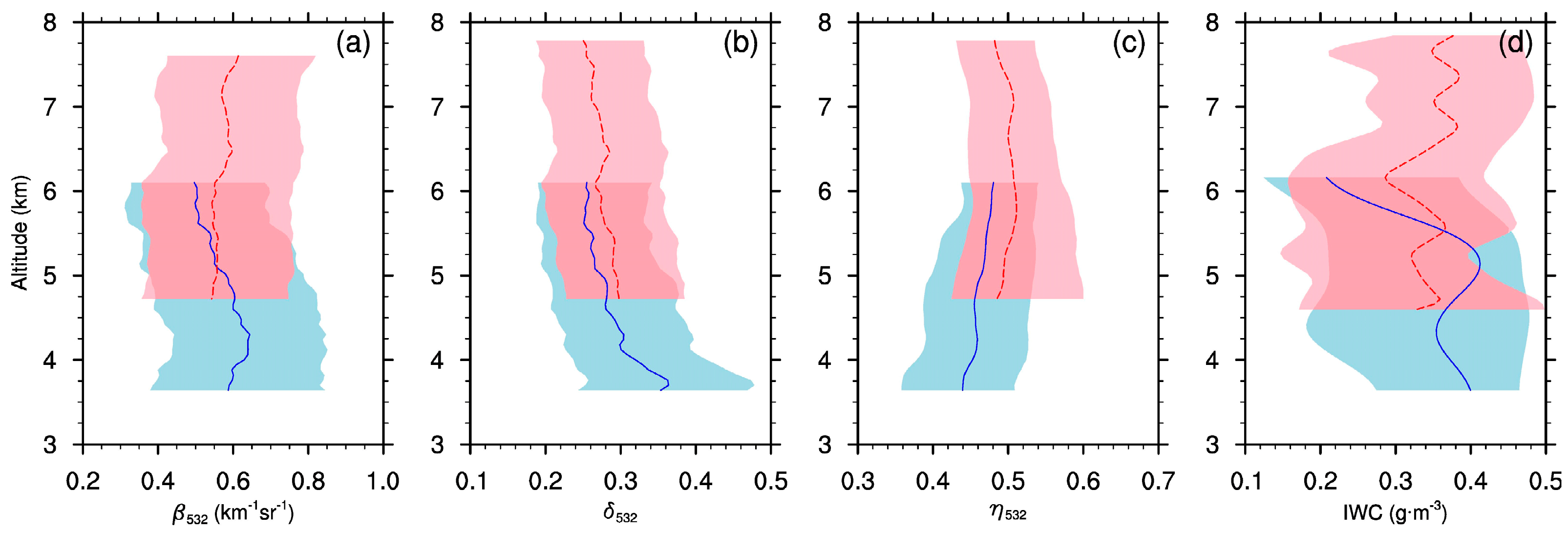
Figure 12 presents the vertical profiles of key microphysical parameters for thin and dense clouds during winter and summer. In general, these clouds exhibit strong optical activity, pronounced non-sphericity, compact structure, and abundant ice water content throughout the vertical column.
The backscatter coefficient β 532 (Figure 12a) shows a significant enhancement within the 5–7 km layer in summer, with median values exceeding 0.6 k m 1 · s r 1 , indicating a high concentration of ice crystals and strong scattering capability in the mid-level cloud region. In winter, the peak occurs near 4 km, consistent with the overall scattering enhancement of ice clouds in the corresponding altitude range shown in Figure 3. δ532 (Figure 12b) decreases with height in both seasons, with slightly higher values in summer, suggesting an increased contribution from near-spherical scatterers at higher altitudes. η532 (Figure 12c) exhibits a slight increase with height, with lower overall values in winter, implying a more compact cloud structure and smaller particle spacing during the colder season. IWC (Figure 12d) remains relatively high in thin and dense clouds throughout both seasons, primarily ranging from 0.2 to 0.5 g · m 3 , which is markedly above the average for all ice clouds.
In summary, despite their limited geometric thickness, thin and dense clouds display typical microphysical characteristics of high particle concentration, strong non-sphericity, and substantial water content in the mid-level layers, adequately explaining the observed microphysical vertical profile of overall ice clouds where thin and dense clouds predominate.

3.3.2. Contrasts in Meteorological Element Distributions of the Thin and Dense Clouds

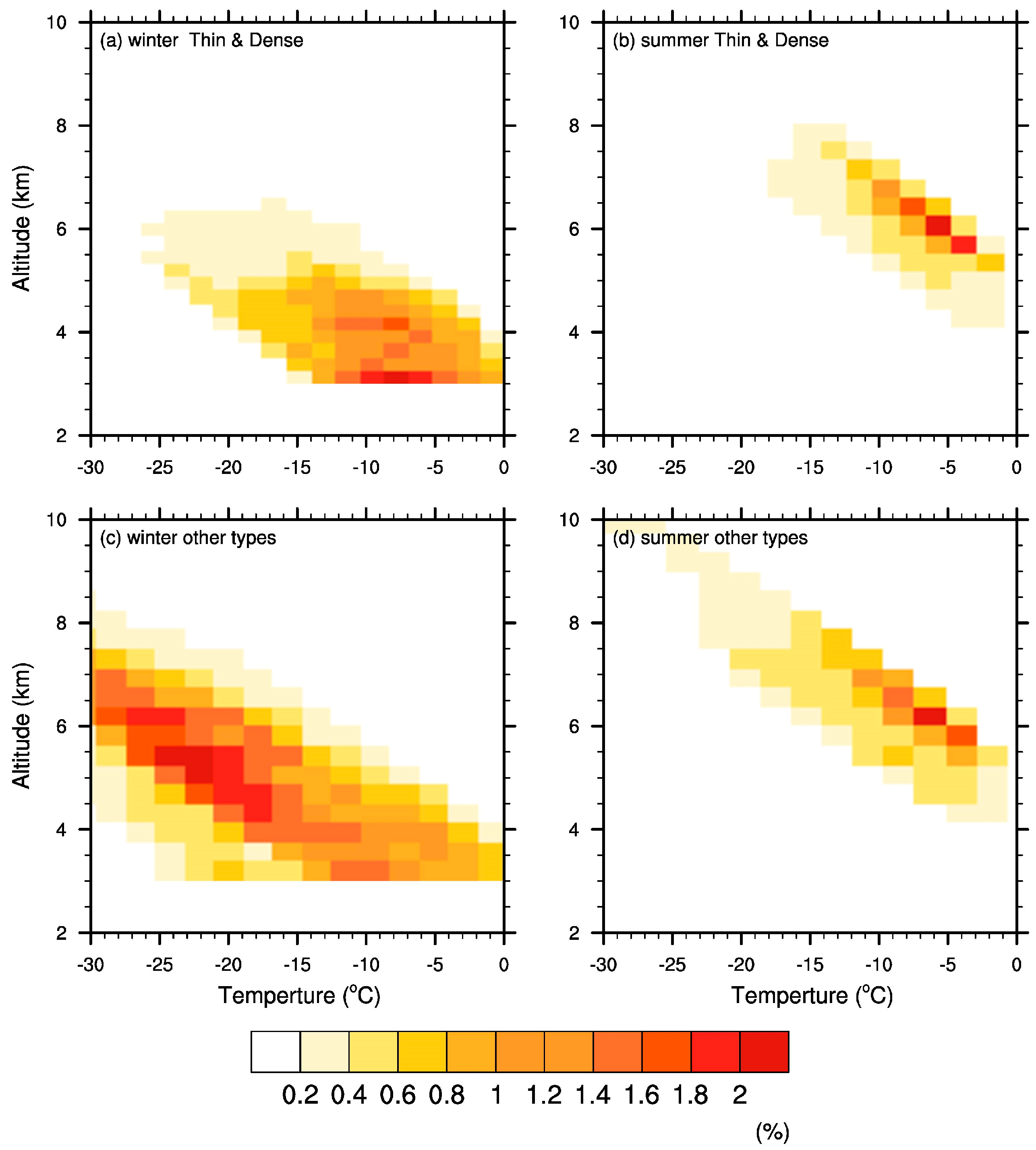
As presented in Figure 13, distinct seasonal differences are observed in the joint temperature–height distributions of thin and dense clouds relative to other ice cloud categories. The differences between thin and dense clouds and other types are more pronounced in winter (Figure 13a,c) than in summer (Figure 13b,d).
In winter, thin and dense clouds are mainly concentrated at altitudes of 3–4 km, corresponding to temperatures between −15 °C and −5 °C (Figure 13a), indicating a preference for relatively lower and warmer background environments. In summer, their distribution shifts upward to approximately 6–8 km, with temperatures ranging mainly from −10 °C to −5 °C (Figure 13b). This suggests that during summer, thin and dense clouds are more actively formed in higher yet relatively warm atmospheric layers. These findings align with the overall ice cloud observations reported by Huo et al. [58] and corroborate research showing cirrus clouds exhibit maximum optical depth under warmer temperature conditions [59]. It should be noted that low air temperature alone does not necessarily imply a purely ice-phase cloud, as supercooled liquid water droplets may persist under cold conditions. Therefore, some cloud layers discussed here may include mixed-phase or supercooled liquid components, rather than being composed exclusively of ice particles.
In contrast, other ice cloud types display a broader vertical range in winter (Figure 13c), spanning from 3 km up to above 8 km, with temperatures extending below −30 °C, reflecting their adaptability to a wider range of stratifications and thermal conditions. Their summer distributions are relatively concentrated around 6–8 km but exhibit more dispersed temperature profiles overall (Figure 13d).
In summary, thin and dense clouds tend to form at moderate altitudes within warmer stratifications, particularly exhibiting a significant elevation in distribution height during summer, highlighting their high sensitivity to temperature conditions.
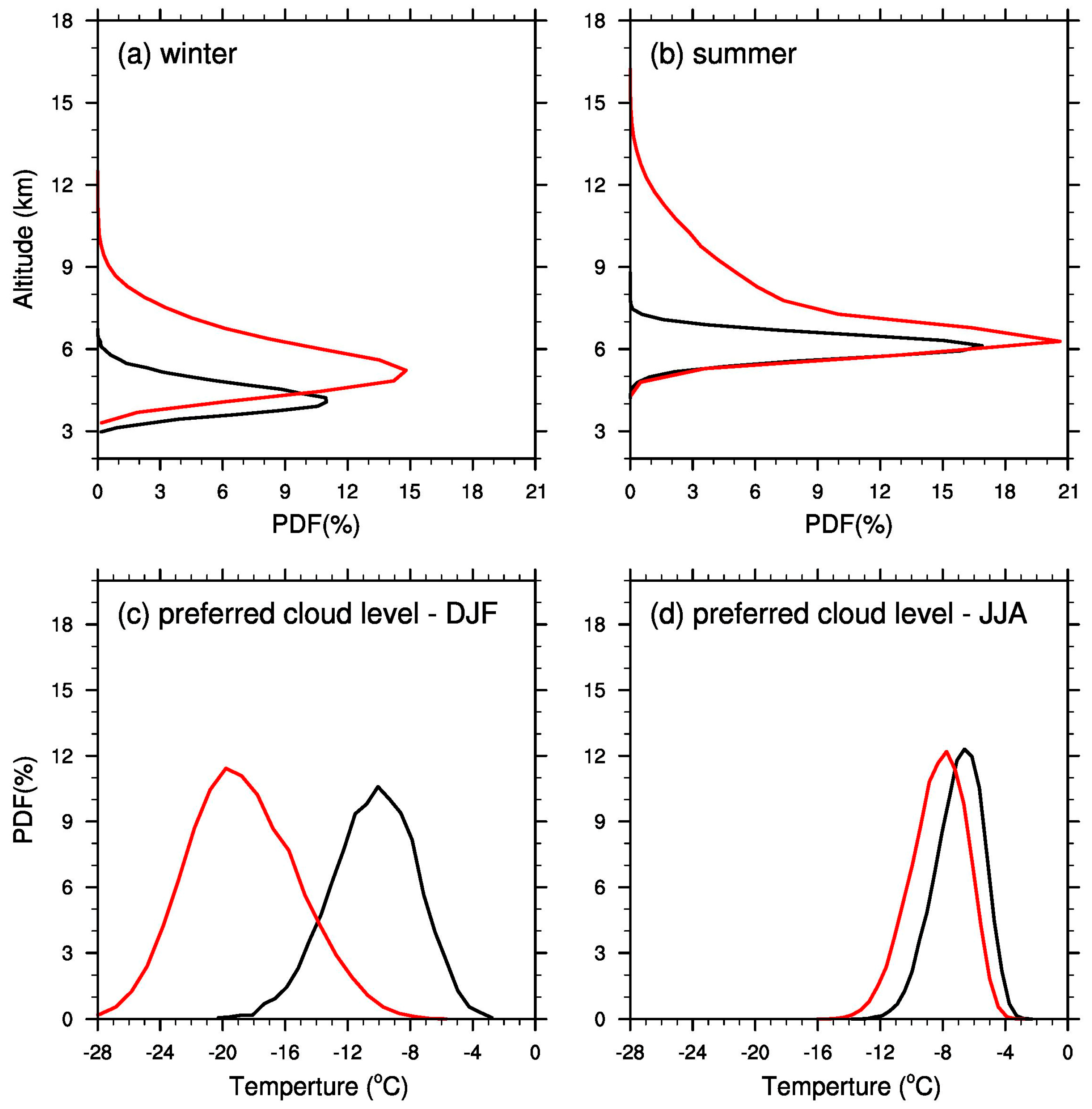
Figure 14 depicts the height probability distributions of thin and dense clouds and other ice cloud types during winter (DJF) and summer (JJA) (Figure 14a,b), as well as the temperature probability distributions corresponding to the cloud layers with the highest occurrence probabilities (Figure 14c,d).
Vertically, thin and dense clouds in winter are predominantly concentrated between 3 and 6 km, significantly lower than the distribution centers of other ice cloud types (Figure 14a). In summer, other ice clouds display a broader vertical extent, reaching up to 15 km, whereas thin and dense clouds remain confined to mid-level altitudes, exhibiting a narrower and more stable vertical structure. However, the altitude differences in the peak occurrence probabilities between these groups are relatively small.
Regarding temperature distributions, thin and dense clouds form within warmer ice-phase temperature ranges, primarily between −10 °C and −6 °C in summer (Figure 14d), and between −12 °C and −8 °C in winter (Figure 14c), notably warmer than the peak temperature ranges of other cloud types, which lie between −22 °C and −16 °C. This discrepancy indicates that thin and dense clouds preferentially develop in relatively warmer mid-tropospheric layers, consistent with Aswini’s [60] findings that thicker clouds are more likely to occur under colder temperature conditions. Furthermore, Gierens et al. [61] pointed out that thin cirrus clouds typically form in ice supersaturated regions (ISSRs), where vertical temperature lapse rates are lower, indicating thermodynamically stable formation environments. These findings further support the conclusion from the perspective of atmospheric thermodynamic structure that thin and dense clouds are more likely to form and persist in stable thermal stratifications.
In summary, compared to other ice cloud types, thin and dense clouds exhibit lower formation heights and higher temperature preferences, revealing a strong dependence of their formation processes on thermal stratification, and a propensity to develop dense, radiatively active cloud structures in the mid-troposphere.

4. Conclusions

This work utilized CALIPSO satellite observations and ERA5 reanalysis to classify ice clouds over the Tibetan Plateau into four types based on optical and geometric thickness. Seasonal differences in spatial distribution, vertical structure, and microphysics of the Thin and Dense clouds were thoroughly quantified. The main findings are as follows:
  • Ice clouds over the Tibetan Plateau and surrounding regions show marked seasonal variation. In winter, the highest backscatter ( β 532 ) and ice-water content (IWC) occurred in the south of the Qinling-Huaihe Line, the Sichuan Basin and the Yangtze Plain. In summer, these maximum move onto the Plateau, and the cloud height rises by about 1 km. Vertically, the maximum value of β 532 is near 6 km in summer but only around 4 km in winter, highlighting the pronounced seasonal contrast in the microphysical properties of Plateau ice clouds.
  • The thin and dense clouds, defined by a geometric thickness of less than 0.4 km and an optical thickness exceeding 1.26, are extremely rare over the Tibetan Plateau in winter, yet they account for more than 30 percent of local ice cloud cases in summer. Their preferred height rises from 3–4 km (approximately −15 °C to −5 °C) in winter to 6–8 km (approximately −10 °C to −5 °C) in summer. Optically, these geometrically thin clouds exhibit the highest β 532 and IWC with the lowest multiple scattering coefficient ( η 532 ) and the highest depolarization ratio ( δ 532 ). They mainly occur in the mid-troposphere under relatively warm atmospheric temperatures.
  • The thin and dense clouds display outstanding optical and microphysical properties. Their backscatter coefficient ( β 532 ) and ice water content (IWC) are one to two orders of magnitude higher than those of any other ice clouds type. Although these clouds represent only 10–20 percent of ice cloud occurrences over the Tibetan Plateau, they contribute approximately 30 percent of the total extinction and backscatter. As a result, they play a significant role in the regional radiation budget.
Within the current observational framework, further progress could be achieved by incorporating complementary observations from additional satellite sensors or available field measurements, which would help refine cloud parameterizations and better constrain model uncertainties.
Future studies should build upon CALIPSO-retrieved ice cloud microphysical parameters to quantify the radiative forcing associated with thin and dense ice clouds, thereby improving the representation of their optical properties and vertical structure in regional and global climate models. Given that thin and dense clouds exhibit distinct microphysical characteristics and seasonal variability, a more accurate parameterization of these cloud types may help reduce uncertainties in simulated cloud–radiation interactions and climate sensitivity, particularly over regions with complex terrain such as the Tibetan Plateau and its surrounding areas.

Author Contributions

Conceptualization, H.C. and Q.C.; Methodology, H.C.; Validation, H.C., Q.C., F.L. and Y.M.; Formal analysis, H.C. and F.L.; Investigation, H.C. and F.L.; Data curation, F.L.; Writing—original draft preparation, F.L.; Writing—review and editing, H.C., C.S. and F.L.; Visualization, F.L.; Supervision, Q.C. All authors have read and agreed to the published version of the manuscript.

Funding

This study was supported by the National Natural Science Foundation of China (Grant Nos. U2442210, 42075087, U20A2097), the Natural Science Foundation of Sichuan Province (Grant No. 2024NSFTD0017) and the Open Fund of State Key Laboratory of Remote Sensing Science (Grant No. OFSLRSS202404).

Institutional Review Board Statement

Not applicable.

Informed Consent Statement

Not applicable.

Data Availability Statement

The original contributions presented in this study are included in the article. Further inquiries can be directed to the corresponding author.

Conflicts of Interest

The authors declare that the research was conducted in the absence of any commercial or financial relationships that could be construed as a potential conflict of interest.

References

  1. Dong, X.Q. Preface to the special issue: Aerosols, clouds, radiation, precipitation, and their interactions. Adv. Atmos. Sci. 2018, 35, 133–134. [Google Scholar] [CrossRef]
  2. Bony, S.; Stevens, B.; Frierson, D.M.W.; Jakob, C.; Kageyama, M.; Pincus, R.; Shepherd, T.G.; Sherwood, S.C.; Siebesma, A.P.; Sobel, A.H.; et al. Clouds, circulation and climate sensitivity. Nat. Geosci. 2015, 8, 261–268. [Google Scholar] [CrossRef]
  3. Fermepin, S.; Bony, S. Influence of low-cloud radiative effects on tropical circulation and precipitation. J. Adv. Model. Earth Syst. 2014, 6, 513–526. [Google Scholar] [CrossRef]
  4. Li, X.Y.; Guo, X.L.; Zhu, J. Climatic features of cloud water distribution and cycle over China. Adv. Atmos. Sci. 2008, 25, 437–446. [Google Scholar] [CrossRef]
  5. Stephens, G.L. Cloud feedbacks in the climate system: A critical review. J. Clim. 2005, 18, 237–273. [Google Scholar] [CrossRef]
  6. Stubenrauch, C.J.; Rossow, W.B.; Kinne, S.; Ackerman, S.; Cesana, G.; Chepfer, H.; Di Girolamo, L.; Getzewich, B.; Guignard, A.; Heidinger, A.; et al. Assessment of Global Cloud Datasets from Satellites: Project and Database Initiated by the GEWEX Radiation Panel. Bull. Am. Meteorol. Soc. 2013, 94, 1031–1049. [Google Scholar] [CrossRef]
  7. Chi, Y.L.; Zhao, C.F.; Yang, Y.K.; Zhao, X.; Yang, J. Global characteristics of cloud macro-physical properties from active satellite remote sensing. Atmos. Res. 2024, 302, 107316. [Google Scholar] [CrossRef]
  8. Eliasson, S.; Buehler, S.A.; Milz, M.; Eriksson, P.; John, V.O. Assessing observed and modelled spatial distributions of ice water path using satellite data. Atmos. Chem. Phys. 2011, 11, 375–391. [Google Scholar] [CrossRef]
  9. Dion, I.A.; Ricaud, P.; Haynes, P.; Carminati, F.; Dauhut, T. Ice injected into the tropopause by deep convection—Part 1: In the austral convective tropics. Atmos. Chem. Phys. 2019, 19, 6459–6479. [Google Scholar] [CrossRef]
  10. Lee, S.S.; Li, Z.Q.; Mok, J.; Ahn, M.H.; Kim, B.G.; Choi, Y.S.; Jung, C.H.; Yoo, H.L. Interactions between aerosol absorption, thermodynamics, dynamics, and microphysics and their impacts on a multiple-cloud system. Clim. Dyn. 2017, 49, 3905–3921. [Google Scholar] [CrossRef]
  11. Cai, H.K.; Yang, Y.; Chen, Q.L. Distribution Characteristics of Cloud Types and Cloud Phases over China and Their Relationship with Cloud Temperature. Remote Sens. 2022, 14, 5601. [Google Scholar] [CrossRef]
  12. Bühl, J.; Seifert, P.; Engelmann, R.; Ansmann, A. Impact of vertical air motions on ice formation rate in mixed-phase cloud layers. NPJ Clim. Atmos. Sci. 2019, 2, 36. [Google Scholar] [CrossRef]
  13. Wang, Z.Z.; Chi, R.L.; Bo, L.; Jun, Z. Depolarization properties of cirrus clouds from polarization lidar measurements over Hefei in spring. Chin. Opt. Lett. 2008, 6, 235–237. [Google Scholar] [CrossRef]
  14. Sunilkumar, S.V.; Parameswaran, K. Temperature dependence of tropical cirrus properties and radiative effects. J. Geophys. Res.-Atmos. 2005, 110, D13205. [Google Scholar] [CrossRef]
  15. Duan, A.M.; Wu, G.X. Role of the Tibetan Plateau thermal forcing in the summer climate patterns over subtropical Asia. Clim. Dyn. 2005, 24, 793–807. [Google Scholar] [CrossRef]
  16. Chen, W.; Zhang, R.H.; Wu, R.G.; Wen, Z.P.; Zhou, L.T.; Wang, L.; Hu, P.; Ma, T.J.; Piao, J.L.; Song, L.; et al. Recent Advances in Understanding Multi-scale Climate Variability of the Asian Monsoon. Adv. Atmos. Sci. 2023, 40, 1429–1456. [Google Scholar] [CrossRef]
  17. Wu, G.; Zhuo, H.; Wang, Z.; Liu, Y. Two types of summertime heating over the Asian large-scale orography and excitation of potential-vorticity forcing I. Over Tibetan Plateau. Sci. China-Earth Sci. 2016, 59, 1996–2008. [Google Scholar] [CrossRef]
  18. Wu, G.; Duan, A.; Liu, Y.; Mao, J.; Ren, R.; Bao, Q.; He, B.; Liu, B.; Hu, W. Tibetan Plateau climate dynamics: Recent research progress and outlook. Natl. Sci. Rev. 2015, 2, 100–116. [Google Scholar] [CrossRef]
  19. Yan, Y.F.; Liu, Y.M.; Lu, J.H. Cloud vertical structure, precipitation, and cloud radiative effects over Tibetan Plateau and its neighboring regions. J. Geophys. Res.-Atmos. 2016, 121, 5864–5877. [Google Scholar] [CrossRef]
  20. Guan, Y.; Wang, X.; Huo, J.; Zhang, Z.; Duan, M.; Zong, X. Analysis of Macro- and Microphysical Characteristics of Ice Clouds over the Tibetan Plateau Using CloudSat/CALIPSO Data. Remote Sens. 2024, 16, 3983. [Google Scholar] [CrossRef]
  21. Wang, J.; Jian, B.D.; Wang, G.Y.; Zhao, Y.X.; Li, Y.R.; Letu, H.; Zhang, M.; Li, J.M. Climatology of Cloud Phase, Cloud Radiative Effects and Precipitation Properties over the Tibetan Plateau. Remote Sens. 2021, 13, 363. [Google Scholar] [CrossRef]
  22. Zhang, F.; Yu, Q.-R.; Mao, J.-L.; Dan, C.; Wang, Y.; He, Q.; Cheng, T.; Chen, C.; Liu, D.; Gao, Y. Possible mechanisms of summer cirrus clouds over the Tibetan Plateau. Atmos. Chem. Phys. 2020, 20, 11799–11808. [Google Scholar] [CrossRef]
  23. Boucher, O.; Randall, D.; Artaxo, P.; Bretherton, C.; Feingold, G.; Forster, P.; Kerminen, V.-M.; Kondo, Y.; Liao, H.; Lohmann, U. Clouds and aerosols. In Climate Change 2013: The Physical Science Basis. Contribution of Working Group I to the Fifth Assessment Report of the Intergovernmental Panel on Climate Change; Cambridge University Press: Cambridge, UK, 2013; pp. 571–657. [Google Scholar]
  24. Myers, T.A.; Scott, R.C.; Zelinka, M.D.; Klein, S.A.; Norris, J.R.; Caldwell, P.M. Observational constraints on low cloud feedback reduce uncertainty of climate sensitivity. Nat. Clim. Change 2021, 11, 501–507. [Google Scholar] [CrossRef]
  25. Zelinka, M.D.; Myers, T.A.; McCoy, D.T.; Po-Chedley, S.; Caldwell, P.M.; Ceppi, P.; Klein, S.A.; Taylor, K.E. Causes of Higher Climate Sensitivity in CMIP6 Models. Geophys. Res. Lett. 2020, 47, e2019GL085782. [Google Scholar] [CrossRef]
  26. Kramer, R.J.; Soden, B.J.; Pendergrass, A.G. Evaluating Climate Model Simulations of the Radiative Forcing and Radiative Response at Earth’s Surface. J. Clim. 2019, 32, 4089–4102. [Google Scholar] [CrossRef]
  27. Taylor, P.C. The Role of Clouds: An Introduction and Rapporteur Report. Surv. Geophys. 2012, 33, 609–617. [Google Scholar] [CrossRef]
  28. Zhao, Y.; Li, J.; Zhang, W.; Deng, C.; Li, Y. Cloud Response Is Significantly Biased by CMIP6 Over the Tibetan Plateau. Geophys. Res. Lett. 2022, 49, e2022GL100903. [Google Scholar] [CrossRef]
  29. Bjordal, J.; Storelvmo, T.; Alterskjær, K.; Carlsen, T. Equilibrium climate sensitivity above 5 °C plausible due to state-dependent cloud feedback. Nat. Geosci. 2020, 13, 718–721. [Google Scholar] [CrossRef]
  30. Hu, L.; Sun, Z.; Deng, D.; Roff, G. Evaluation of Summer Monsoon Clouds over the Tibetan Plateau Simulated in the ACCESS Model Using Satellite Products. Adv. Atmos. Sci. 2019, 36, 326–338. [Google Scholar] [CrossRef]
  31. Zhu, X.H.; Konoshonkin, A.; Wang, Z.Z.; Kustova, N.; Shishko, V.; Timofeev, D.; Tkachev, I.; Wang, Y.J.; Liu, D. Backscattering properties of quasi-horizontally oriented ice crystals for scanning lidars with small tilt angles. Opt. Express 2025, 33, 14012–14022. [Google Scholar] [CrossRef]
  32. Zhu, X.H.; Wang, Z.Z.; Liu, D.; Cai, H.K. The First Global Insight of Cirrus Clouds Characterized by Hollow Ice Crystals From Space-Borne Lidar. Geophys. Res. Lett. 2024, 51, e2024GL109852. [Google Scholar] [CrossRef]
  33. Zhu, X.H.; Wang, Z.Z.; Konoshonkin, A.; Kustova, N.; Shishko, V.; Timofeev, D.; Tkachev, I.; Liu, D. Backscattering properties of randomly oriented hexagonal hollow columns for lidar application. Opt. Express 2023, 31, 35257–35271. [Google Scholar] [CrossRef] [PubMed]
  34. Yang, P.; Hioki, S.; Saito, M.; Kuo, C.-P.; Baum, B.A.; Liou, K.-N. A Review of Ice Cloud Optical Property Models for Passive Satellite Remote Sensing. Atmosphere 2018, 9, 499. [Google Scholar] [CrossRef]
  35. Wu, D.; Hu, Y.X.; McCormick, M.P.; Yan, F.Q. Global cloud-layer distribution statistics from 1 year CALIPSO lidar observations. Int. J. Remote Sens. 2011, 32, 1269–1288. [Google Scholar] [CrossRef]
  36. Li, J.; Wang, W.-C.; Dong, X.; Mao, J. Cloud-radiation-precipitation associations over the Asian monsoon region: An observational analysis. Clim. Dyn. 2017, 49, 3237–3255. [Google Scholar] [CrossRef]
  37. Yin, J.; Wang, D.; Xu, H.; Zhai, G. An investigation into the three-dimensional cloud structure over East Asia from the CALIPSO-GOCCP Data. Sci. China Earth Sci. 2015, 58, 2236–2248. [Google Scholar] [CrossRef]
  38. Winker, D.M.; Hunt, W.H.; McGill, M.J. Initial performance assessment of CALIOP. Geophys. Res. Lett. 2007, 34, L19803. [Google Scholar] [CrossRef]
  39. Yorks, J.E.; Hlavka, D.L.; Vaughan, M.A.; McGill, M.J.; Hart, W.D.; Rodier, S.; Kuehn, R. Airborne validation of cirrus cloud properties derived from CALIPSO lidar measurements: Spatial properties. J. Geophys. Res.-Atmos. 2011, 116, D19207. [Google Scholar] [CrossRef]
  40. Rogers, R.R.; Hostetler, C.A.; Hair, J.W.; Ferrare, R.A.; Liu, Z.; Obland, M.D.; Harper, D.B.; Cook, A.L.; Powell, K.A.; Vaughan, M.A.; et al. Assessment of the CALIPSO Lidar 532 nm attenuated backscatter calibration using the NASA LaRC airborne High Spectral Resolution Lidar. Atmos. Chem. Phys. 2011, 11, 1295–1311. [Google Scholar] [CrossRef]
  41. Liu, Z.Y.; Vaughan, M.; Winker, D.; Kittaka, C.; Getzewich, B.; Kuehn, R.; Omar, A.; Powell, K.; Trepte, C.; Hostetler, C. The CALIPSO Lidar Cloud and Aerosol Discrimination: Version 2 Algorithm and Initial Assessment of Performance. J. Atmos. Ocean. Technol. 2009, 26, 1198–1213. [Google Scholar] [CrossRef]
  42. Kim, S.W.; Berthier, S.; Raut, J.C.; Chazette, P.; Dulac, F.; Yoon, S.C. Validation of aerosol and cloud layer structures from the space-borne lidar CALIOP using a ground-based lidar in Seoul, Korea. Atmos. Chem. Phys. 2008, 8, 3705–3720. [Google Scholar] [CrossRef]
  43. Pappalardo, G.; Wandinger, U.; Mona, L.; Hiebsch, A.; Mattis, I.; Amodeo, A.; Ansmann, A.; Seifert, P.; Linné, H.; Apituley, A.; et al. EARLINET correlative measurements for CALIPSO: First intercomparison results. J. Geophys. Res.-Atmos. 2010, 115, D00H19. [Google Scholar] [CrossRef]
  44. Mioche, G.; Josset, D.; Gayet, J.F.; Pelon, J.; Garnier, A.; Minikin, A.; Schwarzenboeck, A. Validation of the CALIPSO-CALIOP extinction coefficients from in situ observations in midlatitude cirrus clouds during the CIRCLE-2 experiment. J. Geophys. Res.-Atmos. 2010, 115, D00H25. [Google Scholar] [CrossRef]
  45. Hersbach, H.; Bell, B.; Berrisford, P.; Hirahara, S.; Horányi, A.; Muñoz-Sabater, J.; Nicolas, J.; Peubey, C.; Radu, R.; Schepers, D.; et al. The ERA5 global reanalysis. Q. J. R. Meteorol. Soc. 2020, 146, 1999–2049. [Google Scholar] [CrossRef]
  46. Kukulies, J.; Chen, D.L.; Wang, M.H. Temporal and spatial variations of convection and precipitation over the Tibetan Plateau based on recent satellite observations. Part I: Cloud climatology derived from CloudSat and CALIPSO. Int. J. Climatol. 2019, 39, 5396–5412. [Google Scholar] [CrossRef]
  47. Gryspeerdt, E.; Sourdeval, O.; Quaas, J.; Delanoë, J.; Krämer, M.; Kühne, P. Ice crystal number concentration estimates from lidar-radar satellite remote sensing—Part 2: Controls on the ice crystal number concentration. Atmos. Chem. Phys. 2018, 18, 14351–14370. [Google Scholar] [CrossRef]
  48. Shang, H.Z.; Letu, H.S.; Nakajima, T.Y.; Wang, Z.M.; Ma, R.; Wang, T.X.; Lei, Y.H.; Ji, D.B.; Li, S.S.; Shi, J.C. Diurnal cycle and seasonal variation of cloud cover over the Tibetan Plateau as determined from Himawari-8 new-generation geostationary satellite data. Sci. Rep. 2018, 8, 1105. [Google Scholar] [CrossRef] [PubMed]
  49. Young, S.A.; Vaughan, M.A.; Garnier, A.; Tackett, J.L.; Lambeth, J.D.; Powell, K.A. Extinction and optical depth retrievals for CALIPSO’s Version 4 data release. Atmos. Meas. Tech. 2018, 11, 5701–5727. [Google Scholar] [CrossRef]
  50. Kalapureddy, M.C.R.; Patra, S.; Dhavale, V.; Nair, M.R. CloudSat inferred contrasting monsoon intra-seasonal variation in the cloud vertical structure over Indian regions. Clim. Dyn. 2023, 61, 1567–1589. [Google Scholar] [CrossRef]
  51. Winker, D.M.; Vaughan, M.A.; Omar, A.; Hu, Y.X.; Powell, K.A.; Liu, Z.Y.; Hunt, W.H.; Young, S.A. Overview of the CALIPSO Mission and CALIOP Data Processing Algorithms. J. Atmos. Ocean. Technol. 2009, 26, 2310–2323. [Google Scholar] [CrossRef]
  52. Giannakaki, E.; Balis, D.S.; Amiridis, V.; Kazadzis, S. Optical and geometrical characteristics of cirrus clouds over a Southern European lidar station. Atmos. Chem. Phys. 2007, 7, 5519–5530. [Google Scholar] [CrossRef]
  53. Lawson, R.P.; Jensen, E.; Mitchell, D.L.; Baker, B.; Mo, Q.X.; Pilson, B. Microphysical and radiative properties of tropical clouds investigated in TC4 and NAMMA. J. Geophys. Res.-Atmos. 2010, 115, D00J08. [Google Scholar] [CrossRef]
  54. Zhang, M.H.; Lin, W.Y.; Klein, S.A.; Bacmeister, J.T.; Bony, S.; Cederwall, R.T.; Del Genio, A.D.; Hack, J.J.; Loeb, N.G.; Lohmann, U.; et al. Comparing clouds and their seasonal variations in 10 atmospheric general circulation models with satellite measurements. J. Geophys. Res.-Atmos. 2005, 110, D15S02. [Google Scholar] [CrossRef]
  55. Wu, Y.Q.; Gao, J.; Zhao, A.B. Cloud properties and dynamics over the Tibetan Plateau—A review. Earth-Sci. Rev. 2024, 248, 104633. [Google Scholar] [CrossRef]
  56. Dima, I.M.; Wallace, J.M. On the seasonality of the Hadley cell. J. Atmos. Sci. 2003, 60, 1522–1527. [Google Scholar] [CrossRef]
  57. Xing, Y.X.; Chen, Y.; Yan, S.R.; Cao, X.Y.; Zhou, Y.; Zhang, X.Y.; Shi, T.L.; Niu, X.Y.; Wu, D.Y.; Cui, J.C.; et al. Dust storms from the Taklamakan Desert significantly darken snow surface on surrounding mountains. Atmos. Chem. Phys. 2024, 24, 5199–5219. [Google Scholar] [CrossRef]
  58. Huo, J.; Tian, Y.; Wu, X.; Han, C.; Liu, B.; Bi, Y.; Duan, S.; Lyu, D. Properties of ice cloud over Beijing from surface Ka-band radar observations during 2014–2017. Atmos. Chem. Phys. 2020, 20, 14377–14392. [Google Scholar] [CrossRef]
  59. Deng, X.; Xie, C.B.; Liu, D.; Wang, B.X.; Xing, K.M.; Chen, J.F.; Ji, J.; Wang, Y.J. Characteristics and seasonal variations of cirrus clouds from ground-based lidar and satellite observations over Shouxian Area, China. Opt. Express 2024, 32, 21102–21120. [Google Scholar] [CrossRef]
  60. Aswini, M.A.; Ruchith, R.D.; Das, S.K.; Ramaswamy, V.; Muraleedharan, P.M.; Kumar, A. Seasonal distribution of cirrus cloud characteristics and their rapid descent from polarization lidar measurements at the west coast of India. Theor. Appl. Climatol. 2023, 154, 43–57. [Google Scholar] [CrossRef]
  61. Gierens, K.; Wilhelm, L.; Hofer, S.; Rohs, S. The effect of ice supersaturation and thin cirrus on lapse rates in the upper troposphere. Atmos. Chem. Phys. 2022, 22, 7699–7712. [Google Scholar] [CrossRef]
Figure 1. Topography and regional divisions of the study area.
Atmosphere 17 00149 g001
Figure 2. Horizontal distributions of column-integrated cloud microphysical properties during winter (DJF) and summer (JJA). The black closed contours indicate the 3000 m elevation line, which is commonly used to delineate the extent of the Tibetan Plateau, and the blue lines denote the Qinling–Huaihe climatic boundary.
Atmosphere 17 00149 g002
Figure 3. Vertical distributions of cloud microphysical properties during winter (blue) and summer (red) over the entire study region (a) β532, (b) δ 532 , (c) η 532 , (d) IWC. Solid lines represent medians, with red indicating summer and blue indicating winter, and shaded areas indicate interquartile ranges. The horizontal dashed lines mark the 5 and 7 km altitude levels.
Atmosphere 17 00149 g003
Figure 4. Monthly variations in cloud microphysical properties averaged over the entire study region: (a) β532, (b) δ 532 , (c) η 532 , (d) IWC. Shaded areas indicate the standard deviation.
Atmosphere 17 00149 g004
Figure 5. PDFs of ice cloud geometric thickness (a) and optical thickness (b), with red dashed lines indicating the median values, and the classification of ice clouds in the geometric thickness–optical thickness space (c), where the range of each cloud type is defined as the mean ± one standard deviation.
Atmosphere 17 00149 g005
Figure 6. Horizontal distribution of occurrence frequency of different cloud types: winter (left) and summer (right).
Atmosphere 17 00149 g006
Figure 7. Regional statistics of microphysical properties for different ice cloud types in winter and summer (a,b) β532, (c,d) δ 532 , (e,f) η 532 , (g,h) IWC.
Atmosphere 17 00149 g007
Figure 8. Contributions of thin and dense clouds to ice cloud σ 532 and β 532 in winter (a,c) and summer (b,d).
Atmosphere 17 00149 g008
Figure 9. Two-dimensional PDFs of η 532 and δ 532 for four ice cloud types in winter and summer.
Atmosphere 17 00149 g009
Figure 10. Two-dimensional PDFs of β 532 and IWC for four ice cloud types in winter and summer.
Atmosphere 17 00149 g010
Figure 11. Horizontal distributions of column-integrated cloud microphysical properties of thin and dense ice clouds during winter (DJF) and summer (JJA). The black closed contours indicate the 3000 m elevation line, which is commonly used to delineate the extent of the Tibetan Plateau, and the blue lines denote the Qinling–Huaihe climatic boundary.
Atmosphere 17 00149 g011
Figure 12. Vertical profiles of microphysical properties of thin and dense ice clouds during winter (blue) and summer (red) over the entire study region (a) β532, (b) δ 532 , (c) η 532 , (d) IWC. Solid lines represent medians, with red indicating summer and blue indicating winter, and shaded areas indicate interquartile ranges.
Atmosphere 17 00149 g012
Figure 13. Joint probability density distributions of temperature and altitude for thin and dense ice clouds and other ice cloud types during winter and summer.
Atmosphere 17 00149 g013
Figure 14. Probability distributions of cloud occurrence height for thin and dense clouds and other ice cloud types in winter (DJF) and summer (JJA) (a,b), and the corresponding temperature distributions at heights of maximum occurrence (c,d). Black lines denote thin and dense clouds, while red lines represent the other three ice cloud types.
Atmosphere 17 00149 g014
Table 1. Monthly number of CALIOP lidar profiles.
MonthJanFebMarAprMayJunJulAugSepOctNovDec
lidar profiles174816321680189120311742169017001325165116721784
Disclaimer/Publisher’s Note: The statements, opinions and data contained in all publications are solely those of the individual author(s) and contributor(s) and not of MDPI and/or the editor(s). MDPI and/or the editor(s) disclaim responsibility for any injury to people or property resulting from any ideas, methods, instructions or products referred to in the content.