Deep Learning Algorithms for Wind Speed Prediction in Complex Terrain Using Meteorological Data
 ,
,
Abstract
1. Introduction
- (1)
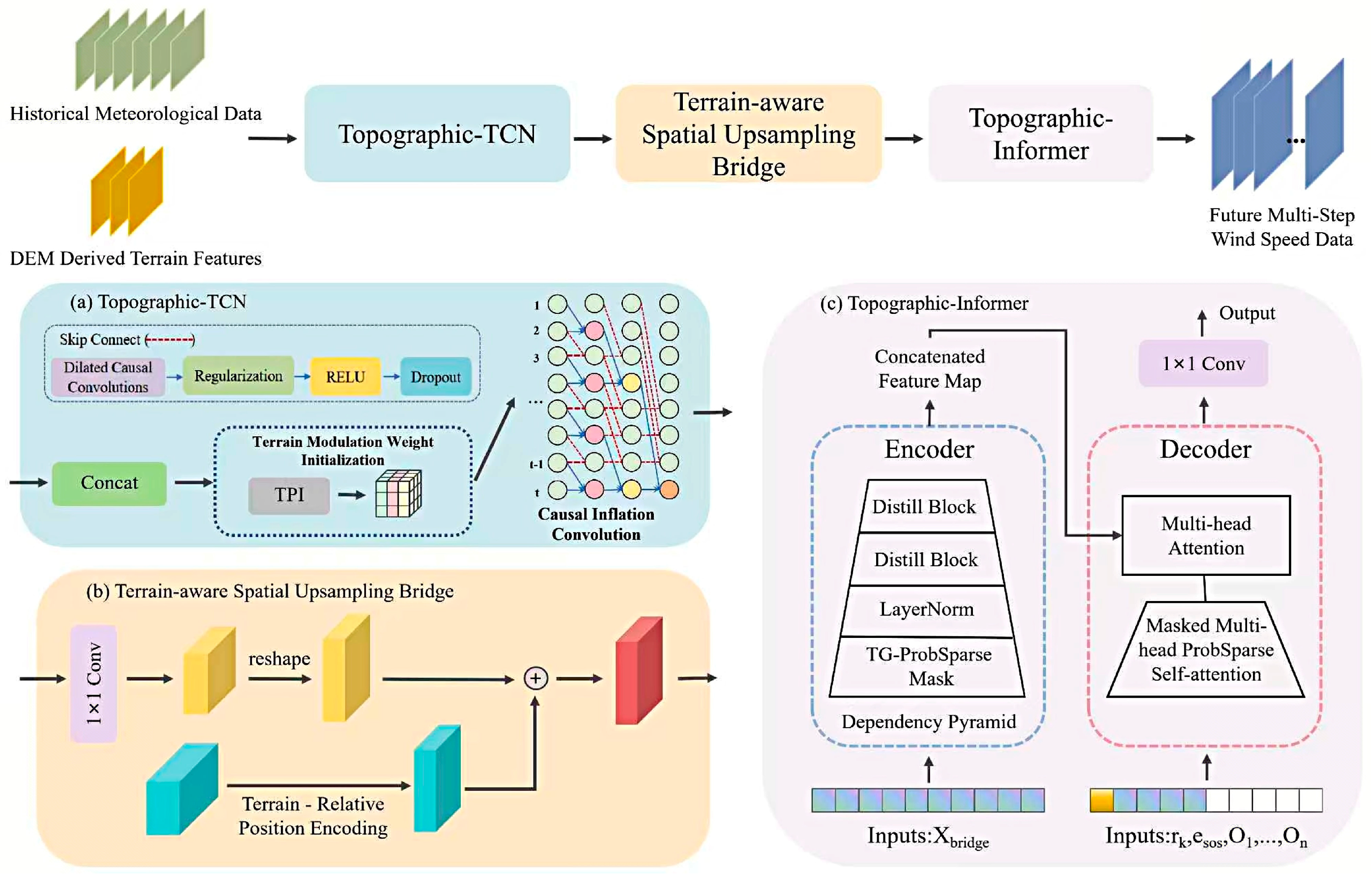
- A temporal modeling framework based on terrain-aware TCNs and a spatial position-encoding bridging module were constructed. Complex terrain weight initialization strategies and learnable relative position encoding were designed and implemented to enhance the model’s sensitivity and expressiveness toward sudden wind speed variations in complex terrain.
- (2)
- A terrain-aware Informer model integrating terrain-sensing mechanisms with sparse attention structures is proposed. This model achieves terrain-guided sparse attention and multi-scale feature fusion, enabling it to focus more on terrain-sensitive regions and effectively improve wind speed prediction accuracy in complex terrain areas.
2. Algorithms Fundamentals
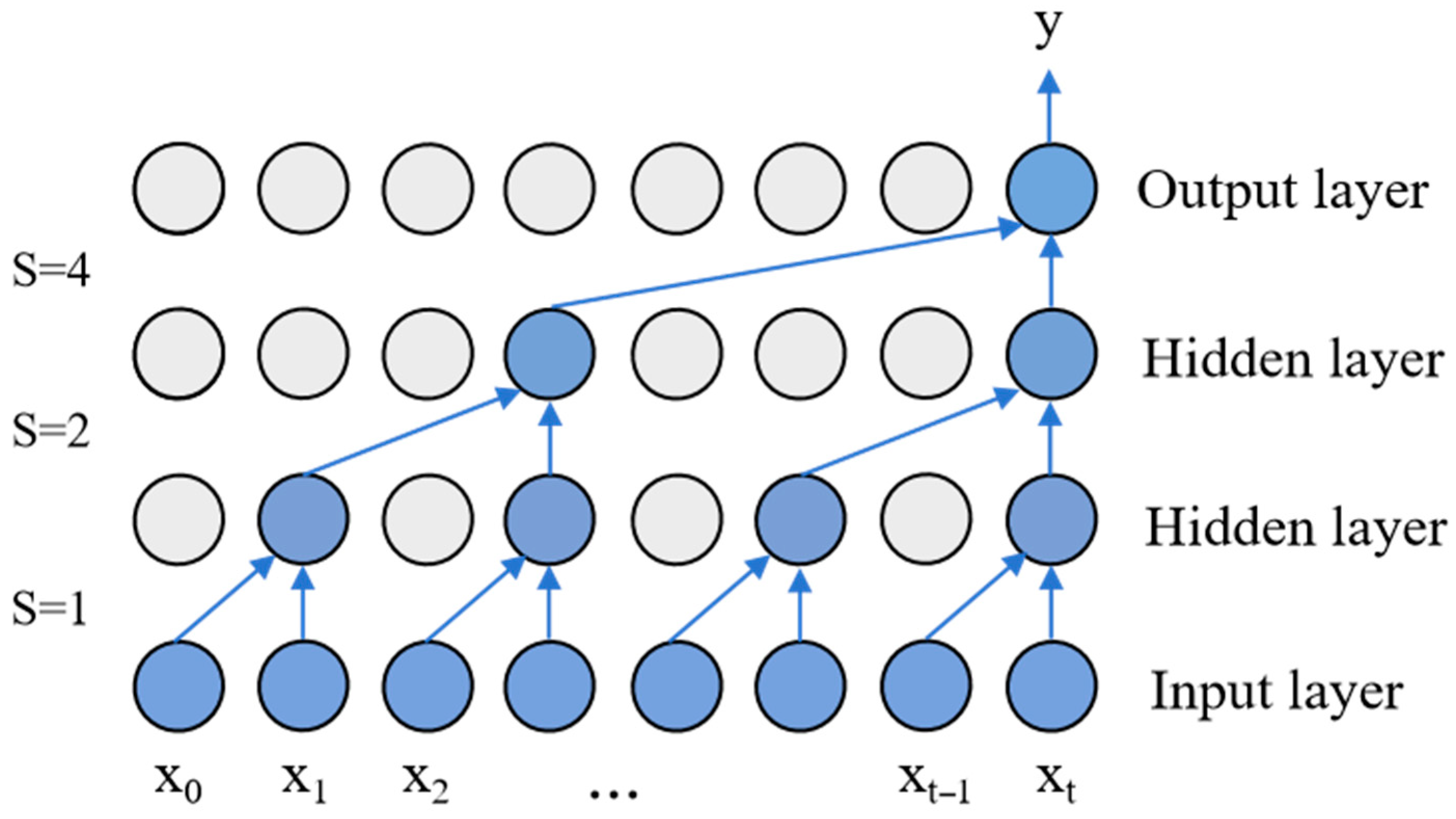
2.1. Temporal Convolutional Networks
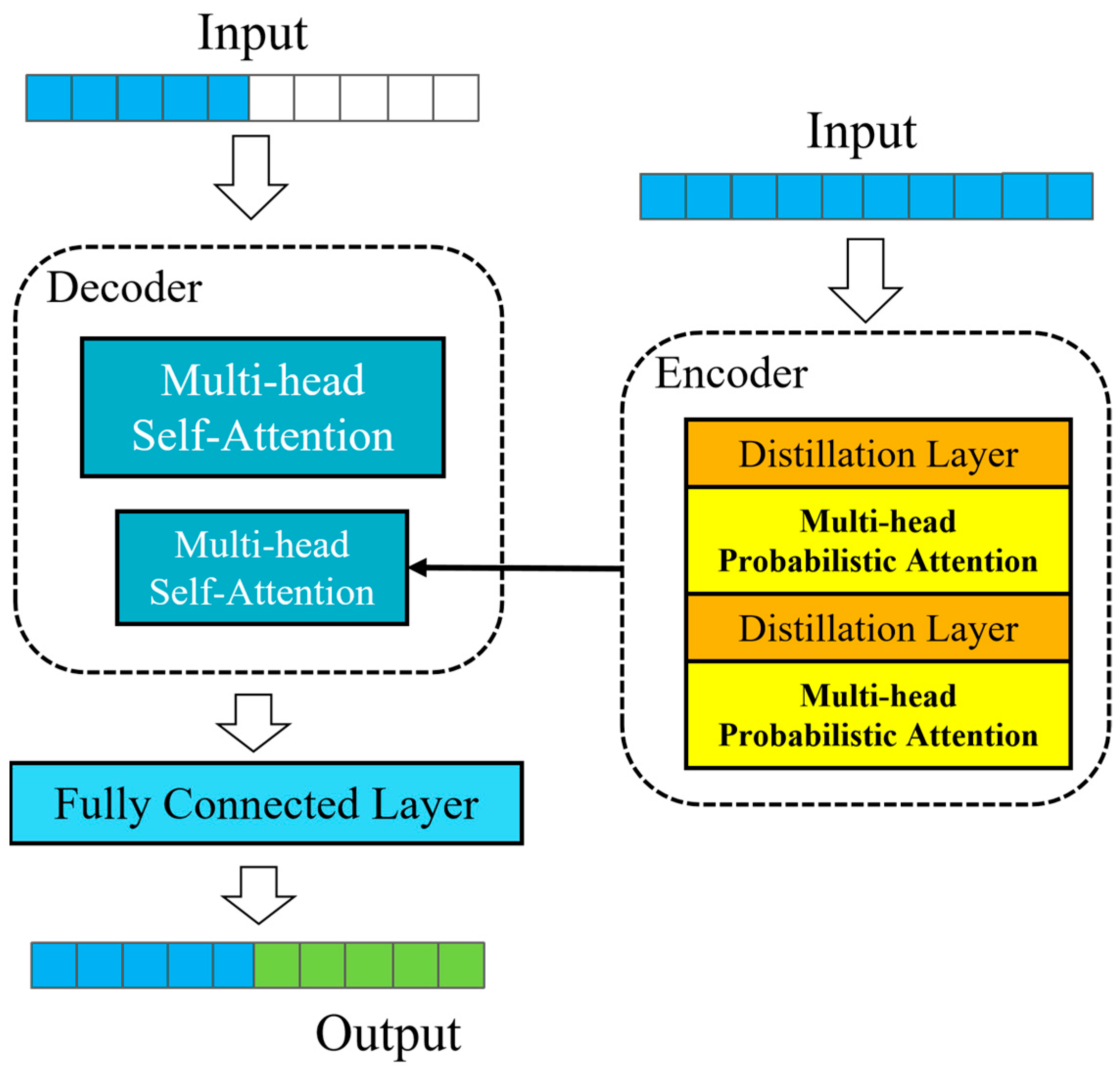
2.2. Informer
3. Method
3.1. T-TCN (Topographic-TCN)
3.2. TSUB (Terrain-Aware Spatial Upsampling Bridge)
3.3. T-Informer (Topographic-Informer)
4. Experiment
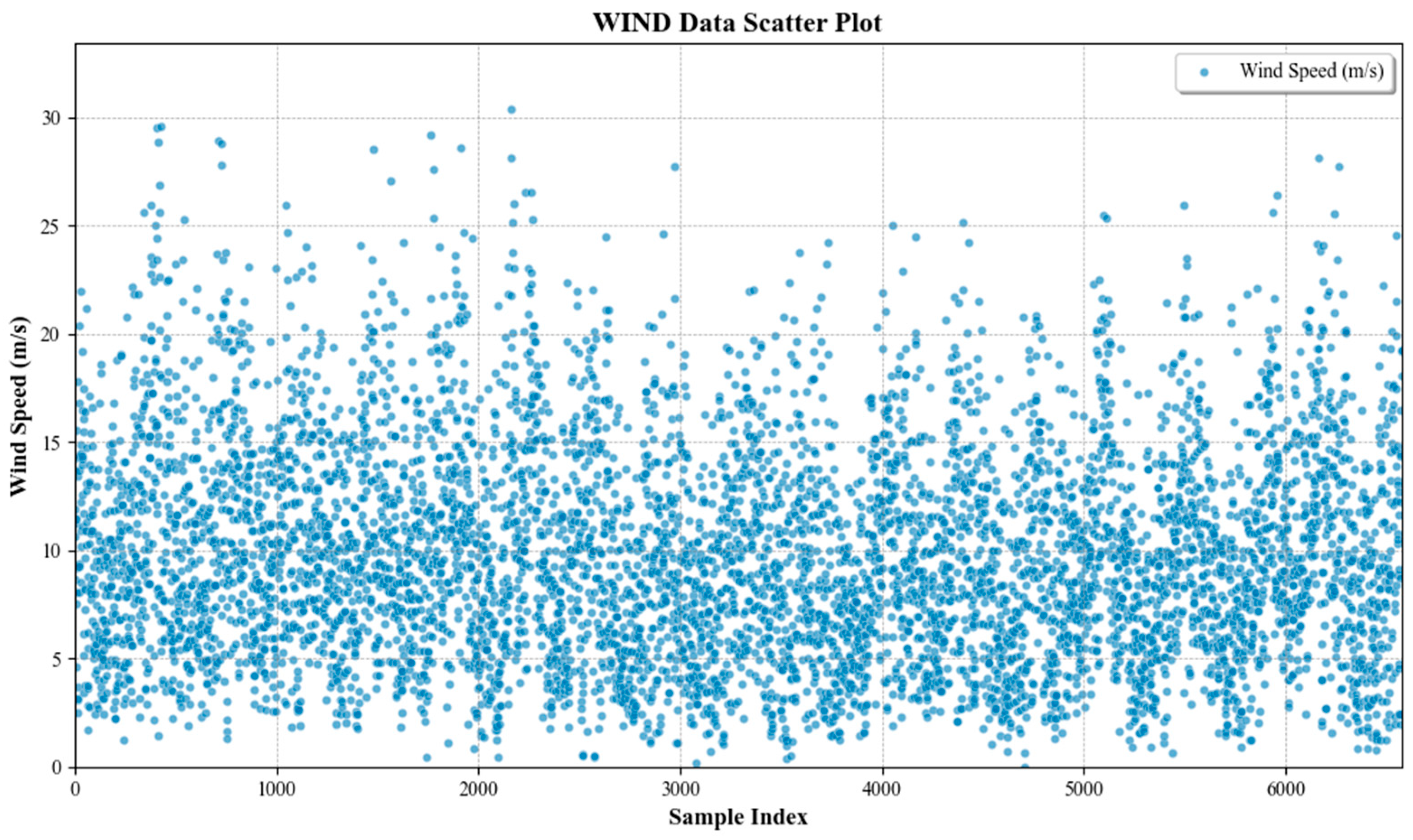
4.1. Experimental Setup and Dataset
4.2. Comparative Experiment on Conventional Wind Speed Prediction
4.3. Strong Wind Forecast Comparison Experiment
5. Conclusions
Author Contributions
Funding
Institutional Review Board Statement
Informed Consent Statement
Data Availability Statement
Conflicts of Interest
References
- Gao, Y.; Zeng, F. Value-Added Areas and Implementation Pathways for Synergistic Development of Meteorology and the “Dual Carbon” Strategy. Product. Res. 2024, 28, 30–35. [Google Scholar]
- Liu, H.; Mi, X.; Li, Y. Smart deep learning based wind speed prediction model using wavelet packet decomposition, convolutional neural network and convolutional long short term memory network. Energy Convers. Manag. 2018, 166, 120–131. [Google Scholar] [CrossRef] [Scilit]
- China Meteorological Administration. Specifications for Surface Meteorological Observation; China Meteorological Press: Beijing, China, 2003. [Google Scholar]
- Gazafroudi, A.S. Assessing the Impact of Load and Renewable Energies’ Uncertainty on a Hybrid System. Int. J. Energy Power Eng. 2016, 5, 1–8. [Google Scholar] [CrossRef] [Scilit]
- Huang, Y.; Zhang, B.; Pang, H.; Wang, B.; Lee, K.Y.; Xie, J.; Jin, Y. Spatio-temporal wind speed prediction based on Clayton Copula function with deep learning fusion. Renew. Energy 2022, 192, 526–536. [Google Scholar] [CrossRef] [Scilit]
- Ding, Y.; Ye, X.W.; Guo, Y. A multistep direct and indirect strategy for predicting wind direction based on the EMD-LSTM model. Struct. Control Health Monit. 2023, 2023, 4950487. [Google Scholar] [CrossRef] [Scilit]
- Li, X.; Li, K.; Shen, S.; Tian, Y. Exploring time series models for wind speed forecasting: A comparative analysis. Energies 2023, 16, 7785. [Google Scholar] [CrossRef] [Scilit]
- Valdivia-Bautista, S.M.; Domínguez-Navarro, J.A.; Pérez-Cisneros, M.; Vega-Gómez, C.J.; Castillo-Téllez, B. Artificial intelligence in wind speed forecasting: A review. Energies 2023, 16, 2457. [Google Scholar] [CrossRef] [Scilit]
- Khan, S.; Mazhar, T.; Khan, M.A.; Shahzad, T.; Ahmad, W.; Bibi, A.; Saeed, M.M.; Hamam, H. Comparative analysis of deep neural network architectures for renewable energy forecasting: Enhancing accuracy with meteorological and time-based features. Discov. Sustain. 2024, 5, 533. [Google Scholar] [CrossRef] [Scilit]
- Shao, B.; Song, D.; Bian, G.; Zhao, Y. Wind speed forecast based on the LSTM neural network optimized by the firework algorithm. Adv. Mater. Sci. Eng. 2021, 2021, 4874757. [Google Scholar] [CrossRef] [Scilit]
- Wang, M.; Wang, J.; Yu, M.; Yang, F. Spatiotemporal wind speed forecasting using conditional local convolution and multidimensional meteorology features. Sci. Rep. 2024, 14, 26219. [Google Scholar] [CrossRef] [Scilit] [PubMed]
- Yu, C.; Ma, Y. A novel model for wind speed point prediction and quantifying uncertainty in wind farms. Electr. Eng. 2025, 107, 6395–6409. [Google Scholar] [CrossRef] [Scilit]
- Ma, J.; Liu, W.; Yan, W. Deep Learning-Based Methods for Meteorological Element Prediction. J. Trop. Meteorol. 2021, 37, 186–193. [Google Scholar] [CrossRef]
- Liang, T.; Chen, C.; Tan, J.; Jing, Y. Wind Speed Prediction Based on Multi-aspect Feature Extraction and Transfer Learning. J. Sol. Energy 2023, 44, 132–139. [Google Scholar]
- Niu, Z.; Yu, Z.; Tang, W.; Wu, Q.; Reformat, M. Wind power forecasting using attention-based gated recurrent unit network. Energy 2020, 196, 117081. [Google Scholar] [CrossRef] [Scilit]
- Khattak, A.; Zhang, J.; Chan, P.-W.; Chen, F. Assessment of wind shear severity in airport runway vicinity using interpretable TabNet approach and Doppler LiDAR data. Appl. Artif. Intell. 2024, 38, 2302227. [Google Scholar] [CrossRef] [Scilit]
- Hu, F.; Feng, X.; Xu, H.; Liang, X.; Wang, X. Ultra-short-term spatio-temporal wind speed prediction based on OWT-STGradRAM. IEEE Trans. Sustain. Energy 2025, 16, 1816–1826. [Google Scholar] [CrossRef] [Scilit]
- Zhang, Z.; Lin, L.; Gao, S.; Wang, J.; Zhao, H.; Yu, H. A machine learning model for hub-height short-term wind speed prediction. Nat. Commun. 2025, 16, 3195. [Google Scholar] [CrossRef] [Scilit]
- Dujardin, J.; Lehning, M. Wind-Topo: Downscaling near-surface wind fields to high-resolution topography in highly complex terrain with deep learning. Q. J. R. Meteorol. Soc. 2022, 148, 1368–1388. [Google Scholar] [CrossRef] [Scilit]
- Le Toumelin, L.; Gouttevin, I.; Galiez, C.; Helbig, N. A two-fold deep-learning strategy to correct and downscale winds over mountains. Nonlinear Process. Geophys. 2024, 31, 75–97. [Google Scholar] [CrossRef] [Scilit]
- Liu, J.; Shi, C.; Ge, L.; Tie, R.; Chen, X.; Zhou, T.; Gu, X.; Shen, Z. Enhanced wind field spatial downscaling method using UNET architecture and dual cross-attention mechanism. Remote Sens. 2024, 16, 1867. [Google Scholar] [CrossRef] [Scilit]
- Li, Y.; Zhang, L.; Lei, Y.; Ran, J.; Ye, G. Short-term electricity consumption forecasting method based on temporal convolutional network and gated re-current unit. Water Resour. Power 2021, 39, 198–201. [Google Scholar]
- Zhou, H.; Zhang, S.; Peng, J.; Zhang, S.; Li, J.; Xiong, H.; Zhang, W. Informer: Beyond efficient transformer for long sequence time-series forecasting. In Proceedings of the AAAI Conference on Artificial Intelligence, Virtual, 2–9 February 2021; Volume 35, pp. 11106–11115. [Google Scholar]
- Fedesoriano. “Wind Speed Prediction Dataset”. Kaggle, 2022. Available online: https://www.kaggle.com/datasets/fedesoriano/wind-speed-prediction-dataset (accessed on 10 July 2025).
- Liu, N.; Xiong, A.; Zhang, Q.; Liu, Y.; Zhan, Y.; Liu, Y. Construction of a Basic Dataset for Training Artificial Intelligence Applications in Severe Convective Weather. J. Appl. Meteorol. 2021, 32, 530–541. [Google Scholar] [CrossRef]
- Medsker, L.R.; Jain, L. Recurrent neural networks. Des. Appl. 2001, 5, 2. [Google Scholar]
- Hochreiter, S.; Schmidhuber, J. Long short-term memory. Neural Comput. 1997, 9, 1735–1780. [Google Scholar] [CrossRef] [Scilit]
- Wang, S.; Wang, X.; Wang, S.; Wang, D. Bi-directional long short-term memory method based on attention mechanism and rolling update for short-term load forecasting. Int. J. Electr. Power Energy Syst. 2019, 109, 470–479. [Google Scholar] [CrossRef] [Scilit]
- Vaswani, A.; Shazeer, N.; Parmar, N.; Uszkoreit, J.; Jones, L.; Gomez, A.N.; Kaiser, Ł.; Polosukhin, I. Attention is all you need. arXiv 2017, arXiv:1508.04409. [Google Scholar] [CrossRef] [Scilit]
- Du, B.; Li, Y.; Ma, Z.; Wang, H.; Zhang, L. A Seq2Seq Wind Speed Prediction Model with Multi-Feature Embedding. Comput. Eng. Des. 2021, 42, 2061–2068. [Google Scholar]
- Zhang, J.; Meng, J.; Li, D.; Chen, X. Wind Speed Prediction Method Along Railway Lines Based on SSA-BP. Comput. Simul. 2023, 40, 209–212+260. [Google Scholar]
- Wang, Y.; Wang, X.; Duan, Y. Short-Term Wind Power Generation Forecasting Based on the GWO-BP Model. Yunnan Hydropower 2023, 39, 67–71. [Google Scholar]
- Chang, Z.; Zhang, X.; Wang, S.; Ma, S.; Ye, Y.; Xiang, X.; Gao, W. MAU: A motion-aware unit for video prediction and beyond. Adv. Neural Inf. Process. Syst. 2021, 34, 26950–26962. [Google Scholar]
- Chang, Z.; Zhang, X.; Wang, S.; Ma, S.; Gao, W. STAM: A spatiotemporal attention based memory for video prediction. IEEE Trans. Multimed. 2022, 25, 2354–2367. [Google Scholar] [CrossRef] [Scilit]



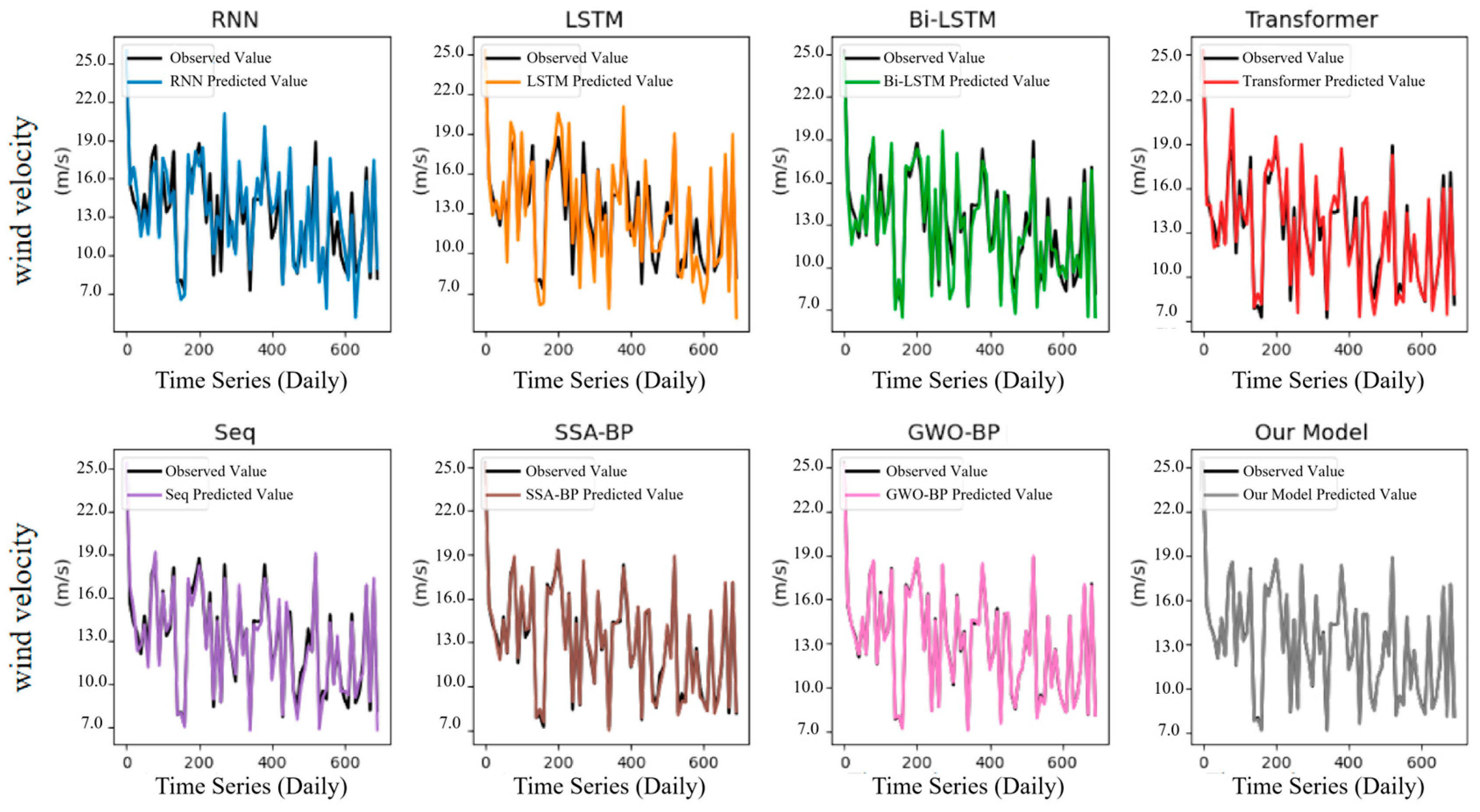
| Model | RMSE | MAE | MAPE | R2 | RMSEσ | p |
|---|---|---|---|---|---|---|
| RNN | 4.18 | 3.08 | 61.6% | 0.73 | 0.02 | <0.05 |
| LSTM | 4.06 | 2.94 | 58.8% | 0.79 | 0.015 | <0.05 |
| Bi-LSTM | 4.29 | 2.48 | 49.6% | 0.84 | 0.018 | <0.05 |
| Transformer | 3.47 | 2.80 | 56.0% | 0.81 | 0.014 | <0.05 |
| Seq | 2.19 | 2.71 | 54.6% | 0.90 | 0.016 | <0.05 |
| GWO-BP | 2.34 | 1.49 | 29.8% | 0.88 | 0.018 | <0.05 |
| SSA-BP | 1.79 | 1.37 | 27.4% | 0.91 | 0.015 | <0.05 |
| Our | 1.25 | 1.28 | 25.6% | 0.95 | 0.008 | <0.05 |
| Model | TS Score | MR | FAR | |
|---|---|---|---|---|
| RNN | 0.28 | 0.35 | 52.4% | 27.6% |
| LSTM | 0.34 | 0.24 | 54.6% | 25.4% |
| Transformer | 0.21 | 0.16 | 51.7% | 19.1% |
| Bi-LSTM | 0.55 | 0.33 | 50.9% | 18.4% |
| PredRNN | 0.47 | 0.29 | 47.6% | 16.9% |
| MAU | 0.51 | 0.41 | 49.0% | 16.1% |
| STAM | 0.62 | 0.45 | 35.5% | 15.3% |
| Our | 0.70 | 0.57 | 34.2% | 10.6% |
Disclaimer/Publisher’s Note: The statements, opinions and data contained in all publications are solely those of the individual author(s) and contributor(s) and not of MDPI and/or the editor(s). MDPI and/or the editor(s) disclaim responsibility for any injury to people or property resulting from any ideas, methods, instructions or products referred to in the content. |
© 2025 by the authors. Licensee MDPI, Basel, Switzerland. This article is an open access article distributed under the terms and conditions of the Creative Commons Attribution (CC BY) license.
Share and Cite
Liu, D.; Wang, H.; Zhang, J.; Lv, J.; He, B.; Zhao, C.; Yu, G. Deep Learning Algorithms for Wind Speed Prediction in Complex Terrain Using Meteorological Data. Atmosphere 2026, 17, 28. https://doi.org/10.3390/atmos17010028
Liu D, Wang H, Zhang J, Lv J, He B, Zhao C, Yu G. Deep Learning Algorithms for Wind Speed Prediction in Complex Terrain Using Meteorological Data. Atmosphere. 2026; 17(1):28. https://doi.org/10.3390/atmos17010028
Chicago/Turabian StyleLiu, Donghui, Hao Wang, Jiyong Zhang, Jingguo Lv, Bangzheng He, Chunhui Zhao, and Gao Yu. 2026. "Deep Learning Algorithms for Wind Speed Prediction in Complex Terrain Using Meteorological Data" Atmosphere 17, no. 1: 28. https://doi.org/10.3390/atmos17010028
APA StyleLiu, D., Wang, H., Zhang, J., Lv, J., He, B., Zhao, C., & Yu, G. (2026). Deep Learning Algorithms for Wind Speed Prediction in Complex Terrain Using Meteorological Data. Atmosphere, 17(1), 28. https://doi.org/10.3390/atmos17010028