Article

Characteristics and Mechanisms of the Dipole Precipitation Pattern in “Westerlies Asia” over the Past Millennium Based on PMIP4 Simulation

1
Key Laboratory of Western China’s Environmental Systems (Ministry of Education), College of Earth and Environmental Sciences, Lanzhou University, Lanzhou 730000, China
2
Department of Geography, Fuyang Normal University, Fuyang 311400, China
3
Faculty of Geographical Science, Beijing Normal University, Beijing 100875, China
4
Key Laboratory for Semi-Arid Climate Change of the Ministry of Education, College of Atmospheric Sciences, Lanzhou University, Lanzhou 730000, China
*
Author to whom correspondence should be addressed.
Atmosphere 2025, 16(12), 1315; https://doi.org/10.3390/atmos16121315
Submission received: 20 September 2025 / Revised: 13 November 2025 / Accepted: 20 November 2025 / Published: 21 November 2025

Abstract

Westerlies Asia, which includes arid Central Asia (ACA) and arid West Asia (AWA), is characterized by water vapor transport primarily controlled by the westerlies. Recent studies have identified a dipole pattern in hydroclimate variability between ACA and AWA during both the Holocene and modern period. However, it remains unclear whether such a dipole pattern persisted over the past millennium. Our findings demonstrate that the PMIP4 multi-model simulations reveal a dipole precipitation pattern between arid Central Asia and arid West Asia over the past millennium. During the Little Ice Age (LIA), annual precipitation increased in ACA but decreased in AWA, while the opposite pattern occurred during the Medieval Climate Anomaly (MCA). This dipole precipitation pattern is attributed to seasonal differences: increased spring precipitation in ACA together with decreased summer precipitation in AWA shaped the annual precipitation anomaly during the Little Ice Age, with a reversed regime during the Medieval Climate Anomaly. Mechanistically, a negative North Atlantic Oscillation (NAO) phase during LIA springs shifted the westerly moisture transport southward, enhancing moisture supply to ACA and increasing the precipitation there. In contrast, during LIA summers, a positive NAO phase displaced the westerly northward, reducing moisture advection to AWA, while a strengthened Azores High promoted moisture outflow and descending motion, suppressing precipitation. These findings offer a paleo-hydroclimatic basis for anticipating alternating dry-wet regimes between subregions, which can inform adaptive water allocation strategies, drought and flood preparedness, and long-term infrastructure planning across Westerlies Asia in a warming world.

1. Introduction

From the perspective of large-scale atmospheric circulation systems, the Asian continent can generally be divided into two parts: “Westerlies Asia”, which is primarily controlled by the mid-latitude westerly circulation, and “Monsoonal Asia,” which is predominantly influenced by the monsoon circulation [1,2]. The arid Central Asia (ACA) and arid West Asia (AWA) form the core of “Westerlies Asia” (Asian dryland). This area is famous for its oasis agriculture and unique mountain-basin coupled landscapes [2,3,4], and it is also a key passage of the ancient Silk Road and the core region of ancient human migrations. With increasing temperatures [5,6], water scarcity and allocation conflicts in this region are worsening [7,8]. Precipitation, as a vital water source, plays a crucial role in the ecological and economic development of arid regions [9,10,11,12]. Therefore, comprehensively understanding the characteristics and mechanisms of precipitation variations in “Westerlies Asia” on different time scales is of significant theoretical and practical importance.
Despite being consistently influenced by the westerlies circulation, instrumental data, proxy records, and model simulations all indicate that, in both the Holocene and modern periods, precipitation variations in the arid Central Asia and West Asia exhibit a dipole pattern [4,13,14]. Specifically, over the Holocene millennium scale, the arid Central Asia has gradually become wetter [2,11,15,16,17], while the arid West Asia has progressively dried since the mid-to-late Holocene [4,13,18]. On a decadal scale, instrumental data indicate that precipitation in arid Central Asia has been gradually increasing over the past few decades [19,20], while precipitation in the arid West Asia has been steadily decreasing [21,22,23]. This dipole precipitation pattern across the “Westerlies Asia” on both millennial and decadal scales may represent a fundamental characteristic of the region’s climatic variability.
The past millennium is a critical period connecting instrumental observations with geological records and is crucial for understanding centennial-scale climate variations in the climate system, as well as predicting precipitation anomalies under global warming conditions [24]. For the arid Central Asia, Chen et al. [25] synthesized high-quality humidity and precipitation proxy records from China and surrounding areas over the past 1000 years and found that during the Little Ice Age (LIA), the climate in Central Asia was relatively humid, while during the Medieval Climate Anomaly (MCA) it was relatively dry. For the arid West Asia, existing reconstruction results remain controversial. Some reconstructions suggest that during the MCA, the climate in West Asia was relatively dry, while it was relatively humid during the LIA. For instance, reconstructions of the Caspian Sea’s historical water levels show lower lake levels during the MCA, suggesting arid conditions, and higher levels during the LIA, indicating a humid climate [26,27]. These findings are supported by reconstruction results from Lake Urmia [28]. Conversely, other reconstruction results suggest that the arid West Asia was relatively humid during the MCA and drier during the LIA. For example, studies from Lake Neor in northwestern Iran [29], Katalekhor Cave in the western Iranian Plateau [30], Lake Van [31], and Lake Nar [32] in southeastern Turkey all indicate a relatively humid MCA and a drier LIA. These contradictory findings highlight the complexity of regional climate responses. By sorting out the existing research progress, it is found that the research on precipitation changes in “Westerly Asia” over the past 1000 years has mainly focused on reconstructing records, lacking the support of paleoclimate simulation results. Furthermore, it remains unclear whether the dipole pattern of precipitation variations in the “Westerly Asia” at the Holocene millennium scale and the modern decadal scale still existed over the past millennium. If such a dipole pattern exists, what are the mechanisms behind these precipitation changes?
The fourth phase of the Paleoclimate Model Intercomparison Project (PMIP4) is an important international collaborative project in the field of climate modeling [33], aimed at studying long-term climate system changes and providing references for modern and future climate change. As a part of CMIP6, PMIP4 designed multiple paleoclimate experiments, including the past1000 experiment (hereafter referred to as the past1000 simulation), which simulates climate changes from 850 to 1849 AD. The primary external forcings include Earth’s orbital parameters, solar radiation, volcanic activity, land-use changes, and greenhouse gas concentration changes [34]. This experiment focuses on the effects of natural variability and external forcings and provides long-term simulation data for climate detection and attribution. The PMIP4 past1000 simulation experiment provides valuable conditions for understanding the precipitation variation characteristics and mechanisms of “Westerlies Asia” over the past millennium on a centennial timescale.
This study aims to determine whether a dipole precipitation pattern has existed across “Westerlies Asia” over the past 1000 years. If such a pattern exists, what are the underlying physical mechanisms? To address the questions above, this paper first reveals the characteristics of precipitation change in “Westerlies Asia” based on the PMIP4 past1000 simulation experiment. Further, by analyzing the atmospheric data, potential mechanisms for the centennial-scale dipole precipitation changes in “Westerlies Asia” will be proposed. The research results will provide theoretical support for water resource management in arid areas and future climate change prediction.

2. Materials and Methods

2.1. PMIP4 Model Settings

We used four models from the CMIP6/PMIP4 framework for past1000 simulations [35] and the output of MPI-ESM1-2-LR from the past2k experiment [33]. The past1000 simulation covers the period 850–1849 and is driven by time-varying solar irradiance, volcanic eruptions, land use, and greenhouse gases. The details of these models are provided in Table 1. We analyzed the outputs of these five models during the period of 850–1849 AD. It should be noted that the precipitation data used in this study includes both liquid and solid phases from all types of clouds (both large-scale and convective). In this study, we used the difference between the Little Ice Age (LIA) and the Medieval Climate Anomaly (MCA) (LIA minus MCA) to represent centennial-scale climate anomalies. Based on the definition of Chen et al. [25], we designated 1000–1300 AD as the MCA and 1400–1850 AD as the LIA. All model data were interpolated to a 1.0° × 1.0° horizontal resolution using bilinear interpolation. Additionally, to effectively reduce model uncertainty, we employed a multi-model mean to explore the features of climate change and its related dynamic mechanisms. The weights of all models are consistent. It should be noted that since the INM-CM4-8 model does not provide data on zonal wind (ua), meridional wind (va), relative humidity (hus), vertical velocity (wap) and geopotential height (zg), only the results of the remaining 4 models are included in the calculation of the multi-model ensemble mean for these variables.

2.2. Water Vapor Transport

The vertically integrated water vapor fluxes (kg m−1 s−1) were calculated as follows:
Q = 1 g 100 h P a P s q V d p
where Q ,   g ,   q ,   V , and P s correspond to water vapor flux, gravity, specific humidity, horizontal velocity, and surface pressure, respectively. During the computation of water vapor fluxes, pressure levels below the surface pressure were excluded due to the influence of topography. To assess the impact of low- and upper-level water vapor on precipitation, fluxes at lower (1000–700 hPa) and upper (700–100 hPa) levels were also analyzed.
Additionally, to quantify the contribution of water vapor transport to the regional water vapor budget, the amount of water vapor entering and exiting the study area at each boundary was calculated separately. The formulas for these calculations are below:
Western boundary:
Q W = φ S φ N Q λ w a d φ
Eastern boundary:
Q E = φ S φ N Q λ E a d φ
Southern boundary:
Q S = φ W φ E Q φ S a c o s φ S d λ
Northern boundary:
Q N = φ W φ E Q φ N a c o s φ N d λ
where λ w and λ E denote the longitudes of the western and eastern boundaries, respectively, while φ S and φ N represent the latitudes of the southern and northern boundaries, respectively, Q λ w and Q λ E indicate the zonal fluxes across the western and eastern boundaries, respectively, and Q φ S and Q φ N represent the meridional fluxes across the southern and northern boundaries, respectively. The value a adopted for the Earth’s mean radius was 6.37 × 10⁶ m.
In this study, the seasons are defined as follows: winter spans from December to February, spring from March to May, summer from June to August, and autumn from September to November.

2.3. Dataset for Model Evaluation

To assess the reliability of the model results, we compared them with observed precipitation and temperature data from the Climatic Research Unit (CRU) dataset version 4.07 (1981–2010 CE; [41]) to evaluate the models’ ability to simulate modern precipitation and temperature. Additionally, surface pressure from the ERA5 reanalysis dataset (1981–2010 CE), provided by the ECMWF with a horizontal resolution of 0.25° × 0.25°, was also utilized [42]. To facilitate comparison between the model outputs, ERA5 reanalysis, and the CRU dataset, all data were regridded to a common 1° × 1° resolution using bilinear interpolation.
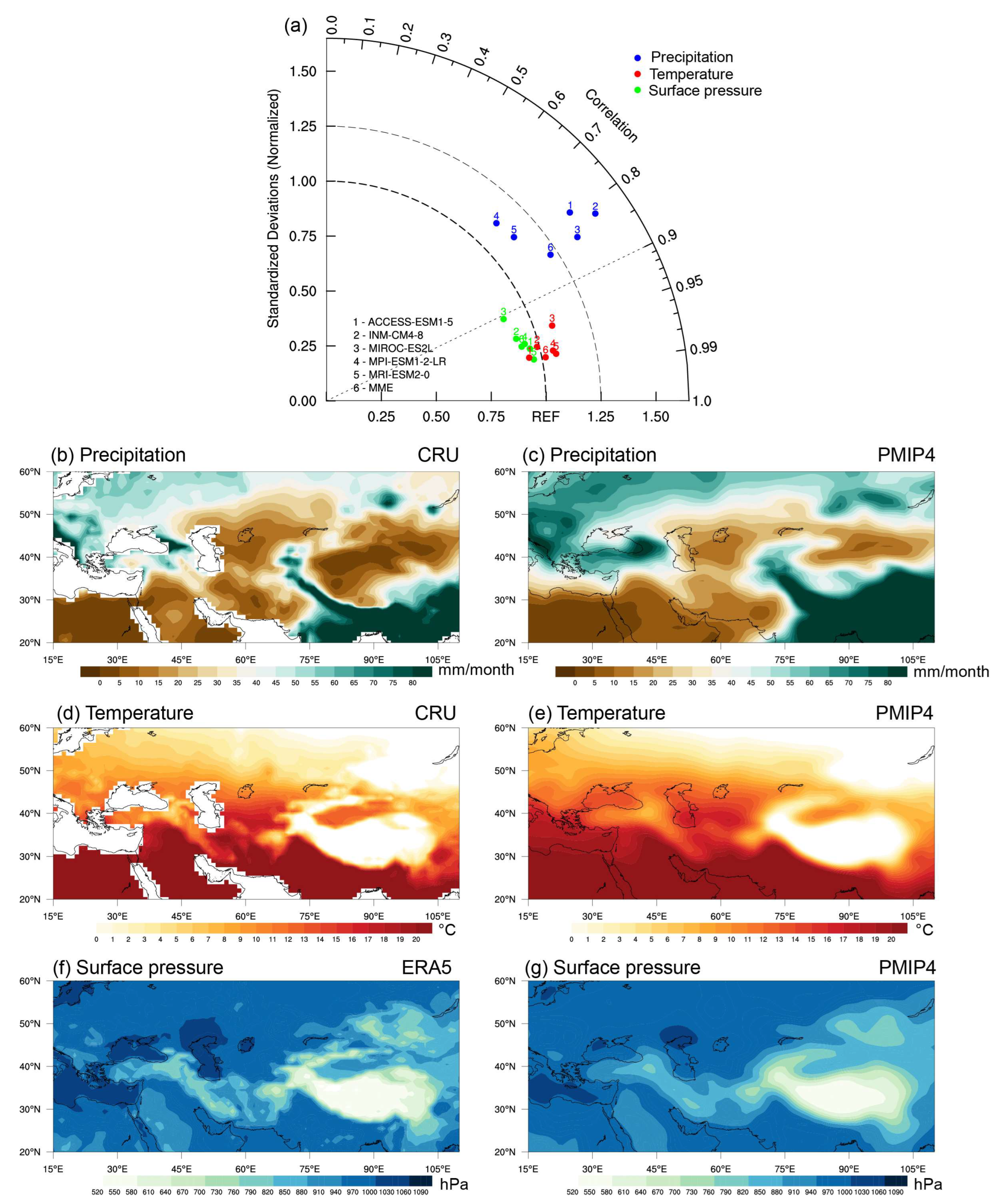
We first verified the reliability of the simulation. The Taylor diagram provides statistical information (i.e., spatial correlation coefficients and standard deviations) between simulations and observations, acting as a useful tool in measuring the performance of models [43]. As shown in Figure 1a, the PMIP4 models generally capture the distributions of precipitation, surface air temperature, and surface pressure over the study area in the modern climate. The spatial correlation coefficients of precipitation between the PMIP4 models and CRU range from 0.69 (MPI-ESM1-2-LR) to 0.84 (MIROC-ES2L), with the multi-model ensemble mean (MME) reaching 0.84, and the standardized deviations range from 1.12 (MPI-ESM1-2-LR) to 1.49 (INM-CM4-8). This indicates that all five models can basically simulate the precipitation characteristics of the study area, and at the same time, the MME shows good simulation performance. In terms of spatial distribution, the results revealed that the annual precipitation pattern obtained from the CRU dataset was largely reproduced by the MME (Figure 1b,c). Specifically, areas such as central Iran, the Arabian Peninsula, and Central Asia exhibited precipitation levels below 30 mm/month, whereas the eastern and northern Mediterranean regions and the Indian subcontinent experienced precipitation exceeding 50 mm/month. Both the spatial distribution and values were roughly replicated, as shown in Figure 1b,c. However, overall, the models tend to overestimate precipitation to a certain extent, particularly in the eastern coast of the Black Sea and the Tibet Plateau, implying that the model simulation results still have certain uncertainties. For surface air temperature and surface pressure, the spatial correlation coefficients of all models and the MME all exceed 0.9, and the standardized deviations are in the range of 0.88–1.06, indicating the models’ good simulation performance for temperature and surface pressure. From the perspective of spatial distribution, the MME also reproduces the spatial distribution characteristics of temperature and pressure well. In addition, the past1000 simulation experiments of PMIP4 have been widely used to explore precipitation and climate change in Asia and the surrounding region [44,45,46], further demonstrating the reliability of PMIP4’s past1000 simulation experiments in the study area.

3. Results and Discussion

3.1. Dipole Precipitation Pattern Between AWA and ACA Simulated by PMIP4

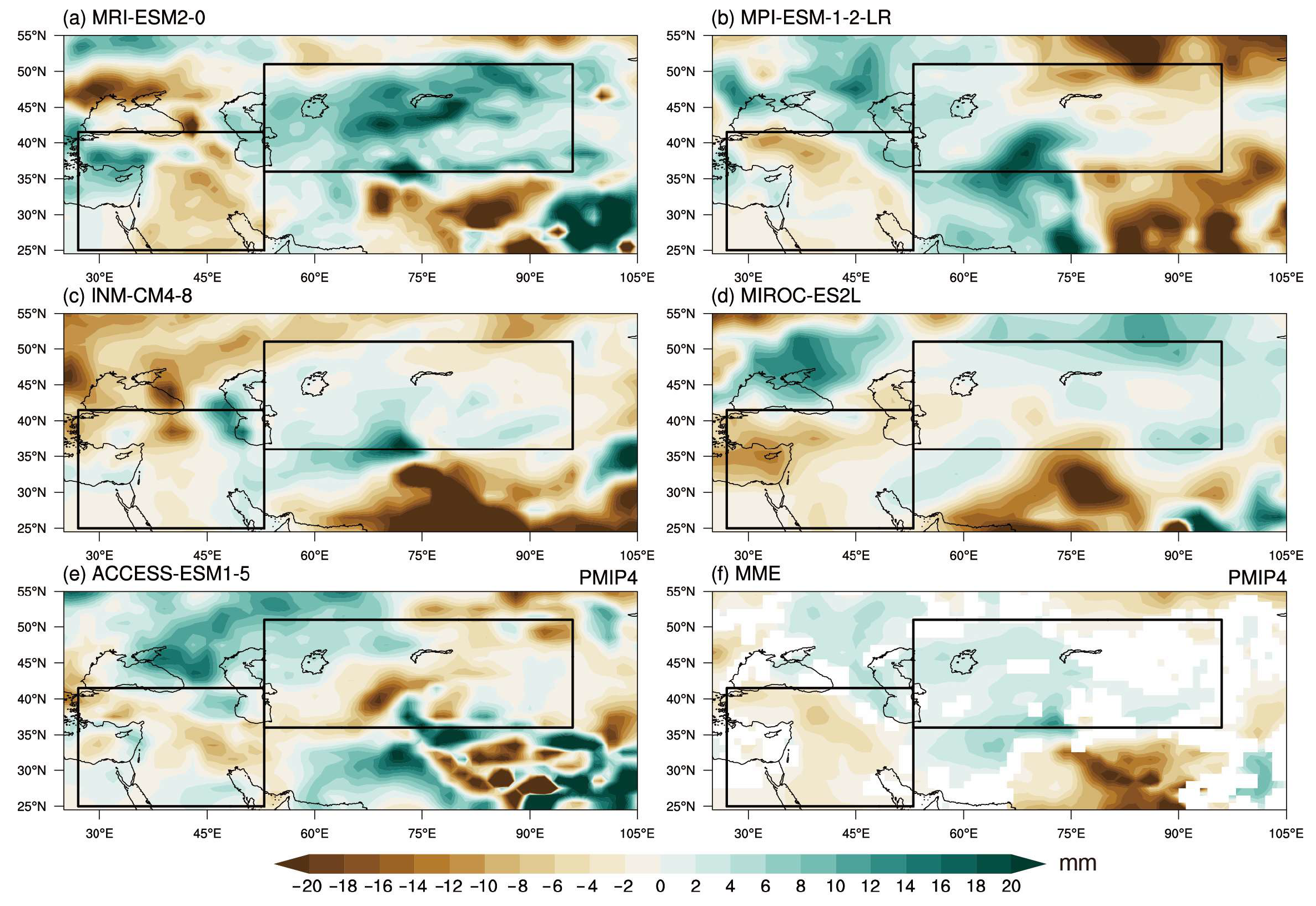
We first analyzed the changes in precipitation between the Little Ice Age (LIA) and the Medieval Climate Anomaly (MCA) as simulated by the PMIP4 models (Figure 2). The results indicate that all five models consistently simulated reduced precipitation in arid West Asia during the LIA. The areas with decreased precipitation were primarily located over the Caucasus and the northern Arabian Peninsula. The range of precipitation reduction is roughly 2–4 mm, and the multi-model average results indicate that the precipitation reduction in arid West Asia during the LIA passed the significance test (Figure 2f). For arid Central Asia (ACA), greater inter-model discrepancies were observed, particularly concerning the spatial extent of increased precipitation. Despite these differences, a majority (three out of five) of the models consistently suggest that most parts of the ACA experienced wetter conditions during the LIA compared to the MCA (Figure 2a–d). The multi-model mean indicates that the increased annual precipitation is mainly concentrated in the five Central Asian countries and eastern Iran (Figure 2f), with a precipitation increase of approximately 2–8 mm. But the increased precipitation in Xinjiang was relatively slight and failed the significance test. Overall, the PMIP4 multi-model mean simulations indicate that arid West Asia and Central Asia exhibit an inverse relationship in precipitation variability over the past millennium (Figure 2f). It is worth noting that although the multi-model ensemble mean confirms the existence of a dipole pattern in precipitation variability between the arid Central Asia and West Asia, discrepancies still exist among the models in simulating precipitation changes over arid Central Asia. These differences may be related to the region’s complex geographic conditions and the parameterization schemes used in the models. Therefore, such uncertainties should be taken into account when interpreting the results of the multi-model ensemble simulations.
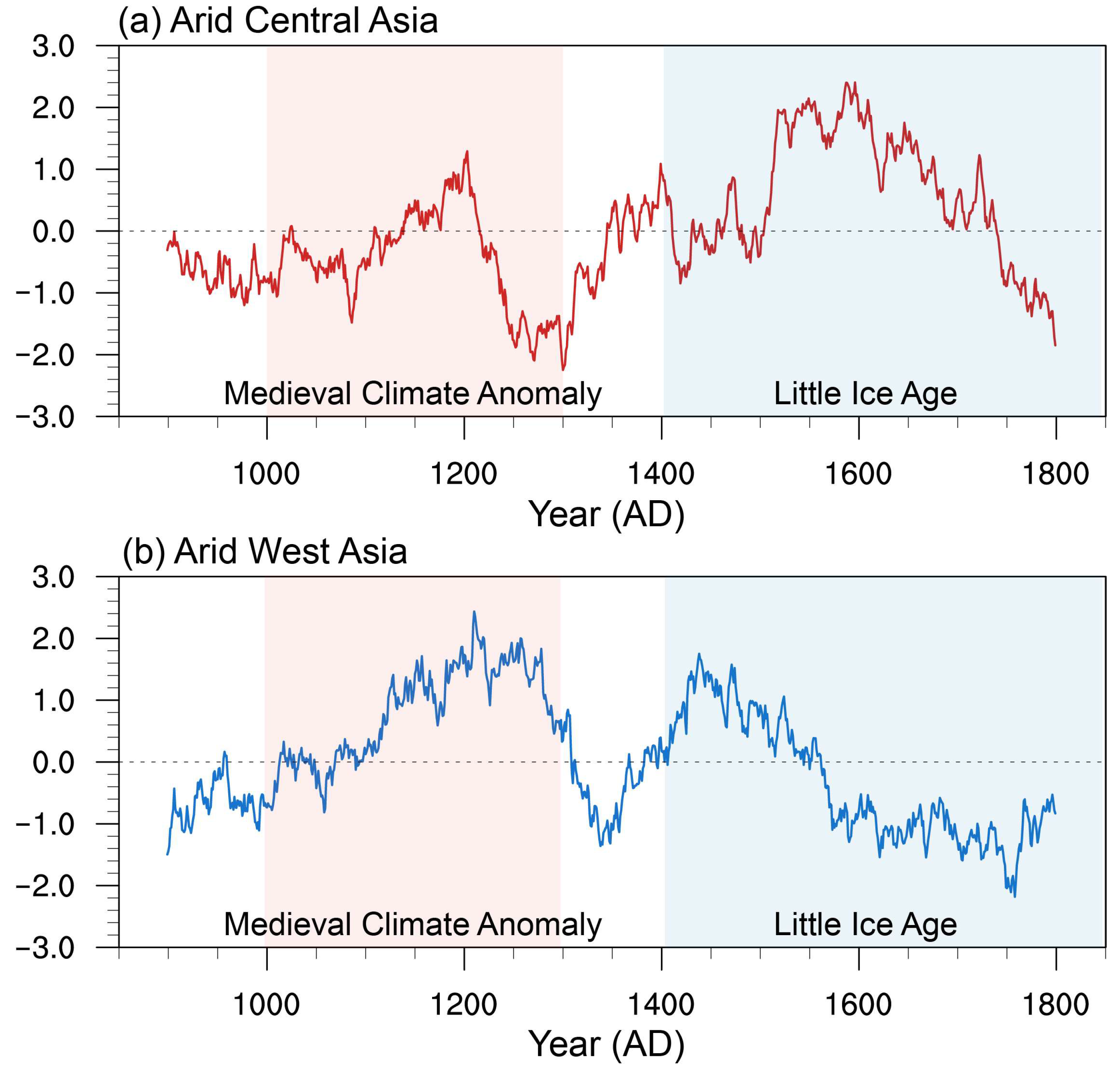
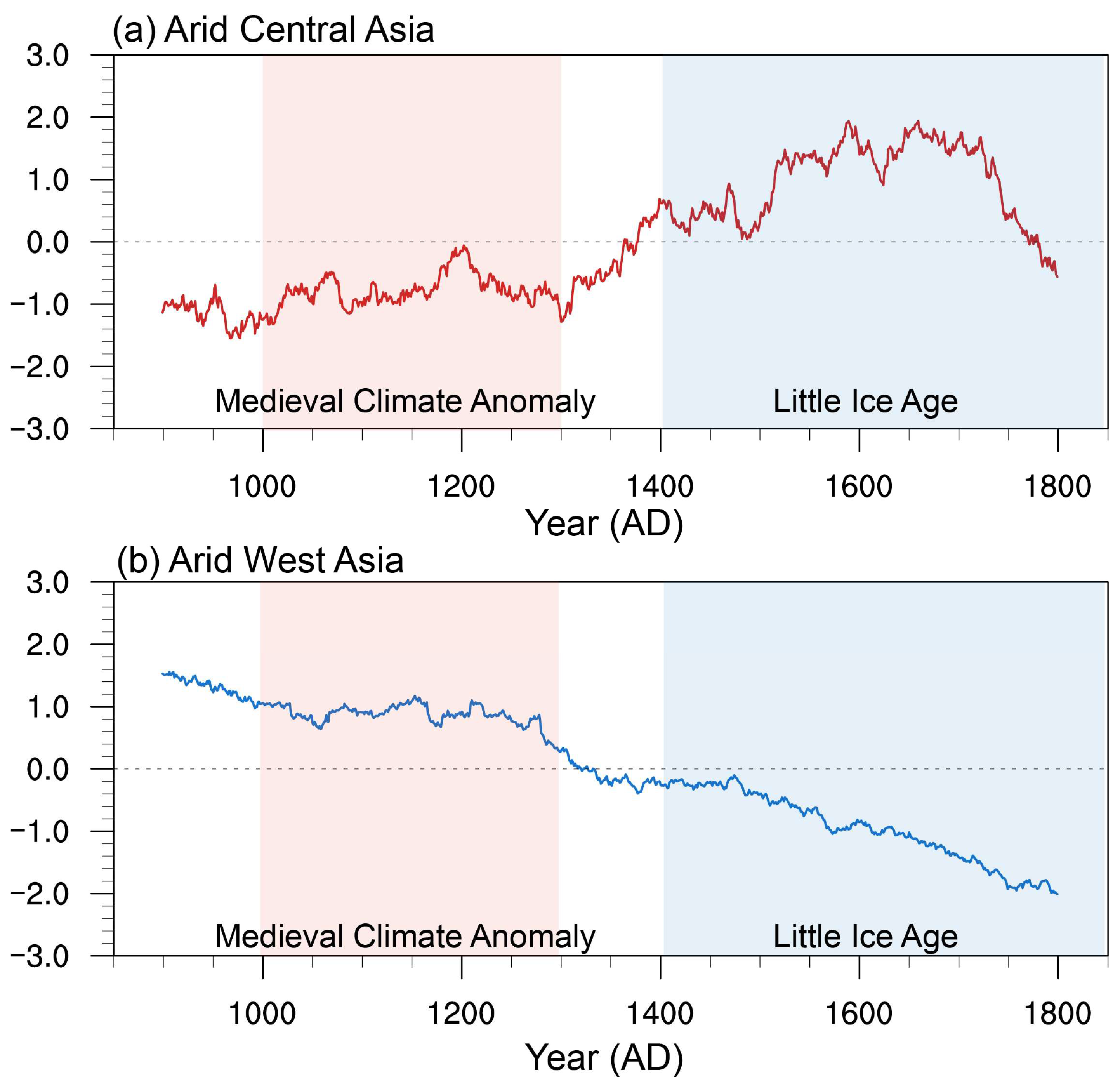
Furthermore, the evolution of annual precipitation simulated by PMIP4 shows that Central Asia experienced a trend of fluctuating increase followed by a decrease, with a turning point around 1600 AD (Figure 3a). In general, precipitation during the MCA was lower than that during the LIA. Similarly, West Asia also exhibited an increasing followed by a decreasing trend in precipitation, with a transition around 1450 AD. On average, the MCA was wetter than the LIA (Figure 3b). These results also confirm the existence of a dipole precipitation pattern between the ACA and AWA. However, it should be noted that the precipitation changes discussed herein are on a centennial scale, and the data have undergone a 99-year moving average and standardization processing. In reality, there may be certain differences in the amplitude and magnitude of precipitation changes, but the overall trends and inflection points of centennial-scale precipitation changes remain unchanged.

3.2. Seasonal Precipitation Differences Dominate the Dipole Precipitation Pattern

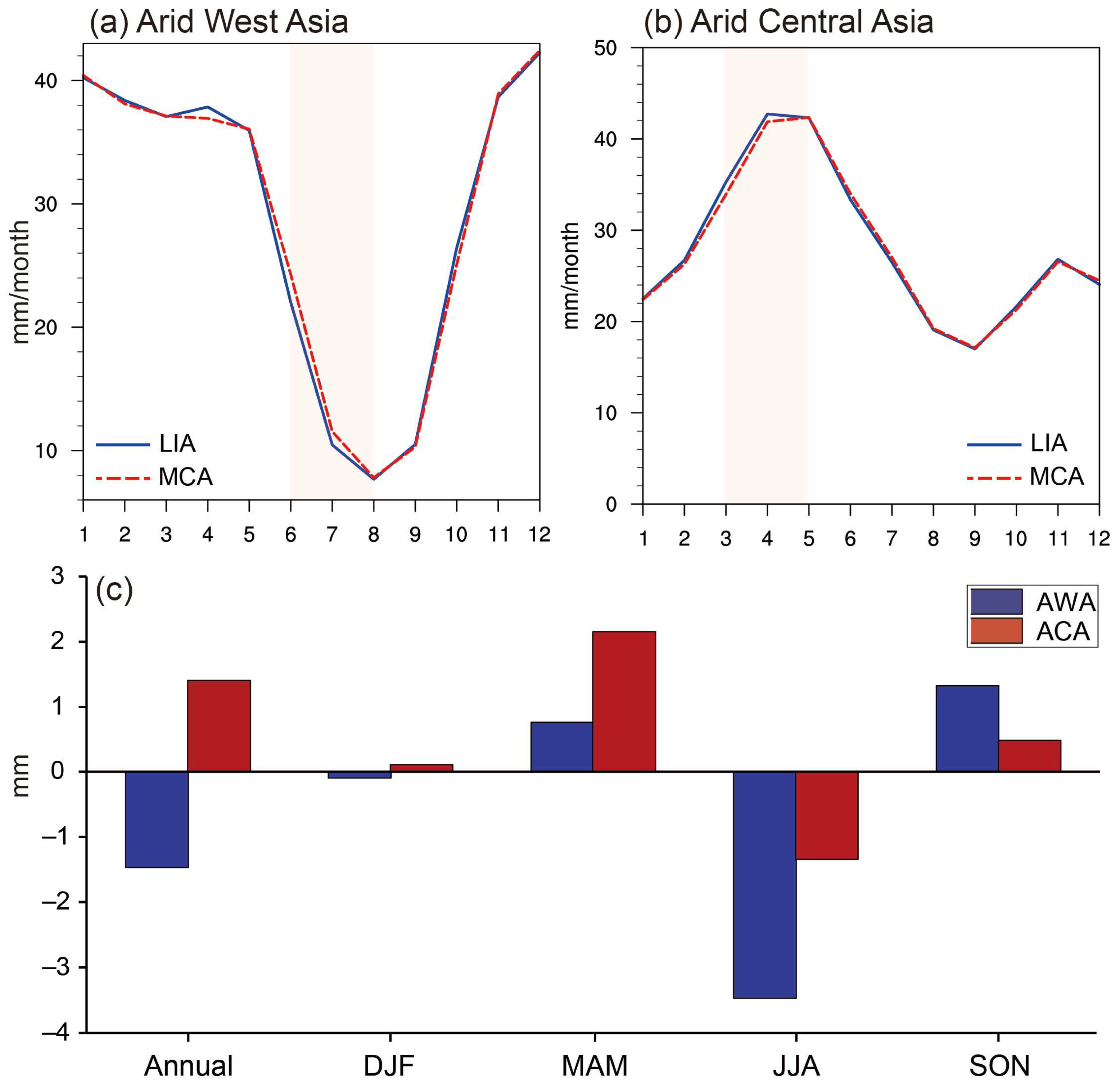
We further evaluated the monthly distribution and seasonal differences in precipitation between the MCA and the LIA in the arid West Asia and Central Asia. Overall, the seasonality of precipitation did not change significantly over the past millennium in both AWA and ACA. West Asia remained dominated by winter and spring precipitation, while Central Asia exhibited relatively uniform precipitation across seasons, with spring being the wettest (Figure 4a,b). From the perspective of the seasonal precipitation change, West Asia experienced a significant reduction in summer precipitation during the LIA, with a decrease of 3.46 mm compared to the MCA (Figure 4c). Slight increases were observed in spring and autumn (0.76 mm and 1.32 mm, respectively), while winter precipitation showed no notable change (Figure 4c). In Central Asia, spring precipitation increased most markedly during the LIA, rising by 2.19 mm compared to the MCA (Figure 4c). The precipitation in summer decreased by 1.34 mm. There is a slight increase (less than 1 mm) in winter and autumn, but it was not significant. It should be noted that due to the spatial heterogeneity of precipitation changes and the use of regional averaging methods, the magnitude of the precipitation change is relatively small, which is understandable. However, this does not affect the direction of the precipitation change. In summary, the most substantial changes in precipitation occurred in summer for West Asia and in spring for Central Asia. Thus, divergent changes in summer and spring precipitation were primarily responsible for the centennial-scale precipitation variability between these two regions.
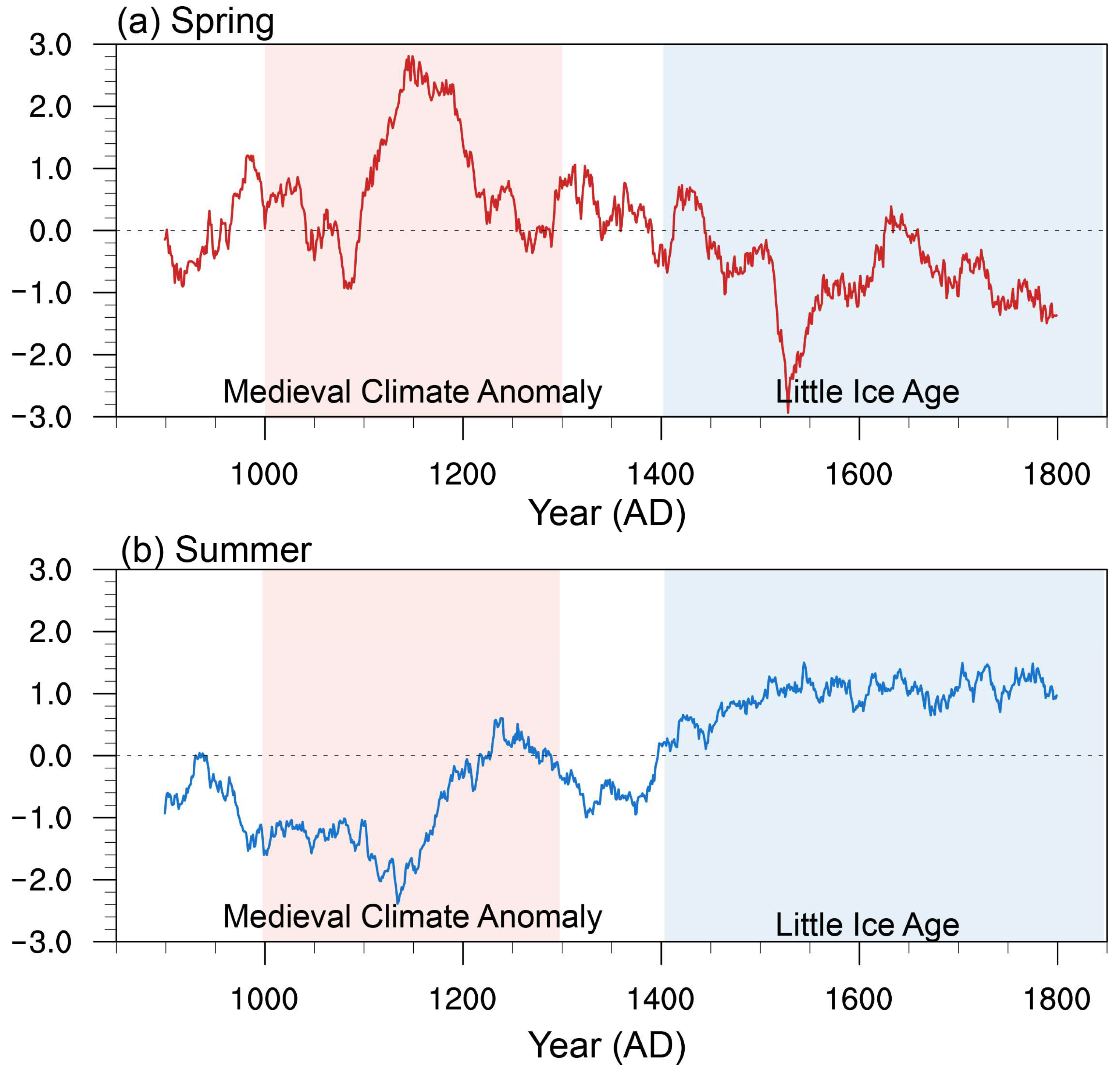
We also analyzed the evolution of spring precipitation in arid Central Asia and summer precipitation in arid West Asia over the past millennium (Figure 5). The results reveal an overall increasing trend in spring precipitation in Central Asia, although a decline occurred around 1700 AD. In general, spring precipitation during the LIA was higher than that during the MCA (Figure 5a). In contrast, summer precipitation in West Asia showed a persistent decreasing trend throughout the past millennium, with lower values during the LIA compared to the MCA (Figure 5b). This finding aligns with the previous conclusion that the difference in summer and spring precipitation is responsible for the divergent centennial-scale patterns in annual precipitation between the AWA and ACA.

3.3. Mechanism of Precipitation Change in ACA During the Past Millennium

As previously mentioned, the differential changes in spring and summer precipitation on centennial-scale shape the divergent annual precipitation patterns between the AWA and ACA. Therefore, we investigate the mechanisms behind spring and summer precipitation changes by examining each season separately.
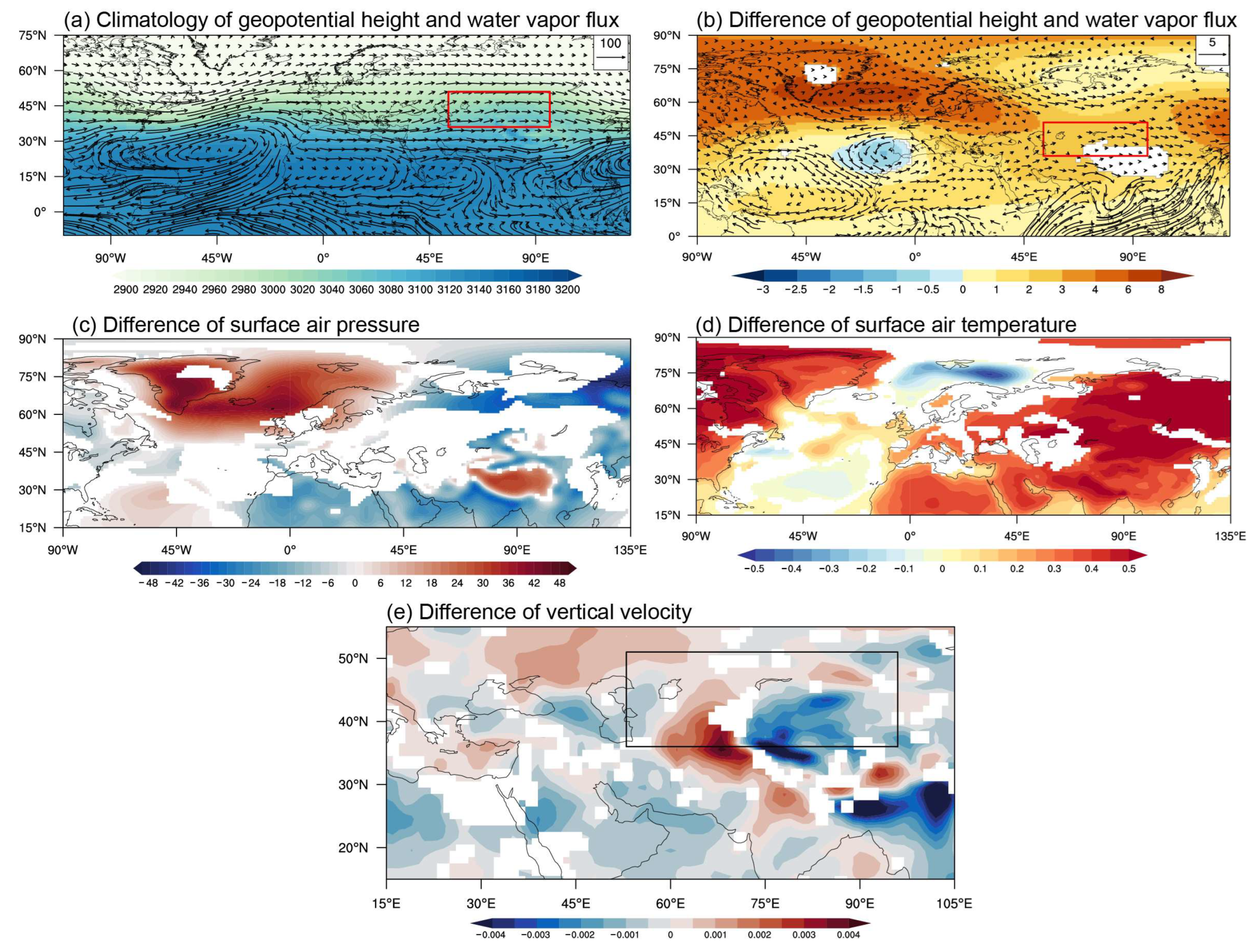
Figure 6a shows the mean integrated moisture transport and geopotential height in spring over the past millennium. The results indicate that both AWA and ACA are controlled by mid-latitude westerlies in spring. By analyzing the differences in atmospheric circulation between the LIA and the MCA, we found that in the spring of the LIA, a low-pressure anomaly appeared over the Azores and a high-pressure anomaly over Iceland, indicating a weakening of both the Azores High and the Iceland Low. This pattern reflects a pronounced negative phase of the North Atlantic Oscillation (NAO) (Figure 6b). Associated with the tendency toward a negative NAO phase, anomalous easterlies occurred over Europe. We also analyzed the changes in surface pressure and found that, similar to the 700 hPa geopotential height, the surface pressure in spring over the Atlantic exhibited a negative NAO phase (Figure 6c), although the scope of the weakened Azores High that passed the significance test was relatively small. The NAO could influence regional moisture budgets by affecting the intensity and path of the westerlies. Therefore, we further evaluated the changes in spring moisture budget over ACA during the MCA and LIA. The results show that the regional moisture budget during LIA springs increased by 0.31 × 10⁶ kg s−1 compared to the MCA (Table 2). This increase was primarily contributed by moisture input in the lower layers (0.69 × 10⁶ kg s−1), while the middle and upper layers made a negative contribution (−0.38 × 10⁶ kg s−1). Specifically, lower-level moisture was mainly input through the northern (0.76 × 10⁶ kg s−1) and western (0.47 × 10⁶ kg s−1) boundaries, and output through the southern (−0.30 × 10⁶ kg s−1) and eastern (−0.24 × 10⁶ kg s−1) boundaries. Figure 6b also shows moisture entering ACA from the western boundaries. The water vapor input from the northern boundary failed the significance test. The moisture from the western boundary was due to the southward shift in the westerly path caused by the negative NAO phase.
The study by Xie et al. [47] indicated that during the negative NAO phases, the weakened Azores High over the mid-latitude Atlantic causes the moisture transport path carried by the mid-latitude westerlies to shift further south compared to climatological conditions or positive NAO phases. This allows the transport of more moisture from upstream water bodies—including the Mediterranean, Black, and Caspian Seas—into arid Central Asia.
In summary, the negative NAO phase during the LIA spring resulted in a southward shift in the westerly path and anomalous northwesterly flows, promoting moisture input into the ACA and creating favorable moisture conditions for precipitation. We also analyzed the spring NAO simulated by the PMIP4 multi-model over the past millennium (Figure 7a). The results show a fluctuating weakening trend in the NAO, generally biased toward a positive phase during the MCA and a negative phase during the LIA. At the same time, the correlation between the spring NAO index and spring precipitation in arid Central Asia reached −0.65, further confirming the close relationship between the NAO and precipitation variability in arid Central Asia. Furthermore, previous studies have also demonstrated that a negative phase of the NAO is associated with increased precipitation in the arid Central Asia [11,48]. This result is also confirmed by modern observational data, which shows a negative correlation between the spring NAO and precipitation changes in the arid Central Asia (Figure S1a). Compared with the positive phase of NAO, there is more precipitation in ACA during the negative phase (Figure S1c).
Furthermore, we analyzed the dynamic conditions in spring. Figure 6e shows the anomaly of vertical velocity at 500 hPa. The results reveal significant anomalous ascending motions over the western Caspian Sea region and Xinjiang, whereas anomalous descending motion is observed in the central part of the ACA. Figure 6c indicates that during LIA springs, the Xinjiang region exhibited low-pressure anomalies. This may be related to the weakening of the Siberian High, which would favor the development of anomalous ascending motions and provide favorable dynamic conditions for precipitation. Consistent with this, surface temperature changes show extensive warming over the Asian continent during LIA springs (Figure 6d). Such large-scale warming would lead to a weakening of the Siberian High, ultimately contributing to anomalous ascending motions. Yang et al. [45] using PMIP3 multi-model results, investigated changes in East Asian winter monsoons and associated atmospheric circulations during the MCA and LIA. They found a weakened Siberian High during the LIA, which is consistent with our results.

3.4. Mechanism of Precipitation Change in WA During the Past Millennium

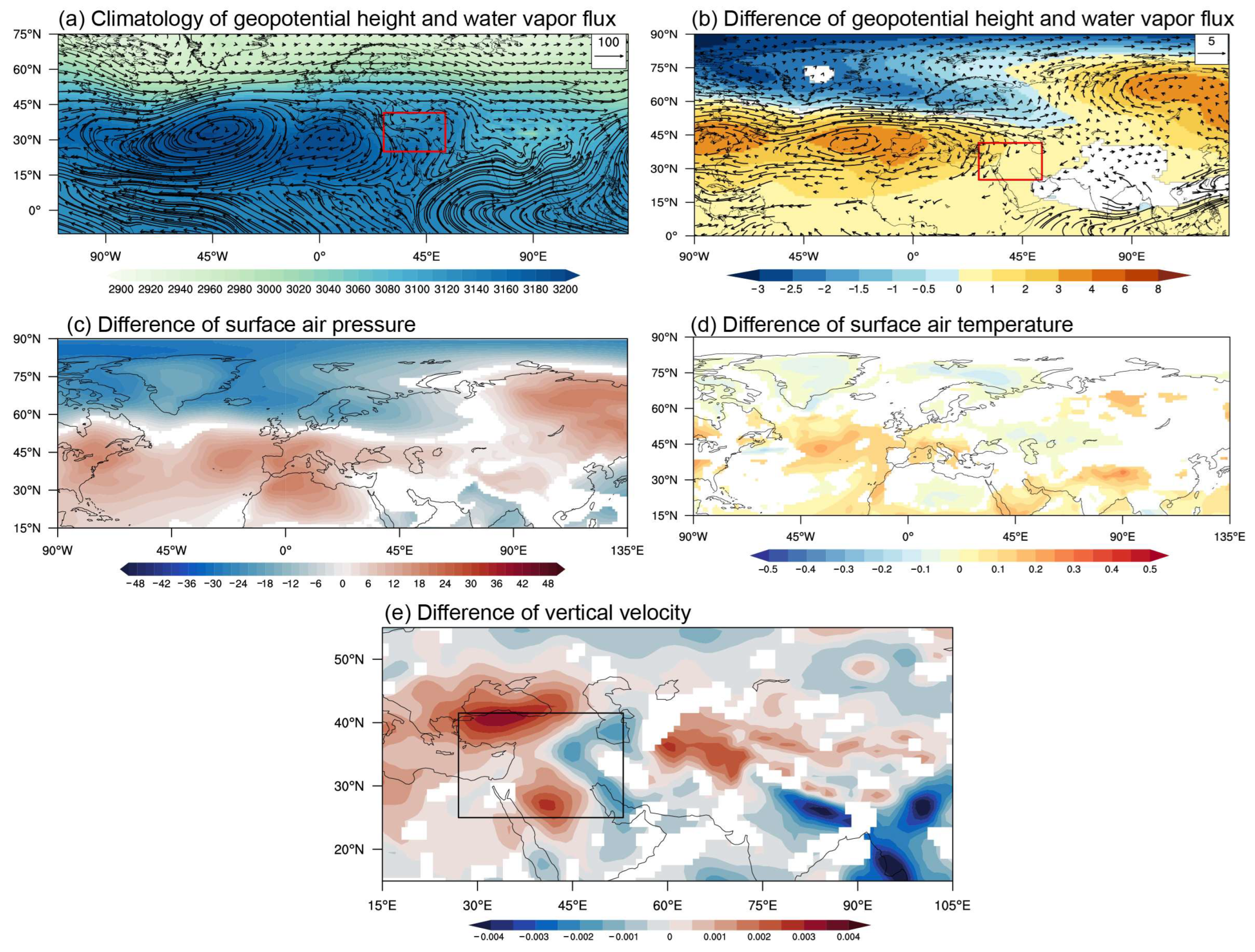
We further analyzed the mechanism behind the reduction in summer precipitation in the AWA. Figure 8b shows that, compared to the MCA, the LIA exhibited a significant high-pressure anomaly over the mid-latitude Atlantic, indicating a strengthened Azores High accompanied by anticyclonic circulation anomalies. In high-latitude regions, a low-pressure anomaly was observed, suggesting an intensified Icelandic Low with cyclonic circulation anomalies. This circulation pattern corresponds to the positive NAO phase, and the surface pressure results also reflect a positive NAO phase (Figure 8c). The summer NAO simulated by the PMIP4 multi-model ensemble over the past millennium further shows that the MCA exhibited a tendency toward a negative phase, while the LIA was characterized by a positive phase (Figure 7b). And the correlation between the summer NAO index and summer precipitation in arid West Asia reached −0.82, also corroborating the above findings. In addition, modern observational data also confirm a negative correlation between the summer NAO and precipitation changes in the arid West Asia (Figure S1b), with a correlation coefficient of −0.30. Compared with the positive phase of NAO, precipitation in the AWA is greater during the negative phase (Figure S1b).
Accompanying the positive NAO phase, westerly anomalies emerged over Europe, indicating a strengthening of mid-latitude westerlies and a northward shift. The strengthening of the Azores High and the northward movement of the mid-latitude westerlies influence moisture transport to the AWA. To explore this further, we analyzed the summer moisture budget in AWA (Table 2). The results reveal that, compared to the MCA, the regional moisture budget decreased by 0.75 × 10⁶ kg s−1 in the LIA, which is unfavorable for precipitation. Specifically, the lower and mid-upper-level moisture budgets were −0.81 × 10⁶ kg s−1 and 0.05 × 10⁶ kg s−1, respectively. This indicates that the reduction in the regional moisture budget during the LIA summer was primarily due to decreased moisture input in the lower levels. The reduction in lower-level moisture transport was mainly caused by increased output at the southern boundary and decreased input at the western boundary. As shown in Figure 8b, during the LIA, a high-pressure anomaly was present over the mid-latitude Atlantic, and the AWA was located to the east of this anomaly. Influenced by northerly anomalies, moisture entered through the northern boundary (1.64 × 10⁶ kg s−1) and exited through the western and southern boundaries of the AWA. Therefore, the reduction in moisture budget in the AWA during the LIA summer can be attributed to the strengthening of the Azores High during the positive NAO phase.
We also analyzed changes in vertical motion over the AWA (Figure 8e). The results indicate that during the LIA summer, anomalous descending motion occurred over the eastern Mediterranean, the Black Sea, and the central Arabian Peninsula, while anomalous ascending motion was observed over the southern Caspian Sea and the Zagros Mountains. Such large-scale descending motion would suppress cloud formation and precipitation. These conditions were primarily induced by the positive NAO phase during the LIA summer, as indicated in both Figure 8b,c. The intensified Azores High is placed on its western flank of the AWA, resulting in anomalous descending motion over the area. Consistently, increased surface temperatures over the Atlantic Ocean and the Mediterranean Sea caused by the strengthened high-pressure system can also be seen in Figure 8d. Compared to the MCA, the more frequent positive NAO phase during the LIA summer enhanced the Azores High. This strengthening promoted moisture outflow through the western and southern boundaries of AWA, thereby reducing the regional moisture budget and inhibiting precipitation. Additionally, the enhanced high-pressure system induced descending motion over the region, which further suppressed precipitation. In conclusion, the reduction in summer precipitation over the AWA during the LIA can be primarily attributed to the positive phase of NAO.

3.5. Mechanism of Opposing Precipitation Trends in ACA and WA

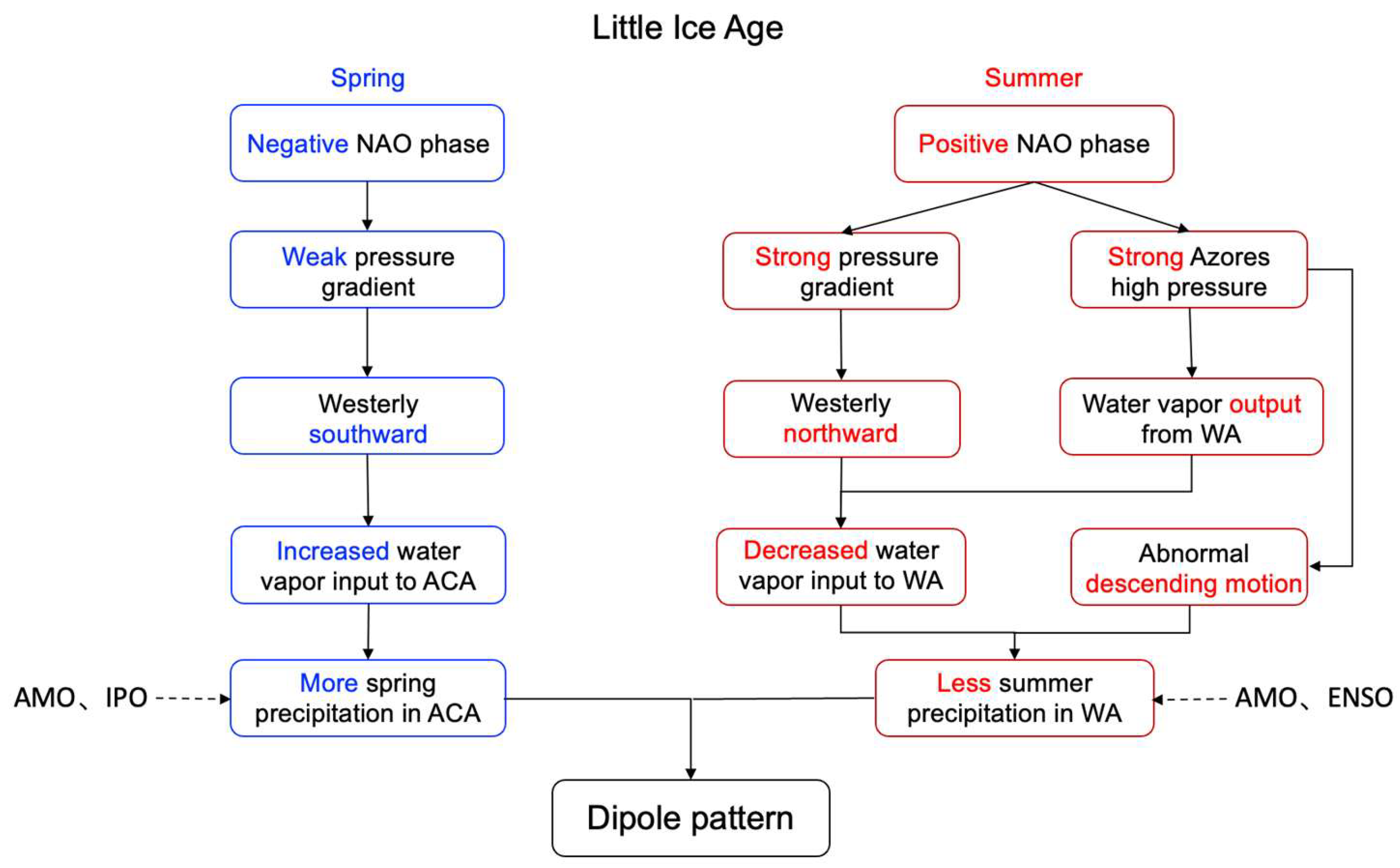
The dipole precipitation pattern between the arid Central Asia and West Asia was primarily driven by contrasting changes in spring and summer precipitation on centennial timescales over the past millennium. During the LIA spring, the NAO tended to exhibit a negative phase. This was characterized by a weakened Azores High and Iceland Low, which reduced the pressure gradient and caused a southward shift in the mid-latitude westerlies. As a result, the westerlies passed over more upstream water bodies, transporting greater moisture into ACA. The combination of abundant moisture and anomalous ascending motion caused by the weakened Siberian High collectively contributed to increased spring precipitation in ACA during the LIA. In contrast, during the LIA summer, the NAO tended to shift toward a positive phase. The enhanced pressure gradient in the mid-latitudes pushed the westerly northward, preventing the moisture from reaching AWA. At the same time, the strengthened Azores High induced strong northerly anomalies along its eastern flank where AWA is located. This circulation promoted moisture outflow from the region, reducing the local moisture budget. Additionally, the intensified high-pressure system enhanced descending motion over AWA, further suppressing precipitation. Thus, the reduction in summer precipitation over AWA during the LIA was largely attributable to the positive NAO phase. However, it should be noted that the relationship established in this paper between the NAO and precipitation changes in the arid Central Asia and West Asia is mainly a linear relationship. This is an idealized conceptual model. In fact, the connection between the actual NAO and precipitation changes involves complex physical processes and is regulated by many other factors, not strictly relying on the linear framework we have established. Therefore, future research should pay more attention to the nonlinear relationship between the NAO and precipitation changes in “Westerly Asia”.
Apart from the influence of the North Atlantic Oscillation (NAO), precipitation variations in “Westerlies Asia” are also affected by other internal variabilities of the Earth system. Research of Jiang et al.(2021) [50] indicate that the warm phase of the AMO can excite mid-latitude circumglobal teleconnection wave trains, leading to increased precipitation in arid central Asia. Meanwhile, the warm phase of the Interdecadal Pacific Oscillation (IPO) induces positive geopotential height anomalies in the Indian Ocean, directing water vapor from the Indian Ocean and the Arabian Sea to the arid Central Asian region and further enhancing precipitation there. We analyzed the variations in the AMO and IPO over the past millennium simulated by the PMIP4 multi-model ensemble mean. The results show that the AMO and IPO were more in the negative phase during the Medieval Climate Anomaly and more in the positive phase during the Little Ice Age (Figure S2a,b). This corresponds to precipitation changes in arid Central Asia. Therefore, centennial-scale precipitation variations in arid Central Asia may be influenced not only by the negative phase of the NAO alone but also by the combined effects of the AMO and IPO. For arid West Asia, the El Niño-Southern Oscillation (ENSO) is considered a major factor influencing precipitation changes in arid West Asia [51,52,53,54,55,56,57,58]. During El Niño events, anticyclonic anomalies typically form over the North Indian Ocean and the Arabian Sea, promoting the northward transport of moisture from these regions along the northwestern flank of the anomalous high-pressure system into the arid West Asia, thereby enhancing precipitation there [51]. Conversely, La Niña events are often associated with severe droughts in arid West Asia. For example, the droughts of 2000/2001 and 2007/2008 have been attributed to the influence of La Niña [59,60]. However, the PMIP4 multi-model ensemble mean simulation results show that ENSO was more in the negative phase during the MAC and more in the positive phase during the LIA (Figure S2c), which does not correspond to the relationship of more precipitation in arid West Asia during the MCA and less precipitation during the LIA. This may be related to the time scale: on the centennial time scale, the influence of the NAO on arid West Asia is relatively dominant, while the influence of ENSO is relatively weak. In addition, the research results of Sheffield and Wood (2008) [61] point out that the positive phase of the AMO is associated with a decrease in soil moisture in arid West Asia, while the negative phase of the AMO is associated with an increase in soil moisture, implying that the AMO may also have a certain impact on precipitation changes in arid West Asia on the centennial time scale. Therefore, the dipole pattern of centennial-scale precipitation changes in arid Central Asia and arid West Asia is dominated by the NAO, and may also be regulated by other factors such as the AMO, IPO, and ENSO. The mechanism underlying the dipole precipitation pattern on centennial-scale over the past millennium in “Westerlies Asia” is summarized in Figure 9. In summary, the dipole precipitation pattern between the ACA and AWA on centennial timescales was mainly influenced by internal Earth system variability, particularly closely related to the seasonal reversal of the NAO. It was also regulated by the AMO, the IPO, and the ENSO.
This study primarily examines the dipole pattern and physical mechanisms of centennial-scale precipitation variations in “Westerlies Asia” over the past millennium, based on the PMIP4 past1000 simulations. However, this research has certain limitations. For example, it relies solely on PMIP4 multi-model simulations and does not incorporate comparisons with paleoclimate proxy records for “Westerlies Asia” over the past millennium, thus lacking support from paleoclimate reconstructions. At the same time, regarding the physical mechanisms, the study mainly focuses on the influence of internal variability within the Earth system and does not consider external forcings such as volcanic eruptions, greenhouse gases, and aerosols. Furthermore, although multi-model ensemble averaging can effectively reduce uncertainties in the results, the differences between models cannot be ignored. How to effectively constrain the uncertainty of simulation results will be one of the directions for future research. These aspects warrant further investigation in the future.
Previous studies have shown that a dipole pattern of precipitation variation between arid central Asia and arid West Asia exists on both Holocene millennial scales and modern decadal scales. The past millennium serves as a crucial period bridging geological records and instrumental observational data, providing essential historical context for an in-depth understanding of contemporary and future climate change backgrounds. By revealing the dipole characteristics and physical mechanisms of centennial-scale precipitation changes in “Westerlies Asia” over the past millennium based on PMIP4 multi-model simulations, the findings of this study further refine the “westerlies-dominated climatic regime” theory of climate change but also establish a scientific basis for projecting future regional hydroclimate changes. These findings offer insights crucial for adaptive water resource management and for improving the accuracy of climate projections under ongoing global warming.

4. Conclusions

This study reveals the centennial-scale dipole precipitation pattern over the past millennium in “Westerlies Asia” and its underlying physical mechanisms based on the PMIP4 past1000 experiments. The main conclusions are as follows:
(1)
The PMIP4 multi-model simulations indicate a dipole precipitation pattern between arid Central Asia and West Asia on the centennial scale. During the LIA, precipitation increased in ACA but decreased in AWA, while this pattern was reversed during the MCA.
(2)
The opposite variations in annual precipitation are controlled by seasonal differences. During the LIA, spring precipitation increased in arid Central Asia, while summer precipitation decreased in West Asia. The increase in spring precipitation and decrease in summer precipitation collectively shaped the dipole pattern of annual precipitation change during the LIA, with the opposite occurring during the MCA.
(3)
In the springs of the LIA, the NAO tended to be in a negative phase, which caused a southward shift in the mid-latitude westerly moisture transport path. This allowed the westerlies to transport more upstream water bodies, delivering more moisture to arid Central Asia. The favorable moisture conditions, combined with ascending motion induced by a weakened Siberian High, jointly contributed to increased spring precipitation in ACA. In the summer of the LIA, the NAO tended to shift toward a positive phase. The northward displacement of the mid-latitude westerly prevented sufficient moisture from reaching arid West Asia. Meanwhile, the strengthened Azores High promoted moisture outflow from AWA, leading to a reduced regional moisture budget. In addition, the enhanced high-pressure system induced anomalous descending motion, further suppressing precipitation. Ultimately, these processes resulted in decreased summer precipitation in AWA during the LIA.

Supplementary Materials

The following supporting information can be downloaded at: https://www.mdpi.com/article/10.3390/atmos16121315/s1, Figure S1. (a) Variations and correlation of standardized area-averaged spring precipitation in the arid central Asia and spring NAO index; (b) Variations and correlation of standardized area-averaged summer precipitation in the arid West Asia and summer NAO index; (c) Difference of spring precipitation over the arid central Asia between the negative NAO phase and positive NAO phase (NAO-negative minus NAO-positive); (d) Difference of summer precipitation over the arid West Asia between the negative NAO phase and positive NAO phase (NAO-negative minus NAO-positive). The dots indicate passing the significance test at the 95% level. Precipitation data are derived from GPCC V2022, and the NAO index is calculated based on the surface pressure data provided by ERA5. Figure S2. (a) AMO, (b) IPO, and (c) ENSO variations simulated by the PMIP4 multi-model ensemble mean over the past millennium. The results are subjected to 99-year moving average and standardization, representing centennial-scale signals. The AMO is calculated based on the detrended sea surface temperature (SST) in the North Atlantic (0–70°N, 280–360°E). The IPO index is derived from the difference between the detrended sea surface temperature anomalies (SSTAs) in the equatorial central Pacific (10°S–10°N, 170°E–90°W) and those in the northwest Pacific (25°N–45°N, 140°E–145°W) and southwest Pacific (50°S–15°S, 150°E–160°W). The ENSO is calculated based on the detrended SST in the equatorial central-eastern Pacific (-5–5°N, 170–240°E).

Author Contributions

Conceptualization, S.M. and Y.L.; methodology, S.M. and Y.L.; software, S.M.; validation, X.L. and G.D.; writing—original draft preparation, S.M.; writing—review and editing, S.M., Y.L., G.D., X.L.; supervision, Y.L. and G.D.; project administration, G.D. and S.M.; funding acquisition, G.D. and S.M. All authors have read and agreed to the published version of the manuscript.

Funding

This study was supported by the China Postdoctoral Science Foundation (Grant No. 2024M751253) and the Fundamental Research Funds for the Central Universities (Grant No. lzujbky-2023-it21).

Institutional Review Board Statement

Not applicable.

Informed Consent Statement

Not applicable.

Data Availability Statement

The CMIP6/PMIP4 model data can be downloaded at https://esgf-node.llnl.gov/projects/esgf-llnl/, accessed on 19 November 2025. The ERA5 dataset can be found at https://cds.climate.copernicus.eu/datasets/reanalysis-era5-single-levels-monthly-means?tab=overview, accessed on 19 November 2025. The Climatic Research Unit dataset version 4.07 was obtained from https://crudata.uea.ac.uk/cru/data/hrg/, accessed on 19 November 2025.

Acknowledgments

We thank the World Climate Research Program’s (WCRP) Working Group on Coupled Modeling Intercomparison Project (CMIP) and the Paleoclimate Modeling Intercomparison Project (PMIP) for providing model output.

Conflicts of Interest

The authors declare no conflicts of interest.

Abbreviations

The following abbreviations are used in this manuscript:
ACAArid Central Asia
AWAArid West Asia
LIALittle Ice Age
MCAMedieval Climate Anomaly
NAONorth Atlantic Oscillation

References

  1. Chen, F.; Yu, Z.; Yang, M.; Ito, E.; Wang, S.; Madsen, D.B.; Huang, X.; Zhao, Y.; Sato, T.; Birks, H.J.B.; et al. Holocene Moisture Evolution in Arid Central Asia and Its Out-of-Phase Relationship with Asian Monsoon History. Quat. Sci. Rev. 2008, 27, 351–364. [Google Scholar] [CrossRef]
  2. Chen, F.; Chen, J.; Huang, W.; Chen, S.; Huang, X.; Jin, L.; Jia, J.; Zhang, X.; An, C.; Zhang, J.; et al. Westerlies Asia and Monsoonal Asia: Spatiotemporal Differences in Climate Change and Possible Mechanisms on Decadal to Sub-Orbital Timescales. Earth-Sci. Rev. 2019, 192, 337–354. [Google Scholar] [CrossRef]
  3. An, C.; Wang, W.; Duan, F.; Huang, W.; Chen, F. Environmental Changes and Cultural Exchange between East and West along the Silk Road in Arid Central Asia. Acta Geogr. Sin 2017, 72, 875–891. [Google Scholar]
  4. Ma, S.; Chen, S.; Chen, J.; Chen, J.; Cao, D.; Xoplaki, E.; Luterbacher, J.; Chen, F.; Huang, W. The Holocene Precipitation Dipole Pattern in the Asian Drylands: Mechanisms and Processes from PMIP4 Simulations and Paleo-Proxy Evidence. Quat. Sci. Rev. 2025, 347, 109091. [Google Scholar] [CrossRef]
  5. Pal, J.S.; Eltahir, E.A. Future Temperature in Southwest Asia Projected to Exceed a Threshold for Human Adaptability. Nat. Clim. Change 2016, 6, 197–200. [Google Scholar] [CrossRef]
  6. Zittis, G.; Almazroui, M.; Alpert, P.; Ciais, P.; Cramer, W.; Dahdal, Y.; Fnais, M.; Francis, D.; Hadjinicolaou, P.; Howari, F.; et al. Climate Change and Weather Extremes in the Eastern Mediterranean and Middle East. Rev. Geophys. 2022, 60, e2021RG000762. [Google Scholar] [CrossRef]
  7. Oweis, T.; Hachum, A. Water Harvesting and Supplemental Irrigation for Improved Water Productivity of Dry Farming Systems in West Asia and North Africa. Agric. Water Manag. 2006, 80, 57–73. [Google Scholar] [CrossRef]
  8. Thomas, R. Opportunities to Reduce the Vulnerability of Dryland Farmers in Central and West Asia and North Africa to Climate Change. Agric. Ecosyst. Environ. 2008, 126, 36–45. [Google Scholar] [CrossRef]
  9. Chen, F.; An, C.; Dong, G.; Zhang, D. Human Activities, Environmental Changes, and Rise and Decline of Silk Road Civilization in Pan-Third Pole Region. Bull. Chin. Acad. Sci. 2017, 32, 967–975. [Google Scholar]
  10. Agrawala, S.; Barlow, M.; Cullen, H.; Lyon, B. The Drought and Humanitarian Crisis in Central and Southwest Asia: A Climate Perspective; International Research Institute for Climate Prediction: New York, NY, USA, 2001. [Google Scholar]
  11. Chen, S.; Chen, J.; Lv, F.; Liu, X.; Huang, W.; Wang, T.; Liu, J.; Hou, J.; Chen, F. Holocene Moisture Variations in Arid Central Asia: Reassessment and Reconciliation. Quat. Sci. Rev. 2022, 297, 107821. [Google Scholar] [CrossRef]
  12. Chen, S.; Liu, J.; Wang, X.; Zhao, S.; Chen, J.; Qiang, M.; Liu, B.; Xu, Q.; Xia, D.; Chen, F. Holocene Dust Storm Variations over Northern China: Transition from a Natural Forcing to an Anthropogenic Forcing. Sci. Bull. 2021, 66, 2516–2527. [Google Scholar] [CrossRef] [PubMed]
  13. Chen, S.; Chen, J.; Ding, G.; Ma, S.; Ji, P.; Zhou, A.; Wu, D.; Khormali, F.; Hou, J.; Chen, F. Dipole Pattern of Holocene Hydroclimate Variations across the Asian Drylands: Critical Evidence from West Asia. J. Geophys. Res. Atmos. 2024, 129, e2023JD039413. [Google Scholar] [CrossRef]
  14. Ding, G.; Chen, S.; Sun, Y.; Ma, S.; Chen, J. Holocene Hydroclimatic Variations in the Asian Drylands: Current Understanding and Future Perspectives. J. Earth Sci. 2024, 35, 292–295. [Google Scholar] [CrossRef]
  15. Wang, W.; Feng, Z. Holocene Moisture Evolution across the Mongolian Plateau and Its Surrounding Areas: A Synthesis of Climatic Records. Earth-Sci. Rev. 2013, 122, 38–57. [Google Scholar] [CrossRef]
  16. Chen, F.; Jia, J.; Chen, J.; Li, G.; Zhang, X.; Xie, H.; Xia, D.; Huang, W.; An, C. A Persistent Holocene Wetting Trend in Arid Central Asia, with Wettest Conditions in the Late Holocene, Revealed by Multi-Proxy Analyses of Loess-Paleosol Sequences in Xinjiang, China. Quat. Sci. Rev. 2016, 146, 134–146. [Google Scholar] [CrossRef]
  17. Wang, Q.; Wei, H.; Khormali, F.; Wang, L.; Yan, H.; Xie, H.; Wang, X.; Huang, W.; Chen, J.; Chen, F. Holocene Moisture Variations in Western Arid Central Asia Inferred from Loess Records from NE Iran. Geochem. Geophys. Geosystems 2020, 21, e2019GC008616. [Google Scholar] [CrossRef]
  18. Cheng, H.; Sinha, A.; Verheyden, S.; Nader, F.H.; Li, X.L.; Zhang, P.Z.; Yin, J.J.; Yi, L.; Peng, Y.B.; Rao, Z.G.; et al. The Climate Variability in Northern Levant over the Past 20,000 Years. Geophys. Res. Lett. 2015, 42, 8641–8650. [Google Scholar] [CrossRef]
  19. Chen, F.; Huang, W.; Jin, L.; Chen, J.; Wang, J. Spatiotemporal Precipitation Variations in the Arid Central Asia in the Context of Global Warming. Sci. China Earth Sci. 2011, 54, 1812–1821. [Google Scholar] [CrossRef]
  20. Chen, F.; Xie, T.; Yang, Y.; Chen, S.; Chen, F.; Huang, W.; Chen, J. Discussion of the “Warming and Wetting” Trend and Its Future Variation in the Drylands of Northwest China under Global Warming. Sci. China Earth Sci. 2023, 66, 1241–1257. [Google Scholar] [CrossRef]
  21. Rahimi, J.; Malekian, A.; Khalili, A. Climate Change Impacts in Iran: Assessing Our Current Knowledge. Theor. Appl. Climatol. 2019, 135, 545–564. [Google Scholar] [CrossRef]
  22. Some’e, B.S.; Ezani, A.; Tabari, H. Spatiotemporal Trends and Change Point of Precipitation in Iran. Atmos. Res. 2012, 113, 1–12. [Google Scholar]
  23. Ma, S.; Wang, T.; Xie, T.; Gao, L.; Wei, B.; Chen, J.; Chen, F.; Huang, W. Interdecadal Pacific Variability Dominated the Decadal Variation of Cold Season Precipitation in Arid West Asia. Atmos. Res. 2023, 288, 106730. [Google Scholar] [CrossRef]
  24. Past Interglacials Working Group of PAGES. Interglacials of the Last 800,000 Years. Rev. Geophys. 2016, 54, 162–219. [Google Scholar] [CrossRef]
  25. Chen, J.; Chen, F.; Feng, S.; Huang, W.; Liu, J.; Zhou, A. Hydroclimatic Changes in China and Surroundings during the Medieval Climate Anomaly and Little Ice Age: Spatial Patterns and Possible Mechanisms. Quat. Sci. Rev. 2015, 107, 98–111. [Google Scholar] [CrossRef]
  26. Karpychev, Y.A. Variations in the Caspian Sea Level in the Historic Epoch. Water Resour. 2001, 28, 1–14. [Google Scholar] [CrossRef]
  27. Kroonenberg, S.; Abdurakhmanov, G.; Badyukova, E.V.; Van der Borg, K.; Kalashnikov, A.; Kasimov, N.; Rychagov, G.; Svitoch, A.; Vonhof, H.; Wesselingh, F. Solar-Forced 2600 BP and Little Ice Age Highstands of the Caspian Sea. Quat. Int. 2007, 173, 137–143. [Google Scholar] [CrossRef]
  28. Talebi, T.; Ramezani, E.; Djamali, M.; Lahijani, H.A.K.; Naqinezhad, A.; Alizadeh, K.; Andrieu-Ponel, V. The Late-Holocene Climate Change, Vegetation Dynamics, Lake-Level Changes and Anthropogenic Impacts in the Lake Urmia Region, NW Iran. Quat. Int. 2016, 408, 40–51. [Google Scholar] [CrossRef]
  29. Sharifi, A.; Pourmand, A.; Canuel, E.A.; Ferer-Tyler, E.; Peterson, L.C.; Aichner, B.; Feakins, S.J.; Daryaee, T.; Djamali, M.; Beni, A.N. Abrupt Climate Variability since the Last Deglaciation Based on a High-Resolution, Multi-Proxy Peat Record from NW Iran: The Hand That Rocked the Cradle of Civilization? Quat. Sci. Rev. 2015, 123, 215–230. [Google Scholar] [CrossRef]
  30. Andrews, J.E.; Carolin, S.A.; Peckover, E.N.; Marca, A.; Al-Omari, S.; Rowe, P.J. Holocene Stable Isotope Record of Insolation and Rapid Climate Change in a Stalagmite from the Zagros of Iran. Quat. Sci. Rev. 2020, 241, 106433. [Google Scholar] [CrossRef]
  31. Wick, L.; Lemcke, G.; Sturm, M. Evidence of Lateglacial and Holocene Climatic Change and Human Impact in Eastern Anatolia: High-Resolution Pollen, Charcoal, Isotopic and Geochemical Records from the Laminated Sediments of Lake Van, Turkey. Holocene 2003, 13, 665–675. [Google Scholar] [CrossRef]
  32. Jones, M.D.; Roberts, C.N.; Leng, M.J.; Türkeş, M. A High-Resolution Late Holocene Lake Isotope Record from Turkey and Links to North Atlantic and Monsoon Climate. Geology 2006, 34, 361–364. [Google Scholar] [CrossRef]
  33. Jungclaus, J.H.; Bard, E.; Baroni, M.; Braconnot, P.; Cao, J.; Chini, L.P.; Egorova, T.; Evans, M.; González-Rouco, J.F.; Goosse, H.; et al. The PMIP4 Contribution to CMIP6–Part 3: The Last Millennium, Scientific Objective, and Experimental Design for the PMIP4 Past1000 Simulations. Geosci. Model Dev. 2017, 10, 4005–4033. [Google Scholar] [CrossRef]
  34. Zheng, W.; Yu, Y.; Luan, Y.; Zhao, S.; He, B.; Dong, L.; Song, M.; Lin, P.; Liu, H. CAS-FGOALS Datasets for the Two Interglacial Epochs of the Holocene and the Last Interglacial in PMIP4. Adv. Atmos. Sci. 2020, 37, 1034–1044. [Google Scholar] [CrossRef]
  35. Eyring, V.; Bony, S.; Meehl, G.A.; Senior, C.A.; Stevens, B.; Stouffer, R.J.; Taylor, K.E. Overview of the Coupled Model Intercomparison Project Phase 6 (CMIP6) Experimental Design and Organization. Geosci. Model Dev. 2016, 9, 1937–1958. [Google Scholar] [CrossRef]
  36. Ziehn, T.; Lenton, A.; Law, R.M.; Matear, R.J.; Chamberlain, M.A. The Carbon Cycle in the Australian Community Climate and Earth System Simulator (ACCESS-ESM1)–Part 2: Historical Simulations. Geosci. Model Dev. 2017, 10, 2591–2614. [Google Scholar] [CrossRef]
  37. Volodin, E.M.; Mortikov, E.V.; Kostrykin, S.V.; Galin, V.Y.; Lykossov, V.N.; Gritsun, A.S.; Diansky, N.A.; Gusev, A.V.; Iakovlev, N.G.; Shestakova, A.A. Simulation of the Modern Climate Using the INM-CM48 Climate Model. Russ. J. Numer. Anal. Math. Model. 2018, 33, 367–374. [Google Scholar] [CrossRef]
  38. Ohgaito, R.; Yamamoto, A.; Hajima, T.; O’ishi, R.; Abe, M.; Tatebe, H.; Abe-Ouchi, A.; Kawamiya, M. PMIP4 Experiments Using MIROC-ES2L Earth System Model. Geosci. Model Dev. Discuss. 2020, 2020, 1195–1217. [Google Scholar] [CrossRef]
  39. Mauritsen, T.; Bader, J.; Becker, T.; Behrens, J.; Bittner, M.; Brokopf, R.; Brovkin, V.; Claussen, M.; Crueger, T.; Esch, M.; et al. Developments in the MPI-M Earth System Model Version 1.2 (MPI-ESM1. 2) and Its Response to Increasing CO2. J. Adv. Model. Earth Syst. 2019, 11, 998–1038. [Google Scholar] [CrossRef]
  40. Yukimoto, S.; Kawai, H.; Koshiro, T.; Oshima, N.; Yoshida, K.; Urakawa, S.; Tsujino, H.; Deushi, M.; Tanaka, T.; Hosaka, M. The Meteorological Research Institute Earth System Model Version 2.0, MRI-ESM2.0: Description and Basic Evaluation of the Physical Component. J. Meteorol. Soc. Jpn. Ser. II 2019, 97, 931–965. [Google Scholar] [CrossRef]
  41. Harris, I.; Osborn, T.J.; Jones, P.; Lister, D. Version 4 of the CRU TS Monthly High-Resolution Gridded Multivariate Climate Dataset. Sci. Data 2020, 7, 109. [Google Scholar] [CrossRef]
  42. Hersbach, H.; Bell, B.; Berrisford, P.; Hirahara, S.; Horányi, A.; Muñoz-Sabater, J.; Nicolas, J.; Peubey, C.; Radu, R.; Schepers, D. The ERA5 Global Reanalysis. Q. J. R. Meteorol. Soc. 2020, 146, 1999–2049. [Google Scholar] [CrossRef]
  43. Taylor, K.E. Summarizing Multiple Aspects of Model Performance in a Single Diagram. J. Geophys. Res. Atmos. 2001, 106, 7183–7192. [Google Scholar] [CrossRef]
  44. Yang, K.; Hua, W.; Luo, F.; Ming, J.; Hu, Q.; Wu, X.; Fan, G. The Asian–Pacific Oscillation over the Past Millennium in PMIP3 and PMIP4. Quat. Sci. Rev. 2023, 301, 107918. [Google Scholar] [CrossRef]
  45. Yang, K.; Hua, W.; Hu, Q. A Multi-Model Analysis of the East Asian Monsoon Changes in the Medieval Climate Anomaly and Little Ice Age. Int. J. Climatol. 2020, 40, 5084–5097. [Google Scholar] [CrossRef]
  46. Ge, Y.; Miao, J.; Lang, X.; Si, D.; Jiang, D. Combined Impacts of the Pacific Decadal Oscillation and Atlantic Multidecadal Oscillation on Summer Precipitation in Eastern China During the Medieval Climate Anomaly and Little Ice Age. J. Geophys. Res. Atmos. 2023, 128, e2023JD038920. [Google Scholar] [CrossRef]
  47. Xie, T.; Huang, W.; Feng, S.; Wang, T.; Liu, Y.; Chen, J.; Chen, F. Mechanism of Winter Precipitation Variations in the Southern Arid Central Asia. Int. J. Climatol. 2022, 42, 4477–4490. [Google Scholar] [CrossRef]
  48. Liu, X.; Chen, J.; Chen, S.; Wang, H.; Huang, W.; Feng, S.; Chen, F. Abrupt Climate Change in Arid Central Asia during the Holocene: A Review. Earth-Sci. Rev. 2023, 242, 104450. [Google Scholar] [CrossRef]
  49. Hurrell, J.W.; Kushnir, Y.; Ottersen, G.; Visbeck, M. An Overview of the North Atlantic Oscillation. Geophys. Monogr.-Am. Geophys. Union 2003, 134, 1–36. [Google Scholar]
  50. Jiang, J.; Zhou, T.; Chen, X.; Wu, B. Central Asian Precipitation Shaped by the Tropical Pacific Decadal Variability and the Atlantic Multidecadal Variability. J. Clim. 2021, 34, 7541–7553. [Google Scholar] [CrossRef]
  51. Mariotti, A. How ENSO Impacts Precipitation in Southwest Central Asia. Geophys. Res. Lett. 2007, 34, L16706. [Google Scholar] [CrossRef]
  52. Hoell, A.; Funk, C.; Barlow, M. The Regional Forcing of Northern Hemisphere Drought during Recent Warm Tropical West Pacific Ocean La Niña Events. Clim. Dyn. 2014, 42, 3289–3311. [Google Scholar] [CrossRef]
  53. Hoell, A.; Funk, C.; Barlow, M.; Cannon, F. A Physical Model for Extreme Drought over Southwest Asia. Clim. Extrem. Patterns Mech. 2017, 283–298. [Google Scholar] [CrossRef]
  54. Hoell, A.; Barlow, M.; Xu, T.; Zhang, T. Cold Season Southwest Asia Precipitation Sensitivity to El Niño–Southern Oscillation Events. J. Clim. 2018, 31, 4463–4482. [Google Scholar] [CrossRef]
  55. Rana, S.; McGregor, J.; Renwick, J. Wintertime Precipitation Climatology and ENSO Sensitivity over Central Southwest Asia. Int. J. Climatol. 2017, 37, 1494–1509. [Google Scholar] [CrossRef]
  56. Rana, S.; McGregor, J.; Renwick, J. Dominant Modes of Winter Precipitation Variability over Central Southwest Asia and Inter-Decadal Change in the ENSO Teleconnection. Clim. Dyn. 2019, 53, 5689–5707. [Google Scholar] [CrossRef]
  57. Rana, S.; Renwick, J.; McGregor, J.; Singh, A. Seasonal Prediction of Winter Precipitation Anomalies over Central Southwest Asia: A Canonical Correlation Analysis Approach. J. Clim. 2018, 31, 727–741. [Google Scholar] [CrossRef]
  58. Alizadeh, O.; Babaei, M. Seasonally Dependent Precipitation Changes and Their Driving Mechanisms in Southwest Asia. Clim. Change 2022, 171, 20. [Google Scholar] [CrossRef]
  59. Barlow, M.; Cullen, H.; Lyon, B. Drought in Central and Southwest Asia: La Niña, the Warm Pool, and Indian Ocean Precipitation. J. Clim. 2002, 15, 697–700. [Google Scholar] [CrossRef]
  60. Barlow, M.; Zaitchik, B.; Paz, S.; Black, E.; Evans, J.; Hoell, A. A Review of Drought in the Middle East and Southwest Asia. J. Clim. 2016, 29, 8547–8574. [Google Scholar] [CrossRef]
  61. Sheffield, J.; Wood, E.F. Global Trends and Variability in Soil Moisture and Drought Characteristics, 1950–2000, from Observation-Driven Simulations of the Terrestrial Hydrologic Cycle. J. Clim. 2008, 21, 432–458. [Google Scholar] [CrossRef]
Figure 1. (a) Taylor diagram showing the statistics of climatological annual precipitation (blue), surface air temperature (red) and surface pressure (green) over the study area between the PMIP4 multi-model ensemble average simulations for the past millennium and observations. The radial distance from the origin represents the standard deviation. The azimuthal position of the model indicates the spatial correlation coefficient. Spatial distribution of annual mean precipitation (b,c) (units: mm/month), surface air temperature (d,e) and surface pressure (f,g). (b,d) Precipitation and temperature data from CRU 1981–2010 [41]. Surface pressure data in (f) are from ERA5. Results in (c,e,g) are from the PMIP4 multi-model ensemble average simulations for the past millennium.
Atmosphere 16 01315 g001
Figure 2. Spatial distribution of annual precipitation differences (LIA minus MCA) simulated by individual PMIP4 models (ae) and the multi-model ensemble mean (MME, (f)). For the MME, the shading indicates that at least half of the models agreed on the sign of the MME. The left box is arid West Asia, and the right box is arid Central Asia. The division of arid central Asia and arid West Asia follows the boundaries defined by Chen et al. (2024) [13] and Ma et al. (2025) [4].
Atmosphere 16 01315 g002
Figure 3. Annual precipitation changes in the (a) arid Central Asian (ACA, 36–51° N, 53–96° E) and (b) West Asia (AWA, 20–41.5° N, 27–53° E) simulated by PMIP4 multi-model ensemble mean (data smoothed using a 99-year moving average and standardized).
Atmosphere 16 01315 g003
Figure 4. Monthly precipitation distribution (a,b) and seasonal precipitation differences (c) between the Little Ice Age (LIA) and the Medieval Climate Anomaly (MCA) in the arid West Asia (AWA) and arid Central Asian (ACA) simulated by PMIP4 multi-model ensemble mean (LIA minus MCA).
Atmosphere 16 01315 g004
Figure 5. (a) Spring precipitation changes in the arid Central Asian (36–51° N, 53–96° E) and (b) summer precipitation changes in the arid West Asia (20–41.5° N, 27–53° E) over the past millennium simulated by the PMIP4 multi-model ensemble mean (data smoothed using a 99-year moving average and standardized).
Atmosphere 16 01315 g005
Figure 6. PMIP4 multi-model ensemble mean simulation of the past millennium spring: (a) Climatological 700 hPa geopotential height (shading, units: m) and vertically integrated water vapor flux (vectors, unit: kg m−1 s−1); (b) Differences in 700 hPa geopotential height (shading, unit: m) and vertical integrated water vapor flux (vectors, unit: kg m−1 s−1) between the Little Ice Age and the Medieval Climate Anomaly (LIA minus MCA); (c) Difference in surface pressure (unit: hPa) between LIA and MCA; (d) Difference in surface temperature between LIA and MCA; (e) Difference in 500 hPa vertical velocity between LIA and MCA. The shading (plotted vectors) indicates where at least half of the models agreed on the sign of the multi-model mean (for zonal or meridional fluxes).
Atmosphere 16 01315 g006
Figure 7. Changes in the NAO index for (a) spring and (b) summer over the past millennium simulated by the PMIP4 multi-model ensemble mean (data smoothed using a 99-year moving average and standardized). By using the method proposed by Hurrell et al. [49], the NAO index is defined as the time series of the leading Empirical Orthogonal Function (EOF) of sea-level pressure anomalies over the Atlantic sector (20–80° N, 90° W–40° E).
Atmosphere 16 01315 g007
Figure 8. PMIP4 multi-model ensemble mean simulation of the past millennium summer: (a) Climatological 700 hPa geopotential height (shading, units: m) and vertically integrated water vapor flux (vectors, unit: kg m−1 s−1); (b) Differences in 700 hPa geopotential height (shading, unit: m) and vertical integrated water vapor flux (vectors, unit: kg m−1 s−1) between the Little Ice Age and the Medieval Climate Anomaly (LIA minus MCA); (c) Difference in surface pressure (unit: hPa) between LIA and MCA; (d) Difference in surface temperature between LIA and MCA; (e) Difference in 500 hPa vertical velocity between LIA and MCA. The shading (plotted vectors) indicates where at least half of the models agreed on the sign of the multi-model mean (for zonal or meridional fluxes).
Atmosphere 16 01315 g008
Figure 9. Schematic diagram illustrating the mechanism of dipole precipitation pattern between the arid Central Asian and the arid West Asia during the Little Ice Age (LIA).
Atmosphere 16 01315 g009
Table 1. Model information of the past1000 simulation experiments under the PMIP4 framework used in this study.
NumberModel NameAtmospheric ResolutionPeriodCountryReference
1ACCESS-ESM1-5192 × 145850–1849Australia[36]
2INM-CM4-8180 × 120850–1849Russia[37]
3MIROC-ES2L128 × 64850–1849Japan[38]
4MPI-ESM1-2-LR192 × 96850–1849German[39]
5MRI-ESM2-0320 × 160850–1849Japan[40]
Table 2. Differences in moisture budget between the Little Ice Age and the Medieval Climate Anomaly (LIA minus MCA) in spring for arid Central Asian and in summer for arid West Asia across different boundaries, as well as differences in regional net moisture budget simulated by the PMIP4 multi-model ensemble mean (units: 106 kg s−1).
SeasonLevelWestern BoundaryEastern BoundaryNorthern BoundarySouthern BoundaryRegional Water Vapor Flux Budget
Spring for arid central AsiaLow Level
(1000–700 hPa)
0.47−0.240.76−0.300.69
Upper Level
(700–100 hPa)
1.09−1.760.160.13−0.38
Vertically integrated
(1000–100 hPa)
1.56−2.000.93−0.170.31
Summer for arid West AsiaLow Level
(1000–700 hPa)
−0.490.441.64−2.39−0.81
Upper Level
(700–100 hPa)
−1.200.461.09−0.280.05
Vertically integrated (1000–100 hPa)−1.690.902.71−2.67−0.75
Disclaimer/Publisher’s Note: The statements, opinions and data contained in all publications are solely those of the individual author(s) and contributor(s) and not of MDPI and/or the editor(s). MDPI and/or the editor(s) disclaim responsibility for any injury to people or property resulting from any ideas, methods, instructions or products referred to in the content.