
Article

Characterizing PM-Bound Nitrated Aromatic Compounds from Construction Machinery: Emission Factors, Optical Properties, and Toxic Equivalents
1
Department of Materials Environmental Engineering, Shanxi Polytechnic College, Taiyuan 030006, China
2
Institute of Atmospheric Environment, Hunan Research Academy of Environmental Sciences, Changsha 410004, China
3
Shanxi Key Laboratory of Coordinated Management and Control for Environmental Quality, Taiyuan University of Science and Technology, Taiyuan 030024, China
4
College of Ecology and Environment, Xinjiang University, Urumqi 830017, China
*
Authors to whom correspondence should be addressed.
Atmosphere 2025, 16(12), 1365; https://doi.org/10.3390/atmos16121365
Submission received: 6 November 2025 / Revised: 23 November 2025 / Accepted: 27 November 2025 / Published: 30 November 2025
(This article belongs to the Special Issue Air Pollution: Emission Characteristics and Formation Mechanisms)

Abstract

Nitrated aromatic compounds (NACs) are critical toxic components of PM2.5, and accurately identifying their sources is vital for effective urban air quality improvement. However, the lack of real-world emission data for construction machinery has introduced significant uncertainties into NACs source apportionment and emission inventories, particularly in urban areas where such machinery is widely used. Here, we characterized NACs, including nitrated polycyclic aromatic hydrocarbons (NPAHs) and nitrophenols (NPs), emissions from forklifts and excavators at construction sites in China. It is found that construction machinery emitted significantly higher NACs levels compared to on-road vehicles, with average NPAHs and NPs emission factors of 340.1 and 562.0 μg kg−1 fuel for forklifts and 459.0 and 1381.1 μg kg−1 fuel for excavators. Emissions during working modes were 1.1–1.6 times higher than during idling for forklifts and excavators. A key finding was the dominance of 5-nitroacenaphthene and 1-nitropyrene, which contrasts sharply with the observed emissions in other sources. We believed that combining the 5-nitroacenaphthene and 1-nitropyrene during the source apportionment using the receptor model would make it possible to separate the contributions of construction machinery. Notably, the light absorption of 45 NACs from both forklifts and excavators collectively accounted for approximately 30% of the total methanol-soluble brown carbon—a significantly higher contribution ratio compared to other emission sources. Furthermore, while construction machinery accounted for less than 5% of urban vehicle numbers, its toxic equivalent quotients can reach 4 to 6 times that of on-road vehicles with the nonnegligible potential toxicity. These results highlight the urgent need for stricter emission controls on construction machinery to reduce NACs-related adverse environmental effects in urban environments. Our findings provide valuable insights for constructing NACs emission inventories and refining NACs source apportionment methods in urban atmospheric studies.

1. Introduction

With the advancement of air pollution control in China, the focus of PM2.5 governance has shifted from merely reducing mass concentrations to mitigating potential environmental and health risks. Nitrated aromatic compounds (NACs)—a class of aromatic compounds with one or multiple nitro functional groups on their aromatic ring, including nitrated polycyclic aromatic hydrocarbons (NPAHs) and nitrophenols (NPs)—have garnered significant attention as critical toxic components of PM2.5. Kawanaka et al. (2008) demonstrated that despite NACs’ extremely low mass concentrations in fine particulate matter, typically less than 0.01% of total PM2.5 mass, merely five NACs accounted for over 10% of the total mutagenicity of PM2.5 [1]. Notably, studies also revealed that NACs, even at low concentrations, can profoundly influence the intracellular redox balance by elevating levels of reactive oxygen species (ROS), which are regarded as the key substances through which PM induces inflammatory damage [2,3,4,5]. Beyond health impacts, NACs’ conjugated structures enable efficient ultraviolet light absorption, establishing them as critical constituents of brown carbon (BrC) that substantially influence atmospheric radiative forcing [6,7,8,9,10,11].
The sources of PM-bound NACs in the atmosphere can be divided into primary emissions, including biomass burning, coal combustion, and vehicle emissions, etc., and secondary formation [12,13,14,15,16,17]. Estimates based on emission source studies about NACs showed that with the upgrading of vehicle emission standards and the increasing proportion of new energy vehicles (~10%) in China, the emission levels of NACs emitted by mobile sources has decreased significantly [18,19,20,21,22,23,24]. Kirchstetter et al. also indicated that compared to organic aerosols produced by high-temperature combustion processes (such as vehicles), those produced by low-temperature incomplete combustion (such as biomass burning and coal combustion) contain substances with strong light absorption characteristics in the ultraviolet range, such as NACs [25,26,27,28,29,30,31]. Researchers believe that the priority of mobile source controls in NACs mitigation strategies should be diminished, and more attention should be focused on biomass burning and coal combustion. However, field observations suggest that mobile sources remain a significant contributor to NACs, even accounting for over 30% of emissions during heating seasons [32,33,34,35,36,37,38,39,40,41,42,43,44,45]. The discrepancy between source emission studies-based results and field observations introduces significant uncertainty in understanding the primary sources of NACs in China. It poses substantial challenges for subsequent mitigation efforts to reduce NACs in PM2.5. Therefore, there is an urgent need for more comprehensive and detailed studies on the contribution of mobile sources to NACs.
In recent years, stringent controls on on-road vehicles have amplified the contribution of non-road machinery (NRMs) in China’s mobile emission sources [46]. Official reports indicated that, although the number of NRMs constituted less than 5% of on-road vehicles, NRMs emitted PM and NOx at levels comparable to those from on-road vehicles (https://www.mee.gov.cn/hjzl/sthjzk/ydyhjgl/202503/W020250326518388591055.pdf; URL (accessed on 30 October 2025)). High pollutants emissions of NRMs stems partly from delayed emission regulations: NRMs only implemented the China IV emissions standard in December 2022, while on-road vehicles had implemented the China VI emissions standard in 2020 [47]. Moreover, due to inadequate early-stage management, a large number of NRMs have not been officially coded and registered, which has also led to a severe underestimation of NRMs’ pollution emissions [48]. Construction machinery, a critical NRM category widely used in the process of urbanization in China, has recently gained attention [46,49,50,51]. Limited studies have revealed alarming PAHs, NOx, and benzenes, which were the precursors of NACs, emissions from construction machinery, exceeding on-road vehicle emissions by 1–3 orders of magnitude [46,47,49,50,51,52]. However, no studies on NACs emissions from construction machinery have been reported to date. Notably, the discrepancies between source-based and field-observed studies of NACs mobile-source contributions may also stem from neglecting the significance of construction machinery. Thus, to improve NACs control in urban China, further research is essential to quantify construction machinery’s emission levels and characterize their profiles.
To address the discrepancy between NACs source emission studies and field-based source apportionment, we conducted on-site observational research on representative construction machinery (e.g., forklifts and excavators) at authentic construction sites. This study aims to: (1) determine particulate NACs emission factors (EFs) for typical construction machinery; (2) characterize optical properties of particulate NACs emitted by typical construction machinery; (3) assess the potential toxic risk differences in NACs emitted by construction machinery compared to other sources.

2. Methodology

2.1. Sampling

According to the Ministry of Ecology and Environment of China’s report, forklifts and excavators constitute the most significant proportion of construction machinery in China, accounting for more than 65%. And, in China, construction machinery with a net power of less than 60 kW was the primary machinery used, accounting for up to 54% of the total construction machinery (https://www.mee.gov.cn/hjzl/sthjzk/ydyhjgl/202503/W0202503 26518388591055.pdf; URL (accessed on 30 October 2025)). In our study, two forklifts and two excavators with a relatively low net power from real-world construction sites were sampled to characterize the emission levels of construction machinery. The detailed sampling information is provided in Table S1. The emission sampling system (Figure S1) comprised the dilution system (Dekati® ejector diluter DI-1000, Dekati Ltd., Kangasala, Finland), the flue gas analyzer (Model F-550, Wöhler, Baden-Württemberg, Heilbronn, Germany), and the sequential sampling setup integrating the quartz filter (for PM collection, parallel sampling). The construction machinery exhaust was drawn through a sampling probe into the dilution system and mixed with nitrogen to cool and dilute the emissions. The diluted exhaust was homogenized in a mixing chamber before being directed to the PM sampler at a constant flow rate of 16.7 L min−1. Detailed descriptions of the sampling system are provided in our previous publication [53]. In this study, one set of samples was collected for each operating condition of every construction machine, with each set comprising two quartz filters. A total of 16 quartz filters were obtained throughout this observation.
CO2, CO, and NOx concentrations in the exhaust gas were measured using a flue gas analyzer (F-550, Wohler, Baden-Württemberg, Heilbronn, Germany) before and after dilution. To ensure accuracy, the dilution ratio was calculated by comparing pre- and post-dilution CO2 concentrations. Before each sampling event, the entire system was purged with nitrogen for 5 min, followed by a 5 min exhaust saturation phase to eliminate residual contamination from previous tests.

2.2. Chemical Analysis

The 45 target NACs, including 19 NPs and 26 NPAHs, were ultrasonically extracted from the quartz filters, with mixed recovery indicators (2-nitrobiphenyl-d9 and 1-nitropyrene-d9, purchased from Sigma-Aldrich, Burlington, USA) added beforehand. Each sample was subjected to sequential extraction with two 15 min extractions using hexane/dichloromethane (1:1) and two 15 min extractions using methanol/dichloromethane (1:1) to optimize recovery and extraction efficiency, maintaining a water bath temperature below 20 °C. The combined extracts were then filtered through an anhydrous sodium sulfate column, concentrated using a cold rotary evaporator, purified through a silica gel chromatography column, and finally concentrated to ~0.2 mL under a gentle nitrogen stream. Prior to instrumental analysis, the concentrated extracts were derivatized using silanization reagents to enhance NACs detection sensitivity.
The quantitative analysis of NACs was conducted using an Agilent 7890/5975C gas chromatography–mass spectrometry (GC–MS) system operated in negative chemical ionization (NCI) mode with selected ion monitoring (SIM). High-purity helium (>99.999%) served as the carrier gas at a constant flow rate of 1.2 mL min−1 through an Agilent HP-5MS capillary column (30 m × 0.25 mm i.d., 0.25 μm film thickness). The oven temperature was initially set at 60 °C for 1 min, increased to 150 °C at 10 °C min−1, and then to 300 °C at 5 °C min−1 with a final hold time of 4 min. Detailed information on the target ions, retention times, and method detection limits (MDL) of the NACs in this study can be found in Table S2. Additionally, the carbon contents of the fuels were determined using an elemental analyzer (Vario EL III, Elementar, Frankfurt, Germany). More details about the analysis can be found in our previous study [54,55,56].

2.3. Calculation of Emission Factors

The EFs of NACs were calculated by using the carbon balance approach. Previous studies indicated that the combustion efficiency of diesel engines can reach 99.5% [53], so it could be assumed that all carbon-containing substances in the fuel could be converted into carbon in CO2, CO, PM, and VOCs. The EFs calculation formula is as follows:
E F NACs ,   i = C NACs ,   i × C F 1 C C O 2 + C CO + C EC + C OC + C VOCs C NACs ,   i × C F 1 C C O 2 + C CO
where C C O 2 , C CO , C EC , C OC   and C VOCs represent the carbon content concentration of CO2 (mass concentration × 0.27), CO (mass concentration × 0.43), EC, OC, and VOCs (minus the background concentration); C F 1 refers to the carbon content per kilogram of diesel used by construction machinery. Wu et al. [53] and Cui et al. [51] indicated that the emission levels of CO2 and CO from construction machinery exceed the emission of other carbon-containing substances by 3–4 orders of magnitude, so the denominator of the calculation Formula (1) can be approximated to CO2 and CO. In this study, C F 1 was 86.49% [53]. The CO2 and CO background concentrations were ~400 ppm and ~3 ppm.

2.4. Calculation of the Light Absorption Coefficient

A DU-8200 Single Beam UV/VIS Spectrophotometer (DRAWELL) was employed to measure light absorption (Aλ) across 300–750 nm for both methanol-soluble brown carbon (MSBrC) and 44 NAC standard solutions. The absorption coefficients (Absλ, Mm−1) were then computed using the same methodology described in previous studies [54,55]. This formula was presented as follows:
Abs λ =   ( A λ     A 700 )   ×   V l V a   ×   l   ×   ln ( 10 )   =   K   ×   λ A A E
where A700 represents the light absorption at 700 nm, which was used to account for baseline drift interference, Vl is the methanol extraction volume (30 mL), Va is the sampled air volume corresponded to two 47 mm diameter filter punches, l is the path length (0.01 m), K is the fitting coefficients for Abs λ and λ , and AAE is Ångström exponent.
Based on the Beer–Lambert law, the light absorption of the i-th methanol-soluble NAC species can be calculated using the expression [54,55,57]:
A i , j   =   l   ×   C i   ×   ε i , j
where Ai,j represents the light absorption of the i-th NAC species at j nm, Ci is the concentration of the i-th NAC species (mol L−1), and εi,j is the molar extinction coefficient of the i-th NAC species at j nm. The mass absorption efficiency (MAE) for each NAC species was subsequently determined using Equation (4) [54,55,57]:
MAE i , j   =   b liq 10 , 000   ×   M i   ×   N A = 1000   ×   ln ( 10 ) ×   ε i , j / N A   10 , 000   ×   M i   ×   N A
where MAEi,j (m2 g−1) represents the mass absorption efficiency for the i-th NAC species at j nm, Mi is the molar mass of the i-th NAC species, NA is the Avogadro constant, and bliq corresponds to the liquid-phase molecular absorption cross-section. The MAE values for the 45 NACs can be found in Figure S2 [54,55].

2.5. Quality Control and Quality Assurance

Field blanks, lab blanks (solvent), and spiked blanks (standards spiked into solvent) were used to determine whether there was any background contamination. NACs were not detected or showed negligible concentrations in the blanks. Recoveries were assessed by adding three different concentrations of mixed NACs standards to blank quartz-fiber filters, followed by pretreatment and instrumental analysis procedures similar to those for real field samples. The mean method recoveries of the 45 NACs are listed in Table S2. In addition, mixed recovery indicators were added to all samples to monitor the sample recovery rate and to correct for errors in the experimental process. In this study, the ranges of the method recovery rate and sample recovery rate were 78–104% and 80–93%, respectively.

3. Results and Discussion

3.1. Emission Factors of PM-Bound NPAHs from Forklifts and Excavators

The average NPAHs-EFs of the forklifts and excavators measured were 340.1 ± 26.9 and 562.0 ± 169.8 μg kg−1 fuel, respectively. Among the NPAHs-EFs of the forklifts and excavators in working mode were 347.9 and 683.3 μg kg−1 fuel, respectively, 1.1 (1.0–1.1) and 1.6 (1.2–1.9) times that of idle mode. To enable cross-comparison among diverse emission sources, we normalized all emission measurements to a standardized metric of mass emitted per unit calorific value consumption. Details on calorific value conversion, including the calorific values and combustion efficiencies of different fuels, are provided in Table S3. Based on calorific value, the NPAHs-EFs for construction machinery were calculated as 8.5 μg MJ−1. A tunnel test-based study reported the PAHs-EFs for vehicle emissions at 2.2 μg km−1 veh−1 [54]. Considering that most of the fleet comprised gasoline vehicles, the conversion factor applied to gasoline vehicles resulted in the NPAHs-EFs of 0.9 μg MJ−1. Zhang et al. [55] and Li et al. [58] revealed that the NPAHs-EFs of biomass burning based on open-burning were 150.5 μg kg−1. Compared to construction machinery and vehicles, the thermal efficiency and calorific value of biomass burning were considerably lower [58], leading to a final converted NPAHs-EFs of 25.7 μg MJ−1. Huang et al. [26] found that the NPAHs-EFs of coal combustion were 832 μg kg−1, translating to a final converted NPAHs-EFs of 35.5 μg MJ−1. The available comparisons show that, without economic cost considerations, fuel oil generates lower NPAHs emissions than biomass and coal under the same energy consumption.
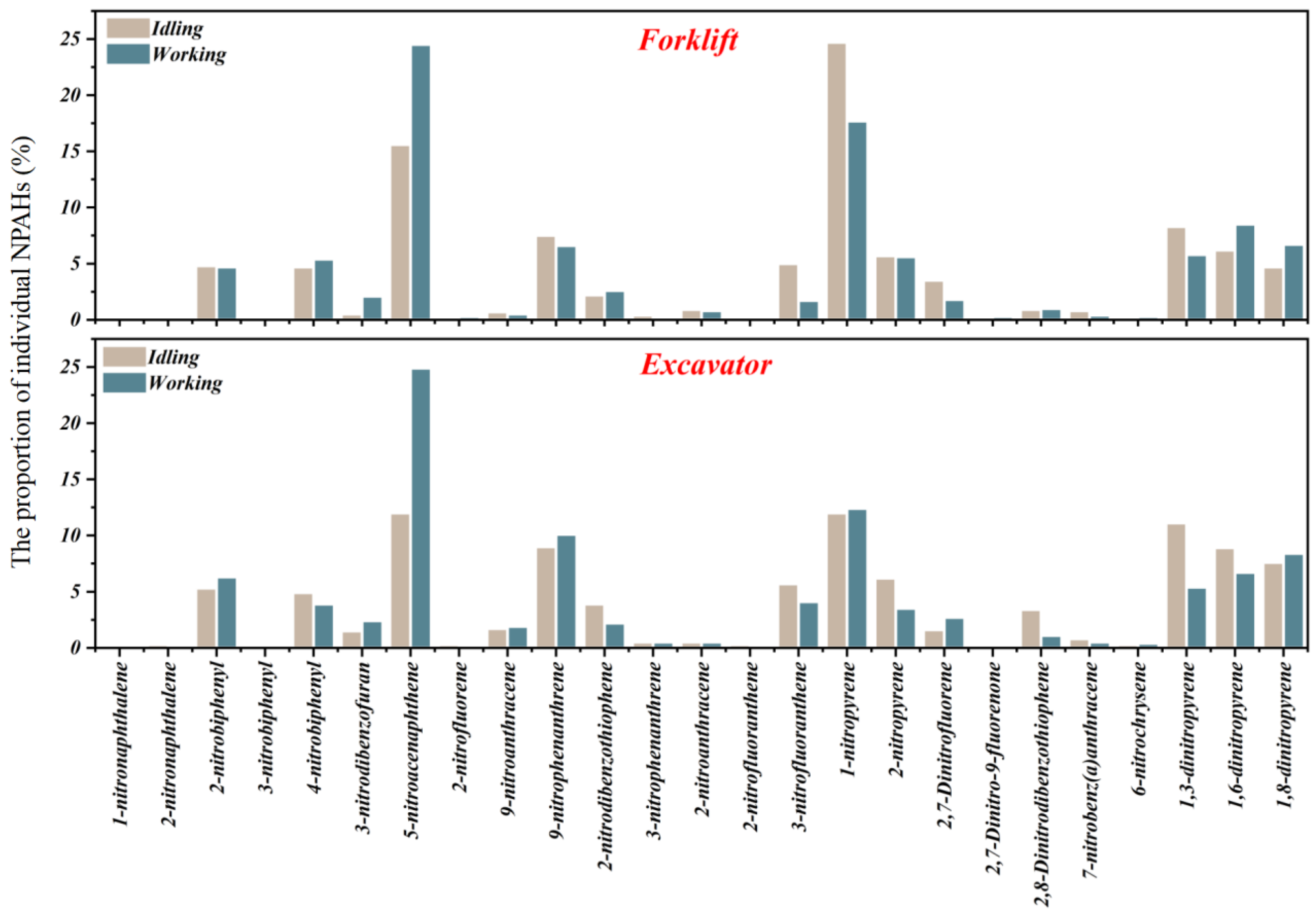
From the perspective of NPAHs composition (Figure 1), both the forklifts and excavators exhibited similar NPAHs compositional profiles, with species 5-nitroacenaphthene, 1-nitropyrene, 9-nitrophenanthrene, and dinitropyrene collectively accounting for over 60% of the total emissions. This research also indicated that the working mode and the idling mode do not significantly alter the composition characteristics of NPAHs emitted by the forklifts and excavators. Notably, compared with other emission sources, 5-nitroacenaphthene exhibited source-specific predominance exclusively in construction machinery emissions, suggesting its potential as a unique tracer for source apportionment studies of construction machinery. Furthermore, early international studies proposed 1-nitropyrene as a potential marker for traffic-derived PM in urban environments. This result has also been widely applied in field observations of NPAHs [59,60,61]. However, this hypothesis faced challenges when Alves et al. [62] failed to detect 1-nitropyrene in PM samples collected from roadside monitoring stations and urban tunnels—a discrepancy potentially attributed to the widespread implementation of advanced exhaust after-treatment technologies [63]. These observations led Alves et al. [62] to question the continued validity of 1-nitropyrene as a vehicle emission marker under modern emission regulatory frameworks. Chinese studies also found this trend, demonstrating a progressive decline in 1-nitropyrene dominance from diesel vehicles, coinciding with both stricter emission standards and the growing penetration of new energy vehicles [18,20,21,54]. Despite these findings, 1-nitropyrene persists as a conventional road transport tracer in field studies, with observed high contribution percentages still being routinely assigned to vehicular sources [32,33,34,41,42,43,44,45,64,65]. Notably, as shown in Table 1, our results revealed a striking contrast: construction machinery emissions exhibit significantly higher 1-nitropyrene contributions (~16.2%) compared to other sources (<5%), including on-road vehicles (5.9%). Consequently, our findings suggested that the high contribution traditionally attributed to on-road vehicles in field observations may predominantly originate from construction machinery emissions. Under current emission regulations, 1-nitropyrene and 5-nitroacenaphthene demonstrate stronger diagnostic potential as a molecular tracer for evaluating construction machinery in urban areas.

3.2. Emission Factors of PM-Bound NPs from Forklifts and Excavators

The average NPs-EFs of the forklifts and excavators measured were 459.0 ± 136.5 and 1381.1 ± 193.9 μg kg−1 fuel, respectively. Among the NPs-EFs of the forklifts and excavators in working mode were 495.7 and 1479.5 μg kg−1 fuel, respectively, both 1.2 times that of idle mode. Based on calorific value, the NPs-EFs for construction machinery were calculated as 21.8 μg MJ−1, the NPs-EFs for vehicle emissions [54], biomass burning [55,58] and coal combustion were calculated as 3.2 μg MJ−1 (7.7 μg km−1 veh−1 based on tunnel tests), 58.9 MJ−1 (344.0 μg kg−1 based on corn straw open-burning), and 137.6 μg MJ−1 (3.2 mg kg−1 based on residential coal combustion), respectively. From the available comparisons, it is evident that, without economic cost considerations, fuel oil generates lower NPs emissions compared to biomass and coal under the same energy consumption. Consistent with the NPAHs emission, our analysis revealed a striking disparity: while construction machinery represents <5% of the total vehicular population in urban areas, it contributes >50% of the total PM-bound NPs emissions compared to on-road vehicles. This disproportionate emission profile underscores the critical need for targeted regulatory intervention. Specifically, implementing stricter emission control measures for construction machinery should be prioritized in urban air quality management strategies to mitigate associated health risks from PM.
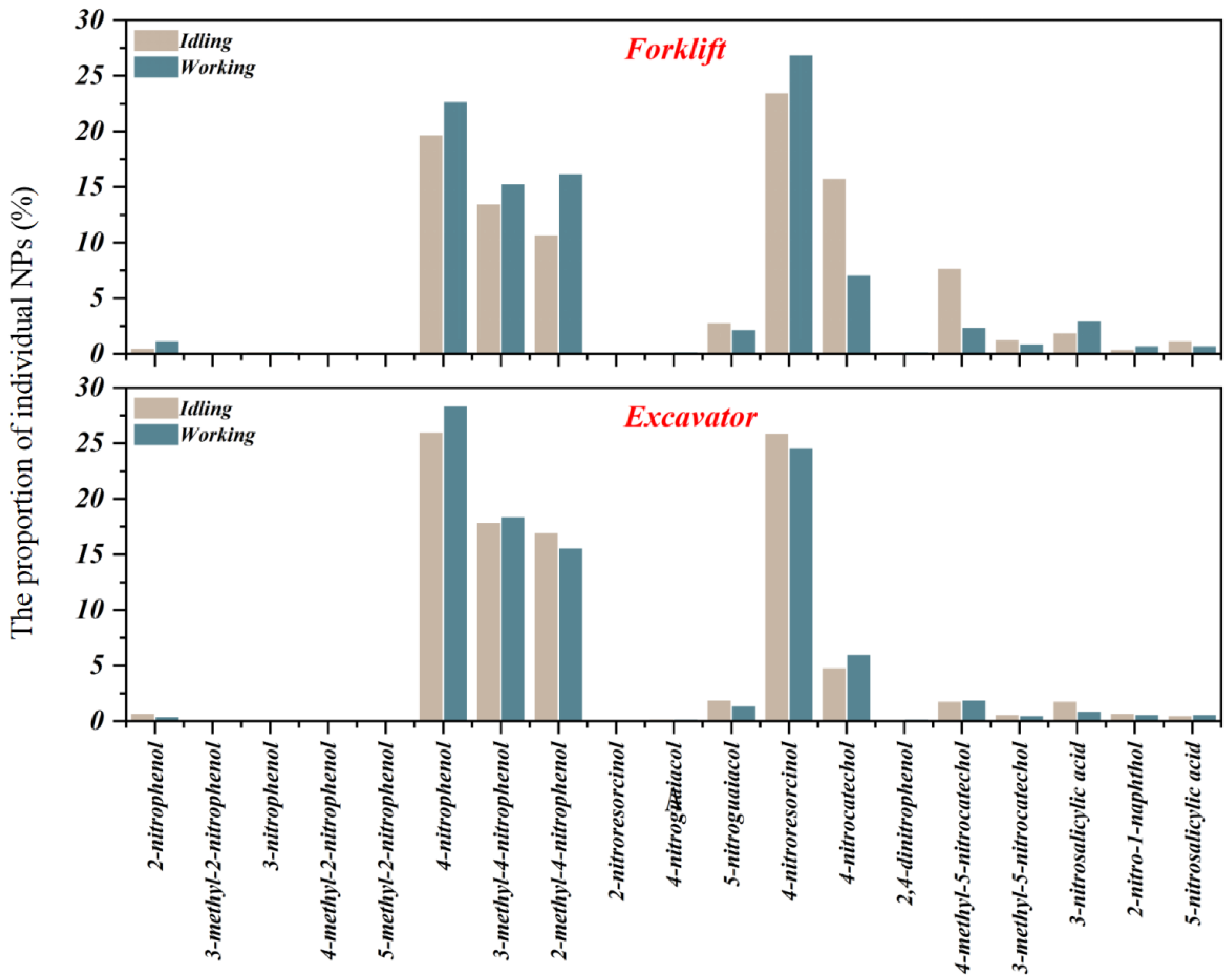
Figure 2 demonstrates that the forklifts and excavators share remarkably similar NPs emission profiles, where 4-nitrophenol (25.8%), its methyl derivatives (32.8%), and 4-nitroresorcinol (25.2%) collectively dominate (83.9% of total emissions). Operational conditions (working vs. idling modes) exerted minimal influence on NP composition, with less than 5% variation in dominant species abundance. Compared with other emission sources (Table 2), the composition characteristics of NPs emissions from construction machinery did not show any specificity that is different from those of other sources. It is worth noting that in recent years, with the increasing attention paid to NPs, diagnostic ratio methods for their source apportionment have also been proposed. Zhang et al. [66] reported distinct ratios of 2-nitro-1-naphthol to 4-nitrocatechol (~15 for coal combustion; 2–3 for biomass burning) as potential diagnostic ratio methods. However, this study revealed that there are no significant differences in the composition characteristics of NPs from different emission sources, challenging the universal applicability of 2-nitro-1-naphthol/4-nitrocatechol for source identification. Collectively, current findings demonstrated that NP emissions lack sufficient source specificity to serve as reliable tracers through conventional diagnostic ratio approaches. This underscores the need for developing more robust multi-marker identification methods for accurate source attribution of atmospheric NPs.

3.3. Light Absorption of PM-Bound NACs

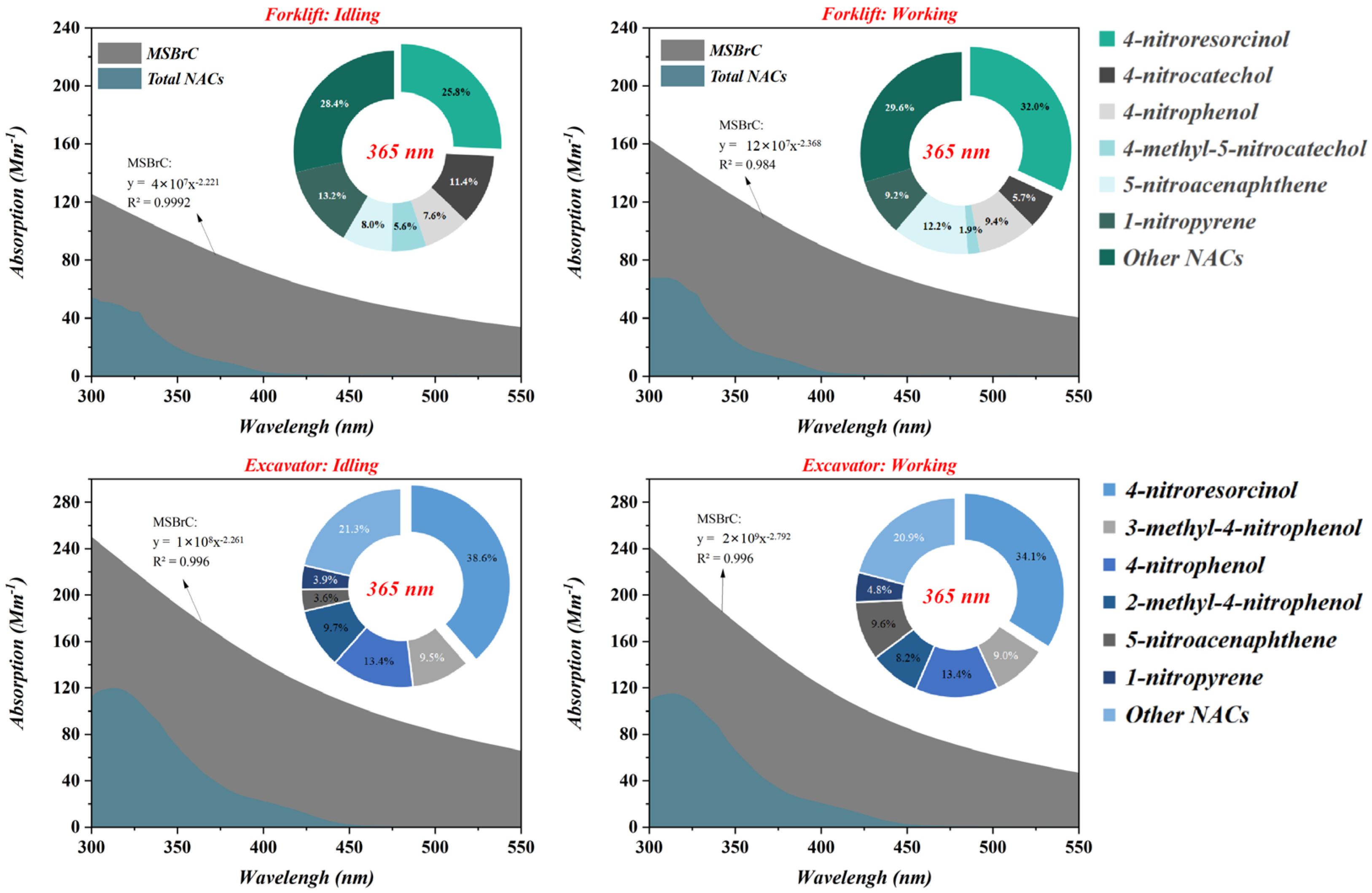
Figure 3 presents the wavelength-resolved light absorption coefficients (babs) of MSBrC (300–550 nm) from the forklifts and excavators. Following the established methodology [57], we selected 365 nm as the characteristic wavelength for BrC optical property analysis, as this wavelength optimally captures the distinctive spectral signature of brown carbon chromophores while minimizing interference from other aerosol components. This study revealed that the excavators (150.6 ± 14.6 Mm−1 at 365 nm; 38.0 ± 11.4 Mm−1 at 635 nm; AAE = 2.5 ± 0.4) demonstrated a significantly stronger absorption capacity than the forklifts (92.1 ± 15.0 Mm−1 at 365 nm; 25.8 ± 2.7 Mm−1 at 635 nm; AAE = 2.3 ± 0.1). Tian et al. [67] pointed out that higher AAE values correlated with BrC containing more wavelength-dependent chromophores. Both the forklifts and excavators exhibited significantly higher AAE during working mode (forklifts: 2.4; excavators: 2.8) compared to idling mode (forklifts: 2.2; excavators: 2.3), indicating more pronounced wavelength-dependent light absorption compounds emitted by construction machinery during active operation. Further comparison with other emission sources revealed that the AAEMSBrC from construction machinery is lower than that of biomass burning (2.5–6.5) [68], vehicle emissions (2.5–2.6), [68,69], and coal combustion (3.1) [70], suggesting a lower wavelength-dependence of chromophores in machinery-emitted MSBrC.
In this study, the absorption spectra of 45 methanol-soluble NACs at 300–700 nm were measured. Based on the calculated MAEs of NACs, as shown in Figure 3, the total light absorption of 45 NACs at 300–550 nm from the forklifts and excavators was 0.1~60.1 Mm−1 (24.4 Mm−1 at 365 nm) and 0.1~117.3 Mm−1 (45.1 Mm−1 at 365 nm), respectively. The mean light absorption contribution of 45 NACs to MSBrC at 365 nm from the forklifts and excavators was 26.5% and 30.0%, respectively. Notably, both the forklifts and excavators exhibited stable light absorption contributions across all operational modes, demonstrating the negligible influence of operational modes on the optical properties of MSBrC-associated NACs. From the perspective of NAC species, the forklifts demonstrated consistent dominant chromophore compounds between idling and working modes at 365 nm, with 4-nitroresorcinol remaining the primary contributor, followed by 1-nitropyrene, 4-nitrocatechol, 5-nitroacenaphthene, 4-nitrophenol, and 4-methyl-5-nitrocatechol, collectively accounting for 70%, and above, of the total absorption, though relative contributions shifted slightly (<5%) during different operation modes. Unlike the forklifts, the excavators demonstrated distinct light absorption characteristics with NAC species 4-nitroresorcinol, 4-nitrophenol, 2-methyl-4-nitrophenol, 3-methyl-4-nitrophenol, and 1-nitropyrene, collectively contributing over 70% of the total absorption, showing less than 5% variability across different operational modes. Collectively, NACs significantly contributed to MSBrC emissions from construction machinery, suggesting targeted NACs reduction would effectively mitigate the climatic impacts of construction machinery.

3.4. Toxic Equivalents of PM-Bound NACs

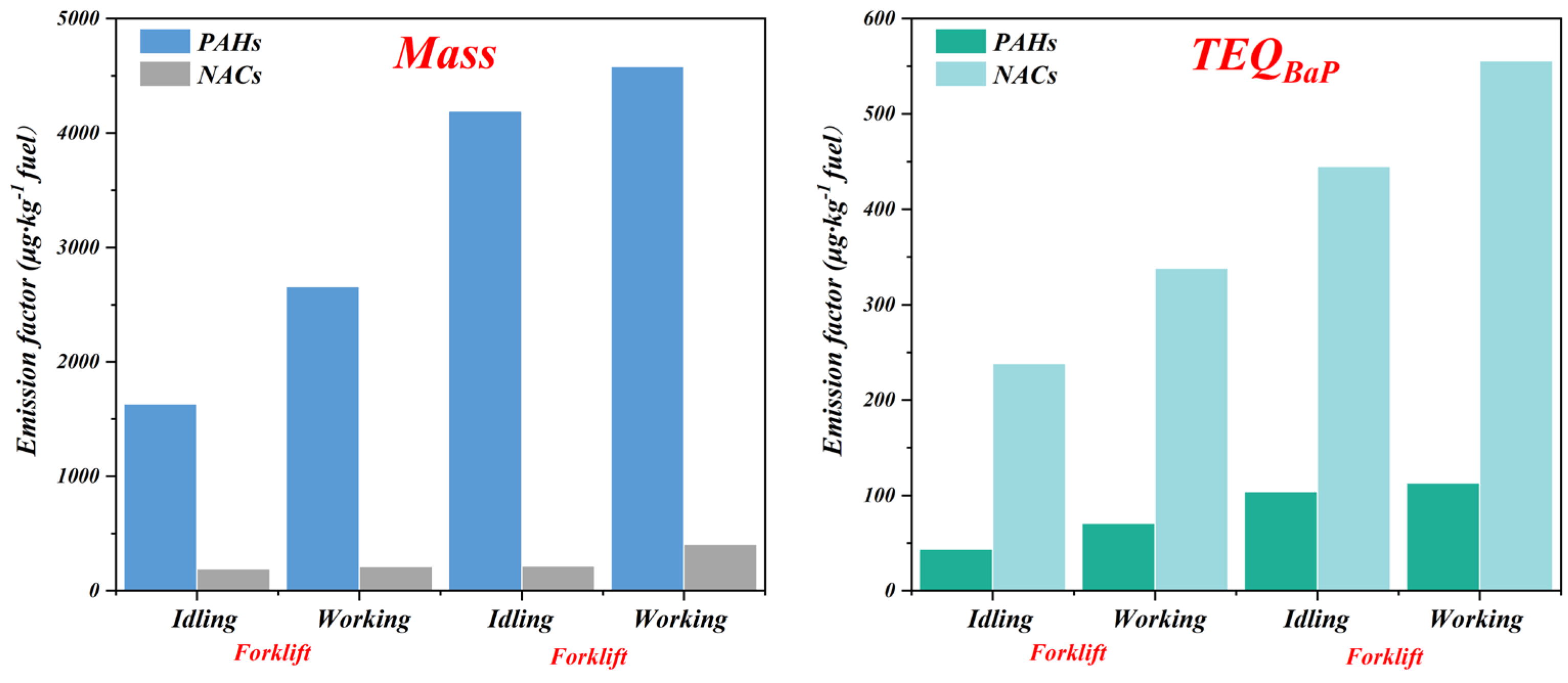
NACs are highly lipophilic and can accumulate in plants and animals, causing harm to human health [1,5,54,55]. The toxic equivalency factors (TEF) refer to the ratio of the affinity of a certain pollutant to the aromatic hydrocarbon receptor to that of a reference substance (benzo[a]pyrene). Through TEF, the toxicity of different pollutants can be standardized, facilitating comparisons and evaluations of their potential impacts on health. A substantial body of studies has indicated the NACs’ hazardous effects. However, only a limited number of benzo(a)pyrene-TEFs (BaP) have been quantified for this class of compounds to date (Table S2) [18,71,72,73]. In this study, nine NACs were selected to evaluate the BaP toxic equivalency quotients (TEQBaP) with available TEFs. The nine NACs TEQBaP-EFs emitted from the forklifts and excavators were 288.1 and 500.1 μg kg−1 fuel, respectively, and the ratios to the corresponding EFs were 1.4 and 1.6. Among the TEQBaP-EFs of the forklifts and excavators in working mode were 338.1 and 555.3 μg kg−1 fuel, respectively, which were 1.4 and 1.2 times that of idle mode. This result demonstrated that a significant association between construction machinery operating conditions and the distribution patterns of high-toxicity pollutants during working modes leads to concentrated emissions of high-toxicity compounds. Notably, while construction machinery demonstrated a high NACs emission intensity, its TEQBaP-EFs per unit mass emission was very low compared to biomass open-burning (TEQBaP-EFs/EFs: 4.2) [55], comparable to vehicle emissions (TEQBaP-EFs/EFs: 1.4) [54] and higher than coal combustion (TEQBaP-EFs/EFs: 0.50) [26], as quantified through the TEF method. This discrepancy originates from differential NACs profiles, where construction machinery emissions contain lower proportions of high-TEF compounds relative to biomass-emitted NACs. Further comparison with 16 USA priority PAHs (see Figure 4) revealed that while mean EF of the 16 PAHs (3263.9 ± 1368.1 μg kg−1 fuel) from construction machinery was 13.0 ± 4.6 times higher than that of the nine NACs (255.1 ± 99.9 μg kg−1 fuel), the TEQBaP of the nine NACs (394.1 ± 136.7 μg kg−1 fuel) were 4.9 ± 0.5 times that of the 16 PAHs (82.7 ± 31.9 μg kg−1 fuel). These findings demonstrate that despite lower emission concentrations relative to PAHs, NACs demand heightened attention owing to their disproportionately higher potential toxicity. It should be emphasized that the toxicity equivalence approach relies solely on parameters derived from bacterial strain assays, whereas in living organisms, elevated reactive oxygen species (ROS) levels induced by NACs may confer more profound toxicological effects. Moreover, our toxicity calculations were confined to the nine NAC species with available TEF data. Notably, these 9 compounds do not represent the most toxic species among the 44 measured NACs, suggesting that the actual overall toxicity is likely higher than our reported estimates.
In terms of species distribution, 1,6-dinitropyrene dominated NAC toxicity across all operational modes of the forklifts and excavators, accounting for >80% of total NACs-TEQBaP, followed by 1,8-dinitropyrene (~7%) and 6-nitrochrysene (~4%). The analysis demonstrated that 1,6-dinitropyrene’s exceptional toxicological contribution stems from both its elevated emission factors and its substantially higher TEF value. Comparative analysis with other NACs sources confirmed 1,6-dinitropyrene’s universal dominance in NACs-TEQBaP profiles, attributable to its high TEF value among NACs. In conclusion, this study found that it is extremely necessary to control the emission of construction machinery as the main strategy to reduce the toxicity risk of NACs in urban areas.

4. Conclusions

Based on on-site measurements at real-world construction sites, this study quantified the EFs and compositional profiles of PM-bound NACs, including 26 NPAHs and 19 NPs, from typical construction machinery such as forklifts and excavators. The results demonstrated that construction machinery emitted substantial levels of NACs, with average EFs of 451.0 μg kg−1 fuel for NPAHs and 920.0 μg kg−1 fuel for NPs. Notably, the excavators exhibited significantly higher emissions—1.7 times for NPAHs and 3.0 times for NPs—compared to the forklifts. Both types of machinery emitted more NPAHs and NPs during working modes compared to idling, with an increase ranging from 1.1 to 1.6 times. Compositional analysis revealed that NPAHs were dominated by 5-nitroacenaphthene, 1-nitropyrene, 9-nitrophenanthrene, and dinitropyrene (collectively >60% of total NPAHs), while NPs were primarily composed of 4-nitrophenol, its methyl derivatives, and 4-nitroresorcinol (totaling >80% of NPs). Compared with other sources, this study indicated that the combined use of these two substances, 1-nitropyrene and 5-nitroacenaphthene, as potential tracers is helpful in addressing the problem of difficult source apportionment of construction machinery in field observations. Critically, although construction machinery accounts for less than 5% of the urban vehicle population, it underscored a disproportionate environmental impact.
The light-absorbing properties of MSBrC from construction machinery were characterized, with the excavators showing a stronger absorption (150.6 ± 14.6 Mm−1 at 365 nm) and a higher absorption Ångström exponent (AAE = 2.5) than the forklifts (92.1 ± 15.0 Mm−1, AAE = 2.3). The 45 measured NACs contributed approximately 26.5–30.0% to the total MSBrC absorption at 365 nm, with 4-nitroresorcinol and 1-nitropyrene as key chromophores. Toxic equivalency assessments based on BaP indicated that while the mass-based toxicity of NACs from construction machinery was lower than that from biomass burning, the high emission levels resulted in TEQBaP reaching ~30% of those from on-road vehicles. The findings emphasize the urgent need for targeted regulatory measures to mitigate the health and climate impacts of construction machinery emissions, particularly through controls on high-toxicity species like 1,6-dinitropyrene. This study provides critical data for refining NACs emission inventories and source apportionment in urban areas.

Supplementary Materials

The following supporting information can be downloaded at: https://www.mdpi.com/article/10.3390/atmos16121365/s1, Table S1: Specifications and operational parameters of tested construction machinery; Table S2: The detection ions, retention times, benzo(a)pyrene (BaP) toxic equivalency factor (TEFBaP), and method detection limits (MDL) and method recoveries of determining compounds; Table S3: The calorific value and combustion efficiency of different fuels; Figure S1: Schematic diagram of sampling system [74].

Author Contributions

Conceptualization, S.L., L.P.; methodology, R.Z., S.L., J.W., and Q.Z.; validation, S.L.; formal analysis, R.Z.; investigation, R.Z., J.W., and S.L.; data curation, R.Z., Z.L., and D.L.; writing—original draft preparation, R.Z.; writing—review and editing, S.L. and Q.H.; supervision, S.L. and Q.H.; funding acquisition, S.L., R.Z., and J.W. All authors have read and agreed to the published version of the manuscript.

Funding

This study was funded by the Natural Science Foundation of China (42207135), Hunan Provincial Natural Science Foundation (2023JJ40361), Shanxi Provincial University Science and Technology Innovation Project (2024L564/2024L563), Shanxi Province Basic Research Program (202403021222376) and Department of Science and Technology of Guangdong Province (2023B1212060049).

Institutional Review Board Statement

Not applicable.

Informed Consent Statement

Not applicable.

Data Availability Statement

Data are available upon request from the corresponding author (giglisheng@163.com).

Acknowledgments

The authors acknowledge the support of Guangzhou Ecological and Environmental Monitoring Center of Guangdong Province.

Conflicts of Interest

The authors declare no conflicts of interest.

References

  1. Kawanaka, Y.; Matsumoto, E.; Wang, N.; Yun, S.-J.; Sakamoto, K. Contribution of nitrated polycyclic aromatic hydrocarbons to the mutagenicity of ultrafine particles in the roadside atmosphere. Atmos. Environ. 2008, 42, 7423–7428. [Google Scholar] [CrossRef]
  2. Øvrevik, J.; Refsnes, M.; Holme, J.A.; Schwarze, P.E.; Låg, M. Mechanisms of chemokine responses by polycyclic aromatic hydrocarbons in bronchial epithelial cells: Sensitization through toll-like receptor-3 priming. Toxicol. Lett. 2013, 219, 125–132. [Google Scholar] [CrossRef] [PubMed]
  3. González-Flecha, B. Oxidant mechanisms in response to ambient air particles. Mol. Asp. Med. 2004, 25, 169–182. [Google Scholar] [CrossRef]
  4. Vinzents, P.S.; Møller, P.; Sørensen, M.; Knudsen, L.E.; Hertel, O.; Jensen, F.P.; Schibye, B.; Loft, S. Personal exposure to ultrafine particles and oxidative DNA damage. Environ. Health Perspect. 2005, 113, 1485–1490. [Google Scholar] [CrossRef] [PubMed]
  5. Kalberer, M.; Rothen-Rutishauser, B.; Dällenbach, K.; Sauvain, J.-J. Oxidative Properties of Atmospheric Particles and their Biological Effects. Chimia 2024, 78, 734–738. [Google Scholar] [CrossRef] [PubMed]
  6. Feng, Y.; Ramanathan, V.; Kotamarthi, V.R. Brown carbon: A significant atmospheric absorber of solar radiation? Atmos. Chem. Phys. 2013, 13, 8607–8621. [Google Scholar] [CrossRef]
  7. Laskin, A.; Laskin, J.; Nizkorodov, S.A. Chemistry of atmospheric brown carbon. Chem. Rev. 2015, 115, 4335–4382. [Google Scholar] [CrossRef]
  8. Lin, P.; Aiona, P.K.; Li, Y.; Shiraiwa, M.; Laskin, J.; Nizkorodov, S.A.; Laskin, A. Molecular characterization of brown carbon in biomass burning aerosol particles. Environ. Sci. Technol. 2016, 50, 11815–11824. [Google Scholar] [CrossRef]
  9. Huang, R.J.; Yang, L.; Cao, J.; Chen, Y.; Chen, Q.; Li, Y.; Duan, J.; Zhu, C.; Dai, W.; Wang, K.; et al. Brown carbon aerosol in urban Xi’an, northwest China: The composition and light absorption properties. Environ. Sci. Technol. 2018, 52, 6825–6833. [Google Scholar] [CrossRef]
  10. Huang, R.J.; Yang, L.; Shen, J.; Yuan, W.; Gong, Y.; Guo, J.; Cao, W.; Duan, J.; Ni, H.; Zhu, C.; et al. Water-insoluble organics dominate brown carbon in wintertime urban aerosol of China: Chemical characteristics and optical properties. Environ. Sci. Technol. 2020, 54, 7836–7847. [Google Scholar] [CrossRef]
  11. Yuan, W.; Huang, R.J.; Yang, L.; Wang, T.; Duan, J.; Guo, J.; Ni, H.; Chen, Y.; Chen, Q.; Li, Y.; et al. Measurement report: PM2.5-bound nitrated aromatic compounds in Xi’an, Northwest ChinaSeasonal variations and contributions to optical properties of brown carbon. Atmos. Chem. Phys. 2021, 21, 3685–3697. [Google Scholar] [CrossRef]
  12. Wang, Y.; Hu, M.; Wang, Y.; Zheng, J.; Shang, D.; Yang, Y.; Liu, Y.; Li, X.; Tang, R.; Zhu, W.; et al. The formation of nitro-aromatic compounds under high NOx and anthropogenic VOC conditions in urban Beijing, China. Atmos. Chem. Phys. 2019, 19, 7649–7665. [Google Scholar] [CrossRef]
  13. Iinuma, Y.; Böge, O.; Gräfe, R.; Herrmann, H. Methyl-nitrocatechols: Atmospheric tracer compounds for biomass burning secondary organic aerosols. Environ. Sci. Technol. 2010, 44, 8453–8459. [Google Scholar] [CrossRef]
  14. Ostojic, B.D.; Dordevic, D.S. Photochemistry of nitrated polycyclic aromatic hydrocarbons under solar radiation. Curr. Org. Chem. 2018, 22, 973–986. [Google Scholar] [CrossRef]
  15. Ding, Z.; Yi, Y.; Wang, W.; Zhang, Q. Atmospheric degradation of chrysene initiated by OH radical: A quantum chemical investigation. Chemosphere 2021, 263, 128267. [Google Scholar] [CrossRef]
  16. Kitanovski, Z.; Čusak, A.; Grgić, I.; Claeys, M. Chemical characterization of the main products formed through aqueous-phase photonitration of guaiacol. Atmos. Meas. Tech. 2014, 7, 2457–2470. [Google Scholar] [CrossRef]
  17. Vione, D.; Maurino, V.; Minero, C.; Pelizzetti, E. Aqueous atmospheric chemistry: Formation of 2,4-dinitrophenol upon nitration of 2-nitrophenol and 4-nitrophenol in solution. Environ. Sci. Technol. 2005, 39, 7921–7931. [Google Scholar] [CrossRef]
  18. Hao, X.; Zhang, X.; Cao, X.; Shen, X.; Shi, J.; Yao, Z. Characterization and carcinogenic risk assessment of polycyclic aromatic and nitro-polycyclic aromatic hydrocarbons in exhaust emission from gasoline passenger cars using on-road measurements in Beijing, China. Sci. Total Environ. 2018, 645, 347–355. [Google Scholar] [CrossRef] [PubMed]
  19. Cao, X.; Hao, X.; Shen, X.; Jiang, X.; Wu, B.; Yao, Z. Emission characteristics of polycyclic aromatic hydrocarbons and nitro-polycyclic aromatic hydrocarbons from diesel trucks based on on-road measurements. Atmos. Environ. 2017, 148, 190–196. [Google Scholar] [CrossRef]
  20. Zhao, T.; Yang, L.; Huang, Q.; Zhang, W.; Duan, S.; Gao, H.; Wang, W. PM2.5-bound polycyclic aromatic hydrocarbons (PAHs) and nitrated-PAHs (NPAHs) emitted by gasoline vehicles: Characterization and health risk assessment. Sci. Total Environ. 2020, 727, 138631. [Google Scholar] [CrossRef]
  21. Zhao, T.; Yang, L.; Huang, Q.; Zhang, Y.; Bie, S.; Li, J.; Zhang, W.; Duan, S.; Gao, H.; Wang, W. PM2.5-bound polycyclic aromatic hydrocarbons (PAHs) and their derivatives (nitrated-PAHs and oxygenated-PAHs) in a road tunnel located in Qingdao, China: Characteristics, sources and emission factors. Sci. Total Environ. 2020, 720, 137521. [Google Scholar] [CrossRef]
  22. Perrone, M.G.; Carbone, C.; Faedo, D.; Ferrero, L.; Maggioni, A.; Sangiorgi, G.; Bolzacchini, E. Exhaust emissions of polycyclic aromatic hydrocarbons, n-alkanes and phenols from vehicles coming within different European classes. Atmos. Environ. 2014, 82, 391–400. [Google Scholar] [CrossRef]
  23. Noya, Y.; Mikami, Y.; Taneda, S.; Mori, Y.; Suzuki, A.K.; Ohkura, K.; Yamaki, K.; Yoshino, S.; Seki, K.-I. Improvement of an efficient separation method for chemicals in diesel exhaust particles: Analysis for nitrophenols. Environ. Sci. Pollut. Res. 2008, 15, 318–321. [Google Scholar] [CrossRef]
  24. Lu, C.; Wang, X.; Dong, S.; Zhang, J.; Li, J.; Zhao, Y.; Liang, Y.; Xue, L.; Xie, H.; Zhang, Q.; et al. Emissions of fine particulate nitrated phenols from various on-road vehicles in China. Environ. Res. 2019, 179, 108709. [Google Scholar] [CrossRef]
  25. Kirchstetter, T.W.; Novakov, T.; Hobbs, P.V. Evidence that the spectral dependence of light absorption by aerosols is affected by organic carbon. J. Geophys. Res. Atmos. 2004, 109, D21208. [Google Scholar] [CrossRef]
  26. Huang, W.; Huang, B.; Bi, X.; Lin, Q.; Liu, M.; Ren, Z.; Zhang, G.; Wang, X.; Sheng, G.; Fu, J. Emission of PAHs, NPAHs and OPAHs from residential honeycomb coal briquette combustion. Energy Fuels 2014, 28, 636–642. [Google Scholar] [CrossRef]
  27. Yang, X.; Liu, S.; Xu, Y.; Liu, Y.; Chen, L.; Tang, N.; Hayakawa, K. Emission factors of polycyclic and nitro-polycyclic aromatic hydrocarbons from residential combustion of coal and crop residue pellets. Environ. Pollut. 2017, 231, 1265–1273. [Google Scholar] [CrossRef] [PubMed]
  28. Wang, R.; Yousaf, B.; Sun, R.; Zhang, H.; Zhang, J.; Liu, G. Emission characterization and δ13C values of parent PAHs and nitro-PAHs in size-segregated particulate matters from coal-fired power plants. J. Hazard. Mater. 2016, 318, 487–496. [Google Scholar] [CrossRef]
  29. Lin, P.; Fleming, L.T.; Nizkorodov, S.A.; Laskin, J.; Laskin, A. Comprehensive molecular characterization of atmospheric brown carbon by high resolution mass spectrometry with electrospray and atmospheric pressure photoionization. Anal. Chem. 2018, 90, 12493–12502. [Google Scholar] [CrossRef]
  30. Olson, M.R.; Garcia, M.V.; Robinson, M.A.; Van Rooy, P.; Dietenberger, M.A.; Bergin, M.; Schauer, J.J. Investigation of black and brown carbon multiple-wavelength-dependent light absorption from biomass and fossil fuel combustion source emissions. J. Geophys. Res. Atmos. 2015, 120, 6682–6697. [Google Scholar] [CrossRef]
  31. Lu, C.; Wang, X.; Li, R.; Gu, R.; Zhang, Y.; Li, W.; Gao, R.; Chen, B.; Xue, L.; Wang, W. Emissions of fine particulate nitrated phenols from residential coal combustion in China. Atmos. Environ. 2019, 203, 10–17. [Google Scholar] [CrossRef]
  32. Zhang, J.; Yang, L.; Mellouki, A.; Chen, J.; Chen, X.; Gao, Y.; Jiang, P.; Li, Y.; Yu, H.; Wang, W. Atmospheric PAHs, NPAHs, and OPAHs at an urban, mountainous, and marine sites in Northern China: Molecular composition, sources, and ageing. Atmos. Environ. 2018, 173, 256–264. [Google Scholar] [CrossRef]
  33. Lyu, Y.; Su, S.; Wang, B.; Zhu, X.; Wang, X.; Zeng, E.Y.; Xing, B.; Tao, S. Seasonal and spatial variations in the chemical components and the cellular effects of particulate matter collected in Northern China. Sci. Total Environ. 2018, 627, 1627–1637. [Google Scholar] [CrossRef]
  34. Liu, D.; Lin, T.; Syed, J.H.; Cheng, Z.; Xu, Y.; Li, K.; Zhang, G.; Li, J. Concentration, source identification, and exposure risk assessment of PM2.5-bound parent PAHs and nitro-PAHs in atmosphere from typical Chinese cities. Sci. Rep. 2017, 7, 10398. [Google Scholar] [CrossRef]
  35. Teich, M.; van Pinxteren, D.; Wang, M.; Kecorius, S.; Wang, Z.; Müller, T.; Močnik, G.; Herrmann, H. Contributions of nitrated aromatic compounds to the light absorption of water-soluble and particulate brown carbon in different atmospheric environments in Germany and China. Atmos. Chem. Phys. 2017, 17, 1653–1672. [Google Scholar] [CrossRef]
  36. Wang, L.; Wang, X.; Gu, R.; Wang, H.; Yao, L.; Wen, L.; Zhu, F.; Wang, W.; Xue, L.; Yang, L.; et al. Observations of fine particulate nitrated phenols in four sites in northern China: Concentrations, source apportionment, and secondary formation. Atmos. Chem. Phys. 2018, 18, 4349–4359. [Google Scholar] [CrossRef]
  37. Li, M.; Wang, X.; Lu, C.; Li, R.; Zhang, J.; Dong, S.; Yang, L.; Xue, L.; Chen, J.; Wang, W. Nitrated phenols and the phenolic precursors in the atmosphere in urban Jinan, China. Sci. Total Environ. 2020, 714, 136760. [Google Scholar] [CrossRef] [PubMed]
  38. Li, X.; Yang, Y.; Liu, S.; Zhao, Q.; Wang, G.; Wang, Y. Light absorption properties of brown carbon (BrC) in autumn and winter in Beijing: Composition, formation and contribution of nitrated aromatic compounds. Atmos. Environ. 2020, 223, 117289. [Google Scholar] [CrossRef]
  39. Liang, Y.; Wang, X.; Dong, S.; Liu, Z.; Mu, J.; Lu, C.; Zhang, J.; Li, M.; Xue, L.; Wang, W. Size distributions of nitrated phenols in winter at a coastal site in north China and the impacts from primary sources and secondary formation. Chemosphere 2020, 250, 126256. [Google Scholar] [CrossRef]
  40. Yang, Y.; Li, X.; Shen, R.; Liu, Z.; Ji, D.; Wang, Y. Seasonal variation and sources of derivatized phenols in atmospheric fine particulate matter in North China Plain. J. Environ. Sci. 2020, 89, 136–144. [Google Scholar] [CrossRef]
  41. Wei, C.; Han, Y.; Bandowe, B.A.M.; Cao, J.; Huang, R.-J.; Ni, H.; Tian, J.; Wilcke, W. Occurrence, gas/particle partitioning and carcinogenic risk of polycyclic aromatic hydrocarbons and their oxygen and nitrogen containing derivatives in Xi’an, central China. Sci. Total Environ. 2015, 505, 814–822. [Google Scholar] [CrossRef]
  42. Wang, J.; Xu, H.; Guinot, B.; Li, L.; Ho, S.S.H.; Liu, S.; Li, X.; Cao, J. Concentrations, sources and health effects of parent, oxygenated- and nitrated- polycyclic aromatic hydrocarbons (PAHs) in middle-school air in Xi’an, China. Atmos. Res. 2017, 192, 1–10. [Google Scholar] [CrossRef]
  43. Niu, X.; Ho, K.F.; Chuang, H.C.; Sun, J.; Huang, Y.; Hu, T.; Xu, H.; Duan, J.; Lui, K.H.; Cao, J. Comparison of cytotoxicity induced by PM2.5-bound polycyclic aromatic compounds from different environments in Xi’an, China. Atmos. Environ. 2019, 216, 116929. [Google Scholar] [CrossRef]
  44. Zhuo, S.; Du, W.; Shen, G.; Wang, R.; Pan, X.; Li, T.; Han, Y.; Li, Y.; Pan, B.; Peng, X.; et al. Urban air pollution and health risks of parent and nitrated polycyclic aromatic hydrocarbons in two megacities, southwest China. Atmos. Environ. 2017, 166, 441–453. [Google Scholar] [CrossRef]
  45. Hu, H.; Tian, M.; Zhang, L.; Yang, F.; Peng, C.; Chen, Y.; Shi, G.; Yao, X.; Jiang, C.; Wang, J. Sources and gas-particle partitioning of atmospheric parent, oxygenated, and nitrated polycyclic aromatic hydrocarbons in a humid city in southwest China. Atmos. Environ. 2019, 206, 1–10. [Google Scholar] [CrossRef]
  46. Jung, S.; Kim, S.; Lim, Y.; Lee, J.; Chung, T.; Hong, H.; Mun, S.; Lee, S.; Jang, W.; Lim, J. Emission characteristics of hazardous air pollutants from construction equipment. Aerosol Air Qual. Res. 2020, 20, 2012–2024. [Google Scholar] [CrossRef]
  47. Li, C.; Cui, M.; Zheng, J.; Chen, Y.; Liu, J.; Ou, J.; Tang, M.; Sha, Q.; Yu, F.; Liao, S.; et al. Variability in real-world emissions and fuel consumption by diesel construction vehicles and policy implications. Sci. Total Environ. 2021, 786, 147256. [Google Scholar] [CrossRef]
  48. Wang, F.; Li, Z.; Zhang, K.; Di, B.; Hu, B. An overview of non-road equipment emissions in China. Atmos. Environ. 2016, 132, 283–289. [Google Scholar] [CrossRef]
  49. Peng, Z.; Ge, Y.; Tan, J.; Fu, M.; Wang, X.; Chen, M.; Lu, Y.; Wu, Y. Real-world emission from in-use construction equipment in China. Aerosol Air Qual. Res. 2016, 16, 1893–1902. [Google Scholar] [CrossRef]
  50. Zhang, Q.; Yang, L.; Ma, C.; Zhang, Y.; Wu, L.; Mao, H. Emission characteristics and chemical composition of particulate matter emitted by typical non-road construction machinery. Atmos. Pollut. Res. 2020, 11, 679–685. [Google Scholar] [CrossRef]
  51. Cui, M.; Chen, Y.; Li, C.; Yin, J.; Li, J.; Zheng, J. Parent and methyl polycyclic aromatic hydrocarbons and n-alkanes emitted by construction machinery in China. Sci. Total Environ. 2021, 775, 144759. [Google Scholar] [CrossRef]
  52. Duan, L.; Hsieh, Y.L.; Lin, S.L.; Mansor, W.N.W.; Bin Mansor, M.I.A.; Lee, H.; Huang, C.-E.; Chao, H.-R.; Song, M.; Song, M. Unignorable emissions and potential health effects of unregulated pollutants from nonroad engines using greener fuelsA review. Aerosol Air Qual. Res. 2024, 24, 240074. [Google Scholar] [CrossRef]
  53. Wu, Z.; Zhang, Y.; He, J.; Chen, H.; Huang, X.; Wang, Y.; Yu, X.; Yang, W.; Zhang, R.; Zhu, M.; et al. Dramatic increase in reactive volatile organic compound (VOC) emissions from ships at berth after implementing the fuel switch policy in the Pearl River Delta Emission Control Area. Atmos. Chem. Phys. 2020, 20, 1887–1900. [Google Scholar] [CrossRef]
  54. Zhang, R.; Li, S.; Fu, X.; Pei, C.; Wang, J.; Wu, Z.; Xiao, S.; Huang, X.; Zeng, J.; Song, W.; et al. Emissions and light absorption of PM2.5-bound nitrated aromatic compounds from on-road vehicle fleets. Environ. Pollut. 2022, 312, 120070. [Google Scholar] [CrossRef]
  55. Zhang, R.; Song, W.; Zhang, Y.; Wang, X.; Fu, X.; Li, S. Particulate nitrated aromatic compounds from corn straw burning: Compositions, optical properties and potential health risks. Environ. Pollut. 2023, 323, 121332. [Google Scholar] [CrossRef]
  56. Fang, L.; Zhang, R.; Li, S.; Song, W.; Chen, D.; Wang, X. Size-segregated nitrated aromatic compounds in PM10 and potential health risks in Guangzhou, South China. Atmos. Environ. 2025, 350, 121145. [Google Scholar] [CrossRef]
  57. Hecobian, A.; Zhang, X.; Zheng, M.; Frank, N.; Edgerton, E.S.; Weber, R.J. Water-soluble organic aerosol material and the light-absorption characteristics of aqueous extracts measured over the Southeastern United States. Atmos. Chem. Phys. 2010, 10, 5965–5977. [Google Scholar] [CrossRef]
  58. Li, X.; Wang, S.; Duan, L.; Hao, J.; Nie, Y. Carbonaceous aerosol emissions from household biofuel combustion in China. Environ. Sci. Technol. 2009, 43, 6076–6081. [Google Scholar] [CrossRef]
  59. Paputapeck, M.C.; Marano, R.S.; Schuetzle, D.; Riley, T.L.; Hampton, C.V.; Prater, T.J.; Skewes, L.M.; Jensen, T.E.; Ruehle, P.H.; Bosch, L.C.; et al. Determination of nitrated polynuclear aromatic hydrocarbons in particulate extracts by using capillary column gas-chromatography with nitrogen selective detection. Anal. Chem. 1983, 55, 1946–1954. [Google Scholar] [CrossRef]
  60. Arey, J.; Zielinska, B.; Atkinson, R.; Winer, A.M.; Ramdahl, T.; Pitts, J.N. The formation of nitro-PAH from the gas-phase reactions of fluoranthene and pyrene with the OH radical in the presence of NOx. Atmos. Environ. (1967) 1986, 20, 2339–2345. [Google Scholar] [CrossRef]
  61. Schulte, J.K.; Fox, J.R.; Oron, A.P.; Larson, T.V.; Simpson, C.D.; Paulsen, M.; Beaudet, N.; Kaufman, J.D.; Magzamen, S. Neighborhood-scale spatial models of diesel exhaust concentration profile using 1-nitropyrene and other nitroarenes. Environ. Sci. Technol. 2015, 49, 13422–13430. [Google Scholar] [CrossRef]
  62. Alves, C.A.; Vicente, A.M.P.; Gomes, J.; Nunes, T.; Duarte, M.; Bandowe, B. Polycyclic aromatic hydrocarbons (PAHs) and their derivatives (oxygenated-PAHs, nitrated-PAHs and azaarenes) in size-fractionated particles emitted in an urban road tunnel. Atmos. Res. 2016, 180, 128–137. [Google Scholar] [CrossRef]
  63. Carrara, M.; Niessner, R. Impact of a NO2-regenerated diesel particulate filter on PAH and NPAH emissions from an EURO IV heavy duty engine. J. Environ. Monit. 2011, 13, 3373–3379. [Google Scholar] [CrossRef]
  64. Li, W.; Wang, C.; Shen, H.; Su, S.; Shen, G.; Huang, Y.; Zhang, Y.; Chen, Y.; Chen, H.; Lin, N.; et al. Concentrations and origins of nitro-polycyclic aromatic hydrocarbons and oxy-polycyclic aromatic hydrocarbons in ambient air in urban and rural areas in northern China. Environ. Pollut. 2015, 197, 156–164. [Google Scholar] [CrossRef]
  65. Ma, L.; Li, B.; Liu, Y.; Sun, X.; Fu, D.; Sun, S.; Thapa, S.; Geng, J.; Qi, H.; Zhang, A.; et al. Characterization, sources and risk assessment of PM2.5-bound polycyclic aromatic hydrocarbons (PAHs) and nitrated PAHs (NPAHs) in Harbin, a cold city in Northern China. J. Clean. Prod. 2020, 264, 121673. [Google Scholar] [CrossRef]
  66. Zhang, L.; Hu, B.; Liu, X.; Luo, Z.; Xing, R.; Li, Y.; Xiong, R.; Li, G.; Cheng, H.; Lu, Q.; et al. Variabilities in primary N-containing aromatic compound emissions from residential solid fuel combustion and implications for source tracers. Environ. Sci. Technol. 2022, 56, 13622–13633. [Google Scholar] [CrossRef]
  67. Tian, J.; Wang, Q.; Ni, H.; Wang, M.; Zhou, Y.; Han, Y.; Shen, Z.; Pongpiachan, S.; Zhang, N.; Zhao, Z.; et al. Emission characteristics of primary brown carbon absorption from biomass and coal burning: Development of an optical emission inventory for China. J. Geophys. Res. Atmos. 2019, 124, 1879–1893. [Google Scholar] [CrossRef]
  68. Xie, M.; Hays, M.D.; Holder, A.L. Light-absorbing organic carbon from prescribed and laboratory biomass burning and gasoline vehicle emissions. Sci. Rep. 2017, 7, 7318. [Google Scholar] [CrossRef] [PubMed]
  69. Zhang, R.; Li, S.; Fu, X.; Pei, C.; Huang, Z.; Wang, Y.; Chen, Y.; Yan, J.; Wang, J.; Yu, Q.; et al. Emissions and light absorption of carbonaceous aerosols from on-road vehicles in an urban tunnel in south China. Sci. Total Environ. 2021, 790, 148220. [Google Scholar] [CrossRef] [PubMed]
  70. Tang, J.; Li, J.; Su, T.; Han, Y.; Mo, Y.; Jiang, H.; Cui, M.; Jiang, B.; Chen, Y.; Tang, J.; et al. Molecular compositions and optical properties of dissolved brown carbon in biomass burning, coal combustion, and vehicle emission aerosols illuminated by excitation-emission matrix spectroscopy and Fourier transform ion cyclotron resonance mass spectrometry analysis. Atmos. Chem. Phys. 2020, 20, 2513–2532. [Google Scholar]
  71. Nisbet, I.C.T.; Lagoy, P.K. Toxic equivalency factors (TEFs) for polycyclic aromatic hydrocarbons (PAHs). Regul. Toxicol. Pharmacol. 1992, 16, 290–300. [Google Scholar] [CrossRef] [PubMed]
  72. Durant, J.L.; Busby, W.F., Jr.; Lafleur, A.L.; Penman, B.W.; Crespi, C.L. Human cell mutagenicity of oxygenated, nitrated and unsubstituted polycyclic aromatic hydrocarbons associated with urban aerosols. Mutat. Res./Genet. Toxicol. 1996, 371, 123–157. [Google Scholar] [CrossRef] [PubMed]
  73. Zhao, J.; Zhang, Y.; Wang, T.; Sun, L.; Yang, Z.; Lin, Y.; Chen, Y.; Mao, H. Characterization of PM2.5-bound polycyclic aromatic hydrocarbons and their derivatives (nitro-and oxy-PAHs) emissions from two ship engines under different operating conditions. Chemosphere 2019, 225, 43–52. [Google Scholar] [CrossRef] [PubMed]
  74. Office of Environmental Health Hazard Assessment (OEHHA). Health Assessment Part B. Benzo[a]pyrene as a Toxic Air Contaminant. OEHHA. 1994. Available online: http://www.arb.ca.gov/toxics/id/summary/bap.pdf (accessed on 30 October 2025).
Figure 1. Emission characteristics of PM-bound 26 NPAHs from construction machinery.
Atmosphere 16 01365 g001
Figure 2. Emission characteristics of PM-bound 19 NPs from construction machinery.
Atmosphere 16 01365 g002
Figure 3. The light absorption of total NACs (300–550 nm) and their dominate components (365 nm) from construction machinery.
Atmosphere 16 01365 g003
Figure 4. Comparison of mass and TEQBaP of 16 PAHs and 9 NACs from construction machinery.
Atmosphere 16 01365 g004
Table 1. Comparison of NPAHs emitted from various sources.
SourcesConstruction MachineryBiomass
Burning
Vehicle
Emission
Coal
Combustion
This Study[55][54][26]
1-nitronaphthalene0.2%0.5%0.5%2.6%
2-nitronaphthalene0.2%1.1%0.6%1.9%
2-nitrobiphenyl5.6%1.8%0.4%36.0%
3-nitrobiphenyl0.1%1.4%0.4%0.2%
4-nitrobiphenyl4.6%6.6%6.2%7.7%
3-nitrodibenzofuran1.8%2.7%17.5%3.4%
5-nitroacenaphthene20.3%1.2%1.2%6.4%
2-nitrofluorene0.3%1.9%0.4%1.0%
9-nitroanthracene1.4%4.7%4.4%3.9%
9-nitrophenanthrene8.8%2.9%1.8%0.4%
2-nitrodibenzothiophene2.8%3.8%8.9%6.8%
3-nitrophenanthrene0.4%1.8%1.3%1.7%
2-nitroanthracene0.6%3.2%3.4%3.5%
2-nitrofluoranthene0.2%1.6%1.6%-
3-nitrofluoranthene4.3%2.2%4.0%2.6%
1-nitropyrene15.8%1.7%5.9%5.8%
2-nitropyrene5.0%13.3%5.1%-
2,7-Dinitrofluorene2.4%1.6%3.9%2.8%
2,7-Dinitro-9-fluorenone0.2%1.4%1.7%-
2,8-Dinitrodibenzothiophene1.6%5.7%19.0%3.9%
7-nitrobenz(a)anthracene0.6%5.1%2.9%2.9%
6-nitrochrysene0.3%1.6%0.8%1.0%
1,3-dinitropyrene7.5%5.8%1.5%0.4%
1,6-dinitropyrene7.6%13.4%1.7%0.0%
1,8-dinitropyrene7.3%9.6%2.3%4.2%
6-nitrobenz(a)pyrene0.0%3.2%2.7%0.4%
Table 2. Comparison of NPs emitted from various sources.
SourcesConstruction MachineryBiomass
Burning
Vehicle
Emission
Coal
Combustion
This Study[55][54][31]
2-nitrophenol0.6%1.3%2.4%-
3-methyl-2-nitrophenol0.0%0.4%0.3%-
3-nitrophenol0.1%1.7%0.3%-
4-methyl-2-nitrophenol0.1%0.4%0.0%-
5-methyl-2-nitrophenol0.0%0.4%0.1%-
4-nitrophenol25.8%21.2%14.8%8.1%
3-methyl-4-nitropheno17.2%11.0%20.4%4.5%
2-methyl-4-nitrophenol15.6%8.5%23.7%3.9%
2-nitroresorcinol0.0%0.5%0.1%-
4-nitroguaiacol0.2%1.4%1.3%-
5-nitroguaiacol1.8%0.5%3.2%-
4-nitroresorcinol25.2%25.4%0.7%-
4-nitrocatechol6.8%14.1%4.3%19.2%
2,4-dinitrophenol0.2%2.4%20.9%4.0%
4-methyl-5-nitrocatechol2.6%5.0%1.8%15.8%
3-methyl-5-nitrocatechol0.7%---
3-nitrosalicylic acid1.7%2.0%1.0%5.0%
2-nitro-1-naphthol0.6%1.4%2.2%-
5-nitrosalicylic acid0.7%2.5%2.5%8.0%
3-methyl-6-nitrocatechol---17.0%
3-methyl-5-nitrocatechol---14.6%
Disclaimer/Publisher’s Note: The statements, opinions and data contained in all publications are solely those of the individual author(s) and contributor(s) and not of MDPI and/or the editor(s). MDPI and/or the editor(s) disclaim responsibility for any injury to people or property resulting from any ideas, methods, instructions or products referred to in the content.