
Article

Contrasting Low-Latitude Ionospheric Total Electron Content Responses to the 7–8 and 10–11 October 2024 Geomagnetic Storms


1
Department of Physics, Babasaheb Bhimrao Ambedkar University, Vidya Vihar, Raebareli Road, Lucknow 226025, India
2
Department of Geological Sciences, Universidad Católica del Norte, Antofagasta 1270398, Chile
3
National Centre for Geodesy, Indian Institute of Technology, Kanpur 208016, India
4
Department of Astronomy, Astrophysics and Space Engineering, Indian Institute of Technology Indore, Indore 453552, India
5
Institute of Astronomy Space and Earth Science, P 177, CIT Road, Scheme 7m, Kolkata 700054, India
6
Department of Electronics and Communication Engineering, Koneru Lakshmaiah Education Foundation (KLEF), Green Fields, Vaddeswaram 522302, India
7
Department of Electrical and Electronics Engineering, Ancient Olive Grove Campus, University of West Attica, 12243 Egaleo, Greece
8
Institute for Astronomy, Astrophysics, Space Applications and Remote Sensing, National Observatory of Athens, 15236 Athens, Greece
9
Hayakawa Institute of Seismo Electromagnetics, Co., Ltd. (Hi-SEM), UEC Alliance Center, Tokyo 182-0026, Japan
10
QuakeInsight Tokyo, UEC Alliance Center, Chofu 182-0026, Japan
*
Authors to whom correspondence should be addressed.
Atmosphere 2025, 16(12), 1364; https://doi.org/10.3390/atmos16121364
Submission received: 15 October 2025 / Revised: 18 November 2025 / Accepted: 27 November 2025 / Published: 30 November 2025
(This article belongs to the Section Upper Atmosphere)

Abstract

This study investigates the ionospheric responses to two successive geomagnetic storms that occurred on 7–8 and 10–11 October 2024 over the Indian equatorial and low-latitude sector. Using GNSS-derived vertical total electron content (VTEC) measurements and the Global Ionosphere Map (GIM)-derived VTEC variation, supported by O/N2 ratio variations, equatorial electrojet (EEJ) estimates, and modeled equatorial electric fields from the Prompt Penetration Equatorial Electric Field Model (PPEEFM), the distinct mechanisms driving storm-time ionospheric variability were identified. The 7–8 October storm produced a strong positive phase in the morning sector, with VTEC enhancements exceeding 100 TECU, followed by sharp afternoon depletions. This short-lived response was dominated by prompt penetration electric fields (PPEFs), subsequently suppressed by disturbance dynamo electric fields (DDEFs) and storm-induced compositional changes. In contrast, the 10–11 October storm generated a more complex and prolonged response, including sustained nighttime enhancements, suppression of early morning peaks, and strong afternoon depletions persisting into the recovery phase. This behavior was mainly controlled by DDEFs and significant reductions in O/N2, consistent with long-lasting negative storm effects. EEJ variability further confirmed the interplay of PPEF and DDEF drivers during both events. The results highlight that even storms of comparable intensity can produce fundamentally different ionospheric outcomes depending on the dominance of electrodynamic versus thermospheric processes. These findings provide new insights into storm-time ionospheric variability over the Indian sector and are crucial for improving space weather prediction and GNSS-based applications in low-latitude regions.

1. Introduction

Geomagnetic storms are among the most significant drivers of space weather disturbances, capable of inducing large-scale modifications in the coupled magnetosphere–ionosphere–thermosphere system [1,2,3,4]. These storms are triggered primarily by solar eruptive phenomena such as coronal mass ejections (CMEs) and high-speed solar wind streams, which inject vast amounts of energy and momentum into near-Earth space through enhanced magnetospheric convection and electrodynamic [5,6]. The subsequent ionospheric response depends on multiple drivers, including prompt penetration electric fields (PPEFs), disturbance dynamo electric fields (DDEFs), thermospheric wind surges, and composition changes, often leading to dramatic variations in ionospheric electron density, vertical plasma drift, and the occurrence of traveling ionospheric disturbances (TIDs) and plasma irregularities [7,8,9,10].
During the last few decades, Total Electron Content (TEC) measurements derived from Global Navigation Satellite System (GNSS) observations have emerged as one of the most cost-effective and reliable tools for continuously monitoring the ionospheric response to geomagnetic storms, owing to their high temporal resolution, global coverage, and suitability for detecting both short- and long-term variations [11,12]. Recent works using TEC data have illuminated complex low-latitude ionospheric responses during geomagnetic storms, revealing pronounced temporal, spatial, and hemispheric asymmetries. At low latitudes, the ionospheric response to geomagnetic storms is complex and highly variable. The TEC, a key parameter influencing radio signal propagation, can exhibit either positive or negative storm effects, depending on storm phase, local time, season, and electrodynamic coupling mechanisms [13]. Positive storm phases are often linked to storm-time penetration electric fields or changes in thermospheric winds, while negative phases are associated with composition changes (e.g., O/N2 ratio) and disturbance dynamo effects [14,15].
The year 2024 witnessed two of the most intense geomagnetic storms during Solar Cycle 25. The first geomagnetic storm, on 10–12 May 2024—often referred to as the “Mother’s Day” event—was triggered by the near-simultaneous arrival of multiple CMEs and reached a minimum SYM-H index of −518 nT, making it the strongest storm in two decades. The second major event occurred on 7–11 October 2024, beginning with a moderate storm on 8 October (SYM-H = −155 nT) and culminating in a superstorm on 10–11 October, with a minimum SYM–H of −341 nT. The October storm ranks as the second most intense of the current Solar Cycle and has caused severe space weather impacts across the globe. Although the Mother’s Day storm sparked a wave of observational and modeling studies and became the subject of special issues in leading journals due to its remarkable and complex effects on the magnetosphere–ionosphere–thermosphere system [16,17,18,19,20,21,22,23], researchers have yet to conduct a comprehensive investigation of the October storm.
Jain A. et al. [23] investigated the ionospheric response near the equatorial anomaly crest at Bhopal, India, during the 10–11 May 2024 “Mother’s Day” superstorm using GNSS-derived vertical TEC (VTEC) data. The storm caused both positive (+61%) and negative (−68.5%) deviations in TEC, linked to PPEFs during the main phase and disturbance dynamo, as well as thermospheric composition changes during recovery. Pal et al. [16] conducted a global spatio-temporal analysis of this storm using VTEC from 422 stations under the international GNSS service (IGS) network and global ionosphere maps (GIMs). The storm caused strong hemispheric asymmetries—enhanced VTEC in the Northern Hemisphere and depleted VTEC in the Southern Hemisphere—driven by penetration electric fields, neutral wind effects, and composition changes. Carmo et al. [24] examined the ionospheric response to the same storm using GNSS, ionosondes, Fabry–Pérot interferometer, and all-sky imager data from the Latin American sector. The storm generated a super equatorial plasma bubble (EPB) drifting westward at ~140 m/s, extending up to 36° geomagnetic latitude (~4500 km apex height) and lasting ~12 h. Their analysis demonstrates that the pronounced super fountain effect transported plasma from the equator to ~35° latitude, enhancing electron density at the equatorial ionization anomaly crest. These large-scale plasma redistributions highlight strong storm-time electrodynamic forcing in low-latitude ionospheres. Paul et al. [25] analyzed global ionospheric responses to the 10–11 May 2024 superstorm using COSMIC-2 RO and Swarm satellite data. The storm caused widespread F-region uplift and increased foF2 over midlatitude dayside regions, with nightside decreases. Extreme vertical drifts (~170 m/s) and poleward equatorial ionization anomaly (EIA) expansion up to ~60° S were observed during the main phase. The results highlight strong hemispheric asymmetries and significant electrodynamic disturbances persisting into the recovery phase. Venugopal et al. [20] reported a pronounced super-fountain effect during the 10 May 2024 extreme storm, driven by prompt penetration and pre-reversal enhancement (PRE) electric fields. Favorable SWARM-A dusk-sector coverage revealed strong equatorial fountain enhancements between ~45° E and 55° W. The study provided the first in situ evidence of electron temperature increases in the evening equatorial ionosphere during such an event, co-located with fountain intensification. Westward electric fields and localized positive storm effects underscored the storm’s spatially complex ionospheric impact.
Despite its significance, the October 2024 superstorm has received limited attention in the literature. To date, only a few dedicated studies have been reported [25,26,27,28,29,30,31,32]. Paul et al. [25] investigated the 10–11 October 2024 extreme geomagnetic storm (SYM-H = −346 nT) using COSMIC-2, Swarm, GNSS TEC, and ionosonde data. The storm drove strong F-region uplifts on the dayside via PPEFs and thermospheric winds, but recombination limited foF2 increases. Southern Hemisphere nightside showed severe electron density depletion, with large vertical plasma drifts and poleward EIA expansion. The event also triggered global large-scale traveling ionospheric disturbances (LSTIDs), anti-Sq currents, and storm-time EPBs, with effects modulated by seasonal and longitudinal conductivity differences. Pierrard et al. [30] examined the ionospheric and plasmaspheric impacts of the 10 May 2024 “Mother’s Day” superstorm (SYM-H = −518 nT) and the 8–10 October 2024 storms (SYM-H = −155 and −341 nT). VTEC and ionosonde data from Europe, USA, and South Korea showed rapid ionization increases at CME arrival, followed by sharp, prolonged depletions. Recovery patterns differed between events, with May 2024 showing an unusually rapid rebound on the second day.
The GIMs provide global distributions of VTEC by utilizing data from a dense network of GNSS receivers. The IGS GIMs have become a standard resource for ionospheric and space weather studies [33,34]. GIM VTEC data are widely applied for validating regional ionospheric models, monitoring ionospheric variability during seismic activities and geomagnetic storms, and assessing ionospheric responses to solar eclipses and other geophysical events [16,35,36]. Their availability at different temporal resolutions (2 h, 1 h, 30 min and 15 min) makes them a versatile tool for both scientific research and practical applications. In a recent study [16], a pronounced hemispherical asymmetry in VTEC variations during the May 2024 G5 geomagnetic storm was highlighted using VTEC profiles for 422 ISG stations worldwide and their comparisons with modeled GIM database. Extending this investigation, the present work focuses on the Indian low-latitude sector, a region strongly influenced by the EIA and electrodynamic processes that often amplify storm-time ionospheric responses. The objective is to assess whether similar comparisons are evident in this sector by comparing GIM-derived VTEC profiles with ground-based observations, thereby providing insights into the regional manifestation of global storm effects.
While these studies have provided valuable insights into the global and mid-latitude ionospheric consequences of the October 2024 storm, the low-latitude ionosphere, which is particularly sensitive to electrodynamic disturbances, has not yet been comprehensively investigated by researchers. The equatorial and low-latitude ionosphere plays a critical role in space weather impacts on navigation, communication, and surveillance systems, and understanding its storm-time dynamics is essential for improving predictive capabilities. The present work aims to address this gap by providing a detailed analysis of the low-latitude ionospheric response to the 7–8 and 10–11 October 2024 geomagnetic storm over the equatorial and low-latitude Indian region.

2. Materials and Methods

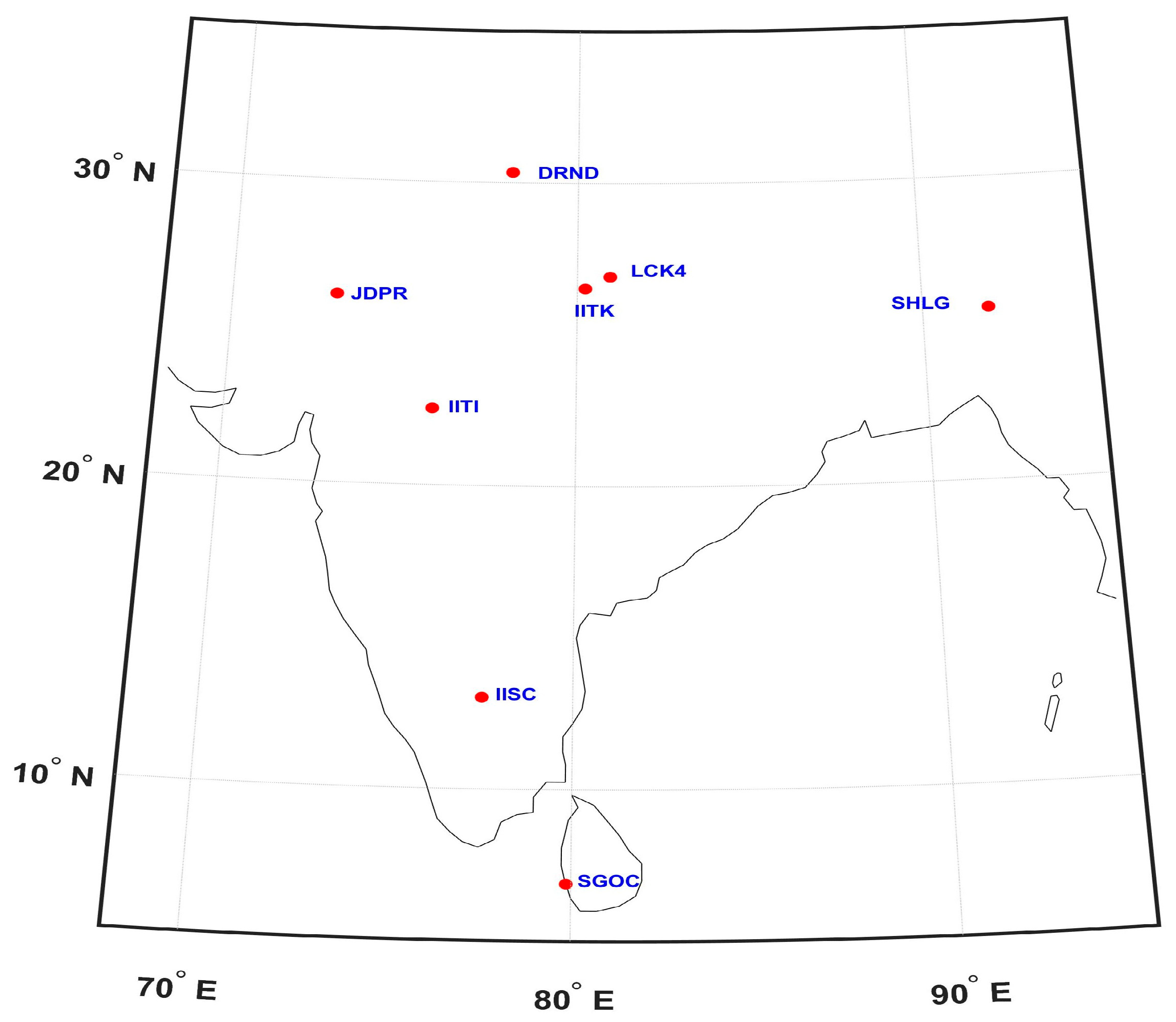
In this study, we considered available GNSS observation data from all the stations in India under IGS network as well as the equatorial IGS station in Sri Lanka to analyze the variation in TEC in the Indian longitude sector. The GNSS data in the form of RINEX files are taken from the GNSS Data Repository (https://data.gnss.ga.gov.au/, last accessed on 21 August 2025) for extracting the TEC values using the RINEX GPS TEC analysis tool (version 2.9.5), developed by Dr. Gopi Krishna Seemala, which can be retrieved from https://seemala.blogspot.com (last accessed on 21 August 2025). Additionally, the ionospheric TEC data from the ionospheric TEC and scintillation monitoring GNSS receiver at IIT Indore is considered in this work which was graciously provided by IIT Indore on request. The geographic distribution of all the GNSS stations considered in this work are shown in Figure 1 whose geographic as well as geomagnetic coordinates are listed in Table 1.
The variations during the 7–8 October and 10–11 October 2024 storms are analyzed from VTEC calculated from GNSS stations. The percentage change in VTEC ( % V T E C ( t ) ) ) is calculated from the change in quiet day VTEC and disturbed day VTEC, by using the formula of Equation (1):
% V T E C ( t )   =   V T E C d i s t ( t )     V T E C q u i e t V T E C q u i e t × 100 ,
where V T E C d i s t ( t ) is the VTEC on storm days and V T E C q u i e t is the average VTEC of the first five geomagnetic quiet days in October 2024.
The GIM data with a temporal resolution of 15 min were retrieved in IONEX format from the NASA CDDIS archive (https://cddis.nasa.gov/archive/gnss/products/ionex, last accessed on 21 August 2025). The gridded VTEC values, provided at 2.5° × 5° latitude–longitude resolution, were interpolated to generate continuous spatiotemporal fields over the study region. These high-resolution GIM datasets enabled the construction of VTEC maps capturing both short-term fluctuations and regional ionospheric responses.
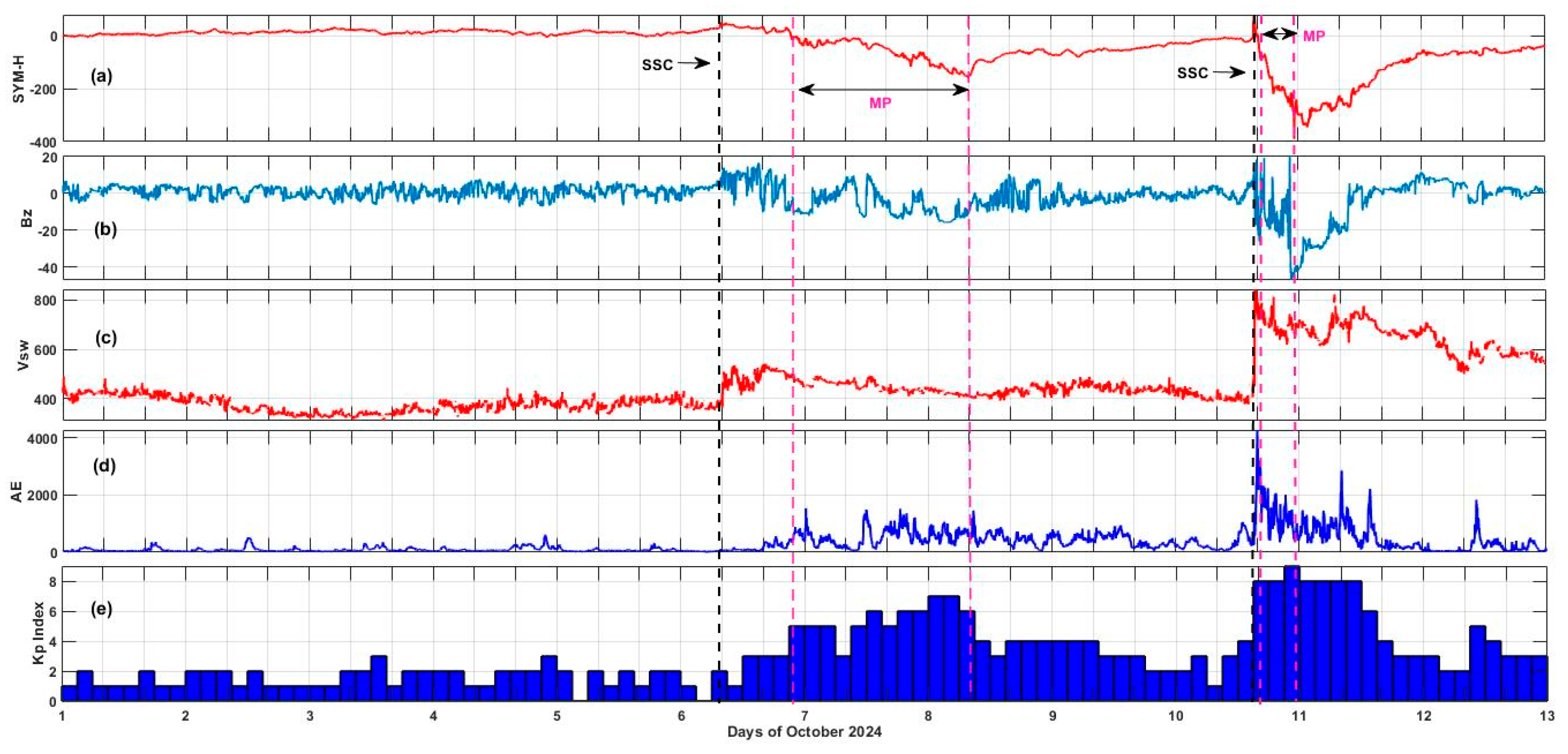
Figure 2 shows the details of interplanetary and geomagnetic conditions during the 7–8 October and 10–11 October 2024 storms. In Figure 2a, we present the one-minute SYM-H data obtained from the OMNI Web Data Explorer (https://omniweb.gsfc.nasa.gov/, accessed on 7 November 2025). The SYM-H index attains values −155 nT and −341 nT, respectively, for 7–8 October and 10–11 October 2024 storms. The interplanetary magnetic field (IMF) Bz (z component of the field), depicted in Figure 2b, data have been taken from the OMNI Web Data Explorer (https://omniweb.gsfc.nasa.gov/form/dx1.html, last accessed on 21 August 2025) and show southward movement after the Storm Sudden Commencement (SSC) on 6 October 2024. The IMF Bz keeps moving southward and attains a value of −42.3 nT at 23UT on 10 October 2024. The solar wind speed (Vsw) data, shown in Figure 2c, are also taken from the OMNI Web Data Explorer. From Figure 2c, it can be observed that the Vsw reaches a speed of 447 km/s and as high as 740 km/s during the storm main phase of 8 and 11 October 2024, respectively. The Auroral Electrojet (AE) data were sourced from SuperMAG (https://supermag.jhuapl.edu/indices/, last accessed on 21 August 2025) and show drastic changes during storm time, with a peak of about 1780 nT on 8 October 2024 and 4741 nT on 10 October 2024, as depicted in Figure 2d. Figure 2e shows the variation in Kp index as obtained from WDC Kyoto (https://wdc.kugi.kyoto-u.ac.jp/dstdir/, last accessed on 21 August 2025).

3. Results

3.1. Solar and Geomagnetic Conditions During Two Storms

The 7–8 October 2024 geomagnetic storm was driven by a CME from highly active sunspot regions, NOAA AR3842, on 3 October 2024. This region was exceptionally dynamic, producing a sequence of powerful solar flares, including X and M class during 7 and 8 October 2024 (https://www.spaceweatherlive.com/en/archive/2024/10/08/xray.html, last accessed on 21 August 2025). As shown in Figure 2, the geomagnetic storm on 8 October was preceded by an SSC on 6 October (07:40 UT). The SYM-H index shows a positive jump which remained positive for around 5 h, followed by a gradual decline in the main phase, reaching a minimum of about −155 nT on 8 October at 08:00 UT, followed by a long recovery phase that lasts till 10 October at 09:00 UT (SYM-H = −12 nT) The IMF Bz turned strongly southward (−15 nT) shortly after the SSC, sustaining for several hours and enabling efficient coupling between the solar wind and magnetosphere. Solar wind speed increased from ~400 km/s to ~600 km/s, while the AE index showed enhanced substorm activity, peaking near 1500 nT. The Kp index rose to values between 6 and 7, indicating strong geomagnetic activity. This storm was moderate in intensity but notable for its prolonged southward IMF and associated auroral electrojet enhancement.
The second geomagnetic storm (10–11 October) began with an SSC at ~18:00 UT on 10 October, followed by a rapid and steep drop in SYM-H index, reaching a minimum of −341 nT during the main phase. IMF Bz plunged to −20 nT and remained southward for an extended duration, accompanied by extremely high solar wind speeds exceeding 800 km/s. AE index spiked above 2000 nT, indicating intense substorm activity, while the Kp index reached extreme levels (8–9), consistent with severe (G4–G5) storm classification. Further details of solar and geomagnetic conditions during this storm can be found at [25,30]. Compared to the 8 October event, this storm exhibited stronger magnetospheric compression, higher solar wind dynamic pressure, and more intense ring current development, resulting in one of the most significant geomagnetic disturbances of Solar Cycle 25.

3.2. VTEC Variation During Two Storms

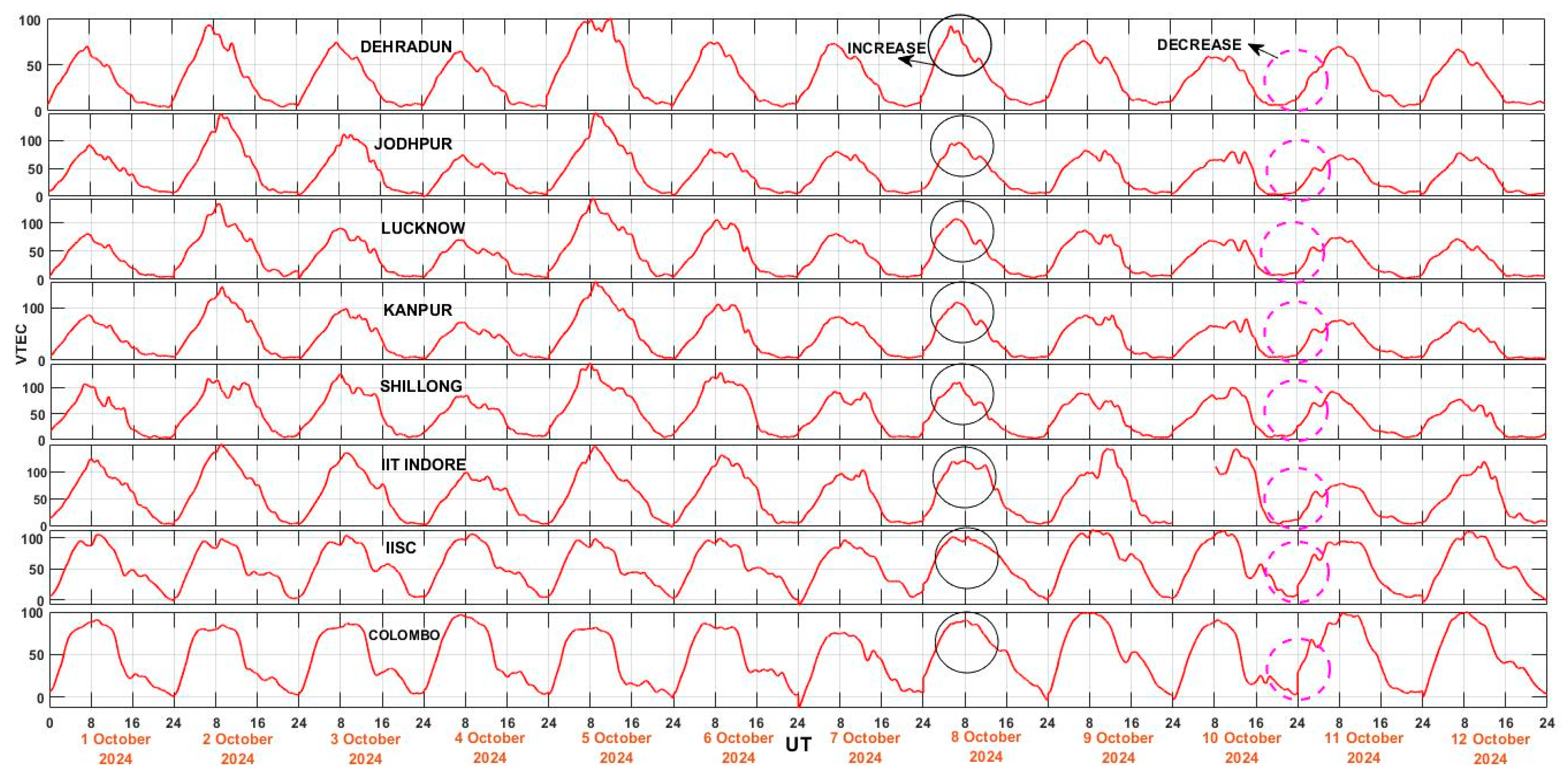
Figure 3 shows the variations in VTEC recorded during the geomagnetic storms of 7–8 October and 10–11 October in 2024, at GNSS stations distributed along different latitudes (Dehradun, Jodhpur, Lucknow, Kanpur, Shillong, IIT Indore, Bangalore and Colombo) covering the entire Indian equatorial and low latitude region. To understand the VTEC variation during the preceding and succeeding days of the storms, we show the VTEC variations from 1 October 0UT to 12 October 24UT in Figure 3. It can be noticed from the figure that the VTEC shows regular diurnal variations at all stations until 4 October. On 5 October, VTEC showed a sharp increase in diurnal magnitude that peaked around 08:00UT at the stations away from the equator (IIT Indore, Shillong, Kanpur, Lucknow, Jodhpur and Dehradun). On 6 October, VTEC during night hours (~16–24UT) show higher values over equatorial stations (Colombo and IISc) compare to previous days.
During the geomagnetic storm of 7–8 October 2024, as shown in Figure 3, all stations exhibited a sharp positive storm effect in the morning hours, followed by a strong negative phase in the afternoon. The main phase of the storm began on 7 October around 17:00 UT (SYM-H = −40 nT); however, likely due to nighttime conditions, no significant VTEC variation was observed, and the trend remained decreasing. On 8 October, VTEC increased after sunrise in the usual manner but with a much steeper rate at all stations. At Lucknow, Kanpur, Shillong, Indore, and Bangalore, VTEC values rose rapidly after sunrise, peaking at ~100–120 TECU around 06:00–08:00 UT.
The subsequent VTEC decrease was steep at Lucknow, Kanpur, and Shillong, ranging from ~15–17 TECU during 12–16 UT, while at the other stations the decrease was larger (~25–50 TECU during the same interval). Overall, IIT Indore recorded the maximum VTEC enhancement (~120 TECU), while Colombo exhibited the minimum (~89 TECU). Interestingly, clear dual peaks were observed in the diurnal VTEC variation at stations located north of the EIA crest (north of IIT Indore) during 10:00–12:00 UT. The storm effect persisted into 9 October, when the VTEC peak remained higher than on 7 October. At stations located at or south of the EIA crest (IIT Indore and IISc, Colombo), the peak VTEC was higher compared with the previous day, while stations north of the EIA showed lower values than on 8 October but still higher than on 7 October. Thus, the 7–8 October storm was characterized by a sharp morning enhancement followed by a deep afternoon depletion, with positive effects dominating at several stations, and its impact persisted on 9 October with a clear demonstration of the EIA effect.
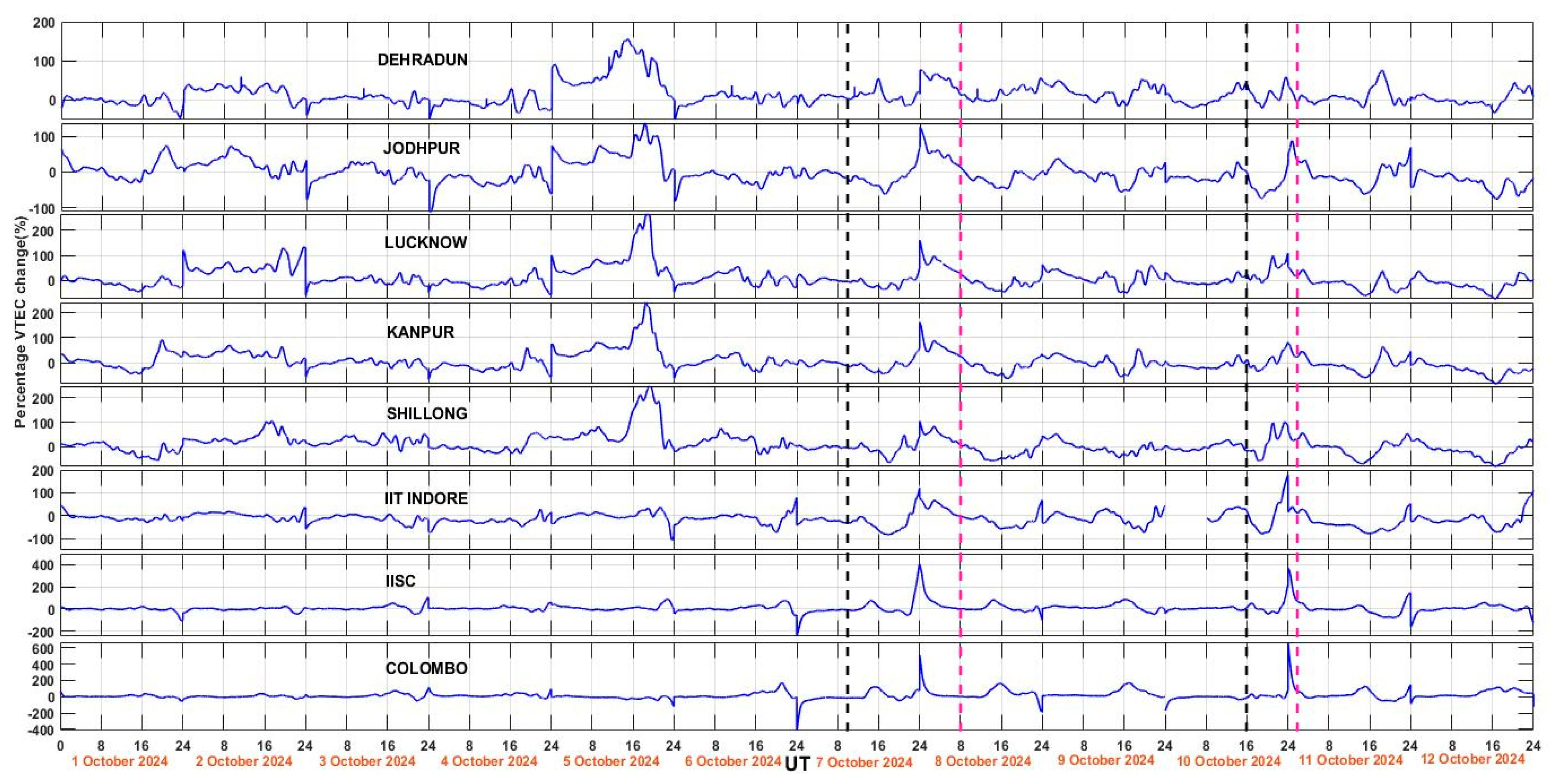
Figure 4 shows the percentage VTEC change for the same GNSS stations as in Figure 3. The percentage change, calculated using Equation (1) with respect to the mean of five geomagnetically quiet days, provides further details of VTEC variability at each station. The VTEC increase on 5 October is clearly visible, which shows 100–200 percentage increase at the off-equatorial stations. On 6 October, percentage increase is promianatly visible during night hours (~16–24UT) over equatorial stations and roughtly estimated to 50% and 130%, respectively, for IISc and Colombo stations. On 8 October, a strong positive ionospheric storm phase was observed during the morning hours, followed by a deep negative phase in the afternoon. At stations north of the EIA (Dehradun, Lucknow, Kanpur, Jodhpur, Shillong), the VTEC enhancement began around 04–06 UT, peaking between +50% and +100%. The enhancement was strongest at Lucknow and Kanpur (+100%), while Jodhpur and Dehradun recorded moderate increases (+65%). Shillong exhibited the smallest enhancement (+45%). All stations showed steep depletions during the afternoon negative phase. In contrast, stations south of the EIA crest (Indore, IISc, Colombo) displayed relatively flat variations (small negative or near-zero changes of up to −30%) during the daytime, but significant enhancements (+80–160%) during 13–15 UT, indicating a positive storm effect in the evening period. These results highlight severe electron density loss in the equatorial and low-latitude ionosphere during the storm. The extended storm effect on 9 October further showed enhancements of ~20–50% at stations mostly north of the EIA.
This morning enhancement across the Indian region highlights storm-induced electrodynamic effects (penetration electric fields and disturbed winds), enhancing plasma density. These large positive deviations indicate that the storm-time PPEFs enhanced the equatorial fountain effect, transporting plasma upward and poleward from the magnetic equator and intensifying the EIA crests. The combined effect of increased eastward electric fields and favorable disturbance dynamo contributions facilitated efficient plasma uplift and redistribution, particularly over the northern low-latitude sector.
Thus, the simultaneous use of absolute TEC and percentage TEC change analysis provides a consistent picture: the 8 October 2024 storm produced a strong positive phase ionospheric response across all Indian GNSS stations, with enhancements being more prominent at low-latitude stations closer to the EIA crests.
The geomagnetic storm of 10–11 October 2024 produced more sustained and widespread ionospheric disturbances compared with the 7–8 October event. As shown in Figure 2, the main phase of the storm began on 10 October around 18 UT, with the minimum SYM-H observed around 02:00 UT on 11 October. As shown in Figure 3, after ~16:00 UT on 10 October, VTEC decreased to very low values (~5 TECU) at most stations, except IISc and Colombo, where VTEC remained relatively higher (~20 TECU). At the beginning of 11 October, the VTEC increase was weaker compared with quiet days at all off-equatorial stations. VTEC peaked around 03:30 UT, followed by a dip, and then exhibited a second peak around 08:00 UT. Interestingly, at equatorial stations (IISc and Colombo), VTEC showed a sharp increase until 03:30 UT (marked with a black arrow), followed by a second peak, at ~08:00 UT. After the second peak, VTEC got nearly flattened at almost all stations until 13:00 UT and showed a decrease compared to the previous day (marked with a dotted circle). The second peak showed clear latitudinal dependence: stations north of IIT Indore recorded lower values (~70–75 TECU), while stations south of Indore reached higher peaks (~95 TECU). This was followed by a negative storm phase (marked with a dotted circle) in the afternoon, with VTEC dropping sharply to ~10–20 TECU by 14:00 UT. At IIT Indore, IISc, and Colombo, the depletion was particularly small (~4 TECU), followed by an increase in VTEC, indicating significant fluctuations in the ionospheric electron density. The VTEC variations were significant until 11 October, suggesting a shorter-duration effect compared with the 7–8 October storm. Unlike the earlier storm, which was dominated by positive effects and exhibited a longer recovery, the 10–11 October event showed positive/negative effects across almost all stations, suggesting stronger geomagnetic forcing and more widespread ionospheric disturbance. Overall, the 10–11 October storm exhibited stronger and more consistent positive and negative storm phases. Both storms also demonstrated a clear EIA influence on VTEC variations.
The percentage VTEC change in Figure 4 showed a strong positive storm over equatorial stations, with VTEC increasing more than 250%, while at the rest of the stations, it was nominal during morning hours (00:00–3:00 UT) on 11 October. Further, between 10:00 and 16:00 UT, a strong negative storm phase developed, with VTEC depletions ranging from −50% to −100% at all stations except equatorial stations, where it small positive. Another positive phase occurred between 16:00 and 24:00 UT on 11 October at all stations except Bangalore and Colombo. The persistence of large positive and negative swings across both days demonstrates that this storm caused more prolonged and intense ionospheric disturbances compared with the 7–8 October event.
Physically, these depletions can be attributed to westward DDEFs generated during the storm’s recovery phase, which opposed the quiet-time eastward electric fields and inhibited plasma uplift at the equator. This suppressed the equatorial fountain effect, leading to a weaker EIA and reduced crest intensities over the low-latitude Indian sector. Additionally, thermospheric composition changes, particularly a reduction in the O/N2 ratio, further decreased the recombination lifetime of ions, intensifying the depletion.

3.3. GIM-Derived VTEC Variation During the Two Storms

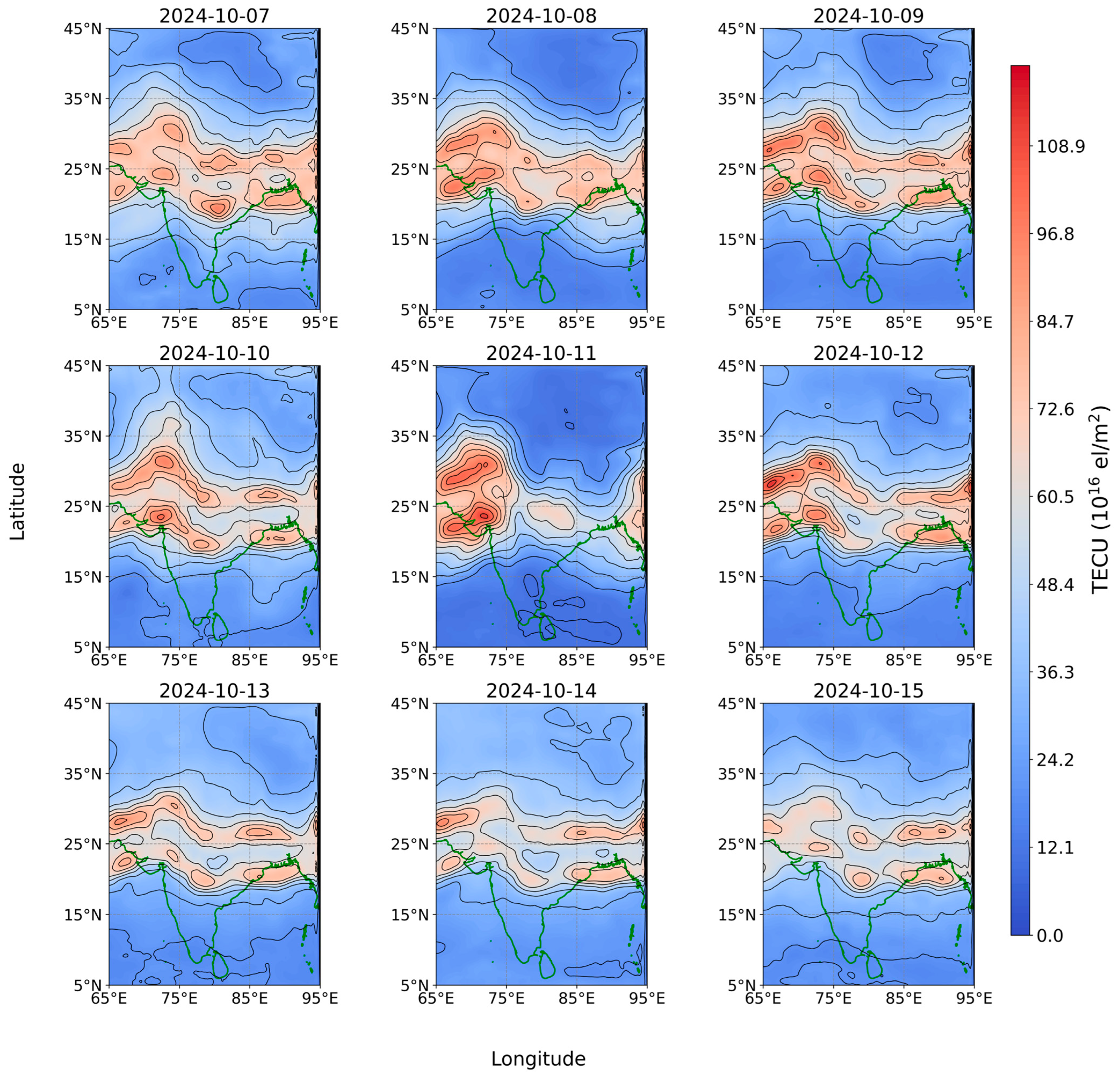
Figure 5 illustrates the spatiotemporal profile of GIM-VTEC profiles over the Indian sector (60° E–95° E, 5° N–45° N) for the period 7–15 October 2024. During the first storm on 7 October 2024, the VTEC enhancement becomes evident, with the EIA crests forming around 20° N–25° N latitude and reaching values of 50–60 TECU compared to quiet-time levels of ~20–25 TECU observed on 14–15 October. This corresponds to an increase of ~120–150% above background. The enhancement further intensifies on 8 October, where the northern EIA crest expands poleward up to ~30° N and VTEC exceeds 60 TECU in localized regions, indicating storm-time penetration of low-latitude electrodynamics.
During the second storm interval (10–11 October 2024), a much stronger positive ionospheric response is observed. On 10 October, the northern crest (centered at ~25° N–30° N) exhibits values exceeding 100 TECU, representing a ~300–350% increase relative to quiet-time conditions. The effect persisted on 11 October, with VTEC remaining elevated (~50–60 TECU) and the crest broadened latitudinally across 20–30° N. These results indicate strong eastward prompt penetration electric fields during the main phase of the storm, which uplifted the equatorial plasma and enhanced fountain-driven transport into the anomaly region.
The recovery phase is observed during 12–13 October, when the VTEC magnitude decreases to 30–40 TECU around the crest regions, closer to background values. However, residual enhancements remain noticeable over the northern latitudes (>25° N), suggesting contributions from disturbance dynamo electric fields and thermospheric composition changes.
Most of the TEC increase occurs to the east and west of the central meridian at 80° E. The apparent longitudinal variation in TEC values around 80° E during 10–11 October 2024 reflects a genuine geophysical feature rather than an observational artifact. As shown in Figure 5, the most intense enhancement (>100 TECU) appears between approximately 77° E and 83° E, centered near 25–30° N. Although TEC values decrease gradually toward both eastern and western longitudes (to about 60–80 TECU), they remain substantially above quiet-time levels (~25–30 TECU), representing an overall 200–350% increase. This localized strengthening near 80° E is consistent with the known longitudinal asymmetry of the Equatorial Ionization Anomaly (EIA) over the Indian sector, where geomagnetic declination, magnetic field geometry, and eastward electric fields combine to enhance the upward E × B plasma drift. During the storm’s main phase, prompt penetration electric fields (PPEFs) and disturbance dynamo electric fields (DDEFs) may further intensify this uplift, producing a pronounced TEC maximum near 80° E.
Overall, the two ionospheric storms in October 2024 caused significant enhancements in GIM VTEC data. The most probable reason for such a change may be due to strong eastward electric fields uplifting equatorial plasma and expanding EIA crests. The increased VTEC values began to decline during the recovery phase (12–13 October), but residual effects remained for the next few days.

4. Discussion

The ionospheric responses during the two October 2024 storms show clear differences in both intensity and duration of VTEC variability. The 7–8 October storm was characterized by a strong positive phase in the morning hours, with VTEC increases exceeding 100 TECU at certain stations, followed by an intense negative phase in the afternoon. This short-lived response, with residual effects into 9 October, reflects the dominance of PPEF-driven uplift in the early phase and subsequent depletion associated with composition changes and disturbance dynamo electric fields [37,38]. Rama Rao et al. [37] studied the July 2004 geomagnetic storm using GPS TEC data from the Indian GPS network and found strong storm-time variations in VTEC. They reported enhancements of 10–20 TECU (about 50%) during the storm’s initial phase, followed by comparable negative storms in the recovery period. The results also revealed intensification of the EIA crest during positive phases, which later weakened as the storm progressed, thereby modifying the latitudinal gradients of electron density. Kumar and Singh [38] investigated the geomagnetic storm of 24 August 2005 over the Indian longitude sector and reported strong storm-time variability in VTEC. During the initial phase, VTEC increased by nearly 50–80% relative to quiet-day levels in the morning hours, whereas the recovery phase was marked by sharp depletions of 30–50%. Thus, our results indicate the combined effects of PPEF uplift during the main phase and composition changes during the recovery phase.
In contrast, the 10–11 October storm exhibited a more complex and prolonged response. The storm effect starts early on 11 October during morning hours with a strong positive VTEC peak over equatorial stations, while during noon time, a strong negative storm phase developed at off-equatorial stations. These effects persisted for nearly two days, marking a stronger and more consistent positive and negative storm. Nava et al. [39] examined the St. Patrick’s Day storm of March 2015 and reported remarkable ionospheric disturbances across low-latitude sectors. Their observations indicated TEC increases of up to 100% during the main phase, followed by large-scale depletions of 20–40 TECU during the recovery phase. The results also highlighted modulation of the EIA during both positive and negative phases of the storm. Similarly, Bagiya et al. [40] reported that negative storms dominate in multi-phase events, particularly during the later stages when disturbance dynamo fields and composition effects overwhelm electrodynamic uplift.
The role of the EIA was evident in both storms, though expressed differently. During 7–8 October, north–south asymmetries in the diurnal peaks reflected modulation of the anomaly, while during 10–11 October, stations near and south of the crest (e.g., Indore, IISc, Colombo) experienced the largest fluctuations. Adebiyi [41] analyzed several intense storms and demonstrated that storm-time TEC responses vary strongly with local time and latitude. Their results showed large positive storms, with TEC enhancements of 50–100% in the morning hours, while the afternoon and evening sectors were dominated by negative storms exceeding 40% depletion. The study concluded that PPEF and disturbance dynamo fields are primary drivers of the positive and negative phases, respectively, with their effects being particularly pronounced near the EIA crests. The asymmetry in storm-time response between the two events might be associated with equatorial latitude variability as reported by Chakraborty et al. [42]. Chakraborty et al. [42] analyzed storm-time responses over the Indian longitude and observed large-scale TEC variations during several events. They reported storm-time enhancements of 50–100% at equatorial stations during the main phase, while the recovery phase was marked by significant depletions. The study also noted asymmetries between regions north and south of the EIA crest. Their results highlighted the dominance of electrodynamic forcing during the main phase and the increasing role of disturbance dynamo in the later storm phases.
Conclusively, the two events demonstrate that consecutive geomagnetic storms can induce fundamentally different ionospheric responses, depending on the balance between electrodynamic uplift and thermospheric composition effects. The 7–8 October event serves as a clear example of a PPEF-dominated positive storm with rapid recovery, possibly due to composition change, while the 10–11 October event represents a positive/negative-storm-dominated case, where sustained thermospheric composition changes and disturbance dynamo fields suppressed the ionosphere over multiple diurnal cycles. These findings reinforce the critical role of storm-time electrodynamics, composition changes, and EIA modulation in shaping the variability of low-latitude ionospheric responses. The effect of these parameters is discussed below for each storm.
  • The O/N2 ratio change during two storms
The O/N2 ratio serves as an indicator of thermospheric composition, reflecting the balance between atomic oxygen and molecular nitrogen, which influences ionospheric electron density through temperature-driven variations. The TIMED satellite, in a 630 km orbit (97.8 min period, 74° inclination), and covers the same longitude at approximately the same local time and producing multiple observations within a given longitude sector each day. GUVI data are available from the Johns Hopkins University Applied Physics Laboratory (http://guvitimed.jhuapl.edu/data_fetch_l3_on2_idlsave, last accessed on 5 November 2025).
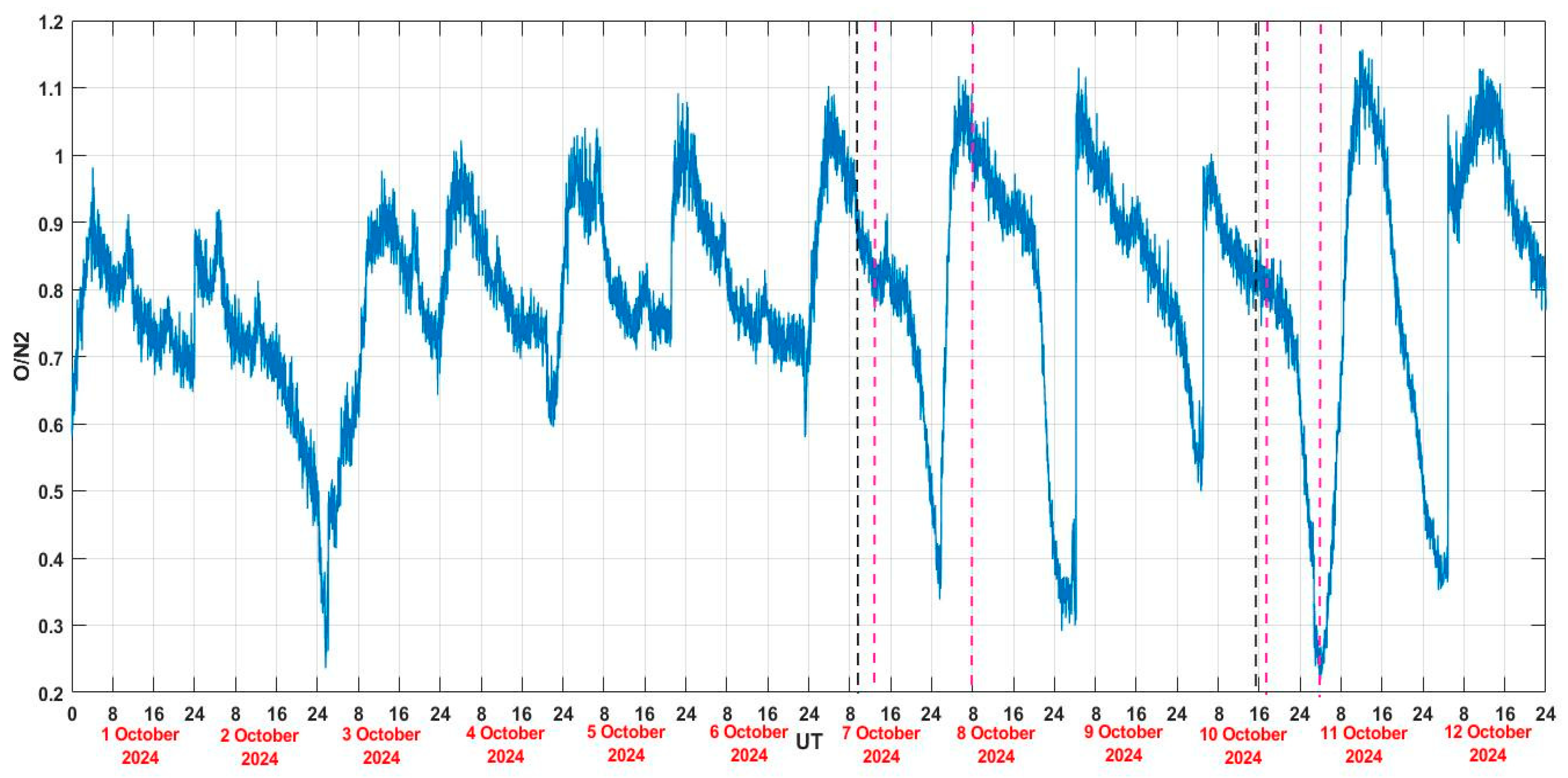
In our study, we selected the Indian region bounded by 20–30° N latitude and 60–100° E longitude. Within this region, GUVI provides several O/N2 measurements each day at different latitude–longitude points and are presented in Figure 6 during 1–12 October 2024.
During the first storm (7–8 October), the O/N2 ratio showed a significant decline beginning in the afternoon of 7 October, shortly after the onset of geomagnetic disturbances. The ratio dropped from values exceeding 1.0 in the morning sector to ~0.6–0.7 by late evening. This depletion persisted through the night of 7 October into 8 October, with the lowest values (~0.3–0.4) observed near local midnight. The sharp reduction in O/N2 indicates strong storm-induced thermospheric composition changes, where enhanced upwelling of molecular species (N2, O2) at low latitudes reduces the relative atomic oxygen concentration [43]. Such composition changes contribute to the observed negative phase in VTEC during the afternoon–evening hours of 8 October, as molecular-rich air enhances recombination rates in the F-region [44]. The partial recovery of O/N2 on 9 October aligns with the gradual recovery of VTEC, confirming the close coupling between thermospheric composition and ionospheric density [45].
In contrast, the second storm (10–11 October) exhibited an even stronger and more prolonged decrease in the O/N2 ratio. A sharp depletion began late on 10 October, with the ratio falling steeply to values below 0.4 near midnight UT on 11 October—the lowest in the entire observation period. This extreme reduction persisted for more than a day, with slow recovery only evident after 12 October. The extended depression in O/N2 reflects significant storm-time energy input into the high-latitude thermosphere, driving equatorward surges of molecular-rich air and thus sustaining long-lasting negative ionospheric effects [46]. This explains the strong and widespread VTEC depletions observed during the 10–11 October storm, particularly in the afternoon and evening sectors. The persistence of low O/N2 ratios into 12 October highlights the dominant role of composition changes, together with disturbance dynamo electric fields, in maintaining negative storm phases long after the main geomagnetic activity subsided [47].
  • The PPEF changes during two storms
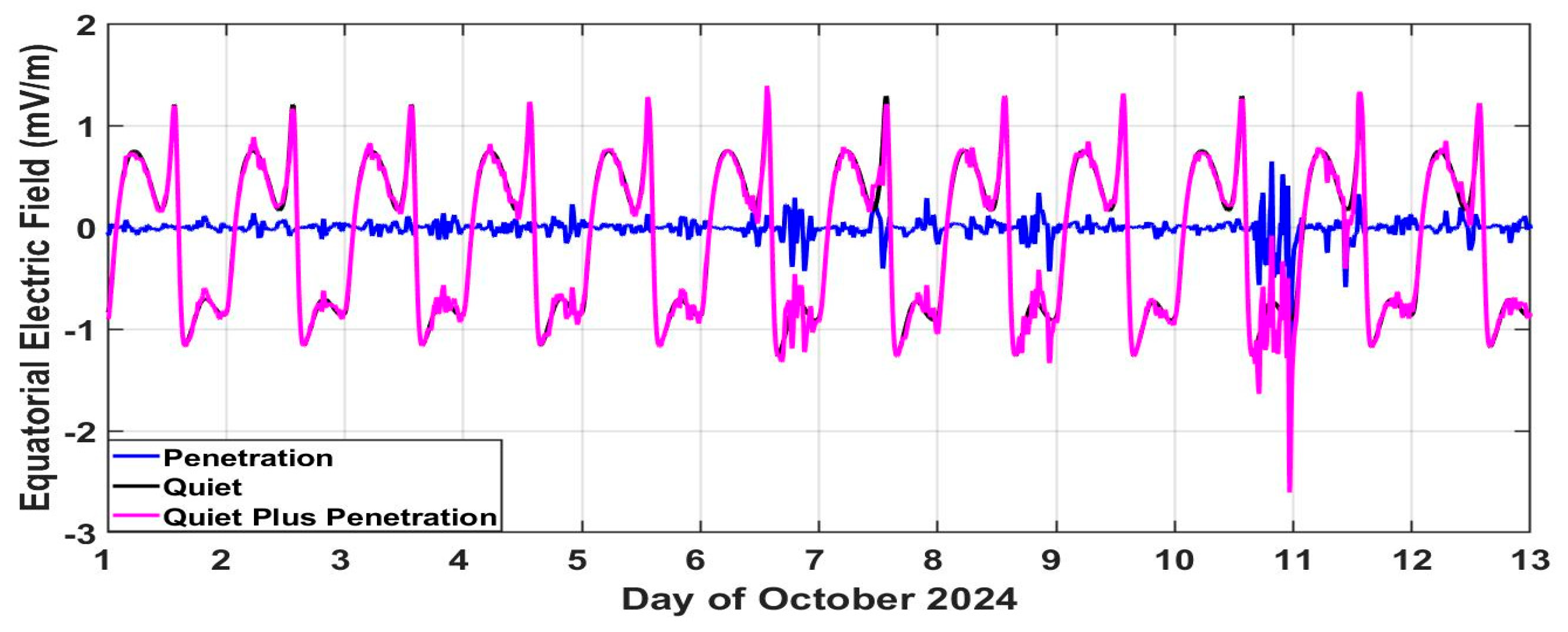
The storm-time equatorial electric field variations were analyzed using the Prompt Penetration Equatorial Electric Field Model (PPEEFM), which incorporates solar wind parameters from DSCOVR and ACE to estimate the zonal electric field (Figure 7). The equatorial zonal field plays a key role in controlling storm-time plasma density variations, vertical ion motion, and the modulation of the EIA through the E × B drift mechanism. The model outputs include the quiet-time zonal component, the PPEF, and their combined variation. A positive (eastward) field enhances upward plasma transport in the F-region, thereby intensifying the EIA, while a negative (westward) field drives downward plasma motion and suppresses EIA development [48].
As shown in Figure 7, a significant fluctuation is seen in the EEJ on 6 October during local nighttime hours (~16–24UT) possibly causing VTEC variations over equatorial stations as shown in Figure 3 and Figure 4 in Section 3.2. As the EEJ fluctuations occurred in the nighttime hours when the E-region conductivity was collapsing, the strength of these fluctuations was insufficient to drive a fully developed fountain to transport the equatorial plasma to higher latitudes. This probably caused a localized redistribution of plasma over the equatorial region, resulting in TEC enhancements being confined to the equatorial region and not strongly appearing at higher low latitudes.
During the geomagnetic storm of 7–8 October 2024, the equatorial electric field exhibited strong enhancements driven by PPEFs. As seen in Figure 7, large deviations from the quiet-time background (black curve) are visible, particularly on 7 October afternoon and evening hours. The penetration component (blue curve) indicates significant eastward PPEFs, which enhanced the total electric field that was eastward directed (pink curve), leading to upward E × B drifts at the equator. These drifts contributed to (i.e., amplified) the PRE of the plasma fountain/EIA and likely intensified ionospheric irregularities. Following this, a shift to westward penetration fields is observed, corresponding to negative excursions in the electric field around local midnight, which drove downward drifts and contributed to the negative ionospheric storm phase. This oscillatory behavior of PPEFs is consistent with previous reports that prompt penetration is most effective during the main phase of geomagnetic storms [13,49].
In the 10–11 October 2024 storm, the electric field perturbations were much stronger and more prolonged. Figure 7 shows sharp, large-amplitude excursions in the penetration field starting late on 10 October, with the combined (quiet + penetration) electric field reaching values below −2.5 mV/m near 11 October midnight. These extreme westward penetration fields suppressed the existing upward drifts and significantly depleted equatorial plasma densities, which explains the widespread and intense negative phase of VTEC observed during this event. The persistence of strong PPEFs over multiple hours highlights the role of prolonged high-latitude energy input in maintaining equatorial disturbances [50,51]. This also indicates coupling with DDEFs, which act on longer timescales and sustain storm-time effects even after PPEFs weaken.
Overall, the two storms demonstrate the crucial role of PPEFs in driving short-term enhancements and depletions in the equatorial electric field, with the 10–11 October storm showing more extreme and long-lasting disturbances compared to the 7–8 October storm.
  • The DDEF change during two storms
The delayed westward electric field signatures observed in the aftermath of both the 7–8 October and 10–11 October 2024 storms strongly suggest the significant influence of DDEF in sustaining ionospheric disturbances beyond the prompt penetration phase. As clearly observed from the literature that while PPEF initiate rapid but transient equatorial electrodynamic changes, DDEF—driven by storm-time changes in high-latitude thermospheric winds—emerges several hours later and persists for extended periods, often modifying the equatorial ionospheric electrodynamics for many hours into recovery [52,53]. In particular, the 7–8 October storm, characterized by moderate O/N2 depletion and a brief negative VTEC phase, aligns with DDEF onset within a few hours of storm commencement, consistent with earlier modeling of thermosphere–ionosphere response [52]. In contrast, the 10–11 October storm displayed a more pronounced and prolonged ionospheric suppression, indicating stronger and longer-lasting DDEF influence—typical of more energetic or sustained high-latitude forcing, as described in climatological studies of storm-time electrodynamics. The extended DDEF impact likely contributed to the persistence of low VTEC and O/N2 depletion, underscoring the complex interplay between prompt and dynamo-driven electric fields in low-latitude ionospheric response.
There is no direct observation of DDEF available, but as demonstrated by Picanço et al. [54] for the October 2024 storm, PPEFs could dominate the main phase (10 October), while DDEFs became the primary driver during the recovery phase (11 October), producing counter-electrojet (CEJ) signatures and prolonged negative ionospheric phases. Their observation of a persistent westward daytime DDEF, which suppressed equatorial plasma uplift and reduced VTEC, is consistent with our results showing weakened equatorial electric fields and extended VTEC depletions on 11 October. This agreement confirms that the DDEF, rather than PPEF, controlled the low-latitude ionospheric response during the recovery stage of the storm.
  • The EEJ variation during two storms
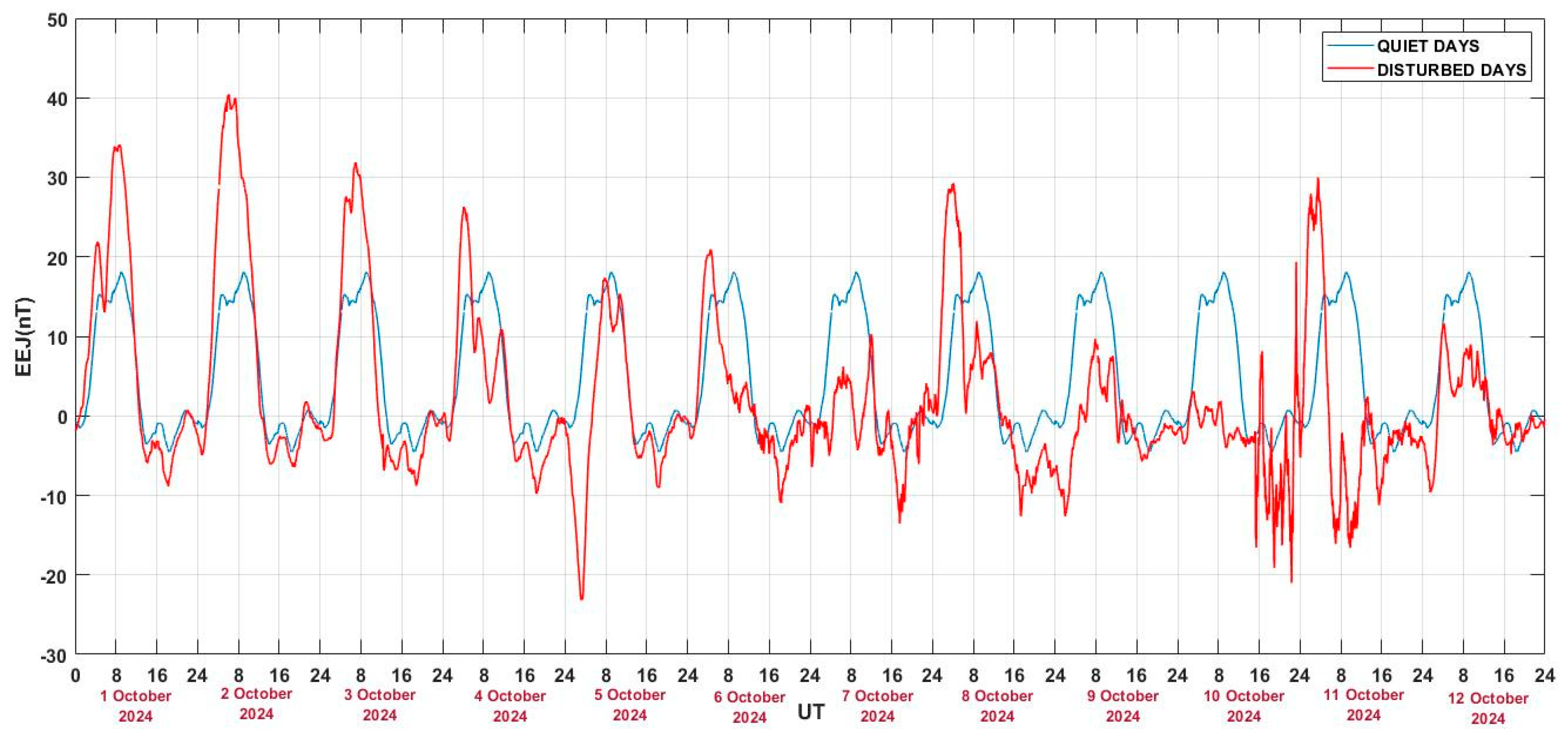
To estimate the EEJ variation during the consecutive storms in October 2024, we followed the standard ΔH method using ground-based magnetometer data. The northward (X), eastward (Y), and downward (Z) components of the geomagnetic field, sampled at a 1 min cadence, were obtained from the INTERMAGNET data portal (https://imag-data.bgs.ac.uk/GIN_V1/GINForms2, last accessed on 21 August 2025). Variations in the horizontal (H) component were analyzed for the period 1–12 October 2024. To remove background contributions, the mean H values during 02–05 LT on the five International Quiet Days (1, 2, 13, 21, and 25 October 2024) were computed for each station. The storm-time perturbation in H was then determined as the difference between the observed H and the quiet-day mean. The EEJ strength was obtained by subtracting the perturbation H at the off-equatorial station (Alibag, India) from that at the equatorial station (Gan International Airport, Addu Atoll, Maldives). The temporal variations in EEJ derived from this method are presented in Figure 8. This ΔH technique is widely used for EEJ estimation and has been validated in several earlier studies [55,56,57].
The EEJ variations during the 1 and 2 October 2024 show relatively strong EEJ during day time despite being the quiet days. The EEJ can show significant day-to-day variations due to changes in atmospheric winds and lunar tides, which can cause high or low values compared to the average quiet-day mean without any input from a solar storm. These EEJ variations do not produces any significant change in TEC. Further, strong CEJ during the morning hours is observed on 5 October which might have caused an anomalous increase in VTEC, as shown in Figure 3 and Figure 4. The CEJ induced a strong westward electric field, driving a downward ExB drift at the equator, which redistributes plasma towards off-equatorial anomaly crests, leading to enhanced daytime TEC in the off-equatorial stations. During the 7–8 October storm, the EEJ showed a sharp enhancement between 06:00 and 09:00 UT on 8 October, followed by oscillatory fluctuations including short-lived counter-electrojet (CEJ) signatures around 12:00–15:00 UT. These features reflect the penetration of interplanetary electric fields into the equatorial ionosphere through PPEFs. The eastward PPEFs enhanced the EEJ and consequently increased plasma uplift, producing positive VTEC disturbances and an associated increase in O/N2 ratio, consistent with earlier reports on PPEF-driven ionospheric responses [49,58,59].
In contrast, during the 10–11 October storm, the EEJ showed strong and prolonged negative excursions on 11 October (~06:00–15:00 UT), indicative of westward DDEFs. These westward fields suppressed the EEJ and weakened equatorial plasma uplift, leading to reduced electron density and negative VTEC disturbances. Simultaneously, the O/N2 ratio decreased, signifying composition changes driven by storm-time thermospheric circulation. Such long-lasting CEJs are a hallmark of DDEF activity, which typically dominates during the recovery phase of intense geomagnetic storms [53,60,61]. Our results are in agreement with Picanço et al. [54], who reported that PPEFs dominated the electrodynamics on 10 October, while DDEFs governed the response on 11 October, leading to suppressed EEJ and negative ionospheric perturbations.
Thus, the combined analysis of EEJ, VTEC, and O/N2 indicates that the 7–8 October storm was primarily controlled by PPEFs, enhancing equatorial electrodynamics and plasma uplift, whereas the 11 October storm was controlled by DDEFs, leading to suppressed EEJ, depleted ionospheric densities, and negative composition anomalies. These results extend earlier findings [49,54,59,62] by providing direct observational evidence of the transition from PPEF to DDEF dominance across successive storm events.

5. Summary and Conclusions

This study investigated the ionospheric response to two successive geomagnetic storms (7–8 and 10–11 October 2024) using GNSS-derived VTEC observations over the Indian low- and equatorial-latitude sector. The results revealed clear contrasts in storm-time variability, both in intensity and duration, despite the storms being closely spaced in time.
The 7–8 October storm was characterized by a strong positive phase during the morning–afternoon hours, with VTEC enhancements exceeding above average (~100 TECU), primarily driven by eastward PPEFs that uplifted the F-layer and intensified the EIA. However, this response was short-lived, as subsequent thermospheric composition changes (O/N2 depletion) and the development of westward DDEFs suppressed ionospheric densities, producing strong afternoon–evening depletions and a rapid recovery thereafter.
In contrast, the 10–11 October storm exhibited a complex and prolonged positive/negative phase. This event was dominated by persistent westward PPEFs that weakened the PRE, large-scale thermospheric composition changes reflected in sustained O/N2 depletion, and prolonged westward DDEFs that drove strong CEJs. These processes suppressed early morning VTEC peaks at equatorial stations and produced strong afternoon–evening depletions at off-equatorial stations. The equatorial ionization anomaly responded differently in the two events, with the 7–8 October storm showing north–south asymmetries in diurnal peaks, while the 10–11 October storm displayed stronger variability near and south of the anomaly crest.
The GIM analysis reveals two distinct storm-time positive ionospheric responses, with the 10 October 2024 event producing the strongest enhancement (>100 TECU, ~3.5 times above quiet-time levels). The results demonstrate that geomagnetic forcing significantly intensified the EIA over the Indian longitude sector, producing both latitudinal broadening (20–30° N) and magnitude amplification of VTEC during the storms.
Overall, the comparative analysis shows that the ionospheric response to geomagnetic storms in the Indian sector is controlled by the dynamic interplay of electrodynamic drivers (PPEFs, DDEFs, EEJ variability) and thermospheric composition changes. The two storms provide clear evidence that consecutive disturbances of comparable intensity can produce fundamentally different ionospheric outcomes depending on the dominance of these mechanisms.
In conclusion, this study provides a promising direction for improving the forecasting of ionospheric variability under disturbed geomagnetic conditions by integrating multi-source datasets—such as GNSS-derived TEC, GUVI O/N2 composition, EEJ variability, and modeled equatorial electric fields—into coupled thermosphere–ionosphere prediction frameworks. The near real-time assimilation of these parameters can effectively distinguish the relative contributions of electrodynamic forcing and compositional changes, thereby enhancing the development of region-specific and reliable forecasting models for the Indian low- and equatorial-latitude sectors, where the interplay between PPEFs and DDEFs is particularly complex. Furthermore, the incorporation of machine learning and data assimilation techniques to identify precursory ionospheric signatures offers potential for event-specific and short-term prediction of GNSS signal disruptions.

Author Contributions

S.B. analyzed the GNSS data and wrote the initial draft. M.N.S. and U.P. assisted in analyzing the model data and draft writing. A.K.M. conceptualized the study, supervised the analysis. B.B. analyzed IIT Indore GNSS data, K.N. analyzed GIM data, S.K.P. reviewed manuscript. S.M.P., S.S. and A.D. contributed to writing, reviewing, and editing the manuscript. All authors have read and agreed to the published version of the manuscript.

Funding

This work is supported by the Anusandhan National Research Foundation (ANRF), New Delhi, India, under CORE research grant (CRG/2021/001322).

Institutional Review Board Statement

Not applicable.

Informed Consent Statement

Not applicable.

Data Availability Statement

The open-source data are available on their respective websites as mentioned in the manuscript.

Acknowledgments

The authors S.B. acknowledges student Intern fellowship under SSR activity of ANRF CRG Project Anusandhan National Research Foundation (ANRF), under CORE research grant (CRG/2021/001322).

Conflicts of Interest

Author Sudipta Sasmal was employed by the company Hayakawa Institute of Seismo Electromagnetics, Co., Ltd. (Hi-SEM). The remaining authors declare that the research was conducted in the absence of any commercial or financial relationships that could be construed as a potential conflict of interest.

Abbreviations

The following abbreviations are used in this manuscript:
GNSSGlobal Navigation Satellite System
TECTotal Electron Content
PPEFprompt penetration electric field
DDEFdisturbance dynamo electric field

References

  1. Tsurutani, B.T.; Gonzalez, W.D. The Interplanetary Causes of Magnetic Storms: A Review. Geophys. Monogr. Ser. 1997, 98, 77–89. [Google Scholar]
  2. Tsurutani, B.T.; Gonzalez, W.D.; Gonzalez, A.L.C.; Guarnieri, F.L.; Gopalswamy, N.; Grande, M.; Kamide, Y.; Kasahara, Y.; Lu, G.; Mann, I.; et al. Corotating Solar Wind Streams and Recurrent Geomagnetic Activity: A Review. J. Geophys. Res. 2006, 111, A07S01. [Google Scholar] [CrossRef]
  3. Gonzalez, W.D.; Joselyn, J.A.; Kamide, Y.; Kroehl, H.W.; Rostoker, G.; Tsurutani, B.T.; Vasyliūnas, V.M. What Is a Geomagnetic Storm? J. Geophys. Res. Space Phys. 1994, 99, 5771–5792. [Google Scholar] [CrossRef]
  4. Tsagouri, I. Space Weather Effects on the Earth’s Upper Atmosphere: Short Report on Ionospheric Storm Effects at Middle Latitudes. Atmosphere 2022, 13, 346. [Google Scholar] [CrossRef]
  5. Yermolaev, Y.I.; Yermolaev, M.Y. Solar and Interplanetary Sources of Geomagnetic Storms: Space weather aspects. lzv. Atmos. Ocean. Phys. 2010, 46, 799–819. [Google Scholar] [CrossRef]
  6. Richardson, I.G.; Cane, H.V. Solar Wind Drivers of Geomagnetic Storms during More than Four Solar Cycles. J. Space Weather Space Clim. 2012, 2, A01. [Google Scholar] [CrossRef]
  7. Sreeja, V.; Devasia, C.V.; Ravindran, S.; Pant, T.K.; Sridharan, R. Response of the equatorial and low-latitude ionosphere in the Indian sector to the geomagnetic storms of January 2005. J. Geophys. Res. Space Phys. 2009, 114, A06314. [Google Scholar] [CrossRef]
  8. Tsurutani, B.T.; Mannucci, A.J.; Iijima, B.A.; Guarnieri, F.L.; Gonzalez, W.D.; Judge, D.L.; Wu, S.T.; Tsuda, T.; Saito, A. Global Dayside Ionospheric Uplift and Enhancement Associated with Interplanetary Electric Fields. J. Geophys. Res. 2004, 109, A08302. [Google Scholar] [CrossRef]
  9. Foster, J.C. Storm-time plasma transport at middle and high latitudes. J. Geophys. Res. 1993, 98, 1675–1689. [Google Scholar] [CrossRef]
  10. Goncharenko, L.P.; Coster, A.J.; Chau, J.L.; Valladares, C.E. Impact of Sudden Stratospheric Warmings on Equatorial Ionization Anomaly. J. Geophys. Res. Space Phys. 2007, 112, A10310. [Google Scholar] [CrossRef]
  11. Mannucci, A.J.; Wilson, B.D.; Yuan, D.N.; Ho, C.H.; Lindqwister, U.J.; Runge, T.F. A global mapping technique for GPS-derived ionospheric total electron content measurements. Radio Sci. 1998, 33, 565–582. [Google Scholar] [CrossRef]
  12. Hernández-Pajares, M.; Juan, J.M.; Sanz, J.; Orus, R.; Garcia-Rigo, A.; Feltens, J.; Komjathy, A.; Schaer, S.C.; Krankowski, A. The IGS VTEC maps: A reliable source of ionospheric information since 1998. J. Geod. 2009, 83, 263–275. [Google Scholar] [CrossRef]
  13. Kelley, M.C. The Earth’s Ionosphere: Plasma Physics and Electrodynamics, 2nd ed.; Academic Press: Cambridge, MA, USA, 2009. [Google Scholar]
  14. Basu, S.; Basu, S.; Valladares, C.E.; Yeh, H.; Su, S.; MacKenzie, E.; Sultan, P.J.; Aarons, J.; Rich, F.J.; Doherty, P.; et al. Ionospheric effects of major magnetic storms during the International Space Weather Period of September and October 1999: GPS observations. J. Geophys. Res. 2001, 106, 30389–30413. [Google Scholar] [CrossRef]
  15. Lin, C.H.; Chu, Y.H.; Lee, C.; Cheng, C.Z.; Liu, J.Y. Ionospheric Dynamics and Irregularities Following the 30 October 2003 Solar Flare and Geomagnetic Storm Event. J. Geophys. Res. Space Phys. 2005, 110, A09S29. [Google Scholar] [CrossRef]
  16. Pal, S.K.; Sarkar, S.; Nanda, K.; Sanyal, A.; Brawar, B.; Datta, A.; Potirakis, S.M.; Maurya, A.K.; Bhattacharya, A.; Panchadhyayee, P.; et al. Global Response of Vertical Total Electron Content to Mother’s Day G5 Geomagnetic Storm of May 2024: Insights from IGS and GIM Observations. Atmosphere 2025, 16, 529. [Google Scholar] [CrossRef]
  17. Rout, D.; Kumar, A.; Singh, R.; Patra, S.; Karan, D.K.; Chakraborty, S.; Scipión, D.; Chakrabarty, D.; Riccobono, J. Evidence of Unusually Strong Equatorial Ionization Anomaly at Three Local Time Sectors during the Mother’s Day Geomagnetic Storm on 10–11 May 2024. Geophys. Res. Lett. 2024, 52, e2024GL111269. [Google Scholar] [CrossRef]
  18. Singh, R.; Scipión, D.E.; Kuyeng, K.; Condor, P.; De La Jara, C.; Velasquez, J.P.; Flores, R.; Ivan, E. Ionospheric Disturbances Observed over the Peruvian Sector during the Mother’s Day Storm (G5-Level) on 10–12 May 2024. J. Geophys. Res. Space Phys. 2024, 129, e2024JA033003. [Google Scholar] [CrossRef]
  19. López, E.D.; Barbier, H.; Carvajal, W.; Guamán, L. Ionospheric Response to the May 11, 2024, Geomagnetic Superstorm over Ecuador. arXiv 2025, arXiv:2502.04503. [Google Scholar] [CrossRef]
  20. Venugopal, I.; Thampi, S.V.; Bhaskar, A. Electrodynamic Forcing of the Duskside Ionosphere and the Super-Fountain Effect during the Superstorm of May 10 to 11 2024. Sci. Rep. 2025, 15, 26551. [Google Scholar] [CrossRef]
  21. Bojilova, R.; Mukhtarov, P.; Pancheva, D. Global ionospheric response during extreme geomagnetic storm in May 2024. Remote Sens. 2025, 16, 4046. [Google Scholar] [CrossRef]
  22. Foster, J.C.; Erickson, P.J.; Nishimura, Y.; Zhang, S.R.; Bush, D.C.; Coster, A.J.; Meade, P.E.; Franco-Diaz, E. Imaging the May 2024 extreme aurora with ionospheric total electron content. Geophys. Res. Lett. 2024, 51, e2024GL111981. [Google Scholar] [CrossRef]
  23. Jain, A.; Malik, S.K.; Satyam, S.; Reddy, B.M.; Rathore, B.P.; Godbole, R. Extreme Low-Latitude Ionospheric Disturbances during the 10–11 May 2024 Geomagnetic Superstorm. Adv. Space Res. 2024, 75, 1441–1453. [Google Scholar] [CrossRef]
  24. Carmo, C.S.; Dai, L.; Wrasse, C.M.; Barros, D.; Takahashi, H.; Figueiredo, C.A.O.B.; Wang, C.; Li, H.; Liu, Z. Ionospheric response to the extreme 2024 “Mother’s Day” geomagnetic storm over the Latin American sector. Space Weather 2024, 22, e2024SW004054. [Google Scholar] [CrossRef]
  25. Paul, K.S.; Haralambous, H.; Moses, M.; Tripathi, S.C. Effects of the October 2024 Storm over the Global Ionosphere. Remote Sens. 2025, 17, 2329. [Google Scholar] [CrossRef]
  26. Picanço, G.A.S.; Fagundes, P.R.; Moro, J.; Nogueira, P.A.B.; Muella, M.T.A.H.; Denardini, C.M.; Resende, L.C.A.; da Silva, L.A.; Laranja, S.R. Dynamics of Polar-Equatorial Ionospheric Irregularities During the 10-13 October 2024 Superstorm. ESS Open Archive 2024. [Google Scholar] [CrossRef]
  27. Singh, R.; Scipión, D.E.; Kuyeng, K.; Condor, P.; Flores, R.; Pacheco, E.; De La Jara, C.; Manay, E. Ionospheric responses to an extreme (G5-level) geomagnetic storm using multi-instrument measurements at the Jicamarca Radio Observatory on 10–11 October 2024. J. Geophys. Res. Space Phys. 2025, 130, e2024JA033642. [Google Scholar] [CrossRef]
  28. Xia, X.; Hu, X.; Wang, H.; Zhang, K. Correlation Study of Auroral Currents with External Parameters During 10–12 October 2024 Superstorm. Remote Sens. 2025, 17, 394. [Google Scholar] [CrossRef]
  29. Tripathi, S.C.; Haralambous, H.; Biswas, T. Ionospheric Variability During the 10 October 2024 Geomagnetic Storm: A Regional Analysis across Europe. Atmosphere 2025, 16, 1029. [Google Scholar] [CrossRef]
  30. Pierrard, V.; Verhulst, T.G.W.; Chevalier, J.-M.; Bergeot, N.; Winant, A. Effects of the Geomagnetic Superstorms of 10–11 May 2024 and 7–11 October 2024 on the Ionosphere and Plasmasphere. Atmosphere 2025, 16, 299. [Google Scholar] [CrossRef]
  31. Aa, E.; Zhang, S.; Coster, A.J.; Hairston, M.R.; Kerr, R.B.; Souza, J.R.; Cai, X.; Luo, B. Super equatorial plasmabubbles and strong longitudinal variabilityduring the 10–11 October 2024geomagnetic storm. J. Geophys. Res. Space Phys. 2025, 130, e2025JA034224. [Google Scholar] [CrossRef]
  32. Zakharenkova, I.; Cherniak, I.; Krankowski, A.; Valladares, C.E.; De la Jara Sanchez, C. On detection of super equatorial plasma bubbles in the American sector during the 10–11 October 2024 geomagnetic storm. J. Geophys. Res. Space Phys. 2025, 130, e2025JA033709. [Google Scholar] [CrossRef]
  33. Schaer, S. Mapping and Predicting the Earth’s Ionosphere Using the Global Positioning System. Ph.D. Thesis, University of Bern, Bern, Switzerland, 1999. [Google Scholar]
  34. Zhao, J.; Hernández-Pajares, M.; Li, Z.; Wang, N.; Yuan, H. Integrity investigation of global ionospheric TEC maps for high-precision positioning. J. Geod. 2021, 95, 35. [Google Scholar] [CrossRef]
  35. Heki, K. Ionospheric Electron Enhancement Preceding the 2011 Tohoku-Oki Earthquake. Geophys. Res. Lett. 2011, 38, L17312. [Google Scholar] [CrossRef]
  36. Jin, S.; Jin, R.; Feng, G. GNSS Ionospheric Seismology: Recent Progress and Perspectives. Earth-Sci. Rev. 2015, 147, 54–64. [Google Scholar] [CrossRef]
  37. Rama Rao, P.V.S.; Gopi Krishna, S.; Niranjan, K.; Prasad, D.S.V.V.D. Temporal and Spatial Variations in TEC Using Simultaneous Measurements from the Indian GPS Network of Receivers during the Geomagnetic Storm of July 2004. Ann. Geophys. 2006, 24, 3279–3292. [Google Scholar] [CrossRef]
  38. Kumar, S.; Singh, A.K. GPS derived ionospheric TEC response to geomagnetic storm on 24 August 2005 at Indian low latitude stations. Adv. Space Res. 2011, 47, 710–717. [Google Scholar] [CrossRef]
  39. Nava, B.; Rodríguez-Zuluaga, J.; Alazo-Cuartas, K.; Kashcheyev, A.; Migoya-Orué, Y.; Radicella, S.M.; Zakharenkova, I. Middle- and Low-Latitude Ionosphere Response to the 2015 St. Patrick’s Day Geomagnetic Storm. J. Geophys. Res. Space Phys. 2016, 121, 3421–3438. [Google Scholar] [CrossRef]
  40. Bagiya, M.S.; Iyer, K.N.; Joshi, H.P.; Thampi, S.V.; Tsugawa, T.; Ravindran, S.; Sridharan, R.; Pathan, B.M. Low-latitude ionospheric-thermospheric response to storm time electrodynamical coupling between high and low latitudes. J. Geophys. Res. 2011, 116, A01303. [Google Scholar] [CrossRef]
  41. Abebiyi, S.J.; Adimula, I.A.; Oladipo, O.A. Investigation on mid-latitude stations to storm-time variations of GPS-TEC. Adv. Space Res. 2015, 55, 1339–1348. [Google Scholar] [CrossRef]
  42. Chakraborty, S.; Kumar, S.; Sharma, S. Equatorial ionization anomaly and ionospheric responses to geomagnetic storms: Case studies over Indian longitude sector. Adv. Space Res. 2015, 56, 1713–1724. [Google Scholar] [CrossRef]
  43. Fuller-Rowell, T.J.; Codrescu, M.V.; Roble, R.G.; Richmond, A.D. How does the thermosphere and ionosphere react to ageomagnetic storm? Geophys. Monogr. Ser. 1997, 98, 203–225. [Google Scholar] [CrossRef]
  44. Mendillo, M. Storms in the Ionosphere: Patterns and Processes for Total Electron Content. Rev. Geophys. 2006, 44, RG4001. [Google Scholar] [CrossRef]
  45. Burns, A.G.; Killeen, T.L.; Roble, R.G. Large enhancements in the O/N2 ratio in the evening sector of the winter hemisphere during geomagnetic storms. J. Geophys. Res. Space Phys. 1991, 96, 14377–14390. [Google Scholar] [CrossRef]
  46. Richmond, A.D.; Lu, G. Upper-Atmospheric Effects of Magnetic Storms: A Brief Tutorial. J. Atmos. Sol. Terr. Phys. 2000, 62, 1115–1127. [Google Scholar] [CrossRef]
  47. Balan, N.; Batista, I.S.; Abdu, M.A.; Souza, J.R.; Bailey, G.J.; Su, Y.Z. Physical mechanism and statistics of positive ionospheric storms in the low latitude ionosphere. J. Geophys. Res. Space Phys. 2010, 115, A04303. [Google Scholar] [CrossRef]
  48. Manoj, C.; Maus, S. A Real-Time Forecast Service for the Ionospheric Equatorial Zonal Electric Field. Space Weather 2012, 10, S09002. [Google Scholar] [CrossRef]
  49. Fejer, B.G.; Jensen, J.W.; Su, S.-Y. Quiet time equatorial F region vertical plasma drift model derived from ROCSAT-1 observations. J. Geophys. Res. Space Phys. 2008, 113, A05304. [Google Scholar] [CrossRef]
  50. Huang, C.S. Penetration Electric Fields: Observations and Theory. J. Atmos. Sol. Terr. Phys. 2018, 171, 160–171. [Google Scholar] [CrossRef]
  51. Klimenko, M.V.; Klimenko, V.V. Disturbance dynamo, prompt penetration electric field and overshielding in the Earth’s ionosphere during geomagnetic storm. J. Atmos. Sol. Terr. Phys. 2012, 90–91, 146–155. [Google Scholar] [CrossRef]
  52. Maruyama, N.; Richmond, A.D.; Fuller-Rowell, T.J.; Codrescu, M.V.; Sazykin, S.; Toffoletto, F.R.; Spiro, R.W.; Millward, G.H. Interaction between direct penetration and disturbance dynamo electric fields in the storm-time equatorial ionosphere. Geophys. Res. Lett. 2005, 32, L17105. [Google Scholar] [CrossRef]
  53. Fejer, B.G.; Scherliess, L. Empirical models of storm time equatorial zonal electric fields. J. Geophys. Res. Space Phys. 1997, 102, 24047–24056. [Google Scholar] [CrossRef]
  54. Huang, C.-S. Identification ofpenetration and disturbance dynamoelectric fields and their effects on thegeneration of equatorial plasma bubbles. J. Geophys. Res. Space Phys. 2023, 128, e2023JA031766. [Google Scholar] [CrossRef]
  55. Rastogi, R.G. Critical problems of equatorial electrojet. Adv. Space Res. 1992, 12, 13–21. [Google Scholar] [CrossRef]
  56. Chandrasekhar, N.; Arora, K.; Nagarajan, N. A comparison of equatorial electrojet indices derived using magnetic field data from the Indian sector. Earth Planets Space 2014, 66, 42. [Google Scholar] [CrossRef]
  57. Yamazaki, Y.; Maute, A. Sq and EEJ—A review on the daily variation of the geomagnetic field caused by ionospheric dynamo currents. Space Sci. Rev. 2017, 206, 299–405. [Google Scholar] [CrossRef]
  58. Kikuchi, T.; Hashimoto, K.K.; Nozaki, K. Penetration of Magnetospheric Electric Fields to the Equator during a Geomagnetic Storm. J. Geophys. Res. Space Phys. 2000, 105, 23151–23162. [Google Scholar] [CrossRef]
  59. Abdu, M.A.; Batista, P.P.; Batista, P.P.; Brum, C.G.M.; Carrasco, A.J.; Reinisch, B.W. Planetary wave oscillations in mesospheric winds, equatorial eveningprereversal electric field and spread F. Geophys. Res. Lett. 2011, 33, L07107. [Google Scholar] [CrossRef]
  60. Blanc, M.; Richmond, A.D. The ionospheric disturbance dynamo. J. Geophys. Res. Space Phys. 1980, 85, 1669–1686. [Google Scholar] [CrossRef]
  61. Chakrabarty, D.; Sekar, R.; Narayanan, R.; Sripathi, S. Impact of prompt penetration electric fields and disturbance dynamo electric fields on the equatorial electrojet. J. Geophys. Res. Space Phys. 2012, 117, A10317. [Google Scholar] [CrossRef]
  62. Kane, R.P. Global evolution of F2-region storms. J. Atmos. Terr. Phys. 1973, 35, 1953–1966. [Google Scholar] [CrossRef]
Figure 1. Locations of the GNSS TEC receiving stations over the Indian equatorial and low-latitude sector.
Atmosphere 16 01364 g001
Figure 2. The geomagnetic storm-time parameters (a) SYM-H Index, (b) IMF Bz, (c) Solar Wind Speed (Vsw), (d) Auroral electrojet (AE) Index and (e) Kp Index. Vertical dotted lines showing storm sudden commencement (SSC, blue line) and storm main phase (MP, red line).
Atmosphere 16 01364 g002
Figure 3. VTEC variation at the selected eight GNSS stations along the Indian longitude between 7 October and 11 October 2024. The black and magenta circles mark the VTEC variation for 7–8 and 10–11 October storms, respectively.
Atmosphere 16 01364 g003
Figure 4. Percentage change in VTEC at all eight GNSS stations in the Indian equatorial and low-latitude region. Vertical dotted lines showing storm sudden commencement (SSC, blue line) and storm main phase (MP, red line).
Atmosphere 16 01364 g004
Figure 5. GIM-derived VTEC variation during 7–15 October 2024. The color code shows the VTEC range in TECU.
Atmosphere 16 01364 g005
Figure 6. Temporal variations in the thermospheric O/N2 ratio derived from TIMED/GUVI measurements during 7–14 October 2024. The vertical dashed lines indicate the onset and main phases of the geomagnetic storms on 7–8 October and 10–11 October.
Atmosphere 16 01364 g006
Figure 7. Model-simulated variations in the equatorial zonal electric field using the Prompt Penetration Equatorial Electric Field Model (PPEEFM) during 1–12 October 2024. The plot shows the quiet-time field (black), penetration electric field (blue), and their combination.
Atmosphere 16 01364 g007
Figure 8. Variation in the Equatorial Electrojet (EEJ) in nanotesla (nT) during quiet days (blue curve) and disturbed days (red curve) for the period 1–12 October 2024.
Atmosphere 16 01364 g008
Table 1. Geographic and geomagnetic coordinates of all the GNSS stations used in this work.
S.No.GNSS Station CodeGNSS Station LocationGeographic LatitudeGeographic LongitudeGeomagnetic LatitudeGeomagnetic LongitudeGNSS Network Type
1JDPR00INDJodhpur26.20 N73.02 E18.31 N147.84 EIGS
2DRDN00INDDehradun30.34 N78.04 E22.01 N152.90 EIGS
3IITK00INDKanpur26.52 N80.23 E18.06 N154.65 EIGS
4LCK400INDLucknow26.91 N80.95 E18.40 N155.36 EIGS
5SHLG00INDShillong25.67 N91.91 E16.58 N165.57 EIGS
6IIT INDRIndore22.52 N75.92 E14.42 N150.24 ELocal
7IISC00INDBangalore13.02 N77.57 E04.87 N151.03 EIGS
8SGOC00LKASri Lanka06.89 N79.87 E01.38 S152.82 EIGS
Disclaimer/Publisher’s Note: The statements, opinions and data contained in all publications are solely those of the individual author(s) and contributor(s) and not of MDPI and/or the editor(s). MDPI and/or the editor(s) disclaim responsibility for any injury to people or property resulting from any ideas, methods, instructions or products referred to in the content.