Review

Polyamines: Small Amines with Large Effects on Plant Abiotic Stress Tolerance

by
Rubén Alcázar
1,
Milagros Bueno
2 and
Antonio F. Tiburcio
1,*
1
Polyamine’s Laboratory, Department of Biology, Healthcare and Environment, Faculty of Pharmacy and Food Sciences, University of Barcelona, 08028 Barcelona, Spain
2
Laboratory of Plant Physiology, Department of Animal Biology, Plant Biology and Ecology, Faculty of Experimental Science, University of Jaén, 23071 Jaén, Spain
*
Author to whom correspondence should be addressed.
Cells 2020, 9(11), 2373; https://doi.org/10.3390/cells9112373
Submission received: 22 September 2020 / Revised: 20 October 2020 / Accepted: 23 October 2020 / Published: 29 October 2020
(This article belongs to the Special Issue Plant Polyamines in Plant Stress Tolerance)

Abstract

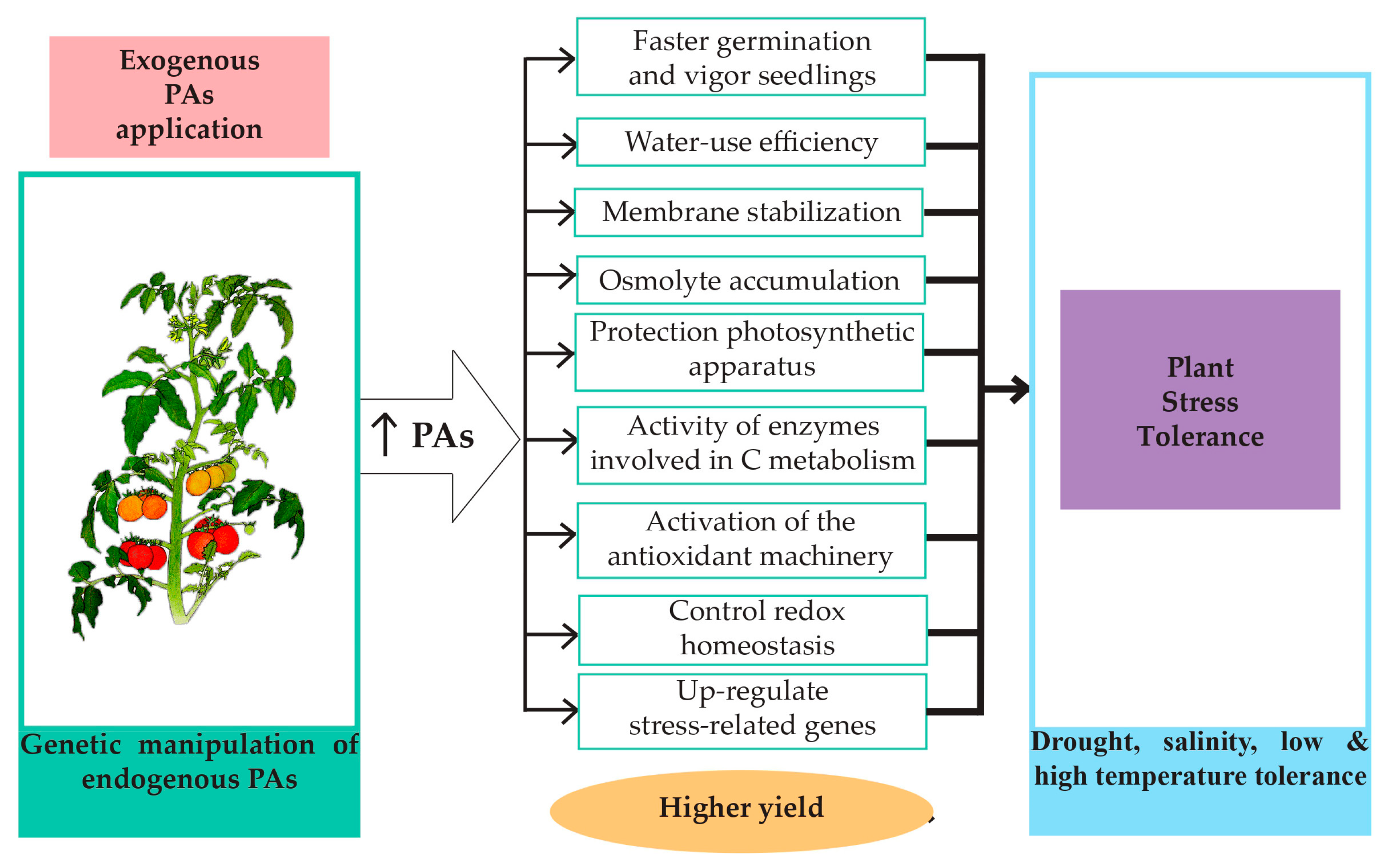
In recent years, climate change has altered many ecosystems due to a combination of frequent droughts, irregular precipitation, increasingly salinized areas and high temperatures. These environmental changes have also caused a decline in crop yield worldwide. Therefore, there is an urgent need to fully understand the plant responses to abiotic stress and to apply the acquired knowledge to improve stress tolerance in crop plants. The accumulation of polyamines (PAs) in response to many abiotic stresses is one of the most remarkable plant metabolic responses. In this review, we provide an update about the most significant achievements improving plant tolerance to drought, salinity, low and high temperature stresses by exogenous application of PAs or genetic manipulation of endogenous PA levels. We also provide some clues about possible mechanisms underlying PA functions, as well as known cross-talks with other stress signaling pathways. Finally, we discuss about the possible use of PAs for seed priming to induce abiotic stress tolerance in agricultural valuable crop plants.
Keywords: drought; salinity; heat; cold; putrescine; spermidine; spermine; thermospermine; climate change; plant stress drought; salinity; heat; cold; putrescine; spermidine; spermine; thermospermine; climate change; plant stress