Review

Targeting the FABP Axis: Interplay Between Lipid Metabolism, Neuroinflammation, and Neurodegeneration


1
School of Medicine, Shenzhen Campus of Sun Yat-sen University, Sun Yat-sen University, Shenzhen 518107, China
2
Department of Molecular Genetics, Institute of Biomedical Sciences, Fukushima Medical University Graduate School of Medicine, Hikarigaoka, Fukushima 960-1295, Japan
3
Department of Ophthalmology, School of Medicine, University of California San Francisco (UCSF), San Francisco, CA 94143, USA
*
Author to whom correspondence should be addressed.
These authors contributed equally to this work.
Cells 2025, 14(19), 1502; https://doi.org/10.3390/cells14191502
Submission received: 12 August 2025 / Revised: 21 September 2025 / Accepted: 23 September 2025 / Published: 25 September 2025

Abstract

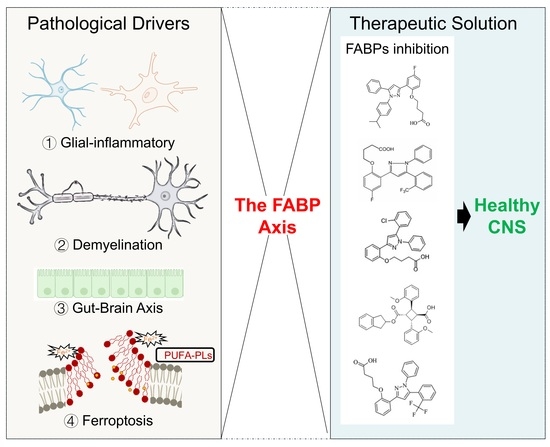
Fatty acid-binding proteins (FABPs) represent a superfamily of intracellular lipid chaperones essential for the transport of lipids and homeostatic lipid metabolism. Although well-known for their role in systemic metabolic diseases, emerging evidence has identified brain-expressed FABPs as core players in neurodegeneration. This review focuses on brain-expressed FABPs, synthesizing recent advancements that link their role in metabolic dysregulation to neurotoxicity. We present a system that integrates these proteins within a multi-tiered complex pathobiological system that involves: an advanced glial “meta-inflammation” paradigm; a novel view on proteotoxicity via liquid–liquid phase separation (LLPS); changes in the gut–brain axis; and an involvement in the regulation of ferroptosis. Additionally, we also discuss the emerging pharmacological pipeline, highlighting notable preclinical ligands and drawing important lessons from systemic disease first-in-class-targeted FABPs. These first-in-class therapies have successfully validated this target family in systemic diseases. Finally, we explore future therapeutic strategies, where we emphasize the challenges and the precision cell-type-specific delivery approaches to harness the full therapeutic potential of these pivotal proteins.
Keywords: fatty acid-binding proteins (FABPs); metabolic reprogramming; neuroinflammation; neurodegenerative diseases; glial metabolism; FABP-targeted therapy fatty acid-binding proteins (FABPs); metabolic reprogramming; neuroinflammation; neurodegenerative diseases; glial metabolism; FABP-targeted therapy
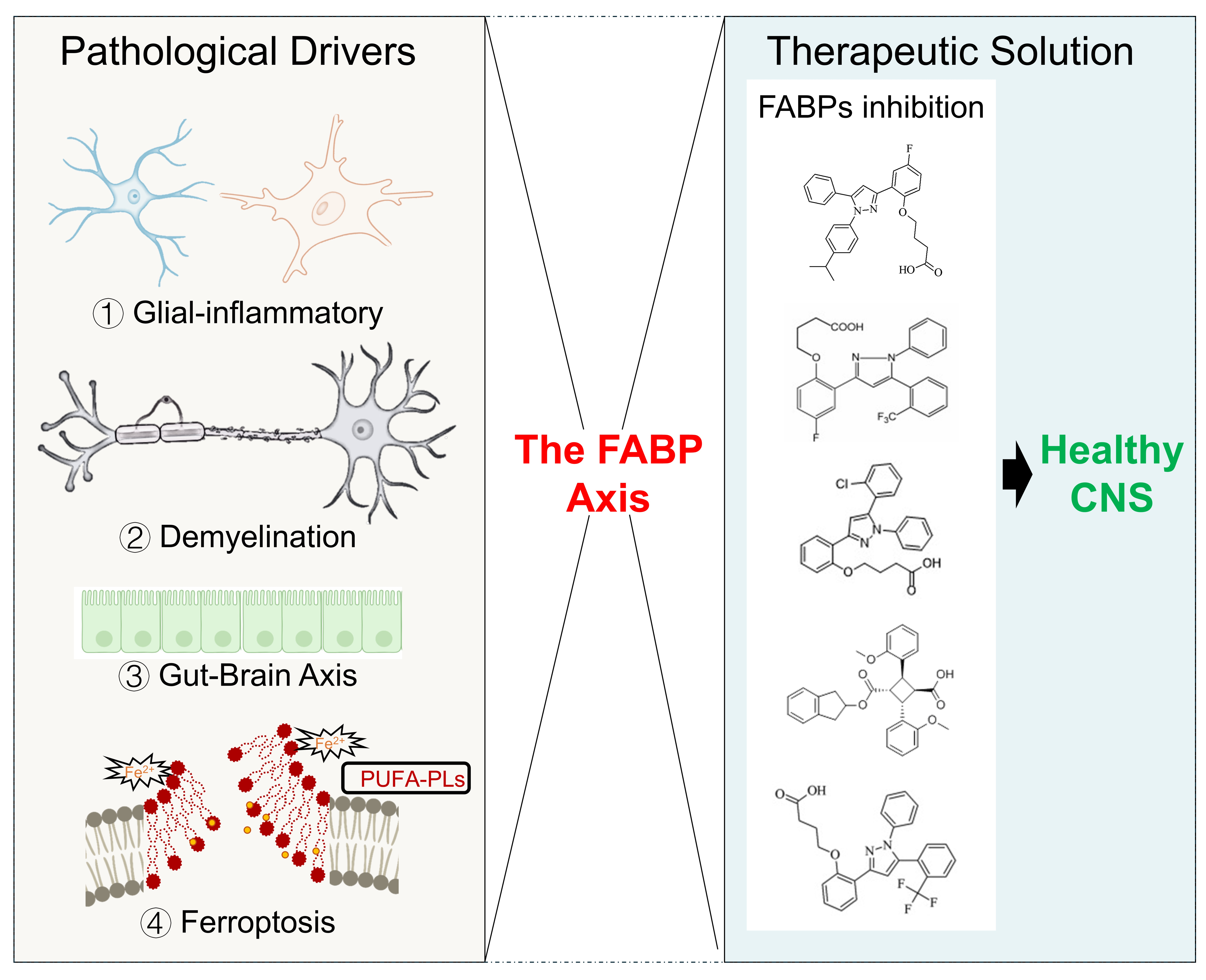
Graphical Abstract