



What’s in a Name? An Overview of the Proliferating Nomenclature in the Field of Phage Lysins


Abstract
1. Introduction
- (1)
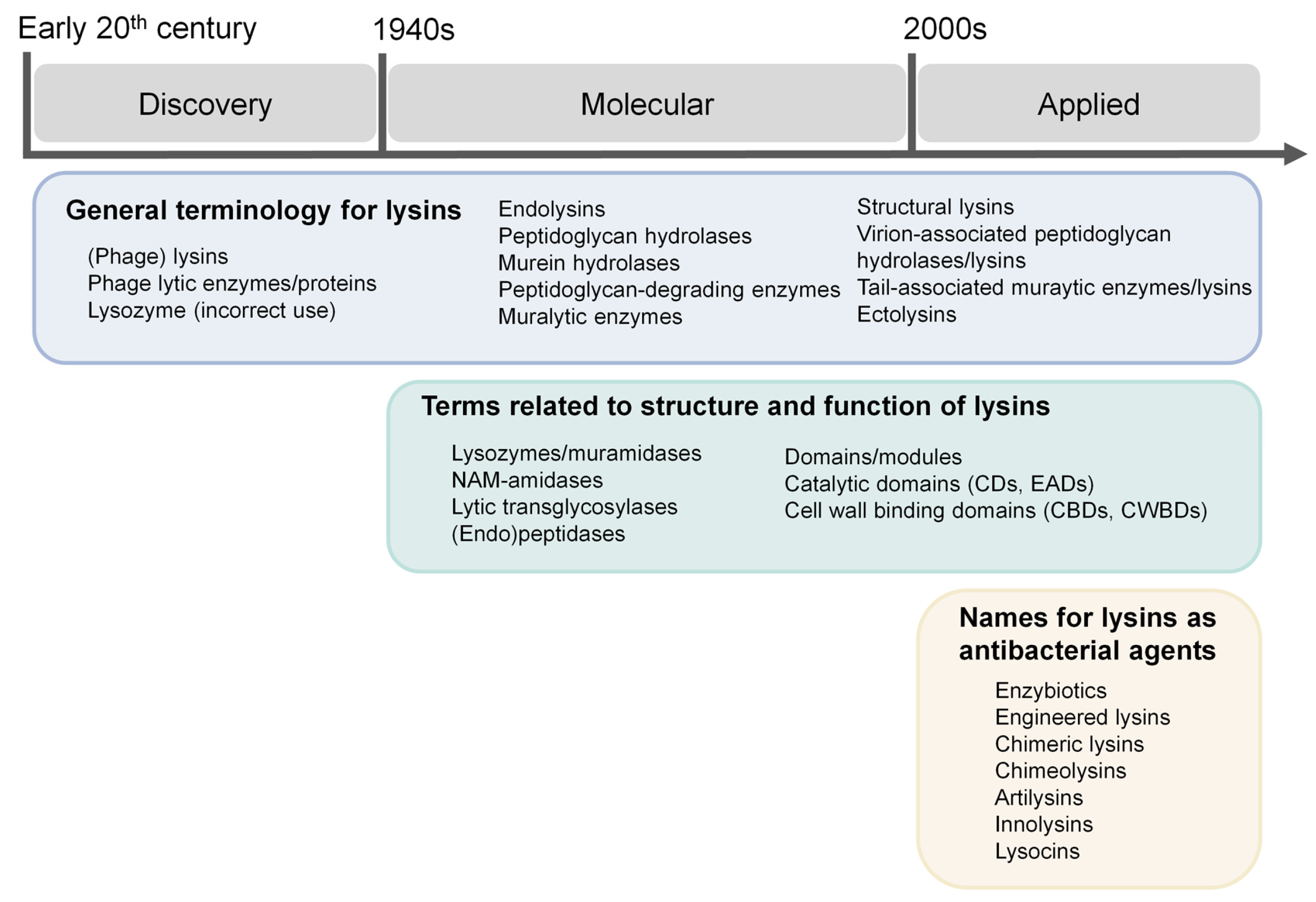
- Discovery era: roughly between the early 20th century and the 1940s, the fundamental terminology in the field was developed at the same time that phenomena were first time described.
- (2)
- Molecular era: in the central and final years of the 20th century, phage research entered the molecular biology era in which the infection and enzyme activity mechanisms were elucidated.
- (3)
- Applied era: since the beginning of the 21st century, phage lysin research entered a more markedly applied stage driven by the antibiotic resistance crisis. At this point, more distinctions came into place, many of which are related to the new role of lysins as antimicrobials. Even more remarkable is the plethora of common names given to the vast number of new lysins being described and investigated, both wild type and engineered, following the most diverse reasonings.
2. General Terminology for Lysins
3. Terms Related to the Structure and Function of Lysins
- We may say that the main features of a module are two: (1) its ability to carry out its function in a relatively autonomous way, and (2) its interchangeability or possibility to be compatibly integrated into other higher-order units comprising different combinations of modules [46];
- The domain, on the other hand, simply means a structural, functional or evolutionary unit of a protein [50].
4. Names for Lysins as Antibacterial Agents
5. Nomenclature of Individual Lysins
6. Concluding Remarks
- (1)
- The first one exemplified by the liberal use of the term “lysin” at the early stages, applied in general to a still undescribed agent causing lysis and thus confusingly referring to what later would be defined as either true endolysins, structural lysins, phage depolymerases, or even the phage itself. The driver for confusion at this stage was not precisely knowing the nature of what was actually causing cell lysis (and, to a certain point, not even grasping the nature of the phage);
- (2)
- A second one driven by the initial lack of evidence or tools able to precisely define biochemical specificity, which at some point derived from the naming of lysins in general as “lysozymes”, a tradition that survived even after the name “lysozyme” was reserved for a precisely described catalytic mechanism of peptidoglycan hydrolysis;
- (3)
- A third one is our current era of engineered lysins, which is being driven by a variety of techniques or conceptualizations, and whose result is a remarkable diversification both in particular names for engineering strategies and naming schemes for individual lysins.
Supplementary Materials
Author Contributions
Funding
Institutional Review Board Statement
Informed Consent Statement
Data Availability Statement
Conflicts of Interest
Appendix A. Glossary of Phage Lysin-Related Terms
| Name | Proposed General Definition | Remarks |
| Artilysin | Registered name by the company Lysando describing specifically engineered lysins | |
| Catalytic domain (CD) | See “enzymatically active domain” | |
| Cell wall-binding domain (CBD, CWBD) | Domain of an enzyme whose main function is to bind to a cell wall component. | |
| Cell wall-degrading enzyme | See “peptidoglycan-degrading enzyme” | |
| Chimeolysin | See “chimeric lysin” | |
| Chimeric endolysin | See “chimeric lysin” | See remarks to “engineered endolysin” |
| Chimeric lysin | Engineered lysin whose architecture is the result of fusing modules originating from different proteins | |
| DLA | A term introduced by the company ContraFect, describing antimicrobial agents that act by directly causing lysis of the bacterium. | It may be used to refer to phage lysins or engineered lysins but also to lysin-causing antimicrobial peptides |
| Domain | Unit of structural, functional and/or sequence conservation within a protein. | |
| Ectolysin | See “structural lysin” | |
| Endolysin | Enzyme encoded by a phage genome that causes bacterial cell lysis at the end of the phage lytic cycle, mainly by catalyzing peptidoglycan degradation, when released towards the cell wall | Should be restricted only to natural phage lysins that exert their action from within the host cell |
| Endopeptidase | Enzyme that catalyzes the hydrolytic cleavage of peptide bonds, particularly not at the end of a peptide chain. | General EC number for peptidases is 3.4. There are rather generalistic endopeptidases, such as l-alanoyl-d-glutamate endopeptidases, which cleave the peptide stem between two quite conserved amino acids and others that are more specific, such as some interpeptide bridge-specific endopeptidases (e.g., d-alanyl-glycyl endopeptidases, glycyl-glycyl endopeptidases, etc.) |
| Engineered endolysin | Endolysin that has been modified with respect to its original, wild-type sequence(s) | Conflicting name: since most engineered endolysins are not involved by principle in bacterial lysis from within the cell, “engineered lysin” would be a more etymologically correct term. Only in some specific circumstances “engineered endolysin” may be more accurate. |
| Engineered lysin | Lysin that has been modified with respect to its original, wild-type sequence(s) | |
| Enzybiotic | Enzyme that works as an antimicrobial agent | |
| Enzymatically active domain (EAD) | Domain of an enzyme whose main function is to catalyze a reaction | |
| EPLE | Engineered phage lytic enzyme, see “engineered lysin”. A name introduced by the company Telum Therapeutics. | |
| Glucosaminidase | Enzyme that catalyzes hydrolysis of terminal non-reducing N-acetyl-d-hexosamine residues. Particularly, among lysins, glucosaminidases break the bond between N-acetyl-d-glucosamine and N-acetyl muramic acid at the reducing side of the former | EC 3.2.1.52, accepted name: β-N-acetylhexosaminidase, full name: N-acetyl-β-d-glucosaminidase |
| Holin | Protein encoded by a phage genome that forms large pores at the inner membrane of the bacterial host to release endolysins to the cell wall at the end of the phage lytic cycle | |
| Innolysin | Chimeric lysin that is made up of modules originating from a lysin plus a phage receptor-binding protein (RBP) | |
| Lysin | Enzyme that catalytically degrades the cell wall peptidoglycan. | Broad term, could be applied to phage lysins, bacterial lysins, engineered ones, etc. |
| Lysin A | Enzyme encoded at the genome of a phage infecting diderm bacteria with an arabino-mycolyl outer layer that exerts bacterial host cell lysis by cleaving peptidoglycan bonds | May be just named “endolysin” |
| Lysin B | Enzyme encoded at the genome of a phage infecting diderm bacteria with an arabino-mycolyl outer layer that exerts bacterial host cell lysis by cleaving arabino-mycolyl ester bonds | |
| Lysocin | Chimeric lysin that is made up of modules originating from a lysin and bacteriocin elements responsible for surface receptor-binding and outer membrane translocation | Conflicting name: a class of antibiotics is already called “lysocins” |
| Lysozyme | Enzyme that hydrolytically cleaves the 1,4-β-linkages between N-acetylmuramic acid and N-acetyl-d-glucosamine residues in peptidoglycan (and between two N-acetyl-d-glucosamine residues in chitodextrins) | EC 3.2.1.17 |
| Lytic transglycosylase | Enzyme that catalyzes non-hydrolytic cleavage of the bond between N-acetyl-d-glucosamine and N-acetyl muramic acid through a process in which a sugar molecule is transformed into another (an anhydro derivative) | EC 4.2.2.n (still not definitive EC number). Alternative name: muropeptide lyase |
| Module | Structural and functional element from a protein (or other composite entity) that is interchangeable or susceptible to be integrated into another higher-order unit | |
| Muralysin | See “peptidoglycan-degrading enzyme” | |
| Muralytic enzyme | See “peptidoglycan-degrading enzyme” | |
| Muramidase | See “lysozyme” | Full name: 1,4-β-N-acetylmuramidase |
| Murein hydrolase | See “peptidoglycan hydrolase” | |
| N-acetylmuramoyl (NAM-)amidase | Enzyme that catalyzes hydrolytic cleavage of the bond between N-acetylmuramoyl and an l-amino acid residue of the stem peptide of the peptidoglycan | EC 3.5.1.28, full name: N-acetylmuramoyl-l-alanine amidase |
| OMP | “Outer membrane permeabilizing”, typically a peptide able to interact and permeabilize biological membranes and, in particular, the outer membrane of Gram-negative bacteria | |
| Peptidase | See “endopeptidase” | The lack of the prefix “endo-” implies that the site of cleavage (terminus or internal site) is not specified. IUBMB does not recommend the term “peptidase”, thus “endopeptidase” is preferred in the context of phage lysins |
| Peptidoglycan hydrolase (PGH) | Enzyme that catalyzes the hydrolytic cleavage of bonds within the peptidoglycan | Not equivalent to “peptidoglycan-degrading enzyme” since there are peptidoglycan lyases (e.g., lytic transglycosylases) |
| Peptidoglycan-degrading enzyme | Enzyme that catalyzes the cleavage of bonds within the peptidoglycan | Not restricted to phage lysins, e.g., peptidoglycan recycling/remodeling enzymes or autolysins from bacterial origin are peptidoglycan-degrading enzymes as well |
| Phage depolymerase | Protein encoded by a phage genome that catalyzes the cleavage of bonds within the exopolysaccharides produced by some bacterial hosts thus facilitating subsequent infection by the virion particles | Not fully distinguished from phage lysins in very early literature |
| (Phage) exopolysaccharide depolymerase | See “phage depolymerase” | |
| Phage lysin | Enzyme encoded by a phage genome that catalytically degrades the cell wall peptidoglycan | Denoting phage origin should be preferred to avoid ambiguities (thus “phage lysin” should be preferred over just “lysin” when referring to lysins from phages) |
| Phage lytic enzyme | See “phage lysin” | |
| Phage lytic protein | Protein encoded by a phage genome that catalytically degrades the cell wall peptidoglycan or that noncatalytically exerts bacterial cell lysis | Can potentially be applied both to (endo)lysins, structural lysins -both enzymes- and the rest of nonenzymatic lysis actors (holins, spanins…) |
| Pinholin | Protein encoded by a phage genome that forms small pores at the inner membrane of the bacterial host cell to allow the activation of signal-arrest-release (SAR-)endolysins | |
| Releasin | Protein encoded by a phage genome that allows release and activation of a SAR-endolysin by a mechanism other than that of pinholins | |
| Spanin | Protein encoded at the genome of a phage infecting diderm, Gram-negative bacteria whose function is to span the periplasm allowing the physical contact of inner and outer membrane to form large pores and then produce the efficient lysis of the bacterial cell host at the end of the lytic cycle | |
| Structural lysin | Enzyme encoded by a phage genome that catalyzes the cleavage of peptidoglycan and is present within the virion particle | |
| Tail-associated lysin (TAL) | See “structural lysin” | |
| Tail-associated muralytic enzyme (TAME) | See “structural lysin” | |
| Virion-associated lysin | See “structural lysin” | |
| Virion-associated peptidoglycan hydrolase (VAPGH, VAPH) | Enzyme encoded by a phage genome that catalyzes the hydrolytic cleavage of peptidoglycan bonds and is present within the virion particle | Does not include all structural lysins (since some of them are potentially lyases and not hydrolases) |
Appendix B
- (1)
- General names (lysin, endolysin, enzybiotic, etc.) should be used, taking into account their actual meaning in the biological context or their actual application;
- (2)
- Names referring to catalytic activities should be used with care, restricting them to those cases in which confirmatory empirical evidence exists. Alternatively, the adjectives “predicted” or “putative” should be added. This also applies to the general term “hydrolase”, which, stricto sensu, does not include many phage lysins that are lyases;
- (3)
- While the interchangeable use of “domain” and “module” in the phage lysin field may be acceptable, we suggest that some attention is paid to the suitability of the semantic nuances of each term. Therefore, “domain” may be preferably used to describe structural/functional features of the proteins, whereas “module” serves more to discussions about the combinatorial nature of phage lysins from evolution or engineering perspectives;
- (4)
- The field could benefit from an agreement on a preferred naming scheme for individual phage lysins, such as the “Ply” or “Lys” nomenclatures. From our point of view, the “Ply” scheme has the additional benefit of the versatility to explicitly name different realities within the phage lysin realm, e.g.,: Ply = phage lysins in general or rather endolysins, Cly = chimeric lysins. One can think of variants for structural lysins such as Sly (“structural lysin”) or Vly (“virion-associated lysin”) or, in general, for engineered lysins (e.g., Ely);
- (5)
- An additional effort in precisely describing engineered lysins in the literature is due, perhaps adopting some sort of in-text “barcode” elaborating how the engineered lysin is derived from its parental sequences with exact amino acid positions, plus transparently using public databases for engineered lysins as well.
References
- Gordillo Altamirano, F.L.; Barr, J.J. Phage Therapy in the Postantibiotic Era. Clin. Microbiol. Rev. 2019, 32, 10–1128. [Google Scholar] [CrossRef] [PubMed]
- Vázquez, R.; Diez-Martínez, R.; Domingo-Calap, P.; García, P.; Gutiérrez, D.; Muniesa, M.; Ruiz-Ruigómez, M.; Sanjuán, R.; Tomás, M.; Tormo-Mas, M.A.; et al. Essential Topics for the Regulatory Consideration of Phages as Clinically Valuable Therapeutic Agents: A Perspective from Spain. Microorganisms 2022, 10, 717. [Google Scholar] [CrossRef] [PubMed]
- Nelson, D.C.; Schmelcher, M.; Rodriguez-Rubio, L.; Klumpp, J.; Pritchard, D.G.; Dong, S.; Donovan, D.M. Endolysins as Antimicrobials. Adv. Virus Res. 2012, 83, 299–365. [Google Scholar] [CrossRef] [PubMed]
- Dams, D.; Briers, Y. Enzybiotics: Enzyme-Based Antibacterials as Therapeutics. Adv. Exp. Med. Biol. 2019, 1148, 233–253. [Google Scholar] [CrossRef]
- Vázquez, R.; García, E.; García, P. Phage Lysins for Fighting Bacterial Respiratory Infections: A New Generation of Antimicrobials. Front. Immunol. 2018, 9, 2252. [Google Scholar] [CrossRef]
- Fischetti, V.A. Development of Phage Lysins as Novel Therapeutics: A Historical Perspective. Viruses 2018, 10, 310. [Google Scholar] [CrossRef]
- Loeffler, J.M.; Nelson, D.; Fischetti, V.A. Rapid Killing of Streptococcus pneumoniae with a Bacteriophage Cell Wall Hydrolase. Science 2001, 294, 2170–2172. [Google Scholar] [CrossRef] [PubMed]
- Nelson, D.; Loomis, L.; Fischetti, V.A. Prevention and Elimination of Upper Respiratory Colonization of Mice by Group A Streptococci by Using a Bacteriophage Lytic Enzyme. Proc. Natl. Acad. Sci. USA 2001, 98, 4107–4112. [Google Scholar] [CrossRef]
- Avery, O.T.; Dubos, R. The Protective Action of a Specific Enzyme against Type Iii Pneumococcus Infection in Mice. J. Exp. Med. 1931, 54, 73–89. [Google Scholar] [CrossRef]
- Fleming, A. On a Remarkable Bacteriolytic Element Found in Tissues and Secretions. Proc. R Soc. B: Biol Sci 1922, 93, 306–317. [Google Scholar]
- Gerstmans, H.; Criel, B.; Briers, Y. Synthetic Biology of Modular Endolysins. Biotechnol. Adv. 2018, 36, 624–640. [Google Scholar] [CrossRef]
- Oechslin, F.; Menzi, C.; Moreillon, P.; Resch, G. The Multi-Domain Architecture of a Bacteriophage Endolysin Enables Intramolecular Synergism and Regulation of Bacterial Lysis. J. Biol. Chem. 2021, 296, 100639. [Google Scholar] [CrossRef] [PubMed]
- Randich, A.M.; Kysela, D.T.; Morlot, C.; Brun, Y.V. Origin of a Core Bacterial Gene via Co-Option and Detoxification of a Phage Lysin. Curr. Biol. 2019, 29, 1634–1646 e6. [Google Scholar] [CrossRef]
- Vázquez, R.; Seoane-Blanco, M.; Rivero-Buceta, V.; Ruiz, S.; van Raaij, M.J.; García, P. Monomodular Pseudomonas Aeruginosa Phage JG004 Lysozyme (Pae87) Contains a Bacterial Surface-Active Antimicrobial Peptide-like Region and a Possible Substrate-Binding Subdomain. Acta Crystallogr. D. Struct. Biol. 2022, 78, 435–454. [Google Scholar] [CrossRef] [PubMed]
- Criel, B.; Taelman, S.; Van Criekinge, W.; Stock, M.; Briers, Y. PhaLP: A Database for the Study of Phage Lytic Proteins and Their Evolution. Viruses 2021, 13, 1240. [Google Scholar] [CrossRef] [PubMed]
- Oliveira, H.; Melo, L.D.; Santos, S.B.; Nobrega, F.L.; Ferreira, E.C.; Cerca, N.; Azeredo, J.; Kluskens, L.D. Molecular Aspects and Comparative Genomics of Bacteriophage Endolysins. J. Virol. 2013, 87, 4558–4570. [Google Scholar] [CrossRef] [PubMed]
- Vázquez, R.; García, E.; García, P. Sequence-Function Relationships in Phage-Encoded Bacterial Cell Wall Lytic Enzymes and Their Implications for Phage-Derived Products Design. J. Virol. 2021, 95, 10–1128. [Google Scholar] [CrossRef]
- Abdelkader, K.; Gerstmans, H.; Saafan, A.; Dishisha, T.; Briers, Y. The Preclinical and Clinical Progress of Bacteriophages and Their Lytic Enzymes: The Parts Are Easier than the Whole. Viruses 2019, 11, 96. [Google Scholar] [CrossRef]
- World Health Organization. Antibacterial Agents in Clinical and Preclinical Development: An Overview and Analysis; World Health Organization: Geneva, Switzerland, 2021. [Google Scholar]
- D’Herelle, F.; Eliava, G. Unicité Du Bactériophage; Sur La Lysine Du Bactériophage. Comp. Rend. Soc. Biol. 1921, 85, 701–702. [Google Scholar]
- Twort, F. The Transmissible Bacterial Lysin and Its Action on Dead Bacteria. Lancet 1925, 206, 642–644. [Google Scholar] [CrossRef]
- Delbrück, M. Bacterial Viruses (Bacteriophages). Adv. Enzymol. Relat. Subj. Biochem. 1942, 2, 1–32. [Google Scholar]
- Adhya, S.L.; Sen, A.; Mitra, S. The Role of Gene, S. Cold Spring Harb. Monog. Arch. 1971, 02, 743–746. [Google Scholar]
- Young, R. Phage Lysis: Three Steps, Three Choices, One Outcome. J. Microbiol. 2014, 52, 243–258. [Google Scholar] [CrossRef] [PubMed]
- Chamblee, J.S.; Ramsey, J.; Chen, Y.; Maddox, L.T.; Ross, C.; To, K.H.; Cahill, J.L.; Young, R. Endolysin Regulation in Phage Mu Lysis. mBio 2022, 13, e0081322. [Google Scholar] [CrossRef] [PubMed]
- Akira Tsugita Phage Lysozyme and Other Lytic Enzymes. Enzymes 1971, 5, 343–411. [CrossRef]
- Jacob, F.; Fuerst, C.R.; Wollman, E.L. Study of Defective Lysogenic Bacteria. II.-Physiological Types resulting from Prophage Mutations. Ann. Inst. Pasteur 1957, 93, 724–753. [Google Scholar]
- Campbell, A. Sensitive Mutants of Bacteriophage λ. Virology 1961, 14, 22–32. [Google Scholar] [CrossRef]
- Groman, N.B.; Suzuki, G. Relation of Endolysin to Lysis by Lambda Bacteriophages. J. Bacteriol. 1962, 84, 596–597. [Google Scholar] [CrossRef] [PubMed]
- London, J.; Appleman, M.D. Oxidative and Glycerol Metabolism of Two Species of Enterococci. J. Bacteriol. 1962, 84, 597–598. [Google Scholar] [CrossRef]
- Barrington, L.F.; Kozloff, L.M. Action of Bacteriophage on Isolated Host Cell Walls. J Biol. Chem. 1956, 223, 615–627. [Google Scholar] [CrossRef]
- Moak, M.; Molineux, I.J. Peptidoglycan Hydrolytic Activities Associated with Bacteriophage Virions. Mol. Microbiol. 2004, 51, 1169–1183. [Google Scholar] [CrossRef] [PubMed]
- Ruska, H. Über Ein Neues Bei Der Bakteriophagen Lyse Auftretendes Formelement. Naturwissenschaften 1941, 29, 367–368. [Google Scholar] [CrossRef]
- Luria, S.E.; Delbruck, M.; Anderson, T.F. Electron Microscope Studies of Bacterial Viruses. J. Bacteriol. 1943, 46, 57–77. [Google Scholar] [CrossRef]
- Salton, M.R. The Properties of Lysozyme and Its Action on Microorganisms. Bacteriol. Rev. 1957, 21, 82–100. [Google Scholar] [CrossRef]
- Koch, G.; Dreyer, W.J. Characterization of an Enzyme of Phage T2 as a Lysozyme. Virology 1958, 6, 291–293. [Google Scholar] [CrossRef] [PubMed]
- Garcia, E. On the Misuse of the Term “Lysozyme”. Mol. Microbiol. 1996, 21, 885. [Google Scholar] [CrossRef] [PubMed]
- Herrlich, P.; Schweiger, M. T3 and T7 Bacteriophage Deoxyribonucleic Acid-Directed Enzyme Synthesis in Vitro. J. Virol. 1970, 6, 750–753. [Google Scholar] [CrossRef]
- Inouye, M.; Arnheim, N.; Sternglanz, R. Bacteriophage T7 Lysozyme Is an N-Acetylmuramyl-l-Alanine Amidase. J. Biol. Chem. 1973, 248, 7247–7252. [Google Scholar] [CrossRef]
- Taylor, A.; Das, B.C.; Van Heijenoort, J. Bacterial-Cell-Wall Peptidoglycan Fragments Produced by Phage λ or Vi II Endolysin and Containing 1,6-Anhydro-N-Acetylmuramic Acid. European J. Biochem. 1975, 53, 47–54. [Google Scholar] [CrossRef]
- Bieʼnkowska-Szewczyk, K.; Lipiʼnska, B.; Taylor, A. The R Gene Product of Bacteriophage λ Is the Murein Transglycosylase. Molec. Gen. Genet. 1981, 184, 111–114. [Google Scholar] [CrossRef]
- Kravchenko, N.A.; Perutz, M.F. Lysozyme as a Transferase. Proc. R. Soc. B: Biol. Sci. 1997, 167, 429–430. [Google Scholar] [CrossRef]
- Kawamura, S.; Eto, M.; Imoto, T.; Ikemizu, S.; Araki, T.; Torikata, T. Functional and Structural Effects of Mutagenic Replacement of Asn37 at Subsite F on the Lysozyme-Catalyzed Reaction. Biosci. Biotechnol. Biochem. 2004, 68, 593–601. [Google Scholar] [CrossRef] [PubMed][Green Version]
- Kuroki, R.; Weaver, L.H.; Matthews, B.W. Structural Basis of the Conversion of T4 Lysozyme into a Transglycosidase by Reengineering the Active Site. PNAS 1999, 96, 8949–8954. [Google Scholar] [CrossRef]
- Botstein, D.; Herskowitz, I. Properties of Hybrids between Salmonella Phage P22 and Coliphage λ. Nature 1974, 251, 584–589. [Google Scholar] [CrossRef]
- Botstein, D. A Theory of Modular Evolution for Bacteriophages. Ann. N. Y. Acad. Sci. 1980, 354, 484–490. [Google Scholar] [CrossRef] [PubMed]
- Garcia, E.; Garcia, J.L.; Garcia, P.; Arraras, A.; Sanchez-Puelles, J.M.; Lopez, R. Molecular Evolution of Lytic Enzymes of Streptococcus Pneumoniae and Its Bacteriophages. Proc. Natl. Acad. Sci. USA 1988, 85, 914–918. [Google Scholar] [CrossRef] [PubMed]
- García, P.; García, J.L.; García, E.; Sánchez-Puelles, J.M.; López, R. Modular Organization of the Lytic Enzymes of Streptococcus Pneumoniae and Its Bacteriophages. Gene 1990, 86, 81–88. [Google Scholar] [CrossRef]
- Diaz, E.; Lopez, R.; Garcia, J.L. Chimeric Pneumococcal Cell Wall Lytic Enzymes Reveal Important Physiological and Evolutionary Traits. J. Biol. Chem. 1991, 266, 5464–5471. [Google Scholar] [CrossRef]
- Schaeffer, R.D.; Daggett, V. Protein Folds and Protein Folding. PEDS 2011, 24, 11–19. [Google Scholar] [CrossRef]
- Guillén, D.; Sánchez, S.; Rodríguez-Sanoja, R. Carbohydrate-Binding Domains: Multiplicity of Biological Roles. Appl. Microbiol. Biotechnol. 2010, 85, 1241–1249. [Google Scholar] [CrossRef]
- Drulis-Kawa, Z.; Majkowska-Skrobek, G.; Maciejewska, B.; Delattre, A.-S.; Lavigne, R. Learning from Bacteriophages-Advantages and Limitations of Phage and Phage-Encoded Protein Applications. Curr. Protein Pept. Sci. 2012, 13, 699–722. [Google Scholar] [CrossRef]
- Majkowska-Skrobek, G.; Latka, A.; Berisio, R.; Squeglia, F.; Maciejewska, B.; Briers, Y.; Drulis-Kawa, Z. Phage-Borne Depolymerases Decrease Klebsiella Pneumoniae Resistance to Innate Defense Mechanisms. Front. Microbiol. 2018, 9, 2517. [Google Scholar] [CrossRef]
- Gasset, M. Membrane-Targeted Enzybiotics. In Enzybiotics; John Wiley & Sons, Ltd.: New York, NY, USA, 2009; pp. 173–198. ISBN 978-0-470-57054-8. [Google Scholar]
- 5Danis-Wlodarczyk, K.M.; Wozniak, D.J.; Abedon, S.T. Treating Bacterial Infections with Bacteriophage-Based Enzybiotics: In Vitro, In Vivo and Clinical Application. Antibiotics 2021, 10, 1497. [Google Scholar] [CrossRef]
- De Maesschalck, V.; Gutierrez, D.; Paeshuyse, J.; Lavigne, R.; Briers, Y. Advanced Engineering of Third-Generation Lysins and Formulation Strategies for Clinical Applications. Crit. Rev. Microbiol. 2020, 46, 548–564. [Google Scholar] [CrossRef]
- Zampara, A.; Sorensen, M.C.H.; Grimon, D.; Antenucci, F.; Vitt, A.R.; Bortolaia, V.; Briers, Y.; Brondsted, L. Exploiting Phage Receptor Binding Proteins to Enable Endolysins to Kill Gram-Negative Bacteria. Sci. Rep. 2020, 10, 12087. [Google Scholar] [CrossRef] [PubMed]
- Heselpoth, R.D.; Euler, C.W.; Schuch, R.; Fischetti, V.A. Lysocins: Bioengineered Antimicrobials That Deliver Lysins across the Outer Membrane of Gram-Negative Bacteria. Antimicrob. Agents Chemother. 2019, 63, e00342-19. [Google Scholar] [CrossRef]
- Lukacik, P.; Barnard, T.J.; Buchanan, S.K. Using a Bacteriocin Structure to Engineer a Phage Lysin That Targets Yersinia Pestis. Biochem. Soc. Trans. 2012, 40, 1503–1506. [Google Scholar] [CrossRef] [PubMed]
- Ronda, C.; López, R.; García, E. Isolation and Characterization of a New Bacteriophage, Cp-1, Infecting Streptococcus Pneumoniae. J. Virol. 1981, 40, 551–559. [Google Scholar] [CrossRef]
- O’Flaherty, S.; Coffey, A.; Meaney, W.; Fitzgerald, G.F.; Ross, R.P. The Recombinant Phage Lysin LysK Has a Broad Spectrum of Lytic Activity against Clinically Relevant Staphylococci, Including Methicillin-Resistant Staphylococcus Aureus. J. Bacteriol. 2005, 187, 7161–7164. [Google Scholar] [CrossRef] [PubMed]
- Gu, J.; Xu, W.; Lei, L.; Huang, J.; Feng, X.; Sun, C.; Du, C.; Zuo, J.; Li, Y.; Du, T.; et al. LysGH15, a Novel Bacteriophage Lysin, Protects a Murine Bacteremia Model Efficiently against Lethal Methicillin-Resistant Staphylococcus Aureus Infection. J. Clin. Microbiol. 2011, 49, 111–117. [Google Scholar] [CrossRef]
- Lai, M.J.; Lin, N.T.; Hu, A.; Soo, P.C.; Chen, L.K.; Chen, L.H.; Chang, K.C. Antibacterial Activity of Acinetobacter Baumannii Phage VarphiAB2 Endolysin (LysAB2) against Both Gram-Positive and Gram-Negative Bacteria. Appl. Microbiol. Biotechnol. 2011, 90, 529–539. [Google Scholar] [CrossRef]
- Nelson, D.; Schuch, R.; Chahales, P.; Zhu, S.; Fischetti, V.A. PlyC: A Multimeric Bacteriophage Lysin. Proc. Natl. Acad. Sci. USA 2006, 103, 10765–10770. [Google Scholar] [CrossRef] [PubMed]
- Gilmer, D.B.; Schmitz, J.E.; Euler, C.W.; Fischetti, V.A. Novel Bacteriophage Lysin with Broad Lytic Activity Protects against Mixed Infection by Streptococcus Pyogenes and Methicillin-Resistant Staphylococcus aureus. Antimicrob. Agents Chemother. 2013, 57, 2743–2750. [Google Scholar] [CrossRef] [PubMed]
- Walmagh, M.; Briers, Y.; dos Santos, S.B.; Azeredo, J.; Lavigne, R. Characterization of Modular Bacteriophage Endolysins from Myoviridae Phages OBP, 201phi2-1 and PVP-SE1. PLoS ONE 2012, 7, e36991. [Google Scholar] [CrossRef] [PubMed]
- Maciejewska, B.; Zrubek, K.; Espaillat, A.; Wisniewska, M.; Rembacz, K.P.; Cava, F.; Dubin, G.; Drulis-Kawa, Z. Modular Endolysin of Burkholderia AP3 Phage Has the Largest Lysozyme-like Catalytic Subunit Discovered to Date and No Catalytic Aspartate Residue. Sci. Rep. 2017, 7, 14501. [Google Scholar] [CrossRef] [PubMed]
- Briers, Y.; Volckaert, G.; Cornelissen, A.; Lagaert, S.; Michiels, C.W.; Hertveldt, K.; Lavigne, R. Muralytic Activity and Modular Structure of the Endolysins of Pseudomonas aeruginosa Bacteriophages PhiKZ and EL. Mol. Microbiol. 2007, 65, 1334–1344. [Google Scholar] [CrossRef]
- Diez-Martinez, R.; De Paz, H.D.; Garcia-Fernandez, E.; Bustamante, N.; Euler, C.W.; Fischetti, V.A.; Menendez, M.; Garcia, P. A Novel Chimeric Phage Lysin with High in Vitro and in Vivo Bactericidal Activity against Streptococcus Pneumoniae. J. Antimicrob. Chemother. 2015, 70, 1763–1773. [Google Scholar] [CrossRef] [PubMed]
- Gerstmans, H.; Grimon, D.; Gutierrez, D.; Lood, C.; Rodriguez, A.; van Noort, V.; Lammertyn, J.; Lavigne, R.; Briers, Y. A VersaTile-Driven Platform for Rapid Hit-to-Lead Development of Engineered Lysins. Sci. Adv. 2020, 6, eaaz1136. [Google Scholar] [CrossRef] [PubMed]
- Daniel, A.; Euler, C.; Collin, M.; Chahales, P.; Gorelick, K.J.; Fischetti, V.A. Synergism between a Novel Chimeric Lysin and Oxacillin Protects against Infection by Methicillin-Resistant Staphylococcus Aureus. Antimicrob. Agents Chemother. 2010, 54, 1603–1612. [Google Scholar] [CrossRef]
- Yang, H.; Zhang, H.; Wang, J.; Yu, J.; Wei, H. A Novel Chimeric Lysin with Robust Antibacterial Activity against Planktonic and Biofilm Methicillin-Resistant Staphylococcus aureus. Sci. Rep. 2017, 7, 40182. [Google Scholar] [CrossRef]
- Yang, H.; Gong, Y.; Zhang, H.; Etobayeva, I.; Miernikiewicz, P.; Luo, D.; Li, X.; Zhang, X.; Dąbrowska, K.; Nelson, D.C.; et al. ClyJ Is a Novel Pneumococcal Chimeric Lysin with a Cysteine- and Histidine-Dependent Amidohydrolase/Peptidase Catalytic Domain. Antimicrob. Agents Chemother. 2019, 63, e02043-18. [Google Scholar] [CrossRef]
- Fenton, M.; Casey, P.G.; Hill, C.; Gahan, C.G.; Ross, R.P.; McAuliffe, O.; O’Mahony, J.; Maher, F.; Coffey, A. The Truncated Phage Lysin CHAPK Eliminates Staphylococcus aureus in the Nares of Mice. Bioeng. Bugs. 2010, 1, 404–407. [Google Scholar] [CrossRef] [PubMed]
- Gutiérrez, D.; Rodríguez-Rubio, L.; Ruas-Madiedo, P.; Fernández, L.; Campelo, A.B.; Briers, Y.; Nielsen, M.W.; Pedersen, K.; Lavigne, R.; García, P.; et al. Design and Selection of Engineered Lytic Proteins With Staphylococcus Aureus Decolonizing Activity. Front. Microbiol. 2021, 12, 723834. [Google Scholar] [CrossRef] [PubMed]
- Rodríguez-Rubio, L.; Martínez, B.; Rodríguez, A.; Donovan, D.M.; García, P. Enhanced Staphylolytic Activity of the Staphylococcus Aureus Bacteriophage VB_SauS-PhiIPLA88 HydH5 Virion-Associated Peptidoglycan Hydrolase: Fusions, Deletions, and Synergy with LysH5. Appl. Environ. Microbiol. 2012, 78, 2241–2248. [Google Scholar] [CrossRef] [PubMed]
- Briers, Y.; Walmagh, M.; Grymonprez, B.; Biebl, M.; Pirnay, J.P.; Defraine, V.; Michiels, J.; Cenens, W.; Aertsen, A.; Miller, S.; et al. Art-175 Is a Highly Efficient Antibacterial against Multidrug-Resistant Strains and Persisters of Pseudomonas Aeruginosa. Antimicrob. Agents Chemother. 2014, 58, 3774–3784. [Google Scholar] [CrossRef] [PubMed]
- World Health Organization. Guidance on the Use of International Nonproprietary Names (INNs) for Pharmaceutical Substances; World Health Organization: Geneva, Switzerland, 2017. [Google Scholar]
- Kropinski, A.M.; Prangishvili, D.; Lavigne, R. Position Paper: The Creation of a Rational Scheme for the Nomenclature of Viruses of Bacteria and Archaea. Environ. Microbiol. 2009, 11, 2775–2777. [Google Scholar] [CrossRef]


| Name | Number of References a | Search |
|---|---|---|
| Lysin | 608 | ((“lysin” OR “lysins”) AND (phage OR bacteriophage)) |
| Endolysin | 934 | ((“endolysin*”) AND (phage OR bacteriophage)) |
| Peptidoglycan-degrading enzyme | 15 | ((“peptidoglycan-degrading enzyme*”) AND (phage OR bacteriophage)) |
| Muralytic enzyme | 26 | ((“muralytic enzyme*”) AND (phage OR bacteriophage)) |
| Cell wall degrading enzyme | 25 | ((“cell wall degrading enzyme*”) AND (phage OR bacteriophage)) |
| Muralysin | 3 | “Muralysin” |
| Peptidoglycan hydrolase (PGH) | 150 | ((“peptidoglycan hydrolase*”) AND (phage OR bacteriophage)) |
| Murein hydrolase | 53 | ((“murein hydrolase*”) AND (phage OR bacteriophage)) |
| Phage lytic protein | 20 | “phage lytic protein*” |
| Phage depolymerase | 193 | ((depolymerase) AND (phage OR bacteriophage)) |
| Phage exopolysaccharide depolymerase | 18 | ((“exopolysaccharide depolymerase*” OR “EPS depolymerase*”) AND (phage OR bacteriophage)) |
| Lysozyme | 1202 | “lysozyme*” AND (phage OR bacteriophage) |
| Muramidase | 1215 | “muramidase*” AND (phage OR bacteriophage) |
| N-acetylmuramoyl (NAM-) amidase | 388 | (“amidase*” OR “NAM-amidase*”) AND (phage OR bacteriophage) |
| Endopeptidase | 500 | ((“endopeptidase*”) AND (phage OR bacteriophage) AND (lysin OR endolysin)) |
| Peptidase | 80 | ((“peptidase*”) AND (phage OR bacteriophage) AND (lysin OR endolysin)) |
| Glucosaminidase | 21 | ((glucosaminidase) AND (phage OR bacteriophage)) |
| Lytic transglycosylase | 53 | ((lytic transglycosylase) AND (phage OR bacteriophage)) |
| Virion-associated peptidoglycan hydrolase (VAPGH, VAPH) | 21 | “virion-associated peptidoglycan hydrolase*” |
| Virion-associated lysin | 3 | “virion-associated lysin*” |
| Enzybiotic | 99 | “enzybiotic*” |
| Engineered lysin | 11 | “engineered lysin*” |
| Engineered endolysin | 15 | “engineered endolysin*” |
| Chimeric lysin | 35 | “chimeric lysin*” |
| Chimeric endolysin | 12 | “chimeric endolysin*” |
| Chimeolysin | 8 | “chimeolysin*” |
| Innolysin | 2 | “innolysin*” |
| Lysocin | 1 | lysocin* AND (phage or bacteriophage) NOT “lysocin E” |
| Artilysin | 12 | “artilysin*” |
| DLA | 10 | “direct lytic agent*” |
| EPLE | 1 | “engineered phage lytic enzyme*” |
| Module | 78 | “module*” AND (lysin OR endolysin) AND (phage or bacteriophage) |
| Domain | 452 | “domain*” AND (lysin OR endolysin) AND (phage or bacteriophage) |
| Enzymatically active domain (EAD) | 23 | “enzymatically active domain*” AND (lysin OR endolysin) AND (phage or bacteriophage) |
| Catalytic domain (CD) | 140 | “catalytic domain*” AND (lysin OR endolysin) AND (phage or bacteriophage) |
| Cell wall-binding domain (CBD, CWBD) | 137 | “cell wall binding domain*” AND (lysin OR endolysin) AND (phage or bacteriophage) |
Disclaimer/Publisher’s Note: The statements, opinions and data contained in all publications are solely those of the individual author(s) and contributor(s) and not of MDPI and/or the editor(s). MDPI and/or the editor(s) disclaim responsibility for any injury to people or property resulting from any ideas, methods, instructions or products referred to in the content. |
© 2023 by the authors. Licensee MDPI, Basel, Switzerland. This article is an open access article distributed under the terms and conditions of the Creative Commons Attribution (CC BY) license (https://creativecommons.org/licenses/by/4.0/).
Share and Cite
Vázquez, R.; Briers, Y. What’s in a Name? An Overview of the Proliferating Nomenclature in the Field of Phage Lysins. Cells 2023, 12, 2016. https://doi.org/10.3390/cells12152016
Vázquez R, Briers Y. What’s in a Name? An Overview of the Proliferating Nomenclature in the Field of Phage Lysins. Cells. 2023; 12(15):2016. https://doi.org/10.3390/cells12152016
Chicago/Turabian StyleVázquez, Roberto, and Yves Briers. 2023. "What’s in a Name? An Overview of the Proliferating Nomenclature in the Field of Phage Lysins" Cells 12, no. 15: 2016. https://doi.org/10.3390/cells12152016
APA StyleVázquez, R., & Briers, Y. (2023). What’s in a Name? An Overview of the Proliferating Nomenclature in the Field of Phage Lysins. Cells, 12(15), 2016. https://doi.org/10.3390/cells12152016

