Article

Integrating Green Manures and Sweet Sorghum into Sugarcane Rotations Enhances Yield and Sandy-Soil Hydrophysical Properties

by
André Araújo do Nascimento
1,
João Henrique Silva da Luz
1,*,
Mirela Ferneda
2,
Felipe Escorce Furlan
2,
Tamara Qualharello
3,
Gustavo Henrique Gravatim Costa
4,
Fernando Ferrari Putti
2 and
Raúl Andres Martinez Uribe
2,*
1
School of Agricultural Sciences, São Paulo State University (UNESP), Av. Universitária, 3780, Altos do Paraiso, Botucatu CEP 18610-034, SP, Brazil
2
Department of Biosystem Engineering, School of Sciences and Engineering, São Paulo State University (UNESP), Rua Domingos da Costa Lopes, 780, Jd. Itaipu, Tupã CEP 17602-496, SP, Brazil
3
Department of Animal Science, Texas A&M University, 400 Bizzell St., College Station, TX 77843, USA
4
Department of Agronomy and Biological Sciences, State University of Minas Gerais, Avenida Professor Mário Palmério, 1001—Bloco B, Frutal CEP 38202-436, Frutal CEP 38202-436, MG, Brazil
*
Authors to whom correspondence should be addressed.
Agronomy 2026, 16(9), 935; https://doi.org/10.3390/agronomy16090935
Submission received: 26 October 2025 / Revised: 8 December 2025 / Accepted: 9 December 2025 / Published: 5 May 2026

Abstract

Sugarcane is the leading feedstock for bioethanol in Brazil and worldwide, but its continuous cultivation can degrade soil through nutrient depletion and compaction. Integrating green manures such as Crotalaria and pigeon pea into rotations offers a sustainable way to improve soil structure, water infiltration, and nutrient cycling. When combined with sweet sorghum as a complementary crop, these species can mitigate soil physical constraints and strengthen the resilience of sugar–energy systems under rainfed conditions. This three-year field experiment evaluated the effects of green manure and sweet sorghum rotations on sugarcane yield and sandy-soil physical attributes. The treatments were arranged in a 3 × 2 factorial design with randomized blocks, including two green manures (Crotalaria and pigeon pea) and a fallow control, each combined with or without sweet sorghum rotation. Biometric traits and yields were measured for all crops, and soil physical properties were assessed after the sugarcane cycle. Green manure significantly increased the stalk yield and dry matter of both sweet sorghum and sugarcane. In sugarcane, rotations with Crotalaria and pigeon pea enhanced stalk and dry matter yields by up to 18%, while the highest increase (31%) occurred under the sweet sorghum rotation. Furthermore, green manures improved sandy-soil water retention, increased infiltration rates, and reduced penetration resistance. These results demonstrate that legume–sorghum rotations are an effective and low-input strategy to enhance crop yield and sandy-soil physical properties, contributing to more sustainable bioenergy production under tropical rainfed conditions.

1. Introduction

Global shifts in energy demand have intensified the pursuit of renewable and efficient bioenergy sources. Bioethanol stands out as one of the most widely adopted and scalable alternatives, now contributing substantially to the global energy matrix. Sugarcane and maize together account for approximately 85% of global ethanol output, with Brazil alone producing nearly 30%. Worldwide production increased more than sixfold—from about 18 billion liters in the early 2000 s to over 110 billion liters in 2019 [1]. Meeting this growing demand requires expanding feedstock supply either through (i) area expansion or (ii) yield intensification on existing cropland. The first pathway is controversial, as it often promotes monoculture expansion and the conversion of conservation areas, raising environmental, economic, and social concerns [2,3]. Conversely, enhancing yield through technological and agronomic innovation represents a more sustainable strategy.
Sweet sorghum (Sorghum bicolor L. Moench) has emerged as a promising complementary feedstock for bioethanol production. Its stalks are rich in fermentable sugars, and the crop exhibits high adaptability across soil and climate types [4]. Notably, it can be cultivated and harvested during the sugarcane off-season (typically planted in October–November and harvested in February–March), thereby reducing industrial downtime and extending feedstock availability [5,6]. However, sequential cultivation of sugarcane and sweet sorghum can lead to soil degradation through excessive nutrient extraction, organic matter decline, and compaction, ultimately impairing key soil properties such as porosity, bulk density, infiltration, and water-holding capacity [7]. Accordingly, management practices that restore soil fertility and structure are essential (particularly on marginal land [e.g., sandy soils], where bioenergy expansion should avoid competing with food and feed crops on prime soils). Agroecological approaches, notably legume green manures integrated into sweet sorghum–sugarcane rotations, can rehabilitate soil physical quality (porosity, infiltration, plant-available water) [8] and enhance nutrient cycling, thereby improving the feasibility and social–ecological sustainability of sugarcane cultivation on sandy soil under rainfed conditions [9].
Green manuring, the practice of cultivating plant species to improve soil properties through biological nitrogen fixation (BNF), nutrient recycling, and structural enhancement, offers a viable and sustainable approach under rainfed tropical conditions [10,11]. Leguminous species such as Crotalaria spp. and pigeon pea (Cajanus cajan) are particularly effective: they enhance nutrient cycling, increase soil organic matter (SOM), and promote biopore formation and aggregate stability. Their deep and vigorous root systems help alleviate compaction, improve infiltration, and increase available water capacity (AWC). Additionally, rotating green manures with cash crops can disrupt pest and disease cycles, contributing to greater system resilience and sustainability in sugar–energy production chains.
Water infiltration, the process by which water enters the soil profile, depends on initial moisture status, pore connectivity, and dynamic permeability as the wetting front advances and air is displaced [12]. Along with soil texture and structure, these factors govern the AWC—the amount of plant-available water (mm) stored within the crop’s effective rooting zone [13]. The Kostiakov equation and its variants remain among the most widely used models to describe infiltration behavior across soil types [14,15]. Soil compaction, characterized by increased bulk density and reduced porosity, restricts root growth and water entry, enhances surface runoff, and is often assessed through soil penetration resistance measurements [16,17]. Therefore, agronomic practices that increase SOM and reduce penetration resistance are expected to enhance infiltration, AWC, and crop yield.
In this context, the present study evaluates, under rainfed conditions in Brazil, the effects of integrating green manure–sweet sorghum rotations on soil physical attributes and subsequent sugarcane yield. We hypothesize that incorporating leguminous green manures prior to sweet sorghum will (i) reduce compaction (lower penetration resistance), (ii) enhance infiltration and AWC, and (iii) translate these improvements into higher sugarcane yields. Specifically, our objectives were to (1) quantify changes in sandy-soil physical property indicators (bulk density, penetration resistance, infiltration parameters, and AWC); (2) examine their relationships with crop performance; and (3) determine whether green manure–sorghum rotations constitute a sustainable management strategy for integrated sugar–energy production systems.

2. Materials and Methods

2.1. Site Description and Experimental Design

The field experiment was conducted in Cabrália Paulista County, São Paulo State, Brazil (latitude 28.480° S, longitude 49.317° W, altitude 530 m). The soil at the site is classified as a sandy Ultisol, and the regional climate is Cwa (humid subtropical with dry winters), according to Köppen’s classification. Precipitation and temperature during the experimental period are shown in Figure 1.
The experiment followed a 3 × 2 factorial design in a randomized complete block with four replications, totaling 24 plots (125 m2 each; total area 3027 m2). Factor 1 consisted of three green manure treatments (Crotalaria, pigeon pea, no green manure [Nil-GM]), and factor 2 consisted of two levels (with or without sweet sorghum rotation). The factorial arrangement yielded six treatments, namely T1—sugarcane planted over Crotalaria, T2—sugarcane planted over sweet sorghum in Crotalaria rotation, T3—sugarcane, T4 sugarcane planted over sweet sorghum, T5—sugarcane planted over pigeon pea, T6—sugarcane planted over sweet sorghum in pigeon pea rotation.
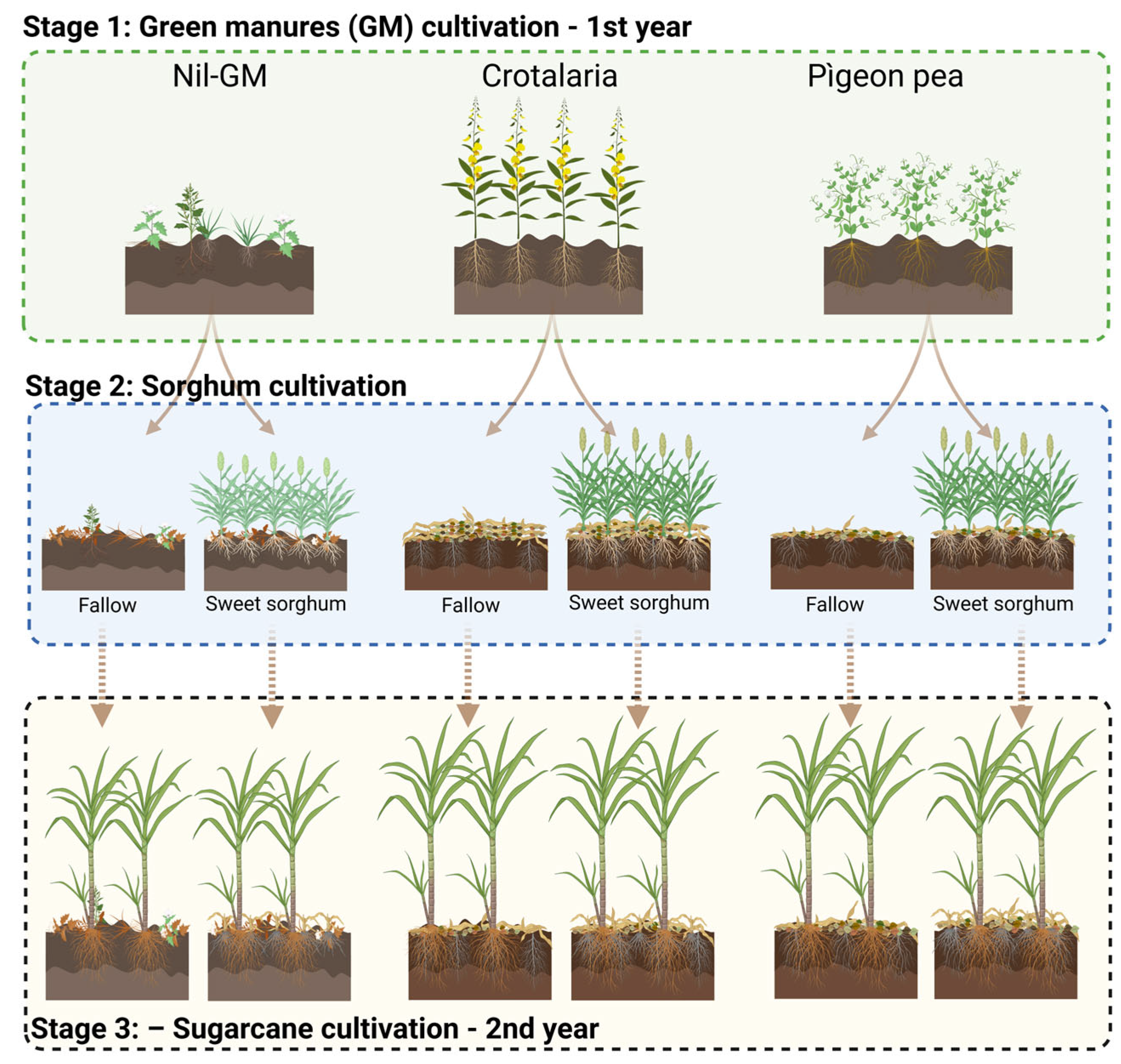
The study spanned three consecutive growing seasons and comprised three stages: (i) green manure phase; (ii) sweet sorghum phase (applied only in the “with sorghum” factor levels); and (iii) sugarcane establishment. Sugarcane plots were then monitored for three years under rainfed conditions (Figure 2).

2.2. Stage 1—Green Manure Cultivation

Soil preparation began in August of the first experimental year with chemical desiccation of the previous sugarcane crop using glyphosate (36%) at 3 L ha−1, followed by the incorporation of 1.9 Mg ha−1 dolomitic limestone (CaO = 25%, MgO = 16%) with 70% relative neutralizing value to correct soil acidity (Table 1).
Crotalaria (cv. IAC-KR1) and pigeon pea (cv. IAC Fava-Larga), sown without inoculation due to the presence of native rhizobia in the region, were sown in October using 20 kg ha−1 of seed. Green manure termination occurred 120 days after sowing (January of the following year).
Before harvest, the fresh biomass yield (Mg ha−1) of Crotalaria and pigeon pea was assessed by collecting and weighing 10 samples (1 m2 each). Subsequently, sub-samples were left to dry in a stove, under forced air circulation, at 65 °C, until a constant weight was reached; thus, it determined moisture rate and sample dry matter.

2.3. Stage 2—Sweet Sorghum Cultivation

Sweet sorghum (cv. Malibu 2190) was sown in February using a three-row planter with 0.5 m row spacing and a target population of 110,000 plants ha−1, adjusted by thinning at 15 days after sowing (DAS). Basal fertilization consisted of 24.6, 37.5, 40.8 kg ha−1 of N, K, and P, respectively.
Weed and pest control included atrazine (50% a.i.) pre-emergence, tebuconazole (85% + 62.5%) at 21 DAS for Claviceps africana (ergot disease), fipronil (25%) for soil and foliar caterpillars, and pyrethroid (35%) for Spodoptera frugiperda.
At harvest (110 DAS, May), biometric parameters were measured: stalk height, diameter, fresh biomass yield, and dry biomass yield. For yield estimates, 1 m of stalk per plot was harvested and subsampled for moisture and dry matter determination after oven-drying at 65 °C. Stalk yield (SYH) and dry matter yield (DMH) were then expressed per hectare.

2.4. Stage 3—Sugarcane Cultivation

Sugarcane (cv. RB867515) was planted in September of the second year, selected for its high agro-industrial performance, adaptability, and stability under low-fertility tropical soils [18]. Planting was performed manually in 30 cm deep furrows spaced 1.5 m apart, with 14–16 buds m−1, arranged in an alternating “feet-to-tip” pattern.
A pre-planting treatment included fipronil (800 g kg−1, 250 g ha−1), a growth regulator mixture (indole-3-butyric acid + gibberellic acid + kinetin, 500 mL ha−1), carbofuran (5 L ha−1) as a nematicide, and azoxystrobin + cyproconazole (500 mL ha−1) as a fungicide. Basal fertilization with 28, 42.7, 46.5 kg ha−1 of N, K, and P, respectively.
Weed control comprised ametryn + clomazone (5 L ha−1) applied at pre- and early post-emergence, followed by 2,4-D amine + picloram (2 L ha−1) as a selective herbicide.
The same biometric measurements as for sorghum were taken at 383 days after planting (DAP), with final harvest in October of the third experimental year.

2.5. Soil Physical Measurements

After harvest, infiltration rate and cumulative infiltration were determined in each plot using the double-ring infiltrometer method [19]. Four readings per treatment were collected, and infiltration–time data were used to fit infiltration curves using the Kostiakov model [14,15]:
I = k     t a
where I is cumulative infiltration (mm), k is the infiltration coefficient, and a is the empirical exponent.
Soil penetration resistance (SPR) was measured with a penetrometer, taking six readings per replicate (144 total). Both maximum pressure (kPa) and penetration depth (cm) were recorded [14,15].
Soil water content at field capacity (Fc) and wilting point (Wp) was determined in May (~9 months after planting). Soil bulk density (ds) was measured using undisturbed cores (volumetric rings) oven-dried at 105–110 °C for 24 h.
The following equations were used to calculate total water storage (TWSA) and total available water (TAW):
T W S A = ( F c W p ) 10     d s
T A W = T W S A     Z
where Fc and Wp are expressed as gravimetric water content (%), ds = soil bulk density (g cm−3), and Z = effective rooting depth (60 cm) [20].

2.6. Statistical Analysis

Results were first tested for normality (Shapiro–Wilk) and homogeneity of variance (Levene’s test). When assumptions were not met, Box–Cox transformation was applied. One-way ANOVA was used for Stages 1 and 2, and two-way ANOVA for Stage 3 (p ≤ 0.05). Mean separation was performed with Tukey’s post hoc test (p ≤ 0.05).
ANOVA, principal component analysis (PCA), and hierarchical clustering (heatmap visualization) were conducted in R® version 4.3.1, using the packages “easyanova”, “pheatmap”, and “Factoextra”.

3. Results and Discussion

3.1. Green Manure Performance

Crotalaria produced significantly higher biomass than pigeon pea (Table 2). Although pigeon pea yields were lower, they remained within ranges reported in the literature—20–40 Mg ha−1 of fresh matter and 5–9 Mg ha−1 of dry matter [21,22,23]. The dry matter yield of Crotalaria observed in this study (~12 Mg ha−1) closely matches that reported by Fontanetti et al. [24].
Beyond its aboveground contribution, Crotalaria also provides substantial belowground biomass, with root dry matter accumulation reported by Pacheco et al. [25] reaching approximately 8.16 Mg ha−1. These root inputs can enhance soil organic matter (SOM) dynamics, promote aggregation, and improve water infiltration, even though such parameters were not directly measured in this study. Additionally, legume-based rotations supply BNF; however, the magnitude is strongly context-dependent (inoculation, soil fertility, and moisture). In studies with inoculated seeds and nutrient-richer soils, estimated BNF ranged from estimated at 72 kg N ha−1 for pigeon pea and 96.5 kg N ha−1 for Crotalaria [26,27]. In our trial, seeds were not inoculated, baseline fertility was lower after successive sugarcane cycles (Table 1), and crops were rainfed; therefore, these literature values should be interpreted as upper-bound benchmarks rather than expected rates under our conditions. Although total and mineral N were not measured, greater biomass inputs from legumes likely contributed to N cycling in subsequent crops.
It is noteworthy that these green manure species developed under nutrient-depleted conditions follow multiple sugarcane cycles. Under such conditions, legume rotations contribute to restoring soil nutrient pools and improving soil moisture, thereby enhancing the establishment of the following crop. Furthermore, rotations introduce a sanitary break, reducing the incidence of key sugarcane pests such as borers and leafhoppers [28]. The present findings also suggest that green manures positively influence soil physical structure, increasing infiltration and moisture retention. Consequently, greater organic inputs and improved moisture may stimulate microbial activity, accelerating nutrient cycling, phosphorus mobilization, and BNF [29]. Collectively, these effects reduce dependence on external fertilizer inputs in subsequent sugarcane cycles.

3.2. Sweet Sorghum Performance

Rotations with legumes significantly increased sweet sorghum height compared to the control (Table 3). Mean plant heights were 1.42, 1.64, and 1.60 m for the control, Crotalaria, and pigeon pea treatments, respectively—lower than the 2.6–3.0 m range typically reported for this crop [30]. This difference likely reflects photoperiod sensitivity of the cultivar used: vegetative growth was shortened by panicle emergence triggered by shorter day length and cooler temperatures during the growing period.
Therefore, strategic agro-industrial planning is required when implementing the sweet sorghum–sugarcane–green manure rotation system. Adjusting sowing time (before December) or adopting photoperiod-insensitive genotypes could optimize growth and yield. However, seed availability in Brazil remains limited, with only two commercial cultivars currently registered, one of which is insensitive to photoperiod [31].
Rotation also influenced stalk diameter, with mean values of 15.9 mm (Crotalaria), 15.9 mm (pigeon pea), and 13.6 mm (control). Although slightly below those reported by Bandeira et al. [32] (17 mm), these results exceed those from Emydio et al. [33] (14 mm for November sowing). Increased stalk diameter under green manure rotation reflects improved vegetative vigor—a desirable trait for mechanized harvest, as thicker stalks reduce lodging and facilitate cutting.
The stalk yield (SYH) of sweet sorghum was also enhanced by legume rotations, reaching 37.0 Mg ha−1 under Crotalaria and 33.3 Mg ha−1 under pigeon pea, compared to 27.9 Mg ha−1 in the control (Table 3). These increases (+9.2 and +5.5 Mg ha−1) indicate improved resource availability and structural soil conditions. Although still below the national average reported by Embrapa (56.6 Mg ha−1 fresh matter; 13.8 Mg ha−1 dry matter) [30], they are consistent with yields obtained under rainfed conditions, where water deficit and low radiation during late development often constrain yield [34].
In Brazil, typical yields for rainfed sweet sorghum range from 25 to 35 Mg ha−1, similar to the present results. Internationally, wide variation is observed—for example, in the U.S. Midwest, dry matter yields have ranged from 9 to 24 Mg ha−1 depending on climate and management [35]. Such variability underscores the crop’s sensitivity to water stress and growing season length, key considerations for its integration into sugar–energy systems.

3.3. Sugarcane Performance

Green manure rotations positively influenced sugarcane growth, with plants under Crotalaria and pigeon pea rotations averaging 40 cm taller and 5 mm thicker than those under Nil-GM (Table 4). In contrast, sweet sorghum rotation alone showed no effect on sugarcane biometric traits.
Plant height and stalk diameter are key yield components, as they directly influence stalk yield (SYH) and dry matter yield (DMH). The heights observed under Crotalaria rotation (~2.9 m) are consistent with values reported by Gonçalves et al. [36] for the same cultivar (RB867515) grown under rainfed conditions.
Sugarcane yields are influenced by numerous factors—soil fertility, rainfall distribution, genotype, and pest incidence [36]. For cultivar RB867515, typical yields range from 103 to 133 Mg ha−1, depending on the cutting cycle and rainfall regime [35,37].
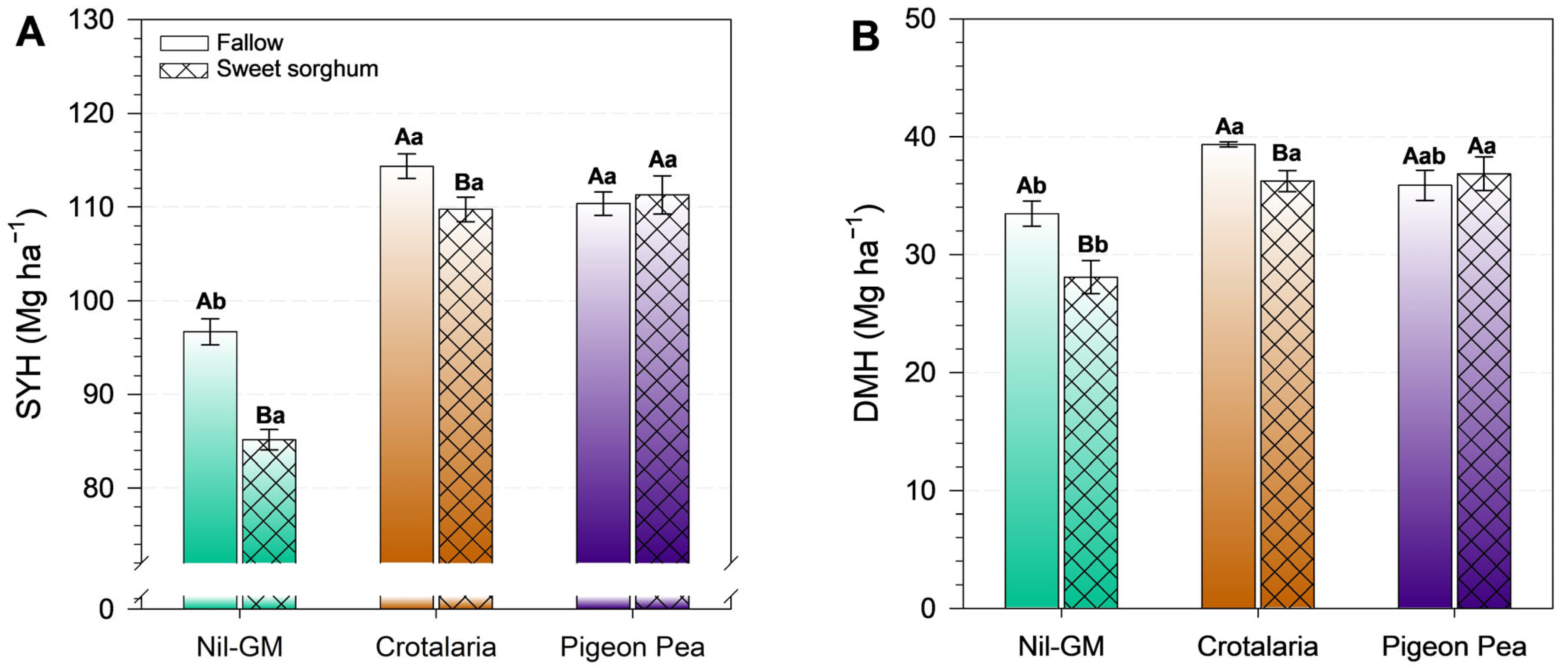
In the present study, both stalk and biomass yields were strongly affected by rotation (Figure 3). Under Nil-GM, rotation with sweet sorghum reduced SYH by 13% and DMH by 20% (p = 0.002 and p = 0.01). However, when preceded by green manure, the negative sorghum effect disappeared (−0.8% to −4%), indicating that green manure mitigated potential yield penalties associated with the sorghum–sugarcane sequence.
Crotalaria and pigeon pea did not differ statistically but showed SYH and DMH increases up to 18% compared to fallow, while the highest gains (up to 31%) occurred under sweet sorghum + green manure rotation. These results suggest that improved soil water retention and infiltration—linked to the enhanced root systems of legumes—contributed to yield improvements.
Comparative studies under irrigation reported 186–222 Mg ha−1 for the same cultivar [38,39], confirming that soil moisture availability is a primary yield determinant. In this context, the lowest yield (85 Mg ha−1) under Nil-GM + sorghum reflects limited water storage capacity, whereas the legume + sorghum rotations (109–111 Mg ha−1) demonstrate the synergistic benefits of integrating green manure into sugar–energy production.
Furthermore, higher DMH indicates increased straw accumulation, which enhances energy co-generation potential. This added benefit strengthens the industrial sustainability of green manure-based rotation systems.

3.4. Basic Infiltration Speed

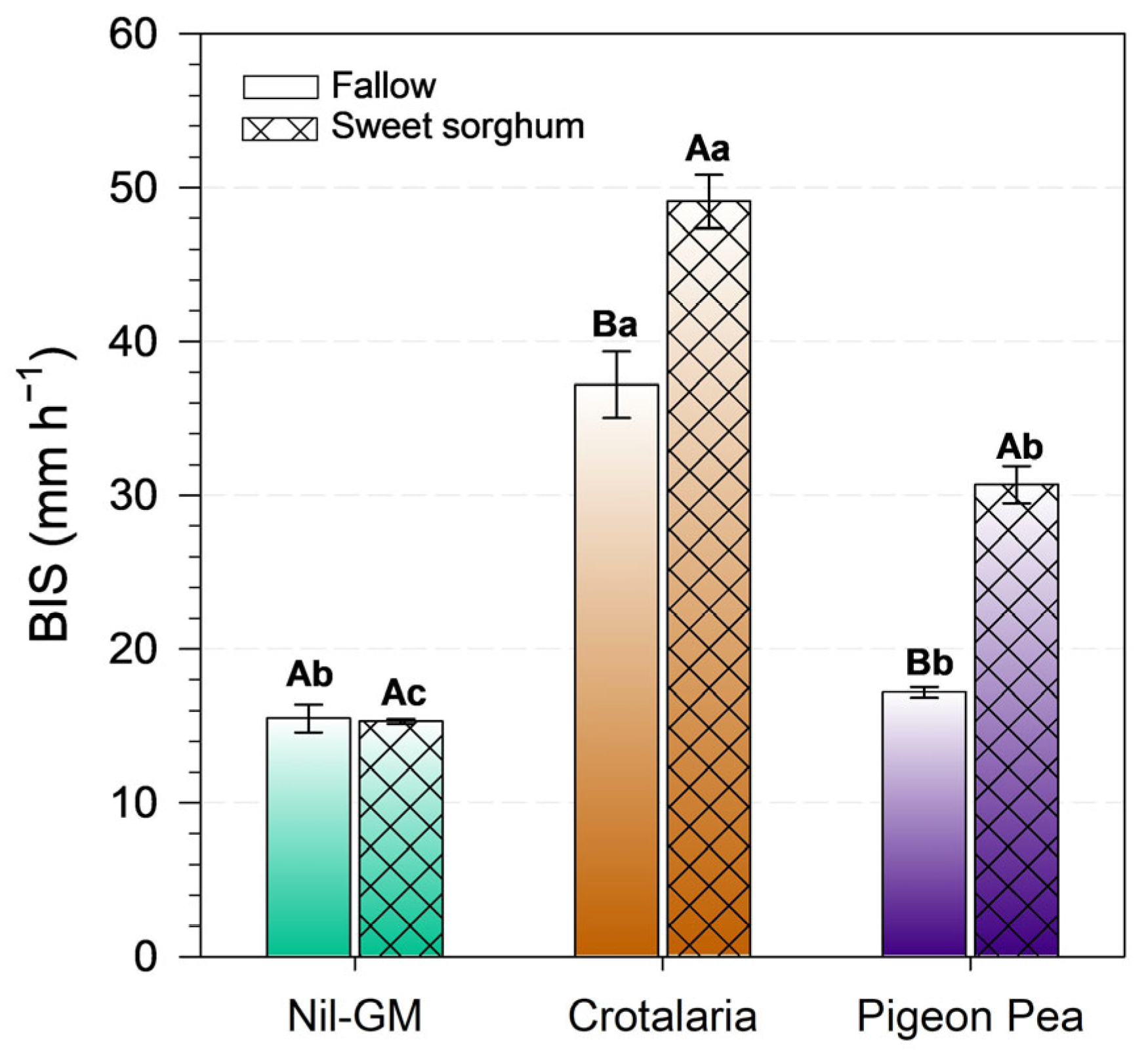
Rotation treatments had a significant effect on basic infiltration speed (BIS) (Figure 4). The Crotalaria-no sorghum combination exhibited the highest BIS (49.1 mm h−1), followed by Crotalaria-sorghum (37.2 mm h−1) and pigeon pea-no sorghum (30.7 mm h−1). Other treatments ranged between 15 and 17 mm h−1. This variation reflects the complex interaction among soil structure, root channels, and macroporosity. Sales et al. [40] reported BIS values of 12.1 to 56.6 mm h−1 in Oxisols, depending on clay and macropore content, while Silva and Kato [41] observed 56–96 mm h−1 with vegetation cover versus 51–78 mm h−1 without cover. Higher BIS under legume rotations—particularly Crotalaria—likely results from deep, fibrous root systems that reduce penetration resistance and enhance pore connectivity [11,42,43].
All treatments were classified as having high to very high infiltration capacity (15–30 and >30 mm h−1, respectively) [44], consistent with the soil’s sandy texture (Table 2). High infiltration rates minimize surface runoff and erosion, though excessive percolation may promote nitrate and ion leaching, especially in intensively cultivated regions such as southern Brazil [45].
It is also important to note that the double-ring infiltrometer method tends to overestimate BIS values compared to sprinkler infiltrometers [45]; therefore, the results should be interpreted comparatively rather than absolutely. Nonetheless, the enhanced infiltration under green manure rotations aligns with improved sugarcane and sorghum yields, reflecting better soil–water relations.

3.5. Soil Penetration Resistance

Crotalaria and pigeon pea exhibited lower penetration resistance (576 and 429 kPa, respectively) than those without green manure (Table 5). Sweet sorghum had no significant effect. Souza et al. [46] found penetration resistance values ranging from 3000 to 6500 kPa under native vegetation and 300–4000 kPa under legume cultivation, confirming that green manures substantially reduce compaction. This improvement is attributed to root-driven biopore formation and the incorporation of organic residues that loosen the soil matrix. The 4.95 Mg ha−1 of dry biomass reported by these authors contributed to enhanced soil aeration and drainage [47].
Critical SPR thresholds (>3500 kPa) are known to restrict root growth, depending on soil texture and moisture [48]. In this study, the maximum penetration depth was greater in plots with green manure (40.2 and 38.6 cm) compared to Nil-GM (36 cm). Sweet sorghum had no effect (mean = 36.3 cm). Since 80% of sugarcane roots occur within the effective rooting depth (~40 cm) [44], these results indicate improved porosity and reduced compaction, facilitating deeper root proliferation and greater access to subsoil moisture, thereby enhancing water-use efficiency [49].

3.6. Soil Water Storage Ability

Green manure treatments significantly increased total available water (TAW) by improving moisture retention at both field capacity and wilting point (Table 6). Crotalaria rotations showed the most favorable results, while sweet sorghum had no effect. Soil bulk density remained within optimal limits for this soil type. These findings confirm that legume rotations (particularly Crotalaria) enhance soil capacity to retain plant-available water, improving crop performance under rainfed systems.
TWSA differed significantly among green manure treatments, averaging 1.26, 1.04, and 0.87 mm cm−1 for Crotalaria, pigeon pea, and control, respectively, while TAW values were 75.4, 62.1, and 52.1 mm, respectively. Such differences are consistent with enhanced infiltration and reduced compaction in legume-amended soils.
Given the sandy nature of the Ultisol, permeability tends to decrease in deeper horizons, but legume root systems and organic inputs can mitigate subsoil restrictions by improving aggregate stability and structural porosity. Therefore, the integrated rotation of legumes and sweet sorghum provides a dual benefit—increasing infiltration and maintaining moisture storage within the root zone.
A seasonal water deficit occurred in June–July of the second year, coinciding with sugarcane’s peak vegetative growth (~9 months after planting) [38]. The treatments with the lowest TAW (52.1 mm) also showed the lowest yield (85.6 Mg ha−1), reinforcing the strong relationship between soil water availability and sugarcane yield.

3.7. Multivariate Approach

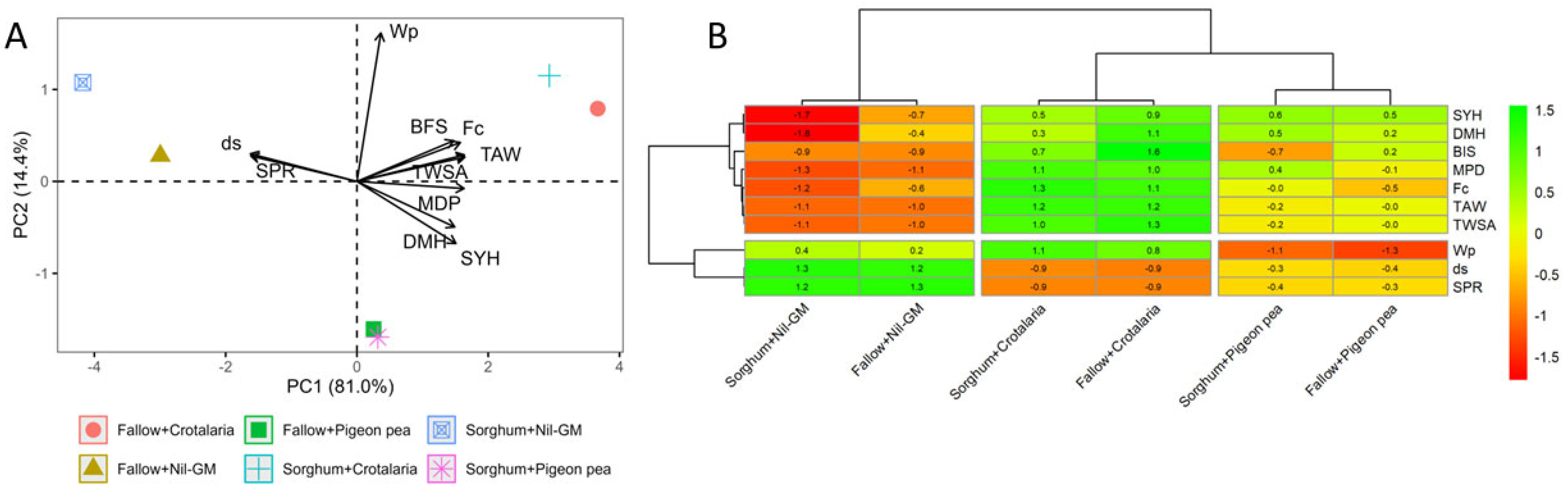
The multivariate approach, combining principal component analysis (PCA) and hierarchical clustering in the heatmap (Figure 5), showed that most of the treatment-driven differentiation was explained by the presence of green manure, with a secondary contribution from sweet sorghum rotation. In the PCA, the largest Euclidean distances from the fallow + Nil-GM treatment were observed for fallow + Crotalaria (6.68) and fallow + pigeon pea (5.99), indicating that legume-based rotations produced the greatest shifts in soil condition and crop response. Both treatments were positively associated with higher BIS, Fc, TAW, and TWSA, and negatively associated with ds and SPR, suggesting improvements in water infiltration, storage, and soil physical structure under green manure rotations.
Sugarcane yield variables (SYH and DMH) were negatively correlated with ds and SPR, supporting the interpretation that reduced bulk density and lower penetration resistance favor stalk production. Although yield variables were not tightly clustered with a single treatment level, the smallest Euclidean distance for yield traits occurred in plots previously cultivated with pigeon pea, suggesting a residual positive effect of this legume on sugarcane performance. Among soil attributes, Wp, ds, and SPR were the strongest discriminators among treatments across both multivariate techniques, highlighting the central role of compaction alleviation and water retention in mediating rotation effects.
These patterns align with prior work showing that cover crops (particularly legumes) tend to increase infiltration and plant-available water by improving soil structure and macroporosity, thereby buffering crops against short-term water deficits [50]. In sugarcane systems, pre-plant legume cover crops (e.g., Crotalaria, pigeon pea) have been repeatedly associated with lower bulk density/penetration resistance and more favorable hydrophysical conditions, supporting higher or more stable yields in subsequent cane cycles [8]. Taken together, our multivariate results (higher BIS, Fc, TAW, and TWSA coupled with lower ds and SPR under legume rotations) are consistent with these mechanisms and with broader syntheses documenting the cover-crop effect on water entry and storage in agricultural soils [50].

4. Conclusions

Crop rotation markedly influenced sugarcane yield through changes in sandy-soil physical and hydrological properties. Sweet sorghum rotation reduced stalk and biomass yield under fallow, but these losses were fully offset when preceded by leguminous green manures. Crotalaria and pigeon pea rotations promoted greater stalk yield, dry matter accumulation, and sandy-soil water availability, reflecting improvements in soil structure and moisture retention that supported sugarcane performance under rainfed conditions.
Green manure rotations, particularly with Crotalaria, also resulted in higher infiltration rates, lower penetration resistance, and greater rooting depth, leading to increased total available water. These outcomes confirm that green manures–sorghum rotations enhance sandy-soil physical and water storage, providing a sustainable and low-input alternative to improve sugarcane yield in tropical rainfed systems. Future research should test these rotations across sites and seasons; quantify nutrient dynamics (mineral N, exchangeable K and Mg, SOC/aggregate stability) alongside full water retention curves; integrate 15N tracing and economic analyses; and use process-based models to scale site-specific recommendations.

Author Contributions

Conceptualization, R.A.M.U.; methodology, R.A.M.U. and G.H.G.C.; formal analysis, R.A.M.U.; investigation, R.A.M.U., G.H.G.C., M.F., F.E.F., T.Q., J.H.S.d.L., F.F.P. and A.A.d.N.; writing—original draft preparation, R.A.M.U.; writing—review and editing, R.A.M.U., A.A.d.N. and J.H.S.d.L., F.F.P.; supervision, R.A.M.U.; project administration, R.A.M.U.; funding acquisition: R.A.M.U. All authors have read and agreed to the published version of the manuscript.

Funding

This research was funded by National Council for Scientific and Technological Development (CNPq) grant number 461638/2014-2.

Data Availability Statement

The data presented in this study are available on request from the corresponding authors.

Conflicts of Interest

The authors declare no conflicts of interest.

References

  1. Hoang, T.D.; Nghiem, N. Recent Developments and Current Status of Commercial Production of Fuel Ethanol. Fermentation 2021, 7, 314. [Google Scholar] [CrossRef]
  2. Hall, J.; Matos, S.; Severino, L.; Beltrão, N. Brazilian biofuels, and social exclusion: Established and concentrated ethanol versus emerging and dispersed biodiesel. J. Clean. Prod. 2009, 17, S77–S85. [Google Scholar] [CrossRef]
  3. Horst, D.V.D.; Vermeylen, S. Spatial scale and social impacts of biofuel production. Biomass Bioenergy 2011, 35, 2435–2443. [Google Scholar] [CrossRef]
  4. Sipos, B.; Réczey, J.; Somorai, Z.; Kádár, Z.; Dienes, D.; Réczey, K. Sweet sorghum as feedstock for ethanol production: Enzymatic hydrolysis of steam pretreated bagasse. Appl. Biochem. Biotechnol. 2009, 153, 151–162. [Google Scholar] [PubMed]
  5. Emydio, B.M. Produção de Etanol a Partir de Sorgo Sacarino. Infobibos. 2010. Available online: http://www.infobibos.com/Artigos/2010_4/sorgo/index.htm (accessed on 5 September 2025).
  6. May, A.; Duraes, F.O.M.; Pereira Filho, I.A.; Schaffert, R.E.; Parrella, R.A.d.C. Sistema Embrapa de Produção Agroindustrial de Sorgo Sacarino para Bioetanol Sistema BRS1G: Tecnologia Qualidade Embrapa; Embrapa Milho e Sorgo: Sete Lagoas, Brazil, 2012. [Google Scholar]
  7. Trivelin, P.C.O.; Vitti, A.C.; Oliveira, M.W.; Gava, G.J.C.; Sarriés, G.A. Utilização de nitrogênio e produtividade da cana-de-açúúcar (cana planta) em solo arenoso com incorporação de resíduos da cultura. Rev. Bras. Ciência Solo 2012, 37, 193–201. [Google Scholar] [CrossRef]
  8. Luz, F.B.; Carvalho, M.L.; de Borba, D.A.; Schiebelbein, B.E.; de Lima, R.P.; Cherubin, M.R. Linking Soil Water Changes to Soil Physical Quality in Sugarcane Expansion Areas in Brazil. Water 2020, 12, 3156. [Google Scholar] [CrossRef]
  9. Von Cossel, M.; Wagner, M.; Lask, J.; Magenau, E.; Bauerle, A.; Von Cossel, V.; Warrach-Sagi, K.; Elbersen, B.; Staritsky, I.; Van Eupen, M.; et al. Prospects of Bioenergy Cropping Systems for A More Social-Ecologically Sound Bioeconomy. Agronomy 2019, 9, 605. [Google Scholar] [CrossRef]
  10. Sachs, J.L.; Quides, K.W.; Wendlandt, C.E. Legumes versus rhizobia: A model for ongoing conflict in symbiosis. New Phytol. 2018, 219, 1199–1206. [Google Scholar] [CrossRef]
  11. Amado, T.J.C.; Bayer, C.; Eltz, F.L.F.; Brum, A.C.R. Potencial de culturas de cobertura em acumular carbono e nitrogênio no solo no plantio direto e a melhoria da qualidade ambiental. Rev. Bras. Ciênc. Solo 2001, 25, 189–197. [Google Scholar] [CrossRef]
  12. Frizzone, J.A. Irrigação por Superfície; Serie Didatica; Departamento de Engenharia Rural, Escola Superior de Agricultura Luiz de Queiroz, Universidade de São Paulo: Piracicaba, Brazil, 1993; Volume 16, p. 160. [Google Scholar]
  13. Machiwal, D.; Jha, M.K.; Mal, B.C. Modelling Infiltration and quantifying spatial soil variability in a Wasteland of Kharagpur, India. Biosyst. Eng. 2006, 95, 569–582. [Google Scholar] [CrossRef]
  14. Kostiakov, A.N. On the dynamics of the co-efficient of water percolation in soils. Trans. Sixth Comm. Int. Soc. Soil. Sci. 1932, 1, 7–21. [Google Scholar]
  15. Fok, Y.S. Derivation of Lewis-Kostiakov Intake Equation. J. Irrig. Drain Eng. 1986, 112, 164–171. [Google Scholar] [CrossRef]
  16. Alaoui, A.; Rogger, M.; Peth, S.; Blöschl, G. Does soil compaction increase floods: A review. J. Hydrol. 2018, 557, 631–642. [Google Scholar] [CrossRef]
  17. Machado, P.L.O.A. Compactação do Solo e Crescimento de Plantas: Como Identificar, Evitar e Remediar; Embrapa Solos: Rio de Janeiro, Brazil, 2003. [Google Scholar]
  18. Hermann, P.H.; Santos, E.G.D.; Bassinello, A.I.; Vieira, M.A.S. Variedades RB de Cana-de-Açúcar, 1st ed.; CCA/UFSCar Tech.: Araras, Brazil, 2008. [Google Scholar]
  19. Brouwer, C.; Prins, K.; Kay, M.; Heibloem, M. Irrigation methods: FAO Irrigation Water Management. Train. Man. 1991, 5, 65. [Google Scholar]
  20. Silva, M.D.A.; Arantes, M.T.; Rhein, A.F.D.L.; Gava, G.J.C.; Kolln, O.T. Potencial produtivo da cana-de-açúcar sob irrigação por gotejamento em função de variedades e ciclos. Rev. Bras. Eng. Agríc. 2014, 18, 241–249. [Google Scholar] [CrossRef][Green Version]
  21. Barcellos, A.D.O.; Ramos, A.K.B.; Vilela, L.; Martha Junior, G.B. Sustentabilidade da produção animal baseada em pastagens consorciadas e no emprego de leguminosas exclusivas, na forma de banco de proteína, nos trópicos brasileiros. Rev. Bras. Zootec. 2008, 37, 51–67. [Google Scholar] [CrossRef]
  22. Silva, J.A.A.D.; Vitti, G.C.; Stuchi, E.S.; Sempionato, O.R. Reciclagem e Incorporação de Nutrientes so Solo pelo Cultivo Intercalar de Adubos Verdes em pomar de laranjeira-‘Pêra. Rev. Bras. Frutic. 2002, 24, 225–230. [Google Scholar] [CrossRef]
  23. Amabile, R.F.; Fancelli, A.L.; Carvalho, A.M.D. Comportamento de Espécies de Adubos Verdes em Diferentes Épocas de Semeadura e Espaçamentos na Região dos Cerrados. Pesqui. Agropecu. Bras. 2000, 35, 47–54. [Google Scholar] [CrossRef]
  24. Fontanetti, A.; Carvalho, G.J.; Gomes, L.A.A. Adubação Verde na Produção Orgânica de Alface Americana e Repolho. Hort. Bras. 2006, 24, 146–150. [Google Scholar] [CrossRef]
  25. Pacheco, L.P.; São Miguel, A.S.D.C.; Bonfim-Silva, E.M.; Souza, E.D.D.; Silva, F.D.D. Influência da densidade do solo em atributos da parte aérea e sistema radicular de crotalária. Pesqui. Agropecu. Trop. 2015, 45, 464–472. [Google Scholar] [CrossRef]
  26. Oliveira, F.L.D.; Guerra, J.G.M.; Junqueira, R.M.; Silva, E.E.D.; Oliveira, F.F.D.; Espindola, J.A.A.; Almeida, D.L.D.; Ribeiro, R.D.L.D.; Urquiaga, S. Crescimento e produtividade do inhame cultivado entre faixas de guandu em sistema orgânico. Hort. Bras 2006, 24, 53–58. [Google Scholar] [CrossRef]
  27. Paulino, G.M.; Alves, B.J.R.; Barroso, D.G.; Urquiaga, S.; Espindola, J.A.A. Fixação biológica e transferência de nitrogênio por leguminosas em pomar orgânico de mangueira e gravioleira. Pesqui. Agropecu. Bras. 2009, 44, 1598–1607. [Google Scholar] [CrossRef]
  28. Dantas, R.A.; Carmona, R.; Carvalho, A.M.; Rein, T.A.; Malaquias, J.V.; Santos, J.J.D.G. Produção de matéria seca e controle de plantas daninhas por leguminosas consorciadas com cana-de-açúcar em cultivo orgânico. Pesqui. Agropecu. Bras. 2015, 50, 681–689. [Google Scholar] [CrossRef]
  29. Ambrosano, E.J.; Trivelin, P.C.O.; Cantarella, H.; Ambrosano, G.M.B.; Schammass, E.A.; Muraoka, T.; Rossi, F. 15N-labeled nitrogen from green manure and ammonium sulfate utilization by the sugarcane ratoon. Sci. Agric. 2011, 68, 361–368. [Google Scholar] [CrossRef]
  30. Embrapa. Agroenergia Em Revista; Empresa Brasileira de Pesquisa Agropecuária: Brasília, Brazil, 2011. [Google Scholar]
  31. Embrapa. Soluções Tecnológicas: Sorgo—BRS 506. 1998. Available online: https://www.embrapa.br/busca-de-publicacoes/-/publicacao/487280/brs-506-sorgo-forrageiro (accessed on 10 August 2018).
  32. Bandeira, A.H.; Medeiros, S.L.P.; Emygdio, B.M.; Biondo, J.C.; Silva, N.G.; Nunes, S.C.P.; Sangoi, P.R. Biometria em plantas de sorgo sacarino submetidos a diferentes épocas de semeadura. In Proceedings of the Reunião Técnica Anual do Milho, 58. Reunião Técnica Anual do Sorgo, 41., Pelotas, Brazil, 16–18 July 2013. [Google Scholar]
  33. Emygdio, B.M.; Facchinello, P.H.K.; Barros, L. Efeito de diferentes condições de manejo sobre a produção de sorgo sacarino no município de Capão do Leão, RS. In Proceedings of the Congresso Nacional De Milho E Sorgo. 15, Salvador, Brazil, 16–18 August 2014; pp. 1–4. [Google Scholar]
  34. May, A.; Mendes, M.S.; Silva, D.D.; Parrella, A.C.R.; Miranda, A.R.; Silva, F.S.A.; Pacheco, F.P.; Aquino, A.L.; Cota, V.L.; Costa, V.R.; et al. Cultivo de sorgo sacarino em áreas de reforma de canaviais. Circ. Técnica 2013, 186, 1–26. [Google Scholar]
  35. Maw, M.J.W.; Houx, J.H., III; Fritschi, F.B. Maize, sweet sorghum, and high biomass sorghum ethanol yield comparison on marginal soils in Midwest USA. Biomass Bioenergy 2017, 107, 164–171. [Google Scholar] [CrossRef]
  36. Gonçalves, I.Z.; Barbosa, E.A.A.; Santos, L.N.S.; Nazário, A.A.; Feitosa, D.R.C.; Tuta, N.F.; Matsura, E.E. Water relations and productivity of sugarcane irrigated with domestic wastewater by subsurface drip. Agric. Water Manag. 2017, 185, 105–115. [Google Scholar] [CrossRef]
  37. Barbosa, M.H.P.; Silveira, L.C.I.; Oliveira, M.W. RB867515 sugarcane cultivar. Crop Breed Appl. Biotechnol. 2001, 1, 437–438. [Google Scholar] [CrossRef]
  38. Barbosa, E.A.A.; Matsura, E.E.; Santos, L.N.S.D.; Gonçalves, I.Z.; Nazário, A.A.; Feitosa, D.R.C. Water footprint of sugarcane irrigated with treated sewage and freshwater under subsurface drip irrigation, in Southeast Brazil. J. Clean. Prod. 2017, 153, 448–456. [Google Scholar] [CrossRef]
  39. Oliveira, E.C.A.D.; Freire, F.J.; Oliveira, R.I.D.; Freire, M.B.G.D.S.; Neto, D.E.S.; Silva, S.A.M.D. Extração e exportação de nutrientes por variedades de cana-de-açúcar cultivadas sob irrigação plena. Rev. Bras. Ciênc. Solo 2010, 34, 1343–1352. [Google Scholar] [CrossRef]
  40. Sales, L.E.O.; Ferreira, M.M.; Silva, M.O.; Curi, N. Estimativa da taxa de infiltração básica do solo. Pesqui. Agropec. Bras. 1999, 34, 2091–2095. [Google Scholar] [CrossRef]
  41. Silva, L.C.; Kato, E. Avaliação de modelos para a previsão da infiltração de água em solos sob cerrado. Pesqui. Agropec. Bras. 1998, 33, 1149–1158. [Google Scholar]
  42. Wutke, E.B.; Arévalo, R.A. Adubação Verde com Leguminosas no Rendimento da Cana-de-Açúcar e no Manejo de Plantas Infestantes; Instituto Agronômico: Campinas, Brazil, 2006; p. 28. [Google Scholar]
  43. Carvalho, J.E.B.D.; Lopes, L.C.; Araújo, A.M.D.A.; Souza, L.D.S.; Caldas, R.C.; Daltro Júnior, C.A.; Carvalho, L.L.D.; Oliveira, A.A.R.; Santos, R.C.D. Leguminosas e seus efeitos sobre propriedades físicas do solo e produtividade do mamoeiro ‘Tainung 1’. Rev. Bras. Frutic. 2004, 26, 335–338. [Google Scholar] [CrossRef]
  44. Bernardo, S.; Soares, A.A.; Mantovani, E.C. Manual de Irrigação, 8th ed.; UFV: Viçosa, Brazil, 2006. [Google Scholar]
  45. Coelho, R.D.; Miranda, J.H.D.; Duarte, S.N. Infiltração da água no solo: Parte I Infiltrômetro de anéis versus infiltrômetro de aspersores. Rev. Bras. Eng. Agric. Ambient 2000, 4, 137–141. [Google Scholar] [CrossRef]
  46. Souza, D.L.; Santos, V.C.; Souza, S.L.; Pereira, S.B.L. Resistência à penetração em latossolo amarelo dos tabuleiros costeiros, sob cobertura vegetal com leguminosas. In Boletim de Pesquisa e Desenvolvimento, 58; Embrapa Mandioca e Fruticultura: Cruz das Almas, Brazil, 2013. [Google Scholar]
  47. Yaacob, O.; Blair, G.J. Effect of legume cropping and organic matter accumulation on the infiltration rate and structural stability of a granite soil under a simulated tropical environment. Plant Soil 1981, 60, 11–20. [Google Scholar] [CrossRef]
  48. Torres, E.; Saraiva, O.F. Camadas de Impedimento do Solo em Sistemas Agrícolas Com a Soja; Empresa Brasileira de Pesquisa Agropecuária: Londrina, Brazil, 1999; p. 58. [Google Scholar]
  49. Sousa, A.C.M.D.; Elaiuy, E.E.; Santos, M.L.C.; Montes, L.N.S. Root system distribution of sugarcane irrigated with domestic sewage effluent application by subsurface drip system. Eng. Agríc. 2013, 33, 647–657. [Google Scholar] [CrossRef]
  50. Carlos, A.; Vitorino, T.; Wilson Cortez, J.; Agronomist, E.; Cristian, A.; Phd, B.; Agronomist, I.E.; Da, M.; Koerber, S. Soil Management and Physical Attributes as a Function of Crops in Sugarcane Field Renewal. Cad. Pedagóg. 2025, 22, e13211. [Google Scholar] [CrossRef]
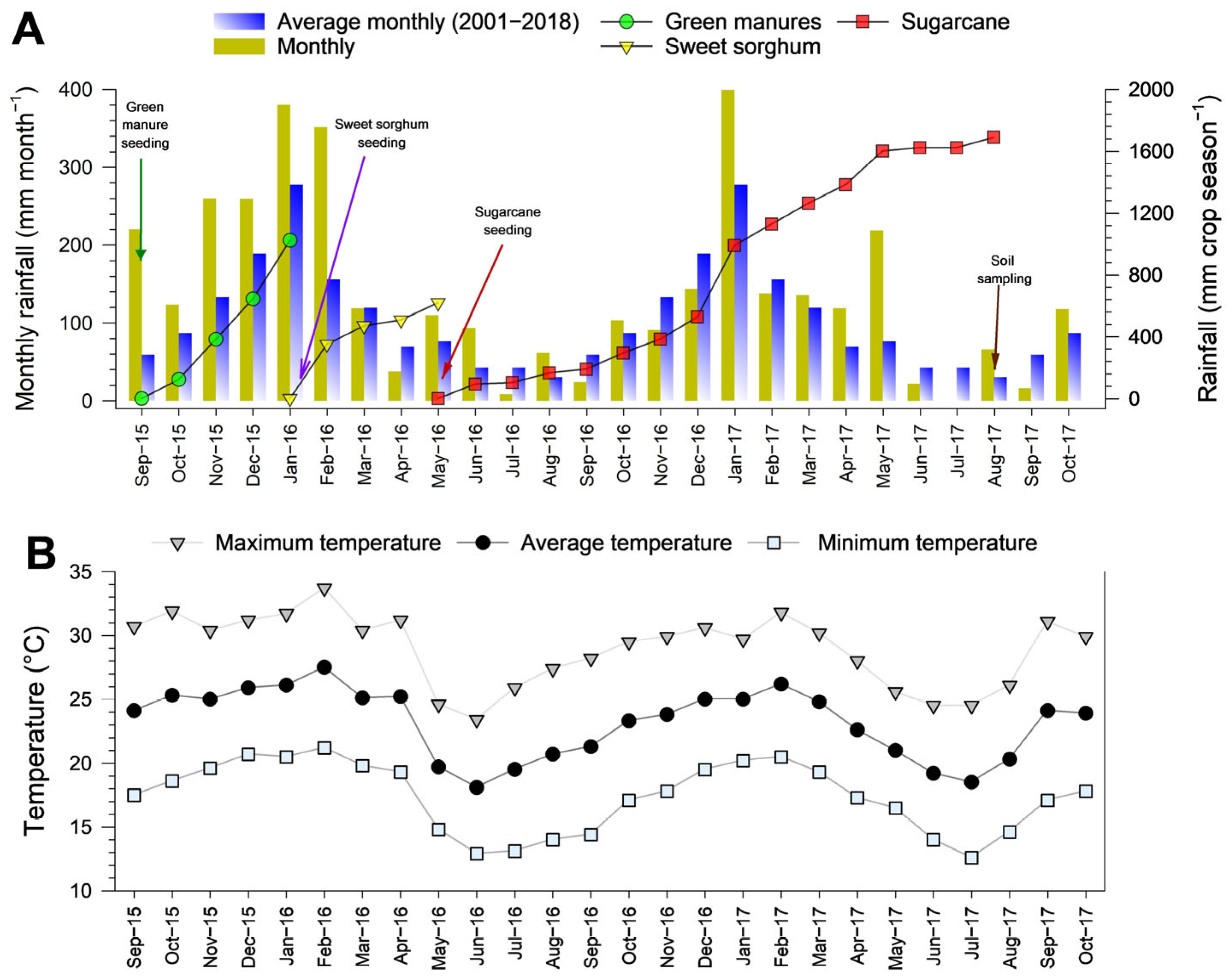
Figure 1. Monthly precipitation of the trial period (2015–2017), known historical average of precipitation (2001–2018), accumulated precipitation in the crops season (A), and temperature (B) in Cabrália Paulista County, São Paulo State.
Agronomy 16 00935 g001
Figure 2. Schematic representation of the crop rotation sequence and the establishment of sugarcane cultivation. Nil-GM: without green manure.
Agronomy 16 00935 g002
Figure 3. Sugarcane stalk yield (SYH, A) and dry matter (DMH, B) under rotation system. Means with different letters, uppercase (sorghum cultivation) and lowercase (green manures), differ statistically according to Tukey’s test (p ≥ 0.05). Nil-GM: without green manure.
Agronomy 16 00935 g003
Figure 4. Basic infiltration speed (BIS) under rotation system. Means with different letters, uppercase (sorghum cultivation) and lowercase (green manures), differ statistically according to Tukey’s test (p ≥ 0.05). Nil-GM: without green manure.
Agronomy 16 00935 g004
Figure 5. Biplot of the first two principal components (A) and a heatmap with hierarchical clustering (Euclidean distance) (B) of soil physical attributes and sugarcane yield in response to rotations with sweet sorghum and green manures. TWSA: total water soil availability; TAW: total available water; SPR: soil penetration resistance; MPD: maximum pressure depth; BIS: basic infiltration speed; SYH: sugarcane stalk yield; DMH: dry matter. Nil-GM: without green manure.
Agronomy 16 00935 g005
Table 1. Chemical and textural soil features of the experimental plot.
LayerPOMpHK+Ca2+Mg2+Al3+H + AlCECV
(cm)Resin  ResinKClKClKClSMP  
mg dm−3g dm−3CaCl2mmolc dm−3 %
0 to 2029105.21.610412641.638
20 to 401584.81.28333042.229
40 to 60574.50.472.743444.123
Sand (%)Clay (%)Silt (%)Limestone (Mg ha−1)
0 to 3089.48.81.81.9
30 to 6088.59.22.3
OM: organic matter; CEC: cation exchange capacity; V: base saturation; SMP: Shoemaker, McLean and Pratt method.
Table 2. Crotalaria and pigeon pea shoot fresh matter, wet and dry matter.
CultureFresh Matter
(Mg ha−1)
Moisture
(%)
Dry Matter
(Mg ha−1)
Crotalaria53.60 ± 2.96 A75 ± 8.11 A13.04 ± 1.24 A
Pigeon pea28.20 ± 1.56 B67 ± 7.24 B9.07 ± 0.87 B
SMD3.010.201.15
CV5.7910.839.70
Different letters show significant differences in Tukey test (p ≤ 0.05); SMD: significant minimum deviation; CV: coefficient of variation.
Table 3. Height, diameter, stalks yield (SYH), and dry matter (DM) of sweet sorghum grown in rotation with Crotalaria and pigeon pea.
TreatmentsHeightDiameterSYHDM
(m)(mm) Mg ha−1
Nil-GM1.41 ± 0.14 B13.65 ± 0.97 B27.85 ± 2.81 B8.71 ± 1.35 B
Crotalaria1.64 ± 0.16 A15.92 ± 1.13 A37.04 ± 3.74 A10.86 ± 1.68 A
Pigeon pea1.60 ± 0.15 A15.87 ± 1.12 A33.33 ± 3.37 A12.44 ± 1.93 A
SMD0.171.223.791.90
CV9.677.1010.1715.67
Difference letters show significant differences in Tukey test (p ≤ 0.05); SMD: significant minimum deviation; CV: coefficient of variation; Nil-GM: without green manure.
Table 4. Sugarcane stalk height and diameter under rotation conditions.
Green Manure (A)HeightDiameter
(m)(mm)
Nil-GM2.49 ± 0.15 B27.85 ± 1.37 B
Crotalaria2.90 ± 0.18 A32.24 ± 1.58 A
Pigeon pea2.93 ± 0.19 A31.98 ± 1.57 A
SMD0.221.96
F Test17.18 **21.42 **
Sweet Sorghum (B)
With2.79 ± 0.17 A30.82 ± 1.51 A
Fallow2.76 ± 0.16 A30.56 ± 1.50 A
SMD0.151.31
F Test0.29 ns0.17 ns
CV%6.064.91
Inter AxB0.54 ns0.07 ns
Different letters show significant differences in the Tukey test (p ≤ 0.05); ns: not significant (p ≥ 0.05); ** significance level at 1% probability; SMD: significant minimum deviations; CV: coefficient of variance; Nil-GM: without green manure.
Table 5. Soil penetration resistance (Pressure, kPa) and maximum pressure depth in plots planted with sugarcane under rotation conditions.
Green Manure (A)PressureMaximum Depth Pressure
(kPa)(cm)
Nil-GM4318 ± 998 A36.0 ± 6.3 B
Crotalaria3742 ± 864 B40.2 ± 7.0 A
Pigeon pea3889 ± 898 B38.6 ± 6.7 AB
SMD3853.2
F Test13.71 **4.87 **
Sweet Sorghum
With4040 ± 933 A38.4 ± 6.5 A
Fallow4020 ± 929 A38.2 ± 6.6 A
SMD3082.2
F Test0.02 ns0.03 ns
CV%23.117.4
Inter AxB0.04 ns2.60 ns
Different letters showed significant differences in the Tukey Test (p ≤ 0.05). ns: not significant (p ≥ 0.05); ** significance at 1% probability level. SMD: significant minimum deviation; CV: coefficient of variation. Nil-GM: without green manure.
Table 6. Mean values for Fc, Wp, ds, TWSA, and TAW in plots planted with sugarcane under different rotation conditions.
Green Manure (A)FcWpdsTWSATAW
%(g cm−3)(mm cm−1)(mm)
Nil-GM15.27 ± 1.53 C10.10 ± 0.96 B1.68 ± 0.17 A0.87 ± 0.08 C52.13 ± 5.17C
Crotalaria18.53 ± 1.85 A10.29 ± 0.98 A1.52 ± 0.15 A1.26 ± 0.12 A75.38 ± 7.47 A
Pigeon pea16.31 ± 1.63 B9.68 ± 0.92 C1.56 ± 0.16 A1.04 ± 0.10 B62.13 ± 6.16 B
SMD0.220.120.190.152.39
F Test94.41 **85.09 **0.76 ns76.35 **21.36 **
Sweet Sorghum (B)
With16.71 ± 1.67 A10.05 ± 0.95 A1.59 ± 0.17 A1.04 ± 0.10 A62.83 ± 6.23 A
Fallow16.69 ± 1.76 A9.99 ± 0.90 A1.58 ± 0.16 A1.06 ± 0.11 A63.58 ± 6.30 A
SMD0.150.080.200.021.60
F Test0.15 ns2.58 ns0.85 ns0.63 ns1.00 ns
CV%10.009.5010.399.169.91
Inter AxB1.16 ns0.26 ns0.98 ns1.37 ns2.36 ns
Different letters show statistically significant differences in the Tukey test (p ≤ 0.05); ns: not significant (p ≥ 0.05); ** significance level at 1% probability; SMD: significant minimum deviation; CV: coefficient of variation; Nil-GM: without green manure.
Disclaimer/Publisher’s Note: The statements, opinions and data contained in all publications are solely those of the individual author(s) and contributor(s) and not of MDPI and/or the editor(s). MDPI and/or the editor(s) disclaim responsibility for any injury to people or property resulting from any ideas, methods, instructions or products referred to in the content.