Uncovering Stable Genetic Loci for Sustainable Pea (Pisum sativum L.) Production Through Genome-Wide Association Mapping
 , , , , and
Abstract
1. Introduction
2. Materials and Methods
2.1. Plant Material and Field Experiments
2.2. Statistical Analysis
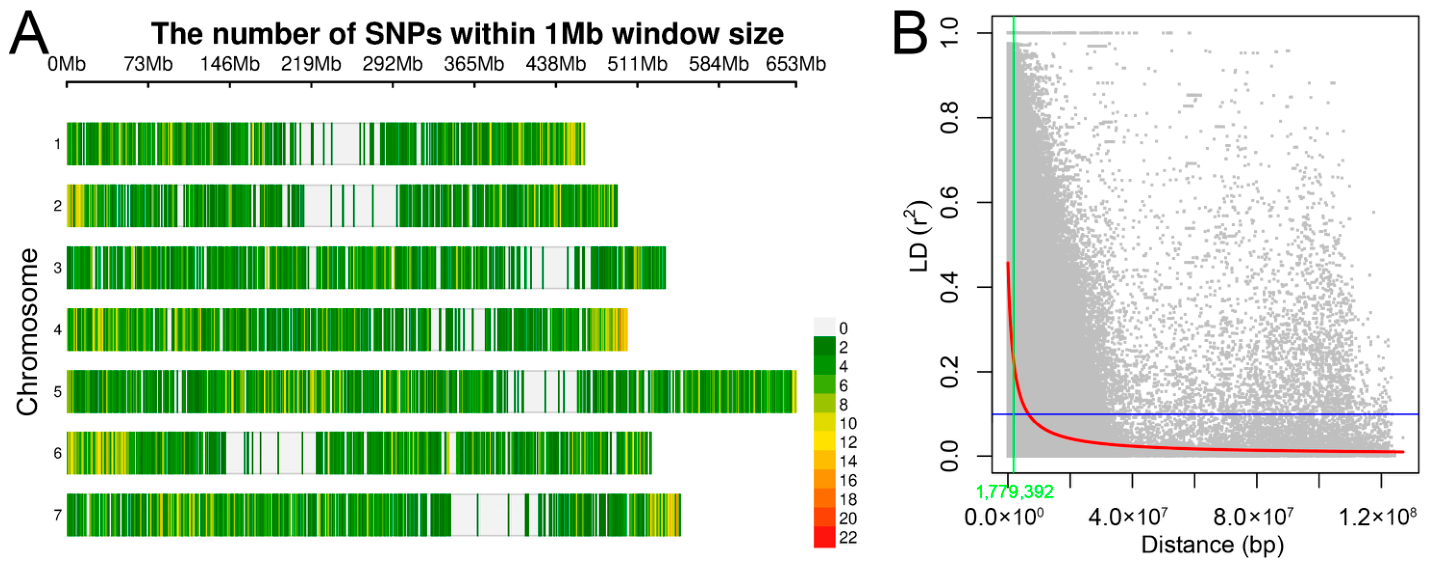
2.3. Genotyping and SNP Dataset
2.4. Population Structure and Genetic Diversity
2.5. Association Mapping
3. Results
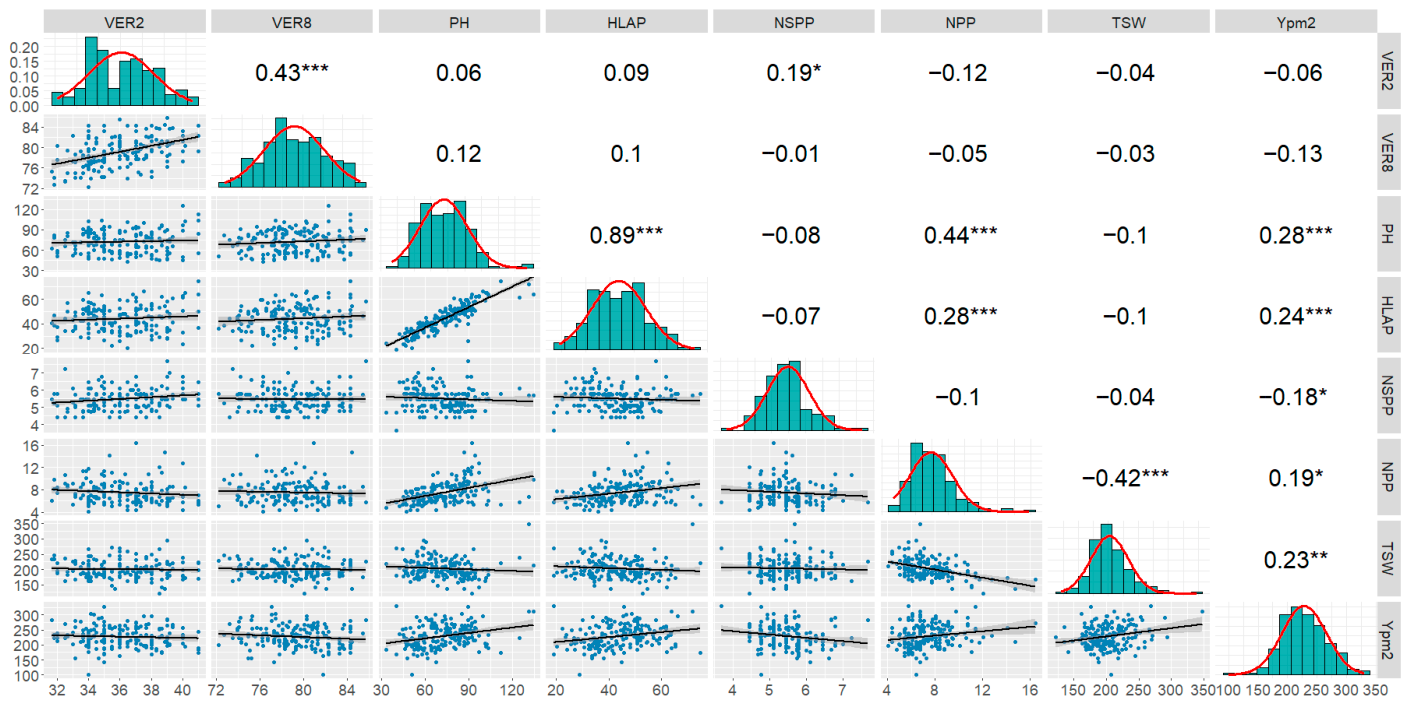
3.1. Phenotypic Variability, Correlation, and Heritability of Agronomic Traits
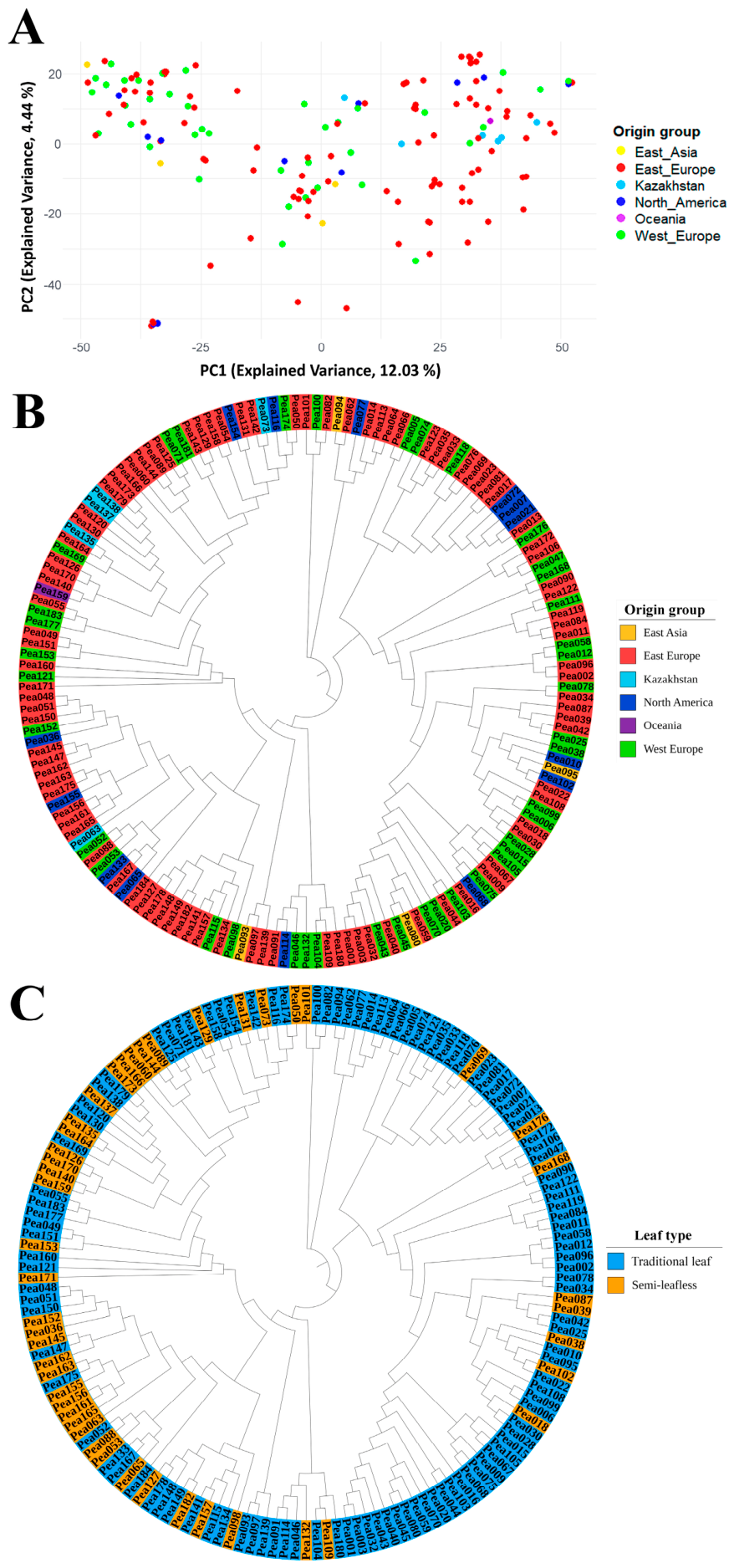
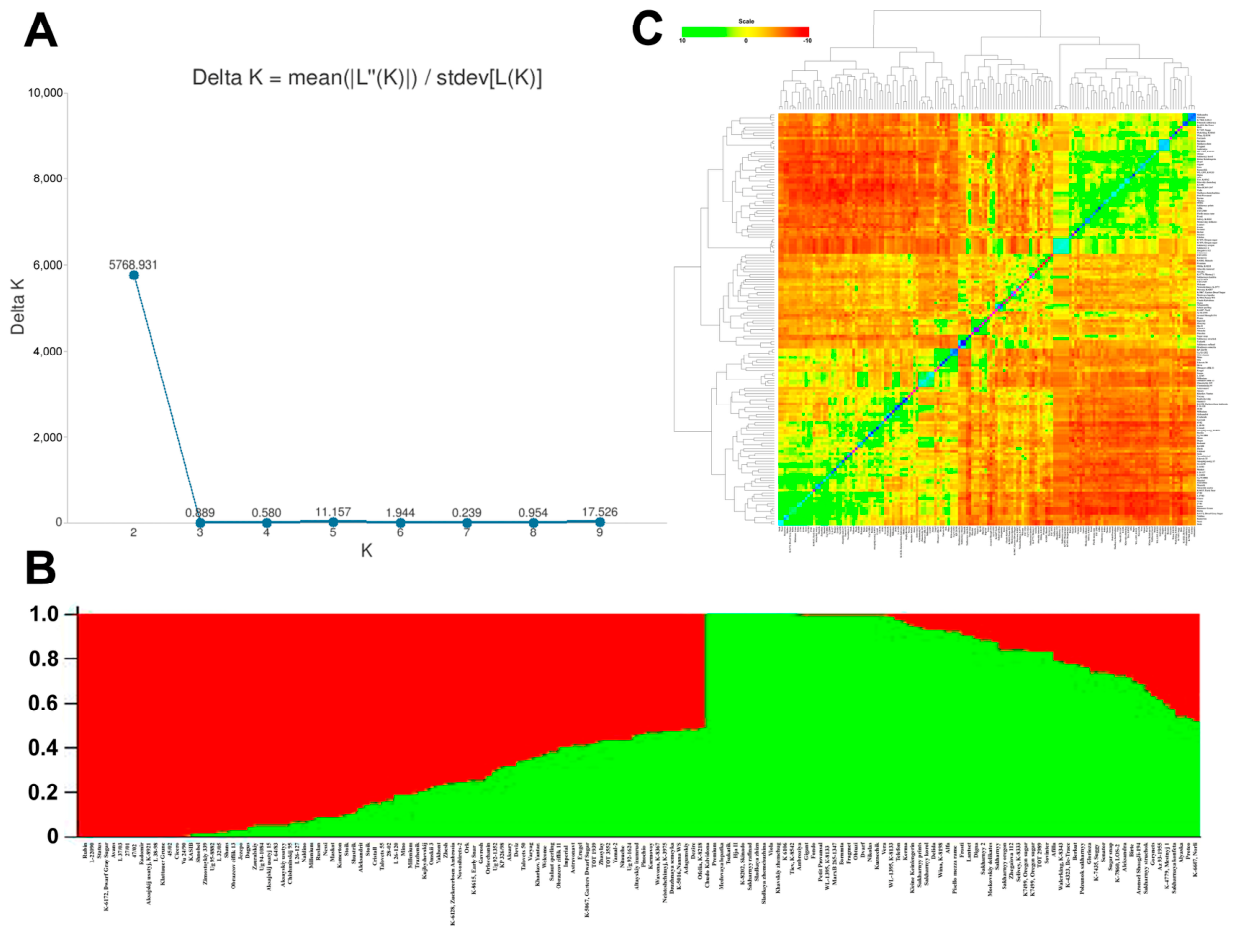
3.2. Population Analysis and Genetic Relationship
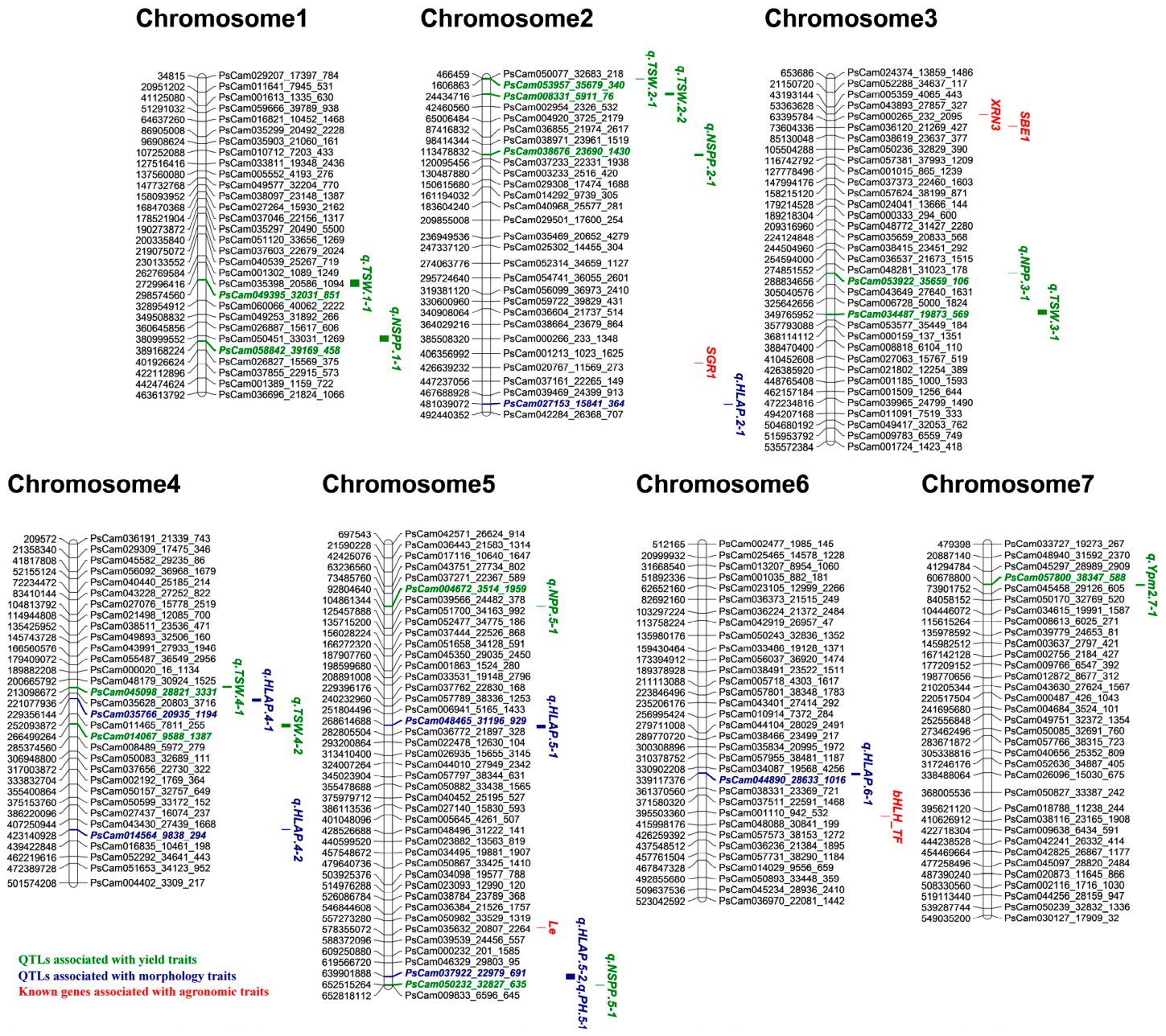
3.3. Identification of Stable QTLs and Their Functional Candidate Genes
4. Discussion
4.1. Phenotypic Variability, Correlation, and Heritability of Agronomic Traits
4.2. Population Analysis and Genetic Relationship
4.3. Identification of Stable QTLs and Their Functional Candidate Genes
5. Conclusions
Supplementary Materials
Author Contributions
Funding
Data Availability Statement
Acknowledgments
Conflicts of Interest
References
- Food and Agriculture Organization (FAO). FAOSTAT Statistical Database. Available online: https://www.fao.org/faostat/ (accessed on 26 March 2026).
- Burstin, J.; Gallardo, K.; Mir, R.R.; Varshney, R.K.; Duc, G. Improving protein content and nutrition quality. In Biology and Breeding of Food Legumes; Pratap, A., Kumar, J., Eds.; CAB International: Wallingford, UK, 2011; pp. 314–328. [Google Scholar]
- Dahl, W.J.; Foster, L.M.; Tyler, R.T. Review of the health benefits of peas (Pisum sativum L.). Br. J. Nutr. 2012, 108, S3–S10. [Google Scholar] [CrossRef] [PubMed]
- Peoples, M.B.; Herridge, D.F.; Ladha, J.K. Biological nitrogen fixation: An efficient source of nitrogen for sustainable agricultural production? Plant Soil 1995, 174, 3–28. [Google Scholar] [CrossRef]
- Suleimenov, M. Trends in the agriculture of Central Asia and implications for rangelands and croplands. In Novel Measurement and Assessment Tools for Monitoring and Management of Land and Water Resources in Agricultural Landscapes of Central Asia; Springer International Publishing: Cham, Switzerland, 2013; pp. 91–105. [Google Scholar] [CrossRef]
- Zatybekov, A.; Turuspekov, Y.; Doszhanova, B.; Didorenko, S.; Abugalieva, S. Effect of population size on genome-wide association study of agronomic traits in soybean. Proc. Latv. Acad. Sci. Sect. B Nat. Exact Appl. Sci. 2020, 74, 244–251. [Google Scholar] [CrossRef]
- Zatybekov, A.; Abugalieva, S.; Didorenko, S.; Rsaliyev, A.; Maulenbay, A.; Fang, C.; Turuspekov, Y. Genome-wide association study for charcoal rot resistance in soybean harvested in Kazakhstan. Vavilov J. Genet. Breed. 2023, 27, 565. [Google Scholar] [CrossRef] [PubMed]
- Doszhanova, B.N.; Zatybekov, A.K.; Didorenko, S.V.; Suzuki, T.; Yamashita, Y.; Turuspekov, Y. Identification of quantitative trait loci of pod dehiscence in a collection of soybean grown in the southeast of Kazakhstan. Vavilov J. Genet. Breed. 2024, 28, 515–522. [Google Scholar] [CrossRef] [PubMed]
- Doszhanova, B.; Zatybekov, A.; Didorenko, S.; Fang, C.; Abugalieva, S.; Turuspekov, Y. Genome-wide association study of seed quality and yield traits in a soybean collection from Southeast Kazakhstan. Agronomy 2024, 14, 2746. [Google Scholar] [CrossRef]
- Zatybekov, A.; Genievskaya, Y.; Anuarbek, S.; Varshney, R.K.; Barmukh, R.; Kudaibergenov, M.; Turuspekov, Y.; Abugalieva, S. GWAS for QTLs associated with agronomic traits in Chickpea (Cicer arietinum L.) harvested in South-East Kazakhstan. BMC Plant Biol. 2026, 26, 42. [Google Scholar] [CrossRef]
- Tuberosa, R. Phenotyping for drought tolerance of crops in the genomics era. Front. Physiol. 2012, 3, 347. [Google Scholar] [CrossRef]
- Gali, K.K.; Sackville, A.; Tafesse, E.G.; Lachagari, V.B.R.; McPhee, K.; Hybl, M.; Muehlbauer, F.J.; Barbetti, M.J. Genome-wide association mapping for agronomic and seed quality traits in field pea (Pisum sativum L.). Front. Plant Sci. 2019, 10, 1538. [Google Scholar] [CrossRef]
- Klein, A.; Houtin, H.; Rond, C.; Marget, P.; Jacquin, F.; Boucherot, K.; Huart, M.; Rivière, N.; Boutet, G.; Lejeune-Hénaut, I.; et al. QTL analysis of frost damage in pea suggests different mechanisms involved in frost tolerance. Theor. Appl. Genet. 2014, 127, 1319–1330. [Google Scholar] [CrossRef]
- Zhang, C.; McGee, R.J.; Vandemark, G.J.; Sankaran, S. Crop performance evaluation of chickpea and dry pea breeding lines across seasons and locations using phenomics data. Front. Plant Sci. 2021, 12, 640259. [Google Scholar] [CrossRef]
- Weller, J.L.; Ortega, R. Genetic control of flowering time in legumes. Front. Plant Sci. 2015, 6, 207. [Google Scholar] [CrossRef] [PubMed]
- Tyagi, N.; Singh, A.K.; Rai, V.P.; Kumar, S.; Srivastava, C.P. Genetic variability studies for lodging resistance and yield attributes in pea (Pisum sativum L.). J. Food Legumes 2012, 25, 179–182. [Google Scholar]
- Singh, K.P.; Singh, H.C.; Verma, M.C. Genetic analysis for yield and yield traits in pea. J. Food Legumes 2010, 23, 113–116. [Google Scholar]
- Warkentin, T.D.; Smýkal, P.; Xu, P.; McPhee, K. Advances in pea breeding and genomics. Front. Plant Sci. 2024, 15, 1430421. [Google Scholar] [CrossRef] [PubMed]
- Nayyar, H.; Bains, T.; Kumar, S. Low temperature induced floral abortion in chickpea: Relationship to abscisic acid and cryoprotectants in reproductive organs. Environ. Exp. Bot. 2006, 57, 114–122. [Google Scholar] [CrossRef]
- Sadras, V.O. Evolutionary aspects of the trade-off between seed size and number in crops. Field Crops Res. 2007, 100, 125–138. [Google Scholar] [CrossRef]
- Kreplak, J.; Madoui, M.A.; Cápal, P.; Novák, P.; Labadie, K.; Aubert, G.; Bayer, P.E.; Bayer, P.E.; Gali, K.K.; Syme, R.A.; et al. A reference genome for pea provides insight into legume genome evolution. Nat. Genet. 2019, 51, 1411–1422. [Google Scholar] [CrossRef]
- Tayeh, N.; Klein, A.; Le Paslier, M.C.; Jacquin, F.; Houtin, H.; Rond, C.; Chabert-Martinello, M.; Magnin-Robert, J.-B.; Marget, P.; Aubert, G.; et al. Genomic prediction in pea: Effect of marker density and training population size and composition on prediction accuracy. Front. Plant Sci. 2015, 6, 941. [Google Scholar] [CrossRef]
- Boutet, G.; Carvalho, S.A.; Falque, M.; Peterlongo, P.; Lhuillier, E.; Bouchez, O.; Lavaud, C.; Pilet-Nayel, M.L. SNP discovery and genetic mapping using genotyping by sequencing of whole genome genomic DNA from a pea RIL population. BMC Genom. 2016, 17, 121. [Google Scholar] [CrossRef]
- Tibbs Cortes, L.; Zhang, Z.; Yu, J. Status and prospects of genome-wide association studies in plants. Plant Genome 2021, 14, e20077. [Google Scholar] [CrossRef]
- Korte, A.; Farlow, A. The advantages and limitations of trait analysis with GWAS: A review. Plant Methods 2013, 9, 29. [Google Scholar] [CrossRef]
- Ballén-Taborda, C.; Johnson, N.; Boatwright, L.; Lawrence, T.; Kay, J.; Windsor, N.; Madurapperumage, A.; Thavarajah, P.; Tang, L.; Shipe, E.; et al. Genome-wide association studies of nutritional traits in peas (Pisum sativum L.) for biofortification. Plant Genome 2025, 18, e70135. [Google Scholar] [CrossRef]
- Martins, L.B.; Balint-Kurti, P.; Reberg-Horton, S.C. Genome-wide association study for morphological traits and resistance to Peryonella pinodes in the USDA pea single plant plus collection. G3 Genes Genomes Genet. 2022, 12, jkac168. [Google Scholar] [CrossRef] [PubMed]
- Osuna-Caballero, S.; Rubiales, D.; Rispail, N. Genome-wide association study uncovers pea candidate genes and metabolic pathways involved in rust resistance. Plant Genome 2024, 17, e20510. [Google Scholar] [CrossRef] [PubMed]
- Mascher, M.; Schreiber, M.; Scholz, U.; Graner, A.; Reif, J.C.; Stein, N. Genebank genomics bridges the gap between the conservation of crop diversity and plant breeding. Nat. Genet. 2019, 51, 1076–1081. [Google Scholar] [CrossRef]
- Smith, A.B.; Cullis, B.R.; Thompson, R. The analysis of crop cultivar breeding and evaluation trials: An overview of current mixed model approaches. J. Agric. Sci. 2005, 143, 449–462. [Google Scholar] [CrossRef]
- Meier, U. Growth Stages of Mono- and Dicotyledonous Plants; Julius Kühn-Institut: Quedlinburg, Germany, 2018. [Google Scholar]
- Bates, D.; Mächler, M.; Bolker, B.; Walker, S. Fitting linear mixed-effects models using lme4. J. Stat. Softw. 2015, 67, 1–48. [Google Scholar] [CrossRef]
- Fisher, R.A. Statistical methods for research workers. In Breakthroughs in Statistics: Methodology and Distribution; Springer: New York, NY, USA, 1970; pp. 66–70. [Google Scholar]
- Holland, J.B.; Nyquist, W.E.; Cervantes-Martínez, C.T.; Janick, J. Estimating and interpreting heritability for plant breeding: An update. In Plant Breeding Reviews; John Wiley & Sons, Inc.: Hoboken, NJ, USA, 2003; Volume 22. [Google Scholar] [CrossRef]
- Tayeh, N.; Aluome, C.; Falque, M.; Jacquin, F.; Klein, A.; Chauveau, A.; Bérard, A.; Houtin, H.; Rond, C.; Kreplak, J.; et al. Development of two major resources for pea genomics: The GenoPea 13.2 K SNP Array and a high-density, high-resolution consensus genetic map. Plant J. 2015, 84, 1257–1273. [Google Scholar] [CrossRef]
- Zheng, X.; Levine, D.; Shen, J.; Gogarten, S.M.; Laurie, C.; Weir, B.S. A high-performance computing toolset for relatedness and principal component analysis of SNP data. Bioinformatics 2012, 28, 3326–3328. [Google Scholar] [CrossRef]
- Saitou, N.; Nei, M. The neighbor-joining method: A new method for reconstructing phylogenetic trees. Mol. Biol. Evol. 1987, 4, 406–425. [Google Scholar] [CrossRef]
- Letunic, I.; Bork, P. Interactive Tree of Life (iTOL) v6: Recent updates to the phylogenetic tree display and annotation tool. Nucleic Acids Res. 2024, 52, W78–W82. [Google Scholar] [CrossRef]
- Evanno, G.; Regnaut, S.; Goudet, J. Detecting the number of clusters of individuals using the software STRUCTURE: A simulation study. Mol. Ecol. 2005, 14, 2611–2620. [Google Scholar] [CrossRef]
- Bradbury, P.J.; Zhang, Z.; Kroon, D.E.; Casstevens, T.M.; Ramdoss, Y.; Buckler, E.S. TASSEL: Software for association mapping of complex traits in diverse samples. Bioinformatics 2007, 23, 2633–2635. [Google Scholar] [CrossRef]
- Wickham, H. Data analysis. In ggplot2: Elegant Graphics for Data Analysis; Springer International Publishing: Cham, Switzerland, 2016; pp. 189–201. [Google Scholar] [CrossRef]
- Yu, J.; Pressoir, G.; Briggs, W.H.; Vroh Bi, I.; Yamasaki, M.; Doebley, J.F.; McMullen, M.D.; Gaut, B.S.; Nielsen, D.M.; Holland, J.B.; et al. Mixed-model method for association mapping. Nat. Genet. 2006, 38, 203–208. [Google Scholar] [CrossRef]
- Zhang, Z.; Ersoz, E.; Lai, C.Q.; Todhunter, R.J.; Tiwari, H.K.; Gore, M.A.; Bradbury, P.J.; Yu, J.; Arnett, D.K.; Ordovas, J.M.; et al. Mixed linear model approach adapted for genome-wide association studies. Nat. Genet. 2010, 42, 355–360. [Google Scholar] [CrossRef] [PubMed]
- Yin, L.; Zhang, H.; Tang, Z.; Xu, J.; Yin, D.; Zhang, Z.; Yuan, X.; Zhu, M.; Zhao, S.; Li, X.; et al. rMVP: A memory-efficient, visualization-enhanced, and parallel-accelerated tool for genome-wide association study. Genom. Proteom. Bioinform. 2021, 19, 619–628. [Google Scholar] [CrossRef]
- Voorrips, R. MapChart: Software for the graphical presentation of linkage maps and QTLs. J. Hered. 2002, 93, 77–78. [Google Scholar] [CrossRef]
- Tang, D.; Chen, M.; Huang, X.; Zhang, G.; Zeng, L.; Zhang, G.; Wang, Y. SRplot platform. PLoS ONE 2023, 18, e0294236. [Google Scholar] [CrossRef]
- Carlson-Nilsson, U.; Aloisi, K.; Vågen, I.M.; Rajala, A.; Mølmann, J.B.; Rasmussen, S.K.; Niemi, M.; Wojciechowska, E.; Pärssinen, P.; Poulsen, G.; et al. Trait expression and environmental responses of pea (Pisum sativum L.) genetic resources targeting cultivation in the Arctic. Front. Plant Sci. 2021, 12, 688067. [Google Scholar] [CrossRef] [PubMed]
- Kebede, G.Y.; Eritro, T.A.; Gutu, D.T. Genotype× environment interaction and stability analysis of advanced field pea (Pisum sativum L.) genotypes in Southeastern Ethiopia. Ecol. Genet. Genom. 2024, 33, 100302. [Google Scholar] [CrossRef]
- Dehghani, H.; Ebadi-Segherloo, A.; Sabaghpour, S.H.; Roostaei, M. Study of Genotype × Environment Interaction for Chickpea Yield in Iran. Agron. J. 2010, 102, 1–8. [Google Scholar] [CrossRef]
- Aman, F.; Ara, N.; Shah, S.M.A. Genetic diversity among pea (Pisum sativum L.) genotypes for maturity and yield traits. Sarhad J. Agric. 2021, 37, 386–397. [Google Scholar] [CrossRef]
- Janusauskaite, D. Productivity of three pea (Pisum sativum L.) varieties as influenced by nutrient supply and meteorological conditions in boreal environmental zone. Plants 2023, 12, 1938. [Google Scholar] [CrossRef] [PubMed]
- Kosev, V.; Vasileva, V. Comparative biological characteristics of pea (Pisum sativum) varieties. Indian. J. Agric. Sci. 2021, 91, 1280–1284. [Google Scholar] [CrossRef]
- Rana, J.C.; Rana, M.; Sharma, V.; Nag, A.; Chahota, R.K.; Sharma, T.R. Genetic diversity and structure of pea (Pisum sativum L.) germplasm based on morphological and SSR markers. Plant Mol. Biol. Report. 2017, 35, 118–129. [Google Scholar] [CrossRef]
- Hu, C.; Cun, J.; Soliman, A.A.; Yang, F.; Ghareeb, Z.E.; Yuan, X.; Yang, T.; Wang, X.; Zhang, J.; Xiang, C.; et al. Agronomic performance and yield stability of field pea (Pisum sativum L.) genotypes in multi-environment trials. BMC Plant Biol. 2025, 25, 1670. [Google Scholar] [CrossRef]
- Smýkal, P.; Aubert, G.; Burstin, J.; Coyne, C.J.; Ellis, N.T.; Flavell, A.J.; Ford, R.; Hýbl, M.; Macas, J.; Neumann, P.; et al. Pea (Pisum sativum L.) in the genomic era. Agronomy 2012, 2, 74–115. [Google Scholar] [CrossRef]
- Brhane, H.; Hammenhag, C. Genetic diversity and population structure analysis of a diverse panel of pea (Pisum sativum). Front. Genet. 2024, 15, 1396888. [Google Scholar] [CrossRef]
- Burstin, J.; Salloignon, P.; Chabert-Martinello, M.; Magnin-Robert, J.B.; Siol, M.; Jacquin, F.; Chauveau, A.; Pont, C.; Aubert, G.; Delaitre, C.; et al. Genetic diversity and trait genomic prediction in a pea diversity panel. BMC Genom. 2015, 16, 105. [Google Scholar] [CrossRef]
- Siol, M.; Jacquin, F.; Chabert-Martinello, M.; Smýkal, P.; Le Paslier, M.C.; Aubert, G.; Burstin, J. Patterns of genetic structure and linkage disequilibrium in a large collection of pea germplasm. G3 Genes Genomes Genet. 2017, 7, 2461–2471. [Google Scholar] [CrossRef] [PubMed]
- Pavan, S.; Delvento, C.; Nazzicari, N.; Ferrari, B.; D’Agostino, N.; Taranto, F.; Lotti, C.; Ricciardi, L.; Annicchiarico, P. Merging genotyping-by-sequencing data from two ex situ collections provides insights on the pea evolutionary history. Hortic. Res. 2022, 9, uhab062. [Google Scholar] [CrossRef]
- Jing, R.; Vershinin, A.; Grzebyta, J.; Shaw, P.; Smýkal, P.; Marshall, D.; Ambrose, M.J.; Ellis, T.N.; Flavell, A.J. The genetic diversity and evolution of field pea (Pisum) studied by high throughput retrotransposon-based insertion polymorphism (RBIP) marker analysis. BMC Evol. Biol. 2010, 10, 44. [Google Scholar] [CrossRef] [PubMed]
- Annicchiarico, P.; Nazzicari, N.; Pecetti, L.; Romani, M.; Russi, L. Pea genomic selection for Italian environments. BMC Genom. 2019, 20, 603. [Google Scholar] [CrossRef] [PubMed]
- Lester, D.R.; Ross, J.J.; Davies, P.J.; Reid, J.B. Mendel’s stem length gene (Le) encodes a gibberellin 3 beta-hydroxylase. Plant Cell 1997, 9, 1435–1443. [Google Scholar] [CrossRef]
- Hecht, V.; Knowles, C.L.; Vander Schoor, J.K.; Liew, L.C.; Jones, S.E.; Lambert, M.J.; Weller, J.L. Pea LATE BLOOMER1 is a GIGANTEA ortholog with roles in photoperiodic flowering, deetiolation, and transcriptional regulation of circadian clock gene homologs. Plant Physiol. 2007, 144, 648–661. [Google Scholar] [CrossRef]



| Trait | Min | Max | Mean | SD | CV (%) |
|---|---|---|---|---|---|
| VER2—flowering time, days | 31.67 | 41.00 | 36.08 | 2.23 | 6.17 |
| VER8—maturity time, days | 72.28 | 85.72 | 79.19 | 3.00 | 3.79 |
| PH—plant height, cm | 33.44 | 134.44 | 72.02 | 17.68 | 24.54 |
| HLAP—height of the lowest pod attachment, cm | 18.96 | 75.01 | 43.61 | 11.11 | 25.48 |
| NPP—number of pods per plant, count. | 4.08 | 16.41 | 7.45 | 1.95 | 26.14 |
| NSPP—number of seeds per pod, count. | 3.67 | 7.67 | 5.49 | 0.62 | 11.28 |
| TSW—thousand seed weight, g | 121.84 | 347.89 | 202.43 | 30.90 | 15.26 |
| Ypm2—yield per m2, g | 100.18 | 330.05 | 228.34 | 37.43 | 16.39 |
| Factors | Df | SS | MS | F-Value | p-Value | H2 |
|---|---|---|---|---|---|---|
| PH | ||||||
| Genotype | 183 | 306,241 | 1673 | 10.51 | <2 ×10⁻¹⁶ | 0.925 |
| Environment | 1 | 7212 | 7212 | 45.298 | 3.29 × 10⁻¹¹ | |
| Genotype × Environment | 169 | 58,305 | 345 | 2.167 | 1.52 × 10⁻¹² | |
| Residuals | 774 | 123,239 | 159 | |||
| HLAP | ||||||
| Genotype | 183 | 124,371 | 679.6 | 9.7 | <2 × 10⁻¹⁶ | 0.889 |
| Environment | 1 | 1363 | 1362.7 | 19.449 | 1.18 × 10⁻⁵ | |
| Genotype × Environment | 169 | 37,221 | 220.2 | 3.143 | <2 × 10⁻¹⁶ | |
| Residuals | 774 | 54,231 | 70.1 | |||
| NPP | ||||||
| Genotype | 183 | 4135 | 22.6 | 2.417 | <2 × 10⁻¹⁶ | 0.759 |
| Environment | 1 | 527 | 526.9 | 56.359 | 1.66 × 10⁻¹³ | |
| Genotype × Environment | 169 | 1849 | 10.9 | 1.17 | 0.0878 | |
| Residuals | 774 | 7236 | 9.3 | |||
| NSPP | ||||||
| Genotype | 183 | 408.5 | 2.2 | 3.297 | <2 × 10⁻¹⁶ | 0.712 |
| Environment | 1 | 416.5 | 416.5 | 615.366 | <2 × 10⁻¹⁶ | |
| Genotype × Environment | 169 | 336.6 | 2 | 2.943 | <2 × 10⁻¹⁶ | |
| Residuals | 774 | 523.9 | 0.7 | |||
| TSW | ||||||
| Genotype | 183 | 915,496 | 5003 | 7.098 | <2 × 10⁻¹⁶ | 0.883 |
| Environment | 1 | 16,958 | 16,958 | 24.06 | 1.14 × 10⁻⁶ | |
| Genotype × Environment | 169 | 259,189 | 1534 | 2.176 | 1.17 × 10⁻¹² | |
| Residuals | 770 | 542,702 | 705 | |||
| Ypm2 | ||||||
| Genotype | 183 | 1,367,936 | 7475 | 1.294 | 0.011 | 0.672 |
| Environment | 1 | 46,399 | 46,399 | 8.029 | 0.005 | |
| Genotype × Environment | 169 | 1,392,274 | 8238 | 1.426 | 0.001 | |
| Residuals | 774 | 4,472,784 | 5779 | |||
| Trait | QTL | SNP | Chr | Position | Interval | p Value | Allele | Effect |
|---|---|---|---|---|---|---|---|---|
| PH | q.PH.5-1 | PsCam037922_22979_691 | 5 | 639,901,919 | 636,138,355–639,901,919 | 6.21 × 10⁻¹² | T/C | −19.27 |
| HLAP | q.HLAP.2-1 | PsCam027153_15841_364 | 2 | 481,039,072 | 481,022,136–481,708,104 | 1.53 × 10⁻⁴ | T/C | 3.04 |
| HLAP | q.HLAP.4-1 | PsCam035766_20935_1194 | 4 | 229,356,151 | 229,356,151–233,353,825 | 2.98 × 10⁻⁴ | T/C | 2.69 |
| HLAP | q.HLAP.4-2 | PsCam014564_9838_294 | 4 | 423,140,921 | 422,688,134–423,140,921 | 1.26 × 10⁻⁴ | A/G | −3.63 |
| HLAP | q.HLAP.5-1 | PsCam048465_31196_929 | 5 | 268,614,680 | 268,614,680–272,795,731 | 5.15 × 10⁻⁴ | A/G | −4.59 |
| HLAP | q.HLAP.5-2 | PsCam037922_22979_691 | 5 | 639,901,919 | 636,138,355–643,508,245 | 1.85 × 10⁻⁷ | T/C | −6.44 |
| HLAP | q.HLAP.6-1 | PsCam044890_28633_1016 | 6 | 339,117,378 | 339,117,378–341,865,789 | 7.17 × 10⁻⁴ | T/C | 4.19 |
| NPP | q.NPP.3-1 | PsCam053922_35659_106 | 3 | 288,834,651 | 288,832,606–288,834,651 | 7.73 × 10⁻⁷ | A/G | 1.88 |
| NPP | q.NPP.5-1 | PsCam004672_3514_1959 | 5 | 92,804,639 | 92,804,639 | 3.41 × 10⁻⁷ | A/C | 1.12 |
| NSPP | q.NSPP.1–1 | PsCam058842_39169_458 | 1 | 389,168,226 | 380,937,045–389,420,594 | 5.11 × 10⁻⁷ | A/G | 0.22 |
| NSPP | q.NSPP.2-1 | PsCam038676_23690_1430 | 2 | 113,478,831 | 112,717,076–115,095,368 | 4.00 × 10⁻⁵ | A/C | −0.30 |
| NSPP | q.NSPP.5-1 | PsCam050232_32827_635 | 5 | 652,515,285 | 652,515,285 | 5.27 × 10⁻⁴ | T/C | 0.30 |
| TSW | q.TSW.1-1 | PsCam049395_32031_851 | 1 | 298,574,569 | 298,574,569–308,608,527 | 6.39 × 10⁻⁴ | A/G | −17.31 |
| TSW | q.TSW.2-1 | PsCam053957_35679_340 | 2 | 1,606,863 | 1,531,745–1,606,863 | 1.12 × 10⁻⁵ | T/C | 14.36 |
| TSW | q.TSW.2-2 | PsCam008331_5911_76 | 2 | 24,434,716 | 22,229,061–25,729,249 | 4.32 × 10⁻⁴ | A/G | −9.69 |
| TSW | q.TSW.3-2 | PsCam034487_19873_569 | 3 | 349,765,949 | 342,755,631–349,765,949 | 4.51 × 10⁻⁴ | A/G | 15.32 |
| TSW | q.TSW.4-1 | PsCam045098_28821_3331 | 4 | 213,098,673 | 210,832,276–213,100,347 | 2.46 × 10⁻⁴ | T/C | 17.27 |
| TSW | q.TSW.4-2 | PsCam014067_9588_1387 | 4 | 266,499,269 | 266,499,269–271,428,148 | 2.38 × 10⁻⁷ | A/G | 24.62 |
| Ypm2 | q.Ypm2.7-1 | PsCam057800_38347_588 | 7 | 60,678,801 | 60,678,801–62,232,668 | 1.37 × 10⁻⁴ | T/C | 20.56 |
| QTL | Gene | Molecular Function | Biological Process | Cellular Component |
|---|---|---|---|---|
| q.PH.5-1 | Psat5g299720 (LE) | Gibberellin 3-beta-dioxygenase activity | Gibberellin biosynthetic process | - |
| q.HLAP.2-1 | Psat2g178840 | SNARE binding; SNAP receptor activity | Intracellular protein transport; Exocytosis, vesicle fusion; Vesicle-mediated transport; Vesicle docking; Membrane fusion | Plasma membrane; Endomembrane system; Membrane; SNARE complex |
| q.HLAP.4-1 | Psat4g102480 | - | - | Membrane |
| q.HLAP.4-2 | Psat4g150760 | Oxidoreductase activity; Acting on the CH-OH group of donors; NAD or NADP as acceptor; NAD binding | Obsolete oxidation-reduction process | - |
| q.HLAP.5-1 | Psat5g121040 | - | - | Plasmodesma |
| q.HLAP.5-2 | Psat5g299720 | Oxidoreductase activity | Obsolete oxidation-reduction process | - |
| q.HLAP.6-1 | PHYA | Phosphorelay sensor kinase activity; Photoreceptor activity; Protein homodimerization activity | Phosphorelay signal transduction system; regulation of DNA-templated transcription; signal transduction; detection of visible light; red, far-red light phototransduction; protein-tetrapyrrole linkage | - |
| q.NPP.3-1 | Psat3g110240 | Catalytic activity; Protein binding | - | - |
| q.NPP.5-1 | - | - | - | - |
| q.NSPP.1-1 | - | - | - | - |
| q.NSPP.2-1 | Psat2g046240 | Catalytic activity; Glutamine synthetase activity | - | Cytoplasm |
| q.NSPP.5-1 | Psat5g306040 | Double-stranded DNA binding | Regulation of DNA-templated transcription | - |
| q.TSW.1-1 | - | - | - | - |
| q.TSW.2-1 | - | - | - | - |
| q.TSW.2-2 | - | - | - | - |
| q.TSW.3-2 | Psat3g137280 | Copper ion binding; Oxidoreductase activity; Hydroquinone: oxygen oxidoreductase activity | Lignin catabolic process | Apoplast |
| q.TSW.4-1 | Psat4g094200 | Ubiquitin-protein transferase activity | Protein ubiquitination | - |
| q.TSW.4-2 | Psat4g121160 | GTPase activator activity | COPI coating of Golgi vesicle | Golgi membrane |
| q.Ypm2.7-1 | Psat7g031840 | Clathrin light chain binding; Structural molecule activity | Intracellular protein transport; Receptor-mediated endocytosis | Cytoplasmic vesicle membrane |
Disclaimer/Publisher’s Note: The statements, opinions and data contained in all publications are solely those of the individual author(s) and contributor(s) and not of MDPI and/or the editor(s). MDPI and/or the editor(s) disclaim responsibility for any injury to people or property resulting from any ideas, methods, instructions or products referred to in the content. |
© 2026 by the authors. Licensee MDPI, Basel, Switzerland. This article is an open access article distributed under the terms and conditions of the Creative Commons Attribution (CC BY) license.
Share and Cite
Zatybekov, A.; Ten, E.; Oshergina, I.; Radul, S.; Amalova, A.; Abugalieva, S.; Turuspekov, Y. Uncovering Stable Genetic Loci for Sustainable Pea (Pisum sativum L.) Production Through Genome-Wide Association Mapping. Agronomy 2026, 16, 934. https://doi.org/10.3390/agronomy16090934
Zatybekov A, Ten E, Oshergina I, Radul S, Amalova A, Abugalieva S, Turuspekov Y. Uncovering Stable Genetic Loci for Sustainable Pea (Pisum sativum L.) Production Through Genome-Wide Association Mapping. Agronomy. 2026; 16(9):934. https://doi.org/10.3390/agronomy16090934
Chicago/Turabian StyleZatybekov, Alibek, Evgeniy Ten, Irina Oshergina, Sergey Radul, Akerke Amalova, Saule Abugalieva, and Yerlan Turuspekov. 2026. "Uncovering Stable Genetic Loci for Sustainable Pea (Pisum sativum L.) Production Through Genome-Wide Association Mapping" Agronomy 16, no. 9: 934. https://doi.org/10.3390/agronomy16090934
APA StyleZatybekov, A., Ten, E., Oshergina, I., Radul, S., Amalova, A., Abugalieva, S., & Turuspekov, Y. (2026). Uncovering Stable Genetic Loci for Sustainable Pea (Pisum sativum L.) Production Through Genome-Wide Association Mapping. Agronomy, 16(9), 934. https://doi.org/10.3390/agronomy16090934