Genetic Diversity of ‘Candidatus Phytoplasma solani’ in Plant Hosts and Insect Vectors in Winegrowing Regions in Germany

 and
and
Abstract
1. Introduction
2. Materials and Methods
2.1. Plant and Insect Samples
2.2. TNA Extraction
2.3. Phytoplasma Detection
2.4. Molecular Characterization of 16SrXII Isolates
2.5. Sequencing and Phylogenetic Analyses
3. Results
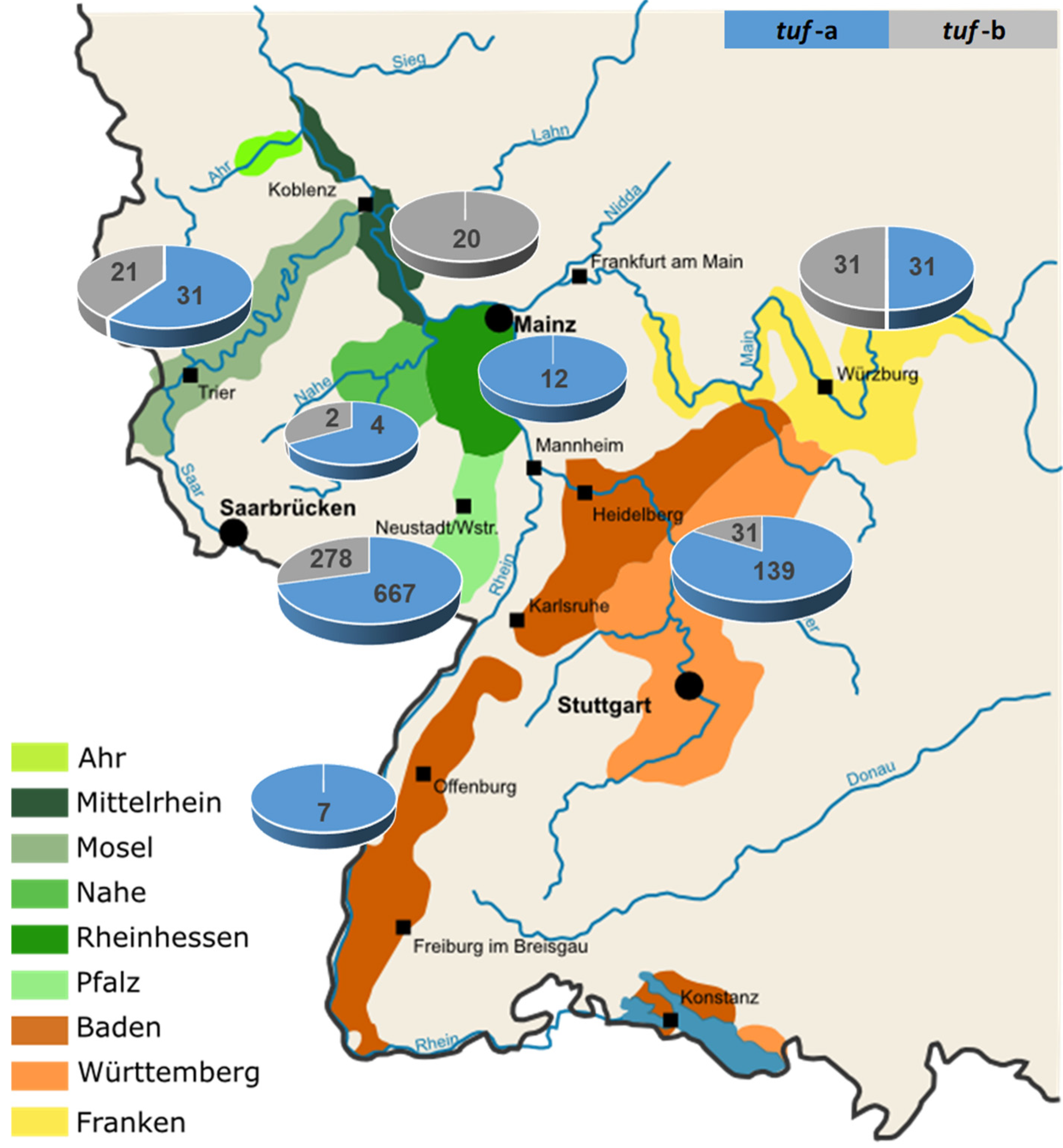
3.1. Diversity of Tuf Genotypes in German Viticultural Areas
3.2. Current BN Incidence and Tuf Genotypes in Reference Plots
3.2.1. Grapevine
3.2.2. Weeds
3.2.3. Insects
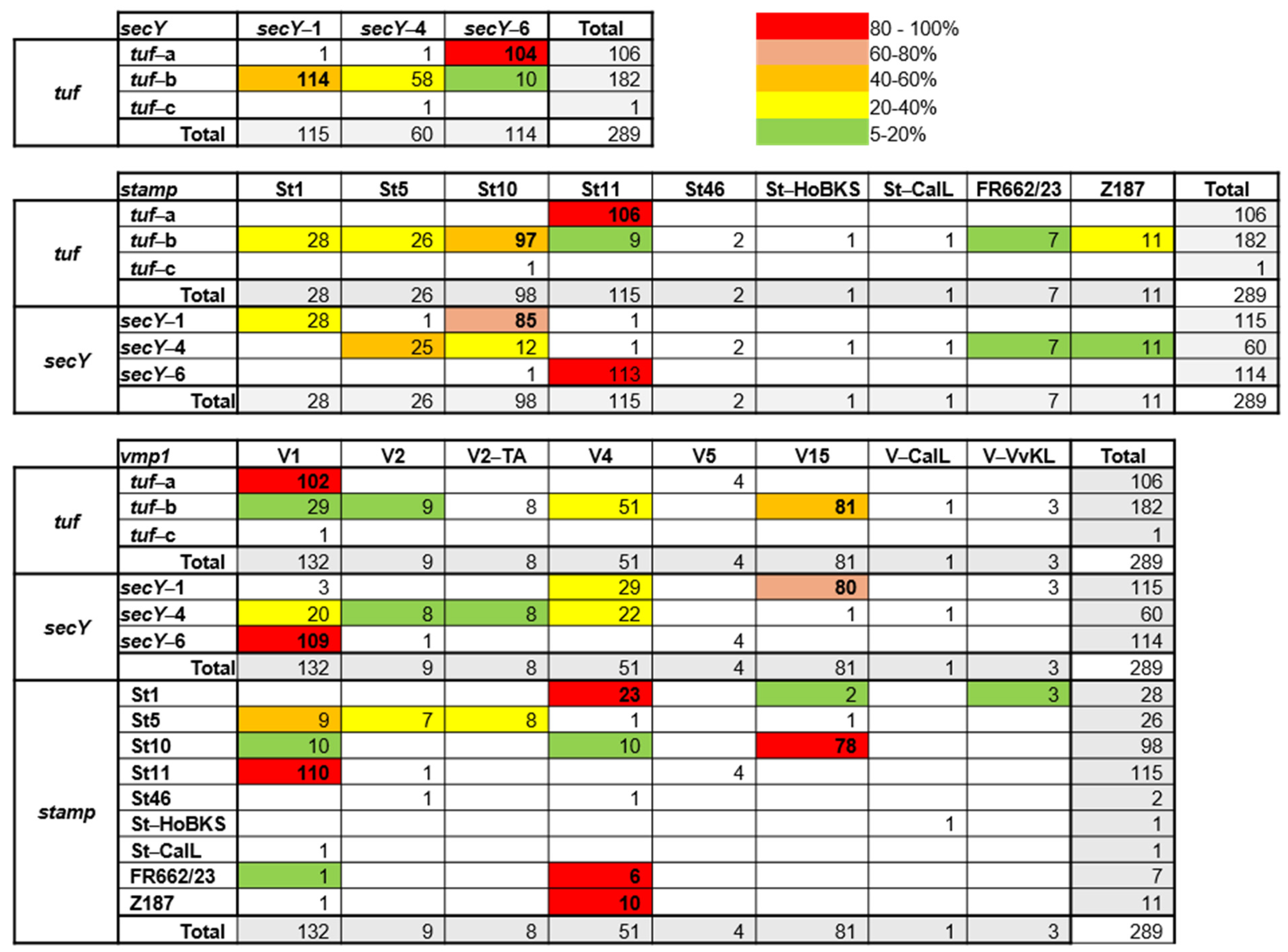
3.3. Multilocus Sequence Typing (MLST)
3.3.1. SecY
3.3.2. Vmp1
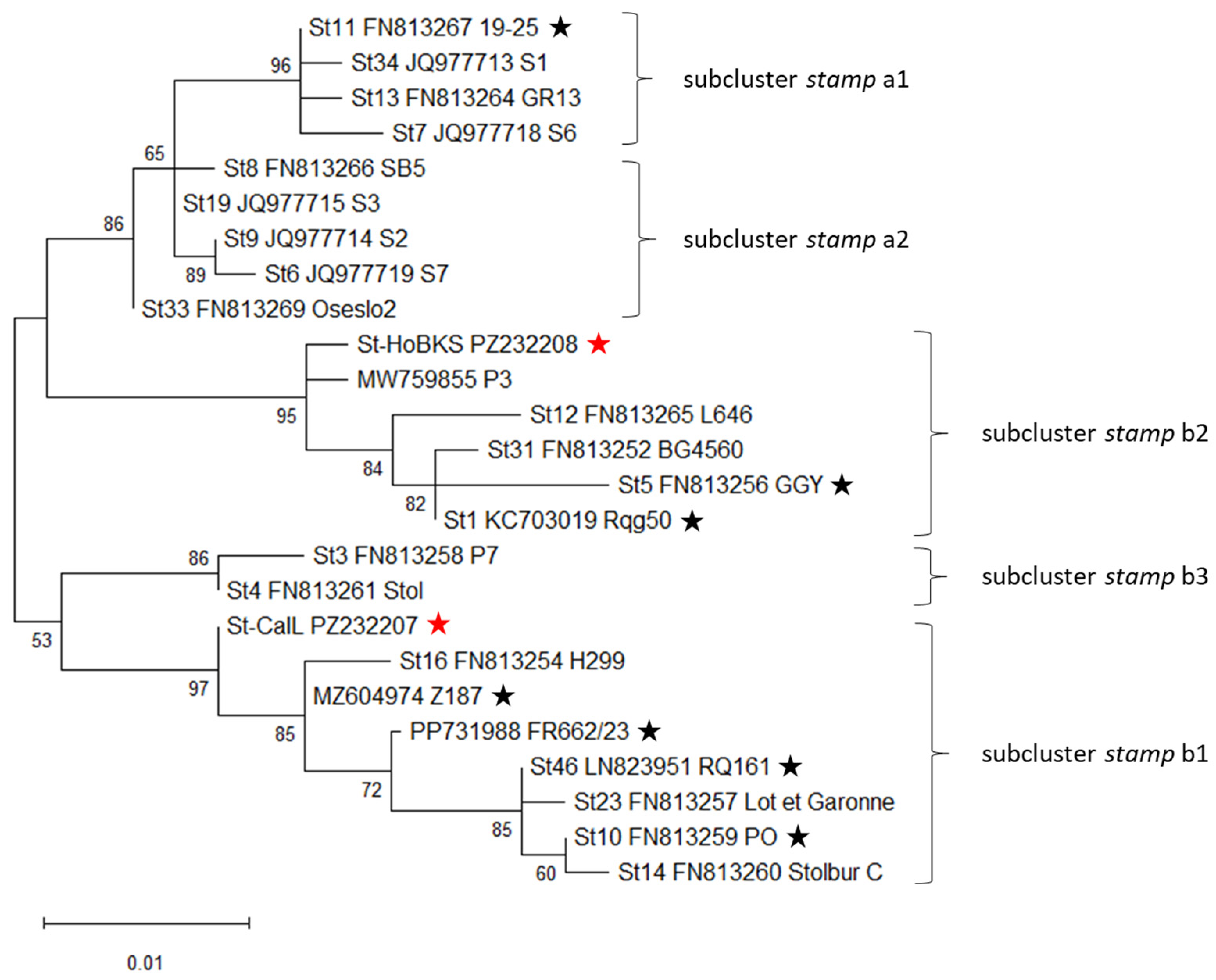
3.3.3. Stamp
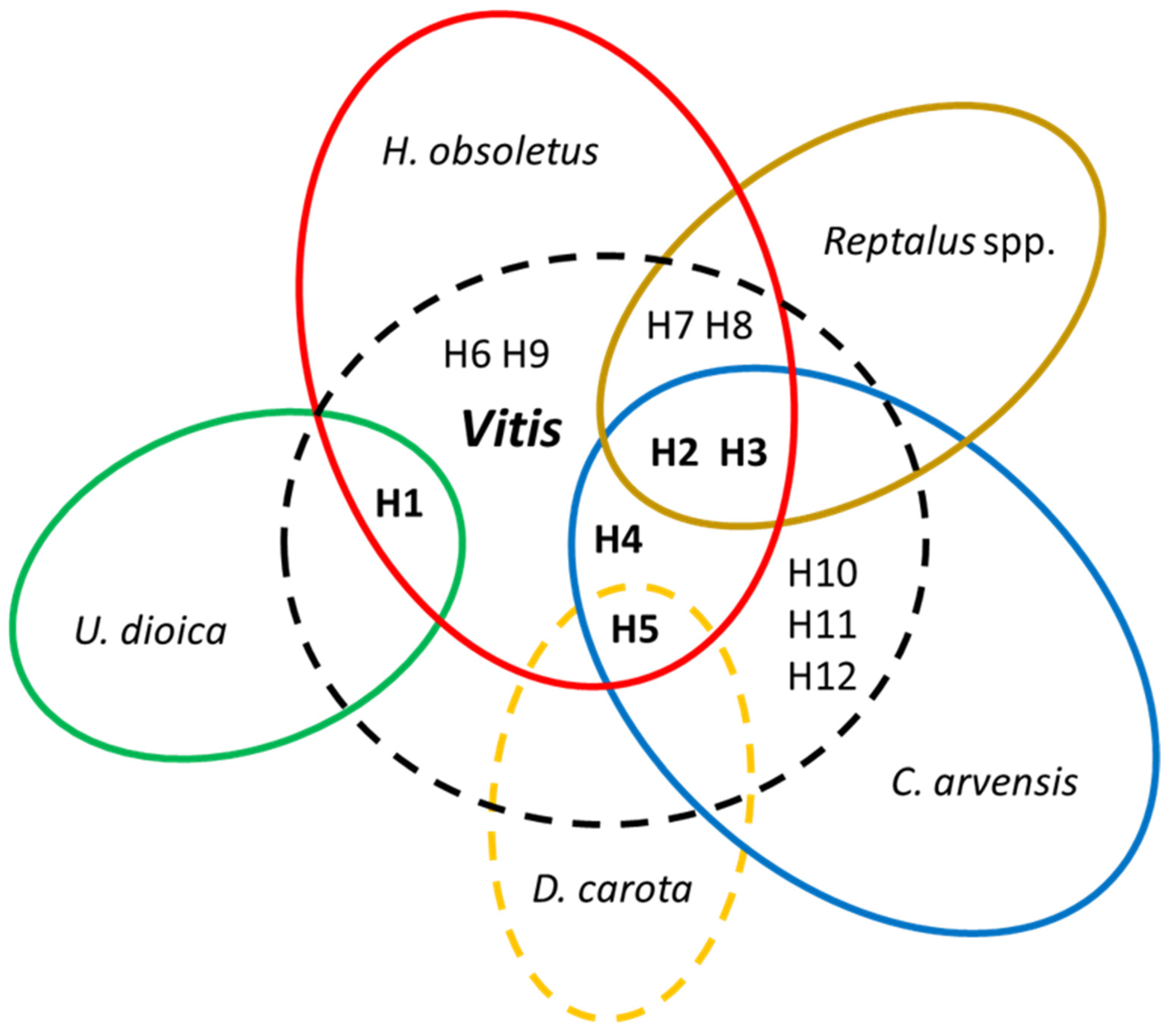
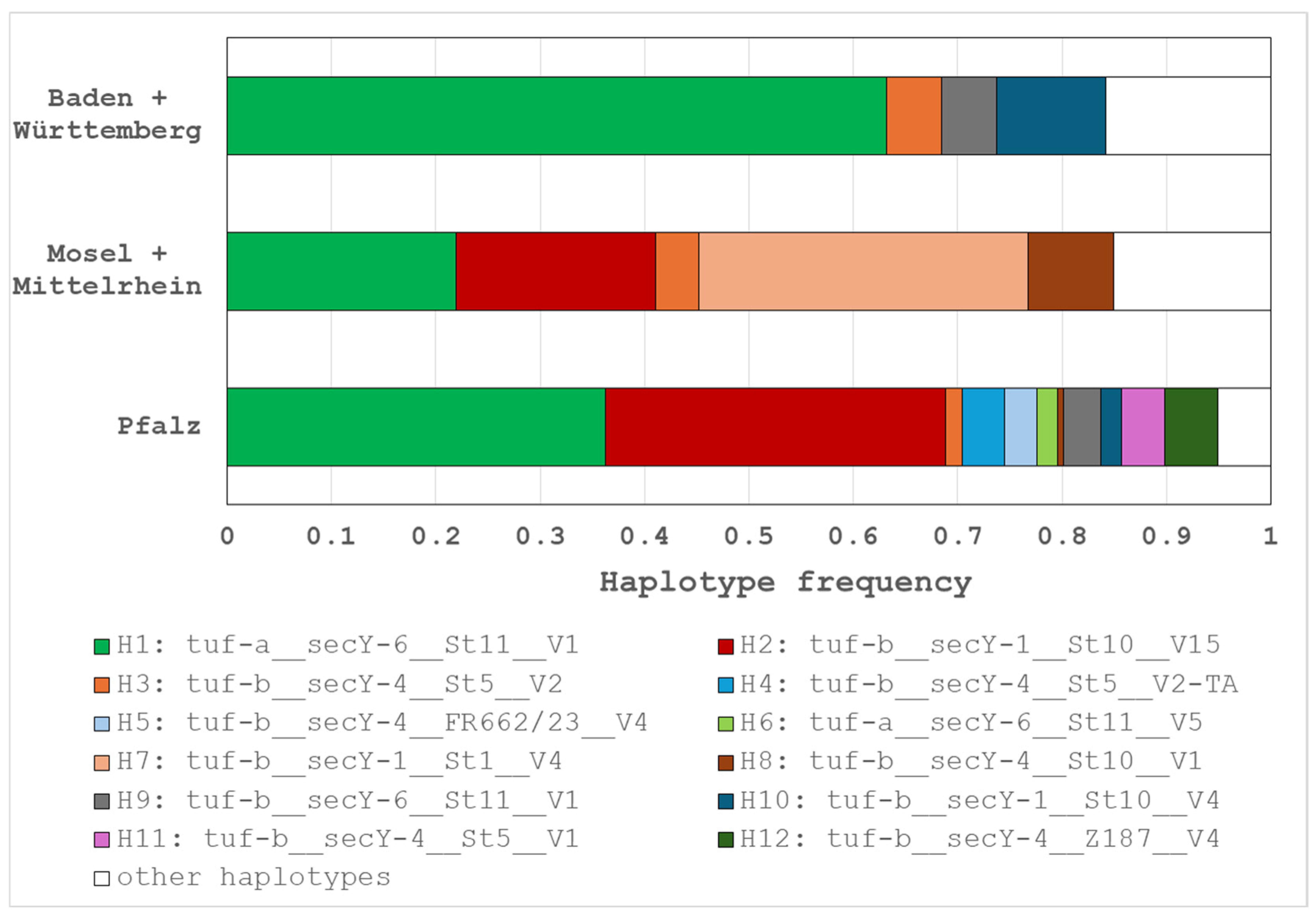
3.3.4. Combining the Gene Markers to Haplotypes
4. Discussion
5. Conclusions
Supplementary Materials
Author Contributions
Funding
Data Availability Statement
Acknowledgments
Conflicts of Interest
Appendix A

| Genotype Codes | ||||
|---|---|---|---|---|
| Gene | This Paper | SEE-ERA.NET (Foissac et al. 2013) [64] | Pierro et al. 2020 [65] | Reference Sequence |
| tuf | tuf-a | tuf-a | - | KJ469707 |
| tuf-b1 | tuf-b1 | - | KJ469708 | |
| tuf-c | tuf-c | - | PZ246496 | |
| secY | secY-1 | secY-1 | - | JQ977710 |
| secY-4 | secY-4 | - | JQ977709 | |
| secY-6 | secY-6 | - | JQ977707 | |
| stamp | St1 | stamp-9 | St1 | KC703019 |
| St5 | stamp-4 | St5 | FN813256 | |
| St10 | stamp-1 | St10 | FN813259 | |
| St11 | stamp-6 | St11 | FN813267 | |
| St46 | stamp-58 | St46 | LN823951 | |
| FR662/23 | - | - | PP731988 | |
| Z187 | - | - | MZ604974 | |
| St-CaIL | - | - | PZ232207 | |
| St-HoBKS | - | - | PZ232208 | |
| vmp1 | V1 | V1 | - | AM992105 |
| V2 | V2 | - | AM992102 | |
| V2-TA | V2-TA | - | AM992103 | |
| V4 | V4 | - | AM992098 | |
| V5 | V5 | - | AM992101 | |
| V15 | V15 | - | AM992100 | |
| V-CaIL | - | - | PZ246497 | |
| V-VvKL | - | - | PZ246498 | |
References
- Quaglino, F.; Zhao, Y.; Casati, P.; Bulgari, D.; Bianco, P.A.; Wei, W.; Davis, R.E. ‘Candidatus Phytoplasma solani’, a novel taxon associated with stolbur and bois noir related diseases of plants. Int. J. Syst. Evol. Microbiol. 2013, 63, 2879–2894. [Google Scholar] [CrossRef]
- Oliveri, C.; Pacifico, D.; D’Urso, V.; La Rosa, R.; Marzachì, C.; Tessitori, M. Bois noir phytoplasma variability in a Mediterranean vineyard system: New plant host and putative vectors. Australas. Plant Pathol. 2015, 44, 235–244. [Google Scholar] [CrossRef]
- Pierro, R.; Pedrelli, A.; Marra, M.; Matic, S.; Baldaccini, L.; Materazzi, A.; Loni, A.; Lucchi, A.; Panattoni, A.; Marcone, C.; et al. New insights on “bois noir” epidemiology in the Chianti Classico area (Tuscany, Central Italy). Eur. J. Plant Pathol. 2022, 164, 461. [Google Scholar] [CrossRef]
- Plavec, J.; Ivancan, G.; Skoric, D.; Foissac, X.; Music, M.S. Genetically divergent ‘Candidatus Phytoplasma solani’ isolates in Croatian vineyard pathosystems suggest complex epidemiological networks. Phytopathol. Res. 2024, 6, 46. [Google Scholar] [CrossRef]
- Quaglino, F.; Sanna, F.; Moussa, A.; Faccincani, M.; Passera, A.; Casati, P.; Bianco, P.A.; Mori, N. Identification and ecology of alternative insect vectors of ‘Candidatus Phytoplasma solani’ to grapevine. Sci. Rep. 2019, 9, 19522. [Google Scholar] [CrossRef]
- Kosovac, A.; Radonjic, S.; Hrncic, S.; Krstic, O.; Tosevski, I.; Jovic, J. Molecular tracing of the transmission routes of bois noir in Mediterranean vineyards of Montenegro and experimental evidence for the epidemiological role of Vitex agnus-castus (Lamiaceae) and associated Hyalesthes obsoletus (Cixiidae). Plant Pathol. 2016, 65, 285–298. [Google Scholar] [CrossRef]
- EPPO. Global Database: ‘Candidatus Phytoplasma solani’ (PHYPSO). Available online: https://gd.eppo.int/taxon/PHYPSO/distribution (accessed on 14 March 2026).
- Kosovac, A.; Jakovljevic, M.; Krstic, O.; Cvrkovic, T.; Mitrovic, M.; Tosevski, I.; Jovic, J. Role of plant-specialized Hyalesthes obsoletus associated with Convolvulus arvensis and Crepis foetida in the transmission of ‘Candidatus Phytoplasma solani’-inflicted bois noir disease of grapevine in Serbia. Eur. J. Plant Pathol. 2019, 153, 183–195. [Google Scholar] [CrossRef]
- Maixner, M. Transmission of German Grapevine Yellows (Vergilbungskrankheit) by the planthopper Hyalesthes-obsoletus (Auchenorrhyncha, Cixiidae). Vitis 1994, 33, 103–104. [Google Scholar]
- Langer, M.; Maixner, M. Molecular characterisation of grapevine yellows associated phytoplasmas of the stolbur-group based on RELP-analysis of non-ribosomal DNA. Vitis 2004, 43, 191–199. [Google Scholar]
- Chuche, J.; Danet, J.L.; Rivoal, J.B.; Arricau-Bouvery, N.; Thiéry, D. Minor cultures as hosts for vectors of extensive crop diseases: Does Salvia sclarea act as a pathogen and vector reservoir for lavender decline? J. Pest. Sci. 2018, 91, 145–155. [Google Scholar] [CrossRef]
- Kosovac, A.; Jakovljevic, M.; Krstic, O.; Cvrkovic, T.; Mitrovic, M.; Tosevski, I.; Jovic, J. Crepis foetida L.: New host plant of cixiid planthopper Hyalesthes obsoletus Signoret 1865 (Hemiptera: Cixiidae), vector of stolbur phytoplasma. Zaštita Bilja 2014, 65, 7. [Google Scholar] [CrossRef]
- Sémétey, O.; Gaudin, J.; Danet, J.L.; Salar, P.; Theil, S.; Fontaine, M.; Krausz, M.; Chaisse, E.; Eveillard, S.; Verdin, E.; et al. Lavender decline in France is associated with chronic infection by lavender-specific strains of ‘Candidatus Phytoplasma solani’. Appl. Environ. Microbiol. 2018, 84, e01507-18. [Google Scholar] [CrossRef]
- Sharon, R.; Soroker, V.; Wesley, S.D.; Zahavi, T.; Harari, A.; Weintraub, P.G. Vitex agnus-castus is a preferred host plant for Hyalesthes obsoletus. J. Chem. Ecol. 2005, 31, 1051–1063. [Google Scholar] [CrossRef] [PubMed]
- Foissac, X.; Maixner, M. Spread of grapevine phytoplasma diseases in Europe. Phytopathog. Mollicutes 2013, 3, 47–50. [Google Scholar] [CrossRef]
- Imo, M.; Maixner, M.; Johannesen, J. Sympatric diversification vs. immigration: Deciphering host-plant specialization in a polyphagous insect, the stolbur phytoplasma vector Hyalesthes obsoletus (Cixiidae). Mol. Ecol. 2013, 22, 2188–2203. [Google Scholar] [CrossRef] [PubMed]
- Cargnus, E.; Pavan, F.; Mori, N.; Martini, M. Identification and phenology of Hyalesthes obsoletus (Hemiptera: Auchenorrhyncha: Cixiidae) nymphal instars. Bull. Entomol. Res. 2012, 102, 504–514. [Google Scholar] [CrossRef]
- Johannesen, J.; Albert, A.; Imo, M.; Maixner, M. Stolbur phytoplasma interaction with vector longevity in alternative plants. Bull. Insectol. 2011, 64, S147–S148. [Google Scholar]
- Kaul, C.; Seitz, A.; Maixner, M.; Johannesen, J. Infection of Bois-Noir tuf-type-I stolbur phytoplasma in Hyalesthes obsoletus (Hemiptera: Cixiidae) larvae and influence on larval size. J. Appl. Entomol. 2009, 133, 596–601. [Google Scholar] [CrossRef]
- Maixner, M.; Albert, A.; Johannesen, J. Survival relative to new and ancestral host plants, phytoplasma infection, and genetic constitution in host races of a polyphagous insect disease vector. Ecol. Evol. 2014, 4, 3082–3092. [Google Scholar] [CrossRef]
- Maixner, M.; Johannesen, J.; Michel, K.; Lux, B.; Seitz, A. Host plant specificity of Hyalesthes obsoletus and consequences for “bois noir” epidemiology. Bull. Insectol. 2007, 60, 399–400. [Google Scholar]
- Aryan, A.; Brader, G.; Mörtel, J.; Pastar, M.; Riedle-Bauer, M. An abundant ‘Candidatus Phytoplasma solani’ tuf b strain is associated with grapevine, stinging nettle and Hyalesthes obsoletus. Eur. J. Plant Pathol. 2014, 140, 213–227. [Google Scholar] [CrossRef] [PubMed]
- Mehle, N.; Kavcic, S.; Mermal, S.; Vidmar, S.; Novak, M.P.; Riedle-Bauer, M.; Brader, G.; Kladnik, A.; Dermastia, M. Geographical and temporal diversity of ‘Candidatus Phytoplasma solani’ iw wine-growing regions in Slovenia and Austria. Front. Plant Sci. 2022, 13, 889675. [Google Scholar] [CrossRef] [PubMed]
- Johannesen, J.; Foissac, X.; Kehrli, P.; Maixner, M. Impact of vector dispersal and host-plant fidelity on the dissemination of an emerging plant pathogen. PLoS ONE 2012, 7, e51809. [Google Scholar] [CrossRef]
- Johannesen, J.; Riedle-Bauer, M. Origin of a sudden mass occurrence of the stolbur phytoplasma vector Hyalesthes obsoletus (Cixiidae) in Austria. Ann. Appl. Biol. 2014, 165, 488–495. [Google Scholar] [CrossRef]
- Cvrkovic, T.; Jovic, J.; Mitrovic, M.; Krstic, O.; Tosevski, I. Experimental and molecular evidence of Reptalus panzeri as a natural vector of bois noir. Plant Pathol. 2014, 63, 42–53. [Google Scholar] [CrossRef]
- Tishechkin, D.Y.; Emeljanov, A.F. Description of a well-known Western Palearctic species of the genus Reptalus Emeljanov 1971 (Homoptera, Auchenorrhyncha, Fulgoroidea, Cixiidae) that has no valid name. Zool. Žurnal 2024, 103, 44–51. [Google Scholar] [CrossRef]
- Chuche, J.; Danet, J.L.; Salar, P.; Foissac, X.; Thiéry, D. Transmission of Candidatus Phytoplasma solani’ by Reptalus quinquecostatus (Hemiptera: Cixiidae). Ann. Appl. Biol. 2016, 169, 214–223. [Google Scholar] [CrossRef]
- Kosovac, A.; Curcic, Z.; Stepanovic, J.; Rekanovic, E.; Duduk, B. Epidemiological role of novel and already known ‘Ca. P. solani’ cixiid vectors in rubbery taproot disease of sugar beet in Serbia. Sci. Rep. 2023, 13, 1433. [Google Scholar] [CrossRef]
- Kreitzer, C.; Stepanovic, J.; Stanojevic, N.; Rohringer, A.; Seiter, M.; Rekanovic, E.; Duduk, B. Dominant cixiid vector and transmission of ‘Candidatus Arsenophonus phytopathogenicus’ and ‘Candidatus Phytoplasma solani’-related strain 16SrXII-P in sugar beet in Austria. Sci. Rep. 2025, 15, 22526. [Google Scholar] [CrossRef]
- Pinzauti, F.; Trivellone, V.; Bagnoli, B. Ability of Reptalus quinquecostatus (Hemiptera: Cixiidae) to inoculate stolbur phytoplasma to artificial feeding medium. Ann. Appl. Biol. 2008, 153, 299–305. [Google Scholar] [CrossRef]
- Cvrkovic, T.; Jovic, J.; Krstic, O.; Marinkovic, S.; Jakovljevic, M.; Mitrovic, M.; Tosevski, I. Epidemiological Role of Dictyophara europae (Hemiptera: Dictyopharidae) in the transmission of ‘Candidatus Phytoplasma solani’. Horticulturae 2022, 8, 654. [Google Scholar] [CrossRef]
- Riedle-Bauer, M.; Sára, A.; Regner, F. Transmission of a Stolbur Phytoplasma by the Agalliinae Leafhopper Anaceratagallia ribauti (Hemiptera, Auchenorrhyncha, Cicadellidae). J. Phytopathol. 2008, 156, 687–690. [Google Scholar] [CrossRef]
- Mitrovic, M.; Trivellone, V.; Cvrkovic, T.; Jakovljevic, M.; Krstic, O.; Jovic, J.; Toševski, I. Experimental and molecular evidence of Neoaliturus fenestratus role in the transmission of “stolbur” phytoplasma to lettuce and carrot plants. Phytopathog. Mollicutes 2019, 9, 109–110. [Google Scholar] [CrossRef]
- Landi, L.; Isidoro, N.; Riolo, P. Natural phytoplasma infection of four phloem-feeding Auchenorrhyncha across vineyard agroecosystems in Central-Eastern Italy. J. Econ. Entomol. 2013, 106, 604. [Google Scholar] [CrossRef]
- EFSA Panel on Plant Health (PLH). Scientific Opinion on the pest categorisation of ‘Candidatus Phytoplasma solani’. EFSA J. 2014, 12, 3924. [Google Scholar] [CrossRef][Green Version]
- Ember, I.; Talaber, C.; Acs, Z.; Nagy, Z.; Kölber, M. Study of stolbur phytoplasma tuber transmission in potato varieties of high starch content. Bull. Insectol. 2011, 64, 209–210. [Google Scholar]
- Ćurčić, Ž.; Kosovac, A.; Stepanović, J.; Rekanović, E.; Kube, M.; Duduk, B. Multilocus genotyping of ‘Candidatus Phytoplasma solani’ associated with rubbery taproot disease of sugar beet in the Pannonian Plain. Microorganisms 2021, 9, 1950. [Google Scholar] [CrossRef]
- Ćurčić, Ž.; Stepanović, J.; Zübert, C.; Taški-Ajduković, K.; Kosovac, A.; Rekanović, E.; Kube, M.; Duduk, B. Rubbery taproot disease of sugar beet in Serbia associated with ‘Candidatus Phytoplasma solani’. Plant Dis. 2020, 105, 255–263. [Google Scholar] [CrossRef]
- Eini, O.; Shoaei, Z.; Varrelmann, M. Molecular detection and multilocus sequence analysis of ‘Candidatus Phytoplasma solani’ strains infecting neighbouring potato and sugar beet fields in Southern Germany. J. Phytopathol. 2025, 173, e70192. [Google Scholar] [CrossRef]
- Gatineau, F.; Jacob, N.; Vautrin, S.; Larrue, J.; Lherminier, J.; Richard-Molard, A.; Boudon-Padieu, E. Association with the syndrome “basses richesses” of sugar beet of a Phytoplasma and a bacterium-like organism transmitted by a Pentastiridius sp. Phytopathology 2002, 92, 384–392. [Google Scholar] [CrossRef]
- Behrmann, S.; Schwind, M.; Schieler, M.; Vilcinskas, A.; Martinez, O.; Lee, K.Z.; Lang, C. Spread of bacterial and virus yellowing diseases of sugar beet in South and Central Germany from 2017–2020. Sugar Ind. 2021, 146, 476–485. [Google Scholar] [CrossRef]
- Behrmann, S.C.; Rinklef, A.; Lang, C.S.; Vilcinskas, A.; Lee, K.Z. Potato (Solanum tuberosum) as a new host for Pentastiridius leporinus (Hemiptera: Cixiidae) and Candidatus Arsenophonus phytopathogenicus. Insects 2023, 14, 281. [Google Scholar] [CrossRef]
- Witczak, N.; Benaouda, S.; Wahl, F.; Göbbels, H.; Lang, C.; Jarausch, B.; Maixner, M. Carrot (Daucus carota L.) as host for Pentastiridius leporinus and phloem-restricted pathogens in Germany. Biology 2025, 14, 1152. [Google Scholar] [CrossRef]
- Rinklef, A.; Behrmann, S.C.; Löffler, D.; Erner, J.; Meyer, M.V.; Lang, C.S.; Vilcinskas, A.; Lee, K.Z. Prevalence in Potato of ‘Candidatus Arsenophonus phytopathogenicus’ and ‘Candidatus Phytoplasma solani’ and their transmission via adult Pentastiridius leporinus. Insects 2024, 15, 275. [Google Scholar] [CrossRef]
- Therhaag, E.; Schneider, B.; Zikeli, K.; Maixner, M.; Gross, J. Pentastiridius leporinus (Linnaeus, 1761) as a vector of phloem-restricted pathogens on potatoes: ‘Candidatus Arsenophonus phytopathogenicus’ and ‘Candidatus Phytoplasma solani’. Insects 2024, 15, 189. [Google Scholar] [CrossRef] [PubMed]
- Quaglino, F.; Passera, A.; Faccincani, M.; Moussa, A.; Pozzebon, A.; Sanna, F.; Casati, P.; Bianco, P.A.; Mori, N. Molecular and spatial analyses reveal new insights on Bois noir epidemiology in Franciacorta vineyards. Ann. Appl. Biol. 2021, 179, 151–168. [Google Scholar] [CrossRef]
- Cimerman, A.; Pacifico, D.; Salar, P.; Marzachí, C.; Foissac, X. Striking Diversity of vmp1, a variable gene encoding a putative membrane protein of the stolbur phytoplasma. Appl. Environ. Microbiol. 2009, 75, 2951–2957. [Google Scholar] [CrossRef]
- Fabre, A.; Danet, J.L.; Foissac, X. The stolbur phytoplasma antigenic membrane protein gene stamp is submitted to diversifying positive selection. Gene 2011, 472, 37–41. [Google Scholar] [CrossRef]
- Pacifico, D.; Alma, A.; Bagnoli, B.; Foissac, X.; Pasquini, G.; Tessitori, M.; Marzachi, C. Characterization of Bois noir isolates by restriction fragment length polymorphism of a stolbur-specific putative membrane protein gene. Phytopathology 2009, 99, 711–715. [Google Scholar] [CrossRef][Green Version]
- Fialová, R.; Válová, P.; Balakishiyeva, G.; Danet, J.L.; Safárová, D.; Foissac, X.; Navrátil, M. Genetic variability of stolbur phytoplasma in annual crop and wild plant species in South Moravia. J. Plant Pathol. 2009, 91, 411–416. [Google Scholar]
- Gärtel, W. Die flavescence dorée oder maladie du Baco 22 A. Weinb. Keller 1959, 6, 295–311. [Google Scholar]
- Gärtel, W. Untersuchungen ueber das Auftreten und das Verhalten der flavescence dorée in den Weinbaugebieten an Mosel und Rhein. Weinb. Keller 1965, 12, 347–376. [Google Scholar]
- Biedermann, R.; Niedringhaus, R. Die Zikaden Deutschlands—Bestimmungstafeln für alle Arten; Wissenschaftlich-Akademischer-Buchvertrieb-Fündt: Osnabrück, Germany, 2004; p. 410. [Google Scholar]
- Folmer, O.; Black, M.; Hoeh, W.; Lutz, R.; Vrijenhoek, R. DNA primers for amplification of mitochondrial Cytochrome C Oxidase subunit I from diverse metazoan invertebrates. Mol. Mar. Biol. Biotechnol. 1994, 3, 294–299. [Google Scholar]
- EPPO. PM 7/129 (2) DNA Barcoding as an Identification Tool for a Number of Regulated Pests. EPPO Bull. 2021, 51, 100–143. [Google Scholar] [CrossRef]
- Maixner, M.; Ahrens, U.; Seemuller, E. Detection of the German Grapevine Yellows (Vergilbungskrankheit) MLO in grapevine, alternative hosts and a vector by a specific PCR procedure. Eur. J. Plant Pathol. 1995, 101, 241–250. [Google Scholar] [CrossRef]
- Lorenz, K.H.; Schneider, B.; Ahrens, U.; Seemuller, E. Detection of the apple proliferation and pear decline phytoplasmas by PCR amplification of ribosomal and nonribosomal DNA. Phytopathology 1995, 85, 771–776. [Google Scholar] [CrossRef]
- Schneider, B.; Seemüller, E.; Smart, C.D.; Kirkpatrick, B.C. Phylogenetic classification of plant pathogenic mycoplasma-like organisms or phytoplasmas. In Molecular and Diagnostic Procedures in Mycoplasmology; Razin, S., Tully, J.G., Eds.; Academic Press: San Diego, CA, USA, 1995; Volume I, pp. 369–380. [Google Scholar]
- Pelletier, C.; Salar, P.; Gillet, J.; Cloquemin, G.; Very, P.; Foissac, X.; Malembic-Maher, S. Triplex real-time PCR assay for sensitive and simultaneous detection of grapevine phytoplasmas of the 16SrV and 16SrXII-A groups with an endogenous analytical control. Vitis 2009, 48, 87–95. [Google Scholar]
- EPPO. PM 7/079 (2) Grapevine flavescence dorée phytoplasma. EPPO Bull. 2016, 46, 78–93. [Google Scholar] [CrossRef]
- Kumar, S.; Stecher, G.; Suleski, M.; Sanderford, M.; Sharma, S.; Tamura, K. Molecular Evolutionary Genetics Analysis version 12 for adaptive and green computing. Mol. Biol. Evol. 2024, 41, msae263. [Google Scholar] [CrossRef]
- Tamura, K.; Nei, M. Estimation of the Number of Nucleotide Substitutions in the Control Region of Mitochondrial-DNA in Humans and Chimpanzees. Mol. Biol. Evol. 1993, 10, 512–526. [Google Scholar] [CrossRef] [PubMed]
- Foissac, X.; Carle, P.; Fabre, A.; Salar, P.; Danet, J.L.; Ember, I.; Della Bartola, M.; Plavec, J.; Avramov, Z.; Mortada, C.; et al. STOLBUR EUROMED Consortium. ‘Candidatus Phytoplasma solani’ genome project and genetic diversity in the Euro-Mediterranean basin. In Proceedings of the 3rd European Bois Noir Workshop, Barcelona, Spain, 20–21 March 2013; pp. 11–13. [Google Scholar]
- Pierro, R.; Panattoni, A.; Passera, A.; Materazzi, A.; Luvisi, A.; Loni, A.; Ginanni, M.; Lucchi, A.; Bianco, P.A.; Quaglino, F. Proposal of a new Bois noir epidemiological pattern related to ‘Candidatus Phytoplasma solani’ strains characterized by a possible moderate virulence in Tuscany. Pathogens 2020, 9, 268. [Google Scholar] [CrossRef]
- Duduk, B.; Stepanovic, J.; Fránová, J.; Zwolinska, A.; Rekanovic, E.; Stepanovic, M.; Vuckovic, N.; Duduk, N.; Vico, I. Geographical variations, prevalence, and molecular dynamics of fastidious phloem-limited pathogens infecting sugar beet across Central Europe. PLoS ONE 2024, 19, e0306136. [Google Scholar] [CrossRef]
- Stark-Urnau, M.; Maixner, M.; Kast, W.K.; Bleyer, K. An aggressive subtype of Stolbur phytoplasma spreading in vineyards of the Wuerttemberg wine region. Mitt. Biol. Bundesanst. Land Forstwirtsch. 2006, 400, 173. [Google Scholar]
- Ipach, U.; Müller, E.; Kling, L.; Helmstätter, B. Are pruning measures useful tools for combating Bois Noir on grapevine? Mitt. Jul. Kühn-Inst. 2008, 417, 306–307. [Google Scholar]
- Mori, N.; Cargnus, E.; Martini, M.; Pavan, F. Relationships between Hyalesthes obsoletus, its herbaceous hosts and Bois noir epidemiology in Northern Italian vineyards. Insects 2020, 11, 606. [Google Scholar] [CrossRef] [PubMed]
- Mori, N.; Quaglino, F.; Tessari, F.; Pozzebon, A.; Bulgari, D.; Casati, P.; Bianco, P.A. Investigation on ‘bois noir’ epidemiology in north-eastern Italian vineyards through a multidisciplinary approach. Ann. Appl. Biol. 2015, 166, 75–89. [Google Scholar] [CrossRef]
- Passera, A.; Zhao, Y.; Murolo, S.; Pierro, R.; Arsov, E.; Mori, N.; Moussa, A.; Silletti, M.R.; Casati, P.; Panattoni, A.; et al. Multilocus genotyping reveals new molecular markers for differentiating distinct genetic lineages among “Candidatus Phytoplasma solani” strains associated with grapevine Bois noir. Pathogens 2020, 9, 970. [Google Scholar] [CrossRef] [PubMed]
- Murolo, S.; Romanazzi, G. In-vineyard population structure of ‘Candidatus Phytoplasma solani’ using multilocus sequence typing analysis. Infect. Genet. Evol. 2015, 31, 221–230. [Google Scholar] [CrossRef] [PubMed]
- Landi, L.; Murolo, S.; Romanazzi, G. Detection of ‘Candidatus Phytoplasma solani’ in roots from Bois noir symptomatic and recovered grapevines. Sci. Rep. 2019, 9, 2013. [Google Scholar] [CrossRef]
- Lang, F.; Kölber, M.; Elek, R.; Kappel, Y.; Kröhner, D.; Johannesen, J.; Maixner, M. Potential role of Reptalus panzeri as a vector of Bois noir in Germany. Mitt. Klosterneubg. 2016, 66, 26–27. [Google Scholar]
- Credi, R.; Terlizzi, F.; Milanesi, L.; Bondavalli, R.; Cavallini, G.; Montermini, A.; Dradi, D. Wild host plants of stolbur phytoplasma and its vector, Hyalesthes obsoletus, at sites of grapevine Bois noir occurrence in Emilia-Romagna, Italy. In Proceedings of the 15th Meeting of the International Council for the Study of Virus and Virus-like Diseases of the Grapevine (ICVG)–Extended Abstracts, Stellenbosch, South Africa, 3–7 April 2006; pp. 182–184. [Google Scholar]
- Lessio, F.; Tedeschi, R.; Alma, A. Population dynamics, host plants and infection rate with Stolbur phytoplasma of Hyalesthes obsoletus Signoret in North-western Italy. J. Plant Pathol. 2007, 89, 97–102. [Google Scholar]
- Atanasova, B.; Jakovljevic, M.; Spasov, D.; Jovic, J.; Mitrovic, M.; Tosevski, I.; Cvrkovic, T. The molecular epidemiology of bois noir grapevine yellows caused by ‘Candidatus Phytoplasma solani’ in the Republic of Macedonia. Eur. J. Plant Pathol. 2015, 142, 759–770. [Google Scholar] [CrossRef]
- Plavec, J.; Krizanac, I.; Budinscak, Z.; Skoric, D.; Music, M.S. A case study of FD and BN phytoplasma variability in Croatia: Multigene sequence analysis approach. Eur. J. Plant Pathol. 2015, 142, 591–601. [Google Scholar] [CrossRef]
- Mitrovic, M.; Jakovljevic, M.; Jovic, J.; Krstic, O.; Kosovac, A.; Trivellone, V.; Jermini, M.; Tosevski, I.; Cvrkovic, T. ‘Candidatus phytoplasma solani’ genotypes associated with potato stolbur in Serbia and the role of Hyalesthes obsoletus and Reptalus panzeri (Hemiptera: Cixiidae) as natural vectors. Eur. J. Plant Pathol. 2016, 144, 619–630. [Google Scholar] [CrossRef]
- Pierro, R.; Materazzi, A.; Luvisi, A.; Quaglino, F.; Loni, A.; Lucchi, A.; Panattoni, A. New insights on “bois noir” epidemiology in the chianti Classico area, Tuscany. Phytopathog. Mollicutes 2019, 9, 39–40. [Google Scholar] [CrossRef]
- Mitrovic, J.; Pavlovic, S.; Duduk, B. Survey and multigene characterization of stolbur phytoplasmas on various plant species in Serbia. Phytopathol. Mediterr. 2013, 52, 434–441. [Google Scholar]
- Contaldo, N.; Stepanovic, J.; Pacini, F.; Bertaccini, A.; Duduk, B. Molecular variability and host distribution of ‘Candidatus Phytoplasma solani’ strains from different geographic origins. Microorganisms 2021, 9, 2530. [Google Scholar] [CrossRef]
- Pierro, R.; Passera, A.; Panattoni, A.; Casati, P.; Luvisi, A.; Rizzo, D.; Bianco, P.A.; Quaglino, F.; Materazzi, A. Molecular typing of Bois noir phytoplasma strains in the Chianti Classico area (Tuscany, Central Italy) and their association with symptom severity in Vitis vinifera L., cv. ‘Sangiovese’. Phytopathology 2018, 108, 362–373. [Google Scholar] [CrossRef]
- Murolo, S.; Marcone, C.; Prota, V.; Garau, R.; Foissac, X.; Romanazzi, G. Genetic variability of the stolbur phytoplasma vmp1 gene in grapevines, bindweeds and vegetables. J. Appl. Microbiol. 2010, 109, 2049–2059. [Google Scholar] [CrossRef]
- Gelbke, F.; Kuzmanovic, N.; Stache, A.-M.; Vogler, U. Molecular Examination of Vegetable Species for the Presence of Candidatus Arsenophonus phytopathogenicus and Candidatus Phytoplasma solani. Available online: https://www.openagrar.de/receive/openagrar_mods_00114050 (accessed on 1 April 2026).
- Witczak, N.; Benaouda, S.; Ritz, J.; Wahl, F.; Lang, C.; Maixner, M.; Markheiser, A. First Report of 16SrΧΙΙ-P related phytoplasma in asparagus (Asparagus officinalis L.) and rhubarb (Rheum rhabarbarum L.) in Germany. Plant Dis. 2026. [Google Scholar] [CrossRef]



| Plant Samples | Insect Samples | |||||
|---|---|---|---|---|---|---|
| Region | N° Sites | Vitis vinifera | Urtica dioica | Convolvulus arvensis | Hyalesthes obsoletus | Reptalus spp. |
| Baden | 3 | 7/3 | ||||
| Franken | 9 | 62/0 | ||||
| Mittelrhein | 1 | 20/9 | ||||
| Mosel | 4 | 52/24 | 59/33 | 25/11 | ||
| Nahe | 2 | 6/0 | ||||
| Pfalz | 22 | 945/116 | 18/9 | 35/34 | 36/32 | 5/5 |
| Rheinhessen | 2 | 12/1 | ||||
| Württemberg | 12 | 170/15 | 2/1 | |||
| total | 1274/168 | 18/9 | 35/34 | 95/65 | 32/17 | |
| Region | Municipality | Plot ID | Cultivar | BN Incidence * | Tuf-Typing Results Total N° of Samples Tested Tuf-a/Tuf-b |
|---|---|---|---|---|---|
| Pfalz | Albersweiler | AW01 | Cabernet Dorsa | 38/235 (16.2%) | 30 (15/15) |
| Albersweiler | AW02 | Dornfelder | 19/523 (3.6%) | 14 (9/5) | |
| Albersweiler | AW03 | Scheurebe | 24/604 (4.0%) | 16 (10/6) | |
| Birkweiler | BW01 | Riesling | 10/1162 (0.9%) | 7 (7 tuf-a) | |
| Birkweiler | BW03 | Chardonnay | 36/1075 (3.3%) | 34 (31/3) | |
| Burrweiler | BU02 | Riesling | 63/2065 (3.1%) | 47 (31/16) | |
| Burrweiler | BU04 | Pinot Meunier | 12/2698 (0.44%) | 10 (4/6) | |
| Burrweiler | BU05 | Riesling | 51/2213 (2.3%) | 19 (14/5) | |
| Burrweiler | BU06 | Kerner | 38/1883 (2.0%) | 14 (13/1) | |
| Hainfeld | BE | Scheurebe | 1/499 (0.2%) | 1 (1 tuf-a) | |
| Leinsweiler | LEI03 | Kerner | 13/973 (1.3%) | nt | |
| Leinsweiler | LEI07 | Dornfelder | 13/1384 (0.94%) | 7 (7 tuf-a) | |
| Leinsweiler | LEI08 | Scheurebe | 17/501 (3.4%) | 17 (14/3) | |
| Edenkoben | ED01 | Cabernet Dorsa | 22/180 (12.2%) | 13 (13 tuf-b) | |
| Edenkoben | ED02 | St. Laurent | 5/222 (2.3%) | 3 (3 tuf-b) | |
| Edenkoben | ED03 | Dornfelder | 19/398 (4.8%) | 16 (2/14) | |
| Mussbach | MUP | St. Laurent | 29/1210 (2.4%) | 26 (20/6) | |
| Mittelrhein | Boppard | DidBe | Riesling | 195/1168 (16.6%) | 8 (8 tuf-b) |
| Boppard | DidJu | Riesling | 55/423 (13.0%) | 1 (1 tuf-b) | |
| Boppard | LzRiJ | Riesling | 135/609 (22.2%) | 7 (7 tuf-b) | |
| Boppard | LzSBJ | Pinot Noir | 10/815 (8.2%) | 4 (4 tuf-b) | |
| Mosel | Kesten | KeKar | Riesling | 64/679 (9.4%) | nt |
| Klotten | Klot | Riesling | 114/5588 (2.0%) | 21 (14/7) | |
| Pommern | Pom15 | Riesling | 120/3340 (3.6%) | 24 (11/13) |
| Insect Species | N° Positive/Total | Tuf-a | Tuf-b | Tuf-c | nd |
|---|---|---|---|---|---|
| H. obsoletus (total N°) | 144/664 (22%) | 41 | 53 | 1 | 49 |
| Pfalz | 65/501 (13%) | 31 | 5 | 0 | 29 |
| Mosel | 79/163 (48%) | 10 | 48 | 1 | 20 |
| Reptalus spp. (total N°) | 1/75 (1%) | 0 | 0 | 0 | 1 |
| Mittelrhein | 0/6 | ||||
| Pfalz | 0/62 | ||||
| Württemberg | 1/7 (14%) | 0 | 0 | 0 | 1 |
| R. salicinus (total N°) | 4/28 (14%) | 0 | 4 | 0 | 0 |
| Franken | 0/4 | ||||
| Württemberg | 1/12 (8%) | 0 | 1 | 0 | 0 |
| Pfalz | 3/12 (25%) | 0 | 3 | 0 | 0 |
| R. panzeri (total N°) | 29/183 (15%) | 2 | 25 | 0 | 2 |
| Mittelrhein | 0/7 | ||||
| Pfalz | 4/12 (33%) | 0 | 3 | 0 | 1 |
| Mosel | 25/164 (15%) | 2 | 22 | 0 | 1 |
| Dictyophara europea | 2/203 (1%) | 0 | 1 | 1 | 0 |
| Agallia spp. | 0/187 (0%) | ||||
| Anaceratagallia ribauti | 0/10 (0%) | ||||
| Cixius spp. | 0/7 (0%) | ||||
| Neoaliturus fenestratus | 0/5 (0%) | ||||
| Psammotettix spp. | 0/48 (0%) | ||||
| total | 1410 |
| Plant Hosts | Insect Hosts | |||||||
|---|---|---|---|---|---|---|---|---|
| Haplotype | Haplotype Acronym | N° | V. vinifera | U. dioica | C. arvensis | H. obsoletus | R. salicinus | R. panzeri |
| tuf-a_secY-1_St11_V1 | 1 (0.3%) | 1 | ||||||
| tuf-a_secY-4_St11_V1 | 1 (0.3%) | 1 | ||||||
| tuf-a_secY-6_St11_V1 | H1 | 100 (34.6%) | 54 | 9 | 35 | 2 | ||
| tuf-a_secY-6_St11_V5 | H6 | 4 (1.4%) | 2 | 2 | ||||
| tuf-b_secY-1_St1_V4 | H7 | 23 (8.0%) | 14 | 4 | 5 | |||
| tuf-b_secY-1_St1_V15 | 2 (0.7%) | 2 | ||||||
| tuf-b_secY-1_St1_V-VvKL | 3 (1.0%) | 3 | ||||||
| tuf-b_secY-1_St5_V1 | 1 (0.3%) | 1 | ||||||
| tuf-b_secY-1_St10_V1 | 1 (0.3%) | 1 | ||||||
| tuf-b_secY-1_St10_V4 | H10 | 6 (2.1%) | 5 | 1 | ||||
| tuf-b_secY-1_St10_V15 | H2 | 78 (27.0%) | 52 | 9 | 9 | 2 | 6 | |
| tuf-b_secY-4_St5_V1 | H11 | 8 (2.8%) | 2 | 6 | ||||
| tuf-b_secY-4_St5_V2 | H3 | 7 (2.4%) | 1 | 2 | 3 | 1 | ||
| tuf-b_secY-4_St5_V2-TA | H4 | 8 (2.8%) | 4 | 3 | 1 | |||
| tuf-b_secY-4_St5_V4 | 1 (0.3%) | 1 | ||||||
| tuf-b_secY-4_St5_V15 | 1 (0.3%) | 1 | ||||||
| tuf-b_secY-4_St10_V1 | H8 | 7 (2.4%) | 3 | 3 | 1 | |||
| tuf-b_secY-4_St10_V4 | 4 (1.4%) | 4 | ||||||
| tuf-b_secY-4_St46_V2 | 1 (0.3%) | 1 | ||||||
| tuf-b_secY-4_St46_V4 | 1 (0.3%) | 1 | ||||||
| tuf-b_secY-4_St-CaIL_V-CaIL | 1 (0.3%) | 1 | ||||||
| tuf-b_secY-4_St-HoBKS_V1 | 1 (0.3%) | 1 | ||||||
| tuf-b_secY-4_FR622/23_V1 | 1 (0.3%) | 1 | ||||||
| tuf-b_secY-4_FR662/23_V4 | H5 | 6 (2.1%) | 3 | 1 | 2 | |||
| tuf-b_secY-4_Z187_V1 | 1 (0.3%) | 1 | ||||||
| tuf-b_secY-4_Z187_V4 | H12 | 10 (3.5%) | 5 | 5 | ||||
| tuf-b_secY-6_St10_V1 | 1 (0.3%) | 1 | ||||||
| tuf-b_secY-6_St11_V1 | H9 | 8 (2.8%) | 7 | 1 | ||||
| tuf-b_secY-6_St11_V2 | 1 (0.3%) | 1 | ||||||
| tuf-c_secY-4_St10_V1 | 1 (0.3%) | 1 | ||||||
| total | 289 | |||||||
Disclaimer/Publisher’s Note: The statements, opinions and data contained in all publications are solely those of the individual author(s) and contributor(s) and not of MDPI and/or the editor(s). MDPI and/or the editor(s) disclaim responsibility for any injury to people or property resulting from any ideas, methods, instructions or products referred to in the content. |
© 2026 by the authors. Licensee MDPI, Basel, Switzerland. This article is an open access article distributed under the terms and conditions of the Creative Commons Attribution (CC BY) license.
Share and Cite
Jarausch, B.; Jarausch, W.; Kugler, S.; Tsormpatzidou, A.; Maixner, M.; Markheiser, A. Genetic Diversity of ‘Candidatus Phytoplasma solani’ in Plant Hosts and Insect Vectors in Winegrowing Regions in Germany. Agronomy 2026, 16, 936. https://doi.org/10.3390/agronomy16090936
Jarausch B, Jarausch W, Kugler S, Tsormpatzidou A, Maixner M, Markheiser A. Genetic Diversity of ‘Candidatus Phytoplasma solani’ in Plant Hosts and Insect Vectors in Winegrowing Regions in Germany. Agronomy. 2026; 16(9):936. https://doi.org/10.3390/agronomy16090936
Chicago/Turabian StyleJarausch, Barbara, Wolfgang Jarausch, Sanela Kugler, Argyroula Tsormpatzidou, Michael Maixner, and Anna Markheiser. 2026. "Genetic Diversity of ‘Candidatus Phytoplasma solani’ in Plant Hosts and Insect Vectors in Winegrowing Regions in Germany" Agronomy 16, no. 9: 936. https://doi.org/10.3390/agronomy16090936
APA StyleJarausch, B., Jarausch, W., Kugler, S., Tsormpatzidou, A., Maixner, M., & Markheiser, A. (2026). Genetic Diversity of ‘Candidatus Phytoplasma solani’ in Plant Hosts and Insect Vectors in Winegrowing Regions in Germany. Agronomy, 16(9), 936. https://doi.org/10.3390/agronomy16090936