Trade-Off Between System Yield and Area-Scaled Carbon Cost Among Cropping Systems Under Contrasting Water Management on the North China Plain


Abstract
1. Introduction
2. Materials and Methods
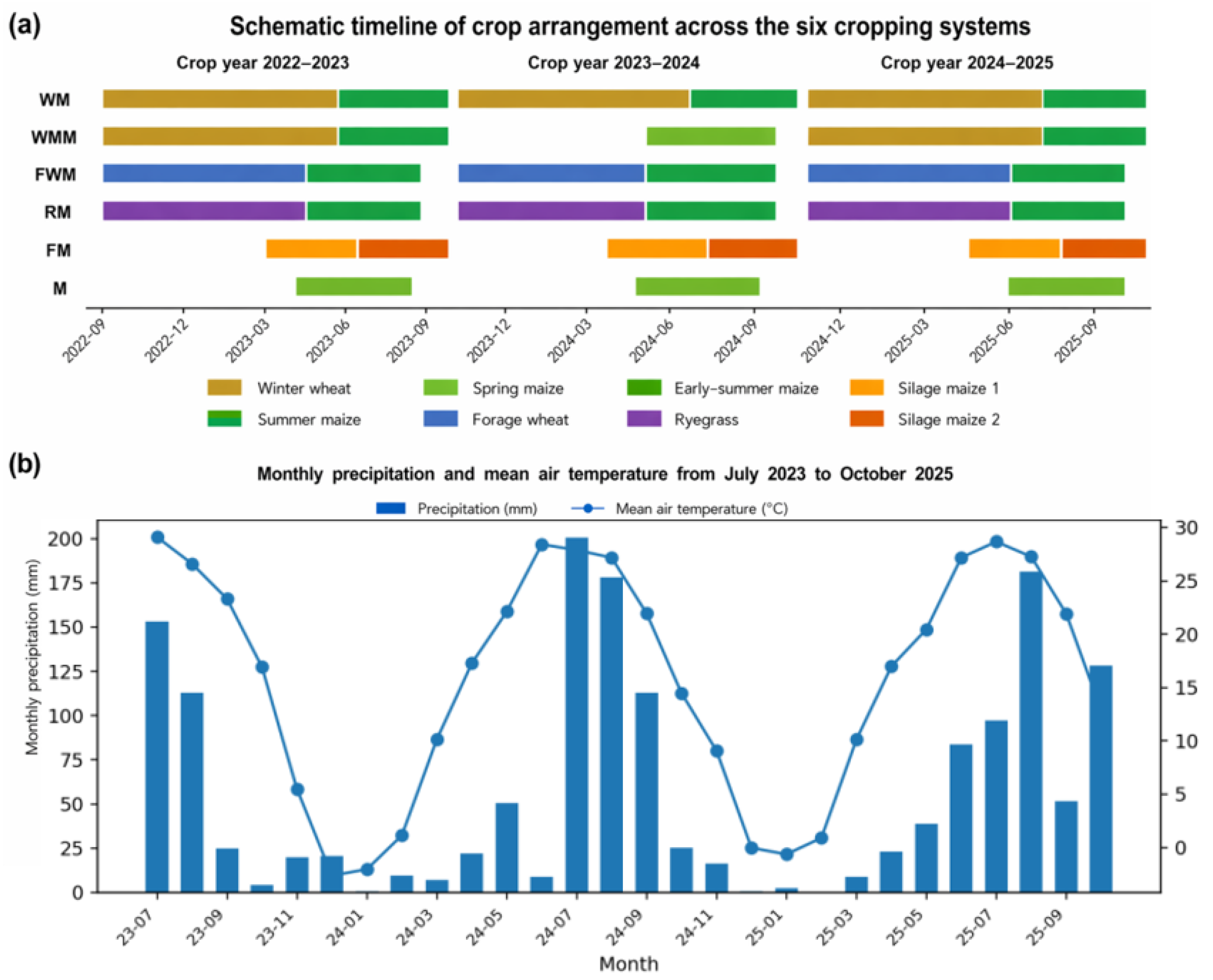
2.1. Site Description and Experimental Design
2.2. Field Management and Measurements
2.3. Soil Organic Carbon Stock, Carbon Footprint, and Emergy Evaluation
2.4. Statistical Analysis
3. Results
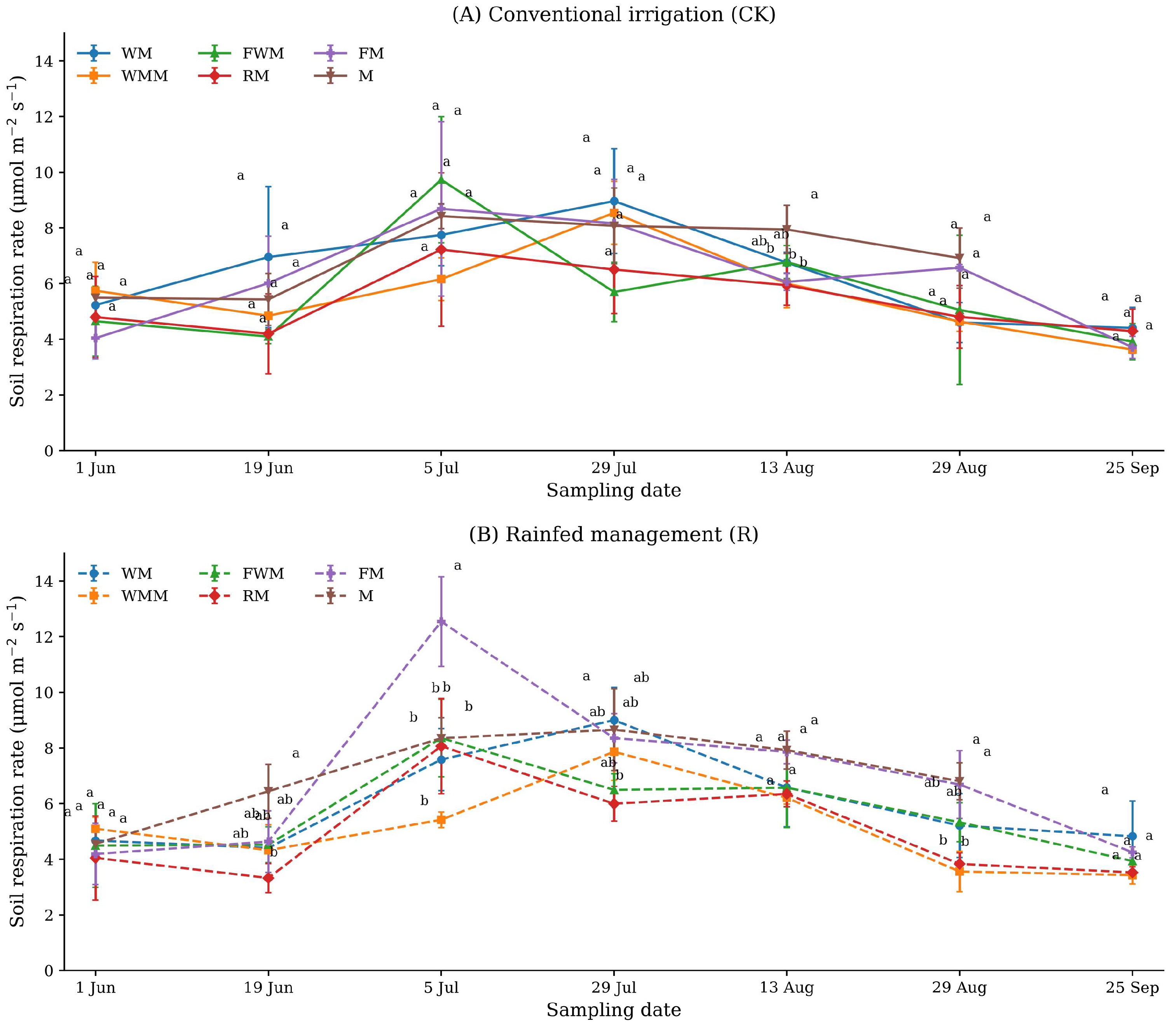
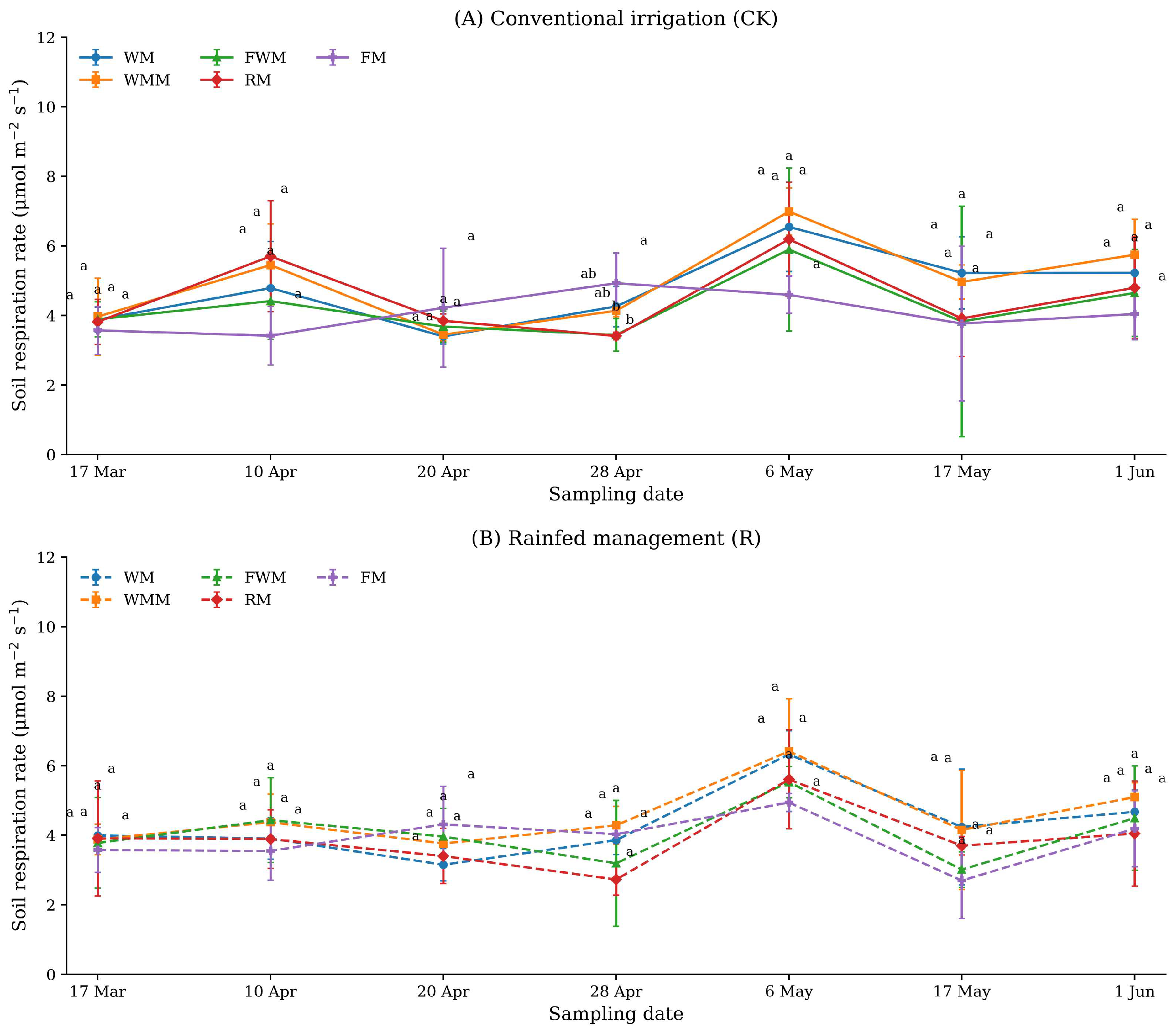
3.1. Dynamics of Soil Respiration Rate Under Different Cropping Systems
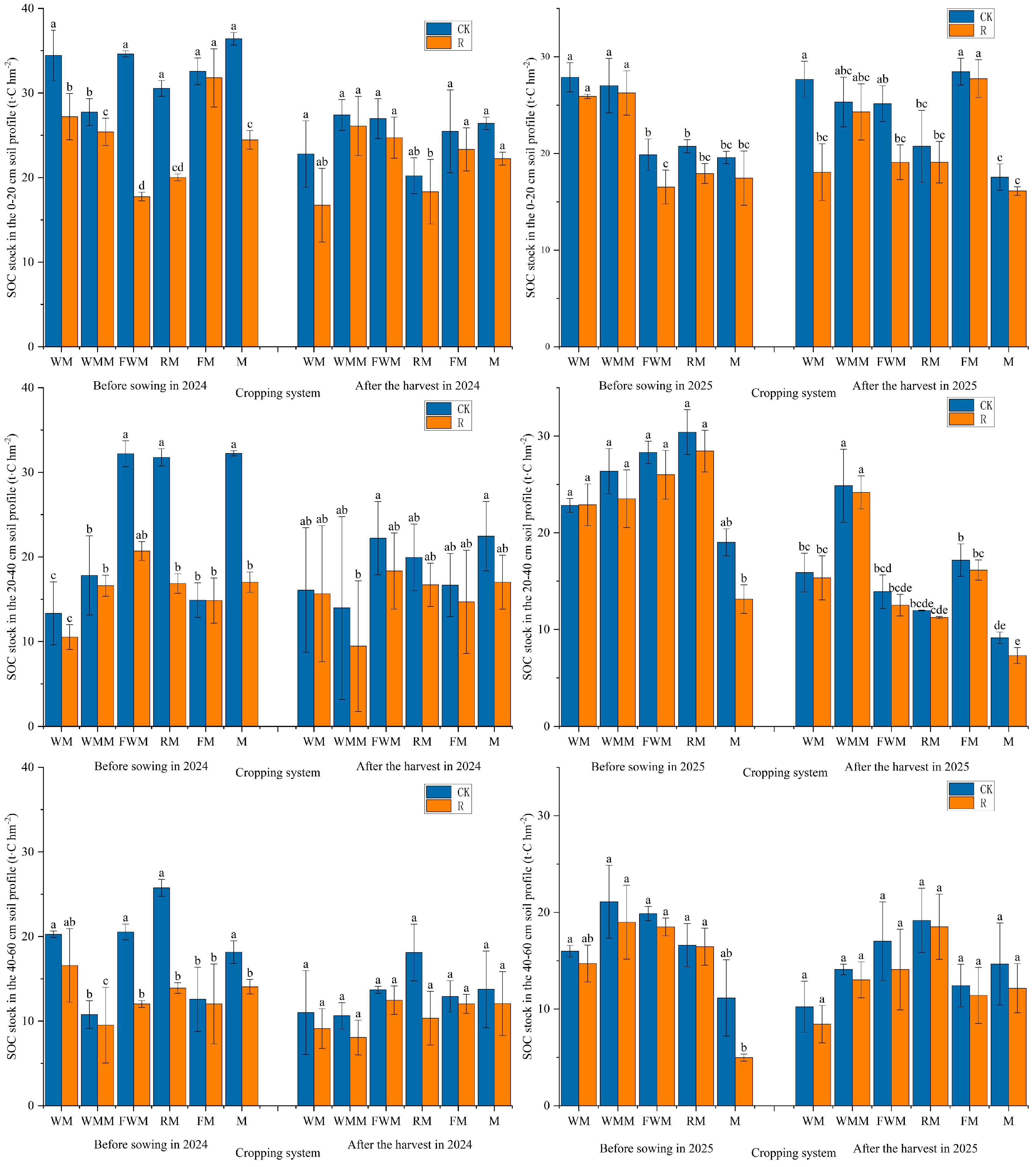
3.2. Changes in Soil Organic Carbon Stock Under Different Cropping Systems
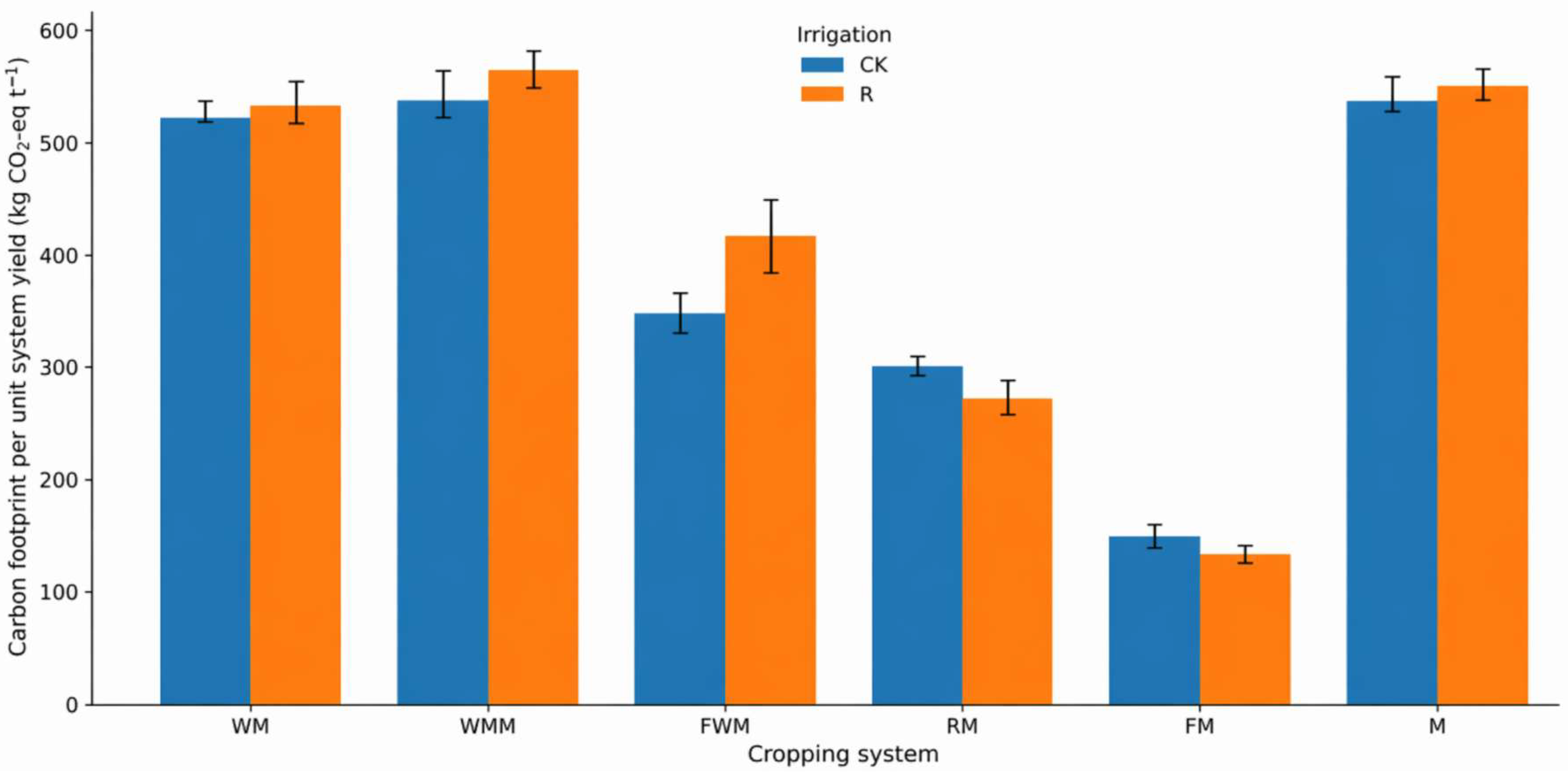
3.3. Carbon-Footprint Characteristics of Different Cropping Systems
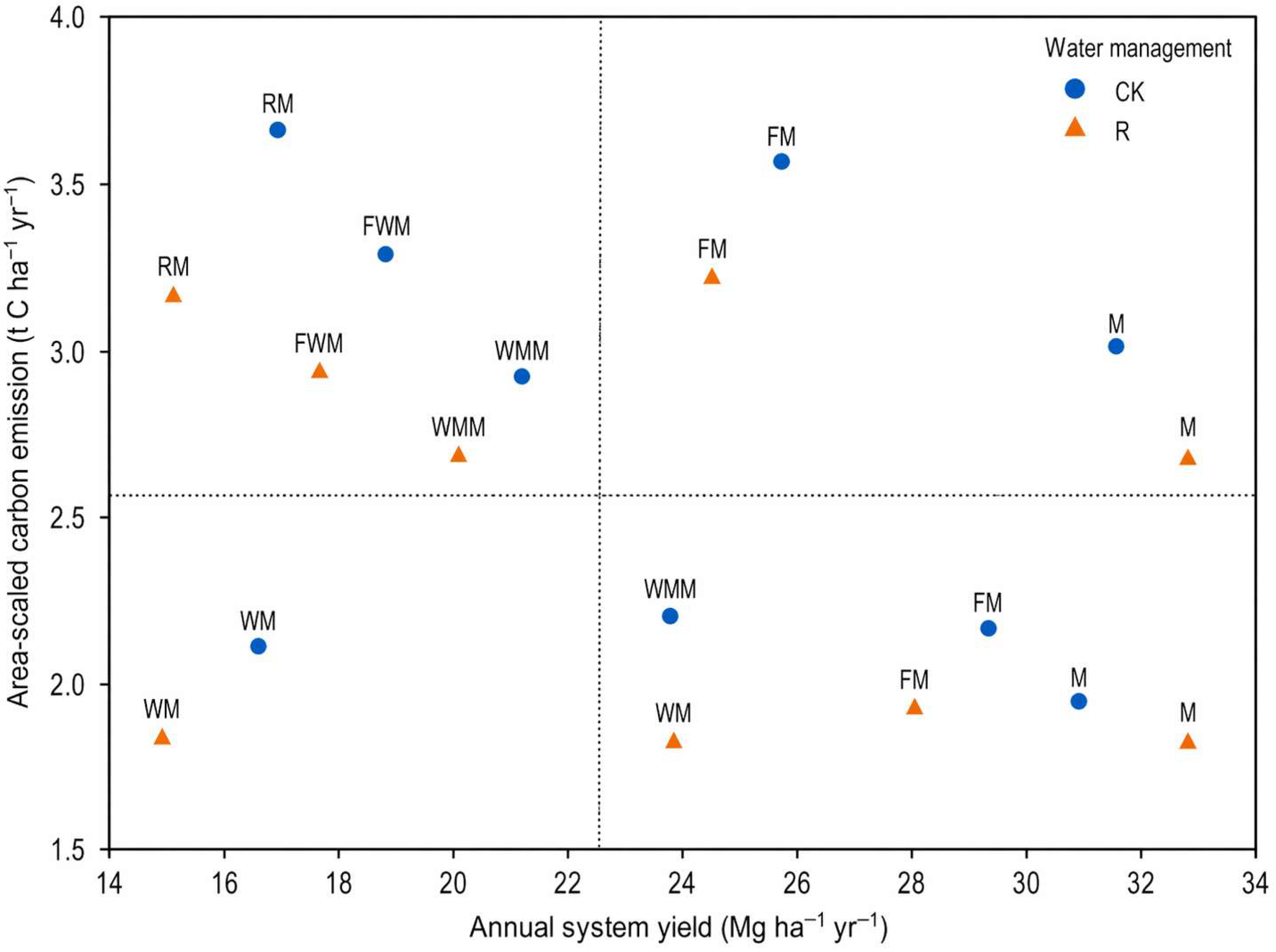
3.4. Effects of Water Management on System Yield
3.5. Comparison Under a Unified Dry-Matter Basis and Supplementary Emergy Results
4. Discussion
4.1. Cropping Systems and Water Inputs Jointly Regulate Soil CO2 Release Dynamics
4.2. Pathways Linking Input-Related Emissions, Soil-Carbon Processes, and Yield Allocation
4.3. Regional Applicability and Management Implications of Grain–Forage Systems
4.4. Methodological Boundaries and Scope of Interpretation
5. Conclusions
- (1)
- Under the unified crop-year/closed-rotation framework, WM maintained the highest grain-oriented annual system yield, whereas WMM lowered area-scaled carbon cost relative to WM but did not reduce product-scaled carbon footprint.
- (2)
- Under a unified dry-matter functional unit, FM showed the lowest CFDM, and RM and FWM also performed relatively well; these systems were therefore more compatible with multifunctional biomass-supply and low-carbon-transition objectives.
- (3)
- Soil respiration and SOC provided supplementary evidence of short-term soil-carbon responses to cropping-system configuration. Because the temporal SOC comparison was restricted to subsets with consistent sampling windows and was not corrected by equivalent soil mass, these results should not be used to infer long-term sequestration superiority.
Supplementary Materials
Author Contributions
Funding
Data Availability Statement
Conflicts of Interest
References
- Wang, H.; Zhang, L.; Dawes, W.R.; Liu, C. Improving water use efficiency of irrigated crops in the North China Plain—Measurements and modelling. Agric. Water Manag. 2001, 48, 151–167. [Google Scholar] [CrossRef]
- Ma, S.; Yu, Z.; Shi, Y.; Gao, Z.; Luo, L.; Chu, P.; Guo, Z. Soil water use, grain yield and water use efficiency of winter wheat in a long-term study of tillage practices and supplemental irrigation on the North China Plain. Agric. Water Manag. 2015, 150, 9–17. [Google Scholar] [CrossRef]
- Yan, Z.; Gao, C.; Ren, Y.; Zong, R.; Ma, Y.; Li, Q. Effects of pre-sowing irrigation and straw mulching on the grain yield and water use efficiency of summer maize in the North China Plain. Agric. Water Manag. 2017, 186, 21–28. [Google Scholar] [CrossRef]
- Wang, Y.; Zhang, Y.; Zhang, R.; Li, J.; Zhang, M.; Zhou, S.; Wang, Z. Reduced irrigation increases the water use efficiency and productivity of winter wheat–summer maize rotation on the North China Plain. Sci. Total Environ. 2018, 618, 112–120. [Google Scholar] [CrossRef]
- Xu, X.; Zhang, M.; Li, J.; Liu, Z.; Zhao, Z.; Zhang, Y.; Zhou, S.; Wang, Z. Improving water use efficiency and grain yield of winter wheat by optimizing irrigations in the North China Plain. Field Crops Res. 2018, 221, 219–227. [Google Scholar] [CrossRef]
- Mei, X.; Kang, S.; Yu, Q.; Huang, Y.; Zhong, X.; Gong, D.; Huo, Z.; Liu, E. Pathways to synchronously improving crop productivity and field water use efficiency in the North China Plain. Sci. Agric. Sin. 2013, 46, 1149–1157. (In Chinese) [Google Scholar] [CrossRef]
- Liu, B.; Liu, W.; Lin, B.; Liu, W.; Han, S.; Zhao, X.; Zhang, H. Sustainable management practices to improve the water use efficiency of winter wheat in the North China Plain: A meta-analysis. Agron. Sustain. Dev. 2022, 42, 33. [Google Scholar] [CrossRef]
- Yang, X.; Gao, W.; Zhang, M.; Chen, Y.; Sui, P. Reducing agricultural carbon footprint through diversified crop rotation systems in the North China Plain. J. Clean. Prod. 2014, 76, 131–139. [Google Scholar] [CrossRef]
- Cui, J.; Sui, P.; Wright, L.D.; Wang, D.; Sun, B.; Ran, M.; Shen, Y.; Li, C.; Chen, Y. Carbon emission of maize-based cropping systems in the North China Plain. J. Clean. Prod. 2019, 213, 300–308. [Google Scholar] [CrossRef]
- Li, C.; Li, S. Energy budget and carbon footprint in a wheat and maize system under a ridge–furrow strategy in dry semi-humid areas. Sci. Rep. 2021, 11, 9367. [Google Scholar] [CrossRef]
- Wang, G.; Luo, Z.; Wang, E.; Zhang, W. Reducing greenhouse gas emissions while maintaining yield in the croplands of the Huang–Huai–Hai Plain, China. Agric. For. Meteorol. 2018, 260–261, 80–94. [Google Scholar] [CrossRef]
- Cui, J.; Yan, P.; Wang, X.; Yang, J.; Li, Z.; Yang, X.; Sui, P.; Chen, Y. Integrated assessment of economic and environmental consequences of shifting cropping systems from wheat–maize to mono-cropped maize in the North China Plain. J. Clean. Prod. 2018, 193, 524–532. [Google Scholar] [CrossRef]
- Yang, L.; Nie, J.; Zhao, J.; Fang, X.; Yang, Y.; Zang, H.; Zeng, Z. Reduce carbon footprint without compromising system productivity: Optimizing crop rotation in the North China Plain. J. Clean. Prod. 2023, 426, 139124. [Google Scholar] [CrossRef]
- Gou, Z.; Yin, W.; Asibi, A.E.; Fan, Z.; Chai, Q.; Cao, W. Improving the sustainability of cropping systems via diversified planting in arid irrigation areas. Agron. Sustain. Dev. 2022, 42, 88. [Google Scholar] [CrossRef]
- Wang, N.; Ai, Z.; Zhang, Q.; Leng, P.; Qiao, Y.; Li, Z.; Tian, C.; Shi, X.; Cheng, H.; Chen, G.; et al. The variations of wheat–maize production, soil organic carbon, and carbon footprints: Insights from a 20-year on-farm observational experiment in the North China Plain. Front. Plant Sci. 2025, 16, 1547431. [Google Scholar] [CrossRef] [PubMed]
- Chen, J.; Wu, L.; Zhang, X.; Deng, A.X.; Song, Z.W.; Zhang, W.J.; Zheng, C.Y. Crop yield and greenhouse-gas emission characteristics under different cropping patterns in the Huang–Huai–Hai region. Chin. J. Eco-Agric. 2025, 33, 508–519. (In Chinese) [Google Scholar] [CrossRef]
- Sun, T.; Li, H.; Wang, C.; Li, R.; Zhao, Z.; Guo, B.; Yao, L.; Gao, X. The carbon footprint and influencing factors of the main grain crops in the North China Plain. Agronomy 2024, 14, 1720. [Google Scholar] [CrossRef]
- Zhang, Q.; Lei, H.-M.; Yang, D.-W. Seasonal variations in soil respiration, heterotrophic respiration and autotrophic respiration of a wheat–maize rotation cropland in the North China Plain. Agric. For. Meteorol. 2013, 180, 34–43. [Google Scholar] [CrossRef]
- Tong, X.; Li, J.; Nolan, R.H.; Yu, Q. Biophysical controls of soil respiration in a wheat–maize rotation system in the North China Plain. Agric. For. Meteorol. 2017, 246, 231–240. [Google Scholar] [CrossRef]
- IPCC. 2006 IPCC Guidelines for National Greenhouse Gas Inventories; Institute for Global Environmental Strategies: Hayama, Japan, 2006. [Google Scholar]
- Camargo, G.G.T.; Ryan, M.R.; Richard, T.L. Energy use and greenhouse gas emissions from crop production using the Farm Energy Analysis Tool. BioScience 2013, 63, 263–273. [Google Scholar] [CrossRef]
- Zhang, Y. Emergy analysis method of agro-ecosystems. Chin. J. Eco-Agric. 2004, 12, 181–183. (In Chinese) [Google Scholar]
- Zeng, L.; Li, X.; Huang, M.; Wang, N. Emergy analysis of the resource and environmental impacts induced by changes in crop planting structure: A case study of Hubei Province during 1978–2015. J. Ecol. Rural Environ. 2019, 35, 608–616. (In Chinese) [Google Scholar] [CrossRef]
- Li, Y.; Cai, G.; Tan, K.; Zeng, R.; Chen, X.; Wang, X. Emergy-based efficiency and sustainability assessments of diversified multi-cropping systems in South China. J. Clean. Prod. 2023, 414, 137660. [Google Scholar] [CrossRef]
- Alluvione, F.; Moretti, B.; Sacco, D.; Grignani, C. EUE (energy use efficiency) of cropping systems for a sustainable agriculture. Energy 2011, 36, 4468–4481. [Google Scholar] [CrossRef]
- Du, K.; Li, F.; Leng, P.; Li, Z.; Tian, C.; Qiao, Y.; Li, Z. Influence of no-tillage and precipitation pulse on continuous soil respiration of summer maize affected by soil water in the North China Plain. Sci. Total Environ. 2021, 766, 144384. [Google Scholar] [CrossRef]
- Du, K.; Li, F.; Leng, P.; Li, Z.; Tian, C.; Qiao, Y.; Li, Z. Differential Influence of No-Tillage and Precipitation Pulses on Soil Heterotrophic and Autotrophic Respiration of Summer Maize in the North China Plain. Agronomy 2020, 10, 2004. [Google Scholar] [CrossRef]
- Yang, X.; Xiong, J.; Du, T.; Ju, X.; Gan, Y.; Li, S.; Xia, L.; Shen, Y.; Pacenka, S.; Steenhuis, T.S.; et al. Diversifying crop rotation increases food production, reduces net greenhouse gas emissions and improves soil health. Nat. Commun. 2024, 15, 198. [Google Scholar] [CrossRef]
- Yang, X.-L.; Chen, Y.-Q.; Steenhuis, T.S.; Pacenka, S.; Gao, W.-S.; Ma, L.; Zhang, M.; Sui, P. Mitigating groundwater depletion in the North China Plain with cropping systems that alternate deep- and shallow-rooted crops. Front. Plant Sci. 2017, 8, 980. [Google Scholar] [CrossRef]
- Liu, M.; Min, L.; Shen, Y.; Wu, L. Evaluating the Impact of Alternative Cropping Systems on Groundwater Consumption and Nitrate Leaching in the Piedmont Area of the North China Plain. Agronomy 2020, 10, 1635. [Google Scholar] [CrossRef]



| System Code | Rotation Calendar and Approximate Sowing/Harvest Window | CK Irrigation Schedule | Annual or Annualized Irrigation Amount (mm) | Fertilizer Rate (Pure Nutrients) | Inputs/Processes Included or Excluded from Emission Accounting | Main Yield Basis (Crop Year) | Unified Functional Units |
|---|---|---|---|---|---|---|---|
| WM | Winter wheat (early Oct.–early Jun. of the following year) → summer maize (mid-Jun.–early Oct.) | Winter wheat: 3 × 75 mm; summer maize: 1 × 75 mm | 300 | For each crop season: N 300, P2O5 150, K2O 225 kg ha−1 | Included: seed, fertilizer, diesel, machinery operations, electricity for irrigation pumping; not listed separately: plastic film, pesticides | Grain yield | Area-scaled emission; dry matter |
| WMM | Crop year 1: winter wheat (early Oct.–early Jun. of the following year) → summer maize (mid-Jun.–early Oct.); crop year 2: spring maize (late May–late Sep.) | Winter wheat: 3 × 75 mm; summer maize: 1 × 75 mm; spring maize: 1 × 75 mm | 187.5 (annualized from 375 mm over two years) | Same as above | Included: seed, fertilizer, diesel, machinery operations, electricity for irrigation pumping; not listed separately: plastic film, pesticides | Total grain yield (annualized after calculation over the complete two-year/three-crop closed rotation) | Area-scaled emission; dry matter |
| FWM | Forage winter wheat (early Oct.–early May of the following year) → early-summer maize (early May–late Sep.) | Forage winter wheat: 1 × 75 mm; early-summer maize: 2 × 75 mm | 225 | Same as above | Included: seed, fertilizer, diesel, machinery operations, electricity for irrigation pumping; not listed separately: plastic film, pesticides | First-season forage fresh/dry matter; second-season maize grain | Area-scaled emission; dry matter |
| RM | Ryegrass (early Oct.–early May of the following year) → early-summer maize (mid-May–late Sep.) | Ryegrass: 1 × 75 mm; early-summer maize: 2 × 75 mm | 225 | Same as above | Included: seed, fertilizer, diesel, machinery operations, electricity for irrigation pumping; not listed separately: plastic film, pesticides | First-season forage fresh/dry matter; second-season maize grain | Area-scaled emission; dry matter |
| FM | Silage maize 1 (late Apr.–mid-Jul.) → silage maize 2 (mid-Jul.–early Oct.) | First season: 2 × 75 mm; second season: 1 × 75 mm | 225 | Same as above | Included: seed, fertilizer, diesel, machinery operations, electricity for irrigation pumping; not listed separately: plastic film, pesticides | Fresh biomass of double silage maize; converted to dry matter in unified analyses | Area-scaled emission; dry matter |
| M | Spring maize (late May–late Sep.) | 1 × 75 mm | 75 | Same as above | Included: seed, fertilizer, diesel, machinery operations, electricity for irrigation pumping; not listed separately: plastic film, pesticides | Grain yield | Area-scaled emission; dry matter |
| Item | Carbon-Emission Coefficient |
|---|---|
| Wheat seed | 0.58 kg CO2-eq·kg−1 |
| Maize seed | 1.98 kg CO2-eq·kg−1 |
| Nitrogen fertilizer (N) | 7.76 kg CO2-eq·kg−1 |
| Phosphate fertilizer (P2O5) | 1.63 kg CO2-eq·kg−1 |
| Potash fertilizer (K2O) | 0.65 kg CO2-eq·kg−1 |
| Diesel | 0.89 kg CO2-eq·kg−1 |
| Electricity for irrigation | 0.6516 kg CO2-eq·kWh−1 |
| Emergy Index | Equation | Meaning |
|---|---|---|
| Unit emergy value (UEV) | UEV = U/Y | Emergy input required per unit of product |
| Emergy yield ratio (EYR) | EYR = Y/(EMF + EMT) | Capacity of the system to generate output from purchased inputs |
| Environmental loading ratio (ELR) | ELR = (EMF + EMT)/EMR | Degree of environmental pressure imposed by the system |
| Emergy sustainability index (ESI) | ESI = EYR/ELR | Integrated indicator of system sustainability |
| Response Variable | Observation Unit | Fixed Effects | Hierarchy/Subject | Working Correlation or Random Structure | Software Implementation |
|---|---|---|---|---|---|
| Soil respiration rate (MixedLM) | Subplot × observation date | Water management, cropping system, observation date, and water management × cropping system | Block/block × water management/subplot | — (random-effects structure) | Python statsmodels MixedLM |
| Annual cumulative soil-CO2 release | Subplot × crop season | Derived by trapezoidal integration of instantaneous fluxes; reported descriptively only | — | — | Excel/Origin summary |
| System yield (MixedLM) | Subplot × crop year (or annualized closed-rotation mean) | System yield: water management, cropping system, crop year, and their interactions | Block/block × water management/subplot | — (random-effects structure) | Python statsmodels MixedLM |
| CFarea, CFprod, and CFDM (descriptive summary) | Input inventory × system | Derived CF indices: no inferential testing | — | — | Excel/Origin summary |
| Stratified SOC data (cross-sectional comparison at the 2025 harvest) | Subplot × soil depth | Water management, cropping system, soil depth, and their interactions | Block/block × water management/subplot | — (random-effects structure) | Python statsmodels MixedLM |
| Source of Variation | df | Wald χ2 | p-Value |
|---|---|---|---|
| Water management | 1 | 0.42 | 0.517 |
| Cropping system | 5 | 18.27 | 0.003 |
| Observation date | 12 | 444.69 | <0.001 |
| Water management × cropping system | 5 | 2.51 | 0.775 |
| System | Water Management | Annualized System Yield over the Closed Comparable Window (t ha−1 yr−1) | Area-Scaled Carbon Emission (t CO2-eq ha−1 yr−1, Based on the Input Inventory) | Product-Scaled Carbon Footprint (kg CO2-eq t−1) |
|---|---|---|---|---|
| WM | CK | 22.91 ± 0.11 | 11.97 | 522.65 ± 2.59 |
| WM | R | 20.43 ± 0.51 | 10.89 | 533.20 ± 13.60 |
| WMM | CK | 16.67 ± 0.48 | 8.97 | 538.28 ± 15.42 |
| WMM | R | 14.44 ± 0.41 | 8.16 | 565.14 ± 16.08 |
| FWM | CK | 33.69 ± 1.79 | 11.70 | 347.96 ± 18.12 |
| FWM | R | 26.23 ± 1.98 | 10.89 | 416.69 ± 32.78 |
| RM | CK | 38.93 ± 1.18 | 11.70 | 300.72 ± 8.99 |
| RM | R | 40.01 ± 2.18 | 10.89 | 272.69 ± 15.21 |
| FM | CK | 42.10 ± 2.85 | 6.26 | 149.11 ± 10.40 |
| FM | R | 40.94 ± 2.61 | 5.44 | 133.35 ± 8.24 |
| M | CK | 11.14 ± 0.17 | 5.99 | 537.72 ± 8.02 |
| M | R | 9.88 ± 0.23 | 5.45 | 551.24 ± 12.67 |
| System | 2022–2023 | 2023–2024 | 2024–2025 | Comparable-Window Annual Mean |
|---|---|---|---|---|
| WM-CK | 22.66 ± 0.38 | 23.15 ± 0.27 | 20.93 ± 1.01 | 22.91 ± 0.11 |
| WM-R | 18.74 ± 0.30 | 22.12 ± 0.95 | 18.33 ± 1.71 | 20.43 ± 0.51 |
| WMM-CK | 22.62 ± 0.89 | 10.73 ± 0.54 | 21.34 ± 2.80 | 16.67 ± 0.48 |
| WMM-R | 18.81 ± 0.59 | 10.07 ± 0.31 | 19.63 ± 2.11 | 14.44 ± 0.41 |
| M-CK | 11.57 ± 0.10 | 10.70 ± 0.40 | 10.89 ± 0.59 | 11.14 ± 0.17 |
| M-R | 10.39 ± 0.19 | 9.38 ± 0.43 | 9.03 ± 1.75 | 9.88 ± 0.23 |
| System | 2022–2023 | 2023–2024 | 2024–2025 | Comparable-Window Annual Mean |
|---|---|---|---|---|
| FWM-CK | 24.21 ± 1.28 | 43.16 ± 2.61 | 27.75 ± 0.73 | 33.69 ± 1.79 |
| FWM-R | 20.90 ± 3.34 | 31.56 ± 1.02 | 23.23 ± 1.24 | 26.23 ± 1.98 |
| RM-CK | 29.01 ± 1.73 | 48.86 ± 1.22 | 29.50 ± 1.61 | 38.93 ± 1.18 |
| RM-R | 27.66 ± 4.80 | 52.35 ± 2.59 | 26.36 ± 1.91 | 40.01 ± 2.18 |
| FM-CK | 36.30 ± 2.96 | 47.89 ± 2.81 | 32.39 ± 1.35 | 42.10 ± 2.85 |
| FM-R | 37.61 ± 2.61 | 44.27 ± 2.81 | 31.15 ± 2.04 | 40.94 ± 2.61 |
| System | Water Management | Dry-Matter Yield in Crop Year 2024–2025 (t ha−1) | CFDM (kg CO2-eq t DM−1) |
|---|---|---|---|
| FM | CK | 32.39 ± 1.35 | 193.85 ± 7.88 |
| FM | R | 31.15 ± 2.04 | 175.71 ± 11.08 |
| FWM | CK | 26.14 ± 0.61 | 449.48 ± 10.52 |
| FWM | R | 22.10 ± 1.08 | 495.33 ± 24.16 |
| M | CK | 9.36 ± 0.51 | 642.14 ± 33.71 |
| M | R | 7.76 ± 1.51 | 721.27 ± 140.34 |
| RM | CK | 27.77 ± 1.36 | 423.17 ± 20.28 |
| RM | R | 25.04 ± 1.71 | 437.43 ± 29.14 |
| WM | CK | 18.00 ± 0.87 | 668.15 ± 31.32 |
| WM | R | 15.77 ± 1.47 | 696.93 ± 61.99 |
| WMM | CK | 18.35 ± 2.41 | 661.62 ± 80.63 |
| WMM | R | 16.88 ± 1.81 | 652.41 ± 68.88 |
Disclaimer/Publisher’s Note: The statements, opinions and data contained in all publications are solely those of the individual author(s) and contributor(s) and not of MDPI and/or the editor(s). MDPI and/or the editor(s) disclaim responsibility for any injury to people or property resulting from any ideas, methods, instructions or products referred to in the content. |
© 2026 by the authors. Licensee MDPI, Basel, Switzerland. This article is an open access article distributed under the terms and conditions of the Creative Commons Attribution (CC BY) license.
Share and Cite
Li, Y.; Liu, G.; Li, H.; Zhang, W.; Guo, Y.; Gao, Z.; Du, X. Trade-Off Between System Yield and Area-Scaled Carbon Cost Among Cropping Systems Under Contrasting Water Management on the North China Plain. Agronomy 2026, 16, 900. https://doi.org/10.3390/agronomy16090900
Li Y, Liu G, Li H, Zhang W, Guo Y, Gao Z, Du X. Trade-Off Between System Yield and Area-Scaled Carbon Cost Among Cropping Systems Under Contrasting Water Management on the North China Plain. Agronomy. 2026; 16(9):900. https://doi.org/10.3390/agronomy16090900
Chicago/Turabian StyleLi, Yuxin, Guangzhou Liu, Hongyu Li, Wenxing Zhang, Yingying Guo, Zhen Gao, and Xiong Du. 2026. "Trade-Off Between System Yield and Area-Scaled Carbon Cost Among Cropping Systems Under Contrasting Water Management on the North China Plain" Agronomy 16, no. 9: 900. https://doi.org/10.3390/agronomy16090900
APA StyleLi, Y., Liu, G., Li, H., Zhang, W., Guo, Y., Gao, Z., & Du, X. (2026). Trade-Off Between System Yield and Area-Scaled Carbon Cost Among Cropping Systems Under Contrasting Water Management on the North China Plain. Agronomy, 16(9), 900. https://doi.org/10.3390/agronomy16090900