Article

Water Stress Effects on Free and Bound Volatile Compounds in Macabeo and Chardonnay Grapes Analyzed Through GC×GC/ToFMS

by
Cristina Cebrián-Tarancón
1,
Nuno Martins
2,
Daniela Fonseca
2,
Maria João Cabrita
2,3,
M. Rosario Salinas
1,
Gonzalo L. Alonso
1,* and
Rosario Sánchez-Gómez
1,*
1
Grupo de Química Agrícola, E.T.S.I. Agronómica y de Montes y Biotecnología (ETSIAMB), Universidad de Castilla-La Mancha, Avda. de España s/n, 02071 Albacete, Spain
2
Mediterranean Institute for Agriculture, Environment and Development, Institute of Research and Advanced Training, University of Évora, Pólo da Mitra, Ap. 94, 7006-554 Évora, Portugal
3
Department of Crop Science, School of Science and Technology, University of Évora, Pólo da Mitra, Ap. 94, 7006-554 Évora, Portugal
*
Authors to whom correspondence should be addressed.
Agronomy 2026, 16(8), 802; https://doi.org/10.3390/agronomy16080802

Submission received: 19 March 2026 / Revised: 11 April 2026 / Accepted: 12 April 2026 / Published: 14 April 2026

Abstract

Climate change and variable rainfall are pushing the wine industry to assess grapevine adaptability, as water deficit alters volatile compounds and understanding these processes is key to maintaining wine quality. A total of 64 compounds, free and glycosidically bound fractions, were analyzed using HS-SPME-GC×GC/ToFMS in Macabeo and Chardonnay grapes under two water irrigation regimes. Results showed that water availability significantly influenced aroma composition. Macabeo showed a strong response to rainfed conditions, with higher levels of monoterpenes, norisoprenoids and sesquiterpenes, mainly in the bound fraction, suggesting a metabolic adaptation to preserve aromatic potential. Chardonnay showed a more stable bound fraction and moderate changes in specific volatiles. These findings indicate that this advanced chromatographic technique allows a detailed evaluation of aroma precursors and their modulation by water availability.

1. Introduction

Nowadays, viticulture is subjected to significant pressure due to climate change. The rise in average temperatures, the increased frequency of extreme weather events, and changes in rainfall patterns have markedly impacted vine phenology and grape development. These climatic alterations are significantly affecting both grape yield and composition [1,2]. As a result, traditional wine-growing regions are being forced to adjust their viticultural practices and to evaluate the adaptability of different grapevine cultivars to these evolving conditions [3,4]. In particular, water scarcity has emerged as a critical constraint, demanding a reevaluation of varietal suitability under drought-prone environments [5]. Grapevine cultivars differ not only in their physiological responses to drought, but also in how water deficit influences the biosynthesis and accumulation of volatile aroma compounds [6]. Thus, understanding the interaction between water scarcity and varietal-specific volatile metabolism is essential for selecting cultivars and irrigation strategies that preserve or enhance wine aroma under increasingly dry conditions.
The volatile composition of grapes is related to their content of free aroma compounds and non-volatile forms, especially those chemically bound to sugars, known as glycosylated aroma precursors. These last compounds can be hydrolyzed when the grapes are processed into wine. Although in certain instances the generation of a single potent odorant via hydrolytic processes can lead to the emergence of distinct sensory varietal attributes, in the majority of cases it is the equilibrium among multiple odorants (or classes of odorants) released through glycoside hydrolysis that governs the formation of specific aromatic nuances contributing to the varietal typicity of wines [7]. Thus, several powerful groups of odorants, such as monoterpenes, norisoprenoids, sesquiterpenes, aliphatic alcohols, acids, esters and lactones can be present in grapes as glycosides [7,8,9], this fraction being the most abundant in the aroma pool of grapes.
Given the important role of the glycosylated aroma precursors in the enological potential of grapes, their determination has attracted the attention of researchers for many years. The literature describes several analytical methods for the determination of aromatic compounds in grapes, both in their free forms and in the most abundant glycosylated structures. In this context, the IPAv (Varietal Aroma Potential Index) parameter serves as an indicator of the global content of glycosylated aroma precursors in grapes, which includes mostly volatile aglycones such as alcohols, terpenes, phenols, and C13-norisoprenoids [10]. Thus, a higher value of this index indicates that grapes could have a greater amount of glycosylated aroma precursors, which could be released during fermentation. However, the most common procedure for the analysis of the glycosylated compounds is to apply different procedures, such as enzymatic hydrolysis and acid hydrolysis [9,11,12]. Among them, enzymatic treatment offers the advantage that, compared to acid hydrolysis, it yields a relatively representative and unbiased profile of the aglycones present in the extract, provided that the appropriate type of enzyme is employed [9]. This approach enables the separation of grape aroma into free and glycosidically bound fractions [13]. In this way, the enzymatic hydrolysis provides a useful estimate of wine aroma compounds derived from the pool of “glycosides of aroma molecules” [14]. However, one of its main limitations lies in the fact that, in many cases, the released aglycone is not a volatile compound relevant to wine aroma, but rather a sensory inactive molecule or an odorless precursor that only becomes aromatically active after undergoing a series of chemical transformations, which are often slow. In this context, it is difficult to directly relate glycoside composition to the free aglycone composition following hydrolysis because glycosidase enzyme activities may differ for each individual glycoside [15].
The most prevalent approach for investigating the aroma precursors previously hydrolyzed by the enzymatic process is the analysis of aglycones through gas chromatography–mass spectrometry (GC/MS) [9,12]. Although gas chromatography remains a cornerstone technique in this domain, the structural resemblance among many varietal volatile compounds frequently leads to co-elution, thereby limiting the resolution and compound-specific identification achievable through single-dimensional GC analysis [16]. To overcome this limitation, comprehensive two-dimensional gas chromatography (GC×GC) has been developed, which is widely recognized for its superior resolving power when analyzing complex volatile mixtures [17,18]. This technique utilizes a sequential configuration of two chromatographic columns with orthogonal selectivity, connected by a modulation interface that fractionates and refocuses analytes between stages [19]. GC×GC significantly enhances analytical confidence by enabling improved separation capacity, enhanced sensitivity to low-abundance analytes, and greater informational depth regarding matrix composition [20]. Given the high complexity and low concentration of aroma-active compounds in grape matrices, the GC×GC system is paired with Time-of-Flight Mass Spectrometry (ToFMS) detectors, which are capable of delivering structural and molecular mass information, facilitating compound identification even in the presence of co-elution and at ultralow concentrations [18]. Therefore, this approach is essential to achieve a comprehensive and detailed characterization of grape aroma compounds, which would be difficult to obtain using conventional one-dimensional techniques.
Chardonnay and Macabeo are two white grape varieties notable for their importance in viticulture and their volatile profile [21]. Chardonnay, which is one of the most cultivated varieties worldwide, produces berries rich in esters, higher alcohols, terpenes and aldehydes, generating wines highlighting its aromatic complexity [7,22,23]. Macabeo, the second most widely planted white grape variety in Spain, presents a significant accumulation of esters and volatile acids that contribute to the aromatic differentiation in Spanish white wines, reinforcing its viticultural importance and regional adaptability [24]. Regarding their response to water scarcity, in Chardonnay, water deficit increased the level of expression of some terpene synthase, indicating that terpenes might be part of the metabolic response to water deficit [25]. Conversely, in Macabeo, water deficit led to a decline in the concentration of bound aroma precursors measured by IPAv index, potentially diminishing varietal typicity [24].
Moreover, it is important to consider that grape aroma composition is characterized by remarkable diversity, complexity, and structural similarities, where even minor molecular differences can lead to significantly distinct aroma profiles. As a result, the use of precise analytical methods, such as the comprehensive two-dimensional chromatography (GC×GC/ToFMS), is essential to investigate the role of free and bound fractions. However, to the authors’ knowledge, this technique has not been used for the independent analysis of the free and glycosylated fractions of the aroma compounds of grapes. It is expected that water deficit conditions differentially affect free and glycosidically bound aroma fractions, leading to distinct compositional profiles, and that GC×GC/ToFMS represents a suitable analytical approach for their accurate characterization. Therefore, the aim of this research is to analyze, for the first time, using HS-SPME-GC×GC/ToFMS, both aroma fractions in Macabeo and Chardonnay grapes under water deficit conditions.

2. Materials and Methods

2.1. Reagents and Standards

Sodium chloride was purchased from Honeywell (Seelze, Germany), sodium hydrogenphosphate from Scharlab (Barcelona, Spain), citric acid monohydrate from Panreac Applichem (Darmstadt, Germany) and AR2000 enzymatic preparation with α- and β-glycosidase activities from Creative Enzymes (Shirley, NY, USA). Ultra-pure water was obtained from Millipore (Elix, Interface, Amadora, Portugal).

2.2. Grapevines and Water Regime

Two white grapevine varieties, Macabeo (VIVC 13127) and Chardonnay (VIVC 2455), were harvested during the 2023 growing season from a vineyard located in the Villamalea region (Castilla-La Mancha, Spain). The vines were planted at 3 m × 1.5 m, grafted onto 110 R rootstock, trained using a vertical shoot positioning trellis system, and pruned to a bilateral cordon. For each variety, 100 vines were randomly selected, with 50 assigned to each irrigation regime. The two water regimes were: an irrigated treatment designed to impose moderate water deficit (D) in which, in addition to rainfall, a total irrigation volume of 854 m3/ha was applied and a rainfed treatment (R), in which vines received water exclusively from natural rainfall, totaling 358 mm over the season. Finally, at the optimal ripening stage (22 ± 0.5° Brix), a representative sample was collected from all vines within each regime. Berries were randomly sampled from all vines within each treatment, ensuring that the peduncle remained intact, until a total of 2 kg was collected. Macabeo grapes showed total acidity values ranging from 4.00 to 4.90 g/L (as tartaric acid) and pH values between 3.30 and 3.50. Chardonnay grapes presented total acidity values ranging from 5.70 to 6.40 g/L (as tartaric acid) and pH values between 3.30 and 3.40. Subsequently, samples belonging to each regime were homogenized and frozen until analysis.

2.3. Sample Preparation and Headspace Solid-Phase Microextraction (HS-SPME)

Grape sample preparation was carried out in accordance with Fonseca et al. [26]. For this purpose, four grams of grapes, previously crushed using an Ultra Turrax T25 basic (IKA Labortechnik, Staufen, Germany), were placed into a 20.0 mL SPME vial sealed with a Teflon-coated rubber septum and a magnetic screw cap. Then, 2 g of sodium chloride and 2 mL of citrate–phosphate buffer solution (pH 5, 0.15 M) were added to the vial. To analyze the free and bound volatile fractions, each sample was prepared in two ways: one without enzyme and the other with 50 mg of AR2000 enzyme to release the glycosylated aroma compounds. Both sample types (with and without enzyme) were made in triplicate. Finally, the vials were incubated at 35 °C for 24 h. The free fraction corresponds to the sample without enzyme, estimated bound fraction was calculated by subtracting the value of the sample without enzyme from that of the sample with enzyme. A control sample containing only the enzyme, sodium chloride and buffer solution, without the addition of grapes, was injected, maintaining the same incubation and chromatographic conditions as the study samples.
For HS-SPME extraction, a carboxen/divinylbenzene/polydimethylsiloxane fiber (CAR/DVB/PDMS), 1 cm, 50/30 μm film thickness, supplied by Supelco, (Bellefonte, PA, USA) was employed. After incubation, the vial was equilibrated for 5 min at 60 °C, followed by a 40 min extraction at the same temperature. Thermal desorption of the analytes was performed by placing the fiber in the GC injection port at 260 °C for 3 min in splitless mode. Moreover, fiber blanks were regularly analyzed: one was run prior to the injection of the first grape sample, and then, subsequent blanks were conducted every three injections to verify the absence of contaminants and/or carryover.

2.4. GC×GC/ToFMS Analysis

Volatile compounds were determined according to the methodology of Fonseca et al. [17]. The analyses were carried out using a comprehensive two-dimensional gas chromatography system coupled to a time-of-flight mass spectrometer (GC×GC/ToFMS), comprising an Agilent 8890 GC System (Shanghai, China) connected to a BenchTOF-Select detector (Markes International, Bridgend, UK). Sample injection was performed automatically with a CTC PAL-System autosampler (SepSolve Analytical, Zwingen, Switzerland). Data acquisition and processing were conducted using ChromSpace software (Markes International, Bridgend, UK).
Chromatographic separation was performed with an INSIGHT™ flow modulator (SepSolve Analytical, Waterloo, Canada), fitted with a 50 µL loop. The first-dimension column (1D) was a BPX5 (20 m × 0.18 mm i.d., 0.18 µm film thickness; SGE GC column, Trajan, Australia), while the second-dimension column (2D) was a BPX50 (5 m × 0.25 mm i.d., 0.1 µm film thickness; SepSolve Analytical, Australia). The modulation period (PM) was set at 5 s, and the flush time (FT) at 200 milliseconds. The oven temperature program started at 40 °C (held for 3 min), then increased at 3 °C/min to 150 °C, followed by 4 °C/min up to 200 °C, and finally 10 °C/min to 260 °C, where it was held for 5 min. Helium served as the carrier gas, flowing at 0.5 mL/min in the first column and 20 mL/min in the second. The transfer line and ion source temperatures were maintained at 270 °C. Mass spectra were acquired using electron ionization (EI) at 70 eV, with full scan mode from m/z 30 to 400 and a data acquisition rate of 50 Hz.
Linear retention indices (LRIs) were determined by analysing a commercial C8–C20 n-alkane mixture (Supelco, Bellefonte, PA, USA) under the same chromatographic conditions (Table S1). To assist in terpene identification, a terpene reference mixture (MegaMix #1, Restek, Bellefonte, PA) was also injected. Volatile compounds were identified by comparing their mass spectra to those in the NIST library (NIST MS Search Program Version 2020), supported by molecular structure and weight data, and by matching calculated LRI values with those reported in the literature. The chromatogram obtained from the control sample was subsequently used to subtract background signals from the chromatograms of the glycosylated samples using the “External Background Subtraction” feature in ChromSpace. An indirect estimation of the glycosidically bound aroma fractions was carried out using absolute peak areas obtained in SCAN mode, due to the absence of internal standards.

2.5. Statistical Analysis and Use of IA

Statistical analyses were performed using Statgraphics Centurion software (version 19.4.02; StatPoint, Inc., The Plains, VA, USA). The effect of the water regime on the total content of each compound group and on the most relevant compounds within each fraction was evaluated by one-way analysis of variance (ANOVA) at a 95% confidence level, according to Fisher’s least significant difference (LSD) test. Additionally, principal component analysis (PCA) was carried out to identify the compounds that contributed most significantly to the differentiation between the two water regimes within each fraction. Microsoft Copilot was used to proofread the English. The authors have reviewed and edited the resulting text and assume full responsibility for the content of this publication.

3. Results and Discussion

The results presented in this section are based on absolute peak area values obtained by GC×GC/ToFMS analysis and are interpreted in terms of relative differences in compound abundance between samples. Accordingly, the discussion focuses on comparative changes in the volatile compound profiles under the studied conditions.

3.1. Effect of Irrigation Regime on the Total Content of Aroma Fractions

The GC×GC/ToFMS analysis of the grape samples revealed complex aroma profiles in both Macabeo and Chardonnay varieties and highlighted differences in the accumulation of volatile compounds between the free and bound fractions under the two water regimes. A total of 64 compounds belonging to five chemical families were identified: alcohols, aldehydes, monoterpenes, norisoprenoids and sesquiterpenes. Table 1 shows the absolute area values of the different groups of compounds, comparing each variety and fraction (free or bound), between the two water regimes. As can be seen, overall, the impact of irrigation on the aromatic profile was dependent on grape variety and aroma fraction.
Alcohols, commonly associated with herbaceous descriptors and green character [14], showed a similar behavior in both grape varieties. Area values were slightly higher under rainfed water regime in both fractions, but the differences were not statistically significant. Even though absolute area values are used, these results indicate a limited response of this group of compounds to the experimental conditions, in contrast with previous works which indicate that limited water availability can increase the content of certain C6 alcohols [27,28], potentially linked to the activation of the lipoxygenase–hydroperoxide lyase pathway (LOX–HPL), on membrane fatty acids [25,29].
Aldehydes, also linked to green, herbaceous, and freshly cut grass aromas were found to be the most abundant volatiles in the free fraction of both grape varieties. In Macabeo, their levels increased in the bound fraction under deficit water regime (p < 0.05), while a slight decrease was observed in the free fraction. In contrast, in Chardonnay, aldehydes significantly increased in the free fraction under deficit water regime (p < 0.05), without a significant increase being observed in the bound fraction. Given that these compounds are generally derived from fatty acid oxidation via the lipoxygenase pathway [30], the observed patterns may reflect differential modulation of volatile compound distribution between free and glycosidically bound forms under moderate water stress conditions (D).
Monoterpenes, which are responsible for floral and fruity aromas and contribute to the varietal character of many aromatic white grape varieties, [31] showed varietal-dependent behavior. In Macabeo, monoterpene area values remained stable in the free fraction but decreased significantly (p < 0.05) in the bound fraction under deficit irrigation, indicating differences in the distribution of these compounds between free and glycosidically bound forms under the studied conditions. This trend is consistent with previous findings in other grape varieties [32]. However, in Chardonnay, monoterpene concentrations increased markedly under deficit irrigation in both fractions. This response suggests a differential modulation of monoterpene accumulation under water deficit conditions in this grapes variety, in agreement with previous studies that observed similar effects under mild drought conditions [25,33]. Studies on white grape varieties have shown that water deficit alters the expression of pathways involved in monoterpene accumulation, leading to changes in both free and glycosidically bound aroma fractions. These responses are known to depend strongly on the cultivar and on the timing of the stress. Consequently, both the intensity of drought and whether it occurs before or after veraison play critical roles in shaping the volatile composition of grapes under water stress conditions [34,35,36]. Norisoprenoids, are commonly described as contributor to fruity, floral, and sweet aromas, [37]. These compounds, derived from carotenoids, are generally highly sensitive to water stress, as both carotenoid synthesis and degradation can be influenced by water availability [38]. However, different varietal responses were observed. In Macabeo, norisoprenoid levels significantly decreased under deficit irrigation in both free and bound fractions (p < 0.05), suggesting enhanced carotenoid degradation under stress conditions and reduced accumulation of these volatile compounds. Conversely, in Chardonnay, norisoprenoid concentrations increased significantly under deficit irrigation in the free fraction (p < 0.001), without significant increase observed in the bound fraction. This pattern suggests that moderate water stress may stimulate norisoprenoid accumulation in Chardonnay, but likely not under more extreme conditions, as previously reported [39]. Sesquiterpenes were also notably affected, particularly in Macabeo. Under deficit irrigation regime, sesquiterpenes showed a high decrease, especially in the bound fraction (p < 0.01), where they were not detected. In Chardonnay, a similar decreasing trend was observed under deficit irrigation in the free fraction, although the reduction was more pronounced in bound fraction (p < 0.05). Previous studies have reported that sesquiterpene levels may vary depending on the variety and the timing of water stress, with different trends observed under distinct conditions [32,36]. In addition, the distribution of sesquiterpenes between free and glycosylated fractions has been shown to differ among white grape varieties. In this context, water deficit has been associated with changes in the relative abundance of sesquiterpenes between fractions, leading to cultivar-dependent patterns [34].
Overall, the results indicate that Macabeo exhibits a general increase in aroma compounds under the rainfed water regime conditions studied, particularly in the bound fraction of norisoprenoids, monoterpenes, and sesquiterpenes, as previously reported for this variety [40]. The higher area values of compounds in this fraction reflect differences in the grape volatile profile under the studied conditions and suggest a varietal-dependent response to water availability. In contrast, Chardonnay showed a less pronounced response to water deficit, with significant decreases in aldehydes, monoterpenes, and norisoprenoids under the rainfed conditions studied. However, the limited differences observed in the bound fraction suggest that the aromatic potential of this variety remains relatively stable regardless of the water regime. This stability indicates limited variation in the grape volatile profile of Chardonnay under the studied water regimes. These results underscore the cultivar-dependent nature of the response to water stress within the analytical framework of this study.

3.2. Individual Aroma Compounds from Free and Bound Fractions in Response to Irrigation Regimes

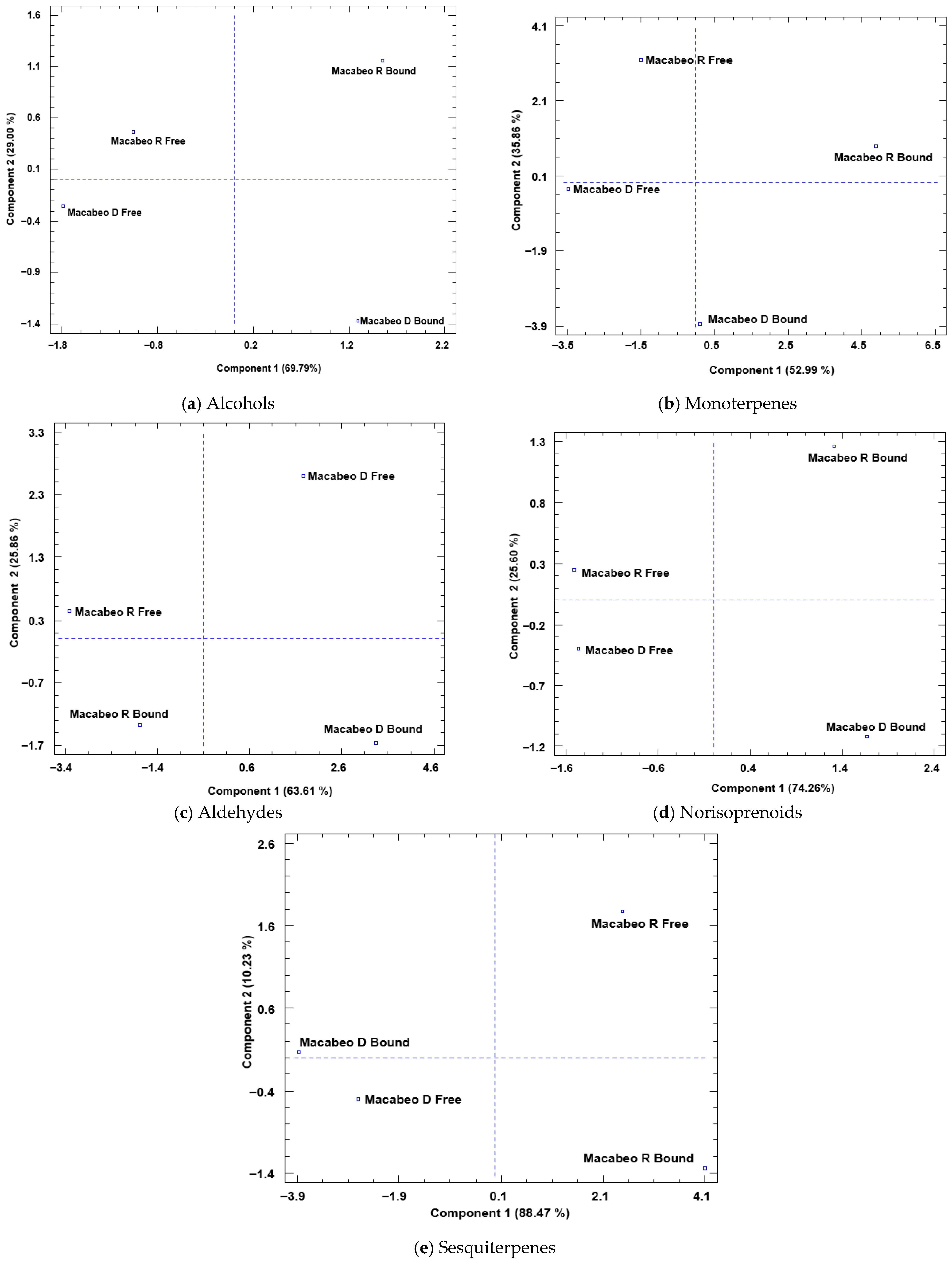
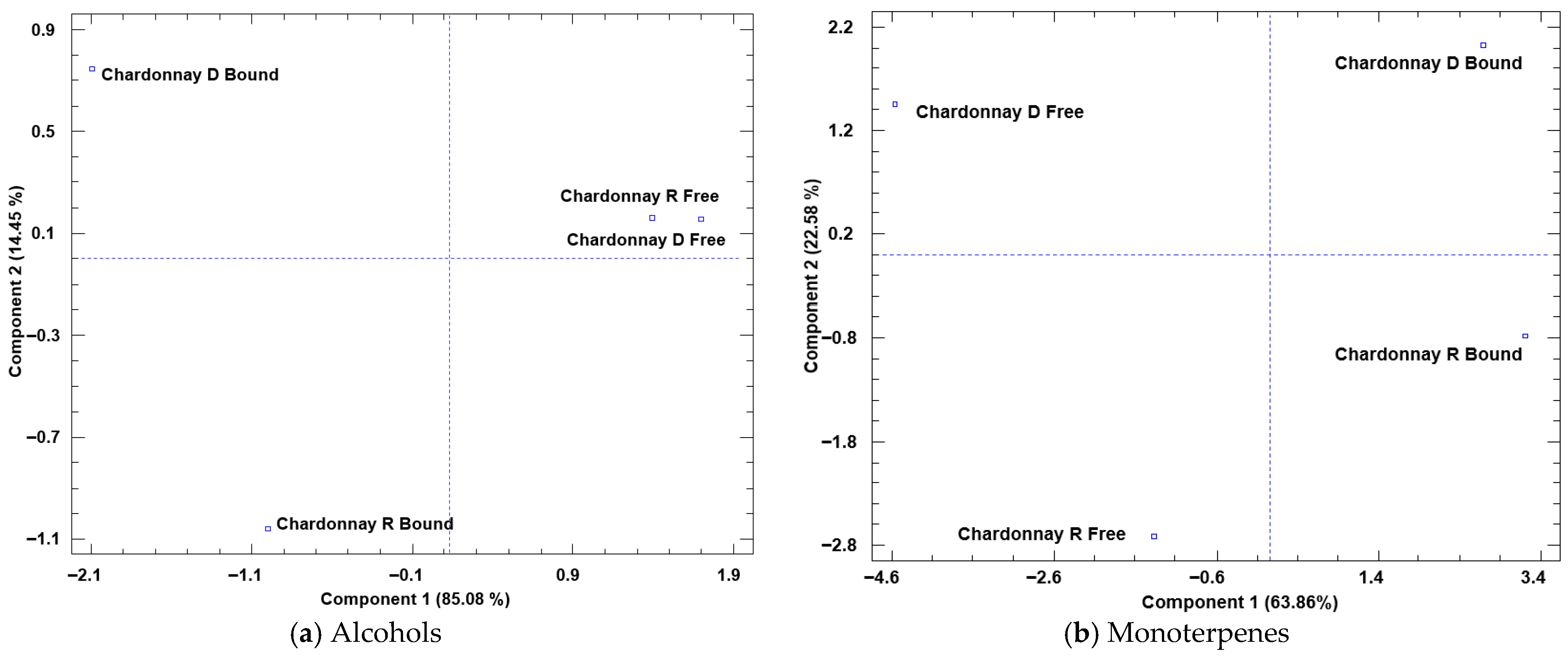
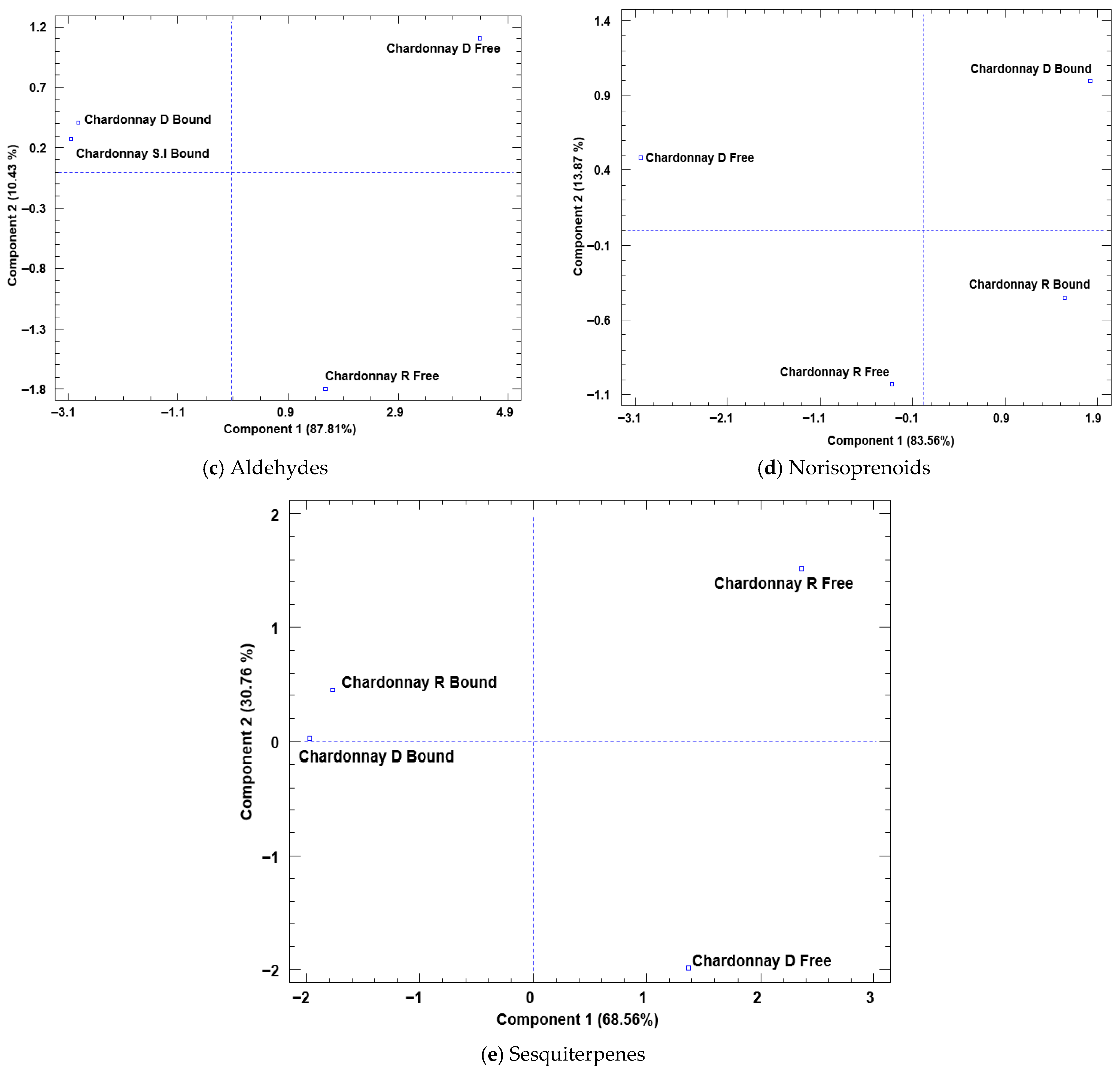
To identify the compounds that contribute most to the differentiation within each chemical group of volatile compounds, principal component analyses (PCA) were performed using the individual compounds included in each group. The results of these analyses are presented in Figure 1 and Table 2 (Macabeo) and in Figure 2 and Table 3 (Chardonnay). In this context, PCA is used as a descriptive approach to visualize patterns of variation and identify compounds associated with the differentiation between irrigation regimes, with the interpretation framed within the analytical characteristics of the study, including the use of relative peak area values, the absence of an internal standard, and the indirect estimation of the glycosidically bound fraction.
To evaluate the effect of the irrigation regime on each volatile fraction (free and bound), the principal component that best separates the two water regimes in each fraction was considered. The percentage of variance explained by each principal component is indicated in Figure 1 and Figure 2. Within each group of compounds, those with the highest loadings were examined, with the top 25% of absolute loadings identified as the main contributors to the observed separation (Tables S1 and S2).

3.2.1. Alcohols

In the Macabeo variety, discrimination between water regimes was mainly described along component 2, which accounted for 29% (Figure 1a). The most influential compound within this component was (Z)-2-octen-1-ol (Table 2), whose content was higher under rainfed water conditions in both fractions (Table S1). This compound is associated with herbaceous, earthy or green descriptors [14]. On the other hand, in the Chardonnay variety, alcohols only showed significant differences between water regimes in the bound fraction, as separated by component 2 (Figure 2a), which accounted for 14.45% of the total variance. Among these, 1-nonanol contributed to the separation (Table 2), with higher absolute area values observed under the deficit irrigation (Table S2).

3.2.2. Monoterpenes

For monoterpenes, in case of Macabeo, component 2 described the separation between water regimes across the free and bound fractions, explaining 35.86% of the total variance (Figure 1b). The six compounds contributing most to this separation, (three along the positive axis and three along the negative axis), were cis-carveol, citral, γ-terpinene, geranyl acetone, myrtenol and p-cymene (Table 2). Among these, γ-terpinene, geranyl acetone and myrtenol showed higher area values in the free fraction under rainfed water conditions, indicating differences in their relative abundance between treatments under the studied conditions. As previously stated, rainfed water regime led to an increased accumulation of monoterpenes in the free fraction of Macabeo grapes (Table 1).
Geranyl acetate, a monoterpene associated with fruity, sweet, and floral aromatic notes, [41] was the most abundant. Its presence was expected only in free form, as its chemical structure does not have a hydroxyl group that can act as a glycosylation site. As reported by other authors [42], the high abundance of this compound may be related to its formation from geraniol, which is one of the main monoterpenes in this variety (Table 2). The second most abundant compound was myrtenol, a monoterpenoid alcohol commonly described as having floral descriptors, commonly used in the fragrance and cosmetic industries. This compound was exclusively detected in the free fraction. Some authors have suggested that myrtenol glycosides may be more resistant to acid hydrolysis compared to other terpenoid glycosides, which could contribute to the absence of this compound in the bound fraction under the analytical conditions applied [43]. p-Cymene was another compound that contributed to the differentiation between water regimes across the fractions. Its absolute area values were not affected by the water regime in the free fraction, but in the bound fraction, it was only observed in rainfed water regime. This compound has been described as floral and resinous descriptors in Tempranillo grapes treated with methyl jasmonate [44].
Citral, a compound associated with citrus-like descriptors, was detected in both the free and bound fractions, with no significant differences observed between water regimes (Table S1). This compound has been previously reported by several authors as a key aroma contributor in aromatic grape varieties [14,45]. γ-Terpinene was also detected, with higher concentrations under rainfed water regime in the free fraction. However, in the bound fraction, it was only present under deficit irrigation conditions (Table S1). In bound fraction, the compound with the highest levels was cis-carveol, which was exclusively detected in this fraction. Although this compound has not been extensively reported in grapes, it has been identified as an odor active compound with mint like aroma [46].
In the Chardonnay variety, the separation between the two water regimes for both volatile fractions occurred along principal component 2, which accounted for 22.58% of the total variance (Figure 2b). The compounds contributing most to this component, in order of weight separation, were citral, β-cyclocitral and verbenone on the positive side of the axis, whereas verbenol, γ-terpinene and myrtenol were associated with the negative axis (Table 3). In the free volatile fraction, citral and β-cyclocitral showed significantly higher concentrations under deficit irrigation conditions, with β-cyclocitral exhibiting the higher response. γ-Terpinene was only detected under deficit irrigation, also with high significance. Verbenol and myrtenol showed no significant differences between water regimes, while verbenone was not detected. In the bound volatile fraction, verbenone and citral were present at significantly higher absolute area values under deficit irrigation, with verbenone showing a highly significant difference. β-Cyclocitral also showed a significant increase under deficit irrigation. In contrast, γ-terpinene and myrtenol did not exhibit statistically significant changes, and verbenol was not detected in any sample (Table S2). These results indicate that deficit irrigation is associated with changes in the volatile composition of Chardonnay grapes, particularly affecting the relative abundance of specific compounds such as β-cyclocitral and citral in both, free and bound fractions under the studied conditions. Previous studies [47,48] have shown that stress treatments in grapevines can increase the expression of genes in the carotenoid cleavage dioxygenase (CCD) pathway, enhancing the breakdown of carotenoids. However, within the scope of the present analytical approach, the observed changes cannot be directly attributed to specific metabolic pathway regulation and should be interpreted as variations in compound absolute area values.

3.2.3. Aldehydes

For aldehydes, in the Macabeo variety component 1 was responsible for the differentiation between water regimes in both the free and bound aroma fractions, explaining 63.61% of the total variance (Figure 1c). In general, rainfed water regime promoted a higher accumulation of aldehydes in the free fraction of both Macabeo and Chardonnay grapes (Tables S1 and S2). Among the most influential compounds in this separation were (E,E)-2,4-heptadienal, 2-heptanal (isomer), 4-ethyl-benzaldehyde, and benzene acetaldehyde (Table 2). The free volatile fraction under the rainfed water regime exhibited significantly higher concentrations of (E,E)-2,4-heptadienal and 2-heptanal. Notably, these aldehydes were not detected in the bound fraction. Benzaldehyde 4-ethyl was not detected in the free volatile fraction under rainfed water regime (R), whereas it was present under deficit water regime. Conversely, this compound was found exclusively in the glycosidically bound fraction under rainfed conditions. On its part, benzene acetaldehyde exhibited a marked decrease in the free fraction under rainfed water regime, while remaining relatively stable in the bound form (Table S1).
In the case of the Chardonnay variety, the effect of the water regime was observed exclusively in the free fraction (Figure 2c). Component 2 accounted for the separation between the two water treatments, explaining 10.43% of the variance. Specifically, the compounds contributing most strongly to this separation were 3-cyclohex-1-enyl-prop-2-enal, (E,E)-2,4-heptadienal and octanal on the positive side of the axis, whereas benzeneacetaldehyde, 2-heptanal and benzaldehyde contributed predominantly on the negative side (Table 3). In the free volatile fraction (Table S2), (E,E)-2,4-heptadienal and 3-cyclohex-1-enyl-prop-2-enal showed significantly higher concentrations under deficit irrigation, with very high significance. Octanal also increased significantly under deficit irrigation conditions, although less significantly. In contrast to the previous compounds, benzene acetaldehyde showed a significantly higher response under the rainfed water regime, while 2-heptanal and benzaldehyde did not exhibit statistically significant differences between treatments. The presence of some of these compounds had already been reported by other authors in Chardonnay grapes [21,23].

3.2.4. Norisoprenoids

In the Macabeo variety, separation between the two water regimes was described by component 2, which explained 25.60% of the total variance (Figure 1d), with vitispirane contributing most to this separation (Table 2). This C13-norisoprenoid compound has been described in the literature in relation to woody, vanilla, and floral notes to the volatile profile of grapes [49,50] and its area values were higher under rainfed water regime in both fractions (Table S1). This compound is an important odorant [49], so its presence suggests that under water stress conditions, Macabeo grapes could be more aromatic. In the context of this study, these results indicate differences in the abundance of this compound under the evaluated conditions. Previous studies have reported that water deficit can influence C13-norisoprenoid levels [38], although no direct conclusions on the underlying mechanisms can be drawn from the present results.
In the Chardonnay variety, the separation between the two water regimes for both volatile fractions occurred along principal component 2, which accounted for 13.09% of the total variance (Figure 2d). Vitispirane contributed most strongly to the positive axis of this component, while α-isomethyl ionone was the major contributor on the negative side (Table 3). Looking at Table S2, in the free fraction, both vitispirane and α-isomethyl ionone showed significantly higher concentrations under deficit irrigation. However, in the bound fraction, vitispirane also increased significantly under deficit irrigation conditions, while α-isomethyl ionone was detected only under rainfed water regime. Vitispirane, the most abundant C13-norisoprenoid identified, has been described in the literature in relation to camphorous or eucalyptus-like descriptors and has been previously reported in Chardonnay grapes [37].

3.2.5. Sesquiterpenes

Regarding sesquiterpenes, component 1 (PC1) effectively differentiated Macabeo samples between the two water regimes across both the free and bound fractions, accounting for 88.47% of the total variance (Figure 1e). The rainfed water regime (R) treatment led to a significant increase in the accumulation of sesquiterpenes in the free volatile fraction (Table S1). In fact, several sesquiterpenes, namely α-cadinene, γ-gurjunene, δ-elemene, α-cubebene, and α-longipinene, were exclusively detected under the rainfed water regime, whereas β-caryophyllene was present in both regimes but showed approximately twice the relative area value under rainfed conditions. This pattern indicates differences in the occurrence and relative abundance of sesquiterpenes between water regimes under the studied conditions, consistent with previous observations reported in the literature [51]. The bound fraction, while characterized by lower sesquiterpene concentrations, also revealed the presence of these compounds predominantly under the rainfed water regime, except for β-caryophyllene.
In the Chardonnay variety, the water regime was also separated along component 2, which explained 30.76% of the total variance (Figure 2e). The sesquiterpenes α-cadinene and α-calacorene contributed most strongly to the positive side of this component (Table 3). Among them, α-cadinene showed the highest concentration (Table S2). However, it was only detected under the more severe water deficit regime, in both free and bound fractions.

3.3. Compounds with the Highest Contribution to the Aroma Profile

Once having discussed the volatile compounds that contributed most to the differentiation between water regimes across the free and bound fractions, the analysis focused on those compounds accounting for more than 10% of the total relative content within their respective chemical families (Table 4). This approach was used to highlight the most abundant compounds which, due to their relative abundance, are expected to have an important impact on the characteristic aroma of the grape variety under the studied conditions.
Regarding alcohols, 1-octen-3-ol and phenylethyl alcohol stood out due to their high absolute area values within their respective fractions, each accounting for more than 10% of the total alcohol content in at least one of the tested conditions (fraction or water regime) in the Macabeo variety (Table 4). In Chardonnay, (Z)-2-octen-1-ol also showed a notable contribution, whereas 1-octen-3-ol was the predominant alcohol in both Macabeo and Chardonnay, particularly in the free fraction. In Macabeo, it accounted for up to 72% under rainfed water regime and 59% under deficit water regime, while in Chardonnay it reached an even higher level in free fraction: 75% under rainfed water regime and 86% under deficit irrigation (Table 4). In the bound fraction, its relative contribution was lower in both varieties, ranging from 36% to 44% in Macabeo and from 19% to 11% in Chardonnay. Despite these differences, no statistically significant effects of water regime were observed in either variety, suggesting that the expression of 1-octen-3-ol remains relatively stable under different water availability conditions.
Phenylethyl alcohol exhibited a distinct behavior. In the bound fraction (42–50%), its response was higher than in the free one, regardless of the water regime, indicating that this compound is less sensitive to the vine’s water status (Table 4). Although its response in the free fraction increased under deficit irrigation, overall absolute area values remained lower than those found in the bound fraction, highlighting the importance of this compound in the bound fraction of grapes as previously reported by other authors [52,53]. A similar behavior was observed in the Chardonnay variety, where the highest abundance of the compound was found in the bound fraction, accounting for 46% and 54% under rainfed and deficit water treatments, respectively (Table 4). This compound had previously been reported by other authors as one of the predominant constituents of the bound fraction in grapes [14].
The most abundant monoterpenes in Macabeo were β-pinene, geraniol, linalool, and verbenone, with γ-terpinene replacing verbenone in Chardonnay (Table 4). Linalool, a monoterpene associated with floral aromas, [54] represented a higher proportion of the glycosidically bound fraction under rainfed water regime (20%) compared to deficit irrigation (8%). For the free fraction, it showed no significant differences with respect to the hydric regimes used. This is in agreement with previous studies that have shown that a lower water availability can significantly increase the bound fraction of monoterpenes, particularly linalool, geraniol, and α-terpineol [55]. However, in Chardonnay, linalool related to the free fraction showed a significant increase under deficit irrigation (20%) compared to rainfed water conditions (14%) and, in bound fraction, an increase from 5% in rainfed water conditions to 14% under deficit one (Table 4).
Geraniol, a floral monoterpene, represented a substantial proportion of the bound fraction in both grape varieties. In Macabeo, it accounted for 17–27% of the bound monoterpenes, with higher responses under deficit irrigation, although these differences were not statistically significant. Its absolute area values in the free fraction were considerably lower (3–5%) but showed a significant increase under water limited conditions (Table 4). Similarly, in Chardonnay variety, geraniol increased slightly from 2% to 3% in the free fraction under deficit irrigation. In the bound fraction, it accounted for 28–34%, with higher absolute area values observed under deficit irrigation, but no statistically significant differences were observed between water treatments (Table 4). Previous works have also reported increased area values of free geraniol after enzymatic hydrolysis with glycosidases [56,57]. Monoterpenes serve as key aroma precursors, not only because they can be hydrolyzed into their corresponding free aglycones during alcoholic fermentation, but also because they can undergo enzymatic or chemical transformations into other volatile terpenes [58]. The predominance of bound geraniol and linalool in Macabeo grapes highlights the increase in varietal aromas under the conditions studied.
β-Pinene, a monoterpene associated with woody aromas [59] showed a significant increase in the free fraction of the Macabeo variety under deficit irrigation, accounting for 16% of total monoterpenes compared to only 6% under rainfed water regime. In the bound fraction, its concentration was negligible or not detected (Table 4). Similarly, in Chardonnay, β-pinene exhibited significant differences in the free fraction under deficit irrigation. However, it was not detected in the bound fraction under either water treatment (Table 4).
In Macabeo, verbenone was not detected in the free fraction, but accounted for over 10% of the bound monoterpenes under deficit irrigation, compared to 4% under rainfed water regime, although this difference was not statistically significant (Table 4). In contrast, γ-terpinene in Chardonnay, despite being present at lower area values, showed a significant decrease in the free fraction from 3% in rainfed water regime to 1% under deficit one, whereas in the bound fraction, its concentration declined sharply from 13% under rainfed conditions to nearly undetectable levels (0%) under deficit irrigation (Table 4).
Among the aldehydes detected in the free volatile fraction, (E)-2-hexenal was the most abundant in Macabeo and in Chardonnay. This C6 compound, previously described as a product of lipid oxidation [48], has been reported in relation to green and slightly fruity descriptors [60] and in Macabeo grapes [52]. In this study, such compound was only detected in the free fraction of Macabeo, where it accounted for 47–61% of total aldehydes, with higher levels observed under rainfed water regime (Table 4). In contrast, in Chardonnay, (E)-2-hexenal was present in both fractions, ranging from 50% to 65% in the free fraction and from 16% to 44% in the bound fraction, with consistently higher concentrations under deficit irrigation. Benzaldehyde was also detected in the free fraction in Macabeo grapes, although it was predominantly found in the bound fraction, where it accounted for over 90% of its total content (Table 4). This compound has been described as originating from phenylalanine metabolism and reported in relation to almond-like descriptors [48].
As expected, β-ionone was detected exclusively in the free volatile fraction of Macabeo grapes (Table 4), and it was the most abundant norisoprenoid identified in both varieties, although in Chardonnay, β-damascenone was also found in bound fractions (Table 4). These compounds originate from the degradation of carotenoids [48] and are characterized by their intense fruity and floral aroma, often described as violet-like. In the Macabeo variety, β-ionone absolute area values did not show significant differences between water regimes studied. However, in Chardonnay, higher levels of this compound were observed under deficit irrigation conditions.
Regarding sesquiterpenes such as calamenene, δ-cadinene, and α-ylangene, these were the most abundant compounds identified in Macabeo grapes, with α-cubebene additionally detected in Chardonnay (Table 4). These compounds were primarily present in the free volatile fraction and exhibited higher concentrations under rainfed water regime conditions in Macabeo grapes. In contrast, in Chardonnay, no significant differences between water regimes were observed in the free fraction. Only the predominant compound, α-cubebene, showed variation between regimes, as it was exclusively detected in the free volatile fraction.

4. Conclusions

The results show that the water regimes influence the accumulation of free and glycosidically bound aroma compounds in Vitis vinifera L. varieties such as Macabeo and Chardonnay under these studied conditions. Macabeo exhibited a more pronounced response to water deficit, with higher absolute area values of monoterpenes and norisoprenoids. Additionally, sesquiterpenes appeared under rainfed conditions, mainly in the bound fraction. In contrast, Chardonnay showed a more stable bound fraction and only moderate changes. This indicates a lower sensitivity of its grape aroma precursors to water regime under the conditions tested. Overall, the results highlight variety-dependent differences in the response of grape volatile composition to irrigation regime within the analytical framework applied. Moreover, the use of the GC×GC/ToFMS technique proved to be a suitable approach for characterizing the diversity and distribution of volatile compounds, supporting its application in further studies aimed at evaluating grape composition under different viticultural conditions.

Supplementary Materials

The following supporting information can be downloaded at: https://www.mdpi.com/article/10.3390/agronomy16080802/s1. Table S1. Absolute area with the greatest weight in the water regimes differentiation of aroma fractions (free and bound compounds) in Macabeo grapes; Table S2. Absolute area with the greatest weight in the water regimes differentiation of aroma fractions (free and bound compound) in Chardonnay grapes.

Author Contributions

Conceptualization: M.R.S., C.C.-T., R.S.-G. and G.L.A.; methodology: C.C.-T., R.S.-G., D.F. and N.M.; software: C.C.-T., R.S.-G. and N.M.; validation: C.C.-T., R.S.-G. and M.R.S.; formal analysis: C.C.-T. and R.S.-G.; investigation: C.C.-T., R.S.-G., N.M. and D.F.; resources: M.R.S., M.J.C., G.L.A. and R.S.-G.; data curation: C.C.-T., R.S.-G. and N.M.; writing—original draft preparation: C.C.-T. and R.S.-G.; writing—review and editing: C.C.-T., R.S.-G. and M.R.S.; visualization: C.C.-T. and R.S.-G.; supervision: M.R.S., M.J.C. and G.L.A.; project administration: G.L.A. and R.S.-G.; funding acquisition: M.R.S., M.J.C., G.L.A. and R.S.-G. All authors have read and agreed to the published version of the manuscript.

Funding

This research received no external funding.

Data Availability Statement

The original contributions presented in this study are included in the article/Supplementary Material. Further inquiries can be directed to the corresponding authors.

Acknowledgments

Authors thank to the University of Castilla-La Mancha, in collaboration with FEDER, and to the Government of Castilla-La Mancha (Spain) for funding this work through SBPLY/21/180501/000014 and 2023-GRIN-34180 projects. C.C.-T. acknowledges the University of Castilla-La Mancha for the postdoctoral contract 2024-UNIVERS-12850 and for grant received for research stays at universities and research centers abroad from the 2024 Call. The authors acknowledge the R&D unit MED—Mediterranean Institute for Agriculture, Environment and Development (https://doi.org/10.54499/UID/05183/2025) and the Associate Laboratory CHANGE–Global Change and Sustainability Institute (https://doi.org/10.54499/LA/P/0121/2020). During the preparation of this manuscript, the authors used Microsoft Copilot for the English proofreading. The authors have reviewed and edited the output and take full responsibility for the content of this publication.

Conflicts of Interest

The authors declare no conflicts of interest.

References

  1. Van Leeuwen, C.; Destrac-Irvine, A.; Dubernet, M.; Duchêne, E.; Gowdy, M.; Marguerit, E.; Pieri, P.; Parker, A.; De Rességuier, L.; Ollat, N. An update on the impact of climate change in viticulture and potential adaptations. Agronomy 2019, 9, 514. [Google Scholar] [CrossRef]
  2. Hewitt, S.; Hernández-Montes, E.; Dhingra, A.; Keller, M. Impact of heat stress, water stress, and their combined effects on the metabolism and transcriptome of grape berries. Sci. Rep. 2023, 13, 9907. [Google Scholar] [CrossRef] [PubMed]
  3. Cebrián-Tarancón, C.; De Rosso, M.; Panighel, A.; Flamini, R.; Alonso, G.L.; Salinas, M.R.; Chacón-Vozmediano, J.L.; Sánchez-Gómez, R. Aroma potential assessment in recovered minority red grape varieties by characterization with UHPLC-TOF/MS of intact glycosidic precursors. Sci. Hortic. 2025, 350, 114283. [Google Scholar] [CrossRef]
  4. Baltazar, M.; Castro, I.; Gonçalves, B. Adaptation to Climate Change in Viticulture: The Role of Varietal Selection—A Review. Plants 2025, 14, 104. [Google Scholar] [CrossRef]
  5. Schultz, H.R.; Change, G.C. Sustainability, and Some Challenges for Grape and Wine Production. J. Wine Econ. 2016, 11, 181–200. [Google Scholar] [CrossRef]
  6. Palai, G.; Caruso, G.; Gucci, R.; D’Onofrio, C. Deficit irrigation differently affects aroma composition in berries of Vitis vinifera L. (cvs Sangiovese and Merlot) grafted on two rootstocks. Aust. J. Grape Wine Res. 2022, 28, 590–606. [Google Scholar] [CrossRef]
  7. Francis, I.L.; Sefton, M.A.; Williams, P.J. Sensory descriptive analysis of the aroma of hydrolysed precursor fractions from semillon, chardonnay and sauvignon blanc grape juices. J. Sci. Food Agric. 1992, 59, 511–520. [Google Scholar] [CrossRef]
  8. Hjelmeland, A.K.; Ebeler, S.E. Glycosidically bound volatile aroma compounds in grapes and wine: A review. Am. J. Enol. Vitic. 2015, 66, 1–11. [Google Scholar] [CrossRef]
  9. Hampel, D.; Robinson, A.L.; Johnson, A.J.; Ebeler, S.E. Direct hydrolysis and analysis of glycosidically bound aroma compounds in grapes and wines: Comparison of hydrolysis conditions and sample preparation methods. Aust. J. Grape Wine Res. 2014, 20, 361–377. [Google Scholar] [CrossRef]
  10. de la Hoz, K.S.; Carmona, M.; Zalacain, A.; Alonso, G.L.; Salinas, M.R. The varietal aroma potential index (IPAv): A tool to evaluate the quality of grape and wines, white and red. In Proceedings of the 37th World Congress of Vine and Wine, Mendoza, Argentina, 9–14 November 2014; Volume 37. [Google Scholar]
  11. Günata, Y.Z.; Bayonove, C.L.; Baumes, R.L.; Cordonnier, R.E. The aroma of grapes I. Extraction and determination of free and glycosidically bound fractions of some grape aroma components. J. Chromatogr. A 1985, 331, 83–90. [Google Scholar] [CrossRef]
  12. Dziadas, M.; Jeleń, H.H. Comparison of enzymatic and acid hydrolysis of bound flavor compounds in model system and grapes. Food Chem. 2016, 190, 412–418. [Google Scholar] [CrossRef]
  13. Gunata, Y.Z.; Bayonove, C.L.; Baumes, R.L.; Cordonnier, R.E. Changes in free and bound fractions of aromatic components in vine leaves during development of muscat grapes. Phytochemistry 1986, 25, 943–946. [Google Scholar] [CrossRef]
  14. Ferreira, V.; Lopez, R. The Actual and Potential Aroma of Winemaking Grapes. Biomolecules 2019, 9, 818. [Google Scholar] [CrossRef]
  15. Caffrey, A.J.; Lerno, L.A.; Zweigenbaum, J.; Ebeler, S.E. Characterization of Free and Bound Monoterpene Alcohols during Riesling Fermentation. J. Agric. Food Chem. 2021, 69, 13286–13298. [Google Scholar] [CrossRef] [PubMed]
  16. Milani, N.B.L.; van Gilst, E.; Pirok, B.W.J.; Schoenmakers, P.J. Comprehensive two-dimensional gas chromatography—A discussion on recent innovations. J. Sep. Sci. 2023, 46, e2300304. [Google Scholar] [CrossRef] [PubMed]
  17. Fonseca, D.; Martins, N.; Garcia, R.; Cabrita, M.J. Comprehensive Two-Dimensional Gas Chromatography with a TOF MS Detector—An Effective Tool to Trace the Signature of Grape Varieties. Molecules 2024, 29, 1989. [Google Scholar] [CrossRef]
  18. Tranchida, P.Q.; Zoccali, M.; Mondello, L. Views on the uses of comprehensive two-dimensional gas chromatography–mass spectrometry in food analysis over the literature period 2018–2023. Trends Anal. Chem. 2024, 174, 117671. [Google Scholar] [CrossRef]
  19. Welke, J.E.; Manfroi, V.; Zanus, M.; Lazarotto, M.; Zini, C.A. Characterization of the volatile profile of Brazilian Merlot wines through comprehensive two dimensional gas chromatography time-of-flight mass spectrometric detection. J. Chromatogr. A 2012, 1226, 124–139. [Google Scholar] [CrossRef]
  20. Robinson, A.L.; Boss, P.K.; Heymann, H.; Solomon, P.S.; Trengove, R.D. Development of a sensitive non-targeted method for characterizing the wine volatile profile using HS-SPME-GC×GC-ToFMS. J. Chromatogr. A 2011, 1218, 504–517. [Google Scholar] [CrossRef]
  21. García, E.; Chacón, J.L.; Martínez, J.; Izquierdo, P.M. Changes in volatile compounds during ripening in grapes of Airén, Macabeo and Chardonnay white varieties grown in La Mancha region (Spain). Food Sci. Technol. Int. 2003, 9, 33–41. [Google Scholar] [CrossRef]
  22. Chacón-Vozmediano, J.L.; Martínez-Gascueña, J.; Ramos, M.C. Projected effects of climate change on Tempranillo and Chardonnay varieties in La Mancha Designation of Origin. Agron. Sustain. Dev. 2021, 41, 24. [Google Scholar] [CrossRef]
  23. Serratosa, M.P.; Marquez, A.; Moyano, L.; Zea, L.; Merida, J. Chemical and morphological characterization of Chardonnay and Gewürztraminer grapes and changes during chamber-drying under controlled conditions. Food Chem. 2014, 159, 128–136. [Google Scholar] [CrossRef] [PubMed]
  24. Cebrián-Tarancón, C.; Serrano, A.S.; Chacón-Vozmediano, J.L.; Martínez-Gascueña, J.; Alonso, G. Volatile Characterization of Recovery Minority Grape Varieties from Castilla-La Mancha Region (Spain). Plants 2024, 13, 1507. [Google Scholar] [CrossRef] [PubMed]
  25. Deluc, L.G.; Quilici, D.R.; Decendit, A.; Grimplet, J.; Wheatley, M.D.; Schlauch, K.A.; Mérillon, J.M.; Cushman, J.C.; Cramer, G.R. Water deficit alters differentially metabolic pathways affecting important flavor and quality traits in grape berries of Cabernet Sauvignon and Chardonnay. BMC Genom. 2009, 10, 212. [Google Scholar] [CrossRef] [PubMed]
  26. Fonseca, D.; Martins, N.; Garcia, R.; Cabrita, M.J. The potential of enzymatic hydrolysis with HS-SPME-GC×GC-ToFMS for the study of volatile signature of grapes. LWT 2025, 215, 117314. [Google Scholar] [CrossRef]
  27. Talaverano, I.; Valdés, E.; Moreno, D.; Gamero, E.; Mancha, L.; Vilanova, M. The combined effect of water status and crop level on Tempranillo wine volatiles. J. Sci. Food Agric. 2017, 97, 1533–1542. [Google Scholar] [CrossRef]
  28. Wang, J.; Abbey, T.; Kozak, B.; Madilao, L.L.; Tindjau, R.; Del Nin, J.; Castellarin, S.D. Evolution over the growing season of volatile organic compounds in Viognier (Vitis vinifera L.) grapes under three irrigation regimes. Food Res. Int. 2019, 125, 108512. [Google Scholar] [CrossRef]
  29. Savoi, S.; Wong, D.C.J.; Degu, A.; Herrera, J.C.; Bucchetti, B.; Peterlunger, E.; Fait, A.; Mattivi, F.; Castellarin, S.D. Multi-omics and integrated network analyses reveal new insights into the systems relationships between metabolites, structural genes, and transcriptional regulators in developing grape berries (Vitis vinifera L.) exposed to water deficit. Front. Plant Sci. 2017, 8, 271730. [Google Scholar] [CrossRef]
  30. Dunlevy, J.D.; Kalua, C.M.; Keyzers, R.A.; Boss, P.K. The production of flavour & aroma compounds in grape berries. In Grapevine Molecular Physiology and Biotechnology, 2nd ed.; Springer: Berlin/Heidelberg, Germany, 2009; pp. 293–340. [Google Scholar] [CrossRef]
  31. Song, M.; Fuentes, C.; Loos, A.; Tomasino, E. Free Monoterpene Isomer Profiles of Vitis vinifera L. cv. White Wines. Foods 2018, 7, 27. [Google Scholar] [CrossRef]
  32. Palai, G.; Caruso, G.; Gucci, R.; D’Onofrio, C. Water deficit before veraison is crucial in regulating berry VOCs concentration in Sangiovese grapevines. Front. Plant Sci. 2023, 14, 1117572. [Google Scholar] [CrossRef]
  33. Balint, G.; Reynolds, A.G. Irrigation level and time of imposition impact vine physiology, yield components, fruit composition and wine quality of Ontario Chardonnay. Sci. Hortic. 2017, 214, 252–272. [Google Scholar] [CrossRef]
  34. Savoi, S.; Wong, D.C.J.; Arapitsas, P.; Miculan, M.; Bucchetti, B.; Peterlunger, E.; Fait, A.; Mattivi, F.; Castellarin, S.D. Transcriptome and metabolite profiling reveals that prolonged drought modulates the phenylpropanoid and terpenoid pathway in white grapes (Vitis vinifera L.). BMC Plant Biol. 2016, 16, 67. [Google Scholar] [CrossRef]
  35. Rienth, M.; Vigneron, N.; Darriet, P.; Sweetman, C.; Burbidge, C.; Bonghi, C.; Walker, R.P.; Famiani, F.; Castellarin, S.D. Grape Berry Secondary Metabolites and Their Modulation by Abiotic Factors in a Climate Change Scenario–A Review. Front. Plant Sci. 2021, 12, 643258. [Google Scholar] [CrossRef] [PubMed]
  36. Bosman, R.N.; Lashbrooke, J.G. Grapevine mono- and sesquiterpenes: Genetics, metabolism, and ecophysiology. Front. Plant Sci. 2023, 14, 1111392. [Google Scholar] [CrossRef]
  37. Mendes-Pinto, M.M. Carotenoid breakdown products—The norisoprenoids—In wine aroma. Arch. Biochem. Biophys. 2009, 483, 236–245. [Google Scholar] [CrossRef]
  38. Song, J.; Shellie, K.C.; Wang, H.; Qian, M.C. Influence of deficit irrigation and kaolin particle film on grape composition and volatile compounds in Merlot grape (Vitis vinifera L.). Food Chem. 2012, 12, 841–850. [Google Scholar] [CrossRef]
  39. Bindon, K.A.; Dry, P.R.; Loveys, B.R. Influence of plant water status on the production of C13-norisoprenoid precursors in Vitis vinifera L. cv. Cabernet Sauvignon grape berries. J. Agric. Food Chem. 2007, 55, 4493–4500. [Google Scholar] [CrossRef]
  40. Montoro, A.; Valdés, E.; Vilanova, M.; Moreno, D.; Serrano, K.; Salinas, R.; Mañas, F.; Sánchez-Felipe, L.; López-Urrea, R. Different behaviour of two grapevine cultivars under similar irrigation management. Acta Hortic. 2017, 1150, 477–484. [Google Scholar] [CrossRef]
  41. Pardo, E.; Rico, J.; Gil, J.V.; Orejas, M. De novo production of six key grape aroma monoterpenes by a geraniol synthase-engineered S. cerevisiae wine strain. Microb. Cell Factories 2015, 14, 136. [Google Scholar] [CrossRef] [PubMed]
  42. Steyer, D.; Erny, C.; Claudel, P.; Riveill, G.; Karst, F.; Legras, J.L. Genetic analysis of geraniol metabolism during fermentation. Food Microbiol. 2013, 33, 228–234. [Google Scholar] [CrossRef]
  43. Liu, F.; Li, S.; Gao, J.; Cheng, K.; Yuan, F. Changes of terpenoids and other volatiles during alcoholic fermentation of blueberry wines made from two southern highbush cultivars. LWT 2019, 109, 233–240. [Google Scholar] [CrossRef]
  44. Garde-Cerdán, T.; Gutiérrez-Gamboa, G.; Baroja, E.; Rubio-Bretón, P.; Pérez-Álvarez, E.P. Influence of methyl jasmonate foliar application to vineyard on grape volatile composition over three consecutive vintages. Food Res. Int. 2018, 112, 274–283. [Google Scholar] [CrossRef]
  45. Hellín, P.; Manso, A.; Flores, P.; Fenoll, J. Evolution of aroma and phenolic compounds during ripening of “superior seedless” grapes. J. Agric. Food Chem. 2010, 58, 6334–6340. [Google Scholar] [CrossRef] [PubMed]
  46. Ringer, K.L.; Davis, E.M.; Croteau, R. Monoterpene Metabolism. Cloning, Expression, and Characterization of (−)-Isopiperitenol/(−)-Carveol Dehydrogenase of Peppermint and Spearmint. Plant Physiol. 2005, 137, 863. [Google Scholar] [CrossRef] [PubMed]
  47. Han, Y.; Wang, J.; Chen, C.; Guan, R.; Zhang, Y.; Jiang, Y. Influence of benzothiadiazole on isoprene metabolism and aroma accumulation in Chardonnay grapes (Vitis vinifera L.) during development. Eur. Food Res. Technol. 2024, 250, 1775–1788. [Google Scholar] [CrossRef]
  48. Rambla, J.L.; Trapero-Mozos, A.; Diretto, G.; Moraga, A.R.; Granell, A.; Gómez, L.G.; Ahrazem, O. Gene-metabolite networks of volatile metabolism in Airen and Tempranillo grape cultivars revealed a distinct mechanism of aroma bouquet production. Front. Plant Sci. 2016, 7, 181382. [Google Scholar] [CrossRef]
  49. Eggers, N.J.; Bohna, K.; Dooley, B. Determination of Vitispirane in Wines by Stable Isotope Dilution Assay. Am. J. Enol. Vitic. 2006, 57, 226–232. [Google Scholar] [CrossRef]
  50. Yuan, F.; Qian, M.C. Development of C13-norisoprenoids, carotenoids and other volatile compounds in Vitis vinifera L. Cv. Pinot noir grapes. Food Chem. 2016, 192, 633–641. [Google Scholar] [CrossRef] [PubMed]
  51. Kalua, C.M.; Boss, P.K. Evolution of volatile compounds during the development of cabernet sauvignon grapes (Vitis vinifera L.). J. Agric. Food Chem. 2009, 57, 3818–3830. [Google Scholar] [CrossRef]
  52. Ugliano, M.; Moio, L. Free and hydrolytically released volatile compounds of Vitis vinifera L. cv. Fiano grapes as odour-active constituents of Fiano wine. Anal. Chim. Acta 2008, 621, 79–85. [Google Scholar] [CrossRef]
  53. Khakdan, F.; Govahi, M.; Mohebi, Z.; Ranjbar, M. Water deficit stress responses of monoterpenes and sesquiterpenes in different Iranian cultivars of basil. Physiol. Plant. 2021, 173, 896–910. [Google Scholar] [CrossRef]
  54. Guth, H. Quantitation and Sensory Studies of Character Impact Odorants of Different White Wine Varieties. J. Agric. Food Chem. 1997, 45, 3027–3032. [Google Scholar] [CrossRef]
  55. Palai, G.; VanderWeide, J.; Pico, J.; Castellarin, S.D.; D’Onofrio, C. Jasmonates signalling plays a key role in modulating berry terpenes accumulation under water deficit conditions in Vitis vinifera L. (cv. Sangiovese). Environ. Exp. Bot. 2025, 236, 106171. [Google Scholar] [CrossRef]
  56. Palomo, E.S.; Hidalgo, M.C.D.-M.; González-Viñas, M.Á.; Pérez-Coello, M.S. Aroma enhancement in wines from different grape varieties using exogenous glycosidases. Food Chem. 2005, 92, 627–635. [Google Scholar] [CrossRef]
  57. Vázquez, L.C.; Pérez-Coello, M.S.; Cabezudo, M.D. Effects of enzyme treatment and skin extraction on varietal volatiles in Spanish wines made from Chardonnay, Muscat, Airén, and Macabeo grapes. Anal. Chim. Acta 2002, 458, 39–44. [Google Scholar] [CrossRef]
  58. Noma, Y.; Asakawa, Y. 3.19-Biotransformation of monoterpenoids. Compr. Nat. Prod. II Chem. Biol. 2010, 3, 669–801. [Google Scholar] [CrossRef]
  59. Kim, M.; Sowndhararajan, K.; Park, S.J.; Kim, S. Effect of inhalation of isomers, (+)-α-pinene and (+)-β-pinene on human electroencephalographic activity according to gender difference. Eur. J. Integr. Med. 2018, 17, 33–39. [Google Scholar] [CrossRef]
  60. Vilanova, M.; Genisheva, Z.; Masa, A.; Oliveira, J.M. Correlation between volatile composition and sensory properties in Spanish Albariño wines. Microchem. J. 2010, 95, 240–246. [Google Scholar] [CrossRef]
Figure 1. PCAs of the analysed compounds (free and bound) grouped by chemical group for Macabeo grapes subjected to different irrigation regime supply: deficit irrigation (D) and rainfed regime (R).
Agronomy 16 00802 g001
Figure 2. PCAs of the analysed compounds (free and bound) grouped by chemical group for Chardonnay grapes subjected to different irrigation regime supply: deficit irrigation (D) and rainfed regime (R).
Agronomy 16 00802 g002aAgronomy 16 00802 g002b
Table 1. p-Values of ANOVA performed using the absolute area of aroma fractions (free and bound compounds) grouped by chemical groups for Macabeo and Chardonnay grapes.
MacabeoChardonnay
Free Bound Free Bound
RDFpvalueRDFpvalueRDFpvalueRDFpvalue
Alcohols4.16 × 1072.64 × 1073.054.10 × 1074.53 × 1070.122.98 × 1072.64 × 1074.766.02 × 1075.30 × 1071.12
Aldehydes3.02 × 1082.66 × 1083.261.24 × 1082.41 × 10828.40 **2.24 × 1084.00 × 10853.77 **3.27 × 1076.95 × 1077.06
Monoterpenes2.99 × 1072.91 × 1070.152.06 × 1078.83 × 10661.26 **1.47 × 1072.91 × 107216.75 ***1.42 × 1072.08 × 10728.41 **
Norisoprenoids1.40 × 1078.02 × 10637.58 **1.74 × 1075.43 × 10666.45 **3.74 × 1068.03 × 106175.71 ***1.76 × 1064.42 × 10619.02 *
Sesquiterpenes1.07 × 1074.34 × 106128.64 ***3.17 × 10⁶n.d.45.91 **3.24 × 1062.67 × 1065.794.13 × 1052.48 × 10552.66 **
Total3.98 × 1083.34 × 1084.632.06 × 1083.01 × 1087.542.75 × 1084.66 × 10861.55 **1.09 × 1081.48 × 1084.02
R: Rainfed regime; D: Deficit irrigation; n.d.: not detected. Differences studied for each aroma fraction between the two water regimes according to Fisher’s LSD test (* p value < 0.1; ** p value < 0.05; *** p value < 0.01).
Table 2. Weights of the variables in the first two principal components for the principal component analysis (PCA) carried out with volatile compounds for Macabeo variety.
Component 1Component 2
Alcohols69.79%29.00%
1-Nonanol−0.4830.534
(Z)-2-Octen-1-ol 0.4070.680
1-Octen-3-ol0.5580.330
Phenylethyl alcohol0.538−0.378
Monoterpenes52.99%35.86%
p-Ocimene0.232−0.149
α-Terpineol0.2710.044
3-Carene−0.2030.152
α-Terpinene0.1610.071
β-Cyclocitral0.2590.053
β-Pinene−0.1670.028
cis-Carveol0.190−0.239
Citral0.169−0.270
γ-Terpinene0.0200.335
Geraniol0.224−0.204
Geranyl acetone0.0130.340
Hotrienol0.1720.262
Linalool0.2600.062
Linalool oxide0.2770.048
Myrtenol 0.0750.309
Nerol Oxide0.279−0.028
p-Cymene0.045−0.328
p-Menthatriene0.2630.113
Safranal0.0210.299
Terpine-4-ol−0.276−0.056
Terpinolene0.2370.164
Tetrahydro linalool−0.274−0.010
Verbenol0.1250.289
Verbenone0.207−0.222
Aldehydes63.61%25.86%
2-Octenal−0.3030.155
2,4-Decadienal0.2210.364
(E,E)-2,4-Heptadienal−0.320−0.004
(E,E)-2,4-Hexadienal−0.3040.174
2-Heptanal (isomer)−0.3220.049
(E)-2-Hexenal−0.3180.079
(E)-2-Nonenal−0.0600.450
3-Cyclohex-1-enyl-prop-e-enal−0.179−0.395
Benzaldehyde0.208−0.390
2-Methyl-benzaldehyde−0.3050.171
3,4-Dimethyl-benzaldehyde−0.316−0.103
4-Ethyl-benzaldehyde0.2780.137
Benzeneacetaldehyde0.3170.104
Octanal−0.024−0.286
p-Mentene-9-al−0.101−0.378
Norisoprenoids74.26%25.60%
Vitispirane0.3420.798
α-Ionene−0.578−0.070
β-Damascenone −0.5790.066
β-Ionone−0.4630.595
Sesquiterpenes88.47%10.23%
Calamenene0.254−0.092
δ-Cadinene0.2150.417
α-Calacorene0.251−0.164
α-Corocalene0.2530.120
Cadalene0.247−0.153
α-Cadinene0.2560.036
γ-Gurjunene0.2560.024
β-Guaiene0.254−0.080
Longifolene0.252−0.116
β-Caryophyllene0.2560.016
β-Copaene0.224−0.375
δ-Elemene0.2560.004
α-Cubebene0.2560.042
α-Longipinene0.255−0.049
α-Ylangene0.248−0.192
α-Copaene0.1100.681
Table 3. Weights of the variables in the first two principal components for the principal component analysis (PCA) carried out with volatile compounds for Chardonnay variety.
Component 1Component 2
Alcohols 85.08%14.45%
1-Octen-3-ol0.541−0.055
Phenylethyl alcohol−0.529−0.276
(Z)-2-Octen-1-ol−0.504−0.464
1-Nonanol−0.4170.840
Monoterpenes63.86%22.58%
β-Ocimene0.2360.228
Linalool−0.2210.268
Linalool oxide0.2130.188
Verbenone0.1790.275
Citral−0.0520.450
Geraniol0.2390.219
α-Terpineol−0.2570.144
Nerol Oxide0.2240.241
β-Pinene−0.2720.019
α-Terpinene0.1390.211
γ-Terpinene0.114−0.177
Terpinolene−0.2000.212
Tetrahydro linalool−0.264−0.026
p-Menthatriene−0.2360.210
Verbenol−0.229−0.224
Terpine-4-ol−0.2090.241
Myrtenol−0.254−0.112
Safranal−0.268−0.032
p-Menth-1-en-9-ol−0.1980.124
Geranyl acetone−0.2720.014
β-Cyclocitral−0.1580.364
Aldehydes87.81%10.43%
2-Methyl-benzaldehyde0.275−0.058
(E)-2-Nonenal0.257−0.106
4-Ethyl-benzaldehyde0.2600.134
3,4-Dimethyl-benzaldehyde0.2750.028
2,4-Decadienal0.2680.155
(E,E)-2,4-Heptadienal0.2520.323
2-Octenal0.273−0.105
3-Cyclohex-1-enyl-prop-e-enal0.2220.472
2-Heptanal0.254−0.308
Octanal0.2570.282
(E)-2-Hexenal0.2630.219
(E,E)-2,4-Hexadienal0.272−0.031
Benzaldehyde0.260−0.262
p-Mentene-9-al−0.2600.255
Benzeneacetaldehyde0.216−0.497
Norisoprenoids83.56%13.87%
Vitispirane0.2490.907
α-Ionene−0.4040.386
β-Damascenone−0.445−0.010
α-Ionone−0.4370.151
α-Isomethyl ionone−0.440−0.042
β-Ionone−0.4380.063
Sesquiterpenes68.56%30.76%
α-Cubebene0.454−0.020
α-Ylangene0.455−0.034
β-Caryophyllene0.3040.507
δ-Cadinene0.450−0.107
Calamenene0.410−0.289
α-Cadinene0.2980.515
α-Calacorene0.189−0.617
Table 4. Compounds with the highest contribution (≥10%) within each chemical group in Macabeo grapes.
FreeBound
RD RD
Area%Area%FpvalueArea%Area%Fpvalue
Macabeo
Alcohols
1-Octen-3-ol2.98 × 10772%1.56 × 10759%2.881.48 × 10736%2.01 × 10744%0.24
Phenylethyl alcohol2.37 × 1066%5.43 × 10621%57.13 **1.72 × 10742%2.25 × 10750%5.32
Monoterpenes
β-Pinene1.91 × 1066%4.76 × 10616%91.77 ***7.97 × 1040.40%n.d. 15.56 *
Geraniol7.76 × 1053%1.51 × 1065%64.74 ***3.50 × 10617%2.41 × 10627%2.82
Linalool2.93 × 10610%2.83 × 10610%0.084.04 × 10620%6.73 × 1058%30.41 **
Verbenonen.d. n.d. 7.54 × 1054%8.85 × 10510%2.31
Aldehydes
(E)-2-Hexenal3.68 × 10661%2.40 × 10647%41.39 **n.d. n.d.
Benzaldehyde3.11 × 10710%5.42 × 10720%18.30 *1.17 × 10894%2.35 × 10897%31.51 **
Norisoprenoids
β-Ionone2.91 × 10621%2.73 × 10634%1.31n.d. n.d.
Sesquiterpenes
Calamenene1.65 × 10615%6.60 × 10515%118.56 ***6.57 × 10521%n.d. 82.90 ***
δ-Cadinene2.58 × 10624%9.78 × 10523%111.97 ***3.05 × 10510%n.d. 5.65 *
Chardonnay
Alcohols
1-Octen-3-ol2.25 × 10775%2.28 × 10786%0.041.17 × 10719%5.93 × 10611%2.03
(Z)-2-Octen-1-ol 3.94 × 10613%n.d.0%416.18 ***2.03 × 10734%1.74 × 10733%3.17
Phenylethyl alcohol2.73 × 1069%2.94 × 10611%0.922.75 × 10746%2.87 × 10754%0.06
Monoterpenes
Linalool1.99 × 10614%5.72 × 10620%314.37 ***6.66 × 1055%2.82 × 10614%6.37
Geraniol3.51 × 1052%9.87 × 1053%30.03 **4.81 × 10634%5.75 × 10628%1.83
β-Pinene2.29 × 10616%4.67 × 10616%61.03 **n.d. n.d.
γ-Terpinene4.46 × 1053%3.85 × 1051%527.26 ***1.81 × 10613%4.43 × 1040%7.56
Aldehydes
(E)-2-Hexenal1.13 × 10850%2.59 × 10865%31.35 **1.44 × 10744%5.31 × 10776%9.10 *
Norisoprenoids
β-Ionone2.30 × 10662%4.18 × 10652%169.68 ***9.95 × 1046%6.91 × 10516%1.11
β-Damascenone7.79 × 10521%1.63 × 10620%58.93 **n.d. n.d.
Sesquiterpenes
α-Cubebene9.79 × 10530%8.03 × 10530%2.741.30 × 10532%n.d.0%242.28 ***
α-Ylangene1.34 × 10641%1.13 × 10642%4.311.88 × 10545%1.81 × 10573%0.13
δ-Cadinene5.49 × 10517%5.24 × 10520%0.37n.d.0%n.d.0%
Calamenene1.17 × 1054%1.40 × 1055%1.245.55 × 10413%6.70 × 10427%1.19
R: Rainfed regime; D: Deficit irrigation; n.d.: not detected. %: percentage respect to the total of each compound family. Differences analysed for each aroma fraction between the two water regimes according to Fisher’s LSD test (* p value < 0.1; ** p value < 0.05; *** p value < 0.01).
Disclaimer/Publisher’s Note: The statements, opinions and data contained in all publications are solely those of the individual author(s) and contributor(s) and not of MDPI and/or the editor(s). MDPI and/or the editor(s) disclaim responsibility for any injury to people or property resulting from any ideas, methods, instructions or products referred to in the content.