Article

Variation and Trade-Offs in Leaf and Root Traits of Perennial Grasses Under Nitrogen Deposition

1
Jilin Provincial Key Laboratory of Tree and Grass Genetics and Breeding, College of Forestry and Grassland Science, Jilin Agricultural University, Changchun 130118, China
2
Jilin Provincial Key Laboratory for Plant Resources Science and Green Production, Jilin Normal University, Siping 136000, China
*
Author to whom correspondence should be addressed.
Agronomy 2026, 16(7), 739; https://doi.org/10.3390/agronomy16070739
Submission received: 1 March 2026 / Revised: 27 March 2026 / Accepted: 30 March 2026 / Published: 31 March 2026
(This article belongs to the Special Issue Multifunctionality of Grassland Soils: Opportunities and Challenges)

Abstract

Atmospheric nitrogen deposition is increasing globally, making it essential to understand how leaf and root traits vary and interact to shape plant ecological strategies under changing environmental conditions. We conducted leaf and root traits of eight perennial grasses (rhizomatous and bunchgrass species) in a field experiment conducted in the Songnen grassland, incorporating control and nitrogen addition treatments (10 g m−2 yr−1). Nitrogen addition significantly altered leaf and root trait expression and promoted biomass accumulation in both life forms. Specifically, nitrogen addition increased assimilation rate (An; 19.4 and 20.7%), leaf nitrogen content (LNC; 51.5 and 57.8%), specific root length (SRL; 30.1 and 41.1%), and root nitrogen content (RNC; 18.6 and 34.4%), while markedly reducing root tissue density (RTD; 40.2 and 46.6%) of perennial rhizome grass and perennial bunchgrasses. Principal component analysis revealed multiple plant resource strategies reflected by multidimensional variation in leaf and root traits. However, no consistent correlations were detected between leaf and root trait dimensions, and regression relationships differed significantly under nitrogen addition. These results indicate a decoupling of above- and belowground resource acquisition strategies at the local scale. Additionally, we underscore the importance of combining above- and belowground traits to improve predictions of plant performance. Our findings advance understanding of leaf–root trait coordination in perennial grasses and provide insights into plant adaptive strategies in arid and semi-arid regions’ grassland ecosystems experiencing increasing nitrogen deposition.

1. Introduction

Rapid industrialization, agricultural intensification, and urban expansion have made North America, Europe, and East Asia global hotspots of nitrogen deposition [1]. Excess nitrogen inputs can enrich soils beyond optimal levels, alter nitrogen cycling and availability, and reshape ecosystem nitrogen-use strategies, which can influence plant ecological strategies and responses to nitrogen addition in grassland ecosystems [2]. Plant functional traits are measurable characteristics that reflect long-term responses and adaptations to environmental conditions. They provide a powerful framework for linking environmental change to plant performance and community dynamics. Trade-offs among traits capture fundamental growth, survival strategies, and how plants adjust resource use under changing environments [3]. Examining coordinated variation in leaf and root traits across plant functional types is therefore critical for predicting the consequences of nitrogen deposition for community assembly and ecosystem functioning [4].
Economic theory has been widely applied in plant ecology to quantify relationships among functional traits associated with resource allocation. The leaf economics spectrum (LES) describes coordinated trade-offs among leaf traits along a gradient from fast to slow returns on resource investment [5]. Resource-acquisitive species typically exhibit high leaf nitrogen content and photosynthetic capacity, but low leaf mass per area (LMA; i.e., high specific leaf area, SLA) and short leaf lifespans [6,7]. In contrast, the root economics spectrum (RES) is increasingly recognized as multidimensional and more complex than the LES [8]. One RES dimension reflects a trade-off between resource acquisition and conservation, driven by a negative relationship between RTD and RNC. A second dimension represents a collaboration gradient, characterized by a negative relationship between SRL and RD, reflecting a shift in resource foraging from the root itself, from a “do-it-yourself” strategy to an ”outsourcing” strategy with mycorrhizal fungi [9].
The plant economics spectrum (PES) hypothesis further implies that traits across leaves, stems, and roots are coordinated along a common economic strategy, forming an integrated spectrum from acquisitive to conservative strategies at the whole-plant level. Empirical studies have supported this framework, reporting strong coordination between LES and RES [10]. However, growing evidence suggests that leaf–root trait relationships are context dependent and may weaken or decouple under certain environmental conditions [11]. For instance, Delpiano et al. (2020) demonstrated that spatial and temporal variation in soil nutrient availability can decouple leaf and root traits in desert shrub communities [12]. These contrasting findings highlight ongoing uncertainty regarding the mechanisms governing coordinated variation between leaf and root traits, particularly under global change drivers such as nitrogen deposition.
Global atmospheric nitrogen deposition has increased rapidly, profoundly influencing plant growth and resource-use strategies in terrestrial ecosystems. Plant biomass is widely regarded as a key integrative indicator of plant performance and ecosystem functioning, reflecting the cumulative outcomes of resource acquisition, allocation, and growth strategies. Prior research has reported that alterations in nutrient availability, particularly nitrogen enrichment, can substantially alter both aboveground and belowground biomass, thereby reshaping plant competitive hierarchies and community structure [13,14]. Increasing evidence suggests that biomass responses to nitrogen deposition are driven by coordinated shifts in functional traits rather than by individual traits alone. However, how trait-mediated biomass allocation patterns emerge across plant organs under sustained nitrogen deposition remains poorly understood.
Experimental nitrogen addition studies in temperate regions show that increased nitrogen availability enhances plant nitrogen uptake and leaf nitrogen concentration [15]. However, nitrogen enrichment can also exacerbate phosphorus limitation, potentially shifting plants toward more conservative survival strategies [16]. In contrast, other studies report increases in SLA under nitrogen deposition, suggesting a shift toward faster growth and more acquisitive strategies [17]. These contrasting responses indicate that plant functional trait responses to nitrogen deposition are context-dependent and illustrate the trade-offs involved in acquiring and conserving resources. While leaf trait responses to nitrogen deposition have been widely documented, root traits—and their integration with leaf traits—remain comparatively understudied. Existing evidence indicates that root responses to nitrogen enrichment are diverse. A meta-analysis synthesizing 15 root traits showed that nitrogen addition had limited impacts on root morphology but significantly increased root biomass (RB) and RNC [18]. Similarly, nitrogen addition has been shown to increase SRL and RNC while reducing RTD and root diameter (RD) in temperate grassland species. Other studies suggest that nitrogen deposition may favor species with acquisitive belowground foraging strategies by increasing SRL, RTD, and RD [19]. Because plant functional traits do not vary independently but covary through allocation trade-offs among competing demands, understanding how leaf and root traits jointly respond to nitrogen deposition is essential for predicting shifts in whole-plant ecological strategies. However, it remains unclear whether increasing nitrogen deposition promotes coordinated variation between leaf and root traits.
The northern grasslands of China constitute the country’s second-largest grassland region and provide multiple essential ecosystem services. Within this region, the Songnen grassland, a typical agropastoral ecotone and representative meadow steppe, is highly productive despite harsh soil and climatic conditions, making it particularly sensitive to global environmental change. Perennial grasses dominate the Songnen grassland at the eastern edge of the Eurasian continent and contribute disproportionately to ecosystem productivity. Here, we focus on eight perennial grass species representing two life forms (perennial rhizome grass and perennial bunchgrasses) to examine how nitrogen deposition influences coordinated variation between leaf and root functional traits. Specifically, this study addresses two key questions: (1) how leaf and root traits of different perennial grasses respond to nitrogen deposition; and (2) whether nitrogen enrichment alters the degree of coupling between leaf and root traits. By integrating responses of both above- and belowground traits, this work enhances our understanding of plant strategy trade-offs and offers new perspectives on plant adaptation and ecosystem functioning under increasing nitrogen inputs.

2. Materials and Methods

2.1. Site Description

The study was conducted at the Jilin Songnen Grassland Ecosystem National Field Scientific Observation and Research Station in Changling County, Jilin Province (44°30′–44°45′ N, 123°31′–123°56′ E), on the eastern margin of the Eurasian steppe. The area experiences a temperate monsoon climate, ranging from semi-arid to semi-humid, at elevations of 140–160 m. Mean annual temperature is 4.6–6.4 °C, and annual precipitation averages ~470 mm. Soils are primarily chernozem and meadow types, with surface layer (0–20 cm) characteristics summarized in Table 1.
Meadow steppe is the predominant grassland type in the Songnen Grassland, mainly composed of meso-xerophytic perennial rhizome grass and perennial bunchgrasses. Leymus chinensis is the dominant and constructive species. Other associated plant species include Phragmites australis, Puccinellia tenuiflora, Kalimeris integrifolia, Artemisia anethifolia, and Kochia sieversiana.
In this study, eight perennial grass species from the Songnen Grassland were selected, including four perennial rhizome grasses and four perennial bunchgrasses, representing a total of six genera. Detailed information on each plant species is provided in Table 2.
According to earlier research findings, in the northern temperate grassland ecosystem, the rate of nitrogen deposition is approximately 10.5 g m−2 yr−1. Therefore, a completely randomized design was employed with two nitrogen addition levels (N0: 0 g m−2 yr−1 and N10: 10 g m−2 yr−1), each replicated three times. Each plot contained only one species, resulting in a total of 48 plots (8 species × 2 nitrogen addition levels × 3 replicates). Each plot measured 2.5 m × 2.5 m, with a spacing of 0.5 m between adjacent plots and 1 m between blocks. Nitrogen was applied in the form of ammonium nitrate (NH4NO3) (Sinopharm Chemical Reagent Co., Ltd., Shanghai, China). Nitrogen addition was carried out once each month in mid-month from May to September. At each application, nitrogen (2 g N m−2) was dissolved in 20 L of water and applied uniformly.
Seeds of the study species were collected from untreated natural meadows within the study area. Germination tests were conducted in a climate-controlled growth chamber to ensure good seed quality. The seeding rate for each plot was determined based on the germination percentage of grass seeds. After sowing, plots were irrigated once a week to ensure seedling emergence. Following emergence, weeds were regularly removed. Plant growth relied primarily on natural precipitation, with supplemental watering provided during periods of low rainfall to ensure normal plant growth.

2.2. Sample Collection and Determination

At the peak of the growing season, five individuals were randomly selected from each plot. An was measured on the second and third fully expanded leaves from the apex using a CIRAS-3 portable photosynthesis system. (PP Systems, Amesbury, MA, USA). Conditions were controlled at a leaf chamber temperature of 25 °C. The concentration of CO2 was the same as the CO2 concentration in the atmosphere under natural conditions and a 500 μmol s−1 flow rate. Photosynthetic photon flux density (PPFD) was set to 1600 μmol m−2 s−1 (90% red, 5% blue, 5% white), with relative humidity maintained at 65%. After measurement, leaves were immediately sealed in plastic bags containing moist filter paper and transported to the laboratory at 4 °C. Surface moisture was removed prior to recording fresh mass (FM). Leaf area (LA) was determined using a portable scanner (AM-350, ADC Bioscientific Ltd., London, UK), followed by oven-drying at 65 °C for 48 h to obtain dry mass (DM).
At the end of the growing season, a 0.5 m × 0.5 m quadrat was randomly placed within each plot, and all aboveground plants within the quadrat were harvested. Following oven-drying at 65 °C (~48 h) to constant mass, samples were ground (MM 400, Retsch, Haan, Germany) and screened through a 100-mesh sieve. Leaf carbon content (LCC) and leaf nitrogen content (LNC) were determined using a stable isotope analyzer (vario EL cube, Elementar, Langenselbold, Germany). Specific leaf area (SLA, m2 g−1) and leaf dry matter content (LDMC, %) were calculated using standard formulas:
SLA = Leaf   area Leaf   dry   mass
LDMC = Leaf   dry   mass Leaf   fresh   mass × 100 %
At the end of the growing season, belowground plant parts were sampled using the diagonal sampling method. In each plot, soil cores (0–30 cm depth) were obtained with an 11 cm diameter root auger. The collected material consisted of fine roots. For perennial rhizomatous grasses, both roots and rhizomes were present; however, rhizomes were excluded from subsequent analyses. Samples were rinsed with water using mesh bags and transported to the laboratory under refrigerated conditions (4 °C). In the laboratory, roots were gently washed, spread evenly in a root scanning tray, and analyzed using an Epson Perfection scanner coupled with WinRHIZO Pro 2012 software to determine root length (RL), root diameter (RD), and root volume (RV). Following scanning, root samples were oven-dried at 65 °C for approximately 48 h to a constant mass and weighed to obtain dry mass (DM). Root carbon (RCC) and nitrogen content (RNC) were measured following the same procedure used for leaf samples. Specific root length (SRL, m g−1) and root tissue density (RTD, g cm−3) were calculated using standard formulas:
SRL = Root   length Root   dry   mass
RTD = Root   dry   mass Root   volume
During the peak of the growing season, plant biomass was also sampled. A 0.25 m2 (0.5 m × 0.5 m) quadrat was randomly placed within each plot. Aboveground biomass within the quadrat was collected by clipping, while belowground biomass was sampled using the root auger method. All harvested plant materials were transported to the laboratory. Above- and belowground components were separated, oven-dried at 65 °C (~48 h) to constant mass, and weighed. Total biomass was calculated as the sum of both fractions for each treatment.

2.3. Statistical Analysis

Data processing and statistical analyses were performed using the R software (R version 4.5.2). First, the normality of all variables was tested using the Kolmogorov–Smirnov test, followed by a test for homogeneity of variances. Two-way analysis of variance (ANOVA) was performed to test the effects of nitrogen addition, life form, and their interaction on leaf traits, root traits, and biomass. Independent-samples t-tests were applied to analyze the effects of nitrogen addition on leaf traits, root traits, and biomass under perennial rhizome grass and perennial bunchgrasses. Principal component analysis (PCA) was conducted to evaluate leaf and root traits of different grass species under the two treatments. Standardized major axis (SMA) regression was used to analyze the relationships between leaf and root traits.

3. Results

3.1. Influence of Nitrogen Addition on Leaf Traits

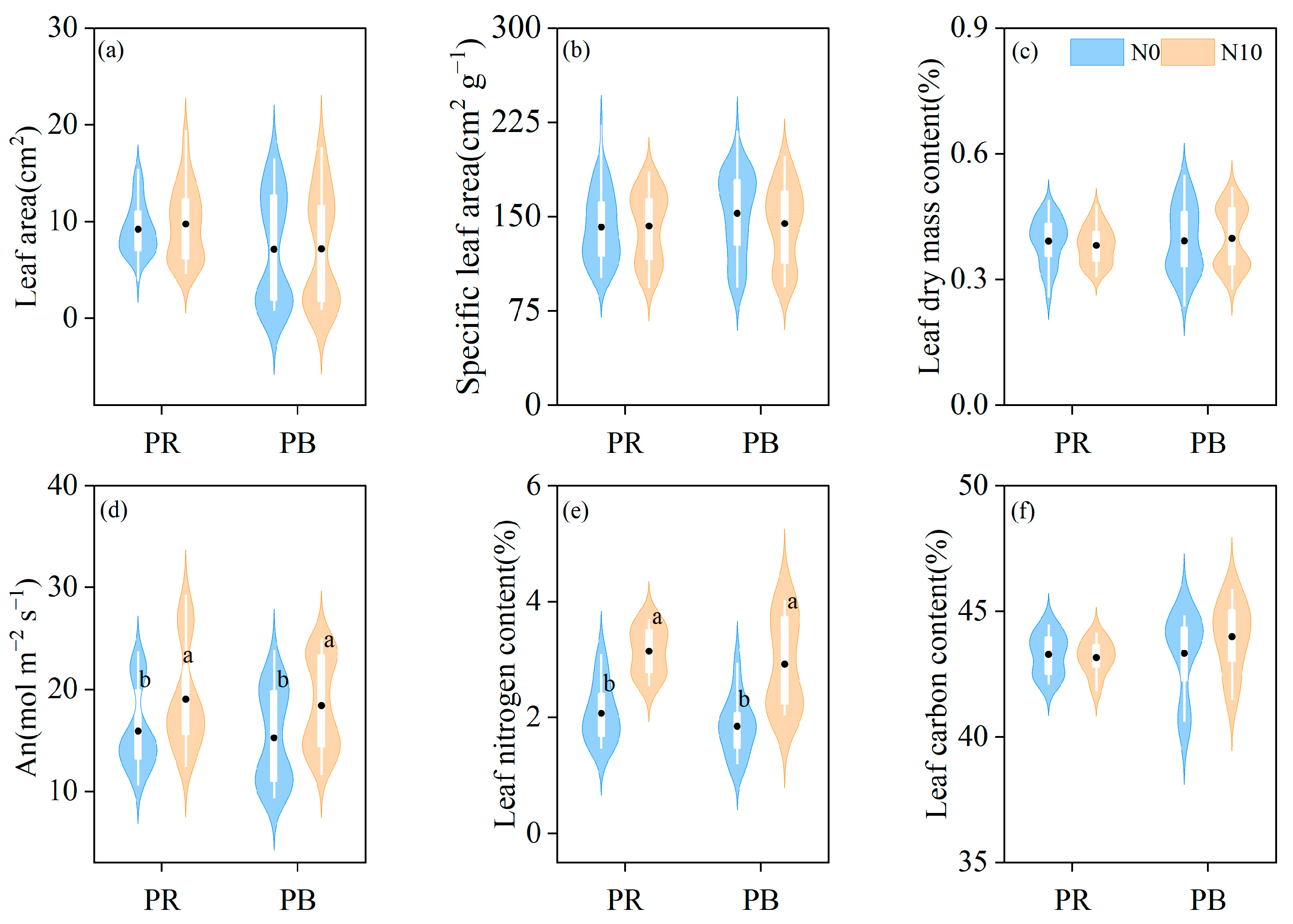
Two-way ANOVA demonstrated that nitrogen addition had highly significant impacts on An and LNC, while life form had a strong influence on LA. No significant interaction between nitrogen addition and life form was detected for any leaf functional trait (Table 3). Nitrogen addition significantly increased An and LNC in both perennial rhizome grass and perennial bunchgrasses, 19.4–20.7% and 51.5–57.8% higher than the control treatment, respectively (Figure 1d,e; p < 0.05). By contrast, nitrogen addition did not produce a statistically significant impact on the remaining leaf functional traits, although an overall increasing trend was observed (Figure 1a–c,f; p > 0.05).

3.2. Influence of Nitrogen Addition on Root Traits

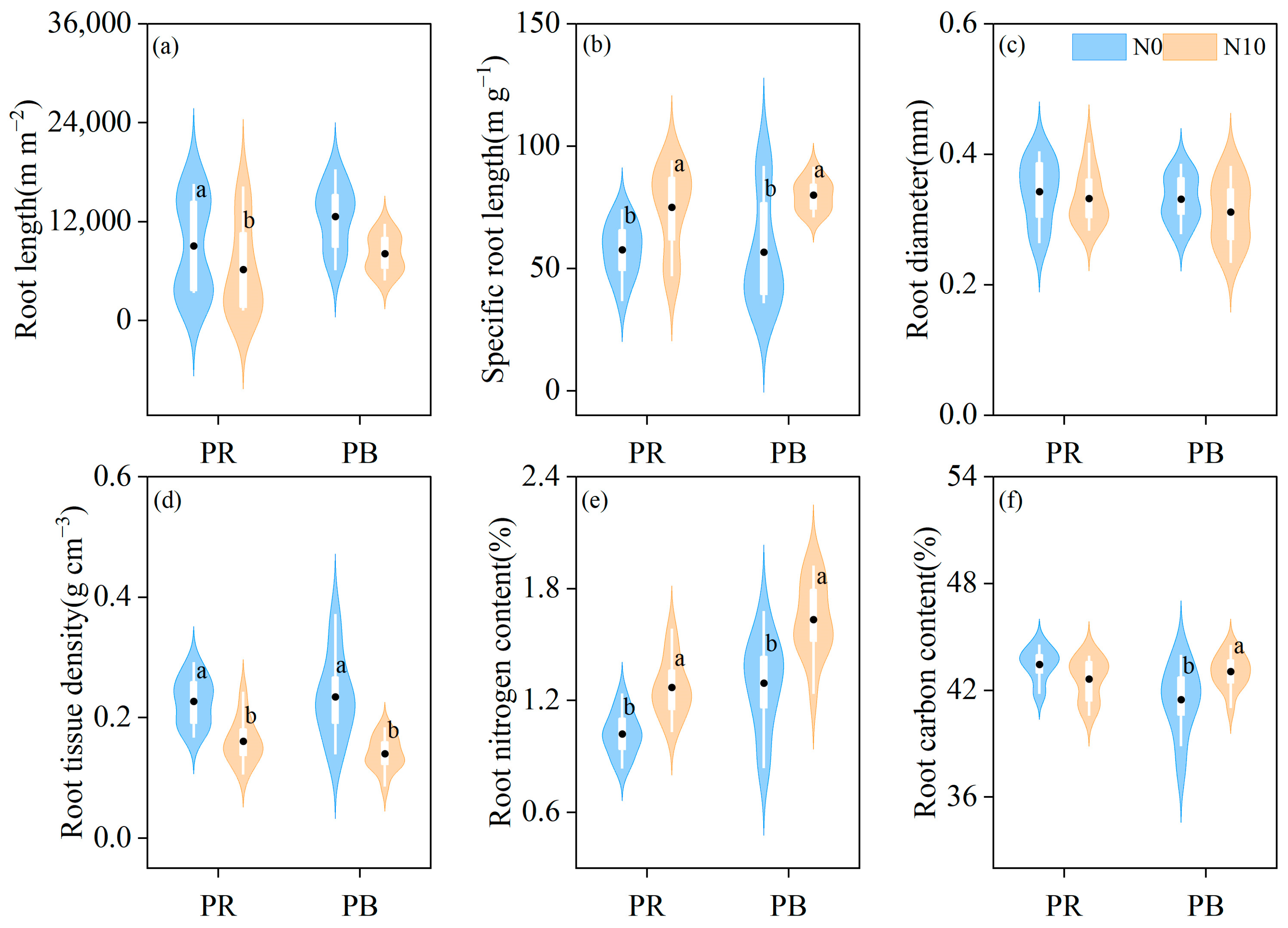
Nitrogen addition exerted significant impacts on RL, SRL, RTD, and RNC. Life form significantly influenced RL, RNC, and RCC, whereas a significant interaction between nitrogen addition and life form was observed only for RCC (Table 4). Nitrogen addition significantly reduced RL and RTD in perennial rhizome grass, with decreases of 31.7% and 40.2%, respectively (Figure 2a,d; p < 0.05). In perennial bunchgrasses, RTD was also markedly lower under nitrogen treatment, showing a 46.6% decline compared with the control (Figure 2d; p < 0.05). By contrast, SRL and RNC increased significantly under nitrogen addition in both life forms, with values 30.1–41.1% and 18.6–34.4% higher than those of the control, respectively (Figure 2b,e; p < 0.05). Additionally, RCC was significantly enhanced in perennial bunchgrasses (Figure 2f; p < 0.05). No significant effect of nitrogen addition on RD was detected in either perennial rhizome grass or perennial bunchgrasses (Figure 2c; p > 0.05).

3.3. Influence of Nitrogen Addition on Biomass

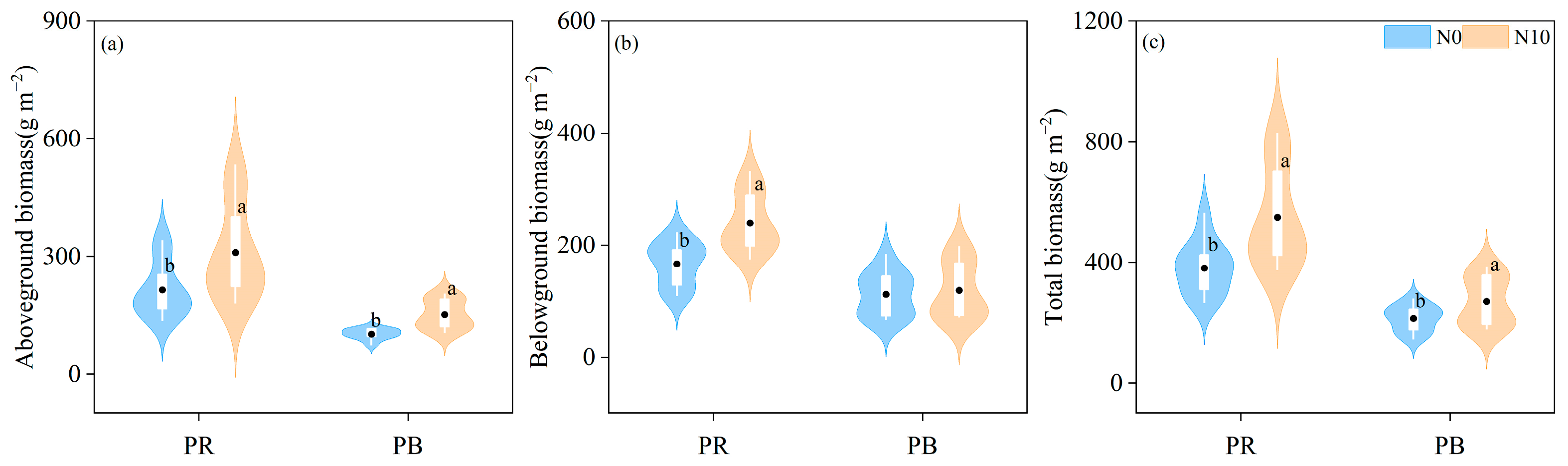
Nitrogen addition and life form both had highly significant impacts on aboveground, belowground, and total biomass, while the interaction between the two significantly affected only BGB (Table 5). Nitrogen addition significantly increased aboveground and total biomass in both perennial rhizome grass and perennial bunchgrasses, 44.6–48.4% and 26.4–44.2% higher than the control treatment, respectively (Figure 3a,c; p < 0.05). Relative to the control, the BGB increased by 43.7% only in perennial rhizome grass under nitrogen treatment (Figure 3b; p < 0.05).

3.4. The Relationship Between Leaf and Root Traits Responses to Nitrogen Addition

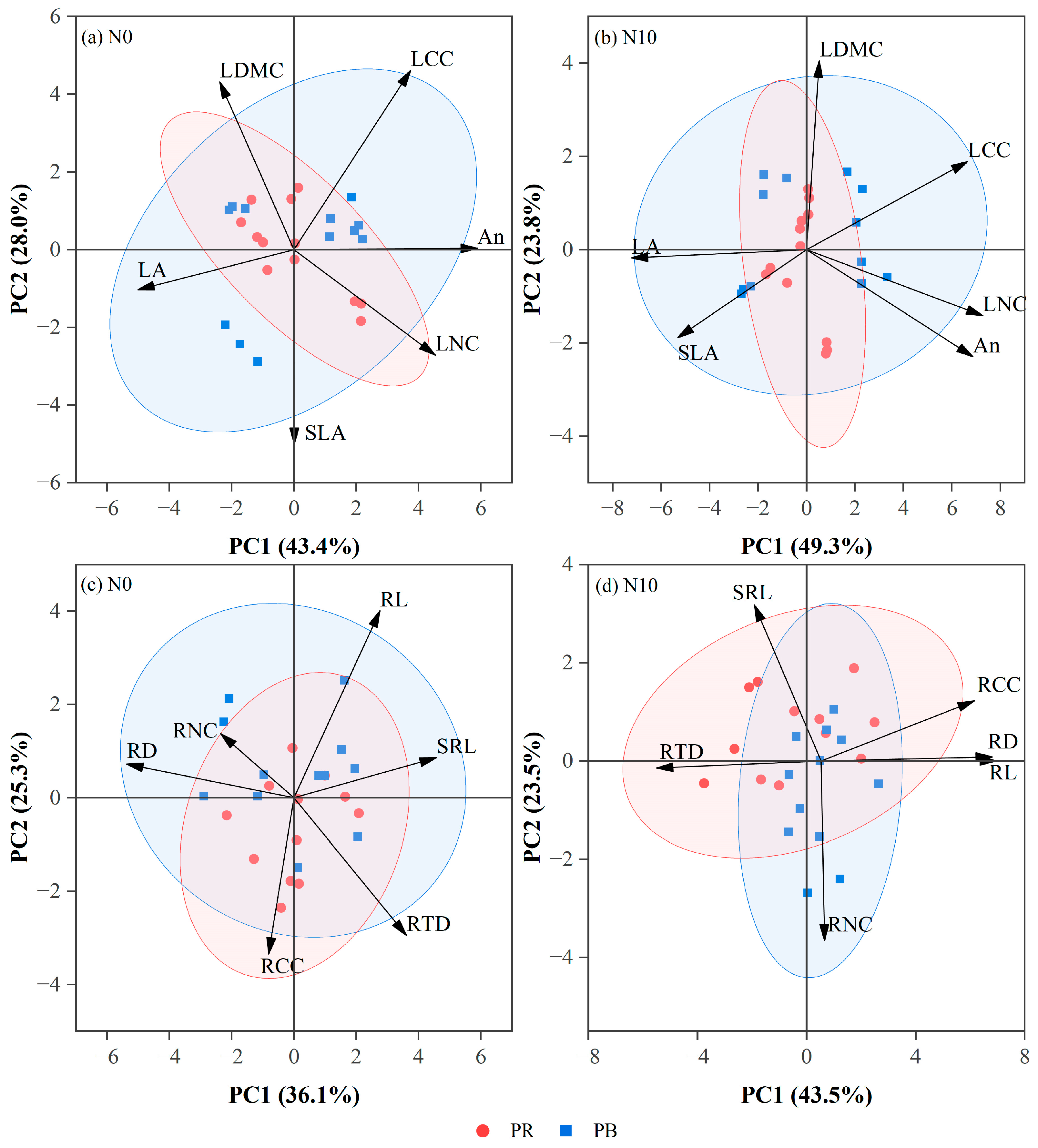
Principal component analysis revealed the resource acquisition strategies of different grass species under nitrogen addition (Figure 4). LPC1 is primarily determined by LA, An, and LNC, explaining 43.4% and 49.3% of the variation under control and nitrogen treatments, respectively (Figure 4a,b, Table S1). LPC2 is mainly determined by leaf coordination traits (SLA, LDMC), explaining 28.0% and 23.8% of the variation under control and nitrogen treatments, respectively (Figure 4a,b, Table S1). These results suggest that LPC1 represents the gradient of leaf resource acquisition, while LPC2 primarily reflects the gradient of leaf resource conservation.
In contrast to leaf traits, root traits exhibited more complex and multidimensional characteristics. RPC1 is determined by RD, SRL, and RL (Figure 4c,d, Table S1), representing a cooperative gradient of resource acquisition. It reflects as an axis associated with variation in root morphological traits related to potential resource acquisition strategies, explaining 36.1% and 43.5% of the variation under control and nitrogen treatments, respectively (Figure 4c,d). RPC2 is determined by RL, RTD, and RNC (Figure 4c,d, Table S1) and represents the root conservation gradient. It explains 25.3% and 23.5% of the variation under control and nitrogen treatments, respectively (Figure 4c,d).
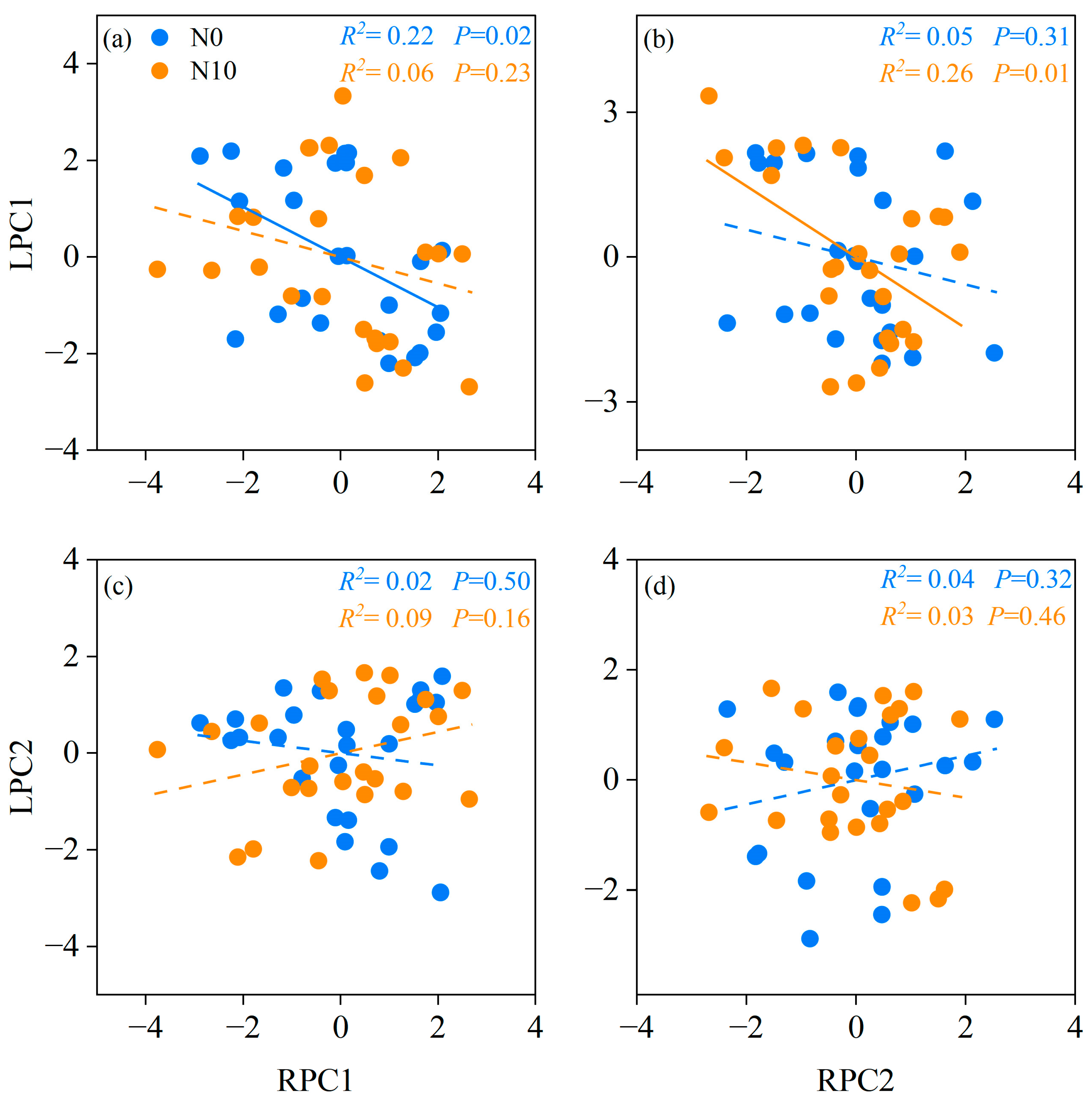
The analysis of the relationship between leaf and root trait dimensions revealed no general significant correlations. However, nitrogen addition induced a directional shift in these associations (Figure 5, Table S3). Under control treatment, RPC1 was significantly correlated with LPC1 (Figure 5a, Table S2). Under nitrogen addition, only LPC1 showed significant correlations with RPC2 (Figure 5b, Table S2). These findings suggest that leaf and root trait dimensions are not significantly correlated, indicating a decoupling between above- and belowground resource acquisition strategies. Furthermore, nitrogen addition may lead to variations in this decoupling pattern.

3.5. The Relationship Between Leaf and Root Traits and Biomass Responses to Nitrogen Addition

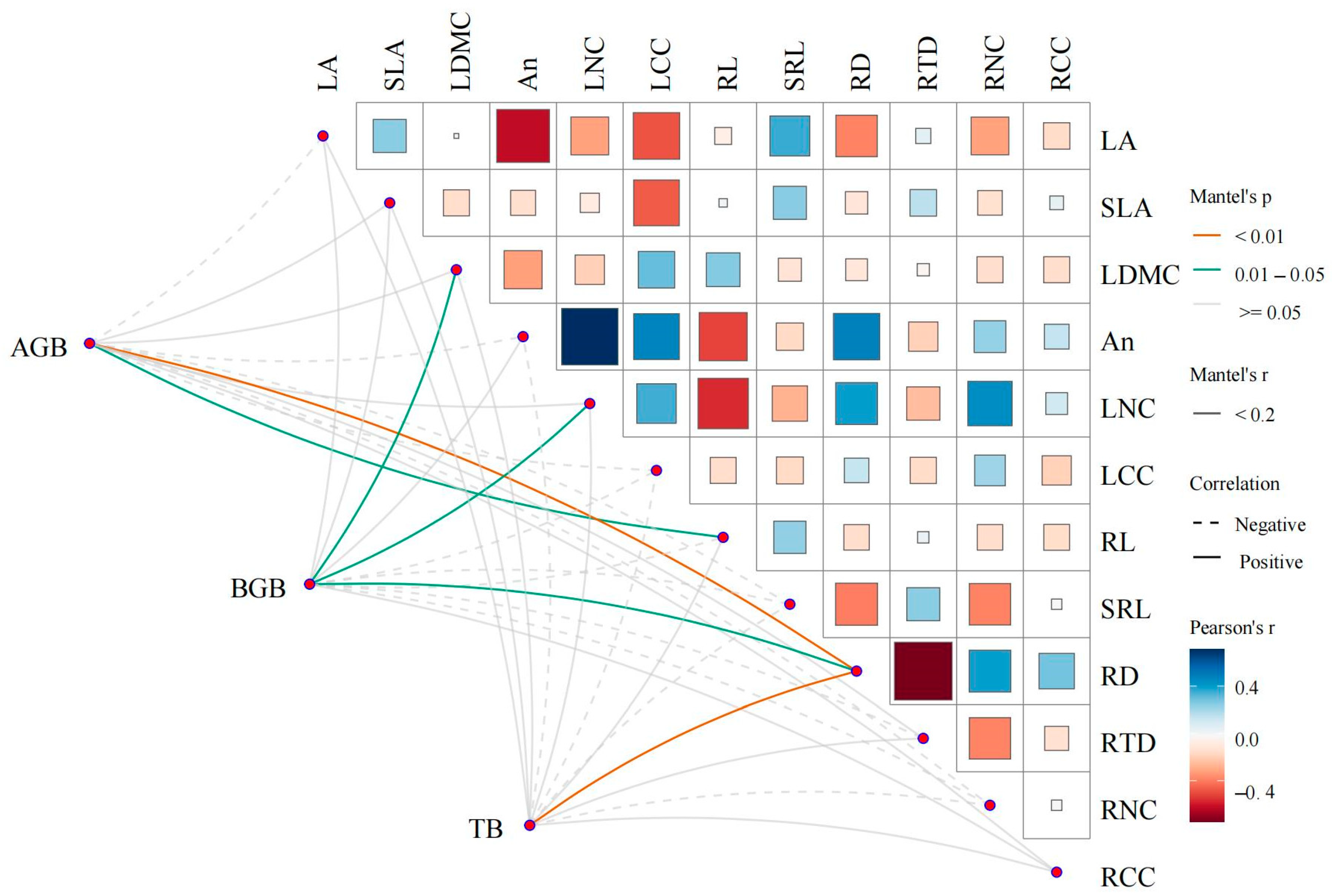
The Mantel test results showed significant correlations between aboveground, belowground, and total biomass with leaf and root traits (Figure 6). Notably, root traits related to plant growth, such as RL, were significantly correlated with AGB, while leaf traits associated with carbon acquisition strategy and growth rate, such as LDMC and LLNC, were significantly correlated with BGB. Additionally, root traits related to resource acquisition, such as RD, were significantly correlated with aboveground, belowground, and total biomass.

4. Discussion

4.1. The Variation in Leaf and Root Traits Under Nitrogen Addition

Plants respond to environmental disturbances by modifying their functional traits, allowing them to adjust to shifting conditions. Leaves, as the primary organs of photosynthesis, are also among the most environmentally sensitive plant organs. Leaf traits are closely linked to resource acquisition and plant adaptation strategies, representing key trade-offs between carbon gain and its subsequent use, which contribute to overall functional optimization. Our results showed that nitrogen addition significantly increased An and LNC in both perennial grass species, whereas other leaf traits remained largely unchanged (Figure 1). These findings are consistent with previous studies [20,21], which have demonstrated that nitrogen inputs enhance assimilation ability and leaf nitrogen content. This response is largely attributed to increased aboveground productivity and enhanced light interception resulting from greater canopy cover under nitrogen enrichment [22]. The absence of significant changes in other leaf traits may be explained by several underlying factors. As soil nitrogen availability increases, nitrogen is no longer a limiting factor for plant growth [23,24,25]. Under such conditions, nitrogen addition is more likely to promote plant growth by enhancing carbon assimilation capacity rather than inducing changes in leaf morphological plasticity.
Roots are the primary organs responsible for water and nutrient uptake, and root traits are key determinants of the ability to acquire soil resources. In this study, nitrogen addition significantly reduced RL in perennial rhizome grass (Figure 2a), while significantly increasing SRL in both perennial grass (Figure 2b). This pattern suggests a lower construction cost per unit root length, thereby enabling more efficient nutrient uptake from the soil [26]. Perennial grasses exhibit two distinct clonal growth strategies. Perennial rhizome grass mainly relies on rhizomes for vegetative reproduction; under nitrogen addition, sufficient nitrogen can be acquired with a shorter root system, thereby reducing carbon investment in roots and allowing greater allocation of carbon to rhizome spatial expansion. In contrast, perennial bunchgrasses also reproduce vegetatively but tend to allocate more carbon to sustain plant growth, resulting in increased SRL. Root tissue density, defined as the ratio of root dry mass to root volume, reflects biomass investment per unit root length and is closely associated with plant growth, defense capacity, and lifespan. Species with higher RTD typically possess a greater proportion of thick-walled tissues, enabling slower growth under stressful environmental conditions. RTD is generally higher in nutrient-poor soils, and previous studies have shown that it decreases with increasing nutrient availability [27]. Our results support this pattern, as nitrogen addition significantly reduced root tissue density (Figure 2d). RNC is an important indicator of fine-root physiological activity. In this study, nitrogen addition significantly increased RNC in both perennial grass species (Figure 2e), indicating enhanced nitrogen uptake and greater allocation of nitrogen to belowground tissues, thereby promoting root growth.
In summary, nitrogen addition primarily enhanced plant growth by increasing carbon assimilation efficiency, as evidenced by higher assimilation ability and leaf nitrogen content, rather than altering leaf morphological traits. For root traits, nitrogen enrichment reduced root construction costs and increased root physiological activity, reflected by higher SRL, lower RTD, and elevated RNC, thereby improving nutrient uptake efficiency. These leaf and root trait responses indicate that nitrogen addition shifts plant strategies toward more efficient resource acquisition and utilization, with life-form-specific adjustments in carbon allocation and growth pathways.

4.2. The Trait Dimensions and Correlations Under Nitrogen Addition

Identifying the principal dimensions of variation in leaf and root traits is essential for evaluating above- and belowground processes and plant functioning. Our results show that under nitrogen addition, the first leaf principal component (LPC1) was primarily determined by LA, An, and LNC, whereas LPC2 was mainly driven by leaf coordination traits, including SLA and LDMC. This pattern corresponds to the leaf economics spectrum, with one end representing a resource-acquisitive strategy and the other representing a resource-conservative strategy. Notably, the axis distinguishing conservative traits from economic trait variation is consistent with patterns previously reported at global [28,29], regional scales [30], and interspecific [28,29,30].
For root traits, RD and SRL defined PC1, whereas PC2 was mainly driven by RTD, RL, and RNC, indicating a two-dimensional structure of the RES. Within the broader RES framework [9], the first axis represents a trade-off between SRL and RD, corresponding to a collaboration gradient that ranges from “do-it-yourself” strategies (characterized by high SRL and low RD) to “outsourcing” strategies (low SRL and high RD). Our findings are consistent with findings reported across both regional [31,32] and global studies [9,33,34]. The second dimension captures a trade-off between fast and slow resource returns, commonly referred to as the root conservation gradient [9]. RNC as an indicator of nutrient concentration and metabolic activity, whereas RTD reflects carbon investment per unit volume. Along this gradient, acquisitive roots typically exhibit high RNC and low RTD, while conservative roots display the opposite pattern, with higher RTD and lower RNC. Overall, the multidimensional variation observed in both leaf and root traits underscores the diversity of plant ecological strategies and suggests that such trait combinations enable plants to flexibly respond to complex and heterogeneous environmental conditions [11].
Understanding the coordination between leaf and root traits is critical for elucidating whole-plant ecological strategies. Growing evidence suggests that there are broadly coordinated economics between plant above- and belowground organs at the interspecies level [34,35,36]. However, in contrast to previous studies, our study found that these relationships are not always apparent (Figure 5). This discrepancy may be explained by at least two factors. First, environmental drivers may exert differential influences on leaf versus root traits. Our results fully support this view that the magnitude of trait variation between corresponding leaf and root traits is not consistent under N addition. Plant organs may exhibit contrasting responses to the same environmental pressures, potentially resulting in a decoupling of resource-use strategies between leaves and roots [37]. In addition, belowground organs operate in more complex environments, as soil conditions with biotic (e.g., microbial communities) and abiotic (e.g., physicochemical properties) may differ fundamentally from those aboveground [38]. These differences can drive divergence in resource acquisition strategies between roots and leaves [9,37]. Second, the degree of leaf–root trait coordination may depend on spatial scale. Previous studies have shown that the strength of correlations between leaf and root traits can vary with spatial scale and even disappear at smaller scales [39]. For example, Liu found that leaf and root economics were coordinated at the regional scale [40]; however, such coordination was absent at the local scale [39,41], likely due to the relatively low environmental heterogeneity at smaller spatial extents. Overall, these two factors may explain the decoupling of intraspecific leaf and root traits. Lastly, we also considered an early-stage response to nitrogen addition. Leaves, which generally respond more rapidly to nutrient addition, exhibited increased An and LNC, whereas root traits showed more complex and sometimes delayed responses. This difference in response timing could lead to decoupling in a short-term N addition. Future multi-year experiments would help determine whether these decoupling patterns persist, diminish, or shift under prolonged nitrogen addition.
Although the relationship between leaf and root trait dimensions revealed no general significant correlations, nitrogen addition induced a directional shift in these associations (Figure 5, Table S3). In our study, nitrogen addition significantly increased An and LNC, and root traits also showed substantial changes, including increased SRL and reduced RTD (Figure 1 and Figure 2). This suggests that leaf traits were mainly associated with photosynthetic capacity and nutrient acquisition, whereas root traits reflected soil resource foraging and structural investment. In addition, leaf and root traits may be organized along different multidimensional axes. Leaf traits were primarily structured along resource acquisition and conservation gradients, whereas root traits exhibited more complex and multidimensional variation. Such differences may alter the direction of the relationship between leaf root traits, highlighting the dynamic nature of plant resource-use strategies under nitrogen addition.

4.3. The Trait–Performance Relationships Under Nitrogen Addition

Nitrogen addition significantly promoted both aboveground and belowground biomass accumulation in perennial rhizome grass (Figure 3a,b), resulting in a marked increase in total biomass (Figure 3c). In this life form, biomass accumulation in above- and belowground organs is governed by trade-offs between carbon assimilation and nutrient uptake [42]. Perennial rhizome grass primarily relies on aboveground tissues for carbohydrate synthesis and energy conversion, while belowground tissues function in mineral nutrient and water absorption as well as vegetative reproduction. Consequently, nitrogen addition provides sufficient nutrients for perennial rhizome grass, thereby stimulating biomass accumulation across plant organs. Nitrogen addition significantly increased aboveground and total biomass in perennial bunchgrasses, but had no significant effect on belowground biomass (Figure 3). This pattern suggests that perennial bunchgrasses are no longer limited by nutrient availability under nitrogen-enriched conditions; instead, their growth is primarily constrained by photosynthetic capacity. As a result, these species enhance leaf biomass investment to enhance light acquisition and photosynthetic performance, thereby increasing overall biomass production.
Plant functional traits are widely recognized as expressions of ecological strategies, and accumulating evidence indicates that variation in plant biomass is closely linked to adaptive shifts in these traits [43]. Our results show significant coupling across plant organs, indicating that variation in aboveground, belowground, and total biomass is structured by coordinated leaf and root strategies. Notably, traits traditionally associated with belowground foraging and growth (e.g., RL) were most strongly linked to aboveground biomass, whereas leaf economic traits associated with carbon acquisition strategy and growth rates (e.g., LDMC and LNC) were most strongly linked to belowground biomass. In addition, root diameter—often interpreted as a key axis of belowground resource acquisition and transport—was significantly correlated with aboveground, belowground, and total biomass, suggesting whole-plant integration in which belowground structural investment covaries with overall plant size or performance (Figure 6).
Leaf traits associated with acquisitive strategies (higher leaf N and lower LDMC) were most strongly correlated with belowground biomass. One explanation is that higher photosynthetic capacity associated with leaf N increases carbon availability, permitting greater construction and maintenance of root systems [44,45]. Meanwhile, we consider increasing nitrogen availability, as acquisition of leaf traits may not only stimulate carbon assimilation but also elevate plant demand for other limiting nutrients, particularly phosphorus (P). This shift may progressively drive ecosystems from N limitation toward P limitation, thereby reinforcing belowground investment in nutrient acquisition [46,47]. A complementary explanation is that nutrient-rich leaves have higher nutrient requirements, potentially selecting for greater belowground investment to sustain N uptake (via roots and associated symbionts) [29,48]. The positive association between root growth-related traits and aboveground biomass is consistent with the idea that shoot production is frequently constrained by belowground acquisition. Greater root length can increase the volume of soil explored and the rate at which plants encounter mobile resources and water, thereby reducing belowground limitation and allowing greater investment in leaves and stems [49]. In addition, root diameter was correlated with biomass across compartments, pointing to an integrated axis linking belowground structure with whole-plant biomass. Recent studies have revealed that with regard to root system functioning within a two-dimensional root economics spectrum, RD has been identified as a key trait, which is usually associated with mycorrhizal fungi symbiosis and metabolic activity [36,50]. Thicker roots may enhance transport capacity and persistence, and may be associated with mycorrhizal collaboration, both of which could promote sustained resource acquisition and growth across organs [51]. Overall, our findings indicate that predicting plant biomass allocation requires consideration of coordinated trait syndromes spanning leaves and roots. Therefore, the linkage between plant functional traits and biomass allocation may be inherently context-dependent, varying with background nutrient availability and soil development. Although phosphorus was not explicitly manipulated in this study, future work incorporating coupled N and P dynamics would help to further resolve these interactions.

5. Conclusions

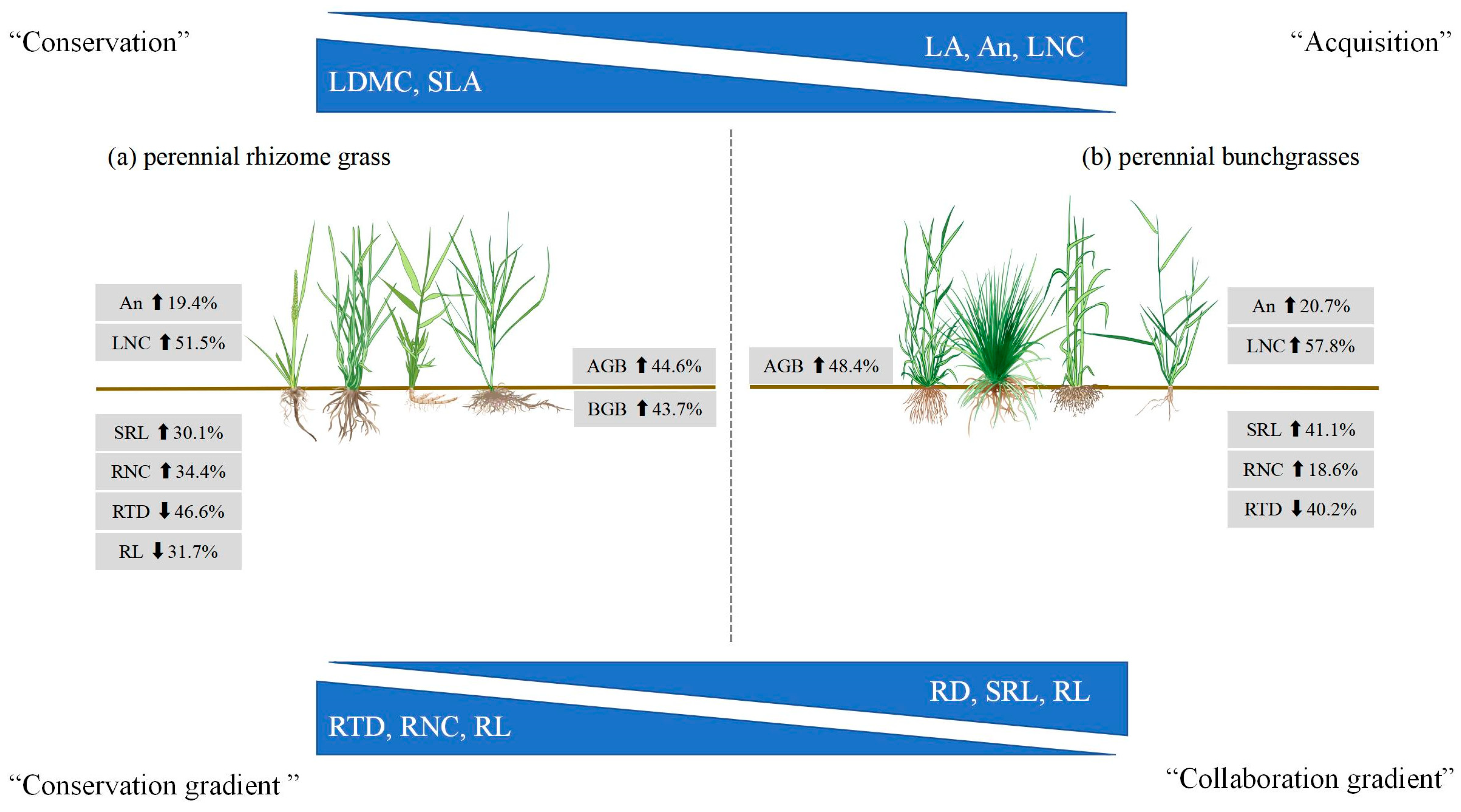
To explore how plant functional traits and resource-use strategies respond to nitrogen deposition, we conducted a nitrogen addition experiment focusing on changes in leaf and root traits and their associated acquisition strategies. Our results demonstrate that nitrogen enrichment significantly reshaped trait expression and resource-use patterns in perennial grasses. In particular, nitrogen inputs shifted both leaf and root traits toward more acquisitive strategies, while also influencing patterns of biomass allocation. Principal component analysis revealed multiple plant resource strategies reflected by multidimensional variation in leaf and root traits. Our results indicate this pattern corresponds to the leaf economics spectrum, with one end representing a resource-acquisitive strategy and the other a resource-conservative strategy. Similarly, root traits were structured along a two-dimensional RES, characterized by conservation and collaboration gradients, consistent with previous studies. However, we observed no coordination between leaf and root trait dimensions (Figure 7). The Mantel test revealed significant associations between leaf and root traits and aboveground, belowground, and total biomass. These results indicate that variation in biomass is correlated with multidimensional leaf and root trait patterns. These findings support a multidimensional view of plant functional traits in the studied perennial grasses and provide insights into plant adaptive responses under nitrogen enrichment in the Songnen grassland. The implications of these results need to be explored through longer-term nitrogen addition experiments, along with the integration of environmental factors and larger-scale studies, in order to determine whether the observed phenomena are stable or temporary.

Supplementary Materials

The following supporting information can be downloaded at https://www.mdpi.com/article/10.3390/agronomy16070739/s1, Table S1. PCA loadings of the leaf, root traits. Table S2. Standardized major axis regression (SMA) analyses of the leaf traits principal component axis 1 (LPC1) and the root traits principal component axis 1 (RPC1), leaf traits principal component axis 1 (LPC1) and root traits principal component axis 2 (RPC2), leaf traits principal component axis 2 (LPC2) and root traits principal component axis 1 (RPC1), leaf traits principal component axis 2 (LPC2) and root traits principal component axis 2 (RPC2) under nitrogen addition treatments. Table S3. Standardized major axis regression (SMA) analyses of the leaf, root principal component axis (LPC1, LPC2, RPC1, RPC2, PPC1, PPC2) between N0 vs N10 treatments.

Author Contributions

Conceptualization, Y.Y. and X.W.; methodology, Y.Y.; software, H.C. and G.L.; validation, Y.Y. and H.C.; formal analysis, G.L. and H.R.; investigation, X.W.; resources, X.W.; data curation, Y.Y. and G.L.; writing—original draft preparation, Y.Y.; writing—review and editing, H.C., G.L. and H.R.; visualization, H.R.; supervision, H.C.; project administration, X.W.; funding acquisition, Y.Y., and X.W. All authors have read and agreed to the published version of the manuscript.

Funding

This research was funded by the Fundamental Research Funds for the Science and Technology Project of the Jilin Provincial Education Department (JJKH20250599KJ).

Data Availability Statement

The original contributions presented in this study are included in the article/Supplementary Materials. Further inquiries can be directed to the corresponding author.

Acknowledgments

During the preparation of this manuscript, the author used DeepSeek, v3.2, for the purposes of checking the grammar of the manuscript. The authors have reviewed and edited the output and take full responsibility for the contents of this publication.

Conflicts of Interest

The authors declare no conflicts of interest.

Abbreviations

The following abbreviations are used in this manuscript:
LAleaf area
SLAspecific leaf area
Anassimilation ability
LNCleaf nitrogen content
LCCleaf carbon content
RLroot length
SRLspecific leaf area
RDroot diameter
RTDroot tissue density
RNCroot nitrogen content
RCCroot carbon content
AGBaboveground biomass
BGBbelowground biomass
TBtotal biomass

References

  1. Zhu, J.; Jia, Y.; Yu, G.; Wang, Q.; He, N.; Chen, Z.; He, H.; Zhu, X.; Li, P.; Zhang, F.; et al. Changing patterns of global nitrogen deposition driven by socio-economic development. Nat. Commun. 2025, 16, 46. [Google Scholar] [CrossRef] [Scilit]
  2. Wang, F.; Zhang, J.; Zeng, Y.; Wang, H.; Zhao, X.; Chen, Y.; Deng, H.; Ge, L.; Dahlgren, R.A.; Gao, H.; et al. Arsenic mobilization and nitrous oxide emission modulation by different nitrogen management strategies in a flooded ammonia-enriched paddy soil. Pedosphere 2024, 34, 1051–1065. [Google Scholar] [CrossRef] [Scilit]
  3. Blumstein, M.; Sala, A.; Weston, D.J.; Holbrook, N.M.; Hopkins, R. Plant carbohydrate storage: Intra- and inter-specific trade-offs reveal a major life history trait. New Phytol. 2022, 235, 2211–2222. [Google Scholar] [CrossRef] [Scilit] [PubMed]
  4. Peng, J.; Ma, F.; Tian, D.; Quan, Q.; Chen, C.; Liao, J.; Zhou, Q.; Niu, S. Plant C:N ratio predicts community composition changes under N addition in an alpine meadow. J. Ecol. 2023, 111, 589–600. [Google Scholar] [CrossRef] [Scilit]
  5. Wright, I.J.; Reich, P.B.; Westoby, M.; Ackerly, D.D.; Baruch, Z.; Bongers, F.; Cavender-Bares, J.; Chapin, T.; Cornelissen, J.H.C.; Diemer, M.; et al. The worldwide leaf economics spectrum. Nature 2004, 428, 821–827. [Google Scholar] [CrossRef] [Scilit]
  6. Zhang, P.; Ding, J.; Wang, Q.; McDowell, N.G.; Kong, D.; Tong, Y.; Yin, H. Contrasting coordination of non-structural carbohydrates with leaf and root economic strategies of alpine coniferous forests. New Phytol. 2024, 243, 580–590. [Google Scholar] [CrossRef] [Scilit]
  7. Wang, Z.; Townsend, P.A.; Kruger, E.L. Leaf spectroscopy reveals divergent inter- and intra-species foliar trait covariation and trait-environment relationships across NEON domains. New Phytol. 2022, 235, 923–938. [Google Scholar] [CrossRef] [Scilit]
  8. Weemstra, M.; Mommer, L.; Visser, E.J.W.; van Ruijven, J.; Kuyper, T.W.; Mohren, G.M.J.; Sterck, F.J. Towards a multidimensional root trait framework: A tree root review. New Phytol. 2016, 211, 1159–1169. [Google Scholar] [CrossRef] [Scilit]
  9. Bergmann, J.; Weigelt, A.; van der Plas, F.; Laughlin, D.C.; Kuyper, T.W.; Guerrero-Ramirez, N.; Valverde-Barrantes, O.J.; Bruelheide, H.; Freschet, G.T.; Iversen, C.M.; et al. The fungal collaboration gradient dominates the root economics space in plants. Sci. Adv. 2020, 6, eaba3756. [Google Scholar] [CrossRef] [Scilit] [PubMed]
  10. de La Riva, E.G.; Tosto, A.; Pérez-Ramos, I.M.; Navarro-Fernández, C.M.; Olmo, M.; Anten, N.P.; Marañón, T.; Villar, R. A plant economics spectrum in Mediterranean forests along environmental gradients: Is there coordination among leaf, stem and root traits? J. Veg. Sci. 2016, 27, 187–199. [Google Scholar] [CrossRef] [Scilit]
  11. Sun, K.; Sun, R.; Liu, L.; Li, Y.; Zhou, G.; Xu, Z. Global coordination and trade-off of grassland species traits and climatic drivers. J. Ecol. 2025, 113, 3210–3224. [Google Scholar] [CrossRef] [Scilit]
  12. Delpiano, C.A.; Prieto, I.; Loayza, A.P.; Carvajal, D.E.; Squeo, F.A. Different responses of leaf and root traits to changes in soil nutrient availability do not converge into a community-level plant economics spectrum. Plant Soil 2020, 450, 463–478. [Google Scholar] [CrossRef] [Scilit]
  13. Wang, Y.; Tian, X.; Yang, C.; Guo, C.; Li, Y.; Lyu, X.; Li, N.; Guo, H. Adaptive Plasticity of Phragmites australis in Aboveground and Belowground Productivity Under Salinization and Nitrogen Enrichment. Agronomy 2025, 15, 2031. [Google Scholar] [CrossRef] [Scilit]
  14. Yang, Z.; Minggagud, H.; Wang, Q.; Pan, H. Interacting Effects of Nitrogen Addition and Mowing on Plant Diversity and Biomass of a Typical Grassland in Inner Mongolia. Agronomy 2023, 13, 2125. [Google Scholar] [CrossRef] [Scilit]
  15. Zhang, H.; Li, W.; Adams, H.D.; Wang, A.; Wu, J.; Jin, C.; Guan, D.; Yuan, F. Responses of Woody Plant Functional Traits to Nitrogen Addition: A Meta-Analysis of Leaf Economics, Gas Exchange, and Hydraulic Traits. Front. Plant Sci. 2018, 9, 683. [Google Scholar] [CrossRef] [Scilit]
  16. Su, Y.; Tang, Y.; Hu, Y.; Liu, M.; Lu, X.; Duan, B. Exploring plant adaptation strategies to phosphorus limitation induced by nitrogen addition: Foliar phosphorus allocation and root functional traits analysis in two dominant subalpine tree species. J. Plant Ecol. 2024, 17, rtae060. [Google Scholar] [CrossRef] [Scilit]
  17. Hai, X.; Shangguan, Z.; Peng, C.; Deng, L. Leaf trait responses to global change factors in terrestrial ecosystems. Sci. Total Environ. 2023, 898, 165572. [Google Scholar] [CrossRef] [Scilit] [PubMed]
  18. Li, W.; Jin, C.; Guan, D.; Wang, Q.; Wang, A.; Yuan, F.; Wu, J. The effects of simulated nitrogen deposition on plant root traits: A meta-analysis. Soil Biol. Biochem. 2015, 82, 112–118. [Google Scholar] [CrossRef] [Scilit]
  19. Caplan, J.S.; Stone, B.W.G.; Faillace, C.A.; Lafond, J.J.; Baumgarten, J.M.; Mozdzer, T.J.; Dighton, J.; Meiners, S.J.; Grabosky, J.C.; Ehrenfeld, J.G. Nutrient foraging strategies are associated with productivity and population growth in forest shrubs. Ann. Bot. 2017, 119, 977–988. [Google Scholar] [CrossRef] [Scilit] [PubMed]
  20. Yu, J.; Song, Z.; Hou, J. Life form-dependent nitrogen–phosphorous allocation strategies of leaf and fine root in a temperate natural forest under long-term nitrogen addition. J. Plant Ecol. 2023, 16, rtad013. [Google Scholar] [CrossRef] [Scilit]
  21. Shi, X.-M.; Qi, J.-H.; Liu, A.-X.; Zakari, S.; Song, L. Leaf phenotypic plasticity coupled with integration facilitates the adaptation of plants to enhanced N deposition. Environ. Pollut. 2023, 327, 121570. [Google Scholar] [CrossRef] [Scilit] [PubMed]
  22. Ye, X.; Bu, W.; Hu, X.; Wang, F.; Sun, R.; He, P.; Liang, X.; Chen, F. Are small trees more responsive to nutrient addition than large trees in an evergreen broadleaved forest? For. Ecol. Manag. 2023, 543, 121129. [Google Scholar] [CrossRef] [Scilit]
  23. Yu, G.; Chen, J.; Li, A.; Wang, S.; Song, L.; Shi, X.; Yan, J.; Xu, M.; Xue, Y.; Lu, X.; et al. Plant morphological and physiological traits are stable in a nitrogen-saturated tropical forest after 18-year nitrogen additions. Plant Soil 2025, 514, 1703–1716. [Google Scholar] [CrossRef] [Scilit]
  24. Lu, X.; Vitousek, P.M.; Mao, Q.; Gilliam, F.S.; Luo, Y.; Zhou, G.; Zou, X.; Bai, E.; Scanlon, T.M.; Hou, E.; et al. Plant acclimation to long-term high nitrogen deposition in an N-rich tropical forest. Proc. Natl. Acad. Sci. USA 2018, 115, 5187–5192. [Google Scholar] [CrossRef] [Scilit]
  25. Tian, J.; Dungait, J.A.J.; Lu, X.; Yang, Y.; Hartley, I.P.; Zhang, W.; Mo, J.; Yu, G.; Zhou, J.; Kuzyakov, Y. Long-term nitrogen addition modifies microbial composition and functions for slow carbon cycling and increased sequestration in tropical forest soil. Glob. Change Biol. 2019, 25, 3267–3281. [Google Scholar] [CrossRef] [Scilit]
  26. Wen, Z.; Pang, J.; Tueux, G.; Liu, Y.; Shen, J.; Ryan, M.H.; Lambers, H.; Siddique, K.H.M. Contrasting patterns in biomass allocation, root morphology and mycorrhizal symbiosis for phosphorus acquisition among 20 chickpea genotypes with different amounts of rhizosheath carboxylates. Funct. Ecol. 2020, 34, 1311–1324. [Google Scholar] [CrossRef] [Scilit]
  27. Gao, W.; Chen, D.; Hu, X.; Fang, X.; Li, Q.; Huang, Q.; Sun, F.; Zhou, J.; Bai, Y.; Zhang, J.; et al. Nitrogen deposition drives the intricate changes of fine root traits. Glob. Ecol. Conserv. 2023, 43, e02443. [Google Scholar] [CrossRef] [Scilit]
  28. Díaz, S.; Kattge, J.; Cornelissen, J.H.C.; Wright, I.J.; Lavorel, S.; Dray, S.; Reu, B.; Kleyer, M.; Wirth, C.; Prentice, I.C.; et al. The global spectrum of plant form and function. Nature 2016, 529, 167–171. [Google Scholar] [CrossRef] [Scilit]
  29. Joswig, J.S.; Wirth, C.; Schuman, M.C.; Kattge, J.; Reu, B.; Wright, I.J.; Sippel, S.D.; Rüger, N.; Richter, R.; Schaepman, M.E.; et al. Climatic and soil factors explain the two-dimensional spectrum of global plant trait variation. Nat. Ecol. Evol. 2022, 6, 36–50. [Google Scholar] [CrossRef] [Scilit]
  30. Puglielli, G.; Bricca, A.; Chelli, S.; Petruzzellis, F.; Acosta, A.T.R.; Bacaro, G.; Beccari, E.; Bernardo, L.; Bonari, G.; Bolpagni, R.; et al. Intraspecific variability of leaf form and function across habitat types. Ecol. Lett. 2024, 27, e14396. [Google Scholar] [CrossRef] [Scilit]
  31. de La Riva, E.G.; Prieto, I.; Marañón, T.; Pérez-Ramos, I.M.; Olmo, M.; Villar, R. Root economics spectrum and construction costs in Mediterranean woody plants: The role of symbiotic associations and the environment. J. Ecol. 2021, 109, 1873–1885. [Google Scholar] [CrossRef] [Scilit]
  32. Ding, J.; Kong, D.; Zhang, Z.; Cai, Q.; Xiao, J.; Liu, Q.; Yin, H. Climate and soil nutrients differentially drive multidimensional fine root traits in ectomycorrhizal-dominated alpine coniferous forests. J. Ecol. 2020, 108, 2544–2556. [Google Scholar] [CrossRef] [Scilit]
  33. Weigelt, A.; Mommer, L.; Andraczek, K.; Iversen, C.M.; Bergmann, J.; Bruelheide, H.; Fan, Y.; Freschet, G.T.; Guerrero-Ramírez, N.R.; Kattge, J.; et al. An integrated framework of plant form and function: The belowground perspective. New Phytol. 2021, 232, 42–59. [Google Scholar] [CrossRef] [Scilit]
  34. Carmona, C.P.; Bueno, C.G.; Toussaint, A.; Träger, S.; Díaz, S.; Moora, M.; Munson, A.D.; Pärtel, M.; Zobel, M.; Tamme, R. Fine-root traits in the global spectrum of plant form and function. Nature 2021, 597, 683–687. [Google Scholar] [CrossRef] [Scilit]
  35. Sanaei, A.; Andraczek, K.; Kretz, L.; Schnabel, F.; Richter, R.; Kahl, A.; Nabel, N.; von Sivers, L.; Künne, T.; van Braak, J.L.; et al. Above- and below-ground trait coordination across 90 angiosperm and gymnosperm tree species in a common garden experiment. J. Ecol. 2026, 114, e70220. [Google Scholar] [CrossRef] [Scilit]
  36. Fan, A.; Wang, X.; Yan, X.; Chen, T.; Jiang, Q.; Jia, L.; Wang, W.; Xiong, D.; Huang, J.; Chen, G. Does a whole plant conservation gradient exist within a subtropical broadleaved evergreen forest? Front. Plant Sci. 2024, 15, 1481323. [Google Scholar] [CrossRef] [Scilit]
  37. Laughlin, D.C.; Lusk, C.H.; Bellingham, P.J.; Burslem, D.F.R.P.; Simpson, A.H.; Kramer-Walter, K.R. Intraspecific trait variation can weaken interspecific trait correlations when assessing the whole-plant economic spectrum. Ecol. Evol. 2017, 7, 8936–8949. [Google Scholar] [CrossRef] [Scilit] [PubMed]
  38. Mommer, L.; Weemstra, M. The role of roots in the resource economics spectrum. New Phytol. 2012, 195, 725–727. [Google Scholar] [CrossRef] [Scilit]
  39. Fraterrigo, J.M.; Chen, W.; Loyal, J.; Euskirchen, E.S. Soil microenvironmental variation drives below-ground trait variation and interacts with macroclimate to structure above-ground trait variation of arctic shrubs. J. Ecol. 2024, 112, 901–916. [Google Scholar] [CrossRef] [Scilit]
  40. Liu, R.; Yang, X.; Gao, R.; Huang, Z.; Cornelissen, J.H.C. Coordination of economics spectra in leaf, stem and root within the genus Artemisia along a large environmental gradient in China. Glob. Ecol. Biogeogr. 2023, 32, 324–338. [Google Scholar] [CrossRef] [Scilit]
  41. Da, R.; He, H.; Zhang, Z.; Zhao, X.; von Gadow, K.; Zhang, C. Leaf and root economics space in Fraxinus mandshurica: A test of the multidimensional trait framework within species. J. Ecol. 2025, 113, 1004–1017. [Google Scholar] [CrossRef] [Scilit]
  42. Zou, Y.; Li, B.; Peñuelas, J.; Sardans, J.; Yu, H.; Chen, X.; Deng, X.; Cheng, D.; Zhong, Q. Response of functional traits in Machilus pauhoi to nitrogen addition is influenced by differences of provenances. For. Ecol. Manag. 2022, 513, 120207. [Google Scholar] [CrossRef] [Scilit]
  43. Li, Y.; Jiang, Y.; Zhao, K.; Chen, Y.; Wei, W.; Shipley, B.; Chu, C. Exploring trait-performance relationships of tree seedlings along experimentally manipulated light and water gradients. Ecology 2022, 103, e3703. [Google Scholar] [CrossRef] [Scilit]
  44. Blumenthal, D.M.; Mueller, K.E.; Kray, J.A.; Ocheltree, T.W.; Augustine, D.J.; Wilcox, K.R. Traits link drought resistance with herbivore defence and plant economics in semi-arid grasslands: The central roles of phenology and leaf dry matter content. J. Ecol. 2020, 108, 2336–2351. [Google Scholar] [CrossRef] [Scilit]
  45. Polley, H.W.; Collins, H.P.; Fay, P.A. Community leaf dry matter content predicts plant production in simple and diverse grassland. Ecosphere 2022, 13, e4076. [Google Scholar] [CrossRef] [Scilit]
  46. Li, C.; Lu, X.; Chen, J.; Tan, Q.; Luo, G.; Wu, L.; Chen, F.; Ran, C.; Zhang, S.; Xiong, L.; et al. Silicate chemical weathering disrupts the global patterns of phosphorus limitation. Nat. Commun. 2025, 16, 10742. [Google Scholar] [CrossRef] [Scilit]
  47. Zhao, Y.; Wang, H.; Song, B.; Xue, P.; Zhang, W.; Peth, S.; Lee Hill, R.; Horn, R. Characterizing uncertainty in process-based hydraulic modeling, exemplified in a semiarid Inner Mongolia steppe. Geoderma 2023, 440, 116713. [Google Scholar] [CrossRef] [Scilit]
  48. Goud, E.M.; Agrawal, A.A.; Sparks, J.P. A direct comparison of ecological theories for predicting the relationship between plant traits and growth. Ecology 2023, 104, e3986. [Google Scholar] [CrossRef] [Scilit] [PubMed]
  49. Freschet, G.T.; Pagès, L.; Iversen, C.M.; Comas, L.H.; Rewald, B.; Roumet, C.; Klimešová, J.; Zadworny, M.; Poorter, H.; Postma, J.A.; et al. A starting guide to root ecology: Strengthening ecological concepts and stand-ardising root classification, sampling, processing and trait measurements. New Phytol. 2021, 232, 973–1122. [Google Scholar] [CrossRef] [Scilit] [PubMed]
  50. de La Riva, E.G.; Querejeta, J.I.; Villar, R.; Pérez-Ramos, I.M.; Marañón, T.; Galán Díaz, J.; de Tomás Marín, S.; Prieto, I. The Economics Spectrum Drives Root Trait Strategies in Mediterranean Vegetation. Front. Plant Sci. 2021, 12, 773118. [Google Scholar] [CrossRef] [Scilit]
  51. Weemstra, M.; Kiorapostolou, N.; van Ruijven, J.; Mommer, L.; de Vries, J.; Sterck, F. The role of fine-root mass, specific root length and life span in tree performance: A whole-tree exploration. Funct. Ecol. 2020, 34, 575–585. [Google Scholar] [CrossRef] [Scilit]
Figure 1. Effect of nitrogen addition on leaf traits. PR: perennial rhizome grass; PB: perennial bunchgrasses. The violin plot where the black pot, white box and white lines display the median, interquartile range, whiskers (upper/lower limits), respectively (af). Statistically significant differences between treatments are indicated by different lowercase letters (p < 0.05; n = 12).
Agronomy 16 00739 g001
Figure 2. Effect of nitrogen addition on root traits. PR: perennial rhizome grass, PB: perennial bunchgrasses. The violin plot where the black pot, white box and white lines display the median, interquartile range, whiskers (upper/lower limits), respectively (af). Statistically significant differences between treatments are indicated by different lowercase letters (p < 0.05; n = 12).
Agronomy 16 00739 g002
Figure 3. Effect of nitrogen addition on biomass. PR: perennial rhizome grass; PB: perennial bunchgrasses. The violin plot where the black pot, white box and white lines display the median, interquartile range, whiskers (upper/lower limits), respectively (ac). Statistically significant differences between treatments are indicated by different lowercase letters (p < 0.05; n = 12).
Agronomy 16 00739 g003
Figure 4. Principal component analysis (PCA) of leaf and root functional traits. In the (ad), the red circles and blue squares represent different sample points, which indicate the positions of the samples in the principal component space. Leaf traits: leaf area (LA), specific leaf area (SLA), assimilation ability (An), leaf nitrogen content (LNC), leaf carbon content (LCC). Root traits: root length (RL), specific leaf area (SRL), root diameter (RD), root tissue density (RTD), root nitrogen content (RNC), root carbon content (RCC).
Agronomy 16 00739 g004
Figure 5. Correlations between multiple leaf and root trait dimensions under nitrogen treatment. The blue and orange circles respectively represent N0 (control) and N10 (nitrogen addition). Solid lines show linear relationships when p < 0.05. LPC1 and LPC2, the scores of the first two axes from LPCA (PCA axis for leaf traits), represent the leaf conservation and acquisitive gradient, respectively (ad); RPC1 and RPC2, the scores of the first two axes from RPCA (PCA axis for root traits), represent the root collaboration and conservation gradients, respectively.
Agronomy 16 00739 g005
Figure 6. The Mantel test for the relationship between the composition of AGB (aboveground biomass), BGB (belowground biomass), TB (total biomass), and leaf, root traits. Leaf traits: leaf area (LA), specific leaf area (SLA), assimilation ability (An), leaf nitrogen content (LNC), leaf carbon content (LCC). Root traits: root length (RL), specific leaf area (SRL), root diameter (RD), root tissue density (RTD), root nitrogen content (RNC), root carbon content (RCC). The edge width and color represent Mantel’s r statistic and statistical significance based on permutations, respectively.
Agronomy 16 00739 g006
Figure 7. Conceptual framework illustrating the contrasting coordination of economics spectrums in leaves and roots. (a) Comparison results of trait variations in perennial rhizome grass under nitrogen treatment, (b) comparison results of trait variations in perennial bunchgrasses under nitrogen treatment. An upward arrow indicates an increase, while a downward arrow indicates a decrease. Abbreviation annotation: aboveground biomass (AGB), belowground biomass (BGB), assimilation ability (An), leaf nitrogen content (LNC), root length (RL), specific leaf area (SRL), root tissue density (RTD), root nitrogen content (RNC), root carbon content (RCC).
Agronomy 16 00739 g007
Table 1. Chemical and physical properties of the basic soil.
Soil PropertiesSoil pHTotal Nitrogen
(g·kg−1)
Total Carbon
(g·kg−1)
Total Phosphorus
(g·kg−1)
Soil EC
(µS·cm−1)
Content8.120.080.890.47136.13
Table 2. Information on the grasses in this study.
Life FormGeneraPlant Species
PRAgropyronAgropyron michnoi Roshev. (Gramineae)
LeymusLeymus chinensis (Trin.) Tzvel.
LeymusLeymus secalinus (Georgi) Tzvel.
PhragmitesPhragmites australis (Cav.) Trin. ex Steud.
PBAchnatherumAchnatherum splendens (Trin.) Nevski
ElymusElymus dahuricus Turcz.
PuccinelliaPuccinellia chinampoensis Ohwi
PuccinelliaPuccinellia tenuiflora (Griseb.) Scribn. et Merr.
Note: perennial rhizome grass (PR), perennial bunchgrasses (PB).
Table 3. Results (F-values) of two-way ANOVAs on the effects of nitrogen addition (N) and life form (L) on leaf traits.
Leaf traitsNLN × L
LA0.24815.424 ***0.178
SLA0.8692.8211.327
LDMC0.0771.2081.004
An29.353 ***1.2450.003
LNC42.500 ***1.8390.000
LCC0.6121.6551.132
Note: * denotes significant difference at p < 0.05; ** denotes significant difference at p < 0.01; *** denotes significant difference at p < 0.001.
Table 4. Results (F-values) of two-way ANOVAs on the effects of nitrogen addition (N) and life form (L) on root traits.
Leaf TraitsNLN × L
RL7.717 **4.239 *0.383
SRL20.593 ***0.2110.444
RD1.3951.6260.132
RTD 36.063 ***0.2401.104
RNC29.580 ***34.569 ***0.706
RCC0.9744.144 *9.996 **
Note: * denotes significant difference at p < 0.05; ** denotes significant difference at p < 0.01; *** denotes significant difference at p < 0.001.
Table 5. Results (F-values) of two-way ANOVAs on the effects of nitrogen addition (N) and life form (L) on biomass.
Leaf TraitsNLN × L
AGB12.079 **42.334 ***1.228
BGB9.395 **45.158 ***6.377 *
TB13.954 **55.039 ***3.468
Note: * denotes significant difference at p < 0.05; ** denotes significant difference at p < 0.01; *** denotes significant difference at p < 0.001.
Disclaimer/Publisher’s Note: The statements, opinions and data contained in all publications are solely those of the individual author(s) and contributor(s) and not of MDPI and/or the editor(s). MDPI and/or the editor(s) disclaim responsibility for any injury to people or property resulting from any ideas, methods, instructions or products referred to in the content.