Article

Mechanisms of Cadmium Immobilization by Biochar and Lime in Acidic Paddy Soils: The Critical Influence of pH Buffering Capacity

1
Institute of Botany, Jiangsu Province and Chinese Academy of Sciences (Nanjing Botanical Garden Mem. Sun Yat-Sen), Nanjing 210014, China
2
Marine Geological Survey of Jiangsu Province, Nanjing 210007, China
3
Guangdong Provincial Key Laboratory for Plant Epigenetics, Guangdong Engineering Research Center for Marine Algal Biotechnology, College of Life Science and Oceanography, Shenzhen University, Shenzhen 518060, China
4
Department of Chemistry, University of Buea, Buea P.O. Box 63, Cameroon
*
Author to whom correspondence should be addressed.
Agronomy 2026, 16(7), 738; https://doi.org/10.3390/agronomy16070738

Submission received: 14 February 2026 / Revised: 25 March 2026 / Accepted: 30 March 2026 / Published: 31 March 2026
(This article belongs to the Special Issue Agricultural Pollution: Toxicology and Remediation Strategies)

Abstract

The persistence of cadmium (Cd) immobilization in acidic paddy soils is exacerbated by acidification and fluctuating redox conditions that promote Cd re-mobilization. While biochar is a promising amendment, its long-term efficacy in Cd immobilization relative to conventional lime and the underlying mechanisms remain incompletely resolved. This study tested the hypothesis that biochar’s superior effect lies in its durable enhancement of soil pH buffering capacity (pHBC), not merely in increasing initial pH. Using six acidic paddy soils amended with three biochars (corn straw, peanut straw, and seeded sunflower plate) and pH-matched lime [Ca(OH)2] controls, we quantified pHBC changes, resistance to simulated acidification, and Cd dynamics during a flooding-drying cycle. Results showed that biochar amendments increased pHBC by 24.7–110%, significantly more than lime. Under acid stress, biochar-treated soils maintained higher pH and released 40–85% less soluble and extractable Cd than lime controls at equivalent pH range. Correlation and regression analyses established that the biochar-induced change in pHBC (ΔpHBC) was the strongest predictor of reduced Cd availability, exerting twice the influence of native soil pHBC. During the redox cycle, enhanced pHBC directly attenuated soil re-acidification upon drainage, minimizing Cd re-mobilization. Thus, the durable enhancement of soil pHBC is the central mechanism for biochar’s sustained Cd immobilization, advocating a strategic shift from transient pH adjustment to building inherent soil buffering resilience for long-term remediation security.

1. Introduction

The global challenge of soil acidification constitutes a profound threat to agricultural productivity and ecosystem stability. Soil acidification is driven by intensive agricultural practices, notably ammonium-based fertilizer overuse, alongside industrial emissions and acidic deposition [1,2]. It accelerates the leaching of essential base cations (Ca2+, Mg2+, K+) and increases the solubility of phytotoxic aluminum (Al3+) and manganese (Mn2+) [3,4,5]. In China, where food security is paramount, cropland acidification has advanced rapidly, with significant pH declines reported across major agricultural regions [1,2,6]. This degradation of the soil chemical environment is particularly detrimental in paddy ecosystems, which are the cornerstone of Asian food security [6,7]. In paddy ecosystems, the inherent biogeochemistry is uniquely complex, involving cycles of anaerobic flooding and aerobic drainage that create dynamic redox oscillations. This continuously modulates soil pH, nutrient availability, and the speciation of metal contaminants [8,9]. This inherent instability renders paddy soils especially vulnerable to acidification stress, undermining their long-term fertility and environmental function.
Compounding this issue is the widespread co-occurrence of heavy metal contamination, with cadmium (Cd) representing one of the most significant threats to food safety. Cd enters agricultural systems through pathways such as mining, smelting, sewage sludge application, and improper electronic waste (e-waste) dismantling [10,11,12]. Its high mobility and bioavailability in acidic soils, coupled with efficient root uptake and translocation in rice (Oryza sativa L.), lead to accumulation in grains [12,13,14]. Chronic dietary exposure to Cd is linked to severe human health outcomes, including itai-itai disease, renal tubular dysfunction, and osteoporosis [15,16]. The environmental fate of Cd in paddy soils is linked to pH and redox potential (Eh). During flooding, the increase in pH and the reduction of sulfate to sulfide can promote Cd immobilization via precipitation as CdS and adsorption onto newly formed Fe/Mn (oxyhydr)oxides [17,18,19,20]. Conversely, upon drainage and reoxidation, soil re-acidification and sulfide oxidation can rapidly re-mobilize Cd, drastically increasing its phytoavailable pool [21,22]. This dynamic effect means that the long-term security of Cd immobilization is intimately linked to a soil’s ability to resist these cyclical pH swings.
The soil’s ability to resist pH fluctuation is quantified as the soil pH buffering capacity (pHBC), a fundamental property that determines the amount of acid or base required to induce a unit change in soil pH [23,24]. pHBC is governed by the soil’s reserve of buffering agents, including carbonates, exchangeable bases, reactive Al and Fe (oxyhydr)oxides, and organic matter [23,24,25]. Soils with low pHBC, such as many highly weathered Ultisols and Oxisols in subtropical China, are “brittle” systems. They undergo rapid and large pH fluctuations in response to proton-generating processes (e.g., nitrification, root exudation, drainage), which in turn trigger abrupt releases of previously immobilized Cd [7]. Therefore, a remediation strategy that simply raises the initial pH without enhancing the underlying buffering system provides only a temporary solution measure. Conventional liming (e.g., with Ca(OH)2 or CaCO3) is a classic example; it effectively neutralizes exchangeable acidity and raises pH in the short term, but its effects are often transient in the face of ongoing acid inputs [26,27]. The added base can be leached or consumed, leaving the soil vulnerable to re-acidification and the consequent failure of Cd passivation [26]. Thus, the strategic goal must shift from temporary pH adjustment to durable pHBC enhancement.
In this context, biochar has garnered significant attention as a multi-functional soil amendment with the potential to address both acidity and contamination [27,28,29]. Produced from the oxygen-limited pyrolysis of biomass (e.g., crop residues), biochar possesses a suite of relevant properties: inherent alkalinity from carbonates and ash, a high density of surface functional groups (-COOH, -OH), substantial cation exchange capacity (CEC), and persistent, aromatic carbon structures [30,31,32]. These characteristics underpin its dual role. First, biochar directly immobilizes Cd through mechanisms such as precipitation with carbonates/phosphates, complexation with oxygen-containing functional groups, and π-electron coordination with its graphene-like sheets [33,34]. Second, biochar can persistently enhance soil pHBC. The mechanisms for this enhancement are multifaceted, including the direct addition of alkaline substances, the creation of new exchange sites that retain base cations, and the protection of native soil organic matter from mineralization [24,35]. This enhanced buffering provides a more resilient “buffer shield” against the proton attacks that occur during nitrification and drainage, thereby locking Cd into a stable, less bioavailable state across successive redox cycles.
While previous studies confirm biochar increases pHBC and reduces Cd availability [19,36], critical knowledge gaps remain. First, most studies measure pHBC as an initial soil property without considering its dynamic influence on pH and Cd speciation during ongoing environmental stress [20,23,37]. Second, no direct mechanistic comparisons isolate pHBC enhancement from initial pH elevation when assessing immobilization persistence [20,38]. Finally, few studies evaluate these interactions across soils of varying parent materials, which differ inherently in mineralogy and retention mechanisms. To address these gaps, we employed pH-matched lime controls across six acidic paddy soils and three contrasting biochars, a methodological innovation that enabled us to experimentally separate durable buffering enhancement from transient pH adjustment. By integrating simulated acidification with flooding-drying cycles, we provide a novel quantitative framework demonstrating that biochar-induced changes in pHBC (ΔpHBC) exert twice the influence of native soil pHBC on long-term Cd stability. We also introduce a predictive composite index (pH × pHBC) that outperforms conventional single-parameter models. Therefore, the specific objectives were condensed to: (1) quantifying pHBC alterations; (2) linking pHBC to Cd release under acid stress; (3) tracking pH and Cd dynamics during flooding-drying cycles; and (4) distinguishing biochar’s durable buffering from lime’s temporary pH effect. By connecting amendment properties to soil buffering and Cd stability, this research aims to build a foundation for designing durable remediation strategies that create inherently resilient, safe agricultural soils.

2. Materials and Methods

2.1. Soil Collection, Characterization, and Biochar Preparation

Six distinct acidic paddy soils were selected for this study to represent varying parent materials and contamination statuses. Soils were collected from the surface layer (0–20 cm), air-dried, and sieved (<2 mm) before experimentation. The soils comprised: Three quaternary red clay-derived paddy soils from Yingtan, Jiangxi (YT1; 28°14′ N, 116°55′ E); Xuancheng, Anhui (XC; 31°03′ N, 119°05′ E); and Changsha, Hunan (CS1; 28°28′ N, 113°21′ E); one tertiary red sandstone-derived paddy soil from Yingtan, Jiangxi (YT2; 28°14′ N, 116°55′ E); one granite-derived paddy soil from Changsha, Hunan (CS2; 28°18′ N, 113°04′ E, natural Cd-contaminated); and one river-lake alluvial deposit-derived paddy soil from Taizhou, Zhejiang (TZ; 28°42′ N, 121°24′ E, Cd-contaminated). To establish a consistent level of contamination for comparative assays, the four non-contaminated soils (XC, YT1, YT2, CS1) were spiked with CdCl2 solution to achieve a nominal concentration of 2 mg Cd kg−1 soil (dry weight). This was followed by a 60-day equilibration period at 70% water-holding capacity (WHC) [19].
Three biochar types, derived from corn straw (CSB), peanut straw (PSB), and seeded sunflower plate (SSPB), were prepared via slow pyrolysis at 400 °C (at a rate of 20 °C min−1) and held constant for 3 h under oxygen-limited conditions. The basic physicochemical properties of all biochars were determined according to standard procedures [19]. Biochar was incorporated into soils at application rates of 3–5% (w/w). The application rates of the biochars were chosen according to the literature [39], and higher rates were used for CSB (5%) than for PSB and SSPB (3%) because the former was less effective in raising soil pH than the latter [19]. Appropriate amounts of biochar were added to the respective soils, wetted to 70% WHC, and incubated as mentioned above. For soil characterization, soil pH was measured in a 1:2.5 (w/v) soil/water suspension using an Orion Star A211 pH meter (Orion Research, Inc., Boston, MA, USA). Total soil Cd was determined by digestion with HNO3-HF-HClO4, and CEC and total organic matter (TOM) content were determined using standard protocols [19,40]. Table 1 presents the basic properties of the selected soils and changes in soil pH and pHBC after treatment with biochar and lime. All the reagents used in this study were purchased from Sinopharm Chemical Reagent Co., Ltd., Shanghai, China, and used without purification.

2.2. Determination of Soil pH Buffering Capacity

Soil pH buffering capacity was determined via acid-base titration [24]. Briefly, 4 g of soil was equilibrated in a 50 mL centrifuge tube with deionized water, 50 µL of 1 M CaCl2 (to maintain a constant ionic strength), and 0.25 mL of chloroform (to inhibit microbial activity). The final suspension volume was adjusted to 20 mL with incremental additions of 0.1 M HCl or NaOH, calculated to span a pH range of 4.0–7.0. Suspensions were shaken (200 rpm, 25 °C) for 24 h, then allowed to equilibrate for 6 d (Percival 136NL Incubator, Percival Scientific, Perry, IA, USA) with daily 5-min shaking. Final pH was measured potentiometrically. The pHBC, expressed as mmol H+/OH kg−1 pH−1, was calculated as the inverse slope of the linear regression between the amount of acid/base added and the resultant equilibrium pH.

2.3. Simulated Soil Acidification

To isolate the effect of enhanced pHBC from the initial liming effect of biochar, a Ca(OH)2-amended control was established. In this study, lime dosages were calculated from calibration curves generated for each soil type, with the target pH being the value measured in the corresponding biochar-amended soil after the 30-day incubation period. For each parent material soil, a lime response curve was generated by adding Ca(OH)2 at six rates (0, 0.1, 0.2, 0.3, 0.4, 0.5, 0.6 g per 100 g soil) [38,39]. The soil samples were incubated for 30 d at 70% WHC, and the relationship between added Ca(OH)2 and resulting soil pH was linearly fitted. This calibration was used to calculate the precise amount of Ca(OH)2 required to raise the pH of the unamended soil to match that of its corresponding biochar-amended counterpart [38,39]. These Ca(OH)2-adjusted soils were subsequently incubated under identical conditions as biochar treatments.
Previous comparative studies employing pH-matched controls adopted variations of ±0.3 pH units tolerance range when isolating pH-dependent from non-pH-dependent mechanisms [20,38]. Based on the complete dataset of paired treatments (presented in Table 1), the achieved pH values in lime-treated soils fell within ±0.3 pH units of their target biochar treatments and soils except for SSPB treatments. For SSPB treatments, the high alkalinity of this biochar [19] resulted in soil pH values that exceeded the linear range of the lime calibration curves for some soils (particularly YT2 and TZ). Rather than applying unrealistically high lime rates that could introduce experimental artifacts, we accepted a larger pH mismatch for these specific comparisons (Table 1). We acknowledge that achieving exact pH matches in heterogeneous soil systems is inherently challenging due to variations in local buffering, mixing efficiency, and minor differences in equilibration dynamics. However, where mismatches occurred, they were not systematically biased. For CSB treatments, lime controls averaged 0.12 units higher than biochar; for PSB treatments, lime controls averaged 0.01 units lower; for SSPB treatments, lime controls averaged 0.5 units lower. This random distribution minimizes the risk of systematic errors.
To simulate acid deposition, a primary driver of soil acidification in agricultural systems, 4 g of treated soils (air-dried and sieved to <0.25 mm) was reacted with 20 mL of HNO3 solution at concentrations of 0–15 mM for CSB-amended soils and 0–22 mM for PSB/SSPB-amended soils. This acid concentration range was selected to encompass the pH decline from near-neutral to strongly acidic conditions (pH < 4.0), representing the full spectrum of acidification stress that paddy soils may experience under field conditions [24]. Suspensions were shaken (200 rpm, 24 h, 25 °C), equilibrated for 6 h, and the final pH was measured [35,38,39]. Subsequently, the suspensions were centrifuged (4500 rpm, 5 min), and the supernatant was analyzed for dissolved Cd using inductively coupled plasma mass spectrometry (ICP-MS, Agilent, 7900 Amer., Santa Clara, CA, USA). The soil residue was extracted with 0.1 M CaCl2 (soil/solution ratio 1:10, 2 h shake) to determine extractable (available) Cd. The relationships between soil pHBC and acidification-induced changes in pH, Cd release, and solid-phase Cd availability were analyzed. Table 2 presents an overview of the experimental design, including the objectives, soils, treatments, and key measurements for each phase of the study.

2.4. Soil Flooding/Drying Cultivation

A separate incubation study was conducted to simulate the redox dynamics characteristic of paddy field management, which profoundly influence soil pH and Cd speciation [20,38]. Biochar-amended and Ca(OH)2-adjusted contaminated soils (CS2 and TZ) were selected for this experiment. The soil samples (200 g dry weight equivalent) were placed in 350 mL containers, flooded with 200 mL deionized water (1:1 soil/water, w/w), and incubated anaerobically at 25 °C for 30 d [19,20]. Following the flooding phase, excess water was decanted, and soils were allowed to air-dry naturally for 15 d (45 d of total incubation). In situ soil pH was measured potentiometrically at regular intervals throughout the cycle.
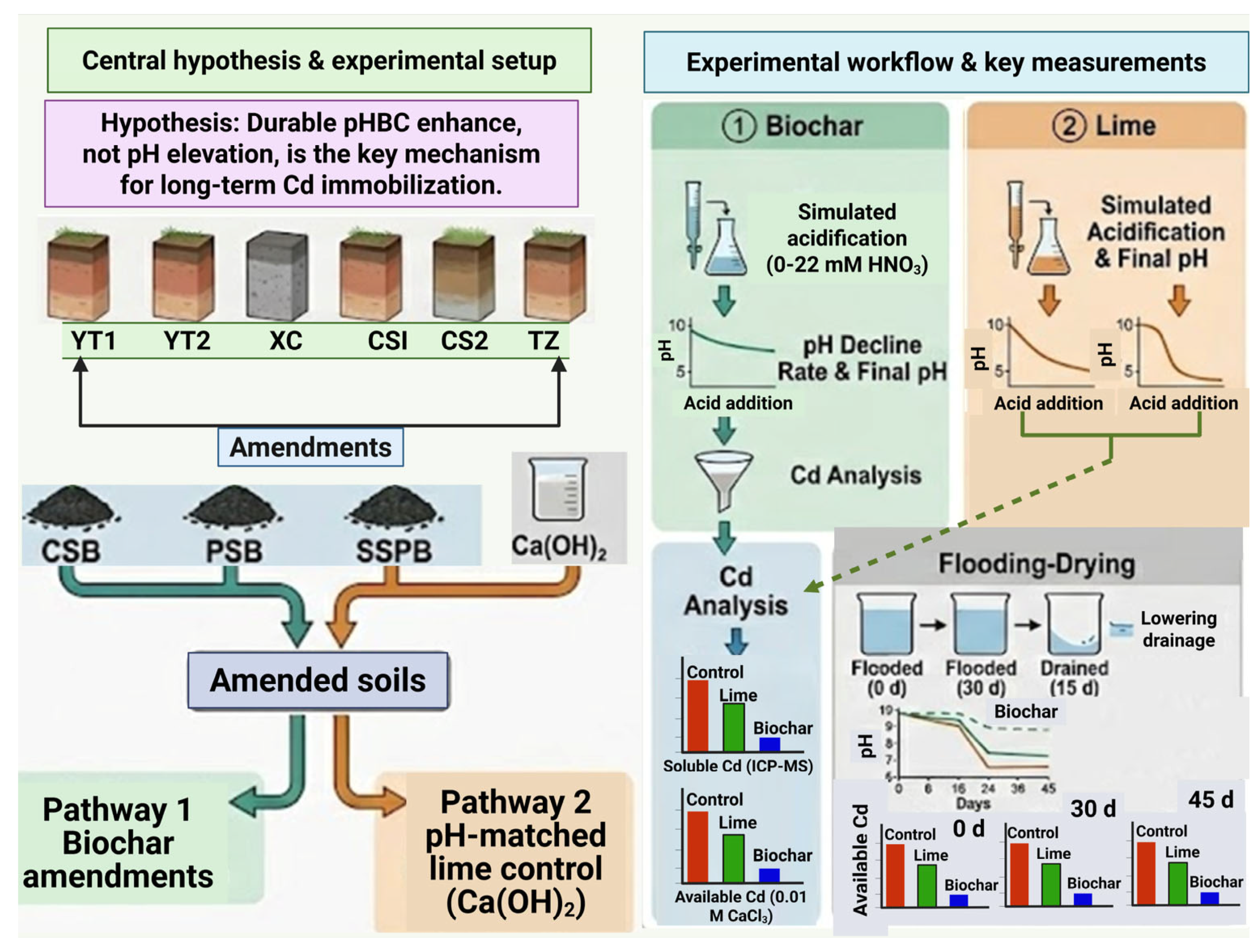
Soil samples were collected at three critical points: initial (0 d flood), post-flooding (30 d), and post-drying (15 d). Available Cd was extracted from 2.0 g of fresh soil with 20 mL of 0.01 M CaCl2 (2 h shaking at 25 °C). Extracts were centrifuged (4500 rpm, 5 min), filtered, and analyzed for Cd by ICP-MS. Figure 1 provides a schematic representation of the integrated experimental design employed to test the central hypothesis that durable pH buffering capacity enhancement is the keystone mechanism for long-term cadmium immobilization.

2.5. Data Analysis and Statistical Methods

All data were analyzed using SPSS Statistics (Version 26.0, IBM Corp., New York, NY, USA). Treatment effects on soil pH, pHBC, and Cd concentrations (soluble and extractable) were evaluated using one-way analysis of variance (ANOVA). Tukey’s Honestly Significant Difference (HSD) post hoc test was applied for multiple comparisons when a significant F-value (p < 0.05) was obtained. Relationships between key variables, such as pH, pHBC, and Cd release, were explored using linear and non-linear regression (exponential decay) models. The coefficients of determination (R2) and significance levels (p-values) are reported for all fitted models. All treatments were conducted in triplicate, and data are presented as the mean ± standard error (SE).
Furthermore, the product (pH × pHBC) was conceived as a composite index representing the soil’s integrated acid-buffering capacity at a given pH state. In this context, pH represents the soil’s current acid-base status, the instantaneous activity of protons in solution, which directly governs Cd speciation and solubility through its effects on surface charge, competition for binding sites, and precipitation-dissolution equilibria [7]. Also, pHBC represents the soil’s reserve capacity to resist changes in that current status, the size of the “buffer reservoir” that can be mobilized to neutralize additional protons [24]. The product (pH × pHBC), therefore, captures the interaction between these two dimensions: the protective effect of a given buffering reserve is amplified when the current pH is higher, because the system operates further from critical thresholds where Cd mobilization accelerates. Conversely, at very low pH, even a large buffering reserve may be partially depleted, reducing its effectiveness. While we acknowledge that pH is logarithmic and pHBC has units (mmol kg−1 pH−1), making the physical interpretation of their product not immediately obvious, the product is best understood as an empirical composite predictor that effectively captures the synergistic relationship between these two variables. Thus, this composite predictor provides superior predictive power compared to alternative formulations.

3. Results

3.1. Variations in the Physicochemical Properties of Biochar and Soil

The selected biochars were strongly alkaline, with pH values increasing in the order of CSB (pH 8.4) < PSB (pH 10.4) < SSPB (pH 10.8). This trend was directly reflected in their total alkalinity, which ranged from 119.6 cmol kg−1 for CSB to 417.3 cmol kg−1 for SSPB. Correspondingly, the content of soluble base cations (K+ + Ca2+ + Mg2+ + Na+) was highly variable, with SSPB possessing a significantly higher concentration (512.9 cmol kg−1) compared to PSB (96.7 cmol kg−1) and CSB (70.6 cmol kg−1) [19]. This indicates that SSPB could act as a more potent liming agent upon soil application. All biochars possessed substantial CEC, with CSB displaying the highest value (148.9 cmol kg−1), followed by SSPB (132.6 cmol kg−1), and PSB (123.4 cmol kg−1). However, the exchangeable base cation pool was highest in SSPB (86.5 cmol kg−1), suggesting a greater reserve of plant-available nutrients. This value was 74.7% and 72.3% greater than the contents in CSB and PSB.
Also, the Boehm titration revealed significant differences in surface acidic functional group chemistry. Total surface acidity was highest for CSB (174.4 cmol kg−1), followed by PSB (150.1 cmol kg−1), and SSPB (133.7 cmol kg−1) [19]. This acidity was dominated by phenolic and carboxylic groups; lactonic groups were not detected. Carboxylic group density, which is crucial for metal complexation, was highest in PSB (34.1 cmol kg−1), while CSB and SSPB had similar, lower values (24.5 and 24.1 cmol kg−1, respectively). In contrast, phenolic group content, which can also participate in metal binding, was greatest in CSB (150.8 cmol kg−1) compared to 116 cmol kg−1 and 109.6 cmol kg−1 for PSB and SSPB, respectively. Therefore, SSPB is characterized by elevated alkalinity and soluble base content, potentially offering superior acid-neutralizing power, whereas CSB and PSB possess higher densities of oxygen-containing functional groups, which may enhance specific adsorption and complexation of Cd2+ ions. While PSB (pH 10.4) and SSPB (pH 10.8) exhibit similarly alkaline pH values, we intentionally selected both to investigate whether other physicochemical properties beyond initial pH, specifically, the forms and distribution of alkalinity, surface functional group chemistry, and CEC, influence their ability to enhance soil pHBC and immobilize Cd. Including biochars with comparable pH but contrasting compositional characteristics allowed us to mechanistically disentangle the contributions of alkalinity versus surface functionality to long-term Cd stabilization. This comparative approach is essential for developing predictive criteria for biochar selection based on desired remediation outcomes.
The six paddy soils selected for this study exhibited a range of physicochemical properties reflective of their distinct parent materials and management histories [19]. Soil pH varied from moderately acidic to near-neutral (Table 1), with the tertiary red sandstone YT2 (pH 5.41) and the alluvial soil TZ (pH 5.82) being the least acidic. The most acidic condition was recorded for the quaternary red clay soil CS1 (pH 4.72). TOM content was generally low across all soils, ranging from 2.6 g kg−1 in XC to 5.0 g kg−1 in TZ. CEC, a key indicator of nutrient and contaminant retention potential, showed significant variation linked to parent material. The soil derived from tertiary red sandstone (YT2) exhibited the lowest CEC of 4.6 cmol kg−1, indicating a limited capacity to retain cationic nutrients and metals. In contrast, soils from quaternary red clay (YT1, XC, and CS1), granite (CS2), and alluvial deposits (TZ) displayed higher and more comparable CEC values, ranging from 10.0 to 12.7 cmol kg−1.
In addition, the background Cd concentrations grouped the soils into uncontaminated and contaminated groups. The four soils YT1, YT2, XC, and CS1 had low total Cd concentrations (0.2–0.30 mg kg−1) while CS2 and TZ were identified as Cd-contaminated, with total Cd levels of 1.2 mg kg−1 and 0.6 mg kg−1 (National standard soil environmental quality risk control standard for soil contamination of agricultural land, Report number: CH2024-0121) [41,42].

3.2. Effect of Biochar and Lime Amendments on Soil pH and Buffering Capacity

Amending all soils with biochar and Ca(OH)2 significantly altered the pH and pHBC of all six paddy soils, with the magnitude of change dependent on both the amendment type and the initial soil properties (Table 1). All three biochars effectively raised soil pH, with the increase (ΔpH) following the order of their inherent alkalinity: SSPB > PSB > CSB. The largest pH elevation was observed in CS1 and YT2, where SSPB increased pH by 4.1 and 4.7 units, respectively. The corresponding lime treatments, designed to match the final pH of their biochar counterparts, successfully achieved comparable target pH values, confirming the experimental design’s validity for isolating the effect of pHBC from initial pH elevation.
Soil amendments significantly enhanced the intrinsic soil pHBC. The percent increase in pHBC (%ΔpHBC) was higher in biochar-treated soils (24.7–109.5%) than in their pH-matched lime controls (−0.5–74.6%). For all biochars, this effect was most pronounced in the soil with the lowest initial buffering capacity, YT2. Specifically, CSB, PSB, and SSPB increased the pHBC of YT2 by 86.5%, 109.5%, and 93.3% compared to only 8.2%, 24.9%, and 40% increase in their lime controls, respectively. Even in soils with higher initial pHBC, such as TZ, biochar elicited significant enhancements (34–51%), whereas the respective lime provided a smaller increase (16–49%). Notably, for CS2, lime addition resulted in a negligible change in pHBC (−0.5%), while CSB treatment increased it by 24.7%.
Among biochars, SSPB, which possessed the highest alkalinity and soluble base cation content, typically induced the greatest absolute increase in pHBC, particularly in soils with lower initial CEC like YT2. In contrast, CSB and PSB, which have higher densities of surface functional groups, produced proportionally larger %ΔpHBC in soils with higher clay and organic matter content (e.g., CS1, TZ).

3.3. Simulated Acidification and Resistance to pH Change and Cd Release

3.3.1. Acidification Resistance as a Function of Soil and Amendment Properties

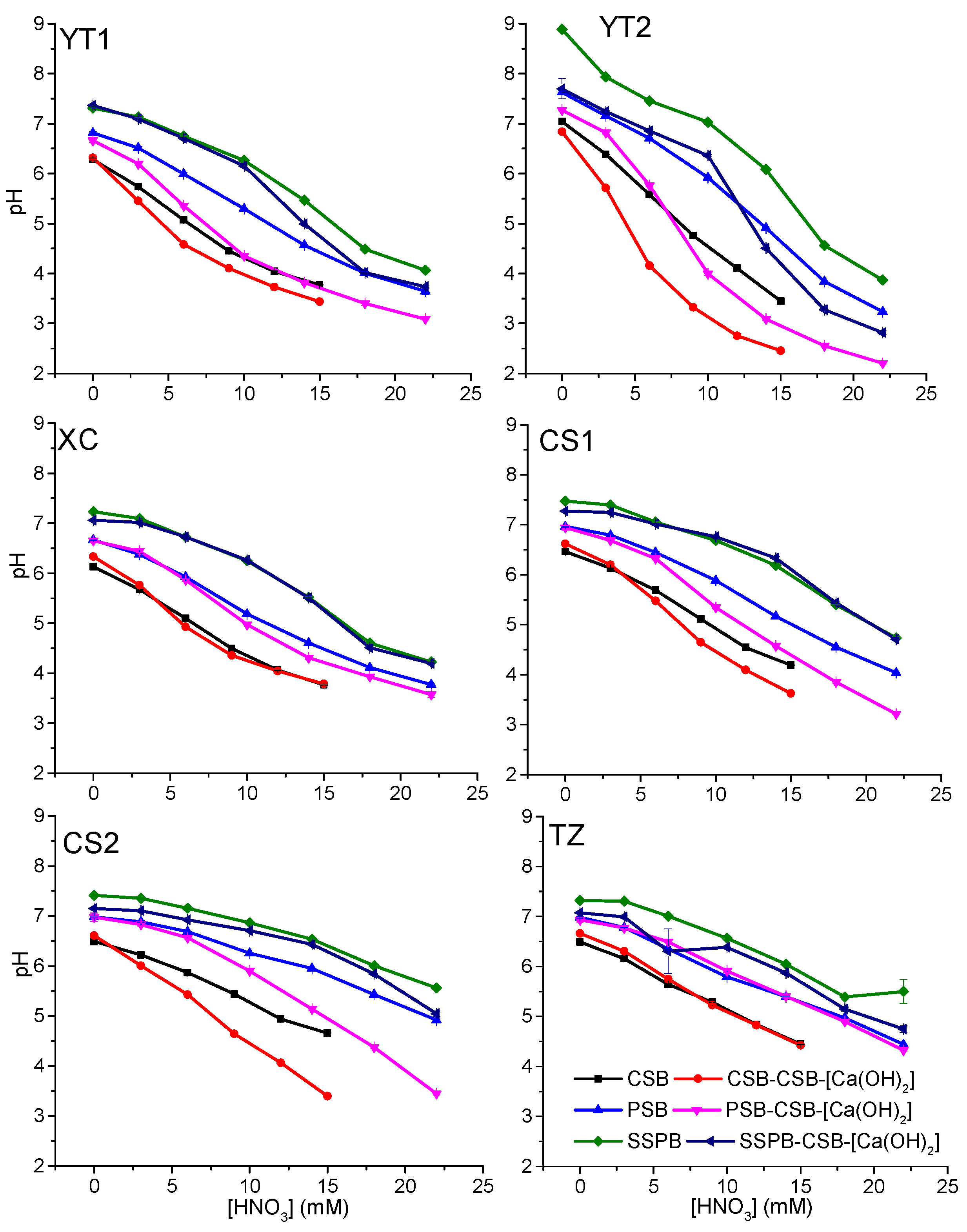
We evaluated the resistance of amended soils to acid stress by measuring equilibrium pH after incremental HNO3 additions (Figure 2). Across all paddy soils, pH decreased progressively with increasing acid concentration, but both the rate of decline and the final pH differed significantly between biochar-amended soils and their pH-matched lime controls. In YT1, CSB treatment pH declined from 6.3 to 3.8 over 0–15 mM HNO3, while its lime control decreased from 6.3 to 3.4. PSB treatment fell from 6.8 to 4.0 over 0–18 mM HNO3, with its control decreasing from 6.7 to 3.4. At 22 mM HNO3, PSB maintained pH 3.6 versus 3.1 for its control. SSPB treatment dropped from 7.3 to 4.5 over 0–18 mM HNO3, while its control decreased from 7.4 to 4.0, ending at pH 4.1 versus 3.7 at 22 mM.
YT2 exhibited the steepest pH declines. CSB treatment decreased from 7.0 to 3.5 over 0–15 mM HNO3, while its lime control fell from 6.8 to 2.5. PSB treatment declined from 7.6 to 3.8 over 0–18 mM HNO3, compared to its control, which dropped from 7.3 to 2.6. At 22 mM, PSB maintained pH 3.2 versus 2.2 for its control. Starting at pH 8.9, SSPB decreased to 4.6 at 18 mM and 3.9 at 22 mM, whereas its control declined from 7.7 to 3.3 and 2.8, respectively. Similar patterns were observed in the remaining soils (XC, CS1, CS2, TZ). Across all soils, biochar-amended treatments consistently maintained higher pH values than their lime controls at equivalent acid concentrations. The difference was most pronounced in poorly buffered soils (e.g., YT2), where lime controls exhibited rapid pH collapse below pH 3.0 under severe acid stress, while biochar treatments maintained pH above 3.5. In better-buffered soils (e.g., CS2, TZ), biochar treatments also showed superior acid resistance, with final pH values 0.5–1.5 units higher than their lime counterparts at the highest acid concentrations. The SSPB treatment, while starting at the highest initial pH, showed diminished advantage under severe acidification compared to PSB, which demonstrated the most stable pH retention across the widest pH range (4.5–6.0).

3.3.2. Cadmium Release and Availability During Simulated Acidification

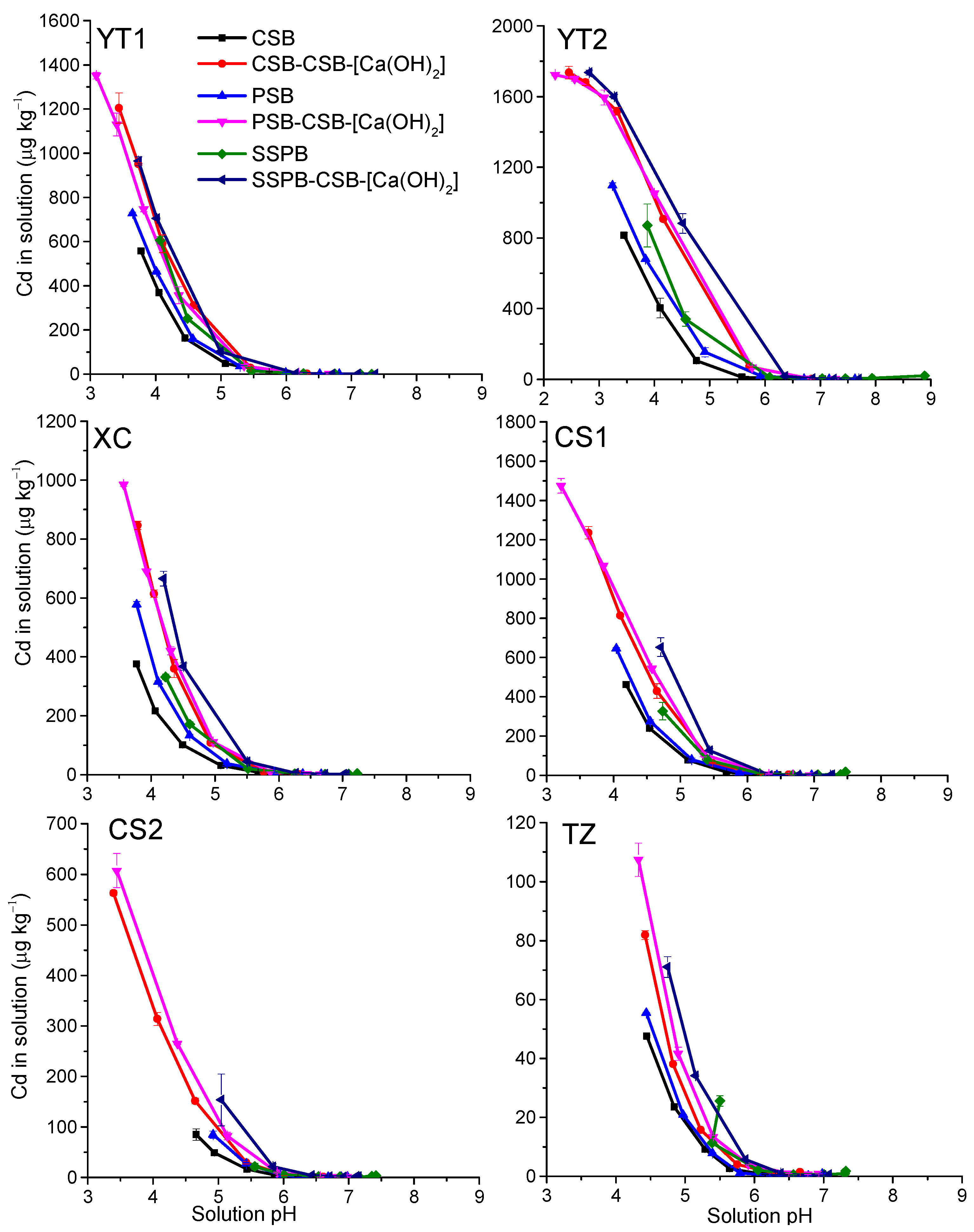
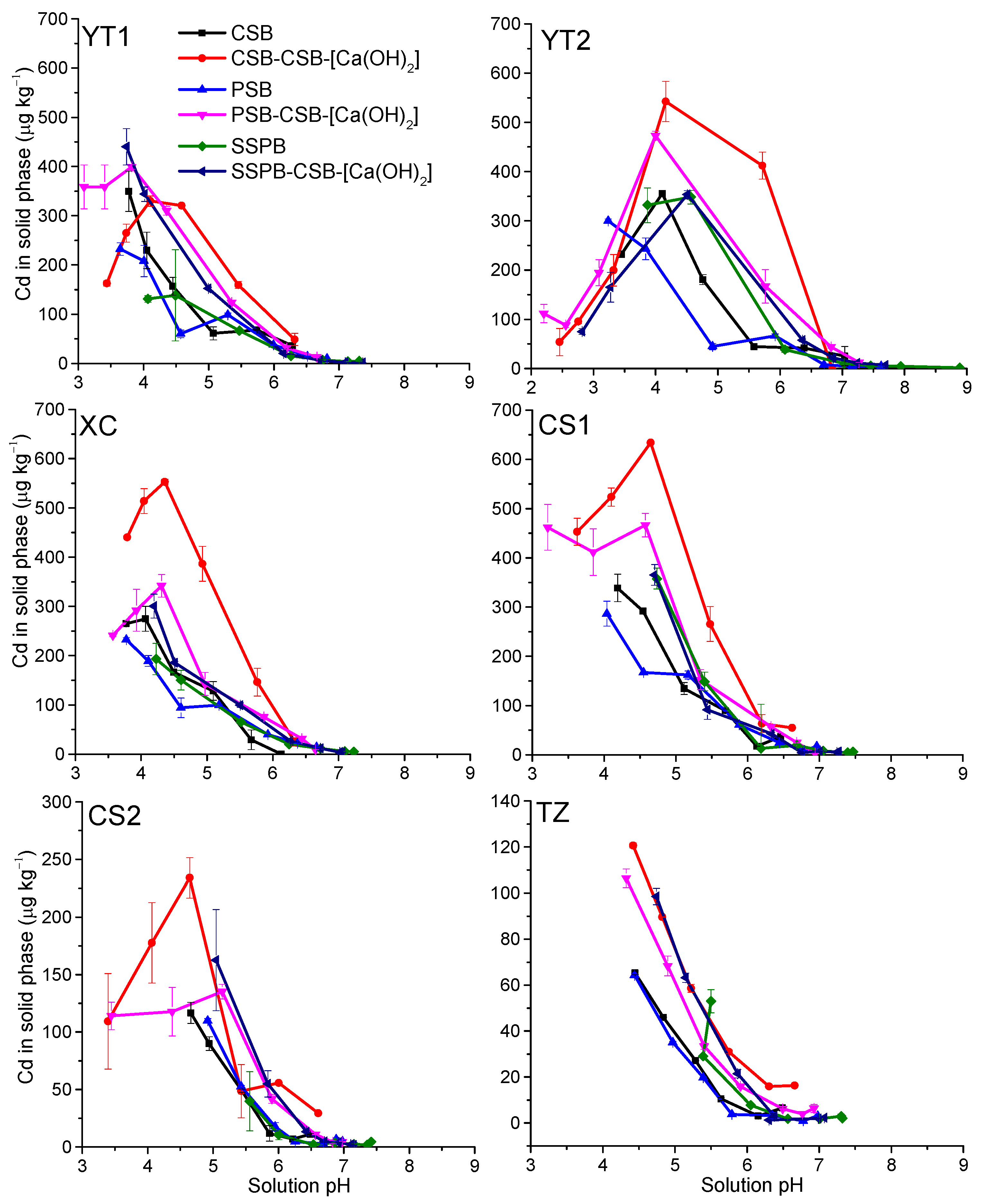
The concentrations of soluble Cd (Figure 3) and CaCl2-extractable (available) Cd (Figure 4) in response to simulated acidification revealed a consistent superiority of biochar amendments over lime in retaining Cd, with the magnitude of difference directly related to the degree of acidification. Across all soils, soluble Cd release followed an exponential increase as suspension pH declined below 5.0 (Figure 3), with biochar-amended soils maintaining significantly lower Cd concentrations than their pH-matched lime controls. The percentage difference was most significant in the poorly buffered YT2 soil. At a pH of approximately 4.1, the CSB treatment released 403.4 µg kg−1 of soluble Cd, which was 76% less than the 1681.9 µg kg−1 released by its lime control at a similar acid concentration (12 mM of HNO3). Even under severe acid stress (15 mM of HNO3), the CSB treatment released 814.1 µg kg−1, still 53.1% less than the 1736.6 µg kg−1 in the lime control. Similar trends were observed with PSB and SSPB. Also, PSB provided the most consistent suppression; in XC at pH ~4.1, the PSB treatment released 314.9 µg kg−1, which was 54% less than the 690.2 µg kg−1 released by its lime control under similar acid concentration at pH 3.9. In soil CS1, at pH ~5.2, the PSB treatment released only 81.3 µg kg−1 of soluble Cd, which was 85% less than the 543.5 µg kg−1 released by its lime control with a lower pH of 4.6 under similar acid treatment (Figure 3). Generally, the trend revealed that the higher soluble Cd content in the lime-treated control under similar acid treatments was due to their significantly lower pH.
The CaCl2-extractable Cd pool showed a non-linear response to acidification, frequently peaking at moderately low pH before declining at extreme acidity (Figure 4). Biochar amendments effectively lowered and broadened this peak, maintaining a larger “safe” pH zone. In the Cd-contaminated CS2 soil, the SSPB treatment kept extractable Cd at or below 40 µg kg−1 across a pH range from 7.4 down to 5.6. At pH 5.6, the SSPB treatment contained 39.7 µg kg−1, which was 76% less than the 162.5 µg kg−1 in its lime control, having a pH of 5.0 (at an acid concentration of 22 mM HNO3). Similarly, in soil YT1 at pH 3.8 (15 mM HNO3), the CSB treatment resulted in 349.8 µg kg−1 of extractable Cd, compared to 162.7 µg kg−1 in its lime control (pH 3.4). Despite this observation, lime controls often exhibited sharper, higher peaks. For example, in XC, extractable Cd in the CSB-[Ca(OH)2] treatment peaked at 552.8 µg kg−1 at pH 4.4, a value 65% higher than the peak of 274.7 µg kg−1 observed in the CSB treatment at a similar acid treatment (pH 4.1).
The efficacy of different biochars in Cd retention was pH-dependent. Specifically, SSPB, with its high initial alkalinity, was most effective at high pH but showed a steeper increase in Cd release upon acidification below pH 5.0. PSB treatments demonstrated a more gradual release profile, offering the most stable performance across mid-range pH values (pH 4.5–6.0). This demonstrates that the enhanced pHBC provided by biochar (Table 1) directly translated into a quantifiable delay and reduction in Cd mobilization under acid stress.
The efficacy of biochar amendments in mitigating Cd release varied significantly by biochar type and soil properties. The CSB treatment (0–15 mM acid) showed moderate control, with its performance closely tied to the soil’s native buffering capacity. In well-buffered soils like TZ and CS2, CSB limited soluble Cd to below 85 µg kg−1 and available Cd below 120 µg kg−1 (Figure 3 and Figure 4), representing reductions of approximately 40–50% compared to lime controls. However, in the poorly buffered YT2 soil, CSB’s control was less effective, with soluble Cd reaching 814.1 µg kg−1, though this was still 53% lower than its lime control at 15 mM HNO3. The PSB treatment (0–22 mM acid) demonstrated the most consistent and superior immobilization across all soils, particularly in the critical pH range of 4.5–6.0. In XC, PSB maintained soluble Cd at 577.9 µg kg−1 even after 22 mM acid, 41% lower than its lime control, while keeping available Cd at 232.6 µg kg−1. This stability was also evident in the acidic CS1 soil, where PSB’s soluble Cd (646.2 µg kg−1) was 56% lower than the control. In contrast, the SSPB treatment (0–22 mM acid) offered good immobilization at high pH but exhibited a more rapid decline in performance under strong acidification. For example, in the alluvial TZ soil, SSPB restricted soluble Cd to only 25.6 µg kg−1 at 22 mM acid, a 64% reduction over lime, and available Cd to 53.0 µg kg−1. However, in YT2, SSPB’s soluble Cd surged to 870.4 µg kg−1 under the highest acid load, though it remained 50% lower than the lime treatment. Overall, PSB provided the most robust and wide-ranging Cd retention, CSB offered reliable but soil-dependent mitigation, and SSPB delivered good results primarily in soils with higher initial pH and buffering capacity. Of all the soils, CS2 and TZ presented the best response to biochar and lime amendments.
In summary, despite their similar pH values, PSB and SSPB exhibited markedly different performance across all experimental endpoints. SSPB, with its substantially higher total alkalinity (417.3 vs. 277.3 cmol kg−1) and soluble base cation content (512.9 vs. 96.7 cmol kg−1), induced greater absolute increases in soil pHBC, particularly in poorly buffered soils like YT2 (Table 1). However, PSB, which possessed a higher density of carboxylic functional groups (34.1 vs. 24.1 cmol kg−1), demonstrated superior Cd retention across a wider pH range. For example, in soil XC at pH ~4.1, PSB released 54% less soluble Cd than its lime control, whereas SSPB’s Cd immobilization declined more rapidly under severe acidification below pH 5.0. These divergent results confirm that initial biochar pH alone is an insufficient predictor of remediation performance.

3.4. Variations in Soil pH and Cadmium Content During Flooding-Drying Alternations

3.4.1. Soil pH Dynamics During Flooding-Drying Cycles

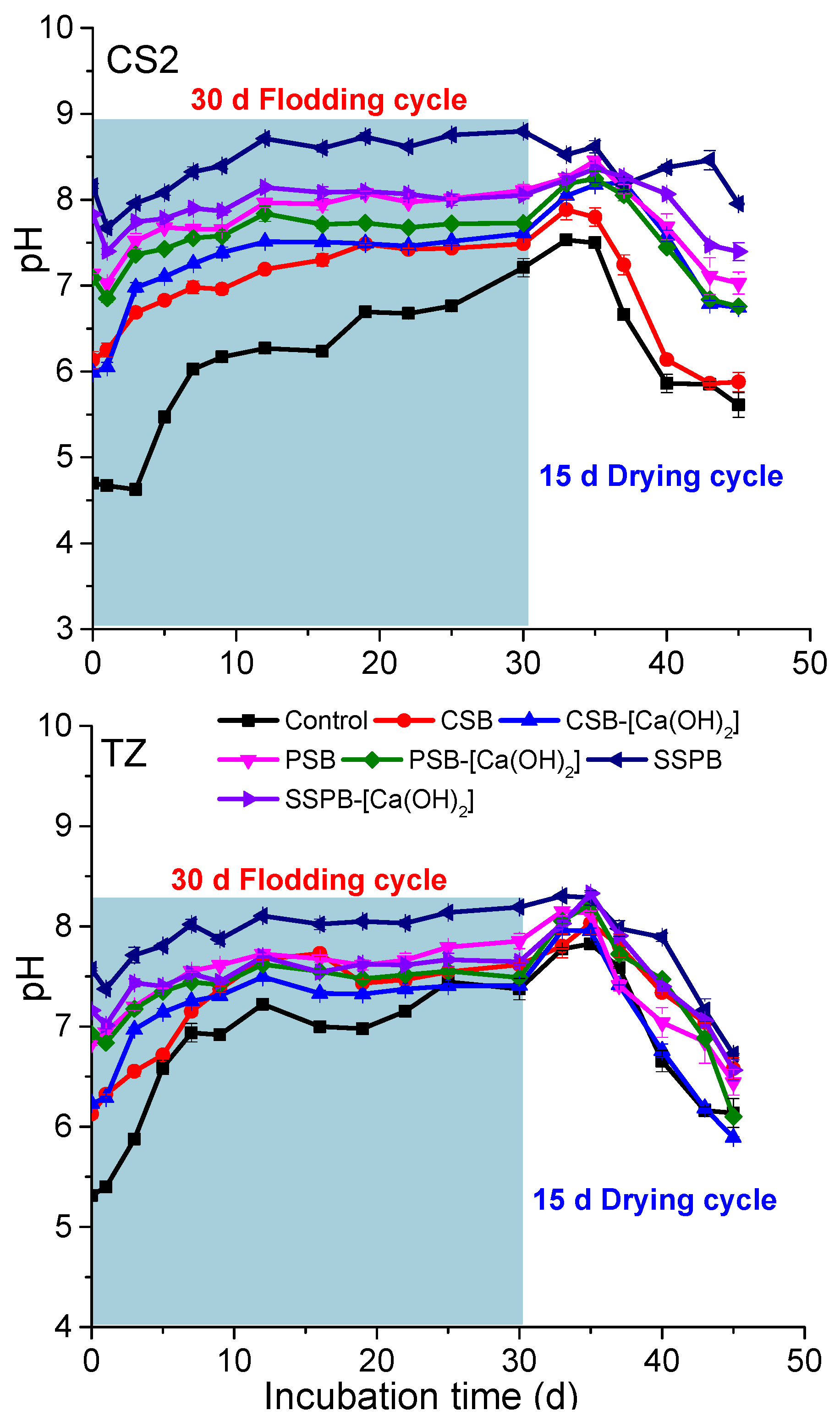
The pH of CS2 and TZ soils exhibited dynamic changes throughout the 45-day flooding (0–30 d) and subsequent drying (30–45 d) cycle, with significant differences between the unamended control and various amendment treatments (Figure 5). In the unamended CS2 soil (control), pH increased from an initial 4.7 to a peak of 7.5 after 33 days of flooding, then decreased sharply during the drying phase to pH 5.6 by day 45. All amendment treatments began at a higher initial pH (0 d) and maintained elevated pH levels throughout the cycle compared to the control. Biochar treatments generally showed greater pH stability than their corresponding lime controls. For example, the CSB treatment pH increased from 6.1 to a peak of 7.9 (33 d) and declined to 5.9 at day 45. Its lime control (CSB-[Ca(OH)2]) followed a similar trajectory, peaking at pH 8.2 after 37 d, and exhibited a slightly higher pH at the end, falling to 6.7. The PSB treatment demonstrated the most stable alkaline conditions, maintaining pH above 7.0 for the entire cycle and declining only to 7.0 at day 45, outperforming its lime control, which fell to 6.8. Also, the SSPB treatment started at the highest pH (8.2) and maintained the most alkaline environment, never falling below 7.9, while its lime control finished at 7.4.
For TZ soil, the control soil pH increased from 5.3 to a maximum of 7.8 during flooding (35 d) before decreasing to 6.1 (45 d) upon drying. The amendment treatments again began at higher pH values and sustained them thereafter. For example, the CSB treatment’s pH increased from 6.1 to a peak of 8.0 and finished at 6.6, showing a more gradual decline than its lime control, which dropped more sharply to pH 5.9 from pH 6.2. Also, the PSB treatment maintained pH above 6.0 throughout the cycle, with a final value of 6.4, compared to its lime control, which fell to 6.10. As in the CS2 soil, the SSPB treatment provided the most alkaline and stable conditions, starting at pH 7.6, peaking at 8.3, and finishing at 6.7, while its lime control ended at 6.6. A key observation across both soils was that biochar amendments, particularly PSB and SSPB, not only raised the initial pH but also moderated the pH fluctuation during the redox cycle. During the critical drying phase (33–45 d), when re-acidification occurred, biochar-treated soils consistently maintained a pH 0.5 to 1.5 units higher than their corresponding lime controls, which had been adjusted to the same initial pH. This indicates that biochar provided a persistent buffering effect that endured through the changing redox conditions, whereas the liming effect was more temporary.

3.4.2. Cadmium Availability Dynamics During Flooding-Drying Cycles

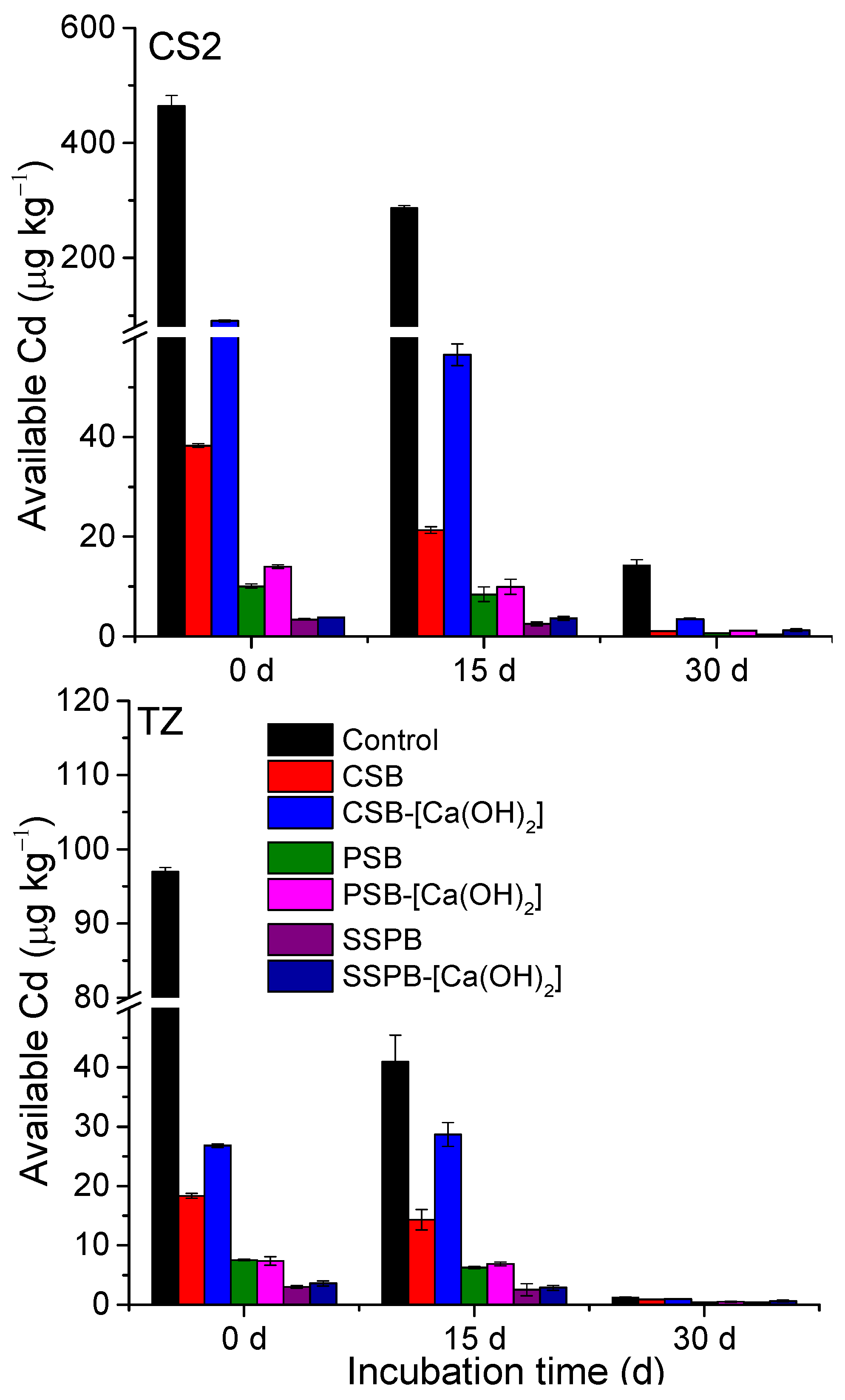
The CaCl2-extractable Cd content in the contaminated CS2 and TZ soils varied significantly across the flooding-drying cycle and between amendment treatments (Figure 6). A pronounced pattern was observed in both unamended control soils, where available Cd decreased substantially after 30 d of flooding, followed by a partial rebound upon 15 d of subsequent drying. In the CS2 control, available Cd dropped from 464.0 µg kg−1 initially to 14.2 µg kg−1 after 30 d, then increased to 286.3 µg kg−1 after 15 d drying (day 45). Similarly, in the TZ control, values decreased from 96.9 to 1.20 µg kg−1 after flooding and rebounded to 40.9 µg kg−1 post-drying.
All amendment treatments significantly reduced the available Cd pool at all three time points compared to their respective controls. Biochar amendments consistently resulted in lower Cd availability than their corresponding lime controls. In the CS2 soil, CSB treatment maintained available Cd at 38.3, 1.1, and 21.4 µg kg−1 at 0 d, 30 d (flooded), and 15 d (dried), respectively. Its lime control showed higher values: 90.6, 3.5, and 56.5 µg kg−1. PSB was particularly effective, with values of 10.1, 0.7, and 8.5 µg kg−1, compared to its lime control at 14.0, 1.2, and 10.0 µg kg−1. SSPB achieved the lowest overall Cd availability (3.4, 0.4, 2.5 µg kg−1), with its lime control also performing well but slightly higher (3.9, 1.3, 3.7 µg kg−1).
An identical trend was observed in the TZ soil. The CSB treatment values (18.3, 0.9, 14.3 µg kg−1) were lower than those of its lime control (26.8, 1.0, 28.7 µg kg−1). PSB again showed strong immobilization (7.5, 0.4, 6.3 µg kg−1) compared to its control (7.4, 0.5, 6.9 µg kg−1). SSPB provided the greatest suppression of available Cd (3.0, 0.4, 2.5 µg kg−1), marginally outperforming its lime control (3.8, 0.6, 2.9 µg kg−1). The results demonstrate that while both flooding and amendments reduce Cd availability, biochars, and SSPB in particular, provide more effective and persistent immobilization throughout redox cycling than pH adjustment with lime alone.

3.5. Correlation Analysis Between pH Buffering Capacity and Cadmium Stability

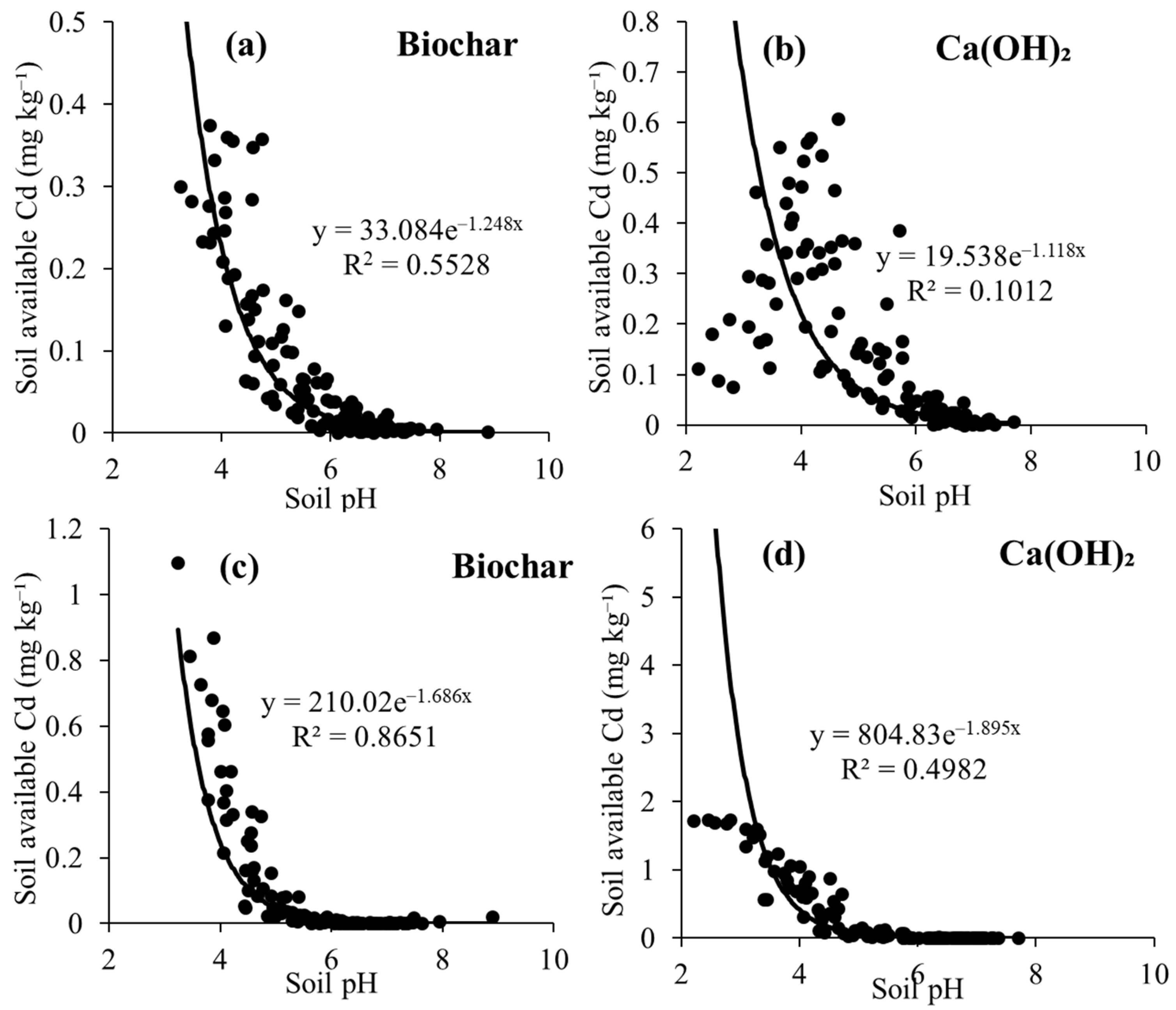
Statistical analyses revealed significant relationships between soil pH, pHBC, and Cd dynamics across all experimental treatments. A strong positive linear correlation was observed between the soil pH after the addition of 6 mM HNO3 and the measured pHBC (R2 = 0.81, p < 0.001). This relationship confirms that soils with greater pHBC were more effective at resisting pH decline at this standardized acid stress level. The mobilization of soluble Cd after 6 mM HNO3 addition showed a strong negative exponential relationship with the pH and the product of the resulting pH and the soil’s pHBC: [Cd_soluble] = A × e^(−k × (pH × pHBC)). This model yielded high coefficients of determination (R2 > 0.87 across all soils). The immobilization efficacy constant (k) was significantly higher for biochar treatments (average k = 0.031) than for lime controls (average k = 0.014) (p < 0.01). This indicates that, per equivalent unit of buffering capacity, biochar was 2.2 times more effective at suppressing Cd solubilization. Similarly, the concentration of CaCl2-extractable (available) Cd at 6 mM acid addition was inversely correlated with pHBC (R2 = 0.72). For a given final pH, soils with higher pHBC maintained significantly lower extractable Cd pools. This was further confirmed by the exponential relationship between soil pH and available Cd (Figure 7a,b) and soluble Cd (Figure 7c,d).
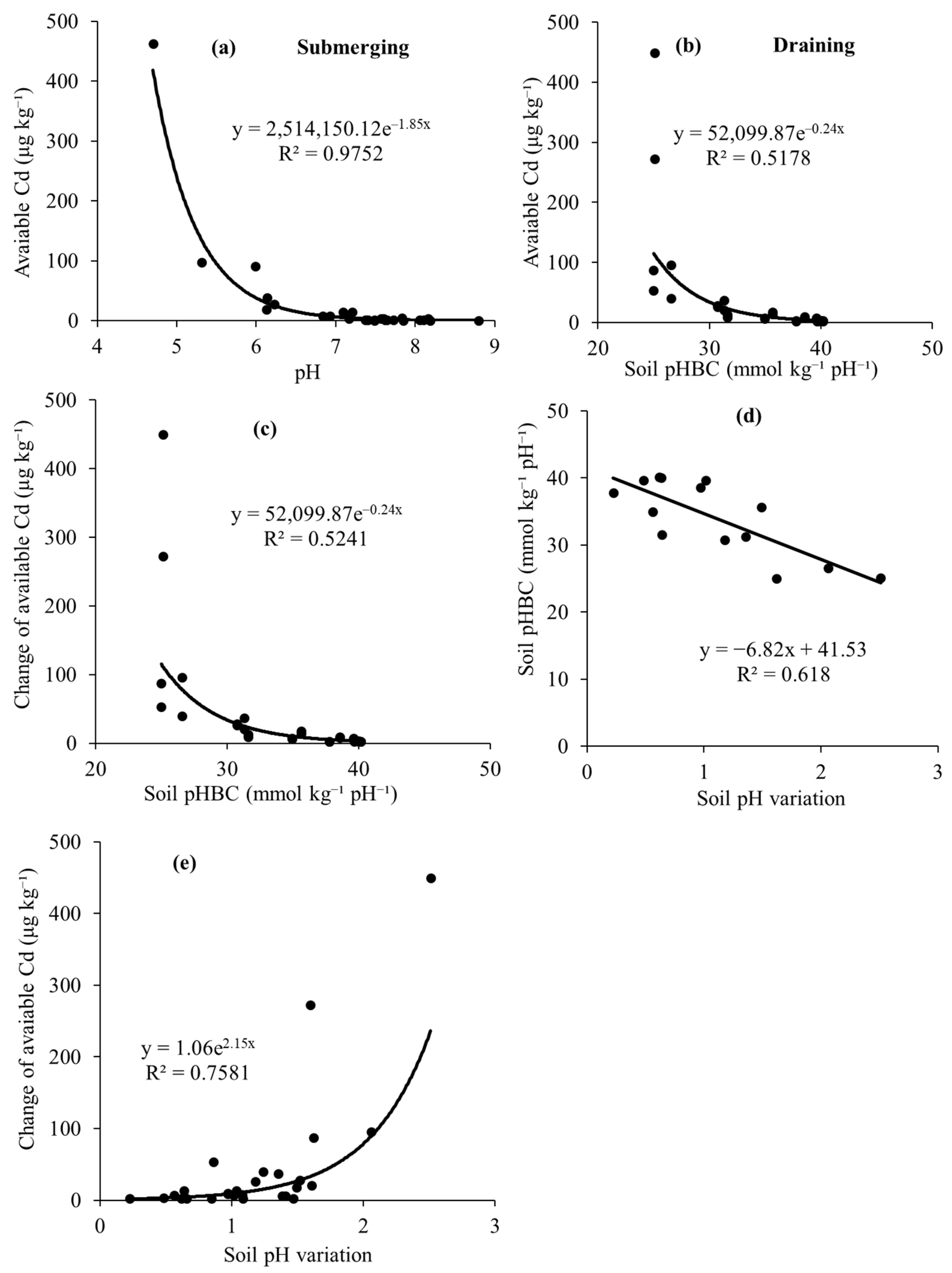
Correlation analyses quantified the interdependent relationships between pH, pHBC, and available cadmium during the flooding-draining cycle in the CS2 and TZ soils (Figure 8). The concentration of available Cd during the flooding phase exhibited a strong negative exponential relationship with the concurrent soil pH (Figure 8a; n = 28, R2 = 0.98, p < 0.001). As pH increased under reducing conditions, Cd availability decreased sharply. During the drainage phase, a strong exponential relationship was observed (Figure 8b; n = 14, R2 = 0.52, p < 0.001), where declining pH led to a rapid resurgence in available Cd. These patterns confirm pH as the primary regulator of Cd lability under alternating redox conditions. The available Cd concentration measured at the end of the complete redox cycle showed a significant negative linear correlation with the soil’s pHBC (Figure 8c; n = 28, R2 = 0.52, p < 0.001). Soils with higher pHBC, primarily biochar-amended treatments, maintained lower final Cd availability. Furthermore, pHBC was linearly and negatively correlated with the magnitude of pH decline (ΔpH) during the drainage phase (Figure 8d; n = 14, R2 = 0.62, p < 0.001). This demonstrates that enhanced buffering capacity directly mitigated soil re-acidification upon drying.
The percent increase in soil pHBC (%ΔpHBC) induced by biochar was strongly correlated with the biochar’s inherent total alkalinity (R2 = 0.91). Furthermore, the reduction in soluble Cd at the 6 mM HNO3 level (relative to the unamended control at the same acid dose) was positively correlated with the %ΔpHBC (R2 = 0.75). Lime treatments, which provided minimal changes in pHBC, showed a weaker correlation and clustered separately from the biochar treatments in this regression. This pattern underscores that the mechanism of Cd immobilization was closely tied to the enhancement of the soil’s buffering system rather than a simple increase in initial pH. A multiple linear regression model incorporating both the native soil buffering and the amendment-induced enhancement effectively predicted available Cd content after the complete flooding-drying cycle: [Cd_available]final = α − β(pHBC_initial) − γ(ΔpHBC). This model explained 83% (R2 = 0.83) of the variance in the final Cd availability (available Cd after 15-day draining) (p < 0.001). Standardized coefficients confirmed that the biochar-induced change in pHBC (ΔpHBC, γ = −0.64) exerted approximately twice the influence of the soil’s initial pHBC (β = −0.31). This result highlights that fortifying the soil’s intrinsic buffering capacity is a more decisive factor for achieving durable Cd immobilization under fluctuating redox conditions than relying on native buffering properties alone.
The available Cd concentration was also directly correlated with the total pH variation (ΔpH) experienced over the cycle (Figure 8e; n = 28, R2 = 0.75, p < 0.001). The slope of this relationship was less steep for high-pHBC treatments, indicating that, for an equivalent pH fluctuation, a better-buffered soil experienced a smaller increase in Cd availability. This integrated analysis establishes a clear mechanistic pathway: biochar amendment → increased pHBC → attenuated pH fluctuation during drainage → reduced concentration of available Cd. These correlations substantiate that enhancing pHBC is the principal mechanism by which biochar ensures more persistent Cd immobilization compared to lime under dynamic field conditions.
Furthermore, we conducted a sensitivity analysis using multiple linear regression with final pH and pHBC as predictors of soluble Cd at the 6 mM HNO3 level (the standardized stress point used in our correlation analyses). The model structure was: [Cd_soluble] = α + β1(pH) + β2(pHBC) + β3(pH × pHBC). The results showed that pHBC was a significant predictor (β2 = −0.58, p < 0.001) independent of pH. Also, the interaction term (pH × pHBC) was also significant (β3 = −0.32, p < 0.01), indicating that the effect of pHBC on Cd retention strengthens as pH increases. Even when pH was forced into the model first, pHBC explained an additional 23% of the variance in soluble Cd (ΔR2 = 0.23, p < 0.001). This analysis confirms that pHBC exerts a significant effect on Cd retention beyond and above the effect of pH alone, supporting our central conclusion that durable buffering enhancement drives biochar’s superior performance.
To empirically validate our choice of the product (pH × pHBC), we compared five alternative regression models predicting soluble Cd at the 6 mM HNO3 level (the standardized stress point used in our correlation analyses, Figure 7 and Figure 8). Models were evaluated based on Akaike Information Criterion (AIC), Bayesian Information Criterion (BIC), and adjusted R2 values [43]. As shown in Table 3, pH alone explained 66% of the variance, confirming its importance but leaving substantial unexplained variation. pHBC alone performed poorly (R2 = 0.49), indicating that buffering capacity without consideration of current pH status is insufficient. The additive combination (pH + pHBC) improved prediction (R2 = 0.77), showing that both variables contribute independently. Also, the full interaction model (including the product term as an additional parameter) performed well (R2 = 0.81) but required estimating four parameters. Notably, the product model (pH × pHBC as a single composite predictor) achieved the highest adjusted R2 (0.86) with the fewest parameters, as evidenced by the lowest AIC and BIC values. This analysis confirms that the product (pH × pHBC) effectively captures the synergistic relationship between current pH status and buffering reserve, providing superior predictive power while maintaining model simplicity.

4. Discussion

This study provides evidence that superior long-term Cd immobilization by biochar in acidic paddy soils is linked to its ability to durably enhance soil pHBC (Table 1). By systematically isolating the effect of pHBC from that of initial pH elevation through Ca(OH)2 controls, our results demonstrate that the strategic enhancement of a soil’s intrinsic buffering system is a more effective remediation strategy than transient pH adjustment. The discussion that follows interprets these findings within the context of existing literature, compares the mechanisms of different amendments, and explores the central role of pHBC in governing Cd dynamics under fluctuating redox conditions.
The most significant finding of this study is the mechanistic distinction between biochar and lime. While both amendments successfully raised the initial soil pH (Table 1), biochar treatments consistently led to a significantly greater increase in pHBC compared to their pH-matched lime controls. This enhanced buffering directly translated to superior performance under stress. In the simulated acidification experiment, biochar-amended soils maintained a higher pH and released substantially less soluble and extractable Cd at equivalent levels of added HNO3 (Figure 2 and Figure 3). For instance, in the poorly buffered YT2 soil, CSB treatment released 53.1–98.7% less soluble Cd than its lime control at similar acid levels. This aligns with the established principle that Cd solubility and bioavailability are exponentially dependent on soil pH [7]. This finding addresses a gap in the literature, where the long-term efficacy of amendments is often attributed to initial chemical changes without considering buffering resilience [20]. Lime operates primarily through a consumptive neutralization reaction; as it neutralizes acidity, its base is depleted, leaving the soil vulnerable to subsequent acidification [44,45]. In contrast, biochar contributes to pHBC through multiple, more persistent mechanisms: the direct input of alkaline substances (carbonates, oxides), the creation of CEC via oxygenated functional groups, and potentially the physical protection of native soil organic matter [24,32,35,46]. Our correlation analysis further solidifies this, showing that the reduction in soluble Cd was more strongly linked to the percent increase in pHBC (%ΔpHBC) than to the final pH alone (Figure 8).
Table 3 reveals that the product of pH × pHBC is an empirical index of the soil’s effective buffering capacity at a given acid-base status. While pH is logarithmic and pHBC has units, their product serves as a composite predictor that captures the synergistic relationship between these two dimensions. A higher pH increases the gap from critical thresholds where Cd mobilization accelerates, while higher pHBC provides the “armor” to maintain that distance when protons are added. Their product, therefore, represents the integrated resistance of the soil system to acid-induced Cd mobilization. The superior performance of this composite predictor (R2 = 0.87) compared to alternative formulations (R2 = 0.52–0.83) empirically validates that the interaction between current pH and buffering reserve, rather than either factor alone, governs Cd release dynamics.
The distinct behaviors of the three biochars underscore a fundamental trade-off between inherent alkalinity and surface functionality. SSPB, with the highest pH (10.8) and total alkalinity (417.3 cmol kg−1), functioned as a potent liming agent, inducing the largest absolute increases in soil pH and pHBC, particularly in poorly buffered soils such as YT2 (Table 1). Its performance was dominant at high pH (>6.0), effectively suppressing Cd availability under mildly acidic conditions. However, under severe acidification, its Cd retention advantage diminished more rapidly than that of PSB, suggesting that its primary mechanism, the delivery of soluble bases, is subject to depletion. In contrast, PSB and CSB possessed lower alkalinity but higher densities of oxygen-containing functional groups (e.g., carboxylic, phenolic) and greater CEC [19]. This endowed them with a greater capacity for specific, non-precipitation Cd immobilization via surface complexation and cation-π interactions [33,47,48]. PSB, in particular, achieved an optimal balance: sufficient alkalinity to raise and buffer pH, coupled with abundant functional groups that acted as a resilient “safety net,” adsorbing Cd2+ even as pH declined. This dual mechanism made PSB the most consistent performer across the critical pH range of 4.5–6.0. Consequently, feedstock selection should be context-dependent: high-alkalinity biochars like SSPB are advantageous for rapid pH correction in severely acidified soils, whereas biochars with balanced alkalinity and rich surface functionality, such as PSB, are better suited for achieving stable, long-term Cd immobilization under variable field conditions where pH may fluctuate.
Nevertheless, small initial soil pH mismatches could theoretically influence the comparison between biochar-amended and lime-amended soil samples in two ways. If lime control pH is higher than biochar treatment pH, this would bias the comparison against our hypothesis, as a higher initial pH would favor lower Cd availability in the lime treatment, potentially narrowing the observed gap between amendments. This scenario occurred in some CSB/PSB treatments (Table 1), yet biochar treatments still demonstrated superior Cd retention in the majority of such cases (Figure 3, Figure 4 and Figure 6). If lime control pH < biochar treatment pH, this would bias the comparison in favor of our hypothesis, as the lime treatment starts at a disadvantage. Even so, this scenario occurred in fewer samples, and the magnitude of pH difference was small (≤0.3 pH units). Additionally, the magnitude of difference in Cd release between biochar and lime treatments was not correlated with the size of the pH mismatch (R2 = 0.08, p > 0.05), indicating that the observed performance differences cannot be attributed to these minor pH variations. Furthermore, in cases where lime controls had slightly higher pH than biochar treatments (e.g., YT1-CSB: 6.46 vs. 6.23), biochar still released 76% less soluble Cd at equivalent acid stress (Figure 3), demonstrating that pHBC effects dominate over minor pH differences.
Additionally, the larger pH mismatch observed for SSPB treatments, rather than being a limitation, provides additional evidence for our central hypothesis. Despite achieving substantially higher initial pH than their lime controls (ΔpH up to 1.19 pH units in YT2, Table 1), the superior Cd retention of SSPB-amended soils cannot be attributed to this pH difference alone. Quantitative analysis demonstrates that pHBC enhancement explains 23% of the variance in Cd release beyond what initial pH can account for. If initial pH were the dominant mechanism, the lime controls, with their lower pH, would be expected to perform proportionally worse, which they do. However, the magnitude of difference (e.g., 79% reduction in soluble Cd in YT2-SSPB at 18 mM HNO3, Figure 3) far exceeds predictions based on pH alone, confirming that durable buffering capacity is the key factor.
The flooding-draining incubation experiment bridges mechanistic understanding with agronomic reality, illustrating how pHBC governs the critical biogeochemical cycle of Cd in paddy soils (Figure 5 and Figure 6). During the flooding phase, the increase in pH and the reduction conditions promoted Cd immobilization through precipitation, likely as Cd sulfide (CdS) and co-precipitation with Fe/Mn (oxyhydr)oxides [21]. The subsequent drainage phase is the period of highest risk, with sulfide oxidation and nitrification, generating protons that re-acidify the soil, dissolve CdS, and re-mobilize Cd [22]. Our results demonstrate that pHBC is the main variable controlling the intensity of this re-acidification process. Specifically, soils with higher pHBC, conferred by biochar amendment, exhibited a significantly smaller drop in pH during drainage (Figure 8d). This attenuated pH fluctuation directly resulted in a smaller Cd availability (Figure 8e). In contrast, the lime-treated controls, despite matching the initial flooded pH, lacked this buffering reserve and underwent severe re-acidification, leading to substantial Cd re-mobilization.
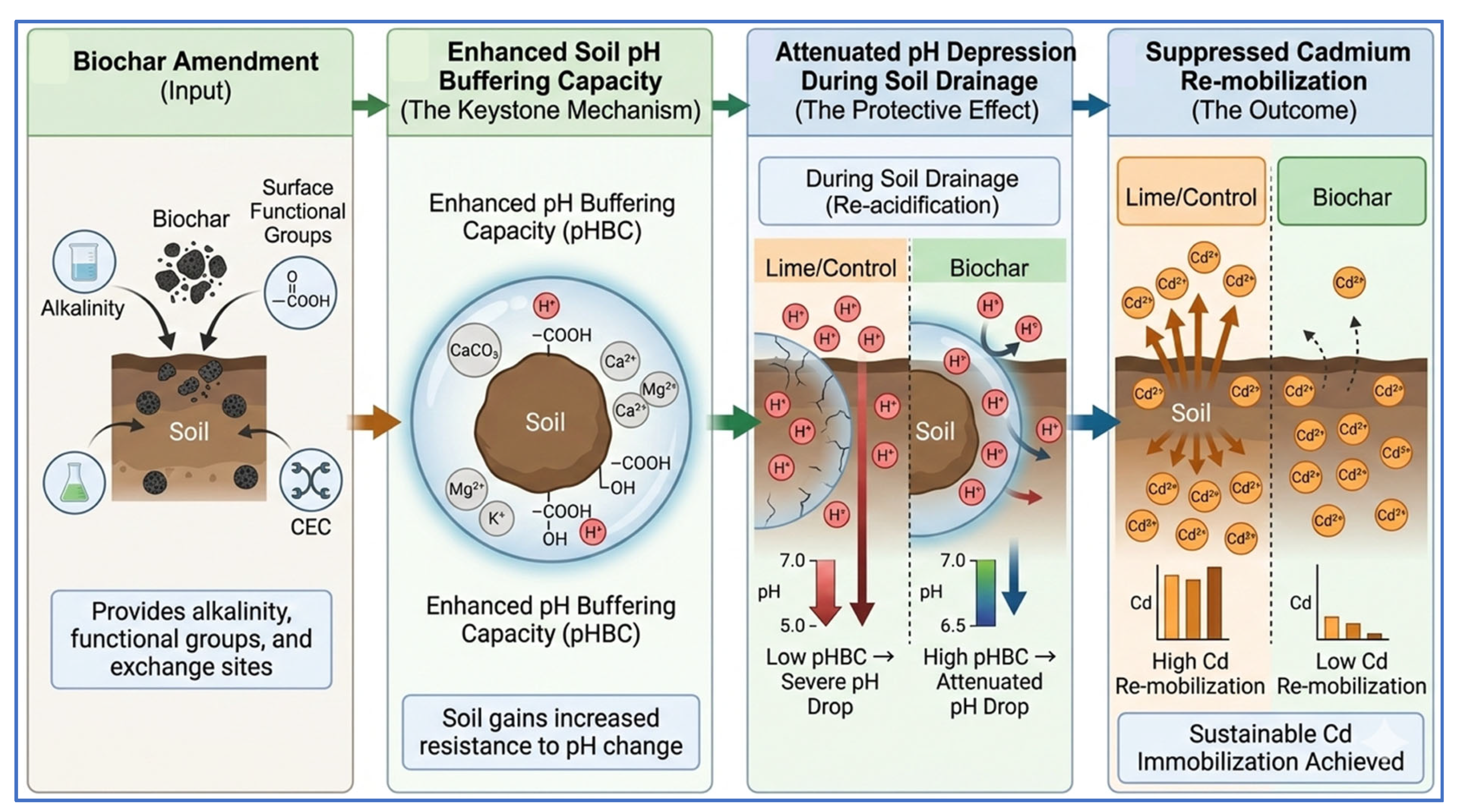
These results establish a clear and actionable causal chain for sustainable remediation: biochar amendment → enhanced soil pHBC → attenuated pH depression during soil drainage → suppressed reoxidation and re-mobilization of Cd. The proposed mechanistic pathway, which forms the central insight of our study, is schematically represented in Figure 9. It provides a clear visual framework for understanding how biochar amendment leads to sustained Cd immobilization through enhanced pHBC. This insight is key to managing Cd-contaminated soil. It suggests that in paddies subjected to intermittent drainage, amendments that enhance pHBC will be more effective in protecting grain safety than those that merely raise the seasonal flooded pH [12,19]. While this study clarifies the central role of pHBC, it also highlights valuable future research directions. The 45-day incubation (Figure 5 and Figure 6), while informative, cannot capture multi-year dynamics. Long-term field trials are essential to verify the persistence of biochar-induced pHBC enhancement under real-world climatic cycles, cropping practices, and natural aging processes [19,49,50]. Moreover, the specific interactions among biochar surfaces, soil minerals (e.g., Fe/Al oxides), and organic matter, which collectively contribute to the measured pHBC, warrant further investigation using advanced spectroscopic and microscopic techniques. Also, a full assessment requires evaluating how different biochars influence not only Cd bioavailability but also soil microbial health, nutrient cycling, greenhouse gas emissions, and ultimate Cd accumulation in rice grains across different cultivars.
For comparative analysis, four of the six soils used in this study (YT1, YT2, XC, CS1) were spiked with Cd at 2 mg kg−1 followed by a 60-day equilibration period. While this approach ensured consistent initial Cd concentrations across treatments and enabled controlled mechanistic comparisons, it may not fully replicate the behavior of aged, field-contaminated soils. In long-term contaminated soils, Cd can become incorporated into less labile fractions through diffusion into micropores, co-precipitation with minerals, and strong complexation with organic matter, processes that reduce bioavailability over time [51]. Consequently, spiked soils may initially overestimate Cd mobility and amendment effectiveness compared to their aged counterparts. However, our use of a 60-day equilibration period allowed partial aging and stabilization, and our key findings focus on relative differences between biochar and lime treatments rather than on total Cd values. The consistent trends observed across both spiked soils and the two naturally contaminated soils (CS2, TZ) provide evidence that our mechanistic conclusions, particularly the central role of pHBC enhancement, are robust and transferable to field conditions. Nevertheless, future studies should validate these findings using long-term contaminated field soils and assess whether the magnitude of biochar’s advantage over lime is moderated by aging processes.
These findings provide a mechanistic foundation for transitioning China’s Cd remediation strategies from conventional liming toward targeted biochar applications. With approximately 2.8 million hectares of agricultural land exceeding soil quality standards, predominantly due to Cd [12], and over 900 million tons of crop residues produced annually [36], the potential for scalable, regionally tailored biochar deployment is substantial. Feedstock selection should be guided by performance criteria established in this study: high-alkalinity biochars (e.g., SSPB) excel in rapid pH correction for severely acidified soils, while functionally rich biochars (e.g., PSB) offer more resilient long-term immobilization. Application rates of 6–10 t ha−1 are logistically feasible using existing equipment, and costs can be regulated over multiple seasons due to biochar’s persistent effects, particularly critical for poorly buffered soils in southern China, where pHBC enhancement of 86–110% was observed (Table 1). Also, policy support should incentivize feedstocks that demonstrably enhance pHBC rather than subsidizing biochar indiscriminately. Integrating biochar production with rural waste management and bioenergy generation can improve economic viability. Meanwhile, our predictive model ([Cd_available]final = α − β(pHBC_initial) − γ(ΔpHBC)) offers a practical tool for monitoring remediation persistence and guiding re-application schedules. By linking fundamental soil properties to field outcomes, this study supports China’s national food safety goals while advancing circular agriculture principles.

5. Conclusions

This study demonstrates that durable pHBC enhancement is the key mechanism underlying biochar’s superior long-term Cd immobilization in acidic paddy soils, particularly under fluctuating redox conditions. By employing rigorous pH-matched controls, the effect of persistent buffering was differentiated from transient pH adjustment. The study further shows that biochar performance is feedstock-dependent, involving a trade-off between high alkalinity (favoring rapid pH increase, as with SSPB) and rich surface functionality (favoring resilient Cd sorption across a wider pH range, as with PSB). Also, in the context of paddy soils, enhanced pHBC directly mitigates the re-acidification and consequent Cd re-mobilization that occurs during the critical drainage phase. Therefore, we propose that the selection and design of soil amendments for Cd-contaminated paddies should prioritize their capacity to enhance pHBC. This fundamental soil property determines the system’s resilience against both external acidification and internal redox-driven acidity. This shift in perspective, from pH management to pH buffering system engineering, provides a more robust scientific foundation for developing sustainable remediation strategies that ensure long-term food safety. Several studies have employed adsorption/desorption equations and sequential extraction to characterize Cd behavior in soils [38,52,53]. However, our study addresses a complementary and underexplored dimension: the role of soil pHBC as a dynamic property governing the resilience of Cd immobilization. By focusing on how amendments modify this fundamental soil characteristic and how these modifications influence Cd release under realistic stresses, we provide mechanistic insights that adsorption studies alone cannot offer. Future work could fully integrate sequential extraction with our approach to further elucidate which geochemical fractions are most influenced by pHBC enhancement.

Author Contributions

C.J.: Funding acquisition, Writing—review and editing, and project administration; L.X., P.Z. and H.S.: Methodology, investigation, data curation, and formal analysis; J.Z.: Project supervision and conceptualization; J.N.N.: Methodology, data curation, visualization, writing—review and editing; H.L.: Conceptualization, methodology, formal analysis, funding acquisition, writing—original draft. All authors have read and agreed to the published version of the manuscript.

Funding

This research was supported by the Natural Science Foundation of Jiangsu Province, China (Grant number: BK20230756), the National Natural Science Foundation of China (No. 42307401), and the Su Dilizhi Fa [2025] Geological Exploration Projects of Jiangsu Provincial Bureau of Geology and Mineral Resources: Soil Environmental Investigation and Assessment Project in Ecologically Sensitive Areas of the Yangtze River Economic Belt (Jiangsu Section) (No. 74-2025).

Institutional Review Board Statement

Not applicable.

Informed Consent Statement

Not applicable.

Data Availability Statement

The original contributions presented in this study are included in the article. Further inquiries may be directed to the corresponding author.

Conflicts of Interest

The authors declare no conflicts of interest.

Abbreviations

The following abbreviations are used in this manuscript:
ANOVAAnalysis of variance
CECCation exchange capacity
CSBCorn straw biochar
CS1Changsha soil 1 (Quaternary red clay)
CS2Changsha soil 2 (Granite, Cd-contaminated)
CdCadmium
HSDHonestly significant difference
ICP-MSInductively coupled plasma mass spectrometry
PSBPeanut straw biochar
SSPBSeeded sunflower plate biochar
SEStandard error
TOMTotal organic matter
TZTaizhou soil (river-lake alluvial deposit, Cd-contaminated)
WHCWater holding capacity
XCXuancheng soil (Quaternary red clay)
YT1Yingtan soil 1 (Quaternary red clay)
YT2Yingtan soil 2 (Tertiary red sandstone)
pHBCpH buffering capacity
ΔpHChange in pH
%ΔpHBCPercent change in pH buffering capacity

References

  1. Gui, R.; Wu, W.; Zhuang, S.; Zhong, Z. Intensive Management Increases Soil Acidification and Phytotoxic Al Content in Phyllostachys Praecox Stands in Southeast China. J. Sustain. For. 2018, 37, 46–55. [Google Scholar] [CrossRef]
  2. Wu, Z.; Sun, X.; Sun, Y.; Yan, J.; Zhao, Y.; Chen, J. Soil Acidification and Factors Controlling Topsoil PH Shift of Cropland in Central China from 2008 to 2018. Geoderma 2022, 408, 115586. [Google Scholar] [CrossRef]
  3. von Uexküll, H.R.; Mutert, E. Global Extent, Development and Economic Impact of Acid Soils. Plant Soil 1995, 171, 1–15. [Google Scholar] [CrossRef]
  4. Guo, J.H.; Liu, X.J.; Zhang, Y.; Shen, J.L.; Han, W.X.; Zhang, W.F.; Christie, P.; Goulding, K.W.T.; Vitousek, P.M.; Zhang, F.S. Significant Acidification in Major Chinese Croplands. Science 2010, 327, 1008–1010. [Google Scholar] [CrossRef] [PubMed]
  5. Zhao, W.; Li, J.; Jiang, J.; Lu, H.; Hong, Z.; Qian, W.; Xu, R.; Deng, K.-Y.; Guan, P. The Mechanisms Underlying the Reduction in Aluminum Toxicity and Improvements in the Yield of Sweet Potato (Ipomoea batatas L.) After Organic and Inorganic Amendment of an Acidic Ultisol. Agric. Ecosyst. Environ. 2020, 288, 106716. [Google Scholar] [CrossRef]
  6. Yang, X.-D.; Ni, K.; Shi, Y.-Z.; Yi, X.-Y.; Zhang, Q.-F.; Fang, L.; Ma, L.-F.; Ruan, J. Effects of Long-Term Nitrogen Application on Soil Acidification and Solution Chemistry of a Tea Plantation in China. Agric. Ecosyst. Environ. 2018, 252, 74–82. [Google Scholar] [CrossRef]
  7. Zhu, H.; Chen, C.; Xu, C.; Zhu, Q.; Huang, D. Effects of Soil Acidification and Liming on the Phytoavailability of Cadmium in Paddy Soils of Central Subtropical China. Environ. Pollut. 2016, 219, 99–106. [Google Scholar] [CrossRef]
  8. Kögel-Knabner, I.; Amelung, W.; Cao, Z.; Fiedler, S.; Frenzel, P.; Jahn, R.; Kalbitz, K.; Kölbl, A.; Schloter, M. Biogeochemistry of Paddy Soils. Geoderma 2010, 157, 1–14. [Google Scholar] [CrossRef]
  9. Tang, W.; Su, Y.; Gao, Y.; Zhong, H. Effects of Farming Activities on the Biogeochemistry of Mercury in Rice–Paddy Soil Systems. Bull. Environ. Contam. Toxicol. 2019, 102, 635–642. [Google Scholar] [CrossRef]
  10. Zhao, F.J.; Ma, Y.; Zhu, Y.G.; Tang, Z.; McGrath, S.P. Soil Contamination in China: Current Status and Mitigation Strategies. Environ. Sci. Technol. 2015, 49, 750–759. [Google Scholar] [CrossRef]
  11. Wang, P.; Chen, H.; Kopittke, P.M.; Zhao, F.J. Cadmium Contamination in Agricultural Soils of China and the Impact on Food Safety. Environ. Pollut. 2019, 249, 1038–1048. [Google Scholar] [CrossRef] [PubMed]
  12. Lu, H.; Li, K.; Shi, Y.; Nkoh, J.N.; Hong, Z.; Xu, R.; Jiang, J. Combining Biochar and Lime Amendments for Remediation of Cd-Contaminated Paddy Soil around e-Waste Dismantling Site: A Study from Laboratory to Field. J. Environ. Manag. 2025, 394, 127490. [Google Scholar] [CrossRef] [PubMed]
  13. Lu, C.; Zhang, L.; Tang, Z.; Huang, X.Y.; Ma, J.F.; Zhao, F.J. Producing Cadmium-Free Indica Rice by Overexpressing OsHMA3. Environ. Int. 2019, 126, 619–626. [Google Scholar] [CrossRef] [PubMed]
  14. Hu, Y.; Cheng, H.; Tao, S. The Challenges and Solutions for Cadmium-Contaminated Rice in China: A Critical Review. Environ. Int. 2016, 92–93, 515–532. [Google Scholar] [CrossRef]
  15. Jin, T.; Nordberg, G.; Ye, T.; Bo, M.; Wang, H.; Zhu, G.; Kong, Q.; Bernard, A. Osteoporosis and Renal Dysfunction in a General Population Exposed to Cadmium in China. Environ. Res. 2004, 96, 353–359. [Google Scholar] [CrossRef]
  16. Song, Y.; Wang, Y.; Mao, W.; Sui, H.; Yong, L.; Yang, D.; Jiang, D.; Zhang, L.; Gong, Y. Dietary Cadmium Exposure Assessment among the Chinese Population. PLoS ONE 2017, 12, e0177978. [Google Scholar] [CrossRef]
  17. Hussain, B.; Ashraf, M.N.; Shafeeq-ur-Rahman; Abbas, A.; Li, J.; Farooq, M. Cadmium Stress in Paddy Fields: Effects of Soil Conditions and Remediation Strategies. Sci. Total Environ. 2021, 754, 142188. [Google Scholar] [CrossRef]
  18. Furuya, M.; Hashimoto, Y.; Yamaguchi, N. Time-Course Changes in Speciation and Solubility of Cadmium in Reduced and Oxidized Paddy Soils. Soil Sci. Soc. Am. J. 2016, 80, 870–877. [Google Scholar] [CrossRef]
  19. Lu, H.; Li, K.; Nkoh, J.N.; Shi, Y.; He, X.; Hong, Z.; Xu, R. Effects of the Increases in Soil PH and PH Buffering Capacity Induced by Crop Residue Biochars on Available Cd Contents in Acidic Paddy Soils. Chemosphere 2022, 301, 134674. [Google Scholar] [CrossRef]
  20. Lu, H.; Li, K.; Nkoh, J.N.; He, X.; Xu, R.; Qian, W.; Shi, R.; Hong, Z. Effects of PH Variations Caused by Redox Reactions and PH Buffering Capacity on Cd(II) Speciation in Paddy Soils during Submerging/Draining Alternation. Ecotoxicol. Environ. Saf. 2022, 234, 113409. [Google Scholar] [CrossRef]
  21. Honma, T.; Ohba, H.; Kaneko-Kadokura, A.; Makino, T.; Nakamura, K.; Katou, H. Optimal Soil Eh, PH, and Water Management for Simultaneously Minimizing Arsenic and Cadmium Concentrations in Rice Grains. Environ. Sci. Technol. 2016, 50, 4178–4185. [Google Scholar] [CrossRef] [PubMed]
  22. Sun, L.; Chen, S.; Chao, L.; Sun, T. Effects of Flooding on Changes in Eh, PH and Speciation of Cadmium and Lead in Contaminated Soil. Bull. Environ. Contam. Toxicol. 2007, 79, 514–518. [Google Scholar] [CrossRef] [PubMed]
  23. Nelson, P.N.; Su, N. Soil PH Buffering Capacity: A Descriptive Function and Its Application to Some Acidic Tropical Soils. Aust. J. Soil Res. 2010, 48, 201–207. [Google Scholar] [CrossRef]
  24. Xu, R.K.; Zhao, A.Z.; Yuan, J.H.; Jiang, J. PH Buffering Capacity of Acid Soils from Tropical and Subtropical Regions of China as Influenced by Incorporation of Crop Straw Biochars. J. Soils Sediments 2012, 12, 494–502. [Google Scholar] [CrossRef]
  25. Aitken, R.L.; Moody, P.W. The Effect of Valence and Ionic Strength on the Measurement of PH Buffer Capacity. Aust. J. Soil Res. 1994, 32, 975–984. [Google Scholar] [CrossRef]
  26. Ruttens, A.; Adriaensen, K.; Meers, E.; De Vocht, A.; Geebelen, W.; Carleer, R.; Mench, M.; Vangronsveld, J. Long-Term Sustainability of Metal Immobilization by Soil Amendments: Cyclonic Ashes versus Lime Addition. Environ. Pollut. 2010, 158, 1428–1434. [Google Scholar] [CrossRef]
  27. Mahar, A.; Wang, P.; Li, R.; Zhang, Z. Immobilization of Lead and Cadmium in Contaminated Soil Using Amendments: A Review. Pedosphere 2015, 25, 555–568. [Google Scholar] [CrossRef]
  28. Shi, R.-Y.; Li, J.-Y.; Ni, N.; Xu, R.-K. Understanding the Biochar’s Role in Ameliorating Soil Acidity. J. Integr. Agric. 2019, 18, 1508–1517. [Google Scholar] [CrossRef]
  29. Dai, Z.; Wang, Y.; Muhammad, N.; Yu, X.; Xiao, K.; Meng, J.; Liu, X.; Xu, J.; Brookes, P.C. The Effects and Mechanisms of Soil Acidity Changes, Following Incorporation of Biochars in Three Soils Differing in Initial PH. Soil Sci. Soc. Am. J. 2014, 78, 1606–1614. [Google Scholar] [CrossRef]
  30. Joseph, S.; Cowie, A.L.; Van Zwieten, L.; Bolan, N.; Budai, A.; Buss, W.; Cayuela, M.L.; Graber, E.R.; Ippolito, J.A.; Kuzyakov, Y.; et al. How Biochar Works, and When It Doesn’t: A Review of Mechanisms Controlling Soil and Plant Responses to Biochar. GCB Bioenergy 2021, 13, 1731–1764. [Google Scholar] [CrossRef]
  31. Yuan, J.H.; Xu, R.K. The Amelioration Effects of Low Temperature Biochar Generated from Nine Crop Residues on an Acidic Ultisol. Soil Use Manag. 2011, 27, 110–115. [Google Scholar] [CrossRef]
  32. Yuan, J.H.; Xu, R.K.; Zhang, H. The Forms of Alkalis in the Biochar Produced from Crop Residues at Different Temperatures. Bioresour. Technol. 2011, 102, 3488–3497. [Google Scholar] [CrossRef] [PubMed]
  33. Uchimiya, M.; Chang, S.C.; Klasson, K.T. Screening Biochars for Heavy Metal Retention in Soil: Role of Oxygen Functional Groups. J. Hazard. Mater. 2011, 190, 432–441. [Google Scholar] [CrossRef] [PubMed]
  34. Tan, Z.; Yuan, S.; Hong, M.; Zhang, L.; Huang, Q. Mechanism of Negative Surface Charge Formation on Biochar and Its Effect on the Fixation of Soil Cd. J. Hazard. Mater. 2020, 384, 121370. [Google Scholar] [CrossRef]
  35. Shi, R.Y.; Hong, Z.N.; Li, J.Y.; Jiang, J.; Baquy, M.A.A.; Xu, R.K.; Qian, W. Mechanisms for Increasing the PH Buffering Capacity of an Acidic Ultisol by Crop Residue-Derived Biochars. J. Agric. Food Chem. 2017, 65, 8111–8119. [Google Scholar] [CrossRef]
  36. Dai, Z.; Zhang, X.; Tang, C.; Muhammad, N.; Wu, J.; Brookes, P.C.; Xu, J. Potential Role of Biochars in Decreasing Soil Acidification—A Critical Review. Sci. Total Environ. 2017, 581–582, 601–611. [Google Scholar] [CrossRef]
  37. Zheng, J.; Berns-Herrboldt, E.C.; Gu, B.; Wullschleger, S.D.; Graham, D.E. Quantifying PH Buffering Capacity in Acidic, Organic-Rich Arctic Soils: Measurable Proxies and Implications for Soil Carbon Degradation. Geoderma 2022, 424, 116003. [Google Scholar] [CrossRef]
  38. He, X.; Shi, R.-Y.; Nkoh, J.N.; Lai, H.-W.; Guan, P.; Li, K.-W.; Xu, R.-K. Promotion of PH Buffering Capacity and Immobilization of Cadmium in Three Paddy Soils by Adding Modified Rice Straw Biochars. Arch. Agron. Soil Sci. 2023, 69, 2999–3014. [Google Scholar] [CrossRef]
  39. Shi, R.Y.; Hong, Z.N.; Li, J.Y.; Jiang, J.; Kamran, M.A.; Xu, R.K.; Qian, W. Peanut Straw Biochar Increases the Resistance of Two Ultisols Derived from Different Parent Materials to Acidification: A Mechanism Study. J. Environ. Manag. 2018, 210, 171–179. [Google Scholar] [CrossRef]
  40. Pansu, M.; Gautheyrou, J. Handbook of Soil Analysis: Mineralogical, Organic and Inorganic Methods; Springer Science & Business Media: Berlin/Heidelberg, Germany, 2006; ISBN 3540312102. [Google Scholar]
  41. Ge, F.; Xu, K.K.; Liu, A.P.; Zhang, K.G.; Yun, J.J.; Zhang, A.G. Progress of the research on soil environmental criteria in other countries and its enlightenment to China. Acta Pedol. Sin. 2020, 58, 331–343. [Google Scholar]
  42. USDA Foreign Agricultural Service. China: National Standard Soil Environmental Quality Risk Control Standard for Soil Contamination of Agricultural Land; USDA Foreign Agricultural Service: Washington, DC, USA, 2024.
  43. Vrieze, S.I. Model Selection and Psychological Theory: A Discussion of the Differences between the Akaike Information Criterion (AIC) and the Bayesian Information Criterion (BIC). Psychol. Methods 2012, 17, 228–243. [Google Scholar] [CrossRef]
  44. Mosharrof, M.; Uddin, M.K.; Jusop, S.; Sulaiman, M.F.; Shamsuzzaman, S.M.; Haque, A.N.A. Changes in Acidic Soil Chemical Properties and Carbon Dioxide Emission Due to Biochar and Lime Treatments. Agriculture 2021, 11, 219. [Google Scholar] [CrossRef]
  45. Li, K.; Guo, L.; Yan, J.; Biswash, M.R.; Xu, R. Lime Requirement Determination for Acidic Soils Based on the Measurement of Soil Mobilized Aluminum with a Portable Colorimeter under Field Conditions. J. Environ. Manag. 2025, 396, 128162. [Google Scholar] [CrossRef] [PubMed]
  46. He, X.; Lu, H.L.; Wu, C.M.; Xu, R.K. Effects of Inorganic Alkalis and Organic Anions in Biochars on Acidic Paddy Soil Resistance to Acidification. J. Soils Sediments 2022, 22, 1201–1213. [Google Scholar] [CrossRef]
  47. Inyang, M.; Gao, B.; Yao, Y.; Xue, Y.; Zimmerman, A.R.; Pullammanappallil, P.; Cao, X. Removal of Heavy Metals from Aqueous Solution by Biochars Derived from Anaerobically Digested Biomass. Bioresour. Technol. 2012, 110, 50–56. [Google Scholar] [CrossRef] [PubMed]
  48. Xu, X.; Cao, X.; Zhao, L. Comparison of Rice Husk- and Dairy Manure-Derived Biochars for Simultaneously Removing Heavy Metals from Aqueous Solutions: Role of Mineral Components in Biochars. Chemosphere 2013, 92, 955–961. [Google Scholar] [CrossRef]
  49. Tan, L.; Ma, Z.; Yang, K.; Cui, Q.; Wang, K.; Wang, T.; Wu, G.L.; Zheng, J. Effect of Three Artificial Aging Techniques on Physicochemical Properties and Pb Adsorption Capacities of Different Biochars. Sci. Total Environ. 2020, 699, 134223. [Google Scholar] [CrossRef]
  50. Rechberger, M.V.; Kloss, S.; Rennhofer, H.; Tintner, J.; Watzinger, A.; Soja, G.; Lichtenegger, H.; Zehetner, F. Changes in Biochar Physical and Chemical Properties: Accelerated Biochar Aging in an Acidic Soil. Carbon 2017, 115, 209–219. [Google Scholar] [CrossRef]
  51. Huang, B.; Li, Z.; Huang, J.; Chen, G.; Nie, X.; Ma, W.; Yao, H.; Zhen, J.; Zeng, G. Aging Effect on the Leaching Behavior of Heavy Metals (Cu, Zn, and Cd) in Red Paddy Soil. Environ. Sci. Pollut. Res. 2015, 22, 11467–11477. [Google Scholar] [CrossRef]
  52. Xu, R.; Nkoh, J.N. Differential Immobilization of Cadmium and Changes in Soil Surface Charge in Acidic Ultisol by Chitosan and Citric Acid: Effect of Their Functional Groups. Environ. Geochem. Health 2024, 46, 275. [Google Scholar] [CrossRef]
  53. Elbana, T.A.; Magdi Selim, H.; Akrami, N.; Newman, A.; Shaheen, S.M.; Rinklebe, J. Freundlich Sorption Parameters for Cadmium, Copper, Nickel, Lead, and Zinc for Different Soils: Influence of Kinetics. Geoderma 2018, 324, 80–88. [Google Scholar] [CrossRef]
Figure 1. Schematic illustration of the experimental design and hypothesized mechanism for biochar’s superior cadmium immobilization through durable pH buffering capacity enhancement.
Agronomy 16 00738 g001
Figure 2. Variations in soil pH during simulated acidification and the effects of biochar and lime on pH decrease. All data are the means of replicates ± standard error. Soils from Yingtan, Jiangxi (YT1 and YT2); Xuancheng, Anhui (XC); Changsha, Hunan (CS1 and CS2); and Taizhou, Zhejiang (TZ). Also, corn straw biochar (CSB), peanut straw biochar (PSB), seeded sunflower plate biochar (SSPB), and biochar-[Ca(OH)2] is the lime control.
Agronomy 16 00738 g002
Figure 3. The change trend of soil solution phase cadmium with pH during soil acidification and the effects of biochar and lime on Cd solubilization. All data are the means of replicates ± standard error. Soils from Yingtan, Jiangxi (YT1 and YT2); Xuancheng, Anhui (XC); Changsha, Hunan (CS1 and CS2); and Taizhou, Zhejiang (TZ). Also, corn straw biochar (CSB), peanut straw biochar (PSB), seeded sunflower plate biochar (SSPB), and biochar-[Ca(OH)2] is the lime control.
Agronomy 16 00738 g003
Figure 4. The change trend of soil solid phase cadmium with pH during soil acidification and the effects of biochar and lime on cadmium immobilization. All data are the means of replicates ± standard error. Soils from Yingtan, Jiangxi (YT1 and YT2); Xuancheng, Anhui (XC); Changsha, Hunan (CS1 and CS2); and Taizhou, Zhejiang (TZ). Also, corn straw biochar (CSB), peanut straw biochar (PSB), seeded sunflower plate biochar (SSPB), and biochar-[Ca(OH)2] is the lime control.
Agronomy 16 00738 g004
Figure 5. Variations in soil pH during flooding-drying alterations. All data are the means of replicates ± standard error. Soils from Changsha, Hunan (CS2) and Taizhou, Zhejiang (TZ). Also, corn straw biochar (CSB), peanut straw biochar (PSB), seeded sunflower plate biochar (SSPB), and biochar-[Ca(OH)2] is the lime control.
Agronomy 16 00738 g005
Figure 6. Variations in soil available cadmium during flooding-draining alterations. All data are the means of replicates ± standard error. Soils from Changsha, Hunan (CS2) and Taizhou, Zhejiang (TZ). Also, corn straw biochar (CSB), peanut straw biochar (PSB), seeded sunflower plate biochar (SSPB), and biochar-[Ca(OH)2] is the lime control.
Agronomy 16 00738 g006
Figure 7. The correlation between soil pH and available (a,b) and supernatant (c,d) cadmium in simulated acidified soil (n = 120).
Agronomy 16 00738 g007
Figure 8. The relationship between the in available Cd as influenced by pH during submerging ((a): n = 28) and the drainage ((b): n = 14), change in available Cd and pH buffering capacity (pHBC, (c): n = 28), pHBC and pH variation ((d): n = 14), and change in available Cd and pH variation ((e): n = 28) in soils from Changsha, Hunan (CS2) and Taizhou, Zhejiang (TZ).
Agronomy 16 00738 g008
Figure 9. Mechanistic pathway illustrating how biochar amendment leads to sustained cadmium immobilization through enhanced pH buffering capacity.
Agronomy 16 00738 g009
Table 1. Representative basic properties of the selected soils and changes in soil pH and pHBC after treatment. Corn straw biochar (CSB), peanut straw biochar (PSB), and seeded sunflower plate biochar (SSPB). Soils from Yingtan, Jiangxi (YT1 and YT2); Xuancheng, Anhui (XC); Changsha, Hunan (CS1 and CS2); and Taizhou, Zhejiang (TZ).
SoilTreatmentpHpHA−pHOpHB−pHLTOMCECTotal CdpHBC%ΔpHBC
g kg−1cmol kg−1mg kg−1mmol kg−1 pH−1
YT1 (quaternary red clay)Control5.12 3.1411.30.2119.42
5% CSB6.231.11 26.7837.9
CSB-[Ca(OH)2]6.461.34−0.23 22.2214.42
3% PSB6.991.87 28.9449.02
PSB-[Ca(OH)2]6.991.870 25.9433.57
3% SSPB8.33.18 30.8658.91
SSPB-[Ca(OH)2]8.143.020.16 28.8348.46
YT2 (tertiary red sandstone)Control5.41 3.224.60.1911.56
5% CSB7.241.83 21.5686.51
CSB-[Ca(OH)2]7.181.770.06 12.518.22
3% PSB8.262.85 24.22109.52
PSB-[Ca(OH)2]8.563.15−0.30 14.4424.91
3% SSPB10.144.73 22.3493.25
SSPB-[Ca(OH)2]8.953.541.19 16.1839.97
XC (quaternary red clay)Control5.24 2.6111.20.1523.98
5% CSB6.080.84 31.4431.11
CSB-[Ca(OH)2]6.451.21−0.37 28.0817.1
3% PSB6.921.68 36.3151.42
PSB-[Ca(OH)2]7.211.97−0.29 33.3839.2
3% SSPB8.142.9 36.1750.83
SSPB-[Ca(OH)2]7.912.670.23 36.6752.92
CS1 (quaternary red clay) Control4.72 3.499.880.319.89
5% CSB6.331.61 30.1351.48
CSB-[Ca(OH)2]6.461.74−0.13 26.1431.42
3% PSB7.352.63 35.4978.43
PSB-[Ca(OH)2]7.072.350.28 28.0340.93
3% SSPB8.834.11 33.3567.67
SSPB-[Ca(OH)2]8.463.740.37 34.7274.56
CS2 (granite)Control5.24 4.1211.41.2425.11
5% CSB6.261.02 31.324.65
CSB-[Ca(OH)2]6.20.960.06 24.99−0.48
3% PSB7.472.23 38.5553.52
PSB-[Ca(OH)2]7.372.130.10 31.5925.81
3% SSPB8.753.51 40.0159.34
SSPB-[Ca(OH)2]8.443.20.31 37.7650.38
TZ (river-lake alluvial deposit)Control5.82 4.9912.740.6326.57
5% CSB6.470.65 35.6534.17
CSB-[Ca(OH)2]6.580.76−0.11 30.7415.69
3% PSB7.421.6 39.649.04
PSB-[Ca(OH)2]7.291.470.13 34.9531.54
3% SSPB8.312.49 40.1651.15
SSPB-[Ca(OH)2]7.711.890.60 39.6749.3
Note: pHA = pH of amended soil samples; pHO = pH of control samples; pHB = pH of biochar-amended samples; pHL = pH of lime-amended samples.
Table 2. Summary of the experimental design and key methodological steps.
ComponentObjectiveSoils UsedAmendmentsKey ConditionsKey Analyses
1. Soil and biochar characterizationTo establish baseline properties of soils and biochars.All six soils: YT1, YT2, XC, CS1, CS2, TZUnamended soils; three biochars (CSB, PSB, SSPB)Air-dried, sieved (<2 mm).Soil: pH, TOM, CEC, Total Cd. Biochar: pH, Alkalinity, CEC, Exchangeable/Soluble Cations, Surface Functional Groups (Boehm titration).
2. Amendment preparation and pH-matched lime controlsTo prepare amended soils and create lime controls with pH identical to or close to biochar treatments, for isolating pHBC effects.All six soilsBiochar: CSB (5% w/w), PSB (3% w/w), SSPB (3% w/w). Lime Controls: Ca(OH)2 added at rates calculated from calibration curves to match the final pH of each corresponding biochar treatment.Incubation for 30 days at 70% WHC, 25 °C.Final soil pH; Linear regression of lime calibration curves.
3. Simulated acidification experimentTo assess the resistance of amended soils to acid stress and link pHBC to Cd release.All six soils, all treatmentsAll biochar and lime-amended soils from Step 2.Soil (4 g) + 20 mL HNO3 (0–22 mM). 24 h shake, 6 h equilibration.Final suspension pH; Soluble Cd in supernatant (ICP-MS); CaCl2-extractable (available) Cd in soil residue.
4. Flooding-drying incubation (redox cycle)To evaluate pH and Cd dynamics under simulated paddy field conditions.Contaminated soils: CS2, TZAll biochar and lime-amended soils for CS2 and TZ from Step 2, plus unamended controls.Flooding: 30 d, 1:1 soil/water, 25 °C. Drainage: 15 days air-drying.In situ pH (at 0, 1, 3, 5, 7, 9, 12, 16, 19, 22, 25, 30, 33, 35, 37, 40, 43, 45 d); CaCl2-extractable Cd at 0 d, 30 d (post-flood), and 45 d (post-dry).
5. Correlation and statistical analysisTo quantify relationships between pHBC, pH dynamics, and Cd stability.All data from all experimentsAll treatments.N/ALinear and non-linear (exponential) regression models; Multiple linear regression for predicting final Cd availability; One-way ANOVA with Tukey’s HSD (p < 0.05).
Table 3. Comparison of alternative regression models for predicting soluble Cd at 6 mM HNO3 addition.
ModelEquationAdjusted R2AICBIC
pH only[Cd] = a·e^(−b·pH)0.66342.8346.5
pHBC only[Cd] = a·e^(−b·pHBC)0.49378.4382.1
pH + pHBC (additive)[Cd] = a·e^(−b·pH − c·pHBC)0.77321.6327.2
pH + pHBC + interaction[Cd] = a·e^(−b·pH − c·pHBC − d·(pH × pHBC))0.81307.4314.8
pH × pHBC (product)[Cd] = a·e^(−k·(pH × pHBC))0.86289.2292.9
Note: pH buffering capacity (pHBC), Akaike Information Criterion (AIC), Bayesian Information Criterion (BIC).
Disclaimer/Publisher’s Note: The statements, opinions and data contained in all publications are solely those of the individual author(s) and contributor(s) and not of MDPI and/or the editor(s). MDPI and/or the editor(s) disclaim responsibility for any injury to people or property resulting from any ideas, methods, instructions or products referred to in the content.