Cultivar-Specific Expression of the Vintage Effect in Furmint Grapes from the Tokaj Wine Region Part I: Berry Growth, Sugar Accumulation and Dry Matter Formation
 , , , ,
Abstract
1. Introduction
1.1. The Cultivar—Furmint
1.1.1. Use, Significance and Synonyms
1.1.2. Origin (Ancestry) and Distribution
1.1.3. Wine Sensory Characteristics
1.1.4. Environmental Needs
1.2. The Terroir—Tokaj
1.3. Physiological Overview of the Effects of Climate on Quantity and Quality
1.3.1. Berry Weight/Must Ratio
1.3.2. Total Soluble Solids (°Brix) and Dry Extract
1.4. Main Goals
2. Materials and Methods
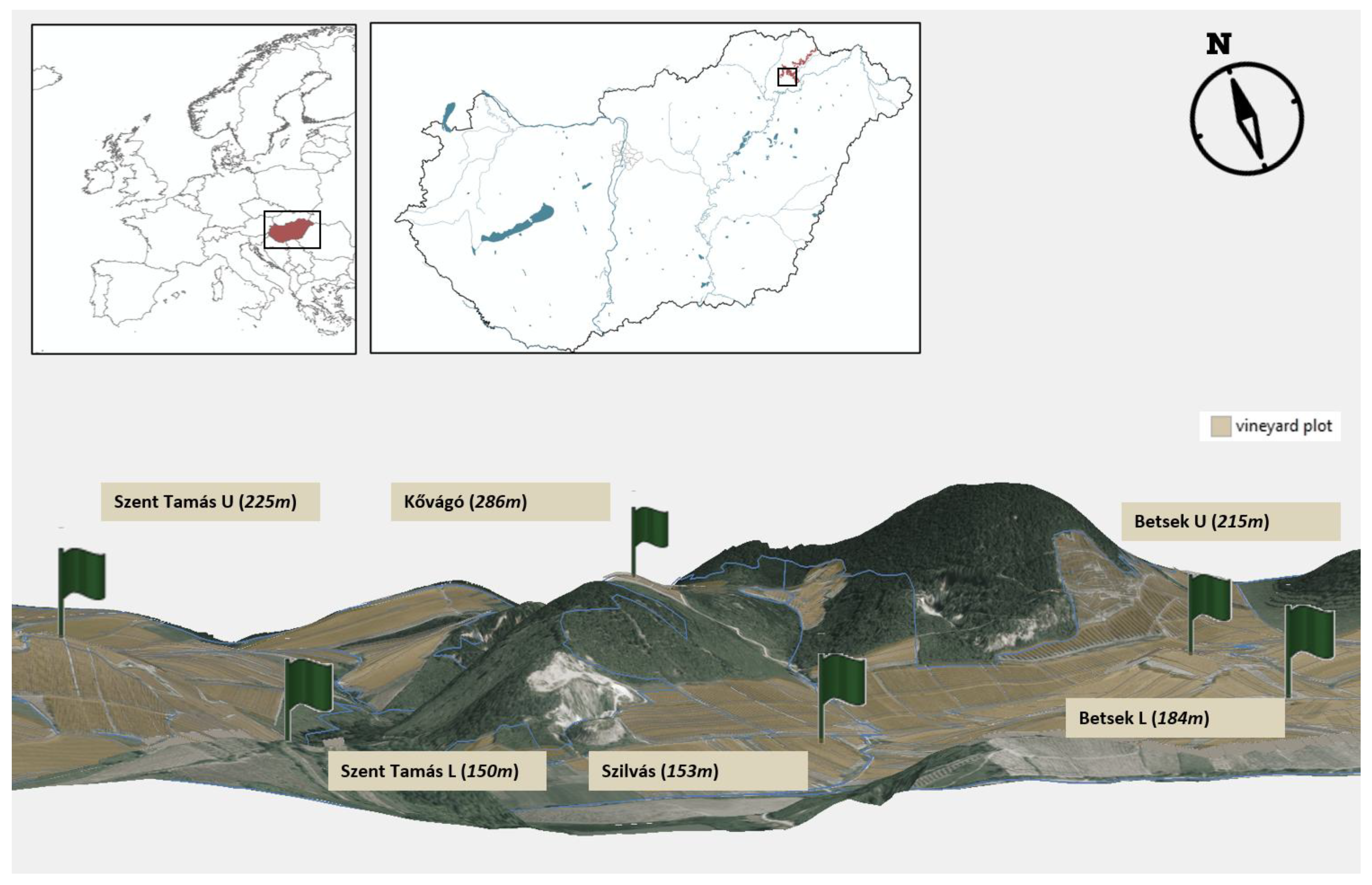
2.1. Vineyard Characteristics
2.2. Meteorological Data
2.3. Must Analysis
2.4. Data Processing and Statistical Analysis
2.5. Climatic Parameter Matrix and Selection
2.5.1. Generation of Climatic Parameters
2.5.2. Elimination and Selection
2.5.3. Climatic Parameters
3. Results
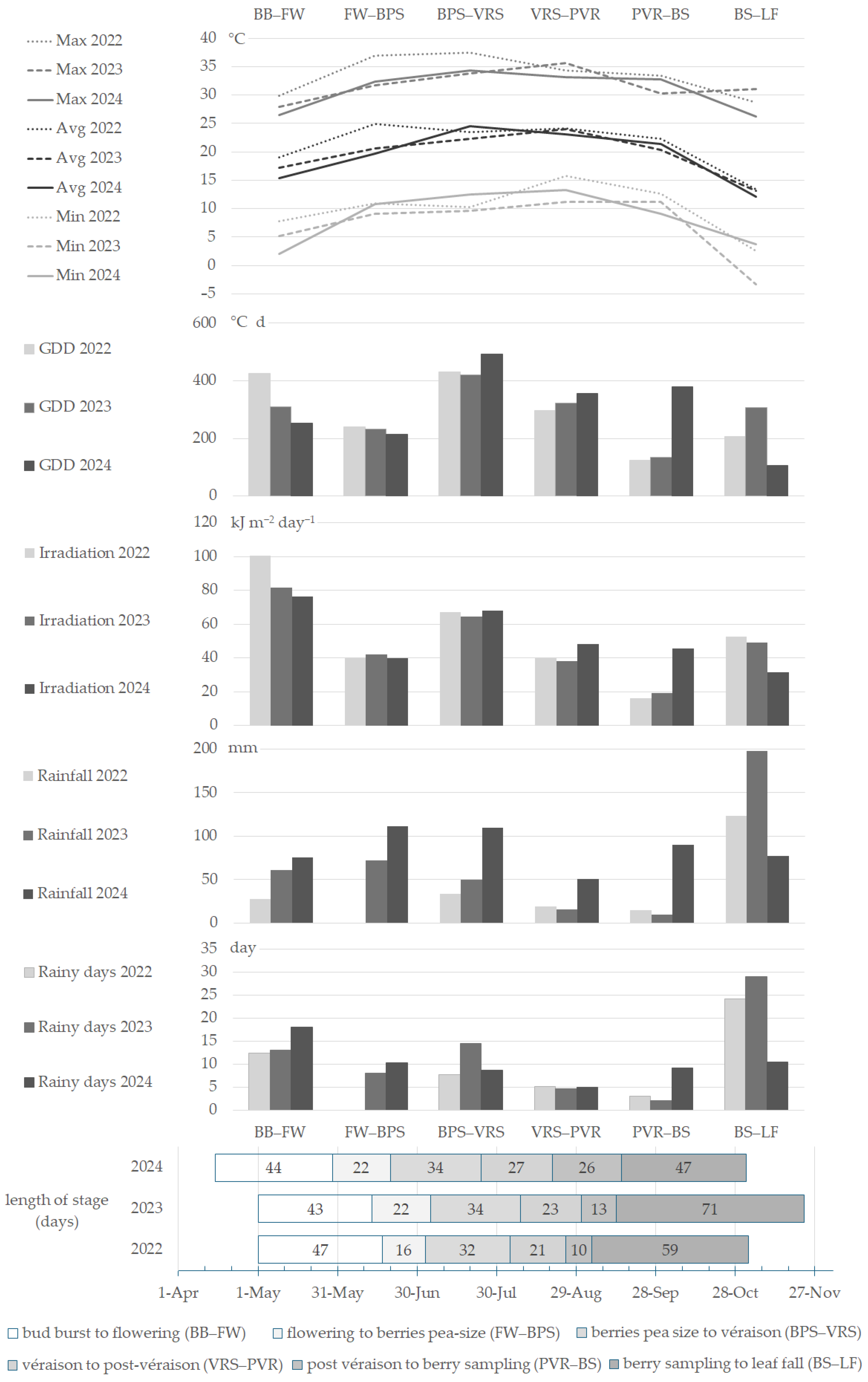
3.1. Climatic Characteristics of the Experimental Years
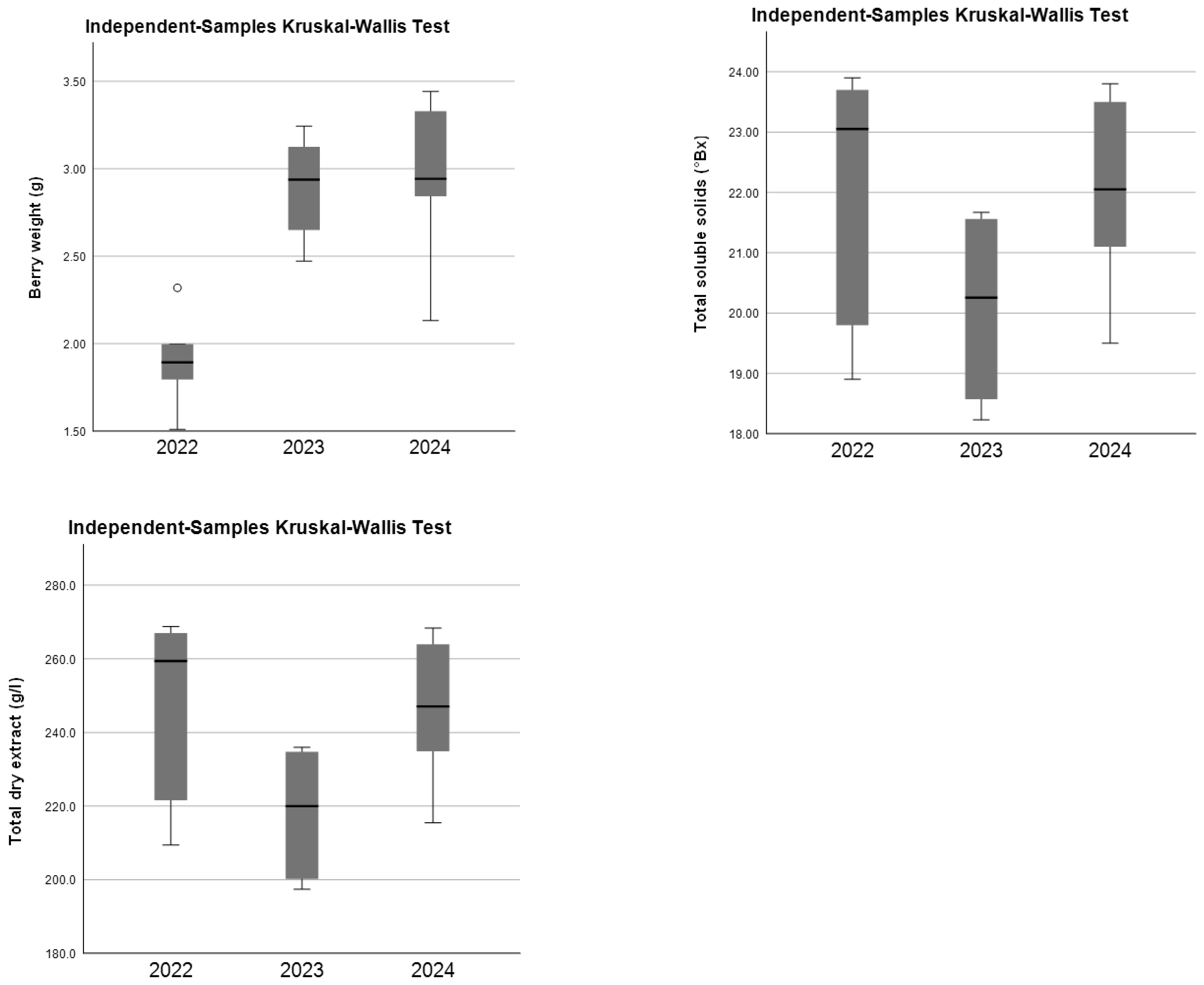
3.2. Vintage Effect on the Berry and Must Parameters
3.3. Climatic Predictors for Berry/Must Parameters
4. Discussion
4.1. Berry Weight
4.2. Total Soluble Solids and Total Dry Extract
5. Conclusions
Author Contributions
Funding
Data Availability Statement
Conflicts of Interest
Appendix A

| Sap Flow Related | Phenology Related Periods | Calendar Months | Custom Periods for Specific Indices | ||||||||||||||||
|---|---|---|---|---|---|---|---|---|---|---|---|---|---|---|---|---|---|---|---|
| Climatic Parameters/Indices | SapFlow Bud Burst—Berry Sampling | SapFlow Bud Burst—Leaf Fall | Blooming Period (15 May–15 June) | Ripening Period (1 June– 30 Sep) | Harvest Time (15 Aug–15 Oct) | April | May | June | July | August | September | October | November | March–May | April–September | April–October | June–September | June–August | September–November |
| Huglin’s Heliothermic Index | |||||||||||||||||||
| Winkler index | |||||||||||||||||||
| Cool Night Index | |||||||||||||||||||
| No. of Tropical Nights | |||||||||||||||||||
| No. of Summer Days | |||||||||||||||||||
| No. of Hot Days | |||||||||||||||||||
| No. of Extremely Hot Days | |||||||||||||||||||
| GS Average Temperature | |||||||||||||||||||
| GS Minimum Temperature | |||||||||||||||||||
| GS Maximum Temperature | |||||||||||||||||||
| GS Thermal Amplitude | |||||||||||||||||||
| Harvesttime Max. Temperature | |||||||||||||||||||
| Harvesttime Min. Temperature | |||||||||||||||||||
| Harvesttime Thermal Amplitude | |||||||||||||||||||
| Mean July monthly Avg. Temp. | |||||||||||||||||||
| July Diurnal Range | |||||||||||||||||||
| Ripening Avg Temperature | |||||||||||||||||||
| Number of Spring Frost Days | |||||||||||||||||||
| Sum of Spring Freezing Temps | |||||||||||||||||||
| Number of Fall Frost Days | |||||||||||||||||||
| Sum of Fall Freezing Temps | |||||||||||||||||||
| Growing Season Rainfall | |||||||||||||||||||
| Growing Season Rainy Days | |||||||||||||||||||
| Summer Rainfall | |||||||||||||||||||
| Blooming Period Rainfall | |||||||||||||||||||
| Ripening Period Rainfall | |||||||||||||||||||
| Ribéreau–Gayon–Peynaud Index | |||||||||||||||||||
| Dunkel’s Radiothermal Index | |||||||||||||||||||
| Actual Phenological Stages | Sap Flow Related | Phenology Related Periods | Calendar Months | |||||||||||||||||||
|---|---|---|---|---|---|---|---|---|---|---|---|---|---|---|---|---|---|---|---|---|---|---|
| Climatic Parameters/Indices | Bud Burst—Flowering | Flowering—Berries Peas Size | Berries Pea-Size—Véraison | Véraison—Post Véraison | Post-Véraison—Berry Sampling | Berry Sampling—Leaf Fall | Bud Burst—Leaf Fall | Bud Burst—Berry Sampling | Bud Burst—End of Sap Flow | SapFlow Bud Burst—Berry Sampling | SapFlow Bud Burst—Leaf Fall | Blooming Period (15 May–15 June) | Ripening Period (1 June–30 Sep) | Harvest Time (15 Aug–15 Oct) | April | May | June | July | August | September | October | November |
| Growing Degree Days | ||||||||||||||||||||||
| Biologically Effective Degree Days | ||||||||||||||||||||||
| Minimum Temperature (Minimum) | ||||||||||||||||||||||
| Minimum Temperature (Average) | ||||||||||||||||||||||
| Minimum Temperature (Maximum) | ||||||||||||||||||||||
| Mean Temperature (Minimum) | ||||||||||||||||||||||
| Mean Temperature (Average) | ||||||||||||||||||||||
| Mean Temperature (Maximum) | ||||||||||||||||||||||
| Maximum Temperature (Minimum) | ||||||||||||||||||||||
| Maximum Temperature (Average) | ||||||||||||||||||||||
| Maximum Temperature (Maximum) | ||||||||||||||||||||||
| Minimum Temperature > 20 °C | ||||||||||||||||||||||
| Maximum Temperature ≥ 25 °C | ||||||||||||||||||||||
| Maximum Temperature ≥ 30 °C | ||||||||||||||||||||||
| Maximum Temperature ≥ 35 °C | ||||||||||||||||||||||
| Diurnal Range of Temperature | ||||||||||||||||||||||
| Minimum Temp. < 0 °C (Frost Days) | ||||||||||||||||||||||
| Freezing Degree Days | ||||||||||||||||||||||
| Heavy Rainfall Days (R ≥ 10 mm) | ||||||||||||||||||||||
| Extreme Rainfall Days (R ≥ 20 mm) | ||||||||||||||||||||||
| Sum of Global Irradiation | ||||||||||||||||||||||
| Average Daily Irradiation | ||||||||||||||||||||||
| High Global Irr. Days (SR > 2.5 kJ) | ||||||||||||||||||||||
| Highest Daily Irradiation | ||||||||||||||||||||||
Appendix B
References
- Machyňáková, A.; Khvalbota, L.; Spánik, I. Enantiomer distribution of major chiral volatile organic compounds in botrytized grapes and wines. Eur. Food Res. Technol. 2021, 247, 2321–2331. [Google Scholar] [CrossRef]
- Galambos, I.; Ernszt, I.; Marton, Z.; Rodek, N. Grape Wines in Hungarian Context. In Production Technologies, Processing, and Health Benefits; Goyal, M.R., Nath, A., Kovács, Z., Eds.; Taylor & Francis, Apple Academic Press: Oakville, ON, Canada, 2024. [Google Scholar]
- Robinson, J.; Harding, J.; Vouillamoz, J. Wine Grapes: A Complete Guide to 1368 Vine Varieties, Including Their Origins and Flavours; Penguin Random House: London, UK, 2013. [Google Scholar]
- Kerridge, G.; Gackle, A. Vines for Wines: A Wine Lover’s Guide to the Top Wine Grape Varieties; CSIRO Publishing: Collingwood, Australia, 2004. [Google Scholar] [CrossRef]
- Boursiquot, J.M.; Lacombe, T.; Bowers, J.; Meredith, C.P. Le Gouais, un cépage clé du patrimoine viticole européen. Bull. OIV 2004, 77, 875–880. [Google Scholar]
- Reynolds, A. The Grapevine, Viticulture, and Winemaking: A Brief Introduction. In Grapevine Viruses: Molecular Biology, Diagnostics and Management; Springer Nature: Berlin/Heidelberg, Germany, 2017. [Google Scholar] [CrossRef]
- Anderson, K.; Nelgen, S. Which Winegrape Varieties Are Grown Where? A Global Empirical Picture (Revised Edition); University of Adelaide Press: Adelaide, Australia, 2020. [Google Scholar]
- Vyviurska, O.; Koljančić, N.; Thai, H.A.; Gorovenko, R.; Špánik, I. Classification of Botrytized Wines Based on Producing Technology Using Flow-Modulated Comprehensive Two-Dimensional Gas Chromatography. Foods 2021, 10, 876. [Google Scholar] [CrossRef] [PubMed]
- Sharma, A.; Somkuwar, R.; Samarth, R. Grape Varieties for Winemaking. In Winemaking; CRC Press: Boca Raton, FL, USA, 2021. [Google Scholar] [CrossRef]
- Chedea, V.S.; Drăgulinescu, A.-M.; Tomoiagă, L.L.; Bălăceanu, C.; Iliescu, M.L. Climate Change and Internet of Things Technologies—Sustainable Premises of Extending the Culture of the Amurg Cultivar in Transylvania—A Use Case for Târnave Vineyard. Sustainability 2021, 13, 8170. [Google Scholar] [CrossRef]
- Clingeleffer, P.R.; Davis, H.P. Assessment of phenology, growth characteristics and berry composition in a hot Australian climate to identify wine cultivars adapted to climate change. Aust. J. Grape Wine Res. 2022, 28, 255–275. [Google Scholar] [CrossRef]
- Botos, E.; Marcinkó, F. Atlas of Tokaj Wines; Bor-Kép: Budapest, Hungary, 2005. (In Hungarian) [Google Scholar]
- Farkas, E.; Jahnke, G.; Szőke, B.; Deák, T.; Oláh, R.; Oláh, K.; Knolmajerné Szigeti, G.; Németh, C.; Nyitrainé Sárdy, D. Clonal Selection of Autochthonous Grape Varieties in Badacsony, Hungary. Horticulturae 2023, 9, 994. [Google Scholar] [CrossRef]
- Eftimová, J.; Bacigálová, K. The susceptibility of Tokay vine varieties to Erysiphe necator Schwein., and Plasmopara viticola. J. Cent. Eur. Agric. 2012, 13, 560–578. [Google Scholar] [CrossRef]
- Lakatos, L.; Nagy, R. Assessment of Historical and Future Changes in Temperature Indices for Winegrape Suitability in Hungarian Wine Regions (1971–2100). Front. Plant Sci. 2025, 16, 1481431. [Google Scholar] [CrossRef]
- Stanojevic, A.; Turnsek, B.A.J.; Jevremovic, L.; Jordanovic, M. The Potentials of Wine Regions for the Formation of Cultural Landscapes: European Experiences. In Proceedings of the 3rd International Conference on Urban Planning, ICUP2020, Online, 12–13 November 2020; Available online: https://www.researchgate.net/publication/357935416_THE_POTENTIALS_OF_WINE_REGIONS_FOR_THE_FORMATION_OF_CULTURAL_LANDSCAPES_EUROPEAN_EXPERIENCES (accessed on 18 August 2025).
- Pál-Molnár, E.; Harangi, S.; Szepesi, J.; Lukács, R.; Raucsik, B.; Sági, T.; Gál, P.; Kiri, L.; Szemerédi, M. Volcanic Terroirs in Hungary; SZTE GeoTerroir Research Group, Manuscript; SZTE TTIK Institute of Geosciences: Szeged, Hungary, 2025; 14p, Available online: https://bor.hu/media/uploads/2025/vulkanikus_tanulmany/volc_terroir_eng_(1).pdf (accessed on 18 October 2025).
- Kiss, A.; Sümeghy, Z.; Czinege, A.; Karancsi, Z. Wine and land use in Nagymaros, Northern Hungary: A case study from the Danube Bend. Acta Climatol. 2005, 38–39, 97–109. Available online: https://citeseerx.ist.psu.edu/document?repid=rep1&type=pdf&doi=76a7603172a1eabc92c53717e5bf0861dc752503 (accessed on 18 September 2025).
- Justyák, J. A Tokaj-Hegyaljai Szőlőültetvények Mezo-és Mikroklimatikus Jellemzői. DSc Thesis, Hungarian Acad-emy of Sciences, Budapest, Hungary, 1992. [Google Scholar]
- Justyák, J. Climate measurements at the southern slope of the Nagy-Kopasz Hill. Acta Geogr. Univ. Debreceniensis 1965, 10, 25–37. [Google Scholar]
- Molnar, F.; Nagymarosy, A.; Jelen, S.; Baco, P. Minerals and wines: Tokaj Mts., Hungary and Slanské Vrchy Mts., Slovakia. Acta Mineral.-Petrogr. Field Guide Ser. 2010, 15, 1–40. Available online: https://www.researchgate.net/publication/234702966_Minerals_and_wines_Tokaj_Mts_Hungary_and_Slanske_Vrchy_Mts_Slovakia (accessed on 18 October 2025).
- Solar Radiation Database, HungaroMet (Hungarian Meteorological Service). Available online: https://www.met.hu/eghajlat/magyarorszag_eghajlata/altalanos_eghajlati_jellemzes/sugarzas/ (accessed on 20 March 2025).
- VanderWeide, J.; Nasrollahiazar, E.; Schultze, S.; Sabbatini, P.; Castellarin, S.D. Impact of Cluster Thinning on Wine Grape Yield and Fruit Composition: A Review and Meta-Analysis. Aust. J. Grape Wine Res. 2024, 2024, 2504396. [Google Scholar] [CrossRef]
- Ohana-Levi, N.; Cohen, Y.; Munitz, S.; Michaelovsky, R.; Ferman Mintz, D.; Hagag, N.; Getz, Y.; Netzer, Y. The response of yield, number of clusters, and cluster weight to meteorological factors and irrigation practices in grapevines: A multi-experiment study. Sci. Hortic. 2024, 326, 112761. [Google Scholar] [CrossRef]
- Zha, Q.; Zhong, H.; Tang, M.; Yin, X.; Sun, P.; Jiang, A.; Xi, X.; Wu, J. Effects of temperature and light during the veraison period on grape berry growth. Plant Stress 2024, 14, 100642. [Google Scholar] [CrossRef]
- Kriedemann, P.; Smart, R. Effects of irradiance, temperature and leaf water potential on photosynthesis of vine leaves. Photosynthetica 1971, 5, 6–15. [Google Scholar]
- Shahood, R.; Torregrosa, L.; Savoi, S.; Romieu, C. First quantitative assessment of growth, sugar accumulation and malate breakdown in a single ripening berry. OENO One 2020, 54, 1077–1092. [Google Scholar] [CrossRef]
- Venios, X.; Korkas, E.; Nisiotou, A.; Banilas, G. Grapevine Responses to Heat Stress and Global Warming. Plants 2020, 9, 1754. [Google Scholar] [CrossRef] [PubMed]
- Abeysinghe, S.K.; Greer, D.H.; Rogiers, S.Y. The Effect of Light Intensity and Temperature on Berry Growth and Sugar Accumulation in Vitis Vinifera ‘Shiraz’ under Vineyard Conditions. Vitis 2019, 58, 7–16. [Google Scholar] [CrossRef]
- Coombe, B. Influence of temperature on composition and quality of grapes. In Proceedings of the Symposium on Grapevine Canopy and Vigor Management, XXII IHC 206, Davis, CA, USA, 18 August 1986; ISHS: Korbeek-Lo, Belgium, 1987; Volume 12, pp. 23–35. [Google Scholar]
- Keller, M. Managing grapevines to optimise fruit development in a challenging environment: A climate change primer for viticulturists. Aust. J. Grape Wine Res. 2009, 15, 56–69. [Google Scholar] [CrossRef]
- Keller, M. The Science of Grapevines: Anatomy and Physiology; Academic Press: New York, NY, USA, 2010. [Google Scholar]
- van Leeuwen, C. Terroir: The effect of the physical environment on vine growth, grape ripening and wine sensory attributes. In Managing Wine Quality: Viticulture and Wine Quality; Woodhead Publishing: Cambridge, UK, 2010; pp. 273–315. [Google Scholar] [CrossRef]
- McMaster, G.S.; Wilhelm, W.W. Growing degree-days: One equation, two interpretations. Agric. For. Meteorol. 1997, 87, 291–300. [Google Scholar] [CrossRef]
- Quinn, F.H.; Assel, R.A.; Boyce, D.E.; Lèskevich, G.A.; Snider, C.R.; Weisnet, D. Summary of Great Lakes weather and ice conditions, winter 1976–77. In NOAA Technical Memorandum ERL GLERL-26; Great Lakes Environmental Research Laboratory: Ann Arbor, MI, USA, 1978; p. 141. [Google Scholar]
- Gladstones, J. Viticulture and Environment; Winetitles: Adelaide, Australia, 1992. [Google Scholar]
- Gladstones, J. Past and future climatic indices for Viticulture. In Proceedings of the 5th International Symposium for Cool Climate Viticulture and Oenology, Melbourne, Australia, 16–20 January 2000. [Google Scholar]
- Huglin, P. Nouveau mode d’évaluation des possibilités héliothermiques d’un milieu viticole. C. R. Acad. Agric. Fr. 1978, 64, 1117–1126. [Google Scholar]
- Amerine, M.A.; Winkler, A.J. Composition and quality of musts and wines of California grapes. Hilgardia 1944, 15, 493–675. [Google Scholar] [CrossRef]
- Winkler, A.J.; Cook, J.A.; Kliere, W.M.; Lider, L.A. General Viticulture, 2nd ed.; University of California Press: Berkeley, CA, USA, 1974. [Google Scholar]
- Tonietto, J.; Carbonneau, A. A multicriteria climatic classification system for grape growing regions worldwide. Agric. For. Meteorol. 2004, 124, 81–97. [Google Scholar] [CrossRef]
- Jones, G.V.; Goodrich, G.B. Influence of Climate Variability on Wine Region in the Western USA and on Wine Quality in the Napa Valley. Clim. Res. 2008, 35, 241–254. [Google Scholar] [CrossRef]
- Happ, E. Indices for exploring the relationship between temperature and grape and wine flavour. Aust. N. Z. Wine Ind. J. 1999, 14, 68–75. [Google Scholar]
- Dry, P.; Smart, R.E. The grape growing regions of Australia. In Viticulture. Volume 1. Resources; Coombe, B.G., Dry, P., Eds.; Winetitles: Adelaide, Australia, 1988. [Google Scholar]
- Katz, R.W. Statistical procedures for making inferences about climate variability. J. Clim. 1988, 1, 1057–1064. [Google Scholar] [CrossRef]
- Sabatelli, M.P.; Stendardi, M.L. Influence of some meteorological factors during the first months of the vegetative cycle on sugar content in grape berries. Riv. Vitic. Enol. 1981, 34, 271–276. [Google Scholar]
- Salinari, F.; Giosuè, S.; Tubiello, F.N.; Rettori, A.; Rossi, V.; Spanna, F.; Rosenzweig, C.; Gullino, M.L. Downy mildew epidemics on grapevine under climate change. Glob. Change Biol. 2006, 12, 1299–1307. [Google Scholar]
- Nicholas, P.; Magarey, P.; Wachtel, M. Diseases and Pests; Grape Production Series; Winetitles: Adelaide, Australia, 1994; p. 106. [Google Scholar]
- Allen Consulting Group. Climate Change, Risk and Vulnerability. Promoting an Efficient Adaptation Response in Australia; Final Report; Ninti One: Hackney, Australia, 2005. [Google Scholar]
- Ribéreau-Gayon, P.; Guimberteau, G. Vintage Reports: 1988–1996; University of Bordeaux: Bordeaux, France, 1996. [Google Scholar]
- Dunkel, Z.; Kozma, F.; Major, G. Temperature and solar radiation supply for vineyards during the vegetation period. Időjárás 1981, 85, 226–234. (In Hungarian) [Google Scholar]
- de la Fuente, M.; Escott, C.; del Fresno, J.M.; Loira, I.; Lissarrague, J.R.; Baeza, P.; Morata, A. Cluster microclimate, canopy management and its influence on the berry (size and composition) quality. BIO Web Conf. 2023, 68, 01027. [Google Scholar] [CrossRef]
- Costa, C.; Graça, A.; Fontes, N.; Teixeira, M.; Gerós, H.; Santos, J.A. The Interplay between Atmospheric Conditions and Grape Berry Quality Parameters in Portugal. Appl. Sci. 2020, 10, 4943. [Google Scholar] [CrossRef]
- Bucur, G.M.; Cojocaru, G.A.; Antoce, A.O. The climate change influences and trends on the grapevine growing in Southern Romania: A long-term study. BIO Web Conf. 2019, 15, 01008. [Google Scholar] [CrossRef]
- Camps, J.O.; Ramos, M.C. Grape harvest and yield responses to inter-annual changes in temperature and precipitation in an area of north-east Spain with a Mediterranean climate. Int. J. Biometeorol. 2012, 56, 853–864. [Google Scholar] [CrossRef]
- Mpelasoka, B.S.; Schachtman, D.P.; Michael, T.; Treeby, M.T.; Thomas, M.R. A review of potassium nutrition in grapevines with special emphasis on berry accumulation. Aust. J. Grape Wine Res. 2003, 9, 154–168. [Google Scholar] [CrossRef]
- Cataldo, E.; Salvi, L.; Paoli, F.; Fucile, M.; Masciandaro, G.; Manzi, D.; Mattii, G.B. Zeolite in Vineyard: Innovative Agriculture Management to Improve Soil Quality, Water Status and Grape Quality. Horticulturae 2021, 7, 188. [Google Scholar]
- Cataldo, E.; Fucile, M.; Mattii, G.B. Effect of Zeolite and Irrigation Treatments on Grapevine Leaves and Berries. Plant Soil 2024, 496, 321–340. [Google Scholar]
- Dominguez, D.L.E.; Cirrincione, M.A.; Deis, L.; Martínez, L.E. Impacts of Climate Change-Induced Temperature Rise on Phenology, Physiology, and Yield in Three Red Grape Cultivars: Malbec, Bonarda, and Syrah. Plants 2024, 13, 3219. [Google Scholar] [CrossRef] [PubMed]
- Anastasiou, E.; Xanthopoulos, G.; Templalexis, C.; Lentzou, D.; Panitsas, F.; Mesimeri, A.; Karagianni, E.; Biniari, A.; Fountas, S. Climatic indices as markers of table-grapes postharvest quality: A prediction exercise. Smart Agric. Technol. 2022, 2, 100059. [Google Scholar] [CrossRef]
- Mori, K.; Sugaya, S.; Gemma, H. Decreased anthocyanin biosynthesis in grape berries grown under elevated night temperature. Sci. Hortic. 2005, 105, 319–330. [Google Scholar] [CrossRef]
- de Rességuier, L.; Inchboard, L.; Parker, A.K.; Petitjean, T.; van Leeuwen, C. Drivers of Grape Berry Sugar Accumulation in Field Conditions at Local Scale. OENO One 2024, 58. [Google Scholar] [CrossRef]
- Crupi, P.; Alba, V.; Gentilesco, G.; Gasparro, M.; Ferrara, G.; Mazzeo, A.; Coletta, A. Viticultural Climate Indexes and Their Role in the Prediction of Anthocyanins and Other Flavonoids Content in Seedless Table Grapes. Horticulturae 2024, 10, 28. [Google Scholar] [CrossRef]
- Suter, B.; Destrac, I.A.; Gowdy, M.; Dai, Z.; van Leeuwen, C. Adapting Wine Grape Ripening to Global Change Requires a Multi-Trait Approach. Front. Plant Sci. 2021, 12, 2021. [Google Scholar] [CrossRef] [PubMed]


| Parameter | Abbr. | Formula | References |
|---|---|---|---|
| Growing Degree Days 1–11,18–20 [°C] | GDD | [34] | |
| Absolute Minimum Temp. 1–11 [°C] | MIN TMIN | - | |
| Average Minimum Temp. 1–11 [°C] | AVG TMIN | - | |
| Maximal Minimum Temp. 1–11 [°C] | MAX TMIN | - | |
| Minimum of Mean Temp. 1–11 [°C] | MIN TAVG | - | |
| Average of Mean Temp. 1–11 [°C] | AVG TAVG | - | |
| Maximum Mean Temp. 1–11 [°C] | MAX TAVG | - | |
| Minimal Maximum Temp. 1–11 [°C] | MIN TMAX | - | |
| Average Maximum Temp. 1–11 [°C] | AVG TMAX | - | |
| Absolute Maximum Temp. 1–11 [°C] | MAX TMAX | - | |
| Number of Tropical Nights 1–11,14 [day] | NTN | - | |
| No. of Summer Days 1–11,14 [day] | NSD | - | |
| No. of Hot Days 1–11,14 [day] | NHD | - | |
| No. of Extremely Hot Days 1–11,14 [day] | NEHD | - | |
| Diurnal Range of Temp. 1–11 [°C] | DRT | - | |
| Number of Frost Days 1–11 [day] | NFD | - | |
| Freezing Degree Days 1–11 [°C] | FDD | [35] | |
| Rainfall Days 1–11 [day] | RD | - | |
| Heavy Rainfall Days 1–11 [day] | HRD | - | |
| Extreme Rainfall Days 1–11 [day] | ERD | - | |
| Sum of Global Irradiation 1–11 [kJ m−2] | IR | - | |
| Average Daily Irradiation 1–11 [kJ m−2] | IRDAVG | - | |
| High Global Irrad. Days 1–11 [day] | HIR | - | |
| Max. Daily Irradiation 1–11 [kJ m−2] | IRMAX | - | |
| Biologically Effective. Degree Days 1–11,14,18–20 [°C] | BEDD | [36,37] | |
| Huglin’s Heliothermic Index 13 [°C] | HI | [38] | |
| Winkler Index 14 [°C] | WI | [39,40] | |
| Cool Night Index 9 [°C] | CNI | [41] | |
| Growing Season Avg. Temp. 2,3,14 [°C] | GSAT | [42] | |
| G.S. Average Min. Temp. 2,3,14 [°C] | GSATN | [42] | |
| G.S. Avg. Maximum Temp. 2,3,14 [°C] | GSATX | [42] | |
| G.S. Diurnal Range 2,3,14 [°C] | GSDR | - | |
| Ripening Period Max. Temp. 15,20 [°C] | RMX | [43] | |
| Ripening P. Minimum Temp. 15,20 [°C] | RMN | - | |
| Ripening P. Diurnal Range 15,20 [°C] | RDR | [44] | |
| Mean July Temperature 7 [°C] | MJT | [44] | |
| July Diurnal Range 7 [°C] | JDR | [45] | |
| Ripening Average Temp. 20 [°C] | RAT | [42] | |
| No. of Spring Frost Days 12 [day] | NSFD | - | |
| Sum of Spring Freezing T. 12 [°C] | SSFT | - | |
| Number of Fall Frost Days 17 [day] | NFFD | - | |
| Sum of Fall Freezing Temps. 17 [°C] | SFFT | - | |
| Growing Season Rainfall 2,3,14 [mm] | GSR | [46,47] | |
| Growing Season Rainy Days 2,3,14 [day] | GSRD | - | |
| Summer Rainfall 16 [mm] | SR | [48] | |
| Bloom Period Rainfall 18 [mm] | BR | - | |
| Ripening Period Rainfall 20 [mm] | RR | [49] | |
| Ribéreau-Gayon-Peynaud Ind. 2,3,14 [–] | RGPI | [50] | |
| Dunkel’s Radiothermal Index 2,3,14 [–] | DRI | [51] |
| (Mean ± Std. Error) | 2022 | 2023 | 2024 | |
|---|---|---|---|---|
| Berry weight (BW) ** | g | 1.90 ± 0.27 b | 2.89 ± 0.30 a | 2.94 ± 0.47 a |
| Total soluble solids (TSS) | °Bx | 23.1 ± 2.2 a | 20.1 ± 1.5 a | 22.0 ± 1.6 a |
| Total dry extract (TDE) | g l−1 | 248 ± 26 a | 218 ± 17 a | 246 ± 19 a |
| Parameter | Period | ANOVA | Tests of Normality | Correlation Coefficients | |||
|---|---|---|---|---|---|---|---|
| Kruskal–Wallis H Test | Kolmogorov–Smirnov Test | Shapiro–Wilk Test | Spearman | Pearson | R2 | ||
| ERD | FW-BPS | 0.0024 | 0.0161 | 0.0037 | 0.84 | 0.70 | |
| BEDD | FW-BPS | 0.0017 | 0.0000 | 0.0000 | 0.85 | 0.72 | |
| SR | SUM | 0.0033 | 0.0002 | 0.0003 | 0.82 | 0.68 | |
| NEHD | FW-BPS | 0.0003 | 0.0000 | 0.0000 | −0.81 | 0.66 | |
| MAX TMIN | FW-BPS | 0.0029 | 0.2000 | 0.0951 | −0.80 | 0.64 | |
| HIR | BB-BS | 0.0008 | 0.0003 | 0.0011 | −0.79 | 0.62 | |
| Rainfall | BLP | 0.0005 | 0.0019 | 0.0018 | 0.78 | 0.61 | |
| HRD | MAY | 0.0092 | 0.0014 | 0.0029 | 0.78 | 0.61 | |
| MAX TAVG | BB-BS | 0.0009 | 0.1477 | 0.0805 | −0.78 | 0.60 | |
| IR | JUN | 0.0026 | 0.0000 | 0.0002 | −0.77 | 0.59 | |
| AVG TMIN | FW-BPS | 0.0033 | 0.2000 | 0.0928 | −0.77 | 0.59 | |
| MIN TAVG | JUL | 0.0005 | 0.2000 | 0.0510 | 0.76 | 0.57 | |
| IRMAX | JUN | 0.0005 | 0.0087 | 0.0155 | −0.75 | 0.57 | |
| BEDD | VRS-PVR | 0.0004 | 0.0003 | 0.0004 | 0.75 | 0.56 | |
| GDD | PVR-BS | 0.0005 | 0.0000 | 0.0000 | 0.75 | 0.56 | |
| BEDD | PVR-BS | 0.0005 | 0.0000 | 0.0001 | 0.75 | 0.56 | |
| BEDD | BB-BS | 0.0011 | 0.0001 | 0.0001 | 0.74 | 0.55 | |
| AVG TAVG | APR | 0.0005 | 0.0000 | 0.0001 | 0.72 | 0.52 | |
| NEHD | BB-BS | 0.0006 | 0.0126 | 0.0009 | −0.71 | 0.50 | |
| NEHD | SFBB-BS | 0.0006 | 0.0126 | 0.0009 | −0.71 | 0.50 | |
| Parameter | Period | ANOVA | Tests of Normality | Correlation Coefficients | |||
|---|---|---|---|---|---|---|---|
| Kruskal–Wallis H Test | Kolmogorov–Smirnov Test | Shapiro–Wilk Test | Spearman | Pearson | R2 | ||
| MIN TMIN | FW-BPS | 0.0319 | 0.2000 | 0.9894 | 0.73 | 0.53 | |
| HRD | JUL | 0.0082 | 0.0035 | 0.0026 | 0.68 | 0.46 | |
| IR | FW-BPS | 0.0057 | 0.2000 | 0.3801 | −0.60 | 0.36 | |
| MAX TMIN | MAY | 0.0222 | 0.1651 | 0.0887 | −0.56 | 0.31 | |
| MIN TMIN | MAY | 0.0183 | 0.0412 | 0.0096 | 0.55 | 0.31 | |
| AVG TMIN | PVR-BS | 0.0091 | 0.2000 | 0.5005 | 0.54 | 0.29 | |
| AVG TMIN | JUN | 0.0028 | 0.1304 | 0.4178 | 0.53 | 0.28 | |
| MIN TMIN | VRS-PVR | 0.0009 | 0.2000 | 0.6001 | 0.53 | 0.28 | |
| NTN | PVR-BS | 0.0005 | 0.0005 | 0.0020 | 0.52 | 0.27 | |
| MIN TMAX | PVR-BS | 0.0015 | 0.0228 | 0.0047 | −0.52 | 0.27 | |
| MAX TMAX | VRS-PVR | 0.0005 | 0.2000 | 0.2891 | −0.49 | 0.24 | |
| MAX TAVG | VRS-PVR | 0.0006 | 0.2000 | 0.3003 | −0.46 | 0.21 | |
| Parameter | Period | ANOVA | Tests of Normality | Correlation Coefficients | |||
|---|---|---|---|---|---|---|---|
| Kruskal–Wallis H Test | Kolmogorov–Smirnov Test | Shapiro–Wilk Test | Spearman | Pearson | R2 | ||
| MIN TMIN | FW-BPS | 0.0319 | 0.2000 | 0.9894 | 0.76 | 0.57 | |
| HRD | JUL | 0.0082 | 0.0035 | 0.0026 | 0.72 | 0.51 | |
| MIN TMIN | MAY | 0.0183 | 0.0412 | 0.0096 | 0.61 | 0.38 | |
| MAX TAVG | AUG | 0.0011 | 0.2000 | 0.4037 | −0.61 | 0.37 | |
| AVG TMIN | JUN | 0.0028 | 0.1304 | 0.4178 | 0.60 | 0.36 | |
| MINTMIN | VRS-PVR | 0.0009 | 0.2000 | 0.6001 | 0.59 | 0.35 | |
| MAX TMIN | MAY | 0.0222 | 0.1651 | 0.0887 | −0.59 | 0.35 | |
| MIN TMAX | PVR-BS | 0.0015 | 0.0228 | 0.0047 | −0.57 | 0.33 | |
| NTN | PVR-BS | 0.0005 | 0.0005 | 0.0020 | 0.57 | 0.33 | |
| NEHD | VRS-PVR | 0.0017 | 0.0000 | 0.0000 | −0.56 | 0.32 | |
| MAX TMAX | VRS-PVR | 0.0005 | 0.2000 | 0.2891 | −0.55 | 0.31 | |
Disclaimer/Publisher’s Note: The statements, opinions and data contained in all publications are solely those of the individual author(s) and contributor(s) and not of MDPI and/or the editor(s). MDPI and/or the editor(s) disclaim responsibility for any injury to people or property resulting from any ideas, methods, instructions or products referred to in the content. |
© 2026 by the authors. Licensee MDPI, Basel, Switzerland. This article is an open access article distributed under the terms and conditions of the Creative Commons Attribution (CC BY) license.
Share and Cite
Rácz, C.; Molnár, K.; Dövényi-Nagy, T.; Bakó, K.; Kathy, I.; Szepsy, I.; Csige, L.; Dobos, A.C. Cultivar-Specific Expression of the Vintage Effect in Furmint Grapes from the Tokaj Wine Region Part I: Berry Growth, Sugar Accumulation and Dry Matter Formation. Agronomy 2026, 16, 594. https://doi.org/10.3390/agronomy16060594
Rácz C, Molnár K, Dövényi-Nagy T, Bakó K, Kathy I, Szepsy I, Csige L, Dobos AC. Cultivar-Specific Expression of the Vintage Effect in Furmint Grapes from the Tokaj Wine Region Part I: Berry Growth, Sugar Accumulation and Dry Matter Formation. Agronomy. 2026; 16(6):594. https://doi.org/10.3390/agronomy16060594
Chicago/Turabian StyleRácz, Csaba, Krisztina Molnár, Tamás Dövényi-Nagy, Károly Bakó, István Kathy, István Szepsy, László Csige, and Attila Csaba Dobos. 2026. "Cultivar-Specific Expression of the Vintage Effect in Furmint Grapes from the Tokaj Wine Region Part I: Berry Growth, Sugar Accumulation and Dry Matter Formation" Agronomy 16, no. 6: 594. https://doi.org/10.3390/agronomy16060594
APA StyleRácz, C., Molnár, K., Dövényi-Nagy, T., Bakó, K., Kathy, I., Szepsy, I., Csige, L., & Dobos, A. C. (2026). Cultivar-Specific Expression of the Vintage Effect in Furmint Grapes from the Tokaj Wine Region Part I: Berry Growth, Sugar Accumulation and Dry Matter Formation. Agronomy, 16(6), 594. https://doi.org/10.3390/agronomy16060594