Article

Physiological and Rhizosphere Microbial Community Responses of Rapeseed (Brassica napus L.) to Antimony Stress: Implications for Phytoremediation and Seed Safety


1
College of Agriculture and Biotechnology, Hunan University of Humanities, Science and Technology, Loudi 417000, China
2
School of Tropical Agriculture and Forestry, Hainan University, Haikou 570228, China
*
Authors to whom correspondence should be addressed.
Agronomy 2026, 16(4), 481; https://doi.org/10.3390/agronomy16040481
Submission received: 27 January 2026 / Revised: 16 February 2026 / Accepted: 18 February 2026 / Published: 20 February 2026
(This article belongs to the Special Issue Risk Assessment of Heavy Metal Pollution in Farmland Soil)

Abstract

Antimony (Sb) contamination in agricultural soils threatens the safety of rapeseed production, yet the mechanisms driving cultivar differences in seed Sb accumulation remain unclear. A pot experiment was conducted with two Sb-tolerant cultivars showing contrasting accumulation patterns, Nanyouza 1 (high-accumulating) and Fengyou 958 (low-accumulating), grown under increasing Sb levels. (1) Sb stress inhibited growth and reduced photosynthetic performance in both cultivars; antioxidant enzymes showed a “low stimulation–high inhibition” response and MDA increased under high Sb, indicating aggravated oxidative damage beyond the tolerance threshold. (2) Nanyouza 1 accumulated more Sb in vegetative tissues and exhibited stronger root-to-shoot translocation than Fengyou 958, whereas seed Sb remained relatively low in both cultivars and bioconcentration/translocation efficiencies declined with increasing Sb. (3) At maturity, rhizosphere bacterial communities shifted along the Sb gradient, and taxa associated with Sb differed, with Ramlibacter and Bacillus positively correlated. These findings provide mechanistic insights supporting the integration of cultivar selection and rhizosphere regulation to achieve both safe production and phytoremediation in Sb-contaminated farmland.

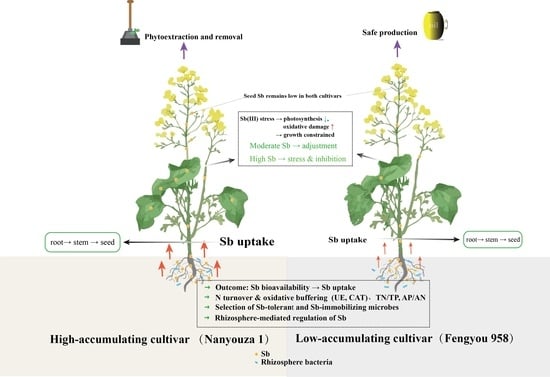
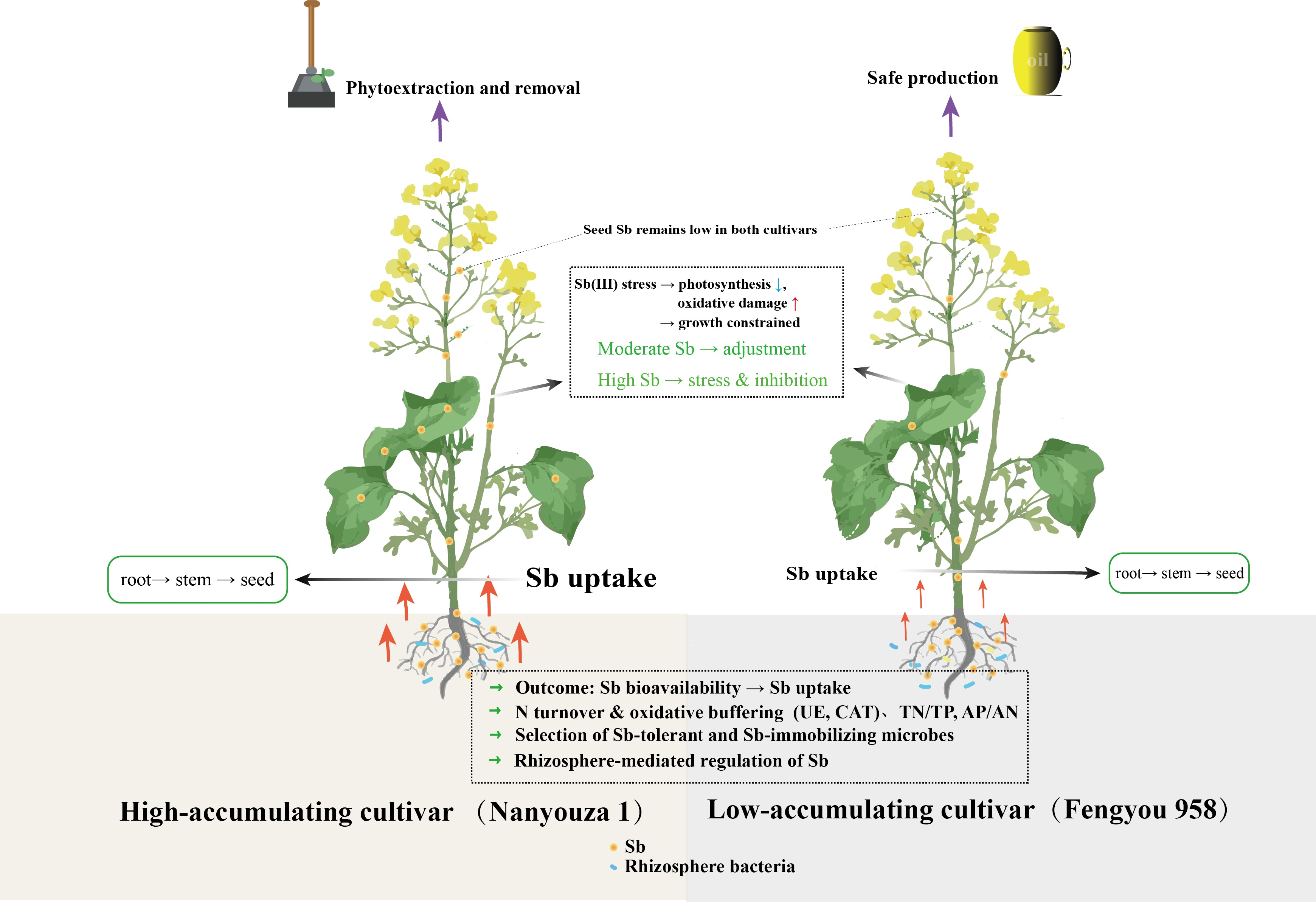
Graphical Abstract

1. Introduction

Antimony (Sb) is a naturally occurring toxic metalloid that is highly mobile and insidious [1]. In recent decades, widespread industrial applications, particularly Sb mining and smelting, have greatly elevated Sb levels in the environment. The World Health Organization (WHO) has indicated that soil Sb concentrations exceeding 36 mg/kg may pose potential risks to human health. Nevertheless, in some contaminated areas, Sb content can reach up to 3947.68 mg/kg, significantly exceeding internationally referenced safety thresholds, thereby posing severe threats to ecosystem stability and security [2]. Our previous field investigations in Xikuangshan, known as the “World Capital of Antimony”, revealed that soil Sb concentrations can reach as high as 8591.16 mg/kg [3]. Studies indicate that long-term exposure to high levels of Sb pollution can cause damage to the human respiratory and cardiovascular systems and to liver and kidney function, and may even carry potential carcinogenic risks [4,5]. Sb is not an essential nutrient for plants. Once absorbed, it is transported and stored in soluble forms, and its accumulation can disrupt physiological processes and ultimately inhibit plant growth [6]. It can bind to thiol groups of proteins, inhibit the activity of various key enzymes, and lead to enhanced oxidative stress and cellular damage [7]. Elevated levels of Sb severely inhibit plant growth, affecting root elongation, shoot development, and overall biomass accumulation, and this inhibition is intensified as the Sb concentration increases [8]. In addition, Sb accumulation disrupts chlorophyll synthesis and reduces photosynthetic efficiency. It also induces excessive generation of reactive oxygen species (ROS), which triggers oxidative stress, damages cellular structures, and exacerbates growth inhibition [9]. Heavy metals may even accumulate in edible plant parts, and such contamination is usually not visible from appearance, thus posing a hidden risk to food safety. Therefore, Sb contamination has become an urgent environmental problem, and the search for efficient, economical, and sustainable remediation technologies has become a key direction of current research.
On metal-contaminated farmland, phytoremediation using high-biomass crops is particularly attractive because it allows simultaneous crop production and gradual restoration of soil quality. Compared with traditional methods such as excavation, soil washing and chemical stabilisation, it is generally less costly and more compatible with routine field management [10]. Phytoremediation operates through several plant-mediated processes, including metal accumulation, stabilisation, translocation and transformation [11]. These processes reduce metal mobility and bioavailability and enhance detoxification through chelation, sequestration and compartmentalisation, ultimately mitigating phytotoxicity and supporting crop growth in contaminated soils [10,12]. In addition, plant performance is co-governed by the rhizosphere microbiome. Beneficial rhizosphere microbes assist in mobilising nutrients, secreting phytohormones, regulating redox potential, and altering metal bioavailability, thus improving plant stress tolerance and uptake depending on the remediation goal [13,14,15]. Although phytoremediation research has made progress in recent years, most studies still focus on non-edible hyperaccumulator plants or are conducted under controlled conditions, lacking systematic exploration of field-scale cultivation of edible crops in contaminated farmland.
Rapeseed (Brassica napus L.) is a dual-purpose crop with potential for both food/oil production and phytoremediation. It is one of the most widely cultivated oilseed crops in China, playing an important role in national food and oil security and providing feedstock for biofuels, lubricants and animal feed. The seeds are pressed for edible oil and the young leaves can be consumed as a vegetable, which further enhances its economic value. In addition, its high biomass, short growth cycle and tolerance or accumulation capacity toward various heavy metals make rapeseed a promising candidate for field-scale phytoremediation on contaminated farmland [16,17]. Notably, heavy metal concentrations in rapeseed grains are typically much lower than in roots, stems and leaves, and under appropriate management this trait makes it possible to maintain relatively safe use of the oil while at the same time promoting a gradual reduction in soil contamination. However, systematic studies on Sb uptake, accumulation and translocation in rapeseed at different growth stages remain limited [18,19]. In oilseed crops such as rapeseed, the seed is the final harvested organ and the most risk-sensitive compartment under contamination, so Sb accumulation in seeds directly determines whether safe production can be achieved on contaminated farmland. Meanwhile, rapeseed shows a certain degree of tolerance and uptake capacity for heavy metals, meaning it can be used either for phytoremediation of contaminated soils or as a production crop within a safe-use framework. Therefore, based on prior evidence indicating contrasting Sb accumulation capacities in different rapeseed cultivars [20], we used two cultivars with contrasting Sb accumulation patterns (Nanyouza 1, high-Sb-accumulating; Fengyou 958, low-Sb-accumulating) as a model system to examine plant growth, physiological responses and Sb partitioning at the seedling, flowering and maturity stages, and to characterise rhizosphere bacterial communities at maturity in Sb-contaminated soil.
This study used two rapeseed (Brassica napus L.) cultivars with different Sb accumulation patterns as a model system, aiming to: (1) elucidate how plant growth, photosynthesis, and antioxidant defence change across different growth stages with increasing Sb stress; (2) clarify Sb uptake, internal partitioning, and translocation processes, with particular emphasis on cultivar-dependent differences and the final seed Sb accumulation; (3) assess, at maturity, whether cumulative Sb exposure is associated with shifts in the rhizosphere bacterial community and its predicted functional potential, and how these shifts relate to Sb bioavailability and final seed Sb outcomes. We hypothesized that with increasing Sb concentrations, rapeseed would exhibit stage-dependent physiological responses and altered Sb partitioning, and that these responses would differ between cultivars; long-term Sb stress would drive rhizosphere microbial community reorganization, thereby influencing Sb availability and its transfer to seeds through rhizosphere processes, providing a basis for achieving synergy between phytoremediation and safe production in Sb-contaminated farmland.

2. Materials and Methods

2.1. Experimental Soil and Plant Materials

Experiments were conducted at Hunan University of Humanities, Science and Technology. Several soil characteristics were measured: the tested soil was loam, pH 7.28 (1:2.5, w/v), organic matter 22.34 g kg−1, total N 1.27 g kg−1, available N 128.53 mg kg−1, total P 0.96 g kg−1, available P 43.63 mg kg−1, total K 15.79 g kg−1, available K 185.15 mg kg−1, and Sb 33.57 mg kg−1. Seeds of two rapeseed cultivars, Fengyou 958 and Nanyouza 1, were provided by Hunan Yahua Seed Industry Co., Ltd. (Loudi, China). These cultivars were selected based on preliminary field and pot screening trials, which revealed contrasting Sb enrichment patterns: Fengyou 958 had a bioconcentration factor (BCF) of 0.32 (<1, low-Sb-accumulating), whereas Nanyouza 1 had a BCF of 1.11 (>1, high-Sb-accumulating).

2.2. Pot Experiment Design

Two Sb-tolerant rapeseed cultivars, Nanyouza 1 and Fengyou 958, were selected based on preliminary screening for Sb tolerance. In the preliminary experiment, Sb concentrations of 0, 1000, 2000, 4000, and 6000 mg kg−1 were applied to determine the maximum Sb tolerance of oilseed rape. Seed germination was completely inhibited at 6000 mg kg−1, whereas seeds still germinated and grew at 4000 mg kg−1. In addition, 4000 mg kg−1 was close to the Sb level at the actual contamination source and was therefore used to simulate a severe contamination scenario. Consequently, Sb concentrations of 1000, 2000, and 4000 mg kg−1 were selected for the formal experiment.
In the formal pot experiment, the treatments included a control without Sb addition (CK) and three Sb stress treatments at 1000, 2000, and 4000 mg kg−1. The specific treatment codes were as follows: NCK, N1, N2, and N4 for Nanyouza 1, and FCK, F1, F2, and F4 for Fengyou 958. In total, eight treatments were established, each with three replicates. Each plastic pot was filled with 5 kg of air-dried and sieved soil. Two weeks before sowing, potassium Sb tartrate (KSbOC4H4O6⋅½H2O, CAS Number: 28,300-74-5) was dissolved in water to prepare Sb solutions of different concentrations, which were applied to the soil with irrigation water and thoroughly mixed to ensure uniform distribution. The treated soil was then allowed to equilibrate. Before sowing, the soil in each pot was thoroughly remixed to prevent vertical heterogeneity of Sb. During the experimental period, greenhouse temperatures ranged from 15 to 30 °C. Plants were irrigated daily with 300 mL of water, and routine management practices such as soil loosening and weeding were carried out regularly.

2.3. Collection of Plant and Physiological Measurements

After measurement, each plant was carefully separated into roots, stems, leaves, and seeds. The separated samples were dried in an oven at 105 °C for 30 min, followed by drying at 65 °C until a constant weight was reached. The dry weight of each organ was then determined.
Net photosynthetic rate (Pn), stomatal conductance (Gs), intercellular CO2 concentration (Ci), transpiration rate (Tr), and chlorophyll fluorescence (Fv) were measured between 10:00 and 12:00 using an IFL portable photosynthesis–fluorescence measuring system (Heinz Walz GmbH, Effeltrich, Germany). Chlorophyll content was determined using a portable chlorophyll meter (SPAD-520Plus; Konica Minolta, Osaka, Japan).

2.4. Antioxidant Enzyme Activities and Lipid Peroxidation in Rapeseed

MDA content and antioxidant enzyme activities, including superoxide dismutase (SOD), peroxidase (POD), and catalase (CAT), were measured using assay kits (Suzhou Keming Biotechnology Co., Ltd., Suzhou, China). Specifically, MDA, SOD, POD, and CAT were determined using the thiobarbituric acid (TBA) method, WST-8 method, guaiacol method, and ultraviolet absorption method, respectively. The absorbance was measured at 532 nm for MDA, 450 nm for SOD, 470 nm for POD, and 240 nm for CAT using a UV-visible spectrophotometer (UV-8000, Shanghai Metash, Shanghai, China). The results were expressed as nmol/g, U/g, U/mL, and nmol/min/g, respectively [21].

2.5. Sb Content in the Plants and Soil

Soil Sb concentrations were measured using sealed high-pressure digestion followed by atomic absorption spectrometry (AAS). For plant samples, Sb concentrations were determined after acid digestion with nitric acid using the same nuclear absorption spectrometry method.

2.6. Calculation of Bioconcentration Factor (BCF) and Translocation Factor (TF)

The bioconcentration factor (BCF) and translocation factor (TF) were calculated to evaluate the accumulation and translocation capabilities of Sb rapeseed. BCF was calculated as the ratio of Sb concentration in plant organs to that in soil, which reflects the plant’s ability to absorb and accumulate Sb from the soil. TF was calculated as the ratio of Sb concentration in the upper organ to that in the lower organ, representing the translocation efficiency of Sb within the plant. In this study, translocation factors between specific organs were defined as follows: TFRS: root to stem; TFSP: stem to silique; TFPS: silique to seed. The formulas are as follows:
BCF   =   Sb   concentration   in   plant   organs   ( mg   kg 1 ) Sb   concentration   in   soil   ( mg   kg 1 )
T F a b = Sb   concentration   in   organ   b   ( mg   kg 1 ) Sb   concentration   in   organ   a   ( mg   kg 1 )

2.7. Microbial Diversity Analysis

Total genomic DNA from rhizosphere soil samples was extracted using the TruSeq Nano DNA LT Library Prep Kit (Illumina, San Diego, CA, USA). DNA concentrations were quantified using a Nanodrop spectrophotometer (Thermo Scientific, Waltham, MA, USA). The V3–V4 region of the bacterial 16S rRNA gene was amplified using primers 338F (5′-ACTCCTACGGGAGGCAGCA-3′) and 806R (5′-GGACTACHVGGGTWTCTAAT-3′). The PCR products were then purified and pooled for sequencing. High-throughput sequencing was performed on the Illumina MiSeq platform (Illumina, San Diego, CA, USA) at Shanghai Personal Biotechnology Co., Ltd. (Shanghai, China).

2.8. Statistical Analysis

All experimental data were recorded using Office Excel 2019. Statistical analyses were performed using IBM SPSS 23.0 software. Significant differences among treatments were determined by Duncan’s multiple range test at a significance level of p < 0.05. Graphs were generated using GraphPad Prism 10. All data are presented as means ± standard deviations (SD).

3. Results

3.1. Effects of Sb on the Morphological Traits of Rapeseed

As shown in Table S1, under different Sb concentrations, the plant height, root length and dry biomass of rapeseed were affected differently at each growth stage. At the seedling stage, both cultivars grew better at 1000 and 2000 mg kg−1 Sb. At maturity, however, 4000 mg kg−1 Sb caused the following reductions: in Nanyouza 1, root length, plant height and dry biomass decreased by 23.90%, 15.31% and 51.0%, respectively, while in Fengyou 958 they declined by 20.90%, 16.50% and 13.80%, respectively. These results indicate that the inhibitory effect on rapeseed intensifies with increasing Sb concentration.

3.2. Sb Accumulation and Translocation in Rapeseed at Different Growth Stage

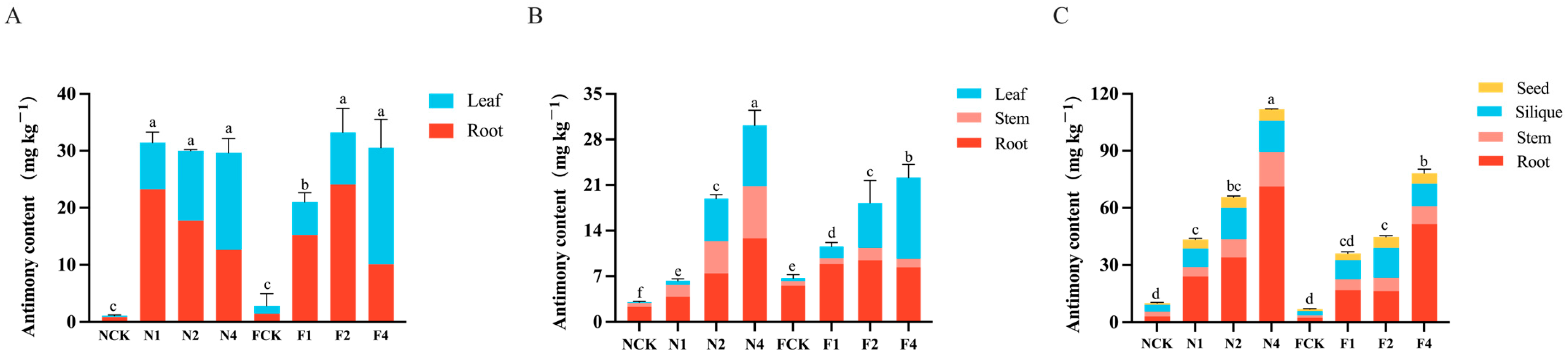
The distribution of Sb in different organs of rapeseed was closely related to its accumulation and translocation capacity. As shown in Figure 1, Sb accumulation in various organs of both cultivars tended to increase overall as the growth stages advanced. At the seedling stage, Sb contents in leaves under N4 and F4 treatments were significantly higher than those in the control, while in other treatments, roots contained higher Sb levels than leaves. During the flowering stage, Sb contents in all organs increased with rising soil Sb concentrations, with roots showing the highest and stems the lowest levels. At maturity, Sb contents ranked in the order of root > silique > stem > seed, and the root Sb content in the N4 treatment was approximately 22 times higher than that in the control, Sb content in the aboveground parts of F is lower than that of N, further confirming that F is a low-accumulating variety.
As shown in Table S2, BCF in different plant parts of rapeseed were affected by growth stage and Sb concentration. At all growth stages, BCFroot values were higher than those of shoots, and BCF decreased significantly with increasing Sb concentration. Table S3 shows that TF among plant organs at maturity differed, following the order of TFSP(stem–silique) > TFRS(root–stem) > TFPS(silique–seed). Under different Sb treatments, both TFRS and TFPS were less than 1. TFPS values were relatively higher in FCK and F4, possibly indicating that the stem still played a role in the redistribution of Sb. TFRS was highest under the CK treatment and higher than in other treatment groups, indicating that Sb stress markedly inhibited the translocation of Sb from roots to stems.

3.3. Effects of Sb on Photosynthetic Parameters of Rapeseed

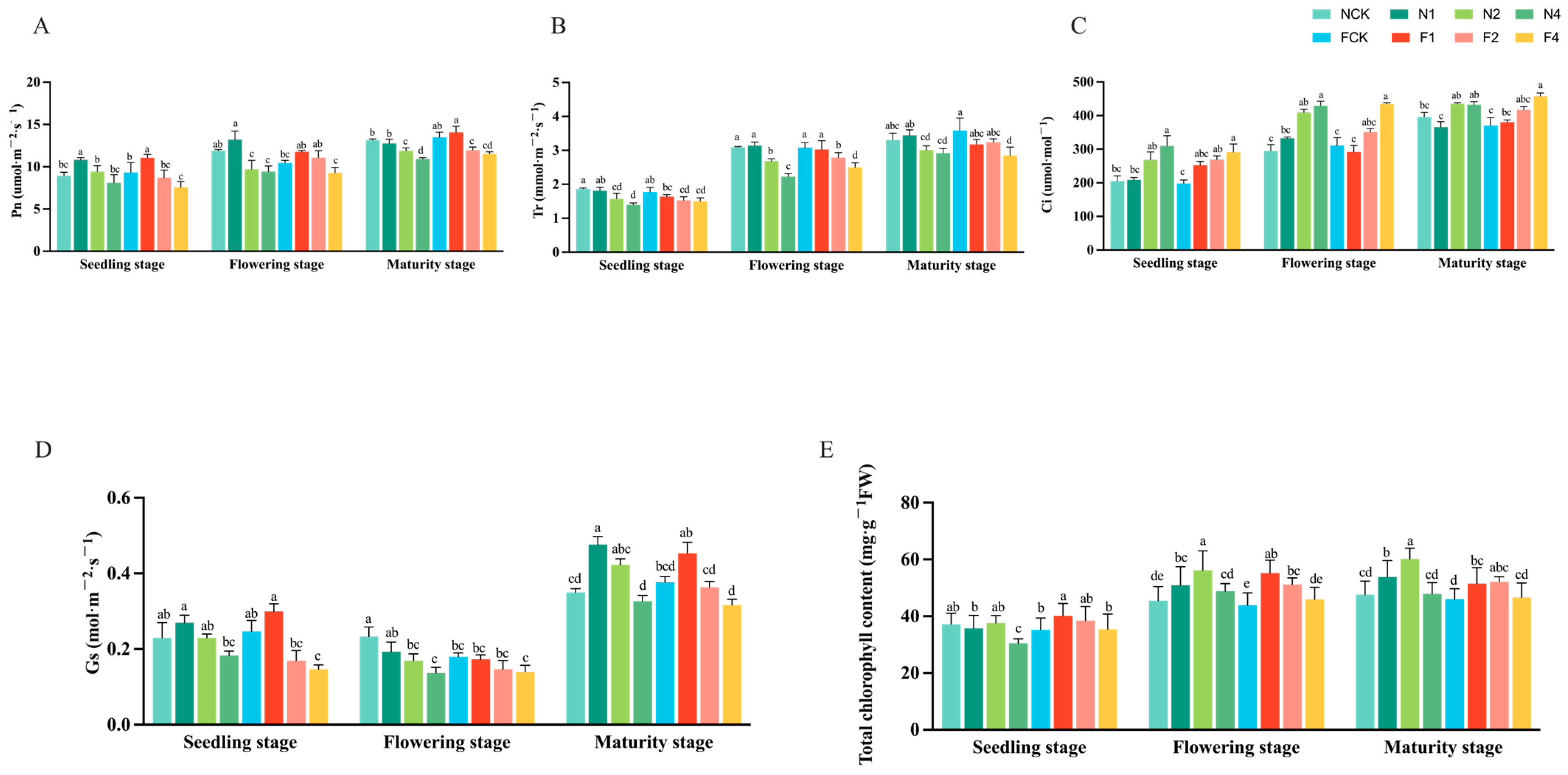
As shown in Figure 2, Pn, Tr, and Ci in rapeseed progressively increased with the advancement of growth stages, following the order of seedling < flowering < maturity. At 1000 mg kg−1 Sb, Pn and Tr at the seedling and flowering stages were slightly enhanced, indicating a mild promotive effect. However, when Sb rose to 2000–4000 mg kg−1, all gas-exchange parameters were affected at maturity. At 4000 mg kg−1 Sb in Nanyouza, Pn, Tr and Gs dropped by 16.8%, 11.6% and 6.7%, respectively, while Ci increased by 9.2%. Fengyou showed a similar trend but larger amplitude: Pn, Tr and Gs dropped by 14.7%, 20.7%, 15.9%, and Ci increased by 23.5% (p < 0.05). At higher concentrations, total chlorophyll content declined, potentially disrupting chlorophyll synthesis and photosynthesis.

3.4. Effects of Sb on MDA Content and Antioxidant Enzyme Activities in Leaves and Roots of Rapeseed

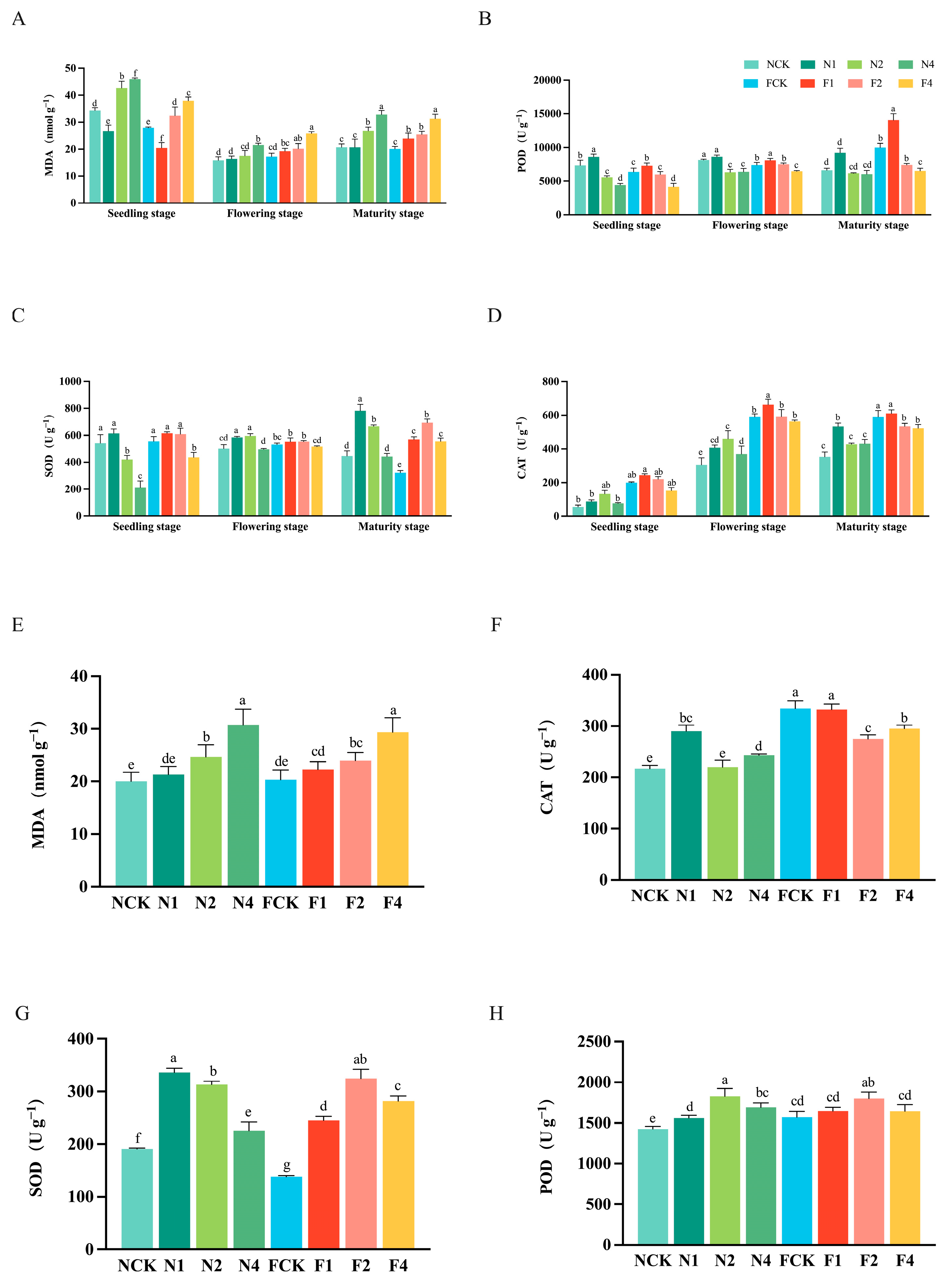
In the leaves of rapeseed (Figure 3A–D), MDA content showed an increasing trend from the seedling to the maturity stage. At the seedling stage, it showed a decrease followed by an increase with rising Sb concentrations. During the flowering stage, the N4 and F4 treatments increased by 36.3% and 50.1%, respectively, compared with the control, while at maturity, the increases were 58.3% and 55.4%, respectively. Activities of CAT, POD, and SOD across all growth stages showed a consistent pattern of increasing first and then decreasing with increasing Sb concentrations, peaking at 1000-2000 mg kg−1 and subsequently declining at 4000 mg kg−1. At the maturity stage, compared with the CK, root MDA content increased more sharply in Nanyouza by 53.7%, while the increase in Fengyou was 44.5%. SOD activity in Fengyou peaked at F2, with a 77.5% rise (Figure 3E–H).

3.5. Soil Enzyme Activities and Physicochemical Properties of Rhizosphere Soil Under Sb Stress

As shown in Table S4, rhizosphere enzyme activities at maturity generally declined with increasing Sb levels in both cultivars, with more pronounced reductions in the high-accumulating cultivar N. In N, urease decreased by 31.1% and catalase decreased by 24.0% relative to the control, while sucrase also declined by 12.2%. In contrast, enzyme changes in F were comparatively moderate, with urease and catalase decreasing by 4.7% and 5.7%, respectively. Soil physicochemical properties showed relatively limited variation overall: TN and pH remained largely stable across Sb treatments, whereas SOM displayed a non-monotonic response, and nutrient indices exhibited cultivar-dependent patterns, with TP and AP increasing under higher Sb in N but tending to decrease in F.

3.6. Effect of Sb Stress on Rhizosphere Microorganisms of Rapeseed Seedlings

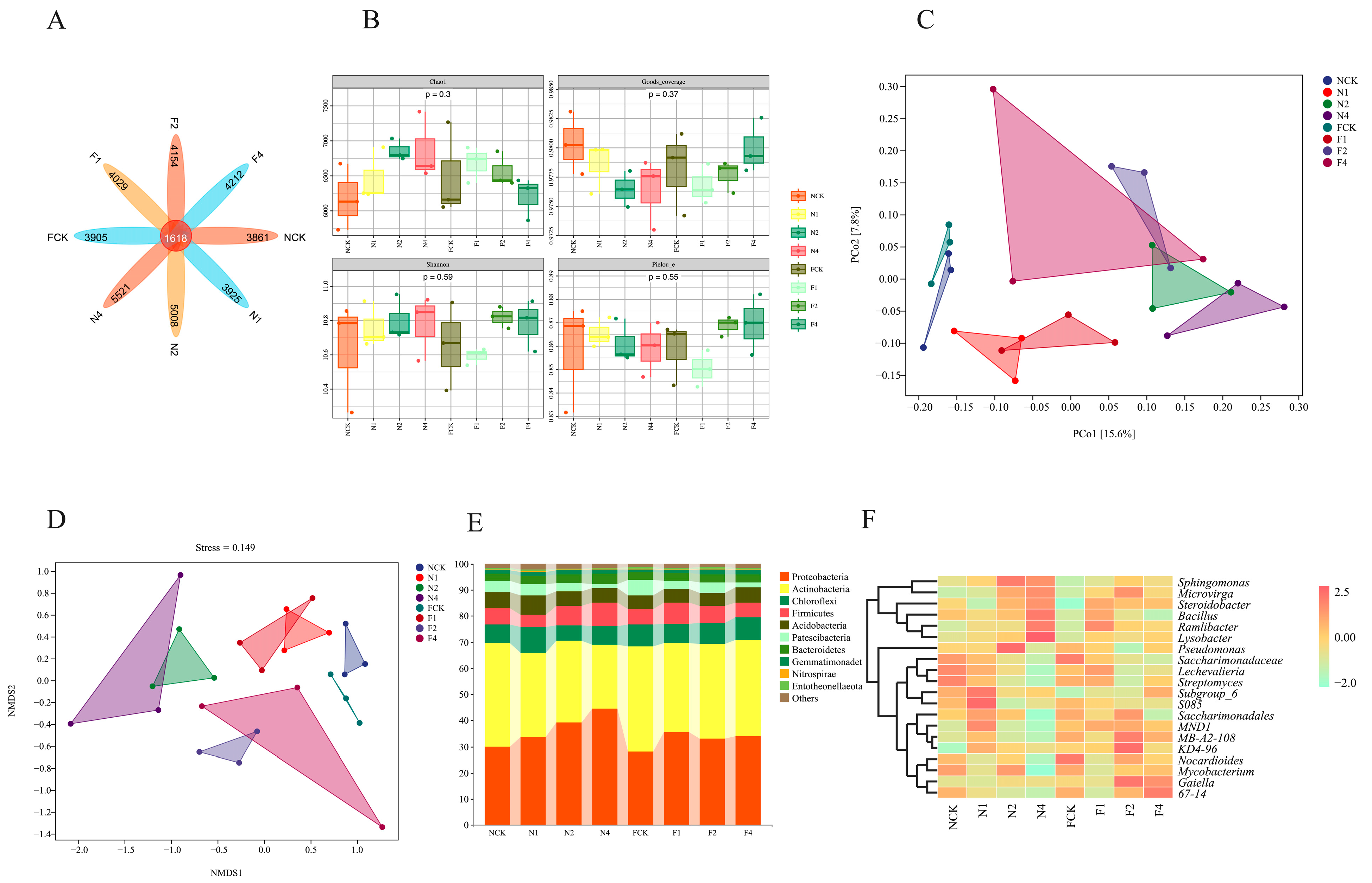
A total of 1618 OTUs were shared across all treatments. The number of unique OTUs increased in the order FCK < F1 < F2 < F4 and NCK < N1 < N2 < N4. Rarefaction curves for all samples plateaued with increasing sequencing depth, indicating that the sequencing depth was sufficient and the data were robust (Figure 4A and Figure S1). The Chao1 index increased initially and then decreased with increasing Sb concentrations, while Shannon, Pielou’s evenness, and Good’s coverage indices decreased first and then increased. Notably, the Good’s coverage index exceeded 0.973 in all treatments, indicating that the sequencing results adequately reflected the composition of rhizosphere soil microbial communities associated with rapeseed under different treatments. A comprehensive analysis of soil microbial alpha diversity revealed that high concentrations of Sb stress reduced microbial abundance while increasing microbial diversity (Figure 4B). PCoA revealed that Sb addition distinctly altered the rhizobacterial community composition, and subtle differences were observed between the two rapeseed cultivars under the same Sb concentration (Figure 4C).
At the phylum level, the dominant bacterial phyla of the two rapeseed cultivars were Proteobacteria (28.1–44.5%), Actinobacteria (24.6–40.3%), Chloroflexi (6.0–9.9%), Firmicutes (4.7–9.0%) and Acidobacteria (5.1–7.4%). Subdominant phyla included Patescibacteria (1.5–5.7%), Bacteroidetes (2.8–4.0%), Gemmatimonadetes (1.0–1.8%), Nitrospirae (0.4–0.6%) and Entotheonellaeota (0.2–0.5%). The relative abundance of Proteobacteria increased with increasing Sb concentration in both Nanyouza and Fengyou, whereas the relative abundance of Actinobacteria decreased. In contrast, the remaining phyla exhibited relatively small fluctuations and no clear directional change along the Sb gradient (Figure 4E). A clustered heatmap based on genus-level relative abundances showed clear differences in rhizosphere bacterial community composition among the different Sb treatments (Figure 4F). At the genus level, typical Proteobacteria genera Ramlibacter and Lysobacter showed higher relative abundances under Sb stress, especially at the highest Sb level. In Nanyouza, the mean relative abundance of Ramlibacter and Lysobacter in N4 was roughly 3–9 times higher than that in NCK, and a similar increasing trend was also observed in Fengyou. Pseudomonas tended to increase at the intermediate Sb concentration (N2) in Nanyouza, whereas its abundance in Fengyou fluctuated within a narrower range among Sb treatments. In contrast, several Actinobacteria-affiliated genera, such as Lechevalieria, Streptomyces and Nocardioides, were relatively more abundant in the control soils and generally decreased under high Sb.
According to LEfSe analysis (LDA > 2), different treatments were associated with distinct indicator genera (Figure S2). In the Nanyouza cultivar, Lactococcus was identified as a biomarker in the control soil (NCK), while Lysobacter was the dominant indicator genus under the highest Sb level (N4). In the Fengyou cultivar, Nocardioides was characteristic of the control treatment (FCK), whereas Aurantimicrobium was specifically enriched in the high Sb treatment (F4). These treatment-specific biomarker genera highlight the shifts in rhizosphere communities along the Sb gradient and between the two cultivars.
In PICRUSt2-based functional prediction, increasing Sb concentrations induced a clear reorganization of rhizosphere microbial metabolic potential (Figure S3). In the high-accumulating cultivar N, the Sb gradient, central carbon and energy metabolism showed different concentration responses, with pathways related to the TCA cycle and associated glycolysis–TCA–glyoxylate processes displaying an increasing trend under elevated Sb levels. Lipid metabolism was markedly affected by Sb exposure, as evidenced by the progressive enrichment of fatty acid and lipid biosynthesis together with enhanced lipid degradation, indicating intensified metabolic turnover under metal stress. Pathways involved in genetic information processing and cellular maintenance, including nucleic acid processing and aminoacyl-tRNA charging, were maintained or enhanced at higher Sb concentrations. By contrast, cultivar F showed weaker concentration-dependent increases in these pathways, while exhibiting relatively higher levels of polymer/glycan degradation under high Sb, implying a comparatively stronger potential for carbon-source turnover in F under severe stress.

3.7. Correlation Between Seed Sb Accumulation, Plant Traits and Rhizosphere Bacterial Diversity at Maturity

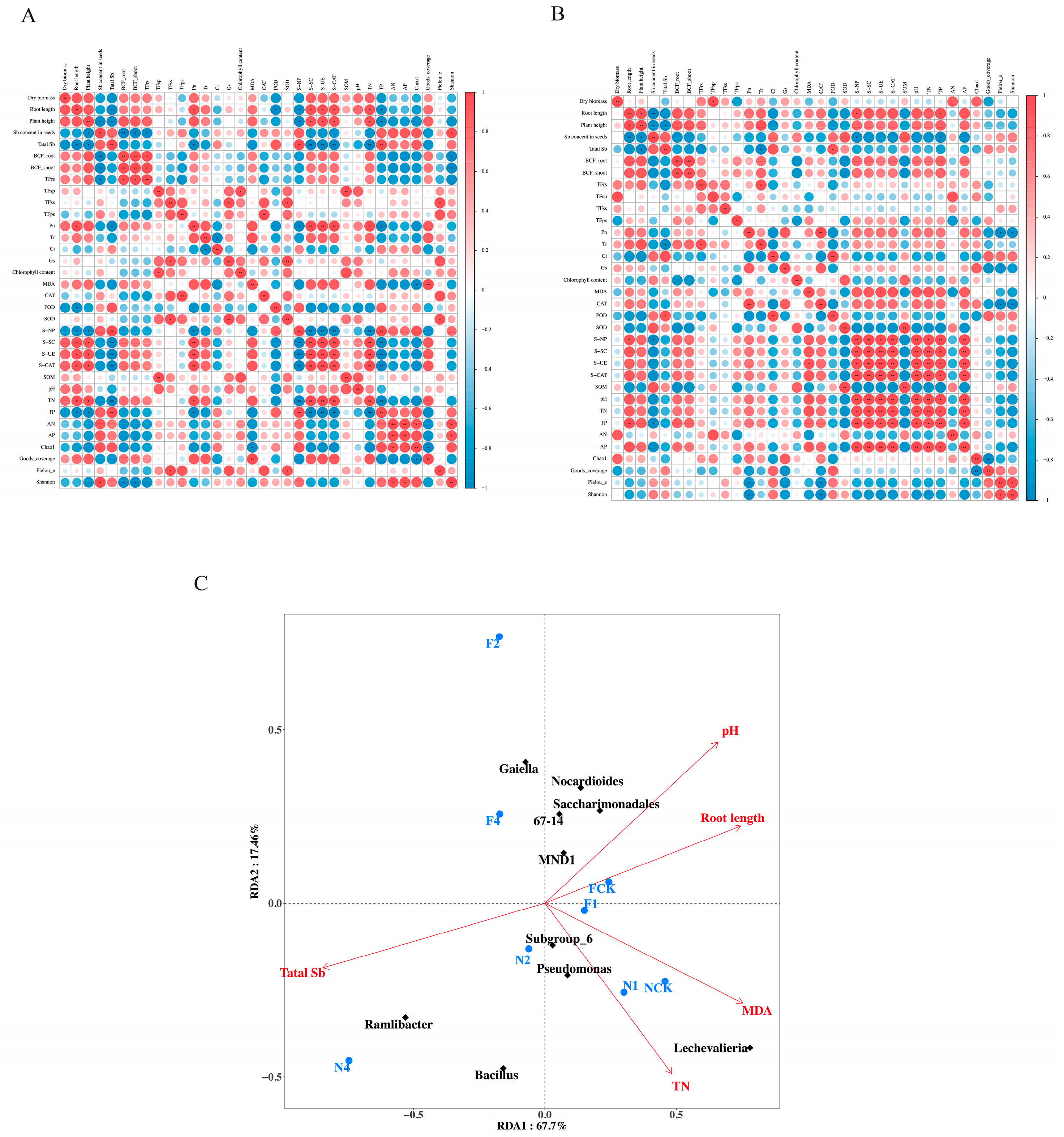
Pearson correlation analysis revealed coordinated relationships among plant growth traits, photosynthetic performance, Sb uptake/transport parameters, and rhizosphere bacterial diversity. Total Sb was strongly and negatively correlated with root length, plant height, and Pn (r = −0.96 to −0.98, p < 0.05), indicating that enhanced Sb accumulation was accompanied by pronounced growth inhibition and reduced photosynthetic performance. Seed Sb concentration showed strong negative correlations with Sb bioconcentration and translocation parameters, including BCFroot, BCFshoot, and TFrs (r = −0.95 to −0.99, p < 0.05), whereas it was strongly positively correlated with bacterial Shannon diversity (r = 0.98, p = 0.018). In addition, soil N-cycling enzyme activities exhibited strong positive correlations with total Sb (r > 0.99, p < 0.01) (Figure 5A). In cultivar F, total Sb was positively correlated with seed Sb content (r = 0.86, p = 0.020) and oxidative stress indicated by POD activity (r = 0.95, p = 0.049), while showing a significant negative correlation with plant height (r = −0.97, p = 0.030). Seed Sb concentration was strongly negatively correlated with root length (r = −0.99, p = 0.005) and plant height (r = −0.96, p = 0.044). BCFroot strongly correlated with BCFshoot (r = 0.99, p = 0.005). In contrast to cultivar N, correlations between Sb accumulation and microbial diversity indices were weak and not statistically significant (Figure 5B).
Redundancy analysis (RDA) was performed to explore the relationships between rhizosphere microbial community composition and environmental variables under Sb stress (Figure 5C). RDA1 explained 67.70% and RDA2 explained 17.46% of the constrained variation. Total Sb showed the strongest fit with the ordination (r2 = 0.79, p = 0.016), and was associated with high-accumulation treatments and specific bacterial taxa (Ramlibacter and Bacillus). In addition, MDA was closely related to Lechevalieria, suggesting that Sb-induced oxidative stress may contribute to shifts in rhizosphere community structure. Root length and soil pH were associated with Nocardioides and Saccharimonadales.

4. Discussion

Understanding how plants cope with Sb stress requires consideration of both plant-intrinsic physiological regulation and rhizosphere-mediated processes. Under Sb exposure, plants must simultaneously maintain growth and photosynthetic performance while restricting excessive Sb accumulation in edible tissues. These outcomes are unlikely to be governed by a single mechanism, but instead emerge from coordinated responses involving plant physiology, Sb uptake and internal translocation, and interactions with the rhizosphere microbial community. Accordingly, the following discussion integrates these different response levels to elucidate how rapeseed regulates Sb partitioning and ultimately determines Sb accumulation in seeds.

4.1. Low Sb Priming Promotes Physiological Adjustment, Whereas High Sb Disrupts Photosynthesis and Redox Homeostasis

As a potentially toxic element in the environment, Sb can markedly impair plant growth, causing leaf chlorosis and necrotic lesions in Dittrichia viscosa Plants [22]. However, plant responses to Sb depend on both species and dose. In this study, rapeseed exhibited a typical “low promotion and high inhibition” under Sb stress: plant height, root length and dry biomass increased slightly at lower Sb levels and then declined as Sb concentrations further increased. Consistent with this, the dry biomass of rapeseed has been reported to increase significantly under 8 mg·kg−1 Sb [23], while higher Sb concentrations caused the fresh and dry weights of oat plants to decrease by 35% and 50%, respectively [24]. We speculate that low doses primarily act as a mild stress signal, activating defense and compensatory growth, while high doses exceed the detoxification capacity and lead to pronounced oxidative damage, impaired photosynthesis, and nutrient imbalance. Nevertheless, the response to low Sb is not universally stimulatory. Liang found that even at extremely low Sb concentrations, root elongation in radish and rapeseed seedlings was significantly inhibited [25], indicating that Sb phytotoxicity can be very strong at the seedling stage and highly dependent on plant species and developmental stage [26].
Chlorophyll is widely recognized as an important indicator for assessing plant responses to environmental stress [27]. Low concentrations of Sb may induce and activate plant protective systems, thereby enhancing photosynthetic performance through hormesis, whereas high Sb concentrations impair photosynthesis via multiple synergistic pathways, including stomatal closure, chloroplast structural damage, photosystem II disruption, inhibition of carbon assimilation enzymes, and excessive ROS accumulation [28]. In this study, Sb addition significantly affected the photosynthetic traits of rapeseed. At low to moderate Sb levels, chlorophyll content and the values of Pn, Gs and Tr tended to increase compared with the control, suggesting that mild Sb stress could transiently stimulate photosynthetic activity and reflect a certain degree of tolerance. However, at the highest Sb concentration, they were markedly reduced, likely because Sb binds to sulfhydryl (–SH) groups in key enzymes involved in chlorophyll biosynthesis, thereby impairing their catalytic function [28,29]. Similarly, Arabidopsis thaliana exposed to Sb has shown decreased chlorophyll content and growth inhibition, further supporting the inhibitory effect of high Sb on photosynthesis [30]. Furthermore, under high Sb stress, the decrease in Pn, Gs and Tr was accompanied by an increase in Ci, consistent with photosynthetic responses reported in sunflower under Sb stress [31]. A decline in Pn accompanied by an increase in Ci, even though Gs decreased, is commonly interpreted as evidence that non-stomatal limitations outweigh stomatal limitation under stress [32]. Consistent with this interpretation, the marked reduction in chlorophyll content under severe Sb treatment suggests impaired light harvesting and electron transport, while the concurrent suppression of carbon assimilation capacity would further limit CO2 fixation, allowing CO2 to accumulate in the intercellular spaces. Thus, high Sb likely reduces carbon assimilation and plant growth by impairing the photosynthetic machinery.
Malondialdehyde (MDA), a critical indicator of lipid peroxidation, reflects oxidative damage to cellular membranes. Under Sb stress, excessive ROS accumulation promotes membrane lipid peroxidation, thereby compromising membrane integrity [22,33,34,35,36]. Consistent with our results, elevated MDA has also been reported in sunflowers under high Sb exposure [37].To cope with oxidative stress induced by ROS, plants generally upregulate antioxidant enzymes such as CAT, POD, and SOD to scavenge free radicals and maintain cellular redox homeostasis [38]. In this study, we found that POD, SOD and CAT activities increased at low to moderate Sb levels but declined under higher Sb stress, a pattern also observed in rice [39,40]. SOD acts as the first line of defence in the enzymatic antioxidant system and works synergistically with POD and CAT to convert O2· and H2O2 into less toxic forms, thereby limiting ROS accumulation. The initial upregulation suggests that moderate ROS may act as signalling cues that induce antioxidant defences and help stabilise membranes [41]. However, at higher Sb concentrations, enzyme activities subsequently declined, which may be attributed to excessive ROS directly attacking antioxidant enzyme proteins, disrupting their active centres (e.g., thiol groups) and leading to enzyme inactivation. In addition, high levels of heavy metals may inhibit the expression of antioxidant enzyme genes, leading to insufficient enzyme synthesis and a further decrease in enzyme activities [42]. This loss of antioxidant protection is consistent with the sharp increase in MDA and the pronounced growth inhibition under severe Sb stress. Sb-induced lipid peroxidation damages membranes and can constrain the energy status of cells. As transporter-mediated fluxes rely on intact membranes and energy input, this oxidative injury may indirectly reshape Sb uptake and its internal translocation/partitioning [8,43].

4.2. Increasing Sb Limits Sb Uptake Efficiency and Alters Root-to-Seed Translocation Patterns

A combination of membrane entry pathways, intracellular detoxification, and long-distance transport barriers often controls sb partitioning in plants. Sb(III), the more toxic and more mobile form, can enter root cells through aquaporins (such as the NIP family) or arsenic transporters (such as Lsi1/Lsi2); once inside the cell, Sb may undergo short-distance translocation through complexation with organic acids or via specific transport proteins [44]; Sb can be complexed by thiol-rich ligands (e.g., glutathione/phytochelatins) and subsequently sequestered into vacuoles or immobilized in cell walls, which favors root retention and limits xylem loading [45]. In this study, the distribution of Sb in rapeseed followed the pattern root > leaf > stem for vegetative organs and silique > seed for reproductive organs, which is consistent with previous observations in rapeseed and medicinal plants, such as dandelion [46,47]. Sb was mainly enriched in roots and stems, whereas seed Sb concentrations remained much lower than those in vegetative organs, consistent with roots being the primary site of Sb uptake [48]. These results suggest that Sb is largely retained in non-edible tissues, with limited transfer to seeds. Rapeseed can take up substantial amounts of Sb from contaminated soils and preferentially retaining it in root and stem tissues. Coupled with growth-associated detoxification processes, this retention pattern may partially alleviate Sb-induced stress and contribute to the phytoremediation potential. At maturity, however, BCFshoot exceeded BCFroot under CK in both cultivars (Table S2), suggesting enhanced root-to-shoot translocation under low Sb conditions. Sb taken up by roots may be more readily loaded into the xylem and transported upward via transpiration-driven flow, resulting in higher Sb accumulation in aboveground tissues. Increasing Sb exposure led to a pronounced decline in both root and shoot BCFs, suggesting reduced uptake efficiency under severe stress. Excess Sb can trigger ROS accumulation and membrane lipid peroxidation, thereby impairing root activity and membrane integrity. Such damage may disrupt membrane transport processes and restrict Sb entry from the rhizosphere into root cells, ultimately resulting in lower bioconcentration under high-Sb conditions. Variations in soil conditions and microbial processes may further modulate Sb bioavailability and uptake [49]. Notably, this pattern is consistent with the dose-dependent decline in photosynthetic performance and the intensified oxidative stress observed in the previous section.
At present, no specific maximum level has been established for Sb in rapeseed or rapeseed oil in the Chinese food contaminant standard. Therefore, seed Sb concentrations in this study are interpreted in a comparative and risk-oriented manner, allowing assessment of relatively lower potential food risk among treatments and cultivars. At maturity, Sb movement from roots to stems was generally restricted under Sb stress, while a relatively stronger allocation from stems to siliques was observed, indicating that Sb stress can reshape internal transport routes, causing stems in some treatments to function in temporary retention and redistribution [28,50]. This shift may be associated with constrained long-distance transport and reduced xylem–phloem redistribution under severe stress. By contrast, TFPS in both cultivars remained below 1 and showed no significant differences, indicating that Sb transfer from siliques to seeds was still strongly restricted, thereby contributing to the low Sb accumulation in the edible fraction. This restricted transfer may be associated with additional transport barriers involved in seed loading, as metal movement from siliques to developing seeds is largely mediated by phloem redistribution and requires coordinated loading, long-distance transport, and unloading processes. Moreover, structural barriers within seed tissues (e.g., the seed coat and embryonic tissues) may further limit Sb entry into the grain [51].A TF value below 1 is generally considered to indicate low translocation ability. Accordingly, lower seed Sb concentrations suggest a comparatively reduced potential food-related risk; However, even trace accumulation of Sb in seeds may still pose food-safety concerns and therefore deserves attention. When rapeseed is used for the remediation of Sb-contaminated soil, particular focus should be placed on seed monitoring and risk assessment. In addition, because Sb concentrations are relatively high in roots and stems, returning residues to the field or open burning may lead to secondary contamination. It is therefore advisable to remove and properly manage aboveground residues such as stems and siliques at harvest to minimise Sb re-entry into the soil and surrounding environment, and they could be collected uniformly for subsequent heavy metal extraction, thereby improving the compatibility between phytoremediation and agricultural production.

4.3. Soil Biochemical Shifts Under Sb Stress and Their Implications for the Rhizosphere

At maturity, rhizosphere soil properties and enzyme activities were evaluated to interpret rhizosphere functioning under Sb stress. Across both cultivars, neutral phosphatase, sucrase, urease, and catalase activities generally declined as Sb increased, suggesting that Sb stress constrained N turnover and weakened oxidative buffering capacity in the rhizosphere. Sb toxicity constrains microbial activity and enzyme production, and metals can also reduce effective enzyme activity through interactions with enzyme proteins and active sites [52], while reduced root vitality and rhizodeposition under severe stress may further limit substrate supply for microbial enzyme production [53,54]. Consequently, reduced phosphatase, sucrase and urease activities imply weakened P turnover, carbon depolymerization and N transformation capacity in the rhizosphere under higher Sb exposure [55]. TP, AP and SOM showed cultivar-dependent responses, which may be attributed to genotype-related differences in the strength of rhizosphere regulation in rapeseed. Rapeseed commonly modulates rhizosphere available P through root exudates and phosphatase-mediated P mobilization, and these patterns therefore likely reflect shifts in the balance between rhizosphere nutrient turnover and plant uptake [56,57]. In addition, the correlation heatmaps showed that TN was consistently associated with multiple bacterial taxa. It suggests that Sb stress first perturbs soil physicochemical properties, and that these biochemical changes are further associated with the restructuring of the rhizosphere microbial community.

4.4. Rhizosphere Microbial Signatures and Soil Biochemical Traits Co-Vary with Seed Sb Accumulation

Exposure to increasing Sb concentrations markedly altered the rhizosphere microbial community of rapeseed. The Shannon diversity index, Pielou’s evenness index and Good’s coverage first decreased and then increased with rising Sb levels, indicating that Sb exerts strong selective toxicity on sensitive populations, followed by a partial recovery of diversity driven by the proliferation of stress-tolerant taxa, a pattern also reported by Huang [58]. In contrast, the Chao1 index increased under low Sb stress but declined at higher levels, suggesting a biphasic response, in which low Sb levels may stimulate microbial growth and richness, whereas excessive Sb ultimately suppresses overall richness, as observed by Zhang [59]. Heavy metal accumulation in soil can therefore significantly alter microbial community structure and diversity, with the magnitude and direction of these effects depending on soil type and management practices [60]. At the phylum level, Proteobacteria, Actinobacteriota, and Chloroflexi were the dominant groups in all treatments, consistent with observations in other metal-contaminated soils [61,62]. Numerous heavy metal-resistant bacteria are embedded within Proteobacteria, which can reduce metal ion influx via extracellular sequestration and often show positive associations between their relative abundance and soil metal concentrations [63,64,65]. In our study, we observed a similar trend: the relative abundance of Proteobacteria increased with rising Sb, suggesting that Sb-tolerant Proteobacterial taxa are selectively enriched. Certain members of this phylum harbor Sb resistance determinants (e.g., arsB, acr3) and can mediate redox transformations between Sb(V) and Sb(III), thereby participating in the biogeochemical cycling of Sb and gaining a competitive advantage under high-Sb conditions [66]. This may explain their stable presence in microbial communities under Sb-contaminated conditions. In contrast, Actinobacteria are aerobic and pollution-sensitive bacteria whose abundance markedly declined under high Sb exposure, which is consistent with many previous studies [67]. Sb stress may suppress their growth and disrupt key metabolic functions, potentially allowing more Sb-tolerant phyla, such as Proteobacteria, o dominate. This shift may be associated with Sb-induced changes in rhizosphere conditions, including increased redox potential and reduced oxygen availability, which particularly disadvantage obligate aerobes like Actinobacteria. However, the specific mechanisms underlying their sensitivity to Sb remain unclear and warrant further investigation [68,69]. Proteobacteria, Bacteroidetes and Firmicutes were positively correlated with seed Sb concentration. These phyla are generally tolerant to Sb, as they often carry multiple metal-resistance genes, possess the capacity for Sb(III) oxidation and detoxification, and can secrete large amounts of extracellular polymeric substances and alleviate oxidative stress. Taken together, this suggests that they may act as accompanying taxa that facilitate heavy-metal uptake and/or enhance plant tolerance under Sb stress [70,71,72]. At the genus level, a considerable fraction of rhizosphere taxa remained taxonomically unclassified, indicating that the genus-level composition is still only partially resolved. Nevertheless, several genera with known functional traits were clearly responsive to Sb. Ramlibacter, for example, has been identified as a potential phosphate-solubilizing bacterium (PSB) whose increased abundance is associated with enhanced P solubilization in the rhizosphere [73,74]. Under Sb stress, Ramlibacter has also been reported to promote phosphate uptake and express plant hormone biosynthesis genes (e.g., IAA-related genes), thereby contributing to the restructuring of rhizosphere communities, alleviation of Sb toxicity, and improvement of plant physiological status [75]. Lysobacter may represent another Sb-responsive taxon, which is a biomarker present under LefSe analysis, suggesting that Sb stress shifts the rhizosphere community from the control-associated assemblage toward stress-tolerant taxa that become dominant under Sb exposure. Owing to its capacity to secrete extracellular polymeric substances (EPS), Lysobacter can chelate heavy metals, reduce their bioavailability, and enhance the biosorption potential of contaminated soils, thereby limiting metal entry into roots [76]. Based on this, we speculate that under Sb stress, Lysobacter may similarly contribute to Sb immobilization in the rhizosphere. Moreover, Lysobacter has been identified as a keystone stabilizing genus in polymetallic-contaminated soils, capable of supporting rhizosphere community stability under heavy metal pressure [77]. In our study, it showed higher relative abundance under high Sb exposure, and its abundance showed a consistent upward trend with increasing Shannon diversity index, suggesting its possible role in maintaining or enhancing microbial diversity in Sb-contaminated soils. These beneficial microorganisms showed increased abundance, suggesting their potential functional relevance under Sb-contaminated soil conditions. In contrast, the abundances of Nocardioides, Lechevalieria, and Streptomyces were highest in the CK treatment. These genera belong to Actinomycetes, which are known to secrete antibiotics and various growth-promoting metabolites that suppress rhizosphere pathogens, modulate plant hormone balance, improve the rhizosphere environment, and thereby enhance nutrient uptake and plant growth [78]. Their decline under Sb stress suggests disruption of a beneficial actinobacterial consortium in the rapeseed rhizosphere, which may weaken the microbial buffering capacity against Sb toxicity and partially explain the reduced plant growth and physiological performance observed at high Sb levels.
Given the pronounced restructuring of the rhizosphere community along the Sb gradient, functional prediction was further applied to assess potential metabolic adjustments under Sb stress. Lipid- and energy-metabolism-related functions increased with rising Sb concentrations. suggesting a potential increase in lipid turnover under Sb exposure, which is commonly associated with membrane remodeling and cellular adjustment in microbes facing toxic stress [79,80]. Sb stress can induce oxidative pressure and compromise membrane stability, which is consistent with the changes observed in antioxidant activities and related physiological indices in this study. Previous studies have shown that membrane lipid remodeling under stress helps maintain membrane integrity and cellular homeostasis [81]. In addition, maintaining high expression of pathways related to nucleic acid processing and aminoacyl-tRNA charging indicates that the microbial community maintained basic growth and repair processes even at higher Sb concentrations [79,82]. Meanwhile, microbial Sb tolerance is often closely associated with efflux and detoxification processes, which frequently rely on membrane-associated proteins and require cofactor-supported redox metabolism [83]. In cultivar F, the relative enrichment of polymeric compound degradation and glycan degradation reflect the capacity of rhizosphere microbes to depolymerize and utilize polysaccharide substrates. Polysaccharides constitute an important component of carbon inputs in the rapeseed rhizosphere, originating not only from mucilage and polysaccharide fractions in root exudates, but also from polysaccharide materials released during root surface renewal and sloughing [84]. Meanwhile, extracellular polymeric substances (EPS) produced by microbes themselves can also act as part of the rhizosphere carbon pool and participate in carbon turnover [85]. Under Sb stress, rhizosphere conditions can alter microbial metabolism, thereby indirectly affecting Sb bioavailability through changes in rhizosphere processes.
To some extent, the Sb concentration in rapeseed is governed by plant growth status, Sb uptake and translocation, oxidative stress, and rhizosphere microorganisms [6,38], and is essentially related to the bioavailability of Sb and its uptake, transport, and redistribution along the continuum from soil and rhizosphere to roots, stems, silique, and seeds. When more Sb is transferred and accumulated, plant growth and translocation capacity are already markedly suppressed, and leaf photosynthetic rate is also reduced. This is consistent with the general pattern under heavy metal stress that “higher accumulation is accompanied by growth inhibition”, indicating that under the high Sb treatments in this study, rapeseed tended to achieve seed Sb enrichment at the cost of reduced growth and translocation efficiency, rather than maintaining high biomass while sustaining high Sb uptake. Notably, soil neutral phosphatase activity and available P were positively correlated with total Sb. As Sb stress intensifies, aggravated plant damage and impaired root function may increase the plant’s P demand and/or induce a relative P limitation in rapeseed [86]. Rapeseed is known to mobilize sparingly soluble P under low-P conditions by stimulating rhizosphere acidification and enhancing P-cycling enzyme activities, and the strength of this response can vary among genotypes [87]. In the low-accumulating cultivar F, increasing Sb stress was accompanied by elevated POD activity and reduced plant height, indicating growth inhibition alongside activation of antioxidative defenses. Similarly, previous studies have shown that Cd stress in rapeseed leads to reduced growth traits together with enhanced antioxidant system responses, and increased POD activity contributes to the detoxification of peroxides and alleviation of early-stage toxicity [88].
Under heavy metal stress, some rhizosphere- and seed-associated bacteria can secrete IAA, ACC deaminase and extracellular polymeric substances, which not only alleviate metal toxicity and maintain root nutrient uptake, but also change the speciation and bioavailability of metals in the rhizosphere, thereby jointly regulating plant uptake of heavy metals and their redistribution to seeds [89]. With increasing total Sb content, particularly in the high-accumulating cultivar, the rhizosphere microbial community structure was markedly altered, accompanied by the enrichment of several metal-tolerant taxa, such as Ramlibacter and Bacillus. Previous studies have reported that certain Bacillus species exhibit strong heavy metal tolerance and can alleviate metal stress in plants through multiple mechanisms, including biosorption or immobilization, production of siderophores and phytohormones, phosphate solubilization, and enhancement of antioxidant systems [90]. Ramlibacter is typically associated with arid, nutrient-poor, or high-stress environments [91] and often increases in abundance under heavy metal or other abiotic stress conditions [92]. In addition, the close association between MDA, an indicator of oxidative damage, and Sb suggests that Sb-induced oxidative stress intensified rhizosphere environmental pressure and played an important role in microbial selection and community reassembly, indicating that this cultivar exhibits a relatively high potential for Sb phytoremediation under Sb stress. In contrast, in the low-accumulating cultivar, rhizosphere microbial community structure was mainly regulated by plant growth status and soil environmental factors (e.g., root length and pH), which may, to some extent, be associated with reduced Sb bioavailability and its entry at the rhizosphere–root interface. This, in turn, effectively reduced Sb transfer to seeds and contributed to a comparatively lower food-related risk. Among the associated taxa, Nocardioides is known to be involved in soil carbon cycling and nitrogen transformation processes [93], whereas Saccharimonadales is characterized by reduced metabolic capacity and a host-dependent lifestyle, showing high sensitivity to environmental changes [94]. Both taxa can therefore be regarded as typical environment-adaptive, stability-maintaining microbial groups. Their positive correlations with Sb content indicate that under conditions of elevated Sb accumulation, these genera are more readily selected and enriched in the rhizosphere.
Seed Sb concentration was positively correlated with total Sb, indicating that seed Sb primarily originates from Sb accumulation and subsequent redistribution within the plant, rather than being determined solely by uptake. Because Sb is mainly absorbed by roots and its translocation to aboveground tissues is relatively limited, further allocation to seeds is constrained by multiple transport and sequestration processes [44]. Consistently, metal accumulation in rapeseed seeds is generally lower than in vegetative tissues [95]. Therefore, a high-accumulating cultivar does not necessarily exhibit a proportional increase in seed Sb, whereas the low-accumulating cultivar, owing to lower uptake and more restricted transport toward seeds, is better able to maintain reduced seed Sb levels, thereby reducing the potential food-related risk. Similar mechanisms, in which seed metal accumulation is jointly regulated by root sequestration and internal transport control, have also been reported in studies of cadmium stress in rapeseed [96]. Although these contrasting accumulation patterns were consistent with previous screening results in Sb-contaminated farmland, further multi-site validation is required to confirm their stability across different soil types and environmental conditions. Our study findings indicate that rhizosphere microbial shifts are closely associated with Sb accumulation patterns and seed Sb outcomes; however, these patterns represent inferred linkages rather than directly validated mechanisms. Together, these results support our hypotheses that Sb triggers stage-dependent physiological adjustment, that Sb accumulation and partitioning (especially seed Sb) differ under increasing stress, and that prolonged Sb exposure drives rhizosphere microbiome reassembly linked to the final seed Sb outcome. This study provides mechanistic evidence for achieving both phytoremediation and safe crop production in Sb-contaminated farmland.

5. Conclusions

In Sb-contaminated soil, rapeseed showed a typical “low stimulation–high inhibition” physiological response, in which moderate Sb enhanced photosynthetic performance and antioxidant activities, whereas high Sb disrupted redox balance and suppressed growth. Sb uptake, internal partitioning and translocation showed pronounced cultivar differences. Nanyouza 1 exhibited a high-accumulating pattern, whereas Fengyou 958 showed a low-accumulating pattern, as supported by total Sb together with bioconcentration and translocation metrics. The high-accumulating cultivar showed greater total Sb loading and stronger rhizosphere responses, supporting its phytoremediation potential, whereas the low-accumulating cultivar maintained lower Sb transfer to seeds, indicating better suitability for safer production. In parallel, along the Sb gradient, rhizosphere bacterial communities shifted in concert with plant stress status and soil conditions, with Sb-enriched treatments associated with Sb-tolerant taxa such as Bacillus and Ramlibacter, while Nocardioides and Saccharimonadales were more closely linked to root length and soil pH. These rhizosphere microbial shifts were closely associated with Sb bioavailability and contributed to cultivar-dependent differences in final seed Sb outcomes. Overall, our results demonstrate that Sb accumulation patterns in rapeseed are governed by the integrated regulation of plant physiology, soil properties, and rhizosphere microbiota, providing a mechanistic basis for combining cultivar selection with rhizosphere-based management to achieve both phytoremediation efficiency and seed safety in Sb-contaminated farmland. It should be noted that the mechanistic links discussed here are mainly inferred from observed associations based on total Sb measurements and predicted microbial functions. Future studies integrating Sb speciation with multi-omics approaches and functional validation of key Sb-responsive microbes will further refine microbiome-assisted remediation strategies. Future studies should further evaluate the effects of Sb stress and cultivar choice on seed yield and oil quality parameters to better assess the agronomic feasibility of cultivar-based phytoremediation strategies.

Supplementary Materials

The following supporting information can be downloaded at: https://www.mdpi.com/article/10.3390/agronomy16040481/s1, Table S1: Effects of different Sb concentrations on plant height, root length, and dry biomass of oilseed rape at various growth stage; Table S2: Effects of different concentrations of Sb on the bioconcentration factors of different parts of two oilseed rape varieties at different growth; Table S3: Sb transport coefficient of different parts of rape at mature stage; Table S4: Soil enzyme activities and physicochemical properties of rhizosphere soil of oilseed rape under different Sb concentrations at the maturity stage; Figure S1: Rarefaction curves of the 16S rRNA of bacterial communities of soils in different treatments; Figure S2: Bacteria LEfSe multi-level species hierarchical tree diagram; Figure S3: Functional prediction heat maps in different treatment groups.

Author Contributions

Conceptualization, J.B. and Y.Z. (Yu Zheng); methodology, J.B. and Y.Z. (Yu Zheng); investigation, J.W., W.L., J.G., M.Z. and Y.Z. (Yu Zhang); formal analysis and data curation, J.W., W.L., J.G., M.Z., Y.Z. (Yu Zhang) and H.C.; resources, H.C.; writing—original draft preparation, J.W.; writing—review and editing, J.B. and Y.Z. (Yu Zheng); supervision, J.B. and Y.Z. (Yu Zheng). All authors have read and agreed to the published version of the manuscript.

Funding

This work was supported by the National Natural Science Foundation of China (Grant No. 41907037) and the Natural Science Foundation of Hunan Province (Grant No. 2024JJ7244).

Data Availability Statement

The original contributions presented in this study are included in the article/Supplementary Material. Further inquiries can be directed to the corresponding authors.

Acknowledgments

The authors gratefully acknowledge Hunan Yahua Seed Industry Co., Ltd. for providing the oilseed rapeseeds used in this study.

Conflicts of Interest

The authors declare no conflicts of interest. Hunan Yahua Seed Industry Co., Ltd. had no role in the design of the study; in the collection, analyses, or interpretation of data; in the writing of the manuscript, or in the decision to publish the results.

References

  1. Herath, I.; Vithanage, M.; Bundschuh, J. Antimony as a global dilemma: Geochemistry, mobility, fate and transport. Environ. Pollut. 2017, 223, 545–559. [Google Scholar] [CrossRef]
  2. Zhou, S.; Hursthouse, A.; Chen, T. Pollution characteristics of Sb, As, Hg, Pb, Cd, and Zn in soils from different zones of Xikuangshan antimony mine. J. Anal. Methods Chem. 2019, 2019, 2754385. [Google Scholar] [CrossRef]
  3. Bai, J.; Zhang, W.; Liu, W.; Xiang, G.; Zheng, Y.; Zhang, X.; Yang, Z.; Sushkova, S.; Minkina, T.; Duan, R. Implications of Soil Potentially Toxic Elements Contamination, Distribution and Health Risk at Hunan’s Xikuangshan Mine. Processes 2021, 9, 1532. [Google Scholar] [CrossRef]
  4. Lai, Z.; He, M.; Lin, C.; Ouyang, W.; Liu, X. Interactions of antimony with biomolecules and its effects on human health. Ecotoxicol. Environ. Saf. 2022, 233, 113317. [Google Scholar] [CrossRef]
  5. Chen, L.; Bai, J.; Wan, J.; Song, Y.; Xiang, G.; Duan, R.; Zheng, Y. Endocrine system, cell growth and death, and energy metabolism induced by Sb (III) exposure in earthworm (Pheretima guillemi) revealed by transcriptome and metabolome analysis. Environ. Pollut. 2024, 356, 124357. [Google Scholar] [CrossRef] [PubMed]
  6. Zheng, Y.; Tang, J.; Liu, C.; Liu, X.; Luo, Z.; Zou, D.; Xiang, G.; Bai, J.; Meng, G.; Liu, X. Alleviation of metal stress in rape seedlings (Brassica napus L.) using the antimony-resistant plant growth-promoting rhizobacteria Cupriavidus sp. S-8-2. Sci. Total Environ. 2023, 858, 159955. [Google Scholar] [CrossRef] [PubMed]
  7. Bai, J.; Lu, D.; Chen, L.; Liu, W.; Zheng, Y.; Xiang, G.; Meng, G.; Lin, Z.; Duan, R. Ecotoxicological differences of antimony (III) and antimony (V) on earthworms Eisenia fetida (Savingy). Toxics 2023, 11, 230. [Google Scholar] [CrossRef]
  8. Tang, H.; Meng, G.; Xiang, J.; Mahmood, A.; Xiang, G.; Ullah, S.; Liu, Y.; Huang, G. Toxic effects of antimony in plants: Reasons and remediation possibilities—A review and future prospects. Front. Plant Sci. 2022, 13, 1011945. [Google Scholar] [CrossRef]
  9. Garrido, I.; Ortega, A.; Hernández, M.; Fernández-Pozo, L.; Cabezas, J.; Espinosa, F. Effect of antimony in soils of an Sb mine on the photosynthetic pigments and antioxidant system of Dittrichia viscosa leaves. Environ. Geochem. Health 2021, 43, 1367–1383. [Google Scholar] [CrossRef]
  10. Ghuge, S.A.; Nikalje, G.C.; Kadam, U.S.; Suprasanna, P.; Hong, J.C. Comprehensive mechanisms of heavy metal toxicity in plants, detoxification, and remediation. J. Hazard. Mater. 2023, 450, 131039. [Google Scholar] [CrossRef]
  11. Khalid, M.; Saeed, U.-R.; Hassani, D.; Hayat, K.; Pei, Z.; Nan, H. Advances in fungal-assisted phytoremediation of heavy metals: A review. Pedosphere 2021, 31, 475–495. [Google Scholar] [CrossRef]
  12. Li, L.; Liao, L.; Fan, Y.; Tu, H.; Zhang, S.; Wang, B.; Liu, T.; Wu, P.; Han, Z. Accumulation and transport of antimony and arsenic in terrestrial and aquatic plants in an antimony ore concentration area (south-west China). Environ. Chem. 2020, 17, 314–322. [Google Scholar] [CrossRef]
  13. Chen, Q.; Song, Y.; An, Y.; Lu, Y.; Zhong, G. Soil microorganisms: Their role in enhancing crop nutrition and health. Diversity 2024, 16, 734. [Google Scholar] [CrossRef]
  14. Mishra, J.; Singh, R.; Arora, N.K. Alleviation of heavy metal stress in plants and remediation of soil by rhizosphere microorganisms. Front. Microbiol. 2017, 8, 295763. [Google Scholar] [CrossRef]
  15. Sharma, N.; Sharma, G.; Kour, S.; Chadha, B.S.; Ohri, P. Unravelling the role of plant growth promoting rhizobacteria in boosting plant growth and phytoremediation of heavy metals. Appl. Soil Ecol. 2024, 199, 105416. [Google Scholar] [CrossRef]
  16. Ortiz, R.; Geleta, M.; Gustafsson, C.; Lager, I.; Hofvander, P.; Löfstedt, C.; Cahoon, E.B.; Minina, E.; Bozhkov, P.; Stymne, S. Oil crops for the future. Curr. Opin. Plant Biol. 2020, 56, 181–189. [Google Scholar] [CrossRef]
  17. Song, X.; Li, C.; Chen, W. Phytoremediation potential of Bermuda grass (Cynodon dactylon (L.) pers.) in soils co-contaminated with polycyclic aromatic hydrocarbons and cadmium. Ecotoxicol. Environ. Saf. 2022, 234, 113389. [Google Scholar] [CrossRef]
  18. Yuan, T.; Gu, J.; Zhou, H.; Huang, F.; Yang, W.; Wang, S.; Zhang, J.; Huo, Y.; Liao, B. Translocation and accumulation of cadmium and lead in the tissues of 39 rape cultivars grown in a polluted farmland. Environ. Sci. Pollut. Res. 2020, 27, 15888–15900. [Google Scholar] [CrossRef] [PubMed]
  19. Yan, Q.; Fang, H.; Wang, D.; Xiao, X.; Deng, T.; Li, X.; Wei, F.; Liu, J.; Lin, C. Transfer and transformation characteristics of Zn and Cd in soil-rotation plant (Brassica napus L and Oryza sativa L) system and its influencing factors. Sci. Rep. 2023, 13, 7393. [Google Scholar] [CrossRef]
  20. Bai, J.; Liu, H.; Chen, L.; Meng, J.; Lu, D.; Qi, J.; Zhang, W.; Luo, Y.; Liu, X.; Xiang, G.; et al. Enrichment and transport characteristics of antimony in different varieties (lines) oilseed rape. J. Hunan Agric. Univ. 2023, 49, 694–701. (In Chinese) [Google Scholar]
  21. Velikova, V.; Yordanov, I.; Edreva, A. Oxidative stress and some antioxidant systems in acid rain-treated bean plants: Protective role of exogenous polyamines. Plant Sci. 2000, 151, 59–66. [Google Scholar] [CrossRef]
  22. Espinosa-Vellarino, F.L.; Garrido, I.; Ortega, A.; Casimiro, I.; Espinosa, F. Response to antimony toxicity in Dittrichia viscosa plants: ROS, NO, H2S, and the antioxidant system. Antioxidants 2021, 10, 1698. [Google Scholar] [CrossRef]
  23. Khamis, G.; Hassan, A.H.; Alsherif, E.A.; Korany, S.M. Low antimony concentration promoted growth, glucosinolates metabolism and biological activity of two Brassica sp. J. Appl. Bot. Food Qual. 2023, 96, 100–108. [Google Scholar]
  24. Albqmi, M.; Selim, S.; Bouqellah, N.A.; Alnusaire, T.S.; Almuhayawi, M.S.; Al Jaouni, S.K.; Hussein, S.; Warrad, M.; Al-Sanea, M.M.; Abdelgawad, M.A. Improving plant adaptation to soil antimony contamination: The synergistic contribution of arbuscular mycorrhizal fungus and olive mill waste. BMC Plant Biol. 2024, 24, 364. [Google Scholar] [CrossRef]
  25. Liang, S.-X.; Gao, N.; Li, X.; Xi, X. Toxic effects of antimony on the seed germination and seedlings accumulation in Raphanus sativus L. radish and Brassica napus L. Mol. Biol. Rep. 2018, 45, 2609–2614. [Google Scholar] [CrossRef]
  26. Shetty, R.; Vidya, C.S.-N.; Vaculík, M. Comparison of the single and combined effects of arsenic and antimony on growth and physiology of giant reed (Arundo donax L.). Environ. Sci. Pollut. Res. 2021, 28, 55476–55485. [Google Scholar] [CrossRef]
  27. Talebzadeh, F.; Valeo, C. Evaluating the effects of environmental stress on leaf chlorophyll content as an index for tree health. Proc. IOP Conf. Ser. Earth Environ. Sci. 2022, 1006, 012007. [Google Scholar] [CrossRef]
  28. Baruah, S.; Bora, M.S.; Dutta, S.; Hazarika, K.K.; Mudoi, P.; Sarma, K.P. Antimony induced structural and ultrastructural changes in Trapa natans. Sci. Rep. 2021, 11, 10695. [Google Scholar] [CrossRef] [PubMed]
  29. Espinosa-Vellarino, F.L.; Garrido, I.; Ortega, A.; Casimiro, I.; Espinosa, F. Effects of antimony on reactive oxygen and nitrogen species (ROS and RNS) and antioxidant mechanisms in tomato plants. Front. Plant Sci. 2020, 11, 674. [Google Scholar] [CrossRef]
  30. Wu, C.; Li, F.; Xu, H.; Zeng, W.; Yu, R.; Wu, X.; Shen, L.; Liu, Y.; Li, J. The potential role of brassinosteroids (BRs) in alleviating antimony (Sb) stress in Arabidopsis thaliana. Plant Physiol. Biochem. 2019, 141, 51–59. [Google Scholar] [CrossRef]
  31. Vaculík, M.; Mrázová, A.; Lux, A. Antimony (SbIII) reduces growth, declines photosynthesis, and modifies leaf tissue anatomy in sunflower (Helianthus annuus L.). Environ. Sci. Pollut. Res. 2015, 22, 18699–18706. [Google Scholar] [CrossRef]
  32. Zhou, X.; Sun, C.; Zhu, P.; Liu, F. Effects of antimony stress on photosynthesis and growth of Acorus calamus. Front. Plant Sci. 2018, 9, 579. [Google Scholar] [CrossRef]
  33. Pereira, G.; Molina, S.M.G.; Lea, P.; Azevedo, R.A.D. Activity of antioxidant enzymes in response to cadmium in Crotalaria juncea. Plant Soil 2002, 239, 123–132. [Google Scholar] [CrossRef]
  34. Shahid, M.; Shamshad, S.; Rafiq, M.; Khalid, S.; Bibi, I.; Niazi, N.K.; Dumat, C.; Rashid, M.I. Chromium speciation, bioavailability, uptake, toxicity and detoxification in soil-plant system: A review. Chemosphere 2017, 178, 513–533. [Google Scholar] [CrossRef]
  35. Janků, M.; Luhová, L.; Petřivalský, M. On the origin and fate of reactive oxygen species in plant cell compartments. Antioxidants 2019, 8, 105. [Google Scholar] [CrossRef]
  36. Mansoor, S.; Ali Wani, O.; Lone, J.K.; Manhas, S.; Kour, N.; Alam, P.; Ahmad, A.; Ahmad, P. Reactive oxygen species in plants: From source to sink. Antioxidants 2022, 11, 225. [Google Scholar] [CrossRef]
  37. Ortega, A.; Garrido, I.; Casimiro, I.; Espinosa, F. Effects of antimony on redox activities and antioxidant defence systems in sunflower (Helianthus annuus L.) plants. PLoS ONE 2017, 12, e0183991. [Google Scholar] [CrossRef] [PubMed]
  38. Liu, X.; You, L.; Yu, W.; Yuan, Y.; Zhang, W.; Yan, M.; Zheng, Y.; Duan, R.; Meng, G.; Chen, Y. Transcriptome profiles of leaves and roots of Brassica napus L. in response to antimony stress. Sci. Rep. 2025, 15, 9413. [Google Scholar] [CrossRef] [PubMed]
  39. Zhu, Y.; Wu, Q.; Lv, H.; Chen, W.; Wang, L.; Shi, S.; Yang, J.; Zhao, P.; Li, Y.; Christopher, R.; et al. Toxicity of different forms of antimony to rice plants: Effects on reactive oxidative species production, antioxidative systems, and uptake of essential elements. Environ. Pollut. 2020, 263, 114544. [Google Scholar] [CrossRef]
  40. Duan, R.; Lin, Y.; Yang, L.; Zhang, Y.; Hu, W.; Du, Y.; Huang, M. Effects of antimony stress on growth, structure, enzyme activity and metabolism of Nipponbare rice (Oryza sativa L.) roots. Ecotoxicol. Environ. Saf. 2023, 249, 114409. [Google Scholar] [CrossRef]
  41. Gill, S.S.; Tuteja, N. Reactive oxygen species and antioxidant machinery in abiotic stress tolerance in crop plants. Plant Physiol. Biochem. 2010, 48, 909–930. [Google Scholar] [CrossRef]
  42. Sharma, P.; Jha, A.B.; Dubey, R.S.; Pessarakli, M. Reactive oxygen species, oxidative damage, and antioxidative defense mechanism in plants under stressful conditions. J. Bot. 2012, 2012, 217037. [Google Scholar] [CrossRef]
  43. Byrt, C.S.; Zhang, R.Y.; Magrath, I.; Chan, K.X.; De Rosa, A.; McGaughey, S. Exploring aquaporin functions during changes in leaf water potential. Front. Plant Sci. 2023, 14, 1213454. [Google Scholar] [CrossRef]
  44. He, J.; Yang, K.; Wang, S.; Li, Y.; Bao, L.; Zhang, N. Research progress on the uptake and transport of antimony and arsenic in the soil-crop system. Front. Plant Sci. 2025, 16, 1610041. [Google Scholar] [CrossRef] [PubMed]
  45. Xalxo, R.; Chandra, J.; Pandey, N.; Sahu, K. Physiological and molecular mechanism of metalloid tolerance in plants. In Approaches to the Remediation of Inorganic Pollutants; Springer: Singapore, 2021; pp. 197–221. [Google Scholar]
  46. Cao, X.; Wang, X.; Tong, W.; Gurajala, H.K.; Lu, M.; Hamid, Y.; Feng, Y.; He, Z.; Yang, X. Distribution, availability and translocation of heavy metals in soil-oilseed rape (Brassica napus L.) system related to soil properties. Environ. Pollut. 2019, 252, 733–741. [Google Scholar] [CrossRef]
  47. Vaculík, M.; Jurkovič, Ľ.; Matejkovič, P.; Molnárová, M.; Lux, A. Potential risk of arsenic and antimony accumulation by medicinal plants naturally growing on old mining sites. Water Air Soil Pollut. 2013, 224, 1546. [Google Scholar] [CrossRef]
  48. Rao, G.; Huang, S.; Ashraf, U.; Mo, Z.; Duan, M.; Pan, S.; Tang, X. Ultrasonic seed treatment improved cadmium (Cd) tolerance in Brassica napus L. Ecotoxicol. Environ. Saf. 2019, 185, 109659. [Google Scholar] [CrossRef]
  49. Wu, Z.; Jiang, Q.; Yan, T.; Xu, S.; Shi, H.; Peng, L.; Du, R.; Zhao, X.; Hu, C.; Wang, X. Antimony symplastic and apoplastic absorption, compartmentation, and xylem translocation in Brassica parachinensis L. under antimonate and antimonite. Ecotoxicol. Environ. Saf. 2020, 197, 110621. [Google Scholar] [CrossRef]
  50. Huang, H.; Yamaji, N.; Ma, J.F. Tissue-specific deposition, speciation and transport of antimony in rice. Plant physiol. 2024, 195, 2683–2693. [Google Scholar] [CrossRef] [PubMed]
  51. Eroglu, S. Metal transport in the developing plant seed. Adv. Bot. Res. 2018, 87, 91–113. [Google Scholar]
  52. Xian, Y.; Wang, M.; Chen, W. Quantitative assessment on soil enzyme activities of heavy metal contaminated soils with various soil properties. Chemosphere 2015, 139, 604–608. [Google Scholar] [CrossRef]
  53. Feng, R.; Lei, L.; Su, J.; Zhang, R.; Zhu, Y.; Chen, W.; Wang, L.; Wang, R.; Dai, J.; Lin, Z. Toxicity of different forms of antimony to rice plant: Effects on root exudates, cell wall components, endogenous hormones and antioxidant system. Sci. Total Environ. 2020, 711, 134589. [Google Scholar] [CrossRef]
  54. Wiesenbauer, J.; König, A.; Gorka, S.; Marchand, L.; Nunan, N.; Kitzler, B.; Inselsbacher, E.; Kaiser, C. A pulse of simulated root exudation alters the composition and temporal dynamics of microbial metabolites in its immediate vicinity. Soil Biol. Biochem. 2024, 189, 109259. [Google Scholar] [CrossRef]
  55. Aponte, H.; Meli, P.; Butler, B.; Paolini, J.; Matus, F.; Merino, C.; Cornejo, P.; Kuzyakov, Y. Meta-analysis of heavy metal effects on soil enzyme activities. Sci. Total Environ. 2020, 737, 139744. [Google Scholar] [CrossRef]
  56. Li, C.; Ma, X.; Wang, Y.; Sun, Q.; Chen, M.; Zhang, C.; Ding, S.; Dai, Z. Root-mediated acidification, phosphatase activity and the phosphorus-cycling microbial community enhance phosphorus mobilization in the rhizosphere of wetland plants. Water Res. 2024, 255, 121548. [Google Scholar] [CrossRef] [PubMed]
  57. Hunter, P.J.; Teakle, G.R.; Bending, G.D. Root traits and microbial community interactions in relation to phosphorus availability and acquisition, with particular reference to Brassica. Front. Plant Sci. 2014, 5, 27. [Google Scholar] [CrossRef]
  58. Huang, X.; Wang, X.; Wu, Q.; Zhang, Z.; Yang, H.; Wen, X. Effects of multiple-metal-compound contamination on the soil microbial community in typical Karst tea plantations. Forests 2023, 14, 1840. [Google Scholar] [CrossRef]
  59. Zhang, S.; Zhang, L.; Chen, P.; Rong, H.; Li, S. Deciphering the microbial patterns of anammox process under hexavalent chromium stress: Abundant and rare subcommunity respond differently. J. Hazard. Mater. 2021, 416, 125850. [Google Scholar] [CrossRef] [PubMed]
  60. Wang, Z.; Deng, G.; Hu, C.; Hou, X.; Zhang, X.; Fan, Z.; Zhao, Y.; Peng, M. Microbial diversity and community assembly in heavy metal-contaminated soils: Insights from selenium-impacted mining areas. Front. Microbiol. 2025, 16, 1561678. [Google Scholar] [CrossRef]
  61. Boros-Lajszner, E.; Wyszkowska, J.; Borowik, A.; Kucharski, J. The response of the soil microbiome to contamination with cadmium, cobalt and nickel in soil sown with Brassica napus. Minerals 2021, 11, 498. [Google Scholar] [CrossRef]
  62. Town, J.R.; Dumonceaux, T.; Tidemann, B.; Helgason, B.L. Crop rotation significantly influences the composition of soil, rhizosphere, and root microbiota in canola (Brassica napus L.). Environ. Microbiome 2023, 18, 40. [Google Scholar] [CrossRef]
  63. Kim, H.-S.; Lee, S.-H.; Jo, H.Y.; Finneran, K.T.; Kwon, M.J. Diversity and composition of soil Acidobacteria and Proteobacteria communities as a bacterial indicator of past land-use change from forest to farmland. Sci. Total Environ. 2021, 797, 148944. [Google Scholar] [CrossRef] [PubMed]
  64. Sun, C.; Wu, P.; Wang, G.; Kong, X. Heavy metal pollution decreases the stability of microbial co-occurrence networks in the rhizosphere of native plants. Front. Environ. Sci. 2022, 10, 979922. [Google Scholar] [CrossRef]
  65. Nnaji, N.D.; Anyanwu, C.U.; Miri, T.; Onyeaka, H. Mechanisms of heavy metal tolerance in bacteria: A review. Sustainability 2024, 16, 11124. [Google Scholar] [CrossRef]
  66. Wang, W.; Zhang, X.; Li, M.; Liu, X.; Yang, K.; Tuovinen, O.H.; Wang, H. Ecological adaptation of antimony-oxidizing bacteria (SbOB) drives habitat-specific bioremediation potential. Environ. Pollut. 2025, 380, 126529. [Google Scholar] [CrossRef]
  67. Bai, J.; Chen, L.; Yang, X.; Deng, Y.; Wan, J.; Zheng, Y.; Song, Y.; Yang, Z.; Xiang, G.; Duan, R. Responses of biomarkers, joint effect and drilosphere bacterial communities to antimony (III and/or V) contamination. Heliyon 2024, 10, e37734. [Google Scholar] [CrossRef] [PubMed]
  68. Barka, E.A.; Vatsa, P.; Sanchez, L.; Gaveau-Vaillant, N.; Jacquard, C.; Klenk, H.-P.; Clément, C.; Ouhdouch, Y.; van Wezel, G.P. Taxonomy, physiology, and natural products of Actinobacteria. Microbiol. Mol. Biol. Rev. 2016, 80, 1–43. [Google Scholar] [CrossRef]
  69. Amin, D.H.; Abdallah, N.A.; Abolmaaty, A.; Tolba, S.; Wellington, E.M. Microbiological and molecular insights on rare Actinobacteria harboring bioactive prospective. Bull. Natl. Res. Cent. 2020, 44, 5. [Google Scholar] [CrossRef]
  70. Du, C.; Yang, F.; Li, X.; Liao, H.; Li, Z.; Gao, J.; Zhang, L. Metagenomic analysis of microbial community structure and distribution of resistance genes in Daihai Lake, China. Environ. Pollut. 2022, 302, 119065. [Google Scholar] [CrossRef]
  71. Xiao, S.; Wang, M.; Amanze, C.; Anaman, R.; Ssekimpi, D.; Zeng, W. Mechanisms of adaptive resistance in Phytobacter sp. X4 to antimony stress under anaerobic conditions. J. Hazard. Mater. 2024, 479, 135628. [Google Scholar] [CrossRef] [PubMed]
  72. Luo, S.; Ouyang, Y.; Zeng, W.; Wu, X. Remediation of antimony-contaminated soil using food waste organic fertilizer and rhizosphere microbial response mechanism. Front. Microbiol. 2025, 16, 1521692. [Google Scholar] [CrossRef]
  73. Han, H.; Kan, D.; Tian, M.; Ruan, Y. Phosphate-solubilizing bacteria reshaped the rhizosphere microbiome and metabolic profile of wheat to inhibit Cd absorption. Environ. Exp. Bot. 2024, 226, 105929. [Google Scholar] [CrossRef]
  74. Zhang, H.; Han, L.; Jiang, B.; Long, C. Identification of a phosphorus-solubilizing Tsukamurella tyrosinosolvens strain and its effect on the bacterial diversity of the rhizosphere soil of peanuts growth-promoting. World J. Microbiol. Biotechnol. 2021, 37, 109. [Google Scholar] [CrossRef]
  75. Zheng, Y.; Sheng, X.; Zhu, J.; Li, W.; Wan, J.; Wu, K.; Yang, P.; Duan, R.; Yang, Z.; Bai, J. Antimony-Resistant PGPR Mitigates Sb Toxicity and Accumulation in Peppers by Restructuring Rhizosphere Microbiota. Front. Microbiol. 2025, 16, 1658223. [Google Scholar]
  76. Yue, H.; Jiang, J.; Taylor, A.J.; Leite, A.D.L.; Dodds, E.D.; Du, L. Outer membrane vesicle-mediated codelivery of the antifungal HSAF metabolites and lytic polysaccharide monooxygenase in the predatory Lysobacter enzymogenes. ACS Chem. Biol. 2021, 16, 1079–1089. [Google Scholar] [CrossRef] [PubMed]
  77. Lin, S.; He, Q.; Zhang, M.; Huang, Y.; Liu, H.; Mu, Q.E.; Wang, S.; Nie, J. Effects of Cadmium Stress on Root Exudates and Soil Rhizosphere Microorganisms of Rice (Oryza sativa L.) and Its Ecological Regulatory Mechanisms. Plants 2025, 14, 1695. [Google Scholar] [CrossRef] [PubMed]
  78. Dede, A.; Güven, K.; Şahïn, N. Isolation, plant growth-promoting traits, antagonistic effects on clinical and plant pathogenic organisms and identification of actinomycetes from olive rhizosphere. Microb. Pathog. 2020, 143, 104134. [Google Scholar] [CrossRef]
  79. Li, J.; Zhang, Y.; Wang, X.; Walk, S.T.; Wang, G. Integrated metabolomics and targeted gene transcription analysis reveal global bacterial antimonite resistance mechanisms. Front. Microbiol. 2021, 12, 617050. [Google Scholar] [CrossRef]
  80. Lee, T.-H.; Charchar, P.; Separovic, F.; Reid, G.E.; Yarovsky, I.; Aguilar, M.-I. The intricate link between membrane lipid structure and composition and membrane structural properties in bacterial membranes. Chem. Sci. 2024, 15, 3408–3427. [Google Scholar] [CrossRef]
  81. Yu, L.; Zhou, C.; Fan, J.; Shanklin, J.; Xu, C. Mechanisms and functions of membrane lipid remodeling in plants. Plant J. 2021, 107, 37–53. [Google Scholar] [CrossRef] [PubMed]
  82. Fruchard, L.; Salinas, C.; Carvalho, A.; Baharoglu, Z. tRNA-modifying enzymes in bacterial stress adaptation. Open Biol. 2025, 15, 1–17. [Google Scholar] [CrossRef] [PubMed]
  83. Ling, J.; Guo, Y.; Liu, M.; Yun, J.; Li, B.; Yang, X.; Wu, X.; Hui, C.-y. Repurposing the Sb (III)-specific efflux and sequestration system (ant operon) to mitigate antimonite cross-talk in ArsR-based bacterial arsenite sensors. Microb. Cell Fact. 2025, 24, 241. [Google Scholar] [CrossRef]
  84. Duan, X.; Jin, K.; Mao, Z.; Liu, L.; He, Y.; Xia, S.; Hammond, J.P.; White, P.J.; Xu, F.; Shi, L. Compacted soil adaptability of Brassica napus driven by root mechanical traits. Soil Tillage Res. 2023, 233, 105785. [Google Scholar] [CrossRef]
  85. Pontrelli, S.; Bigovic Villi, K.; Sichert, A.; Trouillon, J.; Rutz, A.; Landry, Z.C.; Rüdisser, S.H.; Stocker, R.; Sauer, U. Degradation of extracellular polymeric substances shapes microbial community diversity. PLoS Biol. 2025, 23, e3003287. [Google Scholar] [CrossRef]
  86. Liu, D. Root developmental responses to phosphorus nutrition. J. Integr. Plant Biol. 2021, 63, 1065–1090. [Google Scholar] [CrossRef]
  87. Zhang, H.; Huang, Y.; Ye, X.; Shi, L.; Xu, F. Genotypic differences in phosphorus acquisition and the rhizosphere properties of Brassica napus in response to low phosphorus stress. Plant Soil 2009, 320, 91–102. [Google Scholar] [CrossRef]
  88. Zhang, F.; Xiao, X.; Wu, X. Physiological and molecular mechanism of cadmium (Cd) tolerance at initial growth stage in rapeseed (Brassica napus L.). Ecotoxicol. Environ. Saf. 2020, 197, 110613. [Google Scholar] [CrossRef]
  89. Ma, Y.; Oliveira, R.S.; Freitas, H.; Zhang, C. Biochemical and molecular mechanisms of plant-microbe-metal interactions: Relevance for phytoremediation. Front. Plant Sci. 2016, 7, 918. [Google Scholar] [CrossRef]
  90. Wróbel, M.; Śliwakowski, W.; Kowalczyk, P.; Kramkowski, K.; Dobrzyński, J. Bioremediation of heavy metals by the genus Bacillus. Int. J. Environ. Res. Public Health 2023, 20, 4964. [Google Scholar] [CrossRef] [PubMed]
  91. Heulin, T.; Barakat, M.; Christen, R.; Lesourd, M.; Sutra, L.; De Luca, G.; Achouak, W. Ramlibacter tataouinensis gen. nov., sp. nov., and Ramlibacter henchirensis sp. nov., cyst-producing bacteria isolated from subdesert soil in Tunisia. Int. J. Syst. Evol. Microbiol. 2003, 53, 589–594. [Google Scholar] [CrossRef] [PubMed]
  92. Zhao, Q.; Zhang, H.; Zhang, Z.; Chen, Z.; Han, H. Exogenous inoculation with heavy metal-immobilizing bacteria roused the key rhizosphere bacterial community and metabolites of wheat to inhibit cadmium absorption. J. Environ. Chem. Eng. 2024, 12, 113631. [Google Scholar] [CrossRef]
  93. Ma, Y.; Wang, J.; Liu, Y.; Wang, X.; Zhang, B.; Zhang, W.; Chen, T.; Liu, G.; Xue, L.; Cui, X. Nocardioides: “specialists” for hard-to-degrade pollutants in the environment. Molecules 2023, 28, 7433. [Google Scholar] [CrossRef]
  94. Wang, Y.; Gallagher, L.A.; Andrade, P.A.; Liu, A.; Humphreys, I.R.; Turkarslan, S.; Cutler, K.J.; Arrieta-Ortiz, M.L.; Li, Y.; Radey, M.C. Genetic manipulation of Patescibacteria provides mechanistic insights into microbial dark matter and the epibiotic lifestyle. Cell 2023, 186, 4803–4817. [Google Scholar] [CrossRef]
  95. Angelova, V.; Ivanova, R.; Ivanov, K. Heavy metal accumulation and distribution in oil crops. Commun. Soil Sci. Plant Anal. 2004, 35, 2551–2566. [Google Scholar] [CrossRef]
  96. Wang, S.; Sun, J.; Li, S.; Lu, K.; Meng, H.; Xiao, Z.; Zhang, Z.; Li, J.; Luo, F.; Li, N. Physiological, genomic and transcriptomic comparison of two Brassica napus cultivars with contrasting cadmium tolerance. Plant Soil 2019, 441, 71–87. [Google Scholar] [CrossRef]
Figure 1. Sb content in various organs of rapeseed plants at different growth stages (Means ± SE, n = 3). (A) seedling stage; (B) flowering stage; (C) mature stage. NCK (0 mg kg−1 Sb), N1 (1000 mg kg−1 Sb), N2 (2000 mg kg−1 Sb), N4 (4000 mg kg−1 Sb) for Nanyouza 1; FCK (0 mg kg−1 Sb), F1 (1000 mg kg−1 Sb), F2 (2000 mg kg−1 Sb), and F4 (4000 mg kg−1 Sb) for Fengyou 958. Different lowercase letters indicate significant differences among treatments within the same growth stage (p < 0.05).
Agronomy 16 00481 g001
Figure 2. Effects of Sb stress on photosynthetic parameters of two rapeseed cultivars at different growth stages (Means ± SE, n = 3). (A) Net photosynthetic rate (Pn); (B) Transpiration rate (Tr); (C) Intercellular CO2 concentration (Ci); (D) Stomatal conductance (Gs); (E) Total chlorophyll content. NCK (0 mg kg−1 Sb), N1 (1000 mg kg−1 Sb), N2 (2000 mg kg−1 Sb), N4 (4000 mg kg−1 Sb) for Nanyouza 1; FCK (0 mg kg−1 Sb), F1 (1000 mg kg−1 Sb), F2 (2000 mg kg−1 Sb), and F4 (4000 mg kg−1 Sb) for Fengyou 958. Different lowercase letters indicate significant differences among treatments within the same growth stage (p < 0.05).
Agronomy 16 00481 g002
Figure 3. Effects of Sb treatments on MDA content and CAT, POD, and SOD activities in leaves across growth stages (AD) and in roots at the maturity stage (EH) (Means ± SE, n = 3). NCK (0 mg kg−1 Sb), N1 (1000 mg kg−1 Sb), N2 (2000 mg kg−1 Sb), N4 (4000 mg kg−1 Sb) for Nanyouza 1; FCK (0 mg kg−1 Sb), F1 (1000 mg kg−1 Sb), F2 (2000 mg kg−1 Sb), and F4 (4000 mg kg−1 Sb) for Fengyou 958. Different lowercase letters indicate significant differences among treatments within the same growth stage (p < 0.05).
Agronomy 16 00481 g003
Figure 4. Changes in the rhizosphere microbial community of rapeseed under different treatments. Venn diagram of OTU distribution of soil bacteria (A); alpha diversity of bacterial community (B); the beta diversity of bacteria based on Bray–Curtis distances, Principal coordinate analysis (PCoA) (C); Nonmetric multidimensional scaling (NMDS) (D); Relative Abundance of Bacterial Communities at the Phylum (E) and Genus Level (F). The Chao1 index characterizes richness, diversity is characterized by Shannon, uniformity is characterized by Pielou’s evenness index, and coverage is characterized by Good’s coverage. NCK (0 mg kg−1 Sb), N1 (1000 mg kg−1 Sb), N2 (2000 mg kg−1 Sb), N4 (4000 mg kg−1 Sb) for Nanyouza 1; FCK (0 mg kg−1 Sb), F1 (1000 mg kg−1 Sb), F2 (2000 mg kg−1 Sb), and F4 (4000 mg kg−1 Sb) for Fengyou 958.
Agronomy 16 00481 g004
Figure 5. Pearson correlation heatmaps for the high-accumulating cultivar N (A) and low-accumulating cultivar F (B); (C) RDA showing relationships between dominant rhizosphere taxa and selected variables (Total Sb, root length, MDA, pH, TN). * indicates p < 0.05, ** indicates p < 0.01.
Agronomy 16 00481 g005
Disclaimer/Publisher’s Note: The statements, opinions and data contained in all publications are solely those of the individual author(s) and contributor(s) and not of MDPI and/or the editor(s). MDPI and/or the editor(s) disclaim responsibility for any injury to people or property resulting from any ideas, methods, instructions or products referred to in the content.