Article

Effects of Irrigation Water Sources on Heavy Metal Distribution and Dynamics in Soil–Corn Systems

1
College of Water Resources Science and Engineering, Taiyuan University of Technology, No. 79, Yingze West Street, Wanbailin District, Taiyuan 030024, China
2
Shanxi Key Laboratory of Collaborative Utilization of River Basin Water Resources, Taiyuan 030024, China
3
Guangzhou Development Electric Power Group Co., Ltd., Guangzhou 510523, China
*
Author to whom correspondence should be addressed.
Agronomy 2026, 16(4), 438; https://doi.org/10.3390/agronomy16040438
Submission received: 12 December 2025 / Revised: 20 January 2026 / Accepted: 6 February 2026 / Published: 12 February 2026
(This article belongs to the Section Water Use and Irrigation)

Abstract

The rational use of reclaimed water for irrigation is a vital strategy to alleviate water scarcity in arid and semi-arid regions. Assessing its impact on heavy metal behavior in soil–plant systems is crucial for ensuring agricultural safety. This study evaluated the effects of four irrigation water sources—well water (CK, control), river water (R0), a 1:1 mixture of river and reclaimed water (R1), and reclaimed water (R2)—on the distribution of heavy metals (Mn, Zn, Cu) in soil profiles and their accumulation in corn organs across growth stages. Results indicated that soil Mn content increased over time, whereas Zn and Cu levels generally decreased, with the smallest reduction observed in the R2 treatment at deeper soil layers. In corn, Mn and Cu were primarily concentrated in roots and leaves, while Zn accumulated notably in grains. Plant heavy metal content was generally lower under R2 than CK. Risk assessment indicated slight Mn pollution in soil, whereas Zn and Cu remained within safe limits. Health risk indices (THQ) for R1 and R2 were lower than CK. Overall, the mixed water treatment (R1) showed the strongest potential for controlling heavy metal contamination, suggesting that blended reclaimed water can support sustainable irrigation with long-term Mn monitoring recommended.

1. Introduction

Global agricultural water usage typically far exceeds the available agricultural water resources. According to the UN World Water Development Report 2022, agriculture accounts for 70–80% of total global water consumption, and in some countries, agricultural water usage has even surpassed the region’s total available water resources. China is one of the most water-scarce countries in the world, with per capita water resources amounting to only a quarter of the global average. Especially since the reform and opening-up, China’s rapid economic development has led to steadily increasing water demand, while water supply remains relatively limited [1]. Globally, total consumptive groundwater use for irrigation was estimated as 545 km3 yr−1, accounting for 43% of the total consumptive irrigation water use of 1277 km3 yr−1. China ranks second in the world in terms of the absolute area equipped for groundwater irrigation (19 million ha) [2]. Reducing the proportion of freshwater resources in agricultural use, decreasing reliance on surface water and groundwater, and exploring alternative unconventional water resources are undoubtedly essential pathways to address the current global water scarcity crisis.
In 2017, the FAO highlighted the potential of reclaimed water in agriculture, emphasizing its role in enhancing food security and nutrition. As a cost-effective and sustainable approach to addressing water scarcity, reclaimed water reuse has gained global traction. Currently, reclaimed water irrigation is practiced in at least 50 countries, especially in developing countries, such as Egypt, Pakistan, China, India and Iran [3,4,5,6], accounting for roughly 10% of all the irrigated land worldwide [7]. According to the China Urban Construction Statistical Yearbook 2022, the total discharge of municipal wastewater in China reached 62.689 billion m3 in 2022, with a treatment rate of 98.11%. However, the average reuse rate in water-scarce cities at the prefectural level and above remained below 30%. Given this gap, reclaimed water holds significant potential for wider application in China. As an alternative water resource, it not only reduces wastewater discharge and freshwater demand in agricultural production [8] but also contributes certain nutrients and organic matter into the soil [9], thereby enhancing soil fertility and improving fertilizer use efficiency [10].
Current research has demonstrated that reclaimed water irrigation has positive effects on both soil properties and crop physiological characteristics. Studies indicate this practice enhances soil fertility by increasing organic matter content and elevating cation exchange capacity, particularly in arid environments [11]. Moreover, empirical evidence confirms significant yield improvements across various crops [12,13]. Although the concentration of heavy metals in reclaimed water available for agriculture is low and meets irrigation standards, prolonged or improper application of reclaimed water may lead to the accumulation of potentially toxic elements (PTEs) in agricultural soils, including Cd, Pb, Cu, Zn, Ni, and Cr [14,15], which poses pollution risks. The total area of heavy metal-contaminated soil in China exceeds 20 million hectares, with 26.4% of sewage-irrigated areas reported to be polluted [16]. These elements exhibit toxicity, persistence, and non-biodegradability, with the additional risk of bioaccumulation through the food chain [17,18,19]. Furthermore, research has demonstrated that reclaimed water irrigation increases the risks of both soil salinization and sodification [20,21]. The resulting elevated salinity reduces organic complexation of metals due to competitive binding at available sites. This process enhances metal mobilization from the solid phase to the soil solution, potentially facilitating their leaching into aquifers [22]. Therefore, understanding the dynamic changes in heavy metal concentrations in soils, crops, and even shallow groundwater caused by reclaimed water irrigation is of significant importance for scientifically promoting its agricultural application.
It is necessary to evaluate how reclaimed water versus conventional irrigation sources (river water/surface water and well water/groundwater) affects residual heavy metal levels in soil and their accumulation in crops. The research overcomes the common limitation of analyses restricted to isolated time points or soil layers. It not only conducts a continuous fixed-site experiment to concurrently monitor heavy metal dynamics in the soil–corn system under different water sources but also incorporates a comprehensive multidimensional risk evaluation. The aims of this research were to (1) characterize heavy metal dynamics in extensive soil profiles (0–200 cm) under contrasting irrigation sources; (2) indicate metal accumulation level across corn organs during development; (3) evaluate the heavy metal potential pollution risks in this soil–corn system associated with 2-year irrigation sourcing. This research can provide scientific evidence and technical support for the safe and efficient utilization of reclaimed water in arid and semi-arid regions. The findings will offer data support and practical guidance for key decision-makers, including agricultural water resource managers, ecological and environmental supervision departments, sustainable agriculture policymakers, and large-scale farming households in optimizing irrigation strategies, preventing and controlling farmland environmental pollution, and ensuring agricultural product quality and safety.

2. Material and Method

2.1. Experimental Site Description

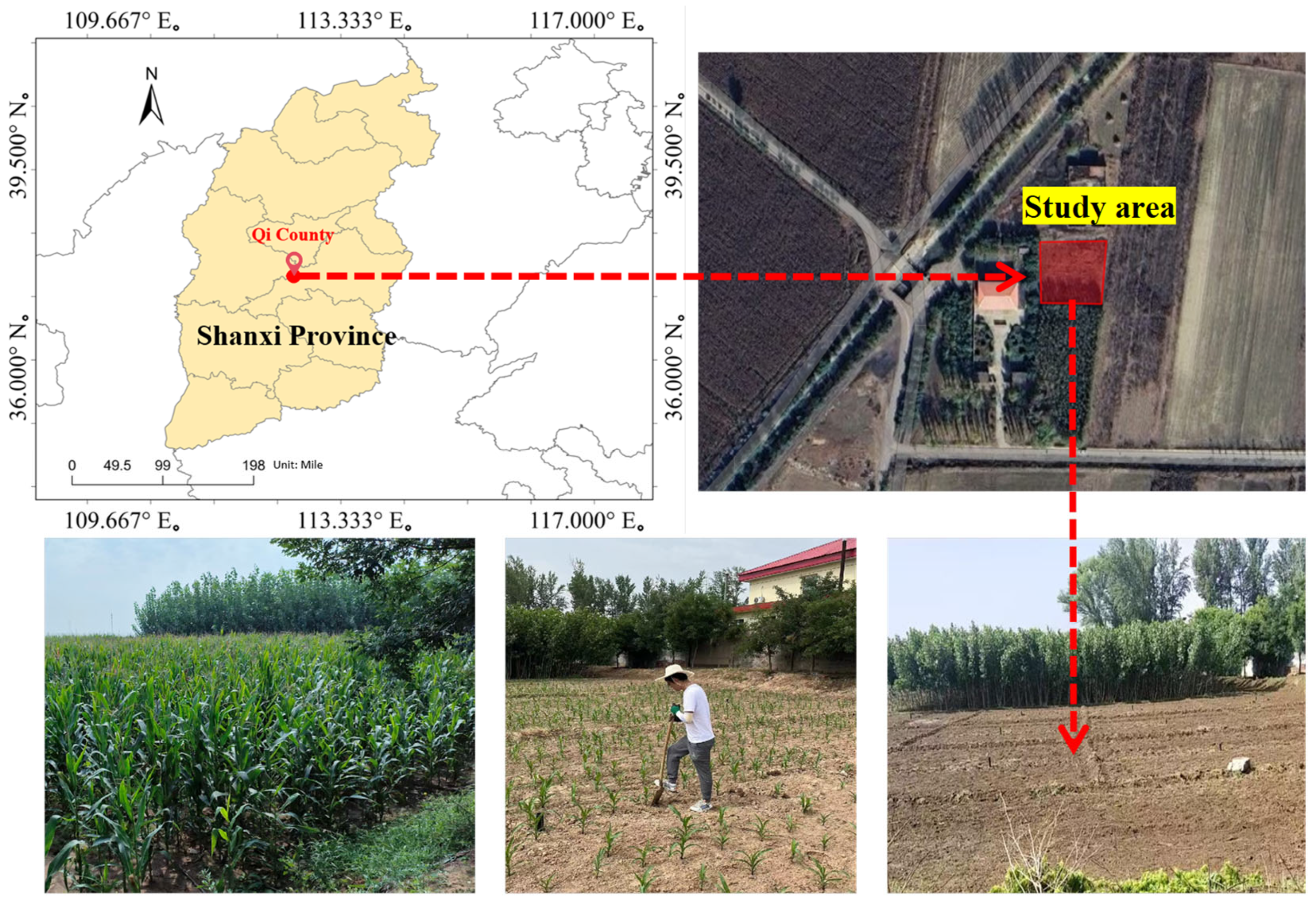
The 2-year field experiment was conducted from May 2022 to October 2023 in the jurisdiction of the Fendong Branch of Shanxi Fenhe Irrigation Management Co., Ltd., located in Jinzhong City, Shanxi Province (112°12′40″ E, 37°19′57″ N) (Figure 1). The site is characterized by a typical warm continental temperate climate. The mean annual precipitation is 441.8 mm, the mean annual sunshine duration is 2675 h, and the mean annual temperature is 9.9 °C. The soil type at the experimental site is classified as an Aridisol (USDA definition) with a sandy loam texture, and basic physicochemical properties are presented in Table 1

2.2. Experimental Design and Management Measurements

The study area was planted with a locally common corn variety (Dedan 1104), in a single-row, single-plant planting pattern, with row and plant spacing both set at 40 cm. The experiments with two growing seasons were conducted from 25 May 2022 and 22 May 2023, respectively. The experiment included four treatments, resulting from the combination of four irrigation sources, including well water, river water, mixed water (river water:reclaimed water = 1:1), reclaimed water, hereafter referred to as the CK, R0, R1 and R2, respectively.
The treatments were arranged in a randomized block design with three replicates, resulting in a total of 12 experimental plots. Each plot measured 9 m × 8 m. A 2 m long plastic film was buried in the soil at all boundaries of the two neighboring plots. After the burial, the soil was backfilled according to the original soil distribution of different depths.
In the study, the reclaimed water was sourced from Shanxi Taiyuan Kangjin Water Co., Ltd., with water quality exceeding the Grade A discharge standard for pollutants in urban wastewater treatment plants. Key parameters including chemical oxygen demand (COD), biochemical oxygen demand (BOD), ammonia nitrogen (NH3-N), and total phosphorus (TP) met the Class IV surface water standard, with effluent quality as follows: COD ≤ 30 mg/L, BOD ≤ 6 mg/L, NH3-N ≤ 1.5 mg/L, TN ≤ 10 mg/L, and TP ≤ 0.3 mg/L. The river water was collected from a tributary of the Fenhe River in Qixian County, Jinzhong City, Shanxi Province, while well water was obtained from a deep well within the Fenhe River Irrigation Management Company in Qixian County. The heavy metal content of irrigation water sources used in each growing seasons is presented in Table 2.
For irrigation management, surface irrigation was employed for all treatments. Prior to corn planting, spring irrigation was uniformly conducted on March 15 for all experimental plots. The CK treatment used well water for spring irrigation, and other treatments utilized river water diverted from the irrigation district. Approximately 120 mm water was applied to homogenize the soil for every plot. Based on rainfall and weather conditions, supplementary irrigation was performed at 70 days after planting in 2022 and 53 days after planting in 2023, with an irrigation quota of 70 mm for each plot. Fertilizer application was scheduled according to the practice of local farmers with fermented cattle manure applied as basal dressing during the two growing seasons. Other agronomic measures were also kept consistent across all treatments.

2.3. Data Collection

2.3.1. Soil Samples

Soil samples at depths of 5, 10, 15, 20, 40, 70, 100, 150, 200 cm were taken in a typical day at corn seedling, tasseling and maturity stages for each growing season by using a 5.0 cm diameter auger. Soil samples were analyzed for soil heavy metal content. The soil samples were air-dried naturally and sieved (200 mesh), followed by wet digestion pretreatment. Then 0.5 g of soil was placed in a polytetrafluoroethylene (PTFE) tube, moistened with 2 drops of distilled water, and then 5 mL of nitric acid was added and mixed thoroughly. The mixture was digested at 100 °C for 0.5 h. Subsequently, 10 mL of hydrochloric acid and 5 mL of hydrofluoric acid were added, and the temperature was raised to 150 °C for 2 h of digestion. After cooling, the solution was diluted to 50 mL with distilled water. The total concentrations of Mn, Zn, and Cu in the solution were determined using inductively coupled plasma mass spectrometry (ICP-MS) (ICAP 6200, USA Thermo Fisher, Waltham, MA, USA).

2.3.2. Plant Samples

Three corn plants were randomly selected from each treatment plot to measure heavy metal content at the seedling, tasseling, and maturity stages. The plants were dissected into seven parts (root, stem of 0–30 cm, stem of 30–60 cm, stem of 60–90 cm, stem above 90 cm, leaf, and corn kernels), and the heavy metal content of each part was analyzed.
The plant samples from each part were first de-enzymed, dried, ground, and sieved (200 mesh). Then, 0.5 g of the prepared sample was placed in a polytetrafluoroethylene (PTFE) tube, mixed with 5 mL of nitric acid, and left at room temperature for 12 h to allow complete reaction. The temperature was then raised to 80 °C for 0.5 h, followed by the addition of another 5 mL of nitric acid and 2 mL of hydrogen peroxide. The mixture was heated to 150 °C for 1.5 h, after which the solution was diluted to a final volume of 50 mL. The total concentrations of Mn, Zn, and Cu in the solution were also determined using inductively coupled plasma mass spectrometry (ICP-MS) (ICAP 6200, USA Thermo Fisher, Waltham, MA, USA).

2.4. Data Analysis

The forms of Mn, Zn, and Cu in soil are not present in a single state; therefore, the heavy metals mentioned in this study refer to the total concentration of the respective elements. The background values for risk assessment classification are based on the Risk Screening Values for Soil Contamination of Agricultural Land in China (GB 15618-2018) [23].

2.4.1. Assessment of Soil Heavy Metal Level

To compare the effects of different treatments on soil heavy metal content, health risk assessment of soil heavy metal was applied in two growing seasons. The single heavy metal pollution index was determined as follows:
C f i = C s i / C n i
where C s i is the measure value, and C n i is the background value of soil heavy metal elements.
The single heavy metal potential ecological risk index was determined as follows:
E r i = T r i × C f i
where T r i is the toxicity response coefficients of each heavy metal, and the values for Mn, Zn, and Cu in soil are 1, 5, and 5, respectively. When E r i < 40, the ecological risk level is low risk; when 40 ≤ E r i < 80, it is moderate risk; when 80 ≤ E r i < 160, it is relatively high risk; when 160 ≤ E r i < 320, it is high risk; when E r i ≥ 320, it is severe risk.
The geo-accumulation index reflects the relationship between the heavy metal content in sediments and the background value, and is widely used to assess the degree of heavy metal pollution. It was determined as follows:
I i g e o = l o g 2 ( C i k × B i )
where I i g e o is the geo-accumulation index for heavy metal i ; C i is the measured concentration of heavy metal i (mg/kg); k is a coefficient accounting for regional geological background variations that may cause fluctuations in soil background values, with k set to 1.5; B i is the soil background value for heavy metal i , with values of 2545 mg kg−1 for Mn, 300 mg kg−1 for Zn, and 200 mg kg−1 for Cu.
The geo-accumulation index evaluation criteria are divided into 7 levels. When I i g e o < 0, the pollution level is 0 (unpolluted); when 0 ≤ I i g e o < 1, the pollution level is 1 (unpolluted to moderately polluted); when 1 ≤ I i g e o < 2, the pollution level is 2 (moderately polluted); when 2 ≤ I i g e o < 3, the pollution level is 3 (moderately to strongly polluted); when 3 ≤ I i g e o < 4, the pollution level is 4 (strongly polluted); when 4 ≤ I i g e o < 5, the pollution level is 5 (strongly to extremely polluted); when I i g e o ≥ 5, the pollution level is 6 (extremely polluted).

2.4.2. Assessment of Plant Heavy Metal Level

Combining the model recommended by the USEPA and the per capita corn consumption data in households [24], the health risks of heavy metal intake through corn consumption was detected by the hazard quotient ( H Q ) method. The adjusted formula was as follows:
H Q i = C i × F c × E D B W × E D × E F × R f D i
where H Q i is the hazard quotient of heavy metal i , C i is the measured concentration of heavy metal i in corn (mg kg−1); F c is the per capita corn consumption rate (kg d−1); E D is the exposure duration (70 years for lifetime exposure); B W is the body weight (60 kg for adults and 18.6 kg for children); E F is the exposure frequency (365 d year−1); R f D i is the reference dose for heavy metal i (mg kg−1 d−1), with values of 0.14 for Mn, 0.037 for Cu, and 0.300 for Zn [25].
The combined hazard quotient ( T H Q ) for multiple heavy metals was determined by:
T H Q = i = 1 n H Q i

2.4.3. Comprehensive Evaluation of the Impact of Different Irrigation Water Sources on Heavy Metal Content

Both the heavy metal contents in the soil profile and in the plants are negative indicators in this study. The weights of heavy metal content in soil and plants were determined using the entropy weighting method. Then, the TOPSIS method was applied to rank the heavy metal contamination levels in the soil–corn system under different irrigation sources. Additionally, the RSR method was also used to evaluate and prioritize heavy metal accumulation in the soil–corn system across these four irrigation sources. The evaluation results of both methods demonstrated that the higher-ranked treatment groups exhibited lower heavy metal content levels, reduced pollution risks, and stronger capacity to control heavy metal contamination in this soil–corn system.

2.5. Statistical Analysis

The statistical differences between treatments for all data were tested with an ANOVA using the SPSS 25.0 (SPSS Inc., Chicago, IL, USA). Mean among treatments were compared by the LSD at the significance level of 0.05. The data were preliminarily processed using Microsoft Excel 2021 (Microsoft Corporation, Redmond, WA, USA), and graphs were generated using Origin 2022 software (OriginLab Corporation, Northampton, MA, USA).

3. Results

3.1. Soil Heavy Metals Content Dynamics in Soil Profile for Different Growth Stages

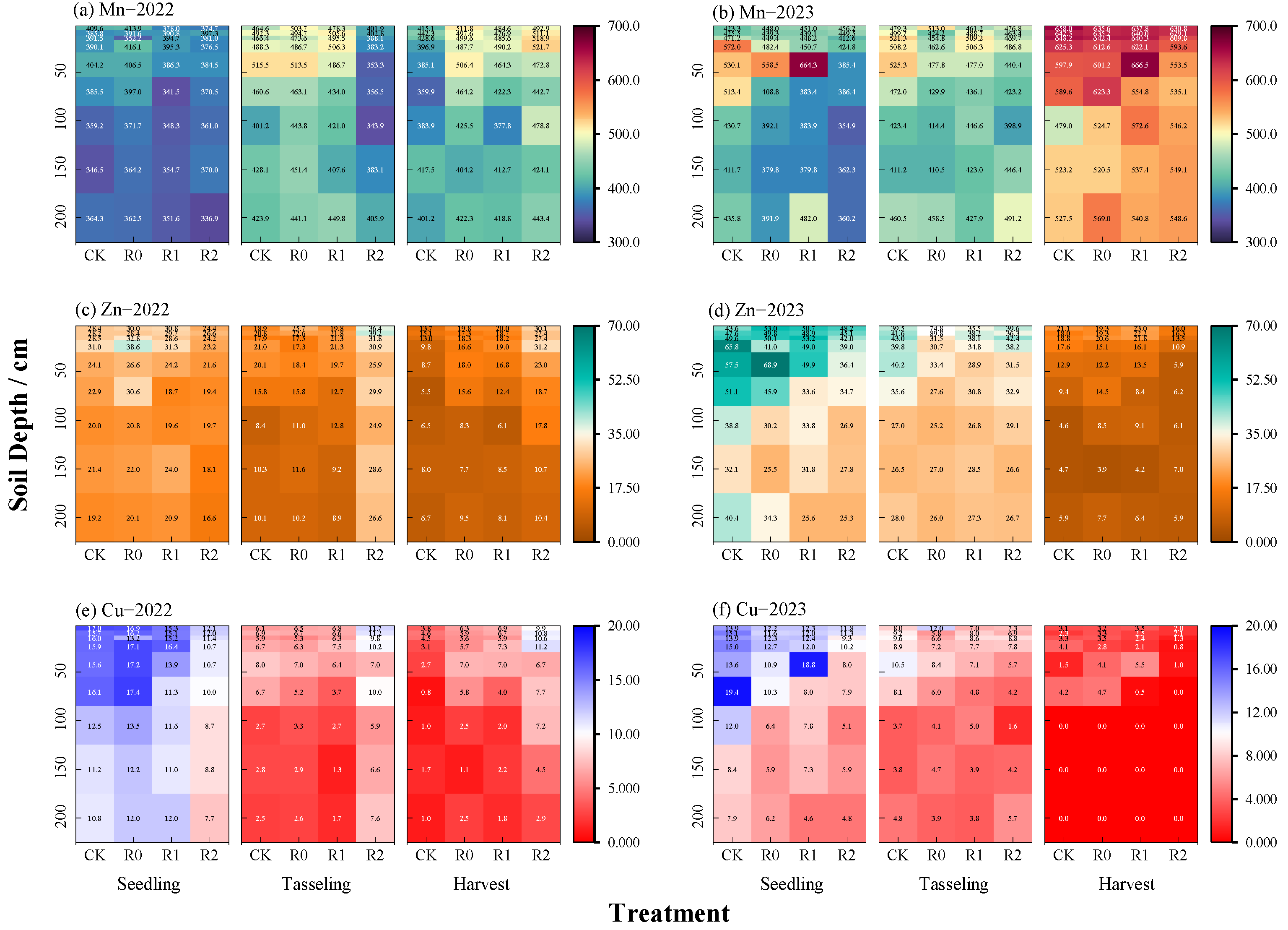
Changes in soil Mn, Zn, and Cu content at different depths across growth stages are shown in Figure 2. Soil Mn content increased with prolonged growth years. When comparing the harvest stage in 2023 to the seedling stage in 2022, soil Mn content increased by 177.9, 190.7, 211.2, and 187.5 mg kg−1 for CK, R0, R1, and R2, respectively. In contrast, soil Zn and Cu content exhibited the opposite trend. The greatest reduction occurred in CK treatments at shallow depths (<70 cm), while R2 showed the smallest reduction at deeper depths (70−200 cm), with decreases of 11.6 mg kg−1 (Zn) and 8.3 mg kg−1 (Cu).
On the soil profile, soil Mn, Zn, and Cu content gradually decreased with soil depth. In 2022, soil Mn content at 0−15 cm was significantly higher than that at 100−200 cm. Soil Zn content at 0−5 cm was significantly higher than that at 100−200 cm. Soil Cu content at 0−15 cm was significantly higher than that at 70−200 cm. In 2023, no significant difference was found in soil Mn and Cu content for CK and R0 treatments. Soil Zn content at 0−5 cm was significantly higher than that at 100−200 cm for all four treatments.

3.2. Analysis of Potential Ecological Hazard Index of Soil Heavy Metals

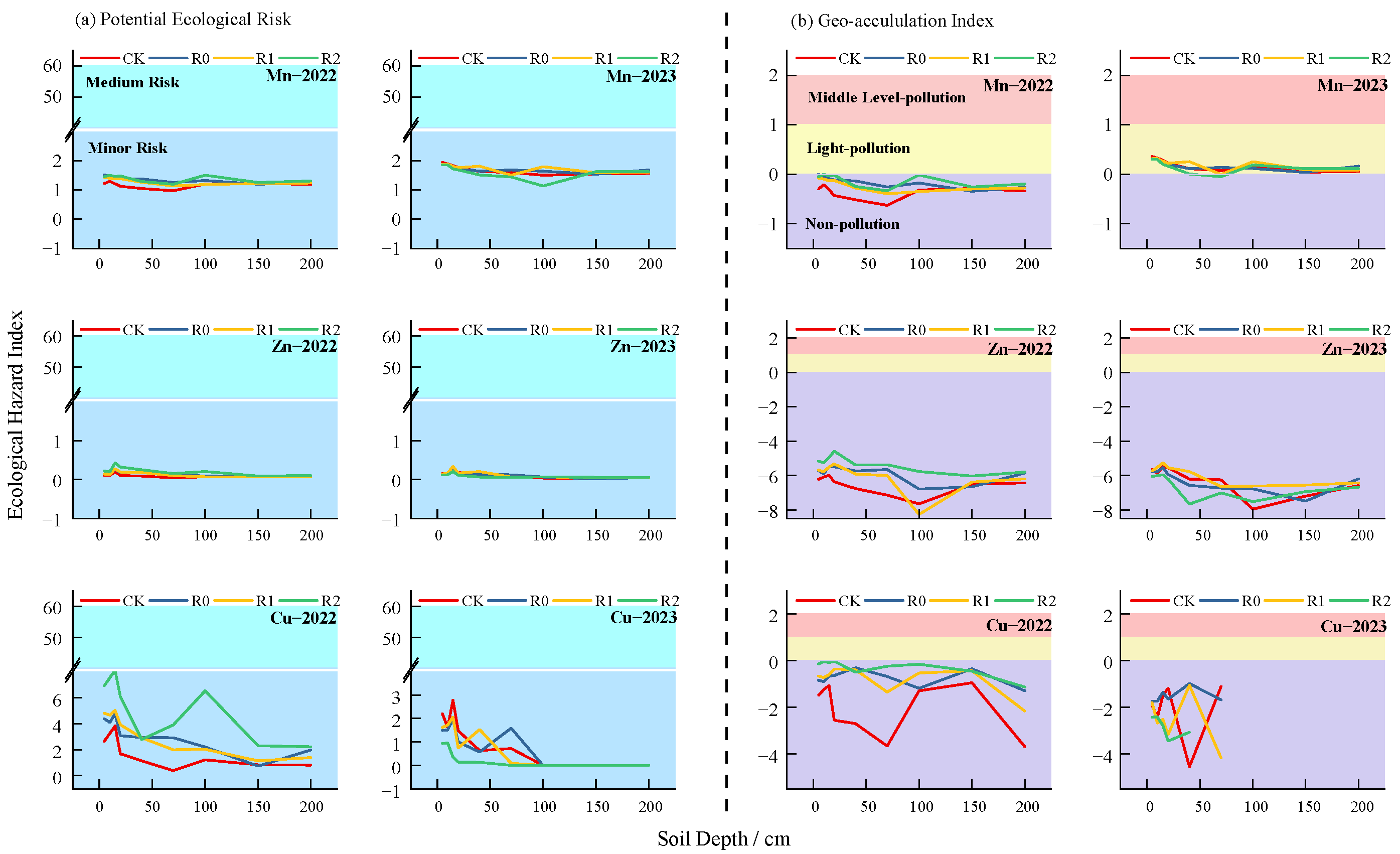
Following two years of experimentation, all treatments presented a slight level of potential ecological risk (Figure 3a). Within the 0–200 cm soil profile, the ecological risk for Mn, Zn, and Cu remained low and showed little variation across treatments, ranging from 0.9 to 2.0, 0.0 to 0.5, and 0.0 to 9.0, respectively. Evident differences in the Cu, however, were observed among treatments in the upper 0–100 cm soil layer.
Generally, the geo-accumulation indices of soil heavy metals under different treatments followed the order of Mn > Cu > Zn (Figure 3b). After the first year of the experiment, the soil Mn content was assessed as pollution-free. However, it shifted to a slightly polluted level in the second year. The geo-accumulation index of Mn across all treatments ranged from −0.6 to 0.0 in the first year and from 0.0 to 0.4 in the second year within the 0–200 cm soil layer. In contrast, the Zn and Cu contents were evaluated as non-polluted in both years. Their geo-accumulation indices in the 0–200 cm soil layer ranged from −8.3 to −4.6 for Zn and from −4.6 to 0.0 for Cu, respectively.

3.3. Heavy Metals Content in Corn Organs

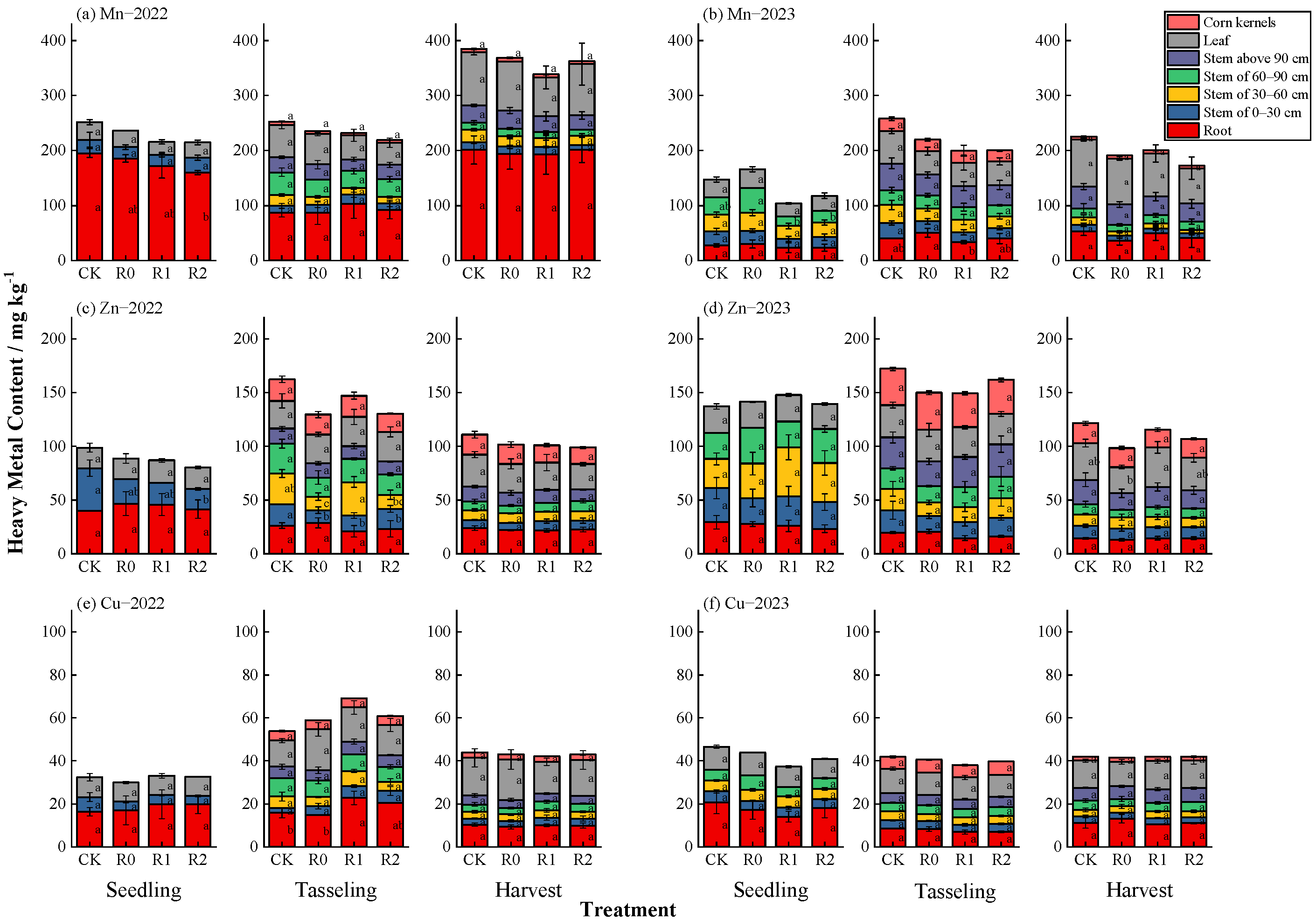
Across different corn organs, Mn content showed a significant decrease in 2023 compared to 2022 (Figure 4). Both Mn and Cu were primarily concentrated in the roots and leaves, with distinct concentration patterns between years. In contrast, Zn distribution followed a different pattern, showing significant accumulation not only in roots and leaves but also in grains. The content of each heavy metal in the stem at different heights did not vary significantly. At harvest stage, the content in stem above 90 cm was higher than at other heights.
For the average heavy metal content in whole corn plants across different treatments, no significant differences were observed in most comparisons. In 2022, the Mn content in CK was significantly higher than in other treatments. For Zn, CK showed higher levels than all other treatments, and R1 was greater than R2, while no consistent pattern was found for Cu among treatments. In 2023, Mn levels in CK were higher than that in R1 and R2. For Zn, R1 exceeded R0, while for Cu, CK > R1 and R0. Averaged over two years, R2 showed reductions of 17.5% (Mn), 15.3% (Zn), and 18.5% (Cu) compared to CK (Table 3).

3.4. The Hazard Quotients (HQs) and Combined Hazard Quotient (THQ) of Heavy Metals in Corn Kernels

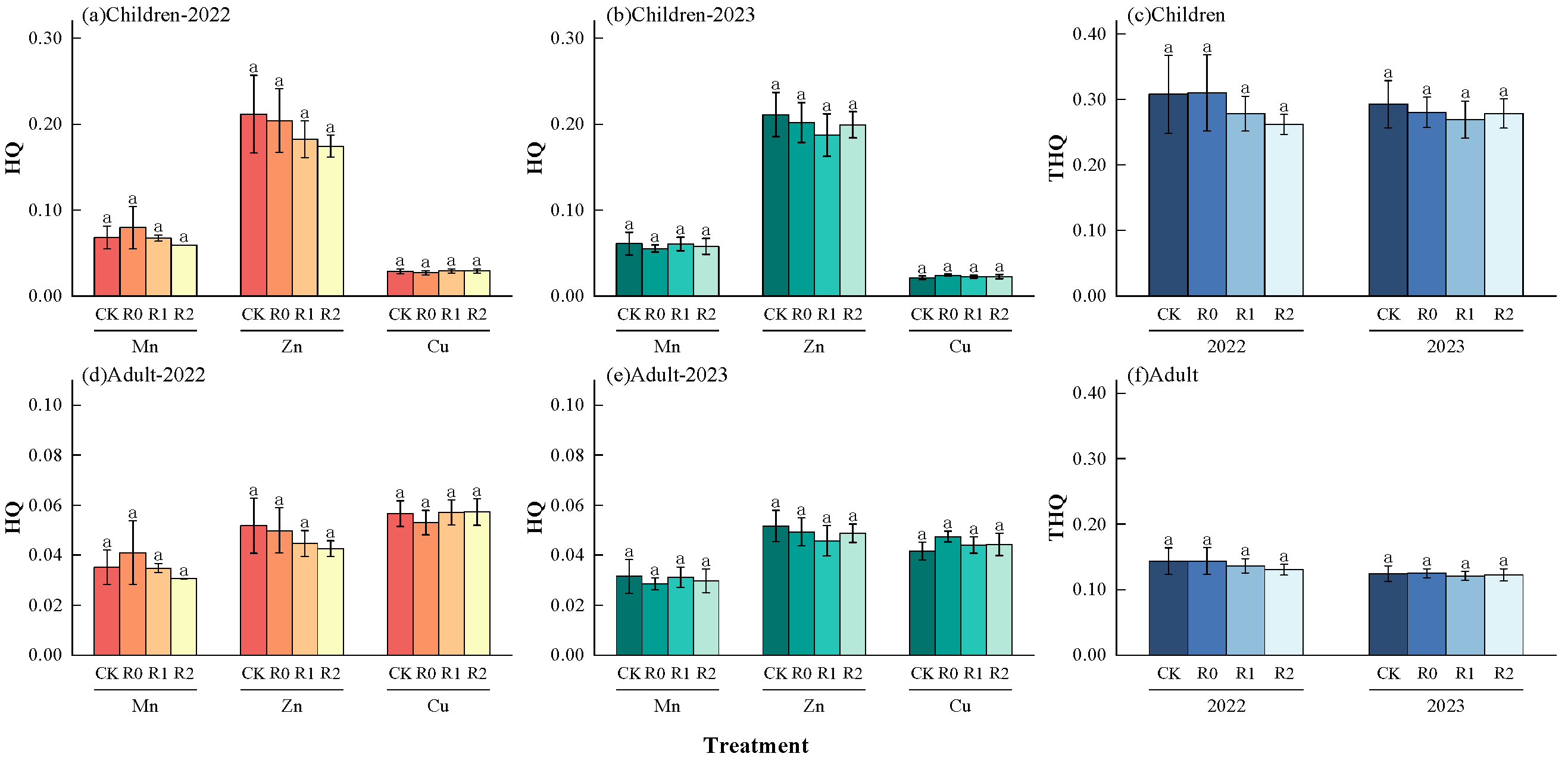
Across all treatments, the H Q and T H Q of Mn, Zn, and Cu in the kernels were below the safety limit (<1) for both children and adults, indicating no significant health risk (Figure 5). Mn posed the lowest hazard to adults, while Cu posed the lowest to children. For children, the H Q of Mn and Zn was 1.9–4.1 times that for adults, whereas the H Q of Cu was about half that for adults. The T H Q for children was 2.0–2.4 times that for adults. From 2022 to 2023, the H Q of Mn and Cu decreased with cultivation years. In contrast, the H Q of Zn increased in 2023 for both children and adults under the CK, R1, and R2 treatments (except R0). The T H Q for all three metals under CK, R0, and R1 was lower in 2023 than in 2022, with reductions in the order: R0 > CK > R1.
No significant differences in H Q were observed among treatments. Compared with CK, the H Q of Mn and Zn under R1 and R2 was lower, following the order CK > R1 > R2. Conversely, the H Q of Cu under R1 and R2 was marginally higher (by only 0.0–4.8%). Over the two-year period, the T H Q under R1 and R2 was consistently lower than under CK and R0. Reductions relative to CK ranged from 3.3 to 5.0% for R1 and 1.9–9.4% for R2.

3.5. Comprehensive Evaluation of the Impact of Different Water Sources on Heavy Metal Content in Soil–Corn System

The TOPSIS method was used to comprehensively evaluate heavy metal levels in soil and plants under different irrigation sources (Table 4). A higher relative proximity (C value) indicates that the heavy metal control level in the soil–corn system is closer to the optimal irrigation practice. Therefore, based on a comprehensive assessment, the R1 treatment was more effective in mitigating heavy metal pollution risks compared to other treatments, particularly the R0 treatment.
The RSR analysis revealed significant differences in heavy metal contamination among treatment groups (p = 0.016). The R1 group showed the highest RSR value, followed by CK and R2, while the R0 had the lowest contamination controlling ability. The Probit regression model (Y = 0.451 + 0.032 × Probit) demonstrated high goodness of fit (R2 = 0.952), supporting the reliability of RSR classification. These results suggest that R0 treatment may significantly promote heavy metal accumulation in the soil–corn system, whereas R1 poses a lower environmental risk.

4. Discussion

4.1. Effect of Different Irrigation Water Sources on Soil Heavy Metal Content

Overall, our two-year field study demonstrates that irrigation with river, reclaimed, mixed, and well water meeting quality standards poses minor immediate ecological risks, as assessed by heavy metal (Mn, Zn, Cu) comprehensive potential ecological risk indices. However, certain differences in the migration and accumulation patterns of different heavy metal elements appeared. The heavy metal content in the plow layer largely depended on the heavy metal concentrations in different water sources, while the heavy metal content in deeper soil layers was related to environmental factors such as rainfall and irrigation events during the corn growing season.
A key finding was the preferential accumulation of heavy metals, particularly Mn, in the plow layer (0–20 cm) compared to deeper soil profiles across all irrigation treatments. This is consistent with the general principle that substances introduced via irrigation are primarily retained in the topsoil due to adsorption and filtration processes [26]. In our study, this effect was most pronounced under river water irrigation, which resulted in the highest plow layer concentrations of Mn, Zn, and Cu at maturity. We attribute this primarily to the higher loading of both nutrients and organic matter carried by river water. The enriched soil organic matter (SOM) in the plow layer likely enhanced metal immobilization through complexation, a mechanism particularly effective for Mn [27].
The behavior of Mn diverged notably from that of Zn and Cu. While Mn showed clear accumulation over time, Zn and Cu contents in the plow layer and subsoil (70–200 cm) remained stable or even decreased under most water sources. The accumulation of Mn in our alkaline soil (pH > 7) is intriguing, given its typically low solubility under such conditions. This suggests contributions from sources beyond irrigation water, such as atmospheric deposition or organic fertilizer inputs [28], which warrant future quantification. In our study, fermented cattle manure was applied. Furthermore, Mn’s strong adsorption capacity as oxides may have played a dual role, not only retaining itself but also potentially immobilizing cationic metals like Zn and Cu in the topsoil [27], partly explaining their limited downward migration.
In deeper soil layers, the Mn, Zn, and Cu contents followed the order R2 > R0 > CK and R1 > CK. We speculated that this migration is primarily governed by soil properties such as pH, SOM, redox potential (Eh), and cation exchange capacity (CEC). Cations like K+, Ca2+, and Mg2+ from reclaimed water and river water can increase soil salinity and enhance CEC [29,30], thereby improving the soil’s ability to retain Mn, Zn, and Cu and leading to higher concentrations at depth [31,32].
Additionally, within a short period after irrigation management (<20 days), a certain accumulation of Mn in both surface and deep soil layers was found for all treatments. However, the Mn content in soil irrigated with reclaimed water was the lowest, while the increase in Mn content in surface soil (<20 cm) was the most pronounced under mixed water irrigation. This may be because reclaimed water contains a significant amount of iron (Fe), and under alkaline conditions, Fe and Mn often co-precipitate to form hydroxides [33,34,35]. Future research should specifically test this mechanism.
Regarding Zn and Cu, their contents decreased in both soil layers under well water, river water, and mixed water irrigation. In contrast, under reclaimed water irrigation, Zn content increased in both layers while Cu decreased. This pattern can be explained by two main factors. In the first year, the higher pH of reclaimed water enhanced Cu mobility compared to Zn, making Cu more prone to leaching below 200 cm, whereas Zn tended to be retained within the 0–200 cm profile. In the second year, the Zn concentration in reclaimed water was significantly higher than in other water sources. The substantial external Zn input exceeded its migration rate, resulting in net accumulation throughout the soil profile.
We acknowledge that short-term (2-year) trends may not predict long-term equilibrium states. Although all risks were currently “minor,” the continuous Mn accumulation signals a need for long-term monitoring, especially under river and mixed water irrigation. In conclusion, our evidence-based analysis confirms the short-term feasibility of using these alternative water sources but identifies Mn accumulation and source-specific metal mobility as critical factors for sustainable long-term management.

4.2. Effect of Different Irrigation Water Sources on Heavy Metal Content in Corn Organs

Our study evaluated the effects of different irrigation water sources on heavy metal accumulation in maize. The key finding is that irrigation with water meeting agricultural quality standards did not lead to Mn, Zn, or Cu concentrations in corn grains that exceeded national food safety limits. Health risk assessment further confirmed that the comprehensive hazard quotients for these elements remained within acceptable levels for both adults and children. These results are consistent with previous reports that treated wastewater, groundwater, and river water generally do not cause significant heavy metal accumulation in edible parts of mature maize [36,37,38].
However, our data revealed that irrigation water quality can influence the distribution of metals within the plant. After two years of irrigation, Zn content in leaves at maturity varied significantly across treatments, following the order R1 > R2 > CK > R0. This pattern suggests that water composition—particularly salinity and accompanying ions such as K+ and Ca2+—may indirectly affect Zn translocation within the plant. While certain ions can promote leaf growth and photosynthesis [39], higher salinity or ion competition in some water sources (e.g., river water) could potentially inhibit Zn accumulation in leaves, as observed in our study. This is supported by the literature indicating that salinity and specific ions can interfere with metal uptake and distribution [37,40].
At the corn maturity period, Mn and Zn content in kernels under mixed water and reclaimed water treatments were slightly lower than in the CK treatment, whereas Cu content was higher than in the well water treatment. Cu concentration was also found to be higher in seeds than other organs in a previous study [41]. This may be attributed to the higher levels of other heavy metal ions in mixed water and reclaimed water compared to well water, imposing certain heavy metal stress on the plants [42]. This stress could interfere with corn’s absorption and distribution of Zn, Cu, and Mn. For instance, cadmium stress has been shown to reduce corn’s uptake of Mg, Mn, and Zn [43,44].
In the short term following irrigation, well water—which contained the lowest levels of salts and contaminants—resulted in the highest relative enrichment of Mn and Zn in leaves, along with lower Cu accumulation. This may reflect reduced ionic competition and stress under cleaner irrigation, allowing more selective metal uptake. By contrast, the decrease in stem Mn and Zn under control conditions could be related to natural translocation dynamics during rapid growth stages. The antagonistic interaction between Zn and Cu and plant tolerance mechanisms such as vacuolar sequestration [45,46] may further modulate internal metal partitioning, though specific physiological responses would require targeted validation.
In summary, while grain metal safety was unaffected across treatments, the translocation of Zn and Cu within corn appears sensitive to water quality. The mechanisms likely involve ion interactions, salinity effects, and plant regulatory responses, rather than simple accumulation from irrigation water. Future studies should directly monitor pollutant levels in irrigation sources and combine them with molecular or physiological assays to clarify the underlying processes.
Overall, while current data indicate safe short-term use, the research suggests that Mn poses the greatest threat of crossing pollution thresholds in soil, and the sensitivity of Zn and Cu (accumulated in the corn kernels) to irrigation water conditions cannot be overlooked. Previous studies have also revealed that different crop combination systems result in different patterns of element migration and their influencing factors are also different [47,48].
It is reasonable to project that under long-term irrigation (10–20 years), soil, particularly the plow layer, will act as a sink for heavy metals. Within this context, the accumulation of Mn and Zn (under reclaimed water irrigation) deserves the most attention, while the risk of Cu leaching remains a significant concern. At the same time, due to plant uptake, long-term irrigation may lead the heavy metal content in soil to approach a dynamic equilibrium. Thus, sustainable large-scale adoption of reclaimed water irrigation therefore requires not only adherence to existing quality standards but also predictive modeling, routine surveillance, and dynamic policy frameworks capable of responding to evolving soil–corn system metal equilibria over multi-decadal timescales.

5. Conclusions

This two-year study revealed short-term patterns of heavy metal dynamics in a soil–corn system under reclaimed water irrigation. Even for reclaimed water compliant with irrigation standards, the transport and distribution of heavy metals remained a concern. After two years of cultivation, Mn accumulated in the soil, while Zn and Cu levels decreased. Soil contamination was dominated by Mn, reaching a mild pollution level, whereas Zn and Cu posed negligible ecological risks. The R2 treatment (mixed water at a 1:1 ratio of river water to reclaimed water) contributed to the retention of heavy metals in deeper soil layers. Heavy metal accumulation varied among corn organs, roots and leaves were the primary sinks for Mn and Cu, while grains accumulated Zn. The R2 treatment effectively reduced heavy metal uptake by plants. Although grain consumption presented minimal health risks, the hazard quotient for children was 1.9–4.1 times higher than that for adults. In summary, using mixed water is recommended as an optimal irrigation practice to control heavy metal risks in the short term. Further long-term studies are needed, particularly on the effects of blending reclaimed water with other sources at different ratios. Meanwhile, periodic assessment of Mn bioavailability (and its transfer factor) in the topsoil, along with monitoring of its migration to deeper soil layers and surface water, should be implemented. This research provides a scientific basis for the short-term safe utilization of reclaimed water in agriculture.

Author Contributions

Conceptualization: Y.F. and L.S.; Methodology and investigation: Y.F. and F.Z.; Data curation: G.G.; Visualization: J.H. and Y.W.; Writing—original draft: Y.F.; Writing—review and editing: Y.J. and R.L.; Funding acquisition and Project administration: G.F. and L.S.; Supervision: L.S. All authors have read and agreed to the published version of the manuscript.

Funding

The study was supported by the Natural Science Foundation of Shanxi Province (No. 20210302124249, 202203021212267 and 202303021222024).

Data Availability Statement

The datasets analyzed and presented in this article can be made available from the corresponding author on reasonable request.

Conflicts of Interest

The authors declare that they have no known competing financial interests that could have appeared to influence the work reported in this paper. Author Guoqiang Geng was employed by the company Guangzhou Development Electric Power Group Co., Ltd. The remaining authors declare that the research was conducted in the absence of any commercial or financial relationships that could be construed as a potential conflict of interest.

References

  1. Wang, J.; Li, Y.; Huang, J.; Yan, T.; Sun, T. Growing water scarcity, food security and government responses in China. Glob. Food Secur. Agric. Policy Econ. Environ. 2017, 14, 9–17. [Google Scholar] [CrossRef]
  2. Siebert, S.; Burke, J.; Faures, J.M.; Frenken, K.; Hoogeveen, J.; Döll, P.; Portmann, F.T. Groundwater use for irrigation—A global inventory. Hydrol. Earth Syst. Sci. 2010, 14, 1863–1880. [Google Scholar] [CrossRef]
  3. Osman, H.E.M.; Abdel-Hamed, E.M.W.; Al-Juhani, W.S.M.; Al-Maroai, Y.A.O.; El-Morsy, M.H.E. Bioaccumulation and human health risk assessment of heavy metals in food crops irrigated with freshwater and treated wastewater: A case study in Southern Cairo, Egypt. Environ. Sci. Pollut. Res. 2021, 28, 50217–50229. [Google Scholar] [CrossRef] [PubMed]
  4. Kazemi Moghaddam, V.; Latifi, P.; Darrudi, R.; Ghaleh Askari, S.; Mohammadi, A.A.; Marufi, N.; Javan, S. Heavy metal contaminated soil, water, and vegetables in northeastern Iran: Potential health risk factors. J. Environ. Health Sci. Eng. 2022, 20, 65–77. [Google Scholar] [CrossRef] [PubMed]
  5. Liang, X.; Rengasamy, P.; Smernik, R.; Mosley, L.M. Does the high potassium content in recycled winery wastewater used for irrigation pose risks to soil structural stability? Agric. Water Manag. 2021, 243, 106422. [Google Scholar] [CrossRef]
  6. Sardar, A.; Shahid, M.; Natasha Khalid, S.; Anwar, H.; Tahir, M.; Shah, G.M.; Mubeen, M. Risk assessment of heavy metal(loid)s via Spinacia oleracea ingestion after sewage water irrigation practices in Vehari District. Environ. Sci. Pollut. Res. 2020, 27, 39841–39851. [Google Scholar] [CrossRef]
  7. UNESCO. United Nations World Water Development Report 2023: Partnerships and Cooperation for Water; UNESCO: Geneva, Switzerland, 2023. [Google Scholar]
  8. Shemer, H.; Wald, S.; Semiat, R. Challenges and solutions for global water scarcity. Membranes 2023, 13, 612. [Google Scholar] [CrossRef]
  9. Horswell, J.; Speir, T.W.; van Schaik, A.P. Bio-indicators to assess impacts of heavy metals in land-applied sewage sludge. Soil Biol. Biochem. 2003, 35, 1501–1505. [Google Scholar] [CrossRef]
  10. Tuo, Y.; Yang, C.; Shen, F. Experimental study on the movement of heavy metal Zn in paddy soil under different irrigation quota of reclaimed water. Sci. Rep. 2020, 10, 10789. [Google Scholar] [CrossRef]
  11. Chaganti, V.N.; Ganjegunte, G.; Meki, M.N.; Kiniry, J.R.; Niu, G. Switchgrass biomass yield and composition and soil quality as affected by treated wastewater irrigation in an arid environment. Biomass Bioenergy 2021, 151, 106160. [Google Scholar] [CrossRef]
  12. Naz, A.; Khan, S.; Muhammad, S.; Ahmad, R.; Khalid, S.; Khan, A.; Nazir, R.; Alam, S.; Rahman, Z.U. Risk assessment of hazardous elements in wastewater irrigated soil and cultivated vegetables in Pakistan. Arab. J. Geosci. 2020, 13, 1201. [Google Scholar] [CrossRef]
  13. Minhas, P.S.; Yadav, R.K.; Lal, K.; Chaturvedi, R.K. Effect of long-term irrigation with wastewater on growth, biomass production and water use by Eucalyptus (Eucalyptus tereticornis Sm.) planted at variable stocking density. Agric. Water Manag. 2015, 152, 151–160. [Google Scholar] [CrossRef]
  14. Oubane, M.; Khadra, A.; Ezzariai, A.; Kouisni, L.; Hafidi, M. Heavy metal accumulation and genotoxic effect of long-term wastewater irrigated peri-urban agricultural soils in semiarid climate. Sci. Total Environ. 2021, 794, 148611. [Google Scholar] [CrossRef] [PubMed]
  15. Wang, Z.; Yu, X.; Geng, M.; Wang, Z.; Wang, Q.; Zeng, X. Accumulation of heavy metal in scalp hair of people exposed in Beijing sewage discharge channel sewage irrigation area in Tianjin, China. Environ. Sci. Pollut. Res. 2017, 24, 13741–13748. [Google Scholar] [CrossRef]
  16. Meng, W.; Wang, Z.; Hu, B.; Wang, Z.; Li, H.; Goodman, R.C. Heavy metals in soil and plants after long-term sewage irrigation at Tianjin China: A case study assessment. Agric. Water Manag. 2016, 171, 153–161. [Google Scholar] [CrossRef]
  17. Su, R.; Ou, Q.; Wang, H.; Luo, Y.; Dai, X.; Wang, Y.; Chen, Y.; Shi, L. Comparison of phytoremediation potential of nerium indicum with inorganic modifier calcium carbonate and organic modifier mushroom residue to Lead-Zinc tailings. Int. J. Environ. Res. Public Health 2022, 19, 10353. [Google Scholar] [CrossRef]
  18. Ma, X.; Ren, Q.; Zhan, W.; Zheng, K.; Chen, R.; Wang, Y. Simultaneous stabilization of Pb, Cd, Cu, Zn and Ni in contaminated sediment using modified biochar. J. Soils Sediments 2022, 22, 392–402. [Google Scholar] [CrossRef]
  19. Wang, Y.; Zheng, K.; Zhan, W.; Huang, L.; Liu, Y.; Li, T.; Yang, Z.; Liao, Q.; Chen, R.; Zhang, C.; et al. Highly effective stabilization of Cd and Cu in two different soils and improvement of soil properties by multiple-modified biochar. Ecotoxicol. Environ. Saf. 2021, 207, 111294. [Google Scholar] [CrossRef]
  20. Elgallal, M.; Fletcher, L.; Evans, B. Assessment of potential risks associated with chemicals in wastewater used for irrigation in arid and semiarid zones: A review. Agric. Water Manag. 2016, 177, 419–431. [Google Scholar] [CrossRef]
  21. Becerra-Castro, C.; Lopes, A.R.; Vaz-Moreira, I.; Silva, E.F.; Manaia, C.M.; Nunes, O.C. Wastewater reuse in irrigation: A microbiological perspective on implications in soil fertility and human and environmental health. Environ. Int. 2015, 75, 117–135. [Google Scholar] [CrossRef]
  22. Lamy, I.; Van Oort, F.; Dère, C.; Baize, D. Use of major- and trace-element correlations to assess metal migration in sandy Luvisols irrigated with wastewater. Eur. J. Soil Sci. 2006, 57, 731–740. [Google Scholar] [CrossRef]
  23. Ministry of Ecology and Environment of the People’s Republic of China. Soil Environmental Quality Risk Control Standard for Soil Contamination of Agricultural Land (GB 15618-2018); China Environmental Science Press: Beijing, China, 2018. [Google Scholar]
  24. EPA. Exposure Factors Handbook 2011 Edition (Final Report); National Center for Environmental Assessment: Washington, DC, USA, 2025. [Google Scholar]
  25. Lei, L.; Liang, D.; Yu, D.; Chen, Y.; Song, W.; Li, J. Human health risk assessment of heavy metals in the irrigated area of Jinghui, Shaanxi, China, in terms of wheat flour consumption. Environ. Monit. Assess. 2015, 187, 647. [Google Scholar] [CrossRef] [PubMed]
  26. van Schaik, J.W.J.; Kleja, D.B.; Gustafsson, J.P. Acid-base and copper-binding properties of three organic matter fractions isolated from a forest floor soil solution. Geochim. Cosmochim. Acta 2010, 74, 1391–1406. [Google Scholar] [CrossRef]
  27. Wang, H.M.; Tan, K.; Wu, F.Y.; Chen, Y.; Chen, L.H. Study of the retrieval and adsorption mechanism of soil heavy metals based on spectral absorption characteristics. Spectrosc. Spectr. Anal. 2020, 40, 316–323. [Google Scholar]
  28. Ma, L.; Zhou, Y.; Wang, A.; Li, Q. A potential heavy metals detoxification system in composting: Biotic and abiotic synergy mediated by shell powder. Bioresour. Technol. 2023, 386, 129576. [Google Scholar] [CrossRef]
  29. Al-Khamisi, S.A.; Al-Wardy, M.; Ahmed, M.; Prathapar, S.A. Impact of reclaimed water irrigation on soil salinity, hydraulic conductivity, cation exchange capacity and macro-nutrients. J. Agric. Mar. Sci. 2017, 21, 7–18. [Google Scholar] [CrossRef]
  30. Loures, L.; Gama, J.; Nunes, J.R.; Lopez-Pineiro, A. Assessing the sodium exchange capacity in rainfed and irrigated soils in the mediterranean basin using GIS. Sustainability 2017, 9, 405. [Google Scholar] [CrossRef]
  31. Jalali, M.; Moradi, F. Competitive sorption of Cd, Cu, Mn, Ni, Pb and Zn in polluted and unpolluted calcareous soils. Environ. Monit. Assess. 2013, 185, 8831–8846. [Google Scholar] [CrossRef]
  32. Vega, F.A.; Covelo, E.F.; Andrade, M.L.; Marcet, P. Relationships between heavy metals content and soil properties in minesoils. Anal. Chim. Acta 2004, 524, 141–150. [Google Scholar] [CrossRef]
  33. Yan, H.; Li, H.; Tao, X.; Li, K.; Yang, H.; Li, A.; Xiao, S.; Cheng, R. Rapid Removal and Separation of Iron (II) and Manganese (II) from Micropolluted Water Using Magnetic Graphene Oxide. ACS Appl. Mater. Interfaces 2014, 6, 9871–9880. [Google Scholar] [CrossRef]
  34. Zhang, Y.; Zhang, L.; Pan, X.; Cheng, Y.; Liu, L.; Wang, H.; Han, L.; Lin, Z. Rapid and selective removal of trace as (III) from water using Fe-Mn binary oxide. Sci. Total Environ. 2024, 907, 167876. [Google Scholar] [CrossRef]
  35. Wang, Z.; Liu, W.; Zhang, C.; Liu, X.; Liang, X.; Liu, R.; Zhao, Y. Mechanisms of S cooperating with Fe and Mn to regulate the conversion of Cd and Cu during soil redox process revealed by LDHs-DGT technology. Sci. Total Environ. 2023, 867, 161431. [Google Scholar] [CrossRef] [PubMed]
  36. Asgari, K.; Cornelis, W.M. Heavy metal accumulation in soils and grains, and health risks associated with use of treated municipal wastewater in subsurface drip irrigation. Environ. Monit. Assess. 2015, 187, 410. [Google Scholar] [CrossRef] [PubMed]
  37. Alkhamisi, S.A.; Abdelrahman, H.A.; Ahmed, M.; Goosen, M.F.A. Assessment of reclaimed water irrigation on growth, yield, and water-use efficiency of forage crops. Appl. Water Sci. 2011, 1, 57–65. [Google Scholar] [CrossRef]
  38. Zhang, S.; Yao, H.; Lu, Y.; Shan, D.; Yu, X. Reclaimed water irrigation effect on agricultural soil and maize (Zea mays L.) in Northern China. Clean Soil Air Water 2018, 46, 1800037. [Google Scholar] [CrossRef]
  39. Gavrilescu, M. Water, soil, and plants interactions in a threatened environment. Water 2021, 13, 2746. [Google Scholar] [CrossRef]
  40. Seleiman, M.F.; Al-Suhaibani, N.; El-Hendawy, S.; Abdella, K.; Alotaibi, M.; Alderfasi, A. Impacts of long-and short-Term of irrigation with treated wastewater and synthetic fertilizers on the growth, biomass, heavy metal content, and energy traits of three potential bioenergy crops in arid regions. Energies 2021, 14, 3037. [Google Scholar] [CrossRef]
  41. Dinu, C.; Vasile, G.G.; Buleandra, M.; Popa, D.E.; Gheorghe, S.; Ungureanu, E.-M. Translocation accumulation of heavy metals in Ocimum basilicum L. plants grown in a mining-contaminated soil. J. Soils Sediments 2020, 20, 2141–2154. [Google Scholar] [CrossRef]
  42. Geng, G.Q.; Fan, Y.Q.; Shen, L.X.; Li, G.Y.; Hu, J.J.; Wang, D.; Ruan, W.G. Effects of irrigation with different water sources on the migration and accumulation of Pb Ni Cr pollutants in corn fields. Water Sav. Irrig. 2024, 68–76. [Google Scholar] [CrossRef]
  43. Wang, M.; Zou, J.; Duan, X.; Jiang, W.; Liu, D. Cadmium accumulation and its effects on metal uptake in maize (Zea mays L.). Bioresour. Technol. 2007, 98, 82–88. [Google Scholar] [CrossRef]
  44. Akhtar, T.; Zia-Ur-Rehman, M.; Naeem, A.; Nawaz, R.; Ali, S.; Murtaza, G.; Maqsood, M.A.; Azhar, M.; Khalid, H.; Rizwan, M. Photosynthesis and growth response of maize (Zea mays L.) hybrids exposed to cadmium stress. Environ. Sci. Pollut. Res. 2017, 24, 5521–5529. [Google Scholar] [CrossRef]
  45. Luo, Y.; Rimmer, D.L. Zinc-copper interaction affecting plant growth on a metal-contaminated soil. Environ. Pollut. 1995, 88, 79–83. [Google Scholar] [CrossRef]
  46. Liščáková, P.; Nawaz, A.; Molnárová, M. Reciprocal effects of copper and zinc in plants. Int. J. Environ. Sci. Technol. 2022, 19, 9297–9312. [Google Scholar] [CrossRef]
  47. Pinto, E.; Aguiar, A.A.R.M.; Ferreira, I.M.P.L.V.O. Influence of Soil Chemistry and Plant Physiology in the Phytoremediation of Cu, Mn, and Zn. Crit. Rev. Plant Sci. 2014, 33, 351–373. [Google Scholar] [CrossRef]
  48. Xu, D.; Shen, Z.; Dou, C.; Dou, Z.; Li, Y.; Gao, Y.; Sun, Q. Effects of soil properties on heavy metal bioavailability and accumulation in crop grains under different farmland use patterns. Sci. Rep. 2022, 12, 9211. [Google Scholar] [CrossRef]
Figure 1. Location of the experimental site.
Agronomy 16 00438 g001
Figure 2. Soil Mn, Zn, and Cu content at different depths across corn growth stages for different treatments in 2022 and 2023. Where CK is well water, R0 is river water, R1 is mixed water (river water:reclaimed water = 1:1), R2 is reclaimed water. (a) Soil Mn content in 2022, (b) Soil Mn content in 2023, (c) Soil Zn content in 2022, (d) Soil Zn content in 2023, (e) Soil Cu content in 2022, (f) Soil Cu content in 2023.
Agronomy 16 00438 g002
Figure 3. The potential ecological hazard index of soil heavy metals. Where CK is well water, R0 is river water, R1 is mixed water (river water:reclaimed water = 1:1), R2 is reclaimed water. (a) potential ecological risk of soil Mn, Zn and Cu at soil profile for different treatments in 2022 and 2023, (b) geo-accumulation index of soil Mn, Zn and Cu at soil profile for different treatments in 2022 and 2023.
Agronomy 16 00438 g003
Figure 4. Heavy metals content of corn organs across growth stages for different treatments in 2022 and 2023. Where CK is well water, R0 is river water, R1 is mixed water (river water: reclaimed water = 1:1), R2 is reclaimed water. Columns followed by different letters are significantly different at p < 0.05. (a) Corn Mn content in 2022, (b) Corn Mn content in 2023, (c) Corn Zn content in 2022, (d) Corn Zn content in 2023, (e) Corn Cu content in 2022, (f) Corn Cu content in 2023.
Agronomy 16 00438 g004
Figure 5. The hazard quotient of heavy metal and combined hazard quotient of multiple heavy metals for children and adults for different treatments. Where CK is well water, R0 is river water, R1 is mixed water (river water:reclaimed water = 1:1), R2 is reclaimed water. Columns followed by different letters are significantly different at p < 0.05. (a) H Q for children in 2022; (b) H Q for children in 2023; (c) T H Q for children over two-year period; (d) H Q for adult in 2022; (e) H Q for adult in 2023; (f) T H Q for adult over two-year period.
Agronomy 16 00438 g005
Table 1. Mean basic physicochemical properties and their standard deviations (n = 3) of test soil.
Depth
(cm)
Density
(g cm−3)
Available Phosphorus
(mg kg−1)
Available Potassium
(mg kg−1)
Organic Matter
(g kg−1)
Mn Content
(mg kg−1)
Zn Content
(mg kg−1)
Cu Content (mg kg−1)
101.32 ± 0.0277.0 ± 3.4383.3 ± 90.720.9 ± 2.0340.1 ± 10.5677.1 ± 76.07.2 ± 0.5
151.64 ± 0.0480.9 ± 3.9380.0 ± 62.421.2 ± 1.4354.2 ± 12.5677.1 ± 76.05.9 ± 1.6
201.62 ± 0.0176.5 ± 16.4376.7 ± 90.224.8 ± 3.2353.3 ± 35.2560.2 ± 71.95.8 ± 0.1
401.41 ± 0.0144.8 ± 19.5236.7 ± 32.216.1 ± 3.9366.9 ± 52.6378.5 ± 66.45.3 ± 0.2
701.42 ± 0.0117.7 ± 8.8180.0 ± 43.614.7 ± 7.3369.9 ± 52.6485.0 ± 0.06.1 ± 2.5
1001.43 ± 0.0315.3 ± 1.7140.0 ± 70.05.2 ± 2.3319.3 ± 25.6515.7 ± 0.03.2 ± 0.9
1501.43 ± 0.0317.0 ± 7.1136.7 ± 5.85.1 ± 3.7338.0 ± 38.6589.3 ± 67.01.8 ± 0.0
2001.37 ± 0.0519.8 ± 5.6183.3 ± 58.67.7 ± 4.6337.7 ± 41.5453.7 ± 98.63.9 ± 0.7
n = 3 refers to three spatially random samples from the field.
Table 2. The physicochemical properties of different irrigation water sources. EC is electrical conductivity; TDS is total dissolved solids.
YearTreatmentpHEC
(mS cm−1)
TDS
(ppm)
Mn Content
(mg L−1)
Zn Content
(mg L−1)
Cu Content
(mg L−1)
2022CK7.37.82284.6 × 10−35.4 × 10−30.2 × 10−3
R07.78.84175.6 × 10−38.5 × 10−30.8 × 10−3
R17.912.76676.5 × 10−39.5 × 10−30.9 × 10−3
R28.213.47117.5 × 10−310.5 × 10−31.0 × 10−3
2023CK8.21.3 × 10−36594.6 × 10−35.4 × 10−30.2 × 10−3
R08.11.2 × 10−36409.7 × 10−38.8 × 10−31.9 × 10−3
R18.11.2 × 10−36777.1 × 10−37.8 × 10−31.0 × 10−3
R28.11.3 × 10−37057.1 × 10−314.8 × 10−31.6 × 10−3
CK is well water, R0 is river water, R1 is mixed water (river water:reclaimed water = 1:1), R2 is reclaimed water.
Table 3. Mean heavy metal content and in whole corn plants over the two years and their standard deviations (n = 3) for different treatments.
TreatmentMn (mg kg−1)Zn (mg kg−1)Cu (mg kg−1)
CK45.9 ± 1.2 a23.6 ± 2.5 a9.7 ± 2.3 a
R042.1 ± 1.0 ab20.1 ± 1.6 a8.0 ± 0.4 a
R137.2 ± 2.9 b20.9 ± 1.9 a9.1 ± 1.9 a
R237.9 ± 2.7 b20.0 ± 1.0 a7.9 ± 0.5 a
CK is well water, R0 is river water, R1 is mixed water (river water:reclaimed water = 1:1), R2 is reclaimed water. Different lowercase letters indicate significant differences among treatments based on one-way ANOVA followed by an LSD test (p < 0.05).
Table 4. Performance ranking of irrigation source treatments for heavy metal control evaluated by TOPSIS and RSR methods.
TOPSISRSR
TreatmentRelative
Proximity C
RankProbitModelR2pRSRRank
CK0.5125.7Y = 0.451 + 0.032 × Probit0.9520.016 **0.642
R00.4544.30.594
R10.5416.50.661
R20.4935.00.613
CK is well water, R0 is river water, R1 is mixed water (river water:reclaimed water = 1:1), R2 is reclaimed water. ** indicates statistical significance at the 0.01 level.
Disclaimer/Publisher’s Note: The statements, opinions and data contained in all publications are solely those of the individual author(s) and contributor(s) and not of MDPI and/or the editor(s). MDPI and/or the editor(s) disclaim responsibility for any injury to people or property resulting from any ideas, methods, instructions or products referred to in the content.