Article

Survival and Metabolic Enzyme Response of Spodoptera exigua Larvae Under Different Nutritional Conditions

1
College of Plant Health and Medicine, Qingdao Agricultural University, Qingdao 266109, China
2
Department of Renewable Resources, University of Alberta, Edmonton, AB T6G 2R3, Canada
*
Authors to whom correspondence should be addressed.
These authors contributed equally to this work.
Agronomy 2026, 16(4), 415; https://doi.org/10.3390/agronomy16040415
Submission received: 7 January 2026 / Revised: 5 February 2026 / Accepted: 6 February 2026 / Published: 9 February 2026
(This article belongs to the Section Pest and Disease Management)

Abstract

Spodoptera exigua has emerged as a globally agricultural pest due to its strong adaptability to diverse nutritional conditions. In this study, we used artificial diets with a protein-to-carbohydrate (P:C) ratio of 1:1 as the control and examined the effects of extreme nutritional imbalances (P:C = 1:7 or 7:1) on survival and the activities of nine enzymes in third-stage larvae. The results showed that survival rates of larvae in both unbalanced diet groups were lower than those in the control group. High-carbohydrate-low-protein diets enhanced carboxylesterase, polyphenol oxidase, superoxide dismutase, peroxidase and three digestive enzymes (trypsin, amylase, lipase), cope with overeating and peroxide accumulation. The high-protein-low-carbohydrate diet exclusively increased lipase activity, confirming that larvae compensate for carbohydrate deficiency through lipid mobilization. These findings provide novel insights into polyphagy mechanisms in S. exigua, establishing a theoretical basis for predicting pest dispersal and developing control strategies.

1. Introduction

The beet armyworm, Spodoptera exigua Hübner, 1808 (Lepidoptera: Noctuidae), originated in Southeast Asia [1] and currently occurs across Asia, Europe, the Americas, and Oceania [2]. Larvae feeding causes leaf notching, stem defoliation, and plant mortality through feeding on leaves and boring into fruits and stems [3]. Studies indicate S. exigua displays exceptional polyphagy, infesting approximately 170 host crops including corn, cotton, tomato, pepper, and cruciferous vegetables [4]. As a global pest, S. exigua has been reported to cause yield reductions in various crops across multiple countries, leading to severe economic losses. For example, S. exigua infestations can result in a 57% yield loss of shallot plants in Indonesia [5]. Another report showed that this pest spread through vegetable production areas in Tianjin, China over a decade and reduced annual welsh onion yields by 30% [6].
The ability of an herbivorous insect to feed on multiple host plants does not imply equal performance on each host [7]. Herbivore success is partly determined by host plant nutritional quality and is commonly reflected in insect growth and developmental rates [8,9]. Plants provide all essential nutrients required by insect herbivores [10]. Among them, protein and carbohydrate components in essential nutrients have received particular research attention because of their fundamental functions in post-ingestive metabolic processes, including glycogen synthesis, lipogenesis, and energy metabolism [10,11]. The ratio of these two key essential nutrients in plant nutritional tissues varies greatly, with the variation occurring between different plant species [12] and within different organs of the same species [13,14]. Differences in nutritional composition can substantially affect insect life-history traits, and these effects ultimately scale up to influence population dynamics. For example, variations in the protein-to-carbohydrate (P:C) ratio of artificial diets significantly affect the survivorship, development time, pupal mass, and growth rate of Tenebrio molitor Linnaeus, 1758 [15]. Similarly, in Henosepilachna vigintioctopunctata Fabricius, 1775, larval survival was highest at a dietary P:C ratio of 33:20, whereas diets with lower protein content failed to support successful pupation [16]. Plant nutrient content is therefore a key driver of herbivore population dynamics [17]. Hamann et al. [18] proposed that elevated atmospheric carbon dioxide concentrations can alter plant carbon–nitrogen balance, reducing plant protein content and consequently leading to nutritional deficiencies in herbivorous insects. To compensate for such nutrient imbalances, insects may increase their feeding rates, thereby exacerbating crop damage. Field experiments in the Gran Chaco region of Paraguay further demonstrated that Schistocerca cancellata Serville, 1838 exhibits a clear preference for carbohydrate-rich food. However, the generally high P:C ratios (>1) of local plants impose a strong constraint on the migration of this pest [19]. Taken together, these findings highlight that investigating pest adaptation to different nutritional conditions is crucial for predicting population dynamics and for developing effective pest management strategies.
As a polyphagous agricultural pest, S. exigua exhibits broad adaptability to diverse host plants, which has attracted considerable research interest. Adam et al. reported that the gut microbial composition of S. exigua differs significantly across host diets, and these diet-driven shifts in microbial communities have important implications for its adaptation to host plants [20]. In addition, a recent study demonstrated that the proteomic composition of oral secretions in S. exigua larvae undergoes flexible adjustments in response to dietary changes [21]. Transcriptomic analyses revealed that numerous genes in S. exigua larvae associated with biological processes including digestion, detoxification, immunity and signal transduction exhibit distinct host-specific expression patterns. This study further emphasized the critical role of genes encoding digestive and defense-related enzymes in underpinning the extensive adaptability of this polyphagous herbivore [7].
Insect digestive enzymes, polyphenol oxidase (PPO), detoxifying enzymes, and antioxidant enzymes represent crucial biochemical markers for evaluating chemical stress (e.g., plant defense, pesticide exposure, heavy metal pollution) and adverse resistance responses [22]. Digestive enzymes play a crucial role in maintaining insect normal growth and development by absorbing nutrients [23]. Some digestive enzymes have also been reported to have indirect detoxifying or antioxidant effects [24]. PPO serves as a vital immune protein in insects by mediating defense responses against pathogen infection and the toxic effects of plant secondary metabolites [25,26]. Detoxifying enzymes chemically modify or degrade endogenous and exogenous non-oxidative toxicants, converting them into water-soluble metabolites with low or no toxicity that are ultimately excreted via the insect excretory system [27]. Antioxidant enzymes perform a core function in scavenging endogenous reactive oxygen species (ROS), thereby preventing oxidative damage to biological macromolecules and cellular impairment caused by oxidative stress [24]. All the four enzyme classes have been implicated in the host adaptation of polyphagous insects [7,24,28,29]. However, most existing studies have focused on how insect enzyme systems counteract the chemical defense systems of different host plants, while few investigations have addressed whether these enzymes contribute to insect adaptation to variations in host plant nutritional composition.
In this study, third-stage S. exigua larvae were used as a model to investigate how extreme dietary protein-to-carbohydrate ratios influence larval survival and the activity of key digestive and defense-related enzymes. Elucidating the relationship between nutritional imbalance and mortality in S. exigua may improve our ability to predict the likelihood of pest outbreaks on different host crops, or on the same crop under contrasting fertilization regimes. Moreover, insights into the enzymatic defense system of S. exigua may reveal novel biochemical targets for the development of molecular- or chemical-based management strategies against this pest.

2. Materials and Methods

2.1. Insect Rearing and Artificial Diet Preparation

Spodoptera exigua specimens were initially collected from onion fields in Laiyang, Shandong Province, China (36°52′48.0″ N, 120°46′12.0″ E). The colony was maintained for more than 30 generations on an artificial diet with P:C ratios of 1:1 (Table 1) under controlled conditions: 28 ± 1 °C, 60 ± 5% relative humidity (RH), and a 14:10 (L:D) photoperiod. Artificial diet formulation was adapted from Xiao et al. [30] with some modifications. Glucose (catalogue No. MP21946721, Fisher) and yeast extract (catalogue No. 50-213-741, Fisher) were used as carbohydrate and protein sources, respectively.

2.2. Survival Rate Measurement

Previous studies by our research group have demonstrated that S. exigua reared on a diet with a protein-to-carbohydrate ratio (P:C) of 1:1 exhibited the shortest generation time, along with a significantly higher intrinsic rate of natural increase, finite rate of increase, fecundity, and predicted population size at 100 days post-inoculation. Although most S. exigua individuals fed on diets with P:C ratios of 7:1 and 1:7 were able to complete their life cycle, their key biological parameters were significantly negatively affected [31,32]. The experimental design of the present study was consistent with that of the aforementioned work: the P:C = 1:1 diet was used as the control group (CT), the P:C = 7:1 diet as the high-protein-low-carbohydrate group (HP), and the P:C = 1:7 diet as the high-carbohydrate-low-protein group (HC). For each group, ten 9-cm Petri dishes (Thermo Fisher Scientific, Waltham, MA, USA) containing the corresponding diet were prepared as biological replicates. Ten newly oviposited eggs were transferred into each Petri dish, and fresh artificial diet was replaced daily. Observations were initiated when the larvae developed to the third instar; dead larvae were recorded and promptly removed, and newly molted fourth-stage larvae were regarded as surviving individuals. For each Petri dish, the survival rate of third-stage larvae was calculated as the ratio of the number of newly molted fourth-stage larvae to the initial number of third-stage larvae.

2.3. Enzyme Activity Assay

The dietary treatments and larval rearing procedures were identical to those described in Section 2.2. Enzyme activities of amylase, lipase, trypsin, polyphenol oxidase (PPO), glutathione S-transferase (GST), carboxylesterase (CarE), peroxidase (POD), catalase (CAT), and superoxide dismutase (SOD) were determined using commercial assay kits (Nanjing Jiancheng Institute, Nanjing, China; catalogue numbers: amylase, C016-1-1; lipase, A054-1-1; trypsin, A080-2; PPO, A136-1-1; GST, A004-1-1; CarE, A133-1-1; POD, A084-1-1; CAT, A007-2-1; and SOD, A001-1).
Each enzyme assay was conducted as an independent experiment. For each enzyme and each dietary treatment, five biological replicates were prepared. For each biological replicate, eight third-stage larvae (24 h post-molting) were pooled and homogenized in a 1.5 mL microcentrifuge tube using a disposable tissue grinding pestle. Larvae were homogenized on ice with nine volumes of buffer (w/v = 1:9). Cold physiological saline was used for amylase, lipase, POD, CAT, and SOD assays, whereas the specific extraction buffers provided with the assay kits were used for trypsin, PPO, CarE, and GST assays respectively. The homogenates were centrifuged at approximately 2500 rpm for 10–15 min at 4 °C, and the resulting supernatants were collected for enzyme activity determination.
Amylase, lipase, PPO, GST, CarE, POD, and SOD activities were measured using colorimetric methods, while trypsin and CAT activities were determined using UV spectrophotometric methods, following the manufacturer’s instructions. Absorbance was measured with a microplate reader (Spark03030923, Tecan, Männedorf, Switzerland).

2.4. Statistical Analysis

Data processing utilized SPSS Statistics 20 (IBM Corporation, New York, NY, USA). The normality of the survival rates and enzyme activity data distribution was assessed using the Shapiro–Wilk test, and the homogeneity of variances was verified via the Levene test. For data that satisfied both the normality and variance homogeneity assumptions, one-way analysis of variance (one-way ANOVA) was conducted to determine the significance of differences, followed by Tukey’s post hoc test for multiple comparisons. For data that did not conform to the normality assumption, Kruskal–Wallis H test (non-parametric one-way ANOVA) was used, with Bonferroni correction applied for multiple comparisons. For data that failed to meet the variance homogeneity assumption, Welch’s ANOVA was utilized to test for differences in means, and subsequent multiple comparisons were performed using the Games–Howell method.

3. Results

3.1. Effect of Different Nutritional Conditions on the Survival Rate of S. exigua

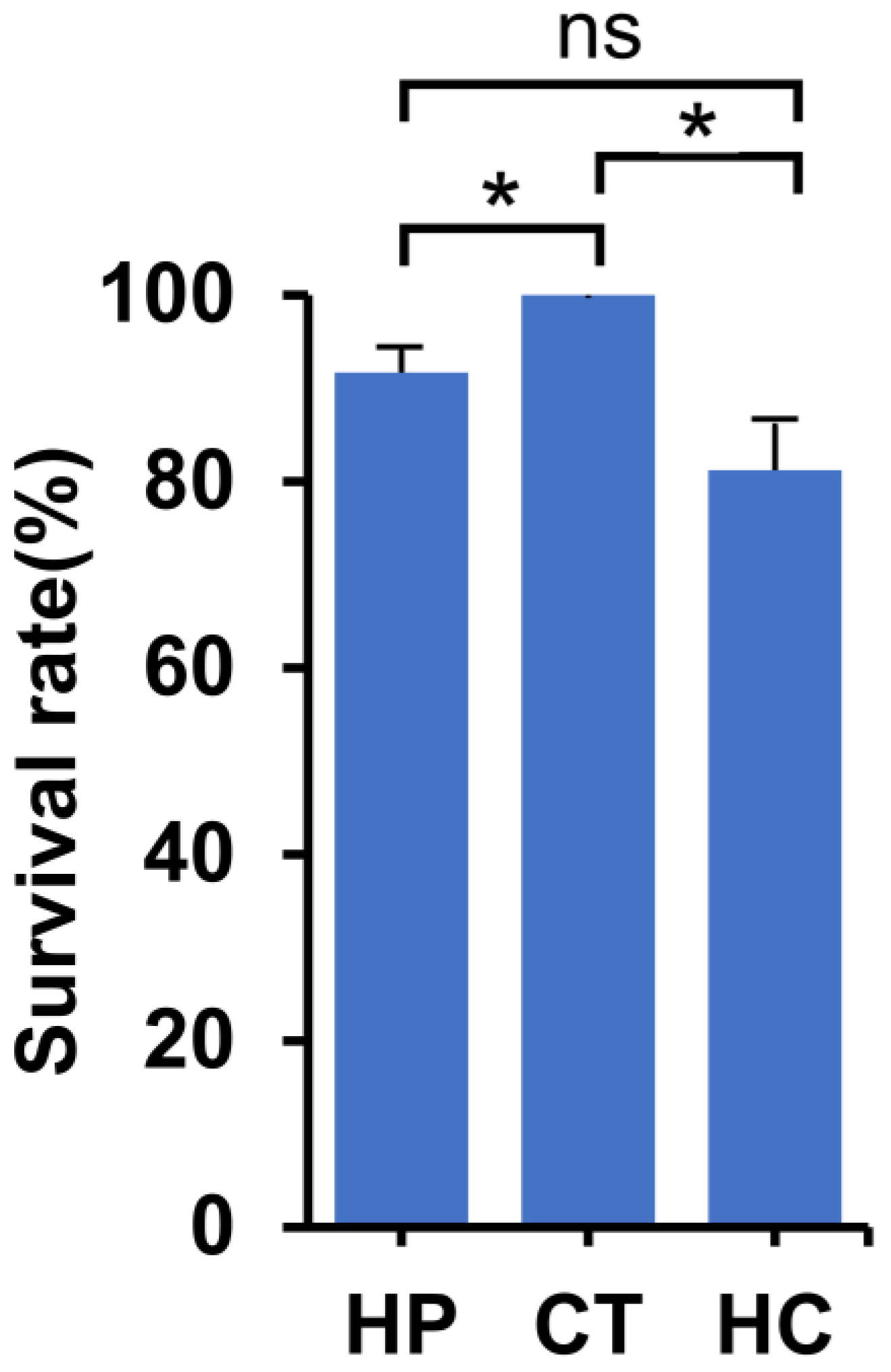
Although the larvae of S. exigua showed high survival rates under the three nutritional conditions, extreme nutritional conditions had obvious negative effects on them. As shown in Figure 1, there were significant differences in the survival rates of the larvae in the three groups (df = 2, 12; H = 12.735; p = 0.002). The survival rate in the HC group (81.21%) was lower than that in the HP group (91.96%), with no significant difference observed between them. However, both treatment groups exhibited a significantly lower survival rate relative to the CT group (100%).

3.2. Effect of Different Nutritional Conditions on the Digestive Enzyme Activity

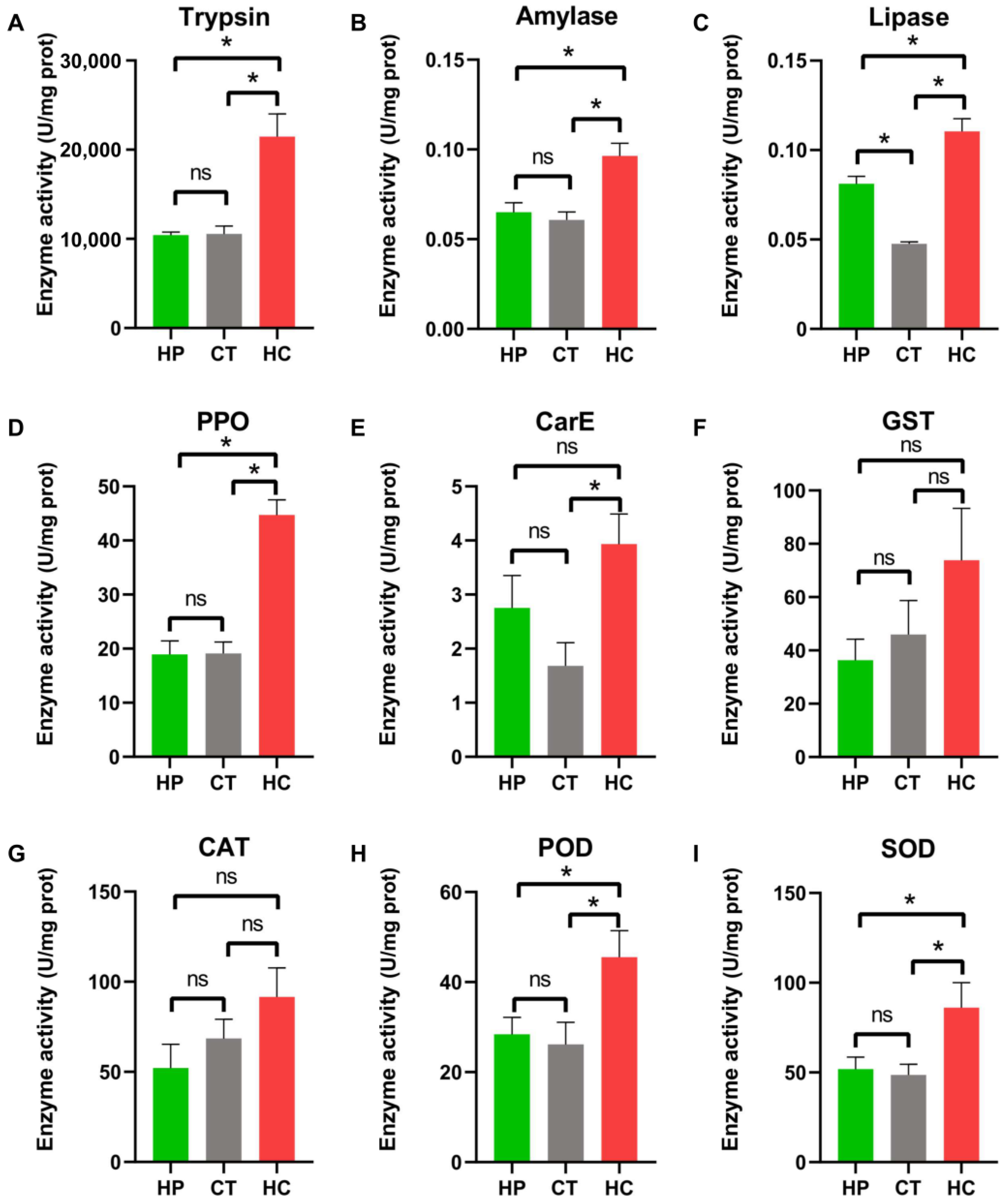
In contrast to plant defense mechanisms, extreme nutritional conditions did not suppress digestive enzyme activity of S. exigua larvae. Instead, significant stimulatory effects were observed for trypsin (df = 2, 12; F = 16.06; p = 0.000), amylase (df = 2, 12; H = 7.440; p = 0.024), and lipase (df = 2, 12; F = 42.186; p = 0.000). As illustrated in Figure 2A–C, the HC group exhibited significantly higher trypsin, amylase, and lipase activities compared to the other treatments. While lipase activity in the HP group surpassed that in the CT group, no significant differences were detected between these groups for trypsin (p = 0.998) and amylase (p = 0.865) activities.

3.3. Effect of Different Nutritional Conditions on the Polyphenol Oxidase Activity

Significant variation in PPO activity was detected among treatment groups (df = 2, 12; F = 35.24; p = 0.000). As presented in Figure 2D, PPO activity showed no significant difference (p = 0.999) between the HP group (18.94 ± 2.50 U/mg protein) and CT group (19.12 ± 2.11 U/mg protein). Both groups exhibited significantly lower PPO activity compared to the HC group (44.70 ± 3.50 U/mg protein).

3.4. Effect of Different Nutritional Conditions on the Detoxification Enzyme Activity

The HP diet exhibited potential toxic effects on S. exigua larvae. Figure 2E,F shows that CarE activity of the HP group (2.75 ± 0.59 U/mg protein) exceeded that in the CT group (1.68 ± 0.43 U/mg protein), though this difference was not statistically significant (p = 0.357). The HC group showed higher CarE activity (3.93 ± 0.56 U/mg protein) compared to the CT group (df = 2, 12; F = 4.47; p = 0.035), while no significant difference was observed between HC and HP groups. GST activity displayed a progressive increase across treatments: 36.33 ± 7.89 U/mg protein (HP), 45.96 ± 12.72 U/mg protein (CT), and 73.83 ± 19.49 U/mg protein (HC). However, these differences were not statistically significant (df = 2, 7.159; Welch’s F = 1.49; p = 0.287).

3.5. Effect of Different Nutritional Conditions on the Antioxidant Enzyme Activity

As shown in Figure 2G–I, the HC diet induced oxidative stress in S. exigua larvae. Among the antioxidant enzymes, CAT activity showed no significant variation among groups (df = 2, 12; F = 2.14; p = 0.161). In contrast, POD (df = 2, 12; F = 4.56; p = 0.034) and SOD (df = 2, 12; F = 4.63; p = 0.032) activities exhibited significant treatment effects. No significant differences in antioxidant enzyme activities were observed between the HP (CAT: 52.09 ± 13.27 U/mg protein, POD: 28.40 ± 3.77 U/mg protein, SOD: 51.84 ± 6.79 U/mg protein) and CT groups (CAT: 64.45 ± 10.69 U/mg protein, POD: 26.11 ± 4.98 U/mg protein, SOD: 48.54 ± 5.98 U/mg protein). However, both POD and SOD activities in the HC group (POD: 45.52 ± 5.92 U/mg protein, SOD: 86.05 ± 14.06 U/mg protein) significantly exceeded those in the HP and CT groups.

4. Discussion

As essential substances for organisms, nutrients play a key role in their growth, development, and physiological metabolism. Consistently, a large number of studies have demonstrated that sufficient nutrient supply can enhance insects’ developmental rate, reproductive performance, immune function, and stress tolerance [33,34]. However, nutrient imbalance may disrupt metabolic homeostasis and promote harmful metabolite accumulation, ultimately compromising survival. For example, excessive protein consumption induces hyperammonemia in Drosophila melanogaster Meigen, 1830 (Diptera: Drosophilidae) [35]. Excessive carbohydrate intake has been shown to be converted into lipid accumulation, thereby increasing the metabolic burden of Heliothis virescens Fabricius, 1777 [36].
As a polyphagous pest, S. exigua encounters diverse nutritional conditions. This study employed a 1:1 protein-to-carbohydrate ratio (P:C) diet, previously established as the preferred ratio for S. exigua larvae, as the control treatment. Two extreme nutritional conditions were tested to evaluate their impact on the survival rate of S. exigua larvae. The result showed high adaptability of S. exigua to different nutritional conditions, as larval survival exceeded 80% in both treatments, which contributes to its broad dietary range. However, survival rates in both treatments were significantly lower than in the control group, confirming that suboptimal nutritional conditions still negatively affect S. exigua viability.
Substantial evidence has established that nutritional status modulates insect feeding behavior [37]. Multiple studies have reported that excessive sugar consumption increases feeding intake in insects [18,33,38]. It is generally believed that high-carbohydrate diets lead to relative protein insufficiency, and insects compensate by increasing food ingestion to satisfy the protein demand for growth and development [18]. However, a neurobiological investigation in D. melanogaster proposed an alternative mechanism: surplus sugar intake desensitizes sweet-sensing neurons, resulting in taste deficits and overeating [38]. In this study, the activities of the three digestive enzymes were all significantly higher in the HC group than in the CT group. This result indicates a counterintuitive pattern: S. exigua larvae under high-sugar treatment display elevated uptake of starch, fat, and protein.
SOD, CAT, POD, and GST are the most extensively studied endogenous antioxidants in insects [39]. SOD catalyzes the conversion of superoxide anions to hydrogen peroxide (H2O2) [39]. CAT can efficiently decompose two molecules of H2O2 into harmless water and oxygen without additional reductants. In contrast, POD requires a reductant and decomposes H2O2 with relatively lower efficiency [40]. Although POD and CAT have similar functions, their responses to H2O2 are not synchronous. For example, when the endogenous ROS production does not exceed the scavenging capacity of the SOD–POD system in Rhyzopertha dominica Fabricius, 1792, CAT activity does not increase [41]. GST not only participates in H2O2 clearance but also catalyzes the decomposition of lipid hydroperoxides, thereby interrupting the lipid peroxidation chain reaction and reducing secondary damage [27]. Studies have shown that D. melanogaster exhibits elevated ROS levels following excess dietary sugar intake, which in turn causes cellular damage [42,43]. In our study, SOD and POD activities in the HC group were higher than in the CT group, whereas CAT and GST activities showed no significant change. We speculate that S. exigua enhances the activity of its SOD–POD system to counteract the increased production of peroxides induced by a high-carbohydrate diet, thereby keeping the associated harm at a low level. This result is consistent with the observed phenotype in our study, where the survival rate of larvae in the HC group remained above 80%.
CarE and GST are not only important detoxification enzymes in insects but also perform additional physiological functions. As mentioned above, GST is involved in the scavenging of peroxides. CarE, as an esterase, participates in lipid turnover in insects in addition to its detoxification role [28]. Birner-Gruenberger et al. [44] reported that CarE directly contributes to lipid storage in D. melanogaster, and loss of its function results in a significant reduction in body fat content. In our study, CarE activity in the HC group was higher than in the CT group, whereas GST activity showed no significant change. These observations suggest that a high-sugar diet did not impose chemical toxicity on S. exigua. The observed increase in CarE activity may be related to lipid accumulation resulting from excessive sugar intake.
In the present study, HC diet significantly increased PPO activity in S. exigua larvae. In insects, PPO has long been regarded as an important defensive factor against exogenous harmful substances, whether biotic or abiotic [25]. To date, few studies have reported that nutritional imbalance or glucose can enhance PPO activity in insects. This result, which differs from previous reports, may have two possible explanations. On one hand, high-sugar diets have been shown to increase susceptibility to pathogen infection in D. melanogaster [45], and the elevated PPO activity may reflect an adaptive response of S. exigua to counteract the heightened immune pressure. On the other hand, plant studies have reported that exogenous application of hydrogen peroxide or stress treatments such as salinity, which induce intracellular ROS generation, can significantly enhance PPO activity [46]. Although the underlying mechanism remains unclear, we cannot exclude the possibility that this phenomenon also occurs in insects.
The HP diet showed no significant effect on detoxification or antioxidant enzyme activities in S. exigua, despite reducing the survival rate of larvae. Among nine examined enzymes, only lipase activity demonstrated significant elevation in the HP group compared to controls. This lipase activation likely reflects compensatory fat mobilization triggered by carbohydrate deficiency. Under such conditions, S. exigua enhances triglyceride breakdown through enhanced lipase activity, releasing free fatty acids. Subsequent β-oxidation of these fatty acids generates energy substrates including acetyl-CoA, FADH, and NADH [47]. Notably, trypsin activity in the HP group showed no significant increase. This observation suggests minimal requirement for additional proteolytic activity when abundant amino nitrogen is readily available from yeast extract absorption. Therefore, we speculate that the reduced survival under HP nutritional conditions likely stems from either energy deficit or metabolic burden associated with excessive amino acid processing [35].

5. Conclusions

In conclusion, this investigation examined survival pressures by unsuitable nutritional conditions and corresponding adaptive mechanisms in third-stage S. exigua. Extreme protein-to-carbohydrate ratios disrupt the survival and metabolic homeostasis of the third-stage larvae of S. exigua, thereby impairing their viability. S. exigua copes with the increased feeding intake induced by a high-carbohydrate diet by enhancing the activities of three digestive enzymes. In addition, the SOD–POD system plays an important role in maintaining the peroxide levels within a tolerable range. The high-protein-low-carbohydrate diet may result in energy deficiency or metabolic loads caused by high amino acid intake, which can be adapted by S. exigua with lipase-mediated fat mobilization. These results provide a theoretical basis for formulating management strategies for S. exigua. It should be noted that insect nutritional requirements vary developmentally [13,48]. Therefore, future research should investigate potential differences in the adaptability to nutritional conditions and the response to enzyme defense system of S. exigua at different instars.

Supplementary Materials

The following supporting information can be downloaded at: https://www.mdpi.com/article/10.3390/agronomy16040415/s1, Table S1: Raw data and statistical analysis results of survival rate; Table S2: Raw data and statistical analysis results of enzyme activity.

Author Contributions

Conceptualization, B.Z. and C.Z.; methodology, X.G., F.Q. and C.Z.; validation, H.Z., X.G., Z.S. and Y.S.; formal analysis, H.Z.; investigation, X.G. and F.Q.; resources, X.G., F.Q. and Y.S.; data curation, X.G., F.Q. and Y.S.; writing—original draft preparation, H.Z.; writing—review and editing, H.Z., Y.S., B.Z. and C.Z.; visualization, H.Z. and Z.S.; supervision, B.Z. and C.Z.; project administration, B.Z.; funding acquisition, B.Z. All authors have read and agreed to the published version of the manuscript.

Funding

This research was funded by National Key R&D Program of China (2024YFC2607600, 2022YFD2300100); Qingdao Science and Technology Benefiting the People Demonstration Project (23-2-8-xdny-12-nsh, 24-1-8-xdny-10-nsh); the Shenzhen Science and Technology Program (KCXFZ20230731093259009, KQTD20180411143628272); and China Scholarship Council (202208370089).

Data Availability Statement

The original contributions presented in this study are included in the Supplementary Materials. Further inquiries can be directed to the corresponding authors.

Acknowledgments

We would like to thank Jie Li, Qianlong Yu, Guiling Zheng, and Chunhong Yang for providing experimental materials and technical assistance. We also thank Zaiyuan Li and Changyou Li for providing access to the project resources. We further thank Fanghao Wan for assistance with manuscript editing.

Conflicts of Interest

The authors declare no conflicts of interest.

Abbreviations

The following abbreviations are used in this manuscript:
CarEcarboxylesterase
CATcatalase
D. melanogasterDrosophila melanogaster
GSTglutathione S-transferase
H2O2hydrogen peroxide
HChigh-carbohydrate-low-protein
HPhigh-protein-low-carbohydrate
PODperoxidase
PPOpolyphenol oxidase
SODsuperoxide dismutase
S. exiguaSpodoptera exigua

References

  1. Che, W.; Shi, T.; Wu, Y.; Yang, Y. Insecticide resistance status of field populations of Spodoptera exigua (Lepidoptera: Noctuidae) from China. J. Econ. Entomol. 2013, 106, 1855–1862. [Google Scholar] [CrossRef]
  2. Fu, X.; Feng, H.; Liu, Z.; Wu, K. Trans-regional migration of the beet armyworm, Spodoptera exigua (Lepidoptera: Noctuidae), in North-East Asia. PLoS ONE 2017, 12, e0183582. [Google Scholar] [CrossRef]
  3. Saeed, S.; Sayyed, A.H.; Ahmad, I. Effect of host plants on life-history traits of Spodoptera exigua (Lepidoptera: Noctuidae). J. Pest Sci. 2010, 83, 165–172. [Google Scholar] [CrossRef]
  4. Maharjan, R.; Ahn, J.; Yi, H. Interactive effects of temperature and plant host on the development parameters of Spodoptera exigua (Hübner) (Lepidoptera: Noctuidae). Insects 2022, 13, 747. [Google Scholar] [CrossRef]
  5. Hidrayani, H.; Nurbailis, N.; Yeni, F.; Ikhsan, Z. Interactive effects of rhizobacteria for managing Spodoptera exigua on shallot plants (Allium cepa L.) under field conditions. J. Proteksi Tanaman 2024, 8, 12–20. [Google Scholar] [CrossRef]
  6. Ma, H.; Zhou, L.; Tan, H.; Xiu, X.; Wang, J.; Wang, X. Population dynamics and seasonal migration patterns of Spodoptera exigua in northern China based on 11 years of monitoring data. PeerJ 2024, 12, e17223. [Google Scholar] [CrossRef]
  7. Breeschoten, T.; Ros, V.I.D.; Schranz, M.E.; Simon, S. An influential meal: Host plant dependent transcriptional variation in the beet armyworm, Spodoptera exigua (Lepidoptera: Noctuidae). BMC Genom. 2019, 20, 845. [Google Scholar] [CrossRef] [PubMed]
  8. Lee, K.P.; Behmer, S.T.; Simpson, S.J.; Raubenheimer, D. A geometric analysis of nutrient regulation in the generalist caterpillar Spodoptera littoralis. J. Insect Physiol. 2002, 48, 655–665. [Google Scholar] [CrossRef] [PubMed]
  9. Perkovich, C.; Ward, D. Protein:carbohydrate ratios in the diet of gypsy moth Lymantria dispar affect its ability to tolerate tannins. J. Chem. Ecol. 2020, 46, 299–307. [Google Scholar] [CrossRef] [PubMed]
  10. Behmer, S.T. Insect herbivore nutrient regulation. Annu. Rev. Entomol. 2009, 54, 165–187. [Google Scholar] [CrossRef]
  11. Kunieda, T.; Fujiyuki, T.; Kucharski, R.; Foret, S.; Ament, S.A.; Toth, A.L.; Ohashi, K.; Takeuchi, H.; Kamikouchi, A.; Kage, E.; et al. Carbohydrate metabolism genes and pathways in insects: Insights from the honey bee genome. Insect Mol. Biol. 2006, 15, 563–576. [Google Scholar] [CrossRef]
  12. Deans, C.A.; Sword, G.A.; Vogel, H.; Behmer, S.T. Quantity versus quality: Effects of diet protein–carbohydrate ratios and amounts on insect herbivore gene expression. Insect Biochem. Mol. Biol. 2022, 145, 103773. [Google Scholar] [CrossRef]
  13. Low, P.A.; McArthur, C.; Fisher, K.; Hochuli, D.F. Elevated volatile concentrations in high-nutrient plants: Do insect herbivores pay a high price for good food? Ecol. Entomol. 2014, 39, 480–491. [Google Scholar] [CrossRef]
  14. Deans, C.A.; Sword, G.A.; Behmer, S.T. Revisiting macronutrient regulation in the polyphagous herbivore Helicoverpa zea: New insights via nutritional geometry. J. Insect Physiol. 2015, 81, 21–27. [Google Scholar] [CrossRef] [PubMed]
  15. Rho, M.S.; Lee, K.P. Identifying the optimal combinations of temperature and macronutrient balance for rearing Tenebrio molitor larvae. J. Insects Food Feed 2023, 10, 259–272. [Google Scholar] [CrossRef]
  16. Wang, Z.; Wang, X.; Li, C.; Xia, Z.; Li, S. Effect of dietary protein and carbohydrates on survival and growth in larvae of the Henosepilachna vigintioctopunctata (Coleoptera: Coccinellidae). J. Insect Sci. 2018, 18, 3. [Google Scholar] [CrossRef]
  17. Cease, A.J. How nutrients mediate the impacts of global change on locust outbreaks. Annu. Rev. Entomol. 2024, 69, 527–550. [Google Scholar] [CrossRef]
  18. Hamann, E.; Blevins, C.; Franks, S.J.; Jameel, M.I.; Anderson, J.T. Climate change alters plant–herbivore interactions: A quantitative review. New Phytol. 2020, 229, 1894–1910. [Google Scholar] [CrossRef]
  19. Cease, A.J.; Youngblood, J.P.; Farington, R.; Trumper, E.V.; Medina, H.E.; Harrison, J.F. Plant carbohydrate content limits performance and lipid accumulation of an outbreaking herbivore. Proc. R. Soc. B Biol. Sci. 2020, 287, 20202500. [Google Scholar]
  20. Adam, M.A.C.; Cailleau, G.; Junier, P.; Benrey, B. Host diet and species interact to shape the bacterial and fungal microbiome in the regurgitant of four Spodoptera species. Microb. Ecol. 2025, 88, 78. [Google Scholar] [CrossRef]
  21. García-Marín, E.; Gamir, J.; Crava, C.M. Proteomic variation in the oral secretion of Spodoptera exigua and Spodoptera littoralis larvae in response to different food sources. J. Chem Ecol. 2025, 51, 10. [Google Scholar] [CrossRef]
  22. Zhang, A.; Liang, K.; Yuan, L.; Li, T.; Jiang, D.; Yan, S. Insect adaptation: Unveiling the physiology of digestion in challenging environments. Chem. Biol. Technol. Agric. 2024, 11, 129. [Google Scholar] [CrossRef]
  23. Terra, W.R.; Ferreira, C. Insect digestive enzymes: Properties, compartmentalization and function. Comp. Biochem. Physiol. B 1994, 109, 1–62. [Google Scholar] [CrossRef]
  24. Chamani, M.; Dadpour, M.; Dehghanian, Z.; Panahirad, S.; Chenari Bouket, A.; Oszako, T.; Kumar, S. From digestion to detoxification: Exploring plant metabolite impacts on insect enzyme systems for enhanced pest control. Insects 2025, 16, 392. [Google Scholar] [CrossRef] [PubMed]
  25. Li, X.; Shapiro-Ilan, D.; Tarasco, E.; Zeng, S.; Liu, Q.; Yang, W.; Yi, J.; Cheng, C.; Fu, H. Thiourea as a polyphenol oxidase inhibitor enhances host infection by the entomopathogenic nematode Heterorhabditis beicherriana. Biol. Control 2024, 191, 105474. [Google Scholar] [CrossRef]
  26. Wu, K.; Zhang, J.; Zhang, Q.; Zhu, S.; Shao, Q.; Clark, K.D.; Liu, Y.; Ling, E. Plant phenolics are detoxified by prophenoloxidase in the insect gut. Sci. Rep. 2015, 5, 16823. [Google Scholar] [CrossRef]
  27. Koirala, B.K.; Moural, T.; Zhu, F. Functional and structural diversity of insect glutathione S-transferases in xenobiotic adaptation. Int. J. Biol. Sci. 2022, 18, 5713–5723. [Google Scholar] [CrossRef] [PubMed]
  28. Cruse, C.; Moural, T.W.; Zhu, F. Dynamic roles of insect carboxyl/cholinesterases in chemical adaptation. Insects 2023, 14, 194. [Google Scholar] [CrossRef]
  29. Mo, C.; Smilanich, A.M. Feeding on an exotic host plant enhances plasma levels of phenoloxidase by modulating feeding efficiency in a specialist insect herbivore. Front. Physiol. 2023, 14, 1127670. [Google Scholar] [CrossRef]
  30. Xiao, W.; Deng, X.; Liu, H. An improved method of rearing Spodoptera exigua larvae. Chin. Bull. Entomol. 2005, 42, 581–583. [Google Scholar]
  31. Ma, H.; Zhang, B.; Li, J.; Qiao, F.; Ma, Q.; Wan, X.; Jiang, Z.; Li, C. Development of Spodoptera exigua population: Does the nutritional status matter? Insects 2023, 14, 13. [Google Scholar] [CrossRef]
  32. Zhang, B.; Li, Z.; Liu, B.; Qiao, F.; Ma, H.; Zheng, G.; Li, J.; Yu, Q.; Qian, W.; Wan, F.; et al. Host adaptation plasticity in Spodoptera exigua larvae: Mechanistic insights from nutritional preferences and developmental shifts in carbohydrate metabolism. Entomol. Gen. 2025, 45, 1651–1659. [Google Scholar] [CrossRef]
  33. Simpson, S.J.; Clissold, F.J.; Lihoreau, M.; Ponton, F.; Wilder, S.M.; Raubenheimer, D. Recent advances in the integrative nutrition of arthropods. Annu. Rev. Entomol. 2015, 60, 293–311. [Google Scholar] [CrossRef] [PubMed]
  34. Ponton, F.; Tan, Y.X.; Forster, C.C.; Austin, A.J.; English, S.; Cotter, S.C.; Wilson, K. The complex interactions between nutrition, immunity and infection in insects. J. Exp. Biol. 2023, 226, jeb245714. [Google Scholar] [CrossRef] [PubMed]
  35. Yoshinari, Y.; Nishimura, T.; Yoshii, T.; Kondo, S.; Tanimoto, H.; Kobayashi, T.; Matsuyama, M.; Niwa, R. A high-protein diet-responsive gut hormone regulates behavioral and metabolic optimization in Drosophila melanogaster. Nat. Commun. 2024, 15, 10819. [Google Scholar] [CrossRef]
  36. Roeder, K.A.; Behmer, S.T. Lifetime consequences of food protein–carbohydrate content for an insect herbivore. Funct. Ecol. 2014, 28, 113–121. [Google Scholar] [CrossRef]
  37. Wang, G.; Zhou, J.J.; Li, Y.; Gou, Y.; Quandahor, P.; Liu, C. Trehalose and glucose levels regulate feeding behavior of the phloem-feeding insect, the pea aphid Acyrthosiphon pisum Harris. Sci. Rep. 2021, 11, 19335. [Google Scholar] [CrossRef]
  38. May, C.E.; Vaziri, A.; Lin, Y.Q.; Grushko, O.; Khabiri, M.; Wang, Q.P.; Dus, M. High dietary sugar reshapes sweet taste to promote feeding behavior in Drosophila melanogaster. Cell Rep. 2019, 27, 1675–1685.e7. [Google Scholar] [CrossRef]
  39. González-Tokman, D.; Villada-Bedoya, S.; Hernández, A.; Montoya, B. Antioxidants, oxidative stress and reactive oxygen species in insects exposed to heat. Curr. Res. Insect Sci. 2025, 7, 100114. [Google Scholar] [CrossRef]
  40. Vidossich, P.; Alfonso-Prieto, M.; Rovira, C. Catalases versus peroxidases: DFT investigation of H2O2 oxidation in model systems and implications for heme protein engineering. J. Inorg. Biochem. 2012, 117, 292–297. [Google Scholar] [CrossRef]
  41. Ranjith, H.V.; Sagar, D.; Kalia, V.K.; Dahuja, A.; Subramanian, S. Differential activities of antioxidant enzymes, superoxide dismutase, peroxidase, and catalase vis-à-vis phosphine resistance in field populations of lesser grain borer (Rhyzopertha dominica) from India. Antioxidants 2023, 12, 270. [Google Scholar] [CrossRef]
  42. Strilbytska, O.; Strutynska, T.; Semaniuk, U.; Burdyliyk, N.; Bubalo, V.; Lushchak, O. Dietary sucrose determines stress resistance, oxidative damages, and antioxidant defense system in Drosophila melanogaster. Scientifica 2022, 2022, 7262342. [Google Scholar] [CrossRef]
  43. Huang, W.H.; Kajal, K.; Wibowo, R.H.; Amartuvshin, O.; Kao, S.H.; Rastegari, E.; Lin, C.H.; Chiou, K.L.; Pi, H.W.; Ting, C.T.; et al. Excess dietary sugar impairs Drosophila adult stem cells via elevated reactive oxygen species-induced JNK signaling. Development 2024, 151, dev201772. [Google Scholar] [CrossRef]
  44. Birner-Gruenberger, R.; Bickmeyer, I.; Lange, J.; Hehlert, P.; Hermetter, A.; Kollroser, M.; Rechberger, G.N.; Kühnlein, R.P. Functional fat body proteomics and gene targeting reveal in vivo functions of Drosophila melanogaster α-Esterase-7. Insect Biochem. Mol. Biol. 2012, 42, 220–229. [Google Scholar] [CrossRef]
  45. Darby, A.M.; Okoro, D.O.; Aredas, S.; Frank, A.M.; Pearson, W.H.; Dionne, M.S.; Lazzaro, B.P. High sugar diets can increase susceptibility to bacterial infection in Drosophila melanogaster. PLoS Pathog. 2024, 20, e1012447. [Google Scholar] [CrossRef] [PubMed]
  46. Goud, P.B.; Kachole, M.S. Effect of exogenous hydrogen peroxide on peroxidase and polyphenol oxidase activities in Cajanus cajan detached leaves. Int. J. Curr. Res. 2011, 3, 61–65. [Google Scholar]
  47. Olsen, L.; Thum, E.; Rohner, N. Lipid metabolism in adaptation to extreme nutritional challenges. Dev. Cell 2021, 56, 1417–1429. [Google Scholar] [CrossRef] [PubMed]
  48. Liu, C.; Du, B.; Hao, F.; Lei, H.; Wan, Q.; He, G.; Wang, Y.; Tang, H. Dynamic metabolic responses of brown planthoppers towards susceptible and resistant rice plants. Plant Biotechnol. J. 2017, 15, 1346–1357. [Google Scholar] [CrossRef]
Figure 1. Survival rate of Spodoptera exigua third-stage larvae fed with HP (P:C = 7:1), CT (P:C = 1:1) and HC (P:C = 1:7) diets, respectively. * indicates significant difference (p < 0.05).
Agronomy 16 00415 g001
Figure 2. Activity of nine enzymes in Spodoptera exigua third-stage larvae fed with HP (P:C = 7:1), CT (P:C = 1:1) and HC (P:C = 1:7) diets, respectively. (A) Trypsin. (B) Amylase. (C) Lipase. (D) Polyphenol Oxidase. (E) Carboxylesterase. (F) Glutathione S-transferase. (G) Catalase. (H) Peroxidase. (I) Superoxide Dismutase. * indicates significant difference (p < 0.05).
Agronomy 16 00415 g002
Table 1. Nutrient composition of artificial diet (P:C = 1:1).
IngredientAmount (g)IngredientAmount (g)
Corn flour185Vitamin B complex2.5
Soybean flour187.5Myo-inositol0.8
Wheat flour500Cholesterol0.5
Agar powder62.5Yeast extract100
Vitamin C15Glucose100
Potassium sorbate5Double-distilled water1400
Methylparaben10
Disclaimer/Publisher’s Note: The statements, opinions and data contained in all publications are solely those of the individual author(s) and contributor(s) and not of MDPI and/or the editor(s). MDPI and/or the editor(s) disclaim responsibility for any injury to people or property resulting from any ideas, methods, instructions or products referred to in the content.