Review

Impact of High Temperatures, Considerations and Possible Solutions for Sustainable Lettuce Production


by
Kelvin D. Aloryi
1,2,†,
Hannah Mather
1,3,†,
Germán V. Sandoya
2,3 and
Kevin Begcy
1,4,*
1
Microbiology and Cell Science Department, Institute of Food and Agricultural Sciences, University of Florida, Gainesville, FL 32611, USA
2
Plant Breeding Graduate Program, Institute of Food and Agricultural Sciences, University of Florida, Gainesville, FL 32611, USA
3
Horticultural Sciences Department, Everglades Research and Education Center, Institute of Food and Agricultural Sciences, University of Florida, Belle Glade, FL 33430, USA
4
Plant Molecular and Cellular Biology Graduate Program, University of Florida, Gainesville, FL 32611, USA
*
Author to whom correspondence should be addressed.
These authors contributed equally to this work.
Agronomy 2026, 16(3), 327; https://doi.org/10.3390/agronomy16030327

Submission received: 8 January 2026 / Revised: 23 January 2026 / Accepted: 25 January 2026 / Published: 28 January 2026
(This article belongs to the Collection Crop Physiology and Stress)

Abstract

High temperature is a major environmental stress factor that affects lettuce (Lactuca sativa L.) growth, development, and productivity. As global temperatures continue to rise, understanding the impact of heat stress on lettuce production is crucial for maintaining crop yields and quality. In fields and in controlled environment agriculture, these elevated temperatures lead to poor seed germination due to thermoinhibition, earlier bolting due to faster crop development, and reduced marketable yields and an increased likelihood of heat-related disorders such as tipburn. Achieving heat tolerance in controlled environment agriculture is paramount as this industry struggles with higher production costs from the excessive use of cooling systems to acclimate greenhouses to temperatures ideal for lettuce production whereas field-grown lettuce must withstand highly variable and extreme thermal conditions, making heat stress a major constraint in both systems. This review comprehensively summarizes the current literature on the impact of heat stress on lettuce and highlights the influence of heat stress at the physiological, biochemical, and molecular level. In addition, we highlight management practices on lettuce production and sustainability as well as the breeding potential for heat tolerance. We synthesized these findings into a proposed conceptual framework for selecting and identifying genomic targets to advance the improvement of heat resilience in lettuce.

1. Introduction

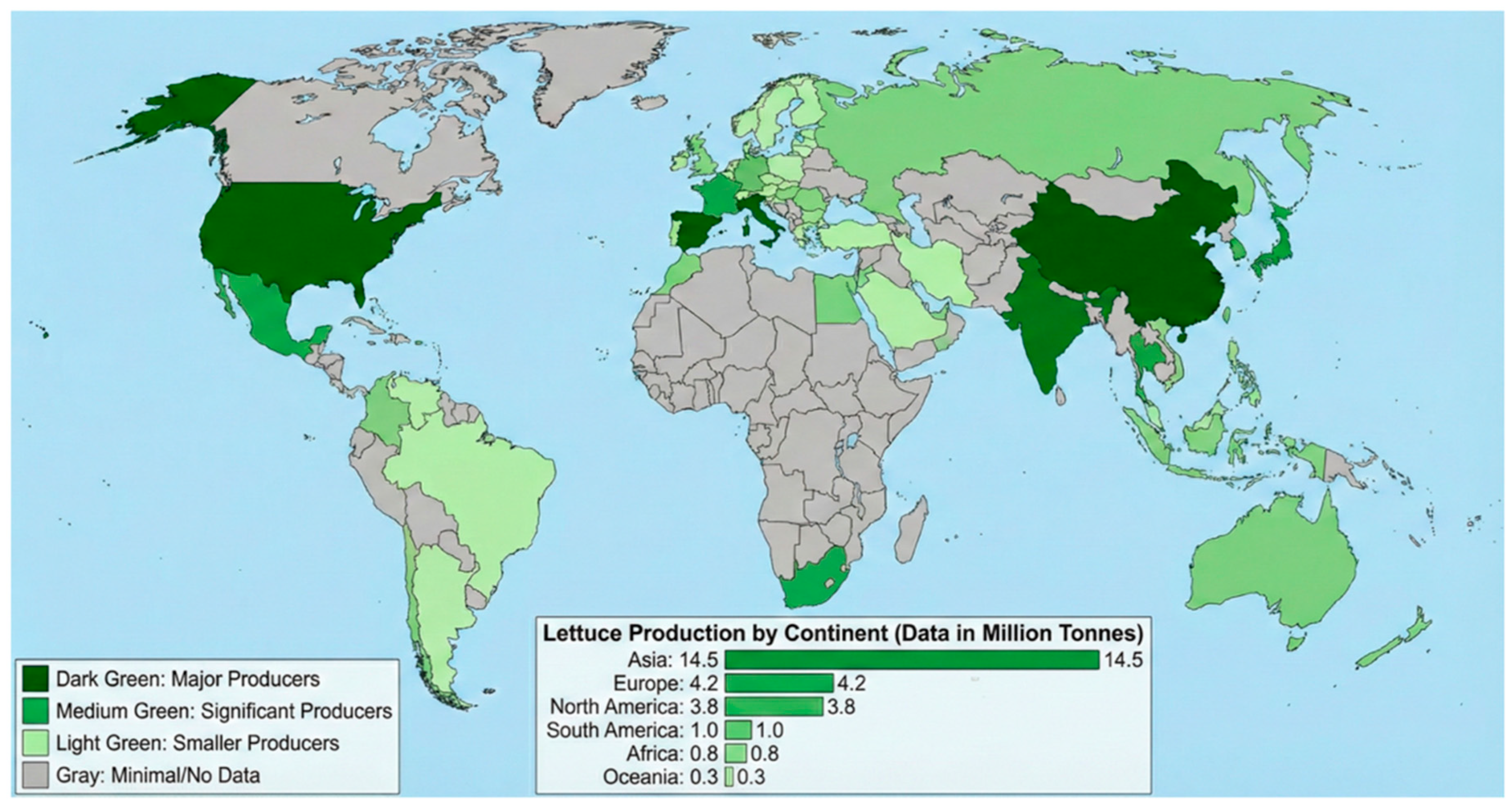
Lettuce (Lactuca sativa L.) is a highly popular leafy vegetable, with a global market valued at USD 3.8 billion in 2023 and projected to reach USD 5.2 billion by 2030 [1]. Globally, Asia overwhelmingly dominates global lettuce production, accounting for over half of the world’s total output, driven primarily by China, which alone produces approximately 14 to 15 million tonnes annually (over 50% of the global share). North America stands as the second-largest producing continent, with the United States contributing roughly 4 million tonnes per year, supported significantly by production in Mexico. Europe follows as a key region, particularly for exports within the same continent, with Spain and Italy leading production at roughly 1 million and 800,000 tonnes, respectively. In contrast, South America, Africa, and Oceania play much smaller roles in the global market, with countries like Australia and South Africa maintaining modest domestic supplies that account for a fraction of the world’s total tonnage [2] (Figure 1).
The popularity of lettuce in household diets has increased due to its numerous health benefits. Lettuce consumption is associated with dishes that explore the flavors and textures of its leaves. From nutritional and health perspectives, lettuce is enriched in fiber, vitamins C and E, polyphenols, tocopherols, and lutenin, which play crucial roles in preventing the incidence of many chronic diseases [3,4].
Heat stress presents one of the most negatively impactful abiotic stresses to crops, as overall plant growth and reproductive development are highly heat sensitive [5,6,7,8], leading to a decline in global yields in response to increasing day temperatures [9,10]. Temperatures are projected to increase on average 1.5 °C to 2 °C based on CO2 and greenhouse gas emissions. This spike in temperature is also expected to become more frequent and intense, causing heatwaves or hot extreme seasons [11,12] that together with humid weather conditions place negative pressure on global lettuce production, which typically relies on cooler day temperatures than 28 °C for proper development [13,14]. Interestingly, increases in minimum night temperatures, predicted to rise 1.4 times than daytime temperatures and extend over longer durations, threaten to exacerbate yield losses in many crops and regions [15,16,17]. These agricultural impacts underscore the pressing need to decipher the genetic mechanisms underlying heat tolerance and to develop tolerant cultivars using advanced breeding approaches. This review provides (i) an overview of the current knowledge on the impact of heat stress on lettuce, spanning from (ii) physiological to (iii) molecular responses. This review also delves into (iv) the management practices to mitigate the effect of heat stress on lettuce production and sustainability, and finally provides (v) breeding strategies for developing thermoresilient lettuce.

2. Description of Morphological Characteristics of Lettuce

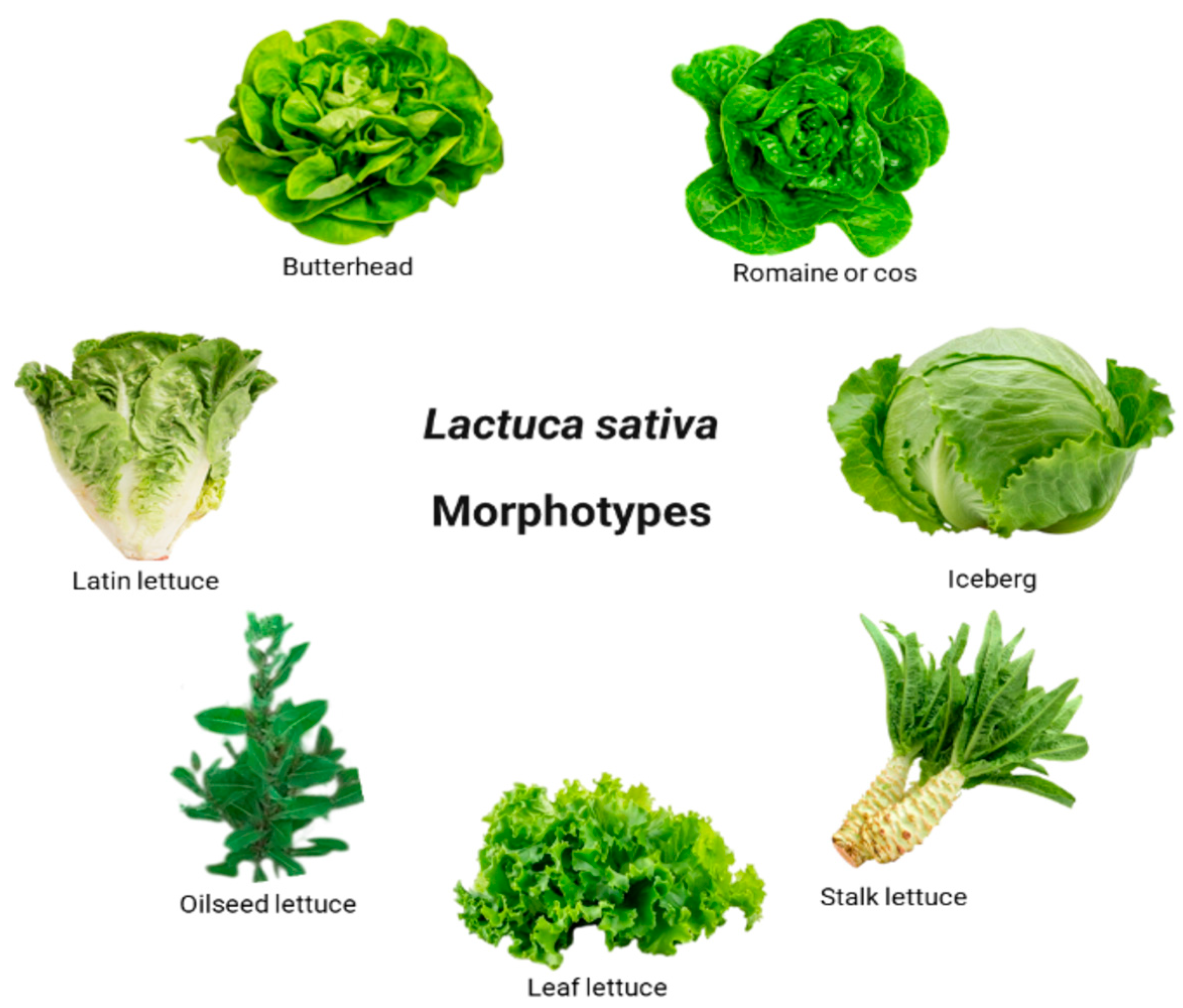
The species L. sativa belongs taxonomically to the clade Eudicots, order Asterales, family Asteraceae and genus Lactuca. It is a widely grown vegetable characterized by a high genetic diversity and adaptability to a myriad of environments. Lettuce cultivars are diverse and often categorized into seven main groups based on morphological differences (Figure 2):
  • Romaine lettuce, also known as Cos lettuce, contains members of the genus L. sativa var. longifolia L. and var. romana [18]. This group is characterized by its long, upright, and somewhat loose head of leaves with firm midribs. The outer leaves are darker green and tougher, while the inner leaves are lighter green and more tender. Unlike some other types of lettuce, romaine lettuce forms a tall, oblong head rather than a tightly packed one. The leaves are long and elongated, with a tendency to be upright rather than tightly curled. The leaves have strong, prominent midribs that add to their structural integrity.
  • Crisphead lettuce, also known as iceberg lettuce, includes members belonging to L. sativa var. capitata L. [18]. Iceberg lettuce is characterized by a tightly packed head of crisp, light green leaves that are broad and often concave. The leaves are known for their crunchy texture and mild, somewhat neutral flavor.
  • Butterhead lettuce, also known as Bibb or Boston lettuce, is a type of head lettuce characterized by soft, buttery leaves that form loosely packed heads [18]. These lettuce heads have a mild, sweet, and succulent flavor, with a tender texture. Butterhead lettuce is a good source of vitamins A and K, as well as iron and calcium.
  • Leaf lettuce, also known as Cutting lettuce, is characterized by a loose, non-heading growth habit, with leaves emerging directly from the stem in a rosette-like formation [18]. These leaves are typically broad and succulent, forming a loose grouping rather than a tightly packed head like iceberg lettuce. The leaves generally lack a distinct petiole, attaching directly to the stem.
  • Oilseed lettuce is characterized by a rosette of leaves, with the main difference being the oil content of the seeds [18]. Leaf shapes can vary, but oilseed lettuce generally has leaves that are not as tightly packed or forming a head as some other varieties like crisphead or butterhead. Because of the bitter taste of its leaves, this type is not eaten as a vegetable.
  • Stalk lettuce, also known as celery or A-choy lettuce, contains members of the L. sativa var. angustana [18]. Stalk lettuce is characterized by its thick, edible stem or stalk. The plant exhibits a morphology with a prominent, elongated stalk and leaves that are typically shorter and wider than those of other lettuce morphotypes. The leaves are attached directly to the stem, without a petiole (leaf stalk).
  • Latin lettuce is characterized by its upright [18], oblong leaves that are longer than they are wide, similar to romaine lettuce but with a more compact, upright growth habit and smaller heads. The leaves also have a butterhead-like texture.

3. Growing and Planting Conditions in Regions with High Heat Stress

Vegetables are typically categorized into warm-season or cool-season types, often allowing farmers to grow seasonally for higher yields and returns than staple crops [10]. Lettuce is considered a cool-season crop, which thrives in cool and moist environments. While specific temperature windows for growing and planting conditions vary region to region, similar environmental parameters are representative of major lettuce-producing regions globally, including the Mediterranean basin (e.g., Spain and Italy), parts of Northern China, South Australia, and the US. Farmers in these zones typically plant early-maturing, heat-tolerant cultivars during early spring or late autumn to avoid the peak summer heat. Irrigation is critical; sprinklers or drip systems deliver thin, even layers of water to prevent wilting, while mulching reduces soil evaporation and maintains cooler root zones. In addition, growers often employ shade cloths or shade trees to lower canopy temperatures, and they adjust planting density to allow airflow, which helps dissipate heat [19]. Soils with good organic matter content retain moisture and buffer temperature fluctuations, and applying a balanced fertilizer (high in potassium) supports cell membrane stability under stress. By combining these planting and cultural practices, lettuce producers can mitigate heat stress and preserve yield and quality in otherwise challenging environments.
Lettuce typically produced during the winter months are adapted to temperatures ranging from 15 to 28 °C during the day and 3–12 °C during nighttime. However, lettuce prefers an average growing temperature of 18 °C during the day for optimum development [20,21,22]. Full maturity requires harvesting lettuce in the vegetative state before reproductive development begins, a process known as bolting. Moreover, lettuce market maturity is morphotype-dependent, where leaf types tend to reach market maturity faster than romaine or iceberg types, and romaine types tend to reach maturity faster than iceberg types in field conditions [13]. Besides dependency in morphotype, market maturity is controlled by the photoperiod and temperature. Lettuce planted during a longer photoperiod matures faster than the ones cultivated under a shorter photoperiod. Likewise, higher temperatures shorten the number of days until lettuce reaches market maturity.
A particular lettuce production area that experiences high temperatures is Florida. Table 1 serves as an example of the days until market maturity for lettuce cultivated in the Everglades Agricultural Area.
In general, planting seasons are divided into three stages: (1) an early-season fall planting, (2) an intermediate-season winter planting, and (3) a late-season planting in spring [23]. Along with the previously mentioned spatial and temporal separations to produce year-round, production also focuses on various unique lettuce types.

4. Heat Stress-Associated Challenges in Lettuce Production

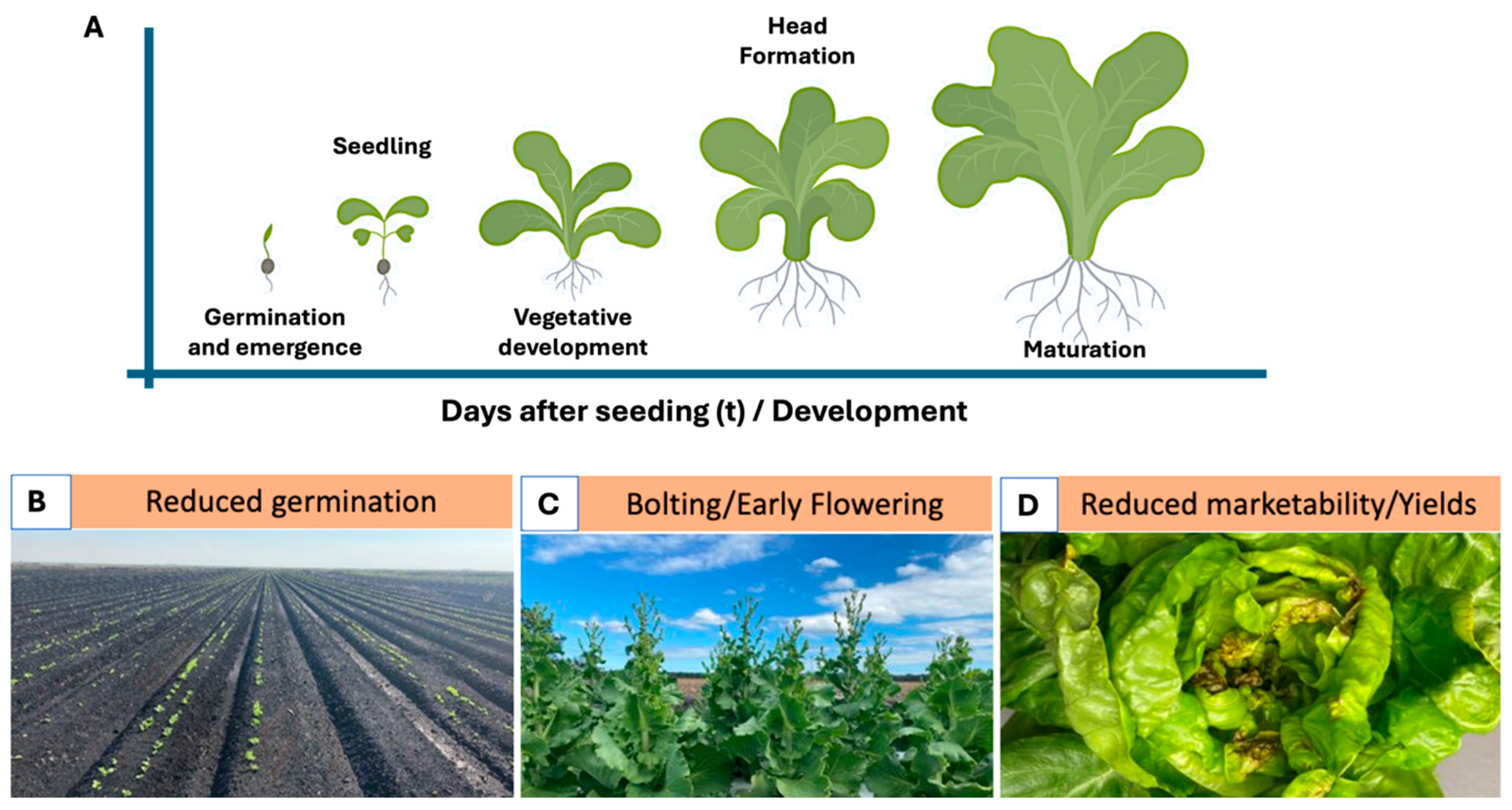
With lettuce being a cool-season crop, increases in day and night temperatures are unfavorable to the overall plant development [8]. With average day and nighttime air and soil temperatures increasing and the variability of seasonal conditions becoming less predictable, breeding for heat tolerance and producing more resilient cultivars will be vital for maintaining production. However, heat stress can exacerbate several factors in commercial production, including thermoinhibition resulting from poor seed germination, accelerated bolting, reduced market quality caused by internal quality defects such as tipburn, and reduced yields (Figure 3) [24].

4.1. Physiological Changes in Lettuce in Response to Heat Stress

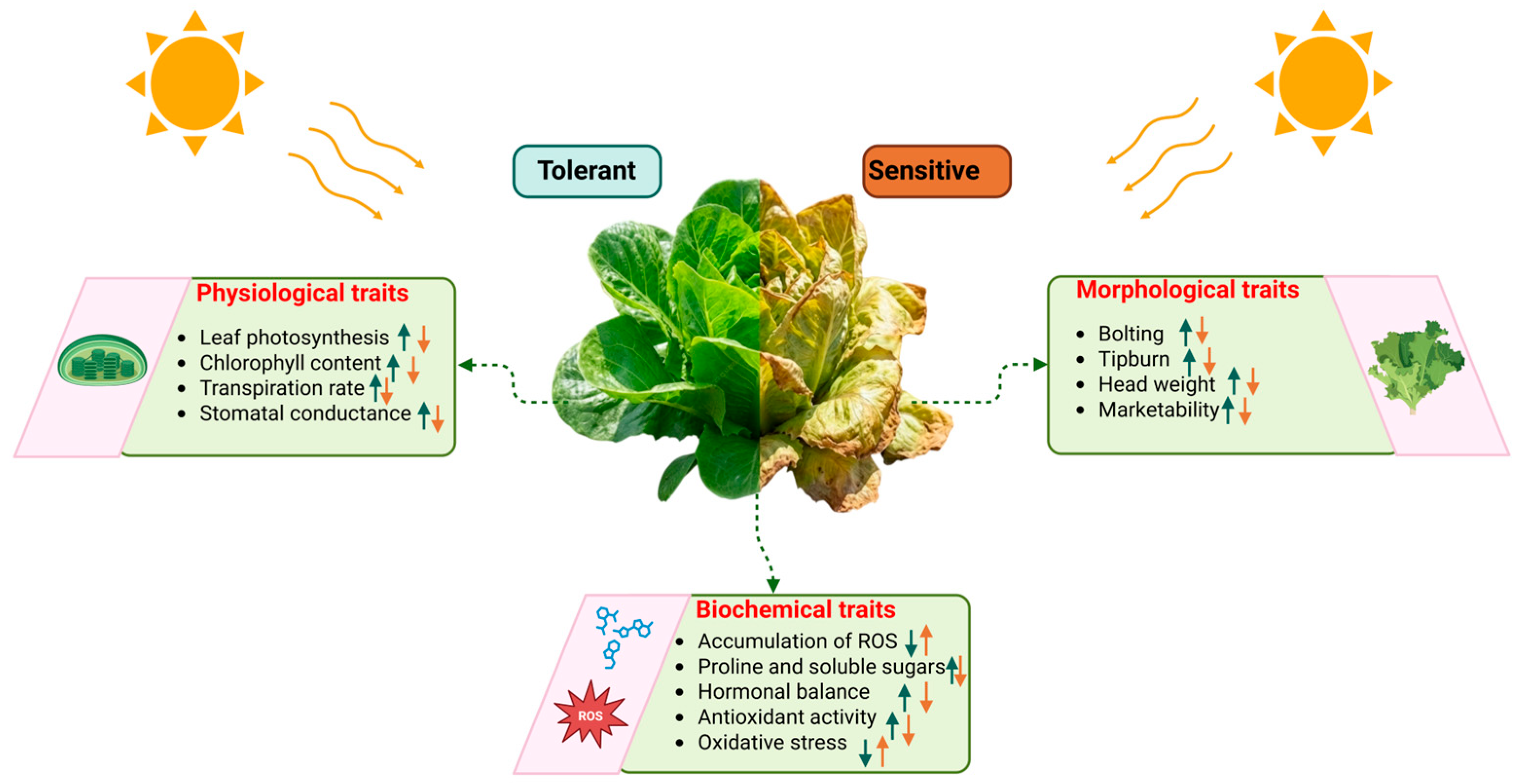
Heat stress affects a myriad of physiological processes in lettuce including photosynthesis, transpiration, membrane stability, reactive oxygen species (ROS) accumulation, antioxidant enzyme activity, and osmotic adjustment (Figure 4). Reduced growth, decreased yield and poor postharvest quality is economically damaging once air temperatures reach 30 °C. Beyond this temperature, lettuce plants naturally shift from vegetative growth to reproductive survival (bolting). The specific percentage of head weight reduction or shelf-life decline fluctuates depending on the duration of exposure and the specific growing region. It has been shown that high temperatures reduce the growth rate of lettuce by inhibiting cell division and expansion [24,25,26,27], increasing water loss through transpiration, resulting in water stress and reduced growth [27,28]. In addition, heat stress causes changes in leaf morphology, including leaf rolling, curling, and yellowing [10,27,28] along with a decreased shelf-life especially in the subtropics [29]. However, several strategies have been proposed to extend lettuce shelf-life [10,30].
ROS play a crucial dual-functionality role during heat stress, acting as a vital signaling molecule [31]. At a moderate level, ROS trigger stress signaling cascades and induce defense-related gene expression [32]. In contrast, excess ROS can lead to cellular damage and can induce oxidative damage through lipid peroxidation, protein carbonylation, and driving programmed cell death [33]. To mitigate oxidative damage, plants utilize a coordinated network of enzymatic antioxidants, including superoxide dismutase (SOD), catalase (CAT), and peroxidase (POD) [33] as well as the production of heat shock proteins (HSPs), which play a crucial role in protecting plants against heat stress [34,35]. In lettuce, the exogenous spermidine and carbon dots (CDs) synthesized by Salvia miltiorrhiza enhanced heat tolerance by increasing antioxidant enzyme activities [35,36].
During heat stress, osmotic substances play critical roles in the heat acclimation of plants. These substances, mainly soluble sugars and proline, accumulate to regulate cellular osmotic potential, counteract cell dehydration, and protect protein molecules from heat-induced denaturation, thereby mitigating the cellular damage associated with heat stress [37]. Proline functions not only as an osmoprotectant but also as an ROS scavenger that minimizes oxidative damage by neutralizing free radicals [38,39]. Increasing soluble sugars under heat stress has been associated with thermotolerant varieties, including lettuce [40], cabbage [37], and potato [41], suggesting that heat tolerance selection could be performed based on osmolyte concentrations under stress [10].
Leaf cell membranes serve as a primary sensor of heat stress. High unsaturated fatty acid content increases membrane fluidity, ultimately leading to reduced membrane rigidity and integrity [42]. This alteration compromises membrane permeability and interferes with the selective transport of molecules, affecting cellular homeostasis [10]. Studies have shown that cell membrane thermostability and chlorophyll fluorescence under heat stress are key traits for identifying varieties able to maintain cellular homeostasis and efficient photosystem II functionality [10,42,43]. Using an electrolyte leakage assay, heat-tolerant cabbage [44] and cauliflower [45] have been identified. This assay evaluates cell membrane thermostability and could be used as a potential indicator for screening heat tolerance in lettuce germplasm.
Photosynthesis is one of the most fundamental processes required for normal plant growth, development, and survival. However, photosynthesis is highly sensitive to heat stress, which impairs key photosynthetic components including CO2 assimilation, photosystem integrity, and the electron transport chain [46,47]. Photosynthesis and related components tend to be very heat-labile, generally suffering reductions in efficiency that shorten crop life cycles under heat stress. Photosynthesis is a critical physiological process in biomass production and overall plant development, with crop yield and quality dependent on photosynthetic CO2 assimilation and respiration (Figure 4) [48]. Identifying resilient photosynthetic processes and gas exchange under high-temperature stress has been a critical aspect of screening and breeding for heat-tolerant crops [6,49,50]. Photosynthetic machinery and associated products tend to suffer damage under high temperatures [48] and therefore are valuable targets for improvement to increase photosynthetic activity and yield under current climate pressures [51]. The effects of heat stress on photosynthesis include ultrastructural chloroplast damage [52], photosystem II inefficiency, reduced photosynthetic pigments, and photorespiration due to reduced Rubisco affinity for carbon dioxide, which ultimately leads to inefficient photosynthesis [10,53].
The leaf is the main photosynthetic organ and in lettuce represents a great part of the final yield, meaning the direct value of the harvest is often a reflection of the productivity of these heat-sensitive systems. Under high temperatures, lettuce leaves tend to become more lanceolate than wide or fan-shaped, petioles extend, and the bulk of the plant becomes loose rather than compact to enhance transpiration and reduce damage to photosynthetic machinery [22]. A reduction in the CO2 assimilation rate (A) is mainly attributed to the thermolability and deactivation of Rubisco, yet plants that can co-express both Rubisco activase (the thermolabile enzyme responsible for activating Rubisco) and Rubisco under high temperatures can improve both photosynthesis and growth as shown in rice [54]. Stomatal behavior (gs) plays a critical role in photosynthesis under heat stress due to functional responses in aperture or density that limit stomatal performance, such as evaporative cooling and CO2 uptake [55].
The stay-green phenotype is another trait associated with thermotolerance, and lower canopy temperatures [10] achieved through transpiration cooling [56], helping the plant to maintain photosynthetic activity by delaying leaf senescence [57]. Therefore, canopy temperature depression or the stay-green trait could be employed as useful screening methods for identifying and developing thermotolerant varieties [10]. The ability to maintain photosynthesis and appropriate canopy temperatures under high temperature largely relies on stomatal conductance activity [58]. Selecting heat-tolerant genotypes based on the ability to respond and maintain stomatal activity, without unnecessary transpiration, has been successfully conducted in sweet pepper [59], chickpea [60], and tomato [61] as previously summarized [10]. The plant’s relative water content reflects the balance of transpirational water losses and water uptake, and heat-tolerant genotypes are able to maintain water homeostasis within the leaves to prevent wilting and other heat stress effects [10]. The use of relative water content as a selection criterion has resulted in the identification of thermotolerant tomato [62] and potato [63]. Therefore, developing lettuce genotypes able to maintain relative water content under high temperatures might also be a potential strategy in lettuce.
Another impact of prolonged exposure to heat stress during vegetative development is the faster development, leading to an accelerated maturity. This abnormally faster development produces longer and narrow leaves resulting in plants with loose, poorly formed heads and lower overall head weight. These morphological changes allow heat-stressed plants to enhance transpiration and reduce the severe effects of heat stress on photosynthetic systems [22,24]. For instance, thirteen days of consecutive heat stress increases biomass and leaf and stalk length in lettuce, except that leaves are much narrower, which is an undesirable trait for the market [22]. Thinner blades and longer internodes reduce the overall nutritional quality and commercial value of lettuce [64]. The accelerated progression from the vegetative to the reproductive phase is often initiated long before the sufficient accumulation of resources under heat stress [65], often reflected in reduced yields and quality. Variation in temperatures induce synergistic changes in morphological and physiological activity that highly influence the rate of lettuce development from seed to harvest maturity [22]. In the case of thermosensitive lettuce genotypes, plants first react to heat stress by increasing antioxidant enzymes and later altering morphology and photosynthetic systems to increase biomass [22]. To cope with heat stress, plants activate adaptive mechanisms leading to changes in morphological and physiological architecture. However, some morpho-physiological adaptations needed for survival are unsuitable for consumer markets, such as thin leaves and loosely formed heads. Therefore, breeding lettuce plants with enhanced resilience to high-temperature stress, including the ability for consistent germination, low tipburn, and delayed flowering, is a crucial strategy that can maintain uniformity and meet marketability standards.

4.2. Seed Thermoinhibition

Lack of seed germination and initial growth under high temperatures is a significant setback for lettuce growers (Figure 3B). Lettuce seeds historically survived regions with long, hot summers by waiting to germinate until temperatures had cooled, using a process controlled by genetics and environmental cues called seed thermoinhibition [25,66]. A common phenomenon observed in lettuce germinating under increased temperatures is the temporary inhibition (thermoinhibition) or permanent inhibition (thermodormancy) of germination when temperatures reach or exceed 25–30 °C [25,67,68,69]. Thermoinhibition or thermodormancy is common in regions that experience high temperatures, and often results in reduced field emergence, establishment, yield, and more complicated management regimes due to asynchronous harvests [66]. Many factors influence the aforementioned complex phenomena, and while maximum seed germination at high temperatures is genetically heritable, environmental factors, including temperature and light during seed formation and germination, as well as inherent genetic variation, also pose a significant influence on seed germination [70].
Seed priming, a technique that induces regulated seed water imbibement by soaking the seed in a tri-potassium phosphate solution, has been demonstrated to allow lettuce seeds to bypass thermodormancy when soil temperatures are high [71]. However, under the current scenario in climate-related events, soil temperature has also increased as ambient temperature and seed priming is not enough to overcome lack of germination in warmer temperatures. There have also been shown to be benefits of maturing seeds under increased temperatures, as opposed to optimal, to increase their respective maximum temperature to germinate [69,72]. Quality seeds able to germinate under increased temperatures are critical for ensuring proper establishment for growers planting in the field during the early and late season.
Thermoinhibited lettuce seeds are susceptible to plant hormones such as abscisic acid (ABA) at high temperatures, with ABA-related genes highly affected by light and temperature [66]. One germination-inhibiting gene, NCED4, which encodes 9-cis-EPOXYCAROTENOID DIOXYGENASE4 required for synthesizing ABA, has been shown to be a primary factor influencing the maximum temperatures of lettuce seed germination [66,73]. In the absence of the expression of temperature-sensitive germination genes, lettuce can maintain >70% germination at 37 °C [73]. Additional evidence suggests that endo-b-mannanase and superoxide dismutase quantification may be insightful thermoinhibition tolerance markers for lettuce selection [74]. Insight into these plant hormones and response pathways offers the opportunity for further research to increase the maximum germination temperature in lettuce. Identifying lettuce that can naturally germinate at high temperatures allows for high reliability in field plantings and for introgressing this capability using breeding techniques. Genetic variation for the ability of lettuce to germinate up to 34 °C was detected in specific Lactuca spp. germplasm [75], yet cultivar development has not been achieved.

4.3. Bolting

Both external and internal factors such as plant hormones, photoperiod, and temperature influence bolting (Figure 3C and Figure 4), characterized by rapid stem elongation as the shoot apical meristem elongates and transitions into the inflorescence meristem [76]. As lettuce is grown for its foliage, prolonging the vegetative phase is critical for increasing yields, maintaining high quality, and reducing bitter flavors associated with bolting [77]. Harvesting before the initial bolting process is critical for growers, and increased temperatures have made that time more unpredictable. Bolting tends to increase under temperatures higher than 30 °C, reducing the overall nutritional quality and number of leaves, directly decreasing yield and marketability [64,78].
Increases in photosynthesis and carbohydrate metabolism initiate lettuce bolting [64,79]. Energy metabolism and protein biosynthesis are vital in bolting initiation and floral bud development since it is a high-energy-demanding process requiring increased glycolysis and pyruvate pathways for bolting initiation [79]. Molecular studies have revealed the influence of day length on lettuce flowering by confirming that the photoperiod and clock gene pathways, and age and hormonal pathways, play crucial roles in high-temperature-induced bolting responses in lettuce [80]. Inherent flowering differences are subject to post-transcriptional modifications of bolting-related genes, specifically kinase family proteins which may potentially play crucial roles in high-temperature flowering time and are also affected by miRNAs and DNA methylation in lettuce [80]. Recent evidence suggests that application of plant hormones such as gibberellin, auxin, brassinolide, and ethylene promote bolting, while external application of paclobutrazol inhibits bolting [81].

4.4. Tipburn

Tipburn is a physiological disorder associated with environmental and internal factors such as humidity, temperature, light, and subpar nutrient or mineral availability, often characterized by black necrotic leaf margins and veins (Figure 3D and Figure 4) [20,82,83]. Previous findings attribute an increase in tipburn incidence and severity to accelerated plant growth, increased photosynthesis, and environments such as greenhouses and growth chambers that facilitate increased dry matter accumulation that requires high calcium (Ca2+) concentrations in expanding leaves [20,82]. Since increasing and decreasing vegetative growth rates can induce tipburn, the incidence and severity can be unpredictable [84,85].
High temperatures in field conditions may contribute to the appearance of tipburn, which significantly reduces field production [20,83,85]. Iceberg, butterhead and romaine lettuce grown in the field can develop tipburn close to market maturity after the head is well formed, making the disorder visually hard to observe [82,85]. Tipburn dramatically reduces the amount of lettuce reaching markets since most packaging companies reject deliveries as unmarketable when even a 5% field incidence is observed [20,24,83]. High light or high temperature can significantly accelerate the plant’s growth rate, increasing the demand for Ca2+ in the meristematic tissues at a rate that exceeds the supply delivered by the xylem, leading to a molecular-level breakdown in cell wall integrity and membrane stability (where Ca2+ is crucial). While tipburn is a complex trait, not directly correlated to high temperature, its incidence under increased temperatures must be further understood to identify mechanisms for prevention. Genetic studies have identified Quantitative Trait Loci (QTLs) for tipburn resistance, with candidate genes in several genetic regions, including those possibly involved in calcium transport [83,86].

4.5. Yield and Marketability

Yield in lettuce is severely affected when lettuce is cultivated under high temperatures. Yield (expressed as head weight) is on average reduced by 20 to 40% when lettuce is planted in warmer environments [21,23,87]. In addition to the direct impact on head weight, the marketability of the crop is severely reduced (Figure 4). For the whole-head market, when lettuce is cultivated under warmer environments, above 30% of the lettuce heads might not meet the standard requirements including less head weight (morphological type-dependent), free of physiological disorders such as tipburn and/or bolting, and free of any other disorders such as sprouting [23] to be considered marketable. Although marketability is a key parameter for the whole-head market, lettuce is also commercially available as chopped products in salad bags that do not need such requirements.

5. Molecular Mechanisms of Lettuce Response to Heat Stress

Heat stress impacts lettuce morphology, physiology, and biochemical responses in distinct ways. The regulatory mechanisms underlying heat tolerance primarily involve multiple intricate genetic pathways.

5.1. Heat Shock Proteins/Factors Serve as First Layers of Response to Heat Evasion

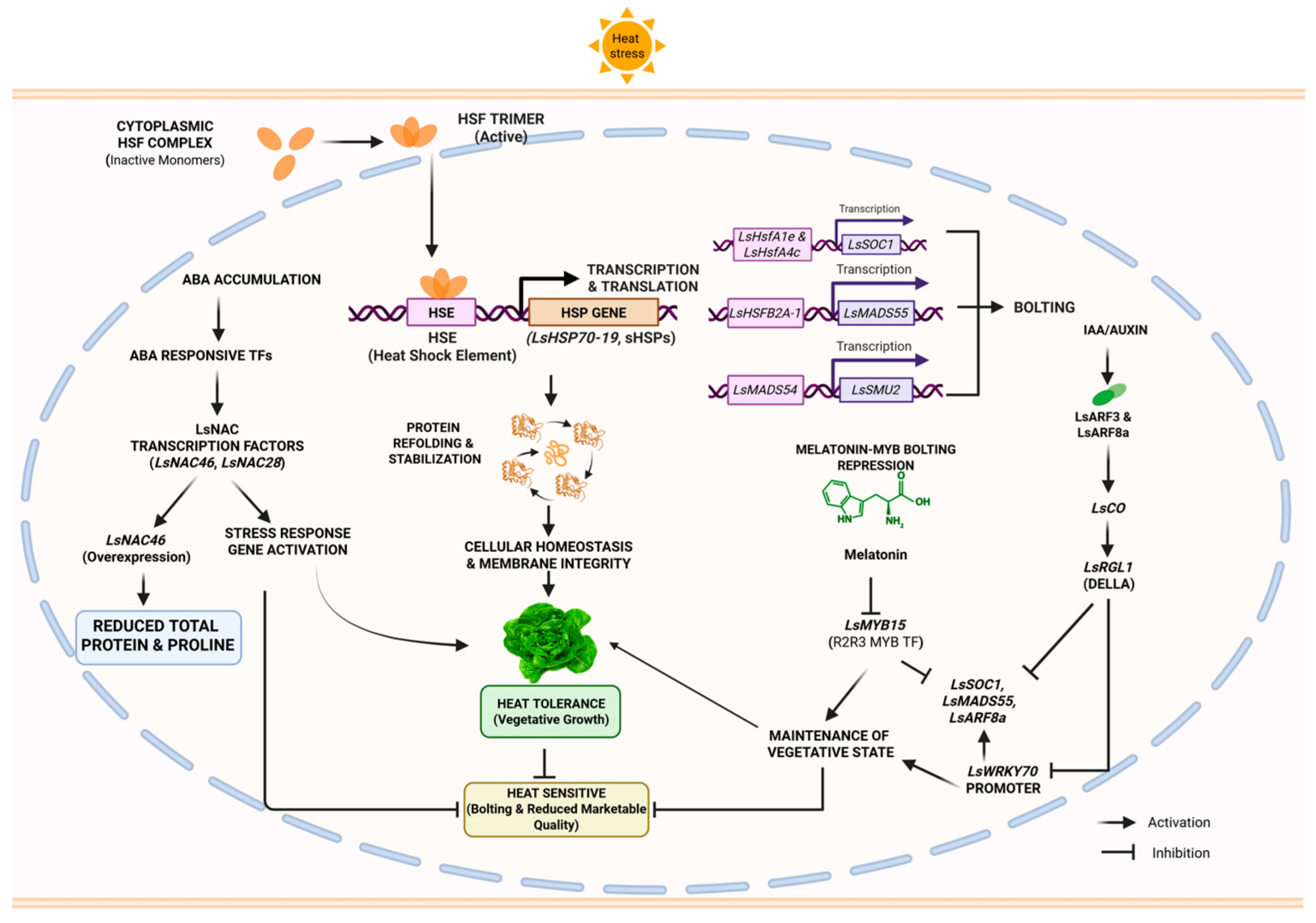
When plants are exposed to heat stress, the expression of a series of heat shock factors (HSFs) and heat shock proteins (HSPs) are induced. HSFs induce the expression of HSPs by binding to promoters of heat shock elements (HSE) of HSPs and the combined activity of HSFs and HSPs constitute central regulators of the heat stress response and induction of thermotolerance [53,88,89]. In Arabidopsis, a systematic network centered on HSPs–HSFs has been well studied [90,91]. In the lettuce genome [92], like many other plant species, HSFs are divided into three evolutionary classes (A, B, and C) based on their structural features and domain [93]. LsHSP70-3701 and LsHSP70-2711 are established as early response genes whose expression increase significantly under heat stress [78]. Heat stress induces LsHSP70 expression to interact with calmodulin proteins (Figure 5). This interaction is associated with accumulation of gibberellins (GA), which drive bolting, whereas reduced expression of LsHSP70 results in increased stem length indicating that LsHSP70 is crucial in bolting tolerance [78]. A functional study utilizing virus-induced gene silencing (VIGS) and transient overexpression showed that LsHSP70-19 is important in regulating lettuce thermotolerance [94]. In addition, heat shock transcription factors LsHsfA1e and LsHsfA4c were identified as key upstream positive regulators of heat-induced bolting by directly binding to HSE1 and HSE2 cis-acting elements of the LsSOC1 promoter [95]. Taken together, genetic approaches to enhance lettuce thermotolerance can benefit from identifying and elucidating specific HSFs/HSPs and their downstream factors.

5.2. Regulation of Lettuce Thermotolerance Is Mediated by Transcription Factors and Plant Hormones

As sessile organisms, plants have developed sophisticated regulatory networks to cope with fluctuating environmental temperatures. Central to these networks are transcription factors (TFs) that act as molecular switches [96]. The primary heat-responsive TFs such as HSFs and Dehydration-Responsive Element Binding (DREB) perceive stress signals by the reprogramming of their transcriptome, and activate the downstream signaling cascade [88,95]. These TFs integrate environmental cues with key hormone pathways including gibberellin and auxin signaling by directly binding the promoters of floral integrators such as LsSOC1 and LsFT (Figure 5). These regulatory proteins serve as decisive gatekeepers that determine vegetative stability and premature reproductive development [95]. Various TF families, most notably, MYB, NAC, WRKY, MADS-box, and ARF, have been implicated in lettuce heat response. While some TFs enhance thermotolerance, others facilitate the rapid transition of the vegetative phase to the reproduction phase leading to flowering [97,98,99].
SUPPRESSOR OF OVEREXPRESSION OF CONSTANS 1 is a MADS-box TF that is involved in controlling flowering time in plants. In Arabidopsis, SOC1 acts downstream of multiple flowering pathways including the photoperiod, ambient temperature, vernalization, age, and gibberellin to promote floral transition by inducing LEAFY (LFY), APETALA1 (AP1), FRUITFULL (FUL), while inhibiting floral repressors such as AGL24 and SHORT VEGETATIVE PHASE (SVP) [100,101]. In lettuce, LsSOC1, a homolog of Arabidopsis SOC1, functions as a positive regulator of high-temperature-induced bolting and flowering. LsSOC1 is directly activated by heat shock transcription factors (LsHsfA1e and LsHsfA4), and integrates developmental and stress response pathways, orchestrating both bolting and stress-responsive transcriptional programs [95,99]. In addition, LsMADS55 (APETALA1 homolog) is induced upon heat stress and is expressed in inflorescence meristems and pappus bristles [102]. The overexpression of LsMADS55 activates early flowering in Arabidopsis and it is bound by heat shock factor LsHSFB2A-1, suggesting that LsMADS are involved in modulating floral organ specification and heat-induced flowering [102]. Similarly, LsMADS54 (LsFUL) heat-induced bolting by interacting with SUPPRESSORS OF MEC-8 AND UNC-52 PROTEIN 2 (LsSMU2) and CONSTANS-LIKE PROTEIN 5 (LsCOL5) [103], indicating that the regulatory module involving LsFUL-LsMUL-LsCOL5 is crucial for inducing premature bolting in lettuce (Figure 5).
MYB is a superfamily of transcription factors widely present in eukaryotes that plays an important role in biotic and abiotic stress [104,105]. In a recent study, a member of the MYB family has been shown to play a significant role in plant physiological processes in the presence of exogenous melatonin [106]. In tea (Camellia sinensis) leaves, the application of melatonin enhanced lignin content by increasing the activity of peroxidase POD [106]. In leaf lettuce, LsMYB15 has been identified as a positive regulator of heat-induced bolting [104]. Silencing LsMYB15 under high temperatures resulted in early bolting, with reduced expression of genes involved in the ABA signaling pathway. Furthermore, the exogenous melatonin therapy exhibited a delayed bolting phenotype by increasing the expression of ABA-related genes [104].
Auxin is an indispensable phytohormone that regulates plant development and physiological processes such as organogenesis, embryogenesis, fruit development, and directional growth [107,108]. Auxin response factors (ARFs) constitute the core factors of the auxin signaling cascade as they modulate the transcription of genes involved in the auxin signaling pathway [108]. Considering that auxin controls various developmental processes in plants including root and shoot tropisms, phototropism, and apical dominance [108], it is perhaps not surprising that auxin is implicated in heat-induced bolting in lettuce. When lettuce was grown at 25 °C, Indole-3-acetic acid (IAA) content increased in response to bolting, and exogenous IAA therapy promoted bolting in lettuce cultivars after a 4-day treatment [77]. Recently, two ARF genes LsARF3 and LsARF8a have been identified as playing a role in thermally induced bolting in lettuce [97,109]. Transgenic plants overexpressing LsARF3 induced early bolting whereas silencing LsARF8a resulted in delayed bolting [97,109]. It was further established that LsARF3 promotes lettuce bolting in response to high temperatures by directly activating the expression of LsCO (floral gene) [97]. In another study, overexpression of LsRGL1, a gene encoding a functional DELLA repressor, diminished IAA biosynthesis, while auxin and gibberellin feeding restored the bolting time of LsRGL1 overexpression lines [81].
NAC [NO APICAL MERISTEM (NAM), ARABIDOPSIS TRANSCRIPTION ACTIVATOR FACTOR 1/2 (ATAF1/2), and CUP-SHAPED COTYLEDON (CUC2)] transcription factors are one of the largest families of plant-specific TFs in plants and possess highly conserved N-terminal domains that control nuclear localization, specific recognition and binding to the downstream target gene [105,110,111]. NAC also has a variable C-terminal transcription regulatory region that determines transcription activation or repression activity [110,111]. There is increasing evidence that NAC plays a vital role in stress response either by enhancing plant basal thermotolerance [112] or acting as negative regulator of basal heat tolerance [113]. Recent studies have suggested that LsNACs act as negative regulators of thermotolerance in lettuce [114,115]. For instance, overexpressing LsNAC46 resulted in a higher heat damage index and lower survival rate due to the reduced accumulation of protective metabolites such as proline and total protein [115]. A functional study indicates that LsNAC28 negatively regulates heat tolerance in stem lettuce where higher expression levels were correlated with a higher heat damage index [114].
Aside from the above TF, other TFs such as WRKY, bZIP, and bHLH have been well studied as playing a role in plant stress response. Recently, LsWRKY70 was shown to positively regulate lettuce bolting under high temperatures. The LsRGL1 protein (a DELLA family protein) directly binds to the promoter of LsWRKY70 via an ABA-mediated bolting network. High temperatures induce LsWRKY70, which subsequently suppresses ABA signaling components while promoting growth-related hormones. Knockdown of LsWRKY70 delayed the bolting phenotype [98].

6. Current Methods for Managing Lettuce Production Under High Temperatures

Heat stress management options that could extend the lettuce production season and yield high-quality lettuce include adapting agricultural and cultural practices, and breeding heat-tolerant cultivars using key physiological markers and molecular strategies. Previous strategies [9] to manage lettuce production under high temperatures have been based on two key approaches: soil and plants.
Developing thermotolerant cultivars able to grow all year around with likely increased quality is a critical strategy to meet growing market demands in production regions facing warmer temperatures. In several geographic locations, high temperatures which were normally only seen during summer have been extending into early fall when lettuce planting traditionally begins. Similarly, high temperatures are now appearing earlier into late spring when lettuce planting ends, causing production issues for growers. Lettuce development, uniformity, crop consistency, and overall quality are highly affected by temperature and significantly affect market value and yields. Head formation in iceberg and butterhead morphotypes is critical in determining value to consumers, and head closure is temperature-dependent to a variable degree, with high temperatures resulting in increased growth rates and more open-form lettuce heads [24].
Soil management strategies under heat stress include the addition of inorganic and organic amendments, as well as agricultural practices such as mulching and microbe applications, all of which aim to reduce soil temperatures to help maintain appropriate moisture levels under heat stress [9]. An additional alternative could be the use of shade cloths to manage heat stress in lettuce. It was found that shade cloths successfully reduced soil temperatures and plant bitterness, especially when shade was combined with a heat-tolerant cultivar [19]. This strategy might work for small farmers, but it has limitations in large production systems. In addition, the use of biostimulants to prevent lettuce tipburn has also been proposed. However, it has only been tested in hydroponic nutrient solutions [116]. Calcium-mobilizing biostimulants have calcium, zinc and proprietary calcium mobility capabilities by activating ion transport channels on cell membranes and allowing calcium to be transported from cell to cell, in addition to the typical transport path between cells as determined by mass flow and transpiration. Presumably, biostimulants could improve calcium distribution to the inner part of the lettuce heads by stimulating the apoplastic pathway. Biostimulants could also improve heat stress tolerance by strengthening plants’ natural defenses, reducing damage, and improving recovery, primarily by boosting antioxidants, enhancing water use, promoting stress response proteins including HSPs, and stabilizing cell membranes, allowing plants to photosynthesize better and maintain growth under high temperatures. Biostimulants work best preventively, priming the plant before severe heat strikes, and can include substances such as seaweed extracts, glycine betaine, microbial inoculants, and humic substances [117,118,119]. In addition, biostimulants increase antioxidants (non-protein thiols) and enzymes that neutralize harmful ROS produced during heat stress [31], protecting cellular components.
Another key strategy to manage heat stress is by altering the planting date, which has been successfully shown to benefit other crops under heat stress [120]. Heat priming, often achieved through exogenous chemical applications or stress-induced priming, has been shown to aid post-anthesis thermotolerance in wheat when applied at the seedling stage [121] or in later developmental stages [122]. In rice, heat stress during early seed development primed germination and seedling establishment [72], a strategy that could be tested in lettuce. Despite current technical and management adaptations, these alterations are insufficient for maintaining yields under heat stress [123]. For this reason, managing heat stress at the plant level is preferred and involves various methods such as selecting and breeding heat-tolerant cultivars, grafting, genetic engineering, and external osmolyte applications [9].

7. Breeding Lettuce That Cope with Heat Stress

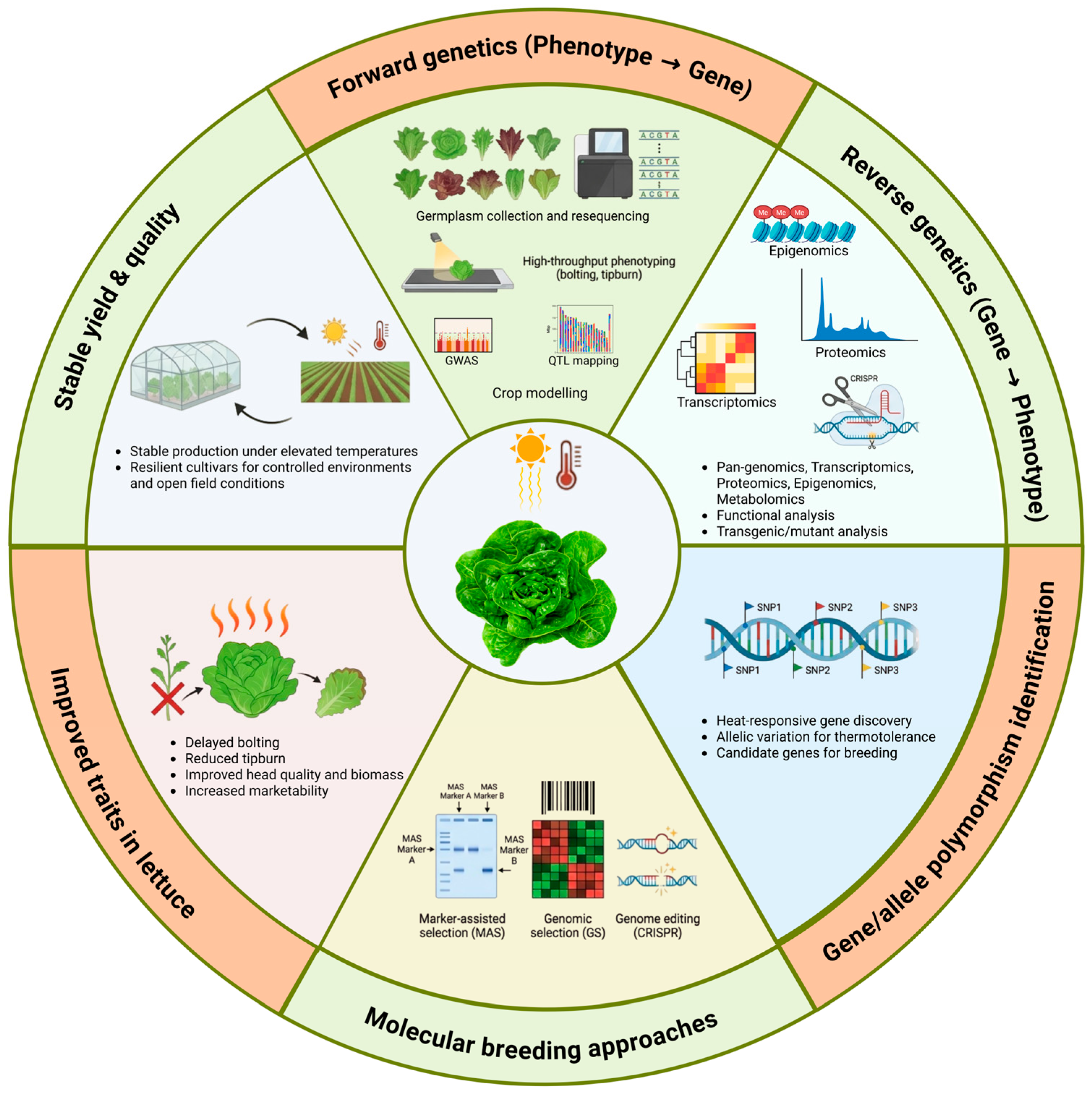
Forward and reverse genetics are useful approaches for identifying genes and developing crop varieties to improve important agronomic traits [124]. Such strategies have the potential to be deployed in lettuce-breeding programs for enhanced heat tolerance. From reverse genetics perspectives, there have been significant advancements in deciphering the molecular mechanisms underlying thermotolerance in lettuce. Also, forward genetic approaches such as extensive germplasm collection, genome sequencing, homology-based gene screening, and phenotyping efforts have been used to identify tolerant genes and alleles governing lettuce thermotolerance [8,50,125].

Genomic and Molecular Strategies to Improve Heat Tolerance in Lettuce

In several plant species, heat tolerance has been approached through seed germination screenings, evaluating seedling viability, hypocotyl and root elongation, and other indirect measurements such as chlorophyll content, hydrogen peroxide content, and ion leakage [126,127]. A large majority of heat tolerance breeding has been conducted in cereal crops such as wheat, rice, maize, and barley, with a large focus on grain filling, flowering, and development under heat stress [9]. Less effort has been placed on selecting thermotolerant germplasm in vegetables. However, recent efforts in identifying important thermotolerant traits for selection in vegetables have been developed to identify thermotolerant varieties [10]. In lettuce for instance, tolerant germplasm has been identified in butterhead, crisphead, red and green leaf, and romaine lettuce [21,23,87,128] for warmer planting locations in the western US. Additional thermotolerant germplasm has been identified for the subtropics in the eastern US [29,129]. Such germplasm has less bolting and tipburn, and acceptable head weight and marketability—key characteristics for the industry. In controlled environment agriculture, heat tolerance is paramount as this industry struggles with higher production costs from the excessive use of cooling systems to acclimate greenhouses to temperatures ideal for lettuce production [130]. Similar efforts have been devoted to identifying thermotolerant germplasm for these settings [131].
Comprehensive analyses of genomic regions controlling heat tolerance in lettuce remain to be elucidated. However, it is suspected that traits related to heat tolerance are controlled by multiple loci that are distributed across the lettuce genome as these characteristics are highly influenced by environmental conditions. Bolting and tipburn have been reported to be controlled by multiple loci (genomic regions) in the lettuce genome. Early bolting alone is usually mapped in chromosomes 2 and 7 but when lettuce is under high stress several other loci for early bolting are identified in chromosomes 2, 3, 6, 8 and 9 [132,133]. Likewise, numerous QTLs are identified for tipburn in lettuce across multiple germplasms and experimental sites [83]. It is unknown whether these QTLs are detected as a consequence of lettuce being exposed to warmer temperatures. Although germplasms with tolerance to heat-related stresses have been identified, dedicated improvement of such germplasms has not been conducted to date. However, breeding programs must consider including a series of characteristics when improving this vegetable to withstand warmer temperatures. Such characteristics include marketability, yield, bolting, and tipburn. The use of genomic selection models that integrate multiple traits and molecular markers would be beneficial in the development of such germplasms (Figure 6).
Breeding strategies that consider multiple loci should be employed in the meantime in the development of heat-tolerant lettuce cultivars. Utilizing the pedigree method with offspring evaluation under warmer plantings in advanced generations of breeding would be the recommended approach considering the multi-loci and multi-environmental influence on traits related to heat tolerance in lettuce.

8. Concluding Remarks and Future Perspectives

The current availability of thermotolerant lettuce cultivars, specifically those adapted to high temperatures, is limited. Identifying heat-tolerant lettuce that maintains germination, acceptable yield, and marketability, while minimizing heat-related disorders such as bolting, and tipburn under high-temperature conditions is required to further develop cultivars to meet growers’ needs. In addition to extending the cropping season, thermotolerant cultivars can increase the yields and quality of lettuce. To make breeding programs more efficient in the selection and breeding process, further understanding of thermotolerant mechanisms, including the ability to maintain photosynthetic and energy production efficiency under heat stress, is also needed. There is also a paramount need to investigate management practices, including the use of soil management strategies that could aid heat-tolerant cultivars to be more efficient under constant weather patterns.
Within the associated heat tolerance genes in lettuce, those detected through forward genetics are still scarce. The favorable natural variation in these genes is poorly characterized, which hinders their utilization in breeding programs. Considering the relevance of genome variation for heat tolerance regulation, more efforts are required to identify natural allelic variation present in these genes to develop heat-tolerant lettuce cultivars. The advent of genome editing technology has revolutionized plant breeding and has proven useful for trait improvement [134,135,136,137]. The use of CRISPR/Cas9 for the precise knockout of functional variants of negative regulators such as LsRGL1 and LsNAC46 offers the opportunity to enhance lettuce thermotolerance. By editing these loci in elite backgrounds, breeders can expedite the development of transgene-free germplasm with improved heat tolerance. However, during the development of new heat-tolerant lettuce cultivars, a balance must be maintained between improved heat response, yield, and quality. Therefore, future research should prioritize fine-tuning this balance by engineering heat-tolerant gene promoters to achieve gain-of-function modifications and maintain stable expression levels under non-stressed conditions while ensuring rapid induction of expression to combat heat stress.
While much research has focused on DNA sequences, the impact of epigenetic regulation such as DNA methylation and histone modification on gene expression and heat stress response has received relatively less attention in recent lettuce research [138,139,140]. Future studies should focus on elucidating the epigenetic regulation of heat tolerance in lettuce, specifically investigating how DNA methylation and histone modifications modulate heat stress memory. Moreover, it will be interesting to understand how chromatin accessibility in the promoters of key regulators such as LsHSP70 and LsSOC1 differs between genotypes, and whether transgenerational epigenetic inheritance can be leveraged to prime subsequent generations for enhanced thermotolerance without altering the underlying DNA sequence.

Author Contributions

K.B. conceived the review. K.D.A., H.M. and K.B. wrote the review. K.B. and G.V.S. edited the manuscript. All authors have read and agreed to the published version of the manuscript.

Funding

The research on heat stress in K.B.’s lab is supported by the National Institute of Food and Agriculture NIFA-AFRI program (grant 2023-67013-39412) and by the Hatch project FLA-ENH-006627 from the United States Department of Agriculture. G.V.S. is supported by Hatch Project FLA-ERC-006174, specialty Crop Block Program—Florida Department of Agriculture and Consumer Service USDA AMS—Award #SCBP27434 and Specialty Crop Research Initiative—USDA AMS Award No. 2021-51181-35903. K.D.A. is supported by the Plant Breeding Graduate Initiative/Dean of Research of the University of Florida—IFAS.

Data Availability Statement

No new data were created or analyzed in this study. Data sharing is not applicable to this article.

Conflicts of Interest

The authors declare no conflicts of interest.

References

  1. USDA Economic Research Service. U.S. Lettuce Production Shifts Regionally by Season. Available online: https://www.ers.usda.gov/data-products/charts-of-note/chart-detail/?chartId=106516 (accessed on 18 May 2025).
  2. Helgi Library. Which Country Produces the Most Lettuce? Lettuce and Chicory Production Data. Helgi Library. Available online: https://www.helgilibrary.com/charts/which-country-produces-the-most-lettuce/ (accessed on 26 November 2025).
  3. Shi, M.; Gu, J.; Wu, H.; Rauf, A.; Emran, T.B.; Khan, Z.; Mitra, S.; Aljohani, A.S.M.; Alhumaydhi, F.A.; Al-Awthan, Y.S.; et al. Phytochemicals, Nutrition, Metabolism, Bioavailability, and Health Benefits in Lettuce—A Comprehensive Review. Antioxidants 2022, 11, 1158. [Google Scholar] [CrossRef]
  4. Yang, X.; Gil, M.I.; Yang, Q.; Tomás-Barberán, F.A. Bioactive Compounds in Lettuce: Highlighting the Benefits to Human Health and Impacts of Preharvest and Postharvest Practices. Comp. Rev. Food Sci. Food Safe 2022, 21, 4–45. [Google Scholar] [CrossRef]
  5. Begcy, K.; Weigert, A.; Egesa, A.; Dresselhaus, T. Compared to Australian Cultivars, European Summer Wheat (Triticum aestivum) Overreacts When Moderate Heat Stress Is Applied at the Pollen Development Stage. Agronomy 2018, 8, 99. [Google Scholar] [CrossRef]
  6. Li, X.; Bruckmann, A.; Dresselhaus, T.; Begcy, K. Heat stress at the bicellular stage inhibits sperm cell development and transport into pollen tubes. Plant Physiol. 2024, 195, 2111–2128. [Google Scholar] [CrossRef]
  7. Begcy, K.; Nosenko, T.; Zhou, L.-Z.; Fragner, L.; Weckwerth, W.; Dresselhaus, T. Male Sterility in Maize after Transient Heat Stress during the Tetrad Stage of Pollen Development. Plant Physiol. 2019, 181, 683–700. [Google Scholar] [CrossRef]
  8. Kim, T.; Egesa, A.; Qin, C.; Mather, H.; Sandoya, G.; Begcy, K. Global Identification of LIM Genes in Response to Different Heat Stress Regimes in Lactuca sativa. BMC Plant Biol. 2024, 24, 751. [Google Scholar] [CrossRef]
  9. Ali, S.; Rizwan, M.; Arif, M.S.; Ahmad, R.; Hasanuzzaman, M.; Ali, B.; Hussain, A. Approaches in Enhancing Thermotolerance in Plants: An Updated Review. J. Plant Growth Regul. 2020, 39, 456–480. [Google Scholar] [CrossRef]
  10. Chaudhary, S.; Devi, P.; HanumanthaRao, B.; Jha, U.C.; Sharma, K.D.; Prasad, P.V.V.; Kumar, S.; Siddique, K.H.M.; Nayyar, H. Physiological and Molecular Approaches for Developing Thermotolerance in Vegetable Crops: A Growth, Yield and Sustenance Perspective. Front. Plant Sci. 2022, 13, 878498. [Google Scholar] [CrossRef]
  11. Gao, Y.; Wu, Y.; Guo, X.; Kou, W.; Zhang, S.; Leung, L.R.; Chen, X.; Lu, J.; Diffenbaugh, N.S.; Horton, D.E.; et al. More Frequent and Persistent Heatwaves Due To Increased Temperature Skewness Projected by a High-Resolution Earth System Model. Geophys. Res. Lett. 2023, 50, e2023GL105840. [Google Scholar] [CrossRef]
  12. Sun, P.; Bian, Y.; Yu, S.; Yao, R.; Wang, Z.; Zhang, Q.; Chen, W.; Ge, C.; Ma, Z.; Du, W. Are Longer and More Intense Heatwaves More Prone to Extreme Precipitation? Glob. Planet. Change 2024, 236, 104428. [Google Scholar] [CrossRef]
  13. Subbarao, K.V. (Ed.) Compendium of Lettuce Diseases and Pests, 2nd ed.; APS, American Phytopathological Society: St. Paul, MN, USA, 2017. [Google Scholar]
  14. Verslues, P.E.; Bailey-Serres, J.; Brodersen, C.; Buckley, T.N.; Conti, L.; Christmann, A.; Dinneny, J.R.; Grill, E.; Hayes, S.; Heckman, R.W.; et al. Burning Questions for a Warming and Changing World: 15 Unknowns in Plant Abiotic Stress. Plant Cell 2023, 35, 67–108. [Google Scholar] [CrossRef]
  15. Sadok, W.; Jagadish, S.V.K. The Hidden Costs of Nighttime Warming on Yields. Trends Plant Sci. 2020, 25, 644–651. [Google Scholar] [CrossRef] [PubMed]
  16. Sakai, H.; Cheng, W.; Chen, C.P.; Hasegawa, T. Short-Term High Nighttime Temperatures Pose an Emerging Risk to Rice Grain Failure. Agric. For. Meteorol. 2022, 314, 108779. [Google Scholar] [CrossRef]
  17. McAusland, L.; Acevedo-Siaca, L.G.; Pinto, R.S.; Pinto, F.; Molero, G.; Garatuza-Payan, J.; Reynolds, M.P.; Murchie, E.H.; Yepez, E.A. Night-time Warming in the Field Reduces Nocturnal Stomatal Conductance and Grain Yield but Does Not Alter Daytime Physiological Responses. New Phytol. 2023, 239, 1622–1636. [Google Scholar] [CrossRef]
  18. Křístková, E.; Doležalová, I.; Lebeda, A.; Vinter, V.; Novotná, A. Description of Morphological Characters of Lettuce (Lactuca sativa L.) Genetic Resources. Hortic. Sci. 2008, 35, 113–129. [Google Scholar] [CrossRef]
  19. Laur, S.; Da Silva, A.L.B.R.; Díaz-Pérez, J.C.; Coolong, T. Impact of Shade and Fogging on High Tunnel Production and Mineral Content of Organically Grown Lettuce, Basil, and Arugula in Georgia. Agriculture 2021, 11, 625. [Google Scholar] [CrossRef]
  20. Choi, K.Y.; Paek, K.Y.; Lee, Y.B. Effect of Air Temperature on Tipburn Incidence of Butterhead and Leaf Lettuce in a Plant Factory. In Transplant Production in the 21st Century; Kubota, C., Chun, C., Eds.; Springer: Dordrecht, The Netherlands, 2000; pp. 166–171. [Google Scholar]
  21. Lafta, A.; Sandoya, G.; Mou, B. Genetic Variation and Genotype by Environment Interaction for Heat Tolerance in Crisphead Lettuce. HortScience 2021, 56, 126–135. [Google Scholar] [CrossRef]
  22. Zhao, X.; Sui, X.; Zhao, L.; Gao, X.; Wang, J.; Wen, X.; Li, Y. Morphological and Physiological Response Mechanism of Lettuce (Lactuca sativa L.) to Consecutive Heat Stress. Sci. Hortic. 2022, 301, 111112. [Google Scholar] [CrossRef]
  23. Sandoya, G.; Lafta, A.; Mou, B. Heat-Tolerant Lettuce Germplasm (Lactuca sativa L.) Identified in Romaine and Butterhead Types for Warmer Plantings. HortScience 2024, 59, 151–163. [Google Scholar] [CrossRef]
  24. Simko, I.; Hayes, R.J.; Mou, B.; McCreight, J.D. Lettuce and Spinach. In CSSA Special Publications; Smith, S., Diers, B., Specht, J., Carver, B., Eds.; Wiley: Hoboken, NJ, USA, 2014; Volume 33, pp. 53–85. [Google Scholar]
  25. Wei, J.; Zhang, Q.; Zhang, Y.; Yang, L.; Zeng, Z.; Zhou, Y.; Chen, B. Advance in the Thermoinhibition of Lettuce (Lactuca sativa L.) Seed Germination. Plants 2024, 13, 2051. [Google Scholar] [CrossRef]
  26. Duan, Y.; Sun, W.; Wang, Q.; Cao, L.; Wang, H.; Hao, J.; Han, Y.; Liu, C. Integrated Transcriptomics and Proteomics Revealed That Exogenous Spermidine Modulated Signal Transduction and Carbohydrate Metabolic Pathways to Enhance Heat Tolerance of Lettuce. BMC Plant Biol. 2025, 25, 754. [Google Scholar] [CrossRef]
  27. Li, B.; Gao, K.; Ren, H.; Tang, W. Molecular Mechanisms Governing Plant Responses to High Temperatures. J. Integr. Plant 2018, 60, 757–779. [Google Scholar] [CrossRef]
  28. Ahmed, H.A.; Yu-Xin, T.; Qi-Chang, Y. Optimal Control of Environmental Conditions Affecting Lettuce Plant Growth in a Controlled Environment with Artificial Lighting: A Review. S. Afr. J. Bot. 2020, 130, 75–89. [Google Scholar] [CrossRef]
  29. Belisle, C.E.; Sandoya, G.V.; Kreutz, G.F.; Sargent, S.A. Screening Subtropical Lettuce Accessions for Heat Tolerance by Incorporating Accelerated Shelf Life Testing. J. Am. Soc. Hort. Sci. 2024, 149, 206–216. [Google Scholar] [CrossRef]
  30. Chase, K.; Belisle, C.; Ahlawat, Y.; Yu, F.; Sargent, S.; Sandoya, G.; Begcy, K.; Liu, T. Examining Preharvest Genetic and Morphological Factors Contributing to Lettuce (Lactuca sativa L.) Shelf-Life. Sci. Rep. 2024, 14, 6618. [Google Scholar] [CrossRef]
  31. Begcy, K. Heat Stress: Pollen Tubes ROSted by Heat Stress. Curr. Biol. 2024, 34, R1147–R1149. [Google Scholar] [CrossRef] [PubMed]
  32. Marchi, S.; Giorgi, C.; Suski, J.M.; Agnoletto, C.; Bononi, A.; Bonora, M.; De Marchi, E.; Missiroli, S.; Patergnani, S.; Poletti, F.; et al. Mitochondria-Ros Crosstalk in the Control of Cell Death and Aging. J. Signal Transduct. 2012, 2012, 329635. [Google Scholar] [CrossRef] [PubMed]
  33. Gulen, H.; Eris, A. Effect of Heat Stress on Peroxidase Activity and Total Protein Content in Strawberry Plants. Plant Sci. 2004, 166, 739–744. [Google Scholar] [CrossRef]
  34. Khan, Z.; Shahwar, D. Role of Heat Shock Proteins (HSPs) and Heat Stress Tolerance in Crop Plants. In Sustainable Agriculture in the Era of Climate Change; Roychowdhury, R., Choudhury, S., Hasanuzzaman, M., Srivastava, S., Eds.; Springer International Publishing: Cham, Switzerland, 2020; pp. 211–234. [Google Scholar]
  35. Li, C.; Han, Y.; Hao, J.; Qin, X.; Liu, C.; Fan, S. Effects of Exogenous Spermidine on Antioxidants and Glyoxalase System of Lettuce Seedlings under High Temperature. Plant Signal. Behav. 2020, 15, 1824697. [Google Scholar] [CrossRef]
  36. Wang, H.; Kang, Y.; Li, H.; Huang, S.; Li, W.; Zheng, M.; Huang, R.; Lei, B.; Yang, X. Salvia Miltiorrhiza Derived Carbon Dots and Their Heat Stress Tolerance of Italian Lettuce by Promoting Growth and Enhancing Antioxidant Enzyme Activity. ACS Omega 2021, 6, 32262–32269. [Google Scholar] [CrossRef]
  37. Song, Q.; Yang, F.; Cui, B.; Li, J.; Zhang, Y.; Li, H.; Qiu, N.; Wang, F.; Gao, J. Physiological and Molecular Responses of Two Chinese Cabbage Genotypes to Heat Stress. Biol. Plant 2019, 63, 548–555. [Google Scholar] [CrossRef]
  38. Guo, H.; Li, J.; Gao, S.; Ye, W.; Su, R.; Gu, Y.; Zou, A.; Li, Y.; Li, Z.; Li, J. Cold Tolerance in Rice: Insights into Genetic Basis, Molecular Mechanisms, and Adaptive Strategies. J. Integr. Plant Biol. 2025, 1–19. [Google Scholar] [CrossRef]
  39. Szabados, L.; Savouré, A. Proline: A Multifunctional Amino Acid. Trends Plant Sci. 2010, 15, 89–97. [Google Scholar] [CrossRef] [PubMed]
  40. Han, Y.; Fan, S.; Zhang, Q.; Wang, Y. Effect of Heat Stress on the MDA, Proline and Soluble Sugar Content in Leaf Lettuce Seedlings. Agric. Sci. 2013, 4, 112–115. [Google Scholar] [CrossRef]
  41. Paul, S.; Gogoi, N.; Sarma, B.; Baroowa, B. Biochemical Changes in Potato under Elevated Temperature. Ind. J. Plant Physiol. 2014, 19, 36–42. [Google Scholar] [CrossRef]
  42. Marcum, K.B. Cell Membrane Thermostability and Whole-Plant Heat Tolerance of Kentucky Bluegrass. Crop Sci. 1998, 38, 1214–1218. [Google Scholar] [CrossRef]
  43. Poudyal, D.; Rosenqvist, E.; Ottosen, C.-O. Phenotyping from Lab to Field—Tomato Lines Screened for Heat Stress Using Fv/Fm Maintain High Fruit Yield during Thermal Stress in the Field. Funct. Plant Biol. 2018, 46, 44–55. [Google Scholar] [CrossRef]
  44. Nyarko, G.; Alderson, P.G.; Craigon, J.; Murchie, E.; Sparkes, D.L. Comparison of Cell Membrane Thermostability and Chlorophyll Fluorescence Parameters for the Determination of Heat Tolerance in Ten Cabbage Lines. J. Hortic. Sci. Biotechnol. 2008, 83, 678–682. [Google Scholar] [CrossRef]
  45. Aleem, S.; Sharif, I.; Tahir, M.; Najeebullah, M.; Nawaz, A.; Khan, M.I.; Batool, A.; Arshad, W. Impact of Heat Stress on Cauliflower (Brassica Oleracea var. Botrytis): A Physiological Assessment. Pak. J. Agric. Res. 2021, 34, 479–486. [Google Scholar] [CrossRef]
  46. Xalxo, R.; Yadu, B.; Chandra, J.; Chandrakar, V.; Keshavkant, S. Alteration in Carbohydrate Metabolism Modulates Thermotolerance of Plant under Heat Stress. In Heat Stress Tolerance in Plants; Wani, S.H., Kumar, V., Eds.; Wiley: Hoboken, NJ, USA, 2020; pp. 77–115. [Google Scholar]
  47. Wang, D.; Li, X.-F.; Zhou, Z.-J.; Feng, X.-P.; Yang, W.-J.; Jiang, D.-A. Two Rubisco Activase Isoforms May Play Different Roles in Photosynthetic Heat Acclimation in the Rice Plant. Physiol. Plant. 2010, 139, 55–67. [Google Scholar] [CrossRef]
  48. Morales, F.; Ancín, M.; Fakhet, D.; González-Torralba, J.; Gámez, A.L.; Seminario, A.; Soba, D.; Ben Mariem, S.; Garriga, M.; Aranjuelo, I. Photosynthetic Metabolism under Stressful Growth Conditions as a Bases for Crop Breeding and Yield Improvement. Plants 2020, 9, 88. [Google Scholar] [CrossRef]
  49. Nadakuduti, S.S.; Laforest, L.C.; Tachev, M.; Decker, A.N.; Egesa, A.O.; Shirazi, A.S.; Begcy, K.; Sarnoski, P.J.; Buell, C.R. Heat Stress during Seed Development Leads to Impaired Physiological Function and Plasticity in Seed Oil Accumulation in Camelina Sativa. Front. Plant Sci. 2023, 14, 1284573. [Google Scholar] [CrossRef]
  50. Aloryi, K.D.; Sandoya, G.V.; Begcy, K. Genome Landscape of the Universal Stress Protein Gene Family in Lettuce and Expression Profile in Response to Heat Stress. BMC Plant Biol. 2025, 25, 1636. [Google Scholar] [CrossRef]
  51. Egesa, A.O.; Vallejos, C.E.; Begcy, K. Cell Size Differences Affect Photosynthetic Capacity in a Mesoamerican and an Andean Genotype of Phaseolus Vulgaris L. Front. Plant Sci. 2024, 15, 1422814. [Google Scholar] [CrossRef]
  52. Yan, Z.; Ma, T.; Guo, S.; Liu, R.; Li, M. Leaf Anatomy, Photosynthesis and Chlorophyll Fluorescence of Lettuce as Influenced by Arbuscular Mycorrhizal Fungi under High Temperature Stress. Sci. Hortic. 2021, 280, 109933. [Google Scholar] [CrossRef]
  53. Zhao, J.; Lu, Z.; Wang, L.; Jin, B. Plant Responses to Heat Stress: Physiology, Transcription, Noncoding RNAs, and Epigenetics. Int. J. Mol. Sci. 2020, 22, 117. [Google Scholar] [CrossRef]
  54. Qu, Y.; Sakoda, K.; Fukayama, H.; Kondo, E.; Suzuki, Y.; Makino, A.; Terashima, I.; Yamori, W. Overexpression of Both Rubisco and Rubisco Activase Rescues Rice Photosynthesis and Biomass under Heat Stress. Plant Cell Environ. 2021, 44, 2308–2320. [Google Scholar] [CrossRef] [PubMed]
  55. Moore, C.E.; Meacham-Hensold, K.; Lemonnier, P.; Slattery, R.A.; Benjamin, C.; Bernacchi, C.J.; Lawson, T.; Cavanagh, A.P. The Effect of Increasing Temperature on Crop Photosynthesis: From Enzymes to Ecosystems. J. Exp. Bot. 2021, 72, 2822–2844. [Google Scholar] [CrossRef] [PubMed]
  56. Kumari, M.; Pudake, R.N.; Singh, V.P.; Joshi, A.K. Association of Staygreen Trait with Canopy Temperature Depression and Yield Traits under Terminal Heat Stress in Wheat (Triticum aestivum L.). Euphytica 2013, 190, 87–97. [Google Scholar] [CrossRef]
  57. Lim, P.O.; Kim, H.J.; Gil Nam, H. Leaf Senescence. Annu. Rev. Plant Biol. 2007, 58, 115–136. [Google Scholar] [CrossRef] [PubMed]
  58. Vialet-Chabrand, S.; Lawson, T. Dynamic Leaf Energy Balance: Deriving Stomatal Conductance from Thermal Imaging in a Dynamic Environment. J. Exp. Bot. 2019, 70, 2839–2855. [Google Scholar] [CrossRef]
  59. Mbandlwa, N.P.; Fotouo-M, H.; Maboko, M.M.; Sivakumar, D. Stomatal Conductance, Leaf Chlorophyll Content, Growth, and Yield of Sweet Pepper in Response to Plant Growth Regulators. Int. J. Veg. Sci. 2020, 26, 116–126. [Google Scholar] [CrossRef]
  60. Kaushal, N.; Awasthi, R.; Gupta, K.; Gaur, P.; Siddique, K.H.M.; Nayyar, H. Heat-Stress-Induced Reproductive Failures in Chickpea (Cicer Arietinum) Are Associated with Impaired Sucrose Metabolism in Leaves and Anthers. Funct. Plant Biol. 2013, 40, 1334–1349. [Google Scholar] [CrossRef]
  61. Camejo, D.; Rodríguez, P.; Angeles Morales, M.; Miguel Dell’Amico, J.; Torrecillas, A.; Alarcón, J.J. High Temperature Effects on Photosynthetic Activity of Two Tomato Cultivars with Different Heat Susceptibility. J. Plant Physiol. 2005, 162, 281–289. [Google Scholar] [CrossRef]
  62. Zhou, R.; Yu, X.; Kjær, K.H.; Rosenqvist, E.; Ottosen, C.-O.; Wu, Z. Screening and Validation of Tomato Genotypes under Heat Stress Using Fv/Fm to Reveal the Physiological Mechanism of Heat Tolerance. Environ. Exp. Bot. 2015, 118, 1–11. [Google Scholar] [CrossRef]
  63. Handayani, T.; Watanabe, K. The Combination of Drought and Heat Stress Has a Greater Effect on Potato Plants than Single Stresses. Plant Soil Environ. 2020, 66, 175–182. [Google Scholar] [CrossRef]
  64. Hao, J.-H.; Zhang, L.-L.; Li, P.-P.; Sun, Y.-C.; Li, J.-K.; Qin, X.-X.; Wang, L.; Qi, Z.-Y.; Xiao, S.; Han, Y.-Y.; et al. Quantitative Proteomics Analysis of Lettuce (Lactuca sativa L.) Reveals Molecular Basis-Associated Auxin and Photosynthesis with Bolting Induced by High Temperature. Int. J. Mol. Sci. 2018, 19, 2967. [Google Scholar] [CrossRef]
  65. Zinn, K.E.; Tunc-Ozdemir, M.; Harper, J.F. Temperature Stress and Plant Sexual Reproduction: Uncovering the Weakest Links. J. Exp. Bot. 2010, 61, 1959–1968. [Google Scholar] [CrossRef] [PubMed]
  66. Argyris, J.; Dahal, P.; Hayashi, E.; Still, D.W.; Bradford, K.J. Genetic Variation for Lettuce Seed Thermoinhibition Is Associated with Temperature-Sensitive Expression of Abscisic Acid, Gibberellin, and Ethylene Biosynthesis, Metabolism, and Response Genes. Plant Physiol. 2008, 148, 926–947. [Google Scholar] [CrossRef] [PubMed]
  67. Reed, R.C.; Bradford, K.J.; Khanday, I. Seed Germination and Vigor: Ensuring Crop Sustainability in a Changing Climate. Heredity 2022, 128, 450–459. [Google Scholar] [CrossRef]
  68. Huo, H.; Henry, I.M.; Coppoolse, E.R.; Verhoef-Post, M.; Schut, J.W.; De Rooij, H.; Vogelaar, A.; Joosen, R.V.L.; Woudenberg, L.; Comai, L.; et al. Rapid Identification of Lettuce Seed Germination Mutants by Bulked Segregant Analysis and Whole Genome Sequencing. Plant J. 2016, 88, 345–360. [Google Scholar] [CrossRef]
  69. Kozarewa, I.; Cantliffe, D.J.; Nagata, R.T.; Stoffella, P.J. High Maturation Temperature of Lettuce Seeds during Development Increased Ethylene Production and Germination at Elevated Temperatures. J. Am. Soc. Hort. Sci. 2006, 131, 564–570. [Google Scholar] [CrossRef]
  70. Guzman, V.L.; Nagata, R.T.; Datnoff, L.E.; Raid, R.N. ‘Florida 202’ and ‘Everglades’: Two New Butterhead Lettuce Cultivars Adapted to Florida. HortScience 1992, 27, 852–853. [Google Scholar] [CrossRef]
  71. Cantliffe, D.J. PRIMING OF LETTUCE SEED FOR EARLY AND UNIFORM EMERGENCE UNDER CONDITIONS OF ENVIRONMENTAL STRESS. Acta Hortic. 1981, 122, 29–38. [Google Scholar] [CrossRef]
  72. Begcy, K.; Sandhu, J.; Walia, H. Transient Heat Stress During Early Seed Development Primes Germination and Seedling Establishment in Rice. Front. Plant Sci. 2018, 9, 1768. [Google Scholar] [CrossRef]
  73. Huo, H.; Dahal, P.; Kunusoth, K.; McCallum, C.M.; Bradford, K.J. Expression of 9-cis-EPOXYCAROTENOID DIOXYGENASE4 Is Essential for Thermoinhibition of Lettuce Seed Germination but Not for Seed Development or Stress Tolerance. Plant Cell 2013, 25, 884–900. [Google Scholar] [CrossRef]
  74. Cavasin, P.Y.; Santos, H.O.D.; Oliveira, T.F.; Pereira, J.A.; Gama, A.B.N.D.; Pereira, W.V.S. Endo-β-Mannanase and Superoxide Dismutase as Enzymatic Markers for Lettuce Seeds Thermotolerance. J. Seed Sci. 2023, 45, e202345008. [Google Scholar] [CrossRef]
  75. Lafta, A.; Mou, B. Evaluation of Lettuce Genotypes for Seed Thermotolerance. HortScience 2013, 48, 708–714. [Google Scholar] [CrossRef]
  76. Fukuda, M.; Matsuo, S.; Kikuchi, K.; Mitsuhashi, W.; Toyomasu, T.; Honda, I. The Endogenous Level of GA1 Is Upregulated by High Temperature during Stem Elongation in Lettuce through LsGA3ox1 Expression. J. Plant Physiol. 2009, 166, 2077–2084. [Google Scholar] [CrossRef] [PubMed]
  77. Wang, Y.; Li, B.; Li, Y.; Du, W.; Zhang, Y.; Han, Y.; Liu, C.; Fan, S.; Hao, J. Application of Exogenous Auxin and Gibberellin Regulates the Bolting of Lettuce (Lactuca sativa L.). Open Life Sci. 2022, 17, 438–446. [Google Scholar] [CrossRef] [PubMed]
  78. Liu, R.; Su, Z.; Zhou, H.; Huang, Q.; Fan, S.; Liu, C.; Han, Y. LsHSP70 Is Induced by High Temperature to Interact with Calmodulin, Leading to Higher Bolting Resistance in Lettuce. Sci. Rep. 2020, 10, 15155. [Google Scholar] [CrossRef] [PubMed]
  79. Hao, J.; Su, H.-N.; Zhang, L.; Liu, C.; Han, Y.; Qin, X.; Fan, S. Quantitative Proteomic Analyses Reveal That Energy Metabolism and Protein Biosynthesis Reinitiation Are Responsible for the Initiation of Bolting Induced by High Temperature in Lettuce (Lactuca sativa L.). BMC Genom. 2021, 22, 427. [Google Scholar] [CrossRef]
  80. Hao, J.; Yang, J.; Liu, X.; Pan, G.; Li, Y.; Zhang, X.; Han, Y.; Fan, S.; Zhou, Z. Molecular Basis of High Temperature-Induced Bolting in Lettuce Revealed by Multi-Omics Analysis. BMC Genom. 2022, 23, 580. [Google Scholar] [CrossRef]
  81. Wang, S.; Luo, C.; Sun, L.; Ning, K.; Chen, Z.; Yang, J.; Wang, Y.; Wang, Q. LsRGL1 Controls the Bolting and Flowering Times of Lettuce by Modulating the Gibberellin Pathway. Plant Sci. 2022, 316, 111175. [Google Scholar] [CrossRef] [PubMed]
  82. Barta, D.J.; Tibbitts, T.W. Calcium Localization in Lettuce Leaves with and without Tipburn: Comparison of Controlled-Environment and Field-Grown Plants. J. Am. Soc. Hort. Sci. 1991, 116, 870–875. [Google Scholar] [CrossRef]
  83. Macias-González, M.; Truco, M.J.; Bertier, L.D.; Jenni, S.; Simko, I.; Hayes, R.J.; Michelmore, R.W. Genetic Architecture of Tipburn Resistance in Lettuce. Theor. Appl. Genet. 2019, 132, 2209–2222. [Google Scholar] [CrossRef]
  84. Saure, M.C. Causes of the Tipburn Disorder in Leaves of Vegetables. Sci. Hortic. 1998, 76, 131–147. [Google Scholar] [CrossRef]
  85. Misaghi, I.J. Effect of Temperature on Tipburn Development in Head Lettuce. Phytopathology 1978, 68, 1738. [Google Scholar] [CrossRef]
  86. Kuronuma, T.; Watanabe, H. Identification of the Causative Genes of Calcium Deficiency Disorders in Horticulture Crops: A Systematic Review. Agriculture 2021, 11, 906. [Google Scholar] [CrossRef]
  87. Lafta, A.; Turini, T.; Sandoya, G.V.; Mou, B. Field Evaluation of Green and Red Leaf Lettuce Genotypes in the Imperial, San Joaquin, and Salinas Valleys of California for Heat Tolerance and Extension of the Growing Seasons. HortScience 2017, 52, 40–48. [Google Scholar] [CrossRef]
  88. Ohama, N.; Sato, H.; Shinozaki, K.; Yamaguchi-Shinozaki, K. Transcriptional Regulatory Network of Plant Heat Stress Response. Trends Plant Sci. 2017, 22, 53–65. [Google Scholar] [CrossRef] [PubMed]
  89. Ren, S.; Ma, K.; Lu, Z.; Chen, G.; Cui, J.; Tong, P.; Wang, L.; Teng, N.; Jin, B. Transcriptomic and Metabolomic Analysis of the Heat-Stress Response of Populus Tomentosa Carr. Forests 2019, 10, 383. [Google Scholar] [CrossRef]
  90. Kan, Y.; Mu, X.-R.; Gao, J.; Lin, H.-X.; Lin, Y. The Molecular Basis of Heat Stress Responses in Plants. Mol. Plant 2023, 16, 1612–1634. [Google Scholar] [CrossRef]
  91. Huang, Y.-C.; Liu, C.-C.; Li, Y.-J.; Liao, C.-M.; Vivek, S.; Chuo, G.-L.; Tseng, C.-Y.; Wu, Z.-Q.; Shimada, T.; Suetsugu, N.; et al. Multifaceted Roles of Arabidopsis Heat Shock Factor Binding Protein in Plant Growth, Development, and Heat Shock Response. Environ. Exp. Bot. 2024, 226, 105878. [Google Scholar] [CrossRef]
  92. Reyes-Chin-Wo, S.; Wang, Z.; Yang, X.; Kozik, A.; Arikit, S.; Song, C.; Xia, L.; Froenicke, L.; Lavelle, D.O.; Truco, M.-J.; et al. Genome Assembly with in Vitro Proximity Ligation Data and Whole-Genome Triplication in Lettuce. Nat. Commun. 2017, 8, 14953. [Google Scholar] [CrossRef]
  93. Kim, T.; Samraj, S.; Jiménez, J.; Gómez, C.; Liu, T.; Begcy, K. Genome-Wide Identification of Heat Shock Factors and Heat Shock Proteins in Response to UV and High Intensity Light Stress in Lettuce. BMC Plant Biol. 2021, 21, 185. [Google Scholar] [CrossRef] [PubMed]
  94. Wang, Q.; Sun, W.; Duan, Y.; Xu, Y.; Wang, H.; Hao, J.; Han, Y.; Liu, C. Genome-Wide Identification and Expression Analysis of HSP70 Gene Family Under High-Temperature Stress in Lettuce (Lactuca sativa L.). Int. J. Mol. Sci. 2024, 26, 102. [Google Scholar] [CrossRef]
  95. Chen, Z.; Zhao, W.; Ge, D.; Han, Y.; Ning, K.; Luo, C.; Wang, S.; Liu, R.; Zhang, X.; Wang, Q. LCM-seq Reveals the Crucial Role of LsSOC1 in Heat-promoted Bolting of Lettuce (Lactuca sativa L.). Plant J. 2018, 95, 516–528. [Google Scholar] [CrossRef] [PubMed]
  96. Wei, H.; Wang, X.; Wang, K.; Tang, X.; Zhang, N.; Si, H. Transcription Factors as Molecular Switches Regulating Plant Responses to Drought Stress. Physiol. Plant. 2024, 176, e14366. [Google Scholar] [CrossRef]
  97. Li, Y.; Zhu, J.; Feng, Y.; Li, Z.; Ren, Z.; Liu, N.; Liu, C.; Hao, J.; Han, Y. LsARF3 Mediates Thermally Induced Bolting through Promoting the Expression of LsCO in Lettuce (Lactuca sativa L.). Front. Plant Sci. 2022, 13, 958833. [Google Scholar] [CrossRef]
  98. Chen, L.; Liu, C.; Hao, J.; Fan, S.; Han, Y. GA Signaling Protein LsRGL1 Interacts with the Abscisic Acid Signaling-Related Gene LsWRKY70 to Affect the Bolting of Leaf Lettuce. Hortic. Res. 2023, 10, uhad054. [Google Scholar] [CrossRef] [PubMed]
  99. Kim, J.-Y.; Jang, Y.-H.; Kim, T.-S.; Jung, Y.-J.; Kang, K.-K. Loss of LsSOC1 Function Delays Bolting and Reprograms Transcriptional and Metabolic Responses in Lettuce. DNA 2025, 5, 40. [Google Scholar] [CrossRef]
  100. Moon, J.; Suh, S.; Lee, H.; Choi, K.; Hong, C.B.; Paek, N.; Kim, S.; Lee, I. The SOC1 MADS-box Gene Integrates Vernalization and Gibberellin Signals for Flowering in Arabidopsis. Plant J. 2003, 35, 613–623. [Google Scholar] [CrossRef]
  101. Lee, J.H.; Yoo, S.J.; Park, S.H.; Hwang, I.; Lee, J.S.; Ahn, J.H. Role of SVP in the Control of Flowering Time by Ambient Temperature in Arabidopsis. Genes Dev. 2007, 21, 397–402. [Google Scholar] [CrossRef] [PubMed]
  102. Ning, K.; Han, Y.; Chen, Z.; Luo, C.; Wang, S.; Zhang, W.; Li, L.; Zhang, X.; Fan, S.; Wang, Q. Genome-wide Analysis of MADS-box Family Genes during Flower Development in Lettuce. Plant Cell Environ. 2019, 42, 1868–1881. [Google Scholar] [CrossRef] [PubMed]
  103. Zhong, M.; Wang, H.; Hao, X.; Liu, C.; Hao, J.; Fan, S.; Han, Y. LsFUL–LsSMU2 Module Positively Controls Bolting Time in Leaf Lettuce (Lactuca sativa L.) under High Temperature. Plant Sci. 2024, 347, 112195. [Google Scholar] [CrossRef] [PubMed]
  104. Chen, L.; Xu, M.; Liu, C.; Hao, J.; Fan, S.; Han, Y. LsMYB15 Regulates Bolting in Leaf Lettuce (Lactuca sativa L.) Under High-Temperature Stress. Front. Plant Sci. 2022, 13, 921021. [Google Scholar] [CrossRef]
  105. Wang, Q.; Zhu, Z. Transcription Factors in the Regulation of Plant Heat Responses. Crit. Rev. Plant Sci. 2023, 42, 385–398. [Google Scholar] [CrossRef]
  106. Han, M.; Yang, N.; Wan, Q.; Teng, R.; Duan, A.; Wang, Y.; Zhuang, J. Exogenous Melatonin Positively Regulates Lignin Biosynthesis in Camellia Sinensis. Int. J. Biol. Macromol. 2021, 179, 485–499. [Google Scholar] [CrossRef]
  107. Jang, Y.J.; Kim, T.; Lin, M.; Kim, J.; Begcy, K.; Liu, Z.; Lee, S. Genome-Wide Gene Network Uncover Temporal and Spatial Changes of Genes in Auxin Homeostasis during Fruit Development in Strawberry (F. × ananassa). BMC Plant Biol. 2024, 24, 876. [Google Scholar] [CrossRef]
  108. Roosjen, M.; Paque, S.; Weijers, D. Auxin Response Factors: Output Control in Auxin Biology. J. Exp. Bot. 2018, 69, 179–188. [Google Scholar] [CrossRef]
  109. Hu, M.; Qi, Z.; Ren, Z.; Tong, J.; Wang, B.; Wu, Z.; Hao, J.; Liu, N. Genome-Wide Analysis of Auxin Response Factors in Lettuce (Lactuca sativa L.) Reveals the Positive Roles of LsARF8a in Thermally Induced Bolting. Int. J. Mol. Sci. 2022, 23, 13509. [Google Scholar] [CrossRef] [PubMed]
  110. Olsen, A.N.; Ernst, H.A.; Leggio, L.L.; Skriver, K. NAC Transcription Factors: Structurally Distinct, Functionally Diverse. Trends Plant Sci. 2005, 10, 79–87. [Google Scholar] [CrossRef]
  111. Kim, T.; Alvarez, J.C.; Rana, D.; Preciado, J.; Liu, T.; Begcy, K. Evolution of NAC Transcription Factors from Early Land Plants to Domesticated Crops. Plant Cell Physiol. 2025, 66, 566–580. [Google Scholar] [CrossRef]
  112. Guan, Q.; Yue, X.; Zeng, H.; Zhu, J. The Protein Phosphatase RCF2 and Its Interacting Partner NAC019 Are Critical for Heat Stress–Responsive Gene Regulation and Thermotolerance in Arabidopsis. Plant Cell 2014, 26, 438–453. [Google Scholar] [CrossRef]
  113. Lee, S.; Lee, H.-J.; Huh, S.U.; Paek, K.-H.; Ha, J.-H.; Park, C.-M. The Arabidopsis NAC Transcription Factor NTL4 Participates in a Positive Feedback Loop That Induces Programmed Cell Death under Heat Stress Conditions. Plant Sci. 2014, 227, 76–83. [Google Scholar] [CrossRef]
  114. He, S.; Huo, G.; Ge, G.; Du, L.; Long, D.; Luo, L.; Long, P.; Wei, S. Identification and Preliminary Functional Analysis of Responsive Genes to Short-Term Heat Stress in Lettuce. J. Am. Soc. Hort. Sci. 2024, 149, 327–336. [Google Scholar] [CrossRef]
  115. Yang, T.; He, S.; Huo, G.; Tian, M.; Du, L.; Yang, X.; Xu, H.; Ge, G.; Zhao, H.; Luo, L.; et al. LsNAC46 Regulates Heat-Resistance and Growth in Lettuce (Lactuca sativa L.). Front. Plant Sci. 2025, 16, 1560470. [Google Scholar] [CrossRef]
  116. Moosavi-Nezhad, M.; Meng, Q. A Calcium-Mobilizing Biostimulant Provides Tipburn Control Comparable to Vertical Airflow Fans in Greenhouse Hydroponic Lettuce ‘Rex. Front. Plant Sci. 2025, 16, 1701667. [Google Scholar] [CrossRef] [PubMed]
  117. Cocetta, G.; Landoni, M.; Pilu, R.; Repiso, C.; Nolasco, J.; Alajarin, M.; Ugena, L.; Levy, C.C.B.; Scatolino, G.; Villa, D.; et al. Priming Treatments with Biostimulants to Cope the Short-Term Heat Stress Response: A Transcriptomic Profile Evaluation. Plants 2022, 11, 1130. [Google Scholar] [CrossRef] [PubMed]
  118. Makonya, G.M.; Bryla, D.R.; Hardigan, M.A.; Hoashi-Erhardt, W.; DeVetter, L.W. Biostimulants with Glycine Betaine or Kelp Extract Alleviate Heat Stress in Red Raspberry (Rubus idaeus). Sci. Rep. 2025, 15, 2251. [Google Scholar] [CrossRef]
  119. Carillo, P. Can Biostimulants Enhance Plant Resilience to Heat and Water Stress in the Mediterranean Hotspot? Plant Stress 2025, 16, 100802. [Google Scholar] [CrossRef]
  120. Dubey, R.; Pathak, H.; Singh, S.; Chakravarti, B.; Thakur, A.K.; Fagodia, R.K. Impact of Sowing Dates on Terminal Heat Tolerance of Different Wheat (Triticum aestivum L.) Cultivars. Natl. Acad. Sci. Lett. 2019, 42, 445–449. [Google Scholar] [CrossRef]
  121. Zhang, X.; Zhou, Q.; Wang, X.; Cai, J.; Dai, T.; Cao, W.; Jiang, D. Physiological and Transcriptional Analyses of Induced Post-Anthesis Thermo-Tolerance by Heat-Shock Pretreatment on Germinating Seeds of Winter Wheat. Environ. Exp. Bot. 2016, 131, 181–189. [Google Scholar] [CrossRef]
  122. Fan, Y.; Ma, C.; Huang, Z.; Abid, M.; Jiang, S.; Dai, T.; Zhang, W.; Ma, S.; Jiang, D.; Han, X. Heat Priming During Early Reproductive Stages Enhances Thermo-Tolerance to Post-Anthesis Heat Stress via Improving Photosynthesis and Plant Productivity in Winter Wheat (Triticum aestivum L.). Front. Plant Sci. 2018, 9, 805. [Google Scholar] [CrossRef] [PubMed]
  123. Driedonks, N.; Rieu, I.; Vriezen, W.H. Breeding for Plant Heat Tolerance at Vegetative and Reproductive Stages. Plant Reprod. 2016, 29, 67–79. [Google Scholar] [CrossRef] [PubMed]
  124. Jankowicz-Cieslak, J.; Till, B.J. Forward and Reverse Genetics in Crop Breeding. In Advances in Plant Breeding Strategies: Breeding, Biotechnology and Molecular Tools; Al-Khayri, J.M., Jain, S.M., Johnson, D.V., Eds.; Springer International Publishing: Cham, Switzerland, 2015; pp. 215–240. [Google Scholar]
  125. Lee, S.H.; Yoon, J.S.; Jung, W.J.; Kim, D.Y.; Seo, Y.W. Genome-Wide Identification and Characterization of the Lettuce GASA Family in Response to Abiotic Stresses. BMC Plant Biol. 2023, 23, 106. [Google Scholar] [CrossRef] [PubMed]
  126. Silva-Correia, J.; Freitas, S.; Tavares, R.M.; Lino-Neto, T.; Azevedo, H. Phenotypic Analysis of the Arabidopsis Heat Stress Response during Germination and Early Seedling Development. Plant Methods 2014, 10, 7. [Google Scholar] [CrossRef]
  127. Weng, M.; Yang, Y.; Feng, H.; Pan, Z.; Shen, W.; Zhu, Y.; Dong, A. Histone Chaperone ASF1 Is Involved in Gene Transcription Activation in Response to Heat Stress in Arabidopsis thaliana. Plant Cell Environ. 2014, 37, 2128–2138. [Google Scholar] [CrossRef]
  128. Joukhadar, I.; Tonnessen, B.; Coon, D.; Walker, S. Performance of Heat-Tolerant Lettuce Cultivars in Southern New Mexico in 2020–21. HortTechnology 2023, 33, 313–316. [Google Scholar] [CrossRef]
  129. Kreutz, G.F.; Sandoya, G.V.; England, G.K.; Mussoline, W. Exploring the Potential of Lettuce (Lactuca sativa L.) as an Early Crop in Florida’s Sandy Soils. HortScience 2021, 56, 59–70. [Google Scholar] [CrossRef]
  130. Bhattarai, K.; Ogden, A.B.; Pandey, S.; Sandoya, G.V.; Shi, A.; Nankar, A.N.; Jayakodi, M.; Huo, H.; Jiang, T.; Tripodi, P.; et al. Improvement of Crop Production in Controlled Environment Agriculture through Breeding. Front. Plant Sci. 2025, 15, 1524601. [Google Scholar] [CrossRef] [PubMed]
  131. Holmes, S.C.; Wells, D.E.; Pickens, J.M.; Kemble, J.M. Selection of Heat Tolerant Lettuce (Lactuca sativa L.) Cultivars Grown in Deep Water Culture and Their Marketability. Horticulturae 2019, 5, 50. [Google Scholar] [CrossRef]
  132. Lee, O.N.; Fukushima, K.; Park, H.Y.; Kawabata, S. QTL Analysis of Stem Elongation and Flowering Time in Lettuce Using Genotyping-by-Sequencing. Genes 2021, 12, 947. [Google Scholar] [CrossRef] [PubMed]
  133. Rosental, L.; Still, D.W.; You, Y.; Hayes, R.J.; Simko, I. Mapping and Identification of Genetic Loci Affecting Earliness of Bolting and Flowering in Lettuce. Theor. Appl. Genet. 2021, 134, 3319–3337. [Google Scholar] [CrossRef] [PubMed]
  134. Gao, C. Genome Engineering for Crop Improvement and Future Agriculture. Cell 2021, 184, 1621–1635. [Google Scholar] [CrossRef]
  135. Nerkar, G.; Devarumath, S.; Purankar, M.; Kumar, A.; Valarmathi, R.; Devarumath, R.; Appunu, C. Advances in Crop Breeding Through Precision Genome Editing. Front. Genet. 2022, 13, 880195. [Google Scholar] [CrossRef]
  136. Sun, L.; Lai, M.; Ghouri, F.; Nawaz, M.A.; Ali, F.; Baloch, F.S.; Nadeem, M.A.; Aasim, M.; Shahid, M.Q. Modern Plant Breeding Techniques in Crop Improvement and Genetic Diversity: From Molecular Markers and Gene Editing to Artificial Intelligence—A Critical Review. Plants 2024, 13, 2676. [Google Scholar] [CrossRef]
  137. Mattiello, L.; Rütgers, M.; Sua-Rojas, M.F.; Tavares, R.; Soares, J.S.; Begcy, K.; Menossi, M. Molecular and Computational Strategies to Increase the Efficiency of CRISPR-Based Techniques. Front. Plant Sci. 2022, 13, 868027. [Google Scholar] [CrossRef]
  138. Cao, S.; Sawettalake, N.; Shen, L. Gapless Genome Assembly and Epigenetic Profiles Reveal Gene Regulation of Whole-Genome Triplication in Lettuce. GigaScience 2024, 13, giae043. [Google Scholar] [CrossRef]
  139. Simko, I. Differentially Methylated Genomic Regions of Lettuce Seeds Relate to Divergence across Morphologically Distinct Horticultural Types. AoB Plants 2023, 15, plad060. [Google Scholar] [CrossRef] [PubMed]
  140. Cao, S.; Sawettalake, N.; Li, P.; Fan, S.; Shen, L. DNA Methylation Variations Underlie Lettuce Domestication and Divergence. Genome Biol. 2024, 25, 158. [Google Scholar] [CrossRef] [PubMed]
Figure 1. Global lettuce production. Dark green indicates major producers. Medium green shows significant producers, light green denotes small producers, and gray indicates minimal or no data. Data in millions of tonnes by continent obtained from the Food and Agriculture Organization (FAOSTAT), year: 2023.
Agronomy 16 00327 g001
Figure 2. Current commercial lettuce morphotypes. Seven main groups based on the morphological differences are commonly cultivated for lettuce production including Latin, Romaine, Iceberg, Butterhead, Leaf, Oilseed and Stalk lettuce.
Agronomy 16 00327 g002
Figure 3. Effects of heat stress on lettuce production. (A) Normal development of lettuce starting with germination and emergence, followed by seedling establishment, rapid growth during vegetative development, head formation, and maturation when lettuce heads are harvested. Heat stress (B) reduces germination, (C) induces bolting or early flowering, and thus (D) reduces marketability and yield.
Agronomy 16 00327 g003
Figure 4. Impact of high temperatures at the physiological, biochemical, and morphological level in lettuce. Comparison of responses between tolerant and sensitive genotypes. Upward arrows () show traits that increase or are maintained at higher level in response to heat stress in tolerant genotypes. Downward arrows () indicate traits that decreased or are suppressed in sensitive genotypes. The directional changes reflect the adaptive response of tolerant genotypes to heat stress while similar changes in sensitive genotypes indicate stress injury and decline.
Agronomy 16 00327 g004
Figure 5. Molecular mechanisms in response to high temperatures in lettuce. Several independent genes and pathways have been proposed as genetic factors determining lettuce thermoresilience including member of the MADS, HSF, HSP, NAC, and MYB transcription factor gene family. Hormones such as ABA and auxin regulate gene expression of many of these gene families.
Agronomy 16 00327 g005
Figure 6. Breeding strategies for developing thermoresilient lettuce. Approaches to address heat stress challenges in lettuce. Diagram of potential approaches to mitigate the effects of high temperatures. Using forward genetic approaches to identifying favorable alleles from germplasm resources including Genome-Wide Association Studies (GWAS), Quantitative Trait Locus (QTL) Mapping and crop modeling. Explore epigenomics, transcriptomics, and proteomics to characterize the effect of heat stress across germplasms. Mine natural variation, prioritizing alleles with enhanced heat-related functions, such as stress response–growth balance, delayed bolting, thermomemory and possible multiple stress tolerance. Use molecular breeding approaches to create beneficial mutations through genome editing. Use Marker-Assisted Selection (MAS) and Genomic Selection (GS) to accelerate the development of heat-tolerant cultivars. Focus on heat-related traits including bolting, tipburn, biomass, and quality. Integrate different strategies to produce cultivars with stable yield and quality in controlled and field conditions.
Agronomy 16 00327 g006
Table 1. Approximate days from seeding to market maturity in lettuce cultivated in the environmental conditions of the state of Florida in the Everglades Agricultural Area. This table should only serve as information rather than a decision-maker to when a lettuce crop is harvested.
Planting SeasonsEarlyIntermediateLate
Day Length11 h 50 min10 h 55 min12 h 20 min
Lettuce TypeDays to Market Maturity
Leaf556052
Romaine607055
Iceberg708565
Disclaimer/Publisher’s Note: The statements, opinions and data contained in all publications are solely those of the individual author(s) and contributor(s) and not of MDPI and/or the editor(s). MDPI and/or the editor(s) disclaim responsibility for any injury to people or property resulting from any ideas, methods, instructions or products referred to in the content.