Impact of High Temperatures, Considerations and Possible Solutions for Sustainable Lettuce Production


Abstract
1. Introduction
2. Description of Morphological Characteristics of Lettuce
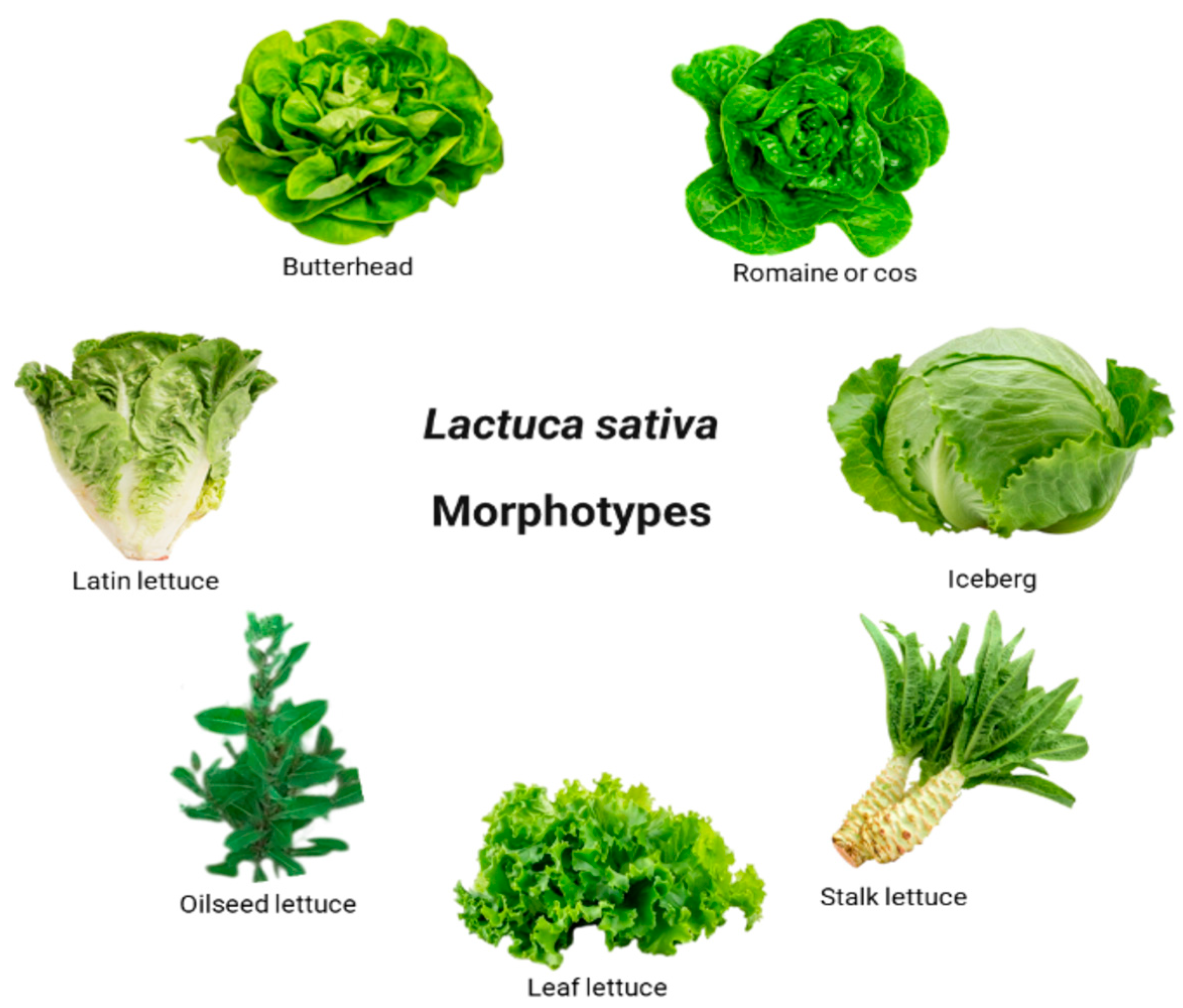
- Romaine lettuce, also known as Cos lettuce, contains members of the genus L. sativa var. longifolia L. and var. romana [18]. This group is characterized by its long, upright, and somewhat loose head of leaves with firm midribs. The outer leaves are darker green and tougher, while the inner leaves are lighter green and more tender. Unlike some other types of lettuce, romaine lettuce forms a tall, oblong head rather than a tightly packed one. The leaves are long and elongated, with a tendency to be upright rather than tightly curled. The leaves have strong, prominent midribs that add to their structural integrity.
- Crisphead lettuce, also known as iceberg lettuce, includes members belonging to L. sativa var. capitata L. [18]. Iceberg lettuce is characterized by a tightly packed head of crisp, light green leaves that are broad and often concave. The leaves are known for their crunchy texture and mild, somewhat neutral flavor.
- Butterhead lettuce, also known as Bibb or Boston lettuce, is a type of head lettuce characterized by soft, buttery leaves that form loosely packed heads [18]. These lettuce heads have a mild, sweet, and succulent flavor, with a tender texture. Butterhead lettuce is a good source of vitamins A and K, as well as iron and calcium.
- Leaf lettuce, also known as Cutting lettuce, is characterized by a loose, non-heading growth habit, with leaves emerging directly from the stem in a rosette-like formation [18]. These leaves are typically broad and succulent, forming a loose grouping rather than a tightly packed head like iceberg lettuce. The leaves generally lack a distinct petiole, attaching directly to the stem.
- Oilseed lettuce is characterized by a rosette of leaves, with the main difference being the oil content of the seeds [18]. Leaf shapes can vary, but oilseed lettuce generally has leaves that are not as tightly packed or forming a head as some other varieties like crisphead or butterhead. Because of the bitter taste of its leaves, this type is not eaten as a vegetable.
- Stalk lettuce, also known as celery or A-choy lettuce, contains members of the L. sativa var. angustana [18]. Stalk lettuce is characterized by its thick, edible stem or stalk. The plant exhibits a morphology with a prominent, elongated stalk and leaves that are typically shorter and wider than those of other lettuce morphotypes. The leaves are attached directly to the stem, without a petiole (leaf stalk).
- Latin lettuce is characterized by its upright [18], oblong leaves that are longer than they are wide, similar to romaine lettuce but with a more compact, upright growth habit and smaller heads. The leaves also have a butterhead-like texture.
3. Growing and Planting Conditions in Regions with High Heat Stress
4. Heat Stress-Associated Challenges in Lettuce Production
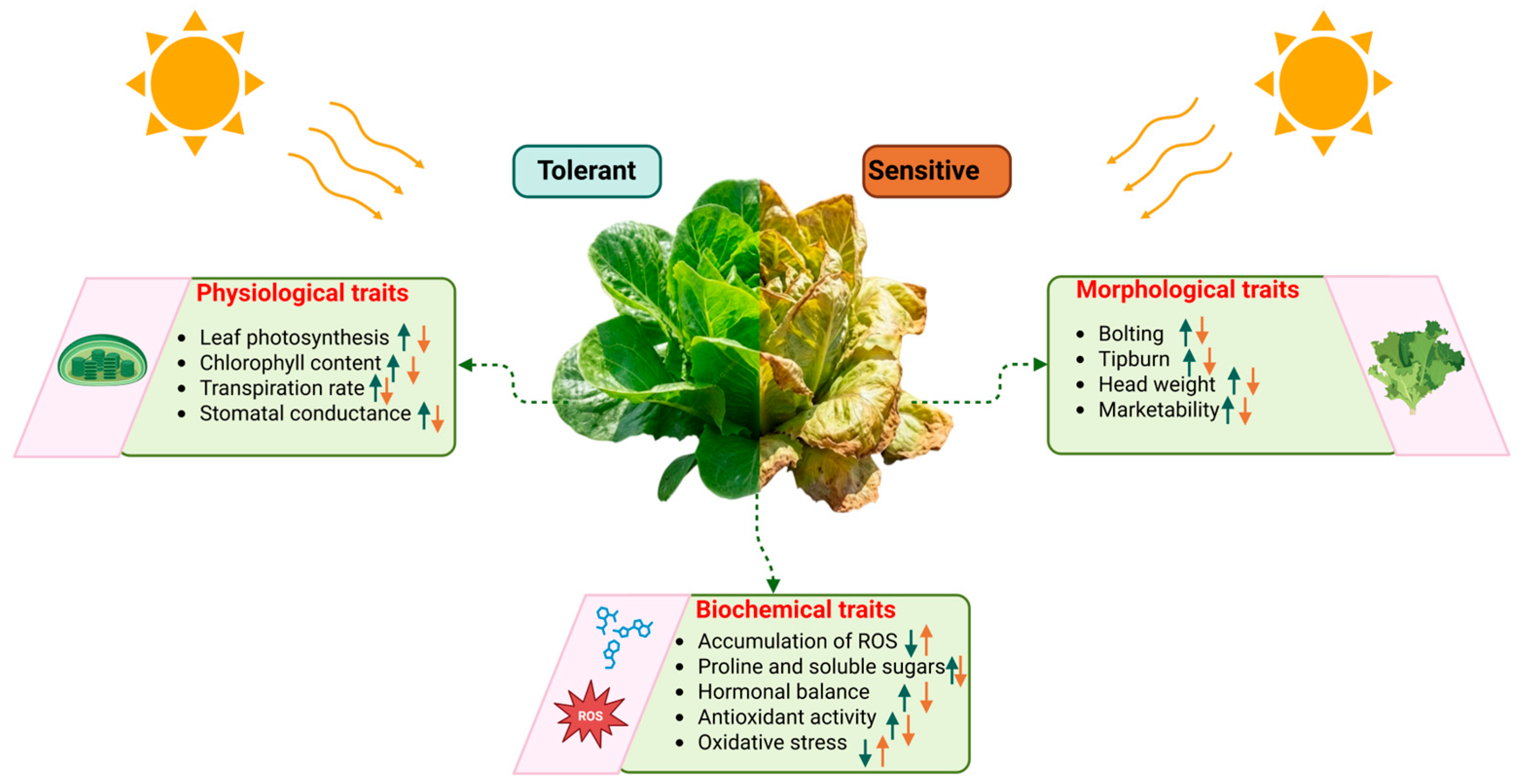
4.1. Physiological Changes in Lettuce in Response to Heat Stress
4.2. Seed Thermoinhibition
4.3. Bolting
4.4. Tipburn
4.5. Yield and Marketability
5. Molecular Mechanisms of Lettuce Response to Heat Stress
5.1. Heat Shock Proteins/Factors Serve as First Layers of Response to Heat Evasion
5.2. Regulation of Lettuce Thermotolerance Is Mediated by Transcription Factors and Plant Hormones
6. Current Methods for Managing Lettuce Production Under High Temperatures
7. Breeding Lettuce That Cope with Heat Stress
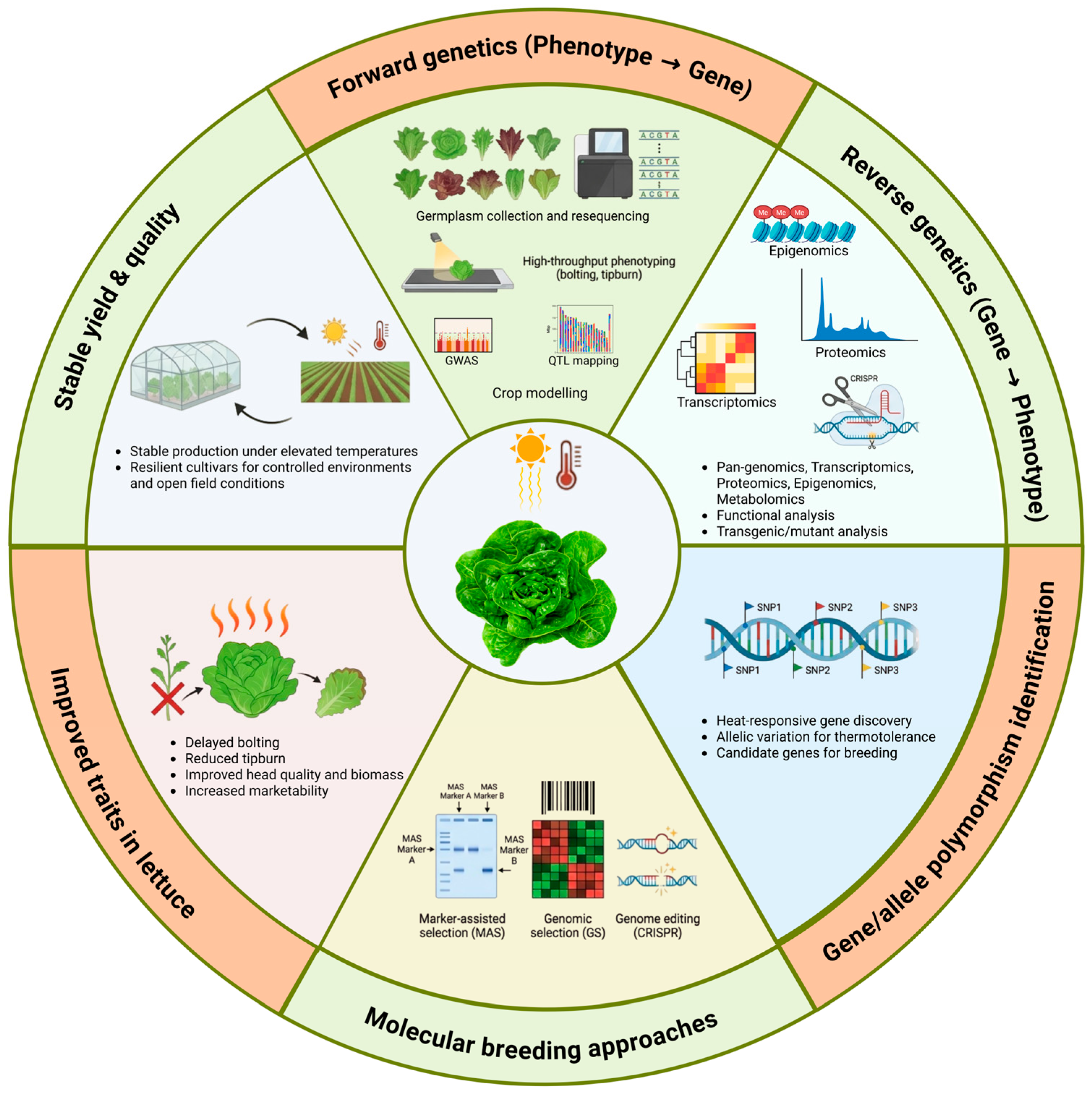
Genomic and Molecular Strategies to Improve Heat Tolerance in Lettuce
8. Concluding Remarks and Future Perspectives
Author Contributions
Funding
Data Availability Statement
Conflicts of Interest
References
- USDA Economic Research Service. U.S. Lettuce Production Shifts Regionally by Season. Available online: https://www.ers.usda.gov/data-products/charts-of-note/chart-detail/?chartId=106516 (accessed on 18 May 2025).
- Helgi Library. Which Country Produces the Most Lettuce? Lettuce and Chicory Production Data. Helgi Library. Available online: https://www.helgilibrary.com/charts/which-country-produces-the-most-lettuce/ (accessed on 26 November 2025).
- Shi, M.; Gu, J.; Wu, H.; Rauf, A.; Emran, T.B.; Khan, Z.; Mitra, S.; Aljohani, A.S.M.; Alhumaydhi, F.A.; Al-Awthan, Y.S.; et al. Phytochemicals, Nutrition, Metabolism, Bioavailability, and Health Benefits in Lettuce—A Comprehensive Review. Antioxidants 2022, 11, 1158. [Google Scholar] [CrossRef]
- Yang, X.; Gil, M.I.; Yang, Q.; Tomás-Barberán, F.A. Bioactive Compounds in Lettuce: Highlighting the Benefits to Human Health and Impacts of Preharvest and Postharvest Practices. Comp. Rev. Food Sci. Food Safe 2022, 21, 4–45. [Google Scholar] [CrossRef]
- Begcy, K.; Weigert, A.; Egesa, A.; Dresselhaus, T. Compared to Australian Cultivars, European Summer Wheat (Triticum aestivum) Overreacts When Moderate Heat Stress Is Applied at the Pollen Development Stage. Agronomy 2018, 8, 99. [Google Scholar] [CrossRef]
- Li, X.; Bruckmann, A.; Dresselhaus, T.; Begcy, K. Heat stress at the bicellular stage inhibits sperm cell development and transport into pollen tubes. Plant Physiol. 2024, 195, 2111–2128. [Google Scholar] [CrossRef]
- Begcy, K.; Nosenko, T.; Zhou, L.-Z.; Fragner, L.; Weckwerth, W.; Dresselhaus, T. Male Sterility in Maize after Transient Heat Stress during the Tetrad Stage of Pollen Development. Plant Physiol. 2019, 181, 683–700. [Google Scholar] [CrossRef]
- Kim, T.; Egesa, A.; Qin, C.; Mather, H.; Sandoya, G.; Begcy, K. Global Identification of LIM Genes in Response to Different Heat Stress Regimes in Lactuca sativa. BMC Plant Biol. 2024, 24, 751. [Google Scholar] [CrossRef]
- Ali, S.; Rizwan, M.; Arif, M.S.; Ahmad, R.; Hasanuzzaman, M.; Ali, B.; Hussain, A. Approaches in Enhancing Thermotolerance in Plants: An Updated Review. J. Plant Growth Regul. 2020, 39, 456–480. [Google Scholar] [CrossRef]
- Chaudhary, S.; Devi, P.; HanumanthaRao, B.; Jha, U.C.; Sharma, K.D.; Prasad, P.V.V.; Kumar, S.; Siddique, K.H.M.; Nayyar, H. Physiological and Molecular Approaches for Developing Thermotolerance in Vegetable Crops: A Growth, Yield and Sustenance Perspective. Front. Plant Sci. 2022, 13, 878498. [Google Scholar] [CrossRef]
- Gao, Y.; Wu, Y.; Guo, X.; Kou, W.; Zhang, S.; Leung, L.R.; Chen, X.; Lu, J.; Diffenbaugh, N.S.; Horton, D.E.; et al. More Frequent and Persistent Heatwaves Due To Increased Temperature Skewness Projected by a High-Resolution Earth System Model. Geophys. Res. Lett. 2023, 50, e2023GL105840. [Google Scholar] [CrossRef]
- Sun, P.; Bian, Y.; Yu, S.; Yao, R.; Wang, Z.; Zhang, Q.; Chen, W.; Ge, C.; Ma, Z.; Du, W. Are Longer and More Intense Heatwaves More Prone to Extreme Precipitation? Glob. Planet. Change 2024, 236, 104428. [Google Scholar] [CrossRef]
- Subbarao, K.V. (Ed.) Compendium of Lettuce Diseases and Pests, 2nd ed.; APS, American Phytopathological Society: St. Paul, MN, USA, 2017. [Google Scholar]
- Verslues, P.E.; Bailey-Serres, J.; Brodersen, C.; Buckley, T.N.; Conti, L.; Christmann, A.; Dinneny, J.R.; Grill, E.; Hayes, S.; Heckman, R.W.; et al. Burning Questions for a Warming and Changing World: 15 Unknowns in Plant Abiotic Stress. Plant Cell 2023, 35, 67–108. [Google Scholar] [CrossRef]
- Sadok, W.; Jagadish, S.V.K. The Hidden Costs of Nighttime Warming on Yields. Trends Plant Sci. 2020, 25, 644–651. [Google Scholar] [CrossRef] [PubMed]
- Sakai, H.; Cheng, W.; Chen, C.P.; Hasegawa, T. Short-Term High Nighttime Temperatures Pose an Emerging Risk to Rice Grain Failure. Agric. For. Meteorol. 2022, 314, 108779. [Google Scholar] [CrossRef]
- McAusland, L.; Acevedo-Siaca, L.G.; Pinto, R.S.; Pinto, F.; Molero, G.; Garatuza-Payan, J.; Reynolds, M.P.; Murchie, E.H.; Yepez, E.A. Night-time Warming in the Field Reduces Nocturnal Stomatal Conductance and Grain Yield but Does Not Alter Daytime Physiological Responses. New Phytol. 2023, 239, 1622–1636. [Google Scholar] [CrossRef]
- Křístková, E.; Doležalová, I.; Lebeda, A.; Vinter, V.; Novotná, A. Description of Morphological Characters of Lettuce (Lactuca sativa L.) Genetic Resources. Hortic. Sci. 2008, 35, 113–129. [Google Scholar] [CrossRef]
- Laur, S.; Da Silva, A.L.B.R.; Díaz-Pérez, J.C.; Coolong, T. Impact of Shade and Fogging on High Tunnel Production and Mineral Content of Organically Grown Lettuce, Basil, and Arugula in Georgia. Agriculture 2021, 11, 625. [Google Scholar] [CrossRef]
- Choi, K.Y.; Paek, K.Y.; Lee, Y.B. Effect of Air Temperature on Tipburn Incidence of Butterhead and Leaf Lettuce in a Plant Factory. In Transplant Production in the 21st Century; Kubota, C., Chun, C., Eds.; Springer: Dordrecht, The Netherlands, 2000; pp. 166–171. [Google Scholar]
- Lafta, A.; Sandoya, G.; Mou, B. Genetic Variation and Genotype by Environment Interaction for Heat Tolerance in Crisphead Lettuce. HortScience 2021, 56, 126–135. [Google Scholar] [CrossRef]
- Zhao, X.; Sui, X.; Zhao, L.; Gao, X.; Wang, J.; Wen, X.; Li, Y. Morphological and Physiological Response Mechanism of Lettuce (Lactuca sativa L.) to Consecutive Heat Stress. Sci. Hortic. 2022, 301, 111112. [Google Scholar] [CrossRef]
- Sandoya, G.; Lafta, A.; Mou, B. Heat-Tolerant Lettuce Germplasm (Lactuca sativa L.) Identified in Romaine and Butterhead Types for Warmer Plantings. HortScience 2024, 59, 151–163. [Google Scholar] [CrossRef]
- Simko, I.; Hayes, R.J.; Mou, B.; McCreight, J.D. Lettuce and Spinach. In CSSA Special Publications; Smith, S., Diers, B., Specht, J., Carver, B., Eds.; Wiley: Hoboken, NJ, USA, 2014; Volume 33, pp. 53–85. [Google Scholar]
- Wei, J.; Zhang, Q.; Zhang, Y.; Yang, L.; Zeng, Z.; Zhou, Y.; Chen, B. Advance in the Thermoinhibition of Lettuce (Lactuca sativa L.) Seed Germination. Plants 2024, 13, 2051. [Google Scholar] [CrossRef]
- Duan, Y.; Sun, W.; Wang, Q.; Cao, L.; Wang, H.; Hao, J.; Han, Y.; Liu, C. Integrated Transcriptomics and Proteomics Revealed That Exogenous Spermidine Modulated Signal Transduction and Carbohydrate Metabolic Pathways to Enhance Heat Tolerance of Lettuce. BMC Plant Biol. 2025, 25, 754. [Google Scholar] [CrossRef]
- Li, B.; Gao, K.; Ren, H.; Tang, W. Molecular Mechanisms Governing Plant Responses to High Temperatures. J. Integr. Plant 2018, 60, 757–779. [Google Scholar] [CrossRef]
- Ahmed, H.A.; Yu-Xin, T.; Qi-Chang, Y. Optimal Control of Environmental Conditions Affecting Lettuce Plant Growth in a Controlled Environment with Artificial Lighting: A Review. S. Afr. J. Bot. 2020, 130, 75–89. [Google Scholar] [CrossRef]
- Belisle, C.E.; Sandoya, G.V.; Kreutz, G.F.; Sargent, S.A. Screening Subtropical Lettuce Accessions for Heat Tolerance by Incorporating Accelerated Shelf Life Testing. J. Am. Soc. Hort. Sci. 2024, 149, 206–216. [Google Scholar] [CrossRef]
- Chase, K.; Belisle, C.; Ahlawat, Y.; Yu, F.; Sargent, S.; Sandoya, G.; Begcy, K.; Liu, T. Examining Preharvest Genetic and Morphological Factors Contributing to Lettuce (Lactuca sativa L.) Shelf-Life. Sci. Rep. 2024, 14, 6618. [Google Scholar] [CrossRef]
- Begcy, K. Heat Stress: Pollen Tubes ROSted by Heat Stress. Curr. Biol. 2024, 34, R1147–R1149. [Google Scholar] [CrossRef] [PubMed]
- Marchi, S.; Giorgi, C.; Suski, J.M.; Agnoletto, C.; Bononi, A.; Bonora, M.; De Marchi, E.; Missiroli, S.; Patergnani, S.; Poletti, F.; et al. Mitochondria-Ros Crosstalk in the Control of Cell Death and Aging. J. Signal Transduct. 2012, 2012, 329635. [Google Scholar] [CrossRef] [PubMed]
- Gulen, H.; Eris, A. Effect of Heat Stress on Peroxidase Activity and Total Protein Content in Strawberry Plants. Plant Sci. 2004, 166, 739–744. [Google Scholar] [CrossRef]
- Khan, Z.; Shahwar, D. Role of Heat Shock Proteins (HSPs) and Heat Stress Tolerance in Crop Plants. In Sustainable Agriculture in the Era of Climate Change; Roychowdhury, R., Choudhury, S., Hasanuzzaman, M., Srivastava, S., Eds.; Springer International Publishing: Cham, Switzerland, 2020; pp. 211–234. [Google Scholar]
- Li, C.; Han, Y.; Hao, J.; Qin, X.; Liu, C.; Fan, S. Effects of Exogenous Spermidine on Antioxidants and Glyoxalase System of Lettuce Seedlings under High Temperature. Plant Signal. Behav. 2020, 15, 1824697. [Google Scholar] [CrossRef]
- Wang, H.; Kang, Y.; Li, H.; Huang, S.; Li, W.; Zheng, M.; Huang, R.; Lei, B.; Yang, X. Salvia Miltiorrhiza Derived Carbon Dots and Their Heat Stress Tolerance of Italian Lettuce by Promoting Growth and Enhancing Antioxidant Enzyme Activity. ACS Omega 2021, 6, 32262–32269. [Google Scholar] [CrossRef]
- Song, Q.; Yang, F.; Cui, B.; Li, J.; Zhang, Y.; Li, H.; Qiu, N.; Wang, F.; Gao, J. Physiological and Molecular Responses of Two Chinese Cabbage Genotypes to Heat Stress. Biol. Plant 2019, 63, 548–555. [Google Scholar] [CrossRef]
- Guo, H.; Li, J.; Gao, S.; Ye, W.; Su, R.; Gu, Y.; Zou, A.; Li, Y.; Li, Z.; Li, J. Cold Tolerance in Rice: Insights into Genetic Basis, Molecular Mechanisms, and Adaptive Strategies. J. Integr. Plant Biol. 2025, 1–19. [Google Scholar] [CrossRef]
- Szabados, L.; Savouré, A. Proline: A Multifunctional Amino Acid. Trends Plant Sci. 2010, 15, 89–97. [Google Scholar] [CrossRef] [PubMed]
- Han, Y.; Fan, S.; Zhang, Q.; Wang, Y. Effect of Heat Stress on the MDA, Proline and Soluble Sugar Content in Leaf Lettuce Seedlings. Agric. Sci. 2013, 4, 112–115. [Google Scholar] [CrossRef]
- Paul, S.; Gogoi, N.; Sarma, B.; Baroowa, B. Biochemical Changes in Potato under Elevated Temperature. Ind. J. Plant Physiol. 2014, 19, 36–42. [Google Scholar] [CrossRef]
- Marcum, K.B. Cell Membrane Thermostability and Whole-Plant Heat Tolerance of Kentucky Bluegrass. Crop Sci. 1998, 38, 1214–1218. [Google Scholar] [CrossRef]
- Poudyal, D.; Rosenqvist, E.; Ottosen, C.-O. Phenotyping from Lab to Field—Tomato Lines Screened for Heat Stress Using Fv/Fm Maintain High Fruit Yield during Thermal Stress in the Field. Funct. Plant Biol. 2018, 46, 44–55. [Google Scholar] [CrossRef]
- Nyarko, G.; Alderson, P.G.; Craigon, J.; Murchie, E.; Sparkes, D.L. Comparison of Cell Membrane Thermostability and Chlorophyll Fluorescence Parameters for the Determination of Heat Tolerance in Ten Cabbage Lines. J. Hortic. Sci. Biotechnol. 2008, 83, 678–682. [Google Scholar] [CrossRef]
- Aleem, S.; Sharif, I.; Tahir, M.; Najeebullah, M.; Nawaz, A.; Khan, M.I.; Batool, A.; Arshad, W. Impact of Heat Stress on Cauliflower (Brassica Oleracea var. Botrytis): A Physiological Assessment. Pak. J. Agric. Res. 2021, 34, 479–486. [Google Scholar] [CrossRef]
- Xalxo, R.; Yadu, B.; Chandra, J.; Chandrakar, V.; Keshavkant, S. Alteration in Carbohydrate Metabolism Modulates Thermotolerance of Plant under Heat Stress. In Heat Stress Tolerance in Plants; Wani, S.H., Kumar, V., Eds.; Wiley: Hoboken, NJ, USA, 2020; pp. 77–115. [Google Scholar]
- Wang, D.; Li, X.-F.; Zhou, Z.-J.; Feng, X.-P.; Yang, W.-J.; Jiang, D.-A. Two Rubisco Activase Isoforms May Play Different Roles in Photosynthetic Heat Acclimation in the Rice Plant. Physiol. Plant. 2010, 139, 55–67. [Google Scholar] [CrossRef]
- Morales, F.; Ancín, M.; Fakhet, D.; González-Torralba, J.; Gámez, A.L.; Seminario, A.; Soba, D.; Ben Mariem, S.; Garriga, M.; Aranjuelo, I. Photosynthetic Metabolism under Stressful Growth Conditions as a Bases for Crop Breeding and Yield Improvement. Plants 2020, 9, 88. [Google Scholar] [CrossRef]
- Nadakuduti, S.S.; Laforest, L.C.; Tachev, M.; Decker, A.N.; Egesa, A.O.; Shirazi, A.S.; Begcy, K.; Sarnoski, P.J.; Buell, C.R. Heat Stress during Seed Development Leads to Impaired Physiological Function and Plasticity in Seed Oil Accumulation in Camelina Sativa. Front. Plant Sci. 2023, 14, 1284573. [Google Scholar] [CrossRef]
- Aloryi, K.D.; Sandoya, G.V.; Begcy, K. Genome Landscape of the Universal Stress Protein Gene Family in Lettuce and Expression Profile in Response to Heat Stress. BMC Plant Biol. 2025, 25, 1636. [Google Scholar] [CrossRef]
- Egesa, A.O.; Vallejos, C.E.; Begcy, K. Cell Size Differences Affect Photosynthetic Capacity in a Mesoamerican and an Andean Genotype of Phaseolus Vulgaris L. Front. Plant Sci. 2024, 15, 1422814. [Google Scholar] [CrossRef]
- Yan, Z.; Ma, T.; Guo, S.; Liu, R.; Li, M. Leaf Anatomy, Photosynthesis and Chlorophyll Fluorescence of Lettuce as Influenced by Arbuscular Mycorrhizal Fungi under High Temperature Stress. Sci. Hortic. 2021, 280, 109933. [Google Scholar] [CrossRef]
- Zhao, J.; Lu, Z.; Wang, L.; Jin, B. Plant Responses to Heat Stress: Physiology, Transcription, Noncoding RNAs, and Epigenetics. Int. J. Mol. Sci. 2020, 22, 117. [Google Scholar] [CrossRef]
- Qu, Y.; Sakoda, K.; Fukayama, H.; Kondo, E.; Suzuki, Y.; Makino, A.; Terashima, I.; Yamori, W. Overexpression of Both Rubisco and Rubisco Activase Rescues Rice Photosynthesis and Biomass under Heat Stress. Plant Cell Environ. 2021, 44, 2308–2320. [Google Scholar] [CrossRef] [PubMed]
- Moore, C.E.; Meacham-Hensold, K.; Lemonnier, P.; Slattery, R.A.; Benjamin, C.; Bernacchi, C.J.; Lawson, T.; Cavanagh, A.P. The Effect of Increasing Temperature on Crop Photosynthesis: From Enzymes to Ecosystems. J. Exp. Bot. 2021, 72, 2822–2844. [Google Scholar] [CrossRef] [PubMed]
- Kumari, M.; Pudake, R.N.; Singh, V.P.; Joshi, A.K. Association of Staygreen Trait with Canopy Temperature Depression and Yield Traits under Terminal Heat Stress in Wheat (Triticum aestivum L.). Euphytica 2013, 190, 87–97. [Google Scholar] [CrossRef]
- Lim, P.O.; Kim, H.J.; Gil Nam, H. Leaf Senescence. Annu. Rev. Plant Biol. 2007, 58, 115–136. [Google Scholar] [CrossRef] [PubMed]
- Vialet-Chabrand, S.; Lawson, T. Dynamic Leaf Energy Balance: Deriving Stomatal Conductance from Thermal Imaging in a Dynamic Environment. J. Exp. Bot. 2019, 70, 2839–2855. [Google Scholar] [CrossRef]
- Mbandlwa, N.P.; Fotouo-M, H.; Maboko, M.M.; Sivakumar, D. Stomatal Conductance, Leaf Chlorophyll Content, Growth, and Yield of Sweet Pepper in Response to Plant Growth Regulators. Int. J. Veg. Sci. 2020, 26, 116–126. [Google Scholar] [CrossRef]
- Kaushal, N.; Awasthi, R.; Gupta, K.; Gaur, P.; Siddique, K.H.M.; Nayyar, H. Heat-Stress-Induced Reproductive Failures in Chickpea (Cicer Arietinum) Are Associated with Impaired Sucrose Metabolism in Leaves and Anthers. Funct. Plant Biol. 2013, 40, 1334–1349. [Google Scholar] [CrossRef]
- Camejo, D.; Rodríguez, P.; Angeles Morales, M.; Miguel Dell’Amico, J.; Torrecillas, A.; Alarcón, J.J. High Temperature Effects on Photosynthetic Activity of Two Tomato Cultivars with Different Heat Susceptibility. J. Plant Physiol. 2005, 162, 281–289. [Google Scholar] [CrossRef]
- Zhou, R.; Yu, X.; Kjær, K.H.; Rosenqvist, E.; Ottosen, C.-O.; Wu, Z. Screening and Validation of Tomato Genotypes under Heat Stress Using Fv/Fm to Reveal the Physiological Mechanism of Heat Tolerance. Environ. Exp. Bot. 2015, 118, 1–11. [Google Scholar] [CrossRef]
- Handayani, T.; Watanabe, K. The Combination of Drought and Heat Stress Has a Greater Effect on Potato Plants than Single Stresses. Plant Soil Environ. 2020, 66, 175–182. [Google Scholar] [CrossRef]
- Hao, J.-H.; Zhang, L.-L.; Li, P.-P.; Sun, Y.-C.; Li, J.-K.; Qin, X.-X.; Wang, L.; Qi, Z.-Y.; Xiao, S.; Han, Y.-Y.; et al. Quantitative Proteomics Analysis of Lettuce (Lactuca sativa L.) Reveals Molecular Basis-Associated Auxin and Photosynthesis with Bolting Induced by High Temperature. Int. J. Mol. Sci. 2018, 19, 2967. [Google Scholar] [CrossRef]
- Zinn, K.E.; Tunc-Ozdemir, M.; Harper, J.F. Temperature Stress and Plant Sexual Reproduction: Uncovering the Weakest Links. J. Exp. Bot. 2010, 61, 1959–1968. [Google Scholar] [CrossRef] [PubMed]
- Argyris, J.; Dahal, P.; Hayashi, E.; Still, D.W.; Bradford, K.J. Genetic Variation for Lettuce Seed Thermoinhibition Is Associated with Temperature-Sensitive Expression of Abscisic Acid, Gibberellin, and Ethylene Biosynthesis, Metabolism, and Response Genes. Plant Physiol. 2008, 148, 926–947. [Google Scholar] [CrossRef] [PubMed]
- Reed, R.C.; Bradford, K.J.; Khanday, I. Seed Germination and Vigor: Ensuring Crop Sustainability in a Changing Climate. Heredity 2022, 128, 450–459. [Google Scholar] [CrossRef]
- Huo, H.; Henry, I.M.; Coppoolse, E.R.; Verhoef-Post, M.; Schut, J.W.; De Rooij, H.; Vogelaar, A.; Joosen, R.V.L.; Woudenberg, L.; Comai, L.; et al. Rapid Identification of Lettuce Seed Germination Mutants by Bulked Segregant Analysis and Whole Genome Sequencing. Plant J. 2016, 88, 345–360. [Google Scholar] [CrossRef]
- Kozarewa, I.; Cantliffe, D.J.; Nagata, R.T.; Stoffella, P.J. High Maturation Temperature of Lettuce Seeds during Development Increased Ethylene Production and Germination at Elevated Temperatures. J. Am. Soc. Hort. Sci. 2006, 131, 564–570. [Google Scholar] [CrossRef]
- Guzman, V.L.; Nagata, R.T.; Datnoff, L.E.; Raid, R.N. ‘Florida 202’ and ‘Everglades’: Two New Butterhead Lettuce Cultivars Adapted to Florida. HortScience 1992, 27, 852–853. [Google Scholar] [CrossRef]
- Cantliffe, D.J. PRIMING OF LETTUCE SEED FOR EARLY AND UNIFORM EMERGENCE UNDER CONDITIONS OF ENVIRONMENTAL STRESS. Acta Hortic. 1981, 122, 29–38. [Google Scholar] [CrossRef]
- Begcy, K.; Sandhu, J.; Walia, H. Transient Heat Stress During Early Seed Development Primes Germination and Seedling Establishment in Rice. Front. Plant Sci. 2018, 9, 1768. [Google Scholar] [CrossRef]
- Huo, H.; Dahal, P.; Kunusoth, K.; McCallum, C.M.; Bradford, K.J. Expression of 9-cis-EPOXYCAROTENOID DIOXYGENASE4 Is Essential for Thermoinhibition of Lettuce Seed Germination but Not for Seed Development or Stress Tolerance. Plant Cell 2013, 25, 884–900. [Google Scholar] [CrossRef]
- Cavasin, P.Y.; Santos, H.O.D.; Oliveira, T.F.; Pereira, J.A.; Gama, A.B.N.D.; Pereira, W.V.S. Endo-β-Mannanase and Superoxide Dismutase as Enzymatic Markers for Lettuce Seeds Thermotolerance. J. Seed Sci. 2023, 45, e202345008. [Google Scholar] [CrossRef]
- Lafta, A.; Mou, B. Evaluation of Lettuce Genotypes for Seed Thermotolerance. HortScience 2013, 48, 708–714. [Google Scholar] [CrossRef]
- Fukuda, M.; Matsuo, S.; Kikuchi, K.; Mitsuhashi, W.; Toyomasu, T.; Honda, I. The Endogenous Level of GA1 Is Upregulated by High Temperature during Stem Elongation in Lettuce through LsGA3ox1 Expression. J. Plant Physiol. 2009, 166, 2077–2084. [Google Scholar] [CrossRef] [PubMed]
- Wang, Y.; Li, B.; Li, Y.; Du, W.; Zhang, Y.; Han, Y.; Liu, C.; Fan, S.; Hao, J. Application of Exogenous Auxin and Gibberellin Regulates the Bolting of Lettuce (Lactuca sativa L.). Open Life Sci. 2022, 17, 438–446. [Google Scholar] [CrossRef] [PubMed]
- Liu, R.; Su, Z.; Zhou, H.; Huang, Q.; Fan, S.; Liu, C.; Han, Y. LsHSP70 Is Induced by High Temperature to Interact with Calmodulin, Leading to Higher Bolting Resistance in Lettuce. Sci. Rep. 2020, 10, 15155. [Google Scholar] [CrossRef] [PubMed]
- Hao, J.; Su, H.-N.; Zhang, L.; Liu, C.; Han, Y.; Qin, X.; Fan, S. Quantitative Proteomic Analyses Reveal That Energy Metabolism and Protein Biosynthesis Reinitiation Are Responsible for the Initiation of Bolting Induced by High Temperature in Lettuce (Lactuca sativa L.). BMC Genom. 2021, 22, 427. [Google Scholar] [CrossRef]
- Hao, J.; Yang, J.; Liu, X.; Pan, G.; Li, Y.; Zhang, X.; Han, Y.; Fan, S.; Zhou, Z. Molecular Basis of High Temperature-Induced Bolting in Lettuce Revealed by Multi-Omics Analysis. BMC Genom. 2022, 23, 580. [Google Scholar] [CrossRef]
- Wang, S.; Luo, C.; Sun, L.; Ning, K.; Chen, Z.; Yang, J.; Wang, Y.; Wang, Q. LsRGL1 Controls the Bolting and Flowering Times of Lettuce by Modulating the Gibberellin Pathway. Plant Sci. 2022, 316, 111175. [Google Scholar] [CrossRef] [PubMed]
- Barta, D.J.; Tibbitts, T.W. Calcium Localization in Lettuce Leaves with and without Tipburn: Comparison of Controlled-Environment and Field-Grown Plants. J. Am. Soc. Hort. Sci. 1991, 116, 870–875. [Google Scholar] [CrossRef]
- Macias-González, M.; Truco, M.J.; Bertier, L.D.; Jenni, S.; Simko, I.; Hayes, R.J.; Michelmore, R.W. Genetic Architecture of Tipburn Resistance in Lettuce. Theor. Appl. Genet. 2019, 132, 2209–2222. [Google Scholar] [CrossRef]
- Saure, M.C. Causes of the Tipburn Disorder in Leaves of Vegetables. Sci. Hortic. 1998, 76, 131–147. [Google Scholar] [CrossRef]
- Misaghi, I.J. Effect of Temperature on Tipburn Development in Head Lettuce. Phytopathology 1978, 68, 1738. [Google Scholar] [CrossRef]
- Kuronuma, T.; Watanabe, H. Identification of the Causative Genes of Calcium Deficiency Disorders in Horticulture Crops: A Systematic Review. Agriculture 2021, 11, 906. [Google Scholar] [CrossRef]
- Lafta, A.; Turini, T.; Sandoya, G.V.; Mou, B. Field Evaluation of Green and Red Leaf Lettuce Genotypes in the Imperial, San Joaquin, and Salinas Valleys of California for Heat Tolerance and Extension of the Growing Seasons. HortScience 2017, 52, 40–48. [Google Scholar] [CrossRef]
- Ohama, N.; Sato, H.; Shinozaki, K.; Yamaguchi-Shinozaki, K. Transcriptional Regulatory Network of Plant Heat Stress Response. Trends Plant Sci. 2017, 22, 53–65. [Google Scholar] [CrossRef] [PubMed]
- Ren, S.; Ma, K.; Lu, Z.; Chen, G.; Cui, J.; Tong, P.; Wang, L.; Teng, N.; Jin, B. Transcriptomic and Metabolomic Analysis of the Heat-Stress Response of Populus Tomentosa Carr. Forests 2019, 10, 383. [Google Scholar] [CrossRef]
- Kan, Y.; Mu, X.-R.; Gao, J.; Lin, H.-X.; Lin, Y. The Molecular Basis of Heat Stress Responses in Plants. Mol. Plant 2023, 16, 1612–1634. [Google Scholar] [CrossRef]
- Huang, Y.-C.; Liu, C.-C.; Li, Y.-J.; Liao, C.-M.; Vivek, S.; Chuo, G.-L.; Tseng, C.-Y.; Wu, Z.-Q.; Shimada, T.; Suetsugu, N.; et al. Multifaceted Roles of Arabidopsis Heat Shock Factor Binding Protein in Plant Growth, Development, and Heat Shock Response. Environ. Exp. Bot. 2024, 226, 105878. [Google Scholar] [CrossRef]
- Reyes-Chin-Wo, S.; Wang, Z.; Yang, X.; Kozik, A.; Arikit, S.; Song, C.; Xia, L.; Froenicke, L.; Lavelle, D.O.; Truco, M.-J.; et al. Genome Assembly with in Vitro Proximity Ligation Data and Whole-Genome Triplication in Lettuce. Nat. Commun. 2017, 8, 14953. [Google Scholar] [CrossRef]
- Kim, T.; Samraj, S.; Jiménez, J.; Gómez, C.; Liu, T.; Begcy, K. Genome-Wide Identification of Heat Shock Factors and Heat Shock Proteins in Response to UV and High Intensity Light Stress in Lettuce. BMC Plant Biol. 2021, 21, 185. [Google Scholar] [CrossRef] [PubMed]
- Wang, Q.; Sun, W.; Duan, Y.; Xu, Y.; Wang, H.; Hao, J.; Han, Y.; Liu, C. Genome-Wide Identification and Expression Analysis of HSP70 Gene Family Under High-Temperature Stress in Lettuce (Lactuca sativa L.). Int. J. Mol. Sci. 2024, 26, 102. [Google Scholar] [CrossRef]
- Chen, Z.; Zhao, W.; Ge, D.; Han, Y.; Ning, K.; Luo, C.; Wang, S.; Liu, R.; Zhang, X.; Wang, Q. LCM-seq Reveals the Crucial Role of LsSOC1 in Heat-promoted Bolting of Lettuce (Lactuca sativa L.). Plant J. 2018, 95, 516–528. [Google Scholar] [CrossRef] [PubMed]
- Wei, H.; Wang, X.; Wang, K.; Tang, X.; Zhang, N.; Si, H. Transcription Factors as Molecular Switches Regulating Plant Responses to Drought Stress. Physiol. Plant. 2024, 176, e14366. [Google Scholar] [CrossRef]
- Li, Y.; Zhu, J.; Feng, Y.; Li, Z.; Ren, Z.; Liu, N.; Liu, C.; Hao, J.; Han, Y. LsARF3 Mediates Thermally Induced Bolting through Promoting the Expression of LsCO in Lettuce (Lactuca sativa L.). Front. Plant Sci. 2022, 13, 958833. [Google Scholar] [CrossRef]
- Chen, L.; Liu, C.; Hao, J.; Fan, S.; Han, Y. GA Signaling Protein LsRGL1 Interacts with the Abscisic Acid Signaling-Related Gene LsWRKY70 to Affect the Bolting of Leaf Lettuce. Hortic. Res. 2023, 10, uhad054. [Google Scholar] [CrossRef] [PubMed]
- Kim, J.-Y.; Jang, Y.-H.; Kim, T.-S.; Jung, Y.-J.; Kang, K.-K. Loss of LsSOC1 Function Delays Bolting and Reprograms Transcriptional and Metabolic Responses in Lettuce. DNA 2025, 5, 40. [Google Scholar] [CrossRef]
- Moon, J.; Suh, S.; Lee, H.; Choi, K.; Hong, C.B.; Paek, N.; Kim, S.; Lee, I. The SOC1 MADS-box Gene Integrates Vernalization and Gibberellin Signals for Flowering in Arabidopsis. Plant J. 2003, 35, 613–623. [Google Scholar] [CrossRef]
- Lee, J.H.; Yoo, S.J.; Park, S.H.; Hwang, I.; Lee, J.S.; Ahn, J.H. Role of SVP in the Control of Flowering Time by Ambient Temperature in Arabidopsis. Genes Dev. 2007, 21, 397–402. [Google Scholar] [CrossRef] [PubMed]
- Ning, K.; Han, Y.; Chen, Z.; Luo, C.; Wang, S.; Zhang, W.; Li, L.; Zhang, X.; Fan, S.; Wang, Q. Genome-wide Analysis of MADS-box Family Genes during Flower Development in Lettuce. Plant Cell Environ. 2019, 42, 1868–1881. [Google Scholar] [CrossRef] [PubMed]
- Zhong, M.; Wang, H.; Hao, X.; Liu, C.; Hao, J.; Fan, S.; Han, Y. LsFUL–LsSMU2 Module Positively Controls Bolting Time in Leaf Lettuce (Lactuca sativa L.) under High Temperature. Plant Sci. 2024, 347, 112195. [Google Scholar] [CrossRef] [PubMed]
- Chen, L.; Xu, M.; Liu, C.; Hao, J.; Fan, S.; Han, Y. LsMYB15 Regulates Bolting in Leaf Lettuce (Lactuca sativa L.) Under High-Temperature Stress. Front. Plant Sci. 2022, 13, 921021. [Google Scholar] [CrossRef]
- Wang, Q.; Zhu, Z. Transcription Factors in the Regulation of Plant Heat Responses. Crit. Rev. Plant Sci. 2023, 42, 385–398. [Google Scholar] [CrossRef]
- Han, M.; Yang, N.; Wan, Q.; Teng, R.; Duan, A.; Wang, Y.; Zhuang, J. Exogenous Melatonin Positively Regulates Lignin Biosynthesis in Camellia Sinensis. Int. J. Biol. Macromol. 2021, 179, 485–499. [Google Scholar] [CrossRef]
- Jang, Y.J.; Kim, T.; Lin, M.; Kim, J.; Begcy, K.; Liu, Z.; Lee, S. Genome-Wide Gene Network Uncover Temporal and Spatial Changes of Genes in Auxin Homeostasis during Fruit Development in Strawberry (F. × ananassa). BMC Plant Biol. 2024, 24, 876. [Google Scholar] [CrossRef]
- Roosjen, M.; Paque, S.; Weijers, D. Auxin Response Factors: Output Control in Auxin Biology. J. Exp. Bot. 2018, 69, 179–188. [Google Scholar] [CrossRef]
- Hu, M.; Qi, Z.; Ren, Z.; Tong, J.; Wang, B.; Wu, Z.; Hao, J.; Liu, N. Genome-Wide Analysis of Auxin Response Factors in Lettuce (Lactuca sativa L.) Reveals the Positive Roles of LsARF8a in Thermally Induced Bolting. Int. J. Mol. Sci. 2022, 23, 13509. [Google Scholar] [CrossRef] [PubMed]
- Olsen, A.N.; Ernst, H.A.; Leggio, L.L.; Skriver, K. NAC Transcription Factors: Structurally Distinct, Functionally Diverse. Trends Plant Sci. 2005, 10, 79–87. [Google Scholar] [CrossRef]
- Kim, T.; Alvarez, J.C.; Rana, D.; Preciado, J.; Liu, T.; Begcy, K. Evolution of NAC Transcription Factors from Early Land Plants to Domesticated Crops. Plant Cell Physiol. 2025, 66, 566–580. [Google Scholar] [CrossRef]
- Guan, Q.; Yue, X.; Zeng, H.; Zhu, J. The Protein Phosphatase RCF2 and Its Interacting Partner NAC019 Are Critical for Heat Stress–Responsive Gene Regulation and Thermotolerance in Arabidopsis. Plant Cell 2014, 26, 438–453. [Google Scholar] [CrossRef]
- Lee, S.; Lee, H.-J.; Huh, S.U.; Paek, K.-H.; Ha, J.-H.; Park, C.-M. The Arabidopsis NAC Transcription Factor NTL4 Participates in a Positive Feedback Loop That Induces Programmed Cell Death under Heat Stress Conditions. Plant Sci. 2014, 227, 76–83. [Google Scholar] [CrossRef]
- He, S.; Huo, G.; Ge, G.; Du, L.; Long, D.; Luo, L.; Long, P.; Wei, S. Identification and Preliminary Functional Analysis of Responsive Genes to Short-Term Heat Stress in Lettuce. J. Am. Soc. Hort. Sci. 2024, 149, 327–336. [Google Scholar] [CrossRef]
- Yang, T.; He, S.; Huo, G.; Tian, M.; Du, L.; Yang, X.; Xu, H.; Ge, G.; Zhao, H.; Luo, L.; et al. LsNAC46 Regulates Heat-Resistance and Growth in Lettuce (Lactuca sativa L.). Front. Plant Sci. 2025, 16, 1560470. [Google Scholar] [CrossRef]
- Moosavi-Nezhad, M.; Meng, Q. A Calcium-Mobilizing Biostimulant Provides Tipburn Control Comparable to Vertical Airflow Fans in Greenhouse Hydroponic Lettuce ‘Rex. Front. Plant Sci. 2025, 16, 1701667. [Google Scholar] [CrossRef] [PubMed]
- Cocetta, G.; Landoni, M.; Pilu, R.; Repiso, C.; Nolasco, J.; Alajarin, M.; Ugena, L.; Levy, C.C.B.; Scatolino, G.; Villa, D.; et al. Priming Treatments with Biostimulants to Cope the Short-Term Heat Stress Response: A Transcriptomic Profile Evaluation. Plants 2022, 11, 1130. [Google Scholar] [CrossRef] [PubMed]
- Makonya, G.M.; Bryla, D.R.; Hardigan, M.A.; Hoashi-Erhardt, W.; DeVetter, L.W. Biostimulants with Glycine Betaine or Kelp Extract Alleviate Heat Stress in Red Raspberry (Rubus idaeus). Sci. Rep. 2025, 15, 2251. [Google Scholar] [CrossRef]
- Carillo, P. Can Biostimulants Enhance Plant Resilience to Heat and Water Stress in the Mediterranean Hotspot? Plant Stress 2025, 16, 100802. [Google Scholar] [CrossRef]
- Dubey, R.; Pathak, H.; Singh, S.; Chakravarti, B.; Thakur, A.K.; Fagodia, R.K. Impact of Sowing Dates on Terminal Heat Tolerance of Different Wheat (Triticum aestivum L.) Cultivars. Natl. Acad. Sci. Lett. 2019, 42, 445–449. [Google Scholar] [CrossRef]
- Zhang, X.; Zhou, Q.; Wang, X.; Cai, J.; Dai, T.; Cao, W.; Jiang, D. Physiological and Transcriptional Analyses of Induced Post-Anthesis Thermo-Tolerance by Heat-Shock Pretreatment on Germinating Seeds of Winter Wheat. Environ. Exp. Bot. 2016, 131, 181–189. [Google Scholar] [CrossRef]
- Fan, Y.; Ma, C.; Huang, Z.; Abid, M.; Jiang, S.; Dai, T.; Zhang, W.; Ma, S.; Jiang, D.; Han, X. Heat Priming During Early Reproductive Stages Enhances Thermo-Tolerance to Post-Anthesis Heat Stress via Improving Photosynthesis and Plant Productivity in Winter Wheat (Triticum aestivum L.). Front. Plant Sci. 2018, 9, 805. [Google Scholar] [CrossRef] [PubMed]
- Driedonks, N.; Rieu, I.; Vriezen, W.H. Breeding for Plant Heat Tolerance at Vegetative and Reproductive Stages. Plant Reprod. 2016, 29, 67–79. [Google Scholar] [CrossRef] [PubMed]
- Jankowicz-Cieslak, J.; Till, B.J. Forward and Reverse Genetics in Crop Breeding. In Advances in Plant Breeding Strategies: Breeding, Biotechnology and Molecular Tools; Al-Khayri, J.M., Jain, S.M., Johnson, D.V., Eds.; Springer International Publishing: Cham, Switzerland, 2015; pp. 215–240. [Google Scholar]
- Lee, S.H.; Yoon, J.S.; Jung, W.J.; Kim, D.Y.; Seo, Y.W. Genome-Wide Identification and Characterization of the Lettuce GASA Family in Response to Abiotic Stresses. BMC Plant Biol. 2023, 23, 106. [Google Scholar] [CrossRef] [PubMed]
- Silva-Correia, J.; Freitas, S.; Tavares, R.M.; Lino-Neto, T.; Azevedo, H. Phenotypic Analysis of the Arabidopsis Heat Stress Response during Germination and Early Seedling Development. Plant Methods 2014, 10, 7. [Google Scholar] [CrossRef]
- Weng, M.; Yang, Y.; Feng, H.; Pan, Z.; Shen, W.; Zhu, Y.; Dong, A. Histone Chaperone ASF1 Is Involved in Gene Transcription Activation in Response to Heat Stress in Arabidopsis thaliana. Plant Cell Environ. 2014, 37, 2128–2138. [Google Scholar] [CrossRef]
- Joukhadar, I.; Tonnessen, B.; Coon, D.; Walker, S. Performance of Heat-Tolerant Lettuce Cultivars in Southern New Mexico in 2020–21. HortTechnology 2023, 33, 313–316. [Google Scholar] [CrossRef]
- Kreutz, G.F.; Sandoya, G.V.; England, G.K.; Mussoline, W. Exploring the Potential of Lettuce (Lactuca sativa L.) as an Early Crop in Florida’s Sandy Soils. HortScience 2021, 56, 59–70. [Google Scholar] [CrossRef]
- Bhattarai, K.; Ogden, A.B.; Pandey, S.; Sandoya, G.V.; Shi, A.; Nankar, A.N.; Jayakodi, M.; Huo, H.; Jiang, T.; Tripodi, P.; et al. Improvement of Crop Production in Controlled Environment Agriculture through Breeding. Front. Plant Sci. 2025, 15, 1524601. [Google Scholar] [CrossRef] [PubMed]
- Holmes, S.C.; Wells, D.E.; Pickens, J.M.; Kemble, J.M. Selection of Heat Tolerant Lettuce (Lactuca sativa L.) Cultivars Grown in Deep Water Culture and Their Marketability. Horticulturae 2019, 5, 50. [Google Scholar] [CrossRef]
- Lee, O.N.; Fukushima, K.; Park, H.Y.; Kawabata, S. QTL Analysis of Stem Elongation and Flowering Time in Lettuce Using Genotyping-by-Sequencing. Genes 2021, 12, 947. [Google Scholar] [CrossRef] [PubMed]
- Rosental, L.; Still, D.W.; You, Y.; Hayes, R.J.; Simko, I. Mapping and Identification of Genetic Loci Affecting Earliness of Bolting and Flowering in Lettuce. Theor. Appl. Genet. 2021, 134, 3319–3337. [Google Scholar] [CrossRef] [PubMed]
- Gao, C. Genome Engineering for Crop Improvement and Future Agriculture. Cell 2021, 184, 1621–1635. [Google Scholar] [CrossRef]
- Nerkar, G.; Devarumath, S.; Purankar, M.; Kumar, A.; Valarmathi, R.; Devarumath, R.; Appunu, C. Advances in Crop Breeding Through Precision Genome Editing. Front. Genet. 2022, 13, 880195. [Google Scholar] [CrossRef]
- Sun, L.; Lai, M.; Ghouri, F.; Nawaz, M.A.; Ali, F.; Baloch, F.S.; Nadeem, M.A.; Aasim, M.; Shahid, M.Q. Modern Plant Breeding Techniques in Crop Improvement and Genetic Diversity: From Molecular Markers and Gene Editing to Artificial Intelligence—A Critical Review. Plants 2024, 13, 2676. [Google Scholar] [CrossRef]
- Mattiello, L.; Rütgers, M.; Sua-Rojas, M.F.; Tavares, R.; Soares, J.S.; Begcy, K.; Menossi, M. Molecular and Computational Strategies to Increase the Efficiency of CRISPR-Based Techniques. Front. Plant Sci. 2022, 13, 868027. [Google Scholar] [CrossRef]
- Cao, S.; Sawettalake, N.; Shen, L. Gapless Genome Assembly and Epigenetic Profiles Reveal Gene Regulation of Whole-Genome Triplication in Lettuce. GigaScience 2024, 13, giae043. [Google Scholar] [CrossRef]
- Simko, I. Differentially Methylated Genomic Regions of Lettuce Seeds Relate to Divergence across Morphologically Distinct Horticultural Types. AoB Plants 2023, 15, plad060. [Google Scholar] [CrossRef] [PubMed]
- Cao, S.; Sawettalake, N.; Li, P.; Fan, S.; Shen, L. DNA Methylation Variations Underlie Lettuce Domestication and Divergence. Genome Biol. 2024, 25, 158. [Google Scholar] [CrossRef] [PubMed]





| Planting Seasons | Early | Intermediate | Late |
|---|---|---|---|
| Day Length | 11 h 50 min | 10 h 55 min | 12 h 20 min |
| Lettuce Type | Days to Market Maturity | ||
| Leaf | 55 | 60 | 52 |
| Romaine | 60 | 70 | 55 |
| Iceberg | 70 | 85 | 65 |
Disclaimer/Publisher’s Note: The statements, opinions and data contained in all publications are solely those of the individual author(s) and contributor(s) and not of MDPI and/or the editor(s). MDPI and/or the editor(s) disclaim responsibility for any injury to people or property resulting from any ideas, methods, instructions or products referred to in the content. |
© 2026 by the authors. Licensee MDPI, Basel, Switzerland. This article is an open access article distributed under the terms and conditions of the Creative Commons Attribution (CC BY) license.
Share and Cite
Aloryi, K.D.; Mather, H.; Sandoya, G.V.; Begcy, K. Impact of High Temperatures, Considerations and Possible Solutions for Sustainable Lettuce Production. Agronomy 2026, 16, 327. https://doi.org/10.3390/agronomy16030327
Aloryi KD, Mather H, Sandoya GV, Begcy K. Impact of High Temperatures, Considerations and Possible Solutions for Sustainable Lettuce Production. Agronomy. 2026; 16(3):327. https://doi.org/10.3390/agronomy16030327
Chicago/Turabian StyleAloryi, Kelvin D., Hannah Mather, Germán V. Sandoya, and Kevin Begcy. 2026. "Impact of High Temperatures, Considerations and Possible Solutions for Sustainable Lettuce Production" Agronomy 16, no. 3: 327. https://doi.org/10.3390/agronomy16030327
APA StyleAloryi, K. D., Mather, H., Sandoya, G. V., & Begcy, K. (2026). Impact of High Temperatures, Considerations and Possible Solutions for Sustainable Lettuce Production. Agronomy, 16(3), 327. https://doi.org/10.3390/agronomy16030327