Article

Efficacy of Insecticide Application Against Aphis gossypii and Its Influence on the Predatory Capacity of Hippodamia variegata

1
College of Life Science and Technology, Tarim University, Alar 843300, China
2
Key Laboratory of Integrated Pest Management (IPM) of Xinjiang Production and Construction Corps in Southern Xinjiang, Tarim University, Alar 843300, China
3
Agricultural College, Tarim University, Alar 843300, China
4
Southern Xinjiang Research Center for Crop Bio-Breeding and Smart Cultivation, Kashi University, Kashi 844000, China
*
Authors to whom correspondence should be addressed.
These authors contributed equally to this work.
Agronomy 2026, 16(2), 228; https://doi.org/10.3390/agronomy16020228
Submission received: 6 December 2025 / Revised: 14 January 2026 / Accepted: 15 January 2026 / Published: 18 January 2026
(This article belongs to the Section Pest and Disease Management)

Abstract

Aphis gossypii (Glover) (Hemiptera: Aphididae) is a significant pest in cotton fields, and the use of both chemical insecticides and natural enemies is a crucial strategy for its management. Hippodamia variegata (Goeze) (Coleoptera: Coccinellidae), a predominant predatory natural enemy in cotton fields, plays a vital role in controlling A. gossypii populations. In this study, we investigated the toxicity of four insecticides to both A. gossypii and H. variegata larvae, assessed their field efficacy against A. gossypii, and evaluated their effects on the predatory function of H. variegata larvae. The results revealed that afidopyropen and spirotetramat exhibited relatively high toxicity against A. gossypii, with LC50 values of 13.18 mg/L and 22.17 mg/L, respectively. Flonicamid demonstrated the least toxicity to H. variegata larvae, with an LC50 of 512.66 mg/L. The selectivity toxicity ratios for afidopyropen and flonicamid were 5.05 and 4.73, respectively, indicating strong, favourable selectivity towards H. variegata. The maximum field control efficacy against A. gossypii was 96.76% for afidopyropen and 96.92% for flonicamid. The reduction rates of H. variegata larvae in the afidopyropen treatment plots were relatively low. Among the four treatments, the theoretical predation of third-instar H. variegata larvae against A. gossypii was highest with flonicamid, reaching 215.67. Overall, the four insecticides differed substantially in their combined effects on aphid suppression and predator performance. In particular, afidopyropen and flonicamid provided excellent control of A. gossypii while showing comparatively lower toxicity to H. variegata and causing less impairment of its predatory capacity, indicating a more favourable biological trade-off between pest control and natural enemy conservation. However, laboratory toxicity and functional response assays may not fully capture predator–prey dynamics under complex field conditions; therefore, afidopyropen and flonicamid may be considered suitable candidate insecticides for inclusion in integrated pest management (IPM) programs in cotton systems.

1. Introduction

Cotton is an essential source of natural fibres globally [1], forming the foundation of global fibre production and trade and contributing significantly to the international fibre market [2]. Xinjiang, China, with its uniquely advantageous natural environment and highly mechanised production system [3], has capitalised on the development opportunities offered by the Belt and Road Initiative. As a result, Xinjiang’s cotton industry has assumed a leading position within China’s cotton sector, with continuously improving international competitiveness [4].
Aphis gossypii (Glover) (Hemiptera: Aphididae) is one of the most significant pests affecting cotton crops in Xinjiang. Its formidable reproductive capacity, short generation time, and high degree of generational overlap render it highly susceptible to explosive outbreaks [5]. Additionally, the expansion of cotton cultivation areas in Xinjiang, along with monoculture cropping practices, has further exacerbated the frequency of A. gossypii infestations [6,7]. A. gossypii feeds on the sap from the undersides of cotton leaves and tender bud tips, leading to stunted plant growth and, in severe cases, the abortion of flowers and bolls. Furthermore, the honeydew secreted by A. gossypii not only contaminates cotton fibres but also facilitates the transmission of viral diseases, such as cotton leafroll dwarf disease (CLRD) and cotton bunchy top disease (CBTD) [8,9,10,11]. This results in degraded fibre quality, thereby significantly impairing cotton yield and fibre quality [12].
Currently, the management of A. gossypii in cotton fields relies primarily on insecticides. However, the extensive application of chemical insecticides has resulted in a rapid increase in A. gossypii resistance. Research indicates that A. gossypii has developed varying degrees of resistance to insecticides such as organophosphates, pyrethroids, and carbamates [13,14,15,16], thereby diminishing the efficacy of chemical control measures [17,18]. Consequently, novel insecticides such as imidacloprid, spirotetramat, afidopyropen, and flonicamid have become the preferred choices for managing A. gossypii. These insecticides are characterized by unique modes of action and swift, highly effective control [19,20,21,22,23,24,25,26]. However, in recent years, the excessive and frequent application of these new insecticides has increased the risk of resistance development in agricultural pests [27,28,29,30,31].
The utilization of beneficial natural enemies within integrated pest management (IPM) strategies is of paramount importance for enhancing the efficacy of green pest control in cotton, reducing pesticide application in cotton fields, and promoting the sustainable development of cotton cultivation [5,32]. Cotton field ecosystems harbour abundant natural enemy resources, which often exert effective control over pests such as A. gossypii [5]. However, certain chemical insecticides characterized by poor selectivity and safety profiles may inadvertently eliminate beneficial natural enemies, thereby significantly undermining their pest control effectiveness [33,34]. This not only hampers pest management efforts but also facilitates the resurgence of A. gossypii populations [35,36]. Research indicates that neonicotinoid insecticides can adversely affect natural enemies even at low application rates [37,38]. Hippodamia variegata (Goezeis) (Coleoptera: Coccinellidae) is a prominent natural predator in cotton fields, playing a crucial role in suppressing A. gossypii populations growth [39,40]. Imidacloprid, spirotetramat, afidopyropen, and flonicamid, as representative new-generation insecticides, are currently the first choice for controlling A. gossypii. Therefore, their potential impact on H. variegata should not be underestimated.
Most previous studies have focused on imidacloprid, spirotetramat, cyclaniliprole, and flonicamid efficacy or acute toxicity to individual species, whereas integrated assessments of insecticide selectivity and impacts on predator–prey interactions are scarce [41,42,43]. Therefore, it remains to be further determined whether these four commonly used novel insecticides for A. gossypii management exhibit differential selectivity between A. gossypii and its dominant natural enemy, H. variegata larvae, and whether insecticides with higher selectivity exert weaker negative effects on the predator’s functional response. In this study, we performed an integrated assessment within a unified framework linking pest toxicity, predator toxicity, field efficacy, and predator functional response, and incorporated functional response parameters as key ecological indicators in conjunction with selectivity metrics and field performance. This approach not only clarifies the relative safety of these insecticides to H. variegata, but also fills an important evidence gap regarding how these compounds influence the predator’s actual biocontrol efficiency, thereby providing scientific support for optimizing the compatibility of chemical control and natural enemy conservation in cotton IPM programs.

2. Materials and Methods

2.1. Rearing of Aphis gossypii

Aphis gossypii were collected from cotton fields in Aral City, Xinjiang (81°7′36″ E, 40°38′17″ N) in June 2025. They were reared on cotton seedlings at the five-leaf stage within an RXZ-500D artificial climate chamber (Ningbo Jiangnan Instrument Factory, Ningbo, China) maintained at a temperature of 26 ± 1 °C, with relative humidity of 50 ± 10%, and a photoperiod of 16 h. Under these conditions, the populations of A. gossypii propagated steadily.

2.2. Rearing of Hippodamia variegata

H. variegata were procured from the Beijing Green Protection Technology Center (Beijing, China). Eggs of H. variegata were placed in insect-rearing cages (35 cm × 35 cm × 35 cm) and incubated in the same RXZ-500D artificial climate chamber set at 26 ± 1 °C, 50 ± 10% relative humidity, and a 16 h photoperiod. Once hatched, the larvae were fed A. gossypii with fresh A. gossypii provided every 24 h [36].

2.3. Toxicity Determination of Four Insecticides in Aphis gossypii

The names and manufacturers of the tested insecticides are listed in Table 1.
The active ingredient was dissolved in acetone (Sangon Bioengineering Co., Shanghai, China) to prepare a stock solution for subsequent use. During the experiment, the stock solution was diluted with a 0.1% Tween-80 (Sangon Bioengineering Co., Shanghai, China) aqueous solution. Based on preliminary laboratory experiments, a series of concentration gradients for each compound was prepared using a stepwise dilution method, ranging from high to low concentrations (Table 2), each concentration was tested in triplicate.
The toxicity of four insecticides against A. gossypii was evaluated using the leaf-dip method [44]. The leaf-dip assay mimics the exposure of A. gossypii to insecticide residues on treated foliage following spray applications, integrating both ingestion and contact routes that commonly occur under field conditions. Healthy, freshly cleaned cotton leaves were immersed in prepared solutions with varying mass concentrations of each insecticide. Each replicate consisted of a single leaf. A control solution was prepared using a 0.1% Tween-80 in an aqueous acetone solvent. Following immersion for 5 s, the leaves were removed, air-dried, and placed in Petri dishes (diameter = 9 cm). The base of each leaf was wrapped with a small amount of absorbent cotton, to which a few drops of distilled water were added to maintain the moisture of the leaves. A. gossypii adults were gently transferred to the Petri dishes using a fine brush, each concentration was replicated three times, with 30 A. gossypii adults per replicate. The dishes were then incubated for 24 h in an RXZ-500D artificial climate chamber set at 26 ± 1 °C, with a relative humidity of 50 ± 10% and a photoperiod of 16 h. The survival of A. gossypii was examined under a microscope. Specimens that did not respond to gentle probing with an insect pin were recorded as deceased. Mortality and corrected mortality rates were calculated using Equations (1) and (2), respectively.
Pi = ND/N × 100%
PA = (PtP0)/(1 − P0)
In this formula, “Pi” represents the mortality rate, “ND” signifies the number of deceased insects, and “N” represents the total number of insects in each treatment group. “PA” indicates the corrected mortality rate, “Pt” refers to the mortality rate for the treatment group, and “P0” corresponds to the mortality rate for the untreated control group. If the mortality rate in the untreated control group is less than 5%, the mortality rates for all insecticide treatments do not require correction. If the mortality rate in the control group ranges from 5% to 20%, the corrected mortality rate for each insecticide treatment must be calculated using the specified correction formula. Should the mortality rate in the control group exceed 20%, the experiment must be repeated.

2.4. Toxicity Determination of Four Insecticides in Hippodamia variegata Larvae

The toxicity of four insecticides against H. variegata was evaluated using the filter paper contact method [45]. The filter paper contact assay represents exposure of non-target arthropods to residues present on plant surfaces, soil particles, or within crop canopies after insecticide application. Third-instar larvae of H. variegata were selected as the test stage because they exhibit high feeding activity, stable physiological traits, and relatively uniform body size, which helps reduce experimental variability and improve reproducibility. In addition, under field conditions, third-instar larvae are frequently exposed to insecticide residues on plant surfaces and within the crop canopy. Therefore, this life stage was considered representative for evaluating non-target risks, and was thus chosen as the target stage in this study. Filter paper was placed inside Petri dishes (diameter = 9 cm), and 1 mL of each test solution at varying concentrations was applied uniformly onto the filter paper (Table 2). A control solution was prepared using a 0.1% Tween-80 in an acetone aqueous solvent. After allowing the dishes to stand at room temperature for 20 min, third-instar larvae of H. variegata were introduced onto the treated filter paper in each dish, with one dish designated for each replicate, each concentration was replicated three times, with 20 H. variegata larvae per replicate, enabling the larvae to move freely. The dishes were then incubated in an RXZ-500D artificial climate chamber at a temperature of 26 ± 1 °C, 50 ± 10% relative humidity, and under a photoperiod of 16 h. After 24 h, the survival of H. variegata larvae was assessed; larvae that were unable to move normally were recorded as dead [46]. Mortality and corrected mortality rates were calculated using Equations (1) and (2).

2.5. Safety Evaluation of Four Insecticides for Hippodamia variegata Larvae

The safety evaluation of the four insecticides for H. variegata larvae was conducted based on the mortality data obtained from the toxicity bioassays. The toxicity of various insecticides is compared using the relative toxicity index. The insecticide exhibiting the highest median lethal concentration (LC50) is assigned a relative toxicity index value of 1. The relative toxicity index for other insecticides is calculated as the ratio of the highest LC50 to the LC50 of the tested insecticide [47]. The relative toxicity index was used to provide a normalized comparison of the intrinsic toxicity of different insecticides under the same laboratory conditions; a higher index indicates greater toxicity relative to the least toxic insecticide among those tested. The safety of insecticides for H. variegata is assessed by calculating the safety coefficients [48], which is determined by dividing the LC50 of the insecticide for H. variegata by the field-recommended application dosage of the insecticide. This calculation provides an evaluation of the insecticide’s safety level for H. variegata. The safety coefficient can serve as a first-tier, conservative indicator of an insecticide’s compatibility with H. variegata in IPM; however, recommended dosage may vary among regions, crops, and formulations, as well as among manufacturers, and the actual applied dosage is further influenced by spray coverage, the pesticide’s dissipation rate, and predator behavior. The selectivity toxicity ratio is calculated as the ratio of the LC50 of the insecticide for the natural enemy (H. variegata) to the LC50 of the insecticide for the pest (A. gossypii) (Equation (3)). This metric serves to evaluate the selectivity of the insecticide between A. gossypii and H. variegata.
STR = LC50, N/LC50, V
In this formula, “STR” denotes the selectivity toxicity ratio, “LC50,N” denotes the LC50 value for the natural enemy (H. variegata), whereas “LC50,V” indicates the LC50 value for the pest (A. gossypii). The interpretation of STR values is as follows: STR < 1: The insecticide exhibits negative selectivity, being toxic to both the natural enemy and the pest. STR = 1: The insecticide shows no significant selectivity, impacting both the natural enemy and the pest equally. 1 < STR ≤ 10: The insecticide demonstrates favorable selectivity, exhibiting higher toxicity to the pest while being comparatively safer for the natural enemy. 10 < STR ≤ 100: The insecticide reflects moderate favorable selectivity, being considerably more toxic to the pest while having less impact on the natural enemy. 100 < STR ≤ 1000: The insecticide displays high favorable selectivity, being highly toxic to the pest while remaining largely safe for the natural enemy [49]. Practically, an STR close to 1 indicates limited selectivity and may pose a higher risk to predator survival following field application, whereas an STR close to 5 suggests some degree of selectivity, but predator safety may still depend largely on the locally applied dosage, application timing, and differences among production systems.

2.6. Field Efficacy of Four Insecticides Against Aphis gossypii and Their Effects on Hippodamia variegata Larvae

Field efficacy trials were conducted using four commonly used insecticides (Table 3) in two independent field trials conducted in early July 2024 and late June 2025, respectively, at the Experimental Base of the Agricultural Science Research Institute of the First Division of the Xinjiang Production and Construction Corps (81°23′25′′ E, 40°32′8′′ N). In both years, insecticides were applied during the same cotton growth window (squaring stage to flowering–boll setting stage) to ensure temporal comparability. Cotton was cultivated using the “one film and four rows” method, with a plant spacing of 10 cm and an inter-row spacing of (66 + 10) cm. The planting density varied from 150,000 to 180,000 plants per hectare, and the film width was 2.26 m. Field management practices were consistently applied, and no insecticides were used throughout the growing period. For each insecticide the field-recommended dose was applied (Table 3), along with a corresponding amount of water as a blank control. In total, five treatments were implemented, each with three replicates, resulting in 15 plots. Each plot covered an area of 200 m2, and the arrangement of the plots followed a randomised block design. Foliar applications were performed using the Tianwen 3WBD-22 portable electric sprayer (Henan Yunfei Technology Development Co., Ltd., Henan, China). To mitigate spray drift, a 2 m buffer zone was established between the plots. All insecticides were applied using a two-fold dilution method, with an application rate of 450 kg/ha. The experimental site was located within a cotton-dominated landscape, and the surrounding area consisted primarily of cotton fields with no adjacent non-cotton habitats. Both A. gossypii and H. variegata larvae were surveyed using the five-point sampling method. At each sampling point, ten cotton plants were selected, ensuring that each plant hosted either A. gossypii and H. variegata larvae (five plants were surveyed for A. gossypii, and five for H. variegata larvae). For A. gossypii surveys, three leaves with A. gossypii located at the upper part of each selected plant were tagged and marked. The number of A. gossypii was recorded one day before insecticide application, and at 1, 3, 7, and 14 days after application. For the survey of H. variegata larvae, the entire cotton plant was inspected, and both the number of A. gossypii and H. variegata larvae were recorded separately for each plant [50]. The reduction rate of pest populations and the control efficacy were calculated using Formulas (4) and (5).
R′ or R = (N0N1)/N0 × 100%
E′ or E = (R1R0)/(1 − R0) × 100%
In this formula, “R′” represents the rate of decline in H. variegata population, while “R” indicates the rate of decline in A. gossypii. “N0” refers to the initial population of either A. gossypii or H. variegata before pesticide application, and “N1” denotes their population after treatment. “E′” is the corrected reduction rate for H. variegata larvae, and “E” signifies the efficacy of controlling A. gossypii. “R1” indicates the population decline rate in the treatment area for A. gossypii or H. variegata, whereas “R0” represents the same in the control area.

2.7. The Impact of Four Insecticides on the Predatory Function of Hippodamia variegata Larvae

The four insecticides of technical grade were dissolved in acetone (Sangon Bioengineering Co., Shanghai, China) to prepare stock solutions for subsequent use. During the experiment, these stock solutions were diluted to LC50 concentrations using a 0.1% Tween-80 (Sangon Bioengineering Co., Shanghai, China) aqueous solution. Filter paper was placed in a Petri dish (diameter = 9 cm), and 1 mL of each insecticide solution was evenly applied to the filter paper. As a control, a 0.1% Tween-80 and an acetone aqueous solution were prepared. After allowing the dishes to stand at room temperature for 20 min, ten third instar larvae of H. variegata were introduced into each Petri dish for insecticide treatment, followed by a starvation period of 24 h.
A single cotton leaf was subsequently placed in each dish, with its base wrapped in a small quantity of absorbent cotton soaked in distilled water to maintain moisture [36]. Adults of A. gossypii (wingless) were introduced into each dish at densities of 20, 50, 100, 150, and 200 individuals, together with one larva of H. variegata that had undergone LC50-level insecticide treatment and starvation and exhibited regular activity. Each Petri dish was covered with a lid containing a breathable mesh with a pore size of 0.15 mm to prevent escape. The dishes were incubated in an RXZ-500D artificial climate chamber maintained at 26 ± 1 °C, 50 ± 10% relative humidity, and a photoperiod of 16 h. After 24 h, the number of remaining A. gossypii individuals in each dish was recorded. Each treatment was replicated three times.
The data were analyzed to evaluate the functional response of H. variegata to A. gossypii after treatment with four insecticides. Functional response data analysis included two steps. First, logistic regression was used to determine the functional response type [51,52]. Specifically, the following polynomial function (1) was used to examine the relationship between the number of prey consumed (Na) and the initial density (N) of the prey:
Na/N = a + bN +cN2 + dN3
In this formula, “Na” is the number of A. gossypii consumed; “N” is the initial density of A. gossypii; “a, b, c, and d” are parameters; and parameter estimation was performed using the least squares method. When the coefficient b < 0, the functional response is type II; when b > 0, the functional response is type III [51,52].
Second, the ‘disc equation’ was used to obtain estimates for handling time (Th) and attack rate (a′) [51,53]. Equations (7) and (8) represent Holling’s Type II and Type III functional response models, respectively, as given below:
Na = aTN/(1 + aThN)
Na = aTN2/(1 + aThN2)
In this formula, “N” represents the initial density of prey; “Na” is the number of prey encountered per predator; “a′” denotes the instantaneous attack rate; “T” represents the time that predator and prey are exposed to each other (1 d); and “Th” denotes the “handling time” associated with each prey eaten.
According to the estimated attack rate and handling time, the search efficiency is calculated [54], as follows:
S = a′/(1 + aThN)
In this formula, “S” is the search efficiency, and the other parameter denotations are the same as those in Formulas (7) and (8). The daily maximum predation rate (T/Th) and theoretical predation (a/Th) were also calculated.

2.8. Data Analysis

All experimental data were compiled using Microsoft Excel 2019. Percentage data were arcsine square-root transformed prior to analysis to meet the assumptions of normality and homogeneity of variance. After testing for normality and homogeneity of variance, one-way analysis of variance (one-way ANOVA) was conducted. To facilitate pairwise comparisons among treatments with relatively small sample sizes and to improve sensitivity in detecting treatment differences, Duncan’s new multiple range test was applied using SPSS 25.0 (IBM SPSS Inc., Chicago, IL, USA). In addition, SPSS 25.0 was used to estimate toxicity regression equations, median lethal concentrations (LC50), chi-square values (χ2), and 95% confidence intervals. Functional response types were determined using third-order polynomial analysis in GraphPad Prism 10.4.2, while Origin 2021 (OriginLab Corporation, Northampton, MA, USA) was used exclusively for figure generation.

3. Results

3.1. Toxicity of Four Insecticides to Aphis gossypii

There were significant differences in the toxicity of four technical-grade insecticides to adult A. gossypii. Among the tested insecticides, afidopyropen exhibited the highest toxicity, spirotetramat was the second most toxic, while imidacloprid demonstrated the lowest toxicity. The relative toxicity index was as follows: afidopyropen > spirotetramat > flonicamid > imidacloprid. Afidopyropen had the highest relative toxicity index (11.69), which was 1.68 and 8.23 times greater than those of spirotetramat and flonicamid, respectively. The relative toxicity index of flonicamid was 1.42, a value comparable to that of imidacloprid (Table 4). These differences likely reflect variation in the modes of action and target-site sensitivities of A. gossypii to the tested insecticides, resulting in differential physiological disruption and mortality responses.

3.2. Toxicity of Four Insecticides to Hippodamia variegata Larvae

All four insecticides tested demonstrated significant toxicity to third-instar larvae of H. variegata. Spirotetramat exhibited the highest toxicity, closely followed by afidopyropen, whereas flonicamid displayed the lowest toxicity. The relative toxicity indices among the four insecticides varied considerably: spirotetramat had the highest relative toxicity index of 8.13, which was 1.06 and 4.49 times greater than those of afidopyropen and imidacloprid, respectively. The relative toxicity index for imidacloprid was 1.81, which is similar to that of flonicamid (Table 5). These differences suggest that third-instar H. variegata larvae differ in their susceptibility to insecticides with distinct modes of action, leading to variable toxic responses among compounds.

3.3. Safety of Four Insecticides for Hippodamia variegata Larvae

Among the four insecticides tested, imidacloprid and flonicamid exhibited relatively high safety for the third-instar larvae of H. variegata, with safety coefficients ranging from 3.03 to 6.06 and 3.08 to 5.13, respectively. Conversely, spirotetramat demonstrated the lowest safety, with safety coefficients of 1.89 to 2.50. The selectivity toxicity ratio, which represents the toxicity to A. gossypii relative to the toxicity to third-instar H. variegata larvae, varied significantly among the insecticides. Afidopyropen had the highest selectivity toxicity ratio at 5.05, followed by flonicamid with a selectivity toxicity ratio of 4.73. In contrast, spirotetramat and imidacloprid showed lower selectivity toxicity ratio of 2.84 and 1.84, respectively. All four insecticides exhibited favorable selectivity, indicating that they were more toxic to A. gossypii than to third-instar H. variegata (Table 6). These results suggest that insecticides differ markedly in their compatibility with the predator, and greater selectivity indicates a greater likelihood of suppressing A. gossypii while reducing direct risk to H. variegata larvae. Such variation in safety and selectivity may influence the conservation of natural enemies and the stability of biological control in IPM programs.

3.4. Field Control Effects of Four Insecticides on Aphis gossypii and Their Impact on Hippodamia variegata Larvae

At one day post-treatment, among the four insecticides tested, flonicamid 10% WG exhibited the highest initial control efficacy against A. gossypii, which was significantly greater than that of imidacloprid 70% WG and spirotetramat 22.4% SC. Afidopyropen 50 g/L DC showed the second-highest efficacy and did not differ significantly from flonicamid, while spirotetramat displayed the lowest control effect at this time point.
By three days post-treatment, the control efficacy of all treatments increased compared with day 1. Afidopyropen 50 g/L DC and flonicamid 10% WG demonstrated similarly high efficacy and were significantly more effective than imidacloprid 70% WG and spirotetramat 22.4% SC, between which no significant difference was detected.
At seven days post-treatment, afidopyropen 50 g/L DC, flonicamid 10% WG, and imidacloprid 70% WG reached their maximum control efficacy. Afidopyropen and imidacloprid exhibited comparable effects and were both significantly more effective than spirotetramat 22.4% SC.
At fourteen days post-treatment, the control efficacy of afidopyropen, flonicamid, and imidacloprid declined relative to the 7-day peak, whereas spirotetramat 22.4% SC showed a delayed peak in efficacy. At this stage, flonicamid 10% WG exhibited the highest control efficacy among the four insecticides, followed by spirotetramat, while imidacloprid showed the lowest efficacy (Table 7). These temporal differences suggest that insecticides vary in both the speed and persistence of their control effects, likely reflecting differences in their modes of action and uptake pathways, which may influence the short-term and sustained suppressive effects of A. gossypii populations in the field.
On the first day following treatment, the reduction in the observed field abundance of H. variegata larvae was highest in the imidacloprid 70% WG treatment, which was significantly greater than that observed under spirotetramat 22.4% SC, while not differing significantly from flonicamid 10% WG. Afidopyropen 50 g/L DC showed the second-highest reduction rate and was significantly more effective than spirotetramat, which exhibited the lowest reduction rate at this time point.
By the third day post-treatment, larval population reduction rates increased across all treatments compared with day 1. The imidacloprid 70% WG treatment again resulted in the highest reduction rate, which was significantly greater than those of all other insecticides. Afidopyropen 50 g/L DC and flonicamid 10% WG showed intermediate reduction rates that did not differ significantly from each other but were significantly higher than that of spirotetramat 22.4% SC, which remained the least effective.
At seven days post-treatment, the reduction rates in the afidopyropen 50 g/L DC, imidacloprid 70% WG, and flonicamid 10% WG treatments reached their peak values. Among them, imidacloprid 70% WG produced the highest reduction rate and was significantly more effective than all other treatments. In contrast, the reduction rates observed for afidopyropen, flonicamid, and spirotetramat did not differ significantly from one another.
By fourteen days post-treatment, the reduction rates in the afidopyropen 50 g/L DC, imidacloprid 70% WG, and flonicamid 10% WG treatments declined relative to those recorded on day 7, with no significant differences detected among these three treatments. In contrast, spirotetramat 22.4% SC exhibited the highest reduction rate at this time point and was significantly more effective than all other insecticides (Table 8). These patterns indicate that insecticides differ in their short-term and sustained effects on the observed field abundance of H. variegata larvae, which may reflect a combination of direct exposure effects, prey-mediated responses, and movement-related processes under open field conditions.

3.5. Effects of Four Insecticides on the Predatory Capacity of Third Instar Hippodamia variegata Larvae

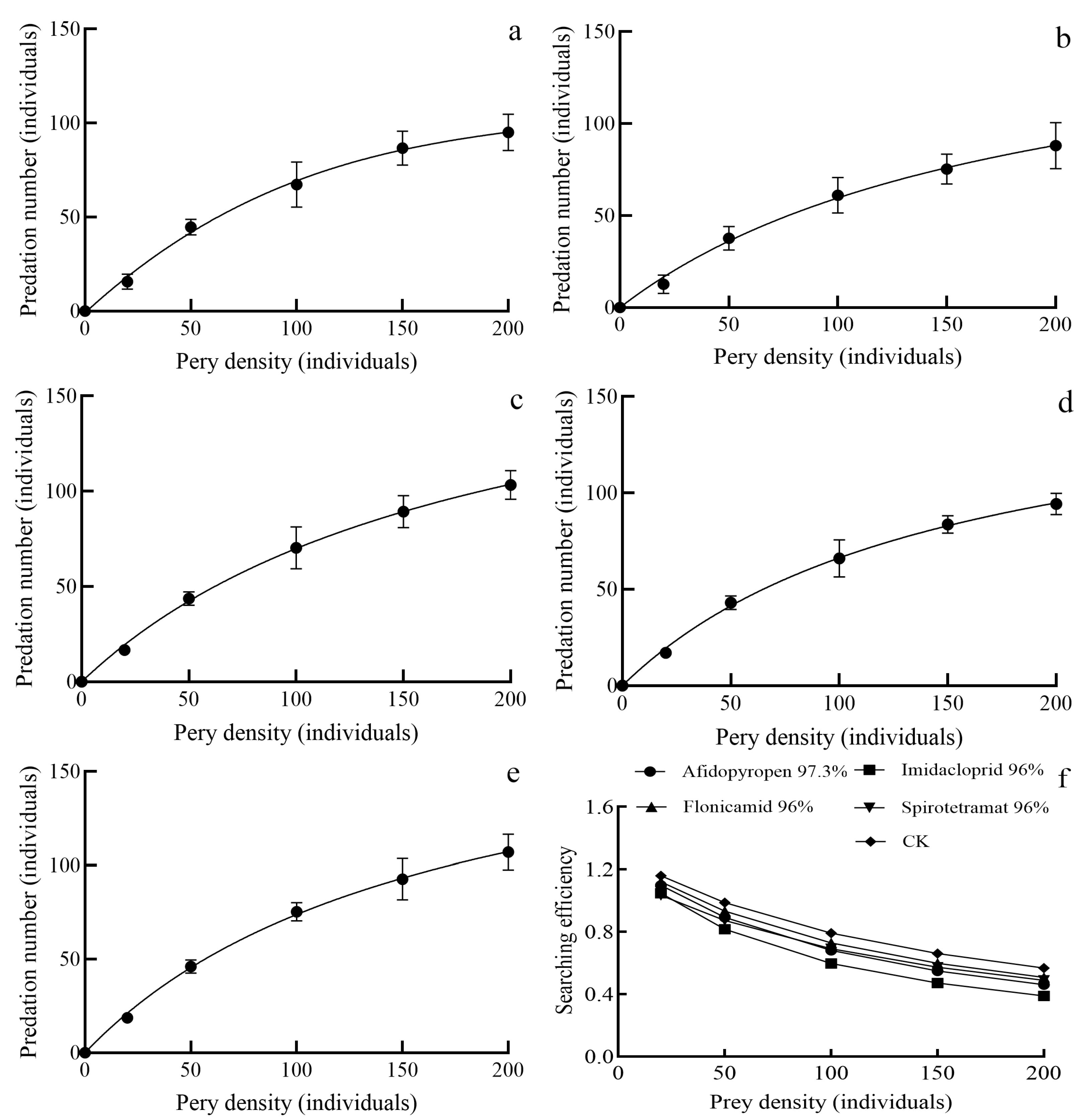
After treatment with each of the four insecticides, the predation capacity of third-instar H. variegata larvae increased with prey density, though the rate of increase diminished as prey density continued to rise. At the same prey density, the 24-h predation rates against A. gossypii by larvae in each treatment were as follows: afidopyropen > flonicamid > spirotetramat > imidacloprid, all of which were lower than those in the control (Figure 1a–e). The functional responses of third-instar H. variegata larvae to A. gossypii under different insecticide treatments all conformed to the Holling II model (Table 9). The persistently lower predation rates following insecticide exposure suggest that sublethal effects may reduce the short-term predatory efficiency of H. variegata, which could weaken its biological control function at field-relevant prey densities.
The functional response of third-instar H. variegata larvae feeding on A. gossypii differed among insecticide treatments (Table 10). Based on theoretical predation (a′/Th), the overall predation capacity followed the order flonicamid > spirotetramat > afidopyropen > imidacloprid, and all treatments resulted in lower predation potential compared with the control. Among the insecticides, flonicamid consistently maintained the highest predation performance, whereas imidacloprid showed the strongest suppressive effect on predatory capacity. Differences among treatments were also reflected in the daily maximum predation rate (T/Th), with flonicamid and spirotetramat supporting relatively higher predation levels than afidopyropen and imidacloprid. In contrast, the instantaneous attack rate (a′) and handling time (Th) showed comparatively smaller variation among treatments. These results indicate that insecticide exposure primarily altered the overall predatory capacity of H. variegata larvae rather than fundamentally changing their attack behavior or handling efficiency, suggesting a general suppression of feeding performance under sublethal exposure.
Following treatment with the four insecticides, the search efficiency of H. variegata third-instar larvae for A. gossypii exhibited a negative correlation with prey density. At equivalent prey densities, the search efficiency of the larvae for A. gossypii across all four treatments was lower than that of the control (CK). When the prey density was standardised at 20 individuals per dish, the highest search efficiency of 1.12 was recorded under the flonicamid treatment. In contrast, the lowest search efficiency of 1.03 was observed under the spirotetramat treatment (Figure 1f). These results indicate that insecticide exposure reduced the prey-searching efficiency of H. variegata larvae, which may limit their encounter rates with prey; therefore, under the practical field application of these insecticides, the overall predation performance of this predator may be weakened.

4. Discussion

The results demonstrated that afidopyropen exhibited the highest toxicity to A. gossypii, while its toxicity to H. variegata was lower than that of spirotetramat. Flonicamid showed high toxicity to A. gossypii but relatively low toxicity to H. variegata, resulting in a high selectivity toxicity ratio. In contrast, imidacloprid displayed comparatively low toxicity to A. gossypii but higher toxicity to H. variegata, indicating poor selectivity. Field trials further confirmed that afidopyropen and flonicamid provided effective A. gossypii control while causing relatively lower reductions in the observed field abundance of H. variegata larvae, whereas imidacloprid resulted in a greater reduction in this predator. Song et al. [55] found that afidopyropen and flonicamid provided effective control of A. gossypii with minimal impact on the population of adult H. variegata. The field application of afidopyropen did not significantly affect the abundance of natural enemy insects [56,57]. Morita et al. [58] reported that flonicamid demonstrated high toxicity to A. gossypii, and Wei et al. [59] found that the LC50 of flonicamid against Coccinella undecimpunctata (Coleoptera: Coccinellidae) was 940 mg/L, indicating a high level of safety, which is consistent with our findings. Conversely, Song et al. [55] showed that the field application of imidacloprid resulted in a significant reduction in adult H. variegata. Wang et al. [60] demonstrated that imidacloprid exerted pronounced toxic effects on adult H. variegata in the field. Liu et al. [61] found that plant-derived insecticides were substantially safer for H. variegata compared to imidacloprid, resulting in lower mortality rates. Li et al. [62] reported that the field application of imidacloprid significantly decreased the beneficial-to-pest ratio of H. variegata to A. gossypii. Wumuerhan et al. [63] demonstrated that spirotetramat posed considerable risks to H. variegata eggs, larvae, pupae, and adults, which aligns with the findings of this study.
Although a reduction in the field abundance of H. variegata larvae was observed following insecticide application in this study, this pattern should be interpreted with caution. Because the field experimental design did not distinguish between mortality and behavioral responses, the observed decline in larval abundance should be regarded as a change in field abundance rather than definitive evidence of insecticide-induced mortality. Therefore, decreases in H. variegata larval abundance do not necessarily indicate direct lethal effects of insecticides. Suppression of aphid populations may lead to secondary declines in predator abundance through prey-mediated effects, whereby reduced prey availability limits predator aggregation and persistence. In addition, changes in larval abundance may reflect behavioral avoidance, reduced foraging activity, or immigration and emigration under open field conditions, rather than lethal toxicity alone.
Collectively, the results of this study indicate that differences in insecticide selectivity may influence the balance between effective suppression of A. gossypii and the conservation of predatory ladybirds, thereby supporting the sustainability of biological control in agroecosystems. Future studies should integrate approaches such as mark-recapture techniques, behavioral observations, or population dynamics monitoring to better distinguish lethal effects from behavioral or ecological processes, enabling a more accurate assessment of the long-term impacts of insecticides on natural enemy populations.
The functional response assay was conducted to evaluate short-term sublethal effects of insecticides on the predatory performance of H. variegata larvae under controlled conditions. LC50-based exposure was adopted as a standardized sublethal benchmark to facilitate comparisons among insecticides with different modes of action. The short starvation period and 24-h observation window were applied to standardize feeding motivation and capture immediate functional responses following exposure, providing insight into early disruptions of predator-prey interactions after insecticide application. The results showed that although the functional responses of H. variegata larvae to A. gossypii under all treatments conformed to the Holling type II model, insecticide treatments consistently reduced predation capacity compared with the control. Decreases in theoretical predation (a′/Th), daily maximum predation rate (T/Th), and prey-searching efficiency indicate that sublethal exposure impaired the overall predatory performance of third-instar larvae. Notably, the persistence of the functional response type does not indicate the absence of ecological effects of insecticides on predators, because declines in key parameters may substantially reduce predatory efficiency even when the functional response type remains unchanged. Yang et al. [36] found that treating third-instar larvae of Harmonia axyridis (Coleoptera: Coccinellidae) with flonicamid had a discernible impact on their predatory functional response towards adult A. gossypii. This is different from the results of the present study, which may be due to differences in ladybird species. Nan et al. [64] reported that afidopyropen did not significantly adversely affect the predatory capacity of H. variegata. Wumuerhan et al. [65] discovered that imidacloprid could significantly diminish the predation rate of adult H. variegata. These results are consistent with those of the present study.
The ecological relevance of these sublethal effects is particularly important for long-term IPM outcomes. Reduced predation efficiency and lower prey-searching efficiency may limit encounter rates with prey under field-relevant densities, potentially weakening the regulatory role of H. variegata populations over time. Such effects may not be immediately evident from short-term pest control outcomes, but could accumulate and compromise biological control services in agroecosystems. Within this context, afidopyropen and flonicamid in this study showed high efficacy against A. gossypii while exerting comparatively lower impacts on predator performance, and may therefore be suitable options under conditions where conservation of natural enemies is a priority. However, their compatibility with IPM strategies is likely to be context dependent and should be evaluated alongside local pest pressure, application regimes, and ecological conditions.

5. Conclusions

Afidopyropen and flonicamid showed high efficacy against A. gossypii while exerting comparatively lower adverse effects on H. variegata larvae under the conditions of this study, suggesting potential advantages in pest management scenarios where conservation of natural enemies is a priority. Their rotational use, based on different modes of action, may also contribute to resistance management in A. gossypii and help reduce risks to predatory ladybirds. However, the suitability of insecticides within integrated pest management programs is inherently context dependent and should be evaluated in relation to local pest pressure, application strategies, and ecological conditions. Careful consideration of insecticide selection, application timing, and dosage, particularly with respect to the activity periods of natural enemies, remains essential for minimizing unintended ecological impacts and supporting sustainable aphid management in cotton agroecosystems.

Author Contributions

Conceptualization, P.L., Y.T., K.W., T.L., L.W. and H.F.; methodology, P.L., Y.T., S.S., K.W., J.L. and T.L.; software, P.L., Y.T., S.S., K.W. and J.L.; validation, P.L., Y.T., S.S., T.L., L.W. and H.F.; formal analysis, P.L., Y.T., J.L., L.W. and H.F.; investigation, P.L., Y.T., K.W., T.L. and J.L.; resources, P.L., Y.T., K.W., T.L. and J.L.; data curation, P.L., Y.T. and S.S.; writing—original draft preparation, P.L., Y.T., S.S. and H.F.; writing—review and editing, P.L., Y.T., L.W. and H.F.; supervision, H.F.; project administration, L.W.; funding acquisition, L.W. and S.S. All authors have read and agreed to the published version of the manuscript.

Funding

This research was funded by the Southern Xinjiang Key Industry Innovation and Development Support Plan Project: Research and Application of Cotton Aphid Drone Remote Sensing Monitoring and Precision Control Technology (2021DB008), and the 2024 Kashi Region Science and Technology Plan Project: Research and Demonstration of Cotton Aphid Resistance Monitoring and Precision Control Technology in Kashi Region (KS2024002).

Data Availability Statement

The original contributions presented in this study are included in the article. Further inquiries can be directed to the corresponding authors.

Acknowledgments

During the preparation of this manuscript/study, the authors used Grammarly in the manuscript to improve grammar, spelling, and language clarity. The authors have reviewed and edited the output and take full responsibility for the content of this publication.

Conflicts of Interest

The authors declare no conflicts of interest.

References

  1. Fang, L.; Wang, Q.; Hu, Y.; Jia, Y.H.; Chen, J.D.; Liu, B.L.; Zhang, Z.Y.; Guan, X.Y.; Chen, S.Q.; Zhou, B.L.; et al. Genomic analyses in cotton identify signatures of selection and loci associated with fiber quality and yield traits. Nat. Genet. 2017, 49, 1089–1098. [Google Scholar] [CrossRef]
  2. Ridley, W.; Devadoss, S. Competition and trade policy in the world cotton market: Implications for US cotton exports. Am. J. Agric. Econ. 2023, 105, 1365–1387. [Google Scholar] [CrossRef]
  3. Dai, J.G.; Xue, J.L.; Zhao, Q.Z.; Wang, Q.; Chen, B.; Zhang, G.S.; Jiang, N. Extraction of cotton seedling growth information using UAV visible light remote sensing images. Trans. Chin. Soc. Agric. Eng. 2020, 36, 63–71. [Google Scholar] [CrossRef]
  4. Li, P.F.; Liu, F.Q.; Feng, H.Z.; Zheng, Y.X.; Wu, G.; Wang, L. Effects of adjuvants on deposition characteristics of spray droplets applied by plant protection unmanned aerial vehicle and control efficiency on Aphis gossypii. Cotton Sci. 2024, 36, 255–266. [Google Scholar] [CrossRef]
  5. Lu, Y.H.; Liang, G.M.; Zhang, Y.J.; Yang, X.M. Advances in the management of insect pests of cotton in China since the 21st century. Chin. J. Appl. Entomol. 2020, 57, 477–490. [Google Scholar] [CrossRef]
  6. Ma, Q. Occurring and Cont rolling of Aphis gossypii in Cotton Filds in Xinjiang. J. Xinjiang Agric. Univ. 2002, S1, 47–50. [Google Scholar]
  7. Tao, C.L.; Xin, Q.W. Causes of massive outbreaks of Aphis gossypii in Xinjiang and their control measures. China Cotton 2004, 8, 37. [Google Scholar]
  8. Wang, X.F.; Men, Z.Z.; Luo, J.X. Aphis gossypii in Xinjiang’s cotton-growing regions distribution, damage characteristics and control measures. Xinjiang Agric. Sci. 2000, 1, 85–87. [Google Scholar]
  9. Wu, N.; Zhang, Y.D.; Cai, X.H.; Shi, Y.H.; Han, R.; Wang, J.G. Studies on the activities of related enzymes of Aphis gossypii after feeding cotton damaged by Acyrthosiphon gossypii. Xinjiang Agric. Sci. 2020, 57, 2050–2064. [Google Scholar]
  10. Pandey, S.; Bag, S.; Roberts, P.; Conner, K.; Balkcom, K.S.; Price, A.J.; Jacobson, A.L.; Srinivasan, R. Prospective alternate hosts of an emerging polerovirus in cotton landscapes in the southeastern United States. Viruses 2022, 14, 2249. [Google Scholar] [CrossRef]
  11. Reddall, A.; Ali, A.; Able, J.A.; Stonor, J.; Tesoriero, L.; Wright, P.R.; Rezaian, M.A.; Wilson, L.J. Cotton bunchy top: An aphid and graft transmitted cotton disease. Australas. Plant Pathol. 2004, 33, 197–202. [Google Scholar] [CrossRef]
  12. Pan, M.Z.; Zhang, Y.; Cao, H.H.; Wang, X.X.; Liu, T.X. Research progresses, application, and prospects in aphid biological control on main crops in China. J. Plant Prot. 2022, 49, 146–172. [Google Scholar] [CrossRef]
  13. Wang, K.Y.; Jiang, X.Y.; Yi, M.Q.; Lv, B.Q.; Zhang, H.C.; Li, C.Z. Research on pesticide resistance and mechanisms in Aphis gossypii Glover in major vegetable-growing regions of Shandong province. Chin. J. Pestic. Sci. 2000, 3, 19–24. [Google Scholar]
  14. Zhang, X.T.; Liu, J.W.; Li, F.; Liu, N.; Sun, L.; Zhang, D.H.; Liu, X.N. Susceptible level of Aphis gossypii to different insecticides in the north of Xinjiang. Plant Prot. 2012, 38, 163–166. [Google Scholar] [CrossRef]
  15. Herron, G.; Powis, K.; Rophail, J. Baseline studies and preliminary resistance survey of Australian populations of cotton aphid Aphis gossypii Glover (Hemiptera: Aphididae). Aust. J. Entomol. 2000, 39, 33–38. [Google Scholar] [CrossRef]
  16. Mushtaq Ahmad, M.A.; Iqbal Arif, M. Susceptibility of Pakistani populations of cotton aphid Aphis gossypii (Homoptera: Aphididae) to endosulfan, organophosphorus and carbamate insecticides. Crop Prot. 2008, 27, 523–531. [Google Scholar] [CrossRef]
  17. Patima, W.; Guo, P.P.; Ma, S.J.; Gao, X.W.; Zhang, L.J.; Zhang, S.; Ma, D.Y. Resistance of different field populations of Aphis gossypii to ten insecticides in Xinjiang. Plant Prot. 2019, 45, 273–278. [Google Scholar] [CrossRef]
  18. Xue, C.; Wang, A.Y.; Zhang, Y.; Zhang, J.H.; Yang, Y.H.; Zhao, M. Occurrence of aphids in peanut-cotton intercropping fields and evaluation of the resistance level to neonicotinoid insecticides. Agrochemicals 2024, 63, 376–381. [Google Scholar] [CrossRef]
  19. Jeschke, P.; Nauen, R. Neonicotinoids-from zero to hero in insecticide chemistry. Pest Manag. Sci. 2008, 64, 1084–1098. [Google Scholar] [CrossRef]
  20. Gu, X.B.; LI, J.P.; Zhou, X.; Liang, C.; Fan, W.H.; He, Y.N.; Zhang, Z.Z. Joint biological activity and field control efficacy of afidopyropen and 5 plant-derived pesticides on tobacco aphids. Agrochemicals 2025, 64, 595–600. [Google Scholar] [CrossRef]
  21. Koch, R.L.; Silva Queiroz, O.D.; Aita, R.C.; Hodgson, E.W.; Potter, B.D.; Nyoike, T.; Ellers-Kirk, C.D. Efficacy of afidopyropen against soybean aphid (Hemiptera: Aphididae) and toxicity to natural enemies. Pest Manag. Sci. 2020, 76, 375–383. [Google Scholar] [CrossRef]
  22. Nauen, R.; Reckmann, U.; Thomzik, J.; Thielert, W. Biological profile of spirotetramat (Movento®)-a new two-way systemic (ambimobile) insecticide against sucking pest species. Bayer Cropsci. J. 2008, 61, 245–278. [Google Scholar]
  23. Brück, E.; Elbert, A.; Fischer, R.; Krueger, S.; Kühnhold, J.; Klueken, A.M.; Nauen, R.; Niebes, J.-F.; Reckmann, U.; Schnorbach, H.-J.; et al. Movento®, an innovative ambimobile insecticide for sucking insect pest control in agriculture: Biological profile and field performance. Crop Prot. 2009, 28, 838–844. [Google Scholar] [CrossRef]
  24. Morita, M.; Yoneda, T.; Akiyoshi, N. Research and development of a novel insecticide, flonicamid. J. Pestic. Sci. 2014, 39, 179–180. [Google Scholar] [CrossRef]
  25. Shu, Z.L.; Yu, J.L.; Miao, K.; Zhao, L.C.; Yang, H.F.; Fang, J.C.; Guo, H.F. The control effect and safety evaluation to natural enemies of flonicamid against white-backed planthopper. Agrochemicals 2016, 55, 851–853. [Google Scholar] [CrossRef]
  26. Jansen, J.P.; Defrance, T.; Warnier, A.M. Side effects of flonicamide and pymetrozine on five aphid natural enemy species. BioControl 2011, 56, 759–770. [Google Scholar] [CrossRef]
  27. Cui, L.; Zhang, J.; Qi, H.L.; Wang, Q.Q.; Lu, Y.H.; Rui, C.H. Monitoring and mechanisms of imidacloprid resistance in Aphis gossypii (Hemiptera: Aphidiidae) in the main cotton production areas of China. Acta Entomol. Sin. 2016, 59, 1246–1253. [Google Scholar] [CrossRef]
  28. Little, S.C.; Umina, P.A. Susceptibility of Australian Myzus persicae (Hemiptera: Aphididae) to three recently registered insecticides: Spirotetramat, cyantraniliprole, and sulfoxaflor. J. Econ. Entomol. 2017, 110, 1764–1769. [Google Scholar] [CrossRef]
  29. Voudouris, C.C.; Williamson, M.S.; Skouras, P.J.; Kati, A.N.; Sahinoglou, A.J.; Margaritopoulos, J.T. Evolution of imidacloprid resistance in Myzus persicae in Greece and susceptibility data for spirotetramat. Pest Manag. Sci. 2017, 73, 1804–1812. [Google Scholar] [CrossRef] [PubMed]
  30. Liu, X.X.; Wu, M.M.; Xue, L.; Wang, S.; Guo, X.J.; Xiao, D.; Xu, Q.X. Examination of the sensitivity of peach orchard aphids to imidacloprid and afidopyropen. J. Fruit Sci. 2024, 41, 1836–1845. [Google Scholar] [CrossRef]
  31. Abbas, N.; Abubakar, M.; Hassan, M.W.; Shad, S.A.; Hafez, A.M. Risk assessment of flonicamid resistance in Musca domestica (Diptera: Muscidae): Resistance monitoring, inheritance, and cross-resistance potential. J. Med. Entomol. 2021, 58, 1779–1787. [Google Scholar] [CrossRef]
  32. Zhang, R.Z.; Ren, L.; Wang, C.L.; Lin, R.H.; Tian, C.Y. Cotton aphid predators on alfalfa and their impact on cotton aphid abundance. Appl. Entomol. Zool. 2004, 39, 235–241. [Google Scholar] [CrossRef]
  33. Rahmani, S.; Bandani, A.R. Sublethal concentrations of thiamethoxam adversely affect life table parameters of the aphid predator, Hippodamia variegata (Goeze) (Coleoptera: Coccinellidae). Crop Prot. 2013, 54, 168–175. [Google Scholar] [CrossRef]
  34. He, Y.X.; Zhao, J.W.; Zheng, Y.; Desneux, N.; Wu, K.M. Lethal effect of imidacloprid on the coccinellid predator Serangium japonicum and sublethal effects on predator voracity and on functional response to the whitefly Bemisia Tabaci. Ecotoxicology 2012, 21, 1291–1300. [Google Scholar] [CrossRef]
  35. Wu, K.M.; Liu, Q.X. Study on pesticides inducing the resurgence of Aphis gossypii. Acta Ecol. Sin. 1992, 4, 341–347. [Google Scholar]
  36. Yang, M.D.; Wang, W.Q.; Li, A.Q.; Yao, Y.S.; Su, Y. Effects of flonicamid on the predation ability of Harmonia axyridis (Coleoptera: Coccinellidae) larvae on Aphis gossypii (Hemiptera:Aphididae) adults. Acta Ecol. Sin. 2025, 68, 1088–1093. [Google Scholar] [CrossRef]
  37. Desneux, N.; Decourtye, A.; Delpuech, J.M. The sublethal effects of pesticides on beneficial arthropods. Annu. Rev. Entomol. 2007, 52, 81–106. [Google Scholar] [CrossRef] [PubMed]
  38. Cloyd, R.A.; Bethke, J.A. Impact of neonicotinoid insecticides on natural enemies in greenhouse and interiorscape environments. Pest Manag. Sci. 2011, 67, 3–9. [Google Scholar] [CrossRef] [PubMed]
  39. Aerziguli, R.; Ding, X.H.; Tursun, A.; Fu, K.Y.; Adili, S.; Guo, W.C. Diversity and seasonal dynamics of ladybug communities in agroforestry habitats in Northern Xinjiang. Chin. J. Biol. Control 2021, 37, 679–691. [Google Scholar] [CrossRef]
  40. Li, Y.Y.; Zhou, X.R.; Duan, W.C.; Pang, B.P. Food consumption and utilization of Hippodamia variegata (Coleoptera: Coccinellidae) is related to host plant species of its prey, Aphis gossypii (Hemiptera: Aphididae). Acta Ecol. Sin. 2015, 58, 1091–1097. [Google Scholar] [CrossRef]
  41. Yue, L.; Song, W.J.; Gao, H.L.; Ye, J.K.; Talerar, D.M.; Zhao, Q.; Lu, W. Laboraton biological assay and field efficacy of 2 insecticides mixed with biological agents against Aphis gossypii. Agrochemicals 2024, 63, 837–842. [Google Scholar] [CrossRef]
  42. Ding, J.P.; Han, Y.; Han, X.; Shang, J.; Yao, Y.S. Sensitivity of Aphis gossypii and Acyrthosiphon gossypii to three insecticides. Plant Prot. 2020, 46, 270–275. [Google Scholar] [CrossRef]
  43. Li, Q.; Ma, Y.Q. Control effect evaluation of ten pesticides against Eriosoma lanigerum (Hausmann) in Qinghai plateau. J. Qinghai Univ. 2020, 38, 1–6. [Google Scholar] [CrossRef]
  44. Wang, F.; Chen, J.B.; Liu, B.Y.; Niu, H.; Liu, C.; He, J.; Zhang, R. Toxicity and field control efficacy of five insecticides against Aphis gossypii. Plant Prot. 2021, 47, 294–298. [Google Scholar] [CrossRef]
  45. Teng, H.Y.; Yuan, Y.D.; Zhang, T.S.; Chang, X.L.; Wang, D.S. Evaluation of the sublethal effect of tetrachlorantraniliprole on Spodoptera exigua and its potential toxicity to two non-target organisms. PLoS ONE 2020, 15, e0242052. [Google Scholar] [CrossRef] [PubMed]
  46. Wang, X.Y.; Shen, Z.R. Selective toxicity of four Insecticides on green peach aphid (Homoptera: Aphididae) and predator multicolored asian ladybird (Coleoptera: Coccinellidae) and the coordination evaluation of biological & chemical control to insect pest. Chin. J. Pestic. Sci. 2002, 1, 34–38. [Google Scholar]
  47. Wang, Z.H.; Yu, J.Y.; Sheng, J.; Zhang, X.Q.; Dong, L.S.; Yu, H.F. The toxicity and control efficacy of different pesticides on Corythucha marmorata. Agrochemicals 2019, 58, 136–140. [Google Scholar] [CrossRef]
  48. Teng, H.Y.; Zhang, T.S.; Chang, X.L.; Gu, H.T.; Wang, D.S.; Yuan, Y.D. Toxicity of seven insecticides on Dasineura pyri and safety evaluation to predator Harmonia axyridis. Plant Prot. 2021, 47, 265–270. [Google Scholar] [CrossRef]
  49. Li, Y.Y.; Liu, Z.; Liu, H. Evaluation of the selective toxicity of six acaricides to Tetranychus cinnabarinus and Neoseiulus cucumeris. Plant Prot. 2014, 40, 209–212. [Google Scholar] [CrossRef]
  50. Zhang, Q.; Wang, S.L.; Li, J.F.; Wang, Y.; Feng, G.Y.; Dong, M.; Lin, Y.Z.; Liang, Q.L.; Qi, H. Comparison of control effects of different insecticides on cotton seeding aphids. Agrochemicals 2022, 61, 756–758. [Google Scholar] [CrossRef]
  51. Holling, C.S. Some characteristics of simple types of predation and parasitism1. Can. Entomol. 1959, 91, 385–398. [Google Scholar] [CrossRef]
  52. Tang, Y.T. Study on Potential of a Novel Natural Enemy Insect Picromerus lewisi Scott in Biological Control. Master’s Thesis, Chinese Academy of Agricultural Sciences, Beijing, China, 2020. [Google Scholar]
  53. Sun, G.L.; Cai, H.S.; Yang, Y.; Jin, S.T.; Zhang, Q.J.; Tang, Y.; Chen, B. Predation by Sycanus croceovittatus on higher instar larvae of Spodoptera frugiperda and Helicoverpa armigera. Plant Prot. 2025, 51, 118–125. [Google Scholar] [CrossRef]
  54. Wang, S.J.; Wu, J.; Zhao, Y.N.; Li, R.X.; Zhao, D.X. Functional response of adult Hierodula patellifera (Serville, 1839) (Mantodea: Mantidae) to Tessaratoma papillosa (Drury) (Hemiptera: Tessaratomidae). Int. J. Trop. Insect Sci. 2020, 40, 1053–1058. [Google Scholar] [CrossRef]
  55. Song, B.M.; Jiang, Y.; Chen, X.; Cheng, W.N.; Zhang, Y.; Pan, H.S. Effectiveness of different pesticides on Aphis gossypii and a safety evaluation of Hippodamia variegata. Chin. J. Appl. Entomol. 2023, 60, 1535–1549. [Google Scholar] [CrossRef]
  56. Slusher, E.K.; Cottrell, T.; Acebes-Doria, A.L. Effects of aphicides on pecan aphids and their parasitoids in pecan orchards. Insects 2021, 12, 241. [Google Scholar] [CrossRef] [PubMed]
  57. Lytle, A.J.; Huseth, A.S. Impact of foliar insecticide sprays on Melanaphis sacchari (Hemiptera: Aphididae) and natural enemy populations in grain sorghum. Crop Prot. 2021, 149, 105764. [Google Scholar] [CrossRef]
  58. Morita, M.; Ueda, T.; Yoneda, T.; Koyanagi, T.; Haga, T. Flonicamid, a novel insecticide with a rapid inhibitory effect on aphid feeding. Pest Manag. Sci. 2007, 63, 969–973. [Google Scholar] [CrossRef]
  59. Wei, Y.D.; Ma, X.; Han, X.; Ma, Z.H.; Zhang, X.L.; Yao, Y.S.; Xiong, R.C. Effects on predation response of Coccinella undecimpunctata fed on Aphis gossypi treated with sublethal doses of flonicamid. Xinjiang Agric. Sci. 2021, 58, 1860–1867. [Google Scholar]
  60. Wang, S.L.; Li, G.K.; Gao, H.F.; Lei, J.J.; Gao, Y.H. Safety evaluation of four pesticides to wheat aphid natural enemies. Xinjiang Agric. Sci. 2013, 50, 2254–2257. [Google Scholar]
  61. Liu, J.M.; Liu, B.; Wang, P.L.; Lu, Y.H. Toxicity of three botanical insecticides to Aphis gossypi and their selectivity to Hippodamia variegata. Xinjiang Agric. Sci. 2021, 58, 2069–2076. [Google Scholar]
  62. Li, N.; Liu, B.; Lu, Y.H. Effects of sulfoxaflor on Aphis gossypii and natural enemies in Xinjiang cotton field. Xinjiang Agric. Sci. 2021, 58, 2062–2068. [Google Scholar]
  63. Wumuerhan, P.; Ding, R.F.; Ma, D.Y.; Wusiman, A.M. Safety evaluation of eight commonly used insecticides on different stages of Hippodamia variegata (Goeze). Chin. J. Pestic. Sci. 2023, 25, 1295–1302. [Google Scholar] [CrossRef]
  64. Nan, J.; Liu, B.; Lu, Y.H. Effects of afidopyropen on the life parameters, predatory function and flight ability of variegated ladybird Hippodamia variegata. J. Plant Prot. 2022, 49, 1799–1808. [Google Scholar] [CrossRef]
  65. Wumuerhan, P.; Tayier, A.; Ma, D.Y. Effects of neonicotinoids insecticides on adult of Hippodamia variegate (Goeze). Agrochemicals 2021, 60, 816–820. [Google Scholar] [CrossRef]
Figure 1. Daily predation rates of third instar Hippodamia variegata larvae under different insecticide treatments. (ae) Represent the daily predation rates of third instar H. variegata larvae after treatment with afidopyropen 97.3%, imidacloprid 96%, flonicamid 96%, spirotetramat 96%, and the control (CK), respectively; (f) Searching effects of third instar H. variegata larvae against A. gossypii under different insecticide treatments. Error bars represent the standard error for each set of data.
Agronomy 16 00228 g001
Table 1. Tested insecticides and their sources.
Pesticide NameCategoryManufacturer
Afidopyropen 97.3%Chordotonal organ modulator; disrupts sensory nerve function, causing rapid cessation of feeding in piercing–sucking insectsShaanxi Yikunte Pharmaceutical Technology Co., Ltd., Shaanxi, China
Imidacloprid 96%Nicotinic acetylcholine receptor (nAChR) agonist; causes persistent neuronal stimulation leading to paralysis and deathHuazhong Biotechnology Co.,
Ltd., Wuhan, China
Flonicamid 96%Feeding inhibitor; rapidly suppresses feeding behavior in piercing–sucking insects via a distinct target siteHubei Maoerwo Biopharmaceutical Co., Ltd., Wuhan, China
Spirotetramat 96%Inhibitor of lipid biosynthesis (acetyl-CoA carboxylase, ACC); disrupts growth and reproductionLansheng Biotechnology Group Co., Ltd.,
Shijiazhuang, China
Table 2. Toxicity test concentration gradient.
Pesticide NameConcentration Gradient/(mg/L)
Afidopyropen 97.3%100502512.56.253.125
Imidacloprid 96%6003001507537.518.75
Flonicamid 96%8004002001005025
Spirotetramat 96%200100502512.56.25
Table 3. Information on different insecticides and application dosage.
Pesticide NameManufacturerRecommended
Dosage
Dosage Per
ha
Afidopyropen 50 g/L DC BASF Ltd., Shanghai, China150–240 mL/ha210 mL
Imidacloprid 70% WGBayer Cropscience Co., Ltd., Hangzhou, China30–60 g/ha50 g
Flonicamid 10% WGIshihara Sangyo Kaisha Ltd., Osaka, Japan450–750 g/ha700 g
Spirotetramat 22.4% SCBayer Cropscience Co., Ltd., Hangzhou, China3000–4000 Times3500 Times
Table 4. The laboratory toxicity of four insecticides against Aphis gossypii.
Pesticide NameToxicity Regression Equation *χ2LC50 (95% Confidence Interval)/(mg/L)Relative Toxicity Index
Afidopyropen 97.3%y = 2.17x − 2.43 2.4613.18 (11.11~15.32)11.69
Imidacloprid 96%y = 2.23x − 4.87 2.01154.01 (133.86~177.44)1
Flonicamid 96%y = 2.10x − 4.281.99108.33 (93.75~124.66)1.42
Spirotetramat 96%y = 2.65x − 1.972.1122.17 (18.94~25.71)6.95
* x: Log of a drug dose; y: mortality rate is converted into the probability value.
Table 5. The laboratory toxicity of four insecticides against Hippodamia variegata.
Pesticide NameToxicity Regression Equation *χ2LC50 (95% Confidence Interval)/(mg/L)Relative Toxicity Index
Afidopyropen 97.3%y = 2.06x − 3.751.5966.59 (55.89~82.84)7.70
Imidacloprid 96%y = 2.48x − 6.243.62282.62 (246.58~329.09)1.81
Flonicamid 96%y = 1.67x − 4.511.41512.66 (417.02~663.61)1
Spirotetramat 96%y = 2.02x − 3.641.7963.07 (54.48~73.87)8.13
* x: Log of a drug dose; y: mortality rate is converted into the probability value.
Table 6. Safety evaluation of four insecticides for Hippodamia variegata.
Pesticide NameRecommended Dosage/(mg/L)Safety CoefficientSelectivity Toxicity Ratio
Afidopyropen 97.3%16.67~26.672.50~3.995.05
Imidacloprid 96%46.67~93.333.03~6.061.84
Flonicamid 96%100.00~166.673.08~5.134.73
Spirotetramat 96%25.20~33.61.89~2.502.84
Table 7. Field control efficacy of four insecticides against Aphis gossypii.
Pesticide NameControl Efficacy (%)
1 Days After Application3 Days After Application7 Days After Application14 Days After Application
Afidopyropen 50 g/L 57.52 ± 4.32 a85.56 ± 5.89 a96.76 ± 2.91 a78.67 ± 6.56 b
Imidacloprid 70%41.40 ± 5.39 b64.43 ± 7.87 b81.35 ± 4.78 b66.51 ± 6.61 c
Flonicamid 10%59.18 ± 7.54 a84.61 ± 4.62 a96.92 ± 3.56 a89.74 ± 8.44 a
Spirotetramat 22.4%37.24 ± 4.91 b67.43 ± 6.56 b82.19 ± 5.37 b87.34 ± 6.92 ab
The data in the table are presented as means ± standard errors. Different lowercase letters following values within the same column indicate significant differences (p < 0.05). After testing for normality and homogeneity of variance, the data met the assumptions. Multiple comparisons were performed using Duncan’s new multiple range test. The same method applies to all subsequent data.
Table 8. The impact of four insecticides on Hippodamia variegata larvae in the field.
Pesticide NameCorrected Decrease Rate (%)
1 Days After Application3 Days After Application7 Days After Application14 Days After Application
Afidopyropen 50 g/L 10.54 ± 7.23 ab18.34 ± 5.38 b23.36 ± 4.97 b16.69 ± 3.84 b
Imidacloprid 70%15.54 ± 2.61 a30.52 ± 9.68 a38.78 ± 5.48 a19.69 ± 3.36 b
Flonicamid 10%9.36 ± 3.53 b12.61 ± 4.76 bc25.53 ± 6.61 b14.61 ± 6.47 b
Spirotetramat 22.4%4.54 ± 1.33 c9.52 ± 3.01 c20.36 ± 6.09 b27.71 ± 5.72 a
The data in the table are presented as means ± standard errors. Different lowercase letters following values within the same column indicate significant differences (p < 0.05).
Table 9. Logistic regression results determining the type of functional response.
Pesticide NameParametersR2
Afidopyropen 97.3%Na/N = 1.234 − 1.076N + 0.005N2 − 9.839 × 10⁶N30.973
Imidacloprid 96%Na/N = 1.221 0.343N + 0.004N2  6.311 × 10⁶N30.958
Flonicamid 96%Na/N = 1.493 0.842N + 0.009N2  6.623 × 10⁶N30.979
Spirotetramat 96%Na/N = 1.327 0.531N + 0.006N2  7.567 × 10⁶N30.964
CKNa/N = 1.271 0.635N + 0.007N2  7.021 × 10⁶N30.981
Table 10. The functional response parameters of Hippodamia variegata third instar larvae preying on Aphis gossypii under four insecticide treatments.
Pesticide NameHolling EquationR2Instantaneous
Attack
Rate (a′)
Handling
Time (Th)
Daily
Maximum
Predation
Rate (T/Th)
Theoretical
Predation (a′/Th)
Afidopyropen 97.3%Na = 1.301N/(1 + 0.009N)0.9721.2980.007143.86185.86
Imidacloprid 96%Na = 1.291N/(1 + 0.011N)0.9711.2910.009111.11143.44
Flonicamid 96%Na = 1.294N/(1 + 0.008N)0.9781.2940.006166.67215.67
Spirotetramat 96%Na = 1.181N/(1 + 0.007N)0.9841.1810.006166.67196.83
CKNa = 1.311N/(1 + 0.007N)0.9811.3110.005200262.2
Disclaimer/Publisher’s Note: The statements, opinions and data contained in all publications are solely those of the individual author(s) and contributor(s) and not of MDPI and/or the editor(s). MDPI and/or the editor(s) disclaim responsibility for any injury to people or property resulting from any ideas, methods, instructions or products referred to in the content.