Hydroponic Screening and Comprehensive Evaluation System for Salt Tolerance in Wheat Under Full-Fertility-Cycle Salt Stress Conditions
 ,
,
Abstract
1. Introduction
2. Materials and Methods
2.1. Hydroponic Salt Tolerance Screening Test
2.2. Pot Experiment
2.2.1. Plant Materials, Treatments, and Experimental Design
2.2.2. Soil Preparation and Salinity Maintenance
2.2.3. Fertilizer Application
2.3. Determination of Traits and Methods
2.3.1. Morphological Characteristics
2.3.2. The Dry Matter Weight of Each Part
2.3.3. Yied and Its Components
2.3.4. Saline Tolerance Index (STI)
2.3.5. Measurement of Physiological Indicators
2.4. Statistical Analysis
2.4.1. Salt Tolerance and High-Yield Index (STHYI)
2.4.2. Principal Component and Membership Function Analysis
2.4.3. Weight of Each Comprehensive Indicator
2.4.4. D Value Calculation
3. Results
3.1. Descriptive Statistics Traits of Tested Wheat Cultivars
3.2. Differential Analysis of Maturity Traits of Tested Wheat Materials Under Salt Stress
3.3. Correlation Analysis
3.4. Principal Component Analysis
3.5. Evaluation of the Membership Function and Composite D-Value
3.6. Regression Analysis
3.7. Random Forest Model Prediction
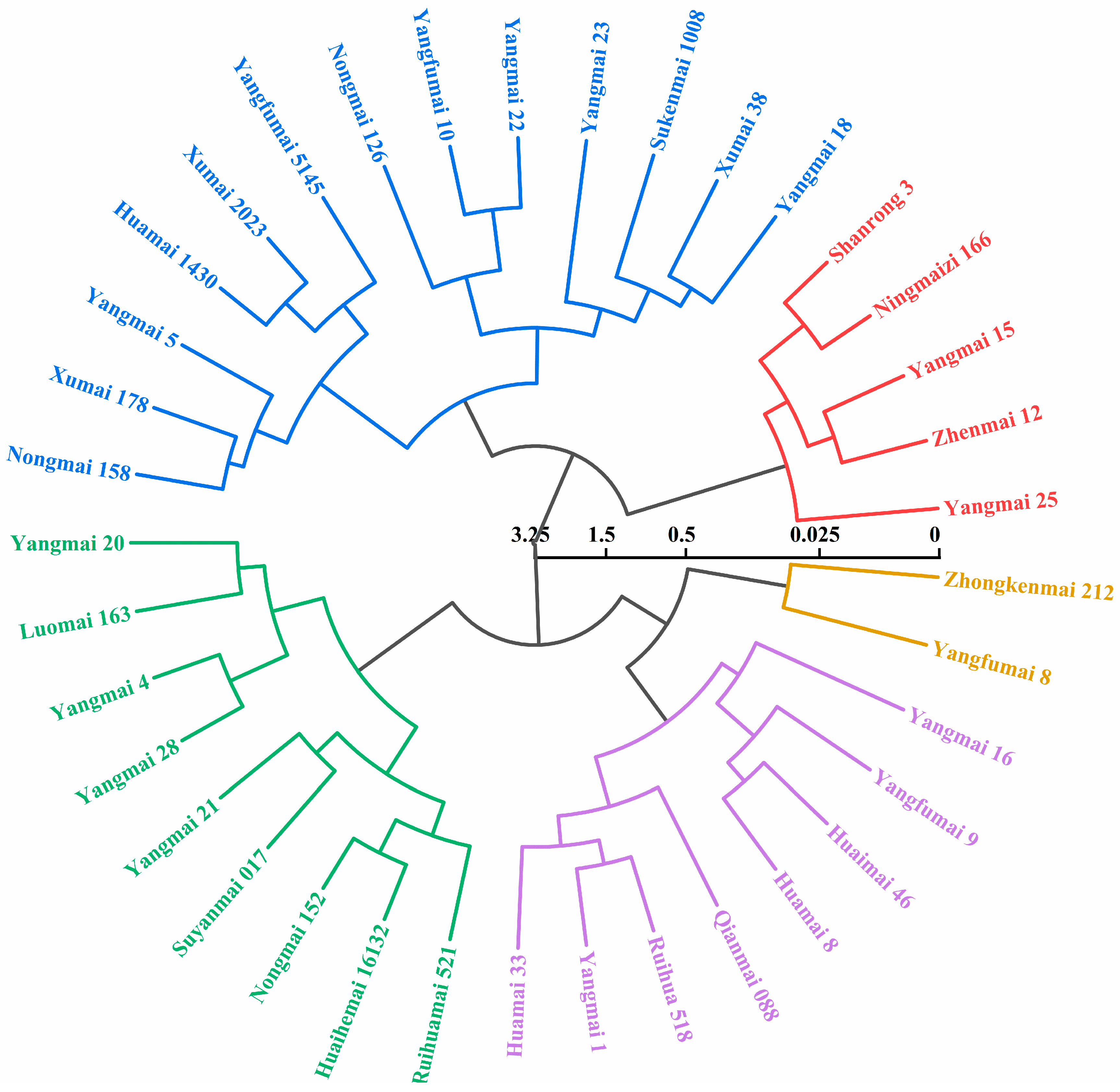
3.8. Systematic Cluster Analysis
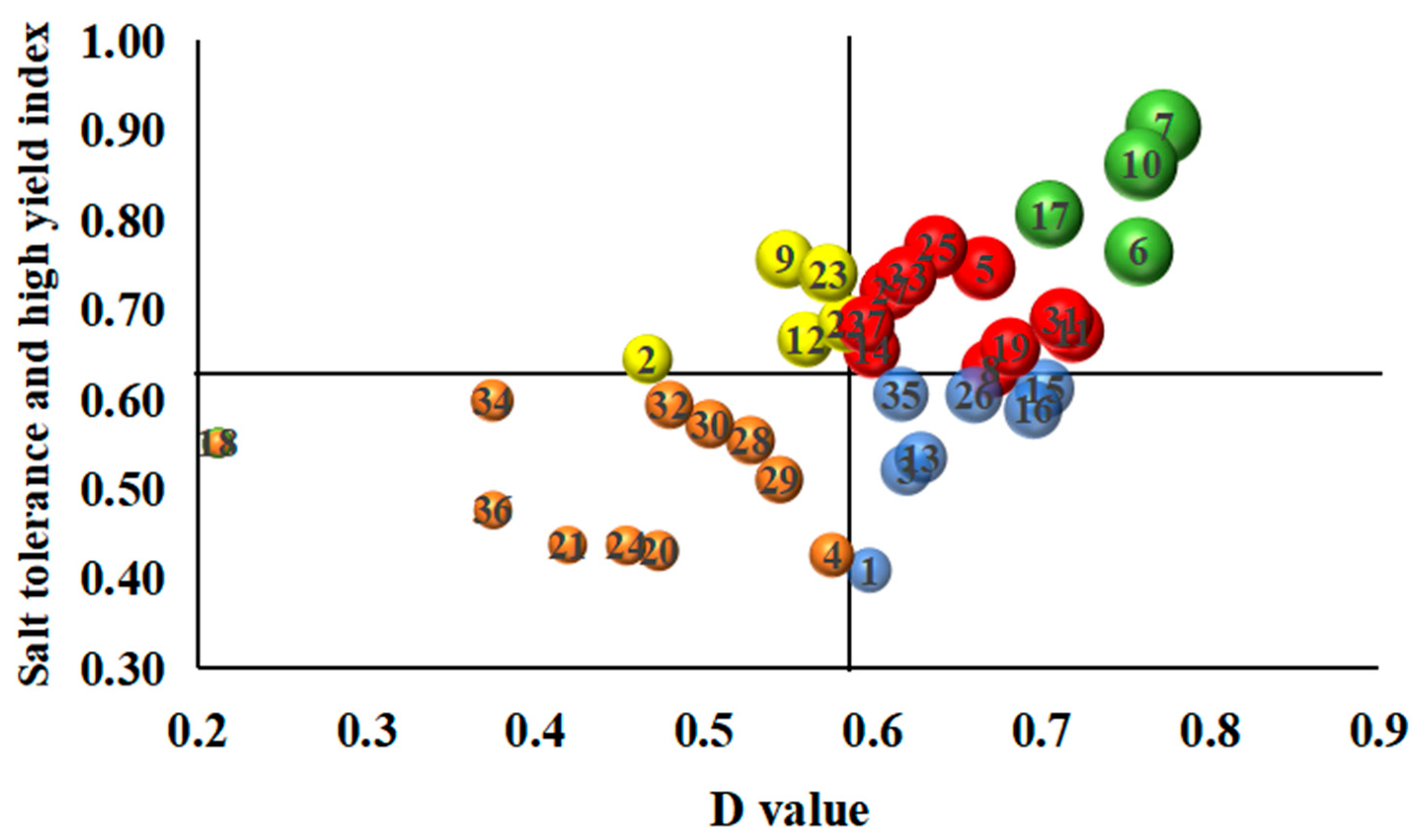
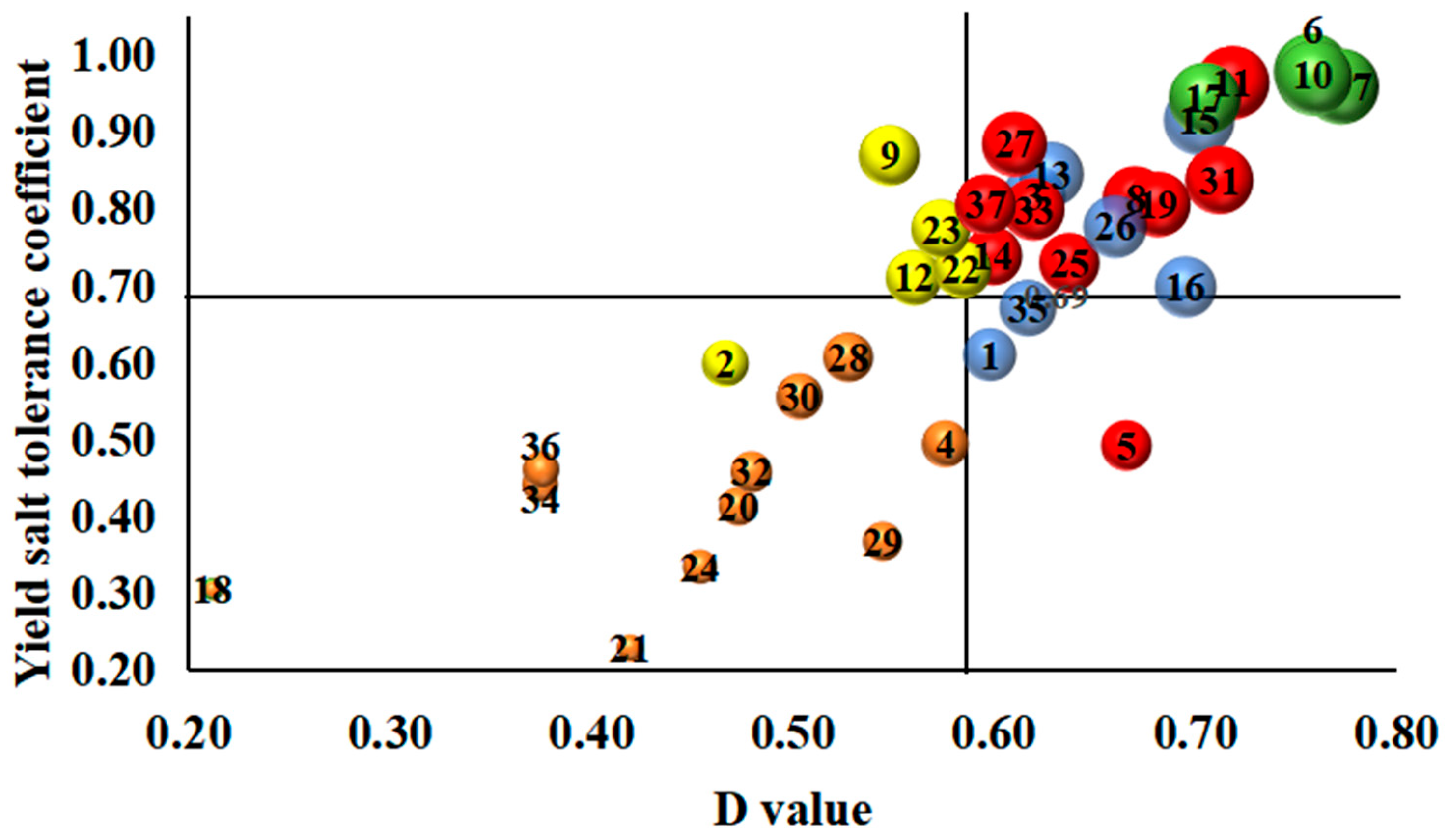
3.9. Boston Matrix Analysis
3.10. Verification of Salt Tolerance Based on Physiological Indicators of Wheat in Pot Experiments
3.11. Verification of Salt Tolerance Based on Yield Components of Wheat in Pot Experiments
4. Discussion
4.1. A Reliable Hydroponic System for Integrated Salt Tolerance Evaluation
4.2. Linking Phenotype to Physiology: Mechanisms and Field Predictivity
4.3. Implications for Breeding and Practical Application
5. Conclusions
Supplementary Materials
Author Contributions
Funding
Data Availability Statement
Acknowledgments
Conflicts of Interest
References
- Wang, J.; Jiang, X.; Zhao, C.; Fang, Z.; Jiao, P. Transcriptomic and metabolomic analysis reveals the role of CoA in the salt tolerance of Zygophyllum spp. BMC Plant Biol. 2020, 20, 9. [Google Scholar] [CrossRef]
- Ismail, A.M.; Heuer, S.; Thomson, M.J.; Wissuwa, M. Genetic and genomic approaches to develop rice germplasm for problem soils. Plant Mol. Biol. 2007, 65, 547–570. [Google Scholar] [CrossRef]
- Zhang, T.; He, Y.; Depauw, R.; Jin, Z.; Garvin, D.; Yue, X.; Anderson, W.; Li, T.; Dong, X.; Zhang, T.; et al. Climate change may outpace current wheat breeding yield improvements in North America. Nat. Commun. 2022, 13, 5591. [Google Scholar] [CrossRef]
- Li, S.; Wang, B.; Liu, D.L.; Chen, C.; Feng, P.; Huang, M.; Wang, X.; Shi, L.; Waters, C.; Huete, A.; et al. Can agronomic options alleviate the risk of compound drought-heat events during the wheat flowering period in southeastern Australia? Eur. J. Agron. 2024, 153, 127030. [Google Scholar] [CrossRef]
- Cheng, H.; Chen, H.; Li, J.R.; Chen, Y.Q.; Zhao, Y.Q.; Li, H.S. Constructionand application of landscape-type saline alkali poncho community based on beach ecological restoration: Taking the wetlandrestoration and reconstruction project of Yancheng National Rare Bird Nature Reserve as an example. Contemp. Hortic. 2017, 22, 163–164. [Google Scholar]
- Zhao, L.; Li, S.; He, X.; Liu, H.; Cheng, Y.; Wang, Y.; Kang, H.; Zeng, J. Identification of salt-tolerant cultivars and plant traits in wheat during germination and seedling emergence stages. Plant Soil Environ. 2025, 71, 123–135. [Google Scholar] [CrossRef]
- Uzair, M.; Ali, M.; Fiaz, S.; Attia, K.; Khan, N.; Al-Doss, A.A.; Ramzan Khan, M.; Ali, Z. The characterization of wheat genotypes for salinity tolerance using morpho-physiological indices under hydroponic conditions. Saudi J. Biol. Sci. 2022, 29, 103299. [Google Scholar] [CrossRef] [PubMed]
- El-Hendawy, S.E.; Ruan, Y.; Hu, Y.; Schmidhalter, U. A Comparison of Screening Criteria for Salt Tolerance in Wheat Under Field and Controlled Environmental Conditions. J. Agron. Crop Sci. 2009, 195, 356–367. [Google Scholar] [CrossRef]
- Jixiang, L. Salinity-alkalinity tolerance in wheat: Seed germination, early seedling growth, ion relations and solute accumulation. Afr. J. Agric. Res. 2012, 7, 467–472. [Google Scholar] [CrossRef]
- Choudhary, A.; Kaur, N.; Sharma, A.; Kumar, A. Evaluation and screening of elite wheat germplasm for salinity stress at the seedling phase. Physiol. Plant. 2021, 173, 2207–2215. [Google Scholar] [CrossRef]
- Choudhary, A.; Kaur, N.; Sharma, A.; Kumar, A.; Kaur, H.; Choudhary, O.P. Screening and Assessment of Triticum aestivum Germplasm for Salt Tolerance in Naturally affected Conditions. J. Soil Sci. Plant Nutr. 2024, 24, 2553–2565. [Google Scholar] [CrossRef]
- El-Hendawy, S.E.; Hassan, W.M.; Al-Suhaibani, N.A.; Refay, Y.; Abdella, K.A. Comparative Performance of Multivariable Agro-Physiological Parameters for Detecting Salt Tolerance of Wheat Cultivars under Simulated Saline Field Growing Conditions. Front. Plant Sci. 2017, 08, 0435. [Google Scholar] [CrossRef]
- Chaurasia, S.; Kumar, A.; Singh, A.K. Comprehensive Evaluation of Morpho-Physiological and Ionic Traits in Wheat (Triticum aestivum L.) Genotypes under Salinity Stress. Agriculture 2022, 12, 1765. [Google Scholar] [CrossRef]
- Moustafa, E.S.A.; Ali, M.M.A.; Kamara, M.M.; Awad, M.F.; Hassanin, A.A.; Mansour, E. Field Screening of Wheat Advanced Lines for Salinity Tolerance. Agronomy 2021, 11, 281. [Google Scholar] [CrossRef]
- Schierenbeck, M.; Alqudah, A.M.; Thabet, S.G.; Avogadro, E.G.; Dietz, J.I.; Simón, M.R.; Börner, A. Natural allelic variation confers diversity in the regulation of flag leaf traits in wheat. Sci. Rep. 2024, 14, 13316. [Google Scholar] [CrossRef]
- Rich, S.M.; Christopher, J.; Richards, R.; Watt, M.; Dodd, I. Root phenotypes of young wheat plants grown in controlled environments show inconsistent correlation with mature root traits in the field. J. Exp. Bot. 2020, 71, 4751–4762. [Google Scholar] [CrossRef]
- Chen, Y.L.; Li, R.K.; Ge, J.F.; Liu, J.G.; Wang, W.B.; Xu, M.F.; Zhang, R.; Hussain, S.; Wei, H.H.; Dai, Q.G. Exogenous melatonin confers enhanced salinity tolerance in rice by blocking the ROS burst and improving Na+/K+ homeostasis. Environ. Exp. Bot. 2021, 189, 104530. [Google Scholar] [CrossRef]
- Fischer, R.A. The importance of grain or kernel number in wheat: A reply to Sinclair and Jamieson. Field Crops Res. 2008, 105, 15–21. [Google Scholar] [CrossRef]
- Xu, J.; Zhu, Y.; Ge, Q.; Li, Y.; Sun, J.; Zhang, Y.; Liu, X. Comparative physiological responses of Solanum nigrum and Solanum torvum to cadmium stress. New Phytol. 2012, 196, 125–138. [Google Scholar] [CrossRef] [PubMed]
- Din, A.M.U.; Mao, H.T.; Khan, A.; Raza, M.A.; Ahmed, M.; Yuan, M.; Zhang, Z.W.; Yuan, S.; Zhang, H.Y.; Liu, Z.H.; et al. Photosystems and antioxidative system of rye, wheat and triticale under Pb stress. Ecotoxicol. Environ. Saf. 2023, 249, 114356. [Google Scholar]
- Zou, J.; Hu, W.; Li, Y.-X.; He, J.-Q.; Zhu, H.-H.; Zhou, Z.-G. Screening of drought resistance indices and evaluation of drought resistance in cotton (Gossypium hirsutum L.). J. Integr. Agric. 2020, 19, 495–508. [Google Scholar] [CrossRef]
- Kakar, N.; Jumaa, S.H.; Redoña, E.D.; Warburton, M.L.; Reddy, K.R. Evaluating rice for salinity using pot-culture provides a systematic tolerance assessment at the seedling stage. Rice 2019, 12, 57. [Google Scholar] [CrossRef]
- Xu, Y.; Weng, X.; Jiang, L.; Huang, Y.; Wu, H.; Wang, K.; Li, K.; Guo, X.; Zhu, G.; Zhou, G. Screening and Evaluation of Salt-Tolerant Wheat Germplasm Based on the Main Morphological Indices at the Germination and Seedling Stages. Plants 2024, 13, 3201. [Google Scholar] [CrossRef] [PubMed]
- Amanat, M.A.; Naeem, M.K.; Algwaiz, H.I.M.; Uzair, M.; Attia, K.A.; Alkathani, M.D.F.; Zaid, I.U.; Zafar, S.A.; Inam, S.; Fiaz, S.; et al. Evaluation of Green Super Rice Lines for Agronomic and Physiological Traits under Salinity Stress. Plants 2022, 11, 1461. [Google Scholar] [CrossRef]
- Chen, X.; Min, D.; Yasir, T.A.; Hu, Y.-G. Evaluation of 14 morphological, yield-related and physiological traits as indicators of drought tolerance in Chinese winter bread wheat revealed by analysis of the membership function value of drought tolerance (MFVD). Field Crops Res. 2012, 137, 195–201. [Google Scholar] [CrossRef]
- Wang, G.Y.; Ahmad, S.; Wang, Y.; Wang, B.W.; Huang, J.H.; Jahan, M.S.; Zhou, X.B.; Shi, C.Q. Multivariate analysis compares and evaluates drought and flooding tolerances of maize germplasm. Plant Physiol. 2023, 193, 339–355. [Google Scholar] [CrossRef] [PubMed]
- Wang, Y.; Wang, J.; Zhao, X.; Yang, S.; Huang, L.; Du, F.; Li, Z.; Zhao, X.; Fu, B.; Wang, W. Overexpression of the Transcription Factor Gene OsSTAP1 Increases Salt Tolerance in Rice. Rice 2020, 13, 50. [Google Scholar] [CrossRef]
- Zhang, Z.; Xia, Z.; Zhou, C.; Wang, G.; Meng, X.; Yin, P. Insights into Salinity Tolerance in Wheat. Genes 2024, 15, 573. [Google Scholar] [CrossRef] [PubMed]
- Hmissi, M.; Chaieb, M.; Krouma, A. Differences in the Physiological Indicators of Seed Germination and Seedling Establishment of Durum Wheat (Triticum durum Desf.) Cultivars Subjected to Salinity Stress. Agronomy 2023, 13, 1718. [Google Scholar] [CrossRef]
- Tavakkoli, E.; Fatehi, F.; Rengasamy, P.; Mcdonald, G.K. A comparison of hydroponic and soil-based screening methods to identify salt tolerance in the field in barley. J. Exp. Bot. 2012, 63, 3853–3867. [Google Scholar] [CrossRef]
- Singh, S.; Sengar, R.S.; Kulshreshtha, N.; Datta, D.; Tomar, R.S.; Rao, V.P.; Garg, D.; Ojha, A. Assessment of Multiple Tolerance Indices for Salinity Stress in Bread Wheat (Triticum aestivum L.). J. Agric. Sci. 2015, 7, 49. [Google Scholar] [CrossRef]
- Al-Ashkar, I.; Alderfasi, A.; Ben Romdhane, W.; Seleiman, M.F.; El-Said, R.A.; Al-Doss, A. Morphological and Genetic Diversity Within Salt Tolerance Detection in Eighteen Wheat Genotypes. Plants 2020, 9, 287. [Google Scholar] [CrossRef]
- Munns, R.; Tester, M. Mechanisms of Salinity Tolerance. Annu. Rev. Plant Biol. 2008, 59, 651–681. [Google Scholar] [CrossRef]
- Jia, M.; Luo, N.; Meng, X.; Song, X.; Jing, Y.; Kou, L.; Liu, G.; Huang, X.; Wang, Y.; Li, J.; et al. OsMPK4 promotes phosphorylation and degradation of IPA1 in response to salt stress to confer salt tolerance in rice. J. Genet. Genom. 2022, 49, 766–775. [Google Scholar] [CrossRef]
- Zhang, L.; Li, Y.; Wang, Y.; Liu, Z.; Kronzucker, H.J.; Wang, Z.; Shi, W.; Li, G. Ion toxicity in waterlogged soils: Mechanisms of root response and adaptive strategies. Front. Plant Sci. 2025, 16, 3008. [Google Scholar] [CrossRef] [PubMed]
- Tibesigwa, D.G.; Zhuang, W.; Matola, S.H.; Zhao, H.; Li, W.; Yang, L.; Ren, J.; Liu, Q.; Yang, J. Molecular Insights into Salt Stress Adaptation in Plants. Plant Cell Environ. 2025, 48, 5604–5615. [Google Scholar] [CrossRef] [PubMed]
- Gheisary, E.; Kazemeini, S.A.; Alinia, M.; Dadkhodaie, A.; Fazaeli, M.; Mastinu, A. Evaluation of Salinity Tolerance Threshold of Two Wheat Cultivars via Photosynthetic Efficiency and Ion Homeostasis. J. Crop Health 2025, 77, 41. [Google Scholar] [CrossRef]
- Luo, Y.; Li, W.; Huang, C.; Yang, J.; Jin, M.; Chen, J.; Pang, D.; Chang, Y.; Li, Y.; Wang, Z. Exogenous abscisic acid coordinating leaf senescence and transport of assimilates into wheat grains under drought stress by regulating hormones homeostasis. Crop J. 2021, 9, 901–914. [Google Scholar] [CrossRef]



| Number | Cultivar | Number | Cultivar | Number | Cultivar | Number | Cultivar |
|---|---|---|---|---|---|---|---|
| 1 | Yangmai 25 | 11 | Yangmai 21 | 21 | Ningmaizi 166 | 31 | Ruihuamai 521 |
| 2 | Yangmai 20 | 12 | Suyanmai 017 | 22 | Nongmai 152 | 32 | Xumai 178 |
| 3 | Yangmai 18 | 13 | Sukenmai 1008 | 23 | Yangmai 1 | 33 | Ruihua 518 |
| 4 | Zhenmai 12 | 14 | Yangmai 4 | 24 | Shanrong 3 | 34 | Nongmai 158 |
| 5 | Huamai 33 | 15 | Yangfumai 5145 | 25 | Huaimai 46 | 35 | Huamai 1430 |
| 6 | Huamai 8 | 16 | Yangmai 5 | 26 | Xumai 2023 | 36 | Yangmai 23 |
| 7 | Yangfumai 8 | 17 | Yangmai 16 | 27 | Qianmai 088 | 37 | Huaihemai 16132 |
| 8 | Luomai 163 | 18 | Yangmai 22 | 28 | Yangfumai 10 | ||
| 9 | Yangfumai 9 | 19 | Yangmai 28 | 29 | Xumai 38 | ||
| 10 | Zhongkenmai 212 | 20 | Yangmai 15 | 30 | Nongmai 126 |
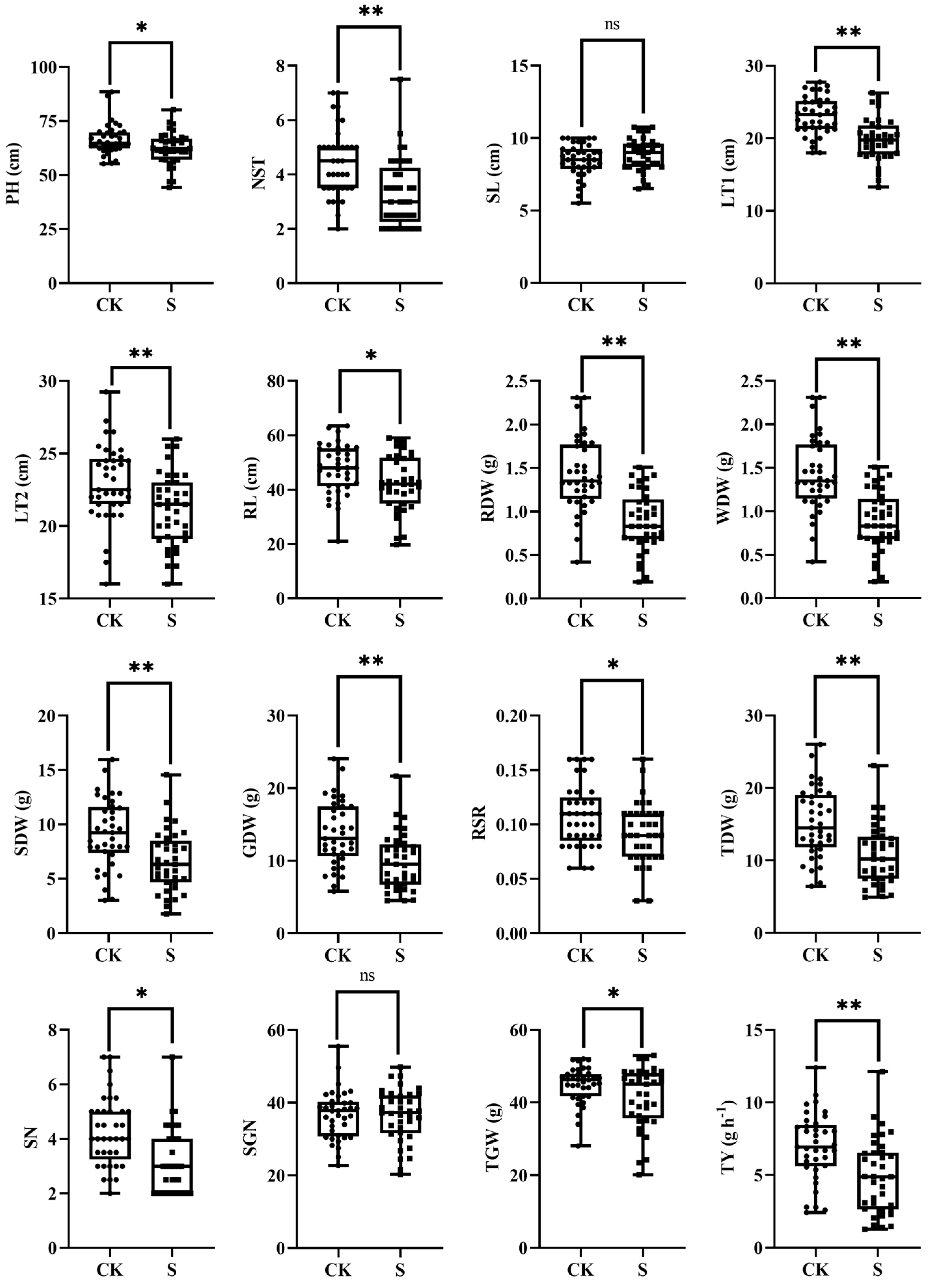
| Character | CK Trait | S Trait | ||||||||
|---|---|---|---|---|---|---|---|---|---|---|
| Mean | SD | Min | Max | CV (%) | Mean | SD | Min | Max | CV (%) | |
| PH | 66.5 | 7.09 | 88.5 | 55.3 | 10.7 | 62.3 | 7.66 | 80.3 | 44.3 | 12.3 |
| NST | 4.43 | 1.24 | 7.00 | 2.00 | 28.0 | 3.30 | 1.26 | 7.50 | 2.00 | 38.1 |
| SL | 8.47 | 1.13 | 10.0 | 5.50 | 13.3 | 8.86 | 1.11 | 10.8 | 6.50 | 12.5 |
| LT1 | 23.1 | 2.63 | 27.8 | 18.0 | 11.4 | 19.9 | 3.09 | 26.3 | 13.3 | 15.5 |
| LT2 | 23.0 | 2.66 | 29.3 | 16.0 | 12.0 | 21.2 | 2.49 | 26.0 | 16.00 | 11.8 |
| RL | 47.4 | 9.28 | 63.5 | 21.0 | 19.6 | 42.2 | 10.2 | 59.0 | 19.8 | 24.1 |
| RDW | 1.42 | 0.42 | 2.31 | 0.42 | 29.7 | 0.89 | 0.34 | 1.51 | 0.19 | 38.4 |
| WDW | 4.59 | 1.53 | 8.54 | 2.48 | 33.4 | 3.24 | 1.26 | 7.11 | 1.45 | 38.8 |
| SDW | 9.16 | 3.17 | 16.0 | 3.02 | 34.6 | 6.62 | 2.81 | 14.6 | 1.78 | 42.4 |
| GDW | 13.8 | 4.49 | 24.1 | 5.79 | 32.6 | 9.86 | 3.86 | 21.7 | 4.52 | 39.2 |
| RSR | 0.11 | 0.03 | 0.16 | 0.06 | 26.2 | 0.09 | 0.03 | 0.16 | 0.03 | 30.1 |
| TDW | 15.2 | 4.77 | 26.0 | 6.46 | 31.4 | 10.7 | 4.13 | 23.1 | 4.93 | 38.4 |
| SN | 4.26 | 1.25 | 7.00 | 2.00 | 29.4 | 3.14 | 1.21 | 7.00 | 2.00 | 38.6 |
| SGN | 36.6 | 6.66 | 55.5 | 22.8 | 18.2 | 36.5 | 7.28 | 49.8 | 20.3 | 20.0 |
| TGW | 45.0 | 5.10 | 52.1 | 28.1 | 11.3 | 41.5 | 8.33 | 53.0 | 20.1 | 20.1 |
| TY | 6.96 | 2.33 | 12.4 | 2.43 | 33.5 | 4.90 | 2.55 | 12.1 | 1.27 | 52.0 |
| Traits | Comprehensive Indexes | ||||
|---|---|---|---|---|---|
| F1 | F2 | F3 | F4 | F5 | |
| TDW | 0.972 | −0.081 | 0.022 | 0.016 | 0.170 |
| GDW | 0.966 | −0.134 | 0.031 | −0.059 | 0.161 |
| SDW | 0.850 | −0.274 | −0.038 | −0.123 | 0.348 |
| WDW | 0.822 | 0.188 | 0.111 | 0.104 | −0.293 |
| SN | 0.796 | 0.179 | −0.372 | 0.050 | −0.205 |
| NST | 0.697 | 0.385 | −0.326 | −0.159 | −0.189 |
| LT1 | −0.152 | 0.659 | −0.172 | −0.411 | 0.355 |
| LT2 | −0.045 | 0.620 | 0.071 | −0.532 | 0.371 |
| SL | −0.229 | 0.514 | 0.419 | −0.307 | −0.317 |
| PH | 0.421 | 0.286 | 0.625 | −0.018 | −0.190 |
| SGN | 0.003 | −0.470 | 0.616 | −0.022 | 0.120 |
| RL | 0.264 | 0.286 | 0.584 | 0.109 | −0.348 |
| RDW | 0.379 | 0.537 | −0.080 | 0.690 | 0.133 |
| RSR | −0.564 | 0.513 | −0.106 | 0.590 | 0.049 |
| TGW | 0.087 | 0.142 | 0.435 | 0.292 | 0.761 |
| EV | 5.19 | 2.35 | 1.787 | 1.53 | 1.47 |
| Weight (%) | 42.1 | 19.1 | 14.5 | 12.4 | 12.0 |
| CR (%) | 34.6 | 15.7 | 11.9 | 10.2 | 9.82 |
| CCR (%) | 34.6 | 50.3 | 62.2 | 72.4 | 82.2 |
| Number | Comprehensive Index | Membership Function | D Value | ||||||||
|---|---|---|---|---|---|---|---|---|---|---|---|
| x1 | x2 | x3 | x4 | x5 | μ1 | μ2 | μ3 | μ4 | μ5 | ||
| 1 | 0.14 | 1.38 | −2.68 | −0.21 | 0.77 | 0.70 | 0.85 | 0.00 | 0.46 | 0.71 | 0.60 |
| 2 | 0.60 | −2.37 | −1.90 | −2.04 | 1.24 | 0.81 | 0.00 | 0.15 | 0.04 | 0.81 | 0.47 |
| 3 | 0.64 | 0.11 | −0.94 | −0.81 | 0.47 | 0.82 | 0.56 | 0.34 | 0.32 | 0.65 | 0.62 |
| 4 | −0.08 | 1.46 | 1.90 | −2.23 | −2.28 | 0.65 | 0.86 | 0.88 | 0.00 | 0.09 | 0.58 |
| 5 | 0.35 | 2.07 | −1.43 | −0.51 | 0.36 | 0.75 | 1.00 | 0.24 | 0.39 | 0.63 | 0.67 |
| 6 | 1.35 | 0.65 | −0.73 | 0.19 | 0.76 | 1.00 | 0.68 | 0.38 | 0.55 | 0.71 | 0.76 |
| 7 | 0.84 | 0.41 | 2.51 | −0.51 | 1.05 | 0.87 | 0.63 | 1.00 | 0.39 | 0.77 | 0.77 |
| 8 | 0.82 | 0.51 | 0.60 | −0.72 | −0.81 | 0.87 | 0.65 | 0.63 | 0.34 | 0.39 | 0.67 |
| 9 | 0.55 | −0.90 | −0.18 | −1.05 | −0.89 | 0.80 | 0.33 | 0.48 | 0.27 | 0.37 | 0.55 |
| 10 | 1.16 | 0.93 | 0.35 | −0.21 | 0.37 | 0.95 | 0.74 | 0.58 | 0.46 | 0.63 | 0.76 |
| 11 | 1.02 | 0.50 | 0.69 | −0.74 | 0.24 | 0.92 | 0.65 | 0.65 | 0.34 | 0.60 | 0.72 |
| 12 | 0.67 | −1.30 | −0.31 | −0.25 | −0.98 | 0.83 | 0.24 | 0.46 | 0.45 | 0.36 | 0.56 |
| 13 | 0.57 | −0.17 | −0.10 | 0.05 | −0.33 | 0.81 | 0.50 | 0.50 | 0.51 | 0.49 | 0.63 |
| 14 | −0.57 | −0.33 | 1.92 | −0.72 | 2.19 | 0.53 | 0.46 | 0.89 | 0.34 | 1.00 | 0.60 |
| 15 | 1.18 | −0.14 | −0.46 | 0.40 | 0.06 | 0.96 | 0.50 | 0.43 | 0.59 | 0.57 | 0.70 |
| 16 | 0.59 | 0.95 | −0.34 | −0.13 | 0.84 | 0.81 | 0.75 | 0.45 | 0.47 | 0.73 | 0.70 |
| 17 | 1.22 | −1.08 | 0.22 | 0.45 | 0.79 | 0.97 | 0.29 | 0.56 | 0.61 | 0.72 | 0.70 |
| 18 | −2.71 | −1.54 | −0.72 | −0.57 | 0.36 | 0.00 | 0.19 | 0.38 | 0.37 | 0.63 | 0.21 |
| 19 | 0.92 | −0.64 | 0.11 | 0.90 | −0.03 | 0.89 | 0.39 | 0.54 | 0.71 | 0.55 | 0.68 |
| 20 | −1.36 | 1.20 | 0.35 | −0.73 | −0.55 | 0.33 | 0.80 | 0.58 | 0.34 | 0.44 | 0.47 |
| 21 | −1.01 | 0.46 | −0.82 | −0.39 | −2.01 | 0.42 | 0.64 | 0.36 | 0.42 | 0.15 | 0.42 |
| 22 | 0.10 | −0.81 | 0.42 | 0.49 | −0.10 | 0.69 | 0.35 | 0.60 | 0.61 | 0.53 | 0.58 |
| 23 | −0.21 | −0.59 | −0.13 | 1.68 | −0.36 | 0.61 | 0.40 | 0.49 | 0.88 | 0.48 | 0.57 |
| 24 | −0.43 | −0.03 | −0.78 | 0.08 | −2.73 | 0.56 | 0.53 | 0.37 | 0.52 | 0.00 | 0.45 |
| 25 | 0.30 | −0.38 | −0.08 | 2.19 | −0.95 | 0.74 | 0.45 | 0.50 | 1.00 | 0.36 | 0.64 |
| 26 | 0.32 | 0.55 | −0.17 | 0.84 | −0.07 | 0.75 | 0.66 | 0.48 | 0.69 | 0.54 | 0.66 |
| 27 | 0.13 | 0.21 | 0.21 | −0.04 | −0.17 | 0.70 | 0.58 | 0.56 | 0.49 | 0.52 | 0.61 |
| 28 | −1.77 | 1.66 | 0.08 | 0.53 | 1.49 | 0.23 | 0.91 | 0.53 | 0.62 | 0.86 | 0.53 |
| 29 | −0.52 | 0.32 | −1.20 | 0.83 | 0.35 | 0.54 | 0.61 | 0.29 | 0.69 | 0.63 | 0.54 |
| 30 | −1.48 | 0.13 | 0.64 | 0.61 | 1.24 | 0.30 | 0.56 | 0.64 | 0.64 | 0.81 | 0.50 |
| 31 | 1.00 | −0.15 | 0.41 | 1.10 | −0.59 | 0.91 | 0.50 | 0.60 | 0.75 | 0.44 | 0.71 |
| 32 | −0.81 | −0.41 | −0.26 | −0.18 | 0.27 | 0.47 | 0.44 | 0.47 | 0.46 | 0.61 | 0.48 |
| 33 | 0.13 | −1.09 | 0.66 | 1.75 | −0.03 | 0.70 | 0.29 | 0.64 | 0.90 | 0.55 | 0.62 |
| 34 | −2.15 | −0.43 | 0.41 | 1.07 | −0.47 | 0.14 | 0.44 | 0.60 | 0.75 | 0.46 | 0.37 |
| 35 | −0.68 | 1.36 | 0.29 | 0.81 | 0.49 | 0.50 | 0.84 | 0.57 | 0.69 | 0.65 | 0.62 |
| 36 | −0.98 | −1.38 | 0.16 | −2.14 | 0.21 | 0.42 | 0.22 | 0.55 | 0.02 | 0.60 | 0.37 |
| 37 | 0.19 | −1.12 | 1.30 | 0.22 | −0.20 | 0.71 | 0.28 | 0.77 | 0.55 | 0.51 | 0.60 |
| Varieties | Primary Value | Regression | Difference | Evaluation Accuracy (%) |
|---|---|---|---|---|
| Yangmai 25 | 0.62 | 0.60 | 0.02 | 96.06 |
| Yangmai 20 | 0.48 | 0.47 | 0.01 | 97.42 |
| Yangmai 18 | 0.63 | 0.62 | 0.01 | 98.69 |
| Zhenmai 12 | 0.55 | 0.58 | −0.03 | 94.93 |
| Huamai 33 | 0.67 | 0.67 | 0.00 | 99.28 |
| Huamai 8 | 0.75 | 0.76 | −0.01 | 98.50 |
| Yangfumai 8 | 0.77 | 0.77 | 0.00 | 99.92 |
| Luomai 163 | 0.65 | 0.67 | −0.02 | 97.23 |
| Yangfumai 9 | 0.54 | 0.55 | −0.01 | 98.26 |
| Zhongkenmai 212 | 0.73 | 0.76 | −0.03 | 95.54 |
| Yangmai 21 | 0.71 | 0.72 | −0.01 | 98.44 |
| Suyanmai 017 | 0.57 | 0.56 | 0.01 | 98.25 |
| Sukenmai 1008 | 0.62 | 0.63 | −0.01 | 98.67 |
| Yangmai 4 | 0.59 | 0.60 | −0.01 | 98.01 |
| Yangfumai 5145 | 0.69 | 0.70 | −0.01 | 98.01 |
| Yangmai 5 | 0.67 | 0.70 | −0.03 | 96.06 |
| Yangmai 16 | 0.73 | 0.70 | 0.02 | 96.76 |
| Yangmai 22 | 0.20 | 0.21 | −0.01 | 94.05 |
| Yangmai 28 | 0.69 | 0.68 | 0.01 | 98.94 |
| Yangmai 15 | 0.47 | 0.47 | 0.00 | 99.82 |
| Ningmaizi 166 | 0.42 | 0.42 | 0.00 | 99.47 |
| Nongmai 152 | 0.56 | 0.58 | −0.03 | 95.55 |
| Yangmai 1 | 0.56 | 0.57 | −0.01 | 98.37 |
| Shanrong 3 | 0.45 | 0.45 | 0.00 | 99.75 |
| Huaimai 46 | 0.65 | 0.64 | 0.02 | 97.58 |
| Xumai 2023 | 0.69 | 0.66 | 0.03 | 95.90 |
| Qianmai 088 | 0.59 | 0.61 | −0.02 | 96.91 |
| Yangfumai 10 | 0.53 | 0.53 | 0.00 | 99.84 |
| Xumai 38 | 0.55 | 0.54 | 0.01 | 98.71 |
| Nongmai 126 | 0.51 | 0.50 | 0.01 | 98.44 |
| Ruihuamai 521 | 0.72 | 0.71 | 0.01 | 98.22 |
| Xumai 178 | 0.51 | 0.48 | 0.03 | 93.36 |
| Ruihua 518 | 0.65 | 0.62 | 0.03 | 95.77 |
| Nongmai 158 | 0.37 | 0.37 | 0.00 | 99.54 |
| Huamai 1430 | 0.59 | 0.62 | −0.03 | 95.56 |
| Yangmai 23 | 0.40 | 0.37 | 0.02 | 94.66 |
| Huaihemai 16132 | 0.60 | 0.60 | 0.01 | 98.67 |
| Cultivar | Treatment (mM NaCl) | Pn mmol CO2 m−2 s−2 | SOD U g−1 FW | POD U g−1 FW | CAT U g−1 FW | MDA nmol g−1 FW | Pro mg g−1 FW |
|---|---|---|---|---|---|---|---|
| Yangfumai 8 | 0 | 18.9 a | 1616.0 a | 472.7 a | 63.3 a | 25.9 c | 152.3 c |
| 34.2 | 15.5 b | 1811.7 b | 385.7 b | 68.7 b | 33.1 b | 279.7 b | |
| 68.4 | 12.0 c | 1259.3 c | 290.0 c | 43.6 c | 45.9 a | 352.0 a | |
| Yangmai 22 | 0 | 16.8 a | 1438.7 a | 490.0 a | 54.7 a | 24.8 c | 150.7 c |
| 34.2 | 13.5 b | 1050.0 b | 357.3 b | 37.3 b | 45.4 b | 250.0 b | |
| 68.4 | 7.80 c | 440.7 c | 261.3 c | 25.0 c | 63.1 a | 291.3 a | |
| Significance of factors | |||||||
| Cultivar | ** | ** | NS | ** | ** | ** | |
| Treatment | ** | ** | ** | ** | ** | ** | |
| Cultivar × treatment | ** | ** | NS | ** | ** | ** |
| Cultivar | Treatment (mM NaCl) | Spike Number (pot−1) | Number of Grains per Spike | Kernel Weight (mg) | Actual Yield (g pot−1) |
|---|---|---|---|---|---|
| Yangfumai 8 | 0 | 43.3 a | 45.3 a | 44.6 a | 86.9 a |
| 34.2 | 41.9 a | 42.1 b | 41.0 b | 76.6 b | |
| 68.4 | 38.0 b | 40.8 b | 38.2 c | 59.3 c | |
| Yangmai 22 | 0 | 38.0 a | 46.3 a | 41.1 a | 72.3 b |
| 34.2 | 24.7 b | 34.7 b | 32.7 b | 28.0 d | |
| 68.4 | 14.3 c | 18.8 c | 30.3 c | 8.16 e | |
| Significance of factors | |||||
| Cultivar | ** | ** | ** | ** | |
| Treatment | ** | ** | ** | ** | |
| Cultivar × treatment | ** | ** | ** | ** |
Disclaimer/Publisher’s Note: The statements, opinions and data contained in all publications are solely those of the individual author(s) and contributor(s) and not of MDPI and/or the editor(s). MDPI and/or the editor(s) disclaim responsibility for any injury to people or property resulting from any ideas, methods, instructions or products referred to in the content. |
© 2026 by the authors. Licensee MDPI, Basel, Switzerland. This article is an open access article distributed under the terms and conditions of the Creative Commons Attribution (CC BY) license.
Share and Cite
Li, R.; Wei, R.; Liu, Y.; Zhao, H.; Liu, Z.; Liu, J.; Wei, H.; Gao, P.; Dai, Q.; Chen, Y. Hydroponic Screening and Comprehensive Evaluation System for Salt Tolerance in Wheat Under Full-Fertility-Cycle Salt Stress Conditions. Agronomy 2026, 16, 227. https://doi.org/10.3390/agronomy16020227
Li R, Wei R, Liu Y, Zhao H, Liu Z, Liu J, Wei H, Gao P, Dai Q, Chen Y. Hydroponic Screening and Comprehensive Evaluation System for Salt Tolerance in Wheat Under Full-Fertility-Cycle Salt Stress Conditions. Agronomy. 2026; 16(2):227. https://doi.org/10.3390/agronomy16020227
Chicago/Turabian StyleLi, Rongkai, Renyuan Wei, Yang Liu, Huimin Zhao, Zhibo Liu, Juge Liu, Huanhe Wei, Pinglei Gao, Qigen Dai, and Yinglong Chen. 2026. "Hydroponic Screening and Comprehensive Evaluation System for Salt Tolerance in Wheat Under Full-Fertility-Cycle Salt Stress Conditions" Agronomy 16, no. 2: 227. https://doi.org/10.3390/agronomy16020227
APA StyleLi, R., Wei, R., Liu, Y., Zhao, H., Liu, Z., Liu, J., Wei, H., Gao, P., Dai, Q., & Chen, Y. (2026). Hydroponic Screening and Comprehensive Evaluation System for Salt Tolerance in Wheat Under Full-Fertility-Cycle Salt Stress Conditions. Agronomy, 16(2), 227. https://doi.org/10.3390/agronomy16020227