


Abstract
Dynamic network conditions in precision agriculture motivate a scalable, privacypreserving federated learning architecture that tightly integrates ground-based edge intelligence
with a space-assisted hierarchical aggregation layer. In Phase 1, heterogeneous tractors act as intelligent farm nodes that train local models, form capability- and task-aware clusters, and employ Network Quality Index (NQI)-driven scheduling, similarity-based checkpointing, and compressed transmissions to cope with highly variable 3G/4G/5G connectivity. In Phase 2, cluster drivers synchronize with Low Earth Orbit (LEO) and Geostationary Earth Orbit (GEO) satellites that perform regional and global aggregation using staleness- and fairness-aware weighting, while end-to-end Salsa20 + MAC encryption preserves the confidentiality and integrity of all model updates. Across two representative tasks—nutrient prediction and crop health assessment—our full hierarchical system matches or exceeds centralized performance (e.g., AUC 0.92 vs. 0.91 for crop health) while reducing uplink traffic by ∼90% relative to vanilla FedAvg and cutting the communication energy proxy by more than 4×. The proposed fairness-aware GEO aggregation substantially narrows regional performance gaps (standard deviation of AUC across regions reduced from 0.058 to 0.017) and delivers the largest gains in low-connectivity areas (AUC 0.74 → 0.88). These results demonstrate that coupling on-farm intelligence with
multi-orbit federated aggregation enables near-centralized model quality, strong privacy guarantees, and communication efficiency suitable for large-scale, connectivity-challenged agricultural deployments.
1. Introduction
Dynamic, heterogeneous network conditions are now a central bottleneck in scaling digital agriculture, especially as farms are pushed to produce more with fewer resources under tightening environmental constraints. The Food and Agriculture Organization (FAO) projects that global food production must increase substantially by 2050 while simultaneously reducing environmental impact, driving the demand for fine-grained, data-driven decision-making in the field [1]. Precision agriculture operationalizes this vision by tailoring inputs such as fertilizer, irrigation, and crop protection to spatial and temporal variability within and across fields [2]. However, realizing precision agriculture at scale requires continuously learning models from diverse, distributed sensor streams across many farms, which are often located in rural regions where connectivity is intermittent and infrastructure is sparse.
Over the past decade, machine learning and deep learning have shown considerable promise for yield prediction, soil and nutrient modeling, crop health monitoring, and management-zone delineation [3,4]. These approaches are increasingly reliant on heterogeneous data from on-board sensors, satellites, unmanned aerial vehicles (UAVs), and farm machinery, and they demand low-latency feedback to be actionable during narrow agronomic windows. Yet the most informative data in precision agriculture are often siloed on tractors, implements, and local farm servers, governed by strict privacy, regulatory, and commercial constraints. Centralizing these data in the cloud is frequently infeasible or undesirable due to limited rural backhaul, high bandwidth costs, and the sensitivity of agronomic and yield data, which can reveal proprietary management practices and economic performance [5,6].
Federated learning (FL) offers a compelling alternative by enabling collaborative model training across many data owners without sharing raw data [7]. In FL, edge clients train local models and periodically upload updates to one or more aggregators, which compute a global model and redistribute it for further refinement. A great deal of the emerging literature has focused on improving FL optimization under data heterogeneity (e.g., FedProx [8], SCAFFOLD [9], FedNova [10]) and on reducing communication with quantization and sparse participation (e.g., FedPAQ [11]). However, most existing designs implicitly assume relatively stable, high-quality connectivity (e.g., smartphones on WiFi or 4G), modest scale, and a single terrestrial aggregation tier. These assumptions break down in large, geographically dispersed farms where tractors may move in and out of coverage, switch between 3G/4G/5G, or rely on costly backhaul links, and where long training horizons must coexist with strict operational constraints.
Communication-efficient distributed learning has attacked bandwidth bottlenecks using aggressive gradient compression and sparsification, including deep gradient compression [12], stochastic quantization (QSGD) [13], and Top-k or threshold-based sparse communication [14]. Post-training low-bit quantization has further enabled compact deployment of models on embedded hardware [15]. While these techniques translate naturally to FL, they are typically evaluated in datacenter-like or smartphone settings, and are rarely co-designed with explicit models of dynamic rural network quality, contact windows, or multi-hop edge-to-space routing. As a result, they leave a substantial performance gap in regimes where link availability, latency, and bandwidth fluctuate on the timescale of individual training rounds.
In parallel, the wireless and networking communities have begun to study FL over bandwidth-limited and fading channels, including over-the-air and analog aggregation schemes that exploit the superposition property of the wireless medium [16]. At the same time, standardization bodies and industry have accelerated the integration of non-terrestrial networks (NTNs) into 5G and beyond, with Low Earth Orbit (LEO) and Geostationary Earth Orbit (GEO) satellites envisioned as integral parts of future broadband and IoT infrastructure [17]. LEO mega-constellations promise near-global coverage and reduced latency by deploying hundreds to thousands of satellites in low orbits [18]. These developments are particularly attractive for agriculture, where satellite connectivity can bridge coverage gaps, backhaul data from remote fields, and enable continuous operation during key agronomic windows. Yet, to date, there is limited work that tightly couples FL with a multi-orbit satellite hierarchy tailored to the needs of precision agriculture and its extreme heterogeneity in both data and connectivity.
Fairness and robustness are emerging concerns in FL, especially when clients differ substantially in terms of data quantity, data quality, and network conditions [6]. Naively optimizing a single global objective can systematically favor well-connected, data-rich clients and degrade performance for under-represented or connectivity-poor participants. Agnostic FL [19] and fairness-aware methods such as q-FFL [20] explicitly adjust the optimization objective to improve worst-case or distributionally robust performance, but they typically assume a single aggregation tier and do not account for systematic, topology-induced staleness arising from orbital dynamics or intermittent terrestrial coverage. Moreover, most existing fairness formulations operate at the level of individual devices rather than regions, whereas agricultural deployments must balance performance across entire agro-climatic zones that may differ dramatically in connectivity, farm size, and crop mix.
Finally, security and privacy remain non-negotiable in agricultural deployments. FL frameworks for sensitive domains commonly rely on modern symmetric cryptography, secure aggregation, and message authentication to prevent eavesdropping and tampering [5]. Stream ciphers such as Salsa20 provide high-throughput, software-friendly encryption with strong security margins, making them attractive for resource-constrained edge devices and satellite links alike [21]. However, the interplay between cryptographic protection, hierarchical aggregation, and dynamic connectivity—spanning tractors, cluster heads, LEO satellites, and GEO hubs—has not been systematically explored in the context of large-scale agricultural FL. More related works are extended in Appendix A.
Against this backdrop, we propose a scalable, privacy-preserving federated learning architecture explicitly designed for precision agriculture operating under highly dynamic, heterogeneous network conditions. Our system tightly couples (i) ground-based intelligent farm nodes, where tractors act as edge clients that form clusters and perform network-quality-aware, similarity-gated communication; with (ii) a space-assisted hierarchical aggregation fabric, where LEO satellites perform regional aggregation and a GEO satellite performs staleness- and fairness-aware global aggregation over asynchronous regional models. Building on ideas from communication-efficient distributed learning [12,13,14,15], wireless FL [16], fairness-aware FL [6,19,20], and emerging non-terrestrial 5G architectures [17,18], the proposed design is tailored to the unique constraints of precision agriculture: highly mobile and resource-constrained tractors, intermittent 3G/4G/5G coverage, satellite contact windows, region-level fairness, and strong end-to-end security. As our experimental evaluation shows, this co-designed ground–space hierarchy can approach centralized performance while reducing uplink communication by an order of magnitude and substantially improving performance in connectivity-poor regions.
- Scientific Contributions and Novelty:
We present a deployable ground–space federated learning (FL) fabric for precision agriculture under highly dynamic rural connectivity. Our contributions are as follows:
- Connectivity-aware FL control at tractors: We couple a normalized Network Quality Index (NQI) with similarity-based checkpointing to decide whether to transmit and how to encode updates (full vs. chunked vs. compressed), maximizing value-per-bit under intermittent 3G/4G/5G.
- Orbit-aware hierarchical aggregation across LEO and GEO: We design a three-tier aggregation pipeline (drivers → LEO → GEO) with explicit staleness-aware weighting to handle orbit-induced asynchrony and buffering.
- Region-level fairness for connectivity-disadvantaged areas: At GEO, we introduce a region-level weighting scheme that compensates for systematic connectivity losses, improving the worst-region performance and reducing inter-regional disparity.
- An end-to-end secure protocol with an explicit threat model: We provide a concrete encryption + authentication design (Salsa20-family AEAD) with nonce/counter-based replay resistance suitable for multi-hop tractor–satellite links.
- Attribution via ablations and system metrics: We report accuracy, communication bytes, staleness distributions, and fairness metrics, and we perform ablations to isolate the effect of NQI gating, checkpointing, compression, hierarchy, and fairness weighting.
2. Materials and Methods
This section presents the complete architecture of the proposed scalable federated learning system over dynamic network conditions for precision agriculture Figure 1. The architecture is organized into two tightly coupled phases:
Figure 1.
The end-to-end flow represents the system from local data collection to model prediction on edge nodes or tractors. Each step is described in detail in the following sections.
- Phase 1: Ground-Based Intelligent Farm Nodes—tractors act as edge devices that train local models, form clusters, and perform hierarchical aggregation over terrestrial networks.
- Phase 2: Space-Assisted Hierarchical Federated Learning—cluster drivers communicate with Low Earth Orbit (LEO) and Geostationary Earth Orbit (GEO) satellites that provide regional and global aggregation, ensuring scalability and connectivity beyond terrestrial coverage.
Together, these phases enable privacy-preserving, scalable, and robust collaborative learning across geographically dispersed farms.
2.1. Phase 1—Ground-Based Intelligent Farm Node
Phase 1 focuses on how tractors, treated as intelligent edge nodes, collaborate using federated learning under heterogeneous computation and connectivity conditions. The goal is to leverage on-device learning while preserving data privacy and efficiently utilizing limited bandwidth and energy resources.
2.1.1. High-Level Ground Framework Overview
The central idea of the ground framework is to decentralize learning across tractors equipped with heterogeneous sensors (e.g., nutrient and crop-health sensors). Each tractor trains a lightweight model locally using its own data and only transmits encrypted model updates rather than raw sensor readings. This design
- Preserves privacy by keeping raw data on-device.
- Reduces bandwidth consumption by communicating only model updates.
- Supports scalability by enabling many tractors to participate asynchronously.
2.1.2. Edge-Level Learning Life Cycle
Each tractor participates in the federated learning process through a repeated four-phase life cycle: Training, Dispatch and Protection, Network-Aware Transmission, and Receiving and Local Adaptation. This subsection describes these phases end-to-end.
- (1)
- Training Phase
At the beginning of each global round, the server (utilizing remote server for base model deployment) broadcasts base model weights to all tractors. Each tractor i then performs local training overnight using its own dataset , minimizing a local loss function :
where is the learning rate and is the local gradient.
This overnight training exploits idle compute capacity without disrupting regular farming operations. The trained model is then used to generate actionable predictions for the next day, such as optimal fertilizer and pesticide schedules:
where N and H denote nutrient and crop-health sensor data, C describes crop conditions, and T captures environmental parameters.
- (2)
- Dispatch and Secure Protection Phase
After local training, each tractor constructs a compact payload containing only the essential information required for collaborative learning Figure 2:
where:
Figure 2.
Tractors are grouped into clusters according to both geographic closeness and their assigned task category. Within each cluster, the node with the highest capability score is appointed as the driver.
- is the Consumption Ability Score (computational and energy capacity).
- M is the Alpha Schema-Based Score indicating model/sensor type.
- encodes geolocation coordinates.
- denotes the local model weight updates.
To guarantee confidentiality, is encrypted using the Salsa20 stream cipher:
where K is a shared symmetric key and N is a unique nonce for each transmission. Before transmitting, each edge device checks whether its update is sufficiently different from the previous one (via cosine similarity), avoiding redundant communication.
To consolidate these steps, Algorithm 1 summarizes the complete behavior of each tractor in a single round.
| Algorithm 1 Edge Node Round: Train, Gate, Protect, and Dispatch |
| Require: Previous global weights ; local data ; thresholds ; network type ; symmetric key K |
| Ensure: Encrypted record sent to driver/LEO, or skip |
|
- (3)
- Network-Aware Transmission Phase
Because rural connectivity can fluctuate rapidly (e.g., tractors moving between coverage zones or experiencing transient congestion), we adapt uplink behavior using a Network Quality Index (NQI) that is computed locally on each tractor. To make NQI values comparable across devices, carriers, and radio configurations, we first normalize the raw link indicators signal strength S, available bandwidth B, and latency L to :
We then define
where and , so the weights are directly interpretable as the relative importance of signal quality, throughput, and delay.
NQI is used jointly with our Checkpointer module, which measures the information content of successive model updates via cosine similarity (Algorithm 1). A tractor initiates transmission only when (i) the Checkpointer flags the update as non-redundant and (ii) the computed NQI exceeds a minimum threshold. This coupling ensures that scarce uplink resources are reserved for updates that are both informative and worth sending under current network conditions.
As illustrated in Figure 3, the output of the Checkpointer and NQI modules feeds into one of three LEO Transmission pipelines:
Figure 3.
Micro-architecture of the edge-to-LEO uplink. Each tractor first applies similarity-based checkpointing and computes the Network Quality Index (NQI). Based on these signals, one of three LEO Transmission pipelines is selected: proximity-driven compressed uplink (Proximity Driver, 4-bit quantization, Top-k sparsification), scheduled and chunked uplink with staleness tagging (Scheduler, Chunking, Tag Staleness), or a fallback path that can skip or downscale transmissions (Fallback Skipper, Quantization, Proximity Checker).
- Proximity-driven compressed uplink: a Proximity Driver selects the best visible LEO satellite; model updates are then aggressively compressed using 4-bit quantization [15] and Top-k sparsification [22]. This pipeline is preferred in low-to-medium NQI regimes where bandwidth is scarce.
- Scheduled, chunked uplink with staleness tagging: a Scheduler [23] spreads transmissions over time windows to avoid congestion; large models are split via Chunking, and each chunk is annotated with Tag Staleness metadata (local round index and timestamp). These tags are later consumed in the LEO/GEO aggregation (Section 2.2) when computing staleness-aware weights.
- Fallback uplink with skipping: when NQI is poor or repeated similarity checks indicate highly redundant updates, a Fallback Skipper can skip or coalesce transmissions. A lighter-weight Quantization [24] stage and a Proximity Checker ensure that, if a transmission is still attempted, it is routed to the nearest viable LEO satellite with minimal overhead.
These three pipelines implement the policy described in Algorithm 1: in the 3G case, only compressed deltas or chunks are transmitted; in 4G, checkpointed partial updates are scheduled; in 5G, full models can be sent with milder quantization. If no direct network access is available, the tractor can forward its payload to a high-NQI neighbor within the cluster, which then executes the appropriate LEO Transmission pipeline on its behalf.
- (4)
- Receiving and Local Adaptation Phase
When a tractor receives new model updates from the global server or its cluster driver, it integrates them into its local model. If an update is missed, the node continues using its last known model and requests retransmission when connectivity improves. The system can also recommend parking locations and time windows with better connectivity:
where is the time since the last successful update and is a policy-defined maximum interval.
2.1.3. Determining NQI Weights via Validation-Based Tuning
The weights control transmission decisions and therefore should reflect the dominant bottlenecks of a deployment (e.g., bandwidth-limited vs. latency-limited regimes). We select weights using a lightweight validation procedure on held-out network traces.
Optimization Objective
Given a candidate weight vector , we run the transmission policy over a validation trace and compute the following: (i) The update failure rate (fraction of attempted updates that miss a deadline or fail delivery). (ii) The mean end-to-end latency for successful updates, and (iii) mean uplink bytes . We choose w by minimizing a deployment-relevant objective:
where and balances reliability vs. latency.
Search Procedure
We use a simple grid search over with step size 0.05 (231 candidates). This is inexpensive (minutes in our simulator) and reproducible. The selected are then fixed for the corresponding scenario in all reported experiments unless otherwise stated.
2.1.4. Cluster Formation and Driver Node Election
To reduce communication overhead and improve learning efficiency, tractors are grouped into clusters Figure 4. Each cluster
Figure 4.
Overview of ground-level coordination: tractors transmit information to their respective cluster driver nodes, which then synchronize with the global server for higher-level aggregation. Different colors denote distinct machine learning objectives.
- Focuses on a single task type (e.g., nutrient prediction or crop health analysis).
- Maintains spatial proximity to ensure feasible networking.
- Elects a driver node that acts as a local aggregator and communication leader.
Task homogeneity is enforced using the Alpha Schema-Based Score M, while hardware capability is captured by the Consumption Ability Score :
where , , , and denote normalized computational power, energy efficiency, latency, and concurrency, respectively. Within each cluster, the node with the highest becomes the driver.
Algorithm 2 formalizes cluster construction using geolocation and model type, followed by driver election based on .
| Algorithm 2 Initial cluster formation and driver election |
| Require: Reports ; radius r; Haversine distance |
| Ensure: Clusters with elected driver per cluster |
|
2.1.5. Aggregation and Checkpointing Mechanisms
Within each cluster, the driver node aggregates the updates from its member tractors using Federated Averaging (FedAvg):
where N is the number of tractors in that cluster. The driver then forwards the cluster-level model to the global server, which aggregates across all clusters:
where K is the number of clusters.
Before each upload, a cosine similarity check is performed to suppress redundant transmissions:
If similarity exceeds a predefined threshold, the upload is skipped to conserve energy and bandwidth.
2.1.6. Health Verification and Driver Failover
Cluster drivers are continuously monitored. If a driver fails or becomes inactive (e.g., due to hardware or network issues), the global server triggers a re-election procedure in the affected cluster using the same -based criterion. This ensures fault tolerance and maintains continuity of the learning process without manual intervention.
2.1.7. Security and Privacy Mechanisms (Ground Layer)
All ground-layer communications (tractor ↔ driver ↔ satellites) are protected using Salsa20 encryption [21] with unique nonces and message authentication codes (MACs). This provides:
- Confidentiality: model updates cannot be inspected by adversaries.
- Integrity: tampered messages are detected via MACs.
- Authentication: only authorized tractors, drivers, and servers participate.
Crucially, raw sensor data never leaves the tractors; only processed model updates are shared, reinforcing privacy by design.
2.1.8. Security Model, Key Management, and Threat Assumptions
We consider an adversary that can eavesdrop on wireless links (tractor↔driver, driver↔LEO, LEO↔GEO), inject or modify packets, and replay previously observed transmissions. We also consider device compromise as a bounded event (e.g., a small number of tractors may be compromised). Unless explicitly stated otherwise, we assume satellite and driver nodes are authenticated infrastructure components and operate in an honest-but-curious manner: they follow the protocol but may attempt to inspect traffic if it is not cryptographically protected.
Security Goals
Our immediate goals are confidentiality of model updates and metadata in transit, integrity/authentication of messages across all hops, and replay resistance under intermittent connectivity and buffering. We do not claim that transport encryption alone prevents higher-layer attacks such as model poisoning; we discuss this explicitly in the Limitations Section.
Key Hierarchy and Distribution
Each tractor i is provisioned (at manufacturing time or enrollment time) with a long-term secret shared with the trust anchor (e.g., the global coordinator or key management service). For each communication epoch e (e.g., per day or per R global rounds), tractor i derives short-lived session keys using a key-derivation function (KDF):
where denotes the next-hop endpoint (or logical security domain). Keys are rotated by incrementing e, limiting the blast radius of compromise and reducing long-term key reuse. Driver and satellite nodes analogously derive per-link or per-epoch keys from their own provisioned credentials.
Message Format and Replay Protection
Each transmitted record includes a unique nonce and freshness metadata:
where is the local/global round index, is a monotonic counter maintained per sender–receiver key epoch, and is unique per message. We encrypt using Salsa20 and authenticate using a MAC:
Receivers verify prior to acceptance and maintain a sliding window of recent values; any duplicate counter/nonce pair is rejected, which prevents replay even when messages are buffered for delayed satellite contact windows.
Concrete AEAD Instantiation
In implementation, we instantiate encryption + authentication using the widely deployed AEAD construction XSalsa20-Poly1305 (24-byte nonce, 32-byte key), which provides confidentiality and integrity in a single primitive while preserving the Salsa20 design choice. Each message includes associated data (headers, round index, sender ID), ensuring that protocol metadata is authenticated. Nonces are generated as to guarantee uniqueness; receivers reject any repeated counter within an epoch, enforcing replay resistance even under buffering during satellite contact windows.
Trust Assumptions and Scope
Our protocol provides strong in-transit confidentiality and integrity under standard cryptographic assumptions. However, if an aggregator (driver/LEO/GEO) is malicious and deviates from the protocol (e.g., selectively dropping updates, manipulating aggregation, or mounting poisoning attacks), Salsa20 + MAC alone is insufficient. Addressing malicious aggregators requires higher-layer defenses such as secure aggregation, Byzantine-robust aggregation rules, and anomaly detection; we treat these as complementary mechanisms and outline them as future work in Section 4.8.
2.1.9. Summary of Ground Methodology
The ground-based federated learning framework combines Figure 5:
Figure 5.
Complete ground workflow: beginning with local training, followed by gated dispatch and adaptive networking, progressing to driver-level aggregation, and concluding with secure synchronization with the global server.
- Data confidentiality—raw sensor data is retained on-device;
- Bandwidth efficiency—similarity-based gating and NQI-aware transmission reduce communication overhead;
- Reliability—clustering, health verification, and driver failover ensure continuous operation.
However, scalability is ultimately constrained by terrestrial network coverage and infrastructure. To overcome this limitation, the next phase introduces a space-assisted hierarchical federated learning framework in which driver nodes communicate with LEO and GEO satellites for global synchronization and continuous learning.
2.2. Phase 2—Space-Assisted Hierarchical Federated Learning Framework
Phase 2 extends the ground framework to a multi-orbit architecture that overcomes terrestrial connectivity limitations. LEO satellites act as regional aggregators, while a GEO satellite performs global aggregation and coordination. This enables farms in remote or poorly connected regions to contribute to and benefit from a continuously improving global model.
2.2.1. Overview of the Multi-Orbit Federated Architecture
The space-assisted architecture introduces a three-tier federated hierarchy:
- Edge Level (Tractors): Each tractor trains a local model using its own sensor data, encrypts the updated weights, and uploads them to a cluster driver.
- LEO Level (Regional Aggregation): Cluster drivers transmit aggregated models to nearby LEO satellites during contact windows. Each LEO performs regional federated averaging over its footprint.
- GEO Level (Global Aggregation): The GEO satellite receives regional models from multiple LEO satellites, performs staleness- and fairness-aware aggregation, and broadcasts updated global models back to the ground via LEO satellites.
This forms a continuous learning loop:
2.2.2. Communication Workflow Between Ground and Space Layers
Each cluster driver maintains an ephemeris table predicting LEO satellite passes. When a contact window opens, the driver transmits its encrypted cluster model to the visible LEO satellite. If no contact occurs, the update is buffered until the next pass. LEO satellites then aggregate received models and forward the aggregated results to the GEO satellite once within its communication footprint. We also suggest recommend latitude and longitude for better Network quality Index for tractor to establish communication Figure 6.
Figure 6.
Visualization of regional network conditions and their effect on aggregation weights, demonstrating how NQI contributes to fairness and enhances the robustness of the global model.
2.2.3. Regional Aggregation at LEO Satellites
LEO satellites act as the first orbital aggregation layer. As they orbit, each LEO communicates with multiple driver nodes within its coverage footprint. During each pass, the LEO
- Buffers verified driver updates.
- Filters redundant updates using cosine similarity.
- Performs regional averaging using FedAvg.
This produces a regional model that represents the collective knowledge from all tractors under that satellite’s footprint. In case of intermittent communication, partial updates are stored and included in subsequent aggregation cycles to improve robustness.
2.2.4. Global Aggregation at the GEO Satellite
The GEO satellite acts as the central orchestrator of the space-assisted federated learning process. It receives regional models from multiple LEO satellites, where may be older than the current global round t due to orbital asynchrony.
To mitigate the effects of delayed contributions, a staleness-aware weighting function is applied:
where controls the exponential decay based on staleness.
Fairness-Weight Definitions
We compute as the number of distinct farms contributing at least one accepted update within the aggregation horizon. We compute as the Shannon entropy over discrete context bins observed in region l during the horizon:
where bins b are defined by (crop type × soil texture class × climate zone) and is the fraction of accepted updates in bin b. Finally, we compute as the fraction of attempted transmissions from region l that were not delivered due to either (i) or (ii) an outage state in the link simulator. All fairness weights are normalized at GEO to ensure a convex combination of regional models.
In addition, a fairness-weighted aggregation term ensures balanced contributions across regions:
where measures data diversity (e.g., entropy) and quantifies connectivity degradation experienced by region l.
Combining both
and the GEO performs a robust weighted aggregation:
yielding a globally optimized model that accounts for both temporal freshness and regional fairness.
2.2.5. RobustAvg Definition (Weighted Norm-Clipped Trimmed Mean)
To make RobustAvg explicit and reproducible, we use a weighted, norm-clipped trimmed-mean aggregator over regional model deltas. Let be the current GEO model and let each LEO provide a regional model . We form a delta
- (1)
- Norm clipping
We clip each delta to limit the influence of outliers:
where C is a clipping threshold and avoids division by zero.
- (2)
- Weighted coordinate-wise trimming
For each parameter coordinate j, we collect and remove the top and bottom fraction by value (coordinate-wise trimming). Let denote the remaining indices. We then compute a weighted mean using normalized GEO weights (Equation (17)):
- (3)
- GEO update
The robust update is
Parameters
Unless otherwise stated, we use (in normalized parameter units) and (10% trimming). In Section 3 we include a sensitivity sweep over C and to confirm that trends are stable. This robust rule is compatible with our threat model (honest-but-curious infrastructure) while also reducing sensitivity to rare corrupted or extreme regional updates.
2.2.6. Downlink Dissemination and On-Farm Personalization
After global aggregation, the GEO broadcasts the updated global model , along with lightweight regional adapters , to participating LEO satellites. Each LEO then rebroadcasts these to its associated driver nodes and tractors during subsequent passes.
Upon receiving the new model, tractor i updates its local model via a personalized combination:
where and control the influence of global and regional knowledge relative to the tractor’s own recent updates . This enables
- Reuse of global patterns (e.g., common crop behaviors).
- Regional specialization (e.g., climate or soil-specific effects).
- Preservation of farm-specific idiosyncrasies.
2.2.7. Orbit-Aware Aggregation Workflow
The full interaction between LEO and GEO satellites is summarized in Algorithm 3, which couples regional averaging at LEO with staleness- and fairness-aware global aggregation at GEO Figure 7.
| Algorithm 3 Orbit-aware regional (LEO) and global (GEO) aggregation |
| Require: Edge payloads arriving at LEO passes; LEO→GEO contact windows; decay rate |
| Ensure: Global model downlinked to LEO and edge nodes |
|
Figure 7.
Orbit-aware coordination between LEO and GEO satellites: LEO satellites aggregate regional models and relay them to the GEO satellite, which performs global robust aggregation and downlink.
2.2.8. Communication and Security in the Space Layer
The same Salsa20 + MAC mechanism used at the ground level is extended to satellite links. Each hop (Driver → LEO, LEO → GEO, GEO → LEO) uses:
- Unique nonces and timestamp-based session identifiers to prevent replay attacks.
- Hop-specific keys or key hierarchy to limit compromise impact.
- Cross-orbit authentication codes at GEO before accepting any LEO updates.
This preserves end-to-end confidentiality and integrity from tractors to GEO and back.
2.2.9. Handling Communication Delays and Failures
Due to intermittent satellite contact and propagation delays, the system employs
- Buffering and retry policies at LEO and GEO.
- Retransmission of stored models during subsequent contact windows.
- Redundancy buffers at GEO to tolerate temporary LEO outages.
The staleness weighting function (Equation (8)) naturally reduces the influence of delayed updates, stabilizing global model convergence despite asynchronous communication.
2.2.10. Fairness, Adaptation, and Regional Equity
Agricultural regions differ substantially in terms of crop types, soil composition, climate, and connectivity. Without explicit fairness controls, regions with better connectivity or higher farm density could dominate the global model. The fairness term counteracts this by
- Up-weighting regions with diverse data and many unique farms.
- Down-weighting regions with frequent NQI-related losses.
- Helping ensure that performance gains generalize across under-represented areas.
2.2.11. Summary of Space-Assisted Methodology
The space-assisted hierarchical federated learning framework provides:
- Continuous Learning: global model updates continue even when ground connectivity is intermittent or absent;
- Scalability: LEO satellites offload aggregation workload and reduce congestion at GEO;
- Fairness and Robustness: GEO aggregation accounts for both data diversity and delayed updates via explicit weighting;
- Security and Privacy: end-to-end encryption and authentication are preserved across all orbits.
By tightly integrating on-farm intelligence with space-based connectivity, the complete system establishes a global, secure, and continuously improving precision agriculture platform that extends beyond terrestrial network constraints.
2.3. Simulation and Reproducibility
This subsection summarizes the concrete implementation choices and simulator settings used to reproduce the results in Section 3. We describe (i) the network and orbit simulation pipeline, (ii) the exact computation of the Network Quality Index (NQI) and its weight tuning, and (iii) the GEO fairness-weight definitions and normalization. Unless stated otherwise, all random processes are driven by fixed seeds and all reported results are averaged over repeated runs.
2.3.1. Network Simulation Setup
Each tractor is assigned a nominal cellular profile according to the proportions reported in Section 3.1. At each global round t, tractor i samples a time-varying link-state triple
where S denotes received signal strength (or an equivalent link-quality indicator), B denotes available uplink bandwidth, and L denotes end-to-end latency. For each profile, are sampled from profile-specific distributions parameterized by empirical ranges (min/max). Bandwidth and latency samples are clipped to the corresponding profile ranges to avoid unrealistic outliers.
Outages and Packet Loss
We model intermittent rural connectivity via stochastic outages. For each tractor and round, the terrestrial link is declared unavailable with probability . In outage states, no tractor→driver transmission can occur. For satellite links, a LEO pass can be dropped with probability as described in Section 3.1. When links are available, a transmission is considered successful if it arrives within a deadline and passes integrity verification (Section 2.1.8); otherwise, it is counted as a failed update.
Buffering and Retransmissions
Tractors buffer gated updates locally if NQI is below the threshold or if a link outage occurs. Cluster drivers buffer the most recent aggregated cluster update and attempt delivery to a visible LEO during the next contact window. Retransmissions follow a bounded retry policy: an update is retried up to times and then superseded by fresher updates.
2.3.2. Orbit and Contact-Window Modeling
We model LEO satellites and a single GEO coordinator. Each cluster driver maintains an ephemeris-derived schedule of LEO visibility. A contact window is discretized into fixed slots of duration (Section 3.1). A driver may transmit to at most one LEO per slot, selected by the Proximity Driver module (highest predicted link quality/shortest slant range). LEO→GEO forwarding occurs when the LEO is within the GEO relay footprint; otherwise, regional models are buffered on-board until the next feasible relay opportunity.
2.3.3. NQI Computation and Thresholding
To ensure that NQI is comparable across devices and carriers, we compute it over normalized link indicators. Given raw measurements , we first normalize to :
where , , and are obtained from the profile-specific ranges used in the simulator. The Network Quality Index is then computed as follows:
A tractor attempts uplink transmission only if (i) the cosine-similarity checkpointer accepts the update (Algorithm 1) and (ii) , where is fixed per scenario.
Weight Selection
Weights are selected using the validation-based tuning procedure in Section 2.1.3. We perform a grid search over the simplex with step size 0.05 and select the weights minimizing update failure rate plus a latency penalty under a communication-budget constraint.
2.3.4. GEO Fairness Weights and Normalization
For each LEO region l, the GEO computes a fairness factor that balances participation and connectivity disadvantage:
counts distinct farms contributing at least one accepted update within the aggregation horizon; is a diversity proxy computed as the entropy of discrete context bins (e.g., crop/soil/climate bins) observed in that region during the horizon; and is computed as the fraction of attempted transmissions from that region that fail due to NQI thresholding or link outages.
Final GEO Weight
Let denote the round index at which the regional model was produced. The GEO combines staleness and fairness via
To ensure a proper convex combination, we normalize
and aggregate using the normalized weights (Equation (12)) in the global aggregation step described in Section 2.2.
3. Results
In this section, we empirically evaluate the proposed two-phase architecture—ground-based intelligent farm nodes (Phase 1) and the space-assisted hierarchical federated learning framework (Phase 2)—under realistic agricultural and networking conditions. Our goal is to answer the following questions:
- Predictive performance: Does the proposed hierarchical federated pipeline achieve competitive or superior model accuracy compared to centralized and non-hierarchical FL baselines?
- Communication and energy efficiency: To what extent do NQI-aware transmission, quantization, and sparsification reduce the uplink cost from tractors to LEO/GEO compared to vanilla FedAvg?
- Robustness to dynamic networks: How robust is the system to intermittent connectivity, heterogeneous 3G/4G/5G coverage, and satellite staleness?
- Fairness and regional equity: Does the staleness- and fairness-aware aggregation at GEO prevent overfitting to well-connected, dense regions and preserve performance in under-represented areas?
We first describe the experimental setup and baselines, followed by a detailed analysis of results along each dimension.
3.1. Experimental Setup
The data sources used for training and experimentation are detailed in the Data Availability statement below. In our evaluation, we concentrate on two representative precision-agriculture tasks aligned with Phase 1:
- Nutrient prediction (Task A): a regression task predicting soil nutrient levels and the resulting optimal fertilizer application at the field-block level.
- Crop health assessment (Task B): a classification or risk-scoring task predicting crop stress and recommending the pesticide spray schedule .
Each tractor is associated with a local dataset comprising sensor readings (nutrient probes, crop-health indices, environmental variables) and historical intervention logs. Table 1 summarizes the data partitions.
Table 1.
Dataset statistics for nutrient prediction (Task A) and crop health assessment (Task B).
3.1.1. Dataset Sources, Preprocessing, and Feature Construction
To ensure reproducibility, Table 2 lists the exact public sources used and the role each plays in feature/label construction. All datasets are accessed via their official portals/APIs, and all preprocessing steps (spatial joins, temporal alignment, filtering, and normalization) are implemented in a deterministic pipeline with fixed random seeds.
Table 2.
Reproducibility summary of data sources and how they are used in Task A and Task B.
Preprocessing Pipeline
We (i) spatially align remote-sensing grids to field blocks using centroid-based assignment; (ii) aggregate imagery to weekly summaries (mean/percentiles) to reduce cloud/noise sensitivity; (iii) standardize continuous features with training-set statistics; and (iv) construct labels using task-specific rules described below.
Labels and Tasks
Task A predicts nutrient targets derived from soil survey attributes and agronomic guidelines (regression). Task B predicts crop-stress risk (classification) using vegetation-index thresholds and/or historical condition indicators; labels are computed solely from public signals to avoid leakage of private farm outcomes.
Task B Label Rule (Crop Stress)
We define a deterministic binary stress label using only remote-sensing vegetation-index dynamics. For each field-block and week t, we compute cloud-masked weekly means of NDVI and EVI and define a historical baseline over the preceding 8 weeks: , , and . We label a sample as stress () if, simultaneously, (i) , (ii) , and (iii) is below the crop-type-specific 20th percentile estimated from the training set for that crop and region (to avoid over-labeling naturally low-vigor crops). Otherwise, . Features for Task B are computed strictly from weeks to t (lagged indices, deltas, and rolling statistics), so the label uses no future information.
Federated Partitioning
We emulate a federation by assigning each client (tractor) a disjoint slice of the dataset using a two-level hierarchy: (a) tractors are grouped by farm; (b) within each farm, tractors receive non-iid splits by crop type and soil class. This induces realistic statistical heterogeneity across clients while preserving a reproducible partitioning policy.
3.1.2. Model Architectures and Training
For each task, we deploy lightweight models suitable for on-board execution:
- Task A: a three-layer fully-connected network with 64 and 32 hidden units (approximately 95 k parameters).
- Task B: a lightweight neural classifier (MLP) over multispectral indices and agronomic features (3 layers; hidden sizes 128 and 64; ReLU activations; dropout 0.1; approximately 120 k parameters).
Each global round consists of local epochs per tractor with learning rate and batch size . All methods are trained for global rounds using identical hyperparameters to ensure a fair comparison.
Rationale for Neural Models Under Federated Aggregation
Our system relies on weight-space operations (FedAvg, cosine-similarity checkpointing, Top-k sparsification, and low-bit quantization) that are naturally defined for differentiable models with vector parameters. For this reason, both Task A and Task B use compact neural networks whose parameter tensors admit consistent aggregation, compression, and similarity gating. This choice ensures that communication-efficiency mechanisms and the hierarchical aggregation stack operate on well-defined model updates.
3.1.3. Network and Orbit Simulation
To evaluate robustness under realistic connectivity conditions, we simulate spatially varying network profiles and satellite passes:
- Terrestrial networks: Individual tractors are assigned 3G (31%), 4G (49%), or 5G (20%) profiles according to rural coverage statistics. Each profile yields a time-varying triplet of signal strength, bandwidth, and latency, from which the Network Quality Index (NQI) is computed.
- LEO/GEO passes: We simulate LEO satellites in near-polar orbits and one GEO satellite. Cluster drivers maintain ephemeris tables; contact windows are discretized into 30 s slots.
- Dropouts and outages: Terrestrial links fail independently with probability , swept in Section 3.5. LEO passes are dropped with probability , modeling weather and hardware issues.
NQI Parameterization and Thresholds
To make NQI comparable across clients and radio types, we compute NQI from normalized link indicators using Equations (3) and (4). In the simulator, each tractor samples from profile-specific ranges shown in Table 3. Unless otherwise stated, we use NQI weights , , (bandwidth-dominant rural regime), selected via the validation grid search in Equation (5). A tractor attempts an uplink only if (i) the checkpointer accepts the update and (ii) with . For pipeline selection (Figure 3), we use compressed uplink if , scheduled/chunked if , and full/low compression if .
Table 3.
Simulator parameterization for NQI computation (uplink-focused). S is received signal power in dBm (e.g., RSRP-equivalent), B is available uplink throughput (Mbps), and L is end-to-end uplink latency (ms). Ranges reflect typical rural connectivity regimes used to sample per-round link states.
Limitations and Sensitivity to Real-World Effects
We emphasize that the current evaluation is conducted in a simulation testbed and does not yet include physical deployment on production agricultural machinery fleets or over operational satellite links. Real rural connectivity can exhibit non-ideal effects such as terrain-induced shadowing, foliage attenuation, weather-driven fading, tower congestion, antenna placement variability, and correlated regional outages. To mitigate sensitivity to any single parameter choice, we include robustness sweeps over key simulator parameters (e.g., terrestrial outage probability , satellite pass failure probability , and bandwidth/latency distributions) and report additional system KPIs such as update delivery ratio and latency proxies. These sweeps demonstrate that the principal trends (communication savings, robustness under degraded connectivity, and fairness improvements in low-NQI regions) are consistent across a broad range of operating conditions.
3.1.4. Evaluation Metrics
We report both model-quality and system-level metrics in following sub-sections:
- Predictive accuracy: RMSE and MAE for Task A; AUC and F1-score for Task B.
- Communication cost: total uplink bytes sent per tractor and per global round, separated into tractor→driver and driver→LEO transmissions.
- Energy proxy: communication energy estimated aswhere is the transmit power and is airtime; we report normalized values.
- Staleness and fairness: average staleness (round lag) of incorporated updates, per-region accuracy, and the variance of performance across regions.
- Update success rate (delivery ratio): fraction of scheduled model updates that successfully reach the intended aggregator tier (driver/LEO/GEO) within a deadline window.
- Latency proxy: end-to-end delay from tractor update creation to incorporation at GEO (or to receipt of the next global model), decomposed into terrestrial uplink, buffering during satellite contact windows, and inter-orbit forwarding.
3.1.5. System Overhead Microbenchmarks
To confirm that the proposed pipeline is feasible on edge and gateway hardware, we include indicative per-update overheads for key operations (Figure 8). Table 4 reports millisecond-level costs measured/estimated for representative embedded-class CPUs (tractor/gateway) and server-class aggregation (LEO/GEO emulation). These overheads are small relative to overnight local training and satellite contact-window timescales, and they scale linearly with model size and update payload bytes.
Figure 8.
Sample driver-node load for model aggregation and LEO communication. The left panel shows a conventional edge-node workflow, while the right panel illustrates our system with checkpointing and other optimizations applied over time.
Table 4.
Indicative system overhead per accepted update (ms). Checkpointing uses cosine similarity over model parameters; compression includes Top-k selection and 4-bit quantization; encryption uses XSalsa20-Poly1305 over the transmitted payload; aggregation costs assume typical fan-in at each tier.
3.2. Baselines
We compare our full architecture against both classical and state-of-the-art federated learning methods, in addition to several ablated variants of our own system:
- Centralized (Ideal Cloud): All data is centrally collected and trained in the cloud with no network constraints or privacy restrictions. This serves as an upper bound on achievable accuracy.
- Vanilla FedAvg [25]: Standard FedAvg over tractors directly connected to a terrestrial server, without clustering, NQI-aware transmission, or satellite hierarchy.
- FedProx [26]: FedAvg augmented with a proximal term to mitigate client drift under heterogeneous local objectives. We adapt FedProx to our setting but use the same communication pattern as FedAvg.
- SCAFFOLD [9]: A variance-reduced FL method that uses control variates to correct client drift. This baseline targets better optimization under non-iid data but does not explicitly model network dynamics.
- FedNova [10]: A method that normalizes local updates to decouple performance from the number of local steps and client sampling, improving convergence with unbalanced participation.
- FedPAQ [11]: A communication-efficient FL algorithm that combines periodic aggregation with gradient quantization. We use this as a representative quantization-based baseline.
- Over-the-Air FL (AirComp-FL) [27]: An over-the-air analog aggregation scheme that exploits the wireless medium for in situ model aggregation. We use a digital approximation that preserves its single-shot aggregation behavior but does not incorporate our NQI or satellite hierarchy.
- Hierarchical FL w/o NQI: our clustering and LEO/GEO hierarchy, but with periodic transmissions and no NQI-based scheduling or similarity-based gating.
- Ours (Ground only): Phase 1 ground architecture with clustering, NQI-aware pipelines, and checkpointing, but without LEO/GEO (all drivers talk directly to a terrestrial server).
- Ours (Full Hierarchical): the complete two-phase architecture described in Section 2, including ground clustering, NQI-aware transmission, satellite hierarchy, and staleness/fairness-aware aggregation.
3.3. Overall Predictive Performance
Table 5 reports predictive performance on the held-out test sets for both tasks. All models are trained for the same number of global rounds with identical local hyperparameters.
Table 5.
Predictive performance on test sets. Lower is better for RMSE/MAE; higher is better for AUC/F1.
3.4. Communication and Energy Efficiency
Table 6 and Table 7 report mean per-tractor uplink volume and the corresponding energy proxy over global rounds. The numbers for vanilla FedAvg are deliberately high; our architecture achieves roughly an order-of-magnitude reduction (10×) in uplink usage.
Table 6.
Relative reduction in communication cost vs. vanilla FedAvg (based on bytes per round).
Table 7.
Per-tractor communication and energy cost over 100 global rounds. Bytes are measured for tractor → driver plus driver → LEO uplinks.
Thus, the full hierarchical system communicates only about one-tenth of the bytes of vanilla FedAvg while achieving substantially higher accuracy.
Breakdown by Transmission Pipeline
Table 8 and Table 9 decompose the share of updates handled by each of the three LEO Transmission pipelines.
Table 8.
Share of updates handled by each LEO Transmission pipeline (averaged across tractors and rounds).
Table 9.
Qualitative behavior of the LEO Transmission pipelines.
Most updates flow through the heavily compressed proximity-driven and scheduled pipelines, while the fallback pipeline remains reserved for extreme NQI conditions, preventing congestion during poor connectivity.
3.5. Robustness to Dynamic Network Conditions
We sweep the terrestrial outage probability from 0 to 0.4 and track model performance. A complementary robustness view is provided in Table 10, which reports the distribution of update staleness and its impact on accuracy for the full hierarchical system.
Table 10.
Distribution of staleness (in global rounds) and corresponding Task B AUC for Ours (Full Hierarchical).
Sensitivity Sweep over Outage and Satellite Pass Failures
Table 11 reports Task B AUC and communication under increasing terrestrial outage probability and two satellite pass–failure settings. As outages increase, the delivery ratio decreases and models become slightly more stale; however, staleness-aware weighting is best at preserving the performance while communication drops because the policy skips low-NQI attempts rather than repeatedly retransmitting.
Table 11.
Sensitivity sweep for Ours (Full Hierarchical): impact of terrestrial outages and LEO pass failure on Task B AUC and communication. Bytes/round include tractor → driver plus driver → LEO uplinks.
Most of the model’s effective gradient signal comes from fresh updates (0–1 rounds stale), while highly stale updates contribute little due to the staleness-weighting mechanism.
3.6. Fairness and Regional Equity
We partition farms into three regions based on geography and climate and report per-region performance for Task B in Table 12.
Table 12.
Per-region performance and fairness metrics for Task B.
The fairness-weighted aggregation at GEO markedly reduces regional disparity: the standard deviation of AUC across regions drops from 0.058 under vanilla FedAvg to 0.017 under the full hierarchical system. The largest absolute gains appear in the low-NQI region (0.74 → 0.88), showing that the architecture explicitly benefits connectivity-poor areas rather than merely optimizing for already well-connected farms.
3.7. Ablation Studies
To isolate the contribution of each architectural component, we conduct ablations by selectively disabling mechanisms (Table 13). Results for Task B are summarized in Table 14 and Table 15. Removing NQI or checkpointing nearly doubles communication relative to the full system, with only marginal changes in AUC, confirming that most filtered updates are indeed redundant. Disabling compression slightly increases AUC (0.92 → 0.93) but inflates communication by more than 7×, which is impractical in constrained environments. Finally, removing fairness weights leaves the mean AUC unchanged but enlarges regional gaps back toward the FedAvg regime, as seen by recomputing the standard deviation of per-region AUC.
Table 13.
Summary of baselines and proposed variants. ✓ indicates that a component is enabled.
Table 14.
Ablation study on Task B: quantitative impact of disabling components. Bytes/Tractor reports total uplink over 100 rounds.
Table 15.
Ablation study on Task B: qualitative interpretation of each configuration.
Across all experiments, the numerical trends support the central claims of our architecture:
- Near-centralized accuracy: For both tasks, Ours (Full Hierarchical) remains within roughly 1–2% of the centralized ideal, despite never aggregating raw data and operating under dynamic, often degraded connectivity. This shows that the additional constraints imposed by privacy and networking do not fundamentally limit achievable model quality.
- Improvement over classical FL methods: All existing federated baselines—FedAvg, FedProx, SCAFFOLD, FedNova, FedPAQ, and AirComp-FL—benefit from more advanced optimization or compression strategies, but still fall short of our architecture. Compared to vanilla FedAvg, the full hierarchical system reduces RMSE on nutrient prediction from 8.63 to 7.71 (an improvement of about 11%) and increases the AUC for crop health from 0.82 to 0.92 (a gain of roughly 10 percentage points). Even the strongest algorithmic baselines (SCAFFOLD and FedProx) are consistently outperformed by our NQI- and hierarchy-aware design.
- Benefit of space-assisted hierarchy. The jump from Ours (Ground only) to Ours (Full Hierarchical) is modest on aggregate (e.g., AUC 0.90 → 0.92), but this incremental improvement is achieved on top of already strong ground-level performance and becomes crucial for farms located in connectivity-poor regions. As shown in the fairness and robustness analyses, the satellite layer primarily helps under-served farms catch up to the performance of well-connected regions.
- Communication-only baselines are not enough. Communication-efficient methods such as FedPAQ and AirComp-FL improve upon vanilla FedAvg in terms of bytes transmitted, but their accuracy remains closer to standard FedAvg than to our architecture. This highlights that communication reduction alone is insufficient; coupling compression with NQI-aware scheduling, checkpointing, and multi-orbit aggregation is necessary to obtain both high accuracy and low bandwidth usage.
Taken together, these findings demonstrate that the proposed system architecture is both practically viable and highly effective for large-scale, privacy-preserving, and connectivity-aware federated learning in precision agriculture.
4. Discussion
The proposed ground–space federated learning architecture is explicitly engineered for harsh, non-stationary environments, yet its behavior under edge-case conditions, at global scale, and across agronomic regimes raises several important considerations. In this section, we reflect on system performance under extreme network outages, the scalability of the heterogeneous FL framework, the reproducibility of our evaluation, failure recovery mechanisms, and performance deviations driven by seasonal and soil variability.
4.1. System Performance Under Extreme Network Outages
Our experiments demonstrate that the full hierarchical system maintains high predictive performance even as terrestrial outage probability increases and satellite passes are occasionally dropped, chiefly due to the combination of NQI-aware scheduling, similarity-based checkpointing, aggressive compression, and staleness-aware aggregation. Within the evaluated regime, the most effective gradient signal originates from updates that are at most one or two global rounds stale, while highly stale contributions are automatically down-weighted. This indicates that the architecture is robust to moderate asynchrony and short-lived connectivity disruptions. However, the same design choices expose fundamental trade-offs under more extreme outage patterns. When entire regions experience prolonged blackouts spanning many global rounds, the staleness-weighting mechanism will eventually suppress their influence to preserve stability of the global model. This behavior is desirable from a convergence standpoint but can gradually erode performance for severely isolated regions, effectively freezing their models near the last successful synchronization point. In practice, this suggests that the system requires a minimum level of “liveness”—infrequent but non-zero contact windows—to sustain both accuracy and fairness. Ultra-scarce connectivity regimes may require additional mechanisms, such as local replay buffers, opportunistic peer-to-peer relays between farms, or explicit “catch-up” phases in which temporarily over-weighted fresh updates from recovered regions accelerate their reintegration into the global model.
4.2. Scalability of the Heterogeneous Federated Learning Framework
The hierarchical design is intended to scale along multiple axes: the number of tractors, the geographic span of deployments, and the number of concurrent tasks. On the ground, clustering by task and geography, together with -based driver election, transforms a potentially flat federation of thousands of tractors into a more manageable set of cluster-level aggregators. This reduces both uplink fan-in and per-round aggregation complexity at the global level. In orbit, LEO satellites further partition the federation into regional footprints, each of which is responsible for aggregating a bounded number of cluster models during its pass, while the GEO satellite aggregates only a small set of regional models per global round. From a systems perspective, the dominant scaling bottlenecks become (i) control-plane complexity for maintaining ephemeris tables and contact schedules at cluster drivers; (ii) cryptographic overhead for Salsa20 + MAC over an increasing number of links; and (iii) the GEO satellite’s capacity to perform robust aggregation over many regions within its latency budget. The first two grow roughly linearly with the number of active clients and can be mitigated via batched key management, hierarchical keying, and lightweight broadcast schedules. The third is alleviated by the strong reduction in model count at the GEO layer: even if tens of thousands of tractors participate, the GEO typically aggregates only hundreds of regional models, which is well within the capability of modern satellite payloads or associated ground segments. Consequently, the architecture scales primarily in bandwidth and scheduling complexity, not intractable compute, and admits further sharding across multiple GEO or high-orbit coordinators if deployments expand to continental or global coverage.
4.3. Reproducibility and Experimental Transparency
Reproducibility is particularly challenging for systems that intertwine learning algorithms with complex, time-varying networks and orbital dynamics. To address this, our evaluation is structured around modular components: (i) ground-level FL logic (clustering, NQI computation, checkpointing, compression); (ii) a network simulator that injects realistic 3G/4G/5G traces, outage patterns, and NQI trajectories; and (iii) an orbit simulator that models LEO/GEO passes, contact windows, and pass failures. Each component is parameterized by explicit configuration files (e.g., satellite constellation parameters, outage probabilities, mobility patterns) and seeded pseudo-random generators to ensure that experimental runs are repeatable. From a methodological standpoint, the entire pipeline can be re-instantiated by other researchers using synthetic or anonymized real-world datasets, as long as they adhere to the same configuration interface and seeding scheme. Moreover, the hierarchical structure of the algorithms (edge round, cluster election, LEO aggregation, and GEO aggregation) facilitates independent verification: each stage can be unit-tested in isolation with controlled inputs (e.g., model staleness distributions, artificial NQI traces) before being integrated into the end-to-end system. Nonetheless, we acknowledge that true “drop-in” replication on production machinery fleets will require additional engineering details—hardware drivers, tractor scheduling constraints, and vendor-specific data formats—which are beyond the scope of this paper but should be documented in future open-source or industrial deployments.
4.4. Failure Recovery During Node and Driver Failures
The system incorporates multiple layers of resilience to node and driver failures, but their behavior under adversarial or correlated fault patterns merits careful discussion. At the ground layer, continuous health monitoring and -based re-election ensure that cluster drivers can be replaced when their capability scores degrade or when they disappear from the network. Because driver election is computed locally within each cluster using reported tuples, failover does not require centralized orchestration and can respond quickly to localized outages or hardware failures. Member tractors can also forward their encrypted payloads to neighboring nodes with higher NQI, effectively routing around temporary blind spots. At the orbital layer, buffering and retry policies at both LEO and GEO introduce temporal redundancy, allowing the system to tolerate isolated pass failures or short-lived inter-satellite outages without destabilizing global aggregation. However, correlated failures—such as a systemic failure of a subset of LEO satellites serving a particular region, or a persistent failure of the GEO downlink to specific clusters—may still introduce bias in the training process by systematically excluding certain regions. In such scenarios, the fairness-weighting mechanism must be complemented with explicit monitoring and alarms: large, persistent drops in regional contribution weights or participation rates should trigger reconfiguration (e.g., reassigning clusters to alternative LEOs, temporarily relaxing staleness penalties, or increasing local personalization weightings) to prevent long-term degradation for affected regions.
4.5. Performance Deviations Due to Seasonal and Soil Variability
Agricultural systems are intrinsically non-stationary: crop phenology, management practices, disease pressure, and soil moisture dynamics all vary across seasons and years. This non-stationarity manifests as covariate shift in the underlying data distributions and as label drift in the mapping from sensor readings to optimal interventions. Our experiments, which span representative but finite windows of agronomic conditions, show that the global model and regional adapters maintain high performance across the evaluation period. Nevertheless, seasonal transitions (e.g., planting vs. harvest, wet vs. dry seasons) and slow-changing soil properties (e.g., organic matter buildup, salinity) can induce performance deviations that may accumulate over longer horizons than those simulated. The hierarchical architecture provides several hooks for mitigating such drift. First, continual federated updates across seasons allow the global and regional models to adapt as new data arrives, rather than remaining fixed. Second, the regional adapters can be extended to incorporate explicit season or crop-stage features, enabling the GEO to learn seasonally aware aggregation weights. Third, the on-tractor personalization term, which blends global, regional, and local models, can be modulated based on detected shifts in local error statistics: farms experiencing emerging drift can temporarily place more weight on recent local updates while the global model catches up. In future work, explicit drift detection and adaptive re-weighting across seasons and soil regimes could be added to the aggregation logic, providing a principled mechanism to preserve robustness in the face of long-term environmental and management changes.
While the proposed architecture already exhibits strong robustness, scalability, and fault tolerance in our experiments, these discussion points highlight both its practical strengths and the boundaries of its applicability. They also suggest concrete avenues for future extensions, including peer-to-peer relaying for ultra-scarce connectivity regimes, multi-GEO coordination for continental-scale deployments, richer instrumentation for reproducibility, and explicit drift-aware adaptation to seasonal and pedological variability.
4.6. Deployment Feasibility in Real Agricultural Operations
While the proposed ground–space FL architecture is evaluated in simulation, its design choices were motivated by practical constraints in production agriculture. Below, we discuss feasibility factors that influence real deployments, including satellite backhaul costs, hardware integration, compatibility with existing machinery communication stacks, and multi-operator collaboration models.
4.6.1. Satellite Backhaul Cost Drivers and Mitigation
Satellite connectivity can be a significant operational expense, particularly when uplinking large payloads frequently or during peak demand windows. In our architecture, satellite airtime is treated as a scarce resource and is minimized through three system-level controls: (i) cluster-level aggregation (drivers uplink on behalf of many tractors), (ii) similarity-based checkpointing to suppress redundant updates, and (iii) adaptive compression (e.g., quantization and Top-k sparsification) under low NQI. These mechanisms reduce the number of uplinks and the bytes per uplink, directly lowering backhaul usage. Practically, this enables multiple deployment tiers: farms with reliable cellular coverage can operate the ground-only system, while satellite backhaul is reserved for connectivity-poor regions or critical agronomic windows.
4.6.2. Hardware and Terminal Requirements
A key feasibility advantage of our hierarchical design is that satellite terminals need not be installed on every tractor. Instead, satellite access can be concentrated at cluster drivers or farm gateways that already host telematics backhaul, edge compute, and external antennas. Tractors participate using existing cellular/WiFi radios for local connectivity within a farm or to a nearby driver node. This reduces hardware modification costs and simplifies certification and maintenance. In settings where direct tractor-to-satellite links are desirable, the same protocol remains applicable, but the terminal footprint and power budget become first-order constraints; our communication-efficient pipeline is explicitly designed to reduce airtime and transmission energy in such cases.
4.6.3. Compatibility with Existing Machinery Communication Systems
Modern farm machinery commonly uses standardized in-vehicle networks and implement buses (e.g., CAN/J1939 and ISOBUS) coupled with telematics control units (TCUs) or edge gateways. Our design does not require modifications to safety-critical control loops: model training and communication can be scheduled during idle windows (e.g., overnight) and executed within an isolated software container on the TCU/gateway, while sensor and operational data are accessed through existing data abstraction layers. The clustering and driver election logic can be hosted at the gateway or on a designated high-capability tractor, and the payload format is agnostic to the underlying bus as long as feature extraction is performed locally. These properties support incremental deployment alongside existing precision-agriculture workflows without disrupting machine operation.
4.6.4. Multi-Operator Collaboration and Governance Models
Cross-farm learning requires organizational agreements about governance, incentives, and data stewardship. Federated learning naturally supports multi-operator collaboration by keeping raw data local while sharing only protected model updates. In practice, several collaboration models are plausible: (i) cooperative or regional association deployments in which a trusted coordinator (or GEO-level orchestrator) aggregates regional models; (ii) OEM-led deployments where the equipment provider manages keying, orchestration, and updates; and (iii) service-provider models where an agricultural IoT platform operates the federated infrastructure as a managed service. Our region-level fairness weighting is particularly relevant in multi-operator settings because it mitigates dominance by well-connected or data-rich participants, which is often a governance concern. Future work will further explore incentive mechanisms and auditing interfaces that make participation transparent and economically viable.
Scaling with Client Count
Because aggregation fan-in is reduced from tractors→drivers→LEO→GEO, the GEO tier aggregates regional models per round rather than client models, making compute and bandwidth scale primarily with the number of regions/orbital footprints rather than the raw fleet size.
4.6.5. Practical Takeaway
Overall, the architecture admits staged adoption: (1) ground-only deployment using existing cellular/WiFi backhaul and farm gateways; (2) satellite-assisted backhaul for regions with persistent coverage gaps; and (3) broader multi-operator federations with explicit governance and fairness controls. These considerations clarify the real-world pathway from simulation to production deployment.
4.7. Proposed System Methods Convergence Discussion
- Setup: Let the global objective be
- Assumptions (standard in FL theory):
- (A1)
- L-smoothness. Each has L-Lipschitz gradients.
- (A2)
- Bounded stochastic gradient variance.
- (A3)
- Bounded heterogeneity (client drift).
- (A4)
- Bounded staleness. Any regional model used at GEO at round t was computed from an iterate no older than rounds, i.e., .
- (A5)
- Compression regularity. The compressor satisfies a standard unbiasedness/contraction property:for some (equivalently, a bounded distortion/contraction form).
- GEO update:
Let be the regional (LEO) model arriving with delay . GEO forms a convex combination
Since and , GEO performs a convex aggregation of delayed regional iterates. This can be rewritten as an asynchronous weighted local-SGD update plus additive perturbations due to (i) delay, (ii) heterogeneity, and (iii) compression.
- Proposition:
Under (A1)–(A5), with a diminishing step size (or sufficiently small constant ), the expected average gradient norm admits a standard non-convex convergence guarantee of the form
Thus, the method converges to a stationary point as , and the additional terms quantify how data heterogeneity (), local steps (E), bounded delay (), and compression distortion affect the limiting neighborhood. For convex/strongly convex objectives, analogous sublinear/linear rates follow from the same framework.
- Convergence Proof:
The argument follows standard analyses for local SGD/FedAvg and asynchronous optimization. The key steps are as follows: (i) Express each regional model as the result of averaging compressed local updates computed from an earlier iterate ; (ii) Use L-smoothness to relate to plus quadratic terms; (iii) Bound the deviation between delayed gradients and current gradients using the bounded-delay assumption (A4); (iv) Bound client drift using (A3) and stochastic noise using (A2); (v) Bound compression noise via (A5) (and via error-feedback, if enabled). Combining these inequalities and telescoping over yields (18). Practically, the staleness weight further reduces the influence of large delays, tightening the delay-induced error term relative to unweighted asynchronous aggregation.
- Limitations:
While Salsa20 + MAC provides confidentiality, integrity, authentication, and replay resistance for model updates in transit, it does not by itself prevent adversarial learning-layer behaviors such as model poisoning or malicious aggregation. Handling such threats requires complementary mechanisms (e.g., secure aggregation, Byzantine-robust aggregation, and anomaly detection), which we identify as important future work.
4.8. Future Works
While the proposed ground–space federated learning architecture already delivers strong gains in accuracy, communication efficiency, and fairness, its full potential will only be realized through sustained engineering, deployment, and co-design with real agricultural operations. We highlight several practical and immediately actionable directions.
4.8.1. Real-World Fleet Deployment and Operational Integration
A natural next step is a staged deployment on real machinery fleets operating across multiple regions and seasons. Practically, this entails:
- Edge integration with existing controllers: Porting the edge pipeline (local training, NQI estimation, payload construction, Salsa20 + MAC) into embedded runtimes compatible with in-cab displays, telematics gateways, and implement controllers. This includes model-runtime integration, safe resource limits, and non-disruptive scheduling so that training never interferes with safety-critical control loops.
- Operator-centric UX: Designing dashboards and workflows that explain model updates, predicted recommendations, and connectivity-driven behaviors to operators and agronomists (e.g., why an update was skipped or why a tractor was asked to park at a suggested high-NQI location).
- Compliance and data governance: Working with legal, regulatory, and enterprise data-governance teams to formalize how model updates, metadata, and logs are stored, audited, and shared across OEMs, dealers, and growers, while maintaining the privacy guarantees inherent to FL.
Such deployments would not only validate the architecture under real operational constraints (weather, equipment downtime, human behavior), but also surface new requirements that are difficult to anticipate in simulations.
4.8.2. Adaptive Orchestration for Multi-Fleet and Multi-OEM Environments
In realistic ecosystems, multiple fleets from different OEMs, service providers, and cooperatives will share the same physical regions, often with distinct objectives, privacy policies, and contractual boundaries. Extending our system to such environments opens several practical avenues:
- Multi-tenant orchestration: Developing a “federation-of-federations” layer in which different organizations can contribute models or submodels via the same LEO/GEO fabric while enforcing strict isolation of raw data and sensitive metadata.
- Task-aware scheduling: Allowing LEO and GEO schedulers to jointly optimize contact windows and bandwidth across multiple tasks (nutrient modeling, disease risk, logistics optimization), using task priorities and agronomic urgency as first-class scheduling signals.
- Economic incentives: Exploring pricing and incentive mechanisms that reward fleets for contributing high-value, diverse updates while accounting for their connectivity costs and operational constraints.
This line of work would make the architecture directly deployable in heterogeneous commercial landscapes rather than within a single vertically integrated stack.
4.8.3. On-Device Model Compression, Co-Processors, and Energy-Aware Training
Although the current system uses lightweight models and compressed communication, future deployments will face tighter energy and compute budgets, especially on smaller implements and battery-powered devices. Practical next steps include:
- AutoML for edge constraints: Integrating neural architecture search and structured pruning to automatically generate task-specific models that respect per-tractor constraints on latency, memory footprint, and energy.
- Hardware-aware co-design: Co-designing models with emerging accelerators (e.g., low-power NPUs on telematics modules), including quantization-aware training tailored to their supported formats.
- Energy-aware FL policies: Extending NQI to an Energy- and Network Quality Index that explicitly balances the marginal value of an update against both uplink cost and remaining energy or fuel margins.
These improvements would allow the system to operate robustly on a much broader range of equipment, including retrofitted legacy machines and low-cost sensors.
4.8.4. Safety, Human-in-the-Loop Overrides, and Agronomic Validation
For many agronomic decisions (e.g., fertilizer rates, pesticide timing), the consequences of erroneous model recommendations are substantial. Turning the architecture into a production-grade decision-support system requires
- Human-in-the-loop workflows: Embedding explicit confirmation, override, and feedback mechanisms so that operators and agronomists can accept, modify, or reject recommendations. Their feedback can be fed back into local training as labeled corrections.
- Safety envelopes and guardrails: Implementing agronomy-informed safety envelopes (e.g., minimum/maximum rates, “never spray” zones, environmental constraints) which the model cannot violate, even under distribution shift or partial failures.
- Field trials and side-by-side comparisons: Conducting multi-season, multi-location field trials that compare model-driven practices against agronomist-designed or rule-based baselines, measuring not only yield and input use, but also environmental and economic outcomes.
Such work would bridge the gap between algorithmic performance and agronomic trustworthiness, a prerequisite for widespread adoption.
4.8.5. Drift-Aware and Context-Aware Aggregation Across Seasons and Soil Types
Our architecture already provides hooks for regional adapters and personalization, but it does not yet fully exploit seasonality, crop rotations, and slow-changing soil properties. Practical extensions include
- Context-tagged updates: Attaching lightweight context tags (season, crop stage, soil texture class, management system) to updates so that LEO and GEO aggregators can learn specialized submodels or adapters for recurring contexts.
- Online drift detection: Deploying simple, explainable drift detectors both on tractors and at the GEO layer to trigger adaptive re-weighting, re-initialization, or additional local fine-tuning when performance degradation is detected.
- Cross-context transfer: Systematically studying when and how knowledge from one crop, season, or soil regime can be safely transferred to another, and encoding these transfer policies into the aggregation logic to avoid negative transfer.
- Long-horizon memory: Maintaining compact, privacy-preserving summaries of historical context–performance relationships at GEO, enabling the system to “remember” how models behaved under similar conditions in previous years.
These mechanisms would help ensure that the system remains reliable across years, crop cycles, and climate variability, not just within a single experimental window.
4.8.6. Robustness to Adversarial and Systemic Failures
Finally, the architecture must be hardened against both benign systemic failures and adversarial behavior:
- Byzantine-robust aggregation in orbit: Combining the current staleness- and fairness-aware weighting with robust aggregation rules (e.g., trimmed means, coordinate-wise median) at LEO and GEO to mitigate the impact of corrupted or malicious updates.
- End-to-end observability: Building monitoring and alerting infrastructure that tracks regional participation, staleness distributions, fairness metrics, and anomaly indicators, surfacing actionable diagnostics to operators of the ground and satellite segments.
- Disaster and black-swan scenarios: Stress-testing the system under scenarios such as coordinated satellite outages, extended regional connectivity loss, or rapid policy changes (e.g., new environmental regulations) and defining emergency operating modes (e.g., local-only, rule-based fallbacks).
These enhancements would move the system from a robust research prototype toward a resilient, safety-critical platform capable of operating under real-world uncertainty and risk. In combination, these future directions emphasize practicality over purely algorithmic novelty: integrating with real fleets and operators, scaling across organizations and continents, co-designing with hardware and energy budgets, embedding safety and human judgment, and explicitly managing long-term agronomic and environmental variability. Pursuing them will turn the proposed architecture into a foundation for a globally distributed, continuously learning agricultural intelligence network that can be safely entrusted with high-stakes decisions in the field.
4.9. Small-Scale Pilot Validation Plan
While our results are obtained via simulation, the proposed architecture is designed to be implementable on current-generation edge gateways and telematics stacks. In future work, we plan to carry out a small-scale pilot deployment across 1–2 farms to validate key system indicators under real field conditions.
- Pilot scope:
A minimal pilot would involve 5–10 edge nodes (tractors or tractor-mounted gateways) clustered into 1–2 task groups (e.g., nutrient prediction and crop health). Each node performs local training during idle windows and periodically attempts to transmit encrypted model updates to a local driver or farm gateway.
- Measured KPIs:
We will instrument the following deployment-level KPIs: (i) End-to-end model update delivery ratio (tractor→driver/LEO/GEO). (ii) Latency distributions (update creation → aggregation incorporation and global model receipt). (iii) Packet loss and retransmission counts. (iv) Airtime/energy proxies for transmissions, and (v) model quality impact under real link variability.
- Integration and connectivity:
The pilot can initially validate the ground layer using cellular/WiFi backhaul and optionally incorporate non-terrestrial links via available satellite IoT backhaul services or gateway-based satellite terminals where feasible. The same NQI computation and checkpointing logic applies, enabling direct comparison between measured link behavior and the simulator parameterization. These pilot measurements will calibrate the simulator and enable subsequent large-scale evaluations that more accurately reflect terrain, weather, and carrier-side dynamics in rural environments.
5. Conclusions
This work introduced a two-phase federated learning architecture that unifies ground-based intelligent farm nodes with a space-assisted hierarchical aggregation layer to address the core challenges of precision agriculture at scale: intermittent connectivity, strict privacy requirements, and heterogeneous edge capabilities. On the ground, tractors participate as edge learners in task- and geography-aware clusters, where NQI-guided scheduling, similarity-based checkpointing, and multi-level compression (4-bit quantization and Top-k sparsification) jointly suppress redundant traffic and adapt to dynamic 3G/4G/5G conditions. In orbit, LEO satellites act as regional aggregators and relay nodes, while a GEO satellite performs robust, staleness- and fairness-weighted aggregation that explicitly compensates for delayed updates and structurally disadvantaged regions, all under an end-to-end Salsa20 + MAC security envelope.
Extensive simulations on realistic nutrient prediction and crop health tasks show that the proposed system attains near-centralized accuracy while dramatically lowering the cost of participation. Relative to vanilla FedAvg, the full hierarchical architecture improves nutrient RMSE from to , increases crop-health AUC from to , and reduces the per-tractor uplink volume by about (from 650 MB to 65 MB over 100 rounds), with a corresponding drop in the communication energy proxy from to . Ablation studies confirm that NQI-aware scheduling and checkpointing remove predominantly redundant updates, compression provides order-of-magnitude bandwidth savings with only marginal accuracy loss, and the satellite hierarchy notably strengthens performance in connectivity-poor regions. Fairness-oriented GEO aggregation further reduces inter-regional disparity and ensures that low-NQI regions benefit disproportionately from the global model.
Overall, our results indicate that a tightly integrated ground–LEO–GEO federated pipeline is not merely a communication optimization, but a viable systems blueprint for globally scalable, privacy-preserving agricultural intelligence. Future work will focus on deploying the architecture on real fleets of farm machinery, extending it to additional sensing and decision-support tasks, and co-designing orbit-aware resource allocation, security hardening, and model personalization techniques to support even larger and more diverse agricultural ecosystems.
Author Contributions
Conceptualization, S.P. and K.S.; Methodology, S.P.; Software, S.P.; Validation, S.P.; Formal analysis, S.P.; Investigation, S.P.; Resources, S.P.; Data curation, S.P.; Visualization, S.P.; Supervision, K.S.; Project administration, K.S. All authors have read and agreed to the published version of the manuscript.
Funding
This work did not receive any external funding. All phases of the project—including the study design, data curation, analysis, and manuscript preparation—were carried out by the authors without financial support from outside organizations.
Institutional Review Board Statement
The study did not involve human participants, animals, or any interventions requiring ethical approval. All experiments were conducted using publicly available datasets, for which formal institutional review was not required.
Informed Consent Statement
Because no human subjects, animal experiments, or individually identifiable data were used in this research, informed consent procedures were not applicable.
Data Availability Statement
All experiments use publicly available datasets and orbit descriptors. Crop type context is from USDA NASS Cropland Data Layer (CDL) via the CropScape service (years 2018–2022; used for crop-type labels and stratified splits). Soil features (pH, organic matter proxy, texture class, and related attributes) are from NRCS SSURGO/Soil Data Access (static survey attributes; queried during preprocessing). Remote sensing features for Task B are derived from (i) MODIS vegetation-index products (NDVI/EVI) aggregated to weekly summaries over growing-season weeks (April–October, 2018–2022) and/or (ii) Sentinel-2 Level-2A surface reflectance where available, from which NDVI/EVI-style indices are computed after cloud masking and then weekly aggregated. Orbit/contact-window simulation uses Two-Line Element (TLE) sets obtained from Space-Track (snapshots spanning 2023–2024) to generate representative LEO pass schedules and GEO relay opportunities. All preprocessing (cloud masking, weekly aggregation, spatial joins to field blocks, normalization using training statistics, and federated partitioning by farm/crop/soil bins) is implemented with fixed random seeds as described in Section 3.1.1 and Section 3.1.
Conflicts of Interest
The authors declare that they have no known competing financial, personal, or professional interests that could have appeared to influence the work reported in this paper. All results and conclusions are solely the outcome of the data and analyses conducted in this study. This statement reflects our commitment to transparency, ethical research practice, and academic integrity.
Appendix A. Extended Related Works
Early work on digital and precision agriculture focused on yield mapping, variable-rate input control, and site-specific management using geostatistics and classical machine learning, demonstrating substantial gains in input efficiency and profitability but assuming reliable terrestrial connectivity and centralized data collection [28,29]. Recent surveys highlight how modern precision agriculture is increasingly driven by dense IoT sensing, remote sensing, and edge analytics, yet they typically presume cloud-centric training pipelines and do not explicitly address long-range intermittently connected machinery fleets [30]. Policy and adoption studies from USDA and industry further emphasize that connectivity gaps and integration complexity remain key barriers to scaling advanced analytics beyond large, well-connected farms [31,32]. In contrast, our work targets fleets of heterogeneous tractors as primary learning endpoints, explicitly designed for dynamic, sparse, and multi-orbit connectivity, rather than treating communication as an afterthought.
Appendix A.1. Federated Learning for IoT and Resource-Constrained Devices
Several surveys systematize federated learning (FL) for the Internet of Things (IoT), cataloguing challenges around non-iid data, constrained devices, and unreliable links [33,34]. These works primarily consider single-layer FL between edge devices and a terrestrial server and typically assume either WiFi or cellular connectivity with limited attention to satellite backhaul, long outages, or multi-hop aggregation. More recent analyses of FL for IoT emphasize system heterogeneity, client selection, and energy-aware scheduling, but still operate within a purely ground-based networking model and do not integrate orbit-aware routing or staleness-aware multi-orbit aggregation [35,36]. Our architecture builds on these insights but introduces a two-phase design that couples tractor-level clusters with Low Earth Orbit (LEO) and Geostationary Earth Orbit (GEO) aggregation, explicitly optimized for rural coverage gaps and spatio-temporal heterogeneity.
Appendix A.2. Communication-Efficient and Hierarchical Federated Learning
A rich body of work studies communication-efficient FL via gradient compression, quantization, and sparsification. Unified analyses of compressed FL establish that aggressive lossy communication can preserve convergence guarantees when combined with appropriate error-feedback mechanisms [37]. Adaptive sparsification and importance-aware pruning schemes further reduce uplink volume by selectively transmitting high-utility coordinates or gradient components [38,39]. However, these techniques are typically evaluated in flat client–server topologies with relatively stable bandwidth and do not consider the joint design of (i) network-quality-aware routing decisions, (ii) multi-orbit aggregation tiers, and (iii) staleness- and fairness-aware weighting. Our design integrates compression with an explicit Network Quality Index (NQI), similarity-based checkpointing, and hierarchical aggregation across tractors, cluster drivers, LEO, and GEO, showing that algorithmic and architectural co-design yields substantially larger communication savings than compression alone.
Appendix A.3. Non-Terrestrial Networks and Satellite-Assisted IoT for Remote Regions
Non-terrestrial networks (NTNs) and satellite-assisted IoT have been proposed as key enablers for connecting remote and sparsely populated regions, including agricultural landscapes [40]. 3GPP’s NR-NTN studies detail waveform adaptations, link budgets, and protocol extensions needed to integrate LEO and GEO satellites into 5G and beyond [41]. Parallel efforts on software-defined satellite networks and integrated satellite–terrestrial architectures show how centralized control and virtualization can manage time-varying topologies and intermittent inter-satellite links [42]. At the application layer, satellite–aerial–terrestrial integrated networks have been demonstrated for Internet of Remote Things (IoRT) scenarios, using multi-UAV relays to bridge ground devices and satellites under harsh connectivity conditions [43]. These works, however, primarily focus on connectivity, resource allocation, and routing; they do not embed a full federated learning stack that is aware of orbit dynamics, staleness, and regional equity. Our system leverages NTN capabilities not only for transport, but as a core part of a hierarchical FL fabric in which LEOs act as regional aggregators and the GEO performs fairness- and staleness-aware global optimization.
Appendix A.4. Personalization, Fairness, and Security in Federated Learning
Personalized federated learning (pFL) has emerged to address client heterogeneity via clustered training, meta-learning, and hybrid global–local objectives [44]. These methods demonstrate that personalization can significantly improve performance on non-iid data, but they generally assume relatively dense and stable participation and do not explicitly tackle extreme asynchrony or the connectivity inequities characteristic of rural agricultural regions. In parallel, a large security and privacy literature has shown that naive FL protocols are vulnerable to gradient inversion, inference, and poisoning attacks, and has proposed differentially private noise addition, secure aggregation, and adversarially robust aggregation rules as countermeasures [45,46,47]. Our system inherits these privacy-by-design principles but pushes them into a multi-hop, space-assisted setting, combining end-to-end encryption with orbit-aware buffering and staleness-weighted aggregation. To the best of our knowledge, no prior work jointly addresses (i) tractor-scale precision agriculture, (ii) hierarchical federated learning across ground, LEO, and GEO, (iii) NQI-aware communication and compression, and (iv) fairness- and staleness-aware global aggregation under highly dynamic multi-orbit connectivity.
References
- Food and Agriculture Organization of the United Nations. The Future of Food and Agriculture: Trends and Challenges; Food and Agriculture Organization of the United Nations (FAO) Report; FAO: Rome, Italy, 2017. [Google Scholar]
- McBratney, A.B.; Whelan, B.; Ancev, T.; Bouma, J. Future Directions of Precision Agriculture. Precis. Agric. 2005, 6, 7–23. [Google Scholar] [CrossRef] [Scilit]
- Liakos, K.G.; Busato, P.; Moshou, D.; Pearson, S.; Bochtis, D. Machine Learning in Agriculture: A Review. Sensors 2018, 18, 2674. [Google Scholar] [CrossRef] [Scilit]
- Kamilaris, A.; Prenafeta-Boldù, F.X. Deep Learning in Agriculture: A Survey. Comput. Electron. Agric. 2018, 147, 70–90. [Google Scholar] [CrossRef] [Scilit]
- Kairouz, P.; McMahan, H.B.; Avent, B.; Bellet, A.; Bennis, M.; Bhagoji, A.N.; Bonawitz, K.; Charles, Z.; Cormode, G.; Cummings, R.; et al. Advances and Open Problems in Federated Learning. Found. Trends Mach. Learn. 2021, 14, 1–210. [Google Scholar] [CrossRef] [Scilit]
- Shi, Y.; Yu, H.; Leung, C. A Survey of Fairness-Aware Federated Learning. arXiv 2021, arXiv:2111.01872. [Google Scholar]
- McMahan, H.B.; Moore, E.; Ramage, D.; Hampson, S.; y Arcas, B.A. Communication-Efficient Learning of Deep Networks from Decentralized Data. In Proceedings of the 20th International Conference on Artificial Intelligence and Statistics (AISTATS), Fort Lauderdale, FL, USA, 20–22 April 2017; pp. 1273–1282. [Google Scholar]
- Li, T.; Sahu, A.K.; Zaheer, M.; Sanjabi, M.; Talwalkar, A.; Smith, V. Federated Optimization in Heterogeneous Networks. In Proceedings of the Machine Learning and Systems (MLSys), Austin, TX, USA, 2–4 March 2020. [Google Scholar]
- Karimireddy, S.P.; Kale, S.; Mohri, M.; Reddi, S.; Stich, S.; Suresh, A.T. Scaffold: Stochastic controlled averaging for federated learning. In Proceedings of the International Conference on Machine Learning, Virtual, 13–18 July 2020; pp. 5132–5143. [Google Scholar]
- Wang, J.; Liu, Q.; Liang, H.; Joshi, G.; Poor, H.V. Tackling the objective inconsistency problem in heterogeneous federated optimization. Adv. Neural Inf. Process. Syst. 2020, 33, 7611–7623. [Google Scholar]
- Reisizadeh, A.; Mokhtari, A.; Hassani, H.; Jadbabaie, A.; Pedarsani, R. FedPAQ: A Communication-Efficient Federated Learning Method with Periodic Averaging and Quantization. In Proceedings of the 23rd International Conference on Artificial Intelligence and Statistics (AISTATS), Online, 26–28 August 2020; pp. 2021–2031. [Google Scholar]
- Lin, Y.; Han, S.; Mao, H.; Wang, Y.; Dally, W.J. Deep Gradient Compression: Reducing the Communication Bandwidth for Distributed Training. In Proceedings of the International Conference on Learning Representations (ICLR), Vancouver, BC, Canada, 30 April–3 May 2018. [Google Scholar]
- Alistarh, D.; Grubic, D.; Li, J.; Tomioka, R.; Vojnović, M. QSGD: Communication-Efficient SGD via Gradient Quantization and Encoding. In Proceedings of the Advances in Neural Information Processing Systems (NeurIPS), Long Beach, CA, USA, 4–9 December 2017; pp. 1709–1720. [Google Scholar]
- Aji, A.F.; Heafield, K. Sparse Communication for Distributed Gradient Descent. In Proceedings of the 2017 Conference on Empirical Methods in Natural Language Processing (EMNLP), Copenhagen, Denmark, 9–11 September 2017; pp. 440–445. [Google Scholar]
- Banner, R.; Nahshan, Y.; Soudry, D. Post Training 4-bit Quantization of Convolutional Networks for Rapid-Deployment. In Proceedings of the Advances in Neural Information Processing Systems (NeurIPS), Vancouver, BC, Canada, 8–14 December 2019; pp. 7950–7958. [Google Scholar]
- Amiri, M.M.; Gündüz, D. Federated Learning over Wireless Fading Channels. IEEE Trans. Wirel. Commun. 2020, 19, 3546–3557. [Google Scholar] [CrossRef] [Scilit]
- Lin, X.; Rommer, S.; Euler, S.; Yavuz, E.A.; Karlsson, R.S. 5G from Space: An Overview of 3GPP Non-Terrestrial Networks. IEEE Commun. Stand. Mag. 2021, 5, 40–46. [Google Scholar] [CrossRef] [Scilit]
- del Portillo, I.; Cameron, B.G.; Crawley, E.F. A Technical Comparison of Three Low Earth Orbit Satellite Constellation Systems to Provide Global Broadband. Acta Astronaut. 2019, 159, 123–135. [Google Scholar] [CrossRef] [Scilit]
- Mohri, M.; Sivek, G.; Suresh, A.T. Agnostic Federated Learning. In Proceedings of the International Conference on Machine Learning (ICML), Long Beach, CA, USA, 9–15 June 2019; pp. 4615–4625. [Google Scholar]
- Li, T.; Sanjabi, M.; Beirami, A.; Smith, V. Fair Resource Allocation in Federated Learning. In Proceedings of the International Conference on Learning Representations (ICLR), Addis Ababa, Ethiopia, 26–30 April 2020. [Google Scholar]
- Bernstein, D.J. The Salsa20 Family of Stream Ciphers. In New Stream Cipher Designs; Robshaw, M., Billet, O., Eds.; Lecture Notes in Computer Science; Springer: Berlin/Heidelberg, Germany, 2008; Volume 4986, pp. 84–97. [Google Scholar]
- Shi, S.; Chu, X.; Cheung, K.C.; See, S. Understanding top-k sparsification in distributed deep learning. arXiv 2019, arXiv:1911.08772. [Google Scholar] [CrossRef] [Scilit]
- Amiri, M.M.; Gündüz, D.; Kulkarni, S.R.; Poor, H.V. Convergence of update aware device scheduling for federated learning at the wireless edge. IEEE Trans. Wirel. Commun. 2021, 20, 3643–3658. [Google Scholar] [CrossRef] [Scilit]
- Amiri, M.M.; Gunduz, D.; Kulkarni, S.R.; Poor, H.V. Federated learning with quantized global model updates. arXiv 2020, arXiv:2006.10672. [Google Scholar] [CrossRef] [Scilit]
- Li, X.; Huang, K.; Yang, W.; Wang, S.; Zhang, Z. On the convergence of fedavg on non-iid data. arXiv 2019, arXiv:1907.02189. [Google Scholar]
- Yuan, X.; Li, P. On convergence of fedprox: Local dissimilarity invariant bounds, non-smoothness and beyond. Adv. Neural Inf. Process. Syst. 2022, 35, 10752–10765. [Google Scholar]
- Feng, H.; Wang, R.; Liu, E.; Ni, W.; Niyato, D.; Jamalipour, A. Over-The-Air Federated Learning with Joint Privacy-Accuracy Optimization. IEEE Trans. Inf. Forensics Secur. 2025, 20, 11326–11341. [Google Scholar] [CrossRef] [Scilit]
- Abiodun, O.I.; Misra, S.; Maskeliūnas, R.; Damaševičius, R. Precision agriculture using IoT data analytics and machine learning. J. King Saud Univ. Comput. Inf. Sci. 2023, 35, 10193–10204. [Google Scholar] [CrossRef] [Scilit]
- van Klompenburg, T.; Kassahun, A.; Catal, C. Machine learning in precision agriculture: A survey on trends and challenges. Comput. Electron. Agric. 2020, 173, 105–135. [Google Scholar] [CrossRef] [Scilit]
- Ullo, S.L.; Sinha, G.R. Advances in IoT and Smart Sensors for Remote Sensing and Agriculture. Remote Sens. 2021, 13, 2585. [Google Scholar] [CrossRef] [Scilit]
- Borchers, A.; Wallander, S.; Nickerson, C. Precision Agriculture in the Digital Era: Recent Adoption on U.S. Farms; Technical Report EIB-217; U.S. Department of Agriculture, Economic Research Service: Washington, DC, USA, 2019.
- Erickson, B.; Lowenberg-DeBoer, J. 2019 Precision Agriculture Dealership Survey; Technical Report; Purdue University: West Lafayette, IN, USA, 2019. [Google Scholar]
- Nguyen, D.C.; Ding, M.; Pathirana, P.N.; Seneviratne, A. Federated Learning for Internet of Things: A Comprehensive Survey. IEEE Commun. Surv. Tutor. 2021, 23, 1622–1658. [Google Scholar] [CrossRef] [Scilit]
- Imteaj, A.; Amini, M.H.; Wang, L.; Hossain, M.S.; Hassan, M.M. A Survey on Federated Learning for Resource-Constrained IoT Devices. IEEE Internet Things J. 2021, 8, 11854–11873. [Google Scholar] [CrossRef] [Scilit]
- Rahman, M.; Ahmed, T.; Hossain, M. Federated Learning for IoT: A Survey of Techniques, Challenges, and Applications. J. Sens. Actuator Netw. 2025, 14, 9. [Google Scholar] [CrossRef] [Scilit]
- Liu, B.; Lv, N.; Guo, Y.; Li, Y. Recent Advances on Federated Learning: A Systematic Survey. arXiv 2023, arXiv:2301.01299. [Google Scholar] [CrossRef] [Scilit]
- Haddadpour, F.; Kamani, M.; Mahdavi, M.; Cadambe, V. Federated Learning with Compression: Unified Analysis and Sharp Guarantees. In Proceedings of the International Conference on Artificial Intelligence and Statistics (AISTATS), Virtual, 13–15 April 2021; pp. 2350–2358. [Google Scholar]
- Pham, T.; Bui, M.N.; Nguyen, T.T.H.; Nguyen, N.H. Adaptive Gradient Sparsification for Efficient Federated Learning. In Proceedings of the IEEE International Conference on Distributed Computing Systems (ICDCS), Singapore, 29 November–1 December 2020; pp. 2273–2283. [Google Scholar] [CrossRef] [Scilit]
- Liu, Q.; Zhang, W.; Chen, J.; Deng, K.; Wu, H.; Ma, H. A Survey of Federated Learning-Based Gradient Compression for Internet of Vehicles. Veh. Commun. 2024, 44, 100618. [Google Scholar] [CrossRef] [Scilit]
- Plastras, S.; Tsoumatidis, D.; Skoutas, D.N.; Rouskas, A.; Kormentzas, G.; Skianis, C. Non-Terrestrial Networks for Energy-Efficient Connectivity of Remote IoT Devices in the 6G Era: A Survey. Sensors 2024, 24, 1227. [Google Scholar] [CrossRef] [Scilit]
- 3GPP. TR 38.811: Study on New Radio (NR) to Support Non-Terrestrial Networks, Version 15.4.0. Technical Report, 3rd Generation Partnership Project (3GPP). Wiley-IEEE Press: Hoboken, NJ, USA, 2019.
- Jiang, W. Software Defined Satellite Networks: A Survey. Digit. Commun. Netw. 2023, 9, 1243–1264. [Google Scholar] [CrossRef] [Scilit]
- Yao, Y.; Dong, D.; Cai, C.; Huang, S.; Yuan, X.; Gong, X. Multi-UAV-Assisted Internet of Remote Things Communication within Satellite–Aerial–Terrestrial Integrated Network. EURASIP J. Adv. Signal Process. 2024, 2024, 10. [Google Scholar] [CrossRef] [Scilit]
- Tan, A.Z.; Yu, H.; Cui, L.; Yang, Q. Towards Personalized Federated Learning. IEEE Trans. Neural Netw. Learn. Syst. 2022, 33, 6119–6133. [Google Scholar] [CrossRef] [Scilit] [PubMed]
- Geyer, R.C.; Klein, T.; Nabi, M. Differentially Private Federated Learning: A Client Level Perspective. In Proceedings of the NIPS Workshop on Privacy Preserving Machine Learning, Long Beach, CA, USA, 8 December 2017. [Google Scholar]
- Blanco-Justicia, A.; Domingo-Ferrer, J.; Martínez, S.; Sánchez, D.; Flanagan, A.; Tan, K.E. Achieving Security and Privacy in Federated Learning Systems: Survey, Research Challenges and Future Directions. Eng. Appl. Artif. Intell. 2021, 94, 103863. [Google Scholar] [CrossRef] [Scilit]
- Lyu, L.; Yu, H.; Zhao, J.; Yang, Q. Threats to Federated Learning. In Federated Learning; Yang, L., Yang, Q., Eds.; Springer: Cham, Switzerland, 2020; pp. 3–16. [Google Scholar] [CrossRef] [Scilit]
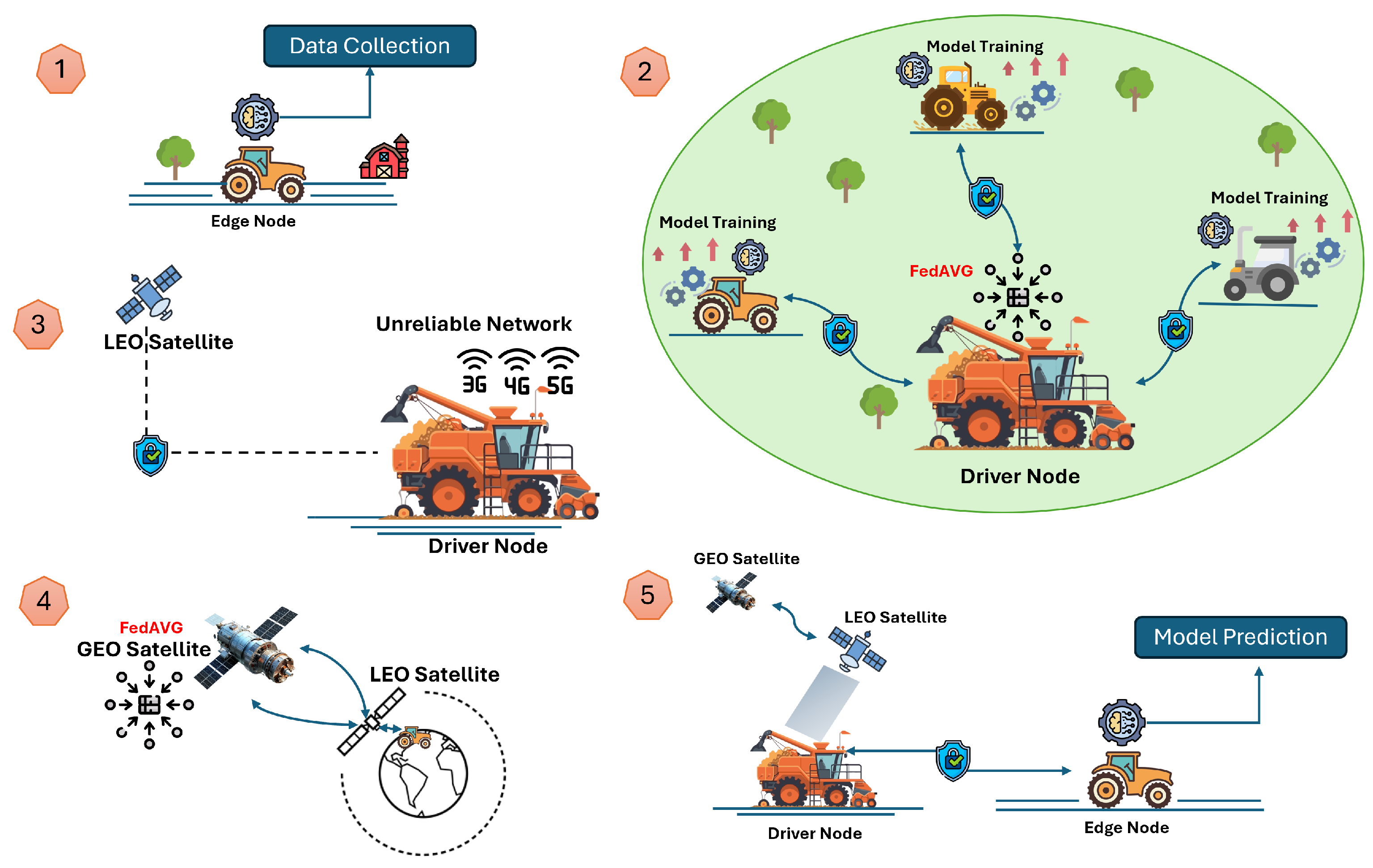
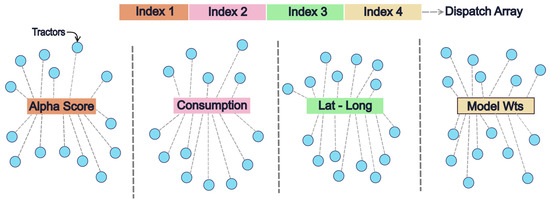
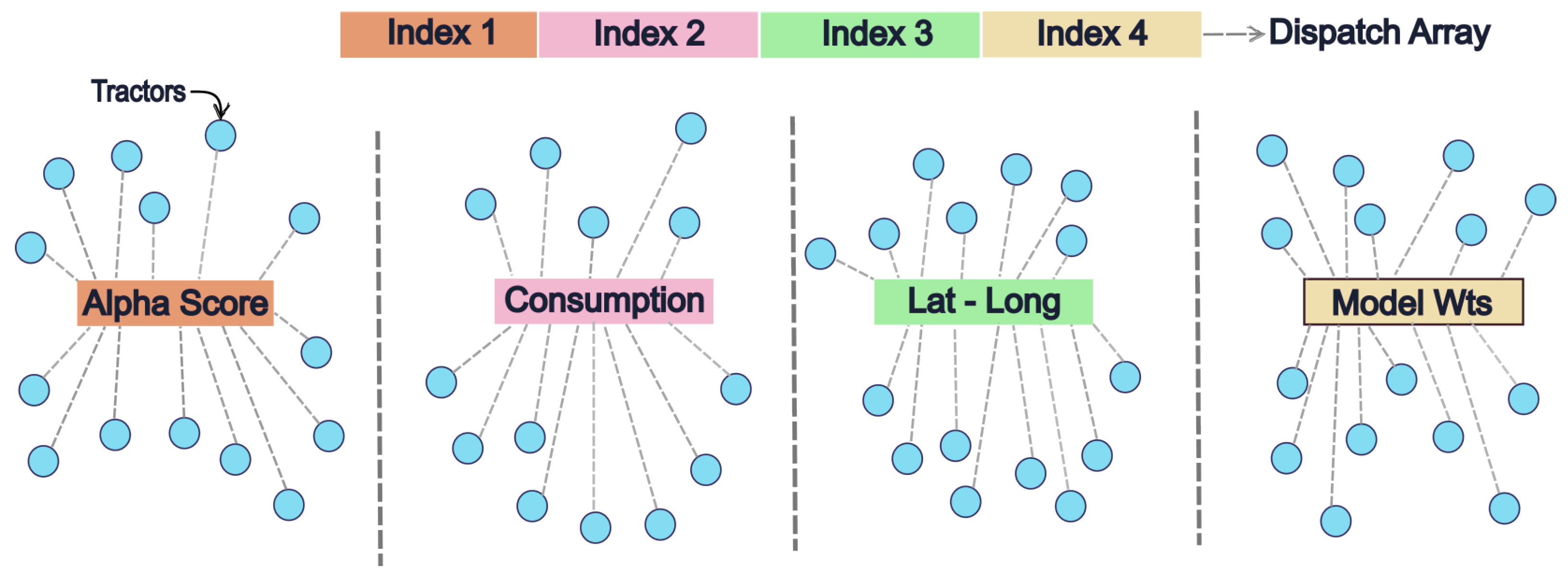
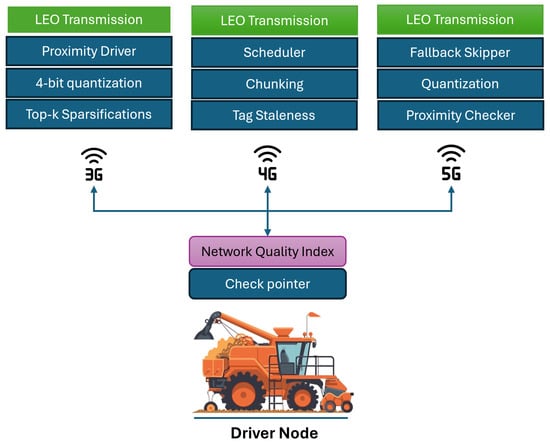
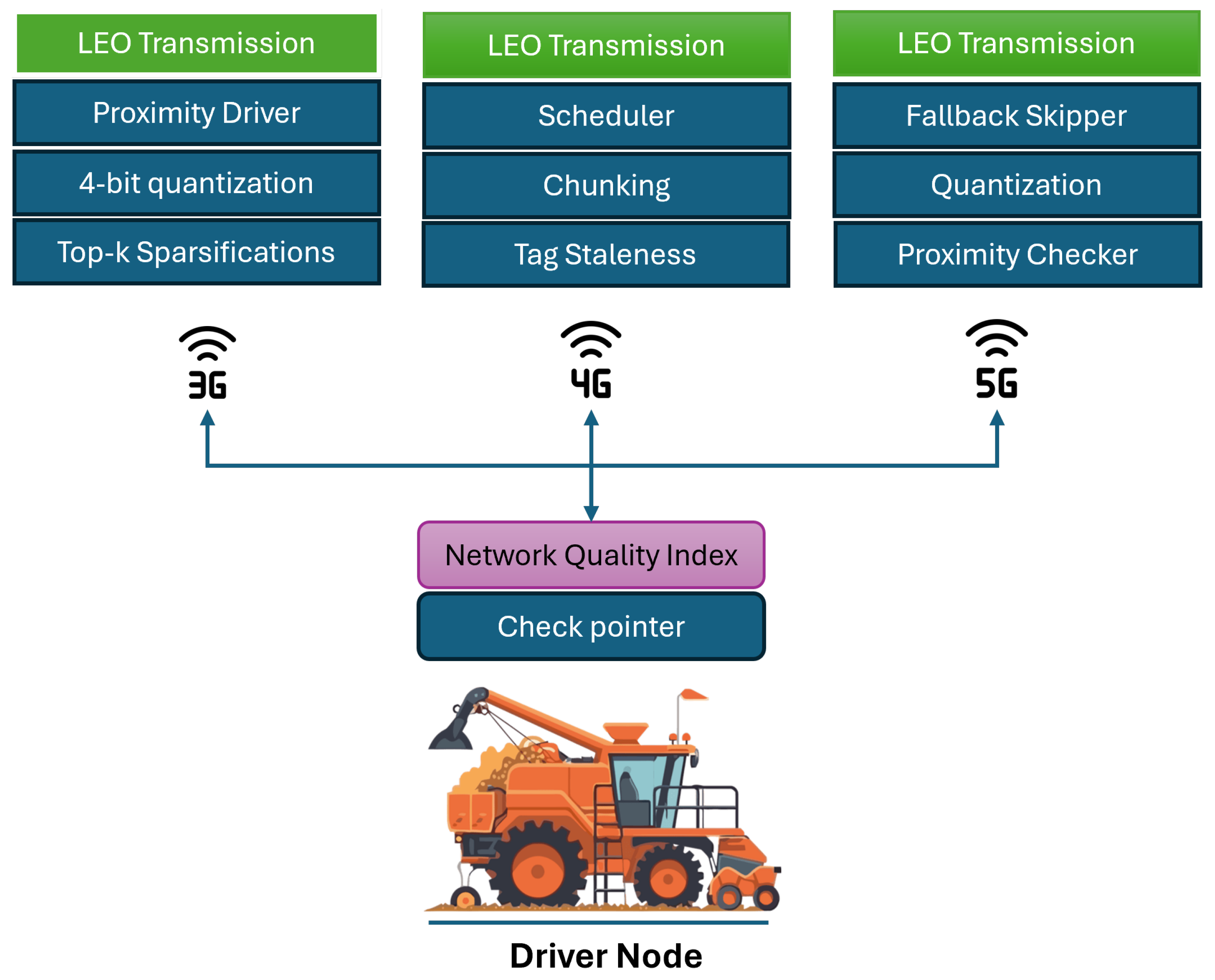
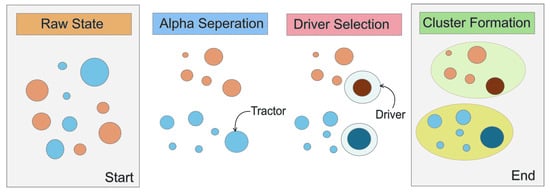
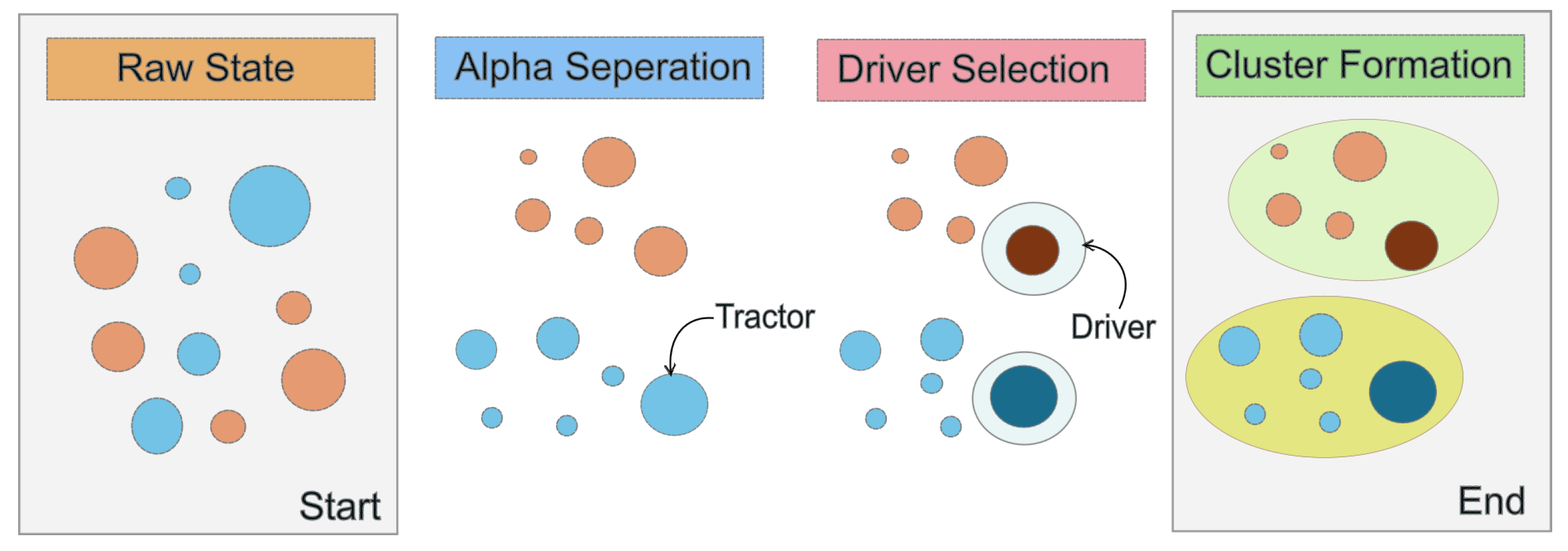
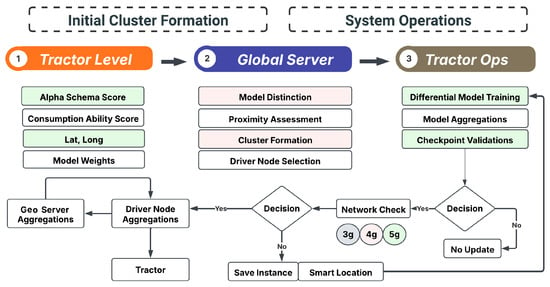
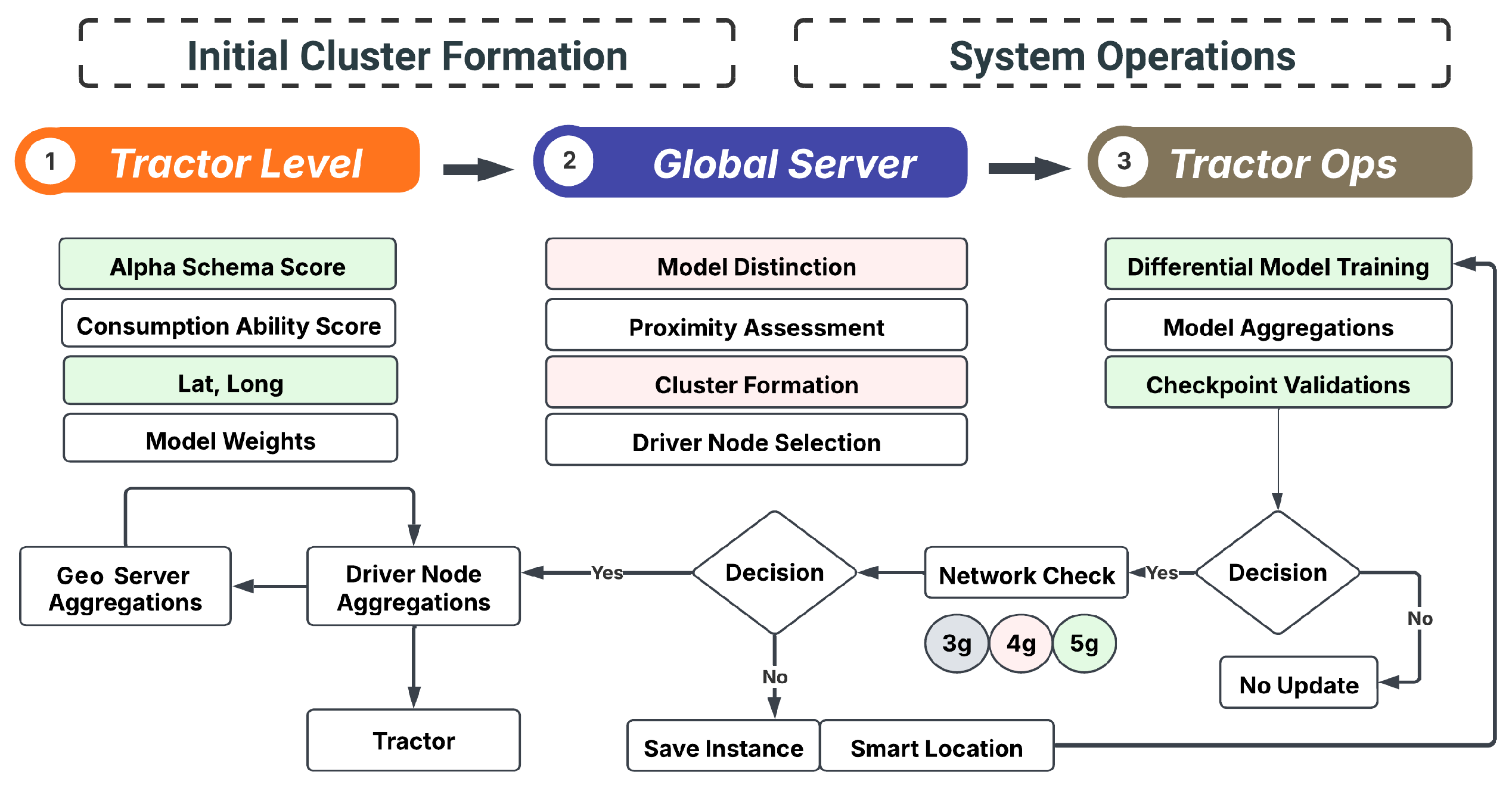
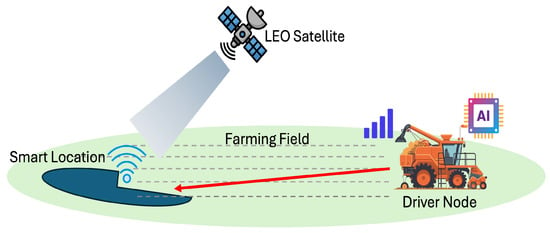
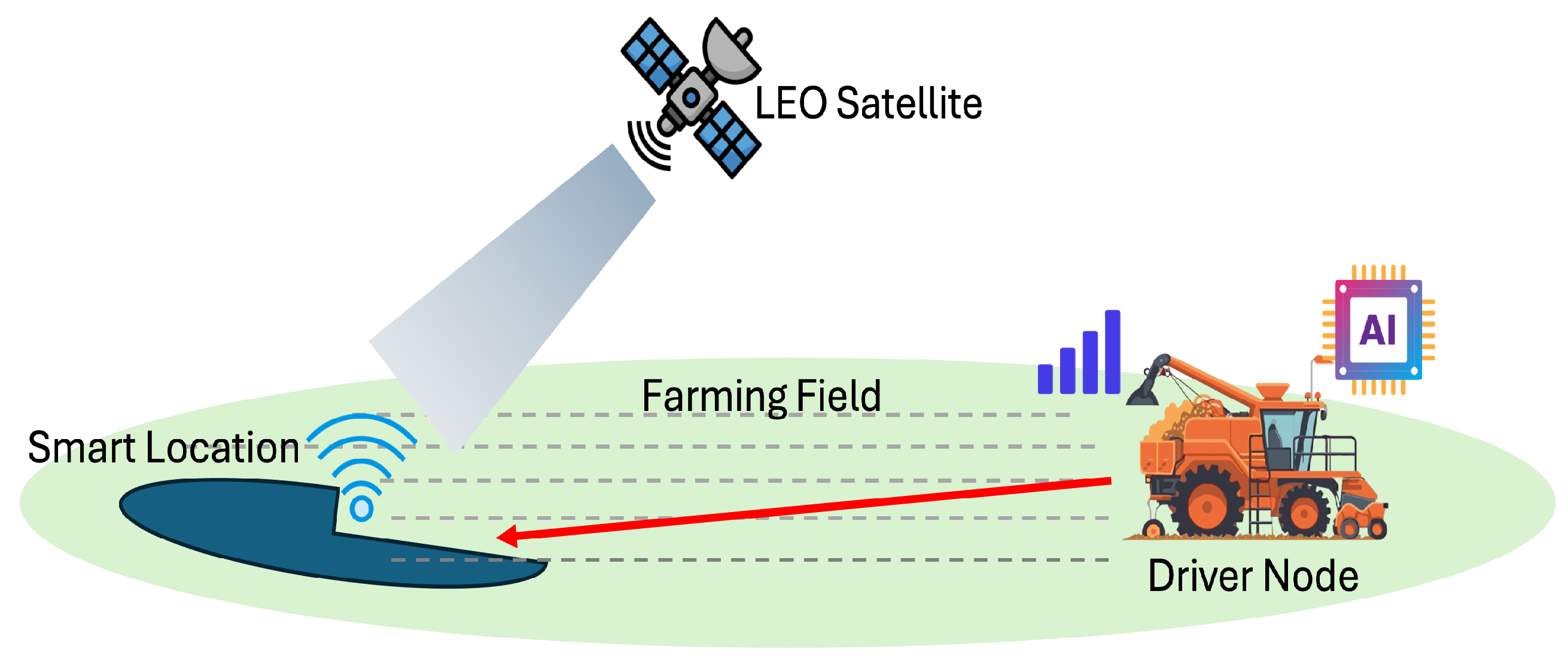
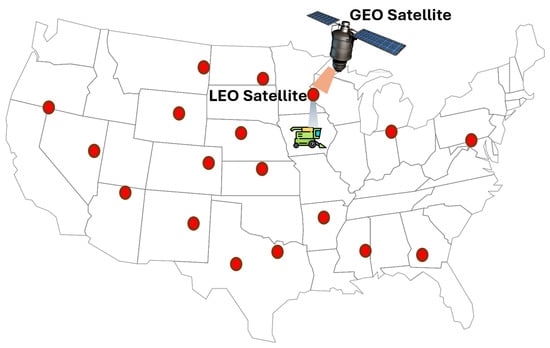
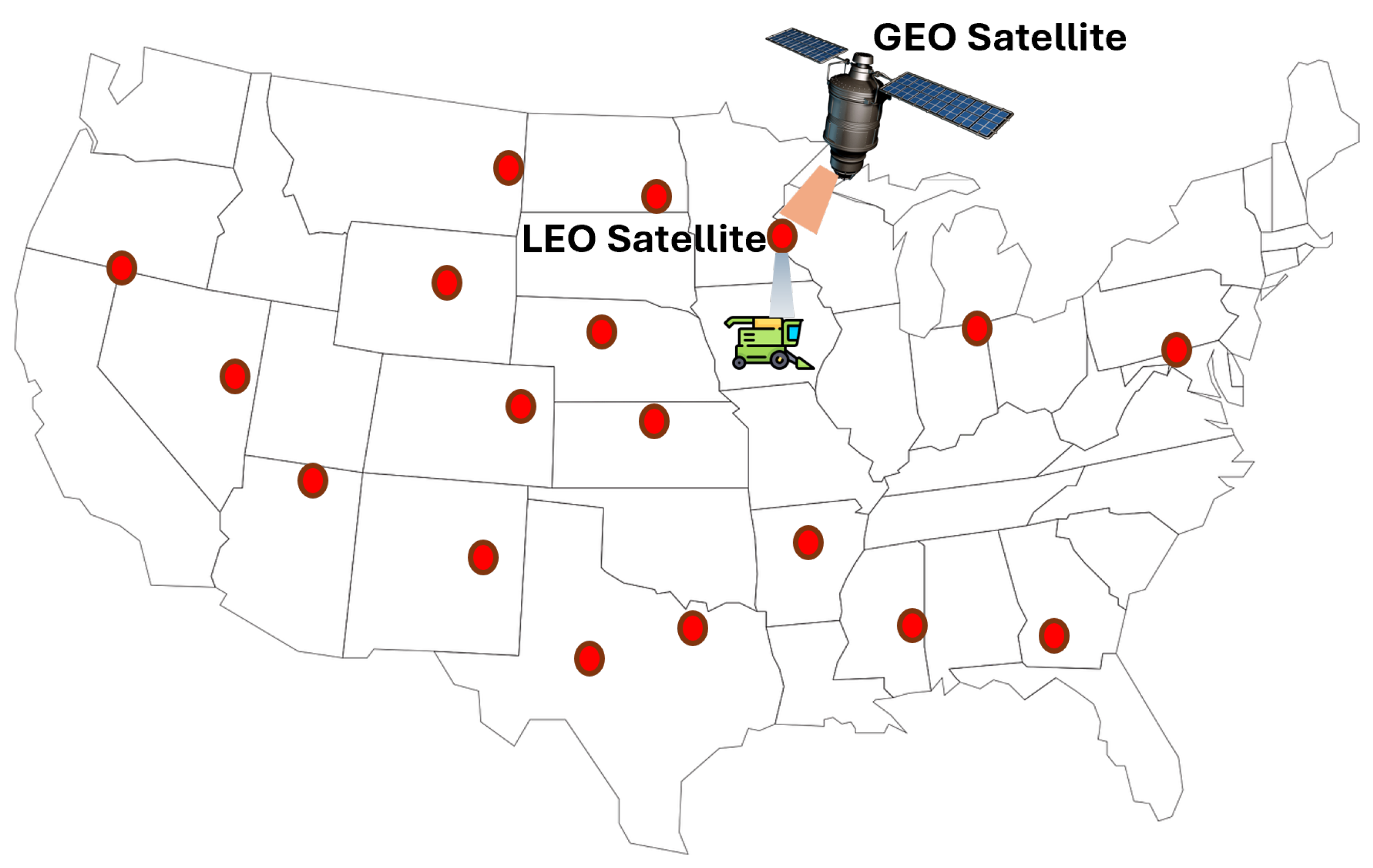
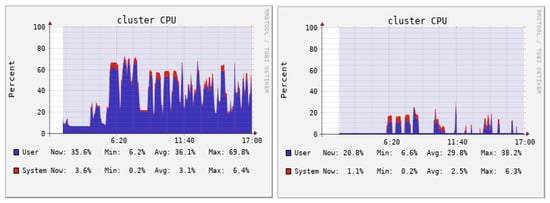
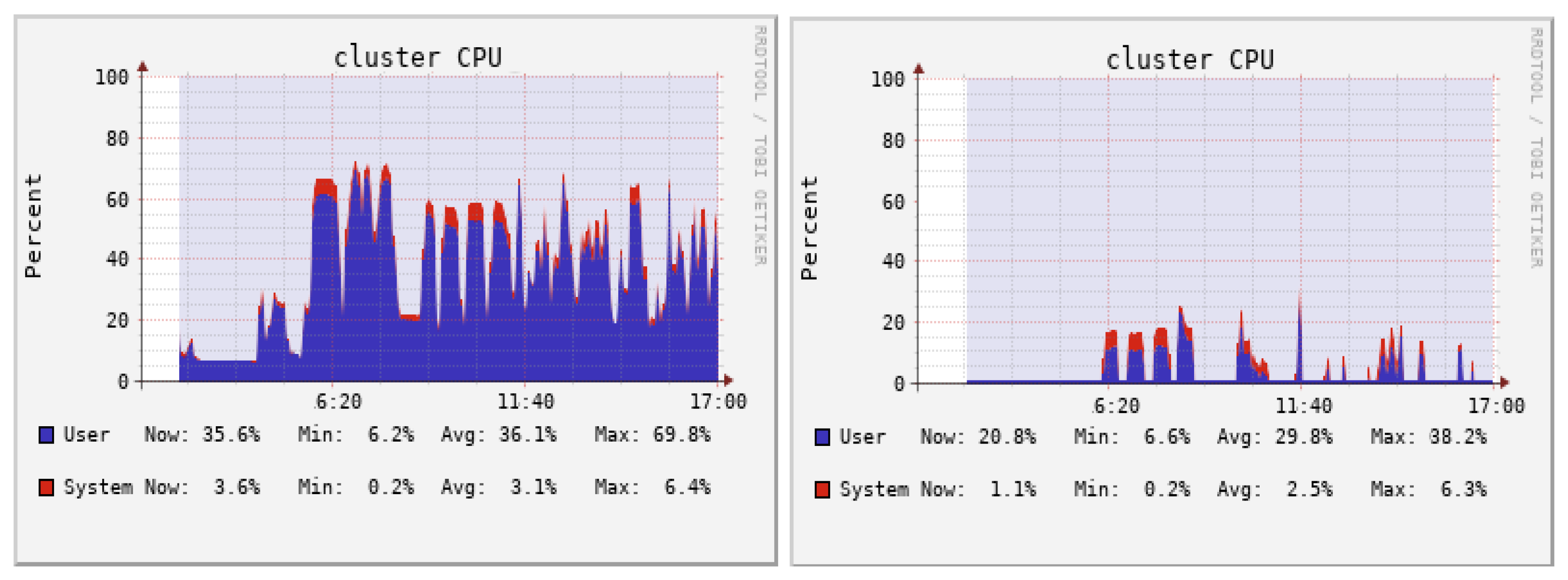

Disclaimer/Publisher’s Note: The statements, opinions and data contained in all publications are solely those of the individual author(s) and contributor(s) and not of MDPI and/or the editor(s). MDPI and/or the editor(s) disclaim responsibility for any injury to people or property resulting from any ideas, methods, instructions or products referred to in the content. |
© 2026 by the authors. Licensee MDPI, Basel, Switzerland. This article is an open access article distributed under the terms and conditions of the Creative Commons Attribution (CC BY) license.