Article

Study on Predicting Cotton Boll Opening Rate Based on UAV Multispectral Imagery

1
College of Agricultural Engineering and Food Science, Shandong University of Technology, Zibo 255049, China
2
Shandong Province Agricultural Aviation Intelligent Equipment Engineering and Technology Research Centre, Zibo 255049, China
3
National Center for International Collaboration Research on Precision Agricultural Aviation Pesticides Spraying Technology (NPAAC), South China Agricultural University, Guangzhou 510642, China
4
National Key Laboratory of Automotive Chassis Integration and Bionics, School of Mechanical and Aerospace Engineering, Jilin University, Changchun 130022, China
*
Author to whom correspondence should be addressed.
Agronomy 2026, 16(2), 162; https://doi.org/10.3390/agronomy16020162
Submission received: 16 December 2025 / Revised: 5 January 2026 / Accepted: 7 January 2026 / Published: 8 January 2026
(This article belongs to the Special Issue Innovations in Agriculture for Sustainable Agro-Systems)

Abstract

The cotton boll opening rate (BOR) is an important indicator for evaluating the physiological maturation process of cotton and the critical stage of yield formation, and it provides essential guidance for subsequent defoliant application and mechanical harvesting. The investigation of cotton BOR usually relies on manual field surveys, which are time-consuming and destructive, making it difficult to achieve large-scale and efficient monitoring. UAV remote sensing technology has been widely used in crop growth monitoring due to its operational flexibility and high image resolution. However, because of the dense growth of the cotton canopy in UAV remote sensing imagery, the boll opening condition in the lower parts of the canopy cannot be completely observed. In contrast, UAV imagery can effectively monitor cotton leaf chlorophyll content (SPAD) and leaf area index (LAI), both of which undergo continuous changes during the boll opening process. Therefore, this study proposes using SPAD and LAI retrieved from UAV multispectral imagery as physiological intermediary variables to construct an empirical statistical equation and compare it with end-to-end machine learning baselines. Multispectral and ground synchronous data (n = 360) were collected in Baibi Town, Anyang, Henan Province, across four dates (8/28, 9/6, 9/13, 9/24). Twenty-eight commonly used vegetation indices were calculated from multispectral imagery, and Pearson’s correlation analysis was conducted to select indices sensitive to cotton SPAD, LAI, and BOR. Prediction models were constructed using the Random Forest (RF), Gradient Boosting Decision Tree (GBDT), Support Vector Machine (SVM), and Partial Least Squares (PLS) models. The results showed that GBDT achieved the best prediction performance for SPAD (R2 = 0.86, RMSE = 1.19), while SVM performed best for LAI (R2 = 0.77, RMSE = 0.38). The quadratic polynomial equation constructed using SPAD and LAI achieved R2 = 0.807 and RMSE = 0.109 in BOR testing, which was significantly better than the baseline model using vegetation indices to directly regress BOR. The method demonstrated stable performance in spatial mapping of BOR during the boll opening period and showed promising potential for guiding defoliant application and harvest timing.

1. Introduction

Cotton is a key strategic economic crop worldwide, and its yield and quality are directly related to the supply of raw materials for the textile industry and the stable development of associated industrial chains [1]. In modern cotton production systems, improving the level of mechanization has become an important approach for enhancing production efficiency, reducing labor costs, and promoting large-scale cultivation. Among the various indicators, the boll opening rate (BOR) is a core metric for assessing cotton maturity and determining the optimal harvest window, and it plays an essential role in guiding mechanized harvesting. The boll opening rate refers to the proportion of cotton bolls that split open and release fibers after maturation, serving as a critical indicator of cotton ripeness and harvest readiness. Accurate understanding of the boll-opening process helps optimize harvesting schedules, reduce losses, and improve harvesting efficiency and fiber quality. Therefore, precise monitoring and prediction of the boll opening rate have become key components of cotton production management.
Traditional field investigation of boll opening rate involves recording the total number of cotton bolls and the number of opened bolls during the boll-opening period and then performing calculations. This method is destructive, time-consuming, and labor-intensive, making it unsuitable for large-scale cultivation, and its results are affected by sample size and human factors. At present, Unmanned Aerial Vehicle (UAV) remote sensing technology has become increasingly mature. Compared with traditional satellite remote sensing, UAV platforms offer higher spatial resolution and more flexible observation frequency, enabling precise capture of canopy structural details during key growth stages of cotton [2]. Leveraging the advantages of low-altitude and near-ground flight, UAVs can autonomously adjust flight routes and imaging timing according to operational requirements, significantly outperforming satellite observations in terms of cloud interference and temporal immediacy, thereby providing more stable, continuous, and high-quality data support for monitoring the dynamics of boll opening in cotton fields [3]. Monitoring cotton growth and agronomic parameters through UAV remote sensing is suitable for large-scale cultivation and reduces destructiveness. Yukun Wang et al. [4] extracted opened boll regions from multispectral imagery using a threshold segmentation algorithm and employed vegetation index change rates as predictive variables, combined with statistical learning and machine learning models, to estimate boll opening rate. However, due to canopy occlusion from the upper layers, direct boll-opening detection based on imagery may insufficiently capture responses from middle and lower bolls, while indirect strategies such as temporal change rates may exhibit lag or attenuation, limiting accuracy and generalizability under complex canopy conditions. Therefore, it is urgent to explore a remote sensing monitoring strategy capable of overcoming canopy occlusion and comprehensively reflecting the maturation dynamics of cotton plants.
The boll-opening process of cotton is essentially a physiological–ecological process driven jointly by the continuous transport of photosynthetic assimilates to the bolls, leaf senescence, and canopy structural degradation [5]. Therefore, the changes in key physiological and structural parameters exhibit strong synchronicity and intrinsic causal relationships with the increase in boll opening rate. Among these parameters, Soil and Plant Analyzer Development (SPAD) reflects leaf chlorophyll content and is a core indicator for evaluating photosynthetic capacity and the rate of functional decline. As boll opening progresses, rapid leaf senescence and chlorophyll degradation lead to a continuous decrease in SPAD, indicating a gradual weakening of photosynthesis and a reduction in assimilate supply, a process that is highly consistent in timing with boll maturation and cracking [6]. Meanwhile, Leaf Area Index (LAI), as a structural indicator representing canopy leaf area and light interception capacity, reflects the dynamic process of leaf abscission and canopy thinning during the boll-opening stage. A decline in LAI reflects degradation of canopy photosynthetic structure, and its temporal trend is closely associated with the overall maturity of cotton plants [7]. Therefore, SPAD and LAI jointly provide a quantitative characterization of physiological decline and structural degradation in cotton during the boll-opening period, describing the complete maturation pathway from the dimensions of functional aging and canopy structural decay, respectively [8]. Consequently, this study employs SPAD and LAI as intermediary variables for predicting boll opening rate, as their synergistic variation can represent the overall maturity status of cotton fields, offering a quantifiable basis for BOR prediction. By modeling the dynamic changes in SPAD and LAI during the boll-opening period, the indirect inversion of BOR is achieved, providing a new technical pathway to address the limitations of direct boll detection under complex canopy structures.
At present, the monitoring of cotton SPAD and LAI typically relies on UAV-acquired canopy multispectral imagery, in which canopy reflectance data are transformed into various types of vegetation indices (VIs). These VIs are then used in statistical regression or machine learning models to achieve high-precision inversion. Yan Chengchuan et al. [9] employed radial basis functions to analyze spectral reflectance under drought stress and normal conditions, identifying a quadratic function as the optimal model for SPAD estimation and developing an accurate SPAD estimation model for the flowering and boll-setting stages of cotton. Shao Yajie et al. [10] established an LAI estimation model by integrating UAV spectral information with texture features of cotton. Their results indicated that VI (nir/green), VI (nir/red), GNDVI, OSAVI, and mean texture values exhibited strong correlations with LAI, enabling the development of a reliable and accurate LAI estimation model. Zhang et al. [11] constructed a remote sensing estimation framework for winter wheat grain filling rate (GFR) using UAV multispectral imagery. Their study employed LAI and chlorophyll content (SPAD) as intermediary physiological parameters and achieved high-precision estimation of LAI and SPAD through feature vegetation index selection (CARS, SPA) and inversion model construction (PLSR, RF), subsequently developing a transformation model linking these parameters to GFR. Currently, correlation analysis is widely used as a foundational step in feature selection. For example, Pearson’s correlation is applied to quantify the linear relationship between individual vegetation indices and target variables, while factor analysis (FA) is used for dimensionality reduction and information extraction to identify optimal VI combinations [12]. Based on the outcomes of such feature selection, researchers typically proceed to construct parameter inversion or crop growth assessment models. In UAV remote sensing applications, prediction models generally fall into two major categories: traditional statistical regression models, such as multiple linear regression (MLR), partial least squares regression (PLSR), and stepwise regression (SR), which are widely used due to their strong interpretability and clear structure; and more advanced machine learning models, including random forest (RF), support vector machines (SVM), XGBoost, and deep neural networks (DNN), which better capture complex nonlinear relationships and significantly enhance prediction accuracy [13,14,15,16,17,18,19].
To address the above limitations, this study proposes a boll opening rate (BOR) estimation model that employs physiological intermediary variables as a bridging mechanism. Specifically, SPAD (relative chlorophyll content) and LAI (leaf area index) are first retrieved from UAV multispectral imagery, and these two parameters are then incorporated into a polynomial equation to estimate BOR. This chain-based inference approach enables the prediction of the boll-opening process by inferring physiological status from canopy-visible signals. Compared with end-to-end methods that directly regress BOR from vegetation indices, the proposed model is expected to mitigate the influence of canopy occlusion on boll recognition and enhance temporal and spatial generalization stability. The main contributions of this study are as follows: (1) proposing and systematically evaluating a UAV multispectral–physiological intermediary–BOR modeling framework; (2) comparing the performance differences between the intermediary equation and end-to-end machine learning baselines across multi-temporal samples during the boll-opening period; (3) generating spatial BOR maps to support defoliant application and regional harvest planning.

2. Materials and Methods

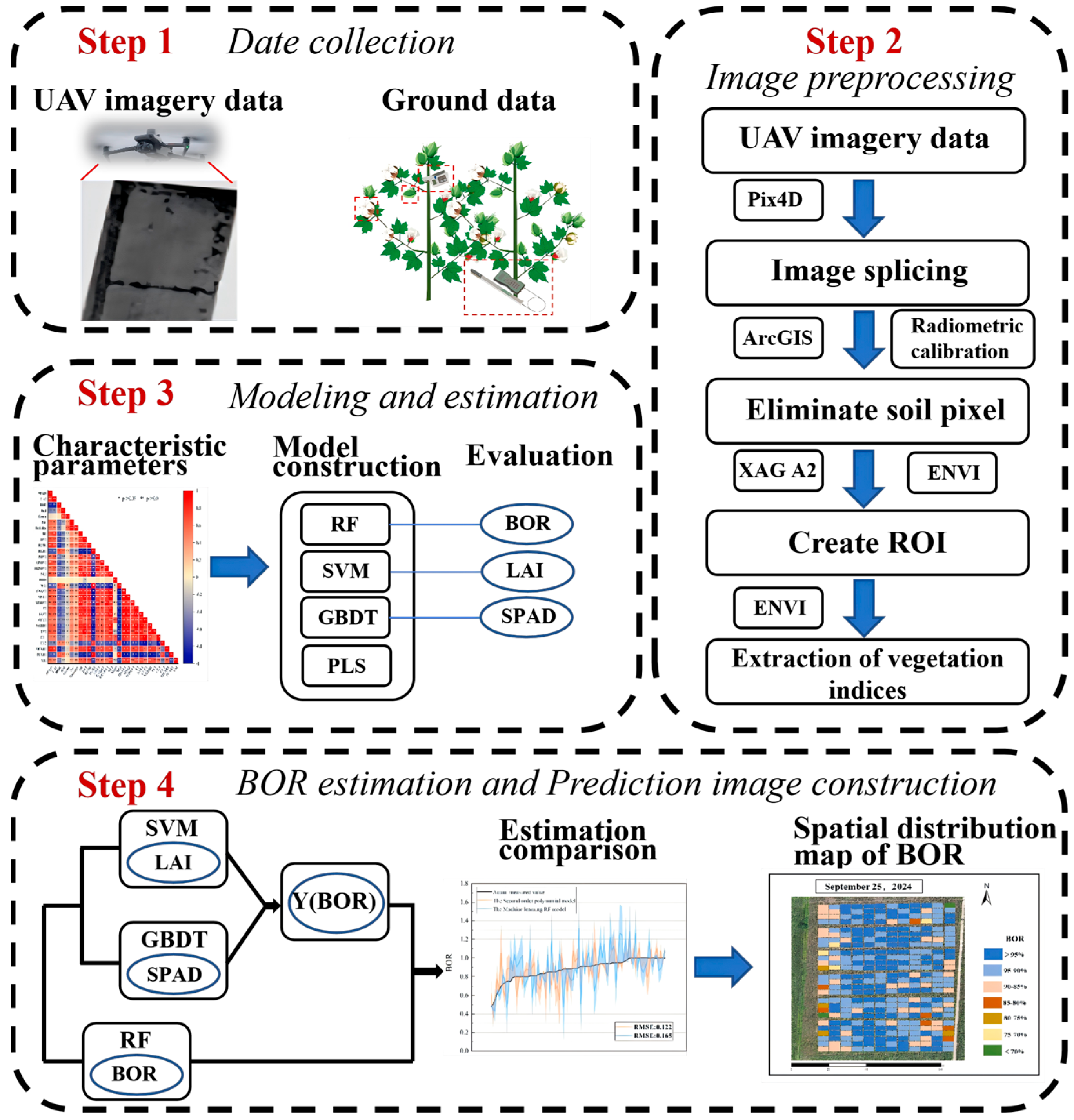
The overall methodological workflow of this study is illustrated in Figure 1. As shown in the figure, UAV multispectral imagery was first acquired and preprocessed to generate georeferenced reflectance data. Vegetation indices were then calculated at the pixel level and spatially aggregated within regions of interest corresponding to ground samples. Based on the established pixel-to-sample mapping, machine learning models were developed to estimate SPAD and LAI from vegetation indices. Finally, the predicted SPAD and LAI were integrated into a physiological-based equation to hierarchically estimate the cotton boll opening rate.

2.1. Experimental Site and Design

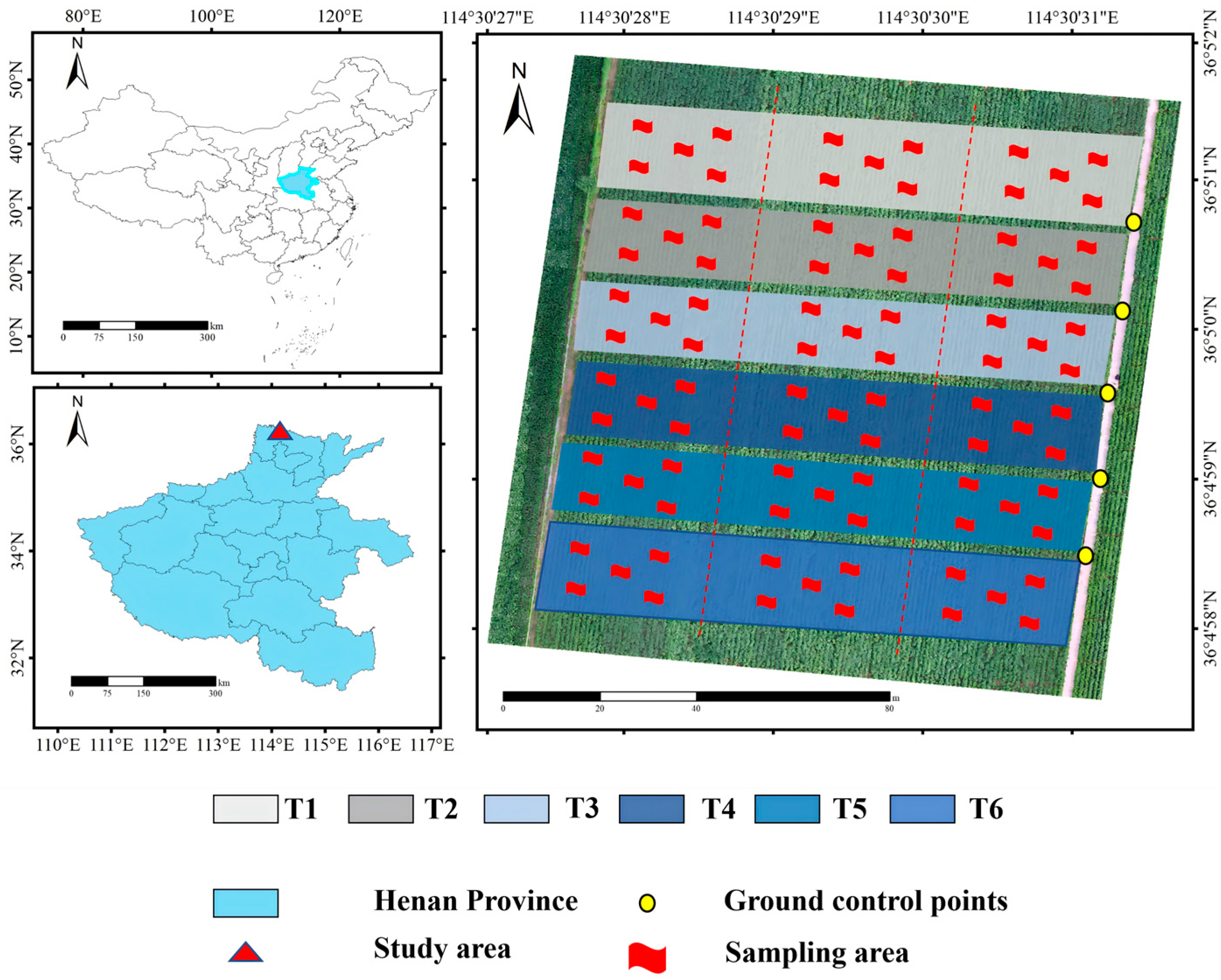
The experimental site of this study was located in Baibi Town, Anyang City, Henan Province, China, which is characterized by a typical temperate monsoon climate with distinct seasons and precipitation concentrated mainly in summer, providing favorable conditions for cotton growth and development. The annual mean temperature is approximately 14.1 °C, the annual precipitation is about 556.8 mm, and the annual sunshine duration is around 2225 h. The cotton variety used in this study was Zhongmian 117, sown on 24 April 2024, with an experimental area of approximately 9072 m2. The experimental field is shown in Figure 2, and the experimental design schemes are presented in Table 1. A basal fertilizer of 105 kg/ha was applied prior to planting, followed by two topdressings of 90 kg/ha and 63 kg/ha. During the squaring stage on 12 June, the plant protection UAV T30 conducted the first application of the biostimulant Utrisha N (Corteva Agriscience, Indianapolis, IN, USA), Utrisha N is a commercial biostimulant product primarily designed to enhance nitrogen availability and improve crop growth, and it was applied following the manufacturer’s recommended dosage and timing. and the second application was carried out on 18 July. Local agricultural management practices were consistently applied across all six treatment zones throughout the growing season, including regular mechanical and manual weeding, standardized fertilization, routine irrigation management, periodic pest and disease monitoring, and timely application of cotton protection measures in accordance with local agronomic guidelines.

2.2. Experimental Data Collection

2.2.1. Acquisition of UAV Imagery Data

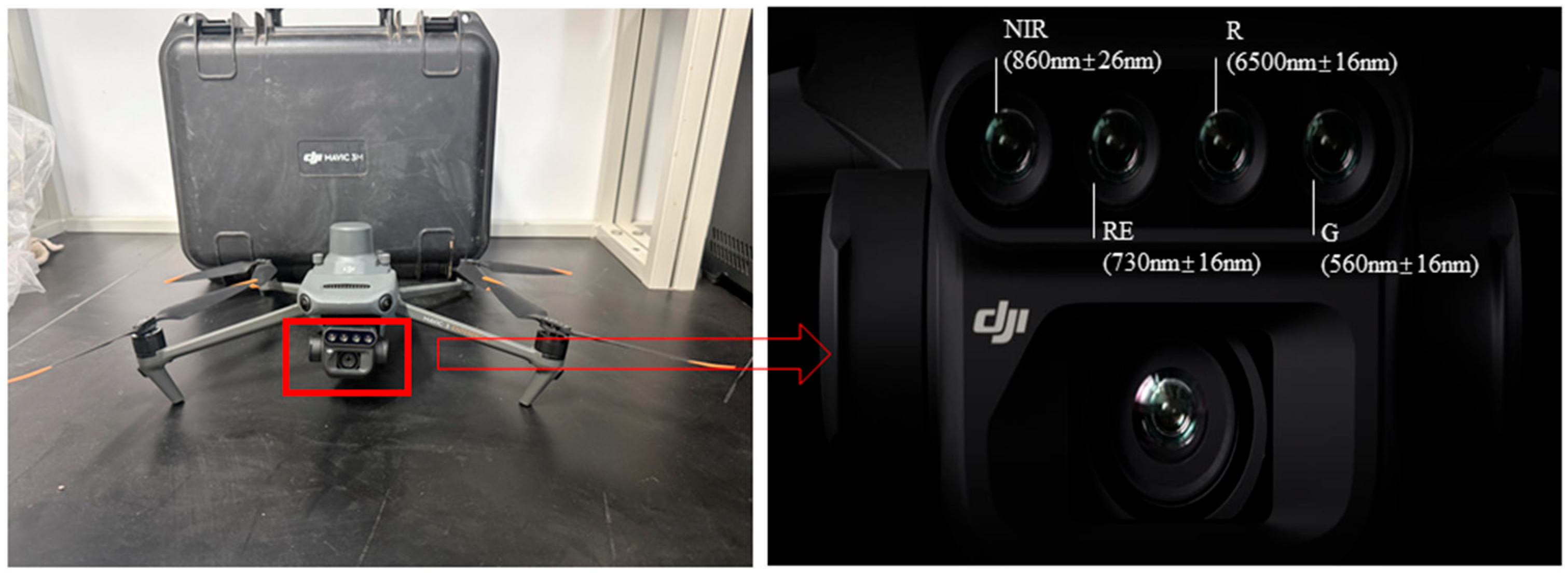
In this experiment, UAV multispectral imagery of cotton during the boll-opening period was collected at five time points: 28 August, 6 September, 13 September, 24 September, and 25 September. The UAV multispectral imagery was acquired using a DJI Mavic 3 Multispectral (DJI Technology Co., Ltd., Shenzhen, China), as shown in Figure 3. The UAV flight parameters are shown in Table 2.
On each sampling day, weather conditions were required to be clear and cloudless, with wind speed not exceeding level 4, and imagery was collected between 10:00 and 14:00. During acquisition, the camera angle was set perpendicular to the ground, and both forward and side overlap rates of the UAV flight path were set at 80%. The UAV flight parameters and visualization settings adopted in this study correspond to commonly used operational configurations for multispectral crop monitoring. Flights were conducted under stable weather conditions with low wind speed and consistent illumination to minimize potential systematic errors related to data acquisition. Although individual error sources were not explicitly quantified, maintaining standardized flight parameters and favorable environmental conditions ensured reliable and consistent vegetation index extraction.
Simultaneously, the UAV camera captured images of a calibrated reflectance panel for radiometric calibration of the multispectral imagery. Ground reference panels were placed in the experimental area to facilitate subsequent georeferencing, and their latitude and longitude coordinates were obtained using the XAG A2 intelligent handheld GPS device (XAG Co., Ltd., Guangzhou, China). The collected multispectral images were processed and stitched using Pix4D4.5.6 software (Pix4D, Lausanne, Switzerland), followed by radiometric calibration and geometric correction within the software to ensure the quality of the stitched multispectral imagery.

2.2.2. Ground Data Collection

On the day of UAV imagery acquisition, actual measurements of cotton leaf chlorophyll content, leaf area index, and boll opening rate were conducted. The data collected at each period were statistically summarized, as shown in Table 3.
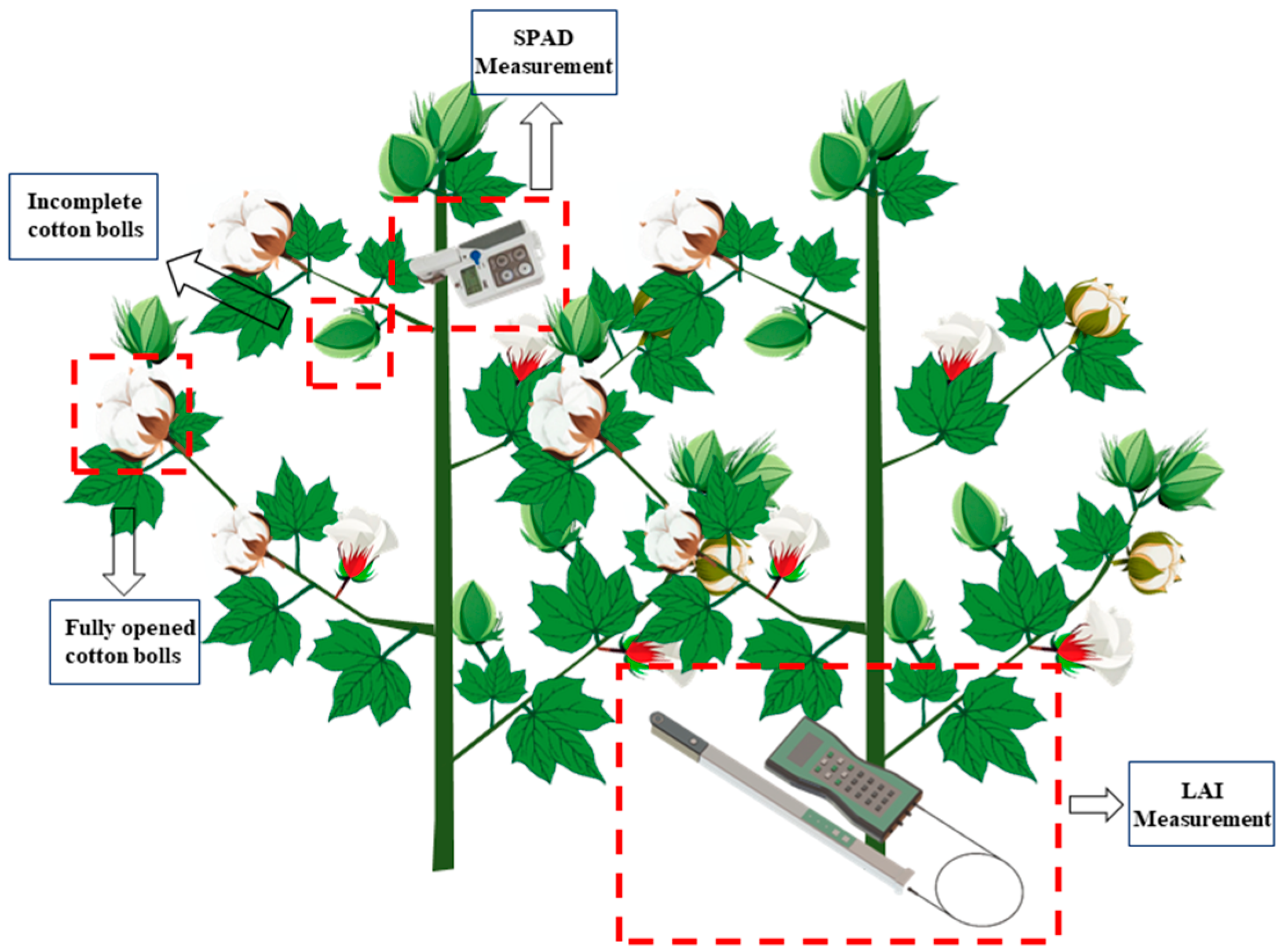
Leaf chlorophyll content was measured using a SPAD-502 (Konica Minolta, Tokyo, Japan), which is based on a dual-wavelength absorption method. The instrument contains two light-emitting diodes that emit red and near-infrared light, respectively; after the light passes through the leaf, a photodiode on the opposite side receives the signal and calculates the relative chlorophyll content. Leaves from uniformly growing regions of the cotton canopy were selected, and each leaf was measured three times to avoid the influence of leaf physiological status and measurement position, with the average value recorded. Leaf area index (LAI) was measured using the LAI-2200C (LI-COR Biosciences, Lincoln, OR, USA), which is based on the optical transmission principle and contains a fisheye optical system with five concentric photodetector rings, each corresponding to a different angular range. The LAI-2200C estimates LAI by measuring the scattering transmittance in the blue light band. Measurements were taken at both the upper and lower parts of the cotton canopy, this instrument is sensitive to observation direction and canopy heterogeneity, with four replicates per sample point, and the average value was recorded, as shown in Figure 4.
The boll opening rate (BOR) was calculated by counting the total number of bolls and the number of fully opened bolls per sample plant, according to Equation (1).
B O R = n N × 100 %
in which
  • B O R is the boll opening rate of a cotton plant;
  • n is the number of fully opened bolls;
  • N is the total number of bolls per plant.

2.3. Extraction of Information from UAV Multispectral Imagery

In this study, a sample refers to one ground observation unit, for which SPAD, LAI, and BOR were measured synchronously at the plant scale on each observation date. A sample point refers to the corresponding spatial region of interest (ROI) in the UAV multispectral image that spatially matches the ground sample location. Vegetation indices were calculated at the pixel level and then averaged within each ROI to represent the spectral characteristics of the corresponding ground sample. The Pix4D software “Agriculture Multispectral” module was used to stitch UAV multispectral imagery. Image correction was performed based on the geographic coordinates of the ground reference panels, and radiometric calibration of the multispectral images was conducted using a reflectance panel, producing complete images in the green, red, red-edge, and near-infrared bands without any defective pixels. To avoid soil background interference in vegetation index calculations, the stitched images were imported into ArcGIS 10.6software (Esri, Redlands, CA, USA) where a support vector machine classifier was applied to separate cotton from soil, and a binary mask layer was created to remove soil pixels. The soil-removed images were then processed in ENVI5.6 software (Harris Geospatial Solutions, Broomfield, CO, USA) to calculate vegetation indices for each sample point at different time points, resulting in a total of 23 multispectral vegetation indices, as shown in Table 4.
For each ground sample, a rectangular region of interest (ROI) centered on the sample location was manually delineated in the georeferenced UAV multispectral imagery using ENVI software. Vegetation indices were first calculated at the pixel level and then spatially averaged within each ROI to obtain representative VI values. An attribute table was subsequently constructed to establish a one-to-one correspondence between each ROI and the associated ground-measured SPAD, LAI, and BOR values, thereby forming a consistent and reproducible pixel-to-sample mapping framework.

2.4. Prediction Model Construction

2.4.1. Random Forest Model

The Random Forest (RF) model is an ensemble of multiple randomized decision trees, which are trained using bootstrap sampling and random feature selection to construct individual submodels. The final prediction is obtained by averaging the results of all trees. The advantage of this model lies in its ability to maintain high predictive accuracy while reducing the overfitting commonly associated with single decision trees. It does not require prior assumptions about the functional relationships between variables and can automatically capture nonlinear relationships. In this study, vegetation indices extracted from UAV imagery are numerous and often correlated. By randomly selecting features at each split node of the decision trees, the model can effectively alleviate issues of multicollinearity.

2.4.2. Gradient Boosting Decision Tree Model

The Gradient Boosting Decision Tree (GBDT) model is an ensemble learning algorithm that constructs multiple weak learners and integrates them in an additive manner, allowing the overall model to progressively approximate the true target function. Compared with traditional single decision trees, GBDT introduces the minimization of a loss function and iteratively corrects the residuals from the previous round. This enables the model to capture nonlinear relationships and feature interactions. In this study, GBDT is suitable for modeling the complex response mechanisms between spectral parameters and crop physiological parameters, as it improves predictive accuracy by progressively optimizing residuals while maintaining stability in the presence of noise and outliers.

2.4.3. Support Vector Machine Model

The Support Vector Machine (SVM) is a supervised learning method that constructs nonlinear mappings in a high-dimensional feature space. Using a kernel function, input variables are mapped to higher dimensions to achieve regression fitting. The core principle involves introducing an ε-insensitive loss function to improve generalization performance. In this study, with a limited number of samples in the UAV-ground synchronous experiment, the Support Vector Machine can maintain stable predictive performance under small-sample conditions.

2.4.4. Partial Least Squares Model

Partial Least Squares (PLS) is a multivariate statistical regression method that extracts latent variables explaining the variation in the dependent variable based on the variance in both independent and dependent variables. Unlike principal component regression, PLS considers the correlation between independent and dependent variables when extracting components, making it more effective for modeling highly correlated and redundant spectral features. It exhibits strong tolerance to noisy data and, in the context of this study, demonstrates significant advantages in handling high-dimensional, strongly correlated, and limited-sample multispectral imagery data, enabling stable and reliable estimation of vegetation physiological parameters.

2.4.5. Empirical Equation Model

Empirical equation model is a mechanism-based modeling approach, whose core concept is to establish mathematical equations describing the relationship between input and output variables based on fundamental principles such as physical laws, energy conservation, mass conservation, and dynamics. In this study, the model is based on crop physiological and ecological mechanisms, establishing functional relationships between leaf area index (LAI), chlorophyll content (SPAD), and boll opening rate (BOR) to predict the cotton boll-opening process. Equations founded on general crop physiological principles can be applied across different varieties or environmental conditions, providing good generalization capability.

2.4.6. Selection of Prediction Model Parameters

In this study, four typical types of machine learning models were selected. All models were implemented in the Python3.9 programming environment and executed on PyCharm2023.1 software (JetBrains, Prague, Czech Republic) using the scikit-learn library. Considering the feature representation capabilities of different models and the characteristics of the samples, as well as common practices in remote sensing data modeling, appropriate parameter ranges were set for each model. The training, validation, and hyperparameter tuning of all models were conducted in the same computational environment, with GridSearchCV and RandomizedSearchCV employed for hyperparameter optimization, as shown in Table 5.

2.5. Evaluation of Prediction Models

To comprehensively evaluate the predictive capability of different models, 66.7% of the experimental samples were used as the training set, while the remaining 33.3% were used to test model performance and accuracy. The coefficient of determination (R2) and root mean square error (RMSE) were calculated using standard formulas. R2 ranges from 0 to 1, with values closer to 1 indicating better model fit. RMSE reflects the overall deviation between predicted and observed values, with greater sensitivity to large errors; smaller values indicate higher predictive accuracy. The relative RMSE normalizes RMSE as a percentage of the observed mean, facilitating comparison across different variables or experimental conditions [42].
R 2 = i = 1 n ( y ^ i y - i ) ( y i y - ) / i = 1 n ( y ^ i y - i ) 2 i = 1 n ( y i y - ) 2
R M S E = i = 1 n y ^ i y i 2 n
in which
  • n represents the total number of samples;
  • y ^ i represents the estimated value;
  • y i represents the measured value;
  • y ˉ i represents the mean of the measured values.

3. Results

3.1. Analysis of Ground-Based Data Variations During the Cotton Boll-Opening Stage

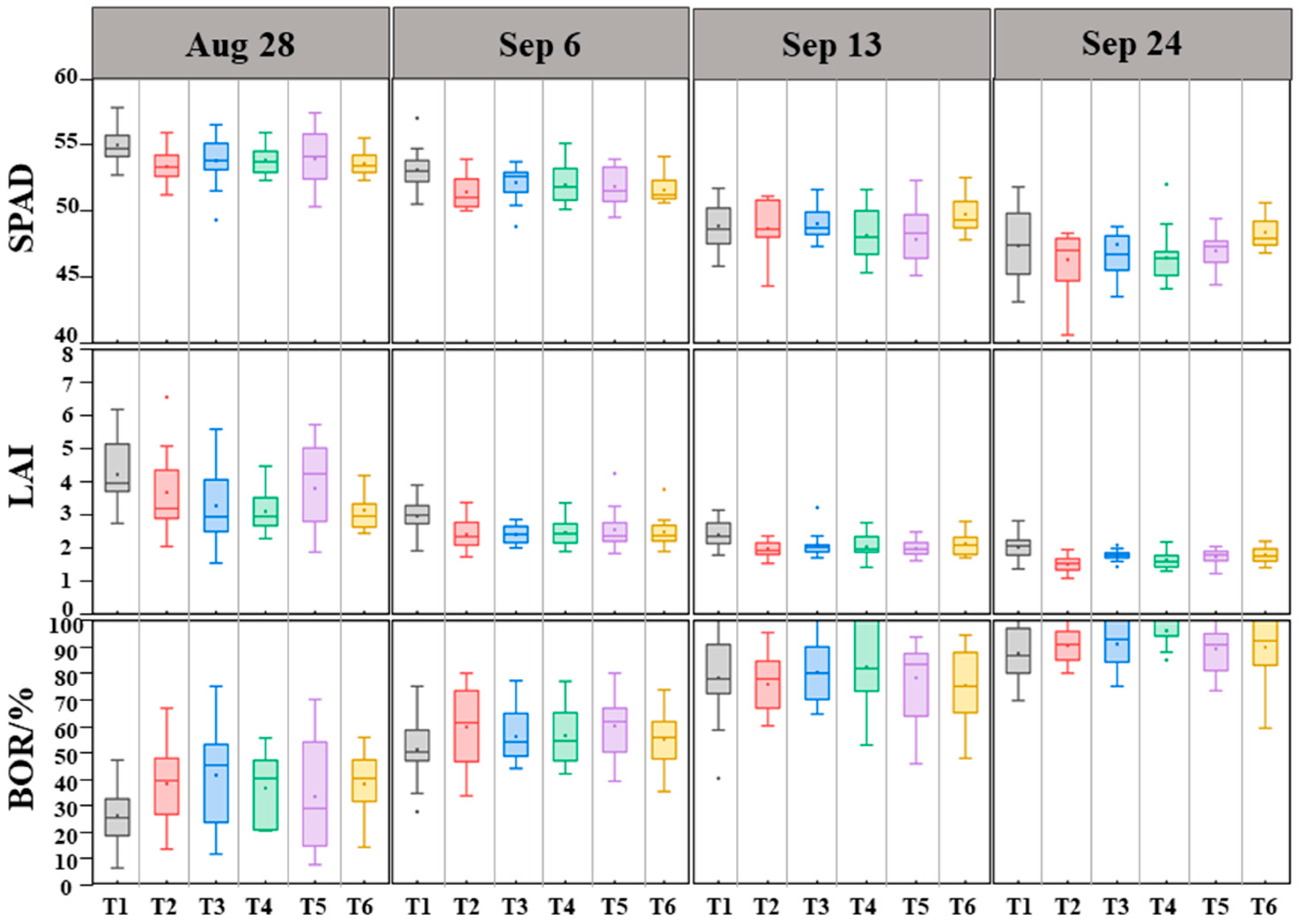
An analysis of four ground-based surveys conducted during the cotton boll-opening period was performed. As shown in Figure 5, the four stages represent the progression of boll opening from the initial phase to full dehiscence. The results indicate that the relative chlorophyll content (SPAD) and leaf area index (LAI) gradually decreased over time, with the declining trend weakening toward the end of the boll-opening period. In contrast, the cotton boll-opening rate increased progressively as SPAD and LAI decreased, and a faster decline in SPAD and LAI corresponded to a more rapid boll-opening process, whereas the rate of increase in boll-opening slowed during the late stage. The reductions in SPAD and LAI during the boll-opening period reflect the decline in leaf photosynthetic performance and canopy physiological activity, as plants transition from vegetative growth to reproductive maturity. Early bolls preferentially cracked, resulting in a rapid increase in the boll-opening rate. Subsequently, the number of functional leaves decreased to a stable level, and late-season bolls exhibited delayed development and higher moisture content, limiting the cracking process and leading to slower decreases in SPAD and LAI and a reduced rate of increase in boll opening. However, rainfall occurred during the late boll-opening stage, causing some cotton plants to produce rotten bolls that could not open normally. Field observations indicated that a small proportion of cotton plants developed rotten bolls that failed to open normally. Although these cases were limited, they may have introduced additional uncertainty into ground-measured BOR values and partially affected model performance.
Regarding treatment differences, the amount of nitrogen fertilizer applied was the dominant factor determining plant vigor and the maturation process during the cotton boll-opening stage. Compared with treatments T2, T4, and T6, which received lower nitrogen inputs under the same biostimulant dosage, treatments T1, T3, and T5 with higher nitrogen application consistently maintained higher SPAD and LAI values. This indicates that adequate nitrogen supply supports stronger leaf photosynthetic capacity and delays leaf senescence, thereby providing greater assimilate accumulation for boll development, ultimately resulting in higher boll-opening rates and a more rapid maturation process. In addition, under the same biostimulant dosage and fertilization conditions, a higher dilution volume (T1) compared with a lower dilution volume (T3) improved spray coverage and deposition uniformity, enhancing the diffusion and absorption of biostimulants on leaf surfaces. This allowed their physiological regulatory effects to be more fully expressed, leading to higher physiological activity and faster boll maturation. In contrast, increasing the number of biostimulant applications did not further enhance physiological responses. Treatments T5 and T6, which received two applications, showed no substantial differences in SPAD, LAI, or BOR compared with single-application treatments T1 and T2, indicating that plant responsiveness to biostimulants tends to saturate during the boll-opening stage, and repeated applications provide limited additional benefit. Overall, nitrogen application rate and dilution volume jointly determined the effectiveness of biostimulants and the physiological state of the plants, serving as key factors regulating the boll-opening process, whereas the number of biostimulant applications exerted a relatively weaker influence and contributed minimally to boll-opening progression.

3.2. Correlation Analysis of Characteristic Parameters

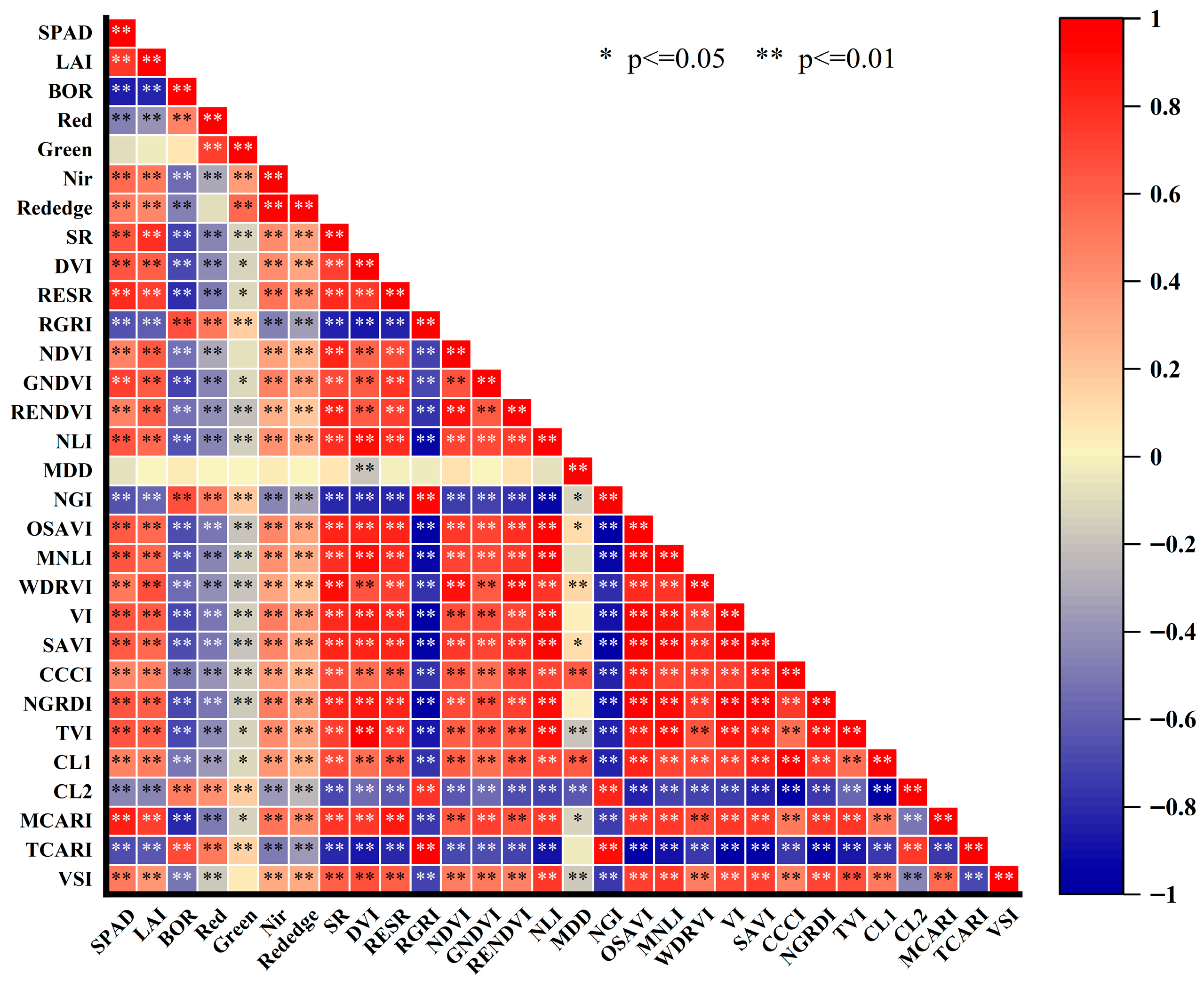
To ensure the validity of input variables for the machine learning prediction models, this study employed Pearson’s correlation analysis based on data from the entire period (four experimental dates) to examine the correlations between 23 vegetation indices calculated from UAV multispectral imagery and ground-measured SPAD, LAI, and BOR. The analytical results are shown in Figure 6.
The results indicate that SPAD exhibited a significant positive correlation with most vegetation indices, among which the correlation coefficients of RESR, GNDVI, and MCARI all exceeded 0.70, and the correlation coefficient between MCARI and SPAD reached 0.847, indicating an extremely significant correlation. LAI showed strong correlations with 12 vegetation indices, with absolute correlation values ranging from 0.60 to 0.80, among which SR had the highest correlation coefficient with LAI, reaching 0.783 at an extremely significant level. In contrast to SPAD and LAI, BOR exhibited negative correlations with most vegetation indices, among which MCARI showed the highest absolute correlation, reaching 0.808 at an extremely significant level. To further identify the features that contribute substantially to model construction, Table 6 summarizes the vegetation indices with absolute correlation values greater than 0.6 as the primary candidate variables for subsequent machine learning modeling.

3.3. Evaluation of Prediction Models Modelling and Analysis

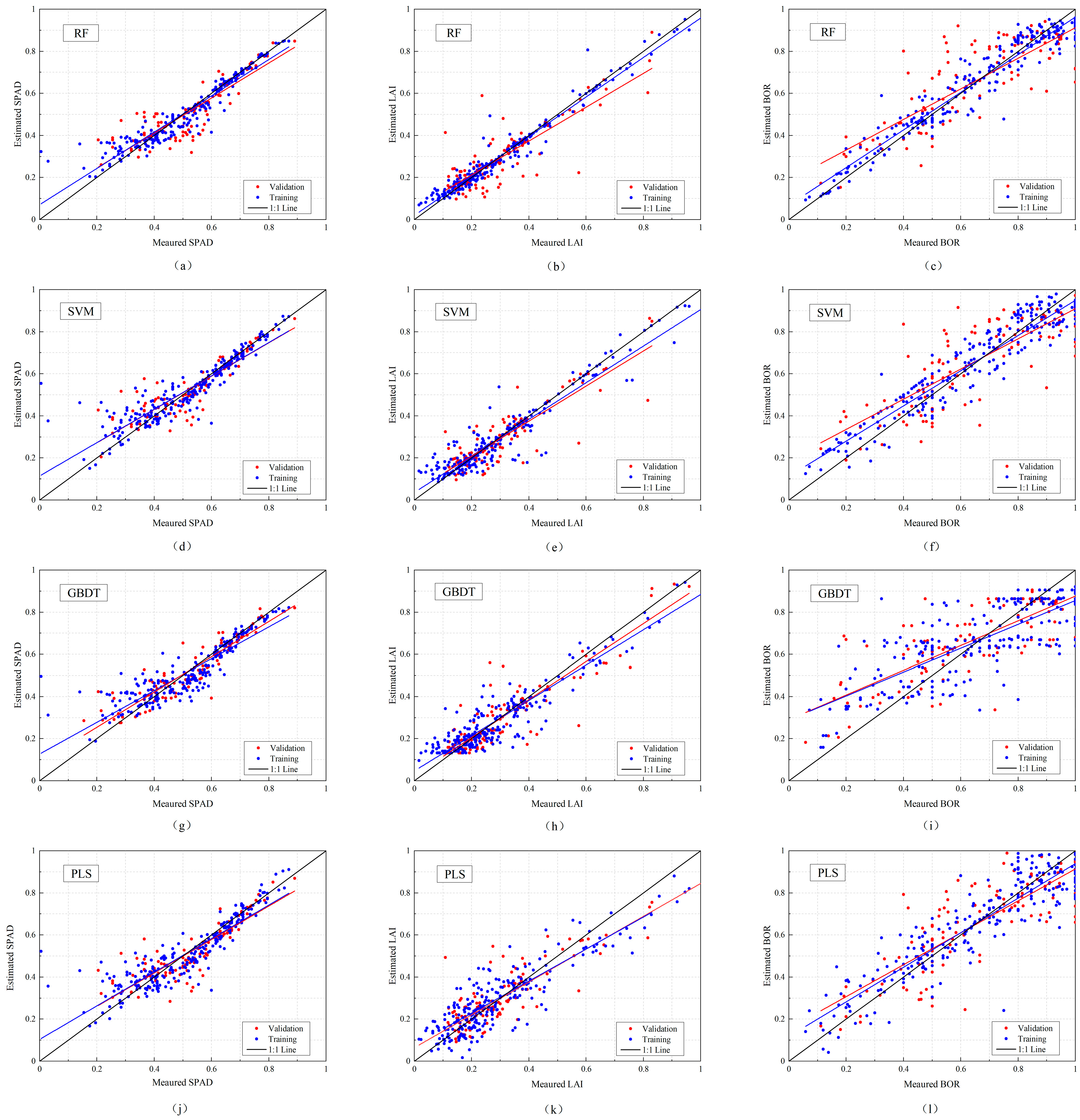
In this study, to investigate the estimation capability of UAV multispectral vegetation indices for cotton boll opening rate and the intermediary variables SPAD and LAI, sensitive vegetation indices derived from full-period remote sensing imagery were used as inputs, and ground-measured data were used to construct estimation models as shown in Figure 7.
The results showed in Table 7 that SPAD was best predicted by the GBDT model throughout the boll opening period, with an R2 of 0.86, an RMSE of 1.19, an rRMSE of 2.38%, and an MAE of 0.85. The prediction results of RF, SVM, and PLS were also relatively stable. For LAI, the SVM model achieved the best prediction performance across the entire period, with an R2 of 0.77, an RMSE of 0.38, an rRMSE of 15.09%, and an MAE of 0.25. Compared with SPAD and LAI, BOR exhibited an overall weaker spectral response to vegetation indices, indicating that multispectral indices are less sensitive to BOR, and the models are able to extract relatively limited effective feature information, thereby constraining the improvement in BOR prediction performance. Among the tested models, RF showed the best performance for BOR, with an R2 of 0.65, an RMSE of 0.13, an rRMSE of 21%, and an MAE of 0.1. Therefore, the GBDT model was selected for predicting SPAD during the boll opening period, the SVM model was selected for predicting LAI, and the RF model, which performed comparatively better, was chosen for BOR prediction.

3.4. Construction and Evaluation of the Physical Model for BOR

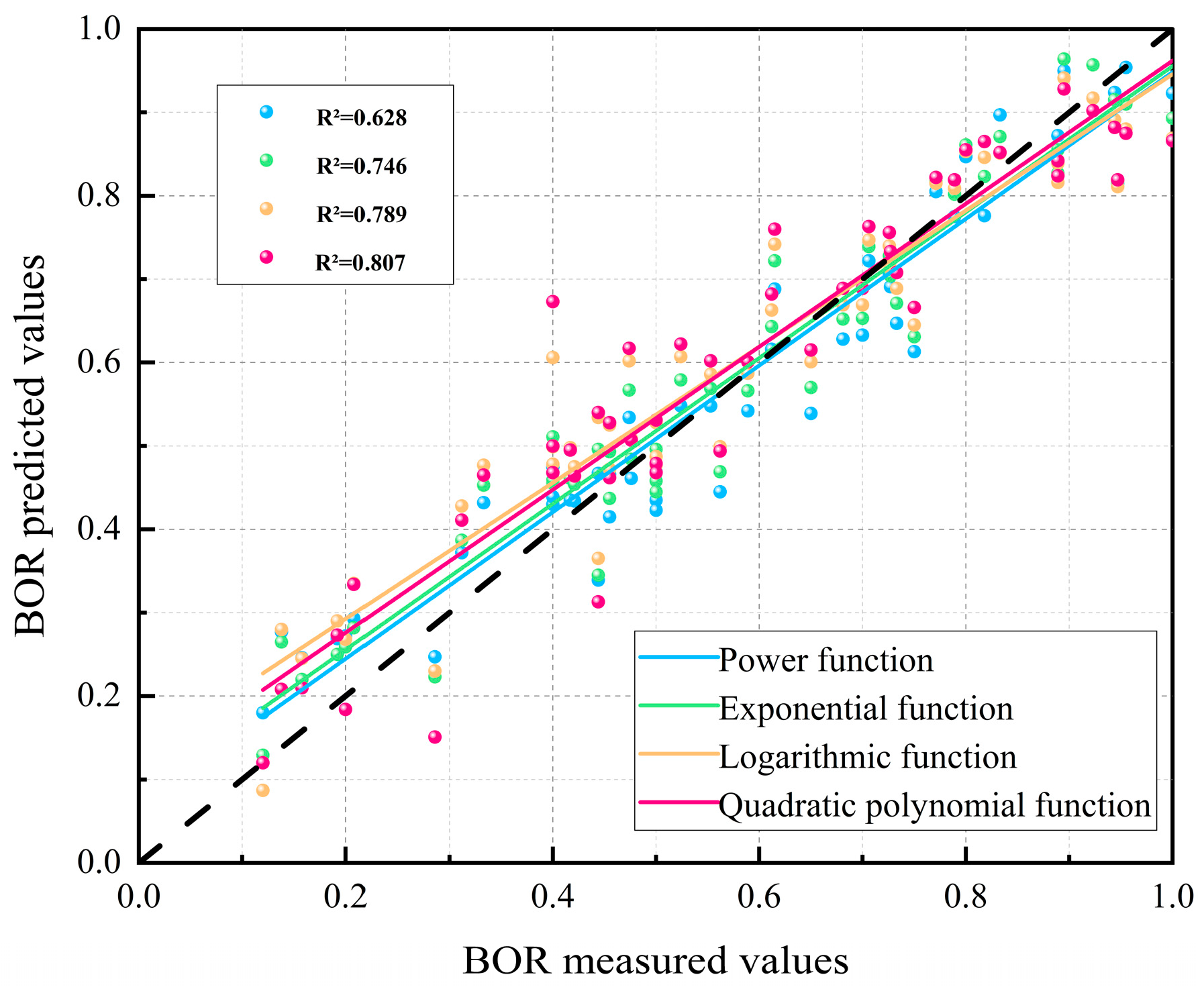
Based on the temporal variation characteristics and correlation analysis of SPAD, LAI, and BOR during the cotton boll opening period, this study further developed an empirical BOR model derived from plant physiological indicators. Using SPAD and LAI as independent variables, four types of equation models—power function, exponential function, logarithmic function, and quadratic polynomial—were constructed to fit BOR. As shown in Figure 8, notable differences were observed in the fitting accuracy among the models, among which the quadratic polynomial model exhibited the best performance, with a coefficient of determination (R2) of 0.807 and a root mean square error (RMSE) of 0.109. This model accurately captured the response pattern of BOR to changes in leaf chlorophyll content and canopy structure during the boll opening period. The constructed boll opening rate prediction equation is as follows:
Y B O R = 1.957 0.031 × S P A D + 0.464 × L A I + 0.004 × S P A D 2 + 0.048 × L A I 2 0.017 × S P A D × L A I
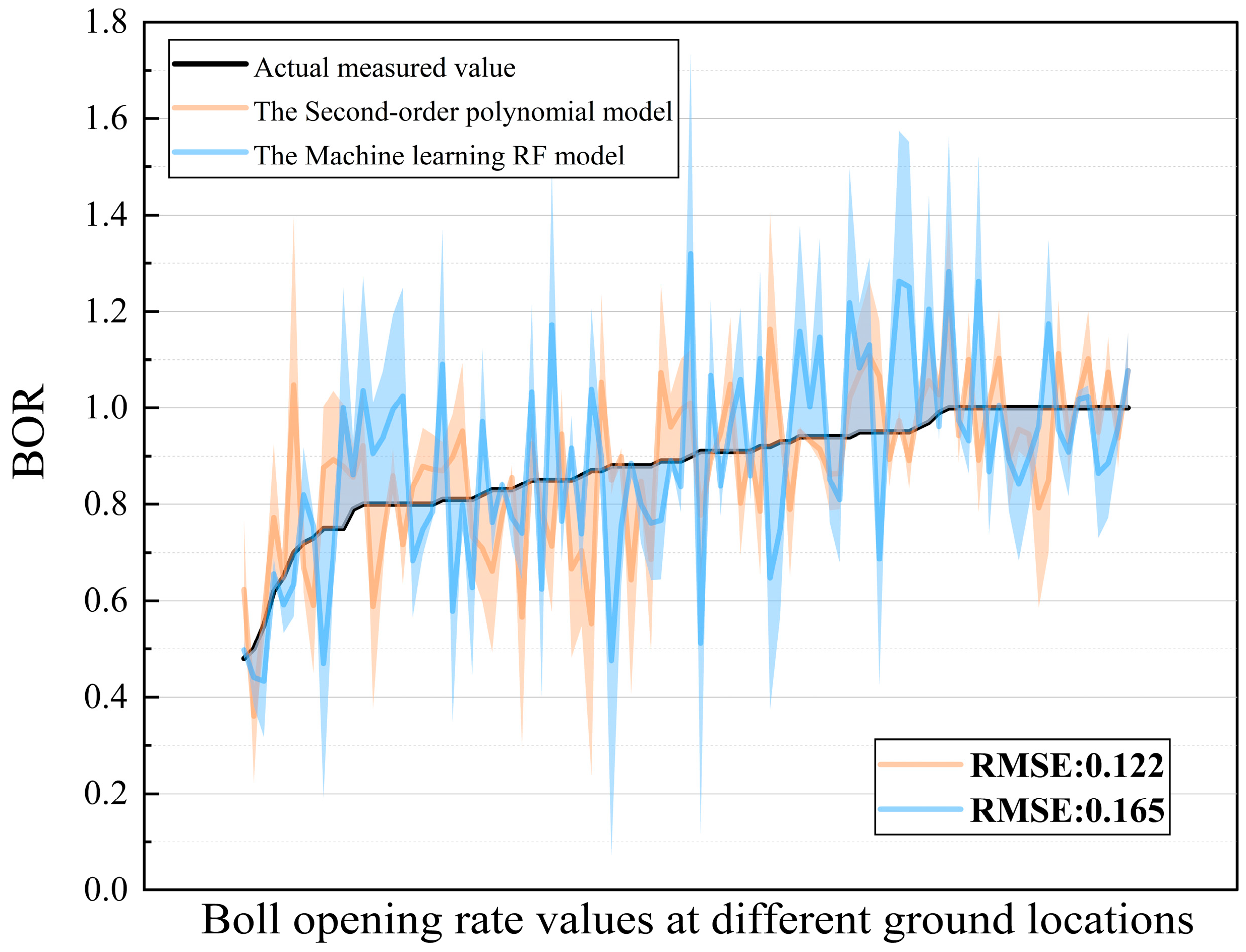
To further verify the generalization capability of the model, UAV multispectral imagery and corresponding ground-measured data acquired on September 25 were selected for independent validation. A comparative analysis was conducted between the RF model using multispectral vegetation indices as inputs and the quadratic polynomial empirical BOR model that used SPAD predicted by GBDT and LAI predicted by SVM as inputs. As shown in Figure 9, the physical equation achieved a root mean square error (RMSE) of 0.122, whereas the machine learning RF model yielded an RMSE of 0.165. The empirical equation model maintained high stability and reliability in BOR prediction, demonstrating the feasibility of the hierarchical modeling approach of “vegetation indices—physiological indicators—boll opening rate.”

3.5. Construction of the Spatial Distribution Map of BOR

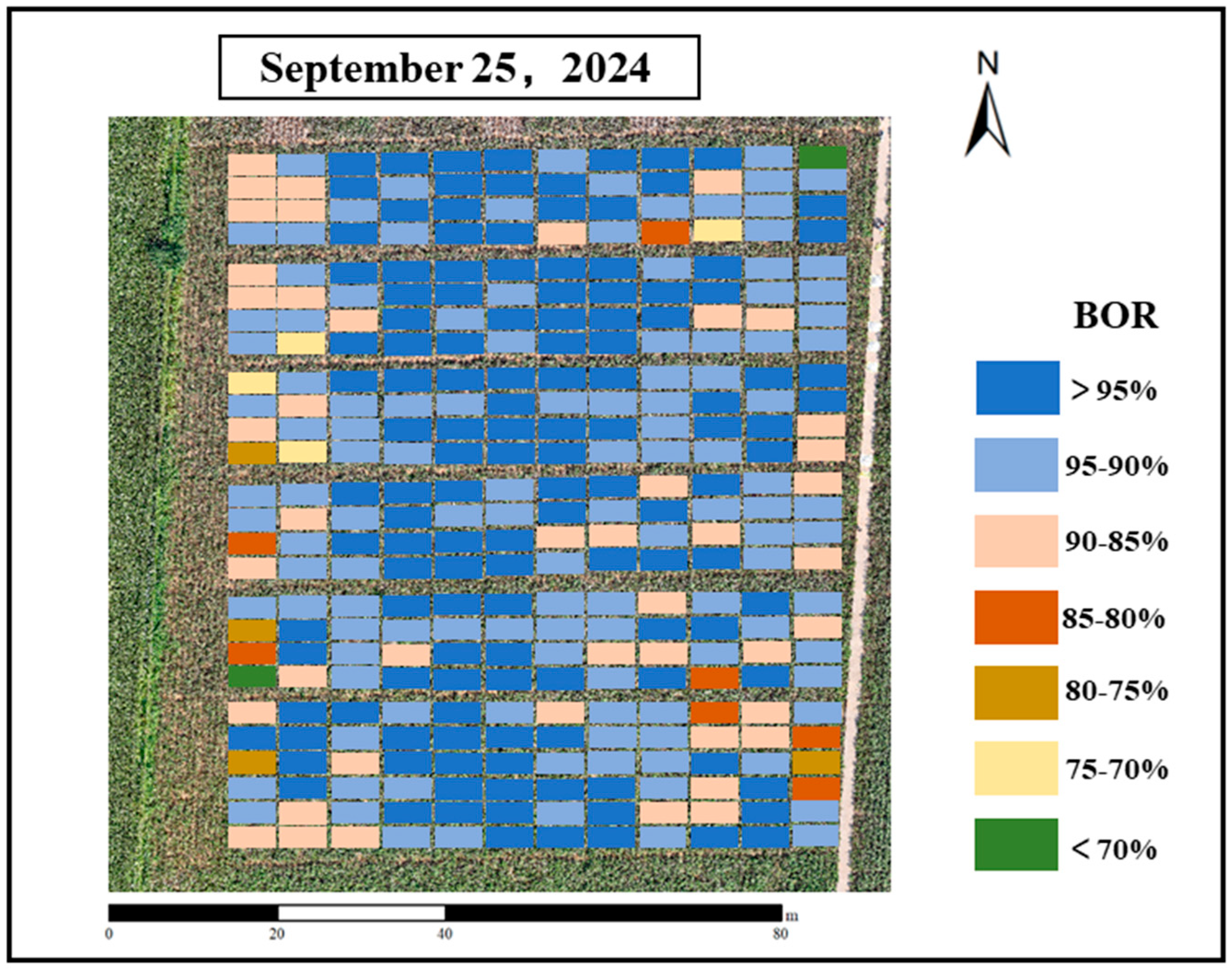
Based on the vegetation indices extracted from the UAV imagery acquired on 25 September 2024, SPAD and LAI were predicted using the GBDT and SVM models, respectively, and subsequently input into the quadratic polynomial equation model to estimate the boll opening rate. It should be noted that the rectangular regions shown in Figure 10 represent the regions of interest (ROIs) used for spatial aggregation rather than individual pixels. For each ROI, vegetation indices were spatially averaged and subsequently used to estimate SPAD and LAI through the trained machine learning models. The predicted SPAD and LAI values were then input into the physiological equation to derive the corresponding boll opening rate (BOR). This ROI-based representation reflects the average physiological and maturity status of cotton plants within each spatial zone, which is more suitable for field-level management and decision-making than single-pixel estimations.
As shown in Figure 10, most areas of the experimental field had already reached a boll opening rate exceeding 90%, with regions above 95% accounting for the largest proportion. These high-rate areas were mainly concentrated in the central and partially marginal zones of the field, indicating that the cotton bolls in these areas had fully opened. Medium-rate regions with boll opening rates of 90–80% were scattered across certain plots and were still in the process of boll opening progression. A small number of areas exhibited boll opening rates below 75%, distributed in fragmented locations, which may be related to treatment differences or variations in light, water, and nutrient availability caused by microtopographic effects. Areas with boll opening rates above 90% had reached the physiological maturity required for defoliant application, and early identification of these regions is beneficial for implementing differentiated management to avoid incomplete defoliation or boll rewetting caused by premature or delayed spraying. For areas with boll opening rates of 80–90%, it is recommended to delay spraying appropriately to ensure optimal defoliation. Additionally, regions with boll opening rates below 75% indicate delayed crop development, and subsequent spraying and harvesting should be carefully scheduled in combination with weather conditions to avoid yield and quality losses caused by forced defoliation.

4. Discussion

Based on multispectral imagery acquired by UAVs and ground-measured data, this study estimated key physiological parameters of cotton—SPAD and LAI—as well as the boll opening rate using canopy vegetation indices. The results showed that the multispectral vegetation indices exhibited strong correlations with both SPAD and LAI, and the temporal variations in SPAD and LAI were consistent with the dynamic changes in the boll opening rate. A quadratic polynomial equation for the boll opening rate was constructed using SPAD and LAI as intermediary variables, and by inputting SPAD and LAI estimated from UAV remote sensing, the boll opening rate in the field was effectively predicted. The approach of indirectly estimating physiological parameters from UAV imagery and subsequently using them to calculate the boll opening rate proved feasible and superior to direct prediction using vegetation indices alone, as it avoids the loss of information on lower-layer cotton bolls caused by canopy shading [43,44]. Compared with traditional manual field surveys, this method significantly improves the efficiency of boll opening rate assessment, reduces subjective bias, and provides a reliable approach for large-scale monitoring of cotton maturity.
The findings of this study are generally consistent with previous research that monitored cotton boll opening rate using canopy spectral information, indicating that multispectral canopy features can effectively reflect the physiological status and maturation level of cotton [45]. Existing studies typically establish empirical models either between spectral indices and boll opening rate or between spectral indices and leaf physiological parameters [46,47,48]. In contrast, this study introduced SPAD and LAI as intermediary variables to derive a physically based transmission pathway for predicting the boll opening rate, providing the model with a clearer physiological interpretation and enhancing its stability and interpretability. Unlike approaches that directly use vegetation indices for modeling, the differences mainly arise because boll opening information is located in the middle and lower bolls of the plant, to which canopy indices have limited sensitivity [49]. Therefore, the indirect modeling strategy adopted in this study better avoids issues of spectral saturation and insufficient sensitivity, offering advantages in both prediction performance and physiological interpretability.
The boll opening rate prediction method developed in this study, based on UAV imagery, demonstrated strong performance in both accuracy and interpretability and provided a practical technical pathway for monitoring cotton maturity. However, certain limitations remain. First, although the current measurements provide valuable insights into cotton boll opening dynamics, the number of sampled plots and observation periods was relatively limited, as data were collected within a single growing season and experimental area. Consequently, the spatio-temporal variability associated with different cotton varieties, planting densities, canopy management practices, and extreme weather conditions may not be fully captured. Therefore, the generalization ability of the proposed model requires further validation through multi-year observations and assessments conducted at regional or national scales. Second, UAV data were acquired under fixed flight altitude and controlled illumination conditions, which improved the consistency of image quality, but potential systematic errors were not fully quantified and may influence the inversion accuracy of SPAD and LAI.
To address the aforementioned limitations, several directions merit further exploration in future research. First, multi-regional and multi-year model validation should be conducted under different cotton varieties, fertilization regimes, and planting densities to enhance the model’s broad applicability. Second, the integration of multi-source features—such as texture characteristics, structural parameters, or three-dimensional canopy information—may further improve the accuracy of the inversion models. Finally, the predicted boll opening rate can be incorporated into precision cotton management systems, for example, to support zoned defoliant application strategies or to optimize mechanical harvesting schedules, thereby enabling an integrated workflow from remote sensing monitoring to field operation decision-making. Overall, the UAV-based method for estimating boll opening rate proposed in this study shows substantial application potential in large-scale cotton maturity monitoring and precision harvesting management.

5. Conclusions

This study developed a remote sensing-based prediction framework for key physiological parameters (SPAD and LAI) and boll opening rate (BOR) during the cotton boll opening stage, using UAV multispectral imagery combined with ground-based measurements. Twenty-eight multispectral vegetation indices were calculated and subjected to correlation analysis to identify significant indices for model construction. Multiple machine learning models were established, among which the GBDT model performed best for SPAD prediction, achieving an R2 of 0.86, while the SVM model showed the highest accuracy for LAI prediction, with an R2 of 0.77. Using remotely estimated SPAD and LAI as physiological intermediary variables, a quadratic polynomial equation model was constructed to indirectly estimate BOR. This model exhibited high prediction accuracy, with an R2 of 0.807, outperforming approaches that rely solely on multispectral indices, thus highlighting the critical role of physiological variables in characterizing cotton boll opening. Based on the model predictions, a spatial distribution map of BOR was generated, which visually reflects in-field differences in boll opening progress and provides scientific support for optimizing UAV-based defoliant application timing and scheduling manual harvesting. Overall, the results provide an effective technical foundation for precise monitoring and mechanized management during the cotton boll opening period.

Author Contributions

Conceptualization, G.W., C.X. and S.C.; methodology, C.X., C.S. (Changfeng Shan) and L.Z.; software, C.X. and L.Z.; validation, G.W., C.X. and C.S. (Changfeng Shan); formal analysis, L.K. and C.S. (Changfeng Shan); investigation, G.W., C.X., L.K. and C.S. (Changfeng Shan); resources, S.C. and Y.L.; data curation, C.X., L.K., C.S. (Cancan Song), L.Z. and Y.L.; writing—original draft, C.X.; writing—review and editing, G.W., L.K. and L.Z.; visualization, C.X., L.K. and C.S. (Cancan Song); supervision, G.W., S.C., C.S. (Changfeng Shan) and C.S. (Cancan Song); project administration, G.W., S.C., C.S. (Changfeng Shan), C.S. (Cancan Song), and Y.L.; funding acquisition, G.W. and Y.L. All authors have read and agreed to the published version of the manuscript.

Funding

This research was funded by the National Key Research and Development Program of China: 2023YFD2000200; National Natural Science Foundation of China: 32302410; and the “Qing Chuang Team Plan” teams of Shandong Province colleges and universities: 2024KJH016.

Data Availability Statement

The original contributions presented in this study are included in this article; further inquiries can be directed to the corresponding author.

Conflicts of Interest

The authors declare no conflicts of interest.

References

  1. Khan, M.A.; Wahid, A.; Ahmad, M.; Tahir, M.T.; Ahmed, M.; Ahmad, S.; Hasanuzzaman, M. World cotton production and consumption: An overview. In Cotton Production and Uses: Agronomy, Crop Protection, and Postharvest Technologies; Springer Nature: Berlin, Germany, 2020; pp. 1–7. [Google Scholar]
  2. Sun, Z.; Wang, X.; Wang, Z.; Yang, L.; Xie, Y.; Huang, Y. UAVs as remote sensing platforms in plant ecology: Review of applications and challenges. J. Plant Ecol. 2021, 14, 1003–1023. [Google Scholar] [CrossRef]
  3. Mohsan, S.A.H.; Khan, M.A.; Noor, F.; Ullah, I.; Alsharif, M.H. Towards the unmanned aerial vehicles (UAVs): A comprehensive review. Drones 2022, 6, 147. [Google Scholar] [CrossRef]
  4. Wang, Y.; Xiao, C.; Wang, Y.; Li, K.; Yu, K.; Geng, J.; Li, Q.; Yang, J.; Zhang, J.; Zhang, M. Monitoring of cotton boll opening rate based on UAV multispectral data. Remote Sens. 2023, 16, 132. [Google Scholar] [CrossRef]
  5. Feng, M.; Su, Y.; Lin, T.; Yu, X.; Song, Y.; Jin, X. High Throughput Cotton Yield Estination Based on Multi-source Remote Sensing Date from Unmanned Aerial Vehicles and Machine Learning. Trans. Chin. Soc. Agric. Mach. 2025, 56, 169–179. [Google Scholar]
  6. Geng, J.; Yang, X.; Huo, X.; Chen, J.; Lei, S.; Li, H.; Lang, Y.; Liu, Q. Effects of controlled-release urea combined with fulvic acid on soil inorganic nitrogen, leaf senescence and yield of cotton. Sci. Rep. 2020, 10, 17135. [Google Scholar] [CrossRef]
  7. Gamon, J.A.; Field, C.B.; Goulden, M.L.; Griffin, K.L.; Hartley, A.E.; Joel, G.; Penuelas, J.; Valentini, R. Relationships between NDVI, canopy structure, and photosynthesis in three Californian vegetation types. Ecol. Appl. 1995, 5, 28–41. [Google Scholar] [CrossRef]
  8. Dong, H.; Li, W.; Tang, W.; Zhang, D. Research Progress in Physiological Premature Senescence in Cotton. Cotton Sci. 2005, 17, 56–60. [Google Scholar]
  9. Yan, C.; Qu, Y.; Chen, Q. Estimation of cotton SPAD value and leaf water content based on UAV multispectral images. Trans. Chin. Soc. Agric. Eng. 2023, 39, 61–67. [Google Scholar]
  10. Shao, Y.; Tang, Q.; Cui, J.; Li, X.; Wang, L.; Lin, T. Cotton Leaf Area Index Estimation Combining UAV Spectral and Textural Features. Trans. Chin. Soc. Agric. Mach. 2023, 54, 186–196. [Google Scholar]
  11. Zhang, B.; Gu, L.; Dai, M.; Bao, X.; Sun, Q.; Zhang, M.; Qu, X.; Li, Z.; Zhen, W.; Gu, X. Estimation of grain filling rate of winter wheat using leaf chlorophyll and LAI extracted from UAV images. Field Crops Res. 2024, 306, 109198. [Google Scholar] [CrossRef]
  12. Ali, M.U.; Ahmed, S.; Ferzund, J.; Mehmood, A.; Rehman, A. Using PCA and factor analysis for dimensionality reduction of bio-informatics data. arXiv 2017, arXiv:1707.07189. [Google Scholar] [CrossRef]
  13. Bischl, B.; Lang, M.; Kotthoff, L.; Schiffner, J.; Richter, J.; Studerus, E.; Casalicchio, G.; Jones, Z.M. mlr: Machine Learning in R. J. Mach. Learn. Res. 2016, 17, 1–5. [Google Scholar]
  14. Nijat, K.; Shi, Q.; Wang, J.; Rukeya, S.; Ilyas, N.; Gulnur, I. Estimation of spring wheat chlorophyll content based on hyperspectral features and PLSR model. Trans. Chin. Soc. Agric. Eng. 2017, 33, 208–216. [Google Scholar]
  15. Väliaho, H.; Pekkonen, T. A Procedure for Stepwise Regression Analysis:(With a Program in FORTRAN V); Walter de Gruyter GmbH & Co KG: Berlin, Germany, 2022. [Google Scholar]
  16. Salman, H.A.; Kalakech, A.; Steiti, A. Random forest algorithm overview. Babylon. J. Mach. Learn. 2024, 2024, 69–79. [Google Scholar] [CrossRef]
  17. Roy, A.; Chakraborty, S. Support vector machine in structural reliability analysis: A review. Reliab. Eng. Syst. Saf. 2023, 233, 109126. [Google Scholar] [CrossRef]
  18. Zhang, P.; Jia, Y.; Shang, Y. Research and application of XGBoost in imbalanced data. Int. J. Distrib. Sens. Netw. 2022, 18, 15501329221106935. [Google Scholar] [CrossRef]
  19. Hussain, H.; Tamizharasan, P.; Rahul, C. Design possibilities and challenges of DNN models: A review on the perspective of end devices. Artif. Intell. Rev. 2022, 55, 5109–5167. [Google Scholar] [CrossRef]
  20. Rosso, P.; Nendel, C.; Gilardi, N.; Udroiu, C.; Chlebowski, F. Processing of remote sensing information to retrieve leaf area index in barley: A comparison of methods. Precis. Agric. 2022, 23, 1449–1472. [Google Scholar] [CrossRef]
  21. Tran, T.V.; Reef, R.; Zhu, X. A review of spectral indices for mangrove remote sensing. Remote Sens. 2022, 14, 4868. [Google Scholar] [CrossRef]
  22. Zhang, D.; Qi, H.; Guo, X.; Sun, H.; Min, J.; Li, S.; Hou, L.; Lv, L. Integration of UAV Multispectral Remote Sensing and Random Forest for Full-Growth Stage Monitoring of Wheat Dynamics. Agriculture 2025, 15, 353. [Google Scholar] [CrossRef]
  23. Wei, H.-E.; Grafton, M.; Bretherton, M.; Irwin, M.; Sandoval, E. Evaluation of point hyperspectral reflectance and multivariate regression models for grapevine water status estimation. Remote Sens. 2021, 13, 3198. [Google Scholar] [CrossRef]
  24. Huang, S.; Tang, L.; Hupy, J.P.; Wang, Y.; Shao, G. A commentary review on the use of normalized difference vegetation index (NDVI) in the era of popular remote sensing. J. For. Res. 2021, 32, 1–6. [Google Scholar] [CrossRef]
  25. Gitelson, A.A.; Kaufman, Y.J.; Merzlyak, M.N. Use of a green channel in remote sensing of global vegetation from EOS-MODIS. Remote Sens. Environ. 1996, 58, 289–298. [Google Scholar] [CrossRef]
  26. Olson, D.; Chatterjee, A.; Franzen, D.W.; Day, S.S. Relationship of drone-based vegetation indices with corn and sugarbeet yields. Agron. J. 2019, 111, 2545–2557. [Google Scholar] [CrossRef]
  27. Goel, N.S.; Qin, W. Influences of canopy architecture on relationships between various vegetation indices and LAI and FPAR: A computer simulation. Remote Sens. Rev. 1994, 10, 309–347. [Google Scholar] [CrossRef]
  28. Zha, H.; Miao, Y.; Wang, T.; Li, Y.; Zhang, J.; Sun, W.; Feng, Z.; Kusnierek, K. Improving unmanned aerial vehicle remote sensing-based rice nitrogen nutrition index prediction with machine learning. Remote Sens. 2020, 12, 215. [Google Scholar] [CrossRef]
  29. Yang, Q.; Ye, H.; Huang, K.; Zha, Y.; Shi, L. Estimation of leaf area index of sugarcane using crop surface model based on UAV image. Trans. Chin. Soc. Agric. Eng. 2017, 33, 104–111. [Google Scholar]
  30. Rondeaux, G.; Steven, M.; Baret, F. Optimization of soil-adjusted vegetation indices. Remote Sens. Environ. 1996, 55, 95–107. [Google Scholar] [CrossRef]
  31. Yang, Z.; Willis, P.; Mueller, R. Impact of band-ratio enhanced AWIFS image to crop classification accuracy. In Proceedings of the 17th Pecora Conference: The Future of Land Imaging Going Operational, Denver, CO, USA, November 18–20, 2008; pp. 1–11. [Google Scholar]
  32. Tucker, C.J. Red and photographic infrared linear combinations for monitoring vegetation. Remote Sens. Environ. 1979, 8, 127–150. [Google Scholar] [CrossRef]
  33. Ren, H.; Zhou, G.; Zhang, F. Using negative soil adjustment factor in soil-adjusted vegetation index (SAVI) for aboveground living biomass estimation in arid grasslands. Remote Sens. Environ. 2018, 209, 439–445. [Google Scholar] [CrossRef]
  34. Raper, T.; Varco, J. Canopy-scale wavelength and vegetative index sensitivities to cotton growth parameters and nitrogen status. Precis. Agric. 2015, 16, 62–76. [Google Scholar] [CrossRef]
  35. Xiaoqin, W.; Miaomiao, W.; Shaoqiang, W.; Yundong, W. Extraction of vegetation information from visible unmanned aerial vehicle images. Trans. Chin. Soc. Agric. Eng. 2015, 31, 152–159. [Google Scholar]
  36. Broge, N.H.; Leblanc, E. Comparing prediction power and stability of broadband and hyperspectral vegetation indices for estimation of green leaf area index and canopy chlorophyll density. Remote Sens. Environ. 2001, 76, 156–172. [Google Scholar] [CrossRef]
  37. Li, F.; Mistele, B.; Hu, Y.; Yue, X.; Yue, S.; Miao, Y.; Chen, X.; Cui, Z.; Meng, Q.; Schmidhalter, U. Remotely estimating aerial N status of phenologically differing winter wheat cultivars grown in contrasting climatic and geographic zones in China and Germany. Field Crops Res. 2012, 138, 21–32. [Google Scholar] [CrossRef]
  38. Gitelson, A.A.; Merzlyak, M.N. Signature analysis of leaf reflectance spectra: Algorithm development for remote sensing of chlorophyll. J. Plant Physiol. 1996, 148, 494–500. [Google Scholar] [CrossRef]
  39. Daughtry, C.S.; Walthall, C.; Kim, M.; De Colstoun, E.B.; McMurtrey Iii, J. Estimating corn leaf chlorophyll concentration from leaf and canopy reflectance. Remote Sens. Environ. 2000, 74, 229–239. [Google Scholar] [CrossRef]
  40. Haboudane, D.; Miller, J.R.; Pattey, E.; Zarco-Tejada, P.J.; Strachan, I.B. Hyperspectral vegetation indices and novel algorithms for predicting green LAI of crop canopies: Modeling and validation in the context of precision agriculture. Remote Sens. Environ. 2004, 90, 337–352. [Google Scholar] [CrossRef]
  41. Gitelson, A.A.; Kaufman, Y.J.; Stark, R.; Rundquist, D. Novel algorithms for remote estimation of vegetation fraction. Remote Sens. Environ. 2002, 80, 76–87. [Google Scholar] [CrossRef]
  42. Chicco, D.; Warrens, M.J.; Jurman, G. The coefficient of determination R-squared is more informative than SMAPE, MAE, MAPE, MSE and RMSE in regression analysis evaluation. PeerJ Comput. Sci. 2021, 7, e623. [Google Scholar] [CrossRef]
  43. Ma, Y.; Chen, X.; Huang, C.; Hou, T.; Lv, X.; Zhang, Z. Monitoring defoliation rate and boll-opening rate of machine-harvested cotton based on UAV RGB images. Eur. J. Agron. 2023, 151, 126976. [Google Scholar] [CrossRef]
  44. Pabuayon, I.L.B.; Kelly, B.R.; Mitchell-McCallister, D.; Coldren, C.L.; Ritchie, G.L. Cotton boll distribution: A review. Agron. J. 2021, 113, 956–970. [Google Scholar] [CrossRef]
  45. Wanjura, D.; Newton, O. Predicting Cotton Crop Boll Development 1. Agron. J. 1981, 73, 476–481. [Google Scholar] [CrossRef]
  46. Yan, P.; Han, Q.; Feng, Y.; Kang, S. Estimating LAI for cotton using multisource UAV data and a modified universal model. Remote Sens. 2022, 14, 4272. [Google Scholar] [CrossRef]
  47. Li, K.; Ying, C.; Chen, M.; Cui, H. Research on cotton SPAD estimation based on UAV multispectral images combined with machine learning. Xinjiang Agric. Sci. 2025, 64, 791–799. [Google Scholar]
  48. Zhao, Y.; Yan, A.; Ma, M.; Xiao, S. Estimation of cotton LAI and SPAD under water—Nitrogen coupling based on multi—Spectral imaging of unmanned aerial vehicle. Xinjiang Agric. Sci. 2025, 62, 781–790. [Google Scholar]
  49. Zhao, D.; Reddy, K.R.; Kakani, V.G.; Read, J.J.; Koti, S. Canopy reflectance in cotton for growth assessment and lint yield prediction. Eur. J. Agron. 2007, 26, 335–344. [Google Scholar] [CrossRef]
Figure 1. Research technical workflow diagram.
Agronomy 16 00162 g001
Figure 2. Schematic diagram of the experimental area.
Agronomy 16 00162 g002
Figure 3. DJI M3m camera specifications.
Agronomy 16 00162 g003
Figure 4. Schematic diagram of ground data measurements.
Agronomy 16 00162 g004
Figure 5. Dynamic changes in ground-based data.
Agronomy 16 00162 g005
Figure 6. Correlation heat map.
Agronomy 16 00162 g006
Figure 7. Fitting results of the prediction models. (a) RF–SPAD fitting; (b) RF–LAI fitting; (c) RF–BOR fitting; (d) SVM–SPAD fitting; (e) SVM–LAI fitting; (f) SVM–BOR fitting; (g) GBDT–SPAD fitting; (h) GBDT–LAI fitting; (i) GBDT–BOR fitting; (j) PLS–SPAD fitting; (k) PLS–LAI fitting; (l) PLS–BOR fitting.
Agronomy 16 00162 g007
Figure 8. Fitting performance of the BOR.
Agronomy 16 00162 g008
Figure 9. Comparison results of the BOR prediction models.
Agronomy 16 00162 g009
Figure 10. Spatial distribution of BOR.
Agronomy 16 00162 g010
Table 1. Experimental area treatment scheme.
TreatmentNitrogen Application Rate (kg/ha)Biostimulant Application Rate (g/ha)Application Method
T1225333Diluted with 90 L/ha of water; applied once at the squaring stage
T2195333
T3225333Diluted with 45 L/ha of water; applied once at the squaring stage
T4195333
T5225333 + 333Diluted with 45 L/ha of water; applied once at the squaring stage and once at the flowering–boll setting stage
T6195333 + 333
Table 2. UAV flight parameters.
UAV SettingsValue
Empty Aircraft Weight951 g
Image Sensor1/2.8-inch CMOS
Camera Resolution5 MP
Shooting Interval2 s
Flight Altitude20 m
Table 3. Statistics of measured data.
DateSampleMaximumMinimumAverageStandard DeviationCoefficient of Variation
SPAD28Aug9057.8049.3053.901.552.88
6Sep9057.0048.8051.991.412.72
13Sep9052.5040.1048.701.923.95
24Sep9052.0040.6046.991.964.17
LAI28Aug906.561.543.541.0730.30
6Sep904.251.732.540.4819.00
13Sep903.221.412.100.3416.40
24Sep902.821.081.740.3017.30
BOR28Aug9075%6%35%0.1644.80
6Sep9080%27%56%0.1221.10
13Sep90100%40%78%0.1417.50
24Sep90100%59%91%0.089.51
Note: The coefficient of variation (CV) is defined as the ratio of the sample standard deviation to the sample mean and is used to quantify the relative variability in the ground survey data, serving as an important statistical indicator for evaluating data stability.
Table 4. Spectral bands and vegetation indices used as model inputs.
Vegetation IndexFormula
Red
Green
NIR
Red edge
SR [20]
R r e d
R g r e e n
R n i r
R r e d   e d g e
S R = R n i r / R r e d
DVI [21] D V I = R n i r R r e d
RESR [22] R E S R = R r e d   e d g e / R r e d
RGRI [23]
NDVI [24]
R G R I = R r e d / R g r e e n
N D V I = ( R n i r R r e d ) / ( R n i r + R r e d )
GNDVI [25] G N D V I = ( R g r e e n R r e d ) / ( R g r e e n + R r e d )
RENDVI [26] R E N D V I = ( R r e d   e d g e R r e d ) / ( R r e d   e d g e + R r e d )
NLI [27] N L I = ( R n i r * R n i r R r e d ) / ( R n i r * R n i r + R r e d )
MDD [28] M D D = ( R n i r R r e d   e d g e ) / ( R r e d   e d g e R r e d )
NGI [29] N G I = R g r e e n / ( R n i r + R g r e e n + R r e d   e d g e )
OSAVI [30] O S A V I = ( 1 + 0.16 ) ( R n i r R r e d ) / ( R n i r + R r e d + 0.16 )
MNLI [31] M N L I = 1.5 ( R n i r * R n i r R r e d ) / ( R n i r * R n i r + R r e d + 0.5 )
WDRVI [28] W N R V I = ( a R n i r R r e d ) / ( a R n i r + R r e d ) ( a = 0.12 )
VI [32] V I = 1.45 ( R n i r * R n i r + 1 ) / ( R r e d + 0.45 )
SAVI [33] S A V I = 1.5 ( R n i r R r e d ) / ( R n i r + R r e d + 0.45 )
CCCI [34] C C C I = ( R n i r R r e d   e d g e ) / ( R n i r + R r e d   e d g e )
NGRDI [35] N G R D I = ( R g r e e n R r e d ) / ( R g r e e n + R r e d )
TVI [36] T V I = 60 * ( R n i r R r e d ) 100 * ( R r e d R g r e e n )
CL1 [37]
CL2 [38]
MCARI [39]
TCARI [40]
VSI [41]
C L 1 = ( R n i r / R r e d   e d g e ) 1
C L 2 = ( R r e d   e d g e / R g r e e n ) 1
M C A R I = ( R r e d   e d g e R r e d 0.2 * ( R r e d   e d g e R g r e e n ) ) * ( R r e d   e d g e / R r e d )
T C A R I = 3 ( ( R r e d   e d g e R r e d ) 0.2 ( R r e d   e d g e R g r e e n ) * ( R r e d   e d g e / R r e d ) )
V S I = ( R n i r + R g r e e n R r e d ) / ( R n i r + R g r e e n + R r e d )
Note: Red, Green, Red edge, and NIR represent original spectral bands, while the remaining variables are derived vegetation indices.
Table 5. Prediction model parameters.
ModelParameterValue Range
RFn_estimators100–300
max_depth5–15
min_samples_leaf2–8
min_sample_split1–6
GBDTn_estimators100–300
max_depth3–8
learning_rate0.05–0.15
min_samples_leaf5–12
SVMC1–50
gamma0.01–0.05
epsilon0.01–0.1
PLSRn_components2–8
Table 6. Correlation coefficient table.
SPAD Sensitive Vegetation IndicesCorrelation CoefficientLAI Sensitive Vegetation IndicesCorrelation CoefficientBOR Sensitive Vegetation IndicesCorrelation Coefficient
MCARI0.847SR0.783MCARI−0.808
RESR0.803MCARI0.739RESR−0.799
GNDVI0.728RESR0.732GNDVI−0.710
TCARI−0.663WDRVI0.664SR−0.710
VI0.659NDVI0.628TCARI0.698
TVI0.656GNDVI0.627VI−0.696
SR0.656VI0.624NGRDI−0.687
NGRDI0.654TCARI−0.626TVI−0.687
DVI0.652TVI0.619DVI−0.684
NGI−0.651DVI0.617RGRI0.675
RGRI−0.645NGRDI0.615NGI0.666
NLI0.641RENDVI0.607OSAVI−0.661
OSAVI0.640 SAVI−0.660
SAVI0.639 MNLI−0.654
Table 7. Evaluation of the prediction models.
Research SubjectsAccuracy MetricsRFSVMGBDTPLS
SPAD R 2 0.750.790.860.80
RMSE1.431.321.191.49
rRMSE (%)2.842.622.382.96
MAE1.020.870.850.99
LAI R 2 0.700.770.740.68
RMSE0.420.380.460.45
rRMSE (%)16.8915.0918.4117.65
MAE0.270.250.210.32
BOR R 2 0.650.630.580.62
RMSE0.130.140.160.14
rRMSE (%)21.0021.5524.4721.72
MAE0.100.110.120.11
Disclaimer/Publisher’s Note: The statements, opinions and data contained in all publications are solely those of the individual author(s) and contributor(s) and not of MDPI and/or the editor(s). MDPI and/or the editor(s) disclaim responsibility for any injury to people or property resulting from any ideas, methods, instructions or products referred to in the content.