Article

Genome-Wide Identification of the FKBP Gene Family in Rice and Its Potential Roles in Blast Resistance

State Key Laboratory of Wheat Improvement, Shandong Agricultural University, Tai’an 271018, China
*
Author to whom correspondence should be addressed.
Agronomy 2026, 16(2), 149; https://doi.org/10.3390/agronomy16020149
Submission received: 6 November 2025 / Revised: 24 December 2025 / Accepted: 5 January 2026 / Published: 7 January 2026

Abstract

Rice (Oryza sativa L.) is a major global staple crop, yet its productivity is severely constrained by rice blast disease caused by Magnaporthe oryzae. FK506-binding proteins (FKBPs) are peptidyl-prolyl cis-trans isomerases involved in protein folding, stress response, and signaling regulation, but their roles in rice blast resistance remain unclear. In this study, we performed a comprehensive identification and characterization of FKBP gene family members in two rice cultivars, Nipponbare (NIP) and Zhonghua 11 (ZH11), based on the latest T2T (telomere-to-telomere) genome assembly of ZH11 and the reference genome of NIP. A total of 24 and 29 FKBP genes were detected in NIP and ZH11, respectively, indicating a slight expansion in ZH11. Phylogenetic and collinearity analyses revealed strong conservation of FKBP family members between the two cultivars, while several ZH11-specific genes likely resulted from recent duplication events. Promoter analysis showed that FKBP genes are enriched in stress and hormone responsive cis-elements, particularly those related to ABA, MeJA, and SA signaling. Transcriptomic and RT-qPCR analyses demonstrated that multiple FKBP genes were significantly regulated during M. oryzae infection, suggesting their potential involvement in defense signaling pathways. This study provides a comprehensive overview of FKBP gene family evolution and expression in rice, identifies candidate genes potentially associated with blast resistance, and offers valuable insights for molecular breeding aimed at improving disease resistance in rice.

1. Introduction

Rice is one of the most important staple crops worldwide, and its yield and quality are closely tied to global food security. Among the major threats to rice production, blast disease caused by the fungal pathogen M. oryzae remains the most destructive, resulting in 10–30% yield losses annually. Understanding the molecular mechanisms underlying blast resistance and identifying key regulatory genes are therefore essential for developing durable disease-resistant cultivars [1,2,3].
Rice blast resistance is governed by both qualitative and quantitative mechanisms. A number of major resistance (R) genes have been identified, many of which encode nucleotide-binding leucine-rich repeat (NLR) receptors that recognize specific pathogen avirulence effectors, triggering effector-triggered immunity (ETI) characterized by hypersensitive response and programmed cell death [4]. Notable examples include Pib, Piz-t, and Pigm, which confer broad-spectrum or race-specific resistance [5,6,7]. In addition, pattern-triggered immunity (PTI) plays a foundational role through recognition of pathogen-associated molecular patterns (PAMPs) by pattern recognition receptors (PRRs), leading to activation of downstream signaling involving mitogen-activated protein kinase (MAPK) cascades, reactive oxygen species (ROS) production, and phytohormone crosstalk [1,8]. Complex interactions among these pathways, along with transcriptional reprogramming and protein homeostasis maintenance, determine the outcome of rice–M. oryzae interactions. Identifying novel regulatory components within these networks is crucial for developing durable resistance strategies.
FK506-binding proteins (FKBPs) are a conserved family of immunophilins characterized by peptidyl-prolyl cis-trans isomerase (PPIase) activity, which enables them to regulate protein folding, cellular signaling, and responses to environmental cues [9]. In plants, FKBPs have been implicated in diverse biological processes, including development, hormone signaling, and stress adaptation [10]. For example, AtFKBP62 in Arabidopsis thaliana participates in heat stress responses by modulating the stability of the HSP90 complex [11]. In rice, several FKBP genes have been associated with drought tolerance [12,13]. However, the FKBP gene family as a whole has not been systematically characterized, and their potential contributions to blast resistance remain largely unknown. A previous genome-wide analysis of the rice FKBP family primarily focused on potential roles in abiotic stress responses based on earlier reference genomes [14]. In contrast, the present study leverages the newly T2T genome assembly of ZH11 alongside the standard NIP reference to enable a comparative cultivar-level analysis, while extending the functional exploration to biotic stress by examining expression patterns during M. oryzae infection, an aspect not previously addressed. Given that FKBP proteins in other plant species have been linked to pathogen defense, protein homeostasis, and hormone-mediated immune signaling [15,16], it is reasonable to hypothesize that rice FKBP genes (OsFKBPs) may play potential roles in immunity against M. oryzae.
The availability of high-quality rice genome assemblies has provided unprecedented opportunities for a comprehensive evaluation of gene families. In particular, recent advancements in long-read and HiFi sequencing technologies have enabled the generation of a gap-free telomere-to-telomere (T2T) rice genome [17,18]. Compared with the widely used NIP reference genome, the T2T assembly of ZH11 offers improved sequence continuity and annotation accuracy, allowing the discovery of previously unannotated or misannotated gene family members. Such improvements are critical for understanding gene expansion, structural diversification, and functional evolution in rice.
In this study, we performed a genome-wide identification and comparative analysis of FKBP gene family members in the NIP reference genome and the ZH11 T2T genome. We examined their phylogenetic relationships, chromosomal distributions, gene structures, conserved domains, and promoter cis-elements. We further integrated transcriptome datasets and RT-qPCR validation to assess the expression patterns of OsFKBP genes under M. oryzae infection. Additionally, comparative genomic analyses with wheat and maize were conducted to elucidate evolutionary conservation and lineage-specific diversification within the Poaceae. Overall, this work provides the first comprehensive characterization of FKBP genes in rice based on both conventional and T2T genome resources. Our findings offer insights into the evolutionary history and functional differentiation of the FKBP family and identify candidate genes potentially involved in blast resistance, thereby providing valuable genetic resources for rice molecular breeding.

2. Materials and Methods

2.1. Identification of FKBP Gene Family Members in Rice

The reference genome sequence and annotation files of NIP were obtained from the Rice Resource Center database (https://ricerc.sicau.edu.cn/) (accessed on 24 December 2025) [18]. The T2T genome assembly of ZH11 was downloaded from the ZH11 genome database (http://101.42.36.205:9900/jbrowse) (accessed on 24 December 2025) [17], The longest transcript and corresponding protein sequences for each gene were extracted using TBtools v2.3.90 [19].
To identify FKBP family members, the hidden Markov model (HMM) profile corresponding to the FKBP domain (PF17800) was retrieved from the Pfam database and used as a query in the HMMER search implemented in TBtools. In parallel, BLASTP searches in TBtools were performed using known FKBP protein sequences as queries against the local protein databases derived from the NIP and ZH11 genome annotation files to ensure comprehensive detection, with an E-value cutoff of 1 × 10⁻⁵ and other parameters set to default. Candidate genes identified by both methods were further validated by confirming the presence of complete FKBP domains using the InterPro (https://www.ebi.ac.uk/interpro/) (accessed on 24 December 2025) and NCBI Conserved Domain (CD)-Search databases (https://www.ncbi.nlm.nih.gov/Structure/bwrpsb/bwrpsb.cgi) (accessed on 24 December 2025), with parameters set to default [20,21]. Basic physicochemical properties of the identified proteins, including amino acid length, molecular weight (MW), and theoretical isoelectric point (pI), were calculated using TBtools.

2.2. Chromosomal Localization and Duplication Analysis

The chromosomal locations of FKBP genes in both NIP and ZH11 genomes were extracted from their respective annotation files and visualized using the Chromosome Mapping tool in TBtools. Gene duplication events were identified using the MCScanX module with default parameters. The physical distributions and duplication relationships were further visualized using the Advanced Circos function in TBtools.

2.3. Phylogenetic and Collinearity Analyses

Multiple sequence alignment of FKBP protein sequences from NIP and ZH11 was performed using MEGA 12 [22], followed by trimming of poorly aligned regions with trimAl [23]. The refined alignments were used to construct a maximum-likelihood (ML) phylogenetic tree using IQ-TREE v3.0.1 [24] with the best-fit substitution model automatically selected and 1000 bootstrap replicates. The resulting tree was visualized and annotated using iTOL (https://itol.embl.de/) (accessed on 24 December 2025) [25].
Syntenic relationships of FKBP genes within and between rice genomes and other genomes were analyzed using the One Step MCScanX function in TBtools. The results were visualized through Advanced Circos, where gray lines indicate overall genomic synteny and colored lines represent FKBP-specific collinear pairs.

2.4. Conserved Domain and Motif Analysis

Conserved domains in the FKBP protein sequences were validated using the NCBI CD-Search tool (https://www.ncbi.nlm.nih.gov/Structure/bwrpsb/bwrpsb.cgi) (accessed on 24 December 2025) [20]. Motif identification was conducted with the MEME algorithm integrated in TBtools, using default parameters. Up to 8 conserved motifs were detected, and their sequence logos were generated automatically. Domain composition, motif arrangement, and gene structures were integrated to illustrate structural diversity and evolutionary conservation among FKBP family members.

2.5. Promoter Cis-Element Analysis

To explore potential regulatory elements, 2000 bp upstream sequences from the translation start sites of FKBP genes were extracted as promoter regions. Cis-acting regulatory elements were predicted using the PlantCARE database (https://bioinformatics.psb.ugent.be/webtools/plantcare/html/) (accessed on 24 December 2025) [26]. Identified elements were manually categorized into functional groups, including stress response, hormone signaling, and development-related motifs, and visualized using TBtools.

2.6. Expression Profiling Under Rice Blast Infection

Transcriptomic data of Nipponbare infected with M. oryzae were used to analyze the expression patterns of FKBP genes at different infection stages. This choice was made because high-quality, comprehensive, and publicly available transcriptome datasets for M. oryzae infection are abundant for NIP, the widely used reference cultivar in rice functional genomics, whereas comparable publicly available infection-related transcriptome data for ZH11 are currently limited. This approach ensures consistency in data sources and avoids potential variability arising from differences in experimental conditions across datasets.
RNA-seq data were generated from Nipponbare rice leaves infected with M. oryzae for expression profiling of FKBP genes. Quality control of raw reads was performed using fastp [27] with the following parameters: qualified quality phred 20, unqualified percent limit 40, minimum length 36 bp, adapter trimming for paired-end reads, error correction, and sliding window trimming (window size 4, mean quality 20). Clean reads were quantified to the transcriptome using Salmon [28] in alignment-free mode with automatic library type detection, sequence-specific and GC bias corrections, mapping validation, and 100 bootstraps for abundance estimation. The Salmon index was built from extracted transcript sequences using default parameters and the specified number of threads. Gene-level abundance matrices (in FPKM units) were generated using tximport in R with a transcript-to-gene mapping file derived from the genome annotation. Expression values (FPKM) were normalized and clustered using TBtools.
For experimental validation, total RNA was extracted from uninfected and infected rice leaves at multiple time points using TRIzol reagent (CWBIO, CW0580, Taizhou, China). First-strand cDNA was synthesized using the All-in-One First-Strand Synthesis MasterMix (YUGON, EG15133S, Lianyugang, China), and quantitative PCR (RT-qPCR) was performed using the UltraSYBR Mixture (CWBIO, CW2602M, Taizhou, China) on a real-time PCR detection system. Relative expression levels were calculated using the 2−ΔΔCt method. Primer sequences used in this study are listed in Table S3, and corresponding transcriptome FPKM data are provided in Table S2.

3. Results

3.1. Identification and Characterization of FKBP Family Members in NIP and ZH11

FKBP family members were identified in both NIP and ZH11 through combined HMMER and BLASTP searches, followed by domain verification using InterPro and CD-Search analyses. A total of 24 FKBP genes were identified in NIP and 29 in ZH11, suggesting that the higher-quality T2T genome assembly of ZH11 allows for more comprehensive detection of FKBP family members.
All FKBP genes were renamed according to their chromosomal positions, and their physicochemical properties were analyzed (Table S1). The FKBP proteins exhibited similar molecular weight and theoretical isoelectric point values between the two cultivars, indicating strong structural conservation. The coexistence of both small and large FKBP proteins in each genome suggests potential functional diversification within the family.
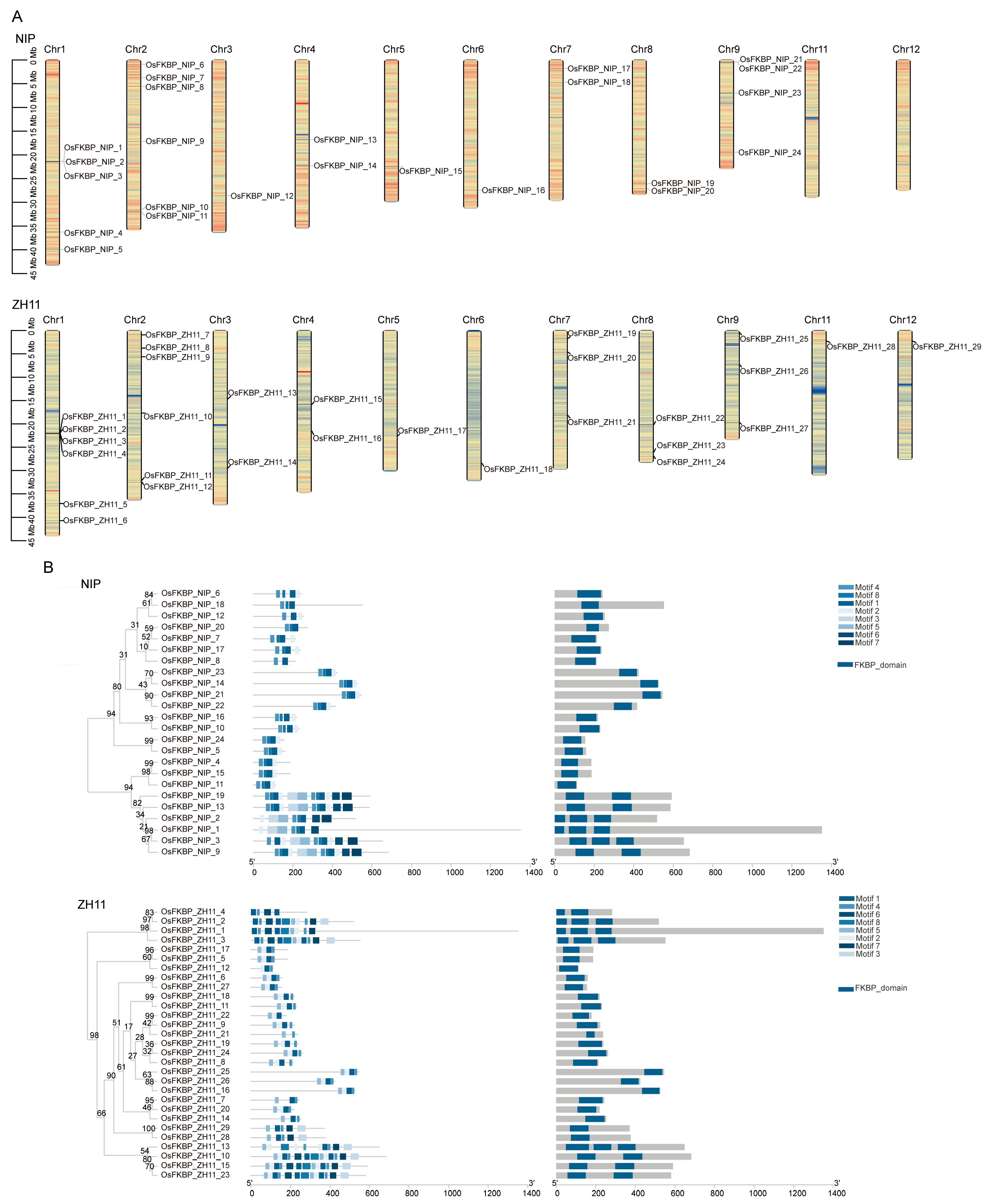
Chromosomal mapping revealed an uneven distribution of FKBP genes across rice chromosomes, with chromosomes 1 and 2 harboring the highest numbers. Notably, ZH11 contained unique FKBP genes located on chromosomes 11 and 12 that were absent in NIP, implying cultivar-specific gene expansion or deletion events (Figure 1A). All identified FKBP proteins possessed the conserved FKBP domain responsible for immunophilin activity, whereas variations in sequence length and motif composition suggested possible subfunctionalization or gene rearrangements (Figure 1B).

3.2. Phylogenetic Classification, Structural Motifs, and Collinearity Relationships of FKBP Genes

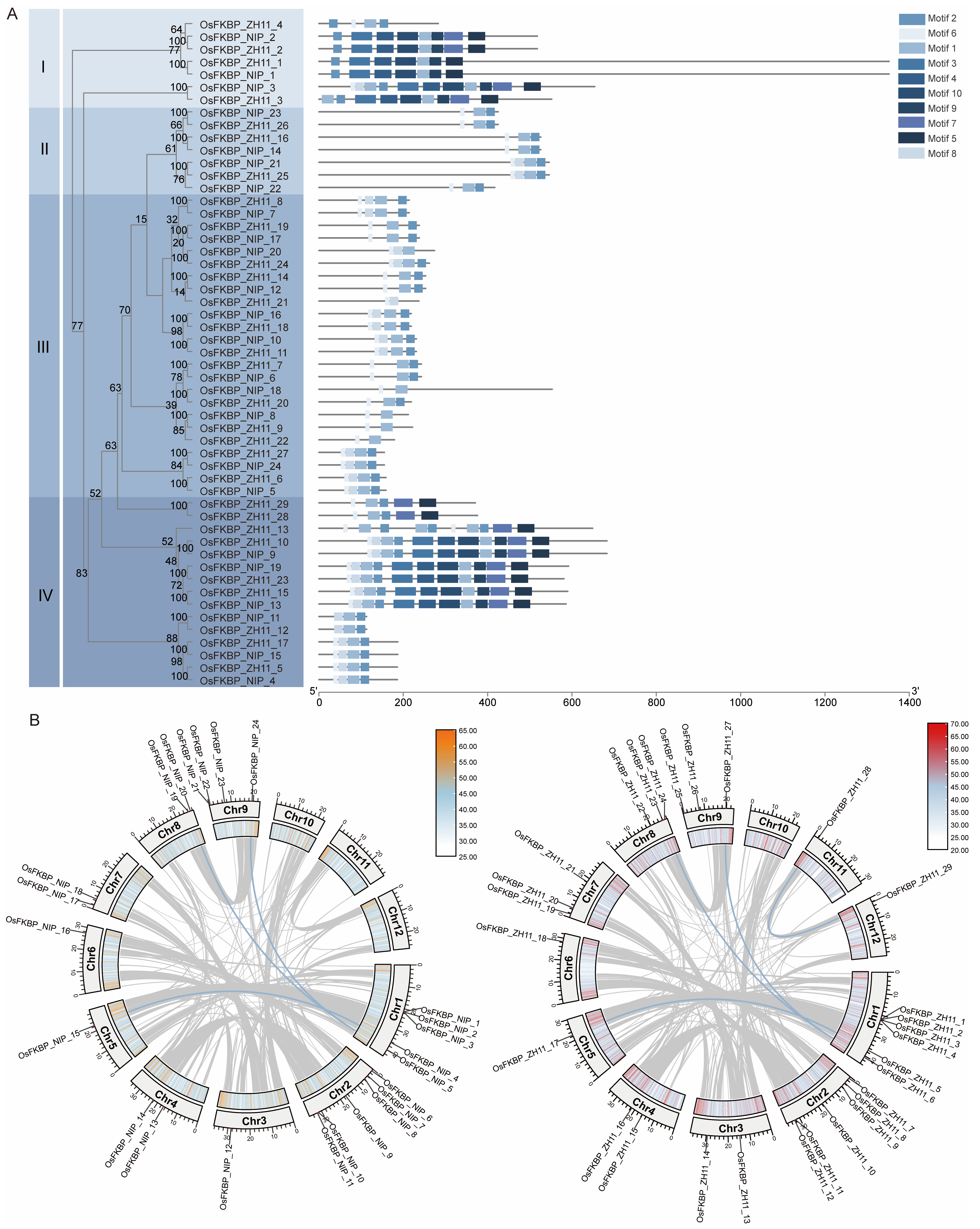
Phylogenetic analysis based on full-length FKBP protein sequences classified all members into four major clades (Figure 2A). Homologous genes from NIP and ZH11 were clustered closely, reflecting high evolutionary conservation. The presence of ZH11 specific members such as OsFKBP_ZH11_28 and OsFKBP_ZH11_29 in distinct branches indicates potential cultivar-specific duplication or retention events.
Motif composition analysis revealed that all FKBP proteins contained several core conserved motifs, including Motif 1, Motif 2, and Motif 6, which are likely essential for maintaining immunophilin catalytic activity (Figure 2A). Variations in the number and arrangement of motifs were observed among different clades, suggesting structural optimization and potential functional diversification during evolution. Overall, the FKBP gene family in both cultivars exhibited a highly conserved phylogenetic structure, while motif variation and gene expansion in ZH11 may reflect fine-tuning or functional adaptation to specific physiological or environmental conditions.
Intraspecific collinearity analysis further showed that only a few FKBP genes exhibited collinearity within each genome, indicating that the FKBP family underwent limited segmental or tandem duplication events and remains largely conserved in rice. Most FKBP genes exist as single-copy loci, suggesting genomic stability and conserved functional characteristics. Importantly, a strong collinear relationship was detected between the ZH11-specific genes OsFKBP_ZH11_28 and OsFKBP_ZH11_29, implying a recent tandem or segmental duplication event (Figure 2B). Such cultivar-specific duplication may represent independent expansion and structural rearrangement within the ZH11 genome, potentially leading to novel or specialized functions.
Collectively, comparative analyses of FKBP genes in NIP and ZH11 highlight a coexistence of conservation and microevolutionary divergence, suggesting that while core structural and functional features have been maintained, limited structural innovations have occurred in specific cultivars.

3.3. Evolutionary Relationships of FKBP Genes Among Rice and Other Poaceae Species

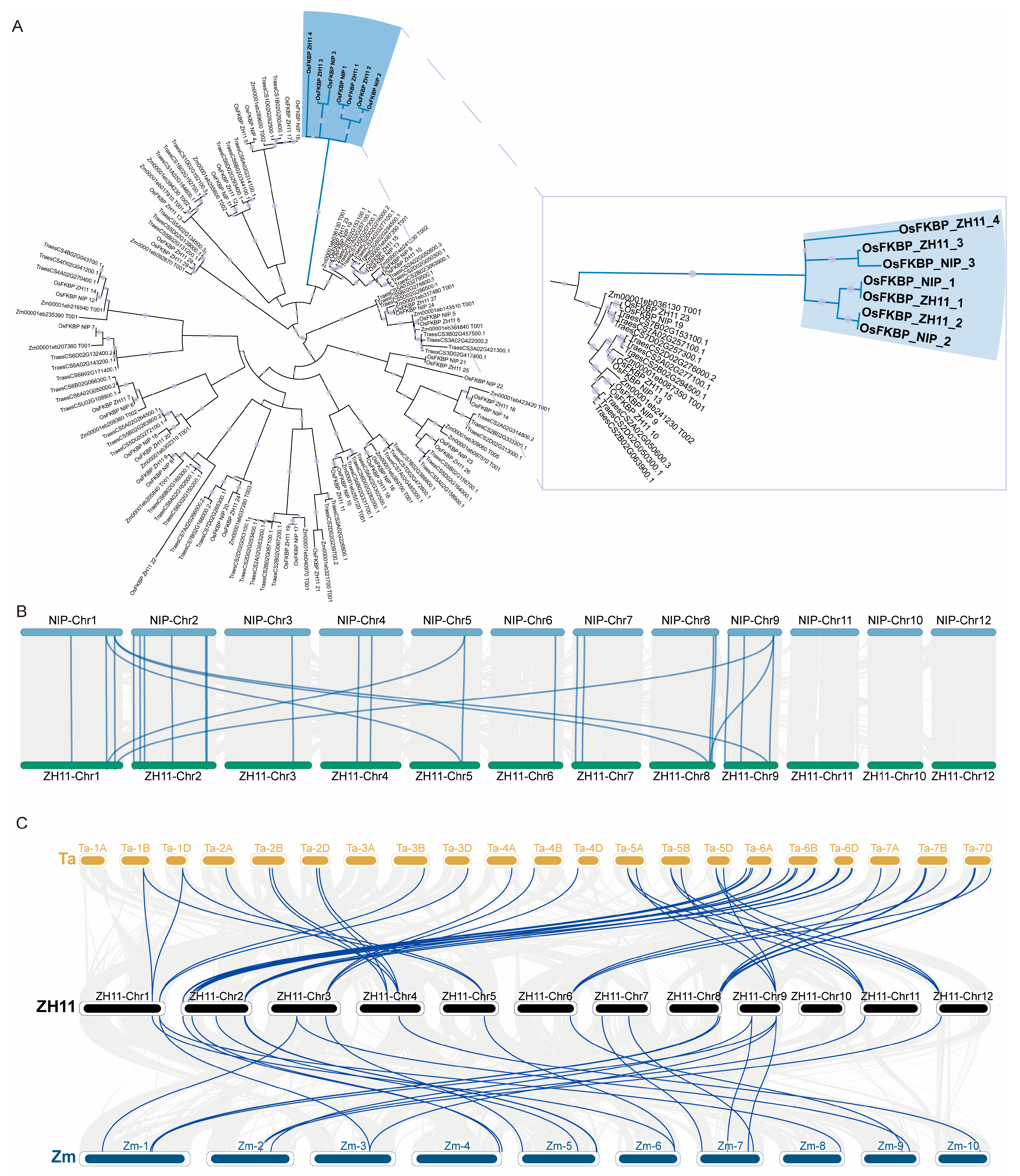
Wheat (Triticum aestivum) and maize (Zea mays) were selected for comparative analysis due to their close evolutionary relatedness to rice as major monocot species within the Poaceae family and the availability of high-quality annotated genome resources, enabling robust assessment of FKBP family conservation and lineage-specific diversification. To investigate the species-specific characteristics and evolutionary conservation of FKBP family members, a phylogenetic analysis was conducted using FKBP protein sequences from NIP, ZH11, wheat, and maize. The results showed that OsFKBP_NIP_1-3, OsFKBP_ZH11_1-4 formed independent clades distinct from wheat and maize orthologs (Figure 3A). This indicates that these genes may have evolved independently in rice, representing rice-specific subfamilies potentially involved in unique physiological or environmental response processes.
Further collinearity analysis among NIP, ZH11, wheat, and maize revealed that most FKBP genes exhibited strong collinearity between the two rice cultivars, except for a few genes such as OsFKBP_NIP_2, OsFKBP_NIP_3, OsFKBP_ZH11_28, and OsFKBP_ZH11_29. This suggests a high degree of conservation of the FKBP family within rice subspecies (Figure 3B). In contrast, fewer FKBP genes showed collinearity between rice and other Poaceae species, including OsFKBP_ZH11_1, OsFKBP_ZH11_2, OsFKBP_ZH11_3, and OsFKBP_ZH11_4, which lacked syntenic counterparts in wheat and maize (Figure 3C). This pattern is consistent with the phylogenetic results, implying that these genes may have arisen through rice-specific evolutionary divergence.
Collectively, these findings suggest that the FKBP family in rice has undergone both conserved evolution within the Poaceae lineage and species-specific expansion events, with certain rice-specific members potentially contributing to unique physiological functions or adaptive responses during evolution.

3.4. Promoter Cis-Element Analysis of FKBP Genes

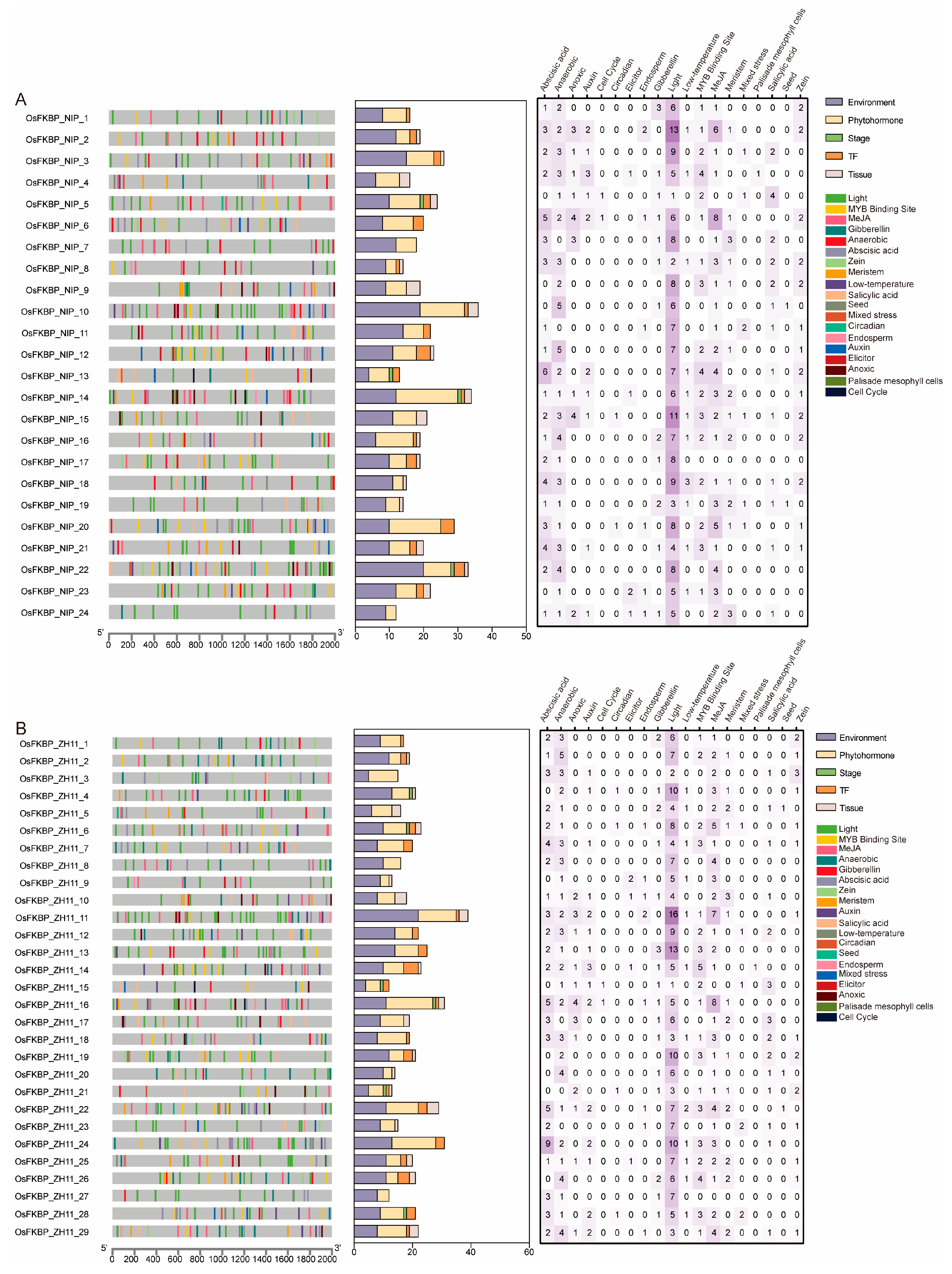
To further explore the potential regulatory roles and biological pathways of FKBP genes in rice, a cis-acting element analysis was performed on the 2.0 kb upstream promoter regions of all FKBP family members in NIP and ZH11. The results showed that the two cultivars exhibited highly similar distributions and types of promoter elements, which mainly included stress-responsive elements, hormone-responsive elements, growth and developmental elements, transcription factor binding sites, and tissue-specific regulatory motifs (Figure 4).
Among the stress-related elements, low-temperature responsive elements, drought-inducible elements, and light-responsive motifs were widely distributed, suggesting a possible role of FKBP genes in abiotic stress adaptation. The presence of abundant ABA-responsive elements in many promoters was consistent with previous reports that FKBP proteins participate in drought and osmotic stress regulation. In addition, MeJA-responsive elements and SA-responsive elements were identified, implying potential involvement of FKBP family members in plant defense signaling and disease resistance.
Furthermore, several FKBP genes contained developmental and tissue-specific regulatory motifs, indicating that certain FKBP members may exhibit stage- or tissue-specific expression patterns.
Taken together, these findings suggest that FKBP family genes in rice may participate in multiple signaling pathways, including hormone regulation, environmental stress response, and developmental control, providing valuable insights into their molecular functions in rice growth and stress adaptation.

3.5. Expression Profiling of FKBP Family Members During Rice Blast Infection

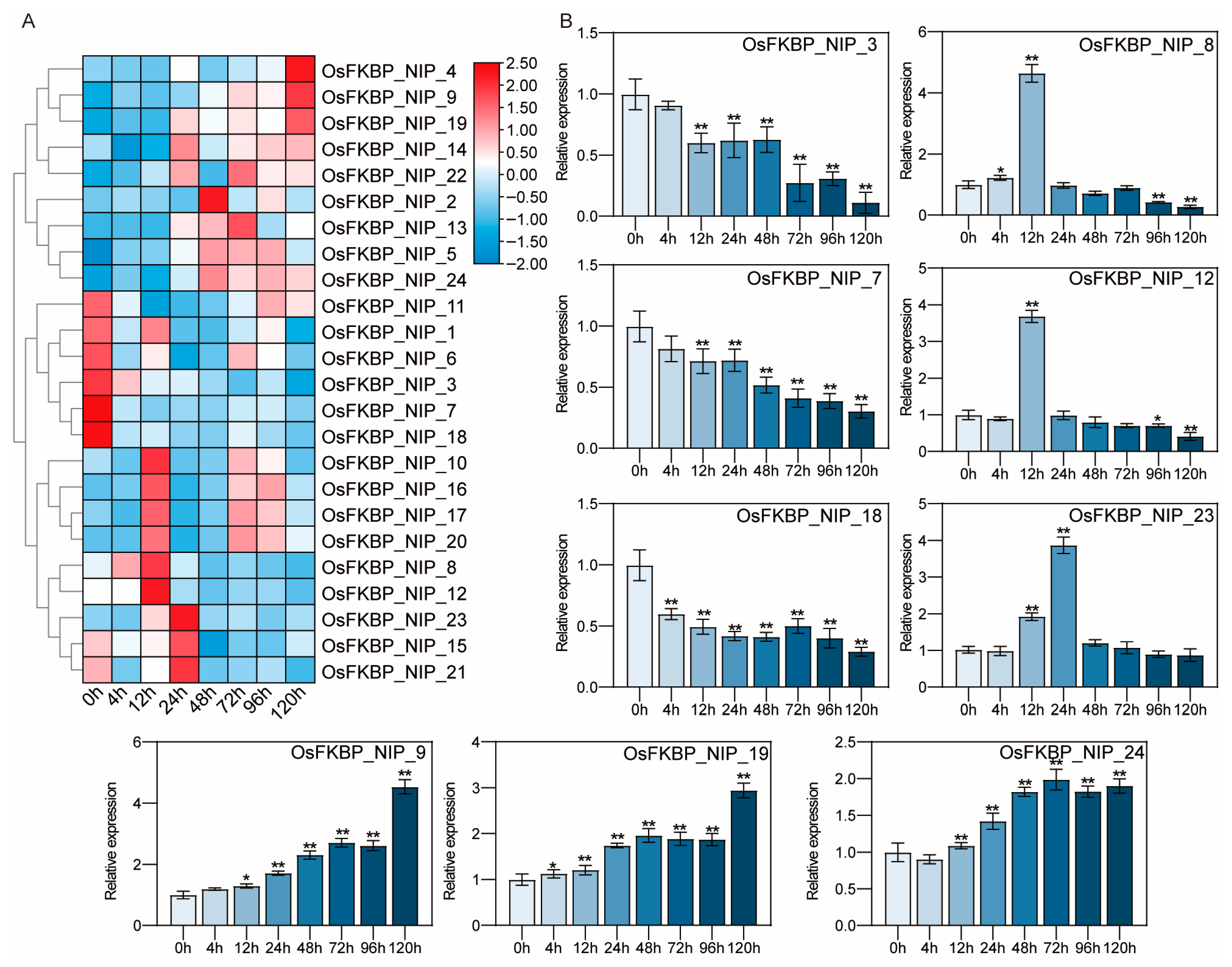
To elucidate the potential roles of FKBP genes in rice blast resistance, transcriptome data were analyzed to assess the expression profiles of FKBP family members in NIP under M. oryzae infection. The results showed that most FKBP genes exhibited significant differential expression during infection, with clear clustering patterns that could be classified into three major groups: (1) Continuously downregulated genes, which may act as negative regulators or be suppressed by pathogen stress; (2) Transiently induced genes, showing upregulation during the middle infection stage followed by recovery or decline, suggesting possible involvement in early defense signaling or stress response; (3) Sustained upregulated genes, maintaining high expression during middle and late infection stages, possibly contributing to enhanced or prolonged resistance mechanisms (Figure 5A). These distinct expression profiles suggest that FKBP family members may play diverse and stage-specific roles. Infection-responsive OsFKBP genes tended to have more MeJA- and SA-responsive cis-elements in their promoters (Figure 4), consistent with potential roles in hormone-mediated defense signaling during M. oryzae infection.
To validate the transcriptome results, representative genes from each expression cluster were analyzed by RT-qPCR. The qPCR results were consistent with the transcriptome data, confirming the reliability of the observed expression trends (Figure 5B). Together, these findings suggest that FKBP genes may participate in multiple layers of defense signaling and potentially modulate rice resistance to M. oryzae infection.

4. Discussion

In this study, we conducted a comprehensive identification and comparative analysis of the FKBP gene family in Oryza sativa using the NIP reference genome and the newly released T2T genome of ZH11. The identification of 24 and 29 FKBP genes in NIP and ZH11 (Table S1, Figure 1A,B), respectively, suggests that the higher assembly completeness of the ZH11 genome uncovered previously unannotated members. A previous genome-wide study of the rice FKBP family, based on earlier reference genomes, primarily explored potential roles in abiotic stress responses [14]. In contrast, our work uniquely integrates the high-quality T2T assembly of ZH11 with the standard NIP reference, enabling a direct cultivar-level comparative analysis that reveals subtle gene expansion and structural variations not detectable in prior single-genome studies. More importantly, by incorporating transcriptome profiling and RT-qPCR validation during M. oryzae infection, we provide the first evidence suggesting potential involvement of OsFKBP genes in rice blast resistance, a biotic stress dimension that remains unexplored in previous characterizations of this family. Despite this numerical difference, the overall conservation of gene structures, domain compositions, and chromosomal distributions between the two cultivars indicates that the FKBP family has undergone limited large-scale duplication during rice evolution. Notably, the ZH11-specific FKBP genes, which were undetectable in previous analyses based on older genome assemblies, display unique motif arrangements and evidence of recent tandem or segmental duplication. These structural features suggest possible sub or neofunctionalization, potentially contributing to cultivar-specific adaptations in stress response or immunity. Although functional validation is required, the identification of such lineage-specific expansions underscores the biological significance of employing T2T assemblies in gene family studies and provides new candidates for rice improvement programs targeting blast resistance [17]. This emphasizes the value of T2T assemblies for uncovering hidden genetic variation and refining gene family annotations.
The phylogenetic and motif analyses revealed that FKBP proteins in rice can be divided into four well-supported clades, consistent with observations in other monocot species such as wheat and maize (Figure 2A). The conserved FKBP_C-like domain across all members ensures the maintenance of core PPIase activity, whereas variations in additional motifs and gene structures may contribute to functional diversification. Such structural heterogeneity often underpins subcellular localization differences and distinct physiological functions, as previously reported for plant immunophilins involved in heat stress, hormone signaling, and chloroplast function [29,30]. The ZH11-specific FKBPs exhibit unique motif compositions (Figure 1B and Figure 2A), suggesting possible functional diversification following recent duplication events (Figure 2B). However, their potential contribution to cultivar-specific adaptability remains speculative at this stage.
Promoter analysis revealed that FKBP genes harbor abundant cis-elements responsive to ABA, MeJA, SA, and environmental stresses, suggesting transcriptional regulation through multiple signaling pathways (Figure 4A,B). These hormones are well-known mediators of plant defense and abiotic stress tolerance, often functioning in complex crosstalk networks. For instance, ABA can modulate stomatal closure and ROS signaling under stress, while JA and SA play critical roles in defense against fungal pathogens: SA primarily in resistance to biotrophic stages and JA in responses to necrotrophic phases [31]. Given that M. oryzae is a hemibiotrophic pathogen that transitions from an initial biotrophic to a later necrotrophic lifestyle, the prevalence of MeJA and SA responsive elements in OsFKBP promoters raises the possibility that these genes are differentially regulated during distinct infection stages. This interpretation is supported by the observed dynamic expression patterns, with some OsFKBP genes showing transient early induction and others sustained upregulation during infection. Collectively, these promoter features and expression data suggest that OsFKBPs may integrate hormonal cues to potentially contribute to stage-specific protein homeostasis and defense signaling in rice blast responses. Moreover, the enrichment of light and development related motifs indicates that FKBP expression may also be spatially and temporally regulated, consistent with their multifunctional nature. However, it should be noted that cis-element identification is based on in silico predictions and does not confirm functional regulatory activity. Therefore, the proposed hormone-responsive regulation of OsFKBP genes should be considered putative and awaits experimental validation through genetic or molecular assays.
The transcriptomic and RT-qPCR analyses revealed that several FKBP genes respond dynamically to M. oryzae infection, displaying both transient and sustained induction patterns (Figure 5A,B). The observed clustering into three major groups likely reflects stage-specific roles during the hemibiotrophic infection cycle of M. oryzae, which transitions from an initial biotrophic phase to a later necrotrophic phase. Genes with continuous downregulation may act as negative regulators of defense or be suppressed by the pathogen to facilitate infection. Transiently induced genes, showing peak upregulation in the middle stage, may participate in early signal transduction or initial defense activation, potentially during the biotrophic phase. In contrast, genes with sustained upregulation potentially contribute to prolonged maintenance of cellular homeostasis, ROS management, or reinforcement of defense mechanisms during the necrotrophic stage. This expression diversity suggests that OsFKBPs may function at multiple stages of the pathogen response, potentially through their protein chaperone activity, folding regulation, or interaction with signaling complexes such as HSP90 [9,32]. In Arabidopsis, AtFKBP62 (ROF1) interacts with heat-shock proteins to regulate stress signaling [11], and plant FKBPs have been implicated in protein homeostasis during biotic stress and hormone-mediated immune responses, often via modulation of defense-related protein complexes [10,14,32]. These Arabidopsis studies are cited here to provide functional context; however, species-specific differences between Arabidopsis and rice should be acknowledged, and direct functional extrapolation should be treated with caution. Although direct evidence for OsFKBPs in rice blast resistance is currently lacking, these findings support the plausibility of similar mechanisms operating in rice, suggesting a possible link between OsFKBPs and defense-related networks during M. oryzae infection. These results indicate that specific FKBP members, particularly the ZH11-specific duplicates, may serve as promising candidates for future functional studies and molecular breeding aimed at blast resistance.
Together, our results highlight that the FKBP gene family in rice is both evolutionarily conserved and functionally diversified. The combination of T2T-based genome annotation, promoter characterization, and expression profiling provides new insights into how structural and regulatory variations contribute to adaptive evolution and immune responses in rice. Future research should focus on elucidating the molecular mechanisms by which specific FKBP proteins modulate disease resistance, including their protein–protein interaction networks and post-translational modifications. Functional validation through CRISPR/Cas9 mediated knockout or overexpression lines will be crucial to confirm their roles in immunity. Moreover, integrating multi-omics data will help uncover the broader regulatory framework involving FKBPs in stress adaptation. Ultimately, understanding FKBP-mediated regulatory networks will facilitate the development of elite rice cultivars with enhanced and durable resistance to blast disease.


5. Conclusions

In this study, the FKBP gene family in rice was comprehensively identified and characterized using both the conventional NIP reference genome and the high-quality T2T assembly of ZH11, revealing 24 and 29 members, respectively. These genes exhibited high evolutionary conservation in structure, domain composition, and phylogenetic relationships, with limited cultivar-specific expansion likely resulting from recent duplication events. Promoter analysis uncovered enrichment of hormone responsive and stress related cis-elements, while transcriptome profiling and RT-qPCR validation during M. oryzae infection demonstrated dynamic regulation of multiple OsFKBP genes, indicating their potential involvement in rice defense responses to blast disease. These findings extend previous characterizations of the rice FKBP family, which focused primarily on abiotic stress, by providing the first insights into biotic stress contexts and highlighting the value of T2T genome assemblies for refined gene family annotation. Overall, this work lays a solid foundation for understanding the regulatory and evolutionary landscape of FKBPs in rice and identifies candidate genes for future functional studies aimed at potentially improving blast resistance through molecular breeding.

Supplementary Materials

The following supporting information can be downloaded at: https://www.mdpi.com/article/10.3390/agronomy16020149/s1, Table S1: Table S1_OsFKBP_members.xlsx; Table S2: Table S2_FPKM.xlsx; Table S3: Table S3_Primer.xlsx.

Author Contributions

Z.Y., X.D. and J.L. conceived and designed the research. J.L., X.W., W.L. and Q.X. performed the analyses and experiments. J.L. and Z.Y. collected the literature and wrote the manuscript. Z.Y., X.D. and J.L. revised and finalized the manuscript. All authors have read and agreed to the published version of the manuscript.

Funding

The work was supported by the State Key Laboratory of Agricultural and Forestry Biosecurity (SKL2025004), National Natural Science Foundation of China (32570232, 32272557, 32072500), National Key R&D Program of China (2022YFD1402100), Major Basic Research Project of Natural Science Foundation of Shandong Province (ZR2022ZD23, ZR2024ZD07), Shandong Province Key Research and Development Plan (2024CXGC010908, 2024LZGCQY009), Taishan Scholar Program of Shandong Province (tsqn202408120, tstp20221117), Zaozhuang major scientific and technological innovation project (2023GH12), Science and Technology Innovation Guidance Project of Ningxia Academy of Agriculture and Forestry Sciences (NKYG-25-21), Nature Science Foundation of Shandong Provinve (ZR2023MC094), Shandong Agriculture Research System (SDARS-04-02), The ‘First Class Discipline’ Construction Project of Shandong Agricultural University (811).

Data Availability Statement

All data generated and analyzed during this study are included in this article (and Supplementary File).

Acknowledgments

Thanks for the funding from the projects mentioned in the Funding section.

Conflicts of Interest

The authors declare no conflicts of interest.

References

  1. Zhao, T.; Ma, S.; Kong, Z.; Zhang, H.; Wang, Y.; Wang, J.; Liu, J.; Feng, W.; Liu, T.; Liu, C.; et al. Recognition of the inducible, secretory small protein OsSSP1 by the membrane receptor OsSSR1 and the co-receptor OsBAK1 confers rice resistance to the blast fungus. Mol. Plant 2024, 17, 807–823. [Google Scholar] [CrossRef] [Scilit]
  2. Kou, Y.; Shi, H.; Qiu, J.; Tao, Z.; Wang, W. Effectors and environment modulating rice blast disease: From understanding to effective control. Trends Microbiol. 2024, 32, 1007–1020. [Google Scholar] [CrossRef] [Scilit]
  3. Huang, X.; Yao, W.; Chen, Q.; Lin, J.; Huang, J.; Zou, Y.; Guo, C.; He, B.; Yuan, X.; Xu, C.; et al. A century of advances in molecular genetics and breeding for sustainable resistance to rice blast disease. Theor. Appl. Genet. 2025, 138, 174. [Google Scholar] [CrossRef] [Scilit]
  4. Jones, J.D.G.; Staskawicz, B.J.; Dangl, J.L. The plant immune system: From discovery to deployment. Cell 2024, 187, 2095–2116. [Google Scholar] [CrossRef] [Scilit]
  5. Xie, Y.; Wang, Y.; Yu, X.; Lin, Y.; Zhu, Y.; Chen, J.; Xie, H.; Zhang, Q.; Wang, L.; Wei, Y.; et al. SH3P2, an SH3 domain-containing protein that interacts with both Pib and AvrPib, suppresses effector-triggered, Pib-mediated immunity in rice. Mol. Plant 2022, 15, 1931–1946. [Google Scholar] [CrossRef] [Scilit]
  6. Tian, D.; Yang, L.; Chen, Z.; Chen, Z.; Wang, F.; Zhou, Y.; Luo, Y.; Yang, L.; Chen, S. Proteomic analysis of the defense response to Magnaporthe oryzae in rice harboring the blast resistance gene Piz-t. Rice 2018, 11, 47. [Google Scholar] [CrossRef] [Scilit] [PubMed]
  7. Deng, Y.; Zhai, K.; Xie, Z.; Yang, D.; Zhu, X.; Liu, J.; Wang, X.; Qin, P.; Yang, Y.; Zhang, G.; et al. Epigenetic regulation of antagonistic receptors confers rice blast resistance with yield balance. Science 2017, 355, 962–965. [Google Scholar] [CrossRef] [Scilit] [PubMed]
  8. Ngou, B.P.M.; Ding, P.; Jones, J.D.G. Thirty years of resistance: Zig-zag through the plant immune system. Plant Cell 2022, 34, 1447–1478. [Google Scholar] [CrossRef] [Scilit]
  9. Noddings, C.M.; Johnson, J.L.; Agard, D.A. Cryo-EM reveals how Hsp90 and FKBP immunophilins co-regulate the glucocorticoid receptor. Nat. Struct. Mol. Biol. 2023, 30, 1867–1877. [Google Scholar] [CrossRef] [Scilit]
  10. Chang, H.H.; Lee, C.H.; Chang, C.J.; Jan, F.J. FKBP-type peptidyl-prolyl cis-trans isomerase interacts with the movement protein of tomato leaf curl New Delhi virus and impacts viral replication in Nicotiana benthamiana. Mol. Plant Pathol. 2022, 23, 561–575. [Google Scholar] [CrossRef] [Scilit]
  11. Aviezer-Hagai, K.; Skovorodnikova, J.; Galigniana, M.; Farchi-Pisanty, O.; Maayan, E.; Bocovza, S.; Efrat, Y.; von Koskull-Döring, P.; Ohad, N.; Breiman, A. Arabidopsis immunophilins ROF1 (AtFKBP62) and ROF2 (AtFKBP65) exhibit tissue specificity, are heat-stress induced, and bind HSP90. Plant Mol. Biol. 2007, 63, 237–255. [Google Scholar] [CrossRef] [Scilit]
  12. Jiang, Y.; Qiao, Y.; Ye, C.; Chen, F.; Zhang, Y.; Ma, Y.; Wang, S.; Wu, L.; Ruan, B.; Yu, Y. Exploring FKBP12’s Role in Enhancing Drought Tolerance in Rice. Rice 2025, 18, 36. [Google Scholar] [CrossRef] [Scilit]
  13. Cheung, M.Y.; Auyeung, W.K.; Li, K.P.; Lam, H.M. A Rice Immunophilin Homolog, OsFKBP12, Is a Negative Regulator of Both Biotic and Abiotic Stress Responses. Int. J. Mol. Sci. 2020, 21, 8791. [Google Scholar] [CrossRef] [Scilit]
  14. Nie, F.; Wang, M.; Liu, L.; Ma, X.; Zhao, J. Genome-Wide Identification and Bioinformatics Analysis of the FK506 Binding Protein Family in Rice. Genes 2024, 15, 902. [Google Scholar] [CrossRef] [Scilit] [PubMed]
  15. Wu, G.; Otegui, M.S.; Spalding, E.P. The ER-localized TWD1 immunophilin is necessary for localization of multidrug resistance-like proteins required for polar auxin transport in Arabidopsis roots. Plant Cell 2010, 22, 3295–3304. [Google Scholar] [CrossRef] [Scilit] [PubMed]
  16. Suri, A.; Singh, H.; Kaur, K.; Kaachra, A.; Singh, P. Genome-wide characterization of FK506-binding proteins, parvulins and phospho-tyrosyl phosphatase activators in wheat and their regulation by heat stress. Front. Plant Sci. 2022, 13, 1053524. [Google Scholar] [CrossRef] [Scilit]
  17. Yao, X.F.; Sun, Z.; Xu, X.; Li, H.; Liu, C.M. Complete genome assembly of japonica rice variety Zhonghua 11. Plant Commun. 2025, 6, 101463. [Google Scholar] [CrossRef] [Scilit] [PubMed]
  18. Qin, P.; Lu, H.; Du, H.; Wang, H.; Chen, W.; Chen, Z.; He, Q.; Ou, S.; Zhang, H.; Li, X.; et al. Pan-genome analysis of 33 genetically diverse rice accessions reveals hidden genomic variations. Cell 2021, 184, 3542–3558.e16. [Google Scholar] [CrossRef] [Scilit]
  19. Chen, C.; Wu, Y.; Li, J.; Wang, X.; Zeng, Z.; Xu, J.; Liu, Y.; Feng, J.; Chen, H.; He, Y.; et al. TBtools-II: A “one for all, all for one” bioinformatics platform for biological big-data mining. Mol. Plant 2023, 16, 1733–1742. [Google Scholar] [CrossRef] [Scilit]
  20. Wang, J.; Chitsaz, F.; Derbyshire, M.K.; Gonzales, N.R.; Gwadz, M.; Lu, S.; Marchler, G.H.; Song, J.S.; Thanki, N.; Yamashita, R.A.; et al. The conserved domain database in 2023. Nucleic Acids Res. 2023, 51, D384–D388. [Google Scholar] [CrossRef] [Scilit]
  21. Blum, M.; Andreeva, A.; Florentino, L.C.; Chuguransky, S.R.; Grego, T.; Hobbs, E.; Pinto, B.L.; Orr, A.; Paysan-Lafosse, T.; Ponamareva, I.; et al. InterPro: The protein sequence classification resource in 2025. Nucleic Acids Res. 2025, 53, D444–D456. [Google Scholar] [CrossRef] [Scilit]
  22. Tamura, K.; Stecher, G.; Kumar, S. MEGA11: Molecular Evolutionary Genetics Analysis Version 11. Mol. Biol. Evol. 2021, 38, 3022–3027. [Google Scholar] [CrossRef] [Scilit]
  23. Capella-Gutiérrez, S.; Silla-Martínez, J.M.; Gabaldón, T. trimAl: A tool for automated alignment trimming in large-scale phylogenetic analyses. Bioinformatics 2009, 25, 1972–1973. [Google Scholar] [CrossRef] [Scilit]
  24. Nguyen, L.-T.; Schmidt, H.A.; von Haeseler, A.; Minh, B.Q. IQ-TREE: A Fast and Effective Stochastic Algorithm for Estimating Maximum-Likelihood Phylogenies. Mol. Biol. Evol. 2015, 32, 268–274. [Google Scholar] [CrossRef] [Scilit]
  25. Letunic, I.; Bork, P. Interactive Tree of Life (iTOL) v6: Recent updates to the phylogenetic tree display and annotation tool. Nucleic Acids Res. 2024, 52, W78–W82. [Google Scholar] [CrossRef] [Scilit]
  26. Lescot, M.; Déhais, P.; Thijs, G.; Marchal, K.; Moreau, Y.; Van de Peer, Y.; Rouzé, P.; Rombauts, S. PlantCARE, a database of plant cis-acting regulatory elements and a portal to tools for in silico analysis of promoter sequences. Nucleic Acids Res. 2002, 30, 325–327. [Google Scholar] [CrossRef] [Scilit] [PubMed]
  27. Chen, S.; Zhou, Y.; Chen, Y.; Gu, J. fastp: An ultra-fast all-in-one FASTQ preprocessor. Bioinformatics 2018, 34, i884–i890. [Google Scholar] [CrossRef] [Scilit] [PubMed]
  28. Patro, R.; Duggal, G.; Love, M.I.; Irizarry, R.A.; Kingsford, C. Salmon provides fast and bias-aware quantification of transcript expression. Nat. Methods 2017, 14, 417–419. [Google Scholar] [CrossRef] [Scilit]
  29. Yang, D.; Li, Y.; Zhu, M.; Cui, R.; Gao, J.; Shu, Y.; Lu, X.; Zhang, H.; Zhang, K. Genome-Wide Identification and Expression Analysis of the Cucumber FKBP Gene Family in Response to Abiotic and Biotic Stresses. Genes 2023, 14, 2006. [Google Scholar] [CrossRef] [Scilit] [PubMed]
  30. Ge, Q.; Peng, P.; Cheng, M.; Meng, Y.; Cao, Y.; Zhang, S.; Long, Y.; Li, G.; Kang, G. Genome-Wide Identification and Analysis of FKBP Gene Family in Wheat (Triticum asetivum). Int. J. Mol. Sci. 2022, 23, 14501. [Google Scholar] [CrossRef] [Scilit]
  31. Patkar, R.N.; Naqvi, N.I. Fungal manipulation of hormone-regulated plant defense. PLoS Pathog. 2017, 13, e1006334. [Google Scholar] [CrossRef] [Scilit] [PubMed]
  32. Gollan, P.J.; Bhave, M.; Aro, E.M. The FKBP families of higher plants: Exploring the structures and functions of protein interaction specialists. FEBS Lett. 2012, 586, 3539–3547. [Google Scholar] [CrossRef] [Scilit] [PubMed]
Figure 1. Chromosomal distribution and conserved domain organization of FKBP family members in NIP and ZH11. (A) Chromosomal locations of FKBP genes in NIP and ZH11. Gene names are labeled; chromosome heatmap shows gene density. (B) Phylogenetic tree (left), motif composition (middle; different colors indicate distinct motifs), and conserved domain organization (right) of FKBP proteins. Scale bars represent amino acid length; bootstrap values are shown on tree branches.
Agronomy 16 00149 g001
Figure 2. Comparative analysis of phylogeny, structural motifs, and collinearity of FKBP genes in NIP and ZH11. (A) Phylogenetic tree of FKBP family members in NIP and ZH11. Bootstrap values are shown on the branches. The family members are divided into four major clades (I, II, III, IV), each highlighted in a distinct color. The right panel shows motif composition. (B) Intraspecific collinearity analysis of FKBP genes. Chromosome heatmap indicates gene density; gray lines show genome-wide collinearity, blue lines indicate FKBP-specific collinear pairs.
Agronomy 16 00149 g002
Figure 3. Phylogenetic and collinearity analysis of FKBP genes among rice and other Poaceae species. (A) Phylogenetic tree of FKBP family members from NIP, ZH11, wheat, and maize. Rice-specific clades are highlighted. (B) Intraspecific collinearity between NIP and ZH11. Blue lines represent collinear FKBP gene pairs, while gray lines indicate collinearity among other rice genes. (C) Interspecific collinearity among ZH11, wheat, and maize. Blue lines represent collinear FKBP family genes, and gray lines denote collinearity of other genomic genes. Ta, wheat; ZH11, rice; Zm, maize.
Agronomy 16 00149 g003
Figure 4. Promoter cis-acting element analysis of FKBP family members in NIP and ZH11. (A) NIP promoters: left panel shows positional distribution of cis-elements along promoter sequences in nucleotides; middle bar chart shows counts of element types; right heatmap shows element abundance with numbers indicating exact counts. (B) ZH11 promoters: left panel shows positional distribution of cis-elements along promoter sequences in nucleotides; middle bar chart shows distribution of element categories; right heatmap shows relative element abundance with numbers indicating exact counts.
Agronomy 16 00149 g004
Figure 5. Expression analysis of FKBP family members in NIP during M. oryzae infection. (A) Heatmap of normalized FPKM expression values clustered by pattern. Color gradient represents relative expression intensity. (B) RT-qPCR validation of representative genes. Relative expression levels are shown. error bars indicate ± SE; * p < 0.05 and ** p < 0.01 (Student’s t-test).
Agronomy 16 00149 g005
Disclaimer/Publisher’s Note: The statements, opinions and data contained in all publications are solely those of the individual author(s) and contributor(s) and not of MDPI and/or the editor(s). MDPI and/or the editor(s) disclaim responsibility for any injury to people or property resulting from any ideas, methods, instructions or products referred to in the content.