Article

BTH-Induced Resistance in Rice Impairs Magnaporthe oryzae Metabolic Fitness and Suppresses Key Virulence Genes


Institute of Wetland Agriculture and Ecology, Shandong Academy of Agricultural Sciences, Jinan 250100, China
*
Authors to whom correspondence should be addressed.
Agronomy 2026, 16(10), 962; https://doi.org/10.3390/agronomy16100962 (registering DOI)

Submission received: 3 April 2026 / Revised: 3 May 2026 / Accepted: 9 May 2026 / Published: 12 May 2026

Abstract

Induced resistance primes host immunity for enhanced protection; however, how pathogens respond to this primed state remains poorly understood. Here, we investigated the molecular responses of the rice blast fungus Magnaporthe oryzae during infection of benzothiadiazole (BTH)-primed rice. Seed priming with BTH conferred long-lasting resistance against M. oryzae at the four-leaf stage. Time-course transcriptomic analyses (12–48 hpi) identified 699 differentially expressed genes (DEGs) in M. oryzae, revealing a distinct temporal transition during infection of BTH-primed rice. The fungal transcriptional response shifted from early growth and environmental sensing to enhanced protein turnover, metabolic repression, energy depletion, and genomic instability, indicating progressive impairment of fungal fitness by host immunity. From these DEGs, eight BTH-suppressed candidate virulence genes (MoBVG1–8) were selected for functional characterization. Gene overexpression analyses showed that two genes, MoBVG2 and MoBVG6, significantly increased pathogenicity on BTH-primed rice, while knockout analyses confirmed that both are required for full pathogenicity on non-primed control plants. MoBVG2 encodes a reactive oxygen species (ROS)-scavenging effector, and MoBVG6 encodes an environmental sensor, highlighting the importance of ROS detoxification and environmental perception for successful host colonization. Functional analyses further revealed that MoBVG2 contribute to vegetative growth, while MoBVG6 is required for proper appressorium development. Together, these findings suggest that BTH-induced resistance restricts blast disease by impairing fungal metabolic fitness and suppressing key virulence genes, providing novel insights into the pathogen-side molecular mechanisms underlying chemically induced resistance in plants.

1. Introduction

Rice blast, caused by the hemibiotrophic fungus Magnaporthe oryzae, is one of the most devastating diseases in global rice production, severely threatening food security [1,2,3]. Rice is the staple food for over half the world’s population, yet rice blast causes annual yield losses of 10–30% worldwide—equivalent to enough rice to feed approximately 60 million people each year [4,5,6]. Under favorable conditions or in severe epiphytotic, losses can approach 100% in affected fields, exacerbating food insecurity in rice-dependent regions. Current control relies primarily on planting resistant varieties—the most economical and environmentally friendly strategy—and chemical fungicides. However, both are undermined by the pathogen’s rapid evolution under selective pressure. For example, in Japan, many rice varieties developed in mid-20th century through introgression of R genes against blast disease experienced a rapid breakdown of resistance—often within just 1–3 years [7]. Fungicides also rapidly lose efficacy, as resistance often emerge in pathogen populations within a few years, compounded by environmental pollution, non-target effects, and health risks [8,9,10]. These limitations highlight the need for sustainable approaches that minimize pathogen adaptation.
Plant induced resistance (IR) enhances disease resistance by priming the host immune system rather than directly target pathogens, offering a promising, ecofriendly alternative or complement to traditional chemical treatments. IR represents an enhanced defensive state triggered by prior exposure to pathogens, beneficial microbes, or chemical stimuli, enabling faster and stronger responses to subsequent attacks with low constitutive energy costs [6,11,12]. Plant activators such as benzothiadiazole (BTH), a functional analog of salicylic acid, activates basal immunity without direct fungicidal activity, thus greatly reducing the risk of resistance evolution in pathogens [13,14]. Consequently, plant activators provide key advantages, including broad-spectrum protection against fungal and bacterial pathogens, environmental sustainability, compatibility with integrated pest management (IPM), and minimal trade-offs in plant growth and yield.
Despite significant progress in understanding host IR mechanisms, how host IR attenuates pathogen virulence remains poorly understood. Equally, the pathogen’s molecular adaptation strategies, particularly its temporal transcriptional reprograming in response to host-induced metabolic stress, have not been thoroughly explored. In rice, the BTH-induced resistance is mediated by the transcription factor WRKY45, in cooperation with OsNPR1, a key regulator of defense gene expression downstream of the SA signaling pathway [15,16]. Overexpression of WRKY45 (WRKY45-OX) in rice significantly enhanced expression levels of pathogenesis-related protein (PR) genes and resistance to both rice blast and bacterial leaf blight caused by Xanthomonas oryzae pv. oryzae [12,15]. Conversely, RNA interference-mediated knockdown of WRKY45 compromised BTH-inducible resistance to blast disease [15], demonstrating its crucial role in BTH-induced defense responses in rice. Microscopic analysis of M. oryzae infection in WRKY45-OX rice reveals a sophisticated two-layered defense system [12]. This includes a pre-invasive defense that blocks fungal appressorium penetration into epidermal cells, often accompanied by hydrogen peroxide (H2O2) accumulation, and a post-invasive defense involving a hypersensitive reaction (HR)-like cell death that restricts fungal growth if initial penetration occurs. This multi-pronged defense illustrates the sophisticated nature of induced resistance at the cellular level. However, detailed insight into pathogen-side molecular responses remain limited.
In this study, we show that BTH-induced resistance in rice restricts blast disease by imposing metabolic stress on M. oryzae and suppressing the expression of two newly identified essential virulence genes, MoBVG2 and MoBVG6, which are involved in vegetative mycelial growth and appressorium development, respectively. These findings provide mechanistic insights into how plant immune priming translates into effective disease control.

2. Materials and Methods

2.1. Plant Materials and Seed-Priming Treatment

We selected a dwarf indica rice cultivar, Co39, which exhibits moderate susceptibility to rice diseases and is frequently utilized in functional studies of fungal pathogenicity [17,18]. To activate induced resistance, seeds were soaked in benzothiadiazole (BTH), a well-characterized and globally recognized defense activator that triggers systemic acquired resistance without direct antimicrobial activity [19,20]. Benzothiadiazole (BTH) (Wako, Osaka, Japan) was dissolved in dimethyl sulfoxide (DMSO) to prepare a 100 mM stock solution. This was then diluted to 20 μM in water immediately prior to use in the seed treatment. Water-soaked seeds served as the control.

2.2. M. oryzae Culture and Inoculation

Guy11 was used as the wild-type strain of M. oryzae and cultured on complete medium (CM, Beijing Kulaibo Technology Co., Ltd., Beijing, China) agar plates, a medium optimized for M. oryzae growth. Conidia formation was induced by continuous fluorescent light for three days. Conidia concentration was determined using a hemocytometer. For vegetative growth, small mycelium blocks from 5-day-old colonies were transferred into fresh liquid CM and incubated in the dark at 28 °C for two days. Mycelia were then harvested and used for DNA and protein extractions [21,22].
Fourteen-day-old seedlings were spray-inoculated with a Guy11 conidia suspension (1 × 10⁵ conidia/mL). Then rice seedlings were transferred into a transparent growth chamber following a 12 h/12 h light/dark cycle exposure schedule. After 5 days, leaf disease severity was documented by photography [23,24]. Lesion areas were measured at 5 days post-inoculation (dpi) using ImageJ software version 1.54f (NIH, Bethesda, MD, USA). Disease severity was scored based on lesion size and percentage of diseased leaf area, with three biological replicates per treatment.
Leaf samples were collected at 12, 24, and 48 h post-inoculation (hpi), encompassing key morphological transitions of the pathogen from appressorium formation to necrotrophic growth. Samples were designated as BTH-12, BTH-24, BTH-48, H2O-12, H2O-24, and H2O-48. All collected leaf samples were immediately frozen in liquid nitrogen, then placed in a dry ice-filled container and sent to OE Biotechnology Co., Ltd. (Shanghai, China) for RNA sequencing.

2.3. RNA-Seq Analysis

Total RNA was extracted from infectious structures at 12, 24, and 48 h post-inoculation (hpi), with three independent biological replicates per time point. Library preparation was performed using the Illumina TruSeq Stranded mRNA Library Prep Kit (Illumina, San Diego, CA, USA). Sequencing was conducted on an Illumina NovaSeq 6000 platform (Illumina, San Diego, CA, USA) to generate 150 bp paired-end reads. Raw reads were quality-filtered using FastQC and Trimmomatic software. Clean reads were aligned to the M. oryzae Guy11 reference genome using HISAT2. Gene expression levels were quantified with FeatureCounts, and normalized using fragments per kilobase of transcript per million mapped reads (FPKM). Differentially expressed genes (DEGs) were identified using DESeq2 with thresholds of |log2FC| ≥ 1 and adjusted p-value (FDR) < 0.05. The false discovery rate (FDR) was controlled using the Benjamini–Hochberg procedure.
Gene ontology (GO) enrichment analysis was performed using agriGO v2.0 (http://systemsbiology.cau.edu.cn/agriGOv2/; accessed on 10 December 2025) [25] with the Plant GO Slim option (FDR < 0.05). Kyoto Encyclopedia of Genes and Genomes (KEGG) pathway enrichment analysis was performed using DAVID functional annotation tool (https://davidbioinformatics.nih.gov; accessed on 10 December 2025) [26]. The RNA-seq raw data has been deposited to the NCBI Sequence Read Archive (SRA) under the BioProject accession number PRJNA1419538.

2.4. Nucleic Acid Extraction and Quantitative Real-Time PCR

Fungal genomic DNA was extracted using the cetyltrimethylammonium bromide (CTAB) method [27]. For DNA isolation, approximately 100 mg of fresh leaf (or lyophilized mycelium) was ground to a fine powder in liquid nitrogen and immediately transferred to a 2 mL microtube pre-heated with 800 µL of 2× CTAB extraction buffer [2% (w/v) CTAB, 100 mM Tris-HCl pH 8.0, 20 mM EDTA pH 8.0, 1.4 M NaCl]. After incubation at 65 °C for 60 min with gentle inversion every 10 min, the homogenate was extracted twice with an equal volume of chloroform: isoamyl alcohol (24:1, v/v) and centrifuged at 12,000× g for 10 min. The supernatant was transferred to a new tube, mixed with 0.7 volume of isopropanol, and incubated at −20 °C for 30 min to precipitate nucleic acids. DNA was pelleted by centrifugation (12,000× g, 15 min), washed twice with 70% ethanol, air- dried, and resuspended in 100 µL of TE buffer (10 mM Tris-HCl, 1 mM EDTA, pH 8.0) containing 0.1 mg mL−1 RNase A. Quality and quantity of the extracted DNA were assessed by 1.0% agarose gel electrophoresis and spectrophotometry (NanoDrop™ 2000, Thermo Fisher Scientific, Shanghai, China), respectively. All samples were stored at −20 °C until further use.
Total RNA was isolated from rice leaves using TRIzol reagent (Invitrogen, Carlsbad, CA, USA) and then treated with RNase-free DNase I (Promega). First-strand cDNA was synthesized from 1 μg total RNA using an oligo-dT primer and ReverTra Ace reverse transcriptase (Toyobo, Osaka, Japan) [28]. Quantitative real-time PCR was performed using the specific quantitative primers listed in Table S1. Expression levels were measured by quantitative real-time PCR using the SYBR Green master mix (Applied Biosystems, Foster City, CA, USA) in a Step-One Plus Real-Time PCR system (Applied Biosystems). The expression levels were normalized against a ubiquitin reference gene. Three biological replicates were used for each experiment, and two quantitative replicates were performed for each biological replicate.

2.5. Targeted Deletion and Complementation of MoBVGs

Deletion mutants of MoBVG genes were generated using the standard one-step gene replacement strategy according to Tang et al. [29]. Two 1.0 kb sequences flanking the MoBVG2 and MoBVG6 were PCR-amplified. The resulting PCR products were digested with restriction endonucleases and ligated into the HPH cassette released from vector pCX62. The ∼3.4 kb fragments, containing the flanking sequences and the hygromycin resistance cassette, were PCR-amplified and transformed into protoplasts of the wild-type strain Guy11 using a polyethylene glycol (PEG)-mediated transformation method. Transformants were selected using hygromycin B resistance, and confirmed by PCR.
For complementation, fragments containing the full MoBVG2 and MoBVG6 genes along with their native promoters were amplified by PCR and inserted into vector pYF11 (conferring bleomycin resistance). The resulting constructs were introduced into the corresponding deletion mutants.
For overexpression analysis, the coding sequences of the MoBVG genes were amplified and cloned into vector pYF11 under the control of native promoter, followed by transformation into protoplasts of the wild-type strain Guy11.

2.6. Protein Extraction and Western Blot

For total protein extraction, strains were incubated in liquid CM media with shaking for 2 days and harvested. Mycelia were grounded into fine powder in liquid nitrogen and suspended in lysis buffer (10 mM Tris-HCl, pH 7.5, 150 mM NaCl, 0.5 mM EDTA, 0.5% NP-40, and 2 mM PMSF) [30]. The lysates were collected into 2.0 mL tubes on ice for 30 min and shaken every 10 min. Lysates were then centrifuged at 15,000 rpm for 10 min at 4 °C, and supernatants were collected as total protein extracts [31,32]. For GFP-tagged protein detection, samples were analyzed with 12% SDS-PAGE gel and immunoblotted with anti-GFP antibodies (mouse, 1:5000, 293967; Abmart, Shanghai, China). Signals were detected by the ODYSSEY infrared imaging system (Software version 2.1).

2.7. Determination of Conidia Viability and Appressorium Development

Conidia were harvested from 7-day-old CM agar plates and adjusted to 5 × 10⁴ conidia/mL in sterile water. Droplets (30 µL) of conidial suspension were applied on coverslips (Fisher Scientific, St. Louis, MO, USA) and incubated under humid conditions at 28 °C. Conidia viability was quantified in terms of germination rate (%) at 24 h. The turgor pressure of mature appressorium was measured using an incipient cytorrhysis (cell collapse) assay at the indicated time point [33]. All experiments were conducted with three replicates, and for each strain and time point, more than 100 conidia were examined per replicate.

2.8. Experimental Design and Data Analysis

Each experiment was independently repeated at least twice with similar results; data shown are representative of one experiment with three biological replicates. Statistical analyses were performed using Microsoft Excel (Microsoft 365; Microsoft Corporation). Data are presented as mean ± standard deviation (SD). Group differences were assessed using Student’s t-test or one-way ANOVA with Tukey’s post hoc multiple comparison test, with p < 0.05 considered statistically significant. For RNA-seq data, differentially expressed genes (DEGs) were defined by a false discovery rate (FDR) < 0.05, as described above.

3. Results

3.1. BTH-Induced Resistance to M. oryzae in Rice

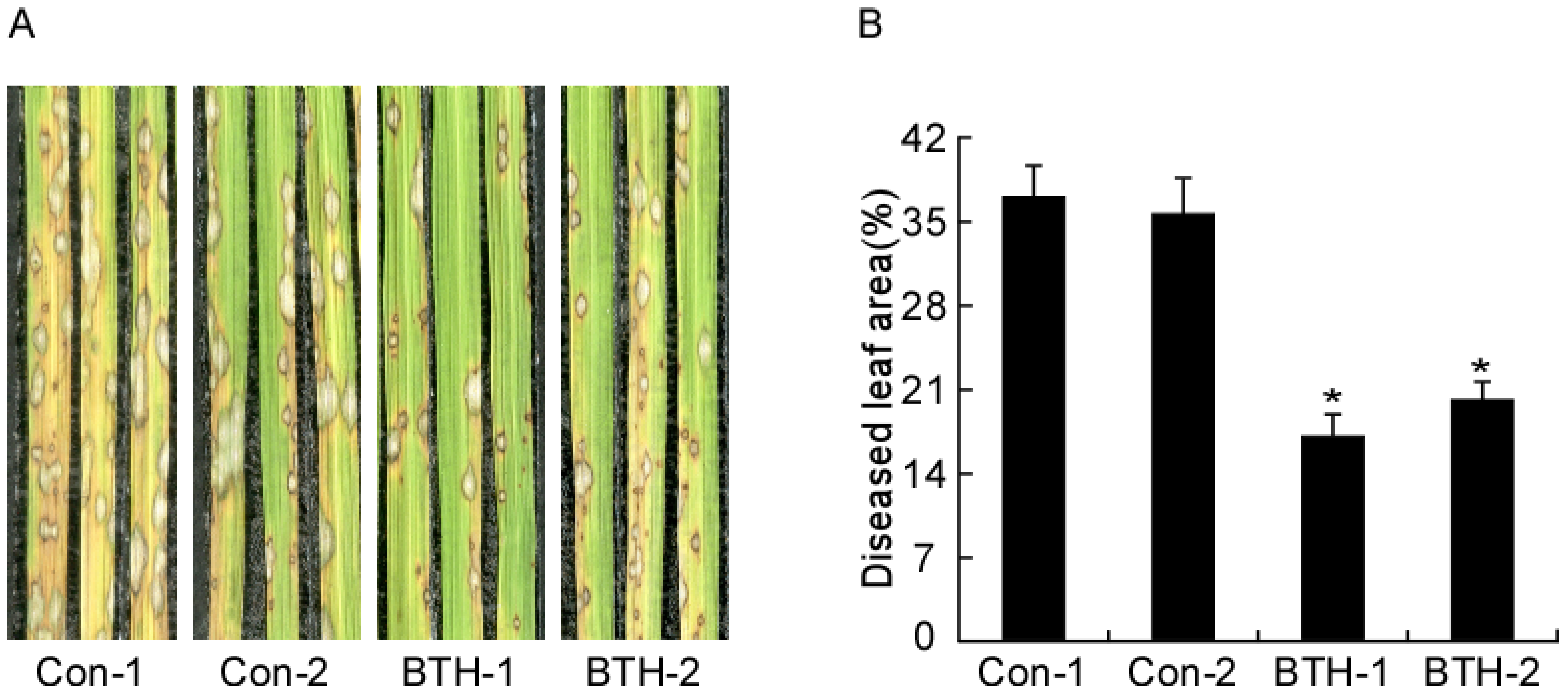
Rice seeds were soaked in either 20 μM benzothiadiazole (BTH) or distilled water (control), and the fourteen-day-old seedlings were spray-inoculated with M. oryzae conidia (1 × 10⁵ conidia/mL). As shown in Figure 1, BTH treatment significantly reduced blast lesions at 5 dpi, confirming the establishment of effective IR.

3.2. Transcriptome Shift in M. oryzae During Infection of BTH-Primed Rice

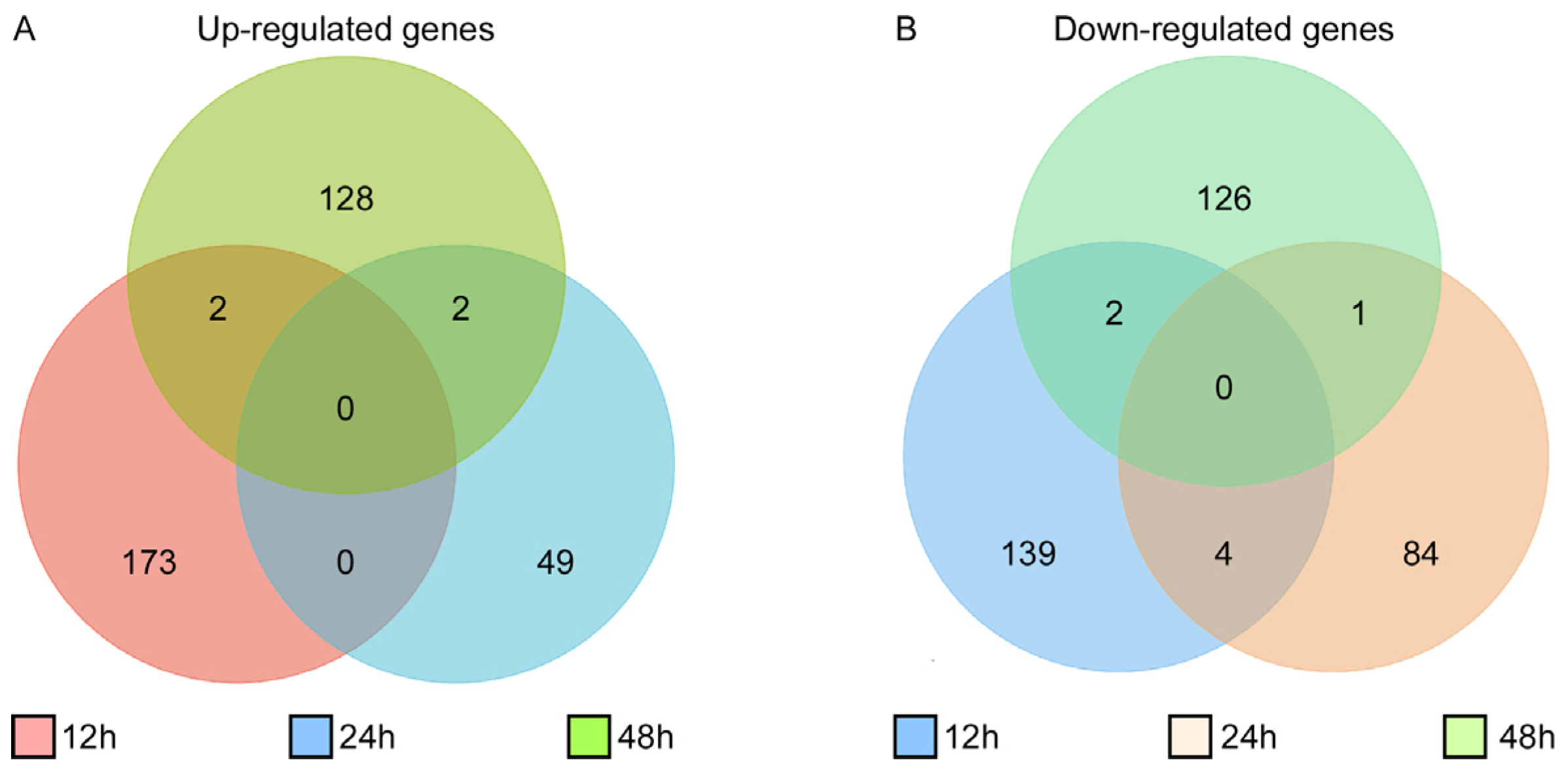
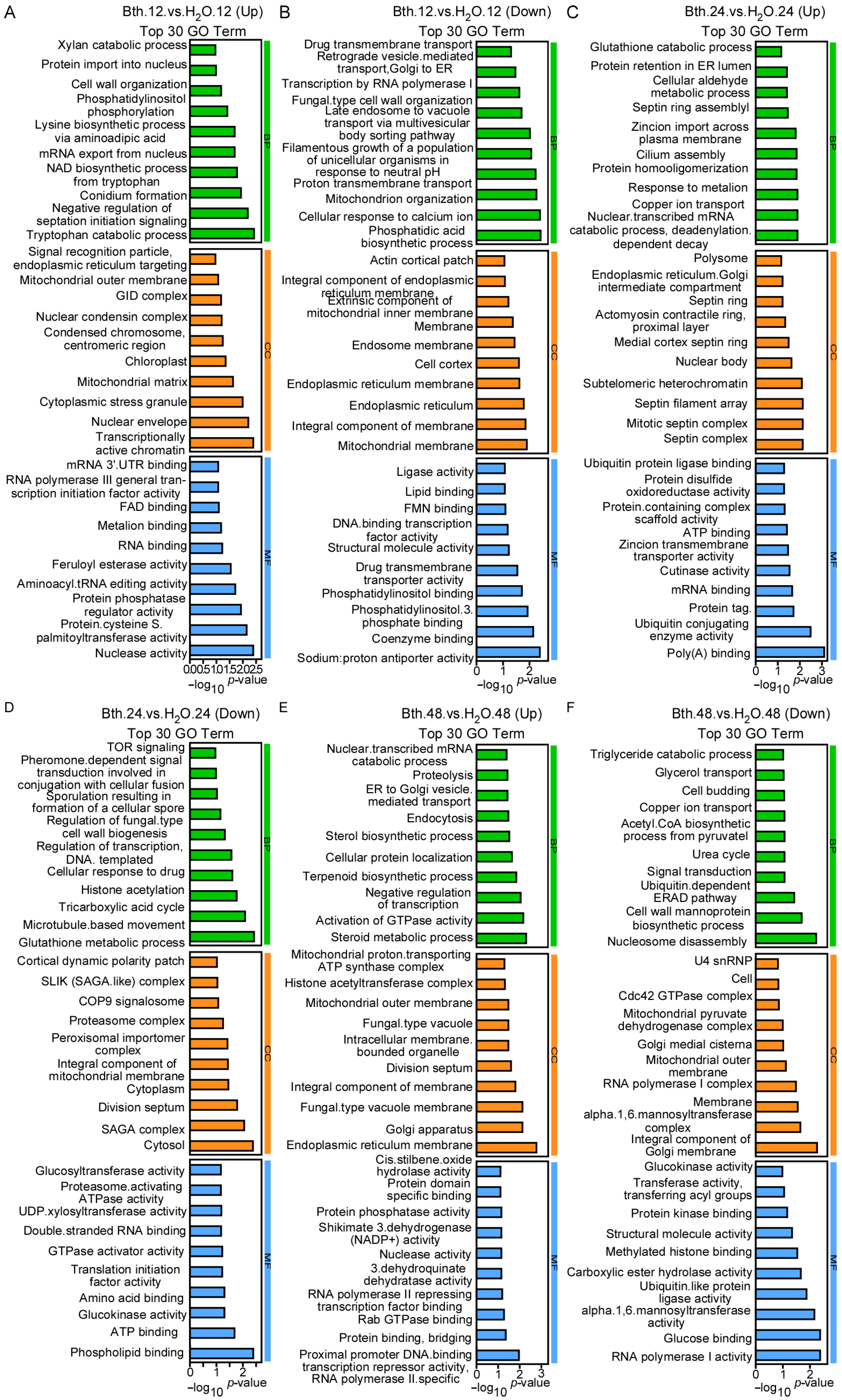
Rice leaves were collected at 12, 24, and 48 hpi to capture the complete infection process, including appressorium penetration (12 hpi), biotrophic colonization (24 hpi), and the necrotrophic phase with visible lesion formation (48 hpi). RNA-seq analysis identified 699 differentially expressed genes (DEGs) between BTH-primed and non-primed control plants across the three time points (350 up-regulated, 349 down-regulated; fold change ≥ 2, FDR < 0.05) (Table S2 and Figure S1). Expression patterns were categorized into two groups: up-regulated DEGs (Figure 2A and Figure 3A,C,E), indicating activated fungal responses to overcome enhanced host defense barriers, and down-regulated DEGs (Figure 2B and Figure 3B,D,F), suggesting suppression of routine growth and metabolic processes in response to host-induced stress conditions. Notably, no DEGs were shared across all three time points, indicating strong phase specificity (Figure 2).
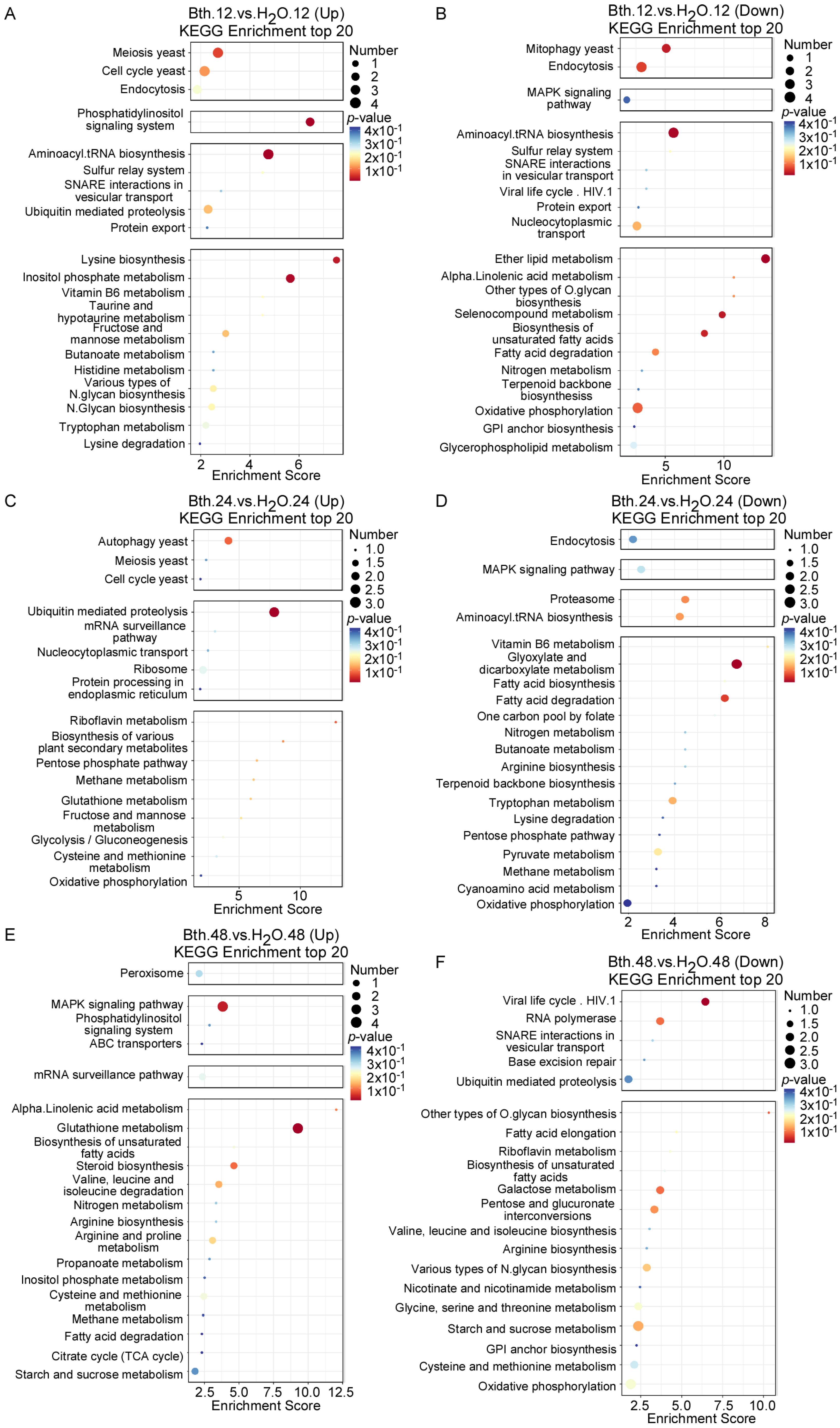
The GO (Figure 3) and KEGG (Figure 4) enrichment analyses of M. oryzae DEGs in BTH-primed rice seedlings across the 12, 24, and 48 hpi time points reveal a distinct phase-dependent transcriptional response to BTH-induced host resistance, transitioning from active growth to cellular recycling via autophagy and ubiquitin-mediated proteolysis, and finally to a detoxification-focused survival mode as host defenses intensify.
At 12 hpi (173 up, 139 down), the fungal transcriptome is characterized by growth and environmental sensing. Up-regulated DEGs are significantly enriched in meiosis, cell cycle, and endocytosis. Activation of the phosphatidylinositol signaling system suggests that the fungus is actively sensing external signals to establish infection. Conversely, MAPK signaling (Figure 4A) and protein export are down-regulated, indicating early suppression of stress-related responses. Moreover, the simultaneous down-regulation of mitophagy, oxidative phosphorylation, and endocytosis indicates a severe disruption of energy homeostasis. Down-regulation of ether lipid metabolism and aminoacyl-tRNA biosynthesis suggests membrane instability and growth arrest (Figure 4B).
By 24 hpi (49 up, 84 down), the fungus shifts its resources toward a large expansion of its translational and quality control machinery. Key up-regulated pathways include the autophagy and ubiquitin-mediated proteolysis (Figure 4C), likely functioning to manage protein turnover. However, a broad suppression of primary metabolism begins at this stage, with significant down-regulation in fatty acid biosynthesis, nitrogen metabolism, and arginine biosynthesis. This suggests that the fungus is beginning to experience BTH-induced nutrient restriction or is shifting its metabolic focus away from primary synthesis. The down-regulation of glyoxylate and dicarboxylate metabolism, alongside oxidative phosphorylation, indicates a profound failure in energy acquisition and carbon utilization, suggesting that the fungus is entering a state of metabolic starvation and energy depletion (Figure 4D).
By 48 hpi (128 up, 126 down), the profile indicates a stress-defense mode as the BTH-primed host defenses intensify. The fungus up-regulates MAPK signaling, glutathione metabolism (detoxification), and ABC transporters to counter host-induced oxidative stress and antifungal compounds (Figure 4E). Despite these responses, the fungus shows signs of major metabolic disruption. Critical pathways for viability, such as RNA polymerase, oxidative phosphorylation, and starch and sucrose metabolism, are significantly suppressed (Figure 4F). The suppression of base excision repair further suggests that the fungus’s ability to maintain its genomic integrity is compromised under host-induced stress.

3.3. Identification of M. oryzae BTH-Suppressed Virulence Genes (MoBVGs)

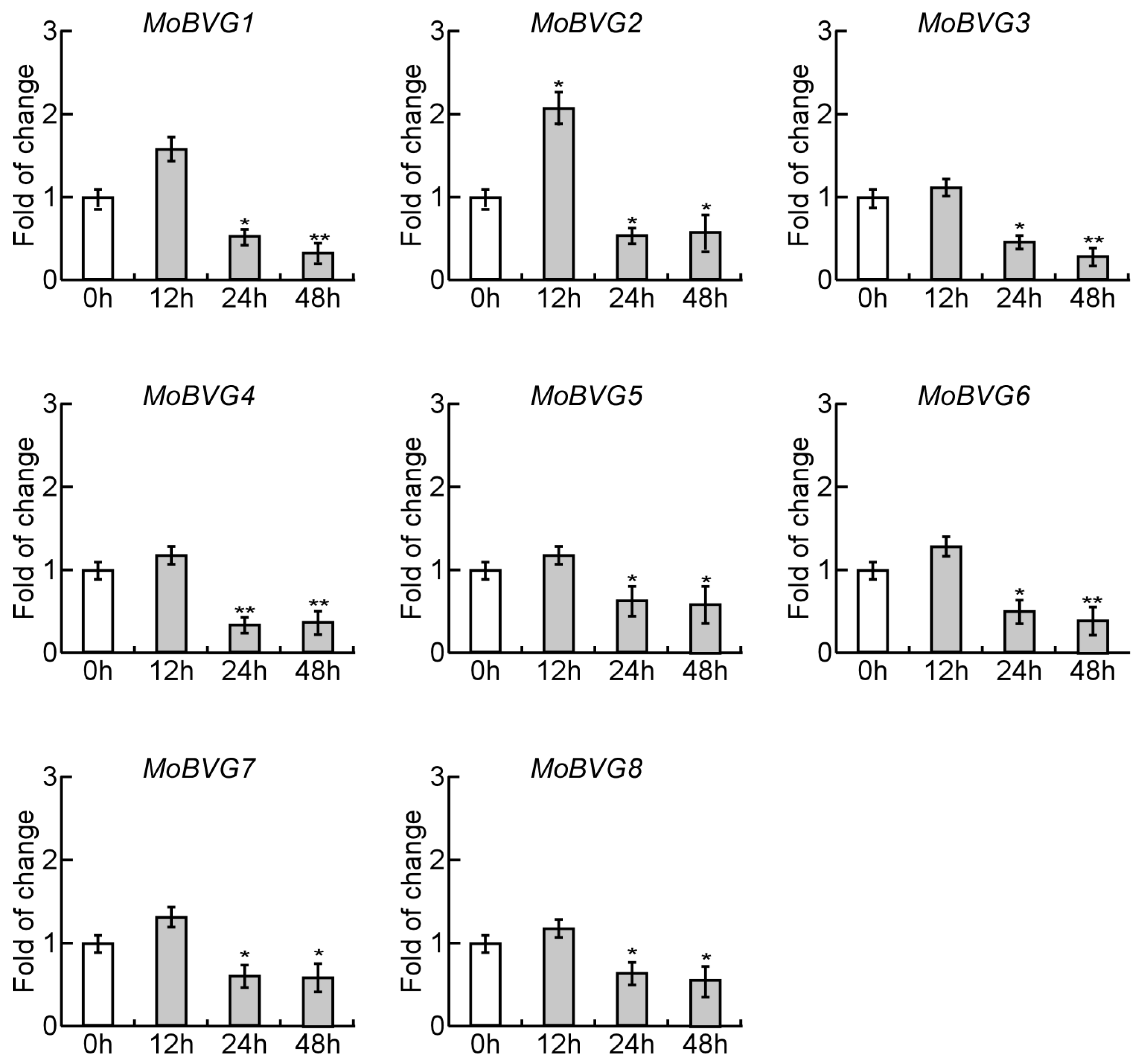
To identify key virulence genes associated with BTH-induced resistance, we selected eight candidate genes (MoBVG1–8) (Table 1) from the DEGs (Figure S2) based on the following criteria: expression strongly suppressed by BTH-priming (≥10-fold reduction); and lack of prior functional characterization through knockout studies. These genes encode proteins involved in cell wall synthases, redox regulators, Ca2+/G protein sensing, and nutrient acquisition. RT-PCR validation confirmed the RNA-seq expression profiles (r > 0.93), demonstrating that these genes form a temporally coordinated virulence network (Figure 5). These genes exhibited maximal repression between 24 and 48 hpi.
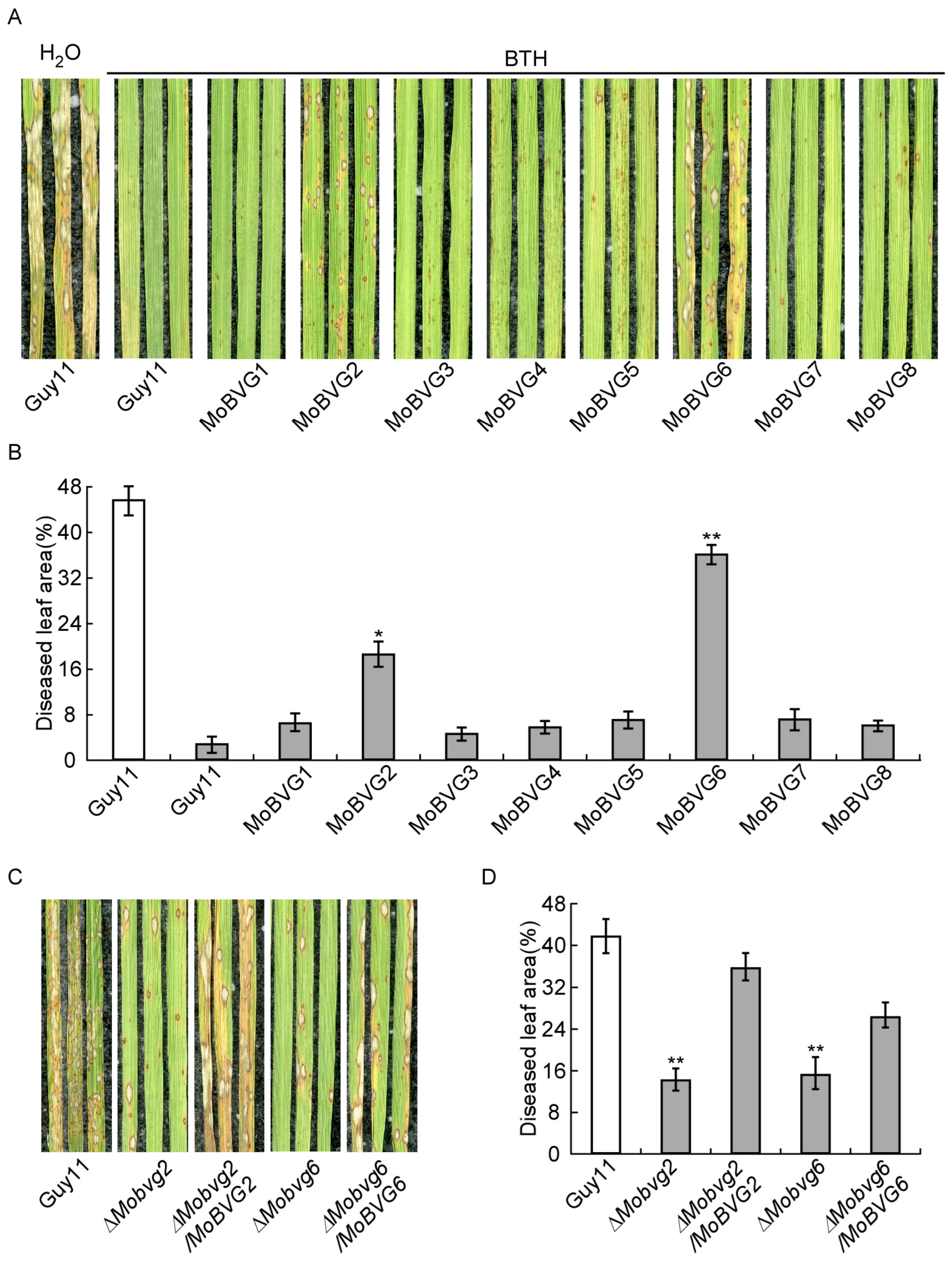
To examine whether restoration of MoBvg1–8 expression could overcome BTH-induced resistance (BTH-IR), we generated GFP-tagged over-expression (OE) strains for each candidate gene (Figure S3A). Pathogenicity assay on BTH-primed rice seedlings revealed that two OE strains, MoBvg2 and MoBvg6, significantly increased M. oryzae virulence under BTH-IR conditions, producing lesion areas approximately 15% and 25% larger than those of the wild-type Guy11 strain, respectively (Figure 6A,B). This result suggests that BTH-mediated suppression of MoBVG2 and MoBVG6 contributes to disease resistance. Determination of conidial viability based on germination rate (%) showed no significant difference between wild type and the OE strains (Figure S4). This indicates that the observed differences in pathogenicity (Figure 6) result from genuine changes in fungal virulence.
To further examine the roles of MoBVG2 and MoBVG6 in M. oryzae pathogenicity, gene knockout mutants were generated via homologous recombination. Gene deletions were confirmed by PCR-genotyping (Figure S3B). Both the deletion mutants, ΔMobvg2 and ΔMobvg6, exhibited drastically reduced pathogenicity on non-primed control rice seedlings, with lesion area reduced to 20% and 25% of that of Guy11, respectively (p < 0.01) (Figure 6C,D). Complementation of each mutant with the corresponding wild-type gene (ΔMobvg/MoBVG) partially but significantly restored virulence (Figure 6C,D). These results establish MoBvg2 and MoBvg6 as essential virulence factors required for successful blast infection.

3.4. Functional Characterization of MoBVG2 and MoBVG6 in Mycelial Growth and Appressorium Development

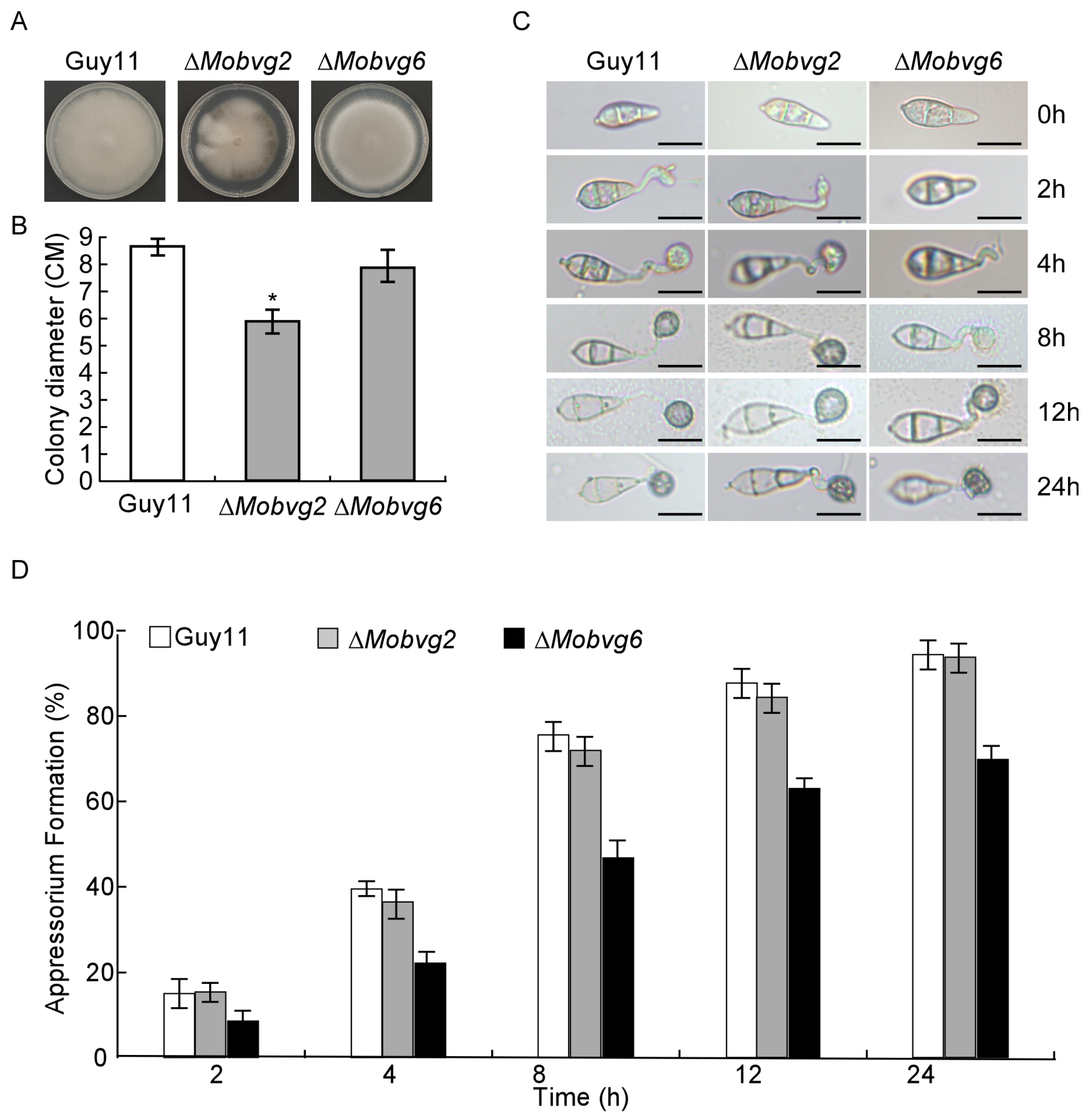
Normal mycelial growth is a critical determinant of pathogenicity in M. oryzae [34,35]. To evaluate the contribution of MoBVG2 and MoBVG6 to vegetative growth, ΔMobvg2 and ΔMobvg6 deletion mutants were cultured on complete medium (CM) for 7 days, and colony diameters were measured. Compared to the wild-type strain Guy11, ΔMobvg2 exhibited significantly reduced radial growth, whereas ΔMobvg6 displayed growth rates comparable to the wild type (Figure 7A,B).
Appressorium formation is essential for successful host penetration by M. oryzae [36,37]. To assess appressorium development, conidial suspensions from each strain were deposited on hydrophobic glass slides and incubated at 28 °C. Appressorium formation rates were monitored at 2 h intervals from 0 to 24 h post-deposition. While ΔMobvg2 displayed appressorium formation kinetics indistinguishable from the wild type, ΔMobvg6 exhibited significantly delayed appressorium morphogenesis (Figure 7C,D), demonstrating a specific role for MoBvg6 in infection structure differentiation.

4. Discussion

The plant activator BTH confers resistance to a broad-spectrum pathogen in rice through the OsNPR1–OsWRKY45 module, which plays crucial roles in priming PR gene expression and phytoalexin biosynthesis [15,16,38]. However, the molecular response of M. oryzae to BTH-induced resistance (BTH-IR) has remained largely unexplored.
To address this gap, we performed temporal transcriptomic profiling during infection of BTH-primed rice and identified 699 IR-associated DEGs (Table S2), revealing a distinct temporal shift in the fungal transcriptional response (Figure 3 and Figure 4). Early in infection (12 hpi), the fungus exhibits a transcriptional profile associated with active growth and host sensing, characterized by enrichment of genes involved in cell cycle progression, meiosis, and signaling pathways. However, simultaneous suppression of pathways related to energy production and membrane metabolism suggests that BTH priming already imposes physiological constraints on fungal metabolism during the penetration stage. By 24 hpi, the number of DEGs declines and the transcriptional profile shifts toward cellular recycling and stress management. Up-regulation of autophagy and ubiquitin-mediated proteolysis, together with broad repression of primary metabolic pathways, indicates that the pathogen begins reallocating resources to maintain protein quality and survival under increasing host-imposed stress. This stage likely reflects the onset of nutrient limitation and reduced carbon and energy availability within BTH-primed host tissues. At 48 hpi, the DEG profile further shifts toward a defensive survival strategy. Up-regulation of detoxification pathways, including glutathione metabolism and ABC transporters, together with activation of MAPK signaling, suggests an attempt by the fungus to counteract host-derived oxidative and chemical stresses. Nevertheless, the concurrent suppression of essential processes such as transcription, oxidative phosphorylation, carbohydrate metabolism, and DNA repair indicates severe metabolic dysfunction. Together, these temporal dynamics suggest that BTH priming progressively restricts fungal growth by compromising energy metabolism, inducing nutrient stress, and ultimately forcing the pathogen into a non-productive stress-response state that prevents successful colonization. Future research should focus on elucidating how these transcriptional shifts translate into functional metabolic changes that impair pathogen fitness.
Among the IR-associated DEGs, we selected eight BTH-suppressed candidate virulence genes (MoBVG1–8) for functional characterization. Deletion of two genes, MoBVG2 and MoBVG6, significantly reduced M. oryzae virulence, as indicated by a 75–80% decrease in lesion area on non-primed rice plants (Figure 6). Conversely, overexpression of these genes significantly increased pathogenicity against BTH-IR. These results demonstrate that induced resistance confers broad spectrum protection, and BTH extensively reprograms plant physiology, thereby enhancing resistance to diverse pathogens, including M. oryzae. MoBvg2 is annotated as encoding a secreted SCP/TAPS domain-containing effector involved in suppressing host reactive oxygen species (ROS), while MoBvg6 is annotated as encoding a G-protein-coupled receptor that functions as an environmental sensor at the apex of the infection cascade (Table 1). These findings highlight the critical roles of ROS scavenging and host sensing in successful M. oryzae pathogenesis. This is consistent with previous finding showing increased hydrogen peroxide (H2O2) accumulation in response to blast infection in rice plants overexpressing WRKY45, a key regulator of BTH-induced resistance [12]. Furthermore, phenotypic characterization of deletion mutants revealed distinct functional roles: ΔMobvg6 exhibited delayed appressorium formation, indicating its requirement for the development of infection-related structures necessary for host invasion, whereas ΔMobvg2 showed reduced radial colony growth and defective blast lesion development, demonstrating its importance for post-penetration proliferation. Notably, deletion-mutation of either of MoBVG2 or MoBVG6 alone did not completely abolish M. oryzae virulence on non-primed plants; similarly, overexpression of these genes did not result in disease severity comparable to that caused by wild-type Guy11 on non-primed plants. These results indicate that multiple virulence genes function cooperatively to achieve full M. oryzae pathogenicity.

5. Conclusions

This study elucidates the pathogen-side molecular mechanisms underlying BTH-induced resistance in rice against blast disease. Our temporal transcriptomic analysis reveals that BTH priming imposes progressive metabolic stress on M. oryzae, disrupting the fungal infection program from initial penetration through colonization. The transcriptional shift from growth-promoting to stress-responsive states reflects the pathogen’s unsuccessful attempt to overcome enhanced host defenses, ultimately leading to infection failure. Functional validation of MoBVG2 and MoBVG6 as critical virulence factors suppressed by BTH-induced resistance provides direct molecular evidence that chemically induced resistance can neutralize essential pathogen functions, including ROS detoxification and host environmental sensing. Together, these findings advance our mechanistic understanding of plant–pathogen interactions in primed hosts and identify potential molecular targets for developing sustainable crop protection strategies based on plant immune priming. However, the molecular mechanisms by which host-induced resistance directly alters pathogen responses remain to be elucidated in future studies.

Supplementary Materials

The following supporting information can be downloaded at https://www.mdpi.com/article/10.3390/agronomy16100962/s1.

Author Contributions

Conceptualization, R.Z., C.-J.J. and X.X.; methodology, R.Z.; validation, R.Z.; formal analysis, R.Z.; investigation, R.Z., Y.S., Y.H. and C.J.; resources, Y.S. and Y.H.; data curation, Y.L.; writing—original draft preparation, R.Z.; writing—review and editing, C.-J.J. and X.X.; visualization, R.Z.; supervision, C.Z. and Y.P.; project administration, C.Z. and Y.P.; funding acquisition, W.S., C.-J.J. and X.X.; technical assistance for experimental procedures and laboratory support, L.X.; technical support for experimental execution, C.J.; assistance with experimental procedures, G.Z.; technical assistance for experimental workflows, J.Z. All authors have read and agreed to the published version of the manuscript.

Funding

This research was funded by the Shandong Province Base and Talent Program (Foreign Experts Double Hundred Plan, WSR2023008); Agricultural Variety Improvement Project of Shandong Province (2023LZGC021); the opening Foundation of State Key Laboratory of Crop Gene Resources and Breeding (CGRB-2024-09) and the Science and Technology Innovation Project of the Shandong Academy of Agricultural Sciences (No. CXGX2025G09).

Data Availability Statement

The original contributions presented in the study are publicly available. The transcriptomic raw data have been deposited in the NCBI Sequence Read Archive (SRA) under the BioProject accession number PRJNA1419538.

Acknowledgments

We are grateful to Han, the research assistant, for her valuable assistance in our daily experiments. In particular, we sincerely appreciate her professional and meticulous work on greenhouse management, which ensured the smooth progress of plant cultivation and related experiments.

Conflicts of Interest

The authors declare no conflicts of interest.

Abbreviations

The following abbreviations are used in this manuscript:
ABCATP-binding cassette
BTHBenzothiadiazole
BTH-IRBenzothiadiazole Induced Resistance
CFEMCommon in Fungal Extracellular Membrane
DEGsDifferentially Expressed Genes
FADFlavin Adenine Dinucleotide
GOGene ontology
HRHypersensitive Reaction
IPMIntegrated Pest Management
IRInduced Resistance
KEGGKyoto Encyclopedia of Genes and Genomes
MAPKMitogen-Activated Protein Kinase
MoBVGsM. oryzae BTH-suppressed Virulence Gene
NPR1Nonexpressor of Pathogenesis-Related Gene
OEOverexpression
PRPathogenesis-Related Protein
RNPRibonucleoprotein
ROSReactive Oxygen Species
SCFSkp1–Cullin–F box
SCPSperm-Coating Protein
SRPSignal recognition particle
TAPSTpx/Antigen 5/Pathogenesis-related Protein
WRKY45WRKY transcription factor 45

References

  1. Dean, R.; Van Kan, J.A.; Pretorius, Z.A.; Hammond-Kosack, K.E.; Di Pietro, A.; Spanu, P.D.; Rudd, J.J.; Dickman, M.; Kahmann, R.; Ellis, J.; et al. The Top 10 fungal pathogens in molecular plant pathology. Mol. Plant Pathol. 2012, 13, 414–430. [Google Scholar] [CrossRef]
  2. Talbot, N.J. On the trail of a cereal killer: Exploring the biology of Magnaporthe grisea. Annu. Rev. Microbiol. 2003, 57, 177–202. [Google Scholar] [CrossRef]
  3. Elert, E. Rice by the numbers: A good grain. Nature 2014, 514, S50–S51. [Google Scholar] [CrossRef]
  4. Greenwood, J.R.; Lacorte-Apostol, V.; Kroj, T.; Padilla, J.; Telebanco-Yanoria, M.J.; Glaus, A.N.; Roulin, A.; Padilla, A.; Zhou, B.; Keller, B.; et al. Genome-wide association analysis uncovers rice blast resistance alleles of Ptr and Pia. Commun. Biol. 2024, 7, 607. [Google Scholar] [CrossRef]
  5. Syauqi, J.; Chen, R.K.; Cheng, A.H.; Wu, Y.F.; Chung, C.L.; Lin, C.C.; Chou, H.P.; Wu, H.Y.; Jian, J.Y.; Liao, C.T.; et al. Surveillance of Rice Blast Resistance Effectiveness and Emerging Virulent Isolates in Taiwan. Plant Dis. 2022, 106, 3187–3197. [Google Scholar] [CrossRef]
  6. Yang, B.; Yang, S.; Zheng, W.; Wang, Y. Plant immunity inducers: From discovery to agricultural application. Stress Biol. 2022, 2, 5. [Google Scholar] [CrossRef]
  7. Fukuoka, S.; Okuno, K. Strategies for breeding durable resistance to rice blast using pi21. Crop Breed. Genet. Genom. 2019, 1, e190013. [Google Scholar]
  8. Aranega-Bou, P.; de la O Leyva, M.; Finiti, I.; García-Agustín, P.; González-Bosch, C. Priming of plant resistance by natural compounds. Hexanoic acid as a model. Front. Plant Sci. 2014, 5, 488. [Google Scholar] [CrossRef] [PubMed]
  9. González-Bosch, C. Priming plant resistance by activation of redox-sensitive genes. Free Radic. Biol. Med. 2018, 122, 171–180. [Google Scholar] [CrossRef] [PubMed]
  10. Reglinski, T.; Havis, N.; Rees, H.J.; de Jong, H. The Practical Role of Induced Resistance for Crop Protection. Phytopathology 2023, 113, 719–731. [Google Scholar] [CrossRef]
  11. Zhu, F.; Cao, M.Y.; Zhang, Q.P.; Mohan, R.; Schar, J.; Mitchell, M.; Chen, H.; Liu, F.; Wang, D.; Fu, Z.Q. Join the green team: Inducers of plant immunity in the plant disease sustainable control toolbox. J. Adv. Res. 2024, 57, 15–42. [Google Scholar] [CrossRef]
  12. Shimono, M.; Koga, H.; Akagi, A.; Hayashi, N.; Goto, S.; Sawada, M.; Kurihara, T.; Matsushita, A.; Sugano, S.; Jiang, C.J.; et al. Rice WRKY45 plays important roles in fungal and bacterial disease resistance. Mol. Plant Pathol. 2011, 13, 83–94. [Google Scholar] [CrossRef]
  13. Wang, J.; Zhou, L.; Shi, H.; Chern, M.; Yu, H.; Yi, H.; He, M.; Yin, J.; Zhu, X.; Li, Y.; et al. A single transcription factor promotes both yield and immunity in rice. Science 2018, 361, 1026–1028. [Google Scholar] [CrossRef] [PubMed]
  14. Yassin, M.; Ton, J.; Rolfe, S.A.; Valentine, T.A.; Cromey, M.; Holden, N.; Newton, A.C. The rise, fall and resurrection of chemical-induced resistance agents. Pest. Manag. Sci. 2021, 77, 3900–3909. [Google Scholar] [CrossRef]
  15. Shimono, M.; Sugano, S.; Nakayama, A.; Jiang, C.J.; Ono, K.; Toki, S.; Takatsuji, H. Rice WRKY45 plays a crucial role in benzothiadiazole-inducible blast resistance. Plant Cell 2007, 19, 2064–2076. [Google Scholar] [CrossRef]
  16. Sugano, S.; Jiang, C.J.; Miyazawa, S.; Masumoto, C.; Yazawa, K.; Hayashi, N.; Shimono, M.; Nakayama, A.; Miyao, M.; Takatsuji, H. Role of OsNPR1 in rice defense program as revealed by genome-wide expression analysis. Plant Mol. Biol. 2010, 74, 549–562. [Google Scholar] [CrossRef]
  17. Talbot, N.J.; Ebbole, D.J.; Hamer, J.E. Identification and characterization of MPG1, a gene involved in pathogenicity from the rice blast fungus Magnaporthe grisea. Plant Cell 1993, 5, 1575–1590. [Google Scholar] [CrossRef]
  18. Chauhan, R.S.; Farman, M.L.; Zhang, H.B.; Leong, S.A. Genetic and physical mapping of a rice blast resistance locus, Pi-CO39(t), that corresponds to the avirulence gene AVR1-CO39 of Magnaporthe grisea. Mol. Genet. Genom. 2002, 267, 603–612. [Google Scholar] [CrossRef]
  19. Li, H.; Wu, J.; Shang, X.; Geng, M.; Gao, J.; Zhao, S.; Yu, X.; Liu, D.; Kang, Z.; Wang, X.; et al. WRKY Transcription Factors Shared by BTH-Induced Resistance and NPR1-Mediated Acquired Resistance Improve Broad-Spectrum Disease Resistance in Wheat. Mol. Plant Microbe Interact. 2020, 33, 433–443. [Google Scholar] [CrossRef] [PubMed]
  20. Jiang, Y.; Sam, F.E.; Li, J.; Bi, Y.; Ma, T.; Zhang, B. Pre-Harvest Benzothiadiazole Spraying Promotes the Cumulation of Phenolic Compounds in Grapes. Foods 2022, 11, 3345. [Google Scholar] [CrossRef] [PubMed]
  21. Guo, M.; Chen, Y.; Du, Y.; Dong, Y.; Guo, W.; Zhai, S.; Zhang, H.; Dong, S.; Zhang, Z.; Wang, Y.; et al. The bZIP transcription factor MoAP1 mediates the oxidative stress response and is critical for pathogenicity of the rice blast fungus Magnaporthe oryzae. PLoS Pathog. 2011, 7, e1001302. [Google Scholar] [CrossRef]
  22. Guo, M.; Guo, W.; Chen, Y.; Dong, S.; Zhang, X.; Zhang, H.; Song, W.; Wang, W.; Wang, Q.; Lv, R.; et al. The basic leucine zipper transcription factor Moatf1 mediates oxidative stress responses and is necessary for full virulence of the rice blast fungus Magnaporthe oryzae. Mol. Plant Microbe Interact. 2010, 23, 1053–1068. [Google Scholar] [CrossRef]
  23. Yin, Z.; Chen, C.; Yang, J.; Feng, W.; Liu, X.; Zuo, R.; Wang, J.; Yang, L.; Zhong, K.; Gao, C.; et al. Histone acetyltransferase MoHat1 acetylates autophagy-related proteins MoAtg3 and MoAtg9 to orchestrate functional appressorium formation and pathogenicity in Magnaporthe oryzae. Autophagy 2019, 15, 1234–1257. [Google Scholar] [CrossRef]
  24. Yin, Z.; Tang, W.; Wang, J.; Liu, X.; Yang, L.; Gao, C.; Zhang, J.; Zhang, H.; Zheng, X.; Wang, P.; et al. Phosphodiesterase MoPdeH targets MoMck1 of the conserved mitogen-activated protein (MAP) kinase signalling pathway to regulate cell wall integrity in rice blast fungus Magnaporthe oryzae. Mol. Plant Pathol. 2016, 17, 654–668. [Google Scholar] [CrossRef]
  25. Tian, T.; Liu, Y.; Yan, H.; You, Q.; Yi, X.; Du, Z.; Xu, W.; Su, Z. agriGO v2. 0: A GO analysis toolkit for the agricultural community, 2017 update. Nucleic Acids Res. 2017, 45, W122–W129. [Google Scholar] [CrossRef] [PubMed]
  26. Huang, D.W.; Sherman, B.T.; Lempicki, R.A. Systematic and integrative analysis of large gene lists using DAVID bioinformatics resources. Nat. Protoc. 2009, 4, 44–57. [Google Scholar] [CrossRef] [PubMed]
  27. Qian, B.; Su, X.; Ye, Z.; Liu, X.; Liu, M.; Shen, D.; Chen, H.; Zhang, H.; Wang, P.; Zhang, Z. MoErv29 promotes apoplastic effector secretion contributing to virulence of the rice blast fungus Magnaporthe oryzae. New Phytol. 2022, 233, 1289–1302. [Google Scholar] [CrossRef]
  28. Deng, Q.; Li, K.Y.; Chen, H.; Dai, J.H.; Zhai, Y.Y.; Wang, Q.; Li, N.; Wang, Y.P.; Han, Z.G. RNA interference against cancer/testis genes identifies dual specificity phosphatase 21 as a potential therapeutic target in human hepatocellular carcinoma. Hepatology 2014, 59, 518–530. [Google Scholar] [CrossRef] [PubMed]
  29. Tang, W.; Ru, Y.; Hong, L.; Zhu, Q.; Zuo, R.; Guo, X.; Wang, J.; Zhang, H.; Zheng, X.; Wang, P.; et al. System-wide characterization of bZIP transcription factor proteins involved in infection-related morphogenesis of Magnaporthe oryzae. Environ. Microbiol. 2014, 17, 1377. [Google Scholar] [CrossRef]
  30. Zhang, J.; Li, H.; Gu, W.; Zhang, K.; Liu, X.; Liu, M.; Yang, L.; Li, G.; Zhang, Z.; Zhang, H. Peroxisome dynamics determines host-derived ROS accumulation and infectious growth of the rice blast fungus. mBio 2023, 14, e0238123. [Google Scholar] [CrossRef]
  31. Liu, M.; Zhang, S.; Hu, J.; Sun, W.; Padilla, J.; He, Y.; Li, Y.; Yin, Z.; Liu, X.; Wang, W.; et al. Phosphorylation-guarded light-harvesting complex II contributes to broad-spectrum blast resistance in rice. Proc. Natl. Acad. Sci. USA 2019, 116, 17572–17577. [Google Scholar] [CrossRef] [PubMed]
  32. Yin, Z.; Feng, W.; Chen, C.; Xu, J.; Li, Y.; Yang, L.; Wang, J.; Liu, X.; Wang, W.; Gao, C.; et al. Shedding light on autophagy coordinating with cell wall integrity signaling to govern pathogenicity of Magnaporthe oryzae. Autophagy 2020, 16, 900–916. [Google Scholar] [CrossRef]
  33. Zhang, H.; Zheng, X.; Zhang, Z. The Magnaporthe grisea species complex and plant pathogenesis. Mol. Plant Pathol. 2016, 17, 796–804. [Google Scholar] [CrossRef]
  34. Zhong, K.; Li, X.; Le, X.; Kong, X.; Zhang, H.; Zheng, X.; Wang, P.; Zhang, Z. MoDnm1 Dynamin Mediating Peroxisomal and Mitochondrial Fission in Complex with MoFis1 and MoMdv1 Is Important for Development of Functional Appressorium in Magnaporthe oryzae. PLoS Pathog. 2016, 12, e1005823. [Google Scholar] [CrossRef]
  35. Zhang, H.; Tang, W.; Liu, K.; Huang, Q.; Zhang, X.; Yan, X.; Chen, Y.; Wang, J.; Qi, Z.; Wang, Z.; et al. Eight RGS and RGS-like proteins orchestrate growth, differentiation, and pathogenicity of Magnaporthe oryzae. PLoS Pathog. 2011, 7, e1002450. [Google Scholar] [CrossRef]
  36. Li, G.; Zhou, X.; Xu, J.R. Genetic control of infection-related development in Magnaporthe oryzae. Curr. Opin. Microbiol. 2012, 15, 678–684. [Google Scholar] [CrossRef] [PubMed]
  37. Ryder, L.S.; Talbot, N.J. Regulation of appressorium development in pathogenic fungi. Curr. Opin. Plant Biol. 2015, 26, 8–13. [Google Scholar] [CrossRef] [PubMed]
  38. Patni, B.; Bhattacharyya, M.; Pokhriyal, A. The role of signaling compounds in enhancing rice allelochemicals for sustainable agriculture: An overview. Planta 2023, 258, 90. [Google Scholar] [CrossRef]
Figure 1. BTH-induced resistance in rice against M. oryzae. Fourteen-day-old rice seedlings from seeds treated either with BTH or water (control) were inoculated with M. oryzae strain Guy11. The relative area of blast lesion (%) was measured at five days post-inoculation. Results from two independent experiments are shown. (A) Representative images of blast lesions. (B) Relative lesion area (%) within a leaf area of 5 cm2. Data are presented as mean ± standard deviation (SD) (n = 10–15 plants). Asterisks denote statistically significant differences compared to the water-treated control (Student’s t-test, * p < 0.05).
Agronomy 16 00962 g001
Figure 2. Stage-specific overlap of differentially expressed genes (DEGs) in M. oryzae during infection of BTH-primed rice. (A) Venn diagram of up-regulated DEGs. (B) Venn diagram of down-regulated DEGs. Numbers within each sector indicate the number of DEGs unique to or shared among the three infection stages (12, 24, and 48 h post-inoculation). DEGs were defined as |log2 fold change| ≥ 1 and false discovery rate < 0.05 (Table S2). Detailed gene list is provided in Supplementary Table S2.
Agronomy 16 00962 g002
Figure 3. Gene Ontology (GO) enrichment analysis of up- and down-regulated DEGs in M. oryzae at different infection stages under BTH-induced resistance. (AF) Bar plots showing the top 30 significantly enriched GO terms for differentially expressed genes (|log2FC| ≥ 1, FDR < 0.05) at 12 hpi (A,B), 24 hpi (C,D), and 48 hpi (E,F). Green bars: Biological Process (BP), Orange bars: Cellular Component (CC), Blue bars: Molecular Function (MF). Bar length represents statistical significance (−log10 p-value). Panels (A,C,E) show up-regulated DEGs; panels (B,D,F) show down-regulated DEGs. Bars represent −log10 of adjusted p-values (<0.05).
Agronomy 16 00962 g003
Figure 4. Time-point-specific KEGG pathway enrichment of up- and down-regulated DEGs in M. oryzae at 12, 24, and 48 hpi. Bubble plots show the top 20 enriched KEGG pathways for (A,B) 12 hpi, (C,D) 24 hpi, and (E,F) 48 hpi. (Left panels): up-regulated genes; (right panels): down-regulated genes. Bubble size represents gene count; color intensity represents −log10 of adjusted p-value (<0.05; red = more significant).
Agronomy 16 00962 g004
Figure 5. RT-qPCR validation of candidate virulence genes. Expression patterns of eight candidate virulence genes were confirmed across three time points. Bars denote mean ± SD (n = 3). Significant differences from RNA-seq trends are indicated by * p < 0.05, ** p < 0.01 (Student’s t-test).
Agronomy 16 00962 g005
Figure 6. Functional analysis of MoBVG genes in M. oryzae pathogenicity. (A,B) Effect of MoBVG-overexpression on pathogenicity of M. oryzae in BTH-primed rice. Fourteen-day-old rice seedlings from BTH-treated seeds were inoculated with wild-type (Guy11) and MoBVG-overexpressing M. oryzae strains. Relative blast lesion area (%) was determined at 5 days post-inoculation. (A) Representative images of blast lesions; (B) Quantification of relative lesion area (%) in 5 cm2 leaf area. Data are mean ± SD (n = 10–15 plants). Asterisks indicate significant differences compared with Guy11 (Student’s t-test, * p < 0.05, ** p < 0.01). (C,D) Effect of MoBVG2 and MoBVG6 deletion-mutations (ΔMobvg2 and ΔMobvg6) on M. oryzae pathogenicity. Fourteen-day-old non-primed control rice seedlings were inoculated with ΔMobvg2 and ΔMobvg6, and their complementation strains (ΔMobvg6/MoBVG6 and ΔMobvg2/MoBVG2). Relative blast lesion area (%) was measured at 7 days post-inoculation. (C) Representative images of blast lesions; (D) Quantification of relative lesion area (%) in 5 cm2 leaf area. Data are mean ± SD (n = 10–15 plants). Asterisks indicate significant differences compared with Guy11 (Student’s t-test, ** p < 0.01).
Agronomy 16 00962 g006
Figure 7. Roles of MoBvg2 and MoBvg6 in M. oryzae vegetative growth and appressorium development. Mutant strains ΔMobvg2 and ΔMobvg6 were examined for vegetative growth and appressorium morphogenesis. (A,B) Mycelial growth assay on complete medium (CM) for seven days. Data are mean ± SD (n = 3). Asterisks denote significant differences compared with the wild type Guy11 (Student’s t-test, * p < 0.05. (C,D) Appressorium formation kinetics on hydrophobic surfaces at 28 °C. For each strain and time point, more than 100 conidia were examined per replicate. Data represent mean ± SD (n = 3). Scale bar = 5 µm.
Agronomy 16 00962 g007
Table 1. Candidate virulence genes in M. oryzae selected for functional characterization.
Gene IDFunctional PredictionPrimary Selection Rationale
MoBVG1
MGG_00446
β-1,3-glucan synthaseAffecting the integrity of the cell wall
MoBVG2
MGG_01925
Secreted SCP/TAPS effectorSuppresses host ROS; related deletions reduce virulence by ~35%
MoBVG3
MGG_07067
FAD-dependent oxidoreductaseDetoxifies H2O2; loss-of-function heightens ROS sensitivity
MoBVG4
MGG_15748
Zn(II)2Cys6transcription factorMaster regulator of calcium signaling essential for appressorial formation
MoBVG5
MGG_13775
Short-chain dehydrogenaseProvide energy for the
formation of appressoria
MoBVG6
MGG_00261
G-protein-coupled receptorEnvironmental sensor at the top of infection cascade
MoBVG7
MGG_15600
F-box/WD40 SCF subunitThe ubiquitin-protease system determines the polarity growth of the infection thread.
MoBVG8
MGG_13484
CFEM cell-wall sensorAffecting the formation of the penetration peg
Disclaimer/Publisher’s Note: The statements, opinions and data contained in all publications are solely those of the individual author(s) and contributor(s) and not of MDPI and/or the editor(s). MDPI and/or the editor(s) disclaim responsibility for any injury to people or property resulting from any ideas, methods, instructions or products referred to in the content.