1. Introduction
The global cultivation of highbush blueberry (
Vaccinium corymbosum L.) has expanded significantly over the past two decades, with annual production now exceeding 655,000 tons [
1]. The increasing demand for blueberries is driven by their recognised health benefits, attributed primarily to their high content of polyphenolic compounds, including anthocyanins, flavonols, and phenolic acids, which exhibit strong antioxidant properties [
2,
3]. Despite the growing popularity of blueberries worldwide, the establishment of new plantations is often constrained by the limited availability of suitable soils [
4]. Consequently, alternative cultivation methods, including various substrate-based systems, have been explored to optimise plant growth and enhance fruit quality.
The composition of bioactive compounds in blueberries is strongly influenced by genetic variability, cultivation methods, and environmental conditions [
5]. The capacity to grow blueberries year-round in different climatic zones provides consumers with a continuous supply of fruits rich in bioactive compounds. Research indicates that anthocyanins, primarily delphinidin and malvidin derivatives, constitute approximately 75% of the total anthocyanin content in blueberries, while quercetin is the predominant flavonol with high bioavailability [
6,
7]. These bioactive compounds contribute to a range of physiological benefits, including anti-inflammatory, anti-carcinogenic, and neuroprotective effects [
8].
Given that the accumulation of bioactive compounds depends not only on external cultivation factors but also on the genetic stability and physiological uniformity of plants, the choice of propagation method becomes a crucial determinant of both biochemical consistency and yield potential. In addition to environmental and management factors, propagation methods and the quality of planting material also play a decisive role in determining both productivity and the reproducibility of fruit quality traits. Traditional soil-based cultivation presents challenges, particularly in regions where acidic, organic-matter-rich soils are scarce. In response, growers have adopted substitute substrates such as peat, coconut coir, perlite, and bark-based media, which provide controlled root-zone conditions and improve nutrient management [
9]. Alternative production systems, including raised-bed cultivation, mulching, or the use of organic and inert substrates, are increasingly implemented to improve soil structure, water retention, and nutrient availability, thereby enhancing both yield and fruit quality parameters [
10].
Environmental stresses related to fluctuating temperature, drought, and pathogen pressure remain major challenges for commercial plantations. The unpredictability of weather patterns poses challenges for growers, with excessive moisture creating favourable conditions for fungal infections such as anthracnose (
Glomerella acutata) and grey mould (
Botrytis cinerea) [
11]. Organic cultivation practices have been promoted as a sustainable alternative, aiming to minimise chemical inputs while enhancing fruit quality. However, these methods require meticulous monitoring to mitigate disease pressure and ensure optimal yield [
12]. Understanding these multifactorial interactions is therefore essential to developing sustainable cultivation systems that maintain high fruit quality and bioactive potential, which forms the central objective of the present study.
To meet market demand and improve production efficiency, researchers have explored various strategies to optimise fruit quality, including modifications in irrigation, fertilisation, and substrate composition. The role of different growing media in influencing fruit phytochemistry remains an area of active investigation. Factors such as substrate pH, organic matter content, and microbial activity can alter nutrient availability, subsequently affecting the synthesis of polyphenolic compounds in blueberries [
10]. Comparative studies on different substrate types have shown significant variations in fruit phenolic composition, emphasising the importance of tailored cultivation strategies to maximise health-promoting properties. Babiker et al. 2023 [
13] highlighted the importance of genotype × environment interactions and cultivation practices for blueberry fruit quality. Multivariate phenotyping approaches have shown large genotypic variation in berry size, firmness and colour stability in modern blueberry germplasm collections. Improved growing systems, including pots and raised beds, have been reported to modify yield and vegetative growth in highbush blueberry [
14]. Thus, cultivation systems should be regarded not only as agronomic frameworks but also as environmental modulators of fruit phytochemistry, directly influencing the formation of bioactive compounds [
15].
Based on prior research, we tested the following specific hypotheses:
Raised-bed + agrotextile systems will increase fruit yield and weight but reduce mechanical properties (firmness and puncture resistance) due to improved water availability and reduced environmental stress.
Cultivar × cultivation system interactions will significantly influence bioactive compound profiles, with stress-sensitive cultivars showing higher total polyphenol content (TPC) and antioxidant capacity under conventional cultivation systems.
Alternative cultivation systems will modify nitrate accumulation in blueberry fruit, with substrate-based systems reducing NO3− uptake compared to mineral soil conditions.
Three-year monitoring will reveal temporal stability of genotype × cultivation system effects on fruit quality traits under Polish climatic conditions.
By analysing a broad set of physicochemical and phytochemical attributes, this research provides cultivation strategies that maximise nutritional value while aligning with market and production requirements.
2. Materials and Methods
2.1. Site Description and Soil Characteristics
The experiment was conducted over three consecutive growing seasons, from spring 2019 to autumn 2021, on a commercial highbush blueberry (Vaccinium corymbosum L.) plantation located approximately 20 km east of Szczecin in the West Pomeranian Voivodeship, Poland (53.397, 14.874). The plantation covers around 60 hectares and is situated at the edge of a forest complex at an elevation of 25–35 m above sea level. The surrounding terrain is flat to gently undulating, typical of the Western Pomeranian Lowlands, providing favourable sunlight exposure and moderate air circulation.
The soil at the site is mineral, composed primarily of light sand with a loamy-sand texture. It is strongly acidic, with a pH of 4.0–4.2, contains 22.1 g/kg organic matter and 5.6 g/kg organic carbon, and has an electrical conductivity (EC) of 0.29 mS/m. Prior to establishing the experimental plots, standard soil preparation procedures were applied, including mechanical weed control, organic matter amendment, and mineral fertilisation.
Two planting methods were evaluated: (1) direct planting on flat terrain and (2) planting on raised trapezoidal beds. The raised beds were 30–40 cm high, 120 cm wide at the base, and 60 cm wide at the top. They were formed by transferring topsoil from the inter-row spaces into the rows using a plough and shaping it into trapezoidal ridges onto which the bushes were planted.
The region is characterised by a temperate oceanic climate (Köppen–Geiger Cfb), with an average annual temperature of approximately 9.5 °C. Winters are generally mild, with mean January lows around −4 °C and highs near 1 °C, while summers are moderately warm, with mean August highs of about 24 °C and lows of 14–15 °C. Annual precipitation totals 550–700 mm and is typically evenly distributed throughout the growing season. In recent years, an increasing frequency of nights with minimum air temperatures above 20 °C (“tropical nights”) has been observed across Poland, including the West Pomeranian region, reflecting ongoing climatic warming.
Weather conditions during the 2019–2021 growing seasons (April–October) differed from the long-term climatic baseline for northwestern Poland (1951–2012). The multiannual mean temperature for this period is 13.7 °C, whereas during the experiment it ranged from 14.1 to 15.4 °C, i.e., +0.4 to +1.7 °C above the reference level (
Table 1). The warmest season was 2019, with particularly high temperatures in June (21.5 °C, +5.1 °C above the long-term average) and persistently warm summer months. The 2020 season was also warmer than the climatic norm, although May and July were relatively cool. In 2021, a markedly cold spring (April and May −2.1 °C and −1.4 °C below the long-term mean, respectively) was followed by a warm early summer (June and July +2–3 °C), resulting in a growing season with alternating cold and warm anomalies.
Precipitation patterns also diverged from the long-term distribution. The mean April–October rainfall for 1951–2012 is 390.6 mm, whereas totals in 2019, 2020, and 2021 amounted to 301.0 mm, 258.1 mm, and 231.9 mm, respectively (
Table 1). Monthly rainfall distribution was highly uneven: in 2019, higher-than-average precipitation occurred mainly in May and June, with distinctly dry conditions in April, July, and August. In 2020, reduced rainfall was recorded in nearly all months except September and October, while 2021 was the driest year of the series, with no rainfall in June and clearly reduced precipitation in most of the remaining months.
2.2. Plant Material and Cultivation System
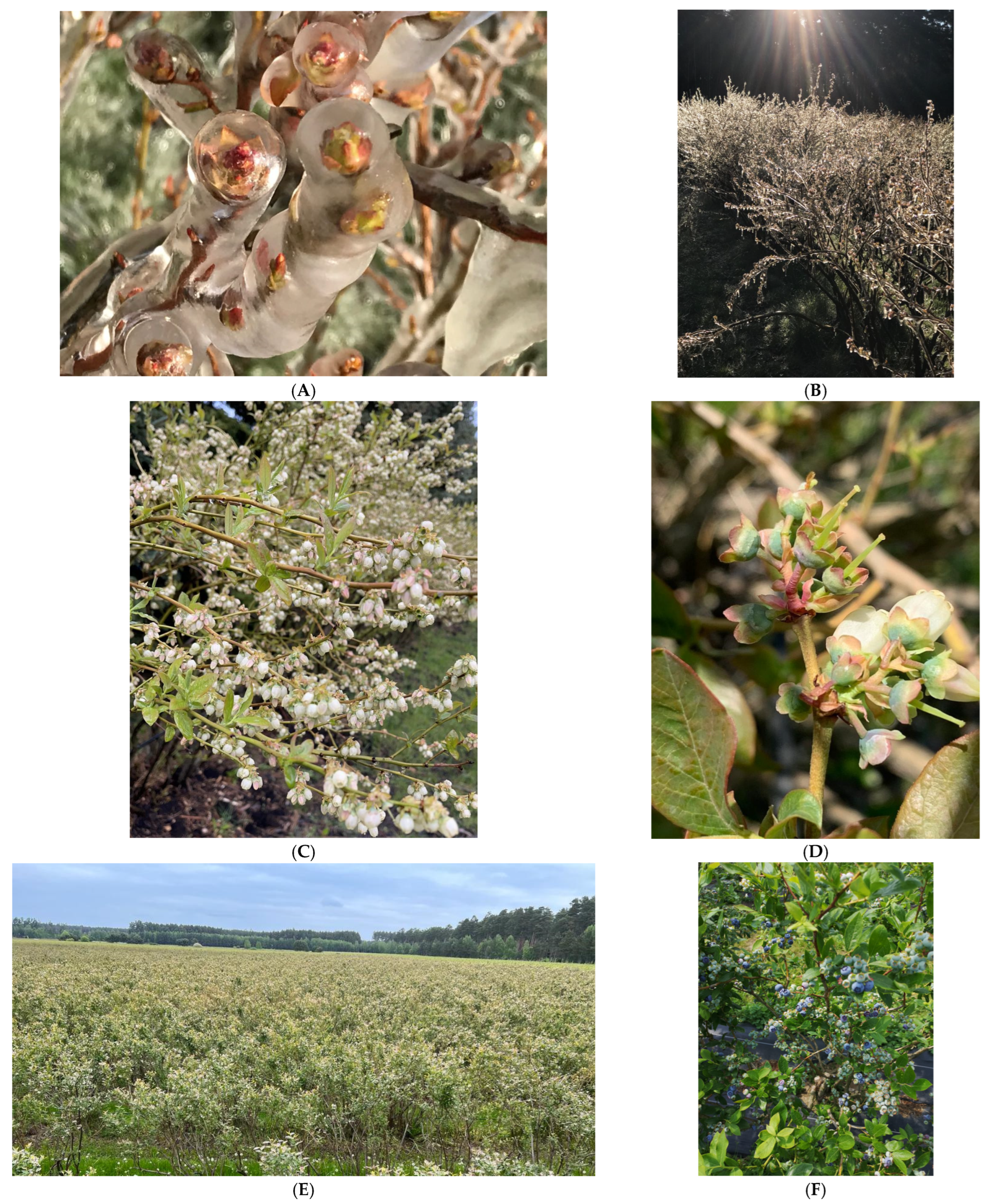
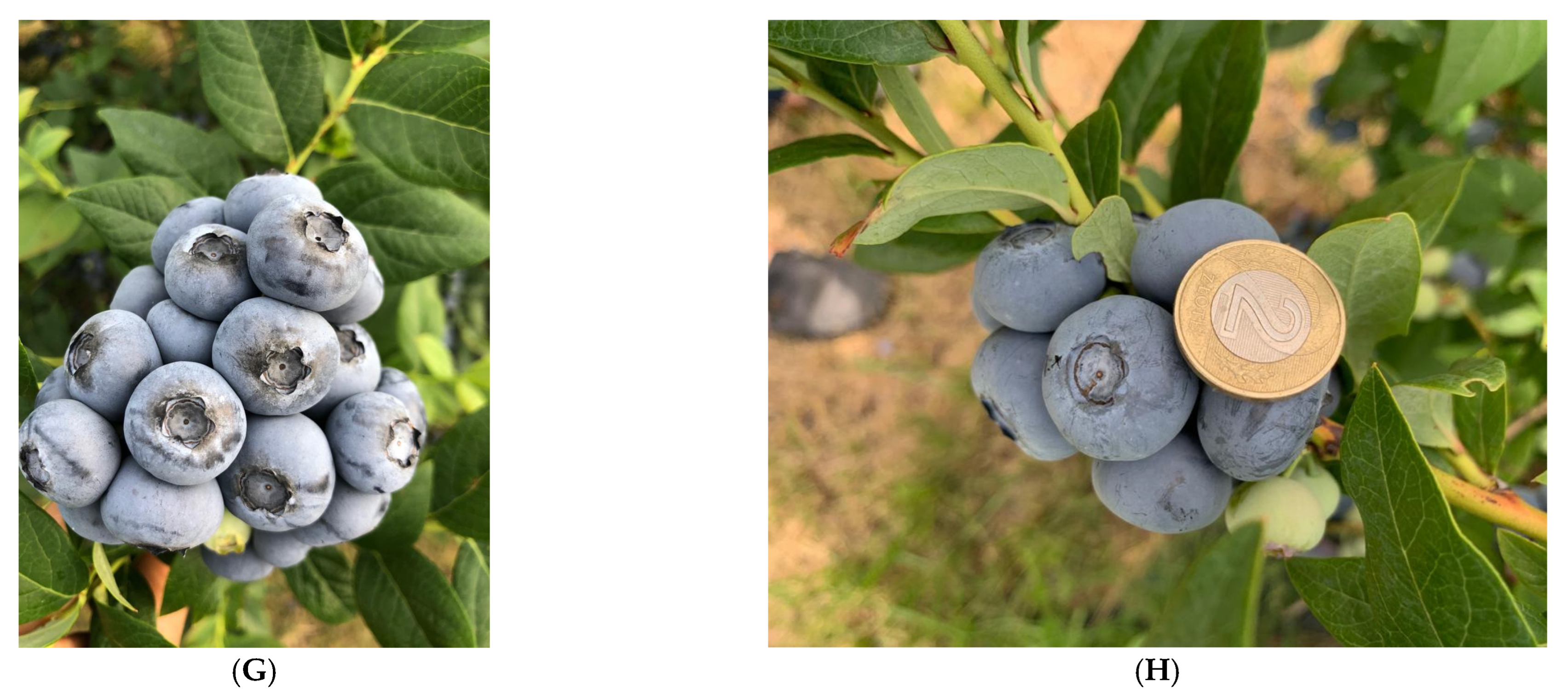
The bushes were established in 2012. The experiment included four highbush blueberry cultivars: ‘Sunrise’, ‘Draper’, ‘Ozark Blue’, and ‘Aurora’. ‘Sunrise’ (NC, USA) is an early- to mid-season cultivar producing large, light-blue fruits with good firmness and mild flavour, well suited for the fresh market (
Figure 1).
‘Draper’ (MI, USA) is a mid-season cultivar widely planted in Europe for its high yield potential, exceptional firmness, and uniform berry size, making it ideal for mechanical harvesting and long-distance transport.
‘Ozark Blue’ (AR, USA) is a mid- to late-season cultivar noted for its large, bright berries and adaptability to warmer climates, valued for extending the harvest window.
‘Aurora’ (OR, USA) is a late-ripening cultivar producing large, firm fruits with excellent postharvest quality, particularly suitable for cold storage and export.
These cultivars were chosen to represent contrasting harvest periods, fruit characteristics, and market purposes, allowing assessment of genotype × cultivation system interactions under temperate conditions. Fruit intended for physicochemical and phytochemical analyses was harvested manually in a single pass at full commercial maturity, defined as 100% blue skin colouration and a minimum soluble solids content of 12 °Brix. Owing to variable thermal conditions during the 2019–2021 seasons, the harvest dates differed between years. In 2019, 2020, and 2021, the ‘Sunrise’ fruit was harvested on 7 July, 12 July, and 18 July, respectively; ‘Draper’ on 14 July, 23 July, and 30 July; ‘Ozark Blue’ on 28 July, 3 August, and 9 August; and the latest-maturing cultivar, ‘Aurora’, on 22 August, 25 August, and 4 September. These dates correspond to the first commercially relevant harvest in each season. Final harvests were completed on 25 July, 29 July, and 4 August for ‘Sunrise’; 3 August, 9 August, and 18 August for ‘Draper’; 15 August, 21 August, and 28 August for ‘Ozark Blue’; and on 26 September, 3 October, and 11 October for ‘Aurora’. All samples were collected from fully mature fruit harvested from the same canopy position and using the same standardised picking protocol across all years.
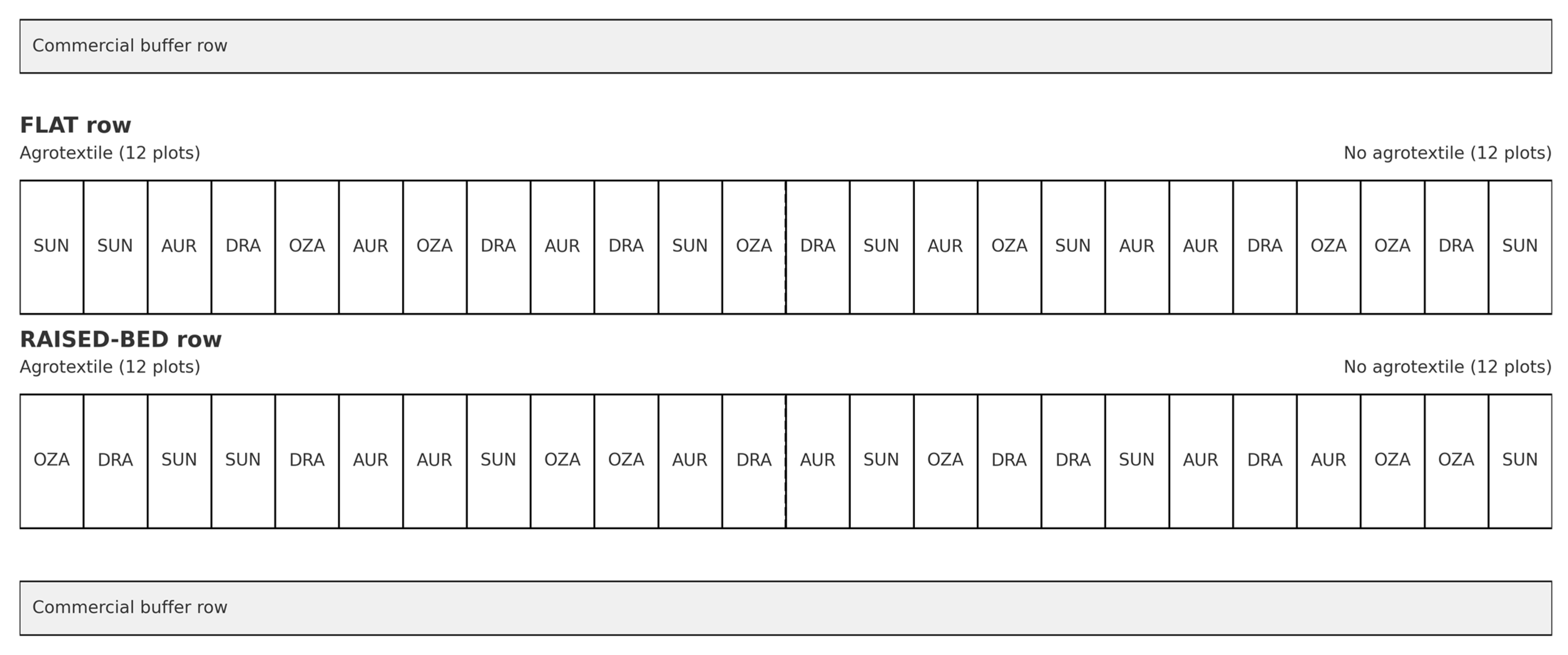
The experiment followed a two-factorial design (4 cultivars × 4 cultivation systems) with three replications, with bushes planted at a spacing of 3.5 m × 1.5 m. Each replication consisted of 4 plants, giving a total of 192 bushes evaluated in this study (
Figure 2). In two of the cultivation systems, the soil surface was covered with a black agrotextile fabric (GeoTerra, Imielin, Poland, 100 g m
−2) designed for weed suppression and modification of root-zone microclimate. The agrotextile was characterised by high water permeability (21 L m
−2 s
−1), air permeability, and resistance to degradation under prolonged contact with moisture, with declared stabilisation for up to ten growing seasons. The fabric thickness corresponded to a grammage of 100 g m
−2 (±5%) and included UV-stabilising additives, allowing partial transmission of solar radiation while increasing soil temperature.
The agrotextile was installed directly on the soil surface and mechanically secured by burying its edges into the soil along the plot margins, ensuring close contact with the ground while leaving an opening at the plant base to avoid stem damage and excessive moisture accumulation around the crown. No gap was maintained between the fabric and soil surface, allowing effective control of evaporation and weed emergence.
In cultivation systems without agrotextile, weed control was performed mechanically using a sub-canopy mower. Due to the characteristically shallow root system of highbush blueberry, mowing was conducted regularly at low cutting height to suppress weed growth without disturbing the root zone or soil structure. No chemical herbicides were applied in any of the experimental plots.
Each year during the leafless period, pruning was performed according to standard recommendations, with approximately 25% of the oldest shoots removed. In the spring, whenever temperatures fell below 0 °C, protective sprays were applied to minimise frost damage. Irrigation was provided annually using a permanent drip irrigation system (T-Tape) with emitters delivering water at a rate of 1 L/h. Soil moisture was maintained within a range of pF 1.8–2.1 and monitored using contact tensiometers (in the root zone for blueberries—20 cm).
The selection of these cultivation systems was justified by their agronomic relevance: raised beds improve root aeration and drainage, while agrotextile enhances water retention, weed suppression, and thermal stability in the root zone, making them suitable for sustainable blueberry production under temperate conditions.
Mineral fertilisation was conducted annually using a drip-fertigation system and supplemented with foliar nutrition, in accordance with the nutritional requirements of highbush blueberry. Ammonium sulphate was applied at 200 kg/ha per year, corresponding to approximately 42 kg N/ha, divided into three applications: (i) at the beginning of shoot growth, (ii) at the early flowering stage, and (iii) immediately after fruit set. Potassium fertiliser KALISOP® (potassium sulphate) was applied at 100 kg/ha per year, providing approximately 50 kg K2O/ha, split between pre-flowering and early fruit development.
Additional macro- and micronutrient fertilisers were selected based on routine soil and leaf analyses performed each year. Magnesium was supplied mainly through fertigation in the form of magnesium sulphate heptahydrate at a total seasonal dose of 20–40 kg/ha, corresponding to standard fertilisation practice in highbush blueberry production. Foliar magnesium was additionally applied interventionally when leaf analysis indicated Mg deficiency, using chelated magnesium (Mg-EDTA), with a total seasonal input of 2–4 kg/ha.
Calcium nutrition was provided exclusively by foliar sprays, as calcium fertilisers applied to the soil may raise pH and negatively affect blueberry growth. Chelated calcium (Ca-EDTA or Ca-IDHA) and calcium lignosulfonate formulations were used at a combined seasonal dose of 6–10 kg/ha, applied in 3–4 treatments from early fruit set to the stage when berries reached approximately 50–60% of their final size. The selection of the specific Ca formulation (chelates or lignosulfonates) was adjusted to weather conditions and leaf nutrient status.
All fertilisers and application rates were consistent with current recommendations for commercial highbush blueberry cultivation, and fertigation nutrient solutions were maintained at an electrical conductivity (EC) of 0.8–1.2 mS/cm to avoid excessive soil salinity.
Plant protection treatments were performed in accordance with standard guidelines for highbush blueberry cultivation. Copper oxychloride was applied twice during the leafless period, while from the onset of flowering three fungicide applications (Signum 33 WG and Switch 62.5 WG) were carried out. Annual official analyses confirmed that pesticide residues in conventionally produced fruits remained below the permitted limits (OJ L70, 16 March 2005).
2.3. Soluble Solid Content, Titratable Acidity, Nitrates, and L-Ascorbic Acid
The total soluble solid content (SSC, °Brix) of the fruit samples was measured at 20 °C using a digital refractometer (PAL-1, Atago, Tokyo, Japan). Titratable acidity (TA) was determined by titration of aqueous extracts with 0.1 N sodium hydroxide (NaOH) to pH 8.1 (Elmetron CX-732, Zabrze, Poland), according to the PN-90/A-75101/04 standard [
16].
Nitrate and L-ascorbic acid contents were determined using an RQflex 10 Reflectoquant reflectometer (Merck, Darmstadt, Germany) with Merck test strips for nitrates (1.16971.0001; range 0–500 mg L
−1 NO
3−) and ascorbic acid (1.16981.0001; range 0–100 mg L
−1). The procedure followed the manufacturer’s protocol and methods previously described by Ochmian et al. 2020 [
7].
2.4. Firmness and Puncture Resistance
Fruit firmness and skin puncture resistance were evaluated using a FirmTech2 apparatus (BioWorks, Wamego, KS, USA). Firmness was expressed as the gram force required to cause a 1 mm deformation of the fruit surface.
2.5. Antioxidant Capacity
Antioxidant capacity was assessed using three complementary assays. The ABTS•+ radical cation decolourisation assay was performed according to the method of Arnao et al., 2001 [
17], while the DPPH• (1,1-diphenyl-2-picrylhydrazyl) radical scavenging assay and the ferric-reducing antioxidant power (FRAP) assay were conducted following the procedures of Akar et al., 2017 [
18] and Benzie and Devaki [
19], respectively. Antioxidant activity was expressed as mmol Trolox equivalents (TE)/100 g fresh weight (FW). Measurements for ABTS•+ and FRAP were performed using a UV-2401 PC spectrophotometer (Shimadzu, Kyoto, Japan).
2.6. Determination of Colour
Fruit skin colour was measured in transmission mode using a photocolourimetric method in the CIE L* a* b* system [
20] with a CM-700d spectrophotometer (Konica Minolta, Tokyo, Japan). Measurements were performed with a 3 mm aperture, using a 10° standard observer and D65 illuminant. In this system, the a* coordinate represents the green (−a*) to red (+a*) axis, the b* coordinate represents the blue (−b*) to yellow (+b*) axis, and the L* parameter denotes lightness, ranging from 0 (black) to 100 (white).
2.7. Extraction and Identification of Polyphenolic Compounds
Polyphenolic compounds were extracted according to a modified procedure of Lachowicz-Wiśniewska et al., 2024 [
21] adapted to a 1 g sample, and subsequently analysed using an ACQUITY UPLC-PDA-MS/MS system (Waters, Milford, MA, USA) equipped with a binary pump, autosampler, column oven, PDA detector, and triple quadrupole mass spectrometer (TQD) with electrospray ionisation (ESI).
Sample preparation and extraction
Approximately 1.000 ± 0.005 g of freeze-dried, ground sample was weighed into 50 mL centrifuge tubes.
Then, 10 mL of methanol/water/formic acid (80:19:1, v/v/v) was added, corresponding to a solid-to-liquid ratio of 1:10 (m/v).
The suspension was sonicated in an ultrasonic bath for 20 min at room temperature (approximately 22–25 °C), and subsequently centrifuged for 10 min at 10,000× g at 4 °C.
The supernatant was collected and the residue was re-extracted with a further 10 mL of the same solvent for 10 min under identical conditions; after centrifugation, the supernatants were combined and made up to 25 mL with extraction solvent in a volumetric flask.
Before UPLC analysis, the solution was filtered through a 0.22 µm PTFE membrane filter.
UPLC chromatographic conditions
Separation was carried out on a BEH C18 column (100 mm × 2.1 mm i.d., 1.7 µm; Waters, Milford, MA, USA) maintained at 50 °C.
For anthocyanin analysis, the mobile phase consisted of the following:
eluent A: water with 2% (v/v) formic acid;
eluent B: acetonitrile/water with 2% (v/v) formic acid (40:60, v/v).
For the analysis of other polyphenolic compounds, the following mobile phases were used:
eluent A: water with 0.1% (v/v) formic acid;
eluent B: acetonitrile with 0.1% (v/v) formic acid.
The gradient programme was identical for both analyses: 0 min, 5% B; 0–8 min, linear increase to 100% B; 8–9.5 min, column washing at 100% B, and return to initial conditions; the total column re-equilibration time was 3.5 min.
The flow rate was 0.35 mL/min and the injection volume was 5 µL (partial loop with needle overfill).
PDA detection
The PDA detector recorded spectra in the range 200–600 nm with a resolution of 1.2 nm.
Chromatograms for quantitative determination of particular classes of compounds were monitored at the following wavelengths:
Anthocyanins, 520 nm;
Flavan-3-ols and tannins, 280 nm;
Hydroxycinnamic acids, 320 nm;
Flavonols, 360 nm.
MS/MS conditions
MS/MS analyses were performed using the TQD mass spectrometer in ESI mode, in positive ionisation for anthocyanins and negative ionisation for other polyphenols.
The source parameters were as follows: capillary voltage 3.5 kV, cone voltage 30 V (for both positive and negative mode), source temperature 250 °C, desolvation temperature 350 °C, cone gas flow 100 L/h, and desolvation gas flow 800 L/h.
Argon was used as the collision gas at a flow rate of 0.3 mL/min.
Collision energy in MS/MS mode was optimised according to the compound class:
Anthocyanins, 25–35 eV;
Flavan-3-ols and tannins, 20–30 eV;
Phenolic acids, 15–25 eV;
Flavonols, 25–35 eV.
Quantitative analyses were performed in MRM (multiple reaction monitoring) mode using specific precursor–product ion transitions for each analyte; MRM parameters (m/z of precursor and product ions, collision energies) were established on the basis of standard infusion experiments and the published literature data.
Compound identification
Preliminary identification was based on retention time, PDA spectra, and the mass-to-charge ratio (m/z) of pseudomolecular ions [M + H]+ or [M − H]− and characteristic fragment ions obtained after collision-induced dissociation (CID).
Compound identity was confirmed by comparison of retention times, UV–Vis spectra, and MS/MS spectra with authentic standards (when available) and with the literature data; peaks were considered unequivocally identified when retention time differed by no more than ±0.1 min from the standard and the pseudomolecular ions and key fragments were consistent.
Quantification
Quantification was performed using an external standard method with the following reference standards:
cyanidin-3-O-glucoside for anthocyanins;
(+)-catechin for flavan-3-ols;
chlorogenic acid for hydroxycinnamic acids;
quercetin-3-O-glucoside for flavonols.
For each standard, at least six-point calibration curves (0.5–100 mg/L) were prepared in the extraction solvent matrix, yielding coefficients of determination R2 ≥ 0.999.
The content of individual compounds was calculated from the respective calibration curves, while the total content of a given class of polyphenols was expressed as equivalents of the corresponding standard (e.g., mg cyanidin-3-glucoside/100 g dw for anthocyanins).
2.8. Statistical Analyses
All statistical analyses were performed using Statistica 13.3 (TIBCO Software Inc.) and R 4.3.1, with the level of significance set at α = 0.05. Each experimental plot consisted of four plants.
Fruit firmness and puncture resistance were assessed using 100 randomly selected berries per plot. Fruit colour (L*) was measured on pooled berry samples. Soluble solids content (SSC) and titratable acidity (TA) were determined on composite fruit samples from each plot (five replications per treatment combination). L-ascorbic acid, nitrate content (NO3−), total polyphenol content (TPC), and antioxidant activity (ABTS, DPPH, FRAP) were analysed on composite plot samples with five analytical replications.
Cultivar and cultivation system were treated as fixed factors, as they represented predefined experimental treatments of direct interest. Year (growing season) was considered a random factor reflecting natural environmental variability between seasons.
Statistical analysis was conducted in two steps. First, separate two-factor ANOVA models (cultivar × cultivation system) were applied for each growing season (2019–2021) to verify variance homogeneity, error structure, and consistency of treatment responses. As no significant heteroscedasticity or violations of ANOVA assumptions were detected, data were combined across years.
In the final analysis, a combined mixed-effects ANOVA model was applied, including cultivar, cultivation system, and their interaction as fixed effects, with year and its interactions treated as random effects. This approach allowed estimation of treatment effects under variable environmental conditions typical for the region.
Because year was treated as a random environmental replicate, results are presented as means averaged across years. Mean comparisons for fixed effects (cultivar, cultivation system, and their interaction) were performed using the LSD test at α = 0.05.
3. Results and Discussion
3.1. Fruit Weight
The values shown in
Table 2,
Table 3 and
Table 4 represent means across the 2019–2021 seasons, which allows us to summarise the long-term response of each cultivar to the cultivation systems rather than year-to-year fluctuations.
Table 2 presents the comparative fruit weight of the evaluated cultivars. The mean fruit weight was highest in cv. ‘Aurora’ (314 g) and lowest in cv. ‘Draper’ (247 g). The largest fruits were obtained in the raised-bed with agrotextile system, highlighting the favourable effect of this practice on fruit size. In contrast, the lowest fruit weight was observed in the raised-bed system without agrotextile, suggesting that ridges alone did not promote fruit enlargement. The reduced performance of shrubs in the absence of agrotextile may be associated with less favourable soil moisture conditions. Although irrigation was applied uniformly across treatments, the use of agrotextile in both the flat with agrotextile and raised-bed with agrotextile systems likely enhanced water retention in the root zone, reduced evaporation, and maintained more stable soil moisture conditions—factors that are critical for fruit growth.
Fruit weight showed a significant cultivation system × cultivar interaction, indicating genotype-specific responses to soil management. For instance, ‘Aurora’ consistently produced the heaviest fruits across all systems, yet the magnitude of increase between raised-bed without agrotextile (270 g) and raised-bed with agrotextile (353 g) was far greater than in the remaining cultivars, confirming that this genotype benefitted most strongly from the combined effects of improved drainage and mulching. In contrast, ‘Draper’ showed only minor differences between systems (227–262 g), demonstrating a markedly weaker sensitivity to cultivation method. ‘Sunrise’ and ‘Ozark’ displayed intermediate but cultivar-specific patterns: ‘Sunrise’ responded most favourably to raised-bed with agrotextile (277 g), whereas ‘Ozark’ showed a stronger improvement on flat with agrotextile (284 g) and raised-bed with agrotextile (294 g) compared with their respective uncovered variants. These contrasting responses highlight that the effectiveness of agrotextile and ridge formation is genotype-dependent and that fruit weight cannot be fully interpreted without considering the interaction between both factors.
The interaction is also reflected in the ranking of systems within each cultivar. For ‘Aurora’, the use of agrotextile boosted fruit weight in both flat and raised-bed systems (328–353 g), whereas for ‘Draper’ the differences between systems remained modest (227–262 g), suggesting that the optimisation of fruit size through mulching is less effective in this cultivar. In ‘Ozark’, fruit weight was noticeably reduced in the raised-bed system without agrotextile (242 g) but increased strongly when agrotextile was applied (294 g), demonstrating a clear dependence on soil moisture stabilisation. These interaction patterns suggest that mulching may compensate for genotypes more sensitive to fluctuations in soil temperature and moisture, while cultivars with inherently stable fruit size (e.g., ‘Draper’) show limited responsiveness to such interventions.
Overall, the results demonstrate that cultivation system affects fruit weight not uniformly but through genotype-specific mechanisms. The largest A × B effects were observed in ‘Aurora’ and ‘Ozark’, for which agrotextile markedly enhanced fruit mass, whereas the minimal response in ‘Draper’ confirms the predominant role of genetic determination in this cultivar. This highlights the need to select cultivation systems tailored to particular genotypes to maximise fruit size and production efficiency.
These findings are in line with the work of Larco et al. 2011 [
22], who showed that mulching with agrotextile in organic blueberry production effectively suppressed weed growth and improved irrigation efficiency, thereby enhancing fruit quality. Similarly, Strik [
23] reported that plants cultivated on raised beds not only achieved higher yields but also produced larger fruits while maintaining desirable technological properties. Comparable results were also described by Aliman et al., 2020 [
24], who confirmed the strong influence of cultivation practices on blueberry fruit morphology. Together, these studies reinforce the conclusion that combining agrotextile mulching with raised-bed systems plays a critical role in optimising plant performance and fruit quality in commercial blueberry production.
Furthermore, Petridis et al., 2021 [
25] demonstrated that mulching, including the use of agrotextile, can increase blueberry yield without negatively affecting essential quality attributes such as sugar or anthocyanin content. Similarly, Wróblewska et al., 2024 [
26] highlighted that under Polish growing conditions, the choice of cultivation system and the use of soil covers significantly influence the morphology and weight of highbush blueberry fruits, underlining the practical importance of agrotextile in production systems. Raised-bed cultivation with agrotextile has also been shown to enhance soil warming, which supports root system development and improves nutrient uptake, ultimately leading to larger, higher-quality fruits [
27]. However, raised beds without mulching may fail to provide optimal soil moisture conditions, which is consistent with the smaller fruit weights recorded in this treatment.
These observations are supported by the general ecological requirements of blueberries, which have shallow root systems and grow best on well-drained, acidic soils with high organic matter content [
28]. Planting on raised beds is a standard practice in commercial blueberry production to improve drainage and protect plants from standing water [
29,
30]. Conversely, planting on flat ground tends to increase soil moisture and reduce soil temperature during fruiting, which is beneficial for root growth in southern highbush blueberry hybrids [
31] and may also simplify weed control. More recent work has further demonstrated that balancing soil aeration and water retention is crucial: excessive soil drying in raised beds without mulching can limit fruit size [
32,
33], whereas combining mulching with appropriate irrigation scheduling optimises root activity and enhances fruit weight [
34].
Additionally, agrotextile has been shown to improve soil temperature stability, stimulate earlier root growth, and mitigate abiotic stress effects, leading to more uniform fruit development and size [
35].
3.2. Fruit Firmness and Mechanical Properties
It was observed that the increase in fruit weight did not always correlate directly with improvements in mechanical properties. In systems with agrotextile, despite achieving relatively high fruit weight, lower firmness and puncture resistance values were recorded (
Table 2). This suggests a trend towards larger fruit size at the expense of tissue compactness. Such an effect may be attributed to enhanced water and nutrient availability, which promote faster cell enlargement and modify cell wall architecture, ultimately reducing tissue firmness [
36].
Fruit firmness varied significantly (
p < 0.05) both among cultivars and across cultivation systems (
Table 2). The highest mean firmness was recorded in cv. Ozark (420 g/mm), forming a statistically distinct group according to HSD test. This cultivar consistently exhibited strong resistance to compression, indicating its suitability for extended storage and long-distance transport. High firmness was also observed in cv. Sunrise (396 g/mm), whereas cv. Draper showed markedly lower firmness values—approximately 22% less than Sunrise—independent of cultivation method. Cultivar Aurora displayed intermediate firmness values across systems.
A significant interaction between cultivation system and cultivar (A × B) was also identified, indicating that fruit firmness was jointly influenced by genetic background and soil-management practices. The strongest positive response to raised-bed cultivation was observed in cvs. Ozark and Sunrise, which achieved their highest firmness in this system, suggesting that improved soil aeration and water relations particularly benefit cultivars with inherently high structural integrity. In contrast, cv. Draper maintained low firmness across all systems (295–325 g/mm), indicating that its mechanical traits are largely insensitive to environmental modification. Cultivar Aurora exhibited a moderate response, with lower firmness in agrotextile-covered systems and higher values on raised beds, although these differences were less pronounced than those observed for Ozark and Sunrise.
The firmness reduction associated with agrotextile was most evident in cvs. Sunrise and Aurora, suggesting that increased water availability in the root zone may weaken tissue compaction in cultivars more sensitive to substrate moisture. By contrast, cv. Ozark maintained relatively high firmness across all systems, indicating that its fruit structure is less affected by changes in soil moisture or aeration. These contrasting patterns demonstrate that the effects of mulching and raised-bed formation are not uniform across cultivars and highlight the need to consider genotype-specific responses when selecting cultivation systems aimed at optimising fruit firmness.
When considering the cultivation systems, the highest firmness values were obtained in the raised-bed (395 g/mm) and flat (380 g/mm) treatments. In contrast, systems with agrotextile showed slightly reduced firmness, especially the flat with agrotextile, which was 9% lower than raised beds. This indicates that while agrotextile improves soil moisture, excessive water availability in the root zone may reduce the mechanical resistance of the fruits by modifying tissue composition.
The results suggest that both genotype and soil–root-zone conditions play complementary roles in determining fruit mechanical resilience, with raised-bed + agrotextile systems increasing fruit weight but reducing firmness and puncture resistance. This yield–quality trade-off can be physiologically explained by the following: enhanced cell expansion due to improved water availability and soil aeration in raised beds, leading to larger but less firm fruits with thinner cell walls (Sanhueza et al., 2024 [
37]); altered carbon allocation prioritising soluble sugars (glucose, fructose) over structural carbohydrates (cellulose, pectin) under stable microclimatic conditions provided by agrotextile (Acharya et al., 2024 [
38]); and reduced lignification and pectin methylesterification resulting from lower environmental stresses, which diminishes cell wall reinforcement and “egg-box” structures (Sanhueza et al., 2024 [
37]).
Comparable findings have been reported in the literature. Retamal-Salgado et al. 2022 [
39] observed that in cv. Ochlockonee, the reduction in soil and leaf temperature induced by mulching was insufficient to enhance fruit firmness, likely due to genetically predetermined characteristics overriding environmental influences. By contrast, in cv. Legacy, factors such as leaf temperature were negatively correlated with fruit firmness, suggesting that mulching improved firmness by reducing gas exchange as a consequence of lower leaf temperature. Additionally, Rivera et al., 2022 [
40] demonstrated that the compression strength of blueberry fruits depends on cultivar as well as on pre- and postharvest conditions, with both bioyield and compression force strongly correlating with overall textural quality.
3.3. Puncture Resistance
Puncture resistance, an indicator of fruit integrity and susceptibility to cracking, also varied significantly depending on cultivar and cultivation system (
Table 2). The highest values were recorded for cv. Aurora (136 g), particularly in the raised-bed system (151 g), confirming the high mechanical quality of this cultivar and its suitability for storage and long-distance trade. In contrast, the lowest puncture resistance was observed in cv. Draper (mean 89 g) regardless of cultivation method, which may limit its postharvest durability and commercial marketability.
A significant interaction between cultivation system and cultivar (A × B) was also detected, showing that the extent to which puncture resistance responded to soil-management practices differed clearly among genotypes. Cv. Aurora benefitted most from raised beds, whereas cv. Sunrise showed moderate improvement in both raised-bed and flat systems without agrotextile. Cv. Ozark maintained high puncture resistance across all uncovered systems, with only slight enhancement under mulching. In contrast, cv. Draper exhibited consistently low values across all systems (86–91 g), indicating very limited environmental responsiveness. These differences demonstrate that cultivar-specific anatomical features of the epidermal and hypodermal layers govern the interaction with cultivation system.
When analysed across cultivation systems, the highest puncture resistance values were obtained in the raised-bed (124 g) and flat (119 g) systems. By comparison, agrotextile-based systems (flat with agrotextile—112 g; raised-bed with agrotextile—111 g) showed significantly lower values. This pattern suggests that the reduced exposure to water and heat stress in systems with agrotextile, although favourable for plant growth and fruit size, may have restricted the development of the outer epidermal and hypodermal layers that contribute to mechanical resistance.
The interaction patterns indicate that genotypes with naturally thicker and more resilient skin tissues (e.g., Aurora and Ozark) gain more from improved soil aeration on raised beds, whereas cultivars characterised by inherently softer skin (e.g., Draper) do not respond to these conditions. Meanwhile, the reduced puncture resistance observed in agrotextile-based systems was more pronounced in Sunrise and Aurora, suggesting that increased moisture availability may weaken the structural compactness of the skin in these genotypes. Overall, the observed interaction reflects cultivar-specific responses to soil moisture and temperature dynamics.
Overall, the results indicate that integrating raised-bed systems with agrotextile can effectively increase fruit size and yield in highbush blueberry but often at the expense of firmness and puncture resistance. These trade-offs highlight the importance of balancing cultivation practices to optimise both productivity and postharvest quality. From a practical standpoint, the findings suggest that agrotextile-based systems may be particularly advantageous for fresh-market production where larger fruit size is prioritised, whereas traditional raised-bed systems could be more suitable for supply chains requiring extended storage life and transport stability [
4,
40,
41].
3.4. Fruit Colour
Fruit colour is a key determinant of visual appeal and consumer acceptance while also serving as an indicator of harvest maturity. It also reflects the accumulation of bioactive compounds, particularly polyphenols and anthocyanins, which are closely linked to antioxidant potential and postharvest performance. The L* parameter, representing fruit brightness, was significantly influenced by both the cultivation system and genotype (
Table 2). This suggests that agrotextile helps to moderate microclimatic conditions around the plants, including soil temperature and moisture, which in turn can affect the synthesis and stability of colour compounds.
Across cultivation systems, the highest mean brightness was obtained in the flat with agrotextile system (37.4) and the raised-bed with agrotextile system (36.8), followed by the flat system (36.1). The lowest brightness was recorded in the raised-bed system without agrotextile (35.5). At the cultivar level, the lightest fruits were observed in cv. Aurora (L* 37.6), while the darkest were produced by cv. Ozark (35.5). Intermediate values were found for ‘Draper’ (36.5) and ‘Sunrise’ (36.1). The highest individual values were obtained for ‘Draper’ in the flat system (38.2) and for ‘Aurora’ in the raised-bed with agrotextile system (38.0), whereas the lowest was recorded for ‘Ozark’ in the flat system (33.5). Notably, fruits from cultivars grown in the flat with agrotextile system exhibited relatively uniform brightness (37.1–37.9), indicating that agrotextile contributed to more consistent fruit colouration.
A significant interaction between cultivation system and cultivar (A × B) was also observed, indicating that changes in fruit brightness were strongly genotype-dependent. The greatest increase in L* values under agrotextile was recorded in cvs. Sunrise and Ozark, which showed markedly brighter fruits in mulched than in uncovered systems. Cv. Draper displayed the largest contrast between cultivation methods, with substantially brighter fruits in the flat system (38.2) and clearly darker fruits on raised beds (34.5). In contrast, cv. Aurora maintained consistently high brightness across all systems (36.2–38.0), reflecting lower sensitivity to cultivation-induced microclimatic variation. These findings show that mulching and raised-bed formation affect epidermal pigmentation in different ways depending on cultivar, resulting in distinct colour responses across genotypes.
In comparison with other small fruits, the L* values of highbush blueberries obtained in this study (35.5–37.6) were considerably higher than those reported for Cornelian cherry, which according to Tural and Koca [
42] exhibited L values of only 10.8–19.7. Even the darkest blueberry fruits (‘Ozark’ in the flat system, 33.5) showed nearly two-fold greater brightness than the darkest Cornelian cherry fruits. Similarly, the L* values of blueberries exceeded those reported for grapes (23.9–27.3; Ochmian et al., 2013 [
43]) and Amelanchier (22.6–29.6; Ochmian et al., 2013 [
44]), both of which develop fruits with a distinctly darker epidermis.
From a commercial standpoint, such variations are highly relevant: brighter fruits are generally preferred in the fresh market, where visual quality strongly influences consumer perception, whereas darker fruits may be more desirable for processing due to their higher anthocyanin content and deeper pigmentation. These patterns are consistent with recent studies showing that fruit skin anthocyanin accumulation is strongly regulated by microclimate factors such as temperature and light exposure, which modulate both colour intensity and brightness in berry fruits. The results indicate that by combining agrotextile with appropriate cultivation design, growers can intentionally steer fruit colour expression to match specific market expectations for either fresh consumption or processing [
45].
3.5. Soluble Solids Content (SSC) and Total Acidity (TA)
The total soluble solids (SSC), expressed in °Brix, provide a measure of fruit sweetness and an important indicator of technological suitability for processing [
24]. In the present study, the highest SSC values were consistently obtained for cv. Aurora, which exceeded 16 °Brix across all cultivation systems and reached a maximum of 16.9 °Brix in the raised-bed with agrotextile system (
Table 3). In contrast, cv. Draper showed the lowest SSC (mean 13.3 °Brix). Cultivation systems also significantly influenced SSC, with the raised-bed system producing the highest mean value (15.5 °Brix), likely due to improved fruit exposure to sunlight and better regulation of soil moisture and aeration. These findings are consistent with those of Aliman et al., 2020 [
24], who reported SSC values up to 13.7 °Brix in cv. Bluecrop under central Bosnian conditions.
A significant interaction between cultivation system and cultivar (A × B) was also observed. Cv. Aurora benefitted most from raised-bed with agrotextile conditions (16.9 °Brix), while cv. Sunrise showed a clear system-dependent increase, with SSC rising from 14.7 °Brix in the flat system to above 16.0 °Brix in raised-bed systems. Cv. Ozark maintained moderately high values across all systems (14.2–15.3 °Brix), and cv. Draper displayed minimal variation (12.2–14.2 °Brix). These patterns indicate that cultivars differ in the extent to which they utilise system-driven improvements in microclimate and resource availability.
Total acidity (TA), expressed as g citric acid/100 g fresh weight (FW), also varied significantly both among cultivars and across cultivation systems (
Table 3). The highest TA was recorded in cv. Aurora (mean 0.93 g/100 g FW), whereas cv. Draper exhibited the lowest values (mean 0.55 g/100 g FW). At the system level, the flat cultivation system without agrotextile produced the highest acidity (0.72 g/100 g FW), while the lowest TA occurred in the raised-bed with agrotextile system (0.65 g/100 g FW). These results align with values reported by Aliman et al., 2020 [
24].
The interaction between cultivation system and cultivar (A × B) was also evident for TA. In cv. Aurora, acidity decreased notably under raised-bed with agrotextile conditions compared with flat cultivation, indicating strong responsiveness to mulching-induced changes in soil moisture and temperature. Cv. Draper showed uniformly low acidity across all systems (0.50–0.60 g/100 g FW). Sunrise and Ozark exhibited intermediate but distinct shifts: Sunrise displayed a marked decrease in TA under mulched raised-bed conditions, whereas Ozark maintained relatively stable acidity values regardless of system. This demonstrates that acid degradation and retention are driven by a combination of genotype and microclimatic effects.
Differences in acidity may reflect variation in fruit ripening stage and environmental conditions, both of which strongly influence metabolic activity and organic acid degradation. Such variation is relevant not only for biochemical characterisation but also for sensory perception and market value. Canales et al., 2024 [
46] demonstrated that consumer willingness to pay increases with moderate organic acid levels, which enhance flavour complexity, while excessive acidity reduces acceptance. Similarly, Lin et al., 2020 [
47] showed that changes in acidity during ripening substantially affect both perceived taste and phytochemical composition, underlining TA as a key determinant of flavour quality in blueberries.
3.6. Nitrate Content
The concentration of nitrates (NO
3−) varied significantly between cultivars and cultivation systems (
Table 3). The highest mean NO
3 content was recorded in cv. Sunrise (68 mg/kg FW), whereas the lowest was observed in cv. Ozark (42 mg/kg FW). Among the cultivation systems, the raised-bed without agrotextile was associated with the highest nitrate levels (64 mg/kg FW), while the lowest concentrations were obtained in the flat with agrotextile system (48 mg/kg FW). The consistently low NO
3 levels across all treatments comply with food safety requirements and reflect efficient nitrogen fertilisation management in the experimental orchard.
A significant interaction between cultivation system and cultivar (A × B) was also detected. Cv. Sunrise exhibited the strongest system-dependent variation, with NO3 values ranging from 56 mg/kg FW in the flat with agrotextile system to 81 mg/kg FW in raised beds. In contrast, cv. Ozark showed uniformly low nitrate accumulation across all systems (32–50 mg/kg FW), reflecting a genetically low capacity for NO3− transport and storage in fruit tissues. Cv. Draper and cv. Aurora displayed intermediate but distinct responses: Draper accumulated higher NO3− in raised beds (73 mg/kg FW) and lower levels when mulching was applied (54–59 mg/kg FW), whereas Aurora exhibited the lowest nitrate concentrations under mulched conditions (42–45 mg/kg FW). These patterns demonstrate that both genotype and cultivation design jointly modulate nitrate accumulation and that mulching generally reduces NO3− levels, particularly in cultivars with moderate accumulation potential.
The nitrate concentrations observed in the present study (42–81 mg kg
−1 FW) were higher than those previously reported for highbush blueberry, which typically ranged between 17 and 35 mg kg
−1 FW depending on cultivation system and substrate [
7,
48]. This discrepancy can be attributed to the following: higher nitrogen fertilisation rates applied in our field experiment (120 kg N ha
−1 yr
−1) compared to container/substrate cultivation systems used by Ochmian et al., 2020 [
7]; mineral soil conditions (sandy loam, pH 4.5–5.0) versus acidic peat-based substrates (pH 3.5–4.0) that enhance N immobilisation; and HPLC-based analysis with post-column derivatisation (detection limit 0.5 mg kg
−1) versus colourimetric methods potentially underestimating nitrate content in previous studies. This pattern does not primarily reflect an intrinsic preference for nitrate but rather the limited nitrification usually expected in acidic blueberry soils, where ammonium-based fertilisation and low pH constrain the conversion of NH
4+ to NO
3− and the subsequent plant uptake of nitrate [
49].
Several agronomic and environmental factors likely contributed to these differences. From a physiological perspective, this pattern can be explained by the species’ preference for nitrogen uptake in the ammonium (NH
4+) rather than the nitrate (NO
3−) form, which limits the flux of nitrates transported to generative tissues and their subsequent accumulation in fruit [
50].
Nevertheless, both the composition and proportion of nitrogen sources, as well as cultivation conditions such as substrate type, may influence NO
3 levels. Field experiments have demonstrated that fruit from bushes grown in sawdust contained higher nitrate concentrations compared with those cultivated in peat, reflecting differences in nitrogen availability and microbial transformation processes in these substrates [
48].
From a food safety perspective, it is important to emphasise that maximum permissible limits for nitrates established within the European Union apply mainly to leafy vegetables such as lettuce and spinach, where acceptable concentrations may reach several thousand mg/kg. For fruits, including blueberries, such thresholds are generally not defined. The nitrate values reported in the present study (up to 81 mg/kg FW) remain very low from a nutritional and food safety perspective, being more than 30-fold lower than the maximum levels permitted for leafy vegetables (2500–3500 mg kg
−1 FW). These results therefore confirm that blueberry is a low-nitrate-accumulating species and that the observed differences primarily reflect environmental and management variability rather than excessive nitrate uptake. Practically, further optimisation of nitrogen form (increasing the NH
4+ to NO
3− ratio) and careful selection of substrate or mulch could help stabilise these already low nitrate concentrations without compromising plant growth or yield performance, as reflected in the system-dependent differences observed in this study [
50].
3.7. Antioxidant Activity (ABTS, DPPH, FRAP)
The results of the 2,2′-azinobis(3-ethylbenzothiazoline-6-sulfonic acid) radical cation decolourisation (ABTS•
+), 2,2-diphenyl-1-picrylhydrazyl (DPPH•), and ferric-reducing antioxidant power (FRAP) assays revealed significant differences between cultivation systems and cultivars of highbush blueberry, indicating a close relationship between antioxidant activity and both the concentration and qualitative profile of polyphenols (
Table 4). The lowest ABTS and DPPH values—reflecting the highest free radical scavenging capacity—were recorded in the treatments with agrotextile (mean 17.9–18.7 mmol TE/100 g), whereas uncovered systems showed substantially higher values (22.3–24.0 mmol TE/100 g). This pattern suggests that agrotextile may support the accumulation of more reactive phenolic compounds. The strongest system effects occurred in cvs. Sunrise and Draper, where ABTS/DPPH values decreased to as low as 13–16 mmol TE/100 g. In contrast, cv. Ozark Blue—despite its highest total polyphenol content (527 mg/100 g FW)—showed the highest ABTS (29.2 mmol TE/100 g) and DPPH (32.7 mmol TE/100 g), indicating that its phenolic fraction is dominated by less reactive compounds. These findings are consistent with Rodrigues et al., 2011 [
51] and Lachman et al., 2009 [
52], who emphasised that anthocyanins, procyanidins, and phenolic acids are the main contributors to antioxidant activity, whereas total TPC does not always correspond directly to biological effectiveness in berry fruits.
A significant interaction between cultivation system and cultivar (A × B) was observed for both ABTS and DPPH. In cvs. Sunrise and Draper, agrotextile markedly lowered ABTS values from 18.9–23.0 mmol TE/100 g in uncovered systems to 13.4–15.3 mmol TE/100 g in mulched treatments, with corresponding reductions in DPPH (15.9–22.3 vs. 13.8–18.4 mmol TE/100 g). By contrast, cv. Ozark Blue exhibited only small system-dependent variation and consistently maintained high ABTS and DPPH values (21.5–32.7 mmol TE/100 g), confirming that its antioxidant potential is limited by phenolic composition rather than by cultivation conditions. Cv. Aurora displayed moderate shifts, with slightly improved antioxidant activity under mulched raised-bed conditions. These interaction patterns highlight that agrotextile most strongly enhances free radical scavenging in cultivars with intermediate antioxidant potential (Sunrise, Draper), whereas genotypes characterised by high but less reactive phenolic pools (Ozark Blue) respond weakly to system-induced microclimatic modification.
The FRAP assay revealed a distinct response compared with ABTS and DPPH, reflecting the contribution of electron donors such as ascorbic acid and flavonols. The lowest (most favourable) FRAP values were recorded in the flat and raised-bed with agrotextile systems (11.5–11.6 mmol TE/100 g), whereas clearly higher values occurred in the flat with agrotextile system (13.9 mmol TE/100 g). Cv. Draper exhibited exceptionally low FRAP values (7.8 mmol TE/100 g), suggesting a strong contribution of ascorbate—although, as noted by Koca and Karadeniz [
53], its influence on overall antioxidant capacity is limited. These observations align with findings by Retamal-Salgado et al., 2022 [
39], who showed that synthetic mulches alter microclimate and fruit quality traits, and with Petridis et al., 2021 [
25], who demonstrated that reflective mulching improves yield but does not substantially affect total antioxidant activity. The potential for mulching to modulate phenolic profiles has also been reported by [
22,
23,
35], although its effect is strongly genotype-dependent and closely linked to the level of abiotic stress [
25,
54].
The FRAP results additionally confirmed a cultivar-dependent A × B interaction. Cv. Draper maintained very low FRAP values across all cultivation systems (5.9–9.6 mmol TE/100 g), whereas cvs. Sunrise, Ozark Blue, and Aurora showed moderate but distinct system-dependent variation, with the highest FRAP activity generally observed in the flat with agrotextile system. These findings indicate that FRAP activity is more strongly governed by intrinsic cultivar characteristics and their interaction with specific combinations of mulching and soil configuration rather than by the presence of agrotextile alone.
Polyphenols function as secondary metabolites induced in response to plant stress—both abiotic (UV radiation, temperature fluctuations, drought) and biotic (pathogen attack). As demonstrated by Grace [
55] and Nakabayashi et al., 2014 [
56], phenolic synthesis forms part of the plant’s defence system, with stress intensity determining both the quantity and qualitative structure of these compounds. Martínez-Lüscher et al., 2014 [
57] further showed that increased exposure to light and thermal stress promotes the accumulation of anthocyanins and flavonols in fruits. In this context, agrotextile likely reduces exposure to stress factors (excessive solar radiation, soil overheating), limiting the stimulus for overproduction of total polyphenols while favouring the synthesis of compounds with higher antioxidant activity. This mechanism explains the lower ABTS and DPPH values observed at comparable TPC levels in agrotextile treatments.
The antioxidant activity of highbush blueberry fruit is therefore determined by both genotype and cultivation system, with a decisive role played not only by the overall quantity but also by the qualitative profile of polyphenols and their adaptive function under stress [
58,
59].
In addition, temperature and light profoundly influence photosynthetic functioning. The authors in [
60,
61] demonstrated that the optimum temperature for net photosynthesis in cvs. Bluecrop and Jersey lies within 14–26 °C, whereas recent studies confirm that at 35 °C, the rate may decline by up to 50% due to stomatal closure and reduced Rubisco activity. In the present study, raised beds covered with black agrotextile were likely most prone to overheating. While the cover effectively reduced water loss and stabilised soil moisture, it also strongly absorbed solar radiation and limited convective heat dissipation. This could have elevated crown-zone temperatures above the optimum for physiological processes. The optimal temperature for young root growth in blueberry is 14–18 °C [
62], and under the raised-bed with agrotextile system, temperatures at 15 cm depth may have periodically exceeded this range, as confirmed by contemporary root-zone temperature monitoring. Bryla and Strik [
33] showed that the highest root density occurs at this depth, making the zone particularly sensitive to thermal fluctuations, consistent with recent container cultivation studies. Excessive heating of the crown zone may further restrict the development of renewal wood and regenerative shoots (whips), in line with physiological temperature-response relationships reported previously by Kim et al., 2013 [
54].
3.8. Total Polyphenol Content (TPC)
The total polyphenol content (TPC) of highbush blueberry fruits differed significantly depending on both cultivar and cultivation system (
Table 4). The highest mean concentration was recorded in cv. Ozark Blue (527 mg/100 g FW), whereas the lowest was observed in cv. Aurora (318 mg/100 g FW). Intermediate values were found in cv. Draper (490 mg/100 g FW) and Sunrise (435 mg/100 g FW). These differences were statistically significant, confirming the pivotal role of genetic background in shaping phenolic accumulation. Similar genotype-driven patterns have been described by [
54,
63], emphasising the strong heritable component of phenolic biosynthesis.
Cultivation system exerted a clear influence on TPC. Fruits from flat plots without agrotextile contained the highest mean concentration (463 mg/100 g FW), while the lowest values were observed in the flat with agrotextile system (425 mg/100 g FW). Across cultivars, the use of agrotextile reduced TPC by approximately 5–8% compared with uncovered plots, and these differences exceeded the LSD threshold. This reduction is consistent with the moderated microclimate created by agrotextile, which lowers UV exposure and dampens temperature fluctuations, reducing stress-induced stimulation of phenolic biosynthesis. Comparable results were reported by Cardeñosa et al., 2016 [
64], who observed greater phenolic accumulation under water-limited conditions, and by Krishna et al., 2023 [
65], who found that UV-filtering covers diminish antioxidant capacity in blueberries.
A significant interaction between cultivation system and cultivar (A × B) was also identified. The highest TPC was recorded in cv. Ozark Blue grown in the raised-bed system (544 mg/100 g FW), whereas the lowest occurred in cv. Aurora under the flat system (297 mg/100 g FW). Responses to agrotextile were clearly genotype-dependent: in cvs. Sunrise and Draper, mulching reduced TPC by 12–13%, whereas in cv. Aurora, the use of agrotextile resulted in a moderate increase (8–11%), suggesting that this cultivar benefits from stabilised moisture and reduced thermal stress. Cv. Ozark Blue exhibited only limited system-driven variation (503–544 mg/100 g FW), indicating that its high TPC is governed primarily by genetic factors. These interaction patterns confirm that cultivars differ widely in their sensitivity to system-induced shifts in soil temperature, water availability, and light transmission.
These findings are consistent with broader evidence showing that mulching and soil covers influence irrigation efficiency, microclimate, and secondary metabolism, but their effects on bioactive compounds depend strongly on genotype and environmental context. Such relationships were noted by [
25,
27], who demonstrated that mulching can alter resource availability without uniformly modifying phenolic accumulation.
The TPC values obtained in the present study (318–544 mg/100 g FW) fall within typical ranges reported for highbush blueberry cultivars across diverse growing regions. Lachowicz-Wiśniewska et al. 2024 [
21] reported 424–652 mg GAE/100 g FW for ‘Bluecrop’ and 425 mg GAE/100 g FW for ‘Duke’ grown in Poland, while Sellappan et al. 2002 [
66] documented 262–930 mg GAE/100 g FW for Georgia-grown cultivars. In the USA, Wang et al. 2008 [
67] found 300–700 mg GAE/100 g FW across 15 northern/southern highbush cultivars, and Prada-Muñoz et al. 2024 [
68] reported 261–585 mg GAE/100 g FW for Colombian cultivars. Lower values of 174–283 mg GAE/100 g FW were observed in South Korea depending on production systems. These results align with the comprehensive range of 181–819 mg GAE/100 g FW previously reported for cultivated highbush blueberries [
69].
Phenolic accumulation is further shaped by fruit maturity, plantation location, substrate composition, and soil microbiome dynamics. Li et al., 2024 [
70] demonstrated that acidified rice husk amendments modified nitrogen cycling and stimulated the biosynthesis of secondary metabolites, including phenolics. Mulching strategies have also been shown to affect fruit quality and antioxidant potential. Betancur et al., 2023 [
71] reported that pine bark and geotextile mulches influenced soil and leaf temperature and affected photosynthetic parameters, fruit firmness, and yield. In organic systems, Petridis et al., 2021 [
25] found that reflective mulch increased yield without altering antioxidant capacity or anthocyanins. Studies on calafate (
Berberis microphylla) by Betancur et al., 2023 [
71] confirmed that organic mulches such as oat straw and hazelnut shells enhance TPC and ORAC values, while geotextile does not. Similarly, Strik et al., 2020 [
72] demonstrated that combining weed mats with organic amendments mitigated negative effects of synthetic covers, such as excessive soil heating and increased irrigation demand.
Taken together, these results indicate that organic mulching generally promotes phenolic accumulation, whereas synthetic covers—although beneficial for weed suppression and soil moisture stabilisation—reduce the environmental stimuli required for the biosynthesis of polyphenols. Importantly, the magnitude and direction of these effects are strongly cultivar-dependent, underscoring the need to tailor mulching strategies to both genotype and production objectives.
3.9. L-Ascorbic Acid (Vitamin C)
The concentration of L-ascorbic acid (vitamin C) in blueberry fruit differed significantly among cultivars and cultivation systems (
Table 3). On average, the highest concentrations were recorded in cvs. Ozark and Draper, whereas lower values were characteristic of cvs. Aurora and Sunrise. With respect to cultivation system, fruit harvested from flat plots without agrotextile exhibited the highest mean vitamin C concentration, while reduced levels were observed in raised-bed systems, particularly when agrotextile was applied. A similar reduction was noted when agrotextile was introduced in flat cultivation, indicating that soil cover modifies the microclimatic conditions affecting ascorbate accumulation.
A significant interaction between cultivation system and cultivar (A × B) was also observed. Cv. Ozark consistently showed the highest vitamin C concentrations across all systems, although clear system-dependent differences were evident, with maximum values under flat cultivation and lower concentrations under raised-bed conditions. In contrast, cvs. Sunrise and Draper exhibited the strongest system-related reductions in vitamin C under agrotextile, whereas Aurora displayed only moderate sensitivity to mulching. These results confirm that cultivar-specific antioxidant strategies, including the allocation of ascorbate, are strongly influenced by system-induced shifts in soil temperature and water availability.
According to the literature, the polyphenolic fraction—particularly anthocyanins—represents the principal determinant of total antioxidant capacity (TAC) in blueberry fruits, while the contribution of vitamin C is generally limited. Numerous studies have demonstrated that correlations between TAC and total polyphenol content (TPC) are consistently stronger than those observed for ascorbic acid, which usually plays a supplementary role in berry antioxidant systems [
3,
73,
74]. Consequently, quantitative changes in vitamin C do not necessarily translate into proportional differences in TAC as assessed by ABTS, DPPH, or FRAP assays, which differ in their sensitivity to specific antioxidant classes.
Experimental evidence further indicates that the contribution of ascorbate to TAC is often minor—typically accounting for only a few to several percent of total activity—whereas phenolic compounds dominate free radical scavenging and reducing capacity. This has been demonstrated using biosensor-based approaches with selective ascorbate subtraction, as well as analytical methods partitioning antioxidant contributions, including ORAC-based variants [
75,
76,
77].
In light of the present results, system-dependent variation in vitamin C contributes to the overall antioxidant profile of blueberry fruit but does not constitute the primary driver of TAC, particularly when parallel shifts occur in the phenolic fraction (anthocyanins, flavonols, procyanidins, and phenolic acids) under altered microclimatic conditions. Consequently, reductions in vitamin C under mulched systems do not necessarily result in lower ABTS, DPPH, or FRAP values if cultivars simultaneously accumulate phenolic compounds characterised by higher redox reactivity.
3.10. Integrated Analysis of Genotype, Cultivation System, and Their Interaction (G, S, G × S)
The two-way ANOVA revealed that genotype (G) was the dominant factor shaping all analysed fruit quality traits (
Table 5). For every parameter, the genotypic effect was highly significant (
p < 0.0001), demonstrating pronounced cultivar-dependent differences in fruit morphology, mechanical properties, chemical composition, and antioxidant characteristics. The magnitude of the genotypic effect varied among traits but consistently exceeded that of the cultivation system.
The cultivation system (S) also exerted a significant influence on all measured traits (p < 0.0001), although its effect was generally weaker than that of genotype. The strongest system-related effects were observed for FRAP antioxidant activity and L-ascorbic acid concentration, indicating that soil configuration and microclimatic modifications associated with specific cultivation practices substantially affected fruit metabolic profiles.
The genotype × system interaction (G × S) was statistically significant for most parameters, demonstrating that cultivars responded differently depending on the cultivation system. The strongest interaction effects were recorded for FRAP, SSC, L-ascorbic acid, and DPPH, indicating substantial genotype-specific plasticity in antioxidant metabolism and carbohydrate accumulation. In contrast, the interaction effect was non-significant for fruit firmness and relatively weak for total acidity, suggesting more uniform genotypic responses for these traits across cultivation systems.
Overall, the high significance of main factors and the numerous interaction effects demonstrate that fruit quality in highbush blueberry is jointly determined by genetic background and environmental conditions created by the cultivation system, with the relative strength of these effects varying considerably among traits.
The consistency of these patterns across three growing seasons (2019–2021) aligns with recent multi-year evaluations of highbush blueberry conducted in Central and Eastern Europe, which consistently report strong cultivar and site effects on phenology, yield, and physicochemical fruit traits [
78]. In combination with emerging studies on advanced phenotyping and quality modelling [
13,
79,
80], the present findings emphasise cultivation system as a key management factor for fine-tuning fruit size, firmness, antioxidant profiles, and the balance between phenolic- and ascorbate-based antioxidant pathways in commercial blueberry production.
4. Conclusions
Both the cultivation system and genotype were identified as key determinants of fruit quality in highbush blueberry (Vaccinium corymbosum). Their interaction significantly influenced fruit morphology, mechanical properties, and bioactive composition, indicating that genotype-specific responses are strongly dependent on the cultivation environment.
Raised-bed cultivation combined with agrotextile increased fruit weight and yield; however, this improvement was often accompanied by reduced firmness and lower skin puncture resistance, suggesting a potential limitation in postharvest durability and long-term storability.
The application of agrotextile stabilised the root-zone microclimate and mitigated environmental stress, leading to a shift in the antioxidant activity profile rather than a simple quantitative increase. This supports the premise that polyphenol synthesis in blueberry is largely stress-induced and responsive to environmental modification.
Fruit bioactivity was driven primarily by the qualitative composition and reactivity of the phenolic fraction rather than its total concentration, reinforcing the concept of polyphenols as secondary metabolites involved in plant defence and adaptive responses.
Genotypic variability exerted a strong influence on the market suitability of fruits. Some cultivars displayed higher firmness and structural integrity, favouring storage and processing, whereas others exhibited larger fruit size and greater brightness, traits desirable for fresh-market production.
Nitrate concentrations remained very low across all cultivation systems, confirming food safety and effective nitrogen management. The overall antioxidant potential was dominated by phenolic compounds, while vitamin C contributed a complementary role.
4.1. Practical Implications
The results provide growers with practical guidance for selecting cultivation systems aligned with specific market objectives, whether prioritising fruit size and visual quality for fresh-market sales or maintaining mechanical resistance for storage and export. This study highlights that sustainable blueberry production relies on balancing yield optimisation with fruit quality and storability rather than maximising a single trait. Moreover, the findings demonstrate that agronomic practices such as mulching and bed shaping can function as effective, non-chemical tools to modulate fruit bioactivity and plant stress responses.
4.2. Limitations
This study was conducted at a single commercial location under relatively uniform soil and climatic conditions, which may limit the direct extrapolation of the results to other environments. In addition, the chemical analyses focused on total phenolic content and overall antioxidant capacity without detailed profiling of individual phenolic subclasses or enzymatic antioxidants, which could provide further insight into specific metabolic responses.
4.3. Future Research
Future studies should include multi-location and multi-year field trials to better capture climatic variability, soil heterogeneity, and genotype × environment interactions. Targeted metabolomic and molecular analyses would allow identification of phenolic compounds and biosynthetic pathways most responsive to cultivation practices, including stress-related signalling mechanisms. Further research should also address soil–microbiome–plant interactions under mulched and non-mulched systems, as well as the long-term effects of mulching on yield stability, plant longevity, and postharvest quality during controlled storage.