Abstract
Berberis amurensis var. quelpaertensis (Nakai) Nakai is an endemic shrub species in Korea with considerable conservation importance; however, information regarding its propagation remains limited. This study aimed to characterize its seed dormancy type and identify optimal germination requirements. Water imbibition tests demonstrated that seed weight increased by >21% in 24 h, indicating a permeable seed coat and the lack of physical dormancy (PY). Additionally, morphological analysis revealed that embryos were completely developed at the time of seed dispersal, indicating the non-occurrence of morphophysiological dormancy (MPD). The results from modified move-along and stratification experiments showed that germination was notably enhanced by cold stratification at 5 °C; however, it also occurred following a prolonged period (>68 weeks) of warm stratification alone. Therefore, we conclude that the seeds of B. amurensis var. quelpaertensis exhibit intermediate physiological dormancy, which may represent a “bet-hedging” strategy adapted to the unique conditions of their alpine environment.
1. Introduction
The genus Berberis, belonging to the family Berberidaceae and order Ranunculales, comprises an extensive and taxonomically diverse group of woody shrubs that are widely distributed throughout temperate and subtropical regions of the Northern Hemisphere. The genus Berberis has been widely utilized as medicinal herbs across various cultures, including ancient Egypt, India, and Korea (referred to as “SOBYEOK”), for treating infectious and inflammatory diseases due to its rich alkaloid content such as berberine [1,2]. Recent phytochemical studies highlight substantial interspecific variation in these chemical constituents, underscoring the importance of accumulating comprehensive biological information on diverse Berberis species [1,3,4].
Despite their medicinal and ecological importance, information on the seed biology of Berberis remains fragmented. Recent studies indicate that Berberis species predominantly exhibit physiological dormancy (PD) or intermediate PD, where the embryo is fully developed but physiological mechanisms within the seed coat or embryo prevent germination [5]. Cold stratification is widely recognized as the primary environmental cue to release this dormancy by mimicking natural winter conditions, thereby regulating the balance of endogenous hormones [6,7]. For instance, B. koreana Palib. [8] and B. amurensis var. latifolia (Nakai) Nakai [9], both native to Korea, were found to exhibit intermediate PD, requiring cold stratification to enhance germination. Similarly, chilling was reported as essential for breaking dormancy in B. manipurana Ahrendt [10]. These findings suggest that understanding these specific stratification requirements is critical for the effective propagation of endemic Berberis species.
More than 500 species of Berberis are distributed globally, of which three species (B. koreana, B. amurensis Rupr., and B. poiretii C.K.Schneid.) and four varieties (B. amurensis var. latifolia, B. amurensis var. quelpaertensis (Nakai) Nakai, B. koreana var. angustifolia Nakai, and B. koreana var. ellipsoidea Nakai) are native to Korea [11]. Specifically, B. amurensis var. quelpaertensis is endemic to Jeju Island and has been designated by the Korea Forest Service for conservation and management [12]. Because endemic plants are restricted to specific regions and do not occur elsewhere, their conservation is critically important [13]. In particular, the current global climate crisis has further underscored the importance of conserving endemic plants, including B. amurensis var. quelpaertensis, thereby highlighting the urgency of research into their biological characteristics and conservation requirements [14].
Seed conservation is the most efficient approach for conserving plant genetic resources [15,16]. Seed storage is space-efficient, cost-effective, technically feasible, and more suitable for long-term conservation than those methods involving tissue cultures or whole plant conservation [17]. Moreover, seed storage provides notable advantages in maintaining viability and genetic diversity [15] and has, therefore, been widely adopted by major genetic resource institutions as a key conservation strategy.
However, the storage of seeds alone is insufficient for the practical utilization of genetic resources. For restoration of forest ecosystems degraded by wildfires, pests, or climate-related disasters, stored seeds must be germinated and established as plants for reintroduction [18]. In addition, practical demands for medicinal, landscaping, and industrial applications are increasing, further highlighting the growing importance of research on seed-to-plant conversion [19]. In particular, elucidating the germination requirements of seeds is a critical prerequisite for their effective utilization [20].
Although seed conservation strategies have been extensively studied in many plant taxa, information on endemic species such as B. amurensis var. quelpaertensis remains scarce. Most wild plant seeds exhibit dormancy, which delays germination even under favorable external conditions [21]. This challenge is even more pronounced in endemic plants, for which ecological and biological information is extremely limited owing to their restricted geographic distribution, thereby hindering their practical use as resources [22].
Therefore, the present study aimed to identify the dormancy type of B. amurensis var. quelpaertensis, an endemic plant of Korea, and to determine the optimal conditions for breaking dormancy. The results of this study are expected to provide fundamental insights essential for the conservation and practical utilization of endemic plant resources.
2. Materials and Methods
2.1. Experimental Materials
The seeds of B. amurensis var. quelpaertensis used in this study were collected on 23 October 2019, from Yeongsil, Mt. Hanla, Dosun-dong, Seogwipo-si, Jeju-do, Republic of Korea (Table 1). Approximately 10,000 fruits were collected and depulped by hand. Only healthy seeds, free from any visible damage such as scratches, pest damage, or signs of disease, were selected. The cleaned seeds were dried in the shade for 7 d in a well-ventilated area, away from direct sunlight. The seeds were then stored hermetically sealed containers containing silica gel desiccant in a refrigerator (5 °C) to maintain viability in a dry state until the experiments began on 19 December 2019.
Table 1.
Location information of B. amurensis var. quelpaertensis seeds.
2.2. Morpho-Anatomical Characteristics of Seeds
Seed samples were examined immediately following collection to document their external morpho-anatomical traits with a scanning electron microscope (SEM; CX-200; COXEM, Daejeon, Republic of Korea). For internal structure analysis, the seeds were bisected with a stainless-steel double-edged razor blade (Dorco, Seoul, Republic of Korea), and the resulting cross-sections were visualized using a digital microscope (DVM6; Leica, Wetzlar, Germany). Both the SEM and digital microscope were employed to track alterations in the seed coat, embryo, and endosperm before and after germination. Additionally, the coloration of the seed surface and internal tissues was assessed using the Royal Horticultural Society Colour Chart, sixth edition (Royal Horticultural Society, London, UK).
2.3. Seed Disinfection and Germination Experiments
Prior to the experiment, the seeds were treated with a disinfectant (Benomyl; FarmHannong, Seoul, Republic of Korea) at a concentration of 1000 mg/L for 24 h and subsequently rinsed with distilled water three times. Subsequently, the disinfected seeds were placed in Petri dishes (90 × 15 mm) lined with two sheets of filter paper (Whatman No. 1; GE Healthcare, Buckinghamshire, UK) and 5 mL of distilled water. Each dish contained 25 seeds, and four replicates were assigned to each treatment. All germination experiments were conducted in growth chambers under a 12/12 h light/dark photoperiod provided by fluorescent lamps with a photosynthetic photon flux density (PPFD) of 40 ± 10 µmol m−2 s−1.
Germination was considered successful when the radicle emerged from the seed coat and protruded by >2 mm. Germination percentages were recorded weekly, and any seeds that decayed or died during the observation period were promptly removed and excluded from the germination calculations.
2.4. Water Imbibition Test
To assess whether the seeds exhibited physical dormancy, water absorption was measured. Two sheets of filter paper were placed in a Petri dish, and distilled water was added. Then, 100 seeds of B. amurensis var. quelpaertensis were introduced into each dish, with three replicate dishes prepared for the experiment. The initial seed weight before water absorption and the weights at 3, 6, 9, 12, 24, 36, and 48 h after sowing were recorded. Water absorption was calculated using Equation (1), where Ws represents the relative weight gain of the seeds owing to water absorption, Wh is the weight of the seeds at each time point after water application, and Wi is the initial weight of the seeds in their dry state [23].
2.5. Modified Move-Along Experiments
Following the method described by Baskin and Baskin [24], the temperature requirements for breaking seed dormancy were estimated by approximating seasonal temperature sequences based on typical environmental conditions. Seeds were incubated on 1% solid medium prepared using Agarose (A9539; Sigma-Aldrich, St. Louis, MO, USA) in Petri dishes sealed with Parafilm to minimize water loss over the extended experimental period. Germination was tested under two different temperature change conditions. The treatment temperatures were established to represent the four seasons: early-spring and early-autumn (15/6 °C), summer (25/15 °C), late-spring and late-autumn (20 °C), and winter (5 °C), based on typical environmental conditions. For the alternating temperature regimes, the higher temperature was maintained during the 12 h light period (day), and the lower temperature during the 12 h dark period (night). The temperature change conditions were categorized into two scenarios: T1, which monitors the transition from winter to summer, back to winter, and then again to summer (5 → 15/6 → 20 → 25/15 →20 → 15/6 → 5 → 15/6 → 20 → 25/15 °C), and T2, which simulates the change from summer to winter, back to summer, and then again to winter (25/15 → 20 → 15/6 → 5 → 15/6 → 20 → 25/15 → 20 → 15/6 → 5 °C). In both the T1 and T2 treatments, the seeds were exposed to each temperature for durations of 12, 4, 4, 12, 4, 4, 12, 4, 4, and 50 weeks, respectively (Table 2). Each treatment consisted of 25 seeds with four replicates, and measurements were collected weekly. Additionally, cross-sections of the seeds were prepared at monthly intervals, and changes in the embryo and endosperm owing to the temperature fluctuations were observed using a digital microscope. The temperature regimes were based on the move-along test proposed by Baskin and Baskin [24], with modifications in this study that included an additional 50-week incubation at a constant temperature after sequential seasonal cycles, to assess delayed germination responses not addressed in the original protocol. In addition, we prepared cross-sections of reserve seeds at monthly intervals using a razor blade and observed internal morphological changes with a digital microscope.
Table 2.
Experimental design for the modified move-along test used to estimate the temperature requirements for breaking seed dormancy in B. amurensis var. quelpaertensis.
2.6. Effect of Cold- and Warm-Stratification on Germination
The disinfected seeds underwent two different stratification treatments: cold stratification at 5 °C and warm stratification at 25/15 °C for a period of 12 weeks. To ensure stable moisture conditions during this prolonged period, seeds were placed in Petri dishes containing 1% solid medium prepared using Agarose. The dishes were sealed with Parafilm to prevent desiccation. Moisture levels of the medium were inspected weekly to ensure seeds remained hydrated without being submerged. Following the stratification treatment, the seeds were transferred to growth chambers with different temperature regimes for subsequent observation. The seeds were then placed under three different temperature conditions (5, 15/6, and 25/15 °C) for 98 weeks. Germination and seed development were monitored at weekly intervals throughout this period.
2.7. Statistical Analyses
The results of each experiment were analyzed by one-way ANOVA using SPSS Program (SPSS version 21, SPSS Inc., Chicago, IL, USA), and the statistical significance of the mean differences among treatments was compared by Duncan’s Multiple Range Test (p ≤ 0.05).
3. Results
3.1. Morpho-Anatomical Characteristics of Seeds
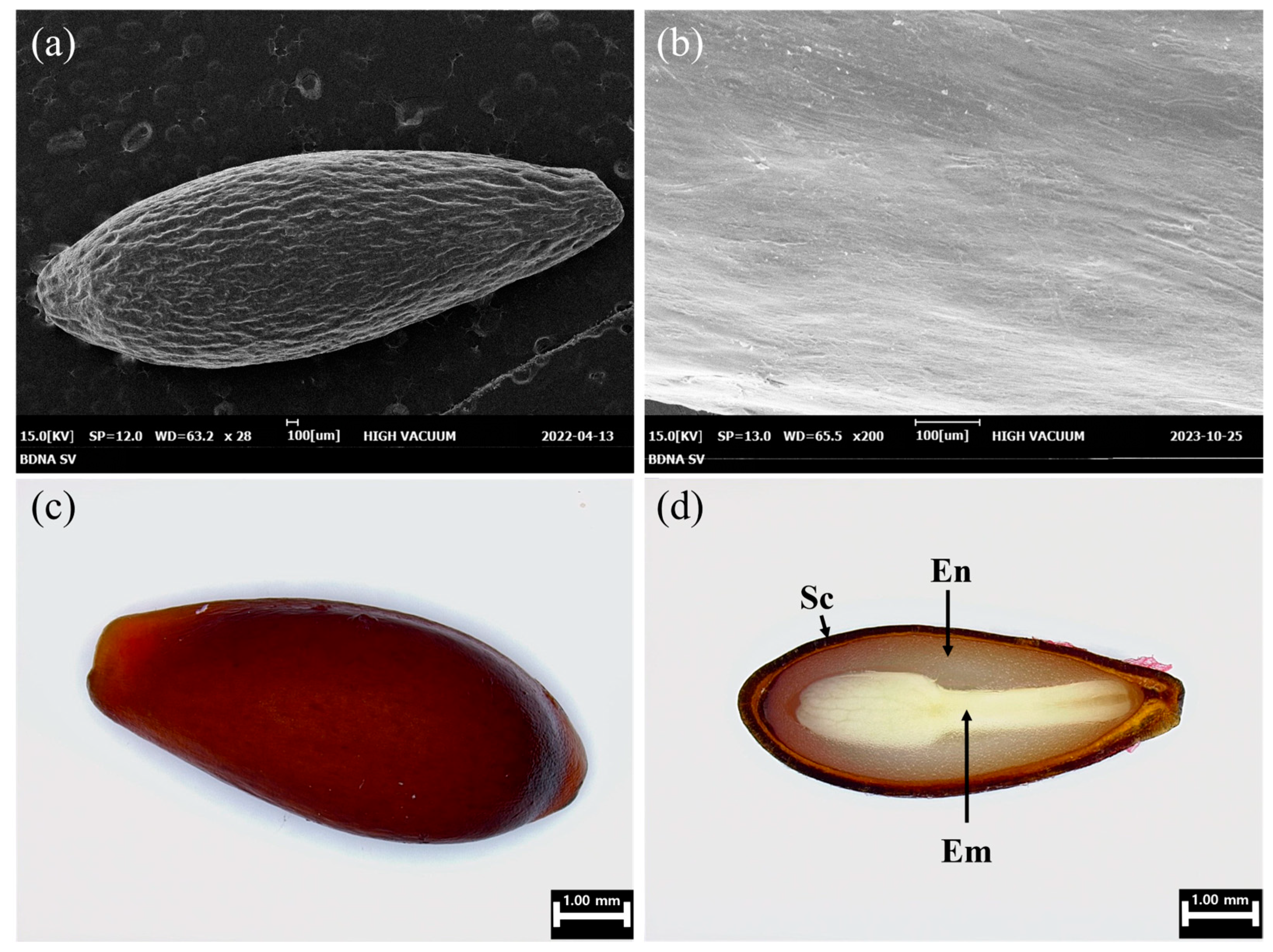
The external and internal morpho-anatomical characteristics of the seeds of B. amurensis var. quelpaertensis were investigated using both SEM and digital microscopy (Figure 1). In fully mature seeds, the seed coat exhibited a reddish-brown coloration (RHS Colour Chart, RED-PURPLE GROUP 59-A, 61-A). SEM imaging revealed that the seed surface had a distinctly wavy pattern (Figure 1a,b).
Figure 1.
Seed external (a–c) and internal morphology (d) of B. amurensis var. quelpaertensis seeds. (a,b) SEM images; (c,d) Digital microscope images. Scale bars are 100 μm (a,b) and 1.00 mm (c,d). Em, embryo; En, endosperm; Sc, seed coat.
The measurements indicated that the mean embryo length was 5.19 ± 0.11 mm, and the average seed length was 5.89 ± 0.12 mm, resulting in an embryo-to-seed ratio (E:S) of 88.25 ± 1.08% (Figure 1d). The thousand-seed weight was 14.13 ± 0.02 g. In the cross-sectional view, the embryo tissue exhibited a light-yellow hue (RHS Colour Chart, GREEN-YELLOW GROUP 1-D), whereas the endosperm appeared white (RHS Colour Chart, GRAYED-WHITE GROUP 156-A) (Figure 1d).
3.2. Water Imbibition Test
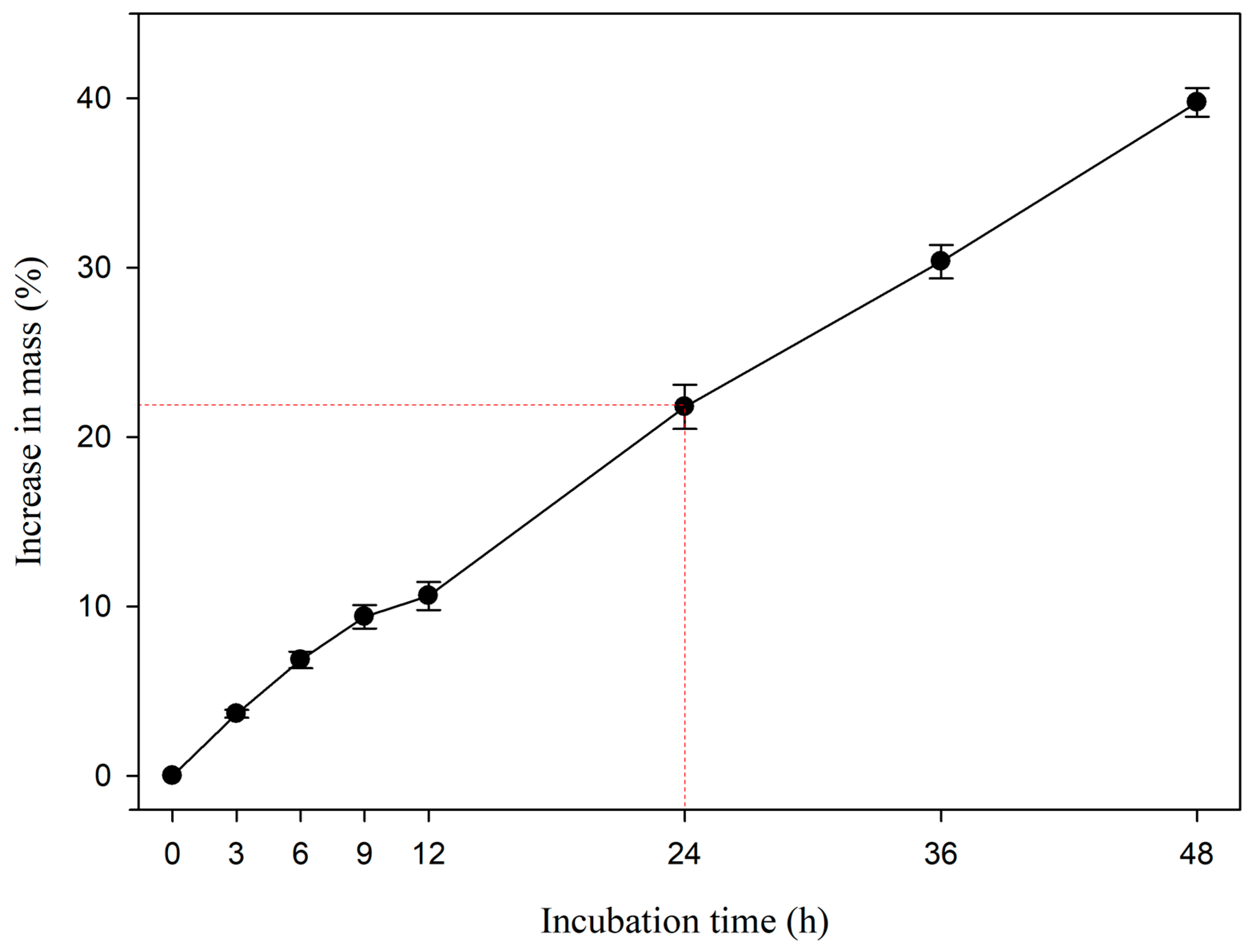
The water absorption test was used to evaluate the imbibition behavior of B. amurensis var. quelpaertensis seeds. The seed fresh weight exhibited an increase of 21.78 ± 1.31% after 24 h and of 39.75 ± 0.85% after 48 h relative to their initial dry mass (Figure 2).
Figure 2.
Water absorption by intact seeds of Berberis amurensis var. quelpaertensis, as indicated by an increase in mass, was monitored. The seeds were incubated at room temperature on filter paper moistened with distilled water for 48 h. Vertical error bars represent standard error (n = 3). Red dashed lines indicate the water absorption at 24 h.
3.3. Modified Move-Along Experiments
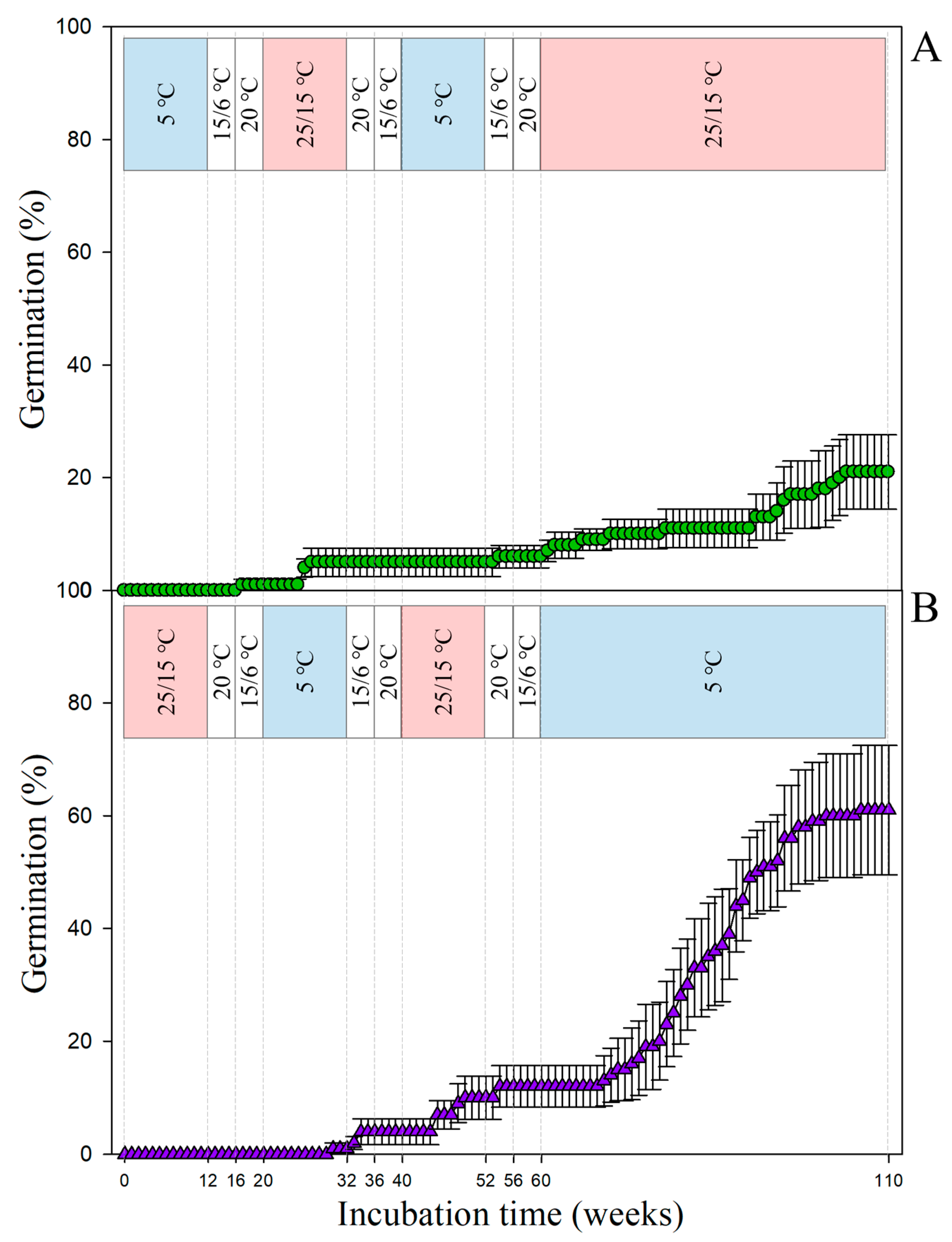
The move-along experimental results indicated that the germination rate in the T1 treatment (5 → 15/6 → 20 → 25/15 → 20 → 15/6 → 5 → 15/6 → 20 → 25/15 °C) was 21.0 ± 6.61%, whereas the T2 treatment (25/15 → 20 → 15/6 → 5 → 15/6 → 20 → 25/15 → 20 → 15/6 → 5 °C) resulted in a significantly higher germination rate of 61.0 ± 11.47% (Figure 3).
Figure 3.
Seed germination of Berberis amurensis var. quelpaertensis was monitored under two temperature sequences: T1 ((A); simulating winter-start sequence starting at 5 °C) and T2 ((B); simulating summer-start sequence starting at 25/15 °C). Vertical error bars represent standard error (n = 4).
Berberis amurensis var. quelpaertensis seeds began to germinate in week 17 in the T1 treatment, under conditions representing late spring temperatures (20 °C, weeks 17–20), with a germination rate of 6.0 ± 2.00% in week 60. The final germination rate, recorded under summer temperature conditions (25/15 °C, weeks 61–110), was 21.0 ± 6.61% (Figure 3A).
In the T2 treatment, seeds did not germinate under summer (25/15 °C, 12 weeks), early autumn (20 °C, 4 weeks), and late autumn (15/6 °C, 4 weeks) temperature conditions. However, germination began after exposure to winter (5 °C) conditions in week 30. In week 60, the germination rate was 12.0 ± 3.65%. The final germination rate under winter conditions (5 °C, weeks 61–110) was 61.0 ± 11.47% (Figure 3B).
3.4. Effect of Cold- and Warm-Stratification on Germination
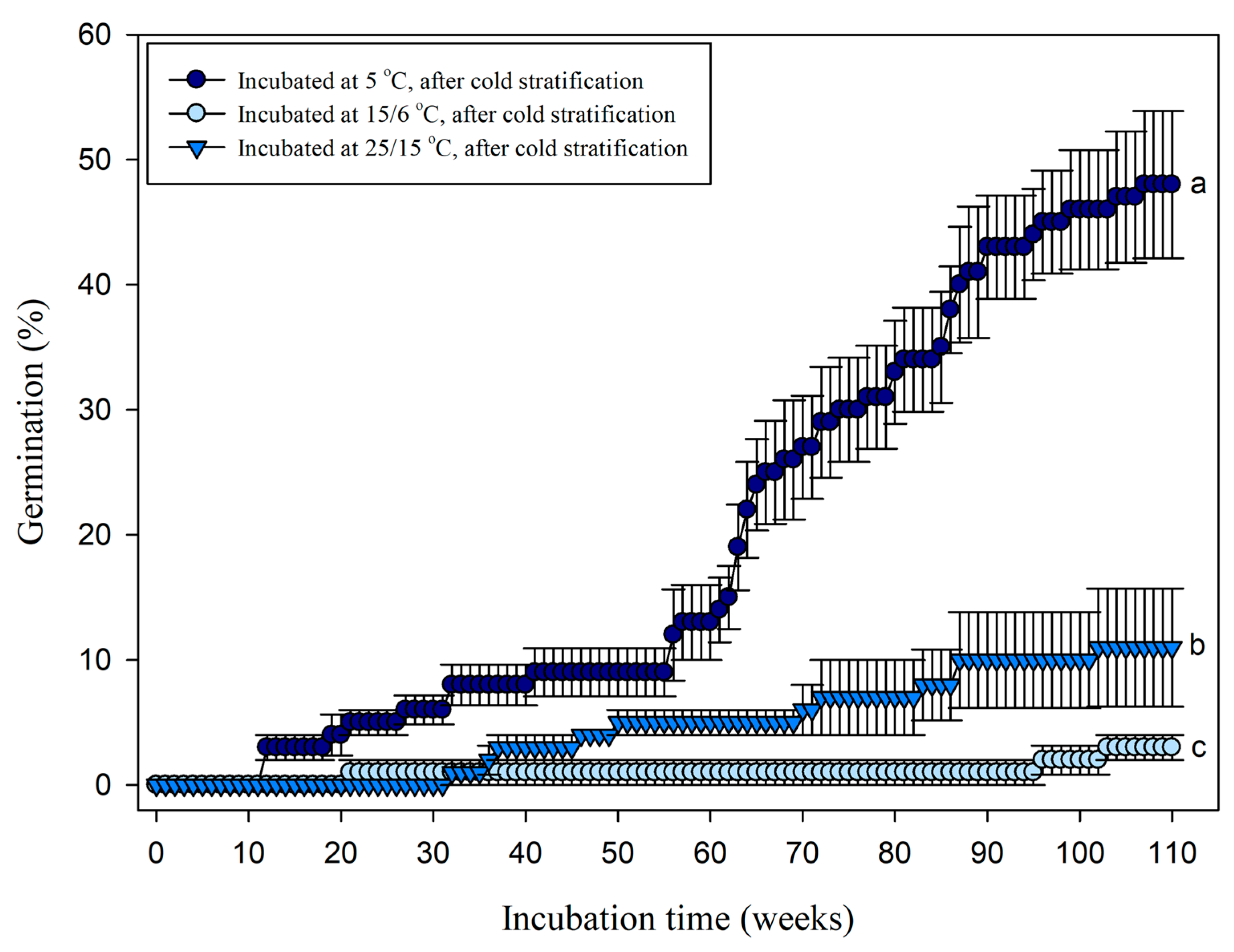
After a 12-week cold stratification period at 5 °C, seeds underwent a 98-week incubation under temperature conditions of 25/15, 15/6, and 5 °C. The final germination rates were 11.0 ± 4.73%, 3.0 ± 1.00%, and 48.0 ± 5.89%, respectively (Figure 4). Notably, when seeds were consistently exposed to 5 °C, the germination rate increased significantly, with a notable increase observed after week 56.
Figure 4.
Seed germination of Berberis amurensis var. quelpaertensis was examined after a 12-week cold stratification period (at 5 °C) under three temperature sequences: 5, 15/6, or 25/15 °C. Vertical error bars represent standard error (n = 4). Values with different small letters (a, b, c) indicate significant differences at p ≤ 0.05 (Duncan’s multiple range test).
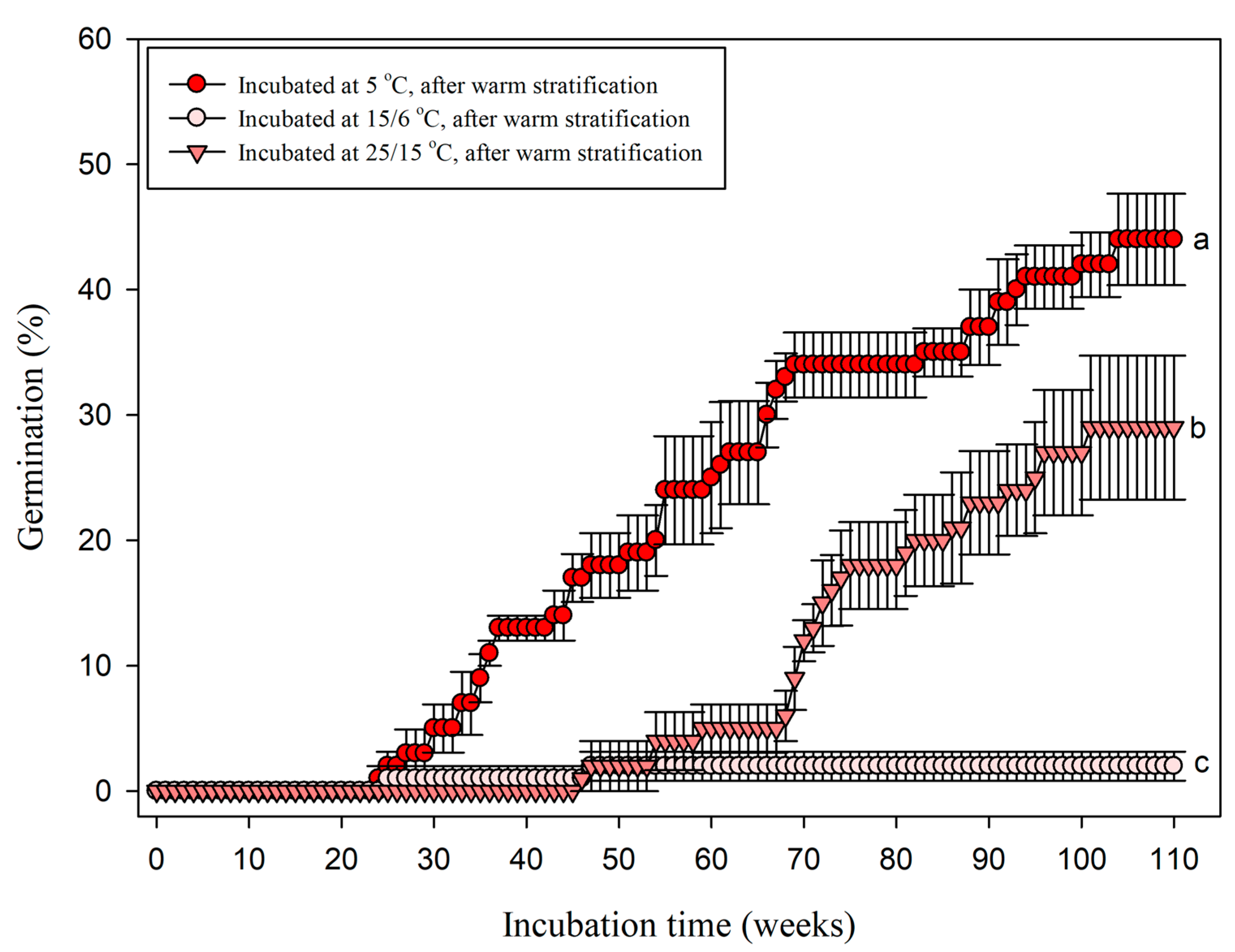
Following a 12-week warm stratification period at 25/15 °C, seeds were incubated for 98 weeks under temperature regimes of 25/15, 15/6, and 5 °C. The final germination rates were 29.0 ± 5.74%, 2.0 ± 1.15%, and 44.0 ± 3.65%, respectively (Figure 5). In particular, seeds that underwent a 12-week stratification at 25/15 °C and subsequently incubated at 5 °C initiated germination within 12 weeks, with germination progressively increasing until the end of the experiment.
Figure 5.
Seed germination of Berberis amurensis var. quelpaertensis was examined after a 12-week warm stratification period (at 25/15 °C) under three temperature sequences: 5, 15/6, or 25/15 °C. Vertical error bars represent standard error (n = 4). Values with different small letters (a, b, c) indicate significant differences at p ≤ 0.05 (Duncan’s multiple range test).
Collectively, these results highlight a distinct germination pattern: while cold stratification serves as the primary trigger for rapid dormancy release, the seeds retain the physiological capacity to germinate under prolonged warm conditions, indicating a dual regulatory mechanism.
4. Discussion
Water imbibition tests demonstrated that seeds absorbed approximately 21% of their dry weight within 24 h (Figure 2). According to Baskin and Baskin [24], an increase in seed mass of ≥20% generally indicates a permeable seed coat. Taxonomically, species within the family Berberidaceae are characterized by having physiological or morphophysiological dormancy, and physical dormancy (PY) is not known to occur in this family [5,24]. This is consistent with previous reports on related species such as B. vulgaris, B. koreana, and B. amurensis var. latifolia, which also lack PY [8,9,25]. Although scarification or anatomical studies were not conducted to definitively rule out localized physical dormancy, the rapid water uptake combined with these taxonomic traits strongly suggests that the seed coat is permeable. Therefore, we focused on identifying the specific physiological dormancy mechanisms.
The seeds of B. amurensis var. quelpaertensis were determined to exhibit physiological dormancy (PD). This conclusion is supported by the observation that the embryo-to-seed (E:S) ratio, measured from the time of seed collection until prior to germination, remained constant at 88.25 ± 1.08% (Figure 1). A consistent E:S ratio indicates that the embryo has reached morphological maturity and that dormancy results from factors other than embryonic immaturity [26]. Therefore, the seeds exhibit PD rather than morphophysiological dormancy (MPD), which would necessitate additional embryo development. This finding is consistent with previous studies indicating that PD is a prevalent dormancy type within the Berberis genus [10,25,27].
The modified move-along experiment revealed that germination was notably facilitated by exposure to winter conditions (5 °C), with seeds subjected to the T2 sequence achieving significantly higher germination rates than those in T1. Specifically, in the T2 treatment group, no seeds germinated during the initial warm phases that corresponded to summer and autumn (25/15, 20, and 15/6 °C); germination only commenced following exposure to the winter condition of 5 °C. This result evidently demonstrates that chilling is the primary determinant for dormancy release. This finding is consistent with numerous studies involving other Berberis species, which also exhibited that cold stratification effectively breaks PD [8,9,14,24].
Cold stratification at 5 °C for 12 weeks resulted in a gradual increase in germination, whereas exposure to warm stratification at 25/15 °C followed by chilling induced an earlier onset of germination. These responses are characteristic of intermediate physiological dormancy, which may be alleviated through different temperature pathways [9,26,28]. Similar dual responses to stratification regimes have been observed in related taxa such as B. amurensis var. latifolia and B. kawakamii [9,28,29].
A notable finding is that seeds exposed to a prolonged period (>68 weeks) of constant warm temperatures (25/15 °C) ultimately exhibited a high germination rate (Figure 5). This indicates that cold stratification is not an absolute requirement for germination but rather acts as a catalyst, substantially reducing the time required to break dormancy. If chilling were indispensable, germination would not have occurred under these constant warm conditions. This behavior is characteristic of intermediate physiological dormancy (intermediate PD), rather than deep PD.
From an ecological perspective, the identified Intermediate Physiological Dormancy—defined as a state where seeds require cold stratification for rapid germination but can eventually germinate under warm conditions—serves as a critical survival mechanism in the alpine environment of Jeju Island [26]. Unlike the stable continental winters of the mainland, the island’s oceanic climate often presents unpredictable temperature fluctuations [14]. In this context, the species employs a “bet-hedging” strategy: a portion of seeds germinates early following winter chilling to maximize the growing season, while another portion remains dormant to germinate later, even if the winter is atypically warm [25,26]. This asynchronous germination spreads the risk of seedling mortality caused by late frosts or varying climate conditions, ensuring the long-term persistence of this endemic population [26]. This finding provides a novel insight into how B. amurensis var. quelpaertensis has adapted to its unique insular habitat, distinguishing it from related taxa that may rely more strictly on cold stratification [8,9].
In summary, the seeds of B. amurensis var. quelpaertensis exhibit intermediate PD, as indicated by the lack of physical dormancy, germination under prolonged warm conditions, notable facilitation of germination by chilling, and accelerated germination following warm stratification.
5. Conclusions
This study definitively classified the seed dormancy of B. amurensis var. quelpaertensis as intermediate physiological dormancy, characterized by a permeable seed coat and a fully developed embryo. We determined that cold stratification at 5 °C is the most effective primary method for breaking dormancy. However, the seeds also exhibited a “bet-hedging” strategy, capable of germinating under prolonged warm conditions to adapt to the variable alpine climate of Jeju Island. These findings provide a scientific basis for establishing mass propagation protocols essential for the conservation and restoration of this endemic species. Future research should focus on optimizing germination speed using plant growth regulators, such as GA3, GA4+7, or ABA, to further enhance propagation efficiency.
Author Contributions
Conceptualization, D.-H.K., C.-S.N. and D.-H.L. (Do-Hyung Lee); methodology, D.-H.K., J.-Y.P. and D.-H.L. (Da-Hyun Lee); validation, D.-H.K., C.-S.N. and D.-H.L. (Do-Hyung Lee); formal analysis, J.-Y.P. and D.-H.L. (Da-Hyun Lee); investigation, D.-H.K.; resources, D.-H.K., J.-Y.P. and D.-H.L. (Da-Hyun Lee); data curation, D.-H.K. and C.-S.N.; writing—original draft preparation, D.-H.K.; writing—review and editing, D.-H.K., C.-S.N. and D.-H.L. (Do-Hyung Lee); visualization, D.-H.K.; supervision, C.-S.N. and D.-H.L. (Do-Hyung Lee); project administration, C.-S.N.; funding acquisition, C.-S.N. All authors have read and agreed to the published version of the manuscript.
Funding
This work was supported by the Korea Forest Service, Republic of Korea, under the commissioned research project “Forest seed quality management and standardization” (Project No. RS-2021-KF001795).
Data Availability Statement
The original contributions presented in this study are included in the article. Further inquiries can be directed to the corresponding authors.
Conflicts of Interest
The authors declare no conflicts of interest.
References
- Arayne, M.S.; Sultana, N.; Bahadur, S.S. The berberis story: Berberis vulgaris in therapeutics. Pak. J. Pharm. Sci. 2007, 20, 83–92. [Google Scholar]
- Yoo, S.J.; Lee, K.B.; Kwak, J.H. Studies on the seasonal variation of berberine contents in Berberis koreana. Korean J. Pharmacogn. 1986, 17, 123–128. [Google Scholar]
- Li, L.; Long, W.; Wan, X.; Ding, Q.; Zhang, F.; Wan, D. Studies on quantitative determination of total alkaloids and berberine in five origins of crude medicine “Sankezhen”. J. Chromatogr. Sci. 2015, 53, 307–311. [Google Scholar] [CrossRef] [Scilit] [PubMed]
- Lee, S.Y.; Park, K.; Jang, B.K.; Ji, B.; Lee, H.; Baskin, C.C.; Cho, J.S. Exogenous gibberellin can effectively and rapidly break intermediate physiological dormancy of Amsonia elliptica seeds. Front. Plant Sci. 2022, 13, 1043897. [Google Scholar] [CrossRef] [Scilit] [PubMed]
- Yong, S.H.; Choi, Y.R.; Cho, A.; Lee, Y.J.; Ghimire, B.; Kim, H.J.; Jeong, M.J. Effect of stratification on the germination and physiological activities of Berberis amurensis seeds. J. Agric. Life Sci. 2024, 58, 41–47. [Google Scholar] [CrossRef] [Scilit]
- Sano, N.; Marion-Poll, A. ABA metabolism and homeostasis in seed dormancy and germination. Int. J. Mol. Sci. 2021, 22, 5069. [Google Scholar] [CrossRef] [Scilit] [PubMed]
- Zhang, K.; Pan, H.; Baskin, C.C.; Baskin, J.M.; Xiong, Z.; Cao, W.; Yao, L.; Tang, B.; Zhang, C.; Tao, J. Epicotyl morphophysiological dormancy in seeds of Paeonia ostii (Paeoniaceae): Seasonal temperature regulation of germination phenology. Environ. Exp. Bot. 2022, 194, 104742. [Google Scholar] [CrossRef] [Scilit]
- Kim, D.H.; Kim, S.G.; Lee, H.; Na, C.S.; Lee, D.H. The dormancy types and germination characteristics of Berberis koreana Palibin, an endemic species of Korea. Horticulturae 2023, 9, 547. [Google Scholar] [CrossRef] [Scilit]
- Kim, D.H.; Lee, D.H.; Park, J.Y.; Kim, H.M.; Kim, J.H.; Kim, H.J.; Che, S.H.; Na, C.S.; Lee, D.H. Seed dormancy class and germination characteristics of Berberis amurensis var. latifolia Nakai native to Korea. Agronomy 2024, 14, 956. [Google Scholar] [CrossRef] [Scilit]
- Deb, C.R.; Sangtam, T.L.; Jamir, N.S. Seed biology of Berberis manipurana Ahrendt: A threatened natural dye yielding plant. Am. J. Plant Sci. 2017, 8, 1285. [Google Scholar]
- Jin, L.N.; Sung, C.C.; Hui, K. A morphometric study of Berberis amurensis and B. koreana. Bull. Seoul Natl. Univ. Arbor. 2004, 24, 83–93. [Google Scholar]
- National Arboretum of Korea. Available online: https://www.nature.go.kr/ (accessed on 25 May 2025).
- Korea Forest Service. Available online: https://www.forest.go.kr/kfsweb/kfi/kfs/cms/cmsView.do?mn=AR02_04_07_03&cmsId=FC_000210 (accessed on 25 May 2025).
- Cho, Y.C.; Seol, J.; Lim, C.H. Climate-induced distribution dynamics and niche adaptation of South Korean endemic plants across the Korean Peninsula. Sci. Rep. 2024, 14, 22253. [Google Scholar] [CrossRef] [Scilit]
- Li, D.Z.; Pritchard, H.W. The science and economics of ex situ plant conservation. Trends Plant Sci. 2009, 14, 614–621. [Google Scholar] [CrossRef] [Scilit]
- Engels, J.M.M.; Visser, L. A Guide to Effective Management of Germplasm Collections; IPGRI Handbook for Genebanks No. 6; Bioversity International: Rome, Italy, 2003. [Google Scholar]
- Pritchard, H.W.; Moat, J.F.; Ferraz, J.B.; Marks, T.R.; Camargo, J.L.C.; Nadarajan, J.; Ferraz, I.D. Innovative approaches to the preservation of forest trees. For. Ecol. Manag. 2014, 333, 88–98. [Google Scholar] [CrossRef] [Scilit]
- Godefroid, S.; Piazza, C.; Rossi, G.; Buord, S.; Stevens, A.-D.; Aguraiuja, R.; Cowell, C.; Weekley, C.W.; Vogg, G.; Iriondo, J.M.; et al. How successful are plant species reintroductions? Biol. Conserv. 2011, 144, 672–682. [Google Scholar] [CrossRef] [Scilit]
- Beneseviciene, K.; Uksas, T. Review—Seed treatment: Importance, application, impact, and opportunities for increasing sustainability. Agronomy 2025, 15, 1689. [Google Scholar] [CrossRef] [Scilit]
- Gupta, S.; Van Staden, J.; Doležal, K. An understanding of the role of seed physiology for better crop productivity and food security. Plant Growth Regul. 2022, 97, 171–173. [Google Scholar] [CrossRef] [Scilit]
- Hay, F.R.; Probert, R.J. Advances in seed conservation of wild plant species: A review of recent research. Conserv. Physiol. 2013, 1, cot030. [Google Scholar] [CrossRef] [Scilit] [PubMed]
- Varsamis, G.; Merou, T.; Tseniklidou, K.; Tsiftsis, S. Seed dormancy and reproductive traits of the southern Balkan endemic plants Jancaea heldreichii (Gesneriaceae) and Viola delphinantha (Violaceae). Willdenowia 2025, 55, 67–77. [Google Scholar] [CrossRef] [Scilit]
- Lee, S.Y.; Rhie, Y.H.; Kim, K.S. Non-deep simple morphophysiological dormancy in seeds of Thalictrum rochebrunianum, an endemic perennial herb in the Korean Peninsula. Hortic. Environ. Biotechnol. 2015, 56, 366–375. [Google Scholar] [CrossRef] [Scilit]
- Baskin, J.M.; Baskin, C.C. When breaking seed dormancy is a problem try a move-along experiment. Nativ. Plants J. 2003, 4, 17–21. [Google Scholar] [CrossRef] [Scilit]
- Finch-Savage, W.E.; Leubner-Metzger, G. Seed dormancy and the control of germination. New Phytol. 2006, 171, 501–523. [Google Scholar] [CrossRef] [Scilit]
- Baskin, C.C.; Baskin, J.M. Seeds: Ecology, Biogeography, and Evolution of Dormancy and Germination, 2nd ed.; Academic Press: San Diego, CA, USA, 2014. [Google Scholar]
- Baskin, J.M.; Baskin, C.C. A classification system for seed dormancy. Seed Sci. Res. 2004, 14, 1–16. [Google Scholar] [CrossRef] [Scilit]
- Chen, S.-Y.; Tsai, Y.-H.; Su, H.-W.; Chien, C.-T. Seed dormancy and germination in the woody species of Berberis kawakamii, Mahonia oiwakensis, and Lonicera acuminata of the high mountains of Taiwan. Taiwan J. For. Sci. 2022, 37, 295–307. [Google Scholar]
- Belwal, T.; Bisht, A.; Bhatt, I.D.; Rawal, R.S. Influence of seed priming and storage time on germination and enzymatic activity of selected Berberis species. Plant Growth Regul. 2015, 77, 189–199. [Google Scholar] [CrossRef] [Scilit]
Disclaimer/Publisher’s Note: The statements, opinions and data contained in all publications are solely those of the individual author(s) and contributor(s) and not of MDPI and/or the editor(s). MDPI and/or the editor(s) disclaim responsibility for any injury to people or property resulting from any ideas, methods, instructions or products referred to in the content. |
© 2026 by the authors. Licensee MDPI, Basel, Switzerland. This article is an open access article distributed under the terms and conditions of the Creative Commons Attribution (CC BY) license.