Plant Volatiles and Essential Oils Induce Sex-Specific Behavioral Responses and Concentration-Dependent Toxicity in the Invasive Pest Bagrada hilaris
 , , , and
Abstract
1. Introduction
2. Materials and Methods
2.1. Insects
2.2. Plant Material
2.3. Olfactometer Bioassays: General Conditions
2.4. Olfactometer Bioassays: Response to Plant Volatiles
2.5. Olfactometer Bioassays: Response to EOs
2.6. Repellency Assay of EO
| PR ≥ 0.8 | : | very high repellency |
| 0.6 ≤ PR < 0.8 | : | high repellency |
| 0.4 ≤ PR < 0.6 | : | medium repellency |
| 0.2 ≤ PR < 0.4 | : | low repellency |
| 0.2 ≤ PR < −0.2 | : | neutral |
| −0.2 ≤ PR < −0.4 | : | low attraction |
| −0.4 ≤ PR < −0.6 | : | medium attraction |
| −0.6 ≤ PR < −0.8 | : | high attraction |
| PR ≥ −0.8 | : | very high attraction |
2.7. Toxicity
2.8. Essential Oil Analysis by Gas Chromatography/Mass Spectrometry (GC/MS)
2.9. Statistical Analysis
3. Results
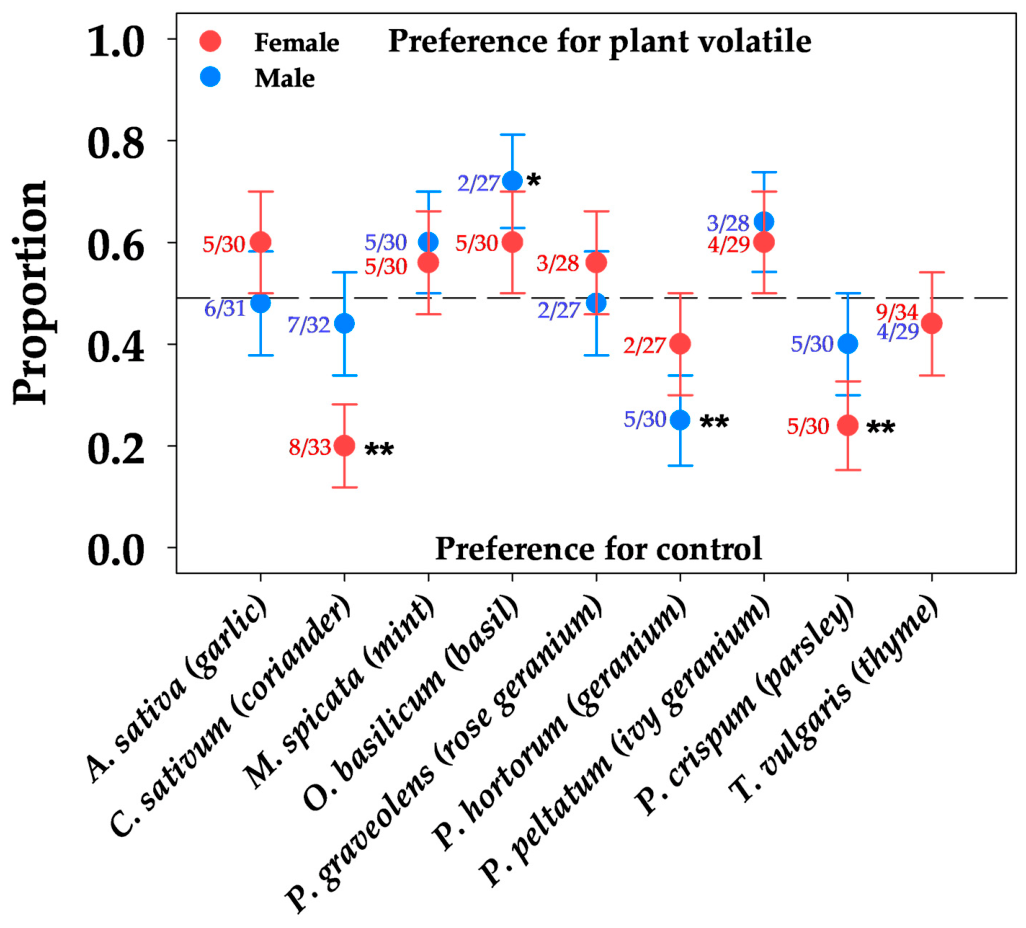
3.1. Response to Plant Volatiles
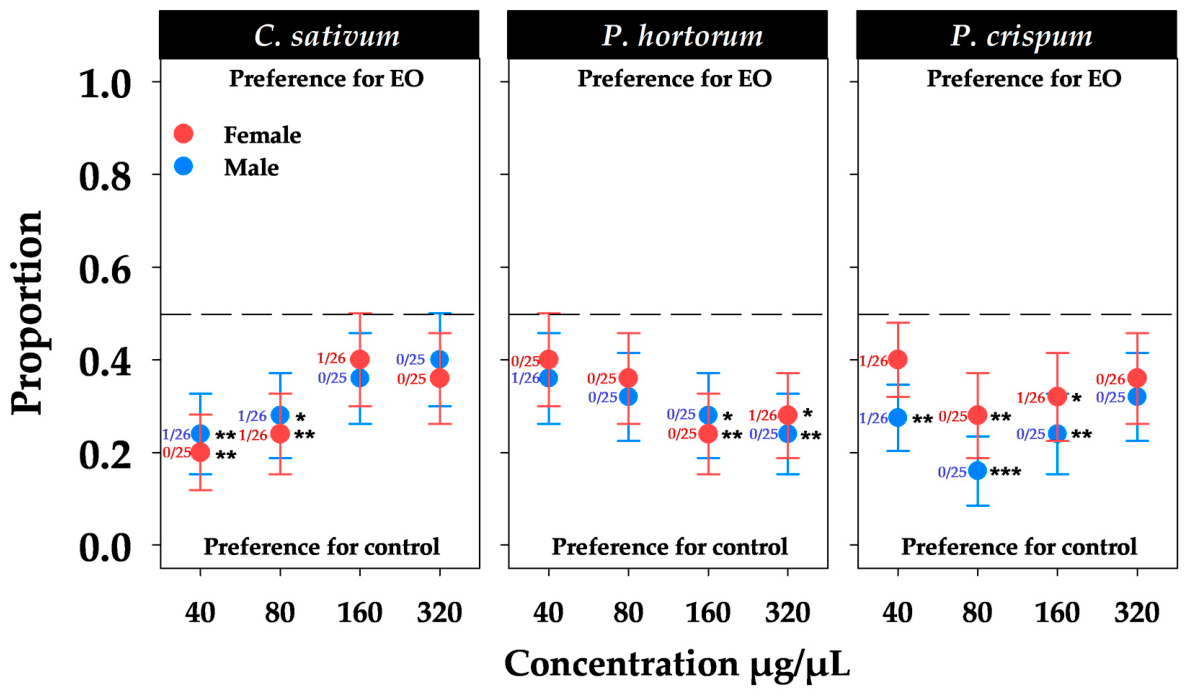
3.2. Response to EOs
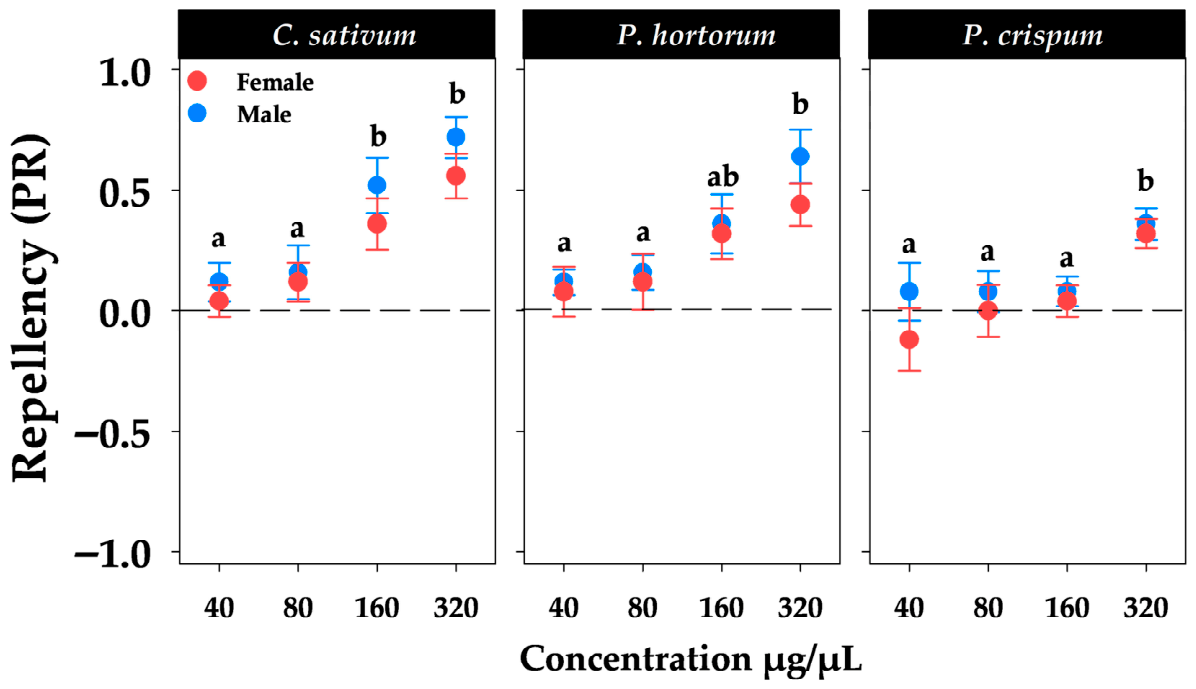
3.3. Repellency Assay of EO
3.4. Toxicity
3.5. EOs Composition
4. Discussion
5. Conclusions
Author Contributions
Funding
Data Availability Statement
Acknowledgments
Conflicts of Interest
References
- Bundy, C.S.; Perring, T.M.; Reed, D.A.; Palumbo, J.C.; Grasswitz, T.R.; Jones, W.A. Bagrada hilaris (Burmesiter). In Invasive Stink Bugs and Related Species (Pentatomoidea); McPherson, J.E., Ed.; CRC Press: Boco Raton, FL, USA, 2018; pp. 205–255. [Google Scholar]
- Huang, T.I.; Reed, D.A.; Perring, T.M.; Palumbo, J.C. Feeding Damage by Bagrada hilaris (Hemiptera: Pentatomidae) and Impact on Growth and Chlorophyll Content of Brassicaceous Plant Species. Arthropod-Plant Interact. 2014, 8, 89–100. [Google Scholar] [CrossRef]
- Palumbo, J.C.; Perring, T.M.; Millar, J.G.; Reed, D.A. Biology, Ecology, and Management of an Invasive Stink Bug, Bagrada hilaris, in North America. Annu. Rev. Entomol. 2016, 61, 453–473. [Google Scholar] [CrossRef]
- Taylor, M.E.; Bundy, C.S.; McPherson, J.E. Life History and Laboratory Rearing of Bagrada hilaris (Hemiptera: Heteroptera: Pentatomidae) with Descriptions of Immature Stages. Ann. Entomol. Soc. Am. 2015, 108, 536–551. [Google Scholar] [CrossRef]
- Faúndez, E.I.; Lüer, A.; Cuevas, Á.G.; Rider, D.A.; Valdebenito, P. First Record of the Painted Bug Bagrada hilaris (Burmeister, 1835) (Heteroptera: Pentatomidae) in South America. Arq. Entomolox 2016, 16, 175–179. [Google Scholar]
- Albornoz, M.V.; Santander, C.C.; Alfaro-Tapia, A. A Review of the Arrival, Effects, and Management of Bagrada hilaris in South America: The Case of Chile. Horticulturae 2024, 10, 1072. [Google Scholar] [CrossRef]
- Carpintero, D.L.; Quiroga, V.N.; Celentano, E.; Holgado, M.G. Primer Registro de Bagrada hilaris (Burmeister, 1835) (Hemiptera: Pentatomidae) Para La República Argentina. Hist. Natl. 2021, 11, 179–184. [Google Scholar]
- Palumbo, J.C.; Natwick, E.T. The Bagrada Bug (Hemiptera: Pentatomidae): A New Invasive Pest of Cole Crops in Arizona and California. Plant Health Prog. 2010, 11, 50. [Google Scholar] [CrossRef]
- Wan, N.F.; Fu, L.; Dainese, M.; Kiær, L.P.; Hu, Y.Q.; Xin, F.; Goulson, D.; Woodcock, B.A.; Vanbergen, A.J.; Spurgeon, D.J.; et al. Pesticides Have Negative Effects on Non-Target Organisms. Nat. Commun. 2025, 16, 1360. [Google Scholar] [CrossRef]
- Desneux, N.; Decourtye, A.; Delpuech, J.M. The Sublethal Effects of Pesticides on Beneficial Arthropods. Annu. Rev. Entomol. 2007, 52, 81–106. [Google Scholar] [CrossRef]
- Sattler, C.; Gianuca, A.T.; Schweiger, O.; Franzén, M.; Settele, J. Pesticides and Land Cover Heterogeneity Affect Functional Group and Taxonomic Diversity of Arthropods in Rice Agroecosystems. Agric. Ecosyst. Environ. 2020, 297, 106927. [Google Scholar] [CrossRef]
- Paolini, A.; Musmeci, S.; Mainardi, C.E.; Peccerillo, C.; Cemmi, A.; Di Sarcina, I.; Marini, F.; Sforza, R.F.H.; Cristofaro, M. Age-Dependent Variation in Longevity, Fecundity and Fertility of Gamma-Irradiated Bagrada hilaris (Hemiptera: Pentatomidae): Insights for a Sustainable SIT Program. Insects 2025, 16, 408. [Google Scholar] [CrossRef]
- Cristofaro, M.; Sforza, R.F.H.; Roselli, G.; Paolini, A.; Cemmi, A.; Musmeci, S.; Anfora, G.; Mazzoni, V.; Grodowitz, M. Effects of Gamma Irradiation on the Fecundity, Fertility, and Longevity of the Invasive Stink Bug Pest Bagrada hilaris (Burmeister) (Hemiptera: Pentatomidae). Insects 2022, 13, 787. [Google Scholar] [CrossRef]
- Mainardi, C.E.; Peccerillo, C.; Musmeci, S.; Paolini, A.; Sforza, R.F.H.; Cemmi, A.; Di Sarcina, I.; Anfora, G.; Porretta, D.; Marini, F.; et al. Sterile but Sexy: Assessing the Mating Competitiveness of Irradiated Bagrada hilaris Males for the Development of a Sterile Insect Technique. Insects 2025, 16, 391. [Google Scholar] [CrossRef]
- Conboy, N.J.A.; McDaniel, T.; George, D.; Ormerod, A.; Edwards, M.; Donohoe, P.; Gatehouse, A.M.R.; Tosh, C.R. Volatile Organic Compounds as Insect Repellents and Plant Elicitors: An Integrated Pest Management (IPM) Strategy for Glasshouse Whitefly (Trialeurodes vaporariorum). J. Chem. Ecol. 2020, 46, 1090–1104. [Google Scholar] [CrossRef]
- Murali-Baskaran, R.K.; Mooventhan, P.; Das, D.; Dixit, A.; Sharma, K.C.; Senthil-Nathan, S.; Kaushal, P.; Ghosh, P.K. The Future of Plant Volatile Organic Compounds (PVOCs) Research: Advances and Applications for Sustainable Agriculture. Environ. Exp. Bot. 2022, 200, 104912. [Google Scholar] [CrossRef]
- Bruce, T.J.A.; Wadhams, L.J.; Woodcock, C.M. Insect Host Location: A Volatile Situation. Trends Plant Sci. 2005, 10, 269–274. [Google Scholar] [CrossRef]
- Cook, S.M.; Khan, Z.R.; Pickett, J.A. The Use of Push-Pull Strategies in Integrated Pest Management. Annu. Rev. Entomol. 2007, 52, 375–400. [Google Scholar] [CrossRef]
- Thiviya, P.; Gunawardena, N.; Gamage, A.; Madhujith, T.; Merah, O. Apiaceae Family as a Valuable Source of Biocidal Components and Their Potential Uses in Agriculture. Horticulturae 2022, 8, 614. [Google Scholar] [CrossRef]
- Isman, M.B. Botanical Insecticides in the Twenty-First Century-Fulfilling Their Promise? Annu. Rev. Entomol. 2020, 65, 233–249. [Google Scholar] [CrossRef]
- Brügger, B.P.; Martínez, L.C.; Plata-Rueda, A.; Castro, B.M.D.C.E.; Soares, A.M.; Wilcken, C.F.; Carvalho, A.G.; Serrão, J.E.; Zanuncio, J.C. Bioactivity of the Cymbopogon citratus (Poaceae) Essential Oil and Its Terpenoid Constituents on the Predatory Bug, Podisus nigrispinus (Heteroptera: Pentatomidae). Sci. Rep. 2019, 9, 8358. [Google Scholar] [CrossRef]
- Farina, P.; Conti, B. Liabilities of Essential Oils as Insect Repellents. Curr. Opin. Environ. Sci. Health 2024, 40, 100564. [Google Scholar] [CrossRef]
- Wang, J.; Li, S.; Fang, Y.; Zhang, F.; Jin, Z.Y.; Desneux, N.; Wang, S. Enhanced and Sustainable Control of Myzus persicae by Repellent Plants in Organic Pepper and Eggplant Greenhouses. Pest Manag. Sci. 2022, 78, 428–437. [Google Scholar] [CrossRef]
- Togni, P.H.B.; Laumann, R.A.; Medeiros, M.A.; Sujii, E.R. Odour Masking of Tomato Volatiles by Coriander Volatiles in Host Plant Selection of Bemisia tabaci Biotype B. Entomol. Exp. Appl. 2010, 136, 164–173. [Google Scholar] [CrossRef]
- Ben-Issa, R.; Gomez, L.; Gautier, H.; Pozzebon, A.; Duso, C.; Loeb, G.M.; Gurr, G.M. Companion Plants for Aphid Pest Management. Insects 2017, 8, 112. [Google Scholar] [CrossRef]
- Isman, M.B. Botanical Insecticides, Deterrents, and Repellents in Modern Agriculture and an Increasingly Regulated World. Annu. Rev. Entomol. 2006, 51, 45–66. [Google Scholar] [CrossRef]
- Casas, J.L.; López Santos-Olmo, M.; Sagarduy-Cabrera, A.; Marcos-García, M.Á. Evaluation of Selected Plant Essential Oils for Aphid Pest Control in Integrated Pest Management. Insects 2025, 16, 353. [Google Scholar] [CrossRef]
- Cagáň, Ľ.; Apacsová Fusková, M.; Hlávková, D.; Skoková Habuštová, O. Essential Oils: Useful Tools in Storage-Pest Management. Plants 2022, 11, 3077. [Google Scholar] [CrossRef]
- Regnault-Roger, C.; Vincent, C.; Arnason, J.T. Essential Oils in Insect Control: Low-Risk Products in a High-Stakes World. Annu. Rev. Entomol. 2012, 57, 405–424. [Google Scholar] [CrossRef]
- Nerio, L.S.; Olivero-Verbel, J.; Stashenko, E. Repellent Activity of Essential Oils: A Review. Bioresour. Technol. 2010, 101, 372–378. [Google Scholar] [CrossRef]
- Gostin, I.N.; Popescu, I.E. Evaluation of the Essential Oils Used in the Production of Biopesticides: Assessing Their Toxicity toward Both Arthropod Target Species and Beneficial Pollinators. Agriculture 2023, 14, 81. [Google Scholar] [CrossRef]
- Mnif, W.; Dhifi, W.; Jelali, N.; Baaziz, H.; Hadded, A.; Hamdi, N. Characterization of Leaves Essential Oil of Pelargonium graveolens Originating from Tunisia: Chemical Composition, Antioxidant and Biological Activities. J. Essent. Oil-Bear. Plants 2011, 14, 761–769. [Google Scholar] [CrossRef]
- Fan, G.W.; Wang, P.; Liu, Y.S.; Sang, Y.L.; Liu, N.; Hao, Y.J. Insecticidal Activity of Two Pelargonium Essential Oils and Head Transcriptome Analysis of Stored-Product Pest Tribolium castaneum (Herbst) (Coleoptera: Tenebrionidae) in Response to Citronellyl Formate Fumigation. Pestic. Biochem. Physiol. 2025, 208, 106278. [Google Scholar] [CrossRef]
- Abouelatta, A.M.; Keratum, A.Y.; Ahmed, S.I.; El-Zun, H.M. Repellent, Contact and Fumigant Activities of Geranium (Pelargonium graveolens L.’Hér) Essential Oils against Tribolium castaneum (Herbst) and Rhyzopertha dominica (F.). Int. J. Trop. Insect Sci. 2020, 40, 1021–1030. [Google Scholar] [CrossRef]
- Al-Khayri, J.M.; Banadka, A.; Nandhini, M.; Nagella, P.; Al-Mssallem, M.Q.; Alessa, F.M. Essential Oil from Coriandrum sativum: A Review on Its Phytochemistry and Biological Activity. Molecules 2023, 28, 696. [Google Scholar] [CrossRef] [PubMed]
- Sumalan, R.M.; Alexa, E.; Popescu, I.; Negrea, M.; Radulov, I.; Obistioiu, D.; Cocan, I. Exploring Ecological Alternatives for Crop Protection Using Coriandrum sativum Essential Oil. Molecules 2019, 24, 2040. [Google Scholar] [CrossRef]
- Khani, A.; Rahdari, T. Chemical Composition and Insecticidal Activity of Essential Oil from Coriandrum sativum Seeds against Tribolium confusum and Callosobruchus maculatus. Int. Sch. Res. Not. 2012, 1, 263517. [Google Scholar] [CrossRef]
- Sriti Eljazi, J.; Bachrouch, O.; Salem, N.; Msaada, K.; Aouini, J.; Hammami, M.; Boushih, E.; Abderraba, M.; Limam, F.; Mediouni Ben Jemaa, J. Chemical Composition and Insecticidal Activity of Essential Oil from Coriander Fruit against Tribolium castaenum, Sitophilus oryzae, and Lasioderma serricorne. Int. J. Food Prop. 2018, 20, S2833–S2845. [Google Scholar] [CrossRef]
- Werdin González, J.O.; Gutiérrez, M.M.; Murray, A.P.; Ferrero, A.A. Composition and Biological Activity of Essential Oils from Labiatae against Nezara viridula (Hemiptera: Pentatomidae) Soybean Pest. Pest Manag. Sci. 2011, 67, 948–955. [Google Scholar] [CrossRef]
- Bedini, S.; Djebbi, T.; Ascrizzi, R.; Farina, P.; Pieracci, Y.; Echeverría, M.C.; Flamini, G.; Trusendi, F.; Ortega, S.; Chiliquinga, A.; et al. Repellence and Attractiveness: The Hormetic Effect of Aromatic Plant Essential Oils on Insect Behavior. Ind. Crops Prod. 2024, 210, 118122. [Google Scholar] [CrossRef]
- Bulgarini, G.; Bortolini, S.; Maistrello, L. Repellent Activity of Essential Oils on Adults of Halyomorpha halys (Heteroptera: Pentatomidae) in Different Physiological-Behavioural Phases. J. Appl. Entomol. 2021, 145, 575–586. [Google Scholar] [CrossRef]
- Zhang, Z.Q.; Sun, X.L.; Xin, Z.J.; Luo, Z.X.; Gao, Y.; Bian, L.; Chen, Z.M. Identification and Field Evaluation of Non-Host Volatiles Disturbing Host Location by the Tea Geometrid, Ectropis obliqua. J. Chem. Ecol. 2013, 39, 1284–1296. [Google Scholar] [CrossRef]
- Joseph, S.V. Repellent Effects of Essential Oils on Adult Bagrada hilaris by Using an Olfactometer. Southwest. Entomol. 2017, 42, 719–724. [Google Scholar] [CrossRef]
- McPherson, J.E.; Bundy, C.S.; Wheeler, A.G., Jr. Overview of the Superfamily Pentatomoidea. In Invasive Stink Bugs and Related Species (Pentatomoidea); McPherson, J.E., Ed.; CRC Press: Boca Raton, FL, USA, 2018; pp. 3–22. [Google Scholar]
- Guarino, S.; Arif, M.A.; Millar, J.G.; Colazza, S.; Peri, E. Volatile Unsaturated Hydrocarbons Emitted by Seedlings of Brassica Species Provide Host Location Cues to Bagrada hilaris. PLoS ONE 2018, 13, e0209870. [Google Scholar] [CrossRef]
- Grettenbergerid, I.M.; Joseph, S.V. Influence of Starvation on Walking Behavior of Bagrada hilaris (Hemiptera: Pentatomidae). PLoS ONE 2019, 14, e0215446. [Google Scholar] [CrossRef] [PubMed]
- Ramírez, C.C.; Fuentes-Contreras, E.; Rodríguez, L.C.; Niemeyer, H.M. Pseudoreplication and Its Frequency in Olfactometric Laboratory Studies. J. Chem. Ecol. 2000, 26, 1423–1431. [Google Scholar] [CrossRef]
- Nascimento, P.T.; Fadini, M.A.M.; Rocha, M.S.; Souza, C.S.F.; Barros, B.A.; Melo, J.O.F.; Von Pinho, R.G.; Valicente, F.H. Olfactory Response of Trichogramma pretiosum (Hymenoptera: Trichogrammatidae) to Volatiles Induced by Transgenic Maize. Bull. Entomol. Res. 2021, 111, 674–687. [Google Scholar] [CrossRef] [PubMed]
- Dieudonné, E.; Gautier, H.; Dardouri, T.; Staudt, M.; Costagliola, G.; Gomez, L. Establishing Repellent Effects of Aromatic Companion Plants on Dysaphis plantaginea, Using a New Dynamic Tubular Olfactometer. Entomol. Exp. Appl. 2022, 170, 727–743. [Google Scholar] [CrossRef]
- Palacios, S.M.; Bertoni, A.; Rossi, Y.; Santander, R.; Urzúa, A. Efficacy of Essential Oils from Edible Plants as Insecticides Against the House Fly, Musca domestica L. Molecules 2009, 14, 1938–1947. [Google Scholar] [CrossRef] [PubMed]
- Liu, H.; Li, X.; Chen, F.; Härdle, W.; Liang, H. A Comprehensive Comparison of Goodness-of-Fit Tests for Logistic Regression Models. Stat. Comput. 2024, 34, 175. [Google Scholar] [CrossRef]
- Bates, D.; Maechler, M.; Bolker, B.; Walker, S.; Christensen, R.H.B.; Singmann, H.; Dai, B.; Grothendieck, G.; Green, P.; Bolker, M. Ben Package “Lme4”. Convergence 2015, 12, 2. [Google Scholar]
- Hothorn, T.; Bretz, F.; Westfall, P. Simultaneous Inference in General Parametric Models. Biom. J. 2008, 50, 346–363. [Google Scholar] [CrossRef]
- Bracho-Nunez, A.; Welter, S.; Staudt, M.; Kesselmeier, J. Plant-Specific Volatile Organic Compound Emission Rates from Young and Mature Leaves of Mediterranean Vegetation. J. Geophys. Res. Atmos. 2011, 116, 16304. [Google Scholar] [CrossRef]
- Al-Mijalli, S.H.; Mrabti, H.N.; Assaggaf, H.; Attar, A.A.; Hamed, M.; Baaboua, A.E.L.; Omari, N.E.; Menyiy, N.E.; Hazzoumi, Z.; Sheikh, R.A.; et al. Chemical Profiling and Biological Activities of Pelargonium graveolens Essential Oils at Three Different Phenological Stages. Plants 2022, 11, 2226. [Google Scholar] [CrossRef] [PubMed]
- Cokl, A.; Carolina Blassioli-Moraes, M.; Alberto Laumonn, R.; Borges, M. The Semiochemistry of Pentatomidae. In Stink Bugs; CRC Press: Boca Raton, FL, USA, 2017; pp. 95–124. [Google Scholar]
- Randlkofer, B.; Obermaier, E.; Hilker, M.; Meiners, T. Vegetation Complexity—The Influence of Plant Species Diversity and Plant Structures on Plant Chemical Complexity and Arthropods. Basic Appl. Ecol. 2010, 11, 383–395. [Google Scholar] [CrossRef]
- Piersanti, S.; Rebora, M.; Ederli, L.; Pasqualini, S.; Salerno, G. Role of Chemical Cues in Cabbage Stink Bug Host Plant Selection. J. Insect Physiol. 2020, 120, 103994. [Google Scholar] [CrossRef]
- Guo, H.; Smith, D.P. Time-Dependent Odorant Sensitivity Modulation in Insects. Insects 2022, 13, 354. [Google Scholar] [CrossRef]
- Bohbot, J.D.; Dickens, J.C. Selectivity of Odorant Receptors in Insects. Front. Cell. Neurosci. 2012, 6, 29957. [Google Scholar] [CrossRef] [PubMed]
- Abenaim, L.; Farina, P.; Mandoli, A.; Conte, G.; Conti, B. Soft Soap and Linalool as Potential Management Tools for Philaenus spumarius (Hemiptera: Aphrophoridae), Vector of Xylella fastidiosa. Crop Prot. 2025, 187, 106968. [Google Scholar] [CrossRef]
- El-Zaeddi, H.; Martínez-Tomé, J.; Calín-Sánchez, Á.; Burló, F.; Carbonell-Barrachina, Á.A. Volatile Composition of Essential Oils from Different Aromatic Herbs Grown in Mediterranean Regions of Spain. Foods 2016, 5, 41. [Google Scholar] [CrossRef]
- Zhong, Y.Z.; Xie, M.H.; Huang, C.; Zhang, X.; Cao, L.; Chen, H.L.; Zhang, F.; Wan, F.H.; Han, R.C.; Tang, R. Characterizations of Botanical Attractant of Halyomorpha halys and Selection of Relevant Deorphanization Candidates via Computational Approach. Sci. Rep. 2022, 12, 4170. [Google Scholar] [CrossRef]
- Jankowska, M.; Rogalska, J.; Wyszkowska, J.; Stankiewicz, M. Molecular Targets for Components of Essential Oils in the Insect Nervous System—A Review. Molecules 2018, 23, 34. [Google Scholar] [CrossRef]
- Schmidt, R.; Cain, W.S. Making Scents: Dynamic Olfactometry for Threshold Measurement. Chem. Senses 2010, 35, 109–120. [Google Scholar] [CrossRef]
- Baldin, E.L.L.; Aguiar, G.P.; Fanela, T.L.M.; Soares, M.C.E.; Groppo, M.; Crotti, A.E.M. Bioactivity of Pelargonium graveolens Essential Oil and Related Monoterpenoids against Sweet Potato Whitefly, Bemisia tabaci Biotype B. J. Pest Sci. 2014, 88, 191–199. [Google Scholar] [CrossRef]
- Abdelgaleil, S.A.M.; Gad, H.A.; Ramadan, G.R.M.; El-Bakry, A.M.; El-Sabrout, A.M. Monoterpenes: Chemistry, Insecticidal Activity against Stored Product Insects and Modes of Action—A Review. Int. J. Pest. Manag. 2024, 70, 267–289. [Google Scholar] [CrossRef]
- Ke, K.; Wu, S.; Hu, K.; Liao, X.; Li, M.; Li, R. NlugOBP1 in Nilaparvata lugens Involved in the Perception of Repellent Agent Geraniol. Sci. Rep. 2025, 15, 22368. [Google Scholar] [CrossRef]
- Parichanon, P.; Ascrizzi, R.; Flamini, G.; Pieracci, Y.; Echeverría, M.C.; Ortega-Andrade, S.; Conti, B. Behavioral Selectivity: Species-Specific Effects of Nutmeg, Cinnamon, and Clove Essential Oils on Sitophilus oryzae and Its Parasitoid Lariophagus distinguendus. Molecules 2025, 30, 3627. [Google Scholar] [CrossRef]
- Seneme, E.F.; Dos Santos, D.C.; Silva, E.M.R.; Franco, Y.E.M.; Longato, G.B. Pharmacological and Therapeutic Potential of Myristicin: A Literature Review. Molecules 2021, 26, 5914. [Google Scholar] [CrossRef] [PubMed]
- Lu, X.X.; Hu, N.N.; Du, Y.S.; Almaz, B.; Zhang, X.; Du, S.S. Chemical Compositions and Repellent Activity of Clerodendrum bungei Steud. Essential Oil against Three Stored Product Insects. Daru J. Pharm. Sci. 2021, 29, 469–475. [Google Scholar] [CrossRef]
- Tian, Y.; Hogsette, J.A.; Norris, E.J.; Hu, X.P. Topical Toxicity and Repellency Profiles of 17 Essential Oil Components against Insecticide-Resistant and Susceptible Strains of Adult Musca domestica (Diptera: Muscidae). Insects 2024, 15, 384. [Google Scholar] [CrossRef] [PubMed]
- Colgoni, A.; Vamosi, S.M. Sexual Dimorphism and Allometry in Two Seed Beetles (Coleoptera: Bruchidae). Entomol. Sci. 2006, 9, 171–179. [Google Scholar] [CrossRef]
- Markussen, M.D.K.; Kristensen, M. Cytochrome P450 Monooxygenase-Mediated Neonicotinoid Resistance in the House Fly Musca domestica L. Pestic. Biochem. Physiol. 2010, 98, 50–58. [Google Scholar] [CrossRef]
- Garbaly, V.; Krestonoshina, K.; Kinareikina, A.; Bobreshova, S.; Avdeeva, A.; Ismagilova, J.; Zaitsev, I.; Silivanova, E. Glutathione S-Transferase (GST) Activities and Gene Expression Patterns of Different GST Classes in Musca domestica L. Depending on Sex and Stage of Development. Int. J. Mol. Sci. 2025, 26, 11366. [Google Scholar] [CrossRef]
- Liu, K.; Xia, J.; Zhu, Z.; Zhang, G.; Wang, W.; Yi, Z.; Xue, S.; Gao, S. Carboxylesterase α-EST5 Is Required for the Red Flour Beetle to Metabolize Mugwort Essential Oil. J. Asia Pac. Entomol. 2024, 27, 102316. [Google Scholar] [CrossRef]
- Maiga, H.; Millogo, A.S.; Bayili, K.; Bilgo, E.; Toe, I.; Dabiré, R.K.; Bouyer, J.; Diabaté, A. Screening the Resistance of Male Aedes aegypti and Anopheles coluzzii to Insecticides in the Context of Using Genetic Control Tools in Burkina Faso. Insects 2025, 16, 315. [Google Scholar] [CrossRef] [PubMed]
- Jacobs, E.; Chrissian, C.; Rankin-Turner, S.; Wear, M.; Camacho, E.; Broderick, N.A.; McMeniman, C.J.; Stark, R.E.; Casadevall, A. Cuticular Profiling of Insecticide Resistant Aedes aegypti. Sci. Rep. 2023, 13, 10154. [Google Scholar] [CrossRef]
- Massango, H.G.L.L.; Faroni, L.R.A.; Haddi, K.; Heleno, F.F.; Viteri Jumbo, L.O.; Oliveira, E.E. Toxicity and Metabolic Mechanisms Underlying the Insecticidal Activity of Parsley Essential Oil on Bean Weevil, Callosobruchus maculatus. J. Pest Sci. 2016, 90, 723–733. [Google Scholar] [CrossRef]



| EOs | Concentration µg/µL | ♀ | ♂ | ||||
|---|---|---|---|---|---|---|---|
| χ2 | df | p-Value | χ2 | df | p-Value | ||
| C. sativum | 40 | 9.00 | 1 | <0.01 | 6.76 | 1 | 0.01 |
| 80 | 6.76 | 1 | 0.01 | 4.84 | 1 | 0.03 | |
| 160 | 1.96 | 1 | 0.16 | 3.24 | 1 | 0.32 | |
| 320 | 1.00 | 1 | 0.32 | 1.00 | 1 | 0.32 | |
| P. hortorum | 40 | 1.00 | 1 | 0.32 | 1.96 | 1 | 0.16 |
| 80 | 1.96 | 1 | 0.16 | 3.24 | 1 | 0.07 | |
| 160 | 6.76 | 1 | 0.01 | 1.00 | 1 | 0.32 | |
| 320 | 1.00 | 1 | 0.32 | 6.76 | 1 | 0.01 | |
| P. crispum | 40 | 1.60 | 1 | 0.21 | 8.10 | 1 | <0.01 |
| 80 | 6.76 | 1 | 0.01 | 11.56 | 1 | 0.001 | |
| 160 | 4.84 | 1 | 0.03 | 6.76 | 1 | 0.01 | |
| 320 | 3.24 | 1 | 0.07 | 1.96 | 1 | 0.16 | |
| Essential Oil | Insect Sex | LC50 (µg/µL) (95% FL) | LC90 (µg/µL) (95% FL) | Slope ± SE | χ2 | df | p-Value |
|---|---|---|---|---|---|---|---|
| C. sativum (coriander) | ♀ | 177.46 (147.49 ± 221.89) | 572.96 (406.55 ± 1008.05) | 2.51 ± 0.34 | 20.46 | 38 | 0.991 |
| ♂ | 106.12 (85.30 ± 131.56) | 431.39 (301.461 ± 788.690) | 2.104 ± 0.30 | 20.65 | 38 | 0.990 | |
| P. hortorum (geranium) | ♀ | 176.61 (140.39 ± 238.03) | 817.63 (503.63 ± 985.90) | 1.925 ± 0.30 | 18.00 | 38 | 0.998 |
| ♂ | 102.41 (81.74 ± 127.25) | 429.07 (298.081 ± 796.64) | 2.060 ± 0.30 | 20.53 | 38 | 0.991 | |
| P. crispum (parsley) | ♀ | 241.84 (196.22 ± 324.13) | 810.44 (535.20 ± 1686.07) | 2.440 ± 0.37 | 26.44 | 38 | 0.921 |
| ♂ | 220.31 (180.77 ± 286.87) | 723.22 (490.87 ± 414.73) | 2.483 ± 0.36 | 24.97 | 38 | 0.949 |
| Classification | Relative Area (%) | ||
|---|---|---|---|
| C. sativum | P. hortorum | P. crispum | |
| Monoterpene | 11.00 | 0.00 | 54.50 |
| Oxygenated monoterpene | 32.20 | 67.10 | 3.00 |
| Sesquiterpene | 0.00 | 12.10 | 1.50 |
| Oxygenated sesquiterpene | 0.00 | 11.40 | 2.90 |
| Other non-terpene molecules | 53.90 | 1.60 | 33.50 |
| Not identified | 2.90 | 7.80 | 4.60 |
| Total | 100.00 | 100.00 | 100.00 |
| Compound Name | Classification | RI exp | Relative Area % | Identification | ||
|---|---|---|---|---|---|---|
| C. sativum | P. hortorum | P. crispum | ||||
| α-Pinene | Monoterpene | 948.8 | 2.3 | 10.5 | MS, RI a | |
| β-Pinene | Monoterpene | 992.1 | 7.7 | MS, RI a, Co-I | ||
| β-Myrcene | Monoterpene | 1002.3 | 5.3 | MS, RI a, Co-I | ||
| α-Terpinolene | Monoterpene | 1033.5 | 2.0 | MS, RI a | ||
| p-Cymene | Monoterpene | 1042.5 | 2.5 | 1.1 | MS, RI a | |
| β-Phellandrene | Monoterpene | 1048.3 | 13.9 | MS, RI a | ||
| γ-Terpinene | Monoterpene | 1076.4 | 4.3 | 0.9 | MS, RI a, Co-I | |
| p-Mentha-1,5,8-triene | Monoterpene | 1132.5 | 15.0 | MS, RI a | ||
| Linalool | Oxygenated monoterpene | 1114.9 | 26.4 | 5.3 | MS, RI a | |
| Rosoxide | Oxygenated monoterpene | 1127.8 | 1.9 | MS, RI a, | ||
| Alcanfor | Oxygenated monoterpene | 1171.0 | 3.2 | MS, RI a | ||
| Isomenthone | Oxygenated monoterpene | 1187.3 | 6.7 | MS, RI a | ||
| 4-Terpineol | Oxygenated monoterpene | 1199.7 | 0.2 | MS, RI a, Co-I | ||
| α-Terpineol | Oxygenated monoterpene | 1215.1 | 0.5 | MS, RI a, Co-I | ||
| β-Citronellol | Oxygenated monoterpene | 1245.5 | 0.7 | 24.5 | MS, RI a | |
| Cytral | Oxygenated monoterpene | 1263.0 | 0.5 | MS, RI a | ||
| trans-Geraniol | Oxygenated monoterpene | 1273.0 | 1.6 | 12.2 | MS, RI a | |
| Citronellyl formate | Oxygenated monoterpene | 1292.7 | 10.0 | MS, RI a | ||
| Thymol | Oxygenated monoterpene | 1314.4 | 0.3 | 2.7 | MS, RI a | |
| Neryl formate | Oxygenated monoterpene | 1321.0 | 3.4 | MS, RI a | ||
| Carvacrol | Oxygenated monoterpene | 1325.2 | MS, RI a | |||
| Geranyl acetate | Oxygenated monoterpene | 1400.8 | 0.5 | MS, RI a | ||
| Citronellyl propionate | Oxygenated monoterpene | 1463.2 | 0.6 | MS, RI a | ||
| Citronellyl butyrate | Oxygenated monoterpene | 1550.4 | 1.0 | MS, RI a | ||
| α-Cubebene | sesquiterpene | 1379.4 | 0.3 | MS, RI a | ||
| α-Copaene | sesquiterpene | 1409.5 | 1.0 | MS, RI a | ||
| β-Bourbonene | sesquiterpene | 1421.3 | 2.3 | MS, RI a | ||
| β-Elemene | sesquiterpene | 1459.7 | 0.3 | MS, RI a | ||
| Caryophyllene | sesquiterpene | 1460.1 | 2.3 | 0.3 | MS, RI a | |
| β-Copaene | sesquiterpene | 1467.9 | 0.4 | MS, RI a | ||
| γ-Elemene | sesquiterpene | 1479.6 | 0.5 | MS, RI a | ||
| Aromandendrene | sesquiterpene | 1501.7 | 0.4 | MS, RI a | ||
| Cadinene | sesquiterpene | 1510.4 | 0.5 | MS, RI a | ||
| γ-Muurolene | sesquiterpene | 1513.0 | 0.3 | MS, RI a | ||
| α-Muurolene | sesquiterpene | 1536.9 | 1.4 | MS, RI a | ||
| γ-Cadinene | sesquiterpene | 1554.2 | 0.5 | MS, RI a | ||
| β-Famesene | sesquiterpene | 1558.8 | 0.4 | MS, RI a | ||
| Cadinene | sesquiterpene | 1556.0 | 2.7 | MS, RI a | ||
| α-Agarofurane | Oxygenated sesquiterpene | 1594.3 | 0.6 | MS, RI a | ||
| Spathulenol | Oxygenated sesquiterpene | 1624.5 | 0.4 | MS, RI a | ||
| Caryophyllene oxide | Oxygenated sesquiterpene | 1633.0 | 0.3 | MS, RI a | ||
| Epicubenol | Oxygenated sesquiterpene | 1656.5 | 0.4 | MS, RI a | ||
| epi-γ-Eudesmol | Oxygenated sesquiterpene | 1667.4 | 7.1 | MS, RI a | ||
| α-Eudesmol | Oxygenated sesquiterpene | 1700.0 | 0.9 | MS, RI a | ||
| Carotol | Oxygenated sesquiterpene | 1720.6 | 1.7 | MS, RI a | ||
| Geranyl tiglate | Oxygenated sesquiterpene | 1729.7 | 1.6 | MS, RI a | ||
| Dimethylstyrene | Other non-terpene molecules | 1106.6 | 11.6 | MS, RI a | ||
| Decanal | Other non-terpene molecules | 1222.3 | 10.6 | MS, RI a | ||
| (E)-2-Decenal | Other non-terpene molecules | 1281.5 | 16.8 | MS, RI a | ||
| (E)-2-Decen-1-ol | Other non-terpene molecules | 1286.3 | 14.2 | MS, RI a | ||
| Undecanal | Other non-terpene molecules | 1325.6 | 0.7 | MS, RI a | ||
| 2-Undecenal | Other non-terpene molecules | 1384.9 | 1.6 | MS, RI a | ||
| Tetradecanal | Other non-terpene molecules | 1637.4 | 0.5 | MS, RI a | ||
| (E)-Tetradec-2-enal | Other non-terpene molecules | 1698.3 | 2.3 | MS, RI a | ||
| Myristicin | Other non-terpene molecules | 1582.0 | 21.8 | MS, RI a | ||
| Geranyl butyrate | Other non-terpene molecules | 1582.9 | 1.6 | MS, RI a | ||
| Dodecanal | Other non-terpene molecules | 1429.8 | 1.7 | MS, RI a | ||
| Elemicin | Other non-terpene molecules | 1605.9 | 1.2 | MS, RI a | ||
| 2-Dodecenal | Other non-terpene molecules | 1489.3 | 5.4 | MS, RI a | ||
| Total identified | 97.1 | 92.2 | 95.4 | |||
| Total no identified | 2.9 | 7.8 | 4.6 | |||
| 100.0 | 100.0 | 100.0 | ||||
Disclaimer/Publisher’s Note: The statements, opinions and data contained in all publications are solely those of the individual author(s) and contributor(s) and not of MDPI and/or the editor(s). MDPI and/or the editor(s) disclaim responsibility for any injury to people or property resulting from any ideas, methods, instructions or products referred to in the content. |
© 2026 by the authors. Licensee MDPI, Basel, Switzerland. This article is an open access article distributed under the terms and conditions of the Creative Commons Attribution (CC BY) license.
Share and Cite
Santander, C.C.; Albornoz, M.V.; Flores, M.F.; Oyanedel, E.; Barros-Parada, W.; Alfaro-Tapia, A. Plant Volatiles and Essential Oils Induce Sex-Specific Behavioral Responses and Concentration-Dependent Toxicity in the Invasive Pest Bagrada hilaris. Agronomy 2026, 16, 957. https://doi.org/10.3390/agronomy16100957
Santander CC, Albornoz MV, Flores MF, Oyanedel E, Barros-Parada W, Alfaro-Tapia A. Plant Volatiles and Essential Oils Induce Sex-Specific Behavioral Responses and Concentration-Dependent Toxicity in the Invasive Pest Bagrada hilaris. Agronomy. 2026; 16(10):957. https://doi.org/10.3390/agronomy16100957
Chicago/Turabian StyleSantander, Camila C., Marta V. Albornoz, M. Fernanda Flores, Eduardo Oyanedel, Wilson Barros-Parada, and Armando Alfaro-Tapia. 2026. "Plant Volatiles and Essential Oils Induce Sex-Specific Behavioral Responses and Concentration-Dependent Toxicity in the Invasive Pest Bagrada hilaris" Agronomy 16, no. 10: 957. https://doi.org/10.3390/agronomy16100957
APA StyleSantander, C. C., Albornoz, M. V., Flores, M. F., Oyanedel, E., Barros-Parada, W., & Alfaro-Tapia, A. (2026). Plant Volatiles and Essential Oils Induce Sex-Specific Behavioral Responses and Concentration-Dependent Toxicity in the Invasive Pest Bagrada hilaris. Agronomy, 16(10), 957. https://doi.org/10.3390/agronomy16100957