Article

Effect of Foliar Biostimulants on Soybean Growth and Yield Across Different Tillage Systems

1
Department of Agricultural Sciences, West Texas A&M University, 2501 4th Ave., Canyon, TX 79016, USA
2
Department of Agriculture, University of Central Missouri, 116 W South St., Warrensburg, MO 64093, USA
3
USDA-ARS, Livestock and Nutrient Management Research Unit, Conservation and Production Research Laboratory, Bushland, TX 79012, USA
*
Author to whom correspondence should be addressed.
Agronomy 2026, 16(10), 958; https://doi.org/10.3390/agronomy16100958 (registering DOI)
Submission received: 2 January 2026 / Revised: 3 May 2026 / Accepted: 7 May 2026 / Published: 12 May 2026

Abstract

Climate variability and widespread synthetic agrochemical use have increased interest in biostimulants (BS) that enhance plant growth, stress tolerance, and yield by stimulating natural plant processes. A two-site field study, conducted under no-till and tilled systems, evaluated the effects of the foliar biostimulant “Source” on soybean growth and yield at three phosphorus (P) rates (0%, 50%, and 100% of soil test recommendations) because of its potential to replace phosphorus inputs. A complementary greenhouse study was conducted to evaluate the effect of the biostimulant on different soybean hybrids. Measured at various dates after planting (DAP), leaf relative water content (LRWC) and normalized difference vegetation index (NDVI) mostly showed insignificant responses to P treatments, but significant responses to BS. Grain yield increased significantly with individual BS and P applications in both tillage systems. Under no-till conditions, BS increased yield by 13.0% (3.05 vs. 2.70 Mg ha−1), and P100 increased yield by 13.5% (3.0 vs. 2.65 Mg ha−1). Under tilled conditions, BS and P100 increased yield by 19.6% (2.75 vs. 2.30 Mg ha−1) and 19.2% (2.72 vs. 2.28 Mg ha−1), respectively, compared with the control. Yield gains were primarily driven by increased pod density and grain number. Greenhouse experiments supported these trends, with BS-treated plants producing more grains per plant (187.6 vs. 171.3) and higher yield per plant (28.8 vs. 25.7 g). Results indicated that biostimulant application improved physiological performance and increased soybean yields, comparable to full-rate phosphorus, highlighting its potential as a sustainable approach under increasing environmental and input-related challenges.

1. Introduction

Plant biostimulants are a diverse group of biological and chemical inputs known to enhance plant performance and stress resilience. The United States Farm Bill [1] describes a plant biostimulant as “a substance or micro-organism that, when applied to seeds, plants, or the rhizosphere, stimulates natural processes to enhance or benefit nutrient uptake, nutrient efficiency, tolerance to abiotic stress, or crop quality and yield.” Biostimulants play an increasingly important role in improving crop productivity, thereby increasing farm profitability. They can be either microbes or organic or inorganic substances that stimulate natural processes within plants and the rhizosphere, leading to enhanced nutrient uptake, tolerance to abiotic stress, and improved crop quality [2,3].
The major characteristic of biostimulants is the supplementation of nutrients and activation of physiological functions throughout the plant development process, which can be applied via soil, irrigation systems, or foliar spraying [4]. They can also enhance plant resilience, improve soil fertility, and promote nutrient use efficiency [5]. To optimize their functional efficacy, biostimulants must be applied in accordance with edaphic properties. The site-specific application enables them to effectively modulate plants’ responses to abiotic stressors [6]. While not classified as nutrients, biostimulants comprise components that biochemically enhance nutrient uptake and promote nutrient cycling [7,8]. Common classes of biostimulants utilized in the agricultural sector include organic acids, protein hydrolysates, arbuscular mycorrhizal fungi (AMF), microbial inoculants, and seaweed extracts. While some remediate soil toxicity, others accelerate seed germination and support plant vitality throughout the plant’s life cycle [9,10]. Microbial inoculants, such as plant growth-promoting rhizobacteria (PGPR), can function as biocontrol agents or bio-fertilizers. As biofertilizers, microbial inoculants regulate various physiological plant processes [11]. Organic acids can solubilize phosphorus; specifically, studies have demonstrated that lactic acid can lower soil pH [12,13]. Notably, seaweed extracts are rich in essential phytohormones, including auxins, cytokinins, and gibberellins, which promote vigorous root development. Seaweed concentrates also increase root mass in various garden plants compared to the control treatment [14].
Soybean (Glycine max L.) is a nutrient-dense, nitrogen-fixing crop. It is of significant economic and agricultural importance in the United States, which is one of the global leaders in soybean production [15]. Soybean is Missouri’s number one crop in terms of acreage and economic value [16]. However, in recent years, the sustainability of soybean production has been jeopardized by increased drought stress. Drought drastically affects soybean root nodulation and nitrogen fixation during the vegetative phase and pollination failure during the reproductive phase [17,18]. Drought stress during grain filling reduces seed weight [19]. Therefore, the use of biostimulants is critical for improving drought tolerance in soybeans. In addition, implementing experiments in both conventional tillage and no-till systems adds to the study’s utility for local growers, who are increasingly interested in no-till agriculture.
Although soybean is a nitrogen-fixing plant, phosphorus and potassium remain the most important supplemental nutrients for maximizing growth and yield. Phosphorus is essential for ATP production and seed development [20], yet much of the soil phosphorus is unavailable to plants because it is tightly bound to soil particles. Excessive fertilizer use can worsen this issue by reducing microbial activity, leading to continued dependence on fertilizers to maintain yields [21]. A sustainable alternative is the use of biostimulants containing phosphorus-solubilizing microorganisms, which increase phosphorus availability by converting insoluble soil phosphorus into plant-accessible forms [22]. This approach also reduces phosphorus losses to aquatic ecosystems and, due to easy application alongside post-emergent herbicides, remains cost-effective and practical for farmers.
The projected surge in global population over the next three decades, alongside the indiscriminate application of synthetic agrochemicals and the accelerated depletion of groundwater reserves, has heightened the need for sustainable solutions in crop production [23,24,25]. As the demand for environmentally friendly farming solutions continues to grow, research on biostimulants becomes increasingly significant in providing alternative strategies for improving crop growth and yield. Biostimulants offer an ecologically sustainable approach for reducing the reliance on agrochemicals that contribute to soil degradation and water pollution. Previous studies have shown that biostimulants can alleviate plant stress by improving physiological traits such as water status and photosynthetic efficiency, which in turn enhances yield-related parameters, including pod number, grain number, and overall grain yield [8]. The application of biostimulants is desirable for crops such as soybean, which is sensitive to both low and high temperatures and to rainfall [26]. The adaptability of biostimulants across diverse environmental conditions and cropping systems underscores their versatility as agronomic inputs. Previous studies demonstrate that biostimulants enhance crop performance under a wide range of agroecological conditions, although their efficacy is influenced by environmental factors, soil properties, and management practices [27]. Furthermore, their applicability across multiple crop species and production systems highlights their functional flexibility and growing relevance in sustainable agriculture [28].
Despite the well-documented benefits of biostimulants in enhancing stress tolerance and nutrient uptake, and the critical role of phosphorus in soybean productivity under water-limited conditions, their interactive effects remain poorly understood [8,29]. Previous research indicates that phosphorus responses vary with tillage systems and environmental conditions [30], while interactions among drought, tillage, and phosphorus are often inconsistent or non-significant [31]. Therefore, integrated studies evaluating biostimulants and phosphorus under varying management conditions are needed to optimize nutrient use efficiency and crop productivity. The objective of this study was to investigate the effect of foliar biostimulants on the growth and yield of soybeans under different phosphorus regimes and tillage systems (tilled vs. no-till).

2. Materials and Methods

2.1. Field Studies

Two concurrent field trials (1.5 km apart) were established near Holden, Missouri (38.7180° N, 93.9909° W, elevation 266 m above mean sea level) in 2024. The first site was managed under conventional tillage, while the second site had been under a no-till system for more than 10 years, allowing for the evaluation of biostimulant effects under different tillage practices. The soil at both locations was classified as the Menfro series. In Menfro soils, the topsoil is thin, typically around 7.5 cm, with 2–4% organic matter, a dark brown color when moist, and the soil texture is usually a silt loam to silty clay loam [32]. For both sites, the previous crop was corn (Zea mays L.).
The experimental design was a Randomized Complete Block Design (RCBD) with four replications that included soybeans grown with and without biostimulants under three phosphorus regimes. Soybean hybrid 3823RXF (Channel Seed, Norborne, MO, USA) was planted on both sites on 7 June 2024, in a soybean–corn–soybean rotation system. Before planting, weeds were controlled using glyphosate as a burndown treatment in the no-till field, while regular disk tillage was used in the tilled field. The seeding rate was 326,000 seeds/ha. Each field consisted of 24 individual plots, measuring 9.1 m long and 3.0 m wide. The biostimulant used in the study was claimed to improve the utilization of soil phosphorus availability by stimulating beneficial soil microbes through plant-mediated signaling. Therefore, three phosphorus treatments were established at planting: 0%, 50%, and 100% of the recommended application rate based on pre-season soil test results. Triple superphosphate (TSP, 0-46-0) fertilizer was applied using a granular fertilizer applicator to ensure uniform and accurate application across treatments. On 15 July 2024, when the soybean plants reached the V4–V5 growth stages, a foliar biostimulant product, “Source” (Sound Agriculture, Emeryville, CA, USA), was applied to half of the plots at 180 mL ha−1, following the manufacturer’s recommended timing and rate. This herbicide-compatible biostimulant was tank-mixed with the post-emergent herbicide Glufosinate to streamline application and reduce field passes. It contains the active ingredient maltol lactone, which helps restore organismal relationships within the rhizosphere by promoting microbial activity that delivers more digestible phosphorus to plant roots [33].

2.2. Greenhouse Study

To complement the field studies, a greenhouse study was conducted at the University of Central Missouri (UCM). Four soybean hybrids commonly grown in the region—3823RXF, 4223RXF, 4023RXF, and 4121RXF (Channel Seeds)—were planted in two-gallon plastic pots filled with natural field soils having properties similar to those in the field experiment. Fertilizer was not applied. Before seeding (19 June 2024), all experimental pots were maintained at the field capacity by adding excess water and allowing them to drain for 24 hrs. The experimental design was a Randomized Complete Block Design (RCBD) with four replications. For half of the plants within each hybrid, a foliar biostimulant, “Source,” was applied at the V4–V5 growth stage (equivalent to 180 mL ha−1). The greenhouse temperature was maintained between 20 °C (night minimum) and 35 °C (day maximum). The plants were irrigated using filtered water every 2–3 days, with irrigation volume adjusted based on evapotranspiration (ET) to maintain soil moisture at 70–90% field capacity throughout the growing season.

2.3. Data Collection

For the field studies, the V4–V5 growth stage was determined by visually observing 10 consecutive plants in a row (with least 50% of the plants having fully expanded 4–5 trifoliate leaves). Seasonal data on leaf chlorophyll content (SPAD; Konica Minolta Inc., Osaka, Japan), normalized difference vegetation index (NDVI; Trimble Inc., Sunnyvale, CA, USA), and plant height were collected, and leaf relative water content (LRWC) was calculated using the following equation [34].
Leaf RWC (%) = [(FW − DW)/(TW − DW)] × 100
where FW = fresh weight, TW = turgid weight, and DW = dry weight.
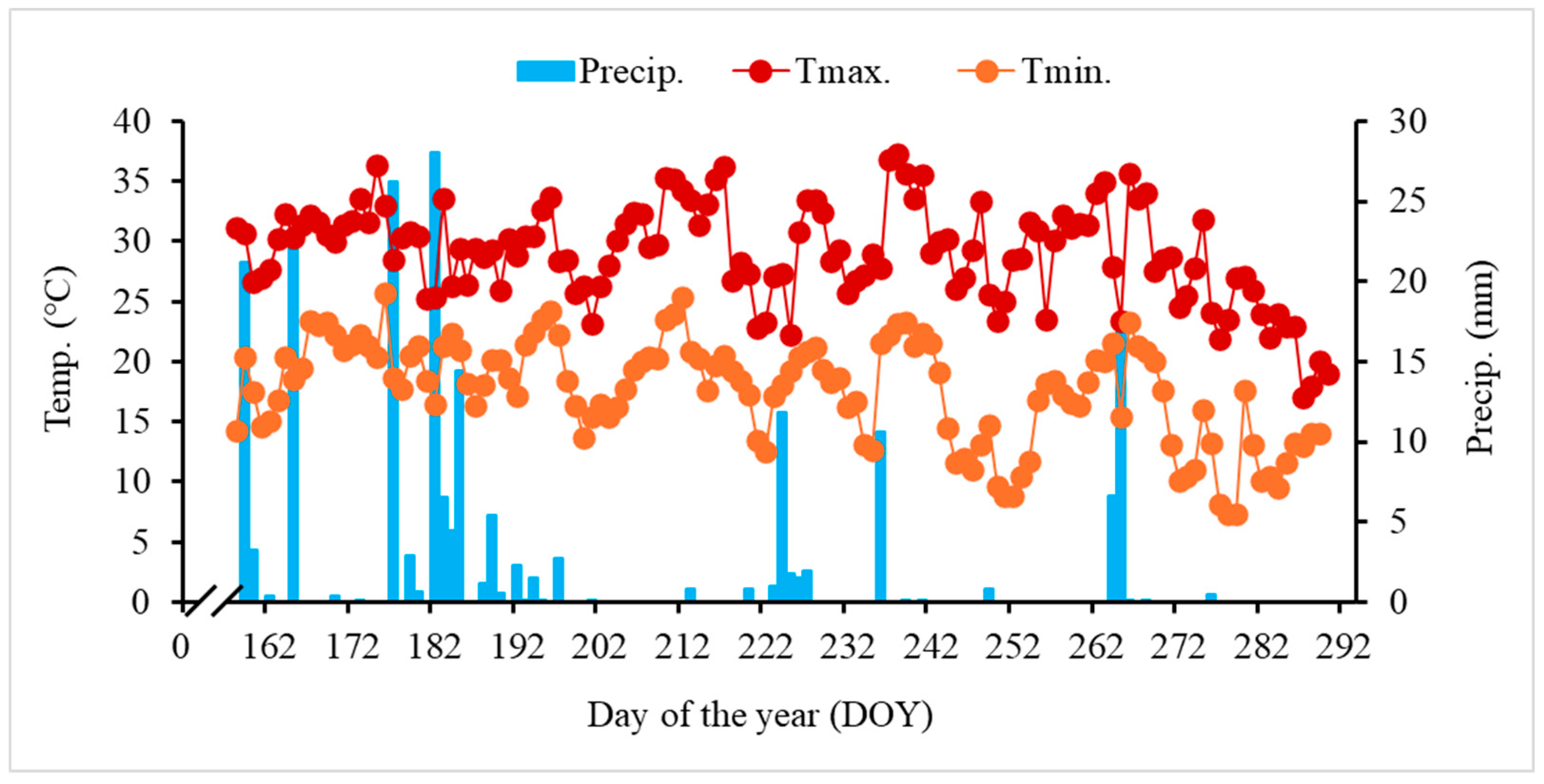
Soil samples were collected after harvesting plants to determine the nutrient content. The samples were analyzed at the University of Missouri Soil Lab. After physiological maturity (17 October 2024), grain yield and kernel moisture were determined by machine-harvesting the center two rows of each plot using a plot combine equipped with weighing scales and a moisture blade. Grain moisture was corrected to 13%. Seasonal weather data were collected on-site, with maximum air temperatures (Tmax) ranging from 15.0 to 37.3 °C and minimum air temperatures (Tmin) ranging from 9.0 to 25.7 °C. Total precipitation during the growing season was 207.3 mm (Figure 1).
For the greenhouse study, SPAD leaf chlorophyll was measured periodically. Plants were manually harvested after physiological maturity on 21 October 2024. Plant height (from the soil surface to the top of the main stem) was measured, pods per plant and total kernel number were counted, and the weight of a thousand kernels was determined. Since the yield from each plant was not enough for grain moisture measurement, seeds were dried in the forced air oven at 65 °C for 72 h and weighed using a digital balance to determine the grain yield per plant at a 13% moisture level.

2.4. Statistical Analysis

All statistical analyses were conducted using SAS version 9.4 (SAS Institute Inc., Cary, NC, USA) [35]. Because the no-till and tilled sites were not adjacent and a significant location effect was observed, data were analyzed separately for each site to avoid confounding treatment effects with site-specific variability. For both field and greenhouse studies, agronomic data, such as plant height, yield, grain count, pod count, etc., were analyzed using a mixed-model analysis of variance (ANOVA) with the PROC MIXED procedure to account for the factorial treatment structure and randomized complete block design (RCBD). Phosphorus rate (P0, P50, and P100) and biostimulant application (with and without) were treated as fixed effects, and replication (block) was treated as a random effect. The phosphorus × biostimulant interaction was included in the model. Type III tests of fixed effects were used for inference, and F-values, numerator and denominator degrees of freedom, and corresponding p-values were reported. Physiological variables measured repeatedly over time, including LRWC, NDVI, and leaf chlorophyll content, were analyzed using a repeated-measures mixed model within each site. The models were fitted using restricted maximum likelihood (REML). Phosphorus rate and biostimulant application were treated as fixed effects, replication as a random effect (block effect), and time factor in days after planting (DAP) as a repeated factor, with plots nested within replication as subjects. The model included all main effects and interactions (phosphorus × biostimulant × DAP), and an autoregressive [AR(1)] covariance structure was specified to account for correlations among repeated observations over time.
Treatment means were estimated using least squares means (LSMeans). Mean separation was performed using Tukey–Kramer adjustment at the 5% significance level only for main effects when the phosphorus × biostimulant interaction was not significant, and for simple effects within interaction levels when the interaction was significant, consistent with factorial inference logic. Estimated least squares means (LSMeans) ± standard error (SE) for each response variable are provided as Supplementary Materials (Supplementary Tables S1–S4). Before using mixed models, data normality was assessed using the Shapiro-Wilk test in PROC UNIVARIATE, and homogeneity of variance was evaluated based on residual diagnostics.

3. Results

3.1. Field Studies

3.1.1. Plant Height

Soybean plant height was not significantly affected by P rate in either the no-till or tilled systems (Table 1 and Table 2; p > 0.05). Application of BSs significantly increased plant height under the no-till system (F = 3.95, p = 0.0453), with mean values of 0.67 m for BS-treated plants compared to 0.65 m for untreated plants, while no significant effect was observed under the tilled system (Table 3). The P × BS interaction was not significant in either tillage system, though the interaction was marginal under the no-till system (F = 3.33, p = 0.0636). In general, plant height differences among phosphorus rates were minimal, and the effect of biostimulants was evident only for the no-till system, indicating that plant height remained relatively stable under the treatments applied. Estimated least squares means (LSMeans) ± SE for plant height, yield, TKW, grain count, pod count, and post-harvest soil phosphorus under different phosphorus levels and biostimulant treatments are provided in Supplementary Table S1.

3.1.2. Leaf Relative Water Content (LRWC)

In the no-till system, LRWC was significantly affected by biostimulant application (F = 10.45, p = 0.0048), while this effect was marginal (F = 3.85, p = 0.0967) in the tilled system, indicating that biostimulants helped to improve leaf water status (Table 4). Phosphorus and the P × BS interaction had no significant effect under either tillage system. LRWC also varied significantly over time in the no-till system (DAP; F = 44.04, p < 0.0001). For example, LRWC was highest at 45 DAP (95.7%), followed by 35 DAP (93.9%), and 55 DAP (88.2%), reflecting developmental changes during the season. In the tilled system, the DAP × P interaction was marginal (F = 4.06, p = 0.0582). No three-way interaction among DAP × P × BSs was noted. Estimated LSMeans ± SE from the repeated-measures ANOVA for LRWC and NDVI across phosphorus levels, biostimulant treatments, and days after planting (DAP) are provided in Supplementary Table S2.

3.1.3. Normalized Difference Vegetation Index (NDVI)

The NDVI showed significant variation over time in both no-till (F = 33.34, p < 0.0001) and tilled (F = 17.59, p < 0.0001) systems, indicating seasonal changes in crop canopy development and vigor (Table 4). In no-till plots, the NDVI was highest at 55 DAP (0.83), followed by 35 DAP (0.81), and 45 DAP (0.78), while in the case of tilled plots, the NDVI was higher at 45 and 55 DAP (both 0.76), and lower at 35 DAP (0.71). In no-till plots, neither phosphorus nor biostimulant application had a significant effect, while in the tilled system, biostimulants significantly affected the NDVI (F = 10.61, p = 0.0049). The NDVI was higher in biostimulant-treated plots (0.76) compared to untreated plots (0.73, Table 3), highlighting their potential to improve canopy growth under conventional tillage. Phosphorus effects were minimal, and no two-way or three-way interactions were significant in either system.

3.1.4. Post-Harvest Soil Phosphorus

Post-harvest soil phosphorus was not significantly affected by either phosphorus rate, biostimulant application, or their interaction in both tillage systems (p > 0.05; Table 1 and Table 2). Mean post-harvest phosphorus concentrations under the no-till plots ranged from 33.18 mg kg−1 (P100) to 33.50 mg kg−1 (P0), while under the tilled plots, values ranged from 32.26 (BS-treated) to 33.25 mg kg−1 (untreated). However, there was a trend indicating that soils from BS-treated plots had less residual phosphorus than soils from untreated plots (Supplementary Table S1).

3.1.5. Grain Yield

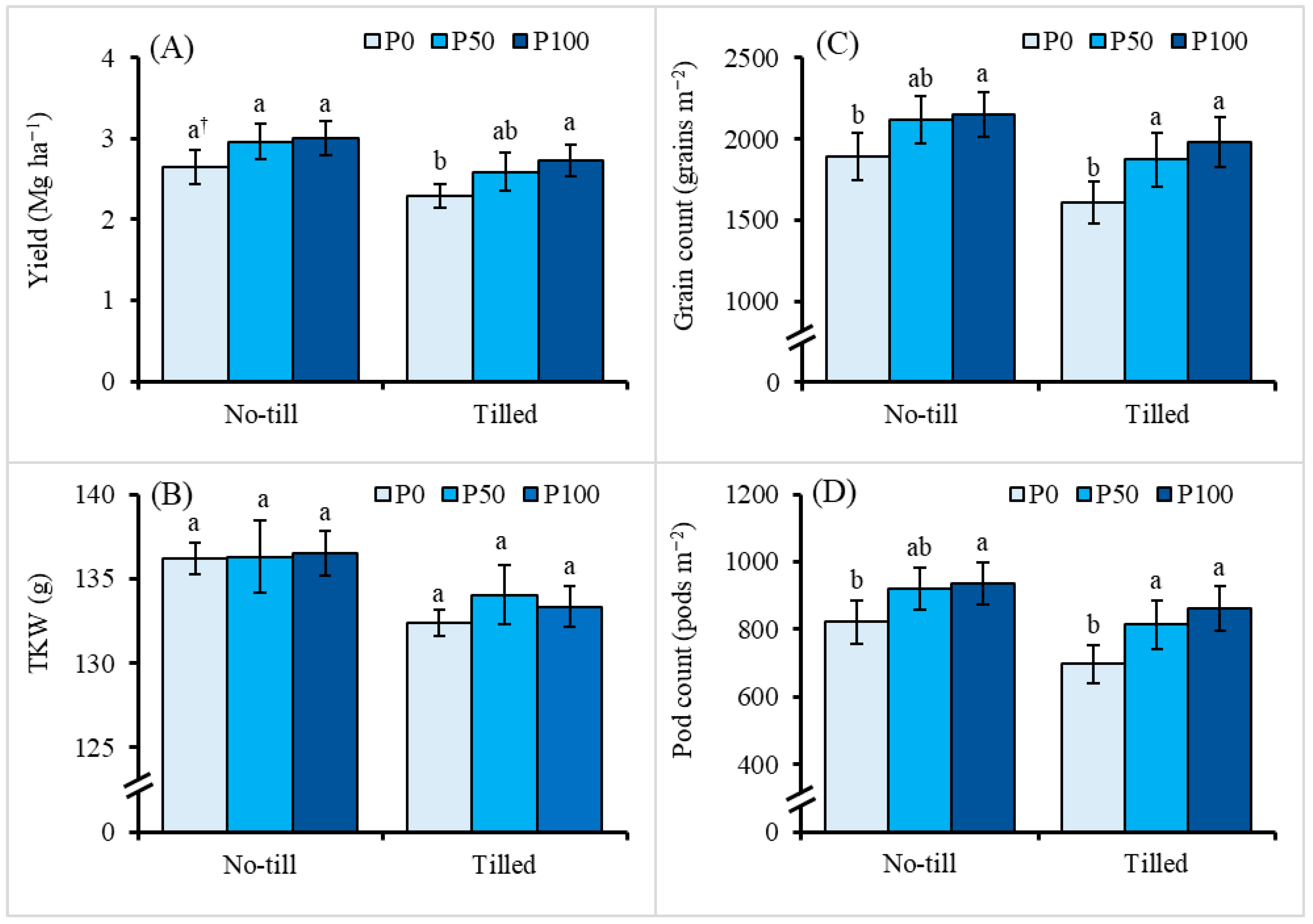
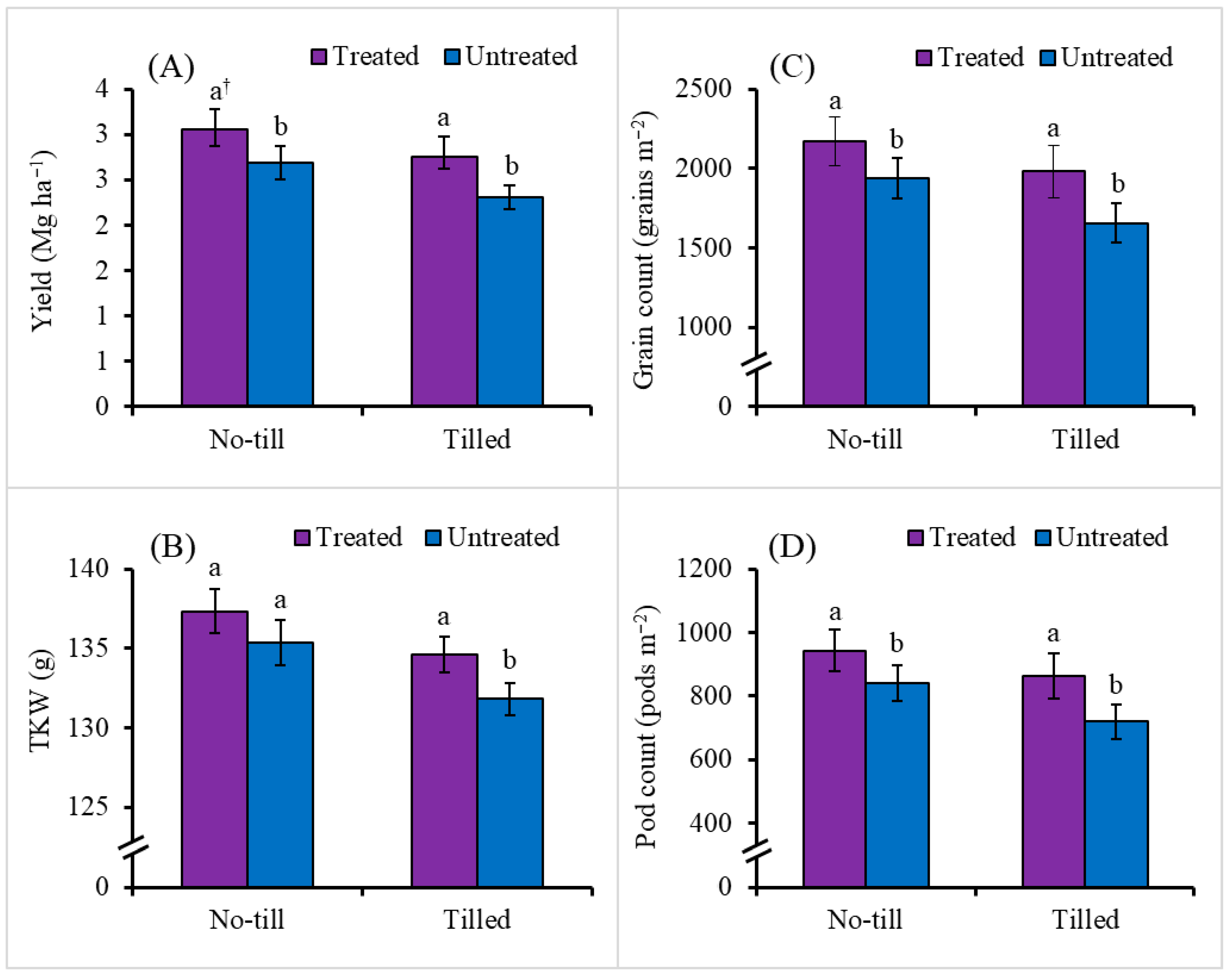
Grain yield was significantly affected by both phosphorus and biostimulant application in both no-till and tilled systems (p < 0.05; Table 1 and Table 2). The P × BS interaction was not significant (p > 0.05). In the no-till plots, mean yields increased from 2.65 Mg ha−1 at P0 to 2.96 Mg ha−1 at P50 and 3.00 Mg/ha−1 at P100 (Figure 2A). Likewise, BS-treated plots produced significantly higher yield (3.05 Mg ha−1) compared to untreated plots (2.70 Mg ha−1) (Figure 3A). In the tilled system too, yield increased with phosphorus rate, with P0 plots yielding 2.28 Mg ha−1, P50 plots yielding 2.58 Mg ha−1, and P100 plots yielding 2.72 Mg ha−1 (Figure 2A). Similarly, the BS-treated plots had a higher yield of 3.05 Mg ha−1 compared to 2.69 Mg/ha for untreated plots (Figure 3A). Overall, both phosphorus fertilization and biostimulant application positively affected soybean yield.

3.1.6. Yield Components

Thousand kernel weight (TKW), grain count, and pod count responded differently to phosphorus and biostimulant applications. TKW was relatively stable across phosphorus rates, with no significant effect on either tillage system (p > 0.05; Table 1 and Table 2, Figure 2B). However, the biostimulant application increased TKW, particularly in the tilled system, from 131.8 g (untreated) to 134.6 g (BS-treated) (Figure 3B).
Pod number per unit area was significantly affected by both phosphorus and biostimulant application under both tillage systems (p < 0.05; Table 1 and Table 2). In no-till plots, pod number increased from 822.4 pods m−2 at P0 to 933.2 pods m−2 at P100, and the application of biostimulants enhanced pod production to 943.7 pods m−2 compared with 842.5 pods m−2 without biostimulant (Figure 2D). In the tilled system, pod count ranged from 697.9 pods m−2 at P0 to 824/0 pods m−2 at P50, and 860.8 pods m−2 at P100 (Figure 3D).
As in the case of pod number, grain number per unit area was significantly affected by both phosphorus and biostimulant application under both tillage systems (p < 0.05; Table 1 and Table 2). In the no-till system, grain count increased from 1891.5 grains m−2 at P0 to 2150.8 grains m−2 at P100, and BS application increased grain number to 2170.5 grains m−2 compared with 1937.8 grains m−2 in untreated plots (Figure 2C and Figure 3C). In the tilled system, grain count increased from 1605.3 grains m−2 in untreated plots to 1982.3 grains m−2 in BS-treated plots, and from 1605.3 grains m−2 at P0 to 1970.0 grains m−2 at P100, showing consistent enhancement with both biostimulant and phosphorus applications (Figure 2C and Figure 3C). Collectively, these results indicate that biostimulant application contributed more consistently to enhanced yield components, while phosphorus fertilization provided moderate benefits, particularly for grain and pod numbers.

3.2. Greenhouse Study

3.2.1. Leaf Chlorophyll and Plant Height

Leaf chlorophyll content was significantly affected by time in days after planting (DAP) (F = 37.16, p < 0.0001), indicating clear changes over time (Table 5). More specifically, leaf chlorophyll content was highest at 60 DAP (48.6 SPAD), followed by 50 DAP (45.2 SPAD), 40 DAP (42.6 SPAD), and 30 DAP (40.4 SPAD). The effect of biostimulants on leaf chlorophyll was marginal (F = 3.63, p = 0.0672) with 44.7 SPAD for treated plants and 43.7 SPAD for untreated plants. The hybrid (HB) (F = 1.74, p = 0.1825) did not show a significant main effect, and no significant interactions were observed between and among HB, BS, and DAP (all p > 0.05) (Table 5). Estimated LSMeans ± SE from the repeated-measures ANOVA for leaf chlorophyll content across different hybrids, biostimulant treatments, and days after planting (DAP) are presented in Supplementary Table S3.
The plant height differed significantly among hybrids (p < 0.0001) (Table 6). The tallest plants were observed in hybrid 4223RXF (0.70 m), followed by 4121RXF (0.60 m) and 3823RXF (0.59 m) as the medium plant height, and 4023RXF (0.52 m) as the shortest (Table 7). Estimated LSMeans ± SE for soybean agronomic traits, including plant height, pod count, grain count, yield, and thousand-kernel weight, across different hybrids and biostimulant treatments are presented in Supplementary Table S4.

3.2.2. Grain Yield and Yield Components

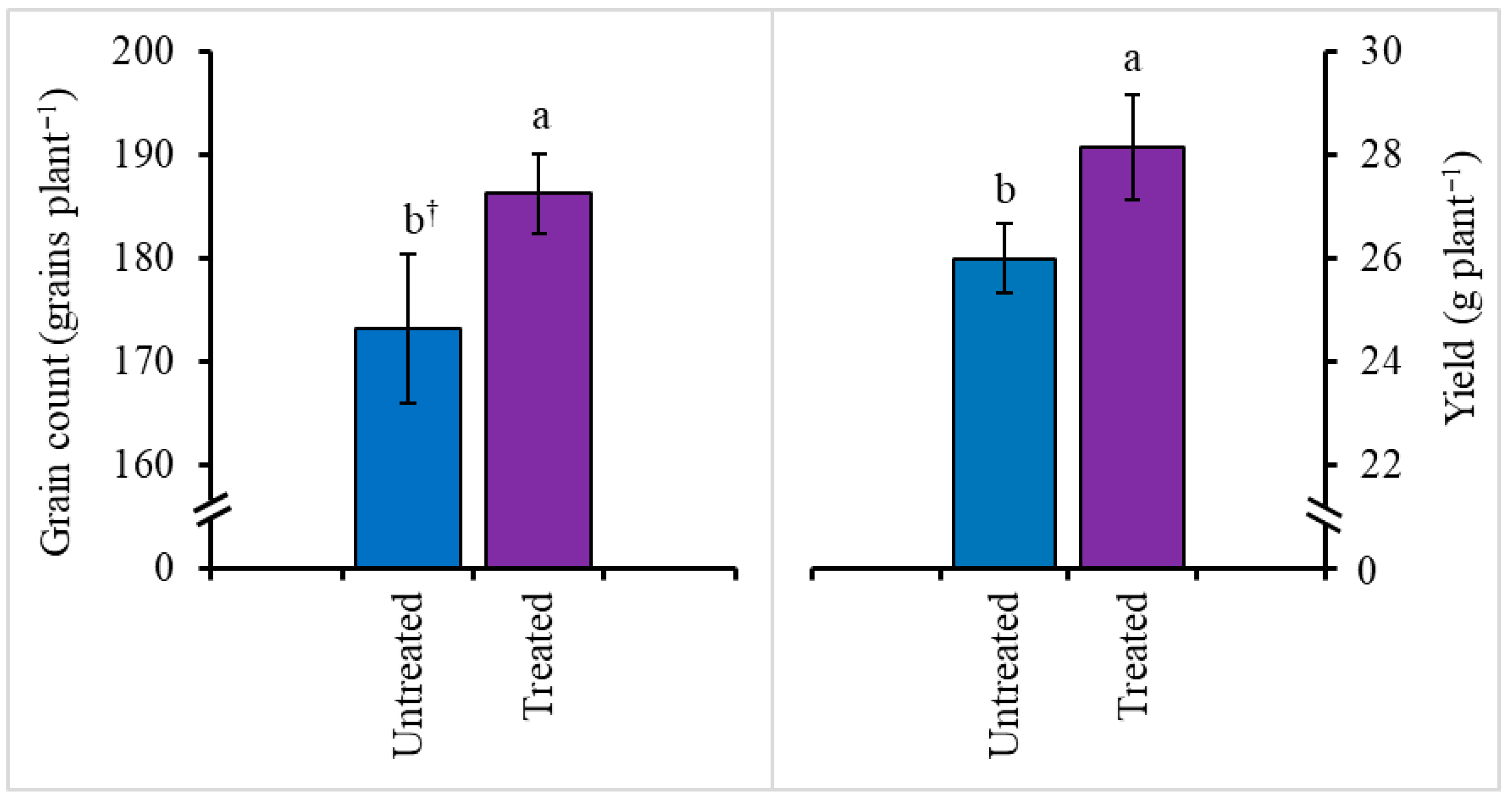
Grain yield and grain number per plant were significantly influenced by both the hybrid and biostimulant individually (Table 6). Grain yield differed significantly among hybrids (p = 0.0466) and biostimulant treatments (p = 0.0436; Table 6). Hybrid 3823RXF yielded the highest (29.3 g plant−1), followed by 4023RXF (27.6 g plant−1), 4121RXF (26.6 g plant−1), and 4223RXF (24.3 g plant−1; Table 7). Furthermore, biostimulant-treated plants had a higher yield (28.8 g plant−1) compared to the untreated (25.7 g plant−1) (Figure 4).
The number of grains per plant was significantly (p = 0.0204) influenced by the hybrid, with 3823RXF (197.6 grains plant−1) outperforming the other hybrids, which ranged between 162.0 and 182.5 g plant−1 (Table 7). Similarly, the biostimulant-treated plants produced a higher number of grains (187.5 grains plant−1) compared to the untreated (171.1 grains plant−1) (Figure 4). Neither the number of pods per plant nor TKW showed a significant response to the biostimulant, hybrid, or their interaction (Table 6).

4. Discussion

4.1. Morphological and Physiological Traits

Tillage affects both soil physical and chemical properties, which in turn alter the environment for root growth and can affect plant growth, nutrient uptake, and yield [36]. Biostimulant application influenced soybean morphological and physiological performance, particularly during early growth stages, although responses varied within each tillage system and with the application of biostimulants. Under no-till conditions, plant height was significantly greater in BS-treated plots (0.67 m) compared with the untreated plots (0.65 m) (Table 3). In contrast, plant height under the tilled system was not affected by treatment. The nutrient stratification of no tillage is more obvious than that of conventional tillage [37]. Therefore, higher early nutrient availability and root accessibility in tilled soils might reduce the relative impact of biostimulant and phosphorus treatments, whereas in no-till systems, these treatments enhanced early growth by alleviating nutrient limitations and supporting root development. Similarly, immobile nutrients like phosphorus tend to accumulate in surface layers, and stratification is greater in no-till or minimum-till systems [38], potentially making added biostimulants more effective in enhancing nutrient availability and supporting plant growth.
The LRWC and NDVI values showed consistent positive trends with biostimulant application, despite limited statistical significance (Table 3 and Table 4). Although plants were grown under favorable water conditions typical of the Midwest, the season was relatively dry, with 207.3 mm of precipitation. LRWC values remained high across biostimulant-treated plots, reflecting improved leaf water status. In contrast, added phosphorus showed mixed results. The LRWC provides a measure of leaves’ water deficit, and drought-resistant genotypes are characterized by relatively small changes in leaf water content per unit change in leaf water potential [34]. NDVI values followed a similar pattern to LRWC, with comparable or higher values for BS-treated plots. Martynenko et al. [39] reported that the application of biostimulants increased the water potential of soybean plants because biostimulants promoted solute accumulation as an osmoprotective strategy to protect cells against water loss caused by water deficit. This finding emphasizes the regulatory role of biostimulants in maintaining cell turgor under water deficit conditions [40], ensuring water balance and cellular homeostasis. Biostimulants modulate plant physiological processes, resulting in enhanced growth performance and improved tolerance to abiotic stresses, including heat and drought [41,42]. Since biostimulants could help mitigate water stress, they likely improved plant health and increased NDVI values. Furthermore, Sozoniuk et al. [43] used plant-based biostimulants in greenhouse-grown soybeans and found that all biostimulant treatments improved soybean growth by activating defense-related physiological processes (gene expression, antioxidants, metabolites, and cell wall changes), with the GA-generated formulation showing the highest effectiveness among the tested variants. Similarly, certain biostimulants, especially those derived from Rhizophagus irregularis, Lactobacillus species, and seaweed extracts, helped plants better tolerate stress by improving cell membrane stability, supporting water balance (osmotic adjustment), and boosting antioxidant enzyme activity [44]. Greenhouse results supported field observations, with clear differences in plant height among hybrids (0.52–0.70 m). The chlorophyll measurements have confirmed consistent physiological development across hybrids. Chlorophyll content showed minor differences among hybrids, reflecting uniform photosynthetic capacity (Table 7). These findings suggest that biostimulants primarily influence plant function and early vigor rather than directly altering chlorophyll concentration. Radzikowska-Kujawska et al. [45] found that the use of some biostimulants did not affect the selected chlorophyll fluorescence parameters, but they resulted in a beneficial effect on plant growth. They concluded that not all biostimulants directly affect the functioning of the photosynthetic apparatus but ultimately benefit plant growth. Overall, current results showed that physiological traits are more sensitive indicators of plant response to management and environmental conditions than plant height. Therefore, integrating physiological measurements with morphological observations to assess crop responses and management efficacy is recommended for a more accurate and comprehensive evaluation of plant performance, early stress detection, and optimization of agronomic practices.

4.2. Grain Yield and Yield Components

Yield responses to biostimulant application were strong and consistent across environments, demonstrating a clear effect of biostimulant and P fertilization. In the no-till system, grain yield increased from 2.70 Mg/ha−1 in the untreated plots to 3.03 Mg ha−1 in the BS-treated plots, representing a 13.4% yield increase. Similarly, in the tilled system, BS-treated plots produced a higher yield of 2.75 Mg ha−1, which was 19.6% higher than the yield from untreated plots (Figure 3A). Greenhouse results further confirmed these trends, as biostimulant-treated plants produced more grains (187.6 vs. 171.3 grains plant−1 for untreated) and higher yield per plant (28.8 vs. 25.7 g plant−1 for untreated plants) across all hybrids. Post-harvest soil P levels did not differ significantly among treatments; however, the relatively lower residual P in biostimulant-treated plots suggests improved P uptake by soybean plants. Plant biostimulants have been shown to increase crop yield and quality, improve nutrient uptake, and enhance tolerance to abiotic stress by improving plant and/or rhizosphere characteristics [46,47]. For example, PGPR-based biostimulants improved growth, nutrient uptake, and antioxidant activity in both maize and tomato under water-limited conditions, with crop-specific responses and stronger effects under drought stress [48]. Repke et al. [49] applied a foliar biostimulant based on amino acids and macro- and micronutrients at the R1 soybean growth stage and found that the application of 0.5 kg/ha of biostimulant increased leaf area by 279% and dry matter by 26%, which was reflected in a 22% increase in crop productivity. Rymuza et al. [50] also reported that the application of biostimulants resulted in a significant increase in soybean yield compared with the control. Biostimulants increase crop yield by about 15.8% on average, with seaweed extracts showing the strongest effect (~17%), followed by humic/fulvic acids (~15%) and amino acids (~10%). The yield response is generally highest in vegetables, followed by pulses, cereals, and oilseed crops [51]. Biostimulants such as seaweed extracts, humic substances, amino acids, and beneficial microbes can significantly improve soybean productivity, with individual yield increases varying widely (e.g., ~4–65% depending on biostimulant type), and substantially greater gains, exceeding 150%, reported when combined with microbial inoculants and mineral inputs [52].
Because weeds were controlled with glyphosate burndown before planting in the no-till field, whereas disk tillage was used in the tilled field, early-season weed pressure was visually greater under tillage. Weed infestation ratings at 20 DAP ranged from 5 to 8 in tilled plots compared with 3 to 6 in no-till plots (0 = weed-free; 10 = maximum infestation. This higher early weed pressure in the tilled system likely increased competition for resources during early soybean growth, contributing to the consistently lower yields observed under tillage across all treatments. Previous studies have shown that weed interference during early vegetative stages of soybean, particularly before the V3–V4 stages, can result in significant yield losses if not controlled within the critical period of weed control, even when weeds are removed later in the season [53,54].
Yield improvements were primarily associated with increased pod and grain numbers rather than seed weight. Under no-till conditions, grain count and pod density both increased by 12.0% in BS-treated plots compared to untreated plots, whereas the increase in TKW was only 1.5%. Similarly, under the tilled system, grain count and pod density increased by 18.5% and 19.7%, respectively, for the same treatments, while TKW increased by 2.1% only. The increase in grain count and pod density was also observed in P-treated plots compared to the untreated control (Figure 2C,D). This is because phosphorus enhances photosynthetic efficiency and nutrient distribution ability within plants, leading to increased pod and seed numbers, improved seed quality, and higher grain yield. In a greenhouse experiment, the yield per plant and average net photosynthetic rate under P1 (40 mg kg−1) and P2 (50 mg kg−1) levels increased by 33.53% and 37.67%, and 20.7% and 15.6%, respectively, compared to P0 (0 mg kg−1) [55]. Thousand-seed weight showed limited treatment response in both systems, indicating that yield gains resulted mainly from enhanced reproductive sink capacity. This result suggests that grain number is the most responsive reproductive trait to both genetic and biostimulant influences, while seed size remains relatively stable across treatments. de Andrade et al. [56] tested the foliar biostimulant Megafol®, which demonstrated growth-promoting effects and increased productivity in several crops, including soybean. Eco-friendly biostimulants (RHAs) improved photosynthesis and nitrogen uptake in wheat (Triticum aestivum) and increased tillering, which ultimately led to approximately 12–15% yield gains under field conditions [57].
Biostimulants enhance plant resilience, particularly in nutrient-poor soils, by improving nutrient use efficiency and overall plant health under both stress and optimal conditions [58]. They may play a crucial role in nutrient assimilation by enhancing the availability and absorption of nutrients in plants. Evidence for this is provided by the relatively lower amount of post-harvest total phosphorus available in the soils where biostimulant-treated soybeans were grown. Post-harvest phosphorus remained relatively stable across treatments (32–34 mg kg−1); however, plots with biostimulant-treated plants had relatively lower P levels, indicating that biostimulants promoted P uptake from those plots. A similar trend was observed in the tilled system. A greater number of pods in untreated plants largely drove yield increases. The grain number per unit area was also greater for the treated plants, while TKW showed smaller and non-significant variation. Single-input treatments (BS alone or P alone) resulted in significant effects, particularly on grain count, pod density, and yield. This is likely because each input independently met a key limiting factor for soybean plant growth, such that their combined application did not further enhance performance. In addition, the combined application of biostimulant and phosphorus may have led to functional overlap in nutrient acquisition or physiological processes, thereby limiting the synergistic response. Adequate availability of P is essential for healthy plant growth, as it promotes root development and initial seedling establishment [59]. The current study showed that biostimulants enhanced soybean yield primarily by increasing pod and grain numbers and improving phosphorus uptake, with particularly strong benefits under no-till management, where nutrient availability and early crop vigor were more limiting. Biostimulants are generally believed to stimulate plant growth and development throughout the entire life cycle, from seed germination to maturity, by enhancing plant hormone activity, promoting root system development, and improving nutrient uptake and translocation, thereby increasing crop productivity and yield quality [8,60].
Greenhouse data highlighted the influence of genotype on yield potential. Hybrid 3823RXF achieved the highest yield (29.3 g plant−1) with the highest grain number (197.6 grains plant−1) and pod count (83.5 pods plant−1), while hybrid 4223RXF produced the lowest yield (24.3 g plant−1) despite a similar TKW (15.9 g). The remaining hybrids exhibited intermediate responses. Biostimulant application increased kernel number and grain yield compared to untreated plants (Figure 4), consistent with the field study results. Szparaga et al. [61] reported that biostimulant application significantly increased both the number of pods and seeds per plant by 40%, which directly contributed to the higher grain yield observed in treated soybean plants compared with the untreated control. Under drought and well-watered conditions, a seaweed-based biostimulant increased grain yield by 54.87% and 23.97%, respectively, compared to untreated plants [62]. Furthermore, averaged across two cultivation sites, the combined application of thiamine and nicotinamide at 50 mg L−1 led to increases of 17.43%, 14.89%, 7.04%, 11.24%, and 15.13% in the number of grains and pods per plant, grains per pod, 1000-grain weight, and grain yield, respectively [63]. Foliar application of spirulina-based (1–3 g L−1) and commercial biostimulant (MC EXTRA, 1 g L−1) improved Fagiolo di Sorana productivity over two years under field and greenhouse conditions, with significant increases in pod weight (~7%) compared to the control [64]. Overall, these results highlight that yield is primarily determined by genotype-dependent reproductive traits, particularly pod and grain number, with biostimulant application providing an additional yield advantage across various environments.

5. Conclusions

This study demonstrates that foliar application of a biostimulant can consistently enhance soybean productivity by improving reproductive traits such as pod and grain number, while having minimal effects on vegetative growth. Beyond yield, biostimulant-treated plants showed improved physiological performance (LRWC and NDVI), suggesting enhanced nutrient use and stress resilience. Although phosphorus fertilization also increased yield, combining it with the biostimulant provided limited additional benefits. These findings have practical relevance for farmers and agronomists seeking cost-effective strategies to improve soybean yield, especially under different tillage systems where nutrient availability varies. By linking foliar biostimulant application to both physiological responses and agronomic outcomes, this work advances current knowledge of sustainable crop management and nutrient efficiency. Future studies under abiotic stress conditions will further clarify the potential of biostimulants to enhance crop resilience and support environmentally sustainable soybean production.

Supplementary Materials

The following supporting information can be downloaded at https://www.mdpi.com/article/10.3390/agronomy16100958/s1, Table S1: Estimated least squares means (LSMeans) ± standard error (SE) for soybean plant height, yield, 4 thousand kernel weight (TKW), grain count per plant, pod count per plant, and post-harvest soil phosphorus (P) under 5 different phosphorus levels and biostimulant (BS, w/ = with and w/o = without) treatment. Table S2: Estimated (LSMeans) ± standard error (SE) from the repeated measures ANOVA for each 6 combination of time in days after planting (DAP), phosphorus (P), and biostimulant (BS, w/ = with and w/o = without) 7 on leaf relative water content (LRWC) and normalized difference vegetation index (NDVI). Table S3: Estimated (LSMeans) ± standard error (SE) from the repeated measures ANOVA for each 5 combination of time factor in days after planting (DAP), hybrid (HB), and biostimulant (BS) on leaf chlorophyll content. Table S4: Estimated least squares means (LSMeans) ± standard error (SE) for soybean plant height, pod 8 count, grain count, yield, 1000-kernel (grain) weight (TKW) across different hybrids (HB) and biostimulant (BS, w/ = 9 with and w/o = without) treatments.

Author Contributions

Conceptualization, S.T.; methodology, S.T.; software, S.T.; validation, S.T., M.S. and A.C.O.; formal analysis, S.T.; investigation, S.T., M.S. and R.G.; resources, S.T. and M.S.; data curation, S.T., M.S., R.G. and A.C.O.; writing—original draft preparation, S.T. and R.G.; writing—review and editing, S.T., R.G. and A.C.O.; visualization, S.T. and A.C.O.; supervision, S.T. and M.S.; project administration, S.T., M.S. and R.G.; funding acquisition, S.T. and M.S. All authors have read and agreed to the published version of the manuscript.

Funding

This research was funded by the Missouri Soybean Merchandising Council (Project No. 24-521-25).

Data Availability Statement

The original contributions presented in this study are included in the article. Further inquiries can be directed to the corresponding authors.

Acknowledgments

We are thankful to the Missouri Soybean Merchandising Council for funding support. We are also thankful to the PRS Farm/Rains family in Holden, Missouri, for logistical support, Channel Seeds for providing soybean seeds, and SoundAg for providing biostimulants, in kind.

Conflicts of Interest

The authors declare no conflicts of interest.

References

  1. The US Farm Bill. Agriculture Improvement Act of 2018; US Government Publishing Office: Washington, DC, USA, 2018. Available online: https://www.congress.gov/115/plaws/publ334/PLAW-115publ334.pdf (accessed on 19 October 2025).
  2. Hamid, B.; Zaman, M.; Farooq, S.; Fatima, S.; Sayyed, R.Z.; Baba, Z.A.; Sheikh, T.A.; Reddy, M.S.; El Enshasy, H.; Gafur, A.; et al. Bacterial plant biostimulants: A sustainable way towards improving growth, productivity, and health of crops. Sustainability 2021, 13, 2856. [Google Scholar] [CrossRef]
  3. Van Oosten, M.J.; Pepe, O.; De Pascale, S.; Silletti, S.; Maggio, A. The role of biostimulants and bioeffectors as alleviators of abiotic stress in crop plants. Chem. Biol. Technol. Agric. 2017, 4, 5. [Google Scholar] [CrossRef]
  4. Mariani, L.; Ferrante, A. Agronomic management for enhancing plant tolerance to abiotic stresses-drought, salinity, hypoxia, and lodging. Horticulturae 2017, 4, 52. [Google Scholar] [CrossRef]
  5. Kauffman, G.L.; Kneivel, D.P.; Watschke, T.L. Effects of a biostimulant on the heat tolerance associated with photosynthetic capacity, membrane thermostability, and polyphenol production of perennial ryegrass. Crop Sci. 2007, 47, 261–267. [Google Scholar] [CrossRef]
  6. Csótó, A.; Tóth, G.; Riczu, P.; Zabiák, A.; Tarjányi, V.; Fekete, E.; Karaffa, L.; Sándor, E. Foliar spraying with endophytic Trichoderma biostimulant increases drought resilience of maize and sunflower. Agriculture 2024, 14, 2360. [Google Scholar] [CrossRef]
  7. Rathore, S.S.; Chaudhary, D.R.; Boricha, G.N.; Ghosh, A.; Bhatt, B.P.; Zodape, S.T.; Patolia, J.S. Effect of seaweed extract on the growth, yield and nutrient uptake of Soybean (Glycine max) under rainfed conditions. South Afr. J. Bot. 2009, 75, 351–355. [Google Scholar] [CrossRef]
  8. Calvo, P.; Nelson, L.; Kloepper, J.W. Agricultural uses of plant biostimulants. Plant Soil 2014, 383, 3–41. [Google Scholar] [CrossRef]
  9. Nwankwegu, A.S.; Orji, M.U.; Onwosi, C.O. Studies on organic and inorganic biostimulants in bioremediation of diesel-contaminated arable soil. Chemosphere 2016, 162, 148–156. [Google Scholar] [CrossRef]
  10. Sivarathri, B.S.; Kodadinne, N.N.; Bryant, C.J.; Dhillon, J.; Reddy, K.R.; Bheemanahalli, R. Influence of seed-applied biostimulants on soybean germination and early seedling growth under low and high temperature stress. Plant Physiol. Rep. 2025, 30, 32–44. [Google Scholar] [CrossRef]
  11. Tabas, H.M.P.; Baruah, N.; Koskimäki, J.J. Biofertilizers and biocontrol agents for agriculture: How to identify and develop new potent microbial strains and traits. Microorganisms 2021, 9, 817. [Google Scholar] [CrossRef]
  12. Gerke, J.; Römer, W.; Beißner, L. The quantitative effect of chemical phosphate mobilization by carboxylate anions on P uptake by a single root. II. The importance of soil and plant parameters for uptake of mobilized P. J. Plant Nutr. Soil. Sci. 2000, 163, 213–219. [Google Scholar] [CrossRef]
  13. Macias-Benitez, S.; Garcia-Martinez, A.M.; Jimenez, P.C.; Gonzalez, J.M.; Tejada Moral, M.; Parrado Rubio, J. Rhizospheric organic acids as biostimulants: Monitoring feedbacks on soil microorganisms and biochemical properties. Front. Plant Sci. 2020, 11, 633. [Google Scholar] [CrossRef]
  14. Crouch, I.J.; Van Staden, J. Evidence for rooting factors in a seaweed concentrate prepared from Ecklonia maxima. J. Plant Physiol. 1991, 137, 319–322. [Google Scholar] [CrossRef]
  15. USDA-ERS. Major Factors Affecting Global Soybean and Products Trade Projections. 2025. Available online: https://www.ers.usda.gov/amber-waves/2016/may/major-factors-affecting-global-soybean-and-products-trade-projections/ (accessed on 3 December 2025).
  16. MU Extension. Soybean. University of Missouri Extension. 2025. Available online: https://extension.missouri.edu/programs/soybean (accessed on 25 November 2025).
  17. Lenssen, A. Soybean Response to Drought. Integrated Crop Management News, Iowa State University Extension and Outreach. 2012. Available online: https://crops.extension.iastate.edu/cropnews/2012/06/soybean-response-drought (accessed on 10 December 2025).
  18. Kness, A. Yield Impact on Heat and Drought-Stressed Soybeans. University of Maryland Extension News. 2020. Available online: https://blog.umd.edu/agronomynews/2020/08/07/yield-impact-on-heat-and-drought-stressed-soybeans/ (accessed on 17 November 2025).
  19. Staton, M. Moisture Stress and High Temperature Effects on Soybean Yields. Michigan State University Extension. 2020. Available online: https://www.canr.msu.edu/news/moisture_stress_and_high_temperature_effects_on_soybean_yields (accessed on 1 December 2025).
  20. Khan, F.; Siddique, A.B.; Shabala, S.; Zhou, M.; Zhao, C. Phosphorus plays key roles in regulating plants’ physiological responses to abiotic stresses. Plants 2023, 12, 2861. [Google Scholar] [CrossRef] [PubMed]
  21. Ali, S.; Akhtar, M.S.; Siraj, M.; Zaman, W. Molecular communication of microbial plant biostimulants in the rhizosphere under abiotic stress conditions. Int. J. Mol. Sci. 2024, 25, 12424. [Google Scholar] [CrossRef] [PubMed]
  22. Panhwar, Q.A.; Radziah, O.; Zaharah, A.R.; Sariah, M.; Razi, I.M. Role of phosphate solubilizing bacteria on rock phosphate solubility and growth of aerobic rice. J. Environ. Biol. 2011, 32, 607–612. [Google Scholar]
  23. Hofmeister, K.; Lerch, R.; Baffaut, C.; Yang, J.; Liu, F. Characterizing groundwater chemistry and recharge in the critical zone of an agricultural claypan watershed. Water Resour. Res. 2022, 58, e2021WR031797. [Google Scholar] [CrossRef]
  24. United Nations. World Population Projected to Reach 9.8 Billion in 2050, and 11.2 Billion in 2100. 2025. Available online: https://www.un.org/en/desa/world-population-projected-reach-98-billion-2050-and-112-billion-2100 (accessed on 11 October 2025).
  25. Aktar, M.W.; Sengupta, D.; Chowdhury, A. Impact of pesticides use in agriculture: Their benefits and hazards. Interdiscip. Toxicol. 2009, 2, 1–12. [Google Scholar] [CrossRef]
  26. Liu, K.; Harrison, M.T.; Yan, H.; Liu, D.L.; Meinke, H.; Hoogenboom, G.; Zhou, M. Silver lining to a climate crisis in multiple prospects for alleviating crop waterlogging under future climates. Nat. Commun. 2023, 14, 765. [Google Scholar] [CrossRef]
  27. Rouphael, Y.; Colla, G. Toward a Sustainable Agriculture Through Plant Biostimulants: From Experimental Data to Practical Applications. Agronomy 2020, 10, 1461. [Google Scholar] [CrossRef]
  28. Bulgari, R.; Franzoni, G.; Ferrante, A. Biostimulants application in horticultural crops under abiotic stress conditions. Agronomy 2019, 9, 306. [Google Scholar] [CrossRef]
  29. Mahmood, M.; Wang, J.; Mehmood, S.; Ahmed, W.; Ayyoub, A.; Seleiman, M.F.; Elrys, A.S.; Elnahal, A.S.M.; Mustafa, A.; Wei, X.; et al. Influence of drought stress on phosphorus dynamics and maize growth in tropical ecosystems. BMC Plant Biol. 2025, 25, 62. [Google Scholar] [CrossRef]
  30. Kimmell, R.J.; Pierzynski, G.M.; Janssen, K.A.; Barnes, P.L. Effects of tillage and phosphorus placement on phosphorus runoff losses in a grain sorghum–soybean rotation. J. Environ. Qual. 2001, 30, 1324–1330. [Google Scholar] [CrossRef] [PubMed]
  31. Zhang, H. Interactive effects of drought, tillage, and nutrient management on crop productivity. Sci. Rep. 2025, 15, 4042. [Google Scholar]
  32. Soil Science Society of America (SSSA)/Missouri Career Education. Missouri State Soil Booklet: Menfro Soil Description; American Society of Agronomy: Madison, WI, USA, 2025. [Google Scholar]
  33. Sound Ag. Source. 2025. Available online: https://www.sound.ag/source (accessed on 27 November 2025).
  34. Pask, A.J.D.; Pietragalla, J.; Mullan, D.M.; Reynolds, M.P. (Eds.) Physiological Breeding II: A Field Guide to Wheat Phenotyping; CIMMYT: Batan, Mexico, 2012. [Google Scholar]
  35. SAS Institute Inc. SAS/STAT 9.4 User’s Guide; SAS Institute Inc.: Cary, NC, USA, 2013. [Google Scholar]
  36. Anderson, E.L. Corn root growth and distribution as influenced by tillage and nitrogen fertilization. Agron. J. 1987, 79, 544–549. [Google Scholar] [CrossRef]
  37. Lv, L.; Gao, Z.; Liao, K.; Zhu, Q.; Zhu, J. Impact of conservation tillage on the distribution of soil nutrients with depth. Soil Tillage Res. 2023, 225, 105527. [Google Scholar] [CrossRef]
  38. MSU Extension. Nutrient Management in no-till and minimum till systems. Mont. State Univ. Ext. 2021, EB0182. Available online: https://www.montana.edu/extension/pubs-linked-in-store/EB0182_Nutrient_Management_in_No-till_and_Minimum_till_Systems_4.21.pdf (accessed on 12 December 2025).
  39. Martynenko, A.; Shotton, K.; Astatkie, T.; Petrash, G.; Fowler, C.; Neily, W.; Critchley, A.T. Thermal imaging of soybean response to drought stress: The effect of Ascophyllum nodosum seaweed extract. Springerplus 2016, 5, 1393. [Google Scholar] [CrossRef]
  40. Elansary, H.O.; Mahmoud, E.A.; El-Ansary, D.O.; Mattar, M. Effects of water stress and modern biostimulants on growth and quality characteristics of mint. Agronomy 2019, 10, 6. [Google Scholar] [CrossRef]
  41. Repke, R.A.; Silva, D.M.R.; Santos, J.C.C.; Silva, M.A. Increased soybean tolerance to high-temperature through biostimulant based on Ascophyllum nodosum (L.) seaweed extract. J. Appl. Phycol. 2022, 11, 3205–3218. [Google Scholar] [CrossRef]
  42. Fleming, T.R.; Fleming, C.C.; Levy, C.C.B.; Repiso, C.; Hennequart, F.; Nolasco, J.B.; Liu, F. Biostimulants enhance growth and drought tolerance in Arabidopsis thaliana and exhibit chemical priming action. Ann. Appl. Biol. 2019, 174, 153–165. [Google Scholar] [CrossRef]
  43. Sozoniuk, M.; Świeca, M.; Bohatá, A.; Bartoš, P.; Bedrníček, J.; Lorenc, F.; Jarošová, M.; Perná, K.; Stupková, A.; Lencová, J.; et al. Plasma activation of plant-based biostimulants enhances growth and defense responses in soybean (Glycine max L.). BMC Plant Biol. 2026, 26, 552. [Google Scholar] [CrossRef]
  44. Acevedo, A.F.G.; Rodrigues, J.N. Physiological and biochemical adjustments in soybean induced by biostimulants application under water deficit stress. South Afr. J. Bot. 2026, 190, 144–155. [Google Scholar] [CrossRef]
  45. Radzikowska-Kujawska, D.; John, P.; Piechota, T.; Nowicki, M.; Kowalczewski, P.Ł. Response of winter wheat to selected biostimulants under drought conditions. Agriculture 2023, 13, 121. [Google Scholar] [CrossRef]
  46. Quille, P.; Kacprzyk, J.; OConnell, S.; Ng, C.K.-Y. Plant biostimulants and their potential role in achieving the United Nations sustainable development goals. Plants People Planet 2026, 1–8. [Google Scholar] [CrossRef]
  47. Corrado, C.L.; Tungadi, T.; Taglienti, A.; Donati, L.; Dragone, I.; Murphy, A.; Bruce, T.; Bertin, S. Role of organic biostimulants in the integrated management of cucurbit crops: Effects on the interaction between potyvirus-infected plants and aphid vectors. Pest Manag. Sci. 2025, 82, 3321–3322. [Google Scholar] [CrossRef] [PubMed]
  48. Melo, J.; Dias, T.; Santos, A.M.; Kamah, S.; Castillo, S.; Akdi, K.; Cruz, C. Microbial biostimulants improve early seedling resilience to water stress. Plants 2026, 15, 20. [Google Scholar] [CrossRef]
  49. Repke, R.A.; Silva, D.M.R.; dos Santos, J.C.C.; de Almeida Silva, M. Alleviation of drought stress in soybean by applying a biostimulant based on amino acids and macroand micronutrients. Agronomy 2022, 12, 2244. [Google Scholar] [CrossRef]
  50. Rymuza, K.; Radzka, E.; Cała, J. The effect of applied biostimulants on the yielding of three non-genetically modified soybean cultivars. Agriculture 2023, 13, 900. [Google Scholar] [CrossRef]
  51. Meena, D.C.; Birthal, P.S.; Kumara, K.T.M.; Sharma, I. Biostimulants for sustainable transformation of agri-food production system: Evidence from field experiments. Agroecol. Sustain. Food Syst. 2026, 1–17. [Google Scholar] [CrossRef]
  52. Appiah, E.A.; Nyandi, M.S.; Ocwa, A.; Duodu, E.J.; Kutasy, E.T. Role of biostimulants in sustainable soybean (Glycine max L.) production: A systematic review. Sustainability 2026, 18, 636. [Google Scholar] [CrossRef]
  53. Van Acker, R.C.; Swanton, C.J.; Weise, S.F. The Critical Period of Weed Control in Soybean [Glycine max (L.) Merr.]. Weed Sci. 1993, 41, 194–200. [Google Scholar] [CrossRef]
  54. Eyherabide, J.J.; Cendoya, M.G. Critical periods of weed control in soybean for full field and in-furrow interference. Weed Sci. 2002, 50, 162–166. [Google Scholar] [CrossRef]
  55. Chen, Q.; Nie, T.; Li, Y.; Li, H.; Sun, Y.; Wu, Y.; Zhang, Y.; Wang, M. Optimized Phosphorus Application Under Water Stress Enhances Photosynthesis, Physiological Traits, and Yield in Soybean During Flowering Stage. Agronomy 2025, 15, 444. [Google Scholar] [CrossRef]
  56. de Andrade, C.L.L.; da Silva, A.G.; Melo, G.B.; Ferreira, R.V.; Moura, I.C.S.; Siqueira, G.G. Biostimulants derived from Ascophyllum nodosum associated of glyphosate in agronomic characteristics of soybean RRR. Rev. Bras. Herbic. 2018, 17, 20203430172. [Google Scholar]
  57. Shen, C.; Zhang, G.; Bao, X.; Xiao, A.; Long, L.; Meng, Q. Rhamnolipids as Agricultural Biostimulants: Effects on Wheat Growth, Yield, and Molecular Mechanisms. J. Agric. Food Chem. 2026, 74, 2877–2887. [Google Scholar] [CrossRef]
  58. Chaffai, R.; Ganesan, M.; Cherif, A. Plant growth-promoting rhizobacteria (pgpr) and plant growth-promoting fungi (pgpf) for alleviating abiotic stress in plants. In Plant Adaptation to Abiotic Stress: From Signaling Pathways and Microbiomes to Molecular Mechanisms; Springer Nature: Singapore, 2024; pp. 457–496. [Google Scholar] [CrossRef]
  59. Rengel, Z.; Cakmak, I.; White, P.J. Marschner’s Mineral Nutrition of Plants; Academic Press: Cambridge, MA, USA, 2022. [Google Scholar]
  60. Basak, A. Biostimulators. Definitions, classification and legislation. In Biostimulators in Modern Agriculture, General Aspects; Gawronska, H., Ed.; Editorial House Wieú Jutra, Limited: Warszawa, Poland, 2008; pp. 7–17. [Google Scholar]
  61. Szparaga, A.; Kocira, S.; Kocira, A.; Czerwińska, E.; Świeca, M.; Lorencowicz, E.; Kornas, R.; Koszel, M.; Oniszczuk, T. Modification of growth, yield, and the nutraceutical and antioxidative potential of soybean through the use of synthetic biostimulants. Front. Plant Sci. 2018, 9, 1401. [Google Scholar] [CrossRef]
  62. Mannan, M.A.; Yasmin, A.; Sarker, U.; Bari, N.; Dola, D.B.; Higuchi, H.; Ercisli, S.; Ali, D.; Alarifi, S. Biostimulant red seaweed (Gracilaria tenuistipitata var. liui) extracts spray improves yield and drought tolerance in soybean. PeerJ 2023, 11, e15588. [Google Scholar] [CrossRef] [PubMed] [PubMed Central]
  63. Alves, V.C.D.; Lima, S.F.; Vendruscolo, E.P.; Witt, T.W.; Nogueira, A.F.; Ferreira, L.M.; Gomides, J.B.; Lacerda, E.R.; Seron, C.C.; Lima, A.L. Biostimulant potential of vitamins in soybean cultivation. Int. J. Plant Prod. 2026, 20, 29. [Google Scholar] [CrossRef]
  64. Palm, E.R.; Santini, G.; Niccolai, A.; Vergine, M.; Negro, C.; Nissim, W.G.; Sabbatini, L.; Balestrini, R.; de Pinto, M.C.; Gohari, G.; et al. Improving yield of a bean ecotype using biostimulants: Focus on bean amino acid profiles and plant responses. Plant Physiol. Biochem. 2026, 231, 110988. [Google Scholar] [CrossRef] [PubMed]
Figure 1. Soybean growing season maximum and minimum temperature and precipitation data for the study site. Both no-till and tilled plots were planted on 6 July 2024 (158 day of the year, DOY) and harvested on 17 October 2024 (290 DOY).
Agronomy 16 00958 g001
Figure 2. Means of soybean yield (A), thousand kernel weight (TKW) (B), grain count (C), and pod count (D) for different phosphorus rates under no-till and tilled systems. † Different letters above error bars indicate significant differences according to Tukey–Kramer adjustment at p = 0.05, applied to main effects when the phosphorus × biostimulant interaction was not significant, or to simple effects within interaction levels when the interaction was significant. (P0 = control, P50 = 50% phosphorus, P100 = 100% phosphorus based on soil test recommendations).
Agronomy 16 00958 g002
Figure 3. Means of biostimulant-treated and untreated soybean yield (A), thousand kernel weight (TKW) (B), grain count (C), and pod count (D). † Different letters above error bars indicate significant differences according to Tukey–Kramer adjustment at p = 0.05, applied to main effects when the biostimulant × phosphorus interaction was not significant, or to simple effects within interaction levels when the interaction was significant.
Agronomy 16 00958 g003
Figure 4. Means of grain number and yield per plant for biostimulant-treated and untreated soybean plants in the greenhouse study. † Different letters above the error bars represent significant differences at p < 0.05.
Agronomy 16 00958 g004
Table 1. Mixed-model ANOVA evaluating the effects of phosphorus (P), biostimulants (BSs), and their interaction on soybean plant height, grain yield, thousand-kernel weight (TKW), pod count, grain count, and post-harvest soil phosphorus under a no-till system.
EffectPlant HeightYieldTKW
Num
DF
Den DFF Valuep-ValueNum
DF
Den DFF Valuep-ValueNum
DF
Den DFF Valuep-Value
P2151.150.34312153.620.05212150.030.9742
BS1153.950.04531159.20.00841153.320.0884
P × BS2153.330.06362150.60.56002152.890.0867
Pod countGrain countPost-harvest P
P2154.230.03502154.190.03592150.110.8992
BS1158.550.01051158.590.01031150.130.7247
P × BS2150.250.78472150.290.75342151.350.2888
Table 2. Mixed-model ANOVA evaluating the effects of phosphorus (P), biostimulants (BSs), and their interaction on soybean plant height, grain yield, thousand-kernel weight (TKW), pod count, grain count, and post-harvest soil phosphorus under a tilled system.
EffectPlant HeightYieldTKW
Num
DF
Den DFF Valuep-ValueNum
DF
Den DFF Valuep-ValueNum
DF
Den DFF Valuep-Value
P2150.140.86842156.630.00872130.930.4181
BS1150.650.431911519.780.00051139.450.0089
P × BS2150.30.74452150.510.61092130.850.4503
Pod countGrain countPost-harvest P
P2158.810.00292158.920.00282140.220.8048
BS11519.980.000411517.90.00071141.50.2415
P × BS2150.310.73642150.410.67242140.10.9033
Table 3. Means of soybean plant height, leaf relative water content (LRWC), normalized difference vegetation index (NDVI), and post-harvest soil phosphorus (P) for both no-till and tilled systems as affected by the main factor of biostimulant treatment.
TreatmentPlant Height (m)LWRC (%)NDVIPost-Harvest P (mg kg−1)
No-TillTilledNo-TillTilledNo-TillTilledNo-tillTilled
Treated0.67 a †0.65 a93.90 a94.52 a0.82 a0.76 a33.21 a32.26 a
Untreated0.65 b0.63 a91.4 b91.94 b0.81b a0.73 b33.42 a33.25 a
† Means followed by different letters within each column are significantly different according to Tukey–Kramer adjustment at p = 0.05, applied to the main effect of BS when the phosphorus × biostimulant interaction was not significant.
Table 4. Repeated measures ANOVA evaluating the effects of time in days after planting (DAP), phosphorus (P), and biostimulants (BSs), and their interactions on leaf relative water content (LRWC) and normalized difference vegetation index (NDVI).
EffectNo-TillTilled
Num DFDen DFF Valuep-ValueNum DFDen DFF Valuep-Value
LRWC
P217.30.490.6200220.10.650.5315
BS117.310.450.0048120.13.850.0967
P × BS217.30.630.5447220.10.560.5773
DAP231.944.04<0.0001236.70.350.7079
DAP × P432.81.040.4003437.04.060.0582
DAP × BS231.90.610.5501236.70.130.8797
DAP × P × BS432.80.790.53814370.820.5221
NDVI
P219.90.980.3932216.12.870.0860
BS119.91.980.1746116.110.610.0049
P × BS219.91.60.227216.12.880.0852
DAP240.033.34<0.0001232.917.59<0.0001
DAP × P440.61.160.3414433.71.840.1447
DAP × BS240.00.060.9448232.91.230.3049
DAP × P × BS440.60.590.675433.70.780.5435
Table 5. Repeated measures ANOVA evaluating the effects of time in days after planting (DAP), hybrid (HB), and biostimulants (BSs), and their interactions on soybean leaf chlorophyll.
EffectNum DFDen DFF Valuep-Value
HB327.51.740.1825
BS127.53.630.0672
HB × BS327.50.050.9828
DAP346.837.16<0.0001
DAP × HB948.81.080.3961
DAP × BS346.80.200.8966
DAP × HB × BS948.81.000.4548
Table 6. Mixed-model ANOVA evaluating the effects of hybrid (HB), biostimulants (BSs), and their interaction on soybean plant height, grain yield, thousand-kernel weight (TKW), pod count, and grain count for the greenhouse study.
EffectPlant HeightGrain YieldTKW
Num
DF
Den DFF Valuep-ValueNum
DF
Den DFF Valuep-ValueNum
DF
Den DFF Valuep-Value
HB31418.02<0.00013143.430.04663140.870.4779
BS1140.240.63001144.920.04361142.80.1162
HB × BS3140.740.54683140.390.76373141.270.3233
Pod countGrain count
HB3141.170.35773144.520.0204
BS1141.050.3231144.60.0500
HB × BS3140.10.96113140.410.7496
Table 7. Means of leaf chlorophyll content, plant height, pod count, grain count, yield, and thousand kernel weight (TKW) as affected by the hybrid.
HybridChlorophyll
(SPAD)
Plant Height
(m)
Pod Count (Pods Plant−1)Grain Count (Grains Plant−1)Grain Yield
(g Plant−1)
TKW (g)
3823RXF41.9 a †0.59 b83.5 a197.6 a29.3 a155.7 a
4121RXF38.1 a0.60 b73.5 a182.5 ab26.6 ab156.6 a
4023RXF39.9 a0.52 c78.1 a162.0 c27.6 ab164.1 a
4223RXF41.5 a0.70 a75.1 a180.0 ab24.3 b159.1 a
† Different letters within each column indicate significant differences according to Tukey–Kramer adjustment at p = 0.05, applied to main effects when the hybrid × treatment interaction was not significant, or to simple effects within interaction levels when the interaction was significant.
Disclaimer/Publisher’s Note: The statements, opinions and data contained in all publications are solely those of the individual author(s) and contributor(s) and not of MDPI and/or the editor(s). MDPI and/or the editor(s) disclaim responsibility for any injury to people or property resulting from any ideas, methods, instructions or products referred to in the content.