Article

Integrated Yield Formation and Multiple Grain Quality Responses of Bread Wheat to Post-Heading Drought Using Multivariate Analyses

Department of Field Crops, Faculty of Agriculture, Aydın Adnan Menderes University, Aydın 09100, Türkiye
Agronomy 2026, 16(10), 953; https://doi.org/10.3390/agronomy16100953 (registering DOI)
Submission received: 25 April 2026 / Revised: 7 May 2026 / Accepted: 8 May 2026 / Published: 11 May 2026

Abstract

Spring drought is a major constraint in Mediterranean wheat production, where elevated temperatures and evapotranspiration after heading limit soil water availability during critical generative stages. This study investigated how post-heading drought reshapes the relationships between yield and multiple quality traits (a total of 22 variables) across ten bread wheat genotypes using multivariate analyses. Field experiments were conducted under rainfed and post-heading drought conditions over two growing seasons. The following traits were evaluated: yield components; flag leaf SPAD; physical, technological, and nutritional quality traits; flour color (L*, a*, b*); phenolic content; and antioxidant activity. Drought caused significant yield reductions, with SPAD, ear yield, grain and test weight emerging as key traits associated with yield formation. Water-limited conditions constrained yield formation in post-heading development stages while promoting certain quality improvements in wheat grain. PCA clearly separated drought and rainfed conditions: drought clustered with bioactive, pigment-related, and mineral traits, whereas rainfed conditions were associated with higher yield, protein content, gluten quality, and technological traits. These findings demonstrate that post-heading drought shifts wheat grain composition toward bioactive and nutritional constituents at the expense of yield-oriented and technological traits, emphasizing the need to select genotypes that sustain both yield stability and nutritional quality under increasing spring water limitations driven by climate change.

1. Introduction

Bread wheat (Triticum aestivum L.) is a major staple cereal adapted to diverse climatic conditions, largely due to its high genetic diversity (it has experienced intensive natural and artificial selection in history), while also serving as a primary source of energy and protein in the human diet worldwide [1]. Wheat alone provides around 20% of the total calories and protein consumed worldwide, and the three major cereals—wheat, rice, and maize—together account for almost 60% of the calories consumed each day [2]. However, in recent years, climate change has caused a significant decline in the production and quality potential of these important plants, which could pose a problem for food safety. Climate change poses severe constraints on agricultural production in Europe and Asia by intensifying heat and drought stress, increasing rainfall variability, and amplifying extreme weather events. These pressures lead to significant crop yield losses, reduced water availability, and damage to agricultural land and infrastructure, while ecosystem disruptions further limit the adaptive capacity of cropping systems [3]. Similar to other crops, wheat also faces a decrease in production level because of extreme climate events (e.g., heat waves, drought, and floods) [4,5,6]. Future projections show that the Mediterranean region is particularly sensitive to climate change, and the possible decrease in precipitation in coastal parts of Türkiye is higher than in other regions [7]. In addition, almost all the Mediterranean regions already experience drought repeatedly each year, and the frequency and intensity of drought seasons are expected to increase, which highlights the urgent need for crop–climate adaptation strategies [8]. Drought in winter cereals most often occurs after the consumption of the winter water supply and the need for rainfall occurs when plants have the largest leaf area and increasing transpiration during the most critical generative growth stages (stem elongation, heading, and grain-filling periods) to maintain optimal yield and quality. During the crucial stages, low rainfall and high evapotranspiration due to high temperatures cause plants to be unable to draw sufficient water from the soil to transpire it. The stomata close, reducing photosynthesis and insufficiently cooling the plant surface, which results in stress in plants, and thus causes reduced productivity [9,10].
Field studies of wheat yield variability have shown that drought stress at 50% field capacity markedly reduced plant height and growth indices (biomass accumulation, days to maturity, and grain-filling period) and forced earlier maturity/phenological shortening across genotypes. Drought stress at stem elongation and anthesis causes yield reduction of approximately 14–25% compared with irrigated crops. Heading and grain filling are the growth periods most sensitive to drought stress, especially in late sowing [11]. In addition to these periods, delayed flowering and late sowing increase the risk of adverse effects on wheat caused by terminal drought, which poses a threat to productivity [12,13]. Drought stress shows similar adverse effects on grain number set and grain mass as high temperature occurring before and post-anthesis, and the grain mass is reduced with higher temperature conditions due to remobilization of assimilates at a faster rate and shortened grain-filling duration [14]. Early heading/anthesis, early sowing, maintaining stay-green duration (delayed senescence), and optimal development durations of post-anthesis stages are the main drought escape strategies for improving wheat potential [15,16,17,18]. In another drought escape strategy, deeper root development was found to potentially enable subsoil water to maintain a stay-green genotype and produce higher yield per plant under moderate water stress [19]. In addition to all these strategies, drought tolerance is a complex multi-trait quantitative plant characteristic. High genotype and environment interactions and low heritability are responsible for drought tolerance, which is controlled by numerous genes and other plant traits [20]. The adverse changes observed in yield formation due to drought and heat stress do not occur to the same extent for grain and functional quality; on the contrary, they lead to significant positive changes in quality characteristics [21]. The concurrence of limited water availability and elevated spring temperatures leads to drought stress in wheat, together with key environmental stress conditions. Pre-heading drought treatments were found to be more related to yield and physico-morphological traits while post-heading drought had a greater effect on quality traits [22].
Mediterranean climates cause differential genotypic responses that affect grain quality in addition to yield formation. Under drought conditions, the anthesis period is a key window for spike fertility and grain set (via complete or partial sterility of florets/grain set), whereas post-anthesis drought during the grain-filling period strongly modulates grain composition and technological and functional quality traits [23,24]. It has been reported that high temperature conditions (>35 °C) may alter flour and baking quality, and moderate temperature (25–32 °C) has a positive effect on dough quality [25,26]. On the other hand, while moderate stress enhances grain quality traits (improves bread-making quality by increasing protein content), severe drought stress conditions cause quality (protein, gluten rate, and sedimentation value) reductions. It has been demonstrated that extremes of high temperature and water-limited conditions during the grain-filling period result in substantial detrimental effects on grain quality, thereby exerting a considerable influence on the final quality of the product. This situation clearly demonstrates the crucial importance of an understanding of environmental stress factors [27]. Water limitation is also found to be directly linked to changes in storage protein synthesis/gluten structure and bread-making quality [28,29]. Gluten structure is determined by storage proteins (gliadin/glutenin) that accumulate during the grain-filling period. A shortened grain-filling period in response to a short period of heat stress has been linked to increased gliadin/glutenin ratio results with weak dough properties [30,31]. Drought stress is known to increase the protein content of grain and reduce carbohydrate content (including starch), but this effect is highly dependent on the timing and duration of water-limited conditions and their interactions with other environmental stress conditions [32]. Additionally, insufficient water availability in the grain-filling period can also result in decreased protein content value, and water stress during this period can lead to smaller and lighter grains, which may reduce overall physical and chemical quality [33].
Aside from the nutritional and technological quality properties of wheat grain, it also has unique biochemical compounds that have health-promoting properties. Whole-grain products are well known to be rich in phenolic compounds, which are primarily concentrated in the outer layers of grain, such as aleurone, testa, and pericarp [34,35]. White flour is the preferred usage product for bakeries; however, the process of milling removes the bran fraction, which is the primary reservoir of phenolic compounds. Consequently, the phenolic content declines markedly with increasing refinement from whole grain to white flour due to these compounds being concentrated in the outer grain layers. Beyond postharvest processing, the antioxidant activity of wheat grain is significantly influenced by genotype, agronomic practices (for example, organic versus conventional management, sowing date, fertilization, and crop protection), and environmental conditions [36,37]. Changes observed in yield and, as with many quality traits, due to environmental factors arising during generative growth stages, also affect the accumulation of biochemical compounds in grain content. Water deficiency in these periods causes changes in the synthesis of polyphenolic compounds and their derivatives, which are rich in antioxidants. Drought stress affecting wheat productivity by inducing biochemical changes is also responsible for the antioxidant defense system against stress conditions [38,39]. Water limitation during the grain-filling period has been demonstrated to modify the biochemical quality of wheat grains, frequently resulting in alterations to phenolic accumulation and antioxidant activity. In addition, phenolic compounds and antioxidant properties have been shown to shift under stress, with these shifts being mostly determined by environment and, secondly, by genotype [34,40].
The present study aims to conduct the following: (i) evaluate how drought stress occurring after heading and simulated changes in spring precipitation patterns influence the processes of yield and quality formation and possible challenges in the future; (ii) examine how post-heading drought significantly modifies multiple evaluated grain quality traits (nutritional, functional, and technological properties); (iii) examine the exact responses of different adaptive and developmental characteristics of bread wheat genotypes for yield and quality relationships under drought and rainfed conditions; (iv) elucidate the relationships between these traits and their association with post-heading drought stress under changing climatic conditions by multivariate analyses.

2. Materials and Methods

2.1. Study Site and Climatic Conditions

For this study, the field experiment was conducted in Aydın Adnan Menderes University, Faculty of Agriculture, Research and Application Farm, located in Koçarlı district, Aydın province, Türkiye (37°45′46″ N 27°45′35″ E, 29 m altitude) during the 2018–19 and 2019–20 wheat-growing seasons. The field experiment location is situated in the Büyük Menderes Basin and a Mediterranean climate prevails [Köppen–Geiger classification: Csa (mild winters and hot, dry summers)]. This study was conducted in the 2019 and 2020 harvest years to ascertain the impact of drought that occurs following the heading and harvest stages on yield formation and technological, nutritional, and functional quality characteristics in 10 distinct bread wheat genotypes, with winter and facultative growth habits, in comparison with the rainfall regime. Annual precipitation deviations were used to describe the climatic background of the experimental period under Mediterranean conditions. The climate of the study site posits that spring drought has led to a substantial decline in rainfall amounts in certain years over an extended timeframe. Yearly precipitation totals from 2005 to 2025 were compared with the long-term average precipitation of 68.9 mm (DOY: 91–150 coincides with pre- and post-heading; BBCH 49: first awns visible to BBCH 89: fully ripe), and deviations were expressed as millimeters above or below this reference. The experimental years, 2019 and 2020, differed markedly in precipitation regime: 2019 exhibited a slight positive deviation (+6 mm), while 2020 showed a pronounced precipitation surplus (+13 mm) relative to the long-term mean (Figure S1).
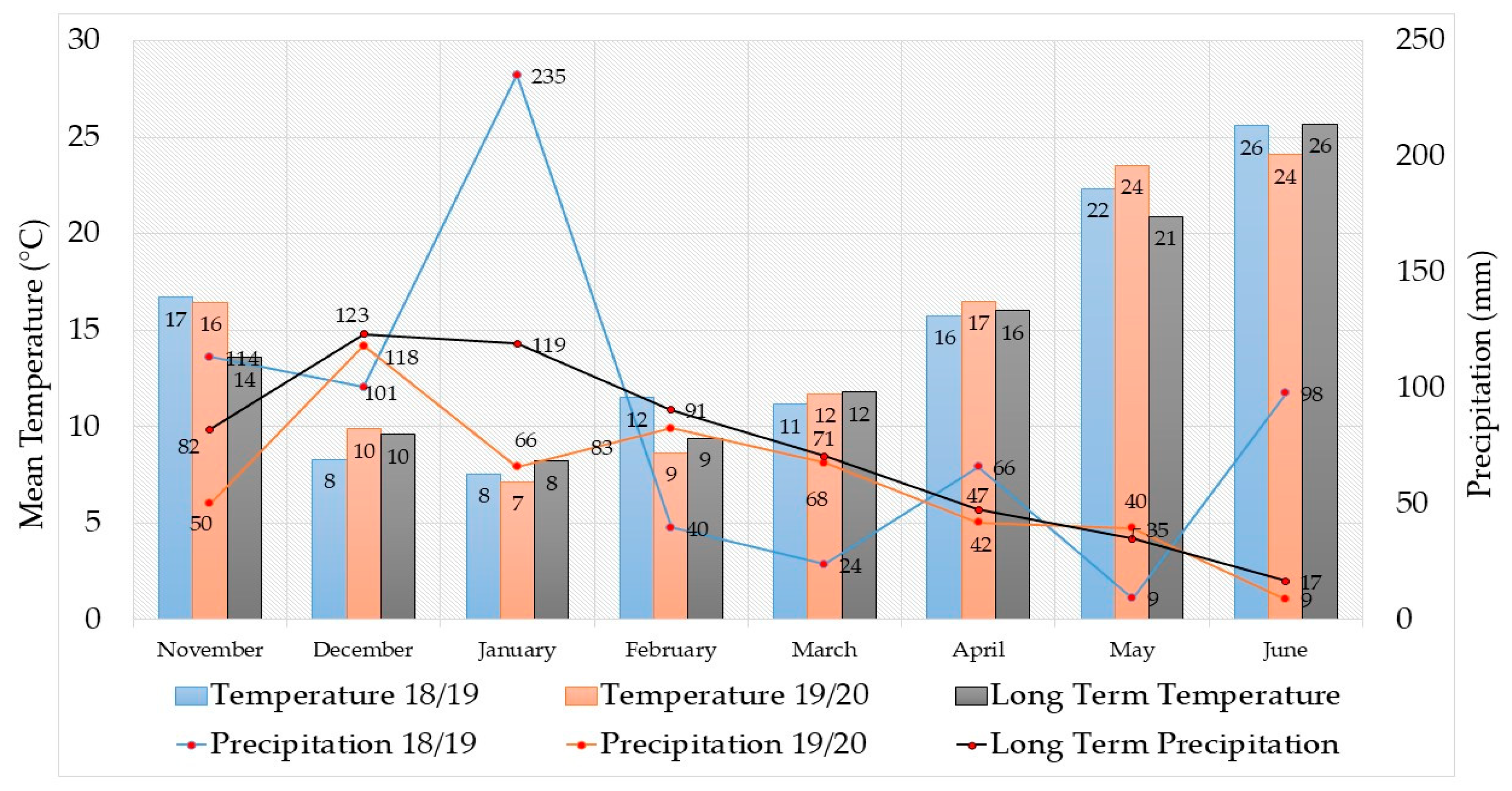
In comparison with long-term climatic averages, the monthly mean temperature and precipitation during the experimental period (November–June) of the 2018–19 and 2019–20 growth seasons were assessed. Although late spring temperatures (April–June) were marginally higher than the long-term mean, especially in 2019–20, both seasons were primarily characterized by the long-term Mediterranean climate pattern. Conversely, precipitation exhibited significant interannual variability, with above-average winter rainfall in 2018–19, particularly in January (235 mm), and decreased, irregular, and lower precipitation with notable late-spring deficits in 2019–20 (except May, which was slightly higher). In addition, a very low rainfall value (9 mm) was observed in May of 2018–19 compared with long-term values.
In general, rainfall amounts in February and March, particularly in February 2018–19 with 40 mm and March 2019–20 with 24 mm, were significantly lower than the long-term rainfall regime. Furthermore, in the 2018–19 season, a rainfall value of 66 mm was recorded in April, reaching a high value compared with other years in the first year of this study (Figure 1, Table S1).
The monthly evapotranspiration (ETp) and global radiation (GR) values for both seasons are presented in Table S2. Evapotranspiration exhibited an upward trend from winter to early summer in 2019/20, reaching its higher values in April (111.0 mm), May (175.2 mm), and June (200.2 mm) compared with 2018/19. In addition, GR exhibited an increase towards the latter stages of the growing seasons, with higher radiation levels being observed during the reproductive period (grain-filling period) in 2019/2020 (752.4 MJ m−2) compared with 2018/19 (245.5 MJ m−2).

2.2. Plant Material and Experimental Design

The material set consists of a total of 9 bread wheat (Triticum aestivum L.) varieties and includes 1 Advanced Line (International Winter Wheat Improvement Programme (IWWIP)) obtained from the Bahri Dağdaş International Agriculture Research Institute, Konya, Türkiye; the Transitional Zone Agricultural Research Institute, Eskişehir, Türkiye; the Eastern Mediterranean Agricultural Research Institute, Adana, Türkiye; the Aegean Agricultural Research Institute, İzmir, Türkiye; and the Field Crops Central Research Institute, Ankara, Türkiye. The varieties were selected for the purpose of observing the yield and quality response of winter and facultative growth habit properties (Table 1).
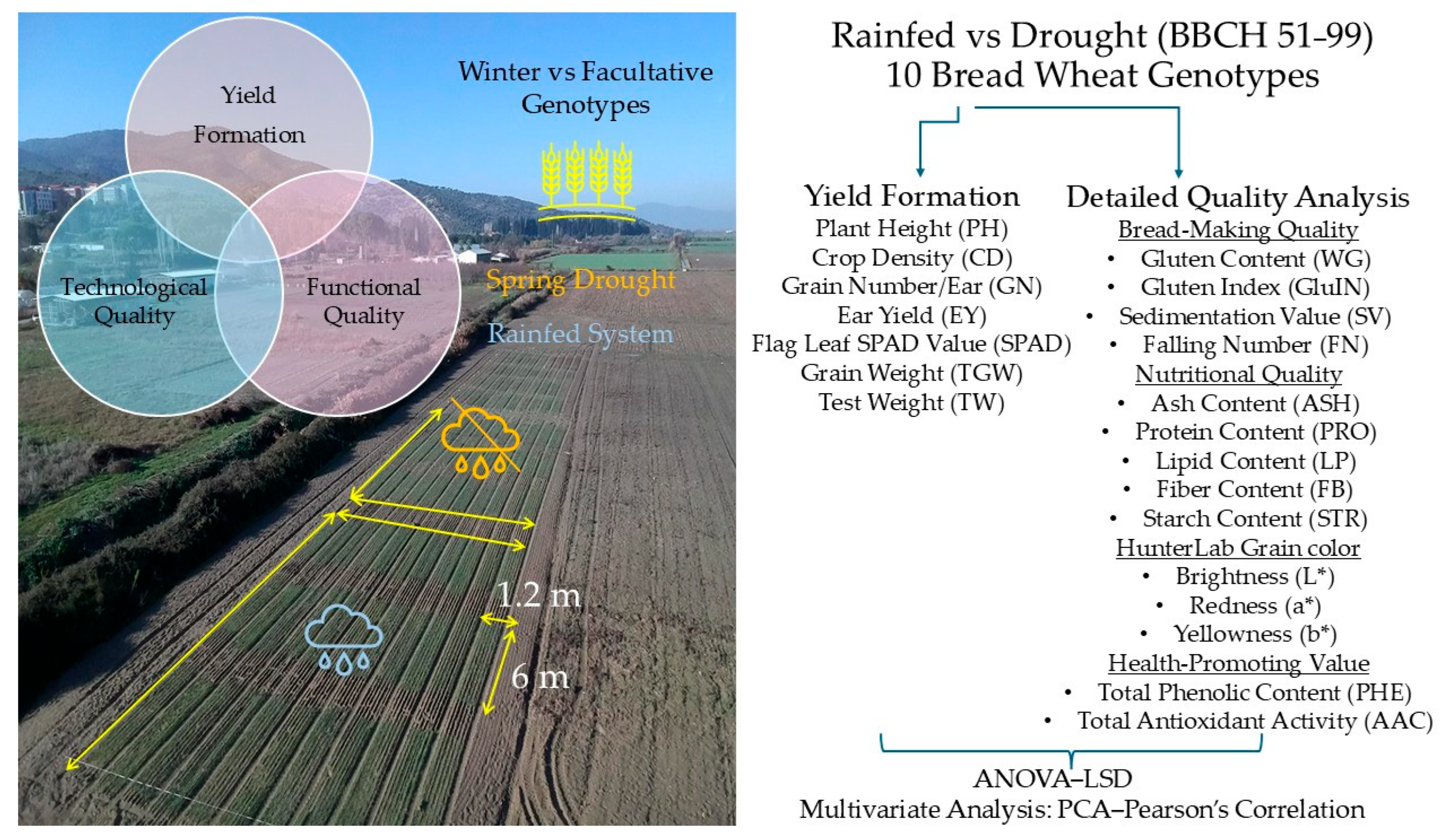
The experiment was laid out in a randomized split–split block design with three replications. Rainfed and drought treatments were applied as the main plot effect (Figure 2). For the purposes of this study, drought was simulated during the post-heading period (BBCH 49-51, 10 April 2019 and 5 April 2020) until harvest (BBCH 99) [41]. For this purpose, a rainout shelter was installed in drought plots, measuring 10 m width and 2 m height; wind circulation for plants was enabled by using a PE Film banner (+UV). The experimental area soil type is loamy (0.30 m depth) with 48.1% sand, 34.2% silt, and 17.5% clay texture properties. The organic content is low (0.64%) with an alkaline pH level of (8.3) and a water-holding capacity of 22.15%. In the anthesis stage, the gravimetric method was used to determine the soil water content in the 30 cm layer, which was found to be 55% and 46% of the water-holding capacity (22.15%) for rainfed conditions. However, as drought stress increased, the soil water content decreased to 36.9% and 25.2% of the water-holding capacity in 2018–19 and 2019–20, respectively.
In the field experiment, plot size and sowing distance between rows were adjusted to 1.2 m × 6 m and 20 cm (500 seeds m−2), respectively. During the growing season, nitrogen fertilizer was applied in the amount of 150 kg N ha−1 (divided into three doses: before sowing (35 kg N ha−1; 20.20.20); at the tillering stage (urea)—BBCH 21; and at the stage of stem elongation (nitrate 33%)). A chemical weed-killing solution containing 25% triosulfuron + 50% dicamba and 240g/L clodinafop-propargyl was used to target narrow and broad-leaved weeds. Furthermore, fungicide applications (50 g/L diniconazole) against Puccinia spp. wheat leaf rust diseases were conducted in both experimental years. In the anthesis period (BBCH 61), the flag leaf chlorophyll value was measured using a Konica Minolta (Tokyo, Japan) SPAD-502 meter. At harvest, the plant height (PH, cm) was measured from the soil surface to the top of the ear on 10 randomly selected plants per plot. The plots were harvested after the removal of border rows on 14 June 2019 and 7 June 2020, with the remaining area being utilized for the determination of yield and its components. The harvested grains were then subjected to threshing, cleaning, and measuring of grain weight and test weight, and then stored at 4 °C until chemical analysis.

2.3. Grain Quality and Color Analysis

All harvested seed samples were milled into whole wheat flour using a laboratory mill (UDY Corporation, Fort Collins, CO, USA) for determination of the bread-making quality, grain color, and nutritional value of the samples. The wet gluten (WG, %) value was determined in two sets of samples using Bastak (Ankara, Türkiye) (ICC Standard No: 137/1), and then the gluten index (GluIN, %) was determined using Bastak Index 2002 (ICC Standard No: 155) devices with whole-grain flour. Falling number (FN, second) was determined according to ICC Standard No: 107/1 in a Bastak falling number device, and the Zeleny sedimentation value (SV, mL) was determined according to ICC Standard No: 107. Grain color analyses (L*: brightness; a*: redness; b*: yellowness) were measured using a ColorFlex EZ Specktrophotometer (HunterLab, Reston, VA, USA). Grain ash (ASH, % DM), lipid (LP, % DM), fiber (FB, % DM), protein (PRO, % DM), and starch ratio (STR, % DM) were determined according to the Near-Infrared Reflected Spectroscopy (NIRS, Bruker MPA) method [42] and expressed based on dry matter content (% DM) (Figure 2).

2.4. Biochemical Analysis

Whole wheat flour samples were freshly milled for extraction to determine total phenolic content [PHE, μg gallic acid equivalent (GAE)/g, % dm] and total antioxidant activity (AAC, % Inhibition). For the extraction procedure, acidified methanol solution (HCl/methanol/water, 1:80:10, v/v/v) was prepared, and then the samples were shaken in a Gerhardt Thermoshake shaker for 1 h under nitrogen gas, followed by centrifugation at 5000 rpm for 20 min in a Hettich centrifuge, as described in [43,44]. Total phenolic content was quantified using the Folin–Ciocalteu method and extracts were reacted with this reagent and then neutralized with sodium carbonate. After 30 min. the phenolic mixture was centrifuged at 2000 rpm for 10 min. Gallic acid was used as the calibration standard, according to the procedures of [43,45] expressed as μg gallic acid equivalents/g sample dry matter basis (DM). Total antioxidant activity was determined using the DPPH (2,2-diphenyl-1-picrylhydrazyl) free radical scavenging assay, following the method of [46], and expressed as the percentage of inhibition. A measure of 3900 μL DPPH solution was added to 100 μL of methanolic wheat extract and the samples were put in 36 °C in water bath for 30 min. Absorbance was measured at 725 nm for total phenolic content and 517 nm for antioxidant activity using a Thermo Scientific spectrophotometer (Figure 2). Antioxidant activity was calculated as percent discoloration described below:
AAC (Inhibition %) = [(Absorbancecontrol − Absorbancesample) × 100/Absorbancecontrol]

2.5. Statistical Analysis

ANOVA and LSD test techniques were analyzed using the IBM SPSS V20 statistical analysis software to evaluate the obtained results in variance for each parameter and statistical differences. In addition, multivariate data analyses, including principal component analysis (PCA), the performance of genotypes under drought and rainfed conditions (combined two experimental years) and Pearson’s linear correlations, with p-values using the dataset consisted of two growing seasons, one water regime (drought), ten genotypes, and three replicates, resulting in a total of n = 60 observations were used. The analyses were performed in R studio (Boston, MA, USA) using the packages “factoextra” (version 1.0.7), “factoMineR” (version 2.8), and “metan” (version 1.18.0) [47,48]. Some figures were generated using Microsoft Excel (Microsoft Corp., Redmond, WA, USA) and point plots were created in R studio using ggplot2 (version 3.4.2) [49].

3. Results

3.1. Observed Yield Formation and Physical Grain Quality Traits in Drought and Rainfed Conditions for Bread Wheat Genotypes

Wheat yield is a highly complex parameter resulting from the interaction of numerous yield components. The influence of environmental factors and genetic properties on the outcomes is particularly notable in the results. Grain yield formation was significantly affected by annual weather variability, as reflected by the highly significant year (a) effect and its interactions with treatment (b) and genotype (c) observed in the results (Table S3). Year had a highly significant effect (p ≤ 0.01) on PH, EY, TGW, SPAD, TW, and GY, reflecting year-dependent variation. Rainfed and post-heading drought treatments (b) and genetic feature [genotype (c)] significantly affected (p ≤ 0.01) the yield and its components, flag leaf SPAD value in anthesis and grain formation (TGW, TW), reflecting strong variation in the yield formation. Moreover, highly significant (p ≤ 0.01) results obtained for year × treatment × genotype (a × b × c) interaction were observed in CD, GN, SPAD, TW, and GY traits, indicating complex and specific genotype responses under rainfed and post-heading drought conditions (Table S3).
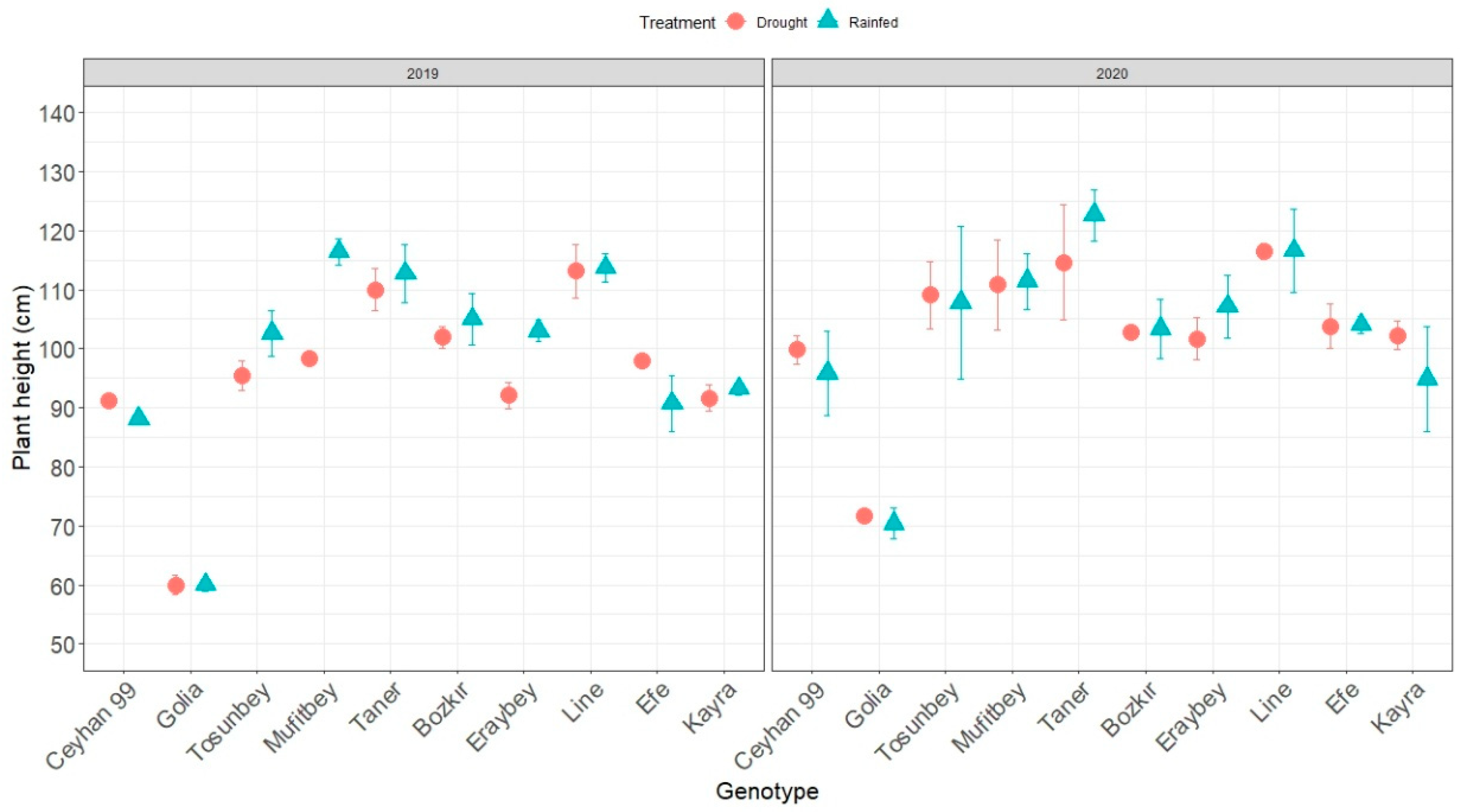
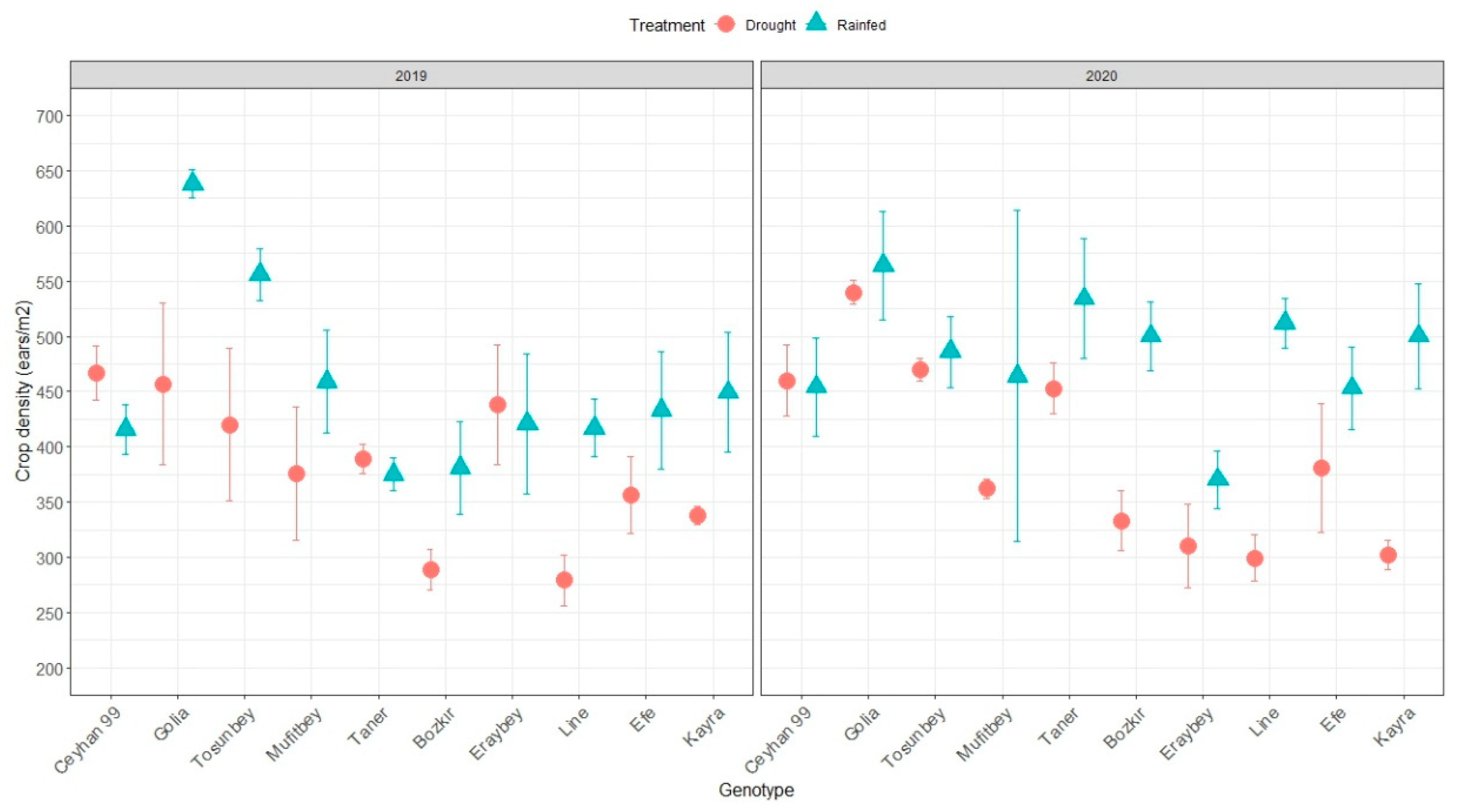
Plant height increased from 96.8 cm in 2019 to 103.3 cm in 2020, indicating more favorable vegetative growth conditions during the second season. Post-heading drought conditions caused significantly smaller plants (99.2 cm) compared with rainfed conditions (101.0 cm). Among genotypes, plant height ranged from 65.5 cm (Golia with reduced height (Rht) dwarf gene) to 115.0 cm (Advanced Line), reflecting genetic variability (Table S5). In contrast to the impact of drought on yield components, the results of this study demonstrate that plant height was affected only to a very limited extent by drought during the reproductive stage in some genotypes. On the other hand, significant treatment × genotype interactions indicated genotypic responses with differential height values in contrasting moisture levels (Figure 3). This study revealed that crop density (CD) was significantly influenced by year, treatment, genotype, and their interactions (see Table S3 for details). The mean CD was higher in 2020 (437 ears m−2) than in 2019 (418 ears m−2). Rainfed conditions were found to promote higher ear density (469 ears m−2) in comparison with drought stress (386 ears m−2).
The mean CD value was highest for the Golia genotype, at 550 ears m−2, by contrast, the lowest mean CD values were exhibited by the Bozkır and Advanced Line genotypes (Table S5). The Golia cultivar demonstrated the highest value in rainfall-dependent conditions in the first year (638 ears m−2), while the lowest value was observed in the same season in the Advanced Line (279 ears m−2) genotype under drought conditions after heading. However, as demonstrated in Figure 4, a substantial decline in crop density was observed among all genotypes under post-heading drought conditions.
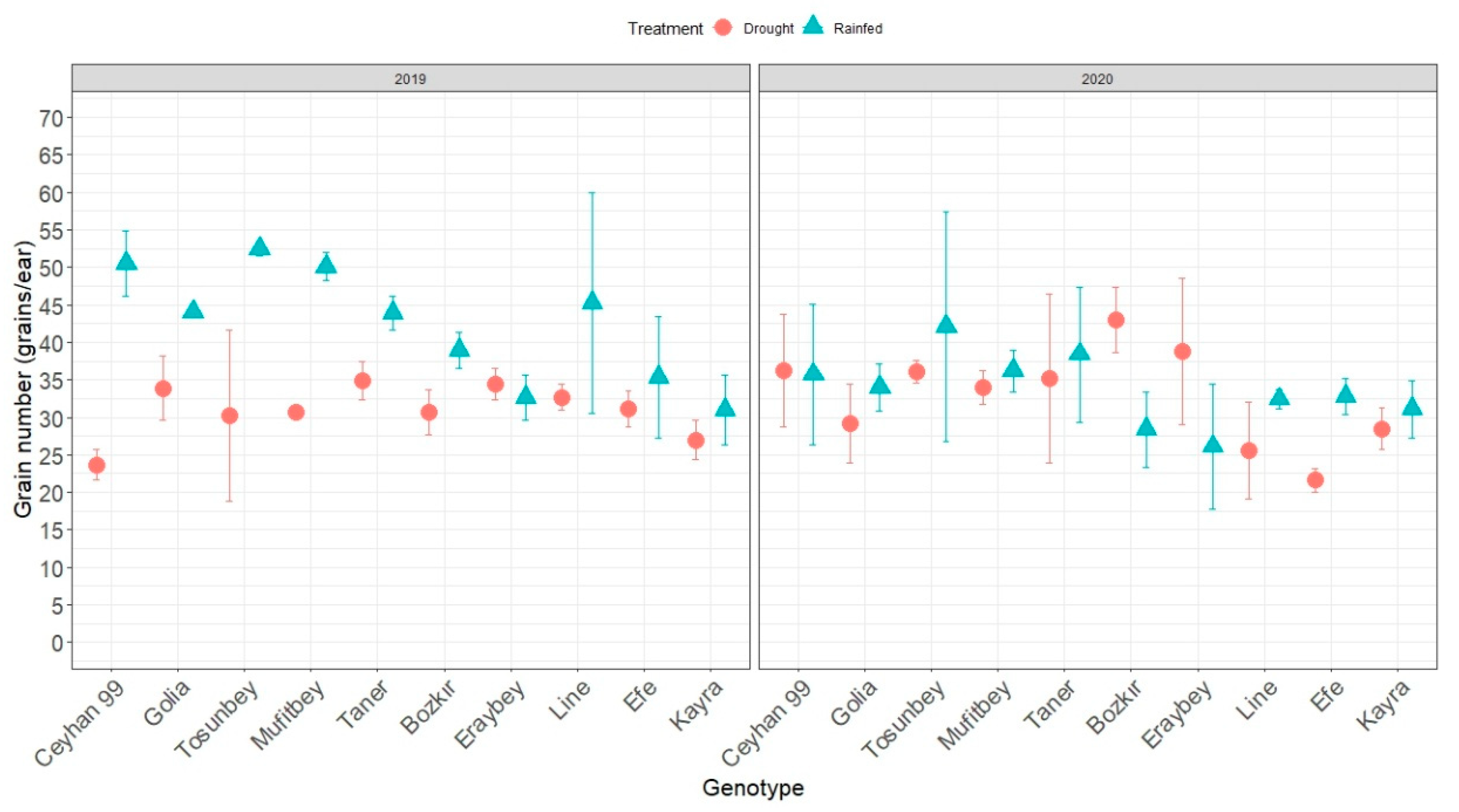
Grain number (GN) was significantly affected by the evaluated factors (year and genotype) and their interactions (a × b × c) (Table S3). GN decreased from 38.0 (grains/ear) under rainfed conditions to 31.9 (grains/ear) under post-heading conditions, reflecting a negative impact of post-heading drought on grain set regarding ear yield and fertility. Among genotypes, GN ranged from 29.4 (Kayra) to 40.2 (Tosunbey) (Table S5). The highest GN in both seasons was obtained in the rainfed system with the Tosunbey cultivar (52.5) in the first year of this study, while the lowest value was found in the post-heading drought conditions with the Efe variety (21.6) in the second year. Overall, some of the genotypes (Ceyhan 99, Müfitbey, and Kayra) maintained relatively higher GN under post-heading conditions in the second year, whereas most of them demonstrated reduced grain number under drought conditions except Bozkır and Eraybey (Figure 5).
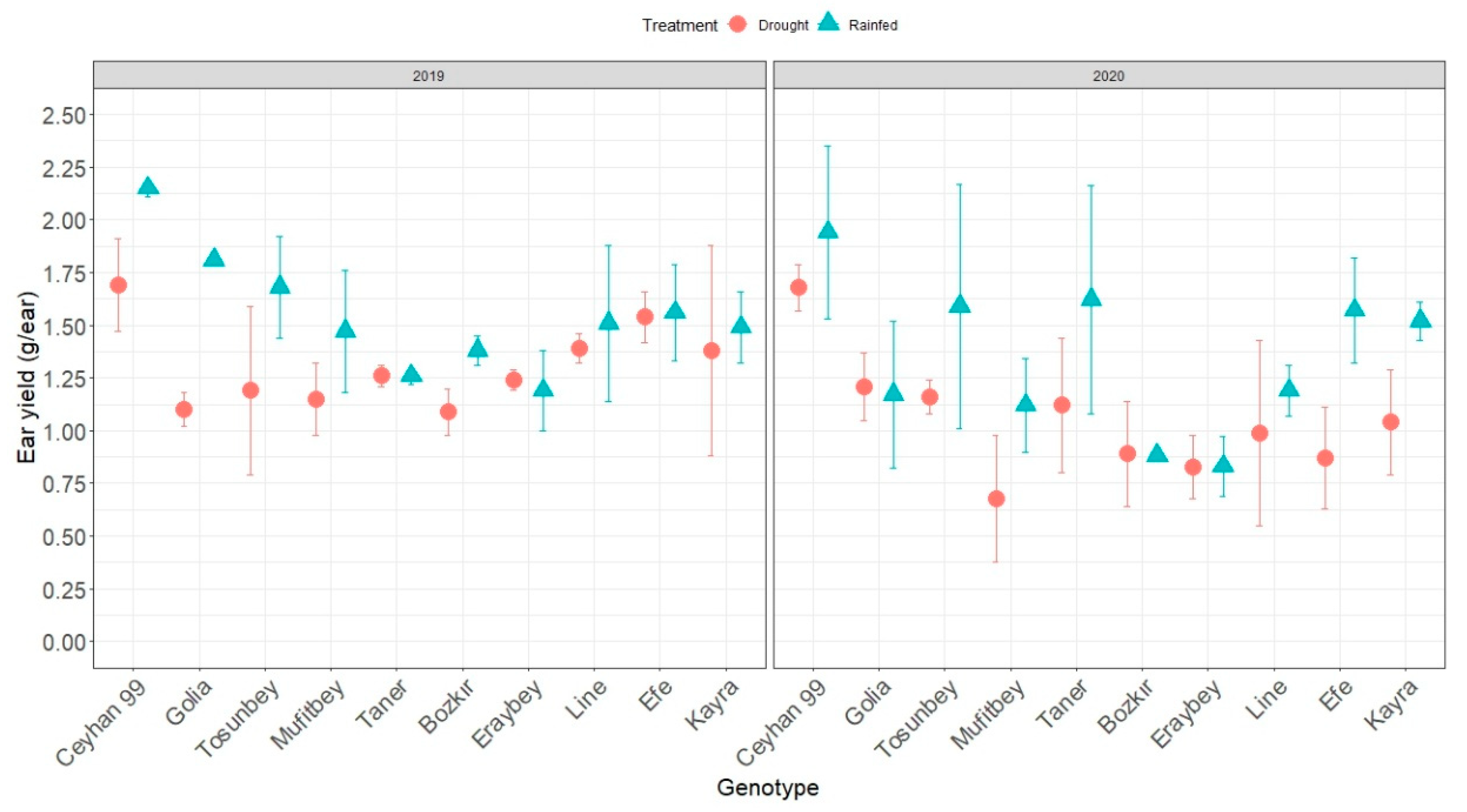
Ear yield was significantly affected by year, treatment, and genotype (Table S3). It is clear that higher EY values were obtained in rainfed conditions (1.43 g ear−1) than under post-heading drought (1.19 g ear−1) (Table S5). The lowest EY values were generally observed in cold-climate-adapted genotypes (Müfitbey, Eraybey, and Bozkır), while Ceyhan 99 obtained the highest EY value. In the second year of field trials, under the rainfed condition in particular, a significant increase in ear yield was observed for the Ceyhan, Tosunbey, Taner, Efe, and Kayra varieties (Figure 6).
Thousand-grain weight (TGW) and test weight (TW) were significantly affected by all factors (a, b, c), as well as their interactions (a × b × c) for TW (Table S3). Across seasons, grain weight was significantly higher in 2019 (43.8 g) than in 2020 (36.1 g), indicating a reduced grain-filling period under less favorable climatic conditions (higher mean temperature, ETp and GR). Post-heading drought caused significantly an approx. 8% decrease in grain weight. It has been observed that genotypes adapted to the region (Mediterranean climate) had higher values (Kayra, Efe, and Ceyhan 99) regarding grain weight. Furthermore, the lowest values were observed in the Bozkır (37.4 g) and Golia cultivars (36.5 g), which, in genetic terms, possess the lowest grain weights. Similarly, higher test weight (TW) values were observed in the first year (74.6 kg/hL), and post-heading drought conditions resulting in a substantial decline in values from 75.6 to 69.2 kg/hL were also observed. Among genotypes, TW ranged from 64.7 kg/hL (Bozkır) to 78.7 kg/hL (Kayra). Significant three-way interaction further demonstrated that genotype-specific differences in grain density were strongly modulated by seasonal climatic conditions and generative drought conditions for TGW and TW. The TW values exhibited significant variation between the two seasons, under contrasting rainfed and post-heading drought conditions. The highest value was observed in Efe (85.2 kg/hL) under rainfed conditions in 2019, while the lowest value (57.6 kg/hL) was recorded in Bozkır under post-heading drought conditions in 2020 (Table 2).
SPAD measurements have been shown to provide a reliable estimate of flag leaf chlorophyll status, which is critical for grain formation and quality during the post-generative stages of wheat. Overall, SPAD values were higher in 2019 (42.3) compared with 2020 (37.9), indicating reduced chlorophyll content under less favorable climatic conditions. It is clear that, under drought conditions, flag leaf SPAD value resulted in significantly lower SPAD value (37.4) compared with rainfed conditions (42.7), reflecting drought-induced chlorophyll reduction. Genotypes showed significant differences; Bozkır exhibited lowest SPAD values compared with other genotypes. The Ceyhan 99 and Golia cultivars had the highest demonstrated resilience in maintaining their chlorophyll levels during periods of post-heading drought conditions, exhibiting higher flag leaf chlorophyll values in both experimental years. Genotype-specific differences were revealed in flag leaf chlorophyll changes under drought and rainfed conditions. The Eraybey cultivar had the highest (52.0) SPAD value in the rainfed conditions of 2019 with decreasing results in drought conditions and the second year of the experiment (Table 3).
Grain yield (GY) was found to be significantly affected by year, treatment, and genotype, and their interactions (Table S3). Over the years, GY was higher under rainfed conditions (54.5 dt ha−1) compared with post-heading drought conditions (34.0 dt ha−1), corresponding to an overall yield reduction of approximately 38% under drought conditions. The highest yield values were observed with the Ceyhan 99, Golia, and Tosunbey cultivars, which are cultivated and adapted to the region, while Bozkır had the lowest yield values. In 2019, the trend of grain yield reductions under drought conditions was from −14.3% (Taner) to −44.3% (Tosunbey), whereas in 2020, yield losses were more pronounced, ranging from −10.7% (Ceyhan 99) to −58.3% (Taner). In 2020, when the lowest yield value (37.8 dt ha−1) was obtained compared with 2019, the lowest yield reductions were observed in Ceyhan 99 (−10.7%), whereas Müfitbey (−55.1%) and Taner (−58.3%) demonstrated marked susceptibility to drought. The obtained results indicate substantial genotypic variation and confirm that post-heading water limitation strongly constrains grain yield formation, particularly under unfavorable spring climatic conditions (Table 4).

3.2. Observed Results of Bread-Making and Grain Quality Traits Under Drought and Rainfed Conditions of Bread Wheat Genotypes

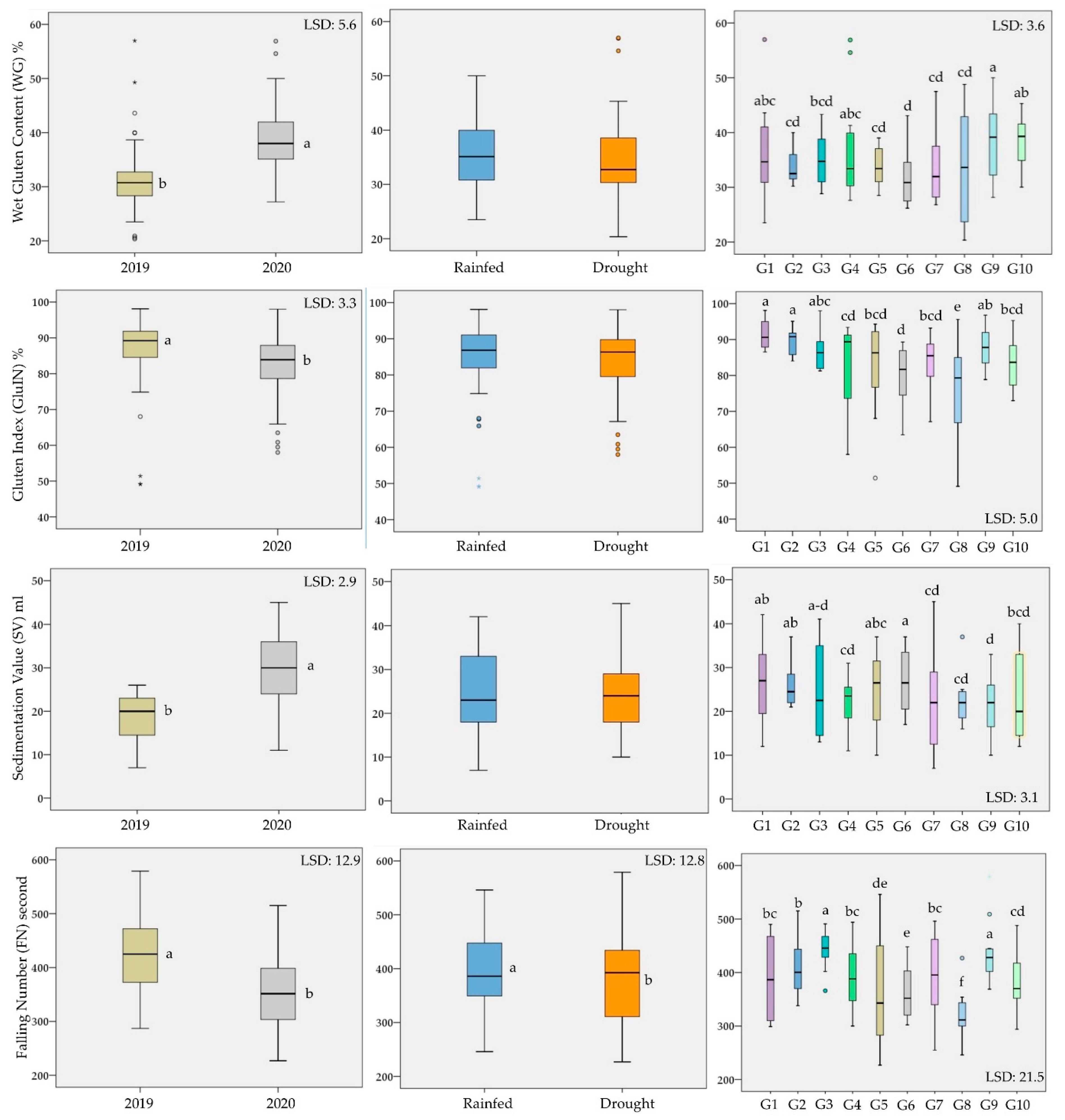
Figure 7 illustrates the effects of post-heading drought and rainfed conditions on bread-making quality traits of 10 bread wheat genotypes across the experimental period. The bread-making quality traits were found to be significantly influenced by the year and genotype, whereas the treatment (drought vs. rainfed) had a significant effect only on falling number (FN) (Tables S3 and S4). In general, wet gluten (WG, %) values were higher in 2020 in comparison with 2019. However, a slight reduction in gluten quantity was observed in the post-heading drought conditions in comparison with rainfed conditions. Conversely, the gluten index (GluIN, %) had higher values in 2019, exhibiting decreasing gluten quantity, which caused higher gluten strength in 2019. The Efe cultivar demonstrated the highest mean wet gluten (WG) value, followed by Kayra. In addition to higher gluten content, these cultivars also exhibited relatively high gluten strength, with Ceyhan 99 and Golia recording the highest GluIN values. In accordance with the yield parameters, Bozkır demonstrated the lowest WG and GluIN values. In accordance with the yield parameters, Bozkır demonstrated the lowest WG and GluIN values. The substantial genotypic variation observed for both WG and GluIN suggests that there is a differential capacity between genotypes to maintain gluten quantity and quality under post-heading drought stress and rainfed conditions. A comparatively high falling number (FN) and low sedimentation value (SV) were observed in the present study, in accordance with the known high-quality bread-making results. This situation can be attributed to the combined effects of elevated temperatures, post-heading drought stress, and seasonal climatic variability during the post-generative period of wheat.
As demonstrated in Figure 7, the SV resulted with the highest values in 2020. In contrast, the FN values were higher in 2019 and under rainfed conditions, whereas post-heading drought resulted in lower FN values, indicating enhanced α-amylase activity under stress conditions. Regarding these traits, the Bozkır cultivar came to the forefront, demonstrating good quality results with the highest SV value and lowest FN results.
The evaluated bread-making quality traits (WG, GluIN, SV, and FN) exhibited significant interaction effects, thereby indicating that genotypic responses were observed to vary depending on the year and water treatment (Tables S3 and S4). The Ceyhan 99 cultivar demonstrated the highest GluIN value in both rainfed and drought conditions during the first year of the experiment, while the Müfitbey cultivar exhibited a notable increase in WG under dry conditions. However, in the second year, Müfitbey exhibited the lowest gluten strength value in the drought condition, resulting in a weak gluten value despite an increase in gluten quantity. Regarding SV, the Tosunbey, Ceyhan 99, and Eraybey cultivars exhibited the highest values in the second year under drought conditions. Conversely, Eraybey demonstrated the lowest value in 2019 under rainfed conditions, which is a notable finding. Regarding the FN trait, the Taner cultivar exhibited the highest value in rainfed conditions in 2019 while it reached the lowest value in drought conditions in 2020. The substantial variation in values observed between genotypes suggests a robust genetic influence on bread-making quality traits, with environmental factors predominantly affecting FN (Table S6).
Table 5 shows the protein ratio values and change trend (∆%) for drought conditions compared with rainfed conditions for the 10 evaluated bread wheat genotypes during the experimental periods (2019 and 2020).
Mean protein content was higher in 2020 (15.1%) than in 2019 (13.2%), indicating significant year to year variation associated with different climatic conditions. This difference was likely related to higher mean temperatures (in April and May), evapotranspiration (ETp), and global radiation (GR) values during grain-filling period in 2020 (Figure 1 and Table S2). Considerable changes were observed, with mean protein ratios ranging from 13.55% (Bozkır) to 14.94% (Golia) across years and treatments. Across the range of water treatments, average protein values were found to be comparable under rainfed (14.2%) and drought (14.1%) conditions. The impact of drought on protein content was found to be genotype-dependent, with certain genotypes demonstrating increased protein ratios under drought conditions (e.g., Müfitbey: ∆+19.7% and Eraybey: ∆+15.3% in 2020), while others exhibited slight reductions. In 2019, a substantial decline in protein content was noted in some genotypes (e.g., Eraybey: ∆−19.4%, Golia: ∆−9.57%), while Ceyhan 99, Efe, and Müfitbey showed positive increases in the protein ratio.
The mean values and standard deviations of grain ash, lipid, fiber, and starch ratios are provided in Table 6. These traits exhibited strong genotypic control, with seasonal climatic conditions exerting a greater influence than post-heading drought and rainfed treatments alone. Mean grain ash values were higher in 2020 than in 2019, suggesting variation in mineral accumulation depending on seasonal climatic conditions of both years. There were pronounced genotypic differences, with Bozkır, Advanced Line, and Taner exhibiting higher values, while Golia and Eraybey obtained lower values across water treatment in the first year. Grain lipid ratio was significantly changed with water treatments as drought conditions increased. In 2020, Golia, Taner, and Eraybey obtained the highest grain lipid values in post-heading drought conditions and Ege had the highest value in rainfed conditions in addition to these cultivars. Post-heading drought resulted in changes in both positive/negative ways in grain fiber content, depending on genotype, highlighting a strong genotype-specific response. In general, grain fiber values were higher (e.g., Tosunbey, Müfitbey, Bozkır, Eraybey, and Advanced Line) in the post-drought conditions in 2020, reflecting altered grain composition under unfavorable climatic conditions and water limitations. In addition to fiber content, grain starch content was also significantly affected by genotype, and their interactions reflect a differential genotypic response to maintain starch accumulation in grain under different climatic and water-limited conditions (Table S4). It was observed that while certain genotypes demonstrated stability or a marginal increase in starch content under drought conditions, others exhibited a reduction. Grain starch content exhibited significant variation, showing a different genotypic response, with the highest values recorded in Taner (74.61%) and the lowest in Bozkır (58.88%) under the first year of rainfed conditions (Table 6).

3.3. Observed Results of Grain Color (L*, a*, b*) and Biochemical (Total Phenol Content and Antioxidant Activity) Properties of Bread Wheat Genotypes Grown in Rainfed and Post-Heading Drought Conditions

Analysis of variance indicated that grain color traits were significantly (p ≤ 0.01) affected by treatment (rainfed and post-heading drought) and genotype, whereas year was not significant. It was also observed that brightness (L*) and redness (a*) color traits were significantly dependent on the combined effects of seasonal conditions, water treatment, and genotype (a × b × c) background, while interaction effect was not significant for yellowness (b*) (Table S4).
According to the mean values, a slight increase in mean L* values was observed under rainfed conditions (83.69) in comparison with post-heading drought (83.36), suggesting a modest decline in grain brightness under conditions of drought stress. A considerable genotypic variation was observed, with Eraybey, Efe, and Bozkır exhibiting the highest mean L* values, whereas Golia and Taner showed comparatively lower brightness. It is evident that Taner (L* = 81.71) and Golia (L* = 82.05) (two red grain cultivars) exhibited the lowest L* brightness values. Moreover, consequently, Golia had the highest redness value (a* = 2.95) compared with other genotypes. It is acknowledged that genotypes are significant in both grain color traits. Unlike grain L* color, post-heading drought conditions caused significant increases in grain redness color. The a* values of the Golia cultivar increased and the highest values (a* = 3.14 and 3.05) were obtained in drought conditions (Table 7).
These interaction effects also exhibit considerable genotyping-dependent variation and are further influenced by soil water availability in generative periods. Across the study period, post-heading drought resulted in significantly higher mean values (b* = 12.2) than rainfed conditions (b* = 11.0), indicating enhanced yellowness under drought stress (Table 8). The findings also demonstrated that the genotype effect was significant for yellowness. It was observed that Müfitbey exhibited the highest grain b* value (12.6), followed by Tosunbey (11.9) and Advanced Line (11.8). The lowest value was observed in Kayra (b* = 10.8) (Table 8).
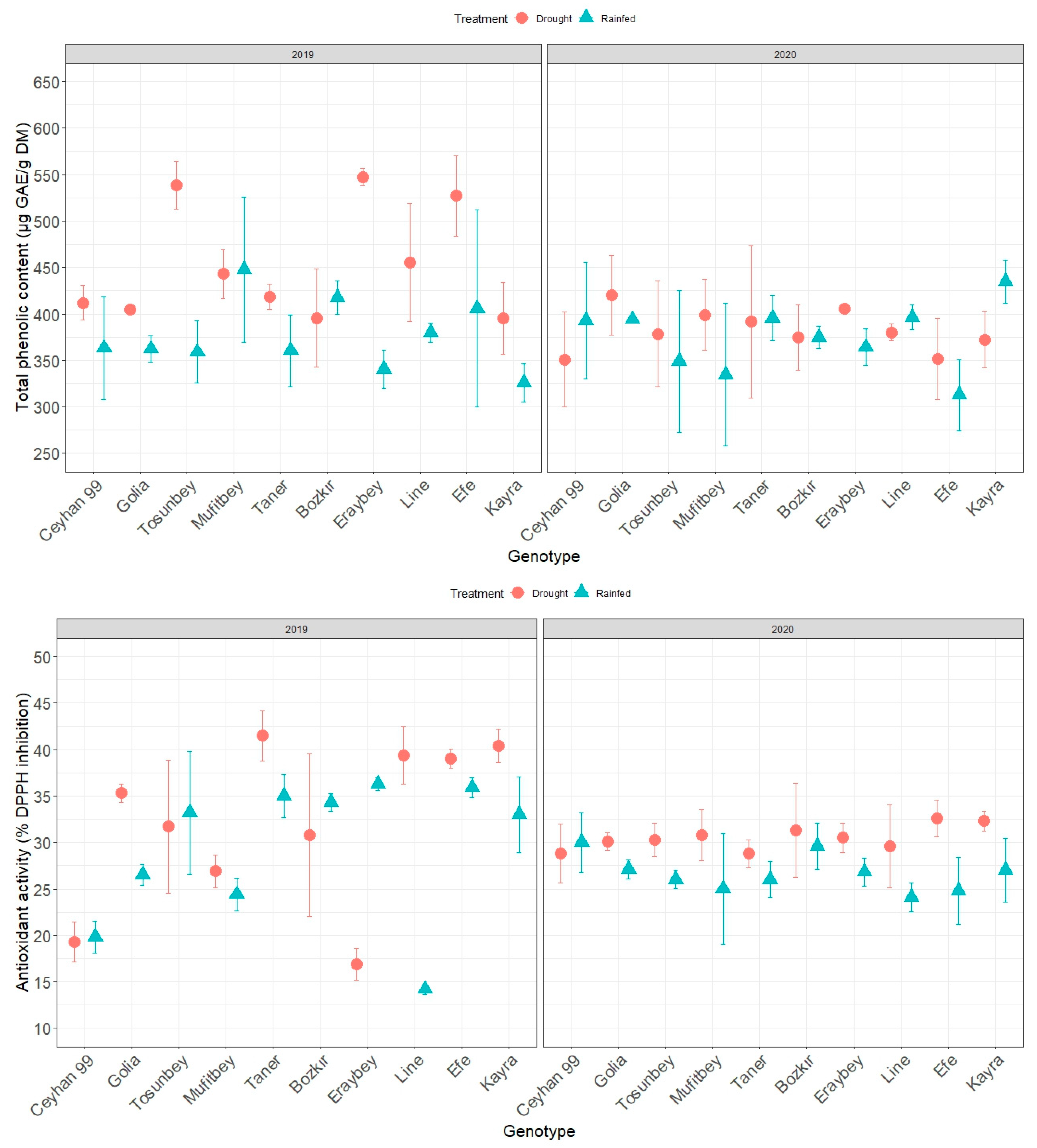
The present study also examined the total phenolic content and antioxidant activity as health-related biochemical traits of bread wheat grain, as well as the genotypic response to unfavorable soil moisture conditions. The findings revealed that total phenolic content (PHE; μg/g DM) and total antioxidant activity (AAC: % Inhibition) of grain were influenced to a significant degree (p ≤ 0.01) by year, treatment, and genotype. Furthermore, a significant year x treatment x genotype interaction was identified for total antioxidant activity. Both traits exhibited higher values in 2019 relative to 2020, with consistently greater values under post-heading drought than under rainfed conditions (Table S4).
A decline in the phenol values of the cultivars was observed in the second year and under dry conditions and a lower trend was also obtained for antioxidant activity. This phenomenon is of particular interest in the second year, due to the high mean temperatures experienced in April and May (the period during which the anthesis–grain-filling periods occur) and the observation of elevated ETp and GR values. The highest PHE values were observed in the first year under dry conditions in the Eraybey, Tosunbey, and Efe varieties, while the lowest value was again detected in the Efe variety in the second year under rainfed conditions. The distribution of antioxidant activity values exhibited a wide range (14.2–41.5%) across various cultivars according to seasonal climatic conditions, drought-rainfed conditions, and genetic characteristics. A significant trend of increased antioxidant activity was observed in all bread wheat genotypes under drought conditions compared with the rainfed-dependent system every two experimental years. When the results of antioxidant activity were evaluated on a general scale, the Taner cultivar attained its maximum value in the initial year under drought conditions, while the minimum value was observed in the same trial year in the rainfed system within the Advanced Line genotype (Figure 8).

3.4. Principal Component Analysis Results

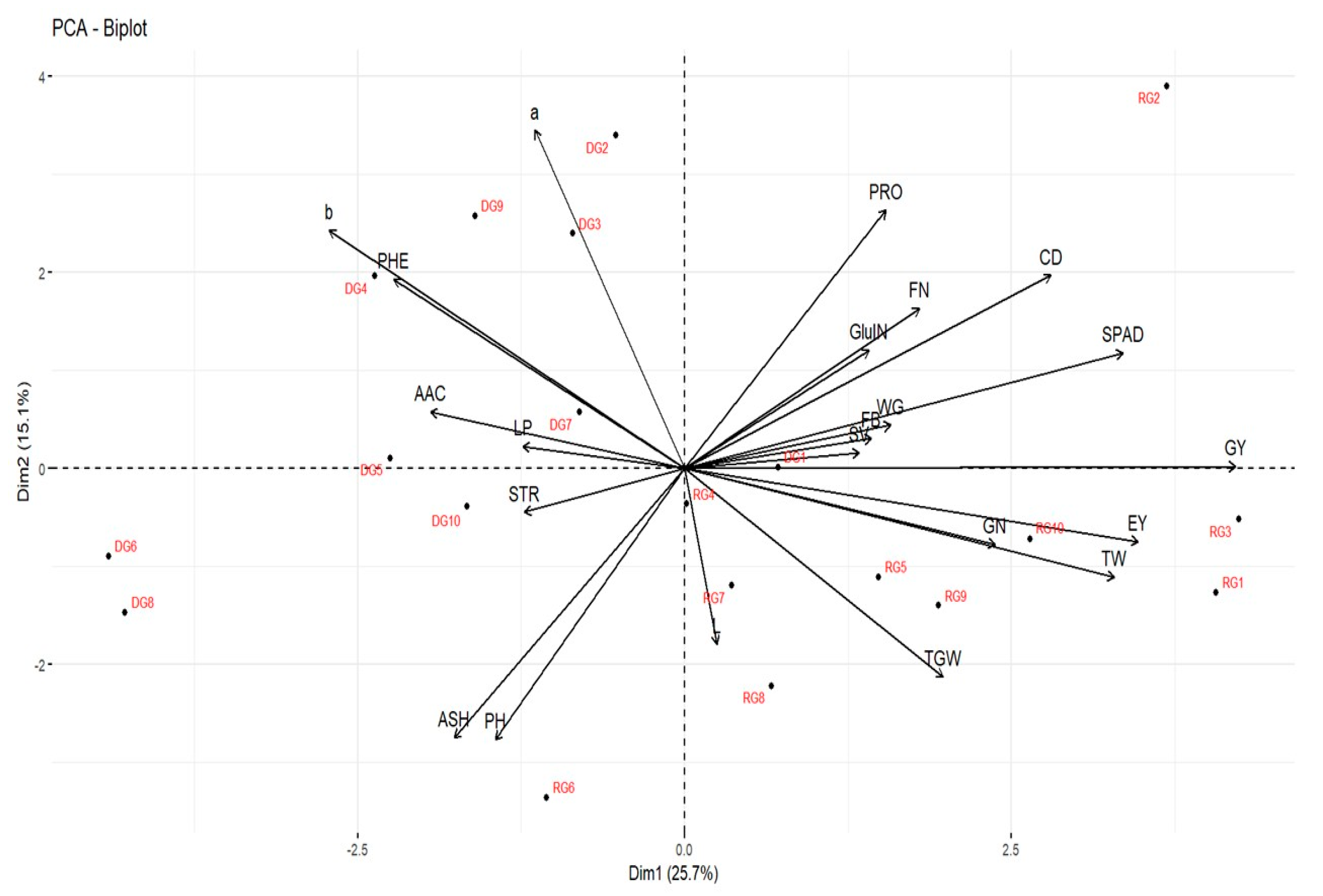
A principal component analysis (PCA) was performed to evaluate yield formation and multiple quality traits (physiological, technological, nutritional, and functional quality) under rainfed and post-heading drought conditions (Figure 9). According to the PCA analysis for bread wheat, two principal components explained 40.8% of the total variance (Dim1: 25.7 and Dim2: 15.1%). Dim1 was mainly associated with physiological and yield-related traits showing strong positive relationships for grain yield (GY), ear yield (EY), grain number (GN), thousand-grain weight (TGW), test weight (TW), crop density (CD), and flag leaf SPAD value in anthesis (SPAD). It is noteworthy that the formation of yield was influenced by numerous interacting variables, underscoring that SPAD, EY, and TW came to the forefront regarding important parameters for yield formation.
Rainfed genotype and environment combinations, particularly RG1 (Ceyhan 99) and RG3 (Tosunbey), were positioned on the positive side of Dim1, reflecting superior yield performance and photosynthetic capacity under the rainfed condition. In contrast, DG6 (Bozkır) and DG8 (Advanced Line) were located on the negative side of GY, showing reduced yield formation under the post-heading drought condition. Furthermore, the parameters of bread-making quality and protein content were shown to be within the positive range of Dim1, indicating that these characteristics exhibit a positive increase under rainfed conditions in comparison with drought conditions. RG2 (Golia) showed a positive strong relationship with grain protein content and higher gluten strength (GluIN) under rainfed conditions. Grain color (a* and b*), total phenolic content, antioxidant activity, lipid content, and starch content parameters were mainly associated with increasing values in post-heading drought conditions. Dim2 can be interpreted as an axis of quality differentiation, integrating technological and functional grain quality traits that are largely independent of yield formation. Grain yellowness color and total phenolic content showed a strong relationship related to higher values of DG4 (Müfitbey) in drought conditions. The PCA demonstrated a clear and significant separation of rainfed and post-heading drought conditions, thereby illustrating a trade-off between yield-related and quality-related traits. Genotypes such as Ceyhan 99 and Tosunbey demonstrated favorable associations with yield traits when cultivated under rainfed conditions (Figure 9).

3.5. Relationships Between Yield and Multiple Quality Traits Under Post-Heading Drought Conditions

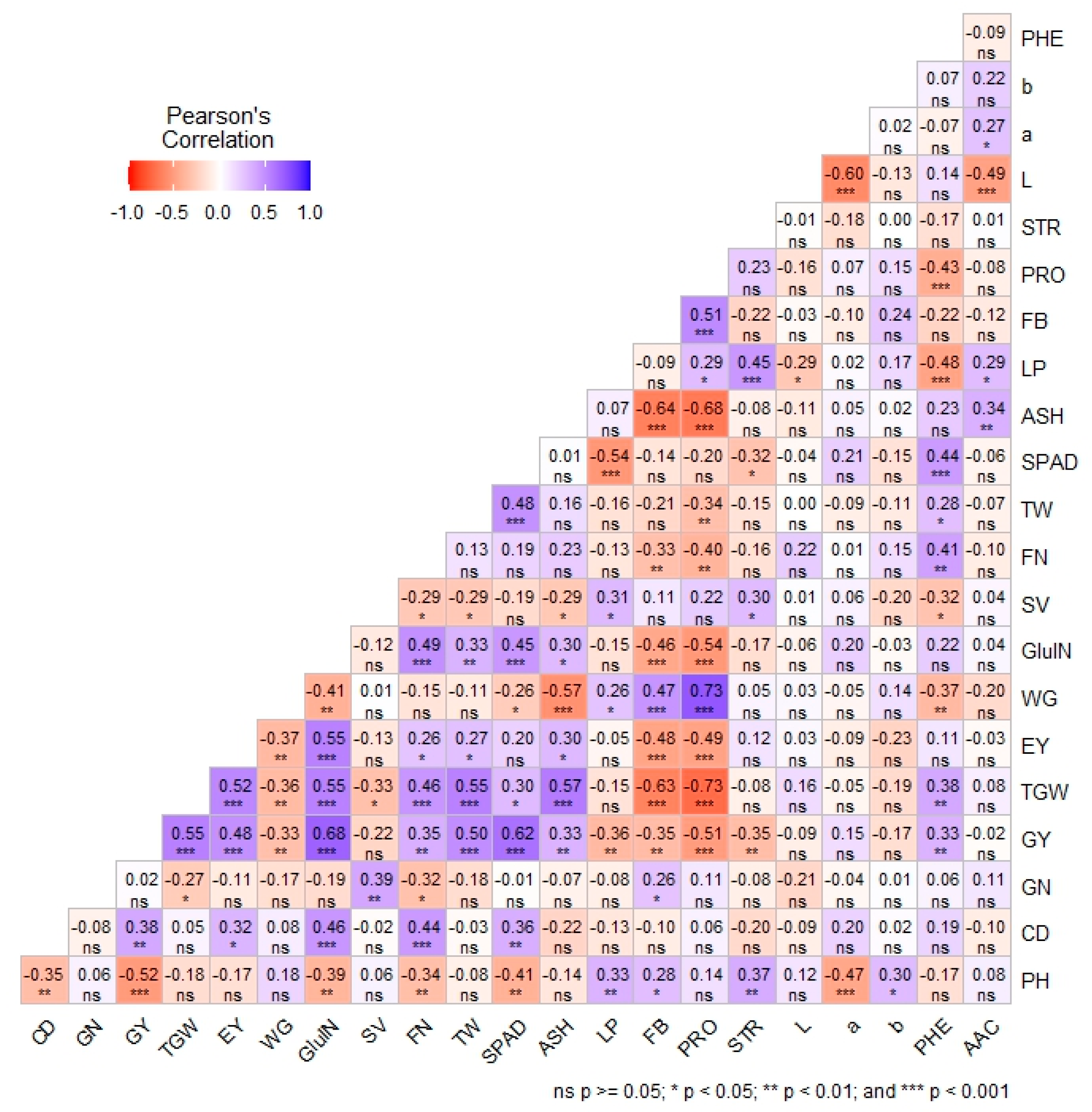
The correlation matrix indicated clear shifts in trait relationships under post-heading drought conditions. Grain yield (GY) showed strong and significant positive correlations with key yield components, particularly grain weight (r = 0.55 ***), ear yield (r = 0.48 ***), and crop density (r = 0.38 **) except grain number per ear (r = 0.02 ns), confirming their significant role in yield formation.
In addition to yield components, flag leaf SPAD value in anthesis (r = 0.62 ***) and test weight (r = 0.50 ***) were found to be highly significant correlates of grain yield, indicating the importance of flag leaf chlorophyll content, which supports assimilate supply through grain post-anthesis under drought conditions (Figure 10). The correlation analysis indicated that higher chlorophyll content (flag leaf SPAD value) was associated with increased yield performance. This relationship underscores the importance of preserving elevated chlorophyll content during the anthesis period to achieve higher yield values and contributes significantly to yield formation under unfavorable weather conditions. The SPAD value was found to be positively correlated with gluten index (r = 0.45 ***), test weight (r = 0.48 ***), and grain weight (r = 0.30 *). The analysis revealed a significant correlation between grain protein content and wet gluten (r = 0.73 ***). This finding suggests that an increase in protein content is associated with a corresponding increase in gluten quantity in drought conditions (Figure 10).
Among bread-making quality traits, sedimentation value resulted in a positive correlation with grain number (0.39 **) and starch content (r = 0.30 *), while ash, test weight and falling number had negative correlation results. Wet gluten content showed positive correlation results with fiber content (r = 0.47 ***) in addition to protein content. Also, statistically significant negative relationships obtained between wet gluten and gluten index, ash content, grain yield, ear yield and grain weight. It has been determined that an increase in gluten content is associated with a reduction in quality and strength of gluten in drought.
Grain ash content showed significant negative content with protein (−0.68 ***) and fiber content (−0.64 ***). Moreover, grain fiber content resulted in a negative correlation (r = −0.35 **) with yield, yield components (TGW, EY) and gluten index while positive correlation observed in protein content. Grain lipid content has positive correlated relationship with grain starch (r = 0.45 ***) protein (r = 0.29 *). From a general perspective, it can be concluded that grain nutritional quality traits are negatively correlated with yield, and that reduced grain yield under drought conditions may have a positive effect on gluten content and nutritional quality (lipid, fiber, protein, starch).
Regarding the grain color characteristics, these were influenced by the interactions between the three evaluated color traits (L*, a*, b*). Grain brightness obtained a significant negative correlation result (r = −0.60 ***) with grain redness color. Grain brightness color was found to be negatively correlated with grain antioxidant activity (r = −0.49 ***), while grain redness was found to be positively related to antioxidant activity.
Lastly, health-related biochemical traits showed no statistically significant results with each other (PHE and AAC), contrary to expectations. However, an important point was obtained in total phenolic content positively correlated with grain yield (0.33 **), grain weight (0.38 **), test weight (0.28 *) and flag leaf SPAD value in anthesis (r = 0.44 ***), while wet gluten, lipid and protein content showed negative correlation results in post-heading drought. Moreover, total antioxidant activity was found to be positively related to grain ash (r = 0.34 *), lipid content (r = 0.29 *) and grain redness color (r = 0.27 *) under drought conditions. Overall, the correlation matrix contributed to understanding yield formation and revealed significant relationships between the quality traits of bread wheat (Figure 10).

4. Discussion

In Mediterranean climates, recent climatic changes have had an adverse effect on winter cereal production as a result of annual precipitation reduction. This is due to increased precipitation variability in spring and altered seasonal distribution of precipitation resulting from higher temperatures, with a progressive shift of winter rainfall toward spring [50,51,52]. Consequently, water stress during wheat reproductive stages has increased, leading farmers to rely more on supplemental spring irrigation. Water limitation and drought stress adversely affect photosynthetic efficiency, nutrient uptake, and support assimilate transfer to grains of wheat. This situation results with plant senescence and, in particular, has detrimental effects on generative growth periods, such as anthesis and grain-filling periods leading to lower grain yield [53,54]. The results of this study suggest that post-heading drought conditions adversely affect wheat yield formation and reduced flag leaf chlorophyll content resulted in grain yield reduction. The findings indicate that, under drought conditions, grain yield decreased from 54.4 (dt/ha) to 34.0 dt/ha, and the SPAD value decreased from 42.3 to 37.9, in comparison with the rainfed condition. During the anthesis period, the chlorophyll content of flag leaf is one of the most important factors affecting yield and decreases significantly under drought conditions. Changes in photosynthetic pigments under drought stress are a key indicator of photosynthesis and one of the fundamental elements affecting yield. In wheat, this is particularly associated with the flag leaf of wheat, as it is the most significant organ in this process and is responsible for 90% of the grain yield that is derived from photosynthetic production; moreover, the flag leaf is sensitive to drought stress, which causes flag leaf senescence [55,56]. Previous studies have shown that leaf chlorophyll concentration decreases by 9% under dry conditions, which has a negative effect on photosynthesis [57].
According to PCA and correlation results, the yield formation and related yield components responsible for final yield value in drought condition, the CD, EY, TGW and TW parameters were found to be related to GY. Despite the occurrence of drought stress during the generative phase, CD and EY emerge as primary factors that determine wheat yield in dry conditions. This is primarily due to the fact that plant density exerts a significant regulatory influence on ear number, which constitutes a substantial component of final grain yield. Appropriate sowing density increases wheat grain yield and water productivity by promoting efficient use of limited rainfall and irrigation through greater crop transpiration [58]. EY is another significant parameter in the formation of yield and is found to be considerably influenced by climatic conditions and stress conditions occurring between heading and flowering. The results obtained demonstrate a 19.3% decrease in the EY under the post-heading drought conditions. The PCA results revealed that, particularly under rainfed conditions, EY significantly contributed to the increase in grain yield values of the Ceyhan 99 and Tosunbey, including TW and GN. During the reproductive phases, exposure to drought and heat stress conditions reduces pollen viability and induces floret abortion, leading to declines in GN and final grain yield under water-limited conditions [20,59,60]. Maintaining optimal GN and grain formation (weight) under drought stress is hypothesized to enhance wheat yield formation by supporting a higher number of ears per unit area. EY is also a robust (correlated with GY; r = 0.48 ***) trait for explaining final grain yield under drought conditions and was found to decrease in drought conditions by about 19.3% compared with rainfed conditions. In a previous study, it was revealed that positive relationships of grain weight, CD, spike length, chlorophyll index, grain filling duration, and GN with yield caused wheat genotypes to exhibit higher performance under drought stress [61]. It is noteworthy that genotypes maintaining higher TW, GW and EY under drought conditions exhibit better floret survival and heavy with plump grain, longer flag leaf stay-green duration (higher SPAD values during this period), and effectively assimilate remobilization to grain in generative stages, bringing these traits to the forefront as potential high-yield properties in Mediterranean climates. Furthermore, this study highlights that genotypes exhibit different responses (even adapted to region) regarding yield under varying water treatment conditions, with the lowest yield of winter growth habit cultivar (Bozkır, 30.3 dt/ha) being particularly noteworthy during experimental period in rainfed and drought conditions. However, winter and facultative growth habit genotypes had the lowest yield values in the second experimental year of the study in drought condition. In general, early flowering/heading, which enables wheat to shorten its life cycle and complete the most sensitive generative growth stages before exposure to severe stress conditions (heat and drought), constituting and effective drought escape strategy [18,62]. Moreover, the cultivars adapted to the region (i.e., Ceyhan 99, Golia, and Tosunbey) have facultative growth habits that had better advantage of ensuring earlier maturity and anthesis/heading by supporting higher flag leaf SPAD values (particularly in the second year) in drought conditions. This may be explained as these cultivars experience shorter exposure to arid conditions than other genotypes exposed to prolonged spring drought.
One of the main goals of this study is to evaluate the response of multiple quality traits of wheat to reproductive drought conditions. The quality of wheat grain, particularly protein composition and gluten characteristics, plays a critical role in determining processing performance and the quality of final products such as bread, pasta, and other cereal-based foods. This study observed that the multitude of quality traits exhibited variations in response to drought conditions depending on genetic and seasonal climatic factors. The results underscore the importance of such evaluations for developing wheat cultivars with stable yield and quality under increasing climate variability. This study determined that bread-making quality characteristics vary depending on the growing season (year) and genetic factors rather than drought and rain-dependent treatments. Environmental conditions (including heat/drought) strongly affect grain yield, and several quality traits (i.e., gluten quality) are determined and controlled by genotype [63]. Moreover, this study revealed a significant relationship between protein content and (WG, r = 0.73 ***) gluten quantity. However, significantly negative relationship was found between other bread quality characteristics (GluIN: r = −0.54 *** and FN: r = −0.40 **) and protein content in the post-heading drought condition.
Cultivars (Ceyhan 99, Golia, Tosunbey and Efe) that have adapted to the regional conditions of the experiment under which this study was conducted regarding gluten strength have become more noticeable with higher results compared to other genotypes. It has been established that sedimentation and falling number values are typically in the medium–low range in relation to bread-making quality characteristics. Protein content, wet gluten, gluten index, and sedimentation value traits were not affected significantly by rainfed and post-heading drought conditions in this study. Genotypes showed differential responses to growing seasons and water regimes, confirming that protein content and quality traits (especially GluIN) are predominantly under genetic control [64]. The negative correlation between WG and GluIN may be linked to heat and drought stress cause to increase protein concentration while altering gluten composition and reducing polymeric gluten fractions, ultimately weakening gluten structure and functionality [65]. In conclusion, an increase in protein content is not associated with an improvement in protein quality.
Although previous studies have reported increased protein content under drought and heat stress during grain filling, this trend was not supported by the ANOVA results in the present study. However, PCA and correlation analyses revealed a negative relationship between grain yield and protein content under post-heading drought, suggesting that reduced yield may have led to a relative increase in protein concentration due to a dilution effect [66,67].
Consistent with bread-making quality traits, treatment (rainfed vs. post-heading drought) effects on grain nutritional quality were not significant when the factors were considered independently, while genotypic responses were found to be significant and varied across climatic and water-stress environments (year x treatment x genotype). A negative and significant relationship (r = −0.68 ***) has been found between protein and ash content [68] and positive correlation found with fiber content (r = 0.51 ***) in the post-heading drought condition. In daily diets, the awareness of consumers mainly focuses on healthy, high-fiber products. This situation may be attributed to genotypic variation and its response to different drought and environmental conditions, as well as proportional changes between them within the grain. Nevertheless, the positive correlation between protein and fiber content under arid conditions is consistent with the beneficial effects of such conditions on nutrition. Under warmer (in 2020) and water-limited (post-heading drought) spring conditions, Müfitbey tends to show higher protein and fiber contents, along with a lower grain weight value compared to other cultivars. This finding was supported by the correlation results, with the TGW exhibiting a significant negative correlation with the protein content (r = −0.73 ***) and fibre content (r = −0.63 ***).
Since baked products made with white flour dominate the production of high-quality products, the focus is on two main components that contribute to improving the starchy endosperm composition and health outcomes: starch and dietary fiber [69]. According to the PCA biplot, STR exhibited a clear negative association with grain yield (GY), as indicated by the opposite orientation of their vectors. In contrast, FB showed a positive relationship with GY, while its association with STR was weakly negative, suggesting differential roles of these traits in yield formation under the rainfed and post-heading drought conditions. The negative relationship observed between traits and the varying responses of genotypes highlights the importance of breeding efforts related to this topic in Mediterranean climate.
Evaluating grain color and biochemical health-related quality traits under drought conditions provided important insights and results into drought-induced changes and contributed a new perspective to literature. In this study, grain color (L*, a*, b*) properties were characterized by a uniform and bright golden yellow color for high-quality pasta production, and their relationships were examined for biochemical properties in drought conditions. However, these characteristics have been linked to the presence of health-promoting biochemical compounds in bread wheat grains [70]. Flour color is mainly controlled and modified by genetic factors [71], and this study revealed significant changes between genotypes (with treatment modifying for b*). It is clear that the results show that drought caused higher color values for a* and b* while brightness increased in rainfed conditions. At this point, Müfitbey cultivar, which exhibits a winter-type growth habit, demonstrated substantial outcomes in terms of higher grain yellowness and phenolic content when it is exposed to post-heading drought condition. A key accomplishment of this study is the identification of a significant positive relation between grain yellow pigment and phenolic content, as revealed by PCA analyses. Concurrently, an increase in yellow pigment in the grain has also been observed, which led to an increase in phenolic compounds [72]. In addition, grain redness (a*) correlated positively and significantly (r = 0.27 *) with total antioxidant activity in the post-heading drought condition. According to the results of the PCA analysis, there was a demonstrable increase in antioxidant and phenolic content levels in response to drought conditions [38,73]. The water-limited conditions contributed to the increase in health-related traits in a positive way after heading, depending on seasonal climate conditions and differential genotypic performance. Despite the absence of a significant correlation between total phenolic compounds and antioxidant activity, a notable association (r = 0.29 *) was identified between antioxidant activity and grain lipid content in the post-heading drought condition. This observation suggests a potential contribution of lipid-related antioxidant components. This situation also highlights the importance of whole wheat flour-based products that contain health-related compounds. The embryo is an important part of the wheat grain structure, containing about 10–15% lipids, 25–25% protein, 17% sugar, and 1.5–4.5% fiber; moreover, about 4% minerals and a high amount of lipids are located in the germ part [74]. However, the embryo is typically discarded during the milling process [75]. In contrast to the observations made in the context of lipid content, no significant relationship was identified in this study between fiber content and antioxidant properties.
Post-heading drought conditions led to marked reductions in yield and yield components while exerting contrasting effects on grain quality, with some traits being negatively (positive correlated with GY) affected (PHE, ASH, GluIN) and others (negative correlated with GY) showing improvement (STR, PRO, FB, LP, and WG). This is particularly observed between the yield and phenolic content of wheat grain. PCA results showed that facultative growth genotypes (i.e., Ceyhan-99, Tosunbey, Efe and Kayra) were strongly associated with yield-related traits (EY, GN and TW), reflecting their superior performance under rainfed conditions. In contrast, the winter-type growth habit genotypes (i.e., DG4: Müfitbey) showed a stronger association with phenolic accumulation under drought, suggesting that prolonged exposure to post-heading water deficit enhances the synthesis of secondary metabolites in wheat grain. Early maturing cultivars likely sustain yield formation by maintaining flag-leaf photosynthetic activity and assimilate supply during grain filling in rainfed condition, whereas lately maturing genotypes exposed to extended drought tend to produce smaller (opposite side vector of TGW to PHE) and shriveled grains (because of accelerated development) accumulate higher levels of phenolic compounds [70]. These differential responses highlight genotype-specific and trait-dependent adaptations to drought conditions and seasonal climate variability, underscoring the importance of climate-adapted genetic studies (particularly in challenging Mediterranean climates) for drought resilience [76].

5. Conclusions

By simultaneously evaluating multiple agronomic, quality and biochemical traits, this study provides a unique comprehensive understanding of how post-heading drought reshapes yield formation and grain quality in Mediterranean climate. The results show that post-heading drought substantially modifies the relationship between yield formation and grain quality traits. Multivariate analyses identified flag-leaf chlorophyll content (SPAD) at anthesis, crop density, ear yield, grain weight and test weight as key indicators associated with yield stability under drought and rainfed conditions. Post-heading drought reduced yield potential as well as accumulation of phenolic compounds and gluten strength, while promoting nutritional value of grain and gluten content. According to PCA analysis, genotypic responses differed according to growth habit (Ceyhan 99, Tosunbey, Kayra), showing superior yield by supporting higher grain number, ear yield and test weight adapted to experimental region; in contrast, cold- and semi-arid-adapted cultivars (Müfitbey and Eraybey) exhibited greater accumulation and related of bioactive compounds with higher phenolic content and antioxidant activity under drought stress. These results highlight a clear trade-off between yield performance and stress-induced biochemical traits and identify important trait combinations for improving agronomic performance and grain quality in bread wheat under increasing spring drought conditions. Overall, aside from yield and its components, the result of the study reveals the positive impact of water scarcity in spring on quality (nutritional, color and health-promoting) of bread wheat. The comprehensive assessment of evaluated traits under post-heading drought provides new insights into the complex impacts of climate change on wheat. These findings contribute valuable knowledge for farmers, breeders, and the milling industry to develop strategies that sustain both yield stability and grain quality under increasing drought risk in Mediterranean environments in the future.

Supplementary Materials

The following supporting information can be downloaded at https://www.mdpi.com/article/10.3390/agronomy16100953/s1: Figure S1. Precipitation deviation from long-term average (2005–2025: 68.9 mm) spring data (DOY 91-150) covering a period of 21 years at the study site (Turkish State Meteorological Service, Station No: 18427). Table S1. Monthly mean temperature (°C) values and total precipitation (mm) amounts during the experimental period (2019 and 2020) compared with long-term values (1941–2024) at the study site (Turkish State Meteorological Service, Station No: 18427). Table S2. Monthly total evaporation (ETp) and global radiation (GR) values during the experimental period (2019 and 2020) at the study site (Turkish State Meteorological Service, Station No: 18427). Table S3. The mean square values with significance levels (* p ≤ 0.05 and ** p ≤ 0.01) found as a result of ANOVA analysis for yield, yield components, SPAD in anthesis, and the physical and bread-making quality parameters evaluated in this study. For abbreviations, see Figure 2. Table S4. The mean square values with significance levels (* p ≤ 0.05 and ** p ≤ 0.01) found as a result of ANOVA analysis for multiple grain quality traits, color parameters, and biochemical properties of wheat grain evaluated in this study. For abbreviations, see Figure 2. Table S5. Mean (x) plant height, crop density, grain number ear−1, and ear yield (±standard deviation) values of wheat genotypes grown under rainfed and post-heading drought conditions during the experimental period (2019 and 2020). For abbreviations, see Section 2. Large letters show significant differences between the factors (a: year; b: treatment; c: genotype), and small letters show interaction (a × b × c) results at * p ≤ 0.05 and ** p ≤ 0.01 significance levels. Table S6. Combined interaction [year(a)*treatment(b)*genotype(c)] mean values (x) of bread-making quality parameters with standard deviations (±). Table S7. Mean (x) grain phenolic content (PHE) ratio and antioxidant activity (AAC) of wheat genotypes grown under rainfed and post-heading drought conditions during the experimental period (2019 and 2020). Large letters show significant differences between the factors (a: year; b: treatment; c: genotype), and small letters show interaction (a × b × c) results at * p ≤ 0.05 and ** p ≤ 0.01 significance levels. Table S8. Principal component loadings of evaluated traits for Dimension 1 (Dim1) and Dimension 2 (Dim2) obtained from PCA.

Funding

This research received no external funding.

Data Availability Statement

Data is contained within the article or Supplementary Materials.

Acknowledgments

I would like to thank the Directorates of the Agricultural Research Institutes and their staff for their assistance in providing seed materials. I am grateful to Nermin Yaraşır (Manisa Celal Bayar University) for her valuable contributions in the field and laboratory observations. I would also like to express my gratitude to the Directorate and staff of the Aydın Adnan Menderes University Agricultural Biotechnology and Food Safety Application and Research Center (ADU-TARBIYOMER) for their support in conducting detailed quality analyses.

Conflicts of Interest

The author declares no conflicts of interest.

Abbreviations

The following abbreviations are used in this manuscript:
BBCHBiologische Bundesanstalt, Bundessortenamt and Chemical Industry
DOYday of the year
Rhtreduced height
SPADsoil plant analysis development

References

  1. Niu, J. Whole-Genome Sequencing of Diverse Wheat Accessions Uncovers Genetic Changes during Modern Breeding in China and the United States. Plant Cell 2023, 35, 4199–4216. [Google Scholar] [CrossRef] [PubMed]
  2. Reynolds, M.P.; Braun, H.-J. Wheat Improvement. In Wheat Improvement; Reynolds, M.P., Braun, H.-J., Eds.; Springer International Publishing: Cham, Switzerland, 2022; pp. 3–15. [Google Scholar] [CrossRef]
  3. IPCC. Climate Change 2023: Synthesis Report. Contribution of Working Groups I, II and III to the Sixth Assessment Report of the Intergovernmental Panel on Climate Change; Core Writing Team, Lee, H., Romero, J., Eds.; IPCC: Geneva, Switzerland, 2023. [Google Scholar] [CrossRef]
  4. Li, S.; Tompkins, A.M.; Lin, E.; Ju, H. Simulating the Impact of Flooding on Wheat Yield—Case Study in East China. Agric. For. Meteorol. 2016, 216, 221–231. [Google Scholar] [CrossRef]
  5. Zampieri, M.; Ceglar, A.; Dentener, F.; Toreti, A. Wheat Yield Loss Attributable to Heat Waves, Drought and Water Excess at the Global, National and Subnational Scales. Environ. Res. Lett. 2017, 12, 064008. [Google Scholar] [CrossRef]
  6. Xiao, K.; Zhou, X.; Gui, H.; Tian, Y.; Chen, X.; Li, Y.; Matomela, N.; Xin, Q. Drought and Extreme Heat Reduce Wheat and Maize Production in the United States by Lowering Both Crop Yields and Harvestable Fraction. Earth’s Future 2025, 13, e2024EF005557. [Google Scholar] [CrossRef]
  7. Seker, M.; Gumus, V. Projection of Temperature and Precipitation in the Mediterranean Region through Multi-Model Ensemble from CMIP6. Atmos. Res. 2022, 280, 106440. [Google Scholar] [CrossRef]
  8. Tarín-Carrasco, P.; Petrova, D.; Chica-Castells, L.; Lukovic, J.; Rodó, X.; Cvijanovic, I. Assessment of Future Precipitation Changes in Mediterranean Climate Regions from CMIP6 Ensemble. Int. J. Climatol. 2025, 45, e70039. [Google Scholar] [CrossRef]
  9. Tricker, P.J.; ElHabti, A.; Schmidt, J.; Fleury, D. The Physiological and Genetic Basis of Combined Drought and Heat Tolerance in Wheat. J. Exp. Bot. 2018, 69, 3195–3210. [Google Scholar] [CrossRef] [PubMed]
  10. Kuresova, G.; Haberle, J.; Svoboda, P.; Wollnerova, J.; Moulik, M.; Chrpova, J.; Raimanova, I. Effects of Post-Anthesis Drought and Irrigation on Grain Yield, Canopy Temperature and 13C Discrimination in Common Wheat, Spelt, and Einkorn. Agronomy 2022, 12, 2941. [Google Scholar] [CrossRef]
  11. Ihsan, M.Z.; El-Nakhlawy, F.S.; Ismail, S.M.; Fahad, S.; Daur, I. Wheat Phenological Development and Growth Studies as Affected by Drought and Late Season High Temperature Stress under Arid Environment. Front. Plant Sci. 2016, 7, 795. [Google Scholar] [CrossRef]
  12. Fang, Y.; Wang, J.; Zhang, R.; Li, F.; Liang, L.; Liu, S.; Xu, B.; Chen, Y. Assessing the Impact of Early and Terminal Droughts on Root Growth, Grain Yield and Yield Stability in Old and Modern Wheat Cultivars on the Loess Plateau. Agric. Water Manag. 2024, 301, 108940. [Google Scholar] [CrossRef]
  13. Gulino, D.; Lopes, M.S. Phenological Adaptation of Wheat Varieties to Rising Temperatures: Implications for Yield Components and Grain Quality. Plants 2024, 13, 2929. [Google Scholar] [CrossRef] [PubMed]
  14. Broberg, M.C.; Hayes, F.; Harmens, H.; Uddling, J.; Mills, G.; Pleijel, H. Effects of Ozone, Drought and Heat Stress on Wheat Yield and Grain Quality. Agric. Ecosyst. Environ. 2023, 352, 108505. [Google Scholar] [CrossRef]
  15. Bassu, S.; Asseng, S.; Motzo, R.; Giunta, F. Optimising Sowing Date of Durum Wheat in a Variable Mediterranean Environment. Field Crops Res. 2009, 111, 109–118. [Google Scholar] [CrossRef]
  16. Shavrukov, Y.; Kurishbayev, A.; Jatayev, S.; Shvidchenko, V.; Zotova, L.; Koekemoer, F.; De Groot, S.; Soole, K.; Langridge, P. Early Flowering as a Drought Escape Mechanism in Plants: How Can It Aid Wheat Production? Front. Plant Sci. 2017, 8, 1950. [Google Scholar] [CrossRef]
  17. Chapman, E.A.; Orford, S.; Lage, J.; Griffiths, S. Capturing and Selecting Senescence Variation in Wheat. Front. Plant Sci. 2021, 12, 638738. [Google Scholar] [CrossRef]
  18. Dorrani-Nejad, M.; Kazemipour, A.; Maghsoudi-Moud, A.A.; Abdolshahi, R. Wheat Breeding for Early Heading: Does It Improve Grain Yield under Drought Stress and Well-Watered Conditions? Environ. Exp. Bot. 2022, 200, 104902. [Google Scholar] [CrossRef]
  19. Shazadi, K.; Christopher, J.T.; Chenu, K. Does Late Water Deficit Induce Root Growth or Senescence in Wheat? Front. Plant Sci. 2024, 15, 1351436. [Google Scholar] [CrossRef]
  20. Senapati, N.; Stratonovitch, P.; Paul, M.J.; Semenov, M.A. Drought Tolerance during Reproductive Development Is Important for Increasing Wheat Yield Potential under Climate Change in Europe. J. Exp. Bot. 2019, 70, 2549–2560. [Google Scholar] [CrossRef]
  21. Rekowski, A.; Wimmer, M.A.; Tahmasebi, S.; Dier, M.; Kalmbach, S.; Hitzmann, B.; Zörb, C. Drought Stress during Anthesis Alters Grain Protein Composition and Improves Bread Quality in Field-Grown Iranian and German Wheat Genotypes. Appl. Sci. 2021, 11, 9782. [Google Scholar] [CrossRef]
  22. Eser, C.; Soylu, S.; Ozkan, H. Drought Responses of Traditional and Modern Wheats in Different Phenological Stages. Field Crops Res. 2024, 305, 109201. [Google Scholar] [CrossRef]
  23. Ji, X.; Shiran, B.; Wan, J.; Lewis, D.C.; Jenkins, C.L.D.; Condon, A.G.; Richards, R.A.; Dolferus, R. Importance of Pre-anthesis Anther Sink Strength for Maintenance of Grain Number during Reproductive Stage Water Stress in Wheat. Plant Cell Environ. 2010, 33, 926–942. [Google Scholar] [CrossRef]
  24. Coughlan De Perez, E.; Ganapathi, H.; Masukwedza, G.I.T.; Griffin, T.; Kelder, T. Potential for Surprising Heat and Drought Events in Wheat-Producing Regions of USA and China. npj Clim. Atmos. Sci. 2023, 6, 56. [Google Scholar] [CrossRef]
  25. Triboi, E. Environmentally-Induced Changes in Protein Composition in Developing Grains of Wheat Are Related to Changes in Total Protein Content. J. Exp. Bot. 2003, 54, 1731–1742. [Google Scholar] [CrossRef]
  26. Flagella, Z.; Giuliani, M.M.; Giuzio, L.; Volpi, C.; Masci, S. Influence of Water Deficit on Durum Wheat Storage Protein Composition and Technological Quality. Eur. J. Agron. 2010, 33, 197–207. [Google Scholar] [CrossRef]
  27. Zhang, X.; Cai, J.; Wollenweber, B.; Liu, F.; Dai, T.; Cao, W.; Jiang, D. Multiple Heat and Drought Events Affect Grain Yield and Accumulations of High Molecular Weight Glutenin Subunits and Glutenin Macropolymers in Wheat. J. Cereal Sci. 2013, 57, 134–140. [Google Scholar] [CrossRef]
  28. Ozturk, A.; Erdem, E.; Aydin, M.; Karaoglu, M.M. The Effects of Drought after Anthesis on the Grain Quality of Bread Wheat Depend on Drought Severity and Drought Resistance of the Variety. Cereal Res. Commun. 2022, 50, 105–116. [Google Scholar] [CrossRef]
  29. Liu, J.; Zhang, J.; Zhu, G.; Zhu, D.; Yan, Y. Effects of Water Deficit and High N Fertilization on Wheat Storage Protein Synthesis, Gluten Secondary Structure, and Breadmaking Quality. Crop J. 2022, 10, 216–223. [Google Scholar] [CrossRef]
  30. Wang, X.; Liu, F. Effects of Elevated CO2 and Heat on Wheat Grain Quality. Plants 2021, 10, 1027. [Google Scholar] [CrossRef] [PubMed]
  31. Dupont, F.M.; Altenbach, S.B. Molecular and Biochemical Impacts of Environmental Factors on Wheat Grain Development and Protein Synthesis. J. Cereal Sci. 2003, 38, 133–146. [Google Scholar] [CrossRef]
  32. Rakszegi, M.; Darkó, É.; Lovegrove, A.; Molnár, I.; Láng, L.; Bedő, Z.; Molnár-Láng, M.; Shewry, P. Drought Stress Affects the Protein and Dietary Fiber Content of Wholemeal Wheat Flour in Wheat/Aegilops Addition Lines. PLoS ONE 2019, 14, e0211892. [Google Scholar] [CrossRef] [PubMed]
  33. Xin, L.; Fu, Y.; Ma, S.; Li, C.; Wang, H.; Gao, Y.; Wang, X. Effects of Post-Anthesis Irrigation on the Activity of Starch Synthesis-Related Enzymes and Wheat Grain Quality under Different Nitrogen Conditions. Plants 2023, 12, 4086. [Google Scholar] [CrossRef]
  34. Martini, D.; Taddei, F.; Ciccoritti, R.; Pasquini, M.; Nicoletti, I.; Corradini, D.; D’Egidio, M.G. Variation of Total Antioxidant Activity and of Phenolic Acid, Total Phenolics and Yellow Coloured Pigments in Durum Wheat (Triticum turgidum L. Var. durum) as a Function of Genotype, Crop Year and Growing Area. J. Cereal Sci. 2015, 65, 175–185. [Google Scholar] [CrossRef]
  35. Martín-Diana, A.B.; García-Casas, M.J.; Martínez-Villaluenga, C.; Frías, J.; Peñas, E.; Rico, D. Wheat and Oat Brans as Sources of Polyphenol Compounds for Development of Antioxidant Nutraceutical Ingredients. Foods 2021, 10, 115. [Google Scholar] [CrossRef] [PubMed]
  36. Mazzoncini, M.; Antichi, D.; Silvestri, N.; Ciantelli, G.; Sgherri, C. Organically vs Conventionally Grown Winter Wheat: Effects on Grain Yield, Technological Quality, and on Phenolic Composition and Antioxidant Properties of Bran and Refined Flour. Food Chem. 2015, 175, 445–451. [Google Scholar] [CrossRef] [PubMed]
  37. Barros Santos, M.C.; Ribeiro Da Silva Lima, L.; Thomaz Dos Santos D’Almeida, C.; Mayrinck Victorio, V.C.; Cameron, L.C.; Bourlieu-Lacanal, C.; Simões Larraz Ferreira, M. Foodomics in Wheat Flour Reveals Phenolic Profile of Different Genotypes and Technological Qualities. LWT 2022, 153, 112519. [Google Scholar] [CrossRef]
  38. Fuentealba-Sandoval, C.; Pedreros, A.; Fischer, S.; López, M.D. Influence of Different Water Deficit Levels during Grain Filling on Yield and Total Polyphenols Content in Spring Wheat Cultivars. Chil. J. Agric. Res. 2020, 80, 433–443. [Google Scholar] [CrossRef]
  39. Tanbakuyi, F.; Chaichi, M.; Razavi, K.; Sanjarian, F. Tissue-Specific Antioxidant Responses and PAL Gene Expression in Bread Wheat Under Drought Stress. Iran. J. Biotech. 2025, 23, e4005. [Google Scholar] [CrossRef]
  40. Fernandez-Orosco, R.; Li, L.; Herflett, C.; Shewry, P.R.; Ward, J.L. Effects of Environment and Genotype on Phenolic Acids in Wheat in the HEALTHGRAIN Diversity Screen. J. Agric. Food Chem. 2010, 58, 9341–9352. [Google Scholar] [CrossRef]
  41. Meier, U. Growth Stages of Mono- and Dicotyledonous Plants; BBCH-Monograph Blackwell: Berlin, Germany, 1997. [Google Scholar]
  42. Oliveira, L.S.; Franca, A.S. Applications of near infrared spectroscopy (NIRS) in food quality evaluation: Control, Analysis and Consumer Concerns. Food Qual. 2011, 34, 131–179. [Google Scholar]
  43. Ragaee, S.; Abdel-Aal, E.M.; Noaman, M. Antioxidant activity and nutrient composition of selected cereals for food use. Food Chem. 2006, 98, 32–38. [Google Scholar] [CrossRef]
  44. Ma, D.; Sun, D.; Li, Y.; Wang, C.; Xie, Y.; Guo, T. Effect of nitrogen fertilization and irrigation on phenolic content, phenolic acid composition, and antioxidant activity of winter wheat grain. J. Sci. Food Agric. 2014, 95, 1039–1046. [Google Scholar] [CrossRef] [PubMed]
  45. Kaluza, W.Z.; McGrath, R.M.; Roberts, T.C.; Schröder, H.H. Separation of phenolics of Sorghum bicolor (L.) Moench grain. J. Food Chem. 1980, 28, 1191–1196. [Google Scholar] [CrossRef]
  46. Brand-Williams, W.; Cuvelier, M.E.; Berset, C. Use of a radical method to evaluate antioxidant activity. LWT Food Sci. Technol. 1995, 28, 25–30. [Google Scholar] [CrossRef]
  47. Kassambara, A.; Mundt, F. Factoextra: Extract and Visualize the Results of Multivariate Data Analyses. R Package Version 1.0.7. 2020. Available online: https://CRAN.R-project.org/package=factoextra (accessed on 10 January 2026).
  48. Olivoto, T.; Lúcio, A.D. metan: An R Package for Multi-environment Trial Analysis. Methods Ecol. Evol. 2020, 11, 783–789. [Google Scholar] [CrossRef]
  49. Wickham, H.; Chang, W.; Henry, L.; Pedersen, T.L.; Takahashi, K.; Wilke, C.; Woo, K.; Yutani, H.; Dunnington, D. ggplot2: Create Elegant Data Visualisations Using the Grammar of Graphics; R Package Version 3.4.2. 2023. Available online: https://ggplot2.tidyverse.org (accessed on 22 April 2026).
  50. Gonzalez-Hidalgo, J.C.; Trullenque-Blanco, V.; Beguería, S.; Peña-Angulo, D. Seasonal Precipitation Changes in the Western Mediterranean Basin: The Case of the Spanish Mainland, 1916–2015. Int. J. Climatol. 2024, 44, 1800–1815. [Google Scholar] [CrossRef]
  51. Conceição Gomes, M.; Costa, R.; Rodrigo, S.; Rolo, V.; Pinheiro, N.; Sofia Bagulho, A.; Costa, A.; Maças, B. Wheat Phenology and Yield in a Mediterranean Scenario of Climate Change. In Agricultural Sciences; Singh Meena, V., Prakash Jaiswal, J., Jinger, D., Paramesh, V., Eds.; IntechOpen: London, UK, 2025; Volume 29. [Google Scholar] [CrossRef]
  52. Ali, E.; Cramer, W.; Carnicer, J.; Georgopoulou, E.; Hilmi, N.J.M.; Le Cozannet, G.; Lionello, P. Cross-Chapter Paper 4: Mediterranean Region. In Climate Change 2022: Impacts, Adaptation and Vulnerability. Contribution of Working Group II to the Sixth Assessment Report of the Intergovernmental Panel on Climate Change; Pörtner, H.-O., Roberts, D.C., Tignor, M., Poloczanska, E.S., Mintenbeck, K., Alegría, A., Craig, M., Langsdorf, S., Löschke, S., Möller, V., et al., Eds.; Cambridge University Press: Cambridge, UK; New York, NY, USA, 2022; pp. 2233–2272. [Google Scholar] [CrossRef]
  53. Moraga, F.; Alcaíno, M.; Matus, I.; Castillo, D.; Del Pozo, A. Leaf and Canopy Traits Associated with Stay-Green Expression Are Closely Related to Yield Components of Wheat Genotypes with Contrasting Tolerance to Water Stress. Plants 2022, 11, 292. [Google Scholar] [CrossRef]
  54. Lamlom, S.F.; Abdelghany, A.M.; Farouk, A.S.; Alwakel, E.S.; Makled, K.M.; Bukhari, N.A.; Hatamleh, A.A.; Ren, H.; El-Sorady, G.A.; Shehab, A.A. Biochemical and Yield Response of Spring Wheat to Drought Stress through Gibberellic and Abscisic Acids. BMC Plant Biol. 2025, 25, 5. [Google Scholar] [CrossRef] [PubMed]
  55. Liu, X.; Yin, B.; Hu, Z.; Bao, X.; Wang, Y.; Zhen, W. Physiological Response of Flag Leaf and Yield Formation of Winter Wheat under Different Spring Restrictive Irrigation Regimes in the Haihe Plain, China. J. Integr. Agric. 2021, 20, 2343–2359. [Google Scholar] [CrossRef]
  56. Tian, H.; Zhou, Q.; Liu, W.; Zhang, J.; Chen, Y.; Jia, Z.; Shao, Y.; Wang, H. Responses of Photosynthetic Characteristics of Oat Flag Leaf and Spike to Drought Stress. Front. Plant Sci. 2022, 13, 917528. [Google Scholar] [CrossRef]
  57. Xu, Z.; Lai, X.; Ren, Y.; Yang, H.; Wang, H.; Wang, C.; Xia, J.; Wang, Z.; Yang, Z.; Geng, H.; et al. Impact of Drought Stress on Yield-Related Agronomic Traits of Different Genotypes in Spring Wheat. Agronomy 2023, 13, 2968. [Google Scholar] [CrossRef]
  58. Dai, Y.; Liao, Z.; Lai, Z.; Bai, Z.; Zhang, F.; Li, Z.; Fan, J. Interactive Effects of Planting Pattern, Supplementary Irrigation and Planting Density on Grain Yield, Water-Nitrogen Use Efficiency and Economic Benefit of Winter Wheat in a Semi-Humid but Drought-Prone Region of Northwest China. Agric. Water Manag. 2023, 287, 108438. [Google Scholar] [CrossRef]
  59. Liu, H.; Searle, I.R.; Mather, D.E.; Able, A.J.; Able, J.A. Morphological, Physiological and Yield Responses of Durum Wheat to Pre-Anthesis Water-Deficit Stress Are Genotype-Dependent. Crop Pasture Sci. 2015, 66, 1024–1038. [Google Scholar] [CrossRef]
  60. Dong, B.; Zheng, X.; Liu, H.; Able, J.A.; Yang, H.; Zhao, H.; Zhang, M.; Qiao, Y.; Wang, Y.; Liu, M. Effects of Drought Stress on Pollen Sterility, Grain Yield, Abscisic Acid and Protective Enzymes in Two Winter Wheat Cultivars. Front. Plant Sci. 2017, 8, 1008. [Google Scholar] [CrossRef]
  61. Javed, A.; Ahmad, N.; Ahmed, J.; Hameed, A.; Ashraf, M.A.; Zafar, S.A.; Maqbool, A.; Al-Amrah, H.; Alatawi, H.A.; Al-Harbi, M.S.; et al. Grain Yield, Chlorophyll and Protein Contents of Elite Wheat Genotypes under Drought Stress. J. King Saud Univ. Sci. 2022, 34, 102279. [Google Scholar] [CrossRef]
  62. Frantová, N.; Rábek, M.; Elzner, P.; Středa, T.; Jovanović, I.; Holková, L.; Martinek, P.; Smutná, P.; Prášil, I.T. Different Drought Tolerance Strategy of Wheat Varieties in Spike Architecture. Agronomy 2022, 12, 2328. [Google Scholar] [CrossRef]
  63. Li, Y.; Wu, Y.; Hernandez-Espinosa, N.; Peña, R.J. The Influence of Drought and Heat Stress on the Expression of End-Use Quality Parameters of Common Wheat. J. Cereal Sci. 2013, 57, 73–78. [Google Scholar] [CrossRef]
  64. Tsenov, N.; Gubatov, T.; Yanchev, I. The Impact of Genotype, Environment, and Genotype × Environment Interaction on Wheat Grain Yield and Quality. Bulg. J. Crop Sci. 2023, 60, 14–30. [Google Scholar]
  65. Olckers, S.-L.; Osthoff, G.; Guzmán, C.; Wentzel, B.; van Biljon, A.; Labuschagne, M. Drought and heat stress effects on gluten protein composition and its relation to bread-making quality in wheat. J. Cereal Sci. 2022, 108, 103562. [Google Scholar] [CrossRef]
  66. Erekul, O.; Kautz, T.; Ellmer, F.; Turgut, I. Yield and bread-making quality of different wheat (Triticum aestivum L.) genotypes grown in Western Turkey. Arch. Agron. Soil Sci. 2009, 55, 169–182. [Google Scholar] [CrossRef]
  67. Soba, D.; González-Torralba, J.; Ancín, M.; Menéndez, S.; Aranjuelo, I. Changes in end-use quality parameters of two bread wheat cultivars under water stress and heatwave conditions. Eur. J. Agron. 2024, 161, 127385. [Google Scholar] [CrossRef]
  68. Alijošius, S.; Švirmickas, G.J.; Bliznikas, S.; Gružauskas, R.; Šašytė, V.; Racevičiūtė-Stupelienė, A.; Kliševičiūtė, V.; Daukšienė, A. Grain Chemical Composition of Different Varieties of Winter Cereals. Zemdirb.-Agric. 2016, 103, 273–280. [Google Scholar] [CrossRef]
  69. Shewry, P.R.; Hazard, B.; Lovegrove, A.; Uauy, C. Improving Starch and Fibre in Wheat Grain for Human Health. Biochem. 2020, 42, 40–45. [Google Scholar] [CrossRef]
  70. Žilić, S.; Serpen, A.; Akıllıoğlu, G.; Janković, M.; Gökmen, V. Distributions of Phenolic Compounds, Yellow Pigments and Oxidative Enzymes in Wheat Grains and Their Relation to Antioxidant Capacity of Bran and Debranned Flour. J. Cereal Sci. 2012, 56, 652–658. [Google Scholar] [CrossRef]
  71. Chen, H.; Zhao, C.; Yang, Y.; Zeng, Z.; Li, W.; Liu, Y.; Tang, H.; Xu, Q.; Deng, M.; Jiang, Q.; et al. Identification and Validation of a Locus for Wheat Maximum Root Length Independent of Parental Reproductive Environment. Front. Plant Sci. 2022, 13, 999414. [Google Scholar] [CrossRef]
  72. Fu, B.; Chiremba, C.; Pozniak, C.; Wang, K.; Nam, S. Total Phenolic and Yellow Pigment Contents and Antioxidant Activities of Durum Wheat Milling Fractions. Antioxidants 2017, 6, 78. [Google Scholar] [CrossRef]
  73. Laddomada, B.; Blanco, A.; Mita, G.; D’Amico, L.; Singh, R.P.; Ammar, K.; Crossa, J.; Guzmán, C. Drought and Heat Stress Impacts on Phenolic Acids Accumulation in Durum Wheat Cultivars. Foods 2021, 10, 2142. [Google Scholar] [CrossRef]
  74. Brandolini, A.; Hidalgo, A. Wheat Germ: Not Only a by-Product. Int. J. Food Sci. Nutr. 2012, 63, 71–74. [Google Scholar] [CrossRef]
  75. Liaqat, H.; Kim, K.J.; Park, S.; Jung, S.K.; Park, S.H.; Lim, S.; Kim, J.Y. Antioxidant Effect of Wheat Germ Extracts and Their Antilipidemic Effect in Palmitic Acid-Induced Steatosis in HepG2 and 3T3-L1 Cells. Foods 2021, 10, 1061. [Google Scholar] [CrossRef] [PubMed]
  76. Babalola, K.O.; Monacelli, N.; Gozzi, M.; Ceccarelli, S.; Folloni, S.; Galaverna, G. Genetic Diversity and Climate Change Adaptation in Wheat: A Systematic Review of Landraces, Composite Cross Populations, and Evolutionary Populations. Front. Sustain. Food Syst. 2025, 9, 1504922. [Google Scholar] [CrossRef]
Figure 1. Monthly mean temperature (°C) values and total precipitation (mm) amounts during the experimental period (2019 and 2020) compared with long-term values (1941–2024) recorded at the study site (Turkish State Meteorological Service, Station No: 18427).
Agronomy 16 00953 g001
Figure 2. Experimental scheme of this study, presenting the observed yield and quality traits and the statistical analysis.
Agronomy 16 00953 g002
Figure 3. Point plot of plant height showing mean and standard deviation results of wheat genotypes grown under rainfed and post-heading drought conditions during the experimental period (2019 and 2020). For abbreviations, see Section 2.
Agronomy 16 00953 g003
Figure 4. Point plot of crop density showing mean and standard deviation results of wheat genotypes grown under rainfed and post-heading drought conditions during the experimental period (2019 and 2020). For abbreviations, see Section 2.
Agronomy 16 00953 g004
Figure 5. Point plot of grain number showing mean and standard deviation results of wheat genotypes grown under rainfed and post-heading drought conditions during the experimental period (2019 and 2020). For abbreviations, see Section 2.
Agronomy 16 00953 g005
Figure 6. Point plot of ear yield showing mean and standard deviation results of wheat genotypes grown under rainfed and post-heading drought conditions during the experimental period (2019 and 2020). For abbreviations, see Section 2.
Agronomy 16 00953 g006
Figure 7. Boxplots of bread-making quality parameters (WG, GluIN, SV, and FN) with median and standard deviations of bread wheat genotypes grown under rainfed and post-heading drought conditions during the period 2019 and 2020 (genotype abbreviations: G1: Ceyhan 99; G2: Golia; G3: Tosunbey; G4: Müfitbey; G5: Taner; G6: Bozkır; G7: Eraybey; G8: Advanced Line; G9: Efe; G10: Kayra). The significance letters were assigned based on the results of the post hoc comparisons performed after ANOVA.
Agronomy 16 00953 g007
Figure 8. Point plot of total phenolic content and antioxidant activity showing mean and standard deviation results of wheat genotypes grown under rainfed and post-heading drought conditions during the experimental period (2019 and 2020). For abbreviations, see Section 2.
Agronomy 16 00953 g008
Figure 9. Principal component analysis results of yield and quality parameters for bread wheat genotypes grown under rainfed and post-heading drought conditions in 2019 and 2020. (For abbreviations, see Figure 2; R: rainfed; D: post-heading drought until harvest condition; G1: Ceyhan 99; G2: Golia; G3: Tosunbey; G4: Müfitbey; G5: Taner; G6: Bozkır; G7: Eraybey; G8: Advanced Line; G9: Efe; G10: Kayra). Dim1 and Dim2 loadings of evaluated traits are given in Table S8.
Agronomy 16 00953 g009
Figure 10. Correlation matrix showing yield, yield components, and multiple grain quality traits under post-heading drought condition (n = 60, for abbreviations, see Figure 2).
Agronomy 16 00953 g010
Table 1. Botanical and growth habit description of genotypes.
GenotypesGrowth HabitSpike TypeInstitute/Company
Ceyhan 99Facultative, Csa *White, awnedEastern Mediterranean Agricultural Research Institute
GoliaFacultative, CsaWhite, awnedTİGEM Agricultural Enterprises (+Rht gene)
TosunbeyFacultative, CsaWhite, awnedField Crops Central Agricultural Research Institute
MüfitbeyWinter, BskWhite, awnedTransitional Zone Agricultural Research Institute
TanerFacultative, BskRed, awnedBahri Dağdaş International Agriculture Research Institute
BozkırWinter, BskWhite, awnedBahri Dağdaş International Agriculture Research Institute
EraybeyFacultative, BskWhite, awnedBahri Dağdaş International Agriculture Research Institute
Advanced LineFacultative, BskWhite, awnedBahri Dağdaş International Agriculture Research Institute
EfeFacultative, CsaWhite, awnedAegean Agricultural Research Institute
KayraFacultative, CsaWhite, awnedAegean Agricultural Research Institute
*: Adapted region, Köppen–Geiger classification (Csa: hot summer Mediterranean climate; Bsk: cold semi-arid climate).
Table 2. Mean (x) TGW and TW (±standard deviation) values of wheat genotypes grown under rainfed and post-heading drought conditions during the experimental period (2019 and 2020). For abbreviations, see Section 2. Large letters show significant differences between the factors (a: year; b: treatment; c: genotype), and small letters show interaction (a × b × c) results (see Table S3).
TGW (g) TW (kg/hL)
20192020 20192020
RainfedDroughtRainfedDroughtx (c)RainfedDroughtRainfedDroughtx (c)
Ceyhan 9946.5 ± 4.345.2 ± 3.038.2 ± 1.237.3 ± 0.541.8 B78.3 ± 5.0 a–f77.0 ± 1.0 c–g77.7 ± 3.4 b–f70.4 ± 1.1 g–m75.8 AB
Golia38.6 ± 1.038.9 ± 2.634.7 ± 1.433.7 ± 0.436.5 F76.6 ± 1.5 c–h69.6 ± 2.0 h–n71.3 ± 4.4 f–l69.4 ± 2.4 i–n71.7 CDE
Tosunbey39.4 ± 1.240.7 ± 0.539.0 ± 1.932.4 ± 0.937.9 EF79.6 ± 3.0 a–e73.0 ± 2.0 e–k80.1 ± 3.1 a–d66.7 ± 2.0 k–o74.8 BC
Müfitbey45.9 ± 6.142.8 ± 4.637.5 ± 2.728.1 ± 0.638.6 DEF75.3 ± 4.6 c–i76.0 ± 1.0 c–i63.8 ± 1.8 m–q62.7 ± 2.6 n–q69.4 E
Taner47.6 ± 1.442.3 ± 0.740.1 ± 5.330.9 ± 1.340.2 B–E80.0 ± 2.6 a–e78.3 ± 0.5 a–f72.2 ± 2.6 f–l65.2 ± 2.0 l–p73.9 BCD
Bozkır42.8 ± 0.938.1 ± 5.039.0 ± 1.129.6 ± 1.037.4 F73.3 ± 6.6 d–k58.6 ± 3.0 pq69.2 ± 7.2 i–n57.6 ± 5.4 q64.7 F
Eraybey42.3 ± 4.741.6 ± 1.538.7 ± 1.633.3 ± 3.439.0 C–F75.3 ± 1.5 c–i74.0 ± 4.3 d–j68.2 ± 7.6 j–o67.1 ± 5.4 j–o71.1 DE
Line 47.2 ± 9.944.0 ± 4.135.3 ± 1.336.0 ± 0.540.7 BCD78.3 ± 3.0 a–f70.6 ± 6.0 g–m64.3 ± 4.4 m–q73.1 ± 5.0 d–k71.6 CDE
Efe49.1 ± 1.047.2 ± 1.935.4 ± 1.233.4 ± 3.741.3 BC76.6 ± 6.8 c–h66.3 ± 6.0 k–o85.2 ± 6.0 a61.5 ± 8.5 opq72.4 CDE
Kayra51.5 ± 6.843.2 ± 2.947.6 ± 1.942.8 ± 5.246.3 A84.6 ± 0.5 ab70.3 ± 2.5 g–m82.2 ± 2.3 abc77.7 ± 6.4 b–f78.7 A
x (a)43.8 A36.1 B 74.6 A70.3 B
RainfedDrought RainfedDrought
x (b)41.8 A38.1 B 75.6 A69.2 B
LSDTGW a: 1.10; LSDTGW b: 1.82; LSDTGW c: 2.71. LSDTW a: 0.88; LSDTW b: 3.5; LSDTW c: 3.3; LSDTW a × b × c: 7.0.
Table 3. Mean (x) flag leaf SPAD values with standard deviations (±) observed in the anthesis period of wheat genotypes grown under rainfed and post-heading drought conditions during the experimental period (2019 and 2020). For abbreviations, see Section 2. Large letters show significant differences between the factors (a: year; b: treatment; c: genotype), and small letters show interaction (a × b × c) results (see Table S3).
Flag Leaf SPAD Value20192020
RainfedDroughtRainfedDroughtx (c)
Ceyhan 9948.9 ± 3.3 abc35.4 ± 3.2 nop41.1 ± 3.8 h–k38.6 ± 5.6 j–o41.0 A
Golia48.2 ± 0.6 a–d46.4 ± 1.3 c–f43.5 ± 2.9 e–i42.0 ± 1.7 g–k45.0 A
Tosunbey46.1 ± 1.8 c–g42.9 ± 4.1 f–j47.5 ± 2.7 b–e40.2 ± 2.4 h–m44.2 BC
Müfitbey48.3 ± 2.3 a–d41.9 ± 1.6 g–k38.1 ± 1.0 k–o34.5 ± 0.8 opq40.7 C
Taner43.6 ± 0.8 e–i40.4 ± 2.5 h–m44.4 ± 4.0 d–h35.3 ± 0.6 nop40.9 C
Bozkır25.6 ± 2.5 s18.6 ± 1.0 t33.7 ± 2.7 qp28.5 ± 1.0 rs26.6 E
Eraybey52.0 ± 2.9 a51.7 ± 1.6 ab36.3 ± 2.8 m–p32.6 ± 2.5 pqr43.1 AB
Advanced Line 44.0 ± 1.3 d–h40.8 ± 0.2 h–l38.6 ± 1.2 j–o30.5 ± 8.2 qr38.5 D
Efe47.1 ± 0.3 c–f39.4 ± 0.8 i–n40.3 ± 2.7 h–m34.7 ± 2.1 opq40.4 CD
Kayra46.6 ± 1.7 c–f38.3 ± 1.0 k–o40.9 ± 1.5 h–k36.6 ± 3.2 l–p40.6 CD
x (a)42.3 A37.9 B
RainfedDrought
x (b)42.7 A37.4 B
LSD a: 1.78; LSD b: 1.57; LSD c: 2.16; LSD a × b × c: 4.35.
Table 4. Mean (x) grain yield (dt/ha) and trend values (∆%) of wheat genotypes grown under rainfed and post-heading drought conditions during the experimental period (2019 and 2020). For abbreviations, see Section 2. Large letters show significant differences between the factors (a: year; b: treatment; c: genotype), and small letters show interaction (a × b × c) results (see Table S3).
2019 2020
GY dt/haRainfedDrought∆% RainfedDrought∆%x (c)
Ceyhan 9978.9 ± 7.2 a45.6 ± 8.4 e–k−42.245.4 ± 5.2 e–l40.5 ± 2.1 h–m−10.752.6 AB
Golia77.9 ± 1.0 a49.3 ± 5.5 d−36.758.8 ± 7.9 bcd40.2 ± 5.0 h–m−31.656.6 A
Tosunbey78.2 ± 2.1 a43.5 ± 6.5 g–l−44.360.4 ± 13.3 bc36.3 ± 3.3 k–n−39.954.6 A
Müfitbey56.0 ± 6.1 b–e41.5 ± 1.3 h–m−25.836.8 ± 7.9 j–m16.5 ± 4.1 q−55.137.7 E
Taner55.6 ± 3.0 b–e47.6 ± 2.1 e–i−14.361.4 ± 7.6 bc25.6 ± 4.1 n–q−58.347.5 BC
Bozkır37.4 ± 4.3 i–m25.0 ± 3.1 opq−33.138.2 ± 6.9 i–m20.5 ± 0.8 q−46.330.3 F
Eraybey53.0 ± 6.6 c–g43.9 ± 3.5 f–l−17.134.7 ± 3.0 l–o25.1 ± 5.3 opq−27.639.2 DE
Advanced Line 55.8 ± 13.0 b–e31.7 ± 1.4 m–p−43.140.4 ± 0.3 h–m24.0 ± 1.9 opq−40.538.0 E
Efe53.2 ± 16.6 c–g38.1 ± 9.7 i–m−28.354.5 ± 2.5 b–f23.5 ± 3.7 pq−47.642.3 CDE
Kayra64.2 ± 8.4 b36.5 ± 15.4 k–n−43.148.3 ± 8.8 d–h25.3 ± 6.2 opq−42.043.6 CD
x (a)50.6 A 37.8 B
Rainfed Drought
x (b)54.5 A 34.0 B
LSD a: 1.13; LSD b: 3.09; Lsd c: 5.5; LSD a × b × c: 10.9; ∆%: GY change trend for drought conditions compared with rainfed conditions.
Table 5. Mean (x) grain protein (% DM) ratio and trend values (∆%) of wheat genotypes grown under rainfed and post-heading drought conditions during the experimental period (2019 and 2020). For the abbreviations, see Section 2. Large letters show significant differences between the factors (a: year; b: treatment; c: genotype), and small letters show interaction (a × b × c) results (see Table S4).
2019 2020
Protein % DMRainfedDrought∆% RainfedDrought∆%x (c)
Ceyhan 9912.66 klm13.72 hij+8.3715.40 cd14.44 e–h−6.2314.05 C
Golia15.45 bcd13.97 g–j−9.5715.38 cd14.96 def−2.7314.94 A
Tosunbey13.40 ijk13.35 i–l−0.3715.00 c–f14.83 d–g−1.1314.14 C
Müfitbey13.37 ijk13.49 ijk+0.8914.70 d–g17.61 a+19.714.79 AB
Taner13.23 jkl12.42 lm−6.1215.12 c–f15.40 cd+1.8514.04 C
Bozkır12.11 m11.83 m−2.3114.83 d–g15.43 bcd+4.0413.55 D
Eraybey15.04 c–f 12.12 m−19.413.40 ijk15.46 bcd+15.314.00 CD
Advanced Line 12.41 lm12.05 m−2.9016.34 b15.25 cde−6.6714.02 CD
Efe13.08 jkl13.34 i–l+1.9815.90 bc15.48 bcd −2.6414.45 BC
Kayra14.21 f–i13.58 h–k−4.4314.69 d–g13.90 g–j−5.3714.09 C
x (a)13.2 B 15.1 A
Rainfed Drought
x (b)14.2 14.1
LSD a: 0.22; Lsd c: 0.46; LSD a × b × c: 0.93; ∆%: protein ratio change trend for drought conditions compared with rainfed conditions. The results of mean values for a × b × c have been scaled by a color gradient (heatmap) that goes from red (lowest values) to green (highest values) by increasing color density.
Table 6. Mean (x) grain ash, lipid, fiber, and starch (% DM) ratios and trend values (∆%) of wheat genotypes grown under rainfed and post-heading drought conditions during the experimental period (2019 and 2020). For abbreviations, see Section 2. Large letters show significant differences between the factors (a: year; b: treatment; c: genotype), and small letters show interaction (a × b × c) results (see Table S4). The results of mean values for a × b × c have been scaled by a color gradient (heatmap) that goes from red (lowest values) to green (highest values) by increasing color density.
ASH (% DM) LP (% DM)
20192020 20192020
RainfedDroughtRainfedDroughtx (c)RainfedDroughtRainfedDroughtx (c)
Ceyhan 991.215 e–j1.248 e–i0.675 opq0.625 pqr0.941 DE2.397 gh2.611 ab1.665 n2.232 ij2.226 F
Golia0.988 j–m1.324 c–h0.607 pqr0.773 m–p0.923 E2.327 hi1.996 kL2.442 fg2.631 a2.349 DE
Tosunbey1.051 i–l1.080 i–l0.678 opq0.399 r0.802 F2.464 efg1.784 m2.443 fg2.579 a–d2.318 E
Müfitbey1.522 bcd1.200 f–j0.878 l–o0.578 pqr1.044 CD2.332 hi2.596 abc2.333 h2.450 fg2.428 BC
Taner1.275 e–i1.730 ab0.889 l–o0.515 qr1.102 BC2.558 a–e2.580 a–d2.206 j2.651 a2.498 A
Bozkır1.373 c–g1.434 c–f1.443 cde0.943 k–n1.298 A2.572 a–d2.526 b–f2.065 k2.574 a–d2.434 B
Eraybey0.884 l–o0.741 n–q1.098 h–l0.729 n–q0.863 EF1.443 o1.340 p2.452 fg2.650 a1.971G
Advanced Line 1.550 bc1.895 a0.633 pqr0.747 n–q1.206 AB2.580 a–d2.593 abc1.902 l2.448 fg2.381 CD
Efe1.287 d–i1.172 g–k0.733 n–q0.616 pqr0.952 DE2.482 d–g2.526 b–f2.659 a2.456 fg2.531 A
Kayra1.241 e–i1.254 e–i0.711 n–q0.615 pqr0.955 DE2.401 gh2.508 c–f2.618 ab2.520 b–f2.512 A
x (a)1.27 A0.74 B 2.331 B2.399 A
RainfedDrought RainfedDrought
x (b)1.030.98 2.317 B2.412 A
LSD a: 0.06; LSD c: 0.12; LSD a × b × c: 0.23LSD a: 0.08; LSD b: 0.03; LSD c: 0.04; LSD a × b × c: 0.10
FB (% DM) STR (% DM)
20192020 20192020
RainfedDroughtRainfedDroughtx (c)RainfedDroughtRainfedDroughtx (c)
Ceyhan 992.964 b–g2.182 lmn3.032 a–f2.728 c–j2.726 B64.03 f–j67.69 c–h70.04 a–d70.78 a–d68.13 BCD
Golia3.191 abc2.236 k–n2.856 c–i2.508 g–m2.698 BC61.41 jk63.66 g–k69.76 a–d68.70 b–f 65.88 D
Tosunbey3.068 a–f2.423 i–m3.179 a–d3.465 a3.034 A62.20 ijk67.84 b–h66.54 c–i67.48 c–h66.01 CD
Müfitbey2.431 i–m1.932 no2.615 f–l3.362 ab2.585 BCD72.35 abc71.64 abc72.74 ab69.63 a–d71.59 A
Taner2.428 i–m2.837 c–i2.611 f–l2.670 e–k2.636 BCD74.61 a63.82 f–k70.24 –d70.52 a–d69.80 AB
Bozkır3.028 a–f2.489 g–m2.648 e–l3.071 a–f2.809 AB58.88 k68.19 b–h68.47 b–g68.56 bg66.02 CD
Eraybey2.703 d–k2.940 b–h2.533 g–m3.050 a–f2.806 B64.55 e–j 63.22 h–k67.64 c–h69.26 a–d66.16 CD
Advanced Line 2.475 h–m1.520 o2.632 f–l3.118 a–d2.436 DE69.8 a–d71.34 a–d69.72 a–d71.36 a–d70.56 AB
Efe2.322 j–n2.129 mn2.427 i–m2.509 g–m2.347 E70.41 a–d69.15 b–e68.51 b–g67.94 b–h69.00 B
Kayra2.498 g–m2.311 j–n2.347 j–n2.774 c–j2.482 CDE68.26 b–g69.86 a–d67.76 b–h67.63 c–h68.38 BC
x (a)2.5052.807 67.1469.16
RainfedDrought RainfedDrought
x (b)2.6992.613 67.8968.41
LSD c: 0.22; LSD a × b × c: 0.47LSD c: 2.44; LSD a × b × c: 5.02
Table 7. Mean (x) grain brightness (L*) and redness (a*) values observed in wheat genotypes grown under rainfed and post-heading drought conditions during the experimental period (2019 and 2020). Large letters show significant differences between the factors (a: year; b: treatment; c: genotype), and small letters show interaction (a × b × c) results (see Table S4). For abbreviations, see Figure 2.
L* a*
20192020 20192020
RainfedDroughtRainfedDroughtx (c)RainfedDroughtRainfedDroughtx (c)
Ceyhan 9984.59 c–f84.22 d–h82.72 m–r83.57 g–m83.77 C2.03 lmn2.45 g–k1.94 mno2.29 i–l2.18 EF
Golia82.05 rs82.19 rs82.58 n–s82.23 qrs82.26 F2.84 bcd3.14 a2.77 c–f3.05 ab2.95 A
Tosunbey84.04 f–j83.83 f–k84.96 b–e83.16 j–p84.00 BC2.19 klm2.60 d–g1.96 mno2.62 c–g2.58 B
Müfitbey82.08 rs83.78 f–k83.13 k–q82.41 o–s82.85 DE2.61 c–g2.30 h–l2.41 g–k2.60 d–g2.48 B
Taner83.12 k–q81.71 s83.27 i–n81.95 rs82.51 EF2.52 f–j2.56 d–i2.42 g–k2.83 b–e2.58 B
Bozkır83.38 h–n83.70 f–k86.21 a84.31 d–g84.40 AB1.68 opq2.56 e–j1.62 pq2.27 jkl2.01 F
Eraybey85.12 bcd85.26 bc85.33 abc83.66 g–l84.84 A1.89 nop2.41 g–k1.99 mno2.49 f–j2.19 DE
Advanced Line81.91 rs83.59 g–m82.40 o–s83.86 f–k82.94 DE2.20 klm2.57 d–h1.55 q2.30 h–l2.15 EF
Efe85.69 ab83.41 g–n85.11 bcd84.18 e–i84.60 A2.08 lmn2.54 f–j2.06 lmn2.61c–g2.32 CD
Kayra82.76 l–r82.34 p–s83.37 h–n83.98 f–k83.11 D2.06 lmn2.89 abc2.69 c–g2.63 c–g2.57 B
x (a)83.4483.62 2.402.35
RainfedDrought RainfedDrought
x (b)83.69 A83.36 B 2.17 B2.58 A
LSDL* b: 0.24; LSDL* c: 0.45; LsdL* a × b × c: 0.91. Lsda* b: 0.12; Lsda* c: 0.13; Lsda* a × b × c: 0.28.
Table 8. Mean (x) grain yellowness (b*) values with standard deviations (±) observed in wheat genotypes grown under rainfed and post-heading drought conditions during the experimental period (2019 and 2020). Large letters show significant differences between the factors (a: year; b: treatment; c: genotype), and small letters show interaction (a × b × c) results (see Table S4).
Grain Color Yellowness (b*)20192020
RainfedDroughtRainfedDroughtx (c)
Ceyhan 9911.3 ± 0.6412.2 ± 0.5110.3 ± 0.4411.5 ± 0.5211.3 BCD
Golia11.6 ± 0.0212.0 ± 0.0911.5 ± 0.1911.9 ± 0.1711.7 BC
Tosunbey10.6 ± 0.7411.9 ± 0.7911.6 ± 0.4113.4 ± 0.9811.9 B
Müfitbey11.5 ± 1.6312.2 ± 0.8413.0 ± 0.5213.5 ± 2.9112.6 A
Taner11.1 ± 0.0112.5 ± 0.6710.8 ± 0.5411.3 ± 0.6511.4 BC
Bozkır10.1 ± 0.3912.5 ± 0.9310.4 ± 0.1711.9 ± 0.8611.2 CD
Eraybey11.0 ± 0.6611.4 ± 0.0510.8 ± 0.4511.6 ± 0.2011.2 CD
Advanced Line 10.4 ± 0.9413.1 ± 0.6210.7 ± 0.9313.2 ± 0.0211.8 B
Efe10.7 ± 0.1712.9 ± 0.5810.8 ± 0.0712.3 ± 0.6711.7 BC
Kayra10.9 ± 0.5211.2 ± 0.4410.0 ± 0.4410.9 ± 0.9010.8 D
x (a)11.611.6
RainfedDrought
x (b)11.0 B12.2 A
LSD b: 0.60; LSD c: 0.59.
Disclaimer/Publisher’s Note: The statements, opinions and data contained in all publications are solely those of the individual author(s) and contributor(s) and not of MDPI and/or the editor(s). MDPI and/or the editor(s) disclaim responsibility for any injury to people or property resulting from any ideas, methods, instructions or products referred to in the content.