Article

Co-Incorporation of Controlled-Release Urea and Conventional Urea Enhances Rice Yield, Economic Benefits, and Nitrogen Use Efficiency in Saline–Alkali Paddy Fields

1
College of Agronomy, Shenyang Agricultural University, Shenyang 110866, China
2
Liaoning Academy of Agricultural Sciences, Shenyang 110161, China
*
Authors to whom correspondence should be addressed.
These authors contributed equally to this work and should be considered co-first author.
Agronomy 2025, 15(12), 2786; https://doi.org/10.3390/agronomy15122786
Submission received: 5 November 2025 / Revised: 28 November 2025 / Accepted: 30 November 2025 / Published: 2 December 2025
(This article belongs to the Section Soil and Plant Nutrition)

Abstract

The combination of controlled-release urea (CRU) and conventional urea (CU) has become an important practical strategy to simultaneously increase rice yield, economic benefits, and nitrogen (N) use efficiency (NUE) with one-time fertilization management. However, the method by which the combination of CRU and CU intervenes with rice yield, economic benefits, and NUE in saline–alkali paddy fields has not yet been established. Accordingly, a two-year field experiment was set up with a total of seven treatments (CK, no N application; CUF, conventional urea split applications; RCUF, CUF treatment with 20% N reduction; CRBF1, 50%CRU + 50%CU one-time base application; CRBF2, 70%CRU + 30%CU one-time base application; RCRBF1, CRBF1 treatment with 20% N reduction; RCRBF2, CRBF2 treatment with 20% N reduction). The results showed that the controlled-release blended fertilizer (CRBF) treatments significantly increased the yield, economic benefits, and NUE over the two years. The CRBF1 and CRBF2 treatments significantly increased the rice yield by 5.10–6.77% and 10.41–11.04%, N recovery efficiency by 13.30–17.40% and 21.69–26.75%, and N agronomic efficiency by 10.40–13.91% and 21.26–22.10% compared to the CUF treatment, respectively. The RCRBF1 and RCRBF2 treatments maintained rice yields and significantly increased NUE compared to the CUF treatment. The analysis of yield components indicated that the greater rice yields of the CRBF were mainly attributed to increased panicle numbers and spikelet numbers per m2. Furthermore, the post-anthesis dry matter, N accumulation, flag SPAD values, flag photosynthetic rates, and soil ammonium nitrogen content were higher during the grain-filling stage of the CRBF treatments compared to the CUF treatments. Compared with the CUF treatment, the CRBF1 and CRBF2 treatments increased economic benefits by 8.74–11.16% and 17.14–17.41%. Therefore, the combination of CRU and CU can increase rice yield, economic benefits, and NUE in saline–alkali paddy fields. Moreover, it is recommended to apply CRU and CU at a ratio of 7:3 in a single basal application as a green and efficient alternative N management strategy for saline–alkali paddy fields. The results provide a scientific basis for N management strategies in saline–alkali paddy fields.

1. Introduction

The rapid increase in population and gradual decrease in arable land resources pose a constant threat to food security [1]. Therefore, it is necessary to develop new land resources, including saline–alkali lands, for sustainable agricultural development [2]. Rice is a major food crop and feeds more than half of the global population [3]. Rice is often used to improve saline–alkali lands since it can adapt and grow well under flooded irrigation conditions in saline–alkali fields [4,5]. Rice cultivation makes saline from the topsoil gradually leach via irrigation [6] and can improve the soil physical structure, promoting the accumulation of nutrients while reducing soil pH and salinity indicators such as electrical conductivity [7,8]. Therefore, it is of great significance to rationally develop and utilize saline–alkali land to promote rice production [9,10].
The Liaoning coastal saline–alkali paddy region is one of the main rice-producing areas of Liaoning Province, accounting for approximately 42% of its total paddy field area, and is mainly distributed in Panjin, Dalian, and Dandong [11]. The strong development of the rice industry in this region plays an important role in the food security of Liaoning Province [12]. However, the pervasive application of excessive N fertilizer in the rice planting system within this region [13], with N input reaching 270–300 kg ha−1 [14], markedly exceeds crop N requirements. Moreover, farmers generally focus on basal fertilizer and light panicle fertilizer, applying 60–70% of the total N as basal fertilizer, which is seriously inconsistent with the nutrient demand for rice growth and development [15]. Similarly, a common challenge persists in some saline–alkali rice regions, including China’s Songnen Plain [10] and coastal areas [16], as well as those in Vietnam [17] and India [18], where excessive nitrogen application and inefficient management practices lead to low rice yield and nitrogen use efficiency (NUE) [19]. It also causes most N loss and several other environmental problems, such as ammonia (NH3) volatilization and greenhouse gas (GHG) emissions [20,21]. To meet the nutrient demand of rice throughout the growth period, nitrogen (N) fertilizer still needs to be applied three or four times in saline–alkali paddy fields [22,23]. A split N application strategy significantly increases rice yield and NUE [24]. However, implementing N topdressing for rice faces critical challenges, such as the lack of labor force or matching topdressing machinery [25,26]. To address this challenge, a range of fertilization equipment has been developed, including agricultural unmanned aerial vehicles (UAVs) [27] and side-deep fertilization machinery [28]. Of these, agricultural UAVs have become one of the most widely utilized tools for rice topdressing, capable of meeting nutrient application demands across all growth stages. However, several limitations persist, such as difficulties ensuring application uniformity, a shortage of skilled operators, high operational costs, and significant susceptibility to weather and environmental conditions [29,30]. Beyond dedicated fertilization equipment, integrated solutions that combine residue management with sowing and fertilization in a single pass are also being developed to address labor shortages and improve operational efficiency. For instance, Yaseen et al. [31] developed a multi-function seeder that simultaneously chops crop residues, incorporates them into the soil, and performs precision sowing and fertilizer application, offering a mechanized approach to reduce reliance on labor and multiple field operations. Therefore, seeking a simple and efficient N management strategy that minimizes dependence on specialized machinery or complex topdressing operations to simultaneously improve rice yield and NUE is critical for rice production in saline–alkali paddy fields [32,33].
Controlled-release urea (CRU), a polymer-coated urea designed to synchronize N release with crop nutrient assimilation [34,35], is an optimized N management practice to improve crop yield and NUE [9,36]. For example, compared with a single application of CU, the application of CRU can increase rice yield and NUE by 11.0% and 13.5% [37], maize yield and NUE by 8.41% and 15.60% [38], and wheat yield and NUE by 18.20% and 32.49% [39]. In addition, CRU can save more labor and time compared to traditional urea [25,26]. However, the actual N release rate of CRU is easily influenced by environmental conditions, especially soil moisture and temperature [34,40]. In the low-temperature spring conditions of the Chinese northeastern region, N release from CRU is often slow in the initial stages, making it unsuitable as an effective source during the early rice growth period [41]. Moreover, the sole application of CRU may increase production costs due to the high unit price of CRU [42]. Consequently, an effective approach combining CRU and CU can be used to solve the problem of N deficiency during the early stages of rice growth and provide N during subsequent phases. Studies have shown that the combined use of CRU and CU improves root morphology and root physiological traits to promote plant N uptake and utilization, thereby increasing rice yield and NUE [7,43]. In addition, CRU combined with CU not only enhances leaf activity and photosynthetic capacity throughout the rice growth period [44] but also delays leaf senescence and increases N uptake and redistribution after the reproductive growth stage and improves the yield stability [45]. Therefore, under a reasonable N application rate, CRU combined with CU can be recommended as an optimized N management strategy to improve the rice yield and NUE [46]. For farmers, this strategy simplifies fertilization into a single basal application, reducing labor and machinery costs. By better synchronizing nitrogen release with crop demand, it can maintain or increase yields with less fertilizer, thereby reducing nitrogen losses and the risk of non-point source pollution [47], which contributes to the sustainability of saline–alkali agriculture [48].
Although previous studies have confirmed the feasibility of combining CRU with CU in rice production under non-saline conditions [42,43], their combined effects and underlying mechanisms in saline–alkali soils remain poorly understood. Saline–alkali soils, typically characterized by a high pH, can significantly promote ammonia volatilization from urea [21], leading to reduced nitrogen use efficiency (NUE). In contrast, the polymer coating of CRU facilitates gradual nitrogen release directly within the root zone, rather than rapid volatilization at the soil surface [43]. This release pattern establishes a relatively stable and persistent “nitrogen reservoir” around the roots [49,50], which is anticipated to reduce nitrogen losses from the soil surface under saline–alkali conditions, thereby improving nitrogen uptake and enhancing rice tolerance to saline–alkali stress [47,51]. Thus, the combined application of CRU and CU may hold greater potential and importance in saline–alkali soils compared to non-saline soils [52]. Nonetheless, the optimal total nitrogen application rate, the ideal CRU-to-CU ratio for saline–alkali paddy fields, and the mechanisms through which this practice ultimately enhances rice yield and NUE by influencing soil nitrogen supply and crop physiological processes remain unclear.
In this study, a two-year field experiment was conducted in coastal saline–alkali paddy fields in Liaoning from 2021 to 2022. Some agronomic and physiological traits including N uptake, dry matter accumulation, tiller dynamics, relative chlorophyll contents (SPAD values), the leaf photosynthetic rate, and soil ammonium nitrogen content were determined. This study aims to (1) evaluate the effects of CRU combined with CU on rice yield and NUE in saline–alkali paddy fields and (2) determine the optimal CRU-to-CU ratio for saline–alkali paddy fields. The study gives new information on how the combination of CRU and CU intervenes with rice yield and NUE and provides a theoretical basis and technical guidance for formulating optimized N management measures in saline–alkali paddy fields.

2. Materials and Methods

2.1. Experimental Site and Climate

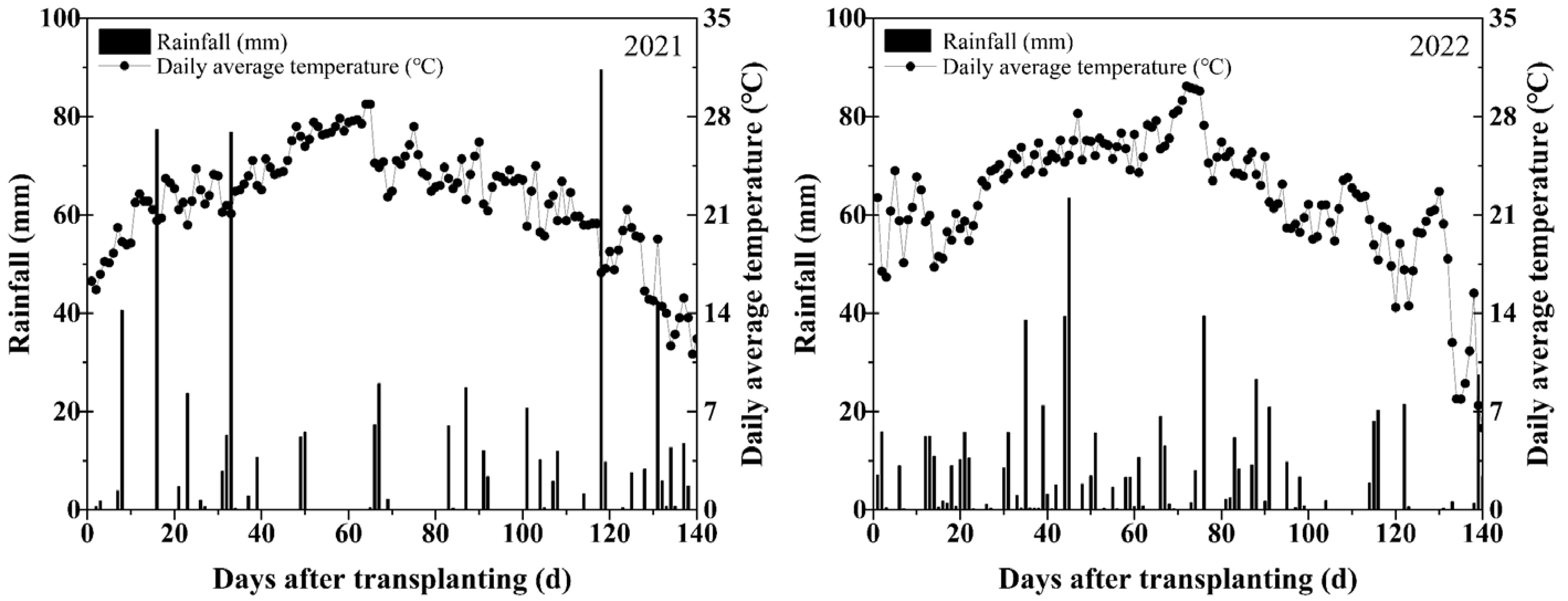
Field experiments were carried out from 2021 to 2022 in Xi′an Town, Dawa District, Panjin City, Liaoning Province, China (40°55′ N, 122°14′ E). The soil type in the field was coastal saline paddy soil. The soil texture was clay loam, and the soil salinity was predominantly composed of chlorides, along with sulfates and bicarbonates. The soil salinity parameters are presented in Table S1. The procedures for determining the above parameters were described in detail by Lu [53]. The physicochemical properties of the top 20 cm of the soil in 2021 and 2022, respectively, were as follows: organic matter, 23.80 and 22.42 g kg−1; available nitrogen, 85.57 and 82.21 mg kg−1; available phosphorus, 15.35 and 14.28 mg kg−1; available potassium, 210.60 and 204.83 mg kg−1; pH, 8.20 and 8.11; and electrical conductivity of soil saturated paste extract, 3.58 and 3.29 dS m−1. The above soil properties were determined according to the methods described by Pansu and Gautheyrou [54]. The preceding crop was rice (Oryza sativa L.), and the field had been managed in this way for consecutive seasons. At the same time, we monitored the daily mean temperature and precipitation at a weather station near the experimental site during the 2021 and 2022 rice growing seasons (Figure 1).

2.2. Experiment Design and Materials

The field experiment was carried out in a randomized block design with three replications in both years. Each experimental plot was 20 m2 and separated by polyethylene plates (height, 50 cm; thickness, 1.35 mm) to a depth of 30 cm to prevent water and nutrient exchange between plots. The experiment was set up with a total of seven treatments (Table 1): (1) no N application (CK); (2) conventional urea fertilizer split applications (CUF); (3) CUF treatment with 20% N reduction (RCUF); (4) controlled-release blended fertilizer, 50%CRU + 50%CU one-time basal application (CRBF1); (5) controlled-release blended fertilizer, 70%CRU + 30%CU one-time basal application (CRBF2); (6) CRBF1 treatment with 20% N reduction (RCRBF1); and (7) CRBF2 treatment with 20% N reduction (RCRBF2). The CUF and RCUF treatments were split over three development stages of the rice crop: 50% as basal, 30% at tillering, and 20% at panicle initiation. The same amounts of phosphorus and potassium fertilizers (90 kg ha−1 and 110 kg ha−1, respectively) were used as basal fertilizer 2 days before transplanting for all treatments. After transplanting, the field was flooded to help seedlings re-green. During the tillering stage, a 2–3 cm water layer was maintained in the field, and then the water was drained at late tillering stage to reduce unproductive tillers. From the booting stage to the heading stage, a 3–5 cm water layer was maintained in the field. During the grain-filling stage, alternate wetting and drying irrigation was practiced in the field. Water was drained a week before harvest. Pests, pathogens, and weeds in the field were controlled by local chemical methods for all treatments.
The CRU used in this study was polyurethane-coated urea (44%N) with a controlled-release period of 90 days, which was produced by Shandong Maoshi Fertilizer Co., Ltd. (Jinan, China). The three conventional fertilizers were CU (46% N) as nitrogen fertilizer, calcium superphosphate (12% P2O5) as phosphate fertilizer, and potassium sulfate (50% K2O) as potassium fertilizer.
The rice cultivar used in this study was Shendao 505. During the two years, the sowing dates were 15 April 2021 and 13 April 2022; the transplanting dates were 26 May 2021 and 24 May 2022. Three seedlings per hill were transplanted, with 30 cm row spacing and 16.7 cm hill spacing.

2.3. Sampling and Measurements

2.3.1. Tiller Dynamics

Ten rice plants in each plot were tagged for observation of the tiller numbers. Observation was conducted every 7 days from transplanting to the heading stage. Tiller numbers from 30 hills in each plot were supplementarily investigated at maturity stage to calculate the percentage of productive tillers, which was defined as the percentage of effective tiller numbers in total tiller numbers.

2.3.2. Leaf SPAD and Photosynthetic Rates

In order to monitor the process of leaf senescence during the grain-filling stage, we used a portable chlorophyll meter (SPAD-502 Plus, Minolta, Tokyo, Japan) to non-destructively measure the SPAD value of rice flag leaves every 7 days after flowering. Five flag leaves per plot were measured. The SPAD values of the upper, middle, and lower parts of each leaf were measured, and the average value of the three parts was taken as the SPAD of the leaf.
The measurements were repeated on the same leaves every seven days. At the same time, we used a portable leaf gas exchange system (TARGAS-1, PP Systems, Amesbury, MA, USA) to measure the corresponding photosynthetic rates of flag leaves, where the incident photosynthetic photon flux density was 1200 µmol m−2 s−1 and the ambient CO2 concentration was 400 µmol mol−1.

2.3.3. Yield and Yield Components

At maturity, we selected plots with uniform rice growth from each plot, continuously monitored the number of rice panicles in 30 hills, and calculated the average number of panicles. After that, rice samples (4 hills) which could represent the average number of panicles were selected in each plot (a total of 12 samples per treatment), and yield components such as the panicle number, spikelet number per panicle, and thousand-grain weight of rice were analyzed. Grain yield was assessed by harvesting 5 m2 of rice plants from each plot. The rice plants were harvested manually and threshed manually by a small thresher. Grains were subsequently air-dried for 3–5 days before grain yield was determined based on 14.5% moisture content.

2.3.4. Dry Matter, N Uptake, and Their Translocation

Five rice plants with uniform growth were selected from each plot at anthesis and the maturity stage. Plant samples were divided into stem sheaths, leaves, and panicles at anthesis and into stem sheaths, leaves, grains, and chaff at maturity. All separated samples were deoxidized at 120 °C for 1 h and dried at 80 °C to a constant weight. The dried subsamples were ground into powder, and the N content of each part of the rice was measured by the Kjeldahl method [55]. The N uptake of each part of the rice plant was calculated by multiplying the dry matter weight by the nitrogen content. The dry matter accumulation and nitrogen uptake of the whole plant during flowering and maturity can be calculated as the sum of the dry matter weight and nitrogen uptake of each part, respectively. It is assumed that all N losses from the stem sheathes and leaves during rice growth were transferred to the grain, and dry matter and N transport during grain filling can be calculated as proposed by Papakosta and Gagianas [56].
DMT = DMa − (DMleaf,m + DMstem-sheath,m + DMpanicle,m)
NT = NTa − (NTleaf,m + NTstem-sheath,m + NTpanicle,m)
where DMT and NT are dry matter and nitrogen translocation, respectively; DMa and NTa are dry matter and nitrogen accumulation of aboveground parts of rice at anthesis, respectively; DMleaf,m, DMstem-sheath,m, and DMpanicle,m are dry matter of the leaf, stem sheath, and panicle at maturity, respectively; and NTleaf,m, NTstem-sheath,m, and NTpanicle,m are nitrogen accumulation in the leaf, stem sheath, and panicle of rice at maturity, respectively.
The dry matter transport efficiency (DMTE) and nitrogen transport efficiency (NTE) were calculated as
DMTE = DMT/DMa
NTE = NT/NTa × 100%
The contribution of pre-anthesis DM remobilization to the grain (CDMRG) and N assimilation to the grain (CNRG) were calculated as
CDMRG = DMT/DMgrain
CNRG = NT/Ngrain
where DMgrain and Ngrain are the grain dry matter weight and grain N accumulation at maturity, respectively.

2.3.5. Calculation of Nitrogen Use Efficiency

Nitrogen recovery efficiency (NRE), nitrogen agronomic efficiency (NAE), nitrogen physiological efficiency (NPE), nitrogen partial factor productivity (PEP), and the nitrogen harvest index (NHI) were calculated as follows:
Nitrogen recovery efficiency (%) = (Nitrogen accumulation of rice plant in N application plot-nitrogen accumulation of rice plant in blank plot)/nitrogen fertilizer application rate.
Nitrogen agronomic efficiency (kg N kg−1) = (rice grain yield in N application plot-rice grain yield in blank plot)/N application rate in N application plot.
Nitrogen physiological efficiency (kg N kg−1) = (Rice grain yield in N application plot-rice grain yield in blank plot)/(Nitrogen accumulation of rice plant in N application plot-Nitrogen accumulation of rice plant in blank plot).
Nitrogen partial factor productivity (kg N kg−1) = rice grain yield in N application plot/N application rate in N application plot.

2.3.6. Soil NH4+-N Content

Soil samples were collected from the rice plants’ root zone (0–20 cm) of each plot at 7 and 21 days after anthesis (DAAs) with a 20 cm soil auger. A five-point sampling method was employed: four points were located at the corners and one at the center of each plot, avoiding the plot edges. The five subsamples from each plot were combined and thoroughly mixed to form one composite sample. The composite sample was placed in a self-sealing bag and immediately stored in a cooler with ice packs for transport. Upon arrival at the laboratory, visible plant residues and stones were removed. The samples were then stored in a refrigerator at 4 °C and analyzed within 48 h. Three replicate samples were taken from the soil sample of each plot for analysis. A fresh soil sample equivalent to 5 g of dry soil was placed in a 100 mL Erlenmeyer flask and extracted with KCl solution (2 M, 50 mL) by shaking for 1 h. The mixture was then filtered, and the soil NH4+-N concentrations were determined using a Discrete Auto Analyzer (Smartchem 200, AMS, Milan, Italy). Another 10 g of fresh soil was weighed and put into an aluminum box, and then the soil sample was dried in an oven to a constant weight and weighed again to calculate the soil water content. The soil moisture content was calculated by weight difference, and the soil NH4+-N content was determined according to the soil water content.

2.3.7. Calculation of Rice Economic Benefit

The economic benefit under each treatment was calculated as follows:
Economic benefit (CNY ha−1) = Rice income − Agricultural inputs cost
Rice income was calculated based on the current local grain price and grain yield. The local rice grain prices were 2720 CHY t−1 and 2640 CHY t−1 in 2021 and 2022, respectively. The agricultural inputs cost includes the seeding cost, fertilizer cost, pesticide cost, machinery cost, and other costs.

2.4. Data Statistical Analysis

Data calculations and analysis of variance (ANOVA) were performed using Microsoft Excel 2019 and SPSS 21.0, respectively. The least significant difference (LSD) test was used to determine significant differences between treatments at a 0.05 probability level. Origin 8.1 software was used for graphing.

3. Results

3.1. Tiller Dynamics

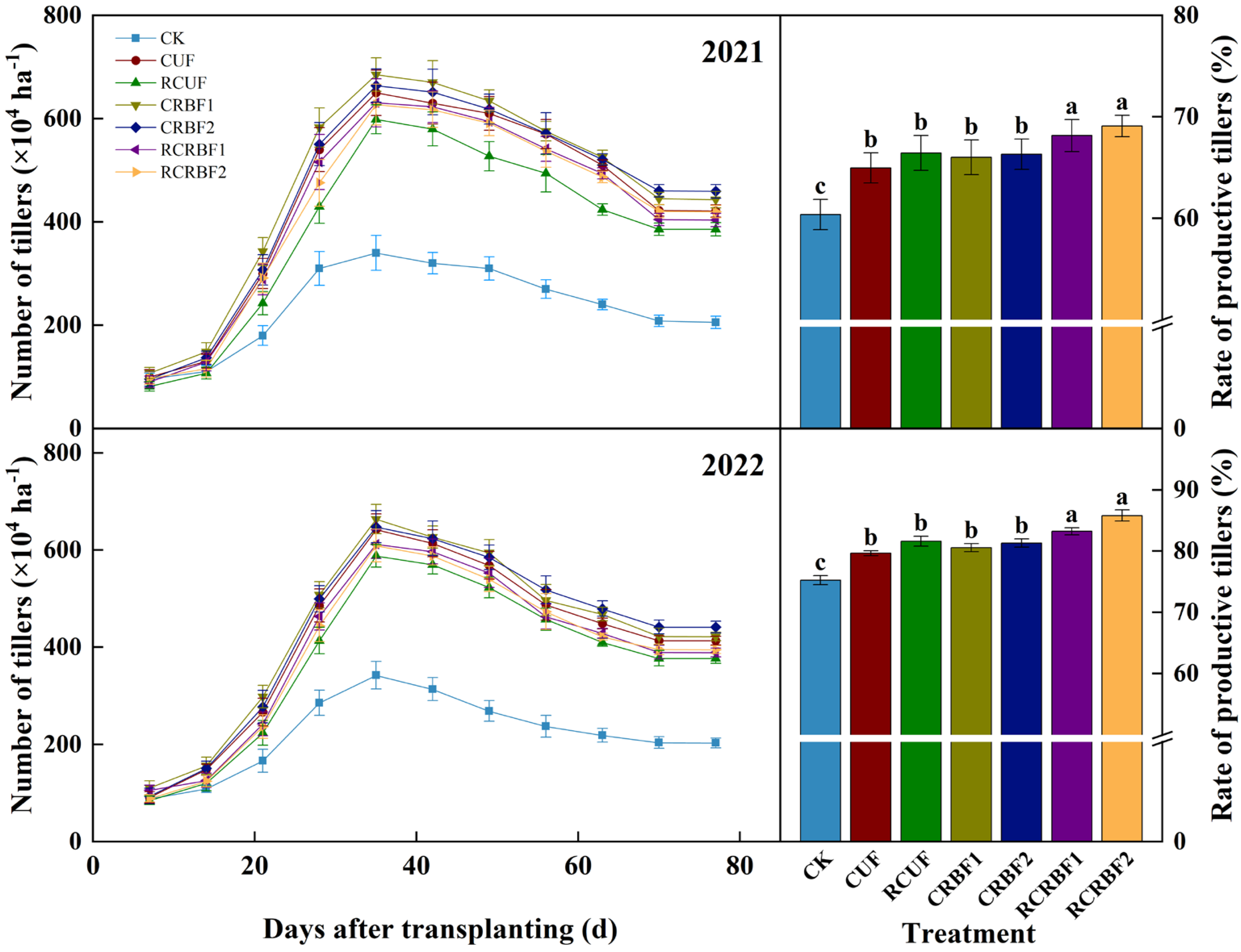
The tiller dynamics of rice under different fertilizer treatments are shown in Figure 2. The number of tillers increased first and then decreased, and the highest number of tillers in each treatment was recorded at 35 days after transplanting. Different fertilizer treatments had a significant effect on the number of tillers. Under the same nitrogen application rate, the CRBF treatments had a greater number of tillers than the conventional urea treatments. Compared to the CUF treatment, the number of tillers under the CRBF1 and CRBF2 treatments was 3.33–5.43% and 1.84–2.15% higher, respectively, at 35 days after transplanting. Moreover, the RCRBF1 and RCRBF2 treatments had a significantly greater number of tillers, 4.08–5.37% and 3.57–4.77%, respectively, at 35 days after transplanting.
As shown in Figure 2, there was no significant difference in the percentage of productive tillers between the RCRBF1 and RCRBF2 treatments, but both showed significantly higher percentages than the other treatments. When the type of N fertilizer was the same, nitrogen reduction showed a higher percentage of productive tillers than conventional N application.

3.2. Flag Leaf SPAD and Photosynthesis

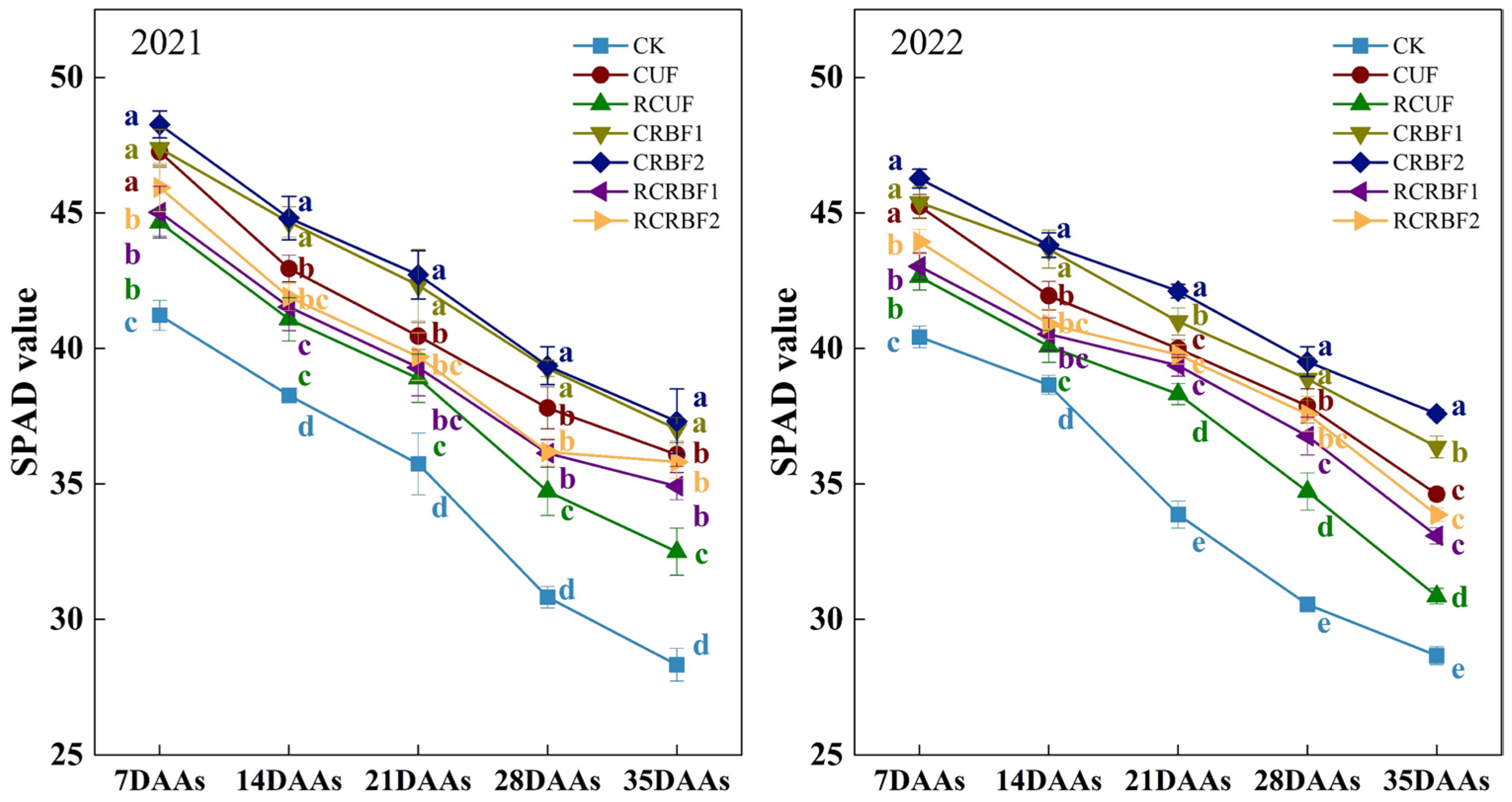
Rice flag leaf SPAD decreased gradually with increasing days after anthesis (Figure 3). The SPAD value was significantly influenced by different fertilizer treatments. The CRBF treatments, particularly CRBF2, consistently maintained higher SPAD values compared to conventional urea treatments (CUF) during the grain-filling stages under the same nitrogen application rate. While all nitrogen-applied treatments showed similar SPAD values in the initial measurement (7 DAAs), the CRBF treatments demonstrated a more gradual decline in chlorophyll content in subsequent stages. This demonstrates that during the late growth stages, the CRBF treatments effectively slowed the rate of chlorophyll content decline, with the higher proportion of CRU being particularly effective. In addition, nitrogen reduction decreased SPAD values, but the SPAD values in the RCRBF1 and RCRBF2 treatments remained comparable to those in the CUF treatment. The sustained higher SPAD values in CRBF treatments, especially during reproductive stages, likely contributed to enhanced photosynthetic capacity and ultimately higher grain yield.
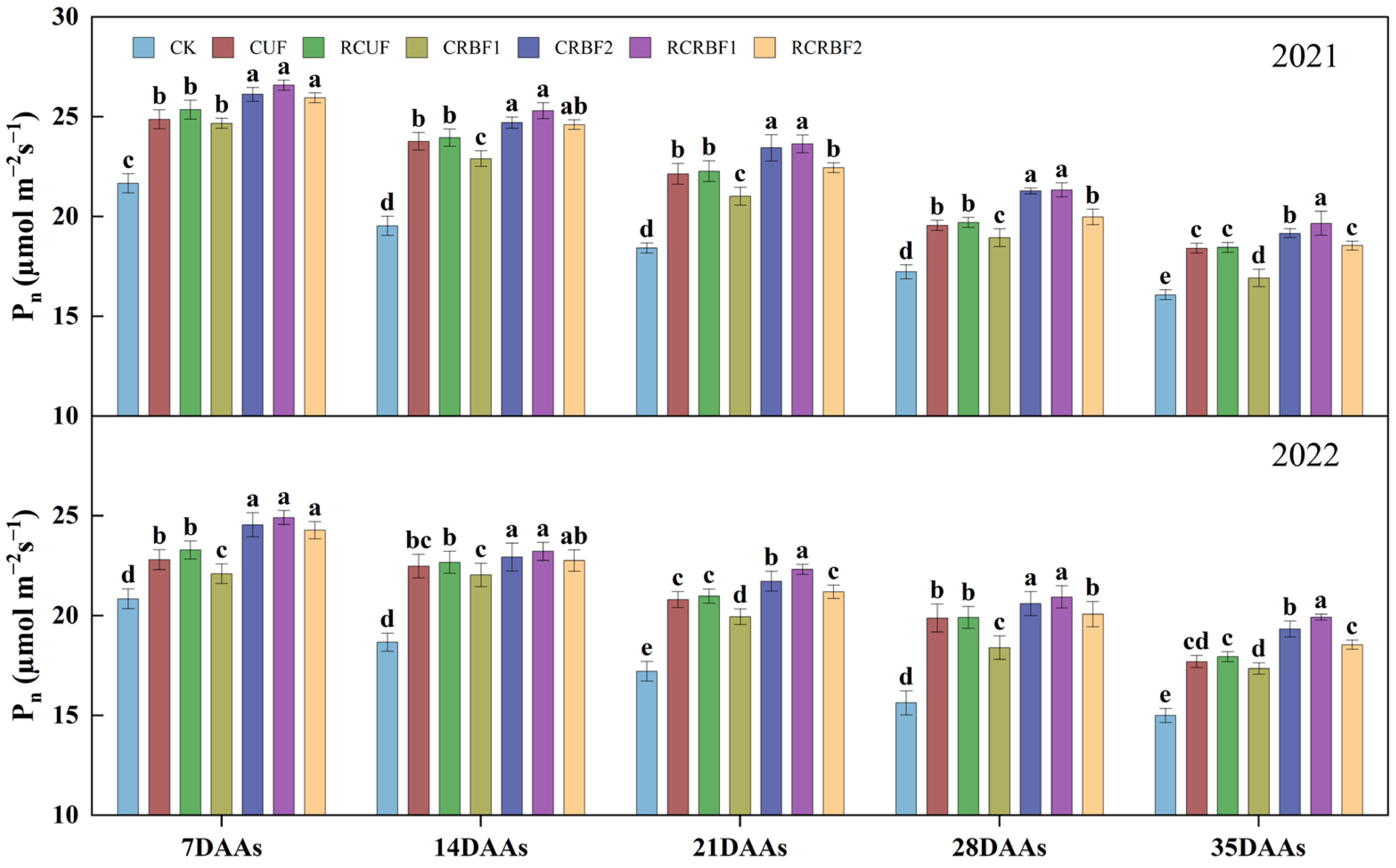
According to Figure 4, the photosynthetic rate of rice flag leaves gradually declined with increasing days after anthesis (DAAs) and was significantly influenced by fertilizer treatments. Nitrogen application markedly enhanced the photosynthetic rate, with the CRBF treatments, particularly CRBF2, consistently maintaining higher photosynthetic rates compared to conventional urea treatments—a trend aligned with grain yield performance. During the early post-anthesis stage (7 and 14 DAAs), photosynthetic rates under CRBF1 and CRBF2 did not differ significantly from those under CUF. However, beyond 14 DAAs, both the CRBF1 and CRBF2 treatments exhibited significantly higher photosynthetic rates than the CUF treatment. Although reducing the nitrogen input decreased photosynthetic rates, the RCRBF1 and RCRBF2 treatments achieved levels comparable to the CUF treatment. The sustained higher photosynthetic rates under CRBF treatments contributed to enhanced dry matter accumulation and grain yield.

3.3. Grain Yield and Yield Components

Table 2 shows the grain yield and yield components of rice under different fertilizer treatments. Different fertilizer treatments had significant effects on the grain yield of rice. Nitrogen fertilizer application significantly improved grain yield, and the CRBF treatments showed a significantly better effect than the conventional urea treatments. Specifically, compared to the CUF treatment, the CRBF2 treatment resulted in the highest yield increases in both 2021 and 2022, with significant gains of 10.41% and 11.04%, respectively, while the CRBF1 treatment also significantly improved the yield by 5.10% and 6.77%, respectively. Nitrogen reduction decreased the rice yield, but the RCRBF1 and RCRBF2 treatments showed no significant difference in the yield compared to the CUF treatment. Moreover, compared with the RCUF treatment, RCRBF1 and RCRBF2 significantly increased the grain yield by 6.96% and 8.54% in 2021 and 6.33% and 8.03% in 2022, respectively.
Significant differences were also observed in the panicle number and spikelet number among the fertilizer treatments. The CRBF treatments led to a significantly higher panicle number and spikelet number than the conventional urea treatments, with CRBF2 giving the highest values among all treatments. Based on the two-year average, compared to the CUF treatment, the CRBF1 and CRBF2 treatments increased the panicle number by 11.33% and 12.91%, respectively, while the spikelet number increased by 6.14% and 8.98%, respectively. Similarly, compared to the RCUF treatment, the RCRBF1 and RCRBF2 treatments increased the panicle number by 6.69% and 8.80% and the spikelet number by 5.21% and 6.73%, respectively. In contrast, no significant differences were detected in the spikelet number per panicle, seed setting rate, or thousand-grain weight between the CRBF and conventional urea treatments.

3.4. Dry Matter, N Accumulation, and Translocation

Table 3 shows the dry matter accumulation (DMA) and translocation in rice under different fertilizer treatments. Different fertilizer treatments had significant effects on rice dry matter accumulation and translocation. Nitrogen application markedly enhanced dry matter accumulation at all growth stages compared to the no-nitrogen control (CK). The CRBF treatments consistently resulted in higher dry matter accumulation across key growth stages compared to conventional urea treatments. Specifically, the CRBF2 treatment achieved the highest dry matter accumulation at anthesis and maturity and during the post-anthesis period in both years, along with the highest grain dry weight (DWgrain). Compared to the CUF treatment, the CRBF1 and CRBF2 treatments significantly increased post-anthesis dry matter accumulation by 6.01–9.50% and 11.46–11.88%, respectively. Moreover, compared with the RCUF treatment, the RCRBF1 and RCRBF2 treatments significantly increased post-anthesis dry matter accumulation by 8.57–10.37% and 8.90–11.73%, respectively. Nitrogen reduction led to a decrease in dry matter accumulation, as observed in the RCRBF1, RCRBF2, and RCUF treatments compared to their full-dose counterparts. However, there was no significant difference in dry matter accumulation between the RCRBF1 and RCRBF2 treatments and the CUF treatment. For pre-anthesis dry matter translocation, the CRBF treatments showed higher translocation than conventional urea treatments, particularly under CRBF2 treatment (3.34–3.48 t ha−1). In contrast, there were no significant differences among the treatments in terms of dry matter translocation efficiency (DMTE) or the contribution of dry matter translocation to grains (CDMRG).
Table 4 presents the dynamics of nitrogen in rice under different fertilizer treatments. Different fertilizer treatments significantly influenced nitrogen accumulation and translocation in rice during both growing seasons. Nitrogen application significantly increased rice nitrogen uptake, and the effect under the CRBF treatments was significantly better than that under the conventional urea treatments. Specifically, the CRBF treatments had higher nitrogen uptake in grains (Ngrain) at anthesis and maturity and during the post-anthesis period than the conventional urea treatments in both years. The CRBF2 treatment had the highest post-anthesis nitrogen uptake and nitrogen uptake at anthesis and maturity. Compared to the CUF treatment, the CRBF1 and CRBF2 treatments significantly increased the post-anthesis nitrogen uptake by 17.27% and 35.06% in 2021 and 20.71% and 36.22% in 2022, respectively, and the nitrogen uptake at maturity by 10.97% and 19.87% in 2021 and 9.95% and 19.50% in 2022, respectively. N reduction reduced rice nitrogen uptake, but the performance of the RCRBF1 and RCRBF2 treatments remained comparable to that of the CUF treatment in most nitrogen uptake parameters and was substantially better than that of the RCUF treatment. Compared to the RCUF treatment, the RCRBF1 and RCRBF2 treatments had significantly higher post-anthesis nitrogen uptake by 15.27–21.04% and 19.82–25.58%, respectively, and higher nitrogen uptake at maturity by 7.92–9.24% and 10.37–11.58%, respectively. In addition, the pre-anthesis nitrogen translocation was higher in the CRBF treatments than in the conventional urea treatments. The pre-anthesis nitrogen translocation in the CRBF treatments was significantly higher than that in the CUF treatment, although the difference was not significant in 2022. There was no significant difference in pre-anthesis nitrogen translocation between the RCRBF1 and RCRBF2 treatments compared to the RCUF treatment. In contrast, the contribution to grain nitrogen under the CRBF2 treatment was significantly lower than that under the CUF treatment. Moreover, there was no significant difference in the nitrogen translocation efficiency rate among treatments.

3.5. N Use Efficiency

The effects of the year (Y) and year × treatment interaction on nitrogen recovery efficiency (NRE), nitrogen agronomic efficiency (NAE), nitrogen physiological efficiency (NPE), and nitrogen partial factor productivity (PEP) were not statistically significant (Table 5). In contrast, different fertilizer treatments had a significant influence on NRE, NAE, and PEP. In the two years, the CRBF1 and CRBF2 treatments significantly increased NRE by 13.30–17.40% and 21.69–26.75% and NAE by 10.40–13.91% and 21.26–22.10%, respectively, compared to the CUF treatment. Similarly, the RCRBF1 and RCRBF2 treatments also exhibited significantly higher NRE and NAE relative to the RCUF treatment, with NRE increasing by 19.76–23.06% and 25.91–28.92% and NAE by 14.27–15.89% and 18.13–19.43%, respectively. These results demonstrate that the application of CRBF can markedly enhance both NRE and NAE, with a higher proportion of controlled-release urea (CRU) in the blend leading to greater improvements. There were no significant differences in NPE among the various treatments. Furthermore, under the same nitrogen fertilizer type, the reduced-nitrogen treatments resulted in higher NAE, NPE, and PEP compared to the conventional nitrogen application rate.

3.6. Soil NH4+-N Content

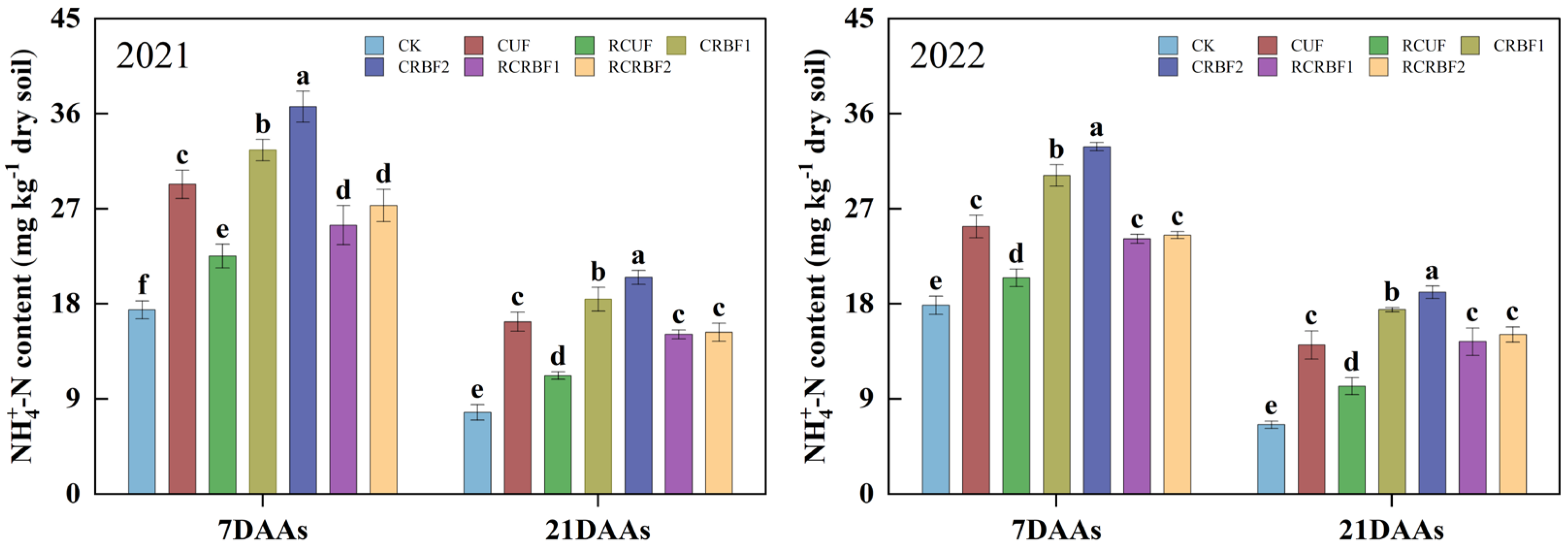
As shown in Figure 5, soil NH4+-N content varied significantly among fertilizer treatments during the post-anthesis period. Nitrogen application generally increased the soil NH4+-N content, with the CRBF treatments maintaining significantly higher concentrations than conventional urea treatments at both 7 and 21 days after application (DAAs). Based on two-year averages, the CRBF1 and CRBF2 treatments increased soil NH4+-N content by 15.04% and 27.43% at 7 DAAs and by 18.38% and 30.58% at 21 DAAs, respectively, compared to CUF. Similarly, under reduced-nitrogen conditions, the RCRBF1 and RCRBF2 treatments also showed significantly higher soil NH4+-N content than RCUF, with increases of 15.46% and 20.47% at 7 DAAs and 38.06% and 42.24% at 21 DAAs, respectively. These results indicate that CRBF treatments, especially those with higher proportions of CRU, provide a more sustained nitrogen supply in the soil during the critical post-anthesis stage.

3.7. Relationships Between Key Traits and Grain Yield and Nitrogen Uptake

3.7.1. Relationships of Panicle Number and Spikelet Number with Grain Yield and N Uptake

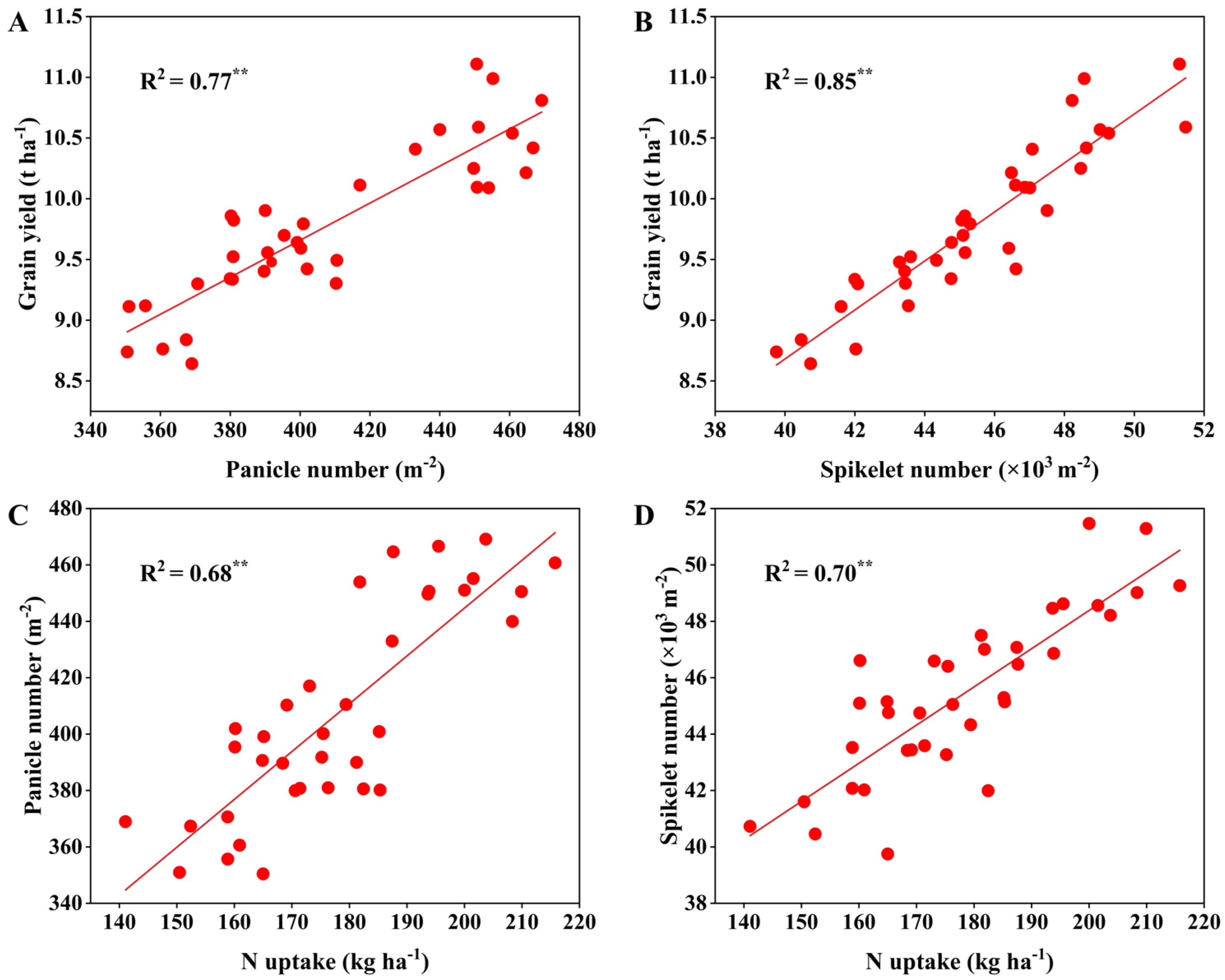
Linear regression analysis demonstrated that grain yield was significantly and positively correlated with the panicle number (R2 = 0.77, p < 0.01, Figure 6A) and spikelet number (R2 = 0.85, p < 0.01, Figure 6B). The linear regression results also showed that N uptake had a positive effect on increasing the panicle number (R2 = 0.68, p < 0.01, Figure 6C) and spikelet number (R2 = 0.70, p < 0.01, Figure 6D). This indicated that larger N uptake stimulated the formation of a larger sink capacity of rice, which resulted in greater grain yield.

3.7.2. Relationships of Pre- and Post-Anthesis DM and N Accumulation with Grain Yield

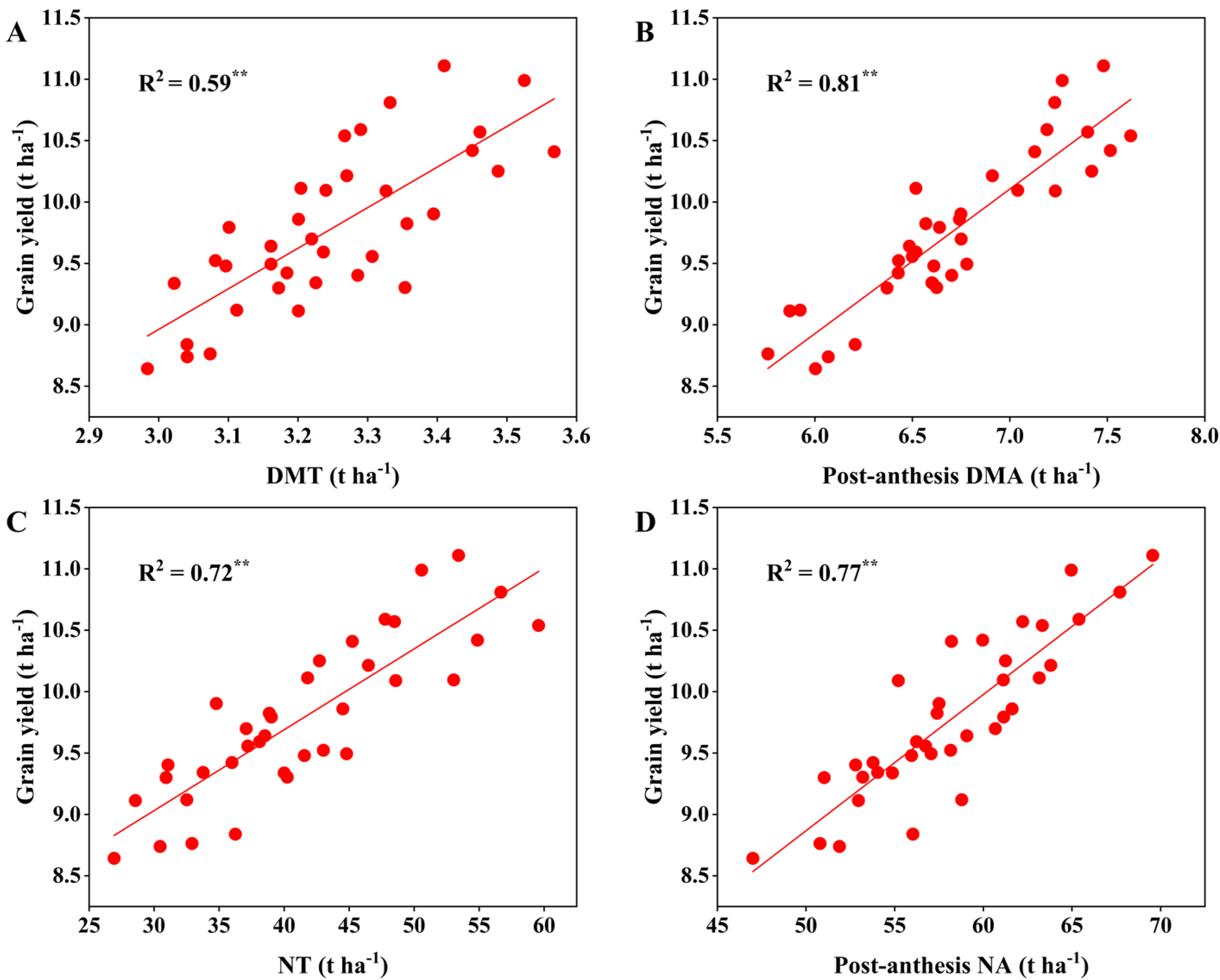
The increase in grain yield is dependent on DM and N accumulation and translocation. Linear regression analysis showed that post-anthesis DM (R2 = 0.81, p < 0.01, Figure 7B) and N accumulation (R2 = 0.77, p < 0.01, Figure 7D) were significantly and positively correlated with grain yield. Moreover, DM translocation (R2 = 0.59, p < 0.01, Figure 7A) and N translocation (R2 = 0.72, p < 0.01, Figure 7C) accumulated before anthesis showed a similar relationship with grain yield. In addition, the linear regression results showed that the positive correlation between post-anthesis DM accumulation and grain yield (R2 = 0.81, p < 0.01, Figure 7B) was stronger than that of DMT (R2 = 0.59, p < 0.01, Figure 7A), indicating that post-anthesis DM accumulation was more important in determining grain yield in this study.

3.8. Cost, Income, and Economic Benefits

As shown in Table 6, compared with conventional urea treatments, the CRBF treatments increased the total costs of rice production, primarily due to higher fertilizer costs. Notably, the CRBF treatments reduced the mechanical cost of topdressing. Compared to the CUF treatment, the CRBF1 and CRBF2 treatments achieved higher rice income and economic benefits due to higher grain yield. Over two years, the CRBF1 and CRBF2 treatments increased the economic benefits by 8.74–11.16% and 17.14–17.41%, respectively, compared to CUF. In conclusion, although the total costs of rice production in the CRBF treatments were higher, they also produced higher grain yields. In addition, they offered labor and time savings. These combined advantages ultimately were translated into higher income and economic benefits.

4. Discussion

4.1. CRU Combined with CU Increases Rice Grain Yield and Economic Benefits in Saline–Alkali Paddy Fields

CRU is a long-lasting fertilizer that can synchronize N release with the crop N demand [43]. Consequently, one-time application as a basal fertilizer could significantly increase crop yield [57]. Previous studies have demonstrated that the combined application of CRU and CU has a more significant effect on rice yield improvement than the single application of CU [26,44]. In the present study, the one-time application of CRU combined with CU (CRBF treatments) significantly increased rice yield compared to the traditional split applications (CUF treatments) under the same N application rate in saline–alkali paddy fields (Table 2). In particular, the CRBF2 treatment (CRU:CU = 7:3) resulted in a significantly increased yield of 10.41–11.04% over both years (Table 2). In addition, the RCRBF1 and RCRBF2 treatments (CRBF with N reduction), despite a 20% reduction in nitrogen application, achieved yields comparable to those of the CUF treatment (conventional urea treatment). This is because CRU combined with CU increased the panicle number (PN) and spikelet number (SN) while maintaining a stable seed setting rate and thousand-grain weight and ultimately increased rice yield (Table 2). This was further supported by the significant and positive correlation between grain yield and PN (R2 = 0.77, p < 0.01, Figure 6A) and SN (R2 = 0.85, p < 0.01, Figure 6B) through linear regression analysis. We also found that PN and SN were also significantly and positively correlated with N uptake (R2 = 0.68, p < 0.01, Figure 6C, R2 = 0.70, p < 0.01, Figure 6D), indicating that greater N uptake promoted the establishment of a larger sink capacity (quantified by spikelet number) and therefore led to higher grain yield. Similar results were also reported by Chen et al. [58]. Saline–alkaline soils exhibit high pH levels, which can easily lead to significant N volatilization from the soil in the form of NH3 [59], thereby reducing the available nitrogen content in the soil [60]. Coupled with the rapid hydrolysis properties of CU in soil [61], CU often leads to a rapid increase in the soil NH4+-N concentration [62], which further aggravates N losses [63]. In saline–alkaline paddy fields, the soil salinity and alkalinity coupled with insufficient N supply seriously inhibit rice tillering, reducing effective spike numbers at maturity and ultimately limiting the yield [10,64]. In contrast, the combined use of CRU and CU not only provides the necessary N for crops in the early stages of rice growth but also extends the release of N into the middle and later stages of rice growth [49]. This avoids the accumulation of large amounts of NH4+-N in the soil in the short term, thereby reducing the substrate concentration and risk of N losses, and enables the root zone to retain more nutrients during the later stages of rice growth [43,65,66]. This more stable and sustained N supply effectively promotes rice growth, mid- and late-stage nutrient uptake in particular, delays plant senescence, and ultimately facilitates an increase in PN and SN (Table 2) and grain filling, thereby increasing rice yield [37,67].
Controlled-release urea (CRU) has shown great potential in field crop production due to its labor savings and high efficiency. Unfortunately, the high cost has been the main factor limiting the promotion and application of CRU. Therefore, farmers’ willingness to adopt this technology depends on whether the increased yield returns and saved labor costs can offset the additional fertilizer investment. In this study, the CRBF1 and CRBF2 treatments increased the total cost of rice production but significantly increased the income and economic benefits of rice compared to CUF treatment (Table 6). This was mainly due to the higher grain yield and labor cost savings achieved by the CRBF1 and CRBF2 treatments (Table 2 and Table 6), which compensated for the increased fertilizer costs. The results are consistent with previous studies. Zheng et al. [68] found that compared to applying CU at the same nitrogen rates, the fertilization strategy combining CRU with CU increased the net profit by 15.4–21.8%. Ding et al. [67] also showed that a single application of CRU and CU blend fertilizer increased net income by 23.76–25.96% compared to multiple applications of CU. Furthermore, we also found that the RCRBF1 and RCRBF2 treatments were able to obtain comparable rice yield and economic benefits compared to the CUF treatment under 20% nitrogen reduction. This highlights the considerable potential of CRBF technology to maintain productivity while reducing nitrogen fertilizer inputs. Nevertheless, it should be noted that in this study, the cost savings from reduced topdressing did not fully compensate for the increased fertilizer cost due to the higher price of CRU. This indicates that the cost disadvantage remains a critical constraint to the large-scale adoption of controlled-release fertilizers in field production. However, it is foreseeable that as production technologies advance and prices decline, the inherent advantages of CRU—such as labor savings, yield increases, and reduced application rates—will gradually offset its cost disadvantage. This makes the one-time application of controlled-release fertilizers an economically viable and attractive strategy for farmers under current conditions.

4.2. Higher Yields Are Related to Greater Post-Anthesis DMA and N Uptake of Rice

Dry matter (DM) accumulation and redistribution is the central physiological basis for determining grain yield [69]. The sources of grain yield mainly include pre-anthesis DMA and redistribution and post-anthesis DM production [70,71]. In our study, both DMT and post-anthesis DMA were higher in the CRBF treatments than in the CUF treatment under the same N application rate (Table 3). However, the contribution of post-anthesis DMA to grain yield (60.14–65.92%, Table 3) was much higher than that of pre-anthesis DMA, which indicated that it was a more dominant source of yield increase. Furthermore, linear regression analysis showed that post-anthesis DMA and pre-anthesis DMT were significantly and positively correlated with grain yield, whereas post-anthesis DM accumulation (R2 = 0.81, p < 0.01, Figure 7B) was more correlated with grain yield than DMT (R2 = 0.59, p < 0.01, Figure 7A). These findings further emphasized that both processes were critical in influencing grain yield, but post-anthesis DMA played a more important role in determining grain yield in the current study.
During the grain-filling period (35 DAAs), the CRBF treatments exhibited significantly higher SPAD values and photosynthetic rates (Figure 3 and Figure 4) than the CUF treatment, which supports their greater post-anthesis DMA (Table 3). These results demonstrated that the combined use of CRU and CU effectively delayed leaf senescence, improved photosynthetic capacity and time, and thereby promoted post-anthesis DMA. However, such sustained photosynthetic activity required a large N supply after anthesis [72,73]. Previous studies have indicated that higher rates of N accumulation and remobilization lead to greater photosynthetic production capacity and delayed leaf senescence in rice [74].
This study demonstrates that the contribution of pre-anthesis nitrogen translocation to the grains (CNRG, 54.04–63.18%) was higher than that of post-anthesis nitrogen uptake (Table 4), indicating that pre-anthesis nitrogen absorption plays a relatively greater role in grain yield and filling. However, although post-anthesis nitrogen uptake accounted for a relatively small proportion (approximately 20–30%, Table 2) of total nitrogen accumulation, its contribution to the final grain yield was crucial. Specifically, a significant positive correlation was observed between post-anthesis nitrogen uptake and grain yield (R2 = 0.77, p < 0.01, Figure 7D), suggesting that increased nitrogen uptake after anthesis leads to a higher grain yield. Supporting this, the pre-anthesis nitrogen translocation in the CRBF treatments did not differ significantly from that in the CUF treatment, whereas both post-anthesis nitrogen uptake and grain yield were significantly higher in the CRBF treatments than in the CUF treatment (Table 4). This further indicates that, after meeting the early-stage nitrogen demand, combining CRU with CU to enhance post-anthesis nitrogen uptake serves as an effective strategy for further increasing yield. The underlying mechanism of this enhancement lies in the ability of CRU to maintain soil available nitrogen levels during the grain-filling period (Figure 5), thereby ensuring a sustained nitrogen supply and regulating the rice plants treated with CRU treatments (the CRBF treatments) to perform grain filling through greater post-anthesis N uptake [44,75]. Adequate post-anthesis nitrogen uptake helps maintain chlorophyll content in functional leaves, delays senescence, prolongs photosynthetic activity, promotes dry matter accumulation, and ultimately increases grain yield [76]. In summary, although pre-anthesis nitrogen uptake and translocation contribute more substantially to the total nitrogen in grains, optimizing the combination of CRU and CU to improve post-anthesis nitrogen uptake could lead to higher rice yields [77].
Moreover, under the same high nitrogen application rate (270 kg ha−1), the treatment receiving only CU (the CUF treatment) performed poorly in both grain yield and post-anthesis processes compared with the CRU + CU combinations (the CRBF treatments). As illustrated in Figure 5, the readily available soil nitrogen in the CUF treatment declined sharply after the initial application and failed to meet the nutritional demand during the critical grain-filling stage. This indicates that CU, before being utilized by the plant during the reproductive phase, is prone to substantial nitrogen losses through ammonia volatilization, denitrification, or leaching [20,59]. Consequently, the high nitrogen input in the CUF treatment did not translate into increased nitrogen uptake or sustained photosynthetic activity (Table 4, Figure 4), ultimately limiting dry matter accumulation and grain yield. This contrast underscores that nitrogen-use efficiency, rather than merely the amount of nitrogen applied, is the decisive factor in productivity. The observed advantage in post-anthesis dry matter accumulation (DMA) for the CRBF treatments can be attributed to the synchronized nitrogen supply from controlled-release urea, which better matches the temporal nitrogen demand of the crop [24,42].

4.3. CRU Combined with CU Improves the N Use Efficiency of Rice in Saline–Alkali Paddy Fields

As a new type of fertilizer that slowly releases N, CRU can provide sufficient N for crop growth and development, control and modulate N release to synchronize with the nutrient uptake of crops, and thereby significantly improve N use efficiency [78,79]. In the current study, the combined application of CRU and CU (the CRBF treatments) significantly increased NRE and NAE compared with the conventional urea split applications (the CUF treatment) in saline–alkali paddy fields (Table 5). In particular, the CRBF1 and CRBF2 treatments significantly increased NRE by 15.35% and 24.22% and NAE by 12.15% and 21.68%, respectively, compared to the CUF treatment. (Table 5). These results align with previous findings by Zhao et al. [42], who found that one-time application CRU combined with CU had higher NRE and NAE compared with CU alone. The author of [44] also reported that controlled-release bulk blending fertilizer (CRU combined with CU) significantly improved the NUE of rice. Our study supports the general conclusions about the combined use of CRU and CU to improve rice yield and NUE in non-saline–alkali paddy fields. More importantly, the present study confirmed the effectiveness of this N management strategy in saline–alkali paddy fields, which indicates its great potential for rice production in saline–alkali paddy fields.
Based on the current study, two points may account for the increases in NUE by the one-time application of CRU combined with CU in saline–alkali paddy fields. The first point is the N nutrient synchrony in supply and demand. When CRU and CU were applied as a blended fertilizer, CU provided the N required for rice in the early growth stage, whereas CRU provided the N in the middle and late growth stages. This process met the N demand of rice throughout the whole growth and development stage. Yang et al. [80] also found that the combination of CRU and CU could balance N supply, avoid early N deficiency and later N surplus, and significantly improve NUE. Optimal N distribution across growth stages is essential for achieving high grain yield and efficient N utilization [40], as synchronizing N supply with crop demand is critical to balancing yield, NUE, and environmental sustainability in crop production systems [81]. Previous studies have demonstrated low NUE under conventional farmer fertilization practices in saline–alkali paddy fields, where the majority of N (CU) is applied during the early stage of rice growth, resulting in marked asynchrony between N supply and crop demand [15,41]. In this study, although CRU and CU (the CRBF treatments) were applied once before transplanting, CRU controlled the slow N release and prolonged the N release time because of the polymer envelope [32,35], so it did not cause excessive N supply in the early stage [25]. Moreover, the combination of CRU and CU could be applied once without the need for topdressing, which reduces labor costs and improves economic and environmental benefits [82]. The second point is the N nutrient stability in supply. CRU decreased the N losses from salt–alkali paddy fields, increased the soil available N content, and stabilized the N nutrient supply throughout the reproductive period of rice [47]. Previous studies have demonstrated that the application of CRU could regulate nutrient release and enhance soil N availability, decrease N loss, and increase N absorption by plants, thereby improving crop yields and NUE [66,83]. Our study found similar conclusions. In our study, under the same N application rate, the CRU treatments (the CRBF treatments) significantly increased N uptake in rice (Table 4) and soil N content and availability (Figure 5) compared with the CU treatments (the CUF treatments), thus further facilitating N absorption and utilization of rice throughout rice development. The ionic stress and high-pH conditions in saline–alkali soil often lead to increased N loss (especially ammonia volatilization), which tends to result in lower NUE in traditional split fertilization [10,59]. CRU prevents the rapid expansion of soil N pools due to its slow-release characteristics, which contributes to reduced N loss and improved NUE [63]. Therefore, the combined application of CRU and CU may be an effective N management strategy to alleviate the problem of N loss and improve NUE in salt–alkali paddy fields [52]. In addition, our study also found that the CRBF2 treatment (70%CRU + 30%CU) was generally better than the CRBF1 treatment (50%CRU + 50%CU) regarding yield and NUE increase (Table 2 and Table 5) under the same N application rate. This may be explained by the fact that a greater proportion of CRU may provide more sustained N supply (Figure 5) and could more effectively meet the demand of rice during the whole growth stage (Table 4). Furthermore, it is worth noting that a greater proportion of CRU may have more advantages in mitigating N loss in salt–alkali paddy fields.
This study also found that, under the same N application rate conditions, the CRBF2 treatment (70%CRU + 30%CU) generally outperformed the CRBF1 treatment (50%CRU + 50%CU) in terms of yield and NUE (Table 2 and Table 5). The reason for this might be that a higher proportion of CRU can provide a more sustained N supply (Figure 5); that is, the CRBF2 treatment constructed a more ideal “quick-release + long-lasting” nitrogen supply system. CU provides “initiating nitrogen” for the initial phase of tillering, while a higher proportion of CRU ensures a stable and sufficient N supply during critical nutrient demanding periods such as the jointing, anthesis, and grain-filling stages [49]. This “pre-stable, middle-sufficient, and post-non-declining” supply pattern synchronizes more precisely with the nitrogen demand curve of rice, providing continuous support for the formation of more effective panicles and a higher spikelet number per panicle [43]. Additionally, it is worth noting that a higher proportion of CRU may have a more significant advantage in reducing nitrogen loss due to salinity in saline–alkali paddy fields. The high pH of saline–alkali soil is the core environmental factor driving ammonia volatilization [84]. Traditional urea or treatments with a lower proportion of controlled-release urea (such as the CRBF1 treatment) still undergo rapid hydrolysis of nitrogen in the soil, resulting in a short-term increase in the local ammonium nitrogen concentration, which is then rapidly lost in the form of ammonia gas under the drive of high pH. The CRBF2 treatment, through a higher proportion of CRU, can reduce the peak concentration of ammonium nitrogen in the early soil, thereby reducing the “substrate” concentration for ammonia volatilization. This enables the CRBF2 treatment to have a more advantageous position in reducing nitrogen gas loss in this specific saline–alkali environment compared to the CUF treatment, thereby retaining more nitrogen in the soil crop system for the absorption and utilization of rice plants. Moreover, studies have shown that in non-saline–alkali paddy fields, 50%CRU + 50%CU can balance the nitrogen supply in the early stage and the continuous release in the later stage [42,55]. This difference may also be due to the strong nitrogen loss triggered by the high-pH environment in saline–alkali fields. Therefore, a higher proportion of CRU is crucial for ensuring a stable supply of nitrogen during the growth’s middle and later stages and resisting saline–alkali stress [46].
At present, a range of N management practices, including the application of urease/nitrification inhibitors [85], biochar amendment [20], and straw return [6], have been demonstrated to enhance rice yield and nitrogen use efficiency in saline–alkali soils globally. Placing our findings within this context reveals that the optimized CRU + CU blend serves as a valuable and complementary strategy. While inhibitors are highly effective for targeted reduction in gaseous losses, they may not fully resolve the issue of long-term nitrogen synchrony with crop demand [86]. Biochar amendment offers remarkable benefits for soil health and water retention, but its direct impact on precise nitrogen timing can be variable [87]. Straw return is crucial for nutrient recycling and soil building, though its implementation must account for the challenge of initial nitrogen immobilization [23]. The CRU + CU approach introduced here complements these strategies by providing a more predictable nitrogen release pattern that directly targets supply–demand matching, independent of specific soil micro-environments. Furthermore, it uniquely integrates this agronomic efficiency with significant labor savings. Thus, our work contributes an additional solution to N management in saline–alkali paddy fields, one that may be particularly advantageous in systems where operational simplicity and reliable nitrogen timing are critical.

4.4. Significance and Limitations

This study has confirmed that CRU combined with CU in one-time basal application technology has multiple positive impacts on rice production in saline–alkali paddy fields. This strategy synchronizes nitrogen release with the fertilizer requirements of rice, significantly improving the nitrogen fertilizer utilization rate and effectively reducing ammonia volatilization loss in the saline–alkali environment. At the same time, it simplifies multiple fertilization operations into a single operation, greatly saving on labor costs. This strategy can also reduce the risk of nitrogen source pollution and has a positive effect on the ecological restoration of saline–alkali soil by promoting crop growth, providing an effective way for the sustainable development of regional agriculture [88].
Although the study demonstrated the significant potential of CRBF fertilizers to enhance rice yields and economic benefits under our specific experimental conditions, the generalizability of these findings to other regions requires comprehensive consideration of local environmental and agronomic factors. The effectiveness of CRBF fertilizers is fundamentally influenced by climate (particularly temperature, which governs nutrient release kinetics), meaning that application outcomes may differ in colder or hotter regions compared to the study site [5,50]. Furthermore, distinct genetic backgrounds and nutrient uptake efficiencies among different rice varieties, coupled with variations in key soil characteristics such as pH, texture, and organic matter content, may either limit or amplify the benefits observed in this study [44,65]. Therefore, while our results provide strong support for this fertilization strategy, their direct application to disparate agroecosystems requires local validation to tailor CRBF management practices for optimizing productivity and profitability. To facilitate the wider adoption of CRBFs, we recommend conducting multi-location field trials to calibrate the nutrient release patterns with local conditions. Furthermore, developing region-specific CRBF formulations and corresponding management guidelines will be crucial for maximizing their effectiveness across diverse agroecological zones.

5. Conclusions

This study demonstrated that CRBF treatments could significantly improve grain yield, economic benefits, and N use efficiency compared with conventional urea treatments in saline–alkali paddy fields. Specifically, the optimal formulation was identified as CRBF2, with a CRU-to-CU ratio of 7:3. The CRBF2 treatment significantly increased rice yield by 10.41–11.04% and economic benefits by 17.13–17.41% while improving nitrogen recovery efficiency (NRE) by 21.69–26.75% and nitrogen agronomic efficiency (NAE) by 21.26–22.10%, compared to conventional split applications of urea. The higher grain yield with CRBF treatments was attributed to enhanced N uptake, which led to greater panicle numbers and spikelet numbers per m2. Further studies revealed that the sustainable N supply of CRU promoted post-anthesis N absorption in rice, which contributed to consistently higher SPAD values and photosynthetic rates and delayed leaf senescence, thereby further promoting post-anthesis DM production and significantly increasing grain yield. Even under a 20% reduction in nitrogen application, this strategy can maintain yield levels and further improve nitrogen use efficiency. Therefore, it is recommended to apply CRU and CU at a ratio of 7:3 in a single basal application as a green and efficient alternative N management strategy for saline–alkali paddy fields.

Supplementary Materials

The following supporting information can be downloaded at https://www.mdpi.com/article/10.3390/agronomy15122786/s1, Table S1: The main soil salinity parameters in 2021 and 2022.

Author Contributions

Conceptualization, S.W.; methodology, C.Z., Y.H. and S.W.; software, C.L.; validation, J.L.; formal analysis, Z.W. and J.N.; investigation, J.L., C.L., J.N. and S.G.; resources, S.W.; data curation, Z.W. and J.L.; writing—original draft preparation, Z.W.; writing—review and editing, Z.W., J.L. and C.Z.; visualization, S.G.; supervision, Y.H.; project administration, Y.H.; funding acquisition, S.W. All authors have read and agreed to the published version of the manuscript.

Funding

This study was supported by Basic Research Project of the Department of Education of Liaoning Province (LJ212410157119).

Data Availability Statement

The data presented in this study are available upon request from the corresponding author.

Acknowledgments

We fully appreciate the editors and all anonymous reviewers for their constructive comments on this manuscript.

Conflicts of Interest

The authors declare no conflicts of interest.

References

  1. Xie, Y.R.; Zhang, X.L.; Gao, Y.; Li, J.Q.; Geng, Y.Q.; Guo, L.Y.; Shao, X.W.; Ran, C. Effects of Different Straw Returning Periods and Nitrogen Fertilizer Combinations on Rice Roots and Yield in Saline-Sodic Soil. Agronomy 2024, 14, 2463. [Google Scholar] [CrossRef]
  2. Meng, T.Y.; Zhang, X.B.; Ge, J.L.; Chen, X.; Yang, Y.L.; Zhu, G.L.; Chen, Y.L.; Zhou, G.S.; Wei, H.H.; Dai, Q.G. Agronomic and Physiological Traits Facilitating Better Yield Performance of Japonica/Indica Hybrids in Saline Fields. Field Crops Res. 2021, 271, 108255. [Google Scholar] [CrossRef]
  3. Liu, B.S.; Huang, L.H.; Jiang, X.T.; Liu, Y.; Huang, G.Z.; Yang, C.; Liang, Y.P.; Cai, J.H.; Zhu, G.; Kong, Q.Q. Quantitative Evaluation and Mechanism Analysis of Soil Chemical Factors Affecting Rice Yield in Saline-Sodic Paddy Fields. Sci. Total Environ. 2024, 929, 172584. [Google Scholar] [CrossRef]
  4. Islam, M.A.; Warwick, N.; Koech, R.; Amin, M.N.; Lobry De Bruyn, L. The Importance of Farmers’ Perceptions of Salinity and Adaptation Strategies for Ensuring Food Security: Evidence from the Coastal Rice Growing Areas of Bangladesh. Sci. Total Environ. 2020, 727, 138674. [Google Scholar] [CrossRef]
  5. Schneider, P.; Asch, F. Rice Production and Food Security in Asian Mega Deltas—A Review on Characteristics, Vulnerabilities and Agricultural Adaptation Options to Cope with Climate Change. J. Agron. Crop Sci. 2020, 206, 491–503. [Google Scholar] [CrossRef]
  6. Che, W.K.; Piao, J.L.; Gao, Q.; Li, X.B.; Li, X.; Jin, F. Response of Soil Physicochemical Properties, Soil Nutrients, Enzyme Activity and Rice Yield to Rice Straw Returning in Highly Saline-Alkali Paddy Soils. J. Soil Sci. Plant Nutr. 2023, 23, 4396–4411. [Google Scholar] [CrossRef]
  7. Xu, Z.K.; Shao, T.Y.; Lv, Z.X.; Yue, Y.; Liu, A.H.; Long, X.H.; Zhou, Z.S.; Gao, X.M.; Rengel, Z. The Mechanisms of Improving Coastal Saline Soils by Planting Rice. Sci. Total Environ. 2020, 703, 135529. [Google Scholar] [CrossRef]
  8. Zhu, Y.; Sun, L.; Fu, Q.L.; Guo, B.; Lin, Y.C.; Liu, X. Long-term Rice Cultivation Improved Coastal Saline Soil Properties and Multifunctionality of Subsoil Layers. Soil Use Manag. 2024, 40, e12918. [Google Scholar] [CrossRef]
  9. Liu, Y.D.; Ma, C.; Li, G.H.; Jiang, Y.; Hou, P.F.; Xue, L.H.; Yang, L.Z.; Ding, Y.F. Lower Dose of Controlled/Slow Release Fertilizer with Higher Rice Yield and N Utilization in Paddies: Evidence from a Meta-Analysis. Field Crops Res. 2023, 294, 108879. [Google Scholar] [CrossRef]
  10. Guo, X.H.; Lan, Y.C.; Xu, L.Q.; Yin, D.W.; Li, H.Y.; Qian, Y.D.; Zheng, G.P.; Lü, Y.D. Effects of Nitrogen Application Rate and Hill Density on Rice Yield and Nitrogen Utilization in Sodic Saline-Alkaline Paddy Fields. J. Integr. Agric. 2021, 20, 540–553. [Google Scholar] [CrossRef]
  11. Lou, W. Development and Prospects of Rice Industry of Coastal Saline-Alkali Soil in Liaoning Province. North. Rice 2019, 49, 52–54. [Google Scholar]
  12. Li, B.; Qu, H.; Gong, L.; Jin, D.D.; Yu, G.X.; Zheng, W.J.; Sun, W.T. Study on the Optimum Nitrogen Application Rate and Nitrogen Application Model on Rice in Coastal Saline-Alkaline Regions. Soil Fertil. Sci. China 2024, 130–137. [Google Scholar]
  13. Gong, L.; Jin, D.D.; Niu, S.W.; Wang, N.; Xu, J.Y.; Sui, S.J. Analysis of Chemical Fertilizer Application Reduction Potential for Paddy Rice in Liaoning Province. Sci. Agric. Sin. 2021, 54, 1926–1936. [Google Scholar]
  14. Li, B.; Gong, L.; Qu, H.; Jin, D.D.; Sun, W.T. Optimal Nitrogen Fertilizer Application Rate for Single-Cropping Paddy Rice in Liaohe Delta. J. Agric. Resour. Environ. 2020, 37, 179–185. [Google Scholar]
  15. Peng, X.Z. Study on Characteristics of Nitrogen Fertilizer Application and Potential of Reducing Nitrogen Fertilizer Application in Single Cropping Rice Region in Northeast China. PhD Thesis, Chinese academy of agricultural sciences, Beijing, China, 2021. [Google Scholar]
  16. Dong, Y.; Hu, Y.T.; Song, X.C.; Guo, S.W.; Ma, Y.; Hou, P.F.; Wang, H.; Wang, J.D. Slow-Release Fertilizers Mitigate Brackish Water Stress in Rice: Boosting Yield and Nitrogen Use Efficiency in Saline Soils. Agric. Water Manag. 2025, 319, 109790. [Google Scholar] [CrossRef]
  17. Luyen, P.; Kamoshita, A. On-Farm Agronomic Manipulations to Improve Rice (Oryza sativa L.) Production in the Saline Coastal Zone of the Red River Delta in Vietnam. Plant Prod. Sci. 2023, 26, 209–224. [Google Scholar] [CrossRef]
  18. Mohanty, S.; Nayak, A.K.; Tripathi, R.; Bhaduri, D.; Chatterjee, D.; Kumar, A.; Shahid, M.; Kumar, U.; Munda, S.; Mandi, G.; et al. Nitrogen Use Efficiency of Rice in India: A Regional Analysis. Int. J. Sustain. Dev. World Ecol. 2023, 30, 869–882. [Google Scholar] [CrossRef]
  19. Zhao, C.Z.; Zhang, H.; Song, C.P.; Zhu, J.K.; Shabala, S. Mechanisms of Plant Responses and Adaptation to Soil Salinity. Innovation 2020, 1, 100017. [Google Scholar] [CrossRef]
  20. He, T.H.; Liu, D.Y.; Yuan, J.J.; Ni, K.; Zaman, M.; Luo, J.F.; Lindsey, S.; Ding, W.X. A Two Years Study on the Combined Effects of Biochar and Inhibitors on Ammonia Volatilization in an Intensively Managed Rice Field. Agric. Ecosyst. Environ. 2018, 264, 44–53. [Google Scholar] [CrossRef]
  21. Wang, X.Y.; Zhu, H.; Yan, B.X.; Chen, L.; Shutes, B.; Wang, M.M.; Lyu, J.; Zhang, F.M. Ammonia Volatilization, Greenhouse Gas Emissions and Microbiological Mechanisms Following the Application of Nitrogen Fertilizers in a Saline-Alkali Paddy Ecosystem. Geoderma 2023, 433, 116460. [Google Scholar] [CrossRef]
  22. Chen, Y.L.; Liu, Y.; Ge, J.F.; Li, R.K.; Zhang, R.; Zhang, Y.; Huo, Z.Y.; Xu, K.; Wei, H.H.; Dai, Q.G. Improved Physiological and Morphological Traits of Root Synergistically Enhanced Salinity Tolerance in Rice under Appropriate Nitrogen Application Rate. Front. Plant Sci. 2022, 13, 982637. [Google Scholar] [CrossRef] [PubMed]
  23. Ran, C.; Li, J.Q.; Gao, Y.; Xie, Y.R.; Li, Y.Y.; Yang, J.G.; Geng, Y.Q.; Guo, L.Y.; Gao, D.P.; Shao, X.W. Effects of Straw Management and Nitrogen Application Rate on Soil’s Physicochemical Properties and Rice Yield in Saline-Sodic Paddy Fields. Plants 2024, 13, 3475. [Google Scholar] [CrossRef]
  24. Zhao, T.C.; Wang, J.B.; Li, R.Y.; Zhang, P.F.; Guo, X.Y.; Qi, Y.C.; Li, Y.S.; Cheng, S.H.; Ji, J.C.; He, A.B.; et al. Effects of Nitrogen Fertilizer Types and Planting Density on the Yield and Nitrogen Use Efficiency of Salt-Tolerant Rice under Salt Stress Conditions. Plants 2025, 14, 501. [Google Scholar] [CrossRef]
  25. Zhang, G.X.; Zhao, D.H.; Liu, S.J.; Liao, Y.C.; Han, J. Can Controlled-Release Urea Replace the Split Application of Normal Urea in China? A Meta-Analysis Based on Crop Grain Yield and Nitrogen Use Efficiency. Field Crops Res. 2022, 275, 108343. [Google Scholar] [CrossRef]
  26. Hu, Y.J.; Cai, Q.; Xu, Y.; Xue, J.T.; Yu, E.W.; Wei, H.Y.; Xu, K.; Huo, Z.Y.; Zhang, H.C. One-Time Fertilization of Controlled-Release Urea with Compound Fertilizer and Rapeseed Cake Maintains Rice Grain Yield and Improves Nitrogen Use Efficiency under Reduced Nitrogen Conditions. Front. Plant Sci. 2023, 14, 1281309. [Google Scholar] [CrossRef]
  27. Qiu, Z.C.; Ma, F.; Zhou, J.M.; Du, C.W. Improving Rice Nitrogen Nutrition Index Estimation Using UAV Images Combined with Meteorological and Fertilization Variables. Agronomy 2025, 15, 1946. [Google Scholar] [CrossRef]
  28. Zhang, H.P.; Mi, K.L.; Chen, J.; Cui, P.Y.; Lu, H.; Zhang, H.C.; Yang, Y.J. Enhancing Rice Yield, Quality and Nitrogen Utilization through Side-Deep Placement of Nitrogen and Zinc Fertilizers. Field Crops Res. 2025, 333, 110096. [Google Scholar] [CrossRef]
  29. Aliloo, J.; Abbasi, E.; Karamidehkordi, E.; Ghanbari Parmehr, E.; Canavari, M. Dos and Don’ts of Using Drone Technology in the Crop Fields. Technol. Soc. 2024, 76, 102456. [Google Scholar] [CrossRef]
  30. Singh, R.; Singh, S. A Review of Indian-Based Drones in the Agriculture Sector: Issues, Challenges, and Solutions. Sensors 2025, 25, 4876. [Google Scholar] [CrossRef] [PubMed]
  31. Yaseen, M.U.; Ahmad, S.; Ahmad, M.; Long, J.M.; Raza, H.A.; Iftekhar, H.; Ameer, S.; Ogunbiyi, D. A Multi-Function Novel Crop Seeder for the Management of Residues and Mechanized Sowing of Wheat in a Single Path. AgriEngineering 2024, 6, 2445–2469. [Google Scholar] [CrossRef]
  32. Mustafa, A.; Athar, F.; Khan, I.; Chattha, M.U.; Nawaz, M.; Shah, A.N.; Mahmood, A.; Batool, M.; Aslam, M.T.; Jaremko, M.; et al. Improving Crop Productivity and Nitrogen Use Efficiency Using Sulfur and Zinc-Coated Urea: A Review. Front. Plant Sci. 2022, 13, 942384. [Google Scholar] [CrossRef]
  33. Yu, C.L.; Lin, Y.C.; Li, B.L.; Liu, X.L.; Liu, Z.L.; Peng, X.L. Polymer-Coated Urea Applied at One-Time Mechanical Topdressing Increases Nitrogen Use Efficiency and Rice Yield in the Cold Area. Soil Res. 2024, 62, SR23192. [Google Scholar] [CrossRef]
  34. Swify, S.; Mažeika, R.; Baltrusaitis, J.; Drapanauskaitė, D.; Barčauskaitė, K. Review: Modified Urea Fertilizers and Their Effects on Improving Nitrogen Use Efficiency (NUE). Sustainability 2023, 16, 188. [Google Scholar] [CrossRef]
  35. Mendonca Cidreira, A.C.; Wei, L.; Aldekhail, A.; Islam Rubel, R. Controlled-Release Nitrogen Fertilizers: A Review on Bio-Based and Smart Coating Materials. J. Appl. Polym. Sci. 2025, 142, e56390. [Google Scholar] [CrossRef]
  36. Zhou, J.J.; Tang, S.; Pan, W.K.; Xu, M.; Liu, X.; Ni, L.; Mao, X.L.; Sun, T.; Fu, H.R.; Han, K.F.; et al. Long-Term Application of Controlled-Release Fertilizer Enhances Rice Production and Soil Quality under Non-Flooded Plastic Film Mulching Cultivation Conditions. Agric. Ecosyst. Environ. 2023, 358, 108720. [Google Scholar] [CrossRef]
  37. Tian, C.; Sun, M.X.; Zhou, X.; Li, J.; Xie, G.X.; Yang, X.D.; Peng, J.W. Increase in Yield and Nitrogen Use Efficiency of Double Rice with Long-Term Application of Controlled-Release Urea. J. Integr. Agric. 2022, 21, 2106–2118. [Google Scholar] [CrossRef]
  38. Wu, P.; Yu, J.Y.; Wang, Q.H.; Liu, Z.Y.; Huang, H.; Wu, Q.; Ren, L.Q.; Zhang, G.X.; Liu, E.K.; Bangura, K.; et al. Deep Placement of Controlled-Release and Common Urea Achieves the Win–Win of Enhancing Maize Productivity and Decreasing Environmental Pollution. Eur. J. Agron. 2025, 164, 127484. [Google Scholar] [CrossRef]
  39. Ma, Q.; Qian, Y.S.; Yu, Q.Q.; Cao, Y.F.; Tao, R.R.; Zhu, M.; Ding, J.F.; Li, C.Y.; Guo, W.S.; Zhu, X.K. Controlled-Release Nitrogen Fertilizer Application Mitigated N Losses and Modified Microbial Community While Improving Wheat Yield and N Use Efficiency. Agric. Ecosyst. Environ. 2023, 349, 108445. [Google Scholar] [CrossRef]
  40. Timilsena, Y.P.; Adhikari, R.; Casey, P.; Muster, T.; Gill, H.; Adhikari, B. Enhanced Efficiency Fertilisers: A Review of Formulation and Nutrient Release Patterns: Enhanced Efficiency Fertilizers. J. Sci. Food Agric. 2015, 95, 1131–1142. [Google Scholar] [CrossRef]
  41. Kong, L.L.; Yin, C.X.; Hou, Y.P.; Zhang, L.; Zhao, Y.K.; Liu, Z.Q.; Xu, X.P. Nitrogen Fertilizer Management for High Yield and High Efficiency of Rice in the Songnen Plain. J. Plant Nutr. Fertil. 2023, 29, 1435–1448. [Google Scholar]
  42. Zhao, C.; Gao, Z.J.; Liu, G.M.; Qian, Z.H.; Jiang, Y.; Li, G.H.; Zhang, J.; Xu, K.; Dai, Q.G.; Guo, B.W.; et al. Optimization of Combining Controlled-Release Urea of Different Release Period and Normal Urea Improved Rice Yield and Nitrogen Use Efficiency. Arch. Agron. Soil Sci. 2023, 69, 821–834. [Google Scholar] [CrossRef]
  43. Wang, Y.H.; Gao, S.; Sun, J.; He, B.; He, W.J.; Tao, W.K.; Tang, X.A.; Geng, Z.; Wu, Z.Y.; Li, W.W.; et al. One-Time Application of Controlled-Release Blended Fertilizer Increases Rice Yield and Nitrogen Utilization by Optimizing Root Morphological Trait Distribution and Nitrogen Uptake. Crop J. 2025, 13, 1234–1245. [Google Scholar] [CrossRef]
  44. Dun, C.P.; Wang, R.; Mi, K.L.; Zhang, Y.T.; Zhang, H.P.; Cui, P.Y.; Guo, Y.L.; Lu, H.; Zhang, H.C. One-Time Application of Controlled-Release Bulk Blending Fertilizer Enhanced Yield, Quality and Photosynthetic Efficiency of Late Japonica Rice. J. Integr. Agric. 2023, 23, 3672–3691. [Google Scholar] [CrossRef]
  45. Yuan, M.M.; Wu, G.; Wang, J.B.; Liu, C.; Hu, Y.G.; Hu, R.; Zhou, Y.; Zhang, X.M.; Wang, W.J.; Sun, Y.X. Blended Controlled-Release Nitrogen Fertilizer Increases Rice Post-Anthesis Nitrogen Accumulation, Translocation and Nitrogen-Use Efficiency. Front. Plant Sci. 2024, 15, 1354384. [Google Scholar] [CrossRef]
  46. Tao, Y.; Zhang, D.H.; Xing, Z.P.; Ni, C.; Ye, M.; Zhang, Z.J. Optimizing Controlled-Release Urea and Urea Combinations for Sustainable Rice-Wheat Production under Nitrogen Reduction. Front. Plant Sci. 2025, 16, 1576049. [Google Scholar] [CrossRef]
  47. Ahmad, S.; Nadeem, M.Y.; Gao, S.; Li, Q.X.; Ding, Y.F.; Liu, Z.H.; Jiang, Y.; Li, W.W.; Li, G.H. Subsurface Placement of Controlled-Release Blended Fertilizers Mitigates Ammonia Volatilization by Promoting Nitrogen Transformation in Rice Fields. Agric. Ecosyst. Environ. 2025, 386, 109624. [Google Scholar] [CrossRef]
  48. Ravindran, A.; Manivannan, A.C.; Kandaiah, R.; Kulanthaisamy, M.; Indirathankam, S.C.; Nachimuthu, G.; Panneerselvan, L.; Palanisami, T. Advancements and Challenges in Controlled-Release Fertilisers: An Approach to Integrate Biopolymer-Based Strategies. Ind. Crops Prod. 2025, 233, 121349. [Google Scholar] [CrossRef]
  49. Liu, S.J.; Zhang, Y.R.; Zhao, D.H.; Liao, Y.C.; Zhang, G.X.; Li, Y.J.; Han, J. Optimizing the Ratio of Controlled Release Urea Relative to Normal Urea to Improve the Crop Yield and N Recovery Efficiency-A Global Meta-Analysis. Field Crops Res. 2025, 328, 109924. [Google Scholar] [CrossRef]
  50. Govil, S.; Van Duc Long, N.; Escribà-Gelonch, M.; Hessel, V. Controlled-Release Fertiliser: Recent Developments and Perspectives. Ind. Crops Prod. 2024, 219, 119160. [Google Scholar] [CrossRef]
  51. Li, R.Y.; Guo, X.Y.; Qi, Y.C.; Wang, Y.Y.; Wang, J.B.; Zhang, P.F.; Cheng, S.H.; He, W.L.; Zhao, T.C.; Li, Y.S.; et al. Soil Amendments and Slow-Release Urea Improved Growth, Physiological Characteristics, and Yield of Salt-Tolerant Rice Under Salt Stress Conditions. Plants 2025, 14, 543. [Google Scholar] [CrossRef]
  52. Xiao, Z.L.; Zhang, Y.; Wang, C.R.; Wen, Y.; Wang, W.L.; Zhu, K.Y.; Zhang, W.Y.; Gu, J.F.; Liu, L.J.; Zhang, J.H.; et al. Optimized Controlled-Release Nitrogen Strategy Achieves High Yield and Nitrogen Use Efficiency of Wheat Following Rice in the Lower Reaches of Yangtze River of China. Field Crops Res. 2024, 317, 109567. [Google Scholar] [CrossRef]
  53. Lu, R.K. Methods of Soil and Agricultural Chemistry Analysis; China Agricultural Science and Technology Press: Beijing, China, 2000. [Google Scholar]
  54. Pansu, M.; Gautheyrou, J. Handbook of Soil Analysis Mineralogical, Organic and Inorganic Methods: Mineralogical, Organic and Inorganic Methods; Springer: Heidelberg, Germany, 2006. [Google Scholar]
  55. Cheng, S.; Xing, Z.P.; Tian, C.; Li, S.P.; Tian, J.Y.; Liu, Q.Y.; Hu, Y.J.; Guo, B.W.; Hu, Q.; Wei, H.Y.; et al. Effects of Controlled Release Urea Formula and Conventional Urea Ratio on Grain Yield and Nitrogen Use Efficiency of Direct-Seeded Rice. Agriculture 2022, 12, 1230. [Google Scholar] [CrossRef]
  56. Papakosta, D.K.; Gagianas, A.A. Nitrogen and Dry Matter Accumulation, Remobilization, and Losses for Mediterranean Wheat during Grain Filling. Agron. J. 1991, 83, 864–870. [Google Scholar] [CrossRef]
  57. Xu, D.; Zhu, Y.; Zhu, H.B.; Hu, Q.; Liu, G.D.; Wei, H.Y.; Zhang, H.C. Effects of a One-Time Application of Controlled-Release Nitrogen Fertilizer on Quality and Yield of Rice. Food Energy Secur. 2023, 12, e413. [Google Scholar]
  58. Chen, Y.T.; Peng, J.; Wang, J.; Fu, P.H.; Hou, Y.; Zhang, C.D.; Fahad, S.; Peng, S.B.; Cui, K.H.; Nie, L.X.; et al. Crop Management Based on Multi-Split Topdressing Enhances Grain Yield and Nitrogen Use Efficiency in Irrigated Rice in China. Field Crops Res. 2015, 184, 50–57. [Google Scholar] [CrossRef]
  59. Wu, S.; Zhang, Z.H.; Sun, H.J.; Hu, H.B. Responses of Rice Yield, n Uptake, NH3 and N2O Losses from Reclaimed Saline Soils to Varied N Inputs. Plants 2023, 12, 2446. [Google Scholar] [CrossRef]
  60. Zhu, W.; Gu, S.G.; Jiang, R.; Zhang, X.; Hatano, R. Saline-Alkali Soil Reclamation Contributes to Soil Health Improvement in China. Agriculture 2024, 14, 1210. [Google Scholar] [CrossRef]
  61. Hamidi, N.H.; Ahmed, O.H.; Omar, L.; Ch’ng, H.Y. Soil Nitrogen Sorption Using Charcoal and Wood Ash. Agronomy 2021, 11, 1801. [Google Scholar] [CrossRef]
  62. Wang, S.Q.; Zhao, X.; Xing, G.X.; Yang, Y.C.; Zhang, M.; Chen, H.K. Improving Grain Yield and Reducing N Loss Using Polymer-Coated Urea in Southeast China. Agron. Sustain. Dev. 2015, 35, 1103–1115. [Google Scholar] [CrossRef]
  63. Liu, R.L.; Wang, Y.; Hong, Y.; Wang, F.; Mao, X.P.; Yi, J. Controlled-Release Urea Application and Optimized Nitrogen Applied Strategy Reduced Nitrogen Leaching and Maintained Grain Yield of Paddy Fields in Northwest China. Front. Plant Sci. 2023, 14, 1033506. [Google Scholar] [CrossRef] [PubMed]
  64. Zhong, Y.; Chi, H.; Wu, T.; Fan, W.B.; Su, H.Y.; Li, R.Y.; Jiang, W.Z.; Du, X.L.; Ma, Z.M. Diversity of Rhizosphere Microbial Communities in Different Rice Varieties and Their Diverse Adaptive Responses to Saline and Alkaline Stress. Front. Microbiol. 2025, 16, 1537846. [Google Scholar] [CrossRef] [PubMed]
  65. Xu, X.B.; Ma, F.; Zhou, J.M.; Du, C.W. Control-Released Urea Improved Agricultural Production Efficiency and Reduced the Ecological and Environmental Impact in Rice-Wheat Rotation System: A Life-Cycle Perspective. Field Crops Res. 2022, 278, 108445. [Google Scholar] [CrossRef]
  66. Zhang, Y.J.; Ren, W.C.; Zhu, K.Y.; Fu, J.Y.; Wang, W.L.; Wang, Z.Q.; Gu, J.F.; Yang, J.C. Substituting Readily Available Nitrogen Fertilizer with Controlled-Release Nitrogen Fertilizer Improves Crop Yield and Nitrogen Uptake While Mitigating Environmental Risks: A Global Meta-Analysis. Field Crops Res. 2024, 306, 109221. [Google Scholar] [CrossRef]
  67. Ding, Z.J.; Hu, R.; Cao, Y.X.; Li, J.T.; Xiao, D.K.; Hou, J.; Wang, X.X. Integrated Assessment of Yield, Nitrogen Use Efficiency and Ecosystem Economic Benefits of Use of Controlled-Release and Common Urea in Ratoon Rice Production. J. Integr. Agric. 2024, 23, 3186–3199. [Google Scholar] [CrossRef]
  68. Zheng, W.L.; Liu, Z.G.; Zhang, M.; Shi, Y.F.; Zhu, Q.; Sun, Y.B.; Zhou, H.Y.; Li, C.L.; Yang, Y.C.; Geng, J.B. Improving Crop Yields, Nitrogen Use Efficiencies, and Profits by Using Mixtures of Coated Controlled-released and Uncoated Urea in a Wheat-maize System. Field Crops Res. 2017, 205, 105–115. [Google Scholar] [CrossRef]
  69. Cai, F.; Mi, N.; Ming, H.Q.; Zhang, Y.S.; Zhang, H.; Zhang, S.J.; Zhao, X.L.; Zhang, B.B. Responses of Dry Matter Accumulation and Partitioning to Drought and Subsequent Rewatering at Different Growth Stages of Maize in Northeast China. Front. Plant Sci. 2023, 14, 1110727. [Google Scholar] [CrossRef]
  70. Pal, R.; Mahajan, G.; Sardana, V.; Chauhan, B.S. Impact of Sowing Date on Yield, Dry Matter and Nitrogen Accumulation, and Nitrogen Translocation in Dry-Seeded Rice in North-West India. Field Crops Res. 2017, 206, 138–148. [Google Scholar] [CrossRef]
  71. Gao, H.X.; Zhang, C.C.; van der Werf, W.; Ning, P.; Zhang, Z.; Wan, S.B.; Zhang, F.S. Intercropping Modulates the Accumulation and Translocation of Dry Matter and Nitrogen in Maize and Peanut. Field Crops Res. 2022, 284, 108561. [Google Scholar] [CrossRef]
  72. Wu, H.; Xiang, J.; Zhang, Y.; Zhang, Y.P.; Peng, S.B.; Chen, H.Z.; Zhu, D.F. Effects of Post-Anthesis Nitrogen Uptake and Translocation on Photosynthetic Production and Rice Yield. Sci. Rep. 2018, 8, 12891. [Google Scholar] [CrossRef]
  73. Padhan, B.K.; Sathee, L.; Kumar, S.; Chinnusamy, V.; Kumar, A. Variation in Nitrogen Partitioning and Reproductive Stage Nitrogen Remobilization Determines Nitrogen Grain Production Efficiency (NUEg) in Diverse Rice Genotypes under Varying Nitrogen Supply. Front. Plant Sci. 2023, 14, 1093581. [Google Scholar] [CrossRef]
  74. Du, K.; Zhao, W.Q.; Lv, Z.W.; Xu, B.; Hu, W.; Zhou, Z.G.; Wang, Y.H. Optimal Rate of Nitrogen Fertilizer Improves Maize Grain Yield by Delaying the Senescence of Ear Leaves and Thereby Altering Their Nitrogen Remobilization. Field Crops Res. 2024, 310, 109359. [Google Scholar] [CrossRef]
  75. Wang, L.; Xue, C.; Pan, X.; Chen, F.; Liu, Y. Application of Controlled-Release Urea Enhances Grain Yield and Nitrogen Use Efficiency in Irrigated Rice in the Yangtze River Basin, China. Front. Plant Sci. 2018, 9, 999. [Google Scholar] [CrossRef] [PubMed]
  76. Sharma, S.; Kumar, T.; Foulkes, M.J.; Orford, S.; Singh, A.M.; Wingen, L.U.; Karnam, V.; Nair, L.S.; Mandal, P.K.; Griffiths, S.; et al. Nitrogen Uptake and Remobilization from Pre- and Post-Anthesis Stages Contribute towards Grain Yield and Grain Protein Concentration in Wheat Grown in Limited Nitrogen Conditions. CABI Agric. Biosci. 2023, 4, 12. [Google Scholar] [CrossRef]
  77. Iqbal, A.; He, L.; Ali, I.; Ullah, S.; Khan, A.; Akhtar, K.; Wei, S.Q.; Fahad, S.; Khan, R.; Jiang, L.G. Co-Incorporation of Manure and Inorganic Fertilizer Improves Leaf Physiological Traits, Rice Production and Soil Functionality in a Paddy Field. Sci. Rep. 2021, 11, 10048. [Google Scholar] [CrossRef] [PubMed]
  78. Zhang, W.Y.; Yu, J.X.; Xu, Y.J.; Wang, Z.Q.; Liu, L.J.; Zhang, H.; Gu, J.F.; Zhang, J.H.; Yang, J.C. Alternate Wetting and Drying Irrigation Combined with the Proportion of Polymer-Coated Urea and Conventional Urea Rates Increases Grain Yield, Water and Nitrogen Use Efficiencies in Rice. Field Crops Res. 2021, 268, 108165. [Google Scholar] [CrossRef]
  79. Li, H.; Zhu, Y.M.; Wang, G.F.; Liu, R.R.; Huang, D.; Song, M.M.; Zhang, Y.H.; Wang, H.; Wang, Y.C.; Shao, R.X.; et al. Maize Yield Increased by Matching Canopy Light and Nitrogen Distribution via Controlled-Release Urea/Urea Adjustment. Field Crops Res. 2024, 308, 109284. [Google Scholar] [CrossRef]
  80. Yang, L.S.; Lakshmanan, P.; Tu, D.B.; Sun, X.Y.; Zhou, Y.J.; Xu, Y.Z.; Li, Z.; Wu, W.G.; Liu, X.Y.; Luo, T.; et al. Co-Benefits of Yield and Nitrogen Use Efficiency Gains through Combined Use of Controlled-Release Urea and Conventional Urea in Rice. Food Energy Secur. 2025, 14, e70043. [Google Scholar] [CrossRef]
  81. Yang, X.Y.; Geng, J.B.; Liu, Q.J.; Zhang, H.Y.; Hao, X.D.; Sun, Y.B.; Lu, X.F. Controlled-Release Urea Improved Rice Yields by Providing Nitrogen in Synchrony with the Nitrogen Requirements of Plants. J. Sci. Food Agric. 2021, 101, 4183–4192. [Google Scholar] [CrossRef]
  82. Hou, Y.P.; Xu, X.P.; Kong, L.L.; Zhang, Y.T.; Zhang, L.; Wang, L.C. Combining Time-Variable Controlled Release Urea Formulations to Improve Spring Maize Yield and Reduce Nitrogen Losses in Northeastern China. Eur. J. Agron. 2024, 159, 127268. [Google Scholar] [CrossRef]
  83. Su, N.; Ronga, X.M.; Xie, G.X.; Chang, T.; Zhang, Y.P.; Peng, J.W.; Luo, G.W. Effectiveness of a 10-Year Continuous Reduction of Controlled-Release Nitrogen Fertilizer on Production, Nitrogen Loss and Utilization of Double-Cropping Rice. Sci. Total Environ. 2024, 912, 168857. [Google Scholar] [CrossRef]
  84. Islam, S.M.M.; Gaihre, Y.K.; Islam, M.N.; Suvo, T.P.; Sander, B.O.; Habib, M.A.; Islam, A.; Nayak, S.; Singh, U.; Hasegawa, T.; et al. Reducing Greenhouse Gas Emissions and Improving Rice Yield: The Influence of Cultivars, Soil Salinity, and Nitrogen Management. Sci. Total Environ. 2025, 997, 180192. [Google Scholar] [CrossRef]
  85. Wang, X.Q.; Xie, J.Y.; Li, W.J.; Pu, L.J.; Chen, P.J.; Han, J.J.; Du, C.L.; Huang, S.H.; Zhang, R.; Zhong, R.; et al. Nitrogen Fertilizer Strategies Modulate Gaseous Nitrogen Losses and Improve Maize Yield and Nitrogen Use Efficiency under Saline-Alkali Stress in Coastal Reclaimed Farmland. Soil Tillage Res. 2026, 256, 106842. [Google Scholar] [CrossRef]
  86. Meng, X.T.; Li, Y.Y.; Yao, H.Y.; Wang, J.; Dai, F.; Wu, Y.P.; Chapman, S. Nitrification and Urease Inhibitors Improve Rice Nitrogen Uptake and Prevent Denitrification in Alkaline Paddy Soil. Appl. Soil Ecol. 2020, 154, 103665. [Google Scholar] [CrossRef]
  87. Miao, S.H.; Wang, X.D.; Song, Y.; Zhang, Y.; Li, X.B.; Che, W.K.; Piao, J.L.; Xie, L.M.; Jin, F. Optimal Agronomic Measures Combined with Biochar Increased Rice Yield through Enhancing Nitrogen Use Efficiency in Soda Saline-Alkali Fields. Eur. J. Agron. 2024, 161, 127365. [Google Scholar] [CrossRef]
  88. Lyu, Y.F.; Yang, X.D.; Pan, H.Y.; Zhang, X.H.; Cao, H.X.; Ulgiati, S.; Wu, J.; Zhang, Y.Z.; Wang, G.Y.; Xiao, Y.L. Impact of Fertilization Schemes with Different Ratios of Urea to Controlled Release Nitrogen Fertilizer on Environmental Sustainability, Nitrogen Use Efficiency and Economic Benefit of Rice Production: A Study Case from Southwest China. J. Clean. Prod. 2021, 293, 126198. [Google Scholar] [CrossRef]
Figure 1. Rainfall and daily average temperature during the rice growing seasons in 2021 and 2022 at the experiment site of Xi′an Town, Dawa District, Panjin City, Liaoning Province, China.
Agronomy 15 02786 g001
Figure 2. The dynamics of tillers of rice under different fertilizer treatments. Different letters indicate statistically significant differences at p = 0.05.
Agronomy 15 02786 g002
Figure 3. The SPAD value of flag leaves under different fertilizer treatments. DAAs, days after anthesis. Vertical bars represent the standard error of the mean. Different letters indicate statistically significant differences at p = 0.05.
Agronomy 15 02786 g003
Figure 4. The photosynthetic rates of flag leaves under different fertilizer treatments. Pn: photosynthetic rates; DAAs: days after anthesis. Vertical bars represent the standard error of the mean. Different letters indicate statistically significant differences at p = 0.05.
Agronomy 15 02786 g004
Figure 5. Soil NH4+-N content during grain filling. DAAs, days after anthesis. Vertical bars represent the standard error of the mean. Different letters indicate statistically significant differences at p = 0.05.
Agronomy 15 02786 g005
Figure 6. Linear relationship of grain yield with panicle number (A) and spikelet number (B) and that of N uptake with panicle number (C) and spikelet number (D). ** p < 0.01.
Agronomy 15 02786 g006
Figure 7. Linear relationship of grain yield with DMT (A), post-anthesis DMA (B), NT (C), and post-anthesis NA (D). ** p < 0.01. DMA, dry matter accumulation; DMT, dry matter translocation; NA, nitrogen accumulation; NT, N translocation.
Agronomy 15 02786 g007
Table 1. Nitrogen fertilizer type, fertilization amount, and method.
TreatmentType of N FertilizerNitrogen
Application Method
Nitrogen
Application Rate (kg ha−1)
CKNo N fertilizer/0
CUFCUBasal application and topdressing270
RCUFCUBasal application and topdressing216
CRBF150% CRU and 50% CUOne-time basal application270
CRBF270% CRU and 30% CUOne-time basal application270
RCRBF150% CRU and 50% CUOne-time basal application216
RCRBF270% CRU and 30% CUOne-time basal application216
Table 2. Yield and yield components of rice under different fertilizer treatments.
YearTreatmentPanicle Number
(m−2)
Spikelet Number
per Panicle
Spikelet Number
(×103 m−2)
Seed Setting Rate (%)Thousand-Grain Weight (g)Grain Yield
(t ha−1)
2021CK205.60 d106.60 a21.92 d92.23 a25.52 a5.00 e
CUF409.50 b110.90 a45.41 b87.25 a24.75 a9.80 c
RCUF357.86 c115.31 a41.26 c87.56 a24.81 a8.90 d
CRBF1455.48 a106.04 a48.30 a88.20 a24.46 a10.30 b
CRBF2460.17 a107.85 a49.63 a89.91 a24.67 a10.82 a
RCRBF1385.63 b112.95 a43.56 b90.49 a24.83 a9.52 c
RCRBF2390.40 b113.78 a44.42 b91.69 a24.84 a9.66 c
2022CK203.20 d105.08 a21.35 d92.04 a25.22 a4.92 e
CUF400.18 b113.88 a45.57 b86.15 a24.94 a9.60 c
RCUF360.22 c116.48 a41.96 c85.88 a24.94 a8.84 d
CRBF1445.56 a108.35 a48.27 a87.20 a24.38 a10.25 b
CRBF2453.96 a109.10 a49.52 a88.90 a24.45 a10.66 a
RCRBF1380.44 b115.63 a43.99 b86.64 a24.75 a9.40 c
RCRBF2390.89 b113.55 a44.39 b87.14 a24.86 a9.55 c
Analysis
of
variance
Year (Y)1.04 NS0.42 NS0.05 NS2.55 NS0.31 NS0.29 NS
Treatment (T)229.45 **1.91 NS409.49 **1.45 NS1.47 NS731.58 **
Y × T0.18 NS0.11 NS1.19 NS0.27 NS0.09 NS0.60 NS
Different letters in the same column indicate statistically significant differences at p = 0.05. **, significant at the p = 0.01 level; NS, not significant at the p = 0.05 level.
Table 3. The dynamics of the dry matter of rice under different fertilizer treatments.
YearTreatmentDWgrain
(t ha−1)
DMA (t ha−1)DMT
(t ha−1)
DMTE
(%)
CDMRG (%)
AnthesisMaturityPost-Anthesis
2021CK4.69 e6.99 f9.81 f2.82 e1.87 c26.75 a39.87 a
CUF8.80 c11.81 c18.46 c6.65 c3.16 b26.71 a35.86 a
RCUF7.93 d10.84 e16.91 e6.07 d3.06 b28.26 a38.63 a
CRBF19.31 b12.39 b19.44 b7.05 b3.27 a26.37 a35.09 a
CRBF29.82 a12.70 a20.14 a7.44 a3.34 a26.27 a34.08 a
RCRBF18.50 c11.53 d18.13 d6.59 c3.11 b26.95 a35.89 a
RCRBF28.65 c11.74 cd18.35 cd6.61 c3.15 b26.86 a36.46 a
2022CK4.57 e6.61 d9.34 e2.73 d1.84 d27.80 a40.23 a
CUF8.59 c11.72 b18.35 b6.63 b3.33 b28.41 a38.73 a
RCUF7.74 d10.83 c16.71 d5.88 c3.09 c28.49 a39.86 a
CRBF19.22 b12.44 a19.70 a7.26 a3.46 a27.82 a37.52 a
CRBF29.64 a12.51 a19.91 a7.39 a3.48 a27.80 a36.09 a
RCRBF18.38 c11.53 b18.02 c6.49 b3.23 b28.06 a38.62 a
RCRBF28.55 c11.71 b18.27 b6.57 b3.28 b27.98 a38.23 a
Analysis
of
variance
Year (Y)4.56 NS3.06 NS10.22 **0.82 NS21.15 **2.75 NS3.29 NS
Treatment (T)352.73 **765.25 **4064.52 **734.79 **301.40 **0.23 NS1.45 NS
Y × T0.07 NS1.06 NS3.92 **1.18 NS1.77 NS0.07 NS0.10 NS
DMgrain, dry matter weight of grain at maturity; DMA, dry matter accumulation; DMT, dry matter translocation; DMTE, dry matter translocation efficiency; CDMRG, dry matter translocation contribution to grain yield. **, significant at the p = 0.01 level; NS, not significant at the p = 0.05 level. Different letters in the same column indicate statistically significant differences at p = 0.05.
Table 4. The dynamics of nitrogen in rice under different fertilizer treatments.
YearTreatmentNgrain
(kg ha−1)
N Uptake (kg ha−1)NT
(kg ha−1)
NTE
(%)
CNRG
(%)
AnthesisMaturityPost-Anthesis
2021CK54.29 e74.44 e95.25 e20.81 e33.48 d44.98 a61.67 a
CUF103.22 c137.35 bc179.22 c41.87 c60.45 bc44.01 a58.57 ab
RCUF90.30 d125.67 d158.74 d33.07 d55.56 c44.21 a61.53 a
CRBF1114.54 b144.73 ab193.82 b49.10 b63.44 ab43.84 a55.39 bc
CRBF2123.73 a153.24 a209.79 a56.55 a66.86 a43.63 a54.04 c
RCRBF198.60 c131.28 cd171.31 c40.03 c57.90 bc44.10 a58.72 ab
RCRBF2100.85 c133.67 cd175.20 c41.53 c58.88 bc44.05 a58.38 ab
2022CK50.54 e71.86 e90.40 e18.54 e32.00 d44.53 a63.30 a
CUF95.29 c137.56 bc175.26 c37.71 c56.46 abc41.05 a59.26 a
RCUF79.55 d121.34 d150.81 d29.46 d50.25 c41.41 a63.18 a
CRBF1104.77 b142.10 ab187.62 b45.52 b58.22 ab40.97 a55.57 b
CRBF2113.87 a150.47 a201.78 a51.31 a61.56 a40.91 a54.06 b
RCRBF188.55 c130.7 c164.75 c33.96 c53.94 bc41.24 a60.91 a
RCRBF290.63 c132.98 bc168.28 c35.30 c54.66 bc41.10 a60.31 a
Analysis
of
variance
Year (Y)42.90 **1.42 NS12.46 **22.99 **18.98 **4.27 NS3.00 NS
Treatment (T)139.16 **148.54 **230.80 **80.23 **64.46 **0.28 NS12.53 **
Y × T0.46 NS0.15 NS0.10 NS0.35 NS0.94 NS0.08 NS0.23 NS
Ngrain, N accumulation of grain at maturity; NT, nitrogen translocation; NTE, nitrogen translocation efficiency; CNRG, nitrogen translocation contribution to grain N. **, significant at the p = 0.01 level; NS, not significant at the p = 0.05 level. Different letters in the same column indicate statistically significant differences at p = 0.05.
Table 5. Nitrogen use efficiency of rice under different fertilizer treatments.
YearTreatmentNRE
(%)
NAE
(kg N-kg−1)
NPE
(kg N-kg−1)
PEP
(kg N-kg−1)
2021CK////
CUF31.10 c17.78 c57.16 a36.30 d
RCUF29.40 c18.06 c61.43 a41.20 b
CRBF136.51 b19.63 bc55.44 a38.15 c
CRBF239.42 a21.56 a54.69 a40.07 b
RCRBF135.21 b20.93 ab59.43 a44.07 a
RCRBF237.02 b21.57 a58.29 a44.72 a
2022CK////
CUF31.43 c17.33 c55.15 a35.56 d
RCUF27.97 d18.15 bc64.89 a40.93 b
CRBF136.01 b19.74 ab54.82 a37.96 c
CRBF238.25 a21.26 a55.58 a39.48 bc
RCRBF134.42 b20.74 a60.25 a43.52 a
RCRBF236.06 b21.44 a59.44 a44.21 a
Analysis
of
variance
Year (Y)2.09 NS0.20 NS0.04 NS2.03 NS
Treatment (T)51.36 **17.77 **2.10 NS65.14 **
Y × T0.24 NS0.07 NS0.16 NS0.06 NS
NRE, N recovery efficiency; NAE, N agronomic efficiency; NPE, N physiological efficiency; PEP, N partial factor productivity. **, significant at the p = 0.01 level; NS, not significant at the p = 0.05 level. Different letters in the same column indicate statistically significant differences at p = 0.05.
Table 6. Costs, income, and economic benefit of rice under different fertilizer treatments (CNY ha−1).
YearTreatmentSeeding
Cost
Fertilizer CostPesticide CostMachinery CostOther
Costs
Total
Cost
Rice
Income
Economic Benefit
2021 CK2064.00 1065.30 1575.00 3000.00 2100.00 9804.30 e13,600.00 e3795.70 e
CUF2064.00 3406.65 1575.00 3450.00 2100.00 12,595.65 bc26,656.00 c14,060.35 c
RCUF2064.00 3148.20 1575.00 3375.00 2100.00 12,262.20 d24,208.00 d11,945.80 d
CRBF12064.00 3988.05 1575.00 3000.00 2100.00 12,727.05 b28,016.00 b15,288.95 b
CRBF22064.00 4221.15 1575.00 3000.00 2100.00 12,960.15 a29,430.40 a16,470.25 a
RCRBF12064.00 3613.35 1575.00 3000.00 2100.00 12,352.35 d25,894.40 c13,542.05 c
RCRBF22064.00 3799.80 1575.00 3000.00 2100.00 12,538.80 c26,275.20 c13,736.40 c
2022 CK2080.50 1038.25 1500.00 2775.00 1950.00 9343.75 f12,988.80 e3645.05 e
CUF2080.50 3250.80 1500.00 3165.00 1950.00 11,946.30 cd25,344.00 c13,397.70 c
RCUF2080.50 3004.20 1500.00 3075.00 1950.00 11,609.70 e23,337.60 d11,727.90 d
CRBF12080.50 3861.71 1500.00 2775.00 1950.00 12,167.21 b27,060.00 b14,892.80 b
CRBF22080.50 4106.46 1500.00 2775.00 1950.00 12,411.96 a28,142.40 a15,730.44 a
RCRBF12080.50 3492.83 1500.00 2775.00 1950.00 11,798.33 d24,816.00 c13,017.68 c
RCRBF22080.50 3688.64 1500.00 2775.00 1950.00 11,994.14 bc25,212.00 c13,217.87 c
Seeding cost includes the cost of seeds, seedlings, and transplanting; fertilizer cost includes the cost of N, P, and K fertilizers; pesticide cost includes the cost of insecticides, fungicides, and herbicides; machinery cost includes the cost of topdressing, tillage, harvesting, and pesticide spraying; other costs include the cost of irrigation, transportation, and electricity. Different letters in the same column indicate statistically significant differences at p = 0.05.
Disclaimer/Publisher’s Note: The statements, opinions and data contained in all publications are solely those of the individual author(s) and contributor(s) and not of MDPI and/or the editor(s). MDPI and/or the editor(s) disclaim responsibility for any injury to people or property resulting from any ideas, methods, instructions or products referred to in the content.