1. Introduction
Rice (
Oryza sativa L.) remains the staple food for more than half of the world’s population and contributes approximately 20–25% of daily caloric intake in Asia [
1,
2]. Thailand is a major rice producer and exporter, with cultivation concentrated in the Central and Northeast regions [
3,
4]. The Northeast accounts for nearly 50% of the country’s rice cultivation area and is dominated by sandy and loamy sand soils that are inherently low in organic matter, weak in nutrient retention, and highly susceptible to leaching [
5,
6]. In contrast, the Central region, contributing 25–30% of the rice-growing area, contains fertile alluvial and clay soils. These contrasting soil conditions create substantial spatial variability in soil fertility and nutrient availability, particularly of micronutrients such as zinc (Zn), which are essential for rice growth and yield.
Zinc deficiency is among the most widespread micronutrient disorders in rice production, affecting nearly half of the world’s rice-growing areas [
7,
8], and is especially severe in intensively cultivated soils of South and Southeast Asia [
9,
10]. Zn plays critical roles in enzyme activation, auxin and protein metabolism, chlorophyll biosynthesis, and reproductive development [
11]. Other micronutrient deficiencies, especially those involving iron (Fe) and manganese (Mn), often co-occur in low-fertility tropical soils and can interact with Zn to alter nutrient uptake and metabolism in rice [
10,
12]. Zn deficiency is manifested by stunted growth, poor tillering, delayed maturity, impaired spikelet fertility, and reduced grain filling, leading to significant yield losses [
13]. Beyond agronomic impacts, Zn deficiency in rice also contributes to low grain Zn concentration, which exacerbates human Zn malnutrition in populations heavily reliant on rice-based diets [
14,
15]. This connection between soil Zn deficiency, reduced grain Zn accumulation, and widespread dietary insufficiency underscores the importance of agronomic Zn biofortification as a practical pathway to improve both crop performance and human health in rice-dependent regions.
Numerous studies have demonstrated the benefits of Zn fertilization for rice growth and yield. Multi-country trials have shown that Zn fertilization significantly improves grain yield and Zn concentration [
16]. Agronomic biofortification through soil and foliar Zn application is recognized as a rapid and effective strategy to address Zn deficiency in cereals [
17]. In Thailand, field and greenhouse studies have shown that Zn fertilization enhances plant vigor, grain yield, and Zn accumulation in both upland and lowland rice [
6,
16]. However, responses to Zn are highly variable and context specific, influenced by soil type, Zn availability, fertilizer source, and management practices [
11].
Soil texture plays a particularly important role in determining Zn efficiency. Coarse-textured sandy soils often exhibit Zn deficiency due to low organic matter, low cation exchange capacity, and rapid leaching, leading to weak fertilizer retention [
6,
9]. In contrast, fine-textured clay soils retain more nutrients but are also prone to Zn fixation by Fe and Al oxides, which reduces Zn solubility and plant availability [
11,
18]. Previous studies suggest that Zn fertilization can partially offset these limitations, but optimal Zn rates differ by soil type. For example, Wissuwa et al. [
14] reported that rice yield and grain Zn were strongly influenced by both genotype and soil Zn status, while Chandrakumar et al. [
19] emphasized that Zn application strategies must consider soil texture and baseline fertility to maximize efficiency. Despite these insights, comparative studies directly evaluating the response of the same rice cultivar grown in loamy sand versus clay soils under varying Zn rates remain scarce.
This knowledge gap is critical because Northeast Thailand, which is dominated by loamy sand soils, is the country’s largest rice-growing region yet has the lowest average yields [
5,
7]. While farmers in clay-rich Central Thailand may benefit from moderate Zn fertilization, nutrient constraints in loamy sand soils may require different management strategies. Understanding soil-specific Zn responses is therefore essential for developing site-specific nutrient management to support yield stability and grain nutritional quality.
The objectives of this study were: (i) to evaluate the effects of different Zn fertilization rates on growth, yield, and Zn uptake of rice cv. Chai Nat 1 grown in loamy sand and clay soils; (ii) to determine soil-specific differences in Zn use efficiency and yield responses; and (iii) to identify mechanistic pathways linking Zn nutrition with yield formation through multivariate analyses. We hypothesized that Zn fertilization would improve rice performance in both soil types, but optimal Zn rates would differ according to soil texture. Loamy sand soils were expected to show higher Zn use efficiency at lower Zn inputs due to low nutrient retention capacity and leaching-prone conditions, whereas clay soils were expected to respond more strongly to higher Zn inputs because of their greater nutrient retention capacity.
2. Materials and Methods
2.1. Soil Sampling and Characterization
Two soils were used in this study: loamy sand (S1), collected from the Mahasarakham University Farm (16°20′43″ N, 103°12′38″ E), and clay (S2), collected from a farmer’s field in Maha Sarakham Province, Northeast Thailand (16°22′53″ N, 104°09′43″ E). Soil samples were collected from the 0–20 cm surface layer using a hand auger, air-dried, gently ground, and passed through a 2 mm sieve before use.
The textural composition was determined by the hydrometer method, yielding 68% sand, 20% silt, and 12% clay for the loamy sand soil, and 24% sand, 28% silt, and 48% clay for the clay soil. Bulk density, measured using the core method, was 1.41 g cm−3 for the loamy sand and 1.28 g cm−3 for the clay soil.
Prior to planting, one composite sample per soil type was prepared and analyzed for physicochemical properties, including pH, electrical conductivity (EC), organic matter (OM), total N, available P, exchangeable K, and available Zn, following standard procedures [
20,
21,
22,
23,
24]. All parameters were analyzed in triplicate (
n = 3 analytical replicates), and the results are reported as mean ± standard deviation (SD) in
Table 1.
2.2. Greenhouse Experimental Conditions
The pot experiment was conducted under greenhouse conditions at the Faculty of Technology, Mahasarakham University, Thailand. The greenhouse was equipped with sensors to monitor temperature and relative humidity, which averaged 32 ± 3 °C (daytime) and 24 ± 2 °C (nighttime), with relative humidity ranging from 65 to 75% during the experiment.
Each plastic pot (25 cm diameter × 30 cm height) was filled with 5 kg of prepared soil. Pots were arranged in a randomized complete block design (RCBD) with five replications and watered daily to maintain soil moisture near field capacity. The greenhouse relied on natural sunlight and ventilation, and no supplemental lighting or automated climate control was used.
2.3. Experimental Design and Treatments
The experiment followed a factorial arrangement with two soil textures (loamy sand (S1) and clay (S2)) and four zinc (Zn) application rates: 0 (Zn1), 5(Zn2), 10 (Zn3), and 15 (Zn4) kg ZnSO4·7H2O ha−1, corresponding to 0, 0.013, 0.026, and 0.039 g ZnSO4·7H2O pot−1.
Half of the Zn dose was incorporated into the soil along with basal fertilizer (16–16–8; 0.561 g pot−1 or 89.74 kg ha−1) three days after transplanting, and the remaining half was applied at the heading stage with urea (46–0–0; 0.210 g pot−1 or 33.33 kg ha−1).
2.4. Crop Management and Sampling
Rice (Oryza sativa L. cv. Chai Nat 1) was grown during the November–April dry seasons of 2022–2023 and 2023–2024. Chai Nat 1 is a lowland Thai rice cultivar with a medium growth duration (121–130 days), moderate tillering ability, and strong stem vigor. It is widely cultivated in irrigated environments and is known to be responsive to micronutrient management, including Zn, which may influence its growth, yield components, and grain Zn concentration under contrasting soil conditions. Three 20-day-old seedlings were transplanted into each pot and maintained under flooded conditions (≈5 cm water depth). Weeds were manually removed throughout the growing period, and plants were harvested approximately 120 days after transplanting.
2.5. Data Collection
At harvest, plant height, tiller number, chlorophyll content (SPAD readings), shoot fresh weight, panicle number, grain number, filled grain weight, thousand-grain weight, and grain yield were measured. Shoots were oven-dried at 40 °C to a constant weight to determine dry biomass.
Grain parameters were adjusted to a standard moisture content of 14% before calculation and comparison among treatments. The harvest index was calculated as the ratio of grain yield to total aboveground biomass.
2.6. Zinc Determination in Rice Straw
Zinc concentration in straw was determined following Jones [
25]. Approximately 0.5 g of finely ground straw was dry-ashed at 535 °C for 8 h, dissolved in 10 mL of HCl (1:1), filtered, and analyzed for Zn concentration by atomic absorption spectrophotometry (AAS; Hitachi Z-8230, Tokyo, Japan).
2.7. Agronomic Zinc Use Efficiency (ZUE)
ZUE was calculated according to Fageria and Baligar [
26] as:
where Tf is the rice grain yield with Zn fertilization (kg), Tu is the rice grain yield without Zn fertilization (kg), and Zna is the amount of applied Zn fertilizer (kg).
2.8. Statistical Analysis
Data were analyzed using analysis of variance (ANOVA) in Statistix 10 (Analytical Software, Tallahassee, FL, USA). Mean separation was performed using Tukey’s HSD test at p < 0.05 and p < 0.01. Pearson’s correlation coefficients among traits were visualized as heatmaps in OriginPro 2024 (OriginLab, Northampton, MA, USA). Principal component analysis (PCA) was conducted on standardized data to evaluate relationships among traits across soil textures and Zn application levels. Structural equation modeling (SEM) was performed using SmartPLS 4.0 (SmartPLS GmbH, Monheim am Rhein, Germany) to assess the direct and indirect effects of soil texture, Zn rate, Zn concentration, and growth traits on yield.
3. Results and Discussion
3.1. Soil Properties Before Rice Transplanting
Baseline soil analysis revealed clear contrasts between the loamy sand and clay soils (
Table 1). The loamy sand soil was slightly acidic (pH 5.85), whereas the clay soil was more acidic (pH 5.02). Electrical conductivity was also higher in the clay soil (0.17 dS m
−1) than in the loamy sand (0.06 dS m
−1). Similarly, soil organic matter and total N contents were greater in the clay soil (0.40% and 0.12%, respectively) than in the loamy sand (0.10% and 0.05%), consistent with previous findings that fine-textured soils in Thailand generally contain higher organic carbon and nutrient reserves than coarse-textured soils [
6,
27].
In contrast, available P (13.00 mg kg
−1) and exchangeable K (100.00 mg kg
−1) were higher in the loamy sand soil than in the clay soil (3.50 mg kg
−1 and 60.00 mg kg
−1, respectively), reflecting weaker sorption and fixation in coarse-textured soils. Available Zn, however, was greater in the clay soil (3.53 mg kg
−1) than in the loamy sand (1.50 mg kg
−1), in agreement with reports that micronutrients such as Zn tend to bind more strongly to colloidal and organic surfaces in fine-textured, acidic soils [
28,
29]. These fertility differences established the baseline for evaluating subsequent rice growth and Zn uptake responses.
3.2. Plant Growth Responses to Zn Fertilization
Rice growth was significantly affected by both soil texture and Zn fertilization, with a strong interaction for plant height and tiller number (
Table 2). Across treatments, plants grown in clay soil attained greater height (80.62 cm), produced more tillers (17.04 hill
−1), and exhibited slightly higher chlorophyll content (28.11 SPAD) compared with those grown in loamy sand soil (72.92 cm, 11.39 hill
−1, and 27.74 SPAD, respectively). These advantages are attributed to higher baseline organic matter, total N, and available Zn in clay soils (
Table 1), which enhance nutrient retention and root uptake efficiency, consistent with previous findings in tropical paddy soils of Thailand and South Asia [
6,
28].
Zinc fertilization significantly improved rice growth relative to the control. The highest Zn rate (15 kg ha
−1) resulted in the greatest plant height (78.35 cm) and tiller number (15.00 hill
−1), while chlorophyll content peaked at 10 kg ha
−1 (28.59 SPAD). These findings confirm Zn’s essential role in tiller initiation, shoot elongation, and chlorophyll biosynthesis, supporting earlier reports that Zn promotes auxin metabolism and stabilizes chlorophyll pigments under flooded conditions [
8,
12,
18,
30].
Interaction effects (S × Zn) indicated that clay soil consistently outperformed loamy sand soil at all Zn levels, suggesting greater susceptibility of coarse-textured soils to Zn deficiency due to low cation exchange capacity (CEC) and weaker Zn adsorption. Similar texture-dependent Zn responses were also reported by [
7,
12,
14,
28].
3.3. Straw Biomass, Harvest Index and Zn Concentration
Straw biomass was significantly affected by both soil texture and Zn fertilization, with a strong soil × Zn interaction (
Table 3). Plants grown in clay soil produced markedly greater straw dry weight (41.41 g hill
−1; 6561.7 kg ha
−1) than those in loamy sand soil (24.79 g hill
−1; 3968.5 kg ha
−1), reflecting the superior water- and nutrient-holding capacity of fine-textured soils [
6,
28,
29]. Increasing Zn rate also enhanced straw biomass, with the significantly highest values (35.86 g hill
−1; 5737.4 kg ha
−1) observed at 15 kg Zn ha
−1, followed closely by the 10 kg Zn ha
−1 treatment. These responses emphasize Zn’s key physiological roles in photosynthesis, internode elongation, and carbohydrate synthesis, as reported by Marschner [
12] and Fageria et al. [
13].
The harvest index (HI) averaged about 34% and was not significantly affected by either soil or Zn rate, suggesting that Zn fertilization proportionally increased both straw and grain biomass rather than altering assimilate partitioning [
14]. Maximum straw yield occurred in clay soil at 10 kg Zn ha
−1, whereas loamy sand remained relatively limited, underscoring the importance of integrated Zn and organic-matter management to enhance nutrient retention and productivity in coarse-textured soils [
16,
28].
Zinc concentration in straw increased consistently with Zn application, rising from 9.90 mg kg
−1 in the control treatment to 13.70 mg kg
−1 at 15 kg ha
−1, with slightly but significantly higher concentrations observed in clay soil than in loamy sand (
Table 3). This finding confirms the dual role of Zn in promoting vegetative biomass production and enhancing nutrient recycling through crop residues [
12,
28].
Zinc is an essential element that plays a vital role in various metabolic processes. However, prolonged excessive dietary intake of Zn can lead to deficiencies in iron and copper, and may cause symptoms such as fever, nausea, vomiting, fatigue, and abdominal pain [
30]. There is no specific standard defining the permissible limit of Zn in rice. However, the general permissible limit for Zn in food has been set at 50 mg kg
−1 [
31].
Zinc concentrations in Thai rice vary widely among cultivars and regions. Phuphong et al. [
32] reported 17–59 mg Zn kg
−1 in brown rice and 9.6–40.2 mg Zn kg
−1 in milled white rice from farmers’ fields in northern and northeastern Thailand. Similarly, Panriansaen et al. [
33] found comparable levels in rice from central Thailand, with dietary exposure assessments indicating that Zn intake from rice remains within acceptable limits and much lower than that of toxic metals. These findings confirm that Zn concentrations in Thai rice are nutritionally beneficial but pose no health risk.
3.4. Yield Components and Grain Yield
Yield components were significantly affected by both soil texture and Zn fertilization, with clear interactions between factors (
Table 4). Rice grown in clay soil produced more panicles (16.90 hill
−1), grains (899.62 hill
−1), and filled grain weight (17.83 g hill
−1) than plants in loamy sand soil (11.04 hill
−1, 535.06 hill
−1, and 10.63 g hill
−1, respectively). This superior performance reflects the greater nutrient and water retention capacity of clay soil, which supports reproductive development and spikelet fertility [
6,
10,
28].
Zinc fertilization significantly enhanced all yield components, with the highest values recorded at 15 kg Zn ha
−1. Increases in panicle formation, grain number, and grain filling confirm Zn’s physiological roles in pollen viability, spikelet fertility, and carbohydrate translocation to developing grains [
8,
12,
13]. The strongest response occurred in clay soil, where filled grain weight reached 20.54 g hill
−1 and grain number reached 932.94 hill
−1 at 15 kg Zn ha
−1, whereas loamy sand remained comparatively lower. These results indicate that Zn application helps mitigate nutrient limitations in coarse-textured soils, although inherent physical constraints such as low cation exchange capacity limit full productivity [
10,
13,
16].
Grain yield followed similar patterns (
Table 5). Clay soil produced significantly higher yields (3403.4 kg ha
−1) than loamy sand (2011.1 kg ha
−1). Application of 10–15 kg Zn ha
−1 increased grain yield by approximately 15–20% over the control, mainly through improvements in panicle number, grain number, and filled grain weight. The thousand-grain weight (TGW) (23.4–23.8 g) was not significantly affected by either soil or Zn rate, indicating that yield improvement resulted primarily from enhanced spikelet fertility rather than grain enlargement [
7,
12].
The lack of a significant TGW response to Zn fertilization is consistent with earlier findings showing that TGW is predominantly controlled by genetic factors and is relatively unresponsive to short-term nutrient inputs [
34,
35]. While Zn enhances grain number and grain filling through its roles in spikelet fertility, pollen viability, and assimilate translocation, grain size is determined early during grain development and is therefore less sensitive to variations in micronutrient availability [
36]. The controlled greenhouse environment, with stable water supply and minimal abiotic stress, likely further stabilized TGW across treatments. These reasons explain why TGW remained uniform across Zn rates and soil textures in this study.
Interaction analysis (S × Zn) showed that clay soil responded most strongly to Zn application, reaching a maximum yield of 3633.1 kg ha
−1 at 15 kg Zn ha
−1, compared with only 1857.0 kg ha
−1 in loamy sand without Zn. This highlights Zn’s capacity to partially compensate for the limited fertility of coarse-textured soils but also emphasizes the importance of integrating Zn with organic matter management for sustainable productivity [
7,
14,
16]. The highest grain yield (3876.0 kg ha
−1) was obtained in clay soil at 10 kg Zn ha
−1, reflecting the combined effects of soil fertility, texture, and Zn availability on rice productivity under tropical conditions.
3.5. Zinc Use Efficiency (ZUE) Response to Zn Fertilization
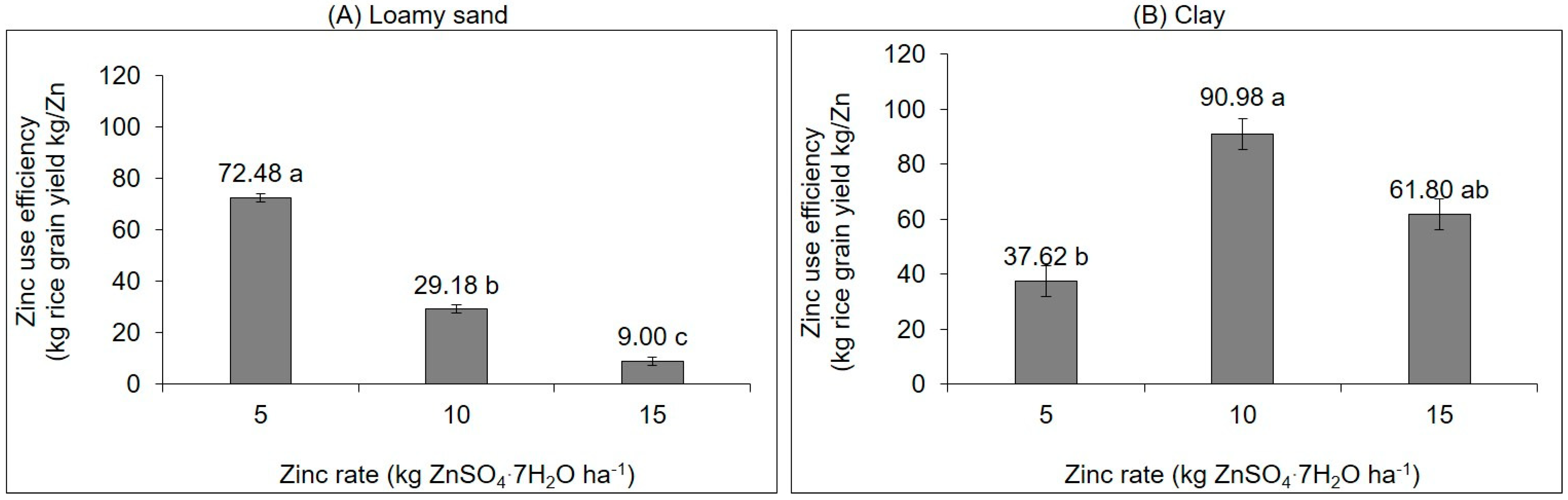
Agronomic zinc use efficiency (ZUE) differed markedly between soils and Zn application rates (
Figure 1). In loamy sand, ZUE peaked at the 5 kg Zn ha
−1 rate (72.48 kg grain kg
−1 Zn) but declined progressively at higher rates, reaching only 9.00 kg grain kg
−1 Zn at 15 kg ha
−1. In contrast, clay soil exhibited the highest efficiency at 10 kg Zn ha
−1 (90.98 kg grain kg
−1 Zn), followed by a non-significant decrease at 15 kg ha
−1 (61.80 kg grain kg
−1 Zn). These patterns indicate distinct texture-specific optima, where low Zn inputs are most effective in coarse-textured soils, while moderate rates achieve maximum response in fine-textured soils due to higher nutrient retention and reduced leaching losses [
10,
14,
16].
The strong decline in ZUE at excessive Zn rates reflects diminishing returns as soil Zn availability exceeds plant demand, consistent with the law of diminishing nutrient response [
5,
12]. Similar patterns were reported by Dobermann and Fairhurst [
7] and Alloway [
28], who observed that agronomic Zn efficiency is highest under mild deficiency and declines once soil and tissue Zn concentrations reach sufficiency [
7,
28].
In loamy sand, the diminishing ZUE at higher Zn rates can be attributed to the soil’s inherently low organic matter and low cation exchange capacity, which together provide very few adsorption sites for Zn. Consequently, additional Zn applied above the optimal level is only weakly retained in the soil matrix and becomes less available for sustained root uptake. Under these conditions, the crop rapidly reaches Zn sufficiency, so further Zn additions do not enhance physiological processes or yield, resulting in sharp reductions in agronomic efficiency despite higher application rates [
8,
13,
28].
The superior ZUE in clay soil at 10 kg Zn ha
−1 suggests improved Zn retention, diffusion, and uptake efficiency, supported by better root proliferation and microbial activity under higher organic matter conditions [
10,
13].
Recent studies from tropical and subtropical rice systems support these texture-dependent ZUE patterns. For example, Shivay et al. [
37] documented dose–response efficiency benefits in Indian lowland rice with Zn application rates beginning at approximately 5 kg ha
−1. Shen et al. [
38] further reported that improved Zn uptake and grain Zn enrichment under variable Zn regimes were consistent with soil-specific nutrient response dynamics. Together, these findings reinforce our texture-based interpretation of ZUE across coarse- and fine-textured soils.
These results demonstrate that site-specific Zn management is essential to maximize nutrient efficiency and minimize unnecessary Zn inputs. For coarse-textured or Zn-depleted soils, small but frequent Zn applications may sustain uptake more effectively than large single doses. In contrast, fine-textured soils benefit from moderate one-time applications aligned with crop Zn demand [
12,
13,
14,
16].
3.6. Trait Correlations, PCA and SEM
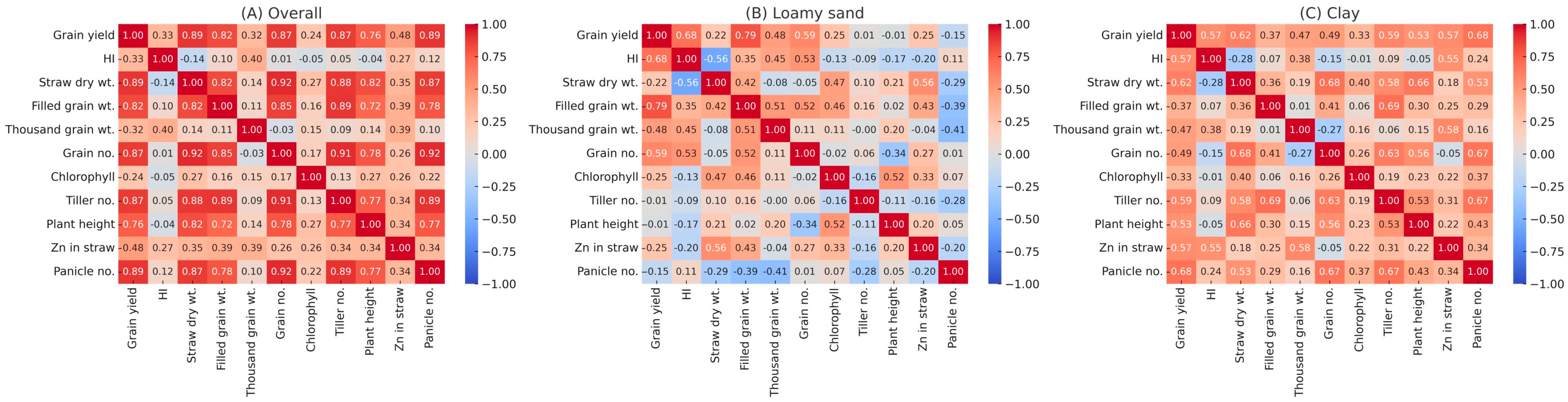
Correlation analysis (
Figure 2;
Figure S1;
Table S1) revealed contrasting yield relationships between the two soil textures. In loamy sand, grain yield exhibited the strongest correlations with reproductive traits such as filled grain weight (r = 0.79 **) and grain number (r = 0.59 **), indicating that yield performance in coarse-textured soils primarily depends on spikelet fertility and grain filling capacity. In contrast, yield in clay soil correlated positively with both vegetative and nutritional traits, particularly tiller number (r = 0.43 *) and Zn concentration in straw (r = 0.73 **). These findings suggest that enhanced Zn uptake and vegetative vigor play complementary roles in sustaining productivity in fine-textured soils with higher nutrient reserves [
7,
8,
10,
16].
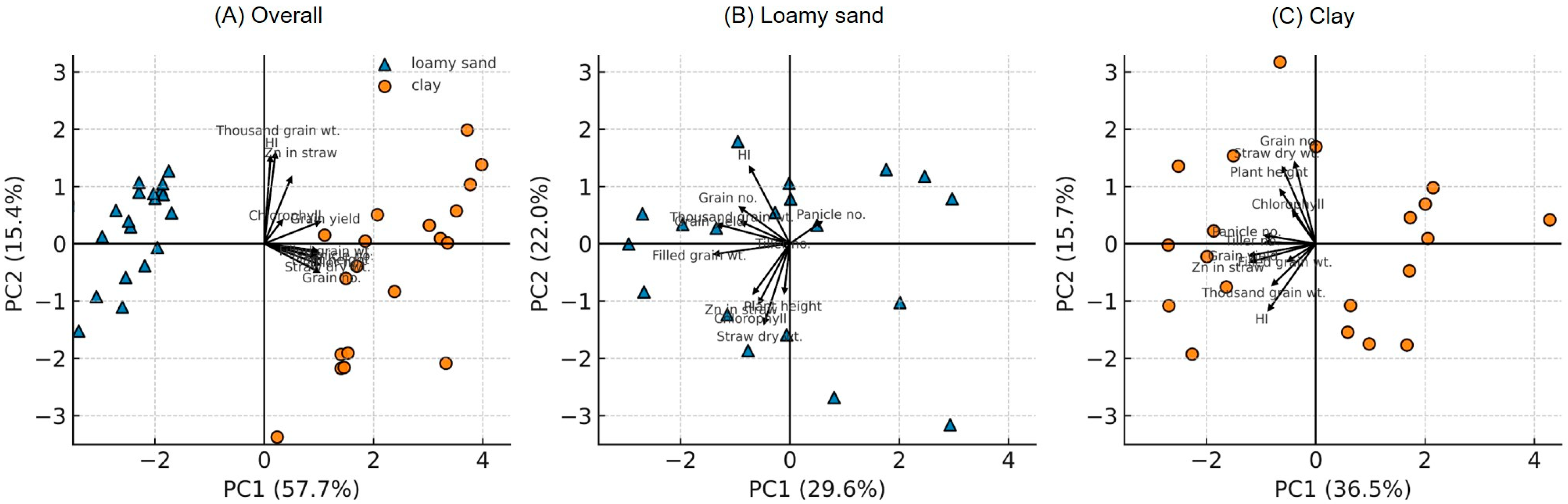
Principal component analysis (PCA;
Figure 3;
Figure S2;
Tables S2 and S3) supported these soil-specific associations. For sandy loam, grain yield clustered closely with grain number, filled grain weight, and harvest index, reflecting the central importance of reproductive efficiency under low nutrient retention. Conversely, in clay soil, yield was positioned near tiller number, plant height, chlorophyll content, and Zn concentration in straw, highlighting the integrated contributions of vegetative biomass and Zn nutrition to yield formation [
12,
13,
28]. The PCA explained 57.7% and 15.4% of the total variation along PC1 and PC2, respectively, confirming clear separation between soil types and consistent trait loading patterns across seasons. The PCA loadings further clarified that trait relationships differed under contrasting soil textures. In loamy sand, yield-associated traits such as grain number, filled grain weight, straw dry weight, and harvest index showed positive but variable loadings along PC1, indicating that reproductive processes contributed to yield formation under low nutrient retention. In contrast, in clay soil, plant height, tiller number, chlorophyll content, and Zn concentration in straw loaded positively along PC1, reflecting the stronger role of vegetative vigor and nutrient uptake in supporting yield under higher Zn-retention capacity. These loading patterns highlight soil-specific clustering of vegetative versus reproductive contributions to yield formation.
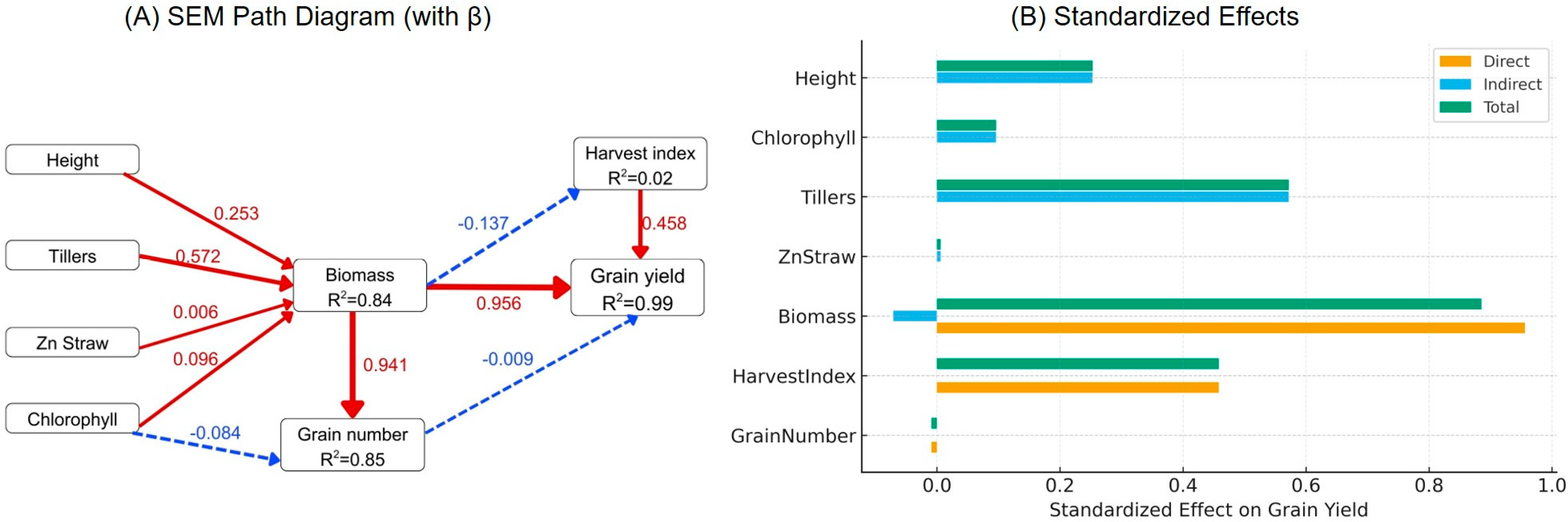
Structural equation modeling (SEM;
Figure 4A,B;
Table S4) quantified the direct and indirect effects of growth and physiological traits on grain yield under Zn fertilization. The model exhibited excellent explanatory power (R
2 = 0.99 **). Biomass accumulation (β = 0.956) had the strongest direct effect on yield, followed by harvest index (β = 0.458), while grain number (β = –0.009) was negligible. Indirect effects of plant height (β = 0.253) and tiller number (β = 0.572) occurred via biomass, indicating their roles in enhancing vegetative vigor and dry-matter production. The positive indirect effect of tiller number on grain yield was thus mediated through biomass accumulation. Chlorophyll content (β = 0.096) and Zn in straw (β = 0.006) showed minor positive indirect effects through improved photosynthesis and Zn uptake. Together, the SEM identified biomass, harvest index, and plant height as key determinants of grain yield, with grain number and Zn partitioning (Zn Straw) playing limited roles.
Consistent with previous findings [
13,
39,
40], Zn application enhances rice yield primarily through improved vegetative growth, photosynthetic efficiency, and nutrient remobilization rather than expansion of sink size. Biomass and harvest index jointly explained over 90% of yield variation in Zn-treated rice [
41,
42], underscoring the central role of assimilate production and partitioning. The strong direct effect of biomass reflects Zn-induced improvements in plant vigor and source capacity via enhanced nitrogen and chlorophyll metabolism [
28,
43]. Moderate indirect effects of plant height and tiller number correspond with Zn-mediated regulation of internode elongation and tiller initiation [
44,
45]. Although chlorophyll content and Zn in straw contributed less, their positive associations indicate a synergistic link between Zn nutrition, chlorophyll biosynthesis, and physiological performance [
46,
47]. These patterns accord with Cakmak [
8] and Noulas et al. [
48], who noted that Zn strengthens both structural and functional traits vital for sustainable yield improvement.
3.7. Mechanistic Interpretation and Implications
This study demonstrates that soil texture fundamentally governs baseline fertility and mediates rice response to Zn fertilization. The higher organic matter, nitrogen, and Zn reserves in clay soil supported greater vegetative vigor and reproductive development, whereas the limited nutrient and water retention of sandy soil constrained growth and yield potential.
Zinc application enhanced both vegetative and reproductive traits, ultimately increasing grain yield; however, the efficiency of Zn utilization differed substantially between soil textures. In sandy soil, ZUE was highest at low Zn inputs, whereas clay soil required moderate Zn rates to achieve optimal yield and Zn uptake. These texture-dependent responses reflect differences in Zn retention, availability, and plant uptake dynamics. Similar texture-specific Zn responses and efficiency patterns have also been reported in other tropical rice-growing regions, further supporting the broader occurrence of these mechanisms beyond Northeast Thailand [
37,
38].
Although the experiment was conducted under controlled greenhouse pot conditions, the intrinsic chemical limitations of the loamy sand soil still influenced Zn behavior. Its low organic matter content and low cation exchange capacity greatly limit the reactive surface area and available sorption sites for retaining Zn in plant-available forms. Under these conditions, small Zn additions are taken up efficiently, but higher Zn rates quickly exceed the soil’s limited adsorption capacity. As a result, additional Zn remains weakly held and contributes little to further uptake, leading to diminishing agronomic efficiency once plant Zn requirements are met. This mechanism aligns with the classical principle of diminishing nutrient response and with established understanding of Zn retention constraints in coarse-textured tropical soils.
From an environmental perspective, aligning Zn inputs with soil-specific retention capacity is important for preventing Zn accumulation in clay soils and minimizing leaching risks in sandy soils, thereby supporting long-term soil health and sustainable nutrient stewardship.
Implementing these findings in practical farm settings requires consideration of the contrasting soil constraints across regions. In sandy soils, where Zn retention is inherently poor, farmers may benefit from applying Zn in smaller but more frequent doses to maintain plant-available Zn throughout critical growth stages. In contrast, farmers managing clay soils can rely on moderate rate of single-dose Zn applications because of their higher Zn-holding capacity and slower diffusion losses. Integrating Zn fertilizers with organic amendments or biofertilizers offers an additional low-cost strategy to increase Zn retention and improve long-term soil fertility. This approach is particularly important for resource-limited farmers in Northeast Thailand. Although a full economic evaluation is beyond the scope of this greenhouse study, these agronomic principles provide a foundation for developing cost-effective, site-specific Zn management guidelines in future field-based research.
Multivariate analyses (correlation, PCA, and SEM) further revealed distinct yield-determining pathways. The PCA trait groupings visually supported these pathways by showing that reproductive traits clustered most closely with yield in sandy soil, whereas vegetative and nutritional traits clustered with yield in clay soil. In sandy soil, yield formation was primarily driven by reproductive efficiency, particularly grain number and filled grain weight, indicating that spikelet fertility and efficient assimilate partitioning are crucial under nutrient-limited conditions. In clay soil, both vegetative vigor and reproductive development, reinforced by Zn uptake and biomass accumulation, made significant contributions to yield formation.
These findings underscore the necessity of site-specific Zn management strategies. In sandy soils, small but frequent Zn applications are likely to maximize efficiency and minimize leaching losses, whereas moderate Zn rates are more effective in clay soils with higher nutrient-retention capacity. In addition, Zn fertilization not only improves agronomic performance but also enhances tissue Zn concentration, contributing to both yield productivity and grain nutritional quality. Integrating Zn application with organic amendments or biofertilizers is particularly recommended for sandy soils in Northeast Thailand, where sustaining long-term fertility and productivity remains a key challenge.
4. Conclusions
This study confirmed that soil texture strongly regulates rice growth, yield, and Zn use efficiency, supporting the hypothesis that Zn fertilization interacts with soil properties to determine crop performance. Clay soil, with higher fertility and greater Zn availability, consistently enhanced vegetative growth, biomass accumulation, and grain yield, whereas loamy sand was constrained by low organic matter and weak nutrient retention. Zinc fertilization alleviated these limitations by improving both vegetative and reproductive traits through enhanced biomass production and Zn uptake.
The optimal Zn rate differed by soil type, validating the second hypothesis: 5 kg Zn ha−1 was most efficient in loamy sand, while 10–15 kg Zn ha−1 maximized yield and Zn uptake in clay soils. Correlation, PCA, and SEM analyses collectively showed that yield formation in loamy sand depended primarily on reproductive efficiency (grain number, filled grain weight), while yield in clay soils was driven by biomass accumulation and Zn uptake pathways. These results demonstrate that (i) Zn fertilization improves rice yield and Zn accumulation through complementary mechanisms, and (ii) soil-specific management is essential for maximizing agronomic efficiency and grain nutritional quality.
Our findings are consistent with earlier reports showing that sandy or coarse-textured soils typically achieve peak Zn efficiency at lower Zn rates, whereas clay-rich soils respond more strongly to moderate Zn inputs because of higher Zn-retention capacity. The soil-specific yield and Zn uptake responses observed here therefore corroborate and extend previous research on tropical rice systems, reinforcing the importance of texture-based Zn management.
These findings also have broader implications for agricultural policy. Soil-specific Zn recommendations can enhance fertilizer efficiency, reduce unnecessary inputs, and support strategies to address widespread Zn deficiency in rice-based food systems. Incorporating these insights into national nutrient management guidelines would contribute to more sustainable and nutritionally effective rice production.



 ,
,