
Article

Microbial Metagenomics Evidence Reveals Forest Soil Amendment Contributes to Increased Sugarcane Yields in Long-Term Cropping Systems

1
Sugarcane Research Institute, Yunnan Academy of Agriculture Science, Kaiyuan 661699, China
2
Forestry Bureau of Nayong County, Nayong 553300, China
3
Yunnan Academy of Biodiversity, Southwest Forestry University, Kunming 650224, China
*
Authors to whom correspondence should be addressed.
These authors contributed equally to this work.
Agronomy 2026, 16(1), 122; https://doi.org/10.3390/agronomy16010122
Submission received: 10 November 2025 / Revised: 26 December 2025 / Accepted: 30 December 2025 / Published: 4 January 2026

Abstract

Long-term continuous cropping is a prevalent agricultural practice aimed at maximizing land use efficiency and crop yields, yet it often leads to severe soil degradation, nutrient imbalance, and microbial community disruption. Effective soil remediation strategies are urgently needed to restore soil health and ensure sustainable agricultural production. In this study, we investigated the impact of forest soil amendment on microbial community structure, diversity, and functional potential in long-term continuous cropping soils. Using metagenomic sequencing, we analyzed soils from natural forest (BK), forest soil-amended soils (BCP), and fields under continuous cropping for 15 years (CP15) and 30 years (CP30). Forest soil amendment significantly mitigated microbial diversity loss and structural degradation caused by prolonged monoculture. Alpha diversity analysis revealed that BCP restored microbial diversity to levels comparable to BK, while beta diversity and NMDS analyses showed that microbial community composition in BCP closely resembled that of forest soil. Taxonomic profiling indicated that forest soil amendment enriched beneficial taxa such as Actinobacterota and Acidobacteriota, reversing shifts observed in CP15 and CP30. Functionally, COG and KEGG annotations revealed that BCP soils exhibited higher abundances of genes involved in carbohydrate metabolism, energy production, and nutrient cycling. Notably, the amendment reduced antibiotic resistance genes and virulence factors, potentially improving the microbial risk profile of soil communities. These findings demonstrate that forest soil amendment effectively restores microbial community structure and functionality in degraded soils, providing a nature-based solution for sustainable agriculture.

1. Introduction

Agricultural cultivation is the most widely practiced form of land use globally, particularly in the continuous cultivation of high-yield crops, where long-term continuous cropping is widely adopted in modern intensive agriculture [1,2]. However, while this practice enhances land use efficiency and crop yields in the short term, long-term monoculture cropping has detrimental effects on soil [3]. The continuous cultivation of a single crop disrupts the physical, chemical, and biological balance of the soil, resulting in soil degradation, accumulation of pests and diseases, and a decline in soil fertility [4]. Therefore, implementing effective soil improvement measures to restore soil health and enhance productivity is crucial to ensuring the sustainability of agricultural production [1,5,6]. In this context, finding effective strategies to improve soil quality, restore soil fertility, and mitigate the negative effects of long-term continuous cropping has become an important issue in current agricultural research.
Long-term continuous cropping leads to the excessive consumption of certain essential nutrients in the soil [7], as the sustained cultivation of a single crop fails to effectively replenish its specific nutrient needs [5,7]. This results in the rapid depletion of key nutrients in the soil, creating nutrient imbalances and accelerating the decline of soil fertility [8,9]. In addition, long-term continuous cropping also leads to the accumulation of pests and diseases in the soil, increasing the frequency of disease outbreaks [10]. Studies have shown that crops in continuous cropping systems interact with soil pathogens through root exudates, which alter the composition of the microbial community and exacerbate disease spread [11]. The root exudates of crops in continuous cropping contain various organic compounds, providing favorable conditions for the growth of pathogens, thereby increasing the likelihood of pest and disease occurrences [12]. Moreover, the continuous cultivation of a single crop leads to the simplification of soil microbial communities, with a reduction in microbial species and a decline in functional diversity [13]. The loss of diversity in soil microbial communities weakens the soil’s ability to suppress different pathogens and harmful substances, leading to a gradual decline in soil biological functions and self-repair capacity [14]. This exacerbates soil health problems, affecting crop growth and yield while increasing the risk of agricultural production and accelerating soil degradation. Previous studies have demonstrated that introducing forest soil can improve the microbial community, increase organic matter, and enhance soil structure [15]. Research has also shown that soil amendments can support microbial functional diversity, providing a potential solution to the challenges posed by continuous cropping [8]. Restoring a diverse and functionally robust microbiome through soil microorganisms offers a promising approach to reversing the soil degradation caused by continuous cropping.
To address the soil degradation caused by long-term continuous cropping, soil improvement has been proven to be an effective solution [15]. Long-term continuous cropping leads to nutrient depletion, pest and disease accumulation, and microbial community degradation, which in turn reduces soil fertility and productivity [10]. Therefore, implementing appropriate soil improvement measures is essential [16]. Among various soil improvement resources, forest soil, with its rich organic matter, high biodiversity, and stable soil structure, is considered an ideal soil amendment material [17]. The introduction of forest soil not only increases the organic matter content and improves soil physical structure, but also promotes the restoration of microbial community diversity, thereby enhancing the soil’s self-repair capacity and ecological functions [18]. A healthy microbial community contributes to the decomposition of organic matter, nutrient cycling, and the secretion of antibiotics to inhibit the growth of pathogens, thereby reducing soil-borne diseases and improving the growth environment for crops [1,19]. However, despite the gradually demonstrated effects of forest soil amendment, the specific mechanisms by which it improves soil quality, enhances soil fertility, and increases crop productivity through microbial community modification remain insufficiently explored.
To investigate how forest soil amendment restores microbial functional groups in long-term continuous cropping soils, this study collected soil samples from four different cropping systems: natural forest soil (BK), forest soil-amended soil (BCP), continuous cropping for 15 years (CP15), and continuous cropping for 30 years (CP30). Using microbial metagenomics technology, we evaluated the microbial community structure, functional diversity, and changes in these soil samples. The main objective of this study is to analyze whether forest soil amendment can effectively improve microbial functional degradation caused by long-term continuous cropping and promote the restoration of soil fertility. By comparing the distribution of microbial metabolic functions, resistance genes, and virulence factors across different treatments, this study will reveal the impact of forest soil amendment on the soil microbiome and its potential for improving crop productivity. By combining forest soil amendment with the microbial community and functional changes in long-term continuous cropping soils, this research provides scientific evidence for agricultural soil improvement and offers technical support for the development of sustainable agricultural production systems.

2. Materials and Methods

2.1. Soil Sampling and Experimental Design

Continuous cropping leads to soil degradation, resulting in a marked decline in soil productivity and consequently reduces crop yield. To address this issue, the aim of this study was to investigate the changes in soil microbial communities during continuous cropping and explore the potential of using forest soil as a microbial inoculant to improve degraded cropland. Specifically, we conducted a soil amendment experiment by incorporating forest soil into soil that had undergone 30 years of continuous cropping. Soil samples were collected from four treatments: forest soil (BK), forest soil-amended soil (BCP), continuous cropping for 15 years (CP15), and continuous cropping for 30 years (CP30).
In January 2024, soil collected from the forest was applied as a surface layer approximately 5 cm thick to plots in the experimental field of the Sugarcane Research Institute, Yunnan Academy of Agricultural Sciences (23.71 N, 103.26 E, elevation 1319 m, soil type was laterite), which had undergone 30 years of continuous cropping (CP30). Following the amendment, sugarcane (variety YZ08-1609) was planted using identical agronomic practices across all treatment plots: continuous cropping for 15 years (CP15), continuous cropping for 30 years (CP30), and forest soil-amended soil with continuous cropping for 30 years (BCP). In August of 2024, soil samples for microbial analysis were collected from four treatments: forest soil (BK), continuous cropping for 15 years (CP15), continuous cropping for 30 years (CP30), and forest soil-amended soil with continuous cropping for 30 years (BCP). Additional soil indicators are presented in Table 1.
Five independent biological replicates were collected for each treatment, with sampling points at least 5 m apart to ensure spatial heterogeneity, five-point composite sampling method in a plum-blossom pattern was used to collect topsoil (0–20 cm) after removing surface litter and weeds. In total, 20 samples were collected. Approximately 500 g of fresh soil was collected at each site, thoroughly homogenized, and immediately flash-frozen in liquid nitrogen to preserve the native microbial community. In the laboratory, samples were processed under sterile conditions, passed through a 2 mm sieve to remove roots and debris, homogenized again, and aliquoted into sterile cryovials for storage at –80 °C until DNA extraction and metagenomic analysis. Different lowercase letters indicate significant differences among treatments (p < 0.05).

2.2. DNA Extraction and Metagenomic Sequencing

Microbial genomic DNA was extracted from 20 soil samples using the OMEGA Soil DNA Kit (OMEGA, New York, NY, USA), and the extraction was performed according to the manufacturer’s instructions. Prior to DNA extraction, the frozen samples were thawed on ice and processed. The extracted DNA was visualized using 0.8% agarose gel electrophoresis to check its integrity. The concentration and purity of the extracted DNA were measured using a NanoDrop ND-100 spectrophotometer (Thermo Scientific, Waltham, MA, USA). Only high-quality DNA samples were standardized to an equal concentration (40 ng/μL) and used for subsequent metagenomic library construction and high-throughput sequencing. The metagenomic library was constructed using the Illumina TruSeq Nano DNA LT Library Preparation Kit, with DNA fragments ligated to adapters. The sequencing was performed on an Illumina Hiseq 2000 platform (Illumina Inc., San Diego, CA, USA) using a paired-end 150 strategy. Sequencing was carried out by Majorbio (Majorbio Biotechnology Co., Ltd., Shanghai, China). The raw sequencing data were subjected to quality control using FastQC (v 0.23.0) to assess sequence quality. Low-quality sequences and adapter contamination were removed, and the remaining data were trimmed using Trimmomatic (v 0.39) to ensure high-quality data for further analysis. Next, SPAdes (v3.15.0) was used to assemble the metagenomic data, generating high-quality contigs, and the assembly quality was evaluated by assessing the N50 value and contig continuity. The assembled data were annotated for microbial species using MetaPhlAn (4.0), and further analysis of microbial community diversity and structure was performed using QIIME (v 24.10).

2.3. Metagenomic Data Processing and Annotation

In this study, the processing and functional annotation of metagenomic data followed a standard bioinformatics pipeline. Firstly, DIAMOND software (v2.0.13) (http://ab.inf.uni-tuebingen.de/software/diamond, accessed on 15 October 2024) was used to align the non-redundant gene set against the NR database (Non-Redundant Database) using the BLASTP (https://blast.ncbi.nlm.nih.gov/, accessed on 15 October 2024) alignment mode. The species annotation was obtained based on the taxonomic information provided by the NR database. Then, the abundance of each species was calculated based on the total gene abundance corresponding to that species. The abundance of species was statistically analyzed at various taxonomic levels, such as Domain, Kingdom, Phylum, Class, Order, Family, Genus, and Species, to construct an abundance profile at each taxonomic level. These data provided a crucial foundation for analyzing the composition and distribution of microbial communities. To further analyze microbial functions, the KEGG database (Kyoto Encyclopedia of Genes and Genomes, http://www.genome.jp/kegg/, accessed on 30 August 2023) was used to perform systematic functional annotation of the assembled genomic data, obtaining metabolic pathway information of the microbial community and revealing its potential functions in the soil environment. To study the resistance mechanisms of microorganisms, the CARD database (Comprehensive Antibiotic Resistance Database, https://card.mcmaster.ca/, accessed on 24 October 2024) was used to annotate antibiotic resistance genes, analyzing the occurrence, spread, and horizontal gene transfer mechanisms of pathogenic resistance genes, further exploring how bacteria adapt and spread antibiotic resistance in the environment. By annotating the data with the CARD database, we were able to deeply explore the antibiotic resistance gene information in the samples, revealing the impact of different soil treatments on microbial resistance characteristics. In addition, DIAMOND software was used to align the gene set with the VFDB core database (Virulence Factor Database) to obtain functional annotations of virulence factor-related genes. Through these annotation analyses, this study was able to investigate the effects of different soil treatments on microbial community functions, resistance genes, and virulence factors, providing important insights into the adaptive changes in soil microorganisms in the ecological environment.

2.4. Statistical and Bioinformatic Analysis

Before performing microbial analysis, all sequencing data were first diluted or normalized to ensure consistent sequence depth across samples. In this study, a hierarchical clustering method (based on Bray–Curtis distance) was used to analyze the similarity relationships between samples from different treatment groups (BK, BCP, CP15, CP30). The Sobs index was used to evaluate the microbial community diversity in each soil treatment group, and the significance of differences between groups was tested using analysis of variance (ANOVA) and Kruskal–Wallis H test. To further compare the structural differences in microbial communities between different treatment groups, non-metric multidimensional scaling (NMDS) based on Bray–Curtis distance matrix was applied, and statistical tests of group differences were performed using the adonis function to assess the impact of different treatments on microbial community structure. All analyses and plots were performed using R version 4.1.0.

3. Results

3.1. Effect of Forest Soil Amendment on Microbial Community

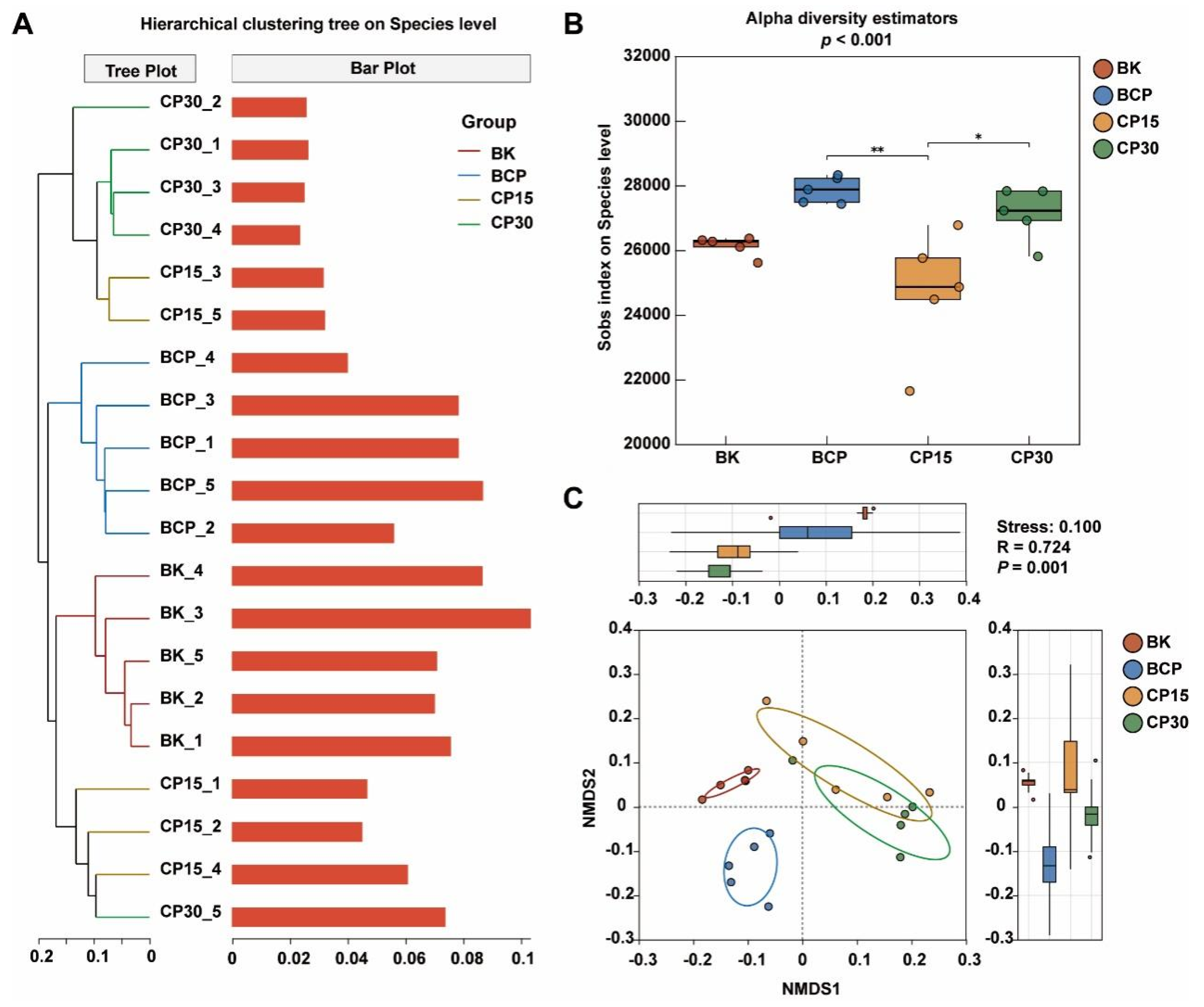
We performed metagenomics analysis to evaluate the impact of different soil treatments on microbial community structure and diversity. Forest soil amendment (BCP) significantly mitigated microbial community degradation caused by long-term continuous cropping, restoring soil microbial diversity and community structure to levels similar to those of forest soil (BK). In hierarchical clustering analysis (Figure 1A), samples from forest soil (BK) and forest soil-amended soil (BCP) clustered together, suggesting similar microbial community compositions. In contrast, samples from continuous cropping for 15 years (CP15) and 30 years (CP30) were distinctly separated, indicating significant shifts in microbial community structure due to long-term cropping. This suggests that long-term cropping alters microbial composition, while forest soil amendment can partially restore this shift.
Alpha diversity analysis (Figure 1B) revealed that microbial diversity in CP15 and CP30 was significantly lower than in both forest soil (BK) and forest soil-amended soils (BCP). Forest soil amendment (BCP) significantly increased microbial diversity, nearly restoring it to levels observed in forest soil (BK). These results highlight the role of forest soil in improving microbial diversity and enhancing soil health by reversing the loss of diversity due to prolonged cropping. Non-metric multidimensional scaling (NMDS) analysis (Figure 1C) further confirmed significant differences in microbial community structure between treatments. Samples from forest soil (BK) and forest soil-amended soil (BCP) clustered closely, while those from CP15 and CP30 were more distantly separated, reflecting the impact of long-term cropping on microbial community structure. Statistical analysis of the NMDS results (Stress = 0.100, R = 0.724, p = 0.001) supports these findings, emphasizing the key role of soil amendment in restoring microbial community structure. These findings suggested that forest soil amendment effectively restores microbial community structure degraded by long-term continuous cropping, significantly improving soil microbial diversity and approaching the levels seen in natural forest soils.

3.2. Effect of Forest Soil Amendment on Microbial Community Composition

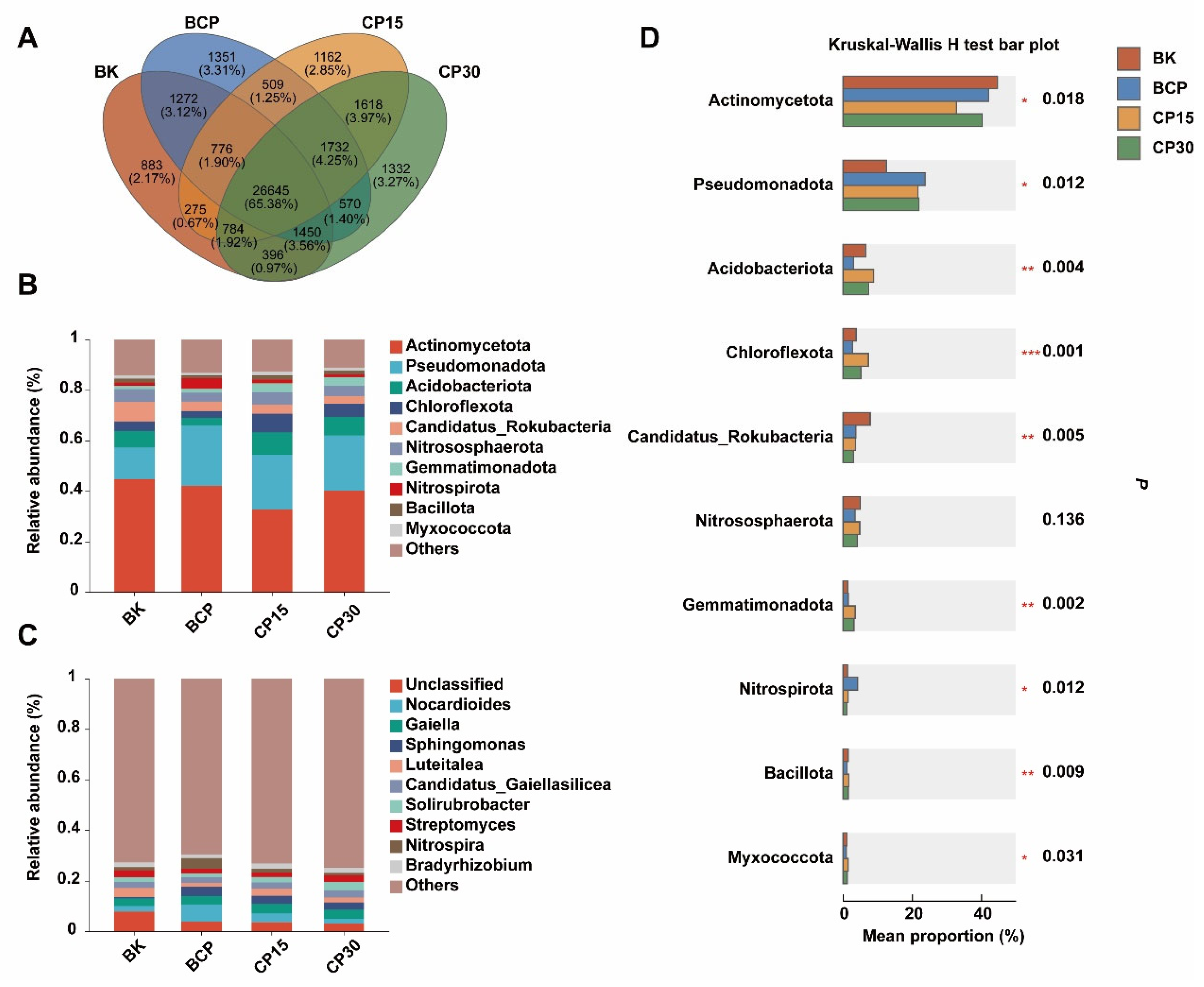
The species composition analysis revealed significant differences in microbial community structure across the different soil treatments. Venn diagram (Figure 2A) depicts the shared microbial species across the four treatment groups. Forest soil (BK) and forest soil-amended soil (BCP) share a high number of microbial species, while soils subjected to long-term continuous cropping (CP15 and CP30) exhibit a distinct microbial composition. Specifically, the CP30 group contains the highest number of unique species (1618, 3.97% of total species), while both CP15 and BCP also harbor unique species, indicating that long-term cropping significantly alters microbial community composition.
We also assessed the microbial taxa under different treatments at the phylum and genus levels. At the phylum level (Figure 2B), Actinobacterota dominates across all treatment groups, with the highest abundance observed in both BK and BCP, reflecting similar community structures in these two treatments. Other phyla, such as Pseudomonadota, Acidobacteriota, and Chloroflexota, exhibit notable variation in abundance across the treatments, with CP15 and CP30 groups showing a marked reduction in some of these phyla, suggesting a shift in microbial composition due to long-term cropping. At the genus level (Figure 2C), specific genera such as Nocardioides, Gaiella, Sphingomonas, and Luteitalea show changes in abundance across the treatments, particularly in the CP15 and CP30 groups, which may be linked to the alterations in soil conditions caused by prolonged cropping. Moreover, we also performed a differential analysis to Kruskal–Wallis H test for significant differences in these species, this results (Figure 2D) shows significant differences in the relative abundance of certain phyla and genera among the treatment groups. Notably, Actinobacterota, Pseudomonadota, Acidobacteriota, Chloroflexota, and Gemmatimonadota display significant differences between treatments, highlighting the substantial impact of soil treatments on these microbial communities. These results indicate that long-term continuous cropping significantly alters the microbial community composition, whereas forest soil amendment (BCP) can partially restore the microbial structure, particularly in Actinobacterota and other key microbial groups.

3.3. Effect of Forest Soil Amendment on the Composition of Microbial Functional Genes

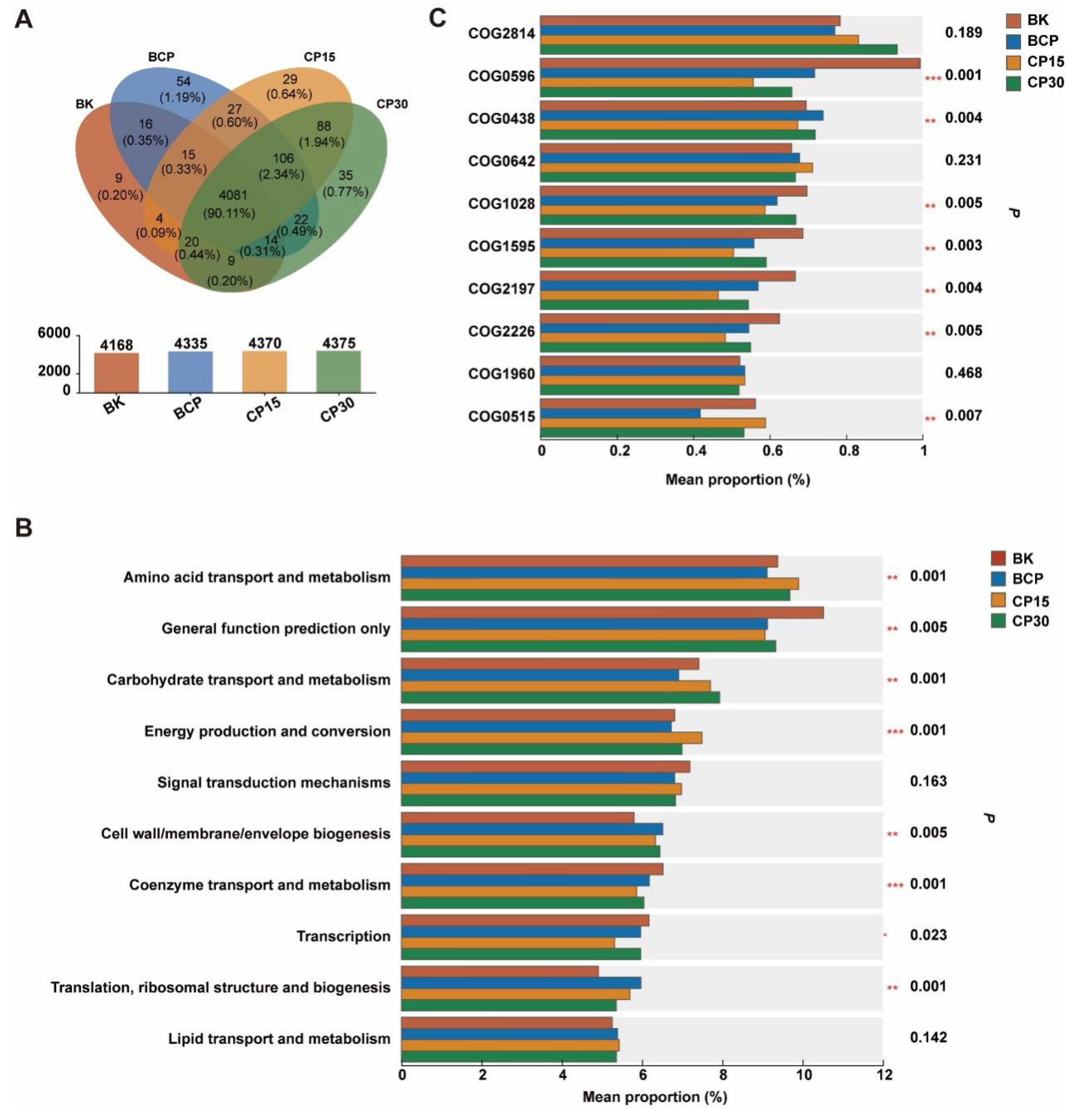
To further evaluate the impact of different soil treatments on the functional potential of microbial communities, this study performed COG (Clusters of Orthologous Groups) annotation of microbial functional genes across the four treatment groups. The results showed (Figure 3A) that a total of 4529 COG functions were commonly detected in all groups. Notably, Although the CP30 group (continuous cropping for 30 years) possessed the highest number of functional genes (1618 in total), the BCP group (forest soil-amended) and the BK group (natural forest soil) had a higher proportion of unique genes, suggesting long-term continuous cropping has significantly altered the microbial functional composition, while forest soil amendment can effectively restore the functional degradation caused by monoculture, making the microbial functional structure more similar to that of healthy forest soil.
In addition, the relative abundance of major metabolic pathways (Figure 3B) varied significantly among treatments. Genes related to Amino acid transport and metabolism, General function prediction only, Carbohydrate transport and metabolism, and Energy production and conversion were significantly more abundant in the BK and BCP groups than in CP15 and CP30 (p < 0.05). Additionally, the BCP group showed higher abundance of genes associated with Cell wall/membrane/envelope biogenesis, Coenzyme transport and metabolism, Transcription, and Translation, ribosomal structure and biogenesis, indicating a more metabolically active and structurally complete microbial community in the amended soils.
To further clarify differences in microbial functional composition, 10 representative COG entries with significant variation among treatments were identified (Figure 3C). COG2814, involved in Carbohydrate transport and metabolism, was the most abundant. COG0438 and COG0642, related to Cell wall biogenesis and Signal transduction, indicated enhanced structural and environmental response functions. COG1028 and COG1960 reflected changes in Lipid metabolism, while COG1595 and COG2197 were linked to Transcription and regulation. COG2226 and COG0596 were associated with Coenzyme metabolism, and COG0515 (Serine/threonine protein kinase) was enriched in forest soil-amended soils, highlighting improved signaling capacity. The abundance of these functional genes was significantly higher in the BCP group than in CP15 and CP30, and closely resembled the levels observed in the BK group. This confirms that forest soil amendment restores critical microbial functions disrupted by long-term monoculture, including metabolic pathways, signaling mechanisms, and environmental adaptability.

3.4. Effect of Forest Soil Amendment on the Composition of Microbial Functional Pathways, Antibiotic Resistance Genes, and Virulence Factors

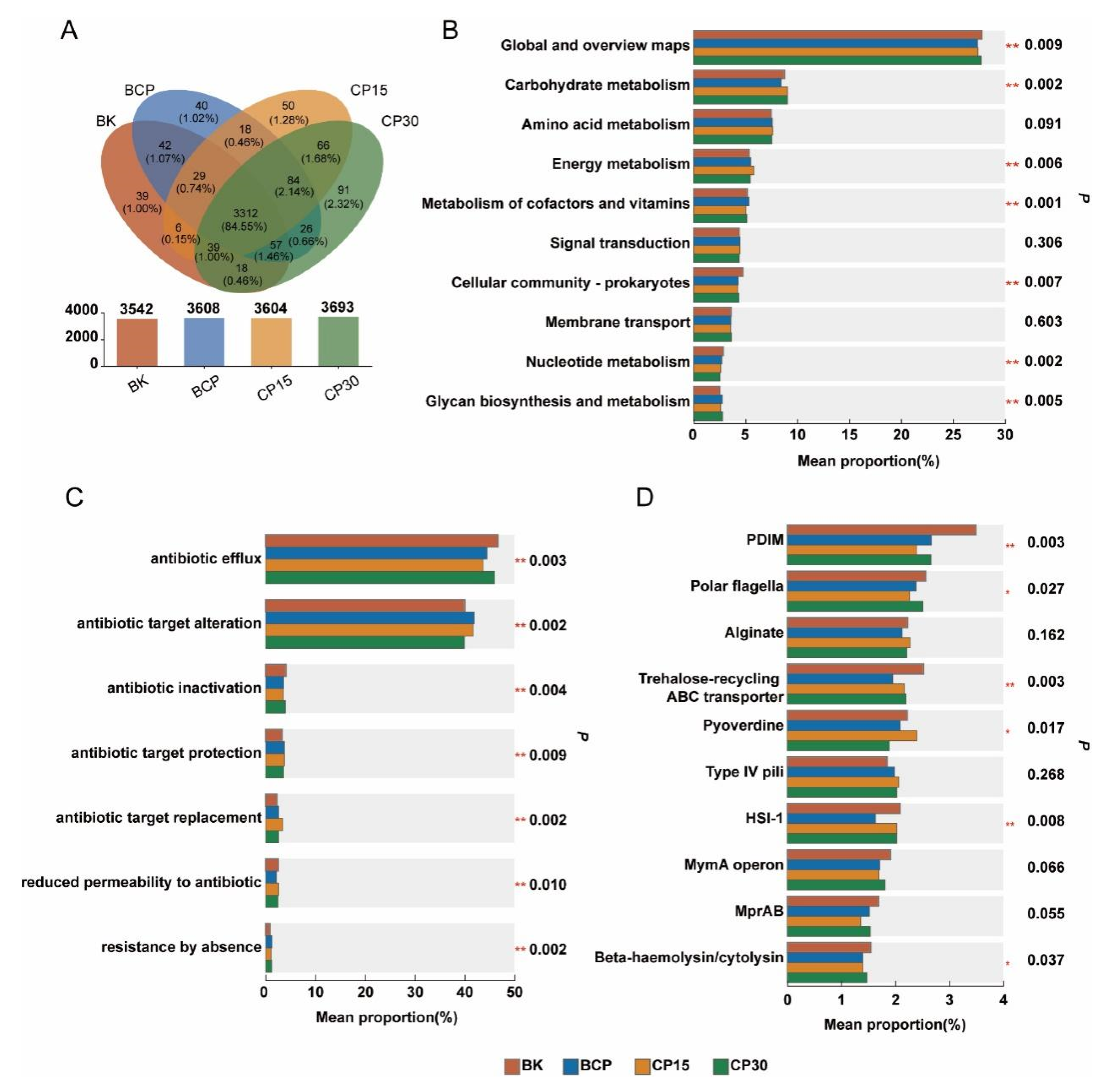
To further evaluate the impact of different soil treatments on the functional potential of soil microbial communities, this study performed KEGG pathway annotation as well as analyses of antibiotic resistance genes and virulence factors across the four treatment groups. The results (Figure 4A) showed that all groups shared a large number of KEGG functional categories, but CP15 and CP30 (continuous cropping for 15 and 30 years) exhibited higher numbers of unique functional categories compared to BK (natural forest soil) and BCP (forest soil-amended). This suggests that long-term continuous cropping significantly alters microbial functional composition, while forest soil amendment reduces this functional divergence and restores a profile closer to that of healthy forest soil. In addition, the relative abundance of major KEGG Level 2 pathways (Figure 4B) varied significantly among treatments. Pathways related to carbohydrate metabolism, energy metabolism, metabolism of cofactors and vitamins, and nucleotide metabolism were significantly more abundant in the BK and BCP groups than in CP15 and CP30 (p < 0.01). The BCP group also showed higher abundance of genes involved in cellular community processes and glycan biosynthesis and metabolism, indicating a more functionally diverse and metabolically active microbial community after amendment.
Furthermore, analysis of antibiotic resistance genes (Figure 4C) revealed that CP15 and CP30 groups had significantly higher abundance of key resistance mechanisms, including antibiotic efflux, target alteration, and inactivation (p < 0.01). In contrast, the BCP group showed significantly reduced abundance of these resistance genes, closely resembling the BK group, suggesting that forest soil amendment can mitigate the accumulation and spread of antibiotic resistance in agricultural soils. Finally, analysis of virulence factors (Figure 4D) showed that CP15 and CP30 had elevated abundance of genes related to PDIM, polar flagella, and type IV pili, among others (p < 0.05), while the BCP group exhibited markedly lower levels of these virulence factors, similar to BK. These results demonstrate that forest soil amendment not only restores core metabolic functions but also reduces the enrichment of antibiotic resistance and virulence genes, thereby improving soil microbial health and reducing disease risk in long-term cropping systems.

4. Discussion

4.1. Long-Term Continuous Cropping Significantly Alters the Structure and Function of Soil Microbial Communities

In modern agricultural production, long-term continuous cropping has become a common practice aimed at achieving high yields and maximizing land use efficiency [8,20]. However, increasing research evidence indicates that continuous cropping not only degrades the soil’s physicochemical properties but also severely disrupts the composition and function of soil microbial communities [11,21], thereby undermining the stability and sustainability of soil ecosystems [22,23,24]. This study systematically evaluated the impact of prolonged cropping on soil microbial diversity and functional composition using metagenomic sequencing, along with diversity indices and community structure analyses. As shown in (Figure 1), the Alpha diversity (Sobs index) of soil microbial communities in continuous cropping for 15 years (CP15) and continuous cropping for 30 years (CP30) was significantly lower than in forest soil (BK) and forest soil-amended soil (BCP), with continuous cropping for 15 years (CP15) showing the most pronounced reduction (p < 0.001). Beta diversity analyses further revealed distinct differences in community structure among treatments: in the NMDS ordination plot, forest soil (BK) and forest soil-amended soil (BCP) samples clustered closely, while samples from continuous cropping for 15 years (CP15) and continuous cropping for 30 years (CP30) were clearly separated (Stress = 0.100, R = 0.724, p = 0.001), indicating that long-term continuous cropping caused significant shifts in microbial community structure [9,25].
Phylogenetic tree analyses confirmed this disturbance, with forest soil (BK) and forest soil-amended soil (BCP) clustering together and continuous cropping for 15 years (CP15) and continuous cropping for 30 years (CP30) forming independent branches. At the functional level, continuous cropping for 15 years (CP15) and continuous cropping for 30 years (CP30) showed significantly reduced abundance of COG genes involved in key metabolic pathways, especially carbohydrate transport and metabolism, lipid metabolism, coenzyme transport and metabolism, and signal transduction. At the taxonomic level, (Figure 2) further revealed differences in microbial taxa under different treatments. Venn diagram analysis (Figure 2A) showed that continuous cropping for 30 years (CP30) had the highest number of unique species (1618, 3.97% of total), while forest soil-amended soil (BCP) and forest soil (BK) shared the largest number of species, indicating that continuous cropping significantly altered community composition, whereas forest soil amendment helped maintain or restore core microbial populations [26,27]. At the phylum level (Figure 2B), dominant phyla included Actinomycetota, Pseudomonadota, Acidobacteriota, and Chloroflexota, but beneficial phyla like Acidobacteriota and Chloroflexota declined markedly in continuous cropping for 15 years (CP15) and continuous cropping for 30 years (CP30), while forest soil-amended soil (BCP)’s composition closely resembled forest soil (BK). At the genus level (Figure 2C), typical beneficial genera such as Nocardioides, Gaiella, and Sphingomonas decreased in the continuous cropping groups but recovered significantly in forest soil-amended soil (BCP). Kruskal–Wallis tests (Figure 2D) indicated significant differences among treatments for several key phyla, with Chloroflexota, Acidobacteriota, Actinomycetota, Gemmatimonadota, and Myxococcota all being significantly more abundant in forest soil-amended soil (BCP) and forest soil (BK) than in continuous cropping for 15 years (CP15) and continuous cropping for 30 years (CP30). These taxa are broadly involved in carbon and nitrogen cycling, organic matter decomposition, and disease suppression, and their decline may directly reduce soil ecosystem functions [28,29].
From the perspective of functional annotation, Figure 3 and Figure 4 together reveal clear differences in the distribution of functional genes among treatments. The COG annotation results in Figure 3 showed that continuous cropping for 30 years (CP30) had a high number of unique functional genes (1618), while forest soil-amended soil (BCP) and forest soil (BK) shared the most, suggesting that forest soil amendment can alleviate the functional loss caused by continuous cropping [30,31]. The KEGG pathway analysis in (Figure 4) further showed that continuous cropping for 15 years (CP15) and continuous cropping for 30 years (CP30) had significantly lower gene abundance in key metabolic pathways such as carbohydrate metabolism, energy metabolism, and cofactor and vitamin metabolism compared to forest soil (BK) and forest soil-amended soil (BCP). Moreover, the abundance of antibiotic resistance genes and virulence factors was markedly higher in continuous cropping for 15 years (CP15) and continuous cropping for 30 years (CP30), including mechanisms like antibiotic efflux, target alteration, PDIM, polar flagella, and type IV pili. This indicates that long-term continuous cropping not only depletes metabolic potential but also promotes the accumulation of resistance and virulence genes, posing additional risks to soil ecological safety [32].

4.2. Forest Soil Amendment Significantly Restores Microbial Functional Potential and Diversity

To address the ecological degradation of soils caused by continuous cropping, it is critical to identify effective and environmentally friendly remediation strategies [5,33]. Forest soil, rich in organic matter, highly diverse microbial communities, and robust ecological functions, is considered an ideal amendment with strong restoration potential [34,35,36]. In this study, we introduced a forest soil amendment treatment (BCP) to systematically assess its impact on the structure and function of soil microbial communities in long-term continuous cropping systems. Results showed that forest soil amendment can significantly improve the functional state of degraded soil microbiomes in a relatively short period. In terms of microbial diversity, the Alpha diversity index of the forest soil-amended soil (BCP) group was significantly higher than in continuous cropping for 15 years (CP15) and continuous cropping for 30 years (CP30), approaching the level seen in forest soil (BK), indicating that introducing forest soil effectively enhances microbial richness and evenness. NMDS and clustering analyses further showed that forest soil-amended soil (BCP) samples were more similar in community structure to forest soil (BK) and clearly distinct from the long-term continuous cropping groups, suggesting that amendment can reconstruct soil microbial communities toward a healthier state [37].
At the functional gene level, forest soil amendment significantly increased the abundance of genes associated with key metabolic pathways [36,38]. Figure 3 showed that forest soil-amended soil (BCP) restored the abundance of COG functional genes involved in carbohydrate transport and metabolism (COG2814), cell wall biogenesis (COG0438), signal transduction (COG0642, COG0515), lipid metabolism (COG1028, COG1960), and coenzyme metabolism (COG2226, COG0596) to levels close to forest soil (BK). Figure 4 further demonstrated that in KEGG Level 2 pathways, forest soil-amended soil (BCP) had significantly higher gene abundance than continuous cropping for 15 years (CP15) and continuous cropping for 30 years (CP30) in carbohydrate metabolism, energy metabolism, and cofactor and vitamin metabolism. Moreover, forest soil-amended soil (BCP) significantly reduced the abundance of antibiotic resistance genes, including mechanisms such as antibiotic efflux and target alteration, and decreased key virulence factors such as PDIM, polar flagella, and type IV pili to levels approaching forest soil (BK). This indicates that forest soil amendment not only restores metabolic activity and ecological functions but also effectively suppresses the accumulation of resistance and virulence genes, enhancing soil biological safety [17,36].
The restorative effect of forest soil may stem from several factors. First, its rich organic matter provides abundant carbon and energy sources to stimulate microbial metabolic activity [39]. Second, a diverse microbial community helps establish more complex ecological networks, enhancing system self-regulation and resilience [40]. Third, specific functional microbes (e.g., actinomycetes, nitrogen-fixing bacteria, antibiotic-producing bacteria) may colonize continuous cropping soils through “microbial invasion,” replacing or suppressing pathogens and improving the soil disease environment [41]. Our results provide an important practical approach: introducing exogenous healthy soil microbial resources can synergistically improve community structure and function to restore soil ecosystems [42]. As a nature-based remediation strategy, forest soil amendment demonstrates strong ecological adaptability and potential for wider application, especially in farmland severely affected by continuous cropping obstacles and extreme soil microbiome degradation

4.3. Practical Implications and Future Prospects for Sustainable Agriculture

This study systematically demonstrates the positive effects of forest soil amendment in restoring microbial diversity, community structure, and functional potential in long-term continuous cropping soils, including the recovery of core metabolic functions and suppression of antibiotic resistance genes and virulence factors [43]. These findings provide both a theoretical foundation and a practical example for the sustainable management of agricultural ecosystems. However, the results of this study are based on microbial metagenomic data, and functional risk needs further confirmation through transcriptomics or culture-based assays. As global fertilizer and pesticide use intensifies and soil degradation becomes increasingly severe, nature-based remediation strategies are emerging as critical directions for green agricultural development [44]. The ecological advantage of forest soil amendment lies in its ability to simultaneously improve soil physicochemical properties and biological characteristics, forming a microbe-centered ecological remediation network. Microorganisms not only participate in nutrient mineralization, organic matter decomposition, and recycling but also play important roles in promoting plant root development and enhancing disease resistance. The reduction in resistance genes and virulence factors further indicates lowered disease risks and improved soil biological safety. Therefore, restoring microbial communities benefits soil health itself while also providing positive feedback on crop physiology and yield. And, key functional microorganisms in forest soil can be seen as “ecological engineers” that, once introduced into continuous cropping soils, restructure interactions within microbial communities through diverse physiological and metabolic activities, strengthening system stability and resilience [45,46]. These functional strains also have potential for further development as microbial fertilizers or soil conditioners, making them valuable research targets for future precision agriculture and microbial resource utilization.
However, the practical application of forest soil amendment still requires careful consideration of factors such as sustainable sourcing, large-scale application feasibility, and compatibility with different cropping systems. As a theoretical study, forest soil holds significant ecological value. However, as an important natural resource, large-scale collection of forest soil for soil amendment faces challenges related to cost and legality in practical applications, necessitating further in-depth research into its feasibility. Future research should combine multi-site, long-term monitoring and multi-omics approaches to further uncover the ecological mechanisms and durability of key functional groups in forest soil amendments. It is also essential to explore more efficient and cost-effective microbial alternatives, such as artificially formulated microbial consortia or bio-humified organic waste products, to balance remediation costs with ecological benefits. In summary, forest soil amendment represents an eco-friendly soil remediation strategy that not only shows clear advantages in rebuilding soil microbial ecology, improving soil quality, and alleviating continuous cropping obstacles but also plays an important role in reducing resistance genes and virulence factors and enhancing soil ecological safety. This approach offers a viable pathway and theoretical support for advancing green agricultural transformation and the development of ecological farming.

5. Conclusions

Our study showed that long-term continuous cropping significantly reshaped the soil microbial community in farmland, altering both community structure and functional potential, and was accompanied by the enrichment of antibiotic resistance genes and virulence factors. Forest soil amendment effectively mitigated these adverse effects: clustering and ordination analyses, together with alpha-diversity metrics, consistently indicated that forest soil amendment increased microbial diversity and shifted community structure toward that of natural forest soil, with partial recovery of key taxa disrupted by continuous cropping. Functionally, forest soil amendment increased the relative abundance of genes involved in core metabolic processes (e.g., carbohydrate and energy metabolism, cofactor and vitamin metabolism, and cellular functions), yielding a functional profile more similar to that of healthy forest soil, while reducing the abundance of major antibiotic resistance mechanisms and multiple virulence-associated factors. Overall, forest soil amendment appears to be an effective strategy for rehabilitating continuously cropped soils by rebuilding microbial diversity, restoring functional capacity, and suppressing undesirable resistance and virulence traits.

Author Contributions

R.L.: Writing—review and editing, Conceptualization. R.Z.: Writing—Original draft, Visualization, Methodology, Formal analysis, Data curation. Z.Z.: Investigation, Methodology. G.T.: Investigation, Data curation. P.Z. and J.D.: Supervision, Funding acquisition, Conceptualization, Writing—review & editing. All authors have read and agreed to the published version of the manuscript.

Funding

This work was funded by High-Level Science and Technology Talent and Innovation Team Selection Program (202205AD160014), Science and Technology Program of Yunnan Province (202304BT090027) and Yunnan Fundamental Research Projects (202501AT070092).

Data Availability Statement

The raw data supporting the conclusions of this article will be made available by the authors upon request.

Conflicts of Interest

The authors declare no conflict of interest.

References

  1. Yang, T.; Siddique, K.H.M.; Liu, K. Cropping systems in agriculture and their impact on soil health—A review. Glob. Ecol. Conserv. 2020, 23, e01118. [Google Scholar] [CrossRef]
  2. Ouyang, W.; Xu, Y.; Hao, F.; Wang, X.; Siyang, C.; Lin, C. Effect of long-term agricultural cultivation and land use conversion on soil nutrient contents in the Sanjiang Plain. CATENA 2013, 104, 243–250. [Google Scholar] [CrossRef]
  3. Hossain, A.; Krupnik, T.J.; Timsina, J.; Mahboob, M.G.; Chaki, A.K.; Farooq, M.; Bhatt, R.; Fahad, S.; Hasanuzzaman, M. Agricultural Land Degradation: Processes and Problems Undermining Future Food Security. In Environment, Climate, Plant and Vegetation Growth; Fahad, S., Hasanuzzaman, M., Alam, M., Ullah, H., Saeed, M., Ali Khan, I., Adnan, M., Eds.; Springer International Publishing: Cham, Switzerland, 2020; pp. 17–61. [Google Scholar]
  4. Ashworth, A.J.; Owens, P.R.; Allen, F.L. Long-term cropping systems management influences soil strength and nutrient cycling. Geoderma 2020, 361, 114062. [Google Scholar] [CrossRef]
  5. Ma, Z.; Guan, Z.; Liu, Q.; Hu, Y.; Liu, L.; Wang, B.; Huang, L.; Li, H.; Yang, Y.; Han, M.; et al. Chapter Four-Obstacles in continuous cropping: Mechanisms and control measures. In Advances in Agronomy; Sparks, D.L., Ed.; Academic Press: Cambridge, MA, USA, 2023; Volume 179, pp. 205–256. [Google Scholar]
  6. Tian, S.; Zhu, B.; Yin, R.; Wang, M.; Jiang, Y.; Zhang, C.; Li, D.; Chen, X.; Kardol, P.; Liu, M. Organic fertilization promotes crop productivity through changes in soil aggregation. Soil Biol. Biochem. 2022, 165, 108533. [Google Scholar] [CrossRef]
  7. Triberti, L.; Nastri, A.; Baldoni, G. Long-term effects of crop rotation, manure and mineral fertilisation on carbon sequestration and soil fertility. Eur. J. Agron. 2016, 74, 47–55. [Google Scholar] [CrossRef]
  8. Ding, M.; Dai, H.; He, Y.; Liang, T.; Zhai, Z.; Zhang, S.; Hu, B.; Cai, H.; Dai, B.; Xu, Y.; et al. Continuous cropping system altered soil microbial communities and nutrient cycles. Front. Microbiol. 2024, 15, 1374550. [Google Scholar] [CrossRef]
  9. Wang, Y.; Zhang, Y.; Li, Z.-Z.; Zhao, Q.; Huang, X.-Y.; Huang, K.-F. Effect of continuous cropping on the rhizosphere soil and growth of common buckwheat. Plant Prod. Sci. 2020, 23, 81–90. [Google Scholar] [CrossRef]
  10. Xia, H.; Jiang, C.; Riaz, M.; Yu, F.; Dong, Q.; Yan, Y.; Zu, C.; Zhou, C.; Wang, J.; Shen, J. Impacts of continuous cropping on soil fertility, microbial communities, and crop growth under different tobacco varieties in a field study. Environ. Sci. Eur. 2025, 37, 5. [Google Scholar] [CrossRef]
  11. An, L.; Lu, X.; Zhang, P.; Sun, J.; Cong, B.; Sa, R.; He, D. Effects of continuous cropping on bacterial community diversity and soil metabolites in soybean roots. Front. Microbiol. 2025, 16, 1534809. [Google Scholar] [CrossRef] [PubMed]
  12. Li, H.; Li, C.; Song, X.; Liu, Y.; Gao, Q.; Zheng, R.; Li, J.; Zhang, P.; Liu, X. Impacts of continuous and rotational cropping practices on soil chemical properties and microbial communities during peanut cultivation. Sci. Rep. 2022, 12, 2758. [Google Scholar] [CrossRef] [PubMed]
  13. Yang, B.; Feng, C.; Jiang, H.; Chen, Y.; Ding, M.; Dai, H.; Zhai, Z.; Yang, M.; Liang, T.; Zhang, Y. Effects of long-term continuous cropping on microbial community structure and function in tobacco rhizosphere soil. Front. Microbiol. 2025, 16, 1496385. [Google Scholar] [CrossRef]
  14. Zhou, Q.; Wang, Y.; Yue, L.; Ye, A.; Xie, X.; Zhang, M.; Tian, Y.; Liu, Y.; Turatsinze, A.N.; Constantine, U.; et al. Impacts of continuous cropping on the rhizospheric and endospheric microbial communities and root exudates of Astragalus mongholicus. BMC Plant Biol. 2024, 24, 340. [Google Scholar] [CrossRef] [PubMed]
  15. Zheng, X.; Wei, L.; Lv, W.; Zhang, H.; Zhang, Y.; Zhang, H.; Zhang, H.; Zhu, Z.; Ge, T.; Zhang, W. Long-term bioorganic and organic fertilization improved soil quality and multifunctionality under continuous cropping in watermelon. Agric. Ecosyst. Environ. 2024, 359, 108721. [Google Scholar] [CrossRef]
  16. Zhang, Z.; Huang, W.; Jia, W.; Xu, Z.; Dang, B.; Shao, H.; Qiu, K.; Han, D. Combined use of green fertilizer and soil conditioner improves soil physicochemical properties, microbial community structure and tobacco quality in continuous cropping. Ann. Microbiol. 2025, 75, 14. [Google Scholar] [CrossRef]
  17. He, G.; Peng, T.; Guo, Y.; Wen, S.; Ji, L.; Luo, Z. Forest succession improves the complexity of soil microbial interaction and ecological stochasticity of community assembly: Evidence from Phoebe bournei-dominated forests in subtropical regions. Front. Microbiol. 2022, 13, 1021258. [Google Scholar] [CrossRef]
  18. Li, F.; Zi, H.; Sonne, C.; Li, X. Microbiome sustains forest ecosystem functions across hierarchical scales. Eco-Environ. Health 2023, 2, 24–31. [Google Scholar] [CrossRef]
  19. Wu, D.; Wang, W.; Yao, Y.; Li, H.; Wang, Q.; Niu, B. Microbial interactions within beneficial consortia promote soil health. Sci. Total Environ. 2023, 900, 165801. [Google Scholar] [CrossRef]
  20. Tan, G.; Liu, Y.; Peng, S.; Yin, H.; Meng, D.; Tao, J.; Gu, Y.; Li, J.; Yang, S.; Xiao, N.; et al. Soil potentials to resist continuous cropping obstacle: Three field cases. Environ. Res. 2021, 200, 111319. [Google Scholar] [CrossRef]
  21. Sun, K.; Fu, L.; Song, Y.; Yuan, L.; Zhang, H.; Wen, D.; Yang, N.; Wang, X.; Yue, Y.; Li, X.; et al. Effects of continuous cucumber cropping on crop quality and soil fungal community. Environ. Monit. Assess. 2021, 193, 436. [Google Scholar] [CrossRef] [PubMed]
  22. Gu, S.; Xiong, X.; Tan, L.; Deng, Y.; Du, X.; Yang, X.; Hu, Q. Soil microbial community assembly and stability are associated with potato (Solanum tuberosum L.) fitness under continuous cropping regime. Front. Plant Sci. 2022, 13, 1000045. [Google Scholar] [CrossRef] [PubMed]
  23. Bai, Y.; Wang, G.; Cheng, Y.; Shi, P.; Yang, C.; Yang, H.; Xu, Z. Soil acidification in continuously cropped tobacco alters bacterial community structure and diversity via the accumulation of phenolic acids. Sci. Rep. 2019, 9, 12499. [Google Scholar] [CrossRef]
  24. Bao, L.; Liu, Y.; Ding, Y.; Shang, J.; Wei, Y.; Tan, Y.; Zi, F. Interactions Between Phenolic Acids and Microorganisms in Rhizospheric Soil From Continuous Cropping of Panax notoginseng. Front. Microbiol. 2022, 13, 791603. [Google Scholar] [CrossRef]
  25. Yang, L.; Tan, L.; Zhang, F.; Gale, W.J.; Cheng, Z.; Sang, W. Duration of continuous cropping with straw return affects the composition and structure of soil bacterial communities in cotton fields. Can. J. Microbiol. 2017, 64, 167–181. [Google Scholar] [CrossRef]
  26. Lu, H.; Lashari, M.S.; Liu, X.; Ji, H.; Li, L.; Zheng, J.; Kibue, G.W.; Joseph, S.; Pan, G. Changes in soil microbial community structure and enzyme activity with amendment of biochar-manure compost and pyroligneous solution in a saline soil from Central China. Eur. J. Soil Biol. 2015, 70, 67–76. [Google Scholar] [CrossRef]
  27. Shu, X.; He, J.; Zhou, Z.; Xia, L.; Hu, Y.; Zhang, Y.; Zhang, Y.; Luo, Y.; Chu, H.; Liu, W.; et al. Organic amendments enhance soil microbial diversity, microbial functionality and crop yields: A meta-analysis. Sci. Total Environ. 2022, 829, 154627. [Google Scholar] [CrossRef] [PubMed]
  28. Bastida, F.; Eldridge, D.J.; García, C.; Kenny Png, G.; Bardgett, R.D.; Delgado-Baquerizo, M. Soil microbial diversity–biomass relationships are driven by soil carbon content across global biomes. ISME J. 2021, 15, 2081–2091. [Google Scholar] [CrossRef]
  29. Wang, X.; Wang, K.; Yang, J.; Zeng, D.; Mo, L.; Pu, G. Nitrogen-cycling microbial diversity and function in tiankengs at different evolutionary stages. CATENA 2025, 254, 108969. [Google Scholar] [CrossRef]
  30. Machado, A.; Serpa, D.; Santos, A.K.; Gomes, A.P.; Keizer, J.J.; Oliveira, B.R.F. Effects of different amendments on the quality of burnt eucalypt forest soils—A strategy for ecosystem rehabilitation. J. Environ. Manag. 2022, 320, 115766. [Google Scholar] [CrossRef]
  31. Luo, G.; Li, L.; Friman, V.-P.; Guo, J.; Guo, S.; Shen, Q.; Ling, N. Organic amendments increase crop yields by improving microbe-mediated soil functioning of agroecosystems: A meta-analysis. Soil Biol. Biochem. 2018, 124, 105–115. [Google Scholar] [CrossRef]
  32. Ying, Y.-X.; Ding, W.-L.; Zhou, Y.-Q.; Li, Y. Influence of Panax ginseng Continuous Cropping on Metabolic Function of Soil Microbial Communities. Chin. Herb. Med. 2012, 4, 329–334. [Google Scholar] [CrossRef]
  33. Gan, T.; Yuan, Z.; Gustave, W.; Luan, T.; He, L.; Jia, Z.; Zhao, X.; Wang, S.; Deng, Y.; Zhang, X.; et al. Challenges of continuous cropping in Rehmannia glutinosa: Mechanisms and mitigation measures. Soil Environ. Health 2025, 3, 100144. [Google Scholar] [CrossRef]
  34. Sarauer, J.L.; Coleman, M.D. Microbial communities of biochar amended forest soils in northwestern USA. Appl. Soil Ecol. 2023, 188, 104875. [Google Scholar] [CrossRef]
  35. Zhu, X.; Mao, L.; Chen, B. Driving forces linking microbial community structure and functions to enhanced carbon stability in biochar-amended soil. Environ. Int. 2019, 133, 105211. [Google Scholar] [CrossRef]
  36. Zhang, P.; Guan, P.; Hao, C.; Yang, J.; Xie, Z.; Wu, D. Changes in assembly processes of soil microbial communities in forest-to-cropland conversion in Changbai Mountains, northeastern China. Sci. Total Environ. 2022, 818, 151738. [Google Scholar] [CrossRef]
  37. Ding, L.-J.; Ren, X.-Y.; Zhou, Z.-Z.; Zhu, D.; Zhu, Y.-G. Forest-to-Cropland Conversion Reshapes Microbial Hierarchical Interactions and Degrades Ecosystem Multifunctionality at a National Scale. Environ. Sci. Technol. 2024, 58, 11027–11040. [Google Scholar] [CrossRef]
  38. Baldrian, P.; Kolařík, M.; Štursová, M.; Kopecký, J.; Valášková, V.; Větrovský, T.; Žifčáková, L.; Šnajdr, J.; Rídl, J.; Vlček, Č.; et al. Active and total microbial communities in forest soil are largely different and highly stratified during decomposition. ISME J. 2012, 6, 248–258. [Google Scholar] [CrossRef]
  39. Liu, Y.; Song, X.; Wang, K.; He, Z.; Pan, Y.; Li, J.; Hai, X.; Dong, L.; Shangguan, Z.; Deng, L. Changes in soil microbial metabolic activity following long-term forest succession on the central Loess Plateau, China. Land Degrad. Dev. 2023, 34, 723–735. [Google Scholar] [CrossRef]
  40. Chen, W.; Wang, J.; Chen, X.; Meng, Z.; Xu, R.; Duoji, D.; Zhang, J.; He, J.; Wang, Z.; Chen, J.; et al. Soil microbial network complexity predicts ecosystem function along elevation gradients on the Tibetan Plateau. Soil Biol. Biochem. 2022, 172, 108766. [Google Scholar] [CrossRef]
  41. Bhatti, A.A.; Haq, S.; Bhat, R.A. Actinomycetes benefaction role in soil and plant health. Microb. Pathog. 2017, 111, 458–467. [Google Scholar] [CrossRef]
  42. Wang, L.; Lu, P.; Feng, S.; Hamel, C.; Sun, D.; Siddique, K.H.M.; Gan, G.Y. Strategies to improve soil health by optimizing the plant–soil–microbe–anthropogenic activity nexus. Agric. Ecosyst. Environ. 2024, 359, 108750. [Google Scholar] [CrossRef]
  43. Sun, D.; Huang, Y.; Wang, Z.; Tang, X.; Ye, W.; Cao, H.; Shen, H. Soil microbial community structure, function and network along a mangrove forest restoration chronosequence. Sci. Total Environ. 2024, 913, 169704. [Google Scholar] [CrossRef]
  44. Mrunalini, K.; Behera, B.; Jayaraman, S.; Abhilash, P.C.; Dubey, P.K.; Swamy, G.N.; Prasad, J.V.N.S.; Rao, K.V.; Krishnan, P.; Pratibha, G.; et al. Nature-based solutions in soil restoration for improving agricultural productivity. Land Degrad. Dev. 2022, 33, 1269–1289. [Google Scholar] [CrossRef]
  45. Zhang, B.; Hu, X.; Zhao, D.; Wang, Y.; Qu, J.; Tao, Y.; Kang, Z.; Yu, H.; Zhang, J.; Zhang, Y. Harnessing microbial biofilms in soil ecosystems: Enhancing nutrient cycling, stress resilience, and sustainable agriculture. J. Environ. Manag. 2024, 370, 122973. [Google Scholar] [CrossRef] [PubMed]
  46. Chen, Q.; Song, Y.; An, Y.; Lu, Y.; Zhong, G. Soil Microorganisms: Their Role in Enhancing Crop Nutrition and Health. Diversity 2024, 16, 734. [Google Scholar] [CrossRef]
Figure 1. Diversity analysis of microbial communities across different planting histories. BK (forest soil), BCP (soil improvement for continuous planting through forest soil), CP15 (15 years of continuous planting), and CP30 (30 years of continuous planting). (A) shows a hierarchical clustering tree at the species level, reflecting the similarity of microbial communities between groups, with BK in brown, BCP in blue, CP15 in yellow, and CP30 in green. (B) presents alpha diversity estimates (Sobs index) at the species level, showing significant differences between groups, with CP30 exhibiting the highest diversity, followed by CP15, BCP, and BK. (C) illustrates non-metric multidimensional scaling (NMDS) based on Bray–Curtis distances to visualize structural differences in microbial communities between groups. The inset box plot shows the NMDS scores for each group, further emphasizing the differences in community composition. Statistical significance was defined as ** p < 0.01, and * p < 0.05.
Agronomy 16 00122 g001
Figure 2. Microbial community composition across different planting histories (BK, BCP, CP15, CP30). (A) Venn diagram showing the unique and shared microbial taxa among the different groups, with the largest overlap observed between CP15 and CP30. (B) Relative abundance of microbial taxa at the phylum level. The bar plots display the distribution of predominant microbial phyla in each group, with Actinobacterota, Pseudomonadota, and Acidobacteriota being the most abundant across all groups. (C) Relative abundance of microbial taxa at the genus level, highlighting the less abundant genera and their variations between groups. (D) Kruskal–Wallis H test bar plots indicating the statistical significance of differences in the relative abundance of major taxa between groups. Asterisks denote significant differences, with CP30 showing distinct differences in several phyla compared to the other groups. Statistical significance was defined as *** p < 0.001, ** p < 0.01, and * p < 0.05.
Agronomy 16 00122 g002
Figure 3. COG functional annotation of microbial communities across different planting histories. (A) Venn diagram showing the number of unique and shared COG functional categories across the different groups. The numbers in each section represent the unique functional categories for each group. (B) Relative abundance of COG functional categories across the groups. The bar plots display the relative abundance of major functional categories, with amino acid transport and metabolism, general function prediction, and carbohydrate transport and metabolism being dominant in all groups. (C) Relative abundance of specific COG entries across the groups. The bar plots show the differences in the abundance of each COG entry, with statistical significance indicated by p-values. CP30 shows significant differences in several COG categories compared to the other groups, particularly in entries such as COG2814 and COG0596. Statistical significance was defined as *** p < 0.001, ** p < 0.01, and * p < 0.05.
Agronomy 16 00122 g003
Figure 4. Functional annotation and analysis of microbial communities across different planting histories. (A) Venn diagram showing the number of unique and shared KEGG functional categories across the different groups. (B) KEGG Level 2 functional classification analysis. Bar plots show the relative abundance of major functional categories across the groups, with significant differences observed in categories such as carbohydrate metabolism, amino acid metabolism, and energy metabolism. Statistical significance is indicated by p-values. (C) Antibiotic resistance gene analysis. Bar plots display the relative abundance of antibiotic resistance mechanisms, including antibiotic efflux, target alteration, and target protection. CP30 shows significant differences in some resistance mechanisms compared to other groups. (D) Virulence factor analysis based on the virulence factor database. The bar plots show the relative abundance of various virulence factors, with significant differences observed in factors such as PDIM, polar flagella, and type IV pili. Statistical significance is indicated by p-values. Statistical significance was defined as ** p < 0.01, and * p < 0.05.
Agronomy 16 00122 g004
Table 1. Summary of soil physicochemical properties and sugarcane yield in the study area.
TreatmentsBKBCPCP15CP30
pH7.18 a6.61 a7.17 a6.62 a
Soil organic matter (g/kg)16.98 a12.54 b13.68 b16.39 a
Total nitrogen (g/kg)1.07 ab0.86 b0.84 b1.31 a
Total phosphorus (g/kg)0.97 a0.79 b0.55 c0.75 b
Total potassium(g/Kg)10.30 b5.95 c5.32 c14.62 a
Alkali-hydrolyzable nitrogen (g/kg)0.12 a0.06 b0.09 b0.14 a
Olsen phosphorus (mg/kg)7.65 b4.06 b21.55 a20.78 a
Available potassium (mg/kg)131.56 a102.69 b80.66 c154.96 a
Sugarcane yield (t/ha)/117.30 a78.60 b81.60 b
Disclaimer/Publisher’s Note: The statements, opinions and data contained in all publications are solely those of the individual author(s) and contributor(s) and not of MDPI and/or the editor(s). MDPI and/or the editor(s) disclaim responsibility for any injury to people or property resulting from any ideas, methods, instructions or products referred to in the content.