Article

Predicting Current and Future Potential Distributions of Ectropis grisescens (Lepidoptera: Geometridae) in China Based on the MaxEnt Model
1
Shanxi Center for Testing of Functional Agro-Products, Shanxi Agricultural University, Taiyuan 030031, China
2
Department of Entomology, Nanjing Agricultural University, Nanjing 210095, China
*
Author to whom correspondence should be addressed.
These authors contributed equally to this work.
Agronomy 2025, 15(11), 2546; https://doi.org/10.3390/agronomy15112546
Submission received: 15 September 2025 / Revised: 29 October 2025 / Accepted: 31 October 2025 / Published: 31 October 2025
(This article belongs to the Special Issue Sustainable Pest Management under Climate Change)

Abstract

Ectropis grisescens Warren (Lepidoptera: Geometridae) is a destructive pest that has severely impacted major tea-growing regions in recent years; as such, it is vital to determine how climate change influences its areas of distribution. In this study, we employed a parameter-optimized maximum entropy (MaxEnt) model, integrating 170 E. grisescens occurrence records and seven selected environmental variables, to predict the pest’s current and future potential distribution in China. Parameter optimization was conducted with the ENMeval package in R, identifying the optimal feature combination as “linear—L, quadratic—Q” and the regularization multiplier as 0.5. These results indicated that the mean diurnal range (bio2), precipitation of driest month (bio14), and elevation were the key variables contributing to the suitable area for E. grisescens. Currently, the total potential suitable area for E. grisescens in China spans approximately 1.969 × 10⁶ km2, covering 20.51% of the country’s land area, of which 5.121 × 10⁵ km2, 7.385 × 10⁵ km2, and 7.185 × 10⁵ km2 possess low, medium, and high suitability, respectively. Notably, the high-suitability regions are predominantly concentrated in southeastern China, encompassing the provinces and municipalities of Zhejiang, Anhui, Hunan, Jiangsu, Chongqing, Jiangxi, Guangxi, Hubei, and Sichuan. Under future climate scenarios, it is projected that the suitable habitats for this pest will undergo varying degrees of change. Specifically, under the SSP1-2.6 scenario, the suitable habitat area is estimated to increase by up to 12.21% by the 2070s. Under the SSP2-4.5 scenario, the centroid of the suitable habitat will be displaced northwest by up to 238.4 km by the 2030s. Our findings provide valuable insights into the future management of E. grisescens and will aid in mitigating its ecological and economic impacts.

1. Introduction

The tea plant (Camellia sinensis L.) one of the most economically valuable crops used to produce non-alcoholic beverages worldwide and is currently cultivated in nearly 60 countries [1,2]. Tea contains bioactive compounds such as polyphenols and catechins which can enhance immunity, reduce oxidative stress, and improve cardiovascular health [3]. As one of the world’s “three major beverages” along with coffee and cocoa, tea is consumed by approximately two-thirds of the global population, and its annual market value exceeds USD 200 billion. China is the world’s largest producer and consumer of tea, with statistical data showing that the country’s tea production accounts for more than 70% of the global total [4]. In 2021, China’s tea cultivation area reached approximately 3.2641 million hectares (hm2), with annual tea exports totaling 3.063 million tons and a total export value of approximately USD 42.63 billion [5]. Despite the booming development of China’s tea industry, it still faces significant challenges posed by the tea gray geometrid Ectropis grisescens Warren (Lepidoptera: Geometridae).
Ectropis grisescens is a destructive defoliating pest prevalent in tropical and subtropical regions [6]. Its larvae prefer to feed on the tender leaves, mature foliage, and new shoots of tea plants, which are vital areas for photosynthesis and new shoot growth. It spawns 6–7 generations per year, leading to rapid population growth or recovery and persistent infestations, complicating pest control efforts. Furthermore, the voracious feeding of its larvae can cause a 60% yield loss in affected areas [7,8]. Beyond the immediate economic damage caused, repeated defoliation weakens the resilience of tea plants, impairing their growth in subsequent growing seasons and increasing their susceptibility to secondary pathogens. Furthermore, the high mobility of E. grisescens enables it to rapidly colonize adjacent tea fields. Recent studies have shown that since 2015, the resistance of E. grisescens populations to pyrethroids has increased 15-fold [9]. These impacts threaten both short-term harvests and the sustainability of tea plantations. As outlined above, the biological traits of this pest necessitate ongoing research and adaptive control measures to mitigate its impacts on tea production.
According to the World Meteorological Organization (WMO), since large-scale industrialization began, global temperatures have significantly increased (by around one degree Celsius). The Intergovernmental Panel on Climate Change (IPCC) has also highlighted that the world climate has been continuously warming in the past three decades, and a report on Global Climate Models and Development Scenarios postulates that if greenhouse gas emissions remain at high levels, global temperatures may rise by about 1.4 to 5.8 °C this century [10,11,12]. A meticulous analysis of extensive long-term data demonstrates that the rapid climatic changes witnessed over the past few decades are certain to induce alterations in the physiology, distribution patterns, and phenological phenomena of adaptable organisms; for example, future climate warming will accelerate the metabolisms, shorten the developmental cycles, and expand the niches of a variety of crucial pests [13,14,15]. More specifically, it is anticipated that the distributions of species will shift to higher elevations [16,17,18]. These alterations in climatic conditions are therefore likely to be a crucial influence on species distribution throughout the 21st century [19,20]. Meanwhile, in tea garden management, human activities such as intensive tree planting configurations, periodic field management measures (such as pruning and fertilization), and the application of chemical pesticides also play important roles in shaping the geographical distribution patterns of E. grisescens.
Species Distribution Models (SDMs), useful statistical methodologies, enable the prediction of habitat suitability for pests by combining species distribution patterns with environmental variables [21,22,23]. Of these, the maximum entropy (MaxEnt) model stands out for its exceptional predictive capabilities. It is a correlative method that models geographic species distributions based on presence-only records [24,25], offering many advantages over other models such as a short runtime, ease of operation, and high simulation precision [26,27]. MaxEnt is widely used to model species distribution and environmental niches in many studies spanning evolution, ecology, and conservation biology [28,29]. It has also been used to predict the potential distribution ranges of various pests, such as Sitobion miscanthi [30], Bactrocera tsuneonis [31], and Corythucha marmorata [32]. Specifically, the first of these studies used an optimized MaxEnt model to predict the suitable habitat of S. miscanthi in China and found that terrain roughness was the most important environmental variable. Currently, the most suitable areas are distributed in southern, eastern, and northeastern China, but will both expand to the northwest and become even more suitable in the future. The second study indicated that the potentially suitable areas for B. tsuneonis are currently concentrated in Central, South, and East China, and predicted that the total suitable area will increase under the future climate scenarios. The third study revealed that regions suitable for C. marmorata currently span from 18–47° N to 103–128° E, with a trend towards the potentially suitable area increasing in the future. Overall, the MaxEnt model enhances our understanding and predictions of potential species habitats, plays a crucial role in ecological research, and makes significant contributions to the fields of conservation and pest management.
Clarifying the distribution of pests, especially under future climate conditions, is crucial for strengthening pest management and implementing targeted management and control measures, effectively controlling their population growth. Many studies on E. grisescens have focused on its biological characteristics [33], molecular biology [34,35], and control strategies [36]; therefore, there is a need to improve our understanding of how continuous climate change will impact its distribution in China. Calculating a species’ distribution centroid quantifies the core spatial position of its current distribution, tracks its spatiotemporal migration under environmental changes (e.g., climate warming), and provides key spatial references for analyzing the relationship between the species and its suitable habitats, formulating conservation strategies, or predicting potential ranges [37,38]. In this study, using E. grisescens distribution data, key environmental variables that limit its distribution, and the ENMeval data package, we developed an optimized MaxEnt model to determine areas that would be potentially suitable habitats. To do so, we (1) identified the geographical distributions of E. grisescens in China; (2) assessed the impact of different environmental variables; (3) created potential E. grisescens distribution regions under both current (1970–2000) and future (2030s, 2050s, and 2070s) climate change scenarios (SSP1-2.6, SSP2-4.5, and SSP5-8.5); (4) evaluated potential future changes in distribution areas; and (5) analyzed potential centroid shifts in E. grisescens distribution under three future scenarios. Using these varied predictive models, we hope to gain a deeper understanding of the potential impacts of climate change on E. grisescens distribution while providing a theoretical basis and technical support for the development of control systems and scientific monitoring methods in tea plantations.

2. Materials and Methods

2.1. Collection of Species Occurrence Records

E. grisescens occurrence records were systematically collated, comprising 187 distribution data points (Table S1). Sources included the previously published academic literature and scientific databases, such as the China National Knowledge Internet (CNKI, https://www.cnki.net/, accessed on 12 April 2025), Web of Science (https://www.webofscience.com/wos/, accessed on 15 April 2025), and Global Biodiversity Information Facility databases (GBIF [39], https://doi.org/10.15468/39omei, accessed on 16 April 2025). Occurrence points lacking geographical coordinates were accurately determined using Google Maps. To minimize the errors arising from spatial autocorrelation, we utilized the ENMTools software to filter the distribution data, removing overly dense occurrence points [14,40]. Simultaneously, we ensured that there was at most one distribution point per 5 km grid cell and removed unreasonable data on the map, such as duplicates, invalid entries, densely clustered points, and latitude–longitude information recorded in the GBIF but not reported in China. Ultimately, 170 effective E. grisescens distribution records were used for model training and validation (Figure 1).

2.2. Variable Environment Selection and Data Processing

Climate projection data from the Beijing Climate Center’s BCC-CSM2-MR model, part of the Coupled Model Intercomparison Project Phase 6 (CMIP6), served as the primary basis for the future climate scenarios in our model. We selected three Shared Socioeconomic Pathways (SSPs) to cover a wide range of possible future scenarios: SSP1-2.6, SSP2-4.5, and SSP5-8.5. Each of these pathways represents a distinct trajectory of greenhouse gas emissions and societal development. SSP1-2.6 corresponds to a low forcing scenario, SSP2-4.5 represents a medium forcing scenario, and SSP5-8.5 represents a high forcing scenario. These scenarios assume that by 2100, radiative forcing will stabilize along paths of approximately 2.6, 4.5, and 8.5 W/m2, respectively [41]. The global data for 19 bioclimatic variables and elevation were downloaded from the World Climate Database (version 2.1) with a resolution of 2.5 arc-min, spanning from 1970 to 2000. The human influence index variable was sourced from the Global Human Influence Index (Geographic) ver. 2 (1995–2004), downloaded from NASA’s (National Aeronautics and Space Administration) Socioeconomic Data and Applications Center. We combined the three SSPs above with three future climate data periods to generate a total of nine future environmental datasets, which were then used to predict the potential distribution of E. grisescens under future climate conditions.
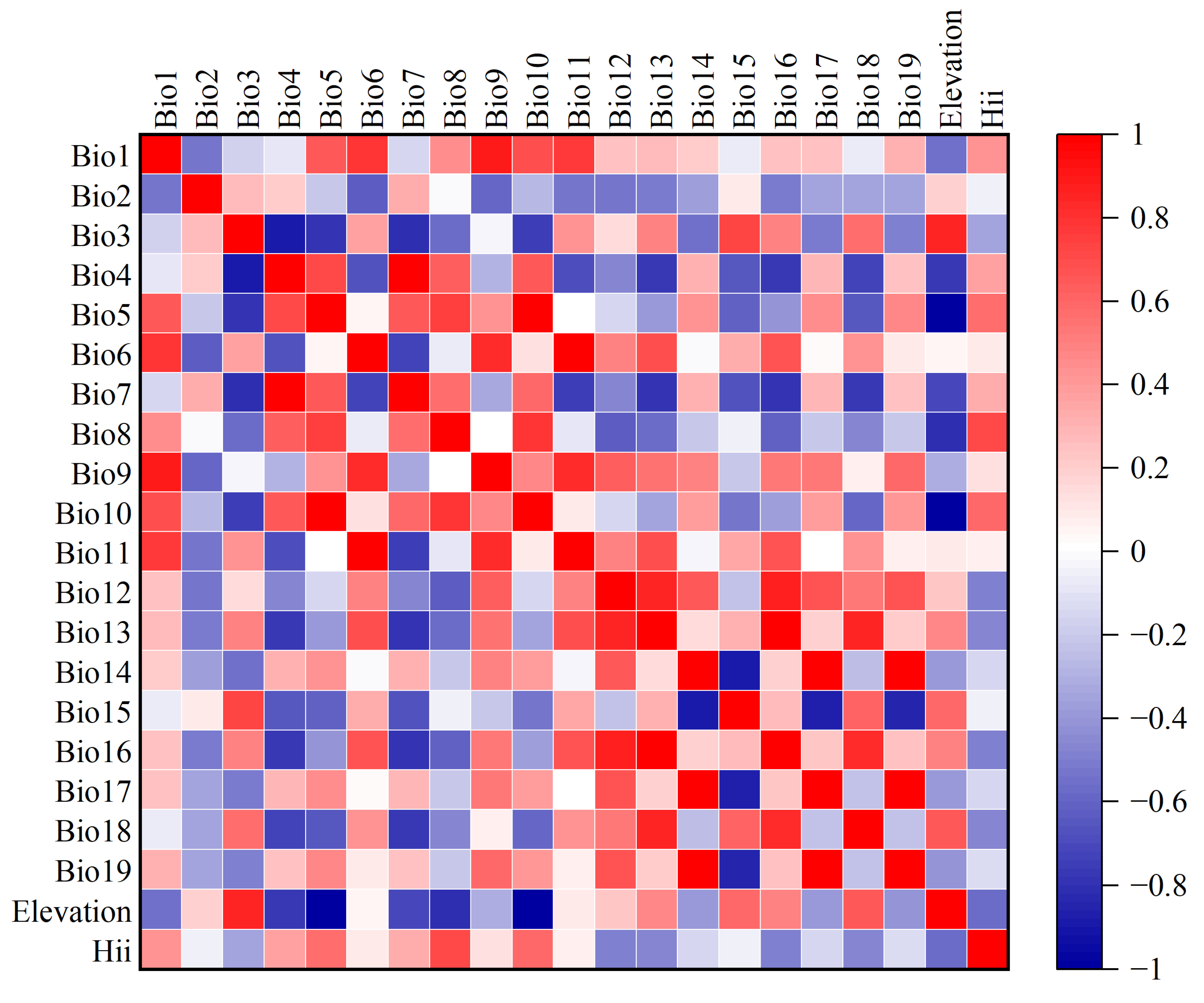
The 21 environmental variables (19 bioclimatic factors + elevation + human influence index) used to predict species distribution exhibited autocorrelation and multicollinearity, making it likely that the prediction accuracy would be affected. Therefore, before establishing the model, it was necessary to conduct correlation analysis on each environmental variable using the jackknife method [42], while we calculated pairwise Pearson correlation coefficients (r) between environmental variables using SPSS version 24.0 software. Variables with an absolute Pearson correlation coefficient of |r| ≥ 0.7 were considered to be highly correlated [43]. Subsequently, variables that contributed significantly to the model of E. grisescens and had low correlation with other variables were retained as key climate factors for predicting distribution [44,45]. The final model contained seven environmental variables: mean diurnal range (bio2), temperature seasonality (bio4), mean temperature of driest quarter (bio9), precipitation of driest month (bio14), precipitation of warmest quarter (bio18), elevation, and human influence index (Hii) (Figure 2).

2.3. Model Construction, Optimization, and Accuracy Evaluation

The prediction model was built using MaxEnt v3.4.1 [46]. To guarantee the reliability and accuracy of the results, we partitioned the dataset into training and testing subsets; specifically, 75% of the occurrence points were randomly selected for model training, while the remaining 25% were used for model testing [47]. The maximum number of background points for the model was set to 10,000, and cross-validation was performed simultaneously. The MaxEnt model was run 10 times, and the results were output in logistic format, with the other parameters set to default values.
We used the ENMeval package in R v4.4.1 to calibrate the MaxEnt model and enhance its precision [48]. This process focused primarily on optimizing two key parameters: the feature combination (FC) and regularization multiplier (RM). For the RM, we incrementally adjusted its value from 0.5 to 4 at intervals of 0.5, resulting in a total of 8 distinct values. As for the FC, there were five available options: linear—L, quadratic—Q, product—P, threshold—T, and hinge—H. These options formed six combinations: “L”, “LQ”, “H”, “LQH”, “LQHP”, and “LQHPT”. We generated a total of 48 parameter combinations for the MaxEnt model by multiplying the 8 RM values and 6 FC types. The optimal MaxEnt model was determined by two criteria: a statistically significant omission rate that fell below the threshold of 0.05, and a delta AICc value of less than 2 [49,50].

2.4. Classification of Suitable Regions and Model Reliability Test

The results generated by the MaxEnt model were imported into ArcGIS v10.8.1 software, and a map showing the geographic distribution of E. grisescens in China was analyzed and developed. The suitability of regions as E. grisescens habitats was classified using the natural break classification method (Jenks) [32]. Subsequently, habitat suitability was classified into four levels: unsuitable areas ranged from 0 to 0.105; low-suitability areas from 0.105 to 0.340; medium-suitability areas from 0.340 to 0.625; and high-suitability areas above 0.625.
We evaluated the model’s predictive performance using two statistical metrics: the area under the curve (AUC) and true skill statistics (TSS). The AUC value, which can be used as an indicator of model prediction stability, ranges from 0 to 1. The larger the AUC value, the more stable the model’s predictions. When AUC > 0.9, this indicates a higher reliability of the model [43]. In addition, if the test AUC is closer to the training AUC, this indicates that the model’s results are excellent [51]. Nevertheless, extant scholarly investigations have shown that the AUC metric demonstrates critical constraints when employed as a predictive criterion in geospatial distribution modeling frameworks [52]. To address these methodological constraints, we systematically incorporated the TSS as a complementary diagnostic measure, leveraging the intrinsic property of sample size invariance within the validation datasets to conduct a robust model performance assessment for ecological niche modeling [53]. TSS values range from −1 to 1, where 1 indicates perfect agreement and ≤0 suggests a performance no better than random [54]. As such, the higher the values of these two statistical indicators, the higher the stability and accuracy of the prediction model [55,56].

2.5. Comparison and Analysis of Current and Future Potential Distribution

To analyze how the potential distribution of E. grisescens might change under current and future climate scenarios, we focused on suitable regions. Continuous suitability maps were transformed into binary maps, using the habitat suitability threshold as a benchmark to classify regions into two distinct levels. Furthermore, by comparing our results pairwise under current and future environmental change conditions, we created maps showing stable, expanded, and contracted regions. We then calculated the corresponding areas using SDM Toolbox v2.4 in ArcGIS v10.8.1 [57].

2.6. Core Distributional Shifts

SDM Toolbox v2.4 was used to analyze variations in suitable regions for E. grisescens, and the centroids of different regions were also compared [57]. To evaluate changes in the size and direction of high suitable areas for E. grisescens, we treated its entire suitable habitat as a single entity and analyzed shifts in centroid position. This analysis allowed us to examine centroid distributions across different time periods and climate scenarios. In addition, we measured the migration distance of suitable areas using latitude and longitude coordinates [58,59].

3. Results

3.1. Model Accuracy

The MaxEnt model was utilized to forecast the potential distribution of E. grisescens in China, incorporating 170 occurrence records and seven environmental variables. The model optimization results revealed that the optimal feature combination (FC) and regularization multiplier (RM) were “LQ” and 0.5, respectively, with AUC and TSS values of 0.949 ± 0.012 and 0.801 ± 0.003, demonstrating outstanding performance in forecasting the suitable regions for E. grisescens.

3.2. Important Environmental Variables

The influence of each environmental variable on area suitability is ranked below. Specifically, mean diurnal range (bio2) ranked first, accounting for 37.3%, followed by precipitation of driest month (bio14, 25.0%), elevation (18.8%), mean temperature of driest quarter (bio9, 13.6%), human influence index (Hii, 2.6%), temperature seasonality (bio4, 1.8%), and precipitation of warmest quarter (bio18, 0.9%) (Table 1). Of these, bio2, bio14, and elevation exerted the most significant influence on area suitability, with a cumulative contribution rate reaching 81.1%. When the probability of E. grisescens survival and reproduction exceeded 0.105, these three variables had the following response ranges: bio2 ranged from 5.35 to 10.28 °C, bio14 from 7.76 to 47.21 mm, and elevation from 0 to 1374.44 m.

3.3. The Current Geographical Distribution of Ectropis Grisescens

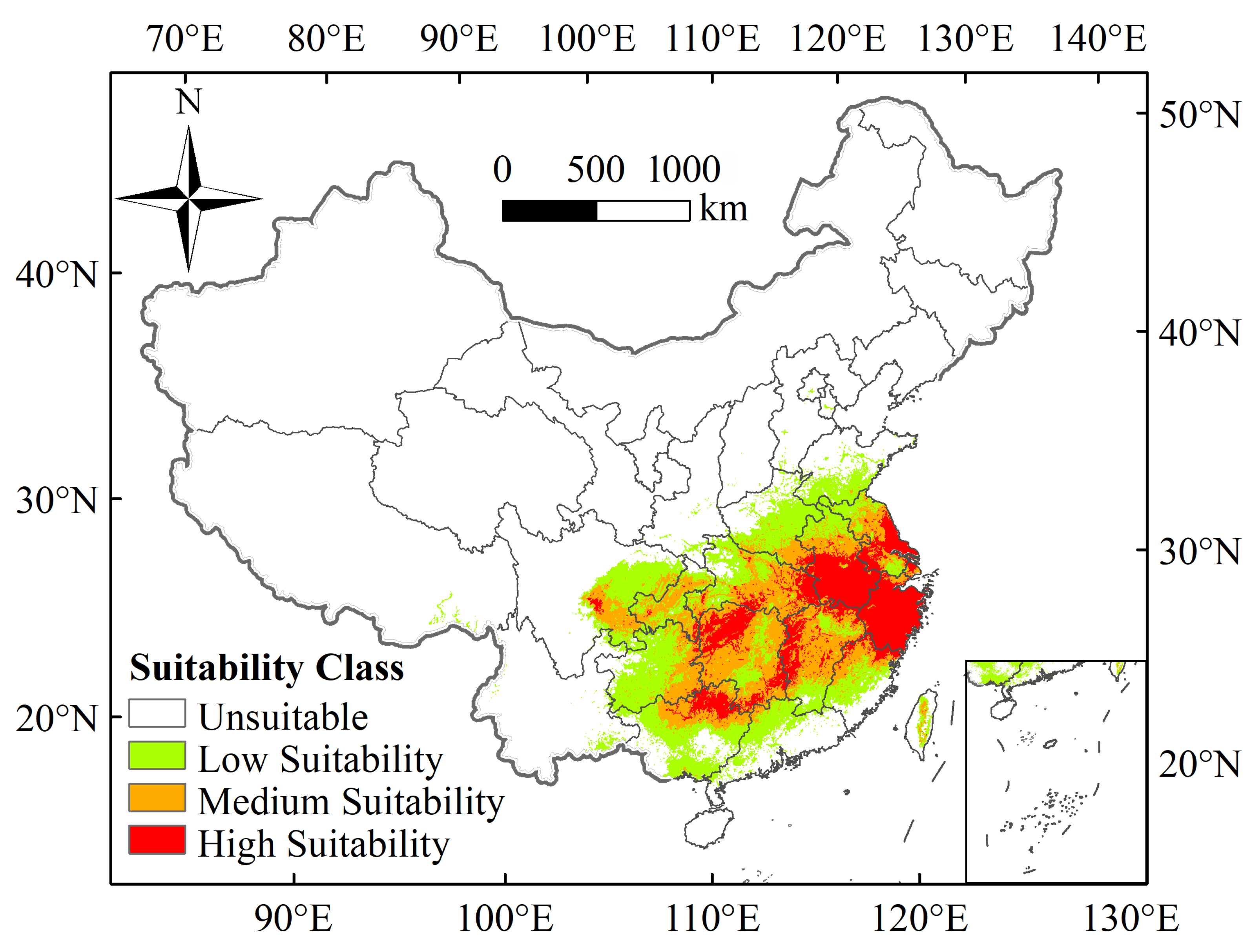
The MaxEnt model was employed to predict the current distribution of E. grisescens. As shown in Figure 3, the total current suitable area was 1.969 × 10⁶ km2, with high-, medium-, and low-suitability areas accounting for 5.121 × 10⁵ km2, 7.385 × 10⁵ km2, and 7.185 × 10⁵ km2, respectively. The areas with high suitability for E. grisescens accounted for 7.48% of China’s land area and were mainly scattered across nine provinces and municipalities, Zhejiang, Anhui, Hunan, Jiangsu, Chongqing, Jiangxi, Guangxi, Hubei, and Sichuan, covering almost the entire province in the case of Zhejiang.

3.4. Future Potential Suitable Areas for Ectropis Grisescens

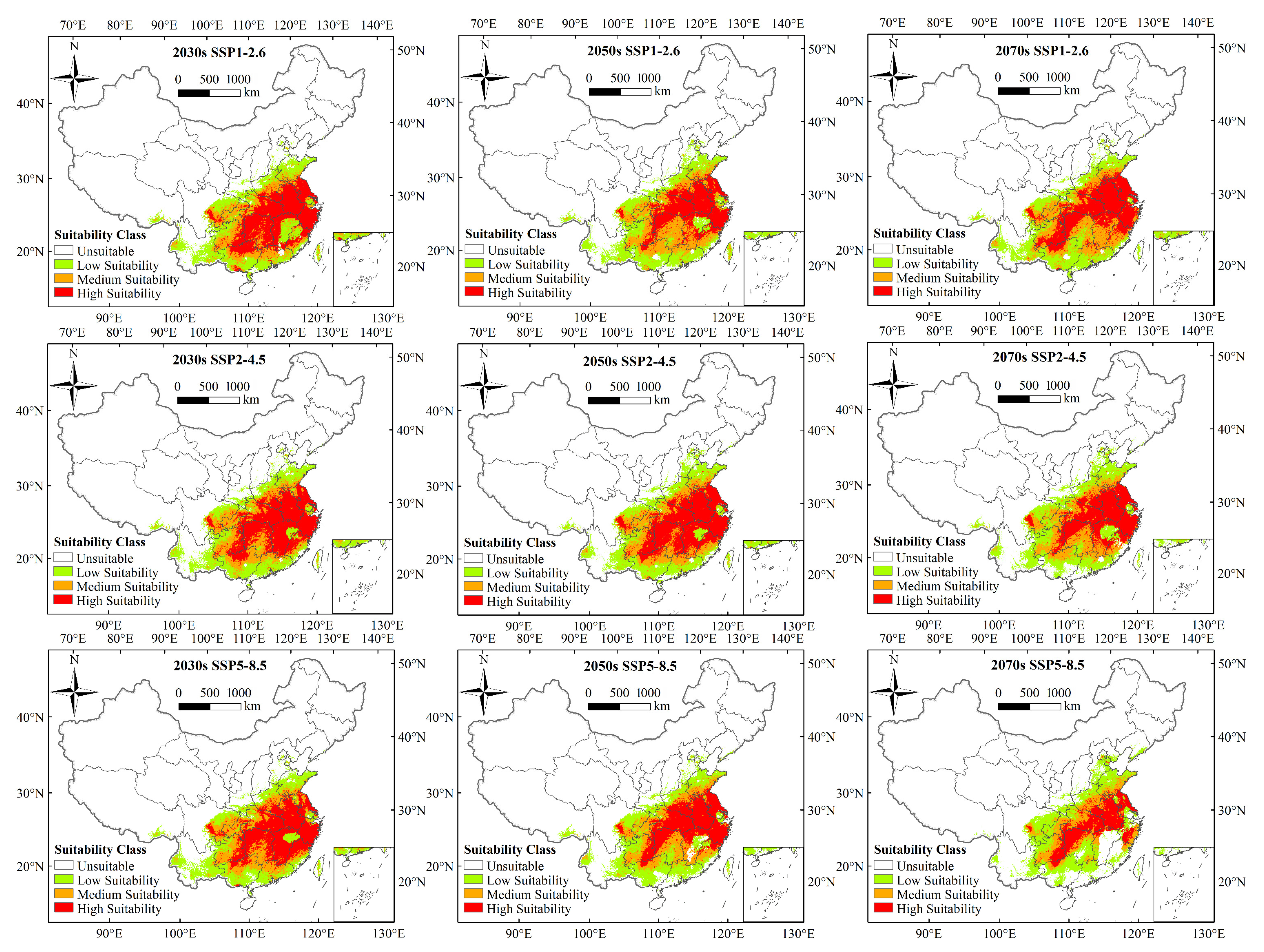
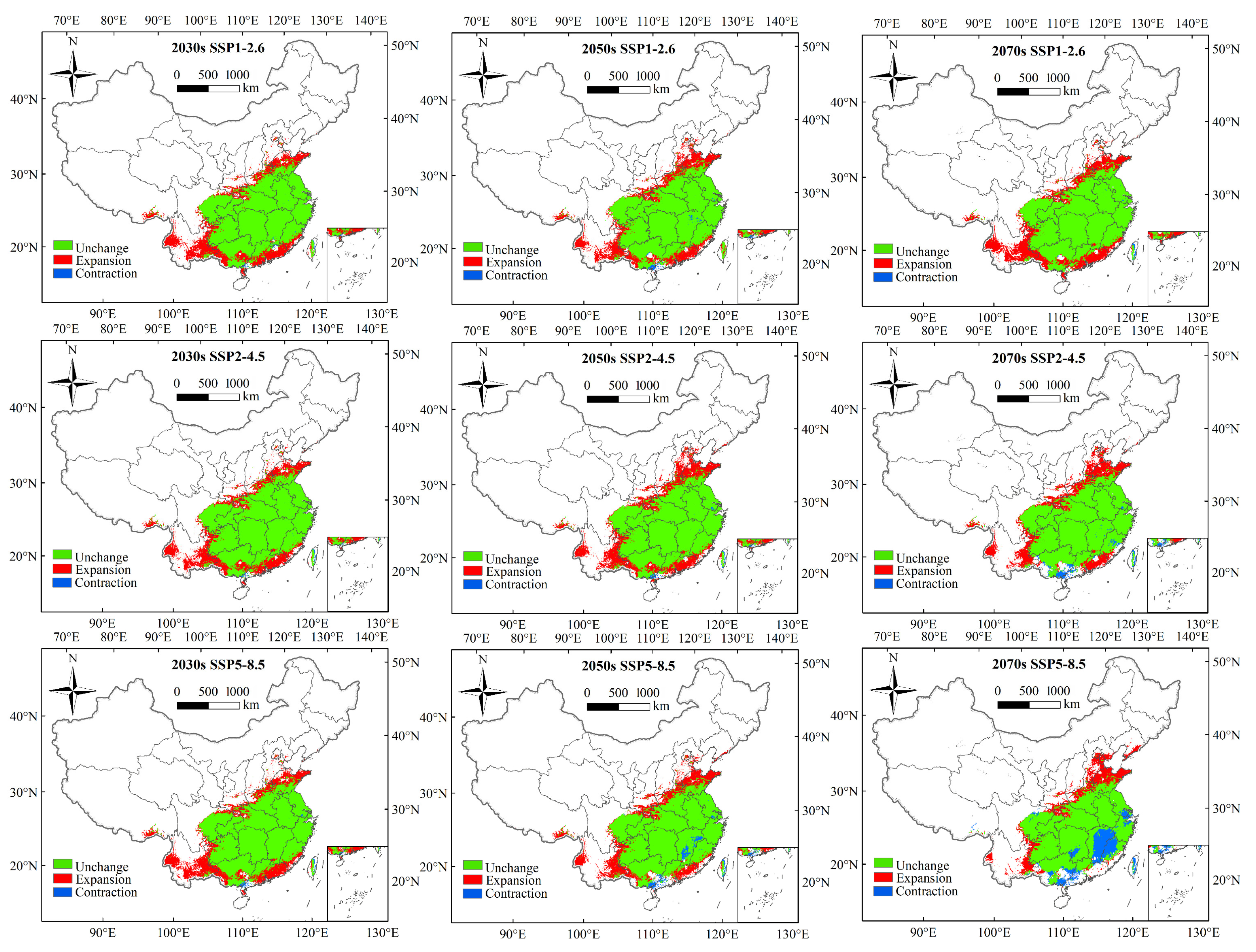
The distribution of E. grisescens within its potential suitable areas differed across climate scenarios in the three future periods; however, certain similarities in the variation trends were observed across all periods (Figure 4 and Figure 5). Compared to the current scenario, medium-suitability areas decreased significantly, whereas low-suitability areas increased notably (Table 2). The average area expansion was 4.955 × 10⁵ km2, accounting for 25.17% of the current suitable habitat area, while the contraction in suitable area for E. grisescens was slight, with an average of 4.48 × 10⁴ km2, accounting for only 2.27% of the currently suitable areas (Table 3).
Under the SSP1-2.6 scenario, it was anticipated that the potential distribution range of E. grisescens would experience moderate expansions in the 2030s, 2050s, and 2070s. In these three periods, the potential area is expected to contract at rates of 0.41%, 0.83%, and 0.33%, and expand at rates of 25.82%, 25.76%, and 27.97%, respectively. Consequently, in the 2030s, 2050s, and 2070s, the potential distribution areas were calculated to be 2.174 × 10⁶ km2, showing a 10.39% increase; 2.139 × 10⁵ km2, with an 8.63% increase; and 2.210 × 10⁶ km2, representing a 12.21% increase, respectively. More specifically, the total high-suitability area will reach 8.963 × 10⁵ km2, with an increase of 24.75%; 6.919 × 10⁵ km2, showing a 3.70% decrease; and 8.358 × 10⁵ km2, representing an 13.32% increase, respectively.
In the SSP2-4.5 scenario, it is anticipated that from the 2030s to the 2070s, the potential distribution range of E. grisescens will undergo a moderate expansion. For the three future periods analyzed, the contraction rates of the potential distribution range were predicted to be 0.35%, 0.64%, and 2.35%, while the expansion rates were projected to be 25.22%, 28.07%, and 24.38%, respectively. As a result, by the 2030s, 2050s, and 2070s, the potential distribution ranges will reach 2.140 × 10⁶ km2, with an increase of 8.70%; 2.187 × 10⁶ km2, showing a 11.08% in-crease; and 2.096 × 10⁶ km2, representing an 6.42% increase, respectively. The total high-suitability area for each period was calculated to be 8.925 × 10⁵ km2, showing a 24.21% increase; 9.170 × 10⁵ km2, with an 27.63% increase; and 7.318 × 10⁵ km2, representing a 1.85% increase, respectively.
Under the SSP5-8.5 scenario, it is expected that the potential distribution area of E. grisescens will continue to increase in the 2030s and 2050s, followed by a decrease in the 2070s. In the 2030s, a growth rate of 8.90% was projected, with the distribution area reaching 2.144 × 10⁶ km2, a contraction rate 0.55%, and an expansion rate of 25.68%. Moving on to the 2050s, the increase was estimated at 5.26%, with the area expanding to 2.073 × 10⁶ km2. Here, the contraction rate stood increased to 2.58% while the expansion rate was 24.07%. By the 2070s, the total distribution area was 1.806 × 10⁶ km2, indicating a −8.28% decrease compared to the present, with the contraction rate of 19.49% and an expansion rate was 12.42%. The total high-suitability areas for each period were projected to reach 8.467 × 10⁵ km2, with an increase of 17.83%; 7.410 × 10⁵ km2, showing a 3.13% increase; and 5.139 × 10⁵ km2, representing an 28.48% decrease, respectively.

3.5. Movements of the Potential Suitable Area Centroid

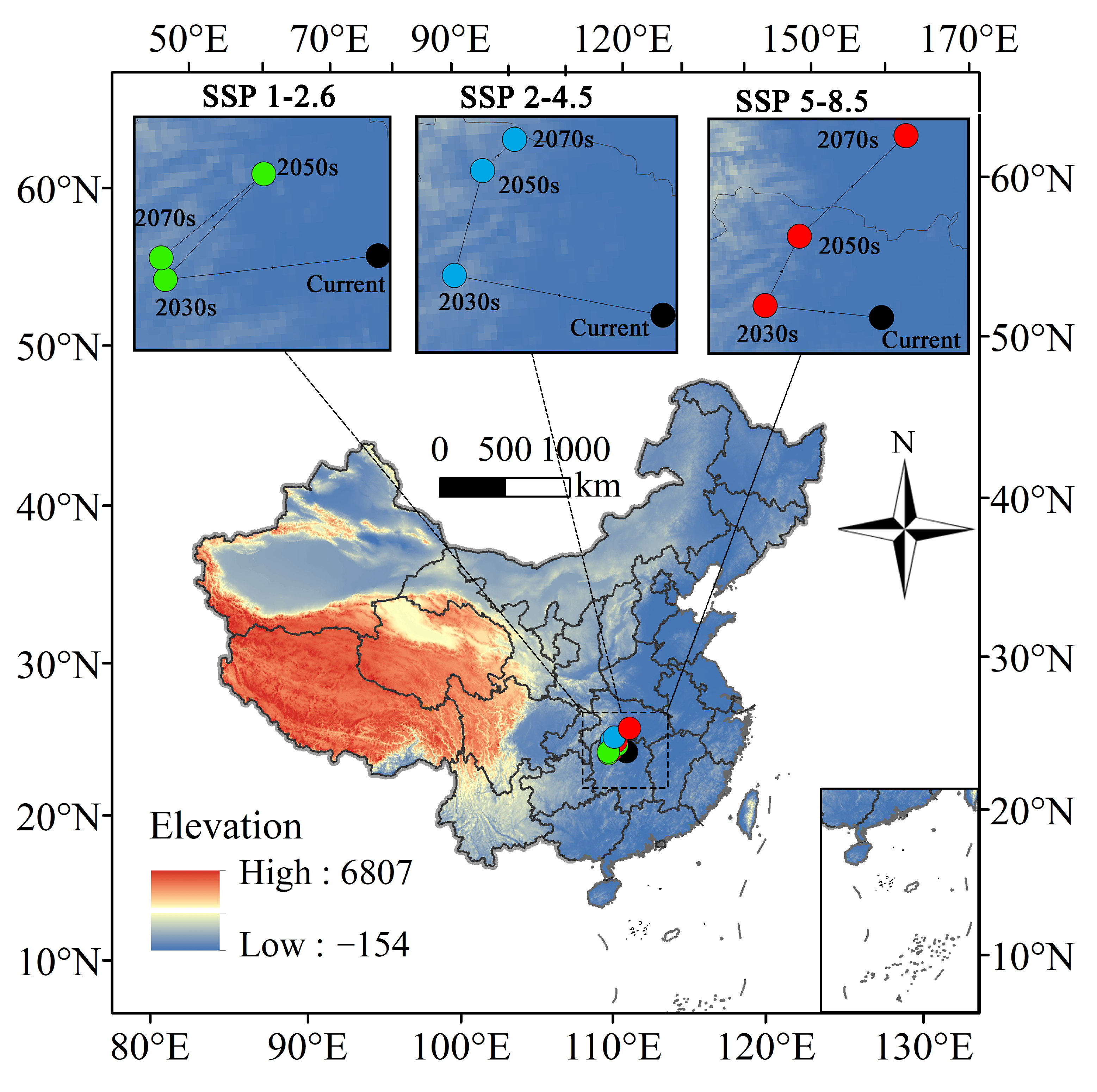
Currently, the distribution center of E. grisescens is located in Pingjiang County, Yueyang City, Hunan Province, at the coordinates 28.64° N, 113.88° E (Figure 6). Under the three different SSP climate scenarios, the direction of migration shows distinct variations.
Under the SSP1-2.6 scenario, the E. grisescens distribution area’s centroid will shift multiple times. By the 2030s, it will shift 227.0 km southwest and reach Anhua County, Yiyang City, Hunan Province, with the new coordinates being 28.44° N, 111.57° E. By the 2050s, the distribution center will move 125.6 km northeast to Xiangyin County, Yueyang City, Hunan Province, at the coordinates 28.73° N, 125.63° E. By the 2070s, it will move a further 62.8 km southwest to Heshan District, Yiyang City, Hunan Province, reaching the coordinates of 28.32° N, 112.37° E.
Under the SSP2-4.5 scenario, the centroid will move 238.4 km northwest by the 2030s, arriving at Taoyuan County, Changde City, Hunan Province, with the coordinates of 28.93° N, 111.46° E. By the 2050s, the center is projected to move 28.4 km southeast, ultimately arriving at Dingcheng District, Changde City, Hunan Province, with the coordinates of 28.72° N, 111.63° E. By the 2070s, it will move a further 114.6 km northeast direction to Yuanjiang City, Yiyang City, Hunan Province, reaching the coordinates of 29.09° N, 112.72° E.
Under the SSP5-8.5 scenario, it will move 197.7 km northwest by the 2030s, arriving at Hanshou County, Changde City, Hunan Province, with the coordinates 28.90° N, 111.88° E. In the 2050s, the center is projected to move 114.8 km northeast, reaching Junshan District, Yueyang City, Hunan Province, at 29.51° N, 114.83° E. Finally, by the 2070s, the center will move 151.0 km northeast, ultimately arriving at Tianmen City, Hubei Province, with the coordinates 30.83° N, 113.21° E.

4. Discussion

Environmental conditions strongly influence species distribution, with the responses varying by species [60,61]. In predicting the potential distribution range of E. grisescens, seven environmental variables were ultimately identified as the most important factors. Of these, bio2 (mean diurnal range), bio14 (precipitation of driest month), and elevation were found to be the variables with the most significant influence. Climatic factors such as temperature, precipitation, and elevation exert either direct or indirect effects on the survival of insect populations, as demonstrated by previous research [62]. Prior studies have also indicated that bio2, bio14, and elevation influence the potential geographical distributions of insects. [63,64]. Temperature has the most pronounced effect, followed by precipitation; this aligns with global trends where warming temperatures and altered precipitation patterns facilitate changes in the ranges of pests [65]. Previous research has shown that environmental variables such as temperature and precipitation, directly or indirectly affect insect survival [62]. Similarly, Wei et al. also reported that temperature and precipitation are critical in determining suitable areas for Cicadella viridis [14]. Furthermore, elevation, as the third core variable determining the distribution of E. grisescens, interacts with temperature and precipitation to jointly define the threshold range of its living environment.
Temperature, a crucial abiotic element, has a profound impact on the population dynamics, life cycles, and behavioral patterns of insects [66]. It significantly influences the geographical spread of organisms, as well as the occurrence and intensity of pest infestations. A recent report indicated that the growth, survival, and reproduction processes of E. grisescens are highly temperature-dependent; this species can not only complete its full life cycle development within a wide temperature gradient range but also maintain viability under short-term high-temperature stress [5]. In a previous study showing the effect of temperature on the growth and development of E. grisescens, the developmental period from egg to adult decreased as the temperature increased, with the shortest developmental period (27.6 d) observed at 31 °C. Different temperatures had significant effects on the survival rate and life table parameters of E. grisescens populations, with the highest survival rate (64.0%) found at 22 °C compared with other temperature treatments. Significantly, the highest net reproductive rate (R0) was seen at 25 °C, up to 90.88 offspring per individual. The intrinsic rate of increase and the finite rate of increase were also the highest at 25 °C, reaching 0.126 d−1 and 1.134 d−1, respectively [67]. In addition to high-temperature stress, low temperatures also have a profound impact on the growth and development of E. grisescens. Dong et al. found that with prolonged refrigeration time, the eclosion rate of E. grisescens pupae decreased and the developmental abnormality rate of adults increased [68]. Previous research has also shown that the developmental threshold temperatures for the eggs, larvae, pupae, and adults of E. grisescens are 8.80–10.84 °C, 4.57–7.70 °C, 6.00–9.44 °C, and 10.78–14.91 °C, respectively, with an effective accumulated temperature of 570.03–631.59 d/°C [69,70]. The environmental changes caused by global warming mainly affect the dynamics of insects directly through changes in water content and rainfall patterns [32]. Environmental humidity exerts a substantial influence on the emergence timing, population density, and geographical spread of agricultural pests [71]. Wang et al. found that the egg production of E. grisescens adults in soil with 50% moisture was significantly higher than that in soil with 20% moisture, while the number of hatched larvae when adults pupated in soilless containers was significantly lower than in soil with 50% moisture [72]. In addition, elevation affects the distribution of pest insects through multiple pathways [73]. On the one hand, as elevation increases, temperature usually decreases accordingly, which significantly impacts the survival, development, and reproduction of pest insects, thereby restricting their distribution range. On the other hand, the distribution of host tea gardens is also constrained by elevation conditions [74]. Since host plants are key resources for the survival of pest insects, plant distribution plays a crucial role in determining pest distribution. These studies suggest that temperature, precipitation, and elevation are essential to both the survival and distribution of E. grisescens. In summary, the synergistic effects of temperature and precipitation define the pest’s ecological niche: warmer conditions accelerate life cycles, whereas adequate rainfall supports larval hatching and adult fecundity, creating compounding pressures under climate change.
Global warming has severely impacted the habitats of various species, leading to the expansion, migration, or contraction of their suitable habitats [75]. Our study reveals that, E. grisescens is currently distributed across 20.51% of China’s land area, approximately 1.969 × 10⁶ km2. Of this total, 71.85 × 10 4 km2 is highly suitable for the pest, accounting for 7.48% of China’s land area. In the context of diverse climate change scenarios, the distribution of E. grisescens is forecasted to undergo varying degrees of change, including expansion and reduction in suitable habitat areas. Specifically, the total potential distribution area will increase at rates ranging from −8.28% to 10.39%. These findings align with previous research, suggesting that climate change will lead to elevated temperatures and enhanced precipitation. As a consequence, the areas that are suitable for numerous pests will change [25,65]. In this study, the shift of E. grisescens from unsuitable to suitable areas was found to be due to the joint influence of temperature and precipitation alterations under various emission scenarios. Notably, substantial changes are anticipated in areas that will be highly suitable for E. grisescens in the future. This implies that global warming will generate more propitious conditions for E. grisescens to multiply and may potentially inflict greater harm on tea plantations. Consequently, agricultural and forestry departments—particularly those in regions outside E. grisescens’ current natural distribution—should remain vigilant.
With significant advantages such as a low sample size requirement, high computational efficiency, strong operational convenience, and reliable simulation accuracy, the MaxEnt model has been widely applied in studies on species distribution prediction [26,27,76]. However, similar to other SDMs, this model still has unavoidable limitations [77]. In this study, we only selected four key environmental driving factors: temperature, precipitation, elevation, and human activities. However, the geographical distribution of species is also subject to complex regulation by a variety of biological factors, such as genetic variation, disease, interspecific competition, and soil vegetation type [78,79], and these unincorporated variables may affect the completeness of the model’s predictions. Previous research has shown that after feeding on different host plants such as Lactuca sativa and Triadica sebifera, E. grisescens exhibits certain differences in growth, development, and reproduction but can still complete its entire life cycle [80]. Currently, the main host plant of this pest is tea plants, but its complete host range remains unclear. Therefore, future studies should incorporate a comprehensive list of E. grisescens host plants to further clarify its potential predicted distribution. In addition, although the three climate scenarios (SSP1-2.6, SSP2-4.5, and SSP5-8.5) adopted in this study are based on current greenhouse gas emission trends and socioeconomic development pathways, they may be limited in two aspects. On the one hand, CO2 emissions are not the only factor driving climate change; the synergistic effects of other elements like aerosols and land use change also influence the evolution of the climate system. On the other hand, the current climate scenarios follow a linear pattern, while the natural climate may exhibit characteristics of nonlinear variation and laws of periodic fluctuation. Therefore, future studies on the potential distribution of E. grisescens are necessary to systematically integrate these key influencing factors and further optimize the model’s parameters and structure. This will enhance the scientific validity and application value of the prediction results, thereby providing more accurate theoretical support for the regional prevention and control of tea geometrids.
Given the significant influence of climate change on the distribution of E. grisescens, it is imperative to closely monitor and develop effective control and prevention strategies to efficiently handle the potential spread and consequences of this pest. We recommend the following steps: first, implement targeted monitoring in high-risk areas to achieve early warning of pest colonization; second, advance the traditional spring pruning time to late March to remove overwintering eggs and interrupt the pest’s life cycle; and third, accelerate the promotion of insect-resistant tea varieties to reduce the feeding damage caused by E. grisescens larvae. This proactive approach will help protect the tea industry from the growing threat posed by E. grisescens under changing climatic conditions.

5. Conclusions

In this study, we conducted an in-depth, comprehensive analysis of the potential distribution of E. grisescens across China. We found that temperature (bio2), precipitation (bio14), and elevation are the primary factors influencing the distribution of E. grisescens. For the current period (1970–2000), the total potential suitable area of E. grisescens is approximately 1.969 × 10⁶ km2. The areas with high suitability were mainly concentrated in Anhui, Guangxi, Chongqing, Hubei, Hunan, Jiangxi, Sichuan, Jiangsu, and Zhejiang. Specifically, under the SSP1-2.6 scenario in the 2070s, the area of suitable habitats is estimated to increase by up to 12.21%. Under the SSP5-8.5 scenario in the 2070s, the area of suitable habitats is estimated to decrease by up to 8.28%. These findings are crucial for developing effective monitoring and control strategies for E. grisescens, providing essential references for predicting changes in the pest’s behavior, and offering theoretical guidance for future pest management in tea plantations.

Supplementary Materials

The following supporting information can be downloaded at: https://www.mdpi.com/article/10.3390/agronomy15112546/s1, Table S1: The occurrence records of Ectropis grisescens in China.

Author Contributions

Conceptualization, C.-F.S., Q.-Z.L. and J.L.; Formal analysis, X.-Y.M. and F.-L.H.; Funding acquisition, C.-F.S., J.L. and X.-Y.M.; Investigation, X.-Y.M., J.L. and F.-L.H.; Methodology, C.-F.S. and Q.-Z.L.; Project administration, C.-F.S., Q.-Z.L., J.L. and F.-L.H.; Resources, C.-F.S. and Q.-Z.L.; Software, C.-F.S. and Q.-Z.L.; Supervision, J.L. and X.-Y.M.; Validation, C.-F.S., Q.-Z.L. and F.-L.H.; Visualization, C.-F.S.; Writing—original draft, C.-F.S.; Writing—review and editing, Q.-Z.L. All authors have read and agreed to the published version of the manuscript.

Funding

This project was financial supported by the National Natural Science Foundation of China (Grant No. 32202284), the Key Research and Development Project of Shanxi Province (Grant No. 2022ZDYF122), the Natural Science Foundation of Shanxi Province (Grant No. 202203021222176 and 202203021222181), the Excellent Doctoral Award of Shanxi Province for Scientific Research Project (Grant No. SXBYKY2023017), and the Scientific Research Foundation of Shanxi Agricultural University (Grant No. 2023BQ31).

Data Availability Statement

The authors confirm that all data are available in this paper.

Conflicts of Interest

The authors declare that they have no known competing financial interest or personal relationships that could have appeared to influence the work reported in this paper.

References

  1. Krishnaraj, T.; Gajjeraman, P.; Palanisamy, S.; Chandrabose, S.R.S.; Mandal, A.K.A. Identification of differentially expressed genes in dormant (banjhi) bud of tea (Camellia sinensis (L.) O. Kuntze) using subtractive hybridization approach. Plant Physiol. Biochem. 2011, 49, 565–571. [Google Scholar] [CrossRef]
  2. Wei, C.; Yang, H.; Wang, S.; Zhao, J.; Liu, C.; Gao, L.; Xia, E.; Lu, Y.; Tai, Y.; She, G.; et al. Draft genome sequence of Camellia sinensis var. sinensis provides insights into the evolution of the tea genome and tea quality. Proc. Natl. Acad. Sci. USA 2018, 115, E4151–E4158. [Google Scholar] [CrossRef]
  3. Konwar, T.; Baruah, I.; Chaudhary, M.K.; Bhuyan, R.P.; Sarmah, B.K. Evaluation of genetic diversity of tea Camellia sinensis (L.) Kuntze germplasm of Assam based on characterization of flavour related metabolites. Genet. Resour. Crop Evol. 2025, 72, 7061–7077. [Google Scholar] [CrossRef]
  4. Dayani, G.R.P.; Tularam, G.A. The tea industry and a review of its price modelling in major tea producing countries. J. Manag. Strategy 2016, 7, 21–36. [Google Scholar]
  5. Shi, F.; Ma, X.; Lin, C.J.; Gao, X.H.; Wang, X.Y.; Kuang, Y.-F.; Wang, L.L.; Li, S.; Lin, C.; Chen, L.L. The application of demographic characteristics of Ectropis grisescens (Lepidoptera: Geometridae) in pest risk assessment of IPM. J. Econ. Entomol. 2024, 117, 230–239. [Google Scholar] [CrossRef]
  6. Li, Z.Q.; Cai, X.M.; Luo, Z.X.; Bian, L.; Xin, Z.J.; Liu, Y.; Chu, B.; Chen, Z.M. Geographical distribution of Ectropis grisescens (Lepidoptera: Geometridae) and Ectropis obliqua in China and description of an efficient identification method. J. Econ. Entomol. 2019, 112, 277–283. [Google Scholar] [CrossRef] [PubMed]
  7. Wang, J.X.; Lin, G.F.; Batool, K.; Zhang, S.Q.; Chen, M.F.; Xu, J.; Wu, J.; Jin, L.; Gelbic, I.; Xu, L.; et al. Alimentary tract transcriptome analysis of the tea geometrid, Ectropis oblique (Lepidoptera: Geometridae). J. Econ. Entomol. 2018, 111, 1411–1419. [Google Scholar] [CrossRef]
  8. Chen, Y.F.; Wang, Z.Y.; Gao, T.; Huang, Y.P.; Li, T.T.; Jiang, X.L.; Liu, Y.J.; Gao, L.P.; Xia, T. Deep learning and targeted metabolomics-based monitoring of chewing insects in tea plants and screening defense compounds. Plant Cell Environ. 2024, 47, 698–713. [Google Scholar] [CrossRef]
  9. Cui, X. Online SPE-UPLC-MS/MS to Establish Four Pyrethroid Pesticides in Tea and Lambda-Cyhalothrin Activity Differences of Ectropis Oblique Hypulina Wehrli. Master’s Thesis, Tianjin Agricultural University, Tianjin, China, 2019. [Google Scholar]
  10. Carroll, C.; Dunk, J.R.; Moilanen, A. Optimizing resiliency of reserve networks to climate change: Multispecies conservation planning in the Pacific Northwest, USA. Glob. Change Biol. 2010, 16, 891–904. [Google Scholar] [CrossRef]
  11. Braunisch, V.; Coppes, J.; Arlettaz, R.; Suchant, R.; Schmid, H.; Bollmann, K. Selecting from correlated climate variables: A major source of uncertainty for predicting species distributions under climate change. Ecography 2013, 36, 971–983. [Google Scholar] [CrossRef]
  12. Cahill, A.E.; Aiello-Lammens, M.E.; Fisher-Reid, M.C.; Hua, X.; Karanewsky, C.J.; Ryu, H.Y.; Sbeglia, G.C.; Spagnolo, F.; Waldron, J.B.; Warsi, O.; et al. How does climate change cause extinction? Proc. R. Soc. B-Biol. Sci. 2013, 280, 20121890. [Google Scholar] [CrossRef]
  13. Xian, X.Q.; Zhao, H.X.; Guo, J.Y.; Zhang, G.F.; Liu, H.; Liu, W.X.; Wan, F.H. Estimation of the potential geographical distribution of a new potato pest (Schrankia costaestrigalis) in China under climate change. J. Integr. Agric. 2023, 22, 2441–2455. [Google Scholar] [CrossRef]
  14. Wei, X.J.; Xu, D.P.; Zhuo, Z.H. Predicting the impact of climate change on the geographical distribution of leafhopper, Cicadella viridis in China through the MaxEnt model. Insects 2023, 14, 586. [Google Scholar] [CrossRef] [PubMed]
  15. Zhao, J.; Ma, L.; Song, C.; Xue, Z.; Zheng, R.; Yan, X.; Hao, C. Modelling potential distribution of Tuta absoluta in China under climate change using CLIMEX and MaxEnt. J. Appl. Entomol. 2023, 147, 895–907. [Google Scholar] [CrossRef]
  16. Schweiger, O.; Settele, J.; Kudrna, O.; Klotz, S.; Kuhn, I. Climate change can cause spatial mismatch of trophically interacting species. Ecology 2008, 89, 3472–3479. [Google Scholar] [CrossRef]
  17. Qiu, Y.X.; Fu, C.X.; Comes, H.P. Plant molecular phylogeography in China and adjacent regions: Tracing the genetic imprints of quaternary climate and environmental change in the world’s most diverse temperate flora. Mol. Phylogenetics Evol. 2011, 59, 225–244. [Google Scholar] [CrossRef]
  18. Kujala, H.; Moilanen, A.; Araujo, M.B.; Cabeza, M. Conservation planning with uncertain climate change projections. PLoS ONE 2013, 8, e53315. [Google Scholar] [CrossRef]
  19. Record, S.; Fitzpatrick, M.C.; Finley, A.O.; Veloz, S.; Ellison, A.M. Should species distribution models account for spatial autocorrelation? a test of model projections across eight millennia of climate change. Glob. Ecol. Biogeogr. 2013, 22, 760–771. [Google Scholar] [CrossRef]
  20. Santos-Hernández, A.F.; Monterroso-Rivas, A.I.; Granados-Sánchez, D.; Villanueva-Morales, A.; Santacruz-Carrillo, M. Projections for Mexico’s tropical rainforests considering ecological niche and climate change. Forests 2021, 12, 119. [Google Scholar] [CrossRef]
  21. Santana, P.A.; Kumar, L.; Da Silva, R.S.; Picanço, M.C. Global geographic distribution of Tuta absoluta as affected by climate change. J. Pest Sci. 2019, 92, 1373–1385. [Google Scholar] [CrossRef]
  22. Byeon, D.H.; Jung, S.; Lee, W. Review of CLIMEX and MaxEnt for studying species distribution in South Korea. J. Asia-Pac. Biodivers. 2018, 11, 325–333. [Google Scholar] [CrossRef]
  23. Kumar, S.; Neven, L.G.; Zhu, H.Y.; Zhang, R.Z. Assessing the Global Risk of Establishment of Cydia pomonella (Lepidoptera: Tortricidae) using CLIMEX and MaxEnt Niche Models. J. Econ. Entomol. 2015, 108, 1708–1719. [Google Scholar] [CrossRef]
  24. Phillips, S.J.; Dudík, M. Modeling of species distributions with Maxent: New extensions and a comprehensive evaluation. Ecography 2008, 31, 161–175. [Google Scholar] [CrossRef]
  25. Phillips, S.J.; Anderson, R.P.; Schapire, R.E. Maximum entropy modeling of species geographic distributions. Ecol. Model. 2006, 190, 231–259. [Google Scholar] [CrossRef]
  26. Yackulic, C.B.; Chandler, R.; Zipkin, E.F.; Royle, J.A.; Nichols, J.D.; Grant, E.H.C.; Veran, S. Presence-only modelling using MaxEnt: When can we trust the inferences? Methods Ecol. Evol. 2012, 4, 236–243. [Google Scholar] [CrossRef]
  27. Thibaud, E.; Petitpierre, B.; Broennimann, O.; Davison, A.C.; Guisan, A. Measuring the relative effect of factors affecting species distribution model predictions. Methods Ecol. Evol. 2014, 5, 947–955. [Google Scholar] [CrossRef]
  28. Zhou, Y.C.; Zhang, Z.X.; Zhu, B.; Cheng, X.F.; Yang, L.; Gao, M.K.; Kong, R. MaxEnt modeling based on CMIP6 models to project potential suitable zones for Cunninghamia lanceolata in China. Forests 2021, 12, 752. [Google Scholar] [CrossRef]
  29. Xu, W.M.; Du, Q.L.; Yan, S.; Cao, Y.; Liu, X.; Guan, D.X.; Ma, L.Q. Geographical distribution of As-hyperaccumulator Pteris vittata in China: Environmental factors and climate changes. Sci. Total Environ. 2022, 803, 149864. [Google Scholar] [CrossRef]
  30. Zhao, Z.X.; Feng, X.L.; Wang, Y.J.; Zhou, Z.X.; Zhang, Y.B. Potential suitability areas of Sitobion miscanthi in China based on the MaxEnt model: Implications for management. Crop Prot. 2024, 183, 106755. [Google Scholar] [CrossRef]
  31. Mao, J.X.; Meng, F.H.; Song, Y.Z.; Li, D.L.; Ji, Q.E.; Hong, Y.C.; Lin, J.; Cai, P.M. Forecasting the expansion of Bactrocera tsuneonis (Miyake) (Diptera: Tephritidae) in China using the MaxEnt Model. Insects 2024, 15, 417. [Google Scholar] [CrossRef] [PubMed]
  32. Li, N.N.; Zhang, J.X.; Tan, C.; Zhu, X.; Cao, S.Y.; Gao, C.Q. Forecast of current and future distributions of Corythucha marmorata (Uhler) under climate change in China. Forests 2024, 15, 843. [Google Scholar] [CrossRef]
  33. Wang, C.; Wang, H.F.; Ma, T.; Xiao, Q.; Cao, P.R.; Chen, X.; Xiong, H.P.; Qin, W.Q.; Sun, Z.H.; Wen, X.J. Choice and no-choice bioassays to study the pupation preference and emergence success of Ectropis grisescens. Jove-J. Vis. Exp. 2018, 140, e58126. [Google Scholar] [CrossRef]
  34. Pan, Y.J.; Fang, G.Q.; Wang, Z.B.; Cao, Y.H.; Liu, Y.J.; Li, G.Y.; Liu, X.J.; Xiao, Q.; Zhan, S. Chromosome-level genome reference and genome editing of the tea geometrid. Mol. Ecol. Resour. 2021, 21, 2034–2049. [Google Scholar] [CrossRef]
  35. Zhang, F.M.; Chen, Y.J.; Zhao, X.C.; Guo, S.B.; Hong, F.; Zhi, Y.A.; Zhang, L.; Zhou, Z.; Zhang, Y.H.; Zhou, X.G.; et al. Antennal transcriptomic analysis of carboxylesterases and glutathione S-transferases associated with odorant degradation in the tea gray geometrid, Ectropis grisescens (Lepidoptera, Geometridae). Front. Physiol. 2023, 14, 1183610. [Google Scholar] [CrossRef] [PubMed]
  36. Yang, F.Y.; Wu, Y.K.; Tu, J.; Dong, F.; Dong, Y.; Xie, F. Cordyceps sp. WZFW1, a novel entomopathogenic fungus to control Ectropis grisescens (Lepidoptera: Geometridae). Entomol. Res. 2024, 54, e12718. [Google Scholar] [CrossRef]
  37. Zhang, Y.B.; Liu, Y.L.; Qin, H.; Meng, Q.X. Prediction on spatial migration of suitable distribution of Elaeagnus mollis under climate change conditions in Shanxi Province, China. Chin. J. Appl. Ecol. 2019, 30, 496–502. [Google Scholar] [CrossRef]
  38. Chen, C.H. The Research and Conservation Programme of Papaveraceae habitatsuitability Based on the Optimized Biomod2 and Zonation Model in China. Master’s Thesis, Qinghai Normal University, Xining, China, 2025. [Google Scholar]
  39. GBIF Occurrence Download. Available online: https://doi.org/10.15468/39omei (accessed on 16 April 2025).
  40. Ouyang, X.; Chen, A.; Li, Y.; Han, X.; Lin, H. Predicting the potential distribution of pine wilt disease in China under climate change. Insects 2022, 13, 1147. [Google Scholar] [CrossRef]
  41. Riahi, K.; Van Vuuren, D.P.; Kriegler, E.; Edmonds, J.; O’neill, B.C.; Fujimori, S.; Bauer, N.; Calvin, K.; Dellink, R.; Fricko, O. The shared socioeconomic pathways and their energy, land use, and greenhouse gas emissions implications: An overview. Glob. Environ. Chang. 2017, 42, 153–168. [Google Scholar] [CrossRef]
  42. Zhang, K.; Sun, L.; Tao, J. Impact of climate change on the distribution of Euscaphis japonica (Staphyleaceae) trees. Forests 2020, 11, 525. [Google Scholar] [CrossRef]
  43. Warren, D.L.; Glor, R.E.; Turelli, M. ENMTools: A toolbox for comparative studies of environmental niche models. Ecography 2010, 33, 607–611. [Google Scholar] [CrossRef]
  44. Wisz, M.S.; Pottier, J.; Kissling, W.D.; Pellissier, L.; Svenning, J.C. The role of biotic interactions in shaping distributions and realised assemblages of species: Implications for species distribution modelling. Biol. Rev. 2013, 88, 15–30. [Google Scholar] [CrossRef] [PubMed]
  45. Zeng, Y.W.; Wei, L.B.; Yeo, D.C.J. Novel methods to select environmental variables in MaxEnt: A case study using invasive crayfish. Ecol. Model. 2016, 341, 5–13. [Google Scholar] [CrossRef]
  46. Phillips, S.J.; Anderson, R.P.; Dudík, M.; Schapire, R.E.; Blair, M.E. Opening the black box: An open-source release of Maxent. Ecography 2017, 40, 887–893. [Google Scholar] [CrossRef]
  47. Yang, H.X.; Jiang, N.Z.Y.; Li, C.; Li, J. Prediction of the current and future distribution of tomato leafminer in China using the MaxEnt model. Insects 2023, 14, 531. [Google Scholar] [CrossRef]
  48. Kass, J.M.; Muscarella, R.; Galante, P.J.; Bohl, C.L.; Pinilla-Buitrago, G.E.; Boria, R.A.; Soley-Guardia, M.; Anderson, R.P. ENMeval 2.0: Redesigned for customizable and reproducible modeling of species’ niches and distributions. Methods Ecol. Evol. 2021, 12, 1602–1608. [Google Scholar] [CrossRef]
  49. Liu, B.Y.; Gao, X.; Ma, J.; Jiao, Z.H.; Xiao, J.H.; Hayat, M.A.; Wang, H.B. Modeling the present and future distribution of arbovirus vectors Aedes aegypti and Aedes albopictus under climate change scenarios in Mainland China. Sci. Total Environ. 2019, 664, 203–214. [Google Scholar] [CrossRef] [PubMed]
  50. Ye, X.P.; Yu, X.P.; Yu, C.Q.; Tayibazhaer, A.; Xu, F.J.; Skidmore, A.K.; Wang, T.J. Impacts of future climate and land cover changes on threatened mammals in the semi-arid Chinese Altai Mountains. Sci. Total Environ. 2018, 612, 775–787. [Google Scholar] [CrossRef]
  51. Warren, D.L.; Seifert, S.N. Ecological niche modeling in Maxent: The importance of model complexity and the performance of model selection criteria. Ecol. Appl. 2011, 21, 335–342. [Google Scholar] [CrossRef] [PubMed]
  52. Lobo, J.M. AUC: A misleading measure of the performance of predictive distribution models. Glob. Ecol. Biogeogr. 2010, 17, 145–151. [Google Scholar] [CrossRef]
  53. Yan, H.; Feng, L.; Zhao, Y.; Feng, L.; Zhu, C. Prediction of the spatial distribution of Alternanthera philoxeroides in China based on ArcGIS and MaxEnt. Glob. Ecol. Conserv. 2019, 21, e00856. [Google Scholar] [CrossRef]
  54. Shcheglovitova, M.; Anderson, R.P. Estimating optimal complexity for ecological niche models: A jackknife approach for species with small sample sizes. Ecol. Model. 2013, 269, 9–17. [Google Scholar] [CrossRef]
  55. Song, C.F.; Liu, Q.Z.; Ma, X.Y.; Liu, J. The impacts of climate change on the potential distribution of Cacopsylla chinensis (Hemiptera: Psyllidae) in China. J. Econ. Entomol. 2025, 118, 105–118. [Google Scholar] [CrossRef]
  56. Liu, Q.Z.; Zhao, J.Y.; Hu, C.Y.; Ma, J.G.; Deng, C.P.; Ma, L.; Qie, X.T.; Yuan, X.Y.; Yan, X.Z. Predicting the current and future distribution of Monolepta signata (Coleoptera: Chrysomelidae) based on the Maximum entropy model. Insects 2024, 15, 575. [Google Scholar] [CrossRef]
  57. Brown, J.L.; Bennett, J.R.; French, C.M. SDMtoolbox 2.0: The next generation Python-based GIS toolkit for landscape genetic, biogeographic and species distribution model analyses. Peerj 2017, 5, e4095. [Google Scholar] [CrossRef]
  58. Zurell, D.; Franklin, J.; König, C.; Bouchet, P.J.; Dormann, C.F.; Elith, J.; Fandos, G.; Feng, X.; Guillera-Arroita, G.; Guisan, A.; et al. A standard protocol for reporting species distribution models. Ecography 2020, 43, 1261–1277. [Google Scholar] [CrossRef]
  59. Smith, A.B.; Godsoe, W.; Rodríguez-Sánchez, F.; Wang, H.H.; Warren, D. Niche estimation above and below the species level. Trends Ecol. Evol. 2019, 34, 260–273. [Google Scholar] [CrossRef] [PubMed]
  60. Castex, V.; Beniston, M.; Calanca, P.; Fleury, D.; Moreau, J. Pest management under climate change: The importance of understanding tritrophic relations. Sci. Total Environ. 2018, 616, 397–407. [Google Scholar] [CrossRef]
  61. Wei, X.J.; Xu, D.P.; Liu, Q.W.; Wu, Y.H.; Zhuo, Z.H. Predicting the potential distribution range of Batocera horsfieldi under CMIP6 climate change using the MaxEnt model. J. Econ. Entomol. 2024, 117, 187–198. [Google Scholar] [CrossRef] [PubMed]
  62. Ma, B.; Sun, J. Predicting the distribution of Stipa purpurea across the Tibetan Plateau via the MaxEnt model. BMC Ecol. 2018, 18, 10. [Google Scholar] [CrossRef]
  63. Li, H.; Zhou, Z.; Zhu, Z.; Zhong, Z.; Li, Y.; Yang, Y. Assessment of the impact of climate change on the habitat dynamics of Tetradium ruticarpum (A. Juss.) TG Hartley in China using MaxEnt model. Theor. Appl. Climatol. 2025, 156, 339. [Google Scholar] [CrossRef]
  64. Zhu, X.; Jiang, X.; Chen, Y.; Li, C.; Ding, S.; Zhang, X.; Luo, L.; Jia, Y.; Zhao, G. Prediction of potential distribution and response of Changium smyrnioides to climate change based on optimized MaxEnt model. Plants 2025, 14, 743. [Google Scholar] [CrossRef]
  65. Deutsch, C.A.; Tewksbury, J.J.; Tigchelaar, M.; Battisti, D.S.; Merrill, S.C.; Huey, R.B.; Naylor, R.L. Increase in crop losses to insect pests in a warming climate. Science 2018, 361, 916–919. [Google Scholar] [CrossRef] [PubMed]
  66. Skendzic, S.; Zovko, M.; Zivkovic, I.P.; Lesic, V.; Lemic, D. The impact of climate change on agricultural insect pests. Insects 2021, 12, 440. [Google Scholar] [CrossRef]
  67. Geng, S.; Hou, H.; He, S.; Liu, J.; Wang, G.; Yin, J.; Qiao, L. Effect of temperature on life table parameters of Ectropis grisescens experimental populations. Fujian J. Agric. Sci. 2021, 36, 572–577. [Google Scholar]
  68. Dong, D.; Chen, J. Effects of cold storage on pupae of tea geometridae (Ectropis oliqua Prout). J. China Jiliang Univ. 2008, 19, 178–182. [Google Scholar]
  69. Ge, C.; Yin, K.; Tang, M.; Xiao, Q. Developmental threshold temperature and effective accumulated temperature of Ectropis grisescens. Plant Prot. 2016, 42, 110–112. [Google Scholar]
  70. Lou, Y. Effect of temperature on the developmental duration of tea geometrid (Ectropis obliqua Prout). J. Tea Sci. 1993, 13, 127–133. [Google Scholar]
  71. Xu, D.; Li, X.; Jin, Y.; Zhuo, Z.; Yang, H.; Hu, J.; Wang, R. Influence of climatic factors on the potential distribution of pest Heortia vitessoides Moore in China. Glob. Ecol. Conserv. 2020, 23, e01107. [Google Scholar] [CrossRef]
  72. Wang, H.F.; Liang, S.P.; Ma, T.; Xiao, Q.; Cao, P.R.; Chen, X.; Qin, W.Q.; Xiong, H.P.; Sun, Z.H.; Wen, X.J.; et al. No-substrate and low-moisture conditions during pupating adversely affect Ectropis grisescens (Lepidoptera: Geometridae) adults. J. Asia-Pac. Entomol. 2018, 21, 657–662. [Google Scholar] [CrossRef]
  73. Tantowijoyo, W.; Hoffmann, A.A. Identifying factors determining the altitudinal distribution of the invasive pest leafminers Liriomyza huidobrensis and Liriomyza sativae. Entomol. Exp. Appl. 2010, 135, 141–153. [Google Scholar] [CrossRef]
  74. Guo, X.; Min, Q. Analysis of landscape patterns changes and driving factors of the guangdong chaoan fenghuangdancong tea cultural system in China. Sustainability 2023, 15, 5560. [Google Scholar] [CrossRef]
  75. Chen, I.C.; Hill, J.K.; Ohlemüller, R.; Roy, D.B.; Thomas, C.D. Rapid range shifts of species associated with high levels of climate warming. Science 2011, 333, 1024–1026. [Google Scholar] [CrossRef]
  76. Li, Y.; Li, M.; Li, C.; Liu, Z. Optimized maxent model predictions of climate change impacts on the suitable distribution of cunninghamia lanceolata in China. Forests 2020, 11, 302. [Google Scholar] [CrossRef]
  77. Ji, W.; Han, K.; Lu, Y.; Wei, J. Predicting the potential distribution of the vine mealybug, Planococcus ficus under climate change by MaxEnt. Crop Prot. 2020, 137, 105268. [Google Scholar] [CrossRef]
  78. Pearson, R.G.; Dawson, T.P. Predicting the impacts of climate change on the distribution of species: Are bioclimate envelope models useful? Glob. Ecol. Biogeogr. 2003, 12, 361–371. [Google Scholar] [CrossRef]
  79. Zhao, X.; Lei, M.; Wei, C.; Guo, X. Assessing the suitable regions and the key factors for three Cd-accumulating plants (Sedum alfredii, Phytolacca americana, and Hylotelephium spectabile) in China using MaxEnt model. Sci. Total Environ. 2022, 852, 158202. [Google Scholar] [CrossRef]
  80. Chen, J.H.; You, W.W.; Guo, S.B.; Zhang, T.H.; Liu, T.F.; Du, Y.Q.; Shi, H.Z. Feeding selection and adaptability of Ectropis grisescens to four host plants. China Plant Prot. 2025, 45, 12–17. [Google Scholar]
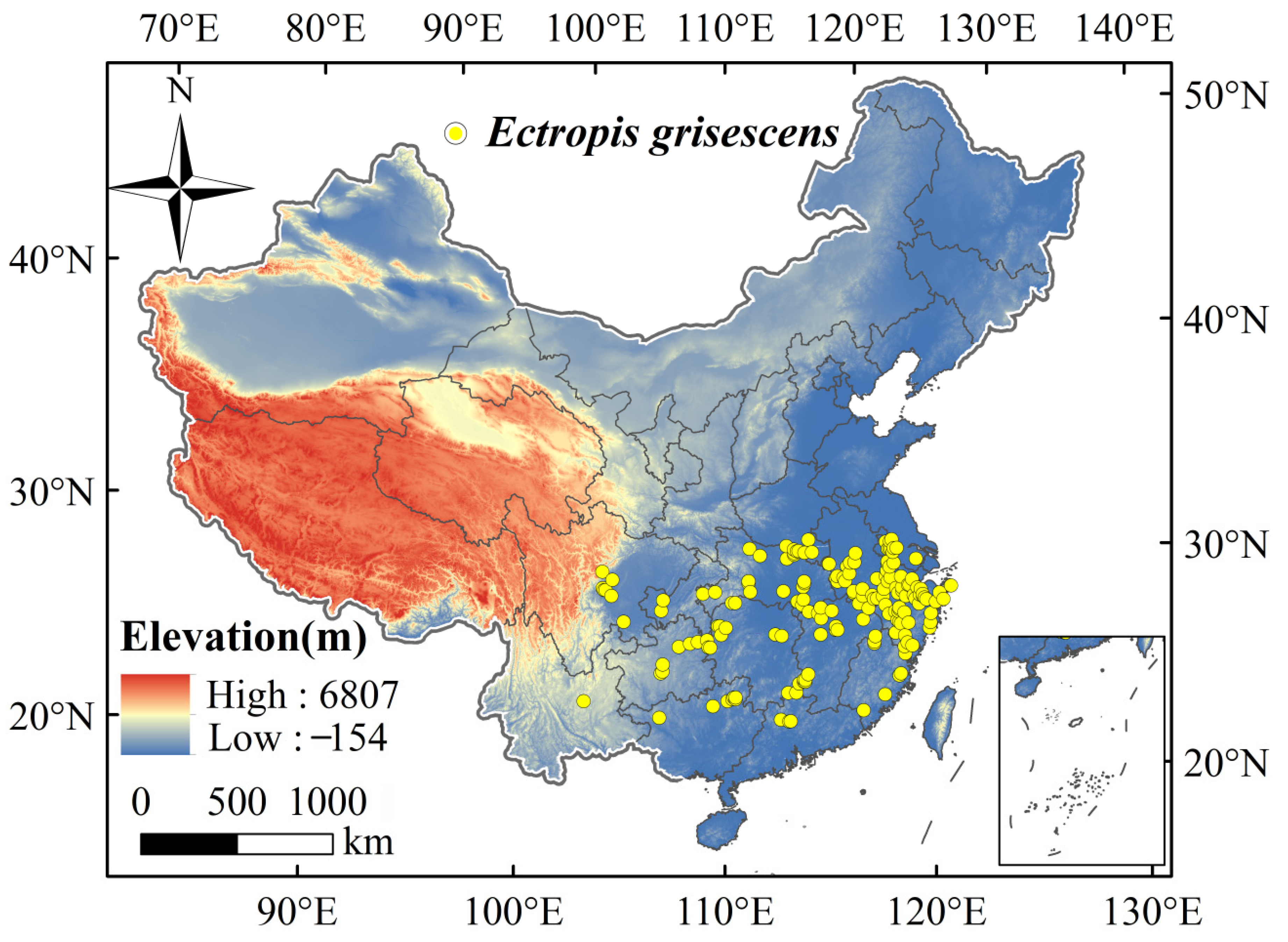
Figure 1. Distribution data for Ectropis grisescens in China.
Agronomy 15 02546 g001
Figure 2. Pearson correlation coefficient analysis of environmental data for Ectropis grisescens.
Agronomy 15 02546 g002
Figure 3. The potential distribution of Ectropis grisescens across China under the present climate conditions.
Agronomy 15 02546 g003
Figure 4. Predicted spread of Ectropis grisescens under different future climatic conditions in China.
Agronomy 15 02546 g004
Figure 5. Alterations in the potentially suitable areas for Ectropis grisescens as the climate transitions from current to future scenarios.
Agronomy 15 02546 g005
Figure 6. Shifts in the core distribution under nine climate scenarios across different years.
Agronomy 15 02546 g006
Table 1. Key environmental variables impacting the distribution of Ectropis grisescens.
VariablePercent Contribution (%)Permutation Importance (%)
Annual mean temperature (bio1, °C)--
Mean diurnal range (bio2, °C)37.32.9
Isothermality (bio3)--
Temperature seasonality (standard deviation × 100, bio4)1.88.6
Max temperature of warmest month (bio5, °C)--
Min temperature of coldest month (bio6, °C)--
Temperature annual range (bio7, mm)--
Mean temperature of wettest quarter (bio8, °C)--
Mean temperature of driest quarter (bio9, °C)13.648.6
Mean temperature of warmest quarter (bio10, °C)--
Mean temperature of coldest quarter (bio11, °C)--
Annual precipitation (bio12, mm)--
Precipitation of wettest month (bio13, mm)--
Precipitation of driest month (bio14, mm)25.015.7
Precipitation seasonality (bio15)--
Precipitation of wettest quarter (bio16, mm)--
Precipitation of driest quarter (bio17, mm)--
Precipitation of warmest quarter (bio18, mm)0.94.3
Precipitation of coldest quarter (bio19, mm)--
Human influence index (Hii)2.61.2
Elevation (m)18.818.7
The bolds are the variables in the final MaxEnt model of E. grisescens.
Table 2. The predicted suitable areas for Ectropis grisescens under both the current and future climate conditions.
Climate
Scenario
DecadesPredicted Area (km2) and % of the Corresponding Current Area
Total Suitable AreaLow Suitability AreaMedium Suitability AreaHigh Suitability Area
1970–20001.969 × 1065.121 × 1057.385 × 1057.185 × 105
SSP1-2.62030s2.174 × 106110.39%7.450 × 105145.50%5.322 × 10572.07%8.963 × 105124.75%
2050s2.139 × 106108.63%7.856 × 105153.41%6.614 × 10589.56%6.919 × 10596.30%
2070s2.210 × 106112.21%7.153 × 105139.69%6.584 × 10589.16%8.358 × 105116.32%
SSP2-4.52030s2.140 × 106108.70%6.931 × 105135.35%5.548 × 10575.13%8.925 × 105124.21%
2050s2.187 × 106111.08%7.189 × 105140.40%5.512 × 10574.64%9.170 × 105127.63%
2070s2.096 × 106106.42%7.970 × 105155.65%5.667 × 10576.74%7.318 × 105101.85%
SSP5-8.52030s2.144 × 106108.90%7.142 × 105139.48%5.835 × 10579.01%8.467 × 105117.83%
2050s2.073 × 106105.26%7.901 × 105154.30%5.415 × 10573.33%7.410 × 105103.13%
2070s1.806 × 10691.72%8.569 × 105167.35%4.353 × 10558.94%5.139 × 10571.52%
Table 3. Rates of change in the suitable areas for Ectropis grisescens under three climate scenarios and time periods.
Climate
Scenario
DecadesPredicted Area (km2) and % of the Corresponding Current Area
Total Suitable RegionContractionUnchangedExpansionRange
Change
Contraction
Percentage
Expansion
Percentage
1970–20001.969 × 106
SSP1-2.62030s2.174 × 1068.100 × 1031.638 × 1065.085 × 10510.39%0.41%25.82%
2050s2.139 × 1061.630 × 1041.630 × 1065.073 × 1050.090.83%25.76%
2070s2.210 × 1066.500 × 1031.653 × 1065.508 × 1050.120.33%27.97%
SSP2-4.52030s2.140 × 1066.800 × 1031.639 × 1064.967 × 1050.090.35%25.22%
2050s2.187 × 1061.260 × 1041.634 × 1065.528 × 1050.110.64%28.07%
2070s2.096 × 1064.620 × 1041.613 × 1064.801 × 1050.062.35%24.38%
SSP5-8.52030s2.144 × 1061.080 × 1041.636 × 1065.057 × 1058.90%0.55%25.68%
2050s2.073 × 1065.090 × 1041.595 × 1064.740 × 1055.26%2.58%24.07%
2070s1.806 × 1062.446 × 1051.416 × 1063.839 × 105−8.28%12.42%19.49%
Disclaimer/Publisher’s Note: The statements, opinions and data contained in all publications are solely those of the individual author(s) and contributor(s) and not of MDPI and/or the editor(s). MDPI and/or the editor(s) disclaim responsibility for any injury to people or property resulting from any ideas, methods, instructions or products referred to in the content.