Article

Global Future Modeling of the Invasive Cryphalus dilutus (Coleoptera: Curculionidae: Scolytinae) and Effects of Bioclimatic Variables

1
Hubei Key Laboratory of Biological Resources Protection and Utilization, Hubei Minzu University, Enshi 445000, China
2
College of Forestry and Horticulture, Hubei Minzu University, Enshi 445000, China
3
College of Forestry and Landscape Architecture, South China Agricultural University, Guangzhou 510642, China
*
Authors to whom correspondence should be addressed.
Agronomy 2026, 16(6), 619; https://doi.org/10.3390/agronomy16060619
Submission received: 27 January 2026 / Revised: 10 March 2026 / Accepted: 12 March 2026 / Published: 14 March 2026
(This article belongs to the Special Issue Sustainable Pest Management under Climate Change)

Abstract

Cryphalus dilutus is an emerging invasive pest of tropical and subtropical regions, with Mangifera indica and Ficus carica being its primary host plants. Larval damage caused by this insect can lead to severe tree wilting, posing a direct threat to agricultural production and ecological security. Native to South Asia, C. dilutus has established introduced populations in the Near East, Mexico, and other areas. In recent years, it has invaded multiple regions, including southern China and southern Italy. Given the widespread global distribution of host plants and the intensification of climate change, their distribution ranges are expected to expand. However, research assessing the potential global geographical distribution of this pest under climate change is lacking. In this study, we used the Random Forest model to predict the potential distribution range of C. dilutus. Under historical climatic conditions between 1970 and 2000, suitable climatic regions for C. dilutus were primarily distributed across southern China, southeastern Brazil, southeastern Mexico, the Congo Basin periphery, and the Iberian Peninsula, with a total area of 12,192.42 × 104 km2. The Temperature Annual Range and Precipitation of Warmest Quarter were identified as key environmental determinants that shaped its distribution. Under the future RCP4.5 climate scenario projected for the 2050s, the total suitable area for C. dilutus is projected to contract. Specifically, high-, medium-, and low-suitability areas are projected to decline by 52.77%, 62.39%, and 24.02%, respectively. While the total area of the very low zones is expected to increase, the total area of the suitable region has been reduced to 11,891.17 ×104 km2. Future climate change is expected to drive the distribution northward to high-altitude areas and inland areas. Model projections indicate a poleward expansion of the fundamental climatic niche, with climatic suitability increasing in high-latitude and high-altitude regions, such as Northern Europe and western North America. Conversely, current core tropical habitats in the Indian subcontinent and the Amazon Basin are projected to face significant habitat degradation due to thermal stress. Agricultural regions previously considered relatively safe due to climatic constraints, such as northern China, the midwestern United States, and Eastern Europe, may face new challenges from pest infestation. These findings underscore the importance of proactive monitoring and implementation of preventive measures. This provides crucial decision support for countries and regions to formulate precise pest control strategies and offers a theoretical basis for early monitoring and prevention of cross-border invasions on a global scale.

1. Introduction

Cryphalus dilutus Eichhoff, 1878 (Coleoptera: Curculionidae: Scolytinae), commonly known as the spurred bark beetle, is an emerging invasive pest of Ficus carica (fig) and Mangifera indica (mango) orchards. Biologically, it is a wood-boring species that primarily colonizes the phloem and cambial tissues of woody host plants, constructing galleries for feeding and reproduction [1,2]. C. dilutus is a polyphagous species that primarily targets stressed or dying trees, but notably, it can also attack healthy individuals, breeding on twigs, branches, and trunks [1,2]. This beetle is native to South Asia (e.g., India) [3]. Currently, this pest is widely distributed across tropical and subtropical regions. In Europe, C. dilutus was first reported in Southeastern Sicily (Italy) in 2014 and 2015, where it caused serious damage to common F. carica trees [2,3]. Subsequently, it was detected in Malta and France, making it a rapidly expanding threat in the region [2,4]. Adults possess natural dispersal capability through flight; however, their rapid intercontinental spread is primarily facilitated by the passive transport of infested wood or plant materials through global trade, which may harbor all developmental stages of the beetle (eggs, larvae, pupae, and adults) [2]. The life cycle of C. dilutus comprises egg, larval, pupal, and adult stages. As a thermophilic species, it is multivoltine, capable of completing multiple overlapping generations per year under favorable warm conditions [2,3]. Although considered polyphagous, the currently confirmed host range of C. dilutus is predominantly restricted to woody plants from two distantly related botanical families: Anacardiaceae and Moraceae. Specifically, recorded hosts include mangoes (Mangifera indica, Anacardiaceae) and various fig species (Ficus carica, Ficus benghalensis, Ficus microcarpa, and Ficus retusa, Moraceae). To date, no major host plants outside of these two genera have been globally established [3]. Among them, M. indica and F. carica are the most frequently reported hosts and represent primary crops of global economic significance. The potential severity of infestation is exemplified by the outbreak in Malta, where more than 50% of F. carica trees infested by this insect died between 2011 and 2017, leading to substantial economic losses [2]. Given the severe risks posed by its potential global expansion, there is an urgent need to implement monitoring and control programs.
The continuous escalation of global surface heat has been well-documented in the IPCC’s Sixth Assessment Report (AR6). This warming trajectory is anticipated to persist through the year 2100, with its ultimate severity dictated by prospective greenhouse gas scenarios and climate mitigation efforts [5]. Because insects rely on external environments to regulate body heat, such warming trends heavily impact their life cycles, directly controlling key parameters like metabolic speed and reproductive output [6]. Climate change impacts insect geographical distribution primarily through three aspects: First, warming temperatures alleviate cold-stress boundaries in high-latitude and high-altitude regions, facilitating the poleward and upward expansion of species that were previously limited by low temperatures [7]. Second, rising temperatures accelerate metabolic activities and developmental rates, which can shorten life cycles and increase the number of generations per year, thereby intensifying pest pressure in agricultural systems [8]. Third, climate change also imposes constraints; extreme high temperatures and altered precipitation patterns may exceed the physiological thermal limits of certain species, leading to habitat suitability degradation and range contraction in tropical regions [6]. Thus, a critical question is whether the C. dilutus population can change in response to climate change. To answer this question, we use species distribution models (SDMs) in this study to predict climate change-driven habitat shifts, which may be the key to understanding the prospects of this population.
Species distribution modeling (SDM) is a commonly used tool in ecological research and pest risk assessment [9]. Various modeling algorithms, such as Maximum Entropy (MaxEnt), the Genetic Algorithm for Rule-set Production (GARP), and Random Forest (RF), have been extensively applied to predict potential suitable habitats of invasive species, thereby supporting proactive early-warning systems and management strategies [10]. Among these, the RF model has emerged as a particularly powerful tool in forest entomology and invasion ecology. It has been successfully utilized to forecast the distribution and outbreak risks of various high-impact invasive pests, such as Dendroctonus frontalis and Ips typographus [11,12]. These demonstrate its efficacy in characterizing complex species environment relationships and outbreak dynamics. This ensemble machine learning approach offers distinct advantages: it does not rely on explicit physiological assumptions or species-specific experimental parameters, making it highly applicable to poorly studied or newly emerging pests. Furthermore, RF excels at capturing complex, non-linear relationships and high-dimensional interactions between species occurrence and environmental variables. Crucially, it has demonstrated robust predictive performance and a strong capacity to reduce overfitting, even when occurrence data are limited [13]. Accordingly, this study employs the RF model to project the potential global distribution of C. dilutus under historical and future climate scenarios.
Current research on C. dilutus has predominantly focused on its biological characteristics and the pathogenicity of its symbiotic fungi on host trees [1,2,3]. While local management strategies, such as the removal of infested wood and chemical control, have been implemented in outbreak regions like southern China, a macroscopic understanding of its invasion potential on a global scale is notably absent. With the expanding international trade of M. indica and F. carica, the risk of transboundary transmission is escalating [2]. However, how this pest will respond to global warming, specifically whether it will expand into higher latitudes or retreat from tropical zones due to thermal stress, remains a critical knowledge gap. To bridge this gap, this study integrated the RF algorithm with host-plant distribution data to model the ecological niche of C. dilutus. By simulating its potential distribution under historical baseline and future climate conditions, this research aimed to achieve two main objectives: (1) to identify the key bioclimatic variables and environmental thresholds limiting the survival of C. dilutus, and (2) to project the spatial shifts in its suitable habitats under a changing climate, quantifying trends of poleward expansion or range contraction. Ultimately, the findings from these objectives are intended to provide a scientific basis for international quarantine measures and early warning systems, thereby supporting policymakers in developing region-specific strategies to prevent the global spread of this wood-boring pest.

2. Materials and Methods

2.1. Methodological Pipeline for Ecological Niche Modeling

To guarantee the reliability and accuracy of our predictions, the analytical procedure was divided into several consecutive phases. First, the potential distributions of the host plants F. carica and M. indica were predicted using the RF model to establish biotic constraints, as RF has been widely applied in species distribution modeling to capture complex, non-linear relationships between environmental variables and species occurrences [14,15]. These outputs were overlaid in ArcGIS 10.8 to generate a composite host availability mask. Second, the potential global distribution of C. dilutus was projected using the RF algorithm under historical and future climate scenarios [15]. Finally, the pest prediction layer was overlaid with the host availability mask to delineate areas where both climatic suitability and host availability are conducive to potential establishment, consistent with the ecological niche modeling framework integrating abiotic and biotic constraints [16]. The final maps represent the potential climatic niche of the pest under historical and future climate scenarios.

2.2. Acquiring and Processing Distribution Coordinates of C. dilutus and Main Hosts (F. carica, and M. indica)

To accurately map the geographic presence of C. dilutus, we aggregated spatial data from three primary channels: public repositories, empirical field surveys, and academic publications. Specifically, 13 geolocation points were retrieved from the Global Biodiversity Information Facility (GBIF, https://doi.org/10.15468/Dl.C7cwkx (accessed on 10 December 2025)and the European and Mediterranean Plant Protection Organization (EPPO, https://gd.eppo.int/, accessed on 10 May 2025). This dataset was further enriched by 27 historical occurrences sourced from prior entomological studies [1,2,3,4,17]. Additionally, recent field tracking was executed between 2024 and 2025 in collaboration with the Department of Forestry Protection of China. Every verified site was comprehensively cataloged with its specific name, geographic coordinates, and elevation. During the data curation phase, we systematically purged all redundant entries to prevent spatial bias. For historical records that only provided descriptive place names without exact geographic markers, precise latitudes and longitudes were georeferenced using the Google Maps (version 25.38.02) [18,19,20]. Following this data-processing pipeline, a final set of 50 pest distribution coordinates was established. Detailed information regarding these occurrence records is provided in Table S1 in the Supplementary Materials.
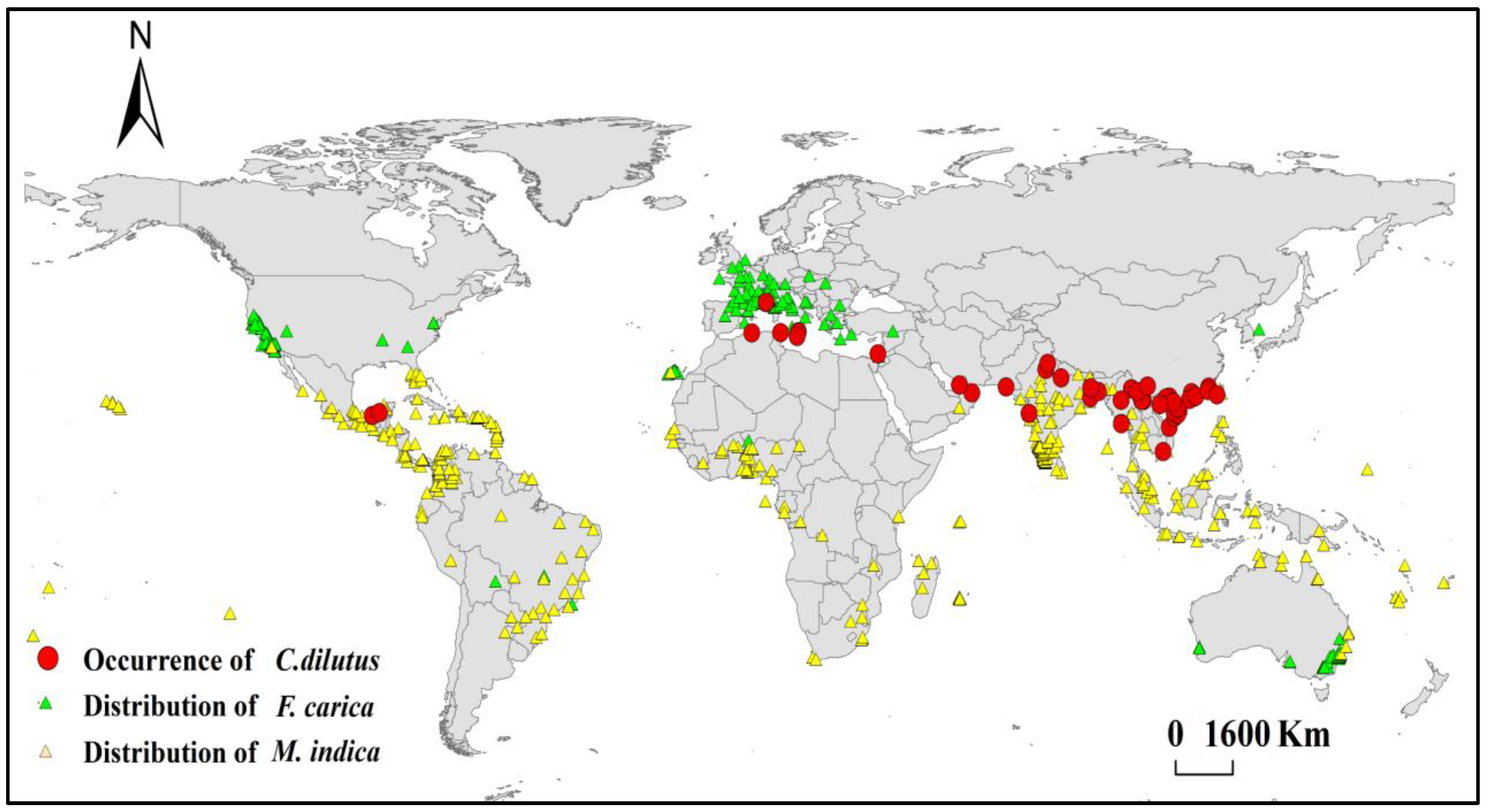
The method used for extracting F. carica and M. indica coordinates is the same as C. dilutus. Ultimately, 133,216 host-plant distribution records were obtained (Tables S2 and S3) [21,22,23,24]. Given the high spatial density of host-plant records in intensively cultivated regions, the dataset was filtered to reduce redundancy and spatial over-representation prior to mapping by using the “Spatially Rarefy Occurrence Data” function from the SDM toolbox in ArcGIS 10.8. This data reduction step aimed to improve the interpretability and visual clarity of distribution maps generated in ArcGIS 10.8. After filtering, 840 host-plant occurrence points were retained for subsequent visualization and analysis (Figure 1).

2.3. Climate Data Acquisition and Climate Scenarios

The environmental predictors essential for our Random Forest framework were sourced from the WorldClim version 2.1 repository (https://www.worldclim.org/, accessed on 10 June 2025). Although this platform provides 19 standard climatic parameters across multiple grid sizes (ranging from 0.5 to 10 arc-minutes), we specifically opted for the 10 min resolution (approximately 340 km2). This specific spatial scale was deliberately adopted to best match the macroscopic, global extent of our current investigation. The historical climatic baseline was established using historical data derived from meteorological observations spanning from 1970 to 2000 [25]. Regarding future projections, insect populations are characterized by short generation times and high reproductive rates, implying a potential for rapid evolutionary adaptation over extended periods [26]. Consequently, projections extending too far into the future (e.g., 2100) carry inherent biological uncertainty. To minimize this uncertainty while capturing significant climatic shifts, the 2050s (averaging 2041–2060) were selected as the target period. Future climate layers were constructed based on downscaled Global Climate Models (GCMs) processed via the WorldClim platform [25]. In its Fifth Assessment Report (AR5), the IPCC established the Representative Concentration Pathways (RCPs) to model varying degrees of global climate change. These trajectories are explicitly defined by their projected radiative forcing limits of the year 2100 compared to pre-industrial baselines (the year 1750), targeting 2.6, 4.5, 6.0, and 8.5 W/m2. Ecologically and socio-economically, these pathways reflect a broad gradient of future actions, ranging from aggressive carbon mitigation (RCP2.6) and intermediate greenhouse gas stabilization (RCP4.5 and RCP6.0) to an unrestrained, fossil-fuel-intensive future (RCP8.5). To simulate future climatic conditions, we selected the Pathway 4.5 (RCP4.5) scenario [27]. Unlike scenarios representing extreme forcing, RCP4.5 represents a moderate greenhouse gas emission trajectory and a stabilization pathway, providing a realistic intermediate baseline for risk assessment [27,28,29]. While earlier studies often incorporated the high-emission RCP 8.5 scenario, recent evaluations of global energy trends and climate policies suggest that RCP 8.5 has become highly improbable and misleading as a ‘business-as-usual’ baseline [28,30]. Current trajectories indicate that global warming is tracking closer to the intermediate pathways (approximately 3 °C by 2100), making RCP 4.5 the most plausible representation of the future climate [31]. Furthermore, proactive government policies addressing climate change are reshaping landscape connectivity. Governments worldwide have adopted extensive ecological restoration measures. Therefore, focusing on this intermediate scenario provides a more realistic basis for developing pest management strategies and agricultural adaptation plans.
To identify the most critical environmental drivers shaping the potential distribution of C. dilutus and to mitigate the risk of model overfitting induced by multicollinearity, a rigorous sequential dimensionality reduction procedure was implemented prior to modeling. Initially, a pairwise Pearson correlation analysis (r) was conducted across all 19 bioclimatic variables (Table 1). For any variable pair exhibiting strong collinearity, when the correlation coefficient between two variables exceeded 0.8, only the one with greater biological relevance to the target species was retained. Following this preliminary filtering, Least Absolute Shrinkage and Selection Operator (LASSO) regression was applied for further feature selection. By constructing an L1 penalty function, the LASSO algorithm effectively shrinks the coefficients of redundant or less informative environmental variables to exactly zero. Ultimately, only the subset of variables with non-zero coefficients was retained as the key predictors to train the final Random Forest model [32].

2.4. Simulating the Global Climatic Niche Using the RF Algorithm

To forecast the suitable geographic ranges of C. dilutus and its primary hosts (F. carica and M. indica), we leveraged the Random Forest algorithm implemented via the BioMod2 ensemble platform in the R computing environment [33,34]. To address the issue of class imbalance and define the environmental background for model training, we generated pseudo-absence points. These points were randomly selected from the entire study area, excluding a buffer zone around known locations to account for spatial uncertainty. A total of 200 pseudo-absence points with a 1:4 ratio to the 50 presence records were generated to create a balanced dataset for model training [35]. To evaluate the algorithm’s performance, we implemented a 10-fold cross-validation strategy. For each iteration, the occurrence dataset was randomly partitioned, dedicating 70% of the points to calibrating the model and reserving the remaining 30% for independent testing. To minimize stochastic variance, optimize predictive reliability, and ensure ecological realism, this entire cross-validation protocol was iterated 10 times. Furthermore, the specific contribution of each climatic factor shaping the ecological niche of C. dilutus was assessed by extracting the internal feature importance scores inherent to the RF algorithm. This method generated accurate and ecologically realistic distribution maps for the three target species.
Suitability grades within the study area generally require classification to better reflect the varying levels of habitat suitability for species across different regions. The prediction results of the RF model are presented as a probability raster with values ranging from zero to one. Different suitability grades were derived for visualization and comparative purposes by defining thresholds informed by the observed distribution patterns of the species. To facilitate preliminary cartographic visualization for C. dilutus, we employed the Jenks Natural Breaks optimization algorithm within ArcGIS 10.8. This procedure stratified the continuous suitability probabilities into five distinct qualitative tiers: unsuitable, very low, low, medium, and high. The Jenks method maximizes variance between classes while minimizing variance within classes, facilitating visualization rather than defining ecological thresholds [36]. Unsuitable areas were defined as regions where environmental conditions were not permissive for species persistence and thus corresponded to suitability values approaching zero. The classification thresholds for the remaining suitability grades were subsequently adjusted based on the spatial density of C. dilutus occurrence records, under the assumption that areas with higher record density reflect relatively higher habitat suitability. For F. carica and M. indica, a simplified binary classification was applied to identify the potential presence of host plants. To adopt a conservative strategy (maximum sensitivity), areas with predicted probabilities greater than zero were retained as potentially suitable, indicating the possible occurrence of host plants, while areas with a probability of zero were considered unsuitable. This binary classification was used solely as a masking step to constrain the potential distribution of C. dilutus and does not imply equivalent ecological suitability across all non-zero probability values [37]. To define the biotic constraints for C. dilutus, the predicted potential distribution maps of F. carica and M. indica (provided in Figure S1 in the Supplementary Materials) were processed using ArcGIS 10.8. The continuous probability outputs were converted into binary presence/absence rasters, where grid cells with probabilities greater than 0 were classified as suitable (value = 1). These binary layers were then spatially overlaid to generate a composite host availability mask. Areas containing at least one host species (value ≥ 1) were identified as suitable host distribution zones, while areas lacking both hosts were deemed unsuitable. The predicted global distribution of C. dilutus generated by the RF model was constrained by the suitable host area mask. This process yielded the final global habitat maps for C. dilutus, explicitly accounting for host-plant limitations.
Model accuracy under multiple climate scenarios was evaluated using three commonly applied indicators: the Area Under the Curve (AUC), the True Skill Statistic (TSS), and the Kappa coefficient. The AUC value represents the area under the Receiver Operating Characteristic (ROC) curve and varies from 0 to 1 [38]. The Kappa statistic measures the consistency between predicted and observed classifications based on the confusion matrix, with possible values ranging from −1 to 1 [39]. The TSS, regarded as a refined form of the Kappa statistic, evaluates the model’s discrimination capacity by calculating the difference between the true positive rate and the false positive rate, with scores ranging from 0 to 1 [40]. For all three indices, values closer to 1 indicate higher model accuracy.

3. Results

3.1. Model Performance and Key Environmental Factors

Table 2 shows the evaluation metrics (AUC, Kappa, and TSS) for the RF model of C. dilutus, M. indica, and F. carica under various climate scenarios. All the metric values were within acceptable ranges, indicating sufficient model accuracy. The RF model predicted the global potential distributions of C. dilutus, M. indica and F. carica based on existing occurrence records. The evaluation indices (AUC, Kappa, and TSS) demonstrated that the C. dilutus model maintained reliable predictive accuracy under both climate scenarios (Table 2).
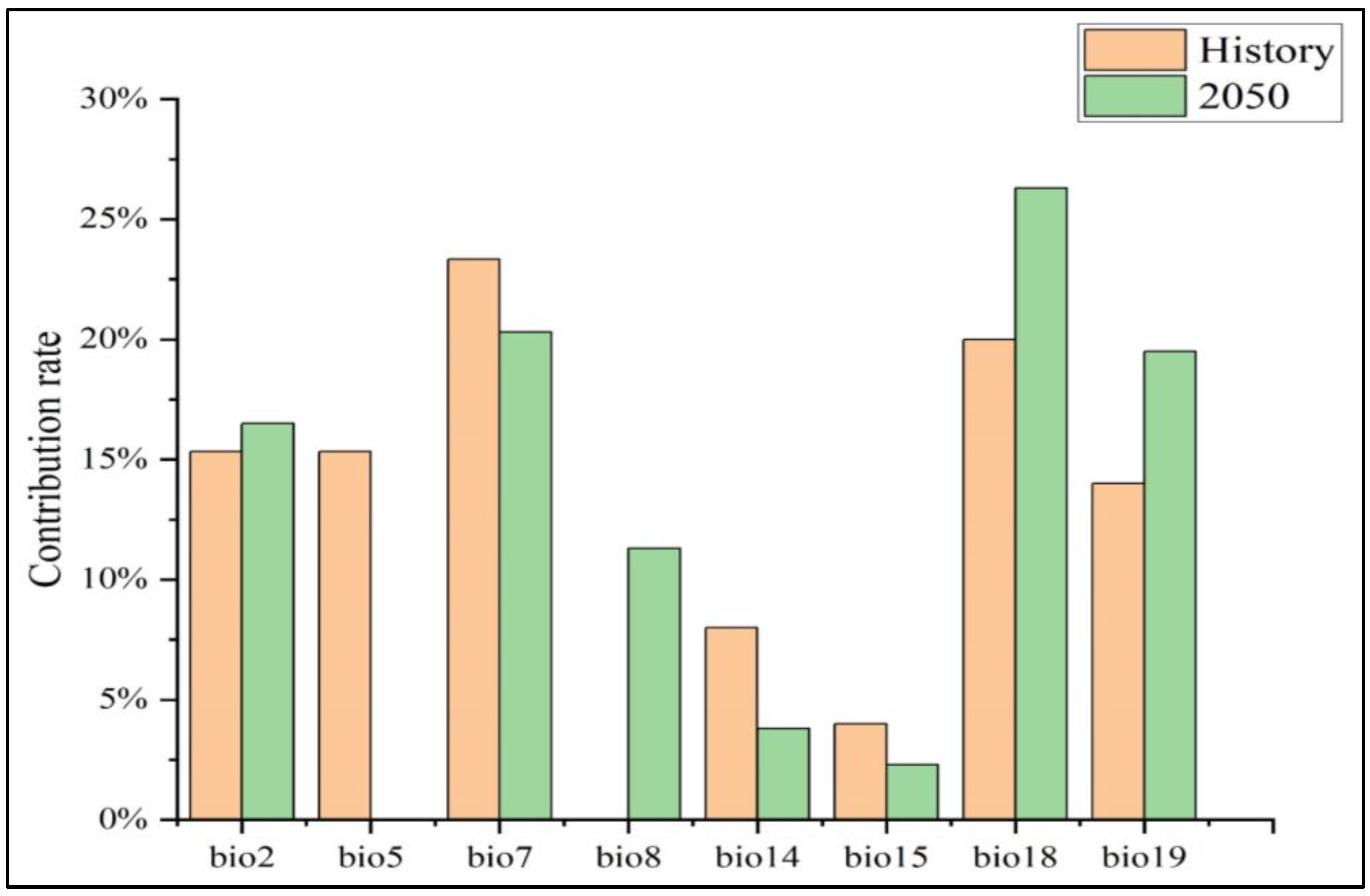
The contributions of major environmental variables to the model outputs under different climate scenarios are presented in Figure 2. Under historical climatic conditions, the top five variables with the most significant contributions were: Temperature Annual Range (BIO7, 23.33%), Precipitation of Warmest Quarter (BIO18, 20.00%), Mean Diurnal Range (BIO2, 15.33%), Max Temperature of Warmest Month (BIO5, 15.33%), and Precipitation of Coldest Quarter (BIO19, 14.00%). Under the future climate scenario, the top five variables shifted, with their contributions ranking as follows: Precipitation of Warmest Quarter (BIO18, 26.3%), Temperature Annual Range (BIO7, 20.3%), Precipitation of Coldest Quarter (BIO19, 19.5%), Mean Diurnal Range (BIO2, 16.5%), and Mean Temperature of Wettest Quarter (BIO8, 11.3%). Under historical climatic conditions, the combined contribution of temperature variables was greater than that of precipitation variables. However, this pattern changes under future climate scenarios, where precipitation-related variables become the dominant contributors. These results indicate that C. dilutus may become more sensitive to precipitation constraints than to temperature limits in the future, providing valuable insights for understanding its potential adaptive response to climate change.

3.2. Global Potential Distribution of C. dilutus Predicted by the RF Model Considering Host Distribution

3.2.1. Potential Global Distribution Under Historical Climate Scenario

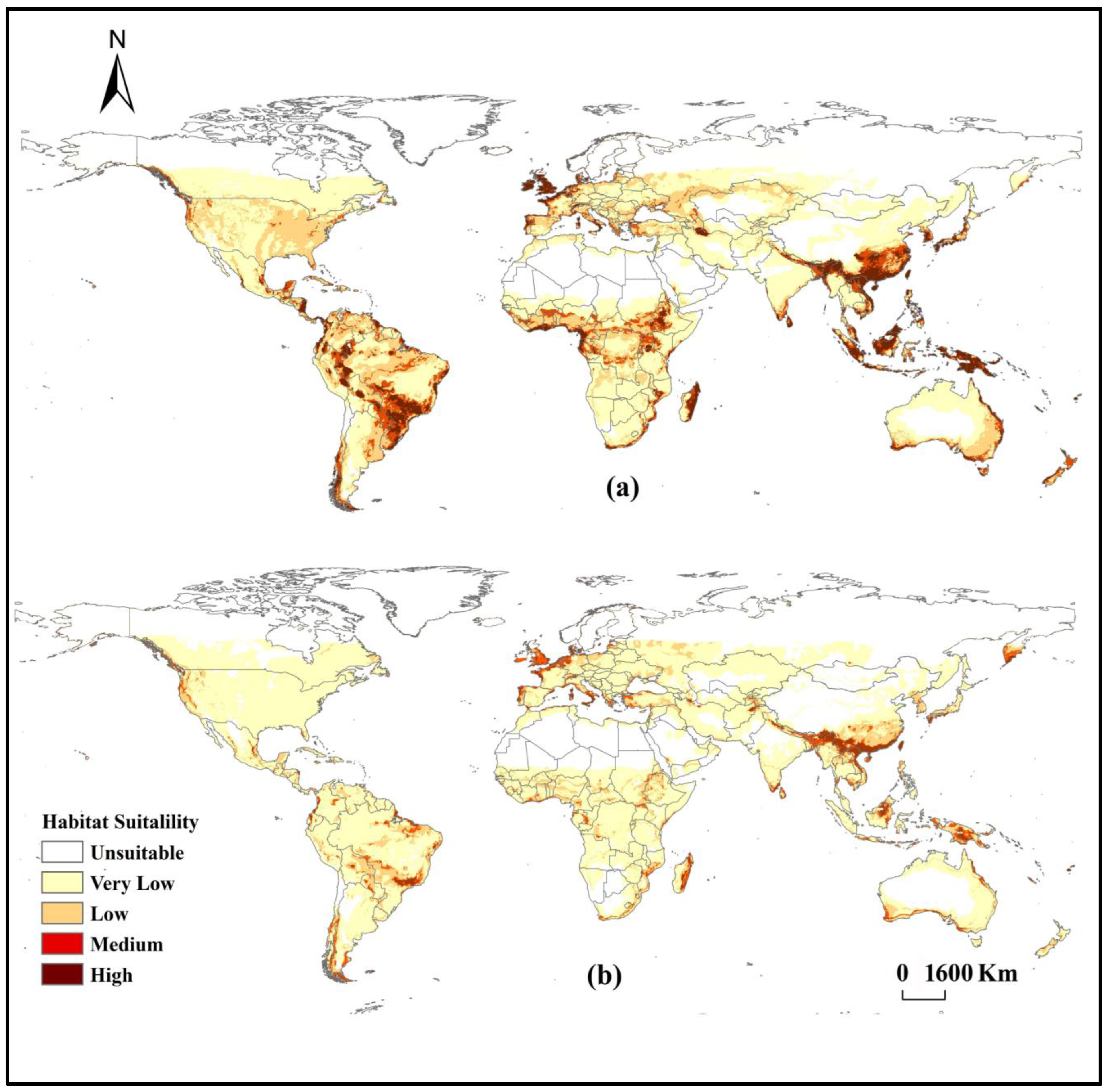
As illustrated in Figure 3a, the Random Forest model projects a potential distribution characterized by distinct latitudinal gradients under the historical climate scenario. The distribution of all the recorded occurrences within suitable areas further demonstrates the robust predictive capability of the model. Core habitats classified as medium to high suitability are primarily concentrated in tropical and subtropical regions. In Asia, these core habitats are broadly distributed across Southern China, particularly in Yunnan, Guangdong, and Fujian. The distribution extends to the Indian subcontinent, covering India, Bangladesh, and Sri Lanka, and spans across Southeast Asia, including Vietnam, Thailand, Malaysia, Indonesia, and the Philippines. In the Americas, highly suitable areas encompass the southeastern United States, such as Florida, along with central Mexico and vast portions of South America, specifically the Amazon Basin and southeastern Brazil. Africa exhibits high suitability in the equatorial belt, notably in the Congo Basin and coastal East Africa. In Oceania, core habitats include Northern Queensland and Eastern New South Wales in Australia. Europe shows a more fragmented distribution, with suitable habitats largely confined to the Mediterranean rim, including Italy, Greece, and Turkey. Notably, the model also identifies extensive areas of marginal suitability, depicted as yellow zones of very low to low suitability, extending into higher latitudes in the Northern Hemisphere. These are present transitional zones where climatic conditions are suitable according to the model, but establishment may be limited by non-climatic constraints.

3.2.2. Potential Distribution of C. dilutus Under the RCP4.5 Climate Scenario

Figure 3b illustrates the potential global distribution of C. dilutus under RCP4.5. The results show a significant contraction of suitable habitats, particularly in regions that were previously highly suitable. In Asia, reductions in high-suitability areas are observed in southern China, India, and Southeast Asia, with many areas transitioning to medium or low suitability. Southern Japan and parts of the Korean Peninsula change from suitable to unsuitable zones. In North America, suitable habitats contract significantly, especially in the western United States and Mexico, where highly suitable regions shrink considerably, leaving only small areas of medium and low suitability. In South America, regions like Brazil, Argentina, and Colombia see reductions in high-suitability areas, transitioning to medium or low suitability. Europe experiences a downgrading of high-suitability areas in southern Spain, Italy, and Greece, while Scandinavia becomes unsuitable. In Oceania, Australia’s eastern coastal regions and Papua New Guinea show a significant decrease in suitable habitats, with high-suitability areas almost entirely disappearing. Overall, the RCP4.5 scenario suggests a widespread degradation of suitable habitats rather than a northward expansion of core areas.

3.3. Comparison of Habitat Suitability Between Historical and Future Scenarios

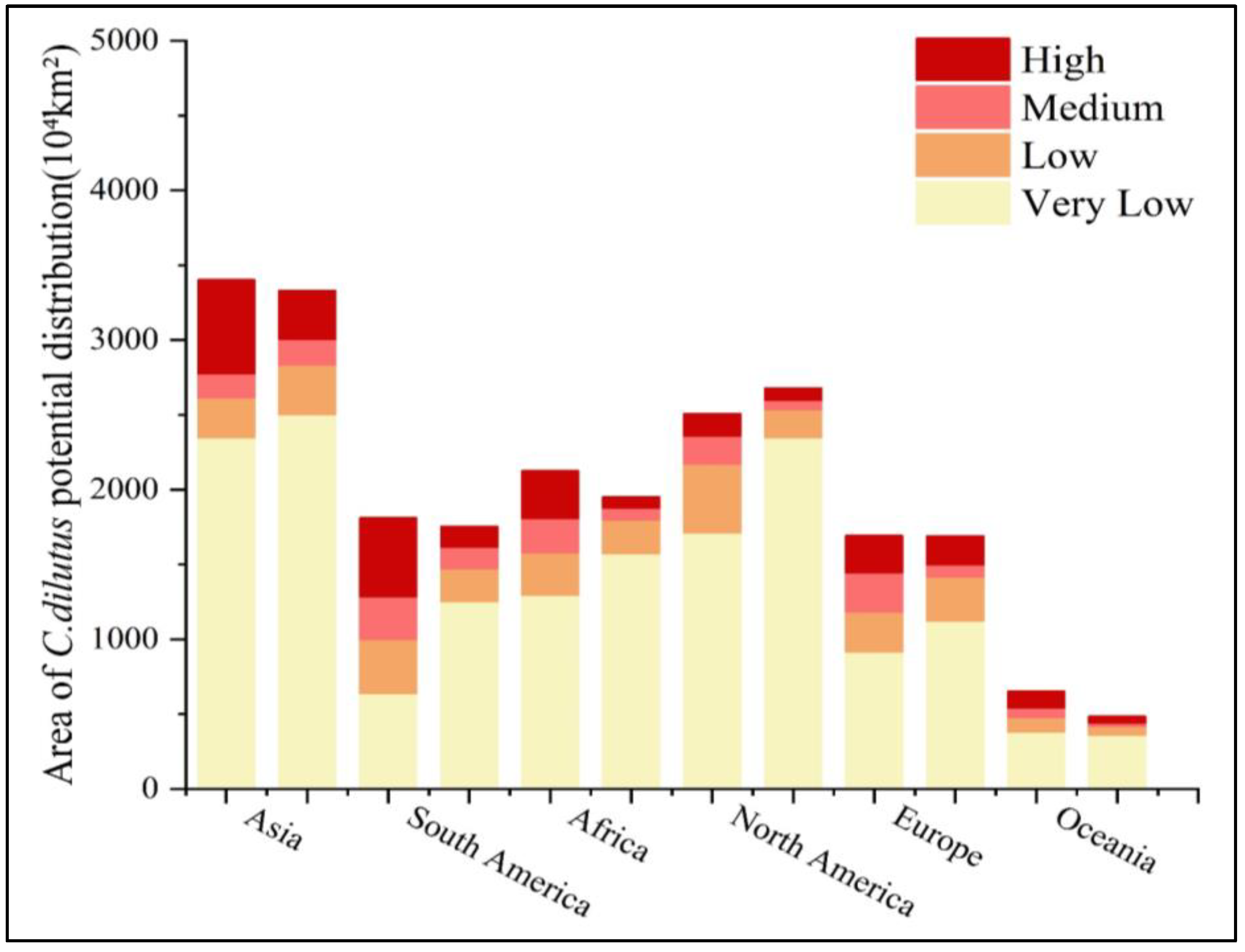
Table 3 summarizes the projected changes in habitat suitability under the RCP4.5 climate scenario relative to historical conditions. By the 2050s, the total predicted suitable habitat area is expected to decline by approximately 2.47%. Although the overall reduction is relatively small, substantial differences are observed among suitability classes. Medium-suitability habitats exhibit the most pronounced contraction, decreasing by 62.39%, followed by high-suitability habitats, with a reduction of 56.77%, and low-suitability habitats, with a reduction of 24.02%. In contrast, very-low-suitability habitats are projected to expand by 25.61%. These results suggest a pronounced shift from high-quality core habitats toward lower-suitability areas, indicating that future climate change will disproportionately erode optimal habitats for the species. Figure 4 shows the continental areas of each suitability class for C. dilutus under historical (left column) and future (right column) scenarios, derived from the results in Figure 3. The total area classified as high-, medium-, and low-suitability decreased across all continents. Conversely, the total area classified as very-low-suitability expanded. The global suitable area was calculated as 12,192.42 × 104 km2 currently and 11,891.17 × 104 km2 in the future, representing a net decrease of 2.47% in the total suitable area under future projections.
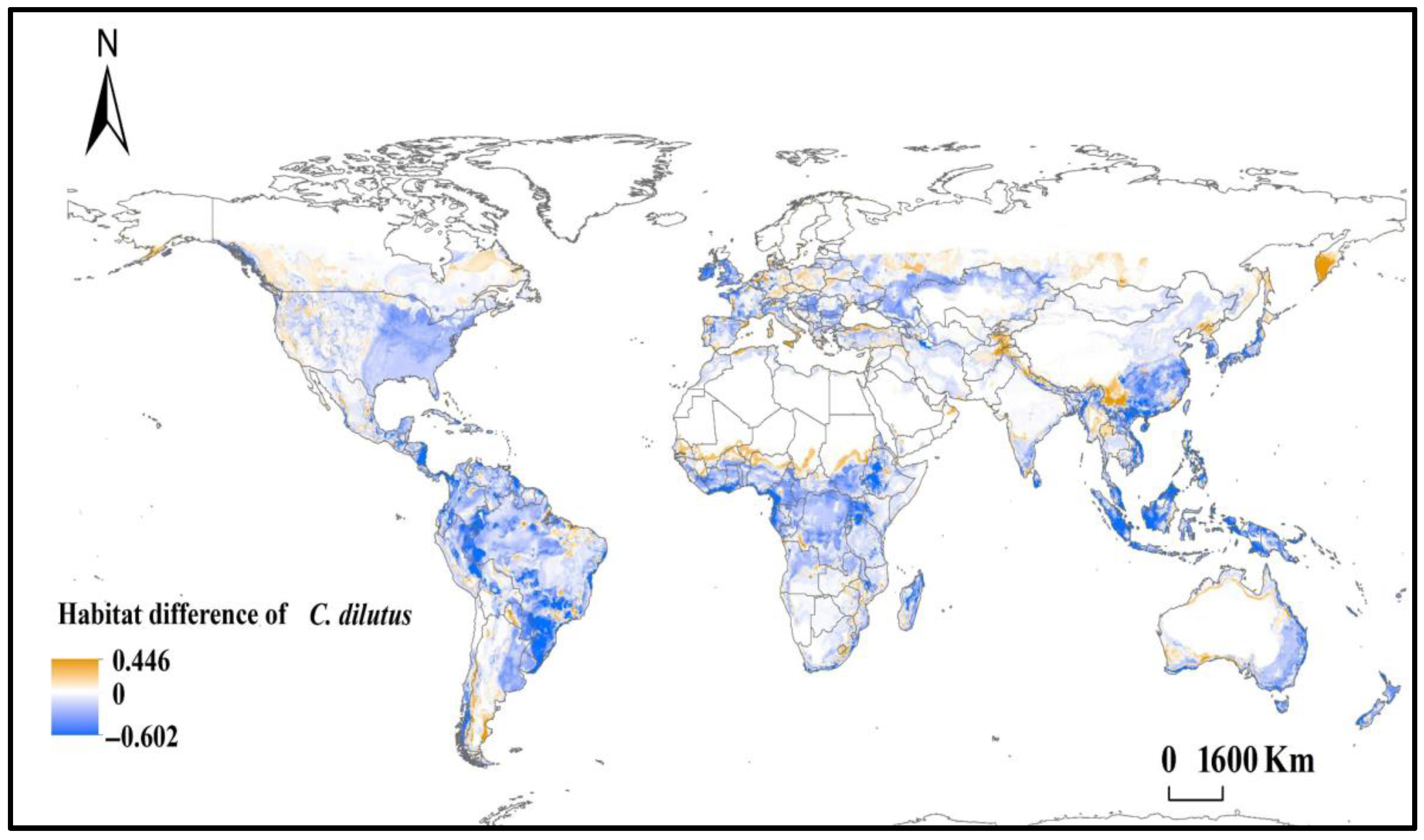
Figure 5 illustrates the projected shifts in habitat suitability for C. dilutus from the historical to the future climate scenario. Yellow and blue regions denote increases and decreases in suitability values, respectively. In South America, extensive regions including the central eastern part of Brazil, northeastern Argentina, eastern Peru, and southern Colombia show a significant decreasing trend. In Africa, the Congo Basin, the southern area of the Ethiopian Plateau, and the southeastern part of South Africa also exhibit a notable decline. Similarly, the eastern coastal areas of Australia show a downward trend. In North America, a marked reduction is observed in the southeastern United States. In Eurasia, trends diverge geographically: the South China Hills region shows a decline, whereas higher latitudes, such as the south-central part of Siberia and parts of Western and Northern Europe, exhibit a slight increase in climatic suitability. This pattern indicates a general degradation of habitat quality in historical tropical core zones, concurrent with a potential northward expansion of the climatic niche.

4. Discussion

4.1. Changes in the Potential Distribution of C. dilutus Under Historical and Future Climate Scenarios

C. dilutus is currently climatically suited to warm and humid regions across multiple continents. High suitability is concentrated in southeastern Brazil and northeastern Argentina, the southeastern United States (e.g., Florida), southeastern Mexico, southern China, northeastern India, Southeast Asia (including Thailand, Vietnam, and Indonesia), the periphery of the Congo Basin, and parts of the Iberian Peninsula. These regions collectively represent the species’ present core climatic niche, characterized by relatively stable thermal regimes and the widespread availability of suitable host plants. Under future climate scenarios, model projections indicate pronounced spatial shifts in climatic suitability across these regions. Two contrasting patterns emerge: a poleward and upward expansion of climatically suitable areas, and a concurrent contraction and degradation of suitability within current tropical core regions. Driven by warming temperatures, the species is projected to expand toward higher latitudes within the potential distribution range of its host plants. Although rising temperatures may theoretically permit seasonal survival during warmer months, persistent winter freezing events, shortened growing seasons, and, most critically, the absence of suitable host plants M. indica and F. carica are expected to severely limit population establishment. Similar model-driven increases in climatic suitability are observed in high-altitude regions such as the Tibetan Plateau, the Alps, and the Himalayas. Nevertheless, complex topographic microclimates and the lack of host vegetation at such elevations act as strong biological barriers, rendering these areas unsuitable despite favorable thermal indices. In contrast, mid-latitude transitional zones, including the Yangtze River Basin in China, Central Europe, and the midwestern United States, are projected to experience moderate increases in climatic favorability. In these regions, warming temperatures may extend the active season or increase the number of generations per year, potentially intensifying pest pressure without necessarily leading to permanent range expansion.
The projected poleward and upward shifts in the distribution of C. dilutus are driven by the synergistic effects of climate change and agricultural practices [41]. Rising temperatures alleviate cold constraints that previously limited survival in high-latitude and high-altitude regions, extending the growing season and accelerating pest development rates [42,43]. At the same time, climate-driven northward shifts in the cultivation of M. indica and F. carica provide essential nutritional resources for colonizing populations, effectively creating temporary bridgeheads in newly permissive climates [44,45]. This process mirrors the large-scale migration of climate isotherms, which displace the fundamental climatic niche of the species toward higher latitudes and elevations. Conversely, tropical core regions such as northern Southeast Asia and southeastern Brazil are projected to undergo widespread declines in suitability and range contraction. Increasing temperatures may push these regions beyond the upper thermal tolerance limits of C. dilutus, leading to elevated mortality, disrupted development, and reduced fecundity [46,47]. Together, escalating thermal stress and altered hydrological conditions are expected to degrade habitat quality and render portions of the current range increasingly uninhabitable.

4.2. Key Factors Influencing the Potential Distribution of C. dilutus

Under historical climate conditions, temperature is the primary factor influencing the global potential distribution of C. dilutus, contributing most strongly to the model outputs. This dominance is rooted in the biological characteristics of the species. As poikilotherms, insects are sensitive to temperature variations [42]. C. dilutus typically requires 30–50 days to complete a single generation, and elevated temperatures substantially shorten this developmental cycle [8,48]. Rising temperatures accelerate growth and development and reduce diapause duration, potentially increasing the number of generations per year. However, it is crucial to note that bark beetles, including C. dilutus, have an upper developmental threshold of approximately 38–39 °C, above which development is inhibited [48]. These key temperature-driven physiological processes underpin the current distribution patterns under the prevailing climate regimes. However, a critical shift in the relative importance of climatic drivers is anticipated under future climate scenarios. Although the cumulative impact of temperature-related factors remains significant, the influence of precipitation variables is projected to surpass that of temperature. This change in driver importance can be attributed to three factors. First, with thermal niche expansion, rising temperatures alleviate cold limitations, expanding the potentially suitable area and thereby diminishing the role of temperature as the primary discriminating factor [49]. Second, direct physiological stress associated with precipitation becomes critical, as moisture availability in the phloem, largely regulated by precipitation, is essential for beetle survival. The beetle’s immature stages, which develop beneath the bark, are highly susceptible to desiccation during drought or fungal infections under waterlogged conditions [50]. Third, indirect host-mediated effects play a decisive role. Precipitation regimes profoundly influence host-plant physiological condition and defense capacity [51]. Moderate drought stress may weaken tree defenses, favoring beetle attacks, whereas prolonged drought or excessive moisture can lead to host mortality, creating a complex and non-linear relationship that ultimately determines habitat suitability [46,52]. Although C. dilutus is currently restricted to Mangifera indica and Ficus carica, its distribution should be regarded as dynamic rather than static. The global cultivation of these hosts, driven by trade and agricultural innovation, is creating new corridors for their spread. Future climate change may induce physiological stress in a broader range of tree species, potentially weakening host-specific barriers and enabling this beetle to colonize novel hosts [53]. This synergy between human-mediated host redistribution and climate-driven host susceptibility could substantially amplify invasion risk, leading to a realized distribution considerably broader than that predicted by climate variables and current host data alone [54].
By employing the RF modeling framework, this study elucidates the dynamic mechanisms through which climatic factors and host plants jointly shape the potential distribution patterns of C. dilutus. Although global temperature increases facilitate poleward expansion by relaxing thermal constraints, water availability through both direct physiological stress and indirect host-mediated effects is expected to become the key bottleneck determining the species’ eventual distribution [55]. The availability and resistance of host plants, along with their responses to climate change, interact in a complex manner with climatic factors, regulating the actual distribution boundaries of this pest [56]. This necessitates that future risk assessments move beyond the analyses of single climatic variables to establish a multidimensional evaluation framework that integrates regional water balance, host-plant dynamics, and pest population responses. These findings offer valuable support for the development of region-specific monitoring, early warning, and ecological regulation measures.

4.3. Quarantine Measures and Management Plan for C. dilutus

The continuous expansion of global trade facilitates the transboundary dispersal of pests, highlighting the need for targeted quarantine strategies. Rather than generalized global vigilance, the potential distribution maps generated in this study provide a spatial framework for prioritizing inspections. For instance, enhanced inspection of imported M. indica and F. carica products is highly recommended at ports of entry in regions identified as highly suitable or emerging transition zones (e.g., the Mediterranean basin, the southeastern United States, and southern China). If C. dilutus is intercepted, appropriate phytosanitary actions should be considered in accordance with respective national regulations. Guided by our modeling, quantitative risk assessments can be conducted, allowing countries to adjust their phytosanitary measures appropriately. Leveraging media platforms to disseminate information about the specific risks of unauthorized transportation of host materials into these high-risk climatic zones will establish a solid foundation for early detection.
At the orchard level, while standard Integrated Pest Management (IPM) practices—such as the removal and safe disposal of severely infested trees—remain foundational, our modeling results offer specific climate-adaptive insights. Because our Random Forest model identified precipitation-related variables (e.g., Precipitation of Warmest/Coldest Quarter) as increasingly dominant drivers under future scenarios, field management is recommended to proactively address hydrological stress. Since host vitality is a key determinant of susceptibility, drought-stressed F. carica and M. indica exhibit weakened chemical defenses against bark beetle colonization. Therefore, in regions projected to experience shifting precipitation regimes or prolonged dry spells, the implementation of precision irrigation and soil moisture conservation is recommended as a primary, site-specific defense strategy. By alleviating environmental stress, orchards can maintain host resistance and reduce their attractiveness to C. dilutus. Finally, actively sharing these spatially explicit risk maps through platforms like the International Plant Protection Convention (IPPC) will support a collaborative, data-driven global defense network.

4.4. Limitations and Future Prospects

In this study, we used the RF model, which provided substantial support for the research, while exhibiting inherent limitations. First, although the RF model efficiently captures complex environmental relationships, its extrapolation to regions with limited data coverage requires caution. Unlike mechanistic models, the limited interpretability of the internal decision-making process hinders the clear elucidation of the causal mechanisms between variables and outcomes [57]. Second, the model was trained on 50 verified occurrence records. While a larger dataset is typically preferable, C. dilutus is an emerging invasive pest with limited confirmed global records. Previous studies have demonstrated that the RF model is robust and performs well even with small sample sizes, particularly for species with specialized niches [10,13]. However, as new invasion records emerge, future iterations of the model should incorporate these data to refine predictions. Third, the Random Forest model predicts climatic potential rather than the actual realized ecological niche [16]. The current models do not account for critical limiting factors such as permafrost, extreme winter cold stress, photoperiod constraints, and the absence of host plants. Therefore, the predicted expansion in these areas should be interpreted as a climatological signal of warming rather than an indication of immediate pest establishment. Future research should prioritize determining the specific physiological thermal limits of C. dilutus through laboratory experimentation. Obtaining precise thresholds for development, reproduction, and lethal temperatures would allow for the development of robust mechanistic models in the future, which could then be cross-validated with the correlative results presented here. Additionally, incorporating biotic interactions, such as natural enemies and interspecific competition, would further enhance the ecological realism of risk assessments [58]. Although the study has certain limitations, the present findings offer valuable early warning references for preventing and controlling C. dilutus, as well as for protecting M. indica, F. carica, and other agricultural products.

5. Conclusions

This study employed the RF model to predict the global potential distributions of C. dilutus and its primary host plants F. carica and M. indica under historical and future climate scenarios. To ensure biological realism, the predicted suitable areas of host plants were utilized as a biotic mask to refine the potential distribution range of C. dilutus. The results demonstrate that Temperature Annual Range and Precipitation of Warmest Quarter are key environmental determinants. While temperature primarily defined the historical distribution, precipitation constraints are projected to become increasingly significant drivers under future warming scenarios. Historically, suitable areas were primarily concentrated in southern China, northeastern India, southeastern Brazil, northeastern Argentina, the southeastern United States, the Congo Basin periphery, and the Iberian Peninsula, covering a total area of 12,192.42 × 104 km2. Under the future RCP4.5 scenario, the global distribution exhibits a trend of range contraction and habitat degradation. The extent of high-, medium- and low-suitability areas is projected to decline significantly by 56.77%, 62.39% and 24.02%, respectively, particularly in current tropical core regions due to thermal stress. Conversely, areas of very low suitability are expected to expand into higher latitudes, representing a broadening of the fundamental climatic niche. Overall, the total suitable area is anticipated to decline by 2.47% to 11,891.17 × 104 km2. Based on these findings, this study identifies potential risk zones for future spread and clarifies the spatial dynamics of range shifts. Consequently, these results provide valuable theoretical guidance for strengthening quarantine measures, early warning systems, and control strategies against C. dilutus on a global scale.

Supplementary Materials

The following supporting information can be downloaded at https://www.mdpi.com/article/10.3390/agronomy16060619/s1: Table S1: The coordinates of the Cryphalus dilutus; Table S2: The coordinates of the Ficus carica; Table S3: The coordinates of the Mangifera indica; Figure S1: The potential global distribution of Ficus carica and Mangifera.

Author Contributions

Conceptualization, H.N. and X.A.; methodology, H.N. and Q.W.; software, Q.W., K.X. and Y.C.; validation, Q.W.; formal analysis, Q.W. and Y.C.; resources, H.N. and X.A.; data curation, Q.W. and K.X.; writing—original draft preparation, Q.W., Y.C. and K.X.; writing—review and editing, H.N.; visualization, Q.W.; supervision, H.N. and M.W.; project administration, H.N.; funding acquisition, H.N. and M.W. All authors have read and agreed to the published version of the manuscript.

Funding

This research was funded by the Natural Science Foundation of Hubei Province, grant number 2024AFB534, and Hubei Key Laboratory of Biological Resources Protection and Utilization Open Fund Projects for 2020 (grant no. PT012009).

Data Availability Statement

The raw data supporting the conclusions of this article will be made available by the authors on request.

Acknowledgments

We thank the colleagues in the office for their assistance with this study.

Conflicts of Interest

The authors declare no conflicts of interest.

Abbreviations

The following abbreviations are used in this manuscript:
C. dilutusCryphalus dilutus
M. indicaMangifera indica
F. caricaFicus carica
RFRandom Forest
rPearson correlation analysis
LASSOLeast Absolute Shrinkage and Selection Operator

References

  1. Johnson, A.J.; Hulcr, J.; Knížek, M.; Atkinson, T.H.; Mandelshtam, M.Y.; Smith, S.M.; Cognato, A.I.; Park, S.; Li, Y.; Jordal, B.H. Revision of the Bark Beetle Genera within the Former cryphalini (Curculionidae: Scolytinae). Insect Syst. Divers. 2020, 4, 1. [Google Scholar] [CrossRef]
  2. Gugliuzzo, A.; Gusella, G.; Leonardi, G.R.; Costanzo, M.B.; Ricupero, M.; Rassati, D.; Biondi, A.; Polizzi, G. From a Cause of Rapid Fig Tree Dieback to a New Threat to Mango Production: The Invasive Bark Beetle Cryphalus dilutus Eichhoff (Coleoptera: Curculionidae, Scolytinae) and Its Associated Fungi Found on Mango Trees in Europe. EPPO Bull. 2023, 53, 663–670. [Google Scholar] [CrossRef]
  3. Johnson, A.J.; Li, Y.; Mandelshtam, M.Y.; Park, S.; Lin, C.S.; Gao, L.; Hulcr, J. East Asian Cryphalus erichson (Curculionidae, Scolytinae): New Species, New Synonymy and Redescriptions of Species. ZooKeys 2020, 995, 15–66. [Google Scholar] [CrossRef]
  4. Barnouin, T.; Soldati, F.; Roques, A.; Faccoli, M.; Kirkendall, L.R.; Mouttet, R.; Daubree, J.B.; Noblecourt, T. Bark Beetles and Pinhole Borers Recently or Newly Introduced to France (Coleoptera: Curculionidae, Scolytinae and Platypodinae). Zootaxa 2020, 4877, 51–74. [Google Scholar] [CrossRef]
  5. Pörtner, H.O.; Roberts, D.C.; Tignor, M.M.B.; Poloczanska, E.S.; Mintenbeck, K.; Alegría, A.; Craig, M.; Langsdorf, S.; Löschke, S.; Möller, V.; et al. (Eds.) Climate Change 2022: Impacts, Adaptation and Vulnerability; Contribution of Working Group II to the Sixth Assessment Report of the Intergovernmental Panel on Climate Change; Cambridge University Press: Cambridge, UK; New York, NY, USA, 2022; pp. 1–3056. [Google Scholar] [CrossRef]
  6. Deutsch, C.A.; Tewksbury, J.J.; Huey, R.B.; Sheldon, K.S.; Ghalambor, C.K.; Haak, D.C.; Martin, P.R. Impacts of Climate Warming on Terrestrial Ectotherms across Latitude. Proc. Natl. Acad. Sci. USA 2008, 105, 6668–6672. [Google Scholar] [CrossRef] [PubMed]
  7. Chen, I.-C.; Hill, J.K.; Ohlemüller, R.; Roy, D.B.; Thomas, C.D. Rapid range shifts of species associated with high levels of climate warming. Science 2011, 333, 1024–1026. [Google Scholar] [CrossRef] [PubMed]
  8. Tobin, P.C.; Nagarkatti, S.; Loeb, G.; Saunders, M.C. Historical and projected interactions between climate change and insect voltinism in a multivoltine species. Glob. Change Biol. 2008, 14, 951–957. [Google Scholar] [CrossRef]
  9. Elith, J.; Leathwick, J.R. Species Distribution Models: Ecological Explanation and Prediction across Space and Time. Annu. Rev. Ecol. Evol. Syst. 2009, 40, 677–697. [Google Scholar] [CrossRef]
  10. Shabani, F.; Kumar, L.; Ahmadi, M. A Comparison of Absolute Performance of Different Correlative and Mechanistic Species Distribution Models in an Independent Area. Ecol. Evol. 2016, 6, 5973–5986. [Google Scholar] [CrossRef]
  11. Koreň, M.; Jakuš, R.; Zápotocký, M.; Barka, I.; Holuša, J.; Ďuračiová, R.; Blaženec, M. Assessment of machine learning algorithms for modeling the spatial distribution of bark beetle infestation. Forests 2021, 12, 395. [Google Scholar] [CrossRef]
  12. Orellana, O.; Sandoval, M.; Zagal, E.; Hidalgo, M.; Suazo-Hernández, J.; Paulino, L.; Duarte, E. Comparison of Artificial Intelligence Algorithms and Random Forest for Modeling Bark Beetle Susceptibility. Remote Sens. 2025, 17, 912. [Google Scholar] [CrossRef]
  13. Wisz, M.S.; Hijmans, R.J.; Li, J.; Peterson, A.T.; Graham, C.H.; Guisan, A. Effects of sample size on the performance of species distribution models. Divers. Distrib. 2008, 14, 763–773. [Google Scholar] [CrossRef]
  14. Breiman, L. Random Forests. Mach. Learn. 2001, 45, 5–32. [Google Scholar] [CrossRef]
  15. Cutler, D.R.; Edwards, T.C.; Beard, K.H.; Cutler, A.; Hess, K.T.; Gibson, J.; Lawler, J.J. Random forests for classification in ecology. Ecology 2007, 88, 2783–2792. [Google Scholar] [CrossRef]
  16. Soberón, J.; Peterson, A.T. Interpretation of models of fundamental ecological niches and species’ distributions. Biodivers. Inform. 2005, 2, 1–10. [Google Scholar] [CrossRef]
  17. GBIF Occurrence Download. Available online: https://doi.org/10.15468/Dl.C7cwkx (accessed on 10 December 2025).
  18. Moudrý, V.; Šímová, P.; Leroux, S.J. Optimising occurrence data in species distribution models: Sample size, positional uncertainty and sampling bias matter. Ecography 2024, 47, e07294. [Google Scholar] [CrossRef]
  19. Wieczorek, J.; Guo, Q.; Hijmans, R.J. The point-radius method for georeferencing locality descriptions and calculating asociated uncertainty. Int. J. Geogr. Inf. Sci. 2004, 18, 745–767. [Google Scholar] [CrossRef]
  20. Xiao, K.; Ling, L.; Deng, R.; Huang, B.; Cao, Y.; Wu, Q.; Ning, H.; Chen, H. Projecting the Potential Global Distribution of Sweetgum Inscriber, Acanthotomicus suncei (Coleoptera: Curculionidae: Scolytinae) Concerning the Host Liquidambar styraciflua Under Climate Change Scenarios. Insects 2024, 15, 897. [Google Scholar] [CrossRef]
  21. GBIF Occurrence Download. Available online: https://doi.org/10.15468/Dl.Me34rf (accessed on 13 April 2025).
  22. GBIF Occurrence Download. Available online: https://doi.org/10.15468/Dl.Cpwbjc (accessed on 13 April 2025).
  23. Yusuf, S.N.A.; Rahman, A.M.A.; Zakaria, Z.; Subbiah, V.K.; Masnan, M.J.; Wahab, Z. Morphological Variability Identification of Harumanis Mango (Mangifera Indica L.) Harvested from Different Location and Tree Age. Trop. Life Sci. Res. 2020, 31, 107–143. [Google Scholar] [CrossRef]
  24. Nuzzo, V.; Gatto, A.; Montanaro, G. Morphological Characterization of Some Local Varieties of Fig (Ficus carica L.) Cultivated in Southern Italy. Sustainability 2022, 14, 15970. [Google Scholar] [CrossRef]
  25. Fick, S.; Hijmans, R. WorldClim 2: New 1-km Spatial Resolution Climate Surfaces for Global Land Areas. Int. J. Climatol. 2017, 37, 4302–4315. [Google Scholar] [CrossRef]
  26. Banfi, D.; Bianchi, T.; Mastore, M.; Brivio, M.F. The Role of Heat Shock Proteins in Insect Stress Response, Immunity, and Climate Adaptation. Insects 2025, 16, 741. [Google Scholar] [CrossRef] [PubMed]
  27. Moss, R.H.; Edmonds, J.A.; Hibbard, K.A.; Manning, M.R.; Rose, S.K.; van Vuuren, D.P.; Carter, T.R.; Emori, S.; Kainuma, M.; Kram, T.; et al. The next Generation of Scenarios for Climate Change Research and Assessment. Nature 2010, 463, 747–756. [Google Scholar] [CrossRef] [PubMed]
  28. Thomson, A.M.; Calvin, K.V.; Smith, S.J.; Kyle, G.P.; Volke, A.; Patel, P.; Delgado, A.; Bond-Lamberty, B.; Wise, M.A.; Clarke, L.E.; et al. RCP4.5: A pathway for stabilization of radiative forcing by 2100. Clim. Change 2011, 109, 77–94. [Google Scholar] [CrossRef]
  29. Van Vuuren, D.P.; Edmonds, J.; Kainuma, M.; Riahi, K.; Thomson, A.; Hibbard, K.; Hurtt, G.C.; Kram, T.; Krey, V.; Lamarque, J.-F. The representative concentration pathways: An overview. Clim. Change 2011, 109, 5. [Google Scholar] [CrossRef]
  30. Hausfather, Z.; Peters, G.P. Emissions—The ‘business as usual’ story is misleading. Nature 2020, 577, 618–620. [Google Scholar] [CrossRef]
  31. Pielke, R., Jr.; Burgess, M.G.; Ritchie, J. Plausible 2005–2050 emissions scenarios project between 2 °C and 3 °C of warming by 2100. Environ. Res. Lett. 2022, 17, 024027. [Google Scholar] [CrossRef]
  32. Xiao, K.; Deng, R.; Chen, X.; Yu, C.; Wu, L.; Ning, H.; Chen, H. Projection of the Climate-Suitable Area of the Invasive Pest Phoracantha semipunctata (Coleoptera: Cerambycidae: Phoracantha) and Its Ability to Continue to Expand in China. Insects 2025, 16, 1171. [Google Scholar] [CrossRef]
  33. R Core Team. R: A Language and Environment for Statistical Computing; R Core Team: Vienna, Austria, 2025. [Google Scholar]
  34. Thuiller, W.; Georges, D.; Engler, R.; Breiner, F. Biomod2: Ensemble Platform for Species Distribution Modeling. Available online: https://CRAN.R-project.org/package=biomod2 (accessed on 5 May 2025).
  35. BarbetMassin, M.; Jiguet, F.; Albert, C.H.; Thuiller, W. Selecting Pseudo-Absences for Species Distribution Models: How, Where and How Many? Methods Ecol. Evol. 2012, 3, 327–338. [Google Scholar] [CrossRef]
  36. Hou, C.; Xie, Y.; Zhang, Z. An Improved Convolutional Neural Network Based Indoor Localization by Using Jenks Natural Breaks Algorithm. China Commun. 2022, 19, 291–301. [Google Scholar] [CrossRef]
  37. Liu, C.; Berry, P.M.; Dawson, T.P.; Pearson, R.G. Selecting thresholds of occurrence in the prediction of species distributions. Ecography 2005, 28, 385–393. [Google Scholar] [CrossRef]
  38. Fielding, A.H.; Bell, J.F. A Review of Methods for the Assessment of Prediction Errors in Conservation Presence/Absence Models. Environ. Conserv. 1997, 24, 38–49. [Google Scholar] [CrossRef]
  39. McHugh, M.L. Interrater Reliability: The Kappa Statistic. Biochem. Med. 2012, 22, 276–282. [Google Scholar] [CrossRef]
  40. Allouche, O.; Tsoar, A.; Kadmon, R. Assessing the Accuracy of Species Distribution Models: Prevalence, Kappa and the True Skill Statistic (TSS). J. Appl. Ecol. 2006, 43, 1223–1232. [Google Scholar] [CrossRef]
  41. Bebber, D.P.; Ramotowski, M.A.T.; Gurr, S.J. Crop pests and pathogens move polewards in a warming world. Nat. Clim. Change 2013, 3, 985–988. [Google Scholar] [CrossRef]
  42. Bale, J.S.; Masters, G.J.; Hodkinson, I.D.; Awmack, C.; Bezemer, T.M.; Brown, V.K.; Butterfield, J.; Buse, A.; Coulson, J.C.; Farrar, J.; et al. Herbivory in global climate change research: Direct effects of rising temperature on insect herbivores. Glob. Change Biol. 2002, 8, 1–16. [Google Scholar] [CrossRef]
  43. Régnière, J.; Powell, J.; Bentz, B.; Nealis, V. Effects of temperature on development, survival and reproduction of insects. Annu. Rev. Entomol. 2012, 57, 35–52. [Google Scholar] [CrossRef]
  44. Caffarra, A.; Rinaldi, M.; Eccel, E.; Rossi, V.; Pertot, I. Modelling the impact of climate change on the interaction between grapevine and its pests and pathogens: European grapevine moth and powdery mildew. Agric. Ecosyst. Environ. 2012, 148, 89–101. [Google Scholar] [CrossRef]
  45. Chaloner, T.M.; Gurr, S.J.; Bebber, D.P. Plant pest and disease management in a changing climate. Insects 2021, 12, 102. [Google Scholar] [CrossRef]
  46. Kingsolver, J.G.; Diamond, S.E.; Buckley, L.B. Heat stress and the fitness consequences of climate change for terrestrial ectotherms. Funct. Ecol. 2013, 27, 141–152. [Google Scholar] [CrossRef]
  47. Deutsch, C.A.; Tewksbury, J.J.; Tigchelaar, M.; Battisti, D.S.; Merrill, S.C.; Huey, R.B.; Naylor, R.L. Increase in crop losses to insect pests in a warming climate. Science 2018, 361, 916–919. [Google Scholar] [CrossRef] [PubMed]
  48. Wermelinger, B.; Seifert, M. Temperature-Dependent Reproduction of the Spruce Bark Beetle Ips Typographus, and Analysis of the Potential Population Growth. Ecol. Entomol. 1999, 24, 103–110. [Google Scholar] [CrossRef]
  49. Goodsman, D.W.; Grosklos, G.; Aukema, B.H.; Whitehouse, C.; Bleiker, K.P.; McDowell, N.G.; Middleton, R.S.; Xu, C. The Effect of Warmer Winters on the Demography of an Outbreak Insect Is Hidden by Intraspecific Competition. Glob. Change Biol. 2018, 24, 3620–3628. [Google Scholar] [CrossRef] [PubMed]
  50. Das, A.K.; Baldo, M.; Dobor, L.; Seidl, R.; Rammer, W.; Modlinger, R.; Washaya, P.; Merganičová, K.; Hlásny, T. The Increasing Role of Drought as an Inciting Factor of Bark Beetle Outbreaks Can Cause Large-Scale Transformation of Central European Forests. Landsc. Ecol. 2025, 40, 108. [Google Scholar] [CrossRef]
  51. Anderegg, W.R.L.; Kane, J.M.; Anderegg, L.D.L. Consequences of Widespread Tree Mortality Triggered by Drought and Temperature Stress. Nat. Clim. Change 2013, 3, 30–36. [Google Scholar] [CrossRef]
  52. Pureswaran, D.S.; Roques, A.; Battisti, A. Forest Insects and Climate Change. Curr. For. Rep. 2018, 4, 35–50. [Google Scholar] [CrossRef]
  53. Frank, A.; Howe, G.T.; Sperisen, C.; Brang, P.; Clair, J.B.S.; Schmatz, D.R.; Heiri, C. Risk of Genetic Maladaptation Due to Climate Change in Three Major European Tree Species. Glob. Change Biol. 2017, 23, 5358–5371. [Google Scholar] [CrossRef]
  54. Hellmann, J.J.; Byers, J.E.; Bierwagen, B.G.; Dukes, J.S. Five Potential Consequences of Climate Change for Invasive Species. Conserv. Biol. J. Soc. Conserv. Biol. 2008, 22, 534–543. [Google Scholar] [CrossRef]
  55. Bentz, B.J.; Regniere, J.; Fettig, C.J.; Hansen, E.M.; Hayes, J.L.; Hicke, J.A.; Kelsey, R.G.; Negron, J.F.; Seybold, S.J. Climate Change and Bark Beetles of the Western United States and Canada: Direct and Indirect Effects. BioScience 2010, 60, 602–613. [Google Scholar] [CrossRef]
  56. Jaime, L.; Batllori, E.; Lloret, F. Bark Beetle Outbreaks in Coniferous Forests: A Review of Climate Change Effects. Eur. J. For. Res. 2024, 143, 1–17. [Google Scholar] [CrossRef]
  57. Imani, M.; Beikmohammadi, A.; Arabnia, H.R. Comprehensive Analysis of Random Forest and XGBoost Performance with SMOTE, ADASYN, and GNUS under Varying Imbalance Levels. Technologies 2025, 13, 88. [Google Scholar] [CrossRef]
  58. Araújo, M.B.; Rozenfeld, A. The geographic scaling of biotic interactions. Ecography 2014, 37, 406–415. [Google Scholar] [CrossRef]
Figure 1. Global presence coordinates of Cryphalus dilutus, Ficus carica, and Mangifera indica.
Agronomy 16 00619 g001
Figure 2. Relative contributions of key environmental variables influencing the potential distribution of Cryphalus dilutus.
Agronomy 16 00619 g002
Figure 3. Predicted global distribution of Cryphalus dilutus based on the RF model: (a) historical climate scenario (1970–2000); (b) RCP4.5 scenario (2041–2060).
Agronomy 16 00619 g003
Figure 4. Continental areas of different suitability classes for Cryphalus dilutus under the historical scenario (left column) and the RCP4.5 scenario (right column).
Agronomy 16 00619 g004
Figure 5. Habitat suitability difference for Cryphalus dilutus from historical to future climate scenarios (each raster value represents the difference between future and current suitability values).
Agronomy 16 00619 g005
Table 1. Bioclimatic predictor variables (BIO1–BIO19) used in the Random Forest modeling of Cryphalus dilutus.
Variable CodeVariable Full Name (Unit)Data Source
BIO1Annual Mean Temperature (°C)WorldClim 2.1
BIO2Mean Diurnal Range (°C) *
BIO3Isothermality (-)
BIO4Temperature Seasonality (°C)
BIO5Max Temperature of Warmest Month (°C) *
BIO6Min Temperature of Coldest Month (°C)
BIO7Temperature Annual Range (°C) *
BIO8Mean Temperature of Wettest Quarter (°C) *
BIO9Mean Temperature of Driest Quarter (°C)
BIO10Mean Temperature of Warmest Quarter (°C)
BIO11Mean Temperature of Coldest Quarter (°C)
BIO12Annual Precipitation (mm)
BIO13Precipitation of Wettest Month (mm)
BIO14Precipitation of Driest Month (mm) *
BIO15Precipitation Seasonality (%) *
BIO16Precipitation of Wettest Quarter (mm)
BIO17Precipitation of Driest Quarter (mm)
BIO18Precipitation of Warmest Quarter (mm) *
BIO19Precipitation of Coldest Quarter (mm) *
Note: Variables with the highest relative importance for model prediction are marked with an asterisk *.
Table 2. Evaluation indicators for the prediction accuracy of Cryphalus dilutus, Mangifera indica and Ficus carica by using RF model.
Target OrganismsClimate ScenarioTime FrameAUCKappaTSS
Cryphalus dilutusHistory1970–20000.96090.71750.8301
RCP4.52041–20600.91890.72040.7688
Mangifera indicaHistory1970–20000.88480.7.0350.7201
RCP4.52041–20600.80830.61020.6026
Ficus caricaHistory1970–20000.94240.85020.8821
RCP4.52041–20600.94170.87500.8792
Note: AUC, Kappa, and TSS represent three indicators used to assess model accuracy. The criteria for satisfactory discrimination were AUC ≥ 0.8, Kappa ≥ 0.6, and TSS ≥ 0.6.
Table 3. Area changes in different suitability levels of Cryphalus dilutus by using RF.
Decade Scenario Predicted Area/104 km2
Total very-low-Total low-Total medium-Total high-
suitability habitatsuitability habitatsuitability habitatsuitability habitat
Historical7287.721732.061185.871986.78
2050s9154.301315.98562.00858.89
Increase/decrease rate (%) [Compared to the historical distribution]
Total very-low-Total low-Total medium-Total high-
suitability habitatsuitability habitatsuitability habitatsuitability habitat
Historical
2050s25.61−24.02−62.39−56.77
Disclaimer/Publisher’s Note: The statements, opinions and data contained in all publications are solely those of the individual author(s) and contributor(s) and not of MDPI and/or the editor(s). MDPI and/or the editor(s) disclaim responsibility for any injury to people or property resulting from any ideas, methods, instructions or products referred to in the content.