Article

Drought Recovery Responses in Grain Sorghum: Insights into Genotypic Variation and Adaptation

by
Samuel Ssebulime
1,2,3,*,
Ephraim Nuwamanya
1,
Ronald Kakeeto
2,
Emmanuel Opolot
4,
Ephraim Echodu
2,
Herbert Ochan Alinaitwe
1,2,
Loyce Migamba
1,2,
Moses Biruma
2,5 and
Scovia Adikini
2,*
1
Department of Crop and Horticultural Sciences, Makerere University, Kampala P.O. Box 7062, Uganda
2
National Semi-Arid Resources Research Institute (NaSARRI), National Agricultural Research Organization, Soroti P.O. Box 56, Uganda
3
National Institute of Agricultural Sciences, Rural Development Administration, Jeonju-si 55365, Republic of Korea
4
Department of Soil Science and Land Use Management, Makerere University, Kampala P.O. Box 7062, Uganda
5
Abi Zonal Agriculture Research and Development Institute, National Agricultural Research Organization, Arua P.O. Box 219, Uganda
*
Authors to whom correspondence should be addressed.
Agronomy 2025, 15(10), 2356; https://doi.org/10.3390/agronomy15102356
Submission received: 13 August 2025 / Revised: 27 September 2025 / Accepted: 28 September 2025 / Published: 8 October 2025

Abstract

In Uganda, rain-fed crops frequently encounter cycles of drought stress followed by rewatering. Thus, with escalating fluctuations in water supply, drought recovery has become a critical focus for future sorghum drought phenotyping, genetics, and breeding research. However, there is currently a low knowledge of the drought recovery potential of prospective genotypes in Uganda’s National Sorghum Improvement Program. The present study aimed to assess the response of selected genotypes to rewatering after drought. Sixteen sorghum genotypes and two check varieties were evaluated under two contrasting moisture regimes: well-watered and drought stress-rewatering in a split-plot layout using a randomized complete block design (RCBD). Watering regimes were assigned to whole plots, while sorghum genotypes were assigned to subplots, with three replications. The results showed highly significant effects (p < 0.05) of drought stress on key agronomic traits, decreased dry weight, grain weight, and biomass yield by 39%, 43% and 37%, respectively, and delayed flowering by an average of 11 days. Key genotype-specific traits associated with drought recovery included rapid rehydration, compensatory growth, and maintenance of high relative chlorophyll content, all of which were essential for optimizing yields after stress. Leveraging drought tolerance indices, genotypes were ranked by their recovery potential and further classified into four distinct groups (A–D) based on their yield performance and stability under the two watering regimes. Genotypes in category A demonstrated high yield stability and strong recovery potential. Conversely, genotypes in category D exhibited the poorest recovery response. Overall, the information generated from this study will support future sorghum breeding efforts for drought resilience.

1. Introduction

Climate models predict increasingly frequent and severe rainfall fluctuations, prompting growing interest in exploring crop recovery potential as a strategy to maintain stable agricultural productivity amid changing climatic conditions [1,2,3]. These unpredictable patterns of alternating drought and rainfall events create significant risks for crop productivity, especially in areas vulnerable to water scarcity [4]. In Uganda, where rain-fed agriculture predominates [5], this vulnerability is especially acute. Staple crops such as sorghum (Sorghum bicolor), essential for both food and income security, face considerable challenges [6,7].
Sorghum’s inherent drought tolerance has made it a resilient crop in arid and semi-arid regions of Uganda [8,9]. However, its long-term productivity under fluctuating water conditions depends not only on its drought resistance but also on its ability to recover once water becomes available. Extensive research has focused on drought tolerance, avoidance, and escape mechanisms [10,11,12], along with molecular studies that have identified stress-inducible transcription factors, late embryogenesis abundant (LEA) proteins, and anti-oxidant enzymes that protect cellular structures during water stress [13,14,15]. However, the physiological and growth responses of sorghum to rehydration and their implications for productivity remain comparatively understudied [16,17], despite insights from related crops such as maize and sugarcane [18,19]. Recovery from drought involves processes such as water uptake, leaf re-expansion, photosynthetic restoration, and biomass accumulation, all of which play a crucial role in maintaining yield stability [17,20].
In Uganda, the National Sorghum Improvement Program has largely prioritized resistance mechanisms (namely, tolerance, avoidance, and escape), assessing genotype performance under random drought scenarios typical of Target Production Environments (TPEs), such as the Karamoja region. Although this approach has yielded valuable insights into drought resistance, limited attention has been given to how sorghum genotypes recover once water availability is restored [17]. Yet, understanding recovery-related traits is essential for developing more resilient sorghum varieties, particularly in the context of climate change. Evaluating genotypic variation in drought recovery responses presents a promising opportunity to enhance breeding programs. By identifying genotypes with superior recovery potential, researchers can equip breeders with reliable indicators for selecting drought-resilient crops. Traits related to post-drought growth, physiological resilience, and yield recovery can serve as critical selection criteria for developing varieties suited to variable water conditions [21].
This study aimed to evaluate the recovery responses of selected sorghum genotypes following drought stress, focusing on growth, morpho-physiological traits, and yield parameters after rehydration. We hypothesized that significant variation would exist among genotypes in these traits, providing valuable insights into genotypic recovery adaptation mechanisms. The findings will contribute to the development of sorghum varieties with enhanced drought resilience, supporting food security in vulnerable regions.

2. Materials and Methods

2.1. Description of the Study Area

The study was conducted at the National Semi Arid Resources Research Institute (NaSARRI), Serere, Uganda. NaSARRI-Serere is located at 1°39′ N and 33°27′ E and has an elevation of 1038 m above sea level. The native soils are sandy, with low water-holding capacity and limited organic matter content, typical of a semi-arid environment. The area experiences a bimodal type of rainfall, with an annual mean of 1427 mm and wide inter-annual fluctuations. The mean annual temperature is 24 °C, with a minimum of 17.9 °C and a maximum of 34.4 °C. The relative humidity ranges between 72% and 84% [22].

2.2. Planting Materials

This study evaluated a diverse set of sorghum genotypes selected from the breeding program at NaSARRI based on their prior performance under random drought conditions. A total of 16 genotypes and 2 checks were used to assess their drought recovery potential. The checks were chosen based on farmer preference and documented performance. NAROSORGH 4 (E17), known for its strong drought resistance traits [23], served as the positive check, while ETEREMA (E4), a more susceptible local landrace, was the negative check. The selected genotypes represented a spectrum of resistance levels, ranging from resistant to moderately resistant and susceptible (Table 1).

2.3. Experimental Setup and Management

The experiment was conducted in a rainout shelter used for drought screening at NaSARRI, following a split-plot arrangement in an RCBD. The two main treatments (whole plots) were well-watered and drought stress-rewatering treatments. Each whole plot was subdivided into 18 subplots (sorghum genotypes), with each genotype replicated three times.
The soil used in the pots was sourced from the experimental station’s fields and enriched with fully decomposed organic manure. Sowing was carried out on 13 April 2024, by placing three pairs of seeds equidistantly in 5 L pots. Two weeks later, at the 3-leaf stage, thinning was performed to retain the three most vigorous seedlings in each pot, which were maintained up to physiological maturity.
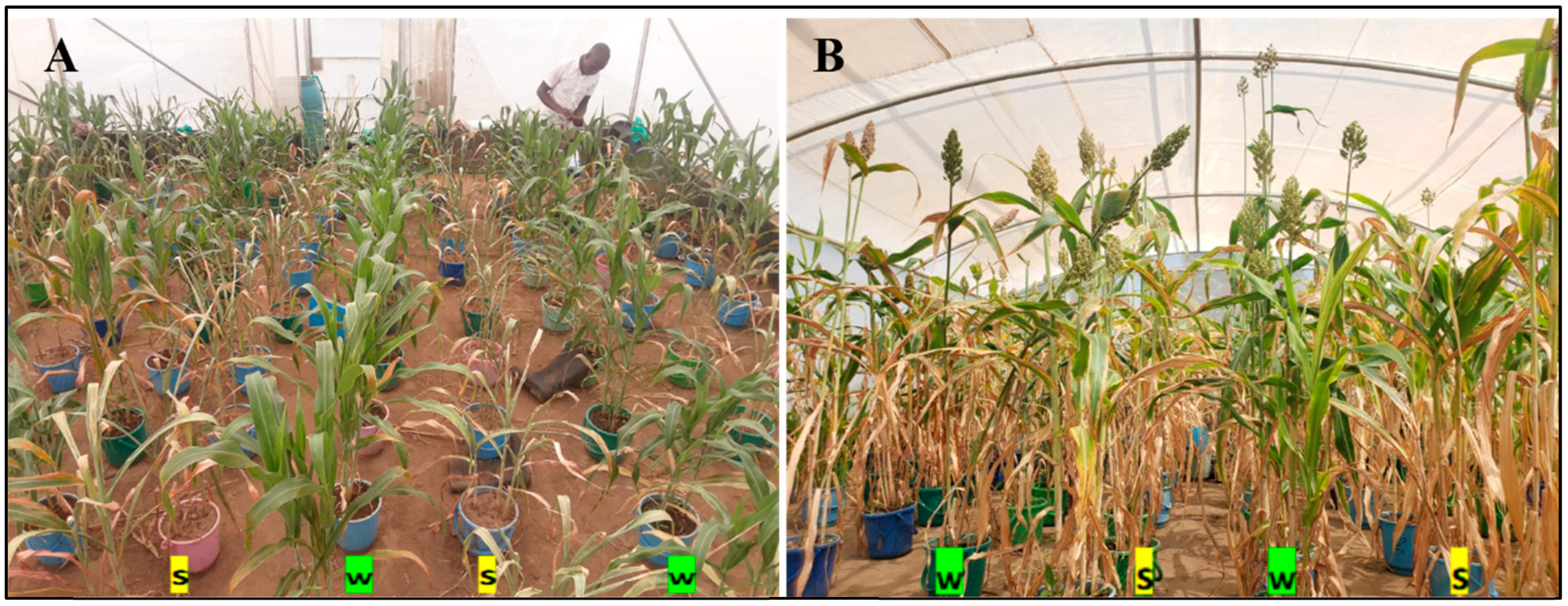
Manual weeding was performed, and irrigation was managed according to the specified watering regimes. For the well-watered regime, pots were irrigated every two days (at a rate of 1 L per pot) until the plants reached physiological maturity. Under the drought stress-rewatering regime, plants received regular irrigation until 23 May 2024, 36 days after emergence (at the panicle development stage), after which irrigation was withheld for 10 consecutive days to impose drought stress. This duration was chosen to induce substantial drought stress in the pots without causing plant death. After the drought period, plants were fully irrigated until they grew and reached physiological maturity (Figure 1).

2.4. Data Collection and Measurement

Data were collected at four-day intervals during both the drought stress period and the recovery phase, which extended up to 15 days after rewatering. Key parameters measured included leaf length, leaf width and internode length measured in centimeters using a 30 cm ruler on all three plants within each pot, while plant height was measured using a 250 cm wooden ruler. Leaf inclination angle was measured as the angle between the stem and the blade of the second fully expanded leaf using a geometric protractor. The total number of green leaves per plant was counted at physiological maturity in water stress-rewatering and in well-watered conditions. Relative chlorophyll content was measured as a proxy using a SPAD-502Plus chlorophyll meter (Konica Minolta, SPAD-502Plus, Osaka, Japan). Two fully expanded green leaves, each pair from the lower, middle, and upper portions of each plant, were measured. Three readings per leaf were taken at the base, middle, and tip, and the mean SPAD value across all sampled leaves was recorded. The stem diameter of the first internode from the ground was measured in millimeters from each plant using a digital vernier caliper (GRIFFCHEM, Digital Caliper 0–150 mm, Ningbo, Zhejiang, China).
Leaf rolling, leaf inclination angle, and epicuticular wax density are important traits linked to drought stress responses in plants [24,25]. Leaf rolling was visually assessed and scored on a 1–5 scale following established methodologies [26,27], where 1 = no visible rolling, 2 = slight rolling, 3 = moderate rolling, 4 = strong rolling, and 5 = extreme rolling with complete adaxial infolding of the leaf margins into a thorn-like or cylindrical shape [28]. Epicuticular wax density was estimated through visual scoring of stem and leaf glaucousness-a proxy for wax accumulation as described by [29,30]. A scale of 1–3 was employed, where 1 = non-glaucous (low wax density), 2 = moderately glaucous (moderate wax density), and 3 = highly glaucous (high wax density). On the other hand, drought recovery response was assessed through visual scoring that reflected each genotype’s ability to rehydrate and resume growth within 12 h of rewatering. A 1–5 scale was applied, where 1 = very rapid recovery with full leaf turgor and visible growth resumption, 2–3 = rapid to moderate recovery with partial restoration of leaf and stem vigor, 4 = poor recovery with persistent wilting and limited growth resumption, and 5 = no recovery with plants showing near-death symptoms.
This study further employed the Drought Recovery Index (DRI) [31,32] to assess morpho-physiological traits, including plant height, stem diameter, internode length, and relative chlorophyll content. The DRI was computed using the formula DRI = log (A) + 2 log (B) [32], where A denotes the relative trait value measured at the end of the drought period, and B represents the relative trait value measured two weeks after rewatering. The relative trait values were computed as follows:
R e l a t i v e   T r a i t   V a l u e = M e a n   t r a i t   v a l u e   i n   d r o u g h t   s t r e s s r e w a t e r i n g   a t   p o i n t   i M e a n   t r a i t   v a l u e   i n   w e l l   w a t e r e d   c o n d i t i o n s   a t   p o i n t   i ,
where i represents either measurement point A or B. At physiological maturity, panicle length, panicle width and panicle exertion were also measured using a 30 cm ruler. Yield traits, including grain yield harvested from the pot, grain weight after threshing and 100-seed weight, were measured after drying using a digital electronic balance (SF-400, maximum capacity 5 kg, readability 1 g, Zhejiang, China). To obtain the above-ground biomass yield, all three plants were cut at the soil level after harvesting the panicles, dried at 70 °C in an oven for 3 days, and then weighed using the same weighing scale. The harvest index was calculated as the ratio of grain yield to total aboveground biomass, expressed as a percentage (%).

2.5. Statistical Analyses

Statistical analyses were performed following the procedure described by [33]. The collected data were entered into Microsoft Excel spreadsheets, summarized, and saved as comma-delimited (CSV) files, then imported into R software (version 4.3.1) [34] for all the statistical analyses. Homogeneity of variances and normality of the residuals were tested using the Shapiro–Wilk test. A generalized linear model, implemented with the lmerTest package [35], was used to obtain the estimated marginal means (EMMs), which were used in multivariate analyses and trait comparisons across genotypes and watering regimes. Furthermore, Student’s t-tests were performed to assess statistical differences in yield traits between the two watering regimes. Principal component analysis (PCA) based on the correlation matrix was performed using the prcomp () function from R’s base stats package, which computes principal components by decomposing the data matrix into uncorrelated components. The eigenvectors derived from the PCA were used to identify the variables that had a strong relationship with a specific principal component. The PC biplot was then generated using the ggbiplot package in R [36] to describe and group sorghum genotypes based on their response to drought and rewatering. Yield improvement and stability are the ultimate goals of any breeding program. Tolerance/resistance indices were calculated following the methodology outlined by [37] and analyzed using the Hmisc package [38] to assess their correlations with each other and with grain yield under both stress-recovery and well-watered conditions. Indices showing strong correlations with grain yield in both conditions were considered key predictors of genotypic drought recovery responses.
For the ranking of genotypes based on recovery potential, multiple drought selection indices were computed and used rather than relying on a single criterion, as noted by [39]. For each genotype, ranks were assigned across all indices, and the mean rank ( R ¯ ), standard deviation of ranks (σR), and rank sum (ΣR) were calculated. The rank sum (ΣR = R ¯ + σR) served as the final ranking criterion, with lower values indicating superior recovery performance and higher values denoting poorer recovery. Using this approach, genotypes were ordered from those exhibiting the best recovery (lowest rank sums) to those with the weakest recovery (highest rank sums). The calculated tolerance and resistance indices were further analyzed to explore their intercorrelations and their relationship with grain yield under both drought stress-rewatering and well-watered conditions [37,40]. This approach facilitated the determination of the effective selection indices.

3. Results

3.1. Effect of Drought Stress and Rewatering on Morphological, Agronomic and Functional Traits

The agro-physiological performance of sorghum genotypes varied markedly between stress-rewatering and well-watered conditions (Table 2). A similar pattern was observed for morphological and morpho-physiological stress-adaptive traits evaluated in the study (Appendix A). Drought stress led to a notable reduction in all measured traits compared to the well-watered control, underscoring the severe impact of water limitation on sorghum growth and yield
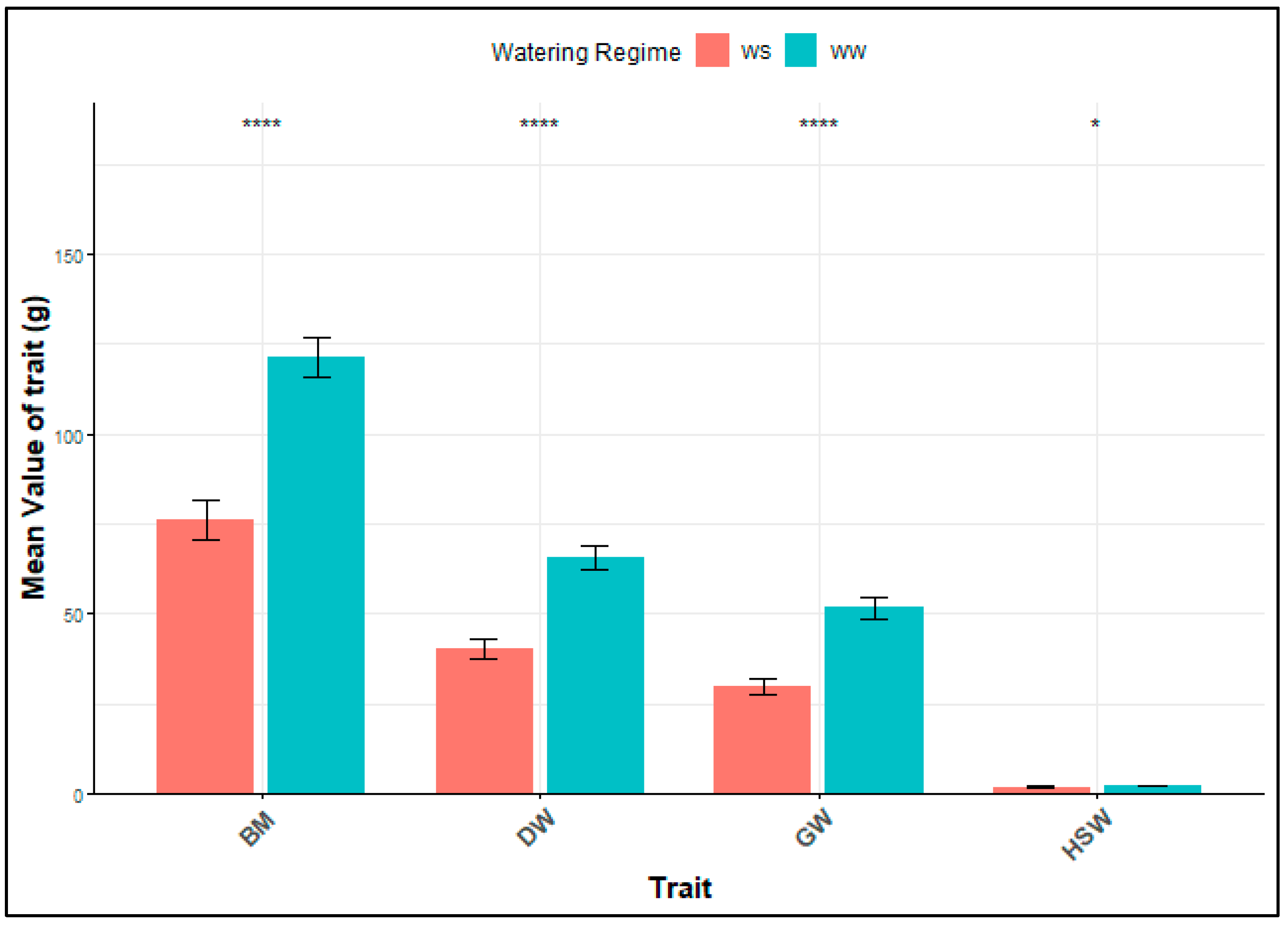
Among the yield traits, the results of the t-test indicated that the majority of the measured traits were strongly affected by the watering regime. Biomass, dry weight and grain weight were significantly higher under the well-watered regime compared to water-stressed conditions (p < 0.0001). The 100-seed weight was also significantly affected by the watering regime, although at a lower level of significance (p < 0.05, *). These results indicate that water stress has a substantial impact on most yield-related traits in sorghum (Figure 2).

3.2. Variation in Drought Recovery Responses Among Sorghum Genotypes Based on Plant Height (PLH), Relative Chlorophyll Content (SPAD), Stem Diameter (SD) and Internode Length (INTL)

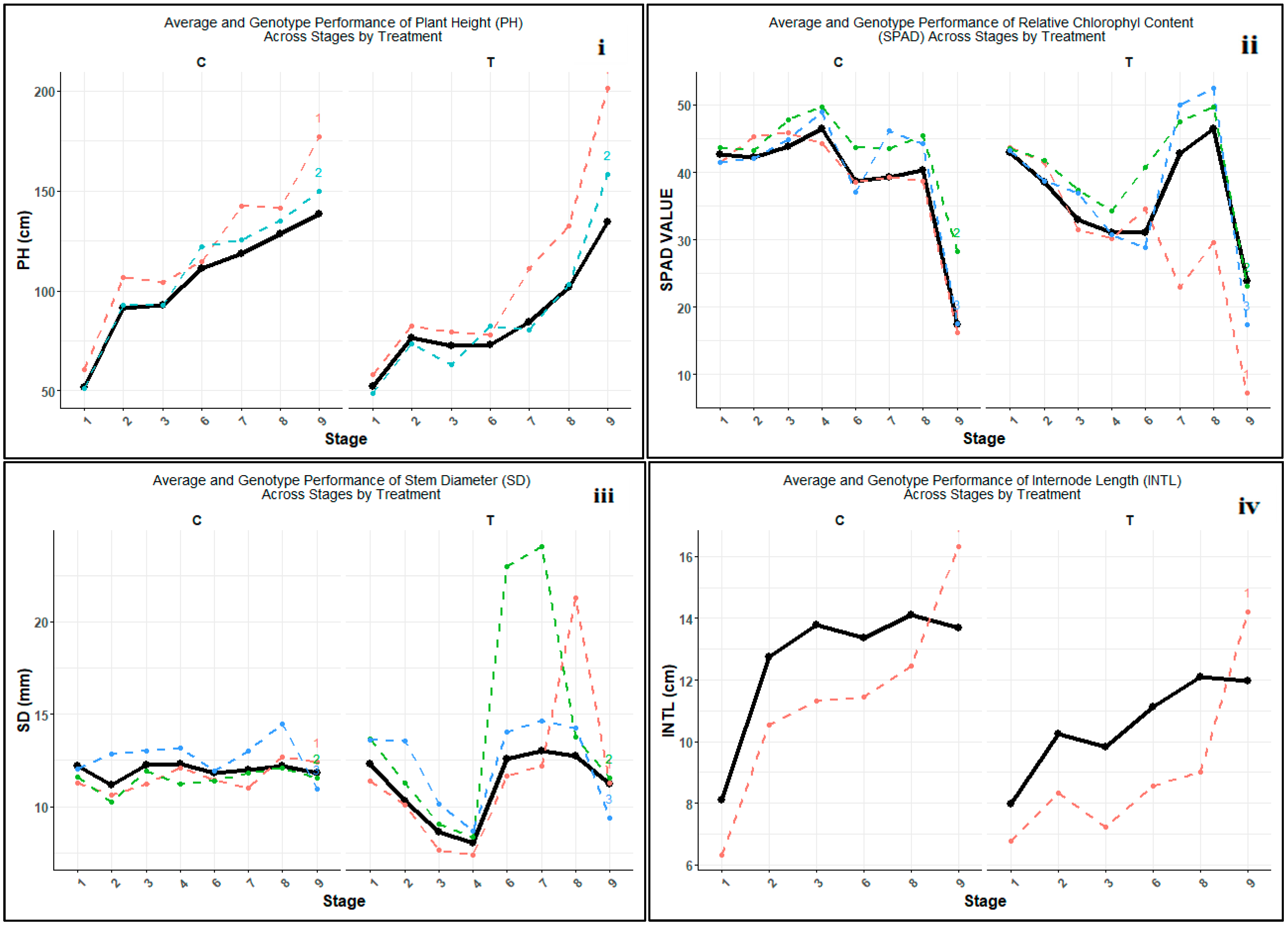
The variation in genotypes’ responses was evident during drought stress and recovery phases (Figure 3). Drought stress caused reductions in SPAD value and stem diameter during stages 1–4 of treatment (T) and declines in plant height and internode length during stages 1–3 (T). However, following rewatering beyond these stages, these traits exhibited greater variability among genotypes during the recovery phase compared to the stress period.
Genotypes E15 and E12, from the susceptible and moderately resistant groups, respectively, consistently maintained high SPAD values (Figure 3ii) throughout both stress and recovery phases, indicating strong potential to sustain photosynthetic activity. A similar trend was observed in plant height (Figure 3i) for these genotypes. In contrast, E7 exhibited a rapid decline in SPAD value during the stress phase, with minimal recovery after rewatering. E18 exhibited strong performance under both stress and well-watered conditions, particularly in maintaining stem diameter, but demonstrated limited internode length (Figure 3iv) during the recovery, indicating a unique response in structural growth. Meanwhile, E14 and E3 showed rapid increases in stem diameter (Figure 3iii) upon rewatering. Overall, the genotypes displayed diverse recovery mechanisms, with some genotypes, like E15, excelling in tissue rehydration and quickly resuming growth, while others, such as E7, showed more limited recovery capacity.

3.3. Evaluation of Drought Recovery Indices to Determine the Recovery Potential of Sorghum Genotypes Based on Post-Stress Response Traits

The values of DRI varied considerably among genotypes, indicating differing recovery efficiencies (Table 3). Genotypes with lower DRI values exhibited poor recovery potential across the assessed traits.
Generally, the genotypes displayed strong recovery for relative chlorophyll content (SPAD) and stem diameter, while exhibiting relatively poor recovery for internode length and plant height. Relative chlorophyll content recovery was most pronounced in the genotypes E13 (0.13), E10 (0.11), E9 (0.09), and E1 (0.09). Conversely, E7 and E2 displayed the poorest recovery, with DRIs of −0.40 and −0.09, respectively. For plant height, genotypes E11 (−0.11), E8 (−0.17), E13 (−0.18), and E10 (−0.20) exhibited relatively good recovery. However, E18 (−0.60) and E2 (−0.50) demonstrated the weakest recovery. Stem diameter is an indication of the potential to rehydrate the tissues after drought stress. Genotypes E3 (0.28) and E1 (0.20) exhibited good rehydration capacity, while E5 (−0.31) and E2 (−0.30) had the poorest.

3.4. Biplot Analysis of Sorghum Genotypes to Visualize Trait Contributions and Identify Lines with Strong Performance Under Stress-Rewatering and Non-Stress Conditions

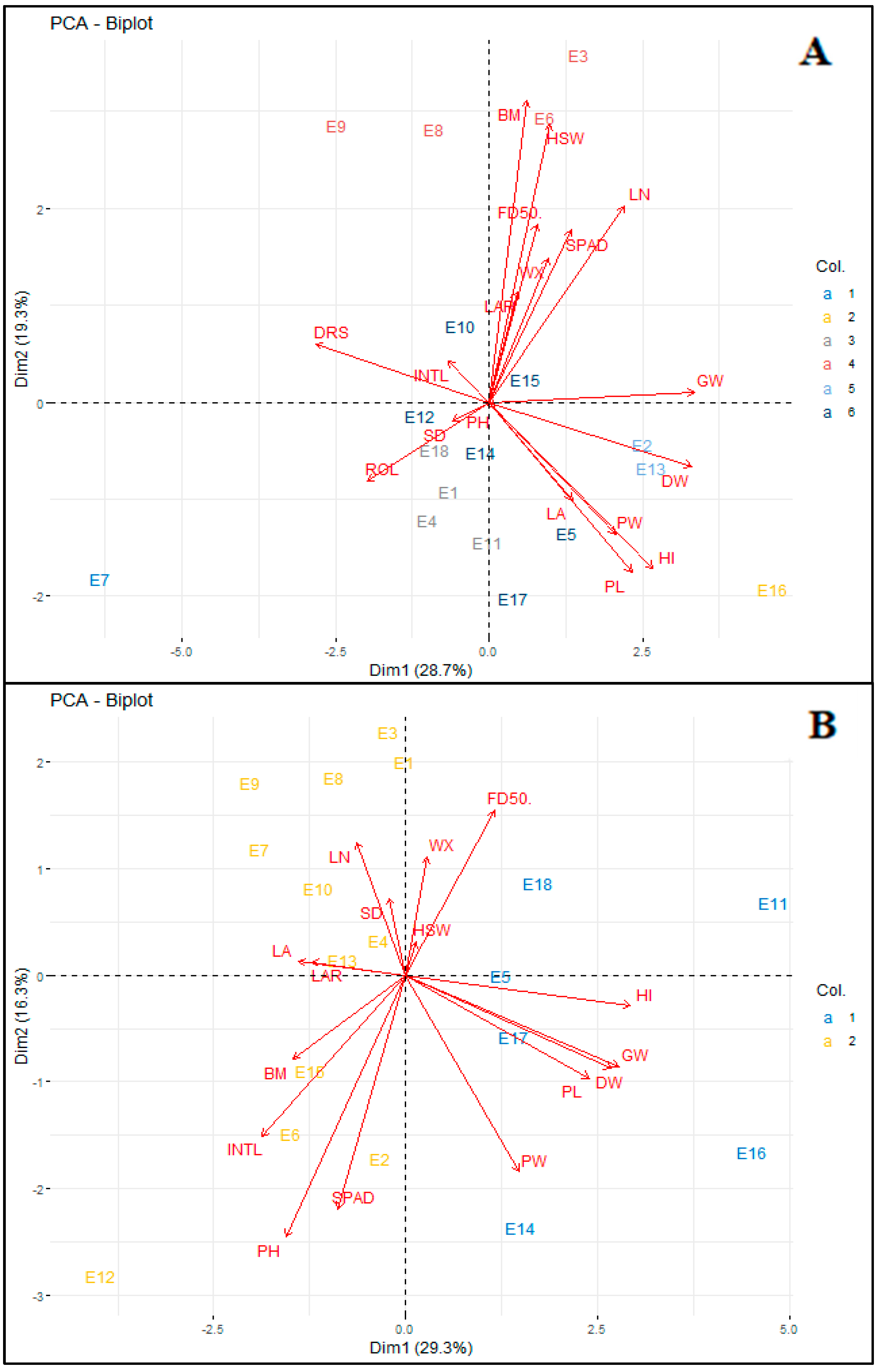
The two principal components explained 48% of the total variation in the drought stress-rewatering treatment and 46% under well-watered treatment. The biplots clustered genotypes according to their responses under both watering regimes (Figure 4).
In the drought stress-rewatering regime, the genotypes were categorized into six distinct clusters (Figure 4A). Specifically, cluster 4 included genotypes E3, E9, E8 and E6. These genotypes were characterized by high biomass yield, 100-seed weight, and generally greater leaf numbers, but they exhibited a lower harvest index. Genotypes E2 and E13 were grouped in cluster 5 and closely associated with E16, which uniquely formed cluster 2. These genotypes exhibited the highest values for key yield traits, including dry weight, grain weight, harvest index, panicle length, and panicle width. They also demonstrated a rapid rewatering response, achieving the lowest mean recovery scores (2.00) within 12 h of rehydration.
Cluster 1, represented solely by genotype E7, exhibited distinct and unfavorable traits. It recorded the lowest grain yield, harvest index, 100-seed weight, and biomass yield, along with the poorest recovery 12 h post-rewatering. Additionally, this genotype had the highest degree of leaf rolling, a manifestation of drought susceptibility, the lowest relative chlorophyll content, and the smallest number of green leaves. E7, therefore, stood out as the most susceptible genotype, displaying the weakest recovery potential.
Under well-watered conditions, the genotypes exhibited limited clustering, forming only two distinct groups (Figure 4B). Clustering was largely driven by yield potential, with cluster 1 comprising genotypes that produced the highest grain yield, dry weight, and other yield-related traits. Cluster 2 included genotypes with comparatively lower yield performance. Notably, within cluster 2, the genotype E12 displayed a distinct response, separating from the other members of the cluster. This genotype recorded the highest relative chlorophyll content, plant height and biomass yield, clearly standing out from all other genotypes.
Overall, the PCA results revealed that the genotypes exhibited diverse recovery patterns, reflected in the distinct clustering, thereby demonstrating a high degree of variability in their responses to drought and rewatering.

3.5. Ranking of Sorghum Genotypes to Identify Lines with Superior Drought Recovery Using Multiple Indices and the Identification of Effective Selection Indices

The drought tolerance indices exhibited diverse patterns of correlation with grain yield under both stress-rewatering and well-watered conditions, with relationships differing in strength and direction (Table 4).
The results show that yield under stress-rewatering (Ys) was strongly and positively associated with yield under well-watered conditions (Yp), with a correlation coefficient of 0.58. Several indices, including Geometric Mean (GM), Mean Productivity Index (MPI), Harmonic Mean (HM), Stress Tolerance Index (STI), and Yield Index (YI), showed strong positive correlations with grain yield in both watering regimes. In contrast, the stress susceptibility index (SSI) and Yield Stability Index (YSI) were significantly linked only to yield under stress, with correlation values of −0.68 and 0.68, respectively. While biomass-related indices such as Mean Biomass (MB), Geometric Mean Biomass (GMB), Biomass Index (BI), and Biomass Stability Index (BSI) did not have statistical significance, they tended to correlate positively with yield under stress and negatively with grain yield in well-watered conditions.
Each genotype was ranked based on its performance across the different drought selection indices. The initial ranking considered only grain yield-related indices (Table 5), followed by a final ranking that incorporated both grain yield- and biomass-related indices (Table 6).

3.6. Classification of Genotypes by Performance Under Stress-Rewatering and Non-Stress Conditions Using Drought Selection Indices

Based on the classification approach outlined by [41] and as applied by [39], genotypes were grouped into four categories according to their grain yield performance under drought stress-rewatering (hereafter referred to as stress) and well-watered (non-stress) conditions, using the drought selection indices (Table 7). Group A comprised genotypes with high yields in both stress and non-stress conditions. These were primarily distinguished by high STI, GM, YI and HM, reflecting strong performance across both environments. Group B included those producing high yields exclusively under non-stress conditions. They were characterized by high MPI and HM, showing good productivity under optimal watering, but with high TOL and SSI, which indicated strong sensitivity to stress. Group C consisted of genotypes maintaining good yields under stress. These genotypes were defined by high Ys, YSI, and YI, showcasing strong drought tolerance, while moderate MPI showed their average performance under non-stress conditions. Finally, group D encompassed those genotypes with poor performance in both stress and non-stress conditions. These were defined by low GM, HM, and MPI, reflecting consistently weak productivity.

4. Discussion of Results

This study aimed to evaluate the drought recovery potential of diverse sorghum genotypes following drought stress, in order to identify the key traits and genotypes that contribute to resilience under fluctuating water availability. Understanding recovery capacity is critical for breeding sorghum varieties capable of maintaining productivity under the increasingly variable rainfall patterns associated with climate change.
The study revealed significant genotypic variation in drought recovery potential, with important implications for breeding programs. Although portable and field-applicable wet-lab diagnostics, such as those used for pathogen detection [42] and seed-based genotyping [43], are advancing rapidly, effective and precise approaches for evaluating morphological and physiological recovery from abiotic stresses, such as drought, remain underdeveloped. This study addresses this gap by applying a practical, multi-trait-based screening method to assess drought recovery potential in sorghum. Drought stress diminished critical yield traits, including dry weight, grain weight and 100-seed weight. These reductions, observed in genotypes E7, E9 and E4, may be ascribed to poor panicle emergence, panicle blasting, ovary abortion and decreases in panicle size and grain number, traits that directly impact grain yield [44,45]. Despite post-stress growth recovery, biomass yield remained lower in drought-stressed plants compared to the control plants, consistent with the responses observed in many plant species subjected to drought stress [46,47,48]. As noted by Abid et al. (2016), this discrepancy reflects pre-drought limitations that constrain the capacity for full recovery. Notably, drought stress delayed flowering by an average of 11 days, contrasting with previous reports of accelerated flowering under drought stress in other plant species [44,49].
Plant growth slowed under drought stress but recovered across all genotypes during the rewatering phase, reflecting the high plasticity of sorghum’s growth. Growth reduction during stress was mainly attributed to a decrease in cell expansion and elongation [50,51]. Typically, this growth retardation reflects a shift in the energy budget, where maintenance processes take priority, leaving less energy available for growth. The genotypes E15 and E12 were particularly notable for sustaining relatively high SPAD values during both the stress and recovery periods, underscoring their drought tolerance characteristics. This observation is supported by prior studies showing that drought-tolerant genotypes tend to maintain higher chlorophyll levels under stress compared to susceptible ones [52,53,54]. The rapid drought-induced reduction in SPAD values across genotypes may indicate a significant loss in photosynthetic functionality at PSI and PSII reaction centers [46]. However, the rapid recovery of plants after rewatering, especially genotypes E15, E1, E13 and E10, suggests that this loss may serve a regulatory rather than a purely damaging function [46,55].
Dehydration is a reversible process [55], consistent with our findings that stem diameter decreased significantly during drought stress but increased across all genotypes during the recovery phase. The heightened variability in responses during the recovery phase, compared to the stress period, highlights the diverse recovery patterns and capacities across the different genotypes.

4.1. Shifts in Traits’ Significance as Adaptive Responses to Drought Stress and Recovery

Plants activate a suite of adaptive mechanisms in response to drought stress and rewatering, encompassing molecular and biochemical changes as well as complex physiological and morphological adjustments [56,57]. However, the extent of plant growth recovery following rewatering may depend on the intensity and duration of the preceding drought [56]. Grain weight, dry weight, harvest index, and panicle size-key yield-contributing traits-were grouped as the main contributors to cluster 5, which comprised genotypes E2 and E13, and were also closely linked to E16. The rapid rehydration response observed in these genotypes, likely reflecting faster recovery of the photosynthetic apparatus and thus higher photosynthetic rates, may explain their higher yields post-rewatering. While leaf rolling is known to reduce transpiration and protect the photosynthetic machinery from photodamage [50,58], our findings indicated that a high degree of leaf rolling was linked to the high susceptibility of genotype E7. As leaf rolling reduces the effective leaf area for photosynthesis [10,58], this susceptibility may be linked to reduced carbon dioxide assimilation, a tradeoff for water conservation in plants [59,60,61]. Biomass yield, on the other hand, showed stronger correlations with leaf number, leaf area, relative chlorophyll content, 100-seed weight, and days to 50% flowering. These traits were associated with genotypes E3, E6, E9 and E8, which were grouped in cluster 4. The 100-seed weight is a key yield component that reflects the source–sink relationship of photo-assimilates during the grain filling stage [62]. The strong positive correlation between 100-seed weight and biomass yield was similarly observed by [63]. Previous studies have reported a strong positive correlation between 100-seed weight and other yield components, such as dry weight, grain weight, and harvest index [64,65,66]. However, no such correlation was observed in this study. Despite the lower productivity of genotypes E12 and E9, their ability to maintain high biomass yield and relative chlorophyll content under both stress and well-watered conditions makes them particularly promising for forage breeding. Therefore, the grouping of traits under drought stress into distinct drought recovery patterns, as shown in the biplots, highlights the varying capacities of genotypes to recover after a drought event.

4.2. Strategy for Selecting Desirable Genotypes Using Drought Tolerance/Resistance Indices

Genotypes exhibit varied responses to drought stress [40,67]. Given this, various selection criteria have been proposed to identify genotypes based on their performance in both stress and non-stress conditions [37,39,40,44]. Tolerant genotypes are characterized by low SSI and TOL values, along with high MP, HM, GMP, STI, YI, and YSI values [37,39,67]. Considering the rank sum, genotypes E5, E15, E8, E13, E2, E1, E6 and E16 demonstrated the best recovery potential, outperforming the positive check E17. This was further supported by the biplot analysis, highlighting their high grain yield under stress and non-stress conditions. Conversely, genotype E7 emerged as the most susceptible, exhibiting the poorest recovery potential and performing below E4, the negative check. Based on both grain and biomass indices, the genotypes assumed new ranks. Two additional genotypes, E3 and E10, emerged among the previously high-performing genotypes, surpassing the positive check. Meanwhile, genotype E11, alongside E7, ranked below E4. Comparable to the findings of [68], we observed a highly significant positive correlation between grain yield under both stress and non-stress conditions. This suggests that during recovery, grain yield performance in optimal conditions serves as a reliable predictor for yield under stress, as also supported by previous studies [39,69].
An effective selection index should have a significant relationship with grain yield in both stress and non-stress conditions [70,71]. The correlation matrix indicated a strong positive association between grain yield in stress conditions (Ys) and in non-stress conditions (Yp), along with indices such as the Geometric Mean (GM), Mean Productivity Index (MPI), Harmonic Mean (HM), Stress Tolerance Index (STI), and Yield Index (YI). This indicates that these criteria were effective in distinguishing drought-tolerant genotypes that maintained high grain yield across both watering regimes. Consequently, these indices were deemed suitable for selecting genotypes with strong recovery potential. Conversely, biomass indices appeared to have limited relevance to grain yield performance.

5. Conclusions

This study evaluated the responses of 18 sorghum genotypes to drought stress and subsequent rewatering to determine their drought recovery potential. Our findings confirmed genotype-specific recovery patterns and the traits that are key to achieving high yields under intermittent water supply. Genotypes such as E16, E2 and E13 demonstrated rapid rehydration and compensatory growth to recover from drought stress and maximize yield. Such a good plasticity suggests that these genotypes are particularly well-suited for agroecologies which experience intense drought stress followed by short periods of heavy rainfall like the case of north-eastern Uganda. Conversely, genotypes such as E15, E5, and E8 achieved higher yields by maintaining higher relative chlorophyll content, which extended their photosynthetic activity during stress and recovery. Based on stress tolerance indices, genotypes suitable for various moisture conditions were identified, with those performing well in both stress and non-stress conditions (Category A), proving particularly valuable under fluctuating water conditions due to their yield stability and adaptability. These genotypes show strong potential as parents for drought resilience breeding efforts. In contrast, genotype E7 exhibited the poorest recovery response, while E11 experienced drastic reductions in performance during drought stress. These two genotypes could serve as reliable negative drought checks in the breeding program. Going forward, understanding the genetic control of the observed recovery responses in selected genotypes will be essential in facilitating the precise introgression of desirable recovery traits in elite breeding materials.

Author Contributions

Conceptualization, S.S., E.N., R.K., M.B. and S.A.; methodology, S.S., E.N., R.K. and E.O.; software, S.S. and R.K.; validation, S.S., E.N., R.K., E.O., S.A. and E.E.; formal analysis, S.S., E.N. and R.K.; investigation, S.S., R.K. and E.E.; resources, S.S., E.N., R.K., S.A., M.B. and E.O.; data curation, S.S. and R.K.; writing—original draft preparation, S.S.; writing—review and editing, S.S., E.N., R.K., S.A. and E.O.; visualization, S.S., E.N., R.K., H.O.A. and L.M.; supervision, E.N., R.K. and E.O.; project administration, S.A. and M.B.; funding acquisition, S.A. and M.B. All authors have read and agreed to the published version of the manuscript.

Funding

This publication is made possible by the generous support of the American people through the United States Agency for International Development (USAID). The contents are the authors’ responsibility and do not necessarily reflect the views of USAID or the United States Government. Program activities of the Centre of Innovation for Finger Millet and Sorghum (CIFMS) under the Innovation Lab for Crop Improvement (ILCI) are funded by the United States Agency for International Development (USAID) under Cooperative Agreement No. 7200AA-19LE-00005. Additional research funds were sourced from the government of Uganda through the National Agricultural Research Organization (NARO), Uganda.

Data Availability Statement

The original contributions presented in this study are included in the article. Further inquiries can be directed to the corresponding authors.

Acknowledgments

The National Agricultural Research Organization (NARO) is acknowledged for its support to the Centre of Innovation for Finger Millet and Sorghum (CIFMS) in East Africa project hosted at the National Semi-Arid Resources Research Institute (NaSARRI). Special thanks to NaSARRI management for supporting the research team and providing logistical items and human resources during data collection. Special gratitude goes to Geoffrey Tusiime of Makerere University and Faizo Kasule, a Graduate Research Assistant at Iowa State University, for their technical support and insightful ideas during the setup of the experiment.

Conflicts of Interest

The authors declare no conflicts of interest.

Appendix A

Table A1. The morphological and morpho-physiological stress adaptive traits assessed in the study.
GTPPHS (cm)PHW (cm)INTLS (cm)INTLW (cm)SDS (mm)SDW (mm)LNSLNWPLS (cm)PLW (cm)PWS (cm)PWW (cm)LARS (cm2)LARW (cm2)ROLS (Score)ROLW (Score)WXS (Score)WXW (Score)LAS (Degrees)LAW (Degrees)DRSS (Score)DRSW (Score)
E178.999.29.111.711.711.56816.712.74.85.1317.5378.73.71.01.31.335.043.94.71.0
E278.3108.710.913.710.212.26719.617.65.25.2341.7359.32.71.02.02.029.440.62.01.0
E378.998.59.511.211.611.78814.012.84.24.2327.3321.72.71.01.71.735.643.32.71.0
E483.1102.59.710.610.512.36715.716.27.56.3297.8340.14.31.01.71.728.345.63.71.0
E584.499.810.913.610.912.85718.816.94.04.7345.7366.33.71.01.31.339.446.13.71.0
E691.5112.711.815.311.010.96717.714.44.65.1371.8430.22.31.01.71.731.143.93.31.0
E781.2107.811.612.910.912.14813.715.52.33.8314.1330.24.01.01.31.332.252.25.01.0
E981.0100.210.713.010.312.66812.614.63.04.2344.7399.64.01.02.02.031.745.04.71.0
E881.599.810.212.410.912.46814.213.63.44.0353.3386.03.71.02.02.030.846.14.71.0
E1182.994.98.910.511.812.05717.018.74.76.1331.0338.33.01.01.71.737.538.34.31.0
E1089.7101.611.713.59.911.57816.215.24.14.4333.0405.83.71.02.02.028.937.83.71.0
E12106.2121.012.014.412.112.26813.211.55.86.2348.1374.14.01.01.01.037.844.53.31.0
E1389.3106.111.313.610.211.66719.217.35.95.6352.0374.33.01.02.02.036.449.42.01.0
E1784.3102.410.111.910.912.15720.118.05.15.5360.4368.23.71.01.31.330.545.03.01.0
E1491.2107.612.613.414.311.57719.218.74.45.3377.6344.03.71.01.31.328.346.12.71.0
E1587.1110.010.312.811.112.37714.312.65.55.2357.3334.04.01.02.02.032.845.53.01.0
E1683.5108.89.611.610.311.47822.321.36.78.0302.5332.43.01.01.71.743.341.71.31.0
E1878.1101.69.011.412.512.75714.516.94.45.0294.3362.63.01.02.02.033.342.23.71.0
Average85.1104.610.512.611.2126716.615.84.85.2337.2363.73.51.01.71.733.544.33.41.0
GTP: Genotype, PH: Plant height, INTL: Internode Length, SD: Stem Diameter, LN: Leaf numbers: PL: Panicle Length, PW: Panicle width, LAR: Leaf area, ROL: Leaf rolling, WX: Wax density, LA: Leaf angle, DRS: Drought recovery score 12 h after rewatering. The subscript (s) on the trait (Traits): Trait under stress- rewatering: The subscript (w) on the trait (Traitw): Trait under well-watering.

References

  1. Weng, T.Y.; Nakashima, T.; Villanueva-Morales, A.; Ryan, S.J.; Sacks, E.J.; Yamada, T. Assessment of drought tolerance of miscanthus genotypes through dry-down treatment and fixed-soil-moisture-content techniques. Agriculture 2022, 12, 6. [Google Scholar] [CrossRef]
  2. Martínez-Goñi, X.S.; Robredo, A.; Pérez-López, U.; Muñoz-Rueda, A.; Mena-Petite, A. Sorghum bicolor prioritizes the recovery of its photosynthetic activity, while manages to preserve it under elevated CO2 and drought. J. Agron. Crop Sci. 2023, 209, 217–227. [Google Scholar] [CrossRef]
  3. Perrone, I.; Pagliarani, C.; Lovisolo, C.; Chitarra, W.; Roman, F.; Schubert, A. Recovery from drought stress affects grape leaf petiole transcriptome. Planta 2012, 235, 1383–1396. [Google Scholar] [CrossRef] [PubMed]
  4. Zegada-Lizarazu, W.; Monti, A. Photosynthetic response of sweet sorghum to drought and re-watering. Physiol. Plant 2013, 149, 56–66. [Google Scholar] [CrossRef]
  5. Magunda, M. Situational analysis study of the agriculture sector in Uganda. In CCAFS Report; CGIAR Research Program on Climate Change, Agriculture and Food Security (CCAFS): Wageningen, The Netherlands, 2020. [Google Scholar]
  6. Nakalembe, C. Characterizing agricultural drought in the Karamoja sub-region of Uganda with meteorological and satellite-based indices. Nat. Hazards 2018, 91, 837–862. [Google Scholar] [CrossRef]
  7. Mugerwa, S. The Potential of Well-Designed Early Warning Systems and Disaster Insurance Schemes in Cushioning Farmers Against Drought-induced Agricultural Losses in the Karamoja Sub-region of Uganda. Sci. Agric. 2013, 3, 19–25. [Google Scholar]
  8. Tenywa, M.M.; Nyamwaro, S.O.; Kalibwani, R.; Mogabo, J.; Buruchara, R.; Oluwole, F. Innovation Opportunities in Sorghum Production in Uganda. FARA Res. 2018, 2, 2018. Available online: www.faraafrica.org (accessed on 20 February 2025).
  9. Lubadde, G.; Ebiyau, J.; Aru, J.C.; Andiku, C.; Wandulu, J.A.; Ugen, M.A. Sorghum Production Handbook for Uganda; National Semi-Arid Resources Research Institute of the National Agricultural Research Organisation (NaSARRI-NARO): Kampala, Uganda, 2013; p. 37.
  10. Badigannavar, A.; Teme, N.; de Oliveira, A.C.; Li, G.; Vaksmann, M.; Viana, V.E.; Ganapathi, T.R.; Sarsu, F. Physiological, genetic and molecular basis of drought resilience in sorghum [Sorghum bicolor (L) Moench]. Indian J. Plant Physiol. 2018, 23, 670–688. [Google Scholar] [CrossRef]
  11. Krupa, K.N.; Dalawai, N.; Shashidhar, H.E.; Harinikumar, K.M.; Manojkumar, H.B.; Bharani, S.; Turaidar, V. Mechanisms of Drought Tolerance in Sorghum: A Review. Int. J. Pure Appl. Biosci. 2017, 5, 221–237. [Google Scholar] [CrossRef]
  12. Verma, R.; Kumar, R.; Nath, A. Drought Resistance Mechanism and Adaptation to Drought stress in Sorghum [Sorghum bicolor (L.) Moench]. Int. J. Bio-Resour. Stress Manag. 2018, 9, 167–172. [Google Scholar] [CrossRef]
  13. Abdel-Ghany, S.E.; Ullah, F.; Ben-Hur, A.; Reddy, A.S.N. Transcriptome analysis of drought-resistant and drought-sensitive sorghum (Sorghum bicolor) genotypes in response to PEG-induced drought stress. Int. J. Mol. Sci. 2020, 21, 772. [Google Scholar] [CrossRef]
  14. Aslam, M.; Maqbool, M.A.; Cengiz, R. Mechanisms of drought resistance. In Drought Stress in Maize (Zea mays L.); Springer: Cham, Switzerland, 2015; pp. 19–36. [Google Scholar] [CrossRef]
  15. Oliver, M.J.; Farrant, J.M.; Hilhorst, H.W.M.; Mundree, S.; Williams, B.; Bewley, J.D. Desiccation tolerance: Avoiding cellular damage during drying and rehydration. Annu. Rev. Plant Biol. 2020, 71, 435–460. [Google Scholar] [CrossRef]
  16. Devnarain, N.; Crampton, B.G.; Chikwamba, R.; Becker, J.V.W.; O’Kennedy, M.M. Physiological responses of selected African sorghum landraces to progressive drought stress and rewatering. S. Afr. J. Bot. 2016, 103, 61–69. [Google Scholar] [CrossRef]
  17. Chen, D.; Wang, S.; Cao, B.; Cao, D.; Leng, G.; Li, H.; Yin, L.; Shan, L.; Deng, X. Genotypic variation in growth and physiological response to drought stress and rewatering reveals the critical role of recovery in drought adaptation in maize seedlings. Front. Plant Sci. 2016, 6, 1241. [Google Scholar] [CrossRef]
  18. Voronin, P.Y.; Maevskaya, S.N.; Nikolaeva, M.K. Physiological and molecular responses of maize (Zea mays L.) plants to drought and rehydration. Photosynthetica 2019, 57, 850–856. [Google Scholar] [CrossRef]
  19. Li, C.; Wang, Z.; Nong, Q.; Lin, L.; Xie, J.; Mo, Z.; Huang, X.; Song, X.; Malviya, M.K.; Solanki, M.K.; et al. Physiological changes and transcriptome profiling in Saccharum spontaneum L. leaf under water stress and re-watering conditions. Sci. Rep. 2021, 11, 5525. [Google Scholar] [CrossRef] [PubMed]
  20. Hasanuzzaman, M.; Shabala, L.; Brodribb, T.J.; Zhou, M.; Shabala, S. Understanding the Role of Physiological and Agronomical Traits during Drought Recovery as a Determinant of Differential Drought Stress Tolerance in Barley. Agronomy 2022, 12, 2136. [Google Scholar] [CrossRef]
  21. Perrier, L.; Rouan, L.; Jaffuel, S.; Clément-Vidal, A.; Roques, S.; Soutiras, A.; Luquet, D. Plasticity of sorghum stem biomass accumulation in response to water deficit: A multiscale analysis from internode tissue to plant level. Front. Plant Sci. 2017, 8, 15. [Google Scholar] [CrossRef]
  22. Onziga, D.I. Characterizing the Genetic Diversity of Finger Millet in Uganda. Master’s Thesis, Makerere University, Kampala, Uganda, 2015. [Google Scholar]
  23. Aru, J.C.; Adikini, S.; Omaria, S.; Okiasi, F.; Esuma, W.; Kakeeto, R.; Manyaza, E. Accelerating Breeding for Drought Tolerance in Sorghum (Sorghum bicolor): An Integrated Approach. In Case Studies of Breeding Strategies in Major Plant Species; IntechOpen: London, UK, 2023; Available online: www.intechopen.com (accessed on 18 March 2025).
  24. Merrium, S.; Ali, Z.; Habib-ur-Rahman, M.; Hakeem, S.; Khalid, M.A. Leaf rolling and leaf angle improve fog capturing and transport in wheat; adaptation for drought stress in an arid climate. Bot. Stud. 2022, 63, 13. [Google Scholar] [CrossRef]
  25. González, A.; Ayerbe, L. Effect of terminal water stress on leaf epicuticular wax load, residual transpiration and grain yield in barley. Euphytica 2010, 172, 341–349. [Google Scholar] [CrossRef]
  26. Mwamahonje, A.; Eleblu, J.S.Y.; Ofori, K.; Feyissa, T.; Deshpande, S.; Tongoona, P. Evaluation of Traits’ Performance Contributing to Drought Tolerance in Sorghum. Agronomy 2021, 11, 1698. [Google Scholar] [CrossRef]
  27. Ben-Amar, A.; Nsarellah, N.E.; Bouizgaren, A.; Rhrib, K.; Benbella, M. Assessment of Leaf Rolling Role in Maintaining Agrophysiological Performances of Moroccan Durum Wheat Cultivars under Water Deficit Conditions. Plant Physiol. Rep. 2020, 25, 436–443. [Google Scholar] [CrossRef]
  28. Kadioglu, A.; Terzi, R. A dehydration avoidance mechanism: Leaf rolling. Bot. Rev. 2007, 73, 290–302. [Google Scholar] [CrossRef]
  29. Clarke, J.M.; Richards, R.A. The Effects of Glaucousness, Epicuticular Wax, Leaf Age, Plant Height, and Growth Environment on Water Loss Rates of Excised Wheat Leaves. Can. J. Plant Sci. 1988, 68, 975–982. [Google Scholar] [CrossRef]
  30. Toor, R.K. Genotypic Differences and Environment Influence on Epicuticular Wax in Wheat. Ph.D. Thesis, Punjab Agricultural University, Ludhiana, India, 2018. [Google Scholar]
  31. Strauss, A.J.; Krüger, G.H.J.; Strasser, R.J.; Van Heerden, P.D.R. Ranking of dark chilling tolerance in soybean genotypes probed by the chlorophyll a fluorescence transient OJIP. Environ. Exp. Bot. 2006, 56, 147–157. [Google Scholar] [CrossRef]
  32. Gano, B.; Dembele, J.S.B.; Tovignan, T.K.; Sine, B.; Vadez, V.; Diouf, D.; Audebert, A. Adaptation responses to early drought stress of West African sorghum varieties. Agronomy 2021, 11, 443. [Google Scholar] [CrossRef]
  33. Ssengo, J.; Zebosi, B.; Karungi, J. Efficiency of Botanical and Chemical Pesticides on the Control of Field Insect Pests under Cowpea Production. Am. J. Plant Sci. 2024, 15, 203–221. [Google Scholar] [CrossRef]
  34. R Development Core Team. A Language and Environment for Statistical Computing. 2024. Available online: https://www.r-project.org/ (accessed on 12 April 2025).
  35. Kuznetsova, A.; Brockhoff, P.B.; Christensen, R.H. lmerTest Package: Tests in Linear Mixed Effects Models. J. Stat. Softw. 2017, 82, 1–26. [Google Scholar] [CrossRef]
  36. Wickham, H. ggplot2: Elegant Graphics for Data Analysis, 2nd ed.; Springer: New York, NY, USA, 2016; pp. 189–201. [Google Scholar] [CrossRef]
  37. Gitore, S.A.; Danga, B.; Henga, S.; Gurmu, F. Evaluating Drought tolerance indices for selection of drought tolerant Orange Fleshed Sweet Potato (OFSP) genotypes in Ethiopia. Int. J. Agric. Sci. Food Technol. 2021, 7, 249–254. [Google Scholar] [CrossRef]
  38. Harrell, F.E., Jr. Package ‘Hmisc’; CRAN 2018; R Development Core Team: Vienna, Austria, 2019; pp. 235–236. Available online: https://cran.r-project.org/package=Hmisc (accessed on 18 November 2024).
  39. Abd El-Mohsen, A.A.; Abd El-Shafi, M.A.; Gheith, E.M.S.; Suleiman, H.S. Using Different Statistical Procedures for Evaluating Drought Tolerance Indices of Bread Wheat Genotypes. Adv. Agric. Biol. 2015, 4, 19–30. [Google Scholar] [CrossRef]
  40. Farshadfar, E.; Sutka, J. Multivariate analysis of drought tolerance in wheat substitution lines. Cereal Res. Commun. 2003, 31, 33–40. [Google Scholar] [CrossRef]
  41. Fernandez, G.C.J. Effective Selection Criteria for Assessing Plant Stress Tolerance. In Proceedings of the International Symposium on Adaptation of Vegetables and Other Food Crops in Temperature and Drought Stress, Taipei, Taiwan, 13–18 August 1992. [Google Scholar]
  42. Ssengo, J.; Wasswa, P.; Mukasa, S.B.; Okiror, A.; Kyamanywa, S. Portable PCR field-based detection of sweet potato viruses. Afr. Crop Sci. J. 2020, 28, 363–374. [Google Scholar] [CrossRef]
  43. Zebosi, B.; Ssengo, J.; Geadelmann, L.F.; Unger-Wallace, E.; Vollbrecht, E. An Effective and Safe Maize Seed Chipping Protocol Using Clipping Pliers with Applications in Small-Scale Genotyping and Marker-Assisted Breeding. Bio-Protocol 2025, 15, e5200. [Google Scholar] [CrossRef] [PubMed]
  44. de Souza, A.A.; de Carvalho, A.J.; Bastos, E.A.; Cardoso, M.J.; Júlio, M.P.M.; Batista, P.S.C.; Julio, B.H.M.; Campolina, C.V.; Portugal, A.F.; de Menezes, C.B.; et al. Grain sorghum under pre- and post-flowering drought stress in a semiarid environment. Aust. J. Crop Sci. 2021, 15, 1139–1145. [Google Scholar] [CrossRef]
  45. Kapanigowda, M.H.; Perumal, R.; Djanaguiraman, M.; Aiken, R.M.; Tesso, T.; Prasad, P.V.; Little, C.R. Genotypic variation in sorghum [Sorghum bicolor (L.) Moench] exotic germplasm collections for drought and disease tolerance. Springerplus 2013, 2, 650. [Google Scholar] [CrossRef]
  46. Wach, D.; Skowron, P. An overview of plant responses to drought stress at morphological, physiological and biochemical levels. Pol. J. Agron. 2022, 50, 25–34. [Google Scholar]
  47. Eziz, A.; Yan, Z.; Tian, D.; Han, W.; Tang, Z.; Fang, J. Drought effect on plant biomass allocation: A meta-analysis. Ecol. Evol. 2017, 7, 11002–11010. [Google Scholar] [CrossRef]
  48. Fenta, B.A.; Beebe, S.E.; Kunert, K.J.; Burridge, J.D.; Barlow, K.M.; Lynch, J.P.; Foyer, C.H. Field phenotyping of soybean roots for drought stress tolerance. Agronomy 2014, 4, 418–435. [Google Scholar] [CrossRef]
  49. Srivastava, R.; Sahoo, L. Balancing yield trade-off in legumes during multiple stress tolerance via strategic crosstalk by native NAC transcription factors. J. Plant Biochem. Biotechnol. 2021, 30, 708–729. [Google Scholar] [CrossRef]
  50. Anjum, S.A.; Ashraf, U.; Zohaib, A.; Tanveer, M.; Naeem, M.; Ali, I.; Tabassum, T.; Nazir, U. Growth and development responses of crop plants under drought stress: A review. Zemdirbyste 2017, 104, 267–276. [Google Scholar] [CrossRef]
  51. Jaleel, C.A.; Manivannan, P.; Wahid, A.; Farooq, M.; Al-Juburi, H.J.; Somasundaram, R.; Panneerselvam, R. Drought stress in plants: A review on morphological characteristics and pigment composition. Int. J. Agric. Biol. 2009, 11, 100–105. [Google Scholar]
  52. Patil, J.V.; Rakshit, S.; Khot, K.B. Genetics of post-flowering drought tolerance traits in post-rainy sorghum [Sorghum bicolor (L.) Moench]. Indian J. Genet. Plant Breed. 2013, 73, 44–50. [Google Scholar] [CrossRef]
  53. Hadebe, S.T. Water Use of Selected Sorghum (Sorghum bicolor L. Moench) Genotypes. Doctoral Dissertation, University of KwaZulu-Natal, Pietermaritzburg, South Africa, 2015. [Google Scholar]
  54. Ali, F.; Ahsan, M.; Ali, Q.; Kanwal, N. Phenotypic stability of Zea mays grain yield and its attributing traits under drought stress. Front. Plant Sci. 2017, 8, 1397. [Google Scholar] [CrossRef]
  55. Efeoǧlu, B.; Ekmekçi, Y.; Çiçek, N. Physiological responses of three maize cultivars to drought stress and recovery. S. Afr. J. Bot. 2009, 75, 34–42. [Google Scholar] [CrossRef]
  56. Abid, M.; Tian, Z.; Ata-Ul-Karim, S.T.; Wang, F.; Liu, Y.; Zahoor, R.; Jiang, D.; Dai, T. Adaptation to and recovery from drought stress at vegetative stages in wheat (Triticum aestivum) cultivars. Funct. Plant Biol. 2016, 43, 1159–1169. [Google Scholar] [CrossRef]
  57. Xu, Z.; Zhou, G.; Shimizu, H. Plant responses to drought and rewatering. Plant Signal Behav. 2010, 5, 649–654. [Google Scholar] [CrossRef]
  58. Saglam, A.; Kadioglu, A.; Demiralay, M.; Terzi, R. Leaf rolling reduces photosynthetic loss in maize under severe drought. Acta Bot. Croat. 2014, 73, 315–332. [Google Scholar] [CrossRef]
  59. Allen, L.H., Jr. Evapotranspiration responses of plants and crops to carbon dioxide and temperature. J. Crop Prod. 2000, 2, 37–70. [Google Scholar] [CrossRef]
  60. Taiz, L.; Zeiger, E. Plant Physiology, 5th ed.; Sinauer Associates Inc.: Sunderland, MA, USA, 2002; pp. 566–567. [Google Scholar]
  61. Zhang, D.; Jiao, X.; Du, Q.; Song, X.; Li, J. Reducing the excessive evaporative demand improved photosynthesis capacity at low costs of irrigation via regulating water driving force and moderating plant drought stress of two tomato cultivars. Agric. Water Manag. 2018, 199, 22–33. [Google Scholar] [CrossRef]
  62. Jabereldar, A.A.; El Naim, A.M.; Abdalla, A.A.; Dagash, Y.M. Effect of Drought Stress on Yield and Water Use Efficiency of Sorghum (Sorghum bicolor L. Moench) in Semi-Arid Environment. Int. J. Agric. 2017, 7, 1–6. [Google Scholar]
  63. Thant, S.; Kumari, P.; Pahuja, S.K.; Tokas, J.; Yashveer, S. Identification of dual-type sorghum genotypes based on correlation and path coefficient studies. Forage Res. 2021, 46, 302–307. [Google Scholar]
  64. Taheri, S.; Saba, J.; Shekari, F.; Abdullah, T.L. Effects of drought stress conditions on the yield of spring wheat (Triticum aestivum) lines. Afr. J. Biotechnol. 2011, 10, 18339–18348. [Google Scholar] [CrossRef]
  65. Wasaya, A.; Manzoor, S.; Yasir, T.A.; Sarwar, N.; Mubeen, K.; Ismail, I.A.; Raza, A.; Rehman, A.; Hossain, A.; El Sabagh, A. Evaluation of fourteen bread wheat (Triticum aestivum L.) genotypes by observing gas exchange parameters, relative water and chlorophyll content, and yield attributes under drought stress. Sustainability 2021, 13, 4799. [Google Scholar] [CrossRef]
  66. Ayalew, K.; Adugna, A.; Fetene, M.; Sintayehu, S. Evaluation of bio-physiological and yield responses of stay green QTL introgression sorghum lines to post-flowering drought stress. Afr. Crop Sci. J. 2018, 26, 447–462. [Google Scholar] [CrossRef][Green Version]
  67. Jafari, A.; Paknejad, F.; AL-Ahmadi, M.J. Evaluation of selection indices for drought tolerance of corn (Zea mays L.) hybrids. Int. J. Plant Prod. 2009, 3, 33–38. [Google Scholar]
  68. Yahaya, M.A.; Shimelis, H.; Nebié, B.; Mashilo, J.; Pop, G. Response of African Sorghum Genotypes for Drought Tolerance under Variable Environments. Agronomy 2023, 13, 557. [Google Scholar] [CrossRef]
  69. Emendack, Y.; Burke, J.; Sanchez, J.; Laza, H.E.; Hayes, C. Agro-morphological characterization of diverse sorghum lines for pre- and post-flowering drought tolerance. Aust. J. Crop Sci. 2018, 12, 135–150. [Google Scholar] [CrossRef]
  70. Rashidi, F.; Majidi, M.M.; Pirboveiry, M. Response of different species of Brassica to water deficit. Int. J. Plant Prod. 2017, 11, 1–16. [Google Scholar]
  71. Lestari, A.P.; Sopandie, D.; Aswidinnoor, H. Estimation for Stress Tolerance Indices of Rice Genotypes in Low Nitrogen Condition. Agric. Sci. Soc. Thail. 2019, 52, 180–190. [Google Scholar]
Figure 1. Visual comparison of sorghum plants under different watering treatments: 7 days during drought stress (A) and 25 days after rewatering (B). Plant rows exposed to drought stress (s) are shown alongside well-watered controls (w).
Agronomy 15 02356 g001
Figure 2. Mean trait performance under two watering regimes (WS = Stress-rewatering, WW = well-watered). Bars represent mean values, and error bars indicate the standard error of the mean (S.E.) across the 18 genotypes. **** = p ≤ 0.0001 and * = p ≤ 0.05. BM = biomass yield, DW = dry weight, GW = grain weight, HSW = 100-seed weight.
Agronomy 15 02356 g002
Figure 3. Performance of selected sorghum genotypes across sequential stages during drought stress and recovery phases, compared to the overall mean performance (Agronomy 15 02356 i001). C = control (well-watered); T = drought stress–rewatering treatment. The stage represents the different time points at which data were collected. Summary of the traits in (iiv). The color of the line indicates the representative genotypes for a particular trait. (i): Plant height (PLH): ------- E12, ----- E15; (ii): Relative chlorophyll content (SPAD): ------- E7, ------ E15, ------ E12; (iii): Stem diameter (SD): ------- E14, ------ E3, --------- E18; (iv): Internode length (INTL): ------- E18.
Agronomy 15 02356 g003
Figure 4. Clustered biplots showing the grouping of traits and sorghum genotypes in (A): stress-rewatering conditions and (B): well-watered conditions. GW: Grain weight after threshing, DW: Dry weight of harvest from a pot, HSW: 100-seed weight, SD: Stem diameter, LAR: Leaf area, LN: Leaf numbers, INTL: Internode length, SPAD: Relative Chlorophyll content: PH: Plant height, FD50: Days to 50% flowering, PL: Panicle length, PW: Panicle width, HI: Harvest index, LA: Leaf anglers, DRS: Drought recovery score.
Agronomy 15 02356 g004
Table 1. Description of the sorghum genotypes used in the study.
GTPCodeSource & OriginDTMD.R
ASARECA 13-1 X Framida-1-1-3-1/22BE1B.L (NaSARRI)-UgandaEarly maturityR
ICSX152666-B-2-7-3-1-1-1E8ICRISAT-KenyaMedium maturityR
ICSX 162719-1-4-1-1-1E9ICRISAT-KenyaMedium maturityR
IESV16 143-1-3-1E10EthiopiaMedium maturityR
NAROSORGH 4 (positive check)E17Released variety-UgandaMedium maturityR
SSGA/RAP/349E18L.V (Karamoja)-UgandaEarly maturityR
ASARECA 13-1 X NAROSORGH3-1-1-1-1/22BE2B.L (NaSARRI)-UgandaEarly maturityM.R
ASARECA13-1 X NAROSORGH3-1-1-5-1/22BE3B.L (NaSARRI)-UgandaEarly maturityM.R
MAZDA 105 EnyankoreE12L.V (Masindi)-UgandaLate maturityM.R
NAROSORGH 1 X FRAMIDA-1-1-5-1/22BE13B.L (NaSARRI)-UgandaMedium maturityM.R
NAROSORGH1 X NAROSORGH3-1-1-1-1/22BE14B.L (NaSARRI)-UgandaMedium maturityM.R
NAROSORGH1 X NAROSORGH3-1-1-5-1/22BE16B.L (NaSARRI)-UgandaMedium maturityM.R
ETEREMA (negative check)E4L.V (Teso)-UgandaMedium maturityS
GE16/2/20B X IESV92041SH (SSEA 18B#6)E5B.L (NaSARRI)-UgandaMedium maturityS
ICSV 142001E6ICRISAT-IndiaMedium maturityS
ICSX 152005-SB-5-3-2-1E7ICRISAT-KenyaMedium maturityS
IESV 214006DLE11ICRISAT-EthiopiaMedium maturityS
NAROSORGH1 X NAROSORGH3-1-1-1-1/22BE15B.L (NaSARRI)-UgandaEarly maturityS
GTP: Genotype, DTM: Days to maturity, D.R: Drought resistance, R: Resistant, M.R: Moderately resistant, S: Susceptible, L.V: Land race variety, B.L: Breeding line.
Table 2. Key agronomic and functional stress response traits measured in the study.
GTPBMS (g)BMW (g)DWS (g)DWW (g)GWS (g)GWW (g)HSWS (g)HSWW (g)HISHIWSPADSSPADWFD50SFD50W
E167.00126.0044.3363.0031.3351.672.302.4546.7741.0135.0136.337369
E259.67174.3357.6774.6738.0060.672.102.8863.6934.835.4341.277663
E3134.33116.6741.3358.0031.6745.673.302.2423.5739.1437.1336.507460
E464.50118.3334.5050.0020.6737.670.971.6032.0431.8335.6839.887261
E560.33103.0052.0080.0037.3356.671.282.3761.8855.0238.5139.077364
E6120.00110.3336.6762.6730.3349.002.752.3525.2844.4136.3439.257859
E745.0085.504.6738.003.3331.330.552.037.4136.6430.1538.717063
E996.33148.6727.3356.3320.0041.332.992.6620.7627.8038.4038.397564
E8105.67135.5031.6765.3333.3350.671.882.7131.5537.3938.6738.788266
E1154.3390.6736.6784.0028.6773.001.332.4652.7680.5134.9339.057166
E1083.67114.6740.0057.6732.0042.332.251.6838.2536.9137.0637.176760
E1284.00153.6735.3344.0027.6732.001.452.1532.9420.8239.7543.186960
E1366.33138.3348.6760.3337.0045.671.552.7955.7833.0235.3136.427460
E1759.33108.6747.3377.6730.3354.001.402.3451.1249.6935.2238.706861
E1472.33130.5042.3385.6726.6769.331.032.1436.8753.1335.9541.157362
E1566.00129.3345.0061.0033.6752.331.942.0651.0140.4637.3240.317260
E1673.00106.3361.3391.6745.0079.671.472.1361.6474.9335.8737.457462
E1856.0093.6736.0072.3325.6757.331.592.1845.8361.2035.4338.047764
Average75.99121.3440.1665.6929.5951.691.792.2941.0644.3736.2338.877362
Change (∆T)37%39%43%22%7%7%11 days
GTP: Genotype, BMs: Biomass yield under stress-rewatering, BMw: Biomass yield under well-watering, DWs: Dry weight under stress-rewatering, DWw: Dry weight under well-watering, GWs: Grain weight under stress-rewatering, GWw: Grain weight under well-watering, HSWs: 100-seed weight under stress-rewatering, HSWw: 100-seed weight under well-watering, HIs: Harvest index under stress-rewatering, HIw: Harvest index under well-watering, SPADs (Soil–Plant Analysis Development; measure of relative chlorophyll content) under stress-rewatering, SPADw: SPAD under well-watering, FD50s: Days to 50% flowering under stress-rewatering, FD50w: Days to 50% flowering under well-rewatering, Change (∆T): Percentage reduction in mean trait performance under stress-rewatering relative to well-watered, days to 50% flowering is expressed as absolute increase in number of days. All weight related traits were measured in grams (g).
Table 3. Drought recovery indices for internode length, relative chlorophyll content, stem diameter and plant height across the different genotypes.
Drought Recovery Index (DRI)
GTPINTLSPADSDPH
E1−0.350.090.20−0.46
E2−0.31−0.09−0.30−0.50
E3−0.370.010.28−0.30
E4−0.11−0.08−0.22−0.37
E5−0.300.03−0.31−0.35
E6−0.390.02−0.07−0.27
E7−0.10−0.40−0.13−0.28
E9−0.250.09−0.26−0.33
E8−0.320.04−0.21−0.17
E11−0.35−0.05−0.05−0.11
E10−0.220.11−0.25−0.20
E12−0.32−0.03−0.02−0.47
E13−0.270.13−0.22−0.18
E17−0.250.00−0.15−0.33
E14−0.15−0.02−0.01−0.27
E16−0.280.07−0.16−0.43
E15−0.290.07−0.19−0.40
E18−0.48−0.04−0.12−0.60
GTP: Genotype, INTL: Internode length, SPAD: Relative chlorophyll content, SD: Stem diameter, PH: Plant height.
Table 4. Pearson correlation coefficients among different drought tolerance and susceptibility indices.
YsYpSSIGMTOLMPIYSIHMSTIYIMBGMBBIBSI
Ys1
Yp0.58 *1
SSI−0.68 **0.161
GM0.92 ***0.85 ***−0.371
TOL−0.120.74 ***0.75 ***0.281
MP10.84 ***0.93 ***−0.200.98 ***0.441
YSI0.68 **−0.16−1.00 ***0.37−0.75 ***0.201
HM0.96 ***0.77 ***−0.48 *0.99 ***0.140.95 ***0.48 *1
STI0.96 ***0.77 ***−0.48 *0.99 ***0.140.95 ***0.48 *1.00 ***1
YI1.00 ***0.58 *−0.68 **0.92 ***−0.120.84 ***0.68 **0.96 ***0.96 ***1
MB0.29−0.23−0.60 **0.10−0.53 *−0.020.60 **0.180.180.291
GMB0.27−0.24−0.58 *0.08−0.52 *−0.040.58 *0.150.150.270.98 ***1
BI0.18−0.20−0.420.04−0.39−0.050.420.100.100.180.79 ***0.88 ***1
BSI0.08−0.08−0.160.02−0.16−0.020.160.050.050.080.400.53 *0.87 ***1
Ys: Grain yield under stress, Yp: Grain yield under well watering, GM: Geometric mean, SSI: Stress susceptibility index, TOL: Tolerance, MPI: Mean productivity index, YSI: Yield Stability Index, HM: Harmonic Mean, STI: Stress tolerance Index, YI: Yield Index, MB: Mean biomass, GMB: Geometric mean biomass, BI: Biomass index, BSI: Biomass Stability Index. *** = p ≤ 0.001, ** = p ≤ 0.005 and * = p < 0.05.
Table 5. Ranking of sorghum genotypes from strongest to weakest recovery based on grain yield-related indices.
Genotype’s Rank (R) for Each Index
GTPGMSSITOLMPIYSIHMSTIYI R ¯ σRΣRF.R
E5359553334.502.076.571
E15677675556.000.936.932
E8866867766.750.897.643
E137221126645.003.168.164
E22812382224.883.918.785
E11010109108899.310.8810.26
E6119812911111010.191.3611.557
E16111161111115.386.2311.618
E1791213712991010.192.0312.229
E31344134121288.754.2312.9810
E101433143131378.755.2614.0111
E1812151591514141513.691.9815.6712
E114161821644129.506.6516.1513
E9161411151416161714.881.8916.7614
E1215111611515139.637.1916.8215
E145171741710101411.755.3417.0916
E417135171317171614.384.1718.5517
E7181814181818181817.501.4118.9118
GTP: Genotype, GM: Geometric mean, SSI: Stress susceptibility index, TOL: Tolerance, MPI: Mean productivity index, YSI: Yield Stability Index, HM: Harmonic Mean, STI: Stress Tolerance Index, YI: Yield Index, R ¯ : Mean Rank, σR: Standard deviation of Rank, ΣR: Rank sum, F.R: Final/overall rank of the genotype.
Table 6. Ranking of sorghum genotypes from strongest to weakest recovery based on grain and biomass yield-related indices.
Genotype’s Rank (R) for Each Index
GTPGMSSITOLMPIYSIHMSTIYIMBGMBBIBSI R ¯ σRΣRF.R
E88668677633335.501.987.481
E1567767555101011167.923.2911.202
E313441341212811116.175.1011.263
E137221126647910176.924.4211.344
E110101091088911119149.961.6011.565
E6119812911111064227.963.6111.576
E53595533315151397.334.7412.077
E22812382225614186.835.3712.218
E16111161111111312756.675.6912.369
E1014331431313797648.004.4712.4710
E17 (Check)9121371299101414151211.382.4813.8511
E121511161151513455118.506.2014.7012
E14517174171010148881010.674.5815.2513
E18121515915141415161616813.792.6216.4214
E91614111514161617224611.085.8816.9715
E4 (Check)1713517131717161213121313.753.4717.2216
E11416182164412171717711.176.4117.5717
E718181418181818181818181517.421.3818.8018
GTP: Genotype, GM: Geometric mean, SSI: Stress susceptibility index, TOL: Tolerance, MPI: Mean productivity index, YSI: Yield Stability Index, HM: Harmonic Mean, STI: Stress tolerance Index, YI: Yield Index, MB: Mean biomass, GMB: Geometric mean biomass, BI: Biomass index, BSI: Biomass Stability Index, R ¯ : Mean Rank, σR: Standard deviation of Rank, ΣR: Rank sum, F.R: Final/overall rank of the genotype.
Table 7. Grouping of the sorghum genotypes according to their performance under different moisture conditions.
GroupGTPGWw (g)GWs (g)
Stress and non-stress (A)E1679.6745.00
E260.6738.00
E556.6737.33
E1754.0030.33
E1552.3333.67
Non-stress conditions (B)E1173.0028.67
E1469.3326.67
E1857.3325.67
Stress conditions (C)E151.6731.33
E850.6733.33
E649.0030.33
E1345.737.00
E345.6731.67
E1042.3332.00
Poor performer in both stress and non-stress (D)E731.333.33
E437.6720.67
E1232.0027.67
E941.3320.00
Mean Grain yield 51.6929.59
GTP: Genotype, GWw: Grain yield in grams under non-stress, GWs: Grain yield in grams under stress.
Disclaimer/Publisher’s Note: The statements, opinions and data contained in all publications are solely those of the individual author(s) and contributor(s) and not of MDPI and/or the editor(s). MDPI and/or the editor(s) disclaim responsibility for any injury to people or property resulting from any ideas, methods, instructions or products referred to in the content.