Article

Chemical Controls on the Green Coloration of the Novel Gem Quartzite “Feizhoucui”: A CIE L*a*b* Colorimetric Study


School of Gemmology, China University of Geosciences, Beijing 100083, China
*
Authors to whom correspondence should be addressed.
These authors contributed equally to this work.
Crystals 2026, 16(2), 145; https://doi.org/10.3390/cryst16020145
Submission received: 23 January 2026 / Revised: 14 February 2026 / Accepted: 14 February 2026 / Published: 17 February 2026

Abstract

This study investigates the mineralogical composition, color origin, and chromatic classification of “Feizhoucui”, a distinctive green quartzite. Analyses of 54 samples via EPMA, UV-Vis spectroscopy, and colorimetry revealed that its characteristic color is primarily attributed to barian–chromian muscovite, occurring as vein-like or spotted associated minerals within a quartz matrix. The chromophoric muscovite’s crystal chemical formula was calculated as (K0.71Na0.05Ba0.20)0.96 (Al1.66Mg0.16Cr0.22Fe0.03Ti0.02)2.09 (Si3.04Al0.96)4O10(OH)2. UV-Vis spectra confirm that the green hue arises from Cr3+ absorption bands at 610–625 nm and 430–460 nm, while Fe content exerts a minor influence by inducing a red shift of the ~518 nm absorption minimum, thereby reducing the hue angle h°. Cr concentration is the dominant factor, correlating positively with chroma C* and negatively with lightness L*. Quartzite crystallinity negatively correlates with chroma C*, indicating that higher defectivity promotes the incorporation of more color-contributing muscovite. Based on K-means clustering of color data, “Feizhoucui” is classified into three commercial grades: Fancy Intense, Fancy Deep, and Fancy.

1. Introduction

“Feizhoucui” is a novel quartzite jewelry material originating from the Barberton Makhonjwa Mountains in South Africa, a region historically known as the Barberton Greenstone Belt [1]. The material is found on the limb of an isoclinal anticline, specifically the southern wing of the Zwartkoppie anticline, and its occurrence is strictly controlled by a key lithological–mechanical boundary layer [2]. The abundant quartzite in this area is the product of hydrothermal alteration, representing the final outcome of two distinct phases of fluid-mediated transformation of the original ultrabasic rock: an early stage forming talc–carbonate schist, followed by a late stage forming fuchsite-bearing quartz schist [3]. It is presently extracted from a strongly foliated green alteration zone.
On 19 December 2024, the Gems & Jewelry Trade Association of China (GAC) released the industry group standard “Feizhoucui—Testing and Classification” [4]. This marks the formal recognition of “Feizhoucui”, a quartzite gem material of African origin, as a rapidly emerging category in the Chinese jewelry market. The standard classifies “Feizhoucui” into five color groups based on the dominant hue: white, green, red, yellow, and multi-color. Among these, the green variety is the most common and popular, largely due to its semi-transparent appearance and the striated distribution of green portions, which together create a resemblance to jadeite jade.
“Feizhoucui” is experiencing rapid market expansion; however, the classification standards for its green varieties remain undefined. The current group standard categorizes “Feizhoucui” by basic color type but lacks clear grading criteria for different shades of green. Moreover, the genesis of its green coloration requires further investigation. In the analogous geological context of the Barberton region, quartz schists rich in fuchsite exhibit pronounced laminated structures, with millimeter-scale, parallel green fuchsite-quartz domains interlayered with gray quartz veins [3]. This suggests that the green color in “Feizhoucui” may similarly originate from Cr-bearing muscovite (fuchsite) [5,6]. Nevertheless, the specific chemical composition and microscopic petrographic characteristics of these chromogenic minerals in “Feizhoucui” remain unclear.
Colorimetry has proven to be a robust tool for quantifying and classifying mineral colors. In gemology, it is widely applied to optimize gem viewing conditions [7,8], grade color [9], and assess gemstone quality [10,11]. More importantly, it serves as a powerful technique for investigating coloration mechanisms, with successful applications in aggregate gems such as jadeite [7], chrysoprase [12], sugilite [13], turquoise [14], serpentine jade [15] etc.
Accordingly, 54 “Feizhoucui” samples with a sequence of green hues were selected. Color was quantitatively characterized using an SP62 spectrometer based on the CIE 1976 L*a*b* color space. Employing the elbow method combined with k-means clustering and integrated with Fisher’s discriminant analysis, the colors were classified into three categories: Fancy Intense, Fancy Deep, and Fancy. The influences of chromogenic minerals, transition elements, and UV-Vis spectral features on color were systematically investigated. Chemical composition and elemental distribution were analyzed using ED-XRF, µ-XRF mapping, and EPMA.

2. Materials and Methods

2.1. Materials

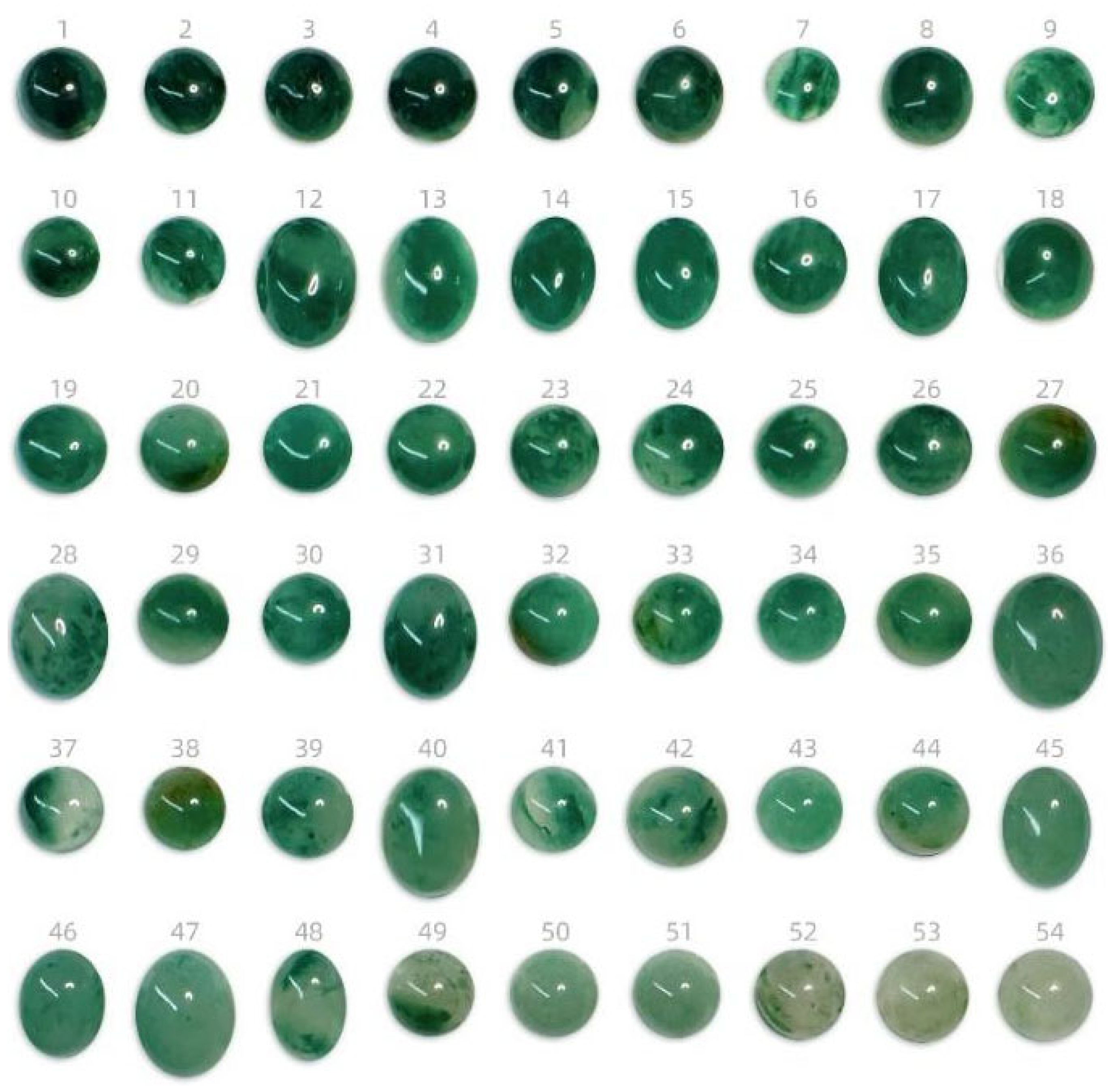
In this study, 54 green quartzites from the Barberton greenstone belt were examined, the colors of which displayed continuously from deep green to vivid green. To obtain the color parameters effectively, each sample was cut into a polished cabochon with a similar thickness of 39–42 mm. Samples are shown in Figure 1.

2.2. Methods

2.2.1. Colorimetric Analysis

Color measurements of “Feizhoucui” samples were carried out using an X-Rite SP62 spectrophotometer (X-Rite, Grand Rapids, MI, USA), with a Munsell N9.5 neutral gray backing. Diffuse reflectance was captured under the instrument’s built-in D65 illuminant, employing an integrating sphere geometry. For each sample, final color values were averaged from three repeated measurements. The measurement configuration was as follows: specular component excluded (SCE), 10° standard observer, spectral range of 400–700 nm, 10 nm sampling interval, 4 mm measurement aperture, and 6.5 mm illumination spot size.

2.2.2. CIE1976 Color Space

The CIE 1976 L*a*b* uniform color space has become a standard framework for evaluating the color of gemstones. Unlike the earlier CIE 1931 color space, its geometric distance between two colors aligns more closely with human visual perception [16]. This system offers two main advantages: (1) improved color uniformity across the space and (2) better agreement with the perceptual observation that color differences in the yellow–blue direction appear larger than those in the red–green direction. It organizes color into three coordinates—lightness L* and chromatic components a* (red–green) and b* (yellow–blue). From a* and b*, additional color attributes, namely, chroma C* and hue angle h°, can be derived as follows:
C * = a * 2 + b * 2
h o = arctan a * b *

2.2.3. Spectroscopic Analysis

Infrared spectroscopy, laser Raman spectroscopy, and UV–visible spectroscopy were conducted in the Gem Testing Laboratory within the School of Gemmology at CUGB. Infrared and UV–visible spectroscopy analyzed all tested rock samples of “Feizhoucui”, whereas Raman spectroscopy was performed on thin sections.
Fourier transform infrared (FTIR) spectroscopy was performed using a Tensor 27 spectrometer (Bruker, Ettlingen, Germany). Spectra were collected under the following conditions: 400–2000 cm−1 range, absorption mode, 4 cm−1 resolution, and 50–100 scans. To extend the spectral coverage, additional transmission measurements were conducted over 400–4000 cm−1 under identical resolution and scanning parameters.
UV-Vis spectroscopy was performed on a Gem-3000 spectrometer (Biaoqi Optoelectronics Technology Development Co., Ltd., Guangzhou, China). Spectra were collected in the 220–1000 nm spectral range with an integration time of 220 ms, 12 scans averaged per measurement, and smoothed using a boxcar width of 2 to reduce high-frequency noise.
Raman analysis was performed on a HR-Evolution micro-Raman spectrometer (HORIBA, Kyoto, Japan). A 50× objective lens was employed to focus on the sample surface under the following conditions: 532 nm laser excitation, 100 mW output power, 0.865 µm pinhole aperture, and 10 s integration time over a spectral range of 200–4000 cm−1. For strong fluorescence, it is necessary to reduce the laser power on the sample and perform multiple acquisitions. Also, mineral identification was performed by comparing the observed Raman vibrational modes with reference spectra from the RRUFF database.

2.2.4. Chemical Analysis

Major element compositions were determined using an EDX-7000 energy-dispersive X-ray fluorescence spectrometer (Gem Testing Laboratory, School of Gemmology, China University of Geosciences, Beijing, China). Measurements were performed in air under the following conditions: oxide quantification mode, 50 kV tube voltage, 108 µA current, 30% dead time, and 1 mm collimator. A total of 54 “Feizhoucui” specimens were analyzed. For samples exhibiting distinct color zoning, differently colored domains were measured separately; the region corresponding to the macroscopic body color was adopted for subsequent quantitative analysis.
Elemental mapping of polished thin sections was carried out on a Bruker M4 TORNADO µ-XRF spectrometer (Bruker Corporation, Billerica, MA, USA) at NIMRF. The instrument is an energy-dispersive system equipped with a rhodium (Rh) target X-ray tube, polycapillary optics, and two XFlash® silicon drift detectors (SDDs). Analyses were conducted under vacuum to enhance sensitivity for light elements (detection range: C–U). The elemental distribution maps presented in this study are semi-quantitative, reflecting the relative X-ray fluorescence intensities (counts per second) of each element across the sample surface, rather than absolute concentrations. Mapping parameters included an accelerating voltage of 50 kV, current of 300 µA, spot size of 30 µm, and stage speed of 20 ms/px.
The BSE image acquisition and quantitative wavelength-dispersive EPMA were performed on a Shimadzu EPMA-1720 electron probe microanalyzer (China University of Geosciences, Beijing, China). Operating conditions were set to 15 kV accelerating voltage, 10 nA beam current, 2 µm beam diameter, and counting times of 10–15 s. Well-characterized natural and synthetic standards were used for calibration: garnet (Al, Fe), diopside (Si, Ca), olivine (Mg), rutile (Ti), albite (Na), sanidine (K), chromite (Cr), pentlandite (Ni), and barite (Ba, S). Raw intensities were corrected using the ZAF procedure.

3. Results

3.1. Color Characteristics

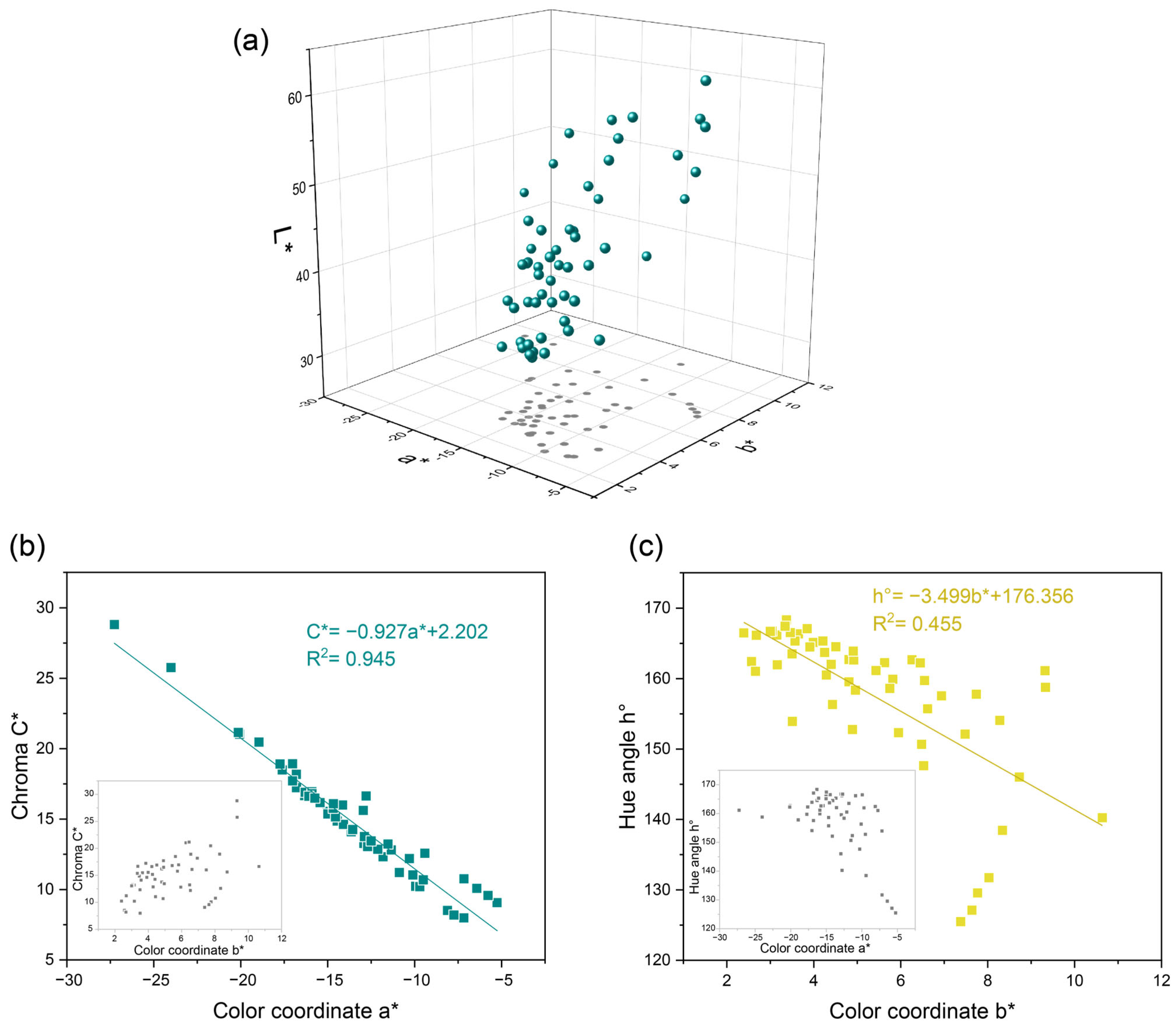
Color parameters were acquired in the CIELAB color space using an X-Rite SP62 portable spectrophotometer (4 mm aperture). Across the 54 specimens, lightness L* ranged from 33.45 to 62.52, a* from −27.26 to −5.26, and b* from 2.39 to 10.64. Corresponding chroma C* values fell between 7.98 and 28.81, with hue angle h° spanning 125.48° to 168.33°. These measurements are in good agreement with the perceived green hues of “Feizhoucui”.
All color coordinates are plotted in the CIE 1976 L*a*b* color space (Figure 2a). Chroma C* represents the Euclidean distance from each data point to the value of zero, while hue angle h° is measured counterclockwise from the positive a* axis. The distribution confirms that all 54 samples fall within the green quadrant.
Correlation analysis indicates a strong negative linear relationship between a* and C* (Pearson’s r = −0.972; R2 = 0.945). By contrast, b* exhibits a weak positive association with C* (Pearson’s r = 0.446, Figure 2b). These results imply that chroma is primarily governed by the green component (−a*), with a secondary contribution from the yellow–blue axis (+b*).
Hue angle h° shows negative correlations with both a* and b. Specifically, a and h° exhibited a Pearson correlation of r = −0.525, while b* and h° showed a stronger negative correlation (r = −0.675, R2 = 0.455; Figure 2c). This indicates that the hue of green Feizhoucui is influenced by both a* and b*, with +b* (yellow hue) playing a slightly more dominant role.

3.2. Infrared Spectroscopy

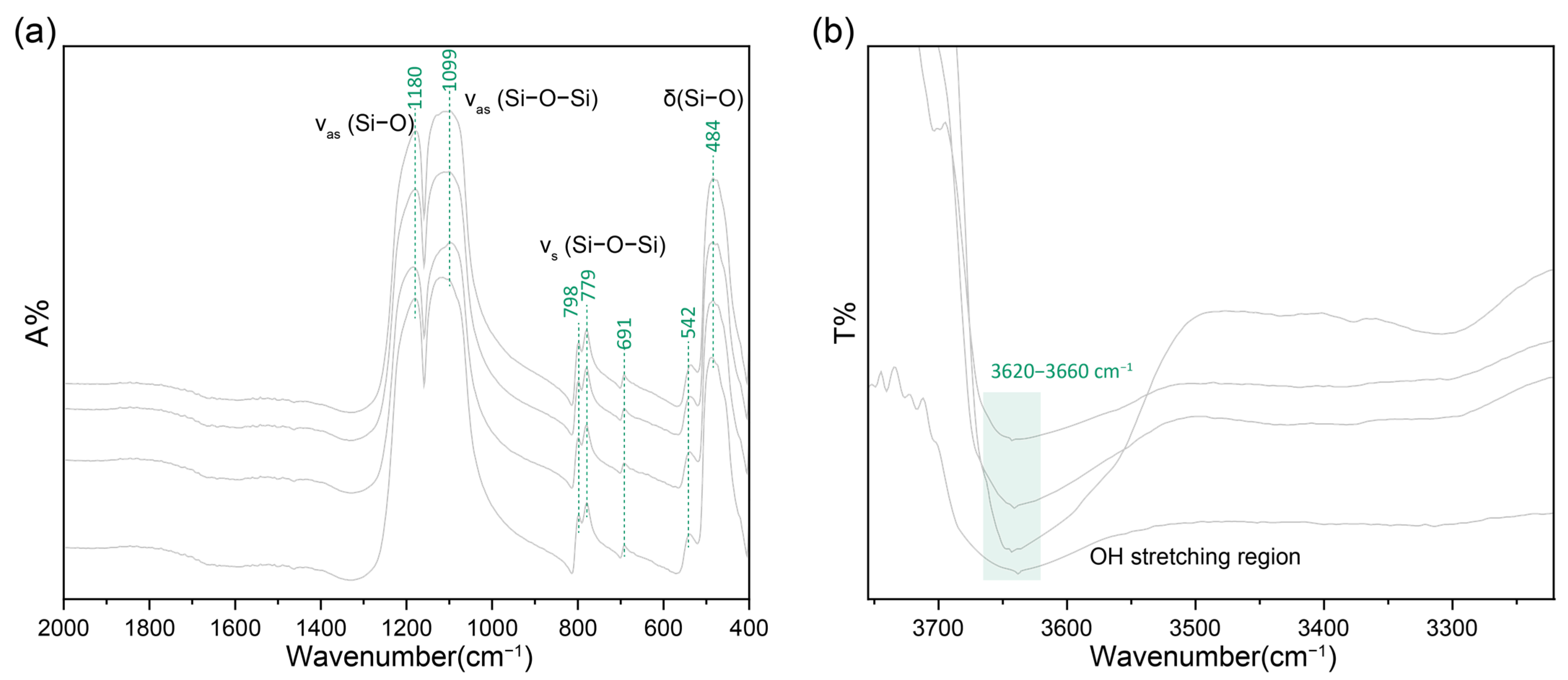
Infrared absorption bands of quartz are dominated by vibrational modes of SiO4 tetrahedra (Figure 3a). Asymmetric stretching vibrations of Si–O–Si linkages produce the bands at 1180 cm−1 (νas(Si–O)) and 1099 cm−1 (νas(Si–O–Si)). The well-defined bands at 798, 779, and 691 cm−1 correspond to symmetric stretching modes of Si–O–Si (νs(Si–O–Si)). Bending vibrations of O–Si–O (δ(O–Si–O)) are observed at 542 and 484 cm−1. These assignments are consistent with the characteristic features of α-quartz reported in the literature [9,17,18].
According to Razva et al., the crystallinity of quartzite jade can be assessed using the infrared intensity ratio of the peaks at 779 and 691 cm−1 [19]. The same study also suggests that the degree of splitting between the peaks in the 801–778 cm−1 range can distinguish amorphous and cryptocrystalline quartz. Cryptocrystalline quartz typically presents a broadened doublet or a band with a weak shoulder in this region. As crystallinity increases, the peak at ~778 cm−1 becomes sharper, more distinct, and eventually separates from the peak near 800 cm−1 [20].
The infrared spectrum of the samples shows a well-resolved doublet at 798 and 779 cm−1, indicating a clear splitting. This, combined with the sharpness of the peaks, means the samples possess a high degree of crystallinity and should be classified as a crystalline quartzite aggregate.
In addition, the samples exhibited intense absorption peaks at 3620–3660 cm−1 (Figure 3b) due to the stretching vibration of hydroxyl groups [21,22].

3.3. Raman Spectroscopy

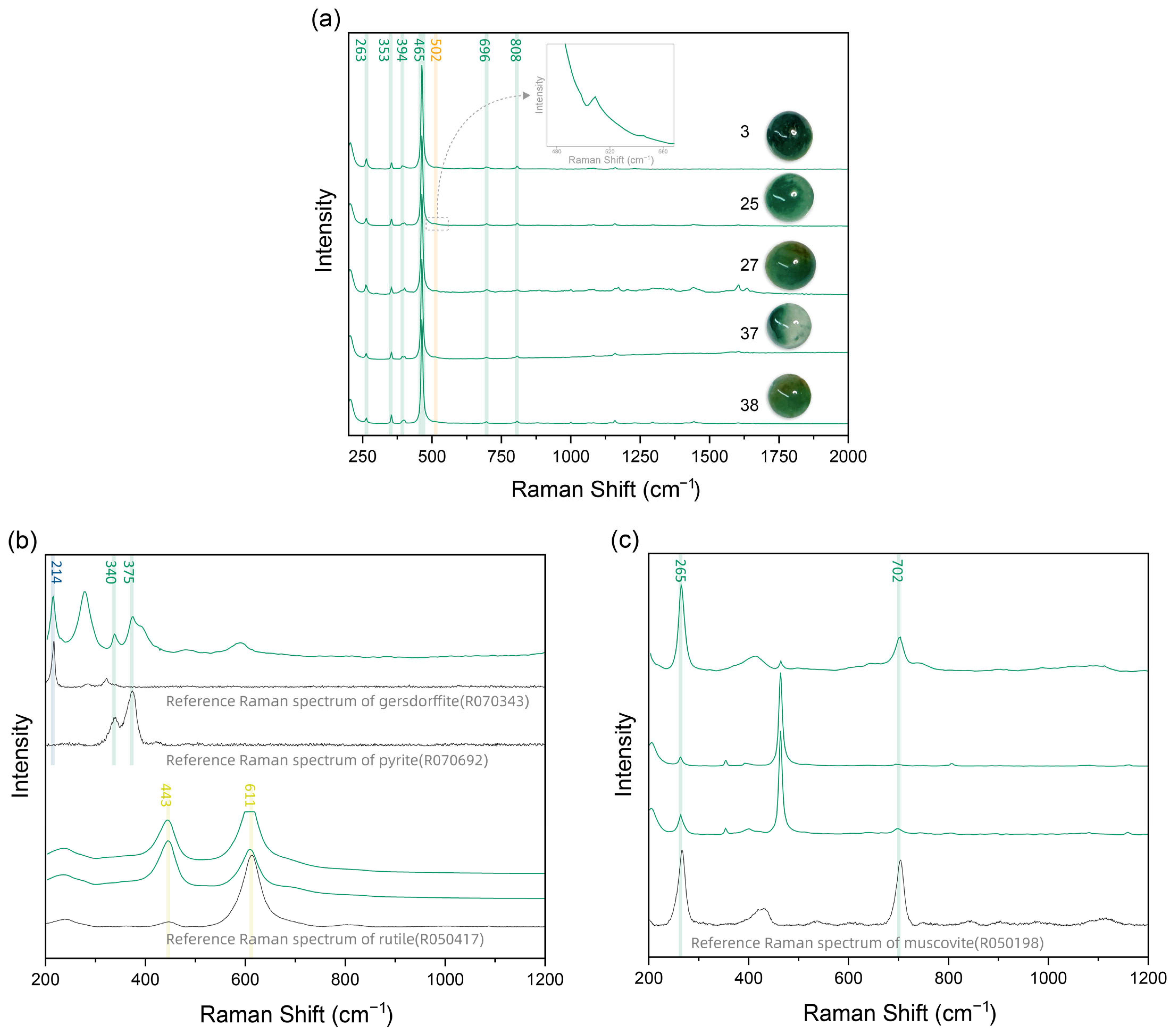
The Raman spectra of the “Feizhoucui” samples are shown in Figure 4a. All samples exhibit the characteristic peaks of quartz. The strong peak at 465 cm−1 is assigned to the Si-O-Si bending vibration in α-quartz, while the medium-intensity peaks at 263 cm−1 and 353 cm−1 are related to the translational and rotational vibrations of the silicon–oxygen tetrahedron [23,24].
Most samples show a characteristic peak at 502 cm−1, which is attributed to moganite (Figure 4a) [24,25,26]. However, the intensity of this peak is considerably weaker than that typically observed in chalcedony [12]. This indicates a relatively high crystallinity of the samples, consistent with their identification as quartzite jade based on infrared spectroscopy [26].
Compare all the mineral inclusions’ Raman spectra with the reference spectral peaks in the RRUFF online library. As shown in Figure 4b, spectra acquired from metallic inclusions reveal peaks at 345 cm−1 and 387 cm−1, identifying pyrite, and a peak at 214 cm−1, consistent with gersdorffite. Peaks at 443 cm−1 and 611 cm−1 match the Raman signature of rutile.
Figure 4c presents the Raman spectra acquired from transparent muscovite veins. Due to the transparency of muscovite, the laser readily penetrates the veins, often yielding a composite spectrum of both muscovite and the underlying quartz. Nonetheless, the characteristic muscovite peaks at 262 cm−1 and 700 cm−1 remain clearly identifiable and are consistent with previously reported spectra [5,27].

3.4. UV–Vis Spectroscopy

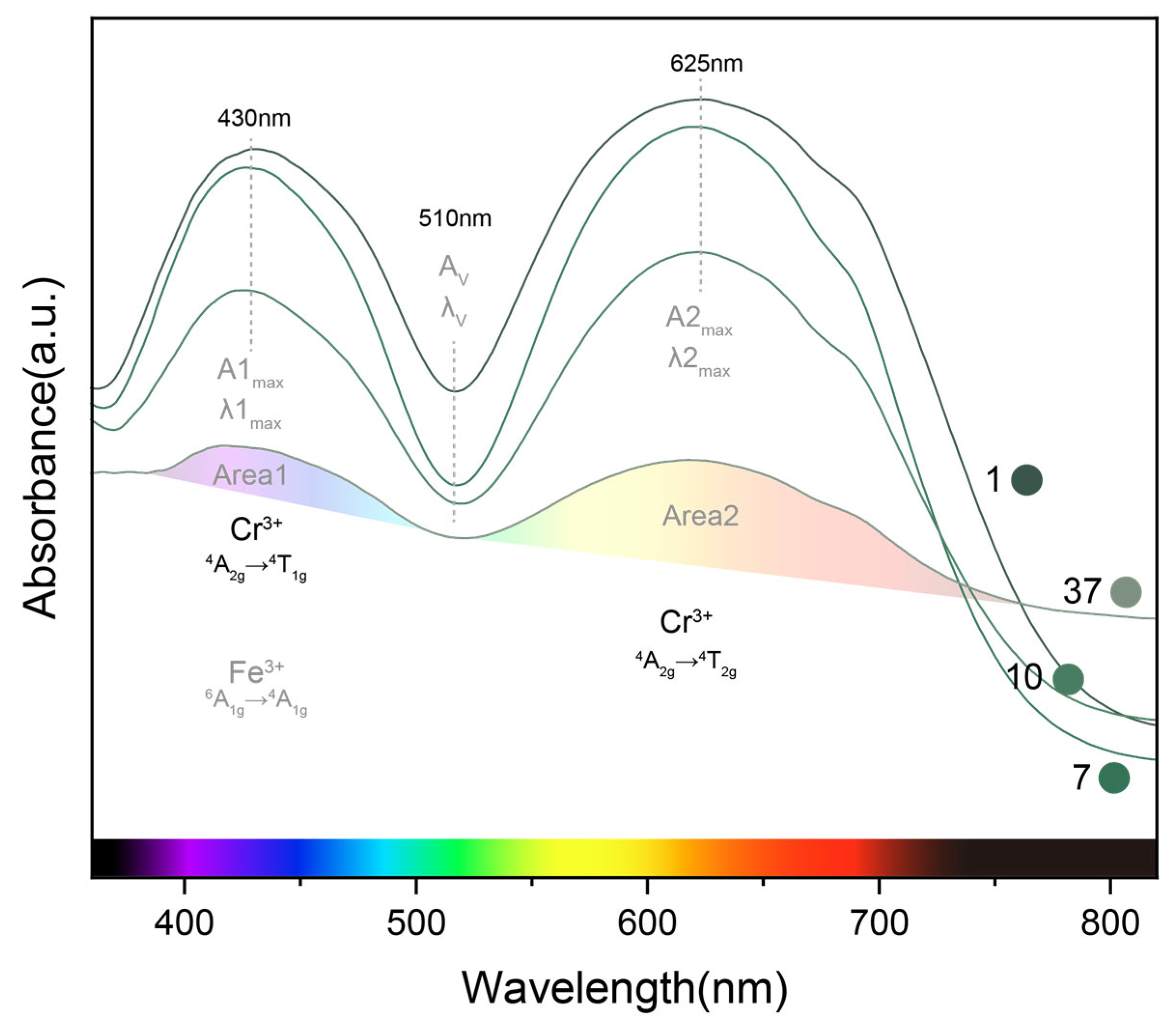
The UV-Vis spectra (Figure 5) of the green series all exhibit broad absorption bands centered at 430–460 nm and 610–625 nm. The band at 430–460 nm is typically less intense than that at 610–625 nm. The absorption valley near 510 nm, which corresponds to the reflection of green light, is responsible for the green color observed by the naked eye.
As the sample color shifts from green to a more yellow–green hue, the absorption valley systematically shifts toward longer wavelengths, resulting in the reflection of more yellow–green light. Furthermore, darker samples exhibit stronger overall absorption across the UV-Vis spectrum and consequently have lower reflectance. It should be noted that the absorption intensity may also be influenced by factors such as sample thickness and the internal aggregate structure, which affect overall transparency.

3.5. ED-XRF

Energy-dispersive X-ray fluorescence (EDXRF) spectroscopy was employed for the rapid and non-destructive determination of the bulk chemical composition of the samples. The analysis of 54 “Feizhoucui” samples revealed that SiO2 is the dominant component, with concentrations ranging from 90.08 to 99.54 wt%. Other major oxides were present in the following ranges: Al2O3, 0–5.70 wt%; BaO, 0.04–1.47 wt%; and K2O, 0.04–1.37 wt%. Trace amounts of Cr2O3, 0–0.58 wt%, SO3, 0–0.73 wt%, CaO, 0–0.71 wt%, Fe2O3, 0–0.07 wt%, and NiO, 0–0.01 wt% were also detected.

3.6. μ-XRF Mapping

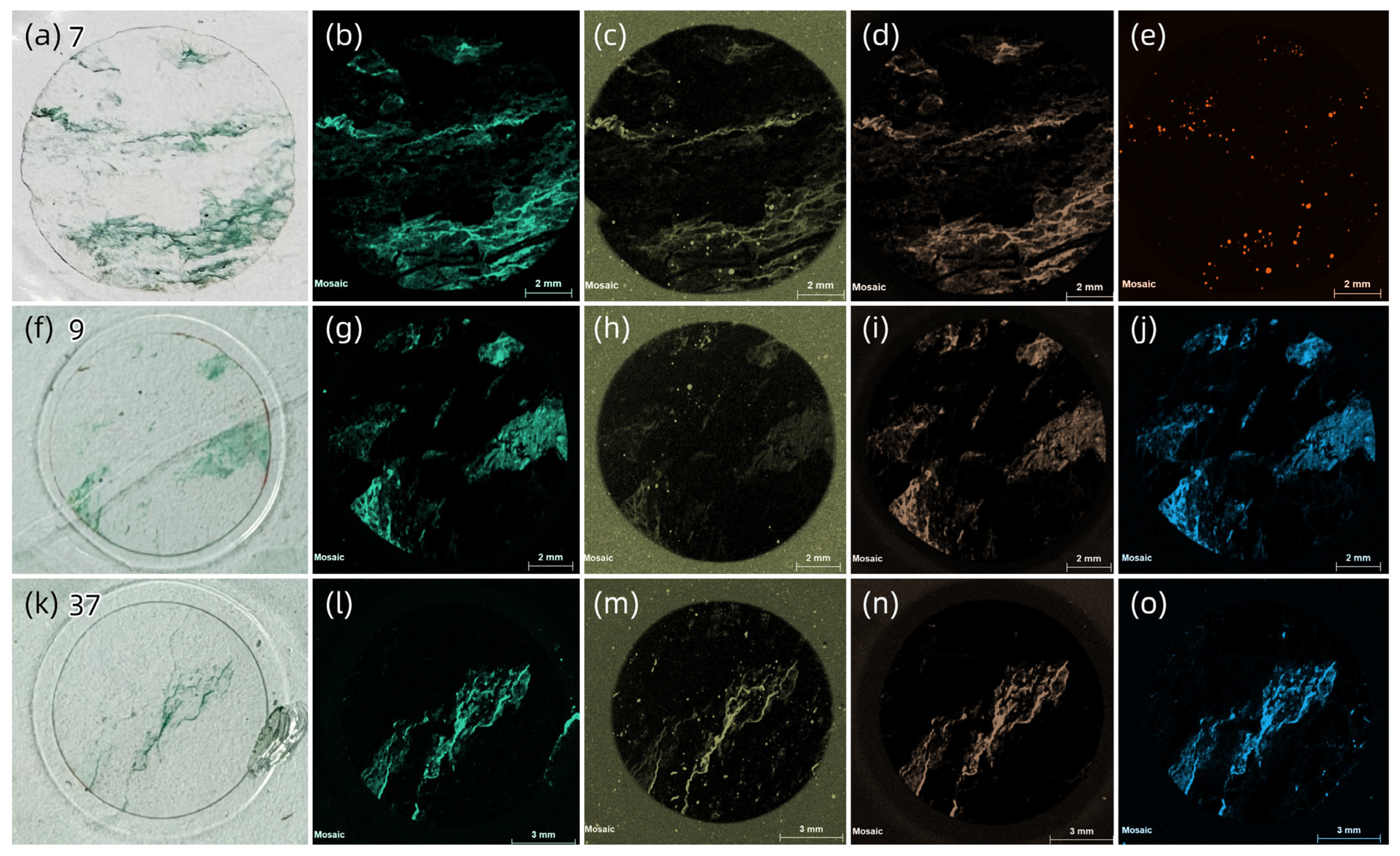
To visualize the distribution of chromophoric minerals and elements, μ-XRF mapping was performed on polished sections from three sample blocks (samples 7, 9, and 37; shown in Figure 6a,f,k).
The resulting elemental maps (Figure 6b–e, g–j, l–o) clearly reveal that within the visually green veins, the distributions of Cr (Figure 6b,g,l), Fe (Figure 6c,h,m), K (Figure 6d,i,n), and Ti (Figure 6j,o) are highly synchronized. These elements form distinct vein-like or spotted patterns within the quartzite matrix. The surrounding quartzite matrix is virtually devoid of Cr, Fe, K, and Ti.
Ni (Figure 6e) exhibits a different distribution pattern, appearing as scattered pinpoint inclusions within the quartz matrix, often adjacent to but not co-localized with the green mineral veins. This indicates that the Ni-bearing phase is distinct from the Cr-bearing chromophoric mineral.

3.7. EPMA and BSE Imaging

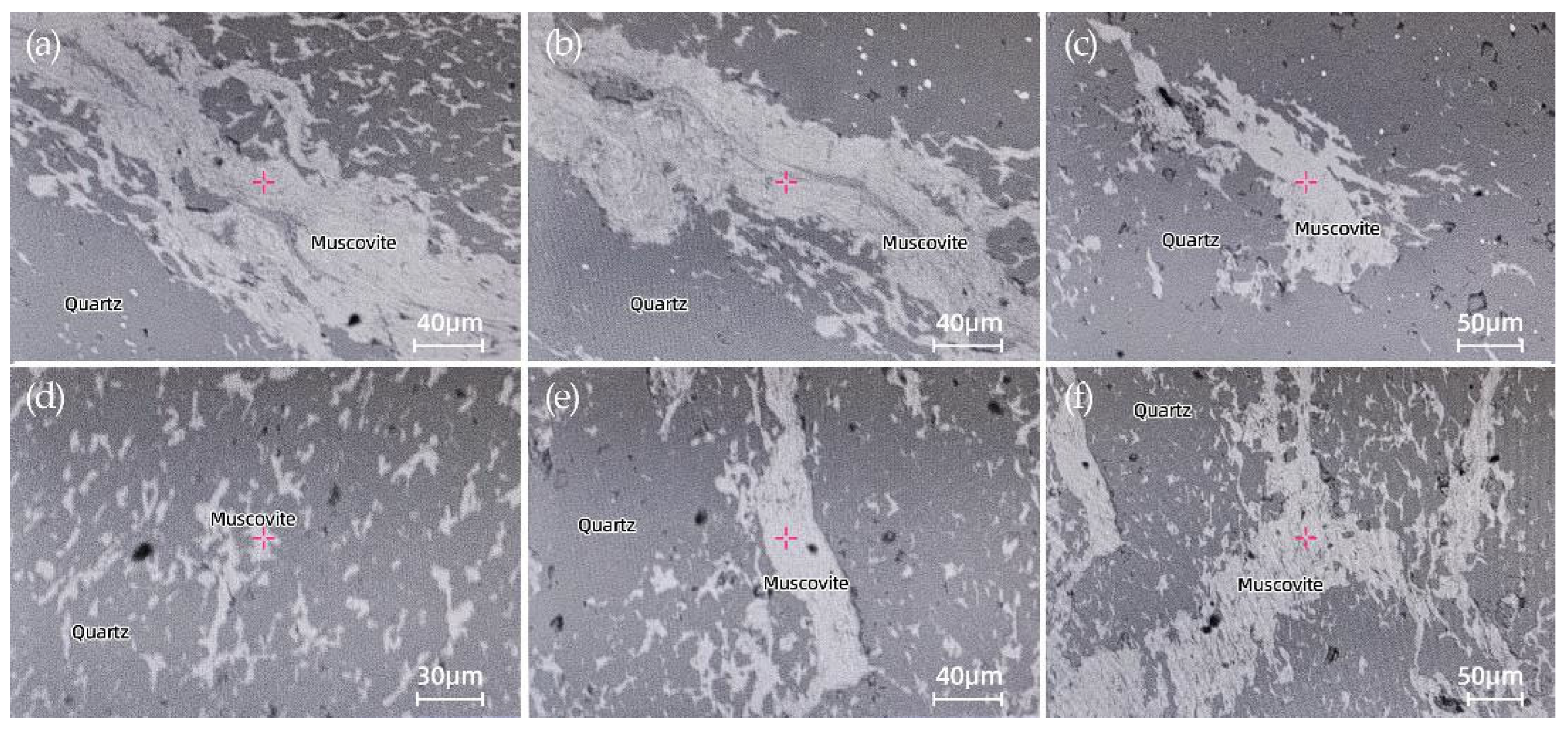
BSE imaging reveals distinct light gray areas within the quartzite matrix (Figure 7). These areas form clear vein-like or fine vein structures, approximately 25 to 80 μm in width, which display irregular branching and winding morphologies. The veins are distributed within the quartzite in an interwoven or pore-filling manner, showing low regularity and occasional intersections. Raman spectroscopy identifies these vein-filling minerals as muscovite.
The interface between the muscovite veins and the quartzite matrix is sharp, with straight to slightly serrated boundaries. No evidence of melting or reaction rims is observed, suggesting that the muscovite likely formed through later fluid infiltration. The vein morphology further indicates that muscovite crystallization may have occurred via fissure-filling or fluid-mediated alteration processes. This is consistent with the activity of potassium-rich fluids during late-stage growth or metamorphism of the quartzite, aligning with the geological characteristics of the source region of “Feizhoucui” [2].
EPMA was conducted at six points within the veins. The results confirm that the veins are composed of Na, Al, Si, K, Cr, Ba, and O, with the major oxide concentrations listed in Table 1.
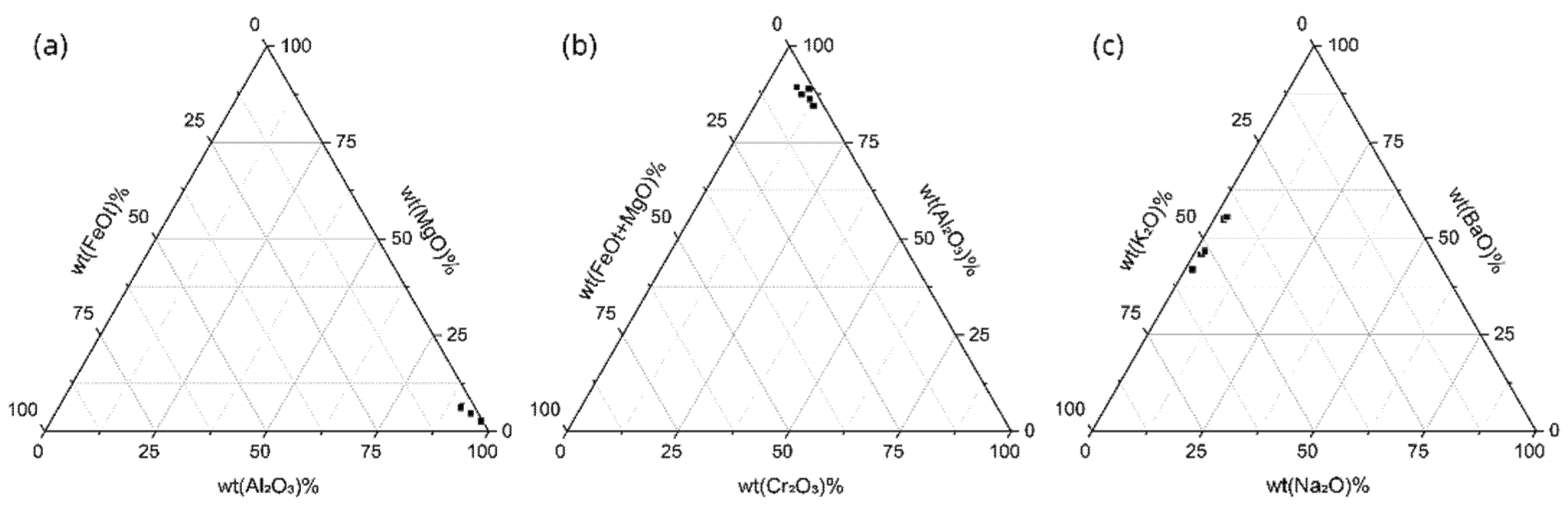
The total FeO content is notably low compared to other mica species, while BaO and Cr2O3 contents are relatively high. As shown in the ternary diagram of MgO–Al2O3–FeOt in Figure 8a, all data points plot near the Al2O3 apex, consistent with muscovite composition. Muscovite with Cr2O3 > 1 wt% typically exhibits a distinct pale to emerald green color, distinguishing it from common colorless or pale-gray muscovite; such material has traditionally been termed “fuchsite” [28]. However, even very low Cr content can induce green coloration, suggesting that the traditional threshold of Cr2O3 > 1 wt% for “fuchsite” may not be strictly applicable in color-based classification [29].
The ternary diagram of (FeOt + MgO)–Al2O3–Cr2O3 (Figure 8b) shows that the compositions remain close to the Al2O3 vertex but exhibit moderate Cr enrichment. The relationship among K2O, Na2O, and BaO (Figure 8c) indicates relatively low Na2O content, with Ba and K present in comparable proportions.
The chemical composition obtained here closely resembles the barian–chromian muscovite reported by Dymak et al. from Greenland [29]. It is characterized by interlayer cations dominated by K with minor Ba substitution (Ba < 50%), enrichment in Ba and Cr, and the presence of Mg, Fe, and Ti. A high tetrahedral Al content further supports its classification as a barian–chromian muscovite.
For micas, the crystal–chemical formula is typically calculated based on a unit containing 11 oxygen atoms, representing a half unit cell (O10(OH)2. The formulas derived for each analysis point are provided in Table 2.
The EPMA data for point 9-01 require specific interpretation. This point corresponds to a cluster of sub-micron spots (~15 μm) within quartz. The anomalously high SiO2 content (48.5%) and the concurrently low concentrations of characteristic muscovite components (e.g., Al2O3, K2O) suggest that the analysis volume included a significant contribution from the surrounding quartz matrix. Therefore, the bulk composition of point 9-01 is not included in the crystal–chemical formula calculation.

4. Discussion

4.1. Color Classification and Grading

The color of green “Feizhoucui” samples was classified using K-means clustering and Fisher discriminant analysis based on the CIE 1976L*a*b* uniform color space. Both methods have been validated in previous gemological studies for color classification of minerals [30,31].
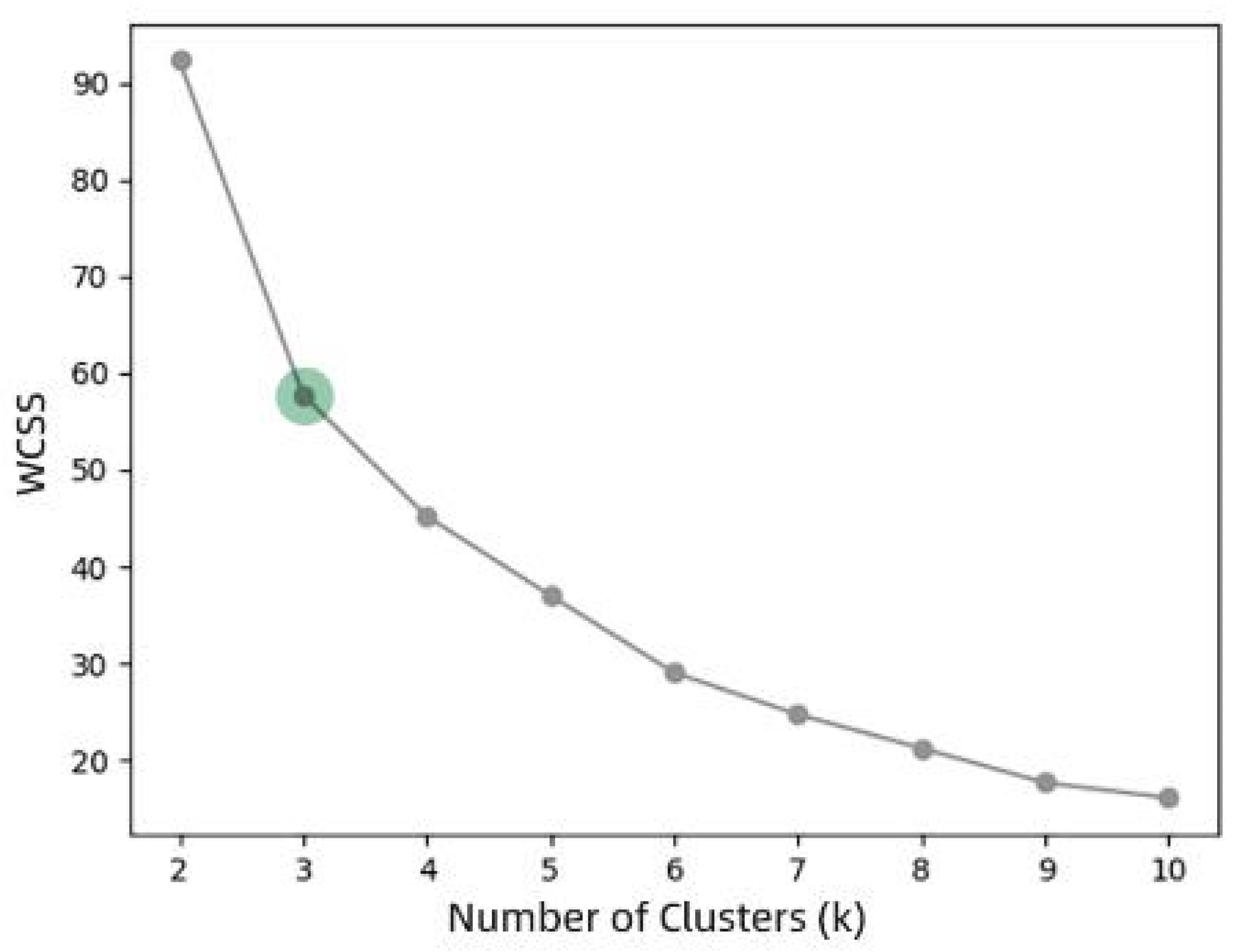
In K-means clustering, the number of clusters (K) must be predefined. The optimal K was determined using the elbow method, which identifies the point where the rate of decrease in Within-Cluster Sum of Squares (WCSS) slows significantly [32]. This “elbow” balances model simplicity and cluster compactness, reducing subjectivity and overfitting, and aligns with prior gemological applications [33]. The elbow method indicated an optimal K of 3 (Figure 9). Table 3 presents the ANOVA results for L*, a*, and b*. The results show that all variables have large F-values and significance levels (Sig.) less than 0.05. This indicates that these variables differ significantly across the clusters, confirming that the K-means clustering solution is effective and successfully distinguishes between distinct groups of samples based on their characteristics.
Fisher discriminant analysis was then applied to develop a classification model based on the three clusters. The derived discriminant functions are:
F1 = 0.625 L* − 0.002 a* + 0.139 b* − 12.274,
F2 = −0.008 L* + 0.298 a* + 0.137 b* + 5.155
The classification results are shown in Table 4. The “Original” method resubstitutes the training data into the functions, yielding perfect separation (100% accuracy) but with potential overfitting [34]. To address this, leave-one-out cross-validation was used [35], achieving an overall accuracy of 91.76% with only five misclassifications. Diagonal values indicate correctly classified samples, while off-diagonal entries represent errors. These results strongly support the model’s discriminant validity.
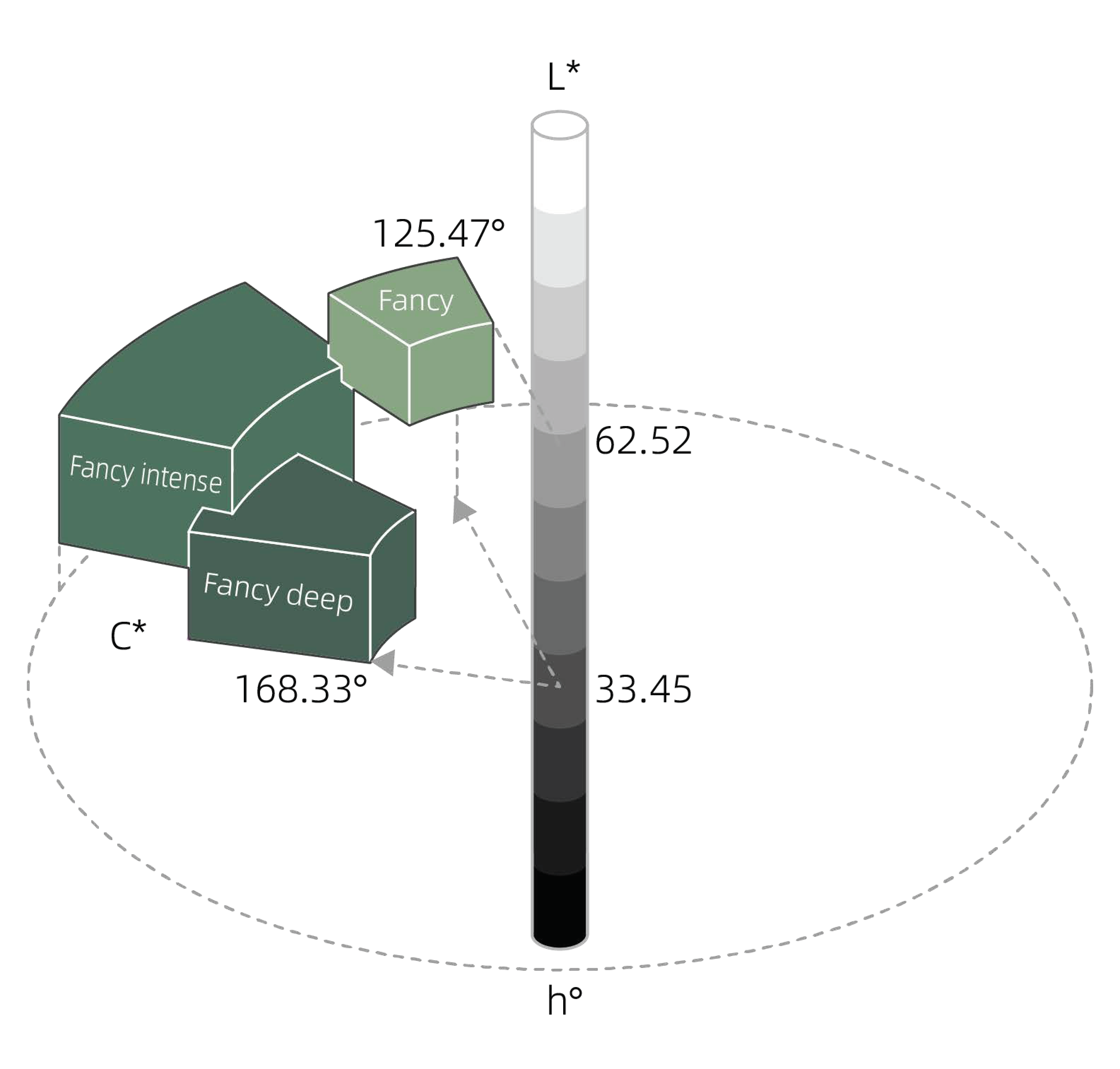
Based on the cluster and discriminant analyses, and referencing GIA’s colored diamond grading system [36], a three-tier color grading system for green “Feizhoucui” is proposed: Fancy, Fancy Intense, and Fancy Deep. These grades correspond to a hue angle range of 125.47° to 168.33° and are illustrated in Figure 10.

4.2. Mineral and Chemical Composition Analysis

Raman spectroscopy, SEM, and EPMA confirm that the green regions in “Feizhoucui” consist predominantly of barian–chromian muscovite (Table 2; Figure 4, Figure 7 and Figure 8). XRF and μ-XRF mapping reveal the presence of Ni, Cr, Fe, and Ti (Figure 6). Among these, Cr, Fe, and Ti are co-located within chromophoric muscovite veins, with Cr content notably higher than Fe and Ti. EPMA data and structural formulas support this distribution (Table 1 and Table 2). Ni occurs as scattered inclusions unrelated to the green veins (Figure 6e), indicating it is not a coloring element. Ti is considered a negligible chromophore due to its low concentration [37]. Cr is the primary chromophore for green coloration, while Fe3+ and Fe2+ contribute red-to-brown hues [37,38].
Bivariate correlation analysis (two-tailed) was performed on 54 samples to examine relationships among Cr2O3, FeOt, FeOt/Cr2O3 ratio, and color parameters L*, C*, and h° (Table 5). Muscovite components K2O and BaO were also included. Pearson correlation coefficients (r) are interpreted as: |r| < 0.3 (negligible), 0.3 ≤ |r| < 0.5 (low), 0.5 ≤ |r| < 0.8 (moderate), and |r| ≥ 0.8 (high).
Cr2O3, FeOt, BaO, and K2O show strong positive correlations, reflecting their common origin in muscovite. Although BaO and K2O are not chromophores, their correlations with color parameters mirror those of Cr2O3 and FeOt, suggesting that color intensity largely depends on muscovite abundance.
Cr2O3 correlates negatively with L* (r = −0.536) and positively with h° (r = 0.392). FeOt correlates negatively with L* (r = −0.547) and positively with C* (r = 0.358) and h° (r = 0.392). In contrast, the FeOt/Cr2O3 ratio correlates positively with L* (r = 0.459) but negatively with C* (r = −0.132) and h° (r = −0.175)—trends opposite to those of FeOt alone. These contrasting patterns suggest that Fe and Cr influence color through different mechanisms. FeOt content measured by XRF primarily reflects muscovite abundance rather than Fe proportion within muscovite, implying that Fe’s direct contribution to green color is minor.
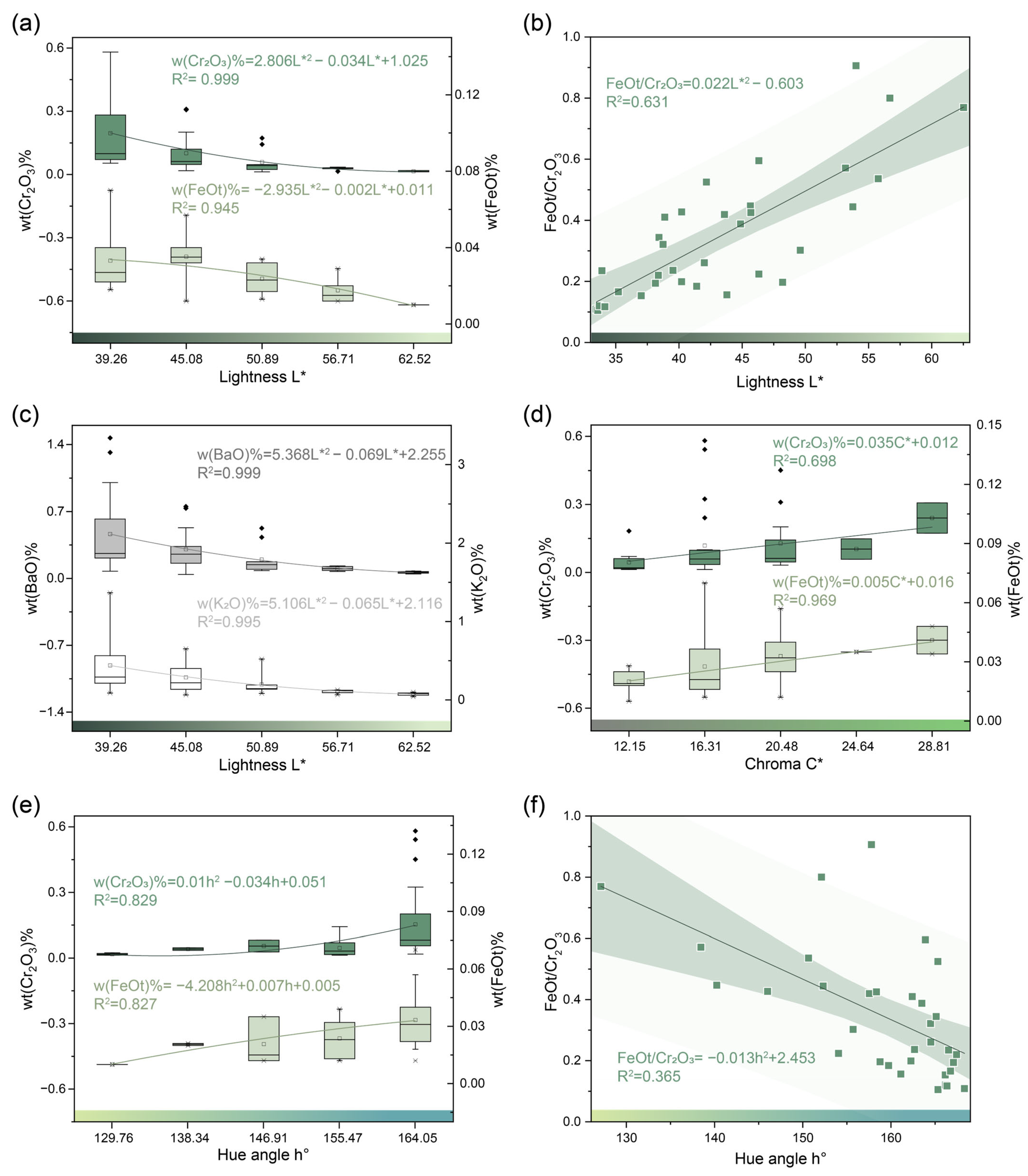
Box plots support these findings. Both Cr2O3 and FeOt show strong negative correlations with L* (Figure 11a, R2 = 0.999 and 0.945), as do BaO and K2O (Figure 11c, R2 = 0.999 and 0.995), indicating that samples darken with increasing muscovite content. Conversely, the FeOt/Cr2O3 ratio correlates positively with L* (Figure 11b), indicating lighter color when Cr is low relative to Fe—further confirming Cr as the dominant chromophore.
Chroma C* correlates positively with BaO and K2O (r = 0.308 and 0.271), suggesting that muscovite composition enhances saturation. Although Cr2O3 shows no significant direct correlation with C* (Table 5), the negative correlation between FeOt/Cr2O3 and C* (r = −0.132) shows Cr as the main driver of green saturation. Figure 11d shows a positive trend between Cr2O3 and C* (R2 = 0.698), though data scatter at C* ≈ 16–23 may reflect reduced saturation from high concentrations of dark, Cr-rich muscovite or reddish/brownish tones introduced by Fe. As Fe2+/Fe3+ ratios were not determined, both interpretations remain plausible.
Hue angle h° correlates positively with BaO and K2O (r = 0.395 and 0.376), indicating that muscovite composition also influences hue. Figure 11e confirms positive correlations of Cr2O3 and FeOt with h°: bluish-green tones correspond to higher Cr and Fe contents. Although the FeOt/Cr2O3 ratio shows a weak negative correlation with h° (r = –0.175; Figure 11f, R2 = 0.365), hue is predominantly controlled by Cr, with Fe playing only a minor role.

4.3. Crystallinity Analysis

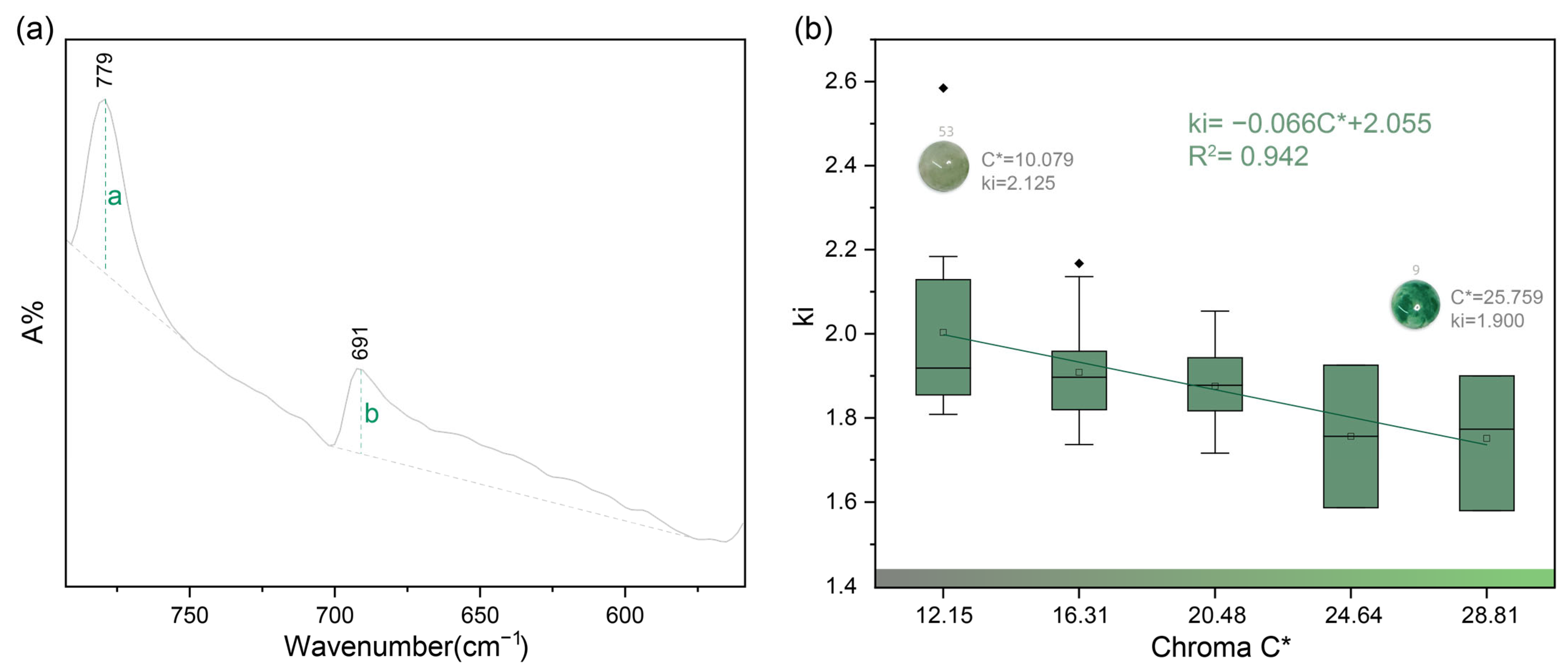
According to Razva. et al., the crystallinity of quartzite can be assessed using the infrared intensity ratio of the peaks at about 779 and 691 cm−1 [19]. The baseline method can be used to calculate the crystallinity index according to the following formula:
k i = a / b
where there is an a/b ratio peak intensity of 778 cm−1 to a peak of 695 cm−1 (Figure 12a).
The baseline was constructed as follows: the starting point of the peak at 691 cm−1 was set at the minimum around 555–595 cm−1, and the end point at the minimum was around 696–705 cm−1. For the peak at 779 cm−1, a baseline was drawn from the region of 738–765 cm−1 to intersect with the end point near the minimum at 786–794 cm−1. After constructing both baselines, distances b and a from the peak maxima at 691 cm−1 and 779 cm−1 to the baseline were calculated, respectively. The higher the a/b ratio, the higher the crystallinity of the quartzite sample.
The 54 “Feizhoucui” samples exhibit a negative correlation between the crystallinity index (ki) and chroma C*. Lower crystallinity corresponds to higher defectivity in the samples, which allows more color-contributing muscovite to enter the quartzite, thereby enhancing chroma C*.

4.4. UV-Vis Analysis

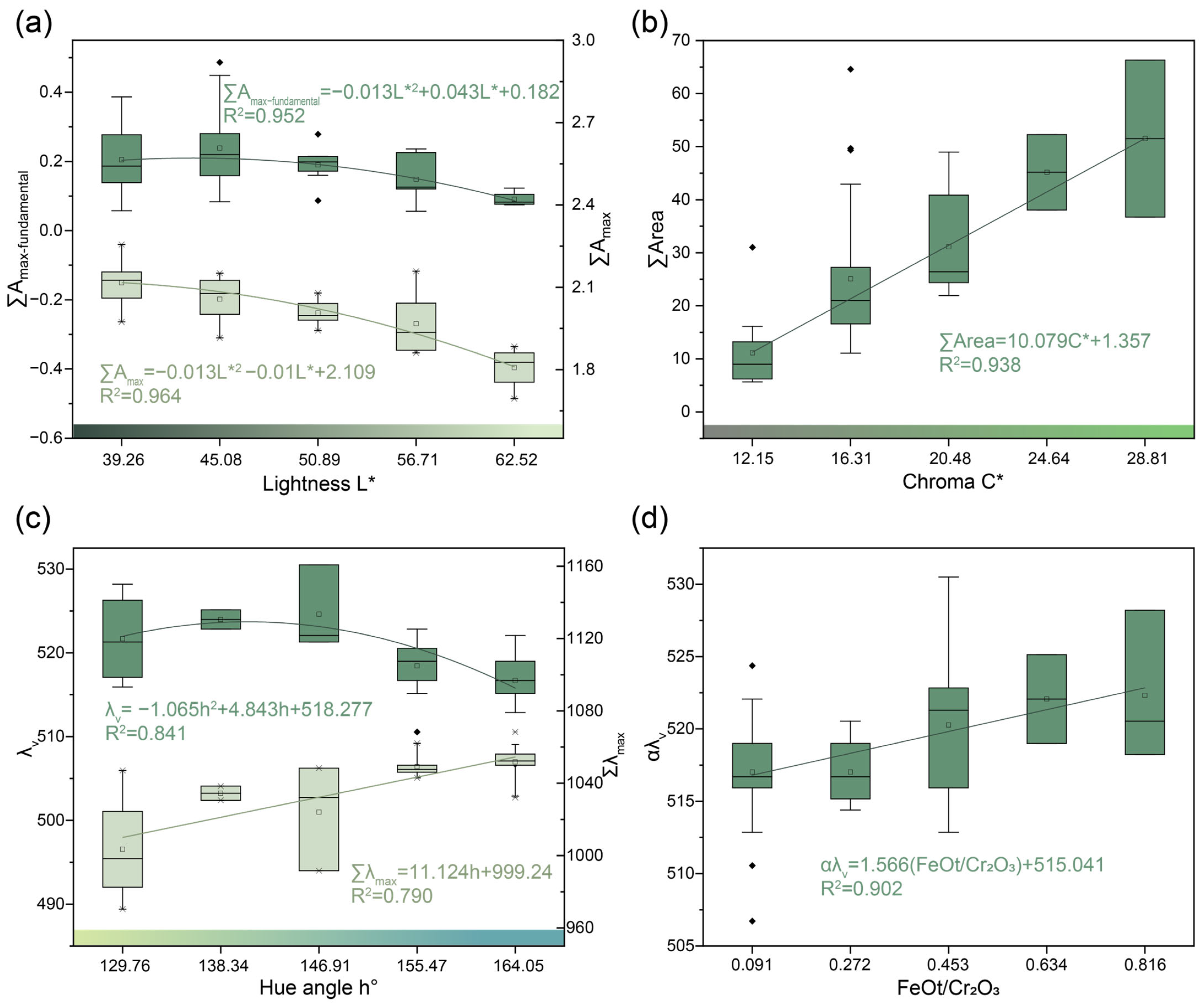
UV-Vis spectral parameters (Table 6) were extracted and subjected to bivariate correlation analysis. As illustrated in Figure 5, A1max and Area1 denote the peak maximum and integrated area of the 430–460 nm band; A2max and Area2 correspond to those of the 610–625 nm band. ΣAmax-fundamental = (A1max − Av) + (A2max − Av), where Av is the absorbance at the ~510 nm valley, reflecting characteristic band intensity after baseline subtraction. ΣAmax = A1max + A2max (includes baseline), and ΣArea = Area1 + Area2. λv is the wavelength of the ~510 nm valley minimum, indicating its shift; Σλmax is the sum of the two band maxima wavelengths, representing overall spectral shift.
The α-series parameters (α1max–Σαλmax, Table 6) are derived from the absorption coefficient α(λ) (6), normalizing for sample thickness.
α(λ) = A(λ)/I
In muscovite, Cr3+ substitutes for Al3+ at octahedral sites, forming [CrO6] octahedra. Its 3d3 configuration yields spin-allowed transitions 4A2g → 4T2g (610–625 nm, orange–yellow absorption) and 4A2g → 4T1g (430–460 nm, blue–purple absorption), together producing green color [39,40,41]. Iron coloration is valence-dependent: Fe2+→Fe3+ charge transfer generates a broad 500–600 nm band (red hues), while the 6A1g → 4A1g transition of Fe3+ absorbs near 443 nm (green hues) [37,38,42].
All samples exhibit a consistent absorption trough at ~510 nm (Figure 5). The absence of significant 500–600 nm absorption rules out Fe2+ → Fe3+ charge transfer as a major contributor. Although Fe3+’s ~443 nm band may overlap with Cr3+’s 4A2g → 4T1g transition, bivariate analysis shows no correlation between the FeOt/Cr2O3 ratio and the intensity of the 430–460 nm band (α1max, αArea1; Table 6), indicating that Fe3+ absorption, if present, is subordinate to Cr3+.
Both BaO and K2O correlate positively with Σαmax-fundamental (r = 0.509, 0.486) and ΣαArea (r = 0.627, 0.601) (Table 6), confirming that muscovite is the primary chromophore-hosting mineral.
Lightness L* is negatively correlated with both ΣAmax (r = –0.754, R2 = 0.964) and ΣAmax-fundamental (r = −0.364, R2 = 0.952) (Figure 13a, Table 5 and Table 6), indicating that L* decreases with stronger absorption. Chroma C* correlates positively with ΣArea (r = 0.687, R2 = 0.938) (Figure 13b): larger absorption area yields more selective absorption and higher saturation [9,12].
Hue angle h° correlates more strongly with Σλmax (r = 0.754, R2 = 0.790) than with λv (r = –0.505, R2 = 0.841) (Figure 13c). However, λv is the more direct hue determinant; as h° increases (green to bluish-green), λv red shifts, reflecting more blue and less yellow light. αλv shows no correlation with individual Cr2O3 or FeOt content but correlates positively with the FeOt/Cr2O3 ratio (r = 0.390, R2 = 0.902, Figure 13d, Table 6). Thus, higher relative Fe content red shifts the transmission valley, enhancing yellow–green reflectance.
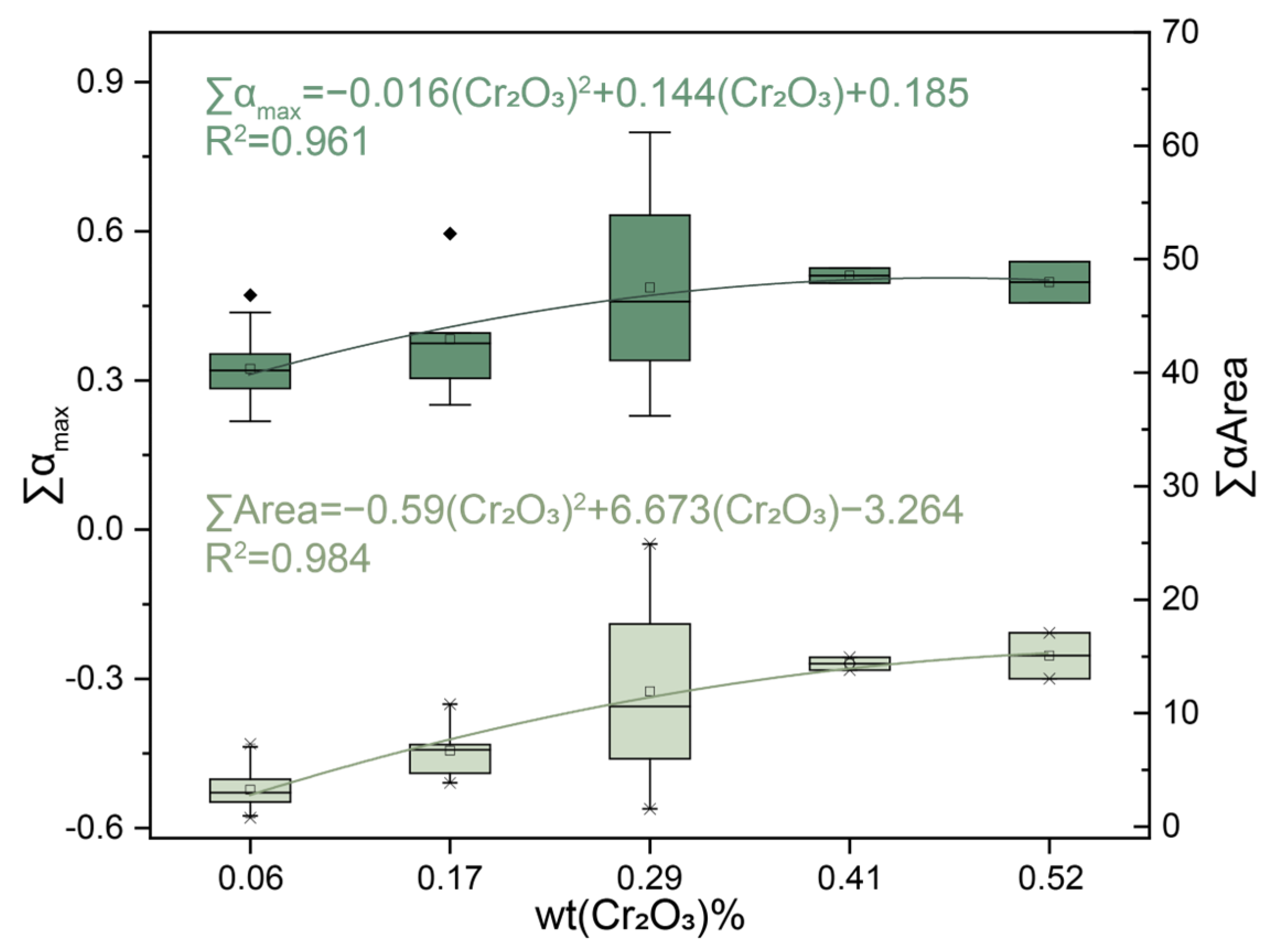
Cr2O3 content correlates positively with Σαmax (r = 0.308, R2 = 0.961) and ΣαArea (r = 0.625, R2 = 0.984) (Figure 14, Table 6). Its correlation with Σαmax-fundamental (r = 0.507) exceeds that with Σαmax (r = 0.308), indicating Cr preferentially enhances net characteristic absorption over background. Cr concentration is, therefore, the primary control on color saturation in “Feizhoucui”.

5. Conclusions

The analysis of 54 “Feizhoucui” samples confirms that this material is a distinctive variety of quartzite, characterized by barian–chromian muscovite as the primary coloring phase. Electron probe microanalysis provided the structural formula of the chromophoric muscovite: (K0.71Na0.05Ba0.20)0.96 (Al1.66Mg0.16Cr0.22Fe0.03Ti0.02)2.09 (Si3.04Al0.96)4O10(OH)2. The host rock is predominantly well-crystallized quartz with trace amounts of moganite. The chromophoric muscovite occurs as distinct vein-like or spotted patterns within the quartz matrix. BaO and K2O contents serve as useful indicators of muscovite abundance and show a strong positive correlation with the key coloring elements Cr and Fe. Minor paragenetic inclusions include pyrite, rutile, and gersdorffite.
UV-Vis spectroscopy indicates that the characteristic green color of “Feizhoucui” originates principally from Cr3+ within the muscovite structure, with Fe content exerting a secondary influence. The Cr3+-induced 4A2g → 4T2g and 4A2g → 4T1g transitions produce absorption bands at 610–625 nm and 430–460 nm, respectively, absorbing orange–yellow and blue–purple light. Higher Cr content increases total absorption area and reduces lightness L*, thereby enhancing chroma C*.
Fe content does not drive the main absorption bands but influences the hue angle h°. With increasing relative Fe content, the absorption minimum near 510 nm shifts slightly higher, resulting in a reduced h°. This red shift may arise from a combination of Fe2+ → Fe3+ charge transfer and the 6A1g → 4A1g transition of Fe3+.
In addition, the crystallinity of quartzite shows a negative correlation with chroma C*, suggesting that higher defectivity facilitates the incorporation of more color-contributing muscovite.
Based on K-means clustering of colorimetric data under standard illumination, Feizhoucui can be classified into three color grades: Fancy Intense, Fancy Deep, and Fancy.

Author Contributions

Conceptualization, N.W., Y.G., and J.H.; methodology, Y.G., P.L., Y.Y., and J.H.; software, P.L., Y.Y., and J.H.; validation, N.W., J.H., and P.L.; formal analysis, P.L.; investigation, P.L. and J.H.; resources, N.W. and J.H.; data curation, J.H. and P.L.; writing—original draft preparation, P.L. and J.H.; writing—review and editing, P.L. and J.H.; visualization, P.L. and J.H.; supervision, N.W., Y.G., Y.Y., and L.Y.; project administration, N.W. and J.H.; funding acquisition, N.W. All authors have read and agreed to the published version of the manuscript.

Funding

This research was funded by the Program of the National Mineral, Rock, and Fossil Specimens Resource Center of the MOST (Grant No. NCSTI-RMF202501).

Data Availability Statement

The original contributions presented in this study are included in the article.

Acknowledgments

The authors gratefully acknowledge Xiaomeng Ye and Yuansheng Jiang for their insightful discussions and advice regarding the experimental work. We also extend our sincere gratitude to the Gemmology Laboratory at the China University of Geo-sciences (Beijing) for providing technical support. Special thanks are given to Lab Instructor Yuan Ye and the laboratory assistants for their invaluable assistance.

Conflicts of Interest

The authors declare no conflicts of interest.

References

  1. Arndt, N. Encyclopedia of Astrobiology; Physics and Astronomy Reference Module Physical and Materials Science Reference Module Chemistry, Materials and Physics; Springer: Berlin/Heidelberg, Germany, 2023; ISBN 978-3-662-65093-6. [Google Scholar]
  2. De Wit, M.; Furnes, H.; MacLennan, S.; Doucouré, M.; Schoene, B.; Weckmann, U.; Martinez, U.; Bowring, S. Paleoarchean Bedrock Lithologies across the Makhonjwa Mountains of South Africa and Swaziland Linked to Geochemical, Magnetic and Tectonic Data Reveal Early Plate Tectonic Genes Flanking Subduction Margins. Geosci. Front. 2018, 9, 603–665. [Google Scholar] [CrossRef]
  3. Pintos Cerda, L.; Jones, C.; Kisters, A. Multi-Stage Alteration, Rheological Switches and High-Grade Gold Mineralization at Sheba Mine, Barberton Greenstone Belt, South Africa. Ore Geol. Rev. 2020, 127, 103852. [Google Scholar] [CrossRef]
  4. T/GAC 21-2024; Feizhoucui—Testing and Classification. Standards Press of China: Beijing, China, 2024.
  5. Zhang, A.; Sun, Z.; Zhao, B.; Bao, W. Gemmological Characteristic of Quartzite Jade “Feizhoucui” and Its Identification. J. Gems Gemmol. 2025, 27, 28–35. [Google Scholar] [CrossRef]
  6. Yu, L. Mineral composition and spectral characteristics of “African Dulong Jade”. Spectrosc. Spectr. Anal. 2024, 44, 1676–1683. [Google Scholar]
  7. Liu, Z.; Guo, Y. The Effect of Munsell Neutral Value Scale on the Color of Yellow Jadeite and Comparison between AP and K-Means Clustering Color Grading Schemes. Crystals 2022, 12, 241. [Google Scholar] [CrossRef]
  8. Ma, Y.; Guo, Y. The Impact of Munsell Neutral Grey Backgrounds on Tsavorite’s Color and Study on the Evaluation Method of Color Gem Cutting. Appl. Sci. 2023, 13, 1673. [Google Scholar] [CrossRef]
  9. Lv, H.; Guo, Y. Genesis of the Body Color of Brazilian Gem-Quality Yellow-Green Opal. Crystals 2023, 13, 316. [Google Scholar] [CrossRef]
  10. Yang, P.; Guo, Y. New Insights into Coloration Mechanism in Violet-Red Pyrope-Almandine. Crystals 2022, 12, 379. [Google Scholar] [CrossRef]
  11. Cui, L.; Guo, Y.; Tang, J.; Yang, Y. Spectroscopy Characteristics and Color-Influencing Factors of Green Iron-Bearing Elbaite. Crystals 2023, 13, 1461. [Google Scholar] [CrossRef]
  12. Jiang, Y.; Guo, Y. Genesis and Influencing Factors of the Colour of Chrysoprase. Sci. Rep. 2021, 11, 9939. [Google Scholar] [CrossRef]
  13. Li, P.; Guo, Y. The Impact of Mineral Composition and Trace Metal Cations on the Body Color of South African Sugilite Jade. Sci. Rep. 2025, 15, 23887. [Google Scholar] [CrossRef] [PubMed]
  14. Wang, X.; Guo, Y. The Impact of Trace Metal Cations and Absorbed Water on Colour Transition of Turquoise. R. Soc. Open Sci. 2021, 8, 201110. [Google Scholar] [CrossRef] [PubMed]
  15. Deng, S.; Guo, Y. Investigation of Factors Affecting the Color of Serpentine Jade from Shandong, China. Crystals 2023, 13, 431. [Google Scholar] [CrossRef]
  16. McLAREN, K. XIII—The Development of the CIE 1976 (L a b) Uniform Colour Space and Colour-difference Formula. Color. Technol. 1976, 92, 338–341. [Google Scholar] [CrossRef]
  17. Choi, E.C.; Lee, S.H. A study on quantification of α-quartz, cristobalite, kaolinite mixture in respirable dust using by FTIR. Anal. Sci. Technol. 2023, 36, 315–323. [Google Scholar] [CrossRef]
  18. Lu, H.; Shi, M.; Cao, Q.; Ma, S.; Zhao, X.; Wu, X. Mineralogical Characteristics and Color Genesis of Black Quartzite Jade from Linwu, Hunan, China. Sci. Rep. 2025, 15, 14643. [Google Scholar] [CrossRef]
  19. Razva, O.; Anufrienkova, A.; Korovkin, M.; Ananieva, L.; Abramova, R. Calculation of Quarzite Crystallinity Index by Infrared Absorption Spectrum. IOP Conf. Ser. Earth Environ. Sci. 2014, 21, 012006. [Google Scholar] [CrossRef]
  20. Hlavay, J.; Jonas, K.; Elek, S.; Inczedy, J. Characterization of the Particle Size and the Crystallinity of Certain Minerals by IR Spectrophotometry and Other Instrumental Methods-II. Investigations on Quartz and Feldspar. Clays Clay Miner. 1978, 26, 139–143. [Google Scholar] [CrossRef]
  21. Williams, Q.; Knittle, E.; Scott, H.P.; Liu, Z. The High-Pressure Behavior of Micas: Vibrational Spectra of Muscovite, Biotite, and Phlogopite to 30 GPa. Am. Mineral. 2012, 97, 241–252. [Google Scholar] [CrossRef]
  22. Busigny, V.; Cartigny, P.; Philippot, P.; Javoy, M. Ammonium Quantification in Muscovite by Infrared Spectroscopy. Chem. Geol. 2003, 198, 21–31. [Google Scholar] [CrossRef]
  23. Kingma, K.J.; Hemley, R.J. Raman Spectroscopic Study of Microcrystalline Silica. Am. Mineral. 1994, 79, 269–273. [Google Scholar]
  24. Zhou, D.; Chen, H.; Lu, T.; Ke, J.; He, M. The relationship between the relative content of moganite and the crystallinity of quartzite jade was studied based on Raman spectroscopy—Infrared spectroscopy—X-ray diffraction technology. Rock Miner. Anal. 2015, 34, 652–658. [Google Scholar] [CrossRef]
  25. Tsukada, Y.; Schmidt, P.; Bowden, S.A. Differentiating α-Moganite, Silanol and α-Quartz by Raman Spectroscopy. Phys. Chem. Chem. Phys. 2024, 26, 8195–8199. [Google Scholar] [CrossRef]
  26. Götze, J.; Nasdala, L.; Kleeberg, R.; Wenzel, M. Occurrence and Distribution of “Moganite” in Agate/Chalcedony: A Combined Micro-Raman, Rietveld, and Cathodoluminescence Study. Contrib Miner. Pet. 1998, 133, 96–105. [Google Scholar] [CrossRef]
  27. Liu, S.; Li, F.; Kang, Z.; Lu, F.; Xu, L.; Liu, X. A Study on the Spectroscopic Characteristics and Color-Genesis of “Dulong Jade”. J. Hebei Geo Univ. 2024, 47, 1–7. [Google Scholar] [CrossRef]
  28. Challis, A.; Grapes, R.; Palmer, K. Chromian Muscovite, Uvarovite, and Zincian Chromite; Products of Regional Metasomatism in Northwest Nelson, New Zealand. Can. Mineral. 1995, 33, 1263–1284. [Google Scholar]
  29. Dymek, R.F.; Boak, J.L.; Kerr, M.T. Green Micas in the Archaean Isua and Malene Supracrustal Rocks, Southern West Greenland, and the Occurrence of a Barian-Chromian Muscovite. Grønlands Geol. Undersøgelse Rapp. 1983, 112, 71–82. [Google Scholar] [CrossRef]
  30. Han, J.; Guo, Y.; Liu, S. Environmental Issues on Color Quality Evaluation of Blue Sapphire Based on GemdialogueTM Color Comparison Charts. Ekoloji 2018, 27, 1365–1376. [Google Scholar]
  31. Tang, J.; Guo, Y.; Xu, C. Color Effect of Light Sources on Peridot Based on CIE1976 L*a*b* Color System and Round RGB Diagram System. Color Res. Appl. 2019, 44, 932–940. [Google Scholar] [CrossRef]
  32. Herdiana, I.; Kamal, M.A.; Triyani; Estri, M.N.; Renny. A More Precise Elbow Method for Optimum K-Means Clustering. arXiv 2025, arXiv:2502.00851. [Google Scholar] [CrossRef]
  33. Liu, X.; Guo, Y. Feasibility Study on Color Grading of Blue Iolite Based on GemDialogue Color Comparison Charts. Appl. Sci. 2023, 13, 6475. [Google Scholar] [CrossRef]
  34. Jun, T.; Ying, G.; Chang, X. Metameric Effects on Peridot by Changing Background Color. J. Opt. Soc. America. A Opt. Image Sci. Vis. 2019, 36, 2030–2039. [Google Scholar] [CrossRef]
  35. Tan, V.; Zohren, S. Estimation of Large Financial Covariances: A Cross-Validation Approach. J. Portf. Manag. 2025, 51, 83–95. [Google Scholar] [CrossRef]
  36. King, J.M.; Moses, T.M.; Shigley, J.E.; Liu, Y. Color Grading of Colored Diamonds in the GIA Gem Trade Laboratory. Gems Gemol. 1994, 30, 220–242. [Google Scholar] [CrossRef]
  37. Finch, J. A Colorimetric Classification of Australian Pegmatitic Muscovite. Am. Mineral. 1963, 48, 525–544. [Google Scholar]
  38. Ruthberg, S.; Barnes, M.W.; Noyce, R.H. Correlation of Muscovite Sheet Mica on the Basis of Color, Apparent Optic Angle, and Absorption Spectrum. J. Res. Natl. Bur. Stan. Sect. A. 1963, 67A, 309. [Google Scholar] [CrossRef]
  39. Reddy, S.L.; Subba Reddy, R.R.; Reddy, G.S.; Rao, P.S.; Reddy, B.J. Optical Absorption and EPR Spectra of Fuchsite. Spectrochim. Acta Part A Mol. Biomol. Spectrosc. 2003, 59, 2603–2609. [Google Scholar] [CrossRef]
  40. Li, J.; Liu, Y. Mineralogical Characteristics of Muscovite-rutile Signet Stone. Mineral. Petrol. 2023, 43, 11–17. [Google Scholar] [CrossRef]
  41. Blumentritt, F.; Notari, F.; Becouze, M.; Vigier, M.; Zuber, G.; Caplan, C.; Fritsch, E. Gem-Quality Green Cryptocrystalline Muscovite (Fuchsite) from Ya’an Prefecture, Sichuan, China. J. Gemmol. 2024, 39, 66–76. [Google Scholar] [CrossRef]
  42. Finch, J.; Gainsford, A.R.; Tennant, W.C. Polarized Optical Absorption and 57Fe Mossbauer Study of Pegmatitic Muscovite. Am. Mineral. 1982, 67, 59–68. [Google Scholar]
Figure 1. Representative green “Feizhoucui” quartzite samples displaying varying color tones.
Crystals 16 00145 g001
Figure 2. (a) The distribution of sample parameters in CIE 1976 L*a*b* uniform color space. (b) Chroma C* shows a strong negative correlation with the a* coordinate and a relatively weaker positive correlation with the b* coordinate. (c) Hue angle h° shows negative correlations with both a* and b*, although the correlations are relatively weak (low R2 values).
Crystals 16 00145 g002
Figure 3. (a) Infrared spectra of some green “Feizhoucui” samples. (b) Spectra of the hydroxyl-stretching vibration.
Crystals 16 00145 g003
Figure 4. (a) Raman spectra of selected green “Feizhoucui” samples. A characteristic peak at 502 cm−1 is magnified. (b) Characteristic Raman peaks of gersdorffite, pyrite, and rutile detected from samples. (c) Characteristic Raman peaks of muscovite detected from samples.
Crystals 16 00145 g004
Figure 5. UV-Vis spectra of some “Feizhoucui” samples.
Crystals 16 00145 g005
Figure 6. μ-XRF elemental distribution maps of Cr, Fe, K, Ni, and Ti in three “Feizhoucui” samples. Each row corresponds to one sample: row 1 (ae): sample 7; row 2 (fj): sample 9; row 3 (ko): sample 37. The panels in each row are: (a,f,k) polished thin sections; (b,g,l) Cr distribution; (c,h,m) Fe distribution; (d,i,n) K distribution; (e) Ni distribution, and (j,o) Ti distribution maps.
Crystals 16 00145 g006
Figure 7. Representative BSE images of “Feizhoucui” samples. The red crosses mark the spots where EPMA was performed: (a) 37-01, (b) 37-02, (c) 37-03, (d) 9-01, (e) 38-01, (f) 38-02.
Crystals 16 00145 g007
Figure 8. Ternary plots of muscovite compositions (wt%): (a) Al2O3–MgO–FeOt diagram; (b) Cr2O3–Al2O3–(FeOt + MgO) diagram; (c) Na2O–BaO–K2O diagram. All data are based on electron microprobe analyses.
Crystals 16 00145 g008
Figure 9. The elbow method plot showing the relationship between the number of clusters and the Within-Cluster Sum of Squares (WCSS). The green point marks the location where the rate of decrease in WCSS slows significantly, indicating an optimal K of 3.
Crystals 16 00145 g009
Figure 10. Color distribution of three groups of “Feizhoucui”: Fancy Intense, Fancy Deep, and Fancy.
Crystals 16 00145 g010
Figure 11. Relationships between color parameters and elemental contents: (a) lightness L* vs. wt% Cr2O3 and wt% FeOt; (b) L* vs. FeOt/Cr2O3 ratio (bdl data excluded); (c) L* vs. wt% BaO and wt% K2O; (d) chroma C* vs. wt% Cr2O3 and wt% FeOt; (e) hue angle h° vs. wt% Cr2O3 and wt% FeOt; (f) h° vs. FeOt/Cr2O3 ratio (bdl data excluded).
Crystals 16 00145 g011
Figure 12. (a) Calculation method of crystallinity index in relation to changes of absorption peaks 778/695 cm−1 in the infrared absorption spectrum. Segments a (778 cm−1) and b (695 cm−1) indicate the peak intensities measured by the baseline method. (b) The chroma C* and the crystallinity of quartzite were positively correlated.
Crystals 16 00145 g012
Figure 13. Relationships between UV-Vis spectral features and colorimetric/chemical properties of “Feizhoucui”. (a) Lightness L* in relation to both the total peak absorption intensity (ΣAmax) and the net characteristic absorption (ΣAmax-fundamental). (b) Positive correlation between chroma C* and the total absorption area (ΣArea) of the two main absorption bands. (c) Hue angle h° versus the sum of absorption maxima wavelengths (Σλmax) and the wavelength of the ~510 nm absorption valley (λv). (d) The FeOt/Cr2O3 ratio versus αλv (bdl data excluded).
Crystals 16 00145 g013
Figure 14. Relationships between the Cr content and Σαmax and ΣαArea, respectively.
Crystals 16 00145 g014
Table 1. The major element oxides of sampling points (wt%). The detection limit is approximately 100 ppm (0.01 wt%).
PointNa2OBaOSiO2TiO2MgOCr2O3SO3Al2O3FeOtK2ONiOTotal
37-010.266.4244.270.282.272.440.0630.610.918.640.0196.16
37-020.277.2942.810.352.053.170.0130.311.088.340.0495.72
37-030.389.2240.610.391.544.870.0131.100.557.180.0195.88
38-010.327.2942.720.361.554.150.0231.160.587.990.0396.17
38-020.459.4839.380.180.933.760.0333.160.117.130.0494.64
9-010.446.8448.510.260.823.110.0221.680.145.040.0286.89
Total iron is reported as FeOt.
Table 2. The crystal–chemical formula, calculated on the basis of 11 oxygen atoms.
PointThe Crystal-Chemical Formula
37-01(K0.76Na0.04Ba0.18)0.98 (Al1.59Mg0.23Cr0.13Fe0.05Ti0.01)2.01 (Si3.08Al0.92)4O10(OH)2
37-02(K0.74Na0.04Ba0.20)0.98 (Al1.55Mg0.21Cr0.17Fe0.06Ti0.02)2.01 (Si3.05Al0.95)4O10(OH)2
37-03(K0.64Na0.06Ba0.26)0.96 (Al1.69Mg0.16Cr0.26Fe0.03Ti0.02)2.16 (Si3.01Al0.99)4O10(OH)2
38-01(K0.71Na0.05Ba0.20)0.96 (Al1.66Mg0.16Cr0.22Fe0.03Ti0.02)2.09 (Si3.04Al0.96)4O10(OH)2
38-02(K0.64Na0.07Ba0.27)0.98 (Al1.87Mg0.10Cr0.20Fe0.01Ti0.01)2.19 (Si2.96Al1.04)4O10(OH)2
Table 3. ANOVA results for L*, a*, and b*.
ClusteringErrorFSig
Mean SquaredfMean Squaredf
L*1128.173212.0635193.5270.000
a*240.30229.7425124.6670.000
b*58.59822.0485128.6150.000
Table 4. Predicted group membership and cluster centers.
Cluster123Total
OriginalCount1270128
20909
3001717
%196.40.03.6100.0
20.0100.00.0100.0
30.00.0100.0100.0
Cross-validatedCount1260228
20909
3121417
%192.907.1100.0
20.0100.00.0100.0
35.911.882.4100.0
Cluster center 123
L*38.4456.4844.73
a*−12.75−9.04−17.61
b*3.957.296.65
Simulated color
Table 5. Results of bivariate correlation analysis. r represents the Pearson correlation coefficient, and Sig. indicates the statistical significance level (p-value).
Cr2O3FeOtFeOt/Cr2O3BaOK2O
L*r−0.536 **−0.547 **0.459 **−0.521 **−0.521 **
Sig0.0000.0010.0010.0000.000
C*r0.2610.358*−0.132 *0.308 *0.271 *
Sig0.0680.0350.3620.0230.047
r0.392 **0.375 *−0.175 **0.395 **0.376 **
Sig0.0050.0272.2250.0030.005
Cr2O3r10.894 **−0.1860.989 **0.976 **
Sig 0.0000.1960.0000.000
Fe2O3r0.894 **1−0.566 **0.904 **0.910 **
Sig0.000 0.0010.0000.000
* At the 0.05 level (two-tailed), the correlation was significant. ** At the 0.01 level (two-tailed), the correlation is very significant. Total iron is reported as FeOt, as Fe3+/Fe2+ was not determined by XRF.
Table 6. Bivariate correlation analysis between the characteristic UV-Vis spectral parameters, colorimetric coordinates (L*, C*, h°), and chemical composition of the “Feizhoucui” samples.
A1maxArea1A2maxArea2ΣAmax-fundamentalΣAmaxΣAreaλvΣλmax
L*r−0.683 **−0.485 **−0.795 **−0.481 **−0.364 **−0.754 **−0.485 **0.399 **−0.525 **
Sig0.0000.0000.0000.0000.0070.0000.0000.0030.000
C*r0.0360.687 **0.1490.681 **0.782 **0.0980.687 **0.0240.223
Sig0.7940.0000.2830.0000.0000.4820.0000.8620.106
r0.382 **0.571 **0.616 **0.514 **0.441 **0.514 **0.533 **−0.505 **0.754 **
Sig0.0040.0000.0000.0000.0010.0000.0000.0000.000
α1maxαArea1α2maxαArea2Σαmax-fundamentalΣαmaxΣαAreaαλvΣαλmax
FeOt/Cr2O3r0.190−0.040.0730.1780.0610.184−0.0250.390 **0.184
Sig0.1860.7820.6140.2170.6730.2010.8630.0050.201
Cr2O3r0.293 *0.600 **0.1650.323 *0.507 **0.308 *0.625 **−0.1320.308 *
Sig0.0390.0000.2520.0220.0000.0290.0000.3610.029
FeOtr0.3040.575 **0.1960.3290.548 **0.3170.621 **−0.1970.317
Sig0.0760.0000.2590.0540.0010.0640.0000.2560.064
BaOr0.286 *0.604 **0.1920.317 *0.509 **0.302 *0.627 **−0.1370.302 *
Sig0.0360.0000.1640.0200.0000.0270.0000.3220.027
K2Or0.281 *0.573 **0.2120.310 *0.486 **0.296 *0.601 **−0.1420.296 *
Sig0.0390.0000.1250.0220.0000.0300.0000.3070.030
* At the 0.05 level (two-tailed), the correlation was significant. ** At the 0.01 level (two-tailed), the correlation is very significant.
Disclaimer/Publisher’s Note: The statements, opinions and data contained in all publications are solely those of the individual author(s) and contributor(s) and not of MDPI and/or the editor(s). MDPI and/or the editor(s) disclaim responsibility for any injury to people or property resulting from any ideas, methods, instructions or products referred to in the content.