Article

The Influence of Coating Thickness and Interface Microcracks on Contact Stresses in Ceramic Bearings: A Discrete Element Study


1
Shenyang Ligong University, Shenyang 110159, China
2
Dalian University of Technology, Dalian 116024, China
3
Shenyang Institute of Engineering, Shenyang 110136, China
*
Author to whom correspondence should be addressed.
Crystals 2026, 16(2), 146; https://doi.org/10.3390/cryst16020146
Submission received: 16 January 2026 / Revised: 3 February 2026 / Accepted: 10 February 2026 / Published: 16 February 2026
(This article belongs to the Section Polycrystalline Ceramics)

Abstract

This paper investigates the contact stress induced by a rigid sphere sliding on a coating-ceramic system. A discrete element model incorporating a ceramic substrate, a surface coating, and a rigid sphere is developed. The influences of the coating grain elastic modulus, coating surface friction coefficient, coating thickness, and interface microcrack defects on the stress distribution within the system are analyzed. The results indicate that a higher coating-to-substrate elastic modulus ratio increases the overall stress but reduces the interfacial shear stress. A lower surface friction coefficient is more beneficial for hard coatings. The relatively optimal coating thickness (h/a) is approximately 0.5. When interface microcrack defects are present, stress concentrations occur at their locations. Longer interface microcracks lead to greater stress concentration, and the interfacial concentrated stress increases with crack length.

1. Introduction

Ceramic bearings are critical components in aerospace, marine, and high-precision machinery due to their superior mechanical properties, corrosion resistance, and thermal stability [1,2]. However, under extreme operating conditions, traditional lubrication often fails, leading to accelerated wear and premature failure. To address this, surface coatings are widely applied to enhance tribological performance, load capacity, and fatigue life [3,4]. Typical hard protective coatings such as diamond-like carbon (DLC) [5], chromium aluminum nitride (CrAlN) [6], and transition metal borides (e.g., TiB2/TiB) [7], as well as diamond coatings and cubic boron nitride (c-BN) coatings [8,9], are particularly valued for their high hardness, high elastic modulus, and excellent wear resistance. Although coatings can mitigate sliding contact damage such as wear and spalling, their inherently brittle nature and weak interfacial toughness remain significant limitations. The stress distribution under sliding contact is a key factor governing coating integrity and system reliability. Thus, accurately predicting contact stresses is essential for optimizing coating thickness, material selection, and overall design [10,11,12]. Given that the production cost of coatings is typically high, relying solely on experimental analysis to study the failure risk of coating systems is economically inefficient and impractical. To reduce costs and effectively predict the failure risk of coating systems, many researchers have turned to numerical analysis and semi-analytical methods to assess the contact response of coating systems.
For the optimal design and application of coating-ceramic systems, a thorough understanding of the stress distribution induced by surface contact forces is paramount [13]. The foundational work in this field stems from classical contact mechanics, where scholars such as Hamilton and Goodman [14] and Burmister [15] pioneered the analysis of stresses in elastic half-spaces under spherical and axisymmetric loads, respectively. This theoretical framework was subsequently extended to layered systems by researchers, including Chen and Engel [16], Westmann [17], King [18], and O’Sullivan [19]. Various analytical and semi-analytical methods have been developed to solve contact problems in single or multi-layer elastic media under combined normal and tangential tractions. These methods include the mixed boundary value method and Fourier transform techniques [20,21,22]. Further refinements incorporated advanced mathematical potentials [23,24,25] and influence coefficient methods [26] to model contacts with spheres and graded material coatings [27].
However, these established approaches predominantly treat the substrate and coating as idealized continua. This fundamental assumption limits their applicability to real ceramic systems, where the substrate is processed from micro-particles and coatings are often composed of micro- and nano-scale grains. Crucially, these continuum-based models cannot inherently account for interfacial microcrack defects, which are a common byproduct of the coating growth process. The presence of these defects critically distorts the local stress field and can precipitate premature failure.
Therefore, there is a compelling need to move beyond continuum assumptions and adopt a numerical methodology capable of explicitly representing the granular microstructure and discrete interfacial defects. This study addresses this gap by employing the discrete element method (DEM) to investigate the sliding contact stress generated by a rigid sphere on a granular coating-ceramic system. The effects of key coating parameters are systematically analyzed. Furthermore, for the first time in a DEM framework, the influence of prefabricated interfacial microcracks on stress concentration and distribution is quantitatively evaluated.

2. Methods

The DEM, pioneered by Cundall for rock mechanics [28,29], is a powerful numerical technique well-suited for simulating the mechanical behavior of brittle and granular materials, such as engineering ceramics, glass, and coal. Unlike continuum-based approaches, DEM explicitly represents a material as an assembly of discrete particles that interact through contact bonds, enabling the direct modeling of microstructural features, intergranular interactions, and damage evolution. This particle-based framework naturally captures the initiation and propagation of fractures, as well as the influence of inherent defects and interfaces, making it particularly effective for investigating failure mechanisms in coated ceramic systems under contact loading.
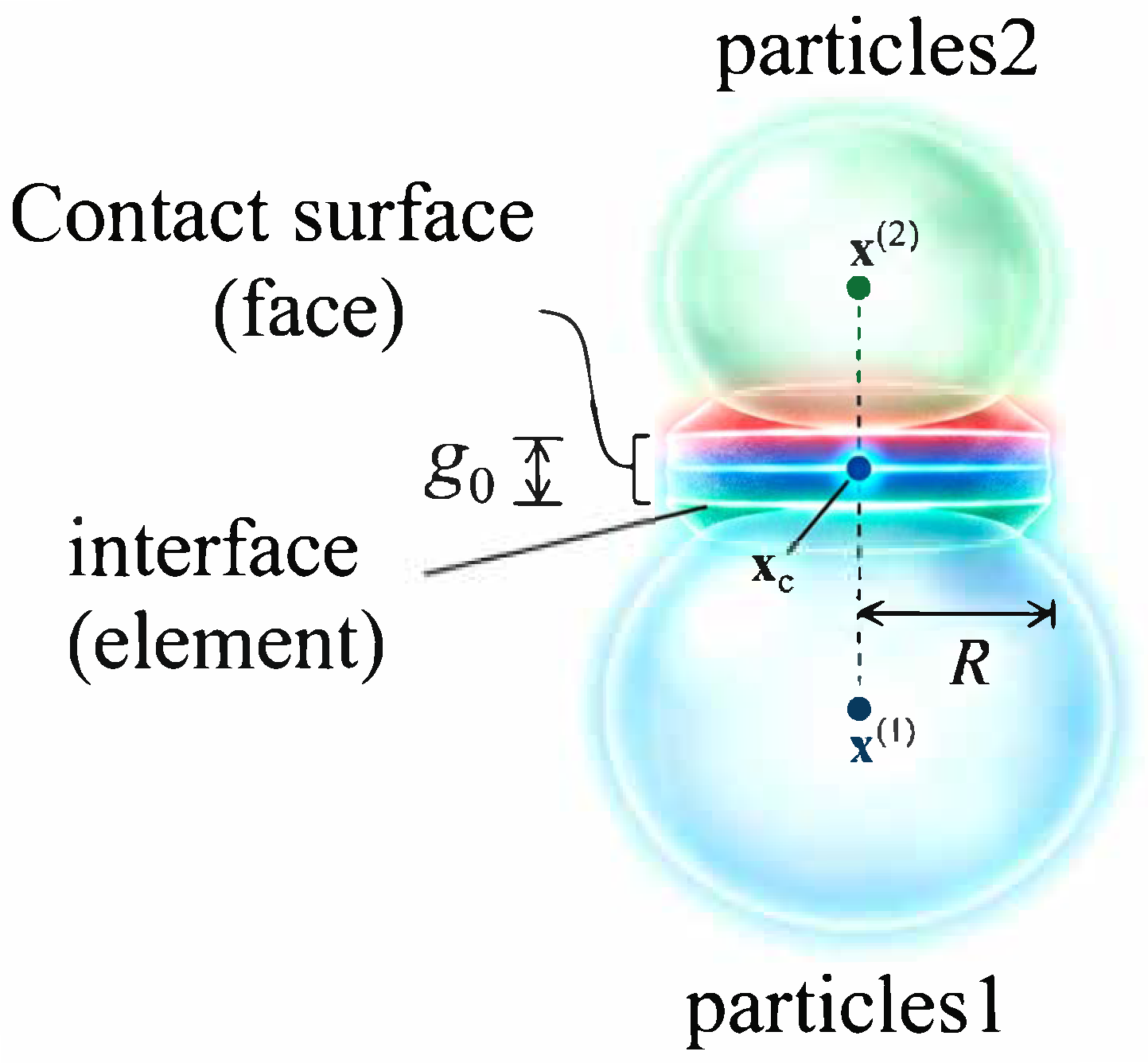
In this study, a two-dimensional flat-jointed model [30] is employed to capture the mechanical response of the brittle coating-ceramic system. As schematically illustrated in Figure 1, the model improves upon standard particle representations by constructing polygonal particles from clusters of circular particles. The contact interface between any two particles is discretized into a series of bonded elements, which are characterized by finite geometry and behave as linear elastic springs until failure.
In the flat-jointed model, each interface element exists in one of two distinct states: bonded or unbonded. In the bonded state, the element transmits both normal and tangential forces, as well as bending moments between adjacent particles, simulating the cohesive behavior of real grain boundaries or material interfaces. Failure is governed by a stress-based criterion: once the local tensile or shear stress within an element exceeds its predefined strength threshold, the bond ruptures irreversibly. Upon failure, the element transitions to an unbonded state; thereafter, it is capable only of transmitting repulsive contact forces without cohesion. The force–displacement response of each bonded element follows a linear elastic constitutive law until failure, and the macroscopic mechanical behavior of the granular assembly—including stiffness, strength, and fracture patterns—emerges from the integrated response and progressive failure of these discrete interfacial elements.
Each element of the 2D flat-joint model is always kept at the center of the interface between the two contacting particles. Therefore, the coordinate system of each element coincides with that of the particle contact surface. The relative movement of the contact surface of each particle is continuously varied, which is related to the relative movement of the contact surface of the particles. The relative motion of each particle contact surface is decomposed into the relative translation velocity V and spin velocity Ω , and they can be obtained as follows [30]:
V = v c ( 2 ) v c ( 1 ) = v ( 2 ) + ω ( 2 ) × x c x ( 2 ) v ( 1 ) + ω ( 1 ) × x c x ( 1 )
Ω = ω ( 2 ) ω ( 1 )
where x ( e ) is the center point position of elements e , x c is the position of elements at the particle contact surface, v ( e ) is the relative translation velocity of elements e , ω ( e ) is the relative spin velocity of elements e , and v c ( e ) is the relative translation velocity of elements e at the particle contact surface.
The relative translation velocity can be given as
V = V n + V s
where V n is the relative translation velocity in the normal direction and V s is the relative translation velocity in the tangential direction.
The relative translation increment Δ U and the rotation angle increment Δ θ during the time step Δ t are as follows
Δ U = V n Δ t + V s Δ t
Δ θ = Ω Δ t
When a flat-joint model is given to the particles in contact, the generalized relative movement is zero.
U n = U s = θ = 0
where U n is the relative translation in the normal direction and U s is the relative translation in the tangential direction.
The relative translation of the particle contact surface is given as
U n = U n + Δ U n
U s = U s + Δ U s
θ = θ + Δ θ
The surface gap of the particles in contact with each other is given by
g ( r ) = U n + θ r R
R = λ min ( R ( 1 ) , R ( 2 ) )
where R ( 1 ) and R ( 2 ) is the radius of each contact particle and r is the moment arm. The gap between the particle contact surfaces is unaffected by relative tangential translation.
In the DEM model, every element between the contacting particle interface is subjected to a force and moment, which act on the element centroid on the contact surface in an equal and opposite way. The interface element force and moment are as follows
F ¯ = e F ¯ ( e )
M ¯ = e ( r ( e ) × F ¯ ( e ) ) + M ¯ ( e )
The relative position is rewritten as
r ( e ) = x ( e ) x c = ρ ( e )
ρ ( e ) = R 2 e + 1 + N N ρ ( e ) = R 2 e + 1 + N N
where e is the id of each element. N is the total number of the interface elements.
An alternative expression for the contact moment can be expressed as
M ¯ = e ( ρ ( e ) × F n ¯ ( e ) ) + M ¯ ( e )
The interface element force of contact particles can be decomposed into normal force and tangential force. The moment of the interface element is equal to the bending moment. The interface element force and element moment are as follows
F ¯ ( e ) = F ¯ n ( e ) + F ¯ s ( e )
ρ ( e ) = R 2 e + 1 + N N M ¯ ( e ) = M ¯ b ( e )
The normal force, tangential force and bending moment on the contact particle interface element are expressed as
F ¯ n ( e ) = e σ d A
F ¯ s ( e ) = F ¯ s s ( e ) + F ¯ s t ( e ) M ¯ ( e ) = M ¯ b ( e )
M ¯ b ( e ) = e r σ d A
where σ is the normal stress of the contact particle interface elements.
The interface element normal and shear stresses are as follows
σ ( e ) = F ¯ n ( e ) A ( e )
τ ( e ) = F ¯ s ( e ) A ( e )
A ( e ) = 2 R t N
where A ( e ) is the area of the interface elements.

3. Problem Description and DEM Model

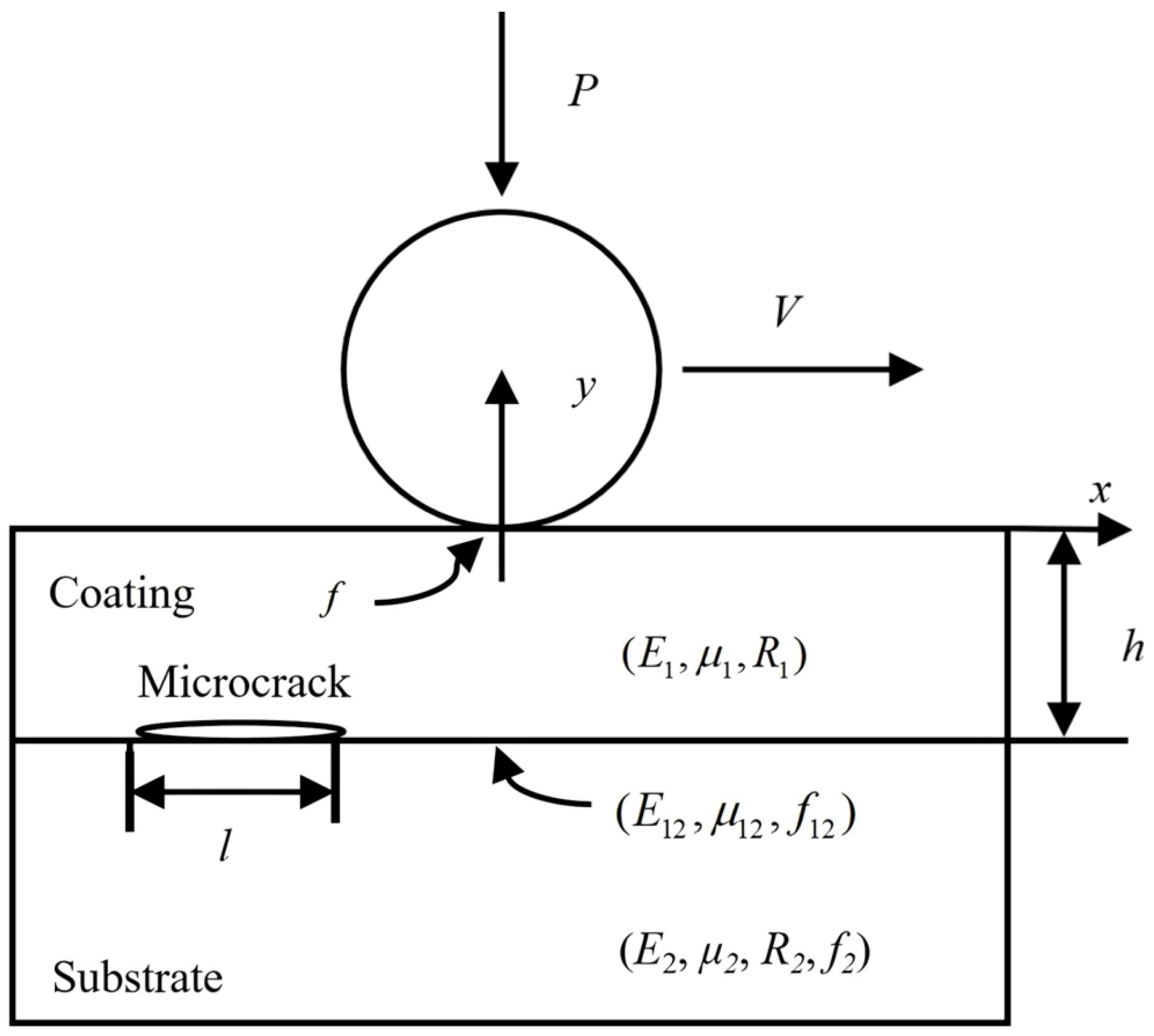
The problem is that a rigid sphere is sliding over the surface of the coating-ceramic system, as shown in Figure 2. The sliding speed of the rigid sphere in the x direction is V. The normal load acting on the rigid ball is P. The friction coefficient between the rigid sphere and the coating surface is f. The thickness of the coating is h. The grain elastic modulus, grain Poisson’s ratio, and grain radius of the coating are E1, μ1, and R1, respectively.
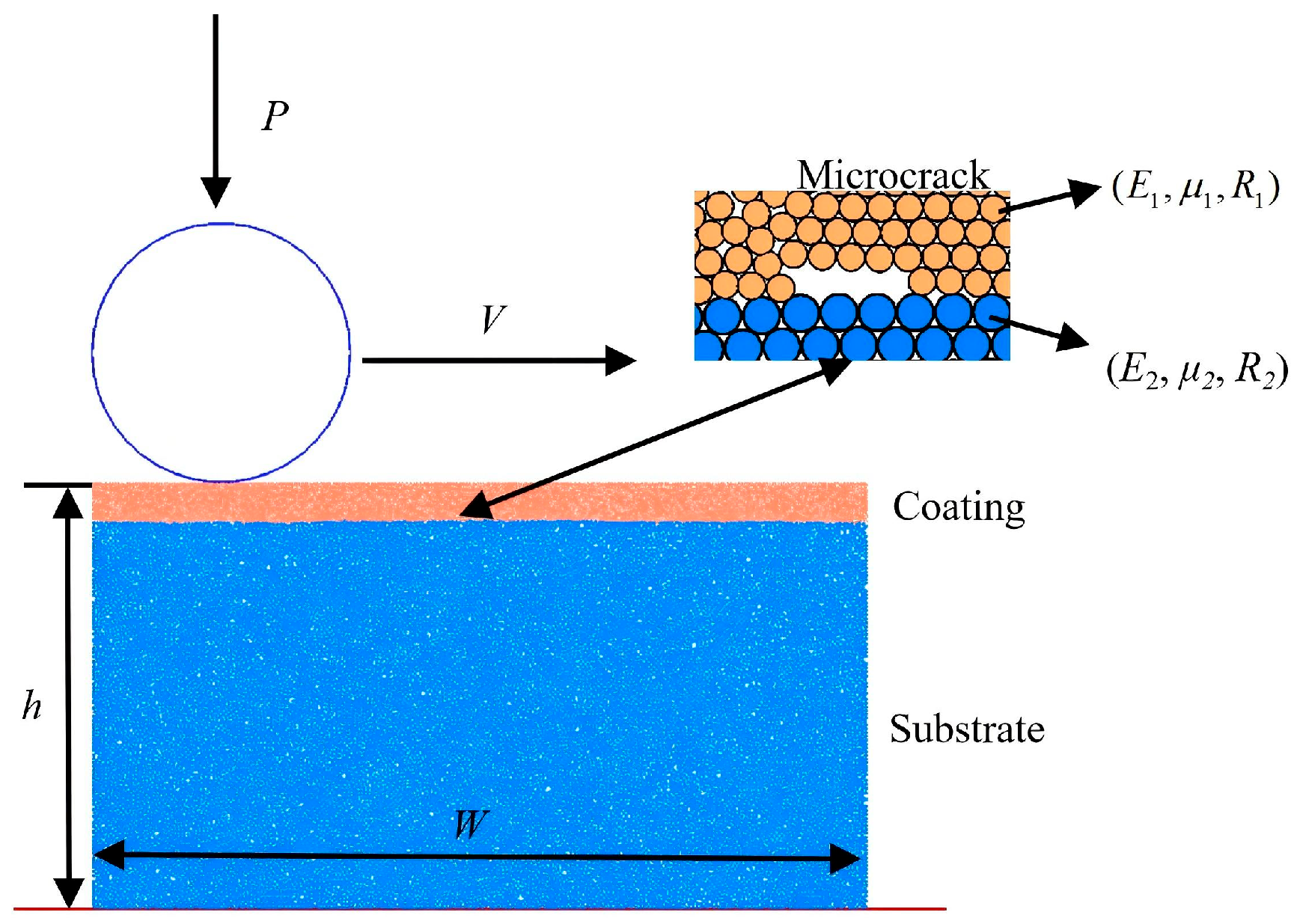
The particle elastic modulus, particle Poisson’s ratio, particle radius, and friction coefficient of the ceramic material are E2, μ2, R2, and f2, respectively. The elastic modulus, Poisson’s ratio, and friction coefficient of the coating-ceramic system interface, along with the microcrack length, are E12, μ12, f12, and l, respectively. In order to establish a DEM model of the coating-ceramic system, the PFC5.0 2D software is used to generate compact and random stacked particles, as shown in Figure 3. The length W and height h of the coating-ceramic system are 1mm and 0.5 mm, respectively. The 2D flat-jointed model is applied to the coating-ceramic system to analyze the mechanical performance of brittle materials.

4. Numerical Results and Discussion

The normal load P and moving speed V of the rigid sphere are −50 N and 0.2 m/s. Poisson’s ratios of the coating grain μ1 and the ceramic particles μ2 are 0.28 and 0.3, respectively. The radius of the coating grains R1 and ceramic particles R2 are 0.15 μm and 0.2 μm, respectively. The particle radii (R1 = 0.15 μm for the coating and R2 = 0.2 μm for the substrate) were chosen to match the typical sub-micron grain sizes of fine-grained engineering ceramics (e.g., silicon nitride) and vapor-deposited hard coatings (e.g., DLC, CrAlN). This selection enables the model to capture the realistic granular microstructure of both coating and substrate. The friction coefficient of the ceramic particle f2 is 0.1. The dimension stress parameter is the permissible contact stress for uncoated contact σ0. The dimension length parameter is the contact radius for uncoated a. h/a is the ratio of coating thickness h to the uncoated Hertzian contact radius a and represents the relative coating thickness with respect to the characteristic contact size.
The material parameters of the coating-ceramic system interface can be calculated as follows:
E 12 = E 1 + E 2 2
μ 12 = μ 1 + μ 2 2
f 12 = f + f 2 2
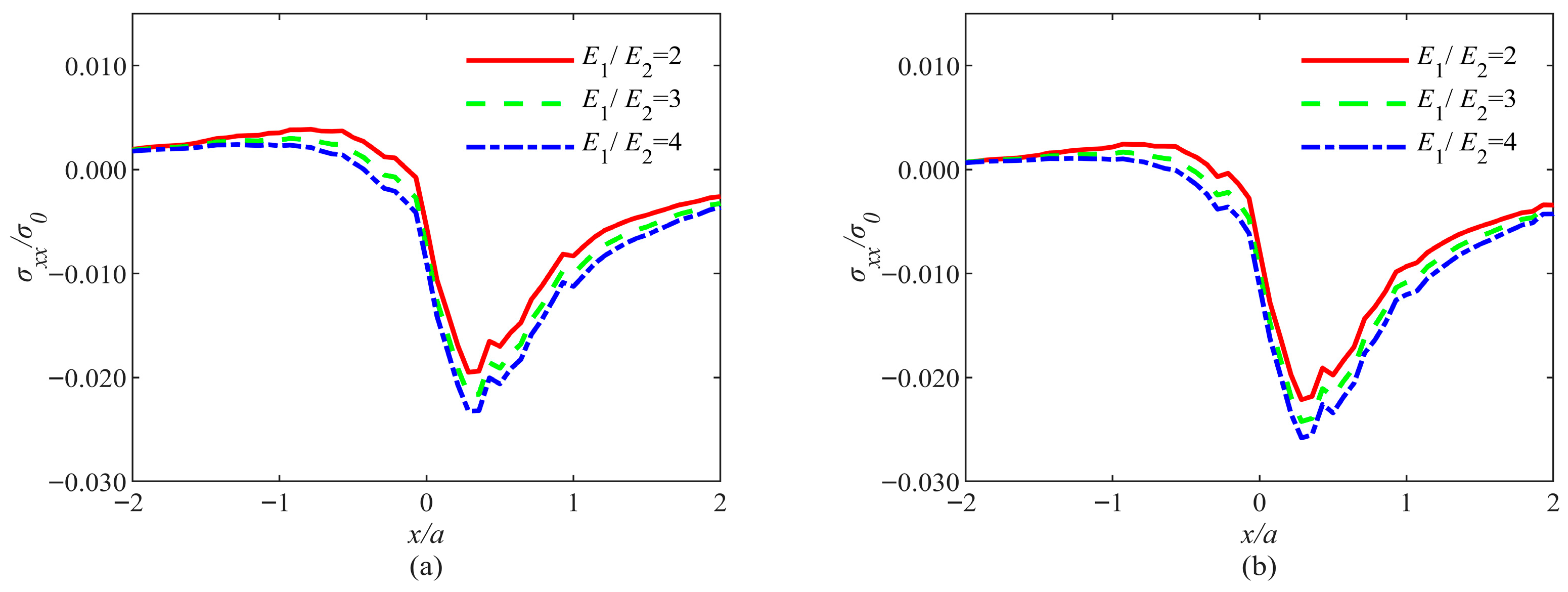
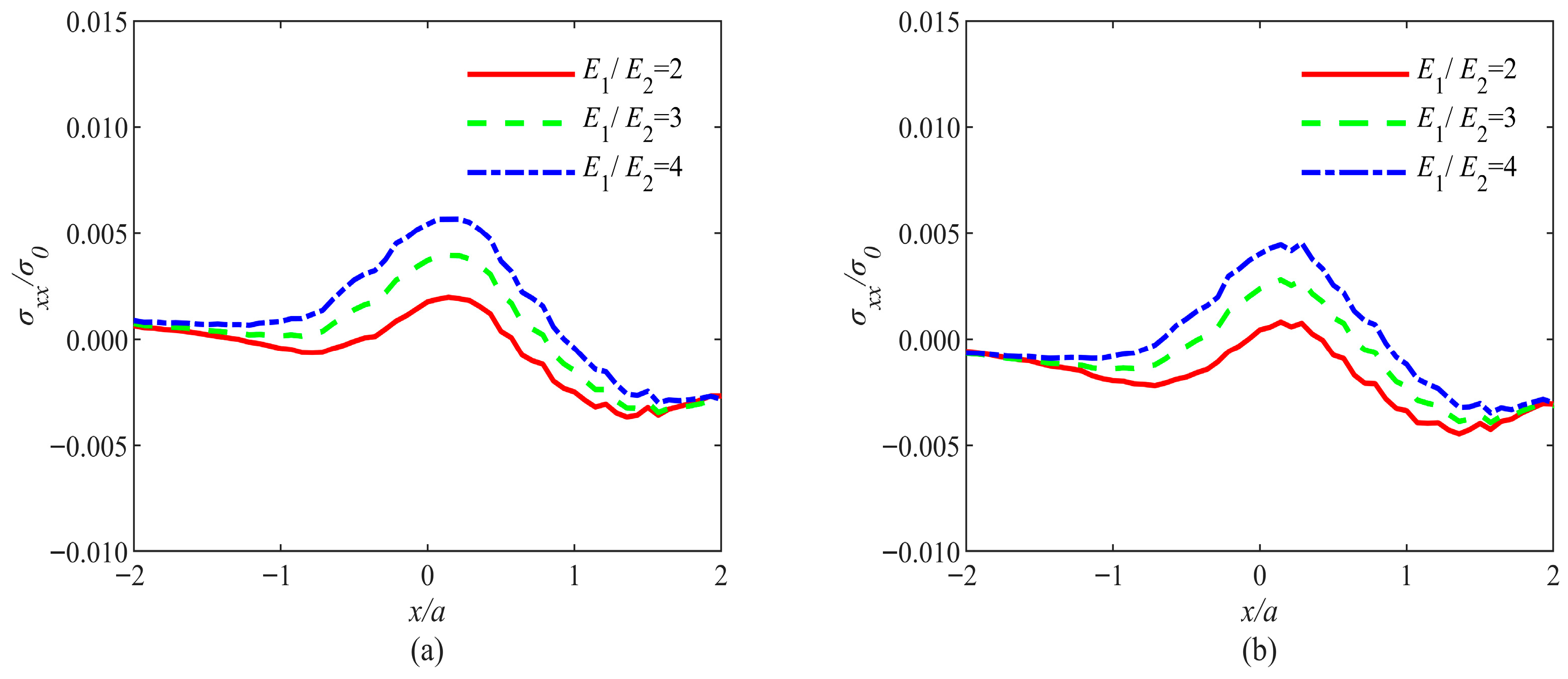
The coating-ceramic system is constructed from brittle materials. The coating surface failure is caused by high transverse stress σxx over the surface. The transverse stress σxx along the x-axis over the coating surface for various values E1/E2 and f is shown in Figure 4. The front of the contact point generates the compressive stress. The tail of the contact point generates the tensile stress, which is considered to be the cause of the coating surface cracks. As the coating-ceramic system elastic modulus ratio and coating surface friction coefficient increase, the maximum transverse stress σxx increases. The harder coatings are more suitable for low-friction applications.
The transverse stress σxx along the x-axis over the coating-ceramic system interface for various values E1/E2 and f is shown in Figure 5. An obvious tensile stress is generated at the interface of the coating-ceramic system. Compressive stress is generated in front of the contact point over the coating-ceramic system interface. As the coating-ceramic system elastic modulus ratio increases, the maximum transverse stress σxx increases. As the coating surface friction coefficient increases, the maximum tensile stress decreases. The compressive stress in front of the contact point increases slightly. Hence, a lower friction and high elastic modulus ratio may cause interfacial microcrack growth failure.
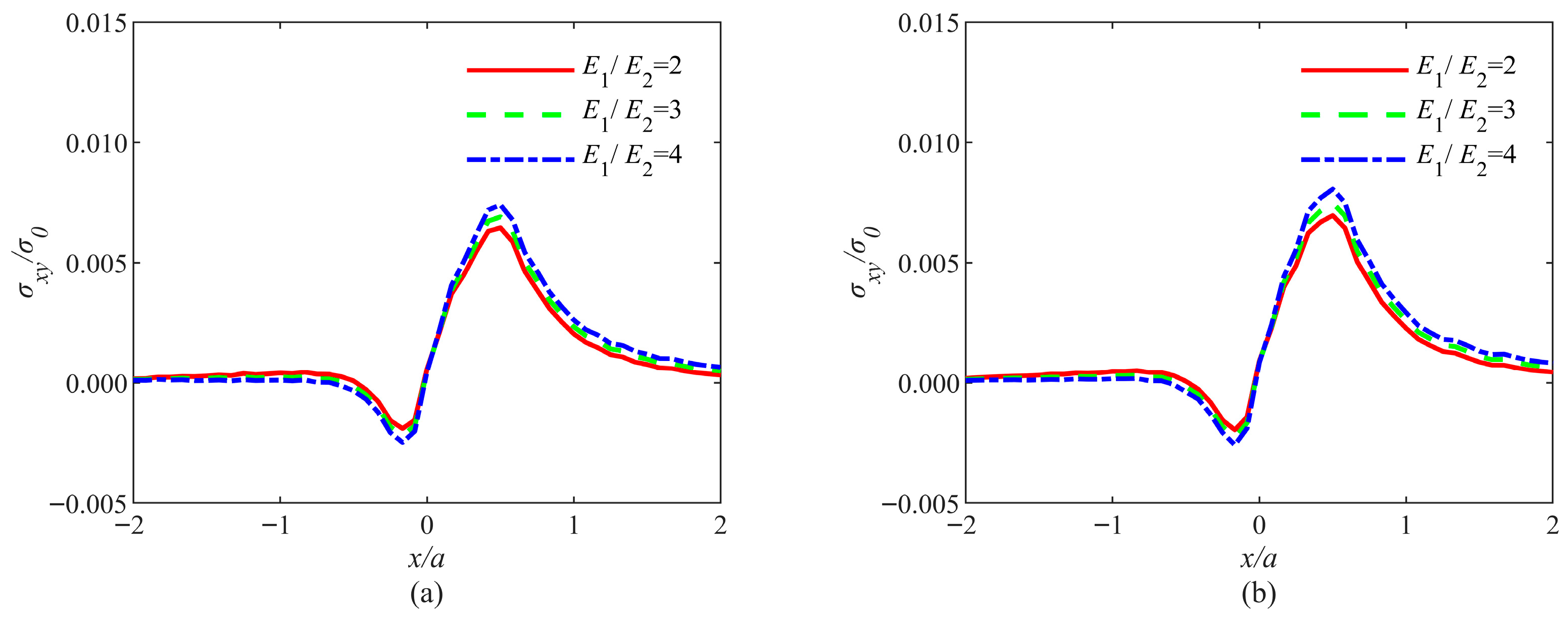
The shear stress σxy along the x-axis over the coating surface for various values E1/E2 and f is shown in Figure 6. As the coating-ceramic system elastic modulus ratio and coating surface friction coefficient increase, the maximum shear stress σxy over the coating surface increases. The maximum shear stress σxy in front of the contact point is greater than that in the tail of the contact point. This asymmetry stems from the opposing directions of the shear stress components induced by normal and tangential tractions in the trailing region, where their partial cancellation reduces the resultant shear stress magnitude.
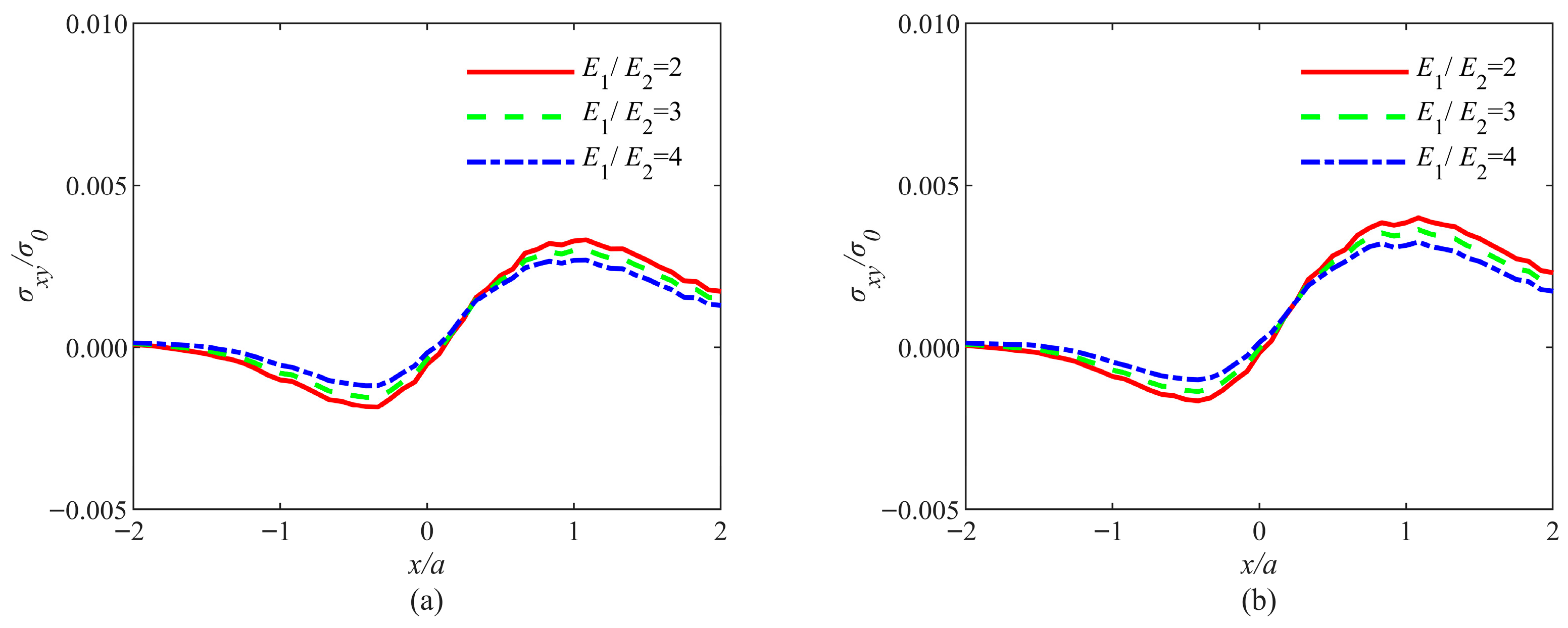
The shear stress σxy along the x-axis over the coating-ceramic system interface for various values E1/E2 and f is shown in Figure 7. As the elastic modulus ratio of the coating-ceramic system increases, the maximum shear stress σxy over the coating-ceramic system interface decreases. As the friction coefficient of the coating surface increases, the maximum shear stress σxy over the coating-ceramic system interface increases. The maximum shear stress σxy over the coating-ceramic system interface is less than the maximum shear stress over the coating surface. The adhesion failure of the coating-ceramic system interface is a main failure form in the sliding contact process, and it is important to maintain a lower interface shear stress.
Research indicates that a lower surface friction coefficient effectively reduces shear stresses at both the coating surface and the interface, which is particularly critical for high-modulus hard coatings (such as DLC, CrAlN, or TiB2-based coatings). Since these materials are inherently more brittle, they are highly sensitive to shear stress concentrations. Therefore, in the application of such hard coatings, reducing the effective friction coefficient—through surface modification (e.g., doping with lubricating phases), optimizing surface finish, or applying lubricants—represents an effective engineering strategy to mitigate the risk of interfacial delamination and extend service life.
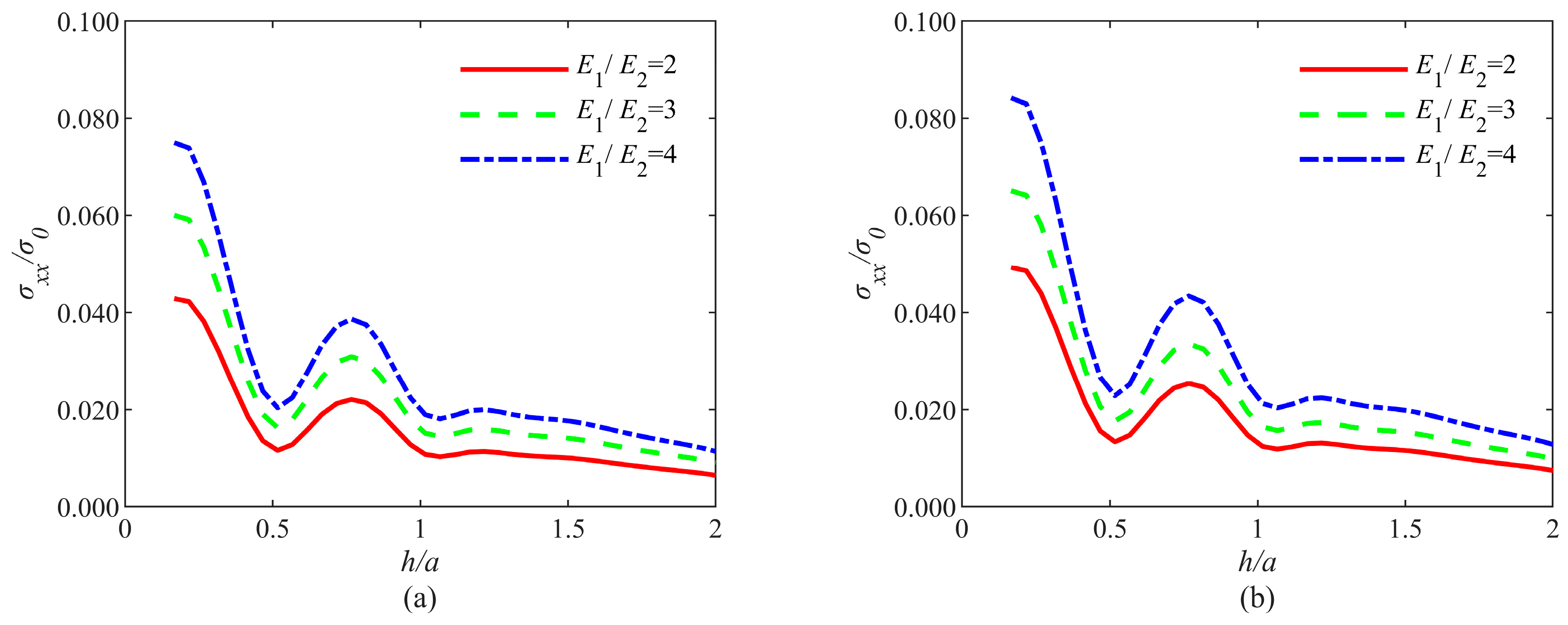
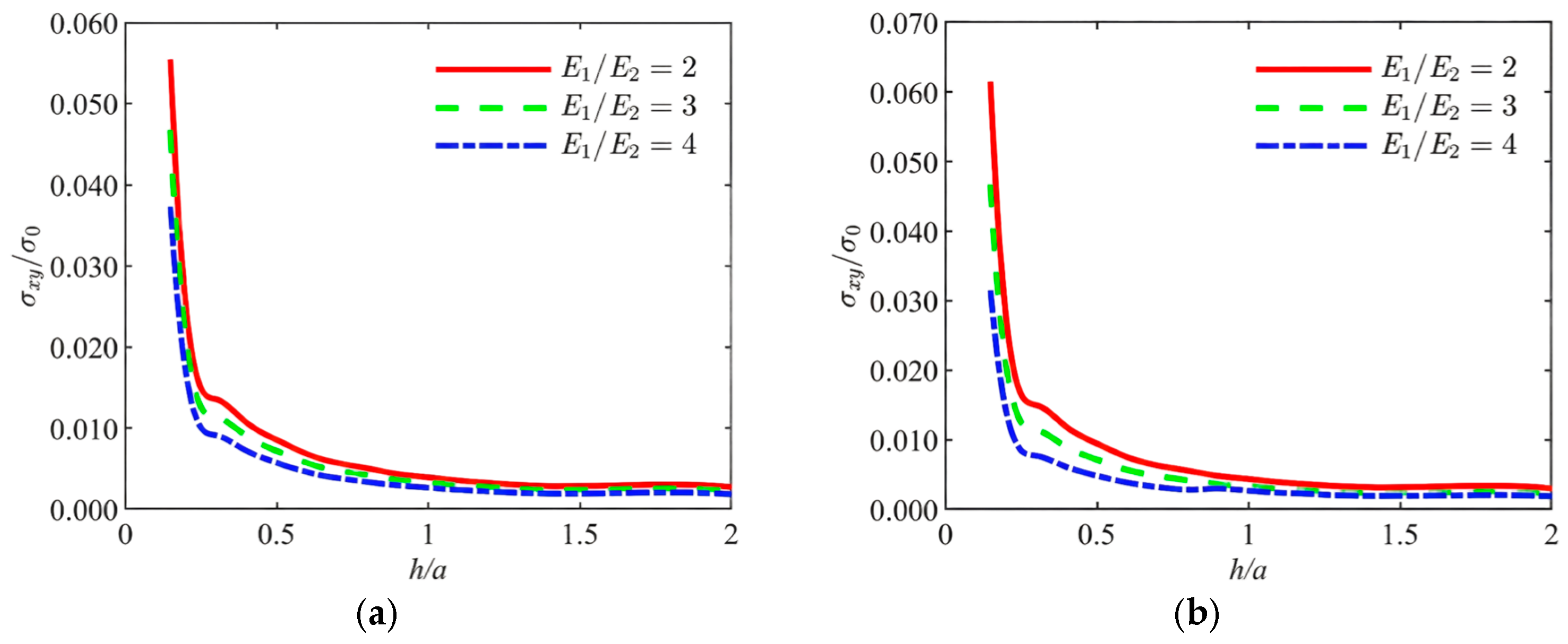
The maximum transverse stress σxx over the coating surface for various values E1/E2 and h/a is shown in Figure 8. When the thickness of the coating increases, the maximum transverse stress σxx over the coating surface shows a decreasing trend. The maximum transverse stress σxx decreases rapidly when coating thickness h/a is less than 0.5. When the coating thickness h/a is equal to 0.75, the maximum transverse stress σxx has a local peak. The maximum stress decreases slowly when the coating thickness h/a is greater than 1.
It is noteworthy that a local stress peak is observed near h/a ≈ 0.75 in Figure 8, which requires explanation from a mechanical mechanism perspective. This phenomenon may be related to the transitional behavior of the stress state in the coating/substrate system as the thickness varies. When the coating is relatively thin (h/a < 0.5), the stress field is primarily dominated by the constraining effect of the rigid substrate, and the interfacial shear stress decays rapidly with increasing thickness. When the coating thickness increases to approximately h/a ≈ 0.75, the influence of the coating’s own stiffness becomes significant, and its local bending deformation may lead to an increase in bending moment, thereby causing a temporary rise in surface stress. With a further increase in thickness (h/a > 1), the system gradually enters a more stable stress state dominated by the coating itself, resulting in a subsequent decrease in stress and a tendency toward gradual variation.
The maximum shear stress σxy over the coating-ceramic system interface for various values E1/E2 and h/a is shown in Figure 9. The maximum interfacial shear stress σxy shows a decreasing trend. When the coating thickness h/a exceeds 0.5, the maximum stress no longer changes significantly. Therefore, in the design of a coating-ceramic system, a reasonable coating thickness should be selected to avoid premature failure due to excessive stress gradient, large compressive stress, and shear stress. For hard coatings, h/a = 0.5 is a suitable choice.
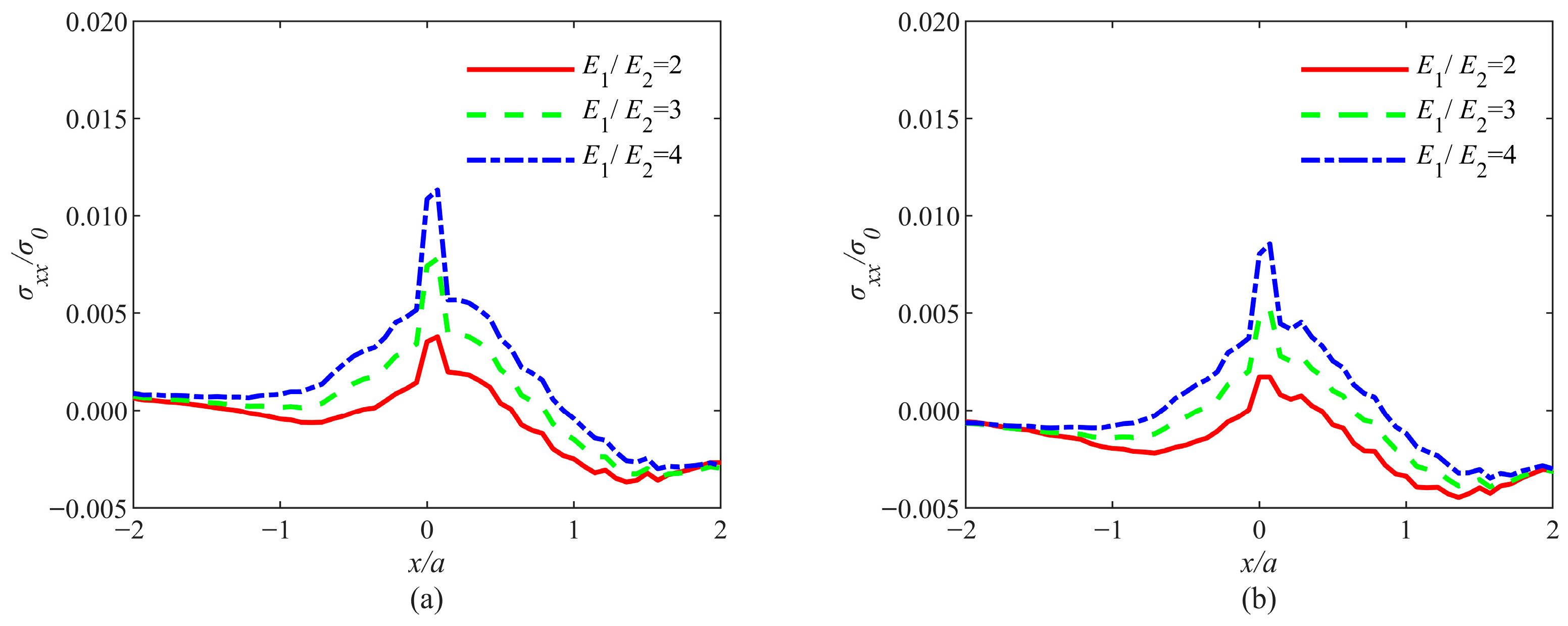
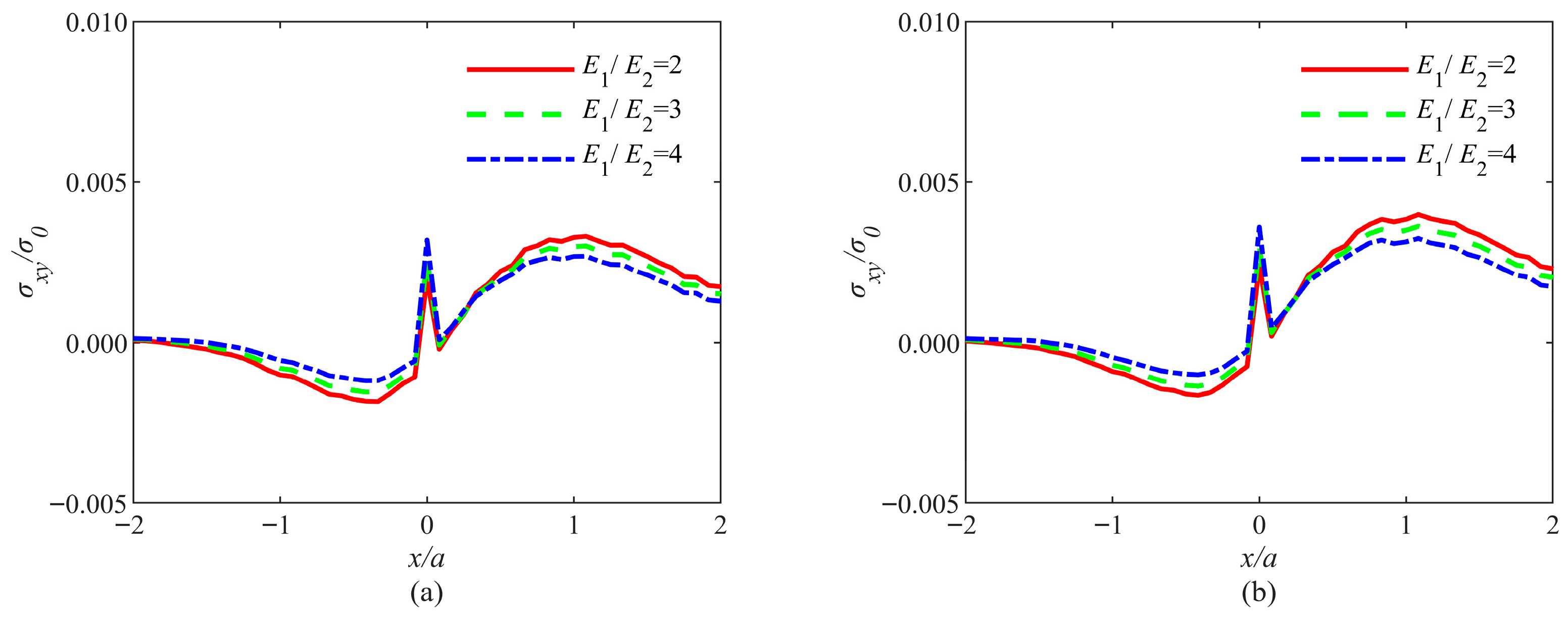
The influence of microcrack defects on the stress of the coating-ceramic system cannot be ignored. A microcrack defect with a length of 1 um is added at the coating interface. The transverse stress σxx and shear stress σxy, when microcrack defects are present along the x-axis over the coating-ceramic interface for various values E1/E2 and f, are shown in Figure 10 and Figure 11. At the location of microcrack defects, coating-ceramic system interfacial shear stresses σxy and transverse stresses σxx can generate stress concentrations. The concentrated stress increases with an increasing coating-ceramic system elastic modulus ratio. As the coating surface friction coefficient increases, the shear concentration stress increases. As the coating surface friction coefficient increases, the transverse concentrated stress decreases. The coating with a high grain elasticity modulus is more sensitive to microcracking defects. With the increase in the coating thickness, the probability of microcrack defects in the coating increases. The microcrack defects also lead to the premature failure of the coating. When there is a microcrack defect at the coating-ceramic system interface, the failure may occur earlier for coatings with a high grain elastic modulus.
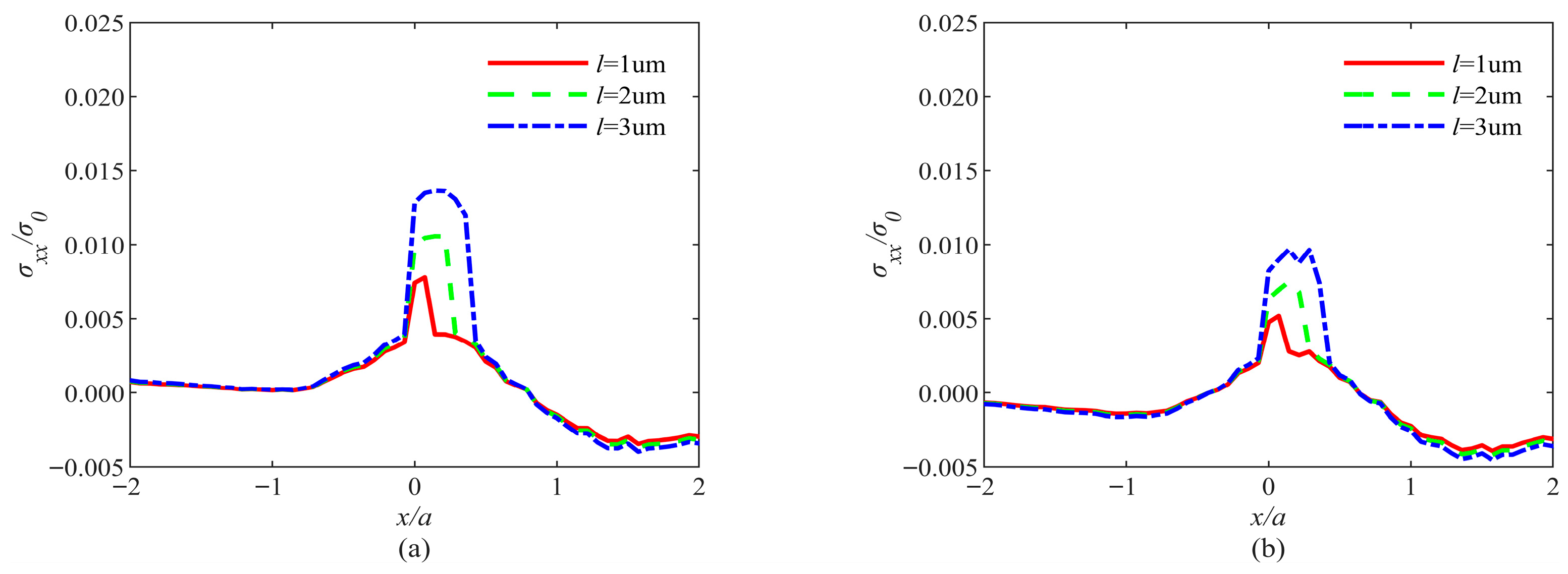
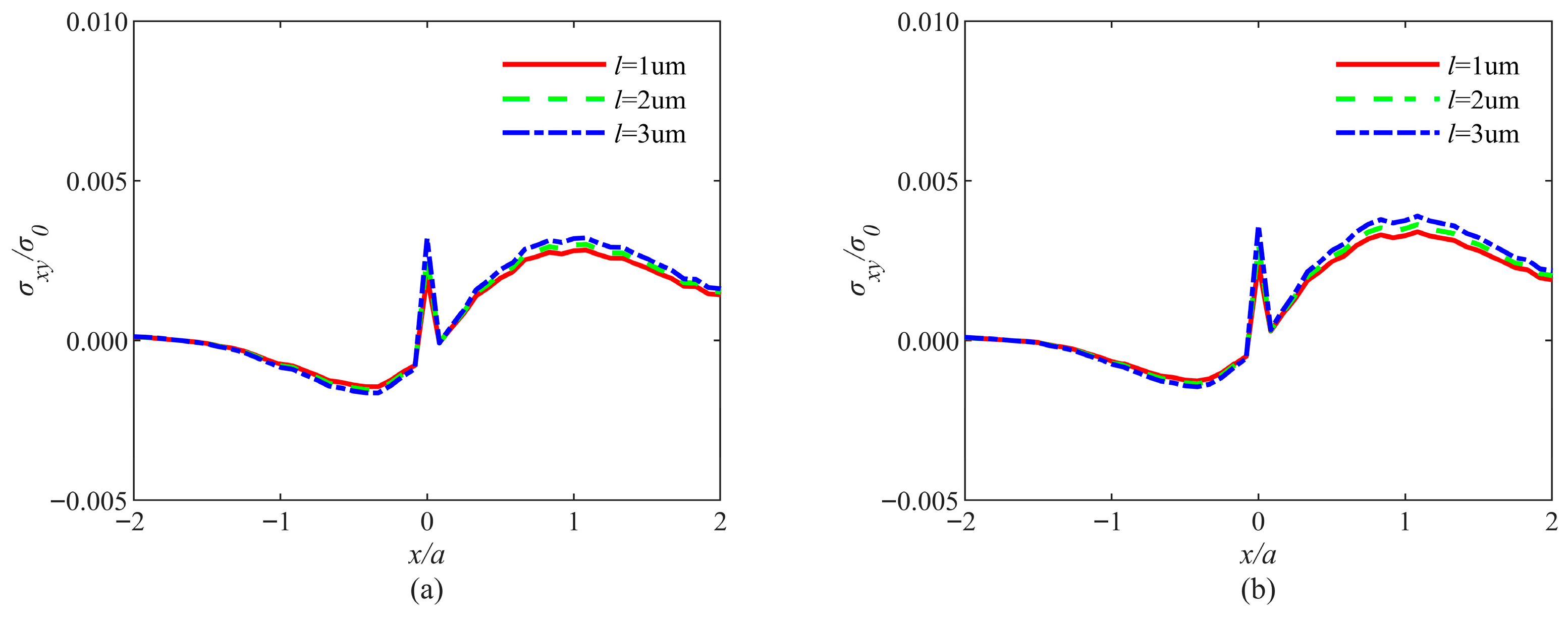
The transverse stress σxx and shear stress σxy, when microcrack defects are present along the x-axis over the coating-ceramic system interface for various values of microcrack defect length l and f, are shown in Figure 12 and Figure 13. With the increase in interface microcrack defect length, the concentrated stress of transverse stress σxx increases, and the width of the concentrated stress increases. As the interface microcrack defect length increases, the shear concentrated stress increases, and the concentrated stress width is not significantly affected. In low-friction applications, microcrack defects may cause coating fracture failure. In high-friction applications, microcrack defects may cause coating adhesion failure.

5. Conclusions

This study employs the DEM to systematically analyze the stress distribution during sliding contact of a rigid sphere on a coating-ceramic system, revealing the influence mechanisms of key parameters such as the coating-to-substrate elastic modulus ratio, surface friction coefficient, coating thickness, and interfacial microcracks. The main conclusions are as follows:
(1)
The elastic modulus ratio between the coating and the substrate (E1/E2) is a key factor affecting the stress state. A higher modulus ratio increases the transverse stress on the coating surface and at the interface but simultaneously reduces the interfacial shear stress. Therefore, hard coatings (e.g., DLC, CrAlN) are more suitable for low-friction conditions, while coatings with a lower modulus are preferable for high-friction applications.
(2)
There exists a relatively optimal value for coating thickness. When the ratio of coating thickness to the uncoated Hertzian contact radius (h/a) is approximately 0.5, the system achieves a better balance between surface stress and interfacial shear stress. Although excessively thick coatings (h/a > 1) can reduce surface stress, they increase the risk of microcrack formation, which is detrimental to long-term reliability.
(3)
Interfacial microcracks induce significant local stress concentration, and the severity of which increases with crack length. High elastic modulus coatings are more sensitive to such defects, making them prone to early failure. A high friction coefficient exacerbates shear stress concentration, promoting adhesive failure, while under low-friction conditions, the primary risk is coating fracture due to tensile stress.
The two-dimensional model used in this study does not fully capture the complexity of three-dimensional contact. Future work could develop three-dimensional discrete element models and combine them with in situ experiments to further investigate failure mechanisms under multi-axial loads, temperature fields, and dynamic contact conditions, providing a more comprehensive theoretical basis for the development of high-performance ceramic bearing coating systems.

Author Contributions

Conceptualization, X.G. and Y.L.; methodology, Y.L.; software, H.L. and J.L.; validation, X.G., Y.L. and J.L.; formal analysis, Y.L.; investigation, Y.L. and H.L.; resources, Y.L.; data curation, H.L.; writing—original draft preparation, Y.L.; writing—review and editing, H.L.; visualization, J.L.; supervision, X.X.; project administration, X.X.; funding acquisition, X.X. All authors have read and agreed to the published version of the manuscript.

Funding

This work was supported by the Science Research Fund of the Department of Science and Technology of Liaoning Province, China (2025-MSLH-587). This work was supported by the National Natural Science Foundation of China (52275119).

Data Availability Statement

The detailed data supporting the results of this study are available from the corresponding authors upon request.

Acknowledgments

During the preparation of this manuscript/study, the authors used generative AI tools (such as ChatGPT/GPT-4) to polish language. The authors have reviewed and edited the output and take full responsibility for the content of this publication.

Conflicts of Interest

The authors declare no conflicts of interest.

References

  1. Lu, H.; Wu, Y.; Liu, Z.; Wang, H.; Yan, G.; Bai, X.; Guo, J.; Zheng, T. Effect of Process Parameters on the Growth and Wear Resistance of CrAlN Coating on Silicon Nitride Surface. Ind. Lubr. Tribol. 2024, 76, 186–195. [Google Scholar] [CrossRef]
  2. Du, X.; Lee, S.S.; Blugan, G.; Ferguson, S.J. Silicon Nitride as a Biomedical Material: An Overview. Int. J. Mol. Sci. 2022, 23, 6551. [Google Scholar] [CrossRef] [PubMed]
  3. Anghel, I.-M.; Pascu, A.; Hulka, I.; Woelk, D.H.; Uțu, I.-D.; Mărginean, G. Characterization of Cobalt-Based Composite Multilayer Laser-Cladded Coatings. Crystals 2025, 15, 970. [Google Scholar] [CrossRef]
  4. Jiang, H.; Han, K.; Li, D.; Cao, Z. Synthesis and Characterization of AlCoCrFeNiNbx High-Entropy Alloy Coatings by Laser Cladding. Crystals 2019, 9, 56. [Google Scholar] [CrossRef]
  5. Osuch-Słomka, E.; Michalczewski, R.; Mańkowska-Snopczyńska, A.; Gibała, M.; Wieczorek, A.N.; Skołek, E. Influence of Gear Set Loading on Surface Damage Forms for Gear Teeth with DLC Coating. Coatings 2025, 15, 857. [Google Scholar] [CrossRef]
  6. Lu, H.; Wu, Y.; Liu, Z.; Zheng, T.; Guo, J. Regulation of Ag Atom Diffusion in CrAlN-Ag Coatings Based on Diffusion Mechanism. Int. J. Appl. Ceram. Technol. 2025, 22, e15150. [Google Scholar] [CrossRef]
  7. Li, N.; He, D.; Liu, D.; Ma, L.; He, C.; Xu, Y.; Yu, J. In-Situ TiB Reinforced Titanium Matrix Composite Coatings Prepared by Laser Cladding: Effect of TiB2 Content on Microstructure, Hardness and Wear Properties. J. Alloys Compd. 2024, 1010, 178215. [Google Scholar] [CrossRef]
  8. Tsuji, T.; Harada, S.; Teraji, T. Measuring the Stress Tensor in Nitrogen-Doped CVD Diamond Using Solid-State Quantum Sensor. Sci. Technol. Adv. Mater. 2025, 26, 2546779. [Google Scholar] [CrossRef]
  9. Chen, C.; Wei, M.; Zhu, X.; Wang, J.; Lu, X. Microstructure and Corrosion Resistance of C-BN/NiCrAl Coatings Synthesized by Laser Cladding. Mater. Today Commun. 2025, 46, 112827. [Google Scholar] [CrossRef]
  10. Zhu, K.; Chen, N.; Jiang, Z.; Li, P.; Jin, X. Symmetrization of Contact Stresses in Coating under Frictional Sliding Indentation. Mech. Adv. Mater. Struct. 2022, 31, 470–482. [Google Scholar] [CrossRef]
  11. Waddad, Y.; Magnier, V.; Dufrénoy, P.; De Saxcé, G. Multiscale Thermomechanical Modeling of Frictional Contact Problems Considering Wear—Application to a Pin-On-Disc System. Wear 2019, 426–427, 1399–1409. [Google Scholar] [CrossRef]
  12. Yu, C.; Wang, Z.; Wang, Q.J. Analytical Frequency Response Functions for Contact of Multilayered Materials. Mech. Mater. 2014, 76, 102–120. [Google Scholar] [CrossRef]
  13. Huang, Y.; Zhao, M.; Feng, M. Electric–Elastic Analysis of Multilayered Two-Dimensional Decagonal Quasicrystal Circular Plates with Simply Supported or Clamped Boundary Conditions. Math. Mech. Solids 2021, 26, 1337–1353. [Google Scholar] [CrossRef]
  14. Hamilton, G.M.; Goodman, L.E. The Stress Field Created by a Circular Sliding Contact. J. Appl. Mech. 1966, 33, 371–376. [Google Scholar] [CrossRef]
  15. Burmister, D.M. The General Theory of Stresses and Displacements in Layered Systems. I. J. Appl. Phys. 1945, 16, 89–94. [Google Scholar] [CrossRef]
  16. Chen, W.; Engel, P.A. Impact and Contact Stress Analysis in Multilayer Media. Int. J. Solids Struct. 1972, 8, 1257–1281. [Google Scholar] [CrossRef]
  17. Westmann, R.A. Layered Systems Subjected to Asymmetric Surface Shears. Proc. R. Soc. Edinb. A: Math. 1963, 66, 140–149. [Google Scholar] [CrossRef]
  18. King, R.B.; O’Sullivan, T.C. Sliding Contact Stresses in a Two-Dimensional Layered Elastic Half-Space. Int. J. Solids Struct. 1987, 23, 581–597. [Google Scholar] [CrossRef]
  19. O’Sullivan, T.C.; King, R.B. Sliding Contact Stress Field due to a Spherical Indenter on a Layered Elastic Half-Space. J. Tribol. 1988, 110, 235–240. [Google Scholar] [CrossRef]
  20. Ramalingam, S.; Zheng, L. Film-Substrate Interface Stresses and Their Role in the Tribological Performance of Surface Coatings. Tribol. Int. 1995, 28, 145–161. [Google Scholar] [CrossRef]
  21. Mao, K.; Sun, Y.; Bell, T. A Numerical Model for the Dry Sliding Contact of Layered Elastic Bodies with Rough Surfaces. Tribol. Trans. 1996, 39, 416–424. [Google Scholar] [CrossRef]
  22. Shi, Z.; Ramalingam, S. Stresses in Coated Solids due to Normal and Shear Tractions on an Elliptical Region. Surf. Coat. Technol. 2001, 138, 192–204. [Google Scholar] [CrossRef]
  23. Wang, Z.-J.; Wang, W.-Z.; Wang, H.; Zhu, D.; Hu, Y.-Z. Partial Slip Contact Analysis on Three-Dimensional Elastic Layered Half Space. J. Tribol. 2010, 132, 021403. [Google Scholar] [CrossRef]
  24. Cai, S.; Bhushan, B. A Numerical Three-Dimensional Contact Model for Rough, Multilayered Elastic/Plastic Solid Surfaces. Wear 2005, 259, 1408–1423. [Google Scholar] [CrossRef]
  25. Kot, M. Contact Mechanics of Coating-Substrate Systems: Monolayer and Multilayer Coatings. Arch. Civ. Mech. Eng. 2012, 12, 464–470. [Google Scholar] [CrossRef]
  26. Wang, T.; Wang, L.; Gu, L.; Zheng, D. Stress Analysis of Elastic Coated Solids in Point Contact. Tribol. Int. 2015, 86, 52–61. [Google Scholar] [CrossRef]
  27. Alinia, Y.; Espo, M. Sliding Contact Problem of an FGM Coating/Substrate System with Two-Dimensional Material Property Grading. Acta Mech. 2019, 231, 649–659. [Google Scholar] [CrossRef]
  28. Chen, R.; Wang, X.; Xiao, X.; Hu, C.; Peng, R.; Wang, Y. A Multi-Objective Identification of DEM Microparameters for Brittle Materials. Crystals 2022, 12, 387. [Google Scholar] [CrossRef]
  29. Zhao, Y.; Weng, M.; Wang, W.; Wang, W.; Qi, H.; Li, C. Fixed Particle Size Ratio Pure Copper Metal Powder Molding Fine Simulation Analysis. Crystals 2025, 15, 628. [Google Scholar] [CrossRef]
  30. Zhang, S.; Wu, S.; Kang; Duan, K. Study on the Deformation and Strength Characteristics of Hard Rock under True Triaxial Stress State Using Bonded-Particle Model. Comput. Geotech. 2019, 112, 1–16. [Google Scholar] [CrossRef]
Figure 1. 2D flat-jointed model.
Crystals 16 00146 g001
Figure 2. Sliding contact problem for a coating-ceramic system.
Crystals 16 00146 g002
Figure 3. Discrete element method model for a coating-ceramic system.
Crystals 16 00146 g003
Figure 4. Transverse stress σxx along the x-axis over the coating surface for various values E1/E2 and f when h/a = 1: (a) f = 0.1, (b) f = 0.5.
Crystals 16 00146 g004
Figure 5. Transverse stress σxx along the x-axis over the coating-ceramic system interface for various values E1/E2 and f when h/a = 1: (a) f = 0.1, (b) f = 0.5.
Crystals 16 00146 g005
Figure 6. Shear stress σxy along the x-axis over the coating surface for various values E1/E2 and f when h/a = 1: (a) f = 0.1, (b) f = 0.5.
Crystals 16 00146 g006
Figure 7. Shear stress σxy along the x-axis over the coating-ceramic interface for various values E1/E2 and f when h/a = 1: (a) f = 0.1, (b) f = 0.5.
Crystals 16 00146 g007
Figure 8. Maximum transverse stress over the coating surface for various values E1/E2 and h/a: (a) f = 0.1, (b) f = 0.5.
Crystals 16 00146 g008
Figure 9. Maximum shear stress σxy over the coating-ceramic interface for various values E1/E2 and h/a: (a) f = 0.1, (b) f = 0.5.
Crystals 16 00146 g009
Figure 10. Transverse stress σxx along the x-axis over the coating-ceramic interface for various values E1/E2 and f when microcrack length l = 1 μm, h/a = 1: (a) f = 0.1, (b) f = 0.5.
Crystals 16 00146 g010
Figure 11. Shear stress σxy along the x-axis over the coating-ceramic interface for various values E1/E2 and f when microcrack length l = 1 μm, h/a = 1: (a) f = 0.1, (b) f = 0.5.
Crystals 16 00146 g011
Figure 12. Transverse stress σxx along the x-axis over the coating-ceramic interface for various values microcrack length and f when E1/E2 = 3, h/a = 1: (a) f = 0.1, (b) f = 0.5.
Crystals 16 00146 g012
Figure 13. Shear stress σxy along the x-axis over the coating-ceramic interface for various values microcrack length and f when E1/E2 = 3, h/a = 1: (a) f = 0.1, (b) f = 0.5.
Crystals 16 00146 g013
Disclaimer/Publisher’s Note: The statements, opinions and data contained in all publications are solely those of the individual author(s) and contributor(s) and not of MDPI and/or the editor(s). MDPI and/or the editor(s) disclaim responsibility for any injury to people or property resulting from any ideas, methods, instructions or products referred to in the content.