Article

Study on the IMC Growth Mechanism of Cu/Sn-58Bi/Cu Joint Under Electromigration with Alternating Current


1
East China Institute of Photo-Electron IC, Bengbu 233000, China
2
Guangxi Key Laboratory of Advanced Packaging and System Integration, School of Mechanical and Electrical Engineering, Guilin University of Electronic Technology, Guilin 541004, China
3
Goertek Inc., Weifang 261000, China
*
Authors to whom correspondence should be addressed.
Crystals 2026, 16(2), 127; https://doi.org/10.3390/cryst16020127
Submission received: 13 January 2026 / Revised: 31 January 2026 / Accepted: 5 February 2026 / Published: 9 February 2026
(This article belongs to the Special Issue Recent Research on Electronic Materials and Packaging Technology)

Abstract

With the ongoing miniaturization of solder joints in three-dimensional integrated electronic packaging, electromigration reliability has become a pressing concern. This study systematically examines the interfacial intermetallic compound (IMC) growth behavior of Cu/Sn-58Bi/Cu joint under electromigration (EM) with a symmetrical square-wave alternating current (AC). Electron backscatter diffraction (EBSD) was employed to perform statistical spatial analysis of Sn grain orientations within the joints to reveal the growth mechanism of interfacial IMC. Results demonstrate that the AC field markedly enhances the anisotropy of IMC growth in Cu/Sn-58Bi/Cu joints, exhibiting two phenomena: uniform growth on both sides and rapid growth (polar growth) on one side of the interfacial IMC. Among them, the IMC thickness difference characterization quantity ΔIMC reached as high as 45.56% for the latter. This is attributed to the directional regulation of atomic migration rate by Sn grain orientation (the angle θ between the c-axis and the electron flow) and is further amplified by the altered atomic diffusion pathways imposed by the Bi phase distribution. Specifically, the Sn grains exhibit a pronounced preferential orientation mode along the current path (horizontal direction), with an orientation gradient of 0.915 μm−1. The arrangement of Bi-rich phases alters the distribution of Sn grains in Cu/Sn-58Bi/Cu joints, thereby reshaping the internal electron transport pathways and significantly intensifying the orientation-dependent effect of IMC growth. Moreover, Sn grains adjacent to the Bi-rich phase boundaries (phase boundary grains) display a stronger tendency for c-axis orientation parallel to the current direction, exhibiting an average effective orientation parameter 1.948 times greater than that of bulk grains, which establishes a well-defined spatial orientation gradient.

1. Introduction

The electromigration (EM) reliability of solder joints is a key factor influencing the reliability of high-density packaging, and significant progress has been made in understanding its mechanism. Numerous studies have shown that under direct current (DC) stressing, the growth behavior of intermetallic compound (IMC) in solder joints exhibits a clear polarity and is significantly affected by the state of the solder (solid/liquid). The fundamental driving force is the directional migration of atoms caused by electron wind [1,2,3,4,5,6,7,8,9]. At the same time, EM under alternating current (AC) conditions has also attracted attention. Due to the periodic alternation of AC direction, directional EM is weakened, while the randomness of atomic diffusion is enhanced. Therefore, IMC may randomly form and grow at the interface on both sides of joints, which differs from that under DC conditions. This is usually attributed to atomic migration driven by thermal and concentration gradients [10,11,12,13]. Further research indicates that the current crowding effect [14] and the anisotropy of the crystallographic orientation of Sn grains [15,16,17,18,19,20,21,22] are two core microscopic mechanisms that regulate EM rate and failure mode. Although previous studies have profoundly revealed the dominant role of grain orientation in EM with DC stressing [19,20,21], the mechanism and extent of influence of this key factor under AC stressing remain unclear. The orientation of Sn grains in the AC field and how it dominates atomic migration processes have not been fully elucidated.
Based on the unconventional phenomenon (polar growth of interfacial IMC) observed in ball grid array (BGA) structure Cu/Sn-58Bi/Cu joints under EM with AC stressing in our previous work [23], this study investigates the influence of microstructure of Sn-58Bi on the interfacial IMC growth by comparing the differences in EM behavior between line-type Cu/Sn-58Bi/Cu and Cu/Sn/Cu joints under AC stressing. Furthermore, by analyzing the Sn grain orientation in the joint, the interfacial IMC growth mechanism under EM with AC stressing was elucidated.
The core innovation of this study lies in combining electron backscatter diffraction (EBSD) statistical analysis with microstructure characterization to elucidate the directional regulation of Sn grain orientation on atomic migration under an AC field for the first time. It also reveals how the Bi-rich phase distribution significantly amplifies this orientation-dependent effect by altering atomic diffusion and internal electron transport paths. The findings enhance understanding of the microscopic mechanisms of EM with AC stressing, particularly clarifying the specific mechanisms and extent of influence of grain orientation as a key factor under AC conditions.

2. Materials and Methods

2.1. Preparation of Samples

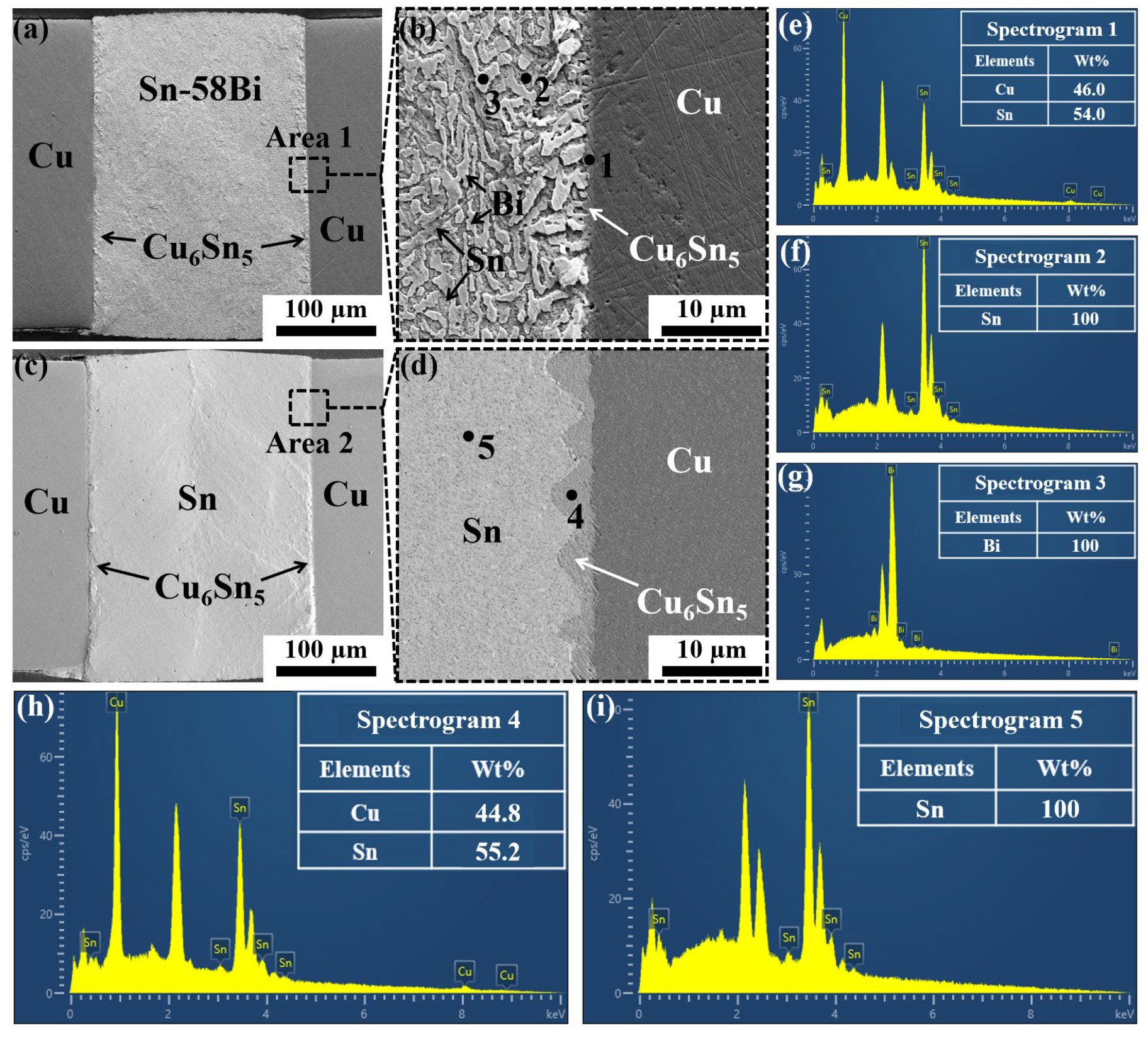
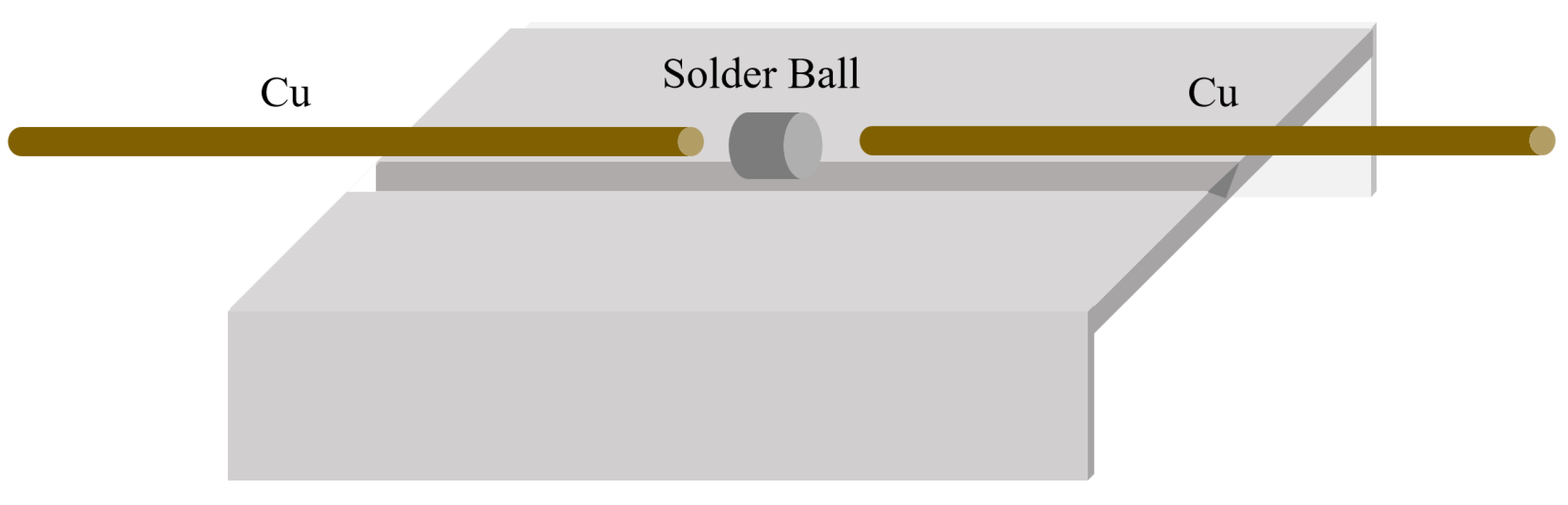
This study employs line-type structure joints to avoid current crowding caused by asymmetrical configuration, thereby more clearly revealing the influence mechanism of microstructure factors on the EM behavior of joints. The preparation process for the line-type joints is as follows: (1) Two high-purity oxygen-free copper wires (320 μm in diameter) and Sn-58Bi solder balls (300 μm in diameter) are sequentially cleaned with acetone and alcohol using ultrasonication to remove surface organic contaminants and then dried for later use. (2) The solder ball is placed between the ends of the two Cu wires, with a distance of 200 μm between the ends (i.e., the joint height), and slight pressure is applied to form a stable lap structure (as shown in Figure 1). (3) The lap structure is reflow soldered using a BGA rework station (HR460, Dinghua Technology, Shenzhen, China). During the reflow process, by setting a reasonable peak temperature and holding time, it is ensured that the solder fully melts, spreads, and undergoes a metallurgical reaction with the Cu substrate, ultimately forming a reliable Cu/Sn-58Bi/Cu joint. In addition, considering that pure Sn solder has a uniform microstructure, a line-type Cu/Sn/Cu joint was prepared using the same method as a control to study the influence of the non-uniform structure of Sn-58Bi solder. The cross-sectional morphology of the prepared joints is shown in Figure 2.

2.2. Experimental Procedure

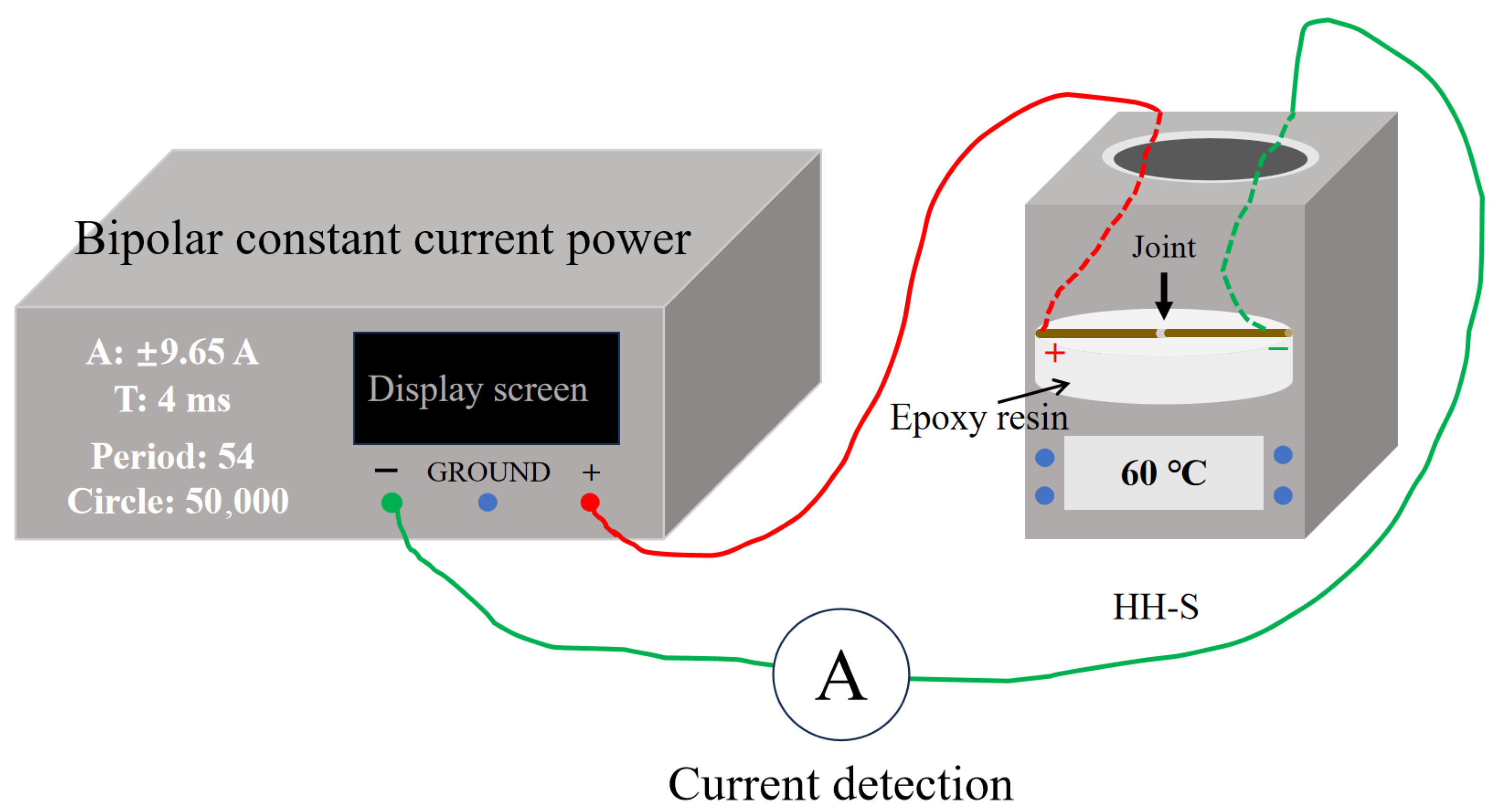
EM experiments were conducted using a symmetrical square-wave AC excitation provided by a bipolar constant power supply (KRT-1030, Kingrang Electronic Technology, Shenzhen, China). The test current was 9.65 A (1.2 × 10⁴ A/cm2), the frequency was 250 Hz, and the energizing time was 180 min. Simultaneously, the joint samples were placed in a constant-temperature oil bath to ensure temperature uniformity. The oil bath temperatures for Cu/Sn-58Bi/Cu and Cu/Sn/Cu were set to 60 °C and 120 °C, respectively, to ensure that the solder matrix remained in a solid state throughout the EM experiment. Epoxy resin was used to splice the electrical connections of the samples to achieve insulation and mechanical protection. A schematic diagram of the EM experiment is shown in Figure 3. After EM, scanning electron microscopy (SEM, ZEISS G360) and EBSD (ZEISS G360, Carl Zeiss AG, Oberkochen, Germany) were used to characterize the microstructure and grain orientation of the samples, respectively. The sample surface was ion-polished using an argon ion polisher (EM TIC 3X, Leica Microsystems, Wetzlar, Germany) before EBSD characterization. Moreover, the interfacial IMC thickness was obtained by dividing the total area of the interfacial IMC phase by its projected interfacial length. It is worth noting that the IMC thickness of both interfaces of the joint was calculated separately, and 20 sets of tests were conducted for each type of joint.

3. Results and Discussion

3.1. Quantitative Analysis of IMC Thickness Difference on Both Sides of the Joint After EM

To quantitatively evaluate the evolution behavior of interfacial IMC on both sides of the joint after EM, the growth asymmetry of the IMC is described by the ratio of the IMC thickness difference (TleftTright) to the joint height (H):
Δ IMC = T left T right ÷ H × 100 %
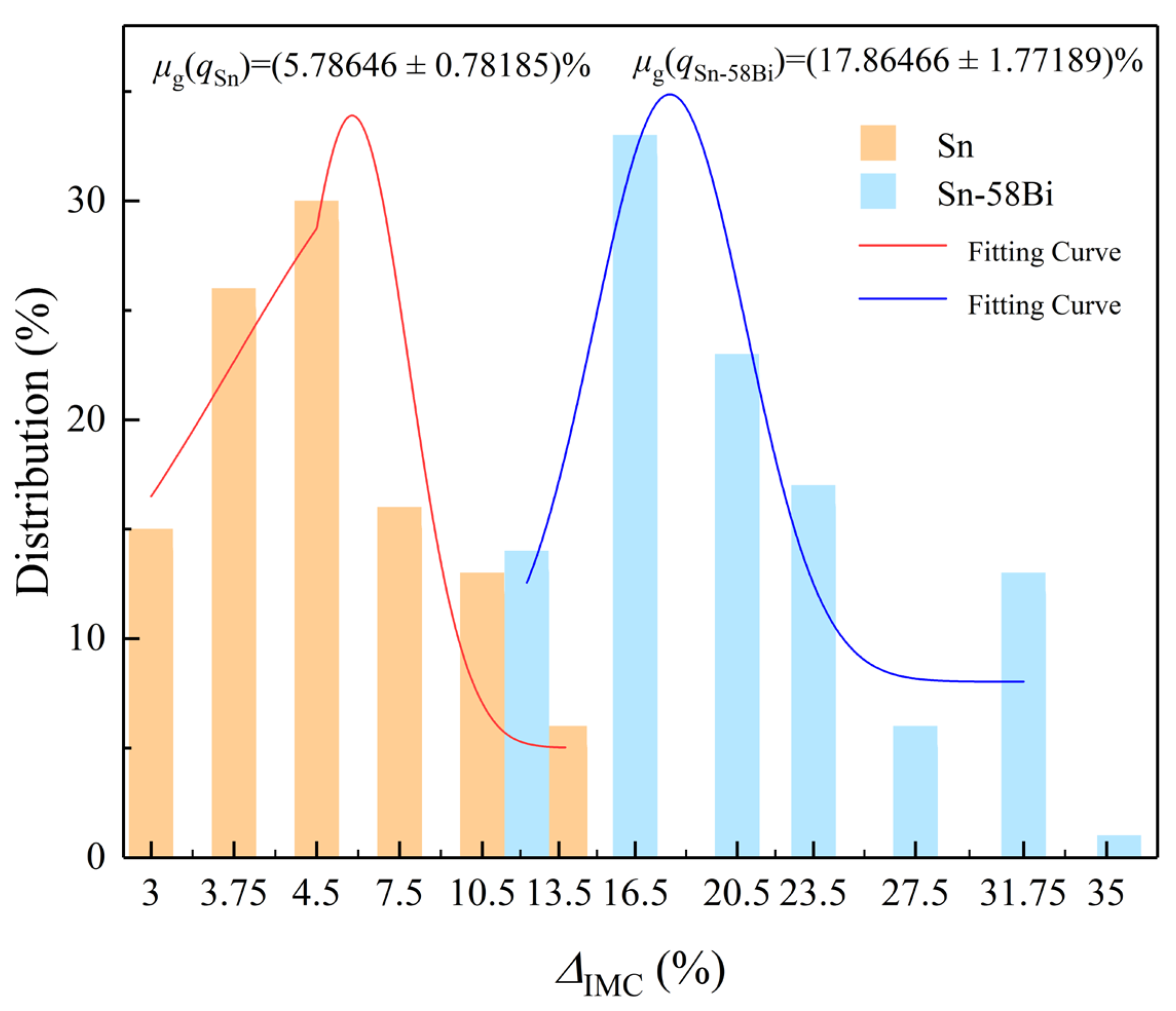
where ΔIMC is the IMC thickness difference characterization quantity; the larger the value of ΔIMC, the more significant the asymmetry in IMC growth. Tleft and Tright represent the interfacial IMC thickness of the left and right sides of the joint, respectively. According to Equation (1), the ΔIMC values of 20 groups of Cu/Sn-58Bi/Cu and Cu/Sn/Cu joints were calculated, and the difference distribution histogram and fitting curve are shown in Figure 4. In Figure 4, the horizontal axis is the ΔIMC value (%), and the vertical axis is the statistical distribution frequency (%) of the corresponding ΔIMC value. For example, when ΔIMC = 4.5, the distribution frequency is 30%, which means there are six samples under this condition. It should be noted that the ΔIMC values of these six samples are not all 4.5 but rather distributed around 4.5. The two fitting curves represent the ΔIMC value distribution of Cu/Sn/Cu (red) and Cu/Sn-58Bi/Cu (blue) samples, respectively, which intuitively show that the two sets of data have different central tendency and dispersion. Specifically, the ΔIMC value distribution of the Cu/Sn/Cu joint is relatively concentrated, and its geometric mean is (5.79 ± 0.78)%. In contrast, the ΔIMC value of the Cu/Sn-58Bi/Cu joints has a wider distribution range and is generally biased towards a larger value, reaching (17.86 ± 1.77)%, which is significantly higher than that of the Cu/Sn/Cu joints, indicating that the polarity asymmetry of IMC growth in Cu/Sn-58Bi/Cu joints is more significant.
In fact, the interfacial IMC growth (polar or nonpolar growth) previously observed under DC conditions lacked a precise mathematical definition because the IMC thickness on both sides of the joint cannot be completely uniform [24,25]. For comparative analysis, we define the arithmetic mean and its standard deviation as benchmarks, i.e., μg. The ΔIMC values of joints greater than the upper limit of μg are classified into the “high asymmetry” group, representing significant differences in IMC growth. The ΔIMC values of joints less than the lower limit of μg are classified into the “low asymmetry” group, representing smaller differences in IMC growth. This grouping method provides a clear statistical basis for the subsequent selection of typical samples from each group for in-depth microstructure characterization.

3.2. Microstructure-Induced Differential IMC Growth of Joints After EM

To systematically investigate the influence mechanism of microstructure, two typical results with significantly different IMC growth were selected from Cu/Sn-58Bi/Cu and Cu/Sn/Cu joints after EM for comparative analysis.

3.2.1. SEM Results Analysis of Cu/Sn-58Bi/Cu Joints After EM

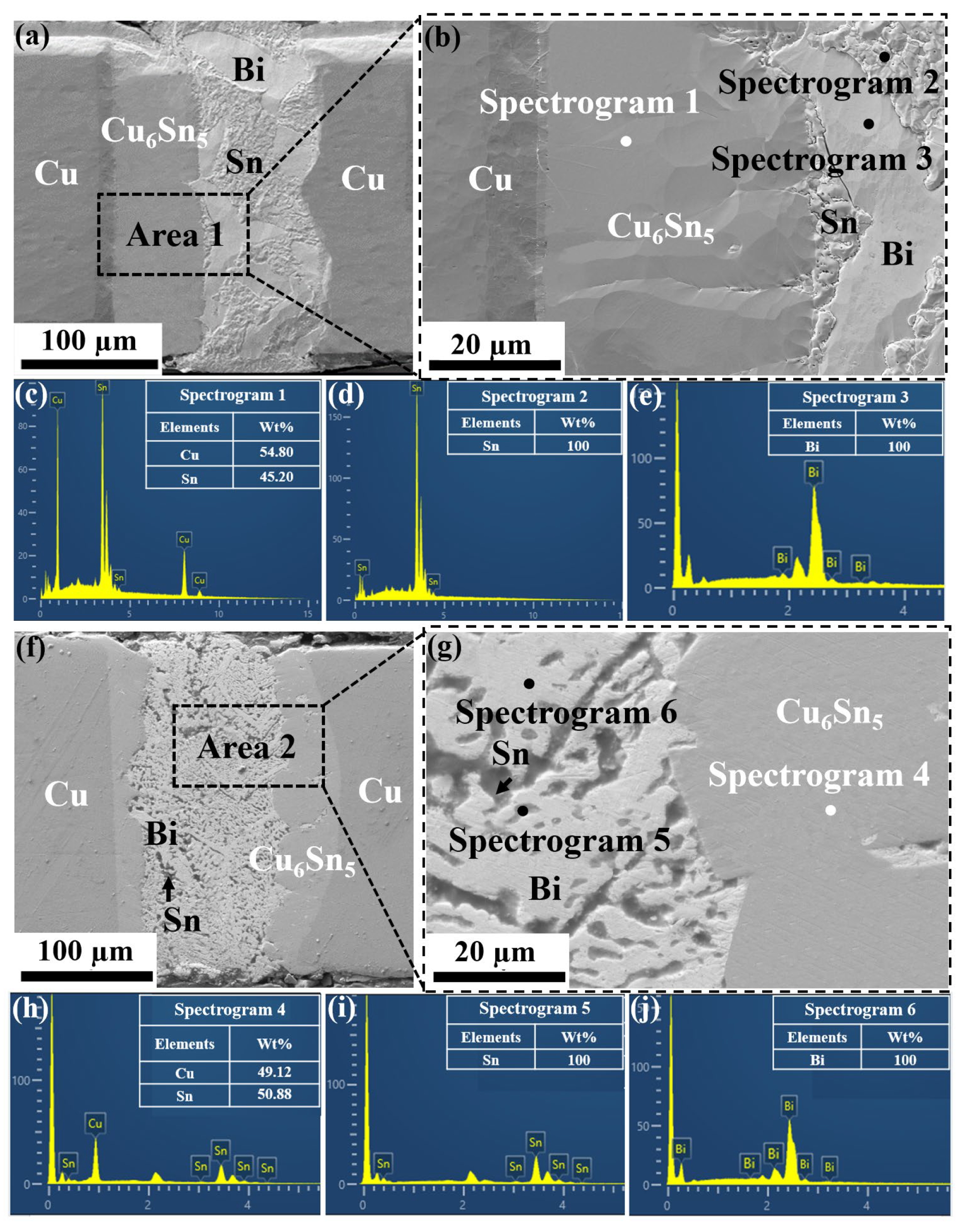
Figure 5 shows the SEM results of Cu/Sn-58Bi/Cu joints, where the representative microstructure of the joint with significant IMC growth asymmetry (high ΔIMC value) is shown in Figure 5a. The internal structure of joints exhibits obvious non-uniformity: a large number of bulk Bi-rich phases with a size of several micrometers are visible, and they are discretely distributed, indicating that Bi elements have undergone significant segregation during the EM process. At the same time, the IMC layer at the interface between the solder and the Cu substrate shows strong growth asymmetry. The IMC layer at the left interface is significantly thicker than that at the right interface, and the morphology is also coarser, with local scallop-like or whisker-like protrusions, while the IMC at the right interface is relatively thin and flat. Quantitative calculations show that the IMC thickness difference characterization quantity ΔIMC at the left interface is as high as 45.56%, which is more significant than that of DC conditions [26]. Further EDS analysis (Figure 5c–e) shows that the atomic ratio of Cu to Sn is close to 6:5, which confirms that the main component of the IMC is Cu6Sn5 [27,28]. This phenomenon indicates that the combined effect of electron wind and chemical potential gradient drives the directional migration of Sn atoms (or Cu atoms), resulting in preferential growth of the IMC on the left interface. Furthermore, the aggregation of the Bi-rich phase may further exacerbate this polar growth effect by hindering the diffusion path or changing the local current density.
Moreover, the joints with minimal IMC growth asymmetry (low ΔIMC value) exhibit a distinctly different evolutionary pattern, as shown in Figure 5f. In the joint, only a small number of fine Bi-rich phase particles are observed, and their distribution is sparse, without forming large-scale aggregations. Correspondingly, the IMC layer at the solder/Cu substrate interface on both sides grows uniformly, with similar thickness and a continuous and dense morphology, showing no obvious asymmetric growth. The IMC thickness difference characterization quantity ΔIMC is only 12.56%. EDS analysis results (Figure 5h–j) also confirm that the interfacial IMC is mainly Cu6Sn5. This result indicates that the EM driving force is greatly alleviated under these conditions, possibly due to the specific orientation of the Sn grains (e.g., the c-axis parallel to the interface), weakening the anisotropy of atomic diffusion, or the more uniform current distribution under this microstructure, thereby suppressing the polar growth of IMC.
In summary, the two sets of results show significant differences under the same EM parameters. In high ΔIMC joints, the presence of bulk Bi-rich phases not only affects mechanical properties as brittle phases, but their interfaces are also likely to become rapid channels for atomic diffusion or void nucleation sites and, synergistically with the specific orientation of Sn grains, exacerbate the asymmetric growth of IMC. In contrast, in low ΔIMC joints, the fine and uniform distribution of the second phase, along with favorable crystal orientation, promotes the homogenization of current and stress distribution, thereby enhancing the joint’s resistance to EM damage. This comparison clearly demonstrates that under AC stressing, there is a close coupling relationship between Sn grain orientation and the spatial distribution of Bi-rich phases; both jointly regulate atomic migration behavior and IMC growth morphology and are key microscopic factors determining the EM reliability of joints.

3.2.2. SEM Results Analysis of Cu/Sn/Cu Joints After EM

Sn-58Bi eutectic solder forms a typical two-phase lamellar structure with alternating Sn and Bi phases after solidification. This inherent microstructural inhomogeneity leads to a significant alteration in the electron flow path under electrical load. The resistivity difference between the Sn and Bi phases forces current to preferentially flow through the low-resistivity Sn phase channels, resulting in significant local current crowding near the phase boundaries and within the Sn phase, greatly intensifying the effect of electron wind on directional movement of atoms [29]. In contrast, pure Sn solder has a uniform single-phase solid solution structure, resulting in a more uniform current distribution, which theoretically can effectively alleviate local current accumulation, thereby resulting in a more uniform IMC growth phenomenon on both sides of the joints. Based on this, the microstructure evolution of a uniform Cu/Sn/Cu joint under EM with AC stressing will be further analyzed below to verify this hypothesis.
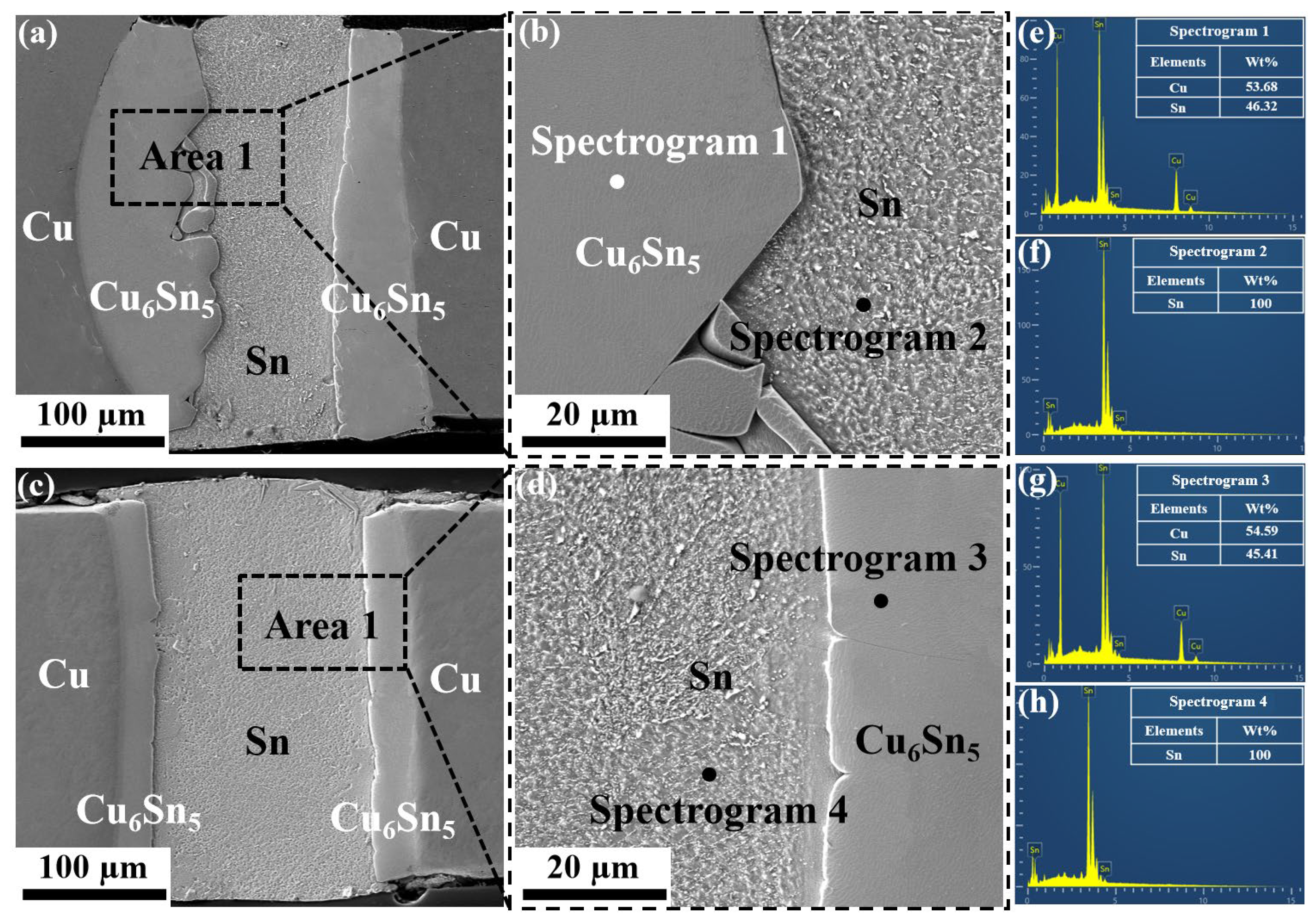
Similarly, after testing with the same EM parameters as the Cu/Sn-58Bi/Cu joints, two typical microstructures of Cu/Sn/Cu joints (high ΔIMC value and low ΔIMC value) were selected for SEM characterization, and the results are shown in Figure 6. For the Cu/Sn/Cu joints with high ΔIMC value, the IMC layer on the left side of the interface is significantly thicker than that on the right side, and the morphology is coarser and more irregular, as shown in Figure 6a,b. EDS analysis (Figure 6e,f) confirms that the interfacial IMC is mainly composed of Cu6Sn5. However, the IMC thickness difference characterization quantity ΔIMC of the joint is 12.02%, which is lower than the low ΔIMC value (12.56%) of the Cu/Sn-58Bi/Cu joint. For the Cu/Sn/Cu joints with low ΔIMC value, the IMC layer at the solder/Cu substrate interface grows uniformly, with similar thickness on both sides, and the morphology is continuous and dense. No obvious asymmetric growth phenomenon is observed, as shown in Figure 6e,f. The IMC thickness difference characterization quantity ΔIMC of the joint is only 2.38%. EDS analysis also confirms that the interface is dominated by Cu6Sn5 (see Figure 6g,h). This result clearly shows that under a uniform single-phase microstructure, the EM driving force is dispersed, thereby significantly suppressing the polar growth of IMC and the asymmetric consumption of the Cu substrate.
Furthermore, through a quantitative statistical comparison of the interfacial IMC growth asymmetry between Cu/Sn-58Bi/Cu and Cu/Sn/Cu joints with the same line-type structure, it was found that the average IMC growth asymmetry of the Cu/Sn/Cu joint after EM with AC stressing was reduced by approximately 60% compared to that of the Cu/Sn-58Bi/Cu joint. This significant quantitative difference strongly demonstrates that the uniformity of the solder microstructure is a key intrinsic factor in regulating current distribution and thus determining the degree of EM damage.

3.3. IMC Growth Mechanism of Cu/Sn-58Bi/Cu Joints Under AC Stressing

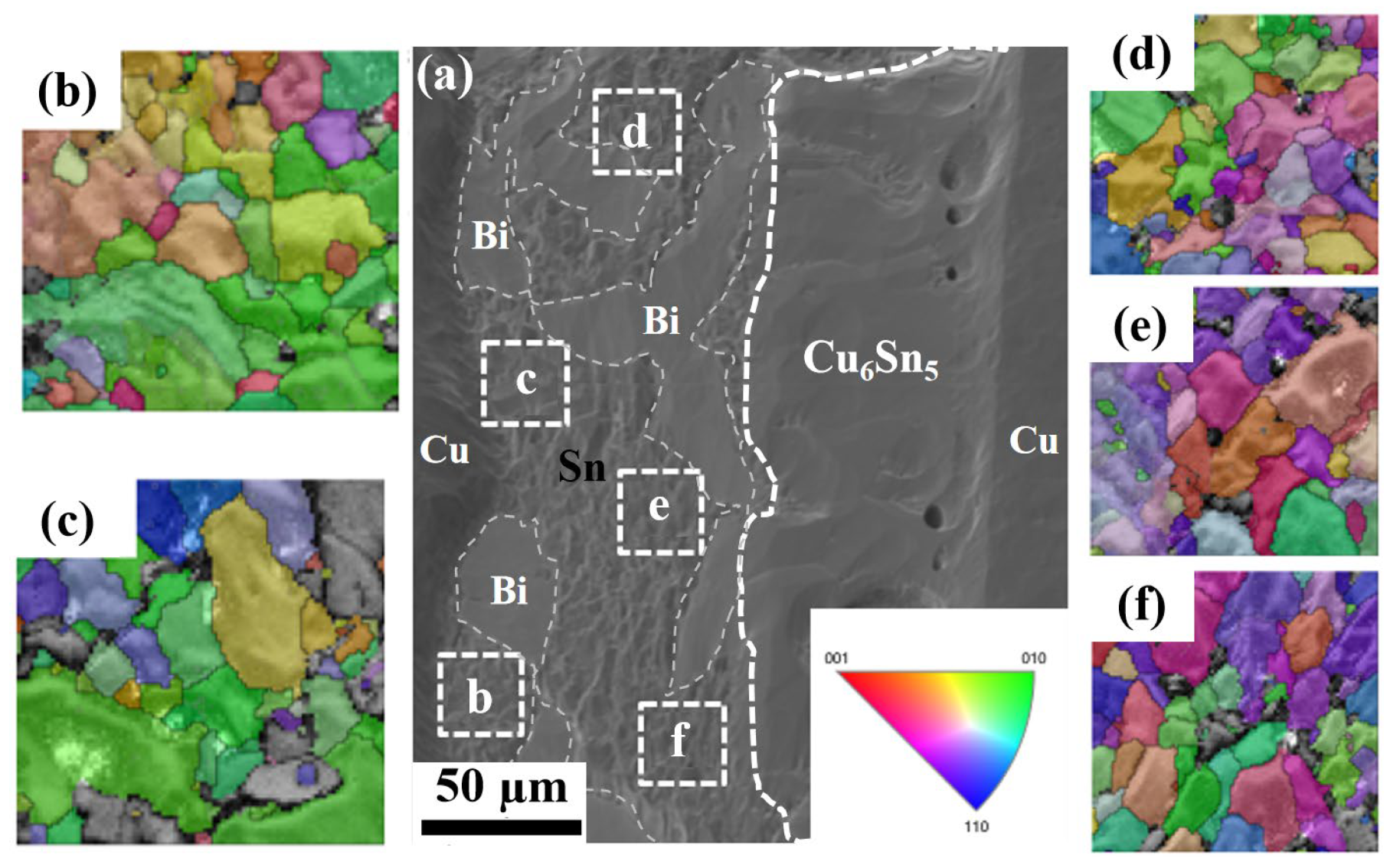
Based on the findings in Section 3.2, the non-uniform microstructure of the Sn-58Bi solder is the main reason for the polar growth of IMC under symmetrical square-wave AC stressing. Previous studies have shown that the growth of interfacial IMC is closely related to the grain orientation of the joint under current stressing [17,30]. The microstructure affects the current path within the joint, thereby further influencing the crystal structure of the solder matrix (such as changes in grain orientation), leading to changes in IMC growth. Therefore, the grain orientation of the Cu/Sn-58Bi/Cu joint was analyzed. It is worth noting that uniform growth of IMC on both sides under symmetrical square-wave AC stressing (i.e., joints with low IMC value) is a relatively common phenomenon [10,31]. Therefore, only Cu/Sn-58Bi/Cu joints with significant asymmetric IMC growth (i.e., samples with high ΔIMC value) were selected for EBSD characterization, and the results are shown in Figure 7. We randomly selected five representative regions (each region with a diameter of 20 μm and containing multiple Sn grains) from the cross-section joint, and the inverse pole figures (IPFs) obtained are shown in Figure 7b–f. Clearly, the Sn grain orientation on the thinner IMC side (Figure 7b,c) differs significantly from that on the thicker IMC side (Figure 7d–f). It is worth noting that the five selected regions are all at different distances from the interfacial IMC, and there is a certain correlation between grain orientation and spatial location (distribution).
The results in Figure 7b–f show that, in the case of coexistence of multi-sized grains, although the presence of tiny grains is dominant in quantity, their actual contribution to the overall material properties is limited. Furthermore, when the orientation difference between grains is less than the software’s resolution (typically 2–5°), these grains are often incorrectly identified as a single grain or cannot be accurately segmented. Considering that atomic diffusion flux is directly related to the cross-sectional area of the diffusion path, grain area was used as a weight to improve statistical representativeness and ensure that the orientation parameter accurately reflects the influence of the dominant grain on EM behavior. The orientation and size of all valid grains (removing grains considered as measurement noise and with a size < 2 μm) within each selected region were obtained using EBSD. The orientation parameter of each grain was represented by a function, and then a weighted average was calculated using the grain area as the weight to obtain a weighted average orientation parameter (or effective orientation parameter) for the selected region. The effective orientation parameter (Qi) can be described as [32]
Q i = j = 1 N A ij D θ ij j = 1 N A ij
where N is the effective number of grains; Aij is the cross-sectional area of the j-th grain in the i-th region (five selected regions); θij is the angle between the c-axis of the j-th grain in the i-th region and the direction of electron flow; D(θij) represents the orientation correlation function. Since Cu atoms diffuse in Sn grains with obvious anisotropy, for example, the diffusion coefficient of Cu atoms along the c-axis of Sn grains is about 4.3 × 10² times that along the a-axis at 150 °C [18]. According to the diffusion theory proposed by Shi and Huntington [33], the D(θij) of Cu atoms in a certain Sn grain orientation can be calculated using the following formula:
D θ ij = D a sin 2 θ ij + D c cos 2 θ ij
where Da and Dc are the diffusion coefficients (m2/s) of Cu atoms along the a and c axes of Sn, respectively. Since Da << Dc, Equation (3) can be simplified to an approximate expression as follows:
D θ ij = D c cos 2 θ ij
When calculating the orientation-weighted average, it can be extracted as a constant factor without affecting the relative distribution of orientation weights. This approach is based on the diffusion theory and conforms to the area-weighted principle commonly used in material texture analysis [34]. Therefore, the simplified effective orientation parameter Qi can be expressed as
Q i = j = 1 N A ij D θ ij j = 1 N A ij
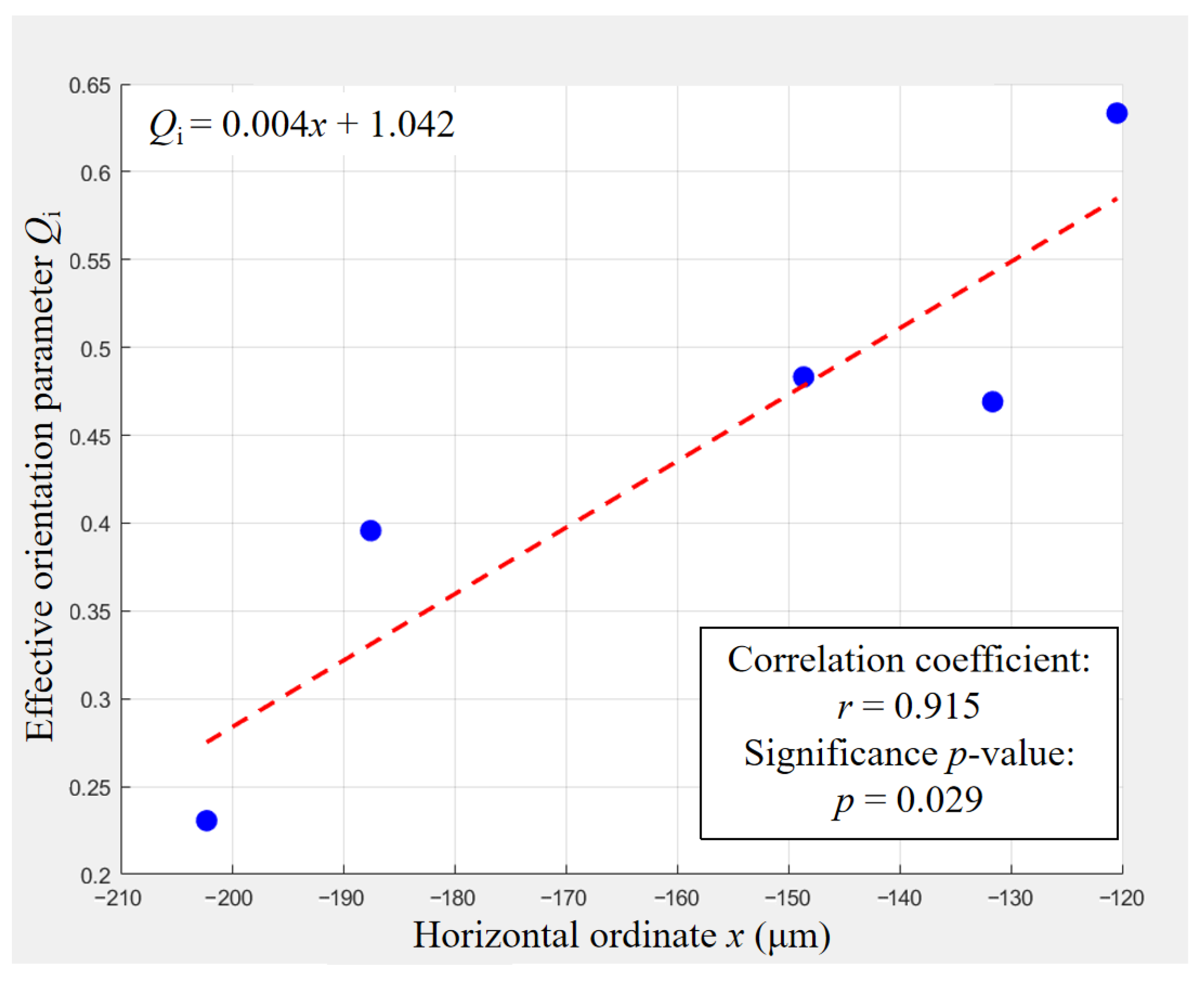
The effective orientation parameter Qi in Equation (5) reflects the contribution of grain orientation to IMC growth within the selected region. Furthermore, with the thick-side IMC/Cu interface as the origin, the horizontal coordinate x of the center of each selected region was recorded. Pearson correlation analysis was used to analyze the correlation between the effective orientation parameter and the horizontal position x of the five selected regions, and the results are shown in Figure 8. This indicates a positive correlation between the horizontal position of the grain and the effective orientation parameter Qi (where r = 0.915, p < 0.05, indicating a significant correlation).
According to Equation (5), the smaller the angle between the c-axis of the grain and the direction of electron flow, the larger Qi is. This means that in the region near the origin of the coordinate system (thick-side IMC), the <001> (c-axis) orientation of the grain tends to be parallel to the direction of electron flow. The observed 0.915 μm−1 positive orientation gradient indicates that during the EM process, the Sn grain forms a preferred orientation mode along the current path (horizontal direction), and there is a significant positive correlation between the orientation angle and its horizontal distance to the solder/IMC interface. Previous studies [19,21] have confirmed that diffusion anisotropy in Sn solder under DC stressing leads to orientation-dependent failure mechanisms. Although this study examined AC stressing, the identified orientation gradients may cause specific regions of the joint to exhibit different EM behaviors. Theoretically, regions with a c-axis of Sn grain more aligned with the current direction would exhibit faster atomic diffusion rates, potentially leading to accelerated interfacial reactions and variations in IMC growth. The consistency of this orientation pattern across multiple selected regions indicates that this is not a random distribution but rather a systematic microstructural feature formed in joints.
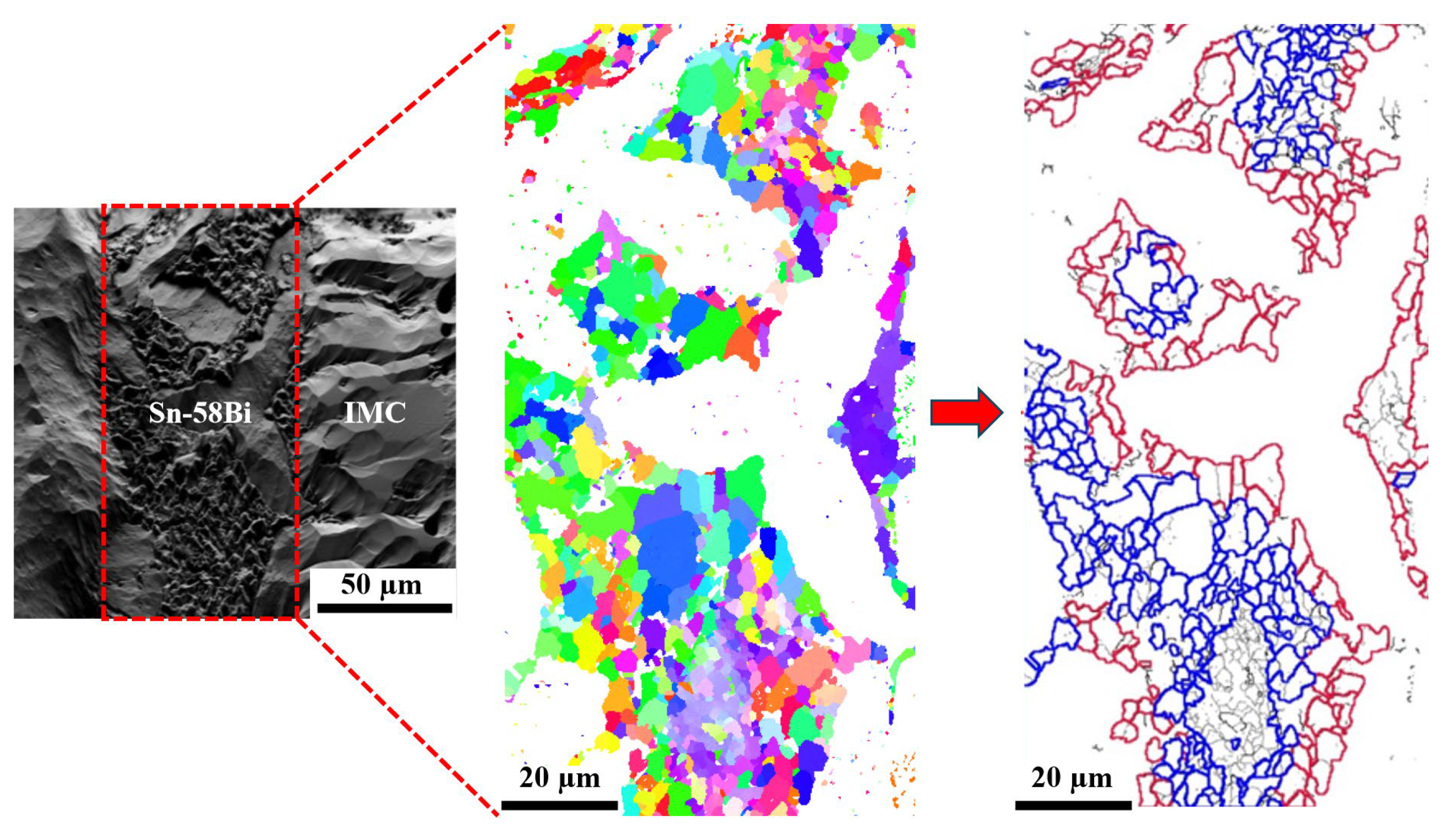
The microstructure of the Cu/Sn-58Bi/Cu joint is a typical two-phase inhomogeneous system. The polar growth of the IMC under AC stressing is related to the following two mechanisms: (1) The angle between the c-axis of the Sn grains and the direction of electron flow regulates the atomic migration rate. This physical mechanism remains valid under AC fields and is not altered by the periodic reversal of the current direction. (2) This regulation effect is related to the precipitation of the Bi-rich phase to some extent. It can change the electron migration pathway in the joint, directly affecting the spatial distribution of Sn grains, and thus determining the preferred growth of IMC. As shown in Figure 9, the effective orientation parameters Qi of two types of Sn grains—phase boundary grains and bulk grains—were statistically analyzed. The red boundaries represent phase boundary grains, which are adjacent to the Bi-rich phase, while the blue boundaries represent bulk grains. The results show that the average effective orientation parameter is 0.6241 for the phase boundary grains and 0.3204 for the bulk grains. This means that the closer the Sn grain is to the Bi phase, the more likely its c-axis is to be parallel to the current direction, which is more conducive to IMC growth. This is because the Bi-rich phase forces the current to converge on these grains, thus amplifying and manifesting its crystallographic anisotropy effect macroscopically. Therefore, an abnormal phenomenon of obvious IMC asymmetric growth (polar growth) can be observed in the Cu/Sn-58Bi/Cu joint under EM with AC stressing.

4. Conclusions

This study investigated interfacial IMC growth behavior of Cu/Sn-58Bi/Cu joint under EM with a symmetrical square-wave AC, and the mechanism of IMC polar growth was revealed through grain orientation analysis. The main conclusions are as follows:
(1) The interfacial IMC of Cu/Sn-58Bi/Cu joints exhibits significant asymmetric growth under EM with AC stressing. The average value of the IMC thickness difference characterization quantity ΔIMC reaches 17.86 ± 1.77%. In extreme cases, the ΔIMC value of Cu/Sn-58Bi/Cu joint is as high as 45.56%, demonstrating obvious polar growth characteristics.
(2) Compared to Cu/Sn/Cu joints, Cu/Sn-58Bi/Cu joints exhibit more significant IMC growth asymmetry under EM with AC stressing, with an average asymmetry degree approximately 60% higher. This is attributed to the inhomogeneity of the Sn-58Bi solder microstructure, where the distribution of Bi-rich phases alters the current path within the joint, exacerbating the directional driving effect of electron wind on atomic migration.
(3) The orientation of Sn grains has a significant regulatory effect on IMC growth of Cu/Sn-58Bi/Cu joints. A distinct orientation gradient (0.915 μm−1) is formed within the joint along the current path. The c-axis of Sn grains at adjacent Bi-rich phase boundaries (phase boundary grains) tends to be parallel to the current direction, and their average effective orientation parameter is 1.948 times that of the bulk grains, thus establishing a clear spatial orientation gradient and promoting rapid growth of the interfacial IMC.

Author Contributions

Conceptualization, B.W. and P.Z.; methodology, B.W. and P.Z.; software, B.W., P.Z. and G.Z.; validation, B.W., P.Z., G.Z., C.D. and K.P.; formal analysis, B.W., P.Z., K.H. and W.H.; investigation, B.W., P.Z. and K.P.; resources, B.W. and P.Z.; data curation, B.W., P.Z. and K.P.; writing—original draft preparation, B.W.; writing—review and editing, P.Z. and K.P.; visualization, B.W. and C.D.; supervision, P.Z. and K.P.; project administration, B.W. and P.Z.; funding acquisition, B.W. and K.P. All authors have read and agreed to the published version of the manuscript.

Funding

This work was supported by the Natural Science Foundation of Guangxi Province (2025GXNSFBA069011, 2025GXNSFDA02850006); the National Natural Science Foundation of China (U2441249); the Anhui Postdoctoral Scientific Research Program Foundation (2025C1116); the Project for Enhancing Young and Middle-Aged Teachers’ Research Basis Ability in Colleges of Guangxi (2024KY0220); and the China Postdoctoral Science Foundation (2025M774389).

Data Availability Statement

The original contributions presented in this study are included in the article. Further inquiries can be directed to the corresponding authors.

Conflicts of Interest

The author Guopei Zhang was employed by the company Goertek Inc. The remaining authors declare that the research was conducted in the absence of any commercial or financial relationships that could be construed as a potential conflict of interest.

References

  1. Le, W.K.; Ning, X.; Huang, J.Q.; Zhou, M.B.; Zhang, X.P. Effect of electric current stressing on the shear strength and fracture behavior of micro-scale BGA structured Cu/Sn–3.0Ag–0.5Cu/Cu joints. In Proceedings of the 19th International Conference on Electronic Packaging Technology (ICEPT), Shanghai, China, 8–11 August 2018; pp. 610–614. [Google Scholar] [CrossRef]
  2. Qin, H.; Liu, T.; Li, W.; Yue, W.; Yang, D. Influence of microstructure inhomogeneity on the current density and temperature gradient in microscale line-type Sn58Bi solder joints under current stressing. Microelectron. Reliab. 2020, 115, 113995. [Google Scholar] [CrossRef]
  3. Liu, T.H.; Liu, Z.G.; Qin, H.B.; Chen, Z. Determining the stress-strain relation of eutectic Sn58Bi alloy by nanoindentation combined with reverse analysis. In Proceedings of the 21st International Conference on Electronic Packaging Technology (ICEPT), Guangzhou, China, 12–15 August 2020; pp. 1–4. [Google Scholar] [CrossRef]
  4. Ding, C.; Liu, T.H.; Lei, C.Y.; Qin, W.; Qin, H.B.; Hou, B. Study on the volume effect of mechanical behavior of Cu/Sn/Cu microscale solder joints considering crystal anisotropy. In Proceedings of the 21st International Conference on Electronic Packaging Technology (ICEPT), Guangzhou, China, 12–15 August 2020; pp. 1–4. [Google Scholar] [CrossRef]
  5. Liu, S.; Liu, Z.; Liu, L.; Song, T.; Liu, W.; Tan, Y.; San, Z.; Huang, S. Electromigration behavior of Cu/Sn–58Bi–1Ag/Cu solder joints by ultrasonic soldering process. J. Mater. Sci. Mater. Electron. 2020, 31, 11997–12003. [Google Scholar] [CrossRef]
  6. Wei, G.Q.; Liu, H.L.; Du, L.C.; Yao, J. Effect of electromigration and isothermal aging on interfacial microstructure and tensile fracture behavior of SAC305/Cu solder joint. China Weld. 2016, 25, 42–48. [Google Scholar]
  7. Gu, X.; Chan, Y.C. Thermomigration and electromigration in Sn58Bi solder joints. J. Appl. Phys. 2009, 105, 093537. [Google Scholar] [CrossRef]
  8. Guo, F.; Liu, Q.; Ma, L.; Zuo, Y. Diffusion behavior of Sn atoms in Sn58Bi solder joints under the coupling effect of thermomigration and electromigration. J. Mater. Res. 2016, 31, 1793–1800. [Google Scholar] [CrossRef]
  9. Wang, B.; Li, W.; Pan, K. Shear performance of microscale ball grid array structure Sn–3.0Ag–0.5Cu solder joints with different surface finish combinations under electro-thermo-mechanical coupled loads. J. Mater. Sci. Mater. Electron. 2022, 33, 4924–4939. [Google Scholar] [CrossRef]
  10. Zhu, Z.; Chan, Y.; Wu, F. Effect of alternating current (AC) stressing on the microstructure and mechanical properties of low-silver content solder interconnect. Microelectron. Reliab. 2019, 92, 12–19. [Google Scholar] [CrossRef]
  11. Zhu, Z.; Chan, Y.; Wu, F. Failure mechanisms of solder interconnects under current stressing in advanced electronic packages: An update on the effect of alternating current (AC) stressing. Microelectron. Reliab. 2018, 91, 179–182. [Google Scholar] [CrossRef]
  12. Siswanto, W.A.; Krasnopevtsev, A.Y.; Talarpoushti, G.F.; Maseleno, A.; Kuzichkin, O.R. Role of alternating current shape on microstructure and damage evolution of solder joints. J. Manuf. Process. 2020, 50, 450–455. [Google Scholar] [CrossRef]
  13. Kim, Y.R.; Osmanson, A.T.; Kim, C.U.; Thompson, P.F.; Chen, Q. Study of failure and microstructural evolution in SAC solder interconnects induced by AC electromigration condition. In Proceedings of the 72nd Electronic Components and Technology Conference (ECTC), San Diego, CA, USA, 31 May–3 June 2022; pp. 1153–1157. [Google Scholar] [CrossRef]
  14. Qin, H.B.; Yue, W.; Ke, C.B.; Zhou, M.B.; Zhang, X.P.; Li, B. Interaction effect between electromigration and microstructure evolution in BGA structure Cu/Sn-58Bi/Cu solder interconnects. In Proceedings of the 15th International Conference on Electronic Packaging Technology (ICEPT), Chengdu, China, 12–15 August 2014; pp. 587–591. [Google Scholar] [CrossRef]
  15. Feng, J.; Hang, C.; Tian, Y.; Wang, C.; Liu, B. Effect of electric current on grain orientation and mechanical properties of Cu-Sn intermetallic compounds joints. J. Alloys Compd. 2018, 753, 203–211. [Google Scholar] [CrossRef]
  16. An, T.; Qin, F. Effects of the intermetallic compound microstructure on the tensile behavior of Sn3.0Ag0.5Cu/Cu solder joint under various strain rates. Microelectron. Reliab. 2014, 54, 932–938. [Google Scholar] [CrossRef]
  17. Huang, M.L.; Zhao, J.F.; Zhang, Z.J.; Zhao, N. Role of diffusion anisotropy in β-Sn in microstructural evolution of Sn-3.0Ag-0.5Cu flip chip bumps undergoing electromigration. Acta Mater. 2015, 100, 98–106. [Google Scholar] [CrossRef]
  18. Huang, M.L.; Sun, H.Y. Interaction between β-Sn grain orientation and electromigration behavior in flip-chip lead-free solder bumps. Acta Metall. Sin. 2018, 54, 1077–1086. [Google Scholar] [CrossRef]
  19. Wei, S.; Ma, H.C.; Chen, J.Q.; Guo, J.D. Extreme anisotropy of electromigration: Nickel in single-crystal tin. J. Alloys Compd. 2016, 687, 999–1003. [Google Scholar] [CrossRef]
  20. Huang, M.L.; Kuang, J.M.; Sun, H.Y. Electromigration-induced β-Sn grain rotation in lead-free flip chip solder bumps. In Proceedings of the 69th Electronic Components and Technology Conference (ECTC), Las Vegas, NV, USA, 28–31 May 2019; pp. 2036–2041. [Google Scholar] [CrossRef]
  21. Huang, M.L.; Zhao, J.F.; Zhang, Z.J.; Zhao, N. Dominant effect of high anisotropy in β-Sn grain on electromigration-induced failure mechanism in Sn-3.0Ag-0.5Cu interconnect. J. Alloys Compd. 2016, 678, 370–374. [Google Scholar] [CrossRef]
  22. Lloyd, J.R. Electromigration induced resistance decrease in Sn conductors. J. Appl. Phys. 2003, 94, 6483–6486. [Google Scholar] [CrossRef]
  23. Zhu, P.Y.; Liu, M.H.; Ran, G.L.; Wang, B.; Huang, W.; Gong, Y.B.; Pan, K.L. Abnormal electromigration behavior of Sn-58Bi solder joints under alternating current stressing. In Proceedings of the 25th International Conference on Electronic Packaging Technology (ICEPT), Tianjin, China, 7–9 August 2024; pp. 1–5. [Google Scholar] [CrossRef]
  24. Kim, S.; Hong, W.; Nam, H.; Kang, N. Growth behavior of intermetallic compounds in various solder joints induced by electromigration. J. Weld. Join. 2021, 39, 89–102. [Google Scholar] [CrossRef]
  25. Chen, L.D.; Huang, M.L.; Zhou, S.M. Effect of electromigration on intermetallic compound formation in line-type Cu/Sn/Cu interconnect. J. Alloys Compd. 2010, 504, 535–541. [Google Scholar] [CrossRef]
  26. Gao, Y.J.; Zhang, K.K.; Zhang, C.; Wang, Y.M.; Chen, W.M. Microstructure and properties of electromigration of Sn58Bi/Cu solder joints with different joule thermal properties. Metals 2023, 13, 1475. [Google Scholar] [CrossRef]
  27. Li, Y.W.; Mo, L.Q.; Chen, F.; Dai, Z.B.; Xu, Y.Q.; He, S.L.; Nishikawa, H. Counter-intuitive mechanical performance variation in aged low-temperature interconnections in electronic packaging. Vacuum 2024, 227, 113367. [Google Scholar] [CrossRef]
  28. Wang, B.; Li, W.Y.; Pan, K.L.; Huang, W.; Gong, Y.B. Size dependence on shear fatigue and fracture behavior of ball grid array structure Cu/Sn–3.0Ag–0.5Cu/Cu solder joints under current stressing. Front. Mater. 2024, 11, 1452773. [Google Scholar] [CrossRef]
  29. Li, X.M.; Wang, J.; Liang, J.Y.; Li, W.Y.; Qin, H.B. Weakened strengthening effect in the Ag added microscale SnBi joints under current stressing. Mater. Lett. 2022, 312, 131677. [Google Scholar] [CrossRef]
  30. Shen, Y.A.; Wu, J.A. Effect of Sn grain orientation on reliability issues of Sn-rich solder joints. Materials 2022, 15, 5086. [Google Scholar] [CrossRef]
  31. Wu, W.H.; Peng, S.P.; Lin, C.S.; Ho, C.E. Study of DC and AC electromigration behavior in eutectic Pb-Sn solder joints. J. Electron. Mater. 2009, 38, 2184–2193. [Google Scholar] [CrossRef]
  32. Wilkinson, A.J.; Britton, T.B. Strains, planes, and EBSD in materials science. Mater. Today 2012, 15, 366–376. [Google Scholar] [CrossRef]
  33. Shi, J.; Huntington, H.B. Electromigration of gold and silver in single crystal tin. J. Phys. Chem. Solids 1987, 48, 693–696. [Google Scholar] [CrossRef]
  34. Engler, O.; Zaefferer, S.; Randle, V. Introduction to Texture Analysis: Macrotexture, Microtexture, and Orientation Mapping; CRC Press: Boca Raton, FL, USA, 2023; ISBN 978-1-003-25833-9. [Google Scholar] [CrossRef]
Figure 1. Preparation of samples of line-type Cu/Sn-58Bi/Cu and Cu/Sn/Cu joints.
Crystals 16 00127 g001
Figure 2. The cross-sectional morphology of the prepared joints: (a) Cu/Sn-58Bi/Cu joint; (c) Cu/Sn/Cu joint; (b,d) enlarged view of “Area X” in (a,c); (ei) EDS characterization results of “Point X” in (b,d).
Crystals 16 00127 g002
Figure 3. Schematic diagram of the EM experiment of joints under AC stressing.
Crystals 16 00127 g003
Figure 4. Histogram and fitting results of the thickness difference distribution of IMC at both ends of Cu/Sn/Cu joints and Cu/Sn-58Bi/Cu joints after EM.
Crystals 16 00127 g004
Figure 5. Different IMC growth behaviors of Cu/Sn-58Bi/Cu joints after EM: (a,f) two typical microstructures; (b,g) enlarged view of “Area X” in (a,f); (ce) and (hj) EDS characterization results of “Spectrogram X” in (b,g).
Crystals 16 00127 g005
Figure 6. Different IMC growth behaviors of Cu/Sn/Cu joints after EM: (a,c) two typical microstructures; (b,d) enlarged view of “Area X” in (a,c); (eh) EDS characterization results of “Spectrogram X” in (b,d).
Crystals 16 00127 g006
Figure 7. EBSD results of Cu/Sn-58Bi/Cu joints with high ΔIMC value: (a) local morphology; (bf) the IPF of rectangles b~f in (a), respectively.
Crystals 16 00127 g007
Figure 8. Correlation between the effective orientation parameter and the spatial location of selected regions.
Crystals 16 00127 g008
Figure 9. Division of Sn grains into two types: bulk grains (blue) and phase boundary (Sn/Bi phase boundary) grains (red).
Crystals 16 00127 g009
Disclaimer/Publisher’s Note: The statements, opinions and data contained in all publications are solely those of the individual author(s) and contributor(s) and not of MDPI and/or the editor(s). MDPI and/or the editor(s) disclaim responsibility for any injury to people or property resulting from any ideas, methods, instructions or products referred to in the content.