Review

Photocatalytic Reduction of CO2 by Bi-Based Semiconductor: A Review on Recent Progress

1
National Key Laboratory of Baiyunobo Rare Earth Resource Researches and Comprehensive Utilization, Baotou 014030, China
2
Baotou Research Institute of Rare Earths, Baotou 014030, China
3
School of Chemistry and Chemical Engineering, Inner Mongolia University, Hohhot 010021, China
*
Authors to whom correspondence should be addressed.
Crystals 2026, 16(2), 128; https://doi.org/10.3390/cryst16020128
Submission received: 15 January 2026 / Revised: 30 January 2026 / Accepted: 5 February 2026 / Published: 9 February 2026
(This article belongs to the Special Issue Advances in Photocatalytic Technology and Materials)

Abstract

Photocatalytic reduction of CO2 into valuable solar fuels represents a promising strategy to address both energy crises and carbon emissions. Bismuth-based semiconductors have emerged as attractive visible-light-driven photocatalysts due to their suitable band structures, layered architectures, and tunable morphologies. This review systematically summarizes recent advances in Bi-based photocatalysts for CO2 photoreduction. First, the fundamental principles and key challenges of CO2 photoreduction are outlined. Subsequently, the structural and electronic characteristics of typical Bi-based materials, including Bi2O3, Bi2S3, Bi2MO6 (M = W; Mo), BiVO4, and BiOX (X = Cl; Br; I), are discussed. Emphasis is placed on design strategies to enhance photocatalytic performance, such as vacancy engineering, microstructure control, crystal facet engineering, heterojunction construction, cocatalyst loading, and their combinations. A comprehensive comparison of catalytic activities under various conditions is also provided. Finally, current limitations and future perspectives are highlighted, aiming to guide the rational design of efficient and stable Bi-based photocatalysts for CO2 conversion.

1. Introduction

Human society has developed rapidly since the Industrial Revolution, resulting in serious environmental problems, especially the excessive emission of carbon dioxide [1,2]. Capturing, storing, and converting carbon dioxide into value-added products offers a dual solution to mitigate carbon emissions and the energy crisis [3,4,5]. Solar energy, a clean and abundant renewable source, has the potential to meet global energy demands. Converting just 10% of the solar energy on 0.3% of the Earth’s surface could surpass the energy requirements projected for 2050 [6]. Photocatalytic CO2 reduction can utilize endless solar energy as the only energy source to directly convert CO2 and H2O into hydrocarbon solar fuels [7,8,9,10,11]. These solar fuels can be burned or used in fuel cells, which release carbon dioxide, which in turn creates a closed carbon cycle [12]. On the one hand, this approach enables high-density storage of solar energy, mainly in the form of C-H chemical bonds, solving the problem that renewable energy usually only provides an intermittent and unreliable energy supply. On the other hand, it also reverses the dilemma that CO2 is a useless exhaust gas.
In 1972, Fujishima and Honda proposed in the journal Nature that titanium dioxide anodes can successfully decompose water to generate hydrogen under near-ultraviolet irradiation, which opened the prelude to semiconductor photocatalysis [13]. Six years later, Halmann first reduced CO2 to HCOOH, CH4, and HCHO through p-GaP single crystal under ultraviolet light irradiation [14]. Since its inception, semiconductor photocatalytic CO2 reduction has garnered significant research interest. However, its low efficiency and poor product selectivity hinder its widespread application [15,16,17]. TiO2, known for its excellent performance, low cost, and non-toxicity, remains one of the most widely used photocatalysts. Nevertheless, TiO2′s photocatalytic activity is limited to ultraviolet light, and its performance under visible light is minimal [18,19,20]. Therefore, developing photocatalysts responsive to visible light is of paramount importance.
Metal oxides [21,22], such as TiO2, are widely used in photocatalytic CO2 reduction [23,24,25,26]. They are stable and inexpensive. However, many oxides absorb mainly UV light, and their visible-light activity is limited. Carbon-based photocatalysts and carbon nanomaterials are also studied. They provide high surface area and fast electron transport. Yet, their intrinsic active sites for CO2 activation are often weak, and they are commonly used as supports or co-catalysts. MOF-based [27,28,29,30] and related porous systems [31,32] offer tunable pore structures and strong CO2 uptake. Still, their long-term stability under irradiation and in the presence of water can be a concern. These limits motivate the search for visible-light-active semiconductors with stronger CO2 activation ability. In this context, Bi-based photocatalysts are attractive. Their valence band often contains Bi 6s–O 2p hybrid states [33], which helps narrow the bandgap and extend light response to the visible region. Many Bi-based compounds also have layered structures. This feature can build an internal electric field across layers and assist charge–carrier separation and transport. In addition, vacancies and surface defects can be introduced more readily in many Bi-based lattices [34]. These sites can strengthen CO2 adsorption and activation. Therefore, Bi-based systems provide a useful platform to link band structure design with surface adsorption chemistry in CO2 photoreduction [35,36,37,38].
In recent years, bismuth-based catalysts have received extensive attention as efficient photocatalysts excited by visible light. For the sake of stability, research mainly focuses on compounds containing Bi3+. First, bismuth-based photocatalysts have unique electronic band structures and controllable morphologies [39,40,41]. The valence band (VB) of most bismuth-based catalysts is primarily composed of the hybridization of O 2p and Bi 6s orbitals. This hybridization results in high dispersion in the VB, narrowing the bandgap and extending light absorption into the visible range. Additionally, the distortion of the lone pairs on Bi 6s orbitals causes a pronounced overlap with O 2p orbitals, which enhances carrier mobility. Second, most bismuth-based photocatalysts have a layered structure, which essentially induces the formation of an internal electric field between the layers, thereby effectively isolating and transferring charge carriers. In addition, the region between the layers is a good active reaction site, which gives the bismuth-based photocatalysts good activity and stability. Finally, bismuth-based photocatalysts can be prepared using facile, harmless, and low-cost strategies, such as hydrothermal synthesis and wet chemical methods. Therefore, the research prospects of bismuth-based photocatalysts are promising.
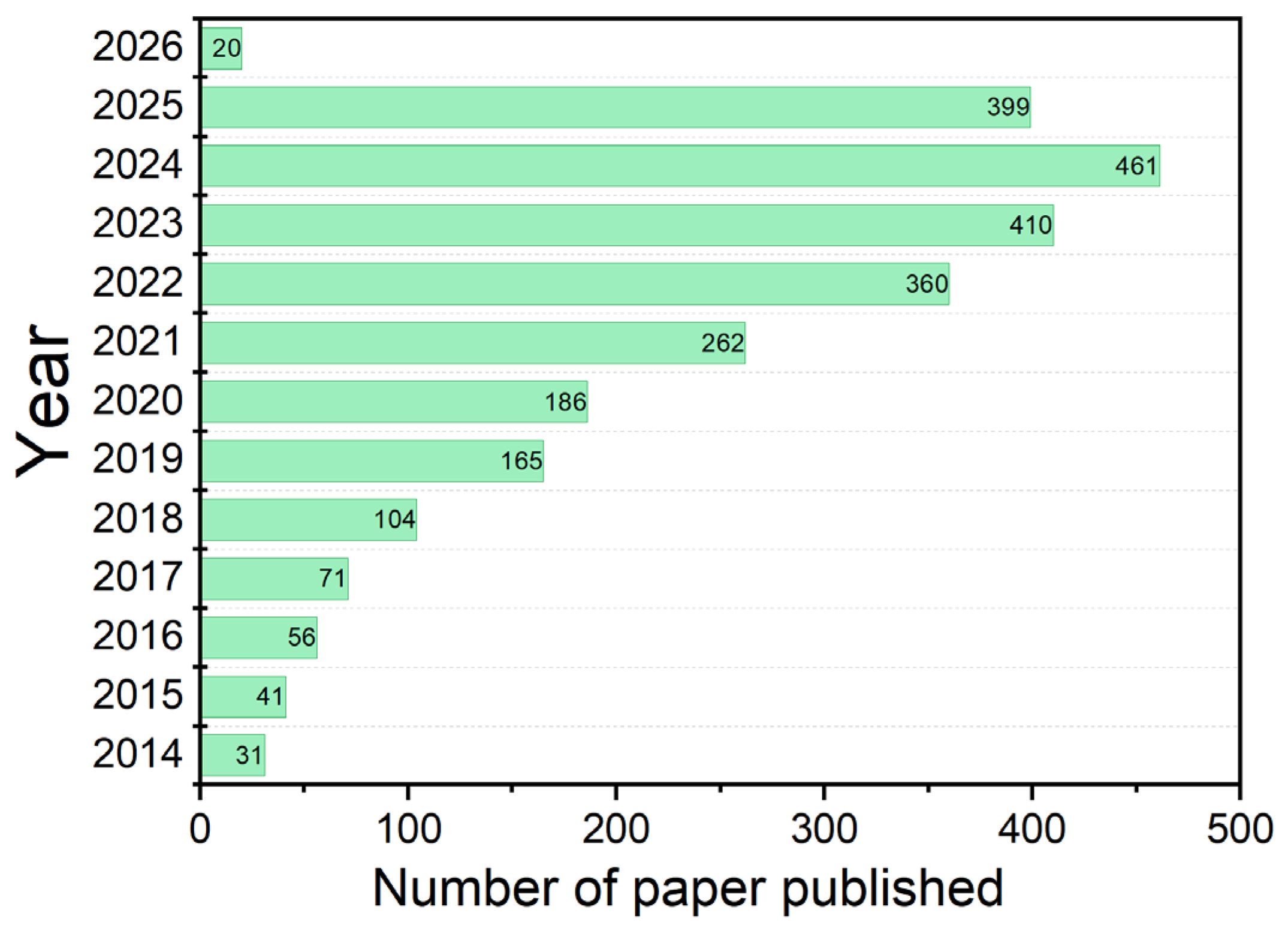
In recent years, research on photocatalytic CO2 reduction, both domestically and internationally, has included reviews on TiO2 and related titanium materials, MOF-based catalysts, graphene, two-dimensional material catalysts, and more [42,43,44,45]. Figure 1 shows the annual number of publications (2014–2026) on bismuth-based catalysts for photocatalytic CO2 reduction based on data retrieved from the Web of Science database in January 2026. The rising trend clearly indicates growing research interest in this field. This review aims to provide a timely overview of recent advances in bismuth-based photocatalysts for CO2 reduction. We begin by outlining the fundamental principles and key challenges of CO2 photoreduction, followed by a systematic summary of the compositional structures, advantages, and limitations of the main types of bismuth-based catalysts. Then, the reported regulatory strategies for optimizing photocatalytic activity are introduced, including vacancy engineering, microstructure control, crystal facet engineering, composites, and co-strategies. For ease of understanding and evaluation, we summarize the performance of the catalysts, tabulating their activities and reaction parameters. Finally, the review presents an outlook on the future development and key challenges in this field. We hope that it will offer valuable insights to researchers working on the design and advancement of bismuth-based photocatalytic materials.

2. Fundamentals and Challenges of CO2 Photoreduction

CO2 molecule exhibits a stable, linear, symmetric structure, with a C=O bond energy of 750 kJ/mol, significantly higher than that of C-H (430 kJ/mol) and C-C (336 kJ/mol), making its activation highly unfavorable [46]. Kinetically, CO2 is non-polar and linearly symmetric, with a uniform electron cloud density around the two oxygen atoms. The carbon atom in CO2 neither donates nor accepts electrons, contributing to the molecule’s stable structure and high activation energy [47,48]. Thermodynamically, the potential required to activate CO2 is approximately −1.44 V (NHE, pH = 0), a value that is challenging for conventional semiconductor catalysts to achieve. Furthermore, CO2 photoreduction involves multi-electron steps and competing reactions, which slow down the overall reduction process.
As the highest oxidation state of carbon, CO2 can be reduced to various products, such as CO, CH4, CH3OH, HCOOH and HCHO, by gaining different numbers of electrons and protons. In addition to these C1 products, some C2 products derived from the C-C coupling reaction, such as C2H4, C2H6, and CH3CH2OH, can also be detected in the photocatalytic CO2 reduction reaction. The photocatalytic CO2 reduction reaction is a complex multi-step reaction. In general, the photocatalytic CO2 reduction process can be subdivided into the following steps. (i) The semiconductor is excited by a suitable light source, and then a large number of electrons and holes is generated. (ii) Photogenerated carriers are separated from the bulk and transferred to the photocatalyst surface. (iii) CO2 and H2O are simultaneously captured and activated on the photocatalyst surface as reactants. (iv) Photogenerated electrons efficiently undergo catalytic reduction at the active sites on the catalyst surface, while photogenerated holes are consumed by H2O or sacrificial reagents, producing O2 or other oxidation products. (v) The resulting products desorb from the photocatalyst surface, re-exposing the active sites for subsequent catalytic reactions. In this section, we also briefly discuss the challenges associated with photocatalytic CO2 conversion.

2.1. Limited Light Absorption

The solar spectrum consists of approximately 5% ultraviolet radiation, 43% visible radiation, and 52% infrared (IR) radiation, and much of the solar spectrum consists of visible and infrared regions. Therefore, generating a large number of charges by absorbing visible or infrared light is a key development trend in semiconductor photocatalysis. The ability of semiconductor photocatalysts to generate efficient photogenerated electrons and holes is a crucial starting step in photocatalysis. In the CO2 photocatalytic reduction reaction, photoexcitation properties, energy band structure, and the separation efficiency of photogenerated carriers are three important factors that influence the behavior of photogenerated electrons in the CO2 reduction process.
Photoexcitation properties include photon energy and light intensity. Photon energy determines whether a semiconductor can absorb photons for excitation, thermodynamically influencing product selectivity. Light intensity, on the other hand, determines the number of photogenerated electrons and holes, which kinetically affects the reaction rate and product selectivity in multi-electron reactions. Many common semiconductors have bandgaps or potentials that limit their ability to absorb sufficient sunlight to drive product formation. While wide-bandgap semiconductors are suitable for redox processes, they are only effective in the shorter wavelength region. For example, TiO2, with a bandgap of 3.2 eV, absorbs only in the UV region, making it inactive for visible-light-induced CO2 conversion. Semiconductors with narrow bandgaps can absorb visible light but tend to suffer from simultaneous reduction and oxidation reactions on the surface, along with rapid recombination of holes and photogenerated electrons [49]. Cu2O, a promising catalyst with a narrow bandgap (2.2 eV), efficiently absorbs photons in the visible range, but its narrow bandgap also causes rapid charge recombination, limiting its catalytic performance. Furthermore, photogenerated holes induce self-oxidation of Cu2O, reducing its photostability [50]. In contrast, stable Bi-based catalysts with appropriately tuned bandgaps offer promising potential for CO2 conversion.

2.2. Adsorption of CO2

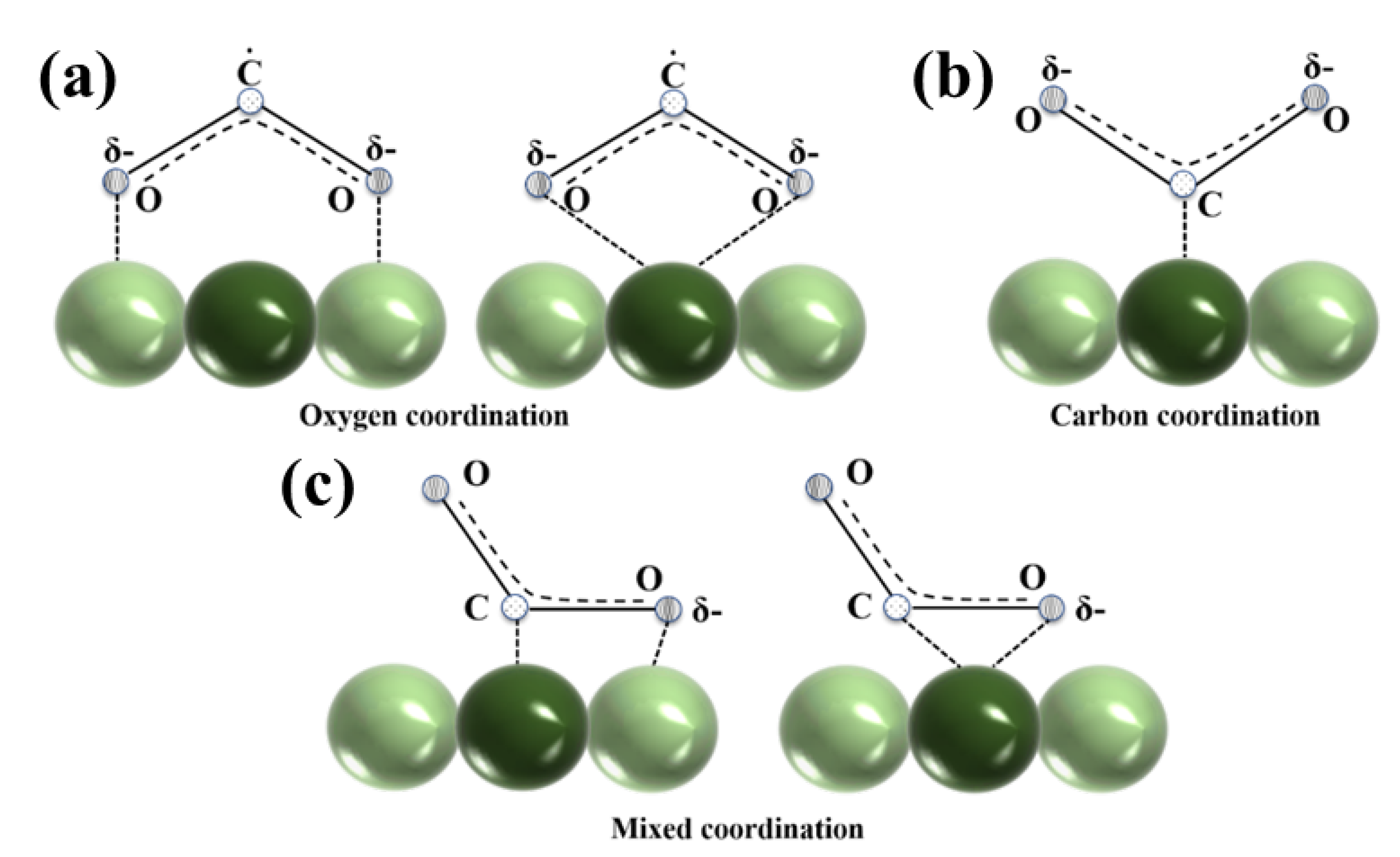
The adsorption of CO2 on the semiconductor surface is a key first step in the CO2 photoreduction reaction. The adsorption interaction results in a partially charged species, CO2δ−. As shown in Figure 2, the main adsorption modes of CO2 on the semiconductor surface include oxygen coordination, carbon coordination, and mixed coordination [51,52]. Figure 2a,b,c show two possible bidentate binding structures in oxygen coordination, forming a typical carbon coordination for a carbonate-like species and mixed coordination, respectively [53]. Different binding modes determine the different CO2δ− reaction pathways to a certain extent. In Figure 2, solid lines represent the intrinsic covalent C=O bonds within the CO2 molecule, while dashed lines indicate the adsorption interactions between CO2 and the surface active sites of catalysts, such as Lewis acid–base interactions or coordination bonds. The light green and dark green spheres denote surface Lewis acid sites and Lewis base sites, respectively.
Poor CO2 adsorption will reduce the amount of CO2 available for reduction. Therefore, enhanced CO2 adsorption on the semiconductor surface can significantly improve the CO2 reduction efficiency. Functionalization of the catalyst surface with hydroxyl (OH), amino (NH2) groups, or oxygen vacancies may donate electrons to CO2 molecules, resulting in negatively charged HCO2δ− species that can increase CO2 adsorption [54]. The use of semiconductors with a large surface area can also provide more active sites for the catalytic reaction while improving the CO2 adsorption capacity [55]. In addition, the alkali metal or alkaline earth-metal-loaded semiconductor has a great affinity for acidic CO2 molecules, which can also promote the adsorption of CO2 on the catalyst surface [56].

2.3. Reaction Pathways

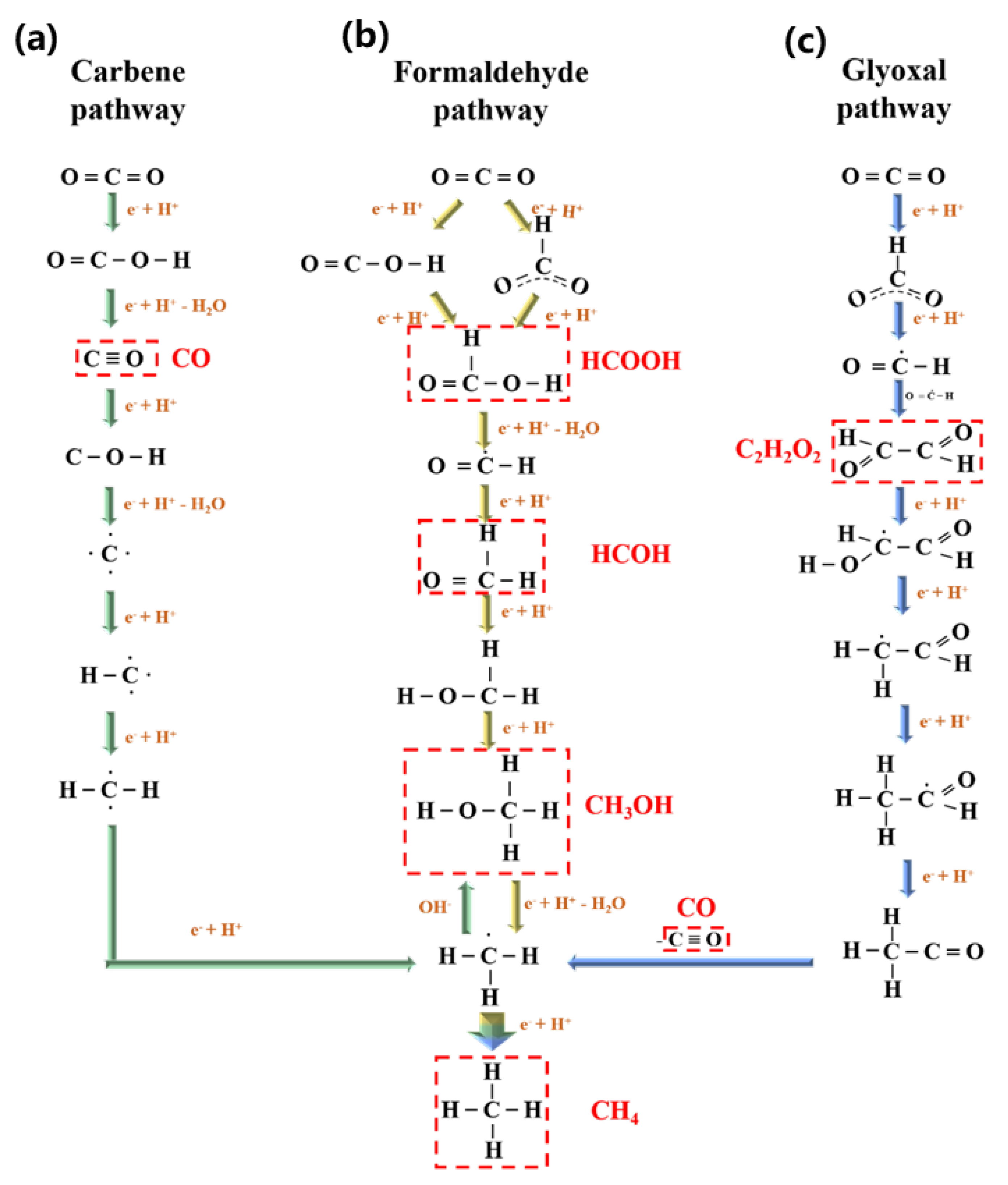
Understanding the mechanisms of CO2 photoreduction to various products is challenging due to many known and unknown phenomena. Various factors, such as the properties of the semiconductor itself, photoexcitation properties, surface defect sites, CO2 adsorption properties, the number of active sites, and the properties of the interface, can significantly affect the reaction pathway. These include the number of photogenerated electrons, the electron transfer rate, the electron–hole recombination rate, C-O bond cleavage, the form of the intermediate substance, the proton source, coupling of the intermediate and the proton, new bond formation, adsorption and desorption of intermediate products, etc. all play crucial roles in determining the reaction efficiency and affect the CO2 reduction pathway [57,58]. As shown in Figure 3, three reaction pathways for photocatalytic reduction of CO2, (a) the carbene pathway, (b) the formaldehyde (HCHO) pathway, and (c) the glyoxal (HOCCOH) pathway, are presented. All of these pathways start with the adsorption and activation of CO2 molecules on the catalyst surface.
In Figure 3a, the green arrows clearly show the carbene pathway for the photocatalytic reduction of CO2 to CH4 [10,52,59]. In the carbene pathway, the process of CO2 conversion to CH4 can be summarized as first deoxygenation followed by hydrogenation. The carbene pathway has two important features. CO is a key intermediate or by-product, depending on its binding mode and adsorption strength on the photocatalyst surface. Furthermore, the final product is either CH3OH or CH4, and these are competing reactions. *CH3OH is formed when *CH3 recombines with hydroxyl radicals (·OH), while CH4 is formed when *CH3 reacts with H·. When the CO2 molecule captures a photogenerated electron and H+, it forms a monodentate carbon-coordinated carboxyl group (·COOH) on the catalyst surface. This group then gains another pair of electrons and H+, undergoing dehydration to form CO*. If the binding energy of CO* to the semiconductor is weak, it desorbs as CO, a by-product. However, if the binding is stronger, CO* further reacts with another pair of electrons and H+ to form COH*. After hydrogenation and dehydration, the intermediate ·C is generated. Continuous hydrogenation steps then produce the critical intermediate ·CH3, which combines with ·OH or H+ to form CH3OH and CH4. ·CH4 is a key intermediate in the photocatalytic CO2 reduction. The carbene pathway, a common mechanism for producing CO and other hydrocarbons, is supported by experimental evidence and can be monitored using advanced analytical techniques, such as EPR (Electron Paramagnetic Resonance).
In the formaldehyde pathway, CO2 has many possible intermediate products in the photocatalytic reduction of CH4 [60]. The yellow arrows in the middle of Figure 3b point out the possible occurrence of carbon dioxide in this process to give two, four, six, and eight electron products as HCOOH, H2CO, CH3OH, and CH4, respectively. In this pathway, the photoconversion of HCOOH to H2CO has the most significant kinetic obstacle. The formaldehyde pathway has two important features. One feature is that the combination of CO2 and the catalyst is carried out through the combination of an oxygen atom and the active site of the catalyst. In addition, H2CO and CH3OH are two intermediates in the reaction process, not by-products. The distinction between intermediates and by-products depends on the surface binding of H2CO and CH3OH to the catalyst. If the binding mode is stronger, the release of H2CO and CH3OH is more difficult, which ensures that the intermediates will further undergo hydrodeoxygenation to form CH4. On the contrary, the weak binding of H2CO and CH3OH on the catalyst surface leads to the direct desorption of H2CO and CH3OH during the reaction. Furthermore, H2CO and CH3OH are obvious by-products in the reaction, while CH4 is in low or no yield. This pathway can explain the production of HCOOH, H2CO, CH3OH, and CH4 but not CO.
The blue arrow in Figure 3c illustrates the reaction route of the glyoxal pathway, which is unique for involving the dimerization of formyl (HCO) radicals. This reaction generates glyoxal, an intermediate with high electron affinity, which is easily reduced to trans-ethan-1,2-semidione. This intermediate is further reduced to form ·CH3, which then reacts with protons to produce CH4, with CO released as a by-product [61].
Although various studies have explored these CO2 reduction pathways theoretically and experimentally, the multiple steps involved in the reaction, the adsorption and desorption of intermediates, and the appearance of by-products make the process more complex in terms of product selectivity. During the reaction process, not only is there a competitive reaction between H2O reduction and CO2 reduction but also the CO2 reduction products of different reaction pathways.
Figure 3. The possible pathways of photocatalytic CO2 reduction to CH4 on the surface of photocatalysts. (a) Carbene pathway; (b) Formaldehyde pathway; (c) Glyoxal pathway. Adapted with permission from Ref. [62]. Copyright 2024, Elsevier Ltd.
Crystals 16 00128 g003

3. Bi-Based Photocatalysts

Bismuth (Bi), located in group VA of the sixth period in the periodic table, has an atomic number of 83 and an atomic weight of 208.98. It exhibits both covalent and metallic bonding characteristics. Most Bi-based materials used in photocatalysis possess a unique layered structure, where strong chemical interactions hold the layers together while weak van der Waals forces exist between them. These structural features contribute to the distinct physical and chemical properties of Bi-based photocatalysts. Considering the stability of Bi3+, most studies have focused on compounds containing Bi3+, such as Bi2O3 [63,64,65], BiVO4 [66,67,68], Bi4Ti3O12 [69,70], Bi12TiO20 [71], Bi2O2CO3 [72,73,74], Bi2WO6 [68,75], BiPO4 [76], BiFeO3 [77], BiOX (X = Cl, Br, I) [78,79,80], Bi3TiNbO9 [81], and Bi0.5K0.5TiO3 [82]. Due to the instability of Bi5+, although its compounds can be excited by visible light, there is little research on these compounds.
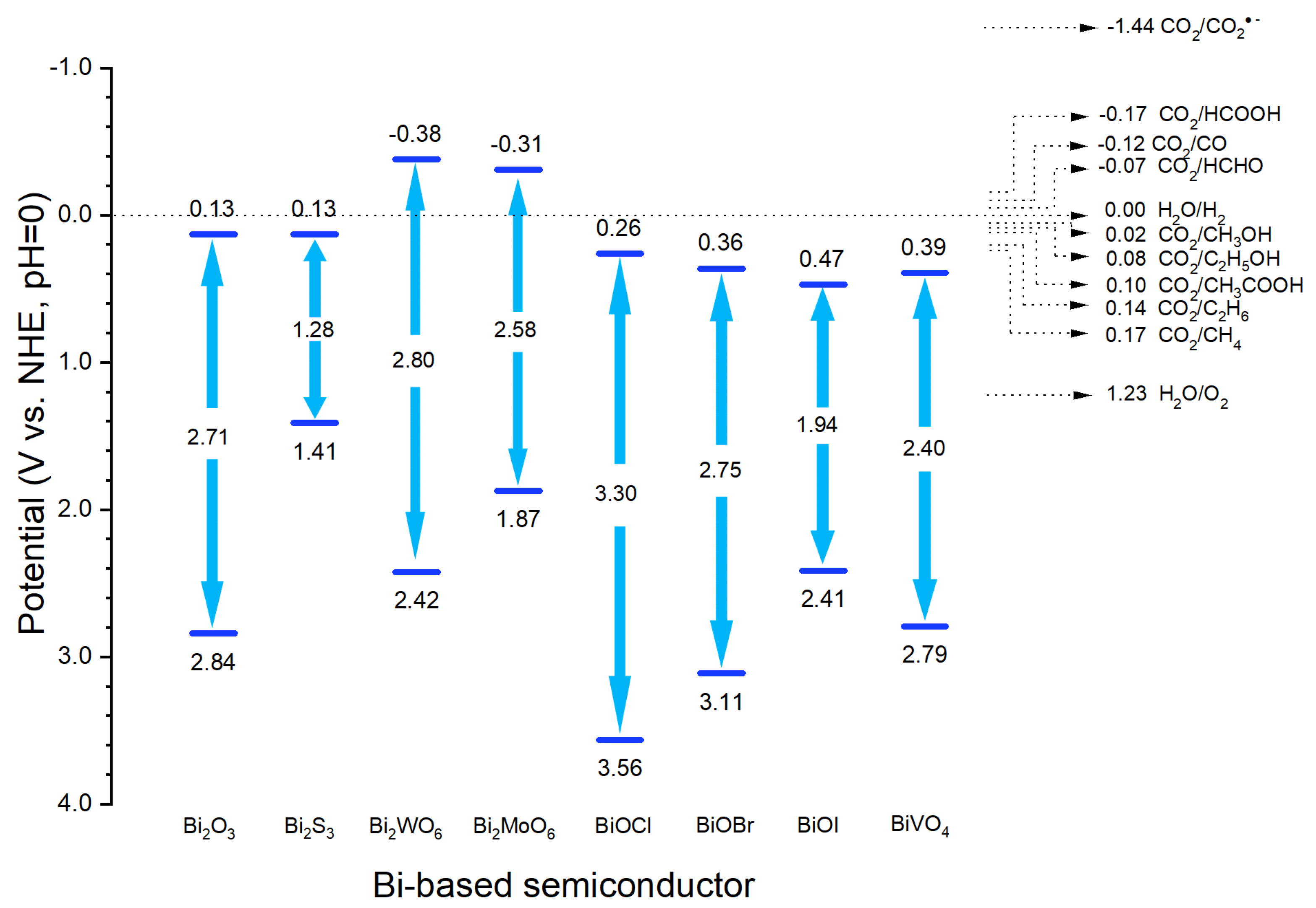
Compared with conventional metal oxide photocatalysts [28], such as TiO2 [24], the valence band (VB) of Bi-based oxides contains not only O 2p orbitals but also Bi 6s orbitals. The Bi 6s orbitals contribute to reducing the bandgap and enhancing the mobility of photogenerated charges in semiconductors. As a result, Bi-based photocatalysts typically have a bandgap of less than 3.0 eV, allowing them to be excited by visible light, as shown in Figure 4. The crystal structure and electronic properties play a significant role in photocatalytic activity. This section discusses the crystal and electronic structures of several well-known Bi-based photocatalysts and evaluates their performance in photocatalytic reactions.

3.1. Bi2O3 and Bi2S3

Bi2O3 (Bismuth (III) Oxide) as an important oxide of the Bi element in nature. Bi2O3 is a light-yellow powder with a melting point of 824 °C and a boiling point of 1890 °C. It is soluble in acid but insoluble in water and alkali. The density of Bi2O3 varies slightly with different crystal types, ranging from 8.2 g·cm−3 to 8.9 g·cm−3.
Bi2O3 is a p-type semiconductor, with several crystal forms resulting from the symmetry of the unit cell, including monoclinic (α), tetragonal (β), body-centered cubic (γ), face-centered cubic (δ), orthorhombic (ε), triclinic (ω), and hexagonal structures [83,84]. Of these phases, only the α-Bi2O3 and γ-Bi2O3 phases exhibit semiconductor properties, while the β-Bi2O3 and δ-Bi2O3 phases behave as oxide ionic conductors. Furthermore, α-Bi2O3 is stable at low temperatures, δ-Bi2O3 is stable at high temperatures, and the other crystal phases are metastable phases, and there is a conversion relationship between the four phases [63]. Although different Bi2O3 crystal forms all have different band positions and properties, this is generally considered a disadvantage. (i) It is difficult to synthesize well-defined Bi2O3 crystal phases at room temperature, usually requiring complex equipment. (ii) The phase transition of Bi2O3 is difficult to control and limits its practical application. In CO2-containing solutions, metastable Bi2O3 will be converted to α-Bi2O3 and bismuth subcarbonate (Bi2O2CO3). (iii) Low-temperature synthesis will lead to poor crystallization of Bi2O3, a crystalline phase, and, if the crystallinity is increased through high-temperature annealing, Bi2O3 will undergo phase transformation. But, Bi2O3 has obvious advantages in photocatalytic reactions. It is inexpensive, non-toxic, abundant in the crust, and inert towards neutral water. In addition, it has a suitable valence band for photocatalytic reactions, chemical and biological inertness, photo corrosion stability, and good solar light absorption. And, β-Bi2O3 has a unique structure, which can provide a charge transfer channel and prevent photogenerated carriers from recombining with holes during the photocatalytic process, and it has better photocatalytic performance than other crystalline phases [85]. However, because the existence of β- Bi2O3 is not stable, the development and preparation of β- Bi2O3 is still a challenge.
Bi2S3 (Bismuth (III) sulfide) belongs to the A2B3 (A = Sb, Bi, As; B = S, Se, Te) type direct bandgap layered semiconducting material, and its crystal system belongs to the orthorhombic system. It is widely used in thermoelectric devices, photocatalysis, and infrared spectrometers [86]. Compared to Bi2O3, Bi2S3 has a narrower bandgap (1.3–1.7 eV), which allows it to generate photogenerated carriers under visible and near-infrared light [87]. However, this narrow bandgap also leads to a higher recombination rate of photoinduced electron–hole pairs, limiting the use of pure Bi2S3 in photocatalysis [88]. Numerous studies have demonstrated that combining Bi2S3 with other materials enhances the separation and migration of electron–hole pairs, thereby improving the photocatalytic activity of bismuth sulfide [89,90,91,92].

3.2. Bi2MO6 (M = W, Mo)

Bi2MO6 (M = Mo, W) has two different crystal phases: orthorhombic and monoclinic structures. The orthorhombic crystal structure Bi2MO6 (M = Mo, W) exists in the mid-to-low-temperature range (T < 960 °C), and the monoclinic Bi2MO6 (M = Mo, W) exists in the high-temperature range (T > 960 °C). The current research in the field of Bi2MO6 (M = Mo, W) mainly focuses on the former one [93]. Bi2MO6 (M = Mo, W) is composed of MO6 (M = Mo, W) octahedral layers and [Bi2O2]2+ layers alternately stacked, presenting an aurivillius type of oxide family. Specifically, each Bi atom in Bi2MO6 is coordinated with six O atoms and four M atoms [94,95], while each M atom is coordinated with six O atoms, forming a co-angular octahedron [96]. Notably, the crystal directions of Bi2MoO6 and Bi2WO6 differ, with the directions perpendicular to the upward orientation of their layered structures being (010) and (001), respectively. Additionally, the local environment around each M and Bi atom in the Bi2MO6 unit cell is slightly distorted [97].
Bi2MoO6 and Bi2WO6 are direct-gap semiconductors. The VB of Bi2MO6 (M = Mo, W) is mainly composed of the 6s orbital of Bi and the 2p orbital of O. The CB is mainly composed of the nd orbital of M (Mo 4d, W 5d); photo-generated electrons transition from the hybrid orbital to the nd orbital in photocatalytic reactions [98]. Combining the above electronic structure and layered structure of Bi2MO6, it can be inferred that in the photocatalytic reaction, M is the reduction reaction site and the O in Bi-M-O or Bi is the oxidation reaction site [97,99,100].
Although the energy band structure of Bi2MoO6 and Bi2WO6 is similar, and both can absorb part of visible light, the bandgap and Eg of the two are different. It is generally believed that the Eg of Bi2MoO6 is about 2.6 eV and the Eg of Bi2WO6 is about 2.8 eV, which is slightly larger and also consistent with the yellow and light green colors of the two. In terms of energy band position, the VB position of Bi2WO6 is more oxidative compared to that of Bi2MoO6. In addition, in order to compare the carrier separation and transport performance of Bi2MoO6 and Bi2WO6, Lai compared the effective electronic mass of the two through density functional theory (DFT) [101]. For photocatalysts, the effective mass of electrons is inversely proportional to the curvature of the bottom of its conduction band. The calculation results show that the curvature of the conduction band bottom of Bi2WO6 is greater than Bi2MoO6, which indicates that the effective electron mass of Bi2WO6 is smaller and the carrier separation and transmission efficiency are higher [102,103]. Bi3+ has a relatively positive reduction potential and is easily reduced to elemental Bi. As a result, Bi2MO6 (M = Mo, W) effectively degrades pollutants and converts energy, but it cannot directly cleave H2O to produce H2 [104]. However, Bi2MO6 faces several challenges as a photocatalyst: (i) its bandgap is about 2.8 eV, which enables it to absorb visible light, but it exhibits minimal photocatalytic activity under light irradiation greater than 470 nm [105]; (ii) the recombination rate of photogenerated electrons and holes is high; and (iii) insufficient exposure of reactive sites limits the adsorption and activation of reactants.
At present, the application of Bi2MO6 (M = Mo, W) in the energy field mainly includes CO2 reduction, nitrogen fixation reaction, oxygen production, and so on. The basic principle of these reactions is to use the redox reaction between photogenerated carriers (mainly photogenerated electrons) and substrate molecules (CO2, N2, H2O) to realize the development and utilization of new energy [106,107,108].

3.3. BiVO4

BiVO4 (Bismuth vanadate), a narrow bandgap semiconductor, is one of the most promising photocatalysts for visible light response, drawing significant attention from researchers. BiVO4 exists in three main crystalline forms: tetragonal scheelite (t-BiVO4), monoclinic scheelite (m-BiVO4), and tetragonal zircon (t-z-BiVO4). t-z-BiVO4 can irreversibly transform into m-BiVO4 when heated to temperatures between 670 K and 770 K, while s-BiVO4 and m-BiVO4 can interconvert at 528 K [109]. Among these phases, m-BiVO4, with a bandgap of 2.4 eV, exhibits the highest photocatalytic performance under visible light irradiation.
The unit cell of m-BiVO4 contains four Bi atoms, four V atoms, and sixteen O atoms. The basic structural unit consists of VO4 tetrahedra and BiO8 dodecahedra. Each Bi atom is surrounded by eight O atoms, forming a BiO8 dodecahedron. Adjacent metal atoms are linked to form a continuous Z-shaped structure on the (221) face, with the BiO8 chains parallel to the (110) face by sharing an edge. The VO4 tetrahedra remain independent and do not touch each other. They are connected to BiO8 dodecahedra through O atoms that share vertices. As a result, each BiO8 dodecahedron is surrounded by eight isolated VO4 tetrahedra. Additionally, Bi and V atoms are alternately arranged along the crystal axis, giving m-BiVO4 its layered structure. However, the arrangement of Bi and V is different along the three different axis directions. In the a-axis or c-axis direction, it has a -Bi-V- structure; in the b-axis direction, it has a -Bi-V-V-Bi- structure. Moreover, the Bi-O bond length in the b-axis direction is longer than in the a-axis or c-axis direction, which leads to a rather weak bond. This may be the reason for the easy cracking along the (010) face. Zhao reported that there are four types of Bi-O bonds and two types of V-O bonds in m-BiVO4, which means that the VO4 tetrahedron and BiO8 dodecahedron will be slightly distorted [110]. The twisted BiO8 dodecahedron will enhance the influence of Bi 6s on the electrons. At the same time, the distortion of the VO4 tetrahedron causes the positive and negative charge centers to shift, creating a built-in electric field that facilitates the separation of photogenerated electron–hole pairs, thus enhancing photocatalytic activity. In contrast, the other BiVO4 structures (t-BiVO4 and t-z-BiVO4) exhibit negligible photocatalytic activity under visible light, primarily due to their symmetrical polyhedral structures. This is why m-BiVO4 shows superior visible light catalytic performance among the three structures.
Density functional theory (DFT) calculations reveal that the valence band (VB) of m-BiVO4 is primarily composed of O 2p orbitals. The top of the VB is mainly contributed by O 2pπ nonbonding orbitals, with a small contribution from Bi 6s. The center of the VB results from the hybridization of V 3d and O sp2 orbitals, while the bottom is influenced by Bi 6p and hybridized O sp2 orbitals. The valence band in the range of −10 to −9 eV is mainly composed of Bi 6s, hybridized with a small amount of O 2p. The conduction band (CB) is primarily composed of the hybridization of V 3d, O 2p, and Bi 6p. Below 4.8 eV, the CB is mainly composed of V 3d and O 2p, with Bi 6p contributing less. Between 4.8 eV and 7.1 eV, the contribution of Bi 6p to the CB is significantly enhanced, while V 3d’s contribution is reduced. This electronic configuration not only narrows the bandgap (Eg) of the photocatalyst, extending its visible light response, but also increases the VB width, promoting the migration of photogenerated holes and inhibiting the recombination of electron–hole pairs [110].
The actual photoelectric conversion efficiency of BiVO4 photocatalytic material is still far lower than its theoretical value due to its own problems, which limits its practical application. The existing problems are mainly reflected in the following aspects. (i) The charge transfer in the BiVO4 is very slow, causing about 60–80% of the charge carriers generated to recombine before reaching the surface of the material. It leads to shortcomings of the photogenerated electron–hole pairs in BiVO4 that are difficult to separate and easy to recombine. (ii) Compared with the oxidation reaction of sulfite, the kinetic rate of BiVO4 release of oxygen is very slow. (iii) The conduction band edge of BiVO4 is located below the potential of the reversible hydrogen electrode, which causes its photoelectrochemical reaction to require an external bias.

3.4. BiOX (X = Cl, Br, I)

BiOX (X = Cl, Br, I) belongs to the tetragonal matlockite structure (PbFCl type) and is a compound with a ternary structure (Ⅴ-Ⅵ-Ⅶ), which has a unique layered crystal structure. BiOX is mainly composed of [Bi2O2]2+ and double X. Two atomic layers are alternately arranged along the C axis to form a layered structure [111,112,113]. The atoms in the layers are mainly connected by relatively strong covalent bonds, and the atoms between the layers are mainly connected by weak Van der Waals force. In this way, the internal non-bonding force and the external bonding force will interact to make the BiOX shows a high degree of anisotropy [114,115]. The layered crystal structure of BiOX is relatively open, providing a large enough space for the polarization of related atoms and orbitals to easily form a built-in electric field perpendicular to the [Bi2O2]2+ and double X. The built-in electric field can prolong the lifetime of photoinduced charge carriers and facilitate the separation of photo-generated electron–hole pairs, improving the photocatalytic performance of the material [87,116,117,118].
In addition, density functional theory (DFT) calculations show that the top of the VB of BiOX is mainly composed of the hybridization of O 2p orbitals and X np orbitals (where the values of n corresponding to Cl, Br, and I are three, four, and five, respectively) and the minimum value of the CB is mainly composed of Bi 6p orbitals [78,119]. Therefore, when the n value of X continues to increase, the density peak of the X np orbital will migrate in the direction of the top of the VB, which will increase the position of the VB top of the BiOX and cause the Eg of the BiOX material to gradually decrease [36,120,121]. It is for this reason that BiOCl has the largest bandgap and only responds to ultraviolet light; BiOI has the smallest bandgap and can respond to visible light.
Building on the discussion of the hybridization of O 2p and X np orbitals in BiOX, further analysis of the bandgap energies reveals how the halogen ion affects the photocatalytic properties. BiOCl [122], with a bandgap of around 3.4 eV, absorbs mostly in the ultraviolet range, limiting its photocatalytic activity under visible light. The larger bandgap of BiOCl is due to the more significant overlap between O 2p and Cl 3p orbitals, which results in a higher energy level for the top of the valence band (VB) and restricts the absorption of visible light. In contrast, BiOBr [123] and BiOI [124] exhibit smaller bandgaps of approximately 2.8 eV and 1.8 eV, respectively. As the atomic number of the halogen increases from Cl to I, the X np orbitals’ energy levels shift closer to the top of the VB, thus reducing the overall bandgap. This shift allows BiOBr and BiOI to absorb light in the visible region, making them more efficient for photocatalytic CO2 reduction under visible light [125,126,127]. The relationship between halogen substitution and the narrowing of the bandgap demonstrates a strategy for optimizing BiOX materials for visible light-driven photocatalysis.
Furthermore, the defect engineering and vacancy formation in BiOX materials can further tune their electronic structure. For instance, vacancy engineering in BiOBr and BiOI enhances their photocatalytic performance by improving charge carrier separation and increasing the surface reactivity for CO2 activation. The presence of halogen vacancies also plays a crucial role in facilitating the transfer of charge carriers, further optimizing the photocatalytic efficiency.
BiOX material is a photocatalyst to be developed due to its special layered structure and good non-toxic, anti-corrosion, and other physicochemical properties. But, its existing problems should not be underestimated: (i) a low surface area, limited light absorption, and few photocatalytic active sites make it difficult for the photocatalytic reaction to occur, and (ii) electrons and holes are not easily separated and photogenerated carriers have a very short lifetime, which in turn affects the photocatalytic activity.

4. Structural Design of Bi-Based Photocatalysts

4.1. Vacancy Engineered

Because the VB and CB edges of most Bi-based semiconductors are mainly composed of sp hybridized Bi and O orbitals, the loss of Bi or O atoms will seriously affect the properties of bismuth-based photocatalysts. Therefore, introducing vacancies is an effective method to modify the electronic structure of photocatalysts. The local polarization field created by vacancies can reduce the energy barrier, facilitating CO2 activation by promoting electron transfer and also triggering C-C coupling by altering the asymmetric charge distribution on the intermediate [52,128,129]. Specifically, the (C-O) π* orbitals of CO2 accept electrons from defect sites, causing the energy level of the 2πu orbital to decrease and the linear structure to bend. This facilitates the activation of CO2 as a reaction intermediate, promoting further reactions. Moreover, uniform charge density on the photocatalyst surface leads to similar charge distributions in reaction intermediates, resulting in strong dipole–dipole repulsion that limits C-C coupling. However, vacancies create variations in charge density between adjacent atoms, providing electrons that enhance CO2 activation, leading to asymmetric charge distribution in the intermediates, which promotes C-C coupling and favors the formation of the desired product.
The methods for synthesizing vacancy can be classified into “top–down” and “bottom–up” categories according to the generation sequence of the vacancy [130]. Most of the “top–down” synthesis methods involve post-processing of the original material, that is, the treatment of bismuth-based materials through methods such as heat treatment, ultrasound, light irradiation, or chemical reduction. The vacancy is created through weak out-of-plane interactions between the outer elements. One-step synthesis methods, in which vacancy defects are generated along with crystal growth through one-step hydrothermal, ionic liquid, and other methods in the synthesis stage, are classified as “bottom–up” methods. This method can simultaneously create vacancy defects in the bulk and the surface of the material and the separation of holes and carriers is further improved.
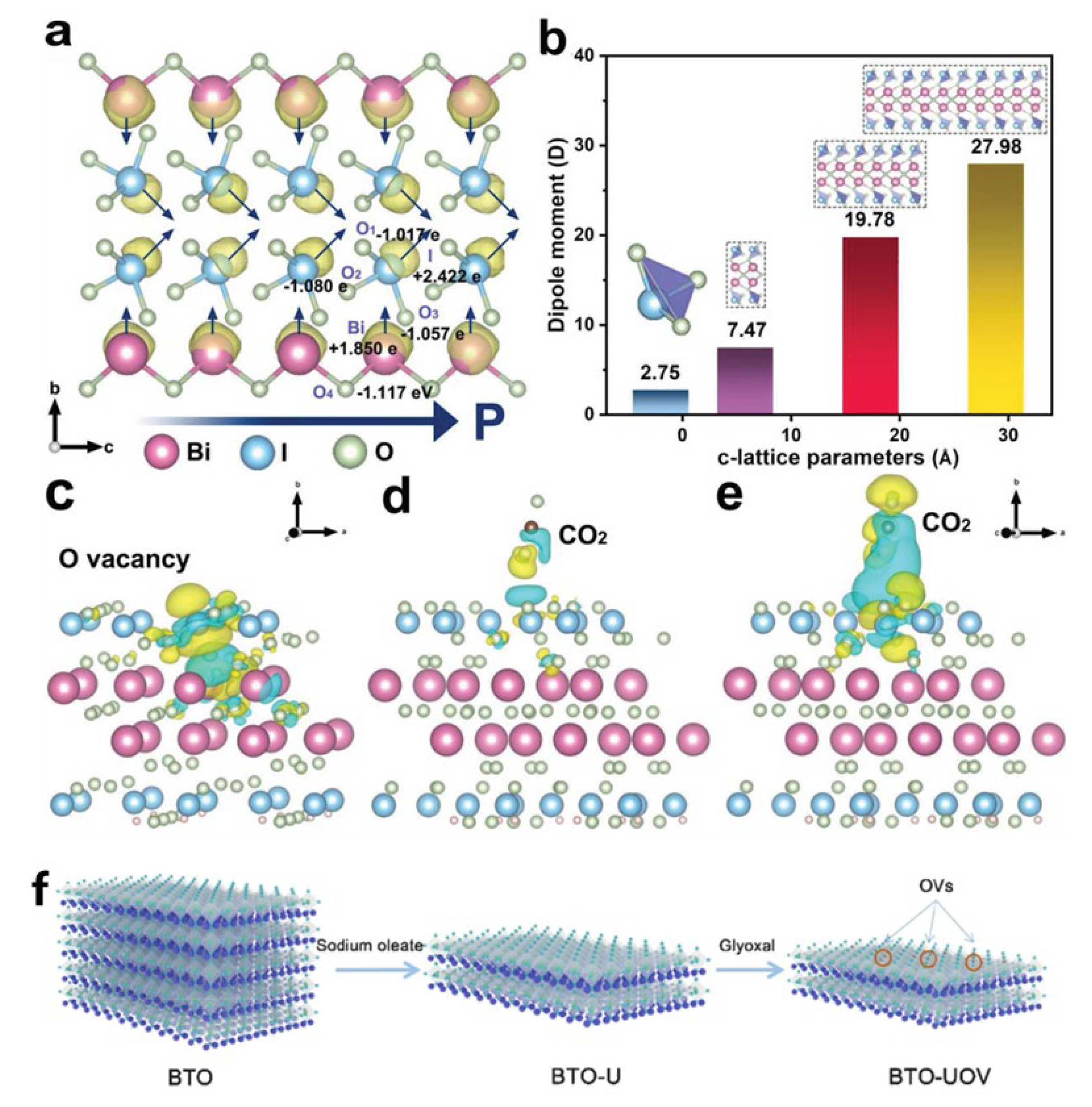
Oxygen vacancies (OVs) play a crucial role in hole engineering and significantly enhance photocatalytic performance. The CO2 photoreduction mechanism mediated by OVs proceeds as follows. First, O atoms in CO2 are adsorbed onto OVs and converted into lattice oxygen during the photoreduction process [131]. The intercalation of oxygen with high electronegativity into the lattice induces charge transfer at Bi-O bonds [132]. As a result, adjacent lattice oxygen with lower charge density is readily oxidized into OVs by two photogenerated holes (2h+) [133]. Under illumination, this process generates new OVs with two positive charges. The O atoms from H2O molecules then fill the OVs, generating two hydrogen protons. After the catalyst acquires electrons and hydrogen protons, different gas molecules are produced through various equilibrium states, and the catalyst returns to its initial state. It has been reported that the formation of the [COOH]· group is the rate-limiting step in CO2 reduction to CO or CH4 due to the high formation energy of [COOH]·. DFT calculations show that OVs on the defect surface serve as active sites, greatly reducing the barrier for [COOH]· formation.
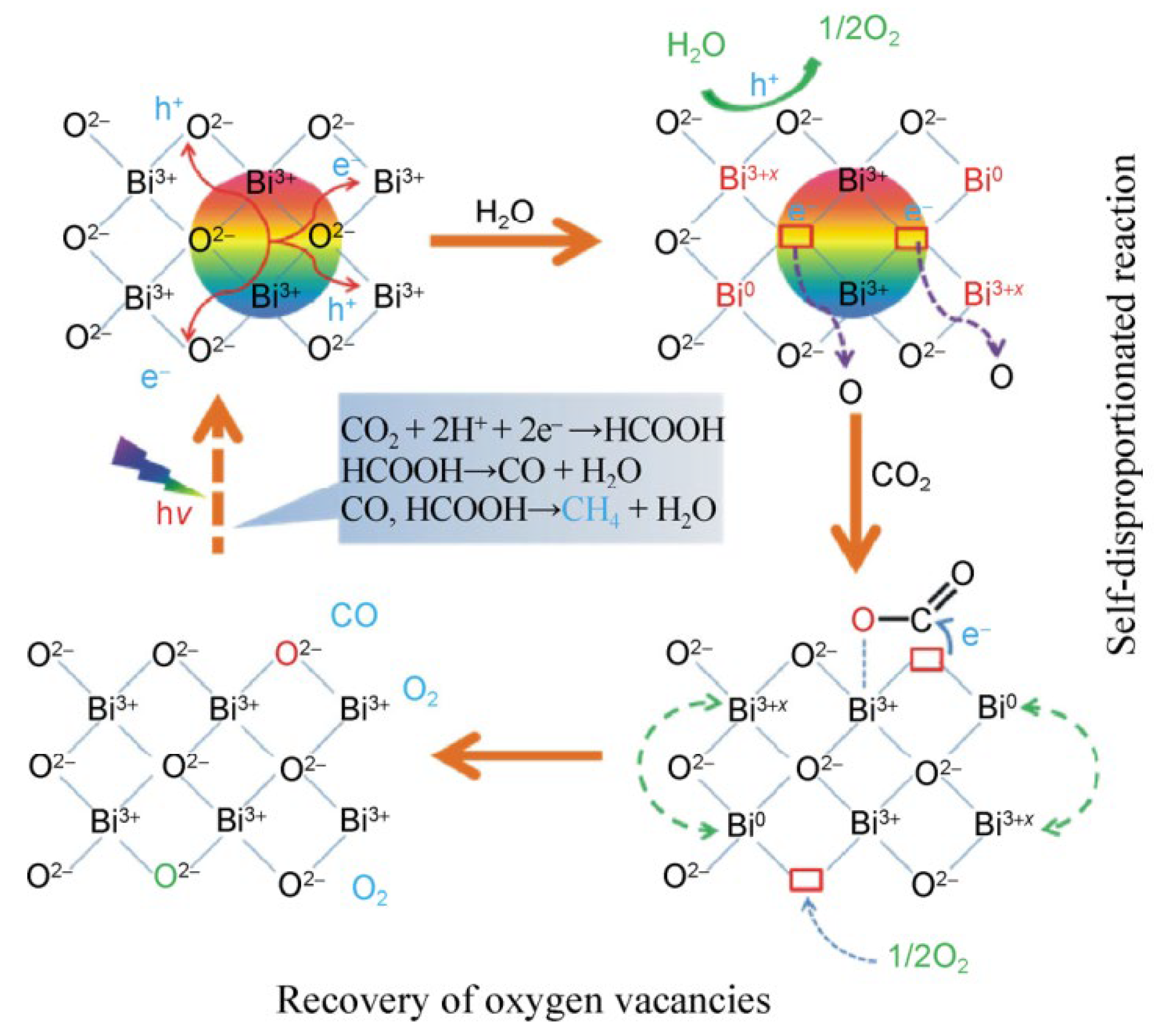
Zhang successfully introduced oxygen vacancies into BiOCl nanoplates using light irradiation [133]. When BiOCl is irradiated under a 500 W xenon lamp for 5 h, the initially white BiOCl transforms into a gray defective form. Due to the high oxygen atom density and low Bi-O bond energy, oxygen vacancies can be easily regenerated under light irradiation, even after being filled by oxygen atoms during the photocatalytic reaction. This enables the generation and recovery of BiOCl defects (Figure 5). In another study, Bi designed Bi12O17Cl2 ultrafine nanotubes enriched with oxygen vacancies through structural deformation to enhance carrier migration and CO2 activation [134]. Without cocatalysts and sacrificial reagents, the CO release rate from Bi12O17Cl2 nanotubes was found to be 16.8 times higher than that from pristine Bi12O17Cl2.
To investigate the impact of oxygen vacancies on photogenerated carrier separation and CO2 activation, Wang synthesized PbBiO2Br atomic layer photocatalysts with tunable oxygen vacancy concentrations [135]. Ultrafast transient absorption spectroscopy and DFT calculations show that photogenerated electrons migrate to the conduction band (CB) and are trapped by surface oxygen vacancies, effectively separating the electron–hole pairs. CO2 molecules adsorbed on oxygen vacancies directly interact with surface protons to form COOH* intermediates, which are further protonated to produce CO. During the photocatalytic reduction of CO2 to CO, oxygen-rich vacancies serve as both electron separation and transfer centers and CO2 adsorption sites. The PbBiO2Br atomic layer photocatalyst with oxygen vacancies exhibits a CO release rate of 4.58 μmol·g−1·h−1 in water, which is 10.9 times higher than that of bulk PbBiO2Br. Guo successfully prepared Bi2Sn2O7 NPs with abundant ultra-small oxygen vacancies via the PVP-assisted hydrothermal method [136]. The oxygen vacancies significantly promote CO2 activation, stabilize COOH* intermediates, and accelerate CO desorption. Additionally, the ultra-small oxygen vacancies enhance the rate of bulk charge diffusion. These factors combined led to an 8.1-fold improvement in the photocatalytic performance of Bi2Sn2O7 NPs for CO2 to CO conversion, with the CO formation rate reaching 14.88 μmol·g−1·h−1. Kong synthesized Bi2WO6 with surface oxygen vacancies using an ethylene glycol-assisted solvothermal method and achieved broad-spectrum photocatalytic CO2 reduction across UV-Vis-NIR for the first time [137]. The introduction of oxygen vacancies creates defect energy levels within the bandgap, extending the photocatalyst’s absorption range from ultraviolet to near-infrared (NIR) light, thus covering the entire solar spectrum.
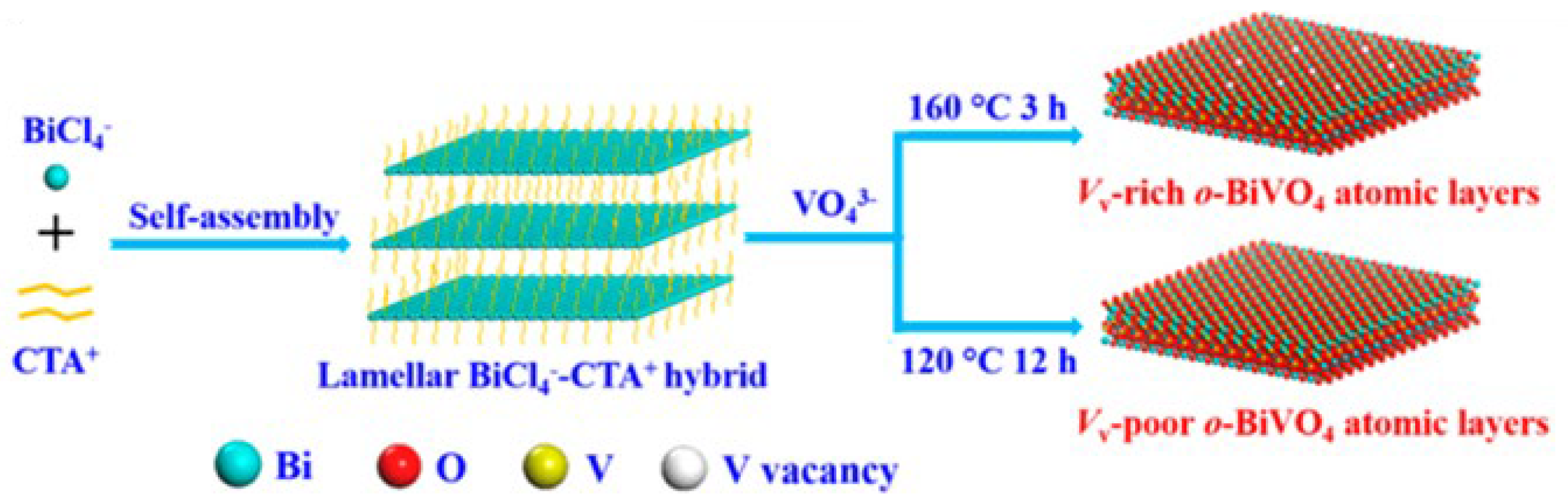
Metal atom vacancies significantly influence light absorption, surface reaction sites, and charge transport. Gao successfully synthesized a gram-level, single-crystal o-BiVO4 layer with vanadium vacancies for the first time by increasing the reaction temperature during the hydrothermal process [138]. Density functional theory (DFT) calculations reveal that vanadium vacancies introduce new defect levels and increase hole concentration near the Fermi level, enhancing both light absorption and electronic conductivity (Figure 6). As a result, the single-crystal o-BiVO4 layer with abundant vanadium vacancies exhibits a high methanol formation rate of 398.3 μmol·g−1·h−1 and an apparent quantum efficiency of 5.96% at 350 nm.

4.2. Microstructure Control

4.2.1. Ultrathin Structures

Atomic-level-thickness oxide-based semiconductors are considered to be an excellent platform for increasing catalytic active sites, increasing CO2 adsorption and stronger light absorption to promote CO2 conversion [139].
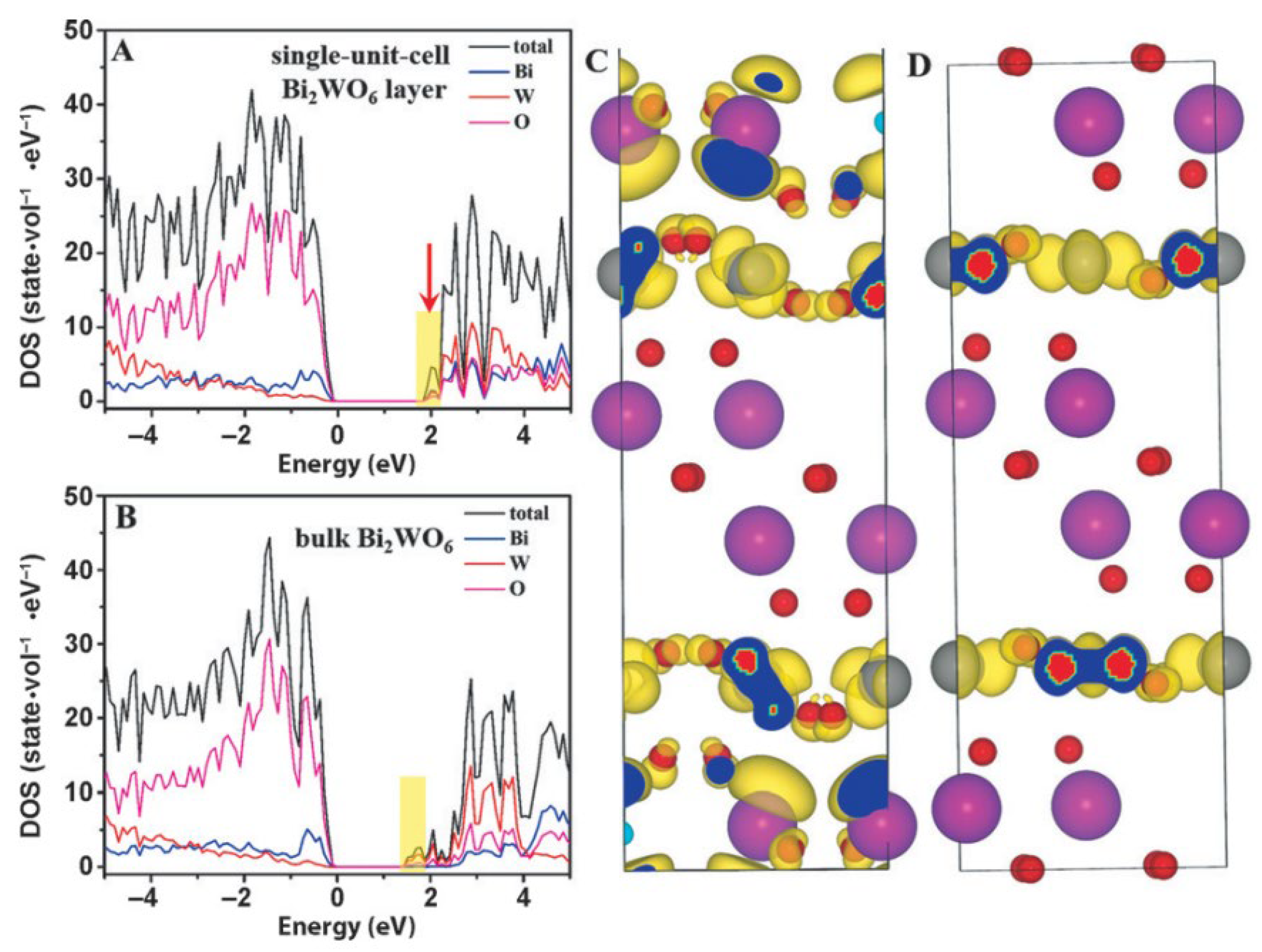
Taking the orthorhombic Bi2WO6 layer as an example, its atomic-scale thickness allows for a high proportion of low-coordinated surface atoms, which serve as catalytic sites for CO2 reduction reactions. This structure facilitates the easy transfer of photoexcited carriers from the interior to the surface, thereby reducing bulk recombination due to diffusion. When the thickness of the Bi2WO6 layer is reduced to a single unit cell, density functional theory (DFT) calculations show an increased density of states (DOS) at the conduction band (CB) edge (Figure 7A,B). Importantly, most of the charge density is concentrated on the surface of the single-unit cell Bi2WO6 layer (Figure 7C,D), which means that photoexcited electron–hole pairs reach the surface more quickly than those generated deeper within the material [140].
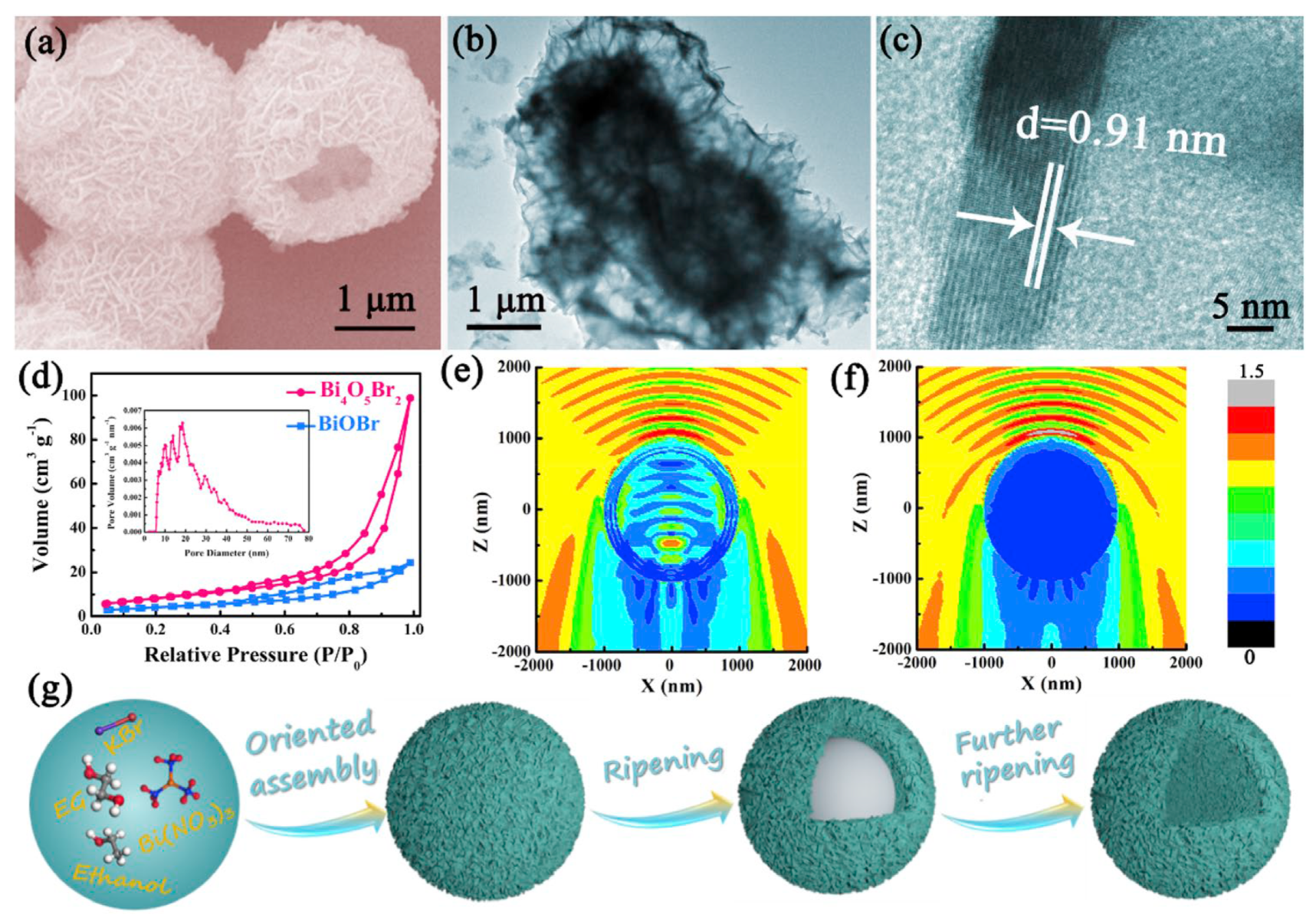
Liang takes advantage of an intermediate precursor of lamellar Bi-oleate complex successfully synthesized using single-unit-cell Bi2WO6 layers [140]. And, through experiments and theoretical calculations, it is proven that the carrier’s lifetime is increased and electron–hole separation efficiency is improved. Due to the advantages of ultra-thin structure, these Bi2WO6 atomic layers can achieve higher CO2 adsorption capacity and stronger light absorption, thus exhibiting a methanol generation rate of 75 μmol·g−1·h−1 under simulated sunlight, which is more than bulk Bi2WO6 (125 times higher). And, the stability is very good; even after 2 days, the catalytic activity will not disappear. Ye synthesizes ultra-thin nanosheet Bi4O5Br2 with a thickness of about 3.7 nm through the glycerol precursor route [141,142], while the thickness of ordinary BiOBr nanosheets is about 65 nm [143]. Due to the ultra-thin and bismuth-rich strategy, Bi4O5Br2 photocatalyst under visible light irradiation shows higher CO2 reduction activity than BiOBr photocatalyst and BiOBr nanosheet photocatalyst [144,145]. Ultra-thin nanosheets increase the generation of CO, and the bismuth-rich strategy enhances the selectivity to CH4.

4.2.2. Hollow and Porous Structures

Hollow structure refers to a material with clear boundaries and internal cavities [146]. As a unique series of functional materials, they have low density and high pore volume, as well as shorter mass and charge transfer length. The hollow structure constructed through three-dimensional materials can provide indoor space and utilize the significant reflections of light to help improve photocatalytic performance.
Jin synthesized bismuth-rich hollow Bi4O5Br2 graded microspheres using a solvothermal method [147]. The hollow interior increases the specific surface area and generates a strong electric field, which enhances CO2 adsorption and accelerates the separation of electron–hole pairs (Figure 8). The high bismuth content lowers the conduction band minimum, thereby boosting the reducing power of Bi4O5Br2. Together, the hollow structure and bismuth-rich composition give Bi4O5Br2 significantly higher photocatalytic CO2 reduction activity than both BiOBr and solid Bi4O5Br2 under solar radiation.

4.3. Crystal Facet Engineering

Crystals grow by reducing their total surface energy. According to the Gibbs–Wulff theorem, facets with higher surface energy grow rapidly but typically occupy a small portion of the surface or disappear. In contrast, facets with lower surface energy grow slowly and remain, ultimately defining the crystal shape. Semiconductor crystals formed under natural or equilibrium conditions often expose less reactive facets, which limits their photocatalytic efficiency [148]. Fortunately, organic or inorganic additives can serve as capping agents, selectively covering high-energy facets and reducing the surface energy of adsorption sites [149]. This allows for the controlled customization and exposure of specific crystal facets, a process known as crystal facet engineering [150].
BiOBr nanosheets dominated by (001) facets are produced through a simple hydrothermal method and different amounts of concentrated nitric acid [151]. The results show that the higher the (001) facets exposure percentage, the better the performance of BiOBr nanosheets in converting CO2 to CO. This is due to the increase in active sites and more efficient carrier separation and significantly improved reducing power. Ye adjusts the exposed crystal faces of BiOI nanosheets by adjusting the reaction time of the hydrothermal process [152]. It is also proven that the (001) facets of BiOI nanosheets have better photo-generated carrier separation efficiency and a higher CB position.
By controlling the acidity of the reaction solution during the hydrothermal process, Chen produced a series of layered BiOIO3 single crystals with different ratios of exposed (010) face to (100) face (Figure 9) [153]. Experiments and density functional theory (DFT) confirm that the (010) face on the top surface is enriched by electron-dominated reduction sites and the (100) face on the side surface is concentrated by hole-dominated oxidation sites. And successfully designed the BiOIO3 crystal with the best thickness and proper ratio of crystal plane, which is about three times that of bulk BiOIO3, greatly improving the photocatalytic activity.

4.4. Bi-Based Composites

In photocatalytic CO2 reduction, the appropriate loading of cocatalysts serves five key functions: (i) reducing the activation energy or overpotential of the CO2 reduction reaction on the semiconductor surface; (ii) promoting the separation and migration of photogenerated electron–hole pairs; (iii) improving CO2 reduction selectivity for specific products; (iv) enhancing photocatalyst stability by consuming photogenerated electrons and holes in a timely manner; and (v) inhibiting side or reverse reactions [9]. However, excessive cocatalyst loading can degrade photocatalytic activity for the following reasons: (i) it may cover the active sites of the photocatalyst, hindering its interaction with CO2, H2O, or sacrificial reagents; (ii) it can block incident light, reducing light absorption and thus decreasing the number of photogenerated electron–hole pairs; and (iii) high loading may lead to the formation of larger, unevenly dispersed particles, further decreasing catalytic activity.

4.4.1. Heterojunction Construction

An appropriate heterojunction between two semiconductor photocatalysts is crucial for promoting the separation and transfer of charge carriers. The relative energy levels at the heterojunction interface, in particular, govern the direction and efficiency of electron–hole separation and transfer.
He has formed a series of CdS/BiVO4 heterogeneous composite materials with different contents of CdS by adjusting the thickness of BiVO4 [154]. By choosing different scavengers or quenchers and some research to verify that the CdS/BiVO4 composite adopted a Z-scheme transfer mode under their experiment conditions, the charge transfer mode directly quenches the reductive electrons of BiVO4 and the oxidative holes of CdS [155,156,157]. Compared with the original photocatalyst, the CdS/BiVO4 heterogeneous composite materials increased the activity of reducing CO2 to CO and CH4 by 1.5 times and 3 times, respectively, after being irradiated with visible light for 5 h. This increase in photocatalytic activity is attributed to the formation of a Z-scheme heterojunction and the reduction of BiVO4 thickness. Bai prepared a g-C3N4/Bi4O5I2 heterojunction and observed that its CO2 reduction activity for CO reached 45.6 μmol·g−1·h−1, which is significantly higher than that of either the g-C3N4 or Bi4O5I2 photocatalyst alone [158]. Experimental analysis suggests that the I3/I redox mediator plays a key role in the Indirect Z-scheme of the g-C3N4/Bi4O5I2 photocatalytic system. Wang used a simple deposition method to prepare a series of BiOI/g-C3N4 photocatalysts [159]. The band edge positions of the g-C3N4 and BiOI were determined experimentally, and the results were used to infer the direction of the photogenerated charge transfer across the heterojunction. Liu employed a solvothermal process to prepare an S-type heterojunction composed of DETA-ammoniated α-MnS hollow spheres and Bi2MoO6 with a Bi SPR effect [160]. The DETA-organic amine molecule enhances the MnS photocatalyst, facilitating interaction with CO2 and lowering its activation energy, thereby constructing a highly efficient catalytic system and improving CO2 reduction efficiency. The Bi/Bi2MoO6 S-scheme heterojunction, with an enhanced SPR effect, features a unique electron transport structure that effectively inhibits photocatalyst photo-corrosion and demonstrates high redox capability.
Li employed an in situ deposition method using Au as a bridge to deposit CdxZn1−xS@Au on the (010) facet of BiVO4, thereby constructing a sandwich-structured CdxZn1−xS@Au/BiVO4 Z-scheme photocatalyst [161]. In this system, photogenerated electrons in the BiVO4 migrate unidirectionally to the Au nanoparticles via the Schottky junction, effectively preventing reverse electron flow. These electrons are then captured by the excited holes in the CdxZn1-xS photocatalyst. Additionally, Zn doping enhances the redox capability and improves charge carrier separation. Compared to CdS and CdS@Au/BiVO4, CdxZn1−xS@Au/BiVO4 demonstrates superior photocatalytic activity for CO2 reduction under visible light irradiation.
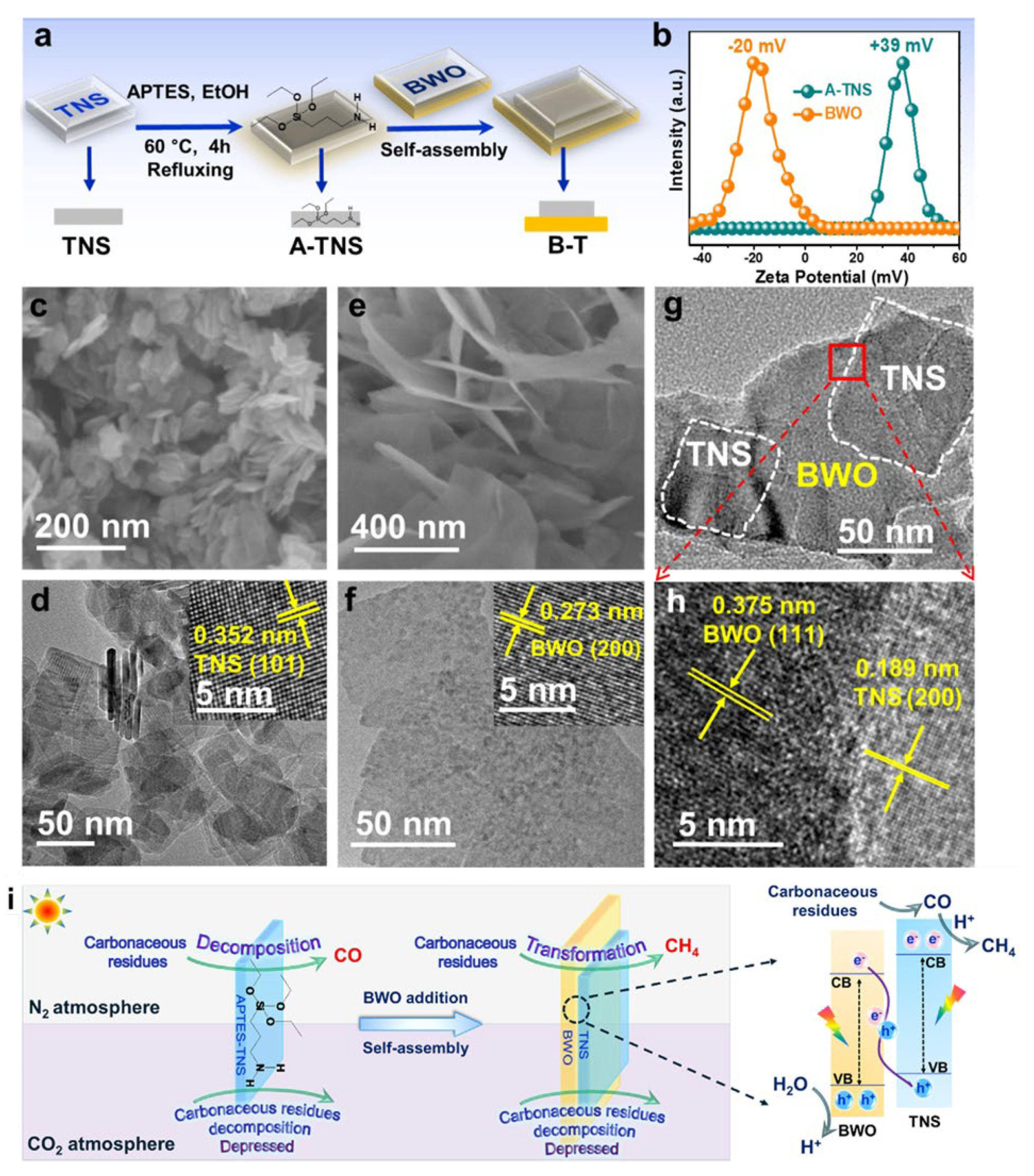
Yuan employed an electrostatic self-assembly method to prepare Bi2WO6/TiO2 heterogeneous composite materials (Figure 10) [162]. Experimental results show that this photocatalyst follows the Z-scheme charge transfer mechanism (Figure 10). The combination of electrons from the Bi2WO6 conduction band (CB) and holes from the TiO2 valence band (VB) enhances hole availability on the VB of Bi2WO6 for the oxidation of H2O, which produces more protons (H+) for CH4 formation. Additionally, the selectivity and yield of CO2 reduction to CH4 are improved. What is interesting is that Yuan‘s comprehensive study of Bi2WO6/TiO2 photocatalyst under N2 and CO2 atmospheres found that when there is a large amount of carbonaceous residue on the photocatalyst, the decomposition of carbonaceous residue will be greatly inhibited. In addition, the presence of carbon residues on the sample will interfere with the measurement of CO2 photocatalytic reduction activity. In the end, the yield of CO2 reduction and precipitation CO is as high as 61.11 μmol·g−1·h−1.

4.4.2. Electron Transporting Material Loading

Ions Grafting
Unlike surface lattice doping or single-atom doping, ion grafting involves attaching external anions or cations to the surface atoms of the photocatalyst, creating a localized polarization field and altering its surface chemical state. However, due to the selective transfer of surface electrons and holes between the exposed surface atoms and the grafted ions, excessive ion encapsulation can hinder the exposure of the photocatalyst’s surface atoms. Therefore, in order to better carry out CO2 photoreduction, an appropriate graft ion concentration should be considered. In addition, the type of ion has a relatively large impact on the photocatalyst. For example, halogens have relatively large electronegativity, when they form bonds with surface metal cations, tending to cause asymmetric distribution of charges or co-catalysts exhibiting a CO yield 73 times higher than that of the unmodified photocatalyst [163].
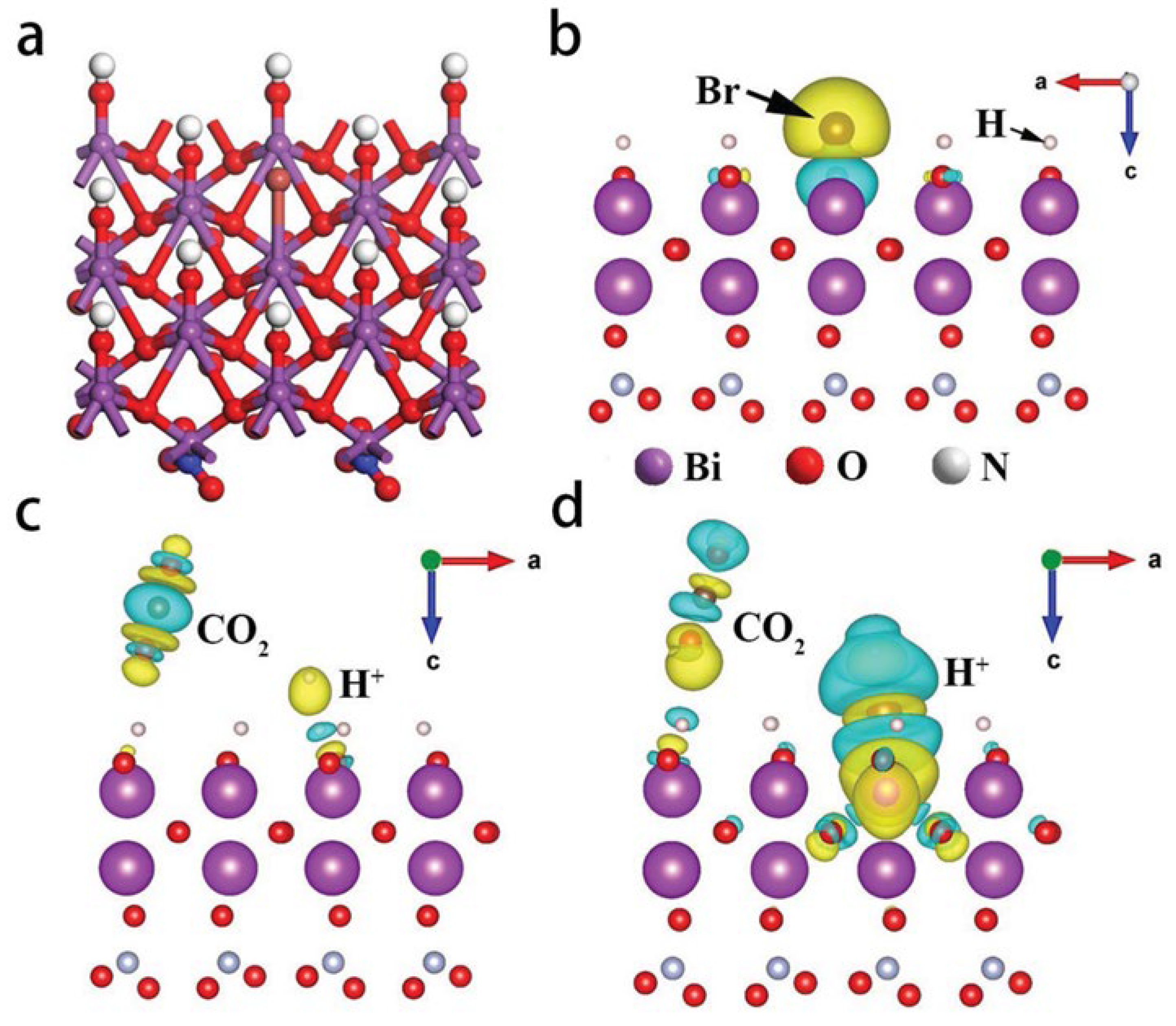
Hao prepared a layered photocatalyst Bi2O2(OH)(NO3) (BON) by substituting surface halogen ions for surface hydroxyl groups and then fixing them on Bi atoms, as shown in Figure 11a–d [164]. This action promotes local charge separation, activates hydroxyl groups, greatly promotes the adsorption of CO2 molecules and protons, and further promotes CO2 conversion. Among the three series of BON-X (X = Cl, Br, and I) catalysts, BON-Br has no sacrificial agent.
Loading Metal
Inorganic precious metals have a higher work function, which means that inorganic precious metals generally have lower Fermi levels (EF) and strong electron extraction capabilities. Taking Pt as an example, Pt has the highest work function (5.65 eV). Loading Pt on the surface of photocatalysts can greatly improve electron–hole separation and migration, thereby enhancing their photocatalytic performance. However, Pt is easy to capture and induce electrons to generate H2, and the generation of H2 is a competitive reaction with the reduction of CO2. In addition, CO will be firmly bound to the Pt metal, resulting in photocatalyst poisoning, and it is not easy to generate CO. It is very important to choose the right metal.
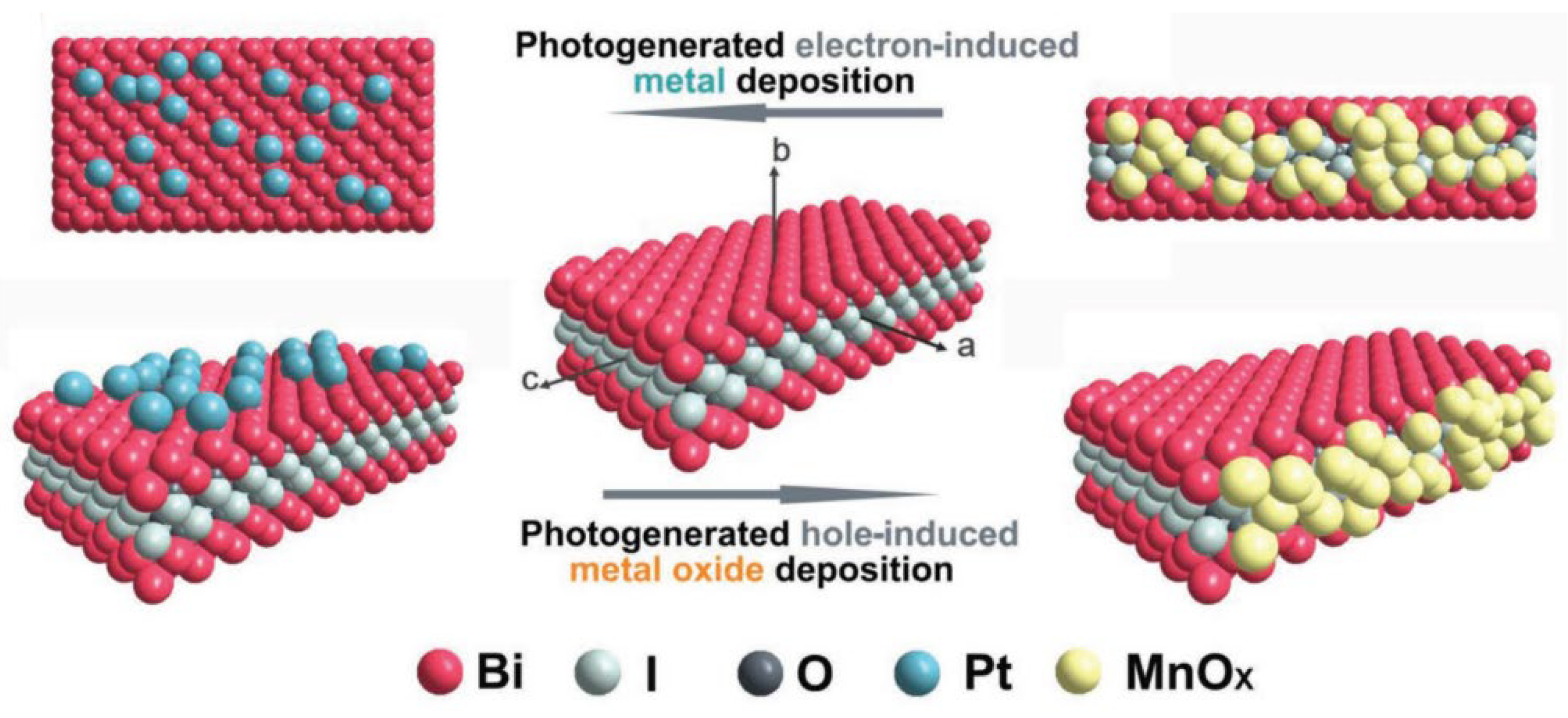
Raja deposited nano-sized Pd particles on the surface of Bi2Ti3O9 photocatalyst through an ultrasonic-assisted incipient wetness technique [165], reducing CO2 to HCOOH, which is twice as active as unloaded Pd. Bai innovatively supported reduction and oxidation co-catalysts on the surface of the photocatalyst, which not only provides active sites for the reduction and oxidation of the reaction but also extracts photo-generated electrons and holes to the surface [166]. Bai co-loaded Au and MnOx on BiOI, and its activity reached 42.9 μmol·g−1·h−1, which was seven times that of the original photocatalyst. Experiments show that the photon absorption efficiency of Au/MnOx/BiOI photocatalyst and BiOI photocatalyst are at the same level, and the improvement of photocatalytic activity comes from the improvement of the efficiency of photo-induced carrier and hole separation. The catalytic activity of the Au/BiOI photocatalyst is 2.1 times that of the MnOx/BiOI photocatalyst, which proves that the electron-withdrawing Au plays a more important role in the improvement of the photocatalytic activity than the hole-absorbing MnOx promoter.
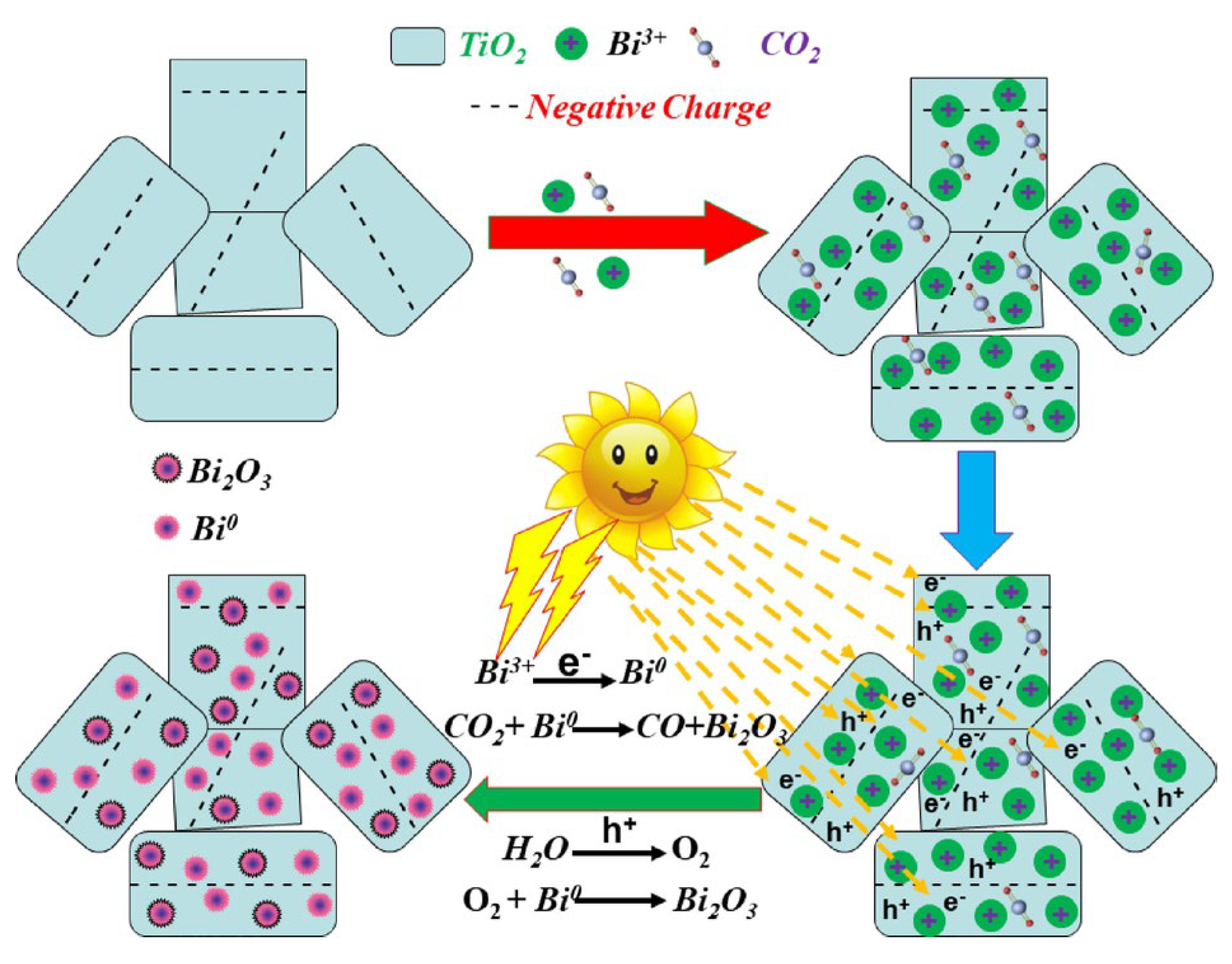
Yang was the first to use metallic bismuth, rather than precious metals, as a promoter of photocatalytic CO2 reduction, as shown in Figure 12 [167]. Compared to the original photocatalyst, CO yield was significantly improved, increasing by about 4.8 times. While precious metals are difficult to deposit through in situ light, metallic Bi can be deposited as quantum dots under in situ light conditions, with an average size of approximately 5 nm. On one hand, Bi at the quantum dot level is unstable in air and challenging to store. On the other hand, unstable Bi can be stabilized in the form of Bi/Bi2O3 quantum dots. During photocatalytic CO2 reduction, white Bi/Bi2O3 (primarily Bi2O3) can easily convert into gray Bi/Bi2O3 composites (primarily Bi), improving the photocatalytic CO2 reduction rate.

4.5. Co-Strategies

A single strategy cannot address both the thermodynamic and kinetic challenges of CO2 photoreduction, as well as the inherent defects of photocatalysts. Therefore, combining multiple strategies is essential to enhance photocatalytic performance.
Chen achieved highly efficient CO2 photoreduction by synthesizing BiOIO3 single-crystal nanobelts with macroscopic spontaneous polarization and surface oxygen vacancies [168]. By controlling the directional growth of BiOIO3 nanoribbons along the (001) direction, a large number of well-aligned IO3 polar units are formed, enhancing the macroscopic polarized electric field and promoting the rapid separation and migration of charges from the bulk to the surface (Figure 13). Additionally, the surface oxygen vacancies create a local electric field, inhibiting the recombination of holes and photogenerated electrons and enhancing CO2 adsorption on the photocatalyst surface. The BiOIO3 nanobelt reduces CO2 to CO at a rate of 17.33 μmol·g−1·h−1 without any sacrificial agent or promoter, making it one of the most efficient photocatalysts for CO2 reduction.
Liu, from the same group, solved the problems of insufficient carrier separation and weak CO2 adsorption by preparing two-dimensional Bi4Ti3O12 ultra-thin nanosheets rich in oxygen vacancies [169]. The selective photo deposition experiment of Pt on Bi4Ti3O12 showed that the ultra-thin structure can shorten the migration distance of photogenerated electrons from the bulk to the surface, which is beneficial for quickly participating in the CO2 reduction reaction. Oxygen vacancies lead to a huge improvement in the surface state and the electronic structure, as well as improving the efficiency of CO2 adsorption, light absorption, and charge separation (Figure 13f). Therefore, in terms of the CO precipitation rate, the best activity of Bi4Ti3O12 nanosheets is 3.2 times that of the original photocatalyst.
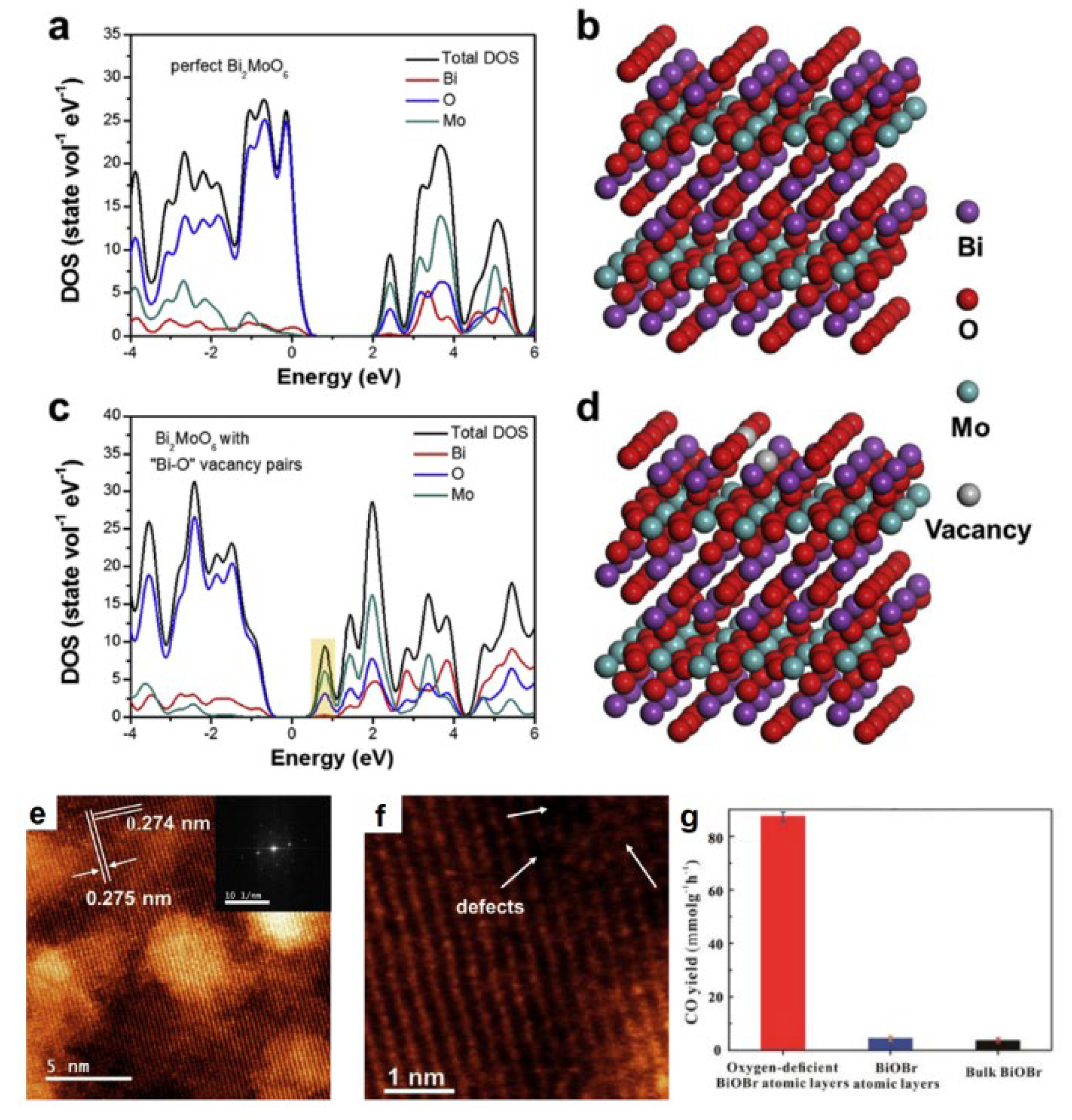
The combination of atomic layer photocatalysts and oxygen vacancies significantly improves the limitations of poor light absorption, slow electron–hole separation, and high CO2 activation barriers. Bi synthesized a Bi2MoO6 photocatalyst with an ultra-thin two-dimensional structure and surface defects using a template-oriented strategy (Figure 14a–f) [170]. The engineered “Bi-O” vacancy pairs modify the local atomic and electronic structure of the photocatalyst, serving as charge separation centers to promote electron–hole separation. The defective ultra-thin structure enhances CO2 adsorption and activation and CO desorption. Under light irradiation, the photocatalytic activity of the defective ultra-thin Bi2MoO6 nanosheets was 2.55 times higher than that of the original photocatalyst. Wu fabricated BiOBr atomic layers with abundant surface oxygen vacancies (Figure 14g) [171]. Both experimental and theoretical studies confirmed that the new defect levels introduced by oxygen vacancies extend light absorption into the visible light region, while charge delocalization around the vacancies aids in CO2 activation to form COOH* intermediates. The atomic layer structure also enhances charge separation and increases the number of surface catalytic sites [172]. Finally, the oxygen vacancies and the atomic layer together enhance the CO2 photoreduction performance of BiOBr, which is 20 times and 24 times that of the BiOBr atomic layer and bulk BiOBr, respectively. Bi prepared atomically layered Bi3O4Br photocatalysts decorated with isolated single atom Co [173]. The atomically layered structure reduces the possibility of carrier recombination while providing more active sites to promote the reaction. Isolated single atom Co in Bi3O4Br is beneficial for carrier and hole separation and CO2 adsorption and activation. Its CO2 photoreduction performance is 4 times and 32 times higher than that of atomically layered Bi3O4Br and bulk Bi3O4Br.
Building on the preceding discussion of the structural characteristics of Bi-based semiconductors and the associated strategies for performance enhancement, such as defect engineering, microstructure regulation, crystal facet engineering, and heterojunction construction, Table 1 summarizes representative studies reported in recent years. This table compares the photocatalytic CO2 reduction performance of various Bi-based photocatalysts under different reaction conditions, including reactor configuration, light source, reaction parameters, product distribution, and production rates. When examined in conjunction with the preceding analysis, Table 1 enables a more intuitive assessment of how different structural design and modulation strategies affect photocatalytic activity and product selectivity, thereby providing useful guidance for the rational design of efficient Bi-based photocatalysts.

5. Outlook

This review summarizes the main performance of bismuth-based semiconductors in photocatalytic CO2 reduction and the adaptation strategies of bismuth-based catalysts to improve the yield of valuable energy. In addition, the fundamentals and challenges of CO2 photoreduction and common bismuth-based semiconductors are also introduced. Although many achievements have been made in designing CO2 reduction photocatalysts with high activity and product selectivity, many explorations and approaches are still in their infancy. Many challenges remain for the further development of this field.
The stability of bismuth-based semiconductors in catalytic reactions is as important as high activity. However, the reasons for deactivation are diverse, including the accumulation of reaction intermediates on the photocatalyst surface, the dissociation of intermediates as by-products, the self-oxidation of bismuth groups, the loss of active oxidation states, and many other reasons. Attempts to make improvements in catalyst stability have been made through a variety of approaches, such as the use of hole scavengers, the construction of heterostructures to retain the desired oxidation state, and the removal of intermediates through heat treatment and other methods. However, there is still a great deal of work to be done to ensure long-term stability and prevent catalyst degradation.
Most of the photocatalysts reported in the literature produce C1 products, such as CO and CH4, with limited studies focused on enhancing C2+selectivity. Given the higher value of C2+products, it is more desirable to pursue the formation of C2+ compounds, such as ethylene, ethanol, and higher alcohols, instead of CO, CH4, and formates. To achieve C-C coupling and form C2+ products, several concrete routes need to be considered. One promising approach is tuning surface CO coverage. By controlling the coverage of *CO on the catalyst surface, it is possible to regulate the reaction pathways and shift the selectivity toward C2+ products. This can be achieved by adjusting the adsorption strength of *CO on the photocatalyst, where an optimal binding strength will facilitate the coupling of *CO intermediates into larger carbon chains while avoiding excessive desorption or further hydrogenation of C1 products.
Another effective strategy to enhance C-C coupling is the use of dual-site catalysts. These catalysts can be designed with two distinct active sites: one for CO2 adsorption and the other for facilitating C-C bond formation. This spatial separation of reactions allows for more efficient product formation, especially for C2+ compounds. Additionally, tandem junctions involving two semiconductors with complementary properties can also promote C-C coupling. By combining a material that efficiently reduces CO2 to *CO with another that promotes C-C coupling, these junctions provide a favorable environment for efficient charge separation and enhanced product selectivity.
In terms of in situ and operando tools, several techniques are crucial for understanding the reaction mechanisms and the role of intermediates in CO2 reduction. DRIFTS (Diffuse Reflectance Infrared Fourier Transform Spectroscopy) is particularly valuable for tracking surface-bound intermediates, such as *COOH, *CO, *CHO, and *HCO, during the photocatalytic process. This technique helps identify how intermediates evolve and whether they are stabilized on the catalyst surface. EPR (Electron Paramagnetic Resonance) is effective in identifying reactive species, such as radicals and unpaired electrons, which play a crucial role in electron transfer and charge separation processes. Raman spectroscopy provides insight into the vibrational modes of surface intermediates and allows for the detection of changes in bonding as the reaction progresses. Finally, AP-XPS (Ambient Pressure X-ray Photoelectron Spectroscopy) is essential for studying the catalyst’s surface chemistry under reaction conditions. This technique can reveal the oxidation states of the catalyst, providing direct information about the electronic structure and the formation of key intermediates during CO2 reduction.
A comprehensive, reliable, and stable product testing system is also required to accurately detect and quantify all possible products in CO2 photoreduction. While CO, CH4, H2, and O2 are the most commonly studied products, other potential products, such as HCOOH, CH3OH, and C2+ compounds, are often overlooked. The development of advanced product detection systems capable of accurately measuring these products at ultra-low concentrations is crucial for advancing the study of reaction mechanisms and improving product selectivity.

Author Contributions

Conceptualization, Y.L. and J.Y.; methodology, J.Y.; software, W.H. (Wei He).; validation, W.H. (Wei He), W.H. (Wenxin Hu), and F.L.; formal analysis, H.G.; investigation, Z.Y.; resources, Z.Y.; data curation, Y.L.; writing—original draft preparation, J.Y.; writing—review and editing, Y.L.; visualization, Y.L.; supervision, Y.L.; project administration, Y.L.; funding acquisition, J.Y. All authors have read and agreed to the published version of the manuscript.

Funding

This research was funded by the 2025 Natural Science Foundation of Inner Mongolia Autonomous Region [2025QN05125]. The authors gratefully acknowledge this financial support.

Data Availability Statement

The data presented in this study are available upon request from the corresponding author.

Conflicts of Interest

The authors declare no conflicts of interest. The funders had no role in the design of the study; in the collection, analyses, or interpretation of data; in the writing of the manuscript; or in the decision to publish the results.

References

  1. Chae, S.Y.; Lee, S.Y.; Han, S.G.; Kim, H.; Ko, J.; Park, S.; Joo, O.-S.; Kim, D.; Kang, Y.; Lee, U.; et al. A perspective on practical solar to carbon monoxide production devices with economic evaluation. Sustain. Energy Fuels 2020, 4, 199–212. [Google Scholar] [CrossRef]
  2. Guo, K.; Hussain, I.; Jie, G.; Fu, Y.; Zhang, F.; Zhu, W. Strategies for improving the photocatalytic performance of metal-organic frameworks for CO2 reduction: A review. J. Environ. Sci. 2023, 125, 290–308. [Google Scholar] [CrossRef]
  3. Modak, A.; Bhanja, P.; Dutta, S.; Chowdhury, B.; Bhaumik, A. Catalytic reduction of CO2 into fuels and fine chemicals. Green Chem. 2020, 22, 4002–4033. [Google Scholar] [CrossRef]
  4. Ray, B.; Churipard, S.R.; Peter, S.C. An overview of the materials and methodologies for CO2 capture under humid conditions. J. Mater. Chem. A 2021, 9, 26498–26527. [Google Scholar] [CrossRef]
  5. Kim, D.; Sakimoto, K.K.; Hong, D.; Yang, P. Artificial photosynthesis for sustainable fuel and chemical production. Angew. Chem. Int. Ed. 2015, 54, 3259–3266. [Google Scholar] [CrossRef]
  6. Lewis, N.S.; Nocera, D.G. Powering the planet: Chemical challenges in solar energy utilization. Proc. Natl. Acad. Sci. USA 2006, 103, 15729–15735. [Google Scholar] [CrossRef]
  7. Li, K.; Peng, B.; Peng, T. Recent Advances in Heterogeneous Photocatalytic CO2 Conversion to Solar Fuels. ACS Catal. 2016, 6, 7485–7527. [Google Scholar] [CrossRef]
  8. Singhal, N.; Kumar, U. Noble metal modified TiO2: Selective photoreduction of CO2 to hydrocarbons. Mol. Catal. 2017, 439, 91–99. [Google Scholar] [CrossRef]
  9. Ran, J.; Jaroniec, M.; Qiao, S.Z. Cocatalysts in Semiconductor-based Photocatalytic CO2 Reduction: Achievements, Challenges, and Opportunities. Adv. Mater. 2018, 30, 1704649. [Google Scholar] [CrossRef]
  10. Fu, J.; Jiang, K.; Qiu, X.; Yu, J.; Liu, M. Product selectivity of photocatalytic CO2 reduction reactions. Mater. Today 2020, 32, 222–243. [Google Scholar] [CrossRef]
  11. Marszewski, M.; Cao, S.; Yu, J.; Jaroniec, M. Semiconductor-based photocatalytic CO2 conversion. Mater. Horiz. 2015, 2, 261–278. [Google Scholar] [CrossRef]
  12. Olah, G.A.; Prakash, G.K.; Goeppert, A. Anthropogenic chemical carbon cycle for a sustainable future. J. Am. Chem. Soc. 2011, 133, 12881–12898. [Google Scholar] [CrossRef] [PubMed]
  13. Fujishima, A.; Honda, K. Electrochemical photolysis of water at a semiconductor electrode. Nature 1972, 238, 37. [Google Scholar] [CrossRef] [PubMed]
  14. Halmann, M. Photoelectrochemical reduction of aqueous carbon dioxide on p-type gallium phosphide in liquid junction solar cells. Nature 1978, 275, 115–116. [Google Scholar] [CrossRef]
  15. Zhang, Z.; Wang, B.; Zhao, H.-B.; Liao, J.-F.; Zhou, Z.-C.; Liu, T.; He, B.; Wei, Q.; Chen, S.; Chen, H.-Y.; et al. Self-assembled lead-free double perovskite-MXene heterostructure with efficient charge separation for photocatalytic CO2 reduction. Appl. Catal. B Environ. 2022, 312, 121358. [Google Scholar] [CrossRef]
  16. Qian, X.; Yue, D.; Tian, Z.; Reng, M.; Zhu, Y.; Kan, M.; Zhang, T.; Zhao, Y. Carbon quantum dots decorated Bi2WO6 nanocomposite with enhanced photocatalytic oxidation activity for VOCs. Appl. Catal. B Environ. 2016, 193, 16–21. [Google Scholar] [CrossRef]
  17. Ni, B.; Jiang, H.; Guo, W.; Xu, Q.; Min, Y. Tailoring the oxidation state of metallic TiO through Ti3+/Ti2+ regulation for photocatalytic conversion of CO2 to C2H6. Appl. Catal. B Environ. 2022, 307, 121141. [Google Scholar] [CrossRef]
  18. Yang, H.; Zhou, J.; Duan, Z.; Liu, X.; Deng, B.; Fang, J.; Xu, W. Amorphous TiO2 beats P25 in visible light photo-catalytic performance due to both total-internal-reflection boosted solar photothermal conversion and negative temperature coefficient of the forbidden bandwidth. Appl. Catal. B Environ. 2022, 310, 121299. [Google Scholar] [CrossRef]
  19. Zhang, H.; Yang, X.; Gao, G.; Yan, J.; Zhao, M.; Su, H. An efficient catalyst of CuPt/TiO2 for photocatalytic direct dehydrogenation of methanol to methyl formate at ambient temperature†. Catal. Sci. Technol. 2022, 12, 773–785. [Google Scholar] [CrossRef]
  20. Duan, M.; Hu, C.; Duan, D.; Chen, R.; Wang, C.; Wu, D.; Xia, T.; Liu, H.; Dai, Y.; Long, R.; et al. Ppm-level Cu dopant on ultrathin Pd nanosheets/TiO2 for highly enhanced photocatalytic alcoholysis of epoxides. Appl. Catal. B Environ. 2022, 307, 121211. [Google Scholar] [CrossRef]
  21. Anandkumar, M.; Sudarsan, S.; Naganaboina, V.R.; Bandari, N.K.; Litvinyuk, K.S.; Singh, S.G.; Trofimov, E.A. High-Entropy (Ce0.2Pr0.2Zn0.2Nd0.2Tb0.2)2Zr2O7 Zirconate Pyrochlore: A Promising Photocatalyst for Diverse Environmental Applications. Nanomaterials 2025, 15, 1668. [Google Scholar] [CrossRef]
  22. Huo, Y.; Zhang, P.; Chi, J.; Fang, F.; Song, Y.; Sun, D. Surface Functionalization and Defect Construction of SnO2 with Amine Group for Enhanced Visible-Light-Driven Photocatalytic CO2 Reduction. Adv. Energy Mater. 2024, 14, 2304282. [Google Scholar] [CrossRef]
  23. Huang, K.; Liang, G.; Sun, S.; Hu, H.; Peng, X.; Shen, R.; Li, X. Interface-induced charge transfer pathway switching of a Cu2O-TiO2 photocatalyst from p-n to S-scheme heterojunction for effective photocatalytic H2 evolution. J. Mater. Sci. Technol. 2024, 193, 98–106. [Google Scholar] [CrossRef]
  24. Wang, R.; Zhang, M.; Liu, J.; Wu, X.; Zhang, S.; Zhong, Q.; Yao, J. Defect-phase engineered NiTi-TiO2 enabling near-unity selective photocatalytic CO2to-methanol conversion. Nat. Commun. 2025, 16, 7844. [Google Scholar] [CrossRef] [PubMed]
  25. Sun, K.; Guo, X.; Chen, Z.; Gong, X.; Jin, H.; Jin, D. Enhanced photothermal preferential oxidation of CO over TiO2−MnCo2O4@NF catalyst with p-n heterojunction. Mol. Catal. 2025, 587, 115461. [Google Scholar] [CrossRef]
  26. Pu, B.; Tuersun, P.; Li, S.; He, G.; Dou, F.; Lv, S. Light Absorption and Scattering Properties of Ag@TiO2 Nanosphere Dimer for Photocatalytic Water Purification. Nanomaterials 2025, 15, 1618. [Google Scholar] [CrossRef]
  27. Jin, R.; Li, R.; Ma, M.L.; Chen, D.Y.; Zhang, J.Y.; Xie, Z.H.; Ding, L.F.; Xie, Y.; Li, J.R. Beyond Tradition: A MOF-On-MOF Cascade Z-Scheme Heterostructure for Augmented CO2 Photoreduction. Small 2025, e2409759. [Google Scholar] [CrossRef]
  28. Zhang, D.; Gu, H.; Liu, X.-H.; Kong, Q. Constructed pyrene-based Zn-MOF/carbon nitride heterojunction for efficient CO2 Photoreduction to CH4. Inorg. Chem. Commun. 2026, 185, 116072. [Google Scholar] [CrossRef]
  29. Liu, L.; Zhang, L.; Du, X.; Li, P.; Wang, R.; Deng, Y.; An, X.; Wu, X. Boosting electron transfer in Lewis-acid MOF facilitates photoreduction of CO2 to ethanol. Appl. Catal. B Environ. Energy 2026, 384, 126183. [Google Scholar] [CrossRef]
  30. Shi, J.; Ju, C.; Yang, T.; Shi, J.; Pu, K.; Zhao, T.; Zheng, N.; Nie, L.; Xue, K.; Gao, Y. Carbon quantum dots modified NH2MIL-125(Ti) acid-etching derived TiO2based photocatalysts and efficient removal of high concentrations of dyes from wastewater under visible light. Colloids Surf. A Physicochem. Eng. Asp. 2023, 677, 132378. [Google Scholar] [CrossRef]
  31. Yang, X.; Lan, X.; Zhang, Y.; Li, H.; Bai, G. Rational design of MoS2@COF hybrid composites promoting C-C coupling for photocatalytic CO2 reduction to ethane. Appl. Catal. B Environ. 2023, 325, 122393. [Google Scholar] [CrossRef]
  32. Wang, M.; Li, Y.; Li, R.; Zhang, Y.; Yue, D.; Zhao, S.; Chen, M.; Song, H. In Situ Construction of 2D/2D g-C3N4/rGO Hybrid Photocatalysts for Efficient Ciprofloxacin Degradation. Nanomaterials 2025, 15, 1641. [Google Scholar] [CrossRef] [PubMed]
  33. Kaur, A.; Kansal, S.K. Flower shaped Bi2O2.33/Bi2WO6 composite: An efficient photocatalyst for degradation of methylene blue from aqueous solution in direct solar light. Chemosphere 2023, 11, 140862. [Google Scholar] [CrossRef] [PubMed]
  34. Wen, X.J.; Wu, X.; Hu, L.; Wu, X.K.; Guo, H.; Qian, B.B.; Liu, Z.T.; Li, H.Z.; Fei, Z.H. A critical review on modification strategies of Bi2Sn2O7 photocatalysts and their applications in energy and environmental remediation fields. Coord. Chem. Rev. 2025, 526, 216377. [Google Scholar] [CrossRef]
  35. Wang, K.; Sun, T.; Ma, H.; Wang, Y.; He, Z.H.; Wang, H.; Wang, W.; Yang, Y.; Wang, L.; Liu, Z.T. Energy band modulating of NiO/BiOCl heterojunction with transition from type-II to S-scheme for enhancing photocatalytic CO2 reduction. Chem. Eng. J. 2024, 497, 154711. [Google Scholar] [CrossRef]
  36. Zhang, J.; Wang, S.; Song, P.; Li, A.; Jiang, W.; Di, J. Copper porphyrin modified BiOBr/Bi19S27Br3 for efficient CO2 photoreduction. J. Colloid Interface Sci. 2024, 679, 383–390. [Google Scholar] [CrossRef]
  37. Ding, X.; Jing, W.; Bai, S.; Kang, X.; Yu, F.; Ma, T.; Wang, F.; Liu, Y.; Guo, L. Infrared light promotes reverse hydrogen spillover for boosting photoconversion of CO2 to CH4 on Bi/BVOv. Chem. Eng. J. 2025, 523, 168447. [Google Scholar] [CrossRef]
  38. Tan, C.; Ai, L.; Wang, L.; Jia, D.; Guo, N.; Zha, M. Revealing the nature of asymmetric Lewis acid sites by dual-orbital hybridization in Tb-BiO1-xCl/BiO1-xCl homostructure for superior photocatalytic performance. Appl. Catal. B Environ. Energy 2025, 373, 125336. [Google Scholar] [CrossRef]
  39. Li, M.; Huang, H.; Yu, S.; Tian, N.; Zhang, Y. Facet, Junction and Electric Field Engineering of Bismuth-Based Materials for Photocatalysis. ChemCatChem 2018, 10, 4477–4496. [Google Scholar] [CrossRef]
  40. Zhang, L.; Yang, J.; Zhao, X.; Xiao, X.; Sun, F.; Zuo, X.; Nan, J. Small-molecule surface-modified bismuth-based semiconductors as a new class of visible-light-driven photocatalytic materials: Structure-dependent photocatalytic properties and photosensitization mechanism. Chem. Eng. J. 2020, 380, 122546. [Google Scholar] [CrossRef]
  41. Xu, M.; Yang, J.; Sun, C.; Liu, L.; Cui, Y.; Liang, B. Performance enhancement strategies of bi-based photocatalysts: A review on recent progress. Chem. Eng. J. 2020, 389, 124402. [Google Scholar] [CrossRef]
  42. Dhakshinamoorthy, A.; Navalon, S.; Corma, A.; Garcia, H. Photocatalytic CO2 reduction by TiO2 and related titanium containing solids. Energy Environ. Sci. 2012, 5, 9217–9233. [Google Scholar] [CrossRef]
  43. Li, R.; Zhang, W.; Zhou, K. Metal–Organic-Framework-Based Catalysts for Photoreduction of CO2. Adv. Mater. 2018, 30, 1705512. [Google Scholar] [CrossRef] [PubMed]
  44. Yang, M.-Q.; Xu, Y.-J. Photocatalytic conversion of CO2 over graphene-based composites: Current status and future perspective. Nanoscale Horiz. 2016, 1, 231–254. [Google Scholar] [CrossRef]
  45. Xu, X.; Ding, X.; Yang, X.; Wang, P.; Li, S.; Lu, Z.; Chen, H. Oxygen vacancy boosted photocatalytic decomposition of ciprofloxacin over Bi2MoO6: Oxygen vacancy engineering, biotoxicity evaluation and mechanism study. J. Hazard. Mater. 2019, 364, 691–699. [Google Scholar] [CrossRef]
  46. Kumar, B.; Llorente, M.; Froehlich, J.; Dang, T.; Sathrum, A.; Kubiak, C.P. Photochemical and photoelectrochemical reduction of CO2. Annu. Rev. Phys. Chem. 2012, 63, 541–569. [Google Scholar] [CrossRef]
  47. Wang, W.H.; Himeda, Y.; Muckerman, J.T.; Manbeck, G.F.; Fujita, E. CO2 Hydrogenation to Formate and Methanol as an Alternative to Photo- and Electrochemical CO2 Reduction. Chem. Rev. 2015, 115, 12936–12973. [Google Scholar] [CrossRef]
  48. Thompson, W.A.; Sanchez Fernandez, E.; Maroto-Valer, M.M. Probability Langmuir-Hinshelwood based CO2 photoreduction kinetic models. Chem. Eng. J. 2020, 384, 123356. [Google Scholar] [CrossRef]
  49. Liang, L.; Li, X.; Sun, Y.; Tan, Y.; Jiao, X.; Ju, H.; Qi, Z.; Zhu, J.; Xie, Y. Infrared Light-Driven CO2 Overall Splitting at Room Temperature. Joule 2018, 2, 1004–1016. [Google Scholar] [CrossRef]
  50. Rej, S.; Bisetto, M.; Naldoni, A.; Fornasiero, P. Well-defined Cu2O photocatalysts for solar fuels and chemicals. J. Mater. Chem. A 2021, 9, 5915–5951. [Google Scholar] [CrossRef]
  51. Tu, W.; Zhou, Y.; Zou, Z. Photocatalytic conversion of CO2 into renewable hydrocarbon fuels: State-of-the-art accomplishment, challenges, and prospects. Adv. Mater. 2014, 26, 4607–4626. [Google Scholar] [CrossRef] [PubMed]
  52. Chang, X.; Wang, T.; Gong, J. CO2 photo-reduction: Insights into CO2 activation and reaction on surfaces of photocatalysts. Energy Environ. Sci. 2016, 9, 2373–2385. [Google Scholar] [CrossRef]
  53. Li, X.; Yu, J.; Jaroniec, M.; Chen, X. Cocatalysts for Selective Photoreduction of CO2 into Solar Fuels. Chem. Rev. 2019, 119, 3962–4179. [Google Scholar] [CrossRef] [PubMed]
  54. Nakada, A.; Koike, K.; Maeda, K.; Ishitani, O. Highly efficient visible-light-driven CO2 reduction to CO using a Ru(ii)--Re(i) supramolecular photocatalyst in an aqueous solution. Green Chem. 2016, 18, 139–155. [Google Scholar] [CrossRef]
  55. Li, Y.; Wang, W.-N.; Zhan, Z.; Woo, M.-H.; Wu, C.-Y.; Biswas, P. Photocatalytic reduction of CO2 with H2O on mesoporous silica supported Cu/TiO2 catalysts. Appl. Catal. B Environ. 2010, 100, 386–392. [Google Scholar] [CrossRef]
  56. Sorcar, S.; Yoriya, S.; Lee, H.; Grimes, C.A.; Feng, S.P. A review of recent progress in gas phase CO2 reduction and suggestions on future advancement. Mater. Today 2020, 16, 100264. [Google Scholar] [CrossRef]
  57. Kong, T.; Jiang, Y.; Xiong, Y. Photocatalytic CO2 conversion: What can we learn from conventional COx hydrogenation? Chem. Soc. Rev. 2020, 49, 6579–6591. [Google Scholar] [CrossRef]
  58. Sorcar, S.; Thompson, J.; Hwang, Y.; Park, Y.H.; Majima, T.; Grimes, C.A.; Durrant, J.R.; In, S.-I. High-rate solar-light photoconversion of CO2 to fuel: Controllable transformation from C1 to C2 products. Energy Environ. Sci. 2018, 11, 3183–3193. [Google Scholar] [CrossRef]
  59. Habisreutinger, S.N.; Schmidt-Mende, L.; Stolarczyk, J.K. Photocatalytic Reduction of CO2 on TiO2 and Other Semiconductors. Angew. Chem. 2013, 52, 7372–7408. [Google Scholar] [CrossRef]
  60. Ji, Y.; Luo, Y. Theoretical Study on the Mechanism of Photoreduction of CO2 to CH4 on the Anatase TiO2(101) Surface. ACS Catal. 2016, 6, 2018–2025. [Google Scholar] [CrossRef]
  61. Ong, W.J.; Putri, L.K.; Mohamed, A.R. Rational Design of Carbon-Based 2D Nanostructures for Enhanced Photocatalytic CO2 Reduction: A Dimensionality Perspective. Chem. Eur. J. 2020, 26, 9710–9748. [Google Scholar] [CrossRef]
  62. Wei, T.; Xiao, H.; Niu, R.; Xu, B.; Li, H.; Yan, X.; Li, Y.; Ou, H.; Lin, B.; Yang, G. Dual plasmonic coupling effect in Bi/vacancy-rich Bi2WO6 heterojunction for selective CO2 photoreduction to CH4. Chem. Eng. Sci. 2024, 292, 120012. [Google Scholar] [CrossRef]
  63. Ai, Z.; Yu, H.; Lee, S.; Zhang, L. Monoclinic α-Bi2O3 photocatalyst for efficient removal of gaseous NO and HCHO under visible light irradiation. J. Alloys Compd. 2011, 509, 2044–2049. [Google Scholar] [CrossRef]
  64. Komatsu, T.; Dimitrov, V.; Tasheva, T.; Honma, T. A review: A new insight for electronic polarizability and chemical bond strength in Bi2O3based glasses. J. Non-Cryst. Solids 2020, 550, 120365. [Google Scholar] [CrossRef]
  65. Hajibigloo, L.; Zhiani, R.; Hosseiny, M.; Moghaddam, H.H.; Ebrahimi, Z. Enhanced photohydrogenation of carbon dioxide to methane using Bi2Sn2O7/Bi2O3. Inorg. Chem. Commun. 2025, 177, 114375. [Google Scholar] [CrossRef]
  66. Abdi, F.F.; Savenije, T.J.; May, M.M.; Dam, B.; Roel, V. The Origin of Slow Carrier Transport in BiVO4 Thin Film Photoanodes: A Time-Resolved Microwave Conductivity Study. J. Phys. Chem. Lett. 2013, 4, 2752–2757. [Google Scholar] [CrossRef]
  67. Malathi, A.; Madhavan, J.; Ashokkumar, M.; Arunachalam, P. A review on BiVO 4 photocatalyst: Activity enhancement methods for solar photocatalytic applications. Appl. Catal. A 2018, 555, 47–74. [Google Scholar]
  68. Liu, X.; Gu, S.; Zhao, Y.; Zhou, G.; Li, W. BiVO4, Bi2WO6 and Bi2MoO6 photocatalysis: A brief review. J. Mater. Sci. Technol. 2020, 56, 45–65. [Google Scholar] [CrossRef]
  69. He, H.; Jiao, Y.; Li, Y.P.; Ying, Z.; Wang, C. Size controllable synthesis of single-crystal ferroelectric Bi4Ti3O12 nanosheet dominated with {001} facets toward enhanced visible-light-driven photocatalytic activities. Appl. Catal. B Environ. 2014, 156–157, 35–43. [Google Scholar] [CrossRef]
  70. Pérez, S.; Vázquez-García, A.; Gutiérrez-Pérez, A.; Ayala-Ayala, M.T.; Boujnah, M.; Tapia-P, J.; Díaz-Real, J.A.; Muñoz-Saldaña, J. Boosting visible light-driven photocatalysis with bismuth titanate (Bi2Ti4O11/Bi4Ti3O12) heterojunctions. Environ. Res. 2026, 289, 123384. [Google Scholar] [CrossRef]
  71. Visible-light photocatalysis with bismuth titanate (Bi12TiO20) particles synthesized by the oxidant peroxide method (OPM). Ceram. Int. 2015, 41, 12073–12080. [CrossRef]
  72. Huang, J.Y.; Zhang, K.Q.; Lai, Y.K. Fabrication, Modification, and Emerging Applications of TiO2 Nanotube Arrays by Electrochemical Synthesis: A Review. Int. J. Photoenergy 2013, 112, 4696–4701. [Google Scholar]
  73. Yan, Z.; Fang, D.; Chen, M.; Yi, X. Synthetic Bi2O2CO3 nanostructures: Novel photocatalyst with controlled special surface exposed. Mol. Catal. 2010, 317, 34–40. [Google Scholar]
  74. Huang, S.; Shen, J.; Wu, Y.; Li, X.; Ma, Y.; Xie, Y.; Yu, C.; Zhang, Y.; Zhang, J. Bi2O2CO3 co-catalyst modification BiOBr driving efficient photoreduction CO2. Colloids Surf. A Physicochem. Eng. Asp. 2025, 725, 137731. [Google Scholar] [CrossRef]
  75. Zhang, L.; Zhu, Y. A review of controllable synthesis and enhancement of performances of bismuth tungstate visible-light-driven photocatalysts. Catal. Sci. Technol. 2012, 2, 694. [Google Scholar] [CrossRef]
  76. Zhu, Y.; Liu, Y.; Lv, Y.; Qiang, L.; Di, L.; Zhu, Y. Enhancement of photocatalytic activity for BiPO4 via phase junction. J Mater Chem A 2014, 2, 13041–13048. [Google Scholar] [CrossRef]
  77. Arnold, D.C. Composition-driven structural phase transitions in rare-earth-doped bifeo3 ceramics: A review. IEEE Trans. Ultrason. Ferroelectr. Freq. Control 2015, 62, 62–82. [Google Scholar] [CrossRef]
  78. Cheng, H.; Huang, B.; Dai, Y. Engineering BiOX (X = Cl, Br, I) nanostructures for highly efficient photocatalytic applications. Nanoscale 2014, 6, 2009–2026. [Google Scholar] [CrossRef]
  79. Garg, S.; Yadav, M.; Chandra, A.; Hernadi, K. A Review on BiOX (X= Cl, Br and I) Nano-/Microstructures for Their Photocatalytic Applications. J. Nanosci. Nanotechnol. 2019, 19, 280–294. [Google Scholar] [CrossRef]
  80. Liu, Q.; Bai, C.; He, D.; Wu, X.; Wu, Y.; Chen, R. Oxygen vacancy mediation of BiOX (X=Cl, Br) towards enhanced photocatalytic CO2 reduction activity. J. Environ. Chem. Eng. 2024, 12, 112449. [Google Scholar] [CrossRef]
  81. Xu, L.; Wan, Y.; Xie, H.; Huang, Y.; Qiao, X.; Qin, L.; Seo, H.J. On Structure, Optical Properties and Photodegradated Ability of Aurivillius-Type Bi3TiNbO9Nanoparticles. J. Am. Ceram. Soc. 2016, 99, 3964–3972. [Google Scholar] [CrossRef]
  82. Bac, L.H.; Le, T.; Chinh, N.V.; Khoa, N.T.; Thiet, D.V.; Trung, T.V.; Dang, D.D. Tailoring the structural, optical properties and photocatalytic behavior of ferroelectric Bi0.5K0.5TiO3 nanopowders. Mater. Lett. 2016, 164, 631–635. [Google Scholar] [CrossRef]
  83. Xiao, X.; Hu, R.; Liu, C.; Xing, C.; Qian, C.; Zuo, X.; Nan, J.; Wang, L. Facile large-scale synthesis of β-Bi2O3 nanospheres as a highly efficient photocatalyst for the degradation of acetaminophen under visible light irradiation. Appl. Catal. B Environ. 2013, 140–141, 433–443. [Google Scholar] [CrossRef]
  84. Díaz-Guerra, C.; Almodóvar, P.; Camacho-López, M.; Camacho-López, S.; Piqueras, J. Formation of β-Bi2O3 and δ-Bi2O3 during laser irradiation of Bi films studied in-situ by spatially resolved Raman spectroscopy. J. Alloys Compd. 2017, 723, 108–118. [Google Scholar] [CrossRef]
  85. Wang, J.; Yang, X.; Zhao, K. Precursor-induced fabrication of β-Bi2O3 microspheres and their performance as visible-light-driven photocatalysts. J. Mater. Chem. A 2013, 1, 9069–9074. [Google Scholar] [CrossRef]
  86. Chen, X.; Zhang, Z.; Chi, L.; Nair, A.K.; Shangguan, W.; Jiang, Z. Recent Advances in Visible-Light-Driven Photoelectrochemical Water Splitting: Catalyst Nanostructures and Reaction Systems. Nano-Micro Lett. 2016, 8, 1–12. [Google Scholar] [CrossRef]
  87. Tan, C.; Ai, L.; Sheng, R.; Wang, L.; Guo, N.; Xu, M.; Jia, D. Delocalization of Bi3+ ions in BiOCl induced by Bi-S bonds for highly selective photoreduction of CO2 to CO. Sep. Purif. Technol. 2025, 363, 132049. [Google Scholar] [CrossRef]
  88. Kim, J.; Do, J.Y.; Park, N.-K.; Lee, S.J.; Hong, J.-P.; Kang, M. Photoreduction of CO2 into CH4 using Bi2S3TiO2 double-layered dense films. Korean J. Chem. Eng. 2025, 35, 1089–1098. [Google Scholar] [CrossRef]
  89. Yu, C.; Wang, K.; Yang, P.; Yang, S.; Lu, C.; Song, Y.; Dong, S.; Sun, J.; Sun, J. One-pot facile synthesis of Bi2S3 /SnS2 /Bi2O3 ternary heterojunction as advanced double Z-scheme photocatalytic system for efficient dye removal under sunlight irradiation. Appl. Surf. Sci. 2017, 420, 233–242. [Google Scholar]
  90. Ai, L.; Wang, L.; Xu, M.; Zhang, S.; Jia, L. Defective Bi.333(Bi6S9)Br/Bi2S3 heterostructure nanorods: Boosting the activity for efficient visible-light photocatalytic Cr(VI) reduction. Appl. Catal. B Environ. 2021, 284, 119730. [Google Scholar] [CrossRef]
  91. Xiang, J.; Li, X.; Mo, R.; Liu, Y.; Li, H. Seed layer-assisted growth of branched Bi2S3 nanostructure on α-Fe2O3 thin film for improved photoelectrochemical performance. J. Mater. Sci. Mater. Electron. 2021, 32, 13040–13050. [Google Scholar] [CrossRef]
  92. Xin, L.; Chen, J.; Li, H.; Li, J. Photoreduction of CO2 to methanol over Bi2S3/CdS photocatalyst under visible light irradiation. J. Nat. Gas Chem. 2011, 20, 413–417. [Google Scholar]
  93. Mcdowell, N.A.; Knight, K.S.; Lightfoot, P. Unusual high-temperature structural behaviour in ferroelectric Bi2WO6. Green Chem. 2010, 37, 11–18. [Google Scholar] [CrossRef] [PubMed]
  94. Lin, J.; He, J.; Huang, Q.; Luo, Y.; Zhang, Y.; Li, W.; Zhou, G.; Hu, J.; Yang, Z.; Zhou, Y. Interfacial Bi-O-C bonds and rich oxygen vacancies synergistically endow carbon quantum dot/Bi2MoO6 with prominent photocatalytic CO2 reduction into CO. Appl. Catal. B Environ. Energy 2024, 362, 127747. [Google Scholar] [CrossRef]
  95. Chengula, P.J.; Charles, H.; Seo, J.Y.; Lee, C.S. Ascorbic Acid-Assisted Morphology Tailoring of Crystalline Bi2WO6 for the Application in CO2 Photoreduction. Int. J. Precis. Eng. Manuf. Green Technol. 2025, 12, 1277–1294. [Google Scholar] [CrossRef]
  96. Sun, S.; Wang, W. Advanced chemical compositions and nanoarchitectures of bismuth based complex oxides for solar photocatalytic application. RSC Adv. 2014, 4, 47136–47152. [Google Scholar] [CrossRef]
  97. Tuerhong, R.; Zhang, P.; Zhang, Y.; Lan, Y.; Chai, K.; Su, X.; Han, L.; Wang, X.; Han, Y. Cation vacancy engineering: Electronic structure reconstruction in Bi2WO6 facilitates CO2 photoreduction. J. Alloys Compd. 2025, 1047, 184969. [Google Scholar] [CrossRef]
  98. Jing, T.; Dai, Y.; Wei, W.; Ma, X.; Huang, B. Near-infrared photocatalytic activity induced by intrinsic defects in Bi2MO6 (M = W, Mo). Phys. Chem. Chem. Phys. 2014, 16, 18596–18604. [Google Scholar] [CrossRef]
  99. Collado, L.; Gomez-Mendoza, M.; García-Tecedor, M.; Oropeza, F.E.; Reynal, A.; Durrant, J.R.; Serrano, D.P.; de la Peña O’Shea, V.A. Towards the improvement of methane production in CO2 photoreduction using Bi2WO6/TiO2 heterostructures. Appl. Catal. B Environ. Energy 2022, 324, 122206. [Google Scholar] [CrossRef]
  100. Zhang, Y.; Liu, S.; Guo, X.; Mikulčić, H.; Xiao, R.; Wang, X. F− doped Bi2MoO6 nanosheets for photoreduction of CO2 with H2O. J. Photochem. Photobiol. A Chem. 2023, 447, 115278. [Google Scholar] [CrossRef]
  101. Lai, K.; Wei, W.; Zhu, Y.; Guo, M.; Dai, Y.; Huong, B. Effects of oxygen vacancy and N-doping on the electronic and photocatalytic properties of Bi2MO6 (M=Mo, W). J. Solid State Chem. 2012, 187, 103–108. [Google Scholar]
  102. Liu, J.; Liu, X.; Dai, C.; Zeng, C.; Ali, S.; Bououdina, M.; Jia, Y. Copper-doped Bi2MoO6 with concurrent oxygen vacancies for enhanced CO2 photoreduction. Inorg. Chem. Front. 2024, 11, 8003–8015. [Google Scholar] [CrossRef]
  103. Niu, L.; Liu, X.; Liu, X.; Yu, J.; Chen, R.; Yang, K.; Chen, L.; Hu, M.; Wu, J.; Hosseini-Bandegharaei, A. Constructing a 3D Bi2WO6/Cd0.3Zn0.7S heterojunction to enhance photocatalytic CO2 reduction efficiency. J. Environ. Chem. Eng. 2026, 14, 121167. [Google Scholar] [CrossRef]
  104. Yuan, S.; Zhao, Y.; Chen, W.; Wu, C.; Wang, X. Self-Assembled 3D Hierarchical Porous Bi2MoO6 Microspheres toward High Capacity and Ultra-Long-Life Anode Material for Li-Ion Batteries. ACS Appl. Mater. Interfaces 2017, 9, 22695–22706. [Google Scholar] [CrossRef] [PubMed]
  105. Chen, T.; Liu, L.; Hu, C.; Huang, H. Recent advances on Bi2WO6based photocatalysts for environmental and energy applications. Chin. J. Catal. 2021, 42, 1413–1438. [Google Scholar] [CrossRef]
  106. Jiang, Z.; Liang, X.; Zheng, H.; Liu, Y.; Wang, Z.; Wang, P.; Zhang, X.; Qin, X.; Dai, Y.; Whangbo, M.-H.; et al. Photocatalytic reduction of CO2 to methanol by three-dimensional hollow structures of Bi2WO6 quantum dots. Appl. Catal. B Environ. 2017, 219, 209–215. [Google Scholar] [CrossRef]
  107. Wang, T.; Feng, C.; Liu, J.; Wang, D.; Hu, H.; Hu, J.; Chen, Z.; Xue, G. Bi2WO6 hollow microspheres with high specific surface area and oxygen vacancies for efficient photocatalysis N2 fixation. Chem. Eng. J. 2021, 414, 128827. [Google Scholar] [CrossRef]
  108. Etogo, A.; Liu, R.; Ren, J.; Qi, L.; Zheng, C.; Ning, J.; Zhong, Y.; Hu, Y. Facile one-pot solvothermal preparation of Mo-doped Bi2WO6 biscuit-like microstructures for visible-light-driven photocatalytic water oxidation. J. Mater. Chem. A 2016, 4, 13242–13250. [Google Scholar] [CrossRef]
  109. Tokunaga, S.; Kato, H.; Kudo, A. Selective Preparation of Monoclinic and Tetragonal BiVO4 with Scheelite Structure and Their Photocatalytic Properties. ChemInform 2002, 33, 111–121. [Google Scholar] [CrossRef]
  110. Zhao, Z.; Li, Z.; Zou, Z. Electronic structure and optical properties of monoclinic clinobisvanite BiVO4. Phys. Chem. Chem. Phys. 2011, 13, 4746–4753. [Google Scholar] [CrossRef]
  111. Gong, S.; Rao, F.; Zhang, W.; Hassan, Q.-U.; Liu, Z.; Gao, J.; Lu, J.; Hojamberdiev, M.; Zhu, G. Au nanoparticles loaded on hollow BiOCl microstructures boosting CO2 photoreduction. Chin. Chem. Lett. 2021, 33, 4385–4388. [Google Scholar] [CrossRef]
  112. Shahid, M.Z.; Chen, Z.; Mehmood, R.; Zheng, S.; Idris, A.M.; Li, Z. The synergy of active sites induced by surface pits in BiOCl nanoplates for efficient CO2 photoreduction. Mater. Today 2023, 34, 101303. [Google Scholar] [CrossRef]
  113. Ma, S.; Yang, P.; Sun, H.; Guo, R.; Wang, Z.; Li, Q.; Luo, X.; Li, X. Enhanced CO2 photoreduction by constructing BiOCl/NiS Schottky heterojunction with a giant internal electric field. Sep. Purif. Technol. 2024, 354, 128976. [Google Scholar] [CrossRef]
  114. Cui, P.; Wang, J.; Wang, Z.; Chen, J.; Xing, X.; Wang, L.; Yu, R. Bismuth oxychloride hollow microspheres with high visible light photocatalytic activity. Nano Res. 2016, 9, 593–601. [Google Scholar] [CrossRef]
  115. Tan, C.; Ai, L.; Wang, L.; Xu, M.; Guo, N.; Jia, D. Selective CO production via a dual-defective CdS/BiOCl photocatalyst for CO2 photoreduction. J. Mater. Chem. A 2024, 12, 25371–25380. [Google Scholar] [CrossRef]
  116. Ding, C.; Ma, Z.; Han, C.; Liu, X.; Jia, Z.; Xie, H.; Bao, K.; Ye, L. Large-scale preparation of BiOX (X = Cl, Br) ultrathin nanosheets for efficient photocatalytic CO2 conversion. J. Taiwan Inst. Chem. Eng. 2017, 78, 395–400. [Google Scholar] [CrossRef]
  117. Zhao, L.; Hou, H.; Wang, S.; Wang, L.; Yang, Y.; Bowen, C.R.; Wang, J.; Liao, Z.; Yang, D.; Yan, R.; et al. Engineering Co Single Atoms in Ultrathin BiOCl Nanosheets for Boosted CO2 Photoreduction. Adv. Funct. Mater. 2024, 35, 202416346. [Google Scholar] [CrossRef]
  118. Wu, D.; Liu, D.; Luo, H.; Wang, J.; Dong, Y. Atomic-scale frustrated Lewis pairs in ultrathin BiOCl nanosheets: Dynamic oxygen vacancy engineering for efficient CO2 photoreduction. Chem. Eng. J. 2025, 522, 167514. [Google Scholar] [CrossRef]
  119. Fabiano, B.; Reverberi, A.P.; Varbanov, P.S. Safety opportunities for the synthesis of metal nanoparticles and short-cut approach to workplace risk evaluation. J. Clean. Prod. 2019, 209, 297–308. [Google Scholar] [CrossRef]
  120. Cao, J.; Cao, B.; Wang, Z.; Jing, B.; Li, R.; Wang, J. Synergistically enhancing CO2 photoreduction over BiOBr nanosheets via Ce doping and induced oxygen vacancy. J. Alloys Compd. 2025, 1036, 182064. [Google Scholar] [CrossRef]
  121. You, R.-J.; Wang, K.; Ma, H.; Li, X.-P.; Cao, Z.; He, Z.-H.; Wang, H.; Wang, W.; Lai, X.; Liu, Z.-T. Co species modulating of BiOBr-based Z-scheme heterojunction for the transform photoreduction CO2 products from CO to CH4. Chem. Eng. J. 2025, 510, 161754. [Google Scholar] [CrossRef]
  122. Peng, T.; Wang, Y.; Wang, K.; Zhang, K.; Wang, Y.; Xu, Y.; Guan, Q.; Wang, G.; Zhang, W.; Wu, B.; et al. Atomically dispersed Co sites on BiOCl nanosheets for efficient CO2 photoreduction. Green Energy Environ. 2025, 10, 1948–1955. [Google Scholar] [CrossRef]
  123. Liu, J.; Qin, W.; Wang, Y.; Xu, Q.; Xie, Y.; Chen, Y.; Dai, Y.; Zhang, W. NH2-UiO-66 modification BiOBr enhancement photoreduction CO2 to CO. Sep. Purif. Technol. 2024, 344, 127289. [Google Scholar] [CrossRef]
  124. Wang, Z.; Cao, B.; Li, R.; Jing, B.; Cai, X.; Cao, J.; He, D.; Xu, Y. Constructing 2D/2D BiOI/Bi2O2CO3 S-scheme heterojunction for boosted CO2 photoreduction. J. Alloys Compd. 2025, 1037, 182207. [Google Scholar] [CrossRef]
  125. Wei, J.; Dong, H.; Gao, Y.; Su, X.; Tan, H.; Li, J.; Zhao, Q.; Guan, X.; Lu, Z.; Ouyang, J.; et al. Synergism of oxygen‚Äìiodine binary vacancies with the interfacial electric field: Enhancing CO2 photoreduction over BiVO4-BiOCl/BiOI atomic-thin nanosheets. J. Mater. Chem. A 2023, 11, 4057–4066. [Google Scholar] [CrossRef]
  126. Nie, J.; Zhang, X.; Wang, M.; Ou, Y.; Li, S.; Zhong, P.; Wang, W.; Zhu, G.; Ma, X. MXene quantum dots decorated g-C3N4/BiOI heterojunction photocatalyst for efficient NO deep oxidation and CO2 reduction. Sep. Purif. Technol. 2024, 354, 128961. [Google Scholar] [CrossRef]
  127. Yang, C.; Zhang, Q.; Wang, W.; Cheng, B.; Yu, J.; Cao, S. 2D/2D g-C3N4@BiOI S-scheme heterojunction with gas-liquid-solid triphase interface for highly efficient CO2 photoreduction. Sci. China Mater. 2024, 67, 1830–1838. [Google Scholar] [CrossRef]
  128. Zhu, S.; Li, X.; Jiao, X.; Shao, W.; Li, L.; Zu, X.; Hu, J.; Zhu, J.; Yan, W.; Wang, C.; et al. Selective CO(2) Photoreduction into C(2) Product Enabled by Charge-Polarized Metal Pair Sites. Nano Lett. 2021, 21, 2324–2331. [Google Scholar] [CrossRef]
  129. Chang, C.-C.; Li, E.Y.; Tsai, M.-K. A computational exploration of CO2 reduction via CO dimerization on mixed-valence copper oxide surface. Phys. Chem. Chem. Phys. 2018, 20, 16675–16683. [Google Scholar] [CrossRef]
  130. Kumar, A.; Singh, P.; Khan, A.A.P.; Le, Q.V.; Nguyen, V.-H.; Thakur, S.; Raizada, P. CO2 photoreduction into solar fuels via vacancy engineered bismuth-based photocatalysts: Selectivity and mechanistic insights. Chem. Eng. J. 2022, 439, 135563. [Google Scholar] [CrossRef]
  131. Li, X.; Sun, Y.; Xu, J.; Shao, Y.; Wu, J.; Xu, X.; Pan, Y.; Ju, H.; Zhu, J.; Xie, Y. Selective visible-light-driven photocatalytic CO2 reduction to CH4 mediated by atomically thin CuIn5S8 layers. Nature 2019, 4, 690–699. [Google Scholar] [CrossRef]
  132. Ji, Y.; Luo, Y. Direct Donation of Protons from H2O to CO2 in Artificial Photosynthesis on the Anatase TiO2(101) Surface. J. Phys. Chem. C 2019, 123, 3019–3023. [Google Scholar] [CrossRef]
  133. Zhang, L.; Wang, W.; Jiang, D.; Gao, E.; Sun, S. Photoreduction of CO2 on BiOCl nanoplates with the assistance of photoinduced oxygen vacancies. Nano Res. 2015, 8, 821–831. [Google Scholar] [CrossRef]
  134. Di, J.; Zhu, C.; Ji, M.; Duan, M.; Long, R.; Yan, C.; Gu, K.; Xiong, J.; She, Y.; Xia, J.; et al. Defect-Rich B12O17Cl2 Nanotubes Self-Accelerating Charge Separation for Boosting Photocatalytic CO2 Reduction. Angew. Chem. Int. Ed. 2018, 57, 14847–14851. [Google Scholar] [CrossRef] [PubMed]
  135. Wang, B.; Yang, S.-Z.; Chen, H.; Gao, Q.; Weng, Y.-X.; Zhu, W.; Liu, G.; Zhang, Y.; Ye, Y.; Zhu, H.; et al. Revealing the role of oxygen vacancies in bimetallic PbBiO2Br atomic layers for boosting photocatalytic CO2 conversion. Appl. Catal. B Environ. 2020, 277, 119170. [Google Scholar] [CrossRef]
  136. Guo, S.; Di, J.; Chen, C.; Zhu, C.; Duan, M.; Lian, C.; Ji, M.; Zhou, W.; Xu, M.; Song, P.; et al. Oxygen vacancy mediated bismuth stannate ultra-small nanoparticle towards photocatalytic CO2 to CO conversion. Appl. Catal. B Environ. 2020, 276, 119156. [Google Scholar] [CrossRef]
  137. Xin, Y.K.; Choo, Y.Y.; Chai, S.P.; Ai, K.S.; Mohamed, A.R. Oxygen vacancies induced Bi2WO6 for realization of full solar spectrum photocatalytic CO2 reduction: From UV to NIR region. Chem. Commun. 2016, 52, 14242–14245. [Google Scholar]
  138. Highly Efficient and Exceptionally Durable CO2 Photoreduction to Methanol over Freestanding Defective Single-unit-cell Bismuth Vanadate Layers. J. Am. Chem. Soc. 2017, 139, 3438. [CrossRef]
  139. Shan, G.; Jiao, X.; Sun, Z.; Zhang, W.; Xie, Y. Ultrathin Co3O4 Layers Realizing Optimized CO2 Electroreduction to Formate. Angew. Chem. 2016, 55, 698–702. [Google Scholar]
  140. Liang, L.; Lei, F.; Gao, S.; Sun, Y.; Jiao, X.; Wu, J. Single Unit Cell Bismuth Tungstate Layers Realizing Robust Solar CO2 Reduction to Methanol. Angew. Chem. 2015, 54, 2155–2159. [Google Scholar] [CrossRef]
  141. Zhao, M.; Qin, J.; Wang, N.; Zhang, Y.; Cui, H. Reconstruction of surface oxygen vacancy for boosting CO2 photoreduction mediated by BiOBr/CdS heterojunction. Sep. Purif. Technol. 2023, 329, 125179. [Google Scholar] [CrossRef]
  142. Wang, Y.; Luo, Y.; Yu, S.; Qin, W.; Xie, Y. Organic-inorganic hybridization strategy for promoting BiOBr CO2 photoreduction via enhanced CO2 adsorption and photogenerated carrier migration. Chin. J. Catal. 2024, 429, 115295. [Google Scholar] [CrossRef]
  143. Ye, L.; Jin, X.; Liu, C.; Ding, C.; Xie, H. Thickness-ultrathin and bismuth-rich strategies for BiOBr to enhance photoreduction of CO2 into solar fuels. Appl. Catal. B Environ. 2016, 187, 281–290. [Google Scholar] [CrossRef]
  144. Meng, J.; Duan, Y.; Jing, S.; Ma, J.; Wang, K.; Zhou, K.; Ban, C.; Wang, Y.; Hu, B.; Yu, D.; et al. Facet junction of BiOBr nanosheets boosting spatial charge separation for CO2 photoreduction. Nano Energy 2021, 92, 106671. [Google Scholar] [CrossRef]
  145. Lu, Y.; Wu, D.; Qin, Y.; Xie, Y.; Ling, Y.; Ye, H.; Zhang, Y. Facile construction of BiOBr/CoAl-LDH heterojunctions with suppressed Z-axis growth for efficient photoreduction of CO2. Sep. Purif. Technol. 2022, 302, 122090. [Google Scholar] [CrossRef]
  146. Zhou, L.; Zhuang, Z.; Zhao, H.; Lin, M.; Zhao, D.; Mai, L. Intricate Hollow Structures: Controlled Synthesis and Applications in Energy Storage and Conversion. Adv. Mater. 2017, 29, 1602914. [Google Scholar] [CrossRef]
  147. Jin, X.; Lv, C.; Zhou, X.; Xie, H.; Sun, S.; Liu, Y.; Meng, Q.; Chen, G. A bismuth rich hollow Bi4O5Br2 photocatalyst enables dramatic CO2 reduction activity—ScienceDirect. Nano Energy. 2025, 21, 13–57. [Google Scholar]
  148. Liu, G.; Yu, J.C.; Lu, G.Q.; Cheng, H.M. Crystal facet engineering of semiconductor photocatalysts: Motivations, advances and unique properties. Chem. Commun. 2011, 47, 6763–6783. [Google Scholar] [CrossRef]
  149. Wang, D.; Jiang, H.; Zong, X.; Xu, Q.; Ma, Y.; Li, G.; Li, C. Crystal Facet Dependence of Water Oxidation on BiVO4 Sheets under Visible Light Irradiation. Chem. Eur. J. 2011, 17, 1275–1282. [Google Scholar] [CrossRef]
  150. Wang, S.; Liu, G.; Wang, L. Crystal Facet Engineering of Photoelectrodes for Photoelectrochemical Water Splitting. Chem. Rev. 2019, 119, 5192–5247. [Google Scholar] [CrossRef]
  151. Wu, D.; Ye, L.; Wong, P.; Keung, Y.; Ho, Y. Organic-free synthesis of {001} facet dominated BiOBr nanosheets for selective photoreduction of CO2 to CO. Catal. Sci. Technol. 2017, 7, 265–271. [Google Scholar] [CrossRef]
  152. Ye, L.; Jin, X.; Ji, X.; Liu, C.; Su, Y.; Xie, H.; Liu, C. Facet-dependent photocatalytic reduction of CO2 on BiOI nanosheets. Chem. Eng. J. 2016, 291, 39–46. [Google Scholar] [CrossRef]
  153. Chen, F.; Huang, H.; Ye, L.; Zhang, T.; Zhang, Y.; Han, X.; Ma, T. Thickness-Dependent Facet Junction Control of Layered BiOIO3 Single Crystals for Highly Efficient CO2 Photoreduction. Adv. Funct. Mater. 2018, 28, 1804281–1804284. [Google Scholar] [CrossRef]
  154. Wei, Z.-H.; Wang, Y.-F.; Li, Y.-Y.; Zhang, L.; Yao, H.-C. Enhanced photocatalytic CO2 reduction activity of Z-scheme CdS/BiVO4nanocomposite with thinner BiVO4 nanosheets. J. CO2 Util. 2018, 28, 15–25. [Google Scholar] [CrossRef]
  155. Zou, L.; Wang, H.; Wang, X. High Efficient Photodegradation and Photocatalytic Hydrogen Production of CdS/BiVO4 Heterostructure through Z-scheme Process. ACS Sustain. Chem. Eng. 2016, 5, 303–309. [Google Scholar] [CrossRef]
  156. He, Y.; Zhang, L.; Fan, M.; Wang, X.; Walbridge, M.L.; Nong, Q.; Wu, Y.; Zhao, L. Z-scheme SnO2−x/g-C3N4 composite as an efficient photocatalyst for dye degradation and photocatalytic CO2 reduction. Sol. Energy Mater. Sol. Cells 2015, 137, 175–184. [Google Scholar] [CrossRef]
  157. He, Y.; Zhang, L.; Teng, B.T.; Fan, M. New application of Z-scheme Ag3PO4/g-C3N4 composite in converting CO2 to fuel. Environ. Sci. Technol. 2015, 49, 649–656. [Google Scholar] [CrossRef]
  158. Bai, Y.; Ye, L.; Wang, L.; Shi, X.; Wang, P.; Bai, W.; Wong, P.K. g-C3N4/Bi4O5I2 heterojunction with I3−/I− redox mediator for enhanced photocatalytic CO2 conversion. Appl. Catal. B Environ. 2016, 194, 98–104. [Google Scholar] [CrossRef]
  159. Wang, J.C.; Yao, H.C.; Fan, Z.Y.; Zhang, L.; Wang, J.S. Indirect Z-Scheme BiOI/g-C3N4 Photocatalysts with Enhanced Photoreduction CO2 Activity under Visible Light Irradiation. ACS Appl. Mater. Interfaces 2016, 8, 3765–3775. [Google Scholar] [CrossRef]
  160. Veisi, H.; Abrifam, M.; Kamangar, S.A.; Pirhayati, M.; Saremi, S.G.; Noroozi, M.; Tamoradi, T.; Karmakar, B. Pd immobilization biguanidine modified Zr-UiO-66 MOF as a reusable heterogeneous catalyst in Suzuki--Miyaura coupling. Sci. Rep. 2021, 11, 21883. [Google Scholar] [CrossRef]
  161. Li, J.; Shao, W.; Geng, M.; Wan, S.; Ou, M.; Chen, Y. Combined Schottky junction and doping effect in CdxZn1-xS@Au/BiVO4 Z-Scheme photocatalyst with boosted carriers charge separation for CO2 reduction by H2O. J. Colloid Interface Sci. 2022, 606, 1469–1476. [Google Scholar] [CrossRef]
  162. Lan, Y.; Lu, K.Q.; Fan, Z.; Fu, X.; Xu, Y.J. Unveiling the interplay between light-driven CO2 photocatalytic reduction and carbonaceous residues decomposition: A case study of Bi2WO6-TiO2 binanosheets. Appl. Catal. B Environ. 2018, 237, 424–431. [Google Scholar] [CrossRef]
  163. Xiao, Y.; Wu, K.; Gu, S.; Lin, X.; Lin, X.; Zhao, X.; Nan, J.; Zuo, X.; Xiao, X. Cellulose nanocrystal/bismuth/bismuth oxychloride (CNC/Bi/BiOCl) ternary Z-scheme heterojunction with dual oxygen defects and a lowered carboxylic acid intermediate (COOH) formation barrier for efficient visible-light CO2 photoreduction. J. Colloid Interface Sci. 2025, 694, 137736. [Google Scholar] [CrossRef] [PubMed]
  164. Hao, L.; Kang, L.; Huang, H.; Ye, L.; Han, K. Surface-Halogenation-Induced Atomic-Site Activation and Local Charge Separation for Superb CO2 Photoreduction. Adv. Mater. 2019, 31, e1900546. [Google Scholar] [CrossRef] [PubMed]
  165. Raja, K.S.; Smith, Y.R.; Kondamudi, N.; Manivannan, A.; Misra, M.; Subramanian, V. CO2 Photoreduction in the Liquid Phase over Pd-Supported on TiO2 Nanotube and Bismuth Titanate Photocatalysts. Electrochem. Solid-State Lett. 2015, 14, P1–P4. [Google Scholar] [CrossRef]
  166. Yang, B.; Ye, L.; Li, W.; Xian, S.; Wang, P.; Wei, B. Dual-cocatalysts loading Au/BiOI/MnOx system for enhanced photocatalytic greenhouse gases conversion into solar fuels. Environ. Sci. Nano 2016, 3, 902–909. [Google Scholar]
  167. Yang, G.; Miao, W.; Yuan, Z.; Jiang, Z.; Huang, B. Bi quantum dots obtained via in situ photodeposition method as a new photocatalytic CO2 reduction cocatalyst instead of noble metals: Borrowing redox conversion between Bi2O3 and Bi. Appl. Catal. B Environ. 2018, 237, 302–308. [Google Scholar] [CrossRef]
  168. Chen, F.; Ma, Z.; Ye, L.; Ma, T.; Huang, H. Macroscopic Spontaneous Polarization and Surface Oxygen Vacancies Collaboratively Boosting CO2 Photoreduction on BiOIO3 Single Crystals. Adv. Mater. 2020, 32, 1908350. [Google Scholar] [CrossRef]
  169. Ll, A.; Hh, A.; Fang, C.A.; Hy, A.; Na, T.A.; Yz, A.; Tzb, C. Cooperation of oxygen vacancies and 2D ultrathin structure promoting CO2 photoreduction performance of Bi4Ti3O12—ScienceDirect. Sci. Bull. 2020, 65, 934–943. [Google Scholar]
  170. Di, J.; Zhao, X.; Lian, C.; Ji, M.; Xia, J.; Xiong, J. Atomically-thin Bi2MoO6 nanosheets with vacancy pairs for improved photocatalytic CO2 reduction. Nano Energy 2019, 61, 54–59. [Google Scholar] [CrossRef]
  171. Sun, Y.; Wu, J.; Li, X.; Shi, W.; Ling, P.; Jiao, X.; Gao, S.; Liang, L.; Xu, J.; Yan, W. Efficient Visible-Light-Driven CO2 Reduction Mediated by Defect-Engineered BiOBr Atomic Layers. Angew. Chem. 2018, 57, 8719–8723. [Google Scholar]
  172. Qian, Z.; Zhang, L.; Zhang, Y.; Cui, H. Synergistically boosting of CO2 photoreduction over Bi/BiOBr nanostructure via in-situ formation of oxygen vacancy and metallic Bi. Sep. Purif. Technol. 2023, 324, 124581. [Google Scholar] [CrossRef]
  173. Di, J.; Chen, C.; Yang, S.-Z.; Chen, S.; Duan, M.; Xiong, J.; Zhu, C.; Long, R.; Hao, W.; Chi, Z.; et al. Isolated single atom cobalt in Bi3O4Br atomic layers to trigger efficient CO2 photoreduction. Nat. Commun. 2019, 10, 2840. [Google Scholar] [CrossRef]
Figure 1. The annual number of published articles on bismuth-based semiconductor photocatalytic CO2 conversion from 2014 to 2026 was obtained from the Web of Science database by searching with the theme terms “(Bi OR bismuth) AND (CO2 OR carbon dioxide) AND (photo OR solar) AND (reduction OR conversion)” across all indexed collections.
Crystals 16 00128 g001
Figure 2. The possible structures of CO2 activation to CO2δ− on catalysts. (a) Single coordination of CO2 through O atoms with surface Lewis acid sites; (b) Single coordination of CO2 through the C atom with surface Lewis base sites; (c) Mixed coordination mode involving simultaneous interactions of C atoms with Lewis base sites and O atoms with Lewis acid sites.
Crystals 16 00128 g002
Figure 4. Energy diagram of Bi-based photocatalysts and redox potentials versus NHE of CO2 reduction and water splitting at pH = 0.
Crystals 16 00128 g004
Figure 5. Possible reaction pathways for the formation of CO, CH4, and O2 from CO2 photoreduction with H2O on BiOCl nanoplates [133]. Reprinted with permission from Ref. [133]. Copyright 2014, Springer Nature Ltd.
Crystals 16 00128 g005
Figure 6. Scheme for the gram-scale synthesis of the V-rich and V-poor o-BiVO4 atomic layers [138]. Reprinted with permission from Ref. [138]. Copyright 2017, American Chemical Society Ltd.
Crystals 16 00128 g006
Figure 7. DFT calculations. Calculated density of states of (A) single-unit-cell Bi2WO6 layer slab and (B) bulk Bi2WO6 slab. Charge density distribution for the conduction band edge of (C) single-unit-cell Bi2WO6 layer slab and (D) bulk Bi2WO6 slab [140]. Reprinted with permission from Ref. [140]. Copyright 2015, John Wiley and Sons Ltd.
Crystals 16 00128 g007
Figure 8. (a,b) SEM and TEM images of hollow Bi4O5Br2. (c) HRTEM image of Bi4O5Br2 nanosheets from the side view and (d) N2 adsorption–desorption isotherms. The electric field distribution at the center section (xz plane) of the model of (e) Bi4O5Br2 hollow microspheres and (f) BiOBr solid microsphere. (g) Illustration of the formation of Bi4O5Br2 hollow spheres [147]. Reprinted with permission from Ref. [147]. Copyright 2015, Elsevier Ltd.
Crystals 16 00128 g008
Figure 9. A schematic of the photo deposition of a metal (Pt) or metal oxide (MnOx) on the BiOIO3 nanoplates [153]. Reprinted with permission from Ref. [153]. Copyright 2018, John Wiley and Sons Ltd.
Crystals 16 00128 g009
Figure 10. (a) Flowchart for the fabrication of A-TNS and B-T. (b) Zeta potentials for Bi2WO6 and TiO2. (cf) SEM and TEM images for TiO2 and Bi2WO6, respectively. (g,h) Insets of TEM and HRTEM images for Bi2WO6/TiO2 photocatalyst. (i) Schematic diagram of the reaction process [162]. Reprinted with permission from Ref. [162]. Copyright 2018, Elsevier Ltd.
Crystals 16 00128 g010
Figure 11. (a) Schematic crystal structure of BON-Br. (bd) Charge difference of BON-Br [164]. Reprinted with permission from Ref. [164]. Copyright 2019, John Wiley and Sons Ltd.
Crystals 16 00128 g011
Figure 12. Schematic representation of the photo deposition process of Bi/Bi2O3 quantum dots on the surface of TiO2 nanosheets [167]. Reprinted with permission from Ref. [167]. Copyright 2018, Elsevier Ltd.
Crystals 16 00128 g012
Figure 13. (a) The electron localization function of BiOIO3. (b) The dipole moment (Z-axis) of IO3 and the BiOIO3 unit cells with different c-lattice lengths. (c) Charge difference of BiOIO3 with OVs. (d) Charge difference of CO2 adsorbed on BiOIO3 and (e) BiOIO3 with OVs (charge accumulation is in yellow and depletion is in blue) [168]. (f) Schematic illustration of the formation of Bi4Ti3O12 [169]. Reprinted with permission from Refs. [168,169]; Copyright 2020, John Wiley and Sons Ltd. and Elsevier Ltd.
Crystals 16 00128 g013
Figure 14. Calculated density of states of (a) perfect Bi2MoO6 and (c) Bi2MoO6 with “Bi-O” vacancy pairs. Structure model of (b) perfect Bi2MoO6 and (d) Bi2MoO6 with “Bi-O” vacancy pairs. (e) Atomic-resolution STEM-ADF image showing the lattice parameters of Bi2MoO6 and (f) the enlarged image confirm the presence of abundant atomic defects [170]. (g) CO yield under a 300 W Xe lamp with a 400 nm cut filter to filter UV radiation for oxygen-deficient BiOBr atomic layers, BiOBr atomic layers, and bulk BiOBr [171].
Crystals 16 00128 g014
Table 1. Summary of recent studies on the photocatalytic performance of Bi-based photocatalysts.
PhotocatalystStrategyReactor TypeCatalyst MassIllumination TemperatureCO2 Partial Pressure/FlowRun TimeProducts and Production Rate (µmol·g−1·h−1)Reference Photocatalyst (Production Rate, µmol·g−1·h−1)Refs.
BiOBrCrystal facet engineering500 mL closed batch system50 mg300 W xenon lamp20 °C1 atmNot reportedCO (gas): 4.5CO (gas): 1.6[103]
BiOBrCo-strategiesNot reported50 mg300 W xenon lamp (λ > 400 nm)Not reported50 m/min5 hCO (gas): 87.4CO (gas): 4.7
CO (bulk): 3.6
[122]
BiOBrMicrostructure controlNot reported150 mg300 W xenon lamp (λ > 400 nm)15–45 °CNot reportedNot reportedCO (gas): 2.67 CH4 (gas): 0.16CO (gas): 1.68 CH4 (gas): 0.16[98]
BiOIO3Crystal facet engineering500 mL closed batch system50 mg300 W xenon lamp20 °C1 atmNot reportedCO (gas): 5.42CO (gas): 1.77[105]
BiOIO3Co-strategiesNot reported30 mg300 W xenon lampNot reportedNot reported1 hCO (gas): 17.33CO (gas): 1.68[119]
BiVO4DopingNot reported150 mgA 25 W ultraviolet lamp with specific wavelength of 254 nmAmbient temperatureNot reported1 hCH4 (gas): 23.8CH4 (gas): 8.3[124]
BiVO4Vanadium vacancyNot reported70 mg300 W xenon lamp0 °CNot reported10 hCH3OH (liquid): 398.3CH3OH (liquid): 284.5[95]
BiVO4Heterojunction constructionNot reported20 mg300 W xenon lampNot reportedNot reported1 hCO (gas): 0.39 CH4 (gas): 1.75CO (gas): 0.26 CH4 (gas): 0.59[106]
BiVO4Different crystal phasesNot reportedNot reportedA fluorescent lamp (36 W)30 °C1 atmNot reportedCH3OH (gas): 1.35 C2H5OH (liquid): 1.73CH3OH (gas): 0.45 C2H5OH (liquid): 0.45[125]
BiVO4Heterojunction constructionNot reported50 mg300 W xenon lamp (λ > 400 nm)Not reportedNot reportedNot reportedCO (gas): 2.2CO (gas): 0.7[113]
Bi2WO6Oxygen vacancyContinuous gas flow reactor120 mgA Xe lamp (500W) including UV (λ < 400 nm), Vis (λ > 400 nm), NIR (λ > 700 nm), and simulated solar lightNot reported1 atm8 hCH4 (gas): 13.9CH4 (gas): 4.9[94]
Bi2WO6Microstructure controlNot reported120 mg300 W xenon lamp20 °CNot reported1 hCH3OH (liquid): 75.0CH3OH (liquid): 0.6[97]
Bi2WO6Heterojunction constructionNot reported20 mg300 W xenon lamp
(780 nm > λ > 320 nm)
25 °CNot reported1 hCO (gas): 25.8
CH4 (gas): 10.8
CO (gas): 2.6
CH4 (gas): 0.7
[103]
Bi2O2(OH)(NO3)Ion graftingNot reported200 mg300 W xenon lampAmbient temperatureNot reportedNot reportedCO (gas): 8.1CO (gas): 0.1[115]
BiOILoading metal350 mL closed batch system20 mg300 W high-pressure xenon lamp 20 °C1 atmNot reportedCO (gas): 42.9CO (gas): 6.13[117]
BiOICrystal facet engineering500 mL closed batch system150 mg300 W high-pressure xenon lamp 20 °C1 atmNot reportedCO (gas): 5.18
CH4 (gas): 1.78
CO (gas): 1.52
CH4 (gas): 1.50
[104]
BiOIOxygen vacancyNot reported150 mg300 W high-pressure xenon lamp 20 °C1 atm1 hCO (gas): 4.10
CH4 (gas): 0.42
CO (gas): 0.51
CH4 (gas): 0.19
[126]
BiOIHeterojunction constructionNot reported50 mg300 W xenon lamp
(λ > 400 nm)
Ambient temperature1 atm9 hCO (gas): 4.86 CH4 (gas): 0.18CO (gas): 0
CH4 (gas):0
[111]
Bi4O5I2Heterojunction constructionNot reported100 mg300 W xenon lamp (λ > 400 nm)45Not reported2 hCO (gas): 45.6CO (gas): 19.8[110]
Bi4O5I2Bismuth-rich strategy350 mL closed batch system100 mg300 W high-pressure xenon lamp with 400 nm cut-off filters 20 °C1 atm1 hCO (gas): 19.82
CH4 (gas): 0.22
CO (gas): 0.70
CH4 0.27
[127]
Bi4Ti3O12Co-strategiesNot reported20 mg300 W xenon lamp20–35 °CNot reported12 hCO (gas): 11.7CO (gas): 3.6[120]
Bi2Ti3O9Loading metal500 mL photocatalytic reactor with quartz window (liquid-phase)20 mg 300 W solar simulator with AM 1.5 filter20–40 °CCO2-saturated 0.1 M H2SO4; CO2 bubbling 150 mL·min−18 h (rate reported for first 8 h)HCOOH (liquid): 110 (first 8 h)HCOOH (liquid): 23 (first 8 h)[116]
Bi2MoO6Co-strategiesNot reported70 mg300 W xenon lampAmbient temperature1 atm1 hCO (gas): 3.6CO (gas): 1.4[121]
Bi2MoO6Heterojunction constructionNot reported50 mg300 W xenon lamp20 °CNot reported3 hCO (gas): 61.1CO (gas): 12.2[112]
BiOClOxygen vacancyNot reported70 mg500 W xenon lampNot reportedNot reportedNot reportedCO (gas): 8.1
CH4 (gas): 1.2
CO (gas): 0
CH4 (gas): 0
[90]
Bi4O5Br2Microstructure control350 mL closed batch system50 mg300 W high-pressure xenon lamp20 °C2 atm12 hCO (gas): 3.2
CH4 (gas): 0.5
CO (gas): 0
CH4 (gas):0
[100]
Bi4O5Br2Bismuth-rich strategyNot reported80 mg300 W xenon lamp (λ > 400 nm)15–45 °CNot reportedNot reportedCO (gas): 2.73
CH4 (gas):2.04
CO (gas): 1.68
CH4 (gas): 0.16
[98]
Bi3O4BrCo-strategies500 mL closed batch system30 mg300 W xenon lamp5 °CNot reportedNot reportedCO (gas): 107.1CO (gas): 3.3[123]
PbBiO2BrOxygen vacancyNot reported20 mg300 W Xe lamp with a 400 nm cut-off filter used as the light source to trigger the photocatalyst10 °CCO2 in the system was adjusted to 80 kPaNot reportedCO (gas): 4.58CO (gas): 0.42[92]
Bi2S3Heterojunction constructionNot reported200 mg500 W xenon lamp
(700 nm > λ > 200 nm)
Not reportedNot reportedNot reportedCH3OH (liquid): 122.6CH3OH (liquid): 61.3[67]
Bi2O3Loading metalNot reported120 mgA Xe lamp (300 W)60 °CNot reported6 hCO (gas): 4.8 CO (gas): 0[118]
Bi5O7IBismuth-rich strategy350 mL closed batch system100 mg300 W high-pressure xenon lamp with 400 nm cut-off filters 35 °C1 atm1 hCO (gas): 1.73
CH4 (gas): 0.18
CO (gas): 0.70
CH4 0.27
[127]
Bi2Sn2O7Oxygen vacancyNot reported20 mg300 W xenon lamp5 °CNot reportedNot reportedCO (gas): 14.88CO (gas): 1.84[93]
Bi12O17Cl2Oxygen vacancyNot reportedNot reportedA Xe lamp (300 W)Not reportedNot reportedNot reportedCO (gas): 48.6CO (gas): 2.9[91]
Disclaimer/Publisher’s Note: The statements, opinions and data contained in all publications are solely those of the individual author(s) and contributor(s) and not of MDPI and/or the editor(s). MDPI and/or the editor(s) disclaim responsibility for any injury to people or property resulting from any ideas, methods, instructions or products referred to in the content.