
Article

Temperature–Current Synergy in NiCo-Catalyzed Ethylene Glycol Oxidation

1
Sustainable Electrochemical Processes (SEP), Departament de Ciència dels Materials i Química Física & Institut de Química Teòrica i Computacional (IQTCUB), Universitat de Barcelona (UB), Martí i Franquès 1, 08028 Barcelona, Spain
2
Departament d’Enginyeria Electrònica i Biomèdica, Universitat de Barcelona (UB), Martí i Franquès 1, 08028 Barcelona, Spain
*
Author to whom correspondence should be addressed.
Catalysts 2026, 16(3), 252; https://doi.org/10.3390/catal16030252
Submission received: 14 February 2026 / Revised: 27 February 2026 / Accepted: 6 March 2026 / Published: 8 March 2026

Abstract

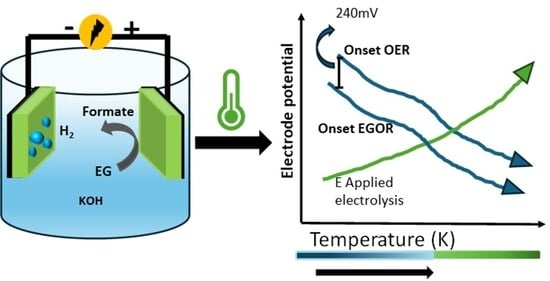
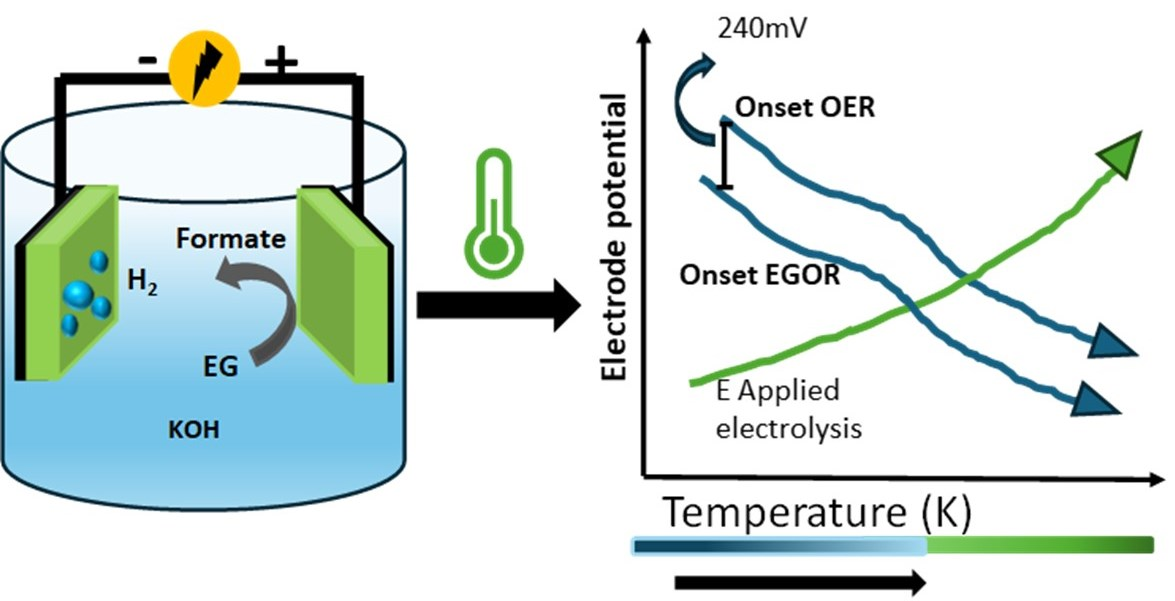
Ethylene glycol oxidation reaction (EGOR) is a promising anodic process to reduce the cell voltage compared with the oxygen evolution reaction (OER). Using ethylene glycol (EG) obtained from biomass-derived streams—such as cellulose, hemicellulose or lignocellulosic intermediates—and polyethylene terephthalate (PET) waste contributes to the development of circular-economy models. This study investigates EGOR on a non-noble NiCo bimetallic electrode, focusing on the effects of temperature and current density. The presence of EG reduces the initial potential by 240 mV at 25 °C, with a further 60 mV decrease at elevated temperatures, while the catalyst maintains high formate selectivity (>65%) across the tested conditions. Faradaic efficiency peaks at 100 mA cm−2 due to the full oxidation of formate to CO2 or the competing OER at higher current densities. There are no significant discrepancies between simulated and experimental faradaic efficiencies, although the presence of terephthalic acid (TPA) affects the shift in the electrode potential. Overall, these results highlight the relevance of EGOR for future applications in which EG derived from recycled plastics and renewable biomass can be electrochemically valorized within integrated biorefinery frameworks.

Graphical Abstract

1. Introduction

The challenge of plastic degradation has emerged as a significant environmental concern. Polyethylene terephthalate (PET), one of the most common plastics, is used extensively in packaging and textiles, among other sectors [1]. Its consumption and associated waste volumes continue to rise, and its poor degradability remains a critical issue [2,3]. Traditional recycling methods, including pyrolysis [4], mechanical processing [5] and chemical degradation [6], such as hydrogenation [7] and gasification [8], often require substantial energy and may lead to secondary pollution [9]. In parallel, biodegradation approaches have also been explored; however, issues related to instability and low system efficiency persist [10].
Compared with these strategies, the alkaline hydrolysis of PET yields a degradation solution predominantly comprising ethylene glycol (EG) and terephthalic acid (TPA) under mild conditions, thereby providing directly utilizable materials for subsequent industrial processes [11]. In addition to PET recycling, EG can also be obtained from biomass-derived feedstocks—such as cellulose, hemicellulose, or lignocellulosic intermediates—situating both its origin and valorization within the conceptual framework of integrated biorefineries [12,13,14]. Ethylene glycol serves as a crucial chemical raw material, finding extensive application as an antifreeze and heat transfer fluid in heat exchange systems of both automotive and industrial sectors. Additionally, it is utilized in various fields, including aviation, as well as in ink and coating electrolytes [15,16,17]. The electrochemical oxidation of ethylene glycol at the anode enables the production of small-molecule organic acid products [18]. In alkaline electrolytes, EG oxidation leads to a range of C1 and C2 products, each associated with distinct hydroxide ion consumption and electron transfer numbers. Several studies indicate that EG oxidation begins with its gradual dehydrogenation on the metal surface, leading to the formation of intermediates such as glyoxal, followed by further oxidation along the C2 pathway, to produce glycolic acid, oxalic acid, and formic acid [19,20,21,22,23]. From a biorefinery perspective, the ability to selectively transform EG into value-added organic acids through electrochemical processes offers an alternative mild-condition pathway compared with thermochemical upgrading methods. Consequently, the development of efficient, low-cost, and stable anodic catalytic capable of operating effectively in PET hydrolysate solutions and potentially applicable to biomass-derived EG streams has become a central research focus.
In recent years, the advancement of electrode materials has progressed rapidly. Noble metal systems, including Pd-PdSe hollow nanosheets [24], Rh/RhOOH metalenes [25] and PdAg alloys [26], show formic acid faradaic efficiencies close to 90%, and the potentials are relatively low. However, due to the high cost of precious metals, researchers are seeking alternative electrode materials. Doping transition metal oxides such as CuCo2O4 [27], NiSe2 [28], and Mn-modified NiCo2O4 [29] has resulted in a faradaic efficiency above 90% for formic acid, surpassing the activity of precious metal systems. Additionally, photoelectrocatalytic electrodes, such as Ni3(PO4)2/α-Fe2O3 [30], have exhibited a formic acid selectivity of up to 87% when assisted by visible light.
Nickel–cobalt (NiCo), as a transition metal system characterized by its abundance and low cost, is well-suited for commercial applications [31]. The similarity in the d-orbital electronic structures of Ni and Co facilitates charge transfer [32], enabling the regulation of adsorption energies and thereby enhancing the activity of the electrochemical ethylene glycerol oxidation reaction (EGOR) [33]. In this bimetallic framework, the Ni-Co interaction also modulates the behavior of proton and oxygen species at the catalyst surface. The incorporation of Co into Ni hydroxide promotes proton deintercalation from the lattice, while the oxygen vacancies generated during the reaction increase the d-band filling of Co sites, facilitating the charge transfer from the catalyst surface to the cleaved molecular fragments [34].
Simulated electrolytes facilitate the rapid screening of electrodes and parameters; however, authentic PET degradation solutions typically comprise oligomers of varying chain lengths, aromatic salts, and impurities from the degradation process. The composition of these solutions evolves over the degradation period, potentially resulting in interfacial adsorption, reconstruction of the active phase, or alterations in mass transfer and capacitance properties. Such changes can significantly impact the actual performance and stability of the electrode. Currently, there is a notable deficiency in systematic research on the extent to which optimized working conditions in simulated liquids can be directly applied to real degradation liquids over different degradation durations. Additionally, the influence of the evolving composition of real degradation liquids on the interface impedance of the NiCo electrode, the effective active area, and the corresponding electrochemical mechanisms remains inadequately explored. This gap constrains the advancement of electrochemical PET processes and the transition from ideal conditions to realistic applications involving actual waste liquids.
This study presents a kinetic model for the ethylene glycol oxidation reaction (EGOR) using a NiCo bimetallic non-precious metal electrode system, incorporating the coordinated regulation of both temperature and current density. These two parameters are critical for ensuring stable operation under realistic electrochemical conditions, and the results show that their synergistic optimization significantly improves overall efficiency. Unlike most studies conducted using simulated ethylene glycol solutions, this investigation successfully employs a genuine PET degradation liquid system. The faradaic efficiency of each reaction was assessed through 1H-NMR, confirming its viability under real conditions. Furthermore, the structure formed by the NiCo electrode enhances double-layer capacitance (Cdl), thereby facilitating resource regeneration without the need for complex structural designs.

2. Results and Discussion

2.1. Electrode Characterization

The NiCo electrocatalyst, with an atomic ratio of 1:2, was synthesized on a nickel foam electrode through a sulfate-assisted electrodeposition method, utilizing NiSO4 and CoSO4 as the metallic precursors and thiourea as an additive to ensure the correct morphology. To prepare the electrocatalyst, a constant potential of −1 V vs. Ag/AgCl (3.5 M KCl) was applied to generate a local increase in pH, thereby promoting the deposition of metal hydroxides on the electrode surface and resulting in the formation of a NiCo layered double hydroxide [35].
Figure 1a shows the FE-SEM images of the synthesized NiCo electrocatalyst, illustrating that the material exhibits a rough morphology with numerous uniformly distributed aggregated particles, suggesting a successful synthesis process. In the high-magnification image presented in Figure 1b, it is observed that these clusters form a three-dimensional porous network. This microstructural configuration enhances the electrode’s specific surface area and increases the number of available active sites. EDS characterization was performed (Figure S1 and Table S1), confirming that both nickel and cobalt were successfully deposited onto the substrate. However, despite the higher concentration of Co2+ in the electrolyte solution compared to Ni2+, the NiCo electrode exhibits a higher Ni content. This occurs because the electrodeposition takes place over Ni substrates and the coating is thin enough to allow the detection of the underlying Ni substrate [36].

2.2. Ethylene Glycol Voltammetric Study

To investigate the electrochemical behavior of the prepared NiCo electrode for ethylene glycol oxidation, we examined the electrocatalytic performance of the electrode in an alkaline electrolyte (1 M KOH), both in the absence and presence of 0.1 M ethylene glycol, using cyclic voltammetry.
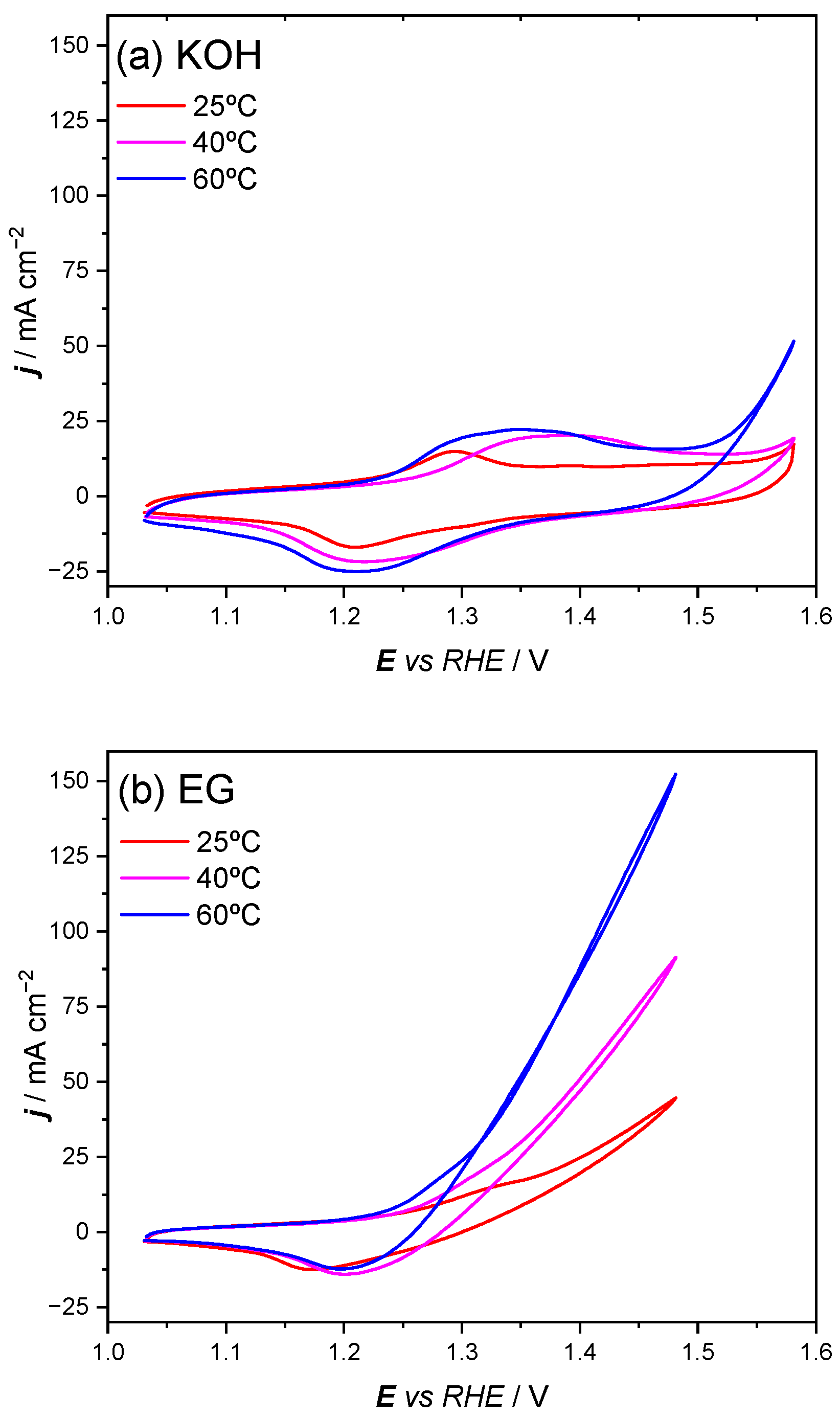
As illustrated in Figure 2a, in 1 M KOH, the electrode exhibits a distinct pair of redox peaks at approximately 1.3 V vs. RHE. This phenomenon is attributed to the oxidation of M(OH)2 to MOOH (Equation (1)), followed by the oxygen evolution reaction (OER) occurring at around 1.6 V vs. RHE. Additionally, the anode peak voltage displays a slight negative shift with increasing temperature, suggesting a reduction in the activation overpotential required for the oxidation reaction.
In the presence of ethylene glycol (Figure 2b), the metal redox pair is replaced by the onset of the ethylene glycol oxidation reaction (EGOR), indicating that the reaction is mediated by the formation of MOOH species, which oxidize ethylene glycol into the corresponding aldehydes and carboxylic acids. (Equations (2) and (3)) [37]. Thus, the actual active sites for EGOR are the electrochemically generated metal oxyhydroxides at the surface of the catalyst. Furthermore, it was observed that the oxidation current densities also increase with temperature, following the same trend observed for the OER.
M OH 2 + OH MOOH + H 2 O + e
MOOH + RCH 2 OH + OH M OH 2 + H 2 O + RCHO + e
RCHO + 3   OH RCOO + 2 H 2 O + 2 e
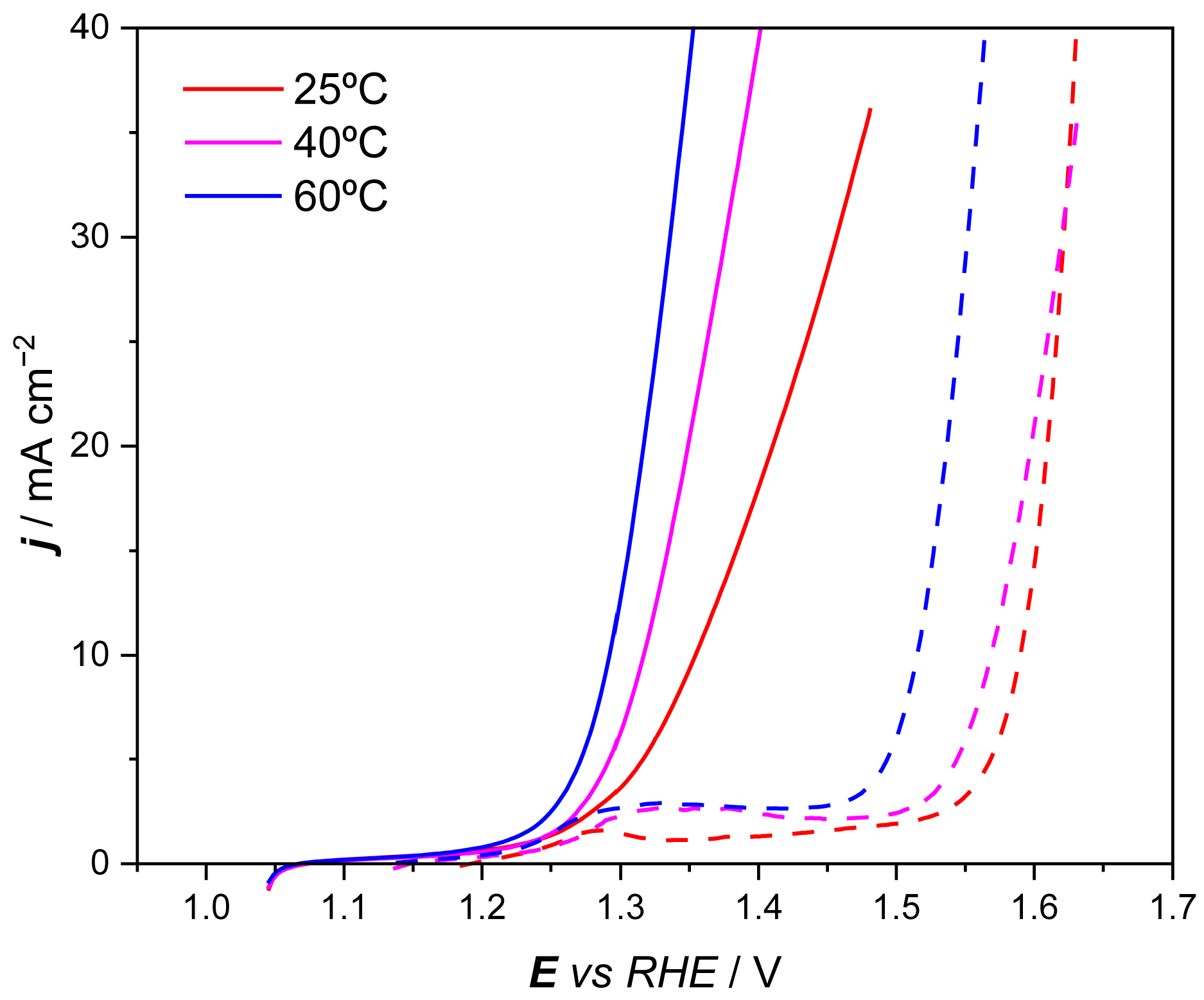
To further evaluate the effect of temperature on electrode performance, LSV and capacitance measurements were performed in the same electrolytes and at the same temperatures as those used for CV. Figure 3 shows the same tendencies observed in the CV measurements, where the addition of ethylene glycol reduces the overpotential and the current increases with increasing temperature. Corresponding to the temperature increases, the capacitance (Cdl) of both electrodes gradually rises, indicating that more charge is stored at the electrode interface within the same potential range. As the onset potential could not be determined, due to tarnishing of the M2+/M3+ redox pair in the voltammetry, the potential required to reach 5 mA cm−2 was used as a comparative value. At 25 °C, the anodic potential decreased from 1.57 to 1.33 V vs. RHE following the addition of ethylene glycol, showing that introducing ethylene glycol to the system results in a potential reduction of 240 mV. This is consistent with the observation in Table 1 and Figure S2 that the Cdl of the electrolyte containing ethylene glycol exceeds that of the EG-free electrolyte, further enhancing charge storage. As the temperature increased, the anodic potential decreased due to the enhanced reaction kinetics. Specifically, increasing the temperature from 25 to 60 °C resulted in a decrease in the anodic potential from 1.57 to 1.50 V vs. RHE in the absence of ethylene glycol, and from 1.33 to 1.27 V vs. RHE in its presence, corresponding to a potential reduction of 60 mV.

2.3. Ethylene Glycol Electrolysis

Although an increase in temperature improves the electrochemical activity, this does not necessarily translate into enhanced electrolysis performance. Apart from reaction potential, faradaic efficiency (Equation (S2)) and selectivity towards a target product are also crucial factors. Therefore, ethylene glycol electrolysis was performed at different current densities (10, 50, 100 and 200 mA cm−2) and temperatures (25, 40 and 60 °C). In these experiments, the product distribution as well as the corresponding cell voltage was continuously monitored.
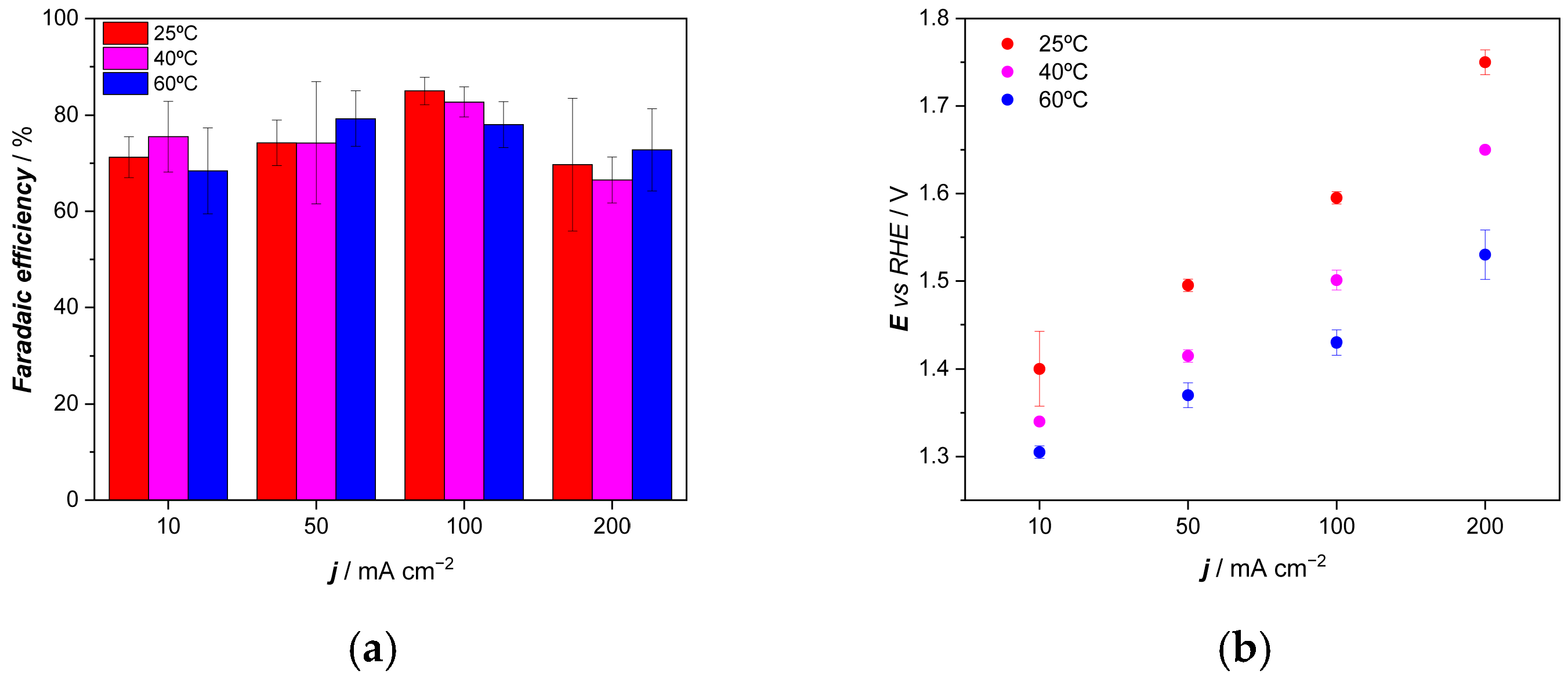
Figure 4 and Table S2 show the faradaic efficiencies of the various electrolysis experiments, and formic acid consistently emerges as the primary product, with its faradaic efficiency surpassing 65% in all cases. Additionally, the electrode exhibits a very high selectivity towards this compound, as no other products were detected in the 1H-NMR analysis. Looking at the 25 °C electrolysis, an increase in current density correlates with an increase in faradaic efficiency up to 100 mA cm−2, while a decline is observed at 200 mA cm−2. This could be attributed to the complete oxidation of the product to CO2, given that the faradaic efficiency decreased under these conditions and no additional products were detected in the 1H-NMR analysis. However, this faradaic efficiency reduction could also be due to the competition with the oxygen evolution reaction (OER). As shown in Figure 4b, the average voltage required for electrolysis gradually rises as the current density increases, and at 200 mA cm−2, the electrolysis voltage exceeds 1.6 V vs. RHE, a potential at which the OER begins to occur. Regarding temperature, no clear trend was identified in the product distribution, but the anodic potential decreased as the temperature rose. This shows that while temperature does not affect product distribution, it is still beneficial, as it reduces the average voltage required for the process. Therefore, 60 °C and 100 mA cm−2 were identified as the optimal operating conditions for ethylene glycol electrooxidation, with remarkable performance compared to previously studied catalysts (Table S3).

2.4. PET Degradation Electrolytes

Even though the NiCo electrode showed good faradaic efficiency and selectivity for the oxidation of ethylene glycol, a clean electrolyte is not typically utilized in the industry. Instead, an electrolyte derived from PET degradation can be employed. For this reason, PET-degradation electrolytes were prepared by heating two different concentrated KOH solutions (1 M and 4 M) for three different periods (1, 2 or 3 days).
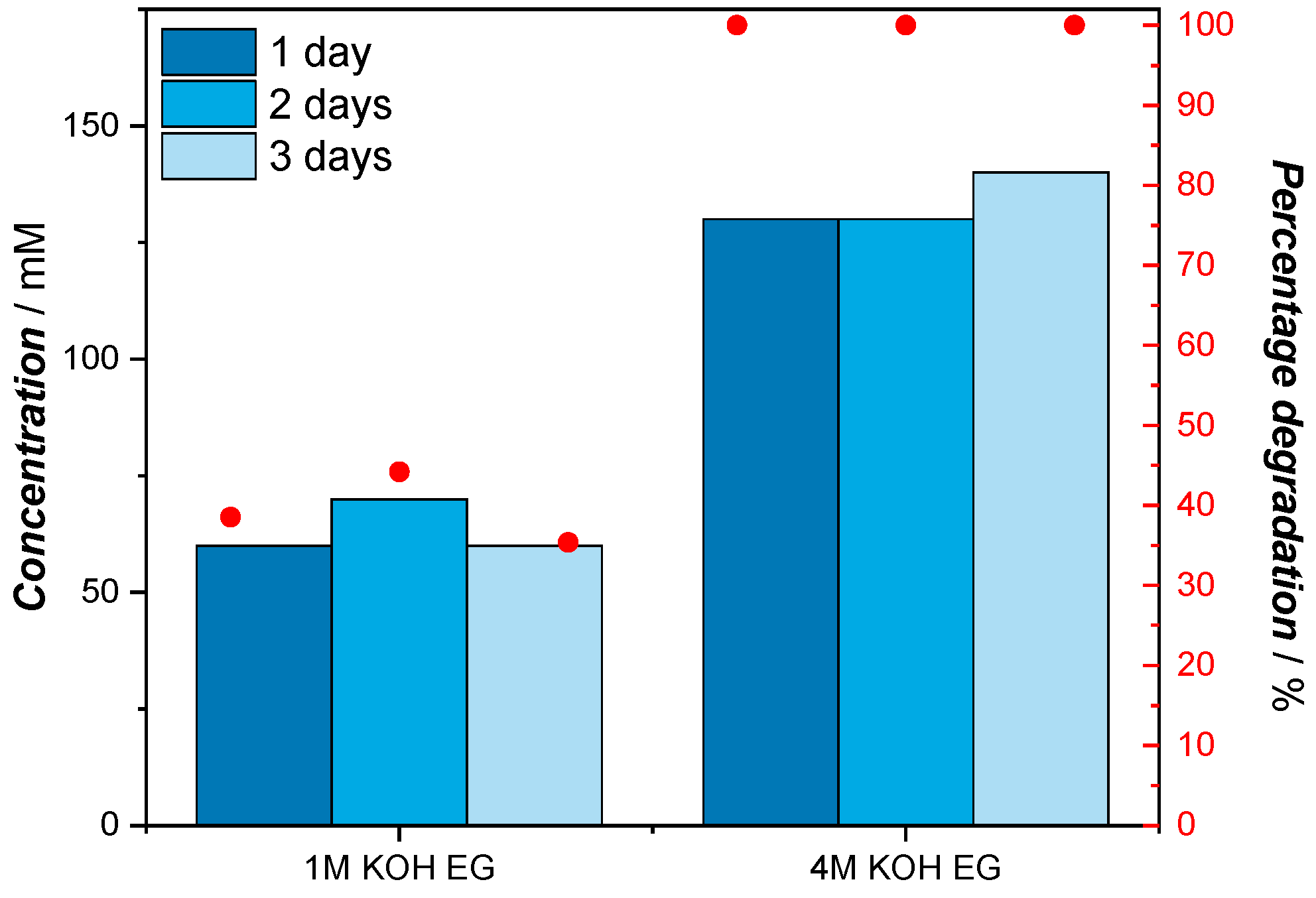
Figure 5 and Table S4 show that for the 1 M KOH degradation solution, the obtained ethylene glycol concentrations were low (0.05 M), with no increase in concentration over time. The PET degradation efficiency was also poor, with only approximately 1/3 of the initial PET degraded. In contrast, the 4 M KOH degradation solution reached maximum degradation within the first day, yielding ethylene glycol concentrations of around 0.13 M. This indicates that 4 M KOH is the optimal degradation medium and that the number of days does not significantly influence the degradation efficiency.

2.5. Voltammetric Study of PET-Degradation Electrolyte

To distinguish the effects of impurities and target products in the degradation solution on the electrochemical responses, cyclic voltammetry was used to evaluate the electrocatalytic performance of the NiCo catalyst (Figure 6) using a PET degradation solution prepared by diluting the 4 M KOH to a 1 M KOH solution after one day of degradation.
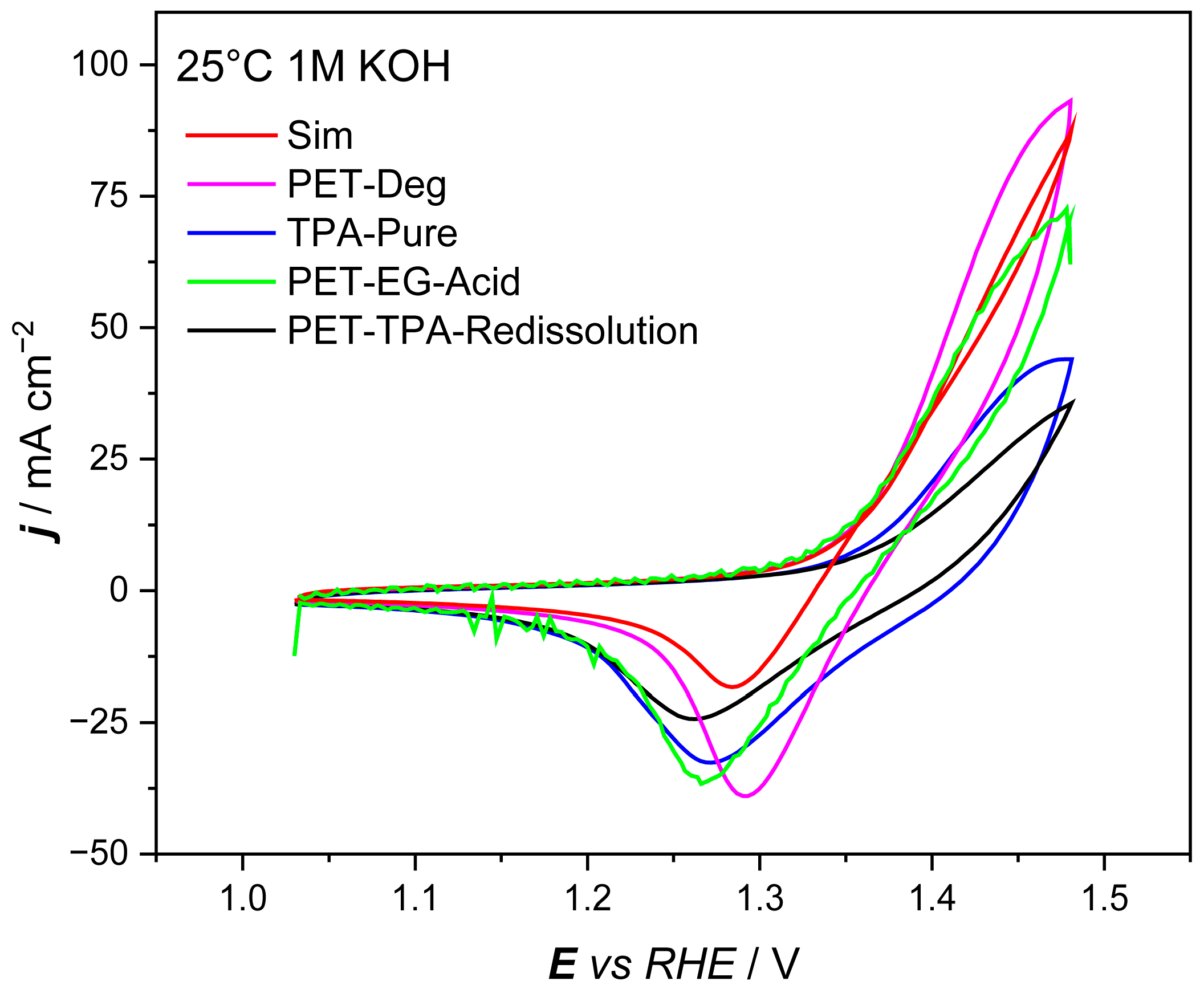
Figure 6 shows that the CV curves of the 4 M KOH, 1-day degradation electrolyte (PET-Deg) do not show pronounced differences in shape compared with those of the simulated solution (Sim). Specifically, the oxidation current in the PET-Deg electrolyte is higher than that in the simulated solution, and the reduction peaks do not exhibit a noticeable shift. The reduction peak of PET-Deg is larger than that of the simulated solution. These changes may be attributed to the presence of impurities in the degradation solution that could be altering the electrode performance. 1H-NMR analysis of the electrolyte reveals that the degradation solution contains a large amount of TPA (Table 2).
For this reason, additional voltammograms were recorded after separating both components from the PET-Deg solution. After acidification, TPA precipitates from the PET-Deg solution. The solid TPA was separated, and the remaining solution was re-alkalinized to obtain the EG electrolyte (PET-EG-Acid). The solid TPA was then dissolved in 1 M KOH to obtain the TPA electrolyte (PET-TPA-Redissolution). As seen in Figure 5, in the EG electrolyte (PET-EG-Acid), the cyclic voltammetry barely changed compared to the degradation solution, showing that TPA is not responsible for the observed behavior change. In the TPA electrolyte (PET-TPA-Redissolution), the oxidation slightly shifted towards higher potentials. This could be due to the presence of EG in the TPA electrolyte (Table 2), as TPA precipitation appears to carry a small amount of EG with it. To better assess the intrinsic effect of TPA, a pure TPA solution was prepared. The prepared TPA solution (TPA-Pure) exhibits a higher oxidation current than PET-TPA-Redissolution, and its curve shape is similar to that of PET-TPA- Redissolution. Furthermore, the sum of the total currents of TPA-Pure and PET-EG-Acid is identical to that of PET-Deg. Meanwhile, TPA-Pure was subjected to electrolysis. The 1H-NMR results showed no detectable byproducts, and the electrolysis was conducted at 1.6 V, a potential at which the OER occurs.

2.6. PET Degradation Electrolyte Electrolysis

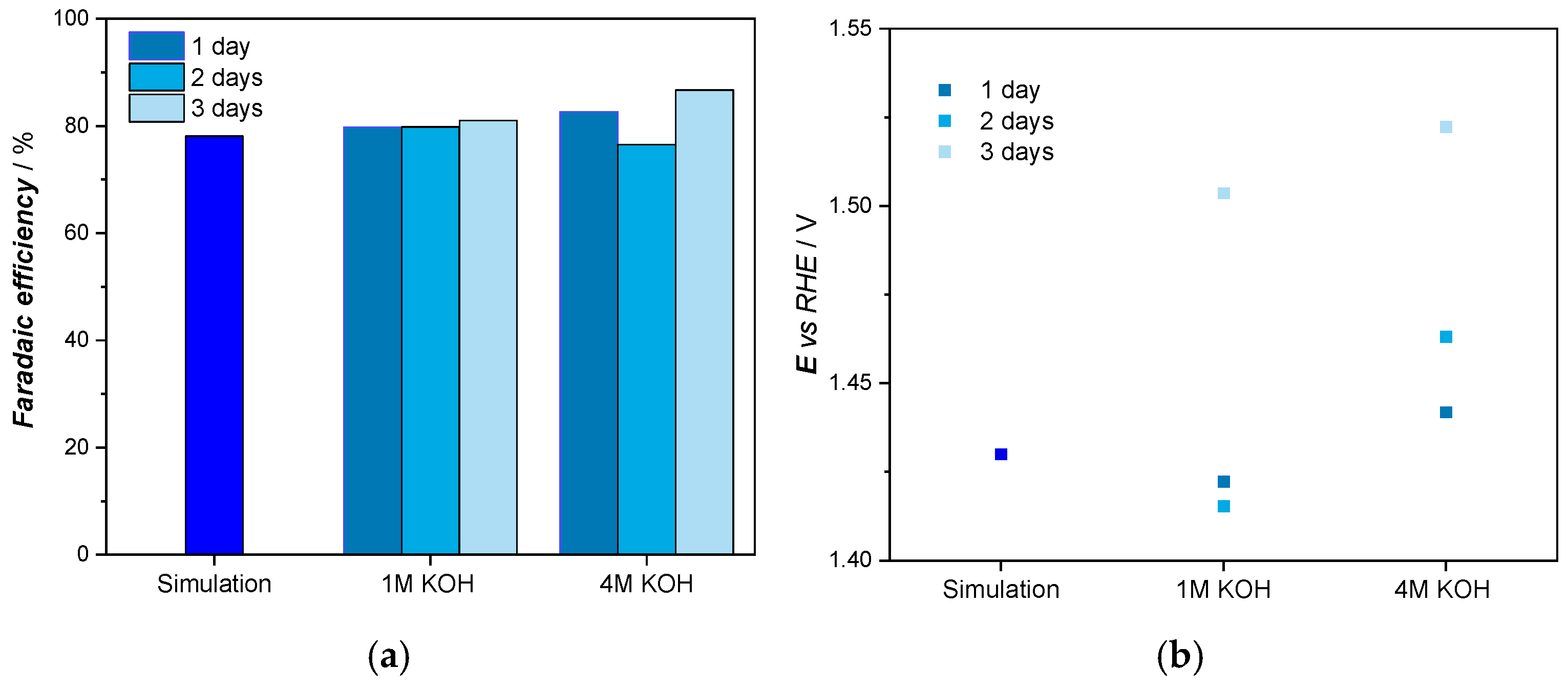
Since the voltammetric study showed that electrochemical activity has not been significantly impacted, we proceeded to test the PET degradation electrolytes in electrolysis using the optimal current density and temperature of 100 mA cm−2 and 60 °C. To eliminate the effect of alkalinity and ethylene glycol concentration, we diluted the 4 M KOH PET degradation solution so that the ethylene glycol concentration remained at 0.05 M for all the electrolysis. However, the electrolysis samples were labeled according to the degradation parameters to differentiate between electrolytes. Figure 7 shows that the faradaic efficiency of the PET-degradation solutions is comparable to that of the simulated solution, regardless of the degradation conditions. It is important to note that ethylene glycol (EG) and other organic complexes are present in the actual electrolyte. The presence of these substances may modify the electrical conductivity and interfacial properties of the solution, resulting in an increased average potential required for electrolysis. This phenomenon may be attributed to the influence of other degradation products within the solution.

3. Materials and Methods

The electrodes were prepared using a nickel foam (NF) support (NI-4753, 1.6 mm thick, 1 × 3 cm2, Recemat, Dodewaard, The Netherlands) with a geometric area of 1 cm2. The NF was immersed in diluted HCl and sonicated for 3 min to eliminate metal oxides. Then, the electrode was placed in a 1:1 acetone and ethanol solution and sonicated for 2 min to remove organic contaminants. Finally, the support was rinsed thoroughly with ultrapure water.
The 1:2 NiCo electrocatalyst was prepared by an electrodeposition method. To prepare the electrochemical bath, a 0.06 M thiourea (99%, Merck, Darmstadt, Germany), 0.005 M NiSO4·6H2O (99%, EMSURE, Merck, Darmstadt, Germany), and 0.01 M CoSO4·7H2O (99%, Alfa Aesar, Lancashire, UK) solution was prepared. Electrodeposition was performed using a VMP-2 Biologic multi-channel potentiostat (Vercors, France) in a three-electrode configuration using Ag/AgCl (3.5 M KCl) and a platinum wire (Heraeus, Hanau, Germany) as the reference and counter electrode, respectively. To electrodeposit the catalyst, a constant voltage of −1.00 V vs. Ag/AgCl was applied at room temperature for 15 min. Finally, the electrodes were annealed at 300 °C for 2 h in a Prometheus muffle furnace in an air atmosphere. The morphology of the samples was analyzed via Field emission scanning electron microscopy (FESEM) on a JEOL J-7100 (JEOL USA, Inc., Peabody, MA, USA) coupled with energy dispersive spectroscopy (EDS).
The electrochemical characterization of the NiCo electrocatalyst was performed in a three-electrode cell configuration, using an Ag/AgCl (3.5 M KCl) and a platinum wire (Heraeus, Hanau, Germany) as the reference and counter electrode, respectively. For data analysis, all potentials were converted into the reversible hydrogen electrode (RHE) scale using the Nernst equation [38], with the E° at 25 °C set at 0.205 V, according to Equation (4).
E RHE V = E Ag / AgCl + E ° Ag / AgCl + 0.059 · pH
Assessment of the oxygen evolution reaction (OER) and the ethylene glycol oxidation reaction (EGOR) was performed using cyclic voltammetry (CV) and linear sweep voltammetry (LSV) measurements. The electrodes were tested in a 1 M KOH (99%, Supelco, Darmstadt, Germany) electrolyte for OER characterization and in a solution containing 1 M KOH and 0.1 M ethylene glycol (98%, Sigma Aldrich, Darmstadt, Germany) for EGOR characterization at three different temperatures (25, 40 and 60 °C). CV measurements were carried out at a scan rate of 20 mV s−1 and LSV at a 5 mV s−1. Additionally, double-layer capacitance (Cdl) was measured by recording CV over a potential window of 0–0.4 V (vs. Ag/AgCl) at varying scan rates (10, 20, 30, 40 and 50 mV s−1).
To determine the product distribution of ethylene glycol oxidation, electrolysis was performed in a 10 mL, two-compartment jacketed H-cell with a Nafion 117 membrane separating the anodic and cathodic compartments. An electrolyte of 1 M KOH and 0.1 M ethylene glycol was used, and the experiments were conducted under constant current conditions of 10 mA, 50 mA, 100 mA, and 200 mA, maintaining a total charge of 7.5 C mL−1 at different temperatures (25, 40, 60 °C). Immediately following the electrolysis, 280 µL of concentrated H2SO4 (99%, Panreac, Castellar del Vallès, Spain) was added to acidify the solution, and the mixture was stirred for 3 min using a stir bar.
To characterize the concentrations of electrolytic products and the various substances generated during PET degradation, 1H-NMR was employed to quantify each species, and the concentrations were determined using the following method: 490 µL of the electrolyte, 90 µL of deuterium oxide (99.9%, Eurisotop, Saint-Aubin, France) and 20 µL of a 0.2%vol DMSO (VWR, Radnor, USA) solution were thoroughly mixed and transferred to an NMR tube. Then, the 1H-NMR scan was acquired following a water suppression method.
To prepare the PET-degradation electrolytes, PET-labeled water bottles were cut into 1 cm2 pieces, and 2 g of plastic was weighed for each experiment. Then, the PET pieces were submerged in 70 mL of 1 M or 4 M KOH solutions in an inner lining container and heated in an oven at 80 °C for 1, 2 or 3 days, resulting in six different electrolytes. After degradation, the mass of the remaining plastic was weighed, and the composition of each electrolyte was determined by 1H-NMR.
These PET-degradation electrolytes were used in ethylene glycol electrolysis at a current density of 100 mA cm−2 and a temperature of 60 °C. The 1 M KOH solutions were used as obtained, whereas the 4 M KOH solutions were diluted with Milli-Q water to match the EG concentration to that of the 1 M KOH solutions.
The 4 M KOH 1-day PET-degradation electrolyte was also used for electrochemical characterization after some alterations (PET-Deg). In total, 10 mL of the prepared 2 g PET 1-Day degradation solution was taken and mixed with 30 mL of ultrapure water. Subsequently, 10 mL of this diluted degradation solution was taken and mixed with 280 µL of concentrated H2SO4 (99%, Panreac, Castellar del Vallès, Spain) for acidification. The TPA precipitate and EG supernatant were then separated via centrifugation. The TPA precipitate and EG supernatant were redispersed in the prepared 1 M KOH solution to obtain the separated product solution (EG and TPA), named as PET-EG-Acid and PET-TPA-Redissolution, respectively.

4. Conclusions

A 1:2 NiCo oxide electrode was successfully prepared on a nickel foam substrate, and its ethylene glycol oxidation reaction performance was evaluated via cyclic and linear sweep voltammetry under alkaline conditions. This study shows that, by replacing the OER with the ethylene glycol oxidation reaction, the oxidation potential is reduced by 240 mV at 25 °C, and when the temperature is increased from 25 to 60 °C, the potential experiences a further reduction. In electrolysis measurements, the electrode exhibited high selectivity toward formic acid with faradaic efficiencies surpassing 65% across a range of current densities and temperatures. Moreover, 100 mA cm−2 was found to be the optimal current density with faradaic efficiencies of around 80%, since at higher current densities the OER begins to compete with the EGOR. Temperature showed no clear pattern in influencing faradaic efficiency, but the anodic potential decreased with increasing temperature, thereby reducing the energy consumption without reducing the formic acid production.
The NiCo electrode was also tested using real PET degradation solutions, and it was found that although impurities in these solutions may slightly alter the voltammetric behavior of the electrode, this does not impact formic acid production. However, these impurities can affect the anodic potential as the average potential required for electrolysis increases in the high-impurity PET degradation solutions. These results demonstrate that EGOR is an effective anodic reaction using industrially relevant electrolytes, supporting its integration into future circular-economy schemes, including biomass-derived EG.

Supplementary Materials

The following supporting information can be downloaded at: https://www.mdpi.com/article/10.3390/catal16030252/s1, Figure S1: Selected points for EDS analysis; Table S1: Elemental composition of the electrode NiCo; Figure S2: Cdl at different temperatures of 1 M KOH and 1 M KOH + 0.1 M EG, and CV at different temperatures of 1 M KOH and 1 M KOH + 0.1 M EG; Table S2: Results of the electrolysis in simulated electrolyte; Table S3: Comparative table of electrocatalysts; Table S4: Specific concentrations of each component in the degradation solution. Half reaction Equation (S1) and Faradaic Efficiency formula; Equation (S2).

Author Contributions

D.Y.—Data curation, Formal analysis, Investigation, Methodology, Visualization, Writing—original draft; M.M.—Data curation, Formal analysis, Methodology, Visualization, Writing—review & editing; T.A.—Conceptualization, Funding acquisition, Methodology, Project administration, Resources, Supervision, Writing—review & editing. All authors have read and agreed to the published version of the manuscript.

Funding

This research was funded by the Ministerio de Ciencia e Innovación and FEDER-UE [PID2022–138491OB-C33 (MICIU/AEI/10.13039/501100011033)]; AGAUR Generalitat de Catalunya [2024 FI-1 00421].

Data Availability Statement

The data supporting this paper are available upon request from the corresponding author.

Acknowledgments

The authors thank Centres Científics i Tecnològics (CCiTUB), Universitat de Barcelona, for their expert and technical help with FESEM and 1H NMR techniques.

Conflicts of Interest

The authors declare no conflicts of interest.

References

  1. Nisticò, R. Polyethylene terephthalate (PET) in the packaging industry. Polym. Test. 2020, 90, 106707. [Google Scholar] [CrossRef]
  2. Pamucar, D.; Simic, V.; Dabic-Miletic, S.; Zaidan, A.A.; Petrović, N.; Narayanamoorthy, S. Sustainable management of polyethylene terephthalate waste flow using a fuzzy frank weighted assessment model. Eng. Appl. Artif. Intell. 2024, 138, 109254. [Google Scholar] [CrossRef]
  3. Bharadwaj, C.; Purbey, R.; Bora, D.; Chetia, P.; Maheswari R, U.; Duarah, R.; Dutta, K.; Sadiku, E.R.; Varaprasad, K.; Jayaramudu, J. A review on sustainable PET recycling: Strategies and trends. Mater. Today Sustain. 2024, 27, 100936. [Google Scholar] [CrossRef]
  4. Brems, A.; Baeyens, J.; Vandecasteele, C.; Dewil, R. Polymeric cracking of waste polyethylene terephthalate to chemicals and energy. J. Air Waste Manag. Assoc. 2011, 61, 721–731. [Google Scholar] [CrossRef] [PubMed]
  5. Ragaert, K.; Delva, L.; Van Geem, K. Mechanical and chemical recycling of solid plastic waste. Waste Manag. 2017, 69, 24–58. [Google Scholar] [CrossRef]
  6. Dang, Y.; Luo, X.; Wang, F.; Li, Y. Value-added conversion of waste cooking oil and post-consumer PET bottles into biodiesel and polyurethane foams. Waste Manag. 2016, 52, 360–366. [Google Scholar] [CrossRef] [PubMed]
  7. Zhang, M.; Huo, Z.; Li, L.; Ji, Y.; Ding, T.; Hou, G.; Song, S.; Dai, W. One-pot Hydrogenolysis of Polyethylene Terephthalate (PET) to p–xylene over CuZn/Al2O3 Catalyst. ChemSusChem 2025, 18, e202402013. [Google Scholar] [CrossRef]
  8. Trapp, W.L.; Murphy, J.W. Chemical Recycling–Gasification. ACS Symp. Ser. 2021, 1391, 129–142. [Google Scholar] [CrossRef]
  9. Joseph, T.M.; Azat, S.; Ahmadi, Z.; Jazani, O.M.; Esmaeili, A.; Kianfar, E.; Haponiuk, J.; Thomas, S. Polyethylene terephthalate (PET) recycling: A review. Case Stud. Chem. Environ. Eng. 2024, 9, 100673. [Google Scholar] [CrossRef]
  10. Bergeson, A.R.; Silvera, A.J.; Alper, H.S. Bottlenecks in biobased approaches to plastic degradation. Nat. Commun. 2024, 15, 4914. [Google Scholar] [CrossRef]
  11. Chen, Q.; Yan, H.; Zhao, K.; Wang, S.; Zhang, D.; Li, Y.; Fan, R.; Li, J.; Chen, X.; Zhou, X.; et al. Catalytic oxidation upcycling of polyethylene terephthalate to commodity carboxylic acids. Nat. Commun. 2024, 15, 5482. [Google Scholar] [CrossRef]
  12. Di Sabatino, R.; Kersten, S.R.; Lange, J.-P.; Ruiz, M.P. Lignocellulosic biomass to glycols: Simultaneous conversion of cellulose, hemicellulose and lignin using an organic solvent. Biomass Bioenergy 2024, 187, 107307. [Google Scholar] [CrossRef]
  13. Molder, T.T.; Kersten, S.; Lange, J.P.; Ruiz, M.P. Ethylene Glycol from Lignocellulosic Biomass: Impact of Lignin on Catalytic Hydrogenolysis. Ind. Eng. Chem. Res. 2021, 60, 7043–7049. [Google Scholar] [CrossRef]
  14. Pang, J.; Zhang, B.; Jiang, Y.; Zhao, Y.; Li, C.; Zheng, M.; Zhang, T. Complete conversion of lignocellulosic biomass to mixed organic acids and ethylene glycolviacascade steps. Green Chem. 2021, 23, 2427–2436. [Google Scholar] [CrossRef]
  15. Yue, H.; Zhao, Y.; Ma, X.; Gong, J. Ethylene glycol: Properties, synthesis, and applications. Chem. Soc. Rev. 2012, 41, 4218–4244. [Google Scholar] [CrossRef]
  16. Staples, C.A.; Williams, J.B.; Craig, G.R.; Roberts, K.M. Fate, effects and potential environmental risks of ethylene glycol: A review. Chemosphere 2001, 43, 377–383. [Google Scholar] [CrossRef]
  17. Ignatowicz, M.; Palm, B. Experimental investigation of thermophysical properties of ethylene glycol based secondary fluids. Int. J. Refrig. 2023, 155, 137–153. [Google Scholar] [CrossRef]
  18. Qi, J.; An, Z.; Li, C.; Chen, X.; Li, W.; Liang, C. Electrocatalytic selective oxidation of ethylene glycol: A concise review of catalyst development and reaction mechanism with comparison to thermocatalytic oxidation process. Curr. Opin. Electrochem. 2022, 32, 100929. [Google Scholar] [CrossRef]
  19. Ma, Y.; Li, L.; Tang, J.; Hu, Z.; Zhang, Y.; Ge, H.; Jian, N.; Zhao, J.; Cabot, A.; Li, J. Electrochemical PET recycling to formate through ethylene glycol oxidation on Ni-Co-S nanosheet arrays. J. Mater. Chem. A 2024, 12, 33917–33925. [Google Scholar] [CrossRef]
  20. Wang, L.; Meng, H.; Shen, P.K.; Bianchini, C.; Vizza, F.; Wei, Z. In situ FTIR spectroelectrochemical study on the mechanism of ethylene glycol electrocatalytic oxidation at a Pd electrode. Phys. Chem. Chem. Phys. 2021, 13, 2667–2673. [Google Scholar] [CrossRef]
  21. Schnaidt, J.; Heinen, M.; Jusys, Z.; Behm, R. Mechanistic aspects of the electro-oxidation of ethylene glycol on a Pt-film electrode: A combined in situ IR spectroscopy and online mass spectrometry study of kinetic isotope effects. Catal. Today 2013, 202, 154–162. [Google Scholar] [CrossRef]
  22. Xin, L.; Zhang, Z.; Qi, J.; Chadderdon, D.; Li, W. Electrocatalytic oxidation of ethylene glycol (EG) on supported Pt and Au catalysts in alkaline media: Reaction pathway investigation in three-electrode cell and fuel cell reactors. Appl. Catal. B 2012, 125, 85–94. [Google Scholar] [CrossRef]
  23. Da Silva, R.G.; de Andrade, A.R.; Servat, K.; Morais, C.; Napporn, T.W.; Kokoh, K.B. Insight into the Electrooxidation Mechanism of Ethylene Glycol on Palladium-Based Nanocatalysts: In Situ FTIRS and LC-MS Analysis. ChemElectroChem 2020, 7, 4326–4335. [Google Scholar] [CrossRef]
  24. Qin, Y.; Zhang, W.; Wang, F.; Li, J.; Ye, J.; Sheng, X.; Li, C.; Liang, X.; Liu, P.; Wang, X.; et al. Extraordinary p–d Hybridization Interaction in Heterostructural Pd-PdSe Nanosheets Boosts C−C Bond Cleavage of Ethylene Glycol Electrooxidation. Angew. Chem. Int. Ed. 2022, 61, e202200899. [Google Scholar] [CrossRef] [PubMed]
  25. Mao, Q.; Deng, K.; Yu, H.; Xu, Y.; Wang, Z.; Li, X.; Wang, L.; Wang, H. In Situ Reconstruction of Partially Hydroxylated Porous Rh Metallene for Ethylene Glycol-Assisted Seawater Splitting. Adv. Funct. Mater. 2022, 32, 2201081. [Google Scholar] [CrossRef]
  26. Liu, F.; Gao, X.; Shi, R.; Guo, Z.; Tse, E.C.M.; Chen, Y. Concerted and Selective Electrooxidation of Polyethylene-Terephthalate-Derived Alcohol to Glycolic Acid at an Industry-Level Current Density over a Pd−Ni(OH)2 Catalyst. Angew. Chem. Int. Ed. 2023, 62, e202300094. [Google Scholar] [CrossRef] [PubMed]
  27. Liu, F.; Gao, X.; Shi, R.; Tse, E.C.M.; Chen, Y. A general electrochemical strategy for upcycling polyester plastics into added-value chemicals by a CuCo2O4 catalyst. Green Chem. 2022, 24, 6571–6577. [Google Scholar] [CrossRef]
  28. Li, J.; Li, L.; Ma, X.; Han, X.; Xing, C.; Qi, X.; He, R.; Arbiol, J.; Pan, H.; Zhao, J.; et al. Selective Ethylene Glycol Oxidation to Formate on Nickel Selenide with Simultaneous Evolution of Hydrogen. Adv. Sci. 2023, 10, 2300841. [Google Scholar] [CrossRef]
  29. Mao, Y.; Fan, S.; Li, X.; Shi, J.; Wang, M.; Niu, Z.; Chen, G. Trash to treasure: Electrocatalytic upcycling of polyethylene terephthalate (PET) microplastic to value-added products by Mn0.1Ni0.9Co2O4-δ RSFs spinel. J. Hazard. Mater. 2023, 457, 131743. [Google Scholar] [CrossRef]
  30. Zhang, B.; Zhang, H.; Pan, Y.; Shao, J.; Wang, X.; Jiang, Y.; Xu, X.; Chu, S. Photoelectrochemical conversion of plastic waste into high-value chemicals coupling hydrogen production. Chem. Eng. J. 2023, 462, 142247. [Google Scholar] [CrossRef]
  31. Ibn Shamsah, S.M. Earth-abundant electrocatalysts for water splitting: Current and future directions. Catalysts 2021, 11, 429. [Google Scholar] [CrossRef]
  32. Liu, J.; Wang, X.; Min, Y.; Li, Q.; Xu, Q. Interfacial Electron Transfer and Synergistic Effects on NiCo(CA)@M Microbars That Boost the Alkaline Oxygen Evolution Reaction. Processes 2023, 11, 1874. [Google Scholar] [CrossRef]
  33. Ma, W.; Zhang, Y.; Wang, B.; Wang, J.; Dai, Y.; Hu, L.; Lv, X.; Dang, J. Significantly enhanced OER and HER performance of NiCo-LDH and NiCoP under industrial water splitting conditions through Ru and Mn bimetallic co-doping strategy. Chem. Eng. J. 2024, 494, 153212. [Google Scholar] [CrossRef]
  34. He, Z.; Hwang, J.; Gong, Z.; Zhou, M.; Zhang, N.; Kang, X.; Han, J.W.; Chen, Y. Promoting biomass electrooxidation via modulating proton and oxygen anion deintercalation in hydroxide. Nat. Commun. 2022, 13, 3777. [Google Scholar] [CrossRef]
  35. Di Michele, A.; Boccalon, E.; Costantino, F.; Bastianini, M.; Vivani, R.; Nocchetti, M. Insight into the synthesis of LDH using the urea method: Morphology and intercalated anion control. Dalton Trans. 2024, 494, 12543–12553. [Google Scholar] [CrossRef] [PubMed]
  36. Li, Y.; Tan, X.; Hocking, R.K.; Bo, X.; Ren, H.; Johannessen, B.; Smith, S.C.; Zhao, C. Implanting Ni-O-VOx sites into Cu-doped Ni for low-overpotential alkaline hydrogen evolution. Nat. Commun. 2020, 11, 2730. [Google Scholar] [CrossRef] [PubMed]
  37. Andreu, T.; Mallafré, M.; Molera, M.; Sarret, M.; Oriol, R.; Sirés, I. Effect of Thermal Treatment on Nickel-Cobalt Electrocatalysts for Glycerol Oxidation. ChemElectroChem 2022, 9, e202200100. [Google Scholar] [CrossRef]
  38. Niu, S.; Li, S.; Du, Y.; Han, X.; Xu, P. How to Reliably Report the Overpotential of an Electrocatalyst. ACS Energy Lett. 2020, 5, 1083–1087. [Google Scholar] [CrossRef]
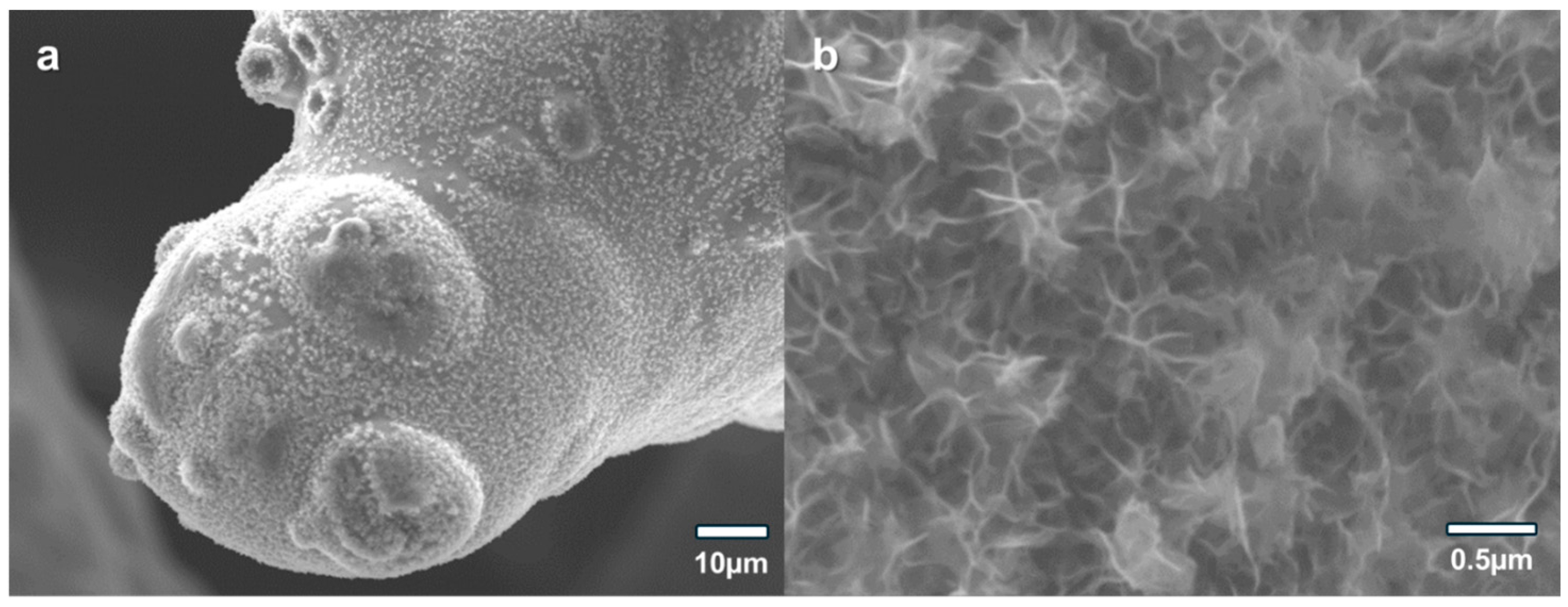
Figure 1. FE-SEM images of the electrodeposited NiCo electrode at (a) low magnification and (b) high-magnification.
Catalysts 16 00252 g001
Figure 2. Cyclic voltammograms obtained at 25 °C (red line), 40 °C (pink line), and 60 °C (blue line) at a scan rate of 20 mV s−1. (a) 1 M KOH electrolyte; (b) 1 M KOH + 0.1 M EG electrolyte.
Catalysts 16 00252 g002
Figure 3. Linear sweep voltammograms recorded at a scan rate of 5 mV s−1 at different temperatures, using 1 M KOH (dotted line) and 1 M KOH + 0.1 M EG (solid line) electrolytes.
Catalysts 16 00252 g003
Figure 4. (a) Faradaic efficiency towards formic acid for ethylene glycol electrolysis in a simulated electrolyte (1 M KOH + 0.1 M EG) at different current densities and temperatures. Accumulated charge of 7.5 C mL−1. (b) Average electrolysis voltage under each condition.
Catalysts 16 00252 g004
Figure 5. Concentration of ethylene glycol following PET degradation and degraded PET mass (red dots) at different degradation times in 1 M KOH and 4 M KOH.
Catalysts 16 00252 g005
Figure 6. Cyclic voltammograms of the re-alkalized product solution obtained by acidifying the degradation solution to generate TPA (black line) and EG (green line), the degradation solution diluted from 4 M KOH to 1 M KOH (magenta line), 1 M simulated EG solution (red line) and 1 M KOH solution prepared from pure TPA (blue line).
Catalysts 16 00252 g006
Figure 7. (a) Faradaic efficiency for ethylene glycol oxidation in PET-degradation electrolytes at 100 mA cm−2 and 60 °C. Accumulated charge of 7.5 C mL−1. (b) Average electrolysis voltage.
Catalysts 16 00252 g007
Table 1. Capacitances (Cdl) of NiCo electrodes in 1 M KOH and 1 M KOH + 0.1 M EG electrolytes at different temperatures.
T (°C)Cdl (KOH) (mF cm−2)Cdl (EG) (mF cm−2)
2536.038.6
4038.141.5
6047.646.5
Table 2. Solution concentration for cyclic voltammetry testing.
NameSimulated Solution
(mM)
PET-Deg
(mM)
PET-EG-Acid
(mM)
PET-TPA-Redissolution
(mM)
TPA037011
EG10028233
Disclaimer/Publisher’s Note: The statements, opinions and data contained in all publications are solely those of the individual author(s) and contributor(s) and not of MDPI and/or the editor(s). MDPI and/or the editor(s) disclaim responsibility for any injury to people or property resulting from any ideas, methods, instructions or products referred to in the content.