Article

Interlayer Immobilization of L-Proline in Mg–Al Layered Double Hydroxides for Efficient and Selective Aldol Condensation of Furfural with Ketones Under Mild Conditions

1
School of Chemical and Blasting Engineering, Anhui University of Science and Technology, Huainan 233022, China
2
Key Laboratory of Energy Thermal Conversion and Process Measurement and Control of Ministry of Education, School of Energy and Environment, Southeast University, Nanjing 210096, China
3
School of Energy Science and Engineering, University of Science and Technology of China, Hefei 230026, China
*
Authors to whom correspondence should be addressed.
Catalysts 2026, 16(4), 312; https://doi.org/10.3390/catal16040312
Submission received: 25 December 2025 / Revised: 4 February 2026 / Accepted: 6 February 2026 / Published: 1 April 2026

Abstract

The homogeneous nature of L-proline organocatalysts restricts their application in aldol condensation due to poor recyclability and stability. Herein, L-proline was heterogenized by ionic intercalation into Mg–Al layered double hydroxides (LDHs), yielding a series of proline-intercalated catalysts with tunable layer structures. Co-precipitation and memory-effect reconstruction strategies were employed to regulate interlayer spacing and proline loading. The resulting catalysts exhibited efficient performance in the aldol condensation of furfural with ketones under mild conditions. The reconstructed catalyst re-Mg4Al1P achieved a furfural conversion of 88.67% and a total product yield of 85.54% at room temperature, with product selectivity exceeding 95%. Structural characterizations confirmed that proline was stabilized within the LDH interlayers via R–COO—Mg electrostatic interaction while preserving the secondary amine active site. Mechanistic analysis indicated that the reaction proceeded through enamine- or enol-mediated pathways depending on water content, while the layered LDH framework imposed geometric confinement that suppressed side reactions. Catalyst deactivation in aqueous systems was mainly attributed to proline leaching rather than structural collapse.

1. Introduction

Aldol condensation is a key C–C coupling reaction for upgrading biomass-derived platform molecules into fuel precursors and value-added chemicals [1,2]. Furfural (FFR), readily obtainable from lignocellulosic hemicellulose, is particularly attractive due to its high reactivity and structural versatility [3]. However, achieving efficient, selective, and recyclable aldol condensation of furfural with ketones under mild conditions remains challenging, as side reactions, catalyst separation, and compatibility with downstream hydrodeoxygenation processes often limit overall process efficiency [4,5].
L-Proline is a well-established organocatalyst for aldol condensation owing to its secondary amine functionality, which enables precise activation of ketone carbonyls [6]. Notably, the catalytic pathway of proline is strongly dependent on the reaction medium, proceeding via enamine intermediates in solvent-free systems and via enol-mediated pathways in aqueous environments, thereby enabling high activity even at room temperature [7]. Despite these advantages, proline-based systems are inherently homogeneous, leading to difficult catalyst recovery, limited recyclability, and practical constraints in integrated biomass-to-fuel routes.
To address these limitations, extensive efforts have been devoted to immobilizing proline on solid supports [8,9]. While polymeric and ionic liquid-based systems can anchor proline through covalent or ionic interactions, they often suffer from complex synthesis, poor thermal stability, or persistent separation challenges. Inorganic supports offer simpler preparation and handling; however, conventional materials such as silica or γ-alumina typically rely on weak adsorption, resulting in severe proline leaching under liquid-phase conditions [10,11]. Consequently, the development of heterogeneous proline catalysts that simultaneously ensure strong immobilization, preserved catalytic pathways, and efficient mass transfer remains an unresolved issue.
Layered double hydroxides (LDHs) are a versatile class of anionic clays, characterized by positively charged brucite-like layers and exchangeable interlayer anions that enable precise tuning of their physicochemical properties [12,13]. Their structural versatility and unique “memory effect” make them highly valuable precursor materials for catalysis and energy applications [14,15]. Their tunable metal composition [16,17], anion-exchangeable interlayers, and layered architecture enable the immobilization of organic anions while offering confined reaction environments [11,18]. Deprotonated proline can be intercalated into Mg–Al LDHs through ionic bonding, potentially stabilizing the secondary amine active site and regulating substrate diffusion and product selectivity [19,20]. Moreover, LDHs can be structurally reconstructed via the memory effect, offering additional control over interlayer spacing and catalyst accessibility [21].
In this work, L-proline was immobilized into Mg–Al LDHs using both co-precipitation and memory-effect reconstruction strategies, and the resulting catalysts were evaluated in the aldol condensation of furfural with acetone and cyclopentanone. By correlating catalyst structure, solvent water content, and catalytic performance, this study elucidates how proline immobilization mode and LDH confinement jointly govern reaction pathways, selectivity, and stability. The results demonstrate a viable route to transform homogeneous amino acid organocatalysts into efficient and recyclable heterogeneous systems, providing insights relevant to the rational design of solid organocatalysts for biomass upgrading.

2. Result and Discussion

2.1. Catalytic Performance of Proline-Intercalated LDHs in Aldol Condensation

The catalytic performances of Mg–Al layered double hydroxides (MgxAly) and proline-intercalated counterparts (MgxAlyP) in the aldol condensation of furfural with acetone are summarized in Table 1. Bare LDHs (Mg1Al1 and Mg2Al1) exhibited no detectable activity, indicating that the intrinsic acid–base sites of LDHs are insufficient to catalyze the reaction under the applied mild conditions. In contrast, the introduction of proline led to a pronounced enhancement in catalytic activity, demonstrating that the secondary amine functionality of proline constitutes the primary active site [22].
Among the tested catalysts, Mg2Al1P showed a clear activity improvement, affording a furfural conversion of 20.31% with a total product yield of 16.63% after 8 h at room temperature. Prolonging the reaction time to 16 h increased the conversion to 56.76% and the total yield to 52.81%, with the dehydrated condensation product (FA) accounting for 40.73%. In contrast, Mg1Al1P exhibited only negligible activity, despite the presence of proline, suggesting that the composition and structural integrity of the LDH host play a decisive role in determining catalytic performance.
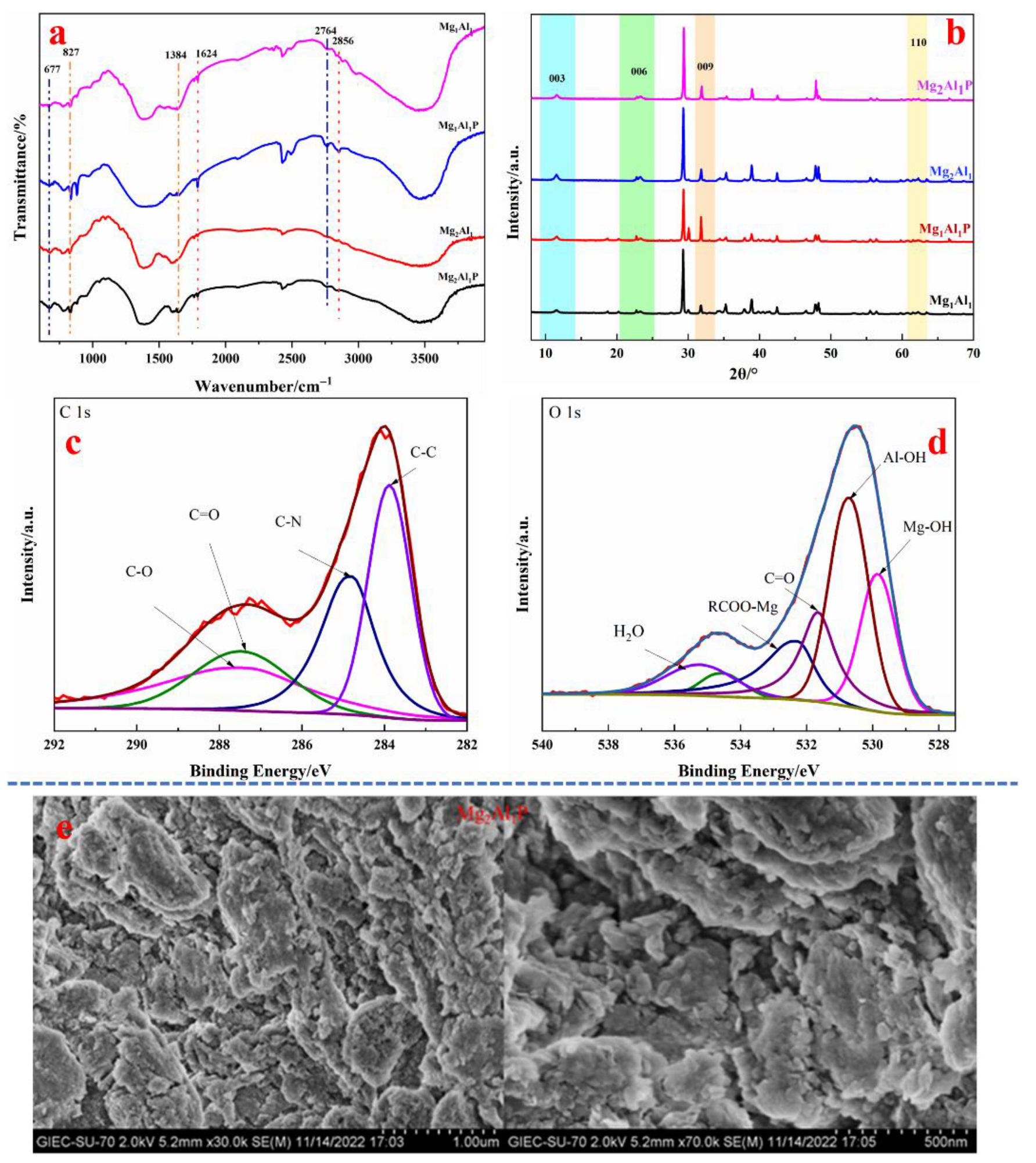
Structural characterization provides insight into this pronounced structure–activity dependence. FT-IR spectra (Figure 1a) confirm the presence of characteristic LDH lattice vibrations in all samples, while additional bands corresponding to N–H, C–H, and carboxylate groups verify successful proline incorporation in MgxAlyP catalysts. Notably, the proline-related bands are more intense for Mg1Al1P than for Mg2Al1P, implying a higher apparent proline content [23,24]. However, XRD patterns (Figure 1b) reveal that Mg1Al1, Mg1Al1P, Mg2Al1 and Mg2Al1P possess poorly developed layered structures, as evidenced by the weak (003), (009), and (110) reflections, indicating that these catalyst primarily exists in the form of mixed oxides [25]. The SEM (Figure 1e) observations further corroborate this structural disparity. These results indicate that in Mg1Al1P, proline is predominantly accumulated on the external surface rather than intercalated into the interlayer galleries, leading to ineffective catalytic utilization.
XPS analysis of Mg2Al1P (Figure 1c,d) further elucidates the proline immobilization mode. The C 1s and O 1s spectra display characteristic signals attributable to C–N, C=O, and R–COO—Mg, confirming that proline is anchored in an anionic form through ionic interaction with Mg–OH sites (electrostatic interaction) [26]. This immobilization mode preserves the secondary amine active site while providing enhanced stability relative to physically adsorbed proline.
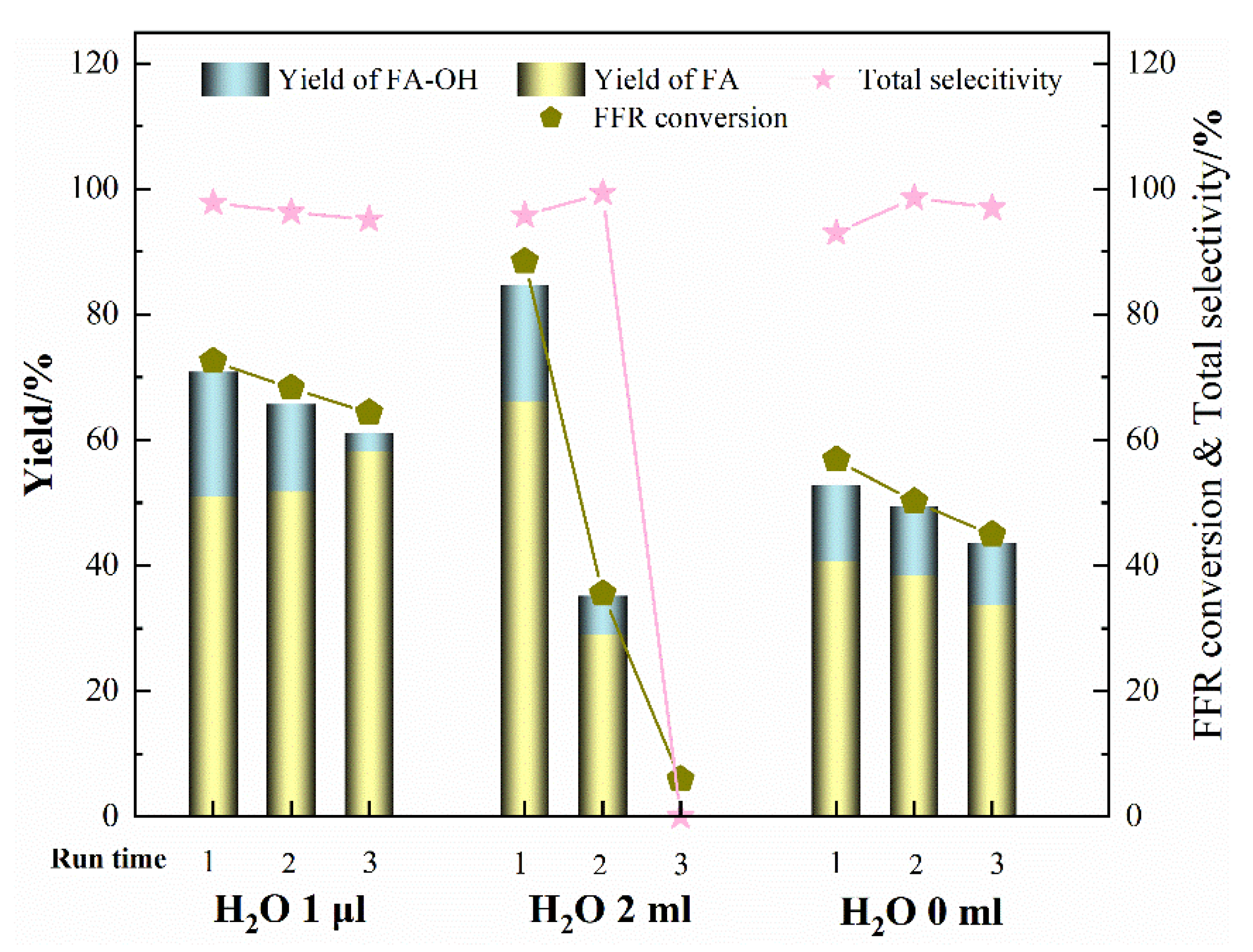
The influence of water content on the catalytic behavior of Mg2Al1P was subsequently investigated (Figure 2). In the absence of added water, furfural conversion decreased to 56.81%, reflecting inefficient proton transfer during the enamine pathway. The addition of trace water (1 μL) significantly enhanced both conversion (72.52%) and product yield (70.91%) while maintaining high selectivity (>95%), indicating that the enamine pathway remains dominant under low-water conditions. Further increasing the water content to 2 mL promoted the enol pathway, resulting in a maximum furfural conversion of 88.3% and a total product yield of 84.72% at room temperature.
Remarkably, irrespective of water content, product selectivity remained consistently above 95%, highlighting the role of the LDH layered architecture in suppressing side reactions. Compared with homogeneous proline catalysis, Mg2Al1P delivered a higher total yield despite slightly lower conversion, demonstrating that LDH confinement enhances selectivity toward mono-condensation products. These results confirm that effective interlayer immobilization of proline within structurally well-defined LDHs enables a favorable balance between activity, selectivity, and catalyst robustness under mild reaction conditions.

2.2. Stability, Substrate Effect, and Structural Regulation of Proline-Intercalated LDHs

The stability of Mg2Al1P was strongly influenced by the water content in the reaction system. As shown in Figure 2, the addition of 2 mL water significantly accelerated catalyst deactivation during recycling. While a high furfural conversion was initially achieved, the conversion dropped to 35.47% in the second run and below 10% after the third cycle, with no detectable condensation products. In contrast, under anhydrous conditions, Mg2Al1P maintained relatively stable activity over three consecutive cycles, exhibiting only a minor decline in furfural conversion and product yield. This behavior can be attributed to the high solubility of L-proline in water and the non-covalent immobilization mode on LDHs [27]. Excessive water facilitates proline leaching from the interlayers, leading to rapid loss of active sites, whereas trace amounts of water can enhance reaction efficiency while minimizing catalyst degradation [28,29].
The effect of substrate size was further examined using cyclopentanone as the ketone reactant (Table 2). Compared with acetone, the Mg2Al1P-catalyzed condensation of furfural with cyclopentanone resulted in a lower total product yield (45.76%) at room temperature, although high mono-condensation selectivity (92.53%) was retained. Upon recycling, furfural conversion gradually decreased from 49.48% to 36.81%, while selectivity remained close to 90%, indicating that catalyst deactivation primarily affected activity rather than reaction specificity. The reduced efficiency can be ascribed to diffusion limitations associated with the larger molecular size of cyclopentanone and its condensation products, which exceed the interlayer spacing of LDHs and hinder effective access to confined active sites [22,30]. Increasing the reaction temperature to 90 °C partially alleviated this limitation, raising the furfural conversion to 76.72%, albeit at the expense of selectivity due to the promotion of side reactions. Prolonging the reaction time further increased conversion but led to a higher proportion of dehydrated unsaturated ketones, consistent with enhanced alcohol dehydration at elevated temperatures.
To further optimize catalytic performance, proline-intercalated LDHs were prepared via a memory-effect reconstruction strategy. As summarized in Table 3, reconstructed catalysts exhibited markedly higher activity than those prepared by direct co-precipitation. The reconstructed re-Mg2Al1P catalyst showed an increased furfural conversion of 35.40%, while a progressive enhancement in activity was observed with increasing Mg/Al ratio. Notably, re-Mg4Al1P achieved a furfural conversion of 54.61% within 8 h at room temperature, accompanied by a pronounced shift in product distribution from hydroxy-aldol intermediates to dehydrated condensation products. The results indicate that under the same conditions, when proline was employed as the catalyst, the furfural conversion reached 37.38%, which is 17% lower than that achieved with re-Mg4Al1P as the catalyst. This demonstrates that the re-Mg4Al1P exhibits higher activity. These results indicate that both catalyst preparation method and metal composition play crucial roles in regulating catalytic activity and selectivity.
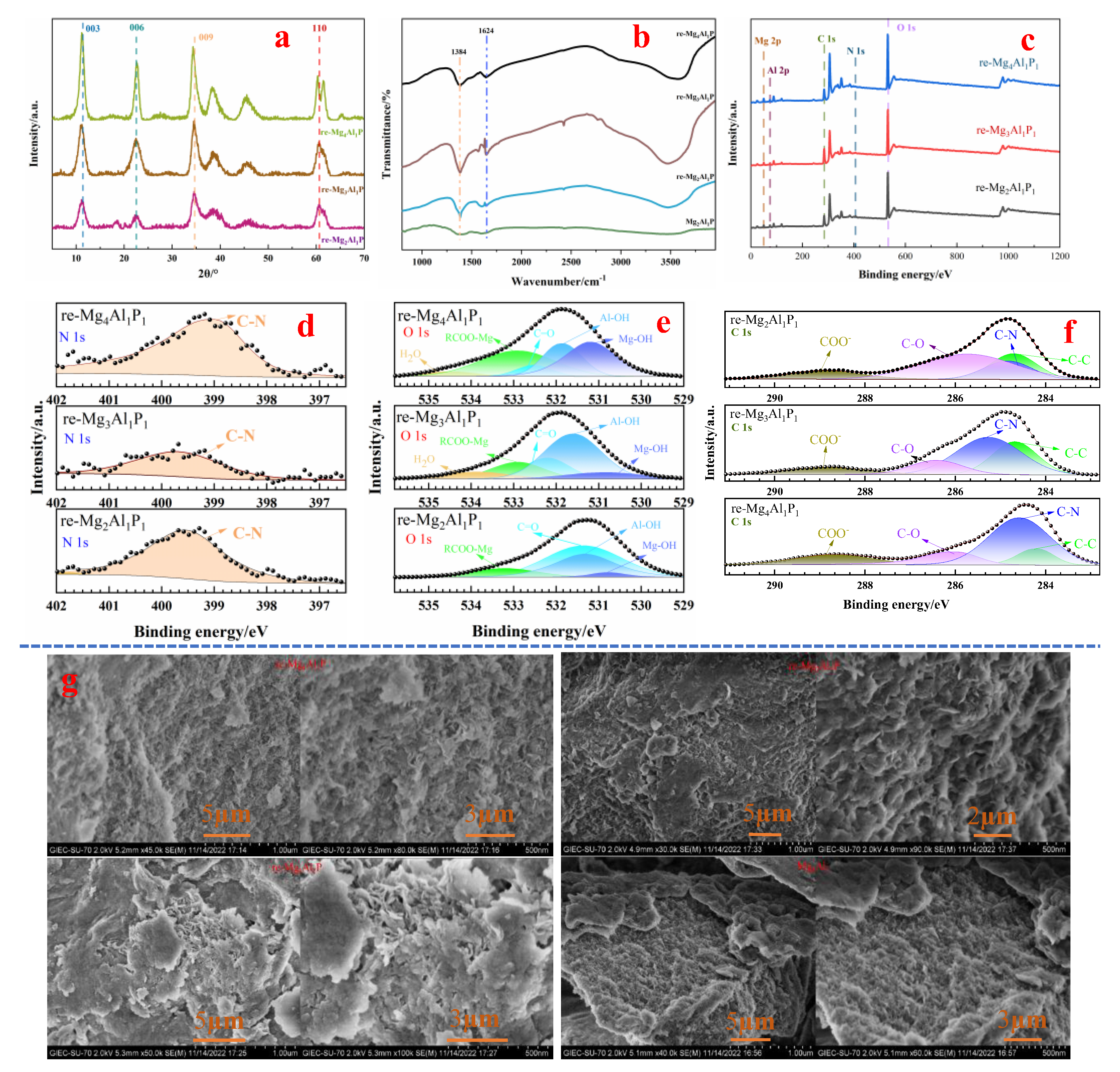
Structural characterization provides insight into the observed performance trends. XRD patterns (Figure 3a) reveal that reconstructed LDHs exhibit significantly enhanced crystallinity compared with their co-precipitated counterparts, with sharper (003), (006), and (009) reflections indicative of well-developed layered structures [31]. Increasing the Mg content led to a gradual shift in the (003) reflection toward lower angles, suggesting an expansion of interlayer spacing. SEM images (Figure 3g) corroborate these findings, showing more pronounced and ordered layered morphologies for re-Mg3Al1P and re-Mg4Al1P. Elemental analysis further confirms higher proline loading with increasing Mg content, as evidenced by the increased nitrogen content from 0.74% in re-Mg2Al1P to 1.75% in re-Mg4Al1P. It is worth noting that a weak but discernible diffraction peak was observed at the 2θ position of 62°, which matches the characteristic peak of periclase-type MgO. MgO itself possesses moderately strong basic sites. Combined with the weak to moderately strong basic sites of the hydrotalcite layers and the potential synergistic effects from the intercalated organic anions, collectively creates a surface environment with optimized basicity strength and distribution, thereby enhancing the efficiency in catalyzing the target reaction.
FT-IR and XPS analyses (Figure 3b–f) demonstrate that proline is consistently immobilized in an anionic form across all reconstructed catalysts. Characteristic carboxylate vibrations and R–COO—Mg, together with C–N signals in the N 1s spectra, confirm electrostatic interaction between deprotonated proline and Mg sites within the LDH interlayers [32]. Importantly, the absence of structural distortion in XRD patterns indicates that proline intercalation does not disrupt the LDH framework. Instead, increasing Mg content and interlayer spacing enables higher proline incorporation and improved accessibility of active sites, thereby enhancing catalytic efficiency. These results highlight the critical interplay between water content, substrate size, catalyst structure, and preparation method in determining the stability and performance of proline-intercalated LDHs. The memory-effect reconstruction strategy effectively strengthens the layered architecture and increases proline loading, mitigating diffusion limitations and improving activity, while excessive water remains the dominant factor governing catalyst deactivation through proline leaching [22].

2.3. Process Optimization, Solvent Effects, and Stability of Reconstructed Proline–LDH Catalysts

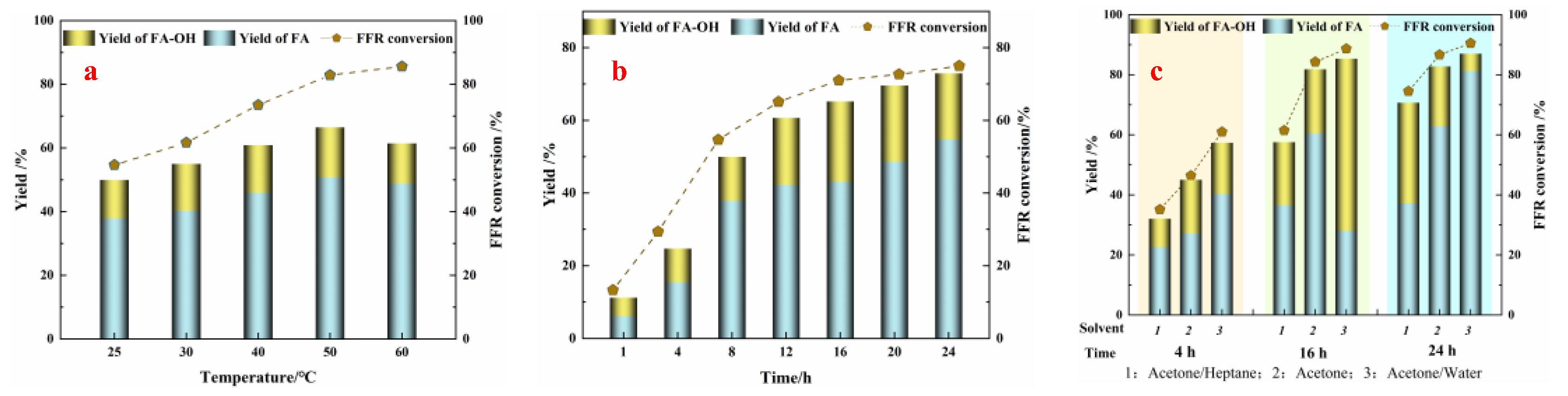
Reaction parameters were optimized using re-Mg4Al1P as the representative catalyst for the aldol condensation of furfural with acetone. Temperature exerted a pronounced influence on catalytic performance (Figure 4a). At room temperature, 54.61% furfural conversion was achieved after 8 h, with the dehydrated product (FA) as the dominant species (37.93% yield). Increasing the temperature to 50 °C significantly enhanced both conversion and FA yield, reaching 82.94% and 59.82%, respectively. Further temperature elevation resulted in only marginal conversion gains while causing a noticeable decline in product yields, consistent with the promotion of competitive side reactions such as Cannizzaro-type pathways [33]. Although the highest total yield was obtained at 50 °C, room temperature afforded the highest selectivity, highlighting the advantage of mild conditions for selective mono-condensation.
Reaction time also regulated conversion and product distribution (Figure 4b). At room temperature, furfural conversion increased rapidly within the first 8 h and gradually approached a maximum value of 75.01% after 24 h. The FA yield followed a similar trend, reaching 54.73% at 24 h. In contrast, the yield of the non-dehydrated product (FA-OH) peaked at 16 h and decreased upon further reaction, indicating progressive dehydration of the aldol intermediate. These results suggest that prolonged reaction time primarily promotes dehydration rather than additional C–C coupling.
Solvent effects were subsequently examined to further control reaction efficiency and product selectivity (Figure 4c). At short reaction times, furfural conversion increased in the order acetone/heptane < acetone < acetone/water, demonstrating the beneficial role of polar solvents. Under these conditions, FA was the major product in all solvent systems. Upon extending the reaction time to 16 h, acetone/water delivered the highest conversion (88.67%) but shifted selectivity toward FA-OH, whereas acetone and acetone/heptane continued to favor FA formation. Further prolongation to 24 h led to a marked redistribution of products in acetone/water, with FA yield increasing sharply to 81.23% while FA-OH decreased to 5.76%. These results indicate that polar aqueous media accelerate aldol formation at intermediate times while enabling subsequent dehydration at extended durations, providing a solvent–time handle to tune product distribution [34].
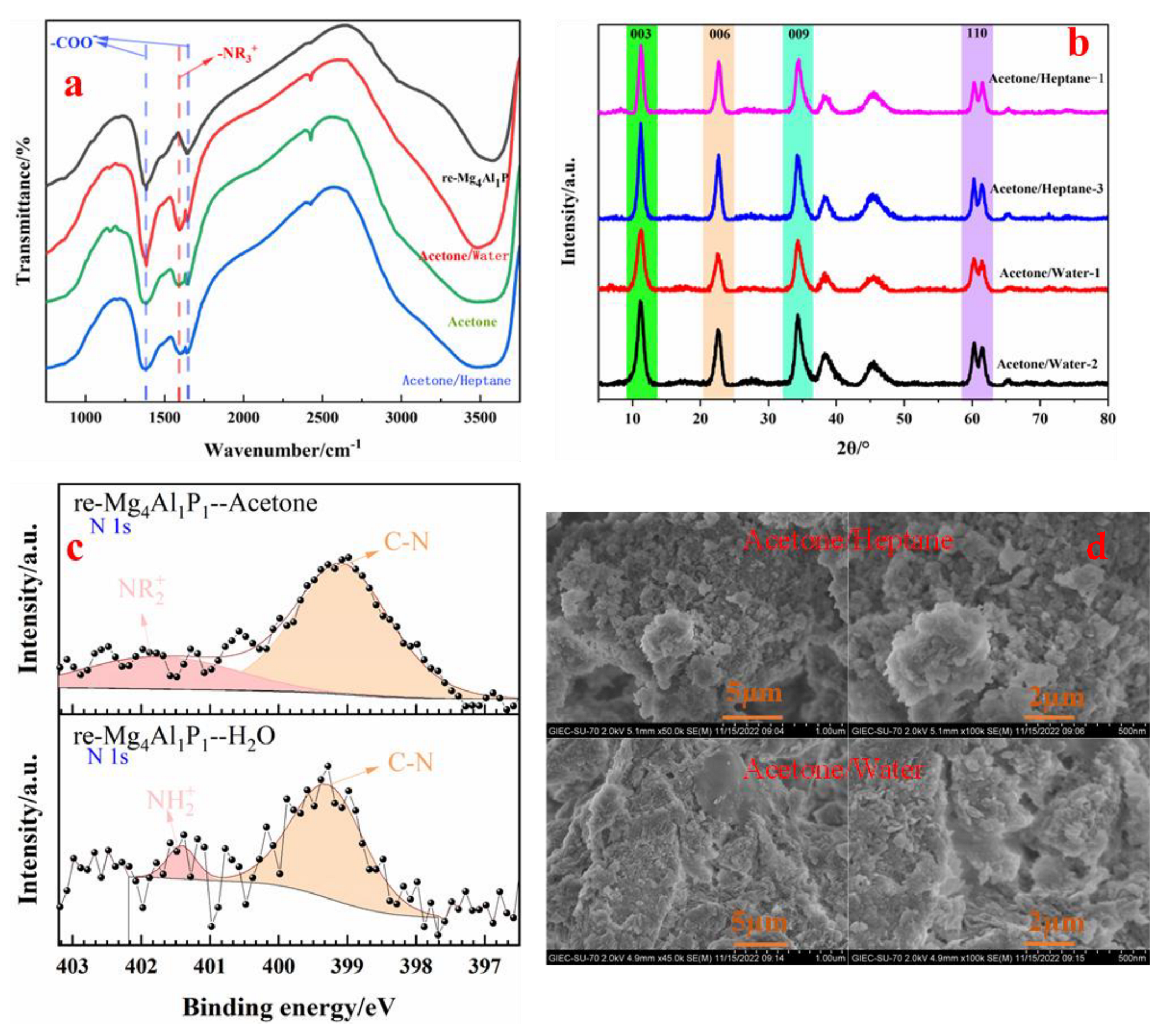
Spectroscopic analysis of spent catalysts confirms that re-Mg4Al1P operates through solvent-dependent proline-mediated pathways (Figure 5). FT-IR spectra retain characteristic carboxylate vibrations of intercalated proline, accompanied by the emergence of bands associated with protonated nitrogen species. Consistently, XPS N 1s spectra reveal a new component at ~401.5 eV corresponding to protonated secondary amines, with distinct protonation states observed in acetone and acetone/water systems [35]. These features are consistent with enamine- and enol-mediated catalytic cycles, rationalizing the enhanced activity observed in polar solvents.
The stability of re-Mg4Al1P was evaluated under representative solvent conditions (Table 4). In acetone/heptane (4:1), the catalyst maintained stable performance over three cycles, with only minor decreases in conversion and total yield and sustained selectivity above 92%. In contrast, rapid deactivation occurred in acetone/water (4:1), where conversion dropped from 88.67% to 26.51% after one recycle. Elemental analysis (Table 5) revealed substantial nitrogen loss in water-containing systems, indicating accelerated leaching of intercalated proline. Since proline is inserted into the hydrotalcite interlayer structure in an anionic form and is highly soluble in water, proline is easily lost when acetone/water is used as the solvent, which also significantly reduces the reaction efficiency. However, in non-polar solvents, there is less loss of proline, and the catalyst activity is largely retained. Notably, XRD and SEM analyses of spent catalysts (Figure 5b,d) confirmed preservation of the LDH layered structure, demonstrating that deactivation originates from active-site depletion rather than framework collapse.
The re-Mg4Al1P enables efficient aldol condensation of furfural under mild conditions and allows solvent- and time-dependent regulation of dehydration degree and product distribution. However, catalyst durability is governed by the balance between the kinetic advantages of aqueous media and the susceptibility of ionically immobilized proline to leaching, emphasizing the need for controlled water content in practical applications.

3. Experiment

3.1. Materials

Furfural (≥99%), acetone (≥99.5%), cyclopentanone (≥98%), L-proline (≥99%), magnesium nitrate hexahydrate (Mg(NO3)2·6H2O, ≥99%), aluminum nitrate nonahydrate (Al(NO3)3·9H2O, ≥99%), sodium hydroxide (NaOH, ≥98%), ethyl acetate (≥99.5%), and acetone (HPLC grade) were purchased from Aladdin Industrial Corporation (Shanghai, China). All chemicals were used as received without further purification. Deionized water was used throughout the experiments.

3.2. Catalyst Preparation

Mg–Al layered double hydroxides (MgxAly, LDHs) were synthesized by a co-precipitation method under N2 atmosphere. To prevent carbonate contamination, deionized water was refluxed at 100 °C for 30 min, degassed, and stored prior to use. The x mmol Mg(NO3)2·6H2O and y mmol Al(NO3)3·9H2O were dissolved in 18 mL of deionized water. A NaOH aqueous solution (1 mmol mL−1) was added dropwise under vigorous stirring until complete precipitation occurred. The resulting suspension was aged at 65 °C for 24 h, filtered, washed repeatedly with deionized water, and dried under vacuum to obtain MgxAly.
Proline-intercalated LDHs (MgxAlyP) were prepared via co-precipitation in the presence of organic anions. L-Proline (0.126 g, 1.1 mmol) was dissolved in freshly prepared NaOH solution (1 mmol mL−1) under N2 atmosphere. The mixed metal nitrate solution was added dropwise while maintaining the pH at 11–12. The suspension was aged at 65 °C for 24 h, followed by filtration, washing, and vacuum drying at 65 °C overnight.
Reconstructed proline-intercalated LDHs (re-MgxAlyP) were synthesized via the memory-effect method. MgxAly was calcined in air at 500 °C for 5 h to obtain mixed metal oxides. The calcined solid (0.5 g) was dispersed in an aqueous solution containing L-proline (6 mmol) and NaOH (6 mmol) and stirred at room temperature for 24 h under N2 atmosphere. The solid was then filtered, washed with deionized water, and vacuum-dried to obtain re-MgxAlyP.

3.3. Catalyst Characterization

Powder X-ray diffraction (XRD) patterns were recorded on a Bruker D8 Advance diffractometer (Bruker AXS, Karlsruhe, Germany) using Cu Kα radiation (λ = 1.5406 Å) to identify crystal structures and interlayer spacing. Fourier-transform infrared (FT-IR) spectra were collected on a Nicolet iS50 spectrometer (Thermo Fisher Scientific, Wilmington, DE, USA) using the KBr pellet method to identify functional groups and bonding modes. X-ray photoelectron spectroscopy (XPS) measurements were performed on a ESCALAB 250Xi system (Thermo Fisher Scientific, Wilmington, DE, USA) with Al Kα radiation to analyze surface elemental composition and chemical states. Scanning electron microscopy (SEM) images were obtained using a Hitachi SU8010 microscope (HITACHI, Tokyo, Japan) to observe morphology and layered structures. Elemental analysis (C, H, N) was conducted using a Vario EL cube analyzer (Elementar, Hanau, Germany) to quantify proline loading.

3.4. Aldol Condensation Reactions and Product Analysis

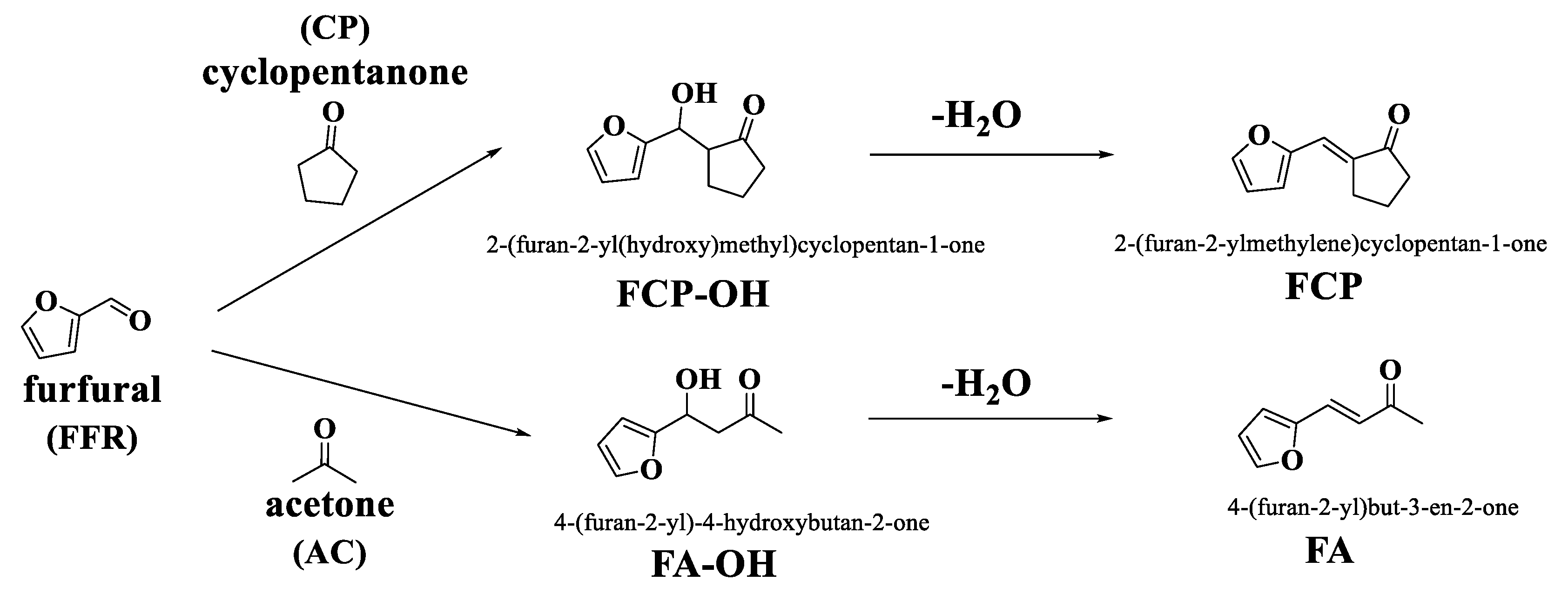
Aldol condensation reactions were carried out in thick-walled pressure-resistant glass reactors. Typically, furfural (10 mmol), ketone (30 mmol), and catalyst (0.2 g) were added to the reactor, with solvent added as required. The reactor was heated in an oil bath to the desired temperature under continuous stirring. After reaction, the catalyst was separated by filtration and washed with acetone. The liquid phase was diluted to a constant volume of 25 mL with ethyl acetate, and quantitative analysis was performed using the external standard method. If the solvent is water, it must first be extracted with 15 mL of ethyl acetate and then diluted to a constant volume of 25 mL. The aldol condensation reaction between furfural and ketones is shown in the Scheme 1, and the four products have been confirmed by GC-MS (Figures S1–S4).
Quantitative analysis was performed using gas chromatography (GC-2014C, Shimadzu, Takamatsu, Japan) equipped with an HP-5 capillary column (30.0 m × 0.32 mm × 0.25 μm) and a flame ionization detector (FID). Product identification was confirmed by GC–MS (Thermo Field, Trace 1300ISQ, Wilmington, DE, USA). Conversions, yields, and selectivities were calculated according to the following equations:
C o n v e r s i o n % = n F F R , 0 n F F R n F F R , 0 × 100 %
Y i e l d % = n P r o d u c t i o n n F F R , 0 × 100 %
S e l e c t i v i t y % = n P r o d u c t i o n n F F R , 0 n F F R × 100 %
where n F F R , 0 and n F F R represent the initial and final molar amounts of furfural, respectively.

4. Conclusions

In this work, proline-intercalated Mg–Al layered double hydroxides were developed as heterogeneous organocatalysts for the aldol condensation of furfural with ketones. By combining co-precipitation and memory-effect reconstruction strategies, the roles of LDH structure, metal composition, and immobilization mode in governing catalytic performance were systematically investigated.
The results reveal that the secondary amine of proline serves as the intrinsic active site, while the LDH host critically controls accessibility, diffusion, and selectivity. Well-defined layered structures with higher Mg content enable effective interlayer immobilization, increased proline loading, and improved activity. The reconstructed re-Mg4Al1P catalyst exhibits efficient furfural condensation under mild conditions, with tunable dehydration behavior regulated by temperature, reaction time, and solvent polarity. Polar solvents accelerate the reaction via proline-mediated pathways, whereas non-aqueous systems provide superior catalyst stability by suppressing proline leaching.
Overall, this study establishes clear structure–function relationships linking proline immobilization, LDH architecture, and solvent environment in heterogeneous aldol catalysis. The findings offer a viable route to convert homogeneous amino acid organocatalysts into recyclable solid catalysts and provide general design principles for developing robust heterogeneous organocatalysts for biomass upgrading under mild conditions.

Supplementary Materials

The following supporting information can be downloaded at: https://www.mdpi.com/article/10.3390/catal16040312/s1, Figure S1: The GC-MS annalysis of FCP-OH (2-(furan-2-yl(hydroxy)methyl)cyclopentan-1-one); Figure S2: The GC-MS annalysis of FC (2-(furan-2-ylmethylene)cyclopentan-1-one); Figure S3: The GC-MS annalysis of FA-OH (4-(furan-2-yl)-4-hydroxybutan-2-one); Figure S4: The GC-MS annalysis of FA (4-(furan-2-yl)but-3-en-2-one).

Author Contributions

Methodology, X.Z. (Xuelai Zhao) and W.W.; software, X.Z. (Xuelai Zhao); validation, X.Z. (Xuelai Zhao), W.W. and X.Z. (Xiuzheng Zhuang); formal analysis, X.Z. (Xuelai Zhao) and Z.J.; investigation, X.Z. (Xuelai Zhao) and W.W.; resources, X.Z. (Xinghua Zhang), Q.Z. and L.M.; data curation, X.Z. (Xuelai Zhao); writing—original draft preparation, X.Z. (Xuelai Zhao); writing—review and editing, Q.Z. and L.M.; visualization, X.Z. (Xuelai Zhao); supervision, Q.Z. and L.M.; project administration, Q.Z.; funding acquisition, Q.Z. and L.M. All authors have read and agreed to the published version of the manuscript.

Funding

This research was funded by the Scientific Research Foundation for High-level Talents of Anhui University of Science and Technology (YJ20240060), the National Natural Science Foundation of China (U25A20586, 52576195), and the Fundamental Research Funds for the Central Universities (No. 2242022R10058).

Data Availability Statement

The data presented in this study are available on request from the corresponding authors. The data are not publicly available due to the large volume of raw experimental data and ongoing related studies.

Acknowledgments

The authors acknowledge the analytical and technical support provided by the School of Energy and Environment, Southeast University, the School of Chemical and Blasting Engineering, Anhui University of Science and Technology, and School of Energy Science and Engineering, University of Science and Technology of China. The authors also thank the staff of the Key Laboratory of Energy Thermal Conversion and Process Measurement and Control for assistance with experimental facilities and characterization instruments.

Conflicts of Interest

The authors declare no conflicts of interest. The funders had no role in the design of the study; in the collection, analyses, or interpretation of data; in the writing of the manuscript; or in the decision to publish the results.

References

  1. He, J.; Qiang, Q.; Liu, S.M.; Song, K.; Zhou, X.W.; Guo, J.; Zhang, B.; Li, C.Z. Upgrading of biomass-derived furanic compounds into high-quality fuels involving aldol condensation strategy. Fuel 2021, 306, 121765–121789. [Google Scholar] [CrossRef]
  2. Saluta, E.D.; Gebresillase, M.N.; Seo, J.G. A Recent Progress on Upgrading of Furfural and Derivatives into Green Transport Fuels and Precursors via C-C Coupling Reactions. Adv. Energy Sustain. Res. 2025, 6, 2400369–2400393. [Google Scholar] [CrossRef]
  3. Bao, Y.Q.; Du, Z.C.; Liu, X.Y.; Liu, H.; Tang, J.S.; Qin, C.R.; Liang, C.; Huang, C.X.; Yao, S.Q. Furfural production from lignocellulosic biomass: One-step and two-step strategies and techno-economic evaluation. Green Chem. 2024, 26, 6318–6338. [Google Scholar] [CrossRef]
  4. Li, Z.S.; Shao, S.S.; Hu, X.G.; Li, X.H.; Cai, Y.X. Insight into the production of aviation fuel by aldol condensation of biomass-derived aldehydes and ketones followed by hydrogenation. Biomass Convers. Biorefinery 2024, 14, 7915–7926. [Google Scholar] [CrossRef]
  5. Arumugam, M.; Kikhtyanin, O.; Osatiashtiani, A.; Kyselova, V.; Fila, V.; Paterova, I.; Wong, K.L.; Kubicka, D. Potassium-modified bifunctional MgAl-SBA-15 for aldol condensation of furfural and acetone. Sustain. Energy Fuels 2023, 7, 3047–3059. [Google Scholar] [CrossRef]
  6. Sapra, S.; Chaudhary, R.; Arora, A.; Kumar, S.; Kumar, R.; Singh, B.K. L-Proline: A Versatile Organocatalyst (A Review). Russ. J. Org. Chem. 2025, 61, 1653–1664. [Google Scholar] [CrossRef]
  7. Nobakht, Y.; Arshadi, N. DFT study of the dual catalytic role of L-proline in the aldol reaction and the effect of water on it. J. Mol. Model. 2018, 24, 334–345. [Google Scholar] [CrossRef]
  8. Chandrasekhar, S.; Narsihmulu, C.; Reddy, N.R.; Sultana, S.S. L-proline catalyzed asymmetric transfer aldol reaction between diacetone alcohol and aldehydes. Chem. Commun. 2004, 2450–2451. [Google Scholar] [CrossRef]
  9. Villano, R.; Acocella, M.R.; Scettri, A. Influence of a remote sulfinyl group on L-proline-catalyzed direct asymmetric aldol addition of acetone. Tetrahedron 2016, 72, 5414–5419. [Google Scholar] [CrossRef]
  10. Yang, H.P.; Zhang, L.; Chen, L.; Zhou, C.S.; Yu, X.J.; Yagoub, A.A.; Ma, H.L. Effect of ionic liquid based imidazolium as an additive on the formation of polymer/salt aqueous biphasic systems. J. Mol. Liq. 2018, 256, 1–8. [Google Scholar] [CrossRef]
  11. Zalewska, K.; Pinto, I.; Cabrita, L.; Zakrzewska, M.E.; Noronha, J.P.; da Ponte, M.N.; Branco, L.C. Development of L-Proline-Based Chiral Ionic Liquids for Asymmetric Michael Reaction. Catalysts 2023, 13, 270. [Google Scholar] [CrossRef]
  12. Centi, G.; Perathoner, S. Catalysis by layered materials: A review. Microporous Mesoporous Mater. 2008, 107, 3–15. [Google Scholar] [CrossRef]
  13. Kanezaki, E. Preparation of Layered Double Hydroxides. In Clay Surfaces-Fundamentals and Applications; Elsevier: Amsterdam, The Netherlands, 2004; pp. 345–373. [Google Scholar]
  14. Gao, J.X.; Jin, B.W.; Shao, M.F. Layered double hydroxides functionalization toward rechargeable batteries. Particuology 2024, 91, 138–154. [Google Scholar] [CrossRef]
  15. Lundehoj, L.; Cellier, J.; Forano, C.; Nielsen, U.G. Atomic Level Understanding of Orthophosphate Adsorption by Magnesium Aluminum-Layered Double Hydroxides-A Multitechnique Study. J. Phys. Chem. C 2019, 123, 24039–24050. [Google Scholar] [CrossRef]
  16. Silva, J.M.; Trujillano, R.; Rives, V.; Soria, M.A.; Madeira, L.M. Dynamic behaviour of a K-doped Ga substituted and microwave aged hydrotalcite-derived mixed oxide during CO2 sorption experiments. J. Ind. Eng. Chem. 2019, 72, 491–503. [Google Scholar] [CrossRef]
  17. Gazzano, M.; Kagunya, W.; Matteuzzi, D.; Vaccari, A. Neutron diffraction studies of polycrystalline Ni/Mg/Al mixed oxides obtained from hydrotalcite-like precursors. J. Phys. Chem. B 1997, 101, 4514–4519. [Google Scholar] [CrossRef]
  18. Wang, W.Y.; Zhao, X.L.; Kang, Q.X.; Chen, L.G.; Zhang, Q.; Zhang, X.H.; Ma, L.L. Production of high-density and low freezing point jet fuel from biomass-derived cyclopentanone and benzaldehyde. Biomass Bioenergy 2026, 205, 108552. [Google Scholar] [CrossRef]
  19. Tran, H.N.; Lin, C.C.; Chao, H.P. Amino acids-intercalated Mg/Al layered double hydroxides as dual-electronic adsorbent for effective removal of cationic and oxyanionic metal ions. Sep. Purif. Technol. 2018, 192, 36–45. [Google Scholar] [CrossRef]
  20. Rojas, R.; Bruna, F.; de Pauli, C.P.; Ulibarri, M.A.; Giacomelli, C.E. The effect of interlayer anion on the reactivity of Mg-Al layered double hydroxides: Improving and extending the customization capacity of anionic clays. J. Colloid Interf. Sci. 2011, 359, 136–141. [Google Scholar] [CrossRef]
  21. Popa, I.M.; Pischetola, C.; Krumeich, F.; van Bokhoven, J.A.; Carja, G.; Artiglia, L. Exploiting the LDH Memory Effect in the Carbon Dioxide to Methanol Conversion. Adv. Funct. Mater. 2025, 35, 2502812–2502823. [Google Scholar] [CrossRef]
  22. Zhao, X.L.; Feng, S.; Li, S.; Hu, Y.Z.; Wang, W.Y.; Zhang, X.H.; Zhang, Q.; Chen, Y.B.; Liu, J.G.; Ma, L.L. The role of primary amines in modified chitosan to enhance the aldol condensation of biomass-derived carbonyl compounds. Fuel 2023, 351, 128820. [Google Scholar] [CrossRef]
  23. Williamson, M.P. The Structure and Function of Proline-Rich Regions in Proteins. Biochem. J. 1994, 297, 249–260. [Google Scholar] [CrossRef] [PubMed]
  24. Samuel, D.; Kumar, T.K.S.; Jayaraman, G.; Yang, P.W.; Yu, C. Proline is a protein solubilizing solute. Biochem. Mol. Biol. Int. 1997, 41, 235–242. [Google Scholar] [CrossRef] [PubMed]
  25. Leont’eva, N.N.; Cherepanova, S.V.; Stepanova, L.N.; Drozdov, V.A.; Lavrenov, A.V. Structural Aspects of “Memory Effect” for MgGa LDHs: New Data Obtained by Simulation of XRD Patterns for 1D Disordered Crystals. Crystals 2022, 12, 629. [Google Scholar] [CrossRef]
  26. Urquhart, S.G.; Ade, H. Trends in the carbonyl core (C 1s, O 1s) → π*c=o transition in the near-edge X-ray absorption fine structure spectra of organic molecules. J. Phys. Chem. B 2002, 106, 8531–8538. [Google Scholar] [CrossRef]
  27. Xu, Z.P.; Wu, Y.C.; Zhang, Z.M.; Wang, Y.Y.; Hu, J.; Ma, Y.W.; Zhang, Z.H.; Huang, H.L.; Wei, J.X.; Shi, C.J.; et al. Insight into ion exchange behavior of LDHs: Asynchronous chloride adsorption and intercalated ions release processes. Cement Concrete Comp. 2024, 147, 105433–105443. [Google Scholar] [CrossRef]
  28. Karim, A.V.; Hassani, A.; Eghbali, P.; Nidheesh, P.V. Nanostructured modified layered double hydroxides (LDHs)-based catalysts: A review on synthesis, characterization, and applications in water remediation by advanced oxidation processes. Curr. Opin. Solid State Mater. Sci. 2022, 26, 100965–101020. [Google Scholar] [CrossRef]
  29. Farhan, A.; Khalid, A.; Maqsood, N.; Iftekhar, S.; Sharif, H.M.A.; Qi, F.; Sillanpää, M.; Asif, M.B. Progress in layered double hydroxides (LDHs): Synthesis and application in adsorption, catalysis and photoreduction. Sci. Total Environ. 2024, 912, 169160–169188. [Google Scholar] [CrossRef]
  30. Li, Y.Y.; Yin, T.; Xu, J.W.; Liu, N.W.; Shi, L.; Meng, X. The role of layered double hydroxides shell in enhancing the adsorption capacity of NaY zeolite for toluene in wet conditions. Environ. Eng. Res. 2024, 29, 230511–230523. [Google Scholar] [CrossRef]
  31. Aggarwal, P.; Mehra, P.; Paul, A. Pore Size-Regulated Vertically Aligned CoFe-LDH on a Carbon Support for the Oxygen Evolution Reaction. ACS Appl. Nano Mater. 2024, 7, 9532–9541. [Google Scholar] [CrossRef]
  32. Pandiarajan, S.; Umadevi, M.; Sasirekha, V.; Rajaram, R.K.; Ramakrishnan, V. FT-IR and FT-Raman spectral studies of bis(L-proline) hydrogen nitrate and biS(L-proline) hydrogen perchlorate. J. Raman Spectrosc. 2005, 36, 950–961. [Google Scholar] [CrossRef]
  33. Fernandez, E.M.S.; Lena, J.I.C.; Altinel, E.; Birlirakis, N.; Barrero, A.F.; Arseniyadis, S. Lead tetraacetate mediated domino reactions on (R)-(-)-carvone-derived bicyclic unsaturated 1,2-diols and further rearrangements. Tetrahedron-Asymmetry 2003, 14, 2277–2290. [Google Scholar] [CrossRef]
  34. Wang, X.G.; Ajisafe, M.P.; Fayad, E.; Katouah, H.A.; Qin, H.L. A protocol for hydrogenation of aldehydes and ketones to alcohols in aqueous media at room temperature in high yields and purity. Org. Biomol. Chem. 2024, 22, 5325–5332. [Google Scholar] [CrossRef]
  35. Pfeifer, J.; Simon, M.; Heinritzi, M.; Piel, F.; Weitz, L.; Wang, D.Y.; Granzin, M.; Müller, T.; Bräkling, S.; Kirkby, J.; et al. Measurement of ammonia, amines and iodine compounds using protonated water cluster chemical ionization mass spectrometry. Atmos. Meas. Tech. 2020, 13, 2501–2522. [Google Scholar] [CrossRef]
Figure 1. (a): FT-IR analysis of MgxAly and MgxAlyP; (b): XRD analysis of MgxAly and MgxAlyP; (c,d): XPS analysis of Mg2Al1P; (e): SEM images of Mg2Al1P.
Catalysts 16 00312 g001
Figure 2. Effect of water content on the condensation reaction of furfural with acetone over Mg2Al1P. Reaction conditions: 10 mmol FFR, 30 mmol acetone, 0.2 g Mg2Al1P, room temperature 16 h; 1: the first cycle; 2: the second cycle; 3: the third cycle.
Catalysts 16 00312 g002
Figure 3. (a) XRD analysis of re-MgxAlyP; (b) FT-IR analysis of re-MgxAlyP; (cf) XPS spectra of re-MgxAlyP; (g) SEM images of re-MgxAlyP.
Catalysts 16 00312 g003
Figure 4. Effect of temperature, time, and solvent on the condensation reaction of FFR and AC. Reaction conditions: (a) 1 mmol FFR, 10 mL AC, 8 h, 0.2 g catalyst; (b) 1 mmol FFR, 10 mL AC, room temperature, 0.2 g catalyst; (c) 1 mmol FFR, 10 mL solvent, room temperature, 0.2 g catalyst.
Catalysts 16 00312 g004
Figure 5. The (a) FT-IR, (b) XRD, (c) XPS (N1s) and (d) SEM analysis of re-Mg4Al1P catalyst after reaction in different solvents.
Catalysts 16 00312 g005
Scheme 1. The aldol reaction of furfural and ketones.
Catalysts 16 00312 sch001
Table 1. Activity of MgxAly and MgxAlyP catalysts in the condensation reaction.
CatalystsConv. FFR (%)Yield FA (%)Yield FA-OH (%)Yield Total (%)Selectivity Total (%)
Mg1Al1-----
Mg1Al1P3.01 ± 0.42----
Mg2Al1-----
Mg2Al1P20.31 ± 0.663.12 ± 0.3213.60 ± 0.4316.63 ± 0.4281.72 ± 0.92
Mg2Al1P a56.76 ± 0.2540.73 ± 0.6412.08 ± 0.4252.81 ± 0.2692.91 ± 0.71
Reaction conditions: Room temperature, 8 h, FFR 10 mmol, ketones 30 mmol, catalyst 0.2 g; a: reaction time extended to 16 h.
Table 2. The aldol condensation reaction of furfural and cyclopentanone over Mg2Al1P.
EntryConv. FFR (%)Yield FCP (%)Yield FCP-OH (%)Yield Total (%)Selectivity Total (%)
1 a49.48 ± 0.7737.38 ± 1.158.41 ± 0.2745.76 ± 0.2892.53 ± 0.27
1 b42.41 ± 0.1233.36 ± 1.627.53 ± 0.5540.92 ± 0.3796.38 ± 0.63
1 c36.81 ± 0.5220.72 ± 0.7211.10 ± 0.3231.81 ± 0.6386.41 ± 0.83
276.72 ± 0.2651.56 ± 0.389.78 ± 0.1661.36 ± 0.4380.03 ± 0.26
398.53 ± 0.6761.02 ± 0.4812.91 ± 0.2673.90 ± 0.3792.32 ± 0.37
Reaction conditions: 1: a: 10 mmol FFR, 30 mmol CPO, 0.2 g Mg2Al1P, 1 μL H2O, room temperature, 16 h; b: the second cycle experiment; c: the third cycle experiment; 2: 90 °C, 16 h; 3: 90 °C, 24 h.
Table 3. The aldol condensation reaction of FFR and AC over re-MgxAlyP.
CatalystsConv. FFR (%)Yield FA (%)Yield FA-OH (%)Yield Total (%)Selectivity Total (%)
Mg2Al1P26.32 ± 0.228.14 ± 0.2615.63 ± 0.3723.71 ± 0.2190.10 ± 0.12
re-Mg2Al1P35.40 ± 0.655.53 ± 0.3527.86 ± 1.5233.40 ± 0.6294.32 ± 0.36
re-Mg3Al1P43.54 ± 0.9314.72 ± 0.7125.52 ± 0.2840.22 ± 0.3792.38 ± 0.27
re-Mg4Al1P54.61 ± 1.0237.93 ± 0.6312.13 ± 0.8350.11 ± 0.2991.17 ± 0.73
L-proline37.38 ± 0.9427.81 ± 0.826.49 ± 0.6034.33 ± 0.7991.68 ± 0.92
Reaction conditions: 1 mmol FFR, 10 mmol AC, 0.2 g catalyst, room temperature, 8 h.
Table 4. Cyclic properties of re-Mg4Al1P catalyst.
EntryConv. FFR (%)Yield FA (%)Yield FA-OH (%)Yield Total (%)Selectivity Total (%)
1 a71.33 ± 0.2136.24 ± 0.1230.17 ± 0.3766.40 ± 0.2693.10 ± 0.84
1 b66.42 ± 0.2533.01 ± 1.0228.53 ± 0.5461.56 ± 0.7792.83 ± 0.20
1 c63.80 ± 0.6131.73 ± 0.7427.12 ± 0.8558.78 ± 0.3692.42 ± 0.29
288.67 ± 0.3628.13 ± 0.3657.44 ± 0.3285.54 ± 0.2796.44 ± 0.28
2 b26.51 ± 0.6416.01 ± 1.188.92 ± 0.5124.90 ± 0.8294.02 ± 0.63
Reaction conditions: a: 1 mmol FFR, 10 mL solvent, room temperature, 0.2 g re-Mg4Al1P, 16 h; b the second run; c: the third run; 1: acetone/heptane = 4:1; 2: acetone/water 4:1.
Table 5. Elemental analysis of catalysts (N).
CatalystSolventN (%)
re-Mg2Al1P-1acetone/heptane1.56
re-Mg3Al1P-2acetone/heptane1.47
re-Mg4Al1P-3acetone/heptane1.02
re-Mg4Al1P-4acetone/heptane0.70
re-Mg4Al1P-1acetone/water0.48
re-Mg4Al1P-2acetone/water0.00
Disclaimer/Publisher’s Note: The statements, opinions and data contained in all publications are solely those of the individual author(s) and contributor(s) and not of MDPI and/or the editor(s). MDPI and/or the editor(s) disclaim responsibility for any injury to people or property resulting from any ideas, methods, instructions or products referred to in the content.