Article

Tailoring Rhenium to Rhenium Carbide Phases Gradient Composites by High Pressure and High Temperature: Evaluation of Electrocatalytic Hydrogen Evolution in Acidic and Alkaline Environments


1
Key Laboratory of Functional Materials Physics and Chemistry of the Ministry of Education, Jilin Normal University, Changchun 130103, China
2
Synergetic Extreme Condition High-Pressure Science Center, State Key Laboratory of Superhard Materials, College of Physics, Jilin University, Changchun 130012, China
*
Authors to whom correspondence should be addressed.
Catalysts 2026, 16(2), 186; https://doi.org/10.3390/catal16020186
Submission received: 31 December 2025 / Revised: 12 February 2026 / Accepted: 13 February 2026 / Published: 15 February 2026
(This article belongs to the Special Issue Catalysis and Sustainable Green Chemistry)

Abstract

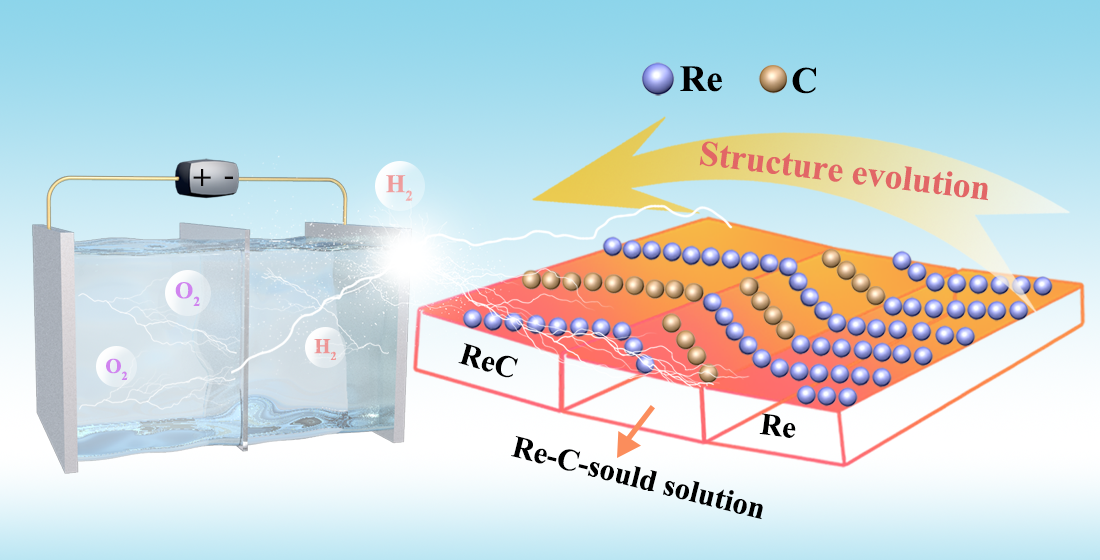
The intrinsic electronic and structural properties of the transition metal rhenium (Re) endow it with substantial application potential in electrocatalysis. However, the high cost of Re requires the development of Re-based materials to reduce cost and optimize the performance at the same time. Herein, a one-step high-pressure and high-temperature (HPHT) synthetic strategy is proposed for fabricating Re-C phase gradient composites, presenting a facile and efficient pathway to develop high-performance hydrogen evolution reaction (HER) electrocatalysts. By studying the structural evolution of Re toward ReC and uncovering its intrinsic mechanism, the regulation of the material’s electrocatalytic activity was successfully realized. Experimental results confirm that HPHT conditions of 5 GPa and 1400 °C effectively induce the formation of multiple crystalline phases of Re-C solid solution and ReC in the Re-C composite. These phases have coherent phase boundaries and form the phase gradient composites. Compared with element Re, the synergistic effect of phase gradient composites broadens the electronic state range by increasing electron transfer from Re to C in ReC (increasing the binding energy) and reduces the binding energy in Re-C solid solution. The broad electronic states range in the phase gradient composites exhibits optimal HER overpotentials of 150 mV (acidic electrolyte) and 166 mV (alkaline electrolyte) at 10 mA cm−2. These findings provide a promising strategy to boost catalysts’ electrocatalytic performance via constructing phase gradient composites.

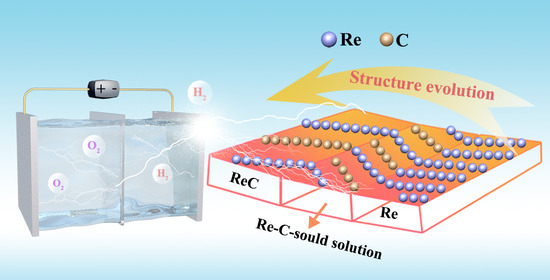
Graphical Abstract

1. Introduction

With the intensifying energy crisis and increasingly prominent environmental pollution, there is a growing emphasis on the exploration and development of clean and sustainable fuels [1,2,3,4,5]. Hydrogen (H2), characterized by its environmental friendliness and green nature, is regarded as an ideal alternative chemical fuel [6,7,8,9,10,11]. Moreover, the broad application prospects of water electrolysis for hydrogen production technology have been fully demonstrated [12]. Platinum (Pt) is widely recognized as the optimal catalyst for the hydrogen evolution reaction (HER), yet its widespread application is restricted by high costs [13,14].
According to the Sabatier principle [15], a high-performance HER catalyst ought to have an interaction with the adsorbed H* intermediate that is neither excessively strong nor overly weak [16]. Rhenium (Re) is considered a promising material for the HER in acidic media based on its predicted performance in the Trasatti volcano plot [17,18,19,20]. Moreover, Re features exceptional mechanical properties, superior thermal stability, and prominent corrosion resistance, together with its relatively low cost (nearly two orders of magnitude lower than platinum, Pt), has emerged as a potential outstanding electrocatalyst [21,22,23,24]. However, the slow reaction kinetics of pure Re metal are the obstacles limiting the performance of Re-based catalysts. In addition, compared with the cheap metals of Fe, Co, Ni, et al., Re is still constrained by prohibitive cost due to scarce reserves, which limits its large-scale application [25]. Thus, further developing low-cost, Re-based HER electrocatalysts by reducing Re loading while regulating catalytic performance is of great significance in electrocatalysis.
In recent years, Re compounds with sulphur (S), boron (B), Selenium (Se), and carbon (C) to form sulfides, borides, and carbides, which can optimize the electronic structure and exhibit outstanding electrocatalytic HER performance [26]. For example, a Re/ReS2/CC electrocatalyst with abundant sulfur vacancies was fabricated via defect engineering. The optimized Re/ReS2-7H/CC exhibits an overpotential of 42 mV at a current density of 10 mA cm−2 in the HER [27]. Moreover, Guo et al. fabricated ReB2, adopting a nanosheet structure, and its derived electrodes required an overpotential of 160 mV at 10 mA cm−2 [28]. For rhenium selenides, the 1T’-ReSe2 nanosheets require only an overpotential of 60 mV at a current density of 10 mA cm−2 [29]. Such compounds can reduce Re dosage and enhance catalytic performance to a certain extent. However, the large-scale deployment of rhenium-based catalysts is still hampered by high production costs, cumbersome synthesizing processes, and limited resource reserves [30].
Engineering rhenium-based composite architectures is another strategy to further reduce Re loading and tune its electrocatalytic activity for the HER. Drawing inspiration from commercial Pt/C catalysts, component synergy allows for the concurrent minimization of noble metal dosage and boosts in catalytic performance. Researchers have fabricated rhenium-non-noble metal support composites and implemented them for the HER. For example, Kim et al. fabricated a composite of Re with amorphous carbon and multi-walled carbon nanotubes (MWNTs), which exhibits an overpotential of 107 mV at 10 mA cm−2 in acidic electrolytes [31]. Moreover, Zhong et al. fabricated small-sized Re nanoparticle-supported carbon nanotube catalysts (Re/CNTs-flash); the catalyst delivers overpotentials of 98 mV and 80 mV in acidic and alkaline electrolytes at a current density of 10 mA cm−2, respectively [32]. While the MWNTs and CNTs are expensive, the synthetic procedures are laborious. Meanwhile, the mechanism underlying the rhenium–carbon interfacial interactions also needs to be further studied.
To address this challenge, we adopted a novel one-step high-pressure and high-temperature (HPHT) synthesis strategy to conduct relevant research in the field of electrocatalysis. Pressure has been proven to be an effective method for altering the structure and physical properties of functional materials [33,34]. For example, HPHT causes a large amount of lattice distortion in the MoS2 catalyst [35]. It not only enhances interlayer interactions to optimize electrical conductivity, but it also regulates their electronic structure, optimizes active sites, and promotes reaction kinetics. Lattice distortion generated in Fe2B under HPHT conditions can adjust the Gibbs free energy (ΔG) and improve the catalytic performance for the HER [36]. Therefore, fabricating Re-C composite by HPHT and investigating the relationship between activity and components holds great significance.
In this work, Re-C/ReC phases gradient composites were prepared via the HPHT method. The structural evolution of Re toward ReC was analyzed to uncover its intrinsic mechanism for electrocatalytic systems. The influence of HPHT synthesis conditions on HER performance was systematically studied. The results indicate that the material exhibits excellent HER performance under the condition of initially forming the mixed phase Re-C-5-1400. This research provides new insights into the synthesis and performance optimization of composite catalysts.

2. Results and Discussion

2.1. Materials Characterization

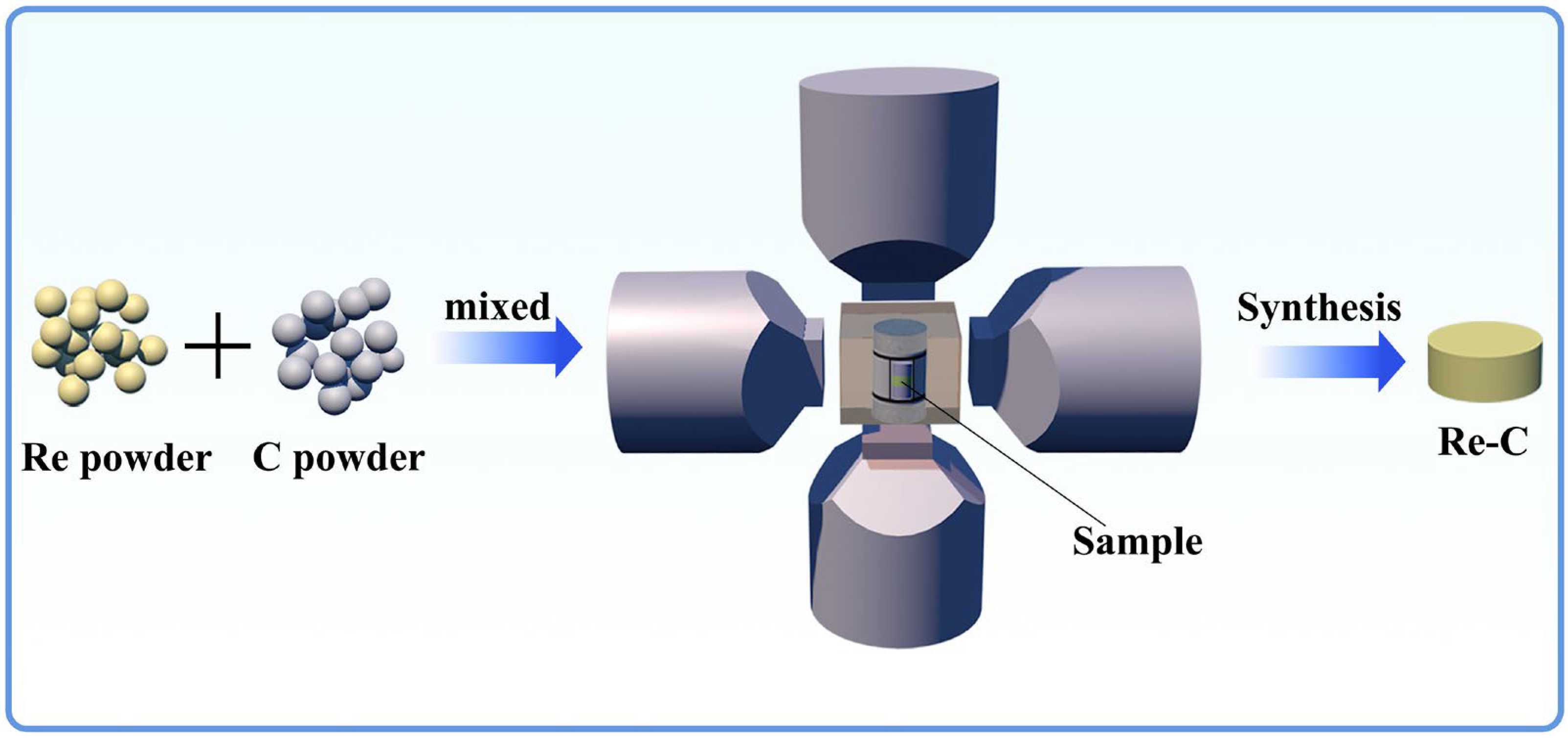
Re-C composites were synthesized using HPHT technology, which can significantly shorten the synthesis time and enhance efficiency, and the process was shown in Scheme 1. The detailed synthesis conditions are shown in Table 1. Re powder and carbon (C) powder were mixed and ground at a stoichiometric ratio of 1:1, then subjected to HPHT treatment to obtain circular bulk materials. Subsequently, samples were assembled into electrodes for electrochemical performance testing. A more detailed experimental procedure is described in the Section 3.
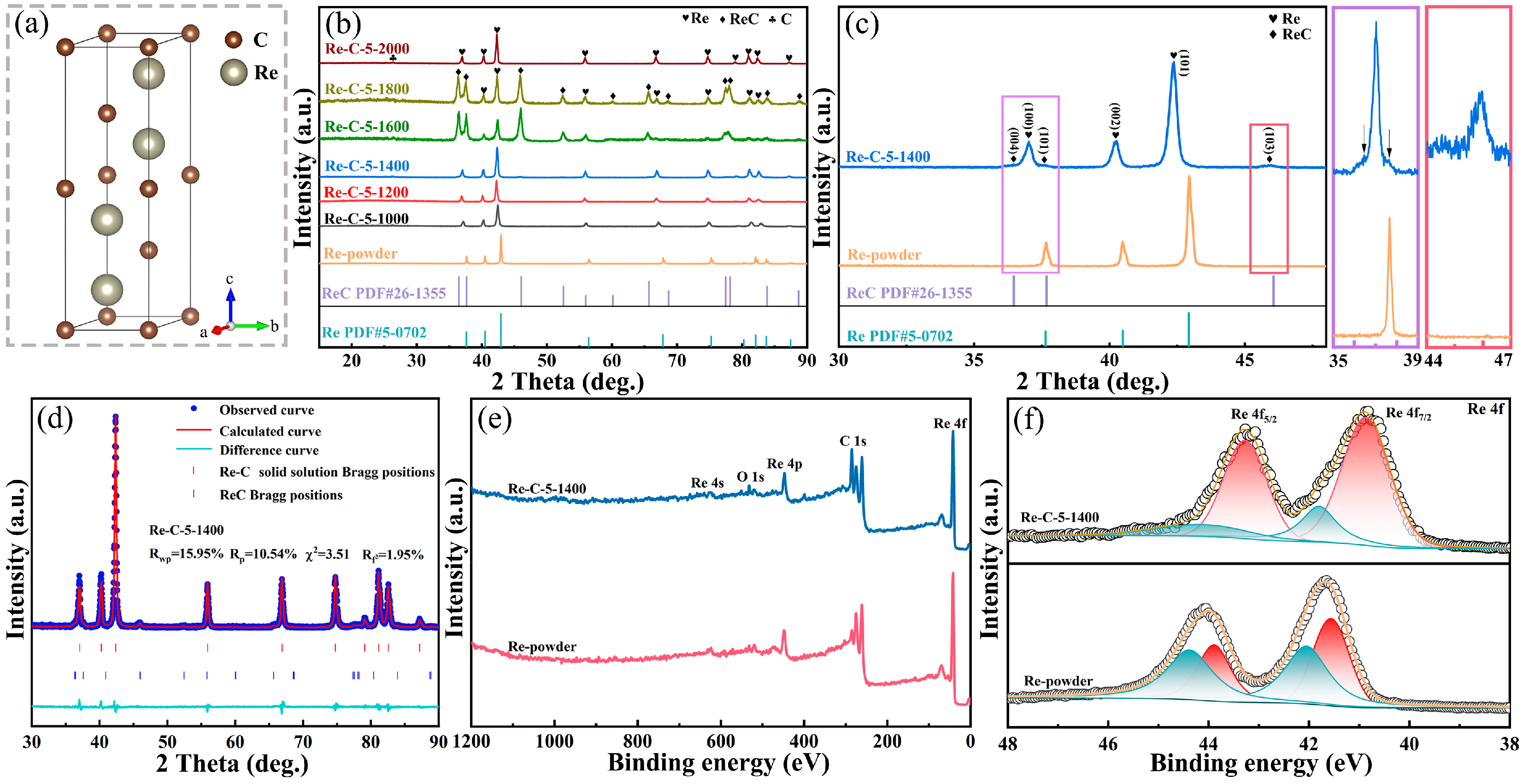
The crystal structure of ReC belongs to the P63/mmc space group (Figure 1a). The structural evolution of Re-C during HPHT synthesis was revealed by X-ray diffraction (XRD) (Figure 1b). The PDF standard card number corresponding to metallic Re is No. 5-0702, while the PDF standard card number for rhenium carbide (ReC) is No. 26-1355. It was found that under a pressure of 5 GPa, no ReC phase appeared at temperatures ranging from 1000 to 1200 °C. When the temperature rose to 1400 °C, weak ReC diffraction peaks began to emerge. As the temperature increased to 1600 °C, the ReC peaks intensified significantly. At 1800 °C, the intensity of the ReC peaks further increased with improved crystallinity. However, when the temperature reached 2000 °C, XRD results indicate that the high temperature promoted the decomposition of ReC into metallic rhenium and carbon, resulting in the complete disappearance of the ReC phase. Figure 1c shows the XRD patterns of Re-C-5-1400 and Re. It can be clearly observed that characteristic peaks of ReC are present at 36.46°, 37.67°, and 45.93°. In addition, compared with the peak positions of Re, the characteristic peaks of Re-C-5-1400 are shifted to lower angles as a whole, and this phenomenon is clearly manifested. The lower angles of a large number of diffraction peaks, however, may result from unreacted C atoms entering the interstitial sites of the Re lattice, causing lattice expansion [37,38]. The Rietveld refinement was performed using the data of Re-C-5-1400 (Figure 1d and Table 2). There are about 16% carbon insert to Re lattice to expand the lattice and form the Re2C0.16 solid solution. ReC can also be refined, and the proportion of ReC is about 30%.
X-ray photoelectron spectrometer (XPS) results of the Re-C-5-1400 and Re powder are shown in Figure 1e,f. According to previous reports [39,40,41], the binding energy at the positions of 41.56 eV and 43.89 eV is assigned to the Re element, except Re oxides (Table 3). The major phase of Re-C-5-1400 is the Re-C solid solution, according to XRD results; hence, the major binding energy of 40.87 eV and 43.27 eV comes from the Re-C solid solution, 41.80 eV and 44.13 eV, which arised from ReC. The Re-C solid solution has a lower binding energy than the Re element, which is caused by the C atom being inserted into the Re lattice, which enhances the electron density of Re, then reduces the binding energy. This is consistent with previous reports of metal and carbon solid solution [41]. Meanwhile, C atoms form chemical bonds with Re atoms, resulting in electron transfer from Re to C, which results in Re and ReC having higher binding energy than the Re element. These results indicate the Re-C-5-1400 has a broader binding energy range than element Re, which may cover multiple surface electronic states and induce many activity sites.
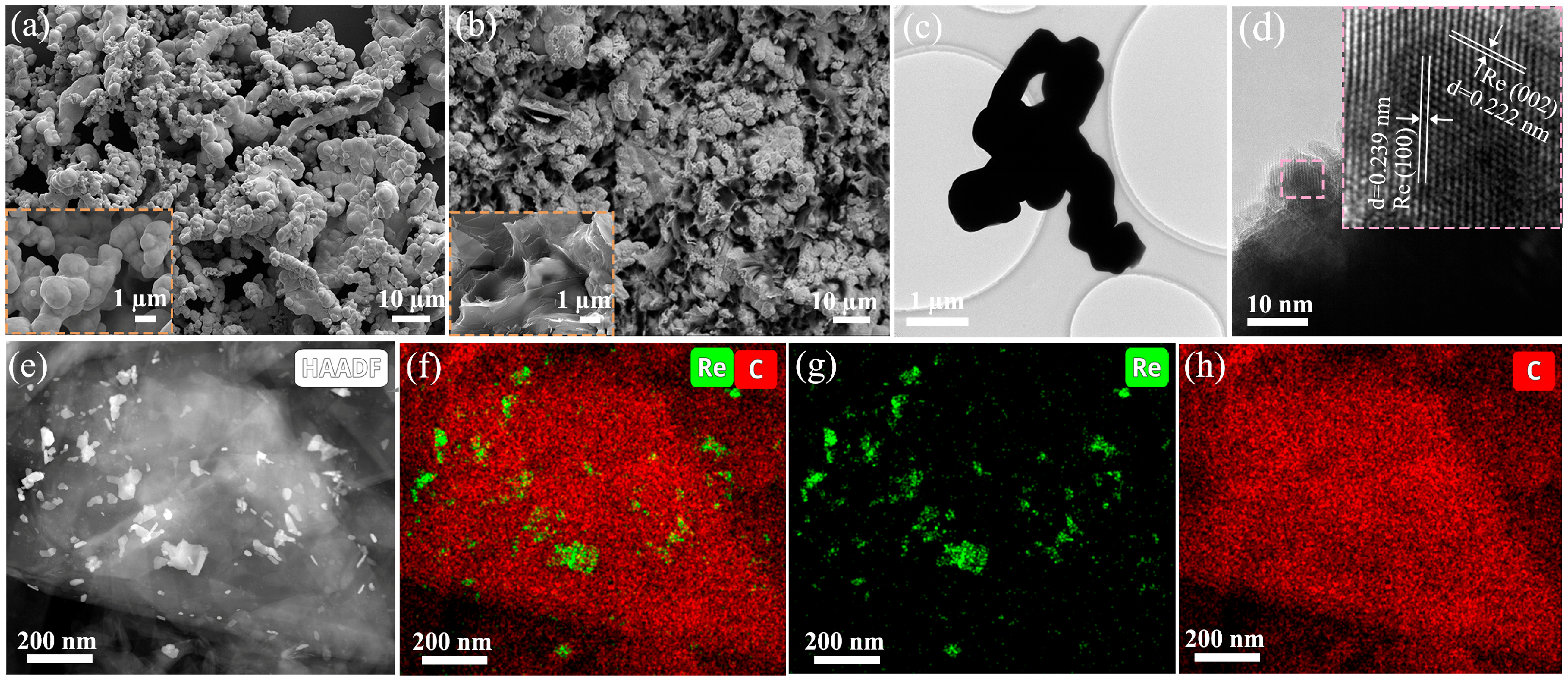
Figure 2a shows the scanning electron microscopy (SEM) image and its magnified counterpart of Re, whose morphology is characterized by interconnected spherical particles of approximately 1 μm in size. Figure 2b presents the SEM image and its magnified view of Re-C-5-1400, where partial retention of the spherical morphology is observed alongside the appearance of dense nanosheet structures. Further structural characterization of the samples was conducted using transmission electron microscopy (TEM) and high-resolution transmission electron microscopy (HRTEM). Figure 2c shows the TEM image of Re powder. The magnified view of the pink-framed region (Figure 2d) yields interplanar spacings of 0.239 nm and 0.222 nm, consistent with the (100) and (002) crystal planes of Re. Based on energy-dispersive X-ray spectroscopy (EDS) analysis coupled with high-angle annular dark-field scanning transmission electron microscopy (HAADF- STEM) observations (Figure 2e–h), the distribution characteristics of Re and C elements in the Re-C-5-1400 sample were clarified.
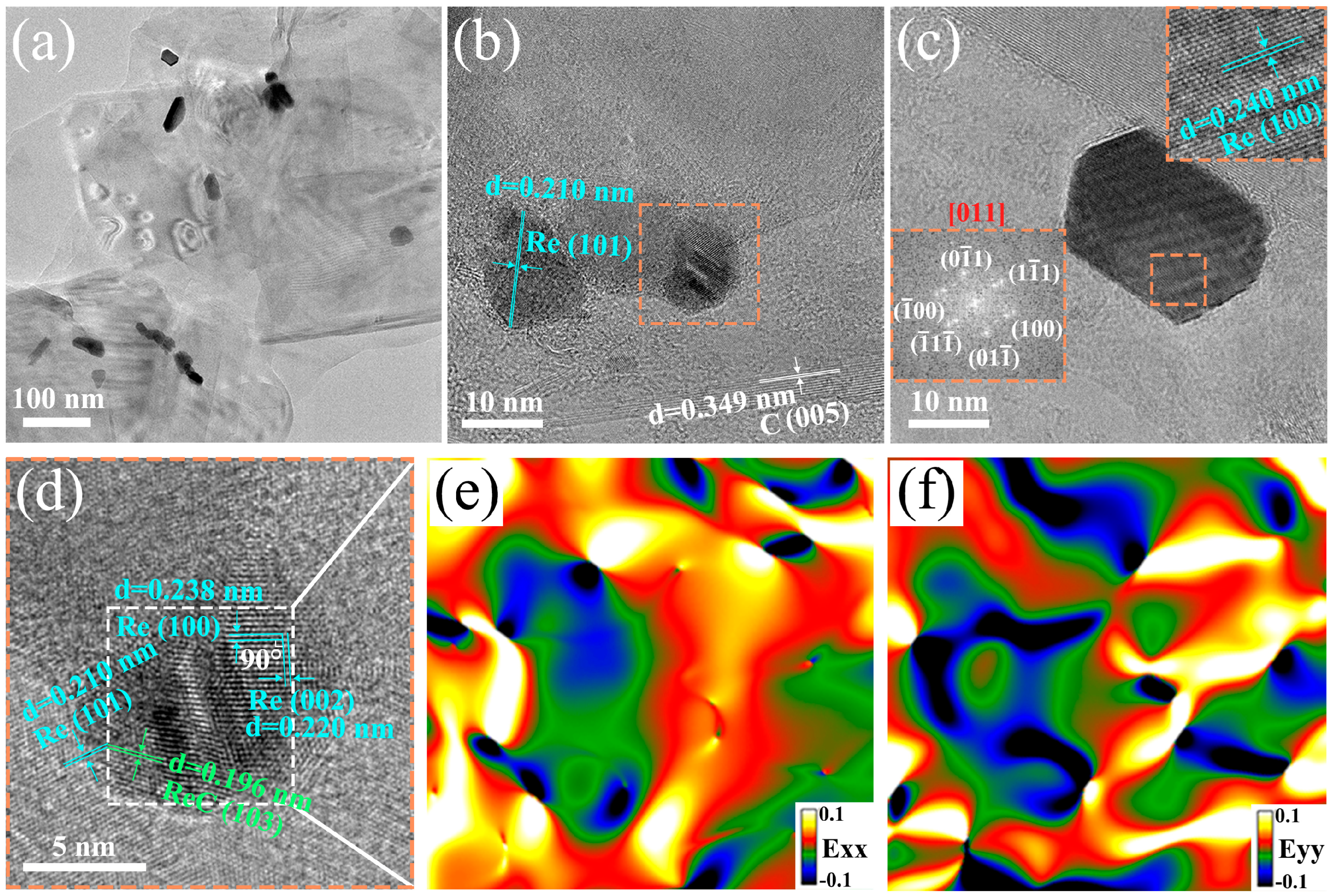
Figure 3a shows the TEM image of Re-C-5-1400, where there are nanosized particles and a submicron layer-like morphology in the sample. As shown in Figure 3b, the nanosized particles are Re lattice with interplanar spacings of 0.210 nm, which is consistent with the Re (101) crystal plane. The submicron layer-like part also has the same crystal plane spacing about 0.210 nm, but the other crystal planes cannot be self-consistent, neither by Re nor ReC. According to EDS results, this part contains a large amount of carbon and also contains Re. Moreover, this part is the major part of the sample in HRTEM, according to XRD results; the major part is the Re-C solid solution. Thus, this part should be the Re-C solid solution. The white-marked region corresponds to the lattice of graphite (0.349 nm, (005) crystal plane). It is reasonable that the Re-C solid solution is at the position between Re and graphite. Figure 3c further confirms that nanoparticles are in the Re element. ReC always connects with the Re-C solid solution in 0.210 nm (101) (Figure 3d); the crystal plane space of 0.196 nm (103) only exists in ReC, which confirms ReC exists by HRTEM. Thus, the nanoparticles are Re and ReC, the submicron layer-like part is the Re-C solid solution with a bit lattice expanded from Re. This ReC and Re-C solid solution generates phase gradient composites. Thus, under these conditions, the introduction of C induces a progressive evolution of the Re crystal structure, which may initially trigger the expansion of Re’s pristine lattice, following the Re and Re-C solid solution formation of the ReC phase.
To validate the reliability of experimental findings, geometric phase analysis (GPA) was utilized to quantify the strain distribution within the white-marked region of Figure 3d [42]. Exx and Eyy denote the relative strain magnitudes along the xx-axis and yy-axis, respectively. Within the strain range of -10% to 10%, Figure 3e,f distinctly reveal that the Re-C-5-1400 sample demonstrates notable relative discrepancies in positive and negative strain values across the field of view. The phase gradient composites formed in this sample trigger an exceptionally high local lattice strain. Consequently, the phase gradient composites and local lattice strain constitute another pivotal factor underpinning the outstanding HER performance of Re-C-composites [43,44,45,46].
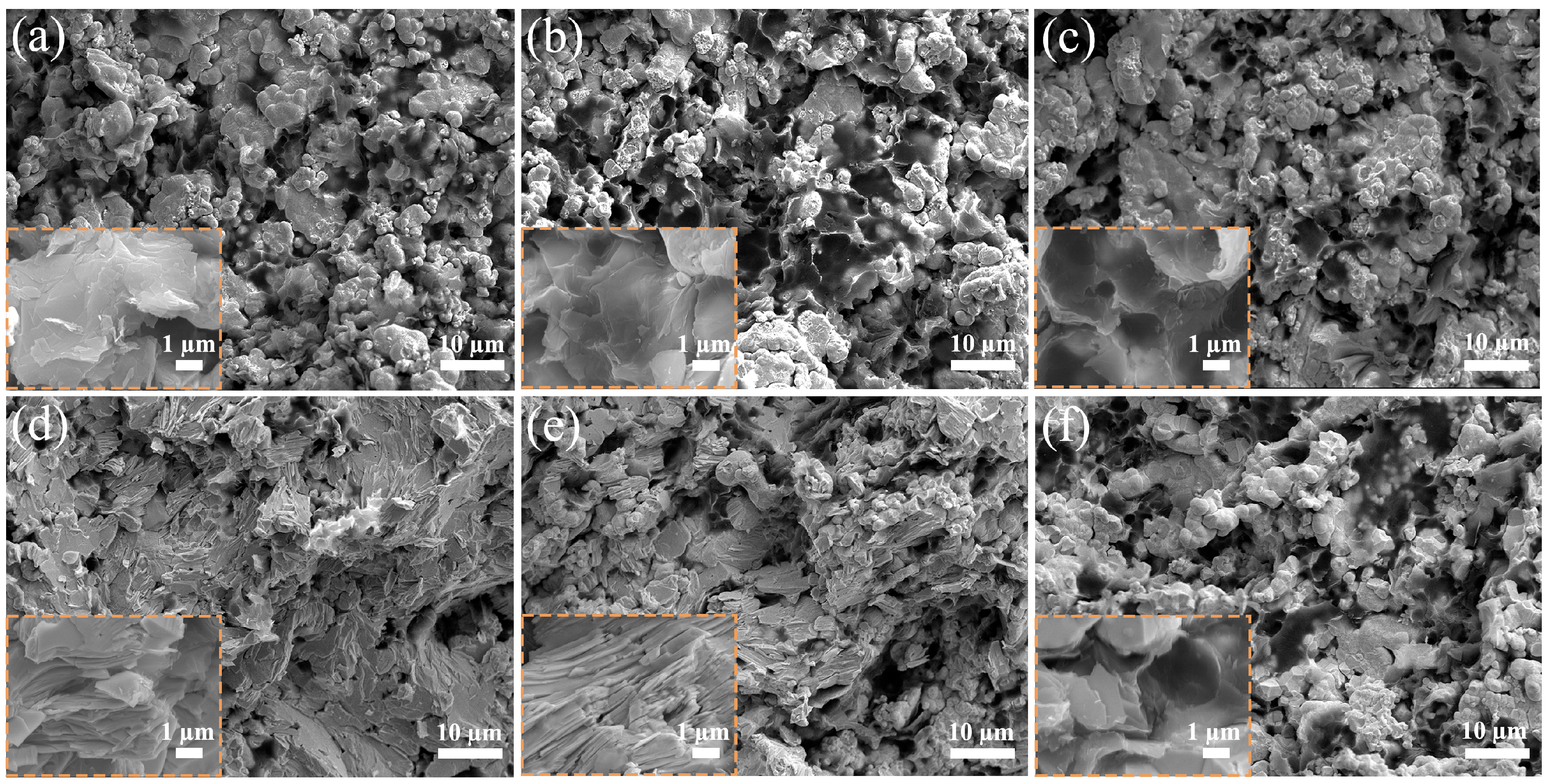
The intrinsic morphology of bulk samples should be observed from the cross-section (fracture surface). Figure 4a shows that Re-C-5-1000 retains most of its spherical morphology with a porous nature. In its cross-sectional magnified view, irregular fragment-like nanosheets have already emerged. Re-C-5-1200 still retains part of its spherical morphology, with reduced porosity compared to Re-C-5-1000. The cross-sectional magnified view shows the appearance of relatively regular nanosheets (Figure 4b). Re-C-5-1400 retains only a small amount of spherical morphology, and both its cross-section and magnified view exhibit relatively dense characteristics (Figure 4c). Re-C-5-1600 exhibits a dense morphology with almost no pores, and its cross-sectional magnified view shows nanosheets with stepwise growth (Figure 4d). Re-C-5-1800 is denser than Re-C-5-1600, and its cross-sectional magnified view shows a more compact step-like morphology (Figure 4e). In Figure 4f, Re-C-5-2000 re-exhibits the spherical morphology, with the step-like morphology in the cross-sectional magnified view disappearing and nanosheets reappearing. Therefore, inferred from the growth behavior of the material, under HPHT conditions, large grains grow by the aggregation of small grains. Meanwhile, the effect of pressure may facilitate the formation of favorable growth interfaces between grains. Gases or moisture within the material are squeezed to the sample surface, ultimately yielding a bulk material with excellent compactness. However, when the temperature reaches 2000 °C, it causes the decomposition of the Re-C composite, leading to the reformation of small particles. Thus, the relatively isotropic growth rate in Re-C-composites determines its particle morphology.

2.2. HER Performance

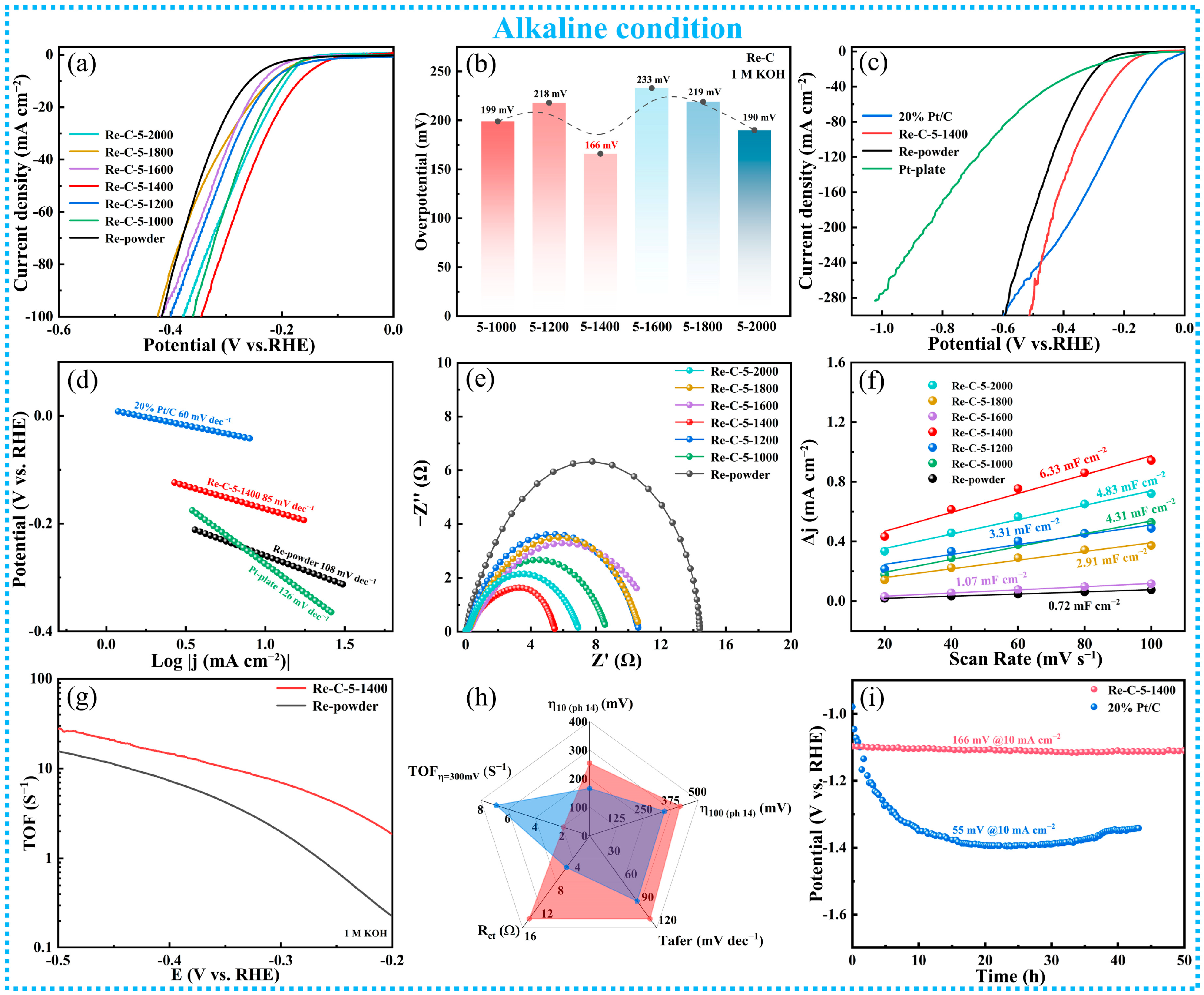
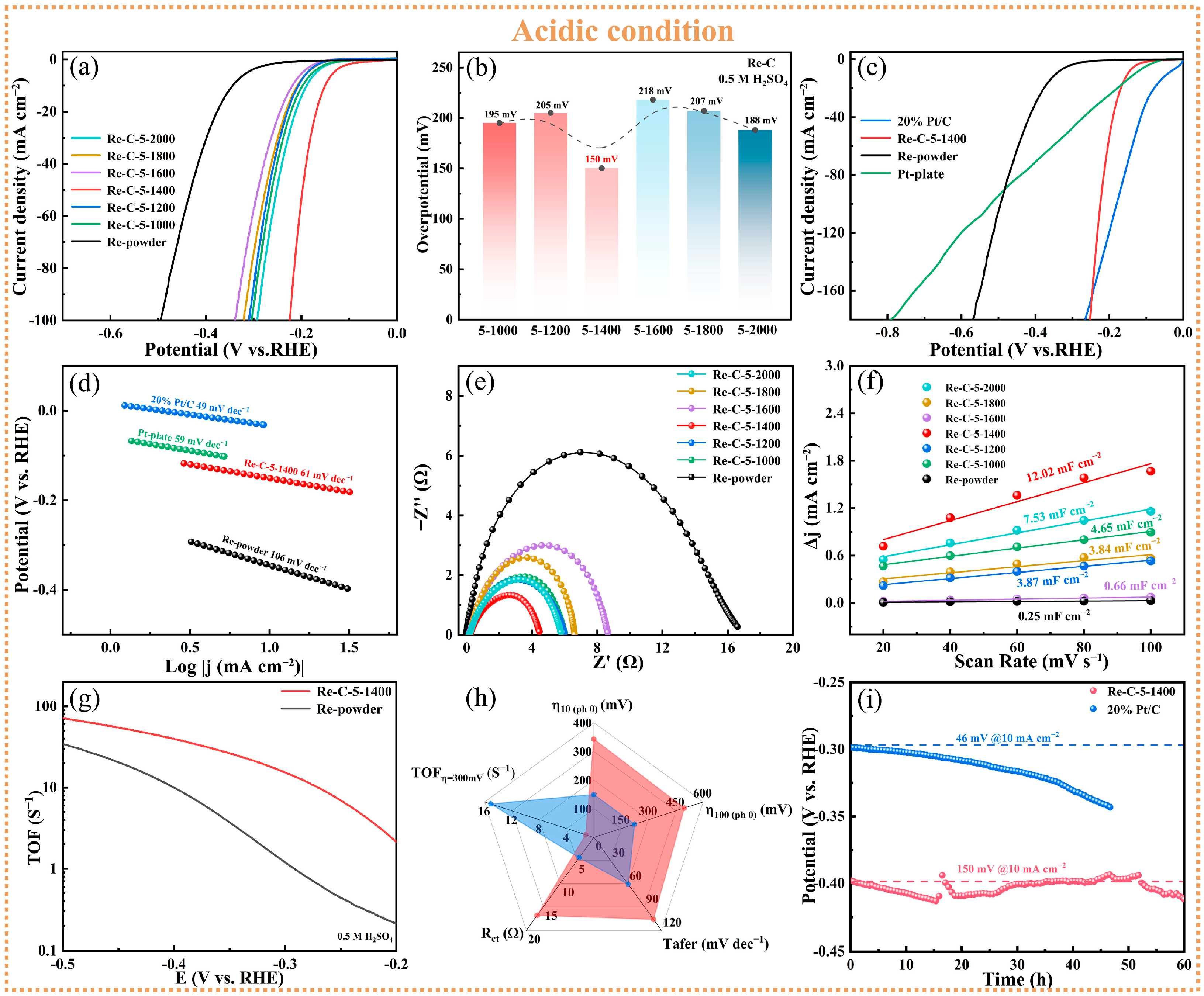
The overpotentials of all samples at a current density of 10 mA cm−2 were compared, and the results are presented in Figure 5a,b and Figure 6a,b. Compared with Re powder, the overpotentials of all samples synthesized via HPHT treatment were reduced. Although a higher temperature does not necessarily correspond to a lower overpotential, the overpotential initially increases with the rising temperature. It reaches the lowest value when the temperature reaches 1400 °C. Under the same pressure, the samples synthesized at 1400 °C exhibited the optimal performance in both acidic and alkaline solutions. Among them, Re-C-5-1400 showed the lowest overpotential, which was 150 mV in acidic solution and 166 mV in alkaline solution, respectively. Therefore, subsequent discussions in this paper will focus on the example of Re-C-5-1400.
Figure 5c presents the HER polarization curves of the samples in the 1 M KOH solution. Meanwhile, the hydrogen evolution activity of a commercially available 20% Pt/C and Pt-plate catalysts was tested as a reference. At a current density of 10 mA cm−2, the overpotentials of the 20% Pt/C, Re-C-5-1400, Re-powder, and Pt-plate were measured to be 55 mV, 166 mV, 254 mV, and 241 mV, respectively. Notably, at a current density of 240 mA·cm−2, the overpotential of Re-C-5-1400 begins to be lower than that of the 20% Pt/C. As shown in Figure 5d, the Tafel slope of Re-C-5-1400 is lower than that of Re powder, indicating that the Re-C-5-1400 catalyst exhibits faster reaction kinetics. The slope is 85 mV dec−1, indicating that the reaction process is a Volmer-Heyrovsky reaction step [47]. Electrochemical impedance spectroscopy (EIS) is used to investigate charge transfer kinetics, and, for the catalyst, the charge transfer resistance (Rct) can be determined by analyzing the diameter of the semicircle in the Nyquist plot. Among them, Re-C-5-1400 exhibits the lowest Rct value of 5.52 Ω (Figure 5e), indicating a low charge transfer resistance, which enables rapid charge transfer for the HER. Figure 5f shows the electrochemical double-layer capacitance (Cdl) of Re-powder and Re-C composites. The Cdl value of Re-C-5-1400 is 6.33 mF cm−2, which is much higher than that of Re-powder (0.72 mF cm−2). Furthermore, both the Nyquist plots and double-layer capacitance validate the trends we observed (Figure 5b). As shown in Figure 5g, in an alkaline medium, when the potential was set at −300 mV versus the reversible hydrogen electrode (RHE), the turnover frequency (TOF) value of Re-C-5-1400 reached 6.88 s−1, which was significantly higher than that of Re-powder (1.93 s−1). The radar chart (Figure 5h) compares the key catalytic performance parameters of Re-powder and Re-C-5-1400 for the HER, including overpotential, Tafel slope, Rct, and TOF, clearly demonstrating the superior catalytic efficiency of Re-C-5-1400. Re-C-5-1400 also exhibits excellent electrochemical stability (Figure 5i). The P-t curve shows that it can operate continuously and stably for 50 h in an alkaline solution, and its stability is significantly superior to that of the 20% Pt/C.
Figure 6c presents the HER polarization curves of the samples in the 0.5 M H2SO4 solution. At a current density of 10 mA cm−2, the overpotentials of the 20% t/C, Re-C-5-1400, Re-powder, and Pt-plate were measured to be 46 mV, 150 mV, 343 mV, and 133 mV, respectively. Notably, at a current density of 170 mA·cm−2, the overpotential of Re-C-5-1400 begins to be lower than that of the 20% Pt/C. As shown in Figure 6d, Re-C-5-1400 exhibits a lower Tafel slope than Re-powder, indicating that it is more favorable for the HER process. The slope is 61 mV dec−1, indicating that the reaction process is a Volmer-Heyrovsky reaction step [47]. The Nyquist plots from EIS are shown in Figure 6e. Re-C-5-1400 exhibits the smallest semicircle, with an Rct value of 4.38 Ω. Figure 6f shows the Cdl of Re-powder and Re-C-composites. The Cdl value of Re-C-5-1400 is 12.02 mF cm−2, which is much higher than that of Re-powder (0.25 mF cm−2). The Cdl value is proportional to the electrochemical active surface area (ECSA), which further confirms that Re-C-5-1400 exhibits faster reaction kinetics and a larger specific surface area. The results are consistent with the trends we observed (Figure 6f). In an acidic medium (Figure 6g), under the same potential condition, the TOF value of Re-C-5-1400 further increased to 15.10 s−1. In contrast, that of Re-powder was only 1.21 s−1. Figure 6h compares the key HER performance parameters (overpotential, Tafel slope, Rct, TOF) of Re-powder and Re-C-5-1400, clearly demonstrating the superior catalytic efficiency of Re-C-5-1400. Re-C-5-1400 also exhibits excellent electrochemical stability in Figure 6i. The P-t curve shows that it can operate continuously and stably for 60 h in an acidic solution, with stability significantly superior to that of the 20% Pt/C. Meanwhile, a comparison of its performance with that of various other rhenium-based catalysts is summarized in Table 4, demonstrating that Re-C-5-1400 exhibits excellent performance [41,48,49,50,51,52,53,54,55].
The excellent catalytic properties originate from the formation of a Re-C/ReC phase gradient composite, as well as the concomitant lattice distortion induced during this process. XPS results confirm that the C solid solution in Re weakens the binding energy of Re, while forming chemical bonds between Re and C enhances the binding energy. These changes also modulate the electronic state of rhenium and optimize the nature of surface active sites, thereby synergistically enhancing the overall catalytic kinetics of the hydrogen evolution reaction.

3. Experimental Section

3.1. Chemicals and Material

Rhenium powder (Re, 99.99% wt%) and graphite powder (C, 99.9% wt%) were purchased from Aladdin Biochemical Technology Co., Ltd. (Shanghai, China). Potassium hydroxide (KOH, mass fraction ≥ 85.0%) and sulfuric acid (H2SO4, mass fraction: 98.0%) were sourced from Sinopharm Chemical Reagent Co., Ltd. (Shanghai, China). All chemicals utilized were of analytical grade and applied directly without additional purification.

3.2. Synthesis of Re-C Composites

Re-C composites were synthesized via the HPHT method. First, metallic Re powder (99.99%) and C powder (99.9%) were mixed at a 1:1 stoichiometric ratio and fully ground in an agate mortar for over 2 h. Second, the mixed powder was cold-pressed into a cylinder with a diameter of 4 mm and a thickness of 2.5 mm. Finally, the cylinder was placed in a 6 × 14,400 kN six-anvil press (cubic-type) and held at a pressure of 5 GPa and temperatures of 1000 °C, 1200 °C, 1400 °C, 1600 °C, 1800 °C, and 2000 °C for 15 min to obtain Re-C composites. The high-pressure environment was provided by 23.5 mm × 23.5 mm square tungsten carbide anvils, with a graphite tube used as the heater. Temperature was pre-calibrated using a W5%Re-W26%Re thermocouple. Pressure calibration was accomplished by leveraging the pressure-induced phase transition resistance changes of Bi (2.55 GPa, 2.69 GPa) and Ba (5.5 GPa). A 32.5 mm × 32.5 mm × 32.5 mm pyrophyllite composite block was used for pressure transmission, and MgO was selected as the insulating material. The samples were named with the experimental conditions as “Re-C-pressure value-temperature value”.

3.3. Materials Characterization

The morphological features of specimens were characterized using a scanning electron microscope (SEM, FEI Magellan 400L, Hillsboro, OR, USA). High-resolution transmission electron microscopy (TEM) micrographs were acquired with a JEM-2200FS TEM (Tokyo, Japan) operated at 200 KV. Structural analyses of the samples were conducted via an X-ray diffractometer (XRD, Rigaku D/Max-ga, Tokyo, Japan) equipped with Cu Kα radiation. Additionally, the phase composition of the synthesized samples was characterized by combining the GSAS 2 program suite [56,57]. Compositional information was recorded using an X-ray photoelectron spectrometer (XPS, ESCALAB 250Xi, Thermal Fisher Scientific, Waltham, MA, USA). All XPS peaks were calibrated against the C 1s peak at 284.8 eV as the reference, followed by curve fitting and background subtraction processes. Using the Re atoms on the surface of the crystal cell as potential active sites [58], we calculated the hydrogen turnover frequency (TOF) of Re powder and Re-C-5-1400 under both acidic and alkaline conditions.

3.4. Electrochemical Measurements

Electrochemical measurements were performed using a Chenhua Instrument (CHI Model 760E Shanghai, China) with a standard three-electrode configuration, which was conducted in 1 M KOH and 0.5 M H2SO4 electrolytes. The preparation procedure for the working electrode is as follows: Firstly, the tablet-shaped sample is firmly adhered to the L-shaped copper electrode using conductive silver paste. After the silver paste is completely dried and cured, an acrylate adhesive is applied to seal the exposed portions of the copper electrode and the silver paste, leaving only the sample surface available for subsequent electrocatalytic testing. The reference electrode was a Hg/HgO electrode in 1 M KOH and a saturated calomel electrode (SCE) in 0.5 M H2SO4. Carbon rods were adopted as counter electrodes in both cases. In this work, the potential is defined as the value relative to the reversible hydrogen electrode (RHE). The potential in 1 M KOH and 0.5 M H2SO4 was calculated via the Nernst equation as Evs.RHE = EHg/HgO + 0.098 V + 0.059 × pH and Evs.RHE = ESCE + 0.241 V + 0.059 × pH, respectively. HER linear sweep voltammetry (LSV) profiles were acquired at a 5 mV s−1 scan rate in 1 M KOH and 0.5 M H2SO4 electrolytes. All LSV curves have undergone iR correction processing, with an iR compensation of 85% [59]. The current density was normalized with respect to the geometric area, determined by a Leica M125 C optical microscope (Wetzlar, Germany). Electrochemical impedance spectroscopy (EIS) was carried out at 1–105 Hz with a 5 mV AC perturbation. The electrochemical active surface area (ECSA) was determined by cyclic voltammetry (CV) using scan rates of 20, 40, 60, 80, and 100 mV s−1 in the non-faradaic potential range.

4. Conclusions

In summary, this study synthesized the Re-C composite via the HPHT method, with the HPHT synthesis process inducing the formation of two distinct crystalline phases in the Re-C-5-1400 (Re-C solid solution, ReC) sample. The coherent phase boundaries generate phase gradient composites. It can also effectively regulate the activity of the Re-C composite, and the pattern is that as the temperature rises, the HER performance first increases and then decreases. The overpotentials of excellent HER performance in Re-C-5-1400 were 150 mV and 166 mV in acidic and alkaline solutions, respectively, at 10 mA cm−2. High performance is caused by the synergistic effect of the phase gradient composite, which broadens the electronic states range via increasing electron transfer from Re to C in ReC (increasing the binding energy) and reduces the binding energy in the Re-C solid solution, finally inducing multi-kinds of activity sites. This study suggests a promising strategy to construct phase gradient composites and optimize the HER performance. And the strategy demonstrates the potential feasibility of employing the HPHT method to reduce the loading of platinum and various other metals, thereby expanding the strategic approaches for the efficient design of electrocatalytic materials.

Author Contributions

Conceptualization, L.B. and Y.C.; methodology, P.Z. and L.B.; software, J.Z.; validation, H.L.; formal analysis, L.B.; investigation, Y.N.; resources, R.B. and L.B.; data curation, L.B., J.Z., Y.N., and J.L.; writing—original draft preparation, L.B. and Y.C.; writing—review and editing, Y.C., H.L., and Q.T.; visualization, J.Z., Y.N., and J.L.; supervision, P.Z.; project administration, Y.C. and Q.T.; funding acquisition, Y.C. and Q.T. All authors have read and agreed to the published version of the manuscript.

Funding

The authors acknowledge funding support from the Science and Technology Development Project of Jilin Province (YDZJ202201ZYTS308). The Open Research Fund of Key Laboratory of Functional Materials Physics and Chemistry of the Ministry of Education (Jilin Normal University, 202405).

Data Availability Statement

The data presented in this study are available on request from the corresponding author.

Acknowledgments

The authors acknowledge the “Solid Environment High Pressure and High Temperature (SEHPHT) Station” for all high-pressure experiments.

Conflicts of Interest

The authors declare no conflicts of interest.

References

  1. Han, N.; Yang, K.R.; Lu, Z.; Li, Y.; Xu, W.; Gao, T.; Cai, Z.; Zhang, Y.; Batista, V.S.; Liu, W.; et al. Nitrogen-doped tungsten carbide nanoarray as an efficient bifunctional electrocatalyst for water splitting in acid. Nat. Commun. 2018, 9, 924. [Google Scholar] [CrossRef] [PubMed]
  2. Fan, X.; Liu, Y.; Chen, S.; Shi, J.; Wang, J.; Fan, A.; Zan, W.; Li, S.; Goddard, W.A.; Zhang, X.-M. Defect-enriched iron fluoride-oxide nanoporous thin films bifunctional catalyst for water splitting. Nat. Commun. 2018, 9, 1809. [Google Scholar] [CrossRef]
  3. Jiao, Y.; Zheng, Y.; Jaroniec, M.; Qiao, S.Z. Design of electrocatalysts for oxygen-and hydrogen-involving energy conversion reactions. Chem. Soc. Rev. 2015, 44, 2060–2086. [Google Scholar] [CrossRef]
  4. Sha, Q.; Wang, S.; Yan, L.; Feng, Y.; Zhang, Z.; Li, S.; Guo, X.; Li, T.; Li, H.; Zhuang, Z.; et al. 10,000-h-stable intermittent alkaline seawater electrolysis. Nature 2025, 639, 360–367. [Google Scholar] [CrossRef]
  5. Wu, Y.; Li, Y.; Gao, J.; Zhang, Q. Recent advances in vacancy engineering of metal-organic frameworks and their derivatives for electrocatalysis. SusMat 2021, 1, 66–87. [Google Scholar] [CrossRef]
  6. Seh, Z.W.; Kibsgaard, J.; Dickens, C.F.; Chorkendorff, I.; Nørskov, J.K.; Jaramillo, T.F. Combining theory and experiment in electrocatalysis: Insights into materials design. Science 2017, 355, eaad4998. [Google Scholar] [CrossRef] [PubMed]
  7. McKone, J.R.; Lewis, N.S.; Gray, H.B. Will Solar-Driven Water-Splitting Devices See the Light of Day? Chem. Mater. 2013, 26, 407–414. [Google Scholar] [CrossRef]
  8. Hamann, T. Perovskites take lead in solar hydrogen race. Science 2014, 345, 1566–1567. [Google Scholar] [CrossRef] [PubMed]
  9. Odenweller, A.; Ueckerdt, F.; Nemet, G.F.; Jensterle, M.; Luderer, G. Probabilistic feasibility space of scaling up green hydrogen supply. Nat. Energy 2022, 7, 854–865. [Google Scholar] [CrossRef]
  10. Aldawsari, A.M.; Shaddad, M.N.; Aladeemy, S.A. Development of Ni-P-N-C/Nickel Foam for Efficient Hydrogen Production via Urea Electro-Oxidation. Catalysts 2025, 15, 662. [Google Scholar] [CrossRef]
  11. Zhuang, H.; Song, Y. Heterointerface Engineering of Pt Nanoparticles Confined on i-MXene for Efficient ORR and HER Catalysis. Catalysts 2025, 16, 1. [Google Scholar] [CrossRef]
  12. Allcock, H.R. Introduction to Materials Chemistry; Wiley: Hoboken, NJ, USA, 2008. [Google Scholar]
  13. Xu, S.; Li, D.; Wu, P. One-Pot, Facile, and Versatile Synthesis of Monolayer MoS2/WS2 Quantum Dots as Bioimaging Probes and Efficient Electrocatalysts for Hydrogen Evolution Reaction. Adv. Funct. Mater. 2015, 25, 1127–1136. [Google Scholar] [CrossRef]
  14. Chen, W.-F.; Muckerman, J.T.; Fujita, E. Recent developments in transition metal carbides and nitrides as hydrogen evolution electrocatalysts. Chem. Commun. 2013, 49, 8896–8909. [Google Scholar] [CrossRef] [PubMed]
  15. Sabatier, P. Hydrogénations et déshydrogé nations par catalyse. Ber. Dtsch. Chem. Ges. 1911, 44, 1984–2001. [Google Scholar] [CrossRef]
  16. Yang, L.; Lu, S.; Wang, H.; Shao, Q.; Liao, F.; Shao, M. The self-activation and synergy of amorphous Re nanoparticle-Si nanowire composites for the electrocatalytic hydrogen evolution. Electrochim. Acta 2017, 228, 268–273. [Google Scholar] [CrossRef]
  17. Trasatti, S. Work function, electronegativity, and electrochemical behaviour of metals: III. Electrolytic hydrogen evolution in acid solutions. J. Electroanal. Chem. Interfacial Electrochem. 1972, 32, 163–184. [Google Scholar] [CrossRef]
  18. Karan, H.I.; Sasaki, K.; Kuttiyiel, K.; Farberow, C.A.; Mavrikakis, M.; Adzic, R.R. Catalytic Activity of Platinum Monolayer on Iridium and Rhenium Alloy Nanoparticles for the Oxygen Reduction Reaction. ACS Catal. 2012, 2, 817–824. [Google Scholar] [CrossRef]
  19. Lu, X.; Wang, Y.; Huang, J.; Han, N.; Li, H.; Yang, Z.; Peng, Y.; Zhang, X.; Xu, C. Boosting the electrochemical nitrogen reduction by rhenium-doping modulated TiO2 nanofibers. Chem. Eng. J. 2022, 434, 134648. [Google Scholar] [CrossRef]
  20. Tang, H.; Brothers, E.N.; Grapperhaus, C.A.; Hall, M.B. Electrocatalytic Hydrogen Evolution and Oxidation with Rhenium Tris(thiolate) Complexes: A Competition between Rhenium and Sulfur for Electrons and Protons. ACS Catal. 2020, 10, 3778–3789. [Google Scholar] [CrossRef]
  21. Zhang, X.; Shang, L.; Yang, Z.; Zhang, T. A Rhenium Single-Atom Catalyst for the Electrocatalytic Oxygen Reduction Reaction. ChemPlusChem 2021, 86, 1635–1639. [Google Scholar] [CrossRef]
  22. Dilworth, J.R. Rhenium chemistry-Then and Now. Coord. Chem. Rev. 2021, 436, 213822. [Google Scholar] [CrossRef]
  23. Lech, A.T.; Turner, C.L.; Lei, J.; Mohammadi, R.; Tolbert, S.H.; Kaner, R.B. Superhard Rhenium/Tungsten Diboride Solid Solutions. J. Am. Chem. Soc. 2016, 138, 14398–14408. [Google Scholar] [CrossRef]
  24. Bykov, M.; Chariton, S.; Fei, H.; Fedotenko, T.; Aprilis, G.; Ponomareva, A.V.; Tasnádi, F.; Abrikosov, I.A.; Merle, B.; Feldner, P.; et al. High-pressure synthesis of ultraincompressible hard rhenium nitride pernitride Re2(N2)(N)2 stable at ambient conditions. Nat. Commun. 2019, 10, 2994. [Google Scholar] [CrossRef]
  25. Fan, R.; Liu, R.; Zhao, Z.; Li, Y.; Liu, D.; Wang, D.; Jia, S. Hydrometallurgical separation of Mo and Re from Rhenium-Containing molybdenum calcine for efficient rhenium recovery. Sep. Purif. Technol. 2025, 363, 132135. [Google Scholar] [CrossRef]
  26. Kawashima, K.; Márquez, R.A.; Smith, L.A.; Vaidyula, R.R.; Carrasco-Jaim, O.A.; Wang, Z.; Son, Y.J.; Cao, C.L.; Mullins, C.B. A Review of Transition Metal Boride, Carbide, Pnictide, and Chalcogenide Water Oxidation Electrocatalysts. Chem. Rev. 2023, 123, 12795–13208. [Google Scholar] [CrossRef]
  27. Pang, Q.Q.; Niu, Z.L.; Yi, S.S.; Zhang, S.; Liu, Z.Y.; Yue, X.Z. Hydrogen-Etched Bifunctional Sulfur-Defect-Rich ReS2/CC Electrocatalyst for Highly Efficient HER and OER. Small 2020, 16, 2003007. [Google Scholar] [CrossRef]
  28. Guo, F.; Wu, Y.; Ai, X.; Chen, H.; Li, G.-D.; Chen, W.; Zou, X. A class of metal diboride electrocatalysts synthesized by a molten salt-assisted reaction for the hydrogen evolution reaction. Chem. Commun. 2019, 55, 8627–8630. [Google Scholar] [CrossRef] [PubMed]
  29. Zhuang, M.; Xu, G.-L.; Gan, L.-Y.; Dou, Y.; Sun, C.-J.; Ou, X.; Xie, Y.; Liu, Z.; Cai, Y.; Ding, Y.; et al. Sub-5 nm edge-rich 1T′-ReSe2 as bifunctional materials for hydrogen evolution and sodium-ion storage. Nano Energ. 2019, 58, 660–668. [Google Scholar] [CrossRef]
  30. Hämäläinen, J.; Mizohata, K.; Meinander, K.; Mattinen, M.; Vehkamäki, M.; Räisänen, J.; Ritala, M.; Leskelä, M. Rhenium Metal and Rhenium Nitride Thin Films Grown by Atomic Layer Deposition. Angew. Chem. Int. Ed. 2018, 57, 14538–14542. [Google Scholar] [CrossRef]
  31. Kim, M.; Yang, Z.; Park, J.H.; Yoon, S.M.; Grzybowski, B.A. Nanostructured Rhenium–Carbon Composites as Hydrogen-Evolving Catalysts Effective over the Entire pH Range. ACS Appl. Nano Mater. 2019, 2, 2725–2733. [Google Scholar] [CrossRef]
  32. Zhong, G.; Zhao, R.; Shi, Y.R.; Li, C.R.; He, L.; He, L.; Huang, Y. Thermal shock synthesis of carbon nanotubes supporting small-sized rhenium nanoparticles for efficient electrocatalytic hydrogen evolution. Rare Met. 2023, 42, 2166–2173. [Google Scholar] [CrossRef]
  33. Yue, L.; Cui, D.; Tian, F.; Liu, S.; Li, Z.; Liu, R.; Yao, Z.; Li, Y.; Yang, D.; Li, X.; et al. Synchronous pressure-induced enhancement in the photoresponsivity and response speed of BiOBr. Acta Mater. 2024, 263, 119529. [Google Scholar] [CrossRef]
  34. Li, C.; Wang, Y.; Liu, K.; Jiang, D.; Feng, J.; Wen, T.; Yue, B.; Zhou, Y.; Sun, L.; Wang, Y. Superconductivity in Quasi-One-Dimensional Ferromagnet CrSbSe3 under High Pressure. J. Am. Chem. Soc. 2024, 146, 9688–9696. [Google Scholar] [CrossRef] [PubMed]
  35. Chen, Y.; Rong, J.; Tao, Q.; Xing, C.; Lian, M.; Cheng, J.; Liu, X.; Cao, J.; Wei, M.; Lv, S.; et al. Show more Modifying microscopic structures of MoS2 by high pressure and high temperature used in hydrogen evolution reaction. Electrochim. Acta 2020, 357, 136868. [Google Scholar] [CrossRef]
  36. Li, H.; Liu, X.; Liu, X.; Cao, J.; Yang, L.; Liu, H.; Zhu, P.; Zhou, Q.; Zhao, X.; Chen, Y. Unveiling the Stacking Faults in Fe2B Induces a High-Performance Oxygen Evolution Reaction. Catalysts 2025, 15, 89. [Google Scholar] [CrossRef]
  37. Yu, Y.; Wang, Z.; Wang, W.; Han, J.; Dong, T.; Jin, G.; Li, H.; Lv, Q.; Kutchin, A.V.; Lai, J.; et al. Small PdCx interstitial compound for efficient acidic CO2 electroreduction to formic acid. Nat. Commun. 2025, 17, 1181. [Google Scholar] [CrossRef]
  38. Zhu, Q.; Xiao, G.; Cui, Y.; Yang, W.; Wu, S.; Cao, G.-H.; Ren, Z. Anisotropic lattice expansion and enhancement of superconductivity induced by interstitial carbon doping in Rhenium. J. Alloys Compd. 2021, 878, 160290. [Google Scholar] [CrossRef]
  39. Ye, T.; Wang, Y.; Yao, X.; Li, H.; Xiao, T.; Ba, K.; Tang, Y.; Zheng, C.; Yang, X.; Sun, Z. Synthesis of Rhenium-Doped Copper Twin Boundary for High-Turnover-Frequency Electrochemical Nitrogen Reduction. ACS Appl. Mater. Interfaces 2024, 16, 24580–24589. [Google Scholar] [CrossRef] [PubMed]
  40. Qi, Y.; Meng, C.; Xu, X.; Deng, B.; Han, N.; Liu, M.; Hong, M.; Ning, Y.; Liu, K.; Zhao, J.; et al. Unique Transformation from Graphene to Carbide on Re(0001) Induced by Strong Carbon–Metal Interaction. J. Am. Chem. Soc. 2017, 139, 17574–17581. [Google Scholar] [CrossRef]
  41. Xu, S.; Zhang, P.; Li, H.; Li, Z.; An, Z.; Chung, C.-H.; Lee, J.Y.; Kim, J.M.; Yoo, P.J. Re nanoflower-decorated carbon cloth for pH-universal hydrogen evolution reaction: Unveiling the intrinsic electrocatalytic activity of metallic Re. Chem. Eng. J. 2023, 452, 139461. [Google Scholar] [CrossRef]
  42. Hÿtch, M.J.; Snoeck, E.; Kilaas, R. Quantitative measurement of displacement and strain fields from HREM micrographs. Ultramicroscopy 1998, 74, 131–146. [Google Scholar] [CrossRef]
  43. Liu, Y.; Guo, J.; Liu, X.; Liu, Z.; Li, T.; Wang, S.; Zhang, C.; Wang, K.; Xu, T.; Kong, W.; et al. Corrosion-Driven Ni3S4 Gradient in NiFe-LDH Enables Durable Industrial-Scale Water Electrolysis. Angew. Chem. Int. Ed. 2025, 64, e202516894. [Google Scholar] [CrossRef] [PubMed]
  44. Zhang, Y.; Guo, P.; Guo, S.; Xin, X.; Wang, Y.; Huang, W.; Wang, M.; Yang, B.; Jorge Sobrido, A.; Ghasemi, J.B.; et al. Gradient Heating Epitaxial Growth Gives Well Lattice-Matched Mo2C-Mo2N Heterointerfaces that Boost Both Electrocatalytic Hydrogen Evolution and Water Vapor Splitting. Angew. Chem. Int. Ed. 2022, 61, e202209703. [Google Scholar] [CrossRef] [PubMed]
  45. Liu, L.; Zheng, Y.; Chen, W.; Du, Y.; Hu, L.; Luo, G.; Shen, Q.; Zhang, J. Surface Reconstruction of Amorphous Ni─Co─S─O Material with a Functional Gradient Layer for Highly Efficient and Stable Alkaline Hydrogen Evolution. Small 2025, 21, 2502293. [Google Scholar] [CrossRef]
  46. Wang, L.; Wang, C.; Hao, Y.R.; Sun, J.; Chen, Y.; Li, C.; Xue, H.; Sun, J.; Wang, Q. Unraveling the Synergistic Effect of Tip-enhanced Electric Field and Amorphization-Derived Gradient Defect for Boosting Hydrogen Evolution. Adv. Funct. Mater. 2025, 35, e17015. [Google Scholar] [CrossRef]
  47. Shinagawa, T.; Garcia-Esparza, A.T.; Takanabe, K. Insight on Tafel slopes from a microkinetic analysis of aqueous electrocatalysis for energy conversion. Sci. Rep. 2015, 5, 13801. [Google Scholar] [CrossRef] [PubMed]
  48. Wang, J.; He, J.; Omololu Odunmbaku, G.; Zhao, S.; Gou, Q.; Han, G.; Xu, C.; Frauenheim, T.; Li, M. Regulating the electronic structure of ReS2 by Mo doping for electrocatalysis and lithium storage. Chem. Eng. J. 2021, 414, 128811. [Google Scholar] [CrossRef]
  49. Yang, S.Z.; Gong, Y.; Manchanda, P.; Zhang, Y.Y.; Ye, G.; Chen, S.; Song, L.; Pantelides, S.T.; Ajayan, P.M.; Chisholm, M.F.; et al. Rhenium-Doped and Stabilized MoS2 Atomic Layers with Basal-Plane Catalytic Activity. Adv. Mater. 2018, 30, 1803477. [Google Scholar] [CrossRef]
  50. Wang, L.; Sofer, Z.; Luxa, J.; Sedmidubský, D.; Ambrosi, A.; Pumera, M. Layered rhenium sulfide on free-standing three-dimensional electrodes is highly catalytic for the hydrogen evolution reaction: Experimental and theoretical study. Electrochem. Commun. 2016, 63, 39–43. [Google Scholar] [CrossRef]
  51. Zhou, Y.; Song, E.; Zhou, J.; Lin, J.; Ma, R.; Wang, Y.; Qiu, W.; Shen, R.; Suenaga, K.; Liu, Q.; et al. Auto-optimizing Hydrogen Evolution Catalytic Activity of ReS2 through Intrinsic Charge Engineering. ACS Nano 2018, 12, 4486–4493. [Google Scholar] [CrossRef]
  52. Yu, J.M.; Qian, Y.T.; Seo, S.; Tran, N.Q.; Shao, X.D.; Liu, Y.; Lee, J.S.; Le, T.A.; Lee, H.; Peng, L.S. Electronic structure engineering of CoS catalysts by rhenium modification for efficient alkaline hydrogen evolution. Rare Met. 2025, 44, 7349–7359. [Google Scholar] [CrossRef]
  53. Alagesan, M.; Mahendran, M.; Pandiaraj, M.; Rajasekaran, N. Strain-induced Ni–Re alloy electrodeposits as efficient electrocatalysts for water-splitting reactions. Nanoscale 2025, 17, 14862–14873. [Google Scholar] [CrossRef]
  54. Kim, J.; Oh, J.; Baskaran, S.; Kim, T.G.; Kim, S.; Yang, J.; Jung, J.; Yoon, S.M. Rhenium redefined as electrocatalyst: Hydrogen evolution efficiency boost via Pt and Ni doping. Appl. Catal. B Environ 2024, 347, 123791. [Google Scholar] [CrossRef]
  55. Zhang, Y.; Wang, X.; Song, X.; Jiang, H. Collaborative effect between single-atom Re and S vacancy on modulating localized electronic structure of MoS2 catalysts for alkaline hydrogen evolution. Nano Res. 2024, 17, 9507–9517. [Google Scholar] [CrossRef]
  56. Rietveld, H.M. A Profile Refinement Method for Nuclear and Magnetic Structures. J. Appl. Crystallogr. 1969, 2, 65. [Google Scholar] [CrossRef]
  57. Toby, B.H. EXPGUI, a graphical user interface for GSAS. J. Appl. Crystallogr. 2001, 34, 210–213. [Google Scholar] [CrossRef]
  58. Wang, T.; Guo, X.; Zhang, J.; Xiao, W.; Xi, P.; Peng, S.; Gao, D. Electronic structure modulation of NiS2 by transition metal doping for accelerating the hydrogen evolution reaction. J. Mater. Chem. A 2019, 7, 4971–4976. [Google Scholar] [CrossRef]
  59. Zheng, W. iR Compensation for Electrocatalysis Studies: Considerations and Recommendations. ACS Energy Lett. 2023, 8, 1952–1958. [Google Scholar] [CrossRef]
Scheme 1. Schematic illustration of the synthesis of Re-C-composites.
Catalysts 16 00186 sch001
Figure 1. (a) The crystal structure of rhenium carbide; (b) Comparison of XRD results between Re-C-composites synthesized at different temperatures under the same pressure and Re-powder; (c) Comparison of XRD results between Re-C-5-1400 and Re-powder, also showing the magnified images; (d) Rietveld refined XRD results of Re-C-5-1400. (e) XPS survey spectra of Re-C-5-1400 and Re-powder, along with high-resolution XPS spectra of (f) Re 4f.
Catalysts 16 00186 g001
Figure 2. (a) SEM images and magnified images of Re powder; (b) SEM images and magnified images of Re-C-5-1400; (c) TEM images of Re-powder; (d) HRTEM images of a Re-powder; (eh) HAADF-STEM image and EDS maps of Re-C-5-1400.
Catalysts 16 00186 g002
Figure 3. (a) TEM images of Re-C-5-1400; (b,c) HRTEM images of a Re-C-5-1400, with the insert showing a fast Fourier transformation (FFT) pattern of the orange-framed area; (d) The magnified region of (b) and its corresponding geometric phase analysis (GPA) results are shown in (e,f); Exx and Eyy, respectively, represent the strain tensors in the xx and yy axis directions.
Catalysts 16 00186 g003
Figure 4. SEM images and their magnified images at 1000 °C (a), 1200 °C (b), 1400 °C (c), 1600 °C (d), 1800 °C (e), and 2000 °C (f) under the same pressure of 5 GPa.
Catalysts 16 00186 g004
Figure 5. Hydrogen evolution performance in a 1 M KOH solution, with the HER polarization curves all subjected to iR compensation; (a) Comparison of linear sweep voltammetry (LSV) curves results between Re-C-composites synthesized at different temperatures under the same pressure and Re powder; (b) Comparison of overpotentials for achieving a current density of 10 mA cm−2 among electrocatalysts under different conditions in 1 M KOH solution; (c) LSV curves of 20% Pt/C, Re-C-5-1400, Re-powder, and Pt-plate catalysts measured; (d) Tafel slope plots for HER; (e) Nyquist plots; (f) The double-layer capacitances; (g) H2 turnover frequency (TOF) per surface site of Re-powder and Re-C-5-1400 were measured in both alkaline conditions; (h) the radar chart comparing the comprehensive HER catalytic performance of Re-powder and Re-C-5-1400; (i) Long-term stability tests for HER in 1.0 M KOH.
Catalysts 16 00186 g005
Figure 6. Hydrogen evolution performance in a 0.5 M H2SO4 solution, with the HER polarization curves all subjected to iR compensation; (a) Comparison of linear sweep voltammetry (LSV) curves results between Re-C-composites synthesized at different temperatures under the same pressure and Re powder; (b) Comparison of overpotentials for achieving a current density of 10 mA cm−2 among electrocatalysts under different conditions in 1 M KOH solution; (c) LSV curves of 20% Pt/C, Re-C-5-1400, Re-powder, and Pt-plate catalysts measured; (d) Tafel slope plots for HER; (e) Nyquist plots; (f) The double-layer capacitances; (g) H2 turnover frequency (TOF) per surface site of Re-powder and Re-C-5-1400, were measured in acidic conditions; (h) the radar chart comparing the comprehensive HER catalytic performance of Re-powder and Re-C-5-1400; (i) Long-term stability tests for HER in 0.5 M H2SO4.
Catalysts 16 00186 g006
Table 1. Sample name and its synthesis conditions.
Sample NamePressureTemperatureTime
Re-C-5-10005 GPa1000 °C15 min
Re-C-5-12005 GPa1200 °C15 min
Re-C-5-14005 GPa1400 °C15 min
Re-C-5-16005 GPa1600 °C15 min
Re-C-5-18005 GPa1800 °C15 min
Re-C-5-20005 GPa2000 °C15 min
Table 2. Structural Parameters from the Final Rietveld Refinement (Figure 1d).
Re-Cx Solid Solution (x = 0.16)ReC
Crystal systemhexagonalhexagonal
space groupP63/mmcP63/mmc
a (Å)2.827323.23165
b (Å)2.827323.23165
c (Å)4.468949.84878
Wyckoff (x y z)Wyckoff (x y z)
Re2d (0.66667 0.33333 0.25)4f (0.33333 0.66667 0.89094)
C12a (0 0 0)2a (0 0 0)
C2 2c (0.33333 0.66667 0.25)
Table 3. The values of the fitting parameters (peak position) of the Re 4f core-level XPS spectra (Figure 1f).
PeakRe 4f7/2Re 4f5/2Re 4f7/2Re 4f5/2
Re-powder41.56 eV (element)43.89 eV (element)42.05 eV (Oxide)44.38 eV (Oxide)
Re-C-5-140040.87 eV (Re-C)43.27 eV (Re-C)41.80 eV (ReC)44.13 eV (ReC)
Table 4. Comparison of overpotentials of Re-based catalysts as HER electrocatalysts in 0.5 M H2SO4 and 1 M KOH at 10 mA cm−2.
CatalystElectrolyteCurrent Density (mA cm−2)Overpotential at Corresponding (mV)Ref.
Re-C-5-14000.5 M H2SO410150This work
Re/CC0.5 M H2SO410186[41]
ReS2@CA/CC0.5 M H2SO410176[48]
Re0.55Mo0.45S20.5 M H2SO410147[49]
3D ReS20.5 M H2SO410336[50]
ReS20.5 M H2SO410223[51]
Re-C-5-14001 M KOH10166This work
Re/CC1 M KOH10205[41]
Re-CoS-11 M KOH10141[52]
Ni-Re311 M KOH10160[53]
Re/C NPCs1 M KOH10136[54]
Re-MoS21 M KOH10245[55]
Disclaimer/Publisher’s Note: The statements, opinions and data contained in all publications are solely those of the individual author(s) and contributor(s) and not of MDPI and/or the editor(s). MDPI and/or the editor(s) disclaim responsibility for any injury to people or property resulting from any ideas, methods, instructions or products referred to in the content.