
Article

Synthesis of Nanostructured Tungsten-Based Catalyst from Scheelite Ore for Electrocatalytic Oxygen Evolution Reaction

by
Maria J. S. Lima
1,*,
Cleber da Silva Lourenço
2,
Fernando E. S. Silva
3,
Kivia F. G. Araujo
1,
Gabriel S. Vasconcelos
1,
Rubens M. Nascimento
1,
Rafael A. Raimundo
1,
Marco A. Morales
1,2 and
Uílame U. Gomes
1,2,*
1
Graduate Program in Materials Science and Engineering, Federal University of Rio Grande do Norte, Natal 59078-970, RN, Brazil
2
Department of Physics, Federal University of Rio Grande do Norte, Natal 59078-970, RN, Brazil
3
Graduate Program in Chemical Engineering, Federal University of Rio Grande do Norte, Natal 59078-970, RN, Brazil
*
Authors to whom correspondence should be addressed.
Catalysts 2026, 16(2), 183; https://doi.org/10.3390/catal16020183
Submission received: 18 December 2025 / Revised: 29 January 2026 / Accepted: 5 February 2026 / Published: 12 February 2026

Abstract

This study presents an integrated low-temperature processing route that converts tungstic acid and ammonium paratungstate derived from scheelite ore (CaWO4) into nanoscale tungsten trioxide (WO3), metallic tungsten (W), and tungsten carbide (WC) via solid-state reaction, hydrogen reduction, and gas–solid reaction, respectively. This approach enables particle size control, reduced energy consumption, and enhanced functional properties, enabling evaluation of the materials’ performance in the oxygen evolution reaction (OER). X-ray diffraction (XRD) confirmed the formation of the desired phases with nanocrystalline structures and average crystallite sizes of 13.3 nm (WO3), 31.55 nm (W), and 10.35 nm (WC). The materials exhibited homogeneous morphologies, demonstrating the effectiveness of the synthesis routes. Electrochemical measurements revealed promising OER activity; the WO3 electrode showed the lowest overpotential of 321 mV at 10 mA cm−2, while W and WC showed 327 mV and 340 mV, respectively, in 1.0 M KOH. Overall, the results demonstrate a strategy for scheelite valorization.

1. Introduction

The growing global demand for clean energy and the transition toward renewable energy sources require the development of innovative energy conversion and storage technologies that are essential to replace fossil-fuel-based systems [1,2,3]. Among these technologies, water electrolysis has attracted significant interest due to its high energy efficiency and low greenhouse gas emissions [4,5,6].
Water electrolysis comprises two fundamental half-reactions: the hydrogen evolution reaction (HER), in which protons are reduced to generate H2, and the oxygen evolution reaction (OER), where water is oxidized, and O2 is released [2,7,8]. However, both reactions exhibit sluggish kinetics and require efficient catalysts to overcome the energy barriers and enable large-scale operation. Noble-metal-based catalysts, such as Pt (HER) and RuO2/IrO2 (OER), display excellent activity but are economically unfeasible due to their high cost and limited availability [9,10].
In this context, extensive efforts have been directed toward the development of transition-metal-based alternatives that combine abundance, stability, and high catalytic activity, representing a promising strategy for advancing sustainable hydrogen and oxygen production systems [11,12,13,14]. Among the materials of interest, tungsten-derived compounds (W) have stood out due to their excellent electrical conductivity, high thermal stability, and corrosion resistance, characteristics that favor their application in electrocatalysis [15,16,17].
Tungsten trioxide (WO3) has attracted considerable interest as a promising electrocatalyst or catalytic support material due to its favorable intrinsic characteristics, which include its abundant natural occurrence, the high tunability of oxygen vacancies, its inherent non-toxicity, and remarkable chemical stability over a wide pH range. This combination of properties makes WO3 suitable for various electrochemical applications [18], and it has been widely studied for the OER, exhibiting typical overpotentials of around 420 mV at 10 mA cm−2 in alkaline media [18,19].
Metallic tungsten (W) and, particularly, tungsten carbide (WC) exhibit high conductivity and electronic properties comparable to those of platinum [20,21,22], making them excellent candidates as electrocatalysts for OER and HER [23]. Jang et al. (2025) synthesized a tungsten carbide-based compound (Ni/WC) combined with nitrogen- and sulfur-codoped carbon nanotubes (Ni/WC@NSCNT), achieving excellent performance with an overpotential of 293 mV for OER [11]. WC/WO3-based heterostructures and composites have shown promising bifunctional behavior, operating efficiently in both HER and OER due to the synergy between conductive and catalytically active phases [24]. These findings indicate that tungsten-derived materials can offer a cost-effective and environmentally sustainable alternative to noble-metal catalysts, contributing to the advancement of water electrolysis technologies and supporting the transition toward zero-carbon energy fuels.
The catalytic activity of these materials, particularly tungsten carbide, depends on the preparation method, the raw materials employed, and the reaction temperatures [23,25]. Traditionally, the production of the main tungsten compounds, including tungsten trioxide (WO3), metallic tungsten (W), and tungsten carbide (WC), is carried out through high-temperature thermal processes involving multiple calcination and reduction steps [26,27,28]. The synthesis of WO3 is generally achieved by calcining ammonium paratungstate (APT) at temperatures between 500 and 800 °C, which leads to the release of ammonia and water and the formation of various intermediate oxide phases [29]. Metallic tungsten (W), in turn, is obtained through a two-step hydrogen reduction process, initially converting WO3 to WO2 and subsequently to W, at typical temperatures between 700 and 900 °C [30,31].
Methods for obtaining nanoscale WC, such as carbothermic reduction [32], mechanical milling [33,34], electrical discharge machining [35], thermal plasma synthesis [36] and chemical vapor condensation [37], among others, have been extensively investigated. The conventional synthesis of tungsten carbide (WC) involves the direct reaction of metallic tungsten or WO3 with elemental carbon (or hydrocarbons), typically at temperatures above 1400 °C, which requires long reaction times and leads to grain growth and high energy consumption [38,39]. Alternative low-temperature thermal routes based on controlled gas–solid reactions have emerged as an innovative strategy for synthesizing nanostructured tungsten carbides [40]. In previous studies, we employed the gas–solid reaction to produce nanostructured WC-Ni composite powders, with average crystallite sizes ranging from 24.2 nm to 46.2 nm, demonstrating that this is a promising synthesis route [41,42].
Despite the extensive studies on tungsten processing and carbide synthesis, most reported routes still rely on high-temperature treatments and commercial precursors, which limit both energy efficiency and microstructural control. In this context, the present work introduces a novel and integrated processing route to produce nano-structured WO3, metallic tungsten (W), and tungsten carbide (WC) powders using ammonium paratungstate and tungstic acid obtained from natural scheelite concentrates. In this approach, WO3 is produced through a solid-state reaction from tungstic acid, while metallic W is obtained via hydrogen reduction of APT, and WC is synthesized through controlled low-temperature gas–solid reactions. The combination of these complementary low-temperature thermal pathways enables reduced processing temperatures, controlled crystallite size, and enhanced material performance, contributing to the development of sustainable, energy-efficient, and high-value tungsten-based materials. Additionally, electrochemical measurements were conducted to evaluate the performance of the synthesized materials as electrocatalysts for the oxygen evolution reaction (OER), further demonstrating the technological relevance of the proposed processing route.

2. Results and Discussion

2.1. Characterization of H2WO4 and APT

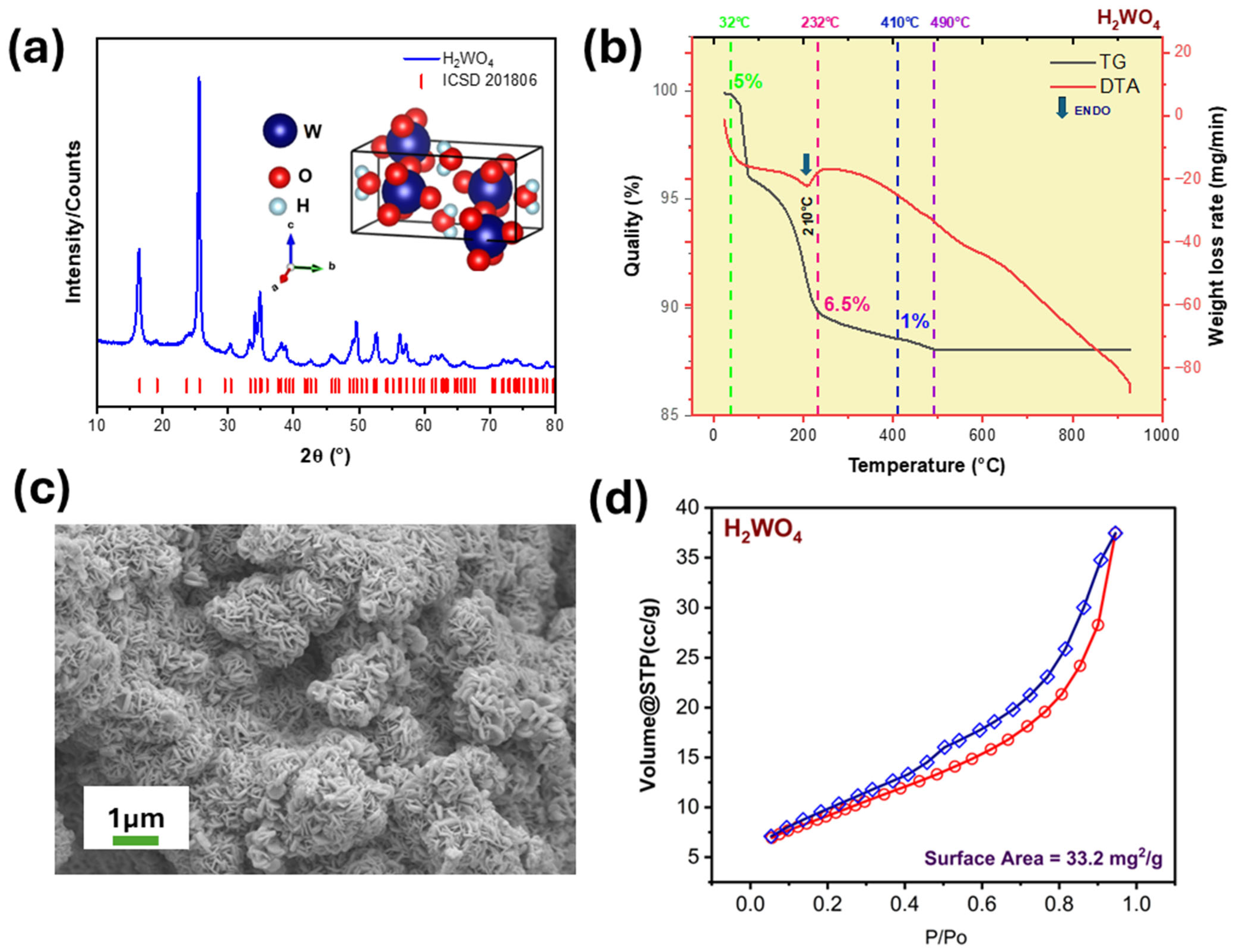
Figure 1 summarizes the structural, morphological, textural, and thermal characteristics of the tungstic acid (H2WO4) obtained from scheelite concentrates. The diffractograms display intense and well-defined peaks characteristic of the pure crystalline phase of H2WO4 (Figure 1a), in excellent agreement with COD pattern 201806, with no detection of secondary peaks or residual calcium phases, indicating the high purity and selectivity of the acid leaching process. This structural purity is essential for the controlled synthesis of subsequent products, as it facilitates the formation of tungsten trioxide (WO3) with regular morphology and, subsequently, APT suitable for efficient reduction and carburization, enabling the production of nanometric metallic tungsten (W) and tungsten carbide (WC) with high uniformity and potential performance in catalytic and structural applications.
Figure 1b presents the textural properties of the material, determined from N2 adsorption isotherms, the blue curve corresponds to the adsorption branch, while the red curve represents the desorption branch. Yielded a specific surface area of 33.21 m2·g−1 using the BET method. The obtained isotherms correspond to type IV, typical of mesoporous materials according to the IUPAC classification [43]. This characteristic is further supported by the presence of an H3-type hysteresis loop, associated with non-rigid aggregates of plate-like particles [44], which is consistent with the morphology observed by SEM-FEG (Figure 1c).
In Figure 1c, the micrographs reveal that H2WO4 exhibits a heterogeneous morphology composed of aggregates of thin platelet-like particles and a sponge-like structure, as described by Villaseca et al. (2015) [45]. The significant porosity observed is consistent with the presence of open and interconnected aggregates, contributing to a high specific surface area.
Figure 1d displays the simultaneous TG/DTA curves, in which a total mass loss of approximately 12.5% is observed up to 900 °C, distributed over three main stages associated with the dehydration and thermal decomposition of the compound.
The first event, occurring between 32 °C and 232 °C, corresponds to a mass loss of approximately 5%, associated with the evaporation of adsorbed water, as described in [46]. Within this temperature interval, an endothermic peak around 210 °C is observed, attributed to the loss of coordinated water [47]. This temperature interval corresponds to the transformation of H2WO4 into crystalline WO3, through progressive dehydration of the material.
The second stage, between 232 °C and 410 °C, shows an additional mass loss of approximately 6.5%, attributed to the dehydroxylation of H2WO4 and the formation of amorphous WO3·xH2O [48]. Finally, the third thermal event, occurring between 410 °C and 490 °C, corresponds to a mass loss of about 1.0%, associated with residual dehydration and structural rearrangement, during which the complete crystallization of WO3 takes place. Above 490 °C, the TG curve stabilizes, confirming the formation of crystalline WO3, a thermally stable phase under inert atmosphere [48]. These results demonstrate a multistep and controlled thermal decomposition of H2WO4, with well-defined transitions that lead to the ordered formation of WO3. The predictable sequence of dehydration and crystallization provides adjustable thermal windows for controlling the nanostructure of WO3, enabling the optimization of subsequent reduction and carburization steps aimed at producing metallic tungsten (W) and tungsten carbide (WC).
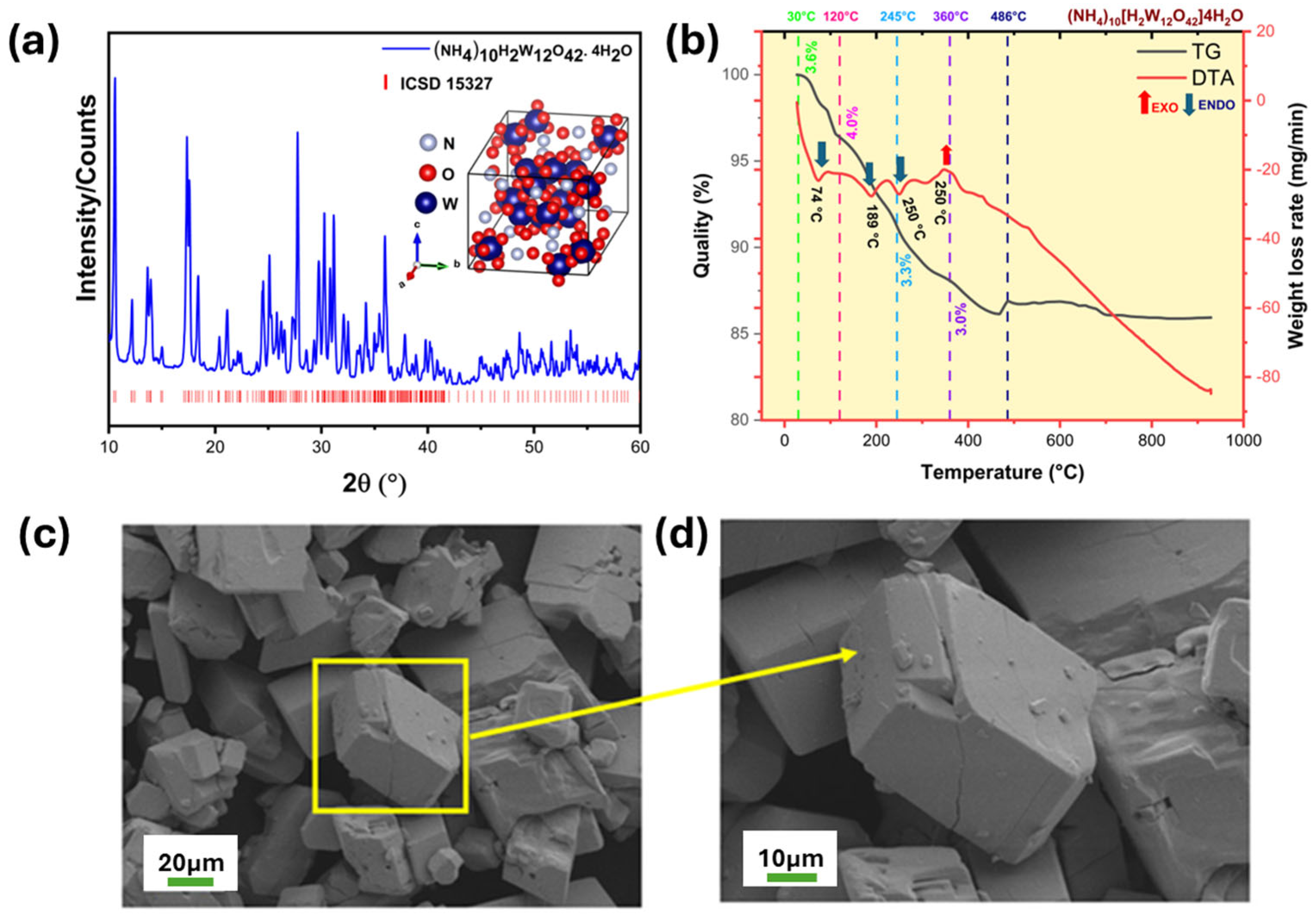
Figure 2a shows the X-ray diffraction pattern of ammonium paratungstate (APT), exhibiting sharp and well-defined diffraction peaks, indicating high crystallinity of the synthesized material. The experimental reflections are in good agreement with the reference data from the ICSD (ICSD 15327), confirming the successful formation of the APT phase without detectable secondary phases. The inset detail in the figure illustrates the APT crystalline unit cell, generated using VESTA software (OpenGL version: 4.6.0), highlighting its complex polyanionic structure.
The X-ray diffraction patterns of ammonium paratungstate (APT) (Figure 2), obtained from the evaporation of the ammonium tungstate solution ((NH4)2WO4), as shown in Equation (1) [46], reveal that crystallization leads to the formation of APT.
12(NH4)2WO4(aq) → (NH4)10[H2W12O42]·4H2O(s) + 14NH3(g) + 2H2O(g)
The XRD analysis confirms the formation of the crystalline APT phase, as verified by the ICSD-15237 reference pattern. The obtained compound exhibits a tetragonal structure, belonging to the I4 space group, with lattice parameters a = 13.93 Å, b = 13.37 Å, and c = 10.14 Å.
Figure 2c,d shows the morphology of the hydrated ammonium paratungstate (APT) obtained. The synthesized APT exhibits a morphology with variable particle sizes, consisting of rod-like and cubic shapes, which are characteristic of the tetrahydrated APT structure [49]. In fact, this observation is confirmed by the X-ray diffraction analysis (Figure 2a), which revealed that the formed APT corresponds to the structural form ((NH4)10[H2W12O42]·4H2O).
The TG and DTA curves recorded simultaneously up to 950 °C are shown in Figure 2b. The thermogravimetric analysis of tetrahydrated ammonium paratungstate under an Ar atmosphere at 950 °C showed a total mass loss of 13.90% (Figure 2b). The TG and DTA curves revealed four stages of mass loss, with three endothermic events and one exothermic event associated with the decomposition process.
The first mass-loss event (30–120 °C), corresponding to the elimination of the initial H2O molecules from APT (dehydration reaction), is observed as an endothermic peak at 74 °C. The second event (120–245 °C), corresponding to the decomposition of APT with the release of NH3 molecules, is associated with the major endothermic peak (189 °C) [50]. The third mass-loss stage (245–360 °C), attributed to the release of a mixture of NH3 and H2O, is associated with a third endothermic event at 250 °C. In the fourth event (360–480 °C), corresponding to the loss of the remaining water and ammonia molecules and the formation of WO3, an exothermic signal (348 °C) is observed, caused by heat release during WO3 crystallization [51].
The results obtained demonstrate that the produced APT exhibits high structural and thermal purity, making it an ideal precursor for the controlled production of tungsten oxides, carbides, and metallic tungsten. The confirmation of the APT tetragonal phase by X-ray diffraction, together with the homogeneous morphology observed by microscopy, indicates the well-defined formation of tetrahydrated APT. Additionally, the thermogravimetric profile revealed progressive dehydration and decomposition steps, culminating in the conversion of APT into WO3 from 360 °C onward, confirming the thermal stability of APT. Thus, the high crystallinity, purity, and controlled thermal behavior of the synthesized APT make it a highly efficient precursor for the subsequent synthesis of nanometric tungsten trioxide (WO3), metallic tungsten (W), and tungsten carbide (WC) powders, enabling the production of fine and homogeneous particles at relatively low temperatures, with strong potential for technological and catalytic applications.

2.2. Characterization of the Obtained WO3, W, and WC

2.2.1. Morphological Structure

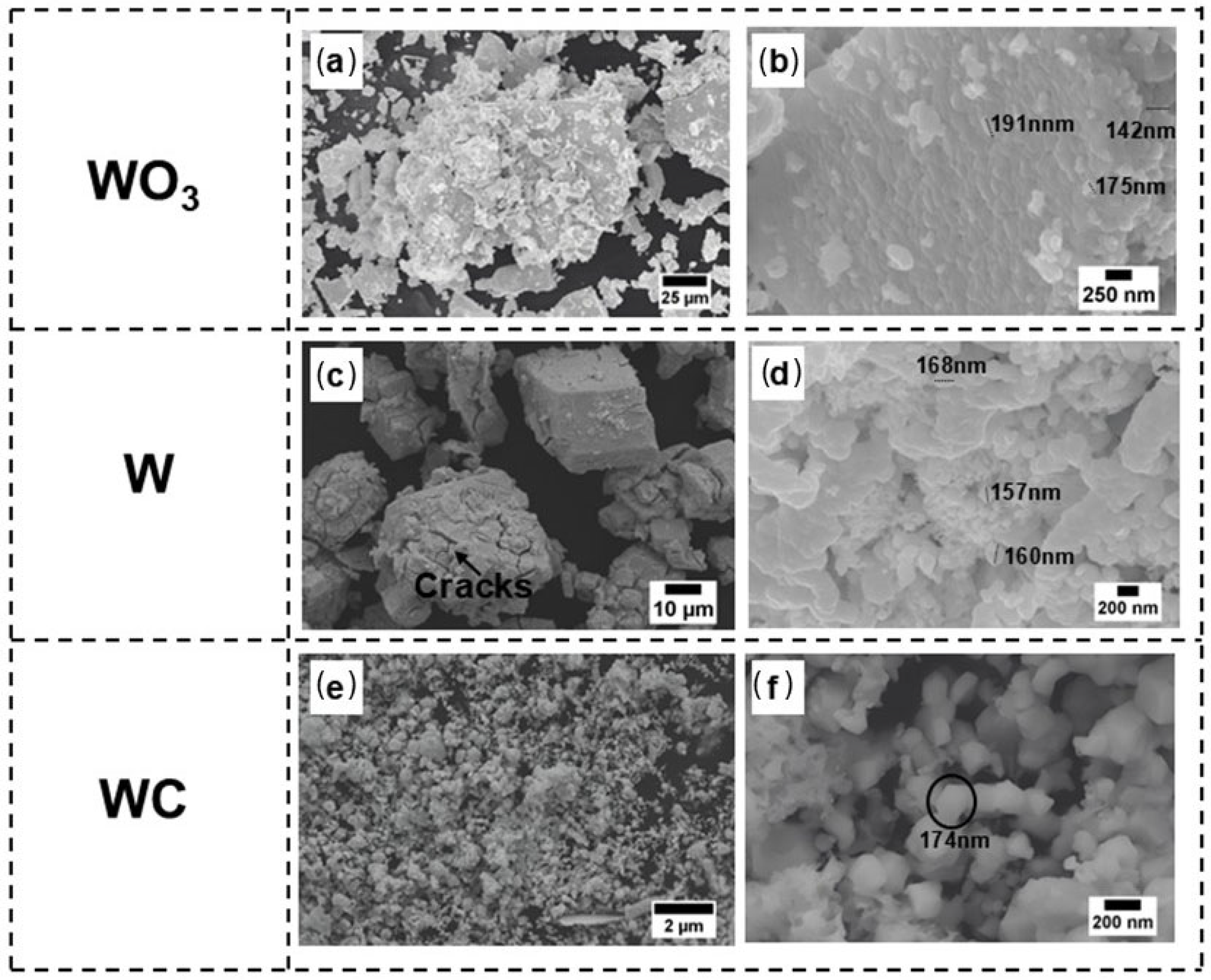
Figure 3 presents the high-resolution scanning electron microscopy of the synthesized powders: WO3 obtained by solid-state reaction, W produced through the reduction process, and WC obtained by carboreduction.
In Figure 3a, it can be observed that WO3 exhibits a morphology composed of aggregates of small particles. These agglomerated WO3 structures (Figure 3b) consist of multilayered lamellar assemblies of nanometric tungsten trioxide particles. This lamellar morphology is directly associated with the transformation pathway of the precursor, since the thermal conversion of tungstic acid (H2WO4) to WO3 primarily involves dehydration and structural rearrangement. Consequently, the WO3 morphology reflects the original layered structure of the tungstic acid powders (Figure 1c), which were used as precursors in the solid-state reaction process. Different morphologies can be found in literature, such as agglomerates of nanorods obtained via solid-state reaction from ammonium meta-tungstate [52] and sodium tungstate dihydrate [53], as well as spherical morphologies produced from peroxotungstic acid [54]. Therefore, the morphology obtained during the solid-state reaction process depends on the morphology of the precursors used [55], as the reaction is strongly determined by the particle–particle interface, and morphology dictates the conditions under which diffusion mechanisms and vacancy migration occur [56].
Although metallic W and WC powders originate from the same ammonium paratungstate (APT) precursor (Figure 2), their different morphologies (Figure 3) arise from the distinct thermochemical transformation mechanisms involved in each synthesis route. Figure 3c,d show the morphology of tungsten powder obtained by hydrogen reduction. Initially, large particles with sizes and shapes similar to the APT precursor are observed (Figure 3c), together with extensive cracking. These cracks are a direct consequence of the reduction process, during which dehydration and ammonia decomposition occur, as evidenced by the TG/DTA curves shown in Figure 1d and Figure 2b. The associated release of gaseous species generates internal stresses that promote particle fracture. As the reduction proceeds, a sequential oxygen removal process (WO3 → WO2 → W) takes place, accompanied by significant volume contraction and solid-state diffusion, ultimately leading to the formation of agglomerates composed of fine W nanoparticles (Figure 3d). Thus, the morphology of W consists predominantly of agglomerated tungsten nanoparticles.
Figure 3e,f present the electron microscopy images of WC powders synthesized via carboreduction. During WC synthesis, the gas–solid carburization process introduces an additional carbon diffusion step, in which simultaneous reduction and carburization occur under a reactive CH4/H2 atmosphere. Unlike WO3 and W, WC does not form large agglomerates, resulting instead in a more dispersed powder. The particles are nanometric and exhibit a polyhedral morphology, which enhances the specific surface area. This behavior can be attributed to the high nucleation density induced by carburization, combined with limited grain growth under low-temperature gas–solid reaction conditions.
Overall, the observed morphological differences are governed primarily by the reaction atmosphere, mass transport mechanisms, and phase transformation pathways, rather than by the precursor morphology alone. This highlights the critical role of reaction-controlled morphology evolution in low-temperature gas–solid processing routes. Notably, all synthesized powders (WO3, W, and WC) exhibit nanometric particle sizes, a feature that is highly beneficial for electrochemical performance and enhances sinterability for the production of advanced tungsten-based composites.

2.2.2. Crystalline Structure

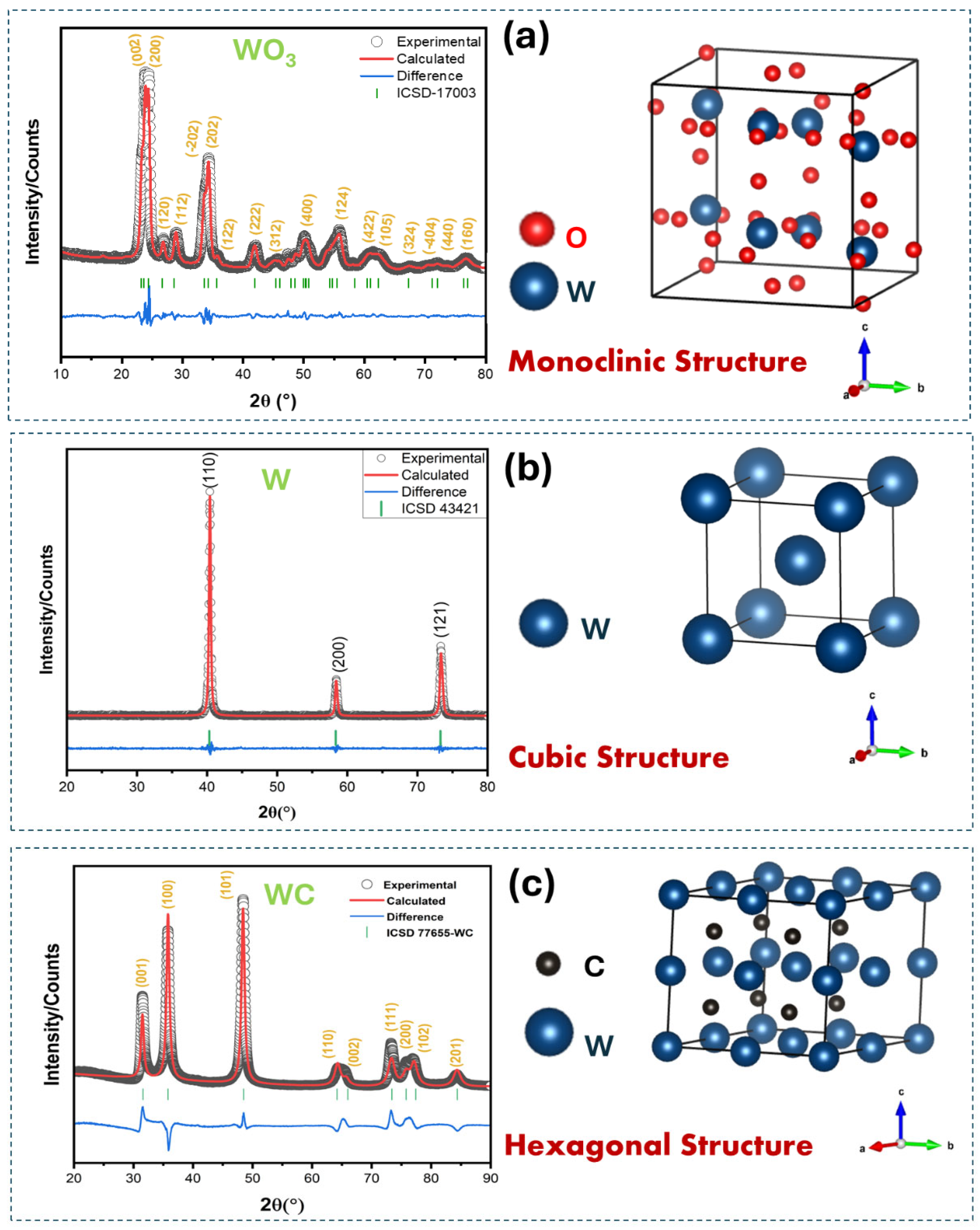
The X-ray diffraction patterns of WO3, W, and WC are presented in Figure 4, along with their respective crystalline structures. The purity of the powders is evidenced by the presence of well-defined crystallographic planes consistent with ICSD 17003 for tungsten trioxide (WO3), ICSD 4321 for metallic tungsten (W), and ICSD 77655 for tungsten carbide (WC). In addition, the absence of characteristic peaks from secondary phases demonstrates the success of the synthesis route in obtaining these materials. The lack of secondary phases in the WO3, W, and WC powders is particularly relevant for applications that require high performance. Furthermore, Figure 4a shows that WO3 exhibits a monoclinic structure, in which the tungsten atom (blue sphere) occupies the center of an octahedron coordinated to six oxygen atoms (red spheres), forming a three-dimensional network of WO6 octahedra. The synthesized metallic tungsten exhibits a body-centered cubic structure (Figure 4b), where the W atom is located at the center of the unit cell, surrounded by eight tungsten atoms. In Figure 4c, the synthesized WC is shown to possess a hexagonal close-packed structure, in which W atoms (blue spheres) form the hexagonal layers, while carbon atoms (black spheres) occupy the interstitial sites between the tungsten atoms.
Table 1 presents the parameters obtained from the structural refinement of the WO3, W, and WC powders. It is noted that the agreement indices Rwp, Rexp, and χ2 for WO3 and W exhibit appropriate values, ensuring the quality of the refinement. The quantification indicates the formation of pure WO3, W, and WC phases, demonstrating the high purity of the materials synthesized from scheelite. Tungsten trioxide shows a crystallite size of 13.3 nm; this small crystallite size, associated with the WO3 nanosheets, provides a higher surface area, leading to the formation of a larger number of active sites for electrochemical reactions [57]. Meanwhile, the synthesized W exhibited a crystallite size of 31.55 nm, whereas conventional methods for synthesizing WC typically require high temperatures (>1000 °C) to obtain this carbide [58,59]. Nevertheless, the methodology used in this study, involving the carboreduction of APT derived from scheelite, enabled the synthesis of pure tungsten carbide at 850 °C, with a smaller crystallite size (10.44 nm) than those reported in the literature [25,60]. Besides, it has been reported that the formation of WC nanostructures enhances the electrocatalytic properties of this material [25].

2.2.3. Electrochemical Analysis

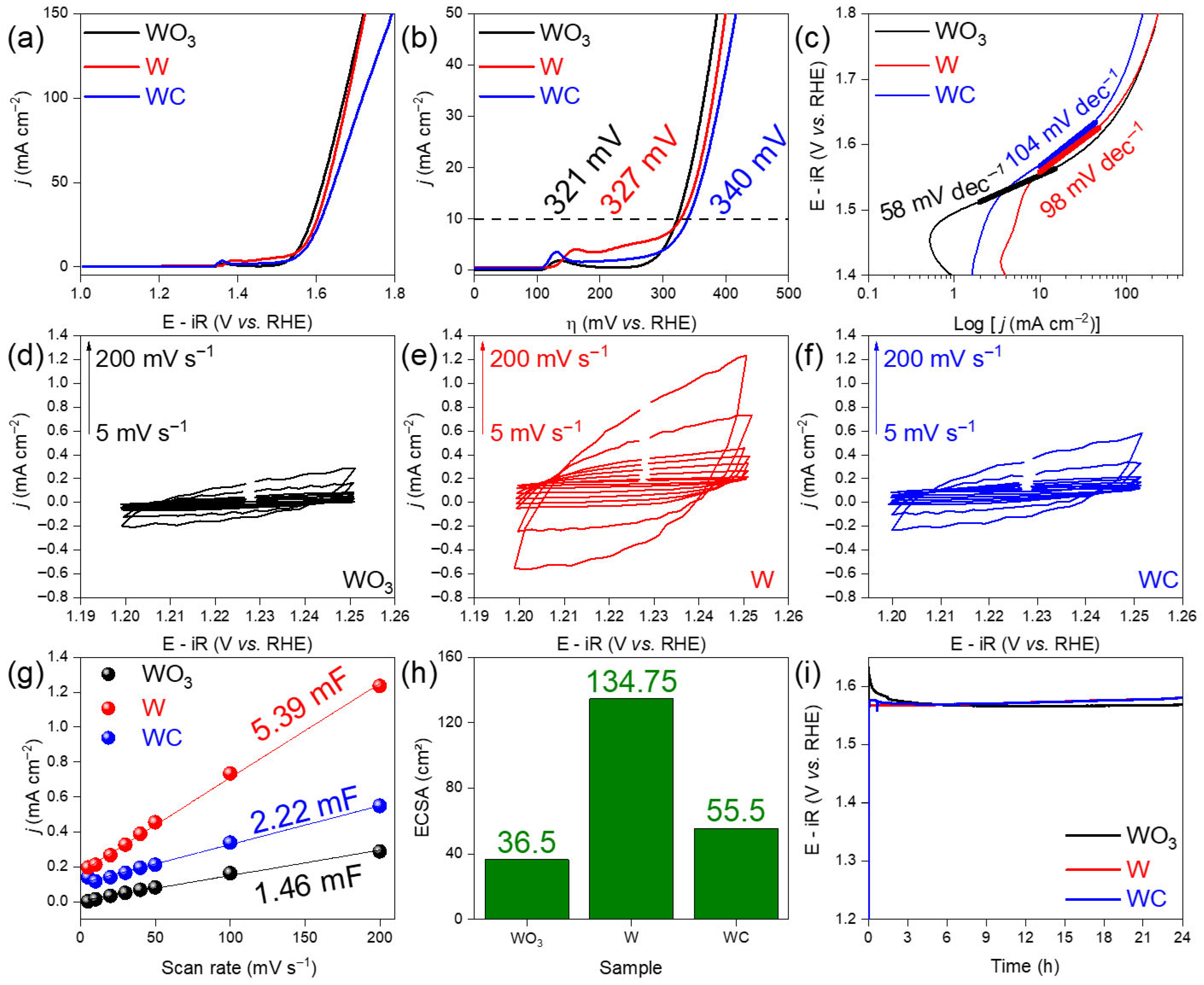
The electrocatalytic performance of the WO3, WC, and W nanoparticles, as well as the nickel foam, toward the oxygen evolution reaction (OER) was evaluated by linear sweep voltammetry (LSV), cyclic voltammetry (CV), and Tafel slope analysis, as shown in Figure 5. The LSV curves presented in Figure 5a,b demonstrate that the electrode with WO3 nanoparticles has the lowest overpotential at 10 mA cm−2 (321 mV vs. RHE), followed by W (327 mV) and WC (340 mV), highlighting the enhanced catalytic activity provided by the tungsten-based materials. The rapid increase in current density above 1.6 V vs. RHE indicates the onset of the OER region and underscores the intrinsically higher activity of these materials when compared to the bare substrate. This behavior directly reflects the effect of the composition, surface chemical reactions, and electronic structure of each tungsten phase on the adsorption and transformation of the reaction intermediates OH, O, and OOH***.
Furthermore, the Tafel slope presented in Figure 5c provides deeper insight into the kinetic differences among the materials. The Tafel plots were derived from the LSV curves using Equation (2).
η = a + b log j0
where η is the overpotential, j0 is the current density, a is the intercept related to the exchange current density, and b is the Tafel slope. The measured Tafel slopes were 58, 98 and 104 mV dec−1 for WO3, W, and WC (Table 2). Among the measured values, WO3 exhibits the lowest Tafel slope (58 mV dec−1), indicating intrinsically faster kinetics and a mechanism in which the rate-determining step involves chemical rearrangement following an electron-transfer process [61]. This behavior is consistent with its vacancy–rich structure and its ability to stabilize intermediates such as OOH* [61]. Meanwhile, WC and W display slopes of 58 and 98 mV dec−1, respectively, similar to those reported in previous studies listed in Table 2.
Table 2 presents a comparison between WO3-NP, W-NP, and WC-NP with other tungsten-based systems, such as WC–Ni (≈378 mV) [59] Ir–WO3−x (≈310 mV) [60] and W–CoO (≈320 mV) [61], which exhibit overpotentials comparable to those of the electrodes studied in this work. These results indicate that the materials synthesized in this study are well aligned with high–performance tungsten-based hybrid catalysts. This behavior is generally associated with the nanometric particle size, which significantly increases the active surface area and, consequently, the density of available catalytic sites. This characteristic is crucial for the kinetics of the OER, playing a fundamental role in the reaction process [62]. In this context, the electrodes based on W, WO3, and WC nanoparticles exhibit competitive performance and position themselves with notable relevance among tungsten-based electrocatalysts studied for the OER.
The Tafel coefficients obtained for WO3-NP, WC-NP, and W-NP directly reflect how each material governs the fundamental steps of the OER, particularly the adsorption of OH, the formation of M-OH* and M-O* species, and the subsequent generation of M-OOH*, which precedes O2 release [63]. The value obtained for WO3-NP (58 mV·dec−1) indicates that tungsten trioxide has a high capacity to stabilize oxygenated intermediates due to the strong W-O polarization and the ease of forming high oxidation states (W5+/W6+) [61]. In this context, WO3-NP acts as a surface electronically favorable for the redistribution of electronic density during the activation and transformation of oxygenated species. For WC-NP and W-NP, the kinetics remain efficient but exhibit greater intrinsic resistance to surface oxidation than WO3-NP.
In metallic tungsten, the initial formation of M-OH* occurs readily, but the subsequent conversion to M-O* requires greater electronic reorganization, since the metallic surface has a lower capacity for covalent stabilization of oxygenated species [64]. In the case of WC-NP, the presence of carbon provides high conductivity and favors electron flow during the OER [64]; however, the more covalent character of the W-C bond reduces the density of states available to interact with adsorbed oxygen [64], increasing the energy of the surface oxidation step and justifying the higher Tafel coefficient compared to WO3-NP.
The CV curves in Figure 5d–f reveal fundamental differences in charge-storage and charge-transfer mechanisms. Metallic tungsten (Figure 5e) exhibits an oval and slightly distorted voltammogram even at low scan rates (5–20 mV s−1), which reflects the natural formation of a thin passive oxide layer (WOx) [62,65]. Although this layer reduces capacitance and limits interfacial charge transfer, Tungsten maintains high electronic conductivity throughout its core, ensuring efficient electron transport and functioning as a robust and stable platform for oxidative OER processes. This combination of high chemical stability, good conductivity, and controlled surface behavior makes W particularly attractive as a support and structural component in hybrid catalysts, where the electronic modulation can substantially enhance the activity of more redox-active materials [63,65].
Tungsten carbide (WC) (Figure 5f) exhibits a distinct behavior, characterized by broad redox peaks associated with W5+/W6+ transitions, evidencing its pseudocapacitive nature [62]. This behavior indicates a surface capable of actively participating in the OER, modulating the adsorption energies of intermediates and providing more favorable reaction kinetics compared to nickel foam. Despite the distortion observed at high scan rates (100–200 mV s−1), resulting from diffusion limitations [62,65], WC combines excellent metallic-like electronic conductivity with surface redox activity, which is particularly advantageous in composite systems where its pseudocapacitive properties can synergistically enhance the performance of more highly active OER materials [56].
However, WO3 (Figure 5d) exhibits the most capacitive electrochemical behavior among the materials studied, maintaining nearly rectangular CV curves even at high scan rates (100–200 mV s−1) [61]. This reflects a fast and surface-dominated charge-storage process, which may be associated with the presence of mixed W5+/W6+ states, abundant oxygen vacancies, and the material’s tendency to form hydrated phases related to intermediate-formation mechanisms [61,65]. Such characteristics provide excellent ionic mobility, facilitate electron-transfer steps coupled with ion insertion, and reduce the energy barriers associated with the formation and conversion of OER intermediates, which explains the pseudocapacitive response observed in the cyclic voltammetry.
The quantification of the observed behavior was performed by determining the double-layer capacitance (CDL) (Figure 5g), which was extracted from the linear relationship between the anodic current density (Jia) and the scan rate (ν), according to Equation (3).
Jia = ν × CDL
W exhibited the highest CDL (5.39 mF), followed by WC (2.22 mF) and WO3 (1.46 mF), values significantly higher than those of nickel foam. The values obtained for these synthesized materials indicate good electrochemically active surface area and surfaces that are more favorable for the formation and conversion of OER intermediates [58,66]. Finally, ECSA is calculated by the equation (ECSA = CDL/CS) [66], where CS is the specific capacitance. For refractory metals-based electrodes in alkaline solution a typical value of CS = 0.040 mF cm−2 was used. The electrochemically active surface area (ECSA, Figure 5h) was calculated to be 36.5, 134.75, and 55.5 cm2 for WO3, W, and WC, respectively.
The refractory metal-based electrocatalysts shown in Figure 5i demonstrate high electrochemical stability when subjected to a constant current density of 10 mA cm−2. The potential (E − iR, vs. RHE) remains practically unchanged over 24 h of continuous operation, indicating the absence of significant degradation of electrocatalytic activity. This behavior highlights the robustness of WO3, W, and WC materials under alkaline conditions (1.0 M KOH), confirming their potential for applications in long-duration electrocatalytic processes.
The results obtained in this study demonstrate the high catalytic potential of the synthesized W, WO3, and WC nanoparticles, placing them among the most promising materials in recent literature for the OER. The overpotential of 321 mV at 10 mA·cm−2 for WO3, significantly lower than that of traditional tungsten-based catalysts (such as PEG–WO3-2, with 407.7 mV) [19] and lower than that of several widely investigated transition–metal oxides (400–490 mV) [67,68,69], highlights a substantial improvement in the intrinsic activity of the materials produced. Notably, W-based systems doped with Co, such as W-CoP (≈252 mV) [70], W-doped systems such as Ni-Fe-W (≈230 mV) [71] and WC-supported systems such as FeNi/WCx (≈211 mV) [72], exhibit lower overpotentials, as reported in Table 2, due to strong synergistic interactions between W and transition metals with high oxidative capacity, which enhance the stabilization of key intermediates M-OH*, M-O*, and M-OOH* [71].
Even when compared with optimized hybrid systems, the catalysts developed in this study exhibit competitive and relevant performance, especially considering that in those systems the reduction of overpotential arises from strong multimetallic synergies involving highly active transition metals. In contrast, the nanoparticles produced here do not rely on doping or advanced support, yet they exhibit robust intrinsic activity, which reinforces the excellence of the synthetic route employed.
In this context, the synthesized WO3, W, and WC nanoparticle-based electrodes exhibit competitive intrinsic performance for the OER, even when compared to optimized systems–especially considering that, in the literature, tungsten is widely employed either as a support in the case of WC [72] or as a dopant [67], as well as in other doped systems [70], whereas the nanoparticles synthesized in this study display their own catalytic activity. Overall, these results position the investigated nanoparticles as promising catalytic platforms for the OER and as strategic candidates for integration into future high-performance hybrid and doped systems.
Table 2. Electrocatalytic performance comparison of refractory metals-based electrodes in this work with tungsten electrocatalytic systems in the literature.
MaterialOverpotential @10 mA cm−2 (mV) for OERTafel Slope (mV dec−1)ElectrolyteReference
WO3 321581.0 M KOHThis work
WC 3401041.0 M KOHThis work
W 327981.0 M KOHThis work
Ni foam4231021.0 M KOHThis work
WC-Ni37893Basic[59]
Ir-WO3−X310-1.0 M KOH[60]
W:CoO32045 Basic[61]
FeNi at WCX211-1.0 M KOH[72]
W-CoP252741.0 M KOH[70]
Ni-Fe-W LDH230641.0 M KOH[71]
WO3407.7 76.2 1.0 M KOH[19]
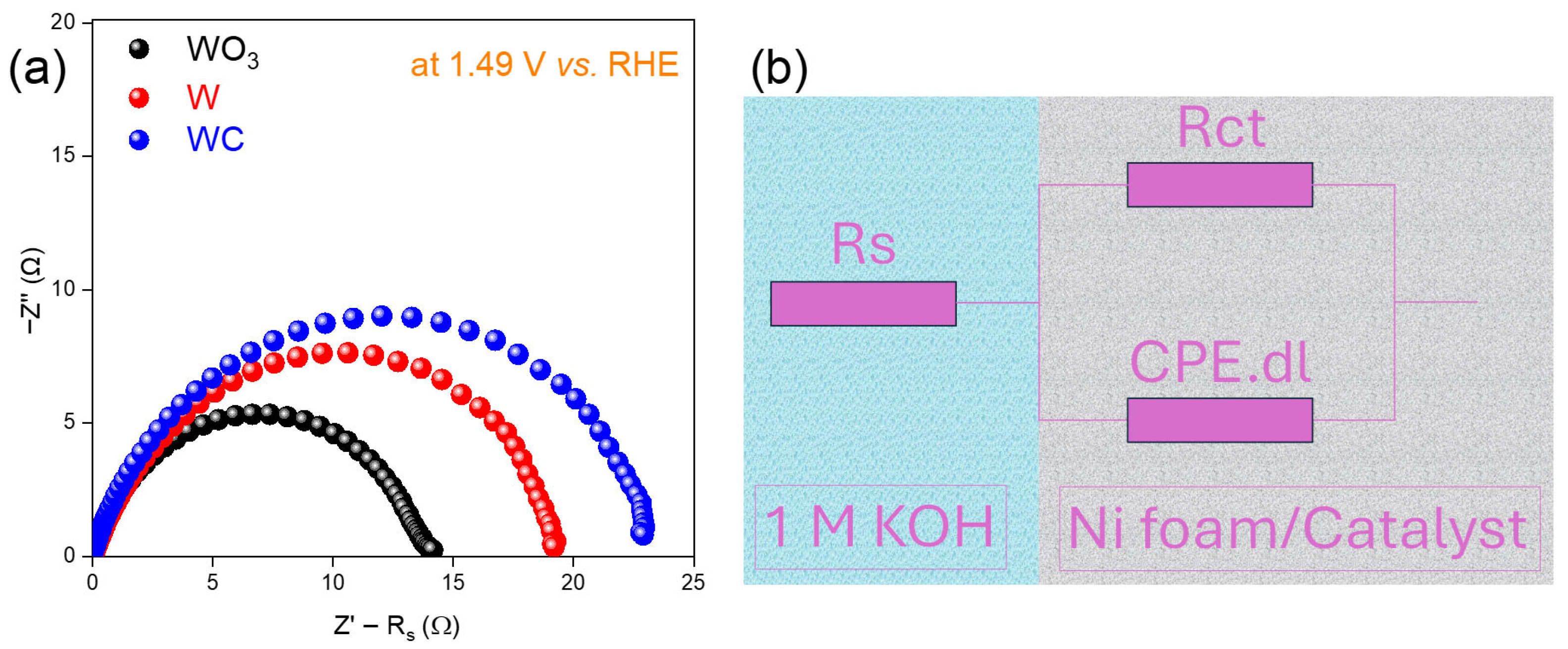
The impedance spectra obtained at 1.49 V vs. RHE for WO3, WC, and W nanoparticles are presented in Figure 6a. A simple Voigt equivalent circuit (ECM) model (Figure 6b), composed of a resistor R in series with an R‖CPE element (ZCPE = Q−1(iω)−n) [73], was used to fit the data, where R and R‖CPE (ZCPE = Q−1(iω)−n) represent the solution resistance and the response of the catalysts (WO3, WC, and W). Here, CPE and ω represent a constant phase element and the angular frequency, respectively, and Q and n are the usual parameters that characterize the pseudocapacitance and the angular frequency exponent, respectively. The effective capacitance is given by C = R(1−n)/nQ1/n [74,75]. The electrochemical parameters resulting from the impedance data fitting are presented in Table 3.
The offset resistance (Rs) values, which mainly reflect the ohmic resistance of the electrolytic solution, are similar among the samples (∼1 Ω; Table 3). The charge transfer resistance (Rct) shows values of 23.84 Ω for WC, 19.37 Ω for W, and 14.02 Ω for WO3. Compared to the WC electrode, a reduction of approximately 19% in Rct is observed for the W electrode and about 41% for the WO3 electrode, indicating a progressively more favorable charge transfer kinetics. Furthermore, the WO3 electrode shows an approximately 28% reduction in Rct compared to W. These results demonstrate the superior performance of WO3 in the charge transfer process under the investigated conditions, correlating with the high performance in the oxygen evolution reaction (OER) observed in Figure 5.
The capacitance values of the electrical double layer (CDL) determined from the electrochemical impedance spectroscopy (EIS) fitting were 1.9, 2.9, and 2.2 mF for WO3, W, and WC (see Table 3), respectively, showing good agreement with those obtained by cyclic voltammetry (CV) (see Figure 5g), with values of the same order of magnitude and practically quantitative agreement in the case of WC. In contrast, for material W, the CDL estimated by CV is substantially higher than that obtained by EIS (see Figure 5g and Table 3), which can be attributed to the greater sensitivity of the voltammetric method to pseudocapacitive contributions and the greater fraction of the electrochemically active area accessible under dynamic conditions. Despite the differences in absolute values, both methodologies consistently indicate that material W has the highest CDL, suggesting a more electrochemically active surface and a higher density of accessible sites when compared to WO3 and WC.

3. Materials and Methods

3.1. Materials

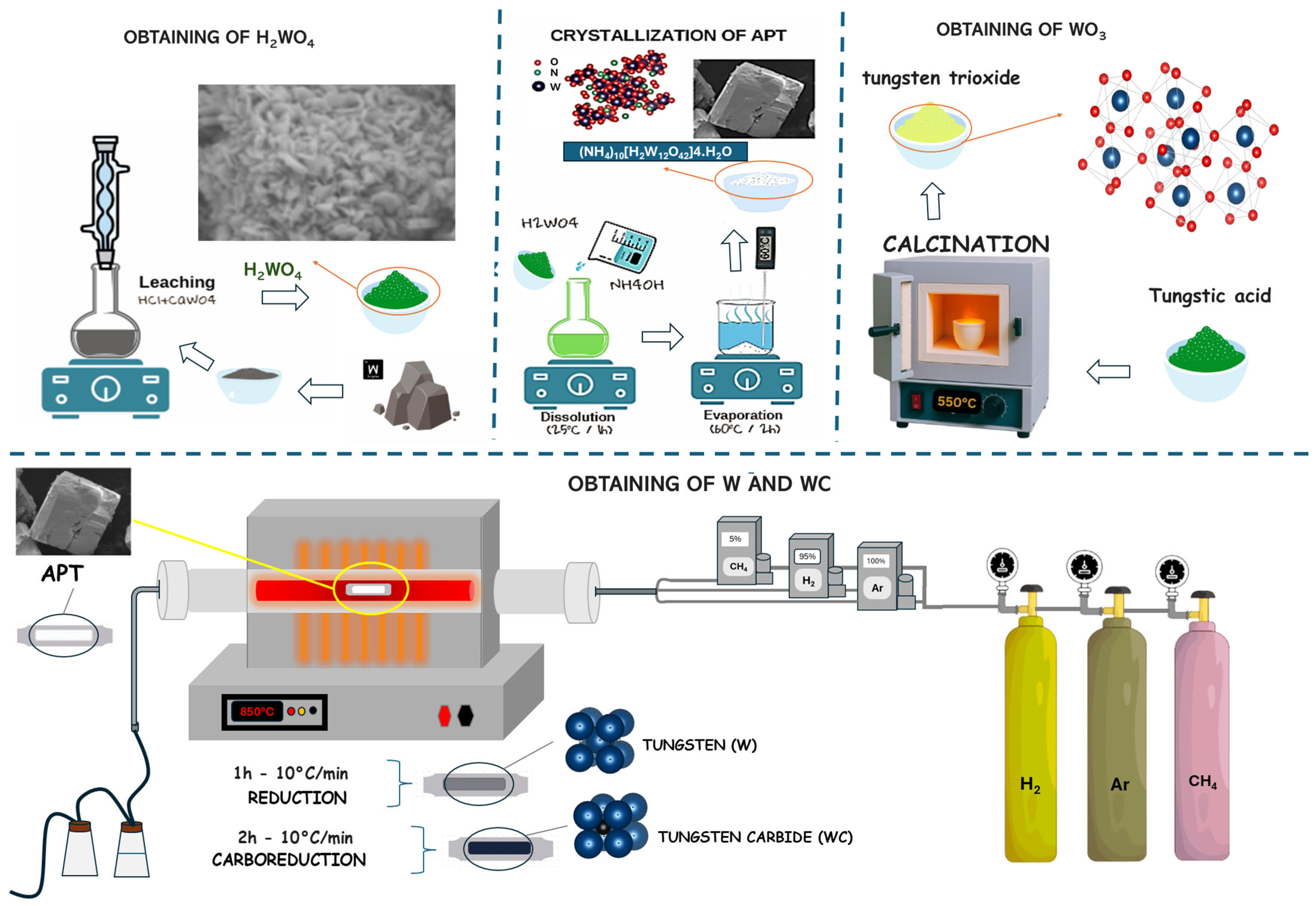
Scheelite ore concentrates were supplied by the Brejuí mine, owned by Mineração Tomaz Salustino, located in Currais Novos, Rio Grande do Norte, Brazil. The other reagents used in this study are analytically pure, including hydrochloric acid (HCl, 37% PA, Exodo, São Paulo, Brazil), ammonium hydroxide (NH4OH, 28–30% P.A., Neon, São Paulo, Brazil), methane gas (CH4, 99.99% P.A., Messer, Barueri, Brazil), hydrogen gas (H2, 99.99% P.A., Messer, Barueri, São Paulo, Brazil), and argon gas (Ar, 99.99% P.A., White Martins, São Paulo, Brazil). Nickel foam (Ni, 99.8%, porosity > 95%), purchased from QiJing Ltd., Suzhou, China, was used as the substrate, and potassium hydroxide flakes (ACS Científica, São Paulo, Brazil) were used to prepare the electrolyte solution. Figure 7 presents the systematic scheme of the experimental procedure used in this study.

3.2. Synthesis of Ammonium Paratungstate (APT)

APT was obtained from the leaching of dry-milled scheelite ore concentrate using a planetary mill (Pulverisette 7, Fritsch, Idar-Oberstein, Germany) with a carbide crucible and balls, applying a ball-to-powder mass ratio of 10:1, a milling time of 10 min, and a rotation speed of 400 rpm (Figure 7). Fifty grams of the milled scheelite concentrate were used at a mass-to-volume ratio of 1:5 (mass of scheelite/volume of acid). The samples were placed in a round-bottom flask under constant magnetic stirring at 80 °C for 3 h of reaction, using 5 mol/L HCl (Figure 7). The leached material was then filtered through a Büchner funnel with the aid of a vacuum pump and subsequently washed with distilled water at 70 °C until the aqueous dispersion reached pH = 6. Finally, the material retained on the filter paper was dried in an oven at 120 °C and ground in an agate mortar, yielding a greenish powder identified as tungstic acid (H2WO4).
Subsequently, the obtained H2WO4 was dissolved in a concentrated ammonium hydroxide solution at a ratio of 1:3 (mass of H2WO4/volume of NH4OH). The powder was slowly dissolved under magnetic stirring for 60 min at room temperature. The solution was then allowed to rest for 2 h and subsequently filtered. The resulting liquor was subjected to crystallization at 60 °C, followed by 2 h of evaporation to fully remove the liquor and achieve complete crystallization of APT (Figure 7).

3.3. Synthesis of Nanostructured WC, WO3, and W Powders

WO3 was obtained from 3 g of H2WO4, produced from scheelite ore leaching, and subjected to calcination in a furnace with a heating rate of 10 °C/min and an isothermal step at 500 °C for 2 h. Tungsten was synthesized through the reduction reaction of the obtained ammonium paratungstate (APT) using hydrogen gas. For this purpose, 2 g of APT were placed in an alumina boat, which was then inserted into a resistive tubular furnace. The furnace was sealed, and a hydrogen flow of 20 L/h was introduced for 2 h at a temperature of 800 °C, with a heating rate of 10 °C/min. After completion of the APT reduction process, the resulting material was characterized (Figure 7).
For the synthesis of tungsten carbide powders, 2 g of ammonium paratungstate were weighed into an alumina boat and subsequently placed in a fixed-bed tubular furnace equipped with temperature and gas-flow controllers. The carboreduction reaction was carried out with a heating rate of 10 °C/min at 800 °C for 2 h. A gas mixture of hydrogen (H2, 95%) and methane (CH4, 5%) was used during the reaction, with flow rates of 1 L/h for CH4 and 19 L/h for H2. At the end of the carboreduction reaction, the reactive gas mixture was replaced with a 10 L/h flow of argon (Ar, 100%), which was maintained until the system reached room temperature (Figure 7).

3.4. Characterization

The chemical composition of the samples was measured in terms of analyte percentage using an X-ray fluorescence spectrometer (Shimadzu EDX-720, Kyoto, Japan). The crystal structure of the initial and synthesized materials was investigated using an X-ray diffractometer (Miniflex II, Rigaku, Tokyo, Japan) with Cu Kα radiation and an average wavelength of 1.5481 Å. The crystalline phases were identified using crystallographic data from the Inorganic Crystal Structure Database (ICSD). All XRD analyses were performed on powdered material under ambient temperature and humidity conditions, with an angular range of 20° to 80°, a scan rate of 2°/min, and a step size of 0.02°.
The morphological characterization of the powders was performed using a Carl Zeiss scanning electron microscope (SEM, Supra 35-VP, Carl Zeiss, Oberkochen, Germany) equipped with an energy-dispersive X-ray spectroscopy detector (EDS, Bruker, Billerica, MA, USA) for elemental analysis. Specific surface area analysis (BET) was carried out using a Quantachrome Nova Station B instrument (Boynton Beach, FL, USA). The sample (0.8309 g) was previously degassed at 150 °C for 24 h, and the measurement was conducted using nitrogen as the adsorbate.
To analyze the thermal behavior and thermal stability of APT, thermogravimetric (TG) and differential thermal analysis (DTA) experiments were performed. These analyses were conducted using a TA Instruments SDT-Q600 system (New Castle, DE, USA) under an argon atmosphere (50 mL/min), with a heating rate of 10 °C/min and a temperature range from 30 °C to 1000 °C. A platinum crucible containing 5 mg of sample was used.

3.5. Electrochemical Measurements for the Oxygen Evolution Reaction (OER)

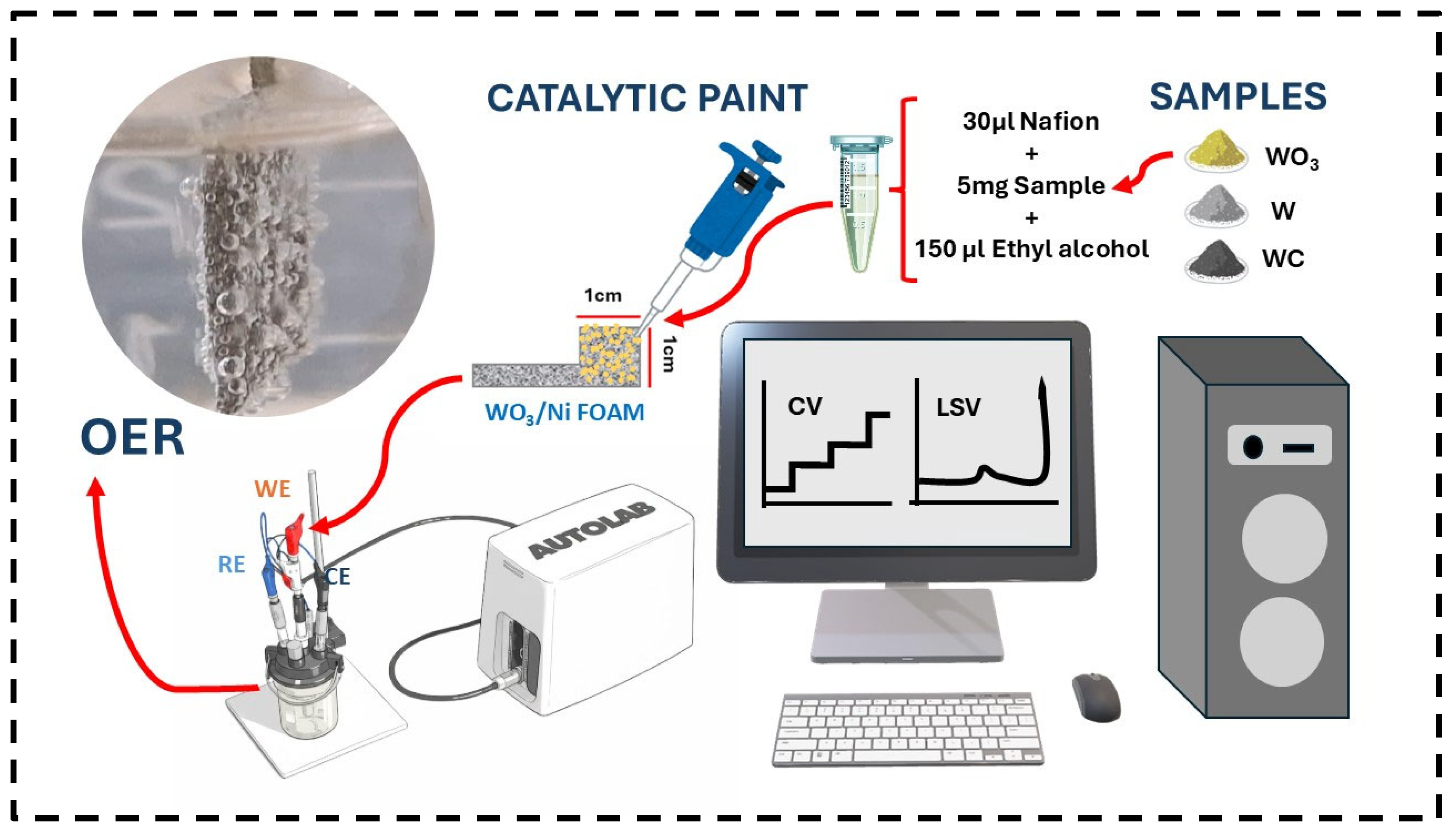
Electrochemical measurements were carried out using a Metrohm Autolab PGSTAT204-FRA32M system (Utrecht, The Netherlands), employing a three-electrode configuration in an alkaline KOH electrolyte solution (1 M, pH = 13.65) at 25 °C. Ag/AgCl and platinum were used as the reference and counter electrodes, respectively, as shown in Figure 8.
Three working electrodes were evaluated: WO3, W, and WC. A catalytic ink was prepared by dispersing 5 mg of sample in a mixture of 150 μL of ethyl alcohol and 30 μL of 5% Nafion, followed by sonication for 30 min. The ink was then deposited onto a cleaned nickel foam substrate with an area of 1 cm2 [76]. After deposition, the working electrodes were dried at room temperature for 24 h.
The potential was converted from Ag/AgCl to the reversible hydrogen electrode (RHE) according to the following Nerst Equation (Equation (4)).
ERHE = EAg/AgCl + 0.1976 V + 0.0059 pH
The properties of the working electrodes (WO3, W, and WC) were evaluated using linear sweep voltammetry (LSV) and cyclic voltammetry (CV). LSV measurements were performed at a scan rate of 5 mV s−1, while cyclic voltammograms were recorded at different scan rates ranging from 5 mV s−1 to 200 mV s−1.
The overpotential was denoted as η10 and calculated at a current density of 10 mAcm–2, by Equation (5):
η10 = ERHE − 1.23eV

4. Conclusions

In summary, we report the synthesis at low temperatures of nanometric WO3, W, and WC from scheelite ore. The precursors obtained (H2WO4 and APT) exhibited high structural purity, homogeneous morphology, and textural properties consistent with mesoporous materials, characteristics that directly influenced the properties of the resulting products (W, WO3, and WC). TG/DTA analyses confirmed a predictable multistep thermal decomposition, with clearly defined processing windows that enabled controlled transitions from H2WO4 to WO3 and from APT to W and WC. This combination of high purity, well–defined thermal behavior, and favorable textural structure was crucial for forming uniform, highly crystalline nanoparticles suitable for the electrocatalytic performance observed.
The electrocatalytic evaluation revealed remarkable performance for the OER, with the WO3 electrode reaching 321 mV at 10 mA·cm−2, a value considerably lower than that of traditional tungsten-based catalysts and superior to numerous widely reported transition-metal oxides (400–490 mV). The W (327 mV) and WC (340 mV) electrodes also proved competitive, reinforcing the positive impact of nanometric morphology, high electrochemically active surface area, and the intrinsic electronic modulation of each tungsten-based material.
The Tafel coefficients of 58 mV·dec−1 for WO3-NP and 98 e 104 mV·dec−1 for W-NP and WC-NP, respectively, demonstrate favorable kinetics for OH dissociation and stabilization of OER intermediates (M-OH*, M-*O, M-OOH*), behavior directly associated with the presence of oxygen vacancies, mixed W5+/W6+ states, and high electronic conductivity. Thus, the nanoparticles produced exhibit consistent intrinsic catalytic activity without the need for doping or specialized supports.
The electrocatalysts based on refractory metals exhibited excellent electrochemical stability, maintaining virtually constant potentials for 24 h under a current density of 10 mA cm−2, which demonstrates their robustness and viability for long-duration electrocatalytic applications.
The proposed synthesis route enables the production of high-performance electrocatalysts with significant potential for application in OER processes, standing out for their suitability for integration into high-performance hybrid systems aimed at green hydrogen production, alkaline electrolysis, and advanced energy-conversion and storage technologies.

Author Contributions

Conceptualization, M.J.S.L., and C.d.S.L.; methodology, M.J.S.L., K.F.G.A., R.A.R. and F.E.S.S.; validation, G.S.V. and M.J.S.L.; formal analysis, M.J.S.L., C.d.S.L. and G.S.V.; investigation, M.J.S.L.; resources; U.U.G.; data curation, C.d.S.L. and M.J.S.L.; writing—original draft preparation, M.J.S.L., K.F.G.A., R.A.R., C.d.S.L. and F.E.S.S.; writing—review and editing, M.J.S.L., R.M.N., M.A.M. and U.U.G.; supervision, M.A.M. and U.U.G. All authors have read and agreed to the published version of the manuscript.

Funding

This work was supported by the Coordination for the Improvement of Higher Education Personnel–Brazil (CAPES), Finance Code 001, and by the National Council for Scientific and Technological Development (CNPq) through the project “Production of Tungsten Oxides, Metallic Tungsten, and Nanometric Tungsten Carbide from Scheelite Mineral” (grant CNPq–407903/2022-4). Additional financial support was provided through a research productivity grant (PQ) awarded to Uílame Umbelino Gomes (CNPq–308894/2021-9) and through financial support granted to M. Morales by CNPq. Rafael A. Raimundo acknowledges financial support from CNPq (grant 151979/2025-1).

Data Availability Statement

The original contributions presented in this study are included in the article. Further inquiries can be directed to the corresponding author.

Acknowledgments

The authors thank Igor Zumba Damasceno, Ana Biatriz Guedes, and Carla L. S. C. Costa from LCEM-UFRN for providing the FEG-SEM images, and the LT2M-IFRN for performing the XRF analyses.

Conflicts of Interest

The authors declare no conflicts of interest.

References

  1. Qadeer, M.A.; Zhang, X.; Farid, M.A.; Tanveer, M.; Yan, Y.; Du, S.; Huang, Z.-F.; Tahir, M.; Zou, J.-J. A Review on Fundamentals for Designing Hydrogen Evolution Electrocatalyst. J. Power Sources 2024, 613, 234856. [Google Scholar] [CrossRef]
  2. Najam, T.; Shah, S.S.A.; Ibraheem, S.; Cai, X.; Hussain, E.; Suleman, S.; Javed, M.S.; Tsiakaras, P. Single-Atom Catalysis for Zinc-Air/O2 Batteries, Water Electrolyzers and Fuel Cells Applications. Energy Storage Mater. 2022, 45, 504–540. [Google Scholar] [CrossRef]
  3. Javed, M.S.; Shah, S.S.A.; Hussain, S.; Tan, S.; Mai, W. Mesoporous Manganese-Selenide Microflowers with Enhanced Electrochemical Performance as a Flexible Symmetric 1.8 V Supercapacitor. Chem. Eng. J. 2020, 382, 122814. [Google Scholar] [CrossRef]
  4. Najam, T.; Ahmad Shah, S.S.; Ali, H.; Song, Z.; Sun, H.; Peng, Z.; Cai, X. A Metal Free Electrocatalyst for High-Performance Zinc-Air Battery Applications with Good Resistance towards Poisoning Species. Carbon 2020, 164, 12–18. [Google Scholar] [CrossRef]
  5. Yu, Z.; Duan, Y.; Feng, X.; Yu, X.; Gao, M.; Yu, S. Clean and Affordable Hydrogen Fuel from Alkaline Water Splitting: Past, Recent Progress, and Future Prospects. Adv. Mater. 2021, 33, 2007100. [Google Scholar] [CrossRef] [PubMed]
  6. Vazhayil, A.; Vazhayal, L.; Thomas, J.; Ashok, C.S.; Thomas, N. A Comprehensive Review on the Recent Developments in Transition Metal-Based Electrocatalysts for Oxygen Evolution Reaction. Appl. Surf. Sci. Adv. 2021, 6, 100184. [Google Scholar] [CrossRef]
  7. Tahir, M.; Pan, L.; Idrees, F.; Zhang, X.; Wang, L.; Zou, J.-J.; Wang, Z.L. Electrocatalytic Oxygen Evolution Reaction for Energy Conversion and Storage: A Comprehensive Review. Nano Energy 2017, 37, 136–157. [Google Scholar] [CrossRef]
  8. Favaro, M.; Yang, J.; Nappini, S.; Magnano, E.; Toma, F.M.; Crumlin, E.J.; Yano, J.; Sharp, I.D. Understanding the Oxygen Evolution Reaction Mechanism on CoOx Using Operando Ambient-Pressure X-Ray Photoelectron Spectroscopy. J. Am. Chem. Soc. 2017, 139, 8960–8970. [Google Scholar] [CrossRef] [PubMed]
  9. Sawant, K.J.; Zeng, Z.; Greeley, J.P. Origin of Stability and Activity Enhancements in Pt-based Oxygen Reduction Reaction Catalysts via Defect-Mediated Dopant Adsorption. Angew. Chem. Int. Ed. 2024, 63, e202312747. [Google Scholar] [CrossRef] [PubMed]
  10. Li, H.; Pan, Y.; Wu, L.; He, R.; Qin, Z.; Luo, S.; Yang, L.; Zeng, J. IrO2 Deposited on RuO2 as Core-Shell Structured RuO2@IrO2 for Oxygen Evolution Reaction in Electrochemical Water Electrolyzer. Mol. Catal. 2023, 551, 113619. [Google Scholar] [CrossRef]
  11. Jang, E.; Lee, S.; Cho, J.; Kim, J.; Kim, J. Design and Synthesis of a 3D Urchin-like Ni/WC@NSCNT Electrocatalyst for Enhanced Bifunctional Performance in Oxygen Evolution and Reduction Reactions. J. Alloys Compd. 2025, 1010, 177221. [Google Scholar] [CrossRef]
  12. Nithya, V.D. Recent Advances in CoSe2 Electrocatalysts for Hydrogen Evolution Reaction. Int. J. Hydrogen Energy 2021, 46, 36080–36102. [Google Scholar] [CrossRef]
  13. Li, J.; Zhang, J.; Shen, J.; Wu, H.; Chen, H.; Yuan, C.; Wu, N.; Liu, G.; Guo, D.; Liu, X. Self-Supported Electrocatalysts for the Hydrogen Evolution Reaction. Mater. Chem. Front. 2023, 7, 567–606. [Google Scholar] [CrossRef]
  14. Mohammed, H.; Mia, M.F.; Wiggins, J.; Desai, S. Nanomaterials for Energy Storage Systems—A Review. Molecules 2025, 30, 883. [Google Scholar] [CrossRef]
  15. Omole, S.; Lunt, A.; Kirk, S.; Shokrani, A. Advanced Processing and Machining of Tungsten and Its Alloys. J. Manuf. Mater. Process. 2022, 6, 15. [Google Scholar] [CrossRef]
  16. Li, H.; Shen, Y.; Wu, X.; Wang, D.; Yang, Y. Advances in Laser Powder Bed Fusion of Tungsten, Tungsten Alloys, and Tungsten-Based Composites. Micromachines 2024, 15, 966. [Google Scholar] [CrossRef]
  17. Can, F.; Courtois, X.; Duprez, D. Tungsten-Based Catalysts for Environmental Applications. Catalysts 2021, 11, 703. [Google Scholar] [CrossRef]
  18. Kishore, R.; Cao, X.; Zhang, X.; Bieberle-Hütter, A. Electrochemical Water Oxidation on WO3 Surfaces: A Density Functional Theory Study. Catal. Today 2019, 321–322, 94–99. [Google Scholar] [CrossRef]
  19. Bhosale, M.; Morankar, P.J.; Amate, R.U.; Jeon, C.-W. Tunable Surfactant-Assisted WO3 Nanogranules as High-Performance Electrocatalysts for the Oxygen Evolution Reaction. Materials 2025, 18, 2129. [Google Scholar] [CrossRef] [PubMed]
  20. Xiao, Y.; Sun, P.; Cao, M. Core–Shell Bimetallic Carbide Nanoparticles Confined in a Three-Dimensional N-Doped Carbon Conductive Network for Efficient Lithium Storage. ACS Nano 2014, 8, 7846–7857. [Google Scholar] [CrossRef] [PubMed]
  21. Faisal, M.M.; Ali, S.R.; Hussain, G.; Autieri, C.; Sánchez, E.M.; Castro, A.T.; Sanal, K.C. Tungsten Carbide as an Electrode Material for Electrochemical Energy Storage Devices: Experiment and Theory. Ceram. Int. 2025, 51, 18886–18895. [Google Scholar] [CrossRef]
  22. Paudel, D.R.; Pan, U.N.; Ghising, R.B.; Kandel, M.R.; Prabhakaran, S.; Kim, D.H.; Kim, N.H.; Lee, J.H. Multi-Interfacial Dendritic Engineering Facilitating Congruous Intrinsic Activity of Oxide-Carbide/MOF Nanostructured Multimodal Electrocatalyst for Hydrogen and Oxygen Electrocatalysis. Appl. Catal. B 2023, 331, 122711. [Google Scholar] [CrossRef]
  23. Sohail, U.; Pervaiz, E.; Ali, M.; Khosa, R.; Shakoor, A.; Abdullah, U. Role of Tungsten Carbide (WC) and Its Hybrids in Electrochemical Water Splitting Application—A Comprehensive Review. FlatChem 2022, 35, 100404. [Google Scholar] [CrossRef]
  24. Ouyang, J.; Sun, Y.; Zhang, Y.; Liu, J.; Bo, X.; Wang, Z. Tungsten Carbide/Tungsten Oxide Catalysts for Efficient Electrocatalytic Hydrogen Evolution. Molecules 2024, 30, 84. [Google Scholar] [CrossRef] [PubMed]
  25. Singla, G.; Singh, K.; Pandey, O.P. Synthesis of Carbon Coated Tungsten Carbide Nano Powder Using Hexane as Carbon Source and Its Structural, Thermal and Electrocatalytic Properties. Int. J. Hydrogen Energy 2015, 40, 5628–5637. [Google Scholar] [CrossRef]
  26. Sridhar, S. Tungsten Oxide-Based Materials: Synthesis, Properties, and Applications. Nanomed. Nanotechnol. Open Access 2023, 8, 1–9. [Google Scholar] [CrossRef]
  27. Morcom, W.R.; Worrell, W.L.; Sell, H.G.; Kaplan, H.I. The Preparation and Characterization of Beta-Tungsten, a Metastable Tungsten Phase. Metall. Trans. 1974, 5, 155–161. [Google Scholar] [CrossRef]
  28. Pinto, O.M.; Toledo, R.P.; Barros, H.E.d.S.; Gonçalves, R.A.; Nunes, R.S.; Joshi, N.; Berengue, O.M. Advances and Challenges in WO3 Nanostructures’ Synthesis. Processes 2024, 12, 2605. [Google Scholar] [CrossRef]
  29. Lackner, A.; Filzwieser, A.; Paschen, P.; Köck, W. On the Reduction of Tungsten Blue Oxide in a Stream of Hydrogen. Int. J. Refract. Met. Hard Mater. 1996, 14, 383–391. [Google Scholar] [CrossRef]
  30. Li, H.; Shang, H.; Pan, F.; Li, W.; Du, Z. Preparation of Ultrafine Tungsten Powder by Fluidized Bed Hydrogen Reduction of WO3-Co3O4. Int. J. Refract. Met. Hard Mater. 2024, 120, 106607. [Google Scholar] [CrossRef]
  31. Zhang, L.; Yang, G.B.; Liu, G.; Chen, S.; Huang, B.Y.; Zhang, C.F. Ultrafine and Nanoscaled Tungsten Carbide Synthesis from Colloidal Carbon Coated Nano Tungsten Precursor. Powder Metall. 2006, 49, 369–373. [Google Scholar] [CrossRef]
  32. Lin, H.; Tao, B.; Xiong, J.; Li, Q.; Li, Y. Tungsten Carbide (WC) Nanopowders Synthesized via Novel Core–Shell Structured Precursors. Ceram. Int. 2013, 39, 2877–2881. [Google Scholar] [CrossRef]
  33. Zhu, M.; Dai, L.Y.; Gu, N.S.; Cao, B.; Ouyang, L.Z. Synergism of Mechanical Milling and Dielectric Barrier Discharge Plasma on the Fabrication of Nano-Powders of Pure Metals and Tungsten Carbide. J. Alloys Compd. 2009, 478, 624–629. [Google Scholar] [CrossRef]
  34. Wang, K.-F.; Sun, G.-D.; Wu, Y.-D.; Zhang, G.-H. Fabrication of Ultrafine and High-Purity Tungsten Carbide Powders via a Carbothermic Reduction–Carburization Process. J. Alloys Compd. 2019, 784, 362–369. [Google Scholar] [CrossRef]
  35. Shabgard, M.R.; Najafabadi, A.F. The Influence of Dielectric Media on Nano-Structured Tungsten Carbide (WC) Powder Synthesized by Electro-Discharge Process. Adv. Powder Technol. 2014, 25, 937–945. [Google Scholar] [CrossRef]
  36. Enneti, R.K. Synthesis of Nanocrystalline Tungsten and Tungsten Carbide Powders in a Single Step via Thermal Plasma Technique. Int. J. Refract. Met. Hard Mater. 2015, 53, 111–116. [Google Scholar] [CrossRef]
  37. Debalina, B.; Kamaraj, M.; Murthy, B.S.; Chakravarthi, S.R.; Sarathi, R. Generation and Characterization of Nano-Tungsten Carbide Particles by Wire Explosion Process. J. Alloys Compd. 2010, 496, 122–128. [Google Scholar] [CrossRef]
  38. Wang, K.-F.; Yang, X.-H.; Chou, K.-C.; Zhang, G.-H. Preparation of Nano-Scaled WC Powder by Low-Temperature Carbothermic Reduction Method. Int. J. Refract. Met. Hard Mater. 2022, 102, 105724. [Google Scholar] [CrossRef]
  39. Gao, L.; Kear, B.H. Low Temperature Carburization of High Surface Area Tungsten Powders. Nanostruct. Mater. 1995, 5, 555–569. [Google Scholar] [CrossRef]
  40. Medeiros, F.F.P.; De Oliveira, S.A.; De Souza, C.P.; Da Silva, A.G.P.; Gomes, U.U.; De Souza, J.F. Synthesis of Tungsten Carbide through Gas–Solid Reaction at Low Temperatures. Mater. Sci. Eng. A 2001, 315, 58–62. [Google Scholar] [CrossRef]
  41. Lima, M.J.S.; Silva, F.E.S.; Souto, M.V.M.; Araújo, K.F.G.; Menezes, R.A.C.; Filgueira, M.; Souza, C.P.; Gomes, U.U. Effect of Synthesis Parameters on the Crystallite Size of WC-Ni Composite Powders Obtained by Gas-Solid Reaction. Ceram. Int. 2021, 47, 23480–23487. [Google Scholar] [CrossRef]
  42. Lima, M.J.S.; Silva, F.E.S.; Raimundo, R.A.; Vitoriano, J.O.; Lourenço, C.S.; Morales, M.; Filgueira, M.; Gomes, U.U. Enhanced Properties of Hard Metal WC-Ni Processed from Nanostructured Powders. Ceram. Int. 2024, 50, 47445–47455. [Google Scholar] [CrossRef]
  43. Thommes, M.; Kaneko, K.; Neimark, A.V.; Olivier, J.P.; Rodriguez-Reinoso, F.; Rouquerol, J.; Sing, K.S.W. Physisorption of Gases, with Special Reference to the Evaluation of Surface Area and Pore Size Distribution (IUPAC Technical Report). Pure Appl. Chem. 2015, 87, 1051–1069. [Google Scholar] [CrossRef]
  44. Ke, J.; Zhou, H.; Liu, J.; Duan, X.; Zhang, H.; Liu, S.; Wang, S. Crystal Transformation of 2D Tungstic Acid H2WO4 to WO3 for Enhanced Photocatalytic Water Oxidation. J. Colloid Interface Sci. 2018, 514, 576–583. [Google Scholar] [CrossRef] [PubMed]
  45. Villaseca, L.; Moreno, B.; Lorite, I.; Jurado, J.R.; Chinarro, E. Synthesis and Characterization of Tungsten Nitride (W2N) from WO3 and H2WO4 to Be Used in the Electrode of Electrochemical Devices. Ceram. Int. 2015, 41, 4282–4288. [Google Scholar] [CrossRef]
  46. Fait, M.J.G.; Radnik, J.; Lunk, H.J. Surface Tungsten Reduction during Thermal Decomposition of Ammonium Paratungstate Tetrahydrate in Oxidising Atmosphere: A Paradox? Thermochim. Acta 2016, 633, 77–81. [Google Scholar] [CrossRef]
  47. Fait, M.J.G.; Moukhina, E.; Feist, M.; Lunk, H.-J. Thermal Decomposition of Ammonium Paratungstate Tetrahydrate: New Insights by a Combined Thermal and Kinetic Analysis. Thermochim. Acta 2016, 637, 38–50. [Google Scholar] [CrossRef]
  48. Cao, J.; Luo, B.; Lin, H.; Xu, B.; Chen, S. Thermodecomposition Synthesis of WO3/H2WO4 Heterostructures with Enhanced Visible Light Photocatalytic Properties. Appl. Catal. B 2012, 111–112, 288–296. [Google Scholar] [CrossRef]
  49. Zhang, L.; Shen, L.; Zhou, Q.; Qi, T.; Peng, Z.; Liu, G.; Li, X. Green and Low-Carbon Preparation of Ammonium Paratungstate by Adding Ammonia to Ammonium Metatungstate Solution. Hydrometallurgy 2023, 222, 106196. [Google Scholar] [CrossRef]
  50. Fait, M.J.G.; Lunk, H.J.; Feist, M.; Schneider, M.; Dann, J.N.; Frisk, T.A. Thermal Decomposition of Ammonium Paratungstate Tetrahydrate under Non-Reducing Conditions. Characterization by Thermal Analysis, X-Ray Diffraction and Spectroscopic Methods. Thermochim. Acta 2008, 469, 12–22. [Google Scholar] [CrossRef]
  51. Madarász, J.; Szilágyi, I.M.; Hange, F.; Pokol, G. Comparative Evolved Gas Analyses (TG-FTIR, TG/DTA-MS) and Solid State (FTIR, XRD) Studies on Thermal Decomposition of Ammonium Paratungstate Tetrahydrate (APT) in Air. J. Anal. Appl. Pyrolysis 2004, 72, 197–201. [Google Scholar] [CrossRef]
  52. Mu, W.; Xie, X.; Li, X.; Zhang, R.; Yu, Q.; Lv, K.; Wei, H.; Jian, Y. Solid-State Synthesis of Hexagonal Tungsten Trioxide Nanorods. Mater. Lett. 2015, 138, 107–109. [Google Scholar] [CrossRef]
  53. Maryam, I.; Iqbal, T.; Syed, A.; Bahkali, A.H.; Tehseen, A.; Afsheen, S.; Sultan, M.S. Facile Green Synthesis of Novel Tantalum Doped Tungsten Trioxide for Photocatalytic Degradation: Correlation with COMSOL Simulation. Spectrochim. Acta A Mol. Biomol. Spectrosc. 2024, 314, 124191. [Google Scholar] [CrossRef]
  54. Qiu, Y.; Liu, P.; Chen, X.; Liu, X.; Chen, A.; Li, J.; He, L.; Sun, F.; Zhao, Z. Preparation of Spherical Tungsten Trioxide by Spray Pyrolysis of Peroxotungstic Acid. Int. J. Refract. Metals Hard Mater. 2025, 131, 107215. [Google Scholar] [CrossRef]
  55. Nogueira, H.I.S.; Cavaleiro, A.M.V.; Rocha, J.; Trindade, T.; de Jesus, J.D.P. Synthesis and Characterization of Tungsten Trioxide Powders Prepared from Tungstic Acids. Mater. Res. Bull. 2004, 39, 683–693. [Google Scholar] [CrossRef]
  56. Martin, M.; Tigelmann, P.; Schimschal-Thölke, S.; Schulz, G. Solid State Reactions and Morphology. Solid State Ion. 1995, 75, 219–228. [Google Scholar] [CrossRef]
  57. Cifre-Herrando, M.; Roselló-Márquez, G.; García-Antón, J. Structural and Electrochemical Characterization of Modified WO3 Nanostructures for Lithium-Ion Battery Anodes. Sep. Purif. Technol. 2025, 373, 133673. [Google Scholar] [CrossRef]
  58. Park, J.; Kulandaivel, L.; Mutuma, M.K.; Jung, H. Enhancement of Hydrogen Evolution Electrocatalytic Activity by Tungsten Carbide Nanoparticles Confined within 3D Mesoporous Graphene Networks. Carbon 2025, 244, 120706. [Google Scholar] [CrossRef]
  59. Bao, K.; Ma, Y.; Zhang, B.; Liu, W. Synthesis of Tungsten Carbide Nanopowder by a One-Step Carbothermal Reduction-Carbonization Method. J. Mater. Res. Technol. 2024, 33, 884–891. [Google Scholar] [CrossRef]
  60. Silva, F.E.S.D. Obtenção e Caracterização de Nanocatalisadores de WC e Ni Suporatados Em Al2O3 e MCM-41. Master’s Thesis, Universidade Federal do Rio Grande do Norte, Natal, Brazil, 2023. [Google Scholar]
  61. Diao, J.; Yuan, W.; Qiu, Y.; Cheng, L.; Guo, X. A Hierarchical Oxygen Vacancy-Rich WO3 with “Nanowire-Array-on-Nanosheet-Array” Structure for Highly Efficient Oxygen Evolution Reaction. J. Mater. Chem. A Mater. 2019, 7, 6730–6739. [Google Scholar] [CrossRef]
  62. Nguyen, L.N.; Thuy, U.T.D.; Truong, Q.D.; Honma, I.; Nguyen, Q.L.; Tran, P.D. Electrodeposited Amorphous Tungsten-doped Cobalt Oxide as an Efficient Catalyst for the Oxygen Evolution Reaction. Chem. Asian J. 2018, 13, 1530–1534. [Google Scholar] [CrossRef]
  63. Han, N.; Yang, K.R.; Lu, Z.; Li, Y.; Xu, W.; Gao, T.; Cai, Z.; Zhang, Y.; Batista, V.S.; Liu, W.; et al. Nitrogen-Doped Tungsten Carbide Nanoarray as an Efficient Bifunctional Electrocatalyst for Water Splitting in Acid. Nat. Commun. 2018, 9, 924. [Google Scholar] [CrossRef]
  64. Ke, S.; Min, X.; Liu, Y.; Mi, R.; Wu, X.; Huang, Z.; Fang, M. Tungsten-Based Nanocatalysts: Research Progress and Future Prospects. Molecules 2022, 27, 4751. [Google Scholar] [CrossRef]
  65. Zhao, T.; Gao, J.; Wu, J.; He, P.; Li, Y.; Yao, J. Highly Active Cobalt/Tungsten Carbide@N-Doped Porous Carbon Nanomaterials Derived from Metal-Organic Frameworks as Bifunctional Catalysts for Overall Water Splitting. Energy Technol. 2019, 7, 1800969. [Google Scholar] [CrossRef]
  66. Rafique, M.; Fu, Q.; Han, J.; Wang, R.; Yao, T.; Wang, X.; Song, B. Tungsten Carbide-Based Materials for Electrocatalytic Water Splitting: A Review. ChemElectroChem 2024, 11, e202300722. [Google Scholar] [CrossRef]
  67. Du, Z.; Qian, J.; Bai, J.; Li, H.; Wang, M.; Zhao, X.; Xiong, D. Surfactant-Modified Hydrothermal Synthesis of Ca-Doped CuCoO2 Nanosheets with Abundant Active Sites for Enhanced Electrocatalytic Oxygen Evolution. Inorg. Chem. 2020, 59, 9889–9899. [Google Scholar] [CrossRef]
  68. Dongyang, B.; Yang, W.; Ye, Q.; Ma, Z.; Lai, S.; Dong, F.; Lin, Z. Modulation of Iron-Based Perovskites for Enhanced Electrocatalytic Oxygen Evolution Reaction by a Multi-Method Approach. J. Alloys Compd. 2023, 958, 170368. [Google Scholar] [CrossRef]
  69. Moghaddam, S.K.; Haghighi, B.; Ahmadian, S.M.S.; Rezvani, Z. Carbon Paste Electrode Modified with AgFeO2 as an Electrocatalyst with Excellent Activity for Water Reduction and Oxidation. J. Electroanal. Chem. 2019, 836, 158–164. [Google Scholar] [CrossRef]
  70. Ren, Z.; Ren, X.; Zhang, L.; Fu, C.; Li, X.; Zhang, Y.; Gao, B.; Yang, L.; Chu, P.K.; Huo, K. Tungsten-Doped CoP Nanoneedle Arrays Grown on Carbon Cloth as Efficient Bifunctional Electrocatalysts for Overall Water Splitting. ChemElectroChem 2019, 6, 5229–5236. [Google Scholar] [CrossRef]
  71. Wu, L.; Yu, L.; Zhang, F.; Wang, D.; Luo, D.; Song, S.; Yuan, C.; Karim, A.; Chen, S.; Ren, Z. Facile Synthesis of Nanoparticle-Stacked Tungsten-Doped Nickel Iron Layered Double Hydroxide Nanosheets for Boosting Oxygen Evolution Reaction. J. Mater. Chem. A Mater. 2020, 8, 8096–8103. [Google Scholar] [CrossRef]
  72. Li, S.; Chen, B.; Wang, Y.; Ye, M.-Y.; van Aken, P.A.; Cheng, C.; Thomas, A. Oxygen-Evolving Catalytic Atoms on Metal Carbides. Nat. Mater. 2021, 20, 1240–1247. [Google Scholar] [CrossRef]
  73. Raimundo, R.A.; Santos, J.R.D.; Silva, T.R.; Vieira, P.S.; Pereira, T.O.; Araújo, A.J.M.; Loureiro, F.J.A.; Macedo, D.A.; Fagg, D.P. Enhancing Oxygen Evolution Reaction through Tailored Copper Oxide/Nickel Foam Interfaces. Mater. Sci. Eng. B 2026, 323, 118826. [Google Scholar] [CrossRef]
  74. Silva, V.D.; Silva, R.M.; Grilo, J.P.F.; Loureiro, F.J.A.; Fagg, D.P.; Medeiros, E.S.; Macedo, D.A. Electrochemical Assessment of Novel Misfit Ca-Cobaltite-Based Composite SOFC Cathodes Synthesized by Solution Blow Spinning. J. Eur. Ceram. Soc. 2018, 38, 2562–2569. [Google Scholar] [CrossRef]
  75. Loureiro, F.J.A.; Araújo, A.J.M.; Paskocimas, C.A.; Macedo, D.A.; Fagg, D.P. Polarisation Mechanism of the Misfit Ca-Cobaltite Electrode for Reversible Solid Oxide Cells. Electrochim. Acta 2021, 373, 137928. [Google Scholar] [CrossRef]
  76. Silva, T.R.; Araújo, A.J.M.; Raimundo, R.A.; Ferreira, L.S.; Macedo, D.A.; Marques, P.A.A.P.; Loureiro, F.J.A.; Fagg, D.P. One-Step Fabrication of Self-Supported MnCo2O4-Reduced Graphene Oxide-Based Anodes for the Alkaline Oxygen Evolution Reaction. J. Phys. Chem. Solids 2026, 208, 113067. [Google Scholar] [CrossRef]
Figure 1. (a) X-ray diffraction pattern; (b) thermogravimetric (TG/DTA) curves of H2WO4; (c) SEM-FEG micrographs; and (d) N2 adsorption–desorption isotherm obtained by the BET method.
Catalysts 16 00183 g001
Figure 2. Characterization of ammonium paratungstate (APT): (a) X-ray diffraction (XRD) pattern with characteristic APT reflections (inset shows a magnified region); (b) TG/DTA curves; (c) SEM-FEG micrograph showing the rod-like morphology of APT particles; (d) SEM-FEG micrograph at higher magnification.
Catalysts 16 00183 g002
Figure 3. High-resolution scanning electron microscopy of the synthesized powders: WO3 (a,b), W (c,d), and WC (e,f).
Catalysts 16 00183 g003
Figure 4. XRD pattern refined by the Rietveld method and Crystal structure modeled using VESTA software, (a) WO3; (b) W and (c) WC.
Catalysts 16 00183 g004
Figure 5. Curves of (a,b) Linear Sweep Voltametry (LSV), (c) Tafel plots, (df) Cyclic Voltammetry curves (g) Double-layer capacitance (CDL), (h) Electrochemically active surface area (ECSA), and chronopotentiometry test (i) at J = 10 mA cm−2 for 24 h of WO3, WC and W electrodes.
Catalysts 16 00183 g005
Figure 6. Nyquist plots (a) recorded at 1.49 V vs. RHE for WO3, W and WC electrodes in 1 M KOH and Equivalent circuit model (EQM) (b) Rs(Rct‖CPE.dl) used to fit the impedance spectra.
Catalysts 16 00183 g006
Figure 7. Systematic Scheme of Experimental Procedure.
Catalysts 16 00183 g007
Figure 8. Systematic Scheme of the Electrochemical Characterization.
Catalysts 16 00183 g008
Table 1. Rietveld Refinement Results.
SamplePhase (%)Lattice Parameter (Å)Crystallite Size (nm)Agreement Indices
RwpRexpχ2
WO3 (ICSD-17003)100a = 7.328
b = 7.494
c = 7.671
13.36.431.145.03
WC (ICSD-77655)100a = b = 2.939
c = 2.842
10.4418.054.044.46
W (ICSD-43421)100a = b = c = 3.16231.557.382.662.9
Table 3. Extracted electrochemical parameters from fitting of the EIS data.
ParameterWO3WWC
1.49 V vs. RHE
Rohm (Ω)0.610.420.57
Rct (Ω)14.0219.3723.84
CDL (mF)1.92.92.2
n0.820.840.81
Disclaimer/Publisher’s Note: The statements, opinions and data contained in all publications are solely those of the individual author(s) and contributor(s) and not of MDPI and/or the editor(s). MDPI and/or the editor(s) disclaim responsibility for any injury to people or property resulting from any ideas, methods, instructions or products referred to in the content.