1. Introduction
The global imperative for sustainable industrial processes and effective environmental remediation has positioned biocatalysis as a cornerstone technology in modern chemistry and biotechnology [
1]. Enzymes, as natural catalysts, offer unparalleled advantages over traditional chemical methods, including high specificity, remarkable catalytic efficiency under mild conditions, and inherent biodegradability [
2]. Among the diverse class of industrial enzymes, laccase (EC 1.10.3.2), a multi-copper oxidase, has garnered significant attention due to its ability to catalyze the oxidation of a broad spectrum of phenolic and non-phenolic compounds, utilizing molecular oxygen as the terminal electron acceptor and producing only water as a byproduct [
3]. This unique, environmentally benign catalytic mechanism makes laccase an ideal candidate for applications ranging from textile dye decolorization and lignin degradation to biofuel cell construction and pharmaceutical synthesis [
4].
Despite its vast potential, the widespread industrial application of free laccase is severely constrained by several critical limitations. These include poor operational stability, susceptibility to denaturation under harsh industrial conditions (e.g., extreme pH, elevated temperature, organic solvents), and the significant cost associated with its non-reusability and difficult recovery from reaction mixtures [
5]. The central challenge, therefore, lies in developing a robust, cost-effective platform that can stabilize the laccase enzyme for repeated use under industrially relevant conditions while maintaining high catalytic performance.
To address the instability and recovery issues, enzyme immobilization has emerged as a pivotal strategy [
6]. Among the various immobilization supports, magnetic nanoparticles (MNPs), particularly magnetite (Fe
3O
4), have become highly favored due to their superparamagnetic properties, which enable rapid and efficient separation from the reaction medium using an external magnetic field [
7,
8]. However, bare Fe
3O
4 nanoparticles suffer from a high tendency to aggregate, a lack of sufficient functional groups for stable enzyme attachment, and potential leaching of the magnetic core [
9]. To mitigate these drawbacks, surface modification with biocompatible polymers is essential. Carboxymethyl cellulose (CMC), a water-soluble derivative of cellulose, has been successfully employed as a coating material, providing abundant functional groups for covalent laccase attachment and creating a protective, hydrophilic microenvironment that helps preserve enzyme activity [
10,
11]. Furthermore, recent nanobiocatalysis research has explored the incorporation of copper nanoparticles (Cu NPs), which can significantly enhance the catalytic performance of copper-dependent laccase by facilitating the electron transfer process between the substrate and the enzyme’s active site [
12,
13].
While previous studies have successfully demonstrated the benefits of individual components—magnetic separability from Fe
3O
4, stabilization from CMC, and catalytic enhancement from Cu NPs—no single platform has yet fully integrated all three components into a synergistic, multifunctional system that simultaneously addresses the triple challenge of enzyme instability, reusability, and catalytic inefficiency. For instance, while CMC-coated Fe
3O
4 supports have shown promise, with one study reporting an activity recovery of approximately 51% and a retention of 50% of initial activity after five reuse cycles [
14], this performance is often insufficient for true industrial viability. The current gap lies in the lack of a rationally designed hybrid nanocomposite that leverages the synergistic interplay between CMC, copper nanoparticles, and magnetic Fe
3O
4 to create a robust nanoplatform that overcomes the electron transfer bottlenecks and provides superior long-term operational stability.
This work aims to synthesize and characterize a novel, multifunctional CMC–Cu@Fe3O4 nanocomposite for efficient laccase immobilization. The novelty of this approach lies in the rational design of this hybrid material to achieve a three-fold synergistic enhancement: (i) the Fe3O4 core ensures rapid magnetic separation; (ii) the CMC shell provides a stable, biocompatible matrix for covalent laccase attachment and prevents nanoparticle aggregation; and (iii) the embedded Cu NPs synergistically boost the catalytic activity and stability of the copper-dependent laccase. We hypothesize that this integrated approach will yield a robust nanobiocatalyst with superior activity recovery, thermal stability, and operational reusability compared to existing Fe3O4 and polymer-coated systems.
The successful development of this high-performance, magnetically separable biocatalyst will significantly advance the field of nanobiocatalysis by providing a new paradigm for enzyme immobilization. Furthermore, the resulting nanobiocatalyst offers a scalable, eco-friendly solution for sustainable wastewater treatment, particularly for the degradation of recalcitrant phenolic pollutants. This work directly contributes to the goals of sustainable development and clean industrial practices, offering a practical and highly efficient alternative to conventional, energy-intensive chemical treatments.
2. Results and Discussion
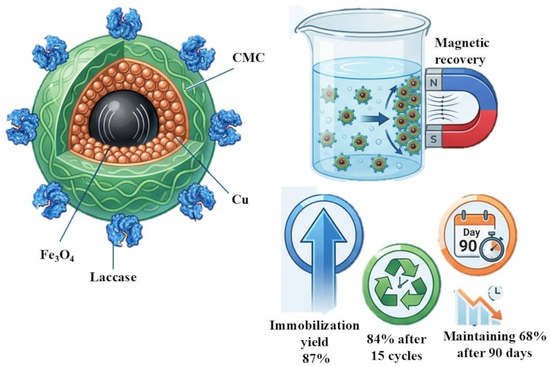
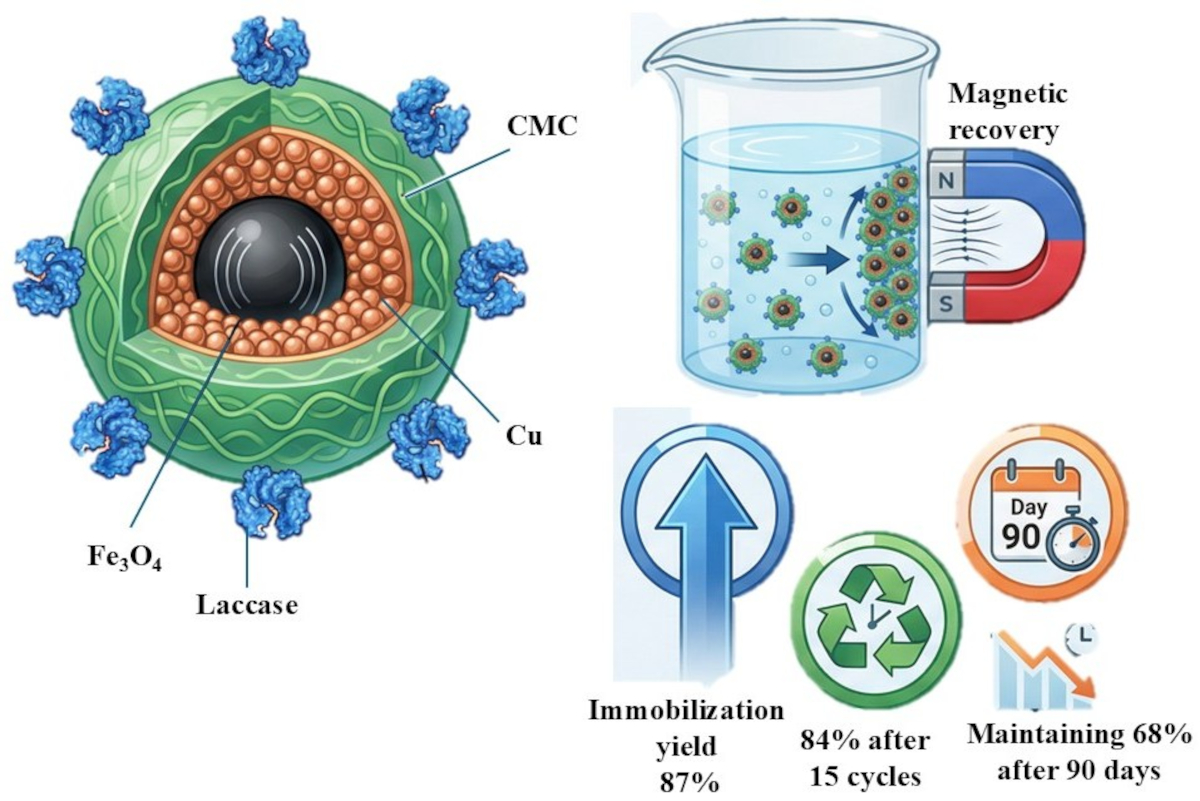
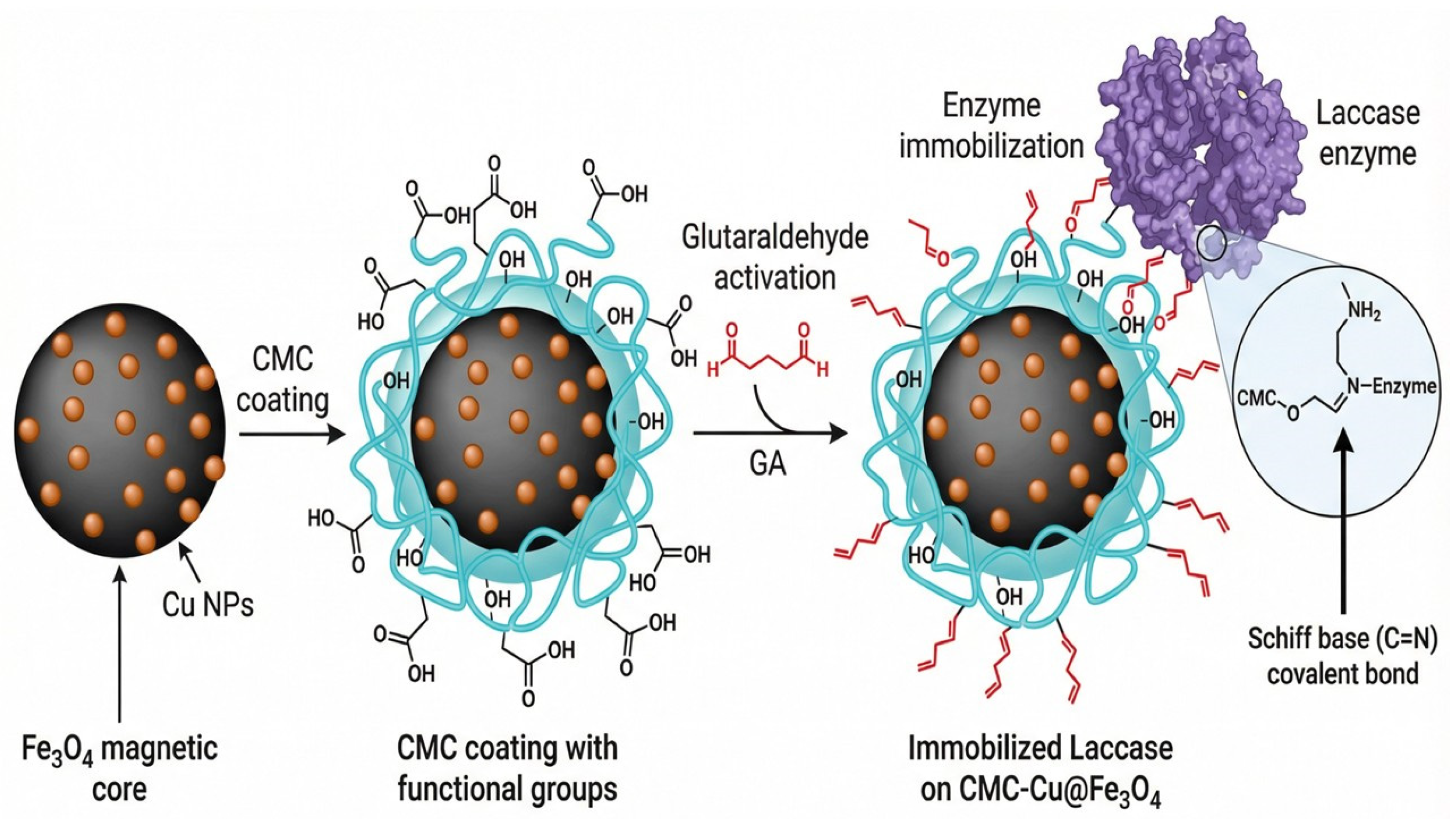
The successful synthesis of the multifunctional CMC–Cu@Fe3O4 nanocomposite represents a foundational step toward the development of a high-performance and magnetically recoverable biocatalytic system. The primary objective of this carrier design was to combine efficient magnetic separation with a stable and favorable microenvironment for laccase immobilization. The effectiveness of the synthesized nanocomposite as an immobilization matrix was reflected by a high immobilization yield of 87%, indicating strong enzyme–support interactions and efficient utilization of the carrier surface. This high immobilization efficiency can be attributed to several synergistic features inherent in the rational design of the CMC–Cu@Fe3O4 system. The carboxymethyl cellulose (CMC) coating plays a central role by providing a hydrophilic and biocompatible interface enriched with abundant carboxyl (–COOH) and hydroxyl (–OH) functional groups. Upon activation with glutaraldehyde, these groups become highly reactive toward the amine functionalities present on the laccase surface, enabling covalent immobilization through the formation of stable Schiff base linkages. Compared to physical adsorption, this covalent immobilization strategy ensures strong enzyme anchoring, minimizes enzyme leaching during washing and catalytic cycles, and contributes to improved operational robustness of the biocatalyst.
It is important to emphasize that the enhanced catalytic performance observed for the Lac@CMC–Cu@Fe
3O
4 system arises from the integrated and multifunctional nature of the carrier rather than from the isolated contribution of a single component. In this composite architecture, the Fe
3O
4 core provides magnetic separability, the CMC matrix offers a functional and biocompatible immobilization interface, and the incorporated copper species contributes to tailoring the local catalytic microenvironment. Although the laccase is immobilized within the polymeric CMC layer, the beneficial influence of copper does not necessarily require direct metal–enzyme contact at the molecular level. In immobilized enzyme systems, embedded metal species can modulate local electrostatic properties, hydration behavior, and proton distribution near the enzyme active site, thereby influencing catalytic activity and operational behavior. Accordingly, the improved performance of the Lac@CMC–Cu@Fe
3O
4 biocatalyst should be understood as the outcome of a synergistic interaction between the polymeric coating, magnetic core, and copper-containing components of the carrier, consistent with the system-level design strategy adopted in this study. To facilitate a clearer understanding of the immobilization mechanism, a schematic illustration of the laccase binding process onto the CMC–Cu@Fe
3O
4 carrier is provided in
Scheme 1. As illustrated, the CMC coating supplies abundant carboxyl and hydroxyl groups that are activated by glutaraldehyde, enabling covalent attachment of laccase through Schiff base formation with surface-exposed amine groups of the enzyme.
When compared with the existing literature, the 87% immobilization yield achieved in this study is highly competitive and underscores the efficacy of the CMC–Cu@Fe
3O
4 platform. For instance, recent studies have explored a variety of supports for laccase immobilization, with varying degrees of success. Almulaiky et al. (2024) reported a high immobilization efficiency of 91% using a chitosan-alginate biopolymer composite modified with Fe
3O
4 nanoparticles, demonstrating the potential of polysaccharide-based carriers [
15]. Similarly, Patel et al. (2022) achieved a yield of 93.1% on copper–magnetic nanoparticles, though this required a multi-step functionalization process with 3-aminopropyltriethoxysilane [
12]. In another study, Wang et al. (2020) reported an exceptionally high immobilization efficiency of 98.6% on Cu
2+-chelated magnetic silica; however, this was coupled with a lower activity recovery of 62.1%, suggesting potential enzyme denaturation [
16]. In contrast, a study by Alotaibi et al. (2025) utilizing a novel support made of nickel ferrite-coated acrylic fabric reported an enzyme loading capacity (yield) of 82% [
17].
Viewed in this context, the 87% yield of the CMC–Cu@Fe3O4 nanocomposite is a significant achievement. It surpasses the performance of some recently developed hybrid supports and remains highly competitive with more complex biopolymer and functionalized nanoparticle systems. The result suggests that our approach strikes an effective balance, achieving a high density of active, covalently bound enzymes without an overly complex synthesis protocol. Therefore, the CMC–Cu@Fe3O4 nanocomposite represents a highly effective and practical support for laccase immobilization, offering a superior combination of high yield and a straightforward, scalable synthesis procedure for industrial and environmental applications.
2.1. XRD Analysis
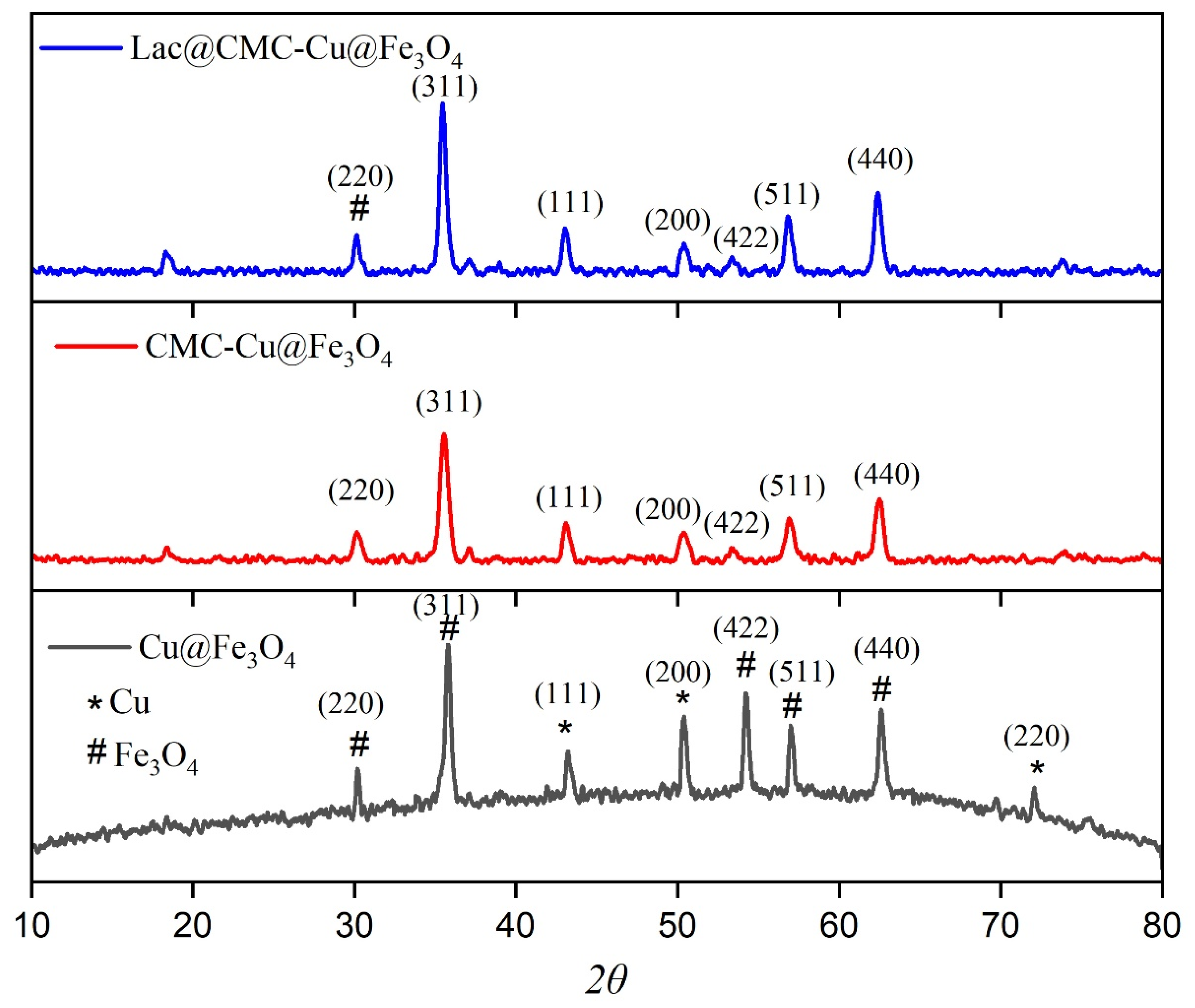
The crystalline structure and phase composition of the nanoparticles at each stage of synthesis were investigated using X-ray diffraction (XRD), with the results presented in
Figure 1. The XRD pattern of the initial Cu@Fe
3O
4 composite displays a series of well-defined diffraction peaks, confirming its crystalline nature. The peaks observed at 2θ values of 30.1°, 35.5°, 57.0°, and 62.6° correspond to the (220), (311), (511), and (440) crystallographic planes, respectively. These peaks are in excellent agreement with the standard diffraction pattern of the cubic spinel structure of magnetite (Fe
3O
4), as documented in JCPDS card No. 19-0629. In addition to the magnetite phase, distinct peaks are also visible at 43.3°, 50.4°, and 74.1°, which can be indexed to the (111), (200), and (220) planes of the face-centered cubic (FCC) structure of metallic copper (Cu), consistent with JCPDS card No. 04-0836. The presence of both sets of peaks provides clear evidence for the successful formation of a hybrid nanocomposite containing both Fe
3O
4 and Cu crystalline phases. After coating the nanoparticles with carboxymethyl cellulose, the resulting CMC–Cu@Fe
3O
4 composite was analyzed. The XRD pattern of this material is nearly identical to that of the uncoated Cu@Fe
3O
4. All the characteristic diffraction peaks for both Fe
3O
4 and Cu are preserved at their original positions, and no new crystalline peaks appear. This indicates that the CMC coating process did not alter the core crystalline structure of the inorganic nanoparticles. The absence of distinct peaks for CMC is expected, as the polymer is amorphous or has very low crystalline, and its presence is better confirmed by FT-IR analysis.
The XRD pattern of the laccase-immobilized biocatalyst, Lac@CMC–Cu@Fe3O4, shows no significant changes compared to the CMC-coated support. The diffraction peaks corresponding to Fe3O4 and Cu remain sharp and well defined, confirming that the structural integrity of the nanocomposite was fully maintained throughout the enzyme immobilization procedure. This demonstrates the stability of the support material under the conditions used for covalent attachment. Collectively, the XRD results provide conclusive evidence of the successful, step-by-step synthesis of the final biocatalyst, confirming the retention of the crystalline phases of magnetite and copper in the final product.
2.2. FT-IR Analysis for Surface Functionalization
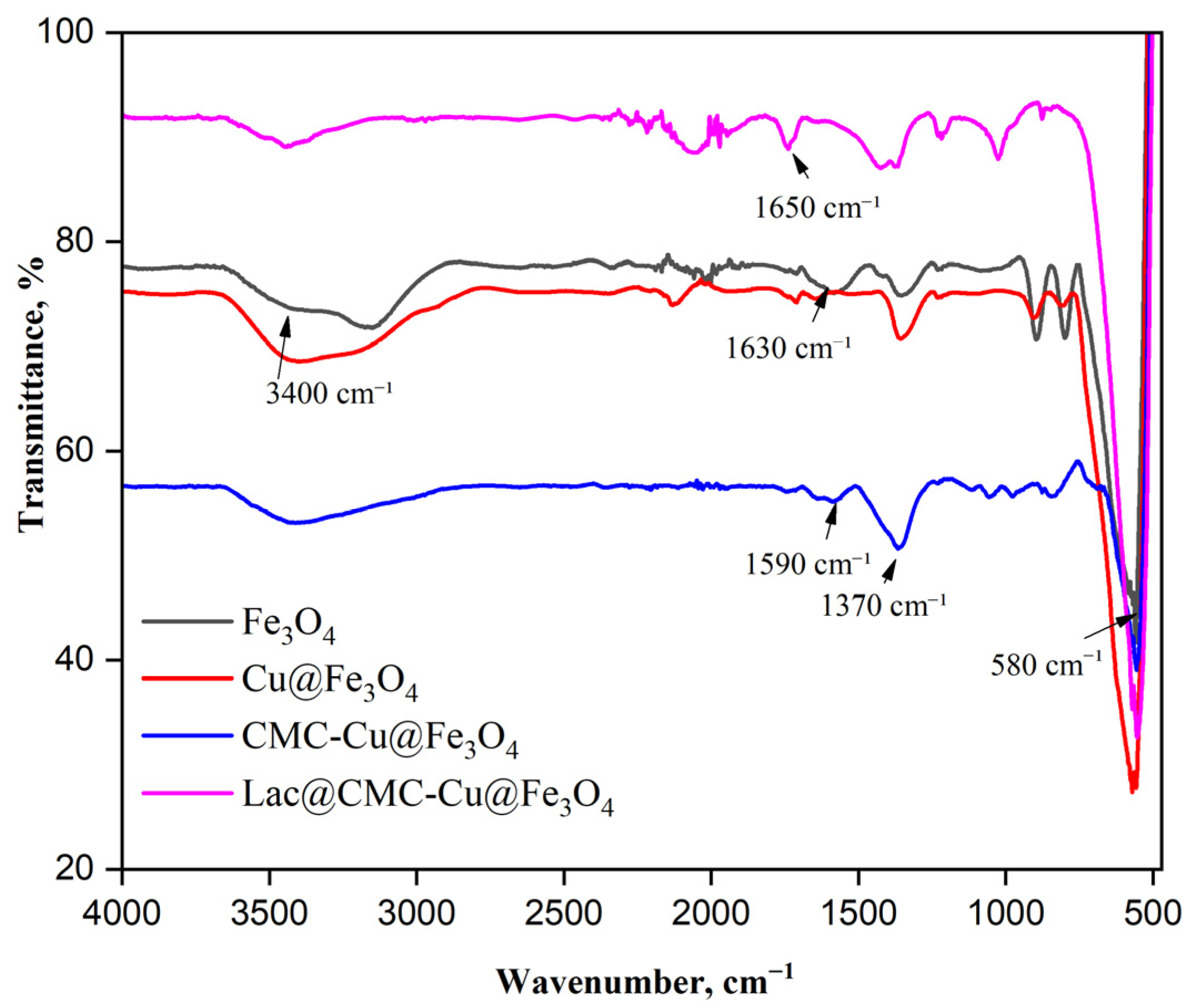
FT-IR spectroscopy was employed to verify the successful surface modification of the nanoparticles at each stage of the synthesis, and the resulting spectra are presented in
Figure 2. The spectrum for the bare Fe
3O
4 nanoparticles shows a prominent, sharp absorption band at 580 cm
−1. This peak is characteristic of the Fe-O stretching vibration in the tetrahedral sites of the magnetite spinel structure, confirming the formation of the core magnetic material. The broad absorption band centered around 3400 cm
−1 and the smaller peak at 1630 cm
−1 are attributed to the O-H stretching and H-O-H bending vibrations of physically adsorbed water molecules on the nanoparticle surface, respectively. Upon the introduction of copper, the spectrum of Cu@Fe
3O
4 remains largely unchanged compared to that of pure Fe
3O
4. The characteristic Fe-O vibration at 580 cm
−1 is still present, indicating that the core magnetite structure was preserved during the deposition of copper nanoparticles. A significant change in the spectrum is observed after the coating with carboxymethyl cellulose (CMC–Cu@Fe
3O
4). New, distinct absorption bands appear, confirming the successful functionalization of the nanoparticle surface. A strong, broad band is visible in the region of 3400 cm
−1, corresponding to the O-H stretching vibrations from the abundant hydroxyl groups of the CMC polymer. Furthermore, new peaks emerge at 1590 cm
−1 and 1370 cm
−1, which are assigned to the asymmetric and symmetric stretching vibrations of the carboxylate groups (COO
−) of CMC, respectively. The appearance of these characteristic CMC peaks provides unequivocal evidence that the polymer was successfully coated onto the surface of the Cu@Fe
3O
4nanoparticles. In the final step, the spectrum of the immobilized laccase, Lac@CMC–Cu@Fe
3O
4, provides evidence of successful enzyme attachment. In addition to the peaks from the CMC–Cu@Fe
3O
4 support, new characteristic peaks associated with the protein structure of laccase appear. A prominent band is observed around 1650 cm
−1, which is attributed to the Amide I band (C=O stretching) of the peptide bonds in the laccase enzyme [
3]. This band overlaps with the carboxylate peak from CMC, resulting in a broader and more intense signal in this region. Furthermore, a new shoulder appears around 1540 cm
−1, corresponding to the Amide II band (N-H bending and C-N stretching) [
3]. The presence of these amide bands is a clear indicator of the successful covalent immobilization of laccases onto the nanocomposite surface.
2.3. Magnetic Properties Analysis
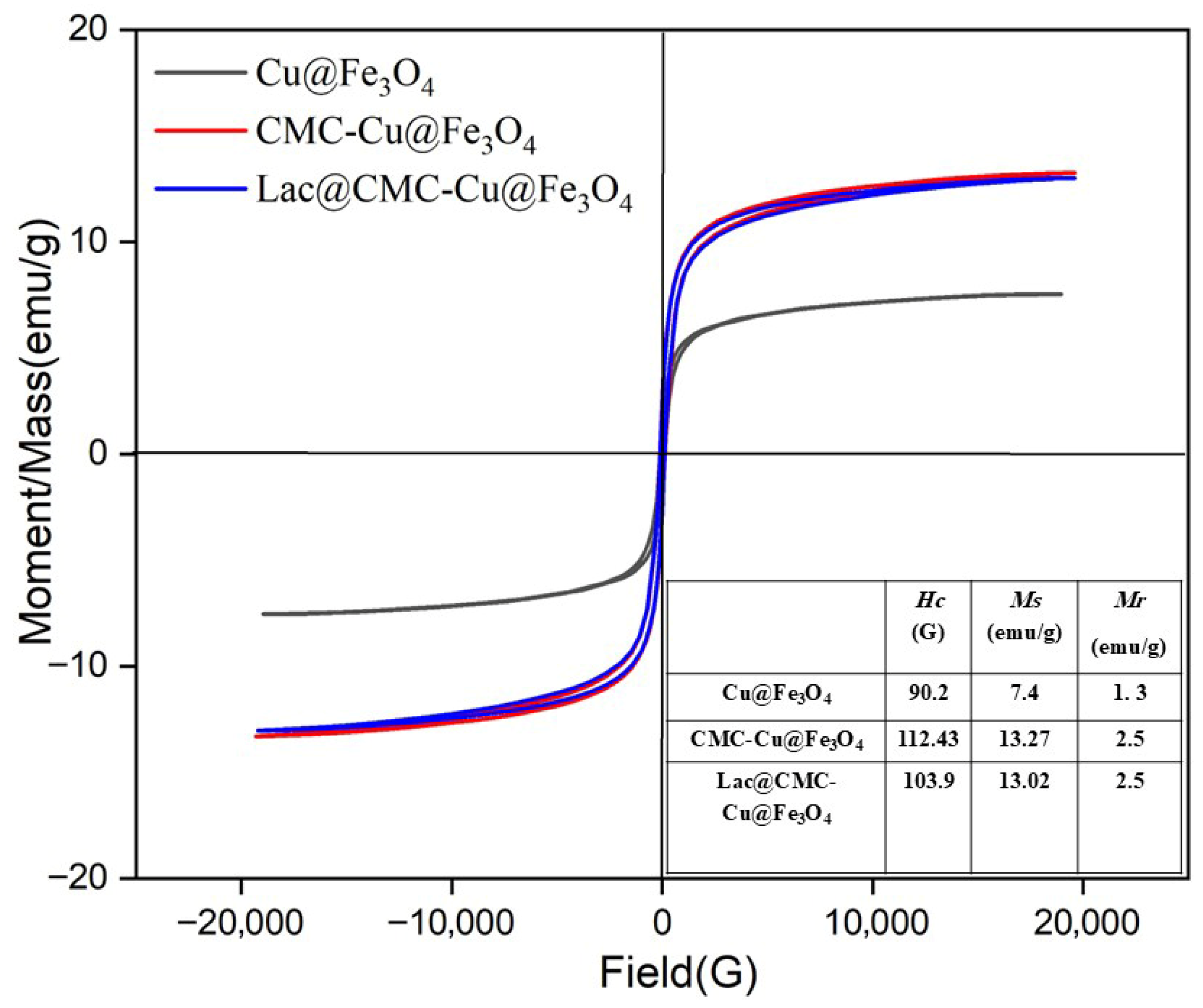
The magnetic properties of the synthesized nanocomposites, which are critical for their practical application in magnetically controlled separation and recovery, were investigated using a vibrating sample magnetometer (VSM) at room temperature. As shown in
Figure 3, all three materials exhibit characteristic S-shaped hysteresis loops, confirming their ferromagnetic nature. The key magnetic parameters—coercivity (Hc), saturation magnetization (Ms), and remanence (Mr)—are summarized in the inset table. The very low values of both coercivity (90.2–112.4 G) and remanence (1.3–2.5 emu/g) are indicative of soft magnetic or superparamagnetic-like behavior. This property is highly advantageous, as it ensures that the nanoparticles can be easily magnetized for separation but do not retain significant magnetism after the external field is removed, thus preventing aggregation and allowing for easy redispersion [
18].
The evolution of the saturation magnetization (Ms) at each stage of synthesis provides valuable insight into the structural changes in the nanocomposite. The initial Cu@Fe
3O
4 nanoparticles displayed an Ms value of 7.4 emu/g. Following the coating with carboxymethyl cellulose, the Ms of the CMC-Cu@Fe
3O
4 composite unexpectedly increased to 13.27 emu/g. While coating a magnetic core with a non-magnetic polymer layer typically decreases the overall Ms due to an increase in non-magnetic mass [
19], such an increase has been documented in some cases. It can be attributed to factors such as improved crystallinity of the magnetic core during the thermal treatment of the coating process, which can reduce surface spin disorder (the “magnetically dead layer”) and lead to a higher net magnetization [
20,
21]. Upon enzyme immobilization, the Ms of the final Lac@CMC-Cu@Fe
3O
4 biocatalyst decreased slightly to 13.02 emu/g. This reduction is an expected outcome, confirming the successful attachment of a non-magnetic laccase layer, which adds to the total mass of the composite [
19].
An analysis of the coercivity and remanence further supports the successful synthesis of a high-performance magnetic carrier. The coercivity increased from 90.2 G to 112.4 G after CMC coating, a change that may be related to increased surface anisotropy or modified inter-particle interactions caused by the polymer matrix. Both the remanence (Mr = 2.5 emu/g) and the squareness ratio (Mr/Ms ≈ 0.19) for the final biocatalyst are very low, confirming its excellent redispersibility. Ultimately, the final Ms value of 13.02 emu/g is robust and well within the range required for effective magnetic separation, comparing favorably with other functional magnetic biocatalysts [
19]. The combination of a high saturation magnetization for rapid collection and a low remanence for preventing aggregation confirms that the Lac@CMC-Cu@Fe
3O
4 composite is a highly effective and magnetically recoverable system ideal for repeated use.
2.4. Surface Area, Porosity, and Surface Charge Analysis
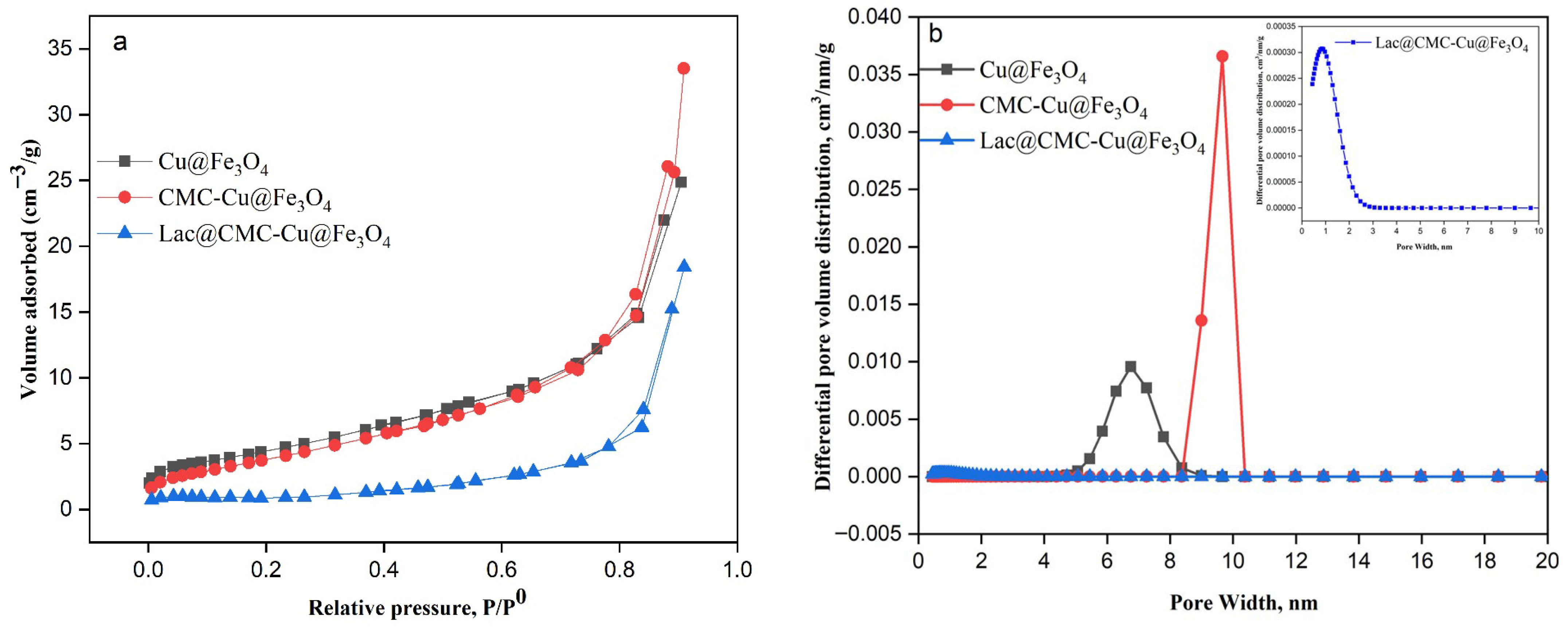
The textural properties and surface charge of the nanocomposites were investigated to understand the physical changes occurring at each modification step. The nitrogen adsorption–desorption isotherms for all three materials are presented in
Figure 4a. According to the IUPAC classification, the isotherms are Type IV with a distinct H3-type hysteresis loop at high relative pressures (P/P
0 > 0.6). This behavior is characteristic of mesoporous materials containing slit-shaped pores, which typically arise from the aggregation of plate-like particles [
22].
The specific surface area (S
BET), pore characteristics, and zeta potential are summarized in
Table 1. The initial Cu@Fe
3O
4 nanoparticles exhibited a BET surface area of 17.81 m
2/g. After coating with carboxymethyl cellulose, the surface area of the CMC-Cu@Fe
3O
4 composite decreased slightly to 16.2 m
2/g. This reduction is attributed to the partial blockage of surface micropores and voids by the CMC polymer chains [
23]. A more dramatic change occurred after enzyme immobilization, with the surface area of the final Lac@CMC-Cu@Fe
3O
4 biocatalyst dropping sharply to 4.97 m
2/g. This significant decrease is strong evidence for the successful immobilization of laccases, as the large enzyme molecules occupy the mesopores and cover the external surface of the support, thereby preventing nitrogen molecules from accessing the pore network [
24].
The pore size distribution, derived from the BJH model (
Figure 4b), reveals further details. The initial Cu@Fe
3O
4 shows a pore distribution centered around 7 nm. Interestingly, after CMC coating, the average pore diameter and total pore volume increased (
Table 1), with a new, more intense peak appearing at approximately 9.5 nm in the distribution plot. This suggests that while some original pores may be blocked, the polymer coating creates new, larger interstitial voids between the aggregated nanoparticles, leading to an overall increase in the measured average pore size. Following laccase immobilization, these pores are effectively filled, as evidenced by the near-complete disappearance of the pore volume distribution peak and a massive reduction in the total pore volume (from 0.050 to 0.005 cm
3/g), confirming that the enzyme has been successfully loaded into the porous structure of the support.
Zeta potential measurements provide definitive confirmation of the surface modifications. The bare Cu@Fe
3O
4 nanoparticles exhibited a strong positive surface charge of +34.5 mV, which is typical for metal oxide nanoparticles in aqueous suspension. Upon coating with CMC, an anionic polymer rich in carboxylate groups, the surface charge reversed to −3.48 mV. This charge inversion is unequivocal proof that the CMC polymer successfully encapsulated the nanoparticles, masking their original positive surface and imparting a net negative charge [
25]. After the final immobilization step, the zeta potential of the Lac@CMC-Cu@Fe
3O
4 biocatalyst shifted to a near-neutral value of +1.93 mV. This change confirms the presence of laccase, as the protein’s own surface charges modify the overall zeta potential of the composite [
26]. Collectively, these analyses of surface area, porosity, and surface charge provide a cohesive and comprehensive confirmation of the successful, step-by-step fabrication of the final nanobiocatalyst.
2.5. Morphological and Elemental Analysis
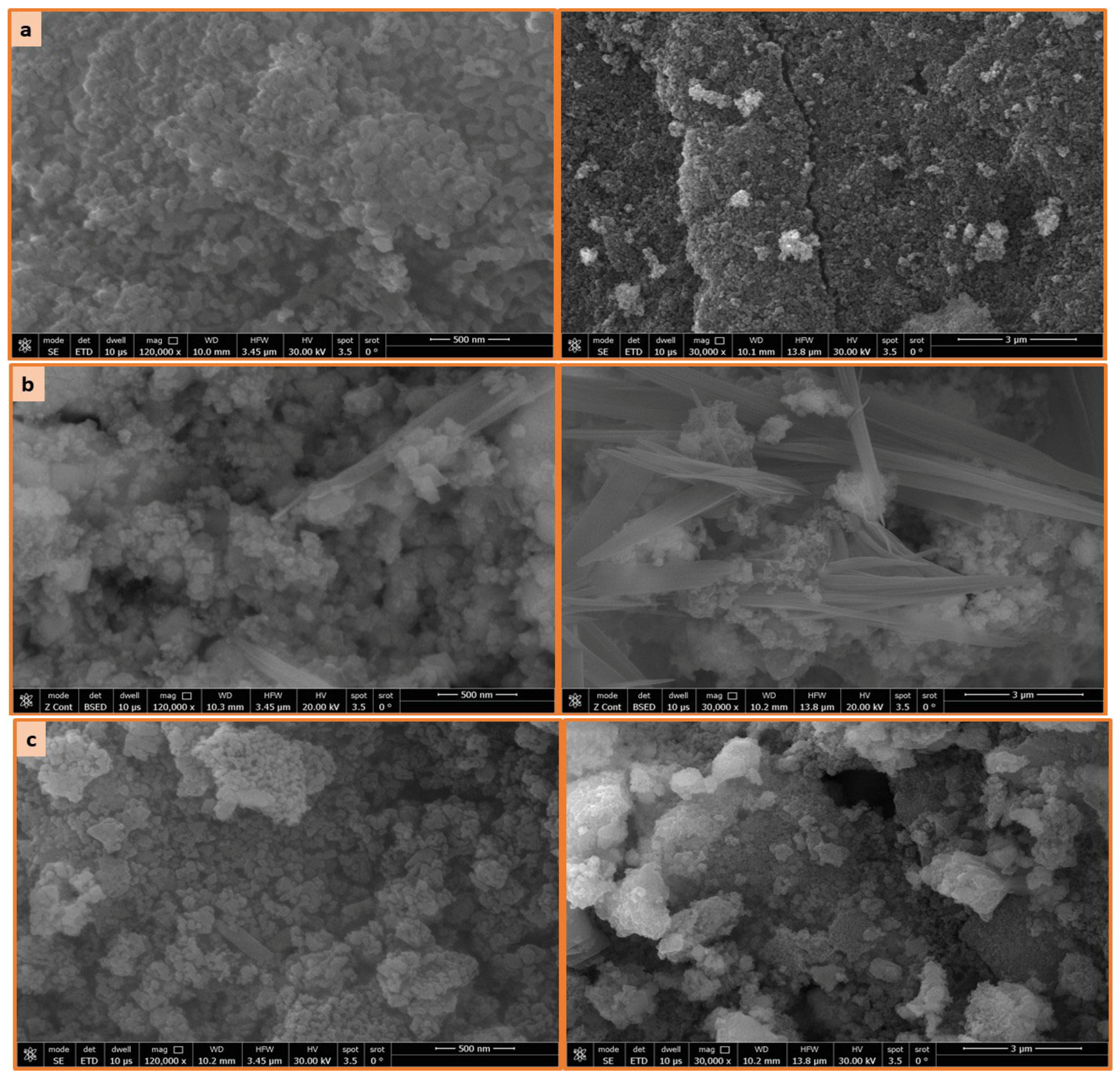
The surface morphology and elemental composition of the nanocomposites were investigated using Field Emission Scanning Electron Microscopy (FESEM) coupled with Energy-Dispersive X-ray Spectroscopy (EDX) (Bruker Nano GmbH, Berlin, Germany). The FESEM micrograph of the initial Cu@Fe
3O
4 nanoparticles (
Figure 5a) reveals that the material consists of small, quasi-spherical nanoparticles that have formed into larger, dense aggregates. This aggregation is a typical characteristic of bare magnetic nanoparticles, which tend to cluster together due to strong inter-particle magnetic dipole–dipole interactions. A significant transformation in the surface morphology is evident after the nanoparticles were coated with carboxymethyl cellulose. As seen in the FESEM image of CMC-Cu@Fe
3O
4 (
Figure 5b), the underlying nanoparticle aggregates are now enveloped by a new, distinct phase appearing as thin, overlapping, sheet-like structures characteristic of the CMC polymer matrix. Following the final immobilization step, the morphology of the Lac@CMC-Cu@Fe
3O
4 biocatalyst (
Figure 5c) is again visibly different. The sharp edges of the CMC sheets are no longer as defined, and the overall surface appears rougher and more granular, consistent with the successful immobilization of a dense layer of laccase enzyme molecules.
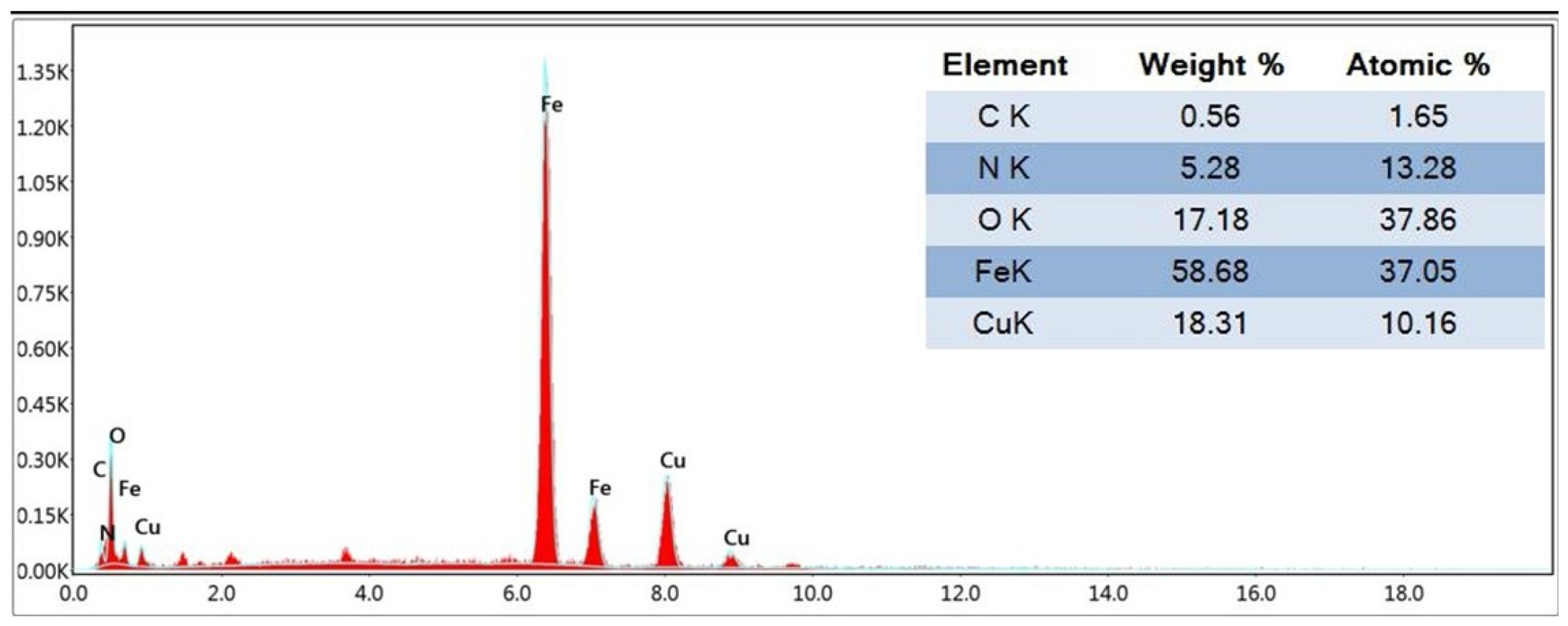
To confirm the chemical composition and the successful immobilization of the enzyme, EDX analysis was performed on the final Lac@CMC-Cu@Fe
3O
4 biocatalyst. The resulting spectrum and elemental composition table are presented in
Figure 6. The analysis confirms the presence of all expected elements. Strong signals for iron (Fe, 58.68 wt%) and copper (Cu, 18.31 wt%) are detected, corresponding to the core inorganic components of the nanocomposite. A significant oxygen (O, 17.18 wt%) signal is also present, originating from the magnetite (Fe
3O
4), the CMC polymer, and the laccase enzyme. Critically, the spectrum shows a clear signal for nitrogen (N, 5.28 wt%). Since neither the magnetic core nor the CMC polymer contains nitrogen, the presence of this element serves as definitive proof of the successful immobilization of the laccase enzyme, which is rich in nitrogen-containing amine and amide groups. The small carbon signal (C, 0.56 wt%) is also consistent with the presence of organic CMC and laccase components. Taken together, the FESEM and EDX results provide a complete picture, confirming both the morphological evolution and the elemental composition of the nanocomposite at each stage of its fabrication.
2.6. Enzyme Kinetic Behavior
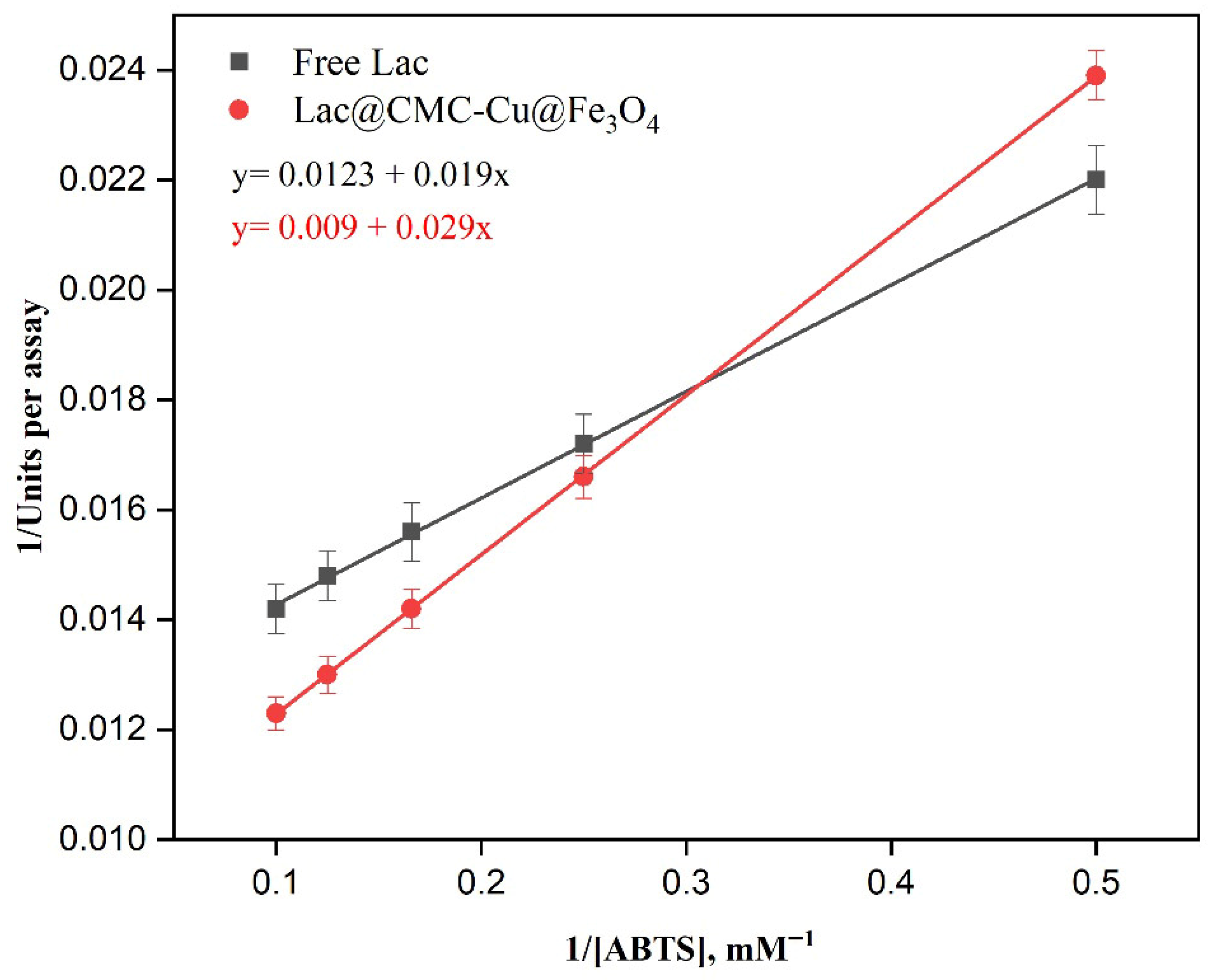
The kinetic parameters of the free and immobilized laccase were determined to understand the effects of immobilization on the enzyme’s catalytic efficiency. The Michaelis constant (Km) and maximum reaction velocity (Vmax) were calculated from the Lineweaver–Burk double-reciprocal plots shown in
Figure 7. For the free laccase, the Km was found to be 1.54 mM with a Vmax of 81.3 µmol/min. Upon immobilization, the kinetic parameters of the Lac@CMC-Cu@Fe
3O
4 biocatalyst changed significantly, exhibiting a Km of 3.22 mM and a Vmax of 111 µmol/min. The increase in the Km value from 1.54 mM to 3.22 mM indicates a lower affinity of the immobilized laccase for the ABTS substrate compared to its free counterpart. This is a commonly observed phenomenon in enzyme immobilization and can be attributed to several factors. The covalent attachment process can induce minor conformational changes in the enzyme’s structure, potentially altering the geometry of the active site. Furthermore, the surrounding polymer matrix may introduce steric hindrance or diffusion limitations, making it more difficult for substrate molecules to access the active sites, which manifests as a higher apparent Km [
27,
28]. More remarkably, the Vmax of the laccase increased by approximately 37% after immobilization, from 81.3 µmol/min to 111 µmol/min. This enhancement is a highly desirable outcome, suggesting that the nanocomposite support provides a favorable microenvironment that enhances the enzyme’s intrinsic catalytic activity. The multipoint covalent attachment likely rigidifies the enzyme’s structure, locking it into a highly active conformation and preventing unproductive structural fluctuations [
29]. It is noteworthy that our observed Vmax of 111 µmol/min is identical to the value reported by Almulaiky et al. (2024) for their laccase immobilized on a chitosan-alginate-Fe
3O
4 composite, which further validates the exceptional performance of our system [
15]. This significant increase in catalytic turnover rate, despite the slight reduction in substrate affinity, demonstrates the overall superiority of the Lac@CMC-Cu@Fe
3O
4 biocatalyst for practical applications.
2.7. Impact of Temperature and pH on Catalytic Activity
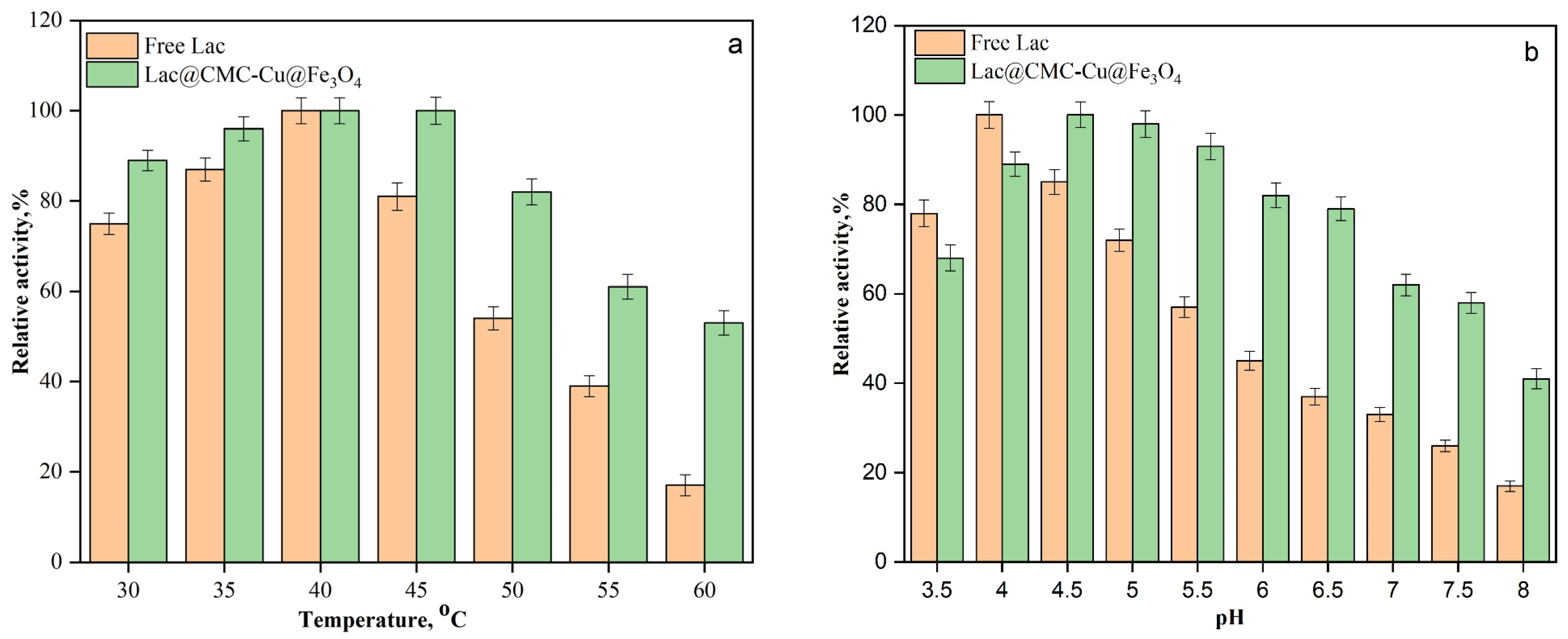
The catalytic activity of both free and immobilized laccase was investigated as a function of temperature and pH to determine their optimal operational conditions, with the results presented in
Figure 8.
The effect of temperature on enzyme activity was investigated from 30 °C to 60 °C, as shown in
Figure 8a. The free laccase exhibited its maximum activity at 40 °C, beyond which its activity declined sharply. At 60 °C, the free enzyme lost 83% of its activity which is indicative of significant thermal denaturation. In stark contrast, the immobilized Lac@CMC-Cu@Fe
3O
4 biocatalyst demonstrated markedly enhanced thermal stability. It displayed a broader optimal temperature range, maintaining peak activity between 40 °C and 45 °C. More impressively, at 60 °C, the immobilized laccase retained 53% of its maximum activity. This substantial improvement in thermal resistance is a direct benefit of the immobilization process. The multipoint covalent attachment of the enzyme to the rigid nanocomposite support restricts its conformational flexibility, preventing the protein from unfolding at elevated temperatures and thereby preserving its catalytic function [
13,
30].
The pH profile of an enzyme is crucial as it dictates the ionization state of both the enzyme’s active site and the substrate. As shown in
Figure 8b, the free laccase exhibited a narrow pH activity profile with a maximum at pH 4.0, followed by a sharp decline in activity under neutral and alkaline conditions. In contrast, the immobilized laccase displayed a slight shift in the optimal pH to 4.5 and, more importantly, a markedly broader pH activity profile. The immobilized biocatalyst maintained enhanced activity across the entire investigated pH range, particularly under neutral to alkaline conditions. Notably, at pH 8.0, where the free laccase exhibited negligible catalytic activity, the immobilized enzyme retained 41% of its maximum activity. This broadening of the pH activity profile is a well-documented consequence of enzyme immobilization. Laccase from
Trametes versicolor has a reported isoelectric point (pI) in the range of 3.0–4.0 [
31], meaning that the enzyme carries a net negative charge at neutral and alkaline pH values. Immobilization onto the CMC–Cu@Fe
3O
4 support likely modifies the local electrostatic environment around the enzyme, influencing proton distribution and substrate–enzyme interactions. The support matrix may create a microenvironment with a pH distinct from that of the bulk solution, effectively buffering the enzyme against abrupt pH variations. In addition, surface charges on the support can facilitate proton partitioning, helping to maintain more favorable conditions near the active site [
3,
32]. As a result, the immobilized Lac@CMC–Cu@Fe
3O
4 system exhibits improved catalytic performance over a wider pH range, which is highly advantageous for practical applications such as wastewater treatment, where pH conditions are often variable and difficult to control.
2.8. Stability in the Presence of Organic Solvents
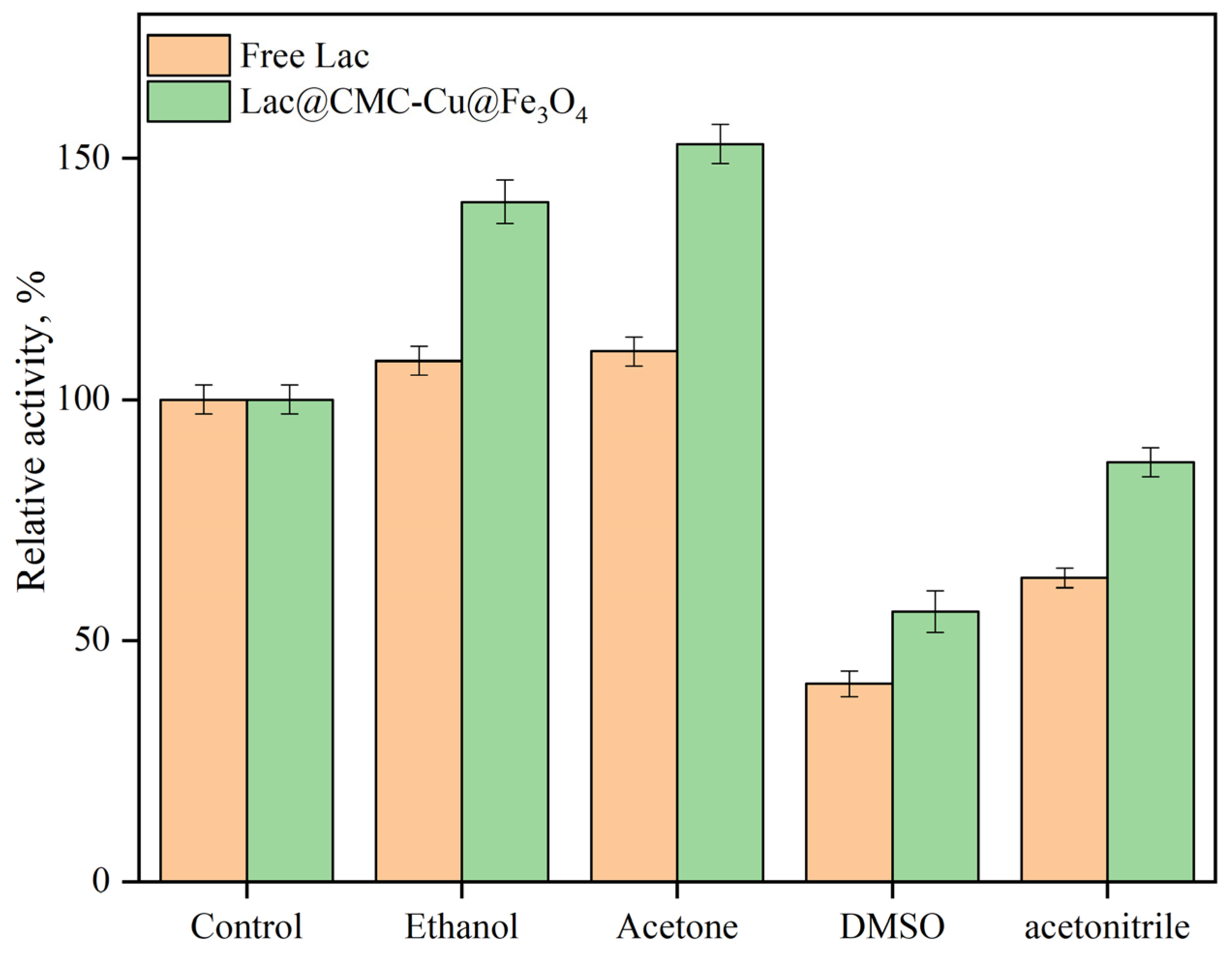
The stability of enzymes in the presence of organic solvents is a critical parameter for many industrial and environmental applications where reactions are often carried out in mixed aqueous–organic media. The performance of both free and immobilized laccases was evaluated after incubation with 10% (
v/
v) of four common water-miscible solvents: ethanol, acetone, dimethyl sulfoxide (DMSO), and acetonitrile. The results, shown in
Figure 9, reveal a remarkable enhancement in the stability and even activity of the immobilized biocatalyst.
A striking observation was the significant activation of the enzyme in the presence of ethanol and acetone. The free laccase exhibited a modest increase in activity to 108% and 110% in ethanol and acetone, respectively. However, the immobilized Lac@CMC-Cu@Fe
3O
4 biocatalyst showed a much more pronounced activation, reaching an impressive 141% relative activity in ethanol and 153% in acetone. While enzymes are often denatured by organic solvents, activation by certain low-concentration solvents like ethanol and acetone has been reported for laccases. This phenomenon is believed to arise from solvent-induced conformational changes that render the enzyme structure more flexible and accessible, leading to a more efficient catalytic state [
33,
34]. The greater activation observed for the immobilized enzyme suggests a synergistic effect; the rigid support may prevent excessive, denaturing structural changes while the solvent induces beneficial flexibility in key regions of the enzyme, leading to a hyper-activated state.
Conversely, DMSO and acetonitrile proved to be inhibitory to both enzyme forms, which is a more typical outcome for enzyme–solvent interactions. These solvents can strip the essential hydration layer from the enzyme surface, leading to denaturation and a loss of activity [
35]. In the presence of DMSO, the free laccase lost nearly 60% of its activity, retaining only 41%. The immobilized laccase, however, proved significantly more robust, retaining 56% of its activity under the same conditions. A similar trend was observed with acetonitrile, where the free enzyme retained 63% of its activity, while the immobilized version retained a much higher 87%.
This enhanced tolerance to inhibitory solvents is a direct benefit of the immobilization strategy. The hydrophilic CMC polymer layer on the nanocomposite surface likely helps to maintain a local aqueous microenvironment around the laccase, shielding it from the full denaturing effect of the bulk organic solvent. Furthermore, the multipoint covalent attachment to the rigid support prevents the enzyme from unfolding, thereby preserving its structural integrity and catalytic function [
36]. The superior performance of the Lac@CMC-Cu@Fe
3O
4 biocatalyst in all tested solvents—being either less inhibited or more activated than its free counterpart—unequivocally demonstrates its enhanced stability and suitability for applications in complex reaction media.
2.9. Reusability and Storage Stability
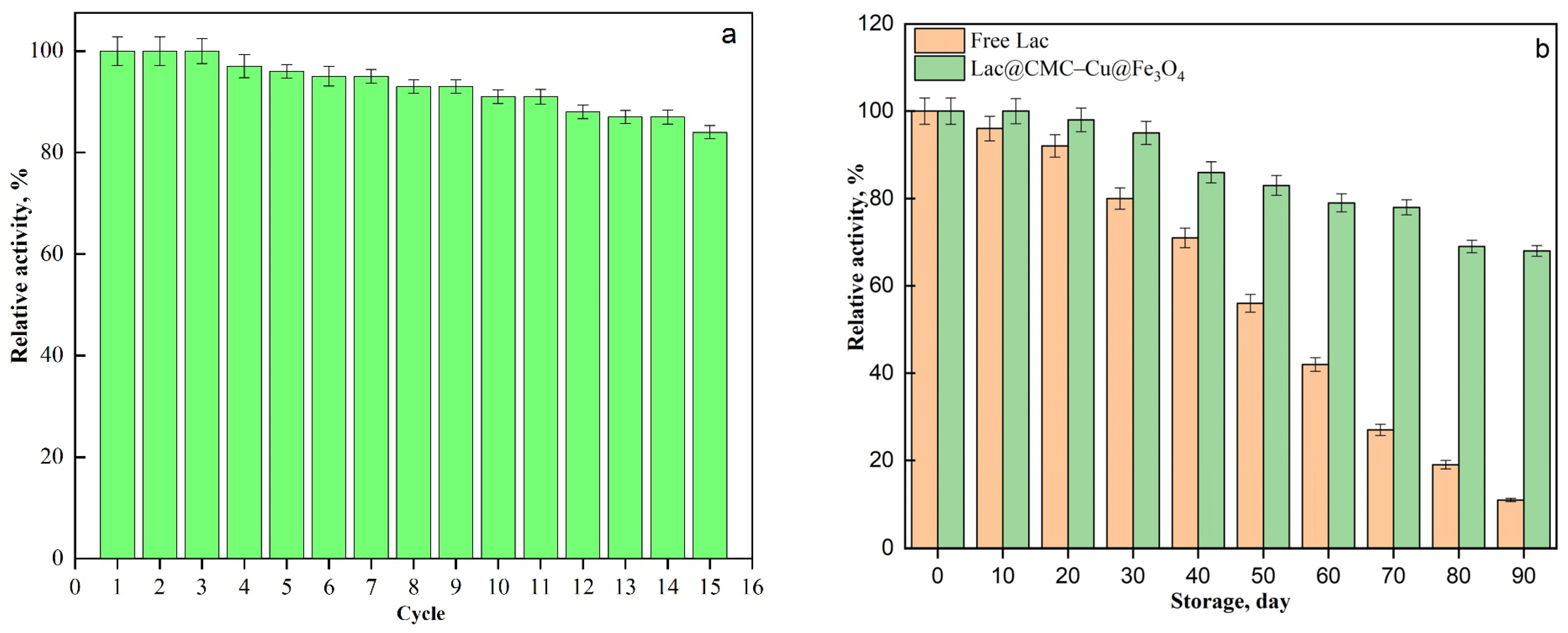
The economic viability of an immobilized enzyme system is heavily dependent on its operational reusability and long-term storage stability. These two parameters were assessed for the Lac@CMC-Cu@Fe
3O
4 biocatalyst, and the results, presented in
Figure 10, highlight the profound practical advantages conferred by the immobilization strategy. The operational stability of the biocatalyst was evaluated over 15 consecutive cycles of ABTS oxidation. As shown in
Figure 10a, the immobilized laccase demonstrated exceptional durability. After 10 consecutive cycles, the biocatalyst maintained an outstanding 91% of its initial activity, and even after 15 cycles, it still maintained 84% of its performance. This minimal loss of activity over numerous cycles is a hallmark of successful immobilization. The robust covalent linkages between the enzyme and the support prevent the laccase from leaching into the reaction medium, while the magnetic nature of the support allows for near-lossless recovery after each cycle. This level of reusability is superior to many other reported systems; for instance, Wang et al. (2021) reported that their immobilized laccase retained only 45.1% of its activity after just 6 cycles [
37]. The excellent operational stability of the Lac@CMC-Cu@Fe
3O
4 composite significantly lowers the operational cost and underscores its potential for large-scale industrial and environmental applications.
The long-term storage stability of the free and immobilized laccase was monitored over a period of 90 days at 4 °C (
Figure 10b). The results clearly demonstrate the dramatic stabilizing effect of immobilization. The free laccase was highly unstable, losing nearly 90% of its activity over the 90-day period and retaining only about 11% of its initial performance. This loss is likely due to microbial degradation, aggregation, or slow denaturation over time. In sharp contrast, the immobilized Lac@CMC-Cu@Fe
3O
4 biocatalyst exhibited excellent storage stability, retaining 68% of its initial activity after the same 90-day period. This remarkable preservation of activity is due to the protective microenvironment provided by the nanocomposite support and the structural rigidity conferred by the multipoint covalent attachment. The immobilization physically isolates the enzyme molecules from each other, preventing aggregation, and the rigid support structure protects the enzyme from denaturation [
38,
39]. This pronounced enhancement in storage stability is crucial for the practical deployment of the biocatalyst, as it allows for long-term storage and intermittent use without a significant loss of function.
Beyond fundamental characterization, the catalytic features of the Lac@CMC–Cu@Fe3O4 system indicate strong potential for practical environmental applications, particularly in wastewater treatment processes involving phenolic compounds and synthetic dyes. Laccase enzymes are widely recognized for their ability to oxidize a broad range of recalcitrant organic pollutants, including phenols, textile dyes, and endocrine-disrupting compounds, which are commonly present in industrial effluents.
The broadened pH activity range and enhanced catalytic performance of the immobilized laccase under neutral to mildly alkaline conditions are especially relevant for real wastewater matrices, where strict pH control is often impractical. Moreover, the improved thermal tolerance and high immobilization yield contribute to sustained catalytic efficiency during repeated operation. Importantly, the magnetic Fe3O4 core enables rapid and efficient separation of the biocatalyst from treated effluents using an external magnetic field, facilitating catalyst recovery and reuse while minimizing secondary contamination.
Taken together, these attributes suggest that the Lac@CMC–Cu@Fe3O4 biocatalyst is well suited for integration into batch or continuous-flow treatment systems for pollutant degradation. The system-level design demonstrated in this study provides a promising platform for developing reusable and environmentally benign biocatalytic technologies, with potential extension to other oxidative biotransformations of industrial relevance.
3. Materials and Methods
Iron chloride hexahydrate (FeCl3·6H2O), ferrous sulfate heptahydrate (FeSO4·7H2O), copper nitrate (Cu(NO3)2), carboxymethyl cellulose (CMC), 25% ammonia solution, disodium hydrogen phosphate, sodium dihydrogen phosphate, sodium acetate, laccase from Trametes versicolor (powder, light brown, ≥0.5 U/mg, CAS Number: 80,498-15-3), and ABTS were all obtained from Sigma Aldrich (St. Louis, MO, USA).
3.1. Synthesis of Carboxymethyl Cellulose–Copper–Magnetite Nanocomposite (CMC–Cu@Fe3O4)
The synthesis process involved two main stages. In the initial stage, Fe3O4 nanoparticles were generated by dissolving FeCl3·6H2O (10 mM) and FeSO4·7H2O (5 mM) in a 2:1 molar ratio within 100 mL of deionized water. This solution was then heated to 80 °C under vigorous stirring. The pH was increased to 10 using a 25% ammonium hydroxide solution, which led to the rapid formation of a black precipitate. The reaction mixture was continuously stirred and maintained at 80 °C for an additional hour. Afterward, the Fe3O4 nanoparticles were filtrated and washed thoroughly rinsed with deionized water and ethanol to remove any impurities and dried in a vacuum oven at 60 °C for two hours. The dried material was then finely ground for subsequent use.
In the second stage, 0.5 g of the synthesized Fe3O4 nanoparticles was redispersed in 100 mL of deionized water and stirred vigorously to achieve a homogeneous suspension. Separately, a 5 mM solution of copper nitrate was prepared in 50 mL of deionized water and gradually added to the Fe3O4 suspension. Additionally, 50 mL of D. costus extract was introduced dropwise into the reaction mixture. The D. costus extract was prepared by boiling 10 g of dried rhizome powder in 100 mL of deionized water for 20 min, followed by filtration through Whatman No.1 paper. The resulting aqueous extract served as a natural reducing and stabilizing agent for the conversion of Cu2+ ions to copper nanoparticles.
The reaction was maintained at 70 °C with constant stirring for two hours, during which a visible color change indicated the formation of Cu@Fe3O4 nanoparticles. These particles were subsequently coated with 1 g of CMC and stirred for another hour at 70 °C. The final composite was retrieved by filtration, thoroughly rinsed with deionized water and ethanol to remove unreacted materials, byproducts, and dried in a vacuum oven at 60 °C for two hours. Finally, the dried CMC–Cu@Fe3O4 nanoparticles were calcinated at 600 °C for two hours to enhance their crystallinity and thermal stability.
3.2. Laccase Immobilization
To facilitate covalent immobilization, the CMC–Cu@Fe
3O
4 composite was first activated using a 2% glutaraldehyde solution to introduce reactive aldehyde groups. This step involved suspending the composite material in a 2% glutaraldehyde solution prepared in 0.1 M sodium phosphate buffer (pH 7.0), followed by gentle agitation at 30 °C for 4 h. After activation, the material was thoroughly rinsed with deionized water to remove any residual glutaraldehyde. Subsequently, laccase (10 units) was dissolved in phosphate buffer (pH 7.0) and added to the activated support. The mixture was gently rotated at room temperature (25 ± 2 °C) for 12 h to ensure uniform enzyme binding. After immobilization, the material was repeatedly washed with phosphate buffer to eliminate any unbound enzyme. The resulting laccase-immobilized composite (Lac@CMC–Cu@Fe
3O
4) was stored in phosphate buffer at 4 °C until further use. Protein concentration was assessed using the Bradford assay, with bovine serum albumin (BSA) serving as the standard [
40]. The immobilization yield (IY%) was calculated using the following formula:
3.3. Laccase Assay
Laccase activity was assessed following a method adapted from Bourbonnais et al. [
41]. The assay utilized a reaction mixture consisting of 4 mM ABTS dissolved in 50 mM sodium acetate buffer at pH 4.5. To this 1 mL solution, either a specific amount of free laccase or an equivalent quantity of its immobilized counterpart was added. The enzymatic oxidation of ABTS was tracked by recording the increase in absorbance at 420 nm at one-minute intervals. For activity calculations, a molar extinction coefficient of ε = 36,000 M
−1·cm
−1 was applied.
4. Material Characterization
X-ray diffraction (XRD)
The crystalline structure and phase composition of Fe3O4, CMC–Cu@Fe3O4, and Lac@CMC–Cu@Fe3O4 nanocomposites were analyzed by X-ray diffraction (XRD) using a Bruker D8 Advance diffractometer equipped with Cu Kα radiation (λ = 1.5418 Å) (Bruker AXS GmbH, Karlsruhe, Germany). The instrument was operated at 40 kV and 40 mA, and diffraction patterns were recorded over a 2θ range of 10–80°. Prior to analysis, the samples were dried, finely ground into powders, and uniformly spread on the sample holder to ensure consistent exposure to the incident X-ray beam.
Fourier-transform infrared (FT-IR) spectroscopy
FT-IR spectroscopy was employed to identify surface functional groups and to confirm polymer coating and enzyme immobilization. Spectra were recorded using a PerkinElmer Spectrum 100 FT-IR spectrometer (Waltham, MA, USA) equipped with an attenuated total reflectance (ATR) accessory over the spectral range of 400–4000 cm−1 at a resolution of 4 cm−1 by averaging 32 scans. Background subtraction, baseline correction, and normalization were applied prior to spectral interpretation. The samples were analyzed directly in solid form without further preparation by placing them in direct contact with the ATR crystal.
Field-emission scanning electron microscopy (FESEM)
The surface morphology and microstructural features of the nanocomposites were examined using field-emission scanning electron microscopy (FESEM, Bruker, Berlin, Germany). The samples were mounted on conductive carbon tape and sputter-coated with a thin gold layer to prevent charging effects. FESEM images were recorded at an accelerating voltage of 5–10 kV to evaluate particle size, aggregation behavior, and surface texture at different stages of modification.
Energy-dispersive X-ray spectroscopy (EDX)
Elemental composition and distribution were analyzed using energy-dispersive X-ray spectroscopy (EDX) coupled to the FESEM system (Bruker Nano XFlash 5010 detector, Berlin, Germany). EDX spectra were collected from multiple regions of each sample to ensure representative analysis. This technique was used to confirm the presence of Fe, Cu, O, C, and N, with nitrogen serving as an indicator of successful laccase immobilization.
Surface area and porosity analysis (BET, BJH, and DFT)
The specific surface area and pore characteristics of the nanocomposites were determined using nitrogen adsorption–desorption analysis at 77 K with a Quantachrome Touchwin v1.21 analyzer (Boynton Beach, FL, USA). Prior to measurements, samples were degassed under vacuum to remove adsorbed moisture and impurities. The Brunauer–Emmett–Teller (BET) method was applied to calculate the specific surface area (SBET), while pore size distribution was derived from the adsorption branch using the Barrett–Joyner–Halenda (BJH) model. Total pore volume was further evaluated using Density Functional Theory (DFT) analysis with Quantachrome ASiQwin software (version 3.01, Quantachrome Instruments, Boynton Beach, FL, USA).
Magnetic measurements (VSM)
The magnetic properties of the nanocomposites were investigated using a Lakeshore 7400 vibrating sample magnetometer (VSM, Lake Shore Cryotronics, Inc., Westerville, OH, USA) at room temperature. Magnetization curves were recorded as a function of the applied magnetic field to determine saturation magnetization, coercivity, and remanence, which are critical parameters for evaluating the magnetic separability and recyclability of the biocatalyst.
Zeta potential analysis
Surface charge and colloidal stability of the nanocomposites were assessed by zeta potential measurements using a Malvern Zetasizer (Version 7.12, Malvern Panalytical, Malvern, UK). For analysis, samples were dispersed in deionized water and sonicated for 10 min to obtain homogeneous suspensions. Measurements were conducted at room temperature, and zeta potential values were calculated based on electrophoretic mobility. These measurements provided insight into surface modification and stability following CMC coating and enzyme immobilization.
4.1. Enzyme Kinetic Behavior
The kinetic parameters of both free and immobilized laccase were determined by measuring their catalytic activity across a range of ABTS substrate concentrations (2–10 mM) in 50 mM sodium acetate buffer (pH 4.5). The initial reaction rates were recorded under standard assay conditions. The Michaelis constant (Km) and the maximum reaction velocity (Vmax), which reflect the enzyme–substrate affinity and the maximum catalytic rate, respectively, were calculated for both the free and immobilized enzyme forms. These parameters were determined by analyzing the experimental data using a Lineweaver–Burk double-reciprocal plot.
4.2. Impact of Temperature and pH
The influence of temperature and pH on the catalytic activity of both free and immobilized laccase was systematically investigated. To determine the optimal temperature, the enzyme activity was measured across a temperature range of 30 °C to 80 °C under standard assay conditions. The temperature at which the highest activity was designated as the optimum, and this maximum activity was set as 100% for calculating relative activity at other temperatures. Similarly, the effect of pH was evaluated by measuring laccase activity over a pH range of 3.5 to 8.0. This was achieved using 50 mM sodium acetate buffer (pH 3.5–6.0) and 50 mM sodium phosphate buffer (pH 6.5–8.0). The activity at the optimal pH was defined as 100%, and the activities at other pH values were expressed as a percentage of this maximum. This comparative analysis was performed for both enzyme forms.
4.3. Impact of Organic Solvents
The tolerance of free and immobilized laccase to various organic solvents was assessed to evaluate the impact of immobilization on its stability. The study was conducted using ethanol, acetone, acetonitrile, and dimethyl sulfoxide (DMSO) at a final concentration of 10% (v/v). Both enzyme forms were incubated in the presence of each solvent for a period of 15 min at room temperature. Following the incubation, the residual catalytic activity was measured under standard assay conditions using ABTS as the substrate. The activity of the enzyme in a solvent-free buffer was considered as the control (100%), and the remaining activities were calculated relative to this control to determine the stability of the free and immobilized laccase in the presence of different organic media.
4.4. Reusability and Storage Stability
The operational reusability of the immobilized laccase was evaluated over 15 consecutive catalytic cycles. In each cycle, the Lac@CMC–Cu@Fe3O4 nanocomposite was incubated with the reaction mixture under the optimized assay conditions. Upon completion of each catalytic run, the immobilized biocatalyst was magnetically separated from the reaction medium using an external magnetic field and washed thoroughly with 50 mM sodium acetate buffer (pH 4.5) to remove residual substrate and reaction products. The enzymatic activity in each cycle was subsequently determined using the standard ABTS assay as previously described. The residual activity was calculated as a percentage of the activity measured in the first cycle, which was defined as 100%. For the storage stability assessment, the immobilized biocatalyst was stored in the same sodium acetate buffer at 4 °C over a period of 90 days. The laccase activity was monitored at 10-day intervals under standard assay conditions, and the remaining activity was expressed as a percentage relative to the initial activity measured on the first day.
5. Conclusions
This study successfully developed a novel multifunctional CMC-Cu@Fe3O4 nanocomposite for highly efficient laccase immobilization, achieving an exceptional 87% immobilization yield. The rationally designed hybrid support synergistically integrates magnetic separability, biocompatible polymer stabilization, and copper-mediated catalytic enhancement. The immobilized biocatalyst demonstrated superior performance across all evaluated parameters, including a 37% increase in maximum reaction velocity, enhanced thermal and pH stability, remarkable tolerance to organic solvents, and exceptional operational reusability with 84% activity retention after 15 cycles. The storage stability was dramatically improved, retaining 68% activity after 90 days compared to only 11% for free laccase. These outstanding characteristics position the Lac@CMC-Cu@Fe3O4 nanobiocatalyst as a robust, cost-effective, and environmentally sustainable platform for industrial biocatalysis and wastewater treatment applications. This work advances the field of enzyme immobilization by demonstrating the power of synergistic nanocomposite design, offering a scalable solution for addressing critical challenges in sustainable industrial processes and environmental remediation.