Article

A Dual-Bed Strategy for Direct Conversion of Syngas to Light Paraffins

State Key Laboratory of Clean and Efficient Coal Utilization, Taiyuan University of Technology, Taiyuan 030024, China
*
Authors to whom correspondence should be addressed.
Catalysts 2022, 12(9), 967; https://doi.org/10.3390/catal12090967
Submission received: 10 August 2022 / Revised: 26 August 2022 / Accepted: 27 August 2022 / Published: 29 August 2022
(This article belongs to the Special Issue Recent Trends in Catalysis for Syngas Production and Conversion)

Abstract

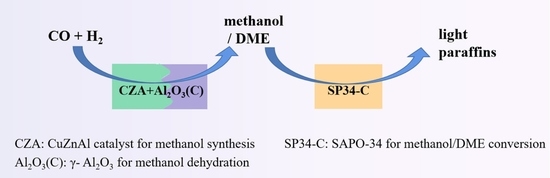
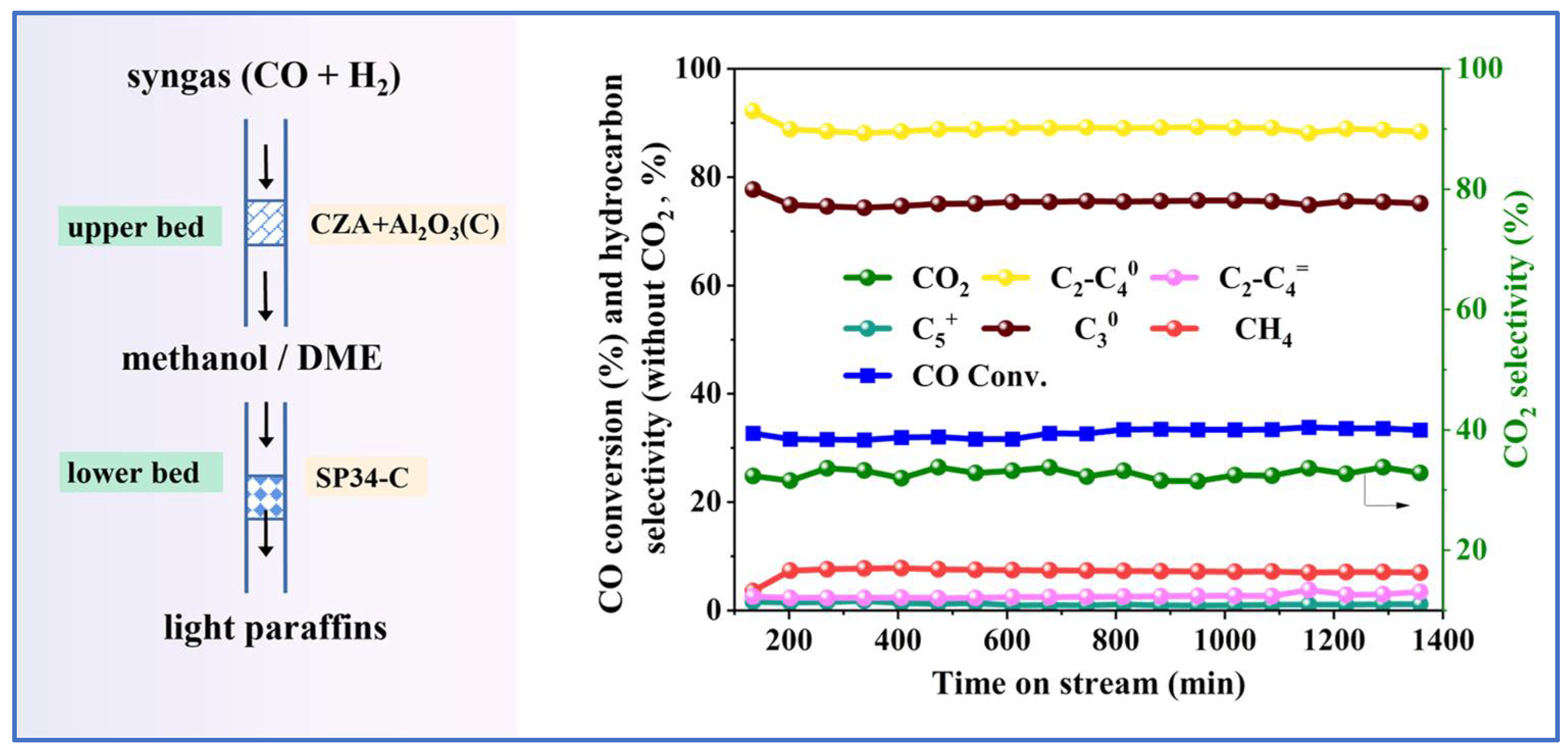
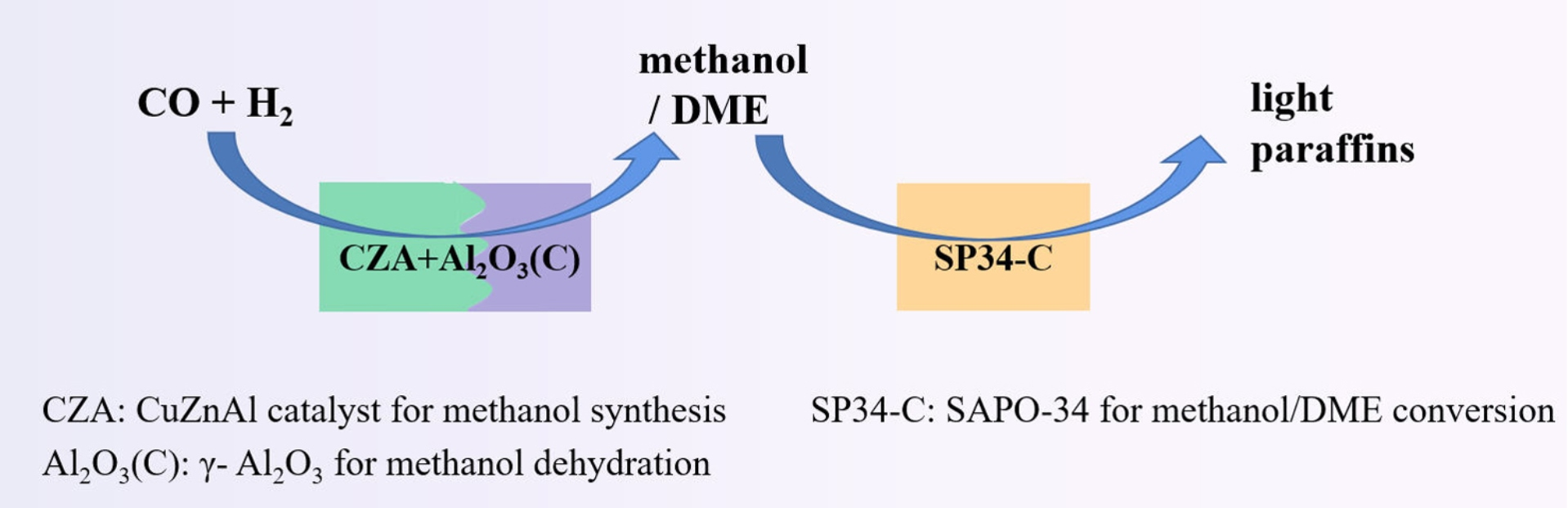
The authors studied the direct conversion of syngas to light paraffins in a dual-bed fixed-bed reactor. A dual-bed catalyst composed of three catalysts, a physically mixed methanol synthesis catalyst (CZA), and a methanol dehydration to dimethyl ether (DME) catalyst (Al2O3(C)) were put in the upper bed for direct conversion of syngas to DME, while the SAPO-34 (SP34-C) zeolite was put in the lower bed for methanol and DME conversion. The effects of the mass ratio of CZA to Al2O3(C), the H2/CO molar ratio, and the space velocity on catalytic performance of syngas to DME were studied in the upper bed. Moreover, a feed gas with a CO/CO2/DME/N2/H2 molar ratio of 9/6/4/5 balanced with H2 was simulated and studied in the lower bed over SP34-C; after optimizing the reaction conditions, the selectivity of light paraffins reached 90.8%, and the selectivity of propane was as high as 76.7%. For the direct conversion of syngas to light paraffins in a dual bed, 88.9% light paraffins selectivity in hydrocarbons was obtained at a CO conversion of 33.4%. This dual-bed strategy offers a potential route for the direct conversion of syngas to valuable chemicals.
Keywords: dual bed; syngas; methanol; dimethyl ether; light paraffins; propane dual bed; syngas; methanol; dimethyl ether; light paraffins; propane
Graphical Abstract