
From Virtual Worlds to Real-World Equity: A Scoping Review of the Metaverse as Computer-Assisted Learning for STEM Competencies

 , , , and
Abstract
1. Introduction
- RQ1 (The Nature of the Shift): To what extent does the integration of metaverse technologies into STEM education constitute a fundamental pedagogical transformation, as opposed to a technological enhancement of existing instructional models? What is gained, and what might be lost, in this transition?
- RQ2 (The Equity Paradox): Whose knowledge, competencies, and ways of learning are being prioritized in the design and implementation of metaverse-based STEM interventions, and whose are being marginalized or ignored? How does the current research landscape reflect or challenge existing patterns of educational inequity?
- RQ3 (The Learner’s Journey): How do metaverse-based learning experiences across K-12, university, and professional contexts connect—or fail to connect—into coherent, lifelong learning pathways? What evidence exists that these short-term interventions translate into sustained STEM engagement and participation?
- RQ4 (Designing for the Future): What critical design principles and research imperatives must guide the next generation of metaverse-based computer-assisted learning to ensure it fulfills its promise of being intelligent, responsive, equitable, and transformative for all learners?
2. Related Work
3. Methodology
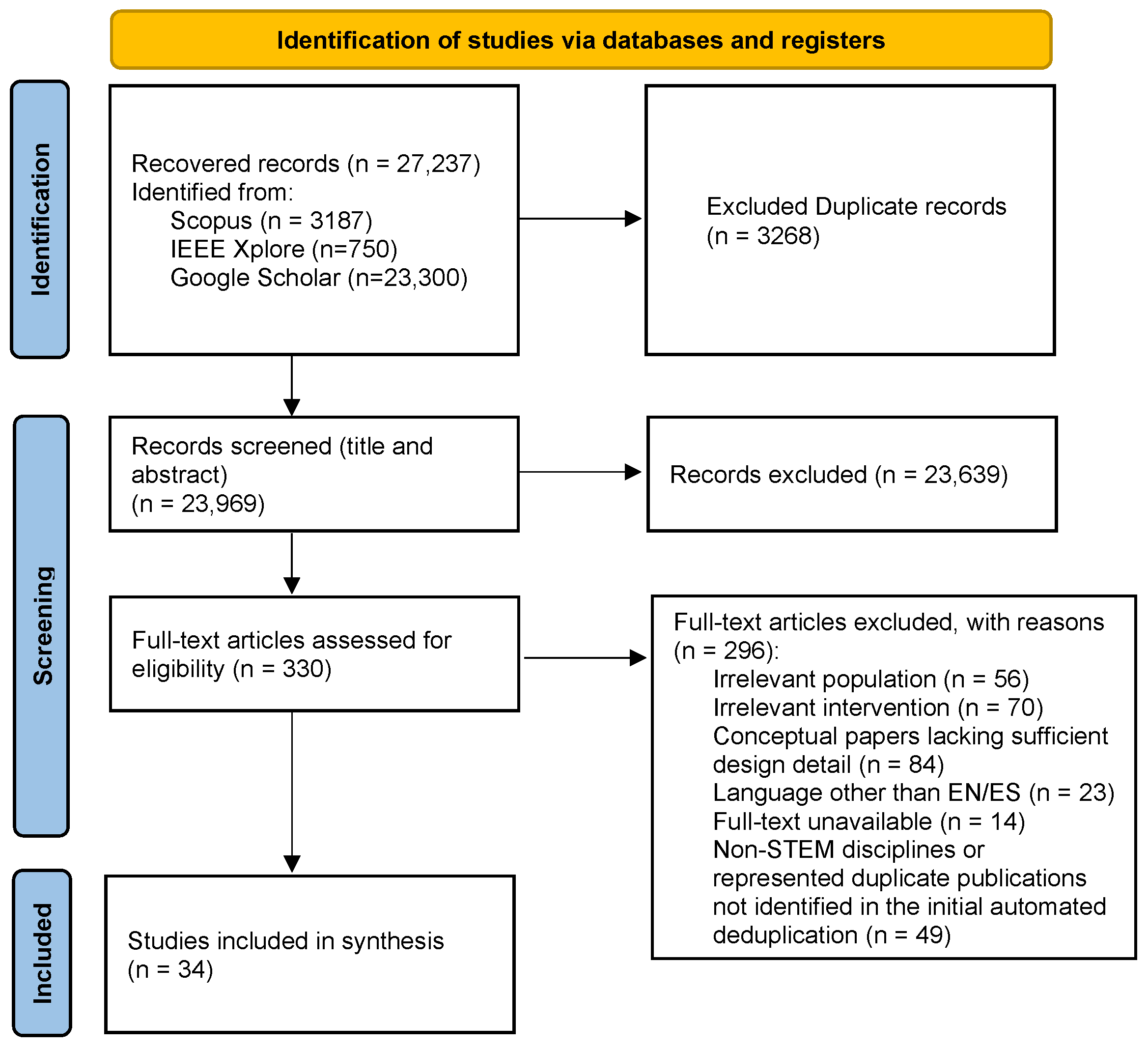
3.1. Databases and Search Strategy
3.2. Inclusion and Exclusion Criteria
- Studies were included if they met the following criteria:
- Focused on STEM education at any level;
- Implemented, evaluated, or proposed metaverse-based learning approaches (including VR, AR, or immersive virtual environments);
- Conceptual and design-oriented studies that provided detailed descriptions of metaverse-based learning environments, pedagogical frameworks, or proposed interventions relevant to STEM competencies;
- Peer-reviewed journal articles or conference proceedings;
- Published in English or Spanish.
- Exclusion criteria were:
- Studies focusing exclusively on non-STEM disciplines;
- Purely speculative works lacking sufficient methodological or design detail;
- Duplicate publications;
- Full-text unavailable.
3.3. Study Selection and Quality Appraisal
3.4. Data Extraction
- Authors and year of publication
- Study type (empirical vs. conceptual/design-oriented)
- Educational level and participant characteristics
- Metaverse platform or technology used
- Pedagogical approach (e.g., game-based, inquiry-based, collaborative learning)
- Targeted STEM competencies
- Reported outcomes (e.g., achievement, engagement, motivation, identity development)
- Key findings and contributions
- Empirical studies: involving implementation and/or evaluation with reported data;
- Conceptual/design-oriented studies: proposing or describing systems, frameworks, or interventions without empirical validation.
3.5. Analytical Framework
3.6. Explicit Coding Rules for STEM Competencies
3.6.1. Problem-Solving
- Core indicator: Learners tackle complex, ill-defined problems through iterative processes.
- Coding present if: Study describes activities involving prototyping, testing, failing, learning, and improving; OR systems thinking where changing one variable affects the whole system; OR diagnosis of malfunctions with solution generation; OR application of knowledge to novel, real-world scenarios.
- Coding absent if: Learning is passive (e.g., lecture, content consumption) without active problem-solving tasks; OR problem-solving is implied but not described, operationalized, or assessed.
3.6.2. Critical Thinking
- Core indicator: Learners analyze data and situations logically rather than at face value.
- Coding present if: Study describes activities involving data interpretation (statistics, charts, visualizations); OR evidence-based reasoning (defending conclusions with facts); OR questioning assumptions; OR systematic evaluation of complex concepts; OR comparative analysis of multiple solutions or perspectives.
- Coding absent if: Learning focuses solely on factual recall or procedural execution without analytical reasoning; OR critical thinking is mentioned as a goal but not operationalized in activities or assessment.
3.6.3. Inquiry and Curiosity
- Core indicator: Learners engage in the scientific method as an engine of discovery.
- Coding present if: Study describes activities involving asking testable questions; OR formulating hypotheses; OR designing fair experiments; OR open-ended exploration where learners discover relationships through investigation; OR guided inquiry cycles with student-driven questioning.
- Coding absent if: Learning follows prescribed step-by-step instructions without opportunities for questioning or exploration; OR curiosity is measured only as self-reported engagement without observable inquiry behaviors.
3.6.4. Mathematical Application
- Core indicator: Learners use mathematics as a language to describe the world.
- Coding present if: Study describes activities involving mathematical modeling (using equations to represent real-world phenomena); OR quantitative reasoning (working with numbers, scale, ratios, proportions); OR logical structuring (creating algorithms, formal proofs); OR explicit calculations (formulas, stoichiometry, geometry proofs, statistical analysis) that are central to learning objectives or assessment.
- Coding absent if: Mathematics is incidental (e.g., basic counting, programming logic without mathematical framing); OR quantitative reasoning is involved but not assessed as a competency; OR mathematics appears only in conceptual design without implementation; OR mathematics is used passively without active application.
3.6.5. Technology Literacy
- Core indicator: Learners use technology as a tool to execute solutions.
- Coding present if: Study describes activities involving decomposition (breaking large problems into smaller steps); OR creating algorithms; OR proficiency development with specific tools, software, sensors, or lab equipment; OR navigation and manipulation of metaverse platforms (VR/AR, 3D environments, avatars, virtual objects); OR computational thinking practices.
- Coding absent if: Technology is used passively (e.g., watching videos, reading digital content) without active manipulation or tool development; OR technology literacy is assumed but not developed, practiced, or assessed.
3.6.6. Collaboration
- Core indicator: Learners work in interdisciplinary teams to achieve complex goals.
- Coding present if: Study describes activities involving teamwork in groups of two or more; OR task distribution across different specialties or roles; OR technical communication (explaining complex ideas to non-experts); OR peer teaching, mentoring, or feedback; OR shared workspaces, real-time co-creation, or collaborative problem-solving.
- Coding absent if: Learning is individual with no structured peer interaction; OR collaboration is limited to simple discussion without shared task completion or interdependence; OR only instructor-student interaction is present without peer collaboration.
3.6.7. Coding Reliability
- Inter-rater reliability for study selection: Cohen’s (high agreement).
- Pooled agreement rate for competency coding: .
- Discrepancies resolved through consensus with third reviewer.
3.7. Operational Definitions for Population Coding
4. Results
4.1. Frequency of STEM Competency Addressing
4.2. Classification of Studies by Evidence Type
5. Discussion
5.1. Pedagogical Transformation or Technological Upgrade? Unpacking the Nature of the Shift (RQ1)
5.1.1. The Allure of Optimization: When the Medium Obscures the Message
5.1.2. Glimpses of Transformation: When the Metaverse Reconfigures Knowing
5.1.3. The Silences of Translation: What Is Lost in Immersive Environments
5.1.4. Beyond the Binary: Designing for Complementarity
5.2. The Equity Paradox: Whose Knowledge, Whose Learners? (RQ2)
5.2.1. The Concentration of Attention: Who Is Worthy of Study?
5.2.2. The Unasked Questions: Whose Bodies, Whose Voices, Whose Minds?
5.2.3. Barriers Not Studied: The Infrastructure of Exclusion
5.2.4. The Unbearable Whiteness of Being: Race and the Metaverse
5.2.5. From Selective Inclusion to Genuine Equity: What Would It Take?
5.3. From Isolated Interventions to Lifelong Learning: Where Is the Learner in the Metaverse? (RQ3)
5.3.1. Evidence Silos: Descriptive Differences Across Educational Levels
5.3.2. The Absent Learner: Why No One Follows Students Across Time
5.3.3. Identity and Belonging: The Missing Mediators
5.3.4. The Transfer Question: Does Virtual Learning Travel?
5.3.5. The Pipeline Imaginary: From Fragmentation to Coherence
5.3.6. Designing for the Learner in Time: What Would It Take?
5.4. Designing for the Future: Implications for Research and Practice
5.4.1. Beyond Technological Solutionism: Designing for Epistemological Pluralism
5.4.2. From Access to Belonging: Designing for Intersectional Inclusion
5.4.3. Connecting the Dots: Designing for Learning Across Time
5.4.4. Beyond the Short Term: Designing for What We Cannot Yet Measure
5.4.5. Designing for the Learners Who Are Not Yet Here
5.4.6. Toward a Research Agenda Worthy of the Moment
6. Conclusions
Author Contributions
Funding
Institutional Review Board Statement
Informed Consent Statement
Data Availability Statement
Conflicts of Interest
Abbreviations
| AI | Artificial Intelligence |
| AR | Augmented Reality |
| BIM | Building Information Modeling |
| CAD | Computer-Aided Design |
| CSI | Crime Scene Investigation |
| DQ | Digital Intelligence Quotient |
| IBL | Inquiry-Based Learning |
| ICT | Information and Communications Technology |
| LMS | Learning Management System |
| MLXP | Metaverse Learning Experience Platform |
| MMORPG | Massively Multiplayer Online Role-Playing Game |
| MR | Mixed Reality |
| NFT | Non-Fungible Token |
| NLP | Natural Language Processing |
| NPC | Non-Player Character |
| PBL | Project-Based Learning |
| PCNN | Piecewise Convolutional Neural Network |
| SCL-STEM | Student-Centered Learning for STEM |
| SDG | Sustainable Development Goal |
| SLT | Social Learning Theory |
| STEAM | Science, Technology, Engineering, Arts, and Mathematics |
| STEM | Science, Technology, Engineering, and Mathematics |
| SUS | System Usability Scale |
| TTCT | Torrance Test of Creative Thinking |
| VR | Virtual Reality |
| XR | Extended Reality |
Appendix A. The Selected Studies

| Authors | Evidence Type | Main Goal | Population | Approach | Findings by Each Skill |
|---|---|---|---|---|---|
| Bedoya-Cano et al. [66] | Conceptual/design-oriented | To describe the development and application of a set of practices focused on electronic circuits using the CoSpaces metaverse educational platform as an alternative for practical assessment that promotes experiential learning and acquisition of electronics competencies. | University students (implicitly) enrolled in STEM/electronics courses. No specific sample size mentioned. | Conceptual development and implementation of four progressive virtual practices in CoSpaces metaverse: (1) breadboard connectivity, (2) Ohm’s law and maximum current, (3) ultrasonic sensor connections, (4) programming logic with sensors. Integrates AI for real-time feedback, personalization, and adaptive assessment. | Problem-Solving: Central to the methodology. Students face controlled practical situations combining electronic devices, programming, and simulation to solve real-life problems. They must diagnose circuit malfunctions, identify causes of failure, and find solutions in a risk-free virtual environment that prevents demotivation from damaged components. Critical Thinking: Enhanced through analysis of circuit behavior, comparison of connection diagrams with virtual implementations, and evaluation of design efficiency. Students examine evidence of learning through simulations and receive AI-generated feedback on accuracy and compliance with learning objectives. Inquiry and Curiosity: Stimulated through interactive 3D simulations that allow students to explore electronic components, manipulate circuits, and observe consequences of their actions in real-time. The immersive environment sparks curiosity about physical phenomena and promotes active knowledge construction through experimentation. Mathematical Application: Directly addressed through Ohm’s law implementation in Practice 2, where students calculate voltage, current limits, and resistance values. Mathematical models replicate physical behavior of circuits, requiring quantitative reasoning about current levels before component breakdown. Technology Literacy: Core focus. Students develop proficiency with CoSpaces metaverse platform, Arduino programming, block-based coding, Python scripts, 3D modeling (Blender), and electronic circuit simulation. AI integration enables personalized learning paths and real-time feedback on technical performance. Collaboration: Supported through metaverse’s capacity for multi-user interaction and teamwork. The platform enables collaborative practices where students and teachers from different locations work together in real-time, strengthening intercultural collaboration skills relevant to global labor markets. |
| Shin and Kim [67] | Conceptual/design-oriented | To propose a set of design practices for metaverse and game development that promote soft skills acquisition, providing developers with a foundation for creating games that can impart nontechnical skills to users for professional and social life applications. | General population of video game players; the proposed model targets developers creating metaverse-based games for soft skills training. | Conceptual analysis based on literature review of metaverse concepts, game design principles, and existing games (Myst, World of Warcraft, Overcooked, Minecraft, Second Life) to develop a design model linking game mechanics to soft skills development. | Problem-Solving: Central to the proposed model. Games like Myst use 3D puzzles in metaverse environments requiring players to explore spaces, use clues, and form solutions. Problem-solving is developed through gameplay mechanics that challenge players to overcome obstacles and achieve goals. Critical Thinking: Developed through analytical reasoning in games with rules and constraints. Games like chess and Go demonstrate deep complexity from simple rules, requiring strategic thinking. Puzzle games encourage reflection on choices made in virtual spaces, shaping self-presentation through action. Inquiry and Curiosity: Stimulated through exploration mechanics in metaverse environments. Games like Myst use fantasy, curiosity, and challenges to motivate players to actively explore different spaces. The metaverse’s interactivity allows players to navigate virtual environments freely, encouraging discovery and creative thinking. Mathematical Application: Not directly addressed. Technology Literacy: Implicitly developed through engagement with metaverse platforms, avatar customization, virtual environment navigation, and understanding game mechanics. Players gain proficiency with 3D virtual worlds, social presence features, and digital interaction tools. Collaboration: Strongly emphasized through two subcategories: teamwork and socializing. Games like Overcooked require near-flawless teamwork and communication to complete goals, forcing players to multitask, exchange roles, and actively communicate. MMORPGs like World of Warcraft provide spaces for forming friendships and realistic interactions through social presence and avatar self-presentation. External communities (Discord, social media) extend collaboration beyond the game. |
| Meletiou-Mavrotheris et al. [68] | Conceptual/design-oriented | To develop, implement, and evaluate a teacher professional development course (EL-STEM) aimed at familiarizing in-service STEM teachers with the potential of using Augmented Reality (AR) to enhance instructional practices, student motivation, and learning processes in STEM education for students aged 12–18. | 119 in-service STEM teachers from secondary schools (and some primary) in Cyprus, Estonia, Greece, and Finland. | Multiple case study using a blended learning professional development program (face-to-face workshops and ICT-mediated instruction). Data collected via surveys, interviews, focus groups, observations, and videotaping. | Problem-Solving: Developed by engaging students in authentic, inquiry-based problem-solving activities using AR. Teachers were trained to create learning scenarios where students tackle complex, “ill-defined” problems through AR-enhanced exploration and experimentation. Critical Thinking: Fostered through analytical reasoning when students interpret AR-overlaid data, evaluate evidence from virtual simulations, and question assumptions about real-world phenomena visualized through AR. Inquiry and Curiosity: Central to the EL-STEM pedagogical framework. Teachers implemented inquiry-based learning cycles where students ask testable questions, formulate hypotheses, and design experiments using AR tools that evoke curiosity through immersive, realistic simulations. Mathematical Application: Not directly addressed. Technology Literacy: Core focus. Teachers and students learned to use various AR authoring tools (HP Reveal, Metaverse, ARTutor, ThingLink, Unity) to create and interact with AR learning objects, developing computational thinking and proficiency with emerging technologies. Collaboration: Strongly emphasized. Teachers collaborated across disciplines to design interdisciplinary STEM lesson plans. Students worked in teams during AR-enhanced activities, sharing tasks and integrating diverse skills. Teachers also formed a community of practice (“Augmented teachers”) to exchange ideas and resources. |
| Mutchima et al. [58] | Empirical | To investigate the effect of metaverse technology on multicultural learning to strengthen secondary school students’ social attitudes, cultural awareness, and critical thinking skills. | 80 secondary school students from the Office of the Basic Education Commission in Bangkok, Thailand, divided equally into experimental (n = 40) and control (n = 40) groups. | Quasi-experimental design with 8-week intervention. Experimental group used metaverse-based multicultural learning activities (virtual cultural exploration, role-playing, discussions/reflections, collaborative projects). Control group used traditional methods. Data collected via pre-/post-tests measuring social attitudes, cultural awareness, and critical thinking skills. Analyzed using independent t-tests. | Problem-Solving: Enhanced through role-playing in simulated situations requiring adaptation to unfamiliar cultural contexts (e.g., negotiating in foreign markets, participating in tribal rituals). Students analyzed and identified solutions to experienced problems, applying problem-solving skills in multicultural scenarios. Critical Thinking: Central focus with significant improvement in experimental group (, , mean = 4.10 vs. control 3.69). Students engaged in systematic evaluation of complex concepts, questioned social interactions, analyzed cultural differences, and developed higher-order thinking through reflection on metaverse experiences and exchange of insights from activities. Inquiry and Curiosity: Stimulated through virtual cultural exploration where students explored and interacted with simulated environments reflecting different cultures (virtual villages, cultural museums). Students observed and documented cultural differences, fostering curiosity about diverse cultural contexts. Mathematical Application: Not addressed. Technology Literacy: Developed through navigation of metaverse platforms, avatar creation, and engagement with immersive 3D environments. Students learned to use virtual spaces for cultural exploration, role-playing, and collaborative projects. The metaverse provided accessible digital learning materials and demonstrated technology’s role in modern education. Collaboration: Strongly emphasized through group-based collaborative projects where students created virtual cultural spaces or online cultural exhibitions. Activities fostered teamwork skills, respect for diverse perspectives, and effective communication with peers. Students engaged in discussions, shared experiences, and worked together to solve problems in simulated multicultural scenarios. |
| Rahman et al. [14] | Empirical | To develop and evaluate a virtual reality-based Virtual Chemistry Classroom for Chemical Bonding (VC3B) using game-based learning to facilitate understanding of chemical bonding and formulas for middle school students in remote education settings. | 90 middle school students (8th grade, aged 12–13) divided into three groups: G1 (textbook, n = 30), G2 (online lecture, n = 30), and G3 (VC3B VR, n = 30). | Randomized controlled study design with three conditions. VC3B developed using Unity3D and Blender, featuring two game modules: “Molecule Construction” (10 levels of molecular assembly) and “Chemical Formula” (10 levels of formula completion). Data collected via learning outcome quiz (9 questions) and usability questionnaire (5 items, 5-point Likert scale). Analyzed using ANOVA (, , ) and descriptive statistics. | Problem-Solving: Developed through game-based learning requiring students to reconstruct molecular structures by rearranging atoms and compose correct chemical formulas. Students engaged in trial-and-error learning with immediate feedback, enhancing their ability to solve chemistry problems systematically. The molecule construction game required correct attachment of compounds to build accurate molecular structures. Critical Thinking: Enhanced through analysis of chemical bonding concepts, evaluation of molecular arrangements, and decision-making in formula composition. Students needed to apply logical reasoning to determine correct atomic positions and chemical combinations. The games reinforced understanding through immediate feedback and progressive difficulty levels. Inquiry and Curiosity: Stimulated through immersive VR environment where students explored 3D molecular structures, manipulated atoms, and discovered chemical relationships. Game elements (points, leaderboards, stars) motivated exploration and sustained engagement. Students showed high satisfaction with VC3B’s interactive interface. Mathematical Application: Addressed through chemical formula composition requiring understanding of atomic counts, subscripts, and stoichiometric relationships. Students learned to interpret molecular formulas (e.g., Na3PO4, C3H8O3) and calculate atomic quantities in compounds. Technology Literacy: Central focus. Students developed proficiency with Oculus Quest 2 VR headsets, controller navigation, and interaction with 3D virtual objects. The VC3B group achieved significantly higher learning outcomes (, , success rate ) compared to textbook () and online lecture () groups. Usability ratings showed “Excellent” for overall satisfaction. Collaboration: Not directly addressed in this study, though the VR environment enables potential collaborative learning. The game-based approach included individual progress tracking with gamification elements (points, leaderboards, stars) that could support future collaborative features. |
| Kovalenko et al. [18] | Empirical | To assess awareness, perceptions, and readiness for metaverse integration in Ukrainian high school curricula, and to identify potential benefits and barriers for developing metaverse-based learning environments. | 120 high school students (ages 14–17, Grades 9–11) and 35 educators from diverse regions of Ukraine, representing STEM, humanities, and arts disciplines. | Survey-based quantitative and qualitative analysis using a 25-item instrument measuring awareness, perceived benefits, anticipated challenges, and willingness to adopt metaverse technologies. Data analyzed using descriptive statistics and thematic coding. | Problem-Solving: Enhanced through metaverse environments that enable collaborative problem-solving beyond traditional classroom constraints. Students engage with real-world contexts and complex tasks in immersive virtual spaces. Critical Thinking: Developed through experiential learning where students analyze data, evaluate evidence, and question assumptions using interactive VR/AR representations of abstract STEM concepts. Inquiry and Curiosity: Stimulated through immersive experiences that boost student engagement (85% of students, 77% of teachers) and motivation to explore subjects deeply through multi-sensory, interactive learning environments. Mathematical Application: Supported through improved understanding of STEM concepts (68% students, 74% teachers) via visual and interactive representations that make abstract mathematical ideas more concrete and accessible. Technology Literacy: Central focus, identified as essential for future employability. Students develop proficiency with VR/AR tools, digital platforms, and immersive technologies. 82% of students and 71% of teachers reported familiarity with VR/AR tools. Collaboration: Strongly emphasized through real-time collaborative opportunities and cross-school/international partnerships (72% overall). Students work together in shared virtual spaces on projects, enabling teamwork across geographical boundaries. |
| Chang [43] | Empirical | To develop a metaverse-enabled Situation-Cooperation-Conversation-Sensemaking (M-SCCS) learning approach and examine its effects on nursing students’ learning achievement, behavioral patterns of high/low achievers, and perceptions compared to conventional SCCS (C-SCCS) approach. | 98 junior nursing students (50 experimental, 48 control) from two pediatric first aid training classes at a technological university in Taiwan, aged 21–22 years. | Quasi-experimental design with experimental group using M-SCCS (Spatial metaverse platform with smartphones/Google Cardboard) and control group using C-SCCS (PowerPoint/videos). Both groups completed 6-person cooperative learning activities over 15 weeks. Data collected via pre-/post-achievement tests, lag sequential analysis of behavioral patterns (9-coded scheme, ), and focus group interviews analyzed using grounded theory. | Problem-Solving: Central to the intervention. Students solved authentic first-aid cases requiring assessment of arrhythmia, airway management, correct supply selection (AED, oxygen cylinders/masks), electric shock administration, and chest compressions. Experimental group showed significantly higher learning achievement (, , ) with adjusted means of 85.42 vs. 75.30. Critical Thinking: Enhanced through SCCS phases requiring analysis of clinical scenarios, evaluation of patient conditions, and decision-making about roles/responsibilities during emergencies. Students engaged in evidence-based reasoning about first-aid procedures and reflected on problem-solving effectiveness. Inquiry and Curiosity: Stimulated through immersive metaverse scenarios where students explored first-aid supplies, questioned procedures, and investigated correct protocols. Experimental group reported increased curiosity and engagement through interactive 3D environments compared to conventional video-based learning. Mathematical Application: Not directly addressed, though first-aid procedures may involve dosage calculations and timing considerations. Technology Literacy: Developed through navigation of Spatial metaverse platform using smartphones and Google Cardboard. Students learned to interact with 3D objects (AEDs, oxygen cylinders/masks), complete coded tasks, and collaborate in virtual spaces. Behavioral analysis showed high achievers actively engaged with learning materials before tasks (), while low achievers required more peer interaction. Collaboration: Strongly emphasized through 6-person cooperative learning groups. M-SCCS facilitated teamwork, role assignment, and task distribution. Lag sequential analysis revealed high achievers demonstrated structured patterns: task selection (ET) → peer interaction (SI) → material reading (RM) → task completion (CT). Low achievers showed patterns of task selection → peer interaction → repeated peer consultation when encountering errors (, ). Interview data confirmed enhanced cooperative learning, emotional connections, and understanding of teamwork during first-aid situations. |
| Cheng and Feng [49] | Empirical | To develop and test a Computer Forensics Summer Academy model that increases STEM career awareness, forensic knowledge, and technical competencies among high school girls, addressing gender gaps in STEM workforce participation. | 150 rising high school junior and senior girls (2018–2022), recruited from diverse backgrounds across Oklahoma, with comparison groups of nonparticipants in 2018–2019. | Design and Development Research (DDR) with mixed methods. Pre-/post-questionnaires assessed career awareness, interests, motivation, soft skills, and technical competencies. Online CSI course assessments measured forensic knowledge. Multi-modality delivery (in-person, hybrid, virtual) adapted for COVID-19. | Problem-Solving: Central to the curriculum. Participants solved simulated modern-day crimes using forensic analytics, AI-powered biometric search engines, and blockchain-based evidence systems. Team-based investigations required applying analytical tools to identify patterns and criminal behavior. Critical Thinking: Developed through forensic analysis requiring logical reasoning, evidence evaluation, and pattern recognition. Girls analyzed crime scenes, evaluated digital evidence, and questioned assumptions using forensic information management systems to store, retrieve, and update biometrics and criminal data. Inquiry and Curiosity: Stimulated through immersive murder investigation scenarios using metaverse and VR simulations. Participants engaged in role-play as investigators, exploring Triage 911 Centers, virtual crime scenes, and detective offices, fostering curiosity about forensic science and emerging careers. Mathematical Application: Not directly addressed, though forensic analytics involves quantitative reasoning and data analysis. Some technical competencies may require mathematical logic. Technology Literacy: Core focus. Participants developed proficiency with AI, blockchain, machine learning, metaverse platforms, VR simulations, forensic biometrics engines, DNA databases (CODIS), fingerprint systems (AFIS), and ICT tools. Significant pre-/post-gains in cybersecurity, forensic biometrics, computer databases, programming, DNA analysis, blood testing, and ICT technologies were observed across all years. Collaboration: Strongly emphasized through team-based investigations where students worked as forensic teams solving murder cases. Activities included collaborative evidence collection, virtual interviews of role-played suspects, and team presentations of findings. Virtual delivery used Zoom and GroupMe for communication and coordination. |
| Nam et al. [57] | Empirical | To understand the metaverse and virtual product development process, create fashion items with 3D avatar simulation in the virtual world using ZEPETO Studio, and enhance students’ creative thinking skills through virtual design pedagogy. | 43 undergraduate students enrolled in fashion and retail merchandising courses at two large southern universities in the United States (53% juniors, 23% seniors, 14% freshmen, 9% sophomores; predominantly female; no prior metaverse or virtual design experience). | Experiential Learning Theory (ELT)-based activity where students created virtual fashion items using ZEPETO StudioTM. Data collected via questionnaire with three sections: demographics, fashion item creation process, and learning experience (pros and cons). Analyzed using SPSS descriptive statistics. | Problem-Solving: Developed through navigating the virtual product development process, overcoming technical challenges (login issues, file format requirements-PNG, size limitations 512 × 512 pixels), and translating design ideas into functional virtual fashion items within platform constraints. Critical Thinking: Enhanced through investigating and analyzing current virtual market research, evaluating product designs, recognizing various ideas and concepts for fashion items, and developing evaluation skills in the metaverse using advanced technology. Inquiry and Curiosity: Stimulated through exploration of the ZEPETO platform’s capabilities, discovering main fashion items to activate the metaverse platform, and gaining inspiration for creative designs (72% of students reported increased interest and enjoyment in the activity). Mathematical Application: Not directly addressed, though students worked within technical constraints including pixel dimensions (Max 512 × 512) and file format specifications, requiring basic technical literacy. Technology Literacy: Central to the intervention. Students with no prior metaverse experience learned to use ZEPETO StudioTM platform, create 3D avatar simulations, develop virtual fashion items, and understand the overall process of 3D virtual products. The platform integrates VR, AR, and 3D experience technologies. Collaboration: Not directly addressed in the findings, though the virtual platform enables potential collaboration through shared virtual spaces and community features. |
| Mehboob et al. [19] | Empirical | To investigate the effects of avatar-based storytelling within a metaverse-type environment (VERSE platform) on primary school students’ learning performance, engagement, and emotional-social experience in science education. | 50 primary school students aged 8–12 from Primary School No. 1 in Ustron, Poland, divided into experimental group (n = 25, avatar-based storytelling) and control group (n = 25, traditional digital methods). | Quasi-experimental pre-test/post-test control group design with mixed methods. Two-week intervention using VERSE metaverse platform with avatar-based science storytelling. Data collected through pre-/post-tests, engagement surveys, focus group interviews, and teacher observations. Analyzed using t-tests, ANOVA, Wilcoxon signed-rank test, and thematic analysis with NVivo. | Problem-Solving: Developed through scenario-based learning where students investigated central problems, worked in groups to propose resolutions, and engaged in creative problem-solving. Tasks addressed cognitive processing including application of knowledge in context. Critical Thinking: Enhanced through open-ended questions requiring explanatory writing, making meaning by explaining scientific language and processes (e.g., how chlorophyll works, photosynthesis). Students analyzed information and drew conclusions about story content. Inquiry and Curiosity: Stimulated through interactive avatar narratives that made abstract science concepts (plant growth, photosynthesis, reproduction) visible and engaging. The immersive environment sparked curiosity and active participation through multisensory stimulation. Mathematical Application: Not directly addressed. Technology Literacy: Central to the intervention. Students developed proficiency with the VERSE metaverse platform, interacting with animated avatars, navigating virtual environments, and engaging with 3D objects and simulations. The platform integrated VR, AR, and 3D technologies for immersive learning. Collaboration: Strongly emphasized through group tasks where students worked together to investigate problems and propose solutions. The scenario-based methodology involved narrative exploration, group activities, presentations, and reflective conversations. Students collaborated in teams, sharing ideas and building on each other’s contributions. |
| Canfarotta and Pipitone [17] | Empirical | To describe how STEAM teachers at a classical high school in Bagheria, Italy used the metaverse for their subjects following international collaboration with a French school, and to evaluate the impact on students’ 4 Cs (critical thinking, communication, collaboration, creativity). | 10 STEAM teachers (7 women, 3 men) and 53 students (aged 14–16, 18 males, 35 females) from the “Francesco Scaduto” classical high school in Bagheria, Sicily, Italy. Included one disabled student. | Qualitative case study using semi-structured interviews with thematic analysis. Teachers implemented metaverse-based teaching across disciplines (Mathematics, Latin/Greek, Physical Education, Science, Art) using the CoSpaces platform over 3 years (2020–2023). | Problem-Solving: Developed through inquiry-based learning and project-based learning approaches. Students identified problems, formulated hypotheses, verified through experiments, and found technical solutions to convey disciplinary content. The Human-Centered Design approach involved students in all steps of problem-solving from observation to implementation. Critical Thinking: Strongly emphasized (100% of students reported improvement). Students compared different aspects of reality, highlighted pros and cons of technical solutions, and engaged in reflection before, during, and after action. They learned to break down problems and analyze phenomena systematically. Inquiry and Curiosity: Fostered through Inquiry-Based Learning (IBL) where students investigated phenomena, asked questions, formulated hypotheses, and conducted experiments. Types included confirmatory, structured, open, and guided inquiry, with students exploring totally new problems and structuring their own methodologies. Mathematical Application: Addressed through creation of Non-Euclidean Geometries museums in the metaverse. Students studied mathematical concepts beyond standard curriculum and applied them to design virtual spaces, requiring precise calculations and geometric understanding. Technology Literacy: Central to the intervention. Students developed proficiency with the CoSpaces platform for 3D creation, coding, and VR/AR exploration. They learned to create virtual worlds across disciplines (mathematics museum, Roman banquet, sports facilities, astronomy environments, eco-sustainable architecture). Teachers received training on virtual/augmented reality. Collaboration: Highly developed (77% of students reported improvement). Students worked in teams to create virtual works, shared ideas, and compared different points of view. The project-based learning approach required collaboration in conception, feasibility study, design, realization, and presentation phases. Teachers also collaborated across disciplines, adopting common methodologies. |
| Vanichchanunt et al. [60] | Empirical | To design and develop a metaverse-based online self-learning platform (KMUTNB Techno Park Metaverse) that combines immersive 3D environments with introductory computer programming and STEM lessons, providing accessible, self-paced education for diverse learners. | Students, undergraduates, professionals, and general learners interested in programming, VR development, and STEM. No specific sample size mentioned. | Development project using Blender for 3D modeling and Unity for metaverse integration. Platform features digital twin of physical building, avatar system, multi-user access, chat system, online classrooms, video-based lessons, virtual laboratories, and integrated Learning Management System (LMS) with assessments. | Problem-Solving: Developed through practical coding scenarios and virtual laboratory experiments. Learners engage with programming challenges and robotics simulations that require applying knowledge to solve real-world problems. The assessment structure includes difficult questions combining multiple topics requiring complex problem-solving in real-life scenarios. Critical Thinking: Enhanced through tiered assessments (easy, medium, difficult) where learners must analyze problems, apply logical reasoning, and synthesize multiple programming concepts. Medium questions require logical reasoning and deeper understanding of programming paradigms. Inquiry and Curiosity: Stimulated through immersive 3D environments, virtual laboratories, and interactive video tutorials that allow learners to explore programming and STEM concepts at their own pace. The digital twin environment creates curiosity about the physical building and its virtual representation. Mathematical Application: Addressed through science and mathematics courses covering undergraduate-level basic knowledge. STEM curriculum integrates mathematical concepts necessary for programming and engineering applications. Technology Literacy: Central to the platform. Learners develop proficiency with Python programming, VR technologies, 3D modeling, digital twin simulations, and metaverse navigation. The platform includes courses on 3D modeling and VR development to enhance technology skills. Learners interact with avatar systems, multi-user environments, and integrated LMS. Collaboration: Facilitated through multi-user access, group communication tools, shared workspaces, and real-time interaction features. Learners can discuss coding concepts, tackle challenges together, receive instant feedback, and participate in collaborative learning within virtual classrooms and laboratories. |
| Yeganeh et al. [51] | Empirical | To propose and validate a multi-layered metaverse classroom model (Meta-MILE) that addresses challenges in virtual education by integrating immersive infrastructure, AI-driven personalization, social collaboration, and advanced assessment techniques to enhance student engagement, inclusivity, and learning outcomes. | 28 senior undergraduate students from a computer design course at Binghamton University, USA. | Mixed-methods pilot experiment using paired pretest-posttest design with a 20-min hands-on VR session in a simulated virtual design studio. Data collected via surveys (Likert scale and multiple choice) and analyzed using Wilcoxon signed-rank tests and descriptive statistics. Effect sizes calculated using rank-biserial correlation. | Problem-Solving: Developed through scenario-based evaluations and virtual simulations where students apply knowledge to real-world challenges. In computer design contexts, students engage in virtual prototyping and collaborative problem-solving tasks that require analytical thinking and adaptability. The Meta-MILE framework emphasizes competency-based learning through practical, hands-on experiences. Critical Thinking: Enhanced through immersive 3D environments and scenario-based assessments that require students to analyze complex situations, evaluate evidence, and make informed decisions. Gamified learning pathways and interactive simulations promote higher-order thinking skills as students navigate multi-step challenges with limited information. Inquiry and Curiosity: Stimulated through gamified elements (quizzes, badges, level progression) and interactive 3D simulations that spark curiosity and motivation. Students explore virtual laboratories, conduct experiments, and engage with holographic displays, fostering scientific inquiry and discovery-based learning. Mathematical Application: Supported through virtual simulations requiring quantitative reasoning, data analysis, and mathematical modeling. Engineering and science scenarios (e.g., virtual bridge design, chemical reactions) demand application of mathematical concepts to real-world problems. Technology Literacy: Central to the framework. Students develop proficiency with VR/AR technologies, 3D modeling tools, AI-driven personalized learning systems, and collaborative digital platforms. Cross-platform accessibility ensures engagement across devices (VR headsets, computers, tablets, smartphones). The pilot study showed significant improvement in students’ comfort with immersive technologies post-intervention. Collaboration: Strongly emphasized through virtual collaboration spaces, breakout rooms, shared whiteboards, real-time communication tools (voice/chat), and document co-editing. Students engage in teamwork, group projects, and peer mentoring within avatar-based environments. The framework includes virtual community hubs connecting students with global peers, mentors, and industry professionals. |
| Hwang [50] | Empirical | To examine the effectiveness of integrating metaverse virtual exhibitions and NFT registration into maker education, comparing creativity development, learning motivation, knowledge construction, sense of achievement, and ownership between students with and without metaverse/NFT treatment. | 60 freshmen (34 control, 26 experimental) from the College of Humanities at a South Korean university, enrolled in a Humanities Basics course, aged 20–28, with no prior metaverse or NFT experience. | Quasi-experimental design with control (general maker education + contest participation) and experimental groups (maker education + NFT registration + metaverse virtual exhibition using Frame VR). Both groups completed 15-week courses with identical schedules except metaverse treatment. Data collected via pre-/post-creativity surveys, post-questionnaires on dependent variables, and reflective papers analyzed using sentiment analysis (VADER, SentiArt) and text mining. | Problem-Solving: Central to the intervention with significant improvement in creative problem-solving for both groups (control: t = −2.15, p = 0.01; experimental: t = −3.742, p = 0.01). Students developed strategies to solve problems, approached challenges from multiple perspectives, and used ideas from various fields for creative convergence in digital content creation. Critical Thinking: Enhanced through creative cognition development, with experimental group showing significant improvement (t = −4.777, p = 0.000) compared to control (non-significant). Students engaged in memory processes, innovative strategies, and evaluation of self-generated ideas. The metaverse exhibition required critical reflection on artwork presentation and peer feedback. Inquiry and Curiosity: Significantly improved in both groups (control: t = −2.260, p = 0.31; experimental: t = −3.348, p = 0.003). Students developed inquisitive mindsets, sought additional information on topics of interest, asked “why” questions about phenomena, and persistently pursued new approaches despite difficulties. Mathematical Application: Not directly addressed, though blockchain/NFT technology involves cryptographic concepts. Technology Literacy: Developed through metaverse platform navigation (Frame VR), avatar creation, NFT minting on OpenSea, MetaMask wallet creation, and 3D object manipulation. Students learned to create virtual exhibitions, upload digital content, link NFT artworks, and use spatialized audio. Experimental group showed significantly higher ownership (M = 4.12 vs. 3.50, p = 0.000) and sense of achievement (M = 4.38 vs. 3.81, p = 0.001). Collaboration: Enhanced through team-based digital content creation (webtoons/videos) and metaverse interactions. Students collaborated in virtual spaces, used whiteboards for anonymous feedback, and experienced spatialized audio that encouraged proximity-based teamwork. Sentiment analysis revealed positive attitudes toward team collaboration in metaverse, with students reporting improved communication and reduced free-riding. |
| Kanthala and Hossain [69] | Conceptual/design-oriented | To explore the design of a CyberEscape room for teaching cybersecurity to high school students and to propose its implementation within the metaverse using the Experience Pyramid model to enhance engagement and learning. | High school students (as the target audience for the proposed game). | Design-based research/Conceptual. The paper reviews game-based learning principles and proposes a design framework for a metaverse-based CyberEscape room. It outlines game levels, environment setup, and challenges based on the Experience Pyramid model, with plans to use the NVIDIA Omniverse platform. | Problem-Solving and Critical Thinking: Central to the game design. The paper argues that gaming naturally fosters these skills by requiring students to overcome challenges through trial and error, make quick decisions under time pressure, and apply knowledge to realistic cyber threats. Inquiry and Curiosity: A core motivator. The immersive and emotional nature of the game (excitement, curiosity) is intended to engage students and enhance memory retention. The narrative and puzzles are designed to spark curiosity. Technology Literacy: The primary skill being taught. Students will learn about cybersecurity concepts (e.g., passwords, network security) by interacting with virtual technologies (computers, files) and using tech tools to solve puzzles within the metaverse. Collaboration: A key learning outcome. The game is designed with a multiplayer mode and team-based challenges. Students must collaborate, delegate tasks, and use diverse skills to solve problems, emphasizing the importance of teamwork in cybersecurity. Mathematical Application: Not addressed in this proposal. The focus is on cybersecurity threats and awareness, not on mathematical modeling or quantitative reasoning. |
| Al-Nawaiseh [22] | Empirical | To assess the effectiveness of using augmented reality (metaverse) technology on the academic achievement in mathematics among fifth-grade students with learning difficulties in the Southern Al-Mazar district of Jordan. | 40 fifth-grade students with learning difficulties (20 experimental, 20 control) from Mutah Basic Mixed School, purposively selected based on access to smartphones and internet services. | Experimental design with pre-test/post-test control group. Experimental group learned geometry unit using augmented reality (Adobe Illustrator, Unite AR, 3D character design) over 8 lessons (2 weeks). Control group used traditional methods. Data analyzed using ANCOVA, ANOVA, and effect size (). | Problem-Solving: Developed through mathematical problem-solving tasks where students classified polygons, triangles, and quadrilaterals based on given descriptions. The AR technology helped students visualize abstract concepts and relationships, reducing cognitive load and enhancing their ability to solve geometry problems systematically. Critical Thinking: Enhanced through activities requiring analysis, classification, and reasoning about geometric properties. Students evaluated shapes to determine polygon types, triangle classifications (equilateral, isosceles), quadrilateral categories, and applied logical reasoning to draw shapes from written descriptions. Inquiry and Curiosity: Stimulated through interactive AR elements including 3D characters, animations, and visual representations that made abstract mathematical concepts tangible and engaging. The technology sparked curiosity by allowing students to explore geometric shapes dynamically. Mathematical Application: Central focus. Students applied mathematical concepts including polygon identification, triangle classification by sides and angles, quadrilateral properties, and geometric reasoning. The experimental group showed significant improvement (mean 22.7 vs. control 19.8, p < 0.007) with large effect size (0.46). Technology Literacy: Developed through interaction with AR applications on smart devices. Students learned to navigate digital content, interact with 3D models, and use technology as a learning tool. The AR environment provided accessible, cost-effective educational materials that integrated images, videos, and interactive elements. Collaboration: Not directly measured, though AR technology enables potential collaborative learning through shared experiences. Gender analysis showed no significant differences ( 0.596), indicating equal benefit for male and female students with learning difficulties. |
| Wannapiroon [56] | Empirical | To develop a Metaverse Learning Experience Platform (MLXP) for immersive design thinking to enhance digital intelligence quotient (DQ) and virtual game developer skills among undergraduate students. | 36 undergraduate students from the Faculty of Science and Technology at Rajamangala University of Technology Suvarnabhumi, Thailand, enrolled in game design and game development courses in academic year 2022. | Research and development approach using System Development Life Cycle (SDLC). MLXP developed with 14 components including M-LMS, M-CMS, M-CDS, personalized learning tools, analytics, assessment tools, and 8 immersive virtual spaces. Immersive design thinking process implemented over 24 weeks with 6 steps: empathize, define, ideate, prototype, test, and share. Data analyzed using means and standard deviations. | Problem-Solving: Central to virtual game developer skills (Mean = 4.67, excellent). Students develop problem-solving skills through debugging code, overcoming technical challenges, and finding creative solutions to complex problems in game development. The immersive design thinking process requires systematic problem-solving across all six stages. Critical Thinking: Developed through the immersive design thinking process where students analyze player needs, synthesize insights, evaluate potential solutions, and make informed decisions about game mechanics and design improvements based on feedback and testing. Inquiry and Curiosity: Stimulated through immersive virtual environments where students explore game mechanics, conduct user research, and investigate player experiences. The design thinking approach emphasizes empathy and understanding user needs through observation and interviews. Mathematical Application: Not directly addressed, though game development may involve mathematical concepts in programming, 3D modeling, and physics simulations. Technology Literacy: Core focus with technical skills/proficiency rated excellent (Mean = 4.75). Students develop programming proficiency, 3D modeling, animation, game engines, and software development tools. The MLXP includes 14 technological components requiring navigation of virtual spaces, avatar creation, and interaction with digital content across multiple immersive environments. Collaboration: Strongly emphasized with collaboration skills rated highest (Mean = 4.92, excellent). Students work effectively with artists, programmers, and designers in immersive virtual co-working spaces, share files, create collaborative projects, and participate in group discussions. The platform supports real-time collaboration through immersive collaboration tools, virtual meeting spaces, and co-working environments across all design thinking stages. |
| Li et al. [30] | Empirical | To investigate how metaverse platforms and enabling technologies (AltSpace, Gather, ZOOM) support collaborative learning in distance education settings, focusing on learner engagement, sense of copresence, and usability. | 20 undergraduate students (3 females, 17 males) from the Game Design and Development course at The Hong Kong Polytechnic University. | Within-subject experimental design with counterbalancing. Participants completed collaborative learning tasks (game design discussions) using three platforms: AltSpace (VR HMD), Gather (2D avatar), and ZOOM (video conferencing). Data collected via copresence scale (NMMSP), engagement scale (DES), usability scale (SUS), platform preference (4C model), conversational analysis, and semi-structured interviews. Analyzed using ANOVA and linear regression. | Problem-Solving: Developed through collaborative game design tasks requiring students to propose and pitch game design ideas (one-button games, puzzle games with combos, games about Chinese culture). Students engaged in brainstorming, idea exchange, and creative problem-solving within their groups. Critical Thinking: Enhanced through analysis of game design concepts, evaluation of design ideas, and collaborative decision-making. Students needed to think critically about game mechanics, player experience, and cultural relevance in their design proposals. Inquiry and Curiosity: Stimulated through exploration of game design topics and peer discussions. The immersive metaverse environments sparked curiosity, with participants describing AltSpace as “new”, “interesting”, and “attractive”, though novelty effects may have contributed. Mathematical Application: Not directly addressed, though game design may involve mathematical concepts in mechanics and logic. Technology Literacy: Central to the study. Students developed proficiency with three different collaboration platforms: AltSpace (VR HMD with Oculus Quest 2), Gather (2D avatar-based platform with webcam integration), and ZOOM. They navigated virtual worlds, used avatars, managed HMDs, and utilized collaboration features (whiteboards, file sharing, text chat). Collaboration: Primary focus. Students worked in groups of 3-4 to complete collaborative learning tasks. AltSpace and Gather induced higher engagement and sense of community compared to ZOOM, with participants reporting feeling “closer to and more connected with other classmates”. Conversational analysis showed more frequent turn-taking in AltSpace. Copresence significantly predicted engagement (, ). |
| Lee and Hwang [70] | Empirical | To investigate how VR-Making (VRM) of instructional contents for K-12 English digital textbooks and metaverse-linking influence pre-service teachers’ technological readiness, 4 Cs (Critical Thinking, Creativity, Collaboration, Communication), and perceived pedagogical benefits for sustainable education. | 51 pre-service English teachers from two universities in South Korea (27 from University A, 24 from University B), enrolled in courses on English textbook methods and multimedia-assisted language learning. | Mixed-methods design with pre-/post-surveys (t-test analysis) and reflective papers analyzed via sentiment analysis (VADER, SentiArt, Liu-Hu) and text mining (KH Coder co-occurrence network). Participants analyzed digital textbooks, created VR contents using Cospaces Edu, and linked them to Frame VR metaverse platform over 15 weeks. | Problem-Solving: Developed through VRM process where pre-service teachers analyzed digital textbook limitations, identified content suitable for VR conversion, and designed solutions to enhance interactivity and immersion. They created 3D learning environments (e.g., school campus with interactive buildings, virtual museum) and coded quizzes using Coblox. Critical Thinking: Enhanced through content analysis of digital textbooks, evaluating pedagogical limitations, and designing VR solutions. Post-survey showed significant improvement in critical thinking (pre , post , ), though teachers were less confident in this area compared to other 4 Cs. Inquiry and Curiosity: Stimulated through exploration of VR creation tools and metaverse platforms. Sentiment analysis revealed high happiness scores () and positive compound sentiment (), indicating intrinsic motivation and curiosity about emerging technologies. Text mining showed words like “fun”, “interest”, and “culture” frequently occurring. Mathematical Application: Not directly addressed. Technology Literacy: Core focus. Teachers developed proficiency with Cospaces Edu (3D creation and coding), Frame VR metaverse platform, and digital textbook analysis. Post-survey showed improved ICT skills (pre , post ) and technology competence (pre , post ). They learned to create VR contents, link them to metaverse, and design 360° video experiences. Collaboration: Significantly enhanced through team-based VRM projects (5-6 students per team) and metaverse-linking activities. Post-survey showed high collaboration scores (). Teachers worked together to analyze textbooks, create VR contents, and design metaverse learning spaces enabling avatar-mediated social interaction and togetherness for sustainable learning. |
| Avcu and Yaman [21] | Empirical | To develop and implement a differentiated science activity for gifted students using the metaverse and immersive VR to enhance engagement, self-regulated learning skills, and scientific creativity while raising awareness of SDG-15 (Life on Land). | 8 gifted secondary school students (grades 6-7, 3 male, 5 female) enrolled in the Individual Talent Development Program at BILSEM (Science and Art Center) in Turkey. | Differentiated instruction using Integrated Curriculum Model and Kaplan’s Grid Model. Activity spanned 8 lesson hours with three 3D scenes in Imedu Metaverse platform accessed via laptops and Oculus Quest 2 VR headsets. Data collected through achievement, process, and product evaluation forms, teacher observations, and student feedback. | Problem-Solving: Developed through inquiry-based tasks requiring students to analyze forest ecosystem changes, identify causes of deforestation and forest fires, and propose solutions. Students designed inventions to achieve SDG-15, integrating scientific knowledge with creative problem-solving to address real-world environmental challenges. Critical Thinking: Enhanced through evidence-based reasoning where students gathered observations from metaverse scenes to support conclusions about ecosystem balance, deforestation impacts, and biodiversity loss. Students evaluated evidence (e.g., CO2 levels, habitat destruction) and made logical inferences about cause-effect relationships in environmental systems. Inquiry and Curiosity: Stimulated through guided exploration of three metaverse scenes (pristine forest, degraded forest, post-fire forest) where students observed living/non-living components, asked questions, and investigated ecosystem dynamics. Pre-metaverse “What if” questions and personal analogy tasks (e.g., imagining being a rabbit in a wildfire) sparked curiosity and imaginative thinking. Mathematical Application: Not directly addressed, though students may engage with quantitative concepts in environmental data analysis. Technology Literacy: Developed through navigation of Imedu Metaverse platform using laptops and Oculus Quest 2 VR headsets. Students learned to control avatars, explore 3D virtual environments, access password-protected scenes, and use navigator menus. The activity demonstrated how emerging technologies can create immersive learning experiences for science education. Collaboration: Fostered through paired group work, peer discussions during metaverse exploration, and social interactions in both virtual and classroom settings. Students shared observations, discussed findings, and engaged in collaborative inquiry processes. Teacher observations confirmed active social engagement and knowledge sharing among gifted students. |
| Rahman et al. [71] | Conceptual/design-oriented | To explore the use of metaverse technology in education, outline principles and approaches for transforming education, and propose a virtual classroom model using Mozilla Hubs for accessible, quality education globally, including developing countries. | Educational sector generally; proposed model targets students and educators worldwide, with emphasis on accessibility for developing and underdeveloped countries. | Qualitative analysis through systematic literature review; proposed a theoretical framework and implemented a prototype virtual classroom model using Mozilla Hubs open-source platform. | Problem-Solving: Addressed through 3D simulations and interactive virtual environments where students can experiment, visualize concepts, and solve real-world problems. The metaverse enables students to tackle complex challenges through immersive problem-solving scenarios. Critical Thinking: Fostered through interactive learning environments where students analyze data, evaluate evidence, and question assumptions using AR/VR visualizations and multimedia resources that enhance analytical reasoning. Inquiry and Curiosity: Stimulated through gamification elements (points, badges, levels) and immersive experiences that spark curiosity and motivate students to explore subjects deeply. AR/VR applications make learning interesting and enjoyable, maintaining engagement throughout courses. Mathematical Application: Supported through visualization of mathematical concepts, 3D modeling, and interactive simulations that help students understand complex mathematical relationships and quantitative reasoning in engineering and science contexts. Technology Literacy: Central to the framework. Students develop proficiency with VR/AR technologies, avatar creation, 3D environments, and digital tools. The Mozilla Hubs platform requires understanding of virtual navigation, multimedia integration, and cross-platform compatibility across devices (VR headsets, browsers). Collaboration: Strongly emphasized through real-time virtual classrooms where students interact, work on group projects, engage in discussions, and participate in thesis meetings. The platform supports spatialized audio, group discussions, and shared virtual spaces for teamwork across geographical boundaries. |
| Amirbekova et al. [35] | Empirical | To investigate the effectiveness of using metaverse-related visualization technologies (VR and AR) in teaching chemistry, examining their impact on student motivation, self-actualization, self-management, and learning outcomes compared to traditional methods. | 236 first-year undergraduate students from the Faculty of Natural Sciences at South Kazakhstan State Pedagogical University, divided into experimental group (n = 122, VR/AR-based learning) and control group (n = 114, traditional laboratory learning). | Experimental design with 1-month intervention. Experimental group used immersive VR/AR technologies for chemistry topics (atomic structure, chemical bonding, kinetics, thermodynamics) in virtual laboratories. Control group followed traditional curriculum in physical laboratories. Data collected using Dombrovskaya’s Motivation for Learning Scale, SAMOAL Questionnaire (self-actualization), and Self-management Questionnaire. Analyzed using Student’s t-test and Pearson correlation. | Problem-Solving: Enhanced through VR/AR-based chemical experiments where students engaged with simulations, multimodal feedback (visual, haptic, auditory, olfactory), and real-time problem-solving in virtual environments. Students showed improved practical skills and knowledge application. Critical Thinking: Developed through analysis of complex chemical systems, molecular structures, and reaction mechanisms using 3D visualization. Students demonstrated improved conceptual understanding and systemic thinking about chemical processes, with post-test scores significantly higher in experimental group () vs. control (). Inquiry and Curiosity: Stimulated through immersive VR/AR environments that sparked interest in theoretical principles of chemistry. Experimental group showed significant increase in motivation to expand cognitive horizons (, ) and find specific information (, ), indicating heightened curiosity and desire for knowledge acquisition. Mathematical Application: Addressed through kinetics and thermodynamics calculations, reaction rate analysis, and quantitative reasoning in chemical processes. VR/AR technologies enabled visualization of mathematical relationships in chemical systems. Technology Literacy: Central focus. Students developed proficiency with VR headsets, AR applications, 3D molecular visualization tools (molecularARweb), and immersive learning platforms (VRMC, VEVIREPSE). Experimental group showed significant improvements in self-management () and self-actualization across all 11 scales (), including autonomy, spontaneity, and flexibility in communication. Collaboration: Enhanced through social motivation increases, particularly in social collaboration (, ) and helping society (, ). Strong correlation found between cognitive and social motivation (). Students showed improved communicability (, ) and flexibility in communication (, ), indicating development of teamwork and interpersonal skills in virtual learning environments. |
| Chang et al. [26] | Empirical | To investigate the effectiveness of a metaverse-integrated scenario-based learning approach based on Social Learning Theory (SLT) on students’ learning achievement, cognitive load, critical thinking, decision-making performance, and behavioral patterns in professional training compared to traditional video-based instruction. | 56 undergraduate nursing students (mean age 21.2 years) enrolled in an introductory pediatric skills course, divided into experimental group (n = 28, metaverse-based SLT learning using Uptale platform with Oculus Quest 3) and control group (n = 28, traditional video-based instruction). | Quasi-experimental design with 4-week intervention. Experimental group used SLT-based metaverse environment for pediatric skill scenarios (lumbar puncture preparation) with structured worksheets, gamification, and system feedback. Control group received traditional video-based instruction. Data collected via pre-/post-achievement tests, cognitive load scale (), critical thinking scale (), and lag sequential analysis of behavioral patterns (8-coded scheme, ). Analyzed using ANCOVA, independent t-tests, and LSA. | Problem-Solving: Developed through scenario-based tasks requiring sequential decision-making in pediatric procedures (intrathecal chemotherapy preparation via lumbar puncture). Experimental group showed significantly higher learning achievement (, , ) with adjusted means of 80.22 vs. 62.64. Students solved authentic clinical problems with system-guided feedback. Critical Thinking: Central focus with significant improvement (, , , experimental M = 4.53 vs. control M = 4.25). Students considered multiple perspectives, evaluated logical strength of information, and recognized reliable sources. Behavioral analysis revealed high critical thinkers followed structured cycles: observation (O) → imitation (I) → action error (A) → system feedback (F) → behavior correction (B) → completion (C) → reflection (S). Inquiry and Curiosity: Stimulated through immersive VR environments where students explored clinical scenarios, investigated procedural steps, and engaged in trial-and-error learning. The SLT framework encouraged observation, imitation, and self-regulated exploration of pediatric skill contexts. Mathematical Application: Not directly addressed, though clinical procedures may involve dosage calculations. Technology Literacy: Developed through navigation of Uptale metaverse platform using Oculus Quest 3 VR headsets. Students learned to interact with virtual patients, access system feedback, manipulate clinical equipment in 3D space, and engage with gamified elements. System reduced extraneous cognitive load (, , Cohen’s d = −1.25) and germane cognitive load (, , Cohen’s d ) compared to controls. Collaboration: Enhanced through SLT’s emphasis on social interaction and observational learning. The metaverse environment enabled multi-user interaction, peer modeling, and shared learning experiences. Low critical thinkers demonstrated feedback-retry loops () indicating reliance on system-guided collaboration. High critical thinkers showed structured learning cycles incorporating reflection and observation, demonstrating self-regulated collaborative skill development. |
| Yeganeh et al. [52] | Empirical | To investigate the impact of a brief metaverse-based intervention on undergraduate students’ familiarity, comfort, motivation, and perceived industry relevance in computer design education, examining how immersive experiences bridge academic learning and career readiness. | 28 senior undergraduate students (16 male, 12 female, aged 21-23) enrolled in a computer design course at Binghamton University, USA. | Paired pretest-posttest design with 20-min hands-on metaverse intervention using VR headsets for virtual prototyping, circuit simulation, system modeling, and collaborative troubleshooting in a shared immersive space. Data collected via pre-/post-surveys (13 Likert-scale items) measuring familiarity, comfort, motivation, educational benefits, industry relevance, and future adoption. Analyzed using Wilcoxon signed-rank tests and rank-biserial correlation effect sizes. | Problem-Solving: Developed through virtual circuit prototyping and system modeling tasks requiring students to diagnose issues, troubleshoot collaboratively, and apply design principles in simulated industry scenarios. Students engaged in authentic problem-solving within a risk-free virtual environment. Critical Thinking: Enhanced through analysis of complex design problems, evaluation of alternative solutions, and decision-making in collaborative troubleshooting exercises. Students needed to assess system behaviors and make informed design choices based on simulated outcomes. Inquiry and Curiosity: Stimulated through autonomous exploration of the metaverse environment, virtual design lab, and 3D visual interfaces. Students showed increased motivation (, ) and curiosity about emerging technologies following hands-on exposure. Mathematical Application: Addressed through circuit design calculations, system modeling parameters, and quantitative reasoning in virtual prototyping tasks that require mathematical precision. Technology Literacy: Central focus with significant gains in comfort (, , ). Students developed proficiency with VR headsets, metaverse navigation, virtual prototyping tools, and collaborative platforms. Post-intervention, extreme comfort rose from 25% to 35.7%, and perceived educational benefits increased (). Students reported significant improvements in immersive hands-on experiences () and realistic industry simulations (). Collaboration: Enhanced through avatar-mediated teamwork in shared immersive spaces where students engaged in collaborative troubleshooting, virtual circuit prototyping, and peer interaction. Students demonstrated improved ability to work in distributed teams, with significant gains in perceived industry relevance (, , ) and future recommendation likelihood (, , ). |
| Payonpak et al. [16] | Empirical | To integrate game-based learning with Lean processes through the Roblox Metaverse to enhance analytical thinking skills of industrial workers, focusing on fatigue testing processes and standardized work principles in manufacturing. | 10 production engineers (research and development engineers, quality assurance engineers) from an automotive manufacturing company in Chachoengsao Province, Thailand, selected through purposive sampling. | Game-based learning intervention using “Factory Runner” game on Roblox Metaverse platform, designed with Lean Standardization principles, visual management, and fatigue testing scenarios. Players completed pre-/post-tests (10 questions) and played for 50–60 min. Data analyzed using t-tests, mean scores, and skill level assessments across four analytical thinking types. | Problem-Solving: Central focus with significant improvement in learning achievement (pre-test M = 4.6, post-test M = 9.0, , ). Players solved simulated manufacturing problems related to material fatigue testing, wheel fatigue analysis, and process optimization. The game required defeating six bosses and using collected items to advance, mirroring real-world problem-solving scenarios. Critical Thinking: Enhanced through analytical thinking skills development. Relational thinking showed most significant improvement (scores increased from 0 to 4, mode = 4 expert level). Evaluative thinking improved from 1 to 3 (mode = 3 advanced level). Players analyzed S-N curves, interpreted testing standards, and evaluated damage impacts using systematic reasoning. Inquiry and Curiosity: Stimulated through immersive Roblox environment where players explored virtual factories, interacted with NPCs, and discovered information through symbols, signage, and models. Game-based learning created engagement and motivation through “edutainment” approach combining education with entertainment. Mathematical Application: Addressed through fatigue testing calculations, S-N curve analysis, quantitative reasoning about material properties, and statistical interpretation of test results. Players applied mathematical concepts to understand testing conditions, behaviors, and damage analysis. Technology Literacy: Developed through navigation of Roblox Metaverse platform, interaction with virtual objects, and engagement with Lua-programmed game mechanics. Game quality rated excellent (overall M = 4.70–4.77) for content alignment, design, and usability. Players learned to use in-game indicators, symbols, and standardized work principles. Collaboration: Not directly addressed in this study, though the multiplayer Roblox platform enables potential collaborative learning. The game allowed simultaneous play with all participants engaging together, creating opportunities for shared learning experiences. |
| Tjiptady and Putra [72] | Empirical | To develop and implement an SCL-STEM model based on the metaverse within the “Merdeka Belajar” curriculum to enhance the capabilities of mechanical engineering students at UNIRA Malang, Indonesia. | 5 mechanical engineering lecturers, 4 curriculum development team members, 3 mechanical engineering students from UNIRA Malang, and 3 curriculum expert validators from Universitas Negeri Malang. | Qualitative case study design using interviews, observation, and documentation. Data analysis involved reduction, display, and verification. | Problem-Solving: Central to the model. Students independently solve challenges (STEM activities) posed by lecturers, working in groups to find solutions through virtual meetings and discussions, developing their capacity to tackle problems autonomously. Critical Thinking: Developed through essential questions posed by lecturers about STEM ideas (e.g., engineering materials and metallurgy). Students analyze data and situations logically, engaging in evidence-based reasoning during solution action phases. Inquiry and Curiosity: Fostered through the first cycle of the SCL-STEM model where students explore STEM-based ideas during virtual meetings, asking testable questions and formulating hypotheses about mechanical engineering concepts. Mathematical Application: Addressed through the nature of mechanical engineering, which integrates mathematical numeracy and logic for modeling real-world phenomena, calculating specifications, and quantitative reasoning in engineering design. Technology Literacy: Core to the metaverse-based approach. Students demonstrate computational thinking and proficiency with digital tools including Learning Management Systems (LMS), virtual meeting platforms, discussion forums, and video-based learning resources. Collaboration: Strongly emphasized through group discussions (solution action) in virtual classes and forums. Students work in interdisciplinary teams to solve STEM challenges, delegate tasks, and integrate diverse skills. The model facilitates direct interaction between students and lecturers without boundaries. |
| Huyen [59] | Empirical | To investigate the efficacy of Non-Player Characters (NPCs) in the metaverse as a tool for enhancing the design thinking mindset of university students, measuring dimensions including human-centeredness, empathy, mindfulness, holistic view, problem reframing, teamwork, and openness to diverse perspectives. | 388 university students aged 20–23 enrolled in Soft Skills courses in Vietnam, divided into control (n = 198) and experimental (n = 196) groups. | Controlled experimental design over 4 months with 4 group assignments in framevr.io metaverse. Experimental group interacted with NPCs in design thinking tasks; control group used traditional methods. Data collected via pre-/post-Design Thinking Mindset questionnaire (28 items, 8 dimensions, reliability) and assignment scores evaluated by two researchers (inter-rater reliability ). Analyzed using independent t-tests and qualitative feedback. | Problem-Solving: Enhanced through problem reframing skills showing significant improvement (experimental M = 3.70 vs. control M = 3.27, ). Students learned to redefine initial problems, challenge assumptions, and achieve accurate understanding through NPC-facilitated scenarios addressing real-life challenges (commuting, meal planning, time management, mental health). Critical Thinking: Developed through holistic view consideration and openness to diverse perspectives (experimental M = 3.68 vs. control M = 3.46, ). NPCs representing various backgrounds challenged assumptions and encouraged consideration of different viewpoints, broadening understanding of problem spaces. Inquiry and Curiosity: Stimulated through interactions with intelligent NPCs using NLP and machine learning for adaptive dialogues. Students engaged in empathy interviews, simulated counseling sessions, and virtual workshops, fostering curiosity about user needs and experiences. Mathematical Application: Not directly addressed. Technology Literacy: Developed through navigation of framevr.io metaverse platform, interaction with AI-driven NPCs, and engagement with immersive virtual environments. Students learned to conduct virtual research, simulate user personas, and leverage technology for design thinking processes. Collaboration: Enhanced through teamwork and multi-disciplinary collaborative skills, though statistical significance was not achieved. NPCs served as virtual peers enabling social learning when real peers unavailable. Assignment 4 showed significant cumulative effect (, experimental M = 8.4 vs. control M = 7.5) where NPCs simulated different student personas for time management challenges, enabling detailed observation, role-playing, and collaborative problem-solving. |
| Sidhu et al. [73] | Conceptual/design-oriented | To investigate and design a conceptual framework for a metaverse learning environment as an additional learning aid in mechanical engineering education, specifically addressing challenges in teaching and learning mechanics dynamics courses from a Malaysian perspective. | Mechanical engineering students in Malaysia (proposed population for future implementation), with literature review covering global engineering education contexts. | Literature review and conceptual framework design. Analyzed existing metaverse applications in education, domain knowledge components (AI, MR, immersive digital space, real-time communication), and educational learning theories (constructivism). Proposed a metaverse learning framework for engineering mechanics dynamics using Gather.town platform, featuring avatar-based interaction, immersive simulations, real-time feedback, and collaborative virtual spaces. Includes example application: projectile motion visualization with adjustable parameters. | Problem-Solving: Central focus through immersive simulations where students engage with classical dynamics problems (e.g., projectile motion) by adjusting launch angles, velocities, and gravitational forces in real-time. Students witness trajectory changes and analyze force interactions, developing systematic problem-solving skills through hands-on virtual experimentation without physical constraints. Critical Thinking: Enhanced through analysis of complex three-dimensional motion, evaluation of force interactions, and evidence-based reasoning about mechanical systems. Students correlate theoretical concepts with practical outcomes, understand equilibrium conditions, and develop analytical reasoning by testing hypotheses in controlled virtual environments. Inquiry and Curiosity: Stimulated through immersive virtual environments where students explore dynamic scenarios (projectile motion, force analysis) with freedom to manipulate parameters and observe consequences. The metaverse enables exploration of scenarios beyond physical laboratory capabilities, including varying gravitational fields, air resistance, and different planetary environments, sparking curiosity about real-world applications. Mathematical Application: Directly addressed through quantitative analysis of motion equations, force calculations, and parameter adjustments. Students apply mathematical principles (kinematics, dynamics, vector analysis) to predict and verify projectile trajectories, understanding relationships between launch angles, velocities, ranges, and heights through real-time mathematical visualization. Technology Literacy: Core focus with students developing proficiency in metaverse platforms (Gather.town), avatar creation, VR/AR/MR technologies, and 3D simulation tools. The framework integrates cutting-edge technologies: AI for personalized learning, blockchain for secure credentialing, real-time communication for global collaboration, and immersive digital spaces for hands-on experimentation. Students learn to navigate virtual laboratories, interact with digital twins, and use haptic feedback devices. Collaboration: Strongly emphasized through shared virtual spaces enabling global student collaboration, peer learning, and teamwork on complex engineering problems. Avatars facilitate cross-cultural interaction and reduce discrimination, creating safe collaborative environments. Students work together on projectile motion simulations, share findings, and engage in problem-solving discussions. The framework supports mentor-student relationships with industry professionals worldwide, fostering knowledge sharing and cultural exchange. |
| Sim et al. [20] | Empirical | To explore the implementation of a practical educational metaverse (NTUniverse) using digital twin technology on NVIDIA Omniverse platform, enabling remote and collaborative learning, professional technical skills training, and virtual analysis of abstract concepts, complex structures, and dynamic processes. | Students at Nanyang Technological University (NTU), Singapore, with a small-scale survey of 8 participants using TROFLEI inventory. The platform serves the entire university community for design, heritage, and STEM education. | Development project using NVIDIA Omniverse platform with Universal Scene Description (USD) foundation. Three modules implemented: (1) Digitalization of NTU campus (200 hectares, 23 Halls, multiple schools) using SolidWorks, Maya, Blender, and LiDAR scanning with Scan-to-BIM conversion; (2) Future campus-train system modeling and simulation with motion path and vehicle dynamics; (3) STEM education applications including vector geometry visualization, physics experiments, and design education. Evaluated via TROFLEI survey (8 questions, 5-point Likert scale). | Problem-Solving: Developed through design education where students learn CAD design, parametric modeling, and dynamic simulation by creating campus train systems and components. Students engage in real problem-solving by designing, assembling, and testing virtual systems before physical implementation. Critical Thinking: Enhanced through analysis of complex systems, evaluation of design alternatives, and virtual experimentation. Students learn vehicle dynamics, potential train faults, and systems thinking through interactive simulations. Physics experiments with ball and ramp demonstrate collision effects with adjustable parameters (x, y coordinates) requiring analytical reasoning. Inquiry and Curiosity: Stimulated through immersive exploration of digital twin campus with 3D directional signs, navigational aids, and virtual walkthroughs of iconic buildings (ADM, HIVE, ARC). Heritage education modules enable virtual Heritage Walks with interactive avatars, promoting cultural understanding and curiosity about campus history. Mathematical Application: Central focus through vector geometry visualization where abstract concepts (Vector Cross Product, Skewline Distance, Left-hand Rule) become tangible through interactive manipulation. Students learn physics laws and energy conservation principles through adjustable virtual experiments, improving self-efficacy and situational interest. Technology Literacy: Core focus with students developing proficiency in multiple professional tools: SolidWorks, Maya, 3D Max Studio, Unity, Unreal, Blender, and NVIDIA Omniverse. They learn USD format, BIM modeling, LiDAR scanning, and real-time physics simulation. TROFLEI results showed high scores for creativity (4.625/5) and NTUniverse usefulness (4.625/5). Collaboration: Enhanced through remote and collaborative learning in shared virtual worlds where students interact via personalized avatars, participate in hybrid classrooms with both avatar and video participants, and engage in team projects. TROFLEI results showed high student cohesiveness (4.625/5), cooperation (4.5/5), and involvement (4.625/5), indicating effective teamwork and peer support in the metaverse environment. |
| Al-Muqbil [15] | Empirical | To explore the effects of metaverse technology on middle school learners’ academic performance and motivation in science subjects, examining how immersive virtual environments can enhance science education outcomes. | 65 female middle school students (second grade) from School 148 in Riyadh, Saudi Arabia, divided into experimental group (n = 33, metaverse-based learning) and control group (n = 32, traditional teaching methods). | Quasi-experimental design with pre-test/post-test control group. Experimental group learned “Matter and Energy” science unit using metaverse technology (Rec Room platform) following ADDIE instructional design model over one semester. Control group received traditional instruction. Data collected via validated science achievement test (40 items, ) and motivation scale (24 items, 4 dimensions, ). Analyzed using independent t-tests, ANOVA, and effect size calculations. | Problem-Solving: Enhanced through metaverse-based learning where students engaged with virtual simulations, conducted experiments in 3D environments, and solved scientific problems interactively. Students could apply knowledge and test hypotheses in virtual laboratories, developing practical problem-solving skills through trial and error. Critical Thinking: Developed through analysis of complex scientific phenomena, evaluation of experimental outcomes, and interpretation of virtual simulations. Students engaged with abstract concepts (energy transformation, matter properties) in concrete, manipulable ways, fostering analytical reasoning and evidence-based thinking. Inquiry and Curiosity: Stimulated through immersive virtual environments that sparked interest and engagement. The experimental group showed significantly higher motivation (, , ) with mean scores of 26.9 vs. control 17.1. Students explored scientific concepts through interactive discovery, reducing reliance on mechanical repetition. Mathematical Application: Addressed through quantitative analysis in science experiments, measurement of physical properties, and interpretation of numerical data in energy and matter investigations. Students applied mathematical reasoning to understand scientific relationships. Technology Literacy: Central focus with significant achievement gains (experimental M = 73.1 vs. control M = 65.9, , , ). Students developed proficiency with metaverse platforms (Rec Room), VR/AR tools, and 3D learning environments. They learned to navigate virtual spaces, interact with digital objects, and collaborate through avatars. The technology provided immediate feedback and realistic simulations of scientific phenomena. Collaboration: Enhanced through team-based learning in virtual environments where students shared information, discussed ideas, and worked together on scientific problems. The metaverse facilitated social interaction and peer collaboration, with students able to interact with each other and teachers in immersive spaces. Collaborative features of the platform encouraged knowledge sharing and collective problem-solving. |
| Zhang et al. [42] | Empirical | To investigate the impact and mechanisms of collaborative science experiments within an educational metaverse on elementary students’ creative thinking, examining how online environmental support, immersion, belongingness, and collaboration quality influence creativity development. | 88 sixth-grade students from two parallel classes in Hangzhou, China (44 experimental, 44 control), aged 11–13 years, with diverse learning styles (15.91% visual, 25% auditory, 20.45% read/write, 38.64% kinesthetic). | Quasi-experimental design with 6-week intervention (12 class periods). Experimental group used Unity3D-based virtual experimental platform with avatar-mediated collaboration, virtual discussions, and immersive science experiments (circuits and light units). Control group used physical equipment in traditional classrooms. Data collected via Torrance Test of Creative Thinking (TTCT, ), creative project evaluations, VARK learning style inventory, and survey questionnaire (12 items, KMO = 0.85). Analyzed using PLS-SEM, bootstrap mediation, and moderated regression. | Problem-Solving: Developed through collaborative scientific experiments requiring students to design solutions for real-life problems (lighting model houses, improving telescopes). Students engaged in systematic problem-solving through four stages: knowledge sharing, collaborative design, cooperative inquiry, and outcome integration. Creative projects evaluated student design solutions and problem-solving processes. Critical Thinking: Enhanced through analysis of experimental phenomena, evaluation of multiple solutions, and evidence-based reasoning. Students used SWOT analysis and 635 brainstorming to expand thinking, and engaged in peer evaluation and self-assessment. The metaverse group showed significant improvements in fluency ( pre-test homogeneity), flexibility, and originality. Inquiry and Curiosity: Stimulated through immersive virtual environments where students explored abstract concepts (circuits, light refraction, reflection, dispersion) through hands-on manipulation. Students could visualize light paths, observe prism dispersion, and experiment with series/parallel circuits in ways impossible in traditional classrooms. Mathematical Application: Addressed through measurement of circuit parameters, calculation of light paths, and quantitative analysis of experimental results. Students applied mathematical reasoning to understand electrical and optical phenomena. Technology Literacy: Developed through navigation of Unity3D-based metaverse platform with avatar creation, 3D model manipulation, audio-video calling, screen sharing, and text chat features. Platform used WebSocket technology for real-time multi-user data transmission and cloud server deployment. Students learned to interact with virtual experimental materials and collaborate through digital avatars. Collaboration: Strongly emphasized through 5-person groups engaged in four-stage collaborative process. Quality of collaboration positively impacted creative thinking (path coefficient , ). Online environmental support positively influenced collaboration quality (, ) and creative thinking (, ). Belongingness partially mediated the relationship between online support and collaboration quality ( mediation effect). Visual learning style significantly moderated the impact of online support on creative thinking (). |
| Luo et al. [74] | Conceptual/design-oriented | To design a STEM digital textbook system based on metaverse and generative artificial intelligence technologies that enables human-machine collaborative knowledge creation, immersive virtual simulation for interdisciplinary skill practice, and intelligent personalized learning support. | Not applicable (conceptual design paper with no empirical implementation or participants). | Literature review and system architecture design. Analysis of metaverse applications in STEM education, generative AI in education, and international digital textbook developments (Japan, Brazil). Proposed three-component system: (1) Human-machine collaborative content intelligent management system, (2) Data-analysis system based on generative large model, (3) Generative virtual simulation interactive training system. Includes knowledge graph construction using PCNN and NLP, and metaverse-based virtual simulation evaluation methods. | Problem-Solving: Supported through interdisciplinary problem-solving paths generated by large models. The system provides STEM case practice areas where learners engage with real-world problems requiring integration of science, technology, engineering, and mathematics knowledge. Gamified learning and role-play challenges develop problem-solving competencies. Critical Thinking: Enhanced through knowledge graph visualization showing interconnections between STEM disciplines, enabling learners to understand implicit relationships and logical hierarchies. The data-analysis system evaluates learning outcomes and provides feedback, promoting analytical reasoning and evidence-based thinking through personalized learning recommendations. Inquiry and Curiosity: Stimulated through immersive metaverse environments with VR/AR technologies, 3D modeling, and virtual simulations that create realistic STEM experiment scenes. Students can explore virtual laboratories, historical scenes, and geographical environments, fostering curiosity through interactive discovery and hands-on virtual experimentation. Mathematical Application: Supported through STEM interdisciplinary knowledge integration where mathematical concepts are connected with science, technology, and engineering. The knowledge graph reveals relationships between mathematical principles and other disciplines, enabling contextualized mathematical learning within STEM problem-solving scenarios. Technology Literacy: Central focus. Students develop proficiency with VR/AR headsets, haptic devices, 3D modeling tools, and metaverse platforms. They interact with digital avatars, participate in virtual simulations, and engage with gamified learning systems. The system integrates multimodal large models, NLP, and generative AI for personalized learning experiences. Collaboration: Strongly emphasized through team collaboration systems enabling students to create personalized digital identities, form teams, and work together on complex challenges. The metaverse environment supports multi-user interaction, discussion forums, word clouds, and real-time communication. Students collaborate globally through virtual avatars, sharing puzzles and experiences to achieve common learning goals. |
| Chen and Huang [53] | Empirical | To design a Jigsaw collaborative learning method implemented in a metaverse virtual space (JCLM-MVS) using Gather Town to assist elementary school students in learning Scratch programming, aiming to enhance programming learning performance, computational thinking, and learning attitudes. | 48 fifth-grade students (aged 11–12) from two classes in New Taipei City, Taiwan, divided into experimental group (n = 24, JCLM-MVS) and control group (n = 24, traditional teacher-centered instruction). | Quasi-experimental design with 6-week intervention. Experimental group used Gather Town metaverse platform with Jigsaw collaborative learning method: 4 expert groups (6 members each) and 6 learning groups (4 members each) with private discussion areas, desktop sharing, and voice communication. Control group used traditional teacher-led instruction. Data collected via Scratch programming performance test (), Computational Thinking Test (CTt, 28 items, ), and Scratch learning attitude scale (31 items, 5 dimensions, ). Analyzed using ANCOVA, paired t-tests, and Cohen’s d effect sizes. | Problem-Solving: Developed through collaborative programming tasks requiring debugging, program analysis, and solution generation. Experimental group showed significantly higher programming performance (, , ) with adjusted mean 65.21 vs. control 53.88. Students solved programming problems through peer teaching and expert group discussions. Critical Thinking: Enhanced through computational thinking development, with experimental group showing significant improvement in “While conditional” dimension (, , ). Both groups significantly improved overall CT (experimental , , Cohen’s ; control , , Cohen’s ). Students analyzed program flow, conditional logic, and debugging scenarios. Inquiry and Curiosity: Stimulated through immersive metaverse environment with avatar-based interaction, virtual objects, and realistic discussion spaces. Experimental group showed significantly higher interest (, , ) and satisfaction (, , ). Students found learning “quite interesting” and preferred avatar-based interactions over traditional video conferencing. Mathematical Application: Addressed through programming concepts involving sequences, loops, conditionals, and logical operations. Students applied mathematical reasoning to solve programming problems and understand algorithmic thinking. Technology Literacy: Developed through navigation of Gather Town metaverse platform with avatar creation, private discussion areas, desktop sharing, voice communication, and object interaction. Students learned to use Scratch block-based programming interface, debugging tools, and collaborative coding features. The experimental group showed significantly higher overall learning attitude (, , ) and practicality (, , ). Collaboration: Central focus through Jigsaw method with expert groups and learning groups. Students demonstrated individual and group accountability, peer teaching, and mutual assistance. Experimental group showed significantly higher collaboration attitude (, , ). Interview data confirmed reduced free-riding, timely peer assistance, and shared learning responsibility. Students reported “we help each other” and “everyone will discuss how to solve programming problems”. |
| Singh et al. [75] | Empirical | To present the design and development of Math City, an immersive metaverse platform incorporating the 5E inquiry model and game elements to support learners’ understanding of three-dimensional shapes, evaluate its functional effectiveness, and examine user experience including students’ perceptions of its usability and learning support. | 179 participants comprising undergraduate and postgraduate students and in-service teachers from various programs (Bachelor of Education, Bachelor of Science, Master of Science in STEM Education, Post Graduate Diploma in Education) at the researcher’s institution. | Design-based research with 4 phases: conceptualization (game design document), design and development (Unity engine, spatial.io platform), iterative testing (playtesting, technical testing, usability testing), and deployment. Platform features 4 quests aligned with 5E model, 8 NPCs, virtual spaces (Classroom, Exploration Lab, Exhibition Hall), and gamification elements (badges, awards). Evaluated using System Usability Scale (SUS) with data analyzed via Orange Data Mining, including decision tree classification. | Problem-Solving: Developed through collaborative quests requiring students to investigate 3D shape properties, identify features (faces, edges, vertices), and apply understanding to real-world geometric solids. The platform achieved SUS score 74.54 (B grade), indicating functional adequacy for supporting problem-solving tasks. Critical Thinking: Enhanced through inquiry-based learning where students analyze Euler’s formula, synthesize information, and produce research reports. The Exploration Lab with ChatGPT and Google search engines enables evidence-based reasoning. NPCs guide students through critical analysis and application of mathematical concepts. Inquiry and Curiosity: Stimulated through immersive 3D environments (deserted city, classroom, exhibition hall) where students explore mathematical concepts via quests and interactive NPCs. The 5E model’s Engage and Explore phases spark curiosity through gamified discovery. Younger users (15–20 age group) showed highest SUS scores (75.259), indicating strong engagement. Mathematical Application: Central focus on 3D geometry, including prisms, pyramids, faces, edges, vertices, and Euler’s formula. Students apply mathematical reasoning through hands-on interaction with virtual objects, answering questions about shape properties and collecting rewards. Technology Literacy: Developed through navigation of browser-based metaverse platform accessible via multiple devices. Students create avatars, interact with NPCs, use integrated AI tools (ChatGPT via poe.com), and engage with virtual portals and discussion spaces. Science-oriented students (B.Sci, M.Sci) rated usability highest, reflecting stronger technology engagement. Collaboration: Strongly emphasized through heterogeneous group formation (6 color-themed teams of 5–6 members) working together on quests. The Exploration Lab facilitates collaborative research report creation. NPCs (e.g., NPC4 Lab Scientist) guide team-based inquiry. Gender analysis showed slight variations (females SUS = 74.524, males SUS = 74.263), suggesting nuanced collaborative experiences across demographics. |
Appendix B. Quality Appraisal of Selected Empirical Studies
| Study | Quality Rating | Key Methodological Strengths | Key Methodological Limitations |
|---|---|---|---|
| Rahman et al. [14] | Moderate | RCT design; clear intervention description. | No pre-registration; moderate sample size (/group); outcome measure a 9-question researcher-developed quiz. |
| Mutchima et al. [58] | Moderate | Quasi-experimental; pre-/post-test design. | No power analysis for sample size (/group); non-validated instruments for some outcomes. |
| Kovalenko et al. [18] | Low | Large sample (); mixed methods. | Cross-sectional survey only; convenience sampling; no causal claims possible; data primarily descriptive. |
| Chang [43] | High | Quasi-experimental; lag sequential analysis; validated instruments. | Unequal group sizes ( vs. 48) not a major issue; robust analysis. |
| Cheng and Feng [49] | Moderate | Multi-year design; mixed methods. | No control group; attrition not systematically reported; reliance on self-report measures for some competencies. |
| Nam et al. [57] | Moderate | Clear description of activity. | No control group; small convenience sample (); descriptive statistics only; no inferential testing. |
| Mehboob et al. [19] | Moderate | Quasi-experimental; mixed methods. | No pre-registration; small sample size (/group). |
| Canfarotta and Pipitone [17] | Low | Rich qualitative case study. | Small, convenience sample; no systematic data-analysis framework detailed; findings not generalizable. |
| Vanichchanunt et al. [60] | Low | Development project description. | No empirical evaluation data; no sample described; purely descriptive. |
| Yeganeh et al. [51] | Moderate | Pre-/post-test design with effect sizes. | Very short intervention (20 min); small sample (); no pre-registration; convenience sampling. |
| Hwang [50] | Moderate | Quasi-experimental; advanced sentiment analysis. | Small sample (); no pre-registration; group sizes unequal (34 vs. 26). |
| Al-Nawaiseh [22] | Moderate | Experimental design with effect sizes. | Small sample (/group); no pre-registration; no follow-up data. |
| Wannapiroon [56] | Moderate | Development and evaluation; clear design. | No control group; no inferential statistics for comparison; descriptive means only. |
| Li et al. [30] | High | Within-subject counterbalanced design; robust statistical analysis. | Small sample () but rigorous design; novelty effect possible. |
| Lee and Hwang [70] | Moderate | Pre-/post-test with sentiment analysis. | No control group; small sample (); pre-registration not indicated. |
| Avcu and Yaman [21] | Low | Rich qualitative description of activity. | Very small sample (); no systematic evaluation of learning outcomes; teacher observation only. |
| Amirbekova et al. [35] | Moderate | Experimental design with validated scales. | No pre-registration; group allocation not fully described; possible selection bias. |
| Chang et al. [26] | High | Quasi-experimental; lag sequential analysis; validated instruments. | Small sample (/group); no pre-registration. |
| Yeganeh et al. [52] | Moderate | Pre-/post-test with effect sizes. | Very short intervention (20 min); small sample (); convenience sampling. |
| Payonpak et al. [16] | Low | Pre-/post-test only. | Very small sample (); no control group; no inferential statistics for between-group comparison. |
| Tjiptady and Putra [72] | Low | Qualitative case study. | Very limited description of methods; no systematic data-analysis approach detailed. |
| Huyen [59] | High | Experimental design with validated instrument. | No pre-registration; group allocation described but not randomized; self-report dependent variable. |
| Al-Muqbil [15] | Moderate | Quasi-experimental; validated instruments. | No pre-registration; no follow-up data; medium sample (/group). |
| Zhang et al. [42] | High | Quasi-experimental; PLS-SEM analysis; validated instrument. | No pre-registration; small sample () for complex SEM analysis. |
| Chen and Huang [53] | High | Quasi-experimental; validated instruments; effect sizes. | No pre-registration; unequal group sizes (24 vs. 24) acceptable; no follow-up. |
| Singh et al. [75] | Moderate | Design-based research; SUS evaluation. | No control group; no pre-/post-test for learning outcomes; usability data only. |
Appendix C. Study Classification for Analyzed Populations
| Population Category | Studies Classified as TARGETED | Justification for Inclusion |
|---|---|---|
| Students with learning difficulties | Al-Nawaiseh [22] | Explicitly recruited fifth-grade students with learning difficulties; intervention designed for this population; outcomes reported specifically for this group |
| Gifted learners | Avcu and Yaman [21] | Explicitly recruited gifted secondary students from BILSEM (Science and Art Center) talent development program; intervention explicitly differentiated using Integrated Curriculum Model |
| Gender-focused | Cheng and Feng [49] | Single-gender sample (high school girls only); intervention explicitly designed to address gender gaps in STEM |
| Al-Muqbil [15] | Single-gender sample (middle school girls only); intervention explicitly targeted female learners in Saudi Arabia | |
| Singh et al. [75] | Reports outcomes disaggregated by gender (females SUS = 74.524, males SUS = 74.263); gender analysis included as analytical variable | |
| Professionals/career-focused | Payonpak et al. [16] | Participants were practicing production engineers (employed in automotive manufacturing); intervention delivered in workplace context |
| Yeganeh et al. [51] | Explicit career readiness focus; participants were senior undergraduates; intervention framed as bridging academic learning to industry practice | |
| Yeganeh et al. [52] | Explicit industry relevance focus; intervention designed to prepare students for professional practice in computer design | |
| Invisible populations | None | No studies in corpus provide empirical data from: students with physical disabilities; Indigenous learners; immigrant/refugee students; rural students; students with chronic illness/mental health conditions |
References
- Tijani, B.E.; Adeduyigbe, A.M. Transforming science education: A systematic review of evidence-based strategies for cultivating 21st-century skills in STEM education. J. Res. Environ. Sci. Educ. 2026, 3, 8–23. [Google Scholar] [CrossRef] [Scilit]
- Phonrawatjaradwat, S.; Jantakoon, T.; Laoha, R. A bibliometric analysis of immersive environments in STEM education: Global trends, research structure, and thematic evolution. Edelweiss Appl. Sci. Technol. 2025, 9, 490–512. [Google Scholar] [CrossRef] [Scilit]
- Chamola, V.; Peelam, M.S.; Mittal, U.; Hassija, V.; Singh, A.; Pareek, R.; Mangal, P.; Sangwan, D.; de Albuquerque, V.H.C.; Mahmud, M.; et al. Metaverse for education: Developments, challenges, and future direction. Comput. Appl. Eng. Educ. 2025, 33, e70018. [Google Scholar] [CrossRef] [Scilit]
- Han, J.; Liu, G.; Gao, Y. Learners in the Metaverse: A systematic review on the use of roblox in learning. Educ. Sci. 2023, 13, 296. [Google Scholar] [CrossRef] [Scilit]
- Chen, X.; Zou, D.; Xie, H.; Wang, F.L. Metaverse in education: Contributors, cooperations, and research themes. IEEE Trans. Learn. Technol. 2023, 16, 1111–1129. [Google Scholar] [CrossRef] [Scilit]
- Ariza, J.Á.; Hernández Hernández, C. A Systematic Literature Review of Research-based Interventions and Strategies for Students with Disabilities in STEM and STEAM Education: JA Ariza and C. Hernández Hernández. Int. J. Sci. Math. Educ. 2025, 23, 2863–2893. [Google Scholar] [CrossRef] [Scilit]
- Mohammadi, D.; Ebrahimi, O. The State of the Metaverse in Education: A Narrative Review of Trends, Applications, Challenges and the Emerging Role of Family–School Interactions. J. Psychol. Perspect. 2025, 7, 259–266. [Google Scholar] [CrossRef] [Scilit]
- Feng, S.; Xu, X.; Li, S.; Li, Z.; Gibson, D. Is metaverse a buzzword in education? Insights from a systematic review. Educ. Technol. Res. Dev. 2024, 72, 3349–3390. [Google Scholar] [CrossRef] [Scilit]
- Yazdi, A. Exploring the intersection of metaverse and mathematics: A visual analysis of bibliometric networks. Discov. Educ. 2025, 4, 314. [Google Scholar] [CrossRef] [Scilit]
- Tricco, A.C.; Lillie, E.; Zarin, W.; O’Brien, K.K.; Colquhoun, H.; Levac, D.; Moher, D.; Peters, M.D.; Horsley, T.; Weeks, L.; et al. PRISMA extension for scoping reviews (PRISMA-ScR): Checklist and explanation. Ann. Intern. Med. 2018, 169, 467–473. [Google Scholar] [CrossRef] [Scilit]
- Haddaway, N.R.; Collins, A.M.; Coughlin, D.; Kirk, S. The role of Google Scholar in evidence reviews and its applicability to grey literature searching. PLoS ONE 2015, 10, e0138237. [Google Scholar] [CrossRef] [Scilit] [PubMed]
- Yasin, A.; Fatima, R.; Wen, L.; Afzal, W.; Azhar, M.; Torkar, R. On using grey literature and Google Scholar in systematic literature reviews in software engineering. IEEE Access 2020, 8, 36226–36243. [Google Scholar] [CrossRef] [Scilit]
- Bickley, M.S.; Kousha, K.; Thelwall, M. A systematic method for identifying references to academic research in grey literature. Scientometrics 2022, 127, 6913–6933. [Google Scholar] [CrossRef] [Scilit] [PubMed]
- Rahman, H.; Wahid, S.A.; Ahmad, F.; Ali, N. Game-based learning in metaverse: Virtual chemistry classroom for chemical bonding for remote education. Educ. Inf. Technol. 2024, 29, 19595–19619. [Google Scholar] [CrossRef] [Scilit]
- Al-Muqbil, N.S.M. Impact of metaverse technology on academic achievement and motivation in middle school science. Multimodal Technol. Interact. 2024, 8, 91. [Google Scholar] [CrossRef] [Scilit]
- Payonpak, K.; Chomsuwan, K.; Suamuang, W. Integrating Game-Based Learning with Lean Processes through Roblox Metaverse to Enhance Analytical Thinking Skills of Industrial Workers. In Proceedings of the 2025 10th International STEM Education Conference (iSTEM-Ed); IEEE: New York, NY, USA, 2025; pp. 1–6. [Google Scholar]
- Canfarotta, D.; Pipitone, M. An International case study: The metaverse in the classical high school. Pedagog. Perspect. 2024, 3, 45–61. [Google Scholar] [CrossRef] [Scilit]
- Kovalenko, O.; Shevchenko, D.; Melnyk, I. Developing a Metaverse-Based Learning Environment for High School Students in Ukraine: A Survey-Based Analysis. Int. J. Art Des. Metaverse 2025, 3. [Google Scholar]
- Mehboob, S.; Fornasari, A.; Smyrnova-Trybulska, E. A Study on the Impact of Verse in the Metaverse: Exploring the Role of Avatars in Scientific Storytelling. Int. J. Res. E-Learn. 2025, 11, 1–22. [Google Scholar] [CrossRef] [Scilit]
- Sim, J.K.; Xu, K.W.; Jin, Y.; Lee, Z.Y.; Teo, Y.J.; Mohan, P.; Huang, L.; Xie, Y.; Li, S.; Liang, N.; et al. Designing an educational metaverse: A case study of ntuniverse. Appl. Sci. 2024, 14, 2559. [Google Scholar] [CrossRef] [Scilit]
- Avcu, Y.E.; Yaman, Y. Differentiated Science Instruction in the Metaverse with Gifted Students: Let’s Visit Kaz Mountains National Park! J. Inq. Based Act. 2024, 14, 46–65. [Google Scholar]
- Al-Nawaiseh, S. The effectiveness of augmented reality technology (metaverse) on mathematics achievement among students with learning difficulties. J. Appl. Sci. Humanit. Ser. 2025, 42, 106. [Google Scholar]
- Batat, W. Phygital customer experience in the metaverse: A study of consumer sensory perception of sight, touch, sound, scent, and taste. J. Retail. Consum. Serv. 2024, 78, 103786. [Google Scholar] [CrossRef] [Scilit]
- Orland, B.; Uusitalo, J. Immersion in a virtual forest: Some implications. In Forests and Landscapes: Linking Ecology, Sustainability, and Aesthetics; IUFRO Research Series; Sheppard, S.R.J., Harshaw, H., Eds.; CABI Publishing: Wallingford, UK, 2001; pp. 205–224. [Google Scholar]
- Reese, G.; Stahlberg, J.; Menzel, C. Digital shinrin-yoku: Do nature experiences in virtual reality reduce stress and increase well-being as strongly as similar experiences in a physical forest? Virtual Real. 2022, 26, 1245–1255. [Google Scholar] [CrossRef] [Scilit]
- Chang, C.Y.; Li, C.H.; Hwang, G.J. Metaverse-Integrated Scenario-Based Professional Training Based on the Social Learning Theory: Evidence From Achievement, Critical Thinking, Decision-Making Performance, and Behavioral Analysis. J. Educ. Comput. Res. 2025, 07356331261424218. [Google Scholar] [CrossRef] [Scilit]
- Koskinen, C.; Kaldestad, K.; Rossavik, B.D.; Ree Jensen, A.; Bjerga, G. Multi-professional ethical competence in healthcare—An ethical practice model. Nurs. Ethics 2022, 29, 1003–1013. [Google Scholar] [CrossRef] [Scilit]
- Soori, H. Errors in medical procedures. In Errors in Medical Science Investigations; Springer: Berlin/Heidelberg, Germany, 2024; pp. 205–224. [Google Scholar]
- Sofyan, M.; Finefter-Rosenbluh, I.; Barnes, M. Unpacking the ethics of care and safe learning environments in Indonesian vocational higher education settings: A contested space of power and (teaching) effectiveness. Pedagog. Cult. Soc. 2025, 33, 49–68. [Google Scholar] [CrossRef] [Scilit]
- Li, C.; Jiang, Y.; Ng, P.H.; Dai, Y.; Cheung, F.; Chan, H.C.; Li, P. Collaborative learning in the edu-metaverse era: An empirical study on the enabling technologies. IEEE Trans. Learn. Technol. 2024, 17, 1107–1119. [Google Scholar] [CrossRef] [Scilit]
- Gonzalez Diaz, C.; Tang, J.; Sarkar, A.; Rintel, S. Making space for social time: Supporting conversational transitions before, during, and after video meetings. In Proceedings of the 1st Annual Meeting of the Symposium on Human-Computer Interaction for Work; Association for Computing Machinery (ACM): New York, NY, USA, 2022; pp. 1–11. [Google Scholar]
- Irving, G.L.; Ayoko, O.B.; Ashkanasy, N.M. Collaboration, physical proximity and serendipitous encounters: Avoiding collaboration in a collaborative building. Organ. Stud. 2020, 41, 1123–1146. [Google Scholar] [CrossRef] [Scilit]
- Young, M.L.; Tseng, F.C. Interplay between physical and virtual settings for online interpersonal trust formation in knowledge-sharing practice. Cyberpsychol. Behav. 2008, 11, 55–64. [Google Scholar] [CrossRef] [Scilit]
- Nah, F.F.H.; Eschenbrenner, B.; Chen, L. Flowing together or alone: Impact of collaboration in the metaverse. Decis. Support Syst. 2025, 188, 114346. [Google Scholar] [CrossRef] [Scilit]
- Amirbekova, E.; Shertayeva, N.; Mironova, E. Teaching chemistry in the metaverse: The effectiveness of using virtual and augmented reality for visualization. Front. Educ. 2024, 8, 1184768. [Google Scholar] [CrossRef] [Scilit]
- Sundstrom, M.; Fussell, R.K.; Scherr, R.E.; Holmes, N.G. Students’ varying responses to instructor prompts for frame shifts in physics labs. In Proceedings of the 2022 Physics Education Research Conference Proceedings; American Association of Physics Teachers: Washington, DC, USA, 2022; pp. 451–456. [Google Scholar]
- St. Clair, N.; Stephens, A.L.; Lee, H.S. ‘But, is it supposed to be a straight line?’Scaffolding students’ experiences with pressure sensors and material resistance in a high school biology classroom. Int. J. Sci. Educ. 2024, 46, 815–838. [Google Scholar] [CrossRef] [Scilit]
- Nason, J.A.; Gavitte, S.B.; Koretsky, M.D. Board 227: Complementary Affordances of Virtual and Physical Laboratories for Developing Engineering Epistemic Practices. In Proceedings of the 2024 ASEE Annual Conference & Exposition, Portland, OR, USA, 23–26 June 2024. [Google Scholar]
- Descamps, I.; Jeon, S.; Holmes, N.; Scherr, R.E.; Hammer, D. Dynamics of productive confirmation framing in an introductory lab. Phys. Rev. Phys. Educ. Res. 2024, 20, 20111. [Google Scholar] [CrossRef] [Scilit]
- Savin-Baden, M.; Burden, D. The Metaverse for Learning and Education; Chapman and Hall/CRC: Boca Raton, FL, USA, 2024. [Google Scholar]
- Torres, V.H.G.; Fuenmayor, P.L.B.; Baldevenites, E.V.L.; Guerrero, M.V.C.; Erazo, R.D.S. Immersive learning in the metaverse: A review of evidence on pedagogical effectiveness and implementation gaps in Higher Education. Metaverse Basic Appl. Res. 2024, 3, 1–11. [Google Scholar] [CrossRef] [Scilit]
- Zhang, X.; Yi, L.; Chen, H.; Qian, J.; Zhai, X. Collaborative science experiments based on the educational metaverse: Research on the impact and mechanisms of collaborative science experiments on elementary students’ creative thinking. STEM Educ. 2025, 5, 250–274. [Google Scholar] [CrossRef] [Scilit]
- Chang, C.C. Metaverse-enabled collaboration for practical case handling: Triangulation authentication of performance, perceptions, and behavioral patterns. Educ. Inf. Technol. 2025, 30, 18679–18703. [Google Scholar] [CrossRef] [Scilit]
- Laine, T.H.; Lee, W. Collaborative virtual reality in higher education: Students’ perceptions on presence, challenges, affordances, and potential. IEEE Trans. Learn. Technol. 2023, 17, 280–293. [Google Scholar] [CrossRef] [Scilit]
- Ghoulam, K.; Bouikhalene, B. From classrooms to cyberspace: Understanding pedagogical approaches and outcomes in Metaverse learning environments. Adv. Mob. Learn. Educ. Res. 2024, 4, 983–993. [Google Scholar] [CrossRef] [Scilit]
- Schmitz-Jakovou, K.M.; Kleffner, M.; Zureck, A. Perceptions of the Metaverse in Education: An Exploratory Qualitative Study on Creative Destruction From the Perspective of Generation Z. In Proceedings of the IAFOR International Conference on Education Hawaii (IICE2026); Oral Presentation; The International Academic Forum (IAFOR): Honolulu, HI, USA, 2026. [Google Scholar]
- Piña, G.C.; Acosta, D.R. Artificial intelligence and the metaverse: New ways of learning at the university. Metaverse Basic Appl. Res. 2024, 3, 1–7. [Google Scholar] [CrossRef] [Scilit]
- Liu, F. Building Responsible Metaverse. In Metaverse, MetaIntelligence and Infinite Worlds with AI; Online First; IntechOpen: London, UK, 2025. [Google Scholar] [CrossRef] [Scilit]
- Cheng, J.; Feng, R. A comparative study of AI-powered workforce development via forensic analytics, blockchain, and metaverse. J. Knowl. Manag. Pract. 2025, 25. [Google Scholar] [CrossRef] [Scilit]
- Hwang, Y. When makers meet the metaverse: Effects of creating NFT metaverse exhibition in maker education. Comput. Educ. 2023, 194, 104693. [Google Scholar] [CrossRef] [Scilit]
- Yeganeh, L.N.; Fenty, N.S.; Chen, Y.; Simpson, A.; Hatami, M. The future of education: A multi-layered metaverse classroom model for immersive and inclusive learning. Future Internet 2025, 17, 63. [Google Scholar] [CrossRef] [Scilit]
- Yeganeh, L.N.; Simpson, A.; Fenty, N.; Hatami, M.; Rho, S.; Park, S.; Chen, Y. Immersive Future: A Case Study of Metaverse in Preparing Students for Career Readiness. In Proceedings of the 2025 International Conference on Metaverse Computing, Networking and Applications (MetaCom); IEEE: New York, NY, USA, 2025; pp. 57–62. [Google Scholar]
- Chen, C.M.; Huang, M.Y. Enhancing programming learning performance through a Jigsaw collaborative learning method in a metaverse virtual space. Int. J. STEM Educ. 2024, 11, 36. [Google Scholar] [CrossRef] [Scilit]
- Parrales-Bravo, F.; Caicedo-Quiroz, R.; Tolozano-Benites, E.; Vasquez-Cevallos, L.; Cevallos-Torres, L. Stop: Studying time-series of preeclamptic emergencies. IEEE Access 2025, 13, 65672–65689. [Google Scholar] [CrossRef] [Scilit]
- Parrales-Bravo, F.; Ortiz-Aguilar, W.; Cevallos-Torres, L.; Barzola-Monteses, J.; Caicedo-Quiroz, R. Current Situation of Serious Games to Support Ecuadorian Health. In Proceedings of the 2025 IEEE 38th International Symposium on Computer-Based Medical Systems (CBMS); IEEE: New York, NY, USA, 2025; pp. 908–911. [Google Scholar]
- Wannapiroon, N. Metaverse learning experience platform (MLXP) for immersive design thinking to enhance digital intelligence quotient and virtual game developer skills. Int. J. Inf. Educ. Technol. 2022, 13, 1879–1889. [Google Scholar] [CrossRef] [Scilit]
- Nam, C.; Bernardoni, J.M.; Min, S.D. Virtual design pedagogy: Understanding the Metaverse and improving creative design skills using ZEPETO studio platformTM. Int. J. Fash. Des. Technol. Educ. 2025, 18, 169–178. [Google Scholar] [CrossRef] [Scilit]
- Mutchima, P.; Leelakitpaisarn, Y.; Pijitkamnerd, B.; Phiwma, N.; Pantrakool, S. The Effect of Metaverse Technology on Multicultural Learning: Strengthening the Social Attitudes, Cultural Awareness and Critical Thinking Skills of Secondary School Students. J. Educ. E-Learn. Res. 2025, 12, 21–30. [Google Scholar] [CrossRef] [Scilit]
- Huyen, N.T. Fostering Design Thinking mindset for university students with NPCs in the metaverse. Heliyon 2024, 10, e34964. [Google Scholar] [CrossRef] [Scilit]
- Vanichchanunt, P.; Kumprasert, P.; Sasithong, P.; Yamyuan, I.; La-Aiddee, P.; Noisri, S.; Saengthongkam, S.; Jearavongtakul, S.; Wuttiananchai, N.; Ali, S.; et al. Design and Implementation of Metaverse for a Self-Learning Platform: A Case Study in KMUTNB Techno Park. In Proceedings of the 2025 22nd International Conference on Electrical Engineering/Electronics, Computer, Telecommunications and Information Technology (ECTI-CON); IEEE: New York, NY, USA, 2025; pp. 1–4. [Google Scholar]
- Kayumova, S.; Dou, R. Equity and justice in science education: Toward a pluriverse of multiple identities and onto-epistemologies. Sci. Educ. 2022, 106, 1097–1117. [Google Scholar] [CrossRef] [Scilit]
- Zolezzi, D. Education Strikes Back: Gamification, Generative AI, and XR as the New Force Shaping the Future of MOOCs. Master’s Thesis, Università degli studi di Genova, Genova, Italy, 2025. [Google Scholar]
- Mansour, N.; Aras, C.; Staarman, J.K.; Alotaibi, S.B.M. Embodied learning of science concepts through augmented reality technology. Educ. Inf. Technol. 2025, 30, 8245–8275. [Google Scholar] [CrossRef] [Scilit]
- Cannady, M.A.; Greenwald, E.; Harris, K.N. Problematizing the STEM pipeline metaphor: Is the STEM pipeline metaphor serving our students and the STEM workforce? Sci. Educ. 2014, 98, 443–460. [Google Scholar] [CrossRef] [Scilit]
- Metcalf, H. Stuck in the pipeline: A critical review of STEM workforce literature. InterActions UCLA J. Educ. Inf. Stud. 2010, 6. [Google Scholar] [CrossRef] [Scilit]
- Bedoya-Cano, Ó.; Marín-Marín, J.A.; Sánchez-Amate, J.J.; López-Belmonte, J. El Metaverso en la Educación STEM: Evaluación interactiva con circuitos electrónicos y Arduino mediado por Inteligencia Artificial. IJERI Int. J. Educ. Res. Innov. 2025, 24, 1–16. [Google Scholar]
- Shin, E.; Kim, J.H. The metaverse and video games: Merging media to improve soft skills training. J. Internet Comput. Serv. 2022, 23, 69–76. [Google Scholar]
- Meletiou-Mavrotheris, M.; Pedaste, M.; Mavrotheris, E.; Katzis, K.; Lasica, I.E.; Brikker, M. Teacher Professional Development on AR-Enhanced Learning: Insights and Lessons Learned from the European Project EL-STEM. In Bridging the XR Technology-to-Practice Gap: Methods and Strategies for Blending Extended Realities into Classroom Instruction Volume II; Association for the Advancement of Computing in Education (AACE): Waynesville, NC, USA, 2023; pp. 227–242. [Google Scholar]
- Kanthala, S.R.; Hossain, G. Teaching Cybersecurity to High School Students Through CyberEscape Room in the Metaverse. In Proceedings of the 2025 IEEE Integrated STEM Education Conference (ISEC); IEEE: New York, NY, USA, 2025; pp. 1–5. [Google Scholar]
- Lee, H.; Hwang, Y. Technology-enhanced education through VR-making and metaverse-linking to foster teacher readiness and sustainable learning. Sustainability 2022, 14, 4786. [Google Scholar] [CrossRef] [Scilit]
- Rahman, K.R.; Shitol, S.K.; Islam, M.S.; Iftekhar, K.T.; Saha, P. Use of metaverse technology in education domain. J. Metaverse 2023, 3, 79–86. [Google Scholar] [CrossRef] [Scilit]
- Tjiptady, B.; Putra, A. Scl-Stem Berbasis Metaverse Dalam Kurikulum Merdeka Belajar Untuk Mengembangkan Potensi Mahasiswa Teknik Mesin. Steam Eng. 2023, 5, 1–8. [Google Scholar] [CrossRef] [Scilit]
- Sidhu, M.S.; Mousakhani, S.; Lee, C.K.; Sidhu, K.K. Educational impact of Metaverse learning environment for engineering mechanics dynamics. Comput. Appl. Eng. Educ. 2024, 32, e22772. [Google Scholar] [CrossRef] [Scilit]
- Luo, Y.; Ke, D.; Lin, J. A design scheme of STEM digital textbook based on metaverse and generative artificial intelligence. In Proceedings of the 2024 7th International Conference on Educational Technology Management; Association for Computing Machinery: New York, NY, USA, 2024; pp. 299–308. [Google Scholar]
- Singh, M.; Sun, D.; Yang, Y. Design and implementation of Math City: An inquiry-based metaverse platform for mathematics education. Comput. Educ. Artif. Intell. 2025, 9, 100462. [Google Scholar] [CrossRef] [Scilit]

| Authors | Goal | Main Findings | Differences with Our Review |
|---|---|---|---|
| Tijani and Adeduyigbe [1] | To identify instructional strategies (IBL, PBL, STEM, immersive tech) supporting 21st-century skills in science education. | Scaffolded inquiry/PBL enhance critical thinking; VR/AR boost engagement; integrated STEM fosters higher-order skills; equity-centered designs vital; barriers include limited tech access and teacher training. | Focuses on general instructional strategies across science education, whereas our review specifically examines metaverse technologies targeting six defined STEM competencies with attention to pedagogical mechanisms and inclusivity across learner populations. |
| Phonrawatjaradwat et al. [2] | To conduct a bibliometric analysis of immersive environments (VR/AR/MR/XR) in STEM education, examining global research trends and thematic developments. | Reveals steady publication growth; key clusters in simulation-based learning and engineering applications; VR/AR for student learning remains conceptually broad; strong contributions from technologically advanced countries with emerging global participation. | Focuses on broad bibliometric mapping of immersive technologies in STEM education, whereas our review examines metaverse technologies targeting six defined STEM competencies with explicit attention to pedagogical mechanisms, inclusivity outcomes, and developmental patterns. |
| Chamola et al. [3] | To explore the metaverse’s role in education, examining its architecture, implementation challenges, and future directions. | The metaverse enables immersive, personalized learning experiences but faces barriers including infrastructure costs, ethical concerns, and hardware limitations; opportunities exist for compact, accessible applications to broaden adoption. | Provides a broad, technology-focused overview of general educational applications across domains, whereas our review targets six defined STEM competencies with explicit attention to pedagogical mechanisms and inclusivity outcomes. |
| Han et al. [4] | To synthesize evidence on the use of Roblox in learning by exploring its benefits, challenges, and existing gaps. | Roblox supports social interactive/collaborative learning, VR environment learning, and programming in STEM education; benefits include large student user base, positive attitudes, and improved cognitive/noncognitive abilities; challenges include cyberbullying, cybersecurity risks, and lack of adequate teaching design. | Focuses specifically on Roblox as a single metaverse platform across general learning contexts, whereas our review examines metaverse technologies targeting six defined STEM competencies with explicit attention to pedagogical mechanisms, inclusivity outcomes, and developmental patterns across K-12, university, and professional populations. |
| Chen et al. [5] | To identify research themes in educational metaverse using bibliometric analysis of 310 papers (2004–2022). | Reveals eight themes including STEM labs, physical education, health/medical PBL, art education, language learning, autism support, gameful learning, and learner experience research; identifies challenges in data security, identity balance, teacher training, and assessment. | Provides broad bibliometric overview across multiple disciplines, whereas our review examines metaverse technologies targeting six defined STEM competencies with attention to pedagogical mechanisms, inclusivity outcomes, and developmental patterns across learner populations. |
| Ariza and Hernández Hernández [6] | To review interventions for students with disabilities (SWDs) in STEM/STEAM education (2013–2024). | Identified 39 interventions; focus on U.S. students with autism/LD using robotics/coding; deaf students need ASL STEM terms; visually impaired need accessible materials; emerging AI/metaverse tools assess SWDs’ cognitive states. | Focuses on inclusive STEM/STEAM for SWDs across disability types, whereas our review examines metaverse technologies targeting six STEM competencies across general populations, with limited inclusivity evidence (only 2 studies on learning difficulties). |
| Mohammadi and Ebrahimi [7] | To explore metaverse trends, applications, and family–school interactions in education. | Identifies STEM/arts adoption surge, post-pandemic research growth, and multi-layered interactions; opportunities for parental real-time participation; challenges include digital equity gaps, privacy, addiction, and accessibility. | Focuses on family–school interactions in metaverse, whereas our review targets six defined STEM competencies with attention to pedagogical mechanisms, inclusivity, and developmental patterns. |
| Feng et al. [8] | To examine conceptual evolution, applications, and effects of metaverse in education through 37 studies since 2008. | Early studies used Second Life/OpenSim for 3D learning; recent work incorporates AI/VR/AR for physical-virtual fusion; effects include enriched engagement and learning outcomes; teacher readiness and student acceptance are key for implementation. | Provides broad conceptual overview of metaverse in education across disciplines, whereas our review specifically examines metaverse technologies targeting six defined STEM competencies with attention to pedagogical mechanisms, inclusivity, and developmental patterns. |
| Yazdi [9] | To bibliometrically analyze metaverse and mathematics research (1990–2024). | Identifies 65 documents; USA/China/Australia lead; two clusters: immersive math education (VR/AR) and e-learning with tree structures; content split between math education and mathematical techniques for metaverse infrastructure. | Focuses on mathematics-metaverse bibliometrics, whereas our review examines metaverse technologies targeting six defined STEM competencies with attention to pedagogical mechanisms and inclusivity. |
| Database | Search Strategy | Results |
|---|---|---|
| Scopus | TITLE-ABS-KEY ((“metaverse” OR “virtual reality” OR “VR” OR “augmented reality” OR “AR” OR “immersive”) AND (“STEM” OR “science education“ OR “mathematics education“ OR “engineering education”) AND (competenc* OR skill* OR “learning outcome*”)) | 3187 |
| IEEE Xplore | (“metaverse” OR “virtual reality” OR “VR” OR “augmented reality” OR “AR” OR “immersive”) AND (“STEM” OR “science education” OR “mathematics education” OR “engineering education”) AND (competenc* OR skill* OR “learning outcome*”) | 750 |
| Google Scholar | (“metaverse” OR “virtual reality” OR “VR” OR “augmented reality” OR “AR” OR “immersive”) AND (“STEM” OR “science education” OR “mathematics education” OR “engineering education”) AND (“competency” OR “competencies” OR “competence” OR “skill” OR “skills” OR “learning outcome” OR “learning outcomes”) | 23,300 |
| Total | 27,237 |
| Skill Category | Core Competency | Description/Key Actions |
|---|---|---|
| Problem-Solving | The Engineering Design Mindset | Tackling complex, “ill-defined” problems through an iterative process. Involves defining constraints, building prototypes, testing, failing, learning, and improving (iteration). Also includes Systems Thinking—understanding how changing one variable affects the whole system. |
| Critical Thinking | Analytical Reasoning | Looking at data and situations logically rather than at face value. Involves Data Analysis (interpreting statistics/charts), Evidence-Based Reasoning (defending conclusions with facts), and Questioning Assumptions (challenging the status quo). |
| Inquiry and Curiosity | The Scientific Method | The engine of discovery that drives experimentation. Involves asking testable questions, formulating Hypotheses (predicting outcomes), and designing fair Experiments to prove or disprove those predictions. |
| Mathematical Application | Numeracy and Logic | Using math as a language to describe the world. Involves Modeling (using equations to represent real-world phenomena like trajectory or growth), Quantitative Reasoning (working with numbers and scale), and Logical Structuring (creating algorithms). |
| Technology Literacy | Computational Thinking | Using technology as a tool to execute solutions. Involves Decomposition (breaking large problems into smaller steps), creating Algorithms (instructions), and gaining proficiency with specific tools, software, sensors, or lab equipment. |
| Collaboration | Communication and Teamwork | Working in interdisciplinary teams to achieve complex goals. Involves integrating work across different specialties and practicing Technical Communication—the ability to explain complex ideas clearly to non-experts (e.g., reports, presentations, instructions). |
| Population Category | Operational Definition | Coding Rule |
|---|---|---|
| Students with learning difficulties | Study explicitly identifies participants as having diagnosed learning difficulties, intellectual disabilities, or being enrolled in special education services; OR study explicitly states inclusion of students with disabilities and reports on their participation or outcomes | Code TARGETED if population is explicitly named in participant description AND study reports empirical data from these participants (disaggregated or integrated); code INCIDENTAL if population is mentioned but no analysis or design consideration is provided |
| Gifted learners | Study explicitly identifies participants as gifted, enrolled in talent development programs, or selected based on above-average ability measures; OR study focuses on creativity/innovation outcomes with populations where gifted status can be reasonably inferred and the intervention is explicitly differentiated for high-ability learners | Code TARGETED if gifted/talent development is explicitly named in participant description OR study explicitly frames the intervention as differentiated for high-ability learners; code INCIDENTAL if creativity is measured but population is general |
| Gender-focused | Study explicitly recruits based on gender (single-gender sample) OR reports outcomes disaggregated by gender as a primary analytical variable | Code TARGETED if gender is a sampling criterion OR gender-disaggregated analysis is reported; code INCIDENTAL if gender is reported in demographics but not analyzed |
| Professionals/career-focused | Study targets practicing professionals (employed in industry) OR explicitly frames intervention for career readiness with workplace-aligned competencies and participants are near workforce entry (e.g., senior undergraduates with explicit career preparation focus) | Code TARGETED if participants are employed professionals OR study explicitly states career-readiness focus with industry-aligned competencies; code INCIDENTAL if career relevance is mentioned but not operationalized |
| Invisible populations | Populations systematically absent from empirical data across the corpus, identified through negative case analysis | No coding applies; these populations are identified by their absence across all 34 studies |
| Competency | Number of Studies (n) | Percentage (%) |
|---|---|---|
| Technology Literacy | 31 | 91.2% |
| Collaboration | 31 | 91.2% |
| Problem-Solving | 28 | 82.4% |
| Critical Thinking | 26 | 76.5% |
| Inquiry and Curiosity | 25 | 73.5% |
| Mathematical Application | 15 | 44.1% |
Disclaimer/Publisher’s Note: The statements, opinions and data contained in all publications are solely those of the individual author(s) and contributor(s) and not of MDPI and/or the editor(s). MDPI and/or the editor(s) disclaim responsibility for any injury to people or property resulting from any ideas, methods, instructions or products referred to in the content. |
© 2026 by the authors. Licensee MDPI, Basel, Switzerland. This article is an open access article distributed under the terms and conditions of the Creative Commons Attribution (CC BY) license.
Share and Cite
Parrales-Bravo, F.; Tolozano-Benites, R.; Jadán-Guerrero, J.; Vasquez-Cevallos, L.; Gómez-Rodríguez, V. From Virtual Worlds to Real-World Equity: A Scoping Review of the Metaverse as Computer-Assisted Learning for STEM Competencies. Computers 2026, 15, 229. https://doi.org/10.3390/computers15040229
Parrales-Bravo F, Tolozano-Benites R, Jadán-Guerrero J, Vasquez-Cevallos L, Gómez-Rodríguez V. From Virtual Worlds to Real-World Equity: A Scoping Review of the Metaverse as Computer-Assisted Learning for STEM Competencies. Computers. 2026; 15(4):229. https://doi.org/10.3390/computers15040229
Chicago/Turabian StyleParrales-Bravo, Franklin, Roberto Tolozano-Benites, Janio Jadán-Guerrero, Leonel Vasquez-Cevallos, and Víctor Gómez-Rodríguez. 2026. "From Virtual Worlds to Real-World Equity: A Scoping Review of the Metaverse as Computer-Assisted Learning for STEM Competencies" Computers 15, no. 4: 229. https://doi.org/10.3390/computers15040229
APA StyleParrales-Bravo, F., Tolozano-Benites, R., Jadán-Guerrero, J., Vasquez-Cevallos, L., & Gómez-Rodríguez, V. (2026). From Virtual Worlds to Real-World Equity: A Scoping Review of the Metaverse as Computer-Assisted Learning for STEM Competencies. Computers, 15(4), 229. https://doi.org/10.3390/computers15040229