1. Introduction
Computational thinking (CT) is widely recognized as a foundational capability for participation in contemporary digital societies and as a key component of modern STEM and STEAM education [
1,
2,
3,
4]. It encompasses cognitive processes such as abstraction, decomposition, algorithmic reasoning, and problem solving, which are transferable across disciplines and learning contexts [
5,
6]. As a result, CT has been progressively integrated into primary and secondary education curricula worldwide.
Despite this growing curricular integration, ensuring equitable access to CT learning remains a significant challenge. Socioeconomic differences continue to shape students’ exposure to digital technologies, availability of resources, and the quality of instructional support [
7,
8,
9]. These disparities affect not only access to computing tools, but also how students engage with and benefit from learning experiences.
While prior research has demonstrated the effectiveness of block-based programming environments such as Scratch and physical computing approaches using Arduino [
10,
11,
12,
13], these studies often focus on tool effectiveness without explicitly accounting for contextual differences across educational settings. In practice, variations in instructional time, scaffolding, and classroom implementation frequently influence learning trajectories. In this context, a critical question remains insufficiently explored: whether instructional design can actively compensate for contextual inequalities rather than simply reflecting them. This study addresses this gap by examining the role of structured instructional mediation as a potential mechanism for enabling equitable computational thinking development across heterogeneous school contexts.
Block-based programming environments such as Scratch have been shown to reduce syntactic barriers and support early algorithmic reasoning, sequencing, and debugging skills [
10,
11,
14,
15]. Empirical studies indicate that block-based environments can promote engagement and cognitive accessibility, particularly in early primary education [
11,
16]. Physical computing experiences, including Arduino-based activities and robotics integrations, further strengthen conceptual understanding by connecting abstract logic with tangible experimentation [
12,
13,
17,
18]. Maker-centered learning frameworks highlight the importance of embodied interaction for deepening conceptual durability [
19,
20].
Prior empirical work conducted in Latin American contexts has demonstrated the potential of Scratch and Arduino interventions to foster programming competencies in primary and secondary education, including non-WEIRD settings [
13,
21,
22,
23]. These studies provide evidence that hybrid block-based and physical computing interventions can be adapted to heterogeneous educational ecosystems. The term WEIRD refers to populations that are Western, Educated, Industrialized, Rich, and Democratic, which have historically dominated empirical research in psychology and education. In contrast, non-WEIRD contexts, such as many Latin American educational systems, are characterized by greater socioeconomic heterogeneity and structural inequalities, making them particularly relevant for examining equity-oriented interventions [
23].
Nevertheless, the equity question is not resolved by adopting tools alone. In practice, contextual differences frequently manifest in instructional pacing, classroom orchestration, and the level of scaffolding required for students to reach comparable outcomes [
24,
25,
26]. Research on instructional design underscores that structured scaffolding plays a critical role in stabilizing learning trajectories across diverse populations [
9,
25]. Even when identical curricular content is implemented, variations in exposure, mediation, and time allocation may influence the time required to achieve learning objectives.
To clarify the core argument of this paper,
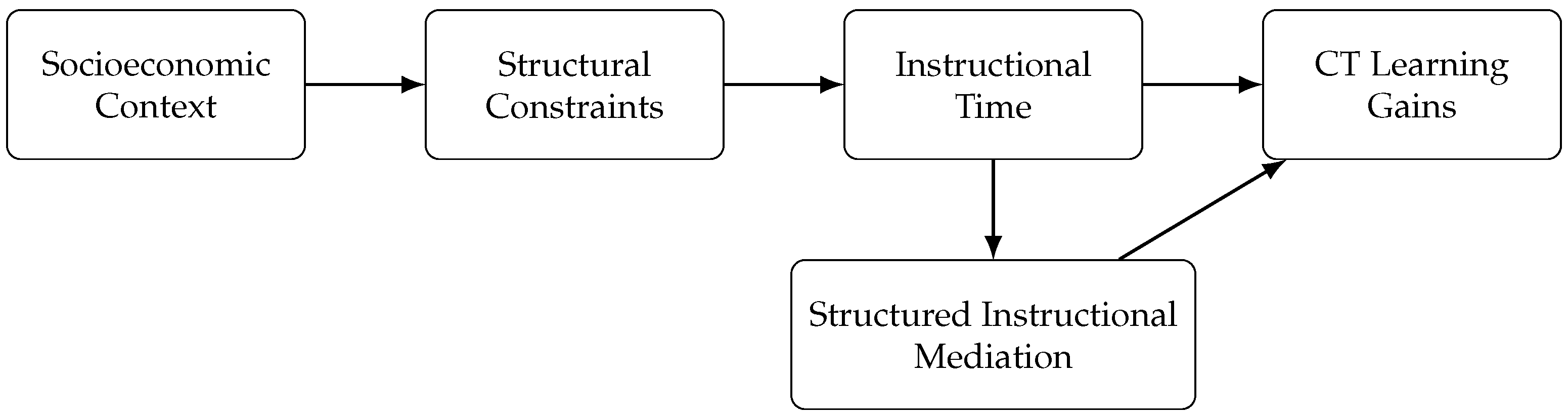
Figure 1 presents the conceptual relationships among the main study variables. Socioeconomic context (operationalized through school type) is treated as the independent variable, influencing infrastructural constraints and instructional pacing. Instructional mediation is modeled as a moderating mechanism, while computational thinking (CT) learning gains represent the dependent variable. The figure illustrates how, despite differences in contextual conditions and pacing, structured mediation may support comparable learning outcomes.
Recent reviews emphasize that computational thinking research is still dominated by studies conducted in WEIRD contexts, limiting generalizability to regions where structural inequality is part of the educational baseline [
4,
27,
28]. Latin American educational systems, including Chile, present marked heterogeneity between private urban, public urban, and rural public institutions in terms of infrastructural readiness and prior digital exposure [
29,
30]. This context provides a meaningful setting to examine whether pedagogical design can operate as a compensatory mechanism rather than merely reflecting structural disparities.
Table 1 positions the present study relative to common gaps identified in CT education research. Rather than focusing exclusively on tool effectiveness, this study explicitly examines whether structured instructional mediation can explain equitable learning outcomes even when instructional pacing differs across contexts.
Despite extensive research on computational thinking interventions, most studies have primarily focused on tool effectiveness without explicitly modeling contextual variability across educational settings. As a result, the role of instructional design in mitigating structural inequalities remains insufficiently understood. In particular, there is limited empirical evidence examining whether pedagogical mediation can actively compensate for disparities in instructional conditions, rather than merely reflecting them.
Accordingly, this study investigates whether structured instructional mediation can operate as a compensatory mechanism enabling equitable CT development across heterogeneous socioeconomic contexts. Specifically, we address the following research questions:
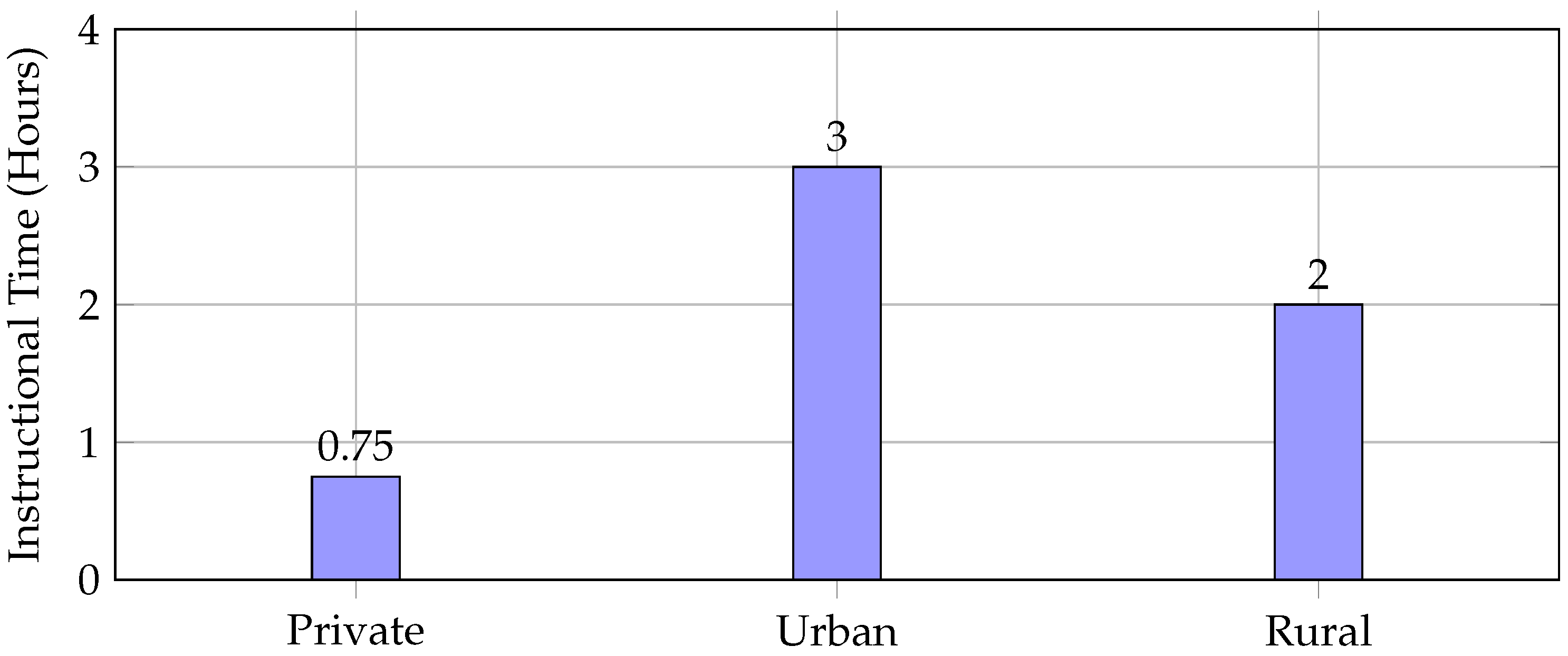
RQ1: Do instructional time requirements differ across private urban, public urban, and rural public contexts when implementing the same CT intervention?
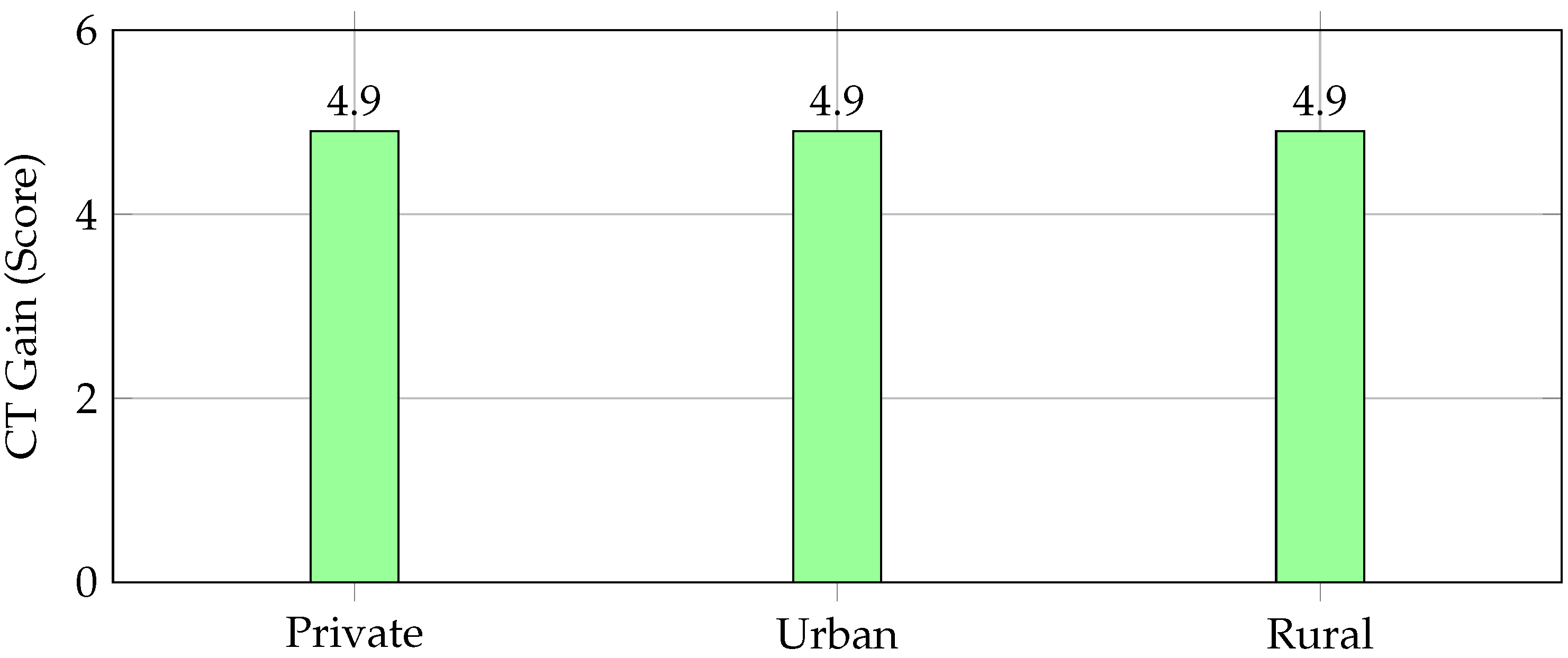
RQ2: Do CT learning gains differ significantly across these contexts under structured scaffolding?
RQ3: Can instructional mediation be interpreted as a plausible compensatory mechanism for equity when pacing disparities exist?
By answering these questions, the paper contributes empirical evidence to the design of equitable computing education, supporting the principle of computational thinking for all through intentional pedagogical scaffolding rather than infrastructure-only approaches. Unlike prior studies that focus primarily on tool effectiveness, this study adopts an explicitly equity-oriented perspective, examining whether instructional design can function as a compensatory mechanism under heterogeneous contextual conditions. This perspective guides both the research questions and the analytical approach.
To provide structural clarity, the remainder of this paper is organized as follows:
Section 2 presents the theoretical framework.
Section 3 describes the research design and statistical analysis.
Section 4 reports the empirical findings.
Section 5 interprets the results within the equity framework. Finally,
Section 6 summarizes the contributions and future research directions.
3. Methodology
3.1. Research Design
A quasi-experimental pre–post comparative design was implemented across three socioeconomically diverse primary schools in the Maule Region of Chile. Random assignment at the individual level was not feasible due to institutional constraints; therefore, intact classroom groups were used. This design aligns with established educational research practices in authentic school environments [
47,
48].
This design was selected to balance ecological validity and analytical rigor, as the intervention was conducted under authentic classroom conditions where random assignment was not feasible. Quasi-experimental approaches are widely adopted in educational research to evaluate instructional interventions in real-world settings while preserving comparability across groups. The study was guided by the following hypotheses:
H1: Instructional time requirements differ significantly across socioeconomic contexts.
H2: Computational thinking (CT) gains do not differ significantly across contexts under structured instructional mediation.
The study follows a quantitative quasi-experimental design based on statistical comparison of group outcomes. The research design was explicitly aligned with the three research questions, ensuring that each analytical procedure directly addresses a specific component of the study.
3.2. Participants and Context
Eighty-eight third-grade students (mean age = 8.9 years) participated in the study. The sample included:
25 students from a private urban school (Talca),
35 students from a public urban school (Talca),
28 students from a public rural school (Maule).
These school types reflect common structural distinctions in Chilean education (see
Table 3), particularly regarding infrastructural readiness and prior exposure to digital tools [
29,
30].
Participants were recruited through coordination with school administrators, who invited intact classroom groups to participate in the study. No individual selection criteria were applied, ensuring that the sample reflected typical classroom composition in each context.
The sample included a balanced distribution of male and female students, with ages ranging from 8 to 9 years. No prior programming experience was required, although exposure to digital tools varied across contexts. Although individual-level socioeconomic data were not collected, school type was used as a contextual indicator of socioeconomic differences, consistent with prior research in Chilean educational settings. This approach reflects structural variations across school types rather than individual SES measurements.
3.3. Intervention Design
The intervention combined block-based programming (Scratch) and physical computing simulation (Arduino via Tinkercad). Activities were standardized across schools, differing only in pacing requirements.
Students completed (1) Scratch Activity: Development of a “Cat and Mouse” interactive game involving event handling, conditional statements, sprite interaction, and score tracking; (2) Arduino Simulation: (i) LED overload demonstration (without resistor), (ii) Application of Ohm’s Law with resistor correction, (iii) Traffic light sequencing using conditional logic.
Structured scaffolding was provided through guided prompts, stepwise modeling, and incremental challenges, consistent with pedagogical best practices in CT education [
24,
25]. Instructional mediation was operationalized through a combination of guided prompts, step-by-step demonstrations, and adaptive support provided by the instructor. These elements were consistently applied across contexts to ensure that differences in outcomes could not be attributed to variations in instructional design.
Figure 3 illustrates the intervention sequence.
Instructional time was recorded by the teachers during the intervention, based on the total duration required for students to complete the activities. These records were validated by the research team to ensure consistency across contexts.
To ensure consistency across contexts, all instructional activities were delivered using a standardized protocol, including predefined learning objectives, step-by-step guidance sequences, and structured feedback mechanisms. Instructors followed the same pedagogical script, allowing differences in outcomes to be attributed to contextual factors rather than variations in instructional delivery.
3.4. Measurement Instrument
Computational thinking was assessed using a structured instrument adapted from validated computational thinking assessment frameworks proposed by [
35] and Brennan and Resnick [
36]. The instrument consisted of 10 items designed to evaluate key dimensions of CT, including sequencing, conditional reasoning, debugging, and logical flow comprehension.
The instrument was performance-based, meaning that students were required to solve tasks rather than respond to Likert-type items. This approach allowed for a more direct evaluation of their ability to apply computational concepts in practice.
Each dimension contributed to a total score ranging from 0 to 10, with higher scores indicating greater proficiency in computational thinking. Internal consistency was assessed using Cronbach’s
, yielding a value of 0.84, which indicates acceptable reliability.
Table 4 summarizes the assessed dimensions and their scoring scheme.
Data collection was conducted during regular classroom sessions. Pre- and post-tests were administered in paper-based format under teacher supervision, ensuring consistent conditions across all participating schools.
3.5. Data Analysis
Statistical analyses were conducted using one-way ANOVA to examine differences across school types. Effect sizes were calculated using eta-squared (
), following established interpretation thresholds [
47,
48]. Because students were nested within schools, potential clustering effects were considered in the analysis. In educational research, hierarchical data structures are common and may influence the interpretation of group comparisons, particularly in studies involving multiple school contexts [
31,
33].
Given the limited number of clusters in this study (three schools), multilevel modelling approaches were considered but not adopted as the primary analytic strategy. Instead, group-level comparisons were retained, while explicitly acknowledging the hierarchical structure of the data and its implications for interpretation.
Two primary analyses were performed:
As a robustness check, an analysis of covariance (ANCOVA) was conducted using post-test CT scores as the dependent variable, school type as the fixed factor, and pre-test scores as a covariate. This approach is commonly used in computational thinking and STEM education research to control for baseline differences and improve the interpretability of group comparisons [
16,
33]. The inclusion of this analysis allows for a more rigorous examination of post-intervention differences across contexts.
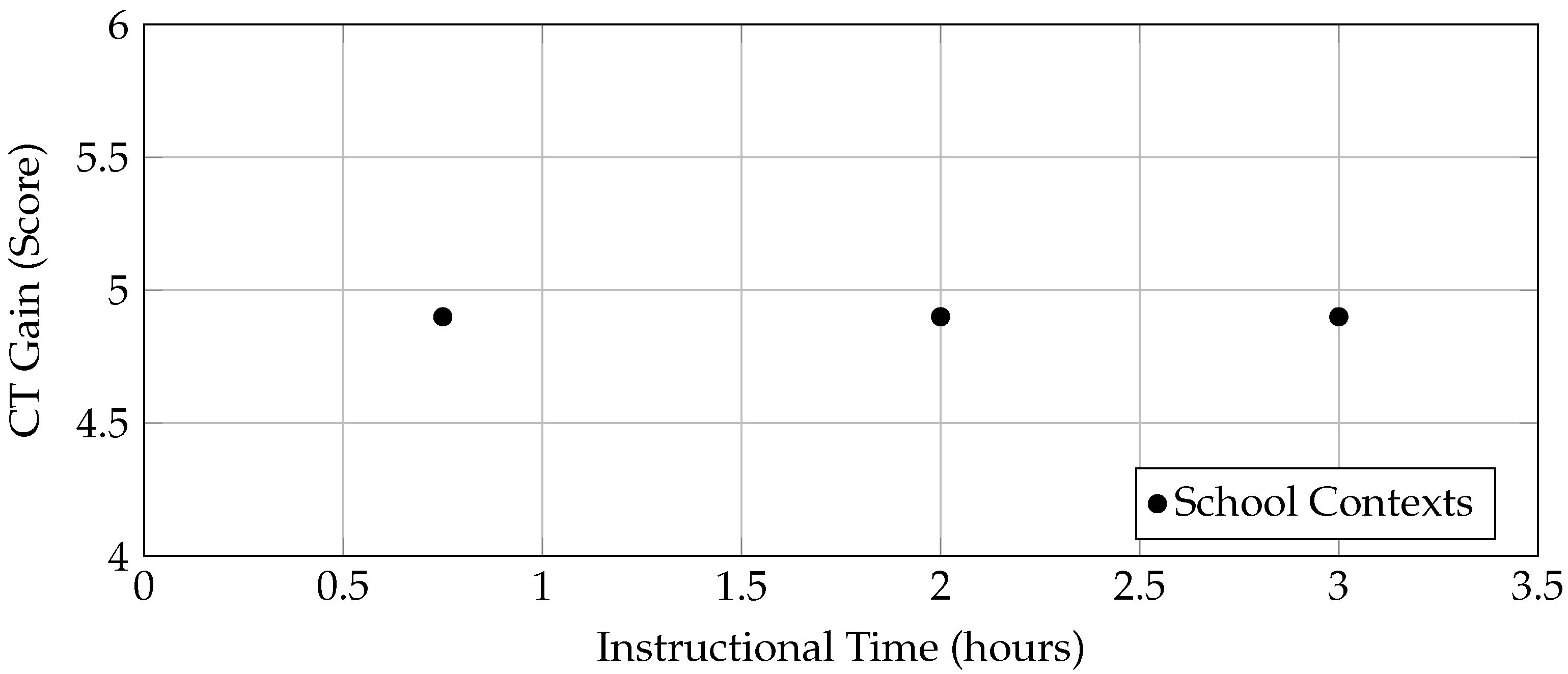
RQ3 was addressed through an interpretative analysis that integrates the results of RQ1 and RQ2. Specifically, the presence of statistically significant differences in instructional time (RQ1), combined with the absence of significant differences in learning gains (RQ2), was interpreted as evidence supporting the role of instructional mediation as a compensatory mechanism. Statistical significance was set at . Assumptions of normality and homogeneity of variance were verified prior to analysis.
The analytical strategy follows a sequential logic: RQ1 establishes whether contextual differences exist in instructional conditions. RQ2 evaluates whether these differences translate into learning outcomes, and RQ3 integrates both results to interpret the potential compensatory role of instructional mediation.
3.6. Ethical Considerations
All procedures complied with institutional academic standards. Parental consent was obtained prior to participation. Data were anonymized prior to statistical analysis.
5. Discussion
This section interprets the results in relation to the study’s guiding perspective, namely the role of instructional mediation as a potential compensatory mechanism in heterogeneous educational contexts.
The present study investigated whether structured instructional mediation can function as a compensatory mechanism enabling equitable computational thinking (CT) development across heterogeneous socioeconomic contexts. Importantly, socioeconomic status (SES) was not directly modeled as an independent variable in the statistical analysis. Instead, school type was used as a contextual proxy, which may capture structural differences but does not allow for causal attribution at the individual level. Therefore, the findings should be interpreted as context-sensitive rather than as direct evidence of SES effects. Just, the findings reveal a nuanced pattern: while instructional time differed significantly across school types, learning gains remained statistically equivalent.
Consistent with digital inequality literature [
7,
8], socioeconomic context significantly influenced implementation conditions. The large effect size observed for instructional time confirms that infrastructural readiness, prior digital exposure, and classroom dynamics shape pacing requirements. These findings align with equity-focused research showing that structural conditions affect educational processes even when curricular content is standardized [
38,
39].
However, the absence of statistically significant differences in CT gains suggests that structured instructional mediation buffered the measurable impact of contextual disparities. This result extends prior work on Scratch- and Arduino-based interventions [
13,
21,
22] by explicitly incorporating an equity lens and empirically testing compensatory effects across school types. This interpretation should be understood cautiously, as RQ3 is addressed through inferential reasoning rather than a direct statistical test. Specifically, the conclusion relies on the combined interpretation of differences in instructional time (RQ1) and the absence of differences in learning gains (RQ2), rather than on a standalone analytical procedure.
This pattern is consistent with the possibility that structured instructional mediation reduced the observable impact of contextual differences on learning outcomes. Similar trends have been reported in computational thinking research, where instructional design plays a key role in supporting learning across diverse educational settings [
16,
33]. However, this interpretation should be approached with caution. The present study does not directly model instructional mediation as an independent variable, and the analytical approach does not fully isolate contextual effects. Therefore, the interpretation of instructional mediation as a compensatory mechanism should be understood as suggestive rather than conclusive.
These findings contribute to the growing body of literature emphasizing the role of pedagogical design in shaping computational thinking development across heterogeneous contexts [
31,
32]. It is important to clarify that instructional mediation was not directly measured as an independent variable, but rather inferred from the structured and standardized implementation of the intervention. Therefore, the compensatory interpretation should be understood as theoretically grounded and empirically supported through indirect evidence, rather than as a direct causal test.
5.1. Instructional Mediation and the Equity Mechanism
The compensatory interpretation is theoretically grounded in scaffolding research [
24,
25], which emphasizes guided support as a stabilizing factor in learning trajectories. Rather than assuming that technology adoption alone ensures equity, the findings suggest that structured mediation, through incremental tasks, guided modeling, and adaptive pacing, may reduce the translation of structural inequality into outcome inequality.
Importantly, the results do not imply that infrastructure is irrelevant. The significant differences in pacing demonstrate that contextual constraints persist. Instead, the findings indicate that instructional quality may mediate the extent to which such constraints manifest in measurable learning outcomes.
Table 8 synthesizes the theoretical and practical implications derived from the empirical findings.
As shown in
Table 8, the study contributes to bridging a critical gap in computing education research. Much of the literature emphasizes either tool effectiveness [
10,
11] or structural inequality [
9,
40], yet few studies empirically test whether structured pedagogy can moderate contextual disparities in primary education settings.
It is important to note that instructional time was inherently associated with school context, which may introduce potential confounding effects. As such, differences in pacing should be interpreted as context-dependent rather than as independent variables. Furthermore, instructional mediation was not directly modeled as an independent variable in the statistical analysis. Consequently, the interpretation of mediation as a compensatory mechanism is derived from the combined pattern of results, rather than from a direct causal test. This distinction is critical for appropriately framing the scope and limitations of the study’s conclusions.
5.2. Implications for STEAM-Oriented Learning
The findings of this study can be interpreted from a broader perspective of STEAM education. The combination of Scratch and Arduino activities reflects an integration of computational thinking with elements of science (understanding circuits), engineering (designing solutions), and mathematics (logical reasoning and sequencing).
Taking into account the development of competencies, instructional mediation not only supports the development of computational thinking but also facilitates access to interdisciplinary learning experiences. This is particularly relevant in contexts where students may have limited prior exposure to digital technologies.
The results suggest that structured pedagogical design can enable students from diverse contexts to participate meaningfully in STEAM learning processes, even when there are differences in pace.
5.3. Implications for Policy and Latin American Contexts
While previous research has consistently reported the influence of socioeconomic factors on learning outcomes [
7,
8,
9], the present findings suggest that, under certain instructional conditions, these effects may be attenuated. Although prior studies have examined the impact of pedagogical design on computational thinking development [
24,
25], the role of instructional mediation as a potential moderating factor remains less explicitly explored.
In many policy frameworks, digital equity initiatives prioritize hardware acquisition and connectivity expansion [
28,
29]. While these components remain foundational, the present findings suggest that hardware provision alone is insufficient. Instructional mediation emerges as a decisive factor in ensuring equitable outcomes.
This insight is particularly relevant in Latin American educational systems, where variability between private urban, public urban, and rural public schools is common [
30]. The study provides quasi-experimental evidence from a non-WEIRD primary education context, addressing a gap identified in recent reviews of computational thinking research [
4,
27].
By demonstrating that learning gains can converge despite pacing disparities, the findings support the principle of computational thinking for all. Equity, in this framing, is not defined by identical conditions but by comparable outcomes under adaptive mediation.
5.4. Limitations and Future Research Directions
Several limitations warrant consideration. First, the intervention was short-term, and long-term retention of CT skills was not assessed. Second, although ANOVA provided evidence of statistical equivalence in gains, hierarchical modeling could further examine classroom-level variance [
49]. Third, replication across broader regional contexts is necessary to strengthen external validity.
Additionally, the nested structure of the data (students within schools) represents a methodological limitation. While this reflects authentic classroom conditions, it also constrains the ability to fully disentangle individual and contextual effects.
Future research should incorporate larger samples and more diverse educational contexts, allowing for the application of multilevel modelling approaches and more robust statistical inference. Such approaches are increasingly recommended in computational thinking and STEM education research [
31,
33].
Overall, the findings suggest that structured instructional mediation represents a promising mechanism for advancing equitable computational thinking development in heterogeneous primary education ecosystems.
6. Conclusions
This study examined whether structured instructional mediation can enable equitable computational thinking (CT) development across heterogeneous socioeconomic primary school contexts. Conducted in three Chilean schools representing private urban, public urban, and rural public settings, the intervention combined Scratch-based programming and Arduino simulations within a standardized pedagogical framework.
The findings reveal a clear distinction between implementation conditions and learning outcomes. Although instructional pacing varied significantly across contexts, CT gains showed no statistically significant differences. This pattern provides indirect empirical support for interpreting instructional mediation as a compensatory mechanism, suggesting that structured scaffolding may reduce the observable impact of contextual disparities on learning outcomes.
From a theoretical perspective, the study contributes to computational thinking research by integrating equity considerations into the evaluation of instructional interventions. Rather than treating tool effectiveness and structural inequality as independent research strands, the findings position pedagogical design as a mediating layer between context and outcomes. This perspective advances the discourse beyond infrastructure-centric approaches and supports a more nuanced understanding of how equitable results may emerge in heterogeneous educational environments.
From a practical standpoint, the results suggest that educational policies aiming to promote “computational thinking for all” should prioritize instructional quality and structured scaffolding alongside infrastructure investment. While access to hardware remains essential, pedagogical mediation appears to play a critical role in stabilizing learning outcomes across diverse school contexts.
It is important to acknowledge that instructional time was inherently associated with school context, introducing potential confounding effects that limit the isolation of pacing as an independent factor. Additionally, instructional mediation was not explicitly modeled as an independent variable in the statistical analysis. Therefore, the interpretation of mediation as a compensatory mechanism relies on the observed pattern of results rather than on a direct causal test. These considerations are essential for accurately delimiting the interpretative scope of the findings.
The study is limited by its short-term design and regional scope. Future research should incorporate longitudinal designs, larger and more diverse samples, and multilevel modeling approaches to better account for hierarchical data structures. Cross-national replication would further strengthen the generalizability of the findings. Additionally, qualitative analyses of instructional practices may provide deeper insights into how pedagogical mediation operates across different contexts.
Overall, the findings extend beyond computational thinking as an isolated skill, highlighting its role within broader STEAM learning processes. Ensuring equitable access to these experiences requires not only technological resources but also intentional instructional design capable of supporting diverse learning trajectories. In this sense, pedagogical mediation emerges as a key factor in advancing STEAM literacy in heterogeneous educational ecosystems.
This study provides a structured analytical pathway for examining equity in computational thinking education, offering a foundation for future research seeking to integrate pedagogical design and contextual variability.





 and
and